Hispanics and Crime

See the updated version of “Immigration and Crime.”

Something or Nothing

The deepest question of all may be “Why is there something rather than nothing?

Here is my answer: Because there is “something”, “nothing” is impossible and not worth trying to envision or explain. This answer points to the real question: “Given that there is ‘something,’ how did it come to exist?”

Before I get to that question, I must say a few things about “nothing”. It is fatuous to suggest that “nothing” can be found in voids or vacuums in the universe. Such voids or vacuums — even if perfectly empty of matter-energy, and even if coterminous with the universe — would be part or all of the universe; that is, they would be part or all of “something”. “Something” would therefore exist. And if “something” exists — no matter how fleeting or minuscule — there is not “nothing”.

“Nothing” could not be “something” from which things have been subtracted; if it were, there would have been “something”. “Nothing” is not merely a void or a vast emptiness. “Nothing” is just nothing; any attempt to envision it or describe it is futile because “nothing” (as opposed to “something”) cannot be envisioned or described.

In any event, because there is “something” — and “nothing” is therefore impossible — philosophy should be concerned with the real question: “Given that there is ‘something’, how did it come to exist?” I have answered that question, to my own satisfaction, in “Existence and Creation.” Here is the succinct version:

  1. In the material universe, cause precedes effect.
  2. Accordingly, the material universe cannot be self-made. It must have a “starting point,” but the “starting point” cannot be in or of the material universe.
  3. The existence of the universe therefore implies a separate, uncaused cause.

That uncaused cause is not “nothing”. It is “something”. But it is a “something” that is beyond human comprehension. If it is impossible for humans to grasp the reality that underlies matter-energy — and I submit that it is impossible — why should humans be expected to understand the true nature of the uncaused cause of the universe? The failure to understand the uncaused cause does not negate it, any more than the failure to understand geometry negates the truth of the Pythagorean Theorem.

Related posts:
Atheism, Religion, and Science
The Limits of Science
Three Perspectives on Life: A Parable
Beware of Irrational Atheism
The Creation Model
The Thing about Science
Evolution and Religion
Words of Caution for Scientific Dogmatists
Science, Evolution, Religion, and Liberty
The Legality of Teaching Intelligent Design
Science, Logic, and God
Capitalism, Liberty, and Christianity
Is “Nothing” Possible?
Debunking “Scientific Objectivity”
Science’s Anti-Scientific Bent
Science, Axioms, and Economics
The Big Bang and Atheism
The Universe . . . Four Possibilities
Einstein, Science, and God
Atheism, Religion, and Science Redux
Pascal’s Wager, Morality, and the State
Evolution as God?
The Greatest Mystery
What Is Truth?
The Improbability of Us
A Digression about Probability and Existence
More about Probability and Existence
Existence and Creation
Probability, Existence, and Creation
The Atheism of the Gaps
Something from Nothing?

Therapeutic Blogging

In my quest for surcease from politics and other serious subjects, I have been mucking about in baseball statistics. The masochists among you may enjoy “What Makes a Winning Team?,” which I have posted at Americana, Etc.

What Makes a Winning Team?

As Eric Walker — the real inventor of “moneyball” — puts it, “moneyball is about seeking undervalued commodities.” Perhaps baseball teams have done a better job of acquiring undervalued commodities since the publication of Michael Lewis’s Moneyball in 2003. But arbitrage opportunities are fleeting, as the price of a “bargain” is driven up and it is no longer a “bargain.” Moreover, as Walker explains, “moneyball” has been around since the 1980s and the concept surely had some influence on player selection even before Lewis made it famous.

At any rate, I have analyzed the performance and payrolls of American League (AL) teams for 1988-2011 to determine their effects on teams’ won-lost (W-L) records. I focused on the AL because an analysis of both major leagues would have been complicated by the presence of the designated hitter in the AL and the absence of the DL in the National League. I began with 1988 because that is the first year covered by the USATODAY Salaries Database for baseball. Performance data are from Retrosheet.

What did I learn from those 24 years’ worth of data? This:

1. Payroll does not drive W-L record.

2. Payroll is mainly determined by 7 aspects of performance.

3. W-L record is mainly determined by 9-11 aspects of performance, only 2-4 of which overlap with the determinants of payroll.

4. W-L record is strongly correlated with the ratio of runs scored (RS) to runs allowed (RA), with an r-squared of 0.89. There is considerable overlap between the determinants of RS-RA and the determinants of W-L record. There is not much overlap between the determinants of RS:RA and the determinants of payroll.

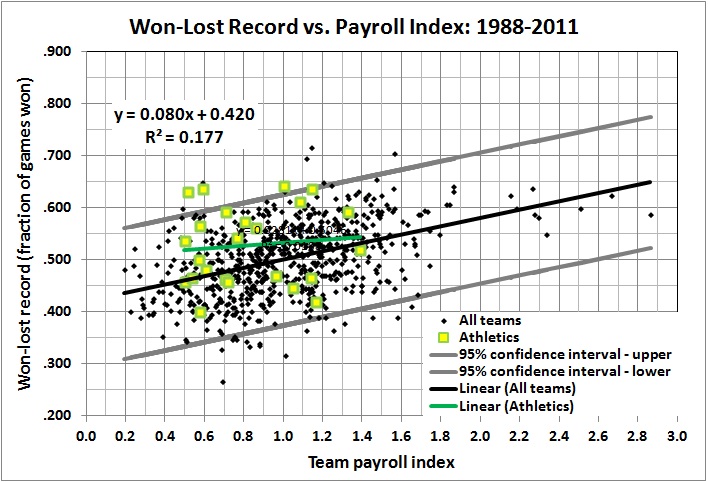
I begin with the relationship between payroll and W-L record:

 Payroll index is the ratio of a team’s payroll in a given season to the average payroll of all AL teams in the same season. A regression on W-L record with payroll index as an explanatory variable cannot include additional explanatory variables that are statistically significant (less than 1 percent chance of a random relationship with the dependent variable). As discussed below, this result indicates that payroll index is a proxy for measures of performance that are statistically significant determinants of a W-L record and RS:RA.

The following table summarizes the results of six regressions. Instead of showing the coefficients for the explanatory variables, I have converted them to elasticities, expressed as the percentage increase in a dependent variable that results from a 1-percent increase in the value of the explanatory variable.

Before I walk through the table, I should observe that the figures represent average tendencies over a 24-year span. The figures are significant, but they do not necessarily indicate the best course of action for a given team in a given situation. The best  course of action for a given team in a given situation will depend on the team’s options (e.g., players available on the free-agent market), on the likely payoff of those options (e.g., addition to runs scored if player A is signed and player B is traded away), and on the cost of obtaining each payoff (e.g., net addition to payroll if player A is signed and player B is traded).

The results in the payroll index column show that the payrolls of AL teams in 1988-2011 were driven mainly by batters’ on-base percentage (OBP); pitchers’ avoidance of giving up home runs; pitchers’ ability to strike out batters (SO); fielders’ avoidance of errors (ERR); batters’ home runs (HR); catchers’ throwing out base stealers (CS); and batters’ not hitting a lot of triples (3B) — perhaps because of the typical characteristics of triples hitters (e.g., they are not usually home-run hitters).

In the next column we see, again, that payroll spending — in the aggregate over 24 seasons — does not strongly influence W-L record. But because payroll is a proxy for several performance variables, no other variable show up as statistically significant when payroll index is used as an explanatory variable. It is important to note, however, that the relatively weak relationship between W-L record and payroll index for the entire AL masks considerable variation across teams. Here is a summary comparison, for the 13 teams that were in the AL in every year from 1988 through 2011:

The Oakland A’s of “moneyball” fame did will for the amount of money spent on payroll, as measured by W-L record divided by payroll index (right-hand column). But, on that measure, the A’s did no better than the Twins, and not a lot better than the Royals and White Sox.

The Yankees were the best team in the AL during 1988-2011, and they paid what it took to be the best. The Red Sox were the second-best team, and they paid accordingly. After that, results were mixed. The A’s paid a lot less than the Yankees and Red Sox, and still won a lot — but did not get much in return when they spent more (correlation coefficient of 0.19, as against 0.50 for the Yankees and 0.31 for the Red Sox). Though an above-average payroll index was not required for a winning record, four of the top six team in W-L and every team with a payroll index of 1.00 or grater had a winning record. All teams but one — the Rangers — managed to eke out some additional wins by increasing their payrolls.

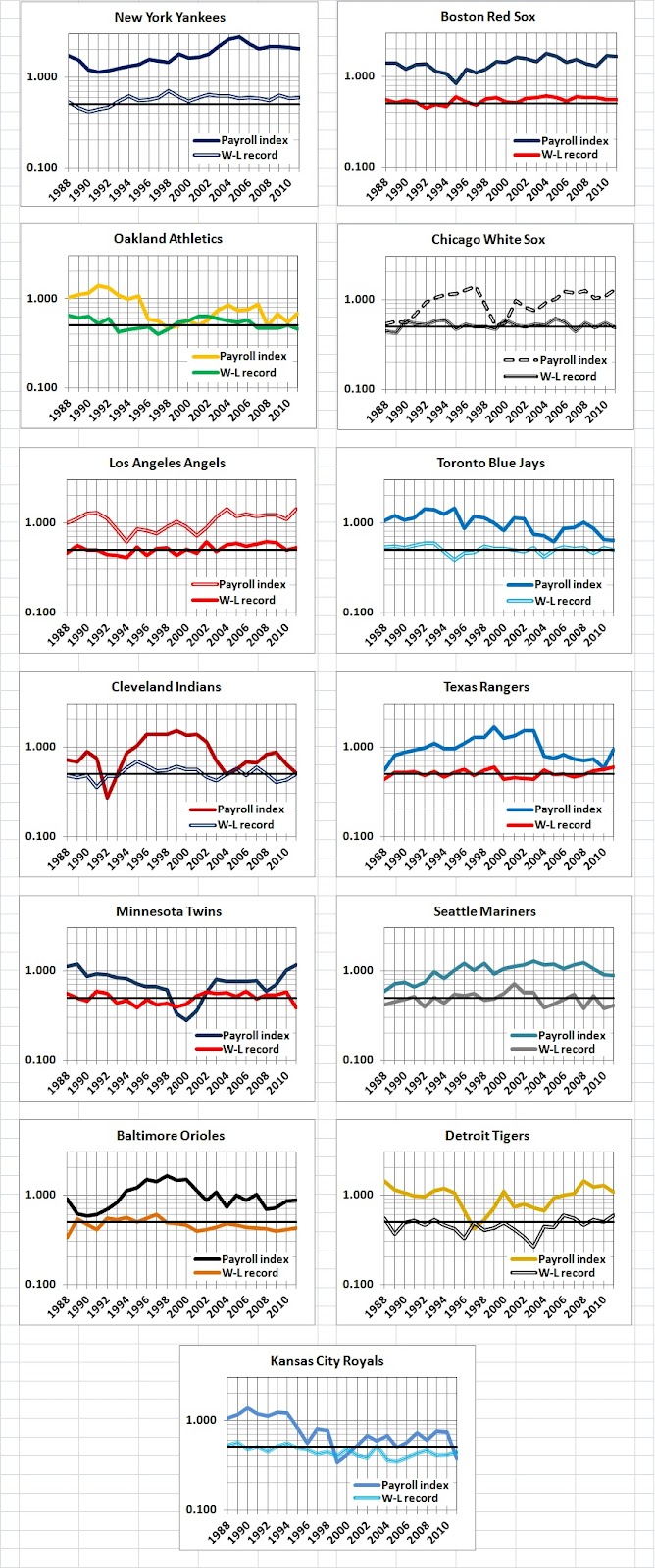
The following graphs illustrate several story lines, such as success with young, low-priced players who then become higher-priced and less-productive players; overspending on once-outstanding veterans whose best seasons were behind them; overspending on promising players whose performance did not rise with their salaries. For ease of reading each team’s W-L record, I have inserted in each graph a horizontal black line at the break-even mark (.500).

Seen in the context of 13 team histories, the A’s look like a team that did well for a while with relatively high-priced players; pared its payroll as its fortunes faded; happened to do well for a while on low-priced players, and then faded as its payroll rose.

Let us now to the column headed W-L record (II) in the first table above. This is where the bat meets the ball, so to speak, because it tells us something about the aspects of performance that determine a team’s W-L record. Except for on-base percentage (OBP), the determinants of payroll have little to do with winning. Defense (represented in fielding average) is far and away the most important determinant of winning. (The payoff of defense may be somewhat overstated, as I will come to.) After that, preventing hits (H) and getting them weigh heavily. Pitchers who save games (SV) are important to winning, as are pitchers who do not give up a lot of walks (BB). Home runs (HR) are just as important as payroll, even though they are down the list of factors that determine payroll.

As mentioned earlier, W-L record is strongly correlated with the ratio of runs scored to runs allowed (RS:RA). The next two columns of the table assess the relationships between RS and various measures of performance; the right-hand column deals with RA. On the offensive side, HR remains important, as does OBP appear, directly and in the form of key elements — H, BA, and BB. On the defense side, fielding is key (more below). Next are H, BB, and HR allowed by pitchers, meaning that allowing relatively few H, BB, and HR are keys to the defensive side of the game. Another key, though a less important one, is striking out batters (SO).

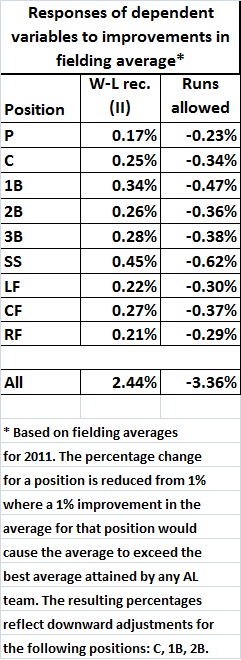
As for fielding, a position-by-position view is more relevant, and the possibility of obtaining better fielding is overstated for some positions. The following table affords the position-by-position view and eliminates the overstatements:

What this tells us is that improved fielding, at any position, can strongly improve a team’s chances of winning, even though fielding is not among the key determinants of payroll.

Genetic Kinship and Society

UPDATED (08/18/12) BELOW

This is the third installment of a series that explores the true nature of liberty, how liberty depends on society, how society (properly understood) has been eclipsed by statism and its artifacts, and how society — and therefore liberty — might re-emerge in the United States. In this installment, I take up the second of several possible objections to my model of a society’s essence and workings. This series will close with a blueprint for the restoration of society and liberty in America.

If you have not read the first two installments, “Liberty and Society” and “The Eclipse of ‘Old America’,” I recommend that you do so before you continue. This post addresses the following question: Is Genetic Kinship an Indispensable Aspect of Society?

In “Liberty and Society,” I define society as “an enduring and cooperating social group whose members have developed organized patterns of relationships through interaction with one another.” Near the end of the post, I say this:

A society coheres around genetic kinship, and is defined by its common culture, which includes its moral code. The culture is developed, transmitted through, and enforced by the voluntary institutions of society (civil society). The culture is the product of trial and error, where those elements that become part of received culture serve societal coherence and — in the best case — help it to thrive. Coherence and success depend also on the maintenance of mutual respect, trust, and forbearance among society’s members. Those traits arise in part from the sharing of a common culture (which is an artifact of societal interaction) and from genetic kinship, which is indispensable to societal coherence. If the foregoing description is correct, there is one aspect of society — and one only — that a society cannot “manufacture” through its social processes. That aspect is genetic-cultural kinship.

In the sequel, “The Eclipse of ‘Old America’,” there is this:

The United States, for a very long time, was a polity whose disparate parts cohered, regionally if not nationally, because the experience of living in the kind of small community sketched above was a common one. Long after the majority of Americans came to live in urban complexes, a large fraction of the residents of those complexes had grown up in small communities.

This was Old America — and it was predominant for almost 200 years after America won its independence from Britain. Old America‘s core constituents, undeniably, were white, and they had much else in common: observance of the Judeo-Christian tradition; British and north-central European roots; hard work and self-reliance as badges of honor; family, church, and club as cultural transmitters, social anchors, and focal points for voluntary mutual aid.

The focus of this post is the indispensable contribution of genetic kinship to society. Before I continue, I want to make it clear that I do not use “society” in the loose way that politicians do, that  is, as a feel-good word for “nation.” The United States, as a nation, may comprise societies of the kind defined above, but the United States is not a society. It is a political convenience, held together by force, not by mutual trust, respect, and forbearance — which are the operational characteristics of a society.

Mutual trust, respect, and forbearance arise from the emotional force of genetic kinship. They may be mimicked in arrangements of convenience, such as economic ones. But those arrangements last only as long as they are profitable to all parties.

Arrangements of convenience may be facilitated by social bonding, but they cannot replace social bonding. For example, disparate peoples may trade with each other, to their mutual advantage, but they are not bound to each other emotionally. History is replete with examples of peoples who have turned against each other, despite their economic ties. Diplomatic ties are even less binding, because of their superficiality.

Whence the emotional bonds of genetic kinship? Are they found only in the nuclear family? (No.) Do they encompass the extended family? (Yes.) Are they enhanced by social relationships (e.g., church and club)? (Yes.) Do they extend to broad racial-ethnic groupings? (Yes.)

Emotional bonds may be reinforced (or not) by familial and social relationships, but they begin with racial-ethnic (genetic) kinship:

[S]tudies have demonstrated that relatedness is often important for human altruism in that humans are inclined to behave more altruistically toward kin than toward unrelated individuals.[22] Many people choose to live near relatives, exchange sizable gifts with relatives, and favor relatives in wills in proportion to their relatedness.[22]

A study interviewed several hundred women in Los Angeles to study patterns of helping between kin versus non-kin. While non-kin friends were willing to help one another, their assistance was far more likely to be reciprocal. The largest amounts of non-reciprocal help, however, were reportedly provided by kin. Additionally, more closely related kin were considered more likely sources of assistance than distant kin.[23] Similarly, several surveys of American college students found that individuals were more likely to incur the cost of assisting kin when a high probability that relatedness and benefit would be greater than cost existed. Participants’ feelings of helpfulness were stronger toward family members than non-kin. Additionally, participants were found to be most willing to help those individuals most closely related to them. Interpersonal relationships between kin in general were more supportive and less Machiavellian than those between non-kin.[24]….

A study of food-sharing practices on the West Caroline islets of Ifaluk determined that food-sharing was more common among people from the same islet, possibly because the degree of relatedness between inhabitants of the same islet would be higher than relatedness between inhabitants of different islets. When food was shared between islets, the distance the sharer was required to travel correlated with the relatedness of the recipient—a greater distance meant that the recipient needed to be a closer relative. The relatedness of the individual and the potential inclusive fitness benefit needed to outweigh the energy cost of transporting the food over distance.[26]

Humans may use the inheritance of material goods and wealth to maximize their inclusive fitness. By providing close kin with inherited wealth, an individual may improve his or her kin’s reproductive opportunities and thus increase his or her own inclusive fitness even after death. A study of a thousand wills found that the beneficiaries who received the most inheritance were generally those most closely related to the will’s writer. Distant kin received proportionally less inheritance, with the least amount of inheritance going to non-kin.[27]

A study of childcare practices among Canadian women found that respondents with children provide childcare reciprocally with non-kin. The cost of caring for non-kin was balanced by the benefit a woman received—having her own offspring cared for in return. However, respondents without children were significantly more likely to offer childcare to kin. For individuals without their own offspring, the inclusive fitness benefits of providing care to closely related children might outweigh the time and energy costs of childcare.[28]

Family investment in offspring among black South African households also appears consistent with an inclusive fitness model.[29] A higher degree of relatedness between children and their caregivers frequently correlated with a higher degree of investment in the children, with more food, health care, and clothing being provided. Relatedness between the child and the rest of the household also positively associated with the regularity of a child’s visits to local medical practitioners and with the highest grade the child had completed in school. Additionally, relatedness negatively associated with a child’s being behind in school for his or her age.

Observation of the Dolgan hunter-gatherers of northern Russia suggested that, while reciprocal food-sharing occurs between both kin and non-kin, there are larger and more frequent asymmetrical transfers of food to kin. Kin are also more likely to be welcomed to non-reciprocal meals, while non-kin are discouraged from attending. Finally, even when reciprocal food-sharing occurs between families, these families are often very closely related, and the primary beneficiaries are the offspring.[30]

Other research indicates that violence in families is more likely to occur when step-parents are present and that “genetic relationship is associated with a softening of conflict, and people’s evident valuations of themselves and of others are systematically related to the parties’ reproductive values”.[31]

Numerous other studies pertaining to kin selection exist, suggesting how inclusive fitness may work amongst peoples from the Ye’kwana of southern Venezuela to the Gypsies of Hungary to even the doomed Donner Party of the United States.[32][33][34] Various secondary sources provide compilations of kin selection studies.[35][36] [from Wikipedia, “Kin selection,” as of 08/14/12]

*   *   *

[E.O.] Wilson used sociobiology and evolutionary principles to explain the behavior of the social insects and then to understand the social behavior of other animals, including humans, thus established sociobiology as a new scientific field. He argued that all animal behavior, including that of humans, is the product of heredity, environmental stimuli, and past experiences, and that free will is an illusion. He has referred to the biological basis of behaviour as the “genetic leash.”[17] The sociobiological view is that all animal social behavior is governed by epigenetic rules worked out by the laws of evolution. This theory and research proved to be seminal, controversial, and influential.[18]

The controversy of sociobiological research is in how it applies to humans. The theory established a scientific argument for rejecting the common doctrine of tabula rasa, which holds that human beings are born without any innate mental content and that culture functions to increase human knowledge and aid in survival and success. In the final chapter of the book Sociobiology and in the full text of his Pulitzer Prize-winning On Human Nature, Wilson argues that the human mind is shaped as much by genetic inheritance as it is by culture (if not more). There are limits on just how much influence social and environmental factors can have in altering human behavior….

Wilson has argued that the unit of selection is a gene, the basic element of heredity. The target of selection is normally the individual who carries an ensemble of genes of certain kinds.” With regard to the use of kin selection in explaining the behavior of eusocial insects, Wilson said to Discover magazine, the “new view that I’m proposing is that it was group selection all along, an idea first roughly formulated by Darwin.”[22] [from Wikipedia, “E.O. Wilson,” as of 08/14/12]

*   *   *

Wilson suggests the equation for Hamilton’s rule:[19]

rb > c

(where b represents the benefit to the recipient of altruism, c the cost to the altruist, and r their degree of relatedness) should be replaced by the more general equation

(rbk + be) > c

in which bk is the benefit to kin (b in the original equation) and be is the benefit accruing to the group as a whole. He then argues that, in the present state of the evidence in relation to social insects, it appears that be>rbk, so that altruism needs to be explained in terms of selection at the colony level rather than at the kin level. However, it is well understood in social evolution theory that kin selection and group selection are not distinct processes, and that the effects of multi-level selection are already fully accounted for in Hamilton’s original rule, rb>c.[20] [from Wikipedia, “Group selection,” as 0f 08/14/12]

The idea that social bonding has a deep, genetic basis is beyond the ken of leftists and pseudo-libertarian rationalists. Both prefer to deny reality, though for different reasons. Leftists like to depict the state as society. Pseudo-libertarian rationalists seem to believe that social bonding is irrelevant to cooperative, mutually beneficial behavior; life, to them, is an economic arrangement.

Leftists and libertarians like to slander the mutual attraction of genetic kin by calling it “tribalism.” On that subject, the author of Foseti writes:

People are – in general – tribal. Let’s take it for granted that we all wish that this were not so. Further, let’s take it for granted that some individual people are much more tribal than others.

The fact remains, however, that people are tribal. It’s one thing to suggest that people should not be tribal in their daily dealings with others. Let’s stipulate that this is moral. It does not, however, follow that it would be moral to organize society around the principle the people will in fact act anti-tribally….

Lots of progressives (especially those of the libertarian sort) are fond of saying that restricting immigration is tribal. They simply can’t support immigration restrictions because they oppose tribalism.

There is no better way of demonstrating your high-status in today’s society than proclaiming your anti-tribalism. You should therefore be skeptical of these proclamations. However, many people are indeed not particularly tribal.

Your humble blogger is not a tribal person. There is no sort of person that I see on the street and say to myself, “wow, I bet he and I have a lot in common – we should look out for each other.” Temperamentally, I’m very much an individualist type. But it’s wishful thinking to generalize from my personal preferences to population-wide-shoulds.

Tribalism is, has always been, and likely always will be a feature of human societies.

Occasionally, we get not-so-gentle reminders that people are tribal. We would do well to learn. Here’s a more light-hearted example. Here’s a reminder that democratic politics is always tribal.

You’re free, of course, to consider yourself above tribalism. However, if you do so, you’ll be an idiot when you try to describe geopolitics, local politics, national politics, and public policies in general. By all means, bury your head in the sand, just don’t preach while you’re down there.

James_G makes a nice analogy in this post. He likens anti-tribal beliefs to communist beliefs. It’s true that some groups of humans can function reasonably well under communistic conditions. It’s similarly true that many human beings are not particularly tribal. However, it’s dangerously immoral to generalize from these exceptions to the general conclusions that communism works on a large scale or that all countries should be rainbow nations…. [from “The immorality of anti-tribalism,” July 25, 2012]

In America, the pursuit of happiness in the form of money has sundered many a tribal community. (See “The Eclipse of ‘Old America’,” especially the 11th and 12th paragraphs.) But tribalism nevertheless remains a potent force in America:


Source: Census.gov, Ancestry: 2000 — Census 2000 Brief, Figure 3. (Right-click to open in a new tab, then click to enlarge.)

I venture to say that the “Americans” who predominate in large swaths of the South are the descendants of the English and Scots-Irish settlers of the colonial and early post-colonial era. They are “Americans” because their ancestors were (for the most part) the Americans of yore.

Not represented in the graph, because it is based on county-level statistics, are the high concentrations of Jews in many urban areas (especially in and around New York City and Miami), the coalescence of Arabs in the Detroit area, and the numerous ethnic enclaves (e.g., Chinese, Czech, Greek, Korean, Polish, Swedish, and Thai) — urban, semi-rural, and rural — that persist long after the original waves of immigration that led to their formation.

If genetic kinship is such a binding force, why is the closest kind of genetic kinship — the nuclear family — so often dysfunctional? Nuclear families are notoriously prone to strife, or so it would seem if one were to count novels and screenplays in evidence. Novels and screenplays are not dispositive, of course, because they emphasize strife for dramatic purposes. That said, there is a lot of evidence to suggest that the American nuclear family is a less binding force than it used to be. But that is to be expected, given the interventions by the state that have eased divorce and lured women out of the home (e.g., affirmative action, subsidies for day care, mandated coverages for employer-provided health insurance).

There are other reasons to reject the (exaggerated) dysfunctionality of the nuclear family as evidence against the importance of genetic kinship to social bonding:

1. Strife is inevitable where humans interact, and family life affords a disproportionate number of opportunities for interaction. (For example, conflicts between the members of a nuclear family — parent vs. child, sibling vs. sibling — often begin during the childhood or adolescence of one or all parties to the conflict.)

2. Blood ties have a way of overcoming “bad blood” when a family member is in need of help. (Thus, for example, children of middle-age and older often are supportive of needful siblings and aged parents out of duty, not love.)

3. Many a person compensates for tense or distant relations with parents and siblings by maintaining close ties to grandparents, aunts, uncles, and cousins.

This is not to say that the bonds of genetic kinship in America are everywhere as strong as in years past. The state’s interventions, the search for greener pastures, and the inexorable force of cross-racial and cross-ethnic sexual attraction have led to a more homogenized America.

But genetic kinship will always be a strong binding force, even where the kinship is primarily racial. Racial kinship boundaries, by the way, are not always and necessarily the broad ones suggested by the classic trichotomy of Caucasoid, Mongoloid, Negroid. (If you want to read for yourself about the long, convoluted, diffuse, and still controversial evolutionary chains that eventuated in the sub-species homo sapiens sapiens, to which all humans are assigned arbitrarily, without regard for their distinctive differences, begin here, here, here, and here.)

The obverse of of genetic kinship is “diversity,” which often is touted as a good thing by anti-tribalist social engineers. But “diversity” is not a good thing when it comes to social bonding. Michael Jonas reports on a study by Harvard political scientist Robert Putnam, “E Pluribus Unum: Diversity and Community in the Twenty-first Century“:

It has become increasingly popular to speak of racial and ethnic diversity as a civic strength. From multicultural festivals to pronouncements from political leaders, the message is the same: our differences make us stronger.

But a massive new study, based on detailed interviews of nearly 30,000 people across America, has concluded just the opposite. Harvard political scientist Robert Putnam — famous for “Bowling Alone,” his 2000 book on declining civic engagement — has found that the greater the diversity in a community, the fewer people vote and the less they volunteer, the less they give to charity and work on community projects. In the most diverse communities, neighbors trust one another about half as much as they do in the most homogenous settings. The study, the largest ever on civic engagement in America, found that virtually all measures of civic health are lower in more diverse settings….

…Putnam’s work adds to a growing body of research indicating that more diverse populations seem to extend themselves less on behalf of collective needs and goals.

His findings on the downsides of diversity have also posed a challenge for Putnam, a liberal academic whose own values put him squarely in the pro-diversity camp. Suddenly finding himself the bearer of bad news, Putnam has struggled with how to present his work. He gathered the initial raw data in 2000 and issued a press release the following year outlining the results. He then spent several years testing other possible explanations.

When he finally published a detailed scholarly analysis in June in the journal Scandinavian Political Studies, he faced criticism for straying from data into advocacy. His paper argues strongly that the negative effects of diversity can be remedied, and says history suggests that ethnic diversity may eventually fade as a sharp line of social demarcation.

“Having aligned himself with the central planners intent on sustaining such social engineering, Putnam concludes the facts with a stern pep talk,” wrote conservative commentator Ilana Mercer, in a recent Orange County Register op-ed titled “Greater diversity equals more misery.”….

The results of his new study come from a survey Putnam directed among residents in 41 US communities, including Boston. Residents were sorted into the four principal categories used by the US Census: black, white, Hispanic, and Asian. They were asked how much they trusted their neighbors and those of each racial category, and questioned about a long list of civic attitudes and practices, including their views on local government, their involvement in community projects, and their friendships. What emerged in more diverse communities was a bleak picture of civic desolation, affecting everything from political engagement to the state of social ties….

After releasing the initial results in 2001, Putnam says he spent time “kicking the tires really hard” to be sure the study had it right. Putnam realized, for instance, that more diverse communities tended to be larger, have greater income ranges, higher crime rates, and more mobility among their residents — all factors that could depress social capital independent of any impact ethnic diversity might have.

“People would say, ‘I bet you forgot about X,'” Putnam says of the string of suggestions from colleagues. “There were 20 or 30 X’s.”

But even after statistically taking them all into account, the connection remained strong: Higher diversity meant lower social capital. In his findings, Putnam writes that those in more diverse communities tend to “distrust their neighbors, regardless of the color of their skin, to withdraw even from close friends, to expect the worst from their community and its leaders, to volunteer less, give less to charity and work on community projects less often, to register to vote less, to agitate for social reform more but have less faith that they can actually make a difference, and to huddle unhappily in front of the television.”

“People living in ethnically diverse settings appear to ‘hunker down’ — that is, to pull in like a turtle,” Putnam writes….

In a recent study, [Harvard economist Edward] Glaeser and colleague Alberto Alesina demonstrated that roughly half the difference in social welfare spending between the US and Europe — Europe spends far more — can be attributed to the greater ethnic diversity of the US population. Glaeser says lower national social welfare spending in the US is a “macro” version of the decreased civic engagement Putnam found in more diverse communities within the country.

Economists Matthew Kahn of UCLA and Dora Costa of MIT reviewed 15 recent studies in a 2003 paper, all of which linked diversity with lower levels of social capital. Greater ethnic diversity was linked, for example, to lower school funding, census response rates, and trust in others. Kahn and Costa’s own research documented higher desertion rates in the Civil War among Union Army soldiers serving in companies whose soldiers varied more by age, occupation, and birthplace.

Birds of different feathers may sometimes flock together, but they are also less likely to look out for one another. “Everyone is a little self-conscious that this is not politically correct stuff,” says Kahn….

In his paper, Putnam cites the work done by Page and others, and uses it to help frame his conclusion that increasing diversity in America is not only inevitable, but ultimately valuable and enriching. As for smoothing over the divisions that hinder civic engagement, Putnam argues that Americans can help that process along through targeted efforts. He suggests expanding support for English-language instruction and investing in community centers and other places that allow for “meaningful interaction across ethnic lines.”

Some critics have found his prescriptions underwhelming. And in offering ideas for mitigating his findings, Putnam has drawn scorn for stepping out of the role of dispassionate researcher. “You’re just supposed to tell your peers what you found,” says John Leo, senior fellow at the Manhattan Institute, a conservative think tank…. [from “The downside of diversity,” The Boston Globe (boston.com), August 5, 2007]

Putnam’s reluctance about releasing the study and his attempt to soften its implications say much about the relationship that anti-tribalist social engineers (like Putnam) have with truth. Here is more from John Leo:

Putnam’s study reveals that immigration and diversity not only reduce social capital between ethnic groups, but also within the groups themselves. Trust, even for members of one’s own race, is lower, altruism and community cooperation rarer, friendships fewer. The problem isn’t ethnic conflict or troubled racial relations, but withdrawal and isolation. Putnam writes: “In colloquial language, people living in ethnically diverse settings appear to ‘hunker down’—that is, to pull in like a turtle.”…

Neither age nor disparities of wealth explain this result. “Americans raised in the 1970s,” he writes, “seem fully as unnerved by diversity as those raised in the 1920s.” And the “hunkering down” occurred no matter whether the communities were relatively egalitarian or showed great differences in personal income. Even when communities are equally poor or rich, equally safe or crime-ridden, diversity correlates with less trust of neighbors, lower confidence in local politicians and news media, less charitable giving and volunteering, fewer close friends, and less happiness….

Putnam has long been aware that his findings could have a big effect on the immigration debate. Last October, he told the Financial Times that “he had delayed publishing his research until he could develop proposals to compensate for the negative effects of diversity.” He said it “would have been irresponsible to publish without that,” a quote that should raise eyebrows. Academics aren’t supposed to withhold negative data until they can suggest antidotes to their findings…

Though Putnam is wary of what right-wing politicians might do with his findings, the data might give pause to those on the left, and in the center as well. If he’s right, heavy immigration will inflict social deterioration for decades to come, harming immigrants as well as the native-born. Putnam is hopeful that eventually America will forge a new solidarity based on a “new, broader sense of we.” The problem is how to do that in an era of multiculturalism and disdain for assimilation…. [from “Bowling with Our Own,” City Journal, June 25, 2007]

*   *   *

UPDATE (08/18/12):

I can do no better at this point than inject some passages from Byron M. Roth’s The Perils of Diversity: Immigration and Human Nature. The following observations, taken from Chapter I, are supported by the rich detail that Roth delivers in the following several hundred pages of the book:

…Multiculturalists … ignore the historical record that suggests that social harmony among different ethnic and language groups is at best rare, and where it exists, tenuous. The history of Europe, whatever else it is, is one long tale of religious and ethnic conflict, almost ceaseless war, and the slaughter and the destruction it entails. The enlightenment, and the scientific advances it engendered, did nothing to mitigate this tale of horrific and bloody conflict, with the twentieth century exhibiting the most lethal and unsparing carnage in European history. In addition, in the twentieth century, class conflict was raised to a level in Europe and Asia never seen before. Communist rulers in Europe and Asia effectively divided their societies along economic lines and managed over the century to slaughter even more people than the ethnically based World Wars I and II.

The breakup of the British Empire led to bloody civil strife throughout the former colonies among the disparate peoples held together by British force of arms. The civil war that led to the partition of India and Pakistan left an estimated one million dead in its wake. Similar terrible and murderous turmoil in Southeast Asia, in for example Cambodia and Vietnam, followed the withdrawal of the European Colonial powers. Among the former European colonies in Africa, even today, civil strife is rampant.

In the wake of the fall of Communism those multiethnic societies that had been held together by authoritarian dictators quickly fell asunder. Czechoslovakia divided in a peaceful and largely amiable way. Yugoslavia, on the other hand, was torn by vicious civil war and genocidal ethnic cleansing. Iraq, after the fall of Saddam Hussein, presents a similar case. The ongoing Israeli-Palestinian conflict is a different and bloody example of the difficulties of establishing harmony among groups of differing cultures and religions. Even Belgium, (the seat of the European Union Parliament) is in danger of splitting into its Dutch-speaking and French-speaking halves.8 Canadians of French and English ancestry are grappling with similar problems. In addition, there is a fundamental inconsistency at the base of the multiculturalist program, in that it applauds ethnic minorities who maintain their cultural traditions, but looks askance at majority populations who wish to do the same. Political elites in all Western societies take a negative view of those who wish to preserve their traditional values and patterns of living and question whether those patterns can be sustained in the face of large numbers of newcomers who do not share those values or are actually hostile to them….

…[T]he social science evidence that a harmonious society composed of identifiable ethnic groups with different cultural and religious backgrounds can be arranged is, almost without exception, negative. Has some new type of social engineering appeared which would allow this historic pattern to be broken? Has some new sort of human being been born who will not repeat the follies of his ancestors? Will the world find a way to emulate the example of the Swiss? Policy makers should be trying to understand how the Swiss have managed to preserve their experiment in multicultural harmony for so long, when so many others have failed so utterly. Perhaps Switzerland can be a model for the new multicultural societies? On the other hand, maybe Switzerland is a special case that cannot be copied. Switzerland, for all its ethnic harmony, is, in effect, a confederation of separate but closely related European ethnicities who reside in different cantons, who speak their own languages (French, German, Italian, and Native Swiss), and maintain their ethnic customs and tastes. It would be reasonable to ask if such an arrangement could be widely duplicated in very different settings, but few in the multicultural camp appear interested in such a question.

Similarly, the assimilationists who support mass immigration seem equally nonchalant about the evidence for their position. Clearly, the history of immigration to the United States has been fortunate and largely successful. But in the past virtually all successful immigration was from European cultures very similar to that of the original English settlers. In addition, those settlers usually came with similar skills and abilities, often better than those of the earlier settlers, and generally had little difficulty in competing with them. Once in America, they could easily blend in, there being few physical or social features which set them apart. Usually they came in small numbers over an extended period of time and were forced to acquire the language of their host country if they expected to thrive. This was because (except for German and French speakers in some areas) no one group could sustain communities sufficiently large as to be economically independent and thereby sustain their native language for general commerce. As a counterexample, the French community in Quebec did possess sufficient size and was therefore able to maintain its language as well as its ethnic identity.

The United States was so vast and the opportunities it offered so generous that group conflict was generally muted. Conflict among immigrant Europeans was generally limited to the crowded multiethnic coastal cities, and those who wished to avoid those conflicts could migrate to the interior, often gravitating to ethnic enclaves. Even in those less crowded settings, however, conflict was not uncommon, though it usually took the form of political differences over the place of religion in society and the nature of education. Is this an immigration pattern that could be replicated today in modern societies when the immigrant groups come in large numbers from vastly different cultural and ethnic backgrounds compared to the residents of their host countries? Can this model work in crowded Western Europe where land for housing is limited and where unemployment remains at chronically high levels? In other words, is the American immigration experience prior to 1965 an exceptional one? Can it be the model for future immigration cycles or are the conditions today so different as to make the model inapplicable? These are questions that need to asked, but rarely are.

A clear implication of Roth’s analysis is that conflict — political, if not violent — is bound to result from racial-ethnic-cultural commingling — unless the disparate groups are geographically separated and politically autonomous in all respects (except, perhaps, that they each bear a “fair share” of the cost of a common defense).

*   *   *

The idea that society– properly defined and understood — requires genetic kinship is nevertheless anathema to anti-tribalist social tinkerers of Putnam’s ilk. It is ironic (but not surprising) that anti-tribalists often seek connections with “kindred” souls. The leftist groves of academe are notorious for their exclusion of libertarians and conservatives, but an academic mistakes his like-minded colleagues for altruistic kinsmen at his own peril. (I speak from the experience of years in a quasi-academic think-tank, and as a former “friend” in many a work-based “friendship.”)

Libertarians, who are notoriously individualistic and aloof, also seek to bond with like-minded persons. Libertarians are responsible for the less-than-successful Free State Project and for seasteading (formally neutral in its ideology, but mainly attractive to libertarians). I expect such experiments in coexistence, if they get off the ground, to be as inconsequential as their anti-libertarian equivalent: the commune. Communes have been around for a while, of course, though none of them has lasted long or attracted many adherents. They are, after all, nothing more than economic arrangements with some “Kumbaya” thrown in.

So, yes, genetic kinship is indispensable to society, where society is properly understood as “an enduring and cooperating social group whose members have developed organized patterns of relationships through interaction with one another.” But, as I discuss here, not all societies based on genetic kinship are created equal. Trying to make them equal is a fool’s errand.

The fourth installment is here.

Related posts:
On Liberty
Rights, Liberty, the Golden Rule, and the Legitimate State
What Is Conservatism?
Zones of Liberty
Society and the State
I Want My Country Back
The Golden Rule and the State
Government vs. Community
Evolution, Human Nature, and “Natural Rights”
More about Conservative Governance
The Meaning of Liberty
Evolution and the Golden Rule
Understanding Hayek
The Golden Rule as Beneficial Learning
True Libertarianism, One More Time
Human Nature, Liberty, and Rationalism
Why Conservatism Works
Reclaiming Liberty throughout the Land
Rush to Judgment
Secession, Anyone?
Race and Reason: The Achievement Gap — Causes and Implications
Liberty and Society
The Eclipse of “Old America”

Why Prescriptivism?

I often read Wilson Follett’s Modern American Usage: A Guide, both as a guide to good writing and as a source of wisdom. It is also an antidote to Language Log, whose contributors often (mostly?) deride prescriptivism in language.

When I read Follett’s book for its wisdom, I open it randomly. Recent explorations have led me to these passages:

It is … one of the striking features of the libertarian position [with respect to language] that it preaches an unbuttoned grammar in a prose style that is fashioned with the utmost grammatical rigor. H.L. Mencken’s two thousand pages on the vagaries of the American language are written in the fastidious syntax of a precisian. If we go by what these men do instead of by what they say, we conclude that they all believe in conventional grammar, practice it against their own preaching, and continue to cultivate the elegance they despise in theory….

[T]he artist and the user of language for practical ends share an obligation to preserve against confusion and dissipation the powers that over the centuries the mother tongue has acquired. It is a duty to maintain the continuity of speech that makes the thought of our ancestors easily understood, to conquer Babel every day against the illiterate and the heedless, and to resist the pernicious and lulling dogma that in language … whatever is is right and doing nothing is for the best. [pp. 30-31]

*   *   *

IThis book] accept[s] the long-established conventions of prescriptive grammar … on the theory that freedom from confusion is more desirable than freedom from rule…. [p. 243]

Related posts:
Remedial Vocabulary Training
One Small Step for Literacy
Punctuation
Unsplit Infinitives
Data Are
“Hopefully” Arrives
Hopefully, This Post Will Be Widely Read
Why Conservatism Works

Not-So-Random Thoughts (V)

Links to the other posts in this occasional series may be found at “Favorite Posts,” just below the list of topics.

Added 08/13/12: Patience as a Tool of Strategy

I wrote about this a while ago. My closing thoughts:

Patience is not a virtue that accrues to amorphous masses, like nations. It can be found only in individuals or groups of individuals who share the same objectives and are able to work together long enough to attain those objectives. Whether such individuals or groups lead nations — and lead them wisely — is another matter.

Imlac’s Journal has a relevant post, about Roman consul and general Fabius Maximus (280 – 203 B.C.),

exemplary in terms of his patience, endurance and self-sacrifice.  He reminds one in many ways of George Washington. Both men lost battles, but in the long run their steady and sensible strategies won wars.

It is possible to be impatient in small things — to have a hair-trigger temper — and yet to be patient in the quest for a major goal. Impatience in small things may even serve the strategy of patience, if impatience (deployed sparingly and selectively) helps to maintain discipline among the ranks.

Added 08/13/12: Beauty-ism

I was amused to find that my post “How to Combat Beauty-ism” has been linked to in the opening paragraph of “Beauty and the Beast: The ‘Othering’ of Women by the Beauty Industry.” This post is on the website of something called The South African Civil Society Information Service: A nonprofit news agency promoting social justice. Seeking answers to the question: How do we make democracy work for the poor?

The author, one Gillian Schutte, who seems to be a regular contributor, is styled “an award winning independent filmmaker, writer and social justice activist.” Ms. Schutte (if “Ms.” is the proper appellation for a South African) appears to be a well-groomed, passably attractive (but not beautiful) person of middle age. She writes:

Beautyism is an assumption that physical appeal prevails [sic] knowledge, value, or anything personable [sic]. It is the inherent bias that bestows all sorts of unproved talents and privileges onto a person simply because she is beautiful.

And it could be, as Ms. Schutte’s writing demonstrates, that a lack of beauty is no guarantee of intelligence. In fact, it might be a source of bitterness, which surfaces as rage against the West and those who dare to be civilized and prosperous. Thus, according to Schutte, the beauty industry

along with the mainstream media, is premised on beautyism and has employed a very effective tool of “othering” those who do not fit into the idealised picture of what is pleasing to the male gaze….

“[O]thering” is a tactic that is used in the marginalisation of many groups of people by the moneyed mainstream. These include the LGBTI sector, the poor, Muslims, and Blacks – and they are marginalised so that those doing the marginalisation can use them as a means to an end. An example is the demonization of Islam in order to push the imperialist oil grabbing agenda of the West.

Wow! From beauty-ism (my preferred spelling) to oil-grabbing in a single post.

I have not seen any oil-grabbing recently, unless it is considered oil-grabbing when Westerners choose to buy the oil that Islamic nations deign to offer for sale. If Islam has been demonized, chalk it up to Islamic extremists, who — among many things — have committed acts of terror against innocents, have punished and murdered persons of the “LGBTI sector,” and are not known for their appreciation of the social value of women, except as bed-partners, bearers of children, and domestic slaves. Such is the selective outrage of the professional “social justice activist.” I could not have written a better parody of “social justice activism” than the one that Ms. Schutte has unwittingly produced.

Income Inequality — The Pseudo-Problem That Will Not Die

The Mismeasure of Inequality” (Kip Hagopian and Lee Ohaian, Policy Review, August 1, 2012) is as thorough a primer on the pseudo-problem of inequality as anyone is likely to find, anywhere. The authors’ facts and logic will not convince hard-leftists who believe in income redistribution and are blind and deaf to its dire consequences for low-income persons. But reasonable people might be swayed.

Closely related are Deirdre McCloskey’s powerful defense of free markets: “Actual Free Market Fairness” (Bleeding Heart Libertarians, June 26 2012) and authoritative demolition of MIchael Sandel’s anti-market screed, “What Money Can’t Buy: The Moral Limit of Markets” (Prudentia, August 1, 2012).

Related posts:
The Causes of Economic Growth
Positive Rights and Cosmic Justice
A Short Course in Economics
Democracy and Liberty
Addendum to a Short Course in Economics
Utilitarianism, “Liberalism,” and Omniscience
Utilitarianism vs. Liberty
The Near-Victory of Communism
Accountants of the Soul
Rawls Meets Bentham
The Left
Enough of “Social Welfare”
A True Flat Tax
A True Flat Tax
Taxing the Rich
More about Taxing the Rich
Positive Liberty vs. Liberty
More Social Justice
Luck-Egalitarianism and Moral Luck
Nature Is Unfair
Elizabeth Warren Is All Wet
“Occupy Wall Street” and Religion
Merit Goods, Positive Rights, and Cosmic Justice
More about Merit Goods
What Is Bleeding-Heart Libertarianism?
The Morality of Occupying Private Property
In Defense of the 1%

Cass Sunstein

Ken Masugi’s “Missing the Significance of Cass Sunstein” (Library of Law and Liberty, August 7, 2012) is a just indictment of Sunstein’s anti-libertarian agenda. For example:

Sunstein has written among the most radical critiques of the American Constitution ever espoused. While not a Marxist revolutionary, his criticism is scarcely less transformative. His project of radicalizing the New Deal and the work of Progressives is captured in the subtitle to his book The Second Bill of Rights: FDR’s Unfinished Revolution and Why We Need It More than Ever. But the book that is even more explicit is After the Rights Revolution: Reconceiving the Regulatory State (1993).

Sunstein claims to present the regulatory measures of bureaucratic government “in a way that is fundamentally faithful” to the American Constitution. The book’s second sentence acknowledges that “Modern regulation has profoundly affected constitutional democracy, by renovating the original commitments to checks and balances, federalism, and individual rights.” That transformation of basic constitutional principles “culminated in the rights revolution of the 1960s and 1970s”—meaning the Great Society and post-Watergate programs. Sunstein’s task is to reinterpret the regulatory regime “in a way that is fundamentally faithful to constitutional commitments and promotes, in a dramatically different environment, the central goals of the constitutional system—freedom and welfare.”

Sunstein weaves three “more particular goals” throughout the book: 1.) the practical one of combating the Reagan and Thatcher reforms, which were based on market principles and “private right,” 2.) defending the history of government regulation in America, and 3.) proposing “a theory of interpretation that courts (and administrative agencies) …. might invoke in order to improve the performance of modern government.” Sunstein emphasizes that he wishes to save the “basic commitments of the American constitutional system,” not the text of the Constitution or the structure it sets forth. Of course the “rights revolution” has transformed the meaning of those commitments, so we are left in a universe that is open to Sunstein’s creative interpretation. As Postell observes, “The final triumph of postmodernism is to avail itself of modern or pre-modern justifications whenever they come in handy, and disparage them when they don’t.”

This post-modern perspective is richly abundant throughout After the Rights Revolution. If you thought freedom of speech is a “basic commitment” of America, think again: The “fairness doctrine” and even more extreme measures are justified to protect citizens from injuries to their “character, beliefs, and even conduct.” (For Sunstein’s regulatory schemes for the internet, including schemes for requiring links and pop-ups to alternative points of view, see Edward Erler’s Claremont Review of Books  essay, “Liberalchic.gov”)  In a regime of equal opportunity, racial preferences remedy market failures that permit employment discrimination. Of course property rights yield to the common good, as determined by political arrangements on behalf of the general welfare. Thus, the Civil War was fought not to affirm the founding principle of self-government (not to mention the quaint notion that each man owns himself) but to herald the regulatory regime of the New Deal.

With “friends” like Sunstein, liberty and the Constitution need no enemies.

Related posts:
Sunstein at the Volokh Conspiracy
More from Sunstein
Cass Sunstein’s Truly Dangerous Mind
An (Imaginary) Interview with Cass Sunstein
Libertarian Paternalism
Slippery Sunstein
A Libertarian Paternalist’s Dream World
The Short Answer to Libertarian Paternalism
Second-Guessing, Paternalism, Parentalism, and Choice
Another Thought about Libertarian Paternalism
Back-Door Paternalism
Another Voice Against the New Paternalism
Sunstein and Executive Power
The Feds and “Libertarian Paternalism”
A Further Note about “Libertarian” Paternalism
Apropos Paternalism
FDR and Fascism
Fascism
Are We All Fascists Now?
Fascism with a “Friendly” Face
Fascism and the Future of America
Discounting and Libertarian Paternalism
The Mind of a Paternalist
Another Entry in the Sunstein Saga
Don’t Use the “S” Word When the “F” Word Will Do

Free Will

This perennial subject of philosophical and psychological debate gets another going-over by Steven Landsburg, in “Free to Choose” (The Big Questions, July 18, 2012). Landsburg defends the idea of free will. I prefer my defense (from “Free Will: A Proof by Example?“):

Is there such a thing as free will, or is our every choice predetermined? Here’s a thought experiment:

Suppose I think that I might want to eat some ice cream. I go to the freezer compartment and pull out an unopened half-gallon of vanilla ice cream and an unopened half-gallon of chocolate ice cream. I can’t decide between vanilla, chocolate, some of each, or none. I ask a friend to decide for me by using his random-number generator, according to rules of his creation. He chooses the following rules:

  • If the random number begins in an odd digit and ends in an odd digit, I will eat vanilla.
  • If the random number begins in an even digit and ends in an even digit, I will eat chocolate.
  • If the random number begins in an odd digit and ends in an even digit, I will eat some of each flavor.
  • If the random number begins in an even digit and ends in an odd digit, I will not eat ice cream.

Suppose that the number generated by my friend begins in an even digit and ends in an even digit: the choice is chocolate. I act accordingly.

I didn’t inevitably choose chocolate because of events that led to the present state of my body’s chemistry, which might otherwise have dictated my choice. That is, I broke any link between my past and my choice about a future action.

I call that free will.

I suspect that our brains are constructed in such a way as to produce the same kind of result in many situations, though certainly not in all situations. That is, we have within us the equivalent of an impartial friend and an (informed) decision-making routine, which together enable us to exercise something we can call free will….

Even if our future behavior is tightly linked to our past and present states of being — and to events outside of us that have their roots in the past and present — those linkages are so complex that they are safely beyond our comprehension and control.

If nothing else, we know that purposive human behavior can make a difference in the course of human events. Given that, and given how little we know about the complexities of existence, we might as well have free will.

See also “Is Free Will an Illusion?” (a virtual colloquium at The Chronicle of Higher Education), “Brain might not stand in the way of free will” (New Scientist, August 9, 2012), and my post, “Free Will, Crime, and Punishment.”

The Capitalist Paradox Meets the Interest-Group Paradox

An insightful post at Imlac’s Journal includes this quotation:

Schumpeter argued the economic systems that encourage entrepreneurship and development will eventually produce enough wealth to support large classes of individuals who have no involvement in the wealth-creation process. This generates apathy or even disgust for market institutions, which leads to the gradual takeover of business by bureaucracy, and eventually to full-blown socialism. [Matt McCaffrey, “Entrepreneurs and Investment: Past, Present, … Future?,” International Business Times, December 9, 2011]

This, of course, is the capitalist paradox, of which the author of Imlac’s Journal writes. He concludes with these observations:

[U]nder statist regimes, people’s choices are limited or predetermined. This may, in theory, obviate certain evils. But as McCaffrey points out, “the regime uncertainty” of onerous and ever changing regulations imposed on entrepreneurs is, ironically, much worse than the uncertainties of the normal market, to which individuals can respond more rapidly and flexibly when unhampered by unnecessary governmental intervention.

The capitalist paradox is made possible by the “comfort factor” invoked by Schumpeter. (See this, for example.) It is of a kind with the foolishness of extreme libertarians who decry defense spending and America’s “too high” rate of incarceration, when it is such things that keep them free to utter their foolishness.

The capitalist paradox also arises from the inability and unwillingness of politicians and voters to see beyond the superficial aspects of legislation and regulation. In Bastiat‘s words,

a law produces not only one effect, but a series of effects. Of these effects, the first alone is immediate; it appears simultaneously with its cause; it is seen. The other effects emerge only subsequently; they are not seen; we are fortunate if we foresee them.

The unseen effects — the theft of Americans’ liberty and prosperity — had been foreseen by some (e.g., Tocqueville and Hayek). But their wise words have been overwhelmed by ignorance and power-lust. The masses and their masters are willfully blind and deaf to the dire consequences of the capitalist paradox because of what I have called the interest-group paradox:

The interest-group paradox is a paradox of mass action….

Pork-barrel legislation exemplifies the interest-group paradox in action, though the paradox encompasses much more than pork-barrel legislation. There are myriad government programs that — like pork-barrel projects — are intended to favor particular classes of individuals. Here is a minute sample:

  • Social Security, Medicare, and Medicaid, for the benefit of the elderly (including the indigent elderly)
  • Tax credits and deductions, for the benefit of low-income families, charitable and other non-profit institutions, and home buyers (with mortgages)
  • Progressive income-tax rates, for the benefit of persons in the mid-to-low income brackets
  • Subsidies for various kinds of “essential” or “distressed” industries, such as agriculture and automobile manufacturing
  • Import quotas, tariffs, and other restrictions on trade, for the benefit of particular industries and/or labor unions
  • Pro-union laws (in many States), for the benefit of unions and unionized workers
  • Non-smoking ordinances, for the benefit of bar and restaurant employees and non-smoking patrons.

What do each of these examples have in common? Answer: Each comes with costs. There are direct costs (e.g., higher taxes for some persons, higher prices for imported goods), which the intended beneficiaries and their proponents hope to impose on non-beneficiaries. Just as importantly, there are indirect costs of various kinds (e.g., disincentives to work and save, disincentives to make investments that spur economic growth). (Exercise for the reader: Describe the indirect costs of each of the examples listed above.)

You may believe that a particular program is worth what it costs — given that you probably have little idea of its direct costs and no idea of its indirect costs. The problem is millions of your fellow Americans believe the same thing about each of their favorite programs. Because there are thousands of government programs (federal, State, and local), each intended to help a particular class of citizens at the expense of others, the net result is that almost no one in this fair land enjoys a “free lunch.” Even the relatively few persons who might seem to have obtained a “free lunch” — homeless persons taking advantage of a government-provided shelter — often are victims of the “free lunch” syndrome. Some homeless persons may be homeless because they have lost their jobs and can’t afford to own or rent housing. But they may have lost their jobs because of pro-union laws, minimum-wage laws, or progressive tax rates (which caused “the rich” to create fewer jobs through business start-ups and expansions).

The paradox that arises from the “free lunch” syndrome is…. like the paradox of panic, in that there is a  crowd of interest groups rushing toward a goal — a “pot of gold” — and (figuratively) crushing each other in the attempt to snatch the pot of gold before another group is able to grasp it. The gold that any group happens to snatch is a kind of fool’s gold: It passes from one fool to another in a game of beggar-thy-neighbor, and as it passes much of it falls into the maw of bureaucracy.

[The interest-group paradox] has dominated American politics since the advent of “progressivism” in the late 1800s. Today, most Americans are either “progressives” (whatever they may call themselves) or victims of “progressivism.” All too often they are both.

Related posts:
Democracy and Liberty
The Interest-Group Paradox
Is Statism Inevitable?
Inventing “Liberalism”
The Price of Government
Fascism and the Future of America
The Indivisibility of Economic and Social Liberty
Law and Liberty
The Devolution of American Politics from Wisdom to Opportunism
The Price of Government Redux
The Near-Victory of Communism
The Mega-Depression
Tocqueville’s Prescience
Accountants of the Soul
Ricardian Equivalence Reconsidered
The Real Burden of Government
Rawls Meets Bentham
Is Liberty Possible?
The Left
The Divine Right of the Majority
The “Forthcoming Financial Collapse”
Estimating the Rahn Curve: Or, How Government Inhibits Economic Growth
The Deficit Commission’s Deficit of Understanding
Our Enemy, the State
Understanding Hayek
The Bowles-Simpson Report
The Bowles-Simpson Band-Aid
The Stagnation Thesis
America’s Financial Crisis Is Now
Utilitarianism and Psychopathy
Estimating the Rahn Curve: A Sequel
Lay My (Regulatory) Burden Down
The Burden of Government
Economic Growth Since World War II
More Evidence for the Rahn Curve
Obamacare, Slopes, Ratchets, and the Death-Spiral of Liberty

The Eclipse of “Old America”

This is the second installment of a series that explores the true nature of liberty, how liberty depends on society, how society (properly understood) has been eclipsed by statism and its artifacts, and how society — and therefore liberty — might re-emerge in the United States. In this installment, I take up the first of several possible objections to my model of a society’s essence and workings. This series will close with a blueprint for the restoration of society and liberty.

If you have not read the first installment, “Liberty and Society,” I recommend that you do so before you continue. This post addresses the following question: Is Society, as I define It, Impossible? Or, Isn’t This All Rather Romantic?

The answers are “no” and “no.” All that the existence of a society requires is the general observance of the Golden Rule. This is not difficult in relatively small communities.

You will have known such a community if you have ever lived or spent much time in a rural or semi-rural village, or in an urban enclave consisting of persons bound by ethnic or religious affiliation. Everyone may not know everyone else in such a community, but the circles formed by common bonds (family, church, etc.) are interlocking. (And a lot of the community’s members will “know of” almost everyone in the community.)

One result of this kind of living is less anti-social behavior and outright crime, but without a lot of formal rules and regulations or more than a token police presence. (Anonymity not only fosters crime but also rudeness, as is evident in comment threads, e-mail exchanges, and behavior on the highway.) Another result is genuine charity, based on direct knowledge of persons who are in need, or a sense of community with them.

Do such communities know unkindness, conflict, and crime? Of course, but to suggest or demand otherwise is to be deluded or to demand impossible perfection. It should be good enough that such communities — where they still exist — are better places in which to live than the mostly anonymous urban complexes that now dominate America.

The United States, for a very long time, was a polity whose disparate parts cohered, regionally if not nationally, because the experience of living in the kind of small community sketched above was a common one. Long after the majority of Americans came to live in urban complexes, a large fraction of the residents of those complexes had grown up in small communities.

This was Old America — and it was predominant for almost 200 years after America won its independence from Britain. Old America‘s core constituents, undeniably, were white, and they had much else in common: observance of the Judeo-Christian tradition; British and north-central European roots; hard work and self-reliance as badges of honor; family, church, and club as cultural transmitters, social anchors, and focal points for voluntary mutual aid. The inhabitants of Old America were against “entitlements” (charity was real and not accepted lightly); for punishment (as opposed to excuses about poverty, etc.); overtly religious or respectful of religion (and, in either case, generally respectful of the Ten Commandments, especially the last six of them); personally responsible (stuff happens, and it is rarely someone else’s fault); polite, respectful, and helpful to strangers (who are polite and respectful); patriotic (the U.S. was better than other countries and not beholden to international organizations, wars were fought to victory); and anti-statist (even if communitarian in a voluntary way). Living on the dole, weirdness for its own sake, open hostility to religion, habitual criminality, “shacking up,” and homosexuality were disgraceful aberrations, not “lifestyles” to be tolerated, celebrated, or privileged.

It is now de rigeur to deride the culture of Old America, and to call its constituents greedy, insensitive, hidebound, culturally retrograde, and — above all — intolerant.  But what does that make the proponents and practitioners of the counter-culture of the ’60s and ’70s (many of whom have long-since risen to positions of prominence and power), of the LGBT counter-culture that is now so active and adamant about its “rights,” and of recently imported cultures that seek dominance rather than assimilation (certain Latins and Muslims, I am looking at you)?

These various counter-culturalists and incomers have not been content to establish their own communities; rather, they have sought to overthrow Old America. Intolerance is their essence. They are not merely reacting to the intolerance that may be directed at them. No, they are intolerant, and militantly so. They seek to destroy what is left of Old America. — and they have enlisted the power of the state in that effort.

Has Old America receded just because its enemies have enlisted the power of the state? Not entirely. There was (and is) also a collective-action phenomenon at work, and it began while Old America was dominant. Americans prospered with the rise of industrialization after the Civil War. But industrialization led to greater productivity in agriculture (thus fewer farm workers per unit of output) while demanding more workers in factories, and thus putting in motion America’s long march toward urban anonymity and away from rural and semi-rural communities. That march led to the New America, where governmental power, geographic displacement, and cultural intermarriage have diluted (and often destroyed) the social norms that bound Old America.

These changes, once put in motion, were bound to continue (unless interrupted by a shock or massive social change) because of path dependence: decisions made in the present are constrained by decisions made in the past. Quite simply, the possibility of quitting the urban scene for rural splendor — however attractive in theory — was closed to most Americans by economic reality, that is, the necessity of making a living and the perceived necessity of doing as well as the urban Joneses. And, worse, the values of Old America simply could not (and cannot) be replicated in New America, given its reliance on governmental power and widespread rejection of the values of Old America.

On that point, I interject a personal note: I have, in my adult life, lived in semi-rural splendor. And I can tell you that it has much to commend it as a way of life, especially as a way of life for one’s children. And I can tell you, also, that living in semi-rural splendor — despite the generally lower cost of living — does require the acceptance of a lower standard of living than that enjoyed by the urban Joneses. Most Americans who recognize and pine for the virtues of rural and semi-rural life, cannot realize those virtues except vicariously on vacation trips or upon retirement, when small towns, small cities, and retirement enclaves beckon.

At any rate, the eclipse of Old America owes much to the bad guys — especially leftist “educators,” so-called intellectuals, and politicians who have conspired with intolerant minorities in the effort to overthrow Old America. But Americans who long for the Old America must also blame themselves and their forbears for its eclipse because of urbanization — a (mostly) voluntary movement. Nothing could demonstrate more starkly the saying that “There ain’t no such thing as a free lunch.”

All of the foregoing might lead you to think that I am incurably pessimistic about the possibility of a resurgence of Old America. I am not. For what I have said, up to this point, is merely prologue. For one thing, somewhere between 20 and 30 percent of Americans still live in rural and semi-rural places. (See the statistics and definitions on this page of Census.gov.) Nor has the core of Old America has shrunk; it is relatively smaller than it was in, say, 1900 — but it is absolutely larger. In fact, the number of persons living in a rural place (defined by the Census Bureau as having a population of less than 2,500), grew from 46 million in 1900 to 59 million in 2010. And in 2010, another 30 million persons lived in a so-called urban cluster (a place with a population of at least 2,500 and less than 50,000).

Of course, not all of the 59 to 89 million persons represent Old America. But surely a lot of them do; and a lot of urban dwellers long for Old America. Just look at the number of States that are Red and getting Redder, despite predictions of a permanent Democrat (i.e., leftist) majority. Have adherents of Old America been let down by Republicans? Of course they have. Have some adherents of Old America been tempted to join the statist brigade, and sometimes succumbed to temptation? Of course they have. But would Old America prevail, and attract new followers were those who preach its values to hold sway in Washington long enough and securely enough to stay true to those values? Of course it would.

Before I leave this topic, I must address the fallacy, propounded by “liberals” and libertarians, that a return to Old America would mean a return to the bad old days of Jim Crow and subservient women. Such a claim is nothing more than a smear on liberty-lovers. “Liberal” fascists have no shame and will resort to any distortion of truth and logic that might help them to retain their hold on power. Libertarians — I should say, pseudo-libertarians — have proved themselves no better. But they, at least, are powerless.

Would the resurgence of Old America transform America into a society? Of course not. A society, as I have described it, cannot be as extensive as a nation the size of the United States. But the resurgence of Old America would enable societies to flourish again in America, and those societies — with their many common values — would form the backbone of a nation that is far less fragmented and far freer than the America that arose in the 20th century.

The third installment is here; the fourth installment is here.

Related reading:
Arnold Kling, “Enrico Moretti on Mobility,” EconLog, July 28, 2012
Bill Vallicella, “Systematic Deracination,” Maverick Philosopher, August 5, 2012
Russell Nieli, “Religion as a Public-Bonding Fiction,” The Public Discourse, August 9, 2012
John Derbyshire, “Si Jeunesse Svait, Si Viellesse Pouvait,” Taki’s Magazine, August 9, 2012

Related posts:
On Liberty
Rights, Liberty, the Golden Rule, and the Legitimate State
What Is Conservatism?
Zones of Liberty
Society and the State
I Want My Country Back
The Golden Rule and the State
Government vs. Community
Evolution, Human Nature, and “Natural Rights”
More about Conservative Governance
The Meaning of Liberty
Evolution and the Golden Rule
Understanding Hayek
The Golden Rule as Beneficial Learning
True Libertarianism, One More Time
Human Nature, Liberty, and Rationalism
Why Conservatism Works
Reclaiming Liberty throughout the Land
Rush to Judgment
Secession, Anyone?

Pseudoscience, “Moneyball,” and Luck

Orin Kerr of The Volokh Conspiracy endorses the following clap-trap, uttered by Michael Lewis (author of Liar’s Poker and Moneyball) in the course of a commencement speech at Princeton University:

A few years ago, just a few blocks from my home, a pair of researchers in the Cal psychology department staged an experiment. They began by grabbing students, as lab rats. Then they broke the students into teams, segregated by sex. Three men, or three women, per team. Then they put these teams of three into a room, and arbitrarily assigned one of the three to act as leader. Then they gave them some complicated moral problem to solve: say what should be done about academic cheating, or how to regulate drinking on campus.

Exactly 30 minutes into the problem-solving the researchers interrupted each group. They entered the room bearing a plate of cookies. Four cookies. The team consisted of three people, but there were these four cookies. Every team member obviously got one cookie, but that left a fourth cookie, just sitting there. It should have been awkward. But it wasn’t. With incredible consistency the person arbitrarily appointed leader of the group grabbed the fourth cookie, and ate it. Not only ate it, but ate it with gusto: lips smacking, mouth open, drool at the corners of their mouths. In the end all that was left of the extra cookie were crumbs on the leader’s shirt.

This leader had performed no special task. He had no special virtue. He’d been chosen at random, 30 minutes earlier. His status was nothing but luck. But it still left him with the sense that the cookie should be his.

So far, sort of okay. But then:

This experiment helps to explain Wall Street bonuses and CEO pay, and I’m sure lots of other human behavior. But it also is relevant to new graduates of Princeton University. In a general sort of way you have been appointed the leader of the group. Your appointment may not be entirely arbitrary. But you must sense its arbitrary aspect: you are the lucky few. Lucky in your parents, lucky in your country, lucky that a place like Princeton exists that can take in lucky people, introduce them to other lucky people, and increase their chances of becoming even luckier. Lucky that you live in the richest society the world has ever seen, in a time when no one actually expects you to sacrifice your interests to anything.

All of you have been faced with the extra cookie. All of you will be faced with many more of them. In time you will find it easy to assume that you deserve the extra cookie. For all I know, you may. But you’ll be happier, and the world will be better off, if you at least pretend that you don’t.

Never forget: In the nation’s service. In the service of all nations.

Thank you.

And good luck.

I am unsurprised by Kerr’s endorsement of Lewis’s loose logic, given Kerr’s rather lackadaisical attitude toward the Constitution (e.g., this post).

Well, what could be wrong with the experiment or Lewis’s interpretation of it? The cookie experiment does not mean what Lewis thinks it means. It is like the Candle Problem in that Lewis  draws conclusions that are unwarranted by the particular conditions of the experiment. And those conditions are so artificial as to be inapplicable to real situations. Thus:

1. The  teams and their leaders were chosen randomly. Businesses, governments, universities, and other voluntary organizations do not operate that way. Members choose themselves. Leaders (in business, at least) are either self-chosen (if they are owners) or chosen by higher-ups on the basis of past performance and what it says (imperfectly) about future performance.

2. Because managers of businesses are not arbitrarily chosen, there is no analogy to the team leaders in the experiment, who were arbitrarily chosen and who arbitrarily consumed the fourth cookie. For one thing, if a manager reaps a greater reward than his employees, that is because the higher-ups value the manager’s contributions more than those of his employees. That is an unsurprising relationship, when you think about it, but it bears no resemblance to the case of a randomly chosen team with a randomly chosen leader.

3. Being the beneficiary of some amount of luck in one’s genetic and environmental inheritance does not negate the fact that one must do something with that luck to reap material rewards. The “extra cookie,” as I have said, is generally produced and earned, not simply put on a plate to be gobbled. If a person earns more cookies because he is more productive, and if he is more productive (in part) because of his genetic and environmental inheritance, that person’s great earning power (over the long haul) is based on the value of what he produces. He does not take from others (as Lewis implies), nor does he owe to others a share of what he earns (as Lewis implies).

Just to drive home the point about Lewis’s cluelessness, I will address his book Moneyball, from which a popular film of the same name was derived. This is Amazon.com‘s review of the book:

Billy Beane, general manager of MLB’s Oakland A’s and protagonist of Michael Lewis’s Moneyball, had a problem: how to win in the Major Leagues with a budget that’s smaller than that of nearly every other team. Conventional wisdom long held that big name, highly athletic hitters and young pitchers with rocket arms were the ticket to success. But Beane and his staff, buoyed by massive amounts of carefully interpreted statistical data, believed that wins could be had by more affordable methods such as hitters with high on-base percentage and pitchers who get lots of ground outs. Given this information and a tight budget, Beane defied tradition and his own scouting department to build winning teams of young affordable players and inexpensive castoff veterans.

Lewis was in the room with the A’s top management as they spent the summer of 2002 adding and subtracting players and he provides outstanding play-by-play…. Lewis, one of the top nonfiction writers of his era (Liar’s Poker, The New New Thing), offers highly accessible explanations of baseball stats and his roadmap of Beane’s economic approach makes Moneyball an appealing reading experience for business people and sports fans alike.

The only problems with Moneyball are (a) its essential inaccuracy and (b) its incompleteness as an analysis of success in baseball.

On the first point, “moneyball” did not start with Billy Beane and the Oakland A’s, and it is not what it is made out to be. Enter Eric Walker, the subject and author of “The Forgotten Man of Moneyball, Part 1,” and “The Forgotten Man of Moneyball, Part 2,” published October 7, 2009, on a site at deadspin.com. (On the site’s home page, the title bar displays the following: Deadspin, Sports News without Access, Favor, or Discretion.) Walker’s recollections merit extensive quotation:

…[W]ho am I, and why would I be considered some sort of expert on moneyball? Perhaps you recognized my name; more likely, though, you didn’t. Though it is hard to say this without an appearance of personal petulance, I find it sad that the popular history of what can only be called a revolution in the game leaves out quite a few of the people, the outsiders, who actually drove that revolution.

Anyway, the short-form answer to the question is that I am the fellow who first taught Billy Beane the principles that Lewis later dubbed “moneyball.” For the long-form answer, we ripple-dissolve back in time …

. . . to San Francisco in 1975, where the news media are reporting, often and at length, on the supposed near-certainty that the Giants will be sold and moved. There sit I, a man no longer young but not yet middle-aged, a man who has not been to a baseball game — or followed the sport — for probably over two decades….

With my lady, also a baseball fan of old, I go to a game. We have a great time; we go to more games, have more great times. I am becoming enthused. But I am considering and wondering — wondering about the mechanisms of run scoring, things like the relative value of average versus power…. I go to the San Francisco main library, looking for books that in some way actually analyze baseball. I find one. One. But what a one.

If this were instead Reader’s Digest, my opening of that book would be “The Moment That Changed My Life!” The book was Percentage Baseball, by one Earnshaw Cook, a Johns Hopkins professor who had consulted on the development of the atomic bomb….

…Bill James and some others, who were in high school when Cook was conceiving the many sorts of formulae they would later get famous publicizing in their own works, have had harsh things to say about Cook and his work. James, for example, wrote in 1981, “Cook knew everything about statistics and nothing at all about baseball — and for that reason, all of his answers are wrong, all of his methods useless.” That is breathtakingly wrong, and arrogant. Bill James has done an awful lot for analysis, both in promoting the concepts and in original work (most notably a methodology for converting minor-league stats to major-league equivalents). But, as Chili Davis once remarked about Nolan Ryan, “He ain’t God, man.” A modicum of humility and respect is in order…. Cook’s further work, using computer simulations of games to test theory (recorded in his second book, Percentage Baseball and the Computer), was ground-breaking, and it came long before anyone thought to describe what Cook was up to as “sabermetrics” and longer still before anyone emulated it.

…I wanted to get a lot closer to the game than box seats. I had, some years before, been a radio newscaster and telephone-talk host, and I decided to trade on that background. But in a market like the Bay Area, one does not just walk into a major radio station and ask for a job if it has been years since one’s last position; so, I walked into a minor radio station, a little off-the-wall FM outfit, and instantly became their “sports reporter”; unsalaried, but eligible for press credentials from the Giants….

Meanwhile, however, I was constantly working on expanding Cook’s work in various ways, trying to develop more-practical methods of applying his, and in time my, ideas….

When I felt I had my principles in a practical, usable condition, I started nagging the Giants about their using the techniques. At first, it was a very tough slog; in those days — this would be 1979 or so, well before Bill James’ Abstracts were more than a few hundred mimeographed copies -– even the basic concepts were unknown, and, to old baseball men, they were very, very weird ideas….

In early 1981, as a demonstration, I gave the Giants an extensive analysis of their organization; taking a great risk, I included predictions for the coming season. I have that very document beside me now as I type…. I was, despite the relative crudeness of the methodology in those days, a winner: 440 runs projected, 427 scored; ERA projected, 3.35, ERA achieved, 3.28; errors projected, 103, actual errors committed, 102; and, bottom line, projected wins, 57, actual wins 56….

By this time, I had taken a big step up as a broadcaster, moving from that inconsequential little station to KQED, the NPR outlet in San Francisco, whence I would eventually be syndicated by satellite to 20 NPR affiliates across the country, about half in major markets.

As a first consequence of that move, a book editor who had heard the daily module while driving to work and thought it interesting approached me with a proposal that I write a book in the general style of my broadcasts. I began work in the fall of 1981, and the book, The Sinister First Baseman and Other Observations, was published in 1982, to excellent reviews and nearly no sales. Frank Robinson, then the Giants’ manager and a man I had come to know tolerably well, was kind enough to provide the Foreword for the book, which was a diverse collection of baseball essays….

At any rate, there I was, finally on contract with a major-league ball club, the Giants, but in a dubious situation…. I did persuade them to trade Gary Lavelle to the Blue Jays, but instead of names like John Cerutti and Jimmy Key, whom I had suggested, Haller got Jim Gott, who gave the Giants one good year as a starter and two forgettable years in the pen, plus two guys who never made the majors. But deals for Ken Oberkfell and especially for John Tudor, which I lobbied for intensely, didn’t get made (Haller called 20 minutes too late to get Oberkfell). I still remember then-Giants owner Bob Lurie, when I was actually admitted to the Brain Trust sanctum on trade-deadline day, saying around his cigar, “What’s all this about John Tudor?” (Tudor, then openly available, had a high AL ERA because he was a lefty in Fenway — this was well before “splits” and “park effects” were commonplace concepts — and I tried to explain all that, but no dice; Tudor went on to an NL ERA of 2.66 over seven seasons.)

When Robinson was fired by the Giants, I knew that owing to guilt by association (remember, Robby wrote the Foreword to my book) I would soon be gone, and so I was. My term as a consultant with the Giants was about half a season. In that brief term, I had had some input into a few decisions, but most of what I advocated, while listened to, was never acted on.

But having once crossed the major-league threshold, I was not about to sink back into oblivion. Across the Bay was an organization with a famously more forward-looking front office, with which I had already had contact. I asked, they answered, and so my career with the A’s began.

Modern analysis has shown a whole treasure chest of interesting and often useful performance metrics, but it remains so that the bedrock principle of classic analysis is simple: out-making controls scoring. What I call “classic” analysis is the principles that I presented to the Oakland Athletics in the early 1980s, which governed their thinking through 20 or so successful seasons, and which were dubbed “moneyball” by Michael Lewis in his book of that title. Because of that book, there has arisen a belief that whatever the A’s do is, by definition, “moneyball”; with the decline in their fortunes in recent years has come a corresponding belief that “moneyball” is in decline — dead, some would say [1] — because the A’s and moneyball are seen as essentially one thing.

That is simply wrong…. “Moneyball,” as the name says, is about seeking undervalued commodities [emphasis added]. In my day, what I regard as the crucial aspects of run-generation, notably on-base percentage, were seriously undervalued, so “moneyball” consisted in finding batters with those skills.

A team that today sustains one of the lowest on-base percentages in baseball, and actively acquires players with drastically low career on-base numbers, is very obviously practicing a different “moneyball” than that for which it became famed. Today’s A’s, it seems, see the undervalued commodities as “defense and athletic players drafted out of high school” (as a recent article on the organization put it). These are not your father’s A’s. What success their new tack will have remains to be seen (their present fortunes are a transition state); but “moneyball” as practiced today by the A’s seems no longer to have at its core the same analytic principles that then-GM Sandy Alderson and I worked with a quarter-century ago, and that I presented to Billy Beane in that now semi-famous paper [“Winning Baseball”]….

In 1994, Sandy promoted Billy Beane to assistant GM. At the same time, he asked me to prepare an overview of the general principles of analysis for Billy, so that Billy could get in one sitting an idea of the way the organization was looking at talent. In the end, I delivered a report titled “Winning Baseball,” with the subtitle: “An objective, numerical, analytic analysis of the principles and practices involved in the design of a winning baseball team.” The report was 66 pages long; I still grit my teeth whenever I remember that Michael Lewis described it as a “pamphlet [on page 58 of this edition of Moneyball].”…

My goal in that report, which I seem to have met, was to put the ideas — not the detailed principles, just the ideas — forward in simple, clear language and logical order, so that they would be comprehensible by and reasonable to a working front-office executive. Sandy Alderson didn’t need a document like this, then or at the outset, but he was a Harvard-trained attorney; I considered myself to be writing not just to Billy Beane but to any veteran baseball man (which, as it turned out, was just as well)….

Lewis not only demotes “Winning Baseball” to a pamphlet, but also demotes Walker to passing mention on three pages of Moneyball: 58, 62, and 63 (in the paperback edition linked above). Why would Lewis slight and distort Walker’s contributions to “moneyball”? Remember that Lewis is not a scientist, mathematician, or statistician. He is a journalist with a B.A. in art history who happened to work at Salomon Brothers for a few years. I have read his first book, Liar’s Poker. It is obviously the work of a young man with a grievance and a flair for dramatization. Moneyball is obviously the work of a somewhat older man who has honed his flair for dramatization. Do not mistake it for a rigorous analysis of the origins and effectiveness of “moneyball.”

Just how effective was “moneyball,” as it was practiced by the Oakland Athletics? There is evidence to suggest that it was quite effective. For example:


Sources and notes: Team won-lost records are from Baseball-Reference.com. Estimates of team payrolls are from USA Today’s database of salaries for professional sports teams, which begins in 1988 for major-league baseball (here). The payroll index measures the ratio of each team’s payroll in a given year to the major-league average for the same year.

The more that a team spends on player salaries, the better the team’s record. But payroll accounts for only about 18 percent of the variation in the records of major-league teams during the period 1988-2011. Which means that other factors, taken together, largely determine a team’s record. Among those factors is “moneyball” — the ability to identify, obtain, effectively use, and retain players who are “underpriced” relative to their potential. But the contribution of “moneyball” cannot be teased out of the data because, for one thing, it would be impossible to quantify the extent to which a team actually practices “moneyball.” That said, it is evident that during 1988-2011 the A’s did better than the average team, by the measure of wins per dollar of payroll: Compare the dark green regression line, representing the A’s, with the black regression line, representing all teams.

That is all well and good, but the purpose of a baseball team is not to win a high number of games per dollar of payroll; it is to win — period. By that measure, the A’s of the Alderson-Beane “moneyball” era have been successful, at times, but not uniquely so:


Source: Derived from Baseball-Reference.com.

The sometimes brilliant record of the Athletics franchise during 1901-1950 is owed to one man: Cornelius McGillicuddy (1862-1956). And the often dismal record of the franchise during 1901-1950 is owed to one man: the same Cornelius McGillicuddy. True fans of baseball (and collectors of trivia) know Cornelius McGillicuddy as Connie Mack, or more commonly as Mr. Mack. The latter is an honorific bestowed on Mack because of his dignified mien and distinguished career in baseball: catcher from 1886 to 1896; manager of the Pittsburgh Pirates from 1894 to 1896; manager of the Philadelphia Athletics from 1901 to 1950; part owner and then sole owner of the Athletics from 1901 to 1954.  (He is also an ancestor of two political figures who bear his real name and alias: Connie Mack III and Connie Mack IV.)

Mack’s long leadership and ownership of the A’s is important because it points to the reasons for the A’s successes and failures during the fifty years that he led the team from the bench. Here, from Wikipedia, is a story that is familiar to persons who know their baseball history:

[Mack] was widely praised in the newspapers for his intelligent and innovative managing, which earned him the nickname “the Tall Tactician”. He valued intelligence and “baseball smarts”, always looking for educated players. (He traded away Shoeless Joe Jackson despite his talent because of his bad attitude and unintelligent play.[9]) “Better than any other manager, Mack understood and promoted intelligence as an element of excellence.”[10] He wanted men who were self-directed, self-disciplined and self-motivated; his ideal player was Eddie Collins.[11]

“Mack looked for seven things in a young player: physical ability, intelligence, courage, disposition, will power, general alertness and personal habits.”[12]

He also looked for players with quiet and disciplined personal lives, having seen many players destroy themselves and their teams through heavy drinking in his playing days. Mack himself never drank; before the 1910 World Series he asked all his players to “take the pledge” not to drink during the Series. When Topsy Hartsel told Mack he needed a drink the night before the final game, Mack told him to do what he thought best, but in these circumstances “if it was me, I’d die before I took a drink.”[13]

In any event, his managerial style was not tyrannical but easygoing.[14] He never imposed curfews or bed checks, and made the best of what he had; Rube Waddell was the best pitcher and biggest gate attraction of his first decade as A’s manager, so he put up with his drinking and general unreliability for years until it began to bring the team down and the other players asked Mack to get rid of him.[15]

Mack’s strength as a manager was finding the best players, teaching them well and letting them play. “He did not believe that baseball revolved around managerial strategy.”[10] He was “one of the first managers to work on repositioning his fielders” during the game, often directing the outfielders to move left or right, play shallow or deep, by waving his rolled-up scorecard from the bench.[12] After he became well known for doing this, he often passed his instructions to the fielders by way of other players, and simply waved his scorecard as a feint.[16]

*   *   *

Mack saw baseball as a business, and recognized that economic necessity drove the game. He explained to his cousin, Art Dempsey, that “The best thing for a team financially is to be in the running and finish second. If you win, the players all expect raises.” This was one reason he was constantly collecting players, signing almost anyone to a ten-day contract to assess his talent; he was looking ahead to future seasons when his veterans would either retire or hold out for bigger salaries than Mack could give them.

Unlike most baseball owners, Mack had almost no income apart from the A’s, so he was often in financial difficulties. Money problems – the escalation of his best players’ salaries (due both to their success and to competition from the new, well-financed Federal League), combined with a steep drop in attendance due to World War I — led to the gradual dispersal of his second championship team, the 19101914 team, who [sic] he sold, traded, or released over the years 1915–1917. The war hurt the team badly, leaving Mack without the resources to sign valuable players….

All told, the A’s finished dead last in the AL seven years in a row from 1915 to 1921, and would not reach .500 again until 1926. The rebuilt team won back-to-back championships in 1929–1930 over the Cubs and Cardinals, and then lost a rematch with the latter in 1931. As it turned out, these were the last WS titles and pennants the Athletics would win in Philadelphia or for another four decades.

With the onset of the Great Depression, Mack struggled financially again, and was forced to sell the best players from his second great championship team, such as Lefty Grove and Jimmie Foxx, to stay in business. Although Mack wanted to rebuild again and win more championships, he was never able to do so owing to a lack of funds.

Had an earlier Michael Lewis written Moneyball in the 1950s, as a retrospective on Mack’s career as a manager-owner, that Lewis would have said (correctly) that the A’s successes and failures were directly related to (a) the amount of money spent on the team’s payroll, (b) Connie Mack’s character-based criteria for selecting players, and (c) his particular approach to managing players.  That is quite a different story than the one conveyed by the Moneyball written by the real Lewis.

Which version of Moneyball is correct? No one can say for sure. But the powerful evidence of Connie Mack’s long tenure suggests that it takes a combination of the two versions of Moneyball to be truly successful, that is, to post a winning record year after year. It seems that Lewis (inadvertently) jumped to a conclusion about what makes for a successful baseball team — probably because he was struck by the A’s then-recent success and did not look to the A’s history.

In any event, success through luck is not the moral of Moneyball; the moral is success through deliberate effort. But Michael Lewis ignored the moral of his own “masterwork” when he stood before an audience of Princeton graduates and told them that they are merely (or mainly) lucky. How does one graduate from Princeton merely (or mainly) by being lucky? Does it not require the application of one’s genetic talents? Did not most of the graduates of Princeton arrive there, in the first place, because they had applied their genetic talents well during their years in high school or prep school (and even before that)? Is one’s genetic inheritance merely a matter of luck, or is it the somewhat predictable result of the mating of two persons who were not thrown together randomly, but who had a lot in common — including (most likely) high intelligence?

Just as the cookie experiment invoked by Lewis is a load of pseudoscientific hogwash, the left-wing habit of finding luck at the bottom of every achievement is a load of politically correct hogwash. Worse, it is an excuse for punishing success.

Lewis’s peroration on luck is just a variation on a common left-wing theme: Success is merely a matter of luck, so it is the state’s right and duty to redistribute the spoils of luck.

Related posts:
Moral Luck
The Residue of Choice
Can Money Buy Excellence in Baseball?
Inventing “Liberalism”
Randomness Is Over-Rated
Fooled by Non-Randomness
Accountants of the Soul
Rawls Meets Bentham
Social Justice
Positive Liberty vs. Liberty
More Social Justice
Luck-Egalitarianism and Moral Luck
Nature Is Unfair
Elizabeth Warren Is All Wet
Luck and Baseball, One More Time
The Candle Problem: Balderdash Masquerading as Science
More about Luck and Baseball
Barack Channels Princess SummerFall WinterSpring
Obama’s Big Lie

Tolerance on the Left

UPDATED (BELOW), 08/10/12

I begin with the Chick-fil-A controversy. If you know more about it than is good for your mental health, jump to the text that follows the  second row of asterisks.

*   *   *   *   *

For the benefit of anyone who has just returned to the U.S. after spending six weeks in Tierra del Fuego, the Chick-fil-A controversy began when the company’s president and COO, Dan Cathy,

made what was seen as an inflammatory statement. Cathy stated: “I think we are inviting God’s judgment on our nation when we shake our fist at Him and say, ‘We know better than you as to what constitutes a marriage’. I pray God’s mercy on our generation that has such a prideful, arrogant attitude to think that we have the audacity to define what marriage is about.”[43][44][45]

And it took off from there:

On July 2, 2012, the LGBT watchdog group Equality Matters published a report with details of donations given by Chick-fil-A to organizations that are opposed to same-sex marriage, such as the Marriage & Family Foundation and the Family Research Council.[46][47][48] Also, on July 2, Biblical Recorder published an interview with Dan Cathy, who was asked about opposition to his company’s “support of the traditional family.” He replied: “Well, guilty as charged.”[49][50] Cathy continued:

“We are very much supportive of the family – the biblical definition of the family unit. We are a family-owned business, a family-led business, and we are married to our first wives. We give God thanks for that. … We want to do anything we possibly can to strengthen families. We are very much committed to that,” Cathy emphasized. “We intend to stay the course,” he said. “We know that it might not be popular with everyone, but thank the Lord, we live in a country where we can share our values and operate on biblical principles.”[49]

In the wake of this interview, Thomas Menino, the Mayor of Boston, stated that he would not allow the company to open franchises in the city “unless they open up their policies.”[51] Menino subsequently wrote a letter to Dan Cathy, citing Cathy’s earlier statement on The Ken Coleman Show and responding: “We are indeed full of pride for our support of same sex marriage and our work to expand freedom for all people.”[52] In Chicago alderman Proco “Joe” Moreno announced his determination to block Chick-fil-A’s bid to build a second store in the city: “They’d have to do a complete 180,” Moreno said in outlining conditions under which he would retract the block. “They’d have to work with LGBT groups in terms of hiring, and there would have to be a public apology from [Cathy].”[53] Moreno received backing from Chicago’s Mayor, Rahm Emanuel: “Chick-fil-A values are not Chicago values,” Emanuel said in a statement. “They disrespect our fellow neighbors and residents. This would be a bad investment, since it would be empty.”[53] San Francisco soon followed suit on July 26 when mayor Edwin M. Lee tweeted, “Very disappointed #ChickFilA doesn’t share San Francisco’s values & strong commitment to equality for everyone.” Lee followed that tweet with “Closest #ChickFilA to San Francisco is 40 miles away & I strongly recommend that they not try to come any closer.”[54]

In the wake of this interview, Thomas Menino, the Mayor of Boston, stated that he would not allow the company to open franchises in the city “unless they open up their policies.”[51] Menino subsequently wrote a letter to Dan Cathy, citing Cathy’s earlier statement on The Ken Coleman Show and responding: “We are indeed full of pride for our support of same sex marriage and our work to expand freedom for all people.”[52] In Chicago alderman Proco “Joe” Moreno announced his determination to block Chick-fil-A’s bid to build a second store in the city: “They’d have to do a complete 180,” Moreno said in outlining conditions under which he would retract the block. “They’d have to work with LGBT groups in terms of hiring, and there would have to be a public apology from [Cathy].”[53] Moreno received backing from Chicago’s Mayor, Rahm Emanuel: “Chick-fil-A values are not Chicago values,” Emanuel said in a statement. “They disrespect our fellow neighbors and residents. This would be a bad investment, since it would be empty.”[53] San Francisco soon followed suit on July 26 when mayor Edwin M. Lee tweeted, “Very disappointed #ChickFilA doesn’t share San Francisco’s values & strong commitment to equality for everyone.” Lee followed that tweet with “Closest #ChickFilA to San Francisco is 40 miles away & I strongly recommend that they not try to come any closer.”[54]

The proposed bans in Boston and Chicago drew criticism from liberal pundits, legal experts and the American Civil Liberties Union. Kevin Drum of Mother Jones magazine said “[T]here’s really no excuse for Emanuel’s and Menino’s actions… you don’t hand out business licenses based on whether you agree with the political views of the executives. Not in America, anyway.”[55] UCLA law professor and blogger Eugene Volokh observed, “[D]enying a private business permits because of such speech by its owner is a blatant First Amendment violation.”[56] Echoing those views were Glenn Greenwald of Salon, professor [Jonathan] Turley of George Washington University, and Adam Schwartz, a senior attorney with the ACLU.[57]

The city of New York is heard from, as well:

A powerful New York politician claims she was just speaking as a private citizen when she tried to run Chick-fil-A out of town, but she used her official letterhead and even invoked her position as City Council speaker to apply pressure on the embattled chicken chain.

New York City Council Speaker Christine Quinn, who has mayoral aspirations, sent a letter to New York University president John Sexton on Saturday asking the school to immediately end their contract with the fast food restaurant. The Atlanta-based company’s sole New York City outlet is in the school’s food court.

“I write as the Speaker of the NYC Council, and on behalf of my family. NYC is a place where we celebrate diversity. We do not believe in denigrating others. We revel in the diversity of all our citizens and their families,” the letter begins….

New York City Mayor Michael Bloomberg said last week that he would not follow the lead of his counterparts in Chicago, San Francisco and Boston, who all said Chick-fil-A was not welcome in their cities. Bloomberg said it was “inappropriate” for any government to decide if a business can or cannot operate in a city because of someone’s political views.

(The first two block quotations are from Wikipedia, as of July 30, 2012. I note the date because history and interpretations of history are notably unstable elements in the hands of Wikipedia’s contributors and editors.)

*   *   *   *   *

It is good to know that there are those on the left (the ACLU, Kevin Drum, and Glenn Greenwald, RINO Bloomberg) who defend Chick-fil-A’s right to exist. But those few voices do not cancel or diminish the left’s general stance of vitriolic disrespect toward persons who oppose the LGBT agenda. That agenda includes legal recognition of same-sex “marriage” (of course), the legalization of adoption by same-sex couples, and a laundry list of other “rights.” All would be secured by depriving non-believers in the LGBT agenda of  freedom of conscience, freedom of association, and property rights.

Tolerance in America — left-wing style — has become a one-way street: Conservatives must succumb to the left’s social agenda, but the left need not tolerate the beliefs of conservatives. Conservatives who oppose the left’s social agenda are not viewed as mere political opponents. Nay, they are — depending on the issue at hand — hate-filled racists or hate-filled gay-bashers.

In a lifetime that now surpasses the number of years prescribed in Psalms 90, I have heard, read, and witnessed much hate. But for sustained, high-volume hate, nothing in my experience exceeds that which pours from the lips and keyboards of left-wingers. As a group, they are intolerant of truth, where it contradicts their cherished beliefs , and hateful toward those whose values conflict with theirs. For example:

  • Skeptics of the flimsy evidence for anthropogenic global warming, and who offer ample evidence against AGW, are flat-earth-global-warming-deniers.
  • Those who believe that governmental interference in economic affairs leads to slower growth and more poverty are not merely drawing out the implications of economic logic and empirical analysis. No, they are the hand-servants of greedy, exploitative corporations and super-rich fat cats (who, oddly enough, bankroll many left-wing causes).
  • Persons who object to the killing of human beings at the fetal stage are not merely principled defenders of life, they are meddling moralists who seek to deny women the convenience of abortion.
  • Those who understand that marriage is a long-standing social institution which cannot be redefined by statute are hate-filled, bigoted troglodytes, not defenders of an essential, civilizing institution.

Left-wingers march in lockstep like wind-up toy soldiers. And all it takes to wind them up is to propose a governmental intervention in social or economic affairs — preferably one that flouts a social tradition that is based on decades and centuries of of experience. Why do leftists have so little respect for the wisdom that accrues in social norms?  Because leftism is rooted in two psychological tendencies. One of them is adolescent rebellion, which can persist for decades past adolescence. This explains the left’s hatred of conventional authority figures who (usually) represent conservative (civilizing) values (e.g., parents, police officers, military officers, members of the clergy).  The other psychological tendency is the urge to dominate others, an urge that leftists project onto conservatives. (See this, this, and this.) In that regard, I have observed, at first hand, that vociferous leftists are fiercely defensive of their autonomy, despite their willingness to deny autonomy to others. (Think “liberal” fascism; more here and here.)

In the face of incessant propagandizing for LBGT causes by the left’s vast academic-entertainment-opinion-cum-news conspiracy,  those who dare to be different are not lesbian, gay, bisexual, and transgendered persons. No, the LGBTers are figuratively ensconced in the left’s sheltering arms, where their outré “lifestyles” are celebrated, promoted, and proclaimed to be normal — or, at least, The New Normal. Those who dare to be different, these days, are the defenders of traditional sexuality, traditional marriage, and traditional families — the core of civilized society. UPDATE: It fact, it is now possible to be accused of a crime for the mere act of stating a preference for traditional sexuality, traditional marriage, and traditional families. This is not surprising, given the growth of the thought hate-crime industry.

And so it has come to pass that heads of hugely influential corporations (e.g., Google and Amazon) lend their names and money to the LGBT cause. Having become “the thing to do,” the LGBT cause is joined by lesser corporations. That cause is today’s version of affirmative action; it is embraced by boards of directors and senior executives who do not have to live with the consequences of their politically correct policy edicts. The consequences include the reduction of corporate income (which belongs to shareholders) by the  hiring, retention, and promotion of otherwise unqualified persons — so that the directors and senior officers can feel good about their commitment to “inclusiveness.”

But that is nothing to the destruction of liberty that is sought in the name of LBGT “rights.” Consider the case of same-sex “marriage”:

It was only yesterday, was it not, that we were being assured that the redefinition of marriage to include same-sex partnerships would have no impact on persons and institutions that hold to the traditional view of marriage as a conjugal union? Such persons and institutions would simply be untouched by the change. It won’t affect your marriage or your life, we were told, if the law recognizes Henry and Herman or Sally and Sheila as “married.”

Those offering these assurances were also claiming that the redefinition of marriage would have no impact on the public understanding of marriage as a monogamous and sexually exclusive partnership. No one, they insisted, wanted to alter those traditional marital norms. On the contrary, the redefinition of marriage would promote and spread those norms more broadly.

When some of us warned that all of this was nonsense, and pointed out the myriad ways that Catholics, Evangelicals, Mormons, Eastern Orthodox Christians, Orthodox Jews, Muslims, and others would be affected, and their opportunities and liberties restricted, the proponents of marriage redefinition accused us of “fearmongering.” When we observed that reducing marriage to a merely emotional union (which is what happens when sexual reproductive complementarity is banished from the definition) removes all principled grounds for understanding marriage as a sexually exclusive and faithful union of two persons, and not an “open” partnership or a relationship of three or more persons in a polyamorous sexual ensemble, we were charged with invalid slippery-slope reasoning. Remember?

No one, they assured us, would require Catholic or other foster care and adoption services to place children in same-sex headed households. No one, they said, would require religiously affiliated schools and social-service agencies to treat same-sex partners as spouses, or impose penalties or disabilities on those that dissent. No one would be fired from his or her job (or suffer employment discrimination) for voicing support for conjugal marriage or criticizing same-sex sexual conduct and relationships. And no one was proposing to recognize polyamorous relationships or normalize “open marriages,” nor would redefinition undermine the norms of sexual exclusivity and monogamy in theory or practice.

That was then; this is now….

…[A]dvocates of redefinition are increasingly open in saying that they do not see these disputes about sex and marriage as honest disagreements among reasonable people of goodwill. They are, rather, battles between the forces of reason, enlightenment, and equality—those who would “expand the circle of inclusion”—on one side, and those of ignorance, bigotry, and discrimination—those who would exclude people out of “animus”—on the other. The “excluders” are to be treated just as racists are treated—since they are the equivalent of racists. Of course, we (in the United States, at least) don’t put racists in jail for expressing their opinions—we respect the First Amendment; but we don’t hesitate to stigmatize them and impose various forms of social and even civil disability upon them and their institutions. In the name of “marriage equality” and “non-discrimination,” liberty—especially religious liberty and the liberty of conscience—and genuine equality are undermined.The fundamental error made by some supporters of conjugal marriage was and is, I believe, to imagine that a grand bargain could be struck with their opponents: “We will accept the legal redefinition of marriage; you will respect our right to act on our consciences without penalty, discrimination, or civil disabilities of any type. Same-sex partners will get marriage licenses, but no one will be forced for any reason to recognize those marriages or suffer discrimination or disabilities for declining to recognize them.” There was never any hope of such a bargain being accepted. Perhaps parts of such a bargain would be accepted by liberal forces temporarily for strategic or tactical reasons, as part of the political project of getting marriage redefined; but guarantees of religious liberty and non-discrimination for people who cannot in conscience accept same-sex marriage could then be eroded and eventually removed. After all, “full equality” requires that no quarter be given to the “bigots” who want to engage in “discrimination” (people with a “separate but equal” mindset) in the name of their retrograde religious beliefs. “Dignitarian” harm must be opposed as resolutely as more palpable forms of harm….

The lesson, it seems to me, for those of us who believe that the conjugal conception of marriage is true and good, and who wish to protect the rights of our faithful and of our institutions to honor that belief in carrying out their vocations and missions, is that there is no alternative to winning the battle in the public square over the legal definition of marriage. The “grand bargain” is an illusion we should dismiss from our minds…. [Robert P. George, “Marriage, Religious Liberty, and the ‘Grand Bargain’,” Public Discourse, July 19, 2012]

The battle over the legal definition of marriage (and other items on the LGBT agenda) will be won through the exercise of political power, abetted by lies and chicanery, and not by sweet reason. Conservatives will (and should) eschew lies and chicanery, leaving them to the LGBT crowed and its allies. But conservatives should not flinch from the use of political power; their cause is liberty, and it is just.

*   *   *

Related reading:
Michael Brown, “The Rise of the Intolerance Brigade,” Townhall.com, August 2, 2012
Matthew J. Franck, “Truth and Lies, Nature and Convention: The Debate Over Same-Sex Marriage,” Public Discourse, July 30, 2012
Christian Smith, “An Academic Auto-da-Fé, The Chronicle of Higher Education, July 23, 2012
Michael Barone, “Supporters of Ted Cruz and Chick-fil-A Break News,” The Examiner, August 4, 2012

Related posts:
Libertarianism, Marriage, and the True Meaning of Family Values
Same-Sex Marriage
“Equal Protection” and Homosexual Marriage
Conservatism, Libertarianism, and “The Authoritarian Personality”
Parenting, Religion, Culture, and Liberty
“Family Values,” Liberty, and the State
The F Scale, Revisited
Civil Society and Homosexual “Marriage”
The Psychologist Who Played God
The Left
Perry v. Schwarzenegger, Due Process, and Equal Protection
Rationalism, Social Norms, and Same-Sex “Marriage”
The Left’s Agenda
In Defense of Marriage
The Myth That Same-Sex “Marriage” Causes No Harm
Abortion, “Gay Rights,” and Liberty

Liberty and Society

This is the first installment of a series that explores the true nature of liberty, how liberty depends on society, how society (properly understood) has been eclipsed by statism and its artifacts, and how society — and therefore liberty — might re-emerge in the United States.

The typical libertarian — like the one who commented on my post “Not Guilty of Libertarian Purism” — will say something like this:

Liberty is simply defined as “do what you want, constrained only by the harm to others.”

This is just a restatement of John Stuart Mill’s “harm principle,” which first appears in Chapter I, paragraph 9, of Mill’s On Liberty:

[T]he only purpose for which power can be rightfully exercised over any member of a civilized community, against his will, is to prevent harm to others.

Mill himself reveals the emptiness of his formulation in paragraphs 11 through 13:

[11] …I regard utility as the ultimate appeal on all ethical questions; but it must be utility in the largest sense, grounded on the permanent interests of man as a progressive being. Those interests, I contend, authorize the subjection of individual spontaneity to external control, only in respect to those actions of each, which concern the interest of other people. If any one does an act hurtful to others, there is a primâ facie case for punishing him, by law, or, where legal penalties are not safely applicable, by general disapprobation. There are also many positive acts for the benefit of others, which he may rightfully be compelled to perform; such as, to give evidence in a court of justice; to bear his fair share in the common defence, or in any other joint work necessary to the interest of the society of which he enjoys the protection; and to perform certain acts of individual beneficence, such as saving a fellow-creature’s life, or interposing to protect the defenceless against ill-usage, things which whenever it is obviously a man’s duty to do, he may rightfully be made responsible to society for not doing. A person may cause evil to others not only by his actions but by his inaction, and in either case he is justly accountable to them for the injury….

[12] But there is a sphere of action in which society, as distinguished from the individual, has, if any, only an indirect interest; comprehending all that portion of a person’s life and conduct which affects only himself, or if it also affects others, only with their free, voluntary, and undeceived consent and participation. When I say only himself, I mean directly, and in the first instance: for whatever affects himself, may affect others through himself; and the objection which may be grounded on this contingency, will receive consideration in the sequel. This, then, is the appropriate region of human liberty. It comprises, first, the inward domain of consciousness; demanding liberty of conscience, in the most comprehensive sense; liberty of thought and feeling; absolute freedom of opinion and sentiment on all subjects, practical or speculative, scientific, moral, or theological. The liberty of expressing and publishing opinions may seem to fall under a different principle, since it belongs to that part of the conduct of an individual which concerns other people; but, being almost of as much importance as the liberty of thought itself, and resting in great part on the same reasons, is practically inseparable from it. Secondly, the principle requires liberty of tastes and pursuits; of framing the plan of our life to suit our own character; of doing as we like, subject to such consequences as may follow: without impediment from our fellow-creatures, so long as what we do does not harm them, even though they should think our conduct foolish, perverse, or wrong. Thirdly, from this liberty of each individual, follows the liberty, within the same limits, of combination among individuals; freedom to unite, for any purpose not involving harm to others: the persons combining being supposed to be of full age, and not forced or deceived.

[13] No society in which these liberties are not, on the whole, respected, is free, whatever may be its form of government; and none is completely free in which they do not exist absolute and unqualified. The only freedom which deserves the name, is that of pursuing our own good in our own way, so long as we do not attempt to deprive others of theirs, or impede their efforts to obtain it. Each is the proper guardian of his own health, whether bodily, or mental and spiritual. Mankind are greater gainers by suffering each other to live as seems good to themselves, than by compelling each to live as seems good to the rest.

The latter two paragraphs (12 and 13) would seem to satisfy the typical libertarian. But they are as empty of content as the bald statement of the harm principle in paragraph 9. What Mill does in paragraph 11 is to pour content into the harm principle — content that the typical libertarian would find abhorrent, for its statism if not for its utilitarianism. The discussion of liberty in paragraphs 12 and 13 cannot be understood without reference to Mill’s restrictive definition of harm in paragraph 11.

To put it another way, liberty — “do what you want, constrained only by the harm to others” — is an empty concept unless it rests on a specific definition of harm. Why? Because harm is not a fixed thing — like the number 1 or your house — it is a vague concept that has meaning only when it refers to specific types of act, which then may be judged as harmful by some and unharmful by others. But until harm is defined and agreed through mutual consent (explicit or implicit), liberty lacks real meaning.

My goal in this post is to outline the social conditions that conduce to actual liberty, that is, a kind of liberty that could be found in the real world, given the nature of human beings as self-centered, quarrelsome, often aggressive individuals, as well as loving, cooperative, and generous ones. (Social behavior, in this context, includes what is usually called economic behavior, which is just a kind of social behavior.) I will try to be realistic (rather than pessimistic) about the degree to which liberty is attainable.

I begin with my definition of liberty, which is

peaceful, willing coexistence and its concomitant: beneficially cooperative behavior.

That may seem just as vague as the harm principle, but it is not. The harm principle is meaningless without an agreed definition of harm. My definition is operationally meaningful, in itself. It says that liberty is found wherever there is peaceful, willing coexistence and beneficially cooperative behavior. Why? Because a society which meets those conditions is a free society to its members, who (by definition) prefer it to alternative conditions of existence. Among other things, they must be agreed about what constitutes harm and how it should be treated.

It is now only(!) a matter of describing the kind of society in which there can be peaceful, willing coexistence and beneficially cooperative behavior. Going from broad characteristics to narrow ones, this is such a society:

1. “Society” has many meanings. This one rings truest:

an enduring and cooperating social group whose members have developed organized patterns of relationships through interaction with one another.

The “organized patterns of relationships” will include rules about behavior (a moral code). On the negative side, the rules will specify (if only tacitly) what is allowed, what is not allowed, how transgressions should be treated, and how certain mitigating circumstances figure into judgments about and the treatment of transgressions. On the positive side, the rules will specify (if only tacitly) expectations about how certain members of society should treat others (e.g., respect for elders, voluntary aid to those in need, mannerly behavior of certain kinds). A society, in other words, is inseparable from its moral code.

2. Mutual trust, respect, and forbearance allow differences within a society to be resolved through voluntary means, according to its moral code (1).

The means will include compromise; not every member of a society will agree with every rule, the way in which rules are enforced, or every resolution of differences, but every member of society will accept them. When a member of society can no longer compromise his preferences with the enactments of society, and has voiced his discontent to no avail, exit is his only option. Exit, at this stage, is exit from a society, as defined in 1. Unlike the situation that pertains when a person can no longer abide the rules imposed on him by a distant and unrepresentative government that controls a large geographic area, exit from a society need not require physical exile.

3. Mutual trust, respect, and forbearance (2) depend, in turn, on genetic kinship and cultural similarity.

Human beings are, at bottom, tribal creatures. This is a fact of life that cannot be erased by wishful thinking: “Why can’t we just all get along with each other?”

4.  The voluntary institutions of society (civil society) inculcate and enforce a society’s moral code (1), foster mutual trust and respect (2), and help to preserve cultural similarity (3).

The institutions of civil society include families, friendships, neighborhoods, churches, clubs, markets — and interconnected circles of them. Enforcement of the moral code, up to a point, is by voluntary observance (for fear of the social and physical consequences of non-observance. Where unacceptable behavior persists or is egregious, it is dealt with by civil institutions, including ad hoc groups organized for the purpose of controlling, confining, and punishing behavior is uncontrollable through the usual means. Those means include intra-familial punishment, physical retaliation, social signalling (ranging from expressions of approval and disapproval to ostracism, at the extreme). The means, themselves, are encompassed in the moral code.

5. A society’s moral code (1) and culture (3) evolve by trial and error, through the operation of the institutions of civil society (4).

The members of a society perceive that certain behaviors enable the society to thrive, and that others do not. Thriving is a matter of social and economic success, of the attainment of outcomes that the members of society find pleasing, and which they seek to promote by encouraging the behaviors that are consistent with pleasing outcomes and discouraging the behaviors that work against those outcomes. These signals — pro and con — are transmitted through the institutions of civil society (4) and thus become part of the society’s culture (3). Observance of the signals is essential to the maintenance of mutual trust and respect (2).

To summarize: A society coheres around genetic kinship, and is defined by its common culture, which includes its moral code. The culture is developed, transmitted through, and enforced by the voluntary institutions of society (civil society). The culture is the product of trial and error, where those elements that become part of received culture serve societal coherence and — in the best case — help it to thrive. Coherence and success depend also on the maintenance of mutual respect, trust, and forbearance among society’s members. Those traits arise in part from the sharing of a common culture (which is an artifact of societal interaction) and from genetic kinship, which is indispensable to societal coherence.

If the foregoing description is correct, there is one aspect of society — and one only — that a society cannot “manufacture” through its social processes. That aspect is genetic-cultural kinship. To put it another way, it is unlikely that a society’s membership can be drawn from more than one genetic grouping (or cluster), of which there may be dozens. Throw in cultural differences, originating in the geographic separation of otherwise genetically close populations, and the number of distinct genetic-cultural groupings must be very large indeed.

Though it is possible that an occasional outsider can be accepted into a society through acculturation and acceptance, because of bonds that develop between the outsider and insiders, it is far less likely that a society will welcome significant numbers of outsiders. This contention is borne out by the checkerboard and tipping models of voluntary racial segregation:

[E]ven when every agent prefers to live in a mixed-race neighborhood, almost complete segregation of neighborhoods emerges as individual decisions accumulate. In [Thomas Schelling’s]  “tipping model”, he demonstrated the effects which emerge when people have varying levels of perception as to acceptable levels for other ethnic groups in the neighborhood. The model shows that members of an ethnic group do not move out of a neighborhood as long as the proportion of other ethnic groups is relatively low, but if a critical level of other ethnicities is exceeded, the original residents may make rapid decisions and take action to leave. This tipping point is viewed as simply the end-result of domino effect originating when the threshold of the majority ethnicity members with the highest sensitivity to sameness is exceeded. If these people leave and are either not replaced or replaced by other ethnicities, then this in turn raises the level of mixing of neighbours, exceeding the departure threshold for additional people. Domino and tipping models were suggested to be explanatory factors for white flight in the 1960s US. Schelling also noted that in different societies, people have residential preferences, for factors other than ethnicity, such as age, gender, income levels.[41] In 2010 Junfu Zhang found support for both the checkerboard model of residential segregation as the only stable spatial arrangement (arrangement not subject to tipping effects), and for tipping effects, showing how these lead to integrated residential areas being irreversibly tipped into complete segregation.[40]

This is “wrong,” in the “liberal” and left-libertarian view of the world.  That view is not based on what can be, given the nature of human beings, but on what ought to be: a desirable but unattainable ideal (see nirvana fallacy).

I will next consider several possible objections to my model of a society’s essence and workings. This series will close with a blueprint for the restoration of society and liberty. The first sequel is “The Eclipse of ‘Old America’ “; the second is “Genetic Kinship and Society“; the third is “Liberty as a Social Construct: Moral Relativism?

Related posts:
On Liberty
Rights, Liberty, the Golden Rule, and the Legitimate State
What Is Conservatism?
Zones of Liberty
Society and the State
I Want My Country Back
The Golden Rule and the State
Government vs. Community
Evolution, Human Nature, and “Natural Rights”
More about Conservative Governance
The Meaning of Liberty
Evolution and the Golden Rule
Understanding Hayek
The Golden Rule as Beneficial Learning
True Libertarianism, One More Time
Human Nature, Liberty, and Rationalism
Why Conservatism Works
Reclaiming Liberty throughout the Land
Rush to Judgment
Secession, Anyone?

That’s Life … Expectancy

UPDATED (BELOW) 07/24/12

For no particular reason, I looked up the most recent U.S. life tables issued by … are you ready? … the National Vital Statistics System of the National Center for Health Statistics of the Centers for Disease Control and Prevention of the U.S. Department of Health and Human Services. The full citation is Arias, Elizabeth; “United States life tables, 2007“; National vital statistics reports, vol. 59, no. 9; Hyattsville, Maryland: National Center for Health Statistics, September 28, 2011.

Relevant quotations from the report:

There are two types of life tables—the cohort (or generation) and the period (or current). The cohort life table presents the mortality experience of a particular birth cohort—all persons born in the year 1900, for example—from the moment of birth through consecutive ages in successive calendar years….

…[The] period life table for 2007 [the type presented in the report[ assumes a hypothetical cohort subject throughout its lifetime to the age-specific death rates prevailing for the actual population in 2007. The period life table may thus be characterized as rendering a ‘‘snapshot’’ of current mortality experience, and shows the long-range implications of a set of age-specific death rates that prevailed in a given year…..

…Hispanic females continued to have the highest life expectancy at birth (83.4 years), followed by non-Hispanic white
females (80.6 years), Hispanic males (78.2 years), non-Hispanic black females (76.5 years), non-Hispanic white males (75.8 years), and non-Hispanic black males (69.6 years)….

I constructed a couple of graphs from tables 11, 12, 14, 15, 17, and 18 of the report. The first depicts the additional number of years that a person of a given age (in 2007) could expect to live:

The second graph is self-explanatory:

Mortality rates bottom out at around age 11. Then rates then rise sharply, especially among males. The dangerous years for males extend from age 12 to about age 22. Male mortality then levels off or declines slightly before embarking on its long, steady, inexorable rise.

Hispanic females are the longest-lived of the groups, and have the lowest mortality rate at almost every age. But the pattern of the Hispanic-female mortality rate resembles that of male mortality from age 12 to age 22. Perhaps a lot of Hispanic female are exposed to the risks that beset males in their teens and early twenties. Nevertheless, Hispanic females in that age group fare better than other females.

Non-Hispanic black females fare as well as Non-Hispanic white females until age 20. But in the age range of 35 to 60, Non-Hispanic black females experience mortality rates that are second only to those of Non-Hispanic black males.

UPDATE

The statistics in the tables cited above include estimates of person-years attained for 100,000 live births. The disparities are striking:

Person-years Index*
Hispanic females 8,337,374 1.00
Non-Hispanic white females 8,061,655 0.97
Hispanic males 7,823,786 0.94
Non-Hispanic black females 7,654,925 0.92
Non-Hispanic white males 7,580,601 0.91
Non-Hispanic black males 6,963,840 0.84
* As a fraction of the number for Hispanic females.

Dan Quayle Was (Almost) Right

Regarding The New York Times piece by Jason DeParle, called “Two Classes in America, Divided by ‘I Do,'” Rick Garnett says, “Maybe the piece should be called “Dan Quayle was right”? There’s no “maybe” about it. Dan Quayle was right when he said this in 1992:

Right now the failure of our families is hurting America deeply. When families fall, society falls. The anarchy and lack of structure in our inner cities are testament to how quickly civilization falls apart when the family foundation cracks. Children need love and discipline. A welfare check is not a husband. The state is not a father. It is from parents that children come to understand values and themselves as men and women, mothers and fathers.

And for those concerned about children growing up in poverty, we should know this: marriage is probably the best anti-poverty program of them all. Among families headed by married couples today, there is a poverty rate of 5.7 percent. But 33.4 percent of families are headed by a single mother are in poverty today.

Nature abhors a vacuum. Where there are no mature, responsible men around to teach boys how to become good men, gangs serve in their place. In fact, gangs have become a surrogate family for much of a generation of inner-city boys….

The system perpetuates itself as these young men father children whom they have no intention of caring for, by women whose welfare checks support them. Teenage girls, mired in the same hopelessness, lack sufficient motive to say no to this trap….

Ultimately, however, marriage is a moral issue that requires cultural consensus, and the use of social sanctions. Bearing babies irresponsibly is, simply, wrong. Failure to support children one has fathered is wrong. We must be unequivocal about this.

It doesn’t help matters when prime time TV has Murphy Brown – a character who supposedly epitomizes today’s intelligent, highly paid, professional woman – mocking the importance of a father, by bearing a child alone, and calling it just another “lifestyle choice.”

I know it is not fashionable to talk about moral values, but we need to do it. Even though our cultural leaders in Hollywood, network TV, the national newspapers routinely jeer at them, I think that most of us in this room know that some things are good, and other things are wrong. Now it’s time to make the discussion public….

Quayle’s message was derided by the usual suspects, of course. But Quayle’s remarks now apply just as much to whites as to the inner-city blacks whose behavior Quayle cites.

Indeed, DeParle focuses on the example of two white women, Jessica Schairer and her boss, Chris Faulkner:

They are both friendly white women from modest Midwestern backgrounds who left for college with conventional hopes of marriage, motherhood and career. They both have children in elementary school. They pass their days in similar ways: juggling toddlers, coaching teachers and swapping small secrets that mark them as friends. They even got tattoos together. Though Ms. Faulkner, as the boss, earns more money, the difference is a gap, not a chasm.

But a friendship that evokes parity by day becomes a study of inequality at night and a testament to the way family structure deepens class divides. Ms. Faulkner is married and living on two paychecks, while Ms. Schairer is raising her children by herself. That gives the Faulkner family a profound advantage in income and nurturing time, and makes their children statistically more likely to finish college, find good jobs and form stable marriages.

Ms. Faulkner goes home to a trim subdivision and weekends crowded with children’s events. Ms. Schairer’s rent consumes more than half her income, and she scrapes by on food stamps.

DeParle also hammers at inequality in a companion piece to the article quoted above:

An interesting pattern over the last four decades is that inequality has grown much faster for households with children than it has for households over all — an indication that changes in family structure (as opposed to wages and employment alone) have increased inequality….

While the decline of two-parent families is most striking in the bottom quarter, that is a familiar story and had largely occurred by 1990. Much of the recent growth has occurred in the second-lowest quarter, sometimes called the working class. In that group, the share of households with children headed by unmarried parents has soared to nearly 40 percent and the growth has continued in recent years:

The focus on inequality is perverse but predictable, inasmuch as DeParle is writing for The New York Times. Yes, DeParle eventually gets around to mentioning the choices made by the women in question:

College-educated Americans like the Faulkners…

Less-educated women like Ms. Schairer, who left college without finishing her degree….

[Ms. Schairer] got pregnant during her first year of college, left school and stayed in a troubled relationship that left her with three children when it finally collapsed six years ago. She has had little contact with the children’s father and receives no child support. With an annual income of just under $25,000, Ms. Schairer barely lifts her children out of poverty, but she is not one to complain. “I’m in this position because of decisions I made,” she said.

Why, then, the focus on economic inequality, which is an unsurprising consequence of the kinds of decisions made by Ms. Schairer and growing numbers of white women? DeParle eventually acknowledges the latter point:

Long concentrated among minorities, motherhood outside marriage now varies by class about as much as it does by race. It is growing fastest in the lower reaches of the white middle class — among women like Ms. Schairer who have some postsecondary schooling but no four-year degree.

But Ms. Schairer finds herself in “the lower reaches of the white middle class” because of her decisions — not because of a mysterious force called inequality, which has become the left’s all-purpose excuse for social ills.

The focus on inequality is surely meant to suggest that there is a “problem” about which government should do something. But the real problem is not economic inequality, which (though inevitable) is exacerbated by the rising trend toward broken families and one-parent homes. And that is the real problem, because its victims are innocent bystanders: the children of broken families and one-parent homes.

Rick Garnett asks, what “[c]an can law [i.e., government] do, if anything, about the challenges identified in [DeParle’s] piece?” The correct answer is that government should not compensate women like Ms. Schairer for the consequences of their bad decisions. Where government, through various welfare schemes, does compensate the Ms. Schairers for the consequences of their bad decisions, the result is to encourage more such bad decisions. (Economists call it moral hazard.)

The most that government can and should do is to cancel the perverse incentives that it has created in the past several decades: lax divorce laws; favoritism in employment and child-care subsidies that lure women into the working world, away from their children;  and, of course, the welfare programs that reward bad decisions.

Government can’t do anything about the real problem, which is the decline of Judeo-Christian values as a guiding force in the affairs of Americans. Government has hastened that decline, but anything that it might do in an effort to reverse the decline is sure to be counterproductive.

Dan Quayle was almost right when he closed his infamous speech with this:

So I think the time has come to renew our public commitment to our Judeo-Christian values – in our churches and synagogues, our civic organizations and our schools. We are, as our children recite each morning, “one nation under God.” That’s a useful framework for acknowledging a duty and an authority higher than our own pleasures and personal ambitions.

Quayle’s counsel is one of lip-service and, strangely, reliance on government.

Judeo-Christian values, to be vital and effective in the affairs of society, must be inculcated within the family circle. Only when government stops breaking up families will there be hope for a broad resurgence of Judeo-Christian values in America.

I am a realist, however. And so I must close by paraphrasing the conclusion of a recent post. I do not believe that America can recover from its descent into hedonism. Therefore, the “single-parent problem” will not go away, and the dwindling fraction of Americans who conduct their lives conscientiously will subsidize an ever-growing fraction of Americans who make bad “life choices.” America is becoming (has become?) a moral wasteland, replete with one-parent “families,” broken families, and children who suffer spiritual neglect.

Given this state of affairs, it is prudent and desirable for traditional families to insulate themselves, as much as possible, from “mainstream” America. This can be done by limiting one’s social relationships (other than superficial ones) to those persons who share one’s values (even to the exclusion of family members, if necessary), and by home-schooling one’s children or sending them to private schools  that can be relied on to transmit Judeo-Christian values.

Related posts:
Facets of Liberty
Burkean Libertarianism
Nature Is Unfair
A Declaration and Defense of My Prejudices about Governance
Why Conservatism Works

Progressive Taxation Is Alive and Well in the U.S. of A.

Re-posted here.

Obama’s Big Lie

I was too easy on Barack Obama in “Barack Channels Princess SummerFall WinterSpring.” It’s not that I gave him a pass for denigrating the accomplishments of successful businesspersons. Far from it. But the Obama piñata deserves another good beating.

This beating is prompted by Jason Brennan’s tone-deaf post, “On Quoting Out of Context and the Right-Wing Smear Machine,” at Bleeding Heart Libertarians. Referring to Obama’s remarks in Roanoke, Virginia, on July 13. Brennan writes:

Obama said:

If you’ve been successful, you didn’t get there on your own…

If you are successful, somebody along the line gave you some help. There was a great teacher somewhere in your life. Somebody helped to create this unbelievable American system we have that allowed you to thrive. Somebody invested in roads and bridges. If you’ve got a business, you didn’t build that. Somebody else made that happen. The Internet didn’t get invented on its own. Government research created the Internet, so then all the companies could make money off the Internet. The point is, is that, when we succeed, we succeed because of our individual initiative, but also because we do things together.

The right-wing smear machine quotes this out of context, as follows:

If you’ve got a business, you didn’t build that. Somebody else made that happen.

Wow, notice how quoting out of context changes the apparent meaning of those two sentences. In context, the sentences mean: If you own a business, you relied upon background institutions, infrastructure, and help from others to build that business. Your success depended upon many of the rest of us and on government. You didn’t create everything from scratch. The bolded “that” refers to “this unbelievable American System” and “roads and bridges”. This is what Obama actually said.

Out of context, the sentences seem to mean: You didn’t build your business; someone else did. Quoting him out of context makes it seem like the bolded “that” refers to your business.

Well, as it happens, the only way to interpret Obama’s statement — in or out of context — is to read it exactly as the so-called right-wing smear machine interprets it.  To help Brennan understand that, I hereby reproduce the paragraph from the official White House source:

If you were successful, somebody along the line gave you some help.  There was a great teacher somewhere in your life.  Somebody helped to create this unbelievable American system that we have that allowed you to thrive.  Somebody invested in roads and bridges.  If you’ve got a business — you didn’t build that.  Somebody else made that happen.  The Internet didn’t get invented on its own.  Government research created the Internet so that all the companies could make money off the Internet.

Note that the official source places an em-dash where Brennan places a comma. I will come to the em-dash in a moment.

The pronoun “that” in the fourth sentence unambiguously refers to “business,” which (in context) is the antecedent of “that.” And the em-dash that sets off the clause “you didn’t build that” makes it all the clearer that “that” refers to “business.” For it is the task of an emphatic clause set off by an em-dash to make an additional or clarifying statement about what immediately precedes the clause.

Further, having introduced the “that” in the fourth sentence, Obama repeats it in the next sentence. So, what Obama says in the fourth and fifth sentence of the paragraph is this:

If you’ve got a business — you didn’t build that [business].  Somebody else made that [business] happen.

One doesn’t have to be a right-winger to see through Obama’s rhetoric.

It may be legitimate to say that (almost) nothing is accomplished (these days) by individuals working on their own. But Obama is trying, not so subtly, to denigrate those who are successful in business (e.g., Mitt Romney) and to make a case for redistributionism. The latter rests on Obama’s (barely concealed) premise that the fruits of a collective enterprise should be shared on some basis other than market valuations of individual contributions. (Brennan seems to share that view, so perhaps he is not altogether unsympathetic to Obama’s aims.)

It is (or should be) obvious that Obama’s agenda is the advancement of collectivist statism. I will credit Obama for the sincerity of his belief in collectivist statism, but his sincerity only underscores and how dangerous he is. (Note to Jason Brennan: “his” and “he” refer to “Obama.”)

Related reading:
Thomas Sowell, “Obama’s Rhetoric,” Townhall.com, July 19, 2012
Thomas Sowell, “Trashing Achievements,” JWR Insight, July 19, 2012
Mark J. Perry, “Milton Friedman Responds to Obama’s Claim That There Is No Such Thing As Individual Achievement,” Carpe Diem, July 20, 2012
Mark Steyn, “Golden Gateway to Dependency,” National Review Online, July 21, 2012

Related posts:
The Causes of Economic Growth
A Short Course in Economics
Addendum to a Short Course in Economics
The Price of Government
The Price of Government Redux
The Mega-Depression
The Real Burden of Government
The Illusion of Prosperity and Stability
Estimating the Rahn Curve: Or, How Government Inhibits Economic Growth
Taxing the Rich
More about Taxing the Rich
A Keynesian Fantasy Land
The Keynesian Fallacy and Regime Uncertainty
Why the “Stimulus” Failed to Stimulate
The “Jobs Speech” That Obama Should Have Given
Say’s Law, Government, and Unemployment
The Real Multiplier
Vulgar Keynesianism and Capitalism
Why Are Interest Rates So Low?
The Commandeered Economy
Estimating the Rahn Curve: A Sequel
In Defense of the 1%
The Real Multiplier (II)
Lay My (Regulatory) Burden Down
The Burden of Government
Economic Growth Since World War II
More Evidence for the Rahn Curve
“Big SIS”: A Review
Don’t Use the “S” Word When the “F” Word Will Do
Barack Channels Princess SummerFall WinterSpring
Progressive Taxation Is Alive and Well in The U.S. of A.
The Economy Slogs Along

The Rationing Fallacy

Sheldon Richman writes:

[S]ome defenders of government control [of health care] acknowledge that rationing is the logical consequence of their ambition. They parry objections by saying in effect: “So we’ll have to ration. Big deal. We already have rationing—by the market.”

For example, Uwe Reinhardt, an economics professor and advocate of government-controlled medicine, writes, “In short, free markets are not an alternative to rationing. They are just one particular form of rationing. Ever since the Fall from Grace, human beings have had to ration everything not available in unlimited quantities, and market forces do most of the rationing.”

Sadly, interventionist economists are not the only economists who talk this way. Most free-market economists would agree that where there is scarcity there must be rationing and that the most efficient way to ration is by price, that is, through the market.

This is factually wrong and strategically ill-advised. As we’ll see, markets–even completely free markets–do not ration….

To see that the market does not ration one need only see that “the market” doesn’t do anything. To talk as if it does things is to reify the market—worse, it is to anthropomorphize the market, ascribing to it attributes — purposes, plans, and actions—that only human beings possess. We may also see this as another instance of literalizing a metaphor, which, as Thomas Szasz has so often warned, is fraught with peril.

I’m not saying that economists don’t realize this diction is a metaphor. Of course they do, and there’s no harm in using this shorthand among those who understand it as such. The problem, as I see it, is that the general public doesn’t fully grasp the metaphorical nature of these statements. For the sake of public understanding, free-market advocates should not welcome a debate in which they begin by saying, “Our method of rationing is better than your method of rationing.”

Better to respond to the interventionists this way: The market does not ration or allocate. The market does not do anything. It has no purposes or objectives. It is simply a legal framework in which people do things with their justly acquired property and their time in order to pursue their own purposes.

I once put it this way:

Economic goods are not rationed by price; price facilitates voluntary transactions between willing buyers and sellers in free markets. Rationing is what happens when a powerful authority (usually a government) steps in to dictate the organization of markets, the specification of goods, and — more extremely — who may buy what goods and at what prices (though dictated prices are essentially meaningless because they do not perform the signaling function that they do in free markets)….

I added:

How will … rationing entice doctors and hospitals to provide services that they are now unwilling to provide? If doctors leave the medical profession, and new doctors enter at reduced rates, what would [an advocate of rationing] do? Begin drafting students into medical schools? What about hospitals that refuse to conform? Would they be nationalized, along with their nurses, orderlies, etc.?

What a pretty picture: Soviet-style medicine here in the U.S. of A. Yet that it precisely where outright rationing will lead if the politburo in Washington sees a shrinking supply of doctors, hospitals, and other medical providers — as it will. Most politicians do not know how to do less. When they create a mess, their natural inclination is to do more of what they did to cause the mess in the first place.

Rationing (in peacetime, at least) is the last refuge of political scoundrels. It gives the appearance of solving a problem, while making it worse.

Barack Channels Princess SummerFall WinterSpring

The princess of the title is Elizabeth Warren, self-reputed to be of Cherokee descent. And, as Native Americans go, Warren is about as authentic as Princess SummerFall WinterSpring of Howdy Doody.

You may remember Warren’s bleat of last September, in support of Obama’s plan to soak “the rich.” It caused ripples in the blogosphere (here and here, for example). The bleat? It goes like this:

I hear all this, you know, Well, this is class warfare, this is whatever. No. There is nobody in this country who got rich on his own — nobody.

You built a factory out there? Good for you. But I want to be clear. You moved your goods to market on the roads the rest of us paid for. You hired workers the rest of us paid to educate. You were safe in your factory because of police-forces and fire-forces that the rest of us paid for. You didn’t have to worry that marauding bands would come and seize everything at your factory — and hire someone to protect against this — because of the work the rest of us did.

Now look, you built a factory and it turned into something terrific, or a great idea. God bless — keep a big hunk of it. But part of the underlying social contract is, you take a hunk of that and pay forward for the next kid who comes along.

Last week, in Virgina, The Mighty O said the same thing in slightly different words:

There are a lot of wealthy, successful Americans who agree with me — because they want to give something back.  They know they didn’t — look, if you’ve been successful, you didn’t get there on your own.  You didn’t get there on your own.  I’m always struck by people who think, well, it must be because I was just so smart.  There are a lot of smart people out there.  It must be because I worked harder than everybody else.  Let me tell you something — there are a whole bunch of hardworking people out there.

I repeat what I said in response to Warren’s bleat:

Who said anything about anyone getting rich on his own? But didn’t the factory owner — and other “malefactors of great wealth” — pay a “fair share”of the taxes that support roads, education, and police and fire forces? Yes.* Didn’t the factory owner pay his workers for their labor? Yes, and sometimes (in the case of union workers) at the expense of consumers and those workers who couldn’t find employment because unions effectively limit entry to the labor market.

If anyone owes “the rest of us” anything, it’s the workers who received subsidized educations that enabled them to earn good wages at factories that were built because factory owners, shareholders, bond holders, and (sometimes) venture capitalists put their own money at risk.

Workers and others (including Elizabeth Warren) ought to be grateful to the “malefactors of great wealth” who have — against heavy odds — enabled America’s prosperity.

Tom Smith of The Right Coast weighs in with this:

…{H]ow many more successful businesses, inventions, products, services, toys, tools, insights, and just plain fun would there be, if government did not in the first place make it so ridiculously difficult to start a business and keep it going? I don’t see our young president taking credit on behalf of the state for all the failures it help cause, all the ideas that never got off the ground because the regulatory hurdles were so high, or all the established companies that never had to face competition because they had managed to get their rents written into law. This is part of the seen and not seen insight of Bastiat. What you see is a successful business when it manages to survive, and then people run up, the same people who taxed and regulated it nearly to death, and say I helped! I helped! What you don’t see are all the businesses that perished or never got started because of the heavy hand of the state. And it’s a very heavy hand….

I started a business, commercially unsuccessful, sadly, but we created some great technology. I was a libertarian before that, but I was really a libertarian afterwards. It’s difficult to even explain how pervasive, expensive, frustrating and sometimes just plain insuperable the regulatory and taxation burden of the state is. It’s not what did our venture in, but it helped….

It’s obvious, but still worth saying — for our young President to suggest that government deserves some large part of the credit for the achievements of business founders who manage, in spite of it all, to start a business and make of a go of it, is deeply, deeply perverse. What it ought to get credit for are all the unseen businesses, no longer here or never to be, that it is responsible for.

I can tell you, from bitter experience as a business owner and corporate officer, that Smith is exactly right. The burdens that government imposes on the creation, expansion, and operation of businesses are myriad and onerous. Most Americans aren’t aware of just how much government does to discourage the creation of jobs, income, and wealth because most Americans — even those who are employed — are not exposed to the ugliness of the business-government interface. If business-government transactions were rated like movies, they would be rated XXX.

There is one more thing to be said about the Warren-Obama attack on industriousness. It’s wrong, as any economist worth his salt could tell you. (That excludes Paul Krugman and his fellow worshipers at the altar of big government.) Despite the pretensions of bleeding heart libertarians and their brethren on the left, no one on Earth is qualified to say how much a person deserves to earn. Aside from thieves and others who coerce their earnings from others (e.g., government officials, members of compulsory unions), Americans earn what they are able to command for their services, on the basis of the value of those services to others.

The factory owner who makes a lot of money does so — after having taken the considerable risk of owning a factory and putting up with a lot of crap from government — because what he produces is valuable to others. He is being rewarded more than his employees because he is taking  risks and putting up with harassment. He is, in other words, being rewarded for his contributions to the success of his enterprise. (Did Barack or Elizabeth do anything to help him create it? Did the workers do more than they were paid to do? No, to both questions.)

And if the factory owner loses a lot of money and goes out of business, is it the fault of those who failed to buy his products? Would Barack Obama and Elizabeth Warren say that everyone let him down? They should, because by their “logic” the failed factory owner was failed by everyone who didn’t buy his products, and so they owe him something.

But most American business owners are not whiny brats like Barack Obama, Elizabeth Warren, and the freeloaders whose votes they depend on to stay in power.

Related posts:
The Causes of Economic Growth
A Short Course in Economics
Addendum to a Short Course in Economics
The Price of Government
Asymmetrical (Ideological) Warfare
“Buy Local”
Giving Back, Again
Taxing the Rich
More about Taxing the Rich
Luck-Egalitarianism and Moral Luck
Union-Busting
In Defense of Wal-Mart
Union Thuggery
Estimating the Rahn Curve: Or, How Government Inhibits Economic Growth

Don’t Use the “S” Word When the “F” Word Will Do

Every once in a while, Bill Vallicella (Maverick Philosopher) warns against calling Obama a socialist. Here’s a sample:

It is a tactical mistake for libertarians and conservatives to label Obama a socialist. For what will happen, has happened: liberals will revert to a strict definition and point out that Obama is not a socialist by this strict definition. Robert Heilbroner defines socialism in terms of “a centrally planned economy in which the government controls all means of production.” To my knowledge, Obama has never advocated such a thing. So when the libertarian or conservative accuses Obama of socialism he lets himself in for a fruitless and wholly unnecessary verbal dispute from which he will emerge the loser.

It is enough to point out that the policies of Obama and the Democrat Party lead us toward bigger government and away from self-reliance, individual responsibility, individual liberty, and sound fiscal policy.  If you want to use the ‘S’ word, you can say that Obama & Co. are pushing us in the direction of socialism.  But calling him a socialist is tactically inadvisable.  Never forget that the whole point is to remove him and his gang from positions of power.  To achieve that goal we need to persuade large numbers of fence-sitters that  that he is leading us down the wrong path.  That persuasion is less likely to happen if we come across as extremists who misuse language….

It’s good advice, and not just for the reasons given by Vallicella. It seems to me that persons of the left — and I mean to include so-called left-of-center “liberal” moderates as well as their “bomb-throwing” brethren on the hard left — suffer a not-fully requited passion for government control of almost everything. As long as it’s their kind of government and as long as their livelihoods are unaffected by what that government controls, of course.

How can so-called “liberal” moderates and “bomb-throwers” be brothers under the political skin? Simple. The so-called moderates like to say that they are against socialism — saying that is what makes them so-called moderates. Yet, whenever a something comes to their attention that they consider unjust, unfair, inequitable, and so on, their knee-jerk response is that government ought to “do something” about it, or to endorse (without thought) the usual and inevitable call for government to “do something” about it. In sum, so-called moderates differ from “bomb-throwers” mainly in being less honest with themselves and others about the depth of their attachment to socialism.

As Vallicella says, leftists will argue that Obama isn’t a socialist. But they will do so only because they know “socialist” is a scare word. And they don’t want their “boy” tainted by a scare word. So they will get technical and defend him (and themselves) by denying that he is in favor of something scary

But, really, they don’t care. To be a socialist is a good thing, even for the so-called left-of-center moderate who tries to conceal his true feelings from himself.

And that is the real reason why it is counterproductive to call Obama a socialist. To be thought of as a socialist (i.e., a lover of big, all-powerful government) is high praise to a large chunk of the citizenry. Daniel B. Klein explains:

Government creates common, effectively permanent institutions, such as the streets and roads, utility grids, the postal service, and the school system. In doing so, it determines and enforces the setting for an encompassing shared experience—or at least the myth of such experience. The business of politics creates an unfolding series of battles and dramas whose outcomes few can dismiss as unimportant. National and international news media invite citizens to envision themselves as part of an encompassing coordination of sentiments—whether the focal point is election-day results, the latest effort in the war on drugs, or emergency relief to hurricane victims — and encourage a corresponding regard for the state as a romantic force. I call the yearning for encompassing coordination of sentiment The People’s Romance (henceforth TPR)….

TPR helps us to understand how authoritarians and totalitarians think. If TPR is a principal value, with each person’s well-being thought to depend on everyone else’s proper participation, then it authorizes a kind of joint, though not necessarily absolute, ownership of everyone by everyone, which means, of course, by the government. One person’s conspicuous opting out of the romance really does damage the others’ interests….

TPR lives off coercion—which not only serves as a means of clamping down on discoordination, but also gives context for the sentiment coordination to be achieved….

[N]ested within the conventional view that government is not a mammoth apparatus of coercion is the tenet that society is an organization to which we belong. Either on the view that we constitute and control the government (“we are the government”) or on the view that by deciding to live in the polity we choose voluntarily to abide by the government’s rules (“no one is forcing you to stay here”), the social democrat holds that taxation and interventions such as a minimum wage law are not coercive. The government-rule structure, as they see it, is a matter of “social contract” persisting through time and binding on the complete collection of citizens. The implication is that the whole of society is a club, a collectively owned property, administered by the government…. [“The People’s Romance: Why People Love Government (as Much as They Do),” The Independent Review, v. X, n. 1, Summer 2005, pp. 5–37]

Which brings me to the “f” word: fascism. This is the core meaning of fascism:

Fascism is a system in which the government leaves nominal ownership of the means of production in the hands of private individuals but exercises control by means of regulatory legislation and reaps most of the profit by means of heavy taxation. In effect, fascism is simply a more subtle form of government ownership than is socialism. [Morris and Linda Tannehil, The Market for Liberty, p. 18]

That is a proper definition of fascism. It is proper because it is devoid of the emotional baggage that the word carries because of its association with the (rightly) despised regimes of Hitler, Mussolini, and lesser figures of the past and present. (That Hitler’s party was the National Socialist German Workers’ Party — Nationalsozialistische Deutsche Arbeiterpartei — is an inconvenient fact, and therefore one that is ignored by the left.) Fascism is not — I repeat — not synonymous with such things as concentration camps and the Holocaust. Those were vile  aspects of Hitler’s regime, but they were not fascistic as such. But — and this is a big “but” — it is the lingering memory of concentration camps and the Holocaust that invests “fascism” with its emotional baggage.

The emotional baggage carried by “fascism” can be very useful to libertarians and conservatives who want to see the back of Obama and his crew of brown-shirts. Why? Because, the Tannehills’ definition of fascism fits Obama’s regime (and that of his spiritual predecessors) like a bespoke suit.

If only Romney could find copywriters who had the skills to connect Obama and fascism — subtly but convincingly.  The evidence is there, it’s just a matter of connecting the dots. The word “fascism” couldn’t be used, of course, because it’s a smear word, and its overt use would backfire. But the word could be implied by factually describing the thrust of Obama’s policies, then adding punchlines like these: “Policies that were disgraced long ago”; “Is this the America you want your grandchildren to inherit?”;  “Utopia comes at a high price.” The punch lines would be accompanied by newsreel clips that do not show Hitler, Nazis, or Nazi rallies, but which unmistakeably depict the Germany of the 1930s. Let viewers connect the dots.

Am I going too far in calling Obama a fascist? I think not. Fascism is simply another manifestation of The People’s Romance:

Notwithstanding the arguments of political scientists – who would distinguish fascism from other collectivist –isms such as communism, socialism, or national socialism (Nazism) – these distinctions are really irrelevant because all these forms of collectivism are equally pernicious to, and destructive of, individual rights and freedom. Leftists like to use the terms fascism or fascist as pejoratives because they naively believe that socialism is somehow less evil than collectivism of “the right” – that the murder of millions of people killed by Lenin and Stalin in the Soviet Union, by Mao in Red China, or by Pol Pot in communist Cambodia somehow was less evil than the murder of millions of people killed by Hitler’s regime in Nazi Germany or Mussolini’s regime in fascist Italy. Leftists have no legitimate claim on the truth, and neither do they have any monopoly on use of the terms fascism or fascist as pejoratives. [David N. Mayer, “2008: Prospects for Liberty,” MayerBlog, January 11, 2008]

*   *   *

…B.C. Forbes, the founder of the eponymous magazine, denounced “rampant Fascism” in 1933. In 1935 former President Herbert Hoover was using phrases like “Fascist regimentation” in discussing the New Deal. A decade later, he wrote in his memoirs that “the New Deal introduced to Americans the spectacle of Fascist dictation to business, labor and agriculture,” and that measures such as the Agricultural Adjustment Act, “in their consequences of control of products and markets, set up an uncanny Americanized parallel with the agricultural regime of Mussolini and Hitler.” In 1944, in The Road to Serfdom, the economist F.A. Hayek warned that economic planning could lead to totalitarianism. He cautioned Americans and Britons not to think that there was something uniquely evil about the German soul. National Socialism, he said, drew on collectivist ideas that had permeated the Western world for a generation or more.

In 1973 one of the most distinguished American historians, John A. Garraty of Columbia University, created a stir with his article “The New Deal, National Socialism, and the Great Depression.” Garraty was an admirer of Roosevelt but couldn’t help noticing, for instance, the parallels between the Civilian Conservation Corps and similar programs in Germany. Both, he wrote, “were essentially designed to keep young men out of the labor market. Roosevelt described work camps as a means for getting youth ‘off the city street corners,’ Hitler as a way of keeping them from ‘rotting helplessly in the streets.’ In both countries much was made of the beneficial social results of mixing thousands of young people from different walks of life in the camps. Furthermore, both were organized on semimilitary lines with the subsidiary purposes of improving the physical fitness of potential soldiers and stimulating public commitment to national service in an emergency.”

And in 1976, presidential candidate Ronald Reagan incurred the ire of Sen. Edward Kennedy (D-Mass.), pro-Roosevelt historian Arthur M. Schlesinger Jr., and The New York Times when he told reporters that “fascism was really the basis of the New Deal.” [from David Boaz’s “Hitler, Mussolini, Roosevelt: What FDR had in common with the other charismatic collectivists of the 30s,” a review of Wolfgang Schivelbusch’s Three New Deals: Reflections on Roosevelt’s America, Mussolini’s Italy, and Hitler’s Germany, 1933–1939]

Obama’s regime is nothing less than a new New Deal — on steroids.

Related posts:
FDR and Fascism
Fascism
The People’s Romance
Fascism with a “Friendly” Face
Fascism and the Future of America