The Evil That Is Done with Good Intentions

Social Security, Medicare, and Medicaid do several bad things at once:

They crowd out prospective providers of retirement funds, medical insurance, and medical care.

They create “moral hazard” by lulling people into the false belief that they will be well-taken-care of in their old age, thereby making it less likely that they will put aside money for their old age.

They therefore cause under-saving and, thus, under-investment in those things upon which economic growth depends: innovation and business creation.

If growth were not hobbled, there would be far fewer people in need of welfare programs and far more money available for voluntary assistance to those who truly cannot care for themselves.

Related posts:
Economic Growth since WWII
A Social Security Reader
The Price of Government
The Commandeered Economy
Rationing and Health Care
The Perils of Nannyism: The Case of Obamacare
The Price of Government Redux
More about the Perils of Obamacare
Health-Care Reform: The Short of It
The Mega-Depression
Presidential Chutzpah
As Goes Greece
The Real Burden of Government
Toward a Risk-Free Economy
The Rahn Curve at Work
The Illusion of Prosperity and Stability
The “Forthcoming Financial Collapse”
Estimating the Rahn Curve: Or, How Government Inhibits Economic Growth
The Deficit Commission’s Deficit of Understanding
Undermining the Free Society
The Bowles-Simpson Report
The Bowles-Simpson Band-Aid
Build It and They Will Pay
Government vs. Community
The Stagnation Thesis

The Illusion of Prosperity and Stability

For reasons I outlined in “The Price of Government,” the post-Civil War boom of 1866-1907 finally gave way to the onslaught of Progressivism. Real GDP grew at the rate of 4.3 percent annually during the post-Civil War boom; it has since grown at an annual rate of 3.3 percent. The difference between the two rates of growth, compounded over a century, is the difference between $13 trillion (2009’s GDP in 2005 dollars) and $41 trillion (2009’s potential GDP in 2005 dollars).

As I said in “The Price of Government,” this disparity

may seem incredible, but scan the lists here and you will find even greater cross-national disparities in per capita GDP. Go here and you will find that real, per capita GDP in 1790 was only 4.6 percent of the value it had attained 218 years later. Our present level of output seems incredible to citizens of impoverished nations, and it would seem no less incredible to an American of 1790. In sum, vast disparities can and do exist, across nations and time.

The main reason for the disparity is the intervention of the federal government in the economic affairs of Americans and their businesses. I put it this way in “The Price of Government”:

What we are seeing [in the present recession and government’s response to it] is the continuation of a death-spiral that began in the early 1900s. Do-gooders, worry-warts, control freaks, and economic ignoramuses see something “bad” and — in their misguided efforts to control natural economic forces (which include business cycles) — make things worse. The most striking event in the death-spiral is the much-cited Great Depression, which was caused by government action, specifically the loose-tight policies of the Federal Reserve, Herbert Hoover’s efforts to engineer the economy, and — of course — FDR’s benighted New Deal. (For details, see this, and this.)

But, of course, the worse things get, the greater the urge to rely on government. Now, we have “stimulus,” which is nothing more than an excuse to greatly expand government’s intervention in the economy. Where will it lead us? To a larger, more intrusive government that absorbs an ever larger share of resources that could be put to productive use, and counteracts the causes of economic growth.

One of the ostensible reasons for governmental intervention is to foster economic stability. That was an important rationale for the creation of the Federal Reserve System; it was an implicit rationale for Social Security, which moves income to those who are more likely to spend it; and it remains a key rationale for so-called counter-cyclical spending (i.e., “fiscal policy”) and the onerous regulation of financial institutions.

Has the quest for stability succeeded? If you disregard the Great Depression, and several deep recessions (including the present one), it has. But the price has been high. The green line in the following graph traces real GDP as it would have been had economic growth after 1907 followed the same path as it did in 1866-1907, with all of the ups and down in that era of relatively unregulated “instability.” The red line, which diverges from the green one after 1907, traces real GDP as it has been since government took over the task of ensuring stable prosperity.

Only by overlooking the elephant in the room — the Great Depression — can one assert that government has made the economy more stable. Only because we cannot see the exorbitant price of government can we believe that it has had something to do with our “prosperity.”

What about those fairly sharp downturns along the green line? If it really is important for government to shield us from economic shocks, there are much better ways of getting the job done that they ways now employed. There was no federal income tax during the post-Civil War boom (one of the reasons for the boom). Suppose that in the early 1900s the federal government had been allowed to impose a small, constitutionally limited income tax of, say, 0.5 percent on gross personal incomes over a certain level, measured in constant dollars (with an explicit ban on exemptions, deductions, and other adjustments, to keep it simple and keep interest groups from enriching themselves at the expense of others). Suppose, further, that the proceeds from the tax had a constitutionally limited use: the payment of unemployment benefits for a constitutionally limited time whenever real GDP declined from quarter to quarter.

Perhaps that’s too much clutter for devotees of constitutional simplicity. But wouldn’t the results have been worth the clutter? The primary result would have been growth at a rate close to that of 1866-1907, but with some of the wrinkles ironed out. The secondary result — and an equally important one — would have been the diminution (if not the elimination) of the “need” for governmental intervention in our affairs.

Related posts:
Basic Economics
The Economic and Social Consequences of Government

The Rahn Curve at Work

Incorporated in this post.

Why Is Entrepreneurship Declining?

Jonathan Adler of The Volokh Conspiracy addresses evidence that entrepreneurial activity is declining in the United States, noting that

The number of employer firms created annually has declined significantly since 1990, and the numbers of businesses created and those claiming to be self-employed have declined as well.

Adler continues:

What accounts for this trend? [The author of the cited analysis] thinks one reason is “the Wal-Mart effect.”

Large, efficient companies are able to out-compete small start-ups, replacing the independent businesses in many markets. Multiply across the entire economy the effect of a Wal-Mart replacing the independent restaurant, grocery store, clothing store, florist, etc., in a town, and you can see how we end up with a downward trend in entrepreneurship over time.

That may be true. It seems to me that another likely contributor is the increased regulatory burden. It is well documented that regulation can increase industry concentration. Smaller firms typically bear significantly greater regulatory costs per employee than larger firms (see, e.g., this study), and regulatory costs can also increase start-up costs and serve as a barrier to entry. While the rate at which new regulations were adopted slowed somewhat in recent years at the federal level (see here), so long as the cumulative regulatory burden increases, I would expect it to depress small business creation and growth.

Going further than Adler, I attribute the whole sorry mess to the growth of government over the past century. And I fully expect the increased regulatory and tax burdens of Obamanomics to depress innovation, business expansion, business creation, job creation, and the rate of economic growth. As I say here,

Had the economy of the U.S. not been deflected from its post-Civil War course [by the advent of the regulatory-welfare state around 1900], GDP would now be more than three times its present level…. If that seems unbelievable to you, it shouldn’t: $100 compounded for 100 years at 4.4 percent amounts to $7,400; $100 compounded for 100 years at 3.1 percent amounts to $2,100. Nothing other than government intervention (or a catastrophe greater than any we have known) could have kept the economy from growing at more than 4 percent.

What’s next? Unless Obama’s megalomaniac plans are aborted by a reversal of the Republican Party’s fortunes, the U.S. will enter a new phase of economic growth — something close to stagnation. We will look back on the period from 1970 to 2008 [when GDP rose at an annual rate of 3.1 percent] with longing, as we plod along at a growth rate similar to that of 1908-1940, that is, about 2.2 percent. Thus:

  • If GDP grows at 2.2 percent through 2108, it will be 58 percent lower than if we plod on at 3.1 percent.
  • If GDP grows at 2.2 percent for through 2108, it will be only 4 percent of what it would have been had it continued to grow at 4.4 percent after 1907.

The latter disparity may seem incredible, but scan the lists here and you will find even greater cross-national disparities in per capita GDP. Go here and you will find that real, per capita GDP in 1790 was only 3.3 percent of the value it had attained 201 years later. Our present level of output seems incredible to citizens of impoverished nations, and it would seem no less incredible to an American of 201 years ago. But vast disparities can and do exist, across nations and time. We have every reason to believe in a sustained growth rate of 4.4 percent, as against one of 2.2 percent, because we have experienced both.

The Price of Government

UPDATED on 04/17/10, to include GDP estimates for 2009 and slight revisions to GDP estimates for earlier years. The bottom line remains the same: The price of government is exorbitant.

he federal government is mounting an economic intervention on a scale unseen since World War II. The excuse for this intervention is that without it the present recession will turn into a full-blown depression. Yet, with the Democrats’ and RINOs’ “stimulus” barely underway, the economy already shows signs of rebounding from an economic dip that bears no comparison with the calamitous gulch that was the Great Depression.

Despite the horror stories about a financial meltdown, what we have experienced since late 2007 is not much more than the downside of a typical, post-World War II business cycle. (For more on that score, see this post — especially the third graph and related discussion.) Would it have been worse were all failing financial institutions allowed to fail? I doubt it. Hard, fast failure leaves in its wake opportunities for the organization of new ventures by investors who still have money (and there are plenty of them). But those same investors are being shouldered out and scared off by Obama’s schemes for nationalization, taxation, regulation, and redistribution.

What we are seeing is the continuation of a death-spiral that began in the early 1900s. Do-gooders, worry-warts, control freaks, and economic ignoramuses see something “bad” and — in their misguided efforts to control natural economic forces (which include business cycles) — make things worse. The most striking event in the death-spiral is the much-cited Great Depression, which was caused by government action, specifically the loose-tight policies of the Federal Reserve, Herbert Hoover’s efforts to engineer the economy, and — of course — FDR’s benighted New Deal. (For details, see this, and this.)

But, of course, the worse things get, the greater the urge to rely on government. Now, we have “stimulus,” which is nothing more than an excuse to greatly expand government’s intervention in the economy. Where will it lead us? To a larger, more intrusive government that absorbs an ever larger share of resources that could be put to productive use, and counteracts the causes of economic growth.

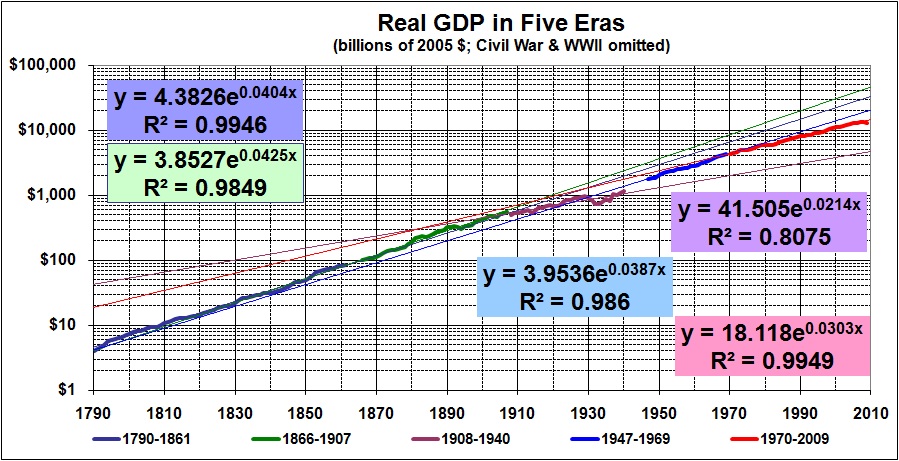
Can we measure the price of government intervention? I believe that we can do so, and quite easily. The tale can be told in three graphs, all derived from constant-dollar GDP estimates available here. The numbers plotted in each graph exclude GDP estimates for the years in which the U.S. was involved in or demobilizing from major wars, namely, 1861-65, 1918-19, and 1941-46. GDP values for those years — especially for the peak years of World War II — present a distorted picture of economic output. Without further ado, here are the three graphs:
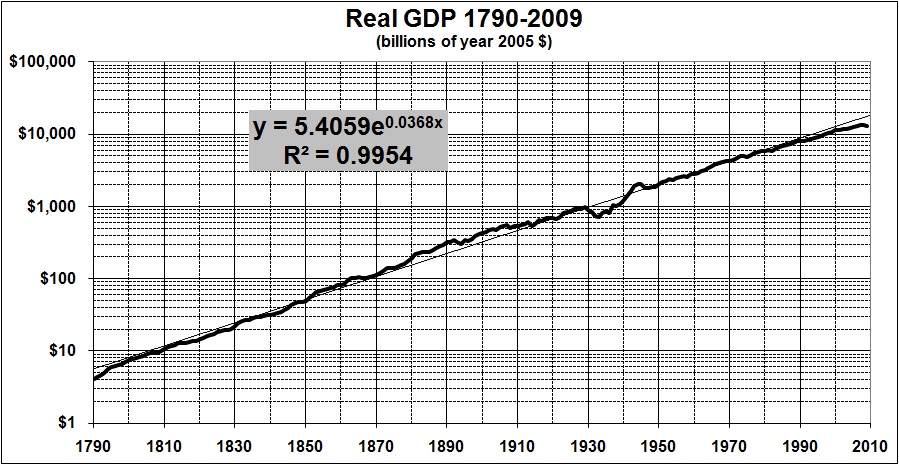
The trend line in the first graph indicates annual growth of about 3.7 percent over the long run, with obviously large deviations around the trend. The second graph contrasts economic growth through 1907 with economic growth since: 4.2 percent vs. 3.6 percent. But lest you believe that the economy of the U.S. somehow began to “age” in the early 1900s, consider the story implicit in the third graph:

  • 1790-1861 — annual growth of 4.1 percent — a booming young economy, probably at its freest
  • 1866-1907 — annual growth of 4.3 percent — a robust economy, fueled by (mostly) laissez-faire policies and the concomitant rise of technological innovation and entrepreneurship
  • 1908-1929 — annual growth of 2.2 percent — a dispirited economy, shackled by the fruits of “progressivism” (e.g., trust-busting, regulation, the income tax, the Fed) and the government interventions that provoked and prolonged the Great Depression (see links in third paragraph)
  • 1970-2008 — annual growth of 3.1 percent —  an economy sagging under the cumulative weight of “progressivism,” New Deal legislation, LBJ’s “Great Society” (with its legacy of the ever-expanding and oppressive welfare/transfer-payment schemes: Medicare, Medicaid, a more generous package of Social Security benefits), and an ever-growing mountain of regulatory restrictions.

Had the economy of the U.S. not been deflected from its post-Civil War course, GDP would now be about three times its present level. (Compare the trend lines for 1866-1907 and 1970-2008.) If that seems unbelievable to you, it shouldn’t: $100 compounded for 100 years at 4.3 percent amounts to $6,700; $100 compounded for 100 years at 3.1 percent amounts to $2,100. Nothing other than government intervention (or a catastrophe greater than any we have known) could have kept the economy from growing at more than 4 percent.

What’s next? Unless Obama’s megalomaniacal plans are aborted by a reversal of the Republican Party’s fortunes, the U.S. will enter a new phase of economic growth — something close to stagnation. We will look back on the period from 1970 to 2008 with longing, as we plod along at a growth rate similar to that of 1908-1940, that is, about 2.2 percent. Thus:

  • If GDP grows at 2.2 percent through 2109, it will be 58 percent lower than if we plod on at 3.1 percent.
  • If GDP grows at 2.2 percent for through 2109, it will be only 4 percent of what it would have been had it continued to grow at 4.3 percent after 1907.

The latter disparity may seem incredible, but scan the lists here and you will find even greater cross-national disparities in per capita GDP. Go here and you will find that real, per capita GDP in 1790 was only 4.6 percent of the value it had attained 218 years later. Our present level of output seems incredible to citizens of impoverished nations, and it would seem no less incredible to an American of 1790. In sum, vast disparities can and do exist, across nations and time. We have every reason to believe in the possibility of a sustained growth rate of 4.4 percent, as against one of 2.2 percent, because we have experienced both.

We should look on the periods 1908-1940 and 1970-2009 as aberrations, and take this lesson from those periods: Big government inflicts great harm on almost everyone (politicians and bureaucrats being the main exceptions), including its intended beneficiaries. Such is the price of government when it does more than “establish Justice, insure domestic Tranquility, [and] provide for the common defence” in order to “promote the general Welfare, and secure the Blessings of Liberty to ourselves and our Posterity.”