Leading Indicators?

If the political mood of the country (or much of it) doesn’t change markedly in the next several months, don’t be surprised if there’s an anti-Obama insurgency in the Democrat party. The Democrats my lose the White House no matter the party’s nominee for president, but a landslide loss would create an anti-Democrat bandwagon effect that lasts for years or decades.

For the history challenged among you, I point to the post-Civil War succession of Republican administrations from 1869 to 1913, broken only by the two terms of Grover Cleveland — a pro-business, gold-standard, small-government, northern Democrat. Then, there was the reaction to the Great Depression, which yielded Democrat presidencies from 1933 to 1969, broken only by the two terms of Dwight Eisenhower — a middling Republican known mainly to the public as the general in charge of the D-Day invasion and subsequent defeat of Hitler’s armies.

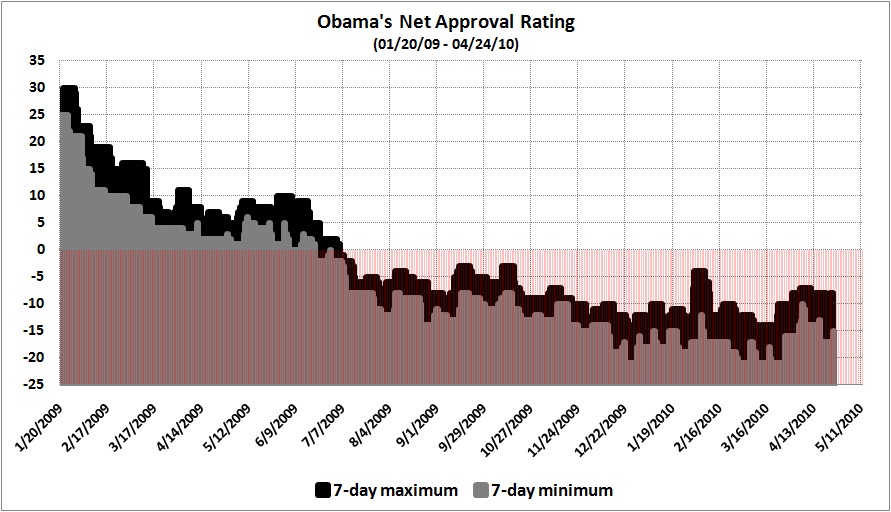
With those precedents in mind, there must be a goodly number of influential Democrats who are thinking about alternatives to Obama. If they are not, they should be. BO’s net popularity index has returned to the slough of despond, after having risen somewhat in the post-election “honeymoon” that followed BO’s cave-in on the extension of the Bush tax cuts:


Each plot-point represents the 7-day trend in BO’s net popularity (or lack thereof). Net popularity is measured as the percentage of likely voters who strongly approve of BO, minus the percentage of likely voters who strongly disapprove of BO. The approval and disapproval statistics are derived from Rasmussen Reports’ Daily Presidential Tracking Poll. I use Rasmussen’s polling results because Rasmussen has a good track record with respect to presidential-election polling.

Then there is Obamacare, which has never been popular, and has just receded to its lowest rating since congressional Democrats committed collective suicide by ramming it through:


Derived from this article and its predecessors at Rasmussen Reports. Poll results before passage of Obamacare represent strong approval minus strong disapproval. Poll results after passage of Obamacare represent strong approval of repeal minus strong disapproval of repeal.

Reality Strikes Again

Ross Douthat writes in  today’s NYT (“Obama the Realist“):

On the campaign trail in 2008, Barack Obama played to two very different foreign policy constituencies. Often he presented himself as the tribune of the anti-war left — the only candidate who had opposed the invasion of Iraq from the beginning, the man who could be trusted to civilize the global war on terror, and the perfect figure to smooth the transition to a post-American world order. To more bipartisan audiences, though, he cast himself as a cold-eyed realist — the rightful heir to George H. W. Bush, if not Henry Kissinger, who would pursue America’s interests without pretending (as the younger President Bush often did) that they matched up perfectly with America’s democratic ideals….

From the war on terror to the current unrest in Egypt, [Obama’s] foreign policy has owed far more to conservative realpolitik than to any left-wing vision of international affairs….

On nearly every anti-terror front, from detainee policy to drone strikes, the Obama administration has been what The Washington Times’s Eli Lake calls a “9/14 presidency,” maintaining or even expanding the powers that George W. Bush claimed in the aftermath of 9/11. (Dick Cheney himself admitted as much last month, effectively retracting his 2009 claim that Obama’s terrorism policies were undermining national security.) Time and again, this president has proved himself a careful custodian of both American and presidential prerogatives — and the most perceptive critics of his policies, tellingly, have been civil libertarians rather than Republican partisans.

Obama’s adoption of realpolitik is unsurprising to me. In the heat of the 2004 election, when Kerry had pulled even with Bush in the polls and it seemed that Kerry the anti-warrior might become president, I wrote this:

Assuming the best on the domestic front — that is, deadlock — what about the war on terror? All wouldn’t be lost if Kerry were to win the White House. He says dangerous multilateralist things about defense policy. But, in these times of clear and present danger, even a Democrat president will put defense above the trappings of internationalism. A massive failure to defend the homeland or to secure vital overseas interests would ensure a rout in the mid-term elections and a one-term presidency, if not impeachment.

It is good to know that Obama seems to take seriously his role as commander-in-chief. But I do wonder whether his new-found “realism” arises from a sense of responsibility or fear of impeachment.  I would not rule out the latter.

Obama’s New Regulatory Regime

Eric Posner, writing in The New Republic (“Obama’s Cost-Benefit Revolution“), comments on Obama’s new executive order about cost-benefit analysis and regulation. Posner offers some background:

Long ago, cost-benefit analysis was a rallying cry for conservatives. It was brought to government by none other than Ronald Reagan, in Executive Order 12291 of 1981. Reagan was riding the wave of the deregulatory movement, which held that regulation of industry was excessive and stunted economic growth. His order stipulated that agencies should issue regulations only after finding that the benefits exceeded the costs.

Outraged liberals charged that cost-benefit analysis was a pretext to stifle regulation, and that it was arbitrary because of the difficulty of attaching dollar values to lives, environmental goods, and other regulatory benefits. Conservatives replied that cost-benefit analysis blocks bad regulations: Why would one support a regulation that produces higher costs than benefits? At the time, the alternative was regulation that seemed to reflect no more than the instincts of bureaucrats (or the agendas of interest groups), accompanied by impenetrable bureaucratese. The debate continued in this vein for decades, but over time, positions shifted. Some liberals came to see cost-benefit analysis as a good-government tool that promotes transparency and accountability, while some conservatives began to wonder whether it confers legitimacy on the New Deal state.

Cost-benefit analysis — even when it is done well — is a sham. But Obama’s approach (an extension of Clinton’s) reveals it as a scam:

Now, the press has reported that Obama’s executive order, which explicitly renews Clinton’s, signals victory for business. But the executive order also provides plenty of wiggle room that can be exploited by pro-regulatory forces, as indeed did Clinton’s before it. Unlike Reagan’s original order, which simply asked agencies to perform cost-benefit analysis, Clinton’s allowed agencies also to take account of “equity.” Obama’s adds that agencies should take account of “human dignity” and “fairness,” values, it helpfully notes, that are “difficult or impossible to quantify.” This is problematic because quantification is the point of cost-benefit analysis. Cost-benefit analysis works in the first place only because it imposes mathematical discipline on agencies. They must supply evidence that a proposed regulation has certain benefits and costs, monetize those benefits and costs, and report a number. If the number is greater than zero, then the agency may regulate. If agencies can instead point to unquantifiable benefits such as the promotion of human dignity, they can do whatever they want, and the main selling point of cost-benefit analysis—government transparency—is eliminated.

The sham to which I refer above is this:

One person’s benefit cannot be compared with another person’s cost. Suppose, for example, the City of Los Angeles were to conduct a cost-benefit analysis that “proved” the wisdom of constructing yet another freeway through the city in order to reduce the commuting time of workers who drive into the city from the suburbs. In order to construct the freeway, the city must exercise its power of eminent domain and take residential and commercial property, paying “just compensation,” of course. But “just compensation” for a forced taking cannot be “just” — not when property is being wrenched from often-unwilling “sellers” at prices they would not accept voluntarily. Not when those “sellers” (or their lessees) must face the additional financial and psychic costs of relocating their homes and businesses, of losing (in some cases) decades-old connections with friends, neighbors, customers, and suppliers. (This is from “Greed, Cosmic Justice, and Social Welfare“; see also “Modern Utilitarianism.”)

Throwing “equity,” “human dignity,” and “fairness” into the equation takes us from sham to scam. As Posner says,  “[t]hese wiggle words … might be licenses to agencies to regulate however they want to.” There’s no “might” about it.

Well, there is a kind of “might” about it. The might of government regulators to force their preferences on us.

Finding Order in Chaos

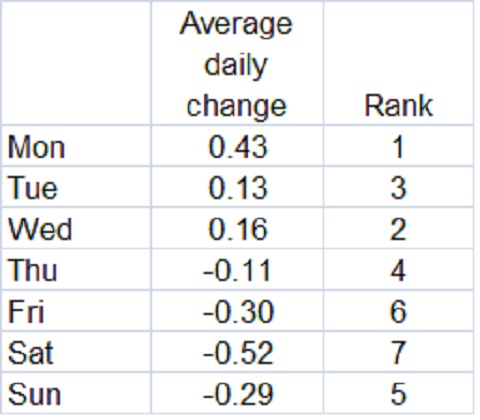
Here is an apparently random plot of daily changes in an index:

Can such randomness yield an orderly outcome? To find out, click “Read more of this post.”

Continue reading “Finding Order in Chaos”

Election 2010: Post-Mortem

UPDATED 11/05/10

This is a followup on my election-morning predictions, a prognosis about the next two years, and a diagnosis of the “progressive” disease.

I expected the GOP to gain eight seats in the Senate. But that prediction ran aground on the narrow wins by Democrats Michael Bennet and Harry Reid in Colorado and Nevada. The race in Washington hasn’t been decided, but it seems that Patty Murray will retain her seat.  The Alaska seat will wind up in GOP hands — it’s just a question of whose hands. So, when the dust settles, the GOP will have gained 6 seats and the Dems will retain a majority. That’s as good as it was likely to get. And it’s good enough, because with 47 seats (and only two or three RINOs in the mix) the GOP will command a cloture-proof minority.

Things turned out better in the House. I expected the GOP to end up with 237 seats. But when the dust settles on 10 9 undecided races, the GOP probably will hold between 239 seats (the current count) and 242 seats (adding 3 races now led by GOP candidates). Needless to say, the GOP will command the agenda in the House. The incoming tide of new Republican members will put a lot of pressure on GOP leaders to undo what Pelosi and company wrought. The stumbling blocks will be the Democrat-controlled Senate and the veto pen of BHO.

Republicans gained a lot of ground in the States, as indicated by the pickup of 12 governorships. (The Democrat pickup in California makes little difference in cloud-cuckoo-land, where the main difference between Arnold Schwarzenegger and his successor, Moonbeam Brown, is their accents.) Greater GOP strength at the State level will mean two things: more resistance to the expansion of federal power, and redistricting of the House in ways favorable to future Republican prospects.

The next two years at the “seat of government” (SOG) in D.C. will be filled with GOP initiatives to roll back the Obama agenda, name-calling by Democrats, and (I hope) gridlock combined with some rollback of Obamacare.

The next two years also will be filled with rationalizations by “progressives,” who — in so many words — will blame the backwardness of the American electorate for the events of November 2. “Progressives,” like their putative leader in the White House, already have adopted the myth that things would have turned out differently if only they had found a way to get their “message” across. Well, they did get their “message” across:

  • Pork disguised as stimulus, which did not and will not stimulate because the economy isn’t a hydraulic mechanism that responds automatically to pump-priming.
  • Financial regulations that will make it harder for Americans to borrow money.
  • A Rube Goldberg plan for reforming the health care “system” that will make it harder for Americans to obtain insurance and less rewarding for doctors and other providers to deliver medical services.

Such is “progressivism” at work: Good intentions (to put the best face on it) thwarted by unintended consequences because “progressives” believe that “hope and change” trump the realities of economic (and social behavior) — realities that “the masses” are able to grasp, if only viscerally.

Moreover, there was — and is — the disdain in which “progressives” hold “the masses,” who exist (in the “progressive” imagination) to be talked down to and led by the hand to the promised land of economic and social bliss — as it is envisioned by “progressives.”

I have news for “progressives.” When you talk down to most adults — and even to a lot of children — they quickly perceive three things: (a) you don’t respect their intelligence and (b) you are therefore trying to do something that’s against their interest. You really lose them when you promise things that they know (or suspect) will cost them liberty as well as money.

“Progressives” seem to believe in economic stability at any price, including the price of liberty and prosperity. A lot of “the masses” aren’t buying it. Good for them.

The Mood of the Country

UPDATED 09/25/10

From the morning of January 21, 2009, through this morning, Obama’s net popularity rating has dropped from +28 to -13 (according to Rasmussen Reports). That’s an average daily decline of 0.07 rating points. But how Obama’s rating fares on a given day depends, in part, on the day of the week; thus:

As the week wears on, the likely voters polled by Rasmussen become less satisfied — or more dissatisfied — with Obama’s performance in office. Irascibility peaks on Saturday, then begins to recede on Sunday. Blue Monday, oddly enough, is Obama’s best day in the eyes of Rasmussen’s survey group. Conversely, the first day of the weekend — a day eagerly anticipated by most working persons — is Obama’s worst day. Go figure.

UPDATE: Saturday continues to be Obama’s blue polling day. With today’s 2-point drop, Saturday’s average change is now -0.54.

A Mere Coincidence?

UPDATED 09/10/10

On this morning after Barack Obama indulged in the politics of envy and class warfare by rejecting the continuation of the “Bush tax cuts” for high-income individuals, his unpopularity rating fell to a new low: -24.

By my estimate, rejection of Obama by conservative-libertarian-independent voters gives him a baseline unpopularity rating of -10. Ratings lower than that require the disapproval of Obama by disaffected Democrats who think he isn’t “doing enough.”

Well, if this morning’s poll results are any indication, there are some well-to-do and aspiring-to-do-well Democrats out there who think Obama would be “doing too much” if he succeeds in raising their marginal tax rates.

UPDATE: Despite today’s slight improvement, from -24 to -21, Obama’s unpopularity rating has hit new lows: 28-day average = -17.4; 7-day average = -20.7.

Obama’s Short-Lived “Peace Dividend”

UPDATED 09/05/10

On August 31, BHO declared an end to U.S. combat operations in Iraq. In anticipation of that declaration, and for a few days following it, BHO enjoyed what (for him) is a surge in popularity. His approval index (per Rasmussen Reports) went from -20 on August 25 to -12 on August 28. It dropped to -14 on August 31, but returned to -12 on September 1 (the morning after BHO’s declaration). It has been all downhill since: -13 on September 2, -16 on September 3, -21 on September 4, -23 on September 5.

Our boy president has recorded an unpopularity rating of -20 or lower only33 times in the 579 polling days that began with his inauguration. Nine of those low marks (more than a fourth of them) have come in the most recent 10 weeks of BHO’s 85 weeks in office.

In fact, Obama has earned a zero or positive rating 27 percent of the time; a negative rating, 73 percent of the time. More than half of his ratings have been -10 and lower. His last zero or positive rating came on June 29, 2009 — 62 weeks ago. That shouldn’t be surprising, given that he peaked two days after his inauguration. It has been mostly downhill and in a negative trough since then. Obama’s 28-day average rating hit -10 on November 7, 2009, and has stayed below -10 (usually well below) for the past 10 months.

It seems that BHO will have to keep looking for a way to become popular. Resignation might do the trick.

Is Obama a Racist?

Obama, by his own standards, is a racist:

By the standard of “disparate impact,” Obama is a racist because the effect of his soak-the-rich economics is to punish high-income individuals for the sin of making a lot of money. It should go without saying that whites are disproportionately represented among high-income individuals. Q.E.D., Obama’s soak-the-rich policy is racist.

But, but… haven’t I said many times that the ultimate effect of soak-the-rich schemes is to harm the poor, because soak-the-rich schemes hamper economic growth and job creation? True. But what counts in Obama’s world of justice is not the effect of one’s actions but the motives behind them. (“Hate crimes” anyone?) If Obama hates “the rich” — as he evidently does — it must be because they are overwhelmingly white. Q.E.D. Obama is a racist.

As the Fourth Approaches, Good News

Obama’s net approval rating has retreated to -20, following an inexplicable spike a few days ago:

Net approval rating: percentage of likely voters strongly approving of BO, minus percentage of likely voters strongly disapproving of BO. Derived from Rasmussen Reports’ Daily Presidential Tracking Poll. I use Rasmussen’s polling results because Rasmussen has a good track record with respect to presidential-election polling.

Obama, Obamacare, and the Polls

Obama, once again, is in trouble with the left (e.g., this piece by Frank Rich of The New York Times). Why is he in trouble this time? Because he lacks the superhuman powers it would require of him to personally stanch the flow of oil in the Gulf of Mexico. The best he can do is throw tantrums (after much prompting from the left). But you can be sure that when the leak is plugged Obama will find a way to take credit for a feat of engineering that owed nothing to his tantrums.

Some of Obama’s fickle, leftist flock will then return to the fold, giving him a bounce in the polls, like the bounces he enjoyed following his attack on the Supreme Court in January’s State of the Union Address and the signing in March of that obaminable piece of legislation known as Obamacare:

Net approval rating: percentage of likely voters strongly approving of BO, minus percentage of likely voters strongly disapproving of BO. Derived from Rasmussen Reports’ Daily Presidential Tracking Poll. I use Rasmussen’s polling results because Rasmussen has a good track record with respect to presidential-election polling.

Obama’s last venture into positive territory occurred way back on June 29, 2009. His ratings have been (mostly) downhill ever since. It seems that his baseline approval rating is around -10 — that’s about as high as it gets when his fickle fans give him  a bounce in the polls. (The modal value for 492 polling days is -10; the modal range is -7 to -15.)

Obamacare has followed a similar course:

Net disapproval before enactment of Obmacare: percentage of poll respondents strongly disapproving of Obmacare, minus percentage of poll respondents strongly approving it (source). Net disapproval after enactment: percentage of poll respondents strongly approving of repeal, minus percentage of poll respondents strongly opposing it (source).

Despite the left’s euphoria when Obama signed his obamanation into law, Obamacare remains broadly unpopular.

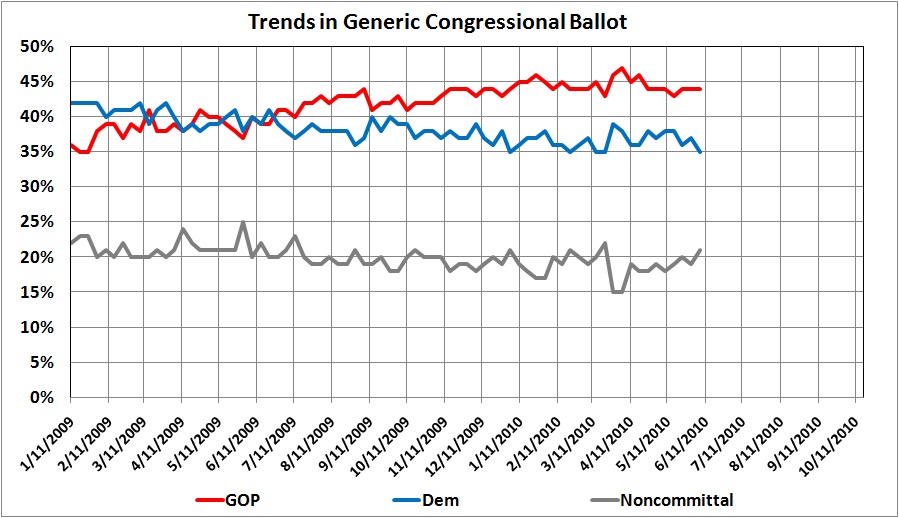
In polls there is hope:

Source: results of a Rasmussen poll in which likely voters are asked whether they intend to vote for their district’s Republican or Democrat candidate.

Afterthought: You can rest assured that around Labor Day the Democrats will launch some kind of sleaze attack on the GOP. Having observed Democrats in action for six decades, I have decided that their motto should be: “When all else fails, fight dirty.” Given Tricky Dick’s track record, I hereby award him posthumous membership in the Democrat Party.

The Omniscient State at Work

For the benefit of Paul Krugman and other worshipers of the all-wise, all-beneficent state, here’s some news from the Associated Press:

WASHINGTON – Despite a top-to-bottom overhaul of the intelligence community after the 2001 terrorist attacks, the nation’s security system showed some of the same failures when it allowed a would-be bomber to slip aboard an airliner, congressional investigators said Tuesday.The Senate Intelligence Committee report at times contradicted the Obama administration’s assertion that the nearly catastrophic Christmas Day bombing attempt was unlike 9/11 because it represented a failure to understand intelligence, not a failure to collect and understand it.

The congressional review is more stark than the Obama administration’s report. It lays much of the blame at the feet of the National Counterterrorism Center, which Congress created to be the primary agency in charge of analyzing terrorism intelligence.

‘Nuff said? Not quite. There’s this, from The Wall Street Journal:

What a fiasco. That’s the first word that comes to mind watching Mahmoud Ahmadinejad raise his arms yesterday with the leaders of Turkey and Brazil to celebrate a new atomic pact that instantly made irrelevant 16 months of President Obama’s “diplomacy.” The deal is a political coup for Tehran and possibly delivers the coup de grace to the West’s half-hearted efforts to stop Iran from acquiring a nuclear bomb.

Full credit for this debacle goes to the Obama Administration and its hapless diplomatic strategy. Last October, nine months into its engagement with Tehran, the White House concocted a plan to transfer some of Iran’s uranium stock abroad for enrichment. If the West couldn’t stop Iran’s program, the thinking was that maybe this scheme would delay it. The Iranians played coy, then refused to accept the offer.

But Mr. Obama doesn’t take no for an answer from rogue regimes, and so he kept the offer on the table. As the U.S. finally seemed ready to go to the U.N. Security Council for more sanctions, the Iranians chose yesterday to accept the deal on their own limited terms while enlisting the Brazilians and Turks as enablers and political shields. “Diplomacy emerged victorious today,” declared Brazil’s President Luiz Inácio Lula da Silva, turning Mr. Obama’s own most important foreign-policy principle against him.

Don’t you sleep better at night with those wonderful folks in D.C. watching out for you? It’s not enough that they’ve screwed up the economy in general, and are in the process of further screwing up our medical care. Now, they’re working toward dismantling our defenses against terrorists and regimes that sponsor terrorism.

Well, you can’t say that I didn’t see it coming (here, here, and here).

How’s “He” Doing?

“He” is Barack Obama (BO), who presides over the left half of the nation and dictates to the right half. In an early post about BO’s popularity — or lack thereof — I observed that his “approval rating may have dropped for the wrong reasons; that is, voters expect him to “do something” about jobs, health care, etc.”

And, sure enough, when BO used his first state of the union address to reiterate his allegiance to the New Deal, his unpopularity dwindled a bit. And when he and his co-conspirators — Reid and Pelosi — rammed their health-care bill through Congress, his unpopularity again dwindled.

The good news is that BO remains generally unpopular:

Net approval rating: percentage of likely voters strongly approving of BO, minus percentage of likely voters strongly disapproving of BO. Derived from Rasmussen Reports’ Daily Presidential Tracking Poll. I use Rasmussen’s polling results because Rasmussen has a good track record with respect to presidential-election polling.

In polls there is hope.

Good News?

GRAPHIC UPDATED 12/14/09

What’s bad news for Obama is good news for the country. As I have said:

To hope that Obama fails is not to wish ill for the nation; to the contrary, it is to hope that Obama’s policies fail of realization because they are seen (rightly) as inimical to liberty and prosperity.

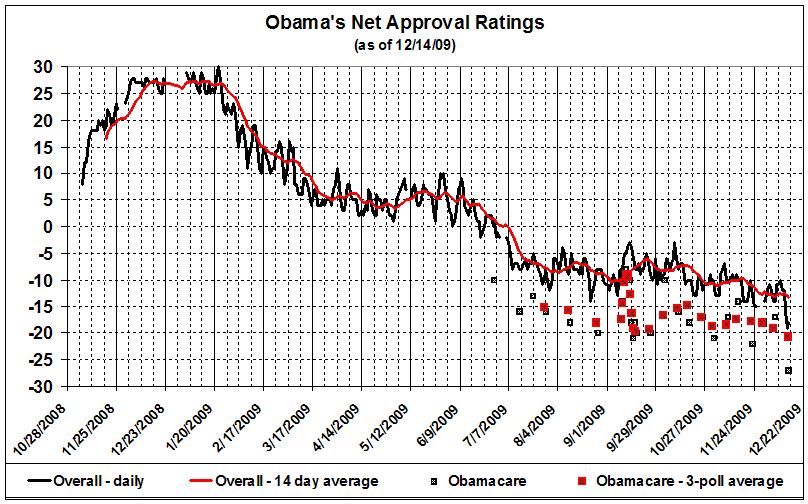
It is my sincere and fervent hope that the following trends portend good news for the liberty and prosperity of Americans:

Sources: Rasmussen Reports Daily Presidential Tracking Poll and Health Care Reform Poll. Overall net approval ratings represent the difference in the percentage of  respondents strongly approving and strongly disapproving of Obama (negative numbers mean net disapproval). Health care ratings represent the difference in the percentage of respondents strongly supporting and strongly opposing Obama’s health care “plan,” or what they take to be his plan. I use Rasmussen’s polling results because Rasmussen has a good track record with respect to presidential-election polling.

Our Sacred Honor?

In “Sizing Up Obama,” I wrote:

On the one hand, we have FDR II, replete with schemes for managing our lives and fortunes.

On the other hand, we have Carter-Clinton II, ready to: kowtow to those who would bury us, create the illusion that peace will reign perforce, and act on that illusion by slashing the defense budget (thereby giving aid and comfort to our enemies).

I have said a lot more about Obama’s schemes for managing our lives and fortunes. (See this, this, this, this, this, and this.) I also have addressed Obama’s apparent willingness to compromise our sacred honor. But it is clear that I have been preoccupied with Obama’s economic agenda, to the neglect of his foreign follies.

While the war in Iraq winds down to a successful conclusion, and the outcome of the war in Afghanistan depends on Obama’s willingness to buck the surrender lobby (of which Obama is a leading member), there is the problem of Iran:

The price of a pre-emptive attack on Iran might be high, but the price of inaction will be even higher. Legitimate U.S. interests in the Middle East (i.e., access to oil) will be threatened by a regime that has proceeded thus far in the face of sanctions and is unlikely to be fazed by more sanctions. The economic hardships caused by the “oil shocks” of the 1970s will be as nothing compared with the hardships caused by Iranian dominance of the Middle East.

Where will Western Europe, Russia, and China be in our hour of need? Western Europe will be busy emulating Vichy France, in the hope that its obseqiousness toward Iran is rewarded by dribbles of oil. Russia and China will actively support Iran (covertly if not overtly), in the expectation of profiting from higher prices on the oil they sell to Western Europe and the United States. Eventually, Russia and China will exploit the inevitable decline of American military power, as our defense budget disappears into the maw of Obamacare, Medicare, Medicaid, Social Security, and other misbegotten ventures.

What has happened since I wrote those words on September 26? Just about what you would expect. Here is Charles Krauthammer, writing on October 16:

And what’s come from Obama’s single most dramatic foreign-policy stroke — the sudden abrogation of missile-defense arrangements with Poland and the Czech Republic that Russia had virulently opposed? . . .

. . . Surely we got something in return for selling out our friends. Some brilliant secret trade-off to get strong Russian support for stopping Iran from going nuclear before it’s too late? . . .

. . . Well, Clinton went to Moscow this week to nail down the deal. What did she get?

“Russia Not Budging on Iran Sanctions: Clinton Unable to Sway Counterpart.” Such was the Washington Post headline’s succinct summary of the debacle.

Note how thoroughly Clinton was rebuffed. Russian foreign minister Sergei Lavrov declared that “threats, sanctions, and threats of pressure” are “counterproductive.” Note: It’s not just sanctions that are worse than useless, but even the threat of mere pressure.

It gets worse. Having failed to get any movement from the Russians, Clinton herself moved — to accommodate the Russian position! Sanctions? What sanctions? “We are not at that point yet,” she averred. “That is not a conclusion we have reached. . . . It is our preference that Iran work with the international community.”

But wait a minute. Didn’t Obama say in July that Iran had to show compliance by the G-20 summit in late September? And when that deadline passed, did he not then warn Iran that it would face “sanctions that have bite” and that it would have to take “a new course or face consequences”?

Gone with the wind. It’s the U.S. that’s now retreating from its already flimsy position of just three weeks ago. We’re not doing sanctions now, you see. We’re back to engagement. Just as the Russians suggest.

Henry Kissinger once said that the main job of Anatoly Dobrynin, the perennial Soviet ambassador to Washington, was to tell the Kremlin leadership that whenever they received a proposal from the United States that appeared disadvantageous to the United States, not to assume it was a trick.

No need for a Dobrynin today. The Russian leadership, hardly believing its luck, needs no interpreter to understand that when the Obama team clownishly rushes in bearing gifts and “reset” buttons, there is nothing ulterior, diabolical, clever, or even serious behind it. It is amateurishness, wrapped in naïveté, inside credulity. In short, the very stuff of Nobels.

And so it goes, in the Orwellian world of Obama, where a temporary illusion of peace is attained through accommodation and surrender.

Health Care “Reform”: The Short of It

Congress and Obama will deliver unto us:

  • an entitlement program that promises “free” or “inexpensive” access to drugs and medical services;
  • higher prices for drugs and medical services, fueled by greater demand (thanks to the entitlement program) and shrinking supply (as more providers decline to accept government-set fees and red tape); and, therefore,
  • more expensive, and rationed, medical care.

The unthinkable alternative — and the only workable one — is to stimulate supply by deregulating the medical professions and the pharmaceutical industry.

In short, Obamacare will not work, unless government (a) nationalizes the drug industry and the medical professions and (b) drafts individuals into the medical professions, Soviet-style. Neither event is unimaginable, as evidenced by the enthusiasm with which  politicians have embraced the nationalization and regimentation of American financial institutions.

Of course, to suggest that Obamacare could be made to work through nationalization and regimentation is to suggest that nothing works unless it is run from Washington. That is precisely the belief held by Obama, most members of Congress, and far too many Americans.

UPDATE: Nationalization and regimentation will not take place immediately upon the enactment of Obamacare, but in response to its obvious objective: Drive private insurers out of business so that government is “forced” to step in, assume the role of the “single payer,” and effectively ration the delivery of prescription drugs and medical services. For an analysis of the slippery-slope mechanisms by which this will happen, see Mario Rizzo’s “Fast Track to the Single Payer.”

UPDATE 2: The chief actuary of the Centers for Medicare and Medicaid services confirms that Obamacare will drive costs up, not down.

Related posts:
Fear of the Free Market — Part I
Fear of the Free Market — Part II
Fear of the Free Market — Part III
Rationing and Health Care
The Perils of Nannyism: The Case of Obamacare
More about the Perils of Obamacare

My Nobel Prize

I awoke this morning to the news that I had been awarded the Nobel Prize for the Suppression of Blogospheric Bloviation. Needless to say, the award would not have been possible without the pioneering efforts of the millions of blogospheric bloviators who preceded me.

As for my humble efforts to suppress blogospheric bloviation, the Nobel Committee’s citation reads as follows:

Politics & Prosperity is a blog of some eight months’ standing, with no record of accomplishment in the world of politics. It stands as a feeble symbol of libertarian enlightenment in a blogosphere dominated by the voices of statism. We therefore recognize the author of Politics & Prosperity for his naïve belief that his writings will have the slightest salutary influence on the strident tone of blogospheric discourse.

I have released the following statement to the media:

I am both surprised and deeply humbled by the decision of the Nobel Committee.  Let me be clear:  I do not view it as a recognition of my accomplishments, which are nil, but rather as an affirmation of my foolish belief in the possibility of suppressing blogospheric bloviation.

I also know that this prize reflects the kind of world that all non-bloggers want to build — a world that gives life to the promise of the internet to sweep away ugly reality and replace it with an imaginary world of perfection. And that is why I will accept this award as a call to action — a call for all bloggers to cease their partisan bickering and bow to my superior wisdom on subjects of which I have no knowledge.

We cannot tolerate a world in which blogospheric bloviation engulfs the internet and intrudes on healthier occupations, such as watching reality TV and getting blitzed every Saturday night.  And that’s why I’ve begun to take concrete steps to pursue a world without blogospheric bloviation, because all people have the right to think, but not all people have the right to share their thoughts with millions of innocent readers.

We cannot accept the growing threat posed by blogospheric bloviation, which could forever damage the world that we pass on to our children — sowing conflict and confusion; destroying friendships and emptying minds.  And that’s why all nations must now accept their share of responsibility for transforming the blogosphere.

We bloggers can’t allow our ideological differences to define the way that we see one another, even though those differences often are fundamental. It is our obligation to pretend that we all love and admire one another, even though most bloggers (especially those on the left) are dangerous ignoramuses.

We can’t accept a blogosphere in which some bloggers thrive while others are neglected. That is why I have made it my goal to ensure that all blog readers are programmed to carry only my blog instead of the blogs requested by subscribers. I understand that such a policy would violate deep constitutional principles, but what the hell. When you want something badly, you don’t let such niceties stand in the way.

The challenge confronting us will not be completed during my time as a blogger.  But I know the challenge can be met because, sooner or later, a wise Latina judge will say “screw the Constitution, suppress bloviation.”

And that’s why this award must be shared with everyone who strives for calmness in the blogosphere — all five of you, wherever you  are.

Thank you very much.

P.S. I have asked the International Olympic Committee to reject summarily any application from the city of Austin, Texas, to host games. Austin is vastly over-rated — especially by its smug “leaders,” who believe that progress consists of ugly high-rises, congested roads (which are narrowed by little-used bicycle lanes, and often closed for public extravaganzas), and tax breaks for commercial enterprises at the expense of residential property owners. (Contrary to the party line in Austin, it is not the live music capital of the world.) The last thing the over-taxed, silent majority of Austin needs is another disruptive, expensive tribute to the city’s supposed wonderfulness. Rio’s loss is Chicago’s gain.

(The main portion of the “release” is adapted from Obama’s remarks on winning the Nobel Peace Prize. The P.S. is inspired by his chauvinistic advancement of Chicago’s application to host the 2016 summer games. The timing of Obama’s Nobel Prize suggests that it was a consolation prize for Chicago’s “loss” to Rio de Janeiro.)

The Folly of Nuclear Disarmament

From the Associated Press:

UNITED NATIONS [September 24, 2009] – With President Barack Obama presiding, the U.N. Security Council on Thursday unanimously endorsed a sweeping strategy aimed at halting the spread of nuclear weapons and ultimately eliminating them, to usher in a world with “undiminished security for all.”

“That can be our destiny,” Obama declared after the 15-nation body adopted the historic, U.S.-initiated resolution at an unprecedented summit session. “We will leave this meeting with a renewed determination to achieve this shared goal.”

The lengthy document was aimed, in part, at the widely denounced nuclear programs of Iran and North Korea, although they were not named. It also reflected Obama’s ambitious agenda to embrace treaties and other agreements leading toward a nuclear weapon-free world, some of which is expected to encounter political opposition in Washington.

On both counts, Thursday’s 15-0 vote delivered a global consensus — countries ranging from Britain to China to Burkina Faso — that may add political impetus to dealing with nuclear violators, advancing arms control in international forums and winning support in the U.S. Congress.

“This is a historic moment, a moment offering a fresh start toward a new future,” U.N. Secretary-General Ban Ki-moon said, saluting the first such Security Council gathering of presidents and premiers to deal with nuclear nonproliferation.

Yeah, and “peace for our time,” to you. For the youngsters out there, that’s a reference to Neville Chamberlain’s infamous capitulation to Hitler, whose peace was the peace of his victims’ graves.

Well, today’s charade in New York — like the one in Munich 71 years ago — simply gives the bad guys more time in which to perfect their evil designs. When nuclear weapons are outlawed, only outlaws will have nuclear weapons.

P.S. So, Obama and other Democrats are now talking tough about Iran’s nuclear program. Two questions: Where were those Democrats when Bush called Iran out a couple of years ago? Will Obama back his tough talk with action? Answer to the second question: Not bloody likely.

P.P.S. As I was saying . . . Instead of destroying Iran’s nuclear facilities, Obama offers Iran “serious, meaningful dialogue.” Gimme a break.

The Incredible Shrinking Obama

Sizing Up Obama” (April 24, 2009):

On the one hand, we have FDR II, replete with schemes for managing our lives and fortunes.

On the other hand, we have Carter-Clinton II, ready to: kowtow to those who would bury us, create the illusion that peace will reign perforce, and act on that illusion by slashing the defense budget (thereby giving aid and comfort to our enemies).

Through the haze of smoke and glare of mirrors I see a youngish president exhorting us to “fear nothing but fear itself” while proclaiming “peace for our time,” as we “follow the yellow-brick road” to impotent serfdom.

The schemes persist, most notoriously (but not exclusively) in health care “reform,” about which Arnold Kling writes today:

What is misleading about statements (a) – (k) [taken from Obama’s speech on September 9] is that each of them referred to a plan that, strictly speaking, does not exist. As far as I know, the Obama Administration never submitted a plan to Congress. . . .

If you are going to repeatedly refer to “my plan” or “this plan” or “the plan I’m proposing,” then unless you have a plan you are lying. The only question is whether it is a little lie or a big one. Obviously, most people think it is only a small lie, or the President would have been called out on it. However, I think that health care policy is an area where there is too much temptation to promise results that are economically impossible to achieve. In that context, my opinion is that giving a speech in favor of a nonexistent plan is a really big lie.

Now — on the 70th anniversary of Stalin’s invasion of Poland — comes Obama’s decision to placate the Russians and insult our allies in Eastern Europe:

President Obama dismayed America’s allies in Europe and angered his political opponents at home today when he formally ditched plans to set up a missile defence shield in Poland and the Czech Republic.

The project had been close to the heart of Mr Obama’s predecessor, President Bush, who had argued before leaving office in January that it was needed to defend against long-range ballistic missile attacks from rogue states such as Iran and North Korea.

But it had hobbled relations with Russia, which considered it both a security threat and an unnecessary political provocation in its own backyard.

At a White House appearance today, Mr Obama confirmed that the defence shield envisaged by the Bush Administration, involving a radar base in the Czech Republic and interceptor rockets sited in Poland, was being abandoned. . . .

“The decision announced today by the Administration is dangerous and short-sighted,” the No 2 Republican in the Senate, Jon Kyl, said in a statement.

Mr Kyl said that the shift would leave the United States “vulnerable to the growing Iranian long-range missile threat” and would send a chilling message to former Soviet satellites who had braved Moscow’s anger to support the system.

“This will be a bitter disappointment, indeed, even a warning to the people of Eastern Europe,” said Mr Kyl, who pointed out that both Poland and the Czech Republic had sent troops to Iraq and Afghanistan. “Today the Administration has turned its back on these allies.”

Senator John McCain, Mr Obama’s defeated Republican White House rival in 2008, said he was “disappointed” with the decision and warned it could undermine US standing in Eastern Europe amid worries there of a resurgent Russia.

“Given the serious and growing threats posed by Iran’s missile and nuclear programmes, now is the time when we should look to strengthen our defences, and those of our allies,” he said in a statement.

“Missile defence in Europe has been a key component of this approach. I believe the decision to abandon it unilaterally is seriously misguided.”

The good news is that Americans seem to have wised up to the Obama scam:

Obama's net approval_090917Sources: Rasmussen Reports Daily Presidential Tracking Poll and Health Care Reform Poll. Overall net approval ratings represent the difference in the number of  respondents strongly approving and strongly disapproving of Obama (negative numbers mean net disapproval). Health care ratings represent the difference in the number of respondents supporting and opposing Obama’s health care “plan,” or what they take to be his plan.

The mini-wave of approval that followed Obama’s health-care speech on September 9 seems to have dissipated. Obama’s appeasement of Russia, if it becomes widely perceived as such, will only push his numbers further south.

Goodbye, Mr. Pitts

When I lived in the D.C. area and subscribed to The Washington Post, I occasionally read a column by Leonard Pitts Jr. This masochistic practice served two purposes. First, it exercised my cardiovascular system (i.e., raised my heart rate and blood pressure). Second, it helped me to keep up with what passes for wisdom among the race-card-playing set.

Mr. Pitts, who is a syndicated columnist operating out of The Miami Herald, comes by his race-card-playing naturally, as a black and — given his age (about 50) — a likely beneficiary of reverse discrimination (a.k.a. affirmative action). I should note that Pitts plays the race-card game clumsily, probably because his mental warehouse is stocked with gross generalizations and logical fallacies.

I was provoked to write this post by a recent Pitts column, to which I will come, where (in passing) he defends the socialization of medicine because other things also have been socialized. By that logic, Pitts would excuse the murder of his wife because millions of murders already have been committed.

*     *     *

I begin my sampling of Pitts’s pathetic prose with “We’ll go forward from this moment,” of September 12, 2001 (a reaction to the terrorist attacks of September 11, 2001):

Let me tell you about my people. We are a vast and quarrelsome family, a family rent by racial, social, political and class division, but a family nonetheless.

No, “we” (the citizens of the United States) are most decidedly not a family, not even a feuding one. If there ever was anything like an American “family,” it existed in the years just after Pearl Harbor was attacked by Japanese forces. The degree of unity and resolve in the America of 1942-45 makes a mockery of the years following September 2001, during which disunity and irresolution became the standard pose of the media, academia, the Democrat Party, more than a few Republican “moderates,” many isolationist paleo-conservatives, and most libertarians.

Americans, now more than ever, are members of millions of separate families, churches, clubs, neighborhoods, work groups, etc. If there is anything shared by a majority of Americans, it is a taste for food in large quantities, vulgar entertainment, and a chance to feed at the public trough at the expense of other Americans.

The most notable schism in American life is one that has arisen since the onset of the Great Depression. It has come to this: Americans are deeply divided (though not evenly divided) about the rightful power of government in foreign and domestic affairs. There are three main camps. The largest favors surrender abroad and statism at home; the smallest favors surrender abroad and anarchy at home; the one to which I belong favors the full exercise of American might in defense of Americans’ legitimate overseas interest, together with a limited government devoted mainly to the protection of Americans from domestic predators and parasite.

It is obvious in what I have just said that Americans today do not even share a tradition of liberty, which has long vanished from the land. Because of this loss of liberty, Americans have become something less than citizens  with a common birthright and something more like hostages in their own land, with little voice and almost no opportunity for exit. Many (perhaps most) Americans like it that way, many others don’t understand what has been lost to them, and some (too few) understand it all too painfully. Pitts and his ilk like it that way because they are in thrall to special-interest politics and cannot see how those politics have abetted our downward spiral into political bondage, social license, and weakness in the face of our foreign and domestic enemies.

*     *     *

Jumping to September 29, 2003, I find “Faithful often give religion a bad name,” in which Pitts proffers this:

People are always pleased to indulge their religiosity when it allows them to stand in judgment of someone else, licenses them to feel superior to someone else, tells them they are more righteous than someone else.

They are less enthusiastic when religiosity demands that they be compassionate to someone else. That they show charity, service and mercy to everyone else.

Consider that last month thousands of people wept on the steps of an Alabama courthouse in support of a rock bearing the Ten Commandments. And watching, you wondered: What hungry person gets fed because of this? What naked person is clothed, what homeless one housed?

It seemed a fresh reminder that religious people are often the poorest advertisement for religious life.

How much more convincing an advertisement, how much more compelling a testimony, if people of faith were more often caught by news cameras demonstrating against healthcare cuts that fill our streets with the homeless mentally ill. Or confronting the slumlord about the vermin-infested holes he offers as places for families to live. Or crusading to make the sweatshop owner pay a living wage to workers who are treated little better than slaves.

From what well of knowledge does Pitts draw his assertions that people are always pleased to indulge their religiosity when they can stand in judgment of others, but are less enthusiastic when compassion is in order? Does Pitts even know, let alone care, that residents of “Red” States — where religious fundamentalism is more prevalent — are much more generous in their charitable giving than residents of “Blue” States — where secular Europeanism is the norm?

And what about those persons who “wept on the steps of an Alabama courthouse in support of a rock bearing the Ten Commandments”? What is wrong with protesting the further distancing of government from morality? I suspect that Pitts doesn’t want public officials to be reminded of the Ten Commandments because one of them says “You shall not steal” — and that is precisely what government does when it taxes and regulates us toward poverty, often in the name of “compassion.”

And why would it be a compelling testimony for religion if “people of faith” were more often seen demonstrating against budget cuts that fill our streets with the homeless mentally ill, or confronting slumlords about vermin-infested holes, or crusading to make sweatshop owners pay a “living wage to workers”? Pitts can offer such advice only because he doesn’t understand or care about the implications of such actions: Higher taxes for hard-working families; more homeless persons, as landlords raise rents to defray the costs of improving their properties; more starving poor, as “sweatshop” owners find new locales in which to recruit willing workers who have less exalted ideas than Pitts about what constitutes a “living wage.”

Pitts reveals himself as an ignoramus or a hypocrite — probably both — who is simply pleased to indulge his moral outrage when it allows him to stand in judgment of others.

*     *     *

Less than a month later (October 20, 2003) Pitts opined that “Race has always benefited whites“; to wit:

As a reader who chose to remain nameless put it, many people wonder if a given black professional “is there because of his/her skills and abilities, or because of affirmative action. Unfortunately, affirmative action policies leave many unanswered questions about a black person’s education and training, as well as skills and abilities. . . . How do we answer these questions?”

I will try my best to answer them with a straight face. It’s going to be difficult.

Because there’s an elephant in this room, isn’t there? It’s huge and noisy and rather smelly, yet none of these good people sees it. The elephant is this simple fact:

White men are the biggest beneficiaries of affirmative action this country has ever seen.

That’s not rhetoric or metaphor. It’s only truth.

THE NATION’S CUSTOM

If affirmative action is defined as giving someone an extra boost based on race, it’s hard to see how anyone can argue the point. Slots for academic admission, for employment and promotion, for bank loans and for public office have routinely been set aside for white men. This has always been the nation’s custom. Until the 1960s, it was also the nation’s law. . . .

My correspondents feel they should not be asked to respect the skill or abilities of a black professional who may or may not have benefited from affirmative action. They think such a person should expect to be looked down upon. But black people have spent generations watching white men who were no more talented, and many times downright incompetent, vault to the head of the line based on racial preference.

So, here’s my question:

Would African Americans be justified in looking down on white professionals? In wondering whether they are really smart enough to do the job? In questioning their competence before they had done a thing?

Pitts deploys three shifty debating techniques: He changes the subject; subtly (and inappropriately) redefines a key term; falsely generalizes about a class of persons (white men); and then draws an unsupported conclusion from flawed premises.

The change of subject is obvious. Pitts, instead of addressing the question whether affirmative action leads to the advancement of under-qualified blacks, attacks whites for having been unqualified.

Why were whites unqualified? Because they, too, benefited from something Pitts chooses to call affirmative action, namely, “giving someone an extra boost based on race.” There is a basic problem with Pitts’s shifty redefinition of affirmative action: discrimination against blacks produces different results than discrimination against whites. The real elephant in the room, the one that it is impolite to mention, is that blacks and whites have different skills. And for most jobs, where intelligence matters, there are many more qualified whites than blacks.

It is therefore wrong to paint whites with the same “affirmative action” brush. Despite Pitts’s implication to the contrary, blacks would not have been justified in looking down on white professionals, as a group. But the converse is not true. Certainly, there are and have been superb black doctors and miserably incompetent white ones, but faced with a choice between, say, a white doctor of unknown skill and a black doctor of unknown skill, a person (black or white) would prudently choose the white doctor. The shame, of course, is that in some parts of the United States blacks were not allowed to choose white doctors.

*     *     *

In “Leave education to the principals, teachers, parents” (November 28, 2007), Pitts subscribes to romantic claptrap:

No one becomes a teacher to get rich. You become a teacher because you want to give back, you want to shape future generations, you want to change the world.

Oh spare me! You become a teacher because

  • you enjoy teaching, in general
  • you enjoy teaching a particular subject because you know it well
  • you enjoy the power of being in charge of a classroom (to the extent that you’re mentally and physically capable of being in charge)
  • it’s the best job you can get, given your intelligence and particular skills
  • some or all of the preceding statements apply to you.

Teaching is a job, not a mystical calling.

Pitts is right to say that

much of what ails American schools can be traced to a bureaucracy that: a) doesn’t pay enough; b) does too little to encourage and reward creativity; c) doesn’t give principals authority over who works in their schools; d) makes it nearly impossible to fire bad teachers.

The key word is “bureaucracy.” American schools will not improve until they are privatized, allowed to compete with one another, and allowed to hire teachers who know their subjects as opposed to NEA-approved hacks with “education” degrees. Some schools will be better than others, of course, but that’s true now. What isn’t true — or possible — now is that most schools will improve, or go out of business. (Public schools sometimes are “closed” for conspicuous failure, only to re-open in the same place, and with most of the same students and teachers.)

The problem, for Pitts and other “liberals,” is that it just isn’t “fair” for some children to have access to better schools than others, even though that also is true now, and even though bright children of less-affluent parents undoubtedly would have access to scholarships funded by affluent graduates of better schools. No, in the name of “fairness,” Pitts and his fellow “liberals” would rather hope for a transformation of public schools that will never happen, precisely because public schools are beholden to the NEA, which is nothing more than a union designed to guarantee work for incompetents who cannot master real subjects.

*     *     *

I come now to the column that touched off this post: “The distance between us” (as titled by the Austin American-Statesman) of August 24, 2009. Though the thread of Pitts’s “logic” is tangled, he his main concern seems to be national unity, or the lack thereof.

He rests his point on the fact that not everyone is happy with the election of Barack Obama or his policies, which he traces to racism or out-and-out nuttiness:

Last year, Barack Obama was elected president, the first American of African heritage ever to reach that office. If this was regarded as a new beginning by most Americans, it was regarded apocalyptically by others who promptly proceeded to lose both their minds and any pretense of enlightenment.

These are the people who immediately declared it their fervent hope that the new presidency fail, the ones who cheered when the governor of Texas raised the specter of secession, the ones who went online to rechristen the executive mansion the “Black” House, and to picture it with a watermelon patch out front.

On tax day they were the ones who, having apparently just discovered the grim tidings April 15 brings us all each year, launched angry, unruly protests. In the debate over health-care reform, they are the ones who have disrupted town hall meetings, shouting about the president’s supposed plan for “death panels” to euthanize the elderly.

Now, they are the ones bringing firearms to places the president is speaking.

The Washington Post tells us at least a dozen individuals have arrived openly — and, yes, legally — strapped at events in Arizona and New Hampshire, including at least one who carried a semiautomatic assault rifle. In case the implied threat is not clear, one of them also brought a sign referencing Thomas Jefferson’s quote about the need to water the tree of liberty with “the blood of … tyrants.”

Is Pitts suggesting that most of the 60,000,000 Americans who voted against Barack Obama (46 percent of those casting a vote in last year’s election) immediately hailed Obama’s election as a “new beginning”? To be sure, there was a honeymoon period around inauguration day, when about two-thirds of voters hopefully approved of Obama and his net approval rating hovered between 25 and 30 percent. But the honeymoon was over almost as soon as it had begun, as Americans began to grasp the bankruptcy (pun intended) of Obama’s policies.

But rather than acknowledge the awakening of most Americans to Obama’s threats to liberty and prosperity, Pitts stoops to barely veiled charges of racism and irrationality. To hope that Obama fails is not to wish ill for the nation; to the contrary, it is to hope that Obama’s policies fail of realization because they are seen (rightly) as inimical to liberty and prosperity. To find racism in talk of secession is a ploy by a columnist who is willing to sell his liberty cheap (or give it away), as long as the president’s skin is of the right color.

Then we have the concatenation of

the ones who went online to rechristen the executive mansion the “Black” House, and to picture it with a watermelon patch out front.

On tax day they were the ones who, having apparently just discovered the grim tidings April 15 brings us all each year, launched angry, unruly protests.

In other words, some racists oppose Obama and his policies; therefore, opposition to Obama and his policies is racist. Pitts evidently failed Logic 101, for he could just as well suggest that some racists (i.e., reverse racists) support Obama and his policies; therefore, support of Obama and his policies is racist.

A relative handful of those publicly protesting Obamacare — themselves a relative handful of the millions who oppose or question it — happen to have carried guns (legally) to the forums at which they (or others) voiced protests. Pitts verges on a Soviet-style declaration that those who oppose the regime are, by definition, mentally ill and must be locked up, for their own safety.

As noted earlier, Pitts is unfazed by the fact “that our libraries, schools, police and fire departments are all ‘socialized’.” If one more thing — namely medical care — is socialized, so what? And, given the number of murders committed every year, if one more person is murdered, so what?

All of that aside, Pitts’s real point has do with the kind of country America will become:

These are strange times. They call to mind what historian Henry Adams said in the mid-1800s: “There are grave doubts at the hugeness of the land and whether one government can comprehend the whole.”

Adams spoke in geographical terms of a nation rapidly expanding toward the Pacific. Our challenge is less geographical than spiritual, less a question of the distance between Honolulu and New York than between you and the person right next to you. . . .

We frame the differences in terms of “conservative” and “liberal,” but these are tired old markers that with overuse and misuse have largely lost whatever meaning they used to have and with it, any ability to explain us to us. This isn’t liberal vs. conservative, it is yesterday vs. tomorrow, the stress of profound cultural and demographic changes that will leave none of us as we were. . . .

Round and round we go and where we stop, nobody knows. And it is an open question, as it was for Henry Adams, what kind of country we’ll have when it’s done.

“Can” one government comprehend the whole? It may be harder to answer now than it was then.

The distances that divide us cannot be measured in miles.

Pitts is right about the distances that divide Americans, but those distances have divided Americans for generations. (I repeat: “We” are not a family.) The only way to reconcile those differences is to restore the basic scheme of of the Constitution, which is to

  • establish one nation united in common defense,
  • with open internal borders, and
  • free movement of goods across those borders, for prosperity’s sake, and
  • free movement of people between and within the several sovereign States, so that individuals may associate with those whom they find most congenial.

Such a wise scheme will not do for collectivists like Pitts, who cannot abide the thought of a world other than one made to their specifications. If the Pittses persist in their collectivist zeal, America will proceed from a (cold) civil war to secession, a military coup, or even revolution. And the fault will lie with the Pittses, because they are the true enemies of liberty.

*     *     *

Having reacquainted myself with Mr. Pitts, and having thereby exercised my cardiovascular system, I now bid him adieu — not fondly but forever.