A Long Row to Hoe

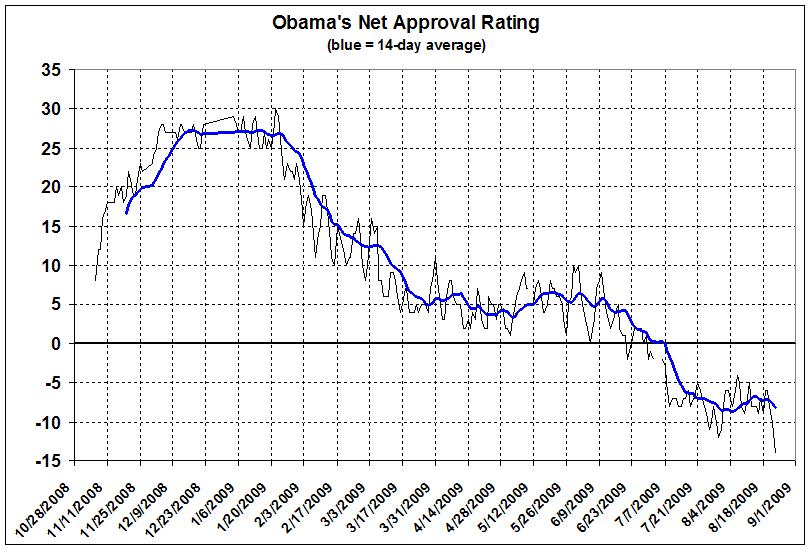
In “A Welcome Trend,” I point to Obama’s declining popularity and note that

the trend — if it continues — offers hope for GOP gains in the mid-term elections, if not a one-term Obama-cy.

Of course, it is early days yet. Popularity lost can be regained. Clinton succeeded in making himself so unpopular during his first two years in office that the GOP was able to seize control of Congress in the 1994 mid-term elections. But Clinton was able to regroup, win re-election in 1996, and leave the presidency riding high in the polls, despite (or perhaps because of) his impeachment.

Focusing on 2012, and assuming that Obama runs for re-election, what must the GOP do to unseat him? In “There Is Hope in Mudville,” I offer this:

What about 2012? Can the GOP beat Obama? Why not? A 9-State swing would do the job, and Bush managed a 10-State swing in winning the 2000 election. If Bush can do it, almost anyone can do it — well, anyone but another ersatz conservative like Bob Dolt or John McLame.

Not so fast. A closer look at the results of the 2008 election is in order:

  • Based on the results of the 2004-2008 elections, I had pegged Iowa, New Hampshire, and New Mexico as tossup States: McCain lost them by 9.5, 9.6, and 15.1 percentage points, respectively.
  • I had designated Florida, Ohio, and Nevada as swing-Red States — close, but generally leaning toward the GOP. McCain lost the swing-Red States by 2.8, 4.6, and 12.5 percentage points, respectively.
  • Of the seven States I had designated as leaning-Red, McCain lost Viginia (6.3 percentage points) and Colorado (9.0 percentage points). (He held onto Missouri by only 0.1 percentage point.)
  • McCain also managed to lose two firm-Red States: North Carolina (0.3) and Indiana (1.0).

The tossups are no longer tossups. It will take a strong GOP candidate to reclaim them in 2012. The same goes for Nevada, Virginia, and Colorado. Only Florida, Ohio, North Carolina, and Indiana are within easy reach for the GOP’s next nominee.

McCain did better than Bush in the following States: Oklahoma, Alabama, Louisiana, West Virginia, Tennessee, and Massachusetts. The first five were already firm- and leaning-Red, so McCain’s showing there was meaningless. His small gain in Massachusetts (1.7 percentage points) is likewise meaningless; Obama won the Bay State by 25.8 percentage points. In sum, there is no solace to be found in McCain’s showing.

The GOP can win in 2012 only if

  • Obama descends into Bush-like unpopularity, and stays there; or
  • Obama remains a divisive figure (which he is, all posturing to the contrary) and the GOP somehow nominates a candidate who is a crowd-pleaser and a principled, articulate spokesman for limited government.

The GOP must not offer a candidate who promises to do what Obama would do to this country, only to do it more effectively and efficiently. The “base” will stay home in droves, and Obama will coast to victory — regardless of his unpopularity and divisiveness.

I hereby temper the optimistic tone of my earlier posts. The GOP has a long row to hoe.

A Welcome Trend

obamas-net-approval2Derived from Rasmussen Reports, Daily Presidential Tracking Poll, Obama Approval Index History. I use Rasmussen’s polling results because Rasmussen has a good track record with respect to presidential-election polling.

Obama’s approval rating may have dropped for the wrong reasons; that is, voters expect him to “do something” about jobs, health care, etc. But voters have come to expect presidents to “do something” about various matters which are none of government’s business. So, even if voters have become less approving of Obama for the wrong reasons, the trend — if it continues — offers hope for GOP gains in the mid-term elections, if not a one-term Obama-cy.

There Is Hope in Mudville

Barack Obama’s achieved his electoral “landslide” in 2008 by grabbing only 9 of the 31 States won by G.W. Bush in 2004. Obama managed his less-than-impressive feat by running against the weakest candidate fielded by the GOP since 1996. (I don’t mean to suggest that G.W. Bush was a world-beater.)

How weak was John McCain? He beat Obama in his (McCain’s) home State of Arizona by 8.5 only percentage points. In 2004, Bush beat John Kerry in Arizona by 10.5 percentage points.

How weak is Obama at this moment? His net approval rating has dropped to -5, the lowest since his inauguration. And he’s less than 6 months into his presidency.

Hint to the  GOP: Stop playing nice and start attacking Obama in earnest: on his foreign policy, his defense policy, his profligate spending, his plans to socialize health care, his Supreme Court nominee, etc., etc., etc. Don’t attack Obama emotionally, attack him on the merits, with facts and figures. Do it hard and do it often, until the message sinks into the minds of all those swing voters out there.

What about 2012? Can the GOP beat Obama? Why not? A 9-State swing would do the job, and Bush managed a 10-State swing in winning the 2000 election. If Bush can do it, almost anyone can do it — well, anyone but another ersatz conservative like Bob Dolt or John McLame.

Obama’s Law

Obama seems bent on nominating a woman (preferably a black or Hispanic one) to succeed Justice Souter. (See, for example, the top-10 list of likely nominees, at The Ninth Justice.) There’s nothing wrong with having a woman on the Supreme Court. But Obama’s evident zeal to nominate a woman  speaks volumes about his approach to the law.

The law, to Obama, isn’t a set of rules to protect the honest and — most importantly — limit government. Obama’s law know no constitutional bounds; it is a recipe that combines “empathy” (i.e., cheap compassion), political payoff, and power-lust.

Sizing Up Obama

On the one hand, we have FDR II, replete with schemes for managing our lives and fortunes.

On the other hand, we have Carter-Clinton II, ready to: kowtow to those who would bury us, create the illusion that peace will reign perforce, and act on that illusion by slashing the defense budget (thereby giving aid and comfort to our enemies).

Through the haze of smoke and glare of mirrors I see a youngish president exhorting us to “fear nothing but fear itself” while proclaiming “peace for our time,” as we “follow the yellow-brick road” to impotent serfdom.

Fascism with a “Friendly” Face

This is the core meaning of fascism:

Fascism is a system in which the government leaves nominal ownership of the means of production in the hands of private individuals but exercises control by means of regulatory legislation and reaps most of the profit by means of heavy taxation. In effect, fascism is simply a more subtle form of government ownership than is socialism.

A fascistic government  — even a totalitarian one — will try to secure broad political support for itself. Scapegoating is a common technique for developing political support. Scapegoating, when successful, fosters the belief that the country’s economic and/or social problems — the ones that the fascistic regime promises to cure — are due to the actions of particular, identifiable groups of citizens. Another common technique is the suppression of dissent, which stifles critical commentary while imparting to the timid masses a lesson in the value of submissiveness to the regime.

Successful scapegoating serves two purposes. First, it turns public scrutiny away from the regime’s mistakes and misdeeds and toward the supposed misdeeds of the scapegoated groups. Second, scapegoating helps to build public support for the regime by identifying it as a force for good, as opposed to the scapegoated groups, which are painted as sources of evil.

Fascism, despite its prevailing image in the popular mind, need not come about through the efforts of black- or brown-shirted thugs. If you will re-read the opening definition of fascism, it should remind you of the present state of affairs in the United States, given that the federal government has assumed de facto control of two leading industries — financial services and automobile manufacturing — the first of which is central to the operations of America’s businesses.*

How did the United States get to this point? Through the “democratic” process, that’s how — without a shot, without a coup, without a foaming-at-the-mouth dictator. The citizens of the United States — enough of them, anyway — have, over the past eight decades, elected the members of Congress and the presidents (and, indirectly, their judicial appointees) who have brought us to our present state. The grinning FDR was a fascist; the smiling Obama is acting like one (see first footnote). Thus “Fascism with a ‘Friendly’ Face” (alternative title: “Bread and Circuses Redux“).

I now turn to the unfriendly face of fascism, that is, to scapegoating and the suppression of dissent. There was scapegoating a-plenty under FDR, as exemplified by his attacks on “economic royalists.” According to FDR, among many other rabble-rousers of the time, “the rich” were to blame for the Depression and were standing in the way of recovery. That FDR’s demonization of “the rich” and his schemes for centralizing power in Washington were the real obstacles to recovery is a fact that eluded his second-rate mind and which still eludes most Americans (even  a Nobel laureate). (For much more, you should buy and read FDR’s Folly: How Roosevelt and His New Deal Prolonged the Great Depression, which I own and have read critically. It’s repetitive and a somewhat dumbed-down, but generally on the mark.)

We are seeing, under Obama, a renewal of scapegoating. It is evident in his plans to soak “the rich,” which would (among other things) lead to income redistribution. As if the the recession could be cured by raising taxes on the very group that is most responsible for economic growth. As if very high incomes were the result of some kind of conspiracy and not symptomatic of a dynamic, growing economy. (For more about income inequality, see this, this, this, this, this, this, and this.) Scapegoating also is evident in Obama’s attack on hedge-fund managers who refused (how dare they!) to roll over and allow the holders of Chrysler bonds to suffer for the benefit of the UAW, to which Chrysler owes its (hoped for) demise. (One hedge-fund manager’s brisk and appropriate response to Obama’s attack is here.)

Then there is Obama’s decision to join the Left’s campaign to pin the “torturer” label on the Bush administration, thereby legitimating that campaign. We might yet witness the unprecedented spectacle of an incoming U.S. administration trying members of the previous administration for what amount to political “crimes” against Leftist sensibilities.

Obama’s ascendancy, though achieved by a fairly narrow popular-vote margin, has emboldened the Left (in and out of government) in other efforts to scapegoat conservatives and suppress conservative views; viz.:

  • this report from the Department of Homeland Security (especially the footnote on page 2) and related commentary (e.g., here, here, here, and here), all reminiscent of 1964, when Barry Goldwater was vilified (successfully) as an extremist because he stood against the concentration of power in Washington;
  • denunciations of the “tea party” movement (e.g. here and here);
  • efforts by universities and public officials to suppress dissent (e.g., here, here, here, and here), most notably Sen. Jay Rockefeller’s proposal to give the president authority to shut down the internet; and

Regarding the suppression of dissent, it is noteworthy that Obama’s has tagged Cass Sunstein (a Chicago crony) to head the Office of Information and Regulatory Affairs in the White House. (See this article for more about the likely direction of OIRA under Sunstein.) My biggest concern about Sunstein, who figures to be a strong influence on Obama, is his embrace of the oxymoronical thing known as “libertarian paternalism.” (For an exposition of its flaws, see this post and its predecessors, linked therein.)

“Libertarian paternalism” is nothing more than a dressed-up version of paternalism, in which the government is used to “nudge” people toward making the kinds of decisions that Sunstein and his ilk would make. That is to say, Sunstein (like too many other bright individuals) likes to believe that he knows what’s best for others. (That conceit is demolished in the posts mentioned at the end of the preceding paragraph and in these posts by an avowed utilitarian.)

“Libertarian paternalism” may seem innocuous, but there’s more to it than a bit of “nudging” (hah!) by the one-ton gorilla in the room (i.e., the federal government). Perhaps the most frightening item on Sunstein’s paternalistic agenda ties into Sen. Rockefeller’s proposal to give the president the power to shut down the internet — which amounts to the power to control the content of the internet. And make no mistake about it, Sunstein would like to control the content of the internet — for our own good, of course. I refer specifically to Sunstein’s “The Future of Free Speech,” in which he advances several policy proposals, including these:

4. . . . [T]he government might impose “must carry” rules on the most popular Websites, designed to ensure more exposure to substantive questions. Under such a program, viewers of especially popular sites would see an icon for sites that deal with substantive issues in a serious way. They would not be required to click on them. But it is reasonable to expect that many viewers would do so, if only to satisfy their curiosity. The result would be to create a kind of Internet sidewalk, promoting some of the purposes of the public forum doctrine. Ideally, those who create Websites might move in this direction on their own. If they do not, government should explore possibilities of imposing requirements of this kind, making sure that no program draws invidious lines in selecting the sites whose icons will be favoured. Perhaps a lottery system of some kind could be used to reduce this risk.

5. The government might impose “must carry” rules on highly partisan Websites, designed to ensure that viewers learn about sites containing opposing views. This policy would be designed to make it less likely for people to simply hear echoes of their own voices. Of course, many people would not click on the icons of sites whose views seem objectionable; but some people would, and in that sense the system would not operate so differently from general interest intermediaries and public forums. Here too the ideal situation would be voluntary action. But if this proves impossible, it is worth considering regulatory alternatives. [Emphasis added.]

A Left-libertarian defends Sunstein’s foray into thought control, concluding that

Sunstein once thought some profoundly dumb policies might be worth considering, but realized years ago he was wrong about that… The idea was a tentative, speculative suggestion he now condemns in pretty strong terms.

Alternatively, in the face of severe criticism of his immodest proposal, Sunstein merely went underground, to await an opportunity to revive his proposal. I somehow doubt that Sunstein, as a confirmed paternalist, truly abandoned it. The proposal certainly was not off-the-cuff, running to 11 longish web pages.  Now, judging by the bulleted list above, the time is right for a revival of Sunstein’s proposal. And there he is, heading the Office of Information and Regulatory Affairs. The powers of that office supposedly are constrained by the executive order that established it. But it is evident that the Obama adminstration isn’t bothered by legal niceties when it comes to the exercise of power. Only a few pen strokes stand between Obama and a new, sweeping executive order, the unconstitutionality of which would be of no import to our latter-day FDR.

Where will it all end? As I argue here, the United States already has descended into statism. The further descent into ingrained fascism is but a fine-tuning exercise for the vast, Left-wing alliance, which consists of public-school “educators,” liberal-arts academics, and their sycophantic students; Hollywood and New York celebrities and their hangers-on; “artists” and “intellectual workers” of most stripes; well-educated, upper-income, professionals who live in and around major metropolitan areas; and hordes of politicians (local, State, and national), who foster and benefit from the prejudices of the alliance. This broad alliance patronizes idealistic twenty-somethings, blacks, Latins, and labor-union members — the four groups from which its favored political candidates draw decisive support at the polls.

The Leftist alliance scorns America and its traditional (but largely abandoned) values of personal responsibility and respect for the persons and property of others. The alliance exalts, instead, the politics of entitlement and envy, of class, ethnic, racial, and gender conflict. As a result, the alliance has succeeded in demolishing the long-standing consensus that the main constitutional functions of the federal government are “to establish Justice, provide for the common defence,” and ensure the free movement of goods and persons among the States.**

Where will it all end? Unless we are roused from our Leftist idyll by some-one or some-thing, it will end in an Orwellian nightmare. The state will control our lives, in minute detail, from conception (and the prevention thereof) to death (and the means thereof).
__________
* For some views about our descent into fascism (even where it isn’t called that), see these posts of mine:
Things to Come
Reclaiming Liberty Throughout the Land
Are We All Fascists Now?

See  also these posts and articles by other writers:
Fundamentally Different
Obama the Planner
Obama: The Grand Strategy
The Death of Democratic Capitalism?
Tarred by TARP
Elizabeth Warren’s Holy Crusade
Pay Limits May Apply to Toxic-Asset Relief Program, Report Says
Environmentalists Are Funny. Right?
EPA’s Endangerment Finding
EPA Says Greenhouse Gases are Threat to Public

** The preamble to the Constitution also mentions “insur[ing] domestic Tranquillity,” “provid[ing] for the general Welfare,” and “secur[ing] the Blessings of Liberty to ourselves and our Posterity.” These injunctions — aside from a few specific, textual grants of power for dealing with insurrections — merely reflect the Framers’ hopes for the nation’s future under the auspices of the new Constitution.

Are We All Fascists Now?

David Henderson of EconLog thinks so; that is, he thinks we’ve become the subjects of a fascist regime:

[President Obama] has already, in less than 100 days, moved the U.S. economy further towards fascism. Sean Hannity and other critics keep criticizing Obama for his socialist leanings. But the more accurate term for many of his measures, especially in the financial markets and the auto market, is fascism.

Here’s what Sheldon Richman writes about “Fascism” in The Concise Encyclopedia of Economics:

Where socialism sought totalitarian control of a society’s economic processes through direct state operation of the means of production, fascism sought that control indirectly, through domination of nominally private owners. Where socialism nationalized property explicitly, fascism did so implicitly, by requiring owners to use their property in the “national interest”–that is, as the autocratic authority conceived it. (Nevertheless, a few industries were operated by the state.) Where socialism abolished all market relations outright, fascism left the appearance of market relations while planning all economic activities. Where socialism abolished money and prices, fascism controlled the monetary system and set all prices and wages politically. In doing all this, fascism denatured the marketplace. Entrepreneurship was abolished. State ministries, rather than consumers, determined what was produced and under what conditions.

I agree wholeheartedly with Henderson and Richman. But I must say that Obama’s latest moves only confirm our long drift to fascism, which is a particular form of statism. As I wrote about 18 months ago:

We were, for decades, poised on the brink of the abyss of statism, which is outright state control of most social and economic institutions (e.g., medicine, notably but far from exclusively). I have concluded that we have gone over the brink and slid, silently and docilely, into the abyss.

Statism may be reached either as an extension of communitarianism or via post-statist anarchy or near-anarchy, as in Stalin’s Russia, Hitler’s Germany, and Mao’s China. We have come to statism via communitarianism, which leads inevitably to statism because the appetite for largesse is insatiable, as is the desire (in certain circles) to foster “social (or cosmic) justice.”

I was once optimistic that our transition to all-out statism would lead, in turn, to overthrow of statism:

[S]tatism is an easier target for reform than communitarianism. The high price of statism becomes obvious to more voters as more facets of economic and personal behavior are controlled by the state. In other words, statism’s inherent weakness is that it creates more enemies than communitarianism.

That weakness becomes libertarians’ opportunity. Persistent, reasoned eloquence in the cause of liberty may, at last, slow the rise of statism and hasten its rollback. And who knows, perhaps libertarianism will gain adherents as the rollback gains momentum.

My optimism has vanished, as I have come to understand that politicians their enablers (voters and contributors) are profoundly irrational. They prefer statism to liberty, regardless of what they say. They (most of them) mean to be benign, but statism is not benign. Statism may seem benign — as it does to Europeans, for example — but it is dehumanizing, impoverishing, and — at bottom — destructive of the social fabric upon which liberty depends.

UPDATE

Megan McArdle takes exception to David Henderson’s observations. She writes:

How is this helpful?  Has clarifying the distinction between fascism and socialism really added to most peoples’ understanding of what the Obama administration is doing?  All this does is drag the specter of Hitler into the conversation.  And the problem with Hitler was not his industrial policy–I mean, okay, fine, Hitler’s industrial policy bad, right, but I could forgive him for that, you know?  The thing that really bothers me about Hitler was the genocide.  And I’m about as sure as I can be that Obama has no plans to round up millions of people, put them in camps, and find various creative ways to torture them to death.

If he does, look, I take it all back.  Use the F-word freely.  Hell, I’ll hide you in our spare bedroom when the state police squads come looking for you.  But until then, can we stick to less inflammatory terms? Surely creative and intelligent adults can find ways to critique Obama without pointing out that Hitler was also a very effective speaker.

It is helpful. Anything that might cause Americans to reject Obama’s policies is helpful. If it takes scaring them by invoking the F-word, I’m all for it. After all, it is fair to say that Obama is a fascist (e.g. this and this), just as it is fair to say that FDR was one, in spades. (Does “Obama youth” ring a bell?)

Fascism is a bad thing. Therefore, why should anyone refrain from calling a fascist a fascist, when the target is a fascist? Leftists and outraged adolescents (much the same thing) like to pin the fascist label on libertarians and conservatives, but in doing so they merely demonstrate their petulance and ignorance of the word’s meaning.

Yes, Hitler was malign compared with Obama, but that doesn’t make Obama benign. In fact, Obama’s policies with respect to embryonic stem-cell research and abortion are steps in the direction of Hitlerian eugenics. If you don’t agree, read this post and all the posts listed at the end of it, plus these:
Singer Said It
The Case against Genetic Engineering
A “Person” or a “Life”?
A Wrong-Headed Take on Abortion

Reclaiming Liberty throughout the Land

Revised version here.


The Perils of Europeanism

Charles Murray speaks eloquently in opposition to our Europe-ward drift; for example:

….If we want to know where America as a whole is headed–its destination–we should look to Europe.

Drive through rural Sweden, as I did a few years ago. In every town was a beautiful Lutheran church, freshly painted, on meticulously tended grounds, all subsidized by the Swedish government. And the churches are empty. Including on Sundays. Scandinavia and Western Europe pride themselves on their “child-friendly” policies, providing generous child allowances, free day-care centers, and long maternity leaves. Those same countries have fertility rates far below replacement and plunging marriage rates. Those same countries are ones in which jobs are most carefully protected by government regulation and mandated benefits are most lavish….

I stand in awe of Europe’s past. Which makes Europe’s present all the more dispiriting. And should make its present something that concentrates our minds wonderfully, for every element of the Europe Syndrome is infiltrating American life as well.

We are seeing that infiltration appear most obviously among those who are most openly attached to the European model–namely, America’s social democrats, heavily represented in university faculties and the most fashionable neighborhoods of our great cities. There are a whole lot of them within a couple of metro stops from this hotel. We know from databases such as the General Social Survey that among those who self-identify as liberal or extremely liberal, secularism is close to European levels. Birth rates are close to European levels. Charitable giving is close to European levels. (That’s material that Arthur Brooks has put together.) There is every reason to believe that when Americans embrace the European model, they begin to behave like Europeans.

Europeanism rests on the fallacy of the “free lunch.” The state, which produces nothing, somehow underwrites the benefits listed by Murray — as well as “benefits” like socialized medicine and month-long vacations. All of these supposed benefits must be paid for, of course; the only question is how they will be paid for.

The illusion of free benefits is a disincentive to work: Why work harder when the state will ‘give” you child care, health care, etc.? The cost of those “free” benefits is a disincentive to hiring, business formation, and capital investment, thus penalizing those Europeans who are willing to work and take the business risks that lead to job creation.

Because of these disincentives, most European nations have long experienced low growth and high unemployment. There is even more of that in Europe’s future (and in ours).

Why? Because the “free” benefits enjoyed by Europeans are not free; they come at a high price. And that price will become even less affordable because of the low birth rate among Europeans. The low birth rate means that future European generations (like our own future generations) will find it harder to bear the burden of supporting their elders (whose numbers will rise disproportionately) while paying for their own “free” benefits.

Europeans are able to enjoy “free” benefits, in part, because they are taxed lightly (relative to Americans) for defense; Europe is a free rider on America’s military strength. As our military budget is tapped to pay for our own adventures in Europeanism, the free ride will end for Europeans. They will then have to pay the price of defending themselves from, say, an aggressive Russia or they will have to succumb to Russia’s territorial and economic demands.

Europeanism, in sum, is a prescription for economic stagnation, unrest, demagogic despotism (as the likely response to unrest), and surrender.

In the Long Run We Are All Poorer

The title of this post is a play on John Maynard Keynes’s famous line, “in the long run we are all dead,” which was not a defense of government spending during the Great Depression. The line comes from  Keynes’s Tract on Monetary Reform, which he published in 1923, years before the Depression. Keynes was in fact writing about the need for government action against inflation.

This post, as its title may suggest, complements an earlier post, “Are We Mortgaging Our Children’s Future?” As I say there, Obama’s economic plan (if it can be called that)

doesn’t simply “mortgage our children’s future.”  It does a lot more than that. Like all government spending that isn’t undertaken for the protection of Americans from foreign and domestic predators, the [Obama plan] mortgages our present, our future, our children’s future, and their children’s future, ad infinitum. The real problem isn’t the size of the national debt, it’s the size of government….

…Obama[‘s] initiatives…will stimulate a massive growth in the size and intrusiveness of government.

Here, I begin with links to three papers about the multiplier effect of government spending:

Is Government Spending Too Easy an Answer?” (N. Gregory Mankiw)

Government Spending Is No Free Lunch” (Robert J. Barro)

New Keynsian versus Old Keynsian Government Spending Multipliers” (John F. Cogan, et al.)

The bottom line: Increases in government spending probably have a much smaller multiplier (stimulative) effect than claimed by the administration; the effect may well be negative. That is, increases in government spending probably will crowd out private consumption and investment, both in the near term (when spending increases are supposed to spur private consumption and investment) and in the long run (as the increases become permanent).

Next, I offer a baker’s dozen links to commentary about Obama’s economic policies and their implications:

Stocks Hate Obeynomics” (Forbes.com)

The Left’s Grip on the American Economy” (Forbes.com)

Obama’s $646 Billion Cap-and-Trade Green Tax” (James Pethokoukis)

The Obama Revolution: Paid for by the people” (Opinion Journal)

The 2% Illusion: Take everything they earn and it still won’t be enough” (Opinion Journal)

Obama Proposes a European U.S.” (Charles Krauthammer)

Federal Outlays as a Percentage of GDP” (N. Gregory Mankiw)

Obama Lied; the Economy Died” (Tony Blankley)

The Great Non Sequitur: The sleight of Hand behind Obama’s Agenda” (Charles Krauthammer)

Neither Moderate Nor Centrist” (Peter Robinson)

Obama’s Radicalism Is Killing the Dow” (Michael J. Boskin)

Even Worse than the Great Depression” (Donald Luskin)

Obama’s Left Turn” (Stuart Taylor)

Taylor sums it up, thusly:

…I now worry that [Obama] may be deepening what looks more and more like a depression and may engineer so much spending, debt, and government control of the economy as to leave most Americans permanently less prosperous and less free.

Precisely.

There is a bit of hope, in the unlikely form of public opinion. Obama’s approval index (percentage of respondents strongly approving minus percentage strongly disapproving) has gone from a high of +30 on January 22 to a low of +6 (as of March 9). If economic logic doesn’t sway Obama, perhaps he can be swayed by public opinion — though I very much doubt it, given his long-standing adherence to economic and political extremism. (For example, his voting record as a senator placed him among the most “liberal,” i.e., statist, members of the U.S. Senate.)

Where are we headed then? The stock market — for all of its exaggerated swings — does a pretty good job of reflecting expectations about the country’s future economic performance. Witness the performance of the S&P 500:

Real S&P 500, updatedReal S&P price index derived from annual closing prices of the S&P 500 Composite Index, as reconstructed by Global Financial Data, Inc. (no longer publicly available), and GDP deflator (Louis D. Johnston and Samuel H. Williamson, “What Was the U.S. GDP Then?” MeasuringWorth, 2008. URL: http://www.measuringworth.org/usgdp/).

The now-enviably stable post-Civil War trend was broken in the early 1900s, when the “progressive” agenda began to take hold — most notably with the passage of the Food and Drug Act and the vindictive application of the Sherman Antitrust Act by Theodore Roosevelt. It has been all downhill since, with the ratification of the Sixteenth Amendment (enabling the federal government to tax incomes); the passage of the Clayton Antitrust Act (a more draconian version of the Sherman Act, which also set the stage for unionism); World War I (a high-taxing, big-spending, command-economy operation that whet the appetite of future New Dealers); a respite (the boom of the 1920s, which was owed to the Harding-Coolidge laissez-faire policy toward the economy); and the Great Depression and World War II (truly tragic events that imbued in the nation a false belief in the efficacy of the big-spending, high-taxing, regulating, welfare state that we now “enjoy”).

Yes, stock prices have continued to rise, on the whole, but they have fluctuated wildly around a trend that is about 50 percent below the trend that prevailed from 1870 to the early 1900s. Such is the destructive power of the regulatory-welfare state.

The reaction of the stock market to Obama’s ascendancy since May 2008 — when he locked up the Democrat nomination — suggests that we have entered an era of even-lower stock prices. I have indicated the onset of this new era by plotting the values for 2008 and 2009 (to date) in red. Lower stock prices would be bad enough, in and of themselves, but what they betoken is the looming economic catastrophe that surely will result if Obama and his ilk persist in their oppressive program of spending, taxing, and regulating.

Eugene Fama and Kenneth French (distinguished financial economists at the University of Chicago) get it almost right:

Government intervention affects the market in two ways. First, it affects the level of expected future profitability, which has direct effects on stock prices. Second, government intervention and uncertainty about the government’s future actions change the risk of expected future profits, which affects stock prices by raising or lowering the discount rates for expected future profits, and thus raising or lowering expected stock returns. Our view is that the rhetoric and sweeping initiatives of the new administration have lowered market expectations of future profitability, and the uncertainty about government policies has increased the risk of expected future profits. Both effects have contributed to the lower stock prices we have seen as the policies of the new administration have unfolded. If the market has it right (that is, if the market is efficient) all this is built into current stock prices, and expected returns are higher going forward.

Future returns may be positive, over the long run, but those returns — and economic output — will be lower than they would have been, absent Obamanomics.

Are We Mortgaging Our Children’s Future?

Or, what will the “stimulus package” stimulate?

Congressional Democrats used to depict George W. Bush’s tax-rate reductions as fiscally irresponsible. The real problem, for Democrats, wasn’t that tax cuts might cause the national debt to swell. The real problem, for Democrats, was the prospect of having less money to spend on things that Democrats like to spend money on.

Now that Democrats control the White House and both houses of Congress, fiscal irresponsibility is all the rage (among Democrats). It seems that an increase in the national debt isn’t fiscally irresponsible if (a) it results from Democrat policies and (b) it’s caused not by lower taxes but by huge government spending programs.

Predictably, some Republicans have reverted to the old GOP line that deficit spending mortgages our children’s future (or some such thing).  The flaws in this assertion are exposed very nicely here, by professional economists.

However, the suggestion that the national debt represents inter-generational theft does hint at an essential truth. The burgeoning size and influence of government (which is the cause of the burgeoning national debt) amounts to theft — period:

1. Government spending (whether financed by taxes, borrowing, or money creation) commandeers resources that could have been used to produce goods and services in the private sector. Government spending diverts those resources to uses deemed “beneficial” not by producers and consumers but by politicians and interest groups.

2. Some of the commandeered resources are devoted to the payment of government employees for the purpose of making work for them, which includes the  writing and enforcement of regulations that hinder economic growth. Other resources are commandeered for the purpose of transferring purchasing power from productive members of society to less-productive and unproductive ones, thus penalizing and discouraging the traits that drive economic growth: hard work, thrift, innovation, and entrepreneurship.

3. The net effect  — near-term and long-run — is to reduce total economic output below what it could have been.

In other words, the “stimulus package” doesn’t simply “mortgage our children’s future.”  It does a lot more than that. Like all government spending that isn’t undertaken for the protection of Americans from foreign and domestic predators, the “stimulus package” mortgages our present, our future, our children’s future, and their children’s future, ad infinitum. The real problem isn’t the size of the national debt, it’s the size of government.

The best way to stimulate the economy is to reduce the tax and regulatory burdens that stifle hard work, thrift, innovation, and entrepreneurship — words that don’t seem to be in Democrats’ vocabulary. On the contrary, Democrats (Barack Obama, in particular) are bent on increasing the tax and regulatory burdens on Americans, especially those upon whom growth most depends.

As Friedrich Hayek explains, in The Constitution of Liberty,

the illusion that by means of progressive taxation the burden can be shifted substantially onto the shoulders of the wealthy has been the chief reason why taxation has increased as fast as it has done and that, under the influence of this illusion, the masses have come to accept a much heavier load than they would have done otherwise. The only major result of the policy has been the severe limitation of the incomes that could be earned by the most successful and thereby gratification of the envy of the less-well-off.

The answer to the question asked at the beginning of this post: The “stimulus package” (and other Obama initiatives) will stimulate a massive growth in the size and intrusiveness of government. Greg Mankiw agrees (here and here, for example).

Further reading:
Curing Debt Hysteria in One Easy Lesson
The Real Meaning of the National Debt
Debt Hysteria, Revisited
Why Government Spending Is Inherently Inflationary
Joe Stiglitz, Ig-Nobelist
A Simple Fallacy
Ten Commandments of Economics
Professor Buchanan Makes a Slight Mistake
More Commandments of Economics
Productivity Growth and Tax Cuts
Risk and Regulation
Liberty, General Welfare, and the State
Do Future Generations Pay for Deficits?
The Laffer Curve, “Fiscal Responsibility,” and Economic Growth
And much more, here.