In Mourning

I am in mourning for liberty in the United States, which has been killed by today’s ruling by the U.S. Supreme Court. Thus the black band at the top of this blog.

More to come.

UPDATE (09/06/13)

I’ve gone back to red because I’m fighting mad, and plan to stay that way.

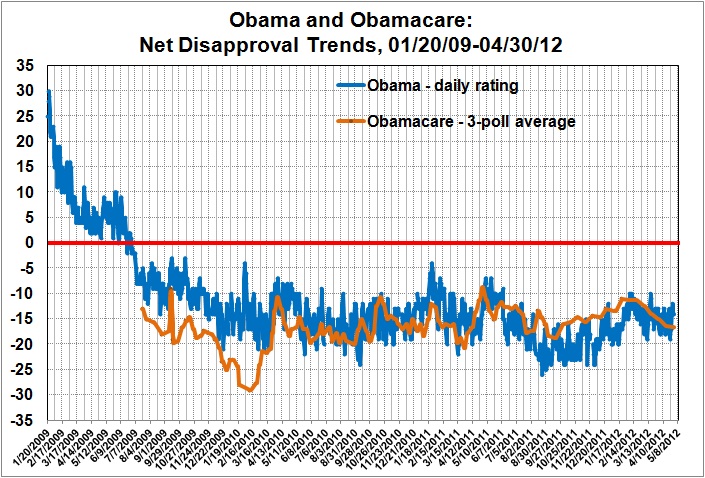
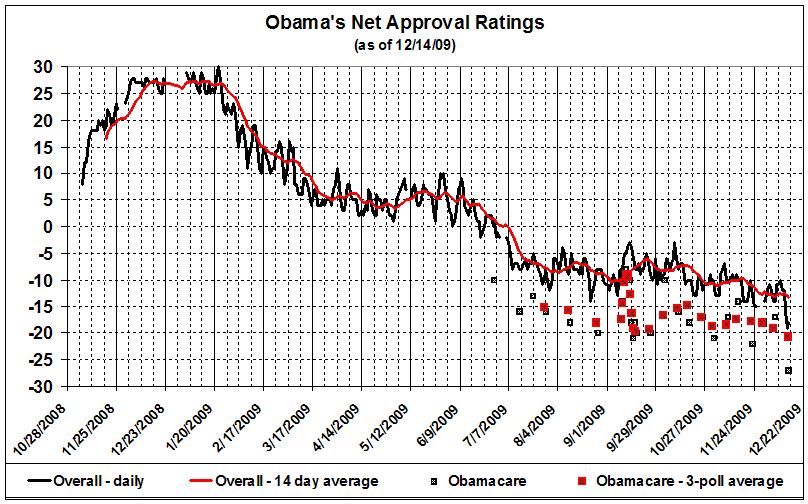
Obama and Obamacare: Twin Disasters

A picture worth 2,000 words:


Sources: Rasmussen Reports, Obama Approval Index History and Health Care Law.

I could have added graphs about the unemployment rate  (2 percentage points above the peak reached during GWB’s administration), the employment/population ratio (5 percentage points below the GWB peak), and the federal debt (which has grown almost 50 percent in the 3 years and 3 months of Obama’s presidency, as against a 25-percent rise in the first 3 years and 3 months of GWB’s presidency) — but why rub it in?

Not-So-Random Thoughts (I)

Links to the other posts in this occasional series may be found at “Favorite Posts,” just below the list of topics.

Secession

Ilya Somin, writing at The Volokh Conspiracy, on secession:

The US Constitution, of course, is one of many where secession is neither explicitly banned or explicitly permitted. As a result, both critics and defenders of a constitutional right of secession have good arguments for their respective positions. Unlike the preceding Articles of Confederation, the Constitution does not include a Clause stating that the federal union is “perpetual.” While the Articles clearly banned secession, the Constitution is ambiguous on the subject.

Even if state secession is constitutionally permissible, the Confederate secession of 1861 was deeply reprehensible because it was undertaken for the profoundly evil purpose of perpetuating and extending slavery. But not all secession movements have such motives. Some are undertaken for good or at least defensible reasons. In any event, there is nothing inherently contradictory about the idea of a legal secession.

Of course, whether or not a secession is legal, it may be morally justified. Conversely, a legal secession may be morally unjustified, as was the case with the Southern secession. But the history of the Southern secession does not taint the legal and moral grounds for secession. As I say here,

The constitutional contract is a limited grant of power to the central government, for the following main purposes: keeping peace among the States, ensuring uniformity in the rules of inter-State and international commerce, facing the world with a single foreign policy and a national armed force, and assuring the even-handed application of the Constitution and of constitutional laws. That is all.

It is clear that the constitutional contract has been breached. It is clear that the Constitution’s promise to “secure the Blessings of Liberty to ourselves and our Posterity”  has been blighted.

Desperate times require desperate measures. I suggest that we begin at the beginning, with a new Declaration of Independence, and proceed from there to a new Constitution.

Obamacare

In a post at The American, John F. Gaski writes:

On the central issue of ObamaCare’s notorious mandate—i.e., whether it is constitutional for the federal government to compel a consumer purchase—everything hinges on the U.S. Constitution’s Commerce Clause. That element of the Constitution gives the federal government authority to regulate interstate commerce or activities affecting it. So far, so reasonable.

But the crux of the issue is whether forcing Americans to buy healthcare is regulation of commerce in the first place. Opponents note that non-purchase of healthcare should not be considered commerce or commerce-related activity. ObamaCare apologists, including some federal judges, make the remarkable claim that a decision not to purchase qualifies as interstate commerce or activity affecting interstate commerce, the same as a decision to purchase or a purchase itself. But even the non-partisan Congressional Research Service, in its 2009 assessment of likely PPACA constitutionality, acknowledged that Commerce Clause-based federal regulatory authority targets genuine activities that affect interstate commerce, not inactivity.

How to resolve this disagreement? The answer is staring us in the face, but has remained obscure to some lawyers and jurists who cannot quite see the forest for the trees. All you really need to know is what the word “commerce” means. To wit, commerce is “exchange of goods, products, or property . . . ; extended trade” (Britannica World Language Dictionary, 1959); “the buying and selling of goods . . .; trade” (Webster’s New World Dictionary, 1964); “the buying and selling of commodities; trade” (The Merriam-Webster Dictionary, 1974); “interchange of goods or commodities, especially on a large scale . . . ; trade; business” (Dictionary.com, 2012). Uniformly, we see, the definition of commerce involves activity, not just a decision to act, and certainly not a decision to not act. The meaning of the concept of commerce presumes action, and always has. Moreover, even casual philology will confirm that the accepted meaning of “commerce” at the time of the Constitution’s drafting referenced activity, not inactivity, at least as much then as it does now (see C. H. Johnson, William & Mary Bill of Rights Journal, October 2004). In the same way, the Commerce Clause has long been construed to apply to action in or affecting commerce, from the 1824 Gibbons v. Ogden Supreme Court case onward.

I am in complete agreement:

[T]he real issue … comes down to this: Does Congress’s power to regulate interstate commerce extend to “health care” generally, just because some aspects of it involve interstate commerce? In particular, can Congress constitutionally impose the individual mandate under the rubric of the Commerce Clause or the Necessary and Proper Clause?…

It is safe to say that a proper reading of the Constitution, as exemplified in the authoritative opinions excerpted above, yields no authority for Obamacare. That monstrosity — the official, Orwellian title of which is the Patient Protection and Affordable Care Act (PPACA) — attempts to reach an aggregation known as “health care,” without any differentiation between interstate commerce, intrastate commerce, and activities that are part of neither, namely, the choices of individuals with respect to health insurance.

It may be a valid exercise of Congress’s power to regulate actual interstate commerce that touches on the provision of health care. It is not a valid exercise to aggregate everything called “health care” and to regulate it as if it were all within the reach of Congress. When that happens, there is no room left — in “health care” nor, by extension, any other loose aggregation of activities — for State action or individual choice.

In sum, Obamacare is neither a valid regulation of interstate commerce nor necessary and proper to a valid regulation of interstate commerce. It is a governmental seizure of 1/9th of the economy. The individual mandate — which is a central feature of that seizure — is nothing more than coercion. It is no less peremptory than the military draft.

Freedom of Conscience

Yes, Virginia, there is freedom of conscience in Virginia:

A bill that ensures that faith-based adoption agencies in the state of Virginia won’t be forced to place children in households led by same-sex couples has passed both houses of the General Assembly and is heading to the desk of Gov. Robert McDonnell, a supporter of the legislation, who is expected to sign it soon.

Gov. McDonnell and the majorities in the Virginia legislature are standing up for freedom of conscience, which is among the negative rights that is trampled by grants of  “positive rights” (i.e., privileges). These

are the products of presumption — judgments about who is “needy” and “deserving” — and they are bestowed on some by coercing others. These coercions extend not only to the seizure of income and wealth but also to denials of employment (e.g., affirmative action), free speech (e.g., campaign-finance “reform”), freedom of contract (e.g., mandatory recognition of unions), freedom of association (e.g., forced admission of certain groups to private organizations), freedom of conscience (e.g., forced participation in abortions), and on and on.

Income Inequality

Thomas A. Garrett, a sensible economist, says good things about income inequality:

The apparent increase in U.S. income inequality has not escaped the attention of policymakers and social activists who support public policies aimed at reducing income inequality. However, the common measures of income inequality that are derived from the census statistics exaggerate the degree of income inequality in the United States for several reasons. Furthermore, although income inequality is seen as a social ill by many people, it is important to understand that income inequality has many economic benefits and is the result of, and not a detriment to, a well-functioning economy….

…[O]ver time, a significant number of households move to higher positions along the income distribution and a significant number move to lower positions along the income distribution. Common reference to “classes” of people (e.g., the lowest 20 percent, the richest 10 percent) is very misleading because income classes do not contain the same households and people over time….

The unconstrained opportunity for individuals to create value for society, which is reflected by their income, encourages innovation and entrepreneurship. Economic research has documented a positive correlation between entrepreneurship/innovation and overall economic growth.9 A wary eye should be cast on policies that aim to shrink the income distribution by redistributing income from the more productive to the less productive simply for the sake of “fairness.” 10 Redistribution of wealth would increase the costs of entrepreneurship and innovation, with the result being lower overall economic growth for everyone.

I am losing track of the posts in which I have made the same points. See this one and this one, and the posts linked in each of them.

The Left-Libertarian (“Liberal”) Personality vs. Morality

Will Wilkinson, a left-libertarian (i.e., modern “liberal”) if ever there was one, writes about his score on the Big-Five Personality Test:

I score very high in “openness to experience” and worryingly low in “conscientiousness”.

A true libertarian (i.e., a Burkean) would score high on “openness to experience” and high on “conscientiousness” — as I do.

As I have said, differences

between various libertarian camps and between libertarians, Burkean conservatives, yahoo conservatives, “liberals,” and so on — are due as much to differences of temperament as they are to differences in knowledge and intelligence.

But temperament is a reason for political error, not an excuse for it:

[T]he desirability or undesirability of state action has nothing to do with the views of “liberals,” “libertarians,” or any set of pundits, “intellectuals,” “activists,” and seekers of “social justice.” As such, they have no moral standing, which one acquires only by being — and acting as — a member of a cohesive social group with a socially evolved moral code that reflects the lessons of long coexistence. The influence of “intellectuals,” etc., derives not from the quality of their thought or their moral standing but from the influence of their ideas on powerful operatives of the state.

See also:
Libertarianism and Morality
Libertarianism and Morality: A Footnote

Obamacare: Neither Necessary Nor Proper

This is from my post “The Unconstitutionality of the Individual Mandate“:

The Constitution simply gives Congress the power to regulate interstate commerce. And not all activities comprised in “health care” occur in transactions that are properly considered interstate commerce. In fact, significant portions of it (e.g., the manufacture of products used in health care, the use of those products by health-care providers, and the personal services rendered by health-care providers) clearly occur outside the activities properly understood as interstate commerce: the sale and transmission of goods (tangible and intangible) across State lines.

With regard to the second question, it follows that the mandate cannot be “necessary and proper” if Congress lacks the authority to regulate “the massive interstate market in health care,” in the first place….

…If the power of Congress to regulate “health care” cannot be found in its power to regulate interstate commerce, where can it be found? Nowhere in the Constitution. And if such a power cannot be found in the Constitution, then there can be no “necessary and proper” law that requires individuals to buy health insurance….

The defenders of Obamacare and the individual mandate would argue that it is “necessary and proper” to regulate activities (commercial or not) that are tangentially related to the portion of “health care” that is comprised in interstate commerce. That is so, in their view, because otherwise the effort to regulate the portion comprised in interstate commerce would fail to have the desired effect. In other words, they would regulate everything that can be labeled “health care,” and everything beyond that which threatens to undermine the intended regulatory outcome.

In so many words, the defenders of Obamacare and the individual mandate, like many others before them, want Congress to have the power to regulate anything and everything that they want Congress to regulate….

James Madison held the same view:

…[T]he Constitution did not give Congress the power to establish an incorporated bank. Hamilton, [Madison] said, was urging the legislators to charter the bank based on the power that Article I, Section 8 of the Constitution gives them “to make all laws which shall be necessary and proper for carrying into Execution the foregoing Powers”—specific, limited powers that the section had just enumerated. But notice what “ductile” language Hamilton must use “to cover the stretch of power contained in the bill.” As the bill puts it, the bank “might be conceived to be conducive to the successful conducting of the finances; or might be conceived to tend to give facility to the obtaining of loans,” Madison quoted, adding emphasis oozing with incredulous contempt. So to begin with, the bank wasn’t even “necessary,” as the “necessary and proper” clause required; “at most it could be but convenient.”

Worse, Madison suggested, Hamilton’s reliance on a doctrine of implied powers instead of explicit ones courted disaster. “The doctrine of implication is always a tender one,” he warned. “Mark the reasoning” behind the bill: “To borrow money is made the end and the accumulation of capitals, implied as the means. The accumulation of capitals is then the end, and a bank implied as the means.” By such a chain of implication, we end up with “a charter of incorporation, a monopoly, capital punishments, &c.,” until finally we take in “every object of legislation, every object within the whole compass of political economy.” In that case, Madison cautioned, the “essential characteristic of the government, as composed of limited and enumerated powers, would be destroyed,” and Congress would bear “the guilt of usurpation.” We should not, he later wrote, “by arbitrary interpretations and insidious precedents . . . pervert the limited government of the Union, into a government of unlimited discretion, contrary to the will and subversive of the authority of the people.” (Myron Magnet, “The Great Little Madison,” City Journal, Spring 2011)

As for the Necessary and Proper Clause:

…[M]ost federal regulations today are justified by the Necessary and Proper Clause. They are said to be within Congress’s Interstate Commerce Power— but within not the core Commerce Clause (“The Congress shall have Power . . . To regulate Commerce . . . among the several States”). Rather, they are said to be supported by the accompanying authority to “make all Laws which shall be necessary and proper for carrying into Execution” the power to regulate commerce.

Now, here’s the irony of the situation: Far from granting “broad authority” to Congress, the truth is that Necessary and Proper Clause grants no power at all. It is placed at the end of Article I, Section 8 as an explanation—that is, a “recital.” A recital is a passage in a legal document that has no substantive legal effect, but serves to inform the reader of assumptions or facts behind the document. Another example of a recital in the Constitution is the Preamble.

In recent years, several constitutional scholars have investigated the true meaning of the Clause, and have worked to correct the record. The process began with an article written by Professor Gary L. Lawson and Patricia B. Granger: The Proper Scope of Federal Power: A Jurisdictional Interpretation of the Sweeping Clause, 43 Duke L. J. 267 (1994). It focused on the meaning of “proper.” A decade later, I delved into the historical record. I found that wording of this kind was extremely common in eighteenth-century documents granting power from one person to another. I also found the courts had issued cases interpreting this language, and that the Founders had adopted the courts’ interpretation. See articles here and here.

Finally, Professors Lawson and I teamed up with two other noted scholars, Geoff Miller, and Guy Seidman, and wrote a book on the subject. (We all have differing political views, by the way.) The book is called The Origins of the Necessary and Proper Clause, and it was published last year by Cambridge University Press.

Here’s what we found:

* The Clause is a mere recital. It informs the reader how to interpret congressional authority. It does not grant any power.

* The term “necessary” tells the reader that congressional authority is interpreted according to the intent behind the document, rather than very strictly (as the Articles of Confederation required).

* The Clause does this by telling the reader that the legal “doctrine of incidental powers” applies to the Constitution. This means that Congress can regulate certain activities outside the strict reading of its powers, but ONLY IF this ancillary regulation is (1) subordinate to an express power, and (2) a customary or necessary way of carrying out the express power. For example, in regulating commerce, Congress can require accurate labels on goods to be shipped in interstate commerce. But Congress cannot regulate the entire manufacturing process.

* The word “proper” means that a law must comply with Congress’s fiduciary (public trust) responsibilities. A law is not “proper”—and is therefore unconstitutional— if it invidiously discriminates among people, violates individual rights, is utterly irrational, or exceeds congressional authority.

* Contrary to prevailing legal mythology, Chief Justice Marshall’s famous case of McCulloch v. Maryland (1819) did not stretch the Clause, but applied it properly and with due regard for its limitations.

Recently, Dave Kopel, the Independence Institute Research Director, filed an amicus curiae brief in the most important anti-Obamacare lawsuit. He did so on behalf of Professors Lawson, Seidman, and me. The goal? To correct the record and inform the courts what the Necessary and Proper Clause REALLY means. (Rob Natelson, “The Constitution: Does the Necessary and Proper Clause Grant “Broad Authority” to Congress? Actually, None at All,” posted May 18, 2011, at The Cauldron: By Caldara, the blog of the president of the Independence Institute)

Which brings us full circle to the opening quotation.

Related posts:
Unintended Irony from a Few Framers
Freedom of Contract and the Rise of Judicial Tyranny
Social Security Is Unconstitutional
The Constitution in Exile
What Is the Living Constitution?
Blame It on the Commerce Clause
The Slippery Slope of Constitutional Revisionism
The Real Constitution and Civil Disobedience
The Constitution: Original Meaning, Corruption, and Restoration
The Unconstitutionality of the Individual Mandate
Does the Power to Tax Give Congress Unlimited Power?
Does Congress Have the Power to Regulate Inactivity?

Miss Brooks’s “Grand Bargain”

The idiot known as David Brooks — The New York Times‘s idea of a conservative — is true to form today:

Imagine you’re a member of Congress. You have your own preferred way to reduce debt. If you’re a Democrat, it probably involves protecting Medicare and raising taxes. If you’re a Republican, it probably involves cutting spending, reforming Medicare and keeping taxes low.

Your plan is going nowhere. There just aren’t the votes. Meanwhile, the debt ceiling is fast approaching and a national catastrophe could be just weeks away.

At the last minute, two bipartisan approaches heave into view. In the Senate, the “Gang of Six” produces one Grand Bargain. Meanwhile, President Obama and John Boehner, the House speaker, have been quietly working on another. They suddenly seem close to a deal.

There’s a lot you don’t know about these two Grand Bargains….

You are being asked to support a foggy approach, not a specific plan. You are being asked to do this even though you have no faith in the other party and limited faith in the leadership of your own. You are being asked to risk your political life for an approach that bears little resemblance to what you would ideally prefer.

Do you do this? I think you do….

You do it because while the Grand Bargains won’t solve most of our fiscal problems. They will produce some incremental progress. We won’t fundamentally address the debt until we control health care inflation….

Both Grand Bargains produce real fiscal progress. They aim for $3 trillion or $4 trillion in debt reduction. Boehner and Obama have talked about raising the Medicare eligibility age and reducing Social Security benefit increases. The White House is offering big cuts in exchange for some revenue increases, or small cuts in exchange for few or none. The Gang of Six has a less-compelling blend of cuts, but it would repeal the Class Act, a health care Ponzi scheme. It would force committees across Congress to cut spending, and it would introduce an enforcement mechanism if they don’t. Sure there’s chicanery, but compared with any recent real-life budget, from Republican or Democratic administrations, these approaches are models of fiscal rectitude.

You do it because both bargains would boost growth. The tax code really is a travesty and a drag on the country’s economic dynamism. Any serious effort to simplify the code, strip out tax expenditures and reduce rates would have significant positive effects — even if it raised some tax revenues along the way….

In other words, Republicans should simply give in, on Miss Brooks’s say-so.

But Miss Brooks doesn’t know what he’s talking about.

First, with respect to “health care inflation,” government is the problem, not the solution. There are two key reasons for rising health-care prices, aside from innovation that yields expensive but effective drugs, procedures, and equipment. They are (a) the tax break that enables employers to subsidize employees’ health plans and (b) the subsidization of old folks’ health care via Medicare and (indirectly) SS. Those two interventions result in the overuse of health-care products and services. (There’s a 25-year old but still valid RAND study on the subject.) A far better system — if one insists on government involvement — would be to provide means-tested vouchers that can be redeemed for a  limited menu of vital medical products and services (e.g., critical surgeries, cardiovascular medications, chemotherapy). That’s it — no more Medicare, Medicaid, or their expansion via Obamacare.

Second, with respect to “tax expenditures” — there ain’t no such thing. Any action that results in higher taxes is a tax increase, no matter what Miss Brooks and his fellow Democrats choose to call it. And tax increases are growth inhibitors, not growth stimulators.

So much for the wisdom of The New York Times‘s pet “conservative.”

Related posts:
The Laffer Curve, “Fiscal Responsibility,” and Economic Growth
Our Miss Brooks
Rationing and Health Care
The Perils of Nannyism: The Case of Obamacare
More about the Perils of Obamacare
Health-Care Reform: The Short of It
Toward a Risk-Free Economy
Undermining the Free Society
The Constitution: Original Meaning, Corruption, and Restoration
The Unconstitutionality of the Individual Mandate
Does the Power to Tax Give Congress Unlimited Power?
Does Congress Have the Power to Regulate Inactivity?
“Tax Expenditures” Are Not Expenditures
My Negotiating Position on the Federal Debt

The Continuing Resurgence of Obamacare

In October I noted a sharp turnaround in likely voters’ views of Obamacare, namely, that is had become markedly less unpopular. Why? I called it bribery (and still do):

Millions of $250 checks have been sent to Medicare beneficiaries in recent weeks — and more will be sent in the four weeks remaining until election day.

There’s more to the bribery than $250 checks. Here are excerpts of the letter that accompanies the checks:

The Affordable Care Act, a new law passed by Congress and signed by President Obama on March 30, 2010, provides a one-time rebate to help with your drug cots. The rebate is sent automatically to most people enrolled in Medicare Part D who reach the Medicare drug plans coverage gap (“doughnut hole”) in 2010….

As part of this new law, starting next year, you will get a 50% discount on covered brand name drugs if you reach the coverage gap. On top of this, Medicare will add even more savings over the next several years until the coverage gap is closed by 2020.

The Affordable Care Act has many other provisions that protect and strengthen your Medicare, reduce your costs, and give you and your familymore control over health care….

It’s the old “something for nothing” trick. In this case, millions of old folks are getting something for nothing, while millions of younger folks will be getting nothing for something — their tax dollars. But the tax bill hasn’t come due yet because the federal government is still able to borrow money from abroad. And so, most of the people have been fooled — for the time being. By the time they understand what’s happening, it will be too late for them to do anything about it.

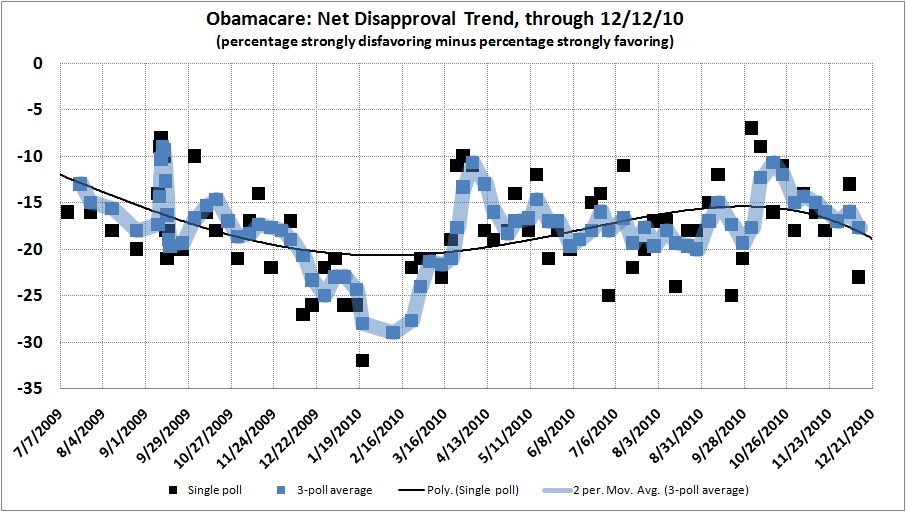
What has happened since October? Bribery still pays. Obamacare, though still unpopular on balance, has been gaining adherents a bit at a time:


Derived from this article and its predecessors at Rasmussen Reports. Poll results before passage of Obamacare represent strong approval minus strong disapproval. Poll results after passage of Obamacare represent strong approval of repeal minus strong disapproval of repeal.

The steep decline early in 2010 reflects “fashionable” pre-enactment resistance to Obamacare among independents, many of whom quickly changed their mind and became “fashionable” supporters of the fait accompli.

The polynomial fit (curved line) simply highlights the trend to date, and does not necessarily indicate Obamacare’s future popularity. But … if the upward movement continues, Republicans will find it hard going to repeal Obamacare, even if they win the Senate and White House in November 2012.

The present budget crisis could lead to a paring back of Obamacare. But if the crisis is resolved decisively, Obama (if not Democrats generally) will get much of the credit, and it will be more difficult to unseat him — unless job creation and economic growth remain in low gear.

Uncertainty abounds, as always.

Was There a “bin Laden bump” for Obama?

I was tempted to ask if there was an “Osama bump” for Obama. Ah well, mustn’t be snarky about our “gutsy” leader, who did no more than he should have done, though he had to “sleep on it” before he approved the Abbottabad operation.

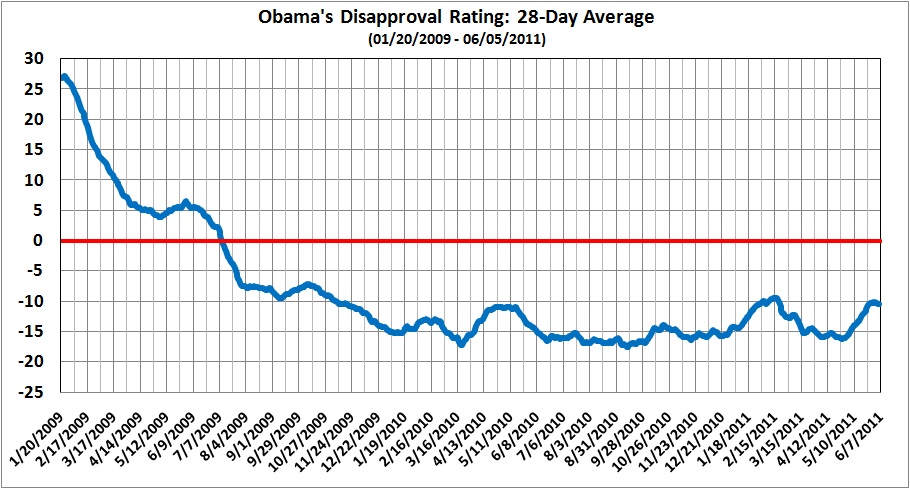
The first graph below gives Obama’s unpopularity ratings for the ten weeks surrounding the date on which Osama’s demise was announced: May 1, 2011. The blue shading spans polls that preceded the announcement. (The May 1 results were released in the morning; Obama announced Osama’s death later that day.) The green shading spans the two days (May 2 and 3) for which Obama’s disapproval rating reflected, in part, the results of polling conducted before the May 1 announcement.

It is evident that Obama was gaining ground, even before the May 1 announcement. We may take his rating of -11 on May 1 as a baseline for the evaluation of the effect of bin Laden’s death. Generously, Obama gained 4 points, and held that gain from May 7 through May 18. So much for the “bin Laden bump.”

It appears that Obama’s unpopularity was already returning to its core level of about -10 — a level that it had reached in the aftermath of the enactment of Obamacare. (See the second and third graphs.) And Obama’s unpopularity has stayed around its core level since the end of the modest “bin Laden bump.”

Why has Obama’s unpopularity returned to its core level? Here is my surmise: The battle lines are being drawn for election 2012, and those independents who enjoyed deriding Obama (for many legitimate reasons) are “coming home to roost” because they fear that if Obama loses in 2012 they will have abetted the demise of “free lunch” governance. They are of the ilk that decries the deficit while resisting the necessary (and inevitable) reductions in “entitlements.”


Net unpopularity is measured as the percentage of likely voters who strongly approve of BO, minus the percentage of likely voters who strongly disapprove of BO. The approval and disapproval statistics are derived from Rasmussen Reports’ Daily Presidential Tracking Poll. There is a gap in the 7-day trend because no poll was released on May 9. I use Rasmussen’s polling results because Rasmussen has a good track record with respect to presidential-election polling. The following graphs are derived from the same source.

Lawyerly Obtuseness

In the matter of Obamacare’s “individual mandate,” Orin Kerr and a three-judge panel of the Fourth Circuit cannot grasp the activity/inactivity distinction. There should be no mystery about it:

The Constitution’s Commerce Clause gives Congress the power to regulate interstate commerce — activities that actually involve the transmission of products and services across State lines. The Commerce Clause does not give Congress the power to force participation in interstate commerce.

Congress therefore lacks the power to regulate the absence of interstate commerce, including decisions by individuals and businesses not to involve themselves in certain aspects of interstate commmerce.

The Necessary and Proper Clause merely allows Congress to make laws that enable it to execute its enumerated powers. The clause is not a mandate for Congress to go beyond those powers. Therefore, the clause cannot properly be invoked as an authority for the individual mandate.

End of discussion. Next case.

P.S. Randy Barnett offers a different view of the proceedings, while David Kopel corroborates my view of the Necessary and Proper Clause.

Related posts:
Rationing and Health Care
The Perils of Nannyism: The Case of Obamacare
More about the Perils of Obamacare
Health-Care Reform: The Short of It
Toward a Risk-Free Economy
Undermining the Free Society
The Constitution: Original Meaning, Corruption, and Restoration
The Unconstitutionality of the Individual Mandate
Does the Power to Tax Give Congress Unlimited Power?
Does Congress Have the Power to Regulate Inactivity?

Leading Indicators?

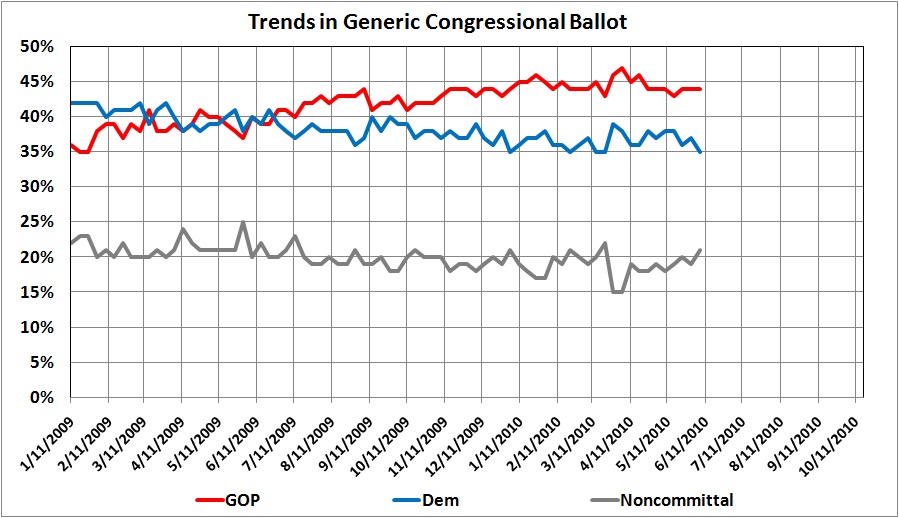
If the political mood of the country (or much of it) doesn’t change markedly in the next several months, don’t be surprised if there’s an anti-Obama insurgency in the Democrat party. The Democrats my lose the White House no matter the party’s nominee for president, but a landslide loss would create an anti-Democrat bandwagon effect that lasts for years or decades.

For the history challenged among you, I point to the post-Civil War succession of Republican administrations from 1869 to 1913, broken only by the two terms of Grover Cleveland — a pro-business, gold-standard, small-government, northern Democrat. Then, there was the reaction to the Great Depression, which yielded Democrat presidencies from 1933 to 1969, broken only by the two terms of Dwight Eisenhower — a middling Republican known mainly to the public as the general in charge of the D-Day invasion and subsequent defeat of Hitler’s armies.

With those precedents in mind, there must be a goodly number of influential Democrats who are thinking about alternatives to Obama. If they are not, they should be. BO’s net popularity index has returned to the slough of despond, after having risen somewhat in the post-election “honeymoon” that followed BO’s cave-in on the extension of the Bush tax cuts:


Each plot-point represents the 7-day trend in BO’s net popularity (or lack thereof). Net popularity is measured as the percentage of likely voters who strongly approve of BO, minus the percentage of likely voters who strongly disapprove of BO. The approval and disapproval statistics are derived from Rasmussen Reports’ Daily Presidential Tracking Poll. I use Rasmussen’s polling results because Rasmussen has a good track record with respect to presidential-election polling.

Then there is Obamacare, which has never been popular, and has just receded to its lowest rating since congressional Democrats committed collective suicide by ramming it through:


Derived from this article and its predecessors at Rasmussen Reports. Poll results before passage of Obamacare represent strong approval minus strong disapproval. Poll results after passage of Obamacare represent strong approval of repeal minus strong disapproval of repeal.

Points of Agreement and Reinforcement

Scott Lincicome, Don Boudreaux, and Mark Perry continue their stalwart defense of free trade (latest entries here, here, and here). The controversy revolves around the notion prevalent in “liberal” circles that exports are “good” and imports are “bad.” This is an old view, which Henry Hazlitt addressed in Economics in One Lesson:

(From the 1952 edition. Originally published in 1946).

I couldn’t agree more with Lincicome, Boudreaux, Perry, and Hazlitt — as you will see if you go here, here, and here.

John Goodman keeps tabs on the abomination known as Obamacare. His many post-enactment observations about Obamacare include these:

Docs Declare “No Confidence” in AMA, Exercise as Anger Management, and the Upcoming Nursing Shortage
Doctors are Leaving Medicare
Who is Going to Provide the Extra Care?
Selling Health Reform to the Victims
The Coming Doctor Shortage
Victims of Health Care Reform

None of this comes as a surprise to me. I warned against Obamacare in several pre-enactment posts:

Rationing and Health Care
The Perils of Nannyism: The Case of Obamacare
More about the Perils of Obamacare
Health-Care Reform: The Short of It

Goodman also offers a tantalizing post about the idea of testing public policies before they are fully implemented. The idea of testing public policies is one of the arguments for true federalism, where the central government has a hands-off policy on economic and social matters (but not civil rights). Only true federalism — which this nation enjoyed (more or less) until the subversion of the Commerce Clause by the Interstate Commerce Act — will dispel the “anger” toward the central government that deeply, and justly, animates a large number of Americans.

Big-government advocate Linda Greenhouse now opposes broadly worded delegations of power to subordinate authorities, because the broadly worded power, in the present instance, would

authoriz[e] the secretary of Homeland Security to “waive all legal requirements” that the secretary, in his or her “sole discretion, determines necessary to ensure expeditious construction of the barriers and roads [comprising the border fence project].”

The writer of the quoted article notes the irony in Greenhouse’s present position. It puts her on the side of Judge Douglas Ginsburg, who argued against broad delegations of congressional authority in “Delegation Running Riot” (Regulation, 1995, no. 1), where he coined the term “the Constitution-in-exile”:

So for 60 years the nondelegation doctrine has existed only as part of the Constitution-in-exile, along with the doctrines of enumerated powers, unconstitutional conditions, and substantive due process, and their textual cousins, the Necessary and Proper, Contracts, Takings, and Commerce Clauses. The memory of these ancient exiles, banished for standing in opposition to unlimited government, is kept alive by a few scholars who labor on in the hope of a restoration, a second coming of the Constitution of liberty-even if perhaps not in their own lifetimes.

All of which reminds me of an old post of mine about the Constitution in exile.

The Fall and Rise (and Fall?) of Obamacare

There are portents (aside from Judge Hudson’s timely ruling against the individual mandate):


Derived from this article and its predecessors at Rasmussen Reports. Poll results before passage of Obamacare represent strong approval minus strong disapproval. Poll results after passage of Obamacare represent strong approval of repeal minus strong disapproval of repeal.

The Unconstitutionality of the Individual Mandate

There are sophisticated arguments for unlimited governmental interference in the affairs of citizens. By sophisticated, I mean that they seem, superficially, to resort to the text and meaning of the Constitution. Here is a good example:

I appreciate Ilya [Somin]’s post below on the meaning of “activity” in Commerce Clause jurisprudence, and I wanted to add two brief observations:

1) If I understand Ilya’s argument, he begins with an assumption as to how much power Congress has, and he then reasons backwards to infer the meaning of “activity” in order to make that assumption correct. A conscious decision not to do something cannot be an “activity,” the thinking goes, because that would give Congress more power than a fair reading of the Commerce Clause would permit. Perhaps, but it seems to me that this argument largely assumes its conclusion. It uses the fact that Congress must have significant limits on its power to show that “activity” has a narrow meaning, which then is used to prove that Congress has significant limits on its power that the individual mandate exceeds. If you start with a different assumption, however, the argument doesn’t work. For example, if you start with the assumption about the scope of the Commerce Clause that Justice Kennedy articulates in his Lopez concurrence, then you can get a different meaning of “activity.”

I suspect some readers will object to this argument on the ground that they share Ilya’s assumption: Because Ilya’s assumption is correct, the argument works. That’s a fair point within the group that shares the assumption. The problem is that others don’t share the assumption, and starting with it won’t go very far in persuading them. That doesn’t necessarily mean Ilya is right or wrong. But I do think it means that this argument is likely not have a lot of force among the people not already inclined to agree with it.

2) More broadly, I still think that the easiest path to resolving the constitutionality of the individual mandate is that it is a “necessary and proper” means of trying to regulate the massive interstate market in health care that is around 1/7th of the United States economy. As I have blogged before, I think that’s a very strong argument based on Supreme Court caselaw on the meaning of “necessary and proper.” I realize that Ilya thinks that the Supreme Court precedents on the meaning of “necessary and proper” have not actually addressed what is “proper,” and thus that there is a still yet unarticulated limitation on the scope of federal power that remains to be developed — and that should be read as adding a level of scrutiny that the individual mandate fails to satisfy. But I don’t think the cases can be fairly read in that way, so it seems to me that the necessary and proper clause caselaw leads to the conclusion that the mandate should be upheld without getting into what counts as an “activity.”

Somin has replied to Kerr, who has replied to Somin, who has replied to Kerr, who has replied to Somin, etc. Their exchange could go on forever, so I will strike out on my own and leave Somin and Kerr to fight it out between themselves. In what follows, I use Kerr as a convenient whipping-boy, even though (in my understanding) he is only representing the defenses that others make of Obamacare and the individual mandate.

For my part, I have three questions about Kerr’s glib defense of the individual mandate: First, what does the size of the “market” for “health care” — an amorphous entity — have to do with the power of Congress to regulate it? Second, if “health care,” as an amorphous entity, is not a proper subject of regulation, then how can the individual mandate be a “necessary and proper” enactment? If Congress has always had the constitutional authority to regulate an industry (or something that loosely resembles one) — which it must if the Constitution is to be dispositive — why did it wait so long to exercise that authority (over railroads), in the Interstate Commerce Act of 1887?

With regard to the first question, Kerr seems to suggest that the fraction of GDP spent on “health care” justifies federal supervision of it. The estimates of GDP and its components given in Table 1.5.5 of the National Income Account tables (available here), indicate that health care accounts for 1/9th (not 1/7th) of GDP. The lower value is still a large share of GDP, but there is nothing in the Constitution that gives Congress the power to regulate loosely defined segments of the economy just because they account for more than X percent of GDP.

The Constitution simply gives Congress the power to regulate interstate commerce. And not all activities comprised in “health care” occur in transactions that are properly considered interstate commerce. In fact, significant portions of it (e.g., the manufacture of products used in health care, the use of those products by health-care providers, and the personal services rendered by health-care providers) clearly occur outside the activities properly understood as interstate commerce: the sale and transmission of goods (tangible and intangible) across State lines.

With regard to the second question, it follows that the mandate cannot be “necessary and proper” if Congress lacks the authority to regulate “the massive interstate market in health care,” in the first place. On that point, I refer you to the Constitution. Here are the relevant portions, the “Commerce Clause” and the “Necessary and Proper Clause”:

To regulate Commerce with foreign Nations, and among the several States, and with the Indian Tribes…. (Article I, Section 8, third clause, emphasis added)

To make all Laws which shall be necessary and proper for carrying into Execution the foregoing Powers, and all other Powers vested by this Constitution in the Government of the United States, or in any Department or Officer thereof. (Article I, Section 8, final clause, emphasis added)

To dispose of the third question, the Interstate Commerce Act of 1887, and much that has followed in its vein, is the culmination of raw politics and flawed interpretations of the Constitution. In 1887, Congress responded to public pressure (fomented, no doubt by competing interests and do-gooders) for action to quell the supposedly monopolistic practices of railroads. No principle of constitutional interpretation that takes the Constitution as something more than window-dressing can claim public pressure as a source of constitutional authority, unless public pressure leads to the adoption of a constitutional amendment in accordance with Article V. The many subsequent aggrandizements of Congress’s regulatory power are owed to the excesses of the “Progressive Era,” the “New Deal,” the “Great Society,” and the general failure of the Supreme Court to check those excesses.

Which brings us back to the regulation of “health care.” If the power of Congress to regulate “health care” cannot be found in its power to regulate interstate commerce, where can it be found? Nowhere in the Constitution. And if such a power cannot be found in the Constitution, then there can be no “necessary and proper” law that requires individuals to buy health insurance — or that authorizes Medicare, Medicaid, or their extension through Obamacare.

The defenders of Obamacare and the individual mandate would argue that it is “necessary and proper” to regulate activities (commercial or not) that are tangentially related to the portion of “health care” that is comprised in interstate commerce. That is so, in their view, because otherwise the effort to regulate the portion comprised in interstate commerce would fail to have the desired effect. In other words, they would regulate everything that can be labeled “health care,” and everything beyond that which threatens to undermine the intended regulatory outcome.

In so many words, the defenders of Obamacare and the individual mandate, like many others before them, want Congress to have the power to regulate anything and everything that they want Congress to regulate. This is nothing new under the sun, or the dome of the Capitol. Through the concatenation of the many regulatory regimes that have been granted similarly sweeping powers, Congress works its will on Americans, without regard for their liberty and property. Surely, that is not what the Framers intended when they vested in Congress specific powers — to the exclusion of powers not enumerated.

And so, the real issue — and the main subject of this post — comes down to this: Does Congress’s power to regulate interstate commerce extend to “health care” generally, just because some aspects of it involve interstate commerce? In particular, can Congress constitutionally impose the individual mandate under the rubric of the Commerce Clause or the Necessary and Proper Clause?

To answer that question, I examined the relevant writings of the Framers and two early justices of the U.S. Supreme Court, whose writings are taken as authoritative. (Relevant excerpts are below the fold.) I compared what I found in those writings with the opinions of Justice Clarence Thomas in two salient cases: United States v. Lopez (1995) and Gonzalez v. Raich (2005). I focused on Justice Thomas because he has been the most reliable interpreter of the Constitution’s original meaning since he joined the Court in 1991. It is evident, even to this lay (but experienced) reader of legal documents, that Justice Thomas accurately represents the original meaning of the Constitution with respect to Congress’s regulatory power over interstate commerce. (If you’re anxious to get to the bottom line, scroll past the long excerpts of Thomas’s opinions to the concluding paragraphs of this post.)

Here are relevant excerpts of Thomas’s concurring opinion in United States v. Lopez. In that case, a 5-4 majority held that the Gun Free School Zones Act of 1990, which forbids “any individual knowingly to possess a firearm at a place that [he] knows . . . is a school zone,” exceeded Congress’s Commerce Clause authority:

The Court today properly concludes that the Commerce Clause does not grant Congress the authority to prohibit gun possession within 1,000 feet of a school, as it attempted to do in the Gun Free School Zones Act of 1990…. Although I join the majority, I write separately to observe that our case law has drifted far from the original understanding of the Commerce Clause….

We have said that Congress may regulate not only “Commerce . . . among the several states,” … but also anything that has a “substantial effect” on such commerce. This test, if taken to its logical extreme, would give Congress a “police power” over all aspects of American life….

At the time the original Constitution was ratified, “commerce” consisted of selling, buying, and bartering, as well as transporting for these purposes…. In fact, when Federalists and Anti Federalists discussed the Commerce Clause during the ratification period, they often used trade (in its selling/bartering sense) and commerce interchangeably….

As one would expect, the term “commerce” was used in contradistinction to productive activities such as manufacturing and agriculture. Alexander Hamilton, for example, repeatedly treated commerce, agriculture, and manufacturing as three separate endeavors….

Moreover, interjecting a modern sense of commerce into the Constitution generates significant textual and structural problems. For example, one cannot replace “commerce” with a different type of enterprise, such as manufacturing. When a manufacturer produces a car, assembly cannot take place “with a foreign nation” or “with the Indian Tribes.” Parts may come from different States or other nations and hence may have been in the flow of commerce at one time, but manufacturing takes place at a discrete site. Agriculture and manufacturing involve the production of goods; commerce encompasses traffic in such articles….

The Constitution not only uses the word “commerce” in a narrower sense than our case law might suggest, it also does not support the proposition that Congress has authority over all activities that “substantially affect” interstate commerce. The Commerce Clause does not state that Congress may “regulate matters that substantially affect commerce with foreign Nations, and among the several States, and with the Indian Tribes.” In contrast, the Constitution itself temporarily prohibited amendments that would “affect” Congress’ lack of authority to prohibit or restrict the slave trade or to enact unproportioned direct taxation…. Clearly, the Framers could have drafted a Constitution that contained a “substantially affects interstate commerce” clause had that been their objective.

In addition to its powers under the Commerce Clause, Congress has the authority to enact such laws as are “necessary and proper” to carry into execution its power to regulate commerce among the several States…. But on this Court’s understanding of congressional power under these two Clauses, many of Congress’ other enumerated powers under Art. I, §8 are wholly superfluous. After all, if Congress may regulate all matters that substantially affect commerce, there is no need for the Constitution to specify that Congress may enact bankruptcy laws, cl. 4, or coin money and fix the standard of weights and measures, cl. 5, or punish counterfeiters of United States coin and securities, cl. 6. Likewise, Congress would not need the separate authority to establish post-offices and post-roads, cl. 7, or to grant patents and copyrights, cl. 8, or to “punish Piracies and Felonies committed on the high Seas,” cl. 10. It might not even need the power to raise and support an Army and Navy, cls. 12 and 13, for fewer people would engage in commercial shipping if they thought that a foreign power could expropriate their property with ease. Indeed, if Congress could regulate matters that substantially affect interstate commerce, there would have been no need to specify that Congress can regulate international trade and commerce with the Indians. As the Framers surely understood, these other branches of trade substantially affect interstate commerce.

Put simply, much if not all of Art. I, §8 (including portions of the Commerce Clause itself) would be surplusage if Congress had been given authority over matters that substantially affect interstate commerce. An interpretation of cl. 3 that makes the rest of §8 superfluous simply cannot be correct. Yet this Court’s Commerce Clause jurisprudence has endorsed just such an interpretation: the power we have accorded Congress has swallowed Art. I, §8.

Indeed, if a “substantial effects” test can be appended to the Commerce Clause, why not to every other power of the Federal Government? There is no reason for singling out the Commerce Clause for special treatment. Accordingly, Congress could regulate all matters that “substantially affect” the Army and Navy, bankruptcies, tax collection, expenditures, and so on. In that case, the clauses of §8 all mutually overlap, something we can assume the Founding Fathers never intended.

Our construction of the scope of congressional authority has the additional problem of coming close to turning the Tenth Amendment on its head. Our case law could be read to reserve to the United States all powers not expressly prohibited by the Constitution. Taken together, these fundamental textual problems should, at the very least, convince us that the “substantial effects” test should be reexamined.

The exchanges during the ratification campaign reveal the relatively limited reach of the Commerce Clause and of federal power generally. The Founding Fathers confirmed that most areas of life (even many matters that would have substantial effects on commerce) would remain outside the reach of the Federal Government. Such affairs would continue to be under the exclusive control of the States….

Yet, despite being well aware that agriculture, manufacturing, and other matters substantially affected commerce, the founding generation did not cede authority over all these activities to Congress. Hamilton, for instance, acknowledged that the Federal Government could not regulate agriculture and like concerns:

“The administration of private justice between the citizens of the same State, the supervision of agriculture and of other concerns of a similar nature, all those things in short which are proper to be provided for by local legislation, can never be desirable cares of a general jurisdiction.” The Federalist No. 17, at 106.

In the unlikely event that the Federal Government would attempt to exercise authority over such matters, its effort “would be as troublesome as it would be nugatory.” Ibid. [n.4]

The comments of Hamilton and others about federal power reflected the well known truth that the new Government would have only the limited and enumerated powers found in the Constitution…. Even before the passage of the Tenth Amendment, it was apparent that Congress would possess only those powers “herein granted” by the rest of the Constitution….

Where the Constitution was meant to grant federal authority over an activity substantially affecting interstate commerce, the Constitution contains an enumerated power over that particular activity. Indeed, the Framers knew that many of the other enumerated powers in §8 dealt with matters that substantially affected interstate commerce. Madison, for instance, spoke of the bankruptcy power as being “intimately connected with the regulation of commerce.” The Federalist No. 42, at 287. Likewise, Hamilton urged that “[i]f we mean to be a commercial people or even to be secure on our Atlantic side, we must endeavour as soon as possible to have a navy.” Id., No. 24, at 157 (A. Hamilton).

In short, the Founding Fathers were well aware of what the principal dissent calls ” `economic . . . realities.’ “… Even though the boundary between commerce and other matters may ignore “economic reality” and thus seem arbitrary or artificial to some, we must nevertheless respect a constitutional line that does not grant Congress power over all that substantially affects interstate commerce.

If the principal dissent’s understanding of our early case law were correct, there might be some reason to doubt this view of the original understanding of the Constitution. According to that dissent, Chief Justice Marshall’s opinion in Gibbons v. Ogden, … established that Congress may control all local activities that “significantly affect interstate commerce,”… And, “with the exception of one wrong turn subsequently corrected,” this has been the “traditiona[l]” method of interpreting the Commerce Clause….

In my view, the dissent is wrong about the holding and reasoning of Gibbons. Because this error leads the dissent to characterize the first 150 years of this Court’s case law as a “wrong turn,” I feel compelled to put the last 50 years in proper perspective.

In Gibbons, the Court examined whether a federal law that licensed ships to engage in the “coasting trade” pre-empted a New York law granting a 30 year monopoly to Robert Livingston and Robert Fulton to navigate the State’s waterways by steamship. In concluding that it did, the Court noted that Congress could regulate “navigation” because “[a]ll America . . . has uniformly understood, the word `commerce,’ to comprehend navigation. It was so understood, and must have been so understood, when the constitution was framed.”… The Court also observed that federal power over commerce “among the several States” meant that Congress could regulate commerce conducted partly within a State. Because a portion of interstate commerce and foreign commerce would almost always take place within one or more States, federal power over interstate and foreign commerce necessarily would extend into the States….

At the same time, the Court took great pains to make clear that Congress could not regulate commerce “which is completely internal, which is carried on between man and man in a State, or between different parts of the same State, and which does not extend to or affect other States.”… Moreover, while suggesting that the Constitution might not permit States to regulate interstate or foreign commerce, the Court observed that “[i]nspection laws, quarantine laws, health laws of every description, as well as laws for regulating the internal commerce of a State” were but a small part “of that immense mass of legislation . . . not surrendered to a general government.”… From an early moment, the Court rejected the notion that Congress can regulate everything that affects interstate commerce. That the internal commerce of the States and the numerous state inspection, quarantine, and health laws had substantial effects on interstate commerce cannot be doubted. Nevertheless, they were not “surrendered to the general government.”

Of course, the principal dissent is not the first to misconstrue Gibbons. For instance, the Court has stated that Gibbons “described the federal commerce power with a breadth never yet exceeded.”… I believe that this misreading stems from two statements in Gibbons.

First, the Court made the uncontroversial claim that federal power does not encompass “commerce” that “does not extend to or affect other States.”… From this statement, the principal dissent infers that whenever an activity affects interstate commerce, it necessarily follows that Congress can regulate such activities. Of course, Chief Justice Marshall said no such thing and the inference the dissent makes cannot be drawn.

There is a much better interpretation of the “affect[s]” language: because the Court had earlier noted that the commerce power did not extend to wholly intrastate commerce, the Court was acknowledging that although the line between intrastate and interstate/foreign commerce would be difficult to draw, federal authority could not be construed to cover purely intrastate commerce. Commerce that did not affect another State could never be said to be commerce “among the several States.”

But even if one were to adopt the dissent’s reading, the “affect[s]” language, at most, permits Congress to regulate only intrastate commerce that substantially affects interstate and foreign commerce. There is no reason to believe that Chief Justice Marshall was asserting that Congress could regulate all activities that affect interstate commerce…

The second source of confusion stems from the Court’s praise for the Constitution’s division of power between the States and the Federal Government:

“The genius and character of the whole government seem to be, that its action is to be applied to all the external concerns of the nation, and to those internal concerns which affect the States generally; but not to those which are completely within a particular State, which do not affect other States, and with which it is not necessary to interfere, for the purpose of executing some of the general powers of the government.”…

In this passage, the Court merely was making the well understood point that the Constitution commits matters of “national” concern to Congress and leaves “local” matters to the States. The Court was not saying that whatever Congress believes is a national matter becomes an object of federal control. The matters of national concern are enumerated in the Constitution: war, taxes, patents, and copyrights, uniform rules of naturalization and bankruptcy, types of commerce, and so on…. Gibbons‘ emphatic statements that Congress could not regulate many matters that affect commerce confirm that the Court did not read the Commerce Clause as granting Congress control over matters that “affect the States generally.” Gibbons simply cannot be construed as the principal dissent would have it.

I am aware of no cases prior to the New Deal that characterized the power flowing from the Commerce Clause as sweepingly as does our substantial effects test. My review of the case law indicates that the substantial effects test is but an innovation of the 20th century.

Even before Gibbons, Chief Justice Marshall, writing for the Court in Cohens v. Virginia, … noted that Congress had “no general right to punish murder committed within any of the States,” … and that it was “clear that congress cannot punish felonies generally,”… The Court’s only qualification was that Congress could enact such laws for places where it enjoyed plenary powers–for instance, over the District of Columbia…. Thus, whatever effect ordinary murders, or robbery, or gun possession might have on interstate commerce (or on any other subject of federal concern) was irrelevant to the question of congressional power.

United States v. Dewitt … marked the first time the Court struck down a federal law as exceeding the power conveyed by the Commerce Clause. In a two page opinion, the Court invalidated a nationwide law prohibiting all sales of naphtha and illuminating oils. In so doing, the Court remarked that the Commerce Clause “has always been understood as limited by its terms; and as a virtual denial of any power to interfere with the internal trade and business of the separate States.”… The law in question was “plainly a regulation of police,” which could have constitutional application only where Congress had exclusive authority, such as the territories….

In United States v. E. C. Knight Co., … this Court held that mere attempts to monopolize the manufacture of sugar could not be regulated pursuant to the Commerce Clause. Raising echoes of the discussions of the Framers regarding the intimate relationship between commerce and manufacturing, the Court declared that “[c]ommerce succeeds to manufacture, and is not a part of it.”… The Court also approvingly quoted from Kidd v. Pearson … :

” `No distinction is more popular to the common mind, or more clearly expressed in economic and political literature, than that between manufacture and commerce . . . . If it be held that the term [commerce] includes the regulation of all such manufactures as are intended to be the subject of commercial transactions in the future, it is impossible to deny that it would also include all productive industries that contemplate the same thing. The result would be that Congress would be invested . . . with the power to regulate, not only manufactures, but also agriculture, horticulture, stock raising, domestic fisheries, mining–in short, every branch of human industry.’ “…

If federal power extended to these types of production “comparatively little of business operations and affairs would be left for state control.”… Whether or not manufacturing, agriculture, or other matters substantially affected interstate commerce was irrelevant.

As recently as 1936, the Court continued to insist that the Commerce Clause did not reach the wholly internal business of the States…. The Federal Government simply could not reach such subjects regardless of their effects on interstate commerce.

These cases all establish a simple point: from the time of the ratification of the Constitution to the mid 1930’s, it was widely understood that the Constitution granted Congress only limited powers, notwithstanding the Commerce Clause. Moreover, there was no question that activities wholly separated from business, such as gun possession, were beyond the reach of the commerce power. If anything, the “wrong turn” was the Court’s dramatic departure in the 1930’s from a century and a half of precedent.

Apart from its recent vintage and its corresponding lack of any grounding in the original understanding of the Constitution, the substantial effects test suffers from the further flaw that it appears to grant Congress a police power over the Nation. When asked at oral argument if there were any limits to the Commerce Clause, the Government was at a loss for words…. Likewise, the principal dissent insists that there are limits, but it cannot muster even one example…. Indeed, the dissent implicitly concedes that its reading has no limits when it criticizes the Court for “threaten[ing] legal uncertainty in an area of law that . . . seemed reasonably well settled.”… The one advantage of the dissent’s standard is certainty: it is certain that under its analysis everything may be regulated under the guise of the Commerce Clause.

The substantial effects test suffers from this flaw, in part, because of its “aggregation principle.” Under so called “class of activities” statutes, Congress can regulate whole categories of activities that are not themselves either “interstate” or “commerce.” In applying the effects test, we ask whether the class of activities as a whole substantially affects interstate commerce, not whether any specific activity within the class has such effects when considered in isolation….

The aggregation principle is clever, but has no stopping point. Suppose all would agree that gun possession within 1,000 feet of a school does not substantially affect commerce, but that possession of weapons generally (knives, brass knuckles, nunchakus, etc.) does. Under our substantial effects doctrine, even though Congress cannot single out gun possession, it can prohibit weapon possession generally. But one always can draw the circle broadly enough to cover an activity that, when taken in isolation, would not have substantial effects on commerce. Under our jurisprudence, if Congress passed an omnibus “substantially affects interstate commerce” statute, purporting to regulate every aspect of human existence, the Act apparently would be constitutional. Even though particular sections may govern only trivial activities, the statute in the aggregate regulates matters that substantially affect commerce.

This extended discussion of the original understanding and our first century and a half of case law does not necessarily require a wholesale abandonment of our more recent opinions. It simply reveals that our substantial effects test is far removed from both the Constitution and from our early case law and that the Court’s opinion should not be viewed as “radical” or another “wrong turn” that must be corrected in the future. The analysis also suggests that we ought to temper our Commerce Clause jurisprudence.

Unless the dissenting Justices are willing to repudiate our long held understanding of the limited nature of federal power, I would think that they too must be willing to reconsider the substantial effects test in a future case. If we wish to be true to a Constitution that does not cede a police power to the Federal Government, our Commerce Clause’s boundaries simply cannot be “defined” as being ” `commensurate with the national needs’ ” or self consciously intended to let the Federal Government ” `defend itself against economic forces that Congress decrees inimical or destructive of the national economy.’ “… Such a formulation of federal power is no test at all: it is a blank check.

At an appropriate juncture, I think we must modify our Commerce Clause jurisprudence. Today, it is easy enough to say that the Clause certainly does not empower Congress to ban gun possession within 1,000 feet of a school.

Thomas was in the minority in Gonzalez v. Raich, where a 6-3 majority held that Congress’s Commerce Clause authority includes the power to prohibit the local cultivation and use of marijuana in compliance with California law. Thomas’s dissent restates points he made in his opinion in United States v. Lopez, but delves further into the scope of the Necessary and Proper clause:

Respondents Diane Monson and Angel Raich use marijuana that has never been bought or sold, that has never crossed state lines, and that has had no demonstrable effect on the national market for marijuana. If Congress can regulate this under the Commerce Clause, then it can regulate virtually anything–and the Federal Government is no longer one of limited and enumerated powers….

Respondents’ local cultivation and consumption of marijuana is not “Commerce … among the several States.”… By holding that Congress may regulate activity that is neither interstate nor commerce under the Interstate Commerce Clause, the Court abandons any attempt to enforce the Constitution’s limits on federal power. The majority supports this conclusion by invoking, without explanation, the Necessary and Proper Clause. Regulating respondents’ conduct, however, is not “necessary and proper for carrying into Execution” Congress’ restrictions on the interstate drug trade…. Thus, neither the Commerce Clause nor the Necessary and Proper Clause grants Congress the power to regulate respondents’ conduct….

The majority advances three reasons why the CSA is a legitimate exercise of Congress’ authority under the Commerce Clause: First, respondents’ conduct, taken in the aggregate, may substantially affect interstate commerce … ; second, regulation of respondents’ conduct is essential to regulating the interstate marijuana market, ante … ; and, third, regulation of respondents’ conduct is incidental to regulating the interstate marijuana market…. Justice O’Connor explains why the majority’s reasons cannot be reconciled with our recent Commerce Clause jurisprudence. The majority’s justifications, however, suffer from even more fundamental flaws….

The majority’s treatment of the substantial effects test is rootless, because it is not tethered to either the Commerce Clause or the Necessary and Proper Clause. Under the Commerce Clause, Congress may regulate interstate commerce, not activities that substantially affect interstate commerce–any more than Congress may regulate activities that do not fall within, but that affect, the subjects of its other Article I powers…. Whatever additional latitude the Necessary and Proper Clause affords, … the question is whether Congress’ legislation is essential to the regulation of interstate commerce itself–not whether the legislation extends only to economic activities that substantially affect interstate commerce….

…This Court has never held that Congress can regulate noneconomic activity that substantially affects interstate commerce…. To evade even that modest restriction on federal power, the majority defines economic activity in the broadest possible terms as the “ ‘the production, distribution, and consumption of commodities.’ ”… This carves out a vast swath of activities that are subject to federal regulation…. If the majority is to be taken seriously, the Federal Government may now regulate quilting bees, clothes drives, and potluck suppers throughout the 50 States. This makes a mockery of Madison’s assurance to the people of New York that the “powers delegated” to the Federal Government are “few and defined,” while those of the States are “numerous and indefinite.” The Federalist No. 45, at 313 (J. Madison).

Moreover, even a Court interested more in the modern than the original understanding of the Constitution ought to resolve cases based on the meaning of words that are actually in the document. Congress is authorized to regulate “Commerce,” and respondents’ conduct does not qualify under any definition of that term. The majority’s opinion only illustrates the steady drift away from the text of the Commerce Clause. There is an inexorable expansion from “ ‘commerce,’ ” … to “commercial” and “economic” activity, … and finally to all “production, distribution, and consumption” of goods or services for which there is an “established … interstate market”…. Federal power expands, but never contracts, with each new locution. The majority is not interpreting the Commerce Clause, but rewriting it.

The majority’s rewriting of the Commerce Clause seems to be rooted in the belief that, unless the Commerce Clause covers the entire web of human activity, Congress will be left powerless to regulate the national economy effectively…. The interconnectedness of economic activity is not a modern phenomenon unfamiliar to the Framers…. Moreover, the Framers understood what the majority does not appear to fully appreciate: There is a danger to concentrating too much, as well as too little, power in the Federal Government. This Court has carefully avoided stripping Congress of its ability to regulate interstate commerce, but it has casually allowed the Federal Government to strip States of their ability to regulate intrastate commerce–not to mention a host of local activities, like mere drug possession, that are not commercial.

One searches the Court’s opinion in vain for any hint of what aspect of American life is reserved to the States. Yet this Court knows that “ ‘[t]he Constitution created a Federal Government of limited powers.’ ”… That is why today’s decision will add no measure of stability to our Commerce Clause jurisprudence: This Court is willing neither to enforce limits on federal power, nor to declare the Tenth Amendment a dead letter. If stability is possible, it is only by discarding the stand-alone substantial effects test and revisiting our definition of “Commerce among the several States.” Congress may regulate interstate commerce–not things that affect it, even when summed together, unless truly “necessary and proper” to regulating interstate commerce….

The majority also inconsistently contends that regulating respondents’ conduct is both incidental and essential to a comprehensive legislative scheme…. [T]he majority further claims that, because the CSA covers a great deal of interstate commerce, it “is of no moment” if it also “ensnares some purely intrastate activity.”… So long as Congress casts its net broadly over an interstate market, according to the majority, it is free to regulate interstate and intrastate activity alike. This cannot be justified under either the Commerce Clause or the Necessary and Proper Clause. If the activity is purely intrastate, then it may not be regulated under the Commerce Clause. And if the regulation of the intrastate activity is purely incidental, then it may not be regulated under the Necessary and Proper Clause….

It is safe to say that a proper reading of the Constitution, as exemplified in the authoritative opinions excerpted above, yields no authority for Obamacare. That monstrosity — the official, Orwellian title of which is the Patient Protection and Affordable Care Act (PPACA) — attempts to reach an aggregation known as “health care,” without any differentiation between interstate commerce, intrastate commerce, and activities that are part of neither, namely, the choices of individuals with respect to health insurance.

It may be a valid exercise of Congress’s power to regulate actual interstate commerce that touches on the provision of health care. It is not a valid exercise to aggregate everything called “health care” and to regulate it as if it were all within the reach of Congress. When that happens, there is no room left — in “health care” nor, by extension, any other loose aggregation of activities — for State action or individual choice.

In sum, Obamacare is neither a valid regulation of interstate commerce nor necessary and proper to a valid regulation of interstate commerce. It is a governmental seizure of 1/9th of the economy. The individual mandate — which is a central feature of that seizure — is nothing more than coercion. It is no less peremptory than the military draft.

And thus has the power to regulate interstate commerce evolved from its original purposes — the protection of American industry in its infancy and the prevention of trade wars among the States — to an instrument of dictatorship. For that is what it is, regardless of the participation of the “people’s representatives.”

It is long past time for the Supreme Court to reverse the long string of Commerce Clause decisions through which the federal government has acquired and exercised dictatorial power. Otherwise, we might as well shred the Constitution, once and for all, and quit paying lip-service to it.

Related post: Social Security Is Unconstitutional

Continue reading “The Unconstitutionality of the Individual Mandate”

The “Forthcoming Financial Collapse”

I have written before about my membership in a Google Group

whose active members are retired scientists, engineers, mathematicians, and economists — some in their upper 80s — who worked on defense issues from the 1940s to the 2000s….

Most members of the group were government employees and/or employees of government contractors. Their attraction to government service — and its steady and rather handsome paychecks — derives, in good part, from their belief in the power of government to “solve problems,” and in the need for government to do just that. It is only natural, then, that many members of the group hold an unrealistically exalted view of the power of quantitative methods to “solve problems,” while holding naive views about the machinations of government, human nature, and history. (The pioneers of military operations research in the United States, by contrast, were realistic about the relative impotence of quantitative analysis of complex, dynamic processes.)

Here, for example, is a recent communication from one of the group’s older members:

A political scientist and former Foreign Service Officer friend proposes the following which, if valid, may complicate the U.S.’s capability to handle the forthcoming financial collapse of our country.

His formulation is as follows: (1) The World Trade Center attacks grievously damaged our self-confidence but did little but material damage. (2) On the other hand, the collapse of Lehman Brothers had impacts across the financial world and among the Central Banks of many countries. In effect, the U.S. was the instrument inflicting damage and loss on both trading partners and creditors.

Do we agree that the second is the more serious. What may be the dimensions of the impact?

If I were to reply, this is what I would say:

Your message is provocative in more than one respect. I won’t get into the material effect of the 9/11 attacks, except to say that the assessment that they caused “little material damage” seems to ignore the economic after-shock and the value of 3,000 lives lost. But I am more concerned with the policy implications of your friend’s formulation, and with what you call “the forthcoming financial collapse of our country.”

I have trouble with your friend’s formulation because it involves an irrelevant comparison. On the one hand, there was a deliberate attack on the U.S. by a foreign enemy. On the other hand, a major investment bank failed, in large part because of investments in bad securities that were issued pursuant to policies of the U.S. government (sub-prime mortgage loans and low interest rates). These are not mutually exclusive events, and should be considered separately in devising appropriate government policies (including a hands-off policy). I am sure that your friend would prefer fewer bank failures, but not at the cost of more terrorist attacks.

I turn now to government’s role (or lack thereof) in securing our economic future. Let’s begin with the collapse of Lehman Brothers. Lehman was allowed to fail because government officials didn’t want to send a “signal” that a bailout would be an automatic reward for failure. But those same officials, in their panic, reversed course with respect to other financial institutions and bailed them out. The bailouts didn’t really help credit markets (as they were supposed to) because — quite reasonably in the aftermath of a government-caused financial panic and recession — the bailed-out institutions (and others) have been slow to lend, while individuals and businesses have been slow to borrow. What the bailouts mainly did was to reinforce the view that government (i.e., taxpayers) will bear the costs of foolish endeavors — which only encourages banks (and other businesses) to undertake more foolish endeavors. The price for those endeavors will come due at the bursting of the next bubble, whatever it is and whenever it occurs.

If there is any lesson to be taken from the comparison offered by your friend, it is an old one that most Americans seem not to have learned: The real job of government is to protect citizens from foreign and domestic predators. Government does that badly enough (though I would rather have it done by government than by private parties, namely, warlords). Government is even worse at other things, like intervening in economic affairs, the unseen cost of which — in forgone economic output — dwarfs the amount spent by governments (at all levels) on defense and law-enforcement. This comparison is apt because we could better afford to pay for the protective services of government, were it to butt out of our economic affairs.

This brings me to “the forthcoming financial collapse of our country.” I assume that you refer to the huge obligations incurred by the federal government in the form of Social Security, Medicare, Medicaid — and the promised expansion of these by what has become known as Obamacare. These obligations, which now consume about 10 percent of GDP, will consume 25 percent of GDP before the end of this century. Add to them the cost of other governmental functions and the regulatory obstacles that government throws into the path of economic growth, and you do have something like an economic disaster in the making — but it may occur in slow motion (as it has for the past century), rather than in the form of a dramatic collapse.

One result of the slow-motion disaster could be a “sovereign debt crisis,” namely, the inability of the U.S. government to sell its debt except, perhaps, at very high rates of interest. In the alternative, the government, acting through the Fed, would simply “print money” in an effort to inflate its way out of the problem. But that would only make government debt less marketable while further stifling economic growth by creating great uncertainty in capital markets. The bottom line is that the “forthcoming financial collapse” — or its slow-motion equivalent — is of the government’s making, and can be averted only by getting government out of the business of running the inter-generational Ponzi schemes that we know as Social Security, Medicare, and Medicaid.

The real strength of the “country” is its people and their voluntary social and business arrangements. It is not government, which — contrary to the views of “progressives” — stands in the way of progress and prosperity.

Related posts:
The Commandeered Economy
The Price of Government
The Mega-Depression
Does the CPI Understate Inflation?
Ricardian Equivalence Reconsidered
The Real Burden of Government
Toward a Risk-Free Economy
The Rahn Curve at Work
How the Great Depression Ended
A Moral Dilemma
Our Miss Brooks
The Illusion of Prosperity and Stability
Society and the State
The Price of Government: More Evidence
Experts and the Economy
I Want My Country Back

Cuccinelli for President?

The more I learn about Ken Cuccinelli, the attorney general of Virginia, the more depressed I become by the fact that he — or someone like him — isn’t in the White House.

For example, Cuccinelli’s office is investigating Michael “Hockey Stick” Mann, who (while at the University of Virginia) accepted State funds for his research. Here is part of the AG’s statement about the matter:

The revelations of Climate-gate indicate that some climate data may have been deliberately manipulated to arrive at pre-set conclusions.  The use of manipulated data to apply for taxpayer-funded research grants in Virginia is potentially fraud.  Given this, the only prudent thing to do was to look into it.

This is a fraud investigation and the attorney general’s office is not investigating Dr. Mann’s scientific conclusions.  The legal standards for the misuse of taxpayer dollars apply the same at universities as they do at any other agency of state government.  This is about rooting out possible fraud and not about infringing upon academic freedom.

That bare statement cries out for amplification. Here are portions of an analysis posted at Watt’s Up With That?:

Mann is the former UVA professor, whose “hockey stick” temperature chart was used to promote claims that “sudden” and “unprecedented” manmade global warming “threatens” human civilization and Earth itself. The hockey stick was first broken by climatologists Willie Soon and Sallie Baliunas, who demonstrated that a Medieval Warm Period and Little Ice Age were clearly reflected in historic data across the globe, but redacted by Mann. Analysts Steve McIntyre and Ross McKitrick later showed that Mann’s computer program generated hockey-stick patterns regardless of what numbers were fed into it – even random telephone numbers; that explained why the global warming and cooling of the last millennium magically disappeared in Mann’s “temperature reconstruction.”

The Climategate emails revealed another deliberate “trick” that Mann used to generate a late twentieth-century temperature jump: he replaced tree ring data with thermometer measurements at the point in his timeline when the tree data no longer fit his climate disaster thesis.

Not surprisingly, he refused to share his data, computer codes and methodologies with skeptical scientists. Perhaps worse, Climategate emails indicate that Mann and others conspired to co-opt and corrupt the very scientific process that Carr asserts will ultimately condemn or vindicate them.

This behavior certainly gives Cuccinelli “probable cause” for launching an investigation. As the AG notes, “The same legal standards for fraud apply to the academic setting that apply elsewhere. The same rule of law, the same objective fact-finding process, will take place.” Some witch hunt.

There is simply no room in science, academia or public policy for manipulation, falsification or fraud. Academic freedom does not confer a right to engage in such practices, and both attorneys general and research institutions have a duty to root them out, especially in the case of climate change research.

Then there is Virginia’s suit for “declaratory and injunctive relief” from Obamacare. Cuccinelli’s office recently responded to the feds’ motion to quash the suit. Here is the AG’s statement:

Virginia has responded to the federal government’s attempt to dismiss the state’s lawsuit against the new federal health care law, Virginia Attorney General Ken Cuccinelli announced today.

In its motion to the court to dismiss Virginia’s lawsuit, the federal government argued that Virginia lacks the standing to bring a suit, that the suit is premature, and that the federal government has the power under the U.S. Constitution’s Commerce Clause to mandate that citizens must be covered by health insurance or pay a civil penalty.  The government also made alternative arguments based upon its taxing power and the Necessary and Proper Clause.

“If the government prevails and Congress may use the Commerce Clause to order Americans to buy private health insurance, then Congress will have been granted a virtually unlimited power to order you to buy anything.  That would amount to the end of federalism and our more than 220 years of constitutional government,” the attorney general said.

Here is a brief summary of some of the arguments:

Federal government’s arguments to dismiss the case

Virginia’s response

Virginia is not injured by the federal health care law

Because the federal health care law purports to invalidate a Virginia law (the Health Care Freedom Act) under the Constitution’s Supremacy Clause, Virginia’s sovereign interests have been injured.

Because the mandate doesn’t take effect until 2014, the case is not “ripe”

1)  Based on several previous Supreme Court decisions, if a dispute is certain to occur in the future, this does not prohibit the suit from being brought in the present

2)  Virginia has already been forced to make decisions regarding insurance exchanges under the act, as well as changes to Medicaid.  One of those decisions made the commonwealth forego more than $100 million in federal money.

Virginia’s suit is barred by the Anti-Injunction Act

The act does not apply to states under these circumstances, because Virginia’s action falls within an exception to the act that has been recognized by the Supreme Court

The government has the power under the Constitution’s Commerce Clause to mandate the purchase of individual health insurance

1)  The federal government’s argument is contrary to the text of the Constitution

2)  The federal government’s argument is contrary to the meaning of the words of the Commerce Clause as understood by the Founders

3)  The federal government’s argument is contrary to the historical context of the nation’s founding.  When Great Britain instituted a tax on tea, the colonists’ response was to boycott and to not buy tea.  Parliament had the power to regulate commerce, but even it did not attempt to force colonists to buy the taxed product.

4)  The federal government’s argument is contrary to the traditional uses of the Commerce Clause.  The clause has always been used to regulate economic activity; never inactivity.

5)  The federal government’s argument is contrary to the precedent of the U.S. Supreme Court.  The Court has set outer limits to the reaches of the Commerce Clause, including in cases such as Lopez and Morrison, saying that the clause must have principled limits, otherwise the federal government essentially would have unlimited power, rather than the limited powers enumerated in the Constitution.

Even if refusing to buy insurance is not commerce, the government can still force people to buy health insurance using the Constitution’s Necessary and Proper Clause.

1)  Since 1819, the Supreme Court has held that any use of the Necessary and Proper Clause must be consistent with both “the letter and spirit” of the Constitution.  Any interpretation that would destroy the federal form of government (where federal power is limited only to those powers enumerated in the Constitution, with remaining powers reserved to the states and the people) is not allowed under that standard.

2)  In May, the Supreme Court decided Comstock.

The Court adopted a historical approach to the use of the Necessary and Proper Clause. Because the mandate is utterly unprecedented, it is unlikely to be upheld under a historical approach.

Even if the government cannot win using the Commerce Clause and Necessary and Proper Clause arguments, the federal health insurance mandate can be justified under the government’s taxing authority.

1)  The penalty for not buying insurance is not a tax.  Congress called it a “penalty” and claimed authority to act only under the Commerce Clause.  To argue otherwise now ignores what Congress actually did.

2)  A penalty for inaction is not a tax of any kind known to the Constitution, when judged historically.

Finally, for today, there is Cuccinelli’s principled defense of the First Amendment in the case of Snyder v. Phelps. Here is the text of the press release that explains his refusal to join a case filed by the AGs of 48 other States:

Attorney General Ken Cuccinelli has decided not to join other states in an amicus brief on behalf of Albert Snyder in Snyder v. Phelps, which will soon be heard by the U.S. Supreme Court.  Mr. Snyder is the father of Matthew Snyder, a soldier killed in Iraq whose funeral was picketed by Fred Phelps and his followers at the infamous Westboro Baptist Church.

Here is our statement, given by Brian Gottstein, director of communication:

The attorney general’s office deplores the absolutely vile and despicable acts of Fred Phelps and his followers.  We also greatly sympathize with the Snyder family and all families who have experienced the hatefulness of these people.  The attorney general has always been a strong supporter of the military, both in his words and in his work as a Senator.  But the consequences of this case had to be looked at beyond what would happen just to Phelps and his followers.

This office has decided not to file a brief in Snyder v. Phelps, because the case could set a precedent that could severely curtail certain valid exercises of free speech.  If protestors – whether political, civil rights, pro-life, or environmental – said something that offended the object of the protest to the point where that person felt damaged, the protestors could be sued.  It then becomes a very subjective and difficult determination as to when the line is crossed from severely offensive speech to that which inflicts emotional distress.  Several First Amendment scholars agree.

Virginia already has a statute that we believe balances free speech rights while stopping and even jailing those who would be so contemptible as to disrupt funeral or memorial services.  That statute, 18.2-415(B), punishes as a class one misdemeanor (up to one year in jail and a fine of up to $2,500) someone who willfully disrupts a funeral or memorial service to the point of preventing or interfering with the orderly conduct of the event.

We do not think that regulation of speech through vague common law torts like intentional infliction of emotional distress strikes the proper balance between free speech and avoiding the unconscionable disruption of funerals.  We think our statute does.

So long as the protesters stay within the letter of the law, the Constitution protects their right to express their views.  In Virginia, if Phelps or others attempt this repugnant behavior, cross the line and violate the law, the attorney general’s office stands ready to provide any assistance to local prosecutors to vindicate the law.

A politician who stands on principle instead of bowing to popular outrage. How refreshing. How unusual.

Cuccinelli for President? Sounds good to me, but if you follow the first link in this post you will learn that Cuccinelli’s views on many issues would cause Democrats to unleash a latter-day anti-Goldwater scare campaign. Given the present mood of the country, however, Ken Cuccinelli could be just the right man for the times.

The Real Burden of Government

Drawing on estimates of GDP and its components, it is easy to quantify the share of economic output that is absorbed by government spending. (See, for example, “The Commandeered Economy.”) With a bit of interpretive license, it is even possible to assess the cumulative effects of government spending and regulation on economic output. (See, for example,  “The Price of Government.”)

But the real economy does not consist of a homogeneous output (GDP). The real burden of government therefore depends on the specific resources that government extracts from the private sector in the execution of particular government programs, and on the particular products and services that are affected by government regulations.

Each new or expanded government program raises the demand for and price of certain kinds of goods and services, and channels rewards (claims on goods and services) in the direction of the businesses and persons involved in providing goods and services to government; for example:

  • Social Security rewards individuals for not working. The service, in this case, is the “good feeling” that comes to politicians, etc., for having done something “compassionate.”  The effect is to raise the prices of the goods and services that prematurely retired individuals would otherwise produce, therefore reducing the well-being of the working public.
  • Medicare — another of many feel-good programs — rewards retirees by subsidizing their medical care and prescription drugs. The upshot of this feel-good program is to reduce the well-being of the working public, which must pay more for its medical services and prescription drugs (directly, through higher insurance premiums, or because of lower wages to offset the cost of employer-provided health insurance).
  • R&D conducted in government laboratories and under government grants absorbs the services of scientists and engineers, thus raising the compensation of many scientists and engineers who couldn’t do as well in the private sector (the reward) and reducing the numbers of scientists and engineers engaged in private-sector R&D (the cost). Remember the private-sector inventors, innovators, and entrepreneurs who brought you the telephone, automobiles, radio, television, any number of “wonder drugs,” computers, online shopping, etc., etc., etc.?
  • A goodly fraction of the teachers and professors at tax-funded schools and universities are rewarded with incomes that they could not earn if they worked in the private sector. (Tax-funded education also provides feel-good rewards to the usual suspects, who worship at the altar of statist inculcation.) Given that the “educators” and administrations of tax-funded educational institutions are essentially unaccountable to their “customers,” it should go without saying that tax-funded education delivers far less than the alternative: combination of private schools (including trade schools), apprenticeships, and penal institutions. Moreover, tax-funded education deprives private-sector companies of the services of (some) teachers and professors who have the skills and ability to help those companies to offer better products and services to consumers.

That’s as far as I care to take that list. You can add to it easily, just by selecting any federal, State, or local government program at random.

All of those programs, onerous as they are, have nothing on the insidious regulatory regime that has engulfed us in the past century. Regulation often are the means by which “bootleggers and Baptists” conspire to protect their interests, on the one hand (“bootleggers”), while slaking their thirst for do-goodism, on the other hand (“Baptists”). The classic case, of course, is Prohibition, which enriched bootleggers while making Baptists (and other temperance-types) feel good about saving our souls. You know how well that worked.

Obamacare is a leading example of “bootleggers and Baptists” at work. Insurance companies and the American Medical Association, anxious to protect themselves, lent their support to a program that promises to increase the demand for prescription drugs and doctors’ services. It’s a pact with the devil, of course, because (unless, by some miracle, it is repealed or declared unconstitutional) insurance companies and doctors will find that they are nothing more than government employees, in deed if not in name. And guess who will end up paying the bill? The working public, of course.

Obamacare is not a purely regulatory regime, however, because it revolves around a feel-good giveaway program. For examples of purely regulatory regimes, I turn to the myriad mundane regulations that are imposed upon us for “our own good” and at our own expense, from make-work schemes for electricians and plumbers building codes to death-inducing delays in drug approval the Pure Food and Drug Act.

More notorious (though perhaps not more damaging to the economy) are the federal government’s misadventures in “managing” the economy. A good place to begin is with the Federal Reserve’s actions from the late 1920s to the early 1930s, which helped to bring on the stock-market bubble that led to the stock-market crash that led to a recession that (with the Fed’s help) turned into the Great Depression. A good place to end is with the recent financial crisis and deep recession — a creature of Congress, the Fed, other federal suspects too numerous to mention, plus Freddie Mac and Fannie Mae — their pseudo-private-bur-really-government co-conspirators.

Have you had enough? I certainly have.

The growth of government and its incursions into our personal and business lives during the past century has done far more than rob us of wealth and income. It has ruined our character and our society, and deprived us of liberty. What has happened to self-reliance, social networks, private charity, and civil society in general? What has happened to plain old liberty, which is a value unto itself? That they are not gone with the wind is due only to the tenacity with which (some of us) hold onto them.

Government grows in power and reach because every government program and regulation — even the most benighted of them — creates a vested interest on the part of its political sponsors (in and out of government), bureaucratic managers, and dependent constituencies. New suckers are born every minute who believe that they can join the gravy train without paying the piper (to mangle a few metaphors). And when the problems created by government become too obvious to ignore, the conditioned response on the part of politicians, bureaucrats, their dependent constituencies, and most of the public is to find governmental solutions to those problems. It is the ultimate vicious circle.

Government is the problem. And it will be the problem for as long as it does more than merely protect its citizens from domestic and foreign predators, so that they can enjoy liberty and its fruits.

*     *     *

Related posts: Too numerous to mention. Begin with this list of posts at Liberty Corner, then start at the beginning of Politics & Prosperity, work your way to the present, and stay tuned.

Obama, Obamacare, and the Polls

Obama, once again, is in trouble with the left (e.g., this piece by Frank Rich of The New York Times). Why is he in trouble this time? Because he lacks the superhuman powers it would require of him to personally stanch the flow of oil in the Gulf of Mexico. The best he can do is throw tantrums (after much prompting from the left). But you can be sure that when the leak is plugged Obama will find a way to take credit for a feat of engineering that owed nothing to his tantrums.

Some of Obama’s fickle, leftist flock will then return to the fold, giving him a bounce in the polls, like the bounces he enjoyed following his attack on the Supreme Court in January’s State of the Union Address and the signing in March of that obaminable piece of legislation known as Obamacare:

Net approval rating: percentage of likely voters strongly approving of BO, minus percentage of likely voters strongly disapproving of BO. Derived from Rasmussen Reports’ Daily Presidential Tracking Poll. I use Rasmussen’s polling results because Rasmussen has a good track record with respect to presidential-election polling.

Obama’s last venture into positive territory occurred way back on June 29, 2009. His ratings have been (mostly) downhill ever since. It seems that his baseline approval rating is around -10 — that’s about as high as it gets when his fickle fans give him  a bounce in the polls. (The modal value for 492 polling days is -10; the modal range is -7 to -15.)

Obamacare has followed a similar course:

Net disapproval before enactment of Obmacare: percentage of poll respondents strongly disapproving of Obmacare, minus percentage of poll respondents strongly approving it (source). Net disapproval after enactment: percentage of poll respondents strongly approving of repeal, minus percentage of poll respondents strongly opposing it (source).

Despite the left’s euphoria when Obama signed his obamanation into law, Obamacare remains broadly unpopular.

In polls there is hope:

Source: results of a Rasmussen poll in which likely voters are asked whether they intend to vote for their district’s Republican or Democrat candidate.

Afterthought: You can rest assured that around Labor Day the Democrats will launch some kind of sleaze attack on the GOP. Having observed Democrats in action for six decades, I have decided that their motto should be: “When all else fails, fight dirty.” Given Tricky Dick’s track record, I hereby award him posthumous membership in the Democrat Party.

The Once and Future Ration Book

Our children and grandchildren will need ration books for medical services if Obamacare isn’t repealed. How else will medical services be acquired when providers exit in the face of arbitrary fee caps, when demand soars because of universal access to “cheap” or “free” medical services, and when private insurance companies have been squeezed out of business by government?

In anticipation of that bleak future, I dug out one of my World War II ration books and updated it. Here’s the revised cover (“health” replaces “war”), followed by a page of ration coupons:

The howitzer motif is appropriate, given that Obamcare is a war on medicine and liberty. Other coupon pages feature equally appropriate symbols: tanks, aircraft carriers, and dive bombers.

Obamacare

Rather than repeat myself, I refer you to these posts:

Rationing and Health Care
The Perils of Nannyism: The Case of Obamacare
More about the Perils of Obamacare
Health Care “Reform”: The Short of It

Good News?

GRAPHIC UPDATED 12/14/09

What’s bad news for Obama is good news for the country. As I have said:

To hope that Obama fails is not to wish ill for the nation; to the contrary, it is to hope that Obama’s policies fail of realization because they are seen (rightly) as inimical to liberty and prosperity.

It is my sincere and fervent hope that the following trends portend good news for the liberty and prosperity of Americans:

Sources: Rasmussen Reports Daily Presidential Tracking Poll and Health Care Reform Poll. Overall net approval ratings represent the difference in the percentage of  respondents strongly approving and strongly disapproving of Obama (negative numbers mean net disapproval). Health care ratings represent the difference in the percentage of respondents strongly supporting and strongly opposing Obama’s health care “plan,” or what they take to be his plan. I use Rasmussen’s polling results because Rasmussen has a good track record with respect to presidential-election polling.

Health Care “Reform”: The Short of It

Congress and Obama will deliver unto us:

  • an entitlement program that promises “free” or “inexpensive” access to drugs and medical services;
  • higher prices for drugs and medical services, fueled by greater demand (thanks to the entitlement program) and shrinking supply (as more providers decline to accept government-set fees and red tape); and, therefore,
  • more expensive, and rationed, medical care.

The unthinkable alternative — and the only workable one — is to stimulate supply by deregulating the medical professions and the pharmaceutical industry.

In short, Obamacare will not work, unless government (a) nationalizes the drug industry and the medical professions and (b) drafts individuals into the medical professions, Soviet-style. Neither event is unimaginable, as evidenced by the enthusiasm with which  politicians have embraced the nationalization and regimentation of American financial institutions.

Of course, to suggest that Obamacare could be made to work through nationalization and regimentation is to suggest that nothing works unless it is run from Washington. That is precisely the belief held by Obama, most members of Congress, and far too many Americans.

UPDATE: Nationalization and regimentation will not take place immediately upon the enactment of Obamacare, but in response to its obvious objective: Drive private insurers out of business so that government is “forced” to step in, assume the role of the “single payer,” and effectively ration the delivery of prescription drugs and medical services. For an analysis of the slippery-slope mechanisms by which this will happen, see Mario Rizzo’s “Fast Track to the Single Payer.”

UPDATE 2: The chief actuary of the Centers for Medicare and Medicaid services confirms that Obamacare will drive costs up, not down.

Related posts:
Fear of the Free Market — Part I
Fear of the Free Market — Part II
Fear of the Free Market — Part III
Rationing and Health Care
The Perils of Nannyism: The Case of Obamacare
More about the Perils of Obamacare