Does Velocity Matter?

I came across some breathless prose about the rising trend in the velocity of pitches. (I’m speaking of baseball, in case you didn’t know. Now’s your chance to stop reading.) The trend, such as it is, dates to 2007, when the characteristics of large samples of pitches began to be recorded. (The statistics are available here.) What does the trend look like? The number of pitchers in the samples varies from 77 to 94 per season. I computed three trends for the velocity of fastballs: one for the top 50 pitchers in each season, one for the top 75 pitchers in each season, and one for each season’s full sample:

Pitching velocity trends

Assuming that the trend is real, what difference does it make to the outcome of play? To answer that question I looked at the determinants of runs allowed per 9 innings of play from 1901 through 2015, drawing on statistics available at Baseball-Reference.com. I winnowed the statistics to obtain three equations with explanatory variables that pass the sniff test:*

  • Equation 5 covers the post-World War II era (1946-2015). I used it for backcast estimates of runs allowed in each season from 1901 through 1945.
  • Equation 7 covers the entire span from 1901 through 2015.
  • Equation 8 covers the pre-war era (1901-1940). I used it to forecast estimates of runs allowed in each season from 1941 through 2015.

This graph shows the accuracy of each equation:
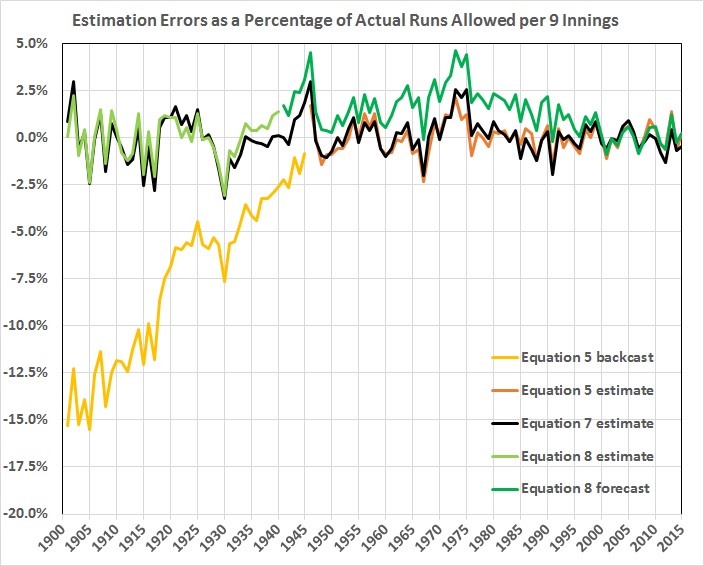
Estimation errors as perentage of runs allowed

Equation 7, even though it spans vastly different baseball eras, is as good as or better than equations 5 and 8, even though they’re tailored to their eras. Here’s equation 7:

RA9 = -5.01 + H9(0.67) + HR9(0.73) + BB9(0.32) + E9(0.60) + WP9(0.69) + HBP9(0.51) + PAge(0.03)

Where 9 stands for “per 9 innings” and
RA = runs allowed
H = hits allowed
HR = home runs allowed
BB = bases on balls allowed
E = errors committed
WP = wild pitches
HBP = batters hit by pitches
PAge = average age of pitchers

The adjusted r-squared of the equation is 0.988; the f-value is 7.95E-102 (a microscopically small probability that the equation arises from chance). See the first footnote regarding the p-values of the explanatory variables.

What does this have to do with velocity? Let’s say that velocity increased by 1 mile an hour between 2007 and 2015 (see chart above). The correlations for 2007-2015 between velocity and the six pitcher-related variables (H, HR, BB, WP, HBP, and PAge), though based on small samples, are all moderately strong to very strong (r-squared values 0.32 to 0.83). The combined effects of an increase in velocity of 1 mile an hour on those six variables yield an estimated decrease in RA9 of 0.74. The actual decrease from 2007 to 2015, 0.56, is close enough that I’m inclined to give a lot of credit to the rise in velocity.**

What about the long haul? Pitchers have been getting bigger and stronger — and probably faster — for decades. The problem is that a lot of other things have been changing for decades: the baseball, gloves, ballparks, the introduction of night games, improvements in lighting, an influx of black and Latin players, variations in the size of the talent pool relative to the number of major-league teams, the greater use of relief pitchers generally and closers in particular, the size and strength of batters, the use of performance-enhancing drugs, and so on. Though I would credit the drop in RA9 to a rise in velocity over a brief span of years — during which the use of PEDs probably declined dramatically — I won’t venture a conclusion about the long haul.
_________
* I looked for equations where explanatory variables have intuitively correct signs (e.g., runs allowed should be positively related to walks) and low p-values (i.e., low probability of inclusion by chance). The p-values for the variables in equation 5 are all below 0.01; for equation 7 the p-values all are below 0.001. In the case of equation 8, I accepted two variables with p-values greater than 0.01 but less than 0.10.

** It’s also suggestive that the relationship between velocity and the equation 7 residuals for 2007-2015 is weak and statistically insignificant. This could mean that the effects of velocity are adequately reflected in the coefficients on the pitcher-related variables.

Verbal Regression Analysis, the “End of History,” and Think-Tanks

There once was a Washington DC careerist with whom I crossed verbal swords. I won; he lost and moved on to another job. I must, however, credit him with at least one accurate observation: Regression analysis is a method of predicting the past with great accuracy.

What did he mean by that? Data about past events may yield robust statistical relationships, but those relationships are meaningless unless they accurately predict future events. The problem is that in the go-go world of DC, where rhetoric takes precedence over reality, analysts usually assume the predictive power of statistical relationships, without waiting to see if they have any bearing on future events.

Francis Fukuyama has just published an article in which he admits that his famous article, “The End of History” (1989), was a kind of verbal regression analysis — a sweeping prediction of the future based on a (loose) verbal analysis of the past.

What is the “end of history”? This, according to Wikipedia:

[A] political and philosophical concept that supposes that a particular political, economic, or social system may develop that would constitute the end-point of humanity’s sociocultural evolution and the final form of human government.

What did Fukuyama say about “the end of history” in 1989? This:

In watching the flow of events over the past decade or so, it is hard to avoid the feeling that something very fundamental has happened in world history….

What we may be witnessing in not just the end of the Cold War, or the passing of a particular period of post-war history, but the end of history as such: that is, the end point of mankind’s ideological evolution and the universalization of Western liberal democracy as the final form of human government. This is not to say that there will no longer be events to fill the pages of Foreign Affairs‘s yearly summaries of international relations, for the victory of liberalism has occurred primarily in the realm of ideas or consciousness and is as yet incomplete in the real or material world. But there are powerful reasons for believing that it is the ideal that will govern the material world in the long run. To understand how this is so, we must first consider some theoretical issues concerning the nature of historical change.

What does Fukuyama say now? This:

I argued [in 1989] that History (in the grand philosophical sense) was turning out very differently from what thinkers on the left had imagined. The process of economic and political modernization was leading not to communism, as the Marxists had asserted and the Soviet Union had avowed, but to some form of liberal democracy and a market economy. History, I wrote, appeared to culminate in liberty: elected governments, individual rights, an economic system in which capital and labor circulated with relatively modest state oversight….

Twenty-five years later, the most serious threat to the end-of-history hypothesis isn’t that there is a higher, better model out there that will someday supersede liberal democracy; neither Islamist theocracy nor Chinese capitalism cuts it. Once societies get on the up escalator of industrialization, their social structure begins to change in ways that increase demands for political participation. If political elites accommodate these demands, we arrive at some version of democracy.

The question is whether all countries will inevitably get on that escalator. The problem is the intertwining of politics and economics. Economic growth requires certain minimal institutions such as enforceable contracts and reliable public services before it will take off, but those basic institutions are hard to create in situations of extreme poverty and political division. Historically, societies broke out of this “trap” through accidents of history, in which bad things (like war) often created good things (like modern governments). It is not clear, however, that the stars will necessarily align for everyone….

A second problem that I did not address 25 years ago is that of political decay, which constitutes a down escalator. All institutions can decay over the long run. They are often rigid and conservative; rules responding to the needs of one historical period aren’t necessarily the right ones when external conditions change.

Moreover, modern institutions designed to be impersonal are often captured by powerful political actors over time. The natural human tendency to reward family and friends operates in all political systems, causing liberties to deteriorate into privileges….

As for technological progress, it is fickle in distributing its benefits. Innovations such as information technology spread power because they make information cheap and accessible, but they also undermine low-skill jobs and threaten the existence of a broad middle class.

No one living in an established democracy should be complacent about its survival. But despite the short-term ebb and flow of world politics, the power of the democratic ideal remains immense. We see it in the mass protests that continue to erupt unexpectedly from Tunis to Kiev to Istanbul, where ordinary people demand governments that recognize their equal dignity as human beings. We also see it in the millions of poor people desperate to move each year from places like Guatemala City or Karachi to Los Angeles or London.

Even as we raise questions about how soon everyone will get there, we should have no doubt as to what kind of society lies at the end of History.

And blah, blah, blah, blah, blah.

The “end of history” will be some kind of “democracy,” and it will arrive despite all of the very real obstacles in its way, which include sectional and sectarian conflict, the capture of governmental power by special interests, and economic realities (which are somehow “wrong,” despite the fact that they are just realities). In the end “hope and change” will prevail because, well, they ought to prevail, by golly.

In sum, Fukuyama has substituted a new verbal regression analysis for his old one.

You may have guessed by now that “verbal regression analysis” means “bullshit.” Fukuyama emitted bullshit in 1989, and he’s emitting it 25 years later. Why anyone would pay attention to him and his ilk is beyond me.

But there are organizations — so-called think-tanks — that specialize in converting your tax dollars into bullshit of the kind emitted by Fukuyama. It’s unfortunate that the output of those think-tanks can’t be bagged and used as fertilizer. It would then have real value.