“Cultural Appropriation” Is a Stupid Concept

Just for the fun of it, let’s divide the world into the old racial categories — Caucasoid, Mongoloid, and Negroid — and stipulate that they are associated with broadly different cultural heritages. By cultural heritages, I mean not just such things as weird languages, funny dance steps, and peculiar ways of decorating oneself, but also such things as the STEM disciplines, the technologies resulting from their application, and various other refinements (or lack thereof) in the various arts (e.g., plastic, visual, musical, and terpsichorean).

Now, it is widely believed by those persons who are sensitive to such things that Caucasoids commit grievous social sins when they adopt and adapt (i.e., appropriate) the cultural artifacts of Mongoloids and Negroids. But Mongoloids and Negroids are free of sin when the appropriate the cultural artifacts of Caucasoids.

This is a good thing for Mongoloids and Negroids because, unlike Caucasoids who claim to detest cultural appropriation, they know where they would be without it. Where’s that? Living in primitive conditions without the following (and much more):

Computers (of all sizes)

Internet

Smart phones

Radio and TV

Movies

Automobiles (of all kinds), airplanes, and trains (including subways)

Mass production of myriad products, from foodstuffs to folderol

Complex and efficient distribution networks for the aforesaid products

The vast array of services that has accompanies, enabled, and evolved with the aforesaid artifacts (and other)

Classical music

Country music

Various sports (e.g., baseball, basketball, soccer, football)

That’s enough of that.

Now consider the number of Mongoloids and Negroids (billions, actually) who benefit from such things. And consider the number of Mongoloids and Negroids in the U.S. (millions, certainly) who are among the country’s top earners because of such things.

Where would those billions and millions be if cultural appropriation were banned by force of law?

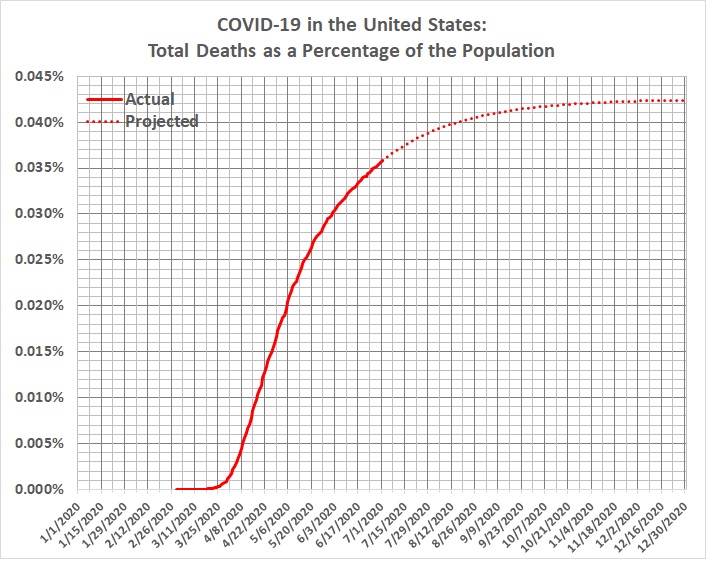
COVID-19 in the United States

Data source: here.

A New Direction

Nothing that I say here will have any effect on the downward spiral of the United States into an anti-libertarian oligarchy, controlled by an academic-media-information technology-regulatory complex that is intent on the suppression of straight, white persons of European descent who aren’t members of the complex, and anyone (regardless of sex, race, ethnicity, or national origin) who dissents from the party line du jour.

The oligarchs themselves will do everything in their considerable power to control the narrative and keep their followers in line by using the contemporary equivalent of bread and circuses (tawdry entertainment; sensational, biased “news”; transfers of income and wealth; further erosion of the institutions that inculcate and enforce traditional morality; etc.).

You can read what I have said about such matters (e.g., here) — and much more — by consulting the list of categories and the tag cloud in the sidebar, and by reading selections from my (very long and semi-organized) list of favorite posts. I will say no more, having said more than enough, to no avail, in a blogging career that spans more than twenty years.

But, as an inveterate analyst, I will continue to produce statistical charts and tables that probe such matters as the status of the COVID-19 outbreak in the United States, Trump’s polling, the outlook for election 2020, climate data, economic indicators, and the ideological direction of the Supreme Court. So, from now on, I will publish posts on subjects that lend themselves to statistical treatment — without commentary. (Well, I may throw in an occasional bit of barbed humor.)

I will report, you may decide — or despair — as you wish.

Racism in Action

Here. It’s not what you expected, is it?

The perp — a young-ish black man — had previously been arrested more than 100 times

Why was he walking around free?

Why aren’t white’s rioting and burning down buildings?

(See also “Crime Revisited“.)

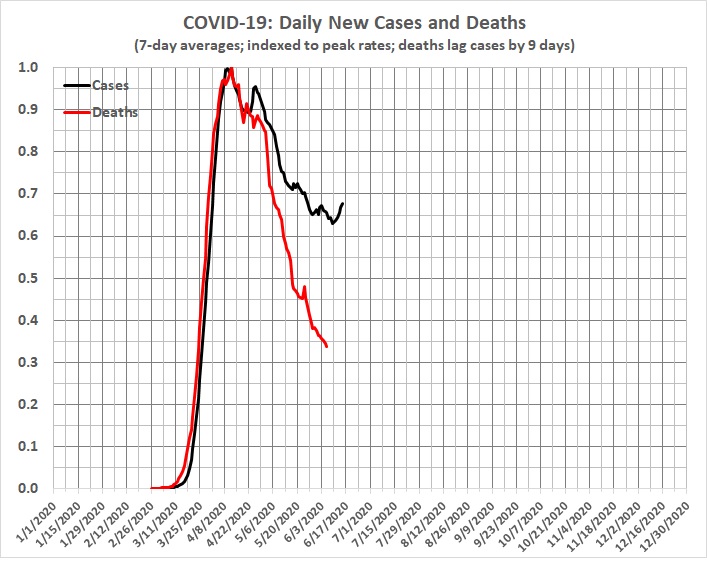
COVID-19: The Disconnect between Cases and Deaths

As many (including me) have observed, COVID-19 case statistics don’t give a reliable picture of the spread of COVID-19 in the U.S. Just a few of the reasons are misdiagnosis; asymptomatic (and untested) cases; and wide variations in the timing, location, and completeness of testing. As a result, the once-tight correlation between reported cases and deaths has loosened to the point of meaninglessness:


Source: Derived from statistics reported here.

So when you hear about a “surge” in cases, do not assume that they are actually new cases. It’s just that new cases are being discovered because more tests are being conducted. The death toll, overstated as it is, is a better indicator of the state of affairs. And the death toll continues to drop.

Less Discrimination Means More Discrimination

From a piece by Jordan Davidson in The Federalist:

The United States Supreme Court on Monday ruled [in Bostock v. Clayton] that the definition of sex in a federal civil rights law expanded to include sexual orientation and gender identity, ensuring the protection of gay, lesbian, and transgender people from being reprimanded or fired at work. This controversial decision comes after multiple failed legislation attempts in Congress over the last 15 years to rewrite the definition of the word “sex” into law.

The ruling was 6-3 with Justice Gorsuch and Justice Roberts, both appointed by Republican presidents, voting with the majority while Justices Clarence Thomas, Samuel Alito and Brett Kavanaugh dissented on the grounds that the definition of sex is not the Court’s decision.

Kavanaugh’s dissent includes this conciliatory aside:

Notwithstanding my concern about the Court’s transgression of the Constitution’s separation of powers, it is appropriate to acknowledge the important victory achieved today by gay and lesbian Americans. Millions of gay and lesbian Americans have worked hard for many decades to achieve equal treatment in fact and in law. They have exhibited extraordinary vision, tenacity, and grit—battling often steep odds in the legislative and judicial arenas, not to mention in their daily lives. They have advanced powerful policy arguments and can take pride in today’s result.

Granting more “equality” to yet another identity group means that employers are less likely to hire and promote — and more likely to fire — white, heterosexual males under the age of 40 who are undeniably of European descent. It’s the only group that can’t claim employment discrimination. Well, maybe it’s not the only group, but it’s certainly the only group that comprises more than a fraction of a percent of the populace. And you can bet that the minuscule minorities will eventually acquire more “rights” than the aforementioned white, heterosexual males.

So much for equal treatment under the law. To paraphrase George Orwell’s observation in Animal Farm: All persons are equal, but some persons are more equal than others.

Reflections on Aging and Social Disengagement

Aging is of interest to me because I suddenly and surprisingly find myself among the oldest ten percent of Americans.

I also find myself among the more solitary of Americans. My wife and I rattle about in a house that could comfortably accommodate a family of six, with plenty of space in which to have sizeable gatherings (which we no longer do). But I am not lonely in my solitude, for it is and long has been of my own choosing. Lockdowns and self-isolation haven’t affected me a bit. Life, for me, goes on as usual and as I like it.

This is so because of my strong introversion. I suppose that the seeds of my introversion are genetic, but the symptoms didn’t appear in earnest until I was in my early thirties. After that I became steadily more focused on a few friendships (which eventually dwindled to none) and decidedly uninterested in the aspects of work that required more than brief meetings (one-on-one preferred). Finally, enough became more than enough and I quit full-time work at the age of fifty-six. There followed, a few years later, a stint of part-time work that also became more than enough. And so, at the age of fifty-nine, I banked my final paycheck. Happily.

What does my introversion have to do with my aging? I suspected that my continued withdrawal from social intercourse (more about that, below) might be a symptom of aging. And I found this, in the Wikipedia article “Disengagement Theory“:

The disengagement theory of aging states that “aging is an inevitable, mutual withdrawal or disengagement, resulting in decreased interaction between the aging person and others in the social system he belongs to”. The theory claims that it is natural and acceptable for older adults to withdraw from society….

Disengagement theory was formulated by [Elaine] Cumming and [William Earl] Henry in 1961 in the book Growing Old, and it was the first theory of aging that social scientists developed….

The disengagement theory is one of three major psychosocial theories which describe how people develop in old age. The other two major psychosocial theories are the activity theory and the continuity theory, and the disengagement theory [is at] odds with both.

The continuity theory

states that older adults will usually maintain the same activities, behaviors, relationships as they did in their earlier years of life. According to this theory, older adults try to maintain this continuity of lifestyle by adapting strategies that are connected to their past experiences [whatever that means].

I don’t see any conflict between the continuity theory and the disengagement theory. A strong introvert like me, for example, finds it easy to maintain the same activities, behaviors, and relationships as I did before I retired. Which is to say that I had begun minimizing my social interactions before retiring, and continued to do so after retiring.

What about the activity theory? Well, it’s a normative theory, unlike the other two (which are descriptive), and it goes like this:

The activity theory … proposes that successful aging occurs when older adults stay active and maintain social interactions. It takes the view that the aging process is delayed and the quality of life is enhanced when old people remain socially active.

That’s just a social worker’s view of “appropriate” behavior for older persons. Take my word for it, introverts don’t need it social activity, which is stressful for them, and resent those who try to push them into it. The life of the mind is far more rewarding than chit-chat with geezers. Why do you suppose my wife and I will do everything in our power to stay in our own home until we die? It’s not just because we love our home so much (and we do), but we can’t abide the idea of communal living, even in an upscale retirement community.

Anyway, I mentioned my continued withdrawal from social intercourse. A particular, recent instance of withdrawal sparked this post. For about fifteen years I corresponded regularly with a former colleague. He  has a malady that I have dubbed email-arrhea: several messages a day to a large mailing list, with many insipid replies from recipients whose choose “reply all”. Enough of that finally became too much, and I declared to him my intention to refrain from correspondence until … whenever. (“Don’t call me, I’ll call you.”) So all of his messages and those of his other correspondents are dumped automatically into my Gmail trash folder, and I no longer use Gmail.

My withdrawal from that particular node of social intercourse was eased by the fact that the correspondent is a collaborationist “conservative” with a deep-state mindset. So it was satisfying to terminate our relationship — and devote more time to things that I enjoy, like blogging.

Another Footnote about Anarchy

Seattle is what happens when the circle of anarchists is widened to include people who believe in force rather than dreamy abstractions about how private defense agencies can keep the peace. The problem — as realists like me have long noted — is that there are a lot of people who don’t believe in peace because it limits them to what the can earn honestly. And goes against their violent nature.


Related posts:

Anarchy: An Empty Concept
Anarchy, Minarchy, and Liberty
Friedman on Anarchy and Conservatism
A Few Thoughts about Anarchy
Extreme Libertarianism vs. the Accountable State
It’s the 1960s Redux
Apt Quotations for a Riot-Ridden Country
Anarchy: A Footnote

Anarchy: A Footnote

In “A Few Thoughts about Anarchy” I opined that if

anarchy were a viable option, it would have long since thrived. If it seems to have eked out a tenuous existence in isolated cases because of state sponsorship, isn’t that evidence of its inviability? And if it hasn’t thrived because statists of one kind and another have suppressed it, isn’t that also proof of its inviability? Call it a non-existence proof.

What we are now witnessing is the use of anarchy (enabled by left-statists) to strengthen the power of the central government. Blacks will get more handouts; more preferential treatment in hiring, promotions, college admissions, etc.; more suppression of speech that offends them (and white leftists), including facts about disparities in intelligence and violence; and more lenient treatment by police and courts (which will abet more violence by blacks). The rest of the populace will bear the costs, though affluent white leftists won’t care and will be glad of the consequences for middle- and low-income whites.

It is telling that some prominent left-statists (e.g., Nancy Pelosi) can’t bring themselves to denounce the movement to abolish police departments. What could better signify the symbiosis of left-statism and black privilege?

(See also “It’s the 1960s Redux” and “Apt Quotations for a Riot-Ridden Country“.)

Apt Quotations for a Riot-Ridden Country

I was browsing The Great Quotations and came upon several quotations that strike me as especially apt today.

The tyranny of a multitude is a multiplied tyranny. (Edmund Burke)

The very first essential for success is a perpetually constant and regular employment of violence. (Adolf Hitler)

All social disturbances and upheavals have their roots in crises of individual self-esteem, and the great endeavor in which the masses most readily unite is basically a search for pride. (Eric Hoffer)

The dictatorship of the proletariat is nothing else than power based upon force and limited by nothing — by no law and absolutely no rule. (V.I. Lenin)

Every reform movement has a lunatic fringe. (Theodore Roosevelt)

The mass never comes up to the standard of its best member, but on the contrary degrades itself to the level of the lowest. (Henry David Thoreau)

Bleeding Heart Libertarians (the Blog): Good Riddance

Ist kaputt. Why is it good riddance? See this post and follow the links, most of which lead to posts critical of Bleeding Heart Libertarians.

It’s the 1960s Redux

The death of George Floyd, which was caused (if only indirectly) by a member of the Minneapolis Police Department, has met with predictable reactions:

1. Trump is to blame for creating an “atmosphere of hate”.

2. The cop’s behavior is symptomatic of “systemic racism” in the United States.

3. Ergo, rioting — not just in Minneapolis but in some other large cities as well.

My thoughts:

1. The “atmosphere of hate” line is high irony, inasmuch as Trump and those who support him are targets of unremitting hatred. There’s a lot of psychological projection at work here.

2. The charge of “systemic racism” is symptomatic of systemic stereotyping by leftists who don’t want to acknowledge the next point and its consequences (discussed below).

3. Persons of low intelligence are more prone to violence than their more-intelligent peers.

The underlying problem hasn’t changed since the wave of urban riots in the 1960s:

Blacks, on average, are significantly less intelligent than whites of European descent, East Asians, and Ashkenzi Jews (a special class of whites of European descent).

Therefore, blacks generally earn less than than members of the other groups because (a) they are less employable and (b) their skills are less valuable (except for the small fraction of blacks who make it big in sports and entertainment).

Blacks, like most human beings, tend to live among persons who are similarly situated: economically, culturally, and racially. “Racism” is a two-way street.

Because large cities contain high concentrations of low-income blacks, resentments can quickly generate violence — not just where a triggering event occurs but wherever low-income blacks are concentrated.

A triggering event — like the death of George Floyd — ignites the simmering and long-standing resentment that must be felt among a large segment of the black population. That resentment is about the failure of blacks generally to advance relative to whites. The source of the resentment is found in the rhetoric of white “liberals”, who constantly peddle this untruth in return for black votes:

The social and economic distance between blacks and whites is due to white racism, and nothing else.

Another Big Lie from the left yields another tragic consequence.

Release Your Inner Introvert

I believe that the tendencies toward introversion and extraversion are inborn. But like many innate traits, their expression is influenced by environment. A born introvert, for example, may have to act like an extravert because of his job, the friends he has made, or some other social aspect of his life.

But lockdowns have allowed tens of millions of persons to work at home rather than in an office. And lockdowns have greatly altered socialization: no dining out, no social gatherings, no church-going, etc.

Such changes, I suspect, have caused many millions of suppressed introverts to discover that they are happier than they were before the lockdowns began. Work is less draining because it is less “close up and personal”. The absence of socialization comes as a surprising relief — no more anxiety about what others might do or say that requires a response or comment; no more anxiety about participating in events the one doesn’t really enjoy.

Not all reborn introverts will continue to enjoy their new freedom, of course. But many of them will do more of their work (perhaps all of it) from home if they are given the option of doing so. And many of them will allow some social “obligations” to lapse, and feel good about it.

So lockdowns have a liberating aspect. Who knew?

Is Trump Taking My Advice?

I made a case, here and here, for preemptive action against Big Tech’s censorship of conservative viewpoints. There has been some movement along anti-trust lines, but Trump’s executive order on social media is a big step in the right direction. Stewart Baker (The Volokh Conspiracy) explains:

The order really only has two and a half substantive provisions, and they’re all designed to increase the transparency of takedown decisions.

The first provision tells NTIA (the executive branch’s liaison to the FCC) to suggest a rulemaking to the FCC. The purpose of the rule is to spell out what it means for the tech giants to carry out their takedown policies “in good faith.” The order makes clear the President’s view that takedowns are not “taken in good faith if they are “deceptive, pretextual, or inconsistent with a provider’s terms of service” or if they are “the result of inadequate notice, the product of unreasoned explanation, or [undertaken] without a meaningful opportunity to be heard.” This is not a Fairness Doctrine for the internet; it doesn’t mandate that social media show balance in their moderation policies. It is closer to a Due Process Clause for the platforms.  They may not announce a neutral rule and then apply it pretextually. And the platforms can’t ignore the speech interests of their users by refusing to give users even notice and an opportunity to be heard when their speech is suppressed.

The second substantive provision is similar. It asks the FTC, which has a century of practice disciplining the deceptive and unfair practices of private companies, to examine social media takedown decisions through that lens.  The FTC is encouraged (as an independent agency it can’t be told) to determine whether entities relying on section 230 “restrict speech in ways that do not align with those entities’ public representations about those practices.”

(The remaining provision is an exercise of the President’s sweeping power to impose conditions on federal contracting. It tells federal agencies to take into account the “viewpoint-based speech restrictions imposed by each online platform” in deciding whether the platform is an “appropriate” place for the government to post its own speech. It’s hard to argue with that provision in the abstract. Federal agencies have no business advertising on, say, Pornhub. In application, of course, there are plenty of improper or unconstitutional ways the policy could play out. But as a vehicle for government censorship it lacks teeth; one doubts that the business side of these companies cares how many federal agencies maintain their own Facebook pages or Twitter accounts. And in any event, we’ll have time to evaluate this sidecar provision when it is actually applied.)

That’s it.  The order calls on social media platforms to explain their speech suppression policies and then to apply them honestly. It asks them to provide notice, a fair hearing, and an explanation to users who think they’ve been treated unfairly or worse by particular moderators.

I would take a much harder line (follow the links in the first sentence of this post). But something is better than nothing. It’s a shot across the bow of Big Tech, though I would prefer a nuclear-tipped torpedo below the water line.

A Word to the Unwise

This post is aimed at young-ish heterosexual males, though persons of other persuasions may find it amusing — or provocative.

It’s hard to tell love from lust when you’re in your late teens or twenties, and possibly even your thirties. But if you are inclined to wed, proceed cautiously. Here are some reasons for caution:

!. There are lots of good fish in the sea. Don’t be bowled over by the first woman who returns your infatuation, or the one who catches you on the rebound from a failed relationship.

2. Marry in haste, repent at leisure. If you take obligations seriously — and you should if you want a happy marriage — you are inviting years and decades of repentance if you make the wrong (hasty, uninformed) choice.

3. If you are not a “liberal” at 25, you have no heart. If you are not a conservative at 35 you have no brain. Men and women don’t always follow the same political path through life, and divergence can badly strain a marriage. Be on the lookout for hints that your intended is a “liberal” at heart, that is, all for the “general good” of mankind but not big on personal responsibility, accomplishment, and liberty. (See #4.)

4. Like mother (or father), like daughter. Not necessarily in looks, but very likely in personality. Get to know the parents, if you can, and take stock of  their traits. If one parent (or both) exhibits a trait or traits that you will find it hard or impossible to live with, be wary of wedding the daughter. (See #1.) The list of traits that might be unbearable is too long to recite here, but these are a few that I would watch for: nagging, controlling, crabby, self-centered, spiteful, resentful of the success of others, and unforgiving.

Election 2020: Installment 1

I was right about Election 2016. Now I’ll start posting regularly about Election 2020. It will be a while before there is some reliable polling about the presidential race. In the meantime, I’ll post about relevant issues, such as Trump’s popularity, the state of the economy, and the retreat of the COVID-19 outbreak.

There’s good news and bad news in this post. Whether the good news is good and the bad news is bad depends on whether you prefer Trump to Biden (or his replacement).

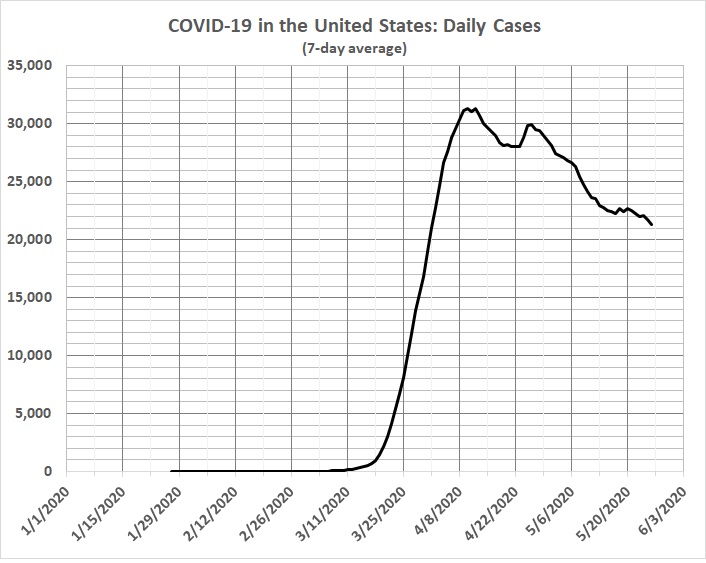
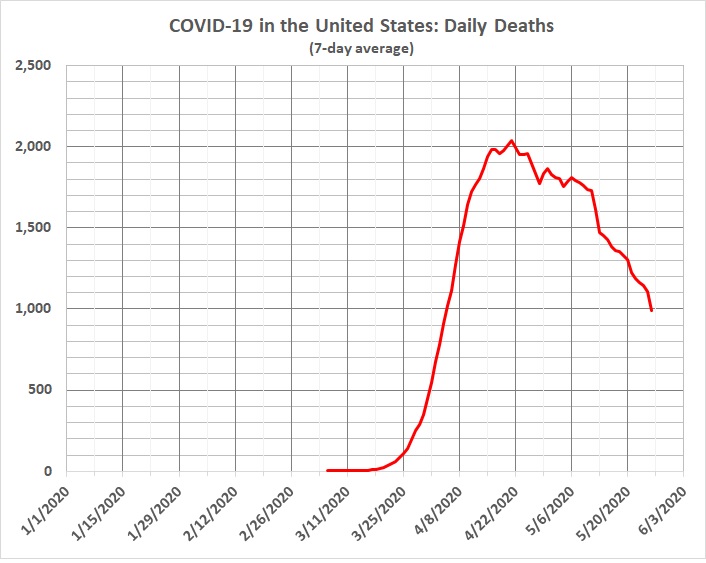
One piece of good news for Trump is the decided drop in the rate at which COVID-19 cases and deaths are occurring (if you believe the official numbers). Here are my tallies, averaged over 7 days to smooth over delays in reporting:

It’s too soon to know whether the curves will ascend again (or ascend significantly, if they do) as a result of “reopening”, which began in earnest over the Memorial Day weekend. Stay tuned.

Two pieces of very bad news for Trump are the sharp declines in (a) his popularity (as measured by an unbiased pollster, Rasmussen Reports) and (b) Americans’ view of the state of the nation (also as measured by Rasmussen).

This is worrying (or not) because it reflects sharply declining poll numbers for Trump, as against rising poll numbers for Obama at this stage 8 years ago:

And this is worrying (or not) because voters’ assessment of the state of the nation is well below where it was when Obama was reelected:

A piece of provisional good news is the possibility (to which I subscribe) of a quick turnaround in the economy. But don’t take my word for it. Consider this:

In early April, Jason Furman, a top economist in the Obama administration and now a professor at Harvard, was speaking via Zoom to a large bipartisan group of top officials from both parties. The economy had just been shut down, unemployment was spiking and some policymakers were predicting an era worse than the Great Depression. The economic carnage seemed likely to doom President Donald Trump’s chances at reelection.

Furman, tapped to give the opening presentation, looked into his screen of poorly lit boxes of frightened wonks and made a startling claim.

“We are about to see the best economic data we’ve seen in the history of this country,” he said….

“Everyone looked puzzled and thought I had misspoken,” Furman said in an interview. Instead of forecasting a prolonged Depression-level economic catastrophe, Furman laid out a detailed case for why the months preceding the November election could offer Trump the chance to brag — truthfully — about the most explosive monthly employment numbers and gross domestic product growth ever.

Since the Zoom call, Furman has been making the same case to anyone who will listen, especially the close-knit network of Democratic wonks who have traversed the Clinton and Obama administrations together, including top members of the Biden campaign.

Furman’s counterintuitive pitch has caused some Democrats, especially Obama alumni, around Washington to panic. “This is my big worry,” said a former Obama White House official who is still close to the former president. Asked about the level of concern among top party officials, he said, “It’s high — high, high, high, high.”…

Furman’s case begins with the premise that the 2020 pandemic-triggered economic collapse is categorically different than the Great Depression or the Great Recession, which both had slow, grinding recoveries.

Instead, he believes, the way to think about the current economic drop-off, at least in the first two phases, is more like what happens to a thriving economy during and after a natural disaster: a quick and steep decline in economic activity followed by a quick and steep rebound….

Furman’s argument is not that different from the one made by White House economic advisers and Trump, who have predicted an explosive third quarter, and senior adviser Jared Kushner, who said in late April that “the hope is that by July the country’s really rocking again.” White House officials were thrilled to hear that some of their views have been endorsed by prominent Democrats.

“I totally agree,” Larry Kudlow, head of the White House National Economic Council, replied in a text message when asked about Furman’s analysis. “Q3 may be the single best GDP quarter since regular data. 2nd half super big growth, transitioning to 4% or more in 2021.” He called Furman, whom he said he knows well, “usually a straight shooter. Hats off to him.”

“I have been saying that on TV as well,” said Kevin Hassett, a top Trump economic adviser, who pointed to a Congressional Budget Office analysis predicting a 21.5 percent annualized growth rate in the third quarter. “If CBO is correct we will see the strongest quarter in history after the weakest in Q2.”

Peter Navarro, a Trump trade and manufacturing adviser who’s a Harvard-educated economist, called the high unemployment America is currently facing “manufactured unemployment, which is to say that Americans are out of work not because of any underlying economic weaknesses but to save American lives. It is this observation that gives us the best chance and hope for a relatively rapid recovery as the economy reopens.”…

[A] former Obama White House official said, “Even today when we are at over 20 million unemployed Trump gets high marks on the economy, so I can’t imagine what it looks like when things go in the other direction. I don’t think this is a challenge for the Biden campaign. This is the challenge for the Biden campaign. If they can’t figure this out they should all just go home.”…

Between now and Election Day, there will be five monthly jobs reports, which are released on the first Friday of every month. The June report, covering May, is likely to show another increase in unemployment. But after that, Furman predicts, if reopening continues apace, the next four reports could be blockbusters. “You could easily have 1 to 2 million jobs created a month in those four reports before November,” he said.

He added, “And then toward the end of October, we will get GDP growth for the third quarter, at an annualized rate, and it could be double-digit positive economic growth. So these will be the best jobs and growth numbers ever.”…

Furman is an economist, but he had some strategic advice for the Biden campaign. “Don’t make predictions that could be falsified. There are enough terrible things to say you don’t need to make exaggerated predictions,” he said. “The argument that we are in another Great Depression will look like it was overstated. Trump can say, ‘Two million deaths didn’t happen, Great Depression didn’t happen, we are making a lot of progress.’”

The stock market reflects Furman’s (and my) assessment:

Give them jobs and their hearts, minds, and votes will follow.


Related posts:

Is a Perfect Electoral Storm Brewing?
“Give Me Liberty or Give Me Death”

Keeping Up with the News

Do you remember when a daily or weekly newspaper — whether local, regional, or national in scope — was delivered to almost every home? I do.

The prevalence of newspapers — in number and market saturation — probably peaked in the 1950s. Though radio had been around for a while, radio news complemented papers rather than supplanting them. It took the rise of television, with its combination of images and immediacy, to reverse the prevalence of newspapers.

The effect that TV had on the newspaper business was intensified and supplanted by rise of the internet as a source of “information”.  The rise of the internet has also pushed TV news to the edge of irrelevancy, but iit has managed to survive by become more sensationalized and politically extreme.

TV and the internet, with their mass audiences, are better suited than newspapers to the ultra-urbanization and homogenization of America, which still had far to go in the middle of the 20th century. The effects of ultra-urbanization and homogenization — the devastation of small-town America and the rise of “bowling alone” — are reflected in the elimination or drastic reduction of the kind of fare that was common to local and even regional papers: reports of illnesses, hospitalizations, visits (to and from the home town), scholastic achievements and awards (from kindergarten on up), graduations from college, engagements, weddings, births, and divorces. Only “obituaries” seem to thrive, but almost all of them aren’t the news stories of yore but, rather, paid death announcements placed through funeral homes.

The death-spiral of the newspaper business — less content, fewer readers, fewer advertisers, less content, etc. — is now several decades old. Regional papers have gone out of business or consolidated. Local papers have gone out of business or been absorbed (though ineffectively) by regional papers. The content of the remaining papers consists largely of syndicated material that is bought by the yard. There’s still a market for stories about local events of general interest (e.g., sports, local government, crime, highway construction) that aren’t covered (or are covered superficially) on TV or the internet.

As for myself, I long ago quit watching TV news bias (except when there is a weather person who gives detailed and informative reports), just as I quit reading print news bias (except for local news that might affect me). The obvious reason is that I have for almost 60 years (unfortunately) lived where what passes for news is really leftist propaganda: “big government good”, “believe almost all women (accusers of Democrats excepted)”, etc., etc., etc. I am immune to such propaganda and have no wish to encourage or subsidize its transmission.

Because of my blogging I’m usually tracking down information — facts, numbers, cogent analyses — rather than absorbing media memes and narratives. I pick and choose from dozens of online sources of information, preferring those that deliver documented facts to those that are freighted with opinion. I eschew right-wing and left-wing propaganda outlets with equal distaste.

Yes, I read the headlines to keep more or less au courant with significant happenings. But the story behind the headlines often emerges slowly and in bits and pieces. The Trump-Russia-collusion narrative, for example, is just now becoming known as what it was all along: Obamagate. It’s the deeper story that interests me, and it takes a lot of surfing to ferret it out.

Most of my offline reading time is devoted to books and articles about science, philosophy, and history. I read a lot of book-length literary fiction, too, with an occasional foray into the detective-mystery-thriller genre.

Time was when I read the print edition of the The Washington Post daily, and at length; ditto the Sunday edition of The New York Times. Now, I give a few minutes of my day to some of come strips carried online by the Post, though the roster of strips worth reading dwindles with every passing year. Similarly, the Times is good for the crossword and a couple of word games. It’s all in the name of saving trees, of course.

Bleeding Heart Libertarians (the Blog): A Bibliography of Related Posts

A recent post at Policy of Truth by its proprietor, Irfan Khawaja, prompted me to compile a list of all of the posts that I have written about some of the blog posts and bloggers at Bleeding Heart Libertarians. Though Khawaja and I disagree about a lot, I believe that we agree about the fatuousness of bleeding-heart libertarianism. (BTW, Khawaja’s flaming valedictory, on a different subject, is worth a read.)

Here’s the bibliography, arranged chronologically from March 9, 2011, to September 11, 2014:

The Meaning of Liberty
Peter Presumes to Preach
Positive Liberty vs. Liberty
More Social Justice
On Self-Ownership and Desert
The Killing of bin Laden and His Ilk
In Defense of Subjectivism
The Folly of Pacifism, Again
What Is Libertarianism?
Why Stop at the Death Penalty?
What Is Bleeding-Heart Libertarianism?
The Morality of Occupying Public Property
The Equal-Protection Scam and Same-Sex Marriage
Liberty, Negative Rights, and Bleeding Hearts
Bleeding-Heart Libertarians = Left-Statists
Enough with the Bleeding Hearts Already
Not Guilty of Libertarian Purism
Obama’s Big Lie
Bleeding-Heart Libertarians = Left-Statists (Redux)
Egoism and Altruism
A Case for Redistribution Not Made

The Common Good, or Rethinking Liberty

C. Bradley Thompson, writing at The American Mind (“The Rise and Fall of Pajama-Boy Nietzscheans“, May 13, 2020) takes on the radical right. There is much in Thompson’s essay with which I agree, and much with which I disagree. But I will focus here on these paragraphs:

There is no such thing as the “common good” unless one means the sum of the interests of all men and women in a particular society, and the only legitimate “good” common to all men and women as rational beings is freedom, which is the necessary condition from which they pursue all the goods necessary for living and living well. To the extent that the “common good” can mean anything at all, it describes the freedom and rights that all individuals must be guaranteed in a civilized society.

But the standard idea of the “common good” as used by [Sohrab] Ahmari [one of Thompson’s targets] is an abstraction that is greater than the sum of the individual men and women who make up a society. Thus the central problem with the anti-concept “common good” is that has no basis in objective reality, which means that it’s literally nothing other than a philosophic fantasy—a creation of the human imagination.

So far, not too bad. “The common good” as used by Ahmari is just another term for social-welfare function. And Thompson is right when he says that it has no basis in objective reality. It is, indeed, a creation of the human imagination. How can anyone meaningfully measure and sum the happiness or unhappiness of the hundreds of millions more persons now living in the United States. (or the billions more now living on Earth)? How, for instance, can anyone say that A’s enjoyment at inflicting pain on B (a non-masochistic) exceeds the pain suffered by B, resulting in an increase in “the common good”? Or conversely?

But the first paragraph quoted above is problematic. Freedom — or liberty — isn’t the necessary condition for living well. Liberty is living well, that is, in peaceful, willing coexistence and its concomitant: beneficially cooperative behavior.

The preconditions for liberty are mutual trust, respect, and forbearance. The third member of that triad requires trust in a transgressor’s ability and willingness to correct himself, either voluntarily or through a socially accepted sanction ranging from reproof to harsh punishment. For the sake of social comity, incorrigibility must therefore be treated by permanent removal from society, through exile, imprisonment, or execution.

Liberty, in sum, isn’t just a personal state of affairs. Rather, it’s a social state of affairs. And attaining it requires social agreement as to what constitutes expected and permissible behavior, and how to treat failures to behave as expected or to behave impermissibly. For, contrary to libertarian dogma, the underpinnings of liberty — mutual trust, respect, and forbearance — require the fulfillment of understood obligations, such as the obligation of able-bodied men to defend a community against invasion; the obligation of parents to instruct their children in society’s mores; or the obligation of men and women to enter into marriage before having children, the better to ensure that the children are raised in a secure and stable environment.

But what if the members of a polity differ strongly and fundamentally in their views of behavioral expectations and how to treat deviancy from those expectations? Where that is the case, there will be irreconcilable differences between factions within the polity, and those factions will strive constantly to rise to power so that they can impose their views on other factions. Where that is the case, liberty is impossible because mutual trust, respect, and forbearance are impossible.

Liberty, in other words, is a chimera in any polity whose members hold strong and irreconcilable views about behavioral norms, and where exit is practically impossible. The Founders and Framers overlooked those conditions because America was then much more homogeneous, culturally; the States were far more independent of each other; and migration to open territory was a real possibility.

Thus the Declaration of Independence opens with this high-flown sentiment:

We hold these truths to be self-evident, that all men are created equal, that they are endowed by their Creator with certain unalienable Rights, that among these are Life, Liberty and the pursuit of Happiness.

And the Constitution begins just as glibly:

We the People of the United States, in Order to form a more perfect Union, establish Justice, insure domestic Tranquility, provide for the common defence, promote the general Welfare, and secure the Blessings of Liberty to ourselves and our Posterity, do ordain and establish this Constitution for the United States of America.

But neither document delves the meaning of liberty or its essential — social — prerequisites, because such delving was unnecessary in the conditions of the time: great cultural homogeneity, weak central government, and the real possibility of exit. Political union, loose at was, was conjoined with something much closer to cultural homogeneity than is now the case.

Paradoxically, America was far more united, culturally, at the time of the bloody Civil War than it is today, when cosmopolitan elites and “real people” are engaged in a bitter and socially and economically destructive cold civil war.

Unless the present clash is resolved in a way that enables the opposing cultures to coexist independently of each other (except for voluntary, arms-length commercial transactions), liberty will continue to be an empty word in the United States.


Related page: Social Norms and Liberty (with a long list of related posts at the end)

Just Another Thing or Two about COVID-19

Though it’s tough to make predictions, especially about the future, and I sort of promised not to make any more predictions about the spread of COVID-19 in the United States because the data are unreliable (examples at the link and here). But I can’t resist saying a few more things about the matter.

Specifically, since my last substantive post about COVID-19 statistics, I now project 2 million cases and 135,000 deaths by mid-August, as against my earlier projections of 1.3 million and 90,000. The new estimates rely on the same database as the old ones, so they aren’t any more reliable than the old ones.

But I have revised my calculations so that they are based on 7-day average numbers of cases and deaths. This is an attempt to smooth over obvious lags in reporting (sudden drops in numbers of cases and deaths followed by sudden surges).

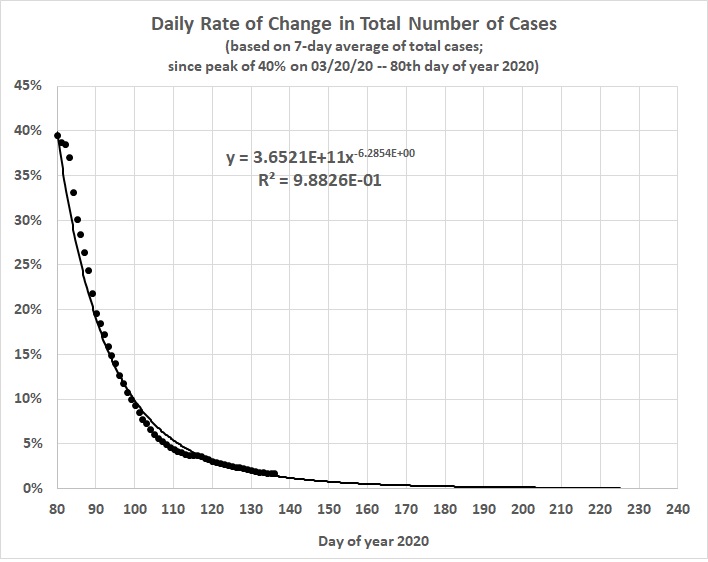
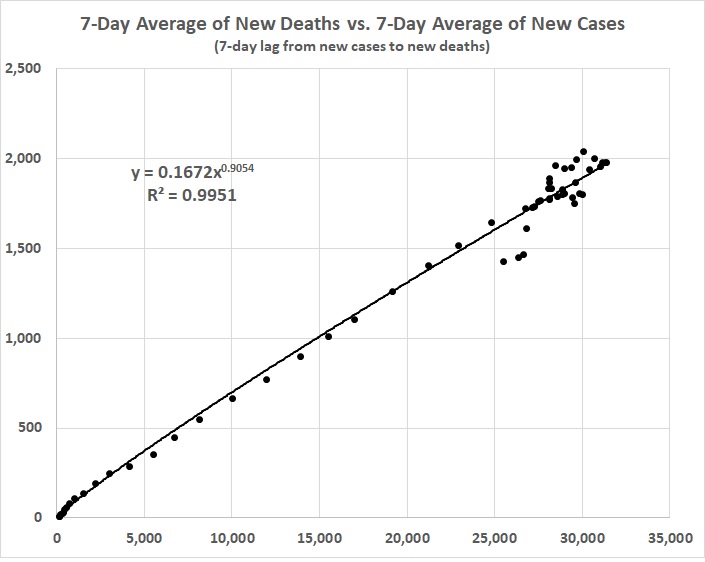
The equations in these two graphs …

… yield these projections:

Those are nationwide numbers. The good news (pending the results of “re-opening”) is that the daily number of new cases has declined sharply from the peaks of late March and late April. But there’s still a long way to go. The first graph in this post is worrisome because recent observations are a bit above the trend line; that is, the incidence of new cases may not be declining quite as rapidly as the equation suggests.

The number of new deaths has declined also, from the peak 7-day average of 2,041 on April 21 to 1,430 as of May 15. Overall, the rate of new deaths per new case seems to have stabilized at 5.7 percent. (The overall percentage will be somewhat higher because the deaths/case rate was higher than 5.7 for quite a while.)

Of course, the situation varies widely from State to State (and, obviously, within each State):

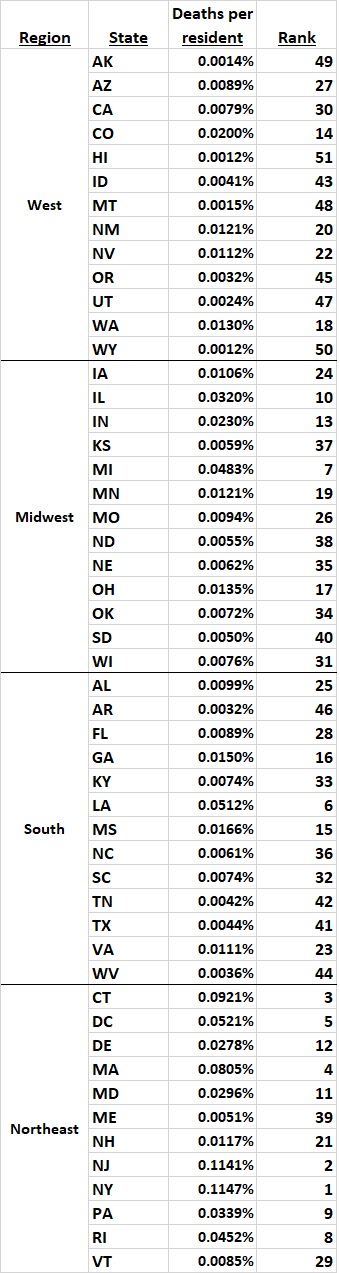
Regional and state variations in death rates
(I am using same assignment of States to regions as used by my data source.)

Nine of the 12 States of the Northeast (including D.C.) are among the top 12 in deaths per resident. The exceptions are the more rural Northeastern States: Main, New Hampshire, and Vermont.

In general, States with large, densely populated metropolitan areas have fared worse than less-urbanized States with smaller cities. That’s unsurprising, of course. But it also underscores the resistance of large swaths of the populace to “New York” rules.


Other related posts:

Contagion Nation?
“Give Me Liberty or Give Me Death”