Mencken’s Pearl of Wisdom

I am not a big fan of H.L. Mencken (see this), nor of Lee Jussim (see this). But I do follow Jussim’s blog, just to keep track of his intellectual outrages. In a recent, quotation-filled post, Jussim quotes Mencken:

The urge to save humanity is almost always only a false-face for the urge to rule it.

Exactly. Thus we have

  • economic destruction to “save the planet” in the name of a pseudo-science that can’t even depict the pre-1975  and post-1998 past accurately
  • cries of “white privilege” and “racism” — accompanied by violence and suppression of speech, aimed at law-abiding persons who don’t think the “right” thoughts and say the “right” things (i.e., conservatives)
  • “gender equality” and “marriage equality” as blanket justifications for the destruction of property rights and freedom of association
  • “income inequality” as the rallying cry of redistributive schemes that penalize success and stifle the very economic growth that would materially enrich the poor
  • shackled, inefficient markets because someone, somewhere made a mistake (from which he and others might have learned) or defrauded someone (for which ample publicity and a prison sentence somehow weren’t a sufficient remedy and caution)
  • massive, costly, authoritarian bureaucracies dedicated to all of those causes, and many more.

It’s all very Orwellian.

Daylight Saving Time Doesn’t Kill…

…it’s “springing forward” in March that kills.

There’s a hue and cry about daylight saving time (that’s “saving” not “savings”). The main complaint seems to be the stress that results from moving clocks ahead in March:

Springing forward may be hazardous to your health. The Monday following the start of daylight saving time (DST) is a particularly bad one for heart attacks, traffic accidents, workplace injuries and accidental deaths. Now that most Americans have switched their clocks an hour ahead, studies show many will suffer for it.

Most Americans slept about 40 minutes less than normal on Sunday night, according to a 2009 study published in the Journal of Applied Psychology…. Since sleep is important for maintaining the body’s daily performance levels, much of society is broadly feeling the impact of less rest, which can include forgetfulness, impaired memory and a lower sex drive, according to WebMD.

One of the most striking affects of this annual shift: Last year, Colorado researchers reported finding a 25 percent increase in the number of heart attacks that occur on the Monday after DST starts, as compared with a normal Monday…. A cardiologist in Croatia recorded about twice as many heart attacks than expected during that same day, and researchers in Sweden have also witnessed a spike in heart attacks in the week following the time adjustment, particularly among those who were already at risk.

Workplace injuries are more likely to occur on that Monday, too, possibly because workers are more susceptible to a loss of focus due to too little sleep. Researchers at Michigan State University used over 20 years of data from the Mine Safety and Health Administration to determine that three to four more miners than average sustain a work-related injury on the Monday following the start of DST. Those injuries resulted in 2,649 lost days of work, which is a 68 percent increase over the hours lost from injuries on an average day. The team found no effects following the nation’s one-hour shift back to standard time in the fall….

There’s even more bad news: Drivers are more likely to be in a fatal traffic accident on DST’s first Monday, according to a 2001 study in Sleep Medicine. The authors analyzed 21 years of data on fatal traffic accidents in the U.S. and found that, following the start of DST, drivers are in 83.5 accidents as compared with 78.2 on the average Monday. This phenomenon has also been recorded in Canadian drivers and British motorists.

If all that wasn’t enough, a researcher from the University of British Columbia who analyzed three years of data on U.S. fatalities reported that accidental deaths of any kind are more likely in the days following a spring forward. Their 1996 analysis showed a 6.5 percent increase, which meant that about 200 more accidental deaths occurred immediately after the start of DST than would typically occur in a given period of the same length.

I’m convinced. But the solution to the problem isn’t to get rid of DST. No, the solution is to get rid of standard time and use DST year around.

I’m not arguing for year-around DST from an economic standpoint. The evidence about the economic advantages of DST is inconclusive.

I’m arguing for year-around DST as a way to eliminate “spring forward” distress and enjoy an extra hour of daylight in the winter.

Don’t you enjoy those late summer sunsets? I sure do, and a lot other people seem to enjoy them, too. That’s why daylight saving time won’t be abolished.

But if you love those late summer sunsets, you should also enjoy an extra hour of daylight at the end of a drab winter day. I know that I would. And it’s not as if you’d miss anything if the sun rises an hour later in the winter. Even with standard time, most working people and students have to be up and about before sunrise in winter, even though sunrise comes an hour earlier than it would with DST.

How would year-around DST affect you? The following table gives the times of sunrise and sunset on the longest and shortest days of 2017 for nine major cities, north to south and west to east:

I report, you decide. If it were up to me, the decision would be year-around DST.

Thoughts for the Day

Excerpts of recent correspondence.

Robots, and their functional equivalents in specialized AI systems, can either replace people or make people more productive. I suspect that the latter has been true in the realm of medicine — so far, at least. But I have seen reportage of robotic units that are beginning to perform routine, low-level work in hospitals. So, as usual, the first people to be replaced will be those with rudimentary skills, not highly specialized training. Will it go on from there? Maybe, but the crystal ball is as cloudy as an old-time London fog.

In any event, I don’t believe that automation is inherently a job-killer. The real job-killer consists of government programs that subsidize non-work — early retirement under Social Security, food stamps and other forms of welfare, etc. Automation has been in progress for eons, and with a vengeance since the second industrial revolution. But, on balance, it hasn’t killed jobs. It just pushes people toward new and different jobs that fit the skills they have to offer. I expect nothing different in the future, barring government programs aimed at subsidizing the “victims” of technological displacement.

*      *      *

It’s civil war by other means (so far): David Wasserman, “Purple America Has All but Disappeared” (The New York Times, March 8, 2017).

*      *      *

I know that most of what I write (even the non-political stuff) has a combative edge, and that I’m therefore unlikely to persuade people who disagree with me. I do it my way for two reasons. First, I’m too old to change my ways, and I’m not going to try. Second, in a world that’s seemingly dominated by left-wing ideas, it’s just plain fun to attack them. If what I write happens to help someone else fight the war on leftism — or if it happens to make a young person re-think a mindless commitment to leftism — that’s a plus.

*     *     *

I am pessimistic about the likelihood of cultural renewal in America. The populace is too deeply saturated with left-wing propaganda, which is injected from kindergarten through graduate school, with constant reinforcement via the media and popular culture. There are broad swaths of people — especially in low-income brackets — whose lives revolve around mindless escape from the mundane via drugs, alcohol, promiscuous sex, etc. Broad swaths of the educated classes have abandoned erudition and contemplation and taken up gadgets and entertainment.

The only hope for conservatives is to build their own “bubbles,” like those of effete liberals, and live within them. Even that will prove difficult as long as government (especially the Supreme Court) persists in storming the ramparts in the name of “equality” and “self-creation.”

*     *     *

I correlated Austin’s average temperatures in February and August. Here are the correlation coefficients for following periods:

1854-2016 = 0.001
1875-2016 = -0.007
1900-2016 = 0.178
1925-2016 = 0.161
1950-2016 = 0.191
1975-2016 = 0.126

Of these correlations, only the one for 1900-2016 is statistically significant at the 0.05 level (less than a 5-percent chance of a random relationship). The correlations for 1925-2016 and 1950-2016 are fairly robust, and almost significant at the 0.05 level. The relationship for 1975-2016 is statistically insignificant. I conclude that there’s a positive relationship between February and August temperatures, but weak one. A warm winter doesn’t necessarily presage an extra-hot summer in Austin.

“They Deserve to Die”?

In “Prosperity Isn’t Everything” I quoted Megan McArdle’s observations about how thing have gotten better and worse for Americans. Here’s some of what she wrote:

By the standards of today, my grandparents were living in wrenching poverty. Some of this, of course, involves technologies that didn’t exist—as a young couple in the 1930s my grandparents had less access to health care than the most  neglected homeless person in modern America, simply because most of the treatments we now have had not yet been invented. That is not the whole story, however. Many of the things we now have already existed; my grandparents simply couldn’t afford them.  With some exceptions, such as microwave ovens and computers, most of the modern miracles that transformed 20th century domestic life already existed in some form by 1939. But they were out of the financial reach of most people….

[Not] everything has gotten better in every way, all the time. There are areas in which things have gotten broadly worse….

  • … Substance abuse, and the police response to it, has devastated both urban and rural communities.
  • Divorce broke up millions of families, and while the college educated class seems to have found a new equilibrium of stable and happy later marriages, marriage is collapsing among the majority who do not have a college degree, leaving millions of children in unstable family situations where fathers are often absent from the home, and their attention and financial resources are divided between multiple children with multiple women.
  • Communities are much less cohesive than they used to be, and while the educated elite may have found substitutes online, the rest of the country is “bowling alone” more and more often—which is not merely lonely, but also means they have fewer social supports when they find themselves in trouble.
  • A weekly wage packet may buy more than it did sixty years ago, but the stability of manufacturing jobs is increasingly being replaced by contingent and unreliable shift work that is made doubly and triply difficult by the instability of the families that tend to do these jobs. The inability to plan your life or work in turn makes it hard to form a family, and stressful to keep one together….

Charles Murray writes candidly but not unsympathetically about the plight of low-income white Americans in Coming Apart: The State of White America, 1960-2010:

Drawing on five decades of statistics and research, Coming Apart demonstrates that a new upper class and a new lower class have diverged so far in core behaviors and values that they barely recognize their underlying American kinship—divergence that has nothing to do with income inequality and that has grown during good economic times and bad.

The top and bottom of white America increasingly live in different cultures, Murray argues, with the powerful upper class living in enclaves surrounded by their own kind, ignorant about life in mainstream America, and the lower class suffering from erosions of family and community life that strike at the heart of the pursuit of happiness.

Along comes Kevin D. Williamson of the National Review to pour scorn upon low-income whites. Williamson’s article, which appeared in the print edition of March 28, 2016, was originally titled “The Father-Fuhrer,” a reference to Donald Trump. The online version is called “Chaos in the Family, Chaos in the State: The White Working Class’s Dysfunction.” Written before Trump had clinched the GOP nomination, the piece is a transparent attempt to discredit Trump by discrediting a key source of his support: low-income whites in chronically depressed regions of the country.

Here’s a key passage:

The truth about these dysfunctional, downscale communities is that they deserve to die. Economically, they are negative assets. Morally, they are indefensible. Forget all your cheap theatrical Bruce Springsteen crap. Forget your sanctimony about struggling Rust Belt factory towns and your conspiracy theories about the wily Orientals stealing our jobs…. The white American underclass is in thrall to a vicious, selfish culture whose main products are misery and used heroin needles. Donald Trump’s speeches make them feel good. So does OxyContin. What they need isn’t analgesics, literal or political. They need real opportunity, which means that they need real change, which means that they need U-Haul.

Disgusting.

Scott Grier, writing in The Daily Caller (“National Review Writer: Working-Class Communities ‘Deserve To Die’,” March 12, 2016), seems to share my disgust. He closes with this:

While Williamson blames the people living in run-down white communities for their own woes, he does not apply the same principle to run-down minority communities. In his book and articles on the failures of Detroit, for instance, the National Review writer blames “progressivism” and unions for ruining the predominately African-American city.

Spot on. As I say in “Prosperity Isn’t Everything,”

Let’s begin with social norms, which are the basis of social ties. If you and I observe the same social norms, we’re likely to feel bound in some way, even if we’re not friends or relatives. This, of course, is tribalism, which is verboten among those who view all of mankind as brothers, sisters, and whatevers under the skin — all mankind except smarty-pants Americans of East Asian descent, Israeli Jews and American Jews who support Israel, Southerners (remember the Civil War!), and everyone else who is a straight, non-Hispanic white male of European descent. To such people, the only legitimate tribe is the tribe of anti-tribalism.You may by now understand that I blame leftists for the breakdown of social norms and social ties. But how can that be if, as McArdle says, “the college educated class seems to have found a new equilibrium of stable and happy later marriages”? The college-educated class resides mostly on the left, and affluent leftists do seem to have avoided the rot.

Yes, but they caused it. You could think of it as a non-suicidal act of terror. But it would be kinder and more accurate to call it an act of involuntary manslaughter.  Leftists meant to make the changes that caused the rot; they just didn’t foresee or intend the rot. Nor is it obvious that they care about it, except as an excuse to “solve” social problems from on high by throwing money and behavioral prescriptions at them — which is why there’s social rot in the first place.

The good intentions embedded in governmental acts and decrees have stealthily expanded and centralized government’s power, and in the process have sundered civil society….

The undoing of traditional mores began in earnest in the 1960s, with a frontal assault on traditional morality and the misguided expansion of the regulatory-welfare state. The unraveling continues to this day. Traditional morality is notable in its neglect; social cohesion is almost non-existent, except where the bonds of religion and ethnicity remain strong. The social fabric that once bound vast swaths of America has rotted — and is almost certainly beyond repair.

The social fabric has frayed precisely because government has pushed social institutions aside and made dependents of hundreds of millions of Americans. As Ronald Reagan said in his first inaugural address, “In this present crisis, government is not the solution to our problem, government is the problem.”

Now for an ironic twist. Were the central government less profligate and intrusive, Americans would become much more prosperous.

Clearly, Kevin Williamson wants to distance himself from people who don’t share his elevated norms. In that respect, he’s no different from a sneering, leftist-voting yuppie. If he were truly conservative, he’d have compassion for the people about whom he writes.

But Williamson has shown himself to be a faux conservative: all economic efficiency and no heart.

Is Consciousness an Illusion?

Scientists seem to have pinpointed the physical source of consciousness. But the execrable Daniel C. Dennett, for whom science is God, hasn’t read the memo. Dennett argues in his latest book, From Bacteria to Bach and Back: The Evolution of Minds, that consciousness is an illusion.

Another philosopher, Thomas Nagel, weighs in with a dissenting review of Dennett’s book. (Nagel is better than Dennett, but that’s faint praise.) Nagel’s review, “Is Consciousness an Illusion?,” appears in The New York Review of Books (March 9, 2017). Here are some excerpts:

According to the manifest image, Dennett writes, the world is

full of other people, plants, and animals, furniture and houses and cars…and colors and rainbows and sunsets, and voices and haircuts, and home runs and dollars, and problems and opportunities and mistakes, among many other such things. These are the myriad “things” that are easy for us to recognize, point to, love or hate, and, in many cases, manipulate or even create…. It’s the world according to us.

According to the scientific image, on the other hand, the world

is populated with molecules, atoms, electrons, gravity, quarks, and who knows what else (dark energy, strings? branes?)….

In an illuminating metaphor, Dennett asserts that the manifest image that depicts the world in which we live our everyday lives is composed of a set of user-illusions,

like the ingenious user-illusion of click-and-drag icons, little tan folders into which files may be dropped, and the rest of the ever more familiar items on your computer’s desktop. What is actually going on behind the desktop is mind-numbingly complicated, but users don’t need to know about it, so intelligent interface designers have simplified the affordances, making them particularly salient for human eyes, and adding sound effects to help direct attention. Nothing compact and salient inside the computer corresponds to that little tan file-folder on the desktop screen.

He says that the manifest image of each species is “a user-illusion brilliantly designed by evolution to fit the needs of its users.” In spite of the word “illusion” he doesn’t wish simply to deny the reality of the things that compose the manifest image; the things we see and hear and interact with are “not mere fictions but different versions of what actually exists: real patterns.” The underlying reality, however, what exists in itself and not just for us or for other creatures, is accurately represented only by the scientific image—ultimately in the language of physics, chemistry, molecular biology, and neurophysiology….

You may well ask how consciousness can be an illusion, since every illusion is itself a conscious experience—an appearance that doesn’t correspond to reality. So it cannot appear to me that I am conscious though I am not: as Descartes famously observed, the reality of my own consciousness is the one thing I cannot be deluded about….

According to Dennett, however, the reality is that the representations that underlie human behavior are found in neural structures of which we know very little. And the same is true of the similar conception we have of our own minds. That conception does not capture an inner reality, but has arisen as a consequence of our need to communicate to others in rough and graspable fashion our various competencies and dispositions (and also, sometimes, to conceal them)….

The trouble is that Dennett concludes not only that there is much more behind our behavioral competencies than is revealed to the first-person point of view—which is certainly true—but that nothing whatever is revealed to the first-person point of view but a “version” of the neural machinery….

I am reminded of the Marx Brothers line: “Who are you going to believe, me or your lying eyes?” Dennett asks us to turn our backs on what is glaringly obvious—that in consciousness we are immediately aware of real subjective experiences of color, flavor, sound, touch, etc. that cannot be fully described in neural terms even though they have a neural cause (or perhaps have neural as well as experiential aspects). And he asks us to do this because the reality of such phenomena is incompatible with the scientific materialism that in his view sets the outer bounds of reality. He is, in Aristotle’s words, “maintaining a thesis at all costs.”

Nagel’s counterargument would have been more compelling if he had relied on a simple metaphor like this one: Most drivers can’t describe in any detail the process by which an automobile converts the potential energy of gasoline to the kinetic energy that’s produced by the engine and then transmitted eventually to the automobile’s drive wheels. Instead, most drivers simply rely on the knowledge that pushing the start button will start the car. That knowledge may be shallow, but it isn’t illusory. If it were, an automobile would be a useless hulk sitting in the driver’s garage.

Some tough questions are in order, too. If consciousness is an illusion, where does it come from? Dennett is an out-and-out physicalist and strident atheist. It therefore follows that Dennett can’t believe in consciousness (the manifest image) as a free-floating spiritual entity that’s disconnected from physical reality (the scientific image). It must, in fact, be a representation of physical reality, even if a weak and flawed one.

Looked at another way, consciousness is the gateway to the scientific image. It is only through the  deliberate, reasoned, fact-based application of consciousness that scientists have been able to roll back the mysteries of the physical world and improve the manifest image so that it more nearly resembles the scientific image. The gap will never be closed, of course. Even the most learned of human beings have only a tenuous grasp of physical reality in all of it myriad aspects. Nor will anyone ever understand what physical reality “really is” — it’s beyond apprehension and description. But that doesn’t negate the symbiosis of physical reality and consciousness.

*     *     *

Related posts:
Debunking “Scientific Objectivity”
A Non-Believer Defends Religion
Evolution as God?
The Greatest Mystery
What Is Truth?
The Improbability of Us
The Atheism of the Gaps
Demystifying Science
Something from Nothing?
Something or Nothing
My Metaphysical Cosmology
Further Thoughts about Metaphysical Cosmology
Nothingness
The Glory of the Human Mind
Mind, Cosmos, and Consciousness
Is Science Self-Correcting?
“Feelings, Nothing More than Feelings”
Words Fail Us
Hayek’s Anticipatory Account of Consciousness

Race and Social Engineering

It’s well known that the white-black gap in intelligence is persistent. (See, for example, the section headed “Race” in this post, and the graphs of average SAT scores by ethnicity in this one.) But according to this paper, those

group mean differences in cognitive test scores arise from the following racially disparate conditions: family income, maternal education, maternal verbal ability/knowledge, learning materials in the home, parenting factors (maternal sensitivity, maternal warmth and acceptance, and safe physical environment), child birth order, and child birth weight.

You should now ask yourself whether family income, maternal education, etc., are the causes of the intelligence gap or evidence of it. My money is on the latter.

But that won’t keep the social engineers at bay. Segregation is a perennial whipping-boy for those who are still seeking the Great Society, even if it’s voluntary, socioeconomic segregation rather than involuntary, state-mandated segregation. People can’t just be allowed to live among the kinds of people they prefer. No, they must be forced to integrate in the (vain) hope of bettering the groups favored by social engineers.

How can integration be forced? Well, the Obama administration found a way to get the ball rolling. It’s a HUD regulation called Affirmatively Furthering Fair Housing, which Wikipedia summarizes as follows:

It requires cities and towns which receive Federal money to examine their housing patterns and look for racial bias. The intention is to promote racial integration….

Under the rule, any jurisdiction that receives money from HUD must analyze its housing occupancy by race, class, English proficiency, and other categories. It must then analyze factors which contribute to any imbalance, and formulate a plan to remedy the imbalance. The plan can be approved or disapproved by HUD. This is done at both the local and regional level. For example, a major city, such as Chicago, will have to analyze any racial disparities within Chicago, and Chicago suburbs will analyze their own racial disparities. In addition, Chicago and the suburbs will have to analyze any disparities as compared with each other. Thereafter, the community has to track progress (or lack thereof). The planning cycle will be repeated every five years. If the Federal Government is not satisfied with a community’s efforts to reduce disparities, then under the disparate impact doctrine, this could be considered illegal discrimination. As a result, federal funds could be withheld, or the community could be sued, using the racial disparity statistics as evidence.

You know about disparate impact, of course. It’s a legalistic contrivance which says, in effect, that outcomes which are attributable to inherent differences between races and genders amount to illegal discrimination. In other words, it’s illegal to pick the best-qualified candidate for a job if the best-qualified candidate is of the “wrong” color or gender. “Disparate impact” effectively outlaws tests of intelligence for jobs that require above-average intelligence because otherwise “not enough” blacks will qualify for such jobs. “Disparate impact” effectively requires the lowering of physical standards for jobs that require strength because otherwise “not enough” women will qualify for such jobs. It’s affirmative action with a vengeance.

Affirmatively Furthering Fair Housing is reverse discrimination with a vengeance. Luckily, Affirmatively Furthering Fair Housing may not survive the Trump administration.

Why would social engineers seek forced integration, other than for the sheer enjoyment of exerting their power and doing unto others as they wouldn’t do unto themselves? The pretext for social engineering, in this case, is the existence of supportive academic studies (shades of the “doll tests” that influenced Brown v. Board of Education). Several of the studies are cited by Thomas B. Edsall in “Integration Works. Can It Survive the Trump Era?” (The New York Times, February 9, 2017). According to Edsall, the studies purport to show that

segregation, especially neighborhood segregation, exacerbates the racial test score gap….

[T]he higher the level of racial and economic segregation in an area, the larger the achievement gap.

Thus:

Among the scholars cited here, there is virtual unanimity on the conviction that one way to improve the prospects of poor minorities, black and Hispanic, is to desegregate both schools and housing.

It’s utilitarianism upon stilts.* And the stilts — the studies — are of dubious quality. Consider, for example, the one that seems to be the least circular of the lot, and which claims to prove that desegregation raises the measured intelligence of blacks. I’m referring to Rucker C. Johnson’s “Long-Run Impacts of School Desegregation & School Quality on Adult Attainments” (National Bureau of Economic Research Working Paper 16664, January 2011). According to the abstract, the study

analyzes the life trajectories of children born between 1945 and 1968, and followed through 2013, using the Panel Study of Income Dynamics (PSID). The PSID data are linked with multiple data sources that describe the neighborhood attributes, school quality resources, and coincident policies that prevailed at the time these children were growing up. I exploit quasi-random variation in the timing of initial court orders, which generated differences in the timing and scope of the implementation of desegregation plans during the 1960s, 70s, and 80s. Event study analyses as well as [two-stage least-squares] and sibling-difference estimates indicate that school desegregation and the accompanied increases in school quality resulted in significant improvements in adult attainments for blacks. I find that, for blacks, school desegregation significantly increased both educational and occupational attainments, college quality and adult earnings, reduced the probability of incarceration, and improved adult health status; desegregation had no effects on whites across each of these outcomes. The results suggest that the mechanisms through which school desegregation led to beneficial adult attainment outcomes for blacks include improvement in access to school resources reflected in reductions in class size and increases in per-pupil spending [emphasis added].

Before I get to the italicized assertions, I must comment on Johnson’s method. Convoluted and speculative are the best words to describe it. Here are some apt quotations directly from Johnson’s paper:

I compiled data on school spending and school segregation, linked them to a comprehensive database of the timing of court-ordered school desegregation, and linked these data to a nationally representative longitudinal dataset that follows individuals from childhood into adulthood. Education funding data come from several sources that are combined to form a panel of per-pupil spending for US school districts in 1967 and annually from 1970 through 2000. School segregation data come from the Office of Civil Rights (OCR), and are combined to form a panel used to construct school segregation indices that span the period 1968 through 1988. The school segregation and spending data are then linked to a database of desegregation litigation between 1954 and 2000.

The data on longer-run outcomes come from the Panel Study of Income Dynamics (PSID) that links individuals to their census blocks during childhood. The sample consists of PSID sample members born between 1945 and 1968 who have been followed into adulthood through 2013; these individuals were between the ages of 45 and 67 in 2013. I include all information on them for each wave, 1968 to 2013. Due to the oversampling of black and low-income families, 45 percent of the sample is black.

I match the earliest available childhood residential address to the school district boundaries that prevailed in 1969 to avoid complications arising from endogenously changing district boundaries over time…. Each record is merged with data on the timing of court ordered desegregation, data on racial school segregation, student-to-teacher ratios, school spending at the school district level that correspond with the prevailing levels during their school-age years. Finally, I merge in county characteristics and information on other key policy changes during childhood (e.g., the timing of hospital desegregation, rollout of “War on Poverty” initiatives and expansion of safety net programs…) from multiple data sources. This allows for a rich set of controls.

The comprehensive desegregation court case data I use contains an entire case inventory of every school district ever subject to court desegregation orders over the 1955-1990 period (American Communities Project), and major plan implementation dates in large districts (compiled by Welch/Light). Every court case is coded according to whether it involved segregation of students across schools, whether the court required a desegregation remedy, and the main component of the desegregation plan. The combined data from the American Communities Project (Brown University) and Welch/Light provide the best available data that have ever been utilized to study this topic for several reasons. First, the year of the initial court order (available for all districts) is plausibly more exogenous than the exact year in which a major desegregation plan was implemented because opposition groups to integration can delay major desegregation plan implementation by lengthening the court proceedings or by implementing inadequate desegregation plans…. And, court-ordered desegregation by legal mandate is plausibly more exogenous than other more voluntary forms of desegregation. Second, the date of the initial court order is precisely measured for all districts.

Sixty-nine percent of the PSID individuals born between 1945-1968 followed into adulthood grew up in a school district that was subject to a desegregation court order sometime between 1954 and 1990 (i.e., 9,156 out of 13,246 individuals), with the timing of the court order not necessarily occurring during their school-age years. Eighty-eight percent of the PSID black individuals born between 1945-1968 followed into adulthood grew up in a school district that was subject to a desegregation court order sometime between 1954 and 1990 (i.e., 4,618 out of 5,245 black individuals). The share of individuals exposed to school desegregation orders during childhood increases significantly with birth year over the 1945-1970 birth cohorts analyzed in the PSID sample….

After combining information from the aforementioned 5 data sources, the main sample used to analyze adult attainment outcomes consists of PSID individuals born between 1945-1968 originally from 8 school districts that were subject to desegregation court orders sometime between 1954 and 1990; this includes 9,156 individuals from 3,702 childhood families, 645 school districts, 448 counties, representing 39 different states. I restrict the estimation sample to individuals who grew up in school districts that were ever subject to court-ordered desegregation, since school districts of upbringing that were never under court order are arguably too different to provide a credible comparison group.

That’s just a small sample of Johnson’s statistical gyrations. Given the complexity of his sources, assumptions, and statistical manipulations, there was ample opportunity for cherry-picking to arrive at the desired result: integration is good for blacks and doesn’t harm whites.

If Johnson has shown anything, it’s that throwing money at the problem is the way to get results. That’s all integration means in the context of his study; it has nothing to do with whatever beneficial effects might arise from the commingling of blacks and whites. (About which, see below.)

And throwing money at the problem most certainly harms whites because most of the money undoubtedly cames from whites. How many white children are denied a chance to go to college, or to a better college, because of the school taxes levied on their parents? Johnson doesn’t bother to consider that question, or any other reasonable question about the deprivations visited upon whites because of higher school taxes.

Moreover, throwing money at the problem doesn’t really work:

Academic performance and preparation for college success are widely shared goals, and so it is useful for the public and policymakers to know how they have varied over time at the state level. The present paper estimates these trends by adjusting state average SAT scores for variation in student participation rates and demographic factors known to be associated with those scores.

In general, the findings are not encouraging. Adjusted state SAT scores have declined by an average of 3 percent. This echoes the picture of stagnating achievement among American 17-year-olds painted by the Long Term Trends portion of the National Assessment of Educational Progress, a series of tests administered to a nationally representative sample of students since 1970. That disappointing record comes despite a more-than-doubling in inflation-adjusted per pupil public-school spending over the same period (the average state spending increase was 120 percent). Consistent with those patterns, there has been essentially no correlation between what states have spent on education and their measured academic outcomes. In other words, America’s educational productivity appears to have collapsed, at least as measured by the NAEP and the SAT.

That is remarkably unusual. In virtually every other field, productivity has risen over this period thanks to the adoption of countless technological advances—advances that, in many cases, would seem ideally suited to facilitating learning. And yet, surrounded by this torrent of progress, education has remained anchored to the riverbed, watching the rest of the world rush past it.

Not only have dramatic spending increases been unaccompanied by improvements in performance, the same is true of the occasional spending declines experienced by some states. At one time or another over the past four decades, Alaska, California, Florida, and New York all experienced multi-year periods over which real spending fell substantially (20 percent or more of their 1972 expenditure levels). And yet, none of these states experienced noticeable declines in adjusted SAT scores—either contemporaneously or lagged by a few years. Indeed, their score trends seem entirely disconnected from their rising and falling levels of spending. [Andrew J. Coulson, “State Education Trends Academic Performance and Spending over the Past 40 Years,” Cato Institute, Policy Analysis Number 746, March 18, 2014]

Similar findings emerged from an earlier study by Dan Lips, Shanea J. Watkins, and John Fleming, “Does Spending More on Education Improve Academic Achievement?” (The Heritage Foundation, Backgrounder Number 2179, November 8, 2008). The answer to the question posed by the title is “no.”

Johnson’s expedition through a maze of data sets somehow miraculously arrives at a conclusion that isn’t supported by following the much more direct route of the Cato and Heritage studies: Throwing money at public schools has had almost no effect on the academic performance of students. Johnson report of exceptional results for a select set of public schools that had been integrated is incredible, in the proper meaning of the word: ” So implausible as to elicit disbelief; unbelievable.”

Don’t try to tell me that court-ordered integration has been worth the cost — in money and liberty — because it has fostered brotherly and sisterly love between whites and blacks. The opposite effect is the more likely one. Rather than repeat myself, I refer you to “Genetic Kinship and Society,” especially the discussions of Robert Putnam’s “E Pluribus Unum: Diversity and Community in the Twenty-first Century“ and Byron M. Roth’s The Perils of Diversity: Immigration and Human Nature. A clear implication of those analyses is that conflict — political, if not violent — is bound to result from racial-ethnic-cultural commingling, especially if it’s forced.

Forced integration is on a moral par with with forced segregation. Don’t let the social engineers tell you otherwise.
_________
*This is an allusion to Jeremy Bentham’s characterization of natural rights as “simple nonsense: natural and imprescriptible rights, rhetorical nonsense,—nonsense upon stilts.” It is a characterization with which I agree.

*     *     *

Related posts:
Race and Reason: The Derbyshire Debacle
Race and Reason: The Victims of Affirmative Action
Race and Reason: The Achievement Gap — Causes and Implications
“Conversing” about Race
Evolution and Race
“Wading” into Race, Culture, and IQ
Evolution, Culture, and “Diversity”
The Harmful Myth of Inherent Equality
Let’s Have That “Conversation” about Race
Affirmative Action Comes Home to Roost
The IQ of Nations
Liberty and Social Norms Re-examined

Unorthodox Economics: 4. A Parable of Political Economy

This is the fourth entry in what I hope will become a book-length series of posts. That result, if it comes to pass, will amount to an unorthodox economics textbook. This first chapter gives a hint of things to come. Here are the chapters that have been posted to date:

1. What Is Economics?
2. Pitfalls
3. What Is Scientific about Economics?
4. A Parable of Political Economy
5. Economic Progress, Microeconomics, and Macroeconomics

Imagine a simple society in which Jack and Jill own neighboring farms that are equally endowed in natural resources, tools, and equipment. Jack makes bread and Jill makes butter. Jack also could make butter and Jill also could make bread, but both of them have learned that they are better off if they specialize. Thus:

  • Jack can make 1 loaf of bread or 0.5 pound of butter a day. (The rate of transformation is linear; e.g. Jack could make 0.5 loaf of bread and 0.25 pound of butter daily.)
  • Jill can make 1 loaf of bread or 1 pound of butter a day. (Again, the rate of transformation is linear; Jill could make 0.5 loaf of bread and 0.5 pound of butter daily.)
  • If both Jack and Jill make bread and butter their total daily output might be 1 loaf and 0.75 pounds.
  • Alternatively, if Jack specializes in bread and Jill specializes in butter their total daily output could be 1 loaf and 1 pound.

Jill is more intelligent than Jack, and thus more innovative. That’s why she is able to reap as much wheat and make as much bread as Jack, even though he’s stronger. That’s also why she’s able to produce twice as much butter as Jack.

Jill has an absolute advantage over Jack, in that she can make as much bread as he can, and more butter than he can. But Jack has a comparative advantage in the production of bread; if he specializes in bread and Jill specializes in butter, he and Jill will be better off than if they both produce bread and butter for themselves.

Jack and Jill negotiate the exchange rate between bread and butter. Each ends up with 0.5 loaf of bread; but Jill gets 0.6 pound of butter to Jack’s 0.4 pound. Jill ends up with more butter than Jack because her greater productivity puts in her in superior bargaining position. In sum, she earns more because she produces more.

Jack and Jill have another neighbor, June, who makes clothing. Jack and Jill are more productive when they’re properly clothed during the colder months of the year. So they’re willing to trade some of their output to June, in return for heavy clothing.

Jerry, another neighbor, is a laborer who used to work for Jack and Jill, but has been unemployed for a long time because of Jill’s technological innovations. Jerry barely subsists on the fruit and game that he’s able to find and catch. Jack and Jill would hire Jerry but he insists on a wage that they can’t afford to pay unless they spends less to maintain their equipment, which would eventually result in a lower rate of output.

Along comes Juan, a wanderer from another region, who has nothing to offer but his labor. Juan is willing to work for a lower wage than Jerry, but has to be fed and clothed so that he becomes strong enough to deliver the requisite amount of labor to be worthy of hire.

Jack, Jill, and June meet to discuss Jerry and Juan. They are worried about Jerry because he’s a neighbor whom they’ve known for a long time. They also empathize with Juan’s plight, though they’re not attached to him because he’s a stranger and doesn’t speak their language well.

Jake — the gunslinger hired by Jack, Jill, and June to protect them from marauders — invites himself the meeting and brings Jerry with him. Jake likes to offset his stern image by feigning compassion. He tells Jack and Jill that they have a duty to pay Jerry the wage that he demands. He also requires Jack and Jill to feed and clothe Juan until he’s ready to work, and then they must hire him and pay him the same wage as Jerry. Jack and Jill demur because they can’t afford to do what Jake demands and make enough bread and butter to sustain their families and put something aside for retirement. June, who reacts with great sympathy to every misfortune around her — perceived and real — sides with Jake. Jerry argues that he should be helped, but Juan shouldn’t be helped because he’s just a stranger with a strange accent who’s looking for a handout.

Jake the gunslinger, disregarding Jerry’s reservation about Juan, announces that Jack and Jill must abide by his decision, inasmuch as there are 3 votes for it and only 2 votes against it — and he has the gun.

What happens next? Several things:

Jack and Jill quite properly accuse Jake of breach of contract. He has assumed a power that wasn’t given to him by Jack, Jill, and June when they hired him. Jake merely laughs at them.

Jack, Jill, and June (though she doesn’t understand it) have lost control of their businesses. They can no longer produce their goods efficiently. This means less output, that is less to trade with each other. Less output also means that they won’t be able to invest as much as before in the improvement and expansion of their operations.

June is happy, for the moment, because Jake sided with her. But she will be unhappy when Jake abuses his authority in a way that she disapproves, and when she finally understands what Jake has done to her business.

Jack and Jill have good reason to resent Juan and Jerry for using Jake to coerce them, and June for siding with Jerry and Juan. There is now a rift that will hinder cooperation for mutual benefit (e.g., willingness to help each other in times of illness).

Juan and Jerry have become dependent on Jake, thus undermining their ability to develop marketable skills and good work habits. Their dependency will keep them mired in near-poverty.

In a sane world, Jack and Jill would get rid of Jake, and the others would applaud them for doing it.

*     *     *

Related posts:
The Sentinel: A Tragic Parable of Economic Reality
Liberty, General Welfare, and the State
Monopoly and the General Welfare
Gains from Trade
Trade
A Conversation with Uncle Sam

Presidents and War

This post is prompted by a recent exchange with former think-tank colleagues about H.R. McMaster‘s Dereliction of Duty: Johnson, McNamara, the Joint Chiefs of Staff. I’ve just started it, having until now steadfastly eschewed rehashes of the Vietnam War since its ignominious end. My assessment of LBJ’s handling of the Vietnam War is based entirely on my knowledge of the war as it unfolded and unraveled, and subsequent reflections on that knowledge. I’ll review McMaster’s book in a later post.

The president’s role as commander-in-chief is a two-edged sword. It was wielded ably by Lincoln and FDR (until the end-game in Europe), and badly by Truman, LBJ, Bush I, Bush II, and Obama.

Starting with Bush II, I believe that he made the right strategic decision, which was to bring the Middle East under control instead of leaving it hostage to the whims of Saddam. (Some will say that Saddam was contained, but — in my view — he was a threat to the Middle East if not to the U.S. as long as he was in power.) That may not have been what Bush intended, but that’s what he could have achieved, and would have achieved if he had committed the forces necessary to bring Iraq firmly under control. Instead, he followed Rumsfeld’s do-it-on-the-cheap advice for too long. Anyway, Bush got bogged down, much as LBJ had done with his “signalling” and gradualism in Vietnam. The 2007 surge might have turned things around, but Bush had run out of political capital and couldn’t commit the forces needed to stabilize Iraq for the long haul (and neutralize Iran), even if he had wanted to.

Obama then followed his anti-colonial impulses and converted potential stability into the mess that we see today.

Bush I set it all up when he declined the golden opportunity to depose Saddam in 1991.

Truman’s handling of the Korean War could be defended as making the best of a bad situation. But Truman’s decision to accept a stalemate instead of taking on the Chinese, as MacArthur urged, was a strategic miscalculation of the first order. It signaled to Russia and China the unwillingness of U.S. leaders to push back against Communist expansion. LBJ reinforced that signal in Vietnam. It took Reagan, who pursued a defense buildup in the face of chicken-little screams from the defeatist left, to push the USSR to its breaking point.

To paraphrase Andy Granatelli, you can pay now or pay later, but pay you will. I fear that the long-run price of the defense build-down under Obama will be high.

Rabble-Rouser without a Cause

Lee Jussim, an academic social psychologist, styles himself a rabble-rouser. I will credit Jussim with even-handedness. He’s no lefty; see, for example, Claire Lehmann’s “How a Rebellious Social Scientist Uncovered the Truth about Stereotypes” (Quillette, December 4, 2015). But he displays a knee-jerk reaction to what he perceives as authoritarianism. As Lehmann puts it:

Jussim appears to have had an anti-authoritarian streak since day one…. Ferociously independent, Jussim describes having little respect for, or deference to, authority figures. In high school he says he purposely made life miserable for his teachers, and later he would become an anti-war activist.

Which leads me to suspect that Jussim never got over his case of adolescent rebelliousness.* He seems to have an inborn need to lash out at the current regime, regardless of its political flavor. A case in point is Jussim’s muddled analysis of the state of the union. Jussim’s assertions, in block quotes, are followed by my commentary.

In my blog entry here, I highlighted [four] main signals of rising authoritarianism….

All four warning signals are flashing bright red.

The first signal [the less the results of national elections reflect the popular vote, the more the principle of majority selection of representatives is weakened] is an inherently undemocratic characteristic of the Electoral College (lots of people defend the Electoral College on other, nondemocratic grounds but let’s not pretend there is anything democratic about it). Minorities tend to be more radical than majorities, in part, because radicalism is usually delusional (think about everything from Soviet and Nazi propaganda to the modern “alternative facts”) and, as Abraham Lincoln once said, “you can’t fool all of the people all of the time.”

Think concretely. Is it easier to convince one person or 1,000,000 people that the moon landing was faked, that AIDs was a conspiracy to kill blacks, or that Adolf was right all along?

Ok, let’s scale it up. How about 2 versus a million? 10 versus a million?

Etc.

Lenin never actually had the support of more than about 20-25 percent of Russians. Hitler maxed at about 40 percent and his vote total declined before he first adroitly took power democratically then executed his coup from within the halls of power.

Minority rule is a very very dangerous thing…

So a system that empowers minorities to select rulers is at much greater risk of selecting radical rulers.

Jussim implies that majority rule guards against tyranny. How does that square with the enshrinement of the administrative state — which is nearly as tyrannical as it gets — by FDR, a four-time winner of a popular-vote majority, and the expansion of the administrative state by LBJ, another big winner of the popular vote? (FDR was also responsible for the internment of Japanese-Americans during World War II, which still rankles leftists — who otherwise view FDR as a god — and libertarians like Jussim.)

And how is a 46-percent popular-vote minority (Trump’s share of the popular-vote total) the same as the type of radical minority from which Lenin and Hitler sprang? We should feel safer with Clinton — a statist in the tradition of FDR — who won only 48 percent of the popular vote?

What about other presidents who won the electoral vote with less than 50 percent of the total popular vote, many of them with smaller shares than Trump’s: John Quincy Adams (1824), James K. Polk (1844), James Buchanan (1856), Abraham Lincoln (1860), Rutherford B. Hayes (1876), James Garfield (1880), Grover Cleveland (1884, 1892), Benjamin Harrison (1888), Woodrow Wilson (1912, 1916 — bingo!), Harry Truman (1948), John F. Kennedy (1960), Richard Nixon (1968), Bill Clinton (1992, 1996), and G.W. Bush (2000). The rule that the winner of the electoral vote wins the presidency has been in place for a long time, and it has produced all of those “minority” presidents. Why? Because with the rule in place, candidates aim to win the electoral vote, not the popular vote. Trump is far from the first successful candidate to do so, and he’ll be far from the last.

So the first signal has been flashing red, on and off, for almost 200 years. It’s a rather unreliable signal, especially given the tyranny instituted by FDR and LBJ — who won huge popular-vote majorities. Or maybe John Quincy Adams was a stealth Hitler. No, it was Woodrow Wilson. Jussim is right, just 100 years late.

The second signal [if and when policies and practices threatening our fundamental rights – speech, religion, association, press – are even proposed, those rights are threatened] is flashing hard and fast. The stay of the Muslim ban was issued, in part, because the ban appears to violate separation of church and state, and in part because it violated academic freedom of state universities (this is part of what gave the states standing to argue for a stay of the ban in court).

Only someone who’s ignorant of constitutional law — as Jussim seems to be — would say that the temporary immigration order was constitutionally stayed for either of the reasons cited. Those are merely judicial pretexts for barring a president from exercising a constitutional function. The Constitution protects Americans’ freedom of religion, despite leftists’ efforts to curtail it; the Constitution doesn’t protect non-Americans because they happen to practice a certain religion. The Constitution protects freedom of speech, including the freedom of academics (like Jussim) to spout nonsense; the Constitution doesn’t guarantee the right of non-American academics to enter the United States.

In addition to the State Department Purge, President Trump has routinely advocated for torture, which is illegal (also flashing the third signal). His administration has also routinely attempted to silence, intimidate, or derogate members of the government and the press.

The State Department purge? Trump simply went against mindless tradition and accepted the resignations of senior political appointees who were undoubtedly anti-Trump. Sanity ruled, for once, in the treatment of the State Department.

Has Trump, as president, authorized torture? Or didn’t he back down from his earlier statements? I believe it’s the latter. (Though I have nothing against torture if the use of it protects Americans.)

Nor has Trump actually attempted to silence the press. He and Bannon have correctly characterized the press (or most of it) as tools of the Democrat Party and left-wing causes generally. Or are they not allowed to say such things because they’ve been accused of harboring fascistic ambitions by people who are afraid that Trump will — justifiably — dismantle much of the left-wing edifice that stands on the necks of American taxpayers? In any event, I’ve seen no evidence that the press has been silenced. Quite the contrary, in fact. Hour after hour, day after day, the media are dominated by anti-Trump reporting propaganda.

The third signal [if and when the federal government advocates not changing laws, but violating laws, the rule of law is threatened] flashed hard when the Trump administration instructed the immigration arms of the executive branch to ignore the court rulings.

The link leads to something else entirely. As far as I know, the court rulings have been honored by the Trump administration.

The fourth signal [rising popularity, membership, and political action among hate groups and neo-fascist movements] is flashing because of the rising tide of harassment of Muslims, minorities, and Jews.

There’s a lot of fake hate-thought and hate-crime out there (small sample here). But none of the real stuff is the doing of Trump, who — unlike Hitler — doesn’t hate non-Aryans or homosexuals. Anyway, there’s simply nothing like a mass movement of the kind that helped to push Hitler into power. It didn’t happen here. Or maybe it did, when Barack Obama became president and black thugs were given free reign to burn, loot, and kill.

To be sure, nearly all Presidential administrations have overstepped their legal and Constitutional bounds at some point. The Founders did not create a system of balance of powers and checks and balances to prevent attempts at overreach — they created it to prevent the success of such attempts. However, I do not recall so many attempts at overreach in the earliest days of any Presidential administration since I started attending to politics (around 1969).

The overreach seems to be in Jussim’s fevered imaginings about a fascist takeover of the country.

The question is: Can a system hold against a determined attempt to undermine it? Tyrants such as Hitler, Putin, and Chavez all initially came to power quite legally, and then subverted their respective systems to install authoritarian autocracies. “Following the law” is no guarantee against tyranny.

The “determined attempt” is another figment of Jussim’s fevered imagination. Tyrants like Teddy Roosevelt, Woodrow Wilson, FDR, and LBJ also came to power quite legally. But they were “all right” because they favored “compassionate” big government. (Well, not the segregationist Wilson or the FDR of the internment camps.)

All of which raises some deeply troubling social, psychological, and political questions. Why do people support autocracies? What, psychologically, is necessary for democracy to flourish?  Why do democracies fail?

American democracy has pretty much failed because successive presidents, Congresses, and Supreme Courts have violated the Constitution. It’s been going on since the Progressive Era of the late 1800s and early 1900s. Fascism is already here — but it’s not Trump’s fascism, so Jussim can’t see it.

Democracy, even American democracy, is not invulnerable, and will almost certainly not last forever. That, however, does not mean anyone needs to quietly acquiesce to its demise.

If Jussim means by “American democracy” the rule of law according to the principles of the Constitution, he’s postmaturely correct. It’s already dead. And it will take more than the election of a Trump to revive it.
__________
* I don’t denigrate persons who rebel against incompetent or tyrannical authority. I’ve done it as an adult. I twice succeeded in having incompetent bosses fired. A third effort failed, but knowing that it might, I used it to set myself up for a financially rewarding exit.

*     *     *

Related posts:
FDR and Fascism
The Ruinous Despotism of Democracy
The People’s Romance
Fascism
Fascism with a “Friendly” Face
Penalizing “Thought Crimes”
Democracy and Liberty
Fascism and the Future of America
The Divine Right of the Majority
Our Enemy, the State
“We the People” and Big Government
Modern Liberalism as Wishful Thinking
The Authoritarianism of Modern Liberalism, and the Conservative Antidote
Society, Polarization, and Dissent
Civil War?
The “H” Word, the Left, and Donald Trump
The Left and “the People”

Cost Disease in the Quasi-Government Sector

What is cost disease? According to Wikipedia, it

is a phenomenon described by William J. Baumol and William G. Bowen in the 1960s. It involves a rise of salaries in jobs that have experienced no increase of labor productivity, in response to rising salaries in other jobs that have experienced the labor productivity growth. This pattern seemingly goes against the theory in classical economics for which real wage growth is closely tied to labor productivity changes.

The rise of wages in jobs without productivity gains is from the requirement to compete for employees with jobs that have experienced gains and so can naturally pay higher salaries, just as classical economics predicts. For instance, if the retail sector pays its managers 19th-century-style salaries, the managers may decide to quit to get a job at an automobile factory, where salaries are higher because of high labor productivity. Thus, managers’ salaries are increased not by labor productivity increases in the retail sector but by productivity and corresponding wage increases in other industries.

There’s a lot more to cost disease than the kind of salary bloat described by Baumol and Bowen. Tyler Cowen addresses it here. Scott Alexander picks up the ball and runs with it here and here. Arnold Kling, as usual, gets to the heart of the matter:

1. At any given time, you will have sectors where demand is growing faster than productivity (think of health care and education) and other sectors where productivity is growing faster than demand (think of manufacturing). In the sectors where demand is growing faster than productivity, you have rising relative prices, or “cost disease.”

2. In health care and education, you also have a lot of government intervention, and government intervention almost always takes the form of subsidizing demand while restricting supply. Of course, that is going to cause relative prices to be higher, thereby exacerbating “cost disease.”

3. I would argue that there are plenty of barriers to competition in the college market. Accreditation is one such barrier. But there are natural incumbent advantages as well. You may be able to enter the market for high school graduates who are in no way prepared for college. But trying to enter the market at the level of a top 100 college is nearly impossible.

4. There are plenty of barriers in health care, also. Clinics are a good innovation, but the real expenses in health care are in chronic illnesses, and clinics do not compete to treat diabetes, Alzheimer’s, and so on.

5. It is in the nature of organizations for middle managers to try to build empires, adding to cost without necessarily creating value. In for-profit businesses, the owners have an incentive to check this, because the owners want to maximize profits. In non-profits, the natural checks operate only when revenues are not rising to cover the cost of expansion. Non-profits only worry about the bottom line when it threatens to go negative.

In short, some “cost disease” is natural. At any given time, some industries will have demand growing faster than productivity. However, much of it is artificial, as government subsidizes demand and restricts supply. Finally, some of it results from the fact that non-profits are less efficient than for-profit firms.

As a former officer of a tax-funded, non-profit, professional services corporation (TNPSC), I know about cost disease in the quasi-government sector of the economy.

First of all Baumol and Bowen’s definition of cost disease as salary bloat, though incomplete, is correct. Because my company — call it XYZ Corp. — derived all of its funds from government sources, our salary policies required the approval of government contracting officers. How did we gain that approval? Every few years XYZ hired a consulting firm that had access to salary data for private-sector companies. The consulting firm would then undertake a “study” to compare private-sector salaries with those of XYZ. Lo and behold, by selecting the right set of private-sector companies and the right set of jobs in those companies, the consulting firm found that XYZ’s salaries lagged, and should be boosted by more than the usual annual rate to keep pace with XYZ’s private-sector “competitors.” XYZ’s above-market benefits package (approved by contracting officers) and below-market turnover rate were conveniently ignored.

A related trick was to set executive salaries so that they kept pace with the salaries of executives at other TNPSCs. And how did the larger TNPSCs justify the high salaries to which XYZ aspired? With “studies” showing that their executive salaries lagged those of their private-sector “competitors.”

It’s a joke to compare salaries paid by relatively stable TNPSCs — organizations that have cozy, long-term relationships with their government sponsors — and salaries paid by private-sector companies. In addition to cushy benefits packages, employees of TNPSCs are well-insulated from competition, unlike their private-sector counterparts. Thus employees of TNPSCs are compensated not only with handsome salaries and benefits, but they also enjoy a high degree of job security. Which is why turnover rates at TNPSCs are low relative to private-sector companies.

How does Kling’s list of reasons for cost disease apply to TNPSCs?

Demand vs. productivity. I’m unfamiliar with the current state of “demand” for (i.e., government spending on) TNPSCs. But over the long haul, since the inception of TNPSCs during World War II, government spending on them has risen by orders of magnitude. It’s probably safe to say that the productivity of TNPSCs has risen little. Advances in computation and data storage have enabled such firms to collect and analyze data pertaining to a broader range of subjects, and to do it more rapidly. But there’s been little real innovation in the tools of analysis, most of which were devised during World War II and the decades immediately following the war. And the basic approach to “solving” the problems of government agencies remains the same as it was in World War II: Define the problem, collect the relevant data, analyze the data to find a preferred solution to the problem, and report the results to the government client. It was and still is a labor-intensive process.

Government intervention and barriers to competition. TNPSCs are formally designated by the government. There are relatively few of them, and most of them have pedigrees that date back to the 1940s, 1950s, and 1960s.

The cozy relationships between TNPSCs and their various government sponsors changed somewhat in the 1990s when profit-seeking professional-services firms declared war on TNPSCs. Some TNPSCs suffered funding cuts as a result, but the cuts were far from fatal and TNPSCs compensated by finding a broader range of government sponsors to maintain them in the style to which they had become accustomed. Some of them spun off for-profit counterparts, with the aid of fees earned on government contracts. More stringent contracting procedures imposed as a result of the war on TNPSCs also forced them to emulate the task-by-task funding of for-profits. But that’s just a cosmetic change; it adds to the cost of running TNPSCs, which the government defrays, of course.

Empire-building. Kling’s analysis is spot-on. Here’s some personal testimony: From the mid-1980s to the mid-1990s, the component of XYZ that I managed grew significantly. Staffing probably doubled, and costs rose accordingly. It wasn’t until 1995, when XYZ suffered funding cuts resulting from the war on TNPSCs, that my empire shrank. I ran the support side of XYZ, which encompassed contracting, accounting, information services, publication services, facility operations, security, computer operations, computer programming, and personnel (called “human resources,” of course). I handed off the computer programming function to another manager, who could sell its services to new clients, and cut the staffing of the other functions by about 20 percent. I did it so that the managers of the research divisions — the ones that do the work for which clients pay — could take much smaller staffing reductions. Did the 20-percent cut in support services hinder the work of the research divisions? Not that I noticed.

Why, then, did I grow the support division? Because I could. That’s empire-building, and I was far from the only empire-builder in XYZ or other TNPSCs. Ambition abounds, and it leads to empire-building for as long as the money is there to support it.

Kling is right. Cost disease prevails where government subsidizes demand and restricts supply. TNPSCs are small potatoes compared with the health-care industry, which is the largest component of the quasi-government sector of the economy. The industry is government subsidized (e.g., through Medicare, Medicaid, and research funding) and sheltered from serious competition by a vast web of laws and regulations. Those laws and regulations also impose heavy cost burdens on health-care providers, their suppliers, drug companies, and insurance companies. But the burdens are defrayed to a large extent by government funding. It’s a vicious cycle that’s largely responsible for the high cost of health care in the United States.

It’s even worse in the official government sector, which includes the vast federal apparatus, all manner of State and local agencies, public schools and universities (and heavily endowed private ones) — and myriad contractors to all of the foregoing. Massive cost overruns, dismal performance, administrative bloat, pension-fund raids on the public treasury (i.e., taxpayers), open-ended “entitlement” programs, etc., etc., etc.  It’s the non-accountability swamp. And the only way to drain it is to say “no” — period, full stop, end of discussion.

Tricky Reasoning

Dr. James Thompson recalls the “Linda” question posed by Amos Tversky and Daniel Kahneman:

Linda is 31 years old, single, outspoken, and very bright. She majored in philosophy. As a student, she was deeply concerned with issues of discrimination and social justice, and also participated in anti-nuclear demonstrations. Which is more probable?
1. Linda is a bank teller.
2. Linda is a bank teller and is active in the feminist movement.

Personally, after reading the above description, I have Linda in my mind’s eye, and I can just see her lecturing me on what sort of yoghurt I should eat. If I ever met her, I would not dream of admitting that I drive a diesel car, and that I have very recently taken up sketching nude women. Of course she is a feminist, and against nuclear weapons! That is obvious. (Actually, if Linda is very attractive, it might be worth my while telling her about my book against nuclear war).

“Linda” is the tricky question Kahneman and Tversky made famous. They implied that people who chose answer 2 were being irrational, because, wait for it, it is more likely from a statistical point of view that Linda is a bank teller (answer 1) than that she is a bank teller with a particular political interest (answer 2). This is because there will be at least some bank tellers who are not feminists, and even if there is only one such bank teller, then the category “bank teller and also feminist” will be smaller than the category “bank teller”. So, it is more likely that she is just a bank teller.

However, the introductory remarks have led you into getting the sucker punch. The woman is SINGLE for God’s sake, despite being 31 years of age. Some problem there. Despite being a woman, she is OUTSPOKEN and VERY BRIGHT. She studied PHILOSOPHY which I can testify puts you on a hiding to nothing. She was DEEPLY CONCERNED with issues of DISCRIMINATION and SOCIAL JUSTICE. ANTI-NUCLEAR completes the picture. Answer 2 is the better match with the female of this species.

I’m almost certain that I got the “wrong” answer to the “Linda” question when I first came across it. Am I irrational? I doubt it very much. (Go here and scroll down to “Intelligence, Temperament, and Beliefs.”)

I understand the arithmetic of the “rational” answer, but the “rational” answer points to a nebbish, which is the image conjured by “bank teller.” The description of Linda isn’t that of a nebbish, it’s of a strongly opinionated person with a vivid character.

Therefore, answer 2 is more “probable” than answer 1. Even if Linda isn’t a bank teller, she’s almost certainly a feminist. In other words, answer 2 better describes Linda than answer 1. That’s how I saw it when I first came across the question. That’s how I see it now.

*     *     *

Related post: The Candle Problem: Balderdash Masquerading as Science

Natural Law, Natural Rights, and the Real World

Natural law is about morality, that is, right and wrong. Natural rights are about the duties and obligations that human beings owe to each other. Believers in natural law claim to start with the nature of human beings, then derive from that nature the “laws” of morality. Believers in natural rights claim to start with the nature of human beings, then derive from that nature the inalienable “rights” of human beings.

A natural law would be something like this: It is in the nature of human beings to seek life and to avoid death. A natural right would be something like this: Given that it is natural for human beings to seek life and avoid death, every human being has the right to life.

Maybe. But what about this? It is in the nature of human beings to enjoy sex. Given that it is natural for human beings to enjoy sex, every human being has the right to rape at will. Or not. Following the natural law-natural rights formula, it’s easy deny a natural right to rape at will: It is in the nature of human beings to seek pleasure and to avoid pain. Rape is usually painful to the person being raped. It is therefore a natural right not to be raped.

I daresay that many other contradictory and absurd propositions can be concocted from the natural law-natural rights formula; for example: Dying is often (usually?) painful, psychologically if not physically to the dying person. It is therefore a natural right not to be killed deliberately. But if there is a natural right not to be raped, and if a rapist is shot and mortally wounded by the person who is being raped (perhaps it was her only possible defense), how does that square with the supposed natural right not to be killed deliberately. Or what about the case of a terrorist who is killed just before he can detonate a bomb that would have killed dozens of persons? And so on.

In sum, natural law and natural rights are malleable concepts. Here, for example, is Timothy Sandefur, writing in “Judge Gorsuch’s Natural Law” (reason.com, February 12, 2017):

Natural law is among the oldest philosophical traditions. Some of history’s greatest geniuses, from Aristotle to Thomas Jefferson, devoted their most brilliant arguments to it, often differing about details but agreeing on the broad outlines. Natural law was the basis on which America’s founders wrote the Constitution….

… [E]ven those who embrace natural law, including Justice Clarence Thomas, have their differences. For example, while Thomas and his allies see natural law as a basis for attacking legal protections for abortion and euthanasia—because they contradict the sanctity of life—others believe that natural law theory actually supports these rights, because it prioritizes individual autonomy.

It seems that Sandefur is in favor of the right to an abortion, as a matter of individual autonomy. He is clearly critical of what he sees as Judge Gorsuch’s “circumscribed view of individual choice,” and “Gorsuch’s ultimate conclusion that government can bar people from doing things it deems evil—just because—without actually violating their freedom of choice.” So in Sandefur’s parsing of the natural law-natural rights formula, individual autonomy overrules a (qualified) natural right: the right to life.

What puts individual autonomy on a higher plane than life, or — to be precise — the life of a fetus? Sandefur is a clever lawyer, so I’m sure that he has a clever explanation. But I’m unable to access it because of a dead-end link in his blog. Speculation is in order.

If individual autonomy trumps the right to life there must be a natural law-natural right argument that makes it so. Something like this, perhaps:

It is in the nature of human beings that they own themselves and are not the property of others.

Human beings therefore have a natural right to reject man-made (positive) laws that dictate what they can do with their own bodies.

Among many things, this natural right encompasses suicide, drug use, consenting sexual acts of any kind, and abortion.

There are, of course, arguments against suicide, drug use, and unrestricted sexual acts. The arguments are “social”; that is, they appeal to the effects of such acts on other persons, and the ways in which such acts violate the natural rights of other persons. Only an extreme individualist (extreme libertarian) will reject such arguments by proclaiming the superiority of individual autonomy over other considerations. I wonder how those extreme individualists cope with the prospect of euthanasia in the guise of physician-assisted suicide, an epidemic resulting from widespread rejection of vaccinations, or the dire effects of inbreeding.

Is there a natural-rights argument against abortion? The basic one — the right to life — is sidestepped by arguments like these:

A fetus may be a human being but it isn’t yet a person.

A fetus is part of another human being, and not an independent being. The other human being (the mother) may therefore exercise her natural right to rid herself of an encumbrance.

The “personhood” argument is legalistic, at best, because personhood is an abstraction, not a physical fact. A human being is created at the moment of conception. It may be a rudimentary human being, but it is one nevertheless. And it has the potential to become a fully formed human being. In fact, it becomes one before birth. Is it then also a person? Why not, if a new-born baby is a person? But perhaps a baby doesn’t become a person until it vocalizes, or seems to recognize a face, or demands food. Arbitrary, as I say, and therefore unconvincing.

Which is why the “encumbrance” argument is usually deployed, though more euphemistically, in the form of slogans like “reproductive rights” and “a woman’s right to control her own body.” It boils down to the “right to choose,” whence “pro-choice” — meaning pro-abortion.

But this merely sidesteps the basic issue: Is there a natural right to life, or is there not? And if there is, infanticide is surely a violation of that right. So if a human being has a right to life as a new-born infant — which most pro-abortionists will concede — why doesn’t the same human being have the right to life just before he is born; or while he is “viable,” because he could be born prematurely and (probably) survive; or before he is viable but would become so were it not for the intervention of an abortionist?

Now, we’re down to line-drawing and can dispense with the fiction that there’s a natural-rights argument for abortion. In fact, line-drawing is a concession to the natural-rights argument against abortion. If you’re pro-life, you don’t draw a line. It’s those who wish to defend abortion who will argue about where to draw the line. But if there were a real natural-rights argument for abortion, there wouldn’t be a line. There would be a natural right to kill a defenseless, non-aggressive human being, whether it’s called abortion, partial-birth abortion, infanticide, or just plain murder.

As I said, natural law and natural rights are malleable concepts. They can be tortured into yielding almost any interpretation that supports the preferences of the torturer. Or, as Sandefur puts it, “differing about details but agreeing on the broad outlines.” But the devil is in the details.

An extension of natural law is that human beings not only seek to live, but also seek to flourish. (Sandefur likes that extension.) A natural right that fosters flourishing is the right to own property, to use it as a means to the end of flourishing, and to enjoy the use of the property itself, as an aspect of flourishing. Socialism denies or severely limits the right to own property, thus depriving some persons of the ability to flourish as fully as they could in order to underwrite the flourishing of other persons. Socialists — and do-gooders, generally — set themselves up as arbiters of flourishing: Some persons must flourish less so that others may flourish more. As skilled accountants of the soul, they know precisely where to draw the line — just like pro-abortionists (which most of them probably are).

There are those persons — like me — who don’t accept the broad outlines of natural law and natural rights. Jazz Shaw says this in “On the Truth of Man’s Rights Under Natural Law” (Hot Air, March 29, 2015):

Certainly … “natural rights” are things that most rational, decent people could agree upon as things that would be wonderful indeed. But if we are to accept that, then how do you deny someone else claiming a “right” which you don’t support? What of the liberal who claims they have a God given right to health care? Or even the right not to be offended by the speech of others? I can find you a library of examples of both with only a few moments on Google. Some of these same folks regularly point to the General Welfare clause and insist that this means they have a God given right to social security and any other number of safety net items. Are they right? Or are they misinterpreting the words of the founders? Oh, my… now we have another debate on our hands….

If we wish to define the “rights” of man in this world, they are – in only the most general sense – the rights which groups of us agree to and work constantly to enforce as a society. And even that is weak tea in terms of definitions because it is so easy for those “rights” to be thwarted by malefactors. To get to the true definition of rights, I drill down even further. Your rights are precisely what you can seize and hold for yourself by strength of arm or force of wit. Anything beyond that is a desirable goal, but most certainly not a right and it is obviously not permanent.

Amen.

Where does that leave me? Try these on for size:
Negative Rights
Negative Rights, Social Norms, and the Constitution
Rights, Liberty, the Golden Rule, and the Legitimate State
“Natural Rights” and Consequentialism
More about Consequentialism
Positivism, “Natural Rights,” and Libertarianism
What Are “Natural Rights”?
The Golden Rule and the State
Evolution, Human Nature, and “Natural Rights”
The Golden Rule as Beneficial Learning
Rights: Source, Applicability, How Held
Human Nature, Liberty, and Rationalism
The Futile Search for “Natural Rights”
Natural Law and Natural Rights Revisited


See also: Jazz Shaw, “On the Truth of Man’s Rights Under Natural Law“, Hot Air, March 29, 2015

Please Understand Me

This is from the updated version of “My Moral Profile.”

I am an INTJ, and an especially strong I, T, and J. Here are my latest scores (02/16/17) on the Keirsey Temperament Sorter (KTS), which is similar to the Myers-Briggs Type Indicator (MBTI). The descriptive excerpts are from David Keirsey and Marilyn Bates’s Please Understand Me.

EXTRAVERSION 0 – INTROVERSION 10

The person who chooses people as a source of energy probably prefers extraversion, while the person who prefers solitude to recover energy may tend toward introversion.

SENSATION 8 – INTUITION 12

The person who has a natural preference for sensation probably describes himself first as practical, while the person who has a natural preference for intuition probably chooses to describe himself as innovative.

THINKING 20 – FEELING 0

Persons who choose the impersonal basis of choice are called the thinking types by Jung. Persons who choose the personal basis are called the feeling types…. The more extreme feeling types are a bit put off by rule-governed choice, regarding the act of being impersonal as almost inhuman. The more dedicated thinking types, on the other hand, sometimes look upon the emotion-laden decisions and choices as muddle-headed.

JUDGING 19 – PERCEIVING 1

Persons who choose closure over open options are likely to be the judging types. Persons preferring to keep things open and fluid are probably the perceiving types. The J is apt to report a sense of urgency until he has made a pending decision, and then he can be at rest once the decision has been made. The F person, in contrast, is more apt to experience resistance to making a decision, wishing that more data could be accumulated as the basis for the decision. As a result, when a P person makes a decision, he may have a feeling of uneasiness and restlessness, while the J person, in the same situation, may have a feeling of ease and satisfaction.

Js tend to establish deadlines and take them seriously, expecting others to do the same. Ps may tend more to look upon deadlines as mere alarm clocks which buzz at a given time, easily turned off or ignored while one catch an extra forty winks, almost as if the deadline were used more as a signal to start than to complete a project.

The Hypocrisy of “Local Control”

There’s much ado among the big-city Democrats of Texas about bills introduced by Republican legislators to ease the burden of city-imposed regulations. The Democrats like to accuse the Republicans of hypocrisy, saying that Republicans are against the federal government telling the States what to do; therefore (the Democrats say), Republicans should be against the government of Texas telling the cities of Texas what to do.

That’s a superficially appealing argument. But what the Republicans are trying to do is keep the cities of Texas from  telling their citizens and businesses what to do, and what not to do. In Austin, for example:

A property owner must have the city’s permission to remove a tree with a diameter greater than 19 inches. The doom-and-gloom scenario is the preposterous one that homeowners will have their trees cut down, which would — among other things — eventually cause more erosion and flooding. Give me a break. It’s costly to cut down trees, and homeowners appreciate their beauty, shade, and value to prospective buyers. A tree comes down only when it’s diseased or in the way of something essential (e.g., an addition to make room for mother-in-law).

Thin plastic bags and flimsy paper bags have been outlawed (with some exceptions). Why? Because the sight of a relatively small number of loose bags offends the greenies and artsy-craftsy crowd. But damn the inconvenience and expense to consumers, who must now carry their purchases in their hands or buy an approved bag if they leave their own approved bag at home. Picking up loose bags is good therapy for greenies and artsy-craftsy types, and an excellent form of community service for Austin’s ample supply of jailbirds.

The city is the monopoly provider of water and electricity to homes and businesses. It overcharges for utilities in order to subsidize the usual causes deemed “worthy” by the city’s left-wing government. And it doesn’t allow utility customers to shop around and buy gas or electricity from low-cost providers.

The city’s government — populated as it is with true believers in AGW — insists on stringent standards for the energy efficiency of new homes and replacement systems for existing homes (e.g., new windows and doors, new HVAC systems). The city, in other words, isn’t content to let property owners decide between investment and operating costs — the city preempts the decision and makes it for property owners.

I could go on, but you get the idea. Austin, like most other big cities, insists on micro-managing the affairs of the persons and businesses within its jurisdiction. Then, when Republican legislators threaten to deregulate something that the city regulates, local politicians appeal to “local control.”

Well, the ultimate in local control is the freedom to do as one wishes with one’s own property — barring actual criminality, of course. Dictation by Austin’s left-wing city council and the hired hands in the city’s various bureaucracies isn’t that kind of local control — it’s local tyranny.

Republican legislators (or some of them) are seeking to liberate me (and others) from local tyranny. It’s no different in kind than the Thirteenth Amendmentan initiative of the federal government — which voided State laws allowing slavery.

The Age of Noise

Aldous Huxley says this in The Perennial Philosophy:

The twentieth century is, among other things, the Age of Noise. Physical noise, mental noise and noise of desire — we hold history’s record for all of them. And no wonder; for all the resources of our almost miraculous technology have been thrown into the current assault against silence. That most popular and influential of all recent inventions, the radio, is nothing but a conduit through which pre-fabricated din can flow into our homes. And this din goes far deeper, of course, than the ear-drums. It penetrates the mind, filling it with a babel of distractions – news items, mutually irrelevant bits of information, blasts of corybantic or sentimental music, continually repeated doses of drama that bring no catharsis, but merely create a craving for daily or even hourly emotional enemas. And where, as in most countries, the broadcasting stations support themselves by selling time to advertisers, the noise is carried from the ears, through the realms of phantasy, knowledge and feeling to the ego’s central core of wish and desire.

Mr. Huxley would hate the twenty-first century. The noise is beyond deafening. And it’s everywhere: beeping cell phones; loud one-sided conversations into cell phones; talking automobiles; ear-shattering “music” blasting from nearby automobiles, stadium loudspeakers, computers, TVs, and (yes) radios; screeching MoTown (or whatever it’s now called) blasting away in grocery stores (at the request of employees, I suspect); movie soundtracks worthy of the Siege of Stalingrad; and on and on.

I’m glad that my hearing aids have a “mute” function. When engaged, it takes the sharp edges off the knives of sound that assail me whenever I venture into the outside world.

Sound has become a substitute for the absorption and processing of information, that is, for thought. The decades-long crescendo in the West’s sound track lends support to Richard Lynn’s hypothesis that intelligence is on the decline.

*     *     *

Related posts:
Flow
In Praise of Solitude
There’s Always Solitude
Intelligence, Personality, Politics, and Happiness

Retrospective Virtue-Signalling

I’ve become fond of “virtue-signalling” — the phrase, that is, not the hypocritical act itself, which is

the conspicuous expression of moral values by an individual done primarily to enhance [his] standing within a social group.

A minor act of virtue-signalling is the grammatically incorrect use of “their” (a plural pronoun), to avoid the traditional “his” (sexist!) or the also correct but awkward “his or her.” That’s why you see “[his]” in the quotation, which replaces the abominable “their.”

Anyway, virtue-signalling is almost exclusively a left-wing phenomenon. And it often takes more acidic forms than the prissy use of “their” to avoid an imaginary lapse into sexism. For example:

An aging, has-been singer shrieks her fantasy of blowing up the White House. Later, she walks it back, saying she was quoted “out of context,” though her words are perfectly clear….

A multimillionaire actress/talk show host not only pretends to believe that Republicans want to return her race to picking cotton, but now wonders aloud just how different we Trump voters are from the Taliban…..

…These awards shows now look more like Comintern speeches with competition to see which androgynous little wussie-pants can sound more macho encouraging “fighting” in the streets, “punching people in the face,” or “Resistance” to frenzied applause from the gathered trained seals. Remember, guys, in a real fight that’s not choreographed there are no stuntmen.

But perhaps the nastiest attacks of all have been on Trump’s family. There were the horrible Tweets about his blameless young son. There were the charming “rape Melania” banners, so odious I thought for sure they had to be photoshopped. They were not. There is an alleged comedienne I had never heard of named Chelsea Handler who announced apropos of nothing that she won’t have Melania on her talk show because “she can’t speak English well enough to be understood.”…

So this is the genius who won’t interview Melania, who speaks five languages. I hope our elegant First Lady can recover from the snub. None of these Mean Girls of any gender would dream of criticizing a Spanish speaker trying to speak English, or correct a black person who said “axe” for “ask” (something I believe they do just to be annoying…). But a beautiful immigrant woman whose English is not perfect deserves mocking. Because liberals are so nice. Virtuous, even. Not Taliban-y at all.

My strongest scorn is reserved for the hordes that have decided to change the names of streets and buildings, to tear down statues, and to remove paintings from public view because the persons thus named or depicted are heroes of the past who committed acts that leftists must deplore — or risk being targeted by other left-wing virtue-signalers.

Retrospective virtue-signalling has been going on for several years now. I’m not sure, but I think it blossomed into an epidemic in the aftermath of the despicable shooting of blacks at a prayer meeting in a Charleston church. A belated example is the recent 3-2 vote by the city council of Charlottesville, Virginia, to remove a statue of Robert E. Lee from a city park.

What can such actions accomplish other than raising the level of smugness of their perpetrators? If they have any effect on racism in the United States, it’s probably to raise its level, too. If I were a racist, I’d be outraged by the cumulative effect of such actions, of which there have been dozens or hundreds in recent years. I’d certainly be a more committed racist than I was before, just as a matter of psychological self-defense.

But such things don’t matter to virtue-signalers. It’s all a matter of reinforcing their feelings of superiority and flaunting their membership in the left-wing goody-two-shoes club — the club that proudly boasts of wanting to “blow up the White House” and “rape Melania.”

And the post-election riots prove that the club has some members who are more than prissy, armchair radicals. They’re the same kind of people who used to wear brown shirts and beat up Jews.

The Shy Republican Supporters, Updated

Here.

A Pledge I Wouldn’t Take

If I wanted to join the Libertarian Party of the United States (and perhaps many or all State parties), I would have to “certify that I oppose the initiation of force to achieve political or social goals.” That’s ridiculous. I would approve the initiation of force to achieve many political and social goals; for example:

The overthrow of an oppressive government of the United States, but only under conditions where success is likely. Otherwise, too many lives would be lost in vain.

Stealthy vigilantism where a known murderer or rapist has escaped justice on a legal technicality (e.g., the failure to give him a Miranda warning). Stealthy so that the vigilantes could execute justice without themselves suffering retribution from an unjust government.

A preemptive military attack on a foreign state or organization that is inimical to Americans, is actively developing plans to harm them, and has or is acquiring the means to execute those plans. This could include instances of great economic harm, such as shutting off a major source of oil or a key trade route.

I wouldn’t join the LP for another reason: It probably drains more votes from GOP candidates than from Democrat candidates. The GOP is far from perfect, but it’s better than the Democrat Party on most issues.


Liberty and Social Norms Re-examined

What is liberty, and why does it depend on the general observance of social norms?

Liberty is not the absence of restraint, whence chaos and depredation flow. Liberty is the presence of mutual restraint based on trust, respect, and forbearance. Where those attributes prevail, a people can coexist peacefully and cooperate beneficially. Cooperation includes not only unremunerated assistance but also the exchange of products and services for mutual benefit, directly or with the use of money.

The state, at best, provides an ambience in which liberty can flourish. It does that by defending citizens from foreign and domestic predators. But the actualization of liberty depends on the institutions of civil society: family, church, community, club, charity, and commercial enterprise. It is those institutions that inculcate social norms, and it the common observance of those norms that creates and sustains mutual trust, respect, and forbearance among a people.

By the same token, a lack of shared norms — especially by outright rejection — fuels mistrust, disrespect, and aggression. How do I know when someone isn’t worthy of my trust, respect, and forbearance? When he habitually signals — by deeds, words, or allegiances — the rejection of social norms.

Here is a rough taxonomy of social norms and their relationship to each other and to liberty:
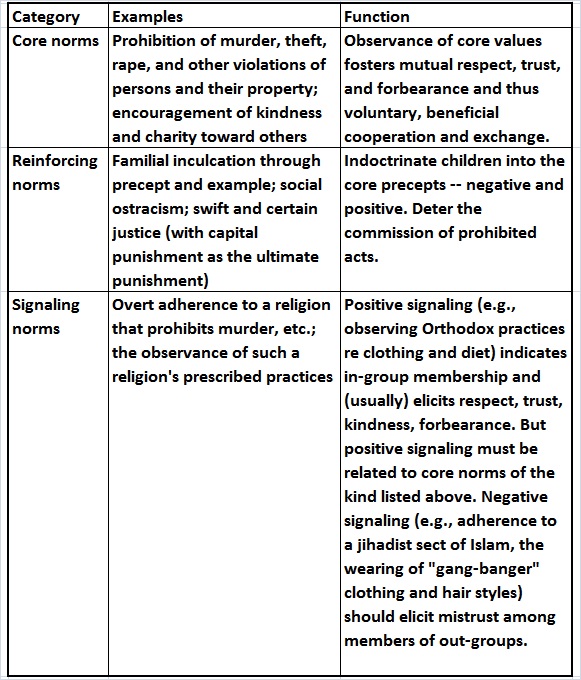
Taxonomy of social norms

I’ll talk about some of the ways in which leftists undermine and signal their opposition to the norms that enable a functional civil society — one that advances mutual trust, respect, and forbearance. But first I want to make a general point about the power of the state to destroy socializing norms and institutions without overtly abolishing them. Leftists like to portray themselves as anti-authoritarian, but they do so cynically. One of the things that they know (or intuit) is that a vast swath of the populace is morally malleable, so if the state says that something is all right (or verboten) huge numbers of persons will follow suit and say that it’s all right (or verboten). As I once wrote, in a post about same-sex “marriage,”

When the state sends signals about private arrangements, private arrangements tend to align themselves with the signals being sent by the state.

Which is why the left relies heavily on non-electoral means of exerting control, that is, litigation and regulation. There is as much authority in those aspects of governance as there is in the decisions of elected representatives. If five justices of the Supreme Court were to say that the death penalty is unconstitutional, as they have said that homosexual “marriage” should be considered marriage, millions of people will acquiesce, without giving more than a moment’s thought to the broader social implications of either decree.

As the following paragraphs attest, decades-long persistence in such matters has amply rewarded the left’s efforts to transform America fundamentally — for the worse.

Murder. Core norms are widely accepted in America, though inconsistently. Leftists will decry murder and even call for the death penalty when the perpetrator is a white heterosexual and the victims are not. But leftists won’t admit that abortion is murder, that is, the taking of a human life. Moreover, leftists (and not a few misguided conservatives and libertarians) have for more than a century signaled their toleration of murder by opposing capital punishment. A pro-life leftist is someone who believes in sparing criminals and enemy combatants, while killing children in the womb.

Theft. Leftists will say that the prohibition of theft is a core social norm, and that it ought to be observed and enforced by the state. In the next breath, they will defend all manner of state-enforced theft, from Social Security transfer payments to housing subsidies, and then propose more of them (e.g., Universal Basic Income). If you believe that taxation isn’t theft (or worse), consider this. And if you believe that income redistribution at the point of a gun is charity, consider this.

Marriage and divorce. Leftists obviously have no qualms about the destruction of a crucial reinforcing norm: marriage. I have written a detailed defense of traditional marriage as a civilizing and libertarian institution, and a detailed condemnation of same-sex “marriage” as an anti-libertarian innovation. Rather than repeat the arguments of that post, I refer you to it. The bottom line is that the left, in its usual zeal to advance the cause of imaginary victims, has set in motion the destruction of a bulwark of civil society.

The heavy hand of leftism is visible in the adoption of no-fault divorce laws, which work against marital perseverance, which helps to ensure children to be raised by both parents. As Wikipedia puts it, the “Women’s movement effected change in Western society, including … ‘no fault’ divorce.” And where did no-fault divorce first become available? In California, of course.

Sexuality. The LGBTQ movement is a left-wing inspiration, designed mainly to infuriate conservatives and incidentally advance the cause of people whom leftists see as victims. (If the aim of persons who “identify” as LGBT or Q is to be left alone, loud shrillness isn’t the way to go about it.) Left-wing support of such groups — which are really identity groups, not victim groups — serves two purposes. The first is virtue-signaling; the second is goading conservatives into acts that can be portrayed as victim-bashing (e.g., various “bathroom bills”).  More deeply, left-wing support of the LGBTQ movement signals a rejection of civilizing norms, and is meant to erode them further. At the margin, there are many impressionable young persons who will turn their backs on marriage and family and adopt the frivolous, decadent, and too-often-fatal LGBTQ “lifestyle.”

Race. Before the contrived prominence of the LGBTQ “cause,” the left’s favorite victim group was blacks. Early and proper attention to barbarous and unjust practices (e.g., lynchings and denial of voting rights) gave way to the persistent myth that racial inequality is an artifact of slavery and legal segregation. The myth persists because of an obdurate refusal to recognize racial differences in intelligence. In “Race Gaps in SAT Scores Highlight Racial Inequality and Hinder Upward Mobility,” for example,  the authors (researchers at the Brookings Institution, which the media usually describe as center-left) document persistent race differences in IQ, admit that “it is unlikely that the racial achievement gap can be explained away by class differences across race,” but end with “race gaps on the SAT hold up a mirror to racial inequities in society as a whole,” as if those inequalities could be eradicated despite the demonstrably ineradicable intelligence gap. Well, they could be reduced — and are reduced, to some extent — but mainly by stealing money, jobs, and university admissions from whites and East Asians.

And so, billions upon billions of dollars have been wasted on early education, job training, public housing, and welfare payments (the conditions of which have destroyed black families and worsened the unemployment rate among blacks). Racial quotas (called “affirmative action” and “diversity programs”) have penalized better-qualified whites and Asians seeking jobs, promotions, and university admissions — and have also penalized blacks by setting them up for failure (see this, this, and this).

Forced “diversity” is in fact socially divisive, as Maverick Philosopher correctly observes. Then there were the divisive eight years of Obama’s presidency, in which he and his so-called Department of Justice defended black thugs and persecuted white cops. Is it any wonder that blacks and whites probably mistrust each other more than they have since the bad old days of D.W. Griffith’s The Birth of a Nation? Where all of this isn’t directly destructive of social comity, it signals rejection of core and reinforcing norms that make social comity possible.

Drugs. The legalization of marijuana isn’t just an issue for leftists, but they certainly champion legalization as yet another blow for “personal freedom.” The usual response to evidence that marijuana has many undesirable long-term effects is something like “so does alcohol, so why isn’t it illegal?” Well, it’s far too late to prohibit alcohol in the United States (tried and failed), and it’s probably far too late (and futile) to prohibit marijuana.

I’m not a prohibitionist (of alcohol or marijuana), but marijuana should be used knowing the risks associated with its use, just as the risks of alcohol consumption are well known. Instead, the push for “personal freedom” simply dodges the issue of risk by allowing marijuana consumption for medical conditions that apply to only a small fraction of its users.

Leftists will eventually turn on marijuana because it’s used and enjoyed by the unwashed masses (like cigarettes), so they will then campaign to regulate it and curtail its use. Marijuana use, in other words, is just a weapon in the culture war-cum-civil war — another route by which the left attacks and weakens traditional norms and those who stand behind them.

Religion. There’s nothing left to be said about the effort to eradicate religion. The late Justice Scalia called it “freedom from religion” as opposed to “freedom of religion,” which the Constitution guarantees. The ACLU and similar organizations attack expressions of religion at every turn. Those attacks may have the unsought effect of redoubling the devotion of many Americans to liberty-advancing religious principles. But surely, at the margin, the attacks will diminish religious affiliation and the social good that goes with it: true kindness and charity, true tolerance, true forgiveness. (For a discussion of the beneficial effects of religion go here and scroll to “Religion and Liberty.”)

To be against religion is an article of faith for most leftists, who fancy themselves rational and fact-based, despite ample evidence to the contrary. They are, in fact, spoiled children of capitalism engaged in adolescent rebellion. And religion is a favored target of the rebellious adolescent — especially religion of the Judeo-Christian variety, because most leftists were reared in that tradition. Islam, on the other hand, is acceptable because its adherents — who stand against almost everything leftists stand for — are “victims” in the twisted topography of leftist dogma.

Self-reliance. What better way to control people than to make them reliant on you instead of themselves? That’s how drug dealers (at the top of the food chain) make big bucks — until they’re shot or arrested. Dependency on big government is tantamount to dependency on the left, which gratifies a deeply felt need for power. (Fascism is a left-wing phenomenon.) Conservatives treat their children like children, so that those children will become responsible adults. Leftists treat adults like children because it makes them (leftists) feel superior. Though when leftists don’t get their way, they act like children, as they have done since the election of Donald Trump.

The left has devised and implemented many forms of control over the past 80 years. Those forms range from Social Security, Medicare, and Medicaid to food stamps, special deals on housing and mortgages, and rampant regulation of all aspects of the economy. What better way to break the old American habit of self-reliance and personal responsibility — a habit that fosters mutually beneficial cooperation — than to establish government as the go-to arbiter of social and economic relations?

I could relate many personal run-ins with the nanny state, but I will close this discussion by pointing to examples of an especially annoying outrage: “Parents In Trouble Again for Letting Kids Walk Alone” (USA Today, April 13, 2015), “Parents Arrested for Letting their Children Play Outside as America Degenerates into Clinical Insanity” (OffTheGridNews, ca. 2012), and “How Children Lost the Right to Roam in Just 4 Generations” (Free-Range Kids, February 1, 2017). Fortunately, as a child I was not cooped up by the state.

*     *     *

That’s more than enough of that. The left’s crusade against social norms leads to predatory and destructive behavior and suppresses peaceful coexistence and mutually beneficial cooperation. It is the inevitable result of the culture war that the left has waged for decades:

When social norms — long-established rules of behavior — are sundered willy-nilly the result is a breakdown of the voluntary order known as civil society. The liberty to live a peaceful, happy, and even prosperous life depends on civil society: the daily observance of person X’s negative rights by persons W, Y, and Z — and vice versa. That is so because it is impossible and — more importantly — undesirable for the state to police everyone’s behavior. Liberty depends, therefore, on the institutions of society — family, church, club, and the like — through which individuals learn to treat one another with respect, through which individuals often come to the aid of one another, and through which instances of disrespect can be noted, publicized, and even punished (e.g., by criticism and ostracism). That is civil society, which the state ought to protect, but instead usurps and destroys. Usurping is one of the state’s primary (and illegitimate) functions. The state establishes agencies (e.g., public schools, welfare), gives them primary and even sole jurisdiction in many matters, and funds them with tax money that could have gone to private institutions. Worse, however, is the way in which the state destroys the social norms that foster social harmony — mutual respect and trust — without which a people cannot flourish….

“Thanks” to the signals sent by the state — many of them in the form of legislative, executive, and judicial dictates — we now have not just easy divorce, subsidized illegitimacy, and legions of non-mothering mothers, but also abortion, concerted (and deluded) efforts to defeminize females and to neuter or feminize males, forced association (with accompanying destruction of property and employment rights), suppression of religion, absolution of pornography, and the encouragement of “alternative lifestyles” that feature disease, promiscuity, and familial instability. The state, of course, doesn’t act of its own volition. It acts at the behest of special interests — interests with a “cultural” agenda…. I call them left-statists. They are bent on the eradication of civil society — nothing less — in favor of a state-directed Rousseauvian dystopia from which morality and liberty will have vanished, except in Orwellian doublespeak.

The culture war, which escalated sharply in the 1960s, is a classic case of barbarism vs. civilization. Arnold Kling describes it in The Three Languages of Politics:

[Leftists] use the heuristic of the oppressed-oppressor axis. [They] view most favorably those groups who can be regarded as oppressed or standing with the oppressed. They view most unfavorably those groups who can be regarded as oppressors. [Conservatives] use the heuristic of the civilization-barbarism axis. [They] view most favorably the institutions that they believe constrain and guide people toward civilized behavior, and they view most unfavorably those people who they see as trying to tear down such institutions.

Kling often strains to be even-handed, not only in Three Languages of Politics but in general. (Sample his blog.) Here, I think he is being unduly kind by crediting the left with a concern for the oppressed. That is a superficial interpretation of the left’s championing of “victims,” but the deeper explanation — of which I’ve given many examples — is an attitude of rebellion for rebellion’s sake, coupled with a desire for control. And damn the social and economic consequences, which seem not to occur to (or bother) leftists hell-bent having their way by harnessing the power of the state.

I must therefore revise Kling’s statement of the conservative heuristic, to read as follows: Conservatives view most favorably the voluntary institutions that constrain and guide people toward civilized behavior. And they view most unfavorably those people who they see as trying to tear down such institutions, even if they are doing it unwittingly and for the ostensible objective of helping the “oppressed.”

But leftists will object that the institutions of civil society are often oppressive, or were when they held sway. That objection usually rests on the nirvana fallacy; the institutions do not or did not live up to the left’s idea of perfection. The left’s answer to the “failure” of civil institutions is the enactment of laws, writing of regulations, and promulgation of a judicial decrees. But how often do “reality based” leftists check back to see whether the various government interventions have produced their wanted effects without producing deleterious side effects? I venture to say that the answer is almost never. If leftists were interested in the actual betterment of their fellow Americans, as opposed to controlling them, they would long ago have curbed government spending and regulatory activity, which have stunted economic growth to the detriment of poor and rich alike.

The urge to control is evident in the nascent secessionist movement in California, which has my best wishes for success. Leftists reject constitutional limits on the central government as long as they’re in charge. But confront leftists with a central government that is at least nominally controlled by Republicans (many of whom are actually conservatives) and they want out. (By contrast, my support of secession is meant to restore constitutional limits on the central government by starting over.)

The urge to secede is legitimate, if hypocritical on the part of leftists. Exit, or the threat of it, is an essential element of the evolution of civil society — or would be if it weren’t under the thumb of the state. If you don’t like the policies of an institution to which you belong, you can voice your objections and exit if your objections aren’t met. The smaller the institution, the more likely is voice to be effective. And the smaller the institution, the more likely that there are ready alternatives to it.

Voice and the threat of exit are part of what make voluntary institutions effective. They can and do change gradually through trial-and-error. Even large ones, like the Roman Catholic Church, which has changed over the centuries in ways large and small. And when it changed too much in a “liberal” direction, alternatives arose in the form of various Traditional Catholic organizations.

Leftists evidently lack the disposition toward trial-and-error and compromise that makes for “living” social institutions. They will point to a few extreme examples (e.g., slavery and forced segregation) to make the case for precipitous and overbearing government action. The irony is that slavery and forced segregation were government-backed institutions. Other favorite examples (e.g., child labor and “sweat shops”) usually overlook the voluntary nature of the relationships in question — voluntary because the supposed victims were made better off than they had been before. A modern equivalent is found in the case of Wal-Mart, which doesn’t compensate its employees as well as some other, similar firms (e.g., Costco), but which doesn’t drag people off the street and enslave them. Wal-Mart’s workforce of volunteers is, by definition, better off than it would be in the absence of Wal-Mart, and Wal-Mart’s millions of customers are, too.

The drive to force Wal-Mart to pay higher wages will, in the end, have the same result as the drive to dictate a minimum wage. It will lead to unemployment for people who most need employment, and it will end in the adoption of automated systems to replace human labor.

Similarly, the drive to make America “fairer” by privileging various groups favored by the left will be thwarted by the realities of economics and human nature. Employers who strive to make a profit (unlike government and universities), will do as they have always done: pay lip-service to “equality” while finding ways to hire only the best-qualified employees. And too many of those persons who are temporarily lifted up by affirmative action and “diversity programs” will find themselves on the outside looking in when they don’t measure up to the expectations of demanding professors and profit-seeking employers.

It comes down to this: Leftists start with an idealized view of the world as it should be — socially and commercially. As a result, they see harm where there is actually gain. And in their zeal to make the world right — by their lights — they make it worse.

Dr. John J. Ray, as usual, is most perceptive about the left:

As a good academic, I first define my terms: A Leftist is a person who is so dissatisfied with the way things naturally are that he/she is prepared to use force to make people behave in ways that they otherwise would not….

The essential feature of all Leftism is the desire to stop other people from doing various things they want to do and make them do various things that they do not want to do (via taxation, regulation, mass murder etc.)  When (on October 30, 2008) Obama spoke of his intention to “fundamentally transform” America, he was not talking about America’s geography or topography.  He was talking about transforming what American people can and must do.  So that is the first and perhaps the most important thing about Leftism:  It is intrinsically authoritarian.

Leftists are not alone in desiring to regulate others, however, so to complete the definition, we have to look at other things that characterize them.

The first remaining thing to say about them is that Leftism is emotional.  The second is to say that the emotion is negative and the third thing to say is that the negative emotion (usually anger/hate/rage) is directed at the world about the Leftist, at the status quo if you like.  The Leftist is nothing if he is not a critic, though usually a very poorly-informed critic.  And the criticisms tend to be both pervasive and deeply felt.

Orwell of course understood Leftism exceptionally well so it is revealing that in 1943 he wrote an essay called “Can Socialists Be Happy?”  His answer was that they can’t even imagine it….

While defining Leftism in terms of their apparent drives and motivations is undoubterdly true and useful, it doesn’t provide a really sharp differentiation of the Left from others.  And I think we can improve on it.  And to do that I think we have to refer to the natural state of affairs.  “The natural state of affairs”?  What is that?  It is a concept sometimes used in both law and economics but I want to broaden its applicability.  I think it is actually quite easy to define in a generally applicable way.  It means whatever people would do in the absence of external constraints….

So I think we can now make a pretty sharp distinction between the changes Leftists want and the changes that conservatives want. Leftists want change AWAY from the natural state of affairs while conservatives want changes TOWARDS the natural state of affairs — or at least changes that respect the natural state of affairs.

For “natural state of affairs” read “social norms that underlie liberty.”

*     *     *

Related:Social Norms and Liberty” and the many posted listed there

The Harm Principle Revisited: Mill Conflates Society and State

John Stuart Mill is the father of modern liberalism, though he is usually thought of as a proponent of classical liberalism. The mistake arises from Mill’s harm principle, enunciated in his long essay On Liberty (1869). It is the sand upon which liberalism (classical and modern) is built:

That principle is, that the sole end for which mankind are warranted, individually or collectively in interfering with the liberty of action of any of their number, is self-protection. That the only purpose for which power can be rightfully exercised over any member of a civilized community, against his will, is to prevent harm to others. [Chapter I, paragraph 9]

This seemingly libertarian principle is in fact anti-libertarian, as I explain at length in “On Liberty.” In that post I focus on harm. As I say there,

the only plausible interpretation of the harm principle is as follows: An individual may do as he pleases, as long as he does not believe that he is causing harm to others. That is Mill’s prescription for liberty. It is, in fact, an invitation to license and anarchy.

In this post I turn to Mill’s definition of society. Here is Mill again:

Society can and does execute its own mandates: and if it issues wrong mandates instead of right, or any mandates at all in things with which it ought not to meddle, it practises a social tyranny more formidable than many kinds of political oppression, since, though not usually upheld by such extreme penalties, it leaves fewer means of escape, penetrating much more deeply into the details of life, and enslaving the soul itself. Protection, therefore, against the tyranny of the magistrate is not enough: there needs protection also against the tyranny of the prevailing opinion and feeling; against the tendency of society to impose, by other means than civil penalties, its own ideas and practices as rules of conduct on those who dissent from them; to fetter the development, and, if possible, prevent the formation, of any individuality not in harmony with its ways, and compel all characters to fashion themselves upon the model of its own. [Chapter I, paragraph 5]

But here’s the rub. Who decides when the “tyranny of prevailing opinion and feeling” is too oppressive? The state.

“State” is nothing more than an impressive-sounding word that really denotes the amalgam of elected and non-elected officials who wield governmental power. There are those who say that the state embodies the nation, which is like saying that the lion-tamer embodies the lion. The state most certainly is not society, but it is has the power to be far more tyrannical than society’s “prevailing opinion and feeling.”

Recourse to the power of the state has become the first resort of individuals and groups who object to prevailing opinion and feeling. And when the state meddles with prevailing opinion and feeling it creates new grievances, which produce resistance and resentments that splinter the nation rather than unite it.

What kinds of prevailing opinion and feeling could be so oppressive that their effects must be undone by the oppressive state? Mill devotes Chapter IV of On Liberty to examples of oppression, but they are examples of state action at the behest of sectarian and moralistic interests. Mill conflates society and state, which is excusable in 19th century England, where nation and society were far more congruous than they are in 21st century America.

At any rate, Mill says that

the likings and dislikings of society, or of some powerful portion of it, are thus the main thing which has practically determined the rules laid down for general observance, under the penalties of law or opinion. [Chapter I, paragraph 7]

And opinion, in Mill’s view, becomes inimical to liberty when it is converted into law and bars such things as music, dancing, drinking, the expression of unpopular views, and free trade. In sum, On Liberty should be read as a warning against statist oppression at the behest of powerful factions. Though, as I show in “On Liberty,” it also — and contradictorily — can be read as a justification for behavior that subverts civilizing norms which underlie liberty.

But no matter, the harm principle lives on in the minds of leftists as a justification for using the power of the state to overturn norms of which they disapprove, while it also serves as a justification for anti-social behavior of which they approve. They are faux-individualists because their penchant for governmental intervention against social norms in the name of liberty actually results in the diminution of liberty.

*     *     *

Related reading: Theodore Dalrymple, “The Simple Truth about J.S. Mill’s Simple Truth,” Library of Law and Liberty, July 20, 2015

*     *     *

Related posts — everything listed at “Social Norms and Liberty,” but especially “On Liberty” and
Anarcho-Authoritarianism
The Meaning of Liberty
Facets of Liberty
The Pseudo-Libertarian Temperament
Romanticizing the State
“We the People” and Big Government
Liberty and Social Norms Re-examined