The Rationing Fallacy

Sheldon Richman writes:

[S]ome defenders of government control [of health care] acknowledge that rationing is the logical consequence of their ambition. They parry objections by saying in effect: “So we’ll have to ration. Big deal. We already have rationing—by the market.”

For example, Uwe Reinhardt, an economics professor and advocate of government-controlled medicine, writes, “In short, free markets are not an alternative to rationing. They are just one particular form of rationing. Ever since the Fall from Grace, human beings have had to ration everything not available in unlimited quantities, and market forces do most of the rationing.”

Sadly, interventionist economists are not the only economists who talk this way. Most free-market economists would agree that where there is scarcity there must be rationing and that the most efficient way to ration is by price, that is, through the market.

This is factually wrong and strategically ill-advised. As we’ll see, markets–even completely free markets–do not ration….

To see that the market does not ration one need only see that “the market” doesn’t do anything. To talk as if it does things is to reify the market—worse, it is to anthropomorphize the market, ascribing to it attributes — purposes, plans, and actions—that only human beings possess. We may also see this as another instance of literalizing a metaphor, which, as Thomas Szasz has so often warned, is fraught with peril.

I’m not saying that economists don’t realize this diction is a metaphor. Of course they do, and there’s no harm in using this shorthand among those who understand it as such. The problem, as I see it, is that the general public doesn’t fully grasp the metaphorical nature of these statements. For the sake of public understanding, free-market advocates should not welcome a debate in which they begin by saying, “Our method of rationing is better than your method of rationing.”

Better to respond to the interventionists this way: The market does not ration or allocate. The market does not do anything. It has no purposes or objectives. It is simply a legal framework in which people do things with their justly acquired property and their time in order to pursue their own purposes.

I once put it this way:

Economic goods are not rationed by price; price facilitates voluntary transactions between willing buyers and sellers in free markets. Rationing is what happens when a powerful authority (usually a government) steps in to dictate the organization of markets, the specification of goods, and — more extremely — who may buy what goods and at what prices (though dictated prices are essentially meaningless because they do not perform the signaling function that they do in free markets)….

I added:

How will … rationing entice doctors and hospitals to provide services that they are now unwilling to provide? If doctors leave the medical profession, and new doctors enter at reduced rates, what would [an advocate of rationing] do? Begin drafting students into medical schools? What about hospitals that refuse to conform? Would they be nationalized, along with their nurses, orderlies, etc.?

What a pretty picture: Soviet-style medicine here in the U.S. of A. Yet that it precisely where outright rationing will lead if the politburo in Washington sees a shrinking supply of doctors, hospitals, and other medical providers — as it will. Most politicians do not know how to do less. When they create a mess, their natural inclination is to do more of what they did to cause the mess in the first place.

Rationing (in peacetime, at least) is the last refuge of political scoundrels. It gives the appearance of solving a problem, while making it worse.

Barack Channels Princess SummerFall WinterSpring

The princess of the title is Elizabeth Warren, self-reputed to be of Cherokee descent. And, as Native Americans go, Warren is about as authentic as Princess SummerFall WinterSpring of Howdy Doody.

You may remember Warren’s bleat of last September, in support of Obama’s plan to soak “the rich.” It caused ripples in the blogosphere (here and here, for example). The bleat? It goes like this:

I hear all this, you know, Well, this is class warfare, this is whatever. No. There is nobody in this country who got rich on his own — nobody.

You built a factory out there? Good for you. But I want to be clear. You moved your goods to market on the roads the rest of us paid for. You hired workers the rest of us paid to educate. You were safe in your factory because of police-forces and fire-forces that the rest of us paid for. You didn’t have to worry that marauding bands would come and seize everything at your factory — and hire someone to protect against this — because of the work the rest of us did.

Now look, you built a factory and it turned into something terrific, or a great idea. God bless — keep a big hunk of it. But part of the underlying social contract is, you take a hunk of that and pay forward for the next kid who comes along.

Last week, in Virgina, The Mighty O said the same thing in slightly different words:

There are a lot of wealthy, successful Americans who agree with me — because they want to give something back.  They know they didn’t — look, if you’ve been successful, you didn’t get there on your own.  You didn’t get there on your own.  I’m always struck by people who think, well, it must be because I was just so smart.  There are a lot of smart people out there.  It must be because I worked harder than everybody else.  Let me tell you something — there are a whole bunch of hardworking people out there.

I repeat what I said in response to Warren’s bleat:

Who said anything about anyone getting rich on his own? But didn’t the factory owner — and other “malefactors of great wealth” — pay a “fair share”of the taxes that support roads, education, and police and fire forces? Yes.* Didn’t the factory owner pay his workers for their labor? Yes, and sometimes (in the case of union workers) at the expense of consumers and those workers who couldn’t find employment because unions effectively limit entry to the labor market.

If anyone owes “the rest of us” anything, it’s the workers who received subsidized educations that enabled them to earn good wages at factories that were built because factory owners, shareholders, bond holders, and (sometimes) venture capitalists put their own money at risk.

Workers and others (including Elizabeth Warren) ought to be grateful to the “malefactors of great wealth” who have — against heavy odds — enabled America’s prosperity.

Tom Smith of The Right Coast weighs in with this:

…{H]ow many more successful businesses, inventions, products, services, toys, tools, insights, and just plain fun would there be, if government did not in the first place make it so ridiculously difficult to start a business and keep it going? I don’t see our young president taking credit on behalf of the state for all the failures it help cause, all the ideas that never got off the ground because the regulatory hurdles were so high, or all the established companies that never had to face competition because they had managed to get their rents written into law. This is part of the seen and not seen insight of Bastiat. What you see is a successful business when it manages to survive, and then people run up, the same people who taxed and regulated it nearly to death, and say I helped! I helped! What you don’t see are all the businesses that perished or never got started because of the heavy hand of the state. And it’s a very heavy hand….

I started a business, commercially unsuccessful, sadly, but we created some great technology. I was a libertarian before that, but I was really a libertarian afterwards. It’s difficult to even explain how pervasive, expensive, frustrating and sometimes just plain insuperable the regulatory and taxation burden of the state is. It’s not what did our venture in, but it helped….

It’s obvious, but still worth saying — for our young President to suggest that government deserves some large part of the credit for the achievements of business founders who manage, in spite of it all, to start a business and make of a go of it, is deeply, deeply perverse. What it ought to get credit for are all the unseen businesses, no longer here or never to be, that it is responsible for.

I can tell you, from bitter experience as a business owner and corporate officer, that Smith is exactly right. The burdens that government imposes on the creation, expansion, and operation of businesses are myriad and onerous. Most Americans aren’t aware of just how much government does to discourage the creation of jobs, income, and wealth because most Americans — even those who are employed — are not exposed to the ugliness of the business-government interface. If business-government transactions were rated like movies, they would be rated XXX.

There is one more thing to be said about the Warren-Obama attack on industriousness. It’s wrong, as any economist worth his salt could tell you. (That excludes Paul Krugman and his fellow worshipers at the altar of big government.) Despite the pretensions of bleeding heart libertarians and their brethren on the left, no one on Earth is qualified to say how much a person deserves to earn. Aside from thieves and others who coerce their earnings from others (e.g., government officials, members of compulsory unions), Americans earn what they are able to command for their services, on the basis of the value of those services to others.

The factory owner who makes a lot of money does so — after having taken the considerable risk of owning a factory and putting up with a lot of crap from government — because what he produces is valuable to others. He is being rewarded more than his employees because he is taking  risks and putting up with harassment. He is, in other words, being rewarded for his contributions to the success of his enterprise. (Did Barack or Elizabeth do anything to help him create it? Did the workers do more than they were paid to do? No, to both questions.)

And if the factory owner loses a lot of money and goes out of business, is it the fault of those who failed to buy his products? Would Barack Obama and Elizabeth Warren say that everyone let him down? They should, because by their “logic” the failed factory owner was failed by everyone who didn’t buy his products, and so they owe him something.

But most American business owners are not whiny brats like Barack Obama, Elizabeth Warren, and the freeloaders whose votes they depend on to stay in power.

Related posts:
The Causes of Economic Growth
A Short Course in Economics
Addendum to a Short Course in Economics
The Price of Government
Asymmetrical (Ideological) Warfare
“Buy Local”
Giving Back, Again
Taxing the Rich
More about Taxing the Rich
Luck-Egalitarianism and Moral Luck
Union-Busting
In Defense of Wal-Mart
Union Thuggery
Estimating the Rahn Curve: Or, How Government Inhibits Economic Growth

“Big SIS”: A Review

“Big SIS” is the special-interest state, of which James V. DeLong writes in Ending “Big SIS” (The Special Interest State) and Renewing the American Republic.It is a non-fiction horror story, one that should outrage every reader. A reader must be impervious facts and logic if he gets very far into “Big SIS” without grasping the direness of America’s present condition.

What is that condition? It is enslavement (not too strong a word) to the regulatory state. DeLong does an admirable job of describing the growth and entrenchment of the regulatory state (chapter 2). But the most compelling parts of his thoroughly factual narrative arrive with his documentation of the costs of the regulatory state and his enumeration of example after example of its lunacies. If you have a visceral feeling that government in the United States has become entirely too intrusive in its methods and perverse in its results, DeLong’s book will confirm that feeling and give you plenty of weapons with which to refute those who believe in government as a disinterested, omniscient force for good.

If chapters 2 and 3 outrage you, as they should, surely chapter 4 will depress you. There, DeLong enumerates and explicates the many reasons that the regulatory state’s death grip on America is unlikely to be loosened. DeLong holds out some hope for change in chapter 5, where he discusses many ways in which the death-grip might be loosened.

But I am less sanguine than DeLong seems to be about the possible efficacy of his proposed counter-measures. The forces that DeLong describes in chapter 4 are likely to prove too strong to be defeated in gentlemanly fashion. In the end, it may well come to non-gentlemanly counter-measures, something along the lines of a new Declaration of Independence from the imperial state that has arisen in Washington.

If it does come to that, DeLong’s catalog of imperial acts and their vile consequences would serve splendidly as a replacement for the original Declaration’s enumeration of King George III’s “repeated injuries and usurpations, all having in direct object the establishment of an absolute Tyranny.”

Related posts:
FDR and Fascism
The People’s Romance
Fascism
Fascism with a “Friendly” Face
Secession
Democracy and Liberty
The Interest-Group Paradox
Is Statism Inevitable?
Inventing “Liberalism”
The Price of Government
A New, New Constitution
Zones of Liberty
Fascism and the Future of America
Secession Redux
The Indivisibility of Economic and Social Liberty
A New Cold War or Secession?
The Price of Government Redux
The Real Constitution and Civil Disobedience
The Near-Victory of Communism
A Declaration of Independence
The Mega-Depression
Tocqueville’s Prescience
First Principles
As Goes Greece
Accountants of the Soul
Ricardian Equivalence Reconsidered
Zones of Liberty
The Constitution: Original Meaning, Corruption, and Restoration
Estimating the Rahn Curve: Or, How Government Inhibits Economic Growth
The Bowles-Simpson Report
The Bowles-Simpson Band-Aid
Regime Uncertainty and the Great Recession
Re-Forming the United States
More about Taxing the Rich
America’s Financial Crisis Is Now
The Southern Secession Reconsidered
A Declaration of Civil Disobedience
The Repealer
Regulation as Wishful Thinking
The Real Multiplier
Vulgar Keynesianism and Capitalism
Why Are Interest Rates So Low?
The Commandeered Economy
Estimating the Rahn Curve: A Sequel
In Defense of the 1%
The Real Multiplier (II)
Lay My (Regulatory) Burden Down
The Burden of Government
Constitutional Confusion
Reclaiming Liberty throughout the Land
Economic Growth Since World War II
More Evidence for the Rahn Curve

Not-So-Random Thoughts (IV)

Links to the other posts in this occasional series may be found at “Favorite Posts,” just below the list of topics.

Demystifying Science

Read my post about “Demystifying Science.” If you do, you will be unsurprised by Via Media’s post about “Unsettling Science.” Samples:

Me —

It is hard for scientists to rise above their human impulses. Einstein, for example, so much wanted quantum physics to be deterministic rather than probabilistic that he said “God does not play dice with the universe.” To which Nils Bohr replied, “Einstein, stop telling God what to do.” But the human urge to be “right” or to be on the “right side” of an issue does not excuse anti-scientific behavior, such as that of so-called scientists who have become invested in AGW.

There are many so-called scientists who subscribe to AGW without having done relevant research. Why? Because AGW is the “in” thing, and they do not wish to be left out. This is the stuff of which “scientific consensus” is made. If you would not buy a make of automobile just because it is endorsed by a celebrity who knows nothing about automotive engineering, why would you “buy” AGW just because it is endorsed by a herd of so-called scientists who have never done research that bears directly on it?

There are two lessons to take from this. The first is  that no theory is ever proven. (A theory may, if it is well and openly tested, be useful guide to action in certain rigorous disciplines, such as engineering and medicine.) Any theory — to be a truly scientific one — must be capable of being tested, even by (and especially by) others who are skeptical of the theory. Those others must be able to verify the facts upon which the theory is predicated, and to replicate the tests and calculations that seem to validate the theory. So-called scientists who restrict access to their data and methods are properly thought of as cultists with a political agenda, not scientists. Their theories are not to be believed — and certainly are not to be taken as guides to action.

The second lesson is that scientists are human and fallible. It is in the best tradition of science to distrust their claims and to dismiss their non-scientific utterances.

Mead (at Via Media) —

Reports that the public is losing “faith in science” have caused a lot of chin stroking, head wagging and even some and finger pointing among the intelligentsia — especially since the studies point to a particularly sharp decline among conservatives.

Via Meadia isn’t so sure all this is on the right; the last time we looked, environmentalists around the world were denouncing decades of careful scientific research on the safety of genetically modified organisms, with dire economic consequences for African development. We’ve also noticed a distinct lack of faith in arithmetic by blue politicians who think that promising large pensions to union workers while failing to set money aside to pay those promises is a course of action that can somehow end well.

There is no sport intellectual elites enjoy more than recounting and bewailing the follies and errors of the Great Unwashed out there in flyover land, so in the academy and elsewhere the story of declining confidence in science is seen as reflecting a declining confidence in reason itself — and evidence of the rising tide of stupidity against which we enlightened few must ceaselessly battle.

But are things really so simple?…

Back in May 2011, Harvard University was rocked by the scandal of Professor Marc Hauser. A decorated senior scientist consistently voted one of the most popular professors by students, Hauser was the director of the university’s Mind, Brain and Behavior program and a trailblazer in the field of evolutionary psychology. He was also a fraud who falsified data in his experiments and was ultimately outed by his own graduate students. When the truth came out, he was barred from teaching and resigned from Harvard in disgrace.

Hauser’s case was far from an isolated incident. Seven months later, the New York Times reported on the corruption of noted Netherlands psychologist Diederik Stape, who managed to mislead the top scientific journals and bamboozle the best science reporters (including those at the Times) with article after article of fraudulent findings:

Corrupt, incompetent scientists? Lax research standards? Systemically flawed peer review processes? These problems, alas, are anything but rare. Stories like Stapel’s, plus reports on the findings of the evidence-based medicine movement about the unreliability of much medical science, and studies like Leslie John’s in Psychological Science (which revealed that the vast majority of psychologists engaged in questionable research practices and that one in ten falsified data)–not to mention the various alarmist exaggerations of some climate researchers–demonstrate that in many cases scientists have no one but themselves to blame for the loss of public faith in their work. Through laziness, politicization of findings, and outright falsification, the practitioners of some of our most important sciences have discredited their disciplines. Every Stapel and Hauser strengthens the voices of science skeptics — and rightly so.

More Inconvenient Facts about “The Rich”

Remember my posts “Taxing the Rich” and “More About Taxing the Rich,” in which I recorded my correspondence with an envious “progressive” leveler.  If not, this your chance to read them. Here are a couple of passages from the second post:

[I]t’s important to keep in mind that people aren’t “stuck” in a particular quintile; there’s a general tendency to move up as one ages, and then to drop down a bit after retiring. For more, see this: http://mjperry.blogspot.com/2008/02/rich-getting-richer-and-poor-are.html.

As you know from our earlier exchange, high-income people already are paying the lion’s share of taxes in this country. (And, surprisingly, more than their peers in the other industrialized nations: http://www.taxfoundation.org/blog/show/27134.html.)

Mark Perry recently posted more about the volatility of high-income groups and the share of taxes paid by whoever happens to be in a high-income group. In “Significant Turnover in the Top 400 U.S. Earners; From 1992-2009, 85% Were in Just 1 or 2 Years,” Perry notes that the

IRS has a new report on the 400 taxpayers reporting the highest adjusted gross incomes (AGI) from 1992 to 2009, and the table above shows the frequency of appearing the “Fortunate 400” over the entire period (Table 4 in the IRS report). The 7,200 tax returns (400 highest earners x 18 years) from 1992 to 2009 represented 3,869 unique, individual taxpayers, since some taxpayers made it into the top 400 earner group more than one year. The data show that:

1. Of the group of 3,869 top earners from 1992-2009, 2,824 individuals made it into the “Fortunate 400” only one time during the 18-year period. Those 2,824 one-timers represent about 73% of the total (3,869), so only about one out of every four, or 27% of the total, made it into the top 400 more than once between 1992 and 2009 (see columns 2 and 3 above).

2. Moreover, 2,824 earners made it into the top 400 once (73%), and another 458 ( about 12%) made it into the top group twice. So 85% made it into the “Fortunate 400” group either once or twice, and only about 15% made it into the top group more than twice.

3. There were only 87 taxpayers out of the 3,869 total taxpayers in the group (2.25%) who were in the top 400 in 10 or more years.

4. Of the 7,200 total returns filed over the 18-year period, 2,824 represent one-timers, so on average in any given year, about 40% of the returns are filed by taxpayers who are not in the “Fortunate 400” in any of the other 17 years (see last two columns).  And more than half of the total 7,200 “Fortunate 400” returns between 1992-2009 (3,740 and 52%) were filed by taxpayers whose returns only appeared in one or two of the 17 years.

According to the IRS, “The data reveal a mostly changing group of taxpayers over time. In fact, there were 3,869 different taxpayers represented in total for the 18-year period. Of these, a little more than 27 percent appear more than once and slightly more than 2 percent were represented in 10 or more years.”

Perry followed with “Top 400 Taxpayers Paid Almost As Much in Federal Income Taxes in 2009 as the Entire Bottom 50%.” The title says it all.

That’s it for today, folks. One more thing…

The Myth That Same-Sex “Marriage” Causes No Harm

That’s the title of a post from last October, in which I quote an article by Stephen Heaney. He says (among other things):

If government exists to support us in our flourishing, then it is obligated, in the deepest sense, to function in accordance with the truth of what is fitting for us. It is obligated to try to protect us from harm, and to support us in what is good for us….

The cause du jour, the primary contest over human flourishing, is the debate over the meaning of marriage.

The truth of marriage is that it can only exist between one man and one woman, for the sake of the children who may come as a result of their sexual union. Thus government is obligated to recognize the truth of marriage; to protect and support that project of bringing children into the world and caring for them; to recognize all and only actual marriages; and to discourage sexual acts in other contexts.

One of the arguments for same-sex “marriage” is that

research shows no difference in outcomes between children whose parents have same-sex relationships and their peers raised by heterosexual parents.

That is from “New Research on Children of Same-Sex Parents Suggests Differences Matter,” which goes on to note the following:

Yesterday the academic journal Social Science Research published a detailed methodological review of the research on which the APA bases its conclusion—a study that questions the validity of the “no difference” assertion. Conducted by a Louisiana State University family scholar, the article concludes:

[N]ot one of the 59 studies referenced in the 2005 APA Brief compares a large, random, representative sample of lesbian or gay parents and their children with a large, random, representative sample of married parents and their children. The available data, which are drawn primarily from small convenience samples, are insufficient to support a strong generalizable claim either way. Such a statement would not be grounded in science. To make a generalizable claim, representative, large-sample studies are needed—many of them.

A large representative sample is supplied in a second new study, conducted by a University of Texas–Austin sociologist and published in the same journal. The New Family Structures Study (NFSS), under the direction of Dr. Mark Regnerus, provides the most representative picture to date of young adults whose parents had same-sex relationships. NFSS is a large, random, nationally representative sample….

According to NFSS, just 1.7 percent of young adults ages 18 to 39 reported having a parent who has had a same-sex romantic relationship. The experience of long-term stability in same-sex households is rarer still….

Only two respondents whose mothers had a same-sex relationship reported that this living arrangement lasted all 18 years of their childhood. No respondents with fathers who had a same-sex relationship reported such longevity….

Compared to young adults in traditional, intact families, young adults whose mothers had a same-sex relationship tended to fare worse than their peers in intact biological families on 24 of the 40 outcomes examined. For example, they were far more likely to report being sexually victimized, to be on welfare, or to be currently unemployed.

Young adults whose fathers had a same-sex relationship showed significant differences from their peers in intact families on 19 of the outcomes. For example, they were significantly more likely to have contemplated suicide, to have a sexually transmitted infection, or to have been forced to have sex against their will….

A significant improvement on the limited research to date on child outcomes and same-sex parenting, this new study marks an important development in the research. As findings based on studies using the NFSS and other large, nationally representative data on same-sex parents and their children accumulate, a more generalizable picture will begin to emerge.

At present, far too little is known about this new household form into which activist courts are pushing America—and much of what has been presented to date gives an inaccurate picture of the reality that children of same-sex parenting have experienced.

NFSS project director Dr. Mark Regnerus concludes in a piece running on Slate today that “the stable, two-parent biological married model [is] the far more common and accomplished workhorse of the American household, and still—according to the data, at least—the safest place for a kid.”

Ah, but don’t tell your typical libertarian that the “harm principle” is an empty concept that lends itself to socially destructive causes like same-sex “marriage.”

The End Game?

Yesterday, Walter Russell Mead wrote about and quoted George Soros on the subject of Europe and its economic fate:

Regular readers know that while I disagree with George Soros on a number of points, I find him to be one of the keenest observers of world events. And of all the subjects on which George is brilliant, Europe is perhaps his best….

In a speech recently given in Trento, Italy, George lays out his vision of the crisis of the European Union and the prospects for its recovery….

The first third is a rehash of some basic concepts that George uses to distinguish between the social sciences and the natural sciences….

Once he’s worked through this concept, George turns his attention to what went wrong in Europe — and to what could be done about it. In a nutshell, he says that the Europe of the last twenty years was a kind of bubble: it was a “fantastic object” — something that was so alluring and attractive that people behaved as if it existed even though in fact it did not.

Now that the financial crisis (which George diagnoses as both a sovereign debt crisis like the third world debt crisis of 1982 and a banking crisis) is upon us….

And what does the world’s most successful financial investor thinks will actually happen?

But the likelihood is that the euro will survive because a breakup would be devastating not only for the periphery but also for Germany…  So Germany is likely to do what is necessary to preserve the euro – but nothing more. That would result in a eurozone dominated by Germany in which the divergence between the creditor and debtor countries would continue to widen and the periphery would turn into permanently depressed areas in need of constant transfer of payments. That would turn the European Union into something very different from what it was when it was a “fantastic object” that fired peoples imagination. It would be a German empire with the periphery as the hinterland.

Today, Mead writes:

After months upon months of fruitless back-and-forth over the Eurozone crisis, as Greece and then Spain brought the continent ever-closer to the brink of catastrophe, the signs of a coherent German policy are beginning to emerge. The Wall Street Journal reports:

Germany is sending strong signals that it would eventually be willing to lift its objections to ideas such as common euro-zone bonds or mutual support for European banks if other European governments were to agree to transfer further powers to Europe….

Unfortunately, the end result is still anything but foreordained. The French, for their part, have balked at the kind of loss of sovereignty over fiscal matters that the Germans are demanding here. And the fact that this kind of sweeping change would require the rewriting and re-ratification of scores of EU treaties means that no solution is immediately at hand, even if all of Europe’s leaders agree to a solution. It’s not at all clear that markets will give Europe the time its sclerotic political process needs to work through — and it’s even less clear that all the other EU countries will sign up for Germany’s new plan.

But a step forward is a step forward, and given the stakes, any sign of life from Europe’s political leadership is to be welcomed.

All may be for naught, however, because of the huge pile of indebtedness and obligations that the industrialized nations have accumulated. One financial expert, Raoul Pal, sees it this way:

…Pal expects a series of sovereign defaults, the “biggest banking crisis in world history”, and asserts that we don’t have many options to stop it.

Pal previously co-managed the GLG Global Macro Fund. He is also a Goldman Sachs alum. He currently writes for The Global Macro Investor, a research publication for large and institutional investors.

A note on the presentation; the last slide is not meant to suggest that we’re going back to the economic activity of 3000 years ago. It refers to the 3000 year old trade links between the nations along the Indian Ocean, which Mr. Pal believes will be the center of world’s opportunities. Just like the West 50 years ago, they have “…low debts, high savings and a young population”….

Read it and … panic? I link, you decide.

Related posts:
The Causes of Economic Growth
In the Long Run We Are All Poorer
Mr. Greenspan Doth Protest Too Much
A Short Course in Economics
Addendum to a Short Course in Economics
The Price of Government
The Price of Government Redux
The Mega-Depression
As Goes Greece
Ricardian Equivalence Reconsidered
The Real Burden of Government
The Illusion of Prosperity and Stability
Estimating the Rahn Curve: Or, How Government Inhibits Economic Growth
The Deficit Commission’s Deficit of Understanding
The Bowles-Simpson Report
The Bowles-Simpson Band-Aid
The Stagnation Thesis
Taxing the Rich
More about Taxing the Rich
America’s Financial Crisis Is Now
Money, Credit, and Economic Fluctuations
A Keynesian Fantasy Land
The Keynesian Fallacy and Regime Uncertainty
Why the “Stimulus” Failed to Stimulate
The “Jobs Speech” That Obama Should Have Given
Regime Uncertainty and the Great Recession
The Real Multiplier
Vulgar Keynesianism and Capitalism
Why Are Interest Rates So Low?
The Commandeered Economy
Stocks for the Long Run?
We Owe It to Ourselves
Stocks for the Long Run? (Part II)
Estimating the Rahn Curve: A Sequel
In Defense of the 1%
Bonds for the Long Run?
The Real Multiplier (II)
Lay My (Regulatory) Burden Down
The Burden of Government
Economic Growth Since World War II
More Evidence for the Rahn Curve

More Evidence for the Rahn Curve

Incorporated in this post.

Whose Principle Is It, Anyway?

In a recent post, I say:

[Thomas] More’s constancy to principle … stands in high relief against the practice of tailoring one’s principles to fit the data at hand — or the data that one selects to justify one’s prejudices. I have found economists to be especially prone to such tailoring. For example, too many economists justify free markets on utilitarian grounds, that is, because free markets produce more (i.e., are more efficient) than regulated markets. This happens to be true, but free markets can and should be justified mainly because they are free, that is, because they allow individuals to pursue otherwise lawful aims through voluntary, mutually beneficial exchanges of products and services. Liberty is a principle, a deep value; economic efficiency is merely a byproduct of adherence to that value.

David Henderson, an economist whose views I often share, slips into the category of unprincipled economist with this:

I watched most of the movie Paradise Road yesterday…. It’s about a large group of women who were captured in Singapore during World War II and taken prisoner by the Japanese government to the island of Sumatra. It’s quite moving.

The lead character, Adrienne Pargiter, … puts an orchestra together to sing Dvorak’s New World Symphony a capella. It’s amazingly good…. The Japanese prison guards are moved by it and, momentarily, become slightly less inhumane.

Later, one of the guards asks Pargiter if she will put together an arrangement of a Japanese folk song. She refuses and it’s clear, from her tone and body language, that this is an issue of principle for her. She hates what they have done to the women so much that she refuses to cooperate.

It seems clear from the context that some of the guards and even the prison commander are willing to trade. The Japanese soldiers have, apparently, stolen their rations, withheld quinine, and generally been nasty. But earlier in the movie a Jewish doctor in the camp … managed to get quinine by trading or making concessions….

So in refusing to conduct the Japanese song, Pargiter is giving up a chance to trade for food and/or quinine, which could save innocent people’s lives.

I don’t see this as a question of principle. Remember, they had been asked to sing a folk song, not the Japanese anthem. (Even with the Japanese anthem, I would have agreed if it had got food or quinine for some of the prisoners.)

I believe in living by strong principles. But I also believe that you should identify very clearly where there really is a principle at stake and where there isn’t.

In the circumstances, I probably would join Henderson in trading with the Japanese guards. But I do not agree with him that there is no principle at stake. The principle, which seems to elude Henderson, is that the guards deserve a rebuke (at the very least) for their inhumane treatment of the prisoners. And the only rebuke that Pargiter can deliver is to refuse the guard’s request.

Pargiter’s stance may seem quixotic, but it reflects a principle — like it or not. I would fault Pargiter’s stance only if it did not reflect a consensus among the other prisoners about (possibly) forgoing food and/or quinine in favor of a rebuke to their captors. But given the unlikelihood of obtaining much, if anything, in the way of better treatment in exchange for the performance of a Japanese folk song, I suspect that Pargiter did the right thing, even if she did it instinctively, out of anger.

Not-So-Random Thoughts (III)

Links to the other posts in this occasional series may be found at “Favorite Posts,” just below the list of topics.

Apropos Science

In the vein of “Something from Nothing?” there is this:

[Stephen] Meyer also argued [in a a recent talk at the University Club in D.C.] that biological evolutionary theory, which “attempts to explain how new forms of life evolved from simpler pre-existing forms,” faces formidable difficulties. In particular, the modern version of Darwin’s theory, neo-Darwinism, also has an information problem.

Mutations, or copying errors in the DNA, are analogous to copying errors in digital code, and they supposedly provide the grist for natural selection. But, Meyer said: “What we know from all codes and languages is that when specificity of sequence is a condition of function, random changes degrade function much faster than they come up with something new.”…

The problem is comparable to opening a big combination lock. He asked the audience to imagine a bike lock with ten dials and ten digits per dial. Such a lock would have 10 billion possibilities with only one that works. But the protein alphabet has 20 possibilities at each site, and the average protein has about 300 amino acids in sequence….

Remember: Not just any old jumble of amino acids makes a protein. Chimps typing at keyboards will have to type for a very long time before they get an error-free, meaningful sentence of 150 characters. “We have a small needle in a huge haystack.” Neo-Darwinism has not solved this problem, Meyer said. “There’s a mathematical rigor to this which has not been a part of the so-called evolution-creation debate.”…

“[L]eading U.S. biologists, including evolutionary biologists, are saying we need a new theory of evolution,” Meyer said. Many increasingly criticize Darwinism, even if they don’t accept design. One is the cell biologist James Shapiro of the University of Chicago. His new book is Evolution: A View From the 21st Century. He’s “looking for a new evolutionary theory.” David Depew (Iowa) and Bruce Weber (Cal State) recently wrote in Biological Theory that Darwinism “can no longer serve as a general framework for evolutionary theory.” Such criticisms have mounted in the technical literature. (Tom Bethell, “Intelligent Design at the University Club,” American Spectator, May 2012)

And this:

[I]t is startling to realize that the entire brief for demoting human beings, and organisms in general, to meaningless scraps of molecular machinery — a demotion that fuels the long-running science-religion wars and that, as “shocking” revelation, supposedly stands on a par with Copernicus’s heliocentric proposal — rests on the vague conjunction of two scarcely creditable concepts: the randomness of mutations and the fitness of organisms. And, strangely, this shocking revelation has been sold to us in the context of a descriptive biological literature that, from the molecular level on up, remains almost nothing buta documentation of the meaningfully organized, goal-directed stories of living creatures.

Here, then, is what the advocates of evolutionary mindlessness and meaninglessness would have us overlook. We must overlook, first of all, the fact that organisms are masterful participants in, and revisers of, their own genomes, taking a leading position in the most intricate, subtle, and intentional genomic “dance” one could possibly imagine. And then we must overlook the way the organism responds intelligently, and in accord with its own purposes, to whatever it encounters in its environment, including the environment of its own body, and including what we may prefer to view as “accidents.” Then, too, we are asked to ignore not only the living, reproducing creatures whose intensely directed lives provide the only basis we have ever known for the dynamic processes of evolution, but also all the meaning of the larger environment in which these creatures participate — an environment compounded of all the infinitely complex ecological interactions that play out in significant balances, imbalances, competition, cooperation, symbioses, and all the rest, yielding the marvelously varied and interwoven living communities we find in savannah and rainforest, desert and meadow, stream and ocean, mountain and valley. And then, finally, we must be sure to pay no heed to the fact that the fitness, against which we have assumed our notion of randomness could be defined, is one of the most obscure, ill-formed concepts in all of science.

Overlooking all this, we are supposed to see — somewhere — blind, mindless, random, purposeless automatisms at the ultimate explanatory root of all genetic variation leading to evolutionary change. (Stephen L. Talbott, “Evolution and the Illusion of Randomness,” The New Atlantis, Fall 2011)

My point is not to suggest that that the writers are correct in their conjectures. Rather, the force of their conjectures shows that supposedly “settled” science is (a) always far from settled (on big questions, at least) and (b) necessarily incomplete because it can never reach ultimate truths.

Trayvon, George, and Barack

Recent revelations about the case of Trayvon Martin and George Zimmerman suggest the following:

  • Martin was acting suspiciously and smelled of marijuana.
  • Zimmerman was rightly concerned about Martin’s behavior, given the history of break-ins in Zimmerman’s neighborhood.
  • Martin attacked Zimmerman, had him on the ground, was punching his face, and had broken his nose.
  • Zimmerman shot Martin in self-defense.

Whether the encounter was “ultimately avoidable,” as a police report asserts, is beside the point.  Zimmerman acted in self-defense, and the case against him should be dismissed. The special prosecutor should be admonished by the court for having succumbed to media and mob pressure in bringing a charge of second-degree murder against Zimmerman.

What we have here is the same old story: Black “victim”–>media frenzy to blame whites (or a “white Hispanic”), without benefit of all relevant facts–>facts exonerate whites. To paraphrase Shakespeare: The first thing we should do after the revolution is kill all the pundits (along with the lawyers).

Obama famously said, “”If I had a son, he would look like Trayvon.” Given the thuggish similarity between Trayvon and Obama (small sample here), it is more accurate to say that if Obama had a son, he would be like Trayvon.

Creepy People

Exhibit A is Richard Thaler, a self-proclaimed libertarian who is nothing of the kind. Thaler defends the individual mandate that is at the heart of Obamacare (by implication, at least), when he attacks the “slippery slope” argument against it. Annon Simon nails Thaler:

Richard Thaler’s NYT piece from a few days ago, Slippery-Slope Logic, Applied to Health Care, takes conservatives to task for relying on a “slippery slope” fallacy to argue that Obamacare’s individual mandate should be invalidated. Thaler believes that the hypothetical broccoli mandate — used by opponents of Obamacare to show that upholding the mandate would require the Court to acknowledge congressional authority to do all sorts of other things — would never be adopted by Congress or upheld by a federal court. This simplistic view of the Obamacare litigation obscures legitimate concerns over the amount of power that the Obama administration is claiming for the federal government. It also ignores the way creative judges can use previous cases as building blocks to justify outcomes that were perhaps unimaginable when those building blocks were initially formed….

[N]ot all slippery-slope claims are fallacious. The Supreme Court’s decisions are often informed by precedent, and, as every law student learned when studying the Court’s privacy cases, a decision today could be used by a judge ten years from now to justify outcomes no one had in mind.

In 1965, the Supreme Court in Griswold v. Connecticut, referencing penumbras and emanations, recognized a right to privacy in marriage that mandated striking down an anti-contraception law.

Seven years later, in Eisenstadt v. Baird, this right expanded to individual privacy, because after all, a marriage is made of individuals, and “[i]f the right of privacy means anything, it is the right of the individual . . . to be free from unwarranted governmental intrusion into matters so fundamentally affecting a person as the decision whether to bear or beget a child.”

By 1973 in Roe v. Wade, this precedent, which had started out as a right recognized in marriage, had mutated into a right to abortion that no one could really trace to any specific textual provision in the Constitution. Slippery slope anyone?

This also happened in Lawrence v. Texas in 2003, where the Supreme Court struck down an anti-sodomy law. The Court explained that the case did not involve gay marriage, and Justice O’Connor’s concurrence went further, distinguishing gay marriage from the case at hand. Despite those pronouncements, later decisions enshrining gay marriage as a constitutionally protected right have relied upon Lawrence. For instance, Goodridge v. Department of Public Health (Mass. 2003) cited Lawrence 9 times, Varnum v. Brien (Iowa 2009) cited Lawrence 4 times, and Perry v. Brown (N.D. Cal, 2010) cited Lawrence 9 times.

However the Court ultimately rules, there is no question that this case will serve as a major inflection point in our nation’s debate about the size and scope of the federal government. I hope it serves to clarify the limits on congressional power, and not as another stepping stone on the path away from limited, constitutional government. (“The Supreme Court’s Slippery Slope,” National Review Online, May 17, 2012)

Simon could have mentioned Wickard v. Filburn (1942), in which the Supreme Court brought purely private, intrastate activity within the reach of Congress’s power to regulate interstate commerce. The downward slope from Wickard v. Filburn to today’s intrusive regulatory regime has been been not merely slippery but precipitous.

Then there is Brian Leiter, some of whose statist musings I have addressed in the past. It seems that Leiter has taken to defending the idiotic Elizabeth Warren for her convenient adoption of a Native American identity. Todd Zywicki tears a new one for Leiter:

I was out of town most of last week and I wasn’t planning on blogging any more on the increasingly bizarre saga of Elizabeth Warren’s claim to Native American ancestry, which as of the current moment appears to be entirely unsubstantiated.  But I was surprised to see Brian Leiter’s post doubling-down in his defense of Warren–and calling me a “Stalinist” to boot (although I confess it is not clear why or how he is using that term).  So I hope you will indulge me while I respond.

First, let me say again what I expressed at the outset–I have known from highly-credible sources for a decade that in the past Warren identified herself as a Native American in order to put herself in a position to benefit from hiring preferences (I am certain that Brian knows this now too).  She was quite outspoken about it at times in the past and, as her current defenses have suggested, she believed that she was entitled to claim it.  So there would have been no reason for her to not identify as such and in fact she was apparently quite unapologetic about it at the time….

Second, Brian seems to believe for some reason that the issue here is whether Warren actually benefited from a hiring preference.  Of course it is not (as my post makes eminently clear).  The issue I raised is whether Warren made assertions as part of the law school hiring process in order to put herself in a position to benefit from a hiring preference for which she had no foundation….

Third, regardless of why she did it, Warren herself actually had no verifiable basis for her self-identification as Native American.  At the very least her initial claim was grossly reckless and with no objective foundation–it appears that she herself has never had any foundation for the claim beyond “family lore” and her “high cheekbones.”… Now it turns out that the New England Historical Genealogical Society, which had been the source for the widely-reported claim that she might be 1/32 Cherokee, has rescinded its earlier conclusion and now says “We have no proof that Elizabeth Warren’s great great great grandmother O.C. Sarah Smith either is or is not of Cherokee descent.”  The story adds, “Their announcement came in the wake of an official report from an Oklahoma county clerk that said a document purporting to prove Warren’s Cherokee roots — her great great great grandmother’s marriage license application — does not exist.”  A Cherokee genealogist has similarly stated that she can find no evidence to support Warren’s claim.  At this point her claim appears to be entirely unsupported as an objective matter and it appears that she herself had no basis for it originally.

Fourth, Brian’s post also states the obvious–that there is plenty of bad blood between Elizabeth and myself.  But, of course, the only reason that this issue is interesting and relevant today is because Warren is running for the U.S. Senate and is the most prominent law professor in America at this moment.

So, I guess I’ll conclude by asking the obvious question: if a very prominent conservative law professor (say, for example, John Yoo) had misrepresented himself throughout his professorial career in the manner that Elizabeth Warren has would Brian still consider it to be “the non-issue du jour“?  Really?

I’m not sure what a “Stalinist” is.  But I would think that ignoring a prominent person’s misdeeds just because you like her politics, and attacking the messenger instead, just might fit the bill. (“New England Genealogical Historical Society Rescinds Conclusion that Elizabeth Warren Might Be Cherokee,” The Volokh Conspiracy, May 17, 2012)

For another insight into Leiter’s character, read this and weep not for him.

Tea Party Sell-Outs

Business as usual in Washington:

This week the Club for Growth released a study of votes cast in 2011 by the 87 Republicans elected to the House in November 2010. The Club found that “In many cases, the rhetoric of the so-called “Tea Party” freshmen simply didn’t match their records.” Particularly disconcerting is the fact that so many GOP newcomers cast votes against spending cuts.

The study comes on the heels of three telling votes taken last week in the House that should have been slam-dunks for members who possess the slightest regard for limited government and free markets. Alas, only 26 of the 87 members of the “Tea Party class” voted to defund both the Economic Development Administration and the president’s new Advanced Manufacturing Technology Consortia program (see my previous discussion of these votes here) and against reauthorizing the Export-Import Bank (see my colleague Sallie James’s excoriation of that vote here).

I assembled the following table, which shows how each of the 87 freshman voted. The 26 who voted for liberty in all three cases are highlighted. Only 49 percent voted to defund the EDA. Only 56 percent voted to defund a new corporate welfare program requested by the Obama administration. And only a dismal 44 percent voted against reauthorizing “Boeing’s bank.” That’s pathetic. (Tad DeHaven, “Freshman Republicans Switch from Tea to Kool-Aid,” Cato@Liberty, May 17, 2012)

Lesson: Never trust a politician who seeks a position of power, unless that person earns trust by divesting the position of power.

PCness

Just a few of the recent outbreaks of PCness that enraged me:

Michigan Mayor Calls Pro-Lifers ‘Forces of Darkness’” (reported by LifeNews.com on May 11, 2012)

US Class Suspended for Its View on Islam” (reported by CourierMail.com.au, May 11, 2012)

House Democrats Politicize Trayvon Martin” (posted at Powerline, May 8, 2012)

Chronicle of Higher Education Fires Blogger for Questioning Seriousness of Black Studies Depts.” (posted at Reason.com/hit & run, May 8, 2012)

Technocracy, Externalities, and Statism

From a review of Robert Frank’s The Darwin Economy:

In many ways, economics is the discipline best suited to the technocratic mindset. This has nothing to do with its traditional subject matter. It is not about debating how to produce goods and services or how to distribute them. Instead, it relates to how economics has emerged as an approach that distances itself from democratic politics and provides little room for human agency.

Anyone who has done a high-school course in economics is likely to have learned the basics of its technocratic approach from the start. Students have long been taught that economics is a ‘positive science’ – one based on facts rather than values. Politicians are entitled to their preferences, so the argument went, but economists are supposed to give them impartial advice based on an objective examination of the facts.

More recently this approach has been taken even further. The supposedly objective role of the technocrat-economist has become supreme, while the role of politics has been sidelined….

The starting point of The Darwin Economy is what economists call the collective action problem: the divergence between individual and collective interests. A simple example is a fishermen fishing in a lake. For each individual, it might be rational to catch as many fish as possible, but if all fishermen follow the same path the lake will eventually be empty. It is therefore deemed necessary to find ways to negotiate this tension between individual and group interests.

Those who have followed the discussion of behavioural economics will recognise that this is an alternative way of viewing humans as irrational. Behavioural economists focus on individuals behaving in supposedly irrational ways. For example, they argue that people often do not invest enough to secure themselves a reasonable pension. For Frank, in contrast, individuals may behave rationally but the net result of group behaviour can still be irrational….

…From Frank’s premises, any activity considered harmful by experts could be deemed illegitimate and subjected to punitive measures….

…[I]t is … wrong to assume that there is no more scope for economic growth to be beneficial. Even in the West, there is a long way to go before scarcity is limited. This is not just a question of individuals having as many consumer goods as they desire – although that has a role. It also means having the resources to provide as many airports, art galleries, hospitals, power stations, roads, schools, universities and other facilities as are needed. There is still ample scope for absolute improvements in living standards…. (Daniel Ben-ami, “Delving into the Mind of the Technocrat,” The Spiked Review of Books, February 2012)

There is much to disagree with in the review, but the quoted material is right on. It leads me to quote myself:

…[L]ife is full of externalities — positive and negative. They often emanate from the same event, and cannot be separated. State action that attempts to undo negative externalities usually results in the negation or curtailment of positive ones. In terms of the preceding example, state action often is aimed at forcing the attractive woman to be less attractive, thus depriving quietly appreciative men of a positive externality, rather than penalizing the crude man if his actions cross the line from mere rudeness to assault.

The main argument against externalities is that they somehow result in something other than a “social optimum.” This argument is pure, economistic hokum. It rests on the unsupportable belief in a social-welfare function, which requires the balancing (by an omniscient being, I suppose) of the happiness and unhappiness that results from every action that affects another person, either directly or indirectly….

A believer in externalities might respond by saying that they are of “economic” importance only as they are imposed on bystanders as a spillover from economic transactions, as in the case of emissions from a power plant that can cause lung damage in susceptible persons. Such a reply is of a kind that only an omniscient being could make with impunity. What privileges an economistic thinker to say that the line of demarcation between relevant and irrelevant acts should be drawn in a certain place? The authors of campus speech codes evidently prefer to draw the line in such a way as to penalize the behavior of the crude man in the above example. Who is the economistic thinker to say that the authors of campus speech codes have it wrong? And who is the legalistic thinker to say that speech should be regulated by deferring to the “feelings” that it arouses in persons who may hear or read it?

Despite the intricacies that I have sketched, negative externalities are singled out for attention and rectification, to the detriment of social and economic intercourse. Remove the negative externalities of electric-power generation and you make more costly (and even inaccessible) a (perhaps the) key factor in America’s economic growth in the past century. Try to limit the supposed negative externality of human activity known as “greenhouse gases” and you limit the ability of humans to cope with that externality (if it exists) through invention, innovation, and entrepreneurship. Limit the supposed negative externality of “offensive” speech and you quickly limit the range of ideas that may be expressed in political discourse. Limit the supposed externalities of suburban sprawl and you, in effect, sentence people to suffer the crime, filth, crowding, contentiousness, heat-island effects, and other externalities of urban living.

The real problem is not externalities but economistic and legalistic reactions to them….

The main result of rationalistic thinking — because it yields vote-worthy slogans and empty promises to fix this and that “problem” — is the aggrandizement of the state, to the detriment of civil society.

The fundamental error of rationalists is to believe that “problems” call for collective action, and to identify collective action with state action. They lack the insight and imagination to understand that the social beings whose voluntary, cooperative efforts are responsible for mankind’s vast material progress are perfectly capable of adapting to and solving “problems,” and that the intrusions of the state simply complicate matters, when not making them worse. True collective action is found in voluntary social and economic intercourse, the complex, information-rich content of which rationalists cannot fathom. They are as useless as a blind man who is shouting directions to an Indy 500 driver….

Theodore Dalrymple

If you do not know of Theodore Dalrymple, you should. His book, In Praise of Prejudice: The Necessity of Preconceived Ideas, inspired  “On Liberty,” the first post at this blog. Without further ado, I commend these recent items by and about Dalrymple:

Rotting from the Head Down” (an article by Dalrymple about the social collapse of Britain, City Journal, March 8, 2012)

Symposium: Why Do Progressives Love Criminals?” (Dalrymple and others, FrontPageMag.com, March 9, 2012)

Doctors Should Not Vote for Industrial Action,” a strike, in American parlance (a post by Dalrymple, The Social Affairs Unit, March 22, 2012)

The third item ends with this:

The fact is that there has never been, is never, and never will be any industrial action over the manifold failures of the public service to provide what it is supposed to provide. Whoever heard of teachers going on strike because a fifth of our children emerge from 11 years of compulsory education unable to read fluently, despite large increases in expenditure on education?

If the doctors vote for industrial action, they will enter a downward spiral of public mistrust of their motives. They should think twice before doing so.

Amen.

The Higher-Eduction Bubble

The title of a post at The Right Coast tells the tale: “Under 25 College Educated More Unemployed than Non-college Educated for First Time.” As I wrote here,

When I entered college [in 1958], I was among the 28 percent of high-school graduates then attending college. It was evident to me that about half of my college classmates didn’t belong in an institution of higher learning. Despite that, the college-enrollment rate among high-school graduates has since doubled.

(Also see this.)

American taxpayers should be up in arms over the subsidization of an industry that wastes their money on the useless education of masses of indeducable persons. Then there is the fact that taxpayers are forced to subsidize the enemies of liberty who populate university faculties.

The news about unemployment among college grads may hasten the bursting of the higher-ed bubble. It cannot happen too soon.

Economic Growth Since World War II

This post is now on a page of its own.

Higher Taxes, Higher Government Spending, Slower Economic Growth

J.D. Foster and Curtis Dubay, writing at The Foundry (“Of Course Higher Taxes Slow Growth — A Response to Diamond and Saez“), make mincemeat of Peter Diamond and Emmanuel Saez’s arguments for higher taxes on “the rich.” Implicit in Foster and Dubay’s takedown of Diamond and Saez is the demonstrably strong (and negative relationship) between government spending and economic growth.

Spending is funded by taxes, after all. And even when spending is funded by borrowing it amounts to a tax on the productive sectors of the economy. How is that? When government sell bonds to the public it redirects money from productive uses in the private sector to unproductive and counter-productive uses in the so-called public sector (i.e., government). The thievery is no less destructive — but more apparent — when the Fed creates money out of thin air to finance government spending.

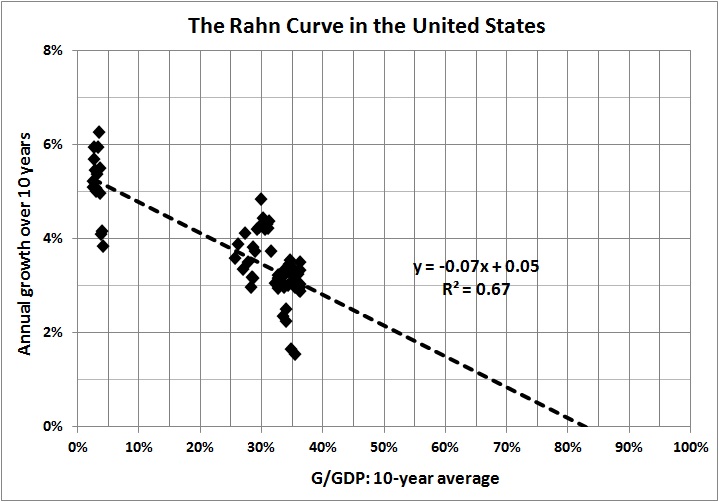
So, the focus should be on spending, for which taxation is a proxy. The effect of government spending on economic growth is nothing less than disastrous. I have treated the subject at length in “Estimating the Rahn Curve: Or, How Government Inhibits Economic Growth.” Here is another version of the final graph in that post:

The bottom line is that for every 10 percentage points by which government spending rises, the rate of growth declines by 0.7 percentage points. If you think that 0.7 percent is negligible, try compounding it over a lifespan of 80 years. In that time, a sustained 10 percent rise in government spending will reduce the average person’s real income by more than 40 percent.

That, my friends, is soak-the-rich Obamanomics at work. Apologists for Obamanomics, like Diamond and Saez, should be ashamed of themselves for abetting economically destructive demagoguery.

Related posts:
The Causes of Economic Growth
A Short Course in Economics
Addendum to a Short Course in Economics
Enough of “Social Welfare”
The Case of the Purblind Economist
Economic Growth since WWII
The Price of Government
Does the Minimum Wage Increase Unemployment?
The Price of Government Redux
The Mega-Depression
The Real Burden of Government
Toward a Risk-Free Economy
The Rahn Curve at Work
The Illusion of Prosperity and Stability
Society and the State
The “Forthcoming Financial Collapse”
Estimating the Rahn Curve: Or, How Government Inhibits Economic Growth
The Deficit Commission’s Deficit of Understanding
Undermining the Free Society
The Bowles-Simpson Report
The Bowles-Simpson Band-Aid
Build It and They Will Pay
Government vs. Community
The Stagnation Thesis
Government Failure: An Example
Taxing the Rich
More about Taxing the Rich
Voluntary Taxation
Money, Credit, and Economic Fluctuations
A Keynesian Fantasy Land
“Tax Expenditures” Are Not Expenditures
The Keynesian Fallacy and Regime Uncertainty
Why the “Stimulus” Failed to Stimulate
The “Jobs Speech” That Obama Should Have Given
Regime Uncertainty and the Great Recession
The Real Multiplier
Vulgar Keynesianism and Capitalism
Why Are Interest Rates So Low?
Don’t Just Stand There, “Do Something”
Economic Growth Since World War II
The Commandeered Economy
We Owe It to Ourselves
In Defense of the 1%
The Real Multiplier (II)

More about Luck and Baseball

In “Luck and Baseball, One More Time,” I make the point that

it takes a lot more than luck to succeed at almost anything, from winning high office to making millions of dollars to painting a masterpiece to building a house to cutting hair properly. To denigrate the rich and famous by calling them lucky is to denigrate every person who strives, with some success, to overmaster whatever bad luck happens to come his way.

The backdrop for that claim is some statistical evidence from the history of major-league baseball:

In the 111-year history of the American League, 60 different players have led the league in batting. Those 60 players have recorded a total of 367 top-10 finishes in American League batting races over the years — an average of 6 top-10 finishes for each of the players. It is not surprising, therefore, that most of the 60 players also compiled excellent career batting averages. Specifically, through 2010, 57 of the 60 had made at least 5,000 plate appearance in the American League, and 43 of the 57 are among the top 120 hitters (for average) — out of the thousands of players with at least 5,000 plate appearances in the American League. Were those 43 players merely “lucky”? It takes a lot more than luck to hit so well, so consistently, and for so many years.

Here is more evidence to the same effect. Two days ago, a young pitcher for the Chicago White Sox named Philip Humber threw a perfect game against the Seattle Mariners. Humber’s was the 19th perfect game since 1893, when the distance from the pitcher’s plate (rubber) to the back point of home plate (where the foul lines intersect) was increased to 60 feet, 6 inches. The 19 perfect games were pitched by 19 different men. And the total number of major league games played from 1893 through today numbers well above 300,000, which means that the potential number of perfect games (if thrown by both teams’ pitchers) is well above 600,000.

Aha, you might say, a perfect game is a matter of luck. Well, it may be partly a matter of luck, but baseball (despite some elements of randomness) is a game of skill, applied intentionally. A perfect game, like many other aspects of baseball, is the residue of the applied skills of pitchers and fielders, just as (the prevalent) imperfect game is the residue of the applied skills of batters and base runners.

The element of skill involved in pitching a perfect game is evidenced by the fact that most of the players who have pitched perfect games are the holders of above-average to exceptional pitching records:

Career Record*
Year of perfect game Pitcher Seasons played Wins Losses W-L % ERA+** Hall of Fame?***
1904 Cy Young 1890-1911 511 316 .618 138 Yes
1908 Addie Joss 1902-1910 160 97 .623 142 Yes
1922 Charlie Robertson 1919-1928 49 80 .380 90 No
1956 Don Larsen 1953-1967 81 91 .471 99 No
1964 Jim Bunning 1955-1971 224 184 .549 114 Yes
1965 Sandy Koufax 1955-1966 165 87 .655 131 Yes
1968 Catfish Hunter 1965-1979 224 166 .574 105 Yes
1981 Len Barker 1976-1987 74 76 .493 94 No
1984 Mike Witt 1981-1993 117 116 .502 105 No
1988 Tom Browning 1984-1995 123 90 .577 98 No
1991 Dennis Martinez 1976-1998 245 193 .559 106 No
1994 Kenny Rogers 1989-2008 219 156 .584 108 Not yet eligible
1998 David Wells 1987-2007 239 157 .604 108 Not yet eligible
1999 David Cone 1986-2003 194 126 .606 121 No
2004 Randy Johnson 1988-2009 303 166 .646 136 Not yet eligible
2009 Mark Buehrle 2000- 162 121 .572 120 Active player
2010 Dallas Braden 2007- 26 36 .419 102 Active player
2010 Roy Halladay 1998- 191 93 .673 139 Active player
2012 Philip Humber 2006- 12 10 .545 110 Active player
Combined W-L 3319 2361 .584
* Through April 22, 2012.
** Earned run average adjusted for ballpark and the league’s mean ERA in each season. An ERA+ of 100 is therefore an average performance over a career; ERA+ >100 is above average; ERA+ <100 is below average. (Details here: http://en.wikipedia.org/wiki/ERA%2B.)
*** Membership in the Hall of Fame is noted for the sake of completeness, though it is not conclusive proof of greatness. (See: http://libertycorner.blogspot.com/2006/10/anti-hall-of-fame-and-baseball.html; http://libertycorner.blogspot.com/2007/12/hall-of-famers.html.)

The point of this excursion into baseball is stated in an old post of mine:

A bit of unpredictability (or “luck”) here and there does not make for a random universe, random lives, or random markets. If a bit of unpredictability here and there dominated our actions, we wouldn’t be here to talk about randomness….

Human beings are not “designed” for randomness. Human endeavors can yield unpredictable results, but those results do not arise from random processes, they derive from skill or the lack therof, knowledge or the lack thereof … , and conflicting objectives…

In baseball, as in life, “luck” is mainly an excuse and rarely an explanation….

Related posts:
Fooled by Non-Randomness
Randomness Is Over-Rated
Luck-Egalitarianism and Moral Luck
Luck and Baseball, One More Time

The Candle Problem: Balderdash Masquerading as Science

For a complete treatment of the Candle Problem and several other cases of balderdash masquerading as science, go here.

In summary:

The Candle Problem is an interesting experiment, and probably valid with respect to the performance of specific tasks against tight deadlines. I think the results apply whether the stakes are money or any other kind of prize. The experiment illustrates the “choke” factor, and nothing more profound than that.

I question whether the experiment applies to the usual kind of incentive (e.g., a commissions or bonus), where the “incentee” has ample time (months, years) for reflection and research that will enable him to improve his performance and attain a bigger commission or bonus (which usually isn’t an all-or-nothing arrangement).

There’s also the dissimilarity of the Candle Problem — which involves more-or-less randomly chosen subjects, working against an artificial deadline — and actual creative thinking — usually involving persons who are experts (even if the expertise is as mundane as ditch-digging), working against looser deadlines or none at all.

The Burden of Government

When the state is more than a “night watchman,” its cost and intrusiveness diminish liberty and prosperity. (See this and this, for example.) Thus it has come to this: Government takes far more from productive Americans than it returns to them in the form of protection from foreign and domestic predators.

This point is overlooked by the keepers of national-income accounts. To them, government spending (which properly includes so-called transfer payments) adds to GDP. In fact, it detracts from GDP. It is a tax on the output of the private sector. The following graph indicates the size of the tax and its growth with time.


Sources: See footnote.

Some observations:

  • In 2010, the average output of a private worker was worth $114,000; government confiscated 40 percent of that output, leaving $68,000 in the private sector. (These estimates do not reflect the regulatory burden, which brings the total cost of government to about 50 percent of GDP.)
  • The direct burden of government spending nearly doubled from 1950 to 2010, rising from 23 percent to 40 percent of the average private employee’s output.
  • As indicated by the trend lines, real output per worker rose at the rate of $1,125 a year, but only $645 of each year’s increment remained in the private sector. In other words, government spent 43 percent of every additional dollar’s worth of real output per worker.

*   *   *

Sources:

Estimates of GDP in year 2005 dollars are from the feature “What Was the U.S GDP Then?” at MeasuringWorth.com.

Estimates of government spending (federal, State, and local) are from Statistical Abstracts of the United States, Colonial Times to 1970: Part 2. Series Y 533-566. Federal, State, and Local Government Expenditures, by Function; and the Bureau of Economic Analysis (BEA), Table 3.1. Government Current Receipts and Expenditures (lines 34, 35). The BEA tables are available here.

I estimated private-sector employment by subtracting the number of civilian government employees from the total number of employed persons in the civilian labor force. Government employment figures come from the 2012 Statistical Abstract, Historical Statistics, No. HS–46. Governmental Employment and Payrolls: 1946 to 2001, and the Bureau of Labor Statistics, Series CES9000000001: Employment, Hours, and Earnings from the Current Employment Statistics survey (National), available here. Total civilian employment is from BLS Series LNS12000000, available here.

Not-So-Random Thoughts (I)

Links to the other posts in this occasional series may be found at “Favorite Posts,” just below the list of topics.

Secession

Ilya Somin, writing at The Volokh Conspiracy, on secession:

The US Constitution, of course, is one of many where secession is neither explicitly banned or explicitly permitted. As a result, both critics and defenders of a constitutional right of secession have good arguments for their respective positions. Unlike the preceding Articles of Confederation, the Constitution does not include a Clause stating that the federal union is “perpetual.” While the Articles clearly banned secession, the Constitution is ambiguous on the subject.

Even if state secession is constitutionally permissible, the Confederate secession of 1861 was deeply reprehensible because it was undertaken for the profoundly evil purpose of perpetuating and extending slavery. But not all secession movements have such motives. Some are undertaken for good or at least defensible reasons. In any event, there is nothing inherently contradictory about the idea of a legal secession.

Of course, whether or not a secession is legal, it may be morally justified. Conversely, a legal secession may be morally unjustified, as was the case with the Southern secession. But the history of the Southern secession does not taint the legal and moral grounds for secession. As I say here,

The constitutional contract is a limited grant of power to the central government, for the following main purposes: keeping peace among the States, ensuring uniformity in the rules of inter-State and international commerce, facing the world with a single foreign policy and a national armed force, and assuring the even-handed application of the Constitution and of constitutional laws. That is all.

It is clear that the constitutional contract has been breached. It is clear that the Constitution’s promise to “secure the Blessings of Liberty to ourselves and our Posterity”  has been blighted.

Desperate times require desperate measures. I suggest that we begin at the beginning, with a new Declaration of Independence, and proceed from there to a new Constitution.

Obamacare

In a post at The American, John F. Gaski writes:

On the central issue of ObamaCare’s notorious mandate—i.e., whether it is constitutional for the federal government to compel a consumer purchase—everything hinges on the U.S. Constitution’s Commerce Clause. That element of the Constitution gives the federal government authority to regulate interstate commerce or activities affecting it. So far, so reasonable.

But the crux of the issue is whether forcing Americans to buy healthcare is regulation of commerce in the first place. Opponents note that non-purchase of healthcare should not be considered commerce or commerce-related activity. ObamaCare apologists, including some federal judges, make the remarkable claim that a decision not to purchase qualifies as interstate commerce or activity affecting interstate commerce, the same as a decision to purchase or a purchase itself. But even the non-partisan Congressional Research Service, in its 2009 assessment of likely PPACA constitutionality, acknowledged that Commerce Clause-based federal regulatory authority targets genuine activities that affect interstate commerce, not inactivity.

How to resolve this disagreement? The answer is staring us in the face, but has remained obscure to some lawyers and jurists who cannot quite see the forest for the trees. All you really need to know is what the word “commerce” means. To wit, commerce is “exchange of goods, products, or property . . . ; extended trade” (Britannica World Language Dictionary, 1959); “the buying and selling of goods . . .; trade” (Webster’s New World Dictionary, 1964); “the buying and selling of commodities; trade” (The Merriam-Webster Dictionary, 1974); “interchange of goods or commodities, especially on a large scale . . . ; trade; business” (Dictionary.com, 2012). Uniformly, we see, the definition of commerce involves activity, not just a decision to act, and certainly not a decision to not act. The meaning of the concept of commerce presumes action, and always has. Moreover, even casual philology will confirm that the accepted meaning of “commerce” at the time of the Constitution’s drafting referenced activity, not inactivity, at least as much then as it does now (see C. H. Johnson, William & Mary Bill of Rights Journal, October 2004). In the same way, the Commerce Clause has long been construed to apply to action in or affecting commerce, from the 1824 Gibbons v. Ogden Supreme Court case onward.

I am in complete agreement:

[T]he real issue … comes down to this: Does Congress’s power to regulate interstate commerce extend to “health care” generally, just because some aspects of it involve interstate commerce? In particular, can Congress constitutionally impose the individual mandate under the rubric of the Commerce Clause or the Necessary and Proper Clause?…

It is safe to say that a proper reading of the Constitution, as exemplified in the authoritative opinions excerpted above, yields no authority for Obamacare. That monstrosity — the official, Orwellian title of which is the Patient Protection and Affordable Care Act (PPACA) — attempts to reach an aggregation known as “health care,” without any differentiation between interstate commerce, intrastate commerce, and activities that are part of neither, namely, the choices of individuals with respect to health insurance.

It may be a valid exercise of Congress’s power to regulate actual interstate commerce that touches on the provision of health care. It is not a valid exercise to aggregate everything called “health care” and to regulate it as if it were all within the reach of Congress. When that happens, there is no room left — in “health care” nor, by extension, any other loose aggregation of activities — for State action or individual choice.

In sum, Obamacare is neither a valid regulation of interstate commerce nor necessary and proper to a valid regulation of interstate commerce. It is a governmental seizure of 1/9th of the economy. The individual mandate — which is a central feature of that seizure — is nothing more than coercion. It is no less peremptory than the military draft.

Freedom of Conscience

Yes, Virginia, there is freedom of conscience in Virginia:

A bill that ensures that faith-based adoption agencies in the state of Virginia won’t be forced to place children in households led by same-sex couples has passed both houses of the General Assembly and is heading to the desk of Gov. Robert McDonnell, a supporter of the legislation, who is expected to sign it soon.

Gov. McDonnell and the majorities in the Virginia legislature are standing up for freedom of conscience, which is among the negative rights that is trampled by grants of  “positive rights” (i.e., privileges). These

are the products of presumption — judgments about who is “needy” and “deserving” — and they are bestowed on some by coercing others. These coercions extend not only to the seizure of income and wealth but also to denials of employment (e.g., affirmative action), free speech (e.g., campaign-finance “reform”), freedom of contract (e.g., mandatory recognition of unions), freedom of association (e.g., forced admission of certain groups to private organizations), freedom of conscience (e.g., forced participation in abortions), and on and on.

Income Inequality

Thomas A. Garrett, a sensible economist, says good things about income inequality:

The apparent increase in U.S. income inequality has not escaped the attention of policymakers and social activists who support public policies aimed at reducing income inequality. However, the common measures of income inequality that are derived from the census statistics exaggerate the degree of income inequality in the United States for several reasons. Furthermore, although income inequality is seen as a social ill by many people, it is important to understand that income inequality has many economic benefits and is the result of, and not a detriment to, a well-functioning economy….

…[O]ver time, a significant number of households move to higher positions along the income distribution and a significant number move to lower positions along the income distribution. Common reference to “classes” of people (e.g., the lowest 20 percent, the richest 10 percent) is very misleading because income classes do not contain the same households and people over time….

The unconstrained opportunity for individuals to create value for society, which is reflected by their income, encourages innovation and entrepreneurship. Economic research has documented a positive correlation between entrepreneurship/innovation and overall economic growth.9 A wary eye should be cast on policies that aim to shrink the income distribution by redistributing income from the more productive to the less productive simply for the sake of “fairness.” 10 Redistribution of wealth would increase the costs of entrepreneurship and innovation, with the result being lower overall economic growth for everyone.

I am losing track of the posts in which I have made the same points. See this one and this one, and the posts linked in each of them.

The Left-Libertarian (“Liberal”) Personality vs. Morality

Will Wilkinson, a left-libertarian (i.e., modern “liberal”) if ever there was one, writes about his score on the Big-Five Personality Test:

I score very high in “openness to experience” and worryingly low in “conscientiousness”.

A true libertarian (i.e., a Burkean) would score high on “openness to experience” and high on “conscientiousness” — as I do.

As I have said, differences

between various libertarian camps and between libertarians, Burkean conservatives, yahoo conservatives, “liberals,” and so on — are due as much to differences of temperament as they are to differences in knowledge and intelligence.

But temperament is a reason for political error, not an excuse for it:

[T]he desirability or undesirability of state action has nothing to do with the views of “liberals,” “libertarians,” or any set of pundits, “intellectuals,” “activists,” and seekers of “social justice.” As such, they have no moral standing, which one acquires only by being — and acting as — a member of a cohesive social group with a socially evolved moral code that reflects the lessons of long coexistence. The influence of “intellectuals,” etc., derives not from the quality of their thought or their moral standing but from the influence of their ideas on powerful operatives of the state.

See also:
Libertarianism and Morality
Libertarianism and Morality: A Footnote

Conservatives vs. “Liberals”

David Brooks occasionally writes something with which I agree. For example, in “Hey Mets! I Just Can’t Quit You” (The New York Times, March 8, 2012) he says:

There’s a core American debate between [Jack Kerouac’s] “On the Road” and [Frank Capra’s}“It’s a Wonderful Life.” “On the Road” suggests that happiness is to be found through freedom, wandering and autonomy. “It’s a Wonderful Life” suggests that happiness is found in the lifelong attachments that precede choice. It suggests that restraints can actually be blessings because they lead to connections that are deeper than temporary self-interest.

What Brooks didn’t say, but probably thought, is that “On the Road” is “liberal” and “It’s a Wonderful Life” is “conservative.” For, as Brooks observes in the next paragraph, “happiness research suggests that ‘It’s a Wonderful Life’ is correct and ‘On the Road’ is an illusion.” That’s consistent with a point I make in “Intelligence, Personality, Politics, and Happiness,” namely, that persons of the right (which includes most libertarians) are happier than “liberals.”

But the happiness of persons of the right — and therefore most of the happiness that’s in the air — is threatened by the “liberal” agenda. And most conservatives are hard put to refute that agenda with reasoned argument. Maverick Philosopher explains, in “Why Are Conservatives Inarticulate?“:

Conservatives, by and large, are doers not thinkers, builders,  not scribblers.  They are at home on the terra firma of the concrete particular but at sea in the realm of abstraction.  The know in their dumb inarticulate way that killing infants is a moral outrage but they cannot argue it out with sophistication and nuance in a manner to command the respect of their opponents.  And that’s a serious problem.

To beat the Left we must out-argue them in the ivory towers and out-slug them in the trenches.  Since by Converse Clausewitz  politics is war conducted by other means, the trench-fighters need to employ the same tactics that lefties do: slanders, lies, smears, name-calling, shout-downs, pie-throwing, mockery, derision….

Politics is war and war is ugly.  We could avoid a lot of this nastiness if we adopted federalism and voluntary Balkanization.  But that is not likely to happen: the totalitarian Left won’t allow it.  So I predict things are going to get hot in the coming years.

To paraphrase Barry Goldwater, inarticulateness in the defense of liberty is no virtue.

The intelligentsia of the right — a select group that includes George Will and does not include the likes of O’Reilly and Hannity — must arm themselves to do battle on the left’s terms. I would avoid slanders, lies, and smears, but name-calling, shout-downs, pie-throwing, mockery, and derision are certainly in order — as is the truth about the baneful effects of leftism on its supposed beneficiaries: the poor and (mostly imaginary) downtrodden. Their raison d’être, in the left’s scheme of things, has been to supply the votes that have enabled the left to exert its totalitarian will on all of us.

Related posts:
The Price of Government
Does the Minimum Wage Increase Unemployment?
The Mega-Depression
The Real Burden of Government
The Left
The Illusion of Prosperity and Stability
Society and the State
I Want My Country Back
Estimating the Rahn Curve: Or, How Government Inhibits Economic Growth
Undermining the Free Society
Intelligence, Personality, Politics, and Happiness
“Intellectuals and Society”: A Review
Government vs. Community
The Stagnation Thesis
The Left’s Agenda
The Public-School Swindle
The Evil That Is Done with Good Intentions
The Left and Its Delusions
The Destruction of Society in the Name of “Society”
Externalities and Statism
Taxes: Theft or Duty?
Society and the State
The Spoiled Children of Capitalism
Politics, Sophistry, and the Academy
Subsidizing the Enemies of Liberty
Estimating the Rahn Curve: A Sequel
Are You in the Bubble?
Lay My (Regulatory) Burden Down

Irrational Rationality

Economists have given “rationality” a bad name. Mario Rizzo explains:

[T]he axioms of rational choice were supposed to shed light on how people actually made choices. Then a sleight of hand occurred. It was claimed that they shed light on how rational individuals would choose – without addressing the issue of whether people were in fact rational in the sense of the axioms. Finally, it was alleged – in the face of empirical evidence that people often did not choose rationally – that the axioms defined the norms of choice. They told us how rational individuals should choose. More than that. Since being rational is taken as “good,” they show us how people should behave – full stop….

The behavioralists may well be correct that people do not act in accordance with … rationality axioms. But they are surely wrong in claiming that they ought to behave in this way. The problem is not with deficient individuals. It is a problem of deficient rationality standards.

It is an old story. Pseudo-scientific economists, suffering from physics envy, strive to reduce the complexity of human behavior to simple-minded metrics, according to which they judge human rationality. When humans fail to hew to the simple-minded preferences of economistic thinkers, it is evident (to those thinkers) that humans must be nudged toward “doing the right thing.”

When economists cross the line from theorizing about economic behavior to judging it, they put themselves on the same low plain as “liberals.” The latter, at least, are honest about wanting their own way … just because … and do not resort to cheap, pseudo-scientific tricks. They simply enforce their preferences through statutes and regulations. Why “nudge” when you can coerce?

Related posts:
Why I Don’t Hang Around with Economists
The Rationality Fallacy
Greed, Cosmic Justice, and Social Welfare
Positive Rights and Cosmic Justice
Inventing “Liberalism”
Utilitarianism, “Liberalism,” and Omniscience
Utilitarianism vs. Liberty
Beware of Libertarian Paternalists
Landsburg Is Half-Right
Negative Rights, Social Norms, and the Constitution
Rights, Liberty, the Golden Rule, and the Legitimate State
The Mind of a Paternalist
Accountants of the Soul
Physics Envy
Rawls Meets Bentham
Enough of “Social Welfare”
The Case of the Purblind Economist
The Arrogance of (Some) Economists
Extreme Economism

Lay My (Regulatory) Burden Down

UPDATE 02/05/17: The website of the Office of the Federal Register has eliminate or very cleverly hidden the source of statistics summarized in the graph below. Alternative sources, as of this date, are here and here.

The Office of the Federal Register, undoubtedly proud of its role in the imposition of rules on Americans, publishes a statistical summary of its handiwork, from which I derived the following graph:


Source: Go to OFR page headed Tutorials, History, and Statistics and under Statistics click on XLS. Number of pages of rules for 1936-1975 estimated from the relationship between the number of pages of rules and the total number of pages in the Federal Register for 1976-2010.

Not all of the rules adopted since 1936 are still in effect, of course, but the graph gives a good indication of the growth and weight of the regulatory burden that hampers Americans and their enterprises. Do not take solace in the slower growth of rule-making pages since 1976; the page count continues to rise. Any number greater than zero represents the foreclosure of consumers’ and producers’ options — the further diminution of liberty, in other words.

How bad is it, economically? A report issued under the aegis of the U.S. Small Business Administration (yes, an arm of the central government) concludes that

the annual total cost of all federal regulations in 2008 was $1.752 trillion. Of this amount, the annual direct burden on business is $970 billion. Economic regulations represent the most costly category, with a total cost of $1.236 trillion, and with $618 billion falling initially on business. Environmental regulations represent the second most costly category in terms of total cost ($281 billion), and the cost apportioned to business is $183 billion. Compliance with the federal tax code is the third most costly category ($160 billion), and the cost of occupational safety and health, and homeland security regulations ranks last ($75 billion). (Nicole V. Crain and W. Mark Crain, Lafayette College, “The Impact of Regulatory Costs on Small Firms,” for SBA Office of Advocacy, September 2010, p. 48; cited and summarized on SBA’s website, here)

In other words governmental impositions in 2008 — a regulatory burden of $1.75 trillion and spending of $5.02 trillion — accounted for 47 percent of that year’s GDP ($14.29 trillion, in current dollars). As I have shown in other posts (e.g., here and here) the cumulative effect of governmental impositions is far greater than that.

Related reading: Henry I. Miller, “Red Tape and Pink Slips: Obama’s Imaginary Regulatory Reform,” The American, February 2, 2012

Related posts:
The Price of Government
The Price of Government Redux
The Mega-Depression
Ricardian Equivalence Reconsidered
The Real Burden of Government
Toward a Risk-Free Economy
The Rahn Curve at Work
The Illusion of Prosperity and Stability
The “Forthcoming Financial Collapse”
Estimating the Rahn Curve: Or, How Government Inhibits Economic Growth
The Deficit Commission’s Deficit of Understanding
Undermining the Free Society
The Bowles-Simpson Report
The Bowles-Simpson Band-Aid
Build It and They Will Pay
Government vs. Community
The Stagnation Thesis
America’s Financial Crisis Is Now
Money, Credit, and Economic Fluctuations
A Keynesian Fantasy Land
“Tax Expenditures” Are Not Expenditures
The Keynesian Fallacy and Regime Uncertainty
The Great Recession Is Not Over
Why the “Stimulus” Failed to Stimulate
Regime Uncertainty and the Great Recession
The Real Multiplier
Vulgar Keynesianism and Capitalism
Why Are Interest Rates So Low?
Economic Growth Since World War II
The Commandeered Economy
Estimating the Rahn Curve: A Sequel
The Real Multiplier (II)

The Real Multiplier (II)

Incorporated in this page.

Bonds for the Long Run?

Interest rates in the low tier of investment-grade corporate bonds (Baa-rated by Moody’s) have exceeded the dividend yield on the S&P Composite Index since the 1950s:


Sources: S&P Composite dividend yield is from Robert Shiller’s data set for Irrational Exuberance. Baa rate is from the Federal Reserve Board’s monthly series of Baa rates.

The more interesting value is the spread between the real yield on the S&P Composite and the real rate of interest on Baa-rated bonds:

The spread, in this instance, is measured by subtracting the real S&P yield from the real interest rate. The spread was at or above 5 percentage points most of the time from 1969 to 2009. For reasons I will come to, this led to a significant narrowing of the gap between real, long-term returns on stocks and bonds:


Key assumptions: Current dividends are reinvested in the S&P Composite Index at the current value of the index. Current interest payments are reinvested in new issues of Baa-rated bonds at the then-prevailing interest rate on such bonds. Bonds mature at the end of the 30-year holding period. That holding period was chosen because, according to the St. Louis Fed, “Moody’s tries to include bonds with remaining maturities as close as possible to 30 years. Moody’s drops bonds if the remaining life falls below 20 years, if the bond is susceptible to redemption, or if the rating changes.”

The graph indicates that the “risk premiumfor stocks (relative to corporate bonds) has not disappeared, but it has become markedly smaller since the mid-1950s. Why? Because dividend payouts have not kept up with stock prices, and so yields have dropped. This, in turn, has caused stock prices to rise less than they would have had yields not fallen.

Why should falling dividend yields have affected stock prices? The long-run return to stock ownership has two components: price movements and dividends. (By contrast, the bond holder who is in for the long haul expects only to redeem his bonds at face value when they mature.) As dividend yields have shrunk relative to interest rates on corporate bonds, stocks have become somewhat less attractive relative to bonds. The net effect, over the years, has been to reduce  the demand for stocks and thus to compound the effect of smaller dividend payouts by causing downward pressure on stock prices, albeit subtly and invisibly.

Yes, stock ownership (on paper) still seems to be a more attractive long-run proposition than bond ownership. But a prudent, risk-averse investor who is willing to buy bonds and hold them to maturity can do quite well without riding the stock-market roller coaster.

Related posts:
Stocks for the Long Run?
Stocks for the Long Run? (Part II)

Estimating the Rahn Curve: A Sequel