The Mind of a Paternalist, Revisited

If there was any doubt that Richard Thaler is not a “libertarian,” even though he implies that he is one when he calls himself a “libertarian paternalist,” read this:

There is another possible argument for including the rich in these tax cuts, one based on “fairness.” By this reasoning, the wealthy are entitled to low tax rates because they have temporarily had them, and it would now be unfair to take them back.

But by that same argument, unemployment insurance should never expire, and every day should be your birthday. “Temporary” has no meaning if it bestows a permanent right.

By Thaler’s convoluted logic, the money one earns is a gift from government, and those who pay taxes have no greater claim on their own money than those to whom the government hands it. How is this “libertarian,” by any reasonable interpretation of that word?

As I have said in various ways, Thaler is a paternalist but not a libertarian. One cannot be both.

Related posts:
Beware of Libertarian Paternalists
Columnist, Heal Thyself
Discounting and “Libertarian” Paternalism
The Mind of a Paternalist

Enough of Krugman

Paul Krugman, who has descended to the use of survey statistics, declares that small businesses aren’t hiring because their sales are down (“It’s Demand, Stupid“). Krugman has two points to make:

  • Small businesses aren’t cowed by regime uncertainty, taxes, and red tape, and all of those other “wonderful” things about which Krugman knows nothing.
  • The way to get out of the recession is to double down on “stimulus.”

Krugman’s first point aligns with  his stubborn insistence — against mountains of evidence  to the contrary– that government is benign and free-markets are malign.

Krugman’s second point aligns with his simplistic Keynsian view of the world, in which GDP is a homogeneous substance, like water, the level of which can be raised or lowered in a trice by government spending or the lack thereof. There’s no room in the Krugmanesque view of the world for real firms, run by real people, staffed by real people, producing myriad goods and services in myriad ways, and subject to the whims of Washington and thousands of State and local governments.

To say that small-businesspersons are reluctant to hire because there is inadequate demand for their products is like saying that a sick person is lying down because he doesn’t feel well. It’s a banal and incomplete interpretation of the situation. In any event, the fact that small businesses — and businesses in general — haven’t resumed hiring at the pre-recession rate is not an argument for mindless pump-priming. If it is an argument for anything, it is an argument for government to get out of the way.

Were the government a business, with a strong incentive to perform services of value to willing buyers, it would get out of the business of managing the economy and stick to what it does best: dispense justice and defend the nation. That it often fails to do those things well should be a clue to the Krugmans of the world about their risible faith in the wise, omniscient, and efficient government of their imagining.

There’s plenty more out there to indict and convict Krugman and his insistently wrong-headed view of the world. Here’s a minute sample:

Krugman and DeLong, a Prevaricating Pair
Professor Krugman Flunks Economics
The Negative Consequences of Government Expenditure
Regime Uncertainty: Behind the Reports of Economic Doom
Finally, Some Evidence from Krugman
Reviewing Krugman
In Pursuit of Empirical Macroeconomics
Krugman: Republicans Are Fiscally Irresponsible for Pushing Smaller Tax Cut, Threatening Much Larger One

To write about Krugman is to grant him the favor of being taken seriously. Basta!

The Population Mystery

Despite the doomsayers, past and present, the world’s population has grown and will grow:


Estimates for 10,000 B.C. through 1940 derived from U.S. Census Bureau, “Historical Estimates of World Population” (left column). Estimates for 1950 through 2050 derived from U.S. Census Bureau, “Total Midyear Population for the World: 1950-2050.” Intervals between years are irregular because of variations in the intervals in the Census tables.

Is it possible that the world’s population will reach an unsustainable level, after which it must shrink and/or plunge the world into abysmal poverty?

Donald Boudreaux, in a 2008 post, writes:

In his new book, Common Wealth, Jeffrey Sachs expresses his concern about population growth.  Worried by a U.N. prediction that global population will rise to 9.2 billion by the year 2050, from 6.6 billion today, Sachs says (on page 23 of his new book) the following about these additional 2.6 billion persons:

I will argue at some length that this is too many people to absorb safely, especially since most of the population increase is going to occur in today’s poorest countries.  We should be aiming….to stabilize the world’s population at 8 billion by midcentury.

Eight billion.  I’m not sure where Sachs got that number.  And, to be frank, I’m not curious about where he got it….

A … problem with Sachs’s eight-billion number is that, in calculating it, there is no way to predict how human creativity will alter the world during the next 42 years.  It’s ludicrous to pretend that we can know now what, say, the average MPG will be for internal-combustion engines in 2050.  Hell, we don’t even know if automobiles and lawnmowers and the like will still use such engines then.

Will another Norman Borlaug arise, between now and 2050, to spark another green revolution?  Will someone invent a way to efficiently power automobiles with air?  Will someone develop new and better techniques for defining and enforcing private property rights in ocean-going fish stocks so that the tragedy of the commons called “over-fishing” is eliminated?  Will an enterprising entrepreneur invent a means for ordinary households to power their homes with mulch or autumn leaves or small fragments of fingernail clippings?

Think back 42 years to 1966.  Who in that year imagined personal computers in nearly every home in America?  The Internet?  Digital cameras?  Cell phones?  Quality wines sold in screw-top bottles?  Buying music with literally the click of a button (and not having to burn fossil fuels in driving to the record store).  Aluminum cans that contain only a fraction of the metal that cans contained back then?  The Kindle (that will reduce the number of trees cut down to enable people to read books)?  Medical advances that make hip-replacements about as routine as getting cavities filled by the dentist?  Microfiber?

There is no way — literally, no way — to know how technology and social institutions will change between now and 2050.  Given this impossibility — and given the fact that we can nevertheless predict with confidence that technology will advance and that social institutions will change — to assert that “optimal” population in the year 2050 will be eight-billion persons is ludicrous in the extreme.  It’s faux-science, and deserves only ridicule.

Here’s Bryan Caplan, writing today:

I finally got around to reading Matt Ridley’s The Rational Optimist. Highlights….

2. How non-renewable energy is more abundant than renewable energy:

The Atlantic Ocean is not infinite, but that does not mean you have to worry about bumping into Newfoundland if you row a dingy out of a harbour in Ireland.  Some things are finite but vast; some things are infinitely renewable, but very limited.  Non-renewable resources such as coal are sufficiently abundant to allow an expansion of both economic activity and population to the point where they can generate sustainable wealth for all the people of the planet without hitting a Malthusian ceiling, and can then hand the baton to some other form of energy.

3. The fallacy of pessimistic extrapolation:

[T]he pessimists are right when they say that, if the world continues as it is, it will end in disaster for humanity.  If all transport depends on oil, and oil runs out, then transport will cease.  If agriculture continues to depend on irrigation and aquifers are depleted, then starvation will ensue.  But notice the conditional: if.  The world will not continue as it is.  That is the whole point of human progress, the whole message of cultural evolution, the whole import of dynamic change – and the whole thrust of this book….

5. Declining flu mortality is not dumb luck.

The modern way of life, with lots of travel but also rather more personal space, tends to encourage mild, casual-contact viruses that need their victims to be healthy enough to meet fresh targets fleetingly…

[W]hy then did H1N1 flu kill perhaps fifty million people in 1918?  Ewald and others think the explanation lies in the trenches of the First World War.  So many wounded soldiers, in such crowded conditions, provided a habitat ideally suited to more virulent behaviour by the virus: people could pass on the virus while dying….

The main argument I wish Ridley pursued more: How the very existence of civilization creates a mighty presumption against pessimism in all its forms.  But I view his omission optimistically: The arguments for optimism are so numerous that no one book can contain them all.

Doomsayers are simple-minded extrapolators. I suspect that they have an aesthetic objection to population growth, which they wrap in pseudo-scientific garb. Like their close kin, anti-market politicians and pundits, doomsayers seem to have no conception of the power of human ingenuity to make life more livable — when that ingenuity is not stifled by government.

Related posts:
The Causes of Economic Growth
A Short Course in Economics
Addendum to a Short Course in Economics
The Price of Government
The Price of Government Redux

A Belated Labor Day Message

The good news:


Derived from “Union Membership, Coverage, Density, and Employment Among Private Sector Workers, 1973-2010,” © 2010 by Barry T. Hirsch and David A. Macpherson.

Why is this good news? Read on: “The Truth about Labor Day,” from the Ludwig von Mises Institute; “Toward a Capital Theory of Value,” “A Very Politically Incorrect Labor Day Post,” and “Your Labor Day Reading,” by me. (NB: Some of the links in these old posts may be broken, and some of the quoted Wikipedia articles may have been revised by “contributors” eager to whitewash the labor-union movement.)

Macroeconomics and Microeconomics

Macroeconomic aggregates (e.g., aggregate demand, aggregate supply) are essentially meaningless because they represent disparate phenomena.

Consider A and B, who discover that, together, they can have more clothing and more food if each specializes: A in the manufacture of clothing, B in the production of food. Through voluntary exchange and bargaining, they find a jointly satisfactory balance of production and consumption. A makes enough clothing to cover himself adequately, to keep some clothing on hand for emergencies, and to trade the balance to B for food. B does likewise with food. Both balance their production and consumption decisions against other considerations (e.g., the desire for leisure).

A and B’s respective decisions and actions are microeconomic; the sum of their decisions, macroeconomic. The microeconomic picture might look like this:

  • A produces 10 units of clothing a week, 5 of which he trades to B for 5 units of food a week, 4 of which he uses each week, and 1 of which he saves for an emergency.
  • B, like A, uses 4 units of clothing each week and saves 1 for an emergency.
  • B produces 10 units of food a week, 5 of which she trades to A for 5 units of clothing a week, 4 of which she consumes each week, and 1 of which she saves for an emergency.
  • A, like B, consumes 4 units of food each week and saves 1 for an emergency.

Given the microeconomic picture, it is trivial to depict the macroeconomic situation:

  • Gross weekly output = 10 units of clothing and 10 units of food
  • Weekly consumption = 8 units of clothing and 8 units of food
  • Weekly saving = 2 units of clothing and 2 units of food

You will note that the macroeconomic metrics add no useful information; they merely summarize the salient facts of A and B’s economic lives — though not the essential facts of their lives, which include (but are far from limited to) the degree of satisfaction that A and B derive from their consumption of food and clothing.

The customary way of getting around the aggregation problem is to sum the dollar values of microeconomic activity. But this simply masks the aggregation problem by assuming that it is possible to add the marginal valuations (i.e., prices) of disparate products and services being bought and sold at disparate moments in time by disparate individuals and firms for disparate purposes. One might as well add two bananas to two apples and call the result four bapples.

The essential problem is that A and B will derive different kinds and amounts of enjoyment from clothing and food, and that those different kinds and amounts of enjoyment cannot be summed in any meaningful way. If meaningful aggregation is impossible for A and B, how can it be possible for an economy that consists of millions of economic actors and an untold variety of goods and services? And how is it possible when technological change yields results such as this?

GDP, in other words, is nothing more than what it seems to be on the surface: an estimate of the dollar value of economic output. It is not a measure of “social welfare” because there is no such thing.

Given that, why do I sometimes use GDP statistics? And, if GDP is really a meaningless aggregate, is there a valid, alternative way of depicting aggregate well-being? To be continued.

Related posts:
Greed, Cosmic Justice, and Social Welfare
Utilitarianism, “Liberalism,” and Omniscience
Utilitarianism vs. Liberty
Accountants of the Soul
Rawls Meets Bentham
Enough of “Social Welfare”
The Case of the Purblind Economist

Why Outsourcing Is Good: A Simple Lesson for “Liberal” Yuppies

You work in Manhattan, at the headquarters of a company whose product is sold throughout the U.S. and overseas. You live in Connecticut and commute to Manhattan by train. You drive to and from the train station in an SUV that was assembled in Tennessee; the parts came from many places, including Japan and Korea.

Shazam! Outsourcing is outlawed. You can’t buy a new SUV unless it’s assembled in Connecticut and all its parts are made in Connecticut of raw materials that are native to Connecticut.

Wait, it gets worse. You can’t work for a Manhattan-based firm if you live in Connecticut. Only Manhattanites need apply. The good news is that you won’t need an SUV if you move to Manhattan, so that you can keep your job. The bad news is that you can’t afford to live in Manhattan. The good news is that you wouldn’t want to live there anyway, because the only raw materials native to Manhattan are soot and dog droppings.

A Moral Dilemma

A classic moral dilemma goes like this:

You are at a train track and see five people tied to the track ahead. A switch is in front of you which will divert the train, but as you look down you see a man is strapped to that track and will be killed. Is it permissible to flip the switch and save the five people at the expense of one?

If you are like most people, you said yes.

Now imagine in order to save the five people, you have to push a stranger in front of the train to stop it. You know for certain it would stop the train in time to save the five people tied to the tracks. Is it permissible to push the man and save the five people at the expense of one?

You probably said no. But the results are the same — the only difference is the method (passive vs. impassive). But in both cases you sacrifice one life to save five.

The problem is squeamishness. It is easier to be passive than active, even if being active has the same result as passivity.

Politicians in Washington face an analogous moral dilemma, to which I will come after setting the stage.

Government debt is rising, and will continue to rise unless the laws governing Social Security, Medicare, and Medicaid are changed to reduce future benefits from “promised” levels. (It has long been understood that the “promises” are not legally binding, and may be changed at any time.) Alternatively, taxes must rise considerably.

Barring benefit reductions or tax increases, government debt will reach a point at which it becomes unsustainable. That is, it would become impossible for government to borrow, except at extremely high rates of interest. Those high rates would spill over into the private sector and make corporate borrowing an unattractive source of capital for business expansion. At the same time, stock prices would drop, in response to higher interest rates, therefore making stock issuance an unattractive source of capital for business expansion.

The developments I have just outlined would lead to prolonged (perhaps permanent) economic stagnation, such as Japan has experienced. Stagnation would, in turn, magnify the burden on future workers, who will (no matter what) foot the bill for Social Security, Medicare, and Medicaid. At some point, politicians would confront two stark options: cut benefits even more deeply than they would if action hadn’t been postponed; maintain “promised” benefits and drive future generations into penury.

In a nutshell:

  • Today’s “promises” to future recipients of Social Security, Medicare, and Medicaid cannot be kept without doing harm,  in the form of onerous taxes and/or economic stagnation (at best), in the not-too-distant future.
  • Despite the certainty of that harm, most politicians are afraid to suggest that today’s “promises” cannot be kept. And they are equally afraid to raise taxes to the levels required to keep those “promises.” They are afraid because they believe that the truth will cost them their jobs.

Politicians who are unwilling to acknowledge the facts about Social Security, Medicare, and Medicaid are like the squeamish bystander who refuses to save five persons by pushing one person onto the train tracks. The one person, of course, is the politician, who fears that he would lose his job for the simple act of doing it.

For most politicians, there is no moral dilemma. Their course of action is preordained by their lack of morality. They will save themselves and sacrifice the well-being of millions of Americans.

Related posts:
Presidential Chutzpah
Can Markets Force Fiscal Discipline?
As Goes Greece . . .

How the Great Depression Ended

Don Boudreaux writes:

No modern myth dies harder than the familiar claim – today repeated in the Los Angeles Times by one Joan Mortenson – that “It was the massive spending of World War II that finally ended the Depression.”

Between 1941 and 1945 Uncle Sam drew into his military 16 million persons – that was 22 percent of the pre-war labor force.  With so many workers then militarized, mostly through conscription, there’s no evidence that wartime spending restored the labor market to health.  And while real GDP did rise during those years because of military spending, the private economy shrank.  As Robert Higgs notes, “Real civilian consumption and private investment both fell after 1941, and they did not recover fully until 1946.  The privately owned capital stock actually shrank during the war.

It is true that the private economy shrank during World War II. But the important thing is what happened after that, and why. Here is a more complete picture, which I have lifted from an old post of mine:

Conventional wisdom has it that the entry of the United States into World War II caused the end of the Great Depression in this country. My variant is that World War II led to a “glut” of private saving because (1) government spending caused full employment, but (2) workers and businesses were forced to save much of their income because the massive shift of output toward the war effort forestalled spending on private consumption and investment goods. The resulting cash “glut” fueled post-war consumption and investment spending.

Robert Higgs, research director of the Independent Institute, has a different theory, which he spells out in “Regime Uncertainty: Why the Great Depression Lasted So Long and Why Prosperity Resumed After the War” (available here), the first chapter his new book, Depression, War, and Cold War. (Thanks to Don Boudreaux of Cafe Hayek for the pointer.) Here, from “Regime Change . . . ” is Higgs’s summary of his thesis:

I shall argue here that the economy remained in the depression as late as 1940 because private investment had never recovered sufficiently after its collapse during the Great Contraction. During the war, private investment fell to much lower levels, and the federal government itself became the chief investor, directing investment into building up the nation’s capacity to produce munitions. After the war ended, private investment, for the first time since the 1920s, rose to and remained at levels sufficient to create a prosperous and normally growing economy.

I shall argue further that the insufficiency of private investment from 1935 through 1940 reflected a pervasive uncertainty among investors about the security of their property rights in their capital and its prospective returns. This uncertainty arose, especially though not exclusively, from the character of federal government actions and the nature of the Roosevelt administration during the so-called Second New Deal from 1935 to 1940. Starting in 1940 the makeup of FDR’s administration changed substantially as probusiness men began to replace dedicated New Dealers in many positions, including most of the offices of high authority in the war-command economy. Congressional changes in the elections from 1938 onward reinforced the movement away from the New Deal, strengthening the so-called Conservative Coalition.

From 1941 through 1945, however, the less hostile character of the administration expressed itself in decisions about how to manage the warcommand economy; therefore, with private investment replaced by direct government investment, the diminished fears of investors could not give rise to a revival of private investment spending. In 1945 the death of Roosevelt and the succession of Harry S Truman and his administration completed the shift from a political regime investors perceived as full of uncertainty to one in which they felt much more confident about the security of their private property rights. Sufficiently sanguine for the first time since 1929, and finally freed from government restraints on private investment for civilian purposes, investors set in motion the postwar investment boom that powered the economy’s return to sustained prosperity notwithstanding the drastic reduction of federal government spending from its extraordinarily elevated wartime levels.

Higgs’s explanation isn’t inconsistent with mine, but it’s incomplete. Higgs overlooks the powerful influence of the large cash balances that individuals and corporations had accumulated during the war years. It’s true that because the war was a massive resource “sink” those cash balances didn’t represent real assets. But the cash was there, nevertheless, waiting to be spent on consumption goods and to be made available for capital investments through purchases of equities and debt.

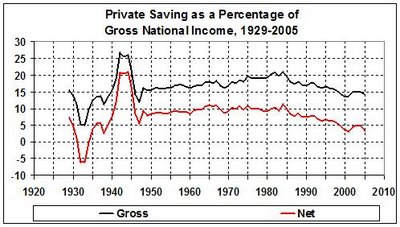
It helped that the war dampened FDR’s hostility to business, and that FDR’s death ushered in a somewhat less radical regime. Those developments certainly fostered capital investment. But the capital investment couldn’t have taken place (or not nearly as much of it) without the “glut” of private saving during World War II. The relative size of that “glut” can be seen here:

Derived from Bureau of Economic Analysis, National Income and Product Accounts Tables: 5.1, Saving and Investment. Gross private saving is analagous to cash flow; net private saving is analagous to cash flow less an allowance for depreciation. The bulge in gross private saving represents pent-up demand for consumption and investment spending, which was released after the war.

World War II did bring about the end of the Great Depression, not directly by full employment during the war but because that full employment created a “glut” of saving. After the war that “glut” jump-started

  • capital spending by businesses, which — because of FDR’s demise — invested more than they otherwise would have; and
  • private consumption spending, which — because of the privations of the Great Depression and the war years — would have risen sharply regardless of the political climate.

UPDATE: Robert Higgs, in an e-mail to me dated 06/24/06, submitted the following comment:

I happened upon your blog post that deals with my ideas about why the depression lasted so long and about the way in which the war related to the genuine prosperity that returned in 1946 for the first time since 1929. I appreciate the publicity, of course. I suggest, however, that you read my entire book, especially, with regard to the points you make on your blog, its chapter 5, “From Central Planning to the Market: The American Transition, 1945-47” (originally published in the Journal of Economic History, September 1999. I show there that the “glut of savings” idea, which is an old one, indeed perhaps even the standard theory of the successful postwar reconversion, does not fit the facts of what happened in 1945-47.

Here is my reply of 10/12/06:

I apologize for the delay in replying to your e-mail about my post… Your book, Depression, War, and Cold War, has not yet made it to the top of my Amazon.com wish list, but I have found “From Central Planning to the Market: The American Transition, 1945-47” on the Independent Institute’s website (here). If the evidence and arguments you adduce there are essentially the same as in chapter 5 of your book, I see no reason to reject the “glut of savings” idea, which is an old one, as I knew when I wrote the post. But, because it is not necessarily an old one to everyone who might read my blog, it is worth repeating — to the extent that it has merit.

At the end of the blog post I summarized the causes of the end of the Great Depression, as I see them:

World War II did bring about the end of the Great Depression, not directly by full employment during the war but because that full employment created a “glut” of saving. After the war that “glut” jump-started

  • capital spending by businesses, which — because of FDR’s demise — invested more than they otherwise would have; and
  • private consumption spending, which — because of the privations of the Great Depression and the war years — would have risen sharply regardless of the political climate.

In the web version of chapter 5 of your book you attribute increased capital spending to an improved business outlook (owing to FDR’s demise) and (in the section on the Recovery of the Postwar Economy, under Why the Postwar Investment Boom?) to “a combination of the proceeds of sales of previously acquired government bonds, increased current retained earnings (attributable in part to reduced corporate-tax liabilities), and the proceeds of corporate securities offerings” to the public. It seems that those “previously acquired government bonds” must have arisen from the “glut” of corporate saving during World War II.

What about the “glut” of personal saving, which you reject as the main source of increased consumer demand after World War II? In the online version of chapter 5 (in the section on the Recovery of the Postwar Economy, under Why the Postwar Consumption Boom?) you say:

The potential for a reduction of the personal saving rate (personal saving relative to disposable personal income) was huge after V-J Day. During the war the personal saving rate had risen to extraordinary levels: 23.6 percent in 1942, 25.0 percent in 1943, 25.5 percent in 1944, and 19.7 percent in 1945. Those rates contrasted with prewar rates that had hovered around 5 percent during the more prosperous years (for example, 5.0 percent in 1929, 5.3 percent in 1937, 5.1 percent in 1940). After the war, the personal saving rate fell to 9.5 percent in 1946 and 4.3 percent in 1947 before rebounding to the 5 to 7 percent range characteristic of the next two decades. After having saved at far higher rates than they would have chosen in the absence of the wartime restrictions, households quickly reduced their rate of saving when the war ended.

That statement seems entirely consistent with the proposition that consumers spent more after the war because they had the money to spend — money that they had acquired during the war when their opportunities for spending it were severely restricted. Not so fast, you would say: What about the fact that “individuals did not reduce their holdings of liquid assets after the war” (your statement)? They didn’t need to. Money is fungible. If consumers had more money coming in (as they did), they could spend more while maintaining the same level of liquid assets — because they had a “backlog” of saving. Here’s my take:

  • Higher post-war incomes didn’t just happen, they were the result of higher rates of investment and consumption spending.
  • The higher rate of investment spending was due, in part, to corporate saving during the war and, in part, to individuals’ purchases of corporate securities and equities.
  • At bottom, the wartime “glut” of personal saving enabled the postwar saving rate to decline to a more normal level, thus allowing consumers to buy equities and securities — and to spend more — without drawing down on their liquid assets.

Granted, business and personal saving during World War II was not nearly as large in real terms as it was on paper — given the very high real cost of the war effort. But it was the availability of paper savings that strongly influenced the behavior of businesses and consumers after the war….

The Case of the Purblind Economist

Purblind: lacking in insight or understanding; obtuse

Steven Landsburg just doesn’t get it. Uwe Reinhardt lectures him about the folly of “efficiency” (or “social welfare”), and Landsburg continues to act as if there were such a thing:

Suppose you live next door to Bill Gates. Bill likes to play loud music at night. You’re a light sleeper. Should he be forced to turn down the volume?

An efficiency analysis would begin, in principle (though it might not be so easy in practice) by asking how much Bill’s music is worth to him (let’s say we somehow know that the answer is $10,000) and how much your sleep is worth to you (let’s say $25). It is important to realize from the outset that no economist thinks those numbers in any way measure Bill’s subjective enjoyment of his music or your subjective annoyance. Only a crazy person would think such a thing, and I’ve never met anybody who’s that crazy in that particular way. Instead, these numbers primarily reflect the fact that Bill is a whole lot richer than you are. Nevertheless, the economist will surely declare it inefficient to take $10,000 worth of enjoyment from Bill in order to give you $25 worth of sleep. We call that a $9,975 deadweight loss.

The problem with this kind of thinking should be obvious to anyone with the sense God gave a goose. The value of Bill’s enjoyment of loud music and the value of “your” enjoyment of sleep, whatever they may be, are irrelevant because they are incommensurate. They are separate, variably subjective entities. Bill’s enjoyment (at a moment in time) is Bill’s enjoyment. “Your” enjoyment (at a moment in time) is your enjoyment. There is no way to add, subtract, divide, or multiply the value of those two separate, variably subjective things. Therefore, there is no such thing (in this context) as a deadweight loss because there is no such thing as “social welfare” — a summation of the state of individuals’ enjoyment (or utility, as some would have it).

Landsburg persists:

Take a more realistic example: Should we spend, say, a billion dollars a year to subsidize end-of-life health care for poor people? It would be, I think, a terrible mistake to settle this question without at least asking whether the recipients might prefer that we spend our billion dollars some other way — say by subsidizing their groceries or just giving them cash. If so, the difference in value between what they’re getting and what they could be getting (as measured by the recipients) is a deadweight loss. The bigger that deadweight loss, the more we should reconsider our spending priorities.

Who is “we,” Prof. Landsburg? Do you presume to speak for me, one of the taxpayers who would share in the cost of subsidizing end-of-life health care for poor people? The “recipients” have no right to prefer anything. It is my money you’re talking about, not some pot of “social welfare” that sits in the sky, waiting to be distributed by omniscient economists like you. The deadweight loss, as far as I’m concerned, is whatever you take from me to “give” to others, in your omniscience. I have better things to do with my money, thank you, and whether or not they’re “charitable” (they are, in part), is no business of yours. Who made you the accountant of my soul?

Related posts:
Greed, Cosmic Justice, and Social Welfare
Positive Rights and Cosmic Justice
Inventing “Liberalism”
Utilitarianism, “Liberalism,” and Omniscience
Utilitarianism vs. Liberty
Beware of Libertarian Paternalists
Landsburg Is Half-Right
Negative Rights, Social Norms, and the Constitution
Rights, Liberty, the Golden Rule, and the Legitimate State
The Mind of a Paternalist
Accountants of the Soul
Rawls Meets Bentham
Enough of “Social Welfare”

A True Flat Tax

REVISED 08/30/10

Don Boudreaux writes:

I do not grant that government’s decision to refrain from taking X‘s money means that government subsidizes X. The tax-exemption might be unwise policy, and it might be unfair (by some plausible guideposts) – and it almost certainly gives the tax-exempt organizations an advantage that they would otherwise not possess.

But tax-exemption does not involve taking money from Y and giving it to X. That fact is vital.

I’m not so sure.

The reason I’m not so sure is that “tax-exemption … almost certainly gives the tax-exempt organizations an advantage that they would otherwise not possess.” In other words, X‘s revenues are greater than they would be absent X’s tax-exempt status. By the same token, Y‘s revenues are less than they would be absent X‘s tax-exempt status. It may be true that X’s greater revenues do not accrue as profits, but they do accrue in some form. For example, in the defense-analysis industry, with which I am familiar, the employees of tax-exempt organizations — known as federally funded research and development centers (FFRDCs)– enjoy more luxurious offices; higher compensation, mainly in the form of benefits (e.g., more vacation time, larger company contributions to health insurance premiums, better retirement plans); and more stable employment (because FFRDCs operate under long-term, sole-source contracts that tend to be renewed decade after decade). The benefits that accrue to X‘s employees because of X‘s tax-exempt status are, in effect, a subsidy paid by Y‘s shareholders and employees.

Another way to look at it is this: In a balanced-budget world, the cost of government would be defrayed entirely by tax revenues. Given a government of a certain size, the exemption of some firms from paying taxes requires that other firms’ shareholders and employees pay higher taxes. That is a subsidy, if I ever saw one.

Going one step further, consider the proper function of government, which is to protect the lives, liberty, and property of citizens. It is none of government’s business what a citizen does when his life, liberty, and property are secure, as long as he doesn’t use it to impinge on the lives, liberty, and property of others. Whether a person makes a billion dollars a year or one dollar a year is really not the government’s concern, nor is it the government’s concern whether a person lives in a castle or a cardboard box. Such things, if they are of concern to anyone other than the person in question, are of concern to that person’s family, friends, neighbors, private charities, and so on.

It follows that government has no proper claim on the amount of income or wealth that a person acquires through the legitimate use of his liberty (such as it is). Warren Buffet and Bill Gates owe the government no more than a panhandler. Buffet and Gates simply have made better use of the protection afforded them by government, at least with respect to the acquisition of income and wealth.

The proper level of taxation, therefore, is that which defrays the cost of the governmental functions which protect the lives, liberty, and property of citizens: defense, courts, and law-enforcement. The cost of those functions is about $3,000 a year for every person aged 21 and older.* Everyone (21 and older) whose annual tax bill includes more than $3,000 for “liberty” services is subsidizing everyone (21 and older) whose annual tax bill for the same things is less than $3,000. All taxes for other services, regardless of who pays them, are forms of theft.**

__________
* The annual cost of national defense, the courts, and law-enforcement agencies is about $600 billion. That amount, divided by 200 million (the approximate number of persons in the United States aged 21 and older) yields an annual per-person cost of $3,000. I exclude persons under 21 because most of them still depend on adults for their subsistence, and have not yet advanced to the stage of making the most of the protections afforded by government.

** Some taxes underwrite regulatory functions, which are counterproductive. Some taxes underwrite services that are used by varying percentages of the populace (e.g., parks, highways), which (a) burdens those taxpayers who do not use the services in question, (b) subsidizes those taxpayers who do use the services in question, and (c) substitutes inefficient, unresponsive political-bureaucratic entities for more efficient, more responsive private firms. A large proportion of taxes (especially for Social Security and Medicare) simply take money from workers and give it to non-workers — an open-and-shut case of theft.

Enough of “Social Welfare”

I once wrote this:

How can a supposedly rational economist, politician, pundit, or “liberal” imagine that the benefits accruing to some persons (commuters, welfare recipients, etc.) somehow cancel the losses of other persons (taxpayers, property owners, etc.)? There is no valid mathematics in which A’s greater happiness cancels B’s greater unhappiness.

Yet, that is how cost-benefit analysis (utilitarianism) works, if not explcitly then implicitly. It is the spirit of utilitarianism (not to mention power-lust, arrogance, and ignorance) which enables Barack Obama and his ilk throughout the land to impose their will upon us — to our lasting detriment.

Uwe E. Reinhardt, an economics professor at Princeton, puts it this way:

The problem with welfare analysis is not so much that ethical dimensions typically enter into it, but that economists pretend that is not so. They do so by justifying their normative dicta with appeal to the seemly scientific but actually value-laden concept of efficiency….

[E]conomists lean on a welfare criterion first proposed in the late 1930s by the eminent British economists Nicholas Kaldor and Sir John Hicks. It is an intuitively appealing criterion, if one does not think too deeply about it….

…As the economist Steven E. Landsburg explains it bluntly to students in “Price Theory and Applications” :

In applications, the Kaldor-Hicks criterion and the efficiency criterion amount to the same thing. When Jack gains $10 and Jill loses $5, social gains increase by $5, so the policy is a good one. When Jack gains $10 and Jill loses $15, there is a deadweight loss of $5, so the policy is bad.

Evidently, on the Kaldor-Hicks criterion one need not know who Jack and Jill are, nor anything about their economic circumstances. Furthermore, a truly stunning implication of the criterion is that if a public policy takes $X away from one citizen and gives it to another, and nothing else changes, then such a policy is welfare neutral. Would any non-economist buy that proposition?

Readers will notice an irony in the widespread acceptance of the Kaldor-Hicks criterion by economists. On the one hand, they claim that their science is rooted strictly in the personal preferences of individuals in society, which seems democratic. In their application of the Kaldor-Hicks criterion to real-world problems, however, economists act like collectivists who seek to allocate society’s resources under a preferred moral doctrine. Economists take on the role of a benevolent dictator presumed to be empowered by someone to redistribute welfare among individual members of society for a larger social purpose — increases in what economists call efficiency and the maximization of what they call overall social welfare.

“Social welfare” (“efficiency”) is an excuse for politicians to play God. An economist who abets such behavior is a shill, not a scientist.

The Recession Lingers…

…by my definition of a recession:

  • two or more consecutive quarters in which real GDP (annualized) is below real GDP (annualized) for an earlier quarter, during which
  • the annual (year-over-year) change in real GDP is negative in at least one quarter.

Here’s how real GDP has fared from the first quarter of 1947 through the second quarter of 2010 (recessions are denoted by vertical bars):


Derived from “Current dollar and real GDP” spreadsheet published by the Bureau of Economic Analysis, U.S. Department of Commerce.

This picture is misleading, of course, because it fails to depict the length and depth of America’s mega-depression, which is now more than a century old and deepening every day.

The Left

The “left” of the title refers, specifically, to left-statists or (usually) leftists.

I describe statism in “Parsing Political Philosophy“:

Statism boils down to one thing: the use of government’s power to direct resources and people toward outcomes dictated by government….

The particular set of outcomes toward which government should strive depends on the statist…. But all of them are essentially alike in their desire to control the destiny of others….

“Hard” statists thrive on the idea of a powerful state; control is their religion, pure and simple. “Soft” statists profess offense at the size, scope, and cost of government, but will go on to say “government should do such-and-such,” where “such-and such” usually consists of:

  • government grants of particular positive rights, either to the statist, to an entity or group to which he is beholden, or to a group with which he sympathizes
  • government interventions in business and personal affairs, in the belief that government can do certain things better than private actors, or simply should do [certain] things….

I continue by saying that left-statists (L-S)

prefer such things as income redistribution, affirmative action, and the legitimation of gay marriage….L-S prefer government intervention in the economy, not only for the purpose of redistributing income but also to provide goods and services that can be provided more efficiently by the private sector, to regulate what remains of the private sector, and to engage aggressively in monetary and fiscal measures to maintain “full employment.” It should be evident that L-S have no respect for property rights, given their willingness to allow government to tax and regulate at will….

L-S tend toward leniency and forgiveness of criminals (unless the L-S or those close to him are the victims)…. On defense, L-S act as if they prefer Chamberlain to Churchill, their protestations to the contrary….

L-S have no room in their minds for civil society; government is their idea of “community.”…

It is no wonder that most “liberals” (L) and “progressives” (P) try to evade the “leftist” label. (I enclose “liberal,” “progressive,” and forms thereof in quotation marks because L are anything but liberal, in the core meaning of the word, and the policies favored by P are regressive in their effects on economic and social liberty.) L and P usually succeed in their evasion because the center of American politics has shifted so far to the left that Franklin Roosevelt — a leftist by any reasonable standard — would stand at the center of today’s political spectrum.

Indeed, the growing dominance of leftism can be seen in the history of the U.S. presidency. It all started with Crazy Teddy Roosevelt, the first president to dedicate himself to the use of state power to advance his cause du jour. (I do not credit the anti-Lincoln zealotry of  the Ludwig von Mises Institute.) TR’s leftism was evident in his “activist” approach to the presidency. No issue, it seems, was beneath TR’s notice or beyond the reach of the extra-constitutional powers he arrogated to himself. TR, in other words, was the role model for Woodrow Wilson, Herbert Hoover (yes, Hoover the “do nothing” whose post-Crash activism helped to bring on the Great Depression), Franklin Roosevelt, Harry Truman, John Kennedy, Lyndon Johnson, Richard Nixon, Bill Clinton, and Barack Obama. (For more about American presidents and their predilections, see this, this, and this.) Countless members of Congress and State and local officials have been, and are, “activists” in the image of TR.

In sum, the problem with America — and it boils down to a single problem — is the left’s success in advancing its agenda. What is that agenda, and how does the left advance it?

The left advances its agenda in many ways, for example, by demonizing its opponents (small-government opponents are simply “mean”), appealing to envy (various forms of redistribution), sanctifying an ever-growing list of “victimized” groups (various protected “minorities”), making a virtue of mediocrity (various kinds of risk-avoiding regulations), and taking a slice at a time (e.g., Social Security set the stage for Medicare which set for Obamacare).

The left’s essential agenda  is the repudiation of ordered liberty of the kind that arises from evolved social norms, and the replacement of that liberty by sugar-coated oppression. The bread and circuses of imperial Rome have nothing on Social Security, Medicaid, Medicare, Obamacare, and the many other forms of personal and corporate welfare that are draining America of its wealth and élan. All of that “welfare” has been bought at the price of economic and social liberty (which are indivisible). (For a broad enumeration, see this post.)

Leftists like to say that there is a difference between opposition and disloyalty. But, in the case of the left, opposition arises from a fundamental kind of disloyalty. For, at bottom, the left pursues its agenda because  it hates the idea of what America used to stand for: liberty with responsibility, strength against foreign and domestic enemies.

Most leftists are simply shallow-minded trend-followers, who believe in the power of government to do things that are “good,” “fair,” or “compassionate,” with no regard for the costs and consequences of those things. Shallow leftists know not what they do. But they do it. And their shallowness does not excuse them for having been accessories to the diminution of  America. A rabid dog may not know that it is rabid, but its bite is no less lethal for that.

The leaders of the left — the office-holders, pundits, and intelligentsia — usually pay lip-service to “goodness,” “fairness,” and “compassion.” But their lip-service fails to conceal their brutal betrayal of liberty. Their subtle and not-so-subtle treason is despicable almost beyond words. But not quite…

Related posts:
The State of the Union: 2010
The Shape of Things to Come

On Liberty
Parsing Political Philosophy
The Indivisibility of Economic and Social Liberty
Greed, Cosmic Justice, and Social Welfare
Positive Rights and Cosmic Justice
Fascism and the Future of America
Inventing “Liberalism”
Utilitarianism, “Liberalism,” and Omniscience
Utilitarianism vs. Liberty
Beware of Libertarian Paternalists
Negative Rights, Social Norms, and the Constitution
Rights, Liberty, the Golden Rule, and the Legitimate State
The Mind of a Paternalist
Accountants of the Soul
Rawls Meets Bentham
Is Liberty Possible?

The Commandeered Economy
The Price of Government
The Mega-Depression
Does the CPI Understate Inflation?
Ricardian Equivalence Reconsidered
The Real Burden of Government
The Rahn Curve at Work

The Rahn Curve at Work

Incorporated in this post.

Toward a Risk-Free Economy

If the real economy — which produces goods and services — could be disconnected from financial markets, the Great Depression (and thus the New Deal) and the Great Recession (and thus TARP and “stimulus”) would not be part of history. The problem is that financial markets are a necessary part of the real economy — unless your idea of an economy is one that functions without money, banking (as we know it), credit, and risk-pooling (e.g., insurance companies and corporations).

Money is the root of all financial crises because it eases the buying and selling of goods and services. That sounds good, but money also enables its holders to more readily change their minds about what and when they buy and sell. When Farmer Joe trades wheat to Farmer Jake in exchange for butter, he does so, in part, because wheat isn’t nearly as portable as money. If Farmer Joe gets money for his wheat, there’s no telling what he’ll do with the money from one day to the next. He might even decide to save some of it, thus depriving Farmer Jake of sales that he was counting on and triggering a Keynsian rollback in aggregate demand.

Banks would be okay, as long as they are warehouses for goods and are not in the business of holding money and lending it out. Instead of paying interest, banks would charge customers for storage services.

Why shouldn’t banks lend money? Because lending by banks is a form of credit, and credit is to be eschewed. If money is the root of all financial crises, credit is the thing that allows money to do its dirty work. When borrowers don’t repay their loans, banks (and other lenders) go belly-up, which just triggers another kind of Keynsian rollback in aggregate demand. Government actions to make lenders whole simply transfer the risk of lending from particular depositors and investors to taxpayers at large, whose natural reaction is to spend less now because they can see higher taxes in their future.

Risk-pooling goes hand-in-hand with credit. People who pool their money to underwrite risky propositions (e.g., business ventures) do so knowing that not all propositions will succeed. Obviously, the thing to do is to back only those propositions that are ensured of success, but there’s no way to do that. Solution: Don’t allow risk pooling because it’s too, well, risky.

So there you have it, a prescription for a risk-free economy: no money, no credit, no banking, no risk-pooling. Just plod down the road to Farmer Jake’s place and trade some of your wheat for some of his butter. And don’t worry about the fact that you live in a thatched hut with a dirt floor, drive a rickety cart which is pulled by a rickety donkey, dig potatoes out of the ground, and eat those potatoes (with a little butter) by the dim light of a few home-made candles.

Wait a minute! There’s still the risk of bad weather, which could stunt or ruin your wheat crop. I guess there’s no such thing as a risk-free economy, is there? But don’t tell that to the regulators, you’ll spoil their fun.

The Real Burden of Government

Drawing on estimates of GDP and its components, it is easy to quantify the share of economic output that is absorbed by government spending. (See, for example, “The Commandeered Economy.”) With a bit of interpretive license, it is even possible to assess the cumulative effects of government spending and regulation on economic output. (See, for example,  “The Price of Government.”)

But the real economy does not consist of a homogeneous output (GDP). The real burden of government therefore depends on the specific resources that government extracts from the private sector in the execution of particular government programs, and on the particular products and services that are affected by government regulations.

Each new or expanded government program raises the demand for and price of certain kinds of goods and services, and channels rewards (claims on goods and services) in the direction of the businesses and persons involved in providing goods and services to government; for example:

  • Social Security rewards individuals for not working. The service, in this case, is the “good feeling” that comes to politicians, etc., for having done something “compassionate.”  The effect is to raise the prices of the goods and services that prematurely retired individuals would otherwise produce, therefore reducing the well-being of the working public.
  • Medicare — another of many feel-good programs — rewards retirees by subsidizing their medical care and prescription drugs. The upshot of this feel-good program is to reduce the well-being of the working public, which must pay more for its medical services and prescription drugs (directly, through higher insurance premiums, or because of lower wages to offset the cost of employer-provided health insurance).
  • R&D conducted in government laboratories and under government grants absorbs the services of scientists and engineers, thus raising the compensation of many scientists and engineers who couldn’t do as well in the private sector (the reward) and reducing the numbers of scientists and engineers engaged in private-sector R&D (the cost). Remember the private-sector inventors, innovators, and entrepreneurs who brought you the telephone, automobiles, radio, television, any number of “wonder drugs,” computers, online shopping, etc., etc., etc.?
  • A goodly fraction of the teachers and professors at tax-funded schools and universities are rewarded with incomes that they could not earn if they worked in the private sector. (Tax-funded education also provides feel-good rewards to the usual suspects, who worship at the altar of statist inculcation.) Given that the “educators” and administrations of tax-funded educational institutions are essentially unaccountable to their “customers,” it should go without saying that tax-funded education delivers far less than the alternative: combination of private schools (including trade schools), apprenticeships, and penal institutions. Moreover, tax-funded education deprives private-sector companies of the services of (some) teachers and professors who have the skills and ability to help those companies to offer better products and services to consumers.

That’s as far as I care to take that list. You can add to it easily, just by selecting any federal, State, or local government program at random.

All of those programs, onerous as they are, have nothing on the insidious regulatory regime that has engulfed us in the past century. Regulation often are the means by which “bootleggers and Baptists” conspire to protect their interests, on the one hand (“bootleggers”), while slaking their thirst for do-goodism, on the other hand (“Baptists”). The classic case, of course, is Prohibition, which enriched bootleggers while making Baptists (and other temperance-types) feel good about saving our souls. You know how well that worked.

Obamacare is a leading example of “bootleggers and Baptists” at work. Insurance companies and the American Medical Association, anxious to protect themselves, lent their support to a program that promises to increase the demand for prescription drugs and doctors’ services. It’s a pact with the devil, of course, because (unless, by some miracle, it is repealed or declared unconstitutional) insurance companies and doctors will find that they are nothing more than government employees, in deed if not in name. And guess who will end up paying the bill? The working public, of course.

Obamacare is not a purely regulatory regime, however, because it revolves around a feel-good giveaway program. For examples of purely regulatory regimes, I turn to the myriad mundane regulations that are imposed upon us for “our own good” and at our own expense, from make-work schemes for electricians and plumbers building codes to death-inducing delays in drug approval the Pure Food and Drug Act.

More notorious (though perhaps not more damaging to the economy) are the federal government’s misadventures in “managing” the economy. A good place to begin is with the Federal Reserve’s actions from the late 1920s to the early 1930s, which helped to bring on the stock-market bubble that led to the stock-market crash that led to a recession that (with the Fed’s help) turned into the Great Depression. A good place to end is with the recent financial crisis and deep recession — a creature of Congress, the Fed, other federal suspects too numerous to mention, plus Freddie Mac and Fannie Mae — their pseudo-private-bur-really-government co-conspirators.

Have you had enough? I certainly have.

The growth of government and its incursions into our personal and business lives during the past century has done far more than rob us of wealth and income. It has ruined our character and our society, and deprived us of liberty. What has happened to self-reliance, social networks, private charity, and civil society in general? What has happened to plain old liberty, which is a value unto itself? That they are not gone with the wind is due only to the tenacity with which (some of us) hold onto them.

Government grows in power and reach because every government program and regulation — even the most benighted of them — creates a vested interest on the part of its political sponsors (in and out of government), bureaucratic managers, and dependent constituencies. New suckers are born every minute who believe that they can join the gravy train without paying the piper (to mangle a few metaphors). And when the problems created by government become too obvious to ignore, the conditioned response on the part of politicians, bureaucrats, their dependent constituencies, and most of the public is to find governmental solutions to those problems. It is the ultimate vicious circle.

Government is the problem. And it will be the problem for as long as it does more than merely protect its citizens from domestic and foreign predators, so that they can enjoy liberty and its fruits.

*     *     *

Related posts: Too numerous to mention. Begin with this list of posts at Liberty Corner, then start at the beginning of Politics & Prosperity, work your way to the present, and stay tuned.

Color Me Unsurprised…

…by this, from Daniel Klein:

Zogby researcher Zeljka Buturovic and I considered the 4,835 respondents’ (all American adults) answers to eight survey questions about basic economics. We also asked the respondents about their political leanings: progressive/very liberal; liberal; moderate; conservative; very conservative; and libertarian….

How did the six ideological groups do overall? Here they are, best to worst, with an average number of incorrect responses from 0 to 8: Very conservative, 1.30; Libertarian, 1.38; Conservative, 1.67; Moderate, 3.67; Liberal, 4.69; Progressive/very liberal, 5.26….

The survey also asked about party affiliation. Those responding Democratic averaged 4.59 incorrect answers. Republicans averaged 1.61 incorrect, and Libertarians 1.26 incorrect. (“Are You Smarter Than a Fifth-Grader?The Wall Street Journal, June 8, 2010)

Part of the explanation, of course, is that “liberals” and “progressives” derive their view of the world from their emotions: “It ought to be that way, so that’s the way it is.” Another part of the explanation is that “liberals” and “progressives” just aren’t as smart or rational as they like to think they are:

IQ and Personality
IQ and Politics
The Right Is Smarter Than the Left
The Psychology of Extremism

I wouldn’t mind it if the hubris of “liberals” and “progressives” led them to a nasty end, but they have acquired the power to take the rest of us with them.

Ricardian Equivalence Reconsidered

Ricardian equivalence is an old and fascinating theory of economics. One writer summarizes it this way:

In [David] Ricardo‘s view, it does not matter whether [government] choose[s] debt financing or tax financing, because the outcome will be the same in either case. Flip a coin if you like, because in terms of the final results, raising taxes by $1,000 is equivalent to the government borrowing $1,000. This concept, appropriately called “Ricardian equivalence,” may be unfamiliar and counterintuitive. The key to understanding it is recognizing that debt financing is essentially just future taxation. If a government issues a bond today to avoid raising taxes, it will need to raise taxes tomorrow to pay off the bond when it comes due. According to Ricardo’s argument, it makes no difference to the public whether those increased taxes will come sooner (tax financing) or later (debt financing).

… Assume [government] can either impose $1,000 in taxes now to pay for [a government program], or … issue $1,000 of government debt, payable in one year for, let’s say, 10% interest. If  [government chooses] taxes, [taxypayers] have $1,000 less to spend today. That’s straightforward enough.

If, on the other hand, [government chooses] debt, then [taxpayers], being a savvy bunch who’ve seen this debt financing in action before, realize that in one year, it will be time…to pay back the people who buy the government debt. [Taxpayers] will owe those people $1,000 plus $100 in interest, for a total of $1,100. [Taxpayers] know that money must come from somewhere, so they expect that in one year, their taxes will go up by $1,100. In order to be ready for that one year from now, they put $1,000 into saving today, earning 10% interest, so that they will have the $1,100 they will need. This is $1,000 dollars today that they cannot spend today or save for reasons other than paying future taxes, so the outcome is that [taxpayers] have $1,000 less to spend today, just like they do if you raise taxes today.

But there are some standard objections to Ricardian equivalence, which the writer summarizes:

1. [T]here must be complete access to perfect capital markets so that all of the required saving and borrowing can be accomplished without friction, and people must be able to borrow at the same interest rate at which the government borrows, or the equivalence breaks down.

2. Additionally, people must care about what happens in the future, when the government debt will be repaid. If the future taxes only will apply so far in the future that the person will be dead, why save now? But if people refuse to offer to save more now, then offered savings in the economy are reduced, so interest rates would have to be higher if the government tried to borrow than if it taxed people directly today. Thus, it is assumed that either all people live long enough to see the debt be repaid, or they have children (that the parents care about and to whom they leave sufficient bequests) who will live to see that day.

3. Even if these requirements are satisfied, people must also recognize the equivalence between tax finance and debt finance in order to act accordingly. This may be the most tenuous assumption required—regardless of how fine the … educational system is, it is unlikely that public debt theory and present value calculations are included in basic, compulsory schooling.

The first two objections do not negate Ricardian equivalence, they merely make it a tendency. That is, instead of perfect equivalence, there may be approximate equivalence. In the example of a $1,000 government expenditure, taxpayers (as a group)  might save less than $1,000 if the interest rate they pay is more than the interest rate government pays, or they might save less than $1,000 if not all of them have descendants or care about them as much as they care about themselves. But, some amount will be saved, and it may be as much as $1,000.

The third objection overlooks the sophistication of the institutions and persons who have the greatest interest in government’s actions: large corporations and persons in high-income brackets. They will react to government borrowing as if it would affect them and their heirs (corporate and individual). This objection, like the first two, simply makes Ricardian equivalence a tendency.

That is as far as I will defend Ricardian equivalence, for it is unnecessarily complex and counterintuitive. It may be true that taxation and borrowing have the same (first-order) effect on the private sector. But that effect arises simply because it is government spending — not the method of financing it — which extracts resources from the private sector.

If government happens to raise taxes by an amount equal to its additional spending, then the burden of that spending falls, to a first approximation, on the persons who happen to pay the additional taxes imposed by government. Their disposable income is reduced by as much as it would be if government had inflated the prices of  the goods and services they buy. Similarly, if additional government spending happens to coincide with additional government borrowing; the real value of private saving is reduced by the inflationary effect of the additional government spending. In fact, both phenomena occur at the same time, regardless of the mix of additional taxation and/or borrowing; that is, government spending inflates the prices of goods and services and thereby erodes the value private wealth.

Related posts:
The Commandeered Economy
The Price of Government
The Mega-Depression
Does the CPI Understate Inflation?

Does the CPI Understate Inflation?

REVISED AND RE-DATED

A website called Shadow Government Statistics offers an alternative estimate of inflation. According to SGS, “methodological shifts in government reporting have depressed reported inflation, moving the concept of the CPI away from being a measure of the cost of living needed to maintain a constant standard of living.” (Related post, here.) According to a chart at the linked page, year-over-year inflation is now about 9 percent, as opposed to the official government figure of about 2 percent.

The claim by SGS has merit, and not only because the definition of inflation has shifted. Specifically:

  • Government spending (at all levels) rose by 6 percentage points between 1980 and 2009. (See the graph at this post.)
  • Most government spending is inherently inflationary.

The inherently inflationary nature of government spending can be grasped by considering the case where government spending is financed by taxes:

  • Suppose that in the absence of government the GDP of the United States would be, as it is today, about $15 trillion. (Actually, as I show here, GDP would be a lot more than today’s $15 trillion were government to do nothing more than provide defense and justice.)
  • Suppose, further, that a bunch of governors arrives on the scene one fine day to announce: “You Americans need our services, so we’re going to tax you $5 trillion in order to provide things that we want you to have.” About 20 percent of the $5 trillion — the money spent on defense and justice — will be of value to almost everyone because (among other things) it protects economic activity. But most of the things our governors wants us to have — a hodge-podge of programs and regulations — will be valued mainly by those governors (i.e., politicians and bureaucrats) and narrow constituencies. The hodge-podge of programs and regulations, along with our governors’ habit of taxing success, raises the real price of government to far more than the $5 trillion shown in our national income accounts.
  • Our governors’ “generous” confiscation of $5 trillion has the same effect as if the producers of $5 trillion worth of real (non-government) goods and services walk off the job. More accurately, it’s as if they walk off the job and begin to vandalize their capital (homes, commercial buildings, computer networks, etc.). Specifically, according to the chairwoman of Obama’s Council of Economic Advisers, tax increases have a multiplier effect of about 3 (i.e., every dollar of a tax increase yields a 3-fold decrease in GDP). Another economist estimates that the supply of labor declines by 1.9 percent in response to a 1 percent cut in wages (a tax is equivalent to a cut in wages). Even transfer-payment schemes (e.g., Social Security) have a negative economic effect because they penalize producers for the benefit of non-producers.
  • Despite the reduction in real output that accompanies government,our governors pretend that they are producing $5 trillion worth of services, so (1) they levy taxes for those services, most of which taxes fall on the productive sector, and (2) they pay the producers of government services (government employees and contractors)  with those taxes.
  • In sum, government pays the producers of government services in “empty dollars,” which those producers then try to spend on real output. And so we have $15 trillion chasing $10 trillion worth of real goods and services.

That’s real inflation. No deficit spending necessary. And it happens every time our governors commandeer additional resources, thus widening the gap between what the productive sector could produce and what it actually produces.

What if government were to borrow the $5 trillion instead of imposing $5 trillion in taxes? Borrowing doesn’t change the outcome, just the way we get there. There is still $15 trillion chasing real output of $10 trillion.

Now, not all of that government spending is inherently inflationary. The protection of citizens and their property from foreign and domestic predators (defense and justice) is essential to economic growth and the orderly functioning of free markets. Government spending on defense and justice currently accounts for 8 percent of GDP, whereas government spending (at all levels) currently accounts for 36 percent of GDP. Let’s say, for the sake of argument, (1) that the “right” level of government spending is 10 percent of GDP (the level that obtained in the early 1900s), (2) that the 10 percent is funded by a system of taxes which isn’t punitive toward investors and entrepreneurs (e.g., a single, flat, tax rate), and (3) that the 10 percent is not accompanied by burdensome regulations. Even in the absence of punitive taxes and burdensome regulations, the increase in government spending from 10 to 36 percent of GDP caused prices to rise by 25 percent. Inflation of 25 percent, when spread over 80 years and more, may seem inconsequential. But it is real — real theft, that is.

Moreover, the growth of government spending has been accompanied by punitive taxes and burdensome regulations. As a result, real GDP is 68 percent below its potential. In other words, in the absence of the regulatory-welfare state, real GDP would be more than 3 times its present level.

Visible inflation is bad enough; invisible inflation is a real killer.

The Land of Sunshine: A Parable

This parable is meant to be disrespectful of many things, not the least of them being our rulers and the rules they foist upon us in their disrespect for us and our liberty. It is not meant to be disrespectful of women or persons of color, except for those among them — and their political champions — who believe that past wrongs justify the multiplication of wrongs into the future.

Once upon at time — not so long ago or far away — there was a land ruled by a wise, young king. Well, he was thought wise because he orated in the unctuous, condescending tones, and he was younger than most of the kings who had preceded him. Let’s just call him “the man.”

Now, the man was known for his unbounded compassion. He would do anything for his subjects, as long as it wasn’t at his own expense or the expense of his large, raucous council of advisers. (More about them, anon.) His preferred method of paying for his acts of beneficence was to pretend that they cost nothing — a ruse that he was able to sustain by taking money from his subjects and promising to repay the debt to their descendants. (This scheme had worked well for the man’s predecessors, and so he adopted it as his own — with a vengeance.)

The man’s pseudo-compassionate heart was troubled by the inequality he found in the land. It was upsetting to him was that not all of his subjects were equal in all respects. Some of the man’s subjects were more capable than others, and therefore had higher incomes than others. Although the man was not troubled about the high incomes of lawyers, movie stars, and basketball players, he nevertheless proposed the imposition of higher taxes on high-income persons, just to get even with them.

Other of the man’s subjects were women who could not do everything that men could do, which the man deemed unfair. Although he did not bemoan the fact that men were inferior to women in many respects, he nevertheless proposed forcing employers to hire women for jobs that men could do better.

And there were those of the man’s subjects who went about with pale, sickly white skin, whereas others sported glowing, healthy-looking shades of gold. And so the man proposed to his council of advisers that all pale persons should be made darker (and thus healthier) by allowing them to spend more time in the sun, and by giving them regular doses of a rare, expensive, and effective elixir.

The council of advisers debated the man’s proposals for months on end. The council had no problem with penalizing capable persons and males, for such practices had been accepted for decades, in the name of equality. Nor did the council object to the practice of sending pale persons to work in the sun, as long as it resulted in more indoor work for the golden ones.

The council’s main objection had to do with the elixir, and whether more of it could be produced so that its new consumers could enjoy it without depriving others of its health-giving powers. In the end, the council agreed with the man that it was more important to create the impression of equality than to worry about such trivial matters as the supply of a health-giving elixir. “Trust us, it will all work out,” were the reassuring words of the council’s leaders.

And thus it came to pass that this not-so-distant land was blessed with less freedom, declining prosperity, ill-bred children, more illness, and equality — but one out of five isn’t bad for government work. The only disappointment came when the pale persons acquired red necks instead of turning golden brown.