The Mar-a-Lago Raid and Election 2024

Earlier today I posted “Trump vs. Biden: 7 (My Unvarnished Perspective)“, in which I said this:

Regardless of the polls and betting odds, I believe (today) that Trump will lose the election….

[Much discussion follows.]

That’s how it looks from here — as of today. Who knows what will happen in the next several months, or how it will affect the outcome of the election? I don’t.

Soon after that, Tristan Justice posted “Former Director Gina Haspel Hid the CIA’s Role in Russiagate for Years” (The Federalist, February 15, 2024). (He calls it Russiagate; I call it Obamagate, for reasons you will understand if you read my page, “Obamagate and Beyond“.)

There are two striking things about Justice’s post. The first is that it points to the kind of event that could drastically affect the outcome of this year’s presidential election — possibly moving the needle sharply in Trump’s direction. Here’s why (from Justice’s post):

The FBI raid on Mar-a-Lago last summer might have been a plot to protect deep state intelligence officials, according to sources who spoke with a team of independent journalists this week.

On Wednesday, journalists Michael Shellenberger, Matt Taibbi, and Alex Gutentag published part 2 of an expose on the role of the Central Intelligence Agency (CIA) in orchestrating the years-long crusade to frame former President Donald Trump as a Russian plant. The article posted on Shellenberger’s Substack, Public, outlined how intelligence officials fretted over the presence of a classified “binder” in Trump’s possession that former CIA Director Gina Haspel had guarded for years….

One unnamed source cited as “knowledgeable about the case” called the binder “Trump’s insurance policy.” Trump was apparently “very concerned about having it and taking it with him because it was his road map” of the Russian collusion hoax….

“The documents in question are said to contain information about the legal justification for those investigations, or more specifically, the lack of justification, among other things. Should more of that information be made public, it might implicate a long list of officials in serious abuses,” Public reported. “Questions like these may be answered if the 10-inch thick binder of sensitive documents about the origins of the Russia probe is made public. Fear for reputations and careers, not national security, is what has intelligence officials panicked.”

The second striking thing is that I surmised the true purpose of the Mar-a-Lago raid on September 13, 2022, when I posted “Why the Mar-a-Lago Raid?“. There, I summarized the conspiracy against Trump which I detail in “Obamagate and Beyond“, and added this:

Where does the raid on Mar-a-Lago fit into all of this? The raid was a fishing expedition to see how much information Trump had acquired about the origins and workings of the [Trump-Russia hoax] conspiracy. The unprecedented nature of the raid, the obviously flimsy pretext for it, and the selective leaks by the FBI all suggest desperation on the part of the conspirators.

One of those conspirators is Biden, of course, who was vice president when the conspiracy began and who has much to gain from discrediting Trump, staying in office, and using his power to minimize the consequences of the exposure of his role in the Biden family’s influence-peddling scheme.

Trump vs. Biden: 7 (My Unvarnished Perspective)

The polls, on average, favor Trump. Although his lead isn’t statistically greater than zero, that’s okay for a Republican.

The betting odds are going against Biden. Bettors see him as much less likely to win than they did a week ago, mainly because of this passage from Special Prosecutor Robert Hur’s report on Biden’s “mishandling” of classified documents:

[A]t trial, Mr. Eiden would likely present himself to a jury, as he did during our interview of him, as a sympathetic, well-meaning, elderly man with a poor memory. Based on our direct interactions with and observations of him, he is someone for whom many jurors will want to identify reasonable doubt. It would be difficult to convince a jury that they should convict him-by then a former president well into his eighties-of a serious felony that requires a mental state of willfulness.

Regardless of the polls and betting odds, I believe (today) that Trump will lose the election. It will happen because of his baggage (e.g., openly vindictive personality and resulting feuds, indictments, possible convictions), which will begin to weigh more heavily as voters actually decide which way to go.

With narrow wins in a few key States, Trump could win the election even if the overall popular vote goes against him by a couple of percentage points (just as he did in 2016). That’s what happened in 2016. I attribute that win to luck and surprise. Clinton’s lead in the polls and betting markets was so large that she seemed to be a shoo-in. As a result, the Democrats didn’t gear up to manufacture enough votes to win the close races that went Trump’s way and gave him an edge in the Electoral College.

Democrats geared up with a vengeance in 2020, with a lot of help from the Covid pandemic which boosted mail-in voting — the happy hunting ground of electoral fraudsters. Democrats will build on their successes of four years ago, while the GOP will try to play catch-up ball. But the GOP will fall short because (for the most part) it will confine its vote-generating operations to legal methods. Democrats (being leftists) will pull out all the stops and officials and judges (mostly Democrats and never-Trumpers) will cover for them.

There are people like me who will vote for Trump if he’s the GOP nominee only because we can’t abide what the Democrats are doing to the country. But there aren’t enough of us, I believe, to overcome Trump’s baggage. Moreover, Democrats still have plenty of time in which to recover from last week’s Biden fiasco — and they find a way to do it, with the enthusiastic aid of most of the media. In the end Biden — or whomever the Democrats nominate — will win in a rerun of 2020.

That’s how it looks from here — as of today. Who knows what will happen in the next several months, or how it will affect the outcome of the election? I don’t.

Trump vs. Biden: 6 (Trump Resurgent)

RealClearPolitics maintains a running tally of presidential election polls. I construct a moving average of the results, where the average represents Trump’s lead (or deficit) for the 10 most recent polls. I also construct a 95-percent confidence interval around the moving average, using the margins of error reported by pollsters. (Having done this for a while and observed some erratic and incredible results from Rasmussen Reports, I removed the results published by that formerly reliable polling organization from my calculations.)

Here’s the trend since late July 2023:

Back-to-back wins in Iowa and New Hampshire boosted Trump considerably. His margin is now (barely) back in positive territory (i.e., the lower band of the 95-percent confidence interval is just above zero).

CAVEAT: This isn’t a prediction of the outcome of the election. The figures simply reflect the stated preferences of respondents when the polls were conducted. Also (and positively), a GOP candidate can win even when he is behind in the (meaningless) nationwide popular vote (see this).

What Do I See in My Crystal Ball?

Nothing good:

The Biden administration overcomes the resistance of Texas and other GOP-led States and continues to allow illegal aliens (potential Democrat voters) to inundate the nation.

Perversely, in response to the resistance from Texas and other GOP-led States, the Biden administration declares a “national emergency” and effectively seizes control of GOP-controlled States. All policies that affirm life and liberty are suppressed (e.g., abortion bans and limits, school choice, effective law-enforcement, and — course — the freedoms of religion and speech).

If the immigration crisis doesn’t result in a “national emergency”, a different predicate will be found. The left’s need for control has is obsessive.

One result of the “national emergency” is the cancellation of the 2024 presidential election and the installation of a “provisional” government, led nominally by Biden (with Obama pulling the strings).

Even if there’s no national emergency or a provisional government, the left will remain in control through electoral chicanery.

Among many things, Biden administration’s egregious policies continue; for example, privileges for violent criminals, blacks, queers, and other “identity groups” (despite their known anti-social predilections and lack of accomplishments and abilities); the impoverishing war on fossil fuels and their efficient use (e.g., in gasoline-powered automobiles, gas furnaces, and gas cooktops); and the aforementioned flood of illegal aliens whose are supported the tax-paying citizens who are also the victims of the criminals among said aliens.

The regime finds a way around the GOP’s efforts to block aid to Ukraine and persists in a war that spreads to Western Europe and thus (via NATO) to the United States — perhaps involving exchanges of nuclear weapons.

The regime fails to take decisive action in the Middle East (and against Iran, specifically), with the result that critical resources and a critical trade route are throttled — re-igniting inflation and imposing real burdens (e.g., soaring energy prices) on working-class Americans.

Israel stands alone and eventually succumbs to the Muslim hordes, which leads to a second Holocaust. The provisional government tut-tuts and does nothing.

Iran, North Korea, and China — having observed the regime’s fecklessness — attack allied nations and international-trade routes, thereby exacerbating the effects of the conflagration in the Middle East. Diminished U.S. armed forces will only stand by as South Korea and Japan are assailed by missile attacks, Taiwan is subjugated to China, and the South China Sea and its bordering nations become China’s possessions.

The regime — under heavy pressure from Russia, China, Iran, and North Korea — enters into an alliance of “peace and prosperity” with those nations. The effect of the alliance is the subjugation of working Americans (i.e., the people who produce things, not ideas) to the regulatory state and the gradual reduction of working people’s living standards to the those of the 1940s (at best).

Further emulating Soviet-style “democracy” the labor of the masses (including the illegal hordes) enables the ruling classes and their favorite to live high on the hog.

Continuing the lawfare conducted against Donald Trump and the J6 protestors, Soviet-style “justice” is exacted upon those who openly dissent from the new dispensation. True justice dies with the effective revocation of the Constitution and the emasculation of those courts that might have resisted the new dispensation.

These are my worst fears. I hope that I’m badly wrong.


Related reading:

Brandon Smith, “Cultural Replacement: Why the Immigration Crisis Is Being Deliberately Engineered“, Alt-Market.us, January 25, 2024

Graham McAleer, “Is Conservatism’s Future Strauss or Vogelin?“, Law & Liberty, January 26, 2024

Hans von Spakovsky, “Biden Doesn’t Have Any Legal Authority to Seize Control of the Texas National Guard“, The Daily Signal, January 27, 2024

How Good Are the Presidential Polls?

The results of the final polls in the last five presidential elections have pointed to four winners. Sounds good? You won’t think so after reading this post.

The values depicted in the graphs at the bottom of this post represent 10-poll averages of respondents’ presidential choices in two-way races (i.e., Republican or Democrat). The dates are mid-points of the periods during which the 10-poll samples were conducted.

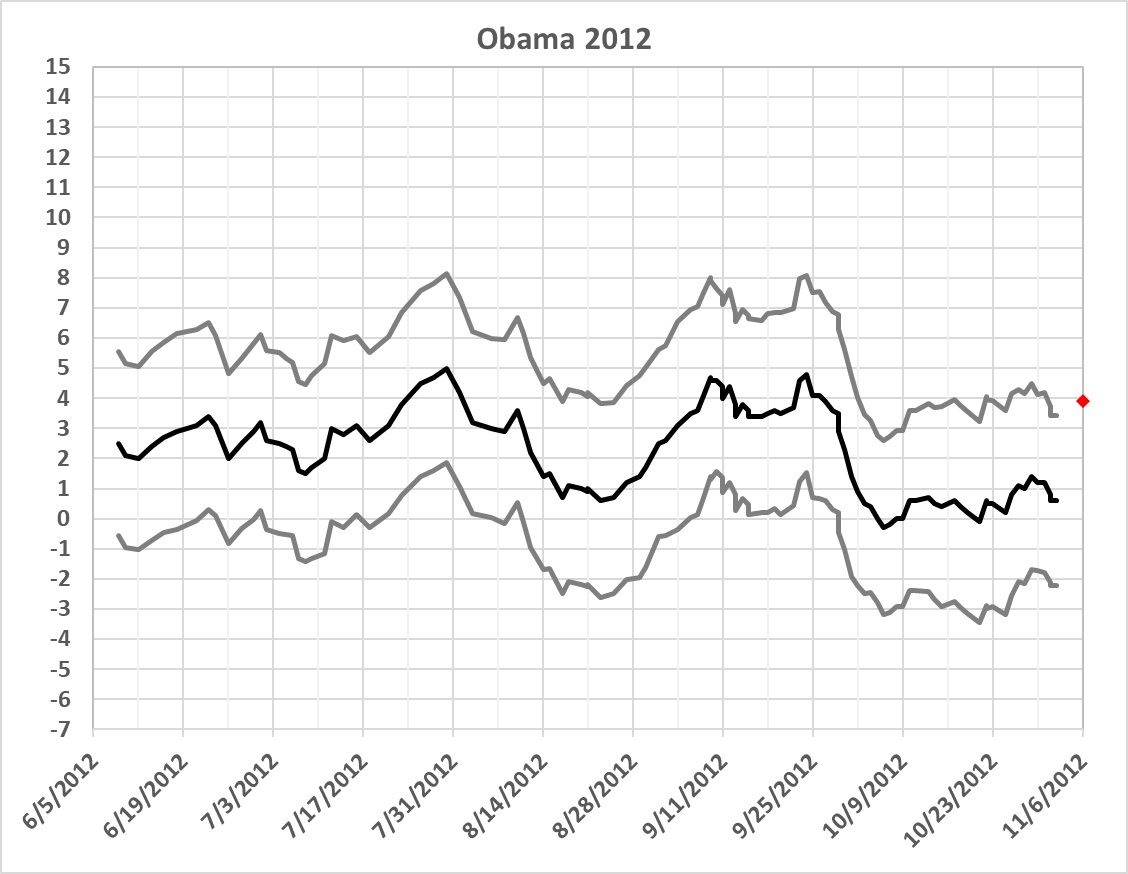
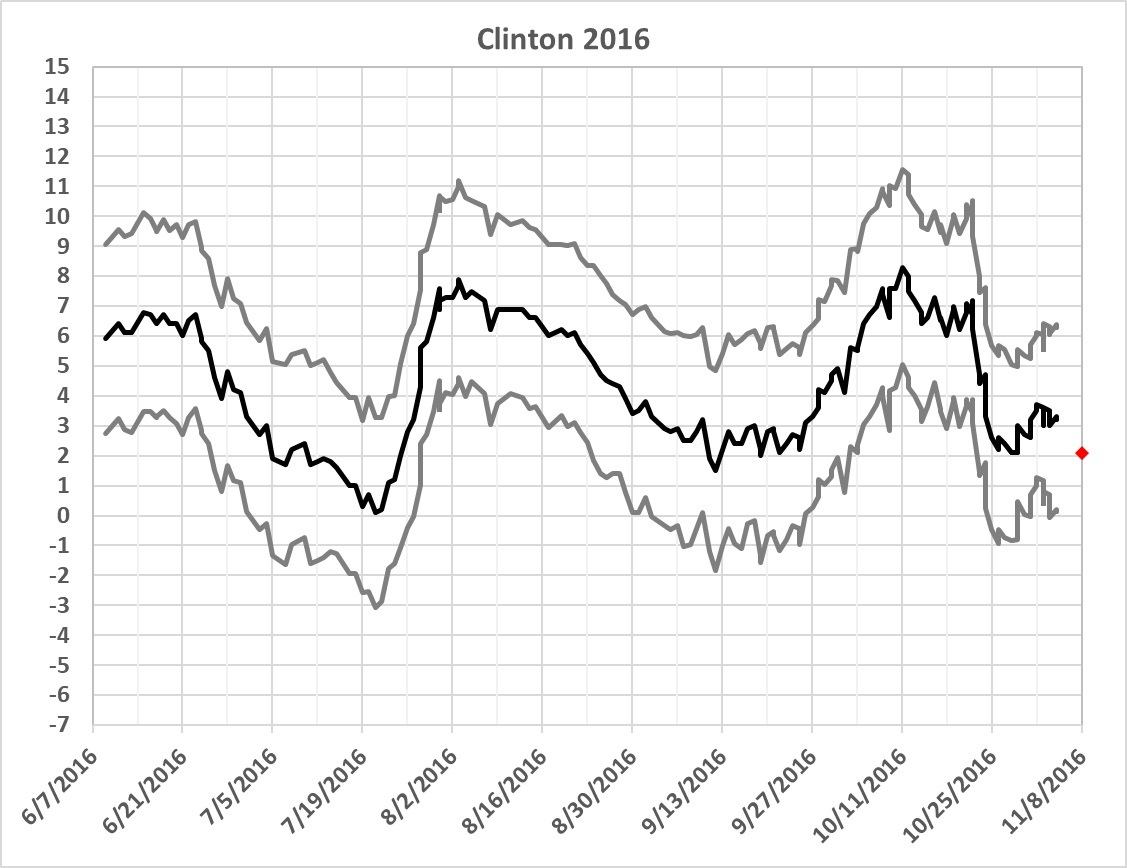
The solid black lines trace the percentage-point lead (or deficit) for the eventual “winner” of the (meaningless) nationwide tally of the popular vote in each presidential election from 2004 through 2020. The gray lines trace the margins of error claimed by the organizations issuing the polls. (The dashed gray lines for 2004 are estimates derived by assuming a margin of error of 3 percentage points, which is typical of the later polls.) The range from the upper gray line to the lower gray line represents a 95-percent confidence interval; that is, the actual result would be within the range (or at its outer limit) with a probability of 95 percent.

The red diamond at the right in each graph is the “winner’s” actual margin of “victory” in the nationwide tally of popular votes. In every case, the actual margin of “victory” is within or at the outer limit of the final 95-percent confidence interval. (I use “sneer quotes” because there is no “winner” of the nationwide popular vote, which is a meaningless number. Presidential elections are decided State-by-State, and in 48 of 50 cases the candidate with the greatest number of popular votes in that State receives the State’s entire bloc of electoral votes.)

Putting that aside for the moment, the 95-percent confidence interval covers a range of about 6 percentage points. That is, the “winner’s” actual margin in the (meaningless) nationwide popular vote could be as many as 6 percentage points away the final 10-poll average. A margin of 6 percentage points means that the “winner’s” share of the popular vote could be 3 percent higher or lower than the share implied by the final 10-poll average. Given the statistical relationship between popular votes and electoral votes (discussed here), a shift of 3 percent can mean a gain or loss of 30 percent of the electoral vote.

What lies behind such a disproportionate response to such a small shift? It is the fact that a miniscule change in the distribution of a State’s popular vote can (in 48 cases out of 50) cause a 100-percent swing in the allocation of its electoral votes.

To take a concrete example, Trump won the electoral vote in 2016 despite Clinton’s 2.1 percent margin of “victory” in the tally of popular votes cast in the 50 States and District of Columbia. Clinton’s margin of “victory” was 2.9 million popular votes. She won California by 4.3 million popular votes. In other words, she “lost” the rest of the U.S. by 1.4 million popular votes. Crucially, she lost three States with a total of 46 electoral votes — Michigan, Pennsylvania, and Wisconsin — by margins of 0.2 to 0.8 percent. Those three losses cost her the election.

To take another example, Biden’s 4.5 percent popular-vote “victory” in 2020 was much larger than Clinton’s. His huge win in California (5.1 million votes more than Trump) left him with a “victory” of about 2 million votes in the rest of the country. But Biden wouldn’t have won the election without narrow victories in Arizona (11 EV, margin of 0.3 percent), Georgia (16 EV, 0.2 percent), Pennsylvania (20 EV, 1.18 percent), and Wisconsin (10 EV, 0.63 percent).

Finally, there’s the case of the 2000 election (not represented in the graphs below), which Bush “lost” by more than 500,000 votes. He didn’t really lose the election, of course, because he won the crucial State of Florida by 537 votes when the U.S. Supreme Court put a stop to the illegal manufacture of votes for Gore in several Democrat-controlled jurisdictions.

Is there a fail-safe lead in the polls? Let’s return to 2020, when Biden eked out an electoral-vote win by “beating” Trump nationwide by 4.5 percentage points — a lead that was at the bottom edge of the 95-percent confidence interval for the final 10 polls. The center of that confidence interval — the 10-poll average — was 7.6 percentage points. You might suppose that a lead (in the polls) of that size would guarantee an election victory, but it didn’t. A lot of dirty pool was required.

Finally, the accuracy of the polls is compromised by two other facts: The mid-point of the polling period for the final 10 polls occurs three or four days before election day. Early voting has become more prevalent in this century, and it played a huge role in the election of 2020.

The lesson learned: Don’t bet on the outcome of a presidential election unless a candidate is leading in the final 10 polls by, say, 9 percentage points or more. (See above commentary about Biden’s final poll numbers in 2020.) Don’t bet against that candidate, and don’t expect to win more than a pittance if you bet on him to win. Anything else — like betting on a 3-point favorite — is pure guesswork or hope.

That’s reality. And don’t let a pollster tell you otherwise.

Here are the graphs:

Sources and notes — Values derived from the polls of polls at RealClearPolitics.com for the presidential elections of 2004, 2008, 2012, 2016, and 2020. The polls completed entirely in June of each election year were organized chronologically according to the middle date of each polling period. A moving, 10-poll average/lead deficit was then computed, as well as moving 10-poll average margin of error.

Trump vs. Biden: 5a

REVISED METHODOLOGY AND UPDATED RESULTS

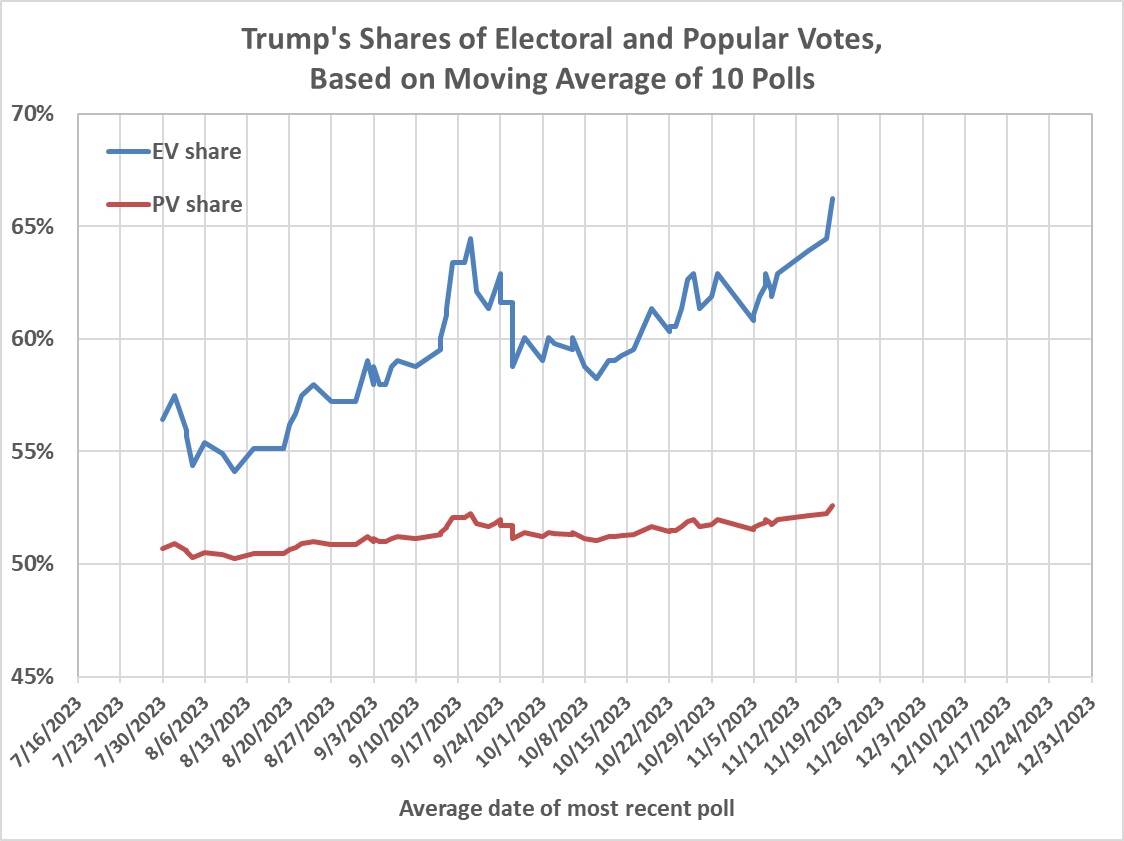
RealClearPolitics maintains a running tally of presidential election polls. I construct a moving average of the results, where the average represents Trump’s adjusted margin for the 10 most recent polls (taking the mid-point of each polling period as the date of each poll).

I then convert that 10-poll average to an estimate of Trump’s share of the two-party popular vote. For example, an average margin of +4 indicates a 52-48 split of the popular vote, that is, Trump gets 52 percent of the popular vote.

Finally, I apply my algorithm for the relationship between the GOP candidate’s share of the electoral vote and his share of two-party popular vote. Here is the trend since July 30, 2023:

These basic estimates of popular-vote and electoral-vote shares don’t account for the margin of error in pollsters’ findings or the margin of error in my estimate of electoral votes. When I apply those margins of error, Trump’s share of the electoral vote ranges from 40 percent to 77 percent for the 10 most-recent polls.

CAVEAT: These are not estimates of the outcome of next year’s election. They simply reflect the stated preferences of voters for Trump or Biden when the polls were conducted.

Trump vs. Biden: 4

UPDATED 11/21/23

RealClearPolitics maintains a running tally of presidential election polls (among many others). RCP has also assessed the pro-Democrat or pro-Republican bias of the final presidential-election polls issued by major pollsters in 2016 and 2020. On average, the polls were biased toward the Democrat nominee by 2.3 percentage points.

As the pollsters release their results, I adjust Trump’s lead/deficit for bias. I then construct a moving average of the adjusted results, where the average represents Trump’s adjusted margin for the 10 most recent polls (taking the mid-point of each polling period as the date of each poll).

I then convert that 10-poll average to an estimate of Trump’s share of the two-party popular vote. For example, an average margin of +4 indicates a 52-48 split of the popular vote, that is, Trump gets 52 percent of the popular vote.

Finally, I apply my algorithm for the relationship between the GOP candidate’s share of the electoral vote and his share of two-party popular vote.

The estimates of popular-vote and electoral-vote shares don’t account for the margin of error in pollsters’ findings or the margin of error in my estimate of electoral votes. But the movement of the estimates may be taken as indication of the movement in voters’ preferences between Trump and Biden (or whoever might become their parties’ nominees). It is that movement which I will report from time to time.

Here is the first report, which begins with a clutch of polls that were completed in mid-August, when polling season seems to have begun in earnest: