Trump 2: Keeping Score (2nd edition)

This is the first sequel to “Trump 2: Keeping Score“, which I published on February 6, 2025. In that post, I used a metric that I devised early in Trump’s first term: the enthusiasm ratio. The ratio is the number of likely voters who strongly approve a president as a percentage of the number of likely voters who venture an opinion one way or the other (thus omitting the voters who are non-committal).

Here is how Trump 2 scores three months into his second term, in comparison with his first term, Obama’s two terms, and Biden’s single term:


Derived from Rasmussen Reports Daily Presidential Tracking Polls for Obama, Trump 1, Biden, and Trump 2.

Here’s a closer look at the first year of each term:

All right so far. It’s too soon to tell whether Trump will win over some of his doubters and detractors, as he did in a big way during his first term.

Stay tuned.

Trump 2: Keeping Score

Back in September 2023, I issued the first of sixteen posts in the series “Trump vs. Biden”. (The series became “Trump vs. Harris”, but that’s another story). In that post, I used (for the last time until now) a metric that I devised early in Trump’s first term: the enthusiasm ratio. The ratio is the number of likely voters who strongly approve a president as a percentage of the number of likely voters who venture an opinion one way or the other (thus omitting the voters who are non-committal).

I am resurrecting the metric, to see whether Trump’s second term turns out to be as well-received as his first term became after its first year, when Trump endured ceaseless media criticism, the hoax-based Mueller investigation into his ties with Russia, and the theatrical rage of Democrats in Congress.

Here is how Trump 2 scores in the early going of his second term, in comparison with his first term, Obama’s two terms, and Biden’s single term:


Derived from Rasmussen Reports Daily Presidential Tracking Polls for Obama, Trump 1, Biden, and Trump 2.

It’s too soon to tell whether Trump will win over some of his doubters, as he did in a big way during his first term. But it will happen if he scores some big wins with his audacious actions, of which I expect to see more.

Stay tuned.

The Promise of Trump’s Second Presidency

I began blogging more than twenty years ago because I had come to understand that too many Americans — under the influence and control of sophists, demagogues, and self-aggrandizers — had veered away from America’s legal and moral founding principles. Those Americans seem to have become hell-bent on becoming slaves of the state. I had hoped that by adding my voice to the chorus of resistance to statism — especially its leftist variety — I might help to quell and even reverse its advance. I cling to that hope.

Statism – control by the central government of economic and social intercourse — is nothing new in America. It has been around, in limited and then pervasive forms, since the founding of the Republic. But statism has become more virulent with the advent of its latest manifestation: state-sponsored and state-enforced wokeness.

The woke and their state sponsors – using methods like those of Robespierre, Stalin, Hitler, and Mao – deploy perverted versions of history and science in the service of yet another delusional utopia. Among its characteristics — in addition to a long-standing and self-defeating (leftist) urge for economic leveling — is the denial of deep-seated biological and cultural differences in strength, physical skills, intelligence, emotional tendencies, and proneness to criminality among various “oppressed” groups, with the result that inferiority is allowed to flourish at the expense of everyone but members of those groups.

Those who dare call attention to such differences, act prudently on those differences in their personal and business lives, or openly protest the privileges accorded the “oppressed” do so at the risk of life, liberty, and fortune – whether at the hands of the state or at the hands of the vicious purveyors of wokeness who enjoy the state’s protection.

The cumulative effect of statism – imposed by legislative, executive, and judicial decrees — has been to limit the freedom of private, cooperating parties and to invest decision-making in arrogant politicians and their appointees and apparatchiks – known otherwise as “our democracy”. The economic cost of statism, which I have elsewhere estimated, is astronomical and mounting daily. The social cost of statism is the prevailing chasm of social division, which is as deep as it was in the Civil War.

Statists abhor the kind of gradual, time-tested change that occurs naturally among persons who live under a minimal state – one that is limited to the defense of life, liberty, and property from predators foreign and domestic. Statists want their utopia, and they want it yesterday — economic and social costs be damned. The resemblance between statism (especially its leftist manifestations) and adolescent rebellion is more than coincidental. both arise from anti-historical, anti-scientific, emotion-driven roots.

The bad news is that statism is inevitable in a polity that is morally and culturally diverse. Strong bonds of morality and culture enable a people to fend for themselves under the guardianship of a minimal, night-watchman state. When those bonds are weakened by moral and cultural diversity, the gates are flung open to those who seek the power to dictate the terms of social and economic intercourse; to those who believe in, rationalize, and clamor for such dictation; and to those who seek privileges from the powerful.

As John Adams put it in an address to the Massachusetts militia in 1798: “Our Constitution was made only for a moral and religious People. It is wholly inadequate to the government of any other.”

Just so. Moral and cultural diversity – and degeneracy — are now rampant in America; for example:

  • There is the withdrawal of the state from the enforcement of traditional moral codes. This has been going on for decades; the rise of the “Soros DAs” is merely a blatant manifestation of the trend. If the trend had a beginning it was the concerted movement to abolish the death penalty. A less spectacular but arguably more influential change was the widespread adoption of no-fault divorce, which fostered the breakup of families and the departure of fathers from the lives of children. Abortion is an abomination disguised as a “right” by the Supreme Court; the virulent reaction to the recission of that “right” attests to America’s moral decline.
  • A second, closely-related development is “freedom from religion”, which has resulted in the state-condoned (and often state-sponsored) spewing of filth into the minds of children and adolescents. Along with the filth comes, naturally, a disdain for “old fashioned” strictures on behavior which served as guardrails against destructive personal and interpersonal acts, and which instilled the kind of the kind of self-discipline that is now so obviously lacking in huge swaths of the populace. From that lack of self-discipline has grown not only a disdain for traditional morality but moral laxity of the kind that has no place for religion, marriage, familial responsibility, self-reliance, and hard work.
  • The flood of illegal immigrants who were invited by the Biden administration to invade America is a moral and cultural scandal. Unfortunately, most Americans – especially leftists – don’t even think of it that way. First, the Biden administration’s actions blatantly flouted the law, which is an evil in itself and an impeachable violation of Biden’s oath of office. (The failure to impeach and convict Biden, for that and other things, is another moral scandal.) Second, the Biden administration encouraged illegal immigration despite its obviously dire consequences for American citizens, especially those living near the southern border; for example, violent criminality, importation of illegal and dangerous drugs, and the denial of government services to Americans for the benefit of illegal immigrants (or higher taxes on citizens to accommodate illegal immigrants). Third, the flood of illegal immigrants meant a sudden – government-imposed — shift in the cultural composition of the country. Whether that is a good or bad thing is irrelevant here. Government shouldn’t be in the business of social engineering. (Side note: The Biden administration did that in spades – not only through illegal immigration, but also through censorship and by such things as promoting transgenderism, denigrating religion, pushing racial “equity” and thereby favoring mediocrity over merit.)

There was, for about 125 years, an America that resembled the one in which the Constitution was born. Then came the “Progressive Era” of the late 1800s and early 1900s, during which the constitutional boundaries on the power of the central government were breached. The rest is history — and contemporary news.

Alongside the onset of the imperial government there came moral degeneration, such as that summarized above. This is no coincidence, inasmuch as the growth of the central government has meant the repudiation of personal responsibility, the weakening of the institutions of civil society, and insulation from many of the consequences of carelessness, impulsiveness, and criminality.

The genie is out of the bottle and there’s no putting it back into the bottle. The moral and cultural America for which the Constitution was written is long gone and will not return.

But, paradoxically, the power of the state can be turned against the forces that have used its power to weaken America economically and to poison it morally and culturally. Firm control of the state’s apparatus gives the controlling party the power to reorder the state’s priorities. Unlike weak-kneed “conservatives” of the never-Trump variety, Donald Trump seems to understand that principle, and seems to relish the opportunity to act upon it

Trump has been and will be called a fascist, a Nazi, a dictator, and many other uncomplimentary names for striving to rescue America from the abyss of left-statism. I say Godspeed to him.

Another Measure of Political Polarization: The Winner’s Share of the Popular Vote in Presidential Elections

In “A Measure of Political Polarization: The Decline of Collegiality in the Confirmation of Justices“, I concocted an index of collegiality for the confirmation of U.S. Supreme Court justices:

C = Fraction of votes in favor of confirming a nominee/fraction of Senate seats held by the nominating president’s party

C score greater than 1 implies some degree of (net) support from the opposing party. The higher the C score, the greater the degree of support from the opposing party.

Examples:

  1. Tom Clark, nominated by Democrat Harry Truman, was confirmed on August 18, 1949, by a vote of 73-8; that is, he received 90 percent of the votes cast. Democrats then held a 54-42 majority in the Senate, just over 56 percent of the Senate’s 96 seats. Dividing Clark’s share of the vote by the Democrats’ share of Senate seats yields C = 1.60. Clark, in other words, received 1.6 times the number of votes controlled by the party of the nominating president.
  2. Samuel Alito, nominated by Republican George W. Bush, was confirmed on January 31, 2006, by a vote of 58-42; that is, he received 58 percent of the votes cast. Republicans then held 55 percent of the Senate’s 100 seats. The C score for Alito’s nomination is 1.05 (0.58/0.55).

The index, which I computed for nominations since World War II, looks like this:

My commentary:

C peaked in 1975 with the confirmation of John Paul Stevens, a nominee of Republican Gerald Ford. (One of many disastrous nominations by GOP presidents.) It has gone downhill since then. The treatment of Brett Kavanaugh capped four decades of generally declining collegiality.

The decline began in Reagan’s presidency, and gained momentum in the presidency of Bush Sr. Clinton’s nominees fared about as well (or badly) as those of his two predecessors. But new lows (for successful nominations) were reached during the presidencies of Bush Jr., Obama, Trump, and Biden.

There’s another measure of political polarization, one that might be said to capture the general mood of the electorate. That measure is the share of the nationwide popular vote that has accrued to the winner of each presidential election. The nationwide popular vote is irrelevant to presidential elections because of the electoral college (see this post and this one). But the tally has some value as an indicator of the degree of divisiveness among the electorate.

Here are the numbers since the inception of the Republican Party in 1856:

The sharp dips were caused by the good showing of third parties (and sometimes fourth and fifth parties).

What I find interesting is the era of “big wins”, which began in 1920 and ended in 1984. It wasn’t an era of big wins by one party. Voters were (then) quite willing to flock to a Democrat or Republican when they were fed up with incumbent president of the other party for whatever reason (policies, economics, scandals, etc.).

A clearer picture emerges when the winner’s share is averaged over three elections:

By this measure, “national collegiality” peaked in the 1920s-1930s and remained high through the 1980s. It has since declined to a level similar to that of the rancorous and volatile post-Civil War era — the era that saw the rise of “progressivism”, which again poisons political discourse and stifles economic progress.


Related: The Hardening of Political Affiliations in America

How Good Are the Presidential Polls?

The results of the final polls in the last five presidential elections have pointed to four winners. Sounds good? You won’t think so after reading this post.

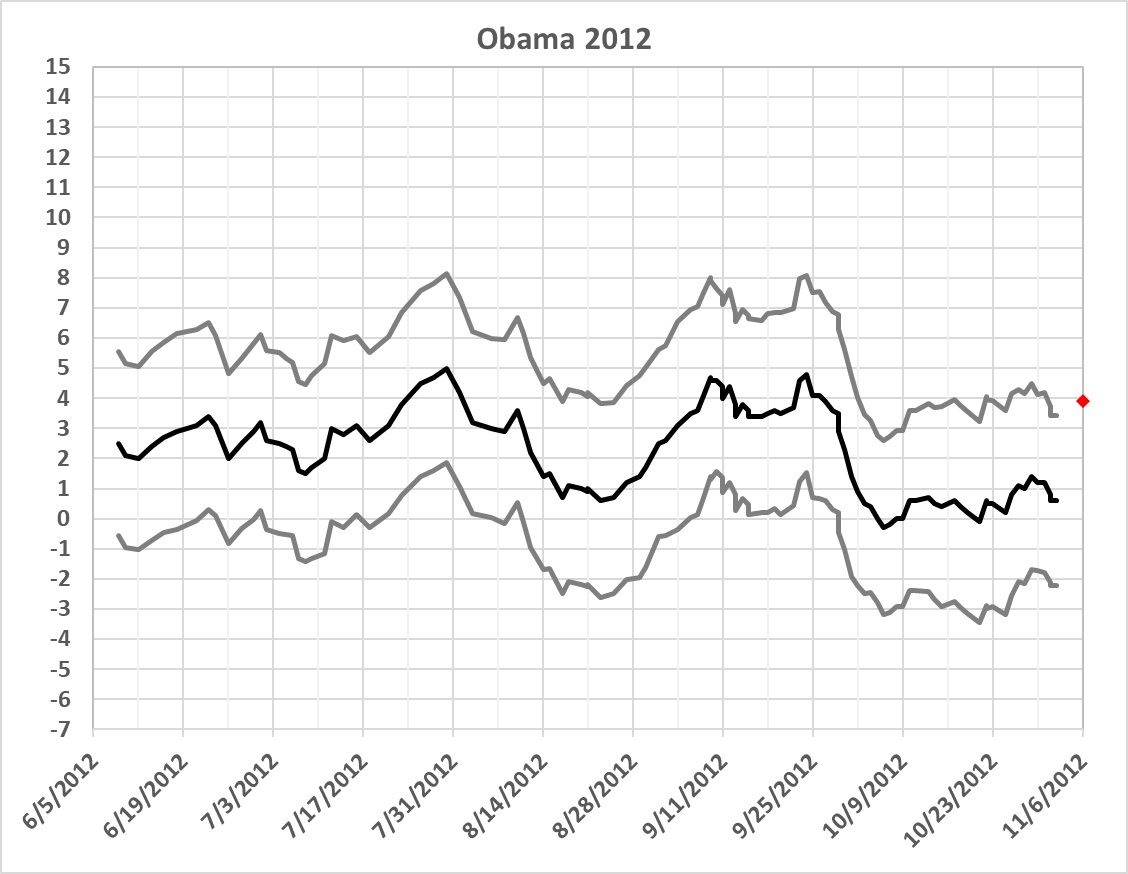
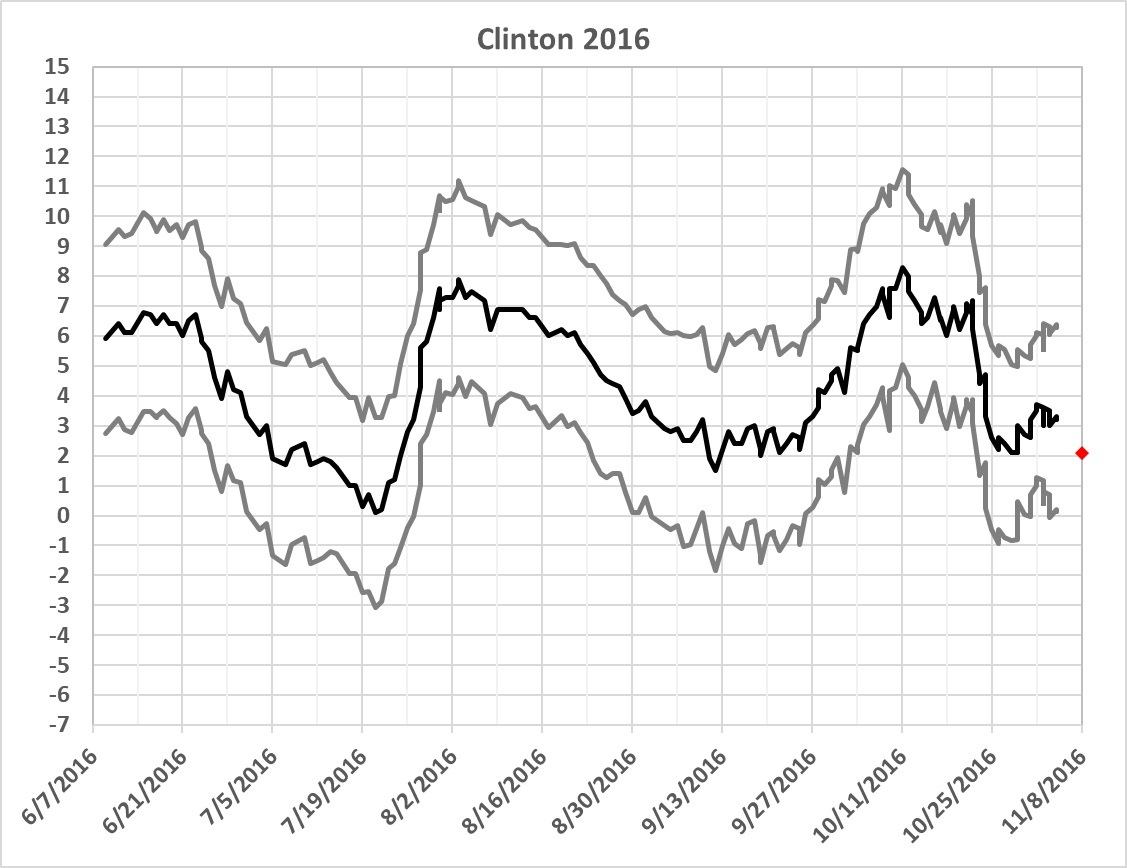
The values depicted in the graphs at the bottom of this post represent 10-poll averages of respondents’ presidential choices in two-way races (i.e., Republican or Democrat). The dates are mid-points of the periods during which the 10-poll samples were conducted.

The solid black lines trace the percentage-point lead (or deficit) for the eventual “winner” of the (meaningless) nationwide tally of the popular vote in each presidential election from 2004 through 2020. The gray lines trace the margins of error claimed by the organizations issuing the polls. (The dashed gray lines for 2004 are estimates derived by assuming a margin of error of 3 percentage points, which is typical of the later polls.) The range from the upper gray line to the lower gray line represents a 95-percent confidence interval; that is, the actual result would be within the range (or at its outer limit) with a probability of 95 percent.

The red diamond at the right in each graph is the “winner’s” actual margin of “victory” in the nationwide tally of popular votes. In every case, the actual margin of “victory” is within or at the outer limit of the final 95-percent confidence interval. (I use “sneer quotes” because there is no “winner” of the nationwide popular vote, which is a meaningless number. Presidential elections are decided State-by-State, and in 48 of 50 cases the candidate with the greatest number of popular votes in that State receives the State’s entire bloc of electoral votes.)

Putting that aside for the moment, the 95-percent confidence interval covers a range of about 6 percentage points. That is, the “winner’s” actual margin in the (meaningless) nationwide popular vote could be as many as 6 percentage points away the final 10-poll average. A margin of 6 percentage points means that the “winner’s” share of the popular vote could be 3 percent higher or lower than the share implied by the final 10-poll average. Given the statistical relationship between popular votes and electoral votes (discussed here), a shift of 3 percent can mean a gain or loss of 30 percent of the electoral vote.

What lies behind such a disproportionate response to such a small shift? It is the fact that a miniscule change in the distribution of a State’s popular vote can (in 48 cases out of 50) cause a 100-percent swing in the allocation of its electoral votes.

To take a concrete example, Trump won the electoral vote in 2016 despite Clinton’s 2.1 percent margin of “victory” in the tally of popular votes cast in the 50 States and District of Columbia. Clinton’s margin of “victory” was 2.9 million popular votes. She won California by 4.3 million popular votes. In other words, she “lost” the rest of the U.S. by 1.4 million popular votes. Crucially, she lost three States with a total of 46 electoral votes — Michigan, Pennsylvania, and Wisconsin — by margins of 0.2 to 0.8 percent. Those three losses cost her the election.

To take another example, Biden’s 4.5 percent popular-vote “victory” in 2020 was much larger than Clinton’s. His huge win in California (5.1 million votes more than Trump) left him with a “victory” of about 2 million votes in the rest of the country. But Biden wouldn’t have won the election without narrow victories in Arizona (11 EV, margin of 0.3 percent), Georgia (16 EV, 0.2 percent), Pennsylvania (20 EV, 1.18 percent), and Wisconsin (10 EV, 0.63 percent).

Finally, there’s the case of the 2000 election (not represented in the graphs below), which Bush “lost” by more than 500,000 votes. He didn’t really lose the election, of course, because he won the crucial State of Florida by 537 votes when the U.S. Supreme Court put a stop to the illegal manufacture of votes for Gore in several Democrat-controlled jurisdictions.

Is there a fail-safe lead in the polls? Let’s return to 2020, when Biden eked out an electoral-vote win by “beating” Trump nationwide by 4.5 percentage points — a lead that was at the bottom edge of the 95-percent confidence interval for the final 10 polls. The center of that confidence interval — the 10-poll average — was 7.6 percentage points. You might suppose that a lead (in the polls) of that size would guarantee an election victory, but it didn’t. A lot of dirty pool was required.

Finally, the accuracy of the polls is compromised by two other facts: The mid-point of the polling period for the final 10 polls occurs three or four days before election day. Early voting has become more prevalent in this century, and it played a huge role in the election of 2020.

The lesson learned: Don’t bet on the outcome of a presidential election unless a candidate is leading in the final 10 polls by, say, 9 percentage points or more. (See above commentary about Biden’s final poll numbers in 2020.) Don’t bet against that candidate, and don’t expect to win more than a pittance if you bet on him to win. Anything else — like betting on a 3-point favorite — is pure guesswork or hope.

That’s reality. And don’t let a pollster tell you otherwise.

Here are the graphs:

Sources and notes — Values derived from the polls of polls at RealClearPolitics.com for the presidential elections of 2004, 2008, 2012, 2016, and 2020. The polls completed entirely in June of each election year were organized chronologically according to the middle date of each polling period. A moving, 10-poll average/lead deficit was then computed, as well as moving 10-poll average margin of error.

The Sky Is Not Falling

The Economist, via The Washington Post’s Dan Balz, has issued a warning that the sky will fall if Trump wins in 2024. Among the things feared by The Economist and many other pearl-clutchers are these:

  • Retribution against political enemies.
  • The roundup and deportation of illegal aliens.

A sober analyst of Trump’s threats regarding political enemies would understand those threats to be a promise to call his political enemies to account for their flagrant abuse of the justice system in an effort to discredit him and (if their luck holds) to put him in prison. There’s a prime facie case that all of the indictments of and other proceedings against Trump are the result of tacit collusion to take down the biggest threat to Democrat control of the executive branch. Trump, in other words, would seek to punish those who have politicized the justice system, which seems like justice to me.

A sober analyst would also understand Trump’s statements about illegal immigration as a promise to enforce the law. Failure to enforce the law has become a routine exercise for Democrat politicians.

But the usual suspects (which include The Economist, WaPo, and a long list of other such organs) eschew sobriety and paint every threat to the Democrat Party and its favored constituencies (e.g., blacks, illegal immigrants) as a moral outrage.

So, if it comes to pass that Trump is elected and he does what he says he’s going to do, the wailing and gnashing of teeth will resound through the left-o-sphere, but the sky definitely won’t be falling.

Don’t Celebrate Yet Virginia

I recently renewed my Virginia citizenship after a lapse of 18 years. It’s great to be back in the Old Dominion, especially given the prospect of a Republican governor and a Republican House of Delegates come January. There’s also a good chance that next year’s Senate elections will give the GOP complete control of the Virginia legislature.

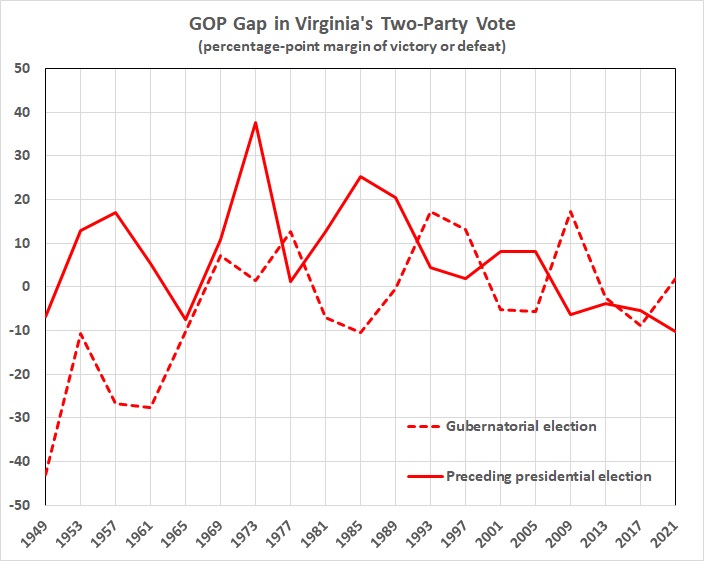
Gratifying as the resurgence of Virginia’s GOP may be, I’m not ready to declare Virginia’s return to Red-ness.  For one thing, there’s an underlying trend toward Blue-ness, which shows up in Virginia’s presidential election results:


Derived from Dave Leip’s Atlas of U.S. Presidential Elections. The series for Virginia begins with the gubernatorial election of 1949,which is the earliest for which Leip as posted popular-vote tallies.

The GOP’s edge in the presidential election peaked in 1968, the year of George Wallace, who (in the South) siphoned votes from the Democrat candidate. If 1968 doesn’t suit as a peak year, because of the Wallace effect, then the peak certainly occurred in 1984, with the re-election of Ronald Reagan. In either case, the GOP candidate’s share of Virginia’s presidential vote has been in decline for decades, and seems unlikely to recover unless there is a nationwide shift away from the Democrat party. Such a shift might occur, given the Dems’ suicide pact with the far-left, but cooler heads may yet prevail among party leaders.

It’s true that the downswing in the GOP’s hold on Virginia’s governorship hasn’t been as pronounced — which supports Tip O’Neill’s observation that all politics are local. But the GOP’s edge in the past has been much greater than the razor-thin victory eked out by Glenn Youngkin in the recent election.

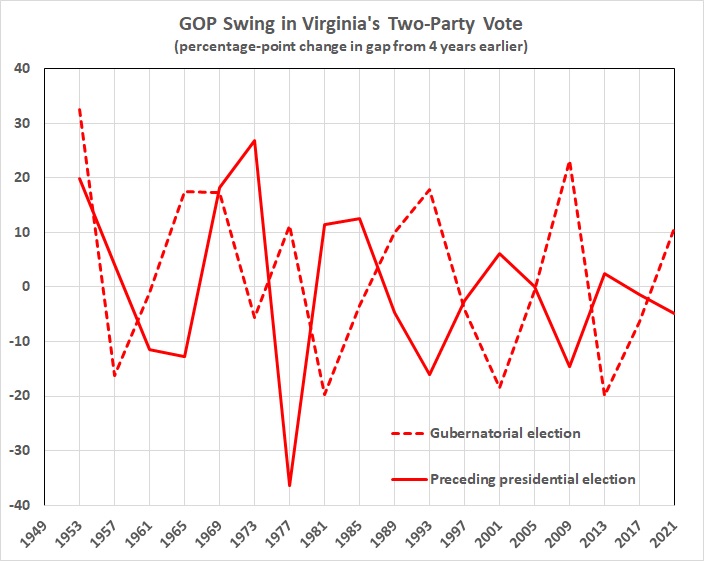
Nor is that victory especially impressive when the swing toward the GOP in 2021 is compared with earlier swings:


Source: Leip’s Atlas.

What probably happened in the 2021 election is what seems to have been happening since the early 1970s. The Virginia gubernatorial election reflects a typical “mid-term” reaction to the previous year’s presidential election. When the GOP presidential candidate racks up a gain relative to the showing of the GOP candidate four years earlier (a positive “swing”), the GOP gubernatorial candidate racks up a loss relative to the showing of the GOP candidate four years earlier (a negative “swing”). And conversely.

So, I won’t count the GOP’s Virginia chickens until they hatch. But, in the meantime, I will savor the (hope of) restoration of some sanity to Virginia’s politics.

Irrational Exuberance

It’s everywhere, but most notably in the stock market and in election returns.

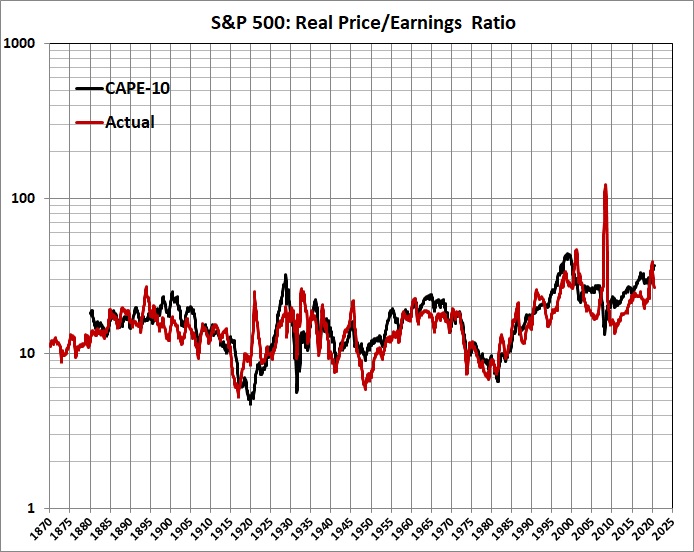
In the stock market, as exemplified by the S&P 500 index, there have been wild swings in the price-earnings ratio:


Derived from Robert Shiller’s data set. CAPE-10 is the cyclically adjusted price/earnings ratio, where the cyclical adjustment amounts to a 10 year average of the ratio.

In a world where stock buyers weren’t driven by irrational exuberance — and irrational pessimism — the PE ratio would follow something like a straight line. It might be a rising straight line because, as some analysts have noted, stock buyers have acquired an increasingly greater tolerance for risk-taking. But it would be close to a straight line.

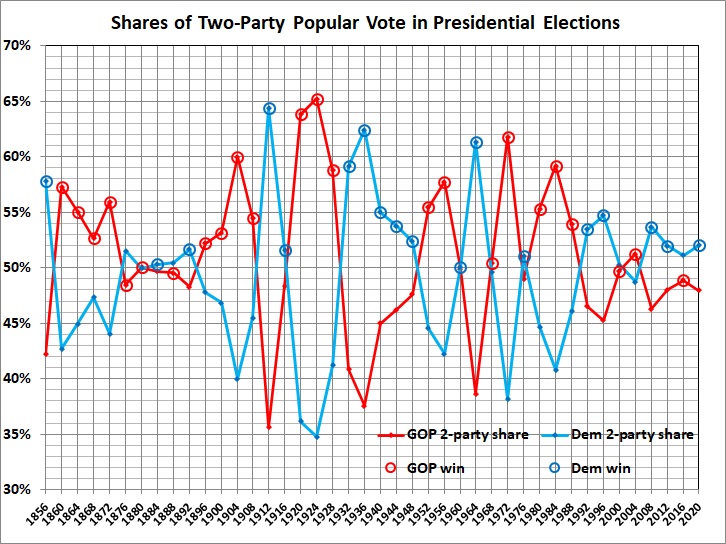
The zigs and zags of the stock market are echoed in the outcomes of presidential elections:


Derived from Dave Leip’s Atlas of U.S. Presidential Elections.

To put it bluntly, almost every American who values his liberty and prosperity would in most elections have preferred the Republican candidate as the lesser of two evils. The success of Democrats testifies to the gullibility of many voters, who are swayed by — among other things — asymmetrical ideological warfare:

Leftists have the advantage of saying the kinds of things that people like to hear, especially when it comes to promising “free” stuff and visions of social perfection….

[L]eftists have another advantage: they’re ruthless. Unlike true conservatives (not Trumpsters) and most libertarians, leftists can be ruthless, unto vicious. They pull no punches; they call people names; they skirt the law — and violate it — to get what they want (e.g., Obama’s various “executive actions”); they use the law and the media to go after their ideological opponents; and on and on.

Why the difference between leftists and true conservatives? Leftists want to rearrange the world to fit their idea of perfection. They have it all figured out, and dissent from the master plan will not be tolerated. (This is very Hitleresque and Stalinesque.) Conservatives and libertarians want people to figure out for themselves how to arrange the world within the roomy confines of simple morality (don’t cheat, don’t steal, don’t murder, etc.).

The left’s ruthlessness was in full spate last year, when the election was bought and probably stolen as well.

In the same post (published on July 23, 2016), my prescience was on display:

If Trump wins in November — a very big “if” — it should be an object lesson to true conservatives and libertarians. Take the gloves off and don brass knuckles. This isn’t a contest for hockey’s Lady Byng Trophy. To change the sports metaphor, we’re in the late rounds of a brutal fight, and well behind on points. It’s time to go for the knockout.

The good news is that recent elections reflect the effects of political polarization. The swings have become less pronounced because the electorate’s “squishy center” has shrunk. The challenge before the GOP is to convince what remains of the “squishy center” that it is in their best interest to reject the anti-libertarian and anti-prosperity policies of the Democrat Party, which has become nothing more than a mouthpiece for an (anti) American brand of Hitlerism and Stalinism.

Liberty vs. Security

An esteemed correspondent makes some good points in the following message (which I have edited lightly):

Our country is in more dire straits than it has been at any time in my lifetime [he is 85]. Maybe not as bad as when a Vice-President shot and killed a former Secretary of the Treasury or when there was an armed insurrection and each faction tried to take the other’s seat-of-government by force. I think our current divisions and divisiveness are detrimental to the continuation of the “greatest nation the world has ever known”; and I don’t think they can be fixed.

Liberty and security pull in opposite directions. More of one, less of the other. History and common-sense tells us that is so.

I’d like to start with Benjamin Franklin’s saying that is often misinterpreted. He said that our form of government is a republic, if you can keep it. That has been misinterpreted, repeatedly and emphatically by the current speaker-of-the-house to mean that Franklin was warning against a strong executive emulating a monarch. I think he was warning against the opposite, which he had witnessed in France. He also was fearful of our becoming a pure democracy with a people’s parliament becoming a law unto itself. This is similar to the tradeoffs between liberty and security. Either extreme is undesirable.

The geniuses who designed our government provided a number of checks and balances to try to keep things sort of in the middle. We are a federated democratic republic, not a democracy as is so often misstated. The Framers of the Constitution designed a government, but they neglected to explain the relationship of the government to those that were being governed. It took the first ten amendments to the Constitution to make that explicit. Those ten amendments delineate the limits that the federal government has over individuals. The 14th amendment essentially extends that to state governments. I especially like the tenth amendment. It is simply worded and says in plain English, any rights and authorities not specifically given to the federal government in this document belong to the people and/or the states.

Two constitutional issues were settled by the Civil War: slavery was no longer legal anywhere; and secondly, it was not permissible for states to secede from the union. It took later amendments to confirm that Blacks were not property; they are human beings with all rights of other human beings. Unfortunately that didn’t sit well with many Americans and we are still trying to sort out that issue in practice.

I don’t think that our current problems can be solved by appealing to the consent of the governed to be governed, namely by voting. Nor do I think secession (breakup) is feasible.

Voting: A significant fraction of those that voted in the November 2020 election think the the “results” are not honest. You can dismiss that view, but it is necessary to have a buy-in to the results of an election to have an election that conveys the consent of the governed. To me it is beside the point whether there is any evidence of “stealing an election” or not. There were enough irregularities that a demagogue can and did stir up doubts. Elections need to appear incorruptible, and today they are not. Could that be fixed? Not in our polarized society.

Furthermore, and this is more important, there isn’t balanced news coverage leading up to our elections or in analyzing the results. When there is overwhelming bias in the media, or there is no fair representation of both sides of the coin, we don’t have an environment for fair elections. Today one political party and the media are indistinguishable. The “media” is totally biased and deceitful in reporting “facts”. Remember Hamilton and Jefferson, who were arch political enemies. Each funded media that parroted his version of “truth”. But there were two sides. Add to the mix today’s “social media”, controlled by those favoring security over liberty. So the voices of liberty over security are relegated to fringe “nuts”. [The last bit is a gross error on the writer’s part, unless the millions who take my position on the matter are all on the fringe.]

Maybe even more importantly and indicative of a long-term fundamental change in America is the influence of “educators”. Uniformly, from those teaching young minds to the teachers of those teachers, in the formulators of “correct” history they favor security at the expense of liberty and are militant about spreading the “gospel”. They are children of the 1970s. Many grew up at a college their parents paid for and they didn’t have to work when they got out of college. They didn’t have any useful skills and of course the remedy for that is the old saying, “Those who can’t do, teach”.

So I don’t think there is any chance of “voting” to obtain the consent of the governed for their government is achievable. The influences wielded by the media and the educational system can’t be alleviated. There is only one perspective instead of a balance between liberty and security. I have avoided using the words liberal or conservative, or republican or democrat. I think that liberty and security are the two concepts that should be discussed more often as the heart of the country’s differences.

Secession: The possibility of secession, peaceful of not, was foreclosed by the Civil War. Since then the entanglements between the federal entity, the state entities, and the states themselves rule out out any practical solution those bindings.

Bottom Line: We’ll muck around for quite some time until it is realized that our system with all its faults is better than any feasible alternative. If and when it happens, I’ll be long gone.

I responded at length, in two epistles. Here’s the first one:

Your analysis of the present situation in the U.S. is spot-on. And, as you say, it’s not going to get any better on its own. There really are two Americas and they are irreconcilable. There are a lot of Americans — me included — who will not stand for “mucking around” that legitimates the present state of affairs or its ultimate destination: an imperial central government that is beholden to and effectively run by ultra-rich oligarchs and their lackeys and enablers in the bureaucracies, public schools, universities, information-technology companies, and media.

As for secession, the Civil War settled nothing — Justice Scalia to the contrary notwithstanding — except to underscore the fact that the North was able to muster superior forces thanks to its larger (free) population and industrial strength. If you have the time, read my analysis of the Court’s infamous ruling in Texas v. White, on which Scalia founded his baseless dictum: https://politicsandprosperity.com/constitution-myths-and-realities/. Scroll down to Section VI.F. for the bottom line about the legality of secession.

I also discuss in another section the practicality of secession or, rather, its impracticality. But there is another way to skin the cat. It is the nullification of federal edicts by the States. I refer to a new kind of nullification, which — unlike the kind attempted by South Carolina in the early 1830s — doesn’t involve formal declarations by State legislatures and governors. Rather, it involves non-compliance, acts of defiance, and foot-dragging. We saw some of that during Trump’s years, as States and cities declared themselves “sanctuaries” for illegal immigrants and refused to cooperate with ICE. We are beginning to see it from the other side as GOP-controlled States bring suit after suit against various federal actions (e.g., Keystone pipeline, Biden’s immigration fiasco), and GOP-controlled cities and counties declare themselves pro-life and gun-rights “sanctuaries”. This could be the wave of the future, with effective diminution of the central government through non-compliance with federal edicts. Federal courts have no power to enforce the edicts, and must rely on the federal government for enforcement. How many brushfires can the federal government put out? Would it resort to force against a state? I don’t know the answers, but it’s not clear that the federal government will come out on top, especially if it tries to enforce things that are wildly unpopular in some States and regions, such as abortion, strict gun-control measures, vaccine passports, or (the coming big thing) climate lockdowns.

So, unlike the earlier secession and its violent conclusion, there could be a non-violent kind of secession. It wouldn’t involve the formal breakup of the U.S., just a new modus vivendi between the States and the central government. Or, rather, a return to the modus vivendi that was intended by the Framers, enshrined in the 10th amendment, and then frittered away by the central government’s “mission creep”.

There is another, complementary, possibility. It is that Americans in the center turn their backs on the radical direction the country seems to be taking. (Resistance to CRT is a good case in point.) If enough of them do it, the GOP will retake Congress. And if in 2024 the GOP were to nominate someone more like Reagan than Trump, the Democrats could be kept out of power for a while — at least until they come to their senses. In the meantime, the Supreme Court could, without fear of being packed, make some libertarian rulings. A key one would be to find that Big Tech is s state actor (because of its immunity under section 230 of the Communications Decency Act), and therefore acts illegally when it censors views on the pretext that they are “hate speech” or “anti-science”, etc. In the way of the world, such an electoral and judicial turn of events could trigger a “cascade” in the direction opposite the one in which the country has been heading. And so, the “mucking around” might come to a better end than the one foreseen by you.

Here’s the second one:

A further thought about the tension between liberty and security.

It is really a tension between left and right, which is a deep psychological divide, as I discuss here: https://politicsandprosperity.com/2018/05/03/can-left-and-right-be-reconciled/. (The missing figure, which I will have to reconstruct, is derived from polling results that support the point made in the text.)

A point that I don’t make explicitly, but which should be obvious, is that compromise invites further compromise, to the detriment of liberty. The ransomware attacks, for instance, wouldn’t be happening if the U.S. hadn’t long ago abandoned the principle of unconditional surrender by the enemy. The track record of the U.S. government since the Korean War invites aggression. China and Russia know that and are playing the long game while Biden is tilting at global-warming windmills and (overtly and tacitly) endorsing a leftist agenda that will drive the U.S. economy to its knees while ensuring that the U.S. remains irreconcilably divided.

The end result of “mucking around” may well be not the kind of “social democracy” that keeps Eurpeoans fat, dumb, and happy. It may well be something far worse than that. You have been warned.

And I have been among the warning voices for many years.


Related reading on polarization: John Sexton, “The CRT Backlash and Progressives’ Big Lie about the Culture War“, Hot Air, July 8, 2021

Where It All Went Wrong

When the usual suspects were rioting, looting, and destroying their own habitat last summer (and many previous summers), did you wonder what happened to the Riot Act? Said act, in its original (British) form, provides that

if any persons to the number of twelve or more, being unlawfully, riotously, and tumultuously assembled together, to the disturbance of the publick peace, at any time after the last day of July in the year of our Lord one thousand seven hundred and fifteen, and being required or commanded by any one or more justice or justices of the peace, or by the sheriff of the county, or his under-sheriff, or by the mayor, bailiff or bailiffs, or other head-officer, or justice of the peace of any city or town corporate, where such assembly shall be, by proclamation to be made in the King’s name, in the form herin after directed, to disperse themselves, and peaceably to depart to their habitations, or to their lawful business, shall, to the number of twelve or more (notwithstanding such proclamation made) unlawfully, riotously, and tumultuously remain or continue together by the space of one hour after such command or request made by proclamation, that then such continuing together to the number of twelve or more, after such command or request made by proclamation, shall be adjudged felony without benefit of clergy, and the offenders therein shall be adjudged felons, and shall suffer death as in a case of felony without benefit of clergy.

Would that it were so in these times.

But it isn’t so because the sob-sisters, bleeding-hearts and weeping-willies — who have always been with us — have for centuries (if not millennia) chipped away at the protections that keep the bad guys more or less in line. They have likewise chipped away at standards of performance.

The effective abolition of the death penalty in this country is just the tip of the melting iceberg of punishment.

Awards for showing up are symptomatic of the erosion of standards.

The two phenomena have been conjoined in the left’s treatment of law-enforcement. There are too many felons running loose because pre-felonious crimes aren’t punished harshly enough (a failure that is often justified by the demographic characteristics of offenders); felonies aren’t punished harshly enough; paroles are too easily granted; police (those who are still on the force) are increasingly edgy about “mistreating” suspects who resist arrest; and affirmative action has ensured that law-enforcers are no longer as strong or quick-witted as they were in the past.

What did happen to the Riot Act (British version)? This:

The death penalty created by sections one, four and five of the act was reduced to transportation for life by section one of the Punishment of Offences Act 1837.

The Riot Act eventually drifted into disuse. The last time it was definitely read in England was in Birkenhead, Cheshire, on 3 August 1919, during the second police strike, when large numbers of police officers from Birkenhead, Liverpool and Bootle joined the strike. Troops were called in to deal with the rioting and looting that had begun, and a magistrate read out the Riot Act. None of the rioters subsequently faced the charge of a statutory felony. Earlier in the same year, at the battle of George Square on 31 January, in Glasgow, the city’s sheriff was in the process of reading the Riot Act to a crowd of 20-25,000 – when the sheet of paper he was reading from was ripped out of his hands by one of the rioters.

The last time it was read in the Scotland was by the deputy town clerk James Gildea in Airdrie in 1971

The act was repealed on 18 July 1973 for the United Kingdom by the Statute Law (Repeals) Act 1973, by which time riot was no longer punishable by death.

There is still a riot act in the United States, and it is sometimes used. Its use by President Trump during the Antifa-BLM riots of 2020 provoked the usual reactions: “Trump is a racist.” “Trump is Hitler.” And the left’s allies in the media simply refused to acknowledge the riots or, when they couldn’t be tossed down the memory hole, insisted on referring to them as “protests” (“mostly peaceful”, of course).

But the history of the Riot Act in Britain, which died from disuse long before it died officially, tells the sad tale of how sob-sisters, bleeding-hearts, and weeping-willies — and leftists — have undermined the rule of law and made the world a less-civilized and less-safe place for the vast majority of its denizens.

None of this would have happened if God had smitten Adam and Eve for their transgression. Perhaps that’s where it all went wrong.

Seriously, though, it all went wrong in the way that most good things go bad. Just a little tweak here to make someone happier and a little tweak there to make someone else happier, and the next thing you know: the think is all tweaked out of shape. It’s like making a mountain out of a molehill: a shovelful at a time over a long period of time will do the trick.


Related posts: Most of the posts listed here.

Trump: Symbol of Resentment?

Thomas Edsall of The New York Times (unsurprisingly) endorses an essay by William Galston, “The Bitter Heartland”. Galston, according to Edsall,

captures the forces at work in the lives of many of Trump’s most loyal backers:

Resentment is one of the most powerful forces in human life. Unleashing it is like splitting the atom; it creates enormous energy, which can lead to more honest discussions and long-delayed redress of grievances. It can also undermine personal relationships — and political regimes. Because its destructive potential is so great, it must be faced.

Recent decades, Galston continues, “have witnessed the growth of a potent new locus of right-wing resentment at the intersection of race, culture, class, and geography” — difficult for “those outside its orbit to understand.”

They — “social conservatives and white Christians” — have what Galston calls a “bill of particulars” against political and cultural liberalism. I am going to quote from it at length because Galston’s rendering of this bill of particulars is on target.

  • “They have a sense of displacement in a country they once dominated. Immigrants, minorities, non-Christians, even atheists have taken center stage, forcing them to the margins of American life.”

  • “They believe we have a powerful desire for moral coercion. We tell them how to behave — and, worse, how to think. When they complain, we accuse them of racism and xenophobia. How, they ask, did standing up for the traditional family become racism? When did transgender bathrooms become a civil right?”

  • “They believe we hold them in contempt.”

  • “Finally, they think we are hypocrites. We claim to support free speech — until someone says something we don’t like. We claim to oppose violence — unless it serves a cause we approve of. We claim to defend the Constitution — except for the Second Amendment. We support tolerance, inclusion, and social justice — except for people like them.”

So far, so good. The four bullet points are right on; that is, they are not only true of “social conservatives and white Christians”, but they are also true of the proponents of what Edsall calls “political and cultural liberalism”. But, as the characterizations of the latter reveal, they are not liberal in the true meaning of the word. It is therefore meet and just for “social conservatives and white Christians” to resent political and cultural fascists — for that is what they are.

But there’s a lot more to it. Our home-grown fascisti are not just resented, but also rightly feared and vehemently opposed by conservatives, regardless of their socioeconomic status or religious views. And that is why Trump still has a grip on hordes of Americans.

Despite Trump’s lack of fiscal and rhetorical discipline, he was more than talk when it came to restoring conservative governance to America.

  • Exhibit A is his record of judicial appointments — in sheer numbers and in conservative judicial philosophy. (Why else would the Democrats have been so fierce in their opposition, not only to Supreme Courts picks but also to many lower-court picks?)
  • Exhibit B: Trump did more than any president since World War II to roll back the administrative state (See “Presidents as Regulators: From Ike to the Donald“. Truman isn’t included because the database is incomplete, but his regime was heavy-handed.)
  • Exhibit C: Defense spending, which was on the decline under Obama, turned around under Trump. (Many conservatives oppose “endless war”, but most conservatives prefer preparedness and the ability to defend the nation in case a “real war” comes along.)
  • Exhibit D: Trump’s pro-life agenda.

I could add a lot to that list, but it seems like more than enough to make the case that allegiance to Trump signals more than mere resentment. It signals alignment with his deeply conservative agenda.

There is also the not insignificant fact that Trump — unlike the Bushes, McCain, and Romney — wasn’t an “establishment” Republican who cozies up to Democrats or a “maverick” prone to betraying those who voted for him.

Trump was true to his base and true to his campaign promises. That’s integrity — a rare commodity in electoral politics. Trump’s supporters are discerning enough to recognize it when they see it, and to reject faux conservatives like Romney.

Playing with Numbers

Stephen Moore asks a rhetorical question in “Why Did Biden’s Census Bureau Add 2.5 Million Residents to Blue-State Population Count?”. The obvious answer is: To reduce the loss of House seats to Red States, as Moore says:

The original projections for Census reapportionment had New York losing two seats, Rhode Island losing a seat, and Illinois perhaps losing two seats. Instead, New York and Illinois only lost one seat, and Rhode Island lost no seats. Meanwhile, Texas was expected to gain three seats, Florida two seats, and Arizona one seat. Instead, Texas gained only two seats, Florida only one, and Arizona none.

Was the Census Bureau count rigged? Was it manipulated by the Biden team to hand more seats to the Democrats and to get more money—federal spending is often allocated based on population—for the blue states?

The evidence is now only circumstantial, but when errors or revisions are almost all only in one direction, the alarm bells appropriately go off.

The same was true of Election 2020. There is ample evidence that the election was stolen from Trump and handed to Biden by chicanery in at least five States: Arizona, Georgia, Michigan, Pennsylvania, and Wisconsin.

But did the courts give a hoot? No, they looked the other way. And the same thing will happen when the Census Bureau’s fudged figures are challenged.

Democrats have a near-lock on electoral fraud. And (to change the metaphor) they need it because their “wokeness” is  is swimming against the tide of popular opinion.

Biden: Not Knocking Their Socks Off

It comes as no surprise that Biden isn’t enjoying a post-inaugural “honeymoon” with the mass of voters. It is evident that he is intent on screwing them with higher taxes, higher energy prices, and special treatment of illegal immigrants, blacks, and gender-confused persons.

Compare and contrast Biden’s performance relative to the performances of Obama and Trump according to a measure that I devised in the early days of Obama’s presidency. I call it the enthusiasm ratio, which I derive from the Daily Presidential Tracking Poll, published by Rasmussen Reports. It is the number of likely voters expressing strong approval as a percentage of the number of likely voters expressing either approval or disapproval. That is, the ratio omits likely voters who express neither approval nor disapproval, and focuses on strong approval rather than mere approval.

Here’s the comparison:

Trump’s slow start can be chalked up to the phony Trump-Russia scandal and the incessant flow of negative stories about “chaos” in the Trump White House, both of which plagued his first months in office. Despite that slow start, Trump’s support then became — and remained — much stronger than Obama’s. It remained stronger even during the pandemic panic and the bizarre post-election months, when Trump was roasted for daring to assert (correctly, I believe) that the election was stolen from him.

Biden’s early returns are as weak as Trump’s, but the lack of enthusiasm for Biden is self-inflicted, not media-generated.

A 100-Day Scorecard

On January 6, 2021, in “Here We Go … “, I essayed 17 predictions about changes Democrats would attempt to consolidate their grip on America and make it over into a European-style “social democracy” with the added feature of subservience to China and Russia. As I said in the original post, not every item on the list will be adopted, but it won’t be for want of trying.

How are my predictions panning out? Quite well, sadly.

Judge for yourself. Here they are:

1. Abolition of the Senate filibuster.

2. An increase of at least two seats on the U.S. Supreme Court (USSC), though there may be some vacancies to be filled.

3. Adoption of an interstate compact by states controlling a total of at least 270 electoral votes, committing each member state’s electoral votes to the presidential candidate who compiles the most popular votes nationwide, regardless of the outcome of the popular vote in each state that is a party to the compact. (This may seem unnecessary if Biden wins, but it will be a bit of insurance against the possibility of a Republican victor in a future election.)

4. Statehood for either the District of Columbia or Puerto Rico, or for both of them. (Each would then have two senators and a requisite number of representatives with full voting privileges in their respective bodies. All of them will be Democrats, of course.)

5. Empowerment of the executive branch to do at least three of the following things:

a. Regulate personal and business activity (in new ways) with the expressed aim of reducing CO2 emissions.

b. Commit at least $500 billion in new obligational authority for research into and/or funding of methods of reducing and mitigating CO2 emissions.

c. Issue new kinds of tax rebates and credits to persons/households and businesses that spend money on any item on a list of programs/technologies that are supposed to reduce CO2 emissions.

d. Impose tax penalties on persons/households and businesses for their failure to spend money on any item in the list mentioned above (shades of the Obamacare tax penalty).

e. Impose penalties on persons/households and businesses for failing to adhere to prescribed caps on CO2 emissions.

f. Establish a cap-and-trade program for CO2 emissions (to soften the blow of the previous item). (Needless to say, the overall effect of such initiatives would deal a devastating blow to economic activity – meaning massive job losses and lower real incomes for large swaths of the populace.)

6. Authorization for an agency or agencies of the federal government to define and penalize written or spoken utterances that the agency or agencies declare “unprotected” by the First Amendment, and to require media enforcement of bans on “unprotected” utterances and prosecution of violators (e.g., here). (This can be accomplished by cynically adopting the supportable position that the First Amendment protects only political speech. The purported aim would be to curb so-called hate speech, but when censorship is in full swing — which would take only a few years — it will be illegal to criticize or question, even by implication, such things as illegal immigration, same-sex marriage, transgenderism, anthropogenic global warming, the confiscation of firearms, or the policies of the federal government. Violations will be enforced by fines and prison sentences — the latter sometimes called “sensitivity training”, “citizenship education”, or some other euphemistic term. Candidates for public office will be prime targets of the enforcers, which will suppress open discussion of such matters.)

7. Imposition of requirements for organizations of all kinds — businesses, universities, charitable organizations, clubs, and even churches — to favor anyone who isn’t a straight, white male of European descent. (The “protections” will be enacted, upheld, and enforced vigorously by federal agencies, regardless of their adverse economic and social effects.)

8. Effective nullification of the Second Amendment through orders/regulations/legislation, to enable gun confiscation (though there will be exemptions for private security services used by favored elites).

9. Use of law-enforcement agencies to enforce “hate speech” bans, mandates for reverse discrimination, and gun-confiscation edicts. (These things will happen regardless of the consequences; e.g., a rising crime rate, greater violence against whites and Asians, and flight from the cities and near-in suburbs. The latter will be futile, anyway, because suburban and exurban police departments will also be co-opted.)

10. Criminalization of “sexual misconduct”, as it is defined by the alleged victim, de facto if not de jure. (Investigations and prosecutions will be selective, and aimed mainly at straight, white males of European descent and dissidents who openly criticize this and other measures listed here.)

11. Parallel treatment for the “crimes” of racism, anti-Islamism, nativism, and genderism. (This will be in addition to the measures discussed in #7.)

12. Centralization in the federal government of complete control of all health care and health-care related products and services, such as drug research, accompanied by “Medicare and Medicaid for All” mandates. (Private health care will be forbidden or strictly limited, though — Soviet-style — there will be exceptions for high officials and other favored persons. Drug research – and medical research, generally – will dwindle in quality and quantity. There will be fewer doctors and nurses who are willing to work in a regimented system. The resulting health-care catastrophe that befalls most of the populace will be shrugged off as necessary to ensure equality of treatment, while ignoring the special treatment accorded favored elites.)

13. Revitalization of the regulatory regime (which already imposes a deadweight loss of 10 percent of GDP). A quantitative measure of revitalization is an increase in the number of new rules published annually in the Federal Register by at least 10 percent above the average for 2017-2020.

14. Proposals for at least least two of the following tax-related initiatives:

a. Reversal of the tax-rate cuts enacted during Trump’s administration.

b. Increases in marginal tax rates for the top 2 or 3 income brackets.

c. Imposition of new taxes on wealth.

15. Dramatic enlargement of domestic welfare programs. Specifically, in addition to the creation of “Medicare and Medicaid for All” programs, there would be a “fix” for Social Security that mandates the payment of full benefits in the future, regardless of the status of the Social Security Trust Fund (which will probably be abolished). (Initiatives discussed in #5, #7, #9, #10, #11, #12, #13, #14, and #15 would suppress investment in business formation and expansion, and would disincentivize professional education and training, not to mention work itself. All of that would combine to push the real rate of economic growth toward a negative value.)

16. Reduction of the defense budget by at least 25 percent, in constant dollars, by 2031 or sooner. (Eventually, the armed forces will be maintained mainly for the purpose of suppressing domestic uprisings. Russia and China will emerge as superpowers, but won’t threaten the U.S. militarily as long as the U.S. government acquiesces in their increasing dominance and plays by their economic rules.)

17. Legalization of all immigration from south of the border, and the granting of citizenship to new immigrants and the illegals who came before them. (The right to vote, of course, is the right that Democrats most dearly want to bestow because most of the newly-minted citizens can be counted on to vote for Democrats. The permanent Democrat majority will ensure permanent Democrat control of the White House and both houses of Congress.)


If you’re keeping up with the news, you will know that almost all of those actions are underway or clearly telegraphed by official statements. It’s hard to chosse the most chilling of those statements, but the one that clearly reveals Biden’s totalitarian urge is his campaign against “white supremacy as domestic terrorism”. This will morph into the suppression of anyone who dares question the doctrine that blacks are where they are because of white racism, and not because of their generally inferior intelligence and cultural traits, or anyone who questions the justice of racial discrimination when it favors blacks. Stay tuned.

Biden: Off to a Bad Start with Voters

It comes as no surprise to me (and to many others) that Biden isn’t enjoying a post-inaugural “honeymoon” with the mass of voters. Though it can be said that he seems intent on screwing them with higher taxes, higher energy prices, and privileges for identity groups.

Compare and contrast Biden’s performance in the Daily Presidential Tracking Poll published by Rasmussen Reports. Specifically, compare and contrast Biden’s performance relative to the performances of Obama and Trump according to a measure that I devised back in the early days of Obama’s presidency. I call it the enthusiasm ratio. It is the number of likely voters expressing strong approval as a percentage of the number of likely voters expressing either approval or disapproval (that is, it ignores likely voters who express neither approval nor disapproval).

Here’s the comparison:

What’s noteworthy about the graph, aside from Biden’s slow start, is Trump’s dominance over Obama after the first ten months of their respective presidencies. It should cast some (additional) doubt on the official outcome of the 2020 election.

Presidents: Key Dates and Various Trivia

I have updated “Presidents: Key Dates and Various Trivia” to reflect the election installation of J.R. Biden (Jr.) as 46th President of the United States.

Trump’s Popularity: A Summing Up

For most of his term as president, Donald Trump was more popular than Barack Obama was at the same points during Obama’s presidency:

That Trump failed of re-election can be chalked up to a combination of four things: fraud, a determined effort by Democrats to get out the vote, anti-Trump enthusiasm, and the decline in Trump’s popularity during the fourth year of his presidency. Even the resurgence between weeks 183 and 196 (due mainly to the Hunter Biden affair) couldn’t save him.

Will Trump remain influential within the Republican Party? Will he form a third party? If he does, will it be self-sustaining or will it fade away like Ross Perot’s party and the Tea Party movement?

Stay tuned….

How Are Americans Really Reacting to the Election?

Forget the Democrat-media propaganda about “no evidence” of election fraud. Forget the trumped up (pun) charges of incitement to riot. Forget the selective condemnation of the mostly white mob that stormed the Capitol, after years of failure to condemn mostly black mobs that looted and burned cities across the land.

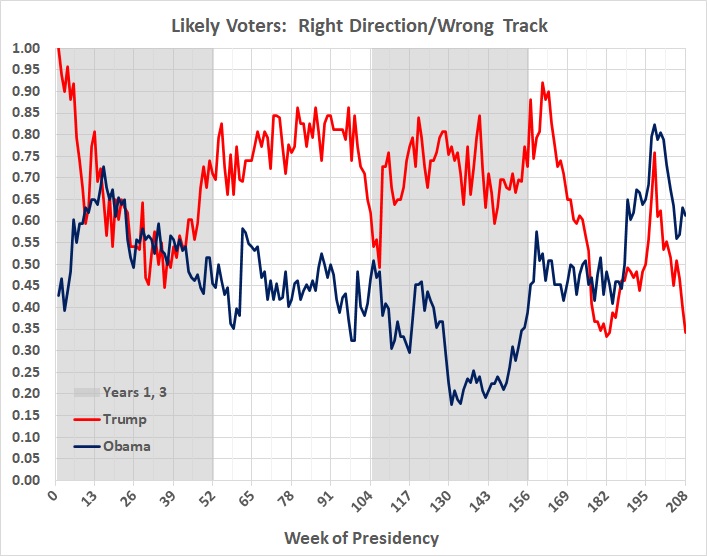
Forget all of that and look at what likely voters think about the state of the union.

Likely voters (polled by Rasmussen Reports) have become much more pessimistic about the country’s direction since the election, that is, since Biden’s stolen victory. Following a steep decline in the mood of the country during the months of pandemic panic, the mood began to lift as Trump began to close the gap with Biden. The peak at week 197 of Trump’s presidency came a week before the election of 2020. The ensuing decline suggests that likely voters, despite the assurances of “establishment” Republicans and the Democrats’ media allies, know what’s coming at them — and it ain’t pretty.

Here We Go …

Down the tubes. It is almost certain that the Democrat candidates will be declared the winners of Georgia two Senate seats. The Senate will then be divided 50-50, and control will pass to the Democrats because VP Harris will cast deciding votes in the case of ties.

This won’t be the first time that Democrats have controlled Congress and the White House, but this Democrat Party isn’t your grandfather’s party, or your father’s party. It isn’t even the party that was led by Barack Obama, who was (and is) an ardent advocate of government control. Today’s party is filled with Obamas and politicians who make the Obamas seem moderate.

What, exactly, happens now (or as soon as Democrats get organized)? The follow list is borrowed from an earlier post. Not every item on the list will be adopted, but it won’t be for want of trying.

1. Abolition of the Senate filibuster.

2. An increase of at least two seats on the U.S. Supreme Court (USSC), though there may be some vacancies to be filled.

3. Adoption of an interstate compact by states controlling a total of at least 270 electoral votes, committing each member state’s electoral votes to the presidential candidate who compiles the most popular votes nationwide, regardless of the outcome of the popular vote in each state that is a party to the compact. (This may seem unnecessary if Biden wins, but it will be a bit of insurance against the possibility of a Republican victor in a future election.)

4. Statehood for either the District of Columbia or Puerto Rico, or for both of them. (Each would then have two senators and a requisite number of representatives with full voting privileges in their respective bodies. All of them will be Democrats, of course.)

5. Empowerment of the executive branch to do at least three of the following things:

a. Regulate personal and business activity (in new ways) with the expressed aim of reducing CO2 emissions.

b. Commit at least $500 billion in new obligational authority for research into and/or funding of methods of reducing and mitigating CO2 emissions.

c. Issue new kinds of tax rebates and credits to persons/households and businesses that spend money on any item on a list of programs/technologies that are supposed to reduce CO2 emissions.

d. Impose tax penalties on persons/households and businesses for their failure to spend money on any item in the list mentioned above (shades of the Obamacare tax penalty).

e. Impose penalties on persons/households and businesses for failing to adhere to prescribed caps on CO2 emissions.

f. Establishment of a cap-and-trade program for CO2 emissions (to soften the blow of the previous item). (Needless to say, the overall effect of such initiatives would deal a devastating blow to economic activity – meaning massive job losses and lower real incomes for large swaths of the populace.)

6. Authorization for an agency or agencies of the federal government to define and penalize written or spoken utterances that the agency or agencies declare “unprotected” by the First Amendment, and to require media enforcement of bans on “unprotected” utterances and prosecution of violators (e.g., here). (This can be accomplished by cynically adopting the supportable position that the First Amendment protects only political speech. The purported aim would be to curb so-called hate speech, but when censorship is in full swing — which would take only a few years — it will be illegal to criticize or question, even by implication, such things as illegal immigration, same-sex marriage, transgenderism, anthropogenic global warming, the confiscation of firearms, or the policies of the federal government. Violations will be enforced by fines and prison sentences — the latter sometimes called “sensitivity training”, “citizenship education”, or some other euphemistic term. Candidates for public office will be prime targets of the enforcers, which will suppress open discussion of such matters.)

7. Imposition of requirements for organizations of all kinds — businesses, universities, charitable organizations, clubs, and even churches — to favor anyone who isn’t a straight, white male of European descent. (The “protections” will be enacted, upheld, and enforced vigorously by federal agencies, regardless of their adverse economic and social effects.)

8. Effective nullification of the Second Amendment through orders/regulations/legislation, to enable gun confiscation (though there will be exemptions for private security services used by favored elites).

9. Use of law-enforcement agencies to enforce “hate speech” bans, mandates for reverse discrimination, and gun-confiscation edicts. (These things will happen regardless of the consequences; e.g., a rising crime rate, greater violence against whites and Asians, and flight from the cities and near-in suburbs. The latter will be futile, anyway, because suburban and exurban police departments will also be co-opted.)

10. Criminalization of “sexual misconduct”, as it is defined by the alleged victim, de facto if not de jure. (Investigations and prosecutions will be selective, and aimed mainly at straight, white males of European descent and dissidents who openly criticize this and other measures listed here.)

11. Parallel treatment for the “crimes” of racism, anti-Islamism, nativism, and genderism. (This will be in addition to the measures discussed in #7.)

12. Centralization in the federal government of complete control of all health care and health-care related products and services, such as drug research, accompanied by “Medicare and Medicaid for All” mandates. (Private health care will be forbidden or strictly limited, though — Soviet-style — there will be exceptions for high officials and other favored persons. Drug research – and medical research, generally – will dwindle in quality and quantity. There will be fewer doctors and nurses who are willing to work in a regimented system. The resulting health-care catastrophe that befalls most of the populace will be shrugged off as necessary to ensure equality of treatment, while ignoring the special treatment accorded favored elites.)

13. Revitalization of the regulatory regime (which already imposes a deadweight loss of 10 percent of GDP). A quantitative measure of revitalization is an increase in the number of new rules published annually in the Federal Register by at least 10 percent above the average for 2017-2020.

14. Proposals for at least least two of the following tax-related initiatives:

a. Reversal of the tax-rate cuts enacted during Trump’s administration.

b. Increases in marginal tax rates for the top 2 or 3 income brackets.

c. Imposition of new taxes on wealth.

15. Dramatic enlargement of domestic welfare programs. Specifically, in addition to the creation of “Medicare and Medicaid for All” programs, there would be a “fix” for Social Security that mandates the payment of full benefits in the future, regardless of the status of the Social Security Trust Fund (which will probably be abolished). (Initiatives discussed in #5, #7, #9, #10, #11, #12, #13, #14, and #15 would suppress investment in business formation and expansion, and would disincentivize professional education and training, not to mention work itself. All of that would combine to push the real rate of economic growth toward a negative value.)

16. Reduction of the defense budget by at least 25 percent, in constant dollars, by 2031 or sooner. (Eventually, the armed forces will be maintained mainly for the purpose of suppressing domestic uprisings. Russia and China will emerge as superpowers, but won’t threaten the U.S. militarily as long as the U.S. government acquiesces in their increasing dominance and plays by their economic rules.)

17. Legalization of all immigration from south of the border, and the granting of citizenship to new immigrants and the illegals who came before them. (The right to vote, of course, is the right that Democrats most dearly want to bestow because most of the newly-minted citizens can be counted on to vote for Democrats. The permanent Democrat majority will ensure permanent Democrat control of the White House and both houses of Congress.)

*      *     *

The list is in keeping with the direction in which the country is headed and, in many cases, has been headed since the 1930s — despite Reagan and Trump, and with the connivance of Ike, Nixon, the Bushes, and (in some crucial cases) the USSC.

The Constitution’s horizontal and vertical separation of powers, system of checks and balances, and limitations on the power of the federal government have been eroded almost to the point of irrelevance. The next few years will put an end to the pretense (or false hope) of governance in accordance with the Constitution as it was written. The next few years will see the destruction of liberty, the bankruptcy of America, and the onset of obeisance to Russia and China.

Proof of Election Fraud or Statistical Hocus-Pocus?

There are many good reasons to believe that Biden’s almost-official election to the presidency was the result of electoral misfeasance, malfeasance, fraud, and judicial bias. But the statistical analysis reported at this link isn’t among them. The authors concocted a statistical model that, according to them,

explains 96% of county-level variance in Trump’s two-party vote share with four demographic variables (non-college white, college-educated white, black and hispanic) and one historical variable (the average of county-level GOP two-party presidential vote share, 2004-2016). All five variables are highly significant. This reinforces the conclusion that the model is generally a very strong predictor of vote shares, and so deviations from it should be considered surprising.

And

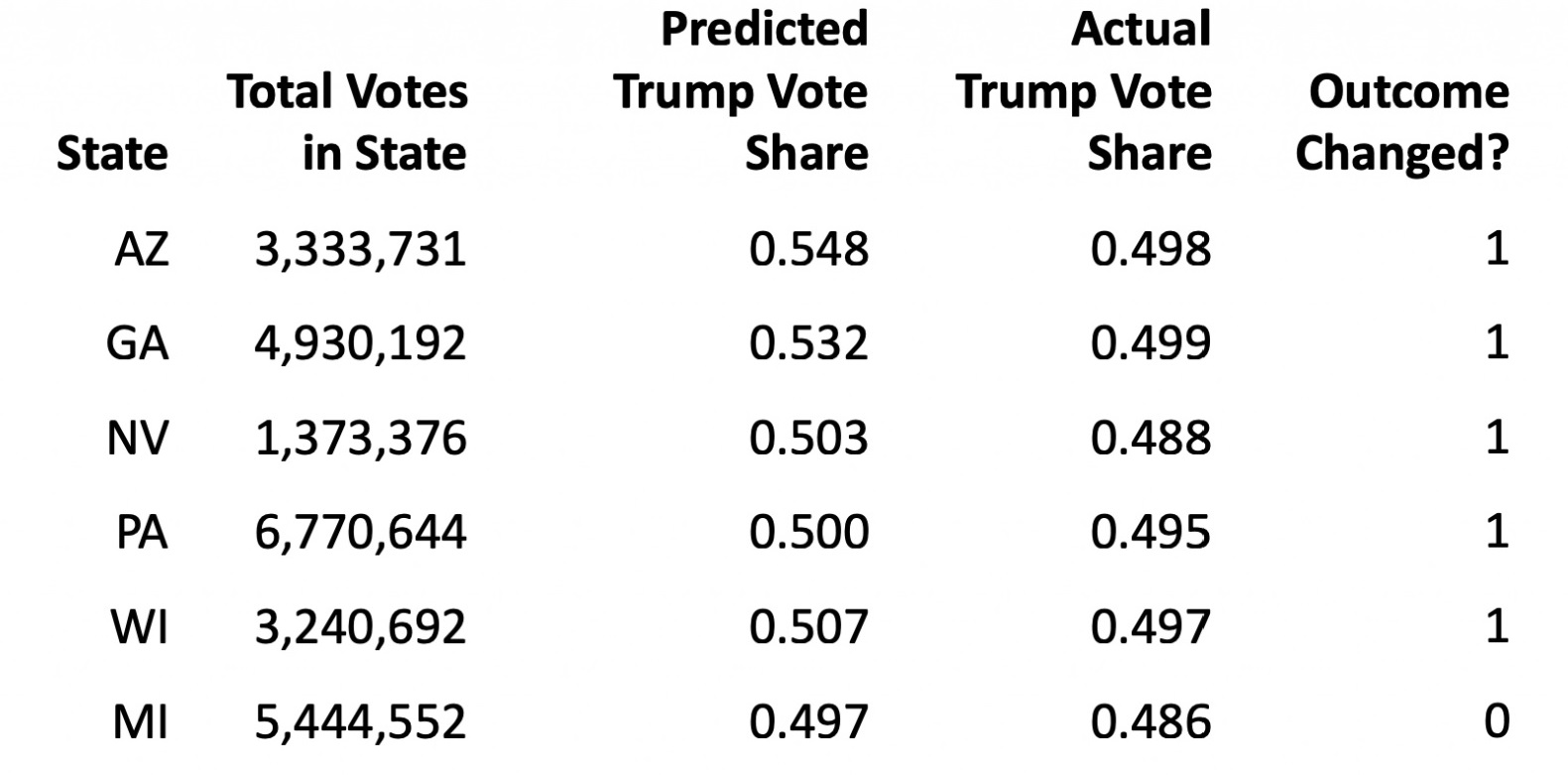
regression analysis shows Trump ought to have won AZ, GA, NV, PA, WI.

Are you convinced? I am not, because the authors (perhaps unwittingly) provide evidence that undermines their claim.

There is a table at the end of the article that gives Trump’s predicted share of the two-party vote for every State (except Alaska and Hawaii) and the District of Columbia. I compared the authors’ predictions with the State-level results compiled as of today at Dave Leip’s Atlas of U.S. Elections. The absolute average of the prediction errors in 1.9 percentage points. The absolute errors for the six States listed above are as follows (in percentage points): AZ, 5.0; GA, 3.3; NV, 1.5; PA, 0.6; WI, 1.0; and MI, 1.1. So, as it turns out, the only outcomes (of the six) that the authors’ predictions might point to as fraudulent are the ones in George and Nevada.

Further, the authors don’t bother to highlight Trump’s significant underperformance (relative to their regression results) in many other States: CA, 4.3; DE, 3.5; ID, 2.4; IN, 2.0; KY, 3.0; ME, 2.5; MD, 3.3; NE, 2.1; NH, 2.2; NM, 2.1; OR, 4.9; TX, 3.6; UT, 6.3; VT, 4.3; and WA, 4.0. If their regression results for Georgia and Nevada are indicative of fraud, so are the results in California, Delaware, … , Vermont, and Washington. But I am unaware of any claims that the official outcomes in those States are bogus.

On top of that, Trump did significantly better than the authors predicted in DC (8.5 percentage points) and North Dakota (3.4 percentage points). Is anyone seriously suggesting that there was electoral fraud favoring Trump in DC, or that his campaign had to resort to fraud in deep-Red North Dakota?

The bottom line: The authors made some good predictions and a lot of very bad ones (20 of their 49 predictions exceed the average absolute error). But there’s nothing in the predictions to prove that Biden’s putative victories in Arizona, Georgia, Nevada, Pennsylvania, and Wisconsin (or even Michigan) were obtained fraudulently. There is plenty of other evidence of misfeasance, malfeasance, and fraud in those States, but the authors’ statistical “proof” is nothing but a demonstration of the errors that abound in statistical analysis.

In this case, the errors resulted in the overprediction of Trump’s share of the vote in 39 States and D.C. — including, coincidentally, the six States that the authors claim to have shown were were stolen from Trump.