Recommended Reading

Leftism, Political Correctness, and Other Lunacies (Dispatches from the Fifth Circle Book 1)


On Liberty: Impossible Dreams, Utopian Schemes (Dispatches from the Fifth Circle Book 2)


We the People and Other American Myths (Dispatches from the Fifth Circle Book 3)


Americana, Etc.: Language, Literature, Movies, Music, Sports, Nostalgia, Trivia, and a Dash of Humor (Dispatches from the Fifth Circle Book 4)

Better-than-Best Pictures, or Who Needs the Oscars?

Incorporated in this page.

“Look That Up in Your Funk & Wagnall’s”

The title of this post is a catchphrase from Laugh In (1968-1973), a weekly comedy show that I sometimes found funny, sometimes found amusing, and often found stupid. I bring it up because my parents owned a Funk & Wagnall’s encyclopedia. It was of a 1940s vintage, though I don’t remember perusing it until 1953, when we moved to a house with a built-in living-room bookcase, where the volumes occupied a prominent spot.

In any event, I looked at and into the encyclopedia so often from 1953 until I left for college in 1958 that I still remember the alphabetic divisions noted on the spines of the volumes:

I recall that there was also a final volume which contained a comprehensive index. And there were some “yearbook” updates.

Note the preponderance of words beginning with letters in the first half of the alphabet. Entries with letters beginning with “n” through “z” occupy only 7-plus of the 25 volumes.

What happened to the set? I don’t know. My mother moved out of the house in 1990, not long after the death of my father. Her next abode was much smaller, and the encyclopedia wasn’t in it. I never thought to ask her what happened to it. And now she is beyond asking — having died a few years ago at the age of 99.

Thank you for indulging this bit of nostalgia.

A Personality Test: Which Antagonist Do You Prefer?

1. Archangel Michael vs. Lucifer (good vs. evil)

2. David vs. Goliath (underdog vs. bully)

3. Alexander Hamilton vs. Aaron Burr (a slippery politician vs. a slippery politician-cum-traitor)

4. Richard Nixon vs. Alger Hiss (a slippery politician vs. a traitorous Soviet spy)

5. Sam Ervin vs. Richard Nixon (an upholder of the Constitution vs. a slippery politician)

6. Kenneth Starr vs. Bill Clinton (a straight arrow vs. a slippery politician)

7. Elmer Fudd vs. Bugs Bunny (a straight arrow with a speech impediment vs. a rascally rabbit)

8. Jerry vs. Tom (a clever mouse vs. a dumb but determined cat)

9. Tweety Bird vs. Sylvester the Cat (a devious bird vs. a predatory cat)

10. Road Runner vs. Wile E. Coyote (a devious bird vs. a stupid canine)

11. Rocky & Bullwinkle vs. Boris & Natasha (fun-loving good guys vs. funny bad guys)

12. Dudley Do-Right vs. Snidely Whiplash (a straight arrow vs. a stereotypical villain)

Summarize and explain your choices in the comments. Suggestions for other pairings are welcome.

The Midwest Is a State of Mind

I am a son of the Middle Border,* now known as the Midwest. I left the Midwest, in spirit, almost 60 years ago, when I matriculated at a decidedly cosmopolitan State university. It was in my home State, but not much of my home State.

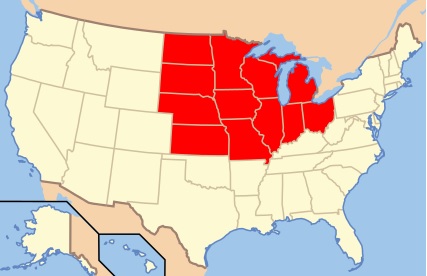
Where is the Midwest? According to Wikipedia, the U.S. Census Bureau defines the Midwest as comprising the 12 States shaded in red:

They are, from north to south and west to east, North Dakota, South Dakota, Nebraska, Kansas, Minnesota, Iowa Missouri, Wisconsin, Illinois, Michigan, Indiana, and Ohio.

In my experience, the Midwest really begins on the west slope of the Appalachians and includes much of New York State and Pennsylvania. I have lived and traveled in that region, and found it, culturally, to be much like the part of “official” Midwest where I was born and raised.

I am now almost 60 years removed from the Midwest (except for a three-year sojourn in the western part of New York State, near the Pennsylvania border). Therefore, I can’t vouch for the currency of a description that appears in Michael Dirda’s review of Jon K. Lauck’s From Warm Center to Ragged Edge: The Erosion of Midwestern Literary and Historical Regionalism, 1920-1965 (Iowa and the Midwest Experience). Dirda writes:

[Lauck] surveys “the erosion of Midwestern literary and historical regionalism” between 1920 and 1965. This may sound dull as ditch water to those who believe that the “flyover” states are inhabited largely by clodhoppers, fundamentalist zealots and loudmouthed Babbitts. In fact, Lauck’s aim is to examine “how the Midwest as a region faded from our collective imagination” and “became an object of derision.” In particular, the heartland’s traditional values of hard work, personal dignity and loyalty, the centrality it grants to family, community and church, and even the Jeffersonian ideal of a democracy based on farms and small land-holdings — all these came to be deemed insufferably provincial by the metropolitan sophisticates of the Eastern Seaboard and the lotus-eaters of the West Coast.

That was the Midwest of my childhood and adolescence. I suspect that the Midwest of today is considerably different. American family life is generally less stable than it was 60 years ago; Americans generally are less church-going than they were 60 years ago; and social organizations are less robust than they were 60 years ago. The Midwest cannot have escaped two generations of social and cultural upheaval fomented by the explosion of mass communications, the debasement of mass culture, the rise of the drugs-and-rock culture, the erasure of social norms by government edicts, and the creation of a culture of dependency on government.

I nevertheless believe that there is a strong, residual longing for and adherence to the Midwestern culture of 60 years ago — though it’s not really unique to the Midwest. It’s a culture that persists throughout America, in rural areas, villages, towns, small cities, and even exurbs of large cities.

The results of last year’s presidential election bear me out. Hillary Clinton represented the “sophisticates” of the Eastern Seaboard and the lotus-eaters of the West Coast. She represented the supposed superiority of technocracy over the voluntary institutions of civil society. She represented a kind of smug pluralism and internationalism that smirks at traditional values and portrays as clodhoppers and fundamentalist zealots those who hold such values. Donald Trump, on the other hand (and despite his big-city roots and great wealth), came across as a man of the people who hold such values.

What about Clinton’s popular-vote “victory”? Nationally, she garnered 2.9 million more votes than Trump. But the manner of Clinton’s “victory” underscores the nation’s cultural divide and the persistence of a Midwestern state of mind. Clinton’s total margin of victory in California, New York, and the District of Columbia was 6.3 million votes. That left Trump ahead of Clinton by 3.4 million votes in the other 48 States, and even farther ahead in non-metropolitan areas. Clinton’s “appeal” (for want of a better word) was narrow; Trump’s was much broader (e.g., winning a higher percentage than Romney did of the two-party vote in 39 States). Arguably, it was broader than that of every Republican presidential candidate since Ronald Reagan won a second term in 1984.

The Midwestern state of mind, however much it has weakened in the last 60 years, remains geographically dominant. In the following graph, counties won by Clinton are shaded in blue; counties won by Trump are shaded in red:


Source: Wikipedia article about the 2016 presidential election.


* This is an allusion to Hamlin Garland‘s novel, A Son of the Middle Border. Garland, a native of Wisconsin, was himself a son of the Middle Border.


Related posts:
“Intellectuals and Society”: A Review
The Left’s Agenda
The Left and Its Delusions
The Spoiled Children of Capitalism
Politics, Sophistry, and the Academy
Subsidizing the Enemies of Liberty
Are You in the Bubble?
The Culture War
Ruminations on the Left in America
Academic Ignorance
The Euphemism Conquers All
Defending the Offensive
Superiority
Whiners
A Dose of Reality
God-Like Minds
An Addendum to (Asymmetrical) Ideological Warfare
Khizr Khan’s Muddled Logic
A Lesson in Election-Rigging
My Platform (which reflects a Midwestern state of mind)
Polarization and De-facto Partition
H.L. Mencken’s Final Legacy
The Shy Republican Supporters
Roundup (see “Civil War II”)
Retrospective Virtue-Signalling
The Left and Violence
Four Kinds of “Liberals”
Leftist Condescension
You Can’t Go Home Again
Class in America
A Word of Warning to Leftists (and Everyone Else)
Another Thought or Two about Class

You Can’t Go Home Again

You can’t go back home to your family, back home to your childhood … back home to a young man’s dreams of glory and of fame … back home to places in the country, back home to the old forms and systems of things which once seemed everlasting but which are changing all the time – back home to the escapes of Time and Memory.

— Thomas Wolfe, You Can’t Go Home Again

*      *      *

I have just begun to read a re-issue of Making It, Norman Podhoretz‘s memoir that stirred up the literati of New York City. According to Jennifer Schuessler (“Norman Podhoretz: Making Enemies,” Publisher’s Weekly, January 25, 1999), Podhoretz’s

frank 1967 account of the lust for success that propelled him from an impoverished childhood in Brooklyn to the salons of Manhattan, … scandalized the literary establishment that once hailed him as something of a golden boy. His agent wouldn’t represent it. His publisher refused to publish it. And just about everybody hated it. In 1972, Podhoretz’s first high-profile personal squabble, with Random House’s Jason Epstein, went public when the New York Times Magazine published an article called “Why Norman and Jason Aren’t Talking.” By 1979, when Podhoretz published Breaking Ranks, a memoir of his conversion from radicalism to militant conservatism, it seemed just about everybody wasn’t talking to Norman.

Next month, Podhoretz will add another chapter to his personal war chronicle with the publication of Ex-Friends: Falling Out with Allen Ginsberg, Lionel and Diana Trilling, Lillian Hellman, Hannah Arendt, and Norman Mailer. In this short, sharp, unabashedly name-dropping book, Podhoretz revisits the old battles over communism and the counterculture, not to mention his bad reviews. But for all his talk of continued struggle against the “regnant leftist culture that pollutes the spiritual and cultural air we all breathe,” the book is a frankly nostalgic, even affectionate look back at the lost world of “the Family,” the endlessly quarreling but close-knit group of left-leaning intellectuals that gathered in the 1940s and ’50s around such magazines as the Partisan Review and Commentary.

Given this bit of background, you shouldn’t be surprised that it was Podhoretz who said that a conservative is a liberal who has been mugged by reality. Nor should you be surprised that Podhoretz wrote this about Barack Obama (which I quote in “Presidential Treason“):

His foreign policy, far from a dismal failure, is a brilliant success as measured by what he intended all along to accomplish….

… As a left-wing radical, Mr. Obama believed that the United States had almost always been a retrograde and destructive force in world affairs. Accordingly, the fundamental transformation he wished to achieve here was to reduce the country’s power and influence. And just as he had to fend off the still-toxic socialist label at home, so he had to take care not to be stuck with the equally toxic “isolationist” label abroad.

This he did by camouflaging his retreats from the responsibilities bred by foreign entanglements as a new form of “engagement.” At the same time, he relied on the war-weariness of the American people and the rise of isolationist sentiment (which, to be sure, dared not speak its name) on the left and right to get away with drastic cuts in the defense budget, with exiting entirely from Iraq and Afghanistan, and with “leading from behind” or using drones instead of troops whenever he was politically forced into military action.

The consequent erosion of American power was going very nicely when the unfortunately named Arab Spring presented the president with several juicy opportunities to speed up the process. First in Egypt, his incoherent moves resulted in a complete loss of American influence, and now, thanks to his handling of the Syrian crisis, he is bringing about a greater diminution of American power than he probably envisaged even in his wildest radical dreams.

For this fulfillment of his dearest political wishes, Mr. Obama is evidently willing to pay the price of a sullied reputation. In that sense, he is by his own lights sacrificing himself for what he imagines is the good of the nation of which he is the president, and also to the benefit of the world, of which he loves proclaiming himself a citizen….

No doubt he will either deny that anything has gone wrong, or failing that, he will resort to his favorite tactic of blaming others—Congress or the Republicans or Rush Limbaugh. But what is also almost certain is that he will refuse to change course and do the things that will be necessary to restore U.S. power and influence.

And so we can only pray that the hole he will go on digging will not be too deep for his successor to pull us out, as Ronald Reagan managed to do when he followed a president into the White House whom Mr. Obama so uncannily resembles. [“Obama’s Successful Foreign Failure,” The Wall Street Journal, September 8, 2013]

Though I admire Podhoretz’s willingness to follow reality to its destination in conservatism — because I made the same journey myself — I am drawn to his memoir by another similarity between us. In the Introduction to the re-issue, Terry Teachout writes:

Making It is never more memorable than when it describes its author’s belated discovery of “the brutal bargain” to which he was introduced by “Mrs. K.,” a Brooklyn schoolteacher who took him in hand and showed him that the precocious but rough-edged son of working-class Jews from Galicia could aspire to greater things— so long as he turned his back on the ghettoized life of his émigré parents and donned the genteel manners of her own class. Not until much later did he realize that the bargain she offered him went even deeper than that:

She was saying that because I was a talented boy, a better class of people stood ready to admit me into their ranks. But only on one condition: I had to signify by my general deportment that I acknowledged them as superior to the class of people among whom I happened to have been born. . . . what I did not understand, not in the least then and not for a long time afterward, was that in matters having to do with “art” and “culture” (the “life of the mind,” as I learned to call it at Columbia), I was being offered the very same brutal bargain and accepting it with the wildest enthusiasm.

So he did, and he never seriously doubted that he had done the only thing possible by making himself over into an alumnus of Columbia and Cambridge and a member of the educated, art-loving upper middle class. At the same time, though, he never forgot what he had lost by doing so, having acquired in the process “a distaste for the surroundings in which I was bred, and ultimately (God forgive me) even for many of the people I loved.”

It’s not an unfamiliar story. But it’s a story that always brings a pang to my heart because it reminds me too much of my own attitudes and behavior as I “climbed the ladder” from the 1960s to the 1990s. Much as I regret the growing gap between me and my past, I have learned from experience that I can’t go back, and don’t want to go back.

What happened to me is probably what happened to Norman Podhoretz and tens of millions of other Americans. We didn’t abandon our past; we became what was written in our genes.

This mini-memoir is meant to illustrate that thesis. It is aimed at those readers who can’t relate to a prominent New Yorker, but who might see themselves in a native of flyover country.

My “ghetto” wasn’t a Jewish enclave like Podhoretz’s Brownsville, but an adjacent pair of small cities in the eastern flatlands of Michigan, both of them predominantly white and working-class. They are not suburbs of Detroit — as we used to say emphatically — nor of any other largish city. We were geographically and culturally isolated from the worst and best that “real” cities have to offer in the way of food, entertainment, and ethnic variety.

My parents’ roots, and thus my cultural inheritance, were in small cities, towns and villages in Michigan and Ontario. Life for my parents, as for their forbears, revolved around making a living, “getting ahead” by owning progressively nicer (but never luxurious) homes and cars, socializing with friends over card games, and keeping their houses and yards neat and clean.

All quite unexceptional, or so it seemed to me as I was growing up. It only began to seem exceptional when I became the first scion of the the family tree to “go away to college,” as we used to say. (“Going away” as opposed to attending a local junior college, as did my father’s younger half-brother about eight years before I matriculated.)

Soon after my arrival on the campus of a large university, whose faculty and students hailed from around the world, I began to grasp the banality of my upbringing in comparison to the cultural richness and sordid reality of the wider world. It was a richness and reality of which my home-town contemporaries and I knew little because we were raised in the days of Ozzie and Harriet — before the Beatles, Woodstock, bearded men with pony-tails, shacking up as a social norm, widespread drug use, and the vivid depiction of sex in all of its natural and unnatural variety.

My upbringing, like that of my home-town contemporaries was almost apolitical. If we overheard our parents talking about politics, we overheard a combination of views that today seems unlikely: suspicion of government; skepticism about unions (my father had to join one in order to work), disdain for “fat cats”; sympathy for “the little guy”; and staunch patriotism. There was nothing about civil rights and state-enforced segregation, which were seen (mistakenly) as peculiarly Southern issues. Their own racism was seldom in evidence because blacks generally “knew their place” in our white-dominated communities.

And then, as a student at a cosmopolitan Midwestern university (that isn’t an oxymoron), I began to learn — in and out of class. The out-of-class lessons came through conversations with students whose backgrounds differed greatly from mine, including two who had been displaced persons in the wake of World War II. My first-year roommate was a mild-mannered Iranian doctoral student whose friends (some of them less mild-mannered) spoke openly about the fear in which Iranians lived because of SAVAK‘s oppressive practices. In my final year as an undergraduate I befriended some married graduate students, one of whom (an American) had spent several years in Libya as a geologist for an American oil company and had returned to the States with an Italian wife.

One of the off-campus theaters specialized in foreign films, which I had never before seen, and which exposed me to people, places, attitudes, and ideas that were intellectually foreign to me, but which I viewed avidly and with acceptance. My musical education was advanced by a friendship with a music major, through whom I met other music majors and learned much about classical music and, of all things, Gilbert and Sullivan. One of the music majors was a tenor who had to learn The Mikado, and did so by playing a recording of it over and over. I became hooked, and to this day can recite large chunks of the libretto. I used to sing them, but my singing days are over.

Through my classes — and often through unassigned reading — I learned how to speak and read French (fluently, those many years ago), and ingested various-sized doses of philosophy, history (ancient and modern), sociology, accounting (the third of four majors), and several other things that escape me at the moment.

Through economics (my fourth and final major), I learned (but didn’t then question), the contradictory tenets of microeconomics (how markets work to allocate resources and satisfy wants efficiently) and macroeconomics (then dominated by the idea of government’s indispensable role in the economic order). But I was drawn in by the elegance of economic theory, and mistook its spurious precision for deep understanding. Though I have since rejected macroeconomic orthodoxy (e.g., see this).

My collegiate “enlightenment” was mild, by today’s standards, but revelatory to a small-city boy. And I was among the still relatively small fraction of high-school graduates who went away to college. So my exposure to a variety of people, cultures, and ideas immediately set me apart — apart not only from my parents and the members of their generation, but also apart from most of the members of my own generation.

What set me apart more than anything was my loss of faith. In my second year I went from ostentatiously devout Catholicism to steadfast agnosticism in a span of weeks. I can’t reconstruct the transition at a remove of almost 60 years, but I suspect that it involved a mixture of delayed adolescent rebellion, a reckoning (based on things I had learned) that the roots of religion lay in superstition, and a genetic predisposition toward skepticism (my father was raised Protestant but scorned religion in his mild way). At any rate, when I walked out of church in the middle of Mass one Sunday morning, I felt as if I had relieved myself of a heavy burden and freed my mind for the pursuit of knowledge.

The odd thing is that, to this day, I retain feelings of loyalty to the Church of my youth — the Church of the Latin Mass (weekly on Sunday morning, not afternoon or evening), strict abstinence from meat on Friday, confession on Saturday, fasting from midnight on Sunday (if one were in a state of grace and fit for Holy Communion), and the sharp-tongued sisters with sharp-edged rulers who taught Catechism on Saturday mornings (parochial school wasn’t in my parents’ budget). I have therefore been appalled, successively, by Vatican Council II, most of the popes of the past 50 years, the various ways in which being a Catholic has become easier, and (especially) the egregious left-wing babbling of Francis. And yet I remain an agnostic who only in recent years has acknowledged the logical necessity of a Creator, but probably not the kind of Creator who is at the center of formal religion. Atheism — especially of the strident variety — is merely religion turned upside down; a belief in something that is beyond proof; I scorn it.

To complete this aside, I must address the canard peddled by strident atheists and left-wingers (there’s a lot of overlap) about the evil done in the name of religion, I say this: Religion doesn’t make fanatics, it attracts them (in relatively small numbers), though some Islamic sects seem to be bent on attracting and cultivating fanaticism. Far more fanatical and attractive to fanatics are the “religions” of communism, socialism (including Hitler’s version), and progressivism (witness the snowflakes and oppressors who now dominate the academy). I doubt that the number of murders committed in the name of religion amounts to one-tenth of the number of murders committed by three notable anti-religionists: Hitler (yes, Hitler), Stalin, and Mao. I also believe — with empirical justification — that religion is a bulwark of liberty; whereas, the cult of libertarianism — usually practiced by agnostics and atheists — is not (e.g., this post and the others linked to therein).

It’s time to return to the chronological thread of my narrative. I have outlined my graduate-school and work experiences in “About.” The main thing to note here is what I learned during the early mid-life crisis which took me away from the D.C. rat race for about three years, as owner-operator of a (very) small publishing company in a rural part of New York State.

In sum, I learned to work hard. Before my business venture I had coasted along using my intelligence but not a lot of energy, but nevertheless earning praise and good raises. I was seldom engaged it what I was doing: the work seemed superficial and unconnected to anything real to me. That changed when I became a business owner. I had to meet a weekly deadline or lose advertisers (and my source of income), master several new skills involved in publishing a weekly “throwaway” (as the free Pennysaver was sometimes called), and work six days a week with only two brief respites in three years. Something clicked, and when I gave up the publishing business and returned to the D.C. area, I kept on working hard — as if my livelihood depended on it.

And it did. Much as I had loved being my own boss, I wanted to live and retire more comfortably than I could on the meager income that flowed uncertainly from the Pennysaver. Incentives matter. So in the 18 years after my return to the D.C. area I not only kept working hard and with fierce concentration, but I developed (or discovered) a ruthless streak that propelled me into the upper echelon of the think-tank.

And in my three years away from the D.C. area I also learned, for the first time, that I couldn’t go home again.

I was attracted to the publishing business because of its location in a somewhat picturesque village. The village was large enough to sport a movie theater, two super markets, and a variety of commercial establishments, including restaurants, shoe stores, clothing stores, jewelers, a Rite-Aid drug store, and even a J.J. Newberry dime store. It also had many large, well-kept homes All in all, it appealed to me because, replete with a “real” main street, it reminded me of the first small city in which I grew up.

But after working and associating with highly educated professionals, and after experiencing the vast variety of restaurants, museums, parks, and entertainment of the D.C. area, I found the village and its natives dull. Not only dull, but also distant. They were humorless and closed to outsiders. It came to me that the small cities in which I had grown up were the same way. My memories of them were distorted because they were memories of a pre-college boy who had yet to experience life in the big city. They were memories of a boy whose life centered on his parents and a beloved grandmother (who lived in a small village of similarly golden memory).

You can’t go home again, metaphorically, if you’ve gone away and lived a different life. You can’t because you are a different person than you were when you were growing up. This lesson was reinforced at the 30-year reunion of my high-school graduating class, which occurred several years after my business venture and a few years after I had risen into the upper echelon of the think-tank.

There I was, with my wife and sister (who graduated from the same high school eight years after I did), happily anticipating an evening of laughter and shared memories. We were seated at a table with two fellows who had been good friends of mine (and their wives, whom I didn’t know). It was deadly boring; the silences yawned; we had nothing to say to each other. One of the old friends, who had been on the wagon, was so unnerved by the forced bonhomie of the occasion that he fell off the wagon. Attempts at mingling after dinner were awkward. My wife and sister readily agreed to abandon the event. We drove several miles to an elegant, river-front hotel where we had a few drinks on the deck. Thus the evening ended on a cheery note, despite the cool, damp drizzle. (A not untypical August evening in Michigan.)

I continued to return to Michigan for another 27 years, making what might be my final trip for the funeral of my mother, who lived to the age of 99. But I went just to see my parents and siblings, and then only out of duty.

The golden memories of my youth remain with me, but I long ago gave up the idea of reliving the past that is interred in those memories.

Three Now-Obscure Actors

The 1950s were as dull as they’re made out to be. (Oh, to have them back!) Among the landmarks of that dull decade were three actors who, between them, seemed to appear almost every night on one TV drama or another: Henry Jones (1912-1999), John Newland (1917-2000), and Harry Townes (1914-2001). All three had long acting careers, and Newland was also a producer and director. But you probably can’t put faces with the names. Here they are:

Henry Jones
Henry Jones


John Newland
John Newland


Harry Townes
Harry Townes

Beyond the Far Horizon

Several years ago I began to track some celebrities who had attained the age of 90. The rather quirky list of notables now looks like this:

Luise Rainer 104, George Beverly Shea 104, Charles Lane 102Irwin Corey 101, Herman Wouk 101, George Kennan 101, Olivia de Havilland 100 (on July 1*), Gloria Stuart 100Eddie Albert 99, Michael DeBakey 99, Zsa Zsa Gabor 99, Vera Lynn 99, Mitch Miller 99, Max Schmeling 99, Risë Stevens 99, John Wooden 99Tony Martin 98, Dale Messick 98, Eli Wallach 98John Kenneth Galbraith 97, Ernest Gallo 97, Billy Graham 97, Estée Lauder 97, Art Linkletter 97, Al Lopez 97Karl Malden 97, John Mills 97, Kitty Carlisle 96Monte Irvin 96, Jack LaLanne 96, Kevin McCarthy 96, Harry Morgan 96, Fay Wray 96Jane Wyatt 96, Joseph Barbera 95, Ernest Borgnine 95, Henri Cartier-Bresson 95Herbert Lom 95, Peter Rodino, Jr 95, Sargent Shriver 95, Patty Andrews 94, Sammy Baugh 94, Constance Cummings 94, Lady Bird Johnson 94, Robert Mondavi 94, Byron Nelson 94, Les Paul 94, Ruth Hussey 93, Frankie Laine 93, Robert McNamara 93, Artie Shaw 93,  Richard Widmark 93, Oleg Cassini 92, Ralph Edwards 92Bob Feller 92, Ernie Harwell 92, Lena Horne 92Julia Child 91, Archibald Cox 91, Geraldine Fitzgerald 91, Frances Langford 91, John Profumo 91, William Westmoreland 91Jane Wyman 90.

I was reminded of this list by a name in the “Today’s Birthdays” feature of the newspaper: actress June Lockhart 91. Because only six members of my original list remain among the living, I’m adding Lockhart to the list, as well as these notables of interest to me: baseball player Bobby Doerr 98, justice John Paul Stevens 96, economist and secretary of state George Shultz 95, prince consort Philip Mountbatten 95, actress Betty White 94, secretary of defense Melvin Laird 93, baseball player Red Schoendienst 93, actress Rose Marie 92, physicist Freeman Dyson 92, president George H.W. Bush 92, and actor Hal Holbrook 91.

_________
* By my reckoning, of the dozens (or hundreds) of actors who starred in Hollywood films before World War II, only Olivia de Havilland survives. She attained star billing in 1935, at the age of 19, for her role in Captain Blood. Other pre-war films in which she starred include The Adventures of Robin Hood (1938) and Gone with the Wind (1939).

Out of the Past

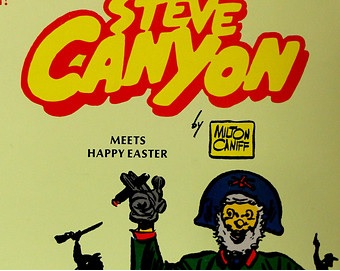
Most of you are too young to remember this comic strip character:

Happy Easter

Another Trip to the Movies

Incorporated in this page.


A Trip to the Movies

Incorporated in this page.


Presidential Trivia: Recurring First Names

Among the 44 Presidents of the United States, there are eight first names that occur more than once. Do you know the eight names? Do you know the middle names (if any) and last names that go with the first names? Try to answer those questions without peeking at a list of presidents, then go to the bottom of this page for the answers.

Radio Days, and Beyond

This trip down memory lane is about some of the shows that I remember from the 1940s and 1950s.

The 1940s were my radio days. I listened on my parents’ Philco console radio, which resembled this one:

These are the radio shows that I remember:

The Adventures of Ozzie and Harriet
The Adventures of Superman
The Aldrich Family
The Baby Snooks Show
Blondie
Burns and Allen
Challenge of the Yukon (Sgt. Preston of the Yukon)
A Date with Judy
Fibber McGee and Molly
The Fred Allen Show
Gang Busters
Gene Autry’s Melody Ranch
The Great Gildersleeve
I Love a Mystery
Inner Sanctum Mysteries
The Jack Benny Program
Life with Luigi
The Lone Ranger
Lum and Abner
Martin Kane, Private Eye
Meet Corliss Archer
Mr. Keen, Tracer of Lost Persons
Nick Carter, Private Detective
Our Miss Brooks
The Phil Harris-Alice Faye Show
The Romance of Helen Trent (overheard while my mother listened)
The Shadow
Suspense
Tom Mix
Twenty Questions
The Whistler

That’s just a small sample of the shows that aired during the Golden Age of Radio. Several of the shows made the transition to television. Those that I remember watching on TV in the 1950s are Ozzie and Harriet, Superman, Blondie, Burns and Allen, Gene Autry, Jack Benny, The Great Gildersleeve, Life with Luigi, The Lone Ranger, Our Miss Brooks, Suspense, and Twenty Questions.

Some shows that I watched on TV in the 1950s got their start on radio, but I followed them only on TV. Among their number:

Abbott and Costello
The Alan Young Show
Amos ‘n’ Andy
Beulah
The Big Story
The Cisco Kid
Death Valley Days
Dr. Kildare
Dragnet
Ellery Queen
Ethel and Albert
Father Knows Best
Five Star Theater
Four Star Playhouse
The Goldbergs
Gunsmoke
The Halls of Ivy
Have Gun, Will Travel
I Was a Communist for the FBI
The Kate Smith Hour
The Ken Murray Program
Kraft Music Hall
The Life of Riley
The Milton Berle Show
Mr. and Mrs. North
My Friend Irma
The Original Amateur Hour
Perry Mason
Quiz Kids
The Roy Rogers Show
Studio One
The Voice of Firsstone
You Bet Your Life
Your Hit Parade

My parents’ first TV set was a 12-inch Sparton, which resembled the table model at the left in the bottom row:

Sparton wasn’t a misspelling of Spartan. Sparton stood for Sparks-Withington, a company in Jackson, Michigan, that made TV sets until 1956. Not nearly as classy as the Philco radio, was it?

Those were the days when radio and TV were safe for kids: no sex, less-than-graphic violence, actors who didn’t mumble or swear, and musical themes of redeeming value:

The Passing of Red-Brick Schoolhouses and a Way of Life

My home town once boasted fifteen schoolhouses that were built between the end of the Civil War and 1899. All but the high school were named for presidents of the United States: Adams, Buchanan, Fillmore, Harrison, Jackson, Jefferson, Madison, Monroe, Pierce, Polk, Taylor, Tyler, Van Buren, and Washington. Another of their ilk came along sometime between 1904 and 1915; Lincoln was its name.

With the Adams School counting for two presidents — the second and sixth — there was a school for every president through Lincoln. Why Lincoln came late is a mystery to me. Lincoln was revered by us Northerners, and his picture was displayed proudly next to Washington’s in schools and municipal offices. We even celebrated Lincoln’s Birthday as a holiday distinct from Washington’s Birthday (a.k.a. President’s Day).

More schools — some named for presidents — followed well into the 20th century, but only the fifteen that I’ve named were built in the style of the classic red-brick schoolhouse: two stories, a center hall with imposing staircase, tall windows, steep roof, and often a tower for the bell that the janitor rang to summon neighborhood children to school. (The Lincoln, as a latecomer, was L-shaped rather than boxy, but it was otherwise a classic red-brick schoolhouse, replete with a prominent bell tower.)

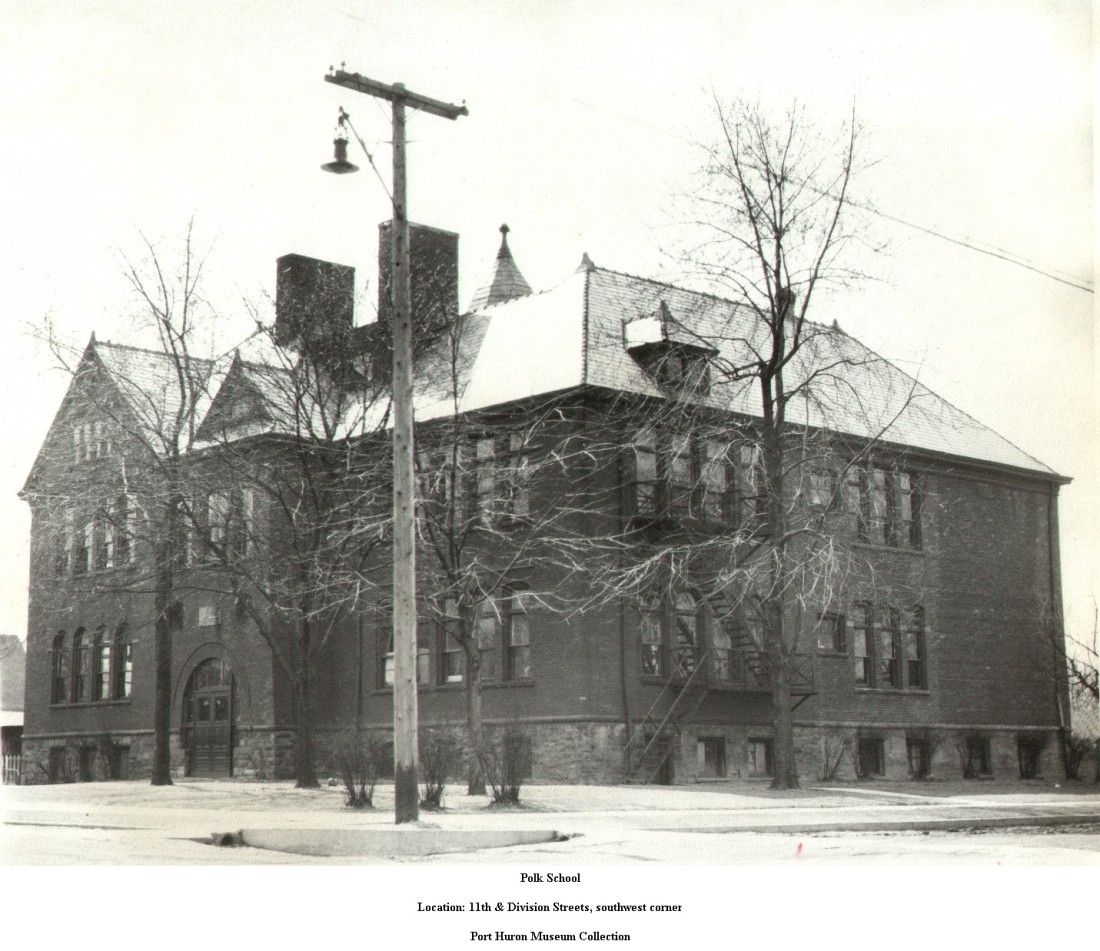
I attended three of the fifteen red-brick schoolhouses. My first was Polk School, where I began kindergarten two days after the formal surrender of Japan on September 2, 1945. (For the benefit of youngsters, that ceremony marked the official end of World War II.)

Here’s the Polk in its heyday:

PolkSch

Kindergarten convened in a ground-floor room at the back of the school, facing what seemed then like a large playground, with room for a softball field. The houses at the far end of the field would have been easy targets for adult players, but it would have been a rare feat for a student to hit one over the fence that separated the playground from the houses.

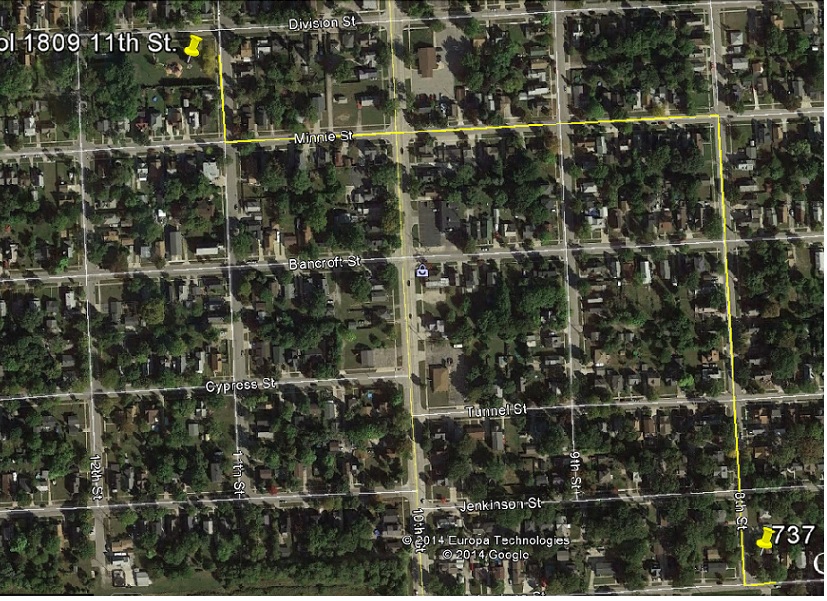
In those innocent days, students got to school and back home by walking. Here’s the route that I followed as a kindergartener:

Route to Polk School

A kindergartener walking several blocks between home and school, usually alone most of the way? Unheard of today, it seems. But in those days predation was unheard of. And, as a practical matter, most families had only one car, which the working (outside-the-home) parent (then known as the father and head-of-household) used on weekdays for travel to and from his job. Moreover, the exercise of walking as much as a mile each way was considered good for growing children — and it was.

The route between my home and Polk School was 0.6 mile in length, and it crossed one busy street. Along that street were designated crossing points, at which stood Safety Patrol Boys, usually 6th-graders, who ensured that students crossed only when it was safe to do so. They didn’t stand in the street and stop oncoming traffic; they simply judged when students could safely cross, and gave them the “green light” by blowing on a whistle. In the several years of my elementary-school career, I never saw or heard of a close call, let alone an injury or a fatality.

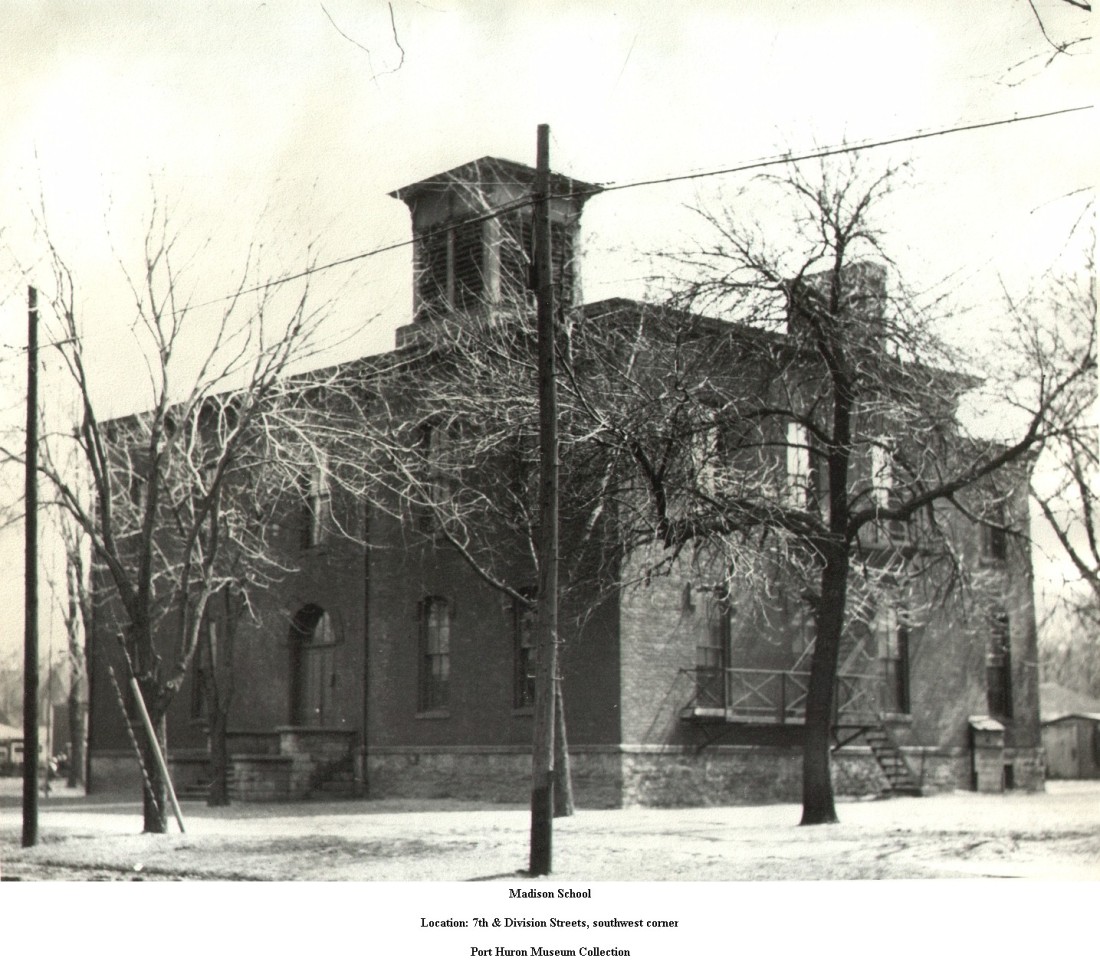
I began at Polk School because the school closest to my home, Madison School, didn’t have kindergarten. I went Madison for 1st grade. It was a gloomy pile:

MadisonSch

Madison was shuttered after my year there, so I returned to Polk for 2nd and 3rd grades. Madison stood empty for a few years, and was razed in the late 1940s or early 1950s. Polk was shuttered sometime in the 1950s, and eventually was razed after being used for many years as a school-district warehouse.

The former site of Madison School now hosts “affordable housing”:

Madison School site

There’s a public playground where Polk School stood:

Polk School site

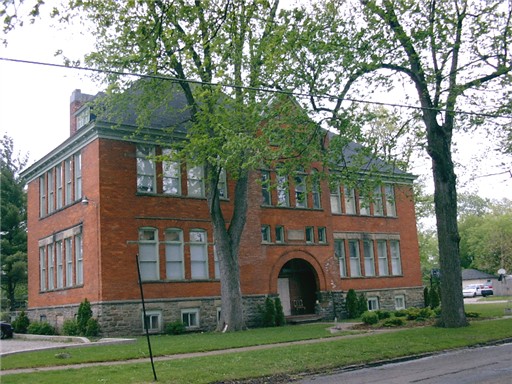
I spent two more years — 4th and 5th grades — in another red-brick schoolhouse: Tyler School. It’s still there, though it hasn’t been used as a school for many decades. It looked like this in 2006, when it served as a halfway house:

Tyler School_2

It now stands empty and uncared for. It looked like this in 2013:

Tyler School 2013

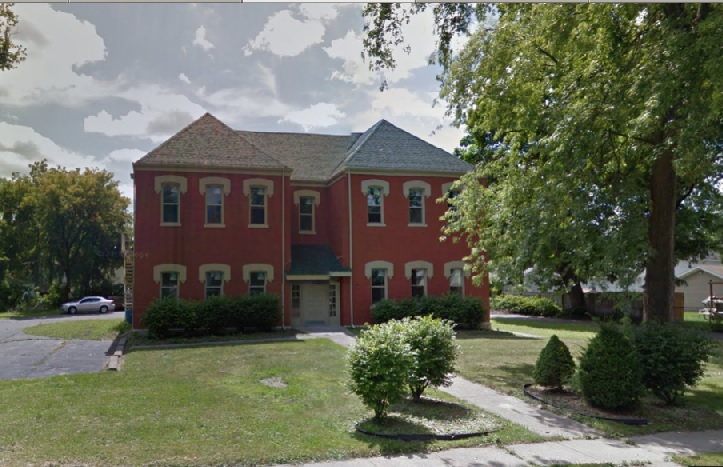
The only other survivor among the fifteen red-brick schoolhouses is Monroe School, the present use of which I can’t ascertain. It seems to have been cared for, however. This image is from 2013:

Monroe School 2013

Tyler and Monroe Schools are ghosts from America’s past — a past that’s now seemingly irretrievable. It was a time of innocence, when America’s wars were fought to victory; when children could safely roam (large cities excepted, as always, from prevailing mores); when marriage was between man and woman, and usually for life; when deviant behavior was discouraged, not “celebrated”; when a high-school diploma and four-year degree meant something, and were worth something; when the state wasn’t the enemy of the church; when politics didn’t intrude into science; when people resorted to government in desperation, not out of habit; and when people had real friends, not Facebook “friends.”

Checking Out

UPDATED 06/25/14

The demise of Mickey Rooney at the age of 93 reminded me that several years ago I began to track some celebrities who had attained the age of 90. The rather quirky list of notables, which doesn’t include Rooney, now looks like this:

Luise Rainer 104, George Beverly Shea 104, Charles Lane 102, George Kennan 101, Gloria Stuart 100Eddie Albert 99Irwin Corey 99, Michael DeBakey 99, Mitch Miller 99, Max Schmeling 99, Risë Stevens 99, John Wooden 99Tony Martin 98, Dale Messick 98, Eli Wallach 98, Herman Wouk 98, Olivia de Havilland 97, Zsa Zsa Gabor 97John Kenneth Galbraith 97, Ernest Gallo 97, Estée Lauder 97, Art Linkletter 97, Al Lopez 97, Vera Lynn 97Karl Malden 97, John Mills 97, Kitty Carlisle 96, ,Jack LaLanne 96, Kevin McCarthy 96, Harry Morgan 96, Fay Wray 96Jane Wyatt 96, Joseph Barbera 95, Ernest Borgnine 95, Henri Cartier-Bresson 95, Monte Irvin 95, Herbert Lom 95, Peter Rodino, Jr 95, Sargent Shriver 95, Patty Andrews 94, Sammy Baugh 94, Constance Cummings 94, Lady Bird Johnson 94, Robert Mondavi 94, Byron Nelson 94, Les Paul 94Billy Graham 93, Ruth Hussey 93, Frankie Laine 93, Robert McNamara 93, Artie Shaw 93,  Richard Widmark 93, Oleg Cassini 92, Ralph Edwards 92Bob Feller 92, Ernie Harwell 92, Lena Horne 92Julia Child 91, Archibald Cox 91, Geraldine Fitzgerald 91, Frances Langford 91, John Profumo 91, William Westmoreland 91Jane Wyman 90.

By my reckoning, of the dozens (or hundreds) of actors who starred in Hollywood films before World War II, only two survive:

I should note that de Havilland’s younger sister and life-long rival, Joan Fontaine, died on December 15, 2013, at the age of 96. The de Havilland sisters came by their longevity the easy way; they inherited it. Their father lived to the age of 95; their mother, to the age of 88.

Checking In

UPDATED, 08/11/10

About four years ago (at Liberty Corner) I drew on the archives of Dead or Alive? to list a number of erstwhile celebrities who were then alive at the age of 90 or older. Here’s how the list looks today:

Charles Lane 102, George Kennan 101, George Beverly Shea 101, Max Schmeling 99, Eddie Albert 99, Michael DeBakey 99, Luise Rainer 100, Gloria Stuart 100, Dale Messick 98, John Wooden 99, Mitch Miller 99, John Kenneth Galbraith 97, Ernest Gallo 97, John Mills 97, Estée Lauder 97, Al Lopez 97, Karl Malden 97, Art Linkletter 97, Risë Stevens 97, Fay Wray 96, Kitty Carlisle 96, Jane Wyatt 96, Tony Martin 96, Kevin McCarthy 96, Irwin Corey 96, Henri Cartier-Bresson 95, Peter Rodino, Jr. 95, Joseph Barbera 95 ,Jack LaLanne 95, Harry Morgan 95, Herman Wouk 95, Byron Nelson 94, Constance Cummings 94, Lady Bird Johnson 94, Robert Mondavi 94, Sammy Baugh 94, Les Paul 94, Sargent Shriver 94, Eli Wallach 94, Olivia de Havilland 94, Artie Shaw 93, Frankie Laine 93, Ruth Hussey 93, Richard Widmark 93, Robert McNamara 93, Ernest Borgnine 93, Zsa Zsa Gabor 93, Vera Lynn 93, Oleg Cassini 92, Ralph Edwards 92, Lena Horne 92, Ernie Harwell 92, Herbert Lom 92, Patti Andrews 92, William Westmoreland 91, Frances Langford 91, John Profumo 91, Geraldine Fitzgerald 91, Archibald Cox 91, Julia Child 91, Bob Feller 91, Billy Graham 91, Monte Irvin 91, Jane Wyman 90.

For many, many more names, go to “People Alive Over 85” at Dead or Alive?

Timely Trivia Question

One person administered the presidential oath of office nine times (a record). Who was that person, and to which presidents did he administer the oath? Scroll down for the answer.

John Marshall, Chief Justice of the United States from 1801 to 1835, administered the oath to Thomas Jefferson in 1801 and 1805, James Madison in 1809 and 1813, James Monroe in 1817 and 1821, John Quincy Adams in 1825, and Andrew Jackson in 1829 and 1833.

Roger B. Taney, Marshall’s successor as Chief Justice (1836 to 1864), administered the oath of office seven times. Warren E. Burger (Chief Justice from 1969 to 1986) administered the oath six times.

For more trivia about inauguration day, go here.

Musical Memories

The six songs I remember from an early age:

I’ve Got Spurs That Jingle Jangle Jingle” (probably sung by Gene Autry)

You Are My Sunshine” (probably sung by Jimmie Davis, who wrote it)

Cool Water” (sung by the Sons of the Pioneers)

Always” (sung by Dinah Shore)

Mairzy Doats” (probably sung by the Andrews Sisters)

Let It Snow

Presidential Heights

I once remarked on the longevity of presidents:

The [following] graph highlights trends (such as they are) in the age at which presidents have died (or to which they have survived if still living), the age at which they were elected or succeeded to the presidency, and the number of years by which they survived (or have thus far survived) election or succession. (I have omitted assassinated presidents from the data for age of death and number of years surviving, thus the gaps in the first and third series.)

It seems to me that the early presidents were generally “healthy and wise” (and wealthy, by the standards of their time). That is, they were of superior genetic stock, relative to the average person. Their successors have tended to be of less-superior stock, and it shows in the downward trends after 1836.

The general rise in life expectancies since 1900 masks the relative inferiority of twentieth century presidents. The rising age of accession to the presidency after 1932 and the rise in years of survivorship after 1924 (both with wide variations around the trend) should not be taken to indicate that presidents of the twentieth century are on a par, genetically, with the early presidents. They are not.

These observations are consistent with the following graph of presidents’ heights (here including only those men who were elected to the presidency):

Source: “Heights of United States presidents and presidential candidates” at Wikipedia.

With the notable exception of Lincoln, presidential heights generally diminished from the late 1700s to the late 1800s. The upward trend since 1900 attests to the general health and vigor of the population; it says nothing about the relative robustness of the men who have been elected to the presidency in the 20th and 21st centuries.

Random Thoughts

Why is “gunite” pronounced gun-ite, whereas “granite” is pronounced gran-it?

If, in 1950, Harry Truman had said “four score and seven years ago,” he would have been referring to 1863, the year in which Abraham Lincoln uttered that famous phrase.

In the computer industry, “email” is preferred to “e-mail.” But it seems to me that “e-mail” better represents the phrase “electronic mail.” The meaning of “e-mail” is immediately obvious to me; “email,” at first glance, looks like a typo.

If the dismal northern weather of early April and late October — which delayed the start of the 2008 baseball season in some cities and then disrupted the World Series — doesn’t convince Major League Baseball to lop two weeks from each end of the regular season, nothing will.

One of the funniest movies I’ve seen is Harold Lloyd’s Dr. Jack (1922). It starts slowly, but builds to a hilariously frantic finish. Lloyd’s Safety Last! is better known — and deservedly considered a comedy classic — but it isn’t half as funny as Dr. Jack.

Between novels, I have been slogging my way through Thomas K. McCraw’s Prophet of Innovation: Joseph Schumpeter and Creative Destruction. There’s too much armchair psychology in it, but it whets my appetite for Schumpeter’s classic Capitalism, Socialism, and Democracy, which (I hate to admit) I haven’t read. Schumpter’s famous term for capitalism, “creative destruction,” often is applied with an emphasis on “destruction”; the emphasis should be on “creative.”

I must observe, relatedly, that my grandmother’s lifetime (1880-1977) spanned the invention and adoption of far more new technology than is likely to emerge in my lifetime, even if I live as long as my grandmother did.