Something or Nothing

The deepest question of all may be “Why is there something rather than nothing?

Here is my answer: Because there is “something”, “nothing” is impossible and not worth trying to envision or explain. This answer points to the real question: “Given that there is ‘something,’ how did it come to exist?”

Before I get to that question, I must say a few things about “nothing”. It is fatuous to suggest that “nothing” can be found in voids or vacuums in the universe. Such voids or vacuums — even if perfectly empty of matter-energy, and even if coterminous with the universe — would be part or all of the universe; that is, they would be part or all of “something”. “Something” would therefore exist. And if “something” exists — no matter how fleeting or minuscule — there is not “nothing”.

“Nothing” could not be “something” from which things have been subtracted; if it were, there would have been “something”. “Nothing” is not merely a void or a vast emptiness. “Nothing” is just nothing; any attempt to envision it or describe it is futile because “nothing” (as opposed to “something”) cannot be envisioned or described.

In any event, because there is “something” — and “nothing” is therefore impossible — philosophy should be concerned with the real question: “Given that there is ‘something’, how did it come to exist?” I have answered that question, to my own satisfaction, in “Existence and Creation.” Here is the succinct version:

  1. In the material universe, cause precedes effect.
  2. Accordingly, the material universe cannot be self-made. It must have a “starting point,” but the “starting point” cannot be in or of the material universe.
  3. The existence of the universe therefore implies a separate, uncaused cause.

That uncaused cause is not “nothing”. It is “something”. But it is a “something” that is beyond human comprehension. If it is impossible for humans to grasp the reality that underlies matter-energy — and I submit that it is impossible — why should humans be expected to understand the true nature of the uncaused cause of the universe? The failure to understand the uncaused cause does not negate it, any more than the failure to understand geometry negates the truth of the Pythagorean Theorem.

Related posts:
Atheism, Religion, and Science
The Limits of Science
Three Perspectives on Life: A Parable
Beware of Irrational Atheism
The Creation Model
The Thing about Science
Evolution and Religion
Words of Caution for Scientific Dogmatists
Science, Evolution, Religion, and Liberty
The Legality of Teaching Intelligent Design
Science, Logic, and God
Capitalism, Liberty, and Christianity
Is “Nothing” Possible?
Debunking “Scientific Objectivity”
Science’s Anti-Scientific Bent
Science, Axioms, and Economics
The Big Bang and Atheism
The Universe . . . Four Possibilities
Einstein, Science, and God
Atheism, Religion, and Science Redux
Pascal’s Wager, Morality, and the State
Evolution as God?
The Greatest Mystery
What Is Truth?
The Improbability of Us
A Digression about Probability and Existence
More about Probability and Existence
Existence and Creation
Probability, Existence, and Creation
The Atheism of the Gaps
Something from Nothing?

Therapeutic Blogging

In my quest for surcease from politics and other serious subjects, I have been mucking about in baseball statistics. The masochists among you may enjoy “What Makes a Winning Team?,” which I have posted at Americana, Etc.

Genetic Kinship and Society

UPDATED (08/18/12) BELOW

This is the third installment of a series that explores the true nature of liberty, how liberty depends on society, how society (properly understood) has been eclipsed by statism and its artifacts, and how society — and therefore liberty — might re-emerge in the United States. In this installment, I take up the second of several possible objections to my model of a society’s essence and workings. This series will close with a blueprint for the restoration of society and liberty in America.

If you have not read the first two installments, “Liberty and Society” and “The Eclipse of ‘Old America’,” I recommend that you do so before you continue. This post addresses the following question: Is Genetic Kinship an Indispensable Aspect of Society?

In “Liberty and Society,” I define society as “an enduring and cooperating social group whose members have developed organized patterns of relationships through interaction with one another.” Near the end of the post, I say this:

A society coheres around genetic kinship, and is defined by its common culture, which includes its moral code. The culture is developed, transmitted through, and enforced by the voluntary institutions of society (civil society). The culture is the product of trial and error, where those elements that become part of received culture serve societal coherence and — in the best case — help it to thrive. Coherence and success depend also on the maintenance of mutual respect, trust, and forbearance among society’s members. Those traits arise in part from the sharing of a common culture (which is an artifact of societal interaction) and from genetic kinship, which is indispensable to societal coherence. If the foregoing description is correct, there is one aspect of society — and one only — that a society cannot “manufacture” through its social processes. That aspect is genetic-cultural kinship.

In the sequel, “The Eclipse of ‘Old America’,” there is this:

The United States, for a very long time, was a polity whose disparate parts cohered, regionally if not nationally, because the experience of living in the kind of small community sketched above was a common one. Long after the majority of Americans came to live in urban complexes, a large fraction of the residents of those complexes had grown up in small communities.

This was Old America — and it was predominant for almost 200 years after America won its independence from Britain. Old America‘s core constituents, undeniably, were white, and they had much else in common: observance of the Judeo-Christian tradition; British and north-central European roots; hard work and self-reliance as badges of honor; family, church, and club as cultural transmitters, social anchors, and focal points for voluntary mutual aid.

The focus of this post is the indispensable contribution of genetic kinship to society. Before I continue, I want to make it clear that I do not use “society” in the loose way that politicians do, that  is, as a feel-good word for “nation.” The United States, as a nation, may comprise societies of the kind defined above, but the United States is not a society. It is a political convenience, held together by force, not by mutual trust, respect, and forbearance — which are the operational characteristics of a society.

Mutual trust, respect, and forbearance arise from the emotional force of genetic kinship. They may be mimicked in arrangements of convenience, such as economic ones. But those arrangements last only as long as they are profitable to all parties.

Arrangements of convenience may be facilitated by social bonding, but they cannot replace social bonding. For example, disparate peoples may trade with each other, to their mutual advantage, but they are not bound to each other emotionally. History is replete with examples of peoples who have turned against each other, despite their economic ties. Diplomatic ties are even less binding, because of their superficiality.

Whence the emotional bonds of genetic kinship? Are they found only in the nuclear family? (No.) Do they encompass the extended family? (Yes.) Are they enhanced by social relationships (e.g., church and club)? (Yes.) Do they extend to broad racial-ethnic groupings? (Yes.)

Emotional bonds may be reinforced (or not) by familial and social relationships, but they begin with racial-ethnic (genetic) kinship:

[S]tudies have demonstrated that relatedness is often important for human altruism in that humans are inclined to behave more altruistically toward kin than toward unrelated individuals.[22] Many people choose to live near relatives, exchange sizable gifts with relatives, and favor relatives in wills in proportion to their relatedness.[22]

A study interviewed several hundred women in Los Angeles to study patterns of helping between kin versus non-kin. While non-kin friends were willing to help one another, their assistance was far more likely to be reciprocal. The largest amounts of non-reciprocal help, however, were reportedly provided by kin. Additionally, more closely related kin were considered more likely sources of assistance than distant kin.[23] Similarly, several surveys of American college students found that individuals were more likely to incur the cost of assisting kin when a high probability that relatedness and benefit would be greater than cost existed. Participants’ feelings of helpfulness were stronger toward family members than non-kin. Additionally, participants were found to be most willing to help those individuals most closely related to them. Interpersonal relationships between kin in general were more supportive and less Machiavellian than those between non-kin.[24]….

A study of food-sharing practices on the West Caroline islets of Ifaluk determined that food-sharing was more common among people from the same islet, possibly because the degree of relatedness between inhabitants of the same islet would be higher than relatedness between inhabitants of different islets. When food was shared between islets, the distance the sharer was required to travel correlated with the relatedness of the recipient—a greater distance meant that the recipient needed to be a closer relative. The relatedness of the individual and the potential inclusive fitness benefit needed to outweigh the energy cost of transporting the food over distance.[26]

Humans may use the inheritance of material goods and wealth to maximize their inclusive fitness. By providing close kin with inherited wealth, an individual may improve his or her kin’s reproductive opportunities and thus increase his or her own inclusive fitness even after death. A study of a thousand wills found that the beneficiaries who received the most inheritance were generally those most closely related to the will’s writer. Distant kin received proportionally less inheritance, with the least amount of inheritance going to non-kin.[27]

A study of childcare practices among Canadian women found that respondents with children provide childcare reciprocally with non-kin. The cost of caring for non-kin was balanced by the benefit a woman received—having her own offspring cared for in return. However, respondents without children were significantly more likely to offer childcare to kin. For individuals without their own offspring, the inclusive fitness benefits of providing care to closely related children might outweigh the time and energy costs of childcare.[28]

Family investment in offspring among black South African households also appears consistent with an inclusive fitness model.[29] A higher degree of relatedness between children and their caregivers frequently correlated with a higher degree of investment in the children, with more food, health care, and clothing being provided. Relatedness between the child and the rest of the household also positively associated with the regularity of a child’s visits to local medical practitioners and with the highest grade the child had completed in school. Additionally, relatedness negatively associated with a child’s being behind in school for his or her age.

Observation of the Dolgan hunter-gatherers of northern Russia suggested that, while reciprocal food-sharing occurs between both kin and non-kin, there are larger and more frequent asymmetrical transfers of food to kin. Kin are also more likely to be welcomed to non-reciprocal meals, while non-kin are discouraged from attending. Finally, even when reciprocal food-sharing occurs between families, these families are often very closely related, and the primary beneficiaries are the offspring.[30]

Other research indicates that violence in families is more likely to occur when step-parents are present and that “genetic relationship is associated with a softening of conflict, and people’s evident valuations of themselves and of others are systematically related to the parties’ reproductive values”.[31]

Numerous other studies pertaining to kin selection exist, suggesting how inclusive fitness may work amongst peoples from the Ye’kwana of southern Venezuela to the Gypsies of Hungary to even the doomed Donner Party of the United States.[32][33][34] Various secondary sources provide compilations of kin selection studies.[35][36] [from Wikipedia, “Kin selection,” as of 08/14/12]

*   *   *

[E.O.] Wilson used sociobiology and evolutionary principles to explain the behavior of the social insects and then to understand the social behavior of other animals, including humans, thus established sociobiology as a new scientific field. He argued that all animal behavior, including that of humans, is the product of heredity, environmental stimuli, and past experiences, and that free will is an illusion. He has referred to the biological basis of behaviour as the “genetic leash.”[17] The sociobiological view is that all animal social behavior is governed by epigenetic rules worked out by the laws of evolution. This theory and research proved to be seminal, controversial, and influential.[18]

The controversy of sociobiological research is in how it applies to humans. The theory established a scientific argument for rejecting the common doctrine of tabula rasa, which holds that human beings are born without any innate mental content and that culture functions to increase human knowledge and aid in survival and success. In the final chapter of the book Sociobiology and in the full text of his Pulitzer Prize-winning On Human Nature, Wilson argues that the human mind is shaped as much by genetic inheritance as it is by culture (if not more). There are limits on just how much influence social and environmental factors can have in altering human behavior….

Wilson has argued that the unit of selection is a gene, the basic element of heredity. The target of selection is normally the individual who carries an ensemble of genes of certain kinds.” With regard to the use of kin selection in explaining the behavior of eusocial insects, Wilson said to Discover magazine, the “new view that I’m proposing is that it was group selection all along, an idea first roughly formulated by Darwin.”[22] [from Wikipedia, “E.O. Wilson,” as of 08/14/12]

*   *   *

Wilson suggests the equation for Hamilton’s rule:[19]

rb > c

(where b represents the benefit to the recipient of altruism, c the cost to the altruist, and r their degree of relatedness) should be replaced by the more general equation

(rbk + be) > c

in which bk is the benefit to kin (b in the original equation) and be is the benefit accruing to the group as a whole. He then argues that, in the present state of the evidence in relation to social insects, it appears that be>rbk, so that altruism needs to be explained in terms of selection at the colony level rather than at the kin level. However, it is well understood in social evolution theory that kin selection and group selection are not distinct processes, and that the effects of multi-level selection are already fully accounted for in Hamilton’s original rule, rb>c.[20] [from Wikipedia, “Group selection,” as 0f 08/14/12]

The idea that social bonding has a deep, genetic basis is beyond the ken of leftists and pseudo-libertarian rationalists. Both prefer to deny reality, though for different reasons. Leftists like to depict the state as society. Pseudo-libertarian rationalists seem to believe that social bonding is irrelevant to cooperative, mutually beneficial behavior; life, to them, is an economic arrangement.

Leftists and libertarians like to slander the mutual attraction of genetic kin by calling it “tribalism.” On that subject, the author of Foseti writes:

People are – in general – tribal. Let’s take it for granted that we all wish that this were not so. Further, let’s take it for granted that some individual people are much more tribal than others.

The fact remains, however, that people are tribal. It’s one thing to suggest that people should not be tribal in their daily dealings with others. Let’s stipulate that this is moral. It does not, however, follow that it would be moral to organize society around the principle the people will in fact act anti-tribally….

Lots of progressives (especially those of the libertarian sort) are fond of saying that restricting immigration is tribal. They simply can’t support immigration restrictions because they oppose tribalism.

There is no better way of demonstrating your high-status in today’s society than proclaiming your anti-tribalism. You should therefore be skeptical of these proclamations. However, many people are indeed not particularly tribal.

Your humble blogger is not a tribal person. There is no sort of person that I see on the street and say to myself, “wow, I bet he and I have a lot in common – we should look out for each other.” Temperamentally, I’m very much an individualist type. But it’s wishful thinking to generalize from my personal preferences to population-wide-shoulds.

Tribalism is, has always been, and likely always will be a feature of human societies.

Occasionally, we get not-so-gentle reminders that people are tribal. We would do well to learn. Here’s a more light-hearted example. Here’s a reminder that democratic politics is always tribal.

You’re free, of course, to consider yourself above tribalism. However, if you do so, you’ll be an idiot when you try to describe geopolitics, local politics, national politics, and public policies in general. By all means, bury your head in the sand, just don’t preach while you’re down there.

James_G makes a nice analogy in this post. He likens anti-tribal beliefs to communist beliefs. It’s true that some groups of humans can function reasonably well under communistic conditions. It’s similarly true that many human beings are not particularly tribal. However, it’s dangerously immoral to generalize from these exceptions to the general conclusions that communism works on a large scale or that all countries should be rainbow nations…. [from “The immorality of anti-tribalism,” July 25, 2012]

In America, the pursuit of happiness in the form of money has sundered many a tribal community. (See “The Eclipse of ‘Old America’,” especially the 11th and 12th paragraphs.) But tribalism nevertheless remains a potent force in America:


Source: Census.gov, Ancestry: 2000 — Census 2000 Brief, Figure 3. (Right-click to open in a new tab, then click to enlarge.)

I venture to say that the “Americans” who predominate in large swaths of the South are the descendants of the English and Scots-Irish settlers of the colonial and early post-colonial era. They are “Americans” because their ancestors were (for the most part) the Americans of yore.

Not represented in the graph, because it is based on county-level statistics, are the high concentrations of Jews in many urban areas (especially in and around New York City and Miami), the coalescence of Arabs in the Detroit area, and the numerous ethnic enclaves (e.g., Chinese, Czech, Greek, Korean, Polish, Swedish, and Thai) — urban, semi-rural, and rural — that persist long after the original waves of immigration that led to their formation.

If genetic kinship is such a binding force, why is the closest kind of genetic kinship — the nuclear family — so often dysfunctional? Nuclear families are notoriously prone to strife, or so it would seem if one were to count novels and screenplays in evidence. Novels and screenplays are not dispositive, of course, because they emphasize strife for dramatic purposes. That said, there is a lot of evidence to suggest that the American nuclear family is a less binding force than it used to be. But that is to be expected, given the interventions by the state that have eased divorce and lured women out of the home (e.g., affirmative action, subsidies for day care, mandated coverages for employer-provided health insurance).

There are other reasons to reject the (exaggerated) dysfunctionality of the nuclear family as evidence against the importance of genetic kinship to social bonding:

1. Strife is inevitable where humans interact, and family life affords a disproportionate number of opportunities for interaction. (For example, conflicts between the members of a nuclear family — parent vs. child, sibling vs. sibling — often begin during the childhood or adolescence of one or all parties to the conflict.)

2. Blood ties have a way of overcoming “bad blood” when a family member is in need of help. (Thus, for example, children of middle-age and older often are supportive of needful siblings and aged parents out of duty, not love.)

3. Many a person compensates for tense or distant relations with parents and siblings by maintaining close ties to grandparents, aunts, uncles, and cousins.

This is not to say that the bonds of genetic kinship in America are everywhere as strong as in years past. The state’s interventions, the search for greener pastures, and the inexorable force of cross-racial and cross-ethnic sexual attraction have led to a more homogenized America.

But genetic kinship will always be a strong binding force, even where the kinship is primarily racial. Racial kinship boundaries, by the way, are not always and necessarily the broad ones suggested by the classic trichotomy of Caucasoid, Mongoloid, Negroid. (If you want to read for yourself about the long, convoluted, diffuse, and still controversial evolutionary chains that eventuated in the sub-species homo sapiens sapiens, to which all humans are assigned arbitrarily, without regard for their distinctive differences, begin here, here, here, and here.)

The obverse of of genetic kinship is “diversity,” which often is touted as a good thing by anti-tribalist social engineers. But “diversity” is not a good thing when it comes to social bonding. Michael Jonas reports on a study by Harvard political scientist Robert Putnam, “E Pluribus Unum: Diversity and Community in the Twenty-first Century“:

It has become increasingly popular to speak of racial and ethnic diversity as a civic strength. From multicultural festivals to pronouncements from political leaders, the message is the same: our differences make us stronger.

But a massive new study, based on detailed interviews of nearly 30,000 people across America, has concluded just the opposite. Harvard political scientist Robert Putnam — famous for “Bowling Alone,” his 2000 book on declining civic engagement — has found that the greater the diversity in a community, the fewer people vote and the less they volunteer, the less they give to charity and work on community projects. In the most diverse communities, neighbors trust one another about half as much as they do in the most homogenous settings. The study, the largest ever on civic engagement in America, found that virtually all measures of civic health are lower in more diverse settings….

…Putnam’s work adds to a growing body of research indicating that more diverse populations seem to extend themselves less on behalf of collective needs and goals.

His findings on the downsides of diversity have also posed a challenge for Putnam, a liberal academic whose own values put him squarely in the pro-diversity camp. Suddenly finding himself the bearer of bad news, Putnam has struggled with how to present his work. He gathered the initial raw data in 2000 and issued a press release the following year outlining the results. He then spent several years testing other possible explanations.

When he finally published a detailed scholarly analysis in June in the journal Scandinavian Political Studies, he faced criticism for straying from data into advocacy. His paper argues strongly that the negative effects of diversity can be remedied, and says history suggests that ethnic diversity may eventually fade as a sharp line of social demarcation.

“Having aligned himself with the central planners intent on sustaining such social engineering, Putnam concludes the facts with a stern pep talk,” wrote conservative commentator Ilana Mercer, in a recent Orange County Register op-ed titled “Greater diversity equals more misery.”….

The results of his new study come from a survey Putnam directed among residents in 41 US communities, including Boston. Residents were sorted into the four principal categories used by the US Census: black, white, Hispanic, and Asian. They were asked how much they trusted their neighbors and those of each racial category, and questioned about a long list of civic attitudes and practices, including their views on local government, their involvement in community projects, and their friendships. What emerged in more diverse communities was a bleak picture of civic desolation, affecting everything from political engagement to the state of social ties….

After releasing the initial results in 2001, Putnam says he spent time “kicking the tires really hard” to be sure the study had it right. Putnam realized, for instance, that more diverse communities tended to be larger, have greater income ranges, higher crime rates, and more mobility among their residents — all factors that could depress social capital independent of any impact ethnic diversity might have.

“People would say, ‘I bet you forgot about X,'” Putnam says of the string of suggestions from colleagues. “There were 20 or 30 X’s.”

But even after statistically taking them all into account, the connection remained strong: Higher diversity meant lower social capital. In his findings, Putnam writes that those in more diverse communities tend to “distrust their neighbors, regardless of the color of their skin, to withdraw even from close friends, to expect the worst from their community and its leaders, to volunteer less, give less to charity and work on community projects less often, to register to vote less, to agitate for social reform more but have less faith that they can actually make a difference, and to huddle unhappily in front of the television.”

“People living in ethnically diverse settings appear to ‘hunker down’ — that is, to pull in like a turtle,” Putnam writes….

In a recent study, [Harvard economist Edward] Glaeser and colleague Alberto Alesina demonstrated that roughly half the difference in social welfare spending between the US and Europe — Europe spends far more — can be attributed to the greater ethnic diversity of the US population. Glaeser says lower national social welfare spending in the US is a “macro” version of the decreased civic engagement Putnam found in more diverse communities within the country.

Economists Matthew Kahn of UCLA and Dora Costa of MIT reviewed 15 recent studies in a 2003 paper, all of which linked diversity with lower levels of social capital. Greater ethnic diversity was linked, for example, to lower school funding, census response rates, and trust in others. Kahn and Costa’s own research documented higher desertion rates in the Civil War among Union Army soldiers serving in companies whose soldiers varied more by age, occupation, and birthplace.

Birds of different feathers may sometimes flock together, but they are also less likely to look out for one another. “Everyone is a little self-conscious that this is not politically correct stuff,” says Kahn….

In his paper, Putnam cites the work done by Page and others, and uses it to help frame his conclusion that increasing diversity in America is not only inevitable, but ultimately valuable and enriching. As for smoothing over the divisions that hinder civic engagement, Putnam argues that Americans can help that process along through targeted efforts. He suggests expanding support for English-language instruction and investing in community centers and other places that allow for “meaningful interaction across ethnic lines.”

Some critics have found his prescriptions underwhelming. And in offering ideas for mitigating his findings, Putnam has drawn scorn for stepping out of the role of dispassionate researcher. “You’re just supposed to tell your peers what you found,” says John Leo, senior fellow at the Manhattan Institute, a conservative think tank…. [from “The downside of diversity,” The Boston Globe (boston.com), August 5, 2007]

Putnam’s reluctance about releasing the study and his attempt to soften its implications say much about the relationship that anti-tribalist social engineers (like Putnam) have with truth. Here is more from John Leo:

Putnam’s study reveals that immigration and diversity not only reduce social capital between ethnic groups, but also within the groups themselves. Trust, even for members of one’s own race, is lower, altruism and community cooperation rarer, friendships fewer. The problem isn’t ethnic conflict or troubled racial relations, but withdrawal and isolation. Putnam writes: “In colloquial language, people living in ethnically diverse settings appear to ‘hunker down’—that is, to pull in like a turtle.”…

Neither age nor disparities of wealth explain this result. “Americans raised in the 1970s,” he writes, “seem fully as unnerved by diversity as those raised in the 1920s.” And the “hunkering down” occurred no matter whether the communities were relatively egalitarian or showed great differences in personal income. Even when communities are equally poor or rich, equally safe or crime-ridden, diversity correlates with less trust of neighbors, lower confidence in local politicians and news media, less charitable giving and volunteering, fewer close friends, and less happiness….

Putnam has long been aware that his findings could have a big effect on the immigration debate. Last October, he told the Financial Times that “he had delayed publishing his research until he could develop proposals to compensate for the negative effects of diversity.” He said it “would have been irresponsible to publish without that,” a quote that should raise eyebrows. Academics aren’t supposed to withhold negative data until they can suggest antidotes to their findings…

Though Putnam is wary of what right-wing politicians might do with his findings, the data might give pause to those on the left, and in the center as well. If he’s right, heavy immigration will inflict social deterioration for decades to come, harming immigrants as well as the native-born. Putnam is hopeful that eventually America will forge a new solidarity based on a “new, broader sense of we.” The problem is how to do that in an era of multiculturalism and disdain for assimilation…. [from “Bowling with Our Own,” City Journal, June 25, 2007]

*   *   *

UPDATE (08/18/12):

I can do no better at this point than inject some passages from Byron M. Roth’s The Perils of Diversity: Immigration and Human Nature. The following observations, taken from Chapter I, are supported by the rich detail that Roth delivers in the following several hundred pages of the book:

…Multiculturalists … ignore the historical record that suggests that social harmony among different ethnic and language groups is at best rare, and where it exists, tenuous. The history of Europe, whatever else it is, is one long tale of religious and ethnic conflict, almost ceaseless war, and the slaughter and the destruction it entails. The enlightenment, and the scientific advances it engendered, did nothing to mitigate this tale of horrific and bloody conflict, with the twentieth century exhibiting the most lethal and unsparing carnage in European history. In addition, in the twentieth century, class conflict was raised to a level in Europe and Asia never seen before. Communist rulers in Europe and Asia effectively divided their societies along economic lines and managed over the century to slaughter even more people than the ethnically based World Wars I and II.

The breakup of the British Empire led to bloody civil strife throughout the former colonies among the disparate peoples held together by British force of arms. The civil war that led to the partition of India and Pakistan left an estimated one million dead in its wake. Similar terrible and murderous turmoil in Southeast Asia, in for example Cambodia and Vietnam, followed the withdrawal of the European Colonial powers. Among the former European colonies in Africa, even today, civil strife is rampant.

In the wake of the fall of Communism those multiethnic societies that had been held together by authoritarian dictators quickly fell asunder. Czechoslovakia divided in a peaceful and largely amiable way. Yugoslavia, on the other hand, was torn by vicious civil war and genocidal ethnic cleansing. Iraq, after the fall of Saddam Hussein, presents a similar case. The ongoing Israeli-Palestinian conflict is a different and bloody example of the difficulties of establishing harmony among groups of differing cultures and religions. Even Belgium, (the seat of the European Union Parliament) is in danger of splitting into its Dutch-speaking and French-speaking halves.8 Canadians of French and English ancestry are grappling with similar problems. In addition, there is a fundamental inconsistency at the base of the multiculturalist program, in that it applauds ethnic minorities who maintain their cultural traditions, but looks askance at majority populations who wish to do the same. Political elites in all Western societies take a negative view of those who wish to preserve their traditional values and patterns of living and question whether those patterns can be sustained in the face of large numbers of newcomers who do not share those values or are actually hostile to them….

…[T]he social science evidence that a harmonious society composed of identifiable ethnic groups with different cultural and religious backgrounds can be arranged is, almost without exception, negative. Has some new type of social engineering appeared which would allow this historic pattern to be broken? Has some new sort of human being been born who will not repeat the follies of his ancestors? Will the world find a way to emulate the example of the Swiss? Policy makers should be trying to understand how the Swiss have managed to preserve their experiment in multicultural harmony for so long, when so many others have failed so utterly. Perhaps Switzerland can be a model for the new multicultural societies? On the other hand, maybe Switzerland is a special case that cannot be copied. Switzerland, for all its ethnic harmony, is, in effect, a confederation of separate but closely related European ethnicities who reside in different cantons, who speak their own languages (French, German, Italian, and Native Swiss), and maintain their ethnic customs and tastes. It would be reasonable to ask if such an arrangement could be widely duplicated in very different settings, but few in the multicultural camp appear interested in such a question.

Similarly, the assimilationists who support mass immigration seem equally nonchalant about the evidence for their position. Clearly, the history of immigration to the United States has been fortunate and largely successful. But in the past virtually all successful immigration was from European cultures very similar to that of the original English settlers. In addition, those settlers usually came with similar skills and abilities, often better than those of the earlier settlers, and generally had little difficulty in competing with them. Once in America, they could easily blend in, there being few physical or social features which set them apart. Usually they came in small numbers over an extended period of time and were forced to acquire the language of their host country if they expected to thrive. This was because (except for German and French speakers in some areas) no one group could sustain communities sufficiently large as to be economically independent and thereby sustain their native language for general commerce. As a counterexample, the French community in Quebec did possess sufficient size and was therefore able to maintain its language as well as its ethnic identity.

The United States was so vast and the opportunities it offered so generous that group conflict was generally muted. Conflict among immigrant Europeans was generally limited to the crowded multiethnic coastal cities, and those who wished to avoid those conflicts could migrate to the interior, often gravitating to ethnic enclaves. Even in those less crowded settings, however, conflict was not uncommon, though it usually took the form of political differences over the place of religion in society and the nature of education. Is this an immigration pattern that could be replicated today in modern societies when the immigrant groups come in large numbers from vastly different cultural and ethnic backgrounds compared to the residents of their host countries? Can this model work in crowded Western Europe where land for housing is limited and where unemployment remains at chronically high levels? In other words, is the American immigration experience prior to 1965 an exceptional one? Can it be the model for future immigration cycles or are the conditions today so different as to make the model inapplicable? These are questions that need to asked, but rarely are.

A clear implication of Roth’s analysis is that conflict — political, if not violent — is bound to result from racial-ethnic-cultural commingling — unless the disparate groups are geographically separated and politically autonomous in all respects (except, perhaps, that they each bear a “fair share” of the cost of a common defense).

*   *   *

The idea that society– properly defined and understood — requires genetic kinship is nevertheless anathema to anti-tribalist social tinkerers of Putnam’s ilk. It is ironic (but not surprising) that anti-tribalists often seek connections with “kindred” souls. The leftist groves of academe are notorious for their exclusion of libertarians and conservatives, but an academic mistakes his like-minded colleagues for altruistic kinsmen at his own peril. (I speak from the experience of years in a quasi-academic think-tank, and as a former “friend” in many a work-based “friendship.”)

Libertarians, who are notoriously individualistic and aloof, also seek to bond with like-minded persons. Libertarians are responsible for the less-than-successful Free State Project and for seasteading (formally neutral in its ideology, but mainly attractive to libertarians). I expect such experiments in coexistence, if they get off the ground, to be as inconsequential as their anti-libertarian equivalent: the commune. Communes have been around for a while, of course, though none of them has lasted long or attracted many adherents. They are, after all, nothing more than economic arrangements with some “Kumbaya” thrown in.

So, yes, genetic kinship is indispensable to society, where society is properly understood as “an enduring and cooperating social group whose members have developed organized patterns of relationships through interaction with one another.” But, as I discuss here, not all societies based on genetic kinship are created equal. Trying to make them equal is a fool’s errand.

The fourth installment is here.

Related posts:
On Liberty
Rights, Liberty, the Golden Rule, and the Legitimate State
What Is Conservatism?
Zones of Liberty
Society and the State
I Want My Country Back
The Golden Rule and the State
Government vs. Community
Evolution, Human Nature, and “Natural Rights”
More about Conservative Governance
The Meaning of Liberty
Evolution and the Golden Rule
Understanding Hayek
The Golden Rule as Beneficial Learning
True Libertarianism, One More Time
Human Nature, Liberty, and Rationalism
Why Conservatism Works
Reclaiming Liberty throughout the Land
Rush to Judgment
Secession, Anyone?
Race and Reason: The Achievement Gap — Causes and Implications
Liberty and Society
The Eclipse of “Old America”


Why Prescriptivism?

I often read Wilson Follett’s Modern American Usage: A Guide, both as a guide to good writing and as a source of wisdom. It is also an antidote to Language Log, whose contributors often (mostly?) deride prescriptivism in language.

When I read Follett’s book for its wisdom, I open it randomly. Recent explorations have led me to these passages:

It is … one of the striking features of the libertarian position [with respect to language] that it preaches an unbuttoned grammar in a prose style that is fashioned with the utmost grammatical rigor. H.L. Mencken’s two thousand pages on the vagaries of the American language are written in the fastidious syntax of a precisian. If we go by what these men do instead of by what they say, we conclude that they all believe in conventional grammar, practice it against their own preaching, and continue to cultivate the elegance they despise in theory….

[T]he artist and the user of language for practical ends share an obligation to preserve against confusion and dissipation the powers that over the centuries the mother tongue has acquired. It is a duty to maintain the continuity of speech that makes the thought of our ancestors easily understood, to conquer Babel every day against the illiterate and the heedless, and to resist the pernicious and lulling dogma that in language … whatever is is right and doing nothing is for the best. [pp. 30-31]

*   *   *

IThis book] accept[s] the long-established conventions of prescriptive grammar … on the theory that freedom from confusion is more desirable than freedom from rule…. [p. 243]

Related posts:
Remedial Vocabulary Training
One Small Step for Literacy
Punctuation
Unsplit Infinitives
Data Are
“Hopefully” Arrives
Hopefully, This Post Will Be Widely Read
Why Conservatism Works

Not-So-Random Thoughts (V)

Links to the other posts in this occasional series may be found at “Favorite Posts,” just below the list of topics.

Added 08/13/12: Patience as a Tool of Strategy

I wrote about this a while ago. My closing thoughts:

Patience is not a virtue that accrues to amorphous masses, like nations. It can be found only in individuals or groups of individuals who share the same objectives and are able to work together long enough to attain those objectives. Whether such individuals or groups lead nations — and lead them wisely — is another matter.

Imlac’s Journal has a relevant post, about Roman consul and general Fabius Maximus (280 – 203 B.C.),

exemplary in terms of his patience, endurance and self-sacrifice.  He reminds one in many ways of George Washington. Both men lost battles, but in the long run their steady and sensible strategies won wars.

It is possible to be impatient in small things — to have a hair-trigger temper — and yet to be patient in the quest for a major goal. Impatience in small things may even serve the strategy of patience, if impatience (deployed sparingly and selectively) helps to maintain discipline among the ranks.

Added 08/13/12: Beauty-ism

I was amused to find that my post “How to Combat Beauty-ism” has been linked to in the opening paragraph of “Beauty and the Beast: The ‘Othering’ of Women by the Beauty Industry.” This post is on the website of something called The South African Civil Society Information Service: A nonprofit news agency promoting social justice. Seeking answers to the question: How do we make democracy work for the poor?

The author, one Gillian Schutte, who seems to be a regular contributor, is styled “an award winning independent filmmaker, writer and social justice activist.” Ms. Schutte (if “Ms.” is the proper appellation for a South African) appears to be a well-groomed, passably attractive (but not beautiful) person of middle age. She writes:

Beautyism is an assumption that physical appeal prevails [sic] knowledge, value, or anything personable [sic]. It is the inherent bias that bestows all sorts of unproved talents and privileges onto a person simply because she is beautiful.

And it could be, as Ms. Schutte’s writing demonstrates, that a lack of beauty is no guarantee of intelligence. In fact, it might be a source of bitterness, which surfaces as rage against the West and those who dare to be civilized and prosperous. Thus, according to Schutte, the beauty industry

along with the mainstream media, is premised on beautyism and has employed a very effective tool of “othering” those who do not fit into the idealised picture of what is pleasing to the male gaze….

“[O]thering” is a tactic that is used in the marginalisation of many groups of people by the moneyed mainstream. These include the LGBTI sector, the poor, Muslims, and Blacks – and they are marginalised so that those doing the marginalisation can use them as a means to an end. An example is the demonization of Islam in order to push the imperialist oil grabbing agenda of the West.

Wow! From beauty-ism (my preferred spelling) to oil-grabbing in a single post.

I have not seen any oil-grabbing recently, unless it is considered oil-grabbing when Westerners choose to buy the oil that Islamic nations deign to offer for sale. If Islam has been demonized, chalk it up to Islamic extremists, who — among many things — have committed acts of terror against innocents, have punished and murdered persons of the “LGBTI sector,” and are not known for their appreciation of the social value of women, except as bed-partners, bearers of children, and domestic slaves. Such is the selective outrage of the professional “social justice activist.” I could not have written a better parody of “social justice activism” than the one that Ms. Schutte has unwittingly produced.

Income Inequality — The Pseudo-Problem That Will Not Die

The Mismeasure of Inequality” (Kip Hagopian and Lee Ohaian, Policy Review, August 1, 2012) is as thorough a primer on the pseudo-problem of inequality as anyone is likely to find, anywhere. The authors’ facts and logic will not convince hard-leftists who believe in income redistribution and are blind and deaf to its dire consequences for low-income persons. But reasonable people might be swayed.

Closely related are Deirdre McCloskey’s powerful defense of free markets: “Actual Free Market Fairness” (Bleeding Heart Libertarians, June 26 2012) and authoritative demolition of MIchael Sandel’s anti-market screed, “What Money Can’t Buy: The Moral Limit of Markets” (Prudentia, August 1, 2012).

Related posts:
The Causes of Economic Growth
Positive Rights and Cosmic Justice
A Short Course in Economics
Democracy and Liberty
Addendum to a Short Course in Economics
Utilitarianism, “Liberalism,” and Omniscience
Utilitarianism vs. Liberty
The Near-Victory of Communism
Accountants of the Soul
Rawls Meets Bentham
The Left
Enough of “Social Welfare”
A True Flat Tax
A True Flat Tax
Taxing the Rich
More about Taxing the Rich
Positive Liberty vs. Liberty
More Social Justice
Luck-Egalitarianism and Moral Luck
Nature Is Unfair
Elizabeth Warren Is All Wet
“Occupy Wall Street” and Religion
Merit Goods, Positive Rights, and Cosmic Justice
More about Merit Goods
What Is Bleeding-Heart Libertarianism?
The Morality of Occupying Private Property
In Defense of the 1%

Cass Sunstein

Ken Masugi’s “Missing the Significance of Cass Sunstein” (Library of Law and Liberty, August 7, 2012) is a just indictment of Sunstein’s anti-libertarian agenda. For example:

Sunstein has written among the most radical critiques of the American Constitution ever espoused. While not a Marxist revolutionary, his criticism is scarcely less transformative. His project of radicalizing the New Deal and the work of Progressives is captured in the subtitle to his book The Second Bill of Rights: FDR’s Unfinished Revolution and Why We Need It More than Ever. But the book that is even more explicit is After the Rights Revolution: Reconceiving the Regulatory State (1993).

Sunstein claims to present the regulatory measures of bureaucratic government “in a way that is fundamentally faithful” to the American Constitution. The book’s second sentence acknowledges that “Modern regulation has profoundly affected constitutional democracy, by renovating the original commitments to checks and balances, federalism, and individual rights.” That transformation of basic constitutional principles “culminated in the rights revolution of the 1960s and 1970s”—meaning the Great Society and post-Watergate programs. Sunstein’s task is to reinterpret the regulatory regime “in a way that is fundamentally faithful to constitutional commitments and promotes, in a dramatically different environment, the central goals of the constitutional system—freedom and welfare.”

Sunstein weaves three “more particular goals” throughout the book: 1.) the practical one of combating the Reagan and Thatcher reforms, which were based on market principles and “private right,” 2.) defending the history of government regulation in America, and 3.) proposing “a theory of interpretation that courts (and administrative agencies) …. might invoke in order to improve the performance of modern government.” Sunstein emphasizes that he wishes to save the “basic commitments of the American constitutional system,” not the text of the Constitution or the structure it sets forth. Of course the “rights revolution” has transformed the meaning of those commitments, so we are left in a universe that is open to Sunstein’s creative interpretation. As Postell observes, “The final triumph of postmodernism is to avail itself of modern or pre-modern justifications whenever they come in handy, and disparage them when they don’t.”

This post-modern perspective is richly abundant throughout After the Rights Revolution. If you thought freedom of speech is a “basic commitment” of America, think again: The “fairness doctrine” and even more extreme measures are justified to protect citizens from injuries to their “character, beliefs, and even conduct.” (For Sunstein’s regulatory schemes for the internet, including schemes for requiring links and pop-ups to alternative points of view, see Edward Erler’s Claremont Review of Books  essay, “Liberalchic.gov”)  In a regime of equal opportunity, racial preferences remedy market failures that permit employment discrimination. Of course property rights yield to the common good, as determined by political arrangements on behalf of the general welfare. Thus, the Civil War was fought not to affirm the founding principle of self-government (not to mention the quaint notion that each man owns himself) but to herald the regulatory regime of the New Deal.

With “friends” like Sunstein, liberty and the Constitution need no enemies.

Related posts:
Sunstein at the Volokh Conspiracy
More from Sunstein
Cass Sunstein’s Truly Dangerous Mind
An (Imaginary) Interview with Cass Sunstein
Libertarian Paternalism
Slippery Sunstein
A Libertarian Paternalist’s Dream World
The Short Answer to Libertarian Paternalism
Second-Guessing, Paternalism, Parentalism, and Choice
Another Thought about Libertarian Paternalism
Back-Door Paternalism
Another Voice Against the New Paternalism
Sunstein and Executive Power
The Feds and “Libertarian Paternalism”
A Further Note about “Libertarian” Paternalism
Apropos Paternalism
FDR and Fascism
Fascism
Are We All Fascists Now?
Fascism with a “Friendly” Face
Fascism and the Future of America
Discounting and Libertarian Paternalism
The Mind of a Paternalist
Another Entry in the Sunstein Saga
Don’t Use the “S” Word When the “F” Word Will Do

Free Will

This perennial subject of philosophical and psychological debate gets another going-over by Steven Landsburg, in “Free to Choose” (The Big Questions, July 18, 2012). Landsburg defends the idea of free will. I prefer my defense (from “Free Will: A Proof by Example?“):

Is there such a thing as free will, or is our every choice predetermined? Here’s a thought experiment:

Suppose I think that I might want to eat some ice cream. I go to the freezer compartment and pull out an unopened half-gallon of vanilla ice cream and an unopened half-gallon of chocolate ice cream. I can’t decide between vanilla, chocolate, some of each, or none. I ask a friend to decide for me by using his random-number generator, according to rules of his creation. He chooses the following rules:

  • If the random number begins in an odd digit and ends in an odd digit, I will eat vanilla.
  • If the random number begins in an even digit and ends in an even digit, I will eat chocolate.
  • If the random number begins in an odd digit and ends in an even digit, I will eat some of each flavor.
  • If the random number begins in an even digit and ends in an odd digit, I will not eat ice cream.

Suppose that the number generated by my friend begins in an even digit and ends in an even digit: the choice is chocolate. I act accordingly.

I didn’t inevitably choose chocolate because of events that led to the present state of my body’s chemistry, which might otherwise have dictated my choice. That is, I broke any link between my past and my choice about a future action.

I call that free will.

I suspect that our brains are constructed in such a way as to produce the same kind of result in many situations, though certainly not in all situations. That is, we have within us the equivalent of an impartial friend and an (informed) decision-making routine, which together enable us to exercise something we can call free will….

Even if our future behavior is tightly linked to our past and present states of being — and to events outside of us that have their roots in the past and present — those linkages are so complex that they are safely beyond our comprehension and control.

If nothing else, we know that purposive human behavior can make a difference in the course of human events. Given that, and given how little we know about the complexities of existence, we might as well have free will.

See also “Is Free Will an Illusion?” (a virtual colloquium at The Chronicle of Higher Education), “Brain might not stand in the way of free will” (New Scientist, August 9, 2012), and my post, “Free Will, Crime, and Punishment.”

Pseudoscience, “Moneyball,” and Luck

Orin Kerr of The Volokh Conspiracy endorses the following clap-trap, uttered by Michael Lewis (author of Liar’s Poker and Moneyball) in the course of a commencement speech at Princeton University:

A few years ago, just a few blocks from my home, a pair of researchers in the Cal psychology department staged an experiment. They began by grabbing students, as lab rats. Then they broke the students into teams, segregated by sex. Three men, or three women, per team. Then they put these teams of three into a room, and arbitrarily assigned one of the three to act as leader. Then they gave them some complicated moral problem to solve: say what should be done about academic cheating, or how to regulate drinking on campus.

Exactly 30 minutes into the problem-solving the researchers interrupted each group. They entered the room bearing a plate of cookies. Four cookies. The team consisted of three people, but there were these four cookies. Every team member obviously got one cookie, but that left a fourth cookie, just sitting there. It should have been awkward. But it wasn’t. With incredible consistency the person arbitrarily appointed leader of the group grabbed the fourth cookie, and ate it. Not only ate it, but ate it with gusto: lips smacking, mouth open, drool at the corners of their mouths. In the end all that was left of the extra cookie were crumbs on the leader’s shirt.

This leader had performed no special task. He had no special virtue. He’d been chosen at random, 30 minutes earlier. His status was nothing but luck. But it still left him with the sense that the cookie should be his.

So far, sort of okay. But then:

This experiment helps to explain Wall Street bonuses and CEO pay, and I’m sure lots of other human behavior. But it also is relevant to new graduates of Princeton University. In a general sort of way you have been appointed the leader of the group. Your appointment may not be entirely arbitrary. But you must sense its arbitrary aspect: you are the lucky few. Lucky in your parents, lucky in your country, lucky that a place like Princeton exists that can take in lucky people, introduce them to other lucky people, and increase their chances of becoming even luckier. Lucky that you live in the richest society the world has ever seen, in a time when no one actually expects you to sacrifice your interests to anything.

All of you have been faced with the extra cookie. All of you will be faced with many more of them. In time you will find it easy to assume that you deserve the extra cookie. For all I know, you may. But you’ll be happier, and the world will be better off, if you at least pretend that you don’t.

Never forget: In the nation’s service. In the service of all nations.

Thank you.

And good luck.

I am unsurprised by Kerr’s endorsement of Lewis’s loose logic, given Kerr’s rather lackadaisical attitude toward the Constitution (e.g., this post).

Well, what could be wrong with the experiment or Lewis’s interpretation of it? The cookie experiment does not mean what Lewis thinks it means. It is like the Candle Problem in that Lewis  draws conclusions that are unwarranted by the particular conditions of the experiment. And those conditions are so artificial as to be inapplicable to real situations. Thus:

1. The  teams and their leaders were chosen randomly. Businesses, governments, universities, and other voluntary organizations do not operate that way. Members choose themselves. Leaders (in business, at least) are either self-chosen (if they are owners) or chosen by higher-ups on the basis of past performance and what it says (imperfectly) about future performance.

2. Because managers of businesses are not arbitrarily chosen, there is no analogy to the team leaders in the experiment, who were arbitrarily chosen and who arbitrarily consumed the fourth cookie. For one thing, if a manager reaps a greater reward than his employees, that is because the higher-ups value the manager’s contributions more than those of his employees. That is an unsurprising relationship, when you think about it, but it bears no resemblance to the case of a randomly chosen team with a randomly chosen leader.

3. Being the beneficiary of some amount of luck in one’s genetic and environmental inheritance does not negate the fact that one must do something with that luck to reap material rewards. The “extra cookie,” as I have said, is generally produced and earned, not simply put on a plate to be gobbled. If a person earns more cookies because he is more productive, and if he is more productive (in part) because of his genetic and environmental inheritance, that person’s great earning power (over the long haul) is based on the value of what he produces. He does not take from others (as Lewis implies), nor does he owe to others a share of what he earns (as Lewis implies).

Just to drive home the point about Lewis’s cluelessness, I will address his book Moneyball, from which a popular film of the same name was derived. This is Amazon.com‘s review of the book:

Billy Beane, general manager of MLB’s Oakland A’s and protagonist of Michael Lewis’s Moneyball, had a problem: how to win in the Major Leagues with a budget that’s smaller than that of nearly every other team. Conventional wisdom long held that big name, highly athletic hitters and young pitchers with rocket arms were the ticket to success. But Beane and his staff, buoyed by massive amounts of carefully interpreted statistical data, believed that wins could be had by more affordable methods such as hitters with high on-base percentage and pitchers who get lots of ground outs. Given this information and a tight budget, Beane defied tradition and his own scouting department to build winning teams of young affordable players and inexpensive castoff veterans.

Lewis was in the room with the A’s top management as they spent the summer of 2002 adding and subtracting players and he provides outstanding play-by-play…. Lewis, one of the top nonfiction writers of his era (Liar’s Poker, The New New Thing), offers highly accessible explanations of baseball stats and his roadmap of Beane’s economic approach makes Moneyball an appealing reading experience for business people and sports fans alike.

The only problems with Moneyball are (a) its essential inaccuracy and (b) its incompleteness as an analysis of success in baseball.

On the first point, “moneyball” did not start with Billy Beane and the Oakland A’s, and it is not what it is made out to be. Enter Eric Walker, the subject and author of “The Forgotten Man of Moneyball, Part 1,” and “The Forgotten Man of Moneyball, Part 2,” published October 7, 2009, on a site at deadspin.com. (On the site’s home page, the title bar displays the following: Deadspin, Sports News without Access, Favor, or Discretion.) Walker’s recollections merit extensive quotation:

…[W]ho am I, and why would I be considered some sort of expert on moneyball? Perhaps you recognized my name; more likely, though, you didn’t. Though it is hard to say this without an appearance of personal petulance, I find it sad that the popular history of what can only be called a revolution in the game leaves out quite a few of the people, the outsiders, who actually drove that revolution.

Anyway, the short-form answer to the question is that I am the fellow who first taught Billy Beane the principles that Lewis later dubbed “moneyball.” For the long-form answer, we ripple-dissolve back in time …

. . . to San Francisco in 1975, where the news media are reporting, often and at length, on the supposed near-certainty that the Giants will be sold and moved. There sit I, a man no longer young but not yet middle-aged, a man who has not been to a baseball game — or followed the sport — for probably over two decades….

With my lady, also a baseball fan of old, I go to a game. We have a great time; we go to more games, have more great times. I am becoming enthused. But I am considering and wondering — wondering about the mechanisms of run scoring, things like the relative value of average versus power…. I go to the San Francisco main library, looking for books that in some way actually analyze baseball. I find one. One. But what a one.

If this were instead Reader’s Digest, my opening of that book would be “The Moment That Changed My Life!” The book was Percentage Baseball, by one Earnshaw Cook, a Johns Hopkins professor who had consulted on the development of the atomic bomb….

…Bill James and some others, who were in high school when Cook was conceiving the many sorts of formulae they would later get famous publicizing in their own works, have had harsh things to say about Cook and his work. James, for example, wrote in 1981, “Cook knew everything about statistics and nothing at all about baseball — and for that reason, all of his answers are wrong, all of his methods useless.” That is breathtakingly wrong, and arrogant. Bill James has done an awful lot for analysis, both in promoting the concepts and in original work (most notably a methodology for converting minor-league stats to major-league equivalents). But, as Chili Davis once remarked about Nolan Ryan, “He ain’t God, man.” A modicum of humility and respect is in order…. Cook’s further work, using computer simulations of games to test theory (recorded in his second book, Percentage Baseball and the Computer), was ground-breaking, and it came long before anyone thought to describe what Cook was up to as “sabermetrics” and longer still before anyone emulated it.

…I wanted to get a lot closer to the game than box seats. I had, some years before, been a radio newscaster and telephone-talk host, and I decided to trade on that background. But in a market like the Bay Area, one does not just walk into a major radio station and ask for a job if it has been years since one’s last position; so, I walked into a minor radio station, a little off-the-wall FM outfit, and instantly became their “sports reporter”; unsalaried, but eligible for press credentials from the Giants….

Meanwhile, however, I was constantly working on expanding Cook’s work in various ways, trying to develop more-practical methods of applying his, and in time my, ideas….

When I felt I had my principles in a practical, usable condition, I started nagging the Giants about their using the techniques. At first, it was a very tough slog; in those days — this would be 1979 or so, well before Bill James’ Abstracts were more than a few hundred mimeographed copies -– even the basic concepts were unknown, and, to old baseball men, they were very, very weird ideas….

In early 1981, as a demonstration, I gave the Giants an extensive analysis of their organization; taking a great risk, I included predictions for the coming season. I have that very document beside me now as I type…. I was, despite the relative crudeness of the methodology in those days, a winner: 440 runs projected, 427 scored; ERA projected, 3.35, ERA achieved, 3.28; errors projected, 103, actual errors committed, 102; and, bottom line, projected wins, 57, actual wins 56….

By this time, I had taken a big step up as a broadcaster, moving from that inconsequential little station to KQED, the NPR outlet in San Francisco, whence I would eventually be syndicated by satellite to 20 NPR affiliates across the country, about half in major markets.

As a first consequence of that move, a book editor who had heard the daily module while driving to work and thought it interesting approached me with a proposal that I write a book in the general style of my broadcasts. I began work in the fall of 1981, and the book, The Sinister First Baseman and Other Observations, was published in 1982, to excellent reviews and nearly no sales. Frank Robinson, then the Giants’ manager and a man I had come to know tolerably well, was kind enough to provide the Foreword for the book, which was a diverse collection of baseball essays….

At any rate, there I was, finally on contract with a major-league ball club, the Giants, but in a dubious situation…. I did persuade them to trade Gary Lavelle to the Blue Jays, but instead of names like John Cerutti and Jimmy Key, whom I had suggested, Haller got Jim Gott, who gave the Giants one good year as a starter and two forgettable years in the pen, plus two guys who never made the majors. But deals for Ken Oberkfell and especially for John Tudor, which I lobbied for intensely, didn’t get made (Haller called 20 minutes too late to get Oberkfell). I still remember then-Giants owner Bob Lurie, when I was actually admitted to the Brain Trust sanctum on trade-deadline day, saying around his cigar, “What’s all this about John Tudor?” (Tudor, then openly available, had a high AL ERA because he was a lefty in Fenway — this was well before “splits” and “park effects” were commonplace concepts — and I tried to explain all that, but no dice; Tudor went on to an NL ERA of 2.66 over seven seasons.)

When Robinson was fired by the Giants, I knew that owing to guilt by association (remember, Robby wrote the Foreword to my book) I would soon be gone, and so I was. My term as a consultant with the Giants was about half a season. In that brief term, I had had some input into a few decisions, but most of what I advocated, while listened to, was never acted on.

But having once crossed the major-league threshold, I was not about to sink back into oblivion. Across the Bay was an organization with a famously more forward-looking front office, with which I had already had contact. I asked, they answered, and so my career with the A’s began.

Modern analysis has shown a whole treasure chest of interesting and often useful performance metrics, but it remains so that the bedrock principle of classic analysis is simple: out-making controls scoring. What I call “classic” analysis is the principles that I presented to the Oakland Athletics in the early 1980s, which governed their thinking through 20 or so successful seasons, and which were dubbed “moneyball” by Michael Lewis in his book of that title. Because of that book, there has arisen a belief that whatever the A’s do is, by definition, “moneyball”; with the decline in their fortunes in recent years has come a corresponding belief that “moneyball” is in decline — dead, some would say [1] — because the A’s and moneyball are seen as essentially one thing.

That is simply wrong…. “Moneyball,” as the name says, is about seeking undervalued commodities [emphasis added]. In my day, what I regard as the crucial aspects of run-generation, notably on-base percentage, were seriously undervalued, so “moneyball” consisted in finding batters with those skills.

A team that today sustains one of the lowest on-base percentages in baseball, and actively acquires players with drastically low career on-base numbers, is very obviously practicing a different “moneyball” than that for which it became famed. Today’s A’s, it seems, see the undervalued commodities as “defense and athletic players drafted out of high school” (as a recent article on the organization put it). These are not your father’s A’s. What success their new tack will have remains to be seen (their present fortunes are a transition state); but “moneyball” as practiced today by the A’s seems no longer to have at its core the same analytic principles that then-GM Sandy Alderson and I worked with a quarter-century ago, and that I presented to Billy Beane in that now semi-famous paper [“Winning Baseball”]….

In 1994, Sandy promoted Billy Beane to assistant GM. At the same time, he asked me to prepare an overview of the general principles of analysis for Billy, so that Billy could get in one sitting an idea of the way the organization was looking at talent. In the end, I delivered a report titled “Winning Baseball,” with the subtitle: “An objective, numerical, analytic analysis of the principles and practices involved in the design of a winning baseball team.” The report was 66 pages long; I still grit my teeth whenever I remember that Michael Lewis described it as a “pamphlet [on page 58 of this edition of Moneyball].”…

My goal in that report, which I seem to have met, was to put the ideas — not the detailed principles, just the ideas — forward in simple, clear language and logical order, so that they would be comprehensible by and reasonable to a working front-office executive. Sandy Alderson didn’t need a document like this, then or at the outset, but he was a Harvard-trained attorney; I considered myself to be writing not just to Billy Beane but to any veteran baseball man (which, as it turned out, was just as well)….

Lewis not only demotes “Winning Baseball” to a pamphlet, but also demotes Walker to passing mention on three pages of Moneyball: 58, 62, and 63 (in the paperback edition linked above). Why would Lewis slight and distort Walker’s contributions to “moneyball”? Remember that Lewis is not a scientist, mathematician, or statistician. He is a journalist with a B.A. in art history who happened to work at Salomon Brothers for a few years. I have read his first book, Liar’s Poker. It is obviously the work of a young man with a grievance and a flair for dramatization. Moneyball is obviously the work of a somewhat older man who has honed his flair for dramatization. Do not mistake it for a rigorous analysis of the origins and effectiveness of “moneyball.”

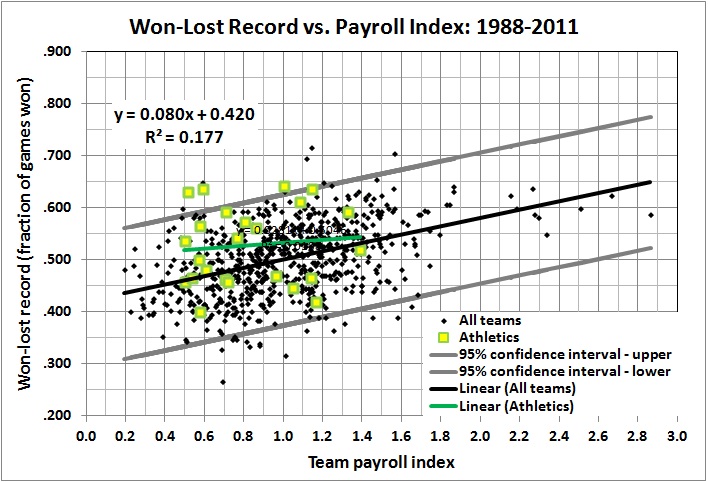
Just how effective was “moneyball,” as it was practiced by the Oakland Athletics? There is evidence to suggest that it was quite effective. For example:


Sources and notes: Team won-lost records are from Baseball-Reference.com. Estimates of team payrolls are from USA Today’s database of salaries for professional sports teams, which begins in 1988 for major-league baseball (here). The payroll index measures the ratio of each team’s payroll in a given year to the major-league average for the same year.

The more that a team spends on player salaries, the better the team’s record. But payroll accounts for only about 18 percent of the variation in the records of major-league teams during the period 1988-2011. Which means that other factors, taken together, largely determine a team’s record. Among those factors is “moneyball” — the ability to identify, obtain, effectively use, and retain players who are “underpriced” relative to their potential. But the contribution of “moneyball” cannot be teased out of the data because, for one thing, it would be impossible to quantify the extent to which a team actually practices “moneyball.” That said, it is evident that during 1988-2011 the A’s did better than the average team, by the measure of wins per dollar of payroll: Compare the dark green regression line, representing the A’s, with the black regression line, representing all teams.

That is all well and good, but the purpose of a baseball team is not to win a high number of games per dollar of payroll; it is to win — period. By that measure, the A’s of the Alderson-Beane “moneyball” era have been successful, at times, but not uniquely so:


Source: Derived from Baseball-Reference.com.

The sometimes brilliant record of the Athletics franchise during 1901-1950 is owed to one man: Cornelius McGillicuddy (1862-1956). And the often dismal record of the franchise during 1901-1950 is owed to one man: the same Cornelius McGillicuddy. True fans of baseball (and collectors of trivia) know Cornelius McGillicuddy as Connie Mack, or more commonly as Mr. Mack. The latter is an honorific bestowed on Mack because of his dignified mien and distinguished career in baseball: catcher from 1886 to 1896; manager of the Pittsburgh Pirates from 1894 to 1896; manager of the Philadelphia Athletics from 1901 to 1950; part owner and then sole owner of the Athletics from 1901 to 1954.  (He is also an ancestor of two political figures who bear his real name and alias: Connie Mack III and Connie Mack IV.)

Mack’s long leadership and ownership of the A’s is important because it points to the reasons for the A’s successes and failures during the fifty years that he led the team from the bench. Here, from Wikipedia, is a story that is familiar to persons who know their baseball history:

[Mack] was widely praised in the newspapers for his intelligent and innovative managing, which earned him the nickname “the Tall Tactician”. He valued intelligence and “baseball smarts”, always looking for educated players. (He traded away Shoeless Joe Jackson despite his talent because of his bad attitude and unintelligent play.[9]) “Better than any other manager, Mack understood and promoted intelligence as an element of excellence.”[10] He wanted men who were self-directed, self-disciplined and self-motivated; his ideal player was Eddie Collins.[11]

“Mack looked for seven things in a young player: physical ability, intelligence, courage, disposition, will power, general alertness and personal habits.”[12]

He also looked for players with quiet and disciplined personal lives, having seen many players destroy themselves and their teams through heavy drinking in his playing days. Mack himself never drank; before the 1910 World Series he asked all his players to “take the pledge” not to drink during the Series. When Topsy Hartsel told Mack he needed a drink the night before the final game, Mack told him to do what he thought best, but in these circumstances “if it was me, I’d die before I took a drink.”[13]

In any event, his managerial style was not tyrannical but easygoing.[14] He never imposed curfews or bed checks, and made the best of what he had; Rube Waddell was the best pitcher and biggest gate attraction of his first decade as A’s manager, so he put up with his drinking and general unreliability for years until it began to bring the team down and the other players asked Mack to get rid of him.[15]

Mack’s strength as a manager was finding the best players, teaching them well and letting them play. “He did not believe that baseball revolved around managerial strategy.”[10] He was “one of the first managers to work on repositioning his fielders” during the game, often directing the outfielders to move left or right, play shallow or deep, by waving his rolled-up scorecard from the bench.[12] After he became well known for doing this, he often passed his instructions to the fielders by way of other players, and simply waved his scorecard as a feint.[16]

*   *   *

Mack saw baseball as a business, and recognized that economic necessity drove the game. He explained to his cousin, Art Dempsey, that “The best thing for a team financially is to be in the running and finish second. If you win, the players all expect raises.” This was one reason he was constantly collecting players, signing almost anyone to a ten-day contract to assess his talent; he was looking ahead to future seasons when his veterans would either retire or hold out for bigger salaries than Mack could give them.

Unlike most baseball owners, Mack had almost no income apart from the A’s, so he was often in financial difficulties. Money problems – the escalation of his best players’ salaries (due both to their success and to competition from the new, well-financed Federal League), combined with a steep drop in attendance due to World War I — led to the gradual dispersal of his second championship team, the 19101914 team, who [sic] he sold, traded, or released over the years 1915–1917. The war hurt the team badly, leaving Mack without the resources to sign valuable players….

All told, the A’s finished dead last in the AL seven years in a row from 1915 to 1921, and would not reach .500 again until 1926. The rebuilt team won back-to-back championships in 1929–1930 over the Cubs and Cardinals, and then lost a rematch with the latter in 1931. As it turned out, these were the last WS titles and pennants the Athletics would win in Philadelphia or for another four decades.

With the onset of the Great Depression, Mack struggled financially again, and was forced to sell the best players from his second great championship team, such as Lefty Grove and Jimmie Foxx, to stay in business. Although Mack wanted to rebuild again and win more championships, he was never able to do so owing to a lack of funds.

Had an earlier Michael Lewis written Moneyball in the 1950s, as a retrospective on Mack’s career as a manager-owner, that Lewis would have said (correctly) that the A’s successes and failures were directly related to (a) the amount of money spent on the team’s payroll, (b) Connie Mack’s character-based criteria for selecting players, and (c) his particular approach to managing players.  That is quite a different story than the one conveyed by the Moneyball written by the real Lewis.

Which version of Moneyball is correct? No one can say for sure. But the powerful evidence of Connie Mack’s long tenure suggests that it takes a combination of the two versions of Moneyball to be truly successful, that is, to post a winning record year after year. It seems that Lewis (inadvertently) jumped to a conclusion about what makes for a successful baseball team — probably because he was struck by the A’s then-recent success and did not look to the A’s history.

In any event, success through luck is not the moral of Moneyball; the moral is success through deliberate effort. But Michael Lewis ignored the moral of his own “masterwork” when he stood before an audience of Princeton graduates and told them that they are merely (or mainly) lucky. How does one graduate from Princeton merely (or mainly) by being lucky? Does it not require the application of one’s genetic talents? Did not most of the graduates of Princeton arrive there, in the first place, because they had applied their genetic talents well during their years in high school or prep school (and even before that)? Is one’s genetic inheritance merely a matter of luck, or is it the somewhat predictable result of the mating of two persons who were not thrown together randomly, but who had a lot in common — including (most likely) high intelligence?

Just as the cookie experiment invoked by Lewis is a load of pseudoscientific hogwash, the left-wing habit of finding luck at the bottom of every achievement is a load of politically correct hogwash. Worse, it is an excuse for punishing success.

Lewis’s peroration on luck is just a variation on a common left-wing theme: Success is merely a matter of luck, so it is the state’s right and duty to redistribute the spoils of luck.

Related posts:
Moral Luck
The Residue of Choice
Can Money Buy Excellence in Baseball?
Inventing “Liberalism”
Randomness Is Over-Rated
Fooled by Non-Randomness
Accountants of the Soul
Rawls Meets Bentham
Social Justice
Positive Liberty vs. Liberty
More Social Justice
Luck-Egalitarianism and Moral Luck
Nature Is Unfair
Elizabeth Warren Is All Wet
Luck and Baseball, One More Time
The Candle Problem: Balderdash Masquerading as Science
More about Luck and Baseball
Barack Channels Princess SummerFall WinterSpring
Obama’s Big Lie

That’s Life … Expectancy

UPDATED (BELOW) 07/24/12

For no particular reason, I looked up the most recent U.S. life tables issued by … are you ready? … the National Vital Statistics System of the National Center for Health Statistics of the Centers for Disease Control and Prevention of the U.S. Department of Health and Human Services. The full citation is Arias, Elizabeth; “United States life tables, 2007“; National vital statistics reports, vol. 59, no. 9; Hyattsville, Maryland: National Center for Health Statistics, September 28, 2011.

Relevant quotations from the report:

There are two types of life tables—the cohort (or generation) and the period (or current). The cohort life table presents the mortality experience of a particular birth cohort—all persons born in the year 1900, for example—from the moment of birth through consecutive ages in successive calendar years….

…[The] period life table for 2007 [the type presented in the report[ assumes a hypothetical cohort subject throughout its lifetime to the age-specific death rates prevailing for the actual population in 2007. The period life table may thus be characterized as rendering a ‘‘snapshot’’ of current mortality experience, and shows the long-range implications of a set of age-specific death rates that prevailed in a given year…..

…Hispanic females continued to have the highest life expectancy at birth (83.4 years), followed by non-Hispanic white
females (80.6 years), Hispanic males (78.2 years), non-Hispanic black females (76.5 years), non-Hispanic white males (75.8 years), and non-Hispanic black males (69.6 years)….

I constructed a couple of graphs from tables 11, 12, 14, 15, 17, and 18 of the report. The first depicts the additional number of years that a person of a given age (in 2007) could expect to live:

The second graph is self-explanatory:

Mortality rates bottom out at around age 11. Then rates then rise sharply, especially among males. The dangerous years for males extend from age 12 to about age 22. Male mortality then levels off or declines slightly before embarking on its long, steady, inexorable rise.

Hispanic females are the longest-lived of the groups, and have the lowest mortality rate at almost every age. But the pattern of the Hispanic-female mortality rate resembles that of male mortality from age 12 to age 22. Perhaps a lot of Hispanic female are exposed to the risks that beset males in their teens and early twenties. Nevertheless, Hispanic females in that age group fare better than other females.

Non-Hispanic black females fare as well as Non-Hispanic white females until age 20. But in the age range of 35 to 60, Non-Hispanic black females experience mortality rates that are second only to those of Non-Hispanic black males.

UPDATE

The statistics in the tables cited above include estimates of person-years attained for 100,000 live births. The disparities are striking:

Person-years Index*
Hispanic females 8,337,374 1.00
Non-Hispanic white females 8,061,655 0.97
Hispanic males 7,823,786 0.94
Non-Hispanic black females 7,654,925 0.92
Non-Hispanic white males 7,580,601 0.91
Non-Hispanic black males 6,963,840 0.84
* As a fraction of the number for Hispanic females.

Race and Reason: The Achievement Gap — Causes and Implications

This is the third (and probably last) post in a series. The first two posts are “Race and Reason: The Derbyshire Debacle” and “Race and Reason: The Victims of Affirmative Action.” The purpose of the series, as suggested by the titles of the posts, is to inject reason (and facts) into the discussion of race. It has been done before, of course, but it cannot hurt to add another voice to the chorus of race-realism.

Yes, I am a race-realist. I believe (based on fact) that the socioeconomic divide between blacks and other racial-ethnic groups in America is primarily a product of genetic and cultural differences that work to the general disadvantage of blacks.

I know that some readers will quickly reject what I have to say, and a lot of them will do so as soon as they reach the end of the preceding paragraph. Why? Because the facts that I present will not comport with their view of the way the world ought to be. What is the “ought to be”? Briefly, it is an imaginary world in which all races are equal in ability, and in which cultural differences hove no bearing on economic achievement. If that is your view of the world, and if you are unwilling to consider a different, fact-based view, you may stop reading now and return to the land of unreality. Before you do that, however, I want you to be aware of one important thing: My own racial views are neutral; that is, I am unprejudiced toward blacks as blacks, though I am greatly opposed to pro-black policies (as opposed to race-neutral ones), which have been harmful to black Americans as well as their countrymen. For evidence of my race-neutrality, see the note at the bottom of this post.

Then there are those readers who might agree with the facts that I present here, but who prefer to ignore them because they might “feed racism” and be used as an excuse to treat blacks as second-class citizens. Racists need no help from me or anyone else who presents the facts about the causes of the socioeconomic divide in America. Racists are immune to facts and see the world as they think it ought to be, which is free of blacks or with blacks shunted to second-class citizenship. The socioeconomic gap between blacks and other Americans cannot be shrunk by ignoring the reasons for the gap. The gap can be shrunk (though never closed) only by understanding its real causes and adopting policies that address those causes.

A note about usage: It is my practice in this blog to put “liberal” (and its variants) in quotation marks when referring to modern liberalism, which is quite a different thing than classical liberalism. The difference, of course, is that modern liberals espouse statism. In particular, they believe that what is adjudged “good” by academic-political elites should be imposed on everyone by the state. And liberty — despite its etymological relationship to the word liberal — be damned. Thus the sarcastic quotation marks, or sneer quotes. In any event, I have, in this post, omitted the quotation marks for the sake of typographical neatness. Rest assured, however, that where I use “liberal” and its variants in this post I am referring to statists and statism.

Continued below the fold. Continue reading “Race and Reason: The Achievement Gap — Causes and Implications”

Not-So-Random Thoughts (IV)

Links to the other posts in this occasional series may be found at “Favorite Posts,” just below the list of topics.

Demystifying Science

Read my post about “Demystifying Science.” If you do, you will be unsurprised by Via Media’s post about “Unsettling Science.” Samples:

Me —

It is hard for scientists to rise above their human impulses. Einstein, for example, so much wanted quantum physics to be deterministic rather than probabilistic that he said “God does not play dice with the universe.” To which Nils Bohr replied, “Einstein, stop telling God what to do.” But the human urge to be “right” or to be on the “right side” of an issue does not excuse anti-scientific behavior, such as that of so-called scientists who have become invested in AGW.

There are many so-called scientists who subscribe to AGW without having done relevant research. Why? Because AGW is the “in” thing, and they do not wish to be left out. This is the stuff of which “scientific consensus” is made. If you would not buy a make of automobile just because it is endorsed by a celebrity who knows nothing about automotive engineering, why would you “buy” AGW just because it is endorsed by a herd of so-called scientists who have never done research that bears directly on it?

There are two lessons to take from this. The first is  that no theory is ever proven. (A theory may, if it is well and openly tested, be useful guide to action in certain rigorous disciplines, such as engineering and medicine.) Any theory — to be a truly scientific one — must be capable of being tested, even by (and especially by) others who are skeptical of the theory. Those others must be able to verify the facts upon which the theory is predicated, and to replicate the tests and calculations that seem to validate the theory. So-called scientists who restrict access to their data and methods are properly thought of as cultists with a political agenda, not scientists. Their theories are not to be believed — and certainly are not to be taken as guides to action.

The second lesson is that scientists are human and fallible. It is in the best tradition of science to distrust their claims and to dismiss their non-scientific utterances.

Mead (at Via Media) —

Reports that the public is losing “faith in science” have caused a lot of chin stroking, head wagging and even some and finger pointing among the intelligentsia — especially since the studies point to a particularly sharp decline among conservatives.

Via Meadia isn’t so sure all this is on the right; the last time we looked, environmentalists around the world were denouncing decades of careful scientific research on the safety of genetically modified organisms, with dire economic consequences for African development. We’ve also noticed a distinct lack of faith in arithmetic by blue politicians who think that promising large pensions to union workers while failing to set money aside to pay those promises is a course of action that can somehow end well.

There is no sport intellectual elites enjoy more than recounting and bewailing the follies and errors of the Great Unwashed out there in flyover land, so in the academy and elsewhere the story of declining confidence in science is seen as reflecting a declining confidence in reason itself — and evidence of the rising tide of stupidity against which we enlightened few must ceaselessly battle.

But are things really so simple?…

Back in May 2011, Harvard University was rocked by the scandal of Professor Marc Hauser. A decorated senior scientist consistently voted one of the most popular professors by students, Hauser was the director of the university’s Mind, Brain and Behavior program and a trailblazer in the field of evolutionary psychology. He was also a fraud who falsified data in his experiments and was ultimately outed by his own graduate students. When the truth came out, he was barred from teaching and resigned from Harvard in disgrace.

Hauser’s case was far from an isolated incident. Seven months later, the New York Times reported on the corruption of noted Netherlands psychologist Diederik Stape, who managed to mislead the top scientific journals and bamboozle the best science reporters (including those at the Times) with article after article of fraudulent findings:

Corrupt, incompetent scientists? Lax research standards? Systemically flawed peer review processes? These problems, alas, are anything but rare. Stories like Stapel’s, plus reports on the findings of the evidence-based medicine movement about the unreliability of much medical science, and studies like Leslie John’s in Psychological Science (which revealed that the vast majority of psychologists engaged in questionable research practices and that one in ten falsified data)–not to mention the various alarmist exaggerations of some climate researchers–demonstrate that in many cases scientists have no one but themselves to blame for the loss of public faith in their work. Through laziness, politicization of findings, and outright falsification, the practitioners of some of our most important sciences have discredited their disciplines. Every Stapel and Hauser strengthens the voices of science skeptics — and rightly so.

More Inconvenient Facts about “The Rich”

Remember my posts “Taxing the Rich” and “More About Taxing the Rich,” in which I recorded my correspondence with an envious “progressive” leveler.  If not, this your chance to read them. Here are a couple of passages from the second post:

[I]t’s important to keep in mind that people aren’t “stuck” in a particular quintile; there’s a general tendency to move up as one ages, and then to drop down a bit after retiring. For more, see this: http://mjperry.blogspot.com/2008/02/rich-getting-richer-and-poor-are.html.

As you know from our earlier exchange, high-income people already are paying the lion’s share of taxes in this country. (And, surprisingly, more than their peers in the other industrialized nations: http://www.taxfoundation.org/blog/show/27134.html.)

Mark Perry recently posted more about the volatility of high-income groups and the share of taxes paid by whoever happens to be in a high-income group. In “Significant Turnover in the Top 400 U.S. Earners; From 1992-2009, 85% Were in Just 1 or 2 Years,” Perry notes that the

IRS has a new report on the 400 taxpayers reporting the highest adjusted gross incomes (AGI) from 1992 to 2009, and the table above shows the frequency of appearing the “Fortunate 400” over the entire period (Table 4 in the IRS report). The 7,200 tax returns (400 highest earners x 18 years) from 1992 to 2009 represented 3,869 unique, individual taxpayers, since some taxpayers made it into the top 400 earner group more than one year. The data show that:

1. Of the group of 3,869 top earners from 1992-2009, 2,824 individuals made it into the “Fortunate 400” only one time during the 18-year period. Those 2,824 one-timers represent about 73% of the total (3,869), so only about one out of every four, or 27% of the total, made it into the top 400 more than once between 1992 and 2009 (see columns 2 and 3 above).

2. Moreover, 2,824 earners made it into the top 400 once (73%), and another 458 ( about 12%) made it into the top group twice. So 85% made it into the “Fortunate 400” group either once or twice, and only about 15% made it into the top group more than twice.

3. There were only 87 taxpayers out of the 3,869 total taxpayers in the group (2.25%) who were in the top 400 in 10 or more years.

4. Of the 7,200 total returns filed over the 18-year period, 2,824 represent one-timers, so on average in any given year, about 40% of the returns are filed by taxpayers who are not in the “Fortunate 400” in any of the other 17 years (see last two columns).  And more than half of the total 7,200 “Fortunate 400” returns between 1992-2009 (3,740 and 52%) were filed by taxpayers whose returns only appeared in one or two of the 17 years.

According to the IRS, “The data reveal a mostly changing group of taxpayers over time. In fact, there were 3,869 different taxpayers represented in total for the 18-year period. Of these, a little more than 27 percent appear more than once and slightly more than 2 percent were represented in 10 or more years.”

Perry followed with “Top 400 Taxpayers Paid Almost As Much in Federal Income Taxes in 2009 as the Entire Bottom 50%.” The title says it all.

That’s it for today, folks. One more thing…

The Myth That Same-Sex “Marriage” Causes No Harm

That’s the title of a post from last October, in which I quote an article by Stephen Heaney. He says (among other things):

If government exists to support us in our flourishing, then it is obligated, in the deepest sense, to function in accordance with the truth of what is fitting for us. It is obligated to try to protect us from harm, and to support us in what is good for us….

The cause du jour, the primary contest over human flourishing, is the debate over the meaning of marriage.

The truth of marriage is that it can only exist between one man and one woman, for the sake of the children who may come as a result of their sexual union. Thus government is obligated to recognize the truth of marriage; to protect and support that project of bringing children into the world and caring for them; to recognize all and only actual marriages; and to discourage sexual acts in other contexts.

One of the arguments for same-sex “marriage” is that

research shows no difference in outcomes between children whose parents have same-sex relationships and their peers raised by heterosexual parents.

That is from “New Research on Children of Same-Sex Parents Suggests Differences Matter,” which goes on to note the following:

Yesterday the academic journal Social Science Research published a detailed methodological review of the research on which the APA bases its conclusion—a study that questions the validity of the “no difference” assertion. Conducted by a Louisiana State University family scholar, the article concludes:

[N]ot one of the 59 studies referenced in the 2005 APA Brief compares a large, random, representative sample of lesbian or gay parents and their children with a large, random, representative sample of married parents and their children. The available data, which are drawn primarily from small convenience samples, are insufficient to support a strong generalizable claim either way. Such a statement would not be grounded in science. To make a generalizable claim, representative, large-sample studies are needed—many of them.

A large representative sample is supplied in a second new study, conducted by a University of Texas–Austin sociologist and published in the same journal. The New Family Structures Study (NFSS), under the direction of Dr. Mark Regnerus, provides the most representative picture to date of young adults whose parents had same-sex relationships. NFSS is a large, random, nationally representative sample….

According to NFSS, just 1.7 percent of young adults ages 18 to 39 reported having a parent who has had a same-sex romantic relationship. The experience of long-term stability in same-sex households is rarer still….

Only two respondents whose mothers had a same-sex relationship reported that this living arrangement lasted all 18 years of their childhood. No respondents with fathers who had a same-sex relationship reported such longevity….

Compared to young adults in traditional, intact families, young adults whose mothers had a same-sex relationship tended to fare worse than their peers in intact biological families on 24 of the 40 outcomes examined. For example, they were far more likely to report being sexually victimized, to be on welfare, or to be currently unemployed.

Young adults whose fathers had a same-sex relationship showed significant differences from their peers in intact families on 19 of the outcomes. For example, they were significantly more likely to have contemplated suicide, to have a sexually transmitted infection, or to have been forced to have sex against their will….

A significant improvement on the limited research to date on child outcomes and same-sex parenting, this new study marks an important development in the research. As findings based on studies using the NFSS and other large, nationally representative data on same-sex parents and their children accumulate, a more generalizable picture will begin to emerge.

At present, far too little is known about this new household form into which activist courts are pushing America—and much of what has been presented to date gives an inaccurate picture of the reality that children of same-sex parenting have experienced.

NFSS project director Dr. Mark Regnerus concludes in a piece running on Slate today that “the stable, two-parent biological married model [is] the far more common and accomplished workhorse of the American household, and still—according to the data, at least—the safest place for a kid.”

Ah, but don’t tell your typical libertarian that the “harm principle” is an empty concept that lends itself to socially destructive causes like same-sex “marriage.”

Not-So-Random Thoughts (III)

Links to the other posts in this occasional series may be found at “Favorite Posts,” just below the list of topics.

Apropos Science

In the vein of “Something from Nothing?” there is this:

[Stephen] Meyer also argued [in a a recent talk at the University Club in D.C.] that biological evolutionary theory, which “attempts to explain how new forms of life evolved from simpler pre-existing forms,” faces formidable difficulties. In particular, the modern version of Darwin’s theory, neo-Darwinism, also has an information problem.

Mutations, or copying errors in the DNA, are analogous to copying errors in digital code, and they supposedly provide the grist for natural selection. But, Meyer said: “What we know from all codes and languages is that when specificity of sequence is a condition of function, random changes degrade function much faster than they come up with something new.”…

The problem is comparable to opening a big combination lock. He asked the audience to imagine a bike lock with ten dials and ten digits per dial. Such a lock would have 10 billion possibilities with only one that works. But the protein alphabet has 20 possibilities at each site, and the average protein has about 300 amino acids in sequence….

Remember: Not just any old jumble of amino acids makes a protein. Chimps typing at keyboards will have to type for a very long time before they get an error-free, meaningful sentence of 150 characters. “We have a small needle in a huge haystack.” Neo-Darwinism has not solved this problem, Meyer said. “There’s a mathematical rigor to this which has not been a part of the so-called evolution-creation debate.”…

“[L]eading U.S. biologists, including evolutionary biologists, are saying we need a new theory of evolution,” Meyer said. Many increasingly criticize Darwinism, even if they don’t accept design. One is the cell biologist James Shapiro of the University of Chicago. His new book is Evolution: A View From the 21st Century. He’s “looking for a new evolutionary theory.” David Depew (Iowa) and Bruce Weber (Cal State) recently wrote in Biological Theory that Darwinism “can no longer serve as a general framework for evolutionary theory.” Such criticisms have mounted in the technical literature. (Tom Bethell, “Intelligent Design at the University Club,” American Spectator, May 2012)

And this:

[I]t is startling to realize that the entire brief for demoting human beings, and organisms in general, to meaningless scraps of molecular machinery — a demotion that fuels the long-running science-religion wars and that, as “shocking” revelation, supposedly stands on a par with Copernicus’s heliocentric proposal — rests on the vague conjunction of two scarcely creditable concepts: the randomness of mutations and the fitness of organisms. And, strangely, this shocking revelation has been sold to us in the context of a descriptive biological literature that, from the molecular level on up, remains almost nothing buta documentation of the meaningfully organized, goal-directed stories of living creatures.

Here, then, is what the advocates of evolutionary mindlessness and meaninglessness would have us overlook. We must overlook, first of all, the fact that organisms are masterful participants in, and revisers of, their own genomes, taking a leading position in the most intricate, subtle, and intentional genomic “dance” one could possibly imagine. And then we must overlook the way the organism responds intelligently, and in accord with its own purposes, to whatever it encounters in its environment, including the environment of its own body, and including what we may prefer to view as “accidents.” Then, too, we are asked to ignore not only the living, reproducing creatures whose intensely directed lives provide the only basis we have ever known for the dynamic processes of evolution, but also all the meaning of the larger environment in which these creatures participate — an environment compounded of all the infinitely complex ecological interactions that play out in significant balances, imbalances, competition, cooperation, symbioses, and all the rest, yielding the marvelously varied and interwoven living communities we find in savannah and rainforest, desert and meadow, stream and ocean, mountain and valley. And then, finally, we must be sure to pay no heed to the fact that the fitness, against which we have assumed our notion of randomness could be defined, is one of the most obscure, ill-formed concepts in all of science.

Overlooking all this, we are supposed to see — somewhere — blind, mindless, random, purposeless automatisms at the ultimate explanatory root of all genetic variation leading to evolutionary change. (Stephen L. Talbott, “Evolution and the Illusion of Randomness,” The New Atlantis, Fall 2011)

My point is not to suggest that that the writers are correct in their conjectures. Rather, the force of their conjectures shows that supposedly “settled” science is (a) always far from settled (on big questions, at least) and (b) necessarily incomplete because it can never reach ultimate truths.

Trayvon, George, and Barack

Recent revelations about the case of Trayvon Martin and George Zimmerman suggest the following:

  • Martin was acting suspiciously and smelled of marijuana.
  • Zimmerman was rightly concerned about Martin’s behavior, given the history of break-ins in Zimmerman’s neighborhood.
  • Martin attacked Zimmerman, had him on the ground, was punching his face, and had broken his nose.
  • Zimmerman shot Martin in self-defense.

Whether the encounter was “ultimately avoidable,” as a police report asserts, is beside the point.  Zimmerman acted in self-defense, and the case against him should be dismissed. The special prosecutor should be admonished by the court for having succumbed to media and mob pressure in bringing a charge of second-degree murder against Zimmerman.

What we have here is the same old story: Black “victim”–>media frenzy to blame whites (or a “white Hispanic”), without benefit of all relevant facts–>facts exonerate whites. To paraphrase Shakespeare: The first thing we should do after the revolution is kill all the pundits (along with the lawyers).

Obama famously said, “”If I had a son, he would look like Trayvon.” Given the thuggish similarity between Trayvon and Obama (small sample here), it is more accurate to say that if Obama had a son, he would be like Trayvon.

Creepy People

Exhibit A is Richard Thaler, a self-proclaimed libertarian who is nothing of the kind. Thaler defends the individual mandate that is at the heart of Obamacare (by implication, at least), when he attacks the “slippery slope” argument against it. Annon Simon nails Thaler:

Richard Thaler’s NYT piece from a few days ago, Slippery-Slope Logic, Applied to Health Care, takes conservatives to task for relying on a “slippery slope” fallacy to argue that Obamacare’s individual mandate should be invalidated. Thaler believes that the hypothetical broccoli mandate — used by opponents of Obamacare to show that upholding the mandate would require the Court to acknowledge congressional authority to do all sorts of other things — would never be adopted by Congress or upheld by a federal court. This simplistic view of the Obamacare litigation obscures legitimate concerns over the amount of power that the Obama administration is claiming for the federal government. It also ignores the way creative judges can use previous cases as building blocks to justify outcomes that were perhaps unimaginable when those building blocks were initially formed….

[N]ot all slippery-slope claims are fallacious. The Supreme Court’s decisions are often informed by precedent, and, as every law student learned when studying the Court’s privacy cases, a decision today could be used by a judge ten years from now to justify outcomes no one had in mind.

In 1965, the Supreme Court in Griswold v. Connecticut, referencing penumbras and emanations, recognized a right to privacy in marriage that mandated striking down an anti-contraception law.

Seven years later, in Eisenstadt v. Baird, this right expanded to individual privacy, because after all, a marriage is made of individuals, and “[i]f the right of privacy means anything, it is the right of the individual . . . to be free from unwarranted governmental intrusion into matters so fundamentally affecting a person as the decision whether to bear or beget a child.”

By 1973 in Roe v. Wade, this precedent, which had started out as a right recognized in marriage, had mutated into a right to abortion that no one could really trace to any specific textual provision in the Constitution. Slippery slope anyone?

This also happened in Lawrence v. Texas in 2003, where the Supreme Court struck down an anti-sodomy law. The Court explained that the case did not involve gay marriage, and Justice O’Connor’s concurrence went further, distinguishing gay marriage from the case at hand. Despite those pronouncements, later decisions enshrining gay marriage as a constitutionally protected right have relied upon Lawrence. For instance, Goodridge v. Department of Public Health (Mass. 2003) cited Lawrence 9 times, Varnum v. Brien (Iowa 2009) cited Lawrence 4 times, and Perry v. Brown (N.D. Cal, 2010) cited Lawrence 9 times.

However the Court ultimately rules, there is no question that this case will serve as a major inflection point in our nation’s debate about the size and scope of the federal government. I hope it serves to clarify the limits on congressional power, and not as another stepping stone on the path away from limited, constitutional government. (“The Supreme Court’s Slippery Slope,” National Review Online, May 17, 2012)

Simon could have mentioned Wickard v. Filburn (1942), in which the Supreme Court brought purely private, intrastate activity within the reach of Congress’s power to regulate interstate commerce. The downward slope from Wickard v. Filburn to today’s intrusive regulatory regime has been been not merely slippery but precipitous.

Then there is Brian Leiter, some of whose statist musings I have addressed in the past. It seems that Leiter has taken to defending the idiotic Elizabeth Warren for her convenient adoption of a Native American identity. Todd Zywicki tears a new one for Leiter:

I was out of town most of last week and I wasn’t planning on blogging any more on the increasingly bizarre saga of Elizabeth Warren’s claim to Native American ancestry, which as of the current moment appears to be entirely unsubstantiated.  But I was surprised to see Brian Leiter’s post doubling-down in his defense of Warren–and calling me a “Stalinist” to boot (although I confess it is not clear why or how he is using that term).  So I hope you will indulge me while I respond.

First, let me say again what I expressed at the outset–I have known from highly-credible sources for a decade that in the past Warren identified herself as a Native American in order to put herself in a position to benefit from hiring preferences (I am certain that Brian knows this now too).  She was quite outspoken about it at times in the past and, as her current defenses have suggested, she believed that she was entitled to claim it.  So there would have been no reason for her to not identify as such and in fact she was apparently quite unapologetic about it at the time….

Second, Brian seems to believe for some reason that the issue here is whether Warren actually benefited from a hiring preference.  Of course it is not (as my post makes eminently clear).  The issue I raised is whether Warren made assertions as part of the law school hiring process in order to put herself in a position to benefit from a hiring preference for which she had no foundation….

Third, regardless of why she did it, Warren herself actually had no verifiable basis for her self-identification as Native American.  At the very least her initial claim was grossly reckless and with no objective foundation–it appears that she herself has never had any foundation for the claim beyond “family lore” and her “high cheekbones.”… Now it turns out that the New England Historical Genealogical Society, which had been the source for the widely-reported claim that she might be 1/32 Cherokee, has rescinded its earlier conclusion and now says “We have no proof that Elizabeth Warren’s great great great grandmother O.C. Sarah Smith either is or is not of Cherokee descent.”  The story adds, “Their announcement came in the wake of an official report from an Oklahoma county clerk that said a document purporting to prove Warren’s Cherokee roots — her great great great grandmother’s marriage license application — does not exist.”  A Cherokee genealogist has similarly stated that she can find no evidence to support Warren’s claim.  At this point her claim appears to be entirely unsupported as an objective matter and it appears that she herself had no basis for it originally.

Fourth, Brian’s post also states the obvious–that there is plenty of bad blood between Elizabeth and myself.  But, of course, the only reason that this issue is interesting and relevant today is because Warren is running for the U.S. Senate and is the most prominent law professor in America at this moment.

So, I guess I’ll conclude by asking the obvious question: if a very prominent conservative law professor (say, for example, John Yoo) had misrepresented himself throughout his professorial career in the manner that Elizabeth Warren has would Brian still consider it to be “the non-issue du jour“?  Really?

I’m not sure what a “Stalinist” is.  But I would think that ignoring a prominent person’s misdeeds just because you like her politics, and attacking the messenger instead, just might fit the bill. (“New England Genealogical Historical Society Rescinds Conclusion that Elizabeth Warren Might Be Cherokee,” The Volokh Conspiracy, May 17, 2012)

For another insight into Leiter’s character, read this and weep not for him.

Tea Party Sell-Outs

Business as usual in Washington:

This week the Club for Growth released a study of votes cast in 2011 by the 87 Republicans elected to the House in November 2010. The Club found that “In many cases, the rhetoric of the so-called “Tea Party” freshmen simply didn’t match their records.” Particularly disconcerting is the fact that so many GOP newcomers cast votes against spending cuts.

The study comes on the heels of three telling votes taken last week in the House that should have been slam-dunks for members who possess the slightest regard for limited government and free markets. Alas, only 26 of the 87 members of the “Tea Party class” voted to defund both the Economic Development Administration and the president’s new Advanced Manufacturing Technology Consortia program (see my previous discussion of these votes here) and against reauthorizing the Export-Import Bank (see my colleague Sallie James’s excoriation of that vote here).

I assembled the following table, which shows how each of the 87 freshman voted. The 26 who voted for liberty in all three cases are highlighted. Only 49 percent voted to defund the EDA. Only 56 percent voted to defund a new corporate welfare program requested by the Obama administration. And only a dismal 44 percent voted against reauthorizing “Boeing’s bank.” That’s pathetic. (Tad DeHaven, “Freshman Republicans Switch from Tea to Kool-Aid,” Cato@Liberty, May 17, 2012)

Lesson: Never trust a politician who seeks a position of power, unless that person earns trust by divesting the position of power.

PCness

Just a few of the recent outbreaks of PCness that enraged me:

Michigan Mayor Calls Pro-Lifers ‘Forces of Darkness’” (reported by LifeNews.com on May 11, 2012)

US Class Suspended for Its View on Islam” (reported by CourierMail.com.au, May 11, 2012)

House Democrats Politicize Trayvon Martin” (posted at Powerline, May 8, 2012)

Chronicle of Higher Education Fires Blogger for Questioning Seriousness of Black Studies Depts.” (posted at Reason.com/hit & run, May 8, 2012)

Technocracy, Externalities, and Statism

From a review of Robert Frank’s The Darwin Economy:

In many ways, economics is the discipline best suited to the technocratic mindset. This has nothing to do with its traditional subject matter. It is not about debating how to produce goods and services or how to distribute them. Instead, it relates to how economics has emerged as an approach that distances itself from democratic politics and provides little room for human agency.

Anyone who has done a high-school course in economics is likely to have learned the basics of its technocratic approach from the start. Students have long been taught that economics is a ‘positive science’ – one based on facts rather than values. Politicians are entitled to their preferences, so the argument went, but economists are supposed to give them impartial advice based on an objective examination of the facts.

More recently this approach has been taken even further. The supposedly objective role of the technocrat-economist has become supreme, while the role of politics has been sidelined….

The starting point of The Darwin Economy is what economists call the collective action problem: the divergence between individual and collective interests. A simple example is a fishermen fishing in a lake. For each individual, it might be rational to catch as many fish as possible, but if all fishermen follow the same path the lake will eventually be empty. It is therefore deemed necessary to find ways to negotiate this tension between individual and group interests.

Those who have followed the discussion of behavioural economics will recognise that this is an alternative way of viewing humans as irrational. Behavioural economists focus on individuals behaving in supposedly irrational ways. For example, they argue that people often do not invest enough to secure themselves a reasonable pension. For Frank, in contrast, individuals may behave rationally but the net result of group behaviour can still be irrational….

…From Frank’s premises, any activity considered harmful by experts could be deemed illegitimate and subjected to punitive measures….

…[I]t is … wrong to assume that there is no more scope for economic growth to be beneficial. Even in the West, there is a long way to go before scarcity is limited. This is not just a question of individuals having as many consumer goods as they desire – although that has a role. It also means having the resources to provide as many airports, art galleries, hospitals, power stations, roads, schools, universities and other facilities as are needed. There is still ample scope for absolute improvements in living standards…. (Daniel Ben-ami, “Delving into the Mind of the Technocrat,” The Spiked Review of Books, February 2012)

There is much to disagree with in the review, but the quoted material is right on. It leads me to quote myself:

…[L]ife is full of externalities — positive and negative. They often emanate from the same event, and cannot be separated. State action that attempts to undo negative externalities usually results in the negation or curtailment of positive ones. In terms of the preceding example, state action often is aimed at forcing the attractive woman to be less attractive, thus depriving quietly appreciative men of a positive externality, rather than penalizing the crude man if his actions cross the line from mere rudeness to assault.

The main argument against externalities is that they somehow result in something other than a “social optimum.” This argument is pure, economistic hokum. It rests on the unsupportable belief in a social-welfare function, which requires the balancing (by an omniscient being, I suppose) of the happiness and unhappiness that results from every action that affects another person, either directly or indirectly….

A believer in externalities might respond by saying that they are of “economic” importance only as they are imposed on bystanders as a spillover from economic transactions, as in the case of emissions from a power plant that can cause lung damage in susceptible persons. Such a reply is of a kind that only an omniscient being could make with impunity. What privileges an economistic thinker to say that the line of demarcation between relevant and irrelevant acts should be drawn in a certain place? The authors of campus speech codes evidently prefer to draw the line in such a way as to penalize the behavior of the crude man in the above example. Who is the economistic thinker to say that the authors of campus speech codes have it wrong? And who is the legalistic thinker to say that speech should be regulated by deferring to the “feelings” that it arouses in persons who may hear or read it?

Despite the intricacies that I have sketched, negative externalities are singled out for attention and rectification, to the detriment of social and economic intercourse. Remove the negative externalities of electric-power generation and you make more costly (and even inaccessible) a (perhaps the) key factor in America’s economic growth in the past century. Try to limit the supposed negative externality of human activity known as “greenhouse gases” and you limit the ability of humans to cope with that externality (if it exists) through invention, innovation, and entrepreneurship. Limit the supposed negative externality of “offensive” speech and you quickly limit the range of ideas that may be expressed in political discourse. Limit the supposed externalities of suburban sprawl and you, in effect, sentence people to suffer the crime, filth, crowding, contentiousness, heat-island effects, and other externalities of urban living.

The real problem is not externalities but economistic and legalistic reactions to them….

The main result of rationalistic thinking — because it yields vote-worthy slogans and empty promises to fix this and that “problem” — is the aggrandizement of the state, to the detriment of civil society.

The fundamental error of rationalists is to believe that “problems” call for collective action, and to identify collective action with state action. They lack the insight and imagination to understand that the social beings whose voluntary, cooperative efforts are responsible for mankind’s vast material progress are perfectly capable of adapting to and solving “problems,” and that the intrusions of the state simply complicate matters, when not making them worse. True collective action is found in voluntary social and economic intercourse, the complex, information-rich content of which rationalists cannot fathom. They are as useless as a blind man who is shouting directions to an Indy 500 driver….

Theodore Dalrymple

If you do not know of Theodore Dalrymple, you should. His book, In Praise of Prejudice: The Necessity of Preconceived Ideas, inspired  “On Liberty,” the first post at this blog. Without further ado, I commend these recent items by and about Dalrymple:

Rotting from the Head Down” (an article by Dalrymple about the social collapse of Britain, City Journal, March 8, 2012)

Symposium: Why Do Progressives Love Criminals?” (Dalrymple and others, FrontPageMag.com, March 9, 2012)

Doctors Should Not Vote for Industrial Action,” a strike, in American parlance (a post by Dalrymple, The Social Affairs Unit, March 22, 2012)

The third item ends with this:

The fact is that there has never been, is never, and never will be any industrial action over the manifold failures of the public service to provide what it is supposed to provide. Whoever heard of teachers going on strike because a fifth of our children emerge from 11 years of compulsory education unable to read fluently, despite large increases in expenditure on education?

If the doctors vote for industrial action, they will enter a downward spiral of public mistrust of their motives. They should think twice before doing so.

Amen.

The Higher-Eduction Bubble

The title of a post at The Right Coast tells the tale: “Under 25 College Educated More Unemployed than Non-college Educated for First Time.” As I wrote here,

When I entered college [in 1958], I was among the 28 percent of high-school graduates then attending college. It was evident to me that about half of my college classmates didn’t belong in an institution of higher learning. Despite that, the college-enrollment rate among high-school graduates has since doubled.

(Also see this.)

American taxpayers should be up in arms over the subsidization of an industry that wastes their money on the useless education of masses of indeducable persons. Then there is the fact that taxpayers are forced to subsidize the enemies of liberty who populate university faculties.

The news about unemployment among college grads may hasten the bursting of the higher-ed bubble. It cannot happen too soon.

Something from Nothing?

I do not know if Lawrence Krauss typifies scientists in his logical obtuseness, but he certainly exemplifies the breed of so-called scientists who proclaim atheism as a scientific necessity.  According to a review by David Albert of Krauss’s recent book, A Universe from Nothing,

the laws of quantum mechanics have in them the makings of a thoroughly scientific and adamantly secular explanation of why there is something rather than nothing.

Albert’s review, which I have quoted extensively elsewhere, comports with Edward Feser’s analysis:

The bulk of the book is devoted to exploring how the energy present in otherwise empty space, together with the laws of physics, might have given rise to the universe as it exists today. This is at first treated as if it were highly relevant to the question of how the universe might have come from nothing—until Krauss acknowledges toward the end of the book that energy, space, and the laws of physics don’t really count as “nothing” after all. Then it is proposed that the laws of physics alone might do the trick—though these too, as he implicitly allows, don’t really count as “nothing” either.

Bill Vallicella puts it this way:

[N]o one can have any objection to a replacement of the old Leibniz question — Why is there something rather than nothing? … — with a physically tractable question, a question of interest to cosmologists and one amenable to a  physics solution. Unfortunately, in the paragraph above, Krauss provides two different replacement questions while stating, absurdly, that the second is a more succinct version of the first:

K1. How can a physical universe arise from an initial condition in which there are no particles, no space and perhaps no time?

K2. Why is there ‘stuff’ instead of empty space?

These are obviously distinct questions.  To answer the first one would have to provide an account of how the universe originated from nothing physical: no particles, no space, and “perhaps” no time.  The second question would be easier to answer because it presupposes the existence of space and does not demand that empty space be itself explained.

Clearly, the questions are distinct.  But Krauss conflates them. Indeed, he waffles between them, reverting to something like the first question after raising the second.  To ask why there is something physical as opposed to nothing physical is quite different from asking why there is physical “stuff” as opposed to empty space.

Several years ago, I explained the futility of attempting to decide the fundamental question of creation and its cause on scientific grounds:

Consider these three categories of knowledge (which long pre-date their use by Secretary of Defense Donald Rumsfeld): known knowns, know unknowns, and unknown unknowns. Here’s how that trichotomy might be applied to a specific aspect of scientific knowledge, namely, Earth’s rotation about the Sun:

1. Known knowns — Earth rotates about the Sun, in accordance with Einstein’s theory of general relativity.

2. Known unknowns — Earth, Sun, and the space between them comprise myriad quantum phenomena (e.g., matter and its interactions of matter in, on, and above the Earth and Sun; the transmission of light from Sun to Earth). We don’t know whether and how quantum phenomena influence Earth’s rotation about the Sun; that is, whether Einsteinian gravity is a partial explanation of a more complete theory of gravity that has been dubbed quantum gravity.

3. Unknown unknowns — Other things might influence Earth’s rotation about the Sun, but we don’t know what those other things are, if there are any.

For the sake of argument, suppose that scientists were as certain about the origin of the universe in the Big Bang as they are about the fact of Earth’s rotation about the Sun. Then, I would write:

1. Known knowns — The universe was created in the Big Bang, and the universe — in the large — has since been “unfolding” in accordance with Einsteinian relativity.

2. Known unknowns — The Big Bang can be thought of as a meta-quantum event, but we don’t know if that event was a manifestation of quantum gravity. (Nor do we know how quantum gravity might be implicated in the subsequent unfolding of the universe.)

3. Unknown unknowns — Other things might have caused the Big Bang, but we don’t know if there were such things or what those other things were — or are.

Thus — to a scientist qua scientist — God and Creation are unknown unknowns because, as unfalsifiable hypotheses, they lie outside the scope of scientific inquiry. Any scientist who pronounces, one way or the other, on the existence of God and the reality of Creation has — for the moment, at least — ceased to be scientist.

Which is not to say that the question of creation is immune to logical analysis; thus:

To say that the world as we know it is the product of chance — and that it may exist only because it is one of vastly many different (but unobservable) worlds resulting from chance — is merely to state a theoretical possibility. Further, it is a possibility that is beyond empirical proof or disproof; it is on a par with science fiction, not with science.

If the world as we know it — our universe — is not the product of chance, what is it? A reasonable answer is found in another post of mine, “Existence and Creation.” Here is the succinct version:

  1. In the material universe, cause precedes effect.
  2. Accordingly, the material universe cannot be self-made. It must have a “starting point,” but the “starting point” cannot be in or of the material universe.
  3. The existence of the universe therefore implies a separate, uncaused cause.

There is no reasonable basis — and certainly no empirical one — on which to prefer atheism to deism or theism. Strident atheists merely practice a “religion” of their own. They have neither logic nor science nor evidence on their side — and eons of belief against them.

Another blogger once said this about the final sentence of that quotation, which I lifted from another post of mine:

I would have to disagree with the last sentence. The problem is epistemology — how do we know what we know? Atheists, especially ‘scientistic’ atheists, take the position that the modern scientific methodology of observation, measurement, and extrapolation from observation and measurement, is sufficient to detect anything that Really Exists — and that the burden of proof is on those who propose that something Really Exists that cannot be reliably observed and measured; which is of course impossible within that mental framework. They have plenty of logic and science on their side, and their ‘evidence’ is the commonly-accepted maxim that it is impossible to prove a negative.

I agree that the problem of drawing conclusions about creation from science (as opposed to logic) is epistemological. The truth and nature of creation is an “unknown unknown” or, more accurately, an “unknowable unknown.” With regard to such questions, scientists do not have logic and science on their side when they asset that the existence of the universe is possible without a creator, as a matter of science (as Krauss does, for example). Moreover, it is scientists who are trying to prove a negative: that there is neither a creator nor the logical necessity of one.

“Something from nothing” is possible, but only if there is a creator who is not part of the “something” that is the proper subject of scientific exploration and explanation.

Related posts:
Atheism, Religion, and Science
The Limits of Science
Three Perspectives on Life: A Parable
Beware of Irrational Atheism
The Creation Model
The Thing about Science
Evolution and Religion
Words of Caution for Scientific Dogmatists
Science, Evolution, Religion, and Liberty
The Legality of Teaching Intelligent Design
Science, Logic, and God
Capitalism, Liberty, and Christianity
Is “Nothing” Possible?
Debunking “Scientific Objectivity”
Science’s Anti-Scientific Bent
Science, Axioms, and Economics
The Big Bang and Atheism
The Universe . . . Four Possibilities
Einstein, Science, and God
Atheism, Religion, and Science Redux
Pascal’s Wager, Morality, and the State
Evolution as God?
The Greatest Mystery
What Is Truth?
The Improbability of Us
A Digression about Probability and Existence
More about Probability and Existence
Existence and Creation
Probability, Existence, and Creation
The Atheism of the Gaps

Combinatorial Play

What is it? It’s the term applied by Einstein to the creative combination of (seemingly) unconnected theories to develop new, more general theories.  Combinatorial play often works subconsciously, while a person is asleep or engaged in a “mindless” diversion. The possibility of arriving at a solution to a problem by shelving it — even overnight — underlies the counsel to “sleep on it.”

Combinatorial play occurs in the absence of artificial deadlines, which hamper truly creative thinking. Such thinking occurs when a person with deep knowledge of a practical, professional, or scientific subject acquires a new insight about the subject by thinking in new ways (often subconsciously) about his knowledge — by making new connections from “old facts,” so to speak.

Related reading:
Thought for thinkers:’Follow your gut,’ study advises on big decisions
Let Subconscious Handle Complex Decision Making?

More about Luck and Baseball

In “Luck and Baseball, One More Time,” I make the point that

it takes a lot more than luck to succeed at almost anything, from winning high office to making millions of dollars to painting a masterpiece to building a house to cutting hair properly. To denigrate the rich and famous by calling them lucky is to denigrate every person who strives, with some success, to overmaster whatever bad luck happens to come his way.

The backdrop for that claim is some statistical evidence from the history of major-league baseball:

In the 111-year history of the American League, 60 different players have led the league in batting. Those 60 players have recorded a total of 367 top-10 finishes in American League batting races over the years — an average of 6 top-10 finishes for each of the players. It is not surprising, therefore, that most of the 60 players also compiled excellent career batting averages. Specifically, through 2010, 57 of the 60 had made at least 5,000 plate appearance in the American League, and 43 of the 57 are among the top 120 hitters (for average) — out of the thousands of players with at least 5,000 plate appearances in the American League. Were those 43 players merely “lucky”? It takes a lot more than luck to hit so well, so consistently, and for so many years.

Here is more evidence to the same effect. Two days ago, a young pitcher for the Chicago White Sox named Philip Humber threw a perfect game against the Seattle Mariners. Humber’s was the 19th perfect game since 1893, when the distance from the pitcher’s plate (rubber) to the back point of home plate (where the foul lines intersect) was increased to 60 feet, 6 inches. The 19 perfect games were pitched by 19 different men. And the total number of major league games played from 1893 through today numbers well above 300,000, which means that the potential number of perfect games (if thrown by both teams’ pitchers) is well above 600,000.

Aha, you might say, a perfect game is a matter of luck. Well, it may be partly a matter of luck, but baseball (despite some elements of randomness) is a game of skill, applied intentionally. A perfect game, like many other aspects of baseball, is the residue of the applied skills of pitchers and fielders, just as (the prevalent) imperfect game is the residue of the applied skills of batters and base runners.

The element of skill involved in pitching a perfect game is evidenced by the fact that most of the players who have pitched perfect games are the holders of above-average to exceptional pitching records:

Career Record*
Year of perfect game Pitcher Seasons played Wins Losses W-L % ERA+** Hall of Fame?***
1904 Cy Young 1890-1911 511 316 .618 138 Yes
1908 Addie Joss 1902-1910 160 97 .623 142 Yes
1922 Charlie Robertson 1919-1928 49 80 .380 90 No
1956 Don Larsen 1953-1967 81 91 .471 99 No
1964 Jim Bunning 1955-1971 224 184 .549 114 Yes
1965 Sandy Koufax 1955-1966 165 87 .655 131 Yes
1968 Catfish Hunter 1965-1979 224 166 .574 105 Yes
1981 Len Barker 1976-1987 74 76 .493 94 No
1984 Mike Witt 1981-1993 117 116 .502 105 No
1988 Tom Browning 1984-1995 123 90 .577 98 No
1991 Dennis Martinez 1976-1998 245 193 .559 106 No
1994 Kenny Rogers 1989-2008 219 156 .584 108 Not yet eligible
1998 David Wells 1987-2007 239 157 .604 108 Not yet eligible
1999 David Cone 1986-2003 194 126 .606 121 No
2004 Randy Johnson 1988-2009 303 166 .646 136 Not yet eligible
2009 Mark Buehrle 2000- 162 121 .572 120 Active player
2010 Dallas Braden 2007- 26 36 .419 102 Active player
2010 Roy Halladay 1998- 191 93 .673 139 Active player
2012 Philip Humber 2006- 12 10 .545 110 Active player
Combined W-L 3319 2361 .584
* Through April 22, 2012.
** Earned run average adjusted for ballpark and the league’s mean ERA in each season. An ERA+ of 100 is therefore an average performance over a career; ERA+ >100 is above average; ERA+ <100 is below average. (Details here: http://en.wikipedia.org/wiki/ERA%2B.)
*** Membership in the Hall of Fame is noted for the sake of completeness, though it is not conclusive proof of greatness. (See: http://libertycorner.blogspot.com/2006/10/anti-hall-of-fame-and-baseball.html; http://libertycorner.blogspot.com/2007/12/hall-of-famers.html.)

The point of this excursion into baseball is stated in an old post of mine:

A bit of unpredictability (or “luck”) here and there does not make for a random universe, random lives, or random markets. If a bit of unpredictability here and there dominated our actions, we wouldn’t be here to talk about randomness….

Human beings are not “designed” for randomness. Human endeavors can yield unpredictable results, but those results do not arise from random processes, they derive from skill or the lack therof, knowledge or the lack thereof … , and conflicting objectives…

In baseball, as in life, “luck” is mainly an excuse and rarely an explanation….

Related posts:
Fooled by Non-Randomness
Randomness Is Over-Rated
Luck-Egalitarianism and Moral Luck
Luck and Baseball, One More Time

Mysteries: Sacred and Profane

A philosopher named Jamie Whyte, about whom I have written before (“Invoking Hitler“), is the author of Bad Thoughts – A Guide to Clear Thinking. According to the publisher, it is a

book for people who like argument. Witty, contentious, and passionate, it exposes the methods with which we avoid reasoned debate…. His writing is both laugh-out-loud funny and a serious comment on the ways in which people with power and influence avoid truth in steering public opinion.

Bad Thoughts is witty — though “laugh-out-loud funny” is a stretch — and, for the most part, correct in its criticisms of the kinds of sloppy logic that are found routinely in politics, journalism, blogdom, and everyday conversation.

But Whyte is not infallible, as I point out in “Invoking Hitler.”  This post focuses on another of Whyte’s miscues, which is found under “Mystery” (pp. 23-26). Here are some relevant samples:

…Consider … the orthodox Christian doctrine of the Unity of the Holy Trinity. The Father, the Son and the Holy Ghost are three distinct entities — as suggested by ‘Trinity’. Yet each is God, a sinle entity — as suggested by ‘Unity’. The doctrine is not that each is part of God, in the way that the FM tuner is part of your three-in-one home stereo. Each is wholly God.

And there’s the problem. It takes only the most basic arithmetic to see that three things cannot be one thing. The doctrine of the Unity of the Trinity is inconsistent with the fact that three does not equal one.

Whyte goes on and on, but the quoted material is the essence of his “case” that the Blessed Trinity (Catholic usage) is impossible because it defies mathematical logic. What is worse, to Whyte, is the fact that this bit of illogic is “explained away” (as he would put it) by calling it a “mystery.”

I am surprised that a philosopher cannot accept the idea of “mystery.” Anyone who thinks for more than a few minutes about the nature of the universe, as Whyte must have done, concludes that its essence is beyond human comprehension. And, yet, the universe exists. The universe — a real thing — is, at bottom, a mystery. Somehow, the mysteriousness of the universe does not negate its existence.

And there are scientific mysteries piled on that mysteriousness. Two of those mysteries have a common feature: They posit the simultaneous existence of one thing in more than one form — not unlike the Blessed Trinity:

Wave–particle duality postulates that all particles exhibit both wave and particle properties. A central concept of quantum mechanics, this duality addresses the inability of classical concepts like “particle” and “wave” to fully describe the behavior of quantum-scale objects.

*   *   *

The many-worlds interpretation is an interpretation of quantum mechanics that asserts the objective reality of the universal wavefunction, but denies the actuality of wavefunction collapse. Many-worlds implies that all possible alternative histories and futures are real, each representing an actual “world” (or “universe”).

As Shakespeare puts it (Hamlet, Act I, Scene V), “There are more things in heaven and earth, Horatio, than are dreamt of in your philosophy.” Or in your physics.

If Whyte wants to disprove the Blessed Trinity, he must first try to disprove the existence of God — a fool’s errand that I have addressed in other posts; for example:

A Digression about Probability and Existence
More about Probability and Existence
Existence and Creation
Probability, Existence, and Creation
The Atheism of the Gaps
Not-So-Random Thoughts (II)” (see the first section, “Atheism,” which inter alia addresses Lawrence M. Krauss’s A Universe from Nothing, which is summarized in this article by Krauss)

The Candle Problem: Balderdash Masquerading as Science

For a complete treatment of the Candle Problem and several other cases of balderdash masquerading as science, go here.

In summary:

The Candle Problem is an interesting experiment, and probably valid with respect to the performance of specific tasks against tight deadlines. I think the results apply whether the stakes are money or any other kind of prize. The experiment illustrates the “choke” factor, and nothing more profound than that.

I question whether the experiment applies to the usual kind of incentive (e.g., a commissions or bonus), where the “incentee” has ample time (months, years) for reflection and research that will enable him to improve his performance and attain a bigger commission or bonus (which usually isn’t an all-or-nothing arrangement).

There’s also the dissimilarity of the Candle Problem — which involves more-or-less randomly chosen subjects, working against an artificial deadline — and actual creative thinking — usually involving persons who are experts (even if the expertise is as mundane as ditch-digging), working against looser deadlines or none at all.

Abortion, Doublethink, and Left-Wing Blather

I recently had the frustrating experience of reading and responding to the blatherings of a young woman who attends what used to be called a liberal-arts college, but should now be called a left-wing indoctrination and reinforcement center. I can only liken the experience to that of attempting conversation with a parrot.

The nexus of our interchange was the subject of abortion. All I need say about the young woman’s stand on the issue is that she is a scion of a “progressive” family* in a “liberal” bastion of this beleaguered republic. Having swallowed whole the leftist cant of her parents and peers, she was only able to regurgitate it. She is a living, breathing advertisement for the wisdom of forbidding a college education to anyone who has not yet worked in the real world of profit and loss.

The discussion began with the posting by my daughter-in-law of this image:

My daughter-in-law accompanied the image with this comment:

Just imagine the hoopla that would surround such a discovery if it were made on Mars. If it’s a discovery made in the womb of the next-door-neighbor, for some strange reason, it doesn’t count as life.

The young woman chimed in with this:

I think at least, the real problem is when this cell (arguably living or not) becomes more important than the life and well-being of the woman it’s inside of. If this were found on another planet it would not probably exist in another being–whereas on earth, there are so many other factors to consider. Just my two cents. I do agree at least this is a thought-provoking way to present this.

To which I responded:

There is no “not” about it, the cell is living. It is, moreover, a living human being in the earliest stage of its existence. It is “viable” even then, as long as it is not aborted. “More important than the life and well-being of the woman” means what? I do not believe that “life and well-being” is a major reason for abortion. The major reason, overwhelmingly, is convenience. The brutality of abortion cannot be justified by the small number of cases in which a woman’s life and health might actually be at risk.

There followed an exchange between the young woman and my daughter-in-law, with a few pertinent contributions from another party. Near the end of the exchange, the young woman admitted her imperviousness to facts and logic:

I personally feel that it is perpetuating violence to deny women full reproductive freedoms. In that case, I also feel we do indeed have different priorities/viewpoints and this probably isn’t a very productive discussion for either of us.

My daughter-in-law’s reply:

I should like to observe that if a woman is killed while she’s still gestating in the womb, she will never have the chance to be denied reproductive freedoms. Or put another way, women must be born to enjoy reproductive freedom. It is an irony that if reproductive freedom means abortion, then women will be denying other women their rights.

The young woman’s feeble rejoinder:

Reproductive freedom is not about abortion…it’s having the freedom to do what you want with your reproductive capacities.

My daughter-in-law’s knockout punch:

While it is true that abortion is not the only thing a woman can do with her reproductive capacities, it’s still part of what is called “reproductive freedom.” Simply being one option among many others does not exclude it from that classification. So it remains that women who choose abortion do, in fact, deny other women their reproductive rights as well as their very lives.

And that was the end of that exchange. I was drafting some comments about the young woman’s inane observations, but forbore when I saw that she had been routed and had withdrawn from the fray.

What follows are various of the young woman’s assertions (in italics), followed by the responses (in bold) that I had drafted:

And you [referring to my daughter-in-law] are correct, when a class of humanity is declared disposable [i.e., children in the womb], then no class is safe. I would argue however, in the United States, many kinds of people are already considered disposable: people of color, the less abled (mentally or physically), the elderly, the homeless, low-income, gender-queer and sexually-queer, etc. And are seen as disposable populations considering the high rate of incarceration of people of color, the refusal/ignorance of natives’ rights, the unequal access to education, the unequal access to reproductive health, the high rate of nursing homes, mental institutions, etc.

Another good example of inverted logic, where you attempt to justify abortion by asserting that “many kinds of people are already considered disposable.” So, if there are some disposable persons it is all right to add to the list? It is trite but true to say that two wrongs don’t make a right. As the author of Being Logical puts it, “What two wrongs make, in fact, is two wrongs.”

“People of color, the less abled (mentally or physically), the elderly, the homeless, low-income, gender-queer and sexually-queer, etc.” have nothing to do with the morality of abortion. By introducing them, you are changing the subject from abortion, not addressing it.

*   *   *

I personally feel that it is perpetuating violence to deny women full reproductive freedoms.

“It is perpetuating violence to deny women full reproductive freedoms” is another way of saying that to ban violence against a fetus is, somehow, an act of violence. George Orwell would have called this Doublethink.

*   *   *

[T]his probably isn’t a very productive discussion for either of us.

If you find yourself in a discussion that “isn’t very productive,” you should ask yourself why that is so. Is it because your interlocutor is being illogical or ignoring facts, or is it because you find yourself unable to respond logically and factually to your interlocutor? Until you are able to carry on a discussion without committing logical errors and resorting to left-wing clichés, you are well advised to share your opinions with like-minded persons.

My objections to abortion are moral and prudential. I cannot condone a brutal, life-taking practice for which the main justification is convenience. (See, for example, tables 2 through 5 of “Reasons U.S. Women Have Abortions: Qualitative and Quantitative Perspectives,” a publication of the Guttmacher Institute, a pro-abortion organization.) Prudentially, I do not want to live in a country where blameless life can be taken easily, with the encouragement of the state or at the state’s insistence. Abortion is a step down a slippery slope.

The history of abortion since Roe v. Wade is a case in point: First, it was abortion in the first trimester. Then it became abortion at any time during a pregnancy, up to and including murder at birth. (Let us not dress it up in fancy language.) There have been serious (academic) proposals to allow post-natal abortion (i.e., infanticide). The next step, which has been taken in some “civilized” countries (not to mention the Third Reich and Soviet Russia) is involuntary euthanasia to “rid the populace” of those deemed unfit.

Ah, but who does the “deeming”? That is always the question. Given the rate at which power is being centralized in this country, it is not unthinkable that decisions about life and death will be placed in the hands of faceless bureaucrats, accountable only to their masters in high places. And those bureaucrats will not care about a person’s politics when they render their decisions, for they will be drunk on the power that is vested in them.

If anyone thinks it cannot happen here, think again. No nation or class of people is immune from the disease of power-lust. The only way to prevent it from spreading and becoming ever more malevolent is to resist it at every turn.

__________
* The young woman’s parents are “yellow dog” Democrats, and decidedly well to the left of center. For example: The young woman’s father is the “friend” I addressed in “Taxing the Rich” and “More about Taxing the Rich“; the facts I adduced in those posts had absolutely no effect on his view that the rich do not deserve their riches, and that taxing them heavily would not in fact harm the economy and therefore harm the “poor” with whom he claims solidarity. The young woman’s mother reluctantly agreed to move to the more affluent, northwestern part of Austin, so that the young woman could attend better schools; the mother was loath to associate with what she called “northwest Nazis” — a Nazi (in her perverted view) being a person who had the gall to resist and resent the dictatorial, money-wasting, redistributionist policies of Austin’s solidly Democrat ruling class.

Related posts:
Law, Liberty, and Abortion
Substantive Due Process and the Limits of Privacy
Crimes against Humanity
Abortion and Logic

Free Will, Crime, and Punishment

Humans often are confronted with situations that they could not and did not foresee in detail, even if those situations were anticipated in outline. Consider aerial combat (dogfighting), before the age of air-to-air missiles.

The enemy pilot (Red) comes “out of the sun,” as he is trained to do, and as the friendly pilot (Blue) is trained to anticipate. Blue, upon seeing his adversary, must decide in an instant how to evade Red — if it is not too late to do so. Assume that Blue survives the crucial early moments of his encounter with Red. Blue’s decision about what to do next (probably) will accord with his training; that is, he will choose one of the maneuvers that he was trained in, though he may not execute it in “textbook” style. But the maneuver that he chooses, and how he specifically executes it, will depend on his (very rapid) assessment of the environment (e.g., the enemy’s rate and angle of closure, altitude, presence of clouds, topography), the condition of his aircraft and its armament (e.g., maneuverability, climb rate, ability to withstand the stress of a violent maneuver, accuracy of the machine gun, number of rounds in the magazine, amount of fuel in the tank), and his own confidence in his ability to do what he “should” do, given his necessarily imperfect assessment of the situation, his options, and his ability to exercise each of them.

The key word in all of that is “judgment.” Regardless of Blue’s genetic and behaviorial inheritance, he is in a life-or-death situation, and his goal — unless he is suicidal — is to get out of it alive. More than that, he wants to elude Red’s initial onslaught so that he can kill Red. Blue therefore assesses his options with those goals in mind, overriding whatever “instincts” might lead him to panic or choose an inappropriate option, given the specific circumstances of his encounter with Red.

Similarly, but less dramatically, humans (in the Western world, at least) make judgments about how they should act so that they can  have enough money to buy a house, be healthy, maintain a stable and happy family life, retire comfortably, and so on.  The judgments — and the behavior that follows from them — may not “come naturally”: saving instead of squandering, drinking moderately instead of heavily, remaining faithful to one’s spouse, and so on.

Thus I have no doubt that I — and most humans — can (and do) act deliberately in ways that are not strictly determined by genetic inheritance, behavioral conditioning, the moon’s cycle, the position of the stars, or any such influence. (It does seem to me that determinism has a lot in common with astrology.) Determinists bear the burden of proving that freely chosen, purposive behavior is an illusion.

Some determinists hew to their faith because it allows them to view criminals as automata who are not responsible for their actions and, therefore, undeserving of punishment. Illogically, these criminal-coddling determinists usually favor “rehabilitation” over punishment. That position is illogical because:

  • If there is free will, punishment can deter wrong-doing and keep wrong-doers out of circulation (for a while, at least). Rehabilitation will work only in those unusual cases where criminals are able to transform themselves, so that their judgments no longer have anti-social consequences.
  • If free will is lacking (either generally or for persons with certain disorders of the brain), rehabilitation is impossible because criminals are “destined” to commit anti-social acts. But punishment (incarceration or execution) will keep them from committing such acts (temporarily or permanently).

Related reading: “Is Free Will an Illusion?” (a virtual colloquium at The Chronicle of Higher Education)

Related posts:
Does Capital Punishment Deter Homicide?
Libertarian Twaddle about the Death Penalty
Crime and Punishment
Abortion and Crime
Saving the Innocent?
Saving the Innocent?: Part II
More on Abortion and Crime
More Punishment Means Less Crime
More About Crime and Punishment
More Punishment Means Less Crime: A Footnote
Clear Thinking about the Death Penalty
Let the Punishment Fit the Crime
Another Argument for the Death Penalty
Less Punishment Means More Crime
Crime, Explained
Abortion and Crime (from a different angle than the earlier post of the same name)
Lock ‘Em Up
Legislating Morality
Legislating Morality (II)

Not-So-Random Thoughts (II)

Links to the other posts in this occasional series may be found at “Favorite Posts,” just below the list of topics.

Atheism

Philip Kitcher reviews Alex Rosenberg’s The Atheist’s Guide to Reality:

The evangelical scientism of “The Atheist’s Guide” rests on three principal ideas. The facts of microphysics determine everything under the sun (beyond it, too); Darwinian natural selection explains human behavior; and brilliant work in the still-young brain sciences shows us as we really are. Physics, in other words, is “the whole truth about reality”; we should achieve “a thoroughly Darwinian understanding of humans”; and neuroscience makes the abandonment of illusions “inescapable.” Morality, purpose and the quaint conceit of an enduring self all have to go.

The conclusions are premature. Although microphysics can help illuminate the chemical bond and the periodic table, very little physics and chemistry can actually be done with its fundamental concepts and methods, and using it to explain life, human behavior or human society is a greater challenge still. Many informed scholars doubt the possibility, even in principle, of understanding, say, economic transactions as complex interactions of subatomic particles. Rosenberg’s cheerful Darwinizing is no more convincing than his imperialist physics, and his tales about the evolutionary origins of everything from our penchant for narratives to our supposed dispositions to be nice to one another are throwbacks to the sociobiology of an earlier era, unfettered by methodological cautions that students of human evolution have learned: much of Rosenberg’s book is evolutionary psychology on stilts. Similarly, the neuroscientific discussions serenely extrapolate from what has been carefully demonstrated for the sea slug to conclusions about Homo sapiens.

And David Albert gets rough with Lawrence M. Krauss’s A Universe from Nothing:

Look at how Richard Dawkins sums it up in his afterword: “Even the last remaining trump card of the theologian, ‘Why is there something rather than nothing?,’ shrivels up before your eyes as you read these pages. If ‘On the Origin of Species’ was biology’s deadliest blow to super­naturalism, we may come to see ‘A Universe From Nothing’ as the equivalent from cosmology. The title means exactly what it says. And what it says is ­devastating.”

Well, let’s see. There are lots of different sorts of conversations one might want to have about a claim like that: conversations, say, about what it is to explain something, and about what it is to be a law of nature, and about what it is to be a physical thing. But since the space I have is limited, let me put those niceties aside and try to be quick, and crude, and concrete.

Where, for starters, are the laws of quantum mechanics themselves supposed to have come from?…

Never mind. Forget where the laws came from. Have a look instead at what they say. It happens that ever since the scientific revolution of the 17th century, what physics has given us in the way of candidates for the fundamental laws of nature have as a general rule simply taken it for granted that there is, at the bottom of everything, some basic, elementary, eternally persisting, concrete, physical stuff….

The fundamental laws of nature generally take the form of rules concerning which arrangements of that stuff are physically possible and which aren’t, or rules connecting the arrangements of that elementary stuff at later times to its arrangement at earlier times, or something like that. But the laws have no bearing whatsoever on questions of where the elementary stuff came from, or of why the world should have consisted of the particular elementary stuff it does, as opposed to something else, or to nothing at all.

The fundamental physical laws that Krauss is talking about in “A Universe From Nothing” — the laws of relativistic quantum field theories — are no exception to this. The particular, eternally persisting, elementary physical stuff of the world, according to the standard presentations of relativistic quantum field theories, consists (unsurprisingly) of relativistic quantum fields. And the fundamental laws of this theory take the form of rules concerning which arrangements of those fields are physically possible and which aren’t, and rules connecting the arrangements of those fields at later times to their arrangements at earlier times, and so on — and they have nothing whatsoever to say on the subject of where those fields came from, or of why the world should have consisted of the particular kinds of fields it does, or of why it should have consisted of fields at all, or of why there should have been a world in the first place. Period. Case closed. End of story….

[Krauss] has an argument — or thinks he does — that the laws of relativistic quantum field theories entail that vacuum states are unstable. And that, in a nutshell, is the account he proposes of why there should be something rather than nothing.

But that’s just not right. Relativistic-quantum-field-theoretical vacuum states — no less than giraffes or refrigerators or solar systems — are particular arrangements of elementary physical stuff…. And the fact that particles can pop in and out of existence, over time, as those fields rearrange themselves, is not a whit more mysterious than the fact that fists can pop in and out of existence, over time, as my fingers rearrange themselves. And none of these poppings — if you look at them aright — amount to anything even remotely in the neighborhood of a creation from nothing.

None of this is news to me. This is from my post, “The Atheism of the Gaps“:

The gaps in scientific knowledge do not prove the existence of God, but they surely are not proof against God. To assert that there is no God because X, Y, and Z are known about the universe says nothing about the creation of the universe or the source of the “laws” that seem to govern much of its behavior.

(See also the many posts linked at the bottom of “The Atheism of the Gaps.”)

Caplan’s Perverse Rationalism

Regular readers of this blog will know that I have little use for the psuedo-libertarian blatherings of Bryan Caplan, one of the bloggers at EconLog. (See also this and this.) Caplan, in a recent post, tries to distinguish between “pseudo output” and “real output”:

1. Some “output” is actually destructive.  At minimum, the national “defense” of the bad countries you think justifies the national defense of all the other countries.

2. Some “output” is wasted.  At minimum, the marginal health spending that fails to improve health.

3. Some “output” doesn’t really do what consumers think it does.  At minimum, astrology.

Note: None of these flaws have any definitional libertarian component.  Even if there’s no good reason for tax-supported roads, existing government roads really are quite useful.  Still, coercive support is often a credible symptom of pseudo-output: If the product is really so great, why won’t people spend their own money on it?

Once you start passing output through these filters, the world seems full of pseudo-output.  Lots of military, health, and education spending don’t pass muster.  Neither does a lot of finance.  Or legal services. In fact, it’s arguably easier to name the main categories of “output” that aren’t fake.  Goods with clear physical properties quickly come to mind:

  • Food.  People may be mistaken about food’s nutritional properties.  But they’re not mistaken about its basic life-preserving and hunger-assuaging power – or how much they enjoy the process of eating it.
  • Structures.  People may overlook a structure’s invisible dangers, like radon.  But they’re not mistaken about its comfort-enhancing power – or how aesthetically pleasing it is.
  • Transportation.  People may neglect a transport’s emissions.  But they’re not mistaken about how quickly and comfortably it gets them from point A to point B.

Lest this seem horribly unsubjectivist, another big category of bona fide output is:

  • Entertainment.  People may be misled by entertainment that falsely purports to be factual.  But they’re not mistaken about how entertained they are.

Caplan is on to something when he says that “coerc[ed] support is often a credible symptom of pseudo-output,” but he gives away the game when he allows entertainment but dismisses astrology. In other words, if Caplan isn’t “entertained” (i.e., made to feel good) by something, it’s of no value to anyone. He is a pacifist, so he dismisses the value of defense. He (rightly) concludes that the subsidization of health care means that a lot of money is spent (at the margin) to little effect, but the real problem is not health care — it is subsidization.

Once again, I find Caplan to be a muddled thinker. Perhaps, like his colleague Robin Hanson, he is merely being provocative for the pleasure of it. Neither muddle-headedness nor provocation-for-its-own-sake is an admirable trait.

The Sociopaths Who Govern Us

I prefer “psychopath” to “sociopath,” but the words are interchangeable; thus:

(Psychiatry) a person afflicted with a personality disorder characterized by a tendency to commit antisocial and sometimes violent acts and a failure to feel guilt for such acts Also called sociopath

In “Utilitarianism and Psychopathy,” I observe that the psychopathy of law-makers is revealed “in their raw urge to control the lives of others.” I am not alone in that view.

Steve McCann writes:

This past Sunday, the Washington Post ran a lengthy front-page article on Obama’s machinations during the debt ceiling debate last summer.  Rush Limbaugh spent a considerable amount of his on-air time Monday discussing one of the highlights of the piece: Barack Obama deliberately lied to the American people concerning the intransigence of the Republicans in the House of Representatives.  The fact that a pillar of the sycophantic mainstream media would publish a story claiming that their hero lied is amazing….

What I say about Barack Obama I do not do lightly, but I say it anyway because I fear greatly for this country and can — not only from personal experience, but also in my dealing with others — recognize those failings in a person whose only interests are himself and his inbred radical ideology, which as its lynchpin desires to transform the country into a far more intrusive state by any means possible….

… Obama is extremely adept at exploiting the celebrity culture that has overwhelmed this society, as well as the erosion of the education system that has created a generation or more of citizens unaware of their history, culture, and the historical ethical standards based on Judeo-Christian teaching….

The reality is that to Barack Obama lying, aka “spin,” is normal behavior. There is not a speech or an off-the cuff comment since he entered the national stage that does not contain some falsehood or obfuscation. A speech on energy made last week and repeated on March 22 is reflective of this mindset. He is now attempting to portray himself as being in favor of drilling in order to increase oil production and approving pipeline construction, which stands in stark contrast to his stated and long-term position on energy and reiterated as recently as three weeks ago. This is a transparent and obvious ploy to once again fool the American people by essentially lying to them….

[T]here has been five years of outright lies and narcissism that have been largely ignored by the media, including some in the conservative press and political class who are loath to call Mr. Obama what he is, in the bluntest of terms, a liar and a fraud. That he relies on his skin color to intimidate, either outright or by insinuation, those who oppose his radical agenda only adds to his audacity. It is apparent that he has gotten away with his character flaws his entire life, aided and abetted by the sycophants around him; thus, he is who he is and cannot change.

Obama: Sociopath-in-Chief.

Poetic Justice

Newspaper Ad Revenues Fall to 60-Yr. Low in 2011

“Nuff said.

The Longevity of Stars

This is a film buff‘s sequel to “Conducting, Baseball, and Longevity.” There, I say that

arm-waving probably is not the key to conductors’ long lives. The evidence for that assertion is found in an analysis of the longevity of baseball players. Using the Play Index (subscription) tool at Baseball-Reference.com, I compiled lists of deceased major-league players who either pitched at least 1,000 innings or played in at least 1,000 games….

In sum, pitchers do not live as long as other players. And catchers, though they live longer than pitchers, do not live as long as other non-pitchers. So much for the idea that longevity is positively related to and perhaps abetted by vigorous and frequent arm motion.

What about the longevity of baseball players in relation to that of the population of white males? I derived the following graphs from the Play Index and the table of life expectancies (both linked above):

I chose 1918 as the cutoff point for ballplayers because that is the last year in the sample of 112 conductors. (As of today, only 15 of the thousands of players born in 1918 or earlier survive** — not enough to affect the comparison.) Before I bring in the conductors, I want to point out the positive trend for longevity among ballplayers (indicated by the heavy black line), especially in relation to the trend for white, 20-year old males. The linear fit, though weak, is statistically robust, and it reflects the long, upward rise in ballplayers’ longevity that is evident in the scatter plot.

I now add conductors to the mix:

For the period covered by the statistics (birth years from 1825 through 1918), conductors enjoyed a modest and significantly insignificant increase in longevity…. By 1918, ballplayers had almost caught up with conductors. The trends suggest that, on average, today’s MLB players can expect to live longer than today’s conductors. Conductors, nevertheless, seem destined to live longer than their contemporaries in the population at large, but not because they (conductors) wave their arms a lot.

Here is my take on all of this: Conductors [and] baseball players … (among members of other identifiable groups) tend to be long-lived because they tend to be physically and mentally vigorous, to begin with. Conductors must possess stamina and intelligence to do what they do…. And, contrary to the popular view of athletes as “dumb,” they are not (as a group); in fact, intelligence and good health (a key component of athleticism) are are tightly bound.

Moreover, conductors (who make music) [and] ballplayers (who play a game) … are engaged in occupations that yield what Robert Atlas calls “gratifying stress.” And, as persons who usually enjoy above-average incomes, they are likely to enjoy better diets and better health-care than most of their contemporaries.

I conclude that occupation — conducting, playing professional baseball, etc. — is a function of the main influences on longevity — mental and physical robustness — and not the other way around. Occupation influences longevity only to the extent that increases it (at the margin) by bestowing “gratifying stress” and/or material rewards, or reduces it (at the margin) by bestowing “frustrating stress” and/or exposure to health-or life-threatening conditions.

Professional actors would seem to have much in common with ballplayers and conductors. They perform for the public, and the not-insignificant mental and physical demands of acting are met with varying degrees of recognition, adulation, and disapproval by their peers and the public. So, it would seem that actors (in general) ought to possess the mental and physical prerequisites of long life, and that “gratifying stress” might add to their longevity. Further, successful actors — by virtue of above-average earnings — should enjoy better diets and health-care than their contemporaries among the general public.

Perhaps the most prominent actors and actresses (to revert to “sexist” terminology) are those who have been nominated for an Academy Award as best in a leading or supporting role. I obtained the names of Oscar-nominated actors and actresses with this search tool, which is provided at the website of the Academy of Motion Picture Arts and Sciences. Search results indicate which of the actors and actresses are deceased. I obtained dates of birth and death from the Internet Movie Database. For consistency with my analysis of ballplayers and conductors, I limited my data set to deceased actors and actresses who were born in 1918 and earlier years. I included two living actresses — Olivia de Havilland and Joan Fontaine, born in 1916 and 1917, respectively — whose presence in the sample does not introduce a downward bias, given their advanced ages.

The resulting sample consists of 268 actors and actresses — 155 of the former, 113 of the latter — distributed as follows:

  • 54 actresses who received at least one nomination for a leading role (8 of whom also were nominated at least once for a supporting role)
  • 59 actresses who were nominated only for supporting roles
  • 71 actors who received at least one nomination for a leading role (15 of whom also were nominated at least once for a supporting role)
  • 84 actors who were nominated only for supporting roles.

The following graphs compare the longevity of these Oscar nominees (by gender and in total) with (a) the longevity trend for conductors, indicated by the dashed black lines, and (b) the life expectancies of whites at various ages, indicated by the orange, light green, and red lines (dashed for females, solid for males). Data points and trend lines for Oscar nominees are rendered in olive green.

The trend lines for the longevity of Oscar nominees are not statistically significant, but they accurately represent the average longevity of those nominees relative to the longevity of conductors and the life expectancies of whites at ages 20, 40, and 60. Some observations:

  • Oscar-nominated actors and actresses generally live far longer than one would expect of a person who had survived to the entry age for the action profession (probably about 20).
  • The trend for Oscar-nominated actresses is positive and in line with the trend for conductors, but is not rising as rapidly as the life expectancy of females in the population at large.
  • The trend for Oscar-nominated actors certainly is not positive, and may be negative. (More about this, below.)
  • In general, women have gone from living only as long as men (in the mid-1800s) to living significantly longer than men. Is there a “men’s health” issue here?)

On the last point, there is a statistically significant difference in the average ages of actors and actresses in the sample. The “bonus” for being a female is a bit more than 4 years.

Do the added gratification and (presumably) greater income that accompany leading roles have an influence on longevity? The statistical evidence is mixed. A regression on the entire sample yields a weak positive relationship between age at death and the total number of nominations received for leading and supporting roles, and a weak negative relationship between age at death and the number of nominations for leading roles.

As it turns out, those relationships do not hold for the the women in the sample; they are entirely attributable to the men. For the men, every nomination — whether for a leading or supporting role — translates to 1.8 additional years of life, but every nomination for a leading role translates to 2 fewer years of life. On average, the men who were nominated only for supporting roles outlived by almost 4 years the men who were nominated for leading roles, though the longevity trend for supporting actors is slightly negative (but not significantly so).

It seems that men who rise to the top of the film-acting profession are more likely than their less-favored peers to succumb to diseases that shorten lives: alcoholism, heart conditions, cancers, and so on. It may be that “driven” leading men are less able to cope with stress than supporting actors — and actresses.

Whatever the case, prominent film actors and actresses join ballplayers and conductors as members of a profession that requires the prerequisites of long life: mental and physical vigor. But the longevity trends among those actors and actresses — especially among the actors — suggest that the negative stresses of their profession have, with time, blunted the advantages of high income. As a result, when it comes to longevity, the general public is gaining on the stars.

Viagra and Logic

From Steven Landsburg:

Ohio State Senator Nina Turner (along with several of her counterparts in other states) has introduced legislation requiring men to undergo a series of humiliating procedures before they can fill their Viagra prescriptions. Here I am confident that Senator Turner is following in the admirable footsteps of Rush Limbaugh, by proposing a policy she doesn’t actually support in order to highlight its symmetry with a policy she finds appalling, namely recent legislation requiring women to undergo a series of humiliating procedures before they can have an abortion….

But is Senator Turner’s analogy a good one? It depends, I think, on the intent of the Ohio abortion law.

There are two possible motivations for that law. Motivation One is paternalistic, proceeding from the assumption that women will make poor choices about abortion and that we do them a favor when we discourage them. If that’s indeed the motivation, then Senator Turner’s analogy is spot-on. If we’re going to assume (with no substantial evidence) that women make poor choices about abortion, why not assume that men make poor choices about erectile dysfunction drugs? If we’re going to arrogate the power to override women’s choices, why not do the same for men?

But Motivation Two is that the legislature believes abortion is ipso facto a bad thing and wants to discourage it in any way possible, without regard to what’s in the best interest of the pregnant woman. If that’s the motivation, then Senator Turner’s analogy becomes much weaker (unless you’re really prepared to argue that erections are ipso facto a bad thing). A perfectly consistent person might fervently oppose this legislation but still consider Senator Turner’s implicit argument a bad one….

… I have the strong impression that Motivation One has been bandied about quite a bit by the proponents of these laws. So I think Senator Turner has got this right, and I admire both her logic and her gumption.

Perhaps Landsburg is trying to atone for his fit of political incorrectness in l’affaire Fluke. In any event, Landsburg has the wrong end of the stick (so to speak).

Motivations One and Two are not, in this case, independent and mutually exclusive, as Landsburg treats them. Motivation Two precedes Motivation One.That is, the motivation for pre-abortion procedures, such as fetal sonograms, is the belief that abortion is ipso facto a bad thing. The intention of legislators who vote to require such procedures is to reduce the number of abortions. (For more about the distinction between motivation and intention, see this letter to the editor of the Orlando Sentinel and a longer discussion in an old post of mine.)

Moreover, requiring men to undergo “a series of … procedures before they can fill their Viagra prescriptions” is not analogous to requiring woment to undergo pre-abortion procedures. In the case of pre-abortion procedures, the intention is to discourage a life-taking event; in the case of pre-Viagra-prescription procedures, the obvious intention is to protest pre-abortion procedures. If you think that the latter is on a moral par with the former, you suffer from an advanced case of pseudo-feminist hysteria.

Nina Turner, call your analyst.

Related posts:
A Useful Precedent
Law, Liberty, and Abortion
Substantive Due Process and the Limits of Privacy
Crimes against Humanity
Abortion and Logic