Law and Society

The Social Contract

Laws tend to reflect social standards of civility, that is, the tenets of acceptable behavior or ethics, if you prefer. Social standards of civility foster the general welfare of a society by creating a “social contract” or understanding among its members that encourages constructive behavior and discourages destructive behavior.

The essence of the social contract is captured in the admonition to “do unto others as you would have them do unto you” (the Golden Rule) and its corollary to “mind your own business.”

Erosion of the Social Contract

Laws that violate the social contract breed contempt for the rule of law, and thus undermine social cohesion, in three ways. First, such laws are often flouted or not enforced consistently (e.g., Prohibition and euthanasia). Second, when such laws are enforced rigidly (e.g., affirmative action) the result is heightened tension between those who stand to gain from their enforcement and those who stand to lose from it. And, third, such laws conflict with and undermine the moral force of accepted social standards.

The written Constitution embodies the social contract. It does not, for example, favor a particular race, gender, or economic class. Rather, it gives individuals enough room in which to pursue their own aims without trampling on the hopes of others.

In spite of the written Constitution, we have come to live under governments — federal and State — that do unto us what we would not do unto others and which mind our business for us. The price of such paternalism is paid not only in high taxes and intrusive regulations but also in the loss of social cohesion and civility. Laws made in Washington and the State capitals through the collusion of special interests undermine the Golden Rule, breed contempt for the rule of law, contempt for lawmakers, and contempt for the special interests they favor. Contempt spills over into incivility and, from there, into unlawfulness.

The Consequences

Is it not mere coincidence that life in this century has become less civil and more dangerous as “activist” governments have sundered the social fabric. We have gone from double-entendres on radio to explicit sex on TV; from dirty election campaigns to perpetual political rancor; from the law as a last resort in disputes to the law as the first resort; from welfare as a disgraceful state to the welfare state; from fifteen minutes of sanitized news to twenty-four hours of salacious speculation; from lyrics you could sing to noise that hurts your ears; from suits, ties, and polished oxfords to tank-tops, shorts, and no shoes at all; from Sunday dinners after church to lost Mondays after drug- and booze-filled weekends; from juvenile delinquency to “routine” rape and murder by juveniles….

And, oh yes, how are racial relations today compared with what they were, say, fifty years ago?

Is There No Balm in the Law?

There are some who believe that government can impose civility, or that it should do so in some circumstances, without heed for the social cost. Well, if government could impose civility, the Civil War and the Civil War amendments would have done the job. As Mr. Lincoln might have said, you can impose civility on some of the people, some of the time, but you can’t impose civility on all of the people all of the time.

Isn’t involuntary civility (e.g., affirmative action) better than voluntary barbarity? The question overlooks the proper role of law, which is not to impose a certain type of civility (e.g., “equality” of the races) but to deter and, if necessary, to punish specific acts of wrongdoing (e.g., murder). The question also overlooks the corrosive effects of coercive laws on the social order.

But isn’t it wrong and uncivil, for example, to refuse a person “a place at the inn” because of his or her color? Answer: It is no more wrong than the refusal to grant a person a place at the inn because he or she is “improperly” attired. The government that may dictate the color of the inn-keeper’s guests and employees is a government that may force the inn-keeper to admit the unkempt and unshod. Discrimination solely on the basis of race is, and was, uncivil and shameful, but the inn is the inn-keeper’s, not society’s and certainly not the government’s.

It is right and civil for the law to say that one person may not kill another person with impunity. Period. Any reference to the color of the victim is gratuitous. Murder is murder. Why should the punishment for murder be tied to the characteristics of the victim? Is it somehow less of a crime to murder a white male than, say, a black female? If it is a capital offense, in some States, to kill a police officer, why is it not a capital offense to kill an “ordinary” citizen?

Re-declaring Independence

When the law was based on social standards of civility, we understood it and respected it. Turning the law on its head by attempting to dictate social standards has had the doubly destructive effect of corrupting our standards and eroding our respect for the law.

This diagnosis points to the remedy, which many have already adopted: a re-declaration of independence. Instead of violently overthrowing the existing order, there is a growing tendency to opt out of it by become less dependent on those institutions that have been corrupted by government. Thus we see more home schooling and private schools in lieu of public schools, just as we see more law-abiding citizens flock to enclaves where they find security and traditional values: rural communities where crime remains relatively rare, “magnet” communities that attract persons who share certain religious or social views, and gated communities with their own security forces.

Government tries to thwart such efforts because they are a threat to its legitimacy and, more importantly, to its ability to collect taxes. Without tax revenues, government cannot support its bloated bureaucracies and the welfare-state junkies (of all economic classes) who cling to it because they have nothing else in which to believe.

The official argument against re-declarations of independence is that they undermine society. The truth is that government has undermined society by undoing the terms of the social contract. Declarations of re-independence are our best hope for restoring the social contract and rebuilding society.

Let us take heart from the closing words of Lincoln’s first inaugural address:


We are not enemies, but friends. We must not be enemies. Though passion may have strained it must not break our bonds of affection. The mystic chords of memory, stretching from every battlefield and patriot grave to every living heart and hearthstone all over this broad land, will yet swell the chorus of the Union, when again touched, as surely they will be, by the better angels of our nature.

 

Gender, Race, and Envy

Critical Distinctions

Gender and race are distinctions that cut across all other ways of discriminating among human beings: class, religion, region, nation, and so on. Class blends into class; individuals change religions, regions, and even nations. And religions and nations change over time. But in the United States, gender and race distinctions are the most prominent and divisive.

The combatants are the principals — “threatened” white males, females who are striving for success (or merely frustrated by the lack of it), and persons of color (particularly blacks and Latinos) who by and large find themselves at the bottom of the economic and social pecking orders — and the principals’ various mentors, supporters, and opponents. These latter are borne to the field of battle on the four horses of emotion, financial interest, ideological fervor, and political advantage.

The Stuff of Strife

Why does this strife persist in spite of laws that seem to mandate “equality” among races and genders? (Or does it persist because of such laws?) There is, of course, the notion that “equality” should mean equality of outcome rather than equality of opportunity. Many enraged white males, strident women, and militant minorities view the laws on civil rights and sexual harassment in that light.

Enraged white males tend to see the laws as giving females and minorities (especially blacks) unearned advantages in the competition for jobs, contracts, and government largesse. Strident women and militant blacks tend to see the laws as mere tokens of white male condescension, knowing that the “elite-white-boys club” will always manage to keep them “in their place.” Enraged white males, of course, are not elite white boys.

About the “Elite-White-Boys Club”

The club doesn’t exist, not even in the minds of its supposed members. Yes, there are elite clubs, formal and informal, which are not always made up of white boys, in whole or in part. But elite white boys are too egotistical, back-biting, and sharp-elbowed to have even a mental tie that binds them in an unselfish way to the mass of other elite white boys.

Moreover, if you think that the typical elite white boy — that is, a white male who seems to have some amount of money and success — has got it “made,” you’re in Ozzie-and-Harriet land. What do you think drives most such white males? It’s massive insecurity. Their need to “get ahead” and stay ahead is built on their fear that failure lurks beyond every sunrise. They don’t show it? Of course not; a guy with a so-called “big ego” is usually a guy with a small ego whose effort to overcome it makes him a jerk.

White-male rage, female stridency, and minority militancy flourish, nevertheless. Why? All three are symptoms of envy, the off-shoot of frustration.

Envy as the Source of Strife

Consider the child who covets another child’s toy. The envious child is frustrated by its inability to have the same toy right then and there. The envious child may then strike or lash out at the other child in rage, stridently voice its envy at high volume and in irrelevant terms (It’s not fair that Johnny has a new toy!), or militantly seize the other child’s toy as if it were its own by right.

The envious child doesn’t care that the toy belongs to the other child. The envious child is bent on expressing its own frustration in the way, or ways, that he believes will garner the toy or an acceptable substitute for it. The envious child might fleetingly consider the idea of earning its own toy by some means but it finds rage, stridency, or militancy too emotionally rewarding to forgo, even if ineffective.

Then there are the envious child’s supporters and mentors: those who are so fraught with their own envy that they foment rage, stridency, and militancy.

Putting Away Childish Emotions

Envious children and their mentors and supporters tend to ask this rhetorical question or its logical equivalent: Is it fair that some other children have more or newer toys than me or my favorite child? But that’s the wrong question: One may as well ask whether it is fair for summers to be milder in Maine than in Florida, or whether it is fair that you were born in the United States in the Twentieth Century and not, say, in Mongolia in the Tenth Century. Here is the right question: How can I (or my favorite child) get better toys of my (its) own?

Grow up, children of rage, stridency, and militancy. Don’t blame “society” or the “system” or the mythical “elite-white-boys club” if you feel deprived of “rights” or material goods or dignity. You have legal rights, and you should exercise them, but those rights do not include the right to pick others’ pockets. You have as much dignity as you allow yourself to have.

Rage, stridency, and militancy are not only undignified but also ill-advised. You cannot advance yourselves by behaving badly toward others. In fact, your vile manners (or worse) will only hamper you.

If you do achieve some degree of success in spite of your vile behavior toward others, you will be all the more susceptible to the rage, stridency, and militancy of those who come to envy you. What goes around comes around.

The Constitution and the Role of the Federal Government

The Constitution’s Purpose Perverted

The Constitution of the United States of America is a contract in which the States establish a federal government with clearly delineated powers, for specified purposes: “…to form a more perfect union, establish justice, insure domestic tranquillity, provide for the common defence, promote the general welfare, and secure the blessings of liberty to ourselves and our posterity….” These are desired ends, not promised outcomes.

In the constitutional contract, the States cede certain of their own powers and grant limited powers to the federal government. In Section 10 of Article I, for example, the States voluntarily deny themselves certain powers that in Section 9 they vest in Congress — creation of money, regulation of trade among the States and between the States and other nations, conduct of foreign relations, and conduct of war.

The Constitution, in turn, authorizes the federal government to enact, execute, and adjudicate laws within a limited sphere of authority. The Constitution not only limits the federal government’s authority but also diffuses it by dividing it among the federal government’s legislative, executive, and judicial branches.

The federal government is the creature of the States, not their master. And the creature, like Frankenstein’s monster, has taken on a destructive life of its own.

Beginning at the Beginning: the Terms of the Constitutional Contract

The limited scope of the constitutional contract provides for:

  • primacy of the federal Constitution and of constitutional laws over those of the States (This primacy applies only within the limited sphere of authority that the Constitution grants to the federal government. The federal government is not, and was not intended to be, a national government that supersedes the States.)
  • collective obligations of the States, as the united States, and individual obligations of the States to each other
  • structure of the federal government–the three branches, elections and appointments to their offices, and basic legislative procedures
  • powers of the three branches
  • division of powers between the States and federal government
  • rights and privileges of citizens
  • process for amending the Constitution.

The principles embodied in the details of the contract are few and simple:

  • The Constitution and constitutional laws are the supreme law of the land, within the clearly limited scope of the Constitution.
  • The federal government has no powers other than those provided by the Constitution.
  • The rights of citizens include not only those rights specified in the Constitution but also any unspecified rights that do not conflict with powers expressly granted the federal government or reserved by the States in the creation of the federal government.

In sum, the constitutional contract charges the federal government with keeping peace among the States, ensuring uniformity in the rules of inter-State and international commerce, facing the world with a single foreign policy and a national armed force, and assuring the even-handed application of the Constitution and of constitutional laws. That is all.

Federal Aggrandizement and Its Consequences

But the great national crises of the Twentieth Century — especially the Depression and World War II — fostered the habit of giving illegitimate power (and money) to the federal government. Thus the constitutional contract and the pillars of the Constitution — the States and citizens — have been undermined.

The immense, illegitimate power that has accrued to the federal government cannot be found in the Constitution. It arises from the cumulative effect of generations of laws, regulations, and court rulings — each ostensibly well-meant by its perpetrators

The habit of recourse to the federal government has become a destructive cycle of dependency. Elected representatives and unelected elites have vested unwarranted power in the federal government to deal with problems “we” face — problems the federal government cannot, for the most part, begin to solve and which it demonstrably fails to solve many more times than not. The conditioned response to failure has been to cede more power (and money) to the federal government in the false hope that the next increment will get the job done.

There has been much bold talk in recent times about making the federal government smaller and devolving federal power to the States. The bottom line is that the executive branch still regulates beyond its constitutional license, Congress still passes laws that give unwarranted power to the federal government, and federal spending still consumes about the same fraction of economic output that it did two decades ago.

The Unconstitutional Bases of Federal Aggrandizement

To break out of this cycle of addiction, we must restore the constitutional contract and thus free the States and citizens — especially citizens — to realize their economic, social, and spiritual potential.

The Constitution may be the “supreme law of the land” (Article VI), but as the ardent federalist Alexander Hamilton explained, the Constitution

…expressly confines this supremacy to laws made pursuant to the Constitution…[Federalist number 33].

Thus the authority of the federal government — that creature of the States — enables the States to pursue common objectives. But that authority is limited so that it does not usurp the authority of States or the rights of citizens.

Moreover, the “checks and balances” in the Constitution limit the federal government’s ability to act, even within its sphere of authority. In the legislative branch neither the House of Representatives nor the Senate can pass a law unilaterally. In his sole constitutional role–as head of the executive branch–the President of the United States must, with specified exceptions, sign acts of Congress before they become law, and may veto acts of Congress–which may, in turn, override his vetoes. >From its position atop the judicial branch, the Supreme Court is supposed to decide cases “arising under” (within the scope of) the Constitution, not to change the Constitution without benefit of convention or amendment.

The Constitution itself defines the sphere of authority of the federal government and balances that authority against the authority of the States and the rights of citizens. Although the Constitution specifies certain powers of the federal executive and judiciary (e.g., commanding the armed forces and judging cases arising under the Constitution), federal power rests squarely and solely upon the legislative authority of Congress, as defined in Article I, Sections 8, 9, and 10. The intentionally limited scope of federal authority is underscored by Amendments IX and X; to repeat, in plain words:

The rights of citizens include not only those rights specified in the Constitution but also any unspecified rights that do not conflict with powers expressly granted the federal government or reserved by the States in the creation of the federal government.

The generations of laws and regulations that have seized the powers and rights of States and citizens are, to put it plainly, unconstitutional. Most such laws and regulations rest on these weak foundations:

  • the phrase “promote the general welfare” in the Preamble. This was a desired result of the adoption of the Constitution, not an edict to redistribute income and wealth.
  • the power of Congress “to regulate commerce…among the several states [Article I, Section 8].” This power was meant to prevent the States from restricting or distorting the terms of trade across their borders, not to enable the federal government to dictate what is traded, how it is made, or how businesses operate.
  • the authority of Congress

[t]o make all Laws which shall be necessary and proper for carrying into execution the foregoing powers, and all other powers vested by this Constitution in the Government of the United States, or in any department or officer thereof [Article I, Section 8].

The words “necessary and proper” have been wrenched out of their context and used to turn the meaning of this clause upside down. It was meant to limit Congress to the enactment of constitutional legislation, not to give it unlimited legislative authority.

  • the “equal protection” clause of Amendment XIV:

…nor shall any State…deny to any person within its jurisdiction the equal protection of the laws.

Amendment XIV was meant to secure the legal equality of those former slaves whose freedom had been secured by Amendment XIII. Amendment XIV became, instead, the basis for Supreme Court decisions and federal laws and regulations that have given special “rights” to specific, “protected” groups by curtailing the constitutional rights of the many who cannot claim affiliation with one or another of the “protected” groups. As the proponents of such groups might ask, is it fair?

The Price of Federal Aggrandizement

It is fitting that today’s “liberals” — who invoke unreasoning fear of less government — are the intellectual descendants of Franklin Roosevelt, the architect and progenitor of policies that have eroded civility, stifled initiative, and bled the nation’s wealth. Yes, the federal government — as it has become — incubates incivility, suppresses individual initiative, and brings about more economic distress than it can ever hope to alleviate.

The incivility of racial tension, for example, has been heightened by the affirmative-action policies of the federal government, which favor classes of people because of their race and gender. It is right, and constitutional, for blacks to have the same access to the ballot box as whites. It is wrong, and unconstitutional, for blacks to be favored over whites because of their color.

The tax code that punishes initiative, to take a second example, rests on the presumption that a person who makes more money should pay not only more taxes than a person who makes less money, but pay disproportionately more taxes. Who is to say that Ms. X, who put herself through graduate school, deserves to pay a higher fraction of her income in taxes than Mr. Y, who chose to drop out of high school and pursue a career in the fast-food business?

Finally, the intervention of the federal government is responsible for exacerbating, if not causing, the great economic disasters of the Twentieth Century — including the Great Depression of the 1930s and the double-digit inflation of the late 1970s and early 1980s. The great bull market of 1974 to 1998 will come to an end — if it hasn’t already — regardless of (if not because of) the great god Greenspan. Expecting the federal government to contain and control fundamental economic forces is like expecting a surfer to tame a tsunami.

It becomes increasingly evident that the Framers knew what we have been re-learning in recent years: A government, even a representative government, is a power-hungry beast. More power in the hands of government means less power for individuals.

Restoring the True Constitution: The Only Thing We Have to Fear Is Fear Itself

The constitutional contract has been breached. Only by restoring it and reversing generations of federal encroachment on the rights and powers of the States and people can we “secure the Blessings of Liberty to ourselves and our posterity.”

The Constitution itself contains the restorative remedy:

[O]n the application of the legislatures of two thirds of the several States, [Congress] shall call a convention for proposing amendments, which …shall be valid to all intents and purposes, as part of this Constitution, when ratified by the legislatures of three fourths of the several States, or by the conventions in three fourths thereof…

Congress has in hand the requisite number of applications for a constitutional convention but has resisted calling one. If pressed, the leaders of Congress would invoke the specter of the rabble rescinding the Bill of Rights. But what the professional politicians in Congress (and their allies in the executive branch and community of special-interest groups) truly fear is the reassertion by the citizens and States of their constitutional rights and powers.

What would happen? Would “society” disintegrate and incivility reign? Would the rich get richer as the poor get poorer? Would we experience wild swings of prosperity and poverty? To ask these questions is to acquiesce in the “liberal” myth that it is government — in particular, the federal government as it has become — that stands between us and a state of incivility, that enables the skilled and determined to get ahead in our positive-sum economy (your gain is not my loss), and that stands between all of us and the specter of another Great Depression.

We are paying (and paying and paying) dearly for our pact with the devil — the promise of an eternal “free lunch” in exchange for control of our own lives and livelihoods. Do we have the collective guts to tear up the pact and reclaim our liberty? Or, as FDR said, will we be bound by “nameless, unreasoning, unjustified terror which paralyzes needed efforts to convert retreat into advance”?

First Principles

The Constitution is for “we the people,” not “we the politicians” or “we the bureaucrats.”

A society is formed by the voluntary bonding of individuals into overlapping, ever-changing groups whose members strive to serve each others’ emotional and material needs. Government — regardless of its rhetoric — is an outside force that cannot possibly replicate societal bonding, or even foster it. At best, government can help preserve society — as it does when it deters aggression from abroad or administers justice. But in the main, government corrodes society by destroying bonds between individuals and dictating the terms of social and economic intercourse — as it does through countless laws, regulations, and programs, from Social Security to farm subsidies, from corporate welfare to the hapless “war” on drugs, from the minimum wage to affirmative action. On balance, the greatest threat to society is government itself.

The promises made in America’s Constitution are valid only within the United States, not across international borders. Even with the benefit of a common Constitution, we Americans find it harder every year to honor and respect each other’s lives, fortunes, and honor. Expecting other nations to behave as if they were bound by our Constitution is like trusting Hitler in the 1930s — an exercise in false hope and self-delusion.>Free speech is a right. A free pass based on gender, race, religion, or any other incidental characteristic is extortion.

Liberty is not anarchy, nor is it the government dictating how we may live our lives and pursue happiness.

Liberty: the right to make mistakes, to pay for them, and to profit by learning from them.

The best government is that which walks the fine line between the tyranny of anarchy and the tyranny of special interests.

The constitutional contract charges the federal government with keeping peace among the States, ensuring uniformity in the rules of inter-State and international commerce, facing the world with a single foreign policy and a national armed force, and assuring the even-handed application of the Constitution and of constitutional laws. That is all.

The business of government is to protect the lawful pursuit and enjoyment of income and wealth, not to redistribute them.

Each citizen is a unique minority of one who should enjoy the same rights as all other minorities.

The most precious right these days is the right to be left alone.

Presidential Chutzpah

Barack Obama — having pushed for and signed into law the thing known as Health Reform — which contains a phony promise to reduce the government’s budget deficit* — met yesterday with his self-created Bipartisan Fiscal Commission. The commission is to recommend ways of reducing future federal deficits. In the course of the meeting, Obama

spoke about the work he has done already towards trying to restore a stable fiscal path, from asking Congress to restore the “pay as you go” rule, to going line by line through the budget for more than $20 billion in savings, to challenging long-entrenched but outdated defense projects, to proposing a freeze in most of the discretionary budget for the next three years.

Wow! $20 billion in savings, as against a deficit of hundreds of billions of dollars — a deficit that would be exacerbated by the spending plans of our “parsimonious” president:


“An Analysis of the President’s Budgetary Proposals for Fiscal Year 2011,” March 2010, Figure 1-1.

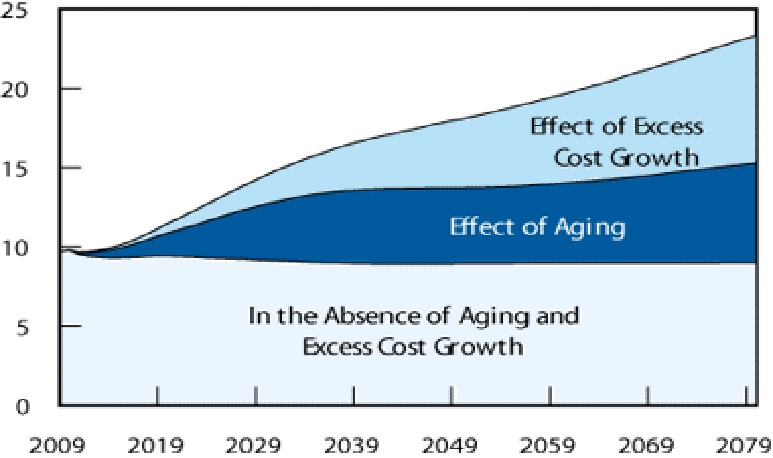
There are only two ways to reduce future deficits significantly: raise taxes or cut Social Security, Medicare, and Medicaid. The total bill for those programs (excluding the hidden costs of Obamacare) will rise from 10 percent of GDP to 23 percent of GDP when our grandchildren are in their “golden years”:


Source: Congressional Budget Office, “The Long-Term Budget Outlook,” June 2009, Box 1-2.

If the commissioners have any courage, they will recommend the gradual phase-out of Social Security, Medicare, and Medicaid — along the lines of my proposed solution:

1. Abolish Social Security payroll taxes as of a date certain (Abolition Day).

2. Pay normal benefits (those implicitly promised under the present system) to persons who are then collecting Social Security and to all other qualifying persons who have then reached the age of 62.

3. Persons who are 55 to 61 years old would receive normal benefits, pro-rated according to their contributions as of Abolition Day.

4. The retirement age for full benefits would be raised for all persons who are younger than 55 as of Abolition Day. The full retirement age is now scheduled to rise to 67 in 2027; it should rise to 73 by, say, 2020. Moreover, partial benefits would no longer be available to persons between the age of 62 and full-retirement age.

4. Persons who are 45 to 54 years old also would receive pro-rata benefits based on their contributions as of Abolition Day. But their initial benefits would be reduced on a sliding scale, so that the benefits of those persons who are 45 as of Abolition Day would be linked entirely to the CPI rather than the wage index.

5. Persons who are younger than 45 would receive a lump-sum repayment of their contributions (plus accrued interest) at full retirement age, in lieu of future benefits. That payment would automatically go to a surviving spouse or next-of-kin if the recipient dies intestate. Otherwise, the recipient could bequeath, transfer, or sell his interest in the payment at any time before it comes due.

6. The residual obligations outlined in points 2-5 would be funded by a payroll tax, which would diminish as those obligations are paid off.

Repeat, with appropriate variations, for Medicare and Medicaid [and Obamacare].

The alternative is to burden the productive sectors of the economy, thus further reducing the rate of economic growth and making Social Security, Medicare, Medicaid, and Obamacare even less affordable. Is that the future we want for our descendants?
__________
* The head of the Congressional Budget Office acknowledges that Obamacare

maintains and puts into effect a number of policies that might be difficult to sustain over a long period of time. For example, the legislation:

– Reduces the growth rate of Medicare spending (per beneficiary, adjusting for overall inflation) from about 4 percent per year for the past two decades to about 2 percent per year for the next two decades. It is unclear whether such a reduction can be achieved, and, if so, whether it would be through greater efficiencies in the delivery of health care or through reductions in access to care or the quality of care. . . .

– Establishes a tax on insurance plans with relatively high premiums in 2018 and (beginning in 2020) indexes the tax thresholds to general inflation.

Whither Inflation?

Who knows? My only observations: The recent up-tick is consistent with price behavior during an economic recovery. And, even with the up-tick, the current year-over-year rate of inflation is in line with the down-trend that began in 1980.


Derived from U.S. Department Of Labor, Bureau of Labor Statistics: Consumer Price Index, All Urban Consumers – (CPI-U), U.S. city average, All items, 1982-84=100.

UPDATED 05/27/10: See this post for an alternative estimate of the rate of inflation.

Tocqueville’s Prescience

I have added Joseph Epstein’s new book, Alexis de Tocqueville: Democracy’s Guide, to my Amazon.com wish list. My urge to own the book arises from a review in The American Spectator. The reviewer (Larry Thornberry) observes that

Tocqueville understood the constant conflict in democracies between liberty and equality, and the threat too much emphasis on the latter poses to the former. He recognized the emotion of envy behind much of the high-minded talk about equality, which he once described as “generally the wish that no one should be better off than oneself.”

Tocqueville saw the soft tyranny of the smothering paternalism that democracies can impose, and the bureaucracies they can build. He understood that too much centralization of government is a one-way street to despotism.

So true. So prescient.

With respect to “soft tyranny” or “soft despotism,” as it is generally called, I can only repeat myself:

Soft despotism is “soft” only in that citizens aren’t dragged from their houses at night and executed for imaginary crimes against the state — though they are hauled into court for not wearing seatbelts, for smoking in bars, and for various other niggling offenses to the sensibilities of nanny-staters.

Despite the absence of arbitrary physical punishment, soft despotism is despotism, period. It can be nothing but despotism when the state holds sway over your paycheck, your retirement plan, your medical care, your choice of associates, and thousands of other details of your life — from the drugs you may not buy to the kind of car you can’t drive, from where you can build a house to the features that your house must include.

“Soft despotism,” in other words, is too soft a term for the regime under which we live. I therefore agree with Tom Smith: “Fascism” is a good descriptor of our present condition, so I’ll continue to use it.

The Once and Future Ration Book

Our children and grandchildren will need ration books for medical services if Obamacare isn’t repealed. How else will medical services be acquired when providers exit in the face of arbitrary fee caps, when demand soars because of universal access to “cheap” or “free” medical services, and when private insurance companies have been squeezed out of business by government?

In anticipation of that bleak future, I dug out one of my World War II ration books and updated it. Here’s the revised cover (“health” replaces “war”), followed by a page of ration coupons:

The howitzer motif is appropriate, given that Obamcare is a war on medicine and liberty. Other coupon pages feature equally appropriate symbols: tanks, aircraft carriers, and dive bombers.

Abortion and Crime

In several posts at my old blog, I examined the causes of crime and ways to combat it. Among other things, I debunked the proposition that more abortion means less crime. (See this post and follow the links therein.) Abortion, if it does anything, leads to more crime by women because it “frees” them from child-rearing:


Derived from Statistical Abstracts of the United States: Table HS-24. Federal and State Prisoners by Jurisdiction and Sex: 1925 to 2001; and Table 338. Prisoners Under Federal or State Jurisdiction by Sex.

It’s women’s lib at work!

How’s “He” Doing?

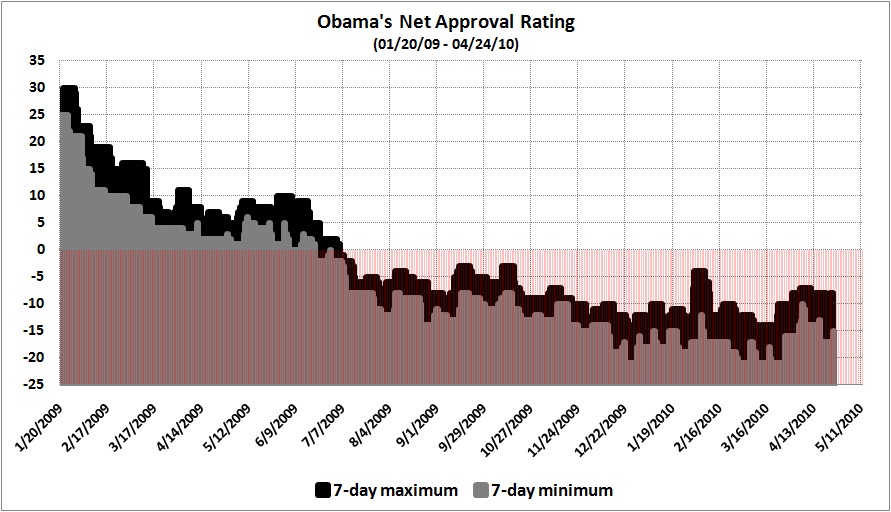
“He” is Barack Obama (BO), who presides over the left half of the nation and dictates to the right half. In an early post about BO’s popularity — or lack thereof — I observed that his “approval rating may have dropped for the wrong reasons; that is, voters expect him to “do something” about jobs, health care, etc.”

And, sure enough, when BO used his first state of the union address to reiterate his allegiance to the New Deal, his unpopularity dwindled a bit. And when he and his co-conspirators — Reid and Pelosi — rammed their health-care bill through Congress, his unpopularity again dwindled.

The good news is that BO remains generally unpopular:

Net approval rating: percentage of likely voters strongly approving of BO, minus percentage of likely voters strongly disapproving of BO. Derived from Rasmussen Reports’ Daily Presidential Tracking Poll. I use Rasmussen’s polling results because Rasmussen has a good track record with respect to presidential-election polling.

In polls there is hope.

A Nation of Sheep

The mail participation rate for Census 2010 has reached 72 percent, matching the Census 2000 rate. By the time the census-takers are done with their canvassing and re-canvassing in July, the vast majority of American households will succumb to the Census Bureau’s unconstitutional prying by divulging information that is none of the government’s business.

Bah! Or, I should say, b-a-a-a!

Clinton the Conspirator

Bill Clinton is back on the job. Thanks to a large assist from CNN, Clinton is once again painting those who oppose oppressive government as potentially violent extremists in the mold of Timothy McVeigh. Byron York has this take on Clinton’s latest foray into fear-mongering:

With the 15th anniversary of the Oklahoma City bombing Monday, former President Bill Clinton is playing a starring role in the liberal effort to draw what the New York Times calls “parallels between the antigovernment tone that preceded that devastating attack and the political tumult of today.” The short version of the narrative is: Today’s Tea Partiers are tomorrow’s right-wing bombers. . . .

At a White House meeting four days [after the bombing], [Dick] Morris presented Clinton with a comeback strategy based on his polling.  Morris prepared an extensive agenda for the session, a copy of which he would include in the paperback version of his 1999 memoir, Behind the Oval Office.  This is how the April 27 agenda began:

AFTERMATH OF OKLAHOMA CITY BOMBING

A. Temporary gain: boost in ratings — here today, gone tomorrow

B. More permanent gain: Improvements in character/personality attributes — remedies weakness, incompetence, ineffectiveness found in recent poll

C. Permanent possible gain: sets up Extremist Issue vs. Republicans . . .

It was a political strategy crafted while rescue and recovery efforts were still underway in Oklahoma City.  And it worked better than Clinton or Morris could have predicted.  In the months after the bombing, Clinton regained the upper hand over Republicans, eventually winning battles over issues far removed from the attack.  The next year, 1996, he went on to re-election.  None of that might have happened had Clinton, along with Morris, not found a way to wring as much political advantage as possible out of the deaths in Oklahoma City.  And that is the story you’re not hearing in all the anniversary discussions.

And here is Debra J. Saunders:

Clinton wrote that while criticism is “part of the lifeblood of democracy … we should remember that there is a big difference between criticizing a policy or a politician and demonizing the government that guarantees our freedom and public servants who enforce our laws.”

What I want to know is: Other than the twisted McVeigh and company, who is not clear on this difference? Does Clinton think his all his critics are stupid, or is he playing stupid?

But wait, there’s more. Clinton continued, “We must all assume responsibility for our words and actions before they enter a vast echo chamber and reach those both serious and delirious, connected and unhinged.”

Think about that for a minute: If anyone were to cast blame for the Fort Hood shootings that left 13 dead, or any other attacks within American military bases, on the antiwar movement, then that assertion would be followed by howls of outrage, and deservedly so. It would be absurd to suggest that opposition to the war be misconstrued as promoting violence against U.S. troops.

Yet somehow arguing against President Obama’s health care plan can be construed as practically an incitement to violence.

It all boils down to this: Clinton spearheads a left-wing conspiracy to discredit Americans who legitimately protest the unconstitutional and fiscally destructive acts of the federal government. One of the conspiracy’s tactics is to charge that Tea-Partiers and other critics of Barack Obama’s policies are “racist” — as if Obama’s policies weren’t, in and of themselves, deserving of opprobrium. (See, for example, the decidedly non-racist “Contract from America,” which reflects the true concerns of the Tea-Partiers and millions of silent Americans who are with them in spirit.)

Clinton’s moral standing is on a par with Teddy Kennedy’s. That is to say, Clinton has no moral standing. (A small, non-sexual sample of Clinton’s morality can be found in the use of CS gas against the 25 children who were present in the Branch Davidian compound at Waco.)  To call Clinton a snake would be an insult to snakes.

The Mega-Depression

In the preceding post, I offered my definition of recession and asked whether the current one has ended. (The answer: not yet, but I may know soon — or sooner than the official score-keepers at the National Bureau of Economic Research.) It since occurred that to focus on the current recession — or any recession — is to ignore America’s mega-depression, which is now more than a century old.

As I explain here, the mega-depression began in the early 1900s, when the economy began to sag under the weight of “progressivism” (e.g., trust-busting, regulation, the income tax, the Fed). Then came the New Deal, whose interventions provoked and prolonged the Great Depression (see, for example, this, and this). From the New Deal and the Great Society arose the massive anti-market/initiative-draining/dependency-promoting schemes known as Social Security, Medicare, and Medicaid. The extension and expansion of those and other intrusive government programs has continued unto the present day (e.g., Obamacare), with the result that our lives and livelihoods are hemmed in by mountains of regulatory restrictions.

The mega-depression is an example of  “that which is not seen,” a coinage of Frédéric Bastiat. In “That Which Is Seen and That Which Is Not Seen,” Bastiat writes:

Have you ever chanced to hear it said “There is no better investment than taxes. Only see what a number of families it maintains, and consider how it reacts on industry; it is an inexhaustible stream, it is life itself.” . . .

The advantages which officials advocate are those which are seen. The benefit which accrues to the providers is still that which is seen. This blinds all eyes.

But the disadvantages which the tax-payers have to get rid of are those which are not seen. And the injury which results from it to the providers, is still that which is not seen, although this ought to be self-evident.

When an official spends for his own profit an extra hundred sous, it implies that a tax-payer spends for his profit a hundred sous less. But the expense of the official is seen, because the act is performed, while that of the tax-payer is not seen, because, alas! he is prevented from performing it.

In the case of aggregate economic activity, what we see is what has been left to us by government. What we do not see is the extent to which the money taken from us by government and the restrictions placed upon us by government have deprived the economy of entrepreneurship, innovation, technology, and productive capacity. The cumulative effect of those deprivations — that which we do not see — dwarfs the Great Depression in depth and extent. The cumulative effect is our mega-depression:

Is the Recession Over?

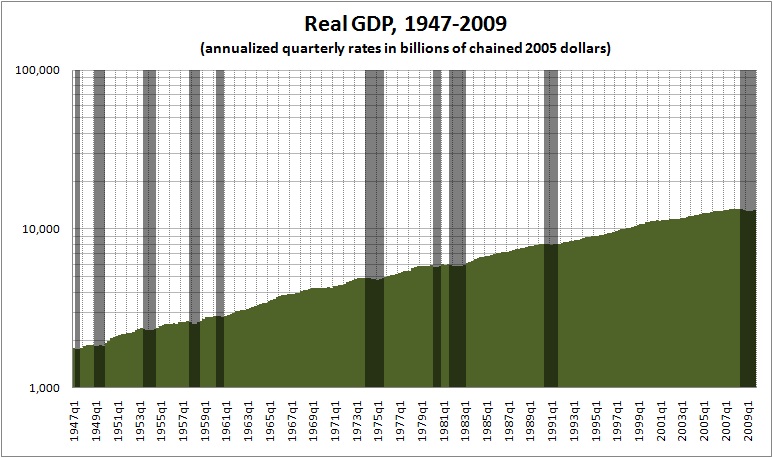
The National Bureau of Economic Research (NBER) has not yet declared an end to the recession. But no matter . . . according to the NBER, a recession ends when the economy has stopped contracting and begun expanding. In other words, the NBER could (and has) declared the end of a recession when the rate of aggregate economic activity (as measured by constant-dollar GDP) remains below its level at the beginning of the recession. That anomaly leads me to the following definition:

  • two or more consecutive quarters in which real GDP (annualized) is below real GDP (annualized) for an earlier quarter, during which
  • the annual (year-over-year) change in real GDP is negative, in at least one quarter.

That is to say, a recession lasts as long as there is a real and sustained dip in economic activity.

Here is my take on postwar recessions, which are marked by the vertical bars (click image to enlarge it):

Contrary to the NBER, there were no recessions in 1969-1970 or 2001. The Reagan-Volcker boom — which began in 1983 and was interrupted by the very mild recession of 1990-1991 — lasted until 2008.

To answer the title question: I don’t know if the recession is over, but I will know as soon as the Bureau of Economic Analysis releases its GDP estimate for the first quarter of 2010. Or, you can wait until the NBER makes its call in 2011.

The Shape of the Supreme Court

UPDATED 08/09/10

With the replacement of Justice John Paul Stevens by Elena Kagan, the Court’s presidential provenance looks like this*:

Reagan — Antonin Scalia (1986), Anthony Kennedy (1988)

Bush I — Clarence Thomas (1991)

Clinton — Ruth Bader Ginsburg (1993), Stephen Breyer (1994)

Bush II — John Roberts (2005), Samuel Alito (2006)

Obama — Sonia Sotomayor (2009), Elena Kagan (2010)

In terms of age, the Court looks like this:

Ginsburg, 77

Scalia, 74

Kennedy, 73

Breyer, 71

Thomas, 61

Alito, 60

Sotomayor, 55

Roberts, 55

Kagan, 50

Barring an unexpected death or retirement, Ginsburg will be the next to go. Like Souter and Stevens, she is likely to retire on Obama’s watch, in an effort to maintan the Court’s present ideological balance. Obama’s picks have not, and likely will not, alter the Court’s ideological balance, but they will create a core of youngish “liberal” justices, who will serve for decades.

The best that we devoted adherents of the Constitution can hope for is a one-term Obama-cy and a Republican successor who will do a better job of selecting justices than Ford (Stevens), Reagan (O’Connor and Kennedy), and G.H.W. Bush (Souter). In fact, the election of a Republican is critical because the person who sits in the White House from 2013 to 2017 or 2021 may well have to replace three justices — most likely Scalia, Kennedy, and Breyer.

Imagine the future of the Court if those three justices — an eccentric originalist, a wavering centrist, and a semi-hard leftist — could be replaced with sober, collegial originalists. They would outnumber Kagan, Sotomayor, and the next Ginsburg by 6-3, setting the stage for an era of constitutional resurgence.

__________

* For those of you who are interested in the Court’s genealogy, the following lines of succession have led to the present Court (* = elevated from associate justice to chief justice):

Chief Justice
John Jay (1789-1795)
John Rutledge* (1795-1795)
Oliver Ellsworth (1796-1800)
John Marshall (1801-1835)
Roger Brooke Taney (1836-1864)
Salmon Portland Chase (1864-1873)
Morrison Remick Waite (1874-1888)
Melville Weston Fuller (1888-1910)
Edward Douglass White* (1910-1921)
William Howard Taft (1921-1930)
Charles Evans Hughes* (1930-1941)
Harlan Fiske Stone* (1941-1946)
Fred Moore Vinson (1946-1953)
Earl Warren (1954-1969)
Warren Earl Burger (1969-1986)
William Hubbs Rehnquist* (1986-2005)
John Glover Roberts Jr. (2005-)

Associate-1
James Wilson (1789-1798)
Bushrod Washington (1799-1829)
Henry Baldwin (1830-1844)
Robert Cooper Grier (1846-1870)
William Strong (1870-1880)
William Burnham Woods (1881-1887)
Lucius Quintus C. Lamar (1888-1893)
Howell Edmunds Jackson (1893-1895)
Rufus Wheeler Peckham (1895-1899)
Horace Harmon Lurton (1910-1914)
James Clark McReynolds (1914-1941)
James Francis Byrnes (1941-1942)
Wiley Blount Rutledge (1943-1949)
Sherman Minton (1949-1956)
William Joseph Brennan Jr. (1957-1990)
David Hackett Souter (1990-2009)
Sonia Maria Sotomayor (2009-)

Associate-2
William Cushing (1790-1810)
Joseph Story (1812-1845)
Levi Woodbury (1846-1851)
Benjamin Robbins Curtis (1851-1857)
Nathan Clifford (1858-1881)
Horace Gray (1882-1902)
Oliver Wendell Holmes Jr. (1902-1932)
Benjamin Nathan Cardozo (1932-1938)
Felix Frankfurter (1939-1962)
Arthur Joseph Goldberg (1962-1965)
Abraham Fortas (1965-1969)
Harry Andrew Blackmun (1970-1994)
Stephen Gerald Breyer (1994-)

Associate-3
John Blair (1790-1795)
Samuel Chase (1796-1811)
Gabriel Duvall (1811-1835)
Philip Pendleton Barbour (1836-1841)
Peter Vivian Daniel (1842-1860)
Samuel Freeman Miller (1862-1890)
Henry Billings Brown (1891-1906)
William Henry Moody (1906-1910)
Willis Van Devanter (1911-1937)
Hugo Lafayette Black (1937-1971)
Lewis Franklin Powell Jr. (1972-1987)
Anthony McLeod Kennedy (1988-)

Associate-4
John Rutledge* (1790-1791)
Thomas Johnson (1792-1793)
William Patterson (1793-1806)
Brockholst Livingston (1807-1823)
Smith Thompson (1824-1843)
Samuel Nelson (1845-1872)
Ward Hunt (1873-1882)
Samuel Blatchford (1882-1893)
Edward Douglass White* (1894-1910)
Joseph Rucker Lamar (1911-1916)
Louis Dembitz Brandeis (1916-1939)
William Orville Douglas (1939-1975)
John Paul Stevens (1975-2010)
Elena Kagan (2010-)

Associate-5
James Iredell (1790-1799)
Alfred Moore (1800-1804)
William Johnson (1804-1834
James Moore Wayne (1835-1867)

Associate-6
Thomas Todd (1807-1826)
Robert Trimble (1826-1828)
John McLane (1830-1861)
Noah Hayes Swayne (1862-1881)
Stanely Matthews (1881-1889)
David Josiah Brewer (1890-1910)
Charles Evans Hughes* (1910-1916)
John Hessin Clarke (1916-1922)
George Sutherland (1922-1938)
Stanley Forman Reed (1938-1957)
Charles Evans Whitaker (1952-1962)
Byron Raymond White (1962-1993)
Ruth Bader Ginsburg (1993-)

Associate-7
John Carlton (1837-1865)

Associate-8
John McKinley (1838-1852)
John Archibald Campbell (1853-1861)
David Davis (1862-1877)
John Marshall Harlan (1877-1911)
Mahlon Pitney (1912-1922)
Edward Terry Sanford (1923-1930)
Owen Josephus Robert (1930-1945)
Harold Hitz Burton (1945-1958)
Potter Stewart (1959-1981)
Sandra Day O’Connor (1981-2006)
Samuel Anthony Alito Jr. (2006-)

Associate-9
Stephen Johnson Field (1863-1897)
Joseph McKenna (1898-1925)
Harlan Fiske Stone* (1925-1941)
Robert Houghwout Jackson (1941-1954)
John Marshall Harlan II (1955-1971)
William Hubbs Rehnquist* (1972-1986)
Antonin Gregory Scalia (1986-)

Associate-10
Joseph P. Bradley (1870-1892)
George Shiras Jr. (1892-1903)
William Rufus Day (1903-1922)
Pierce Butler (1923-1939)
William Francis Murphy (1940-1949)
Thomas Campbell Clark (1949-1967)
Thurgood Marshall (1967-1991)
Clarence Thomas (1991-)

Sources: Appendix Two, “Nominations and Successions of the Justices,” The Oxford Guide to United States Supreme Court Decisions, edited by Kermit L. Hall, Oxford University Press, 1999; “Members of the Supreme Court of the United States,” from the website of the U.S. Supreme Court.

A Declaration of Independence, Updated

If you haven’t read “A Declaration of Independence,” or haven’t read it since I revised it, I recommend a first or second look.

The State of the Union, Obama-style

My fellow Democrats — and anyone else who may be watching — I make this special appearance tonight for the purpose of gloating, er, celebrating our recent victory, which was won against the will of the people, and which will make them poorer and less healthy. But never mind that, the important thing is to have played the game of politics and won — the consequences be damned.

Having succeeded in attaining a major goal of this administration, I will now turn to our other major goals, which are to:

  • tax and regulate Americans until their entrepreneurial spirit and work ethic sink to European levels
  • reject our traditional allies, while bowing to the forces that would destroy us — which will make us even more European.

I close this brief address by paraphrasing the sainted John F. Kennedy: Ask not what your country can do for you, but what your country can do to you if you are a heterosexual male with a good job, above-average income, and traditional views about family, morality, limited government, and fiscal responsibility. The worst is yet to come. Bwah-ha-ha-ha-ha.

A Declaration of Independence

See “The Constitution: Myths and Realities“.

Quick Takes

1. Bryan Caplan, who is prone to wrong-headed generalizations, is at it again. He defends survey research (e.g., “how happy are you?”) by pointing out that all economic statistics are based on surveys — as if to equate subjective measures of happiness with objective (if not precise) measures of employment, unemployment, prices, etc., etc.

2. Caplan does himself one better when he argues for a “Consumer Satisfaction Standard.” He writes:

Most economists still cling to the Demonstrated Preference Standard: If A buys X, then X makes A better off by definition.

Actually, “most” economists (if I may speak for them) would say that at the time A buys X, he believes that buying X will make him better off. If A later suffers buyer’s remorse, that is simply the result of having acquired additional information that A can then apply to future decisions. Only a supremely naive economist (Caplan?) would believe that humans are perfectly prescient about the consequences of their decisions.

Unabashed, Caplan continues by offering the Consumer Satisfaction Standard (CSS):

[I]f A buys X, and would do so if he had the chance to make the decision over again, then X makes A better off.

The validity of the CSS rests on the assumption that the buyer somehow knows that buying something else (Y) instead of X would have made him happier. But the buyer can’t know that unless he actually buys Y and finds that he doesn’t suffer buyer’s remorse. This kind of imaginary second-guessing could go on forever.

3. I must give Caplan credit for challenging the addiction-as-disease school of psychology. He writes:

While I think that addictive behavior should be legal, it’s still irresponsible and emotionally abusive towards the people who care about you.   The addiction-as-disease story shifts the blame from where it belongs – the self-destructive addict – to family, friends, co-workers, employers, tax-payers, and other victims.  Calling bad behavior a “disease” may be merciful, but it’s unjust.

Bravo!

4. Megan McArdle, as usual, makes sense. Some of her predictions about Obamacare:

[A]t least one of the major funding sources, and possibly all of them, will be substantively repealed:  the Medicare cuts (except Medicare Advantage), the excise tax, and so forth.

This program will not reduce the rate of growth in medical costs by anything like 1.5% a year.

A fiscal crisis of some sort is quite likely by 2030, though not just because of this program.  But this program will make it worse, either by increasing the deficit directly, or by using up the low-hanging fruit that should have funded Medicare reform.

By 2030, there’s an 80% chance that the government will have imposed substantial price controls on pharma and other medical technology–and this will noticeably slow the rate of innovation.

5. Finally — and aptly — is a review of Thomas Sowell’s Intellectuals and Society. The reviewer, J.R. Nyquist, refers to the subjects of Sowell’s book as “Civilization’s Wrecking Crew.”  An excerpt:

. . . Sowell offers a detailed examination of those who carry today’s ideological equivalent of the Black Death. He defines the term “intellectual” as referring to those teachers and writers who chiefly deal in ideas, and are paid — by the media or the state — for batting ideas around. By focusing on intellectuals who are paid for intellectualizing, he is able to make a series of observations about their ideological tendencies, their lack of accountability, and their tendency to live outside the “real world.” . . . It is one of those sociological tragedies that intellectuals act as if “their special kind of knowledge of generalities can and should substitute for, and override, the mundane specific knowledge of others.” The intellectuals, as a class, tend to reject the first-hand knowledge of non-intellectuals as “prejudice” or “stereotypes.” Abstract formulas, adopted by the intelligentsia as dogma, are advanced as some kind of superior wisdom and used to undergird insane government policies that fly in the face of common sense. How else, indeed, has our Republic arrived at its present state?

Once established, the intellectual class continues to feed politicians and bureaucrats with ideas that point toward one solution: big government, interventionism, wealth redistribution, and other egalitarian absurdities. The country is pushed, inch by inch, toward an unnamed catastrophe. Who will name it? Who will stop the pushing? The intellectuals are feeding at the public trough, and they are entrenched. It seems that the rest of society is helpless to stop them.

To decry their push for “judicial activism” avails us nothing. If you stop them in the Supreme Court they will infect popular opinion and a new Congress will be elected. If they don’t elect Congress, they will elect a president. If they cannot act politically, they will take over the universities and bring out a generation of politically correct drones. Here we are not dealing with a particular set of abuses that can be fixed with appeals to democracy, Christianity, or legal reform. Here we are dealing with thousands of writers and professors who have, through some mysterious process, arisen from the lower depths, from the inner hell of a confused though fashionable relativism. The welfare state is their brainchild, and economic calamity is also theirs.

Civilization’s Wrecking Crew has been working overtime lately.

Obamacare

Rather than repeat myself, I refer you to these posts:

Rationing and Health Care
The Perils of Nannyism: The Case of Obamacare
More about the Perils of Obamacare
Health Care “Reform”: The Short of It