Trump vs. Biden: 8 (Updated)

Here.

Trump vs. Biden: 8 (New Numbers)

UPDATED 03/03/24

My unvarnished view about Trump’s candidacy to the contrary notwithstanding, it is better for Trump to be ahead (rather than behind) in the polls. Polls do have some (limited) value as a predictor of presidential election outcomes — though it is far too early to use them for that purpose.

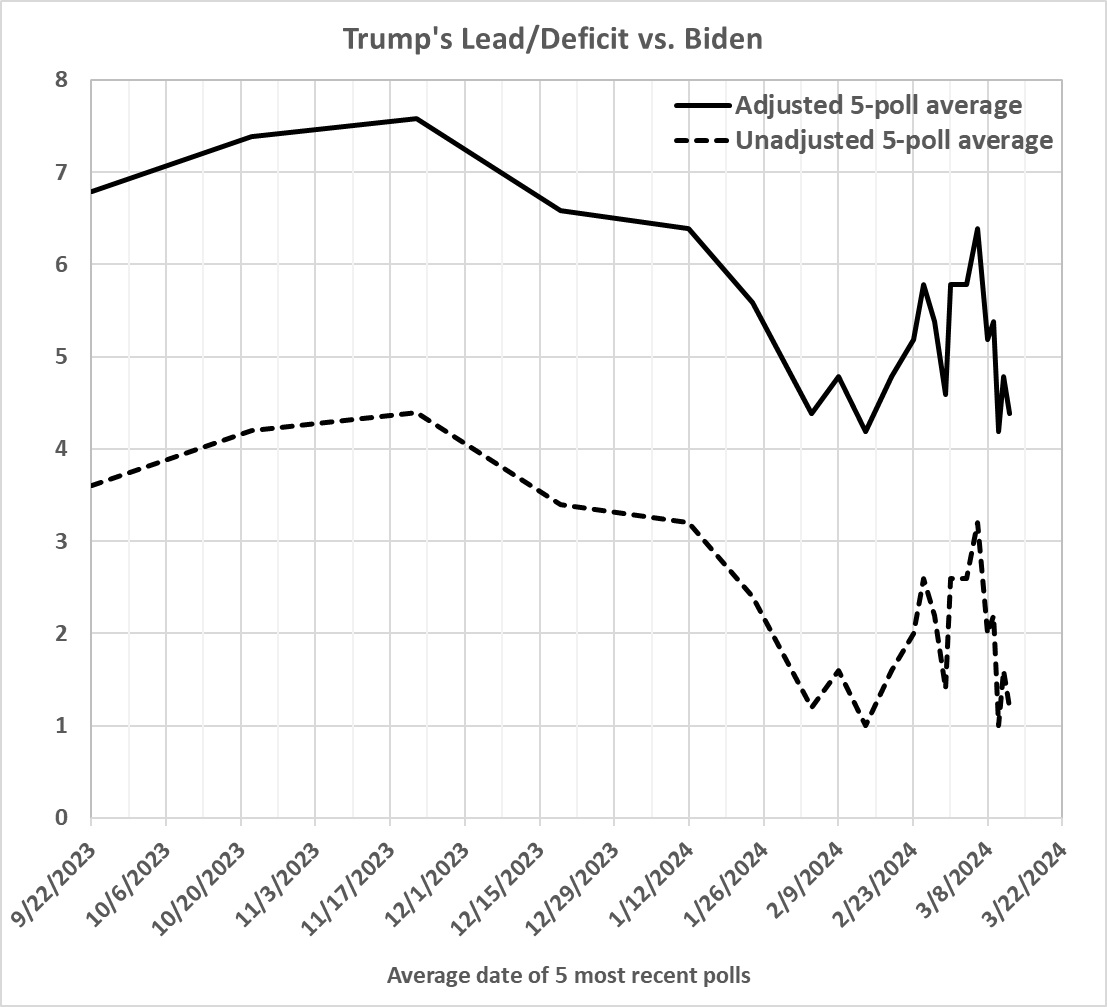
In any event, with the release of four new polls yesterday and today, the latest numbers look like this:


Source: Polls reported by RealClearPolitics.

To avoid the over-representation of polling organizations that report frequently, the values plotted above include only the latest poll released by each organization. (Polls without margins of error are excluded.) The three-poll span affords a better indication of trends than the 10-poll average that I had been using.

CAVEATS: The average date of the three most recent polls is February 27 — five days before the publication of this post. The numbers shouldn’t be taken as predictive of the outcome of the election. They simply reflect the stated preferences of respondents when the polls were conducted. Also (and positively), a GOP candidate can win even when he is behind in the (meaningless) nationwide popular vote (see this).

The Mar-a-Lago Raid and Election 2024

Earlier today I posted “Trump vs. Biden: 7 (My Unvarnished Perspective)“, in which I said this:

Regardless of the polls and betting odds, I believe (today) that Trump will lose the election….

[Much discussion follows.]

That’s how it looks from here — as of today. Who knows what will happen in the next several months, or how it will affect the outcome of the election? I don’t.

Soon after that, Tristan Justice posted “Former Director Gina Haspel Hid the CIA’s Role in Russiagate for Years” (The Federalist, February 15, 2024). (He calls it Russiagate; I call it Obamagate, for reasons you will understand if you read my page, “Obamagate and Beyond“.)

There are two striking things about Justice’s post. The first is that it points to the kind of event that could drastically affect the outcome of this year’s presidential election — possibly moving the needle sharply in Trump’s direction. Here’s why (from Justice’s post):

The FBI raid on Mar-a-Lago last summer might have been a plot to protect deep state intelligence officials, according to sources who spoke with a team of independent journalists this week.

On Wednesday, journalists Michael Shellenberger, Matt Taibbi, and Alex Gutentag published part 2 of an expose on the role of the Central Intelligence Agency (CIA) in orchestrating the years-long crusade to frame former President Donald Trump as a Russian plant. The article posted on Shellenberger’s Substack, Public, outlined how intelligence officials fretted over the presence of a classified “binder” in Trump’s possession that former CIA Director Gina Haspel had guarded for years….

One unnamed source cited as “knowledgeable about the case” called the binder “Trump’s insurance policy.” Trump was apparently “very concerned about having it and taking it with him because it was his road map” of the Russian collusion hoax….

“The documents in question are said to contain information about the legal justification for those investigations, or more specifically, the lack of justification, among other things. Should more of that information be made public, it might implicate a long list of officials in serious abuses,” Public reported. “Questions like these may be answered if the 10-inch thick binder of sensitive documents about the origins of the Russia probe is made public. Fear for reputations and careers, not national security, is what has intelligence officials panicked.”

The second striking thing is that I surmised the true purpose of the Mar-a-Lago raid on September 13, 2022, when I posted “Why the Mar-a-Lago Raid?“. There, I summarized the conspiracy against Trump which I detail in “Obamagate and Beyond“, and added this:

Where does the raid on Mar-a-Lago fit into all of this? The raid was a fishing expedition to see how much information Trump had acquired about the origins and workings of the [Trump-Russia hoax] conspiracy. The unprecedented nature of the raid, the obviously flimsy pretext for it, and the selective leaks by the FBI all suggest desperation on the part of the conspirators.

One of those conspirators is Biden, of course, who was vice president when the conspiracy began and who has much to gain from discrediting Trump, staying in office, and using his power to minimize the consequences of the exposure of his role in the Biden family’s influence-peddling scheme.

Trump vs. Biden: 7 (My Unvarnished Perspective)

The polls, on average, favor Trump. Although his lead isn’t statistically greater than zero, that’s okay for a Republican.

The betting odds are going against Biden. Bettors see him as much less likely to win than they did a week ago, mainly because of this passage from Special Prosecutor Robert Hur’s report on Biden’s “mishandling” of classified documents:

[A]t trial, Mr. Eiden would likely present himself to a jury, as he did during our interview of him, as a sympathetic, well-meaning, elderly man with a poor memory. Based on our direct interactions with and observations of him, he is someone for whom many jurors will want to identify reasonable doubt. It would be difficult to convince a jury that they should convict him-by then a former president well into his eighties-of a serious felony that requires a mental state of willfulness.

Regardless of the polls and betting odds, I believe (today) that Trump will lose the election. It will happen because of his baggage (e.g., openly vindictive personality and resulting feuds, indictments, possible convictions), which will begin to weigh more heavily as voters actually decide which way to go.

With narrow wins in a few key States, Trump could win the election even if the overall popular vote goes against him by a couple of percentage points (just as he did in 2016). That’s what happened in 2016. I attribute that win to luck and surprise. Clinton’s lead in the polls and betting markets was so large that she seemed to be a shoo-in. As a result, the Democrats didn’t gear up to manufacture enough votes to win the close races that went Trump’s way and gave him an edge in the Electoral College.

Democrats geared up with a vengeance in 2020, with a lot of help from the Covid pandemic which boosted mail-in voting — the happy hunting ground of electoral fraudsters. Democrats will build on their successes of four years ago, while the GOP will try to play catch-up ball. But the GOP will fall short because (for the most part) it will confine its vote-generating operations to legal methods. Democrats (being leftists) will pull out all the stops and officials and judges (mostly Democrats and never-Trumpers) will cover for them.

There are people like me who will vote for Trump if he’s the GOP nominee only because we can’t abide what the Democrats are doing to the country. But there aren’t enough of us, I believe, to overcome Trump’s baggage. Moreover, Democrats still have plenty of time in which to recover from last week’s Biden fiasco — and they find a way to do it, with the enthusiastic aid of most of the media. In the end Biden — or whomever the Democrats nominate — will win in a rerun of 2020.

That’s how it looks from here — as of today. Who knows what will happen in the next several months, or how it will affect the outcome of the election? I don’t.

About the CIA and Trump

In case you missed the reports of how the CIA instigated spying by foreign intelligence agencies on Trump’s 2016 campaign, see Margot Cleveland’s “Sources Say U.S. Intelligence Agencies Tasked Foreign Partners with Spying on Trump’s 2016 Campaign“ (The Federalist, February 14, 2024). There’s more detail in Margot Cleveland’s “Did Our Intelligence Agencies Suggest the Russia Hoax to Hillary Clinton’s Campaign?” (The Federalist, February 15, 2024).

For a more complete picture of anti-Trump activities since 2016, see my page “Obamagate and Beyond“.

The Residue of a Powerful Government

The aphorism “luck is the residue of design” is attributed to Branch Rickey, a baseball, player, manager, and executive. Rickey’s long and successful career as a manager, general manager, and c0-owner of major league teams was marked the breaking baseball’s “color barrier” by signing Jackie Robinson, a future Hall-of-Famer, to a minor league contract.

It is widely believed that John Milton wrote something to the same effect, but I can’t find a source for that assertion.

There is a saying attributed to Seneca the Younger, a Roman philosopher: “Luck is what happens when preparation meets opportunity.” But that attribution is also doubtful. The saying attributed to Seneca the Younger is however a better expression of the concept that “luck is residue of design” is meant to capture.

Now that I’m done with that bit of etymology, I want to expand on the idea that luck is the residue of design.*

Design, or preparation, is the residue (result) of assiduous thought and planning Assiduous though and careful planning arise from conscientiousness and intelligence.

There are some cultures in which such traits are prized and rewarded. Those cultures become peaceful and prosperous. But when assiduous thought, careful planning, conscientiousness, and intelligence are no longer prized and rewarded, the culture is doomed to subside into mediocrity or worse.

When government goes beyond the bounds of defending citizens from each other and foreign enemies, and ventures into the realm of economic and social engineering, it undermines the system of rewards for assiduous thought, careful planning, conscientiousness, and intelligence. Worse yet, it fosters a culture that denigrates those traits.

Having observed the evolution of the culture of the United States for several decades, I can assure you that unless the power of government isn’t curtailed sharply and soon, it won’t be long before America resembles a third-world country — complete with a wealthy, smug oligarchy that doesn’t give a damn about the rest of us.


* Thanks to an esteemed correspondent, I have learned of two more — and better — quotations in the same vein. One is spuriously attributed to Thomas Jefferson: “The harder I work, the luckier I get.” The other is genuinely attributed to Louis Pasteur: “Dans les champs de l’observation le hasard ne favorise que les esprits préparés.” (“In the fields of observation chance favors only the prepared mind.” From a lecture at the University of Lille on 7 December 1854.)

The Mainstream

When I hear the complaint that conservatives are “out of the mainstream,” this is what I visualize:

THE MAINSTREAM THEN


THE MAINSTREAM NOW

The mainstream has shifted considerably to the left in the past 90 years. Being in the mainstream of current political thought is no virtue; being out of the mainstream of current political thought is no vice.

“Licking” in the Age of Wokeness

Eons ago, when I was a freshman in college, I learned that “licking” was the art of adapting a story or novel to a movie script. That use of “licking” seems to have vanished, which is unsurprising in an age when actual licking (and other such things) is a staple of film fare.

In any event, I use “licking” here to mean the adaptation of a piece of literature to a script. The script in this case is that of Lessons in Chemistry, a 2023 release on Apple TV+, which in eight episodes veers wildly from the novel on which it is based: Lessons in Chemistry: A Novel, by Bonnie Garmus. The novel and the TV adaptation are set in the 1950s.

“Licking” sometimes involved changing the ending of the story. And the writers of the TV version certainly did that. But that was the least of their sins. The most of their sins was their feat of making Garmus’s story even more woke than the print version.

The book is a long, feminist rant. The TV adaptation is a feminist, racist rant, amplified through a bullhorn. Things that aren’t in the book but which are in the TV version:

  • Calvin Evans (the white, male protagonist) and Elizabeth Zott (the white, female protagonist) live in a black neighborhood.
  • There is a black neighbor woman (more about her below) who abandoned her law career to put her husband through medical school.
  • The same black woman leads a crusade to keep the corrupt, all-white, city council and greedy developers from replacing the neighborhood with a freeway.
  • Elizabeth Zott, who (for reason too convoluted to discuss here) becomes the host of a successful TV show about cooking (an early Julia Child). That much is in the books. But when Elizabeth alienates her sponsor — the maker of a hydrogenated shortening — she manages to replace that sponsor with … Tampax. Not in the book, but essential to the arch-feminist tone of the TV series.
  • Calvin Evans, as a child, is placed in an orphanage run by Catholic priests. That’s in the book. What’s not in the book is that he’s held back from adoption because the priests exploit his nascent brilliance as a chemist to distill and sell bootleg whiskey.
  • A clergyman — white in the book, black in the TV show — helps Calvin’s daughter, Mad Zott, find the orphanage. The book’s clergyman didn’t know Calvin; the TV’s show’s clergyman was a long-lost friend.

Similar things can happen relatively infrequently -in life but when they’re packed into a single TV series, you know that you’re getting a message like this one:

  • White folks and black folks can get along just fine — as long as white folks are willing.
  • White folks who live among and socialize with black folks are open-minded, loving people. (How about white folks who live among or near violent black folks? Are they open-minded and loving or just stupid or too poor to move?)
  • Bad things happen to black folks because of white folks. (Hmm … that’s the theme of CRT, which fails to acknowledge the weighty burdens of lower intelligence and a culture of irresponsibility and violence.)
  • Catholic priests are b-a-a-d people, unless they’re homosexuals. (Sodomizing young boys is really bad, but it’s usually done by homosexuals, which is why the badness shown in the TV version skirted that issue.)

About that black neighbor woman: Like the black neighborhood, she didn’t exist in the book. The middle-aged, white housewife who befriended Elizabeth in the book had to be replaced by a younger, black housewife-lawyer-crusader. In other words, more of the same: arch-feminism and racism.

The book was a feel-good story that probably appealed mainly to white women in search of escape and a bit of inner rebellion. The TV series is a feel-good story for well-off white folks of the kind who hate Donald Trump and believe that anyone who might vote for him is a misogynist, racist Neanderthal.

Zeno Revisited (Again)

Bill Vallicella (Maverick Philosopher) asserts that

No one has successfully answered Zeno’s Paradoxes of Motion.  (No, kiddies, Wesley Salmon did not successfully rebut them; the ‘calculus solution’  is not a definitive (philosophically dispositive) solution.)

The link in the quoted passage leads to a post from 2009 in which BV addresses Zeno’s Regressive Dichotomy:

The Regressive Dichotomy is one of Zeno’s paradoxes of motion. How can I get from point A, where I am, to point B, where I want to be? It seems I can’t get started.

A_______1/8_______1/4_______________1/2_________________________________ B

To get from A to B, I must go halfway. But to travel halfway, I must first traverse half of the halfway distance, and thus 1/4 of the total distance. But to do this I must move 1/8 of the total distance. And so on. The sequence of runs I must complete in order to reach my goal has the form of an infinite regress with no first term:

. . . 1/16, 1/8, 1/4, 1/2, 1.

Since there is no first term, I can’t get started.

Zeno’s paradox rests on the assumption that a first step is an infinitesimal fraction of the distance to be traversed, a fraction that can never be resolved mathematically. But that is an obviously false and arbitrary assumption.

Zeno, had he been less provocative (though mundane), would have observed that first step in going from A to B is a random distance that depends on the stride of the traveler; it has nothing to do with the distance to be traversed.

Thus, the distance from point A to point B can be traversed in x strides, where

x = d/l

and

d = distance from A to B

l = average length of stride.

That’s all f-f-folks.


See also “Achilles and the Tortoise Revisited“.

What Does the “G” in “GDP” Stand For?

It stands for product, that is, the output of goods and services, denominated in dollars (current and inflation-adjusted).

It is therefore mystifying to read this, by Arnold Kling:

What is GDP supposed to measure? I think of it as a measure of economic activity, meaning goods and services bought in the market.

The fact that GDP omits the value of home production (cooking, cleaning, lawn-mowing, etc.) means that GDP is an incomplete measure of the total output of goods and services. The remedy for that omission would be to estimate the dollar value of those services if they were purchased at market prices.

Kling tries to get around that objection:

If I pay you to mow my lawn, your labor counts in GDP. If I mow my own lawn, my labor does not count in GDP. That might seem wrong, but I believe it is exactly right. I think of economic activity as specialization and trade. We exploit comparative advantage and the division of labor. The more we outsource, the better off we are….

People who think in terms of production complain that housework belongs in GDP. But I say that if a woman (or a man) engages in housework, that is economic malfunctioning. She should be able to outsource housework to machinery and/or someone she employs.

Economic activity isn’t specialization and trade. It’s the production and consumption of goods and services, however inefficiently. Those that are produced at home (or on the farm) aren’t necessarily inferior to those that are produced by someone else. A lot of people actually enjoy producing and consuming their own goods and services. To them, those goods and services are just as valuable (perhaps more valuable) than the things they could buy from someone else. I am also bothered by the implication that housework has no value unless it’s outsources, which demeans those women (and men) who do their own housework because they can’t afford to outsource it.

Take the case of an apple farmer who reserves a part of his output for consumption in the form of apples (simply eaten), applesauce, apple butter, apple pies and tarts, desserts that include apples and other fruits, etc. If he raises hogs, he probably includes apple peels in their slop. Why should those parts of his apple crop not be counted in GDP just because the farmer uses the apples instead of selling them?

Kling is on the wrong path. He should use his formidable brainpower to think of ways to count home production in GDP so that it better measures what it’s supposed to measure: the total value of things produced in the U.S.

A Weak Argument for Freedom of Speech

Greg Lukianoff, president of FIRE (Foundation for Individual Rights and Expression), is (of course) an ardent proponent of freedom of speech. I like most of what Lukianoff posts on his Substack blog, The Eternally Radical Idea, but a recent post falls short of what I expect from him.

In “Mill’s Trident: An Argument Every Fan (or Opponent) of Free Speech Must Know“, Lukianoff writes:

John Stuart Mill’s observ[es] in his 1859 masterpiece “On Liberty” that in any argument there are only three possibilities: You are either wholly wrong, partially wrong, or wholly correct — and in each case free speech is critical to improving or protecting those positions.

Why? According to Lukianoff:

  • If you are wrong, freedom of speech is essential to allow people to correct you.
  • If you are partially wrong, free speech and contrary viewpoints will help you get even closer to the truth.
  • If you are 100% correct (which is unlikely) you still need free speech for dissent, disagreement, and attempts to disprove you, both to check your arguments and to strengthen them.

This is an excellent example of preaching to the choir, albeit a relatively small one.

Mill’s arguments for freedom of speech omit a crucial assumption. There are people out there — perhaps a vast majority — who don’t seek the truth. They seek comfort in beliefs that they have acquired (often as a matter of belonging to the “right” group), and they seek to enforce those beliefs. Enforcement these days, is usually accomplished by laws, regulations, and the coercive use of state power (e.g., suppression of dissent from the Covid narrative by Big Tech execs anxious to retain their exemption from liability laws). Truth only gets in the way of comfort and power, the latter of which is a powerful elixir.

The truth, in short, is an inconvenience sought by the naïve, the powerless, and the increasingly rare person of principle.

As for On Liberty, it doesn’t deserve Lukianoff’s praise (or anyone else’s). See “On Liberty“, “My View of Mill, Endorsed“, and “The Harm Principle Revisited: Mill Conflates Society and State“.

Cloaks of Authority

From a commentary about the biblical significance of the cloak:

The use of cloaks as a symbol of authority is prevalent throughout the Old Testament. In ancient times, a cloak was a sign of status and power and was often worn by kings, priests, and other high-ranking officials.

There are many other symbols of authority; for example, a judge’s robe, a crown, a scepter, stars (on an epaulet), a corner office on the top floor of an elegant office building, and the Oval Office in the West Wing of the White House. Titles also confer authority, even without the trappings of a robe, a crown, and so on. But let us here call all such things cloaks of authority.

Cloaks of authority used to obscure the human beings in whom authority is vested. That is no longer the case in the age of the internet, which spreads truth and fiction in equal measure — and leaves it to the individual person to sort them. The sorting, of course, is done mainly in accordance with the individual’s preconceptions about who is “good” and who is “bad”. And most persons, it seems, seek out the truth or fiction that supports their preconceptions.

Nowhere is this state of affairs more evident than with respect to the presidency of the United States. Perhaps it’s just my faulty memory, but it seems to me that most voters used to believe that one candidate was better than the other, and they accordingly voted for that candidate. Now, it seems that most voters are fearful of what one or the other candidate might do if elected and vote against that candidate because he represents the greater of two evils.

Given that, the presidency (among many other positions of authority) is no longer held in awe, though it is regarded in fear by about half the populace. But even those citizens who support the incumbent do so, for the most part, because he is considered to be the lesser of two evils.

One might say that the imperial presidency is in decline because the “emperor” has no cloak.

Proportionality in War

Just-war theory is useful if it’s interpreted properly.

Take the principle of proportionality, for example:

Combatants must make sure that the harm caused to civilians or civilian property is not excessive in relation to the concrete and direct military advantage anticipated by an attack on a legitimate military objective.

If the enemy’s objective is the destruction of your nation — civilians and all — it is just to seek the destruction of the enemy’s nation — civilians and all.

Thus endeth today’s lesson in how to wage war.

Trump vs. Biden: 6 (Trump Resurgent)

RealClearPolitics maintains a running tally of presidential election polls. I construct a moving average of the results, where the average represents Trump’s lead (or deficit) for the 10 most recent polls. I also construct a 95-percent confidence interval around the moving average, using the margins of error reported by pollsters. (Having done this for a while and observed some erratic and incredible results from Rasmussen Reports, I removed the results published by that formerly reliable polling organization from my calculations.)

Here’s the trend since late July 2023:

Back-to-back wins in Iowa and New Hampshire boosted Trump considerably. His margin is now (barely) back in positive territory (i.e., the lower band of the 95-percent confidence interval is just above zero).

CAVEAT: This isn’t a prediction of the outcome of the election. The figures simply reflect the stated preferences of respondents when the polls were conducted. Also (and positively), a GOP candidate can win even when he is behind in the (meaningless) nationwide popular vote (see this).

What Do I See in My Crystal Ball?

Nothing good:

The Biden administration overcomes the resistance of Texas and other GOP-led States and continues to allow illegal aliens (potential Democrat voters) to inundate the nation.

Perversely, in response to the resistance from Texas and other GOP-led States, the Biden administration declares a “national emergency” and effectively seizes control of GOP-controlled States. All policies that affirm life and liberty are suppressed (e.g., abortion bans and limits, school choice, effective law-enforcement, and — course — the freedoms of religion and speech).

If the immigration crisis doesn’t result in a “national emergency”, a different predicate will be found. The left’s need for control has is obsessive.

One result of the “national emergency” is the cancellation of the 2024 presidential election and the installation of a “provisional” government, led nominally by Biden (with Obama pulling the strings).

Even if there’s no national emergency or a provisional government, the left will remain in control through electoral chicanery.

Among many things, Biden administration’s egregious policies continue; for example, privileges for violent criminals, blacks, queers, and other “identity groups” (despite their known anti-social predilections and lack of accomplishments and abilities); the impoverishing war on fossil fuels and their efficient use (e.g., in gasoline-powered automobiles, gas furnaces, and gas cooktops); and the aforementioned flood of illegal aliens whose are supported the tax-paying citizens who are also the victims of the criminals among said aliens.

The regime finds a way around the GOP’s efforts to block aid to Ukraine and persists in a war that spreads to Western Europe and thus (via NATO) to the United States — perhaps involving exchanges of nuclear weapons.

The regime fails to take decisive action in the Middle East (and against Iran, specifically), with the result that critical resources and a critical trade route are throttled — re-igniting inflation and imposing real burdens (e.g., soaring energy prices) on working-class Americans.

Israel stands alone and eventually succumbs to the Muslim hordes, which leads to a second Holocaust. The provisional government tut-tuts and does nothing.

Iran, North Korea, and China — having observed the regime’s fecklessness — attack allied nations and international-trade routes, thereby exacerbating the effects of the conflagration in the Middle East. Diminished U.S. armed forces will only stand by as South Korea and Japan are assailed by missile attacks, Taiwan is subjugated to China, and the South China Sea and its bordering nations become China’s possessions.

The regime — under heavy pressure from Russia, China, Iran, and North Korea — enters into an alliance of “peace and prosperity” with those nations. The effect of the alliance is the subjugation of working Americans (i.e., the people who produce things, not ideas) to the regulatory state and the gradual reduction of working people’s living standards to the those of the 1940s (at best).

Further emulating Soviet-style “democracy” the labor of the masses (including the illegal hordes) enables the ruling classes and their favorite to live high on the hog.

Continuing the lawfare conducted against Donald Trump and the J6 protestors, Soviet-style “justice” is exacted upon those who openly dissent from the new dispensation. True justice dies with the effective revocation of the Constitution and the emasculation of those courts that might have resisted the new dispensation.

These are my worst fears. I hope that I’m badly wrong.


Related reading:

Brandon Smith, “Cultural Replacement: Why the Immigration Crisis Is Being Deliberately Engineered“, Alt-Market.us, January 25, 2024

Graham McAleer, “Is Conservatism’s Future Strauss or Vogelin?“, Law & Liberty, January 26, 2024

Hans von Spakovsky, “Biden Doesn’t Have Any Legal Authority to Seize Control of the Texas National Guard“, The Daily Signal, January 27, 2024

Another Measure of Political Polarization: The Winner’s Share of the Popular Vote in Presidential Elections

In “A Measure of Political Polarization: The Decline of Collegiality in the Confirmation of Justices“, I concocted an index of collegiality for the confirmation of U.S. Supreme Court justices:

C = Fraction of votes in favor of confirming a nominee/fraction of Senate seats held by the nominating president’s party

C score greater than 1 implies some degree of (net) support from the opposing party. The higher the C score, the greater the degree of support from the opposing party.

Examples:

  1. Tom Clark, nominated by Democrat Harry Truman, was confirmed on August 18, 1949, by a vote of 73-8; that is, he received 90 percent of the votes cast. Democrats then held a 54-42 majority in the Senate, just over 56 percent of the Senate’s 96 seats. Dividing Clark’s share of the vote by the Democrats’ share of Senate seats yields C = 1.60. Clark, in other words, received 1.6 times the number of votes controlled by the party of the nominating president.
  2. Samuel Alito, nominated by Republican George W. Bush, was confirmed on January 31, 2006, by a vote of 58-42; that is, he received 58 percent of the votes cast. Republicans then held 55 percent of the Senate’s 100 seats. The C score for Alito’s nomination is 1.05 (0.58/0.55).

The index, which I computed for nominations since World War II, looks like this:

My commentary:

C peaked in 1975 with the confirmation of John Paul Stevens, a nominee of Republican Gerald Ford. (One of many disastrous nominations by GOP presidents.) It has gone downhill since then. The treatment of Brett Kavanaugh capped four decades of generally declining collegiality.

The decline began in Reagan’s presidency, and gained momentum in the presidency of Bush Sr. Clinton’s nominees fared about as well (or badly) as those of his two predecessors. But new lows (for successful nominations) were reached during the presidencies of Bush Jr., Obama, Trump, and Biden.

There’s another measure of political polarization, one that might be said to capture the general mood of the electorate. That measure is the share of the nationwide popular vote that has accrued to the winner of each presidential election. The nationwide popular vote is irrelevant to presidential elections because of the electoral college (see this post and this one). But the tally has some value as an indicator of the degree of divisiveness among the electorate.

Here are the numbers since the inception of the Republican Party in 1856:

The sharp dips were caused by the good showing of third parties (and sometimes fourth and fifth parties).

What I find interesting is the era of “big wins”, which began in 1920 and ended in 1984. It wasn’t an era of big wins by one party. Voters were (then) quite willing to flock to a Democrat or Republican when they were fed up with incumbent president of the other party for whatever reason (policies, economics, scandals, etc.).

A clearer picture emerges when the winner’s share is averaged over three elections:

By this measure, “national collegiality” peaked in the 1920s-1930s and remained high through the 1980s. It has since declined to a level similar to that of the rancorous and volatile post-Civil War era — the era that saw the rise of “progressivism”, which again poisons political discourse and stifles economic progress.


Related: The Hardening of Political Affiliations in America

How Good Are the Presidential Polls?

The results of the final polls in the last five presidential elections have pointed to four winners. Sounds good? You won’t think so after reading this post.

The values depicted in the graphs at the bottom of this post represent 10-poll averages of respondents’ presidential choices in two-way races (i.e., Republican or Democrat). The dates are mid-points of the periods during which the 10-poll samples were conducted.

The solid black lines trace the percentage-point lead (or deficit) for the eventual “winner” of the (meaningless) nationwide tally of the popular vote in each presidential election from 2004 through 2020. The gray lines trace the margins of error claimed by the organizations issuing the polls. (The dashed gray lines for 2004 are estimates derived by assuming a margin of error of 3 percentage points, which is typical of the later polls.) The range from the upper gray line to the lower gray line represents a 95-percent confidence interval; that is, the actual result would be within the range (or at its outer limit) with a probability of 95 percent.

The red diamond at the right in each graph is the “winner’s” actual margin of “victory” in the nationwide tally of popular votes. In every case, the actual margin of “victory” is within or at the outer limit of the final 95-percent confidence interval. (I use “sneer quotes” because there is no “winner” of the nationwide popular vote, which is a meaningless number. Presidential elections are decided State-by-State, and in 48 of 50 cases the candidate with the greatest number of popular votes in that State receives the State’s entire bloc of electoral votes.)

Putting that aside for the moment, the 95-percent confidence interval covers a range of about 6 percentage points. That is, the “winner’s” actual margin in the (meaningless) nationwide popular vote could be as many as 6 percentage points away the final 10-poll average. A margin of 6 percentage points means that the “winner’s” share of the popular vote could be 3 percent higher or lower than the share implied by the final 10-poll average. Given the statistical relationship between popular votes and electoral votes (discussed here), a shift of 3 percent can mean a gain or loss of 30 percent of the electoral vote.

What lies behind such a disproportionate response to such a small shift? It is the fact that a miniscule change in the distribution of a State’s popular vote can (in 48 cases out of 50) cause a 100-percent swing in the allocation of its electoral votes.

To take a concrete example, Trump won the electoral vote in 2016 despite Clinton’s 2.1 percent margin of “victory” in the tally of popular votes cast in the 50 States and District of Columbia. Clinton’s margin of “victory” was 2.9 million popular votes. She won California by 4.3 million popular votes. In other words, she “lost” the rest of the U.S. by 1.4 million popular votes. Crucially, she lost three States with a total of 46 electoral votes — Michigan, Pennsylvania, and Wisconsin — by margins of 0.2 to 0.8 percent. Those three losses cost her the election.

To take another example, Biden’s 4.5 percent popular-vote “victory” in 2020 was much larger than Clinton’s. His huge win in California (5.1 million votes more than Trump) left him with a “victory” of about 2 million votes in the rest of the country. But Biden wouldn’t have won the election without narrow victories in Arizona (11 EV, margin of 0.3 percent), Georgia (16 EV, 0.2 percent), Pennsylvania (20 EV, 1.18 percent), and Wisconsin (10 EV, 0.63 percent).

Finally, there’s the case of the 2000 election (not represented in the graphs below), which Bush “lost” by more than 500,000 votes. He didn’t really lose the election, of course, because he won the crucial State of Florida by 537 votes when the U.S. Supreme Court put a stop to the illegal manufacture of votes for Gore in several Democrat-controlled jurisdictions.

Is there a fail-safe lead in the polls? Let’s return to 2020, when Biden eked out an electoral-vote win by “beating” Trump nationwide by 4.5 percentage points — a lead that was at the bottom edge of the 95-percent confidence interval for the final 10 polls. The center of that confidence interval — the 10-poll average — was 7.6 percentage points. You might suppose that a lead (in the polls) of that size would guarantee an election victory, but it didn’t. A lot of dirty pool was required.

Finally, the accuracy of the polls is compromised by two other facts: The mid-point of the polling period for the final 10 polls occurs three or four days before election day. Early voting has become more prevalent in this century, and it played a huge role in the election of 2020.

The lesson learned: Don’t bet on the outcome of a presidential election unless a candidate is leading in the final 10 polls by, say, 9 percentage points or more. (See above commentary about Biden’s final poll numbers in 2020.) Don’t bet against that candidate, and don’t expect to win more than a pittance if you bet on him to win. Anything else — like betting on a 3-point favorite — is pure guesswork or hope.

That’s reality. And don’t let a pollster tell you otherwise.

Here are the graphs:

Sources and notes — Values derived from the polls of polls at RealClearPolitics.com for the presidential elections of 2004, 2008, 2012, 2016, and 2020. The polls completed entirely in June of each election year were organized chronologically according to the middle date of each polling period. A moving, 10-poll average/lead deficit was then computed, as well as moving 10-poll average margin of error.

The Coming Showdown — As It Would Be if the U.S. Had Leaders Who Care about America

Iran is testing the resolve of the U.S. government by ordering the Houthis to attack shipping in the Red Sea. I doubt that the U.S. government under Biden & Co. will pass the test. But if it did pass the test, here’s what would happen:

  • In response to the attacks, the U.S. would strike Iran directly and with more than token force.
  • The strike wouldn’t decapitate the Irania regime. But the regime would be placed on notice to cease the attacks or face devastation.
  • Russia and China would be told — in no uncertain terms — to butt out of a dispute between the West and iran.
  • That should be the end of it. If it isn’t, all Iranian government and military targets, including “secret” nuclear weapons facility, would be obliterated.

Would Russia and China care to challenge the U.S. after that?  I think not.

Will it happen under Biden & Co.? I think not.

China’s Ascendancy: A Legacy of the Misconduct of the Korean War

General of the Army Douglas MacArthur differed privately and then publicly with President Harry S Truman about the conduct of the Korean War: Truman wanted to settle for stalemate, MacArthur wanted to press on to victory. MacArthur’s reward for presuming that victory was the aim of war came on April 11, 1951, when Truman dismissed him as commander of UN forces in Korea, CinC of the U.S. Far East Command, and Supreme Commander for the Allied Powers in Japan, that, is Japan’s overlord.

The firing of MacArthur — a war hero and acclaimed military leader since the U.S. expedition into Mexico in 1914 — instigated a firestorm of calumny directed at Truman and his administration and paeans of praise and honor for MacArthur.

The highest point of MacArthur’s homecoming was his appearance before a joint session of Congress on April 19, 1951. His speech is perhaps most famous for its concluding lines, described here by William Manchester in American Caesar:

He praised “your fighting sons,” reporting that “they are splendid in every way.… Those gallant men will remain often in my thoughts and in my prayers always.” Then, in words few would forget, he said: “I am closing my fifty-two years of military service. When I joined the Army, even before the turn of the century, it was the fulfillment of all my boyish hopes and dreams. The world has turned over many times since I took the oath on the Plain at West Point, and the hopes and dreams have long since vanished. But I still remember the refrain of one of the most popular barrack ballads of that day, which proclaimed, most proudly, that ‘Old soldiers never die. They just fade away.’ And like the soldier of the ballad, I now close my military career and just fade away—an old soldier who tried to do his duty as God gave him the light to see that duty.” The last word was a hush: “Good-bye.”

Before reaching that point, MacArthur addressed appeasement (again quoting Manchester):

All his life he had been a daring officer, an advocate of aggressive action, and now he told his listeners why: “History teaches with unmistakable emphasis that appeasement but begets new and bloodier war. It points to no single instance where the end has justified that means—where appeasement has led to more than a sham peace. Like blackmail, it lays the basis for new and successively greater demands, until, as in blackmail, violence becomes the only other alternative. Why, my soldiers asked of me, surrender military advantages to an enemy in the field?” He paused histrionically, and his voice dropped to a husky whisper: “I could not answer.”

MacArthur followed his triumphal speech with a tour of cities across the U.S. Here is Manchester again on one stop along the way:

On Saturday, March 22, 1952, MacArthur capped his campaign against the administration. Standing on the steps of the capitol in Jackson, Mississippi, he charged that administration policies were “leading toward a Communist state with as dreadful certainly as though the leaders of the Kremlin were charting the course.” He deplored massive American aid to Europe; charity should begin at home, he said; although billions had been spent on the Continent, he doubted that the United States had “gained a single convert to the cause of freedom or inspired new or deeper friendships” there. Of the Korean truce talks, which had been under way for eight months, he said that “the only noticeable result is that the enemy has gained time,” and he prophesied that “our failure… in Korea will probably mean the ultimate loss of continental Asia.”

What he meant — and which everyone then understood — was the loss of continental Asia (i.e., the People’s Republic of China — the PRC — and the nations on its periphery) to the brand of Communism that then ruled and still rules the PRC.

And so the loss is coming to pass, and so will it extend well beyond continental Asia. Communists play the long game, as they are able to do — unencumbered as they are with fickleness of “democratic” politics.

In addition to the obvious (but as yet unanswered) buildup of naval and military forces and facilities in and around the strategically invaluable South China Sea, and the imminent demise of the Republic of China (a.k.a. Taiwan), there is just as importantly the PRC’s leading if not dominant position in international trade. The latter has been acquired in large part by the acquiescence of Western elites to the trading of the West’s industrial (and thus military) infrastructure for goods made in PRC factories under conditions that those same elites would deplore if found in the West.

A realistic reading of the PRC’s intentions and U.S. fecklessness is offered by James E. Fanell and Bradley A. Thayer in “Credible Assurance Is Appeasement by Another Name” (American Greatness, December 11, 2023):

As the People’s Republic of China (PRC) mourns the loss of their “old friend” Dr. Henry Kissinger, who passed away on November 29, it is worth noting his influence as the originator of the “Engagement School” of thought towards the People’s Republic of China (PRC), which remains the dominant voice amongst the “China Hands” of America’s foreign policy establishment. Ironically, this was exemplified the day after his death in the pages of the Council of Foreign Relations Foreign Affairs international relations magazine. It published an article entitled “Taiwan and the True Sources of Deterrence: Why America Must Reassure, Not Just Threaten, China.”…

The authors condemn “ill-advised” statements by former and current U.S. officials who have called for the United States Government (USG) to formally recognize Taiwan. The authors go so far as to demand that USG officials avoid even giving the impression that America is moving toward restoring formal diplomatic relations or a defense alliance with the island, even in the face of the PRC’s military threats against Taiwan that have dramatically spiked in the past year….

[T]hroughout the article the authors provide no acknowledgement for the past 30 years of prior “credible assurances” the USG has made to the PRC through the implementation of the Kissinger School of Engagement by both Democrat and Republican Administrations.

The authors make no mention of the Clinton administration’s efforts to provide the PRC, and the People’s Liberation Army (PLA), access to sensitive rocket and space technology or for ushering the PRC into the World Trade Organization (WTO) before the PRC’s economy was fully qualified. WTO entry greatly accelerated its military capabilities and thus threat to Taiwan and the U.S. and its allies. Neither still do the authors fully acknowledgement the Bush administration’s very public castigation of former Taiwan President Chen Shui-bien for his comments regarding independence.

What is most egregious is the failure of the authors to acknowledge the decades old policy of the U.S. Department of Defense’s invitations to their PLA counterparts to visit U.S. naval bases in Hawaii, San Diego, and Norfolk and to openly share with them solutions to improving the PLA as a fighting force. Neither do the author’s mention the Obama administration’s dismantlement of the U.S. Navy over an eight-year period that subsequently led to the PRC Navy becoming the largest in the world. In that vein, the authors also make no mention of the current administration’s pleadings to re-establish military-to-military relations to bring down the tensions they claim are so dangerous, and dominate, in U.S.-PRC relations.

The fact is these authors know full well that none of these efforts at “credible assurance” have altered the CCP from achieving its strategic goal of achieving the Great Rejuvenation of the PRC. Its end state demands the degradation of the United States and the post WWII system of peace and stability that most of the world has benefited from like no other time in history.

What is also clear is that the authors’ article has been used by pro-PRC parties in Taiwan to undermine the upcoming Presidential and parliamentary elections on January 13, 2024 and to interfere in Taiwan’s inherent right to pursue their own self-determination. This amounts to election interference, which the pro-PRC Engagement community appears to believe is their duty. Yet, regardless of what the authors claim, the assertion that Washington and Taipei must provide “credible assurances” is appeasement to the CCP and will only lead to more aggression and danger.

Rather than take the advice of these appeasers, American leaders should stand firm against the threat of war from the PRC and instead should get busy building up the hard-power elements of America’s national defense, which the authors dishonestly proclaim has received too much attention. The reality is the opposite—America’s military power vis-à-vis the PRC and our ability to deter a PRC invasion of Taiwan are at their lowest levels ever.

Taiwan is far from the PRC’s only target, of course. This is from Ellen Nakashima and Joseph Nenn’s “China’s Cyber Army Is Invading Critical U.S. Services” (The Washington Post, December 11, 2023):

The Chinese military is ramping up its ability to disrupt key American infrastructure, including power and water utilities as well as communications and transportation systems, according to U.S. officials and industry security officials.

Hackers affiliated with China’s People’s Liberation Army have burrowed into the computer systems of about two dozen critical entities over the past year, these experts said.

The intrusions are part of a broader effort to develop ways to sow panic and chaos or snarl logistics in the event of a U.S.-China conflict in the Pacific, they said.

Among the victims are a water utility in Hawaii, a major West Coast port and at least one oil and gas pipeline, people familiar with the incidents told The Washington Post. The hackers also attempted to break into the operator of Texas’s power grid, which operates independently from electrical systems in the rest of the country.

Several entities outside the United States, including electric utilities, also have been victimized by the hackers, said the people, who spoke on the condition of anonymity because of the matter’s sensitivity.

None of the intrusions affected industrial control systems that operate pumps, pistons or any critical function, or caused a disruption, U.S. officials said. But they said the attention to Hawaii, which is home to the Pacific Fleet, and to at least one port as well as logistics centers suggests the Chinese military wants the ability to complicate U.S. efforts to ship troops and equipment to the region if a conflict breaks out over Taiwan….

“It is very clear that Chinese attempts to compromise critical infrastructure are in part to pre-position themselves to be able to disrupt or destroy that critical infrastructure in the event of a conflict, to either prevent the United States from being able to project power into Asia or to cause societal chaos inside the United States — to affect our decision-making around a crisis,” said Brandon Wales, executive director of the Department of Homeland Security’s Cybersecurity and Infrastructure Security Agency (CISA). “That is a significant change from Chinese cyber activity from seven to 10 years ago that was focused primarily on political and economic espionage.”…

The hackers are looking for a way to get in and stay in without being detected, said Joe McReynolds, a China security studies fellow at the Jamestown Foundation, a think tank focused on security issues. “You’re trying to build tunnels into your enemies’ infrastructure that you can later use to attack. Until then you lie in wait, carry out reconnaissance, figure out if you can move into industrial control systems or more critical companies or targets upstream. And one day, if you get the order from on high, you switch from reconnaissance to attack.”

The disclosures to The Post build on the annual threat assessment in February by the Office of the Director of National Intelligence, which warned that China “almost certainly is capable” of launching cyberattacks that would disrupt U.S. critical infrastructure, including oil and gas pipelines and rail systems.

“If Beijing feared that a major conflict with the United States were imminent, it almost certainly would consider undertaking aggressive cyber operations against U.S. homeland critical infrastructure and military assets worldwide,” the assessment said….

This is far from China’s first foray into hacking critical infrastructure. In 2012, a Canadian company, Telvent, whose software remotely operated major natural gas pipelines in North America, notified customers that a sophisticated hacker had breached its firewalls and stolen data relating to industrial control systems. The cybersecurity firm Mandiant traced the breach to a prolific PLA hacking group, Unit 61398. Five members of the unit were indicted in 2014 on charges of hacking U.S. companies.

At the time, the U.S. government wasn’t sure whether China’s aim was to collect intelligence or pre-position itself to disrupt. Today, based on intelligence collection and the fact that the facilities targeted have little intelligence of political or economic value, U.S. officials say it’s clear that the only reason to penetrate them is to be able to conduct disruptive or destructive actions later….

China “is sitting on a stockpile of strategic” vulnerabilities, or undisclosed security flaws it can use in stealthy attacks, Adamski said last month at the CyberWarCon conference in Washington. “This is a fight for our critical infrastructure. We have to make it harder for them.”

The topic of Chinese cyber intrusions into critical infrastructure was on a proposed list of talking points to raise in Biden’s encounter with Xi, according to people familiar with the matter, but it did not come up in the four-hour meeting [emphasis added].

And so it goes. Appeasement sooner or later yields aggression against the appeasers — and the multitudes of innocent bystanders who are gulled in supporting the appeasers.

Political Conservatism Is Centrist

I have described the spectrum of political ideologies as a circle. But as I rethink my analysis, I conclude that the spectrum should be thought of a straight line. At the left is statism (which is really leftist even when it is said to be rightist), conservatism is in the middle, and pure libertarianism (anarchy) is at the right.

Statism is statism: The ruler or ruling class decides how you should live and ensures, through physical and psychological coercion that you live as you are told to live.

Anarchy is the opposite of statism: No one is in charge of everyone. Whether anarchy is good or bad depends on the morals of the potentially most powerful persons or coalitions.

Conservatism is therefore centrist because it recognizes the need for a state of defined and limited power — just enough power to enforce a benign morality.