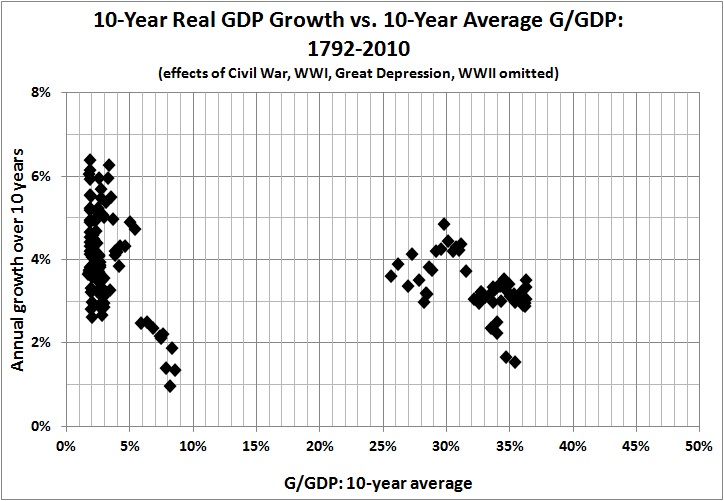
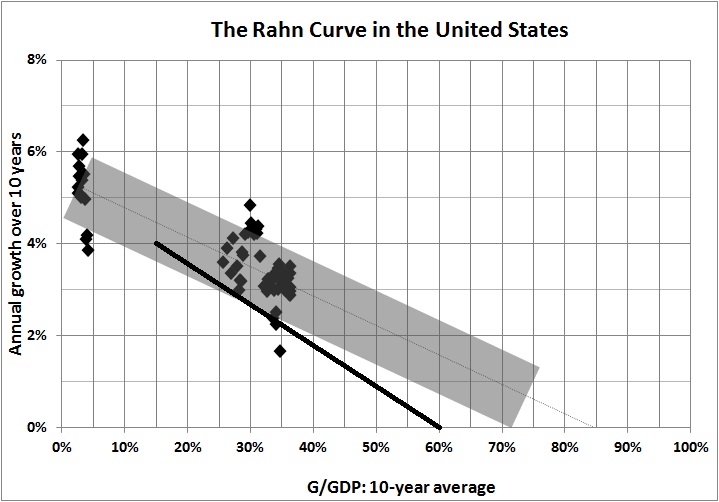
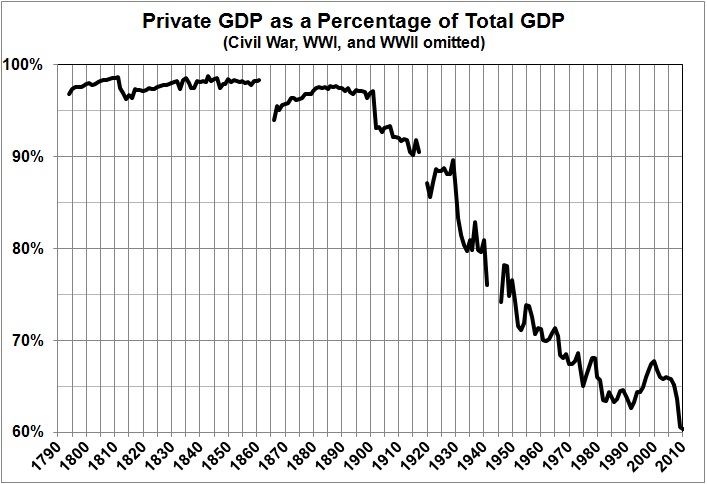
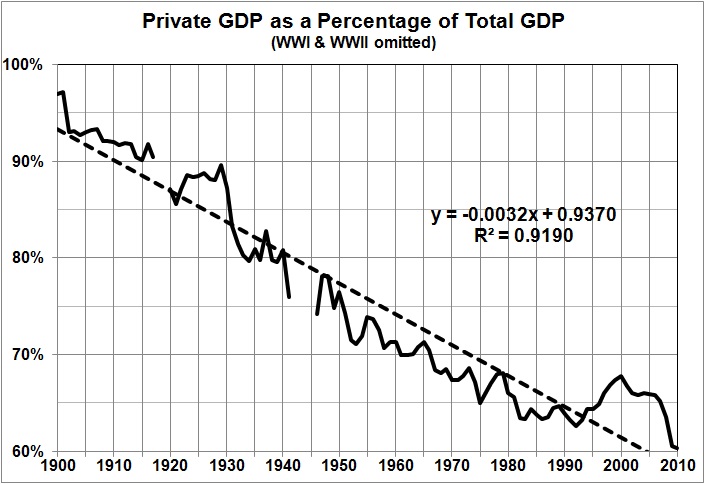
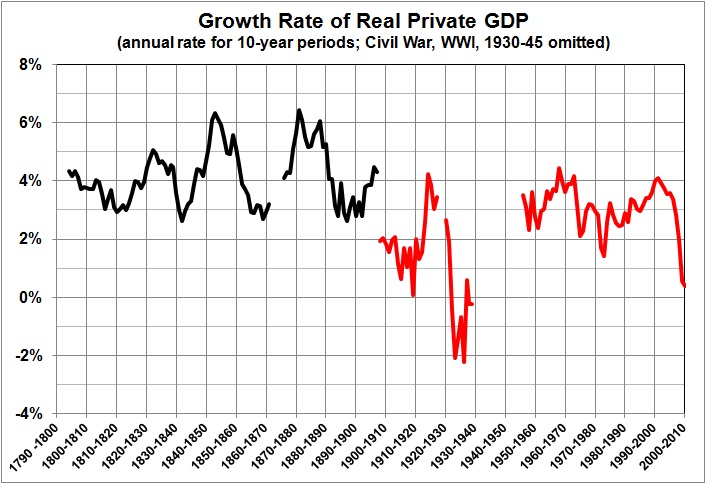
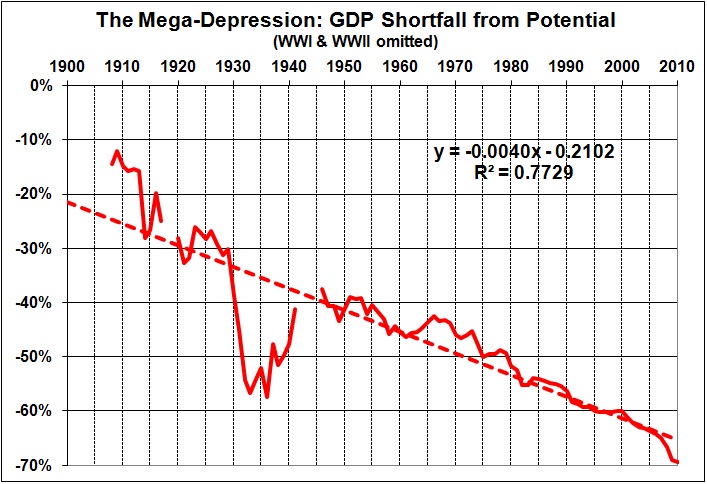
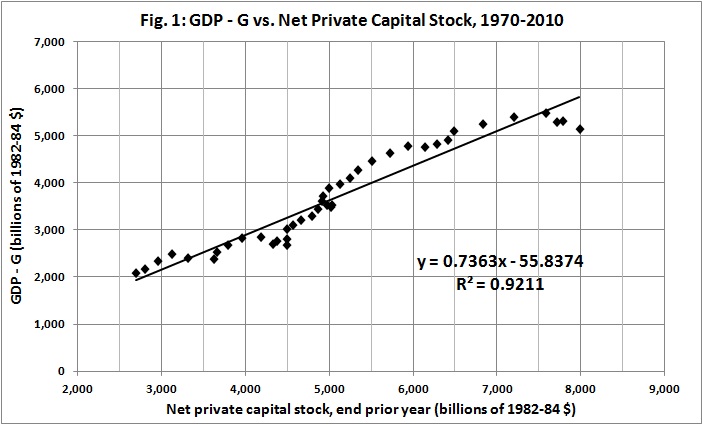
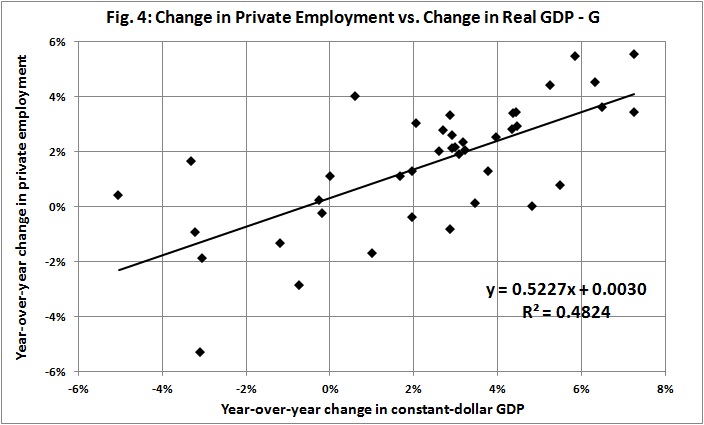
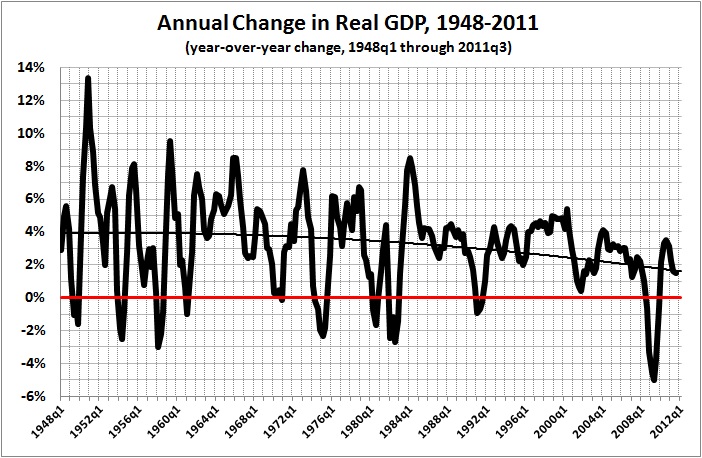
The Obama Effect: Disguised Unemployment (Updated)

Here.

“We the People” and Big Government: Part 1 (continued)

Incorporated into this post.

“We the People” and Big Government: Part I

Incorporated into this post.

More about “Secession Made Easy”

Read “Secession Made Easy,” which addresses inter-State secession, that is, the annexation of a portion of one State by another State. Then consider the table below. It includes some moves not mentioned in the earlier post, and assesses the potential gains accruing to the GOP if parts of some States were shifted to neighboring States.

Secession made easy - table

The baseline is the current lineup of U.S. Senate seats, governorships, and State legislatures.  The potentially big gains for the GOP are found in the Senate. Those gains would be worth the (possible) loss of a single governorship, because the addition of nine GOP Senate seats would shift control of Congress to the GOP. (This assumes that the House remains indefinitely under GOP control for some years to come, which may be a heroic assumption.) Further, the GOP would continue to control about 3/5 of State legislatures — a big advantage when it comes to congressional redistricting.

In any event, some denizens of Blue States would become citizens of Red States — a prize in itself.

See also “The Constitution: Myths and Realities“.

Secession Made Easy

It seems that the “Red” areas of several “Blue” States are agitating to secede from those States. It seems, also, that there is a way to secede that might pass legal scrutiny: the seceding portion of a State (the Red counties of Blue-dominated Maryland, for instance) hooks up with a more congenial State (West Virginia, for instance). Half a loaf certainly would be better than none if you’re a conservative in a conservative region of California, Colorado, Maryland, or Michigan — to name a few of the many possibilities.

The upshot of a half-a-loaf strategy with respect to secession would be … what? Some Red States would become Redder and some Blue States would become Bluer. Would the balance of political power be affected? Consider some possibilities:

  • California/Nevada — Northern California plus Nevada could push Nevada into Red territory. A plus for the GOP in the U.S. Senate and control of Nevada’s government.
  • Colorado/Kansas/Utah — Merging eastern Colorado into Kansas and western Colorado into Utah wouldn’t change the political landscape, but the ex-Coloradans would be happier.
  • Delaware/Maryland/Virginia/West Virginia — Two mergers here: southern Delaware and eastern Maryland into Virginia, western Maryland into West Virginia. Virginia would become more reliably Red; West Virginia, almost Deep Red. Pluses for the GOP in the U.S. Senate and control of the governments of Virginia and West Virginia.
  • Illinois/Ohio — Moving southern Illinois into Ohio would make Ohio more reliably Red.
  • Michigan/Wisconsin — If Wisconsin were to annex Michigan’s upper peninsula (and perhaps the northern part of the lower peninsula) it would become firmly Red. Perhaps a tossup, given Michigan’s occasional Reddish tinge, but the ex-Michiganders would be happier.

Those are the obvious possibilities; there may be others.

The problem with all of this, of course, is that Democrats will do the math and fiercely resist any such rearrangements.

But nothing venture, nothing gain. In other words, go for it!

Be sure to read the follow-up post, here.

See also “The Constitution: Myths and Realities“.

The Most Disgusting Thing I’ve Read Today

UPDATED 07/01/14 (below)

It’s a post at a blog called Lion of the Blogosphere, the proprietor of which evidently has delusions of grandeur. The post is “Abortion and the just-world fallacy.” (No, I won’t link to the blog or the post.) The author, one Mr. Lion (of the Blogosphere), seems to be an unabashed proponent of abortion for the “underclass.”

Mr. Lion’s latest abomination begins with this:

To quote Wikipedia, “the just-world hypothesis or just-world fallacy is the cognitive bias (or assumption) that a person’s actions always bring morally fair and fitting consequences to that person, so that all noble actions are eventually rewarded and all evil actions are eventually punished. “

I see this cognitive bias in many of the comments to anything I post about abortion. Anti-abortion people have this bias that they believe that banning abortion (which is supposed to be evil) will bring better outcomes. But the reality, as I keep pointing out, is that abortion is effective at reducing the birthrate of poor women.

Until I was enlightened by Mr. Lion, I had no idea that opposition to abortion arises from the just-world fallacy. I had thought, all along, that those of us who oppose abortion do so because it is a eugenic practice that involves the state-condoned taking of innocent lives. Or, because it is a sin — as some opponents prefer to say.

Superior beings like Mr. Lion (and Mr. Hitler) have no qualms about eugenic practices. Well, they don’t if they’re not on the receiving end of those practices. I wonder how Mr. Lion will enjoy the eugenic program known as Obamacare, with its inevitable death panels (though they won’t be called that) — a program that he implores Republicans to accept as the law of the land.

Mr. Lion justifies his pro-abortion position on cost-effectiveness grounds:

[A]ccording to the Guttmacher Institute “Forty-two percent of women obtaining abortions have incomes below 100% of the federal poverty level ($10,830 for a single woman with no children)” and another “twenty-seven percent of women obtaining abortions have incomes between 100–199% of the federal poverty level.

So we see that the women most likely to have abortions are those who should be having abortions, women who have no way to support their children except by collecting welfare, and children raised by welfare moms are many times more likely to be criminals….

I already said “disgusting,” didn’t I? Why not just take the women out and shoot them? That would be cheaper than giving them abortions, wouldn’t it?

Mr. Lion would make a good technocrat, given his readiness to treat human beings like numbers and erase them at will. But “good” isn’t excellent; excellent technocrats are able to feign compassion and disguise their viciousness.

What about crime and abortion? I cut Mr. Lion off just as he was about to add this:

[S]o it’s not surprising at all that Steven D. Levitt, author of Freakonomics, found that abortion reduced crime. (And Levitt rigorously rebuts Steve Sailer who tried to argue that it didn’t.)

Oh, really? Well, as it happens, Levitt’s “rigorous rebuttal” isn’t very rigorous. As I point out here,

Levitt’s findings are built on statistical quicksand. From the abstract of a paper by Christopher L. Foote and Christopher F. Goetz of the Boston Fed:

[A] fascinating paper by Donohue and Levitt (2001, henceforth DL) . . . purports to show that hypothetical individuals resulting from aborted fetuses, had they been born and developed into youths, would have been more likely to commit crimes than youths resulting from fetuses carried to term. We revisit that paper, showing that the actual implementation of DL’s statistical test in their paper differed from what was described. . . .We show that when DL’s key test is run as described and augmented with state‐level population data, evidence for higher per capita criminal propensities among the youths who would have developed, had they not been aborted as fetuses, vanishes.

There’s a lot more about the Levitt-Sailer controversy here; the bottom line, in my view, favors Sailer. My own analysis (here) also refutes Levitt.

The moral of the story: If you’re going to be an excellent technocrat in the United States, you must (a) take care to disguise your viciousness, and (b) quote unimpeachable sources (i.e., not Steven Levitt).

UPDATE 07/01/14 – for readers coming here via a link in a comment at Mr. Lion’s blog

Here’s the comment:

If you haven’t read this guy’s blog, he’s disgusted with Lion’s position on pro-abortion for prole and NAM women.

https://politicsandprosperity.com/2013/10/11/the-most-disgusting-thing-ive-read-today/

He seems to think Lion’s take on it is about eugenics, but it’s more about IQ leading to poor outcomes. One needs to understand that perpetual proledom and NAMdom is a good measure of IQ. Multigenerational poverty, dysfunctionality and underachievement are a result of low IQs.

The commenter seems to think that “Lion’s take” isn’t about eugenics. A state-sponsored effort to reduce the numbers of low-IQ “proles” and “NAMs” is nothing but an exercise in eugenics.

Unsplit Infinitives

A RERUN OF A POST AT MY OLD BLOG, FROM MAY 1, 2008

Eugene Volokh, a known grammatical relativist, scoffs at “to increase dramatically,” as if “to dramatically increase” would be better. But better in what way: clearer or less stuffy? The meaning of “to increase dramatically” is clear. The only reason to write “to dramatically increase” would be to avoid the appearance of stuffiness.

Seeming unstuffy (i.e., without standards) is neither a necessary nor sufficient reason to split an infinitive. The rule about unsplit infinitives, like most other grammatical rules, serves the valid and useful purpose of preventing English from sliding yet further down the slippery slope of incomprehensibility than it has slid already. If an unsplit infinitive makes a clause or sentence seem awkward, the clause or sentence should be rewritten to avoid the awkwardness. Better that than make an exception that leads to further exceptions — and thence to babel.

Related posts:
Remedial Vocabulary Training
One Small Step for Literacy
Punctuation
Data Are
“Hopefully” Arrives
Hopefully, This Post Will Be Widely Read
Why Prescriptivism?

A Human Person

A RERUN (WITH LIGHT EDITING) OF A POST AT MY OLD BLOG, FROM MAY 5, 2008

The ludicrous and (it seems) increasingly popular assertion that plants have rights should not distract us from the more serious issue of fetal rights. (My position on the issue can be found among these links.) Maverick Philosopher explains how abortion may be opposed for non-religious reasons:

It is often assumed that opposition to abortion can be based only on religious premises. This assumption is plainly false. To show that it is is false, one need merely give an anti-abortion argument that does not invoke any religious tenet, for example:1. Infanticide is morally wrong.
2. There is no morally relevant difference between abortion and infancticide.
Therefore
3. Abortion is morally wrong.

Whether one accepts this argument or not, it clearly invokes no religious premise. It is therefore manifestly incorrect to say or imply that all opposition to abortion must be religiously-based. Theists and atheists alike could make use of the above argument.

MP then links to a piece by Nat Hentoff, an atheist and Leftist. Hentoff writes, apropos Barack Obama and abortion, that

I admire much of Obama’s record, including what he wrote in “The Audacity of Hope” about the Founders’ “rejection of all forms of absolute authority, whether the king, the theocrat, the general, the oligarch, the dictator, the majority … George Washington declined the crown because of this impulse.”

But on abortion, Obama is an extremist. He has opposed the Supreme Court decision that finally upheld the Partial-Birth Abortion Ban Act against that form of infanticide. Most startlingly, for a professed humanist, Obama — in the Illinois Senate — also voted against the Born Alive Infant Protection Act….

Furthermore, as “National Right to Life News” (April issue) included in its account of Obama’s actual votes on abortion, he “voted to kill a bill that would have required an abortionist to notify at least one parent before performing an abortion on a minor girl from another state.”

These are conspiracies — and that’s the word — by pro-abortion extremists to transport a minor girl across state lines from where she lives, unbeknownst to her parents. This assumes that a minor fully understands the consequences of that irredeemable act. As I was researching this presidential candidate’s views on the unilateral “choice” that takes another’s life, I heard on the radio what Obama said during a Johnstown, Pa., town hall meeting on March 29 as he was discussing the continuing dangers of exposure to HIV/AIDS infections:

“When it comes specifically to HIV/AIDS, the most important prevention is education, which should include — which should include abstinence education and teaching children, you know, that sex is not something casual. But it should also include — it should also include other, you know, information about contraception because, look, I’ve got two daughters, 9 years old and 6 years old. I am going to teach them first of all about values and morals.

“But if they make a mistake,” Obama continued, “I don’t want them punished with a baby.”

Among my children and grandchildren are two daughters and three granddaughters; and when I hear anyone, including a presidential candidate, equate having a baby as punishment, I realize with particular force the impact that the millions of legal abortions in this country have had on respect for human life.

And that’s the crux of the issue: respect for human life.

Thus I turn to a Peter Lawler’s “A Human Person, Actually,” in which Lawler reviews Embryo: A Defense of Human Life, by Robert P. George and Christopher Tollefsen:

The embryo, George and Tollefsen argue, is a whole being, possessing the integrated capability to go through all the phases of human development. An embryo has what it takes to be a free, rational, deliberating, and choosing being; it is naturally fitted to develop into a being who can be an “uncaused cause,” a genuinely free agent. Some will object, of course, that the embryo is only potentially human. The more precise version of this objection is that the embryo is human—not a fish or a member of some other species—but not yet a person. A person, in this view, is conscious enough to be a free chooser right now. Rights don’t belong to members of our species but to persons, beings free enough from natural determination to be able to exercise their rights. How could someone have rights if he doesn’t even know that he has them?…

Is the embryo a “who”? It’s true enough that we usually don’t bond with embryos or grieve when they die. Doubtless, that’s partly because of our misperception of who or what an embryo is. But it’s also because we have no personal or loving contact with them. We tend to think of persons as beings with brains and hearts; an embryo has neither. But personal significance can’t be limited to those we happen to know and love ourselves; my powers of knowing and loving other persons are quite limited, and given to the distortions of prejudice. Whether an embryo is by nature a “who” can be determined only by philosophical reflection about what we really know.The evidence that George and Tollefsen present suggests that there are only two non-arbitrary ways to consider when a “what” naturally becomes a “who.” Either the embryo is incapable of being anything but a “who”; from the moment he or she comes to be, he or she is a unique and particular being capable of exhibiting all the personal attributes associated with knowing, loving, and choosing. Or a human being doesn’t become a “who” until he or she actually acquires the gift of language and starts displaying distinctively personal qualities. Any point in between these two extremes—such as the point at which a fetus starts to look like a human animal or when the baby is removed from the mother’s womb—is perfectly arbitrary. From a purely rational or scientific view, the price of being unable to regard embryos as “whos” is being unable to regard newborn babies as “whos”….

As I say here,

abortion is of a piece with selective breeding and involuntary euthanasia, wherein the state fosters eugenic practices that aren’t far removed from those of the Third Reich. And when those practices become the norm, what and who will be next? Libertarians, of all people, should be alert to such possibilities. Instead of reflexively embracing “choice” they should be asking whether “choice” will end with fetuses.

Most libertarians, alas, mimic “liberals” and “progressives” on the issue of abortion. But there are no valid libertarian arguments for abortion, just wrong-headed ones.

Are You Happy?

A RERUN OF A POST AT MY OLD BLOG, FROM MAY 6, 2008

Justin Wolfers (Freakonomics blog) has completed a series of six posts about the economics of happiness (here, here, here, here, here, and here). The bottom line, according to Wolfers:

1) Rich people are happier than poor people.
2) Richer countries are happier than poorer countries.
3) As countries get richer, they tend to get happier.

All of which should come as no surprise to anyone, without the benefit of “happiness research.” Regarding which, I agree with Arnold Kling, who says:

My view is that happiness research implies Nothing. Zero. Zilch. Nada. I believe that you do not learn about economic behavior by watching what people say in response to a survey.

You learn about economic behavior by watching what people actually do.

And…you consult your “priors.” It is axiomatic that individuals prefer more to less; that is, more income yields more satisfaction because it affords access to goods and services of greater variety and higher quality. Moreover, income and the wealth that flows from it are valued for their own sake by most individuals. (That they might be valued because they enable philanthropic endeavors is a case in point.)

It is reasonable to conclude, therefore, that the “law” of diminishing marginal utility, which may apply to particular goods and services, does not generally apply to income or wealth in the aggregate. But, in any event, given that Wolfers’s first conclusion is self-evidently true, the second and third conclusions follow. And they follow logically, not from “happiness research.”

Values and Geography

The World Values Survey is

a worldwide investigation of sociocultural and political change….

… carried out by an international network of social scientists, with local funding for each survey (though in some cases, it has been possible to raise supplementary funds from outside sources). In exchange for providing the data from interviews with a representative national sample of at least 1,000 people in their own society, each participating group gets immediate access to the data from all of the other participating societies. Thus, they are able to compare the basic values and beliefs of the people of their own society with those of more than 60 other societies…..

“Society” here means “nation,” not “society” properly understood. Nevertheless, the cross-national comparisons yielded by the survey are revealing, and generally ring true.

Let’s begin with a graph from an analysis of recent survey results, presented in Ronald Inglehart and Christian Wenzel’s “Changing Mass Priorities: The Link between Modernization and Democracy“:

Locations of 53 societies on global cultural map in 2005-2007

What does it mean? Here are excerpts of the authors’ observations:

… The World Values Survey and EuropeanValues Study (hereafter referred to as the WVS/EVS) provide evidence that the transition from agrarian to industrial society produces one set of changes, and the rise of postindustrial societies produces another set of changes in peoples’ values and motivations. Analyses of WVS/EVS data reveal two major dimensions of cross-cultural variation: a traditional versus secular-rational values dimension and a survival versus self-expression values dimension.These two dimensions tap scores of attitudinal variables, and are robust enough that researchers obtain similar results using various combinations of these variables….

Factor analysis of data from the 43 societies in the 1990 WVS/EVS found that these two dimensions accounted for over half of the cross-national variance in scores of variables. When this analysis was replicated with data from the 1995–1998 surveys, the same two dimensions emerged—although the new analysis included 23 additional countries.12 The same two dimensions also emerged in analysis of data from the 2000–2001 surveys.
Figure 1 shows the locations of 52 countries on these two dimensions, using the data from the 2005–2007 WVS…. Relative scores on these two dimensions have been stable attributes of most countries throughout the period from 1981 to 2007.

Our revised version of modernization theory holds that rising levels of existential security are conducive to a shift from traditional values to secular-rational values, and from survival values to self-expression values. Accordingly, all of the high-income countries rank high on both dimensions, falling into the upper-right region of the chart—while all of the low and lower-middle-income countries rank low on both dimensions, falling into the lower-left region of the chart.

But the evidence also supports the Weberian view that a society’s religious values leave a lasting imprint. The publics of protestant Europe show relatively similar values across scores of questions—as do the publics of Catholic Europe, the Confucian-influenced societies, the Orthodox societies, the English-speaking countries, Latin America, and sub-Saharan Africa. The cross-national differences found in the large-N surveys reflect each society’s economic and socio-cultural history.

Cross-national differences are huge. Thus, the proportion saying that God is very important in their lives ranges from 98 percent in relatively traditional countries to 3 percent in secular-rational countries. Cross-national differences dwarf the differences within given societies….

… Thus, Italy is at the center of Figure 1, near Spain but a substantial distance from most other societies. Although individual Italians can fall anywhere on the map, there is surprisingly little overlap between the prevailing orientations of large groups of Italians and their peers in other countries: most nationalities are at least one or two standard deviations away from the Italians. The same holds true of Slovenians, Norwegians, Mexicans, Americans, Russians, British and other nationalities….

All of that is well and good, but the groupings drawn in Figure 1 are often tenuous.*  To take a few examples:

  • Japan is placed in the Confucian group, but it is closer to the Germanys than it is to other members of the Confucian group.
  • China and South Korea are placed in the Confucian group, but they are sandwiched between members of the Orthodox group.
  • Romania (Orthodox) is closer to Iraq (South Asia) than it is to other members of its assigned group.
  • The conjunction of the South Asia, Latin America, and Africa groups is replete with countries that are closer to each other than they are to other members of their respective groups.
  • The U.S. is lumped with other English-speaking countries. but on the vertical dimension there is a signficant distance (about 3 standard deviations) between the U.S. and Britain.

Further, Figure 1 covers a limited time span. Robustness and completeness would be served by showing comparisons over a longer span, and by showing trends (to the extent that there are any).

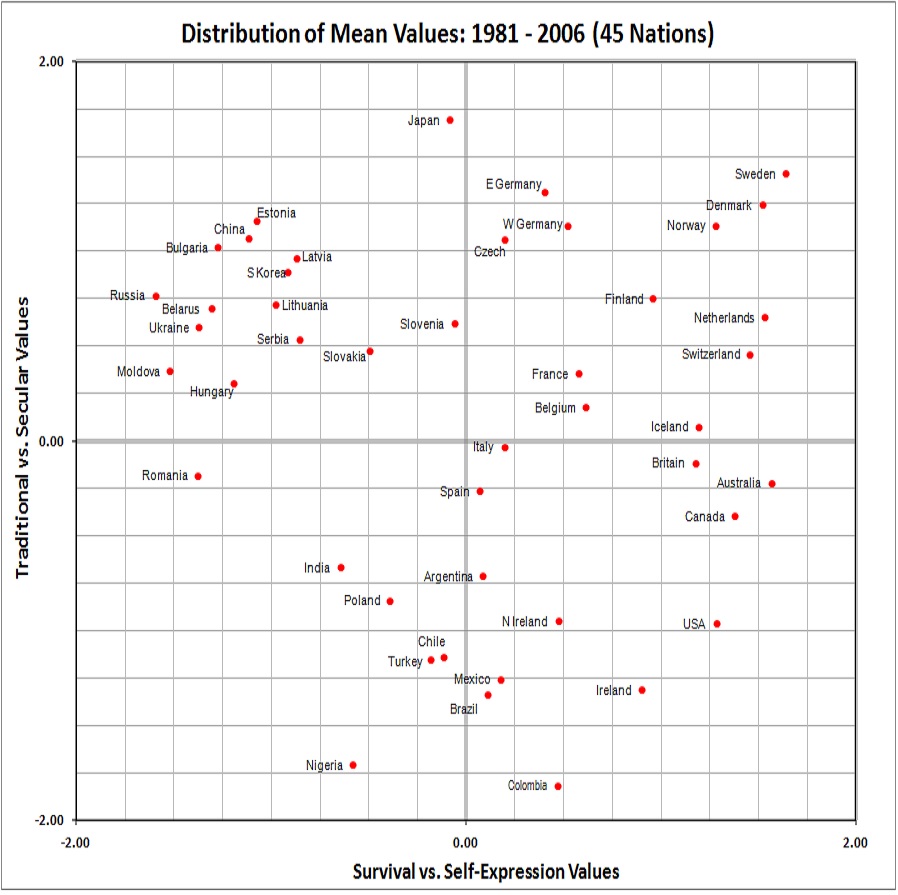
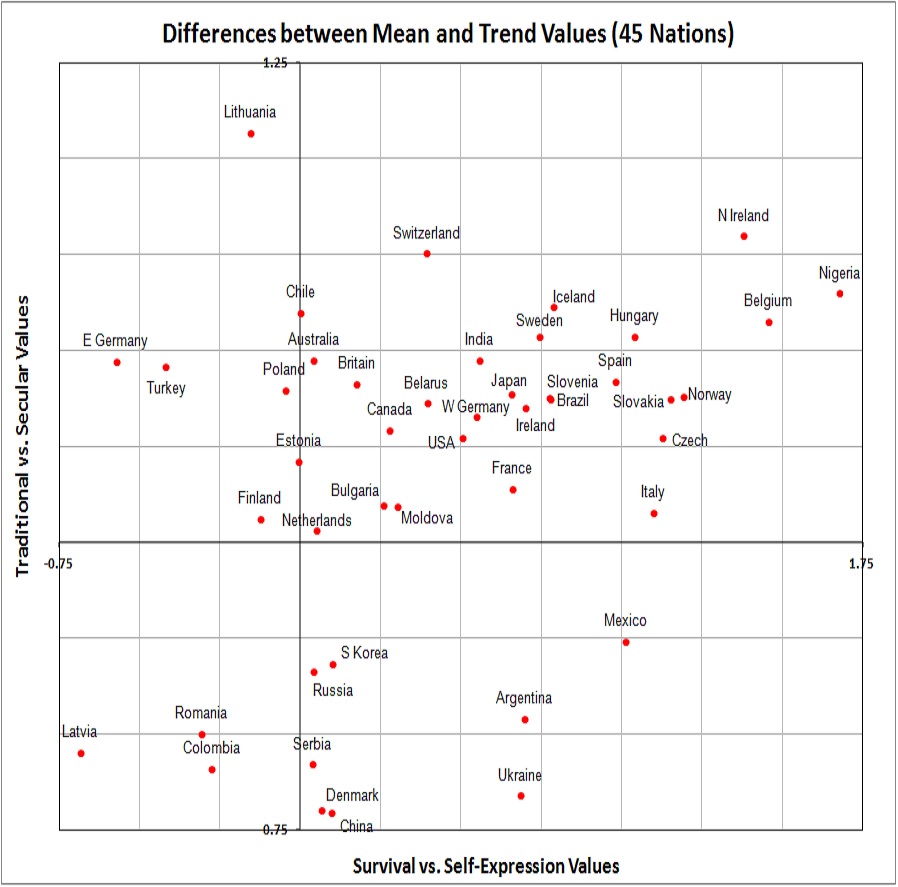
Accordingly, using data for 1981-2006 (“National-Level Value Scores on the Two Major Values Dimensions, for All Nations and Waves“), I constructed the graphs below. The first graph is a plot of the means for each country, where a country is included only if it appears in at least three of the five surveys (1981, 1990, 1995, 2000, 2006). The second graph is a plot of the difference between each country’s mean and its predicted position in 2013, as estimated by using the LINEST function of Excel. Although the two graphs are drawn to different scales, because of differences in the spread of plot points, the gridlines in both graphs are 0.25 standard deviations apart. Therefore, a vertical or horizontal distance of 4 gridlines represents 1 standard deviation.

Values - distribution of means, 1981-2006

Values - differences between means and trends

In the first graph, the distance between points indicates degree of significance. Thus, for example, the vertical distance between Japan and Colombia is about 14 gridlines, or 2.5 standard deviations. That is, indeed, a significant difference. Similarly, Sweden is about 13 gridlines (2.25 standard deviations) from Russia in the horizontal dimension; another separation that I would consider significant. Make what you will of it; there are some unsurprising clusters; for example:

  • Several formerly Communist countries are grouped in the northwest quadrant.
  • Nordic countries (Sweden, Denmark, Norway) are grouped in the upper part of the northeast quadrant.
  • Britain, Australia, and Canada form a fairly tight grouping.

On the other hand, here are some other examples:

  • The Britain-Australia-Canada cluster is close to the point for Iceland, which (surprisingly) is fairly far from the the Sweden-Denmark-Norway cluster.
  • Japan — perhaps unsurprisingly, as the most Westernized of Asian nations — stands well apart from China and South Korea, which are in a cluster with former Communist countries.
  • Italy and Spain aren’t significantly far from France and Belgium, nor are the latter significantly far from Finland and Iceland.

The best that I can make of the first graph is a rough east-west split along the horizontal axis, and, of course, a rough less-religious to more-religious split along the vertical axis.

What about the trends that are indicated in the second graph? There, the relevant distance is from the 0,0 intersection of the axes. That is so because the graph depicts the predicted change (in 2013) from each country’s mean for 1981-2006. Only Lithuania is on a course to move vertically by 4 or more gridlines (1 or more standard deviations). Further, there’s a lot of downward movement.

The preceding observations suggest that, in general, there isn’t strong movement away from traditional values toward secular ones. That’s consistent with the Weberian view: religious values have a lasting effect. I would add that they have a lasting effect where they’re not suppressed — as they were in the former Communist countries, and as they are by the “thought police” of many Western European countries and Canada.

There is, however, a definite rightward movement, away from survival values. In fact, several countries are on a course to move horizontally by 4 or more gridlines: Spain, Hungary, Italy, Czech Republic, Slovakia, Norway, Northern Ireland, Belgium, and Nigeria. The movement away from survival values toward what the authors call self-expression values is consistent with the general rise of living standards in much of the world.

In sum, the groupings drawn by the authors in their Figure 1 are strained and uninformative. If you believe that the “values” surveys yield meaningful aggregations, look beyond the authors’ groupings to the data presented in my two graphs. And draw your own conclusions.
__________
* A similar but later mapping is found here. Similar criticisms apply to it.

More Thoughts about Patience and Its Significance

This is a rerun of “Patience as a Tool of Strategy,” (10/03/11), and of “Happy Anniversary to Me” (10/03/12). I have revised the closing paragraphs.

Today is the 16th anniversary of my retirement from full-time employment. I take special delight in this annual observance because my retirement capped a subtle campaign to arrange the end of my employment on terms very favorable to me. The success of the campaign brought a profitable end to my tense relationship with my boss. I liken the campaign to fly-fishing: I reeled in a big fish by accurately casting an irresistible lure then playing the fish into my net. I have long wondered if my boss ever grasped what I had done and how I had done it. The key was patience; more than a year passed between my casting of the lure and the netting of the fish (early retirement with a financial sweetener). Without going into the details of my “fishing expedition,” I can translate them into the elements of success in any major undertaking:

  • strategy — a broad and feasible outline of a campaign to attain a major objective;
  • intelligence — knowledge of the opposition’s objectives, resources, and tactical repertoire, supplemented by timely reporting of his actual moves (especially unanticipated ones);
  • resources — the physical and intellectual wherewithal to accomplish the strategic objective while coping with unforeseen moves by the opposition and strokes of bad luck;
  • tactical flexibility — a willingness and ability to adjust the outline of the campaign, to fill in the outline with maneuvers that take advantage of the opposition’s errors, and to compensate for one’s own mistakes and bad luck;
  • and — as mentioned — a large measure of patience, especially when one is tempted either to quit or escalate blindly.

Patience is not a virtue that accrues to amorphous masses, like nations. It can be found only in individuals or groups of individuals who share the same objectives and are able to work together long enough to attain those objectives. Patience doesn’t necessarily accompany other virtues. After all, Hitler exhibited great patience in his willingness to pursue power despite setbacks and ridicule along the way. The successful pursuit of high office in the United States also requires great patience, but the power of the presidency has been wielded by the likes of Wilson, FDR, LBJ, Nixon, Carter, Clinton, and Obama. What does that say about me? You can read my posts and be the judge, insofar as what I write reflects the kind of person that I am. But in reading my posts, you will learn more about me than you will ever know about aspirants to high office.

*     *     *

Related posts:
A Grand Strategy for the United States
Not-So-Random Thoughts (V) (first entry)

The World Turned Upside Down

Of World War II and the Cold War, I once wrote:

The Third Reich and Empire of the Rising Sun failed to dominate the world only because of (a) Hitler’s fatal invasion of Russia, (b) Japan’s wrong-headed attack on Pearl Harbor, and (c) the fact that the United States of 1941 had time and space on its side…

[The subsequent Cold War was a] necessary, long, and costly “war” of deterrence through preparedness [that] enabled the U.S. to protect Americans’ legitimate economic interests around the world by limiting the expansion of the Soviet empire.

I now suspect that the Cold War was unnecessary, and therefore a vast waste of lives resources, because World War II took a wrong turn.

Bear in mind that the USSR, our Cold War enemy, survived World War II, went on to seize Eastern Europe, and became a power to be reckoned with largely because of

  • vast deliveries of American aid to the USSR during the war
  • the adoption of the policy of unconditional surrender, which probably prolonged the war in Europe, enabling the USSR to move its forces farther to the west
  • the Anglo-American invasion of Europe through northern France on D-Day, rather than through southern Europe earlier in the war, which also enabled Soviet forces to move farther to the west
  • FDR’s concessions to Stalin, late in the war at the Yalta Conference, which set the stage for the USSR’s seizure of Eastern Europe (the scope of which was ratified at the Potsdam Conference)
  • Soviet influence and espionage, exerted through and conducted by U.S. government officials, which abetted the foregoing and hastened the USSR’s acquisition of nuclear weapons.

But there is more: several foregone opportunities to end the war early and turn the tide against the USSR.

The first such opportunity is related in a recent news story:

[Rudolf] Hess’s journey to Britain by fighter aircraft to Scotland has traditionally been dismissed as the deranged solo mission of a madman.

But Peter Padfield, an historian, has uncovered evidence he says shows that, Hess, the deputy Fuhrer, brought with him from Hitler, a detailed peace treaty, under which the Nazis would withdraw from western Europe, in exchange for British neutrality over the imminent attack on Russia.

The existence of such a document was revealed to him by an informant who claims that he and other German speakers were called in by MI6 to translate the treaty for Churchill….

The informant said the first two pages of the treaty detailed Hitler’s precise aims in Russia, followed by sections detailing how Britain could keep its independence, Empire and armed services, and how the Nazis would withdraw from western Europe. The treaty proposed a state of “wohlwollende Neutralitat” – rendered as “well wishing neutrality”, between Britain and Germany, for the latter’s offensive against the USSR. The informant even said the date of the Hitler’s coming attack on the east was disclosed….

Mr Padfield, who has previously written a biography of Hess as well as ones of Karl Dönitz and Heinrich Himmler, believes the treaty was suppressed at the time, because it would have scuppered Churchill’s efforts to get the USA into the war, destroyed his coalition of exiled European governments, and weakened his position domestically, as it would have been seized on by what the author believes was a sizeable “negotiated peace” faction in Britain at that time. At the same time, since the mission had failed, it also suited Hitler to dismiss Hess as a rogue agent….

Mr Padfield added….

“This was a turning point of the war. Churchill could have accepted the offer, but he made a very moral choice. He was determined that Hitler, who could not be trusted, would not get away with it. He wanted the US in the war, and to defeat Hitler.”

Mr Padfield has also assembled other evidence to support the existence of the treaty and its contents – as well as the subsequent cover-up….

For the rest of the story, see Jasper Copping’s article, “Nazis ‘Offered to Leave Western Europe in Exchange for Free Hand to Attack USSR’,” (The Telegraph, September 26, 2013).

Hess’s aborted mission took place in 1941, and — purportedly — with Hitler’s blessing. After the failure of Hess’s mission, however, a lot happened without Hitler’s blessing. What follows are excerpts of Diana West’s American Betrayal: The Secret Assault on Our Nation’s Character (St. Martin’s Press, 2013):

… When Louis Lochner, for many years the AP bureau chief in Berlin, attempted to file a story on the activities of anti-Nazi Germans operating out of France in October 1944, U.S. military censors blocked the story. Why? “The government official in charge of censorship was forthcoming enough to confide to Lochner that there was a personal directive from the president of the United States ‘in his capacity of commander in chief forbidding all mention of the German resistance,’” writes Klaus P. Fischer in his 2011 book, Hitler and America. Drawing from Lochner’s 1956 memoir Always the Unexpected, Fischer quotes Lochner’s explanation for this seemingly inexplicable and outrageous censorship: “Stories of the existence of a resistance movement did not fit into the concept of Unconditional Surrender!” …

Turns out, Lochner knew Roosevelt personally, and both men had a mutual friend in Prince Louis Ferdinand of Prussia. Lochner had been in contact with the anti-Hitler opposition in Germany since 1939. In November 1941, German anti-Nazis asked Lochner, heading home on leave, to contact the president on their behalf, to ask Roosevelt to speak out about what form of government he would like to see take shape in post-Hitler Germany, and to provide the president with secret radio codes so that Americans and German anti-Nazis could communicate directly with each other. So writes Peter Hoffman in The History of the German Resistance, 1933– 1945, which first appeared in Germany in 1969, drawing from the 1955 German edition of Lochner’s memoir, certain details of which Hoffman says are not in the English version.

Lochner was interned by the Nazi regime at the outbreak of the war in December 1941 and didn’t reach Washington until the summer of 1942. This would have been shortly after “unconditional surrender” was affirmed and reaffirmed by the president’s postwar advisory council subcommittee, and shortly after Roosevelt had promised a “second front” to Soviet minister Molotov. Lochner immediately informed the White House that he had personal and confidential messages for the president from the prince “and secret information on resistance groups in Germany that he might not confide to anyone else.”

No answer. No interest.

Lochner’s attempts at gaining an audience in June 1942 failed. Lochner followed up with a letter and received no reply. Finally, he was informed by the White House through the AP bureau in Washington, Hoffman writes, that “there was no desire to receive his information and he was requested to refrain from further efforts to transmit it.” …

… Hoffman reveals an important piece of the puzzle in a footnote. Lochner’s final attempt to reach Roosevelt on June 19, 1942, was in a letter addressed to a trusted presidential aide. That aide was [Soviet agent] Lauchlin Currie….

***

In his 1958 memoir, Wedemeyer Reports!, General [Albert C.] Wedemeyer picks up on George H. Earle’s series of secret negotiations with the German underground, which began with [Hitler’s chief spy Adm. Wilhelm] Canaris….

According to Earle’s account, he sent Canaris’s initial query regarding a negotiated peace to the White House via diplomatic pouch in early 1943….

… Just before Earle departed the United States to become FDR’s special emissary in Istanbul (officially, naval attaché), he wrote the following letter on December 19, 1942, from New York City on Ritz-Carlton stationery.

Dear Harry: If you don’t mind I’m going to report to you direct my activities. I like the way your mind works and I know you will sort out what you think of importance enough for the President.

[Canaris’s query went nowhere, of course, given Hopkins’s position as a pro-Soviet agent of influence — de facto if not de jure.]

***

The next approach to Earle, also in that spring of 1943, came from Baron Kurt von Lersner, a German aristocrat of Jewish extraction who lived in virtual exile in Turkey. He, too, had a proposal for the Allies. Earle wrote, “According to Lersner— and I could not doubt him; he had placed his life in my hands— some of the highest officials in Germany, [ambassador to Turkey Franz von] Papen included, loved their country but hated Hitler. They wanted to end the war before he bled Germany of all her youth, all her strength and resources. At the same time, they were deeply concerned about Russia’s growing might and power.” …

Earle sent off another dispatch to FDR at the White House marked “Urgent.” Again, Earle received no reply. “I pressed the matter with every ounce of my persuasion and judgment,” Earle wrote, “but I sensed the old trouble. Lersner’s call for an overt stand against Communist expansion distressed Roosevelt.” …

Earle wrote that his German contacts came back to him with another more specific plan, laying out the involvement of Field Marshal Ludwig Beck; Count Wolf Heinrich von Helldorf, chief of police of Berlin; Prince Gottfried Bismarck, a Potsdam official and grandson of the “Iron Chancellor”; and a well-known cavalry officer, Freiherr von Boeselager. Again, the plan was to stage a coup, turn over Hitler and his top henchmen to the Allies, and bring about Germany’s “unconditional surrender, with one condition”: The Russians were not to be allowed into Central Europe, including Germany or territory at that time controlled by Germany.

Earle sent this dispatch off with high hopes, he wrote….

Earle doesn’t specify how much time went by, but finally an answer from the president came through. It was stiff and impersonal. “All such applications for a negotiated peace should be referred to the Supreme Allied Commander, General Eisenhower,” Roosevelt wrote…. Earle explains, “In diplomatic language, this was the final runaround. Even if we did get to Eisenhower, the matter would be referred back to Roosevelt for a decision. The President’s answer was therefore a clear indication of his complete disinterest in this plan to end the war….

As for “unconditional surrender”:

Quite notably, … the very first use of the phrase “unconditional surrender” at Casablanca was by Harry Hopkins himself. In a January 23, 1943, meeting, one day ahead of the president’s sensational announcement, Hopkins told the grand vizier of Morocco, “The war will be pursued until Germany, Italy, and Japan agree to unconditional surrender.” …

… [U]nconditional surrender may well be the policy that ensured Soviet dominion over half of Europe. It was also, as Ian Colvin noted in the preface to a 1957 edition of his Canaris biography, a “pivotal point” in the tragedy of the German underground. “Unconditional surrender” would set the strategy of “total war” (Allied) as the only appropriate response to “total guilt” (German). Such a strategy presumed, indeed, drew inspiration from, a belief in the unwavering, monolithic German support for Nazism and Hitler, which the very existence of a significant anti-Nazi German resistance movement belied. For the sake of the policy then, the significant anti-Nazi German resistance movement had to be denied, shut out. Otherwise, “total war,” and the total destruction it required, wasn’t justified. Otherwise, I say, Stalin wouldn’t win.

General Wedemeyer devotes an entire chapter of his memoir to making the devastating strategic case against unconditional surrender. The general did not mince words: “We annulled the prospect of winning a real victory by the Casablanca call for unconditional surrender,” he wrote. 39 Why? “Our demand for unconditional surrender naturally increased the enemy’s will to resist and forced even Hitler’s worst enemies to continue fighting to save their country.” …

Wedemeyer elaborated, “We failed to realize that unconditional surrender and the annihilation of German power would result in a tremendous vacuum in Central Europe into which the Communist power and ideas would flow.”

About that vacuum in Central Europe: Is it the case that “we” simply “failed” to realize that a vacuum would emerge? Or had enough of us instead bought the Moscow line that Stalin wanted “nothing more than security for his country,” as Roosevelt, invoking Harry Hopkins, told William Bullitt at this same fateful moment? What about those among us in positions of power who had already decided that Stalin in Europe would be a good thing?

Remember Hanson Baldwin’s Numero Uno “great mistake of the war”: the belief “that the Politburo had abandoned  … its policy of world Communist revolution and was honestly interested in the maintenance of friendly relations with capitalist governments.”

Where did that belief— propaganda— come from?

Wedemeyer explains, “We poisoned ourselves with our own propaganda and let the Communist serpent we took to our bosom envenom our minds and distort our ideals.” Baldwin is more matter-of-fact. “We became victims of our own propaganda,” he wrote. “Russian aims were good and noble. Communism had changed its spots.”

We were victims, all right, but not of “our own” propaganda; it was their propaganda. It was propaganda conceived in Moscow and disseminated by bona fide Kremlin agents, mouthpieces and organizers of Communist parties, fellow travelers, and many, many dupes (“ liberals,” “all the best people,” opinion makers, etc.). …

This puts a cap on it:

Now, the question: What if Lochner’s query had been received with natural interest and acted on in mid-1942? What if the U.S. government had initiated contact with the anti-Hitler opposition at that point and supported a successful coup against Hitler in Germany? Or, what if six months later, Canaris, Hitler’s secret opponent, had been encouraged to produce the defection of the German army and negotiate its surrender to the Allies? What if one of the subsequent, serious attempts that other opponents of Hitler made through various Anglo-American emissaries in 1942, 1943, and 1944 had been able to overthrow the Führer, close down the concentration camps, abort the Final Solution, thwart Soviet conquests in Europe and Asia, call off every battle from Monte Cassino to D-day to the Warsaw Uprising to the Battle of the Bulge, avoid the destruction of city centers from Hamburg to Dresden, and save the lives of millions and millions and millions of people in between? …

… [B]ut there it is: World War II could have ended years earlier had Communists working for Moscow not dominated Washington, quashing every anti-Nazi, anti-Communist attempt, beginning in late 1942, throughout 1943 and 1944, to make common cause with Anglo-American representatives….

It’s not as if the true nature and intentions of the Soviet regime were unknown. As West points out, the peace feelers from Canaris et al.

began … at about the same time former U.S. ambassador to the USSR William C. Bullitt presented FDR with his prophetic blueprint of what the postwar world would look like if Anglo-American appeasement of Stalin didn’t stop….

Specifically:

Bullitt’s first memo to FDR was written on January 29, 1943. It was, Bullitt told the president, “as serious a document as any I have ever sent you.” He began by acknowledging that many observers in the United States believed that Stalin shared the president’s post-war vision expressed in the Atlantic Charter and the Four Freedoms. Bullitt countered that no “factual evidence” existed to support the view that Stalin was a changed man. “We find no evidence,” he wrote, “but we find in all democratic countries an intense wish to believe that Stalin has changed….” This view of a changed Stalin, therefore, was “a product of the fatal vice in foreign affairs—the vice of wishful thinking.” U.S. and British admiration for the valor demonstrated by the Russian people in the defense of their homeland was causing policymakers to overlook “both basic Russian Nationalist policy and Soviet Communist policy.”

“The reality,” Bullitt explained,

is that the Soviet Union, up to the present time, has been a totalitarian dictatorship in which there has been no freedom of speech, no freedom of the press, and a travesty of freedom of religion; in which there has been universal fear of the O.G.P.U. [secret police] and Freedom from Want has been subordinated always to the policy of guns instead of butter.

Stalin controls “in each country of the world,” Bullit further explained, “a 5th column” composed of “public or underground Communist Parties.” Stalin uses this Fifth Column for “espionage, propaganda, character assassination of opponents, and political influence….”

“[T]here is no evidence,” Bullitt emphasized, “that [Stalin] has abandoned either the policy of extending communism or the policy of controlling all foreign communist parties.” The Soviet Union “moves where opposition is weak, [but] stops where opposition is strong.” The United States must, advised Bullitt,

demonstrate to Stalin—and mean it—that while we genuinely want to cooperate with the Soviet Union, we will not permit our war to prevent Nazi domination of Europe to be turned into a war to establish Soviet domination of Europe. We have to back democracy in Europe to the limit, and prove to Stalin that, while we have intense admiration for the Russian people and will collaborate fully with a pacific Soviet State, we will resist a predatory Soviet State just as fiercely as we are now resisting a predatory Nazi State.

Bullitt provided FDR with a brief history lesson to show that Russia had always been an expansionist power…. Therefore, Bullitt opined, “[e]ven if Stalin had become a mere Russian nationalist—which he has not—that would be no guarantee of pacific behavior; indeed, it would be a guarantee of aggressive imperialism.”

Bullitt then listed Stalin’s “avowed” aims, which included the annexation of Bukovina, eastern Poland, Besserabia, Lithuania, Estonia, Latvia, and parts of Finland, and his secret goals, which included establishing communist governments in Romania, Bulgaria, Yugoslavia, Poland and northern Iran, and expanding the influence communist parties in France and Germany. Bullit feared that a Soviet Union victorious in Europe would try to take geopolitical advantage of the fact that the United States and Great Britain still had to contend with Japan in the Far East. In such circumstances, Bullit wrote, “[t]here will be no single power or coalition in Europe to counterbalance the Soviet Union. The Soviet Union will be in a position to devote all its strength to overrunning Europe….” He sketched the following scenario:

While the United States and Great Britain are engaged in defeating Japan, the Red Army … will sweep through Europe from east to west, being welcomed by the Soviet 5th columns already organized in every European country. Then will follow the familiar comedy. There will be no talk of “annexation by the Soviet Union.” There will be a “freely chosen form of government” (Soviet); “free expression of the people’s will” (under occupation by the Red Army); and out will be trotted again all the obscene lies that accompanied the “freely expressed desire of the Baltic Republics, to be received into the Soviet Union.”

To prevent Soviet domination of Europe after the war, Bullitt counseled, the United States must establish in “occupied or liberated countries in Europe democratic administrations which, working together, will be strong enough to provide the requisite defense against invasion by the Soviet Union.” … ” The United States, he advised Roosevelt, must “lay the ground work for a combination of democratic governments in Europe strong enough to preserve democracy in Europe and keep the Bolsheviks from replacing the Nazis as masters of Europe.”

The United States, argued Bullitt, should not rely on agreements with the Soviet Union to preserve peace and the balance of power in Europe and the world. “The onward flow of the Soviet Union,” he explained, “has never been impeded by any written agreement…. Soviet invasion finds barriers in armed strength, not in Soviet promises.” That armed strength, according to Bullitt, should consist of an integrated, democratic and armed Europe backed by Great Britain and the United States….

Four months later, on May 12, 1943, Bullitt wrote a short follow-up memo to the president. He urged FDR to get commitments from the Soviet Union and Britain to help us in our war against Japan, and repeated his call for a military invasion of the Balkans to liberate Eastern and Central Europe before Soviet forces occupied the region. U.S. power was at its zenith, according to Bullitt, so it was essential that we translate that power to achieve our political goals.

On August 10, 1943, Bullitt wrote a final letter to the president on this subject. Echoing the great theorist of war, Karl von Clausewitz, Bullitt emphasized to Roosevelt that “[w]ar is an attempt to achieve political objectives by fighting; and political objectives must be kept in mind in planning operations.” The political objectives of the United States, he explained, “require the establishment of British and American forces in the Balkans and eastern and central Europe. Their first objective should be the defeat of Germany, their second, the barring to the Red Army of the way into Europe….”

A Soviet dominated Europe would be as great a threat to the United States and Britain as a German dominated Europe, wrote Bullitt. The dilemma of U.S. policy was to find a way to “prevent the domination of Europe by the Moscow dictatorship without losing the participation of the Red Army in the war against the Nazi dictatorship.” The most important elements of such a policy were, he wrote, the “creation of a British-American line in Eastern Europe,” and the establishment of “democratic governments behind” that line. (From the entry for William Bullitt at the University of North Carolina’s site, American Diplomacy: Foreign Service Dispatches and Periodic Reports on U.S. Foreign Policy)

Roosevelt ignored Bullitt, and the rest is history. The war in Europe was prolonged, unnecessarily and at great cost in lives and treasure. (Bear in mind that if the war in Europe had ended sooner, the Allies could then have focused their efforts on the war in the Pacific — with the resultant saving of many more lives and much more treasure.)

Perhaps the failure to seize an early victory can be chalked up to stubbornness and near-sightedness. I would believe that if there had been only one failure, or even two of them. But several failures look like a pattern to me: a pattern of preference for the survival of the Communist regime in Russia, and a willingness to abide Communist expansion in Europe. The best that can be said is that FDR’s outlook was blinkered by his commitment to Germany’s unconditional surrender, and that his views about the long run were (a) unduly optimistic, (b) insouciant, or (c) actively pro-Soviet. Given the degree of influence wielded by Harry Hopkins with respect to unconditional surrender and Soviet success, I opt for (c). Dupe or not, FDR sat in the Oval Office and made the decisions that turned the world upside down.

The prolongation of World War II is perhaps the biggest government failure in the history of the United States. There is one other that might rival it, though its proximate cause was inadvertent.

The End of Dynasty

I have updated “The End of a Dynasty?” and removed the question mark. I am convinced that we have seen the end of Dynasty III of the New York Yankees. Go there for details.

“Ensuring America’s Freedom of Movement”: A Review

Ensuring America’s Freedom of Movement: A National Security Imperative to Reduce U.S. Oil Dependence was issued by CNA in October 2011. (CNA, in this case, is a not-for-profit analytical organization located in Alexandria, Virginia, and is not to be mistaken for the Chicago-based insurance and financial services company.) Ensuring America’s Freedom of Movement is a product of CNA’s Military Advisory Board (MAB), and is the fourth report issued by the MAB. Accordingly, I refer to it in the rest of this review as MAB4.

This review may be somewhat out of date in places, though not in its thrust. I began writing it almost two years ago, when Ensuring… was published. I have not been in a hurry to post this review because Ensuring… is an inconsequential bit of fluff and unlikely to influence policy. But post I must, because the existence of the MAB and MAB4 are affronts to the distinguished intellectual heritage claimed by CNA.

*     *     *

A critical reader — someone who is not seeking support for preconceived policy prescriptions — will be disappointed in MAB4. If there are valid arguments for government initiatives to foster the development and use of alternatives to oil, they do not leap out of the pages of MAB4.

The main point of MAB4 is to urge

government … action to promote the use of a more diverse mix of transportation fuels and to drive wider public acceptance of these alternatives. (p. xiv, emphasis added)

And on cue, a day after the issuance of Obama’s plan to combat “climate change,” the MAB released a statement that ends with this:

The CNA MAB supports the President’s plan to act now to address the worst effects of climate change and to improve our nations’ energy posture and competitive advantage in clean energy markets. The CNA MAB continues to identify the security implications of climate change and to protect and enhance our energy, climate and national security today and for our future generations. (June 26, 2013)

Despite token acknowledgement of the power of markets to do the job, the authors consistently invoke the power of government, in the name of “stability.”

There is much pointing-with-alarm at the instability caused by “dependence” on imported oil — with a focus on the Middle East. But the only “hard” estimate of the price of instability is a poorly documented, questionable estimate of the effects of a 30-day closure of the Strait of Hormuz on GDP and the output and employment of the U.S. trucking industry. Empirical estimates of the effects of sudden reductions in oil imports (oil shocks) are available, but the authors of MAB4 did not use them — or perhaps did not know about them.

It would have been instructive to compare the cumulative losses to GDP resulting from actual oil shocks with (a) the costs of maintaining forces in the Middle East to deter overtly hostile shocks (e.g., the closure of the Strait of Hormuz by Iran) and (b) the costs to taxpayers and consumers of government subsidies and edicts to promote the development and require the use of alternative energy sources. But no such comparison is offered, so the critical reader has no idea whether efforts to wean the U.S. from oil — especially imported oil — make economic sense.

Moreover, the authors of MAB4 reject the possibility of drawing down U.S. forces in the Middle East, for “strategic” reasons, which means that (in the authors’ view) taxpayers should continue to foot the bill for Middle East forces while coughing up additional sums to subsidize the development and use of alternative energy sources. I am all in favor of a forward strategy that is aimed at deterring and countering adventurism on the part of America’s enemies and potential enemies. It would be foolish in the extreme to allow our enemies and potential enemies to aggrandize their power by denying America’s access to a vital resource, such as oil. (Iran and China, I am looking at you.) It would be (and is) doubly foolish to throw bad money after good by also succumbing to the lobbying efforts of corn-growers, makers of solar panels, and kindred rent-seekers.

In sum, MAB4 is a piece of advocacy, not objective analysis. True believers in the wisdom and infallibility of government will rejoice in MAB4 and hope, pray, plead, and work for the adoption of its recommendations by the federal government. Critical readers will check their wallets and wonder at the naivete and presumptuousness of the 13 retired flag and general officers who constituted the MAB when CNA extruded MAB4.

*   *   *

I will elaborate on the preceding observations in the rest of this review, which has six main parts:

  • I. Background: CNA and the MAB — This part is for the benefit of those readers — almost all of you, I’m sure — who know nothing of CNA or its Military Advisory Board.
  • II. An Overview of MAB4 — This part outlines the organization of MAB4 and summarizes its findings and recommendations, which come into play throughout the review.
  • III. The Hidden Foundation of MAB4 — MAB4’s findings and recommendations rest on a foundation of hidden assumptions — biases, if you will. Part III articulates those biases.
  • IV. The Analytical Superstructure of MAB4 — This part focuses on the facts and logic of the substantive portions of MAB4, namely, Chapters 1 and 2. They are found wanting.
  • V. MAB4 vs. CNA’s Standards — CNA proclaims itself an organization that upholds a long tradition of high standards and objectivity. Are the MAB and MAB4 consistent with that tradition? Part V answers that question in the negative.
  • VI. Summary Assessment —  A final 534 words, for the benefit of readers who want to skip the gory details.

(The rest of this very long review is below the fold.) Continue reading ““Ensuring America’s Freedom of Movement”: A Review”

Conservatism as Right-Minarchism

W. Winston Elliott III delivers an apt appreciation of Russell Kirk and conservatism:

[Kirk’s The Conservative Mind] does not supply its readers with a “conservative ideology”: for the conservative abhors all forms of ideology. An abstract rigorous set of political dogmata: that is ideology, a “political religion,” promising the Terrestrial Paradise to the faithful; and ordinarily that paradise is to be taken by storm. Such a priori designs for perfecting human nature and society are anathema to the conservative, who knows them for the tools and the weapons of coffeehouse fanatics.

For the conservative, custom, convention, constitution, and prescription are the sources of a tolerable civil social order. Men not being angels, a terrestrial paradise cannot be contrived by metaphysical enthusiasts; yet an earthly hell can be arranged readily enough by ideologues of one stamp or another. Precisely that has come to pass in a great part of the world, during the twentieth century.

Edward Feser puts it this way:

Tradition, being nothing other than the distillation of centuries of human experience, itself provides the surest guide to determining the most rational course of action. Far from being opposed to reason, reason is inseparable from tradition, and blind without it. The so-called enlightened mind thrusts tradition aside, hoping to find something more solid on which to make its stand, but there is nothing else, no alternative to the hard earth of human experience, and the enlightened thinker soon finds himself in mid-air…. But then, was it ever truly a love of reason that was in the driver’s seat in the first place? Or was it, rather, a hatred of tradition? Might the latter have been the cause of the former, rather than, as the enlightened pose would have it, the other way around?) (“Hayek and Tradition“)

As for conservative governance, I turn to Michael Oakeshott:

To some people, ‘government’ appears as a vast reservoir of power which inspires them to dream of what use might be made of it. They have favourite projects, of various dimensions, which they sincerely believe are for the benefit of mankind, and to capture this source of power, if necessary to increase it, and to use it for imposing their favourite projects upon their fellows is what they understand as the adventure of governing men. They are, thus, disposed to recognize government as an instrument of passion; the art of politics is to inflame and direct desire….

Now, the disposition to be conservative in respect of politics reflects a quite different view of the activity of governing. The man of this disposition understands it to be the business of a government not to inflame passion and give it new objects to feed upon, but to inject into the activities of already too passionate men an ingredient of moderation; to restrain, to deflate, to pacify and to reconcile; not to stoke the fires of desire, but to damp them down….

It is not, then, mere stupid prejudice that disposes a conservative to take this view of the activity of governing; nor are any highfalutin metaphysical beliefs necessary to provoke it or make it intelligible. It is connected merely with the observation that where activity is bent upon enterprise the indispensable counterpart is another order of activity, bent upon restraint, which is unavoidably corrupted (indeed, altogether abrogated) when the power assigned to it is used for advancing favourite projects. An ‘umpire’ who at the same time is one of the players is no umpire; ‘rules’ about which we are not disposed to be conservative are not rules but incitements to disorder; the conjunction of dreaming and ruling generates tyranny.

Political conservatism is, then, not at all unintelligible in a people disposed to be adventurous and enterprising, a people in love with change and apt to rationalise their affections in terms of ‘progress’…. Indeed, a disposition to be conservative in respect of government would seem to be pre-eminently appropriate to men who have something to do and something to think about on their own account, who have a skill to practise or an intellectual fortune to make, to people whose passions do not need to be inflamed, whose desires do not need to be provoked and whose dreams of a better world need no prompting. Such people know the value of a rule which imposes orderliness without irecting enterprise, a rule which concentrates duty so that room is left for delight…. (“On Being Conservative,” Rationalism in Politics and Other Essays, New and Expanded Edition., pp. 431-5)

Now, returning to Kirk, I redact his six “canons” of conservatism to conform to my “canons” of right-minarchism:

(1) Belief that a divine intent rules society as well as conscience…. Political problems, at bottom, are religious and moral problems… (2) Affection for the proliferating variety and mystery of traditional life, as distinguished from the narrowing uniformity and equilitarianism and utilitarian aims of most radical systems. (3) Conviction that civilized society requires orders and classes…. Society longs for leadership…. (4) Persuasion that property and freedom are inseparably connected, and that economic levelling is not economic progress…. (5) Faith in prescription [traditional mores] and distrust of “sophisters and calculators.” Man must put a control upon his will and his appetite…. Tradition and sound prejudice provide checks upon man’s anarchic impulse. (6) Recognition that change and reform are not identical….

Religion isn’t necessary to right-minarchism, though neither is it ruled out. Basic religious precepts (as in the Ten Commandments) form the moral foundation of civil society, which depends not so much on orders and classes as it does on order (as opposed to lawlessness) and respect for the persons and property of others. There is little else on which to differ with Kirk.

Therefore, in my taxonomy of politics, Kirk’s conservatism is located in right-minarchism — which is a distinct branch of libertarianism. Right-minarchism rejects the nihilism and strident anti-religionism which are rampant in strains of libertarianism, namely, anarchism and left-minarchism. Anarchists and left-minarchists believe, foolishly, that liberty is to be found in the rejection of order and social norms. Liberty would be the first victim of the brave new disorder that they wish for.

So, here’s to right-minarchism, the nexus of true conservatism and true libertarianism.

*     *     *

Related posts:
Democracy and Liberty
Parsing Political Philosophy
Is Statism Inevitable?
Inventing “Liberalism”
What Is Conservatism?
Utilitarianism, “Liberalism,” and Omniscience
Utilitarianism vs. Liberty
Law and Liberty
Negative Rights
Negative Rights, Social Norms, and the Constitution
Rights, Liberty, the Golden Rule, and the Legitimate State
The Near-Victory of Communism
Tocqueville’s Prescience
Accountants of the Soul
“Natural Rights” and Consequentialism
Rawls Meets Bentham
Is Liberty Possible?
The Left
More about Consequentialism
Line-Drawing and Liberty
The Divine Right of the Majority
Our Enemy, the State
Pseudo-Libertarian Sophistry vs. True Libertarianism
Positivism, “Natural Rights,” and Libertarianism
What Are “Natural Rights”?
The Golden Rule and the State
Libertarian Conservative or Conservative Libertarian?
Liberty, Equality, Fraternity: Part I
Bounded Liberty: A Thought Experiment
Evolution, Human Nature, and “Natural Rights”
More Pseudo-Libertarianism
More about Conservative Governance
The Meaning of Liberty
Positive Liberty vs. Liberty
Facets of Liberty
Burkean Libertarianism
Rights: Source, Applicability, How Held
What Is Libertarianism?
True Libertarianism, One More Time
Human Nature, Liberty, and Rationalism
Utilitarianism and Psychopathy
Why Conservatism Works
Liberty and Society
The Eclipse of “Old America”
Genetic Kinship and Society
Liberty as a Social Construct: Moral Relativism?
Defending Liberty against (Pseudo) Libertarians
Fighting Modernity
The Barbarians Within and the State of the Union
Defining Liberty

Defining Liberty

When philosophers get together, you can be sure of one thing: A lot of words will be spilled to little or no effect. This proposition is amply demonstrated by a virtual symposium on “The System of Liberty” at The Online Library of Liberty.

Thousands of words leave the reader in search of a useful definition of liberty — any definition of it, for that matter. This is as good as it gets:

[I]n conventional English, the words “liberty” and “freedom” appear to be used to refer to variety of related but not identical things. My view is that “freedom” and “liberty” are not in the first instance philosophical concepts, unlike, say, “epistemic justification” or “social contract.” Instead, these are conventional concepts in natural language, though they are concepts that philosophers appropriately take great interest in. Thus, there is a default presumption that philosophers should yield to common usage when discussing what “liberty” really means….

In closing, I think there are three main questions about liberty:

1. What is it? …

There’s a lot of hooey about Hobbes and Locke, and so on, but it’s all to no avail.

Well, what is liberty? Bereft as I am of indoctrination in the mumbo-jumbo of philosophy, I am especially qualified to tell you. It is a social construct that cannot be defined by a priori philosophizing.

Thus:

liberty — “do what you want, constrained only by the harm to others” — is an empty concept unless it rests on a specific definition of harm. Why? Because harm is not a fixed thing — like the number 1 or your house — it is a vague concept that has meaning only when it refers to specific types of act, which then may be judged as harmful by some and unharmful by others. But until harm is defined and agreed through mutual consent (explicit or implicit), liberty lacks real meaning.

Therefore:

Liberty … is a social construct, without a fixed meaning. Further, harm is not a single thing; it is many things, each of which is socially defined. Each harm refers to a right; the right not to be killed without (specified) cause, for example. The collection of rights (anti-harms) defines the scope of liberty in a particular society. Liberty is therefore divisible, to some extent; that is, a person might enjoy most of his socially agreed rights, but not all of them, because of this action by government or that action by a compatriot or enemy. (It is wrong, however, to assume that one can divide rights between social and economic categories; what is called economic activity is nothing more than a particular aspect of social activity, and the denial of certain economic rights is also a denial of social rights.)

However, when I say that

liberty is a social construct …. is a realistic position, not a morally relativistic one. I am quite prepared to be judgmental of societies and polities. There is a “best” morality. It was widely practiced in Old America [see this]. Though it is still practiced in the remnants of Old America, it is vanishing from the United States, mainly because government has sundered social bonds and usurped the role of  society as the arbiter of morality. The government of the United States and the governments of most of its political subdivisions are illegitimate because their legal impositions are, for the most part, rooted in envy and power-lust — and not in Judeo-Christian morality.

I am in danger of philosophizing, so I’ll leave you with a specific definition of liberty:

peaceful, willing coexistence and its concomitant: beneficially cooperative behavior

To sum up:

The problem with [the usual definitions of liberty] should … be obvious. Those definitions focus on the individual, whereas the relevant definition of liberty is a social one. That is to say, one cannot address social justice and its connection to liberty unless liberty is viewed as a modus vivendi for a group of individuals. There is no such thing as the ability to do as one pleases — the dominant motif of [the usual definitions] — unless

  • one lives in complete isolation from others, or
  • one lives in the company of others who are of identical minds, or
  • one rules others.

The first condition is irrelevant to the matter of social justice. The second is implausible. The third takes the point of view of a dictator, and omits the point of view of his subjects.

If you prefer to read thousands of words, go here:
On Liberty
Rights, Liberty, the Golden Rule, and the Legitimate State
What Is Conservatism?
Law and Liberty
Zones of Liberty
Society and the State
I Want My Country Back
The Golden Rule and the State
Government vs. Community
Evolution, Human Nature, and “Natural Rights”
More about Conservative Governance
The Meaning of Liberty
Evolution and the Golden Rule
Understanding Hayek
The Golden Rule as Beneficial Learning
Facets of Liberty
True Libertarianism, One More Time
Human Nature, Liberty, and Rationalism
Libertarianism and Morality
Libertarianism and Morality: A Footnote
Legislating Morality
Legislating Morality (II)
Why Conservatism Works
Reclaiming Liberty throughout the Land
Liberty and Society
The Eclipse of “Old America”
Genetic Kinship and Society

America’s Financial Crisis Is Now

A REISSUE (WITHOUT UPDATES) OF THE ORIGINAL POST DATED MAY 1, 2011

*     *     *

INTRODUCTION

Three Economic Charts That Will BLOW YOUR MIND,” at RightWing News, offers some tantalizing statistics about the relationship between federal tax receipts and GDP. The bottom line:

The key thing to take away from this is that the amount of revenue the government can bring in via the income tax is, for whatever reason, more inelastic than most people think. That’s yet another reason to put more emphasis on balancing the budget via spending cuts as opposed to trying to fix the problem with tax increases.

Now, if Hauser’s law is as spot-on as it has been in the past … it’s going to be difficult to raise the government’s revenue level much beyond the 20% mark….

I have no quibble with the proposition that the U.S. government has made unaffordable, unilateral “promises” about Social Security, Medicare, and Medicaid benefits. But I must take issue with the focus on the income tax and Hauser’s law, which is

the proposition that, in the United States, federal tax revenues since World War II have always been approximately equal to 19.5% of GDP, regardless of wide fluctuations in the marginal tax rate.

It is necessary to step back from a myopic focus on the federal government and look at all government receipts and expenditures in the United States. The need to do so arises from two facts: (1) State and local spending is substantial, and (2) federal, State, and local finances have become tightly bound together since the advent of revenue sharing and block grants, and with the explosion of federal statutory and regulatory commands to the States.

I begin by looking at the historical record of government income and outgo. That leads me to the future, in which “entitlements” loom unaffordably large . There are three broad paths along which to proceed: cut “entitlements,” borrow considerably more, or tax considerably more. I explain why the second and third options are untenable and economically destructive. The only viable alternative is to cut “entitlements,” and to begin cutting now.

GOVERNMENT SPENDING AND RECEIPTS: THE HISTORICAL RECORD

Here is how State and local spending stacks up against federal spending:
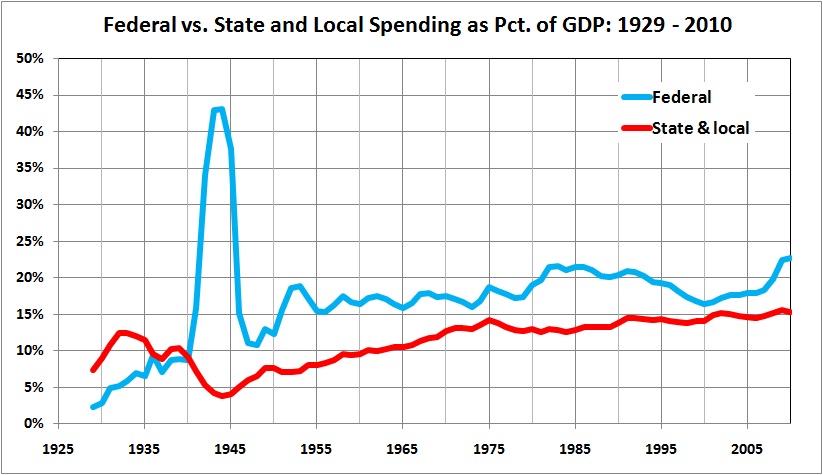
Federal vs state and local spending pct GDP
Sources: Derived from U.S. Department of Commerce, Bureau of Economic Analysis (BEA), National Income and Product Accounts (NIPA) Tables: Table 3.2 Federal Government Current Receipts and Expenditures (lines 26 and 40-45) and Table 3.3 State and Local Government Current Receipts and Expenditures (line 33).

State and local spending is not insubstantial, and has risen in recent decades, with a lot of help from the federal government. Federal grants to State and local governments have risen steadily from almost zero in 1929 to upwards of 4 percent of GDP in recent years. (I have excluded those grants from federal spending to avoid double-counting.)

Here is an aggregate picture of federal, State, and local spending and receipts.
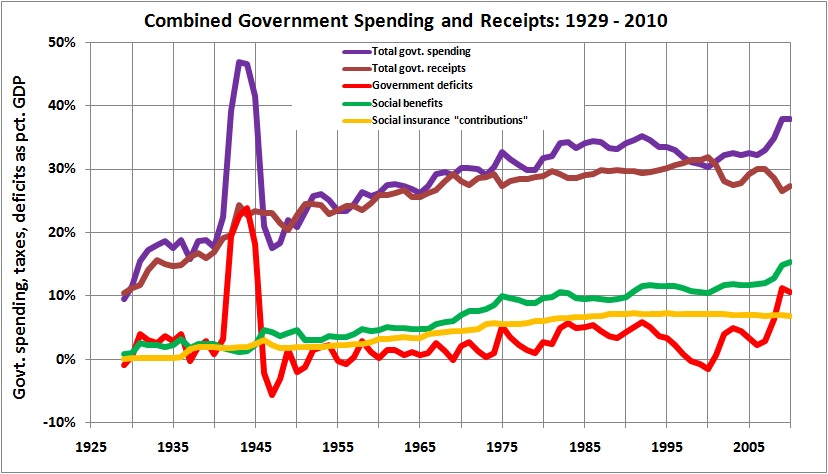
Combined government spending and receipts
Source: Derived from NIPA Table 3.1 Government Current Receipts and Expenditures (lines 7, 19, 30, and 33-39).

Despite Hauser’s “law,” government receipts, as a percentage of GDP, rose steadily from 1929 until 2000, peaking at 32 percent. The post-2000 decline can be attributed to slow economic growth (capped by the recession of 2008-2010) and the so-called Bush tax cuts (which Congress approved initially and again in 2010). I have nothing against the tax cuts, except for the fact that they were not matched by spending cuts. The real burden of government is measured by spending, which diverts resources from productive uses to ones that are less-productive (e.g., public education), counter-productive (e.g., regulation), and downright destructive (i.e., growth-retarding and inflationary). The fact that lenders have increasingly borne the monetary cost of the burden of government has not offset its egregious economic effects. And, as I discuss below, without drastic spending cuts (relative to GDP) there will come a day when lenders will shrug off the burden or demand a much higher price for bearing it.

In any event, regardless of generally diminishing receipts in the first decade of the 21st century, government spending rose as a percentage of GDP, for several reasons. First, there was (and is) slower economic growth, due in no small part to the preceding decades of governmental interference in economic affairs. On top of that, there was Obama’s “stimulus package,” which was meant to end the recession of 2008-2010 but did not (because it could not); the recession ended in the normal way, through the recovery of “animal spirits” and consumer confidence. Then there was (and is) a growing population of persons eligible for Social Security, Medicare (supplemented by “free” or “cheap” prescription drugs), and Medicaid — a population made all the more eager to claim its “entitlements,” given the state of the economy. Finally, and almost incidentally, two foreign wars were fought simultaneously (though with varying degrees of intensity) throughout the decade.

To focus only on federal spending, as I say, is myopic because State and local governments have a habit of raising State and local taxes when so-called federal grants are cut back. (I say “so-called” because the money for those grants is provided largely by taxpayers who are, of course, denizens of the States and their political subdivisions.) In addition to the possibility of higher State and local spending in reaction to cuts in federal largesse, taxpayers — not public-sector unions — should be up in arms about the above-market compensation of government employees. A significant portion of that above-market compensation comes in the form of cushy pension plans, which allow “public servants” to receive high fractions of their salary (sometimes as much as 100 percent) for life, and to begin receiving those payments when they are in their 40s and 50s, after having held a government job for 20 years or so. As a result of these obligations and other undisciplined spending habits, State and local governments have liabilities of more than $7 trillion.

Which brings me to the 500-pound gorilla: the federal government.

“ENTITLEMENTS”: THE SOURCE OF OUR PRESENT AND PROSPECTIVE WOES

Perhaps the most interesting lines in the second graph (above) are the three at the bottom. The gap between the cost of social programs (green line) and “contributions” to those programs (gold line) has risen markedly since the late 1990s. By 2010, the size of that gap — 8.5 percent of GDP — accounted for most deficit spending (red line) — 10.6 percent of GDP. And that is but a hint of things to come. The internet abounds with graphs and tables that depict future federal spending and revenues under various assumptions. They all point to the same conclusion: Spending “commitments” must be cut — and cut drastically — in order to avoid (a) economically disabling tax increases and (b) a day of reckoning in credit markets.

The online offerings include these from the Congressional Budget Office (CBO): “Impact of the President’s Proposals on the Budget Outlook” (blog summary), and “Long Term Analysis of a Budget Proposal by Chairman Ryan” (blog summary). The CBO analyses are somewhat dense and must be read in juxtaposition. They are neatly conjoined by the Committee for a Responsible Federal Budget’s “Analyzing the President’s New Budget Framework.” Here is an informative graphic from that analysis:

Debt projections under various fiscal reform plans

Obama’s “framework,” as the report emphasizes, is short on details. It is obviously a slap-dash response to Paul Ryan’s detailed plan (labelled “House Republicans” in the graphic), which is a serious proposal for long-term deficit reduction. To understand the bankruptcy of Obama’s actual budget and current law, which are about the same, one must look beyond 2021.

Drawing on CBO’s work, Cato Institute’s Michael Tanner take the long view in “Bankrupt: Entitlements and the Federal Budget.” Tanner leads off with this:

The U.S. government is about to exceed its statutory debt limit of $14.3 trillion. But that actually underestimates the size of the fiscal time bomb that this country is facing. If one considers the unfunded liabilities of programs such as Medicare and Social Security, the true national debt could run as high as $119.5 trillion.

Moreover, to focus solely on debt is to treat a symptom rather than the underlying disease. We face a debt crisis not because taxes are too low but because government is too big. If there is no change to current policies, by 2050 federal government spending will exceed 42 percent of GDP. Adding in state and local spending, government at all levels will consume nearly 60 percent of everything produced in this country. Whether financed through debt or taxes, government that large would be a crushing burden to our economy and our liberties. (p. 1)

Government spending now consumes almost 40 percent of everything produced in this country. Imagine the lives of your children and their children if and when government spending consumes almost 60 percent of everything produced in this country. But wait — it can get worse. Here, Tanner projects federal spending under current law, through 2080:
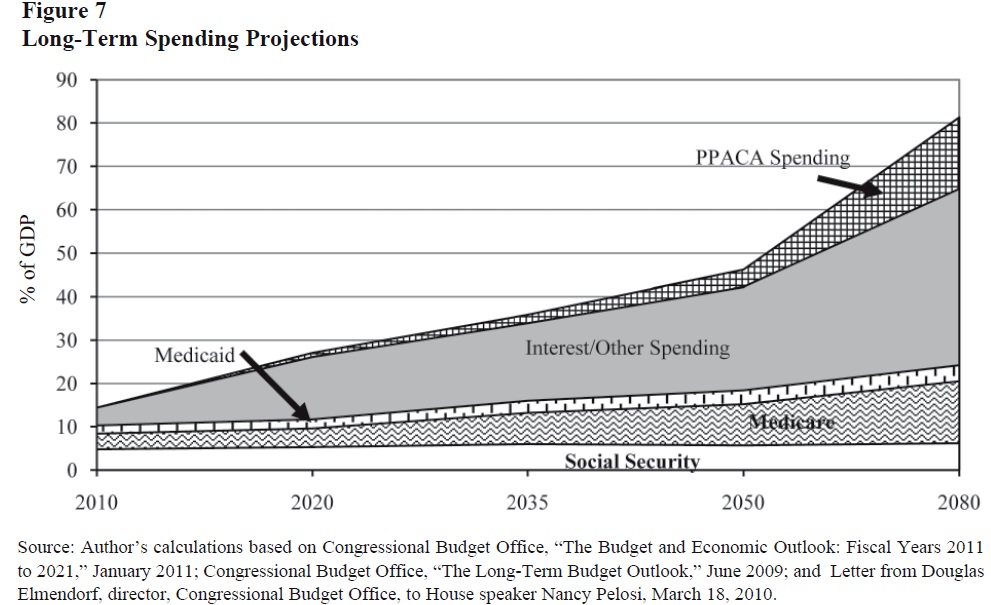
Long-term spending projections (Tanner)

Add State and local spending and, by 2080, you have an economy whose entire output is claimed by government entities. Some of that output would be directed to individuals for their sustenance, of course. But the form of that sustenance — along with everything else — would be dictated and allocated by politicians and bureaucrats. They — and their favored intellectuals, artists, and athletes — would live reasonably well (though not nearly as well as they could in a free-market system), while the proles would lead lives of hard work, hard drink, and hard deaths. It would be the USSR all over again. And, as with the USSR, the misdirection of economic activity by politicians and bureaucrats would ensure economic stagnation.

It may not come to that, if there are enough voters who understand the consequences of unbridled government spending, and who put liberty and true prosperity above the illusory promises of security offered by the big-government crowd. But as time goes by and more voters become accustomed to handouts, they will become “European” in their embrace of the welfare state. Slippery slopes and death-spirals lead to the same slough of despond (second definition).

That said, is there a way to have “our” cake and eat it, too? Can the U.S. government raise enough money through borrowing or taxation to fend off the day of reckoning and attain the left’s dream of attaining “Europeanism”?

BORROWING A SEA OF TROUBLES

In fact, financial markets may help to reign in government spending by sending signals that cannot be ignored — if the U.S. government borrows money from willing lenders instead of just printing it. (Economist Karl Smith explains why printing money — deliberate inflation — is an unlikely course of action. He refers to “structured default,” which is explained here.) As government spending rises, and as voters and politicians (in the main) reject significant tax increases, government debt will rise to unprecedented heights. Here, from The Heritage Foundation’s 2011 Budget Chart Book, is a retrospective and prospective look at the size of the federal government’s debt in relation to GDP:

National debt set to skyrocket

Financial markets will reject U.S. government debt — or charge a lot for carrying it — long before it reaches the levels shown above. The events of year ago, when Greece’s financial bind came to a head, gave a hint of the likely reaction of markets to continued fiscal profligacy. Then, earlier this month, there was a sharp, brief stock-market sell off in response to an announcement by Standard & Poor’s about U.S. government debt (“‘AAA/A-1+’ Rating On United States of America Affirmed; Outlook Revised To Negative“):

  • We have affirmed our ‘AAA/A-1+’ sovereign credit ratings on the United States of America.
  • The economy of the U.S. is flexible and highly diversified, the country’s effective monetary policies have supported output growth while containing inflationary pressures, and a consistent global preference for the U.S. dollar over all other currencies gives the country unique external liquidity.
  • Because the U.S. has, relative to its ‘AAA’ peers, what we consider to be very large budget deficits and rising government indebtedness and the path to addressing these is not clear to us, we have revised our outlook on the long-term rating to negative from stable.
  • We believe there is a material risk that U.S. policymakers might not reach an agreement on how to address medium- and long-term budgetary challenges by 2013; if an agreement is not reached and meaningful implementation is not begun by then, this would in our view render the U.S. fiscal profile meaningfully weaker than that of peer ‘AAA’ sovereigns.

If there is no serious effort to control the growth of the U.S. government’s debt by scaling back “entitlements,” two things will happen: Interest rates will rise, thus compounding the problem, and lenders will back away. Megan McArdle outlines a plausible scenario:

Right now, when Treasury goes to sell new bonds, it enters a fairly robust market, with not just the Fed but a bunch of fairly price-inelastic Asian central banks who are willing to take on our bonds at whatever the market offers. If China exits the market, we will either need to borrow less, or attract new lenders by offering higher interest rates. Even a noticeable decrease in volume would force us to pay more for our deficits….

… A lot of people tend to assume that there will be warning signs telling us that we need to get our fiscal house in order: China will slow down its bond purchases, interest rates will gradually rise. But in fact, the lesson of fiscal crises is that the “warning signs” we’re watching for often are the crisis. Unless interest rates increase (or debt buying decrease–which is really the same thing) in a very gradual, orderly fashion, then by the time your interest rates rise, it is already too late to do anything easy; your debt service burden forces you into dramatic fiscal measures, or default.

According to economist Carmen Reinhart, who has made an intensive study of crises, there’s no reason to expect the change to be orderly and gradual. She says the lesson of history is pretty unequivocal: interest rates are not a good predictor of who is about to tip into a crisis. People are willing to lend at decent rates, until suddenly they’re barely willing to lend at all.

When you look at how much of our debt comes due by the end of 2012, it’s easy to see how fast higher interest rates could turn into a real problem for us. To be sure, we’re no Japan–but that’s not necessarily a happy thought, because Japan finances something like 95% of its debt from its pool of thrifty (and nationalistic) savers. Their stock of lenders probably isn’t going anywhere. Ours might.

Lawrence Kotlikoff agrees:

…CBO’s baseline budget updates suggest the date for reaching what Carmen Reinhart, Kenneth Rogoff and other prominent economists believe is a critical insolvency threshold — a 90 percent ratio of federal debt held by the public to gross domestic product — has moved four years closer, in just nine months!…

And if foreigners balk at buying U.S. debt, why would Americans fill the breach? Is there a patriotic duty to finance socialism?

In summary, it seems unlikely that the U.S. can erect a full-blown welfare state on the backs of lenders. Can it be done on backs of taxpayers?

TAXING “THE RICH” — AND A LOT OF OTHERS, TOO?

The short answer to the preceding question is “no.” In evidence, I return to Michael Tanner’s “Bankrupt: Entitlements and the Federal Budget“:

Many observers suggest that we can simply tax the rich. For example, the Center for American Progress has recommended, among other things, imposing a 5–7 percent surtax on households with incomes above $500,000 per year, eliminating the cap on Social Security payroll taxes, increasing the estate tax, and raising the top marginal tax rate on capital gains and dividends.60 That would potentially raise the total marginal tax burden on some people to well above 50 percent.

Setting aside the simple immorality of government taking such an enormous portion of anyone’s income, there are many reasons to be skeptical of such an approach, starting with the fact that it may not actually generate any additional revenue….

…[I]ncentives matter. At some point taxes become high enough to discourage economic activity and therefore produce less revenue than would be predicted under a more static analysis….

But even if one assumes that taxes can be raised without having any impact on economic growth, taxing the rich still wouldn’t get us out of our budget hole—because the hole is quite simply bigger than the amount of revenue we could raise from taxing the rich even if there were no disincentives. To put it in admittedly oversimplified perspective: our current obligations, including both implicit and explicit debt, total more than 900 percent of GDP. The combined wealth of everyone in the United States who earns at least $1 million per year equals roughly 100 percent of GDP…. Therefore, you could confiscate the entire wealth of every millionaire in the United States and still barely make a dent in the amount we will owe.

Clearly, therefore, any tax increases would have to extend well beyond “the rich.” In fact, the Congressional Budget Office said in 2008 that in order to pay for all currently scheduled federal spending both the corporate tax rate and top income tax rate would have to be raised from their current 35 percent to 88 percent, the current 25 percent tax rate for middle-income workers to 63 percent, and the 10 percent tax bracket for low-income workers to 25 percent. It is likely, given increased spending since then, that the required tax levels would be even higher today.

Regardless of how one feels about taxing the rich, taxes at those levels would be devastating to future economic growth.

Harvard economist Martin Feldstein points out that the actual loss from tax increases to the private sector is a combination of the confiscated revenue as well as a hidden cost of the actual increase, known as deadweight loss. This hidden cost can be very expensive. Feldstein calculates that “the total cost per incremental dollar of government spending, including the revenue and the deadweight loss, is . . . a very high $2.65. Equivalently, it implies that the marginal excess burden per dollar of revenue is $1.65.” This means that for every 1 percent of GDP needed to be raised in revenue, the equivalent of 2.65 percent of GDP needs to be extracted from the private sector first.

Clearly, tax increases required to finance an increase in spending of more than 40 percent of GDP would place an impossible burden on the private economy. (pp. 13-4, source notation omitted)

One more thing (from Table 1 of the Tax Foundation’s “Fiscal Facts“): For 2008, federal income tax returns with adjusted gross incomes in the top 1 percent accounted for 38 percent of income taxes; the top 5 percent, 59 percent; the top 10 percent, 70 percent; the top 25 percent, 86 percent; and the top 50 percent, 97 percent. Not only that, but the top 10 percent of American taxpayers is taxed more heavily than the top 10 percent in other developed countries, including those “advanced” European countries that American leftists would like to emulate. (See “No Country Leans on Upper-Income Households as Much as U.S.” at the Tax Foundation’s Tax Policy Blog.) And the left has the gall to claim that America’s “rich” aren’t paying enough taxes!

VIVE LA RÉSISTANCE

It will not do simply to put an end to the U.S. government’s spending spree; too many State and local governments stand ready to fill the void, and they will do so by raising taxes where they can. As a result, some jurisdictions will fall into California- and Michigan-like death-spirals while jobs and growth migrate to other jurisdictions. Contemporary mercantilists to the contrary, the “winners” are “losers,” too. Even if Congress resists the urge to give aid and comfort to profligate States and municipalities at the expense of the taxpayers of fiscally prudent jurisdictions, the high taxes and anti-business regimes of California- and Michigan-like jurisdictions impose deadweight losses on the whole economy. If you believe otherwise, you believe in the broken-window fallacy, wherein an economically destructive force (natural or governmental) is credited with creating jobs and wealth because it leads to the visible expenditure of effort and resources.

So, the resistance to economically destructive policies cannot end with efforts to reverse the policies of the federal government. But given the vast destructiveness of those policies — “entitlements” in particular — the resistance must begin there. Every conservative and libertarian voice in the land must be raised in reasoned opposition to the perpetuation of the unsustainable “promises” currently embedded in Social Security, Medicare, and Medicaid — and their expansion through Obamacare. To those voices must be added the voices of “moderates” and “liberals” who see through the proclaimed good intentions of “entitlements” to the economic and libertarian disaster that looms if those “entitlements” are not pared down to their original purpose: providing a safety net for the truly needy.

The alternative to successful resistance is stark: more borrowing, higher interest payments, unsustainable debt, higher taxes, and economic stagnation (at best).

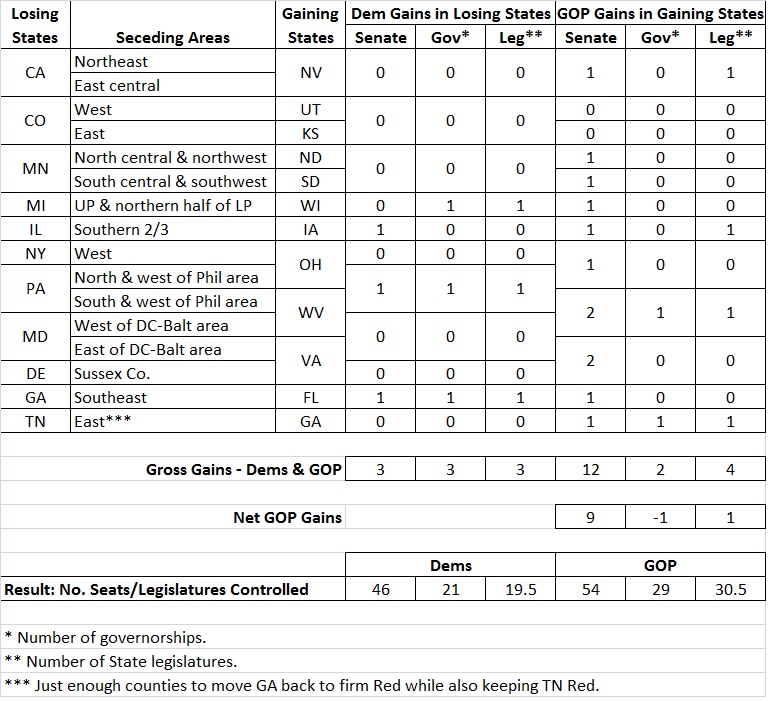
Estimating the Rahn Curve: Or, How Government Inhibits Economic Growth

UPDATED 12/13/14 — This update consists of a comment about my estimate of the Rahn curve. I have just published a much better estimate of the curve for the post-World War II era.

UPDATED 12/28/11 — This update incorporates GDP and government spending statistics for 2010 and corrects a minor discrepancy in the estimation of government spending. Also, there are new, easier-to-read graphs. The bottom line is the same as before: Government spending and everything that goes with it (including regulation) is destructive of economic growth.

UPDATED 09/19/13 — This version incorporates two later posts “Estimating the Rahn Curve: A Sequel” (01/24/12) and “More Evidence for the Rahn Curve” (05/27/12).

*     *     *

The theory behind the Rahn Curve is simple — but not simplistic. A relatively small government with powers limited mainly to the protection of citizens and their property is worth more than its cost to taxpayers because it fosters productive economic activity (not to mention liberty). But additional government spending hinders productive activity in many ways, which are discussed in Daniel Mitchell’s paper, “The Impact of Government Spending on Economic Growth.” (I would add to Mitchell’s list the burden of regulatory activity, which accumulates with the size of government.)

What does the Rahn Curve look like? Daniel Mitchell estimates this relationship between government spending and economic growth:

Rahn curve (2)

The curve is dashed rather than solid at low values of government spending because it has been decades since the governments of developed nations have spent as little as 20 percent of GDP. But as Mitchell and others note, the combined spending of governments in the U.S. was 10 percent (and less) until the eve of the Great Depression. And it was in the low-spending, laissez-faire era from the end of the Civil War to the early 1900s that the U.S. enjoyed its highest sustained rate of economic growth.

Here is a graphic look at the historical relationship between government spending and GDP growth:

(Source notes for this graph and those that follow are at the bottom of this post.)

The regression lines are there simply to emphasize the long-term trends. The relationship between government spending as a percentage of GDP (G/GDP) and real GDP growth will emerge from the following graphs. There are chronological gaps because the Civil War, WWI, the Great Depression, and WWII distorted the relationship between G/GDP and economic growth. Large wars inflate government spending and GDP. The Great Depression saw a large rise in G/GDP, by pre-Depression standards, even as the economy shrank and then sputtered to a less-than-full recovery before the onset of WWII.

Est Rahn curve 1792 1861

Est Rahn curve 1866 1917

Est Rahn curve 1792 1917

Est Rahn curve 1946-2010

The graphs paint a consistent picture: Higher G/GDP means lower growth. There is one inconsistency, however, and that is the persistence of growth in the range of 2 to 4 percent during the post-WWII era, despite G/GDP in the range of 25-45 percent. That is not the kind of growth one would expect, given the relationships that obtain in the earlier eras. (The extrapolated trend line for 1946-2009 comes into use below.)

There are at least five plausible — and not mutually exclusive — explanations for the discrepancy. First, there is the difficulty of estimating GDP for years long past. Second, it is almost impossible to generate a consistent estimate of real GDP spanning two centuries; current economic output is vastly greater in volume and variety than it was in the early days of the Republic. Third, productivity gains (advances in technology, management techniques, and workers’ skills) may offset the growth-inhibiting effects of government spending, to some extent. Fourth, government regulations and active interventions (e.g., antitrust activity, the income tax) have a cumulative effect that operates independently of G/GDP. Regulations and interventions may have had an especially strong effect in the early 1900s (see the second graph in this post). The effects of regulations and interventions may diminish with time because of  adaptive behavior (e.g., “capture” of regulatory bodies).

Finally, and perhaps most importantly, there is the shifting composition of government spending. At relatively low levels of G/GDP, G consists largely of government programs that usurp and interfere with private-sector functions by diverting resources from productive uses to uses favored by politicians, bureaucrats, and their patrons. Higher levels of G/GDP — such as those we in the United States have known since the end of WWII — are reached by the expansion of the welfare state. Government spending (at all levels) on so-called social benefits accounted for only 7 percent of G and 0.8 percent of GDP in 1929; in 2009, it accounted for 36 percent of G and 15 percent of GDP. The provision of “social benefits” brings government into the business of redistributing income, which discourages work, saving, and capital formation to some extent, but doesn’t impinge directly on commerce. Therefore, I would expect G to be less damaging to GDP growth at higher levels of G/GDP — which is the message to be found in the contrast between the experience of 1946-2009 and the experience of earlier periods.

With those thoughts in mind, I present this empirical picture of the relationship between G/GDP and GDP growth in the United States:

Est Rahn curve 1792-2010

The intermediate points, unfortunately, are missing because of the chronological gaps mentioned above. But, as indicated by the five earlier graphs, it is entirely reasonable to infer from the preceding graph a strong relationship between GDP growth and changes in G/GDP throughout the history of the Republic.

It is possible to obtain a rough estimate of the downward sloping portion of the Rahn curve by focusing on two eras: the post-Civil War years 1866-1890 — before the onset of “progressivism,” with its immediate and strong negative effects — and the post-WWII years 1946-2009. Thus:

Est Rahn curve rough sketch

My rough estimate is appropriately “fuzzy” and somewhat more generous than Daniel Mitchell’s, which is indicated by the heavy black line. In light of my discussion of the shifting composition of G as G/GDP becomes relatively large, I  have followed the slope of the trend line for 1792-2010; that is, every 1 percentage-point increase in G/GDP yields a decrease in the growth rate of about 0.07 percent. That seemingly small effect becomes a huge one when G/GDP rises over a long period of time (as has been the case for more than a century, with no end in sight).

For the record, the best fit through the “fuzzy” area is:

Annual rate of growth = -0.066(G/GDP) + 0.054.

[A revised and more realistic estimate for the post-World War II era is

Real rate of growth = -0.372(G/GDP) + 0.067(BA/GDP) + 0.080 ,

where the real rate of growth is the annualized rate over a 10-year period, G/GDP is the fraction of GDP spent by government (including social transfers) over the preceding 10-year period, and BA/GDP represents business assets as a fraction of GDP for the preceding 10-year period.]

Again, it’s the annualized rate of growth over a 10-year span, as a function of G/GDP (fraction of GDP spent by governments at all levels) in the preceding 10 years. The new term, BA/GDP, represents the constant-dollar value of private nonresidential assets (i.e., business assets) as a fraction of GDP, averaged over the preceding 10 years. The idea is to capture the effect of capital accumulation on economic growth, which I didn’t do in the earlier analysis.

Maximum GDP growth seems to occur when G/GDP is 2-4  percent. That is somewhat less than the 7-percent share of GDP that was spent on national defense, public order, and safety in 2010. The excess represents additional “insurance” against predators, foreign and domestic. (The effectiveness of the additional “insurance” is a separate question, though I am inclined to err on the side of caution when it comes to defense and law enforcement. Those functions are not responsible for the economic woes facing America’s taxpayers.)

If G/GDP reaches 55 percent — which it will if present entitlement “commitments” are not curtailed — the “baseline” rate of growth will shrink further: probably to less than 2 percent. And thus America will remain mired in its Mega-Depression.

*     *     *

Source notes:

Estimates of real and nominal GDP, back to 1790, come from the feature “What Was the U.S GDP Then?” at MeasuringWorth.com.

Estimates of government spending (federal, State, and local) come from USgovernmentspending.com; Statistical Abstracts of the United States, Colonial Times to 1970: Part 2. Series Y 533-566. Federal, State, and Local Government Expenditures, by Function; and the Bureau of Economic Analysis (BEA), Table 3.1. Government Current Receipts and Expenditures (lines 34, 35).

I found the amount spent by governments (federal, State, and local) on national defense and public order and safety by consulting BEA Table 3.17. Selected Government Current and Capital Expenditures by Function.

The BEA tables cited above are available here.

*     *     *

ADDENDUM: THE RAHN CURVE: A SEQUEL

In the original post (above) I note that maximum GDP growth occurs when government spends two to four percent of GDP. The two-to-four percent range represents the share of GDP claimed by American governments (federal, State, and local) throughout most of the 19th century, when government spending exceeded five percent of GDP only during the Civil War.

Of course, until the early part of the 20th century, when Progressivism began to make itself felt in Americans’ tax bills, governments restricted themselves (in the main) to the functions of national defense, public order, and safety — the terms used in national-income accounting. It is those functions — hereinafter called defense and justice — that foster liberty and economic growth because they protect peaceful, voluntary activity. Effective protection probably would cost more than four percent of GDP in these parlous times. But an adequate figure, except in the rare event of a major war, is probably no more than seven percent of GDP — the value for 2010, which includes the cost of fighting in Iraq and Afghanistan.

In any event, government spending — even on defense and justice — is impossible without private economic activity. It is that activity which yields the wherewithal for the provision of defense and justice. Once those things have been provided, the further diversion of resources by government is economically destructive. Specifically, from “Estimating the Rahn Curve” (above):

It is possible to obtain a rough estimate of the downward sloping portion of the Rahn curve by focusing on two eras: the post-Civil War years 1866-1890 — before the onset of “progressivism,” with its immediate and strong negative effects — and the post-WWII years 1946-2009. Thus:

Est Rahn curve rough sketch

My rough estimate is appropriately “fuzzy” and somewhat more generous than Daniel Mitchell’s [in “The Impact of Government Spending on Economic Growth”], which is indicated by the heavy black line. In light of my discussion of the shifting composition of G as G/GDP becomes relatively large, I  have followed the slope of the trend line for 1792-2010; that is, every 1 percentage-point increase in G/GDP yields a decrease in the growth rate of about 0.06 percent. That seemingly small effect becomes a huge one when G/GDP rises over a long period of time (as has been the case for more than a century, with no end in sight).

The following graphs offer another view of the devastation wrought by the growth of government spending — and regulation. (Sources are given in “Estimating the Rahn Curve.”) I begin with the share of GDP which is not spent by government:

Est Rahn curve sequel_priv GDP as pct total GDP

A note about my measure of government spending is in order. National-income accounting purists would insist that transfer payments (mainly Social Security, Medicare, and Medicaid) should not count as spending, even though I count them as such. But what does it matter whether money is taken from taxpayers and given to retired persons (as Social Security) or to government employees (as salary and benefits) or contractors (as reimbursement for products and services delivered to government)? All government spending represents the transfer of claims on resources from persons who earned those claims to other persons, who either did something of questionable value for the money (government employees and contractors) or nothing (e.g., retirees).

In any event, it is obvious that Americans enjoyed minimal government until the early 1900s, and have since “enjoyed” a vast expansion of government. Here is a closer look at the trend from 1900 onward:

Est Rahn curve sequel_private GDP pct total GDP since 1900

This is a good point at which to note that the expansion of government is understated by the growth of government spending, which only imperfectly captures the effects of the rapidly growing regulatory burden on America’s economy. The combined effects of government spending and regulation can be seen in this “before” and “after” depiction of growth rates:

Est Rahn curve sequel_growth rate of private GDP

(I omitted the major wars and the Great Depression because their inclusion would give an exaggerated view of economic growth in the aftermath of abnormally suppressed private economic activity.)

The marked diminution of growth  after 1900 has led to what I call America’s Mega-Depression. Note the similarity between the downward path of private sector GDP (two graphs earlier) and the downward path of the Mega-Depression in the following graph:

Est Rahn curve sequel_mega-depression

What is the Mega-Depression? It is a measure of the degree to which real GDP has fallen below what it would have been had economic growth continued at its post-Civil War pace. As I explain here, the Mega-Depression began in the early 1900s, when the economy began to sag under the weight of Progressivism (e.g., trust-busting, regulation, the income tax, the Fed). Then came the New Deal, whose interventions provoked and prolonged the Great Depression (see, for example, this, and this). From the New Deal and the Great Society arose the massive anti-market/initiative-draining/dependency-promoting schemes known as Social Security, Medicare, and Medicaid. The extension and expansion of those and other intrusive government programs has continued unto the present day (e.g., Obamacare), with the result that our lives and livelihoods are hemmed in by mountains of regulatory restrictions.

Regulation aside, government spending — except for defense and justice — is counterproductive. Not only does it fail to stimulate the economy in the short run, but it also robs the economy of the investments that are needed for long-run growth.

*     *     *

ADDENDUM: MORE EVIDENCE FOR THE RAHN CURVE

Here:

[W]e have some new research from the United Kingdom. The Centre for Policy Studies has released a new study, authored by Ryan Bourne and Thomas Oechsle, examining the relationship between economic growth and the size of the public sector.

The chart above compares growth rates for nations with big governments and small governments over the past two decades. The difference is significant, but that’s just the tip of the iceberg. The most important findings of the report are the estimates showing how more spending and more taxes are associated with weaker performance.

Here are some key passages from the study.

Using tax to GDP and spending to GDP ratios as a proxy for size of government, regression analysis can be used to estimate the effect of government size on GDP growth in a set of countries defined as advanced by the IMF between 1965 and 2010. …As supply-side economists would expect, the coefficients on the tax revenue to GDP and government spending to GDP ratios are negative and statistically significant. This suggests that, ceteris paribus, a larger tax burden results in a slower annual growth of real GDP per capita. Though it is unlikely that this effect would be linear (we might expect the effect to be larger for countries with huge tax burdens), the regressions suggest that an increase in the tax revenue to GDP ratio by 10 percentage points will, if the other variables do not change, lead to a decrease in the rate of economic growth per capita by 1.2 percentage points. The result is very similar for government outlays to GDP, where an increase by 10 percentage points is associated with a fall in the economic growth rate of 1.1 percentage points. This is in line with other findings in the academic literature. …The two small government economies with the lowest marginal tax rates, Singapore and Hong Kong, were also those which experienced the fastest average real GDP growth.

My own estimate (see above) for the United States, is that

every 1 percentage-point increase in G/GDP yields a decrease in the growth rate of about 0.07 percent. That seemingly small effect becomes a huge one when G/GDP rises over a long period of time (as has been the case for more than a century, with no end in sight).

In other words, every 10 percentage-point increase in the ratio of government spending to GDP causes a not-insignificant drop of 0.7 percentage points in the rate of growth. That is somewhat below the estimate quoted above (1.1 percentage points), but surely it is within the range of uncertainty that surrounds the estimate.

Vulgar Keynesianism and Capitalism

A REISSUE (WITHOUT UPDATES) OF THE ORIGINAL POST DATED DECEMBER 4, 2011

Robert Higgs quite rightly disparages “vulgar Keynesianism”:

Most of the people who purport to possess expertise about the economy rely on a common set of presuppositions and modes of thinking. I call this pseudo-intellectual mishmash vulgar Keynesianism. It’s the same claptrap that has passed for economic wisdom in this country for more than fifty years and seems to have originated in the first edition of Paul Samuelson’s Economics (1948), the best-selling economics textbook of all time and the one from which a plurality of several generations of college students acquired whatever they knew about economic analysis. Long ago, this view seeped into educated discourse and writing in the news media and in politics and established itself as an orthodoxy.

Unfortunately, this way of thinking about the economy’s operation, particularly its overall fluctuations, is a tissue of errors of both commission and omission. Most unfortunate have been the policy implications derived from this mode of thinking, above all the notion that the government can and should use fiscal and monetary policies to control the macroeconomy and stabilize its fluctuations. Despite having originated more than half a century ago, this view seems to be as vital in 2009 as it was in 1949.

Higgs then dissects “the six most egregious aspects of this unfortunate approach to understanding and dealing with economic booms and busts.” These are the aggregation of myriad and disparate economic actions, failure to take into account changes in relative prices, misunderstanding of the meaning and economic role of interest rates, disregard for the importance of capital, blind “money pumping” as a “solution” to recessions, and disregard for the disincentivizing effects of government activism on the private sector.

I agree with everything said by Higgs, and I have said many of the same things (in my own way) at this blog and its predecessor.  However, GDP — an aggregate measure of economic activity — is a useful construct, as flawed as it may be. It is an indicator of the general direction and magnitude of economic activity. Other aggregate measures — such as employment, jobs added and lost, unemployment rate — are also useful in that regard. If, for example, constant-dollar GDP per capita was twice as high in 2010 than it was 40 years earlier, in 1970 (computed here), it indicates that most Americans enjoyed a significantly higher standard of living in 2010 than they and their predecessors did in 1970. Further, the difference is so significant that it overshadows the difficulty of aggregating the value of billions of disparate transactions and separating the effects of price inflation from quality improvements.

What is special about 1970? It marks a turning point in the economic history of the U.S., which I discussed in a post that is now two-and-a-half years old:

Can we measure the price of government intervention [in the economy]? I believe that we can do so, and quite easily. The tale can be told in three graphs, all derived from constant-dollar GDP estimates available here. The numbers plotted in each graph exclude GDP estimates for the years in which the U.S. was involved in or demobilizing from major wars, namely, 1861-65, 1918-19, and 1941-46. GDP values for those years — especially for the peak years of World War II — present a distorted picture of economic output….

The trend line in the first graph indicates annual growth of about 3.7 percent over the long run, with obviously large deviations around the trend. The second graph contrasts economic growth through 1907 with economic growth since: 4.2 percent vs. 3.6 percent. But lest you believe that the economy of the U.S. somehow began to “age” in the early 1900s, consider the story implicit in the third graph:

  • 1790-1861 — annual growth of 4.1 percent — a booming young economy, probably at its freest
  • 1866-1907 — annual growth of 4.3 percent — a robust economy, fueled by (mostly) laissez-faire policies and the concomitant rise of technological innovation and entrepreneurship
  • 1908-1929 — annual growth of 2.2 percent — a dispirited economy, shackled by the fruits of “progressivism” (e.g., trust-busting, regulation, the income tax, the Fed) and the government interventions that provoked and prolonged the Great Depression (see links in third paragraph)
  • 1970-2008 — annual growth of 3.1 percent –  [2.8 percent for 1970-2010] an economy sagging under the cumulative weight of “progressivism,” New Deal legislation, LBJ’s “Great Society” (with its legacy of the ever-expanding and oppressive welfare/transfer-payment schemes: Medicare, Medicaid, a more generous package of Social Security benefits), and an ever-growing mountain of regulatory restrictions.

Taking the period 1970-2010 as a distinctive era — that of the full-fledged regulatory-welfare state — it may be possible to discern some aggregate relationships that were stable during that era (and may well continue to hold). The relationship that I want to explore is suggested by Higgs’s discussion of the vulgar Keynesian view of aggregate demand and the role of capital in economic production:

Because the vulgar Keynesian has no conception of the economy’s structure of output, he cannot conceive of how an expansion of demand along certain lines but not along others might be problematic. In his view, one cannot have, say, too many houses and apartments. Increasing the spending for houses and apartments is, he thinks, always good whenever the economy has unemployed resources, regardless of how many houses and apartments now stand vacant and regardless of what specific kinds of resources are unemployed and where they are located in this vast land. Although the unemployed laborers may be skilled silver miners in Idaho, it is supposedly still a good thing if somehow the demand for condos is increased in Palm Beach, because for the vulgar Keynesian, there are no individual classes of laborers or separate labor markets: labor is labor is labor. If someone, whatever his skills, preferences, or location, is unemployed, then, in this framework of thought, we may expect to put him back to work by increasing aggregate demand, regardless of what we happen to spend the money for, whether it be cosmetics or computers.

This stark simplicity exists, you see, because aggregate output is a simple increasing function of aggregate labor employed:

Q = f (L), where dQ/dL > 0.

Note that this “aggregate production function” has only one input, aggregate labor. The workers seemingly produce without the aid of capital! If pressed, the vulgar Keynesian admits that the workers use capital, but he insists that the capital stock may be taken as “given” and fixed in the short run. And ― which is highly important ― his whole apparatus of thought is intended exclusively to help him understand this short run. In the long run, he may insist, we are, as Keynes quipped, “all dead”; or he may simply deny that the long run is what we get when we place a series of short runs back to back. The vulgar Keynesian in effect treats living for the moment, and only for it, as a major virtue. At any given time, the future may safely be left to take care of itself.

In fact, the Keynesian-Marxian view of capital is about 180 degrees from the truth:

1. A broad array of capital goods (e.g., metal presses and railroad cars) will produce the same outputs (e.g., auto body parts of a certain quality and a certain number of passenger-miles) despite wide variations in the intelligence, education, and motor skills of their operators.

2. That is to say, capital leverages labor (especially unskilled labor).

3. Rewards justifiably — if unpredictably — flow to those who invent capital goods, innovate improvements in capital goods, invest in the production of such goods, and take the risk of owning businesses that use such goods in the production of consumer goods and services.

4. The activities of those inventors, innovators, investors, and entrepreneurs constitute a form of labor, but it is a very special form. It is not the brute force kind of labor envisaged by Marx and his intellectual progeny. It is a kind of labor that involves mental acuity, special knowledge, a penchant for risk-taking, and — yes, at times — hard work.

Without capital, labor would produce far less than it does. Capital, by the same token, enables labor of a given quality to produce more than it otherwise would.

(By “invest in the production of capital goods,” I mean to include individuals whose saving — whether or not it goes directly into the purchases of stocks and corporate bonds — helps to fund the purchases of capital goods by businesses.)

With that in mind, look at the aggregate relationship between the stock of private non-residential capital and private-sector GDP (GDP – G) for the period 1970-2010:

GDP - G vs net private capital stock, 1970-2010
Notes:  Current-dollar values for GDP and G are from Bureau of Economic Analysis, Table 1.1.5. Gross Domestic Product (available here). Capital stock estimates are from Bureau of Economic Analysis, Table 4.1. Current-Cost Net Stock of Private Nonresidential Fixed Assets by Industry Group and Legal Form of Organization (available here). Current-dollar values for GDP – G and capital stock were adjusted to 1982-84 dollars by constructing and applying deflators from CPI-U statistics for 1913-present (available here).

Variations around the trend line indicate fluctuations in economic activity. I treat the difference between “actual” GDP and the trend line as a residual to be explained by factors other than the aggregate value of the private, nonresidential capital stock. Measures of employment or unemployment will not do the job; they are simply proxies for aggregate output. The best measure that I have found is the value of new investment in the current year, relative to the value of the capital stock at the end of the prior year:

Residual vs new invest per PY capital stock
Notes: Residual GDP – G derived from Fig. 1, as discussed in text. Estimates of new investment in private capital stock are from Bureau of Economic Analysis, Table 4.7. Investment in Private Nonresidential Fixed Assets by Industry Group and Legal Form of Organization (available here); adjusted for inflation as discussed in notes for Fig. 1.

Using the trendline equation from Fig. 2, I adjusted the estimates derived from the trendline equation of Fig. 1, with this result:

Adjusted GDP - G vs. net private capital stock

There is precious little for labor to do but to show up for work and apply itself to the tools provided by capitalism:

Change in priv emply vs change in real GDP

*   *   *

Knowledgeable readers will understand that I have taken some statistical liberties. And I have done so as a way of satirizing the view that prosperity depends on labor and its correlate, consumption spending. But my point is a serious one: Capital should not be denigrated. Those who denigrate it give aid and comfort to the enemies of economic growth, that is, to the “progressives” who are the real enemies of the poor, of labor, and of liberty.

Why Are Interest Rates So Low?

A REISSUE (WITHOUT UPDATES) OF THE ORIGINAL POST DATED DECEMBER 7, 2011

Interest rates reflect the supply of and demand for funds. Money is tighter now than it was in the years immediately before the onset of the Great Recession. Tim Congdon explains:

In the three years to October 2008, the quantity of money soared from $10,032 billion to $14,186 billion, with a compound annual growth rate of just over 12 per cent. The money growth rate in this period was the highest since the early 1970s. Indeed, 1972 and 1973 had many similarities to 2006 and 2007, with bubbling asset markets, buoyant consumer spending and incipient inflationary pressures. On the other hand, in the three years from October 2008 the quantity of money was virtually unchanged. (It stood at $14,340 billion in October 2011.) In other words, in the three years of the Great Recession the quantity of money did not increase at all.

But if money is relatively tight, why are interest rates so low? For example, as of October 2011, year-over-year inflation stood at 3.53 percent (derived from CPI-U estimates, available here). In October, Aaa bond yields averaged 3.98 percent, for a real rate of about 0.4 percent; Baa bond yields averaged 5.37 percent, for a real rate of about 1.8 percent; and conventional mortgages averaged 4.07 percent, for a real rate of about 0.5 percent. By contrast, in 1990-2000, when the CPI-U rose at an annual rate of 3.4 percent, real Aaa, Baa, and conventional mortgage rates hovered in the 4-6 percent range. (Real rates are derived from interest rate statistics available here.)

The reason for these (and other) low rates is that borrowers have become less keen about borrowing; that is, they lack confidence about future prospects for income (in the case of households) and returns on investment (in the case of businesses). Why should that be?

If the post-World War II trend is any indication — and I believe that it is — the American economy is sinking into stagnation. Here is the long view:

  • 1790-1861 — annual growth of 4.1 percent — a booming young economy, probably at its freest
  • 1866-1907 — annual growth of 4.3 percent — a robust economy, fueled by (mostly) laissez-faire policies and the concomitant rise of technological innovation and entrepreneurship
  • 1970-2010 — annual growth of 2.8 percent – sagging under the cumulative weight of “progressivism,” New Deal legislation, LBJ’s “Great Society” (with its legacy of the ever-expanding and oppressive welfare/transfer-payment schemes: Medicare, Medicaid, a more generous package of Social Security benefits), and an ever-growing mountain of regulatory restrictions.

(From this post, as updated in this one.)

And here is the post-World War II view:

Annual change in real GDP 1948-2011

This trend cannot be reversed by infusions of “stimulus spending” or “quantitative easing.” It reflects an underlying problem that cannot be cured by those simplistic macroeconomic “fixes.”

The underlying problem is not “tight money,” it is that American businesses are rightly pessimistic about an economic future that is dominated by a mountain of debt (in the form of promised “entitlements”) and by an ever-growing regulatory burden. Thus business investment has been a decline fraction of private-sector GDP:

Non-household GPDI fraction GDP - G
Derived from Bureau of Economic Analysis, Table 1.1.5. Gross Domestic Product (available here). The numerator is gross private domestic investment (GPDI, line 7) less the residential portion (line 12). The denominator is GDP (line 1) less government consumption expenditures and gross investment (line 21).

As long as business remains (rightly) pessimistic about the twin burdens of debt and regulation, the economy will sink deeper into stagnation. The only way to overcome that pessimism is to scale back “entitlements” and regulations, and to do so promptly and drastically.

In sum, the present focus on — and debate about — conventional macroeconomic “fixes” (fiscal vs. monetary policy) is entirely misguided. Today’s economists and policy-makers should consult Hayek, not Keynes or Friedman or their intellectual descendants. If economists and policy-makers would would read and heed Hayek — the Hayek of 1944 onward, in particular — they would understand that our present and future economic morass is entirely political in origin: Failed government policies have led to more failed government policies, which have shackled both the economy and the people.

Economic and political freedoms are indivisible. It will take the repeal of the regulatory-welfare state to restore prosperity and liberty to the land.