
Today’s big economic news is the decline in real GDP reported by the Department of Commerce’s Bureau of Economic Analysis (BEA): an annualized rate of minus 2.9 percent from the fourth quarter of 2013 to the first quarter of 2014. Except for times when the economy was in or near recession, that’s the largest decline recorded since the advent of quarterly GDP estimates:
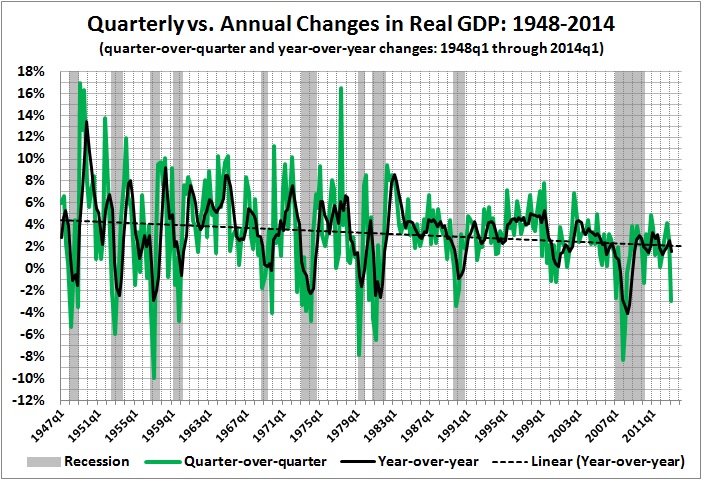
Derived from the “Current dollar and real GDP series” issued by BEA. See this post for my definition of a recession.
What’s the silver lining? Quarter-to-quarter changes in real GDP are more volatile than year-over-year and long-run changes. Some will take solace in the fact that real GDP rose by (a measly) 1.5 percent between the first quarter or 2013 and the first quarter of 2014. (Though they will conveniently ignore the long-run trend, marked by the dashed line in the graph.)
What’s the cloud? Well, as I pointed out above, the quarter-to-quarter decline in the first quarter of 2014 is unprecedented in the post-World War II era. Unless the sharp drop in the first quarter of 2014 is a one-off phenomenon (as suggested by some cheerleaders for Obamanomics), it points two possibilities:
- The economy is in recession, as will become evident when the BEA reports on GDP for the second quarter of 2014.
- The economy isn’t in recession — strictly speaking — but the dismal performance in the first quarter presages an acceleration of the downward trend marked by the dashed line in the graph. (For those of you who care about such things, the chance that the trend line reflects random “noise” in GDP statistics is less than 1 in 1 million.)
Even if there’s a rebound in the second quarter of 2014, the big picture is clear: The economy is in long-term decline, for reasons that I’ve discussed in the following posts:
The Laffer Curve, “Fiscal Responsibility,” and Economic Growth
The Causes of Economic Growth
In the Long Run We Are All Poorer
A Short Course in Economics
Addendum to a Short Course in Economics
The Price of Government
The Price of Government Redux
The Mega-Depression
As Goes Greece
Ricardian Equivalence Reconsidered
The Real Burden of Government
The Illusion of Prosperity and Stability
Taxing the Rich
More about Taxing the Rich
A Keynesian Fantasy Land
The Keynesian Fallacy and Regime Uncertainty
Why the “Stimulus” Failed to Stimulate
The “Jobs Speech” That Obama Should Have Given
Say’s Law, Government, and Unemployment
Unemployment and Economic Growth
Regime Uncertainty and the Great Recession
Regulation as Wishful Thinking
The Real Multiplier
The Commandeered Economy
We Owe It to Ourselves
In Defense of the 1%
Lay My (Regulatory) Burden Down
The Burden of Government
Economic Growth Since World War II
The Economy Slogs Along
Government in Macroeconomic Perspective
Keynesianism: Upside-Down Economics in the Collectivist Cause
The Price of Government, Once More
Economic Horror Stories: The Great “Demancipation” and Economic Stagnation
Economics: A Survey (also here)
Why Are Interest Rates So Low?
Vulgar Keynesianism and Capitalism
Estimating the Rahn Curve: Or, How Government Spending Inhibits Economic Growth
America’s Financial Crisis Is Now
The Keynesian Multiplier: Phony Math
The True Multiplier
The Obama Effect: Disguised Unemployment
Obamanomics: A Report Card
See especially “Regime Uncertainty and the Great Recession,” “Estimating the Rahn Curve: Or, How Government Spending Inhibits Economic Growth,” and “The True Multiplier.”
 Politics and Prosperity