Never Relent

Despite some appearances to the contrary, the tide of statism in the United States is ebbing. Mr. Trump is turning the power of the state against the forces that have used its power to weaken America economically and to poison it morally and culturally.

The battle for liberty will not end soon, nor ever.

Lovers of liberty — those of us who do not think of the state as a supreme being — should always remember and heed the spirit of these words from Churchill’s speech following the successful evacuation of Dunkirk:

[W]e shall fight on the seas and oceans, we shall fight with growing confidence and growing strength in the air, we shall defend our island, whatever the cost may be. We shall fight on the beaches, we shall fight on the landing grounds, we shall fight in the fields and in the streets, we shall fight in the hills; we shall never surrender….

Wordplay II

Less poetic than the first edition, but perhaps worth a chuckle or two.

Geezer’s trousers – High rise
Chain gang – Con job
Antics in the attic – High jinks
Raging rabbits – Cross hares
Rome vs. Carthage – Punic attacks
Sicilian swine – Guinea pig
French film — Subtitled subtlety
Champagne flight – Altitude adjuster
Leftist logic – Null set
Stranger in a strange Land – Hollywood conservative
Inventory upgrade – Stock exchange
Politician’s memoir – Historical fiction
Anthropogenic global warming – Science fiction

Obamagate: An Update

The latest issue of Imprimis, a publication of Hillsdale College, is by Mollie Hemingway, editor-in-chief of The Federalist. Hemingway’s entry, “The Significance of the Recently Released Russia Hoax Documents“, is an excellent summary of the origins and perpetuation of the Trump-Russia hoax and its vile consequences. The piece is short. You should read it.

If you have a taste for gory details, see my page “Obamagate and Beyond“, which tells the tale as I have understood it since 2018. The tale is amplified by the dozens of articles to which I link.

Hemingway and I draw the same conclusion: Obama is the culprit. Obama’s scheming led to the near-paralysis of the first Trump administration and to anti-Trump myths that will never die — on the left and in the mainstream media, at least.

“White Heat” and the Present Threat of Nuclear War

White Heat is the title of a 1949 film noir, what stars James Cagney as a psychotic criminal, Arthur “Cody” Jarrett. Wikipedia supplies some highlights:

Cody and his gang rob a mail train in the Sierra Nevada mountains, killing four members of the train’s crew. While on the lam, Cody has a severe migraine, through which Ma [his mother] nurses him. Afterward, Ma and Cody have a quick drink and toast, “Top of the world!”, before rejoining the others….

Informants enable the authorities to close in on a motor court in Los Angeles, where Cody, Verna [his wife], and Ma are holed up. Cody shoots and wounds US Treasury investigator Philip Evans and makes his escape. He then puts his emergency scheme in motion – confess to a lesser crime committed by an associate in Springfield, Illinois, at the same time as the train job—a federal crime—thus providing him with a false alibi and assuring him a lesser sentence. He turns himself in and is sentenced to one to three years in state prison….

In the [prison’s] infirmary, [Cody] is diagnosed as having a “homicidal psychosis” and is recommended for transfer to an asylum. Another inmate sneaks him a gun, which Cody uses to take hostages, and along with Hank and their cellmates, Cody escapes….

Cody plans to steal a chemical plant’s payroll by using an empty tanker truck as a Trojan horse. Hank [Fallon, an undercover agent] rigs a signal transmitter and attaches it to the tanker…. The police track the tanker and prepare an ambush…

[T]he police surround the building and call on Cody to surrender; he decides to fight it out…. In the ensuing gun battle, the police kill most of Cody’s gang…. Cody shoots one of his own men for trying to surrender. Finally, only Cody is still loose. He flees to the top of a gigantic, globe-shaped gas storage tank. After Hank shoots Cody several times with a rifle, Cody fires at the tank, which bursts into flames. He shouts, “Made it, Ma! Top of the world!”, before the tank explodes.

The ending of the film parallels the death of Adolph Hitler four years earlier. Hitler, with his “Thousand Year Reich” in ruins and facing certain defeat by the Allies, shot himself in his underground bunker.

According to my AI assistant, between the death of Alexander the Great in 323 B.C. (not by suicide) and Hitler’s suicide, there were only four suicides by leaders of nations that were then great powers:

Name Country Year Context
Cleopatra VII Egypt (then a major Mediterranean power) 30 B.C. Committed suicide (likely by poison or snakebite) after defeat by Octavian (later Augustus). Egypt was a client kingdom but still geopolitically significant.
Mark Antony Roman Republic 30 B.C. Took his own life after military defeat and believing Cleopatra had died. Rome was the dominant power of the era.
Nero Roman Empire 68 A.D. Committed suicide after being declared a public enemy by the Senate. Rome was the preeminent power in Europe.
Zhu Youjian (Chongzhen Emperor) Ming Dynasty China 1644 A.D. Hanged himself as rebels stormed Beijing. Ming China was one of the world’s most populous and powerful empires at the time.

The common themes of the suicides (including Hitler’s) are defeat and loss of power. Yet, defeat (political if not military) and loss of power have long been commonplace among leaders of great powers. In retrospect, the surprising thing about Hitler’s suicide is that it happened.

What does all of this have to do with nuclear war? If a leader were to initiate the use of nuclear weapons, he might hope that the enemy’s response would be in kind (at most) and not escalatory. But unless he were psychotic (a description that seems to fit Hitler), he would have to anticipate escalation, culminating in mutual devastation. His own death would be a near certainty, either as a direct result of the nuclear exchange or in the aftermath (by suicide, starvation, or at the hands of others).

But rare is the leader who prefers suicide to loss of power. Rarer yet, since the horrors of Hiroshima and Nagasaki, is the leader who has cast the first nuclear stone.

What about threats to cast the first nuclear stone (since 1945), specifically, Putin’s threats during the course of his war on Ukraine? Those threats put the onus on the West if Putin were to go nuclear. And so, the West initially stopped short of doing things that might cause Putin to go nuclear.

However, as time has passed and Putin’s “red lines” have been breached without a nuclear response from Russia, it has become increasingly clear that Putin isn’t willing to risk the devastation of Russia, let alone a form of suicide.

At least, that’s the way I see it.

Some Blogging History

My first official blog was Liberty Corner, which I maintained from March 2004 to July 2008. It is no longer accessible because it was hosted at Blogger (blogspot.com, owned by Google) and I have closed my Google account. I have moved all Liberty Corner posts to this blog, where they appear in chronological order and are represented in the index of posts.

However, Liberty Corner posts listed in the index can’t be reached directly from the index because the links to them are now broken. They can usually be found by typing the titles of posts into this blog’s search box.

All of the internal links between Liberty Corner posts are now also broken. A linked Liberty Corner post can usually be found on this blog by searching on its title (which appears in the URL that appears when hovering over a link).

Finally, I have put up a new page — Liberty Corner: The Original — which reproduces the pre-Blogspot version of Liberty Corner that I posted on my AT&T home page in the late 1990s. Many of the themes struck in those posts are treated in many of the 4,000 ensuing posts at Liberty Corner and Politics & Prosperity.

The Search for Truth: From Science to Conspiracy Theories

Any set of observations has an infinite number of explanations.

— William M. Briggs (Science Is Not the Answer)


The main difference between mathematical formulae and the real world is that the formulae usually reduce open-ended reality to closed-form hypotheses about reality. By closed form, I mean that the hypotheses include only a limited number of factors that determine what is observed (not to mention the inevitable errors in the estimation of the values and weights of those factors).

“Climate change” is exhibit A when it comes to the failure of mathematical formulae to replicate reality. In addition to the many well-researched articles (e.g., here) that challenge the general “scientific” view that CO2 drives atmospheric temperatures, there is Alan Longhurst‘s Doubt and Certainty in Climate Science. Longhurst adduces dozens of factors that influence atmospheric (and oceanic) temperatures — factors that are ignored or insufficiently accounted for in global climate models (GCMs) — while also documenting the wide range of uncertainty about the values and weights of such factors. A more accessible and powerful indictment of “climate change” is the report by John Christy et al., John Christy et al., “A Critical Review of Impacts of Greenhouse Gas Emissions on the U.S. Climate“.

As in too many other cases, GCMs are built upon foundations of sand — their developers’ biases. Examples abound of models equally devoid of reality because they reflect what their builders wish to be true.

One model that is on a par with GCMs in its destructive effects is the Keynsesian multiplier, which for more than 80 years has been used to justify government spending, a vastly destructive undertaking. (For more about biases — known more charitably as assumptions — see Arnold Kling’s post, “The God’s-Eye View of the Economy“.)

Also in the realm of economics, there is the failure of complex macroeconomic models to predict accurately quarter-to-quarter changes in GDP. I last addressed the subject eight years ago. Here’s key graph from that post:

“Fair” refers to Professor Ray C. Fair of Princeton University, the creator of the model in question. The model isn’t fair (as in fair to middling), it’s a dismal failure. Most of the errors are huge.

If the Fair model seems bad, consider the forecasts of changes in GDP that are published by the Federal Reserve Bank of Atlanta at GDPNow. The forecasts are expressed as changes in the annual rate of real (inflation-adjusted) growth in GDP. The website includes a misleading graph of the increasing accuracy of the forecasts. It is misleading because the forecasts are compared to the initial estimates of quarterly GDP changes issued by the Bureau of Economic Analysis (BEA). When the estimates are compared with BEA’s final estimates of quarterly GDP, this is the result:
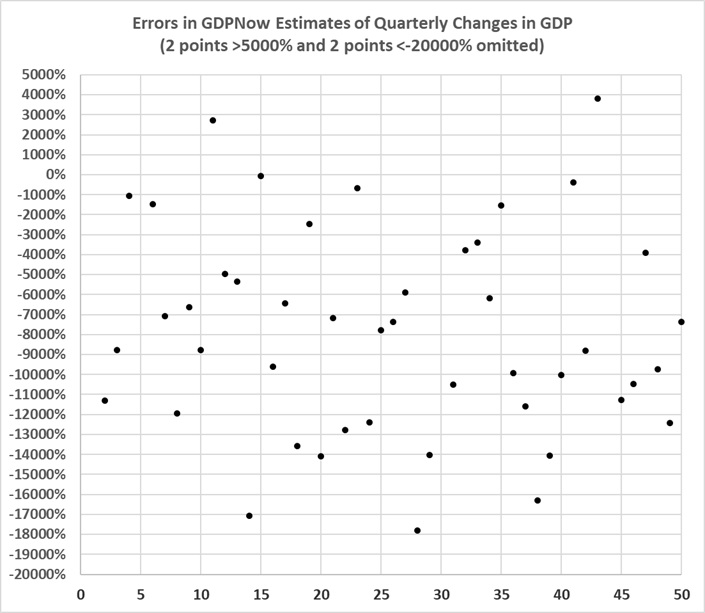
Need I say more?

Just one more thought about economics before I shift to a seemingly sacrosanct model: Einstein’s general theory of relativity. The additional thought is this: GDP is defined by simple equations, the simplest of which is GDP = C + I + G, where C is consumption expenditures, I is investment expenditures, and G is government expenditures. The equation implies that GDP rises if G rises. But that isn’t the case, as shown here.

Economics is a soft target. General relativity is a relatively (pun) hard one. But it’s not impregnable. To begin where we ought to begin, “theory” (in the physical sciences) refers to a hypothesis that has been “confirmed” by evidence (experiments, observations) and remains valid (e.g., consistently accurate in predicting the behavior of objects within its scope).

There’s a subtle catch, however. As William Briggs observes here,

Classical hypothesis testing is founded on the fallacy of the false dichotomy. The false dichotomy says of two hypotheses that if one hypothesis is false, the other must be true.

In the case of general relativity, which is really an explanation of gravity, it became obvious that Newton’s “law” of gravitation is inadequate on a large scale (e.g., it couldn’t explain the precession of Mercury’s orbit). It is considered “correct enough” on a small scale (e.g., Earth), but “incomplete”. Which is to say that it is incorrect.

General relativity solved the precession problem, among others. But is it correct, that is, complete? Apparently not. As scientists learn more and more about the universe, lacunae abound in the general theory:

The current understanding of gravity is based on Albert Einstein‘s general theory of relativity, which incorporates his theory of special relativity and deeply modifies the understanding of concepts like time and space. Although general relativity is highly regarded for its elegance and accuracy, it has limitations: the gravitational singularities inside black holes, the ad hoc postulation of dark matter, as well as dark energy and its relation to the cosmological constant are among the current unsolved mysteries regarding gravity,[3] all of which signal the collapse of the general theory of relativity at different scales and highlight the need for a gravitational theory that goes into the quantum realm. At distances close to the Planck length, like those near the center of a black hole, quantum fluctuations of spacetime are expected to play an important role.[4] Finally, the discrepancies between the predicted value for the vacuum energy and the observed values (which, depending on considerations, can be of 60 or 120 orders of magnitude)[5][6] highlight the necessity for a quantum theory of gravity.

Imagine the errors in all of the equations that are used (explicitly or implicitly) in the making of things that human beings use. What saves humanity from utter chaos — in the physical realm — is the practice of “over-building” — allowing for abnormal conditions and unknown factors in the construction of machinery, vehicles, buildings, aircraft, spacecraft, etc. Even then, the practice is often ignored or inadequate in particular situations (e.g., rocket-launch failures, bridge collapses, aircraft accidents).

The usual response to the failure of physical systems is that they are the result of “random events”. In fact, when they occur in spite of “over-building” they are the result of the inadequacy of equations to capture reality.

This brings me to so-called conspiracy theories (hypotheses, really). Some of them are patently ludicrous. Others are plausible. Most famously, perhaps, are hypotheses about who really killed JFK (or had him killed), and how he was killed. Those who scoff at such hypotheses usually do so because they don’t want them to be correct, and wish to hew to the official line. Hypotheses about the killing of JFK are plausible because of uncertainty about the “facts” that support the official view of events: Lee Harvey Oswald was the lone gunman and he acted alone.

In the case of the assassination of JFK, the following questions reflect some of the uncertainty about several (but far from all) of the official “facts”:

  • Why did the Secret Service chose a route through Dallas that would bring the presidential motorcade to a halt before slowly resuming speed in front of a seven-story building?
  • Who, at the highest level, approved the route?
  • Why hadn’t the building been thoroughly inspected and brought under tight control, given that its location vis-a-vis the route was well known?
  • How many shots were fired at JFK?
  • From what position or positions were the shots fired?
  • What was nature of the CIA’s involvement with Lee Harvey Oswald?
  • Why did Jack Ruby — a man with “mob” connections — really kill Lee Harvey Oswald?
  • Who stood to gain from JFK’s death? (Assuming Oswald as the lone gunman conveniently eliminates LBJ; the CIA, in revenge for the Bay of Pigs fiasco and JFK’s punitive reaction; RFK’s anti-mob crusade).

And so on.

The real world is full of uncertainty. But few human beings seem to be comfortable with it. Thus, crap science, science on a pedestal (of sand), and conspiracy theories.

What we wish for ourselves — decisions that have certain outcomes — isn’t aligned with the way the world works. But we keep trying, despite the odds. What else can we do?

Logical Dissonance

Yesterday evening, as I was enjoying veal in marsala sauce at a nearby restaurant, I recalled the distaste for veal among some of the (female) lefties of my acquaintance. They are too squeamish to eat young bovines, but not squeamish when it comes to the murder of young human beings.

Obamagate and Beyond

“Obamagate and Beyond” is the title of this page, an episodic tale of the conspiracy to get Trump, which I started seven years ago when the Trump-Russia hoax was in full spate.

Today The Daily Signal offers a piece by Al Perotta, “FBI ‘Grand Conspiracy’ Case Goes Far Beyond Comey and Brennan“. Where does it go? To Barack Obama, whom I long ago (in the aforementioned page) had tagged as the grand conspirator behind the get-Trump movement.

Here’s a bit of what I had to say:

The Obamagate conspiracy was designed to discredit Trump and deny him the presidency. It continued while he was in office, with a coordinated assault by congressional Democrats and media leftists to eject him from the presidency. It has continued since he left office, with the specific aim of preventing him from running or being elected in 2024, and the broader aim of discrediting the GOP and undermining electoral support for GOP candidates.

The entire Obamagate operation is reminiscent of Obama’s role in the IRS’s persecution of conservative non-profit groups. Obama spoke out against “hate groups” and Lois Lerner et al. got the message. Lerner’s loyalty to Obama was rewarded with a whitewash by Obama’s. Department of Justice and FBI.

The conspiracy was instigated by the White House and the Clinton campaign, and executed by the CIA and FBI. There is some speculation (e.g., here) that the CIA instigated the Trump-Russia hoax, but it is more likely that it was instigated by Barack Obama in unrecorded conversations with John Brennan and Hillary Clinton or someone working for her.

Preemptive War and Iran (Revisited)

From November 11, 2011. Be sure to read “Preemptive War“, which preceded this by three days, and “Some Thoughts and Questions about Preemptive War”, which followed by eight days.

My post, “Preemptive War,” is mainly a general argument for preemption, where American’s vital interests are at stake. But it was prompted by ” the imminent acquisition by Iran of material with which to produce nuclear weapons.”

The authors of “Why Obama Should Take Out Iran’s Nuclear Program” (Foreign Affairs, November 9, 2011) see the wisdom of preemption:

The November 8 International Atomic Energy Agency (IAEA) report casts further doubt on Iran’s continual claims that its nuclear program is intended solely for peaceful use….

…[T]he Obama administration has downplayed the findings of the new IAEA report, suggesting that a change in U.S. policy is unlikely. Yet this view underestimates the challenges that the United States would confront once Iran acquired nuclear weapons.

For example, the Obama administration should not discount the possibility of an Israeli-Iranian nuclear conflict….

Beyond regional nuclear war, Tehran’s acquisition of these weapons could be a catalyst for additional proliferation throughout the Middle East and beyond….

…Iran’s rivals for regional dominance, such as Turkey, Egypt, and Saudi Arabia, might seek their own nuclear devices to counterbalance Tehran. The road to acquiring nuclear weapons is generally a long and difficult one, but these nations might have shortcuts. Riyadh, for example, could exploit its close ties to Islamabad — which has a history of illicit proliferation and a rapidly expanding nuclear arsenal — to become a nuclear power almost overnight….

The closer Iran gets to acquiring nuclear weapons, the fewer options will be available to stop its progress. At the same time, Iran’s incentives to back down will only decrease as it approaches the nuclear threshold. Given these trends, the United States faces the difficult decision of using military force soon to prevent Iran from going nuclear, or living with a nuclear Iran and the regional fallout.

But the Obama administration — more accurately, Barack Obama — seems committed to a perverse foreign policy in the Middle East. This is from “Panetta Assures Iran It Has Little to Worry About” (Commentary, November 11, 2011):

If the leaders of the Iranian regime were worried about Jeffrey Goldberg’s prediction that Barack Obama would confound the world and launch a U.S. military strike designed to save Israel from nuclear destruction, they can now calm down. Secretary of Defense Leon Panetta made it crystal clear at a Pentagon news conference yesterday he has no intention of supporting an American attack on Iran’s nuclear facilities….

…But by publicly throwing cold water on the idea the United States is ready and able to militarily squash Iran’s nuclear ambitions, Panetta has sent a dangerous signal to Tehran that the Pentagon intends to veto any use of force against them. Combined with Russia’s pledge to block any further sanctions on Iran, the statement should leave the Khameini/Ahmadinejad regime feeling entirely secure as they push ahead to the moment when they can announce their first successful nuclear test.

This — combined with Obama’s dubious support of Israel, his unseemly withdrawal from Iraq, and his reluctant and easily reversed decision to “surge” in Afghanistan — confirms Obama’s position as the Jimmy Carter of the 21st century. Where is the next Ronald Reagan when we need him?

The “loss” of the Middle East and its relatively cheap oil would be a disaster for America’s economy. Further, it would leave an opening for an ambitious and increasingly powerful China.

Does Obama care about such things? Evidently not. He is too busy trying to remake the U.S. in the image of Europe: defenseless, bankrupt, and hostage to enviro-nuts.

See also “Some Thoughts and Questions about Preemptive War.”

The Demise of Natural Eugenics

It is my view that genetic fitness for survival has become almost irrelevant in places like the North America, Europe, and Japan. There is a supportable hypothesis that humans in those cosseted realms are, on average, becoming less intelligent. The less-intelligent portions of the populace are breeding faster than the more-intelligent portions.

The rise of technology and the “social safety net” (state-enforced pseudo-empathy) have enabled the survival and reproduction of traits that would have dwindled in times past. Evolution — in the absence of challenges that ensure survival of the fittest — seems to have resulted in devolution. The evidence is all around us.

Trump’s Challenge to China — and Europe

I will post a more complete analysis of Trump’s “Liberation Day” tariffs and their implications for America’s (and the world’s) economic and political future. For the moment, I will focus on the implications of Trump’s challenge to China, which now faces a tariff of 34 percent on goods and services exported to the United States. China has announced that it would reciprocate. Trump announced, in turn, that if China reciprocates he will up the ante to a tariff of 104 percent on imports from China.

What Trump is saying, in effect, that the United States will no longer subsidize China’s industrial and military ambitions. Trump, rightly, sees China as the “main enemy” and wants to put it out of the business of draining America’s ability to prepare for and fight a massive, prolonged war, and thus to deter China from threatening just that. By putting China out of business, he will have de-fanged it and eliminated it as a threat to America — and Europe.

If the Europeans are smart, they will respond to Trump’s tariffs by reducing theirs on U.S. goods and services. And they will treat China a harshly as Trump seems willing to do.

If what’s left of Western Civilization has a future, it is in Trump’s hands. Will Europe go along or continue its slide into economic catastrophe and subservience to China (and its self-inflicted Muslim invasion)?

My guess is that some European nations will break from the EU and unilaterally reduce tariffs on U.S. imports.  Others (e.g., France and Germany) will not, just to spite Trump. One result will be the breakup of the EU. Another will be the effective breakup of NATO. A third will be Putin’s agreement to a settlement with Ukraine, given the removal of the NATO spectre from Russia’s vision. A fourth will be the de-fanging of China, as its sources of funding in America and (part of) Europe wither away — either through acquiescence to Trump or because they defy him.

How Not to Think about Tariffs

Tyler Cowen — The Free Press‘s new eminence grise — thinks about tariffs like the economist that he is; for example:

Like a game show host, Trump announced a series of tariff rates on many of America’s major trading partners.

How did he come up with the rates?

It seems by a crude formula: A given nation’s trade deficit with the U.S. divided by that nation’s exports to the U.S.

There is a base rate of 10 percent, to be applied to the UK, Costa Rica, and some other friendly nations. For India, it is 26 percent For Japan, it is 24 percent. For the European Union, it is 20 percent.

The most incomprehensible are those on Vietnam (the new tariff rate is 46 percent); Sri Lanka (44 percent); South Korea (25 percent); Cambodia (49 percent); and Taiwan (32 percent)….

Cowen goes on and on, citing seemingly authoritative statistics and ending up where a “good” economist should: tarrifs bad (like Orange Man). The upshot, according to Cowen, is that

we will be moving into a future with higher prices, less product choice, and much weaker foreign alliances. The tanking of the stock market, and other possible asset price repercussions, may tip America into recession and increase joblessness.

What really matters — and Cowen has no more insight into this than the Man in the Moon — is how foreign governments react to Trump’s announced tariffs, and what Trump does in response to those reactions.

Cowen’s doom-saying merely reveals his anti-Trump bias. In that respect, his eminence is just another pundit.

Trump 2: Keeping Score (2nd edition)

This is the first sequel to “Trump 2: Keeping Score“, which I published on February 6, 2025. In that post, I used a metric that I devised early in Trump’s first term: the enthusiasm ratio. The ratio is the number of likely voters who strongly approve a president as a percentage of the number of likely voters who venture an opinion one way or the other (thus omitting the voters who are non-committal).

Here is how Trump 2 scores three months into his second term, in comparison with his first term, Obama’s two terms, and Biden’s single term:


Derived from Rasmussen Reports Daily Presidential Tracking Polls for Obama, Trump 1, Biden, and Trump 2.

Here’s a closer look at the first year of each term:

All right so far. It’s too soon to tell whether Trump will win over some of his doubters and detractors, as he did in a big way during his first term.

Stay tuned.

A Bit of Epistemology

Epistemology: The branch of philosophy that examines the nature of knowledge, its presuppositions and foundations, and its extent and validity.

Experience (observation) and logic yield hypotheses about discrete phenomena and the workings of natural and constructed entities. Hypotheses are provisional because of the possibility of error and the fact that universal generalization is impossible.

Hypotheses about how things work are nevertheless useful — nay, indispensable — to life and its improvement. But nothing is certain because hypotheses are necessarily limited in their application. Why? Because they are abstractions that cannot account for human error and the variability of physical phenomena.

Experience shows, for example, that a cake recipe (which is a hypothesis about how to bake a cake) cannot guarantee the production of an edible cake of certain dimensions. In addition to wide variations in the ability of cooks (especially amateurs), there are wide variations in the quality and freshness of ingredients, the adequacy of tools (e.g., sifters and whisks), and the precision with which ovens can maintain specified temperatures.

Similar considerations — but far more serious ones — apply to “recipes” for constructing buildings, highways, bridges, aircraft, spacecraft, etc. The “recipe” for estimating the effect of human activity (CO2 emissions) on climate is deeply flawed by human bias, measurement error, and failure to adequately account for relevant “ingredients” (some of which remain unknown). “The science” is never settled; for example, an apparent error in Einstein’s general theory of relativity is just one of the many problems that still daunt scientists.

Error (failure) is an epistemological fact of life. It may be possible to predict the fact of error (e.g., a novice bowler will not bowl a 200 game) but the magnitude of error can be known only after the fact. That is why critical systems (e.g., bridges and aircraft) are usually built to withstand extreme conditions. But they still sometimes fail.


Related post: Words Fail Us

Natural Law, Positive Law, and Rights

There is a ten-part exchange about natural law vs. positive law at Political Questions, the blog of Steven Hayward. (Links are at the bottom of this post.) The exchange pits Hayward and Linda Denno (a.k.a. Lucretia) against John Yoo. Hayward and Denno defend natural law; Yoo defends positive law. The exchange is entertaining but thus far disappointing — to this lay person, at least.

To overcome my disappointment, I am offering my own version of the controversy. It is more straightforward and conclusive than the rather meandering (albeit enjoyable) repartee offered up by Hayward, Denno, and Yoo.

A law, in the realm of human endeavor, is a rule that arises from one or more sources:

  • It may be “ingrained” in human nature, either divinely or through natural processes. Such a rule would be universal and self-enforcing if all human beings were “wired” identically. But they are not. (Think of two squabbling siblings with different conceptions of fairness.)
  • It may a cultural norm, where culture includes religious belief. Here, it becomes obvious that universality is unattainable. (Think of Muslims and Jews.)
  • It may established and enforced by a powerful entity (e.g., a parent, the state). In this instance, it may mimic a norm that is either “ingrained” or cultural in origin (e.g., the prohibition of murder).

The first two points address “natural” law, which has an uncertain provenance. The third point addresses positive law. It is evident that “natural” law cannot be universal or self-enforcing. But even if it were universal (self-enforcement is patently impossible), most of mankind doesn’t agree as to its tenets. Positive law is therefore essential to the functioning of most human groupings, from nations to families.

Having disposed of the main issue, I will venture into the question of rights, which are implicit in law. For example, if there is a law (“natural” or positive) against the murder of blameless persons, all blameless persons must have the right not to be murdered.

Does a right inhere in a person, or is a right an obligation on the part of all persons? In the case of positive law, the answer is obvious: The right not to be murdered is a legal construction that imposes an obligation on all persons.

Regarding “natural” law, I argue at length here that rights do not inhere in persons — at least not through the operation of reproductive processes.

What about through the operation of cultural processes? Culture is an artifact of the inculcation of beliefs and behavior, adherence to which signifies cultural kinship. The belief that something is a right is a cultural artifact grounded in human nature. Thus the commonality of certain rights (e.g., the last six of the Ten Commandments) across many or most cultures.

I put it to you that the (almost) universal desire to live a life in which one is not a victim of murder, theft, etc., is the basis of rights. But what such rights signify are only desires that no law — “natural” or positive — can guarantee.

That observation is consistent with the accumulation of rights (in the West) over the past century-and-a-half. Until the rise of “progressivism” — with its ever-expanding list of rights intended for the attainment of “racial justice”, “social justice”, “equity” and the like — rights were negative in the main. Negative rights require (and even demand) no action on the part of others (e.g., abstention from murder and theft). “Progressivism” gave birth to a panoply of positive rights, through which government usurps private charity (the receipt of which is not a right) and imposes costs on the general public for the benefit of selected recipients. The worthiness of those recipients is determined by arbitrary measures, including (but far from limited to) skin color, record of criminality, lack of intelligence or aptitude for a job, and illegal residence in the United States.

It is true that a person cannot live without food, clothing, shelter, or the effective functioning of myriad biological processes. That fact, like the inevitability death (but not taxes) is a truly natural law. But that law belies to the existence of “natural” rights. If there is no right to live forever, there is no right to anything that enables living at all.

In a post that is now eight years old, I quote the late Jazz Shaw, who penned this:

If we wish to define the “rights” of man in this world, they are – in only the most general sense – the rights which groups of us agree to and work constantly to enforce as a society. And even that is weak tea in terms of definitions because it is so easy for those “rights” to be thwarted by malefactors. To get to the true definition of rights, I drill down even further. Your rights are precisely what you can seize and hold for yourself by strength of arm or force of wit. Anything beyond that is a desirable goal, but most certainly not a right and it is obviously not permanent. [“On the Truth of Man’s Rights under Natural Law“, Hot Air, March 29, 2015]

Amen.


Here are the links, in chronological order:

https://stevehayward.substack.com/p/thomas-jefferson-versus-jeremy-bentham

https://stevehayward.substack.com/p/is-natural-law-jurisprudence-just

https://stevehayward.substack.com/p/the-natural-law-vs-positivism-debate

https://stevehayward.substack.com/p/the-natural-law-vs-positivism-debate-174

https://stevehayward.substack.com/p/the-natural-law-vs-positivism-debate-37f

https://stevehayward.substack.com/p/natural-law-vs-positivism-debate

https://stevehayward.substack.com/p/natural-law-vs-positivism-chapter

https://stevehayward.substack.com/p/natural-law-vs-positivism-chapter-cb7

https://stevehayward.substack.com/p/natural-law-vs-positivism-chapter-335

https://stevehayward.substack.com/p/natural-law-vs-positivism-chapter-3f5

Economics: The Bad News about Economic Growth

I have updated the page, “Economics: The Bad News about Economic Growth“.

Constitutional Musings: Substantive Due Process; the Regulatory State

SUBSTANTIVE DUE PROCESS

The U.S. Constitution refers to due process of law in two places:

  • Amendment V — “No person shall be … deprived of life, liberty, or property, without due process of law”….
  • Amendment XIV (Section 1) — “[N]or shall any State deprive any person of life, liberty, or property, without due process of law”….

The clause in Amendment XIV extends right of due process beyond the jurisdiction of the federal government to the States.

Due process takes two forms:

  • Procedural due process is about the treatment of persons according to law. To take an extreme example, a mob lynching is a violation of due process of law (among other things) because the person who was lynched was executed without having been judged without a trial in which a jury of his peers considered the evidence for and against his guilt, and punished by a mob rather than as a result of a judgment of a court following a trial and a verdict of guilty.
  • Substantive due process is about barring government from transgressing rights that are not enumerated in the Constitution but which the Supreme Court recognizes as “fundamental” and beyond the reach of statutory law.

What is said to be a leading example of substantive due process is the holding of the U.S. Supreme Court in Lochner v. New York (1905). The Lochner Court decided that a New York State statute which prescribed maximum working hours for bakers violated the bakers’ right to freedom of contract. The Court’s reasoning, however, relied on the Equal Protection Clause of Amendment XIV, which is the route by which unenumerated rights have been invented. Lochner is therefore dismissed as a leading (albeit overturned) example of a substantive-due-process decision.

I admit to agreement with Lochner and similar decisions upholding economic liberty, which — Justice Holmes’s dissent in Lochner to the contrary notwithstanding — is not divisible from liberty in general. I made my case for Lochner many years ago, and I am satisfied with it. Lochner clearly upholds a right which didn’t have to be invented via the Due Process Clause because it is enumerated in the Constitution (Article I, Section 10).

In contrast to Lochner, there are many cases in which substantive due process has been applied to invent rights. I am thinking specifically of Roe v. Wade (1973) and the other substantive-due-process cases mentioned by Justice Clarence Thomas in his concurring opinion in Dobbs v. Jackson Women’s Health Organization (2022), which overturned Roe:

Considerable historical evidence indicates that “due process of law” merely required executive and judicial actors to comply with legislative enactments and the common law when depriving a person of life, liberty, or property. Other sources, by contrast, suggest that “due process of law” prohibited legislatures “from authorizing the deprivation of a person’s life, liberty, or property without providing him the customary procedures to which freemen were entitled by the old law of England.” Either way, the Due Process Clause at most guarantees process. It does not, as the Court’s substantive due process cases suppose, “forbi[d] the government to infringe certain ‘fundamental’ liberty interests at all, no matter what process is provided.”…

The Court today declines to disturb substantive due process jurisprudence generally or the doctrine’s application in other, specific contexts. Cases like Griswold v. Connecticut (right of married persons to obtain contraceptives); Lawrence v. Texas (right to engage in private, consensual sexual acts); and Obergefell v. Hodges (right to same-sex marriage), are not at issue. The Court’s abortion cases are unique, and no party has asked us to decide “whether our entire Fourteenth Amendment jurisprudence must be preserved or revised.” Thus, I agree that “[n]othing in [the Court’s] opinion should be understood to cast doubt on precedents that do not concern abortion.” [Citations removed throughout.]

The Lochner Court of 1905 did not invent a right. The Griswold, Roe, Lawrence, and Obergfell Courts of 1965-2015 (like the Court in Brown v. Board of Education of 1954), blatantly invented rights (and “facts”) for the purpose of overturning State laws with which majorities of the various Courts disagreed.

I will call special attention to the linch-pin of Griswold, Roe, and Lawrence: the right to privacy. This post sums up my view of that right. Here is a key point:

If privacy were an absolute right, it would be possible to get away with murder in one’s home simply by committing murder there. In fact, if there are any absolute rights, privacy certainly isn’t one of them.

As for Obergfell, see this post and this one, both of which precede by four years the decision in which the Court redefined marriage.

Griswold is probably beyond reach. Lawrence, too. But Obergfell, it seems to me, is still vulnerable — if and only if there is a concerted legal movement to overturn it. I doubt that such a movement can be mounted successfully in this “enlightened” era.

Roe fell, for good reason, because it faced widespread opposition from the day it was decided.

THE REGULATORY STATE

There is bad news and good news on the regulatory front. The bad news (which isn’t news) is that regulatory state (a.k.a. the administrative state) is largely responsible for the decimation of America’s economy (see this and this). The good news is that the regulatory state doesn’t have a constitutional leg to stand on.

The main impetus for the federal government’s costly interference in economic affairs came with the Supreme Court’s decision in Wickard v. Filburn (1942). Wickard gave government the authority to regulate anything and everything that could be tangentially connected to interstate commerce. That decision paved the way for Chevron U.S.A., Inc. v. Natural Resources Defense Council, Inc. (1984), which established the doctrine known as “Chevron deference”. Regulatory agencies acquired the authority to shape draconian edicts from vague legislative pronouncements, and to do so with impunity.

Chevron was overturned in 2024, in Loper Bright Enterprises v. Raimondo and a paired case (Relentless, Inc. v. Department of Commerce), without resorting to Lochnerian substantive due process.

There is more hope on the horizon, in the form of Ream v. U.S. Department of Treasury:

[John] Ream wants to distill small quantities of alcohol in his own home for his personal consumption….

… Mr. Ream cannot pursue this hobby because the federal government criminalizes home distilling, which exceeds Congressional authority and is unconstitutional. But it isn’t just home distilling that is at stake. If Congress can prohibit home distilling, what’s to stop it from banning home bread baking, sewing, or vegetable gardening? Practically anything can be outlawed.

John Ream is just one of the millions of victims of Wickard. Perhaps his case — now pending with the U.S. District Court for the Southern District of Ohio, Eastern Division — will be Wickard’s undoing.

But there’s no need to wait for the current Supreme Court to undo the vast harm done by its predecessor. As Attorney Trent D. Laviano says:

The John Ream case appears to be a perfect opportunity for the Court to overturn decades of bad precedent and limit the Commerce Clause to regulating activities which are actually interstate commerce….

While it would certainly be a good thing if the Supreme Court corrected this problem in John Ream, there is no need to wait for that to happen.

Legislation is always preferable to litigation. The time is long overdue for Congress to reassert its constitutional authority and define the proper limits of the Commerce Clause.

The main purpose of the Commerce Clause was not to restrict commerce — and certainly not to restrict intrastate commerce — but to “regulate” commerce across State boundaries. And what did “regulate” mean? To make commerce “regular”; that is, to ensure its free flow according open and agreed rules, and to prevent individual States from obstructing it for the benefit of particular interests.

Here’s to the success of John Ream — and the nation’s economy.

Trump 2: Keeping Score

Back in September 2023, I issued the first of sixteen posts in the series “Trump vs. Biden”. (The series became “Trump vs. Harris”, but that’s another story). In that post, I used (for the last time until now) a metric that I devised early in Trump’s first term: the enthusiasm ratio. The ratio is the number of likely voters who strongly approve a president as a percentage of the number of likely voters who venture an opinion one way or the other (thus omitting the voters who are non-committal).

I am resurrecting the metric, to see whether Trump’s second term turns out to be as well-received as his first term became after its first year, when Trump endured ceaseless media criticism, the hoax-based Mueller investigation into his ties with Russia, and the theatrical rage of Democrats in Congress.

Here is how Trump 2 scores in the early going of his second term, in comparison with his first term, Obama’s two terms, and Biden’s single term:


Derived from Rasmussen Reports Daily Presidential Tracking Polls for Obama, Trump 1, Biden, and Trump 2.

It’s too soon to tell whether Trump will win over some of his doubters, as he did in a big way during his first term. But it will happen if he scores some big wins with his audacious actions, of which I expect to see more.

Stay tuned.

“Our Democracy” and Its Enemies

“Our democracy” is the rule of the many by the few who assume that they know what is best. Not best for the many, necessarily, but best for those parties (themselves included) whose well-being they put above the well-being of others. The “best” is often anchored in — or justified by — “the science”, which is a cherry-picked set of beliefs to which the few can point as “proof” of the rightness of the edicts imposed on they many.

About half of the many agree with the few. Their reasoning (usually implicit) goes like this:

  1. America is a democracy.
  2. The majority should rule in a democracy (except when I am in the minority).
  3. Democratically elected leaders (and their minions) are therefore entitled to rule (as long as I am in the majority).
  4. I trust them to do what is right because they follow “the science”. And they care about “the people” because they are especially solicitous of “oppressed” groups.
  5. Anyone who opposes democratically elected leaders (and their minions) is therefore an enemy of “our democracy”.
  6. Opponents of “our democracy” are “fascists” and “Nazis”.

Sometimes the shoe is on the other foot. Such reasoning isn’t monopolized by adherents of the party and policies that were (barely) voted down in November. (NB: The party’s policies are nowhere near death, thanks to Democrat office-holders and their minions, “news” outlets, etc.)

But similarity of reasoning doesn’t mean similarity of beliefs. There are significant substantive differences between the proponents and opponents of “our democracy”. I won’t bother to detail those differences. If you’ve been paying an attention to “news” and real news over the past two decades, you know what they are. You also know that the differences aren’t just differences of opinion; they are differences of fact.

The real — and strongest — enemies of “our democracy” are the facts and the real science that yields them.

Arguments for God

An esteemed correspondent sent me a link to “Arguments for God Tier-List“, a post at Bentham’s Newsletter on Substack. The author, who goes by Bentham’s Bulldog, begins his post with this explanation:

Tier lists rank arguments for God on a scale from F to S, where F is the worst, S is the best, and the rest follow a traditional letter grade—A better than B, B better than C, and so on.

He notes that his “views on which arguments for God are good diverges sharply from the standard views.” That’s for sure. His favorite argument, the anthropic argument, to which he assigns a grade of S (followed by three heart emojis), isn’t an argument for God. I am hard-pressed to say what it is an argument for, if anything.

Here’s Bulldog’s summary of the anthropic argument:

  1. You exist.
  2. You’re likelier to exist if there are more total people that exist. Suppose that a coin gets flipped which creates one person if heads and ten people if tails. You should, after being created by the coinflip, think tails is ten times likelier than heads.
  3. If 10 people existing makes your existence ten times likelier and 100 people existing makes your existence 100 times likelier, infinity people existing makes your existence infinitely likelier.
  4. Thus, you should think there are infinite people. This doesn’t stop at the smallest infinity—you should think the number of people that exist is the most that there could be.
  5. That’s a really huge number. Theism can nicely explain why that number of people exists, but atheism has no comparable explanation. In fact, because it’s good to create, theism actively predicts that number of people existing, while atheism does not.

Where is God? He is nowhere to be found in that gibberish, nor in Bulldog’s two long attempts to explain the anthropic argument (here and here), except in name. His existence is merely assumed, there is no attempt to prove it.

This brings me to what I consider to be the most compelling argument for God’s existence. It is the cosmological argument discussed by Bulldog here:

  1. Everything that exists and is possibly caused is actually caused.
  2. There cannot be an infinite chain of possibly caused things without some deeper cause of the chain.
  3. Therefore, there exists at least one uncausable cause.
  4. If there exists at least one uncausable cause, then God exists.
  5. Therefore, God exists.

That’s a good argument for God’s existence, though I have a shorter version:

  1. In the material universe, cause precedes effect.
  2. Accordingly, the material universe cannot be self-made. It must have a “starting point,” but the “starting point” cannot be in or of the material universe.
  3. The existence of the universe therefore implies a separate, uncaused cause [which can be called many things, God among them].