The Complexity of Race

Bill Vallicella takes issue with Pat Buchanan’s recent discussion of Trump’s supposed racism. Buchanan says:

[W]hat is racism?

Is it not a manifest dislike or hatred of people of color because of their color? Trump was not denouncing the ethnicity or race of Ilhan Omar in his rally speech. He was reciting and denouncing what Omar said, just as Nancy Pelosi was denouncing what Omar and the Squad were saying and doing when she mocked their posturing and green agenda.

BV says:

Buchanan’s definition is on the right track except that he conflates race with skin color, which is but a superficial phenotypical indicator of race.

True enough. Race is more than skin deep, and skin color is among the least significant manifestations of racial differences. More significant manifestations include certain physical proclivities (e.g., “white men can’t jump”) and marked differences in the distribution of intelligence.

Races are nothing more (or less) than subspecies of Homo sapiens under this taxonomy:

Kingdom: Animalia
Phylum: Chordata
Class: Mammalia
Order: Primates
Suborder: Haplorhini
Infraorder: Simiiformes
Family: Hominidae
Subfamily: Homininae
Tribe: Hominini
Genus: Homo
Species: Homo sapiens

It is hard to pin down races (subspecies) with great precision. There are gradations of differences within the broadly defined races (Caucasoid, Mongoloid, and Negroid). Consider, for one example, the range of “subraces” comprised in the Mongoloid category.

There will be even more gradations as a result of international mobility and the erosion of social barriers between whites, Asians, blacks, and Latinos (or Hispanics) — the latter of which include groups that are admixtures of Caucasoids (mainly Spaniards) and Mongoloids (various Amerindian strains of long-ago migrants from Asia).

The subtlety of racial gradations is captured by the (not uncontroversial) study of genetic clustering:

Genetic structure studies are carried out using statistical computer programs designed to find clusters of genetically similar individuals within a sample of individuals….

These clusters are based on multiple genetic markers that are often shared between different human populations even over large geographic ranges. The notion of a genetic cluster is that people within the cluster share on average similar allele frequencies to each other than to those in other clusters….

A major finding of Rosenberg and colleagues … was that when five clusters were generated by the program (specified as K=5), “clusters corresponded largely to major geographic regions.” Specifically, the five clusters corresponded to Africa, Europe plus the Middle East plus Central and South Asia, East Asia, Oceania, and the Americas. The study also confirmed prior analyses by showing that, “Within-population differences among individuals account for 93 to 95% of genetic variation; differences among major groups constitute only 3 to 5%.” [But significant differences flow from the 3 to 5 percent, such as the aforementioned differences in athletic ability and intelligence.] …

Rosenberg and colleagues … have argued, based on cluster analysis, that populations do not always vary continuously and a population’s genetic structure is consistent if enough genetic markers (and subjects) are included. “Examination of the relationship between genetic and geographic distance supports a view in which the clusters arise not as an artifact of the sampling scheme, but from small discontinuous jumps in genetic distance for most population pairs on opposite sides of geographic barriers, in comparison with genetic distance for pairs on the same side….

Think of “K” as representative of the degree of commonality, where K=1 represents a loose relationship and K=7 represents a much tighter one. Here, for example, is a graphical presentation of the result of a K=7 analysis:

From: Low Levels of Genetic Divergence across Geographically and Linguistically Diverse Populations from India Rosenberg NA, Mahajan S, Gonzalez-Quevedo C, Blum MGB, Nino-Rosales L, et al.PLoS Genetics Vol. 2, No. 12, e215 doi:10.1371/journal.pgen.0020215[1] (fig. 2A) original caption: “Representative estimate of population structure for 1,384 individuals from worldwide populations, including 432 individuals from India. The plot represents the highest-likelihood run among ten STRUCTURE runs with K = 7 clusters. Eight of the other nine runs identified a cluster largely corresponding to India, and five of these eight produced plots nearly identical to the one shown.”

The presence of distinct physical and political-cultural boundaries is obvious in the sharp breaks that occur at five points (reading down from the top). Also striking is the closeness of the clustering patterns for Europe, North Africa, and the near Middle East. (The inhabitants of those areas used to be identified as Caucasiod.)

Where an American belongs on the graph depends on where his ancestors came from. Despite much genetic mixing, the origins of most Americans are still readily identifiable — especially “Americans” like Ilhan Omar and Alexandria Occasio-Cortez. And so race — as we have known it — is still an important distinction that can’t be removed simply by saying that “race is a social construct” or “race is only skin deep”.

(See also “Race and Reason: The Achievement Gap — Causes and Implications“, “The IQ of Nations“, “Why Race Matters“, “Is Race a Social Construct?“, and “Real Americans“.)

Did Nixon Get a Bum Rap?

Geoff Shephard, writing at The American Spectator (“Troubling Watergate Revelations, Too Late to Matter“), argues in the affirmative:

August 9 is the 45th anniversary of the resignation of Richard Nixon [on this date in 1974], the only president in American history to resign or be removed from office. We know what triggered his resignation. He was already on the ropes after two and a half years of Watergate revelations, but what ended any and all defense was the release of the “smoking gun” transcript on August 5 [1974]. It showed that Nixon had concurred with his staff’s suggestion that they get the CIA to tell the FBI not to interview two Watergate witnesses.

As astonishing as it may be to Americans, who have been assured that the smoking gun tape is proof positive of Nixon’s early cover-up involvement, every person connected to that particular conversation now agrees that the CIA gambit was an effort to prevent disclosure of prominent Democrats who had made substantial contributions to Nixon’s re-election campaign under assurances of absolute secrecy.

I should know. I was there: a member of Nixon’s Watergate defense team, the third person to hear the smoking gun tape, the one who first transcribed it, and the one who termed it “the smoking gun.” Here is a much fuller explanation of what actually happened. But the bottom line remains unchanged. Nixon’s Watergate defense lawyers completely misinterpreted the tape, and their mistake ended his presidency….

But Nixon did resign — in the aftermath of the release of the smoking gun transcript. Three months later, when prosecutors sought to prove their allegation of Nixon’s personal approval during the course of the Watergate cover-up trial — with their witnesses having to testify under oath and subject to cross-examination — they were totally unable to do so….

By this time, however, the total refutation of their secret allegation concerning Nixon’s payoff instructions had become irrelevant. Nixon had resigned the previous August, and the smoking gun tape seemed to prove his early cover-up involvement in any event. Since no one knew of their allegation of Nixon’s personal wrongdoing, it was as though it had never happened, and no one could claim that Nixon had been unfairly hounded from office. The underlying facts — and their significance — have only emerged in recent years.

I will leave it to the reader to parse Mr. Shepard’s full argument, which includes portions of the transcript of the “smoking gun” conversation, which occurred on June 23, 1972. (There is a more complete version here.) I will say only this: If the “smoking gun” was not really a “smoking gun”, as Mr. Shepard argues, then Mr. Nixon probably got a bum rap.

Why? Because The New York Times published, in May 1974, The White House Transcripts, a compendium of the transcripts of Oval Office conversations pertaining to Watergate that had been released before the so-called smoking gun tape emerged. In those days, when the Times was still relatively fair and balanced — and dealt mainly in news rather than opinion — R.W. Apple concluded the book’s introduction with this:

Throughout the period of the Watergate affair the raw material of these recorded confidential conversations establishes that the President had no prior knowledge of the break-in and that he had no knowledge of any cover-up prior to March 21, 1973. In all of the thousands of words spoken, even though they often are undlear and ambiguous, not once does it appear that the President of the United States was engaged in a criminal plot to obstruct justice.

On March 21, 1973, when the President learned for the first time of allegations of such a plot and an alleged attempt to blackmail the White House, he sought to find out the facts first from John Dean and then others. When it appeared as a result of these investigations that there was reason to believe that there may have been some wrongdoing he conferred with the Attorney General and with the Assistant in charge of the criminal division of the Department of Justice and cooperated fully to bring the matter expeditiously before the grand jury.

Ultimately Dean has pled guilty to a felony and seven former White House officials stand indicted. their innocence or guilt will be determined in a court of law.

This is as it should be.

The recent acquittals of former Secretary Stans and former Attorney General Mitchell in the Vesco case demonstrate the wisdom of the President’s actions in insisting that the orderly process of the judicial system be utilized to determine the guilt or innocence of individuals charged with crime, rather than participating in trials in the public media [emphasis added].

In any event, the “smoking gun” tape proved to be Nixon’s undoing:

Once the “smoking gun” transcript was made public, Nixon’s political support practically vanished. The ten Republicans on the House Judiciary Committee who had voted against impeachment in committee announced that they would now vote for impeachment once the matter reached the House floor. He lacked substantial support in the Senate as well; Barry Goldwater and Hugh Scott estimated no more than 15 Senators were willing to even consider acquittal. Facing certain impeachment in the House of Representatives and equally certain conviction in the Senate, Nixon announced his resignation on the evening of Thursday, August 8, 1974, effective as of noon the next day.

A gross miscarriage of justice? I report, you decide.

Back in Business

I have returned from Realities, where I set up shop in April 2019. I had hoped that the change of venue would result in short, punchy posts. And that’s the way I started, but it’s not in my nature to say a little bit when there’s a lot to be said. So here I am again.

I’ve brought back with me all of the posts that I published at Realities from April 2, 2019, through August 5, 2019. They’re reproduced here, bearing the same dates as they had at Realities. If you didn’t read them there, now’s your chance to catch up.

The Learning Curve and the Flynn Effect

UPDATED 09/14/19

I first learned of the learning curve when I was a newly hired analyst at a defense think-tank. A learning curve

is a graphical representation of how an increase in learning (measured on the vertical axis) comes from greater experience (the horizontal axis); or how the more someone (or something) performs a task, the better they [sic] get at it.

In my line of work, the learning curve figured importantly in the estimation of aircraft procurement costs. There was a robust statistical relationship between the cost of making a particular model of aircraft and the cumulative number of such aircraft produced. Armed with the learning-curve equation and the initial production cost of an aircraft, it was easy to estimate of the cost of producing any number of the same aircraft.

The learning curve figures prominently in tests that purport to measure intelligence. Two factors that may explain the Flynn effect — a secular rise in average IQ scores — are aspects of learning: schooling and test familiarity and a generally more stimulating environment in which one learns more. The Flynn effect doesn’t measure changes in intelligence, it measures changes in IQ scores resulting from learning. There is an essential difference between ignorance and stupidity. The Flynn effect is about the former, not the latter.

Here’s a personal example of the Flynn effect in action. I’ve been doing The New York Times crossword puzzle online since February 18 of this year. I have completed all 210 puzzles published by TNYT from that date through the puzzle for September 15, with generally increasing ease:

The difficulty of the puzzle varies from day to day, with Monday puzzles being the easiest and Sunday puzzles being the hardest (as measured by time to complete). For each day of the week, my best time is more recent than my worst time, and the trend of time to complete is downward for every day of the week (as reflected in the graph above). In fact, in the past week I tied my best time for a Monday puzzle and set new bests for the Thursday and Friday puzzles.

I know that that I haven’t become more intelligent in the last 30 weeks. And being several decades past the peak of my intelligence, I am certain that it diminishes daily, though only fractionally so (I hope). I have simply become more practiced at doing the crossword puzzle because I have learned a lot about it. For example, certain clues recur with some frequency, and they always have the same answers. Clues often have double meanings, which were hard to decipher at first, but which have become easier to decipher with practice. There are other subtleties, all of which reflect the advantages of learning.

In a nutshell, I am no smarter than I was 30 weeks ago, but my ignorance of TNYT crossword puzzle has diminished significantly.

(See also “More about Intelligence“, “Selected Writings about Intelligence“, and especially “Intelligence“, in which I quote experts about the Flynn Effect.)

Modeling Is Not Science: Another Demonstration

The title of this post is an allusion to an earlier one: “Modeling Is Not Science“. This post addresses a model that is the antithesis of science. Tt seems to have been extracted from the ether. It doesn’t prove what its authors claim for it. It proves nothing, in fact, but the ability of some people to dazzle other people with mathematics.

In this case, a writer for MIT Technology Review waxes enthusiastic about

the work of Alessandro Pluchino at the University of Catania in Italy and a couple of colleagues. These guys [sic] have created a computer model of human talent and the way people use it to exploit opportunities in life. The model allows the team to study the role of chance in this process.

The results are something of an eye-opener. Their simulations accurately reproduce the wealth distribution in the real world. But the wealthiest individuals are not the most talented (although they must have a certain level of talent). They are the luckiest. And this has significant implications for the way societies can optimize the returns they get for investments in everything from business to science.

Pluchino and co’s [sic] model is straightforward. It consists of N people, each with a certain level of talent (skill, intelligence, ability, and so on). This talent is distributed normally around some average level, with some standard deviation. So some people are more talented than average and some are less so, but nobody is orders of magnitude more talented than anybody else….

The computer model charts each individual through a working life of 40 years. During this time, the individuals experience lucky events that they can exploit to increase their wealth if they are talented enough.

However, they also experience unlucky events that reduce their wealth. These events occur at random.

At the end of the 40 years, Pluchino and co rank the individuals by wealth and study the characteristics of the most successful. They also calculate the wealth distribution. They then repeat the simulation many times to check the robustness of the outcome.

When the team rank individuals by wealth, the distribution is exactly like that seen in real-world societies. “The ‘80-20’ rule is respected, since 80 percent of the population owns only 20 percent of the total capital, while the remaining 20 percent owns 80 percent of the same capital,” report Pluchino and co.

That may not be surprising or unfair if the wealthiest 20 percent turn out to be the most talented. But that isn’t what happens. The wealthiest individuals are typically not the most talented or anywhere near it. “The maximum success never coincides with the maximum talent, and vice-versa,” say the researchers.

So if not talent, what other factor causes this skewed wealth distribution? “Our simulation clearly shows that such a factor is just pure luck,” say Pluchino and co.

The team shows this by ranking individuals according to the number of lucky and unlucky events they experience throughout their 40-year careers. “It is evident that the most successful individuals are also the luckiest ones,” they say. “And the less successful individuals are also the unluckiest ones.”

The writer, who is dazzled by pseudo-science, gives away his Obamanomic bias (“you didn’t build that“) by invoking fairness. Luck and fairness have nothing to do with each other. Luck is luck, and it doesn’t make the beneficiary any less deserving of the talent, or legally obtained income or wealth, that comes his way.

In any event, the model in question is junk. To call it junk science would be to imply that it’s just bad science. But it isn’t science; it’s a model pulled out of thin air. The modelers admit this in the article cited by the Technology Review writer, “Talent vs. Luck, the Role of Randomness in Success and Failure“:

In what follows we propose an agent-based model, called “Talent vs Luck” (TvL) model, which builds on a small set of very simple assumptions, aiming to describe the evolution of careers of a group of people influenced by lucky or unlucky random events.

We consider N individuals, with talent Ti (intelligence, skills, ability, etc.) normally distributed in the interval [0; 1] around a given mean mT with a standard deviation T , randomly placed in xed positions within a square world (see Figure 1) with periodic boundary conditions (i.e. with a toroidal topology) and surrounded by a certain number NE of “moving” events (indicated by dots), someone lucky, someone else unlucky (neutral events are not considered in the model, since they have not relevant effects on the individual life). In Figure 1 we report these events as colored points: lucky ones, in green and with relative percentage pL, and unlucky ones, in red and with percentage (100􀀀pL). The total number of event-points NE are uniformly distributed, but of course such a distribution would be perfectly uniform only for NE ! 1. In our simulations, typically will be NE N=2: thus, at the beginning of each simulation, there will be a greater random concentration of lucky or unlucky event-points in different areas of the world, while other areas will be more neutral. The further random movement of the points inside the square lattice, the world, does not change this fundamental features of the model, which exposes dierent individuals to dierent amount of lucky or unlucky events during their life, regardless of their own talent.

In other words, this is a simplistic, completely abstract model set in a simplistic, completely abstract world, using only the authors’ assumptions about the values of a small number of abstract variables and the effects of their interactions. Those variables are “talent” and two kinds of event: “lucky” and “unlucky”.

What could be further from science — actual knowledge — than that? The authors effectively admit the model’s complete lack of realism when they describe “talent”:

[B]y the term “talent” we broadly mean intelligence, skill, smartness, stubbornness, determination, hard work, risk taking and so on.

Think of all of the ways that those various — and critical — attributes vary from person to person. “Talent”, in other words, subsumes an array of mostly unmeasured and unmeasurable attributes, without distinguishing among them or attempting to weight them. The authors might as well have called the variable “sex appeal” or “body odor”. For that matter, given the complete abstractness of the model, they might as well have called its three variables “body mass index”, “elevation”, and “race”.

It’s obvious that the model doesn’t account for the actual means by which wealth is acquired. In the model, wealth is just the mathematical result of simulated interactions among an arbitrarily named set of variables. It’s not even a multiple regression model based on statistics. (Although no set of statistics could capture the authors’ broad conception of “talent”.)

The modelers seem surprised that wealth isn’t normally distributed. But that wouldn’t be a surprise if they were to consider that wealth represents a compounding effect, which naturally favors those with higher incomes over those with lower incomes. But they don’t even try to model income.

So when wealth (as modeled) doesn’t align with “talent”, the discrepancy — according to the modelers — must be assigned to “luck”. But a model that lacks any nuance in its definition of variables, any empirical estimates of their values, and any explanation of the relationship between income and wealth cannot possibly tell us anything about the role of luck in the determination of wealth.

At any rate, it is meaningless to say that the model is valid because its results mimic the distribution of wealth in the real world. The model itself is meaningless, so any resemblance between its results and the real world is coincidental (“lucky”) or, more likely, contrived to resemble something like the distribution of wealth in the real world. On that score, the authors are suitably vague about the actual distribution, pointing instead to various estimates.

(See also “Modeling, Science, and Physics Envy” and “Modeling Revisited“.)

“That’s Not Who We Are”

I had been thinking recently about that meaningless phrase, and along came Bill Vallicella’s post to incite this one. As BV says, it’s a stock leftist exclamation. I don’t know when or where it originated. But I recall that it was used a lot on The West Wing, about which I say this in “Sorkin’s Left-Wing Propaganda Machine“:

I endured The West Wing for its snappy dialogue and semi-accurate though cartoonish, depictions of inside politics. But by the end of the series, I had tired of the show’s incessant propagandizing for leftist causes….

[The] snappy dialogue and semi-engaging stories unfold in the service of bigger government. And, of course, bigger is better because Aaron Sorkin makes it look that way: a wise president, crammed full of encyclopedic knowledge; staffers whose IQs must qualify them for the Triple Nine Society, and whose wit crackles like lightning in an Oklahoma thunderstorm; evil Republicans whose goal in life is to stand in the way of technocratic progress (national bankruptcy and the loss of individual freedom don’t rate a mention); and a plethora of “worthy” causes that the West-Wingers seek to advance, without regard for national bankruptcy and individual freedom.

The “hero” of The West Wing is President Josiah Bartlet[t], who — as played by Martin Sheen — is an amalgam of Bill Clinton (without the sexual deviancy), Charles Van Doren (without the venality), and Daniel Patrick Moynihan (without the height).

Getting back to”That’s not who we are”, it refers to any policy that runs afoul of leftist orthodoxy: executing murderers, expecting people to work for a living, killing terrorists with the benefit of a jury trial, etc., etc., etc.

When you hear “That’s not who we are” you can be sure that whatever it refers to is a legitimate defense of liberty. An honest leftist (oxymoron alert) would say of liberty: “That’s not who we (leftists) are.”

Thoughts about Mass Shootings

The shootings yesterday and today in El Paso and Dayton have, of course, redoubled the commitment of Democrats to something called “gun control”. This is nothing more than another instance of the left’s penchant for magical thinking.

The root of the problem isn’t a lack of “gun control”, it’s a lack of self-control — a lack that has become endemic to America since the 1960s. As I say in “Mass Murder: Reaping What Was Sown“, that lack is caused by (among other things):

  • governmental incentives to act irresponsibly, epitomized by the murder of unborn children as a form of after-the-fact birth control, and more widely instituted by the vast expansion of the “social safety net”
  • treatment of bad behavior as an illness (with a resulting reliance on medications), instead of putting a stop to it and punishing it
  • the erosion and distortion of the meaning of justice, beginning with the virtual elimination of the death penalty, continuing on to the failure to put down and punish riots, and culminating in the persecution and prosecution of persons who express the “wrong” opinions
  • governmental encouragement and subsidization of the removal of mothers from the home to the workplace
  • the decline of two-parent homes and the rise of illegitimacy
  • the complicity of government officials who failed to enforce existing laws and actively promoted leniency in their enforcement (see this and this, for example).

It is therefore

entirely reasonable to suggest that mass murder … is of a piece with violence in America, which increased rapidly after 1960s and has been contained only by dint of massive incarceration. Violence in general and mass-murder in particular flow from the subversion and eradication of civilizing social norms, which began in earnest in the 1960s. The numbers bear me out.

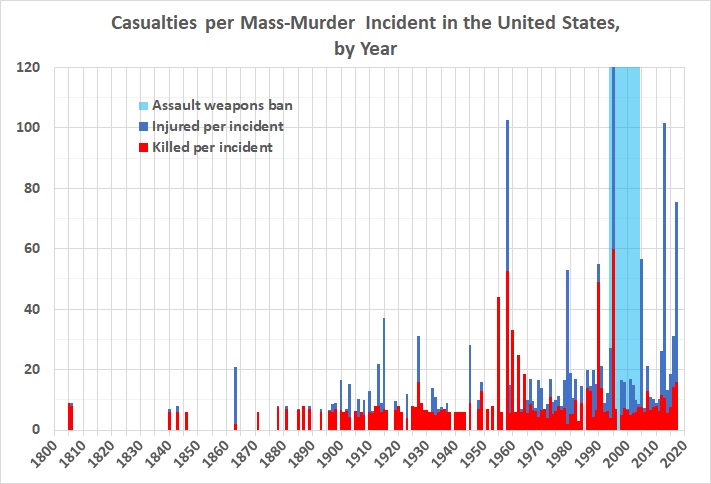
Drawing on Wikipedia, I compiled a list of 317 incidents of mass murder in the United States from the early 1800s through 2017….

These graphs are derived from the consolidated list of incidents:


The vertical scale is truncated to allow for a better view of the variations in the casualty rate. In 1995, there were 869 casualties in 3 incidents (an average of 290); about 850 of the casualties resulted from the Oklahoma City bombing.

The federal assault weapons ban — really a ban on the manufacture of new weapons of certain kinds — is highlighted because it is often invoked as the kind of measure that should be taken to reduce the incidence of mass murders and the number of casualties they produce. Even Wikipedia — which is notoriously biased toward the left — admits (as of today) that “the ban produced almost no significant results in reducing violent gun crimes and was allowed to expire.”

There is no compelling, contrary evidence in the graphs. The weapons-ban “experiment” was too limited in scope and too-short lived to have had any appreciable effect on mass murder. For one thing, mass-murderers are quite capable of using weapons other than firearms. The years with the three highest casualty rates (second graph) are years in which most of the carnage was caused by arson (1958) and bombing (1995 and 2013).

The most obvious implication of this analysis is found in the upper graph. The incidence of mass murders was generally declining from the early 1900s to the early 1960s. Then all hell broke loose.

I rest my case.

(See also “Reductio ad Sclopetum, or Getting to the Bottom of ‘Gun Control’“, “‘This Has to Stop’“, and “Utilitarianism vs. Liberty“, especially UTILITARIANISM AND GUN CONTROL VS. LIBERTY.)

Thaler’s Fatuousness

Richard  Thaler, with whom I had a nodding acquaintance many years ago, is one of my least favorite economists — and a jerk, to boot. (See, for example, “The Perpetual Nudger“, “Richard Thaler, Nobel Laureate“, “Thaler’s Non-Revolution in Economics“, “Another (Big) Problem with ‘Nudging’“, and ” Thaler on Discounting“.) What the world needs isn’t a biography of the nudger-in-chief, but that’s what the world now has, no thanks to The Library of Economics and Liberty, where the mercifully brief bio is posted.

In it, the reader is treated to such “wisdom” as this:

Economists generally assume that more choices are better than fewer choices. But if that were so, argues Thaler, people would be upset, not happy, when the host at a dinner party removes the pre-dinner bowl of cashews. Yet many of us are happy that it’s gone. Purposely taking away our choice to eat more cashews, he argues, makes up for our lack of self-control.

Notice the sleight of hand by which the preferences of a few (including Thaler, presumably) are pushed front and center: “many of us are happy”. Who is “us”? And what about the preferences of everyone else, who may well comprise a majority? Thaler is happy because the the host has taken an action of which he (Thaler) approves, because he (Thaler) wants to tell the rest of us what makes us happy.

There’s more:

Thaler … noticed another anomaly in people’s thinking that is inconsistent with the idea that people are rational. He called it the “endowment effect.” People must be paid much more to give something up (their “endowment”) than they are willing to pay to acquire it. So, to take one of his examples from a survey, people, when asked how much they are willing to accept to take on an added mortality risk of one in one thousand, would give, as a typical response, the number $10,000. But a typical response by people, when asked how much they would pay to reduce an existing risk of death by one in one thousand, was $200.

Surveys are meaningless. Talk is cheap (see #5 here).

Even if the survey results are somewhat accurate, in that there is a significant gap between the two values, there is a rational explanation for such a gap. In the first instance, a person is (in theory) accepting an added risk, one that he isn’t already facing. In the second instance, the existing risk may be one that the person being asked considers to be very low, as applied to himself. The situations clearly aren’t symmetrical, so it’s unsurprising that the price of accepting a new risk is higher than the payment for reducing a possible risk.

That’s enough of Thaler. More than enough.

Why Populism Is Popular

Affluent “elites” are well-insulated from the consequences of the policies that they promote and enact. Sometimes the elites justify those policies because they are “good” for an amorphous aggregation (“the country”, “the people”, GDP). Thus, for example, elites favor “free trade” and “open borders” because some they (supposedly) result in a net gain in GDP. That the gain is net of the losses incurred by many taxpayers and victims of crime is irrelevant to the elites.

And when elites are promoting “social justice” they favor policies that are best for a particular group, to the exclusion of other groups. It doesn’t start that way, but that’s how it ends up, because the easiest way to “make things right” for a particular group is to penalize others, as in “affirmative action”, “affordable (tax-funded) housing”, suppression of speech, etc.

You get the idea. Elites stroke their own egos in the pursuit of abstract measures of “good”, and disdain those who are harmed, calling them — among many things — “bitter clingers”, “deplorables”, and denizens of “flyover country”.

I have been guilty of elitism, but I am cured of it. I have joined the no-longer-silent majority. No-longer-silent thanks to Donald Trump — praise be!

(See also “Modern Utilitarianism“, “Rethinking Free Trade“, and “Rooted in the Real World of Real People“.)

Some Conundrums

Here are five (my answers are below):

1. Why are killers (too often) not killed for their crimes?

2. Why can some parties suppress and distort the speech of others, yet continue to enjoy the liberties (including freedom of speech) that enable their actions?

3. How is it that some very-rich persons claim to pay “too little” in taxes, yet they (a) do not voluntarily contribute to the U.S. Treasury and (b) want to impose higher taxes on persons who are not very rich?

4. If “climate change” is a problem that causes the governments of some cities and States to impose extraordinary regulations (e.g., extra gasoline taxes, tighter emissions standards), why do those same governments countenance any activity that (supposedly) contributes to “climate change” (e.g., municipal transit, official travel, subsidized arenas, the construction of houses larger than, say, 2,000 square feet)? (And do the officials who push such regulations bother to compute the vanishingly small effect of those regulations on “climate change”, assuming that there is any effect?)

5. Why do so many people choose to live in metropolitan areas — only to complain about crime, traffic congestion, high prices, and stress — when they could be relieved of those woes by moving out? The opportunities are rife:

Answers:

1. The opposition to capital punishment is an exemplar of politically correct (i.e., muddled) thinking. It is epitomized in this common combination of attitudes: aborting an innocent fetus is all right; killing a killer is bad. Why? Because killing is “bad”, regardless of the end it serves.  It is like the PC idea that saying “gun”, drawing one, or owning one is bad because guns are “bad”, no matter what (unless your hired bodyguard carries a gun).

2. Leniency with respect to entities that suppress speech is of a piece with pacifism. It invites the aggressor to do unto you what you should do unto him before he can do it unto you.

3. Some very-rich persons are empty-headed twits who care more about virtue-signalling than they care about the welfare of their fellow citizens (those who pay taxes, at any rate), and they are hypocrites, to boot.

4. Change the preceding answer by substituting “municipal and State officials” for “very-rich persons”.

5. The are many reasons for staying in a metropolitan area, some of them good ones; for example, moving to an extra-metropolitan area would mean the loss of ready access to “culture” (arts, entertainment, dining, organized sports), the abandonment of established social relationships, and very possibly (because of a dearth of suitable jobs) a drastic reduction in one’s standard of living despite lower housing costs. There are, however, some reasons that are merely self-defeating, namely, inertia and pride (e.g., reluctance to give up the Lexus SUV and McMansion). Putting up with crime, traffic congestion, high prices, and stress — while complaining about such things — points to the uselessness of most surveys. Talk is cheap.

First They Came For …

… the Communists
And I did not speak out
Because I was not a Communist

Then they came for the Socialists
And I did not speak out
Because I was not a Socialist

Then they came for the trade unionists
And I did not speak out
Because I was not a trade unionist

Then they came for the Jews
And I did not speak out
Because I was not a Jew

Then they came for me
And there was no one left
To speak out for me

So goes one version of “First they came …

the poetic form of a prose post- war confession first made in German in 1946 by the German Lutheran pastor Martin Niemöller (1892–1984). It is about the cowardice of German intellectuals and certain clergy (including, by his own admission, Niemöller himself) following the Nazis’ rise to power and subsequent incremental purging of their chosen targets, group after group.

Niemöller’s message has been repeated time and again by observers of political developments in the U.S. Sometimes in defense of the communists being “persecuted” by Joe McCarthy, and sometimes by conservatives who are (rightly) fearful of the power of Big Tech.

But I find myself in disagreement with the message and its assumptions.

For one thing, it is right to go after some groups (e.g., Big Tech). The “marketplace of ideas” is a fatuous notion, and liberty cannot be sustained if its enemies are allowed free rein to convert the populace to anti-libertarian dogmas. The First Amendment was not meant to be a prescription for political suicide.

For another thing, it is ridiculous to think that intellectuals and clergymen could have prevented the rise of Nazism and its eventual (and largely successful) effort to eradicate the Jews of Germany and occupied territories. In fact, a goodly share of Germany’s intellectuals (and clergy and affluent professionals) gave aid and comfort to the Nazi regime.

The same is true, in large part, of American intellectuals, clergy, and affluent professionals. That they are dupes of the left’s coterie of would-be dictators doesn’t occur to them. But they are dupes, and with the left in the saddle and riding hard toward economic and social dictatorship, it will not matter whether any or most of them recant before dictatorship is upon us.

Some of the dupes, if they are suitably subservient, will become court favorites — until they say or do something that puts their allegiance in doubt, when they will be purged à la Stalin. Those who turned against the left during its rise to absolute power will be remembered and dealt with harshly in Orwellian fashion, as enemies of “equality”, “social justice”, “sexual liberation”, and other such perverted concepts. The silent majority will be left (mostly) alone, though only by dint of its continued silence in an economic and social wasteland.

Consequentialism

According to consequentialism, an act (or a refusal to act in a particular way) should be judged by its consequences. But consequences can only follow from an act (or lack of action). So consequentialism is really founded on hope, with perhaps some justification in experience — if certain types of act (or inaction) are known to have certain consequences.

But even the simplest acts — those with a direct connection between their commission and the desired outcomes — can have unforeseen and unwanted consequences. Murder committed in the heat of the moment, but with the intention to kill, may land the murderer in prison or an execution chamber, neither of which outcome the murderer had in mind when he pulled the trigger or plunged the knife into his victim. Less dramatically, the outcome of a marriage proposal may — and usually does — lead not only to marital bliss (though perhaps not for as long as intended) but also to complications that hadn’t been contemplated (e.g., the raising of difficult children, financial stress, affairs, and other irritants large and small that strain the marriage).

Governance on the basis of consequentialism has proven time and time again to be foolish, when not treacherous. Social Security, for example, which was meant to be a boon to indigent old people has become a vast, economically draining, disincentivizing middle-to-lower-class welfare program. Social Security led to other vast and wasteful schemes, including Medicare and Medicaid and expansion through Obamacare, whose proponents made this fraudulent promise:

If you like the plan you have, you can keep it. If you like the doctor you have, you can keep your doctor, too. The only change you’ll see are falling costs as our reforms take hold.

Even successful wars — World War II, notably and uniquely in the American experience — have led to massive waste in lives and treasure. An annotated list of the ill-conceived and mis-conceived government ventures in the history of the United States would (and does) fill volumes.

I am not suggesting that persons refrain from taking action for fear that things won’t turn out as hoped for. (Government is entirely a different matter, and if most of it were abolished Americans would be far better off than they are.) What I am saying is that judging an action by its consequences can be done only after the fact, when all of the ramifications of the action have played out. Moreover, and crucially, similar actions can have wildly different consequences.

In sum: Consequentialism is an empty philosophical construct. “Good” consequences justify the actions that lead to them, but the actions have already been taken, and similar actions often have different consequences.

Vive le collège électoral!

Long live the Electoral College!

As long as the States retain their power under the Constitution, they remain co-sovereign with the government of the United States. The election of a president by the Electoral College recognizes the co-sovereignty of the States, and the separate voice that each of them has in the election of a president.

It is not for the voters of California to dictate the winner of a presidential election, as they would have done in 2016 had a nationwide tally of popular votes by State been decisive. Rather, it is for the voters of each State, in the aggregate, to cast what amounts to a State-wide vote through the Electoral College. One can quibble with the constitutional compromise that gave less-populous States a slightly disproportionate say in the outcome. (The number of electoral votes cast by each State is equal to the number of its Representatives in Congress — thus roughly proportional to its population — plus the number of its Senators in Congress, which is two for every State regardless of its population.) But the principle remains, regardless of the quibble: Each State is independent of every other State and its aggregate preference should not be submerged in the mythical nationwide popular-vote tally.

These observations are prompted by Victor Davis Hansen’s perceptive analysis of the meaning and consequences of the election of Donald Trump in 2016. Had it not been for the Electoral College, Hillary Clinton would have won the election and the United States would have been led deeper into costly and counterproductive spending and regulatory activity to combat “climate change” and various “social injustices”; the southern border would have been thrown open to all and sundry welfare-moochers; and the charade known as the Iran nuclear deal would have played out to its predictable end — the sudden emergence of an Iran armed with long-range nuclear missiles. In the meanwhile, the disarmament of America would have continued, in the face of the rising power of China and Russia. And those nations would (sooner later) have had carte blanche to commit economic and military blackmail against the interests of American citizens and companies.

What about 2020? Naive forecasts of the votes cast in the Electoral College based on trends in the GOP candidates’ share of each State’s popular vote (2000 to 2016 and 2012 to 2016) point to another win by Trump. The likely margin of victory is about the same as in 2016 or even larger if the pro-GOP trend continues in Maine, Minnesota, Nevada, or New Hampshire. (Any such projection is, of course, subject to great uncertainty — especially with respect to the state of the economy, the continuation of relative piece, the containment of terrorism, and other events that might jolt the electorate.)

A Roundup of Related Posts: “Americanism” Edition

Read Dov Fischer’s “So Where Do They Come From?“, and then these related posts  (if you haven’t already done so):

Real Americans

The Age of Memes

About Trump’s “Go Back” Statement

Anti-patriotism

Political “Memes”

Rooted in the Real World of Real People

Rooted in the Real World of Real People

I am far from nostalgic about my home town. But it’s still my home town, and I often revisit it in my mind’s eye.

The only places that I mentally revisit with pleasure are the first home that I can remember — where I lived from age 1 to age 7 — and the first of the three red-brick school houses that I attended.

I haven’t been to my home town in four years. The occasion was the funeral of my mother, who lived to the age of 99.

I may not go back again. But it’s still my home town.

I think of it that way not only because I grew up there but also because it’s a “real” place: a small, mostly run-down, Midwestern city with a population of about 30,000 — the largest city in a county that lies beyond the fringes of the nearest metropolitan area.

Perhaps I’m nostalgic about it, after all, because “real” places like my home town seem to be vanishing from the face of America. By real, I mean places where (real) people still work with their hands; live in houses that are older than they are, and have fewer bathrooms than bedrooms; mow their own lawns, clean their own homes, and make their own meals (except when they partake of the American Legion fish fry or go to a Chick-Fil-A); bowl, hunt, fish, stroll their neighborhoods and know their neighbors (who have been their neighbors for decades); read Reader’s Digest, Popular Mechanics, and romance novels; go to bars that lack ferns and chrome; prefer Fox News and country music to NPR, CNN, MSNBC, and hip-hop; go to church and say grace before meals; and vote for politicians who don’t think of real people as racists, ignoramuses, gun nuts, or religious zealots (“deplorables”, in other words).

In fact, America is (or was) those real places with real people in them. And it is vanishing with them.

P.S. I have lived outside the real world of real people for a very long time, but the older I get, the more I miss it.

Political “Memes”

The dominant theme in political discourse changes frequently. As politicians figure out that most of the public is tired of one theme, they pick up another one, and it dominates for a while. Rinse, lather, repeat.

A few years ago the dominant political theme was inequality. Now it’s racism (or, more broadly, discrimination “hate”). Dominant themes of yore include anti-communism vs. anti-anti-communism, relations with the USSR, civil rights, and various wars (especially Vietnam and Iraq II). The economy becomes a dominant theme when it’s down, giving politicians an excuse to promote economically destructive spending and redistribution schemes.

What’s next? I don’t know, but there will be a dominant theme, possibly before the end of Trump’s first term. One possibility (though it may be too arcane) is the power of the information-technology giants, which is being attacked from left and right. Something “sexier” is sure to come along.

(See also “The Age of Memes“.)

Anti-patriotism

It has become the first refuge of scoundrels.

The Enlightenment’s Fatal Flaw

The fatal flaw is the reliance on reason. As Wikipedia puts it,

The Enlightenment included a range of ideas centered on reason as the primary source of knowledge….

Where reason is

the capacity of consciously making sense of things, establishing and verifying facts, applying logic, and adapting or justifying practices, institutions, and beliefs based on new or existing information.

So much of life is — of necessity — conducted in a realm beyond “reason”, where instincts and customs come into play in a universe that is but dimly understood.

By contrast, as the Wikipedia article admits, the Enlightenment — like its contemporary manifestations in pseudo-science (e.g., Malthusianism, Marxism, “climate change”), politics (e.g., “social justice”), and many other endeavors — relies on reductionism, which is

the practice of oversimplifying a complex idea or issue to the point of minimizing or distorting it.

Reason relies on verbalization (or its mathematical equivalent), but words (and numbers) fail us:

Love, to take a leading example, is a feeling that just is. The why and wherefore of it is beyond our ability to understand and explain. Some of the feelings attached to it can be expressed in prose, poetry, and song, but those are superficial expressions that don’t capture the depth of love and why it exists.

The world of science is of no real help. Even if feelings of love could be expressed in scientific terms — the action of hormone A on brain region X — that would be worse than useless. It would reduce love to chemistry, when we know that there’s more to it than that. Why, for example, is hormone A activated by the presence or thought of person M but not person N, even when they’re identical twins?

The world of science is of no real help about “getting to the bottom of things.” Science is an infinite regress. S is explained in terms of T, which is explained in terms of U, which is explained in terms of V, and on and on. For example, there was the “indivisible” atom, which turned out to consist of electrons, protons, and neutrons. But electrons have turned out to be more complicated than originally believed, and protons and neutrons have been found to be made of smaller particles with distinctive characteristics. So it’s reasonable to ask if all of the particles now considered elementary are really indivisible. Perhaps there other more-elementary particles yet to be hypothesized and discovered. And even if all of the truly elementary particles are discovered, scientists will still be unable to explain what those particles really “are.”

Reason is valuable when it consists of the narrow application of logic to hard facts. But it has almost nothing to do with most of life — and especially not with politics.

Just as words fail us, so has the Enlightenment and much of what came in its wake.

As exemplified by this “child of the enlightenment”:

Child of the enlightenment

(See also “In Praise of Prejudice” and “We, the Children of the Enlightenment“.)

In Praise of Prejudice

The title of this post is borrowed from Theodore Dalrymple’s In Praise of Prejudice: The Necessity of Preconceived Ideas. John Stuart Mill, who epitomized The Enlightenment, is a main target of Dalyrmple’s book.

Social custom (along with monarchy and religion) was a main target of The Enlightment. Mill’s On Liberty (1869) is an extended attack on social custom, as Dalyrymple explains:

For Mill, custom is an evil that is the principle obstruction to progress and moral improvement, and its group on society is so strong that originality, unconventionality, and rebellion against it are goods in themselves, irrespective of their actual content. The man who flouts a convention ipso facto raises society from its torpor and lets everyone know that there are different, and better, ways of doing things. The more such people there are, the greater the likelihood of progress….

Of radical evil, in which the [twentieth] century was to abound, [Mill] has nothing to say, and therefore he had no idea that a mania for progress could result in its very antithesis, or that some defense against such radical evil, of which the commission was not possible without the co-operation and participation of many men, was necessary. The abandonment of customary restraint and inverted moral prejudice was not necessarily followed by improvement.

(See also “On Liberty“, “Accountants of the Soul“, “The Fallacy of Human Progress“, “The Harmful Myth of Inherent Equality“, “Social Norms and Liberty“, “More about Social Norms and Liberty“, “The Harm Principle Revisited: Mill Conflates Society and State“, “My View of Mill, Endorsed“, “Suicide or Destiny?“, “O.J.’s Glove and the Enlightenment“, and “James Burham’s Misplaced Optimism“.)

About Trump’s “Go Back” Statement

What did Trump actually say? This:

So interesting to see “Progressive” Democrat Congresswomen, who originally came from countries whose governments are a complete and total catastrophe, the worst, most corrupt and inept anywhere in the world (if they even have a functioning government at all), now loudly and viciously telling the people of the United States, the greatest and most powerful Nation on earth, how our government is to be run. Why don’t they go back and help fix the totally broken and crime infested places from which they came. Then come back and show us how it is done. These places need your help badly, you can’t leave fast enough. I’m sure that Nancy Pelosi would be very happy to quickly work out free travel arrangements!

Trump is inarticulate (perhaps purposefully, in part). There are those who read Trump’s statement as racist, and an attempt to silence The Squad.

Trump’s message, as I read it, wasn’t that The Squad should be denied its right to speak. It is that The Squad (and its adherents) are enemies of liberty and prosperity. There’s nothing racist in calling attention to the fact that the members of The Squad (whether immigrants or not) have their roots in countries and regions which are just as Trump describes them.

Reading racism into Trump’s statement is just an attempt to perpetuate the myth that Trump is a racist. Whence that myth? It is rooted in Trump’s commitment to stem the flow of illegal immigrants from south of the border — illegals who also happen to be “persons of color”.

The real racism is The Squad’s use of “racism” to divert attention from the promotion of policies that are subversive of liberty and prosperity. That’s The Squad (and its friends) in action.