Fine-Tuning in a Wacky Wrapper

The Unz Review hosts columnists who hold a wide range of views, including whacko-bizarro-conspiracy-theory-nut-job ones. Case in point: Kevin Barrett, who recently posted a review of David Ray Griffin’s God Exists But Gawd Does Not: From Evil to the New Atheism to Fine Tuning. Some things said by Barrett in the course of his review suggest that Griffin, too, holds whacko-bizarro-conspiracy-theory-nut-job views; for example:

In 2004 he published The New Pearl Harbor — which still stands as the single most important work on 9/11 — and followed it up with more than ten books expanding on his analysis of the false flag obscenity that shaped the 21st century.

Further investigation — a trip to Wikipedia — tells me that Griffin believes there is

a prima facie case for the contention that there must have been complicity from individuals within the United States and joined the 9/11 Truth Movement in calling for an extensive investigation from the United States media, Congress and the 9/11 Commission. At this time, he set about writing his first book on the subject, which he called The New Pearl Harbor: Disturbing Questions About the Bush Administration and 9/11 (2004).

Part One of the book looks at the events of 9/11, discussing each flight in turn and also the behaviour of President George W. Bush and his Secret Service protection. Part Two examines 9/11 in a wider context, in the form of four “disturbing questions.” David Ray Griffin discussed this book and the claims within it in an interview with Nick Welsh, reported under the headline Thinking Unthinkable Thoughts: Theologian Charges White House Complicity in 9/11 Attack….

Griffin’s second book on the subject was a direct critique of the 9/11 Commission Report, called The 9/11 Commission Report: Omissions And Distortions (2005). Griffin’s article The 9/11 Commission Report: A 571-page Lie summarizes this book, presenting 115 instances of either omissions or distortions of evidence he claims are in the report, stating that “the entire Report is constructed in support of one big lie: that the official story about 9/11 is true.”

In his next book, Christian Faith and the Truth Behind 9/11: A Call to Reflection and Action (2006), he summarizes some of what he believes is evidence for government complicity and reflects on its implications for Christians. The Presbyterian Publishing Corporation, publishers of the book, noted that Griffin is a distinguished theologian and praised the book’s religious content, but said, “The board believes the conspiracy theory is spurious and based on questionable research.”

And on and on and on. The moral of which is this: If you have already “know” the “truth,” it’s easy to weave together factual tidbits that seem to corroborate it. It’s an old game that any number of persons can play; for example: Mrs. Lincoln hired John Wilkes Booth to kill Abe; Woodrow Wilson was behind the sinking of the Lusitania, which “forced” him to ask for a declaration of war against Germany; FDR knew about Japan’s plans to bomb Pearl Harbor but did nothing so that he could then have a roundly applauded excuse to ask for a declaration of war on Japan; LBJ ordered the assassination of JFK; etc. Some of those bizarre plots have been “proved” by recourse to factual tidbits. I’ve no doubt that all of them could be “proved” in that way.

If that is so, you may well ask why I am writing about Barrett’s review of Griffin’s book? Because in the midst of Barrett’s off-kilter observations (e.g., “the Nazi holocaust, while terrible, wasn’t as incomparably horrible as it has been made out to be”) there’s a tantalizing passage:

Griffin’s Chapter 14, “Teleological Order,” provides the strongest stand-alone rational-empirical argument for God’s existence, one that should convince any open-minded person who is willing to invest some time in thinking about it and investigating the cited sources. This argument rests on the observation that at least 26 of the fundamental constants discovered by physicists appear to have been “fine tuned” to produce a universe in which complex, intelligent life forms could exist. A very slight variation in any one of these 26 numbers (including the strong force, electromagnetism, gravity, the mass difference between protons and neutrons, and many others) would produce a vastly less complex, rich, interesting universe, and destroy any possibility of complex life forms or intelligent observers. In short, the universe is indeed a miracle, in the sense of something indescribably wonderful and almost infinitely improbable. The claim that it could arise by chance (as opposed to intelligent design) is ludicrous.

Even the most dogmatic atheists who are familiar with the scientific facts admit this. Their only recourse is to embrace the multiple-universes interpretation of quantum physics, claim that there are almost infinitely many actual universes (virtually all of them uninteresting and unfit for life), and assert that we just happen to have gotten unbelievably lucky by finding ourselves in the one-universe-out-of-infinity-minus-one with all of the constants perfectly fine-tuned for our existence. But, they argue, we should not be grateful for this almost unbelievable luck — which is far more improbable than winning hundreds of multi-million-dollar lottery jackpots in a row. For our existence in an amazingly, improbably-wonderful-for-us universe is just a tautology, since we couldn’t possibly be in any of the vast, vast, vast majority of universes that we couldn’t possibly be in.

Griffin gently and persuasively points out that the multiple-universes defense of atheism is riddled with absurdities and inconsistencies. Occam’s razor definitively indicates that by far the best explanation of the facts is that the universe was created not just by an intelligent designer, but by one that must be considered almost supremely intelligent as well as almost supremely creative: a creative intelligence as far beyond Einstein-times-Leonardo-to-the-Nth-power as those great minds were beyond that of a common slug.

Fine-tuning is not a good argument for God’s existence. Here is a good argument for God’s existence:

  1. In the material universe, cause precedes effect.
  2. Accordingly, the material universe cannot be self-made. It must have a “starting point,” but the “starting point” cannot be in or of the material universe.
  3. The existence of the universe therefore implies a separate, uncaused cause.

Barrett (Griffin?) goes on:

Occam’s razor definitively indicates that by far the best explanation of the facts is that the universe was created not just by an intelligent designer, but by one that must be considered almost supremely intelligent as well as almost supremely creative: a creative intelligence as far beyond Einstein-times-Leonardo-to-the-Nth-power as those great minds were beyond that of a common slug.

Whoa! Occam’s razor indicates nothing of the kind:

Occam’s razor is used as a heuristic technique (discovery tool) to guide scientists in the development of theoretical models, rather than as an arbiter between published models. In the scientific method, Occam’s razor is not considered an irrefutable principle of logic or a scientific result; the preference for simplicity in the scientific method is based on the falsifiability criterion. For each accepted explanation of a phenomenon, there may be an extremely large, perhaps even incomprehensible, number of possible and more complex alternatives, because one can always burden failing explanations with ad hoc hypotheses to prevent them from being falsified; therefore, simpler theories are preferable to more complex ones because they are more testable.

Barrett’s (Griffin’s?) hypothesis about the nature of the supremely intelligent being is unduly complicated. Not that the existence of God is a testable (falsifiable) hypothesis. It’s just a logical necessity, and should be left at that.

Misunderstanding the Problem

In “How Statistics Lost Their Power — and Why We Should Fear What Comes Next” (The Guardian, January 19, 2017), William Davies asserts that

statistics should help settle arguments. They ought to provide stable reference points that everyone – no matter what their politics – can agree on. Yet in recent years, divergent levels of trust in statistics has become one of the key schisms that have opened up in western liberal democracies. Shortly before the November presidential election, a study in the US discovered that 68% of Trump supporters distrusted the economic data published by the federal government….

Rather than diffusing controversy and polarisation, it seems as if statistics are actually stoking them. Antipathy to statistics has become one of the hallmarks of the populist right, with statisticians and economists chief among the various “experts” that were ostensibly rejected by voters in 2016. Not only are statistics viewed by many as untrustworthy, there appears to be something almost insulting or arrogant about them. Reducing social and economic issues to numerical aggregates and averages seems to violate some people’s sense of political decency….

The declining authority of statistics – and the experts who analyse them – is at the heart of the crisis that has become known as “post-truth” politics. And in this uncertain new world, attitudes towards quantitative expertise have become increasingly divided. From one perspective, grounding politics in statistics is elitist, undemocratic and oblivious to people’s emotional investments in their community and nation. It is just one more way that privileged people in London, Washington DC or Brussels seek to impose their worldview on everybody else. From the opposite perspective, statistics are quite the opposite of elitist. They enable journalists, citizens and politicians to discuss society as a whole, not on the basis of anecdote, sentiment or prejudice, but in ways that can be validated. The alternative to quantitative expertise is less likely to be democracy than an unleashing of tabloid editors and demagogues to provide their own “truth” of what is going on across society.

And yada yada yada.

Davies views the world through the lens of the policy-maker, who believes that he can fine-tune the interests of millions of people and arrive at policies that deliver the “greatest amount of happiness for the greatest amount of people.” This is nothing more than utilitarianism — the arrogant doling out of other people’s money — which is antithetical to liberty.

Here’s why “populists” are up in arms about statistics: They don’t like to be pushed around, and they can smell b.s. a mile away. Social statistics are malleable things. In the hands of pundits and politicians they are cherry-picked and smoothed and slanted in favor of one-size-fits-all “solutions” to perceived problems. The result usually is that a lot of people get burned by those “solutions.” Take Obamacare, please!

The real solution to most “social” problems isn’t more and better statistics, it’s smaller and less powerful government.

That’s what all the fuss is about, Mr. Davies.

Read on:
The Greatest Good of the Greatest Number?
The Interest-Group Paradox
Utilitarianism, “Liberalism,” and Omniscience
Utilitarianism vs. Liberty
Accountants of the Soul
Rawls Meets Bentham
Utilitarianism and Psychopathy
Governmental Perversity
Utilitarianism vs. Liberty (II)
Social Justice vs. Liberty

Scott Adams Understands Probability

A probability expresses the observed frequency of the occurrence of a well-defined event for a large number of repetitions of the event, where each repetition is independent of the others (i.e., random). Thus the probability that a fair coin will come up heads in, say, 100 tosses is approximately 0.5; that is, it will come up heads approximately 50 percent of the time. (In the penultimate paragraph of this post, I explain why I emphasize approximately.)

If a coin is tossed 100 times, what is the probability that it will come up heads on the 101st toss? There is no probability for that event because it hasn’t occurred yet. The coin will come up heads or tails, and that’s all that can be said about it.

Scott Adams, writing about the probability of being killed by an immigrant, puts it this way:

The idea that we can predict the future based on the past is one of our most persistent illusions. It isn’t rational (for the vast majority of situations) and it doesn’t match our observations. But we think it does.

The big problem is that we have lots of history from which to cherry-pick our predictions about the future. The only reason history repeats is because there is so much of it. Everything that happens today is bound to remind us of something that happened before, simply because lots of stuff happened before, and our minds are drawn to analogies.

…If you can rigorously control the variables of your experiment, you can expect the same outcomes almost every time [emphasis added].

You can expect a given outcome (e.g., heads) to occur approximately 50 percent of the time if you toss a coin a lot of times. But you won’t know the actual frequency (probability) until you measure it; that is, after the fact.

Here’s why. The statement that heads has a probability of 50 percent is a mathematical approximation, given that there are only two possible outcomes of a coin toss: heads or tails. While writing this post I used the RANDBETWEEN function of Excel 2016 to simulate ten 100-toss games of heads or tails, with the following results (number of heads per game): 55, 49, 49, 43, 43, 54, 47, 47, 53, 52. Not a single game yielded exactly 50 heads, and heads came up 492 times (not 500) in 1,000 tosses.

What is the point of a probability statement? What is it good for? It lets you know what to expect over the long run, for a large number of repetitions of a strictly defined event. Change the definition of the event, even slightly, and you can “probably” kiss its probability goodbye.

*     *     *

Related posts:
Fooled by Non-Randomness
Randomness Is Over-Rated
Beware the Rare Event
Some Thoughts about Probability
My War on the Misuse of Probability
Understanding Probability: Pascal’s Wager and Catastrophic Global Warming

A Nation of Immigrants, a Nation of Enemies

I’m sick and tired of hearing that the United States is a nation of immigrants. So what if the United States is a nation of immigrants? The real issue is whether immigrants wish to become Americans in spirit, not in name only — loyal to the libertarian principles of the Constitution or cynical abusers of it.

I understand and sympathize with the urge to live among people with whom one shares a religion, a language, and customs. Tribalism is a deeply ingrained trait. It is not necessarily a precursor to aggression, contrary to the not-so-subtle message (aimed at white Americans) of the UN propaganda film that I was subjected to in high school. And the kind of tribalism found in many American locales, from the barrios of Los Angeles to the disappearing German communities of Texas to the Orthodox Jewish enclaves of New York City, is harmless compared with  Reconquista and Sharia.

Proponents of such creeds don’t want to become Americans whose allegiance is to the liberty promised by the Constitution. They are cynical abusers of that liberty, whose insidious rhetoric is evidence against free-speech absolutism.

But they are far from the only abusers of that liberty. It is unnecessary to import enemies when there is an ample supply of them among native-born Americans. Well, they are Americans in name because they were born in the United States and (in most cases) haven’t formally renounced their allegiance to the Constitution. But they are its enemies, no matter how cleverly they twist its meaning to support their anti-libertarian creed.

I am speaking of the left, of course. Lest we forget, the real threat to liberty in America is home-grown. The left’s recent hysterical hypocrisy leads me to renounce my naive vow to be a kinder, gentler critic of the left’s subversive words and deeds.

*     *     *

Related posts:
IQ, Political Correctness, and America’s Present Condition
Greed, Conscience, and Big Government
Tolerance
Privilege, Power, and Hypocrisy
Thinkers vs. Doers
Society, Polarization, and Dissent
Another Look at Political Labels
Individualism, Society, and Liberty
Social Justice vs. Liberty
My Platform
Polarization and De-facto Partition
How America Has Changed
The Left and “the People”
Why Conservatives Shouldn’t Compromise
Liberal Nostrums
Politics, Personality, and Hope for a New Era

Foolish Inconsistency

A rich man graciously allowed visitors to wander the grounds of his estate. Many years ago, he had failed to be vigilant in screening visitors. And so, when vandals did great damage to some of his valuable plantings, he was called a reckless fool.

Finally, before another group of vandals could do more damage, he locked the gates to his estate until he could devise a way of detecting vandals among the visitors. For that he was called a cruel tyrant.

The name-calling in both cases came from the same people. What they proved wasn’t that the rich man was a reckless fool or a cruel tyrant, but that they were inconsistent fools driven by their hatred of the rich man.

The rich man pointed out that he wasn’t required to allow visitors, and that doing so raised the cost of maintaining his estate. His enemies jeered and called him selfish. Though, in their hypocrisy, they continued to lock their doors and protect their passwords, and the rich among them kept their armed bodyguards.

*     *     *

Related posts:
Not-So-Random Thoughts (XVIII) – third item
Immigration and Crime

Brilliant Crazies

Gregory Cochran avers that “smart people are susceptible to all kinds of ideological craziness.” Cochran’s case in point is Neil Turok, a theoretical physicist from South Africa, currently head of the Perimeter Institute for Theoretical Physics in Canada. Back to Cochran:

I mentioned that [Turok] was a smart guy. He’s also crazy. He thinks that sub-Saharan Africans today are analogous to Ashkenazi Jews in 1850 or so – ready to explode into the intellectual world and tear it a new asshole.

Wanna bet? With African math scores at the 5th percentile? With their IQ scores two standard deviations below those of Europeans, three below the Askenazim? That low average tremendously suppresses the fraction above a high threshold. With every event in life its own self consistent with those statistics – not just in Africa, but everywhere in the African diaspora?

And he has no excuse [other than his commie family history]. He grew up in South Africa: there are plenty of things he would have seen if this picture of the world were true, and he’s never seen any of them. Did black kids out-argue him, beat him at chess, win the math competitions even though their parents were poor as synagogue mice? No sirree.

A very smart person like Neil Turok is probably eligible for the Triple-Nine Society (as I was before old age set in). That is, his IQ probably places him at or above the 99.9th percentile of the population: the top 0.1 percent. You’re unlikely to run into one of the 0.1 percenters unless you hang around a university, a research lab, a think tank, or a big professional-services company. They cluster in such places like birds on telephone wires.

Such persons usually do well for themselves. If they aren’t in the top one-percent of the income distribution, it’s because they don’t have the kind of personality (or athletic ability or photogenic qualities) it takes to get there. Wheeling and dealing isn’t for introverts, who are more likely than extroverts to be very smart. But very smart people have the wherewithal to make a good living, especially when the kinds of things they are good at and enjoy (e.g., teaching, writing, conducting research, and crafting legal arguments) are subsidized by taxpayers and bankrolled by wealthy clients and foundations.

Thus very smart persons usually have the luxury of thinking impossible things and dreaming impossible dreams. And when they do, they detach themselves from reality; that is, they become crazy. Like Turok, they often make a good living at it. They’re paid and encouraged to be crazy — to treat reality as an option.

Albert Einstein, for example, held a sinecure at the Institute for Advanced Study of Princeton University for the final 22 years of his life. During that time he added essentially nothing to his monumental work on special relativity, general relativity, and early quantum theory. His career played out in a Quixotic fashion: dreaming the dream (perhaps an impossible one) of a unified field theory and trying in vain to discredit quantum theory as it had developed after his early contributions. But Einstein wasn’t entirely harmless in his dotage. He was a socialist and advocate of world government, and should be dishonored for lending his prestige to those abominable causes.

Cochran is right: High intelligence doesn’t immunize a person from ideological craziness. Nor from nastiness. There’s nothing nastier than an intellectual in attack mode. As a denizen of a Ph.D.-laden think-tank for 30 years, I saw a lot of intellectual savagery at first hand. It was ugly, and I’m ashamed to say that I committed some of it.

High intelligence is highly overrated as a virtue. But if you have it you probably wouldn’t trade it for a million dollars. Well, maybe less than that. I’m open to offers.

Politics, Personality, and Hope for a New Era

“Liberals” are more neurotic than conservatives. That is, “liberals” have a “tendency to experience unpleasant emotions easily, such as anger, anxiety, depression, and vulnerability.” This is consistent with what I have observed of family members, friends, and co-workers over a span of more than 50 years.

Anxious persons are eager to sacrifice better but less certain outcomes — the fruits of liberty — for “safe” ones. Anxious persons project their anxieties onto others, and put their trust in exploitative politicians who play on their anxieties even if they don’t share them. This combination of anxieties and power-lust yields “social safety net” programs and regulations aimed at reducing risks and deterring risk-taking.. At the same time, American “liberals” — being spoiled children of capitalism — have acquired a paradoxical aversion to the very things that would ensure their security: swift and sure domestic justice, potent and demonstrably ready armed forces.

Conservatives tend toward conscientiousness more than liberals do; that is, they “display self-discipline, act dutifully, and strive for achievement against measures or outside expectations.” (This paper summarizes previous research and arrives at the same conclusion about the positive correlation between conscientiousness and conservatism.) In other words, conservatives (by which I don’t mean yahoos) gather relevant facts, think things through, assess the risks involved in various courses of action, and choose to take risks (or not) accordingly. When conservatives choose to take risks, they do so after providing for the possibility of failure (e.g., through insurance and cash reserves). Confident, self-reliant conservatives are hindered by governmental intrusions imposed at the behest of anxious “liberals.” All that conservatives need from government is protection from domestic and foreign predators. What they get from government is too little protection and too much interference.

Liberty — secured by swift domestic justice and a strong national defense — abets social comity and informed risk-taking, which is the life-blood of prosperity. “Liberalism” has almost extinguished liberty in America, but its feeble pulse has shown signs of strength since January 20, 2017. I can live with the bombast of Trump’s utterances, with higher labor costs, and some restrictions on imports if those things are part of a package deal that includes the reversal of the Supreme Court’s “liberalism,” the emasculation of the EPA, an end to government-sponsored warmist-pandering, significant deregulation, the end of Obamacare, smaller and cheaper government on the domestic front, respect and support for the police who daily put their lives on the line, larger and more potent armed forces, an “America First” foreign policy, and the end of “social justice” as an animating force in government policy.

Prosperity Isn’t Everything

There is no denying that per-capita income rises with specialization and trade; for example:

  • A is a farmer with land that’s good for growing fruit trees; B is a farmer with land that’s good for raising cattle.
  • The total output of both apples and butter will be greater if A specializes in growing apples and B specializes in making butter than if both A and B grew apples and made butter.
  • A and B can then trade apples for butter so that of them is better off than he would have been in the absence of specialization and trade.

Sometimes A and B live in different cities, different States, and different countries. If the raison d’etre of specialization and trade is the maximization of income, it would be foolish to exclude international trade while allowing inter-State and inter-city trade. (Note that the preceding sentence begins with if.)

The combination of specialization, trade, invention, innovation, and entrepreneurship has wrought much good. Here’s Megan McArdle’s testimony:

By the standards of today, my grandparents were living in wrenching poverty. Some of this, of course, involves technologies that didn’t exist—as a young couple in the 1930s my grandparents had less access to health care than the most  neglected homeless person in modern America, simply because most of the treatments we now have had not yet been invented. That is not the whole story, however. Many of the things we now have already existed; my grandparents simply couldn’t afford them.  With some exceptions, such as microwave ovens and computers, most of the modern miracles that transformed 20th century domestic life already existed in some form by 1939. But they were out of the financial reach of most people.

If America today discovered a young couple where the husband had to drop out of high school to help his father clean tons of unsold, rotted produce out of their farm’s silos, and now worked a low-wage, low-skilled job, was living in a single room with no central heating and a single bathroom to share for two families, who had no refrigerator and scrubbed their clothes by hand in a washtub, who had serious conversations in low voices over whether they should replace or mend torn clothes, who had to share a single elderly vehicle or make the eight-mile walk to town  … that family would be the subject of a three-part Pulitzer prizewinning series on Poverty in America.

But in their time and place, my grandparents were a boring bourgeois couple, struggling to make ends meet as everyone did, but never missing a meal or a Sunday at church. They were excited about the indoor plumbing and electricity which had just been installed on his parents’ farm, and they were not too young to marvel at their amazing good fortune in owning an automobile. In some sense they were incredibly deprived, but there are millions of people in America today who are incomparably better off materially, and yet whose lives strike us (and them) as somehow objectively more difficult.

Much of that is true of my parents, who were of the same generation as McArdle’s grandparents. More of it is true of my maternal grandmother, who was born in 1880, wed in 1903, bore and raised ten children, and was widowed at the age of 60. I remember well the years before she reached the age of 70; until then she cooked on a wood-fired range, pumped water from a well in her backyard, and went to the outhouse for calls of nature. And yet, the following things, and much more, came to pass in her lifetime: alternating-current electricity, a telephone in most homes (though my grandmother lacked one until she was in her 70s), automobiles (though she never learned to drive), airplanes (she first flew at the age of 93), movies, radio, movies with sound, television (she never owned one), radar, penicillin, vaccinations against various debilitating diseases, electric typewriters, and early transistorized computers.

Because my dominant memories of my grandmother and her way of life in a small village are boyhood memories, it’s tempting to characterize them as nostalgic and somewhat romanticized. But I know that she was more or less typical of the residents of her village. Though she was far from rich, she wasn’t poor by the standards of the village. She certainly didn’t feel impoverished or resentful about her lack of material goods.

Today, however, relatively poor people in America have far, far more in the way of material goods than my grandmother ever dreamt of owning, yet they are anxious and even miserable, because… Here’s McArdle’s view:

[Not] everything has gotten better in every way, all the time. There are areas in which things have gotten broadly worse….

  • … Substance abuse, and the police response to it, has devastated both urban and rural communities.
  • Divorce broke up millions of families, and while the college educated class seems to have found a new equilibrium of stable and happy later marriages, marriage is collapsing among the majority who do not have a college degree, leaving millions of children in unstable family situations where fathers are often absent from the home, and their attention and financial resources are divided between multiple children with multiple women.
  • Communities are much less cohesive than they used to be, and while the educated elite may have found substitutes online, the rest of the country is “bowling alone” more and more often—which is not merely lonely, but also means they have fewer social supports when they find themselves in trouble.
  • A weekly wage packet may buy more than it did sixty years ago, but the stability of manufacturing jobs is increasingly being replaced by contingent and unreliable shift work that is made doubly and triply difficult by the instability of the families that tend to do these jobs. The inability to plan your life or work in turn makes it hard to form a family, and stressful to keep one together….
  • Widespread credit has democratized large purchases like furniture and cars. It has also enabled many people, particularly financially marginal people, to get into serious trouble.  Debt magnifies your life experience: when things are going relatively well, it gives you more options, but when things are going badly, it can turn a setback into a catastrophe—as many, many families found out in 2008….

This list illustrates why public policy seems to be struggling to come up with a plan of attack against our current insecurities. The welfare state is relatively good at giving people money: you collect the taxes, write a check, and now people have money. The welfare state has proven very bad at giving people stable jobs and stable families, a vibrant community life, promising career tracks, or a cure for their drug addiction. No wonder so many hopes now seem to be pinned on early childhood education, far in excess of the evidence to support them: it is the only thing we have not already tried and failed at.

But I think this list illustrates the poverty of trying to measure living standards by staring at median wages. Many of the changes of the last century show up in that statistic, but others, like the time no longer spent plucking chickens, or the joys of banishing lye from the pantry, appear nowhere.  Nor do the changes in job and family structure that have made the lives of people who are indisputably vastly materially richer than my young grandparents were, nonetheless feel much more precarious.

Where did it all go wrong? And I do believe that it went wrong. I say that as a man who has lived more than his three-score and ten years, remains in good health, lives comfortably, has a loving wife of 52 years, has two fine children and twelve joyous grandchildren, and is by nature an optimistic achiever who isn’t easily thrown off course by a setback.

It didn’t go wrong because of globalization, though globalization may have hastened the rot. It didn’t go wrong because of prosperity per se, though it was helped by the fevered pursuit of prosperity. It went wrong because of the fraying of the social ties that bound much of America for so long — even with the Civil War and its decades-long residue of bitterness.

Why did those ties fray? And why are they now weaker than than have been since the eve of the Civil War?

Let’s begin with social norms, which are the basis of social ties. If you and I observe the same social norms, we’re likely to feel bound in some way, even if we’re not friends or relatives. This, of course, is tribalism, which is verboten among those who view all of mankind as brothers, sisters, and whatevers under the skin — all mankind except smarty-pants Americans of East Asian descent, Israeli Jews and American Jews who support Israel, Southerners (remember the Civil War!), and everyone else who is a straight, non-Hispanic white male of European descent. To such people, the only legitimate tribe is the tribe of anti-tribalism.

You may by now understand that I blame leftists for the breakdown of social norms and social ties. But how can that be if, as McArdle says, “the college educated class seems to have found a new equilibrium of stable and happy later marriages”? The college-educated class resides mostly on the left, and affluent leftists do seem to have avoided the rot.

Yes, but they caused it. You could think of it as a non-suicidal act of terror. But it would be kinder and more accurate to call it an act of involuntary manslaughter.  Leftists meant to make the changes that caused the rot; they just didn’t foresee or intend the rot. Nor is it obvious that they care about it, except as an excuse to “solve” social problems from on high by throwing money and behavioral prescriptions at them — which is why there’s social rot in the first place.

The good intentions embedded in governmental acts and decrees have stealthily expanded and centralized government’s power, and in the process have sundered civil society. Walter Williams puts it this way in “Culture and Social Pathology” (creators.com, June 16, 2015):

A civilized society’s first line of defense is not the law, police and courts but customs, traditions, rules of etiquette and moral values. These behavioral norms — mostly transmitted by example, word of mouth and religious teachings — represent a body of wisdom distilled over the ages through experience and trial and error. They include important thou-shalt-nots, such as thou shalt not murder, thou shalt not steal and thou shalt not cheat. They also include all those courtesies that have traditionally been associated with ladylike and gentlemanly conduct.

The failure to fully transmit these values and traditions to subsequent generations represents one of the failings of what journalist Tom Brokaw called “The Greatest Generation.” People in this so-called great generation, who lived during the trauma of the Great Depression and fought World War II, not only failed to transmit the moral values of their parents but also are responsible for government programs that will deliver economic chaos….

For nearly three-quarters of a century, the nation’s liberals have waged war on traditional values, customs and morality. Our youths have been counseled that there are no moral absolutes. Instead, what’s moral or immoral is a matter of personal opinion. During the 1960s, the education establishment began to challenge and undermine lessons children learned from their parents and Sunday school with fads such as “values clarification.” So-called sex education classes are simply indoctrination that undermines family and church strictures against premarital sex. Lessons of abstinence were considered passe and replaced with lessons about condoms, birth control pills and abortions. Further undermining of parental authority came with legal and extralegal measures to assist teenage abortions with neither parental knowledge nor parental consent….

If it were only the economic decline threatening our future, there might be hope. It’s the moral decline that spells our doom.

The undoing of traditional mores began in earnest in the 1960s, with a frontal assault on traditional morality and the misguided expansion of the regulatory-welfare state. The unraveling continues to this day. Traditional morality is notable in its neglect; social cohesion is almost non-existent, except where the bonds of religion and ethnicity remain strong. The social fabric that once bound vast swaths of America has rotted — and is almost certainly beyond repair.

The social fabric has frayed precisely because government has pushed social institutions aside and made dependents of hundreds of millions of Americans. As Ronald Reagan said in his first inaugural address, “In this present crisis, government is not the solution to our problem, government is the problem.”

Now for an ironic twist. Were the central government less profligate and intrusive, Americans would become much more prosperous.

*     *     *

Related posts:
Social Norms and Liberty
Whiners — Left and Libertarian
The Adolescent Rebellion Syndrome
“Intellectuals and Society”: A Review
Government vs. Community
The Left’s Agenda
The Left and Its Delusions
The Destruction of Society in the Name of “Society”
The Spoiled Children of Capitalism
Politics, Sophistry, and the Academy
Society and the State
Are You in the Bubble?
The Culture War
Ruminations on the Left in America
God-Like Minds
Non-Judgmentalism as Leftist Condescension
An Addendum to (Asymmetrical) Ideological Warfare
Democracy, Human Nature, and the Future of America
1963: The Year Zero
Society
How Democracy Works
“Cheerful” Thoughts
How Government Subverts Social Norms
Turning Points
The Twilight’s Last Gleaming?
How America Has Changed

Liberal Nostrums

Persons who call themselves libertarians or classical liberals are loathe to relinquish their claim to liberalism, even though the word has a acquired a justifiably foul odor because of its long association with leftist statism. What is liberalism, and why should self-styled libertarians and classical liberals want to align themselves with it?

The following discussion, from “Liberalism” at Stanford Encyclopedia of Philosophy, shows a decided lack of consensus about the principles of liberalism, even of the so-called classical or libertarian strain:

Liberal political theory … fractures over the conception of liberty. But a more important division concerns the place of private property and the market order. For classical liberals — sometimes called the ‘old’ liberalism — liberty and private property are intimately related. From the eighteenth century right up to today, classical liberals have insisted that an economic system based on private property is uniquely consistent with individual liberty, allowing each to live his life — including employing his labor and her capital — as he sees fit. Indeed, classical liberals and libertarians have often asserted that in some way liberty and property are really the same thing; it has been argued, for example, that all rights, including liberty rights, are forms of property; others have maintained that property is itself a form of freedom…. A market order based on private property is thus seen as an embodiment of freedom…. Unless people are free to make contracts and to sell their labour, or unless they are free to save their incomes and then invest them as they see fit, or unless they are free to run enterprises when they have obtained the capital, they are not really free.

Classical liberals employ a second argument connecting liberty and private property. Rather than insisting that the freedom to obtain and employ private property is simply one aspect of people’s liberty, this second argument insists that private property is the only effective means for the protection of liberty. Here the idea is that the dispersion of power that results from a free market economy based on private property protects the liberty of subjects against encroachments by the state. As F.A. Hayek argues, “There can be no freedom of press if the instruments of printing are under government control, no freedom of assembly if the needed rooms are so controlled, no freedom of movement if the means of transport are a government monopoly”….

Although classical liberals agree on the fundamental importance of private property to a free society, the classical liberal tradition itself refracts into a spectrum of views, from near-anarchist to those that attribute a significant role to the state in economic and social policy…. Towards the most extreme ‘libertarian’ end of the classical liberal spectrum are views of justified states as legitimate monopolies that may with justice charge for their necessary rights-protection services: taxation is legitimate so long as it is necessary to protect liberty and property rights. As we go further ‘leftward’ we encounter classical liberal views that allow taxation for (other) public goods and social infrastructure and, moving yet further ‘left’, some classical liberal views allow for a modest social minimum…. Although today classical liberalism is often associated with extreme forms of libertarianism [e.g., anarcho-capitalism], the classical liberal tradition was centrally concerned with bettering the lot of the working class. The aim, as Bentham put it, was to make the poor richer, not the rich poorer…. Consequently, classical liberals reject the redistribution of wealth as a legitimate aim of government.

All of that is more or less opposed to

[w]hat has come to be known as ‘new’, ‘revisionist’, ‘welfare state’, or perhaps best, ‘social justice’, liberalism challenges this intimate connection between personal liberty and a private property based market order…. Three factors help explain the rise of this revisionist theory. First, the new liberalism arose in the late nineteenth and early twentieth centuries, a period in which the ability of a free market to sustain what Lord Beveridge … called a ‘prosperous equilibrium’ was being questioned. Believing that a private property based market tended to be unstable, or could, as Keynes argued … , get stuck in an equilibrium with high unemployment, new liberals came to doubt that it was an adequate foundation for a stable, free society. Here the second factor comes into play: just as the new liberals were losing faith in the market, their faith in government as a means of supervising economic life was increasing. This was partly due to the experiences of the First World War, in which government attempts at economic planning seemed to succeed (Dewey, 1929: 551-60); more importantly, this reevaluation of the state was spurred by the democratization of western states, and the conviction that, for the first time, elected officials could truly be, in J.A. Hobson’s phrase ‘representatives of the community’…. As D.G. Ritchie proclaimed:

be it observed that arguments used against ‘government’ action, where the government is entirely or mainly in the hands of a ruling class or caste, exercising wisely or unwisely a paternal or grandmotherly authority — such arguments lose their force just in proportion as the government becomes more and more genuinely the government of the people by the people themselves….

The third factor underlying the development of the new liberalism was probably the most fundamental: a growing conviction that, so far from being ‘the guardian of every other right’ … , property rights generated an unjust inequality of power that led to a less-than-equal liberty (typically, ‘positive liberty’) for the working class. This theme is central to what is usually called ‘liberalism’ in American politics, combining a strong endorsement of civil and personal liberties with, at best, an indifference, and often enough an antipathy, to private ownership. The seeds of this newer liberalism can be found in Mill’s On Liberty….

I won’t rehearse my arguments against On Liberty and the “new” liberalism, which you can find in many posts (e.g., here, here, here, here, and here). My concern here is with the limitations of classical liberalism, which is a superficial political philosophy.

Take religion, for example, which remains a vital force in the lives of millions of Americans, but which is overtly attacked by modern liberals (a.k.a. progressives) and subtly attacked by many classical liberals. Here, for example, is Kevin Vallier — a philosopher who seems to take a classical liberal stance — in “A Genuinely Liberal Approach to Religion in Politics” (Cato Unbound, October 6, 2014):

Conservatives regularly attempt to legally define marriage as a union between one man and one woman. Let’s assume for the sake of argument that conservatives have both successful (but not indubitable) natural law arguments that explain why heterosexual marriage is the only morally permissible form of conjugal union and successful (but not indubitable) theological arguments that only a man and a woman can count as married in God’s eyes. On the theory I advance, these arguments cannot justify restricting marriage to a man and a woman given that such laws force many organizations to deny benefits to gay couples that would otherwise offer them. This is because many people, religious and secular, can reasonably reject even good conservative arguments.

On the other hand, legalizing gay marriage without religious exemptions disrespects sincere citizens of faith by forcing them to provide benefits to gay couples whose unions they reasonably believe are morally and theologically invalid. Thus, my approach either requires the abolition of government marriage, or as a second best policy, the legalization of gay marriage with extensive religious exemptions. These two policies are the only way to respect the diverse reasoning of all concerned parties.

Classical liberalism, in Vallier’s rendition of it, effectively removes legal standing from religious norms — even long-standing ones, such as the prohibition of murder. But religious norms are just social norms that have been embedded in religious doctrines. Or perhaps it’s the other way around. The prohibition of murder, for example, is a religious norm that is also a widely accepted and almost universally practiced social norm. Or perhaps it was a social norm that was adopted as a religious one. At any rate, it’s fair to call it a social-religious norm of ancient provenance.

Should government allow homosexual “marriage” despite a long-standing social-religious norm that forbids it? If so, why shouldn’t government allow murder despite a long-standing social-religious norm against it? Both norms serve vital social functions, it’s just that the function served by the prohibition of murder is more obvious than the one served by the prohibition of homosexual “marriage.” As I say here,

Marriage — despite its imperfections and the state’s involvement (e.g., licensing, separation proceedings, divorce decrees) — remains a bulwark of civil society, or of the remnants of civil society that have survived usurpation and negation by the state. Therefore, the proponents of state-imposed same-sex “marriage” bear the burden of proving that the expansion of marriage to include homosexual partnerships will redound to the benefit of civil society. Saying that opposition to same-sex marriage amounts to bigotry is no kind of proof.

This leads me to ask  whether (1) state-imposed homosexual “marriage” would be deleterious to civil society in the long run, and (2) if marriage loses its traditional definition, any institution of civil society is immune from the depradations of the state.

On the question of the long-run effects of state-imposed homosexual “marriage,” I turn to Jennifer Roback Morse’s “Marriage and the Limits of Contract” (Policy Review, April & May 2005):

It is clear that a free society needs traditional, heterosexual marriage, which — as Morse explains — is a primary civilizing force. As if in answer to that truth, the proponents of same-sex “marriage” aver that its recognition by the state will not undermine the societal benefits of traditional marriage. They aver, rather, that it will extend those benefits to encompass those homosexuals who choose “marriage,” and their biological or adopted children.

Is there really a “win-win” argument for same-sex “marriage”? The answer, in a word,  is “no.”  The recognition of homosexual “marriage” by the state — though innocuous to many, and an article of faith among most libertarians and liberals — is another step down the slippery slope of societal disintegration. The disintegration began in earnest in the 1930s, when Americans began to place their trust in chimerical, one-size-fits-all “solutions” offered by power-hungry, economically illiterate politicians and their “intellectual” enablers and apologists. In this instance, the state will recognize homosexual “marriage,” then bestow equal  benefits on homosexual “partners,”  and then require private entities (businesses, churches, etc.) to grant equal benefits to homosexual “partnerships.” Individuals and businesses who demur will be brought to heel through the use of affirmative action and hate-crime legislation to penalize those who dare to speak against homosexual “marriage,” the privileges that flow from it, and the economic damage wrought by those privileges.

Vallier suggests two options. The first one is to privatize marriage. It’s a course that I favor, but it’s an unlikely one. Vallier’s second option — his second-best policy — is the legalization of same-sex “marriage” with extensive religious exemptions. But as Roback Morse and I argue, no number of religious exemptions can forestall the social damage that will result from the legal recognition of same-sex “marriage.”

In any event, Vallier’s case for the legal recognition of same-sex “marriage,” with religious exemptions, rests on the assumption that the failure of government to recognize same-sex “marriage” would “force many organizations to deny benefits to gay couples that would otherwise offer them.” Private organizations are free to offer benefits to whomever they wish to offer them; they just have to pay for the benefits and try to recoup the costs from customers or donors. But that’s always true; for example, employer-provided health-insurance isn’t “free” to employees, it really comes out of employees’ wages and must be covered by employers’ revenues.

It’s probably true that the refusal of government to recognize same-sex “marriage” would mean the denial of spousal benefits to the homosexual partners of government employees. But it’s also true that government budgets are limited — despite massive debt — and government doesn’t provide a lot of benefits that various groups would like to enjoy.

As a taxpayer, I would prefer fewer government benefits, not more. I would argue, for example, that the tax code should be absolutely neutral with respect to marital status and number of dependents; those are personal “lifestyle” choices that shouldn’t be encouraged by government and subsidized by single taxpayers with no dependents.

Further, how would Vallier exempt taxpaying religious objectors from subsidizing the spousal benefits to homosexual partners of government employees? If he cannot find a way to do that — and I don’t see how he can — his “neutral” solution — recognition of same-sex “marriage” with lots of exemptions for objectors — is no solution at all.

Why have I given so much space to the issue of same-sex “marriage” and a classical liberal treatment of it? To illustrate the glibness of the “liberal” worldview. Wordsmiths like Vallier try to weave their way around social norms by resorting to simplistic concepts that seem to promise liberty but cannot deliver it. In that regard, Vallier is in company with J.S. Mill, whose harm principle is an intellectually fraudulent attack on social norms.

For more about Mill, “liberalism,” and liberty, see these posts:

On Liberty
Rationalism, Social Norms, and Same-Sex “Marriage”
Pseudo-Libertarian Sophistry vs. True Libertarianism
Bounded Liberty: A Thought Experiment
Evolution, Human Nature, and “Natural Rights”
The Meaning of Liberty
Positive Liberty vs. Liberty
The Meaning of Liberty
Positive Liberty vs. Liberty
The Golden Rule as Beneficial Learning
Burkean Libertarianism
What Is Libertarianism?
True Libertarianism, One More Time
Human Nature, Liberty, and Rationalism
Merit Goods, Positive Rights, and Cosmic Justice
More about Merit Goods
Prohibition, Abortion, and “Progressivism”
Liberty, Negative Rights, and Bleeding Hearts
Conservatives vs. “Liberals”
Why Conservatism Works
Liberty and Society
The Eclipse of “Old America”
Genetic Kinship and Society
Liberty as a Social Construct: Moral Relativism?
Defending Liberty against (Pseudo) Libertarians
Defining Liberty
The Social Animal and the “Social Contract”
The Pseudo-Libertarian Temperament
Modern Liberalism as Wishful Thinking
Getting Liberty Wrong
Romanticizing the State
Getting Liberty Wrong
Romanticizing the State
My View of Libertarianism
More About Social Norms and Liberty
The War on Conservatism
Friedman on Anarchy and Conservatism
The Authoritarianism of Modern Liberalism, and the Conservative Antidote
Society, Polarization, and Dissent
Another Look at Political Labels
Social Justice vs. Liberty
Economically Liberal, Socially Conservative

The American League’s Greatest Hitters: III

This post supersedes “The American League’s Greatest Hitters: Part II” and “The American League’s Greatest Hitters.” Here, I build on “Bigger, Stronger, and Faster — but Not Quicker?” which assesses the long-term trend (or lack thereof) in batting skill.

Specifically, I derived ballpark factors (BF) for each AL team for each season from 1901 through 2016. For example, the fabled New York Yankees of 1927 hit 1.03 times as well at home as on the road. Given a schedule evenly divided between home and road games, this means that batting averages for the Yankees of 1927 were inflated by 1.015 relative to batting averages for players on other teams.

The BA of a 1927 Yankee — as adjusted by the method described in “Bigger, Stronger…” — should therefore be multiplied by a BF of 0.985 (1/1.015) to obtain that Yankee’s “true” BA for that season. (This is a player-season-specific adjustment, in addition the long-term trend adjustment applied in “Bigger, Stronger…,” which captures a gradual and general decline in home-park advantage.)

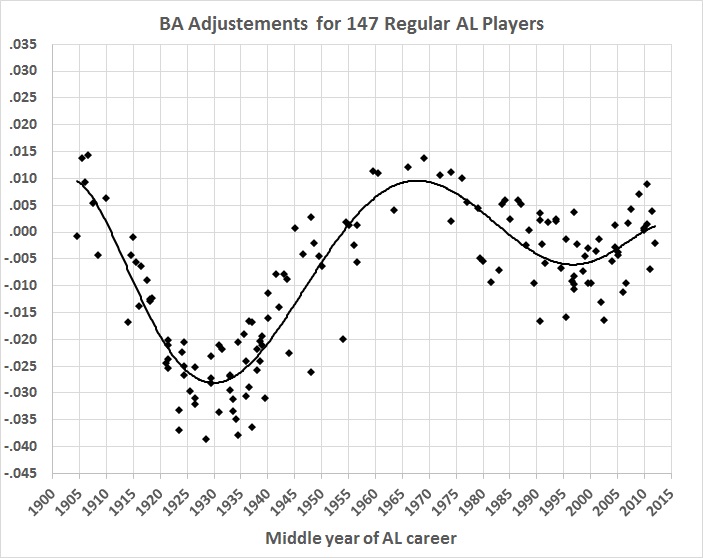
I made those adjustments for 147 players who had at least 5,000 plate appearances in the AL and an official batting average (BA) of at least .285 in those plate appearances. Here are the adjustments, plotted against the middle year of each player’s AL career:

batting-average-analysis-top-147-al-hitters-unadjusted-graph

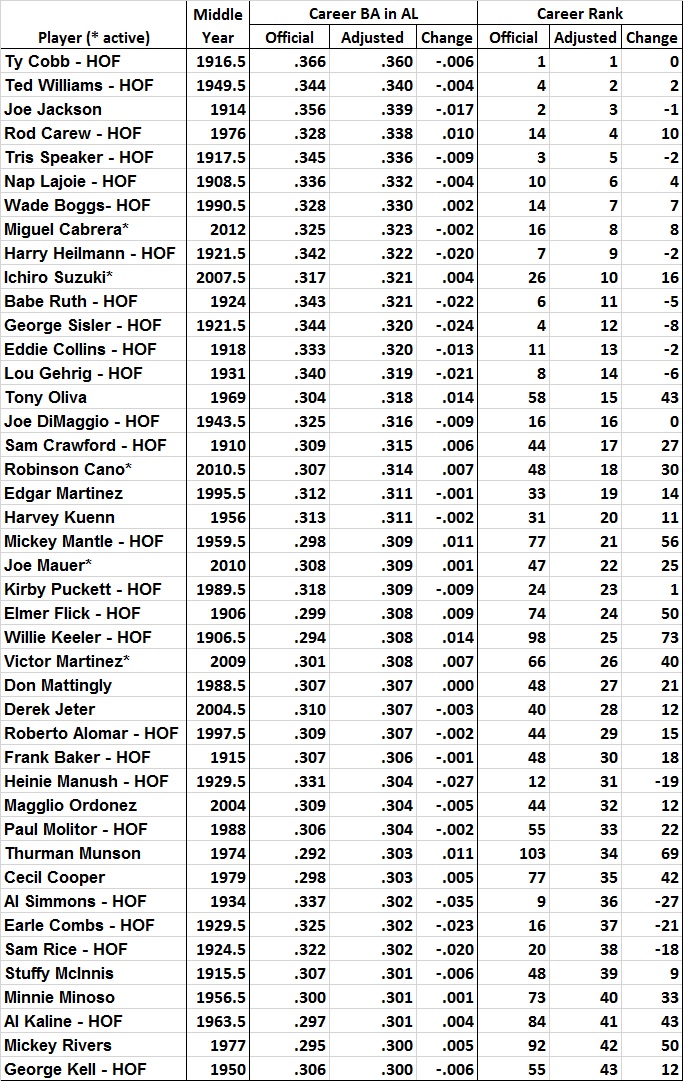
When all is said and done, there are only 43 qualifying players with an adjusted career BA of .300 or higher:

batting-average-analysis-greatest-hitters-top-43-table

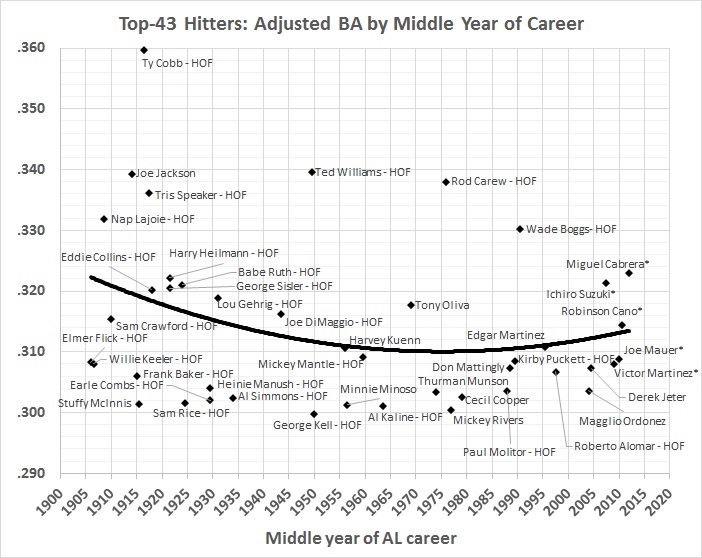
Here’s a graph of the relationship between adjusted career BA and middle-of-career year:

batting-average-analysis-top-43-al-hitters-graph

The curved line approximates the trend, which is downward until about the mid-1970s, then slightly upward. But there’s a lot of variation around that trend, and one player — Ty Cobb at .360 — clearly stands alone as the dominant AL hitter of all time.

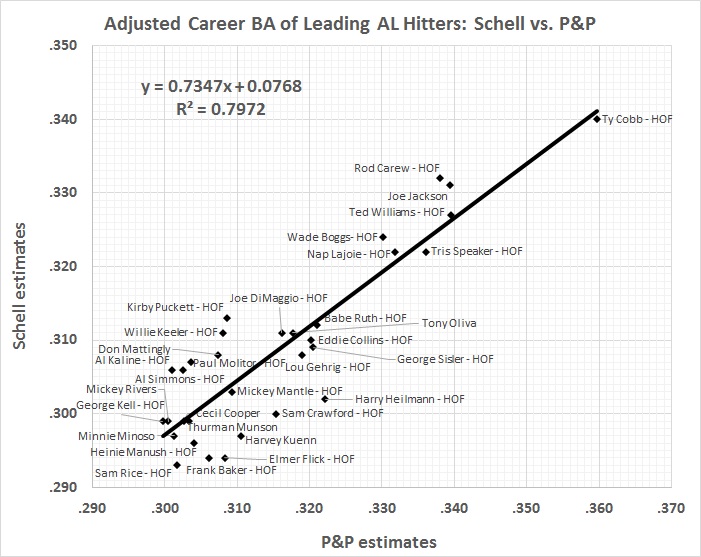
Michael Schell, in Baseball’s All-Time Best Hitters, ranks Cobb second behind Tony Gwynn, who spent his career (1982-2001) in the National League (NL), and much closer to Rod Carew, who played only in the AL (1967-1985). Schell’s adjusted BA for Cobb is .340, as opposed to .332 for Carew, an advantage of .008 for Cobb. I have Cobb at .360 and Carew at .338, an advantage of .022 for Cobb. The difference in our relative assessments of Cobb and Carew is typical; Schell’s analysis is biased (intentionally or not) toward recent and contemporary players and against players of the pre-World War II era.

Here’s how Schell’s adjusted BAs stack up against mine, for 32 leading hitters rated by both of us:

batting-average-analysis-schell-vs-pandp

Schell’s bias toward recent and contemporary players is most evident in his standard-deviation (SD) adjustment:

In his book Full House, Stephen Jay Gould, an evolutionary biologist [who imported his ideological biases into his work]…. Gould imagines [emphasis added] that there is a “wall” of human ability. The best players at the turn of the [20th] century may have been close to the “wall,” many of their peers were not. Over time, progressively better hitters replace the weakest hitters. As a result, the best current hitters do not stand out as much from their peers.

Gould and I believe that the reduction in the standard deviation [of BA within a season] demonstrates that there has been an improvement in the overall quality of major league baseball today compared to nineteenth-century and early twentieth-century play. [pp. 94-95]

Thus Schell’s SD adjustment, which slashes the BA of the better hitters of the early part of the 20th century because the SDs of that era were higher than the SDs after World War II. The SD adjustment is seriously flawed for several reasons:

1. There may be a “wall” of human ability, or it may truly be imaginary. Even if there is such a wall, we have no idea how close Ty Cobb, Tony Gwynn, and other great hitters have been to it. That is to say, there’s no a priori reason (contra Schell’s implicit assumption) that Cobb couldn’t have been closer to the wall than Gwynn.

2. It can’t be assumed that reaction time — an important component of human ability, and certainly of hitting ability — has improved with time. In fact, there’s a plausible hypothesis to the contrary, which is stated in “Bigger, Stronger…” and examined there, albeit inconclusively.

3. Schell’s discussion of relative hitting skill implies, wrongly, that one player’s higher BA comes at the expense of other players. Not so. BA is a measure of the ability of a hitter to hit safely given the quality of pitching and other conditions (examined in detail in “Bigger, Stronger…”). It may be the case that weaker hitters were gradually replaced by better ones, but that doesn’t detract from the achievements of the better hitter, like Ty Cobb, who racked up his hits at the expense of opposing pitchers, not other batters.

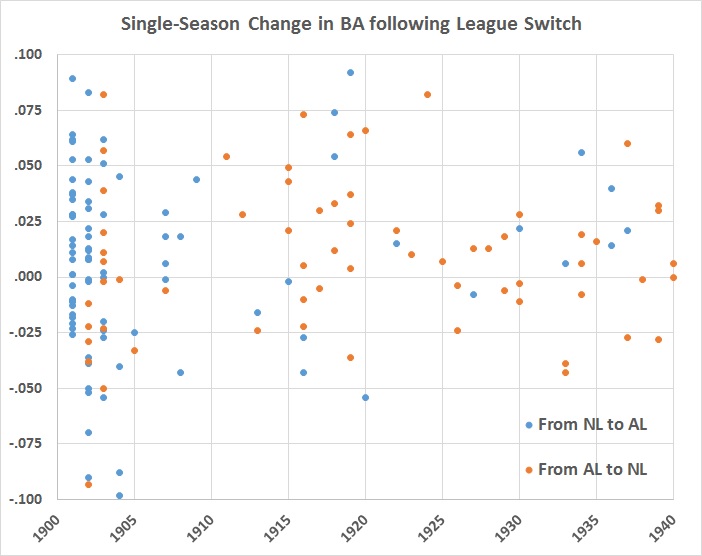
4. Schell asserts that early AL hitters were inferior to their NL counterparts, thus further justifying an SD adjustment that is especially punitive toward early AL hitters (e.g., Cobb). However, early AL hitters were demonstrably inferior to their NL counterparts only in the first two years of the AL’s existence, and well before the arrival of Cobb, Joe Jackson, Tris Speaker, Harry Heilmann, Babe Ruth, George Sisler, Lou Gehrig, and other AL greats of the pre-World War II era. Thus:

batting-average-analysis-single-season-change-in-ba-following-league-switch

There seems to have been a bit of backsliding between 1905 and 1910, but the sample size for those years is too small to be meaningful. On the other hand, after 1910, hitters enjoyed no clear advantage by moving from NL to AL (or vice versa). The data for 1903 through 1940, taken altogether, suggest parity between the two leagues during that span.

One more bit of admittedly sketchy evidence:

  • Cobb hit as well as Heilmann during Cobb’s final nine seasons as a regular player (1919-1927), which span includes the years in which the younger Heilmann won batting titles with average of .394, .403, 398, and .393.
  • In that same span, Heilmann outhit Ruth, who was the same age as Heilmann.
  • Ruth kept pace with the younger Gehrig during 1925-1932.
  • In 1936-1938, Gehrig kept pace with the younger Joe DiMaggio, even though Gehrig’s BA dropped markedly in 1938 with the onset of the disease that was to kill him.
  • The DiMaggio of 1938-1941 was the equal of the younger Ted Williams, even though the final year of the span saw Williams hit .406.
  • Williams’s final three years as a regular, 1956-1958, overlapped some of the prime seasons of Mickey Mantle, who was 13 years Williams’s junior. Williams easily outhit Mantle during those years, and claimed two batting titles to Mantle’s one.

I see nothing in the preceding recitation to suggest that the great hitters of the years 1901-1940 were inferior to the great hitters of the post-WWII era. In fact, it points in the opposite direction. This might be taken as indirect confirmation of the hypothesis that reaction times have slowed. Or it might have something to do with the emergence of football and basketball as “serious” professional sports after WWII, an emergence that could well have led potentially great hitters to forsake baseball for another sport. Yet another possibility is that post-war prosperity and educational opportunities drew some potentially great hitters into non-athletic trades and professions. In other words, unlike Schell, I remain open to the possibility that there may have been a real, if slight, decline in hitting talent after WWII — a decline that was gradually reversed because of the eventual effectiveness of integration (especially of Latin American players) and the explosion of salaries with the onset of free agency.

Finally, in “Bigger, Stronger…” I account for the cross-temporal variation in BA by applying a general algorithm and then accounting for 14 discrete factors, including the ones applied by Schell. As a result, I practically eliminate the effects of the peculiar conditions that cause BA to be inflated in some eras relative to other eras. (See figure 7 of “Bigger, Stronger…” and the accompanying discussion.) Even after taking all of those factors into account, Cobb still stands out as the best AL hitter of all time — by a wide margin.

And given Cobb’s statistical dominance over his contemporaries in the NL, he still stands as the greatest hitter in the history of the major leagues.

Unorthodox Economics: 3. What Is Scientific about Economics?

This is the third entry in what I hope will become a book-length series of posts. That result, if it comes to pass, will amount to an unorthodox economics textbook. Here are the chapters that have been posted to date:

1. What Is Economics?
2. Pitfalls
3. What Is Scientific about Economics?
4. A Parable of Political Economy
5. Economic Progress, Microeconomics, and Macroeconomics

Perhaps the biggest pitfall that awaits an economist, student of economics, or reader of economic literature is the belief that economics is a science because of its mathematical and statistical content. David S. D’Amato takes a clear-headed view in “Is Economics a Hard Science?” (The American Spectator, January 4, 2017):

[E]conomists and social scientists are gathering and analyzing statistical data constantly. [But] those data are limited by the density of the causal atmosphere of the environment from which they emerge, a rich and variable sea of causes and effects. Isolating one or even a few factors becomes impossible.

As Jim Manzi explains in his book Uncontrolled, “[W]e can never be sure that any experiment actually has controlled for every possible alternative cause of an outcome.” And while this is, of course, true in every field of inquiry, the problem is especially acute within the social sciences, so-called. That’s because, as Manzi observes, “human social organizations have a causal density that dwarfs anything astrophysics considers.”…

For any given observable phenomenon, the scientist must attempt to parse a convoluted web of actual and potential causes. Unable to control the experiment, its environmental inputs, groups, etc., the social scientist is unable to know whether the hypothesis being tested has been confirmed. This causal density means economic data must always be the subject of several competing explanations, informed by ideology and extra-economic social theory…

…The great classical liberal political economist Jean-Baptiste Say foresaw the complacency of today’s economists, their tendency to oversell the power of data and mathematics. Anticipating the praxeology of Ludwig von Mises, Say held the proper foundations for economics are “the rigorous deductions of undeniable general facts,” not “new particular fact[s]” (i.e., statistics), but basic laws of human action….

If empirical data are often too messy, too causally intricate, without the help of a philosophical or interpretative framework, then mathematical models are in a sense too neat to tell us very much about reality; they reduce enormously complex concepts and arguments about economic behavior to sterile formulae. Sometimes this is useful, as in the case of an economic model that explains the relationship between supply and demand. But as economists address their model-building processes to more difficult questions, the serviceability of the models diminishes. And if we are to believe the critics of “mathiness,” whom we can find all over the spectrum of ideas, the preoccupation with practically useless mathematical models has all but completely overtaken the economics profession.

Mathematical models, agglomerations of equations using multivariable calculus, are, it turns out, not a language suited to the task of describing something as dynamic as human behavior. Among the axioms of modern economics is the idea that economic value is something assigned to good and services subjectively by individual buyers and sellers. As Austrian School economists frequently point out, there is an irreducible subjectivity at the heart of all economic action. This explanation of value in terms of subjective preference and marginal utility replaced classical theories that made value a function of the quantities of labor expended during a good’s production. If value subjectivism holds, then, for example, one’s partiality for Chicago-style pizza as opposed to New York-style pizza is simply not the kind of preference that can be quantified. There is, as the saying goes, no accounting for taste.

It’s a simple example, but it points to a much more general and far-reaching truth: Formal logic and mathematics are not a stable foundation for the economist. This has been borne out by the inability of computer models to anticipate the movements of actual markets. For all their complex mathematics and pretensions to rigorousness, these models rely on crude oversimplifications. As New York University economist Mario J. Rizzo notes, “Ceteris paribus prediction is prediction of ‘stylized facts,’” whose connection to the real world is tenuous at best.

Yet, as Arnold Kling explains in “An Important Emerging Economic Paradigm” (TCS Daily, March 2, 2005), many (perhaps most) economists have lost sight of the axioms of economics in their misplaced zeal to emulate the methods of the physical sciences:

The most distinctive trend in economic research over the past hundred years has been the increased use of mathematics. In the wake of Paul Samuelson’s (Nobel 1970) Ph.D dissertation, published in 1948, calculus became a requirement for anyone wishing to obtain an economics degree. By 1980, every serious graduate student was expected to be able to understand the work of Kenneth Arrow (Nobel 1972) and Gerard Debreu (Nobel 1983), which required mathematics several semesters beyond first-year calculus.

Today, the “theory sequence” at most top-tier graduate schools in economics is controlled by math bigots. As a result, it is impossible to survive as an economics graduate student with a math background that is less than that of an undergraduate math major. In fact, I have heard that at this year’s American Economic Association meetings, at a seminar on graduate education one professor quite proudly said that he ignored prospective students’ grades in economics courses, because their math proficiency was the key predictor of their ability to pass the coursework required to obtain an advanced degree.

The raising of the mathematical bar in graduate schools over the past several decades has driven many intelligent men and women (perhaps women especially) to pursue other fields. The graduate training process filters out students who might contribute from a perspective of anthropology, biology, psychology, history, or even intense curiosity about economic issues. Instead, the top graduate schools behave as if their goal were to produce a sort of idiot-savant, capable of appreciating and adding to the mathematical contributions of other idiot-savants, but not necessarily possessed of any interest in or ability to comprehend the world to which an economist ought to pay attention.

. . . The basic question of What Causes Prosperity? is not a question of how trading opportunities play out among a given array of goods. Instead, it is a question of how innovation takes place or does not take place in the context of institutional factors that are still poorly understood.

Economic models usually are clothed in the language of mathematics and statistics. But those aren’t scientific disciplines in themselves; they are tools of science. Expressing a theory in mathematical terms may lend the theory a scientific aura, but a theory couched in mathematical terms is not a scientific one unless (a) it can be tested against facts yet to be ascertained and events yet to occur, and (b) it is found to accord with those facts and events consistently, by rigorous statistical tests. In sum, modeling is not science.

Economics is a science only to the extent that it yields empirically valid insights about  specific economic phenomena (e.g., the effects of laws and regulations on the prices and outputs of specific goods and services). The Keynesian multiplier, about which I’ll say more in a later chapter, is not a scientific theory. It is a hypothesis that rests on a simplistic, hydraulic view of the economic system. (Other examples of pseudo-scientific economic theories are the labor theory of value and historical determinism.)

A scientific theory is a hypothesis that has thus far been confirmed by observation, and which has not yet been refuted (falsified) by observation.* (The Keynesian multiplier has been falsified.) Every scientific theory rests eventually on axioms: self-evident principles that are accepted as true without proof. Economics, as D’Amato notes, is no exception. It rests on these self-evident axioms:

1. Each person strives to maximize his or her sense of satisfaction, which may also be called well-being, happiness, or utility (an ugly word favored by economists). Striving isn’t the same as achieving, of course, because of lack of information, emotional decision-making, buyer’s remorse, etc

2. Happiness can and often does include an empathic or expedient concern for the well-being of others; that is, one’s happiness may be served by what is usually labelled altruism or self-sacrifice.

3. Happiness can be and often is served by the attainment of non-material ends. Not all persons (perhaps not even most of them) are interested in the maximization of wealth, that is, claims on the output of goods and services. In sum, not everyone is a wealth maximizer. (But see axiom number 12.)

4. The feeling of satisfaction that an individual derives from a particular product or service is situational — unique to the individual and to the time and place in which the individual undertakes to acquire or enjoy the product or service. Generally, however, there is a (situationally unique) point at which the acquisition or enjoyment of additional units of a particular product or service during a given period of time tends to offer less satisfaction than would the acquisition or enjoyment of units of other products or services that could be obtained at the same cost.

5. The value that a person places on a product or service is subjective. Products and services don’t have intrinsic values that apply to all persons at a given time or period of time.

6. The ability of a person to acquire products and services, and to accumulate wealth, depends (in the absence of third-party interventions) on the valuation of the products and services that are produced in part or whole by the person’s labor (mental or physical), or by the assets that he owns (e.g., a factory building, a software patent). That valuation is partly subjective (e.g., consumers’ valuation of the products and services, an employer’s qualitative evaluation of the person’s contributions to output) and partly objective (e.g., an employer’s knowledge of the price commanded by a product or service, an employer’s measurement of an employees’ contribution to the quantity of output).

7. The persons and firms from which products and services flow are motivated by the acquisition of income, with which they can acquire other products and services, and accumulate wealth for personal purposes (e.g., to pass to heirs) or business purposes (e.g., to expand the business and earn more income). So-called profit maximization (seeking to maximize the difference between the cost of production and revenue from sales) is a key determinant of business decisions but far from the only one. Others include, but aren’t limited to, being a “good neighbor,” providing employment opportunities for local residents, and underwriting philanthropic efforts.

8. The cost of production necessarily influences the price at which a good or and service will be offered for sale, but doesn’t solely determine the price at which it will be sold. Selling price depends on the subjective valuation of the products or service, prospective buyers’ incomes, and the prices of other products and services, including those that are direct or close substitutes and those to which users may switch, depending on relative prices.

9. The feeling of satisfaction that a person derives from the acquisition and enjoyment of the “basket” of products and services that he is able to buy, given his income, etc., doesn’t necessarily diminish, as long as the person has access to a great variety of products and services. (This axiom and axiom 12 put paid to the myth of diminishing marginal utility of income.)

10. Work may be a source of satisfaction in itself or it may simply be a means of acquiring and enjoying products and services, or acquiring claims to them by accumulating wealth. Even when work is satisfying in itself, it is subject to the “law” of diminishing marginal satisfaction.

11. Work, for many (but not all) persons, is no longer be worth the effort if they become able to subsist comfortably enough by virtue of the wealth that they have accumulated, the availability of redistributive schemes (e.g., Social Security and Medicare), or both. In such cases the accumulation of wealth often ceases and reverses course, as it is “cashed in” to defray the cost of subsistence (which may be far more than minimal).

12. However, there are not a few persons whose “work” is such a great source of satisfaction that they continue doing it until they are no longer capable of doing so. And there are some persons whose “work” is the accumulation of wealth, without limit. Such persons may want to accumulate wealth in order to “do good” or to leave their heirs well off or simply for the satisfaction of running up the score. The justification matters not. There is no theoretical limit to the satisfaction that a particular person may derive from the accumulation of wealth. Moreover, many of the persons (discussed in axiom 11) who aren’t able to accumulate wealth endlessly would do so if they had the ability and the means to take the required risks.

13. Individual degrees of satisfaction (happiness, etc.) are ephemeral, nonquantifiable, and incommensurable. There is no such thing as a social welfare function that a third party (e.g., government) can maximize by taking from A to give to B. If there were such a thing, its value would increase if, for example, A were to punch B in the nose and derive a degree of pleasure that somehow more than offsets the degree of pain incurred by B. (The absurdity of a social-welfare function that allows As to punch Bs in their noses ought to be enough shame inveterate social engineers into quietude — but it won’t. They derive great satisfaction from meddling.) Moreover, one of the primary excuses for meddling is that income (and thus wealth) has a  diminishing marginal utility, so it makes sense to redistribute from those with higher incomes (or more wealth) to those who have less of either. Marginal utility is, however, unknowable (see axioms 4 and 5), and may not always be negative (see axioms 9 and 12).

14. Whenever a third party (government, do-gooders, etc.) intervene in the affairs of others, that third party is merely imposing its preferences on those others. The third party sometimes claims to know what’s best for “society as a whole,” etc., but no third party can know such a thing. (See axiom 13.)

15. It follows from axiom 13 that the welfare of “society as a whole” can’t be aggregated or measured. An estimate of the monetary value of the economic output of a nation’s economy (Gross Domestic Product) is by no means an estimate of the welfare of “society as a whole.”

That may seem like a lot of axioms, which might give you pause about my claim that some aspects of economics are scientific. But economics is inescapably grounded in axioms such as the ones that I propound, just as much of modern physics is inescapably grounded in the principle of uniformity.**

It is important to distinguish between axioms, which are self-evidently true, and biases that stem from normative views of what ought to be. Behavioral economists, for example, see the world through the lens of wealth-and-utility-maximization. Their great crusade is to force everyone to make rational decisions (by their lights), through “nudging.” It almost goes without saying that government should be the nudger-in-chief. (See “The Perpetual Nudger” and the many posts linked to therein.)

Other economists — though not as many as in the past — are obsessed by monopoly and oligopoly (the domination of a market by one or a few sellers). They’re heirs to the trust-busting of the late 1800s and early 1900s, a movement led by non-economists who sought to blame the woes of working-class Americans on the “plutocrats” (Rockefeller, Carnegie, Ford, etc.) who had merely made life better and more affordable for Americans, while also creating jobs for millions of them and reaping rewards for the great financial risks that they took. (See “Monopoly and the General Welfare” and “Monopoly: Private Is Better than Public.”) As it turns out, the biggest and most destructive monopoly of all is the federal government, so beloved and trusted by trust-busters — and too many others. (See “The Rahn Curve Revisited.”)

Nowadays, a lot of economists are preoccupied by income inequality, as if it were something evil and not mainly an artifact of differences in intelligence, ambition, and education, etc. And inequality — the prospect of earning rather grand sums of money — is what drives a lot of economic endeavor, to the benefit of workers and consumers. (See “Mass (Economic) Hysteria: Income Inequality and Related Themes” and the many posts linked to therein.) Remove inequality and what do you get? The Soviet Union and Communist China, in which everyone is equal except party operatives and their families, friends, and favorites. As George Orwell put it in Animal Farm, “all [people] are equal, but some [people] are more equal than others.”

When the inequality-preoccupied economists are confronted by the facts of life, they usually turn their attention from inequality as a general problem to the (inescapable) fact that an income distribution has a top one-percent and top one-tenth of one-percent — as if there were something especially loathsome about people in those categories. (Paul Krugman shifted his focus to the top one-tenth of one percent when he realized that he’s in the top one percent, so perhaps he knows that’s he’s loathsome and wishes to deny it — to himself, at least.)

Crony capitalism is trotted out as a major cause of very high incomes. But that’s hardly a universal cause, given that a lot of very high incomes are earned by athletes and film stars beside whom most investment bankers and CEOs earn slave wages. Moreover, as I’ve said on several occasions, crony capitalists are bright and driven enough to be in the stratosphere of any income distribution. Further, the breeding ground of crony capitalism is the regulatory power of government that makes it possible.

Many economists became such, it would seem, in order to promote big government and its supposed good works — income redistribution being one of them. Joseph Stiglitz and Paul Krugman are two leading exemplars of what I call the New Deal school of economic thought, which amounts to throwing government and taxpayers’ money at every perceived problem, that is, every economic outcome that is deemed unacceptable by accountants of the soul. (See “Accountants of the Soul.”)

Stiglitz and Krugman — both Nobel laureates in economics — are typical “public intellectuals” whose intelligence breeds in them a kind of arrogance. (See “Intellectuals and Society: A Review.”) It’s the kind of arrogance that reveals itself in a penchant for deciding what’s best for others, even beyond the arrogance of behavioral “nudgers.”

New Deal economists like Stiglitz and Krugman carry it a few steps further. They ascribe to government an impeccable character, an intelligence to match their own, and a monolithic will. They then assume that this infallible and wise automaton can and will do precisely what they would do: Create the best of all possible worlds. (See the preceding chapter, in which I discuss the nirvana fallacy.)

I hold economists of the New Deal stripe partly responsible for the swamp of stagnation into which the nation’s economy has descended. (See “Economic Growth Since World War II.”) Largely responsible, of course, are opportunistic if not economically illiterate politicians who pander to rent-seeking, economically illiterate constituencies. (Yes, I’m thinking of pensioners and the many “disadvantaged” groups with which “compassionate” politicians have struck up an alliance of convenience.)

Enough said, for now. Some economics is science. Too much of it is nothing more than special pleading cloaked in the jargon of economics, and pseudo-scientific theorizing overlaid with a veneer of mathematics or statistics.

Caveat lector.
__________
* This is from Karl Popper‘s classic statement of the scientific method. Richard Feynman, a physicist (and real scientist), had a different view. I see Feynman’s view as complementary to Popper’s, not at odds with it. What is “constructive skepticism” (Feynman’s term) but a gentler way of saying that a hypothesis or theory might be falsified and that the act of falsification may point to a better hypothesis or theory?

** The principle of uniformity is a fundamental axiom of modern physics, most notably of Einstein’s special and general theories of relativity. According to the principle of uniformity, for example, if observer B is moving away from observer A at a certain speed, observer A will perceive that he is moving away from observer B at that speed. This statement holds only if A and B can’t see another object. But suppose, for example, there’s an object C that’s visible to A, and which A perceives as stationary. If A sees that B is moving away from C as well as from A, then A will perceive that B is in motion while A is at rest (relative to C, at least). That aside, A still doesn’t have an absolute velocity or direction of travel. Velocity and direction are always relative to an arbitrary reference point.

Trump’s Inauguration Speech, Annotated

I’m glad that the president is Donald Trump, not Hillary Clinton. But I still would have preferred someone else (e.g., Ted Cruz, Marco Rubio). Trump says a lot of things that cause this libertarian conservative to scratch his head.

Chief Justice Roberts, President Carter, President Clinton, President Bush, President Obama, fellow Americans, and people of the world: thank you. For what? Most of them opposed you.

We, the citizens of America, are now joined in a great national effort to rebuild our country and restore its promise for all of our people. Together we will determine the course of America and the world for many, many years to come. We will face challenges. We will confront hardships, but we will get the job done. Rebuild how? Restore what promise in particular?

Every four years, we gather on these steps to carry out the orderly and peaceful transfer of power, and we are grateful to President Obama and First Lady Michelle Obama for their gracious aid throughout this transition. They have been magnificent. Thank you. B.S.

Today’s ceremony, however, has very special meaning. Because today we are not merely transferring power from one administration to another or from one party to another, but we are transferring power from Washington, D.C. and giving it back to you, the people. I’m all for it, if it’s the power to live cooperatively and peacefully, with less government interference.

For too long, a small group in our nation’s capital has reaped the rewards of government while the people have borne the cost. Washington flourished, but the people did not share in its wealth. Yes, the central government and its dependents are the true cronies (as in crony anti-capitalism).

Politicians prospered, but the jobs left, and the factories closed. The establishment protected itself, but not the citizens of our country. Their victories have not been your victories; their triumphs have not been your triumphs; and while they celebrated in our nation’s capital, there was little to celebrate for struggling families all across our land. Regulation caused a lot of the jobs to leave and factories to close, but there were other, legitimate causes (e.g., fewer trade barriers).

That all changes starting right here and right now, because this moment is your moment. It belongs to you. It belongs to everyone gathered here today and everyone watching all across America. This is your day, this is your celebration, and this, the United States of America, is your country. We’ll see.

What truly matters is not which party controls our government, but whether our government is controlled by the people. Jan. 20, 2017, will be remembered as the day the people became the rulers of this nation again Let’s hope this is a figurative statement referring to the ability of people to live cooperatively and peacefully, with less government interference.

The forgotten men and women of our country will be forgotten no longer. Everyone is listening to you now. You came by the tens of millions to become part of an historic movement, the likes of which the world has never seen before. At the center of this movement is a crucial conviction that a nation exists to serve its citizens. Yes, by leaving them alone and defending them.

Americans want great schools for their children, safe neighborhoods for their families and good jobs for themselves. These are just and reasonable demands of righteous people and a righteous public, but for too many of our citizens, a different reality exists:

Mothers and children trapped in poverty in our inner cities, rusted-out factories scattered like tombstones across the landscape of our nation; an education system flush with cash but which leaves our young and beautiful students deprived of all knowledge; and the crime and the gangs and the drugs that have stolen too many lives and robbed our country of so much unrealized potential. A lot of truth in this, but benign neglect is the best policy.

This American carnage stops right here and stops right now. I hope so.

We are one nation, and their pain is our pain. Their dreams are our dreams, and their success will be our success. We share one heart, one home, and one glorious destiny. The oath of office I take today is an oath of allegiance to all Americans. We aren’t one nation in morals and mores. Never were. Never will be. What should bind Americans is the freedom to live their lives peacefully. The rest is up to them.

For many decades we’ve enriched foreign industry at the expense of American industry, subsidized the armies of other countries while allowing for the very sad depletion of our military. The second clause is spot-on.

We’ve defended other nations’ borders while refusing to defend our own and spent trillions and trillions of dollars overseas while America’s infrastructure has fallen into disrepair and decay. We’ve made other countries rich while the wealth, strength and confidence of our country has dissipated over the horizon. This is most yahoo hogwash.

One by one, the factories shuttered and left our shores, with not even a thought about the millions and millions of American workers that were left behind. The wealth of our middle class has been ripped from their homes and then redistributed all across the world. But that is the past, and now we are looking only to the future. See earlier comments about jobs. What has really harmed most Americans (except for politicians and their dependents) is government itself.

We assembled here today are issuing a new decree to be heard in every city, in every foreign capital and in every hall of power. From this day forward, a new vision will govern our land. From this day forward, it’s going to be only America first. America first. In defense, yes; in uncontrolled immigration, yes; in trade, no.

Every decision on trade, on taxes, on immigration, on foreign affairs will be made to benefit American workers and American families. We must protect our borders from the ravages of other countries making our products, stealing our companies and destroying our jobs. Protection will lead to great prosperity and strength. Only when it comes uncontrolled immigration that increases the tax burden on working Americans.

I will fight for you with every breath in my body, and I will never, ever let you down. America will start winning again, winning like never before. We will bring back our jobs. We will bring back our borders. We will bring back our wealth. And we will bring back our dreams. Wow!

We will build new roads, and highways, and bridges, and airports, and tunnels, and railways all across our wonderful nation. We will get our people off of welfare and back to work rebuilding our country with American hands and American labor. “Infrastructure” meets the Keynesian fallacy.

We will follow two simple rules: Buy American and hire American. We will seek friendship and goodwill with the nations of the world, but we do so with the understanding that it is the right of all nations to put their own interests first. Bass-ackwards economics.

We do not seek to impose our way of life on anyone, but rather to let it shine as an example. We will shine for everyone to follow. No more nation-building? Good.

We will reinforce old alliances and form new ones — and unite the civilized world against radical Islamic terrorism, which we will eradicate completely from the face of the earth. At least he’s willing to say it aloud. That’s a big step forward.

At the bedrock of our politics will be a total allegiance to the United States of America, and through our loyalty to our country, we will rediscover our loyalty to each other. When you open your heart to patriotism, there is no room for prejudice. The Bible tells us how good and pleasant it is when God’s people live together in unity. All right, already. I heard you.

We must speak our minds openly, debate our disagreements honestly, but always pursue solidarity. When America is united, America is totally unstoppable. There should be no fear. We are protected, and we will always be protected. We will be protected by the great men and women of our military and law enforcement and, most importantly, we will be protected by God. I don’t care whether America is united. I want to be protected from enemies (foreign and domestic), and otherwise left alone.

Finally, we must think big and dream even bigger. In America, we understand that a nation is only living as long as it is striving. What does that mean?

We will no longer accept politicians who are all talk and no action, constantly complaining but never doing anything about it. The time for empty talk is over. Now arrives the hour of action. Do not allow anyone to tell you that it cannot be done. No challenge can match the heart and fight and spirit of America. We will not fail. Our country will thrive and prosper again. How about less talk and less action?

We stand at the birth of a new millennium, ready to unlock the mysteries of space, to free the earth from the miseries of disease and to harness the energies, industries and technologies of tomorrow. A new national pride will stir ourselves, lift our sights and heal our divisions. Whoopee!

It’s time to remember that old wisdom our soldiers will never forget: that whether we are black or brown or white, we all bleed the same red blood of patriots, we all enjoy the same glorious freedoms, and we all salute the same great American flag. Whatever.

And whether a child is born in the urban sprawl of Detroit or the wind-swept plains of Nebraska, they look up at the same night sky. They fill their heart with the same dreams, and they are infused with the breath of life by the same almighty creator. Striving to be Lincolnesque, but not getting there.

So to all Americans, in every city near and far, small and large, from mountain to mountain, from ocean to ocean, hear these words. You will never be ignored again. Your voice, your hopes and your dreams will define our American destiny. And your courage and goodness and love will forever guide us along the way. Okay, okay!

Together we will make America strong again. We will make America wealthy again. Basta!

We will make America proud again. We will make America safe again. And, yes, together, we will make America great again. Thank you. God bless you and God bless America. Thank you. God bless America. Uncle!

Facts about Presidents, Updated

Here, with the addition of Donald Trump and some trivia.

Ending As He Began

Rasmussen Reports has issued the last of its almost-daily polls of Obama’s popularity (mostly the lack thereof). His final surge (see graph below) can only be seen as a backhanded compliment: (a) a belief shared by a lot of voters that Trump or Clinton would have been worse; (b) relief that the power-grabbing, quasi-socialist, race-baiting, feckless (or traitorous) “statesman” is leaving office; and (c) forgetfulness about the atrocities that marked Obama’s first seven years in office (e.g., Obamacare, the IRS scandal, fiascos in the Middle East, weakness vs. Russia, the defense draw-down, soaring health-insurance premiums, the gleeful uprooting of long-standing social norms).

obamas-final-approval-ratings

It’s a great relief to me that Obama is leaving office, and that he won’t be succeeded by Hillary Clinton. It’s also a great relief that I can now abandon the almost-daily chore of recording Obama’s standing in Rasumssen’s poll. It’s been a l-o-o-o-n-g eight years.

It should be said of Obama that nothing became his presidency so well as the leaving of it.

Color Me Unmoved

Today is Martin Luther King Jr. Day, an annual observance of the birth of its eponymous honoree. I was a young man, two months into my first post-college job, at the time of King’s March on Washington for Jobs and Freedom. I wasn’t moved by the march, or by King’s “I Have a Dream” speech.

Not for me are the mass march or the stirring speech. It is easy to stir the emotions of millions of persons. Such events are therefore insignificant. Significant events — the events that bind people and conduce to liberty — are mundane ones:

  • Couples who wed, stay together despite rough patches in their marriage, and teach their children right from wrong.
  • Owners of small businesses who persevere through hard times, retain loyal employees, and participate willingly and generously in community activities.
  • Craftsmen who take satisfaction in jobs well done, and who are pleased when their efforts please others.
  • Bankers whose diligence safeguards the money with which they’re entrusted, and who lend it judiciously to help couples buy homes, to finance businesses, and to provide the craftsmen’s tools of the trade.
  • Clergymen who tend the souls of these “average” Americans, and police who protect them.

These — and many others like them — are the unheralded, often mocked, and too-often scorned heroes whose daily lives of perseverance and dedication are the backbone of liberty: peaceful, willing coexistence and its concomitant: beneficially cooperative behavior.

“I have a dream,” “ask what you can do for your country,” and “we have nothing to fear but fear itself” are nothing more than high-flown, empty phrases. Liberty is built on the ordinariness of “ordinary people” doing ordinary things in everyday life.

Why Conservatives Shouldn’t Compromise

It’s tempting, sometimes, to compromise with the left’s agenda, which is top-down regulation of social and economic relations. The agenda has a huge constituency, after all. Think of the tens of millions of persons who would be harmed in the short run, if not for a long time, if a leftist scheme were undone.

Consider Obamacare, for example. A key provision of Obamacare — the camel’s nose, head, and shoulders in the tent of universal health care (a.k.a., socialized medicine) — is the vast expansion of eligibility for Medicaid. In the 30-some States that have opted to participate in the expanded program, persons with incomes up to 133 percent of the poverty line are eligible, including adults without dependent children.

It would seem that only a Simon Legree or Ebenezer Scrooge would deny Medicaid coverage to those millions who have obtained it by way of Obamacare. Or it would until the following considerations come to mind:

  • The poverty line is a misleading metric. It’s a relative measure of income, not an absolute one. Most “poor” persons in today’s America are anything but poor in relation the truly poor of the world, and they live far above a subsistence level. The poverty line is nothing but an arbitrary standard that justifies income redistribution.
  • Other persons, with their own problems, are paying for the government’s generous “gift” to the semi-poor. But who is really in a position to say that the problems of Medicaid recipients are more deserving of subsidization than the problems facing those who defray the subsidy?
  • If expanded Medicaid coverage were withdrawn, those now covered would be no worse off than they had been before taxpayers were forced to subsidize them.
  • Being relatively poor used to be a good reason for a person to work his way up the ladder of success. Perhaps not far up the ladder, but in an upward direction. It meant learning skills — on the job, if necessary — and using those skills to move on to more-demanding and higher-paying jobs. Redistributive measures — Medicaid subsidies, food stamps, extended unemployment benefits, etc. — blunt the incentive to better oneself and, instead, reinforce dependency on government.

I will underscore the last point. The lack of something, if it’s truly important to a person, is an incentive for that person to find a way to afford the something. That’s what my parents’ generation did, even in the depths of the Great Depression, without going on the dole. There’s no reason why later generations can’t do it; it’s merely assumed that they can’t. But lots of people do it. I did it; my children did it; my grandchildren are doing it.

Republicans used to say such things openly and with conviction, before they became afraid of seeming “mean.” Principled conservatives should still be thinking and saying such things. When conservatives compromise their principles because they don’t want to seem “mean,” they are complicit in the country’s march down the road to serfdom — dependency on and obeisance to the central government.

Every advance in the direction of serfdom becomes harder and harder to reverse. The abolition of Social Security, Medicare, and Medicaid is now unthinkable, even though those programs have caused hundreds of millions of Americans to become addicted to government handouts.

And how does government pay for those handouts? In part, it taxes many of the people who receive them. It also pays generous salaries and benefits of the army of drones who administer them. It’s a Ponzi scheme enforced at gunpoint.

The best time — usually the only time — to kill a government program is before it starts. That’s why conservatives shouldn’t compromise.

The Left and “the People”

The American left, like its counterparts in the Soviet Union and the People’s Republic of China, likes to don the mantle of democracy. The left is the “voice of the people,” ruling on behalf of “the people.” These are claims that the citizens of the USSR and PRC were never in a position to challenge. They were forced to vote, and when they voted they found that the Communist candidates ran unopposed.

America still has free elections, at least to the extent that voting remains optional and there usually is a choice between a Republican candidate and a Democrat candidate. Whether that’s a real choice or just variations on a theme is a subject for another post. But, symbolically and rhetorically, the choice between Republican and Democrat is perceived and portrayed as a stark one.

Given that, it never ceases to amaze the left that so many of “the people” turn their backs on a leftist (Democrat) candidate in favor of the (perceived) Republican rightist. Why is that? One reason, which became apparent in the recent presidential election, is that a lot of “the people” don’t believe that the left is their “voice” or that it rules on their behalf.

A lot of “the people” believe, correctly, that the left despises “the people” and is bent on dictating to them. Further, a lot of “the people” also believe, correctly, that the left’s dictatorial methods are not really designed with “the people” in mind. Rather, they are intended to favor certain groups of people — those deemed “victims” by the left — and to advance pet schemes (e.g., urban rail, “green” energy, carbon-emissions reductions, Obamacare) despite the fact that they are unnecessary, inefficient, and economically destructive.

It comes as a great shock to left that so many of “the people” see the left for what it is: doctrinaire, unfair, and dictatorial. Why, they ask, would “the people” vote against their own interest by rejecting Democrats and electing Republicans? The answer is that a lot of “the people” are smart enough to see that the left does not represent them and does not act in their interest.

Unorthodox Economics: 2. Pitfalls

This is the second entry in what I hope will become a book-length series of posts. That result, if it comes to pass, will amount to an unorthodox economics textbook. Here are the chapters that have been posted to date:

1. What Is Economics?
2. Pitfalls
3. What Is Scientific about Economics?
4. A Parable of Political Economy
5. Economic Progress, Microeconomics, and Macroeconomics

A person who wants to learn about economics should be forewarned about pernicious tendencies and beliefs — often used unthinkingly and expressed subtly — that lurk in writings and speeches about economics and economic issues. This chapter treats seven such tendencies and beliefs:

  • misuse of probability
  • reductionism
  • nirvana fallacy
  • social welfare
  • romanticizing the state
  • paternalism
  • judging motives instead of results

MISUSE OF PROBABILITY

Probability is seldom invoked in non-technical economics. But when it is, beware of it. A statement about the probability of an event is either (a) a subjective evaluation (“educated” guess) about what is likely to happen or (b) a strict, mathematical statement about the observed frequency of the occurrence of a well-defined random event. I will bet you even money that the first meaning applies in at least six of the next ten times that you read or hear a statement about probability or its cognate “chance,” as in 50-percent chance of rain. And my subjective evaluation is that I have a 90-percent probability of winning the bet.

Let’s take the chance of rain (or snow or sleet, etc.). You may rely heavily on a weather forecaster’s statement about the probability that it will rain today. If the stated probability is high, you may postpone an outing of some kind, or take an umbrella when you leave the house, or wear a water-repellent coat instead of a cloth one, and so on. That’s prudent behavior on your part, even though the weather forecaster’s statement isn’t really probabilistic.

What the weather forecaster is telling you (or relaying to you from the National Weather Service) is a subjective evaluation of the “chance” that it will rain in a given geographic area, based on known conditions (e.g., wind direction, presence of a nearby front, water-vapor imagery). The “chance” may be computed mathematically, but its computation rests on judgments about the occurrence of rain-producing events, such as the speed of a front’s movement and the direction of water-vapor flow. In the end, however, you’re left with only a weather forecaster’s judgment, and it’s up to you to evaluate it and act accordingly.

What about something that involves “harder” numbers, such as the likelihood of winning a lottery (where there’s good information about the number of tickets sold) or casting the deciding vote in an election (where there’s good information about the number of votes that will be cast)? I will continue with the case of voting, which is discussed in chapter 1 as an example of the extent to which economics has spread beyond its former preoccupations with buyers, sellers, and the aggregation of their activities.

An economist named Bryan Caplan has written a lot about voting. For example, he says the following in “Why I Don’t Vote: The Honest Truth” (EconLog, September 13, 2016):

Aren’t we [economists] always advising people to choose their best option, even when their best option is bleak?  Sure, but abstention [from voting] is totally an option.  And while politicians have a clear incentive to ignore we abstainers, only remaining aloof from our polity gives me inner peace.

You could respond, “Inner peace at what price?”  It is only at this point that I invoke the miniscule probability of voter decisiveness.  If I had a 5% chance of tipping an electoral outcome, I might hold my nose, scrupulously compare the leading candidates, and vote for the Lesser Evil.  Indeed, if, like von Stauffenberg, I had a 50/50 shot of saving millions of innocent lives by putting my own in grave danger, I’d consider it.  But I refuse to traumatize myself for a one-in-a-million chance of moderately improving the quality of American governance.  And one-in-a-million is grossly optimistic.

Caplan links to a portion of his lecture notes for a course in the logic of collective action. The notes include this mathematical argument:

III. Calculating the Probability of Decisiveness, I: Mathematics

A. When does a vote matter? At least in most systems, it only matters if it “flips” the outcome of the election.

B. This can only happen if the winner wins by a single vote. In that case, each voter is “decisive”; if one person decided differently, the outcome would change.

C. In all other cases, the voter is not decisive; the outcome would not change if one person decided differently.

D. It is obvious that the probability of casting the decisive vote in a large electorate is extremely small….

H. Now suppose that everyone but yourself votes “for” with probability p – and “against” with probability (1-p).

I. Then from probability theory: caplan-on-voting-probability-of-tie

J. From this formula, we can see that the probability of a tie falls when the number of voters goes up….

K. Intuitively, the more people there are, the less likely one person makes a difference….

IV. Calculating the Probability of Decisiveness, II: Examples

A. What is neat about the above formula is that it allows us to say not just how the probability of decisiveness changes, but how much….

I. Upshot: For virtually any real-world election, the probability of casting the decisive vote is not just small; it is normally infinitesimal. The extreme observation that “You will not affect the outcome of an election by voting” is true for all practical purposes.

J. Even if you were to play around with the formula to increase your estimate a thousand-fold, your estimated answer would remain vanishingly small.

What Caplan and other economists who write in the same vein ignore is the influence of their point of view. It’s self-defeating because it appeals to extremely rationalistic people like Caplan. One aspect of their rationalism is a cold-eyed view of government, namely, that it almost always does more harm than good. That’s a position with which I agree, but it’s a reason to vote rather than abstain. If rationalists like Caplan abstain from voting in large numbers, their abstention may well cause some elections to be won by candidates who favor more government rather than less.

Moreover, Caplan’s argument against voting is really a way of rationalizing his disdain for voting. This is from “Why I Don’t Vote: The Honest Truth”:

My honest answer begins with extreme disgust.  When I look at voters, I see human beings at their hysterical, innumerate worst.  When I look at politicians, I see mendacious, callous bullies.  Yes, some hysterical, innumerate people are more hysterical and innumerate than others.  Yes, some mendacious, callous bullies are more mendacious, callous, and bully-like than others.  But even a bare hint of any of these traits appalls me.  When someone gloats, “Politifact says Trump is pants-on-fire lying 18% of the time, versus just 2% for Hillary,” I don’t want to cheer Hillary.  I want to retreat into my Bubble, where people dutifully speak the truth or stay silent.

Thus demonstrating the confirmation bias in Caplan’s mathematical “proof” of the futility of voting.

Nor is his “proof” really probabilistic. A single event — be it an election, a lottery drawing, of the toss of a fair coin — doesn’t have a probability.  What does it mean to say, for example, that there’s a probability of 0.5 (50 percent) that a tossed coin will come up heads (H), and a probability of 0.5 that it will come up tails (T)? Does such a statement have any bearing on the outcome of a single toss of a coin? No, it doesn’t. The statement is only a shorthand way of saying that in a sufficiently large number of tosses, approximately half will come up H and half will come up T. The result of each toss, however, is a random event — it has no probability. You may have an opinion (or a hunch or a guess) about the outcome of a single coin toss, but it’s only your opinion (hunch, guess). In the end, you have to bet on a discrete outcome.

An election that hasn’t taken place can’t have a probability. There will be opinion polls — a lot of them in the case of a presidential election — but choosing to vote (or not) because of opinion polls can be self-defeating. Take the recent presidential election. Almost all of the polls, including those that forecast the electoral vote as well as the popular vote, had Mrs. Clinton winning over Mr. Trump.

But despite the high “probability” of a victory by Mrs. Clinton, she lost. Why? Because the “ignorant” voters in several swing States turned out in large numbers, while too many pro-Clinton voters evidently didn’t bother to vote. It’s possible that she lost some crucial States because of the abstention of voters who believed the high “probability” that she would win.

The election of 2016 — like every other election — isn’t even close to being something as simple as the toss of a fair coin. And, despite its mathematical precision, a statement about the probability of the next toss of a fair coin is meaningless. It will come up H or it will come up T, but it will not come up 0.5 H or T.

REDUCTIONISM

This subject is more important than probability, so I will say far less about it.

Reductionism is the adoption of a theory or method which holds that a complex idea or system can be completely understood in terms of its simpler components. Most reductionists will defend their theory or method by agreeing that it is simple, if not simplistic. But they will nevertheless adhere to that theory or method because it’s “the best we have.” That claim should remind you of the hoary joke about the drunk who searched for his keys under a street light because he could see the ground there, even though he had dropped the keys half a block away.

Caplan’s adherence to the simplistic, mathematical analysis of voting is a good example of reductionism. Why? Because it omits the crucial influence of group behavior. It also omits other reasons for voting (or not). It certainly omits Caplan’s real reason, which is his “extreme disgust” for voters and the candidates from whom they must choose. Finally, it omits the psychic value of voting — its “feel good” effect.

Economists also are guilty of reductionism when they suggest that persons act rationally only when they pursue the maximization of income or wealth. I’ll say more about that when I get to paternalism.

NIRVANA FALLACY

The nirvana fallacy is the logical error of comparing actual things with unrealistic, idealized alternatives. The actual things usually are the “somethings” about which government is supposed to “do something.” The unrealistic, idealized alternatives are the outcomes sought by the proponents of a particular course of government action.

There is also a pervasive nirvana fallacy about government itself. Government — which is a mere collection of fallible, squabbling, power-lusting humans — is too often thought and spoken of as if it were a kind of omniscient, single-minded, benevolent being that can overcome the forces of nature and human nature which give rise, in the first place, to the “something” about which “something must be done.”

Specific examples of the nirvana fallacy will arise in later chapters of this book.

SOCIAL WELFARE

Wouldn’t you like to arrange the world so that everyone is better off? If you would — and I suspect that most people would — you’d have to define “better off.” Happier, healthier, and wealthier make a good starting point. Of course, you’d have to arrange it so that everyone would be happier and healthier and wealthier in the future as well as in the present. That is, for example, you couldn’t arrange greater happiness at the cost of greater wealth, or at the cost of the greater happiness or wealth of those living today or their descendants.

It’s a tall order isn’t it? In fact, it’s an impossibility. (You might even call it a state of nirvana.) In the real world of limited resources, the best that can happen is that a change of some kind (e.g., the invention of an anti-polio vaccine, hybridization to produce healthier and more abundant crops) makes it possible for many people to be better off — but at a price. There is no free lunch. Someone must bear the costs of devising and implementing beneficial changes. In market economies, those costs are borne by the people who reap the benefits because they (the beneficiaries) voluntarily pay for whatever it is that makes their lives better.

Enter government, whose agents decide such things what lines of medical research to fund, and how much to spend on each line of research. A breakthrough in a line of research might be a boon to millions of Americans. But other millions of Americans — many more millions, in fact — won’t benefit from the breakthrough, though a large fraction of them will have funded the underlying research through taxes extracted from them by force. I say by force because tax collections would decline sharply if it weren’t for the credible threat of heavy fines and imprisonment tax collections.

A voluntary exchange results when each of the parties to the exchange believes that he will be better off as a result of the exchange. An honest voluntary exchange — one in which there is no deception or material lack of information — therefore improves the well-being (welfare) of all parties. An involuntary exchange, as in the case of tax-funded medical research, cannot result make all parties better off. No government agent — or economist, pundit, or politician — can look into the minds of millions of people and say that each of them would willingly donate a certain amount of money to fund this or that government program. And yet, that is the presumption which lies behind government spending.

That presumption is the fallacious foundation of cost-benefit analysis undertaken to evaluate government programs. If the “social benefit” of a program is said to equal or exceed its cost, the program is presumably justified because the undertaking of it would cause “social welfare” to increase. But a “social benefit” — like a breakthrough in medical research — is a always a benefit to some persons, while the taxes paid to elicit the benefit are nothing but a burden to other persons, who have their own problems and priorities.

Why doesn’t the good outweigh the bad? Think of it this way: If a bully punches you in the nose, thus deriving much pleasure at your expense, who is to say that the bully’s pleasure outweighs your pain? Do you believe that there’s a third party who is entitled to say that the result of your transaction with the bully is a heightened state of social welfare? Evidently, there are a lot of voters, economists, pundits, and politician who act as if they believe it.

ROMANTICIZING THE STATE

This section is a corollary to the preceding one.

It is a logical and factual error to apply the collective “we” to Americans, except when referring generally to the citizens of the United States. Other instances of “we” (e.g., “we” won World War II, “we” elected Barack Obama) are fatuous and presumptuous. In the first instance, only a small fraction of Americans still living had a hand in the winning of World War II. In the second instance, Barack Obama was elected by amassing the votes of fewer than 25 percent of the number of Americans living in 2008 and 2012. “We the People” — that stirring phrase from the Constitution’s preamble — was never more hollow than it is today.

Further, the logical and factual error supports the unwarranted view that the growth of government somehow reflects a “national will” or consensus of Americans. Thus, appearances to the contrary (e.g., the adoption and expansion of national “social insurance” schemes, the proliferation of cabinet departments, the growth of the administrative state) a sizable fraction of Americans (perhaps a majority) did not want government to grow to its present size and degree of intrusiveness. And a sizable fraction (perhaps a majority) would still prefer that it shrink in both dimensions. In fact, The growth of government is an artifact of formal and informal arrangements that, in effect, flout the wishes of many (most?) Americans. The growth of government was not and is not the will of “we Americans,” “Americans on the whole,” “Americans in the aggregate,” or any other mythical consensus.

PATERNALISM

Paternalism arises from the same source as “social welfare”; that is, it reflects a presumption that there are some persons who are competent to decide what’s best for other persons. That may be true of parents, but it is most assuredly not true of so-called libertarian paternalists.

Consider an example that’s used to explain libertarian paternalism. Some workers choose “irrationally” — according to libertarian paternalists — when they decline to sign up for an employer’s 401(k) plan. The paternalists characterize the “do not join” option as the default option. In my experience, there is no default option: An employee must make a deliberate choice between joining a 401(k) or not joining it. And if the employee chooses not to join it, he or she must sign a form certifying that choice. That’s not a default, it’s a clear-cut and deliberate choice which reflects the employee’s best judgment, at that time, as to the best way to allocate his or her income. Nor is it an irrevocable choice; it can be revisited annually (or more often under certain circumstances).

But to help employees make the “right” choice, libertarian paternalists would find a way to herd employees into 401(k) plans (perhaps by law). In one variant of this bit of paternalism, an employee is automatically enrolled in a 401(k) and isn’t allowed to opt out for some months, by which time he or she has become used to the idea of being enrolled and declines to opt out.

The underlying notion is that people don’t always choose what’s “best” for themselves. Best according to whom? According to libertarian paternalists, of course, who tend to equate “best” with wealth maximization. They simply disregard or dismiss the truly rational preferences of those who must live with the consequences of their decisions.

Libertarian paternalism incorporates two fallacies. One is what I call the rationality fallacy (a kind of reductionism), the other is the fallacy of central planning.

As for the rationality fallacy, there is simply a lot more to maximizing satisfaction than maximizing wealth. That’s why some couples choose to have a lot of children, when doing so obviously reduces the amount of wealth that they can accumulate. That’s why some persons choose to retire early rather than stay in stressful jobs. Rationality and wealth maximization are two very different things, but a lot of laypersons and too many economists are guilty of equating them.

Nevertheless, many economists do equate rationality and wealth maximization, which leads them to propose schemes for forcing us to act more “rationally.” Such schemes, of course, are nothing more than central planning, dreamt up by self-anointed wise men who seek to impose their preferences on the rest of us. They are, in other words, schemes to maximize that which can’t be maximized: social welfare.

JUDGING MOTIVES INSTEAD OF RESULTS

If a person commits what seems to be an altruistic act, that person may seem to sacrifice something (e.g., a life, a fortune) but the “sacrifice” was that person’s choice. An altruistic act serves an end: the satisfaction of one’s personal values — nothing more, nothing less. There is nothing inherent in a supposedly altruistic act that makes it morally superior to profit-seeking, which is usually thought of as the opposite of altruism.

To illustrate my point I resort to the following bits of caricature:

1. Suppose Mother Teresa’s acts of “sacrifice” were born of rebellion against parents who wanted her to take over their business empire. That is, suppose Mother Teresa derived great satisfaction in defying her parents, and it is that which drove her to impoverish herself and suffer many hardships. The more she “suffered” the more her parents suffered and the happier she became.

2. Suppose Bill Gates really wanted to become a male version of Mother Teresa but his grandmother, on her deathbed, said “Billy, I want you to make the world safe from the Apple computer.” So, Billy went out and did that, for his grandmother’s sake, even though he really wanted to be the male Mother Teresa. Then he wound up being immensely wealthy, much to his regret. But Billy obviously put his affection for or fear of his grandmother above his desire to become a male version of Mother Teresa. He satisfied his personal values. And in doing so, he make life better for millions of people, many millions more than were served by Mother Teresa’s efforts. It’s just that Billy’s efforts weren’t heart-rending, and were seemingly motivated by profit-seeking.

Now, tell me, who is the altruist, my fictional Mother Teresa or my fictional Bill Gates? You might now say Bill Gates. I would say neither; each acted in accordance with her and his personal values. One might call the real Mother Teresa altruistic because her actions seem altruistic, in the common meaning of the word. But one can’t say (for sure) why she took those actions. Suppose that the real Mother Teresa acted as she did not only because she wanted to help the poor but also because she sought spiritual satisfaction or salvation. Would that negate her acts? No, her acts would still be her acts, regardless of their motivation. The same goes for the real Bill Gates.

Results matter more than motivations. (“The road to hell,” and all that.) It is arguable that profit-seekers like the real Bill Gates — and the real John D. Rockefeller, Andrew Carnegie, Henry Ford, and their ilk — brought more happiness to humankind than did Mother Teresa and others of her ilk.

That insight is at least 240 years old. Adam Smith put it this way in The Wealth of Nations (1776):

By pursuing his own interest [a person] frequently promotes that of the society more effectually than when he really intends to promote it. I have never known much good done by those who affected to trade for the public good.

A person who makes a profit makes it by doing something of value for others.

A Downside of Empathy

When you can keep your head when others about you are losing theirs, maybe you don’t understand the gravity of the situation.

It’s a funny line, but it also points to a downside of empathy. Empathy is defined as “the power of entering into another’s personality and imaginatively experiencing his feelings.” Extreme empathy puts the empathizer in the same panicked condition as those around him. Which means that the empathizer is probably unable to view the situation unemotionally and react to it rationally.

Unorthodox Economics: 1. What Is Economics?

This is the first entry in what I hope will become a book-length series of posts. That result, if it comes to pass, will amount to an unorthodox economics textbook. This first chapter gives a hint of things to come. Here are the chapters that have been posted to date:

1. What is Economics?
2. Pitfalls
3. What Is Scientific about Economics?
4. A Parable of Political Economy
5. Economic Progress, Microeconomics, and Macroeconomics

A book about economics should begin by explaining what the author means by the word. Many economists have given many definitions of economics. You can look them up.

Regardless of where it started, economics seems to have become the study of how human beings make choices and how those choices affect them directly (e.g., the demand for and supply of new automobiles, enrollment in an employer’s retirement plan) and indirectly (e.g., the effects of government actions on the income available for the purchase of new automobiles or on the benefits paid out by retirement plans). The parenthetical examples are about choices that usually come with dollar signs attached. And most non-economists probably think of economics as having something (or everything) to do with money – earning it, spending it, making a profit (or not) by making and selling things, adding up the dollar value of items bought and sold to arrive at an estimate of aggregate economic activity, and understanding why the aggregate grows and shrinks, for example.

But there are many economists nowadays who have taken the study of choice into areas that would seem strange to economists of yore. Here’s just one example: voting, as in whether or not to vote and how much time (if any) to spend in the pursuit of information about the candidates or issues on the ballot. Some economists tackle voting as they would any other aspect of economics: by arguing (pro or con) that voting is rational (or irrational) given the amount of time involved (time that could spent on other pursuits, such as making money), the vanishingly small chance that an individual vote will tip the balance in an election (at least in an election where there are more than a few hundred voters), and the effect of the election results on the individual voter’s well-being (usually in terms of money).

On the other hand (as economists are supposedly fond of saying), there are economists who recognize that casting a ballot is a “feel good” act, and that voting is therefore rational if it makes one happier. But that’s only a local, short-run effect. Some economists understand that voting leads to the enactment of policies that harm voters (or many of them), regardless of why they choose to vote. This points to two conclusions: (1) Voting should be discouraged, and (2) the power of government should be curbed so that voters can feel good without causing harm (or as much of it as they do now).

So, which is it? Is voting a waste of time or is it a good use of time if it makes the voter feel good? And is it worse than a waste of time if it leads to harm? This conundrum illustrates a key point about economics (and analysis in general): It leads to conclusions that are built into the assumptions (usually implicit) that guide the economist who studies an issue. If the economist cares about liberty, he is likely to tackle the issue of voting as it affects persons other than the voter. If the economist isn’t interested in liberty – or if he sees it only as a peripheral issue — he is likely to tackle the issue of voting as it affects the voter.

Unfortunately, too many economists take the view that if government can do something to promote economic well-being, it ought to be empowered to do so. But economic well-being is in the eye of the beholder. And in this era of massive redistribution, one person’s benefit is another person’s cost. Who, other than an arrogant economist, presumes to weigh one person’s benefit against another person’s cost? My list begins with the greedy voter who believes that he can get something for nothing; the smug pundit; and the power-hungry, vote-buying politician.

There is much more to be said about the wayward paths taken by economists, and the essays in this book say a lot of it. But more than that, this book is a defense of liberty against economists who – wittingly or not – undermine it. And, ironically, the diminution of liberty results in the diminution of prosperity, which economists claim to love.

In sum economics is fraught with dangerous error. This book is meant as a warning and antidote.