Social Justice vs. Liberty

The original position is a central feature of John Rawls’s social contract account of justice, “justice as fairness,” set forth in A Theory of Justice (TJ). It is designed to be a fair and impartial point of view that is to be adopted in our reasoning about fundamental principles of justice. In taking up this point of view, we are to imagine ourselves in the position of free and equal persons who jointly agree upon and commit themselves to principles of social and political justice. The main distinguishing feature of the original position is “the veil of ignorance”: to insure impartiality of judgment, the parties are deprived of all knowledge of their personal characteristics and social and historical circumstances. They do know of certain fundamental interests they all have, plus general facts about psychology, economics, biology, and other social and natural sciences. The parties in the original position are presented with a list of the main conceptions of justice drawn from the tradition of social and political philosophy, and are assigned the task of choosing from among these alternatives the conception of justice that best advances their interests in establishing conditions that enable them to effectively pursue their final ends and fundamental interests. Rawls contends that the most rational choice for the parties in the original position are two principles of justice: The first guarantees the equal basic rights and liberties needed to secure the fundamental interests of free and equal citizens and to pursue a wide range of conceptions of the good. The second principle provides fair equality of educational and employment opportunities enabling all to fairly compete for powers and positions of office; and it secures for all a guaranteed minimum of all-purpose means (including income and wealth) individuals need to pursue their interests and to maintain their self-respect as free and equal persons.

Samuel Freeman, “Original Position,” Stanford Encyclopedia of Philosophy,
February 27, 1999, with a substantive revision on September 9, 2014

Rawls, like many moral philosophers, presumes to judge all and sundry with his God-like mind. He uses it to fabricate abstract, ideal principles of distributive justice. Thus the real and possible world is found wanting because it fails to conform the the kind of world that’s implicit in Rawls’s principles. And thus the real and possible world must be brought into line with Rawls’s false ideal. The alignment must be performed by the state, whether or not Rawls admits it, because his principles are inconsistent with human nature and the facts of human existence.

There can’t be an original position. Human beings are already in myriad “positions,” of which they have extensive knowledge. And a large fraction of human beings wouldn’t willingly act as if they were “deprived of all knowledge of their personal characteristics and social and historical circumstances.” Why? because they wouldn’t deem it in their interest. The original position and the veil of ignorance are therefore nothing but contrivances aimed at justifying Rawls’s preferred social, political, and economic arrangements.

Further, there isn’t — and never will be — agreement as to “general facts about psychology, economics, biology, and other social and natural sciences.” For example, many of the related entries in this blog are representative of deep divisions between respectable schools of thought about such subjects as psychology, economics, evolution (as it applies to race and “natural rights”), criminology, etc. Rawls writes blithely of “general facts” because he assumes that they point to the kind of world that he envisions.

Similarly, there’s Rawls’s “list of the main conceptions of justice drawn from the tradition of social and political philosophy.” I doubt that Rawls is thinking of the conception that there is, or ought to be, an absolute rejection of any kind of social-welfare function wherein A’s gain is “acceptable” if it (somehow and by some impracticable measure) offsets B’s loss. But that position is implicit in the idea that there ought to be “a guaranteed minimum of all-purpose means (including income and wealth) individuals need to pursue their interests and to maintain their self-respect as free and equal persons.” This is nothing but cover for redistribution. Who decides how much of it is enough? Rawls? The social engineers who buy into Rawls’s conception of justice? Well, of course. But what justifies their stance? Their only real recourse is to impose their views by force, which reveals Rawls’s philosophical rationalization for what is, necessarily, a state-enforced redistributive scheme.

And who says that a person who accepts state-enforced handouts (the fruit of theft) will thereby maintain his self-respect and is a free and equal person. In fact, many recipients of state-imposed handouts are lacking in self-respect; they are not free because as wards of the state they subject themselves to its dictates; and they are equal only in an irrelevant, rhetorical sense, not in the sense that they are the equal of other persons in ability, effort, or moral character.

Rawlsian equality is an empty concept, as is the veil of ignorance. The latter is a variant of Kant’s categorical imperative: “Act only according to that maxim whereby you can, at the same time, will that it should become a universal law.” The categorical imperative is a vacuous bit of philosophical rhetoric that doesn’t get around reality: Human beings often act as if there were a “law” for everyone else, but not for themselves.

The “veil of ignorance,” according to Wikipedia (as of July 2010) requires you to

imagine that societal roles were completely re-fashioned and redistributed, and that from behind your veil of ignorance you do not know what role you will be reassigned. Only then can you truly consider the morality of an issue.

This is just another way of pretending to omniscience. Try as you might to imagine your “self” away, you can’t do it. Your position about a moral issue is your position, not that of someone else. Rawls’s position is Rawls’s position, and that of persons who like the redistributive implications of his position. But who are Rawls and his ilk to set themselves up as neutral, omniscient judges of humanity’s moral, social, and economic arrangements? Who died and made them Gods?

In the end, justice comes down to the norms by which a people abide:  They can be voluntarily evolved and enforced socially, or in part by the state (e.g., imprisonment and execution). They can devised by clever theorists (e.g., Rawls) and others with an agenda (e.g., redistribution of income and wealth, abolition of alcohol, defense of slavery), and then imposed by the state.

There is a neglected alternative, which Michael Oakeshott describes in Rationalism in Politics and Other Essays:

Government…as the conservative…understands it, does not begin with a vision of another, different and better world, but with the observation of the self-government practised even by men of passion in the conduct of their enterprises; it begins in the informal adjustments of interests to one another which are designed to release those who are apt to collide from the mutual frustration of a collision. Sometimes these adjustments are no more than agreements between two parties to keep out of each other’s way; sometimes they are of wider application and more durable character, such as the International Rules for for the prevention of collisions at sea. In short, the intimations of government are to be found in ritual, not in religion or philosophy; in the enjoyment of orderly and peaceable behaviour, not in the search for truth or perfection….

To govern, then, as the conservative understands it, is to provide a vinculum juris for those manners of conduct which, in the circumstances, are least likely to result in a frustrating collision of interests; to provide redress and means of compensation for those who suffer from others behaving in a contrary manners; sometimes to provide punishment for those who pursue their own interests regardless of the rules; and, of course, to provide a sufficient force to maintain the authority of an arbiter of this kind. Thus, governing is recognized as a specific and limited activity; not the management of an enterprise, but the rule of those engaged in a great diversity of self-chosen enterprises. It is not concerned with concrete persons, but with activities; and with activities only in respect of their propensity to collide with one another. It is not concerned with moral right and wrong, it is not designed to make men good or even better; it is not indispensable on account of ‘the natural depravity of mankind’ but merely because of their current disposition to be extravagant; its business is to keep its subjects at peace with one another in the activities in which they have chosen to seek their happiness. And if there is any general idea entailed in this view, it is, perhaps, that a government which does not sustain the loyalty of its subjects is worthless; and that while one which (in the old puritan phrase) ‘commands the truth’ is incapable of doing so (because some of its subjects will believe its ‘truth’ to be in error), one which is indifferent to ‘truth’ and ‘error’ alike, and merely pursues peace, presents no obstacle to the necessary loyalty.

…[A]s the conservative understands it, modification of the rules should always reflect, and never impose, a change in the activities and beliefs of those who are subject to them, and should never on any occasion be so great as to destroy the ensemble. Consequently, the conservative will have nothing to do with innovations designed to meet merely hypothetical situations; he will prefer to enforce a rule he has got rather than invent a new one; he will think it appropriate to delay a modification of the rules until it is clear that the change of circumstances it is designed  to reflect has come to stay for a while; he will be suspicious of proposals for change in excess of what the situation calls for, of rulers who demand extra-ordinary powers in order to make great changes and whose utterances re tied to generalities like ‘the public good’ or social justice’, and of Saviours of Society who buckle on armour and seek dragons to slay; he will think it proper to consider the occasion of the innovation with care; in short, he will be disposed to regard politics as an activity in which a valuable set of tools is renovated from time to time and kept in trim rather than as an opportunity for perpetual re-equipment.

Such was the wisdom of the much-violated and mutilated Constitution of the United States. Its promise of liberty in the real world has been dashed by the Saviours of Society — idealists like Rawls, opportunists like FDR and LBJ, and criminals like the Clintons.

*      *      *

Related posts:
Greed, Cosmic Justice, and Social Welfare
Positive Rights and Cosmic Justice
What Is Conservatism?
Utilitarianism, “Liberalism,” and Omniscience
Utilitarianism vs. Liberty
Accountants of the Soul
Rawls Meets Bentham
The Meaning of Liberty
Positive Liberty vs. Liberty
On Self-Ownership and Desert
Burkean Libertarianism
Nature Is Unfair
Human Nature, Liberty, and Rationalism
Utilitarianism and Psychopathy
Merit Goods, Positive Rights, and Cosmic Justice
More about Merit Goods
Liberty, Negative Rights, and Bleeding Hearts
Why Conservatism Works
Defending Liberty against (Pseudo) Libertarians
Defining Liberty
Conservatism as Right-Minarchism
Getting Liberty Wrong
Romanticizing the State
More About Social Norms and Liberty
God-Like Minds
The Authoritarianism of Modern Liberalism, and the Conservative Antidote
Individualism, Society, and Liberty
Utilitarianism vs. Liberty (II)
AGW in Austin? (II)

I said this in “AGW in Austin?“:

There’s a rise in temperatures [in Austin] between the 1850s and the early 1890s, consistent with the gradual warming that followed the Little Ice Age. The gap between the early 1890s and mid-19naughts seems to have been marked by lower temperatures. It’s possible to find several mini-trends between the mid-19naughts and 1977, but the most obvious “trend” is a flat line for the entire period….

Following the sudden jump between 1977 and 1980, the “trend” remains almost flat through 1997, albeit at a slightly higher level….

The sharpest upward trend really began after the very strong (and naturally warming) El Niño of 1997-1998….

Oh, wait! It turns out that Austin’s sort-of hot-spell from 1998 to the present coincides with the “pause” in global warming….

The rapid increase in Austin’s population since 2000 probably has caused an acceleration of the urban heat-island (UHI) effect. This is known to inflate city temperatures above those in the surrounding countryside by several degrees.

What about drought? In Austin, the drought of recent years is far less severe than the drought of the 1950s, but temperatures have risen more in recent years than they did in the 1950s….

Why? Because Austin’s population is now six times greater than it was in the 1950s. The UHI effect has magnified the drought effect.

Conclusion: Austin’s recent hot weather has nothing to do with AGW.

Now, I’ll quantify the relationship between temperature, precipitation, and population. Here are a few notes about the analysis:

  • I have annual population estimates for Austin from 1960 to the present. However, to tilt the scale in favor of AGW, I used values for 1968-2015, because the average temperature in 1968 was the lowest recorded since 1924.
  • I reduced the official population figures for 1998-2015 to reflect a major annexation in 1998 that significantly increased Austin’s population. The statistical effect of that adjustment is to reduce the apparent effect of population on temperature — thus further tilting the scale in favor of AGW.
  • The official National Weather Service station moved from Mueller Airport (near I-35) to Camp Mabry (near Texas Loop 1) in 1999. I ran the regression for 1968-2015 with a dummy variable for location, but that variable is statistically insignificant.

Here’s the regression equation for 1968-2015:

T = -0.049R + 5.57E-06P + 67.8

Where,

T = average annual temperature (degrees Fahrenheit)

R = annual precipitation (inches)

P = mid-year population (adjusted, as discussed above)

The r-squared of the equation is 0.538, which is considerably better than the r-squared for a simple time trend (see the first graph below). Also, the standard error is 1.01 degrees; F = 2.96E-08; and the p-values on the variables and intercept are highly significant at 0.00313, 2.19E-08, and 7.34E-55, respectively.

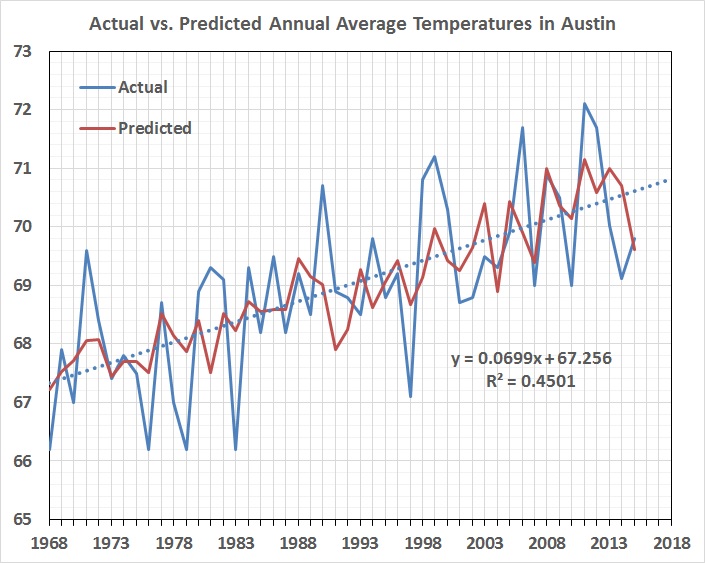
Here’s a graph of actual vs. predicted temperatures:

Actual vs predicted average annual temperatures in Austin

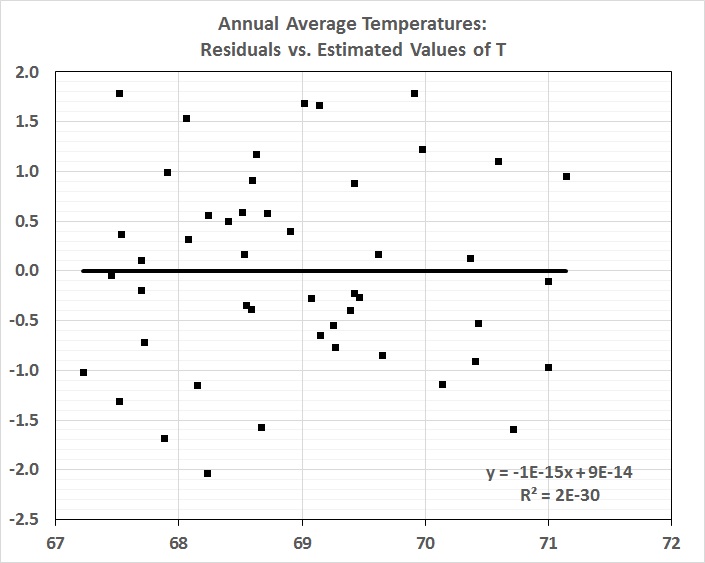
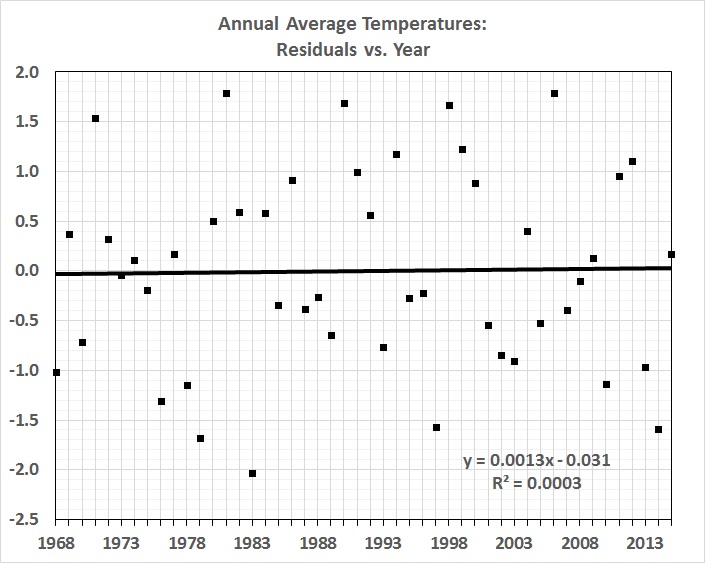
The residuals are randomly distributed with respect to time and the estimated values of T, so there’s no question (in my mind) about having omitted a significant variable:

Average annual temperatures_residuals vs. year

Average annual temperaturs_residuals vs. estimates of T

Austin’s average annual temperature rose by 3.6 degrees F between 1968 and 2015, that is, from 66.2 degrees to 69.8 degrees. According to the regression equation, the rise in Austin’s population from 234,000 in 1968 to 853,000 (adjusted) in 2015 accounts for essentially all of the increase — 3.5 degrees of it, to be precise. That’s well within the range of urban heat-island effects for big cities, and it’s obvious that Austin became a big city between 1968 and 2015. It also agrees with the estimated effect of Austin’s population increase, as derived from the equation for North American cities in T.R. Oke’s “City Size and the Urban Heat Island.” The equation (simplified for ease of reproduction) is

T’ = 2.96 log P – 6.41

Where,

T’ = change in temperature, degrees C

P = population, holding area constant

The author reports r-squared = 0.92 and SE = 0.7 degrees C (1.26 degrees F).

The estimated UHI effect of Austin’s population growth from 1968 to 2015 is 2.99 degrees F. Given the standard error of the estimate, the estimate of 2.99 degrees isn’t significantly different from my estimate of 3.5 degrees or from the actual increase of 3.6 degrees.

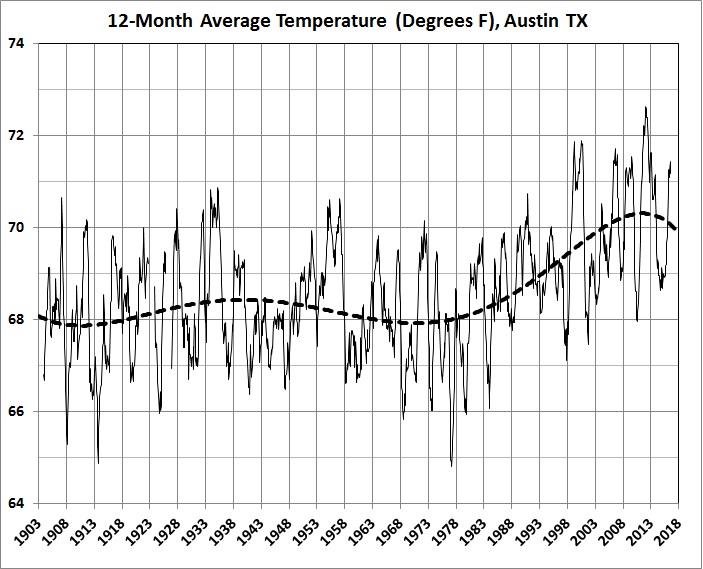
I therefore dismiss the possibility that population is a proxy for the effects of CO2 emissions, which — if they significantly affect temperature (a big “if”) — do so because of their prevalence in the atmosphere, not because of their concentration in particular areas. And Austin’s hottest years occurred during the “pause” in global warming after 1998. There was no “pause” in Austin because its population continued to grow rapidly; thus:

12-month average temperatures in Austin_1903-2016

Bottom line: Austin’s temperature can be accounted for by precipitation and population. AGW will have to find another place in which to work its evil magic.

*     *     *

Related reading:
U.S. climate page at WUWT
Articles about UHI at WUWT
David Evans, “There Is No Evidence,” Science Speak, June 16, 2009
Roy W. Spencer, “Global Urban Heat Island Effect Study – An Update,” WUWT, March 10, 2010
David M.W. Evans, “The Skeptic’s Case,” Science Speak, August 16, 2012
Anthony Watts, “UHI – Worse Than We Thought?,” WUWT, August 20, 2014
Christopher Monckton of Brenchley, “The Great Pause Lengthens Again,” WUWT, January 3, 2015
Anthony Watts, “Two New Papers Suggest Solar Activity Is a ‘Climate Pacemaker‘,” WUWT, January 9, 2015
John Hinderaker, “Was 2014 Really the Warmest Year Ever?,” PowerLine, January 16, 2015
Roy W. Spencer, John R. Christy, and William D. Braswell, “Version 6.0 of the UAH Temperature Dataset Released: New LT Trend = +0.11 C/decade,” DrRoySpencer.com, April 28, 2015
Bob Tisdale, “New UAH Lower Troposphere Temperature Data Show No Global Warming for More Than 18 Years,” WUWT, April 29, 2015
Patrick J. Michaels and Charles C. Knappenberger, “You Ought to Have a Look: Science Round Up—Less Warming, Little Ice Melt, Lack of Imagination,” Cato at Liberty, May 1, 2015
Mike Brakey, “151 Degrees Of Fudging…Energy Physicist Unveils NOAA’s “Massive Rewrite” Of Maine Climate History,” NoTricksZone, May 2, 2015 (see also David Archibald, “A Prediction Coming True?,” WUWT, May 4, 2015)
Christopher Monckton of Brenchley, “El Niño Has Not Yet Paused the Pause,” WUWT, May 4, 2015
Anthony J. Sadar and JoAnn Truchan, “Saul Alinsky, Climate Scientist,” American Thinker, May 4, 2015
Clyde Spencer, “Anthropogenic Global Warming and Its Causes,” WUWT, May 5, 2015
Roy W. Spencer, “Nearly 3,500 Days since Major Hurricane Strike … Despite Record CO2,” DrRoySpencer.com, May 8, 2015

Related posts:
AGW: The Death Knell (with many links to related readings and earlier posts)
Not-So-Random Thoughts (XIV) (second item)
AGW in Austin?
Understanding Probability: Pascal’s Wager and Catastrophic Global Warming
The Precautionary Principle and Pascal’s Wager

Not-So-Random Thoughts (XVII)

Links to the other posts in this occasional series may be found at “Favorite Posts,” just below the list of topics.

*     *     *

Victor Davis Hanson offers “The More Things Change, the More They Actually Don’t.” It echoes what I say in “The Fallacy of Human Progress.” Hanson opens with this:

In today’s technically sophisticated and globally connected world, we assume life has been completely reinvented. In truth, it has not changed all that much.
And he proceeds to illustrate his point (and mine).

*     *     *

Dr. James Thompson, and English psychologist, often blogs about intelligence. Here are some links from last year that I’ve been hoarding:

Intelligence: All That Matters” (a review of a book by Stuart Ritchie)

GCSE Genes” (commentary about research showing the strong relationship between genes and academic achievement)

GWAS Hits and Country IQ” (commentary about preliminary research into the alleles related to intelligence)

Also, from the International Journal of Epidemiology, comes “The Association between Intelligence and Lifespan Is Mostly Genetic.”

All of this is by way of reminding you of my many posts about intelligence, which are sprinkled throughout this list and this one.

*     *     *

How bad is it? This bad:

Thomas Lifson, “Mark Levin’s Plunder and Deceit

Arthur Milikh, “Alexis de Tocqueville Predicted the Tyranny of the Majority in Our Modern World

Steve McCann, “Obama and Neo-fascist America

Related reading: “Fascism, Pots, and Kettles,” by me, of course.

Adam Freedman’s book, A Less than Perfect Union: The Case for States’ Rights. States’ rights can be perfected by secession, and I make the legal case for it in “A Resolution of Secession.”

*     *     *

In a different vein, there’s Francis Menton’s series about anthropogenic global warming. The latest installment is “The Greatest Scientific Fraud of All Time — Part VIII.” For my take on the subject, start with “AGW in Austin?” and check out the readings and posts listed at the bottom.

The Rahn Curve Revisited

Moved.

Oh, the Horror!

I constructed the following graph with the aid of Advance Title Search at IMDb.

Horror, musical, and comedy films as percentage of total

How would you explain the shifting popularity of the three genres? Here are my thoughts:

The rising popularity of comedies in the 1930s and 1940s can be attributed to the tensions of the Great Depression and World War II. The renewed and rising popularity of comedies in the 1960s to 2010s can be attributed to the rising social tensions of those decades. The relative unpopularity of comedy in the 1950s attests to the “normalcy” of that decade.

There were a few silent “musicals,” but real musicals didn’t arrive on the scene until the late 1920s, so the rise in popularity in the 1930s is unsurprising. The further rise in the 1940s is probably the due to the impetus of World War II, and the need for “light” escape. The decline in the relative popularity of musicals since the 1940s reflects the growing “sophistication” of the populace. Musicals defy belief in ways that comedies and horror films do not. People often crack jokes; horror simply exaggerated the brutal reality of twisted bodies, twisted minds, and the destructiveness of man and nature. But people don’t begin a sentence and then break into song, with the backing of a full orchestra and the accompaniment of choruses and dancers.

What about horror films, the taste for which seems to have risen through the 1980s, dropped in the 1990s, and since resumed its climb? Viewing a horror film is a way of fighting fire with fire: immersing oneself in the phony frights of the screen in order to make the traumas of everyday life seem milder by comparison. The Great Depression was followed in turn by World War II and the Cold War that ended in 1991 (and during which nuclear annihilation seemed a possibility). The Cold War was studded with lesser but controversial wars (Korea, Vietnam), assassinations, social unrest, and oil shortages, to name some of the lowlights of the post-World War II era through 1991. Then came the “peace dividend” of the 1990s: a decade of 1950-ish “normalcy” (compared with what had preceded it). That brief era ended shockingly on September 11, 2001, and it has been followed by wars, seemingly unextinguishable terror, and economic stagnation (punctuated by the worst recession since the Great Depression). So moviegoers resumed their antidotal intake of horror.

Your turn.

Credit Where Credit Is Due

I have been scathing about Geoffrey R. Stone, a law professor at the University of Chicago. I vented my wrath about his “liberal” casuistry in “Killing Free Speech in Order to Save It” (2005) and “Liberal Claptrap” (2006). I must admit, however, that I like and agree with most of Stone’s recent essay, “Free Expression in Peril.”

Stone writes, for example, that “[w]e live today in an era of political correctness in which students themselves demand censorship, and colleges, afraid to offend those students, too often surrender academic freedom.” Stone then catalogs some of the many offenses against free speech that have been committed by students, often with the aid of administrators. Stone then asks

[h]ow did we get here? It was not long ago when college students were demanding the right to free speech. Now they demand the right to be free from speech that they find offensive or upsetting.

One often-expressed theory is that students of this generation, unlike their predecessors, are weak, fragile, and emotionally unstable. They’ve been raised, the argument goes, by parents who have protected, rewarded, and celebrated them in every way from the time they were infants. Therefore they’ve never learned to deal with challenge, defeat, uncertainty, anxiety, stress, insult, or fear. They are emotionally incapable of dealing with challenge.

But if that is so, then the proper role of a university is not to protect and pamper them but to prepare them for the difficulties of the real world. The goal should not be to shield them from discomfort, insult, and insecurity, but to enable them to be effective citizens. If their parents have, indeed, failed them, then their colleges and universities should save them from themselves.

There is, however, another possibility. It is that students, or at least some students, have always felt this way, but until now they were too intimidated, too shy, too deferential to speak up. If so, this generation of college students deserves credit, because instead of remaining silent and oppressed, they have the courage to demand respect, equality, and safety.

I think there is an element of truth in both of these perspectives, but I am inclined to think that the former explains more than the latter.

I agree with Stone. Today’s students seem to be spoiled brats, and their anti-free speech behavior is nothing better than a tantrum.

Stone, later in the essay, poses and answers some questions:

Should students and faculty be allowed to express whatever views they want, however offensive they might be to others?

Yes. Absolutely.

Should those who disagree and who are offended be allowed to condemn that speech and those speakers in the most vehement terms? Yes. Absolutely.

Should those who are offended and who disagree be allowed to demand that the university punish those who have offended them? Yes. Absolutely.

Should the university punish those whose speech annoys, offends, and insults others? Absolutely not.

That is the core meaning of academic freedom.

Though he does wimp out at that point:

Does that mean the university’s hands are tied? No.

A university should educate its students about the importance of civility and mutual respect. These values should be reinforced by education and example, not by censorship.

A university should encourage disagreement, argument, and debate. It should instill in its students and faculty members the importance of winning the day by facts, by ideas, and by persuasion, rather than by force, obstruction, or censorship. For a university to fulfill its most fundamental mission, it must be a safe space for even the most loathsome, odious, offensive, disloyal arguments. Students should be encouraged to be tough, fearless, rigorous, and effective advocates and critics.

At the same time, a university has to recognize that in our society, flawed as it is, the costs of free speech will fall most heavily on those who feel the most marginalized and unwelcome. All of us feel that way sometimes, but the individuals who bear the brunt of free speech — at least of certain types of free speech — often include racial minorities; religious minorities; women; gay people, lesbians, and transsexuals; and immigrants. Universities must be sensitive to that reality.

Although they should not attempt to “solve” this problem by censorship, universities should support students who feel vulnerable, marginalized, silenced, and demeaned. They should help them learn how to speak up, how to respond effectively, how to challenge those whose attitudes, whose words, and whose beliefs offend and appall them. The world is not a safe space, and we must enable our graduates to win the battles they’ll have to fight in years to come.

What about conservatives who believe in free speech, free markets, traditional morality, and the defense of America and the aforementioned principles that seem to be disappearing from the land? Speak up, Professor Stone, I can’t hear you.

Anyway, Stone continues [with my occasional comment in brackets]:

But hard cases remain. As simple as it may be to state a principle, it is always much more difficult to apply it to concrete situations. So let me leave you with a few cases to ponder.

A sociology professor gives a talk on campus condemning homosexuality as immoral and calling on “normal” students to steer clear of “fags, perverts, and sexual degenerates.” What, if anything, should the chair of the sociology department do? In my judgment, this is a classic case of academic freedom. The professor is well within his rights to offer such opinions, however offensive others might find them.

A student hangs a Confederate flag, a swastika, an image of an aborted fetus, or a “Vote for Trump” sign on the door of his dorm room. What, if anything, should administrators do? The university should not pick and choose which messages to permit and which to ban. That is classic censorship. But in the context of a residence hall, where students are a bit of a captive audience, the university can have a content-neutral rule that bans all signs on dorm-room doors. [This is fair enough, but wimpish.]

The dean of a university’s law school goes on Fox News and says “Abortion is murder. We should fire any female faculty member and expel any female student who has had an abortion.” The university president is then inundated with complaints from alumni saying, in effect, “I’ll never give another nickel to your damn school as long as she remains dean.” What should the president do? A dean or other administrator at a university has distinctive responsibilities. If she engages in behavior, including expression, that renders her effectively incapable of fulfilling her administrative responsibilities, then she can be removed from her position. [As a former executive, I concur.] This is necessary to the core functioning of the institution. At the same time, though, if the dean is also a faculty member, she cannot be disciplined as a faculty member for the exercise of academic freedom.

We needn’t rely solely on hypotheticals. There was the situation at DePaul University in which a student group invited a highly controversial speaker who maintains, among other things, that there is no wage gap for women, that as a gay man he can attest that one’s sexual orientation is purely a matter of choice, and that white men have fewer advantages than women and African-Americans. A group of student protesters disrupted the event by shouting, ultimately causing the talk to be canceled. They maintained that their shouting was merely the exercise of free speech.

What should the university do in such circumstances? Should it permit the protest? Arrest the protesters on the spot? Allow them to protest and then punish them after the fact?

Such a disruption is not in any way an exercise of free expression. Although students can protest the event in other ways, they cannot prevent either speakers or listeners from engaging in a dialogue they wish to engage in without obstruction. In such circumstances, the protesters should be removed and disciplined for their behavior. (DePaul’s president, the Rev. Dennis H. Holtschneider, apologized to the speaker but also criticized “speakers of his ilk” for being “more entertainers and self-serving provocateurs than the public intellectuals they purport to be.” [Holtschneider is clearly a thoroughly indoctrinated leftist.])

Or consider the incident last year at the University of Oklahoma when a group of fraternity brothers, in a private setting, chanted a racist song. Someone who was present at the time filmed the event and circulated it online. Was the university’s president, David Boren, right to expel the students? In my judgment, no.

This statement occurs in the middle of Stone’s essay:

Faced with the continuing challenges to academic freedom at American universities, the University of Chicago’s president, Robert J. Zimmer, charged a faculty committee last year with the task of drafting a formal statement on freedom of expression. The goal of that committee, which I chaired, was to stake out Chicago’s position on these issues. That statement has since become a model for a number of other universities.

The work of Stone’s committee found its way into the candid and refreshing letter of acceptance from the University of Chicago’s Dean of Students to incoming freshmen; for example:

Once here you will discover that one of the University of Chicago’s defining characteristics is our commitment to freedom of inquiry and expression. This is captured in the University’s faculty report on freedom of expression. Members of our community are encouraged to speak, write, listen, challenge, and learn, without fear of censorship. Civility and mutual respect are vital to all of us, and freedom of expression does not mean the freedom to harass or threaten others. You will find that we expect members of our community to be engaged in rigorous debate, discussion, and even disagreement. At times this may challenge you and even cause discomfort.

Our commitment to academic freedom means that we do not support so called ‘trigger warnings,’ we do not cancel invited speakers because their topics might prove controversial, and we do not condone the creation of intellectual ‘safe spaces’ where individuals can retreat from ideas and perspectives at odds with their own.

Two-point-nine cheers for Geoffrey Stone; three cheers for the University of Chicago.

Consistent Conservatism

[A] person’s political philosophy — if he may be said to have one — is likely to consist of a set of attitudes, many of them logically irreconcilable. This, I believe, is due mainly to the influence of temperament on one’s political views. It is a rare human being who does not interpret the world through the lens of his preferences, and those preferences seem to be more a matter of temperament than of knowledge and reason. Even highly intelligent persons are capable of believing in the most outlandish things because they want to believe those things.

Parsing Political Philosophy (II),” Politics & Prosperity

*       *      *

I offer myself as an example of the operation of temperament on political preferences. I am, by nature, a conservative person. For example, I’m cautious about change. It’s my view that if a thing works reasonably well, tinkering with it will probably cause it to stop working well, or at all. For that reason, I dislike meddling in the affairs of others. I don’t know what they know about their own circumstances, so I presume that they’re acting in their own best interests. And if they mess up their lives, it’s up to them to make things right if they can. And if they can’t, it’s not my responsibility to clean up the mess that they’ve made. But, in typically conservative fashion, I will try to help them if I’m attached to them by blood or another strong bond.

By extension, I intensely dislike government meddling because it can mess up so many lives, even (and especially) lives that would otherwise be well lived. It follows that government has only one legitimate function, which is to protect Americans from force and fraud. That implies a vigorous defense of Americans and their overseas interests against enemies, foreign and domestic. The purpose of a vigorous defense is to enable Americans to lead their lives (lawfully) as they deem best; it is not to make America safe for governmental meddling in social and economic affairs.

Government, in short, should be conservative in the way that I am conservative. Some would call me a libertarian, but it is my long-held position that conservatism is true libertarianism.

My consistent conservatism is reflected in my attitude toward WikiLeaks. I was gladdened by this recent news:

WikiLeaks founder Julian Assange promised he’s not done leaking information that could be damaging to Hillary Clinton. During an interview this week with Fox’s Megyn Kelly he said the documents would be “significant” in perhaps turning the tide of the 2016 election by giving voters a better understanding who they’re electing.

Not that I’m a Donald Trump fan; I’m not, as you will know if you’re a regular reader of this blog. But I welcome almost any development that might keep that lying, hypocritical statist Hillary Clinton out of the White House.

Am I a hypocrite, too? My visceral (conservative) reaction to activists, protestors, and rabble-rousers is “go away and mind your own business.” That was my reaction to WikiLeaks when I first heard of it — and Julian Assange — six years ago, in connection with the release of documents related to the wars in Iraq and Afghanistan.

When it comes to war-making in defense of Americans and their overseas interests, my conservative (i.e., cautious) view is that it’s better to kill enemies sooner rather than later. Delay gives enemies a chance to build their strength, and to use it in unexpected ways.

I know that the politicians and generals who wage war aren’t always or often brilliant about how they do it. But perfection is hard to come by, so I’m willing to tolerate mistakes as long as they err on the side of “too much” defense. (LBJ’s Vietnam vacillations were maddening to me; he should have gone all out or bugged out, but he did neither.) I was therefore angered by the revelations six years ago because it seemed to me that they put America’s war-fighters in jeopardy, or at least compromised America’s ability to wage war.

So, no, I don’t think I’m hypocritical in the least. Anything (non-violent) that helps to take down a domestic enemy like Hillary Clinton is acceptable. Anything (violent or non-violent) that damages America’s defenses against foreign enemies is unacceptable, and often treasonous.

Conservative in temperament, conservative in politics, consistently conservative. That’s my motto.

Utilitarianism vs. Liberty (II)

This post has moved.


“And the Truth Shall Set You Free”

The truth contained in Drs. Lawrence Mayer and Paul McHugh’s “Sexuality and Gender” (The New Atlantis No. 50, Fall 2016) will fall on the same deaf ears as many other truths. The “party of science” is really the party of magical thinking — about many things, including economics, climate, race, war, and (most recently) “gender.”

“Gender” is the latest egregious example of seeing the world as one wishes it were, instead of the way it is. “Gender” smacks of Victorian prudery; it’s a euphemism for “sex.” But it’s more than that, because it connotes more than a mere biological fact of life; it connotes a state of mind that somehow transcends biology. (Very Zen, don’t you think?)

Among the subjects addressed by Drs. Mayer and McHugh is “gender identity” The executive summary of Part Three, which addresses that subject, gives these findings:

● The hypothesis that gender identity is an innate, fixed property of human beings that is independent of biological sex — that a person might be “a man trapped in a woman’s body” or “a woman trapped in a man’s body” — is not supported by scientific evidence.

● According to a recent estimate, about 0.6% of U.S. adults identify as a gender that does not correspond to their biological sex.

● Studies comparing the brain structures of transgender and non-transgender individuals have demonstrated weak correlations between brain structure and cross-gender identification. These correlations do not provide any evidence for a neurobiological basis for cross-gender identification.

● Compared to the general population, adults who have undergone sex-reassignment surgery continue to have a higher risk of experiencing poor mental health outcomes. One study found that, compared to controls, sex-reassigned individuals were about 5 times more likely to attempt suicide and about 19 times more likely to die by suicide.

● Children are a special case when addressing transgender issues. Only a minority of children who experience cross-gender identification will continue to do so into adolescence or adulthood.

● There is little scientific evidence for the therapeutic value of interventions that delay puberty or modify the secondary sex characteristics of adolescents, although some children may have improved psychological well-being if they are encouraged and supported in their cross-gender identification. There is no evidence that all children who express gender-atypical thoughts or behavior should be encouraged to become transgender.

Don’t get me wrong, I bear no animus toward those few persons who are truly conflicted about their sexuality. But I have no sympathy for juvenile faddishness and the unseemly (and temporarily halted) eradication of privacy in the name of “gender equality.” It’s as if time-honored codes of conduct have somehow become unnecessary and unduly discriminatory. (Where have we heard that before?)

And, as usual, the rush to remake the world in a new, trendy image won’t stop with “equality.” It will become (and has become, in some places) verboten to refer to anyone by anything but an approved label, just as it has become verboten in some places to refuse to bake a wedding cake or provide flowers for a homosexual “marriage.”

It’s easy enough for a black, a woman, or any one of a long list of “protected groups” to march into an EEOC office and file a baseless discrimination claim. It’s unsurprising that the list of protected groups now encompasses anyone who identifies as LGB or T. (What’s wrong with Q?)

What I want to know is why the EEOC and all of the other equality-enforcing agencies of government are still in business. Given the relatively small number of persons who aren’t in a protected group — namely straight, white, non-Hispanic males under the age of 40 who are neither disabled (a broad category) or veterans — it seems to me that equality has already been achieved. Except for the unprotected, of course, but only their mothers give two hoots about them (maybe).

*     *     *

Related posts:
Two-Percent Tyranny
The Culture War
Ruminations on the Left in America
The Euphemism Conquers All
Superiority
The War on Conservatism
How Government Subverts Social Norms
Identity and Crime
There’s More to It Than Religious Liberty
The Authoritarianism of Modern Liberalism, and the Conservative Antidote
Privilege, Power, and Hypocrisy
The Beginning of the End of Liberty in America
The Technocratic Illusion
“Fairness”
Equal Protection in Principle and Practice
Society, Polarization, and Dissent

Laugh of the Day

Facebook, for me, is a mildly amusing diversion. I have only 39 Facebook “friends,” and I follow only about a third of them. The rest are obligatory friends whose doings don’t interest me.

I strive to make Facebook as unintrusive as possible. To that end, I have long used the F.B. Purity extension for Firefox, which eliminates a lot of clutter and unwanted features. I also use Adblock Plus, though Facebook has found a way to work around it and plops an ad or two in my newsfeed every day.

I’ve just learned that Facebook categorizes the politics of its users. I was amused to find that I’m a Liberal. I guess it’s because of the postings of some of my friends — postings that I usually hide to avoid irritation.  It’s easy to delete the political preference setting, so I did.

And I’ve just come to understand the meaning of the popular abbreviation for Facebook: FB = For the Birds.

Film Fiasco: Mon Oncle Antoine

WARNING! WARNING! WARNING! SPOILERS AHEAD — THOUGH I RECOMMEND THAT YOU AVOID THE FILM REVIEWED HERE.

This is a review of Mon oncle Antoine, a 1971 French-Canadian film. The film is set at Christmastime in a remote village in Quebec, the main adornment of which is the mountainous pile of dirt leavings (or whatever they’re called) at an asbestos mine.

The story starts with Jos Poulin working at the mine. Jos doesn’t like the job, so he quits and goes to work at a logging camp. Jos doesn’t like that job either, so he wanders home.

In the meantime there’s Benoit, a 15 year old who lives with his Uncle Antoine and Aunt Cecile. Antoine and Cecile own the general store, and Antoine is also the local undertaker. Antoine and Cecile employ a clerk named Fernand, who is also the undertaker’s assistant. They also employ a girl of about 15 named Carmen, who lives with them. Her father drops by on payday to collect Carmen’s pay. Carmen seem to be an unhappy person. She and Benoit lust after each other, but nothing comes of it.

Benoit is an altar boy. He drinks from the bottle of communion wine, then he watches the priest do the same thing, so that’s okay.

On Christmas Eve, Jos’s oldest son, Marcel, dies. Jos doesn’t know this because he’s still slogging home from the logging camp. Antoine goes to fetch the body, but he takes Benoit instead of Fernand with him for no discernible reason other than to allow Cecile to play Cougar to Fernand. So she does. And they do.

Antoine and Benoit set out by horse-drawn sleigh to collect Marcel’s body. Although it’s the late 1940s (or the late 1960s, judging by the shortness of Carmen’s dress), Antoine doesn’t seem to have an automobile. But if he had one the main event of the film wouldn’t have happened, and the film would be more pointless than it is.

The main event is this: After arriving at the Poulin house with the pine box for Marcel’s body, Marcel’s mother offers Antoine and Benoit a meal, of which Antoine partakes in a rather crude fashion — grunting and belching all the while. Oh, he’s also drinking from the 1.5 litre bottle of grappa (or something more lethal) that he brought along for the trip. Antoine and Benoit get Marcel’s body into the pine box and onto the back of the sleigh. And off they go, as Antoine continues to chug the bottle of grappa. When Antoine falls asleep (or into a semi-comatose state), Benoit decides to liven things up by stirring the horse into action. Now the thing that I expected to happen does happen. The pine box containing Marcel’s body slides off the back of the sleigh.

Benoit brings the sleigh to a halt about 100 feet from the box. After pounding on Antoine to bring him to half-awakeness, they trudge to the box, which Antoine is unable to budge because his muscles have turned to mush after so many oral doses of grappa. He cries about his wasted life.

Antoine and Benoit return to the store — which, cozily, is also where Antoine, Cecile, Benoit, Carmen, and Fernand live. Benoit, of course, opens the door to Cecile’s boudoir to find Fernand there. Some muttering (but no violence) ensues before Fernand and Benoit set off to retrieve the box. Benoit, amazingly and despite the remarkable event that has just befallen him, can’t remember which of two possible routes to follow back to the box.

Well, it doesn’t matter. Because they eventually arrive back at the Poulin house, sans box, which has somehow transported itself into the Poulin’s parlor. There, the wandering Jos and his family are kneeling around the open box, staring at the dead Marcel. And wondering, no doubt, why the hell they agreed to act in such a pointless film.

But maybe they knew that it would someday be voted the best Canadian film of all time. I’d hate to see the second-best one.

True Confession, New Resolution

RETRACTED AS HOPELESSLY NAIVE. SEE, FOR EXAMPLE, MANY SUBSEQUENT POSTS, INCLUDING BUT FAR FROM LIMITED TO Leftism As Crypto-Fascism: The Google Paradigm AND What’s Going On? A Stealth Revolution

I spent 30 years at a defense think-tank. There were many things that I liked about it, and a few things that I didn’t like about it. The thing that I disliked most was the way in which some senior managers and many analysts offered criticism. They practiced a perverted version of the Socratic method. Instead of working with the author of an analysis to improve it, they would keep probing the weak points of he work — or more correctly, the analyst’s ability to explain and defend it — and leave the analyst melting in a puddle of mortification.

I resented that kind of criticism when it was aimed at me, and when I saw it being aimed at others. (I was involved in the creation of a mock “seal” for the  hazing sessions that were led by a former president of the think-tank. The seal displayed the motto “Nibbled to death by ducks.”) But I often resorted to the method when I was the critic. Human nature is like that.

I am here to confess (as I just did), to repent (as I hope I am doing), and to enter onto the path of righteousness (as I hope I will).

The most constructive way to offer criticism, in my experience, is to put yourself in the place of the person you are criticizing. Try to understand the issue at hand, as he sees it, and try to understand the way he comes at the issue. If you get “inside” that person’s mind, you can then talk to him about the problem in a way that he understands. From there, you can work with him to improve whatever it is he is seeking to improve — be it the Navy’s choice of a new weapon system or the opportunities available to low-income persons.

I know that a person’s political views are largely a matter of temperament, and for that reason not always susceptible to change by appealing to facts or logic. But political views are nevertheless changeable, in the way that a person who is addicted to drugs or alcohol will overcome his addiction — if he understands that he can do it, and will live a miserable life and die miserably if he doesn’t.

I am also aware that leftists — who are the usual targets of my criticism — do not often (or perhaps ever) respond constructively to conciliatory statements. As I say here,

leftists can be ruthless, unto vicious. They pull no punches; they call people names; they skirt the law — and violate it — to get what they want (e.g., Obama’s various “executive actions”); they use the law and the media to go after their ideological opponents; and on and on.

Nevertheless, this blog is but a pinprick on the vast hide of leftism. Perhaps it will be more effective if I make a greater effort to understand what leftists want, and try to appeal to them on that basis, instead of preaching to the choir of libertarian-conservatives as I often do.

*     *     *

Related reading and viewing:

Jonathan Haidt, “Why the Centre Cannot Hold in America, Europe, and Psychology” (Heterodox Academy, August 9, 2016). This is an introduction to Haidt’s recent speech at the American Psychological Association’s annual convention in Denver, where he addressed the causes and consequences of political polarization.

A video of the speech: https://youtu.be/vAE-gxKs6gM

PowerPoint slides: http://heterodoxacademy.org/wp-content/uploads/2016/08/haidt.APA-2016-lecture-on-polarization.for-posting.compressed.pptx

PDF version of the slides: http://heterodoxacademy.org/wp-content/uploads/2016/08/haidt.APA-2016-lecture-on-polarization.slides-for-printing.pdf

Affirmative Action Comes Home to Roost

There are some people — a lot of them, in fact — who simply can’t abide the truth:

Professors at Smith College in Northampton, Mass. are being denounced as white supremacists after private messages were leaked in which they claim affirmative action sets up students for academic failure at the school.

The controversy in question concerns two letters sent by faculty in Smith’s School for Social Work to school administrators….

The first letter, sent by professor Dennis Miehls, warns that the school was failing in its “gatekeeper” function by admitting too many academically unprepared applicants….

A separate letter, signed only “Concerned Adjuncts,” isn’t as explicit about race, but voices similar concerns that lowered standards for certain groups were setting them up for failure.

“There is clearly something terribly faulty with the admission policy when scores of students develop, from the very start, serious problems in both their academic performance and their field experience,” the letter said. “What many people are thinking but afraid to say is that when students are admitted who do not have the academic qualifications to do well enough in a rigorous, demanding, stressful program … these students are being set up for failure….

The claims in the letters reflect prior research that suggests affirmative action may hurt beneficiaries by sending them to schools they are underqualified for, where they are then outclassed by other students.

Both letters appear to have been well-intentioned, but since being leaked, they have caused a firestorm at Smith. The unknown person who leaked them said the letters demonstrated the existence of “white supremacist systems” at the school.

Hundreds of students held a public protest Tuesday, denouncing the alleged racism within the School for Social Work.

“We bear witness to the violence of racialized, differential treatment of students of color,” student Katherine Roubos said at the protest, according to the Daily Hampshire Gazette.

Ironically, though, the protesters seem to share many facts with the complaining letters. Christopher Watkins, a protest leader, complained that a “disproportionate amount” of black and Hispanic students at the school have been placed under academic review, which seems to reflect the situation the letters complained about. The protesting students, though, believe their poorer performance reflects systemic racism in the school, rather than lower overall readiness.

Which doesn’t compute. It’s a reasonable surmise that the faculty of Smith College, like that of most colleges (especially the elite ones of the Northeast), is dominated by leftists. And we know that leftists, by self-definition, are anti-racists in the nth degree. So, either Smith’s faculty is riddled with crypto-racist hypocrites (not a remote possibility) or Smith (like almost all colleges in the U.S.) eagerly admits unqualified students in the name of “diversity,” etc., etc., etc.

But the victims of affirmative action — the unqualified students — don’t want to hear that. So their plight is the result of racism. What else is new?

*     *     *

Related posts:
Race and Reason: The Victims of Affirmative Action
Race and Reason: The Achievement Gap — Causes and Implications
“Conversing” about Race
Evolution and Race
“Wading” into Race, Culture, and IQ
Evolution, Culture, and “Diversity”
The Harmful Myth of Inherent Equality
Let’s Have That “Conversation” about Race
Non-judgmentalism as Leftist Condescension

Pontius Pilate: Modern Politician

Thou art a king, then? Pilate asked. And Jesus answered, It is thy own lips that have called me a king. What I was born for, what I came into the world for, is to bear witness of the truth. Whoever belongs to the truth, listens to my voice. Pilate said to him, What is truth? And with that he went back to the Jews again, and told them, I can find no fault in him. You have a custom of demanding that I should release one prisoner at paschal time; would you have me release the king of the Jews? Whereupon they all made a fresh outcry; Barabbas, they said, not this man. Barabbas was a robber.

John 18:37-40


But the chief priests and elders had persuaded the multitude to ask for Barabbas and have Jesus put to death; and so, when the governor openly asked them, Which of the two would you have me release? they said, Barabbas. Pilate said to them, What am I to do, then, with Jesus, who is called Christ? They said, Let him be crucified. And when the governor said, Why, what wrong has he done? they cried louder than ever, Let him be crucified. And so, finding that his good offices went for nothing, and the uproar only became worse, Pilate sent for water and washed his hands in full sight of the multitude, saying as he did so, I have no part in the death of this innocent man; it concerns you only.

Matthew 27:20-24

*     *     *

Pilate is a modern man. In asking “What is truth?” he marks himself as a moral relativist, someone who scorns the idea that one moral system can be better than another. He would have reacted to the terrorist attacks of September 11, 2001, in the vein of many leftists: “We were asking for it.”

And like a politician who “accepts full responsibility” for a disastrous decision — but pays no penalty — Pilate ceremonially absolves himself of blame in the death of Christ. As if the ceremonial act (or rote apology) somehow rectifies a grave error of judgment or dereliction of duty. Pilate, having gone through the motions, remains in high office — just like a modern politician.

A Resolution of Secession

See “The Constitution: Myths and Realities“.

Unintended Consequences

Now comes this unsurprising revelation from The Economist:

Forcing job applicants to declare they have a criminal record—whether or not it is relevant to the post—allows employers to filter out ex-convicts, it is argued, and prevents them finding the sort of work that would help them stay out of prison. So activists across the world have called for “ban-the-box” laws, which prohibit employers from inquiring about criminal histories prior to job interviews or offers.

Some 24 states and many municipalities in America have now introduced laws along those lines….

A paper by Jennifer Doleac of the University of Virginia and Benjamin Hansen of the University of Oregon, published on August 1st, looked at the impact of introducing ban-the-box policies on labour-market data from America’s population census. It found that withholding criminal-record data from employers encouraged them to treat certain minority groups as if they were more likely to have criminal pasts. In areas where ban-the-box laws have taken effect, the study found, the probability of being employed has fallen by 5.1% for young, low-skilled African-American men, and by 2.9% for young, low-skilled Hispanic men….

Other research backs up this conclusion. Amanda Agan of Princeton University and Sonja Starr of the University of Michigan sent 15,000 fictitious job applications to employers in New York and New Jersey. Before ban-the-box was introduced in these states, white applicants received around 7% more callbacks than similar black applicants. But when the policy took effect the gap increased to 45%.

How do you think a lot of employers cope with racial hiring quotas affirmative action? They use names and other clues to identify those applicants for employment who are black. They then weed out all but those black candidates who seem exceptionally well-qualified, and obviously better-qualified than the white or Asian candidates — which is often none. Why? Because once a black person shows up for an interview, he or she becomes a potential liability — a prospective employee who, if not hired, can file a racial discrimination claim. And it costs a lot of money to defend racial discrimination claims.

Result: Racial hiring quotas affirmative action means that fewer blacks are hired than would otherwise be the case.

*     *     *

Related posts:

Guilty Until Proven Innocent

Race and Reason: The Victims of Affirmative Action


Jonathan Swift Redux?

Bryan Caplan seems to be muscling in on Jonathan Swift‘s literary territory: satire. Consider Caplan’s post “Murder Equivalents“:

Economists’ [sic] have long struggled to get non-economists to put a dollar value on human life.  We’ve almost completely failed.  No matter how high the dollar value you use, non-economists hear callous minimization of human suffering.  Is there any way to quantify the magnitude of Awful without seeming awful yourself?

I say there is.  From now on, let us measure each horror in “Murder Equivalents.”  The Murder Equivalent of X, by definition, is the number of ordinary murders that would be just as bad as X.  The concept allows for the reasonable possibility that some deaths are less bad than a normal murder.  The Murder Equivalent of an accidental death, for example, might only be .5  The concept also allows for the reasonable possibility than some deaths are worse than a normal murder.  The Murder Equivalent for a death by terrorism, for example, might be 2.  A terrible war that lays a country waste might be twice the number of deaths from war crimes, plus the number of civilian deaths, plus .5 times the number of soldier deaths, plus one per $10 M in property damage.

Logically, this re-scaling is no better than a sophisticated Value of Life calculation.  Psychologically, however, it’s far better.  Comparing something to murder doesn’t sound callous.  Nor does it minimize the badness.  It only puts the world in perspective.  Many salacious front-page horror headlines are clearly less bad than one murder.  Thinking in terms of Murder Equivalents would help diffuse such distractions, reducing the risk of costly crusades against relatively minor problems.

Yes, I know that many people will angrily reject any metric that potentially implies their gut emotional reactions are unreasonable.  As usual, I’m working at the margin.  How can we get more people to think numerately about the horrors of the world?  Murder Equivalents is the best idea I’ve got.

Caplan’s modest proposal is Swiftian, even if it’s not meant to be. I refer, of course, to Dean Swift’s A Modest Proposal for Preventing the Children of Poor People From Being a Burthen to Their Parents or Country, and for Making Them Beneficial to the Publick, wherein the author (an Anglo-Irishman) “suggests that the impoverished Irish might ease their economic troubles by selling their children as food for rich gentlemen and ladies.”

Numerate thinking about the horrors of the world seems to belong in a category with Swift’s idea. Why, pray tell, is thinking numerately about the horrors of the world an improvement on thinking emotionally about them? An emotional reaction to horror is a valid reaction. Murder and terrorism are abhorrent, and ought not be smoothed over by equating them with accidental death or death by old age. Yet, that’s what Caplan’s cold-blooded alternative invites.

Death by old age is death by old age; death by accident is death by accident; death by murder or terrorism is neither, and can’t be calibrated with either of them by an arbitrarily assigned coefficient. Murder is an intentional act that can be deterred and avenged. (The best way yet devised of deterring murder is by executing murderers, swiftly (no pun intended) and surely. Not only does execution send a “message” to would-be murderers, many of whom will heed it, but it prevents murderers from murdering again.) Terrorism is an intentional act that can be prevented, deterred, and avenged, it’s not just another “risk” — like being struck by lightning — as some fatuous economists would have it. Murder and terrorism are not merely death by accident or old age with higher coefficients.

In any event, how would the coefficient (relative value) of death by murder or terrorism be assigned? By a know-it-all professor of economics like Bryan Caplan? Even a first-year student of economics could tell you that the only meaningful relative value is the one that results from a market exchange between a willing seller (the prospective victim) and a willing buyer (the prospective murderer). In a word: price. The problem (for Caplan) is that every murder would have a different price, and a lot of murders would have a price of infinity, because the prospective victims would be unwilling to be murdered at any price.

Fascism, Pots, and Kettles

The syllabus for a “course” called Trump 101 is entertaining, especially for this anti-Trump (but not pro-Clinton) reader. But there’s a lot of tailoring in the selections and descriptions thereof to fit the popular view of Trump. Take fascism. Here’s a proper (non-genocidal) definition of fascism, straight from the pen of Benito Mussolini:

Fascism conceives of the State as absolute, in comparison with which all individuals or groups are relative, on to be conceived of in their relation to the State….

The Fascist State organizes the nation, but leaves a sufficient margin of liberty to the individual. The latter is deprived of all useless and possibly harmful freedom, but retains what is essential. The deciding power in this question cannot be the individual, but the State alone [emphasis added].

Trump, if elected, would fit right into an American political tradition that dates back to Woodrow Wilson, and which is associated with the party of the Clintons. (See, for example, Jonah Goldberg’s Liberal Fascism: The Secret History of the American Left, from Mussolini to the Politics of Meaning.) A Democrat calling Trump a fascist is exactly like the pot calling the kettle black.

Multiplicative Hogwash

The Economist offers an almost-balanced view of the Keynesian multiplier, starting with its inception in Keynes’s General Theory, its theoretical refinement by Alvin Hansen and Paul Samuelson, and subsequent theoretical and empirical work. This sums it up: “Decades after its conception, Keynes’s multiplier remains as relevant, and as controversial, as ever.” It’s relevant only in the sense that a lot of economists and policy-makers still believe in it. What it is is hogwash:

The Keynesian Multiplier: Phony Math
The True Multiplier
Further Thoughts about the Keynesian Multiplier

Three Now-Obscure Actors

The 1950s were as dull as they’re made out to be. (Oh, to have them back!) Among the landmarks of that dull decade were three actors who, between them, seemed to appear almost every night on one TV drama or another: Henry Jones (1912-1999), John Newland (1917-2000), and Harry Townes (1914-2001). All three had long acting careers, and Newland was also a producer and director. But you probably can’t put faces with the names. Here they are:

Henry Jones
Henry Jones


John Newland
John Newland


Harry Townes
Harry Townes