The Alabama Abortion Law

This newly enacted law is a likely vehicle by which to bring the issue of abortion back to the Supreme Court. If the issue does return to the Court, Roe v. Wade could be overturned if at least five justices follow the logic prescribed in a post that I wrote before Alabama acted.

I fear, however, that Roberts or Kavanaugh (or both) might try to assuage the left — which is a futile and therefore stupid thing to do. But it would be in the long and sad tradition of conservative cuckoldry to the left.

Rules

There are three types of rule:

1. Social norms that arise from and serve voluntary, beneficial social and economic intercourse. (The Golden Rule is a general statement of such a norm.)

2. State-enforced rules that apply social norms (e.g., the prohibition of murder, theft, battery, etc.)

3. State-enforced rules that are contrived to serve particular interests, including but far from limited to the power-lust of state actors. Such rules go far beyond the scope of social norms, and often contravene and subvert them. (These rules are contrived in accordance with meta-rules that govern the operations of the state.)

Let the Punishment Deter the Crime

While awaiting the return of my wife to our car in a grocery-store parking lot, I observed a few of the myriad instances of the thoughtlessness that is endemic in the public behavior of Americans. In particular, I noted the abject failure of drivers (usually women) to park parallel to the side-lines of a space and approximately midway between them. That behavior reminded me of other types of behavior that cause confusion and chaos on America’s highways and by-ways.

It seems to me that the problem would soon be cured by the swift and certain administration of justice; for example:

Failure to park as described above, even in a private parking lot: punishable by a fine of $1,000 for each violation.

Failure to move one’s automobile forward within a centisecond after a light turns green: punishable by a fine of $1,000 for each violation. If the driver of an automobile fails to move his car forward within the prescribed length of time, said driver is responsible for any damage to the rear of said automobile.

Failure to move forward into an intersection, without impeding oncoming traffic, when a light is green, and then completing one’s left turn when oncoming traffic has cleared: punishable by a fine of $1,000 for each violation.

Driving in a passing lane when one is not passing: punishable by 1 day in jail. The sentence rises by 1 day in jail for each successive violation. The guilty driver has no legal recourse if his automobile is rear-ended by another vehicle.

Passing on the right, except when the passing lane is blocked by a non-passing vehicle: punishable by 1 week in jail. The sentence rises by 1 week for each successive violation.

Running a red light: punishable by a year in jail. The sentence rises by a year for each successive violation.

In no instance will a guilty party be allowed bail,  time off for good behavior, or parole.

Not with a Bang

This is the way the world ends
Not with a bang but a whimper.

T.S. Elliot, The Hollow Men

It’s also the way that America is ending. Yes, there are verbal fireworks aplenty, but there will not be a “hot” civil war. The country that my parents and grandparents knew and loved — the country of my youth in the 1940s and 1950s — is just fading away.

This would not necessarily be a bad thing if the remaking of America were a gradual, voluntary process, leading to time-tested changes for the better. But that isn’t the case. The very soul of America has been and is being ripped out by the government that was meant to protect that soul, and by movements that government not only tolerates but fosters.

Before I go further, I should explain what I mean by America, which is not the same thing as the geopolitical entity known as the United States, though the two were tightly linked for a long time.

America was a relatively homogeneous cultural order that fostered mutual respect, mutual trust, and mutual forbearance — or far more of those things than one might expect in a nation as populous and far-flung as the United States. Those things — conjoined with a Constitution that has been under assault since the New Deal — made America a land of liberty. That is to say, they fostered real liberty, which isn’t an unattainable state of bliss but an actual (and imperfect) condition of peaceful, willing coexistence and its concomitant: beneficially cooperative behavior.

The attainment of this condition depends on social comity, which depends in turn on (a) genetic kinship and (b) the inculcation and enforcement of social norms, especially the norms that define harm.

All of that is going by the boards because the emerging cultural order is almost diametrically opposite that which prevailed in America. The new dispensation includes:

  • casual sex
  • serial cohabitation
  • subsidized illegitimacy
  • abortion on demand
  • easy divorce
  • legions of non-mothering mothers
  • concerted (and deluded) efforts to defeminize females and to neuter or feminize males
  • gender-confusion as a burgeoning norm
  • “alternative lifestyles” that foster disease, promiscuity, and familial instability
  • normalization of drug abuse
  • forced association (with accompanying destruction of property and employment rights)
  • suppression of religion
  • rampant obscenity
  • identity politics on steroids
  • illegal immigration as a “right”
  • “free stuff” from government (Social Security was meant to be self-supporting)
  • America as the enemy
  • all of this (and more) as gospel to influential elites whose own lives are modeled mostly on old America.

As the culture has rotted, so have the ties that bound America.

The rot has occurred to the accompaniment of cacophony. Cultural coarsening begets loud and inconsiderate vulgarity. Worse than that is the cluttering of the ether with the vehement and belligerent propaganda, most of it aimed at taking down America.

The advocates of the new dispensation haven’t quite finished the job of dismantling America. But that day isn’t far off. Complete victory for the enemies of America is only a few election cycles away. The squishy center of the electorate — as is its wont — will swing back toward the Democrat Party. With a Democrat in the White House, a Democrat-controlled Congress, and a few party switches in the Supreme Court (of the packing of it), the dogmas of the anti-American culture will become the law of the land; for example:

Billions and trillions of dollars will be wasted on various “green” projects, including but far from limited to the complete replacement of fossil fuels by “renewables”, with the resulting impoverishment of most Americans, except for comfortable elites who press such policies).

It will be illegal to criticize, even by implication, such things as abortion, illegal immigration, same-sex marriage, transgenderism, anthropogenic global warming, or the confiscation of firearms. These cherished beliefs will be mandated for school and college curricula, and enforced by huge fines and draconian prison sentences (sometimes in the guise of “re-education”).

Any hint of Christianity and Judaism will be barred from public discourse, and similarly punished. Islam will be held up as a model of unity and tolerance.

Reverse discrimination in favor of females, blacks, Hispanics, gender-confused persons, and other “protected” groups will be required and enforced with a vengeance. But “protections” will not apply to members of such groups who are suspected of harboring libertarian or conservative impulses.

Sexual misconduct (as defined by the “victim”) will become a crime, and any male person may be found guilty of it on the uncorroborated testimony of any female who claims to have been the victim of an unwanted glance, touch (even if accidental), innuendo (as perceived by the victim), etc.

There will be parallel treatment of the “crimes” of racism, anti-Islamism, nativism, and genderism.

All health care in the United States will be subject to review by a national, single-payer agency of the central government. Private care will be forbidden, though ready access to doctors, treatments, and medications will be provided for high officials and other favored persons. The resulting health-care catastrophe that befalls most of the populace (like that of the UK) will be shrugged off as a residual effect of “capitalist” health care.

The regulatory regime will rebound with a vengeance, contaminating every corner of American life and regimenting all businesses except those daring to operate in an underground economy. The quality and variety of products and services will decline as their real prices rise as a fraction of incomes.

The dire economic effects of single-payer health care and regulation will be compounded by massive increases in other kinds of government spending (defense excepted). The real rate of economic growth will approach zero.

The United States will maintain token armed forces, mainly for the purpose of suppressing domestic uprisings. Given its economically destructive independence from foreign oil and its depressed economy, it will become a simulacrum of the USSR and Mao’s China — and not a rival to the new superpowers, Russia and China, which will largely ignore it as long as it doesn’t interfere in their pillaging of respective spheres of influence. A policy of non-interference (i.e., tacit collusion) will be the order of the era in Washington.

Though it would hardly be necessary to rig elections in favor of Democrats, given the flood of illegal immigrants who will pour into the country and enjoy voting rights, a way will be found to do just that. The most likely method will be election laws requiring candidates to pass ideological purity tests by swearing fealty to the “law of the land” (i.e., abortion, unfettered immigration, same-sex marriage, freedom of gender choice for children, etc., etc., etc.). Those who fail such a test will be barred from holding any kind of public office, no matter how insignificant.

Are my fears exaggerated? I don’t think so, given what has happened in recent decades and the cultural revolutionaries’ tightening grip on the Democrat party. What I have sketched out can easily happen within a decade after Democrats seize total control of the central government.

Will the defenders of liberty rally to keep it from happening? Perhaps, but I fear that they will not have a lot of popular support, for three reasons:

First, there is the problem of asymmetrical ideological warfare, which favors the party that says “nice” things and promises “free” things.

Second, What has happened thus far — mainly since the 1960s — has happened slowly enough that it seems “natural” to too many Americans. They are like fish in water who cannot grasp the idea of life in a different medium.

Third, although change for the worse has accelerated in recent years, it has occurred mainly in forums that seem inconsequential to most Americans, for example, in academic fights about free speech, in the politically correct speeches of Hollywood stars, and in culture wars that are conducted mainly in the blogosphere. The unisex-bathroom issue seems to have faded as quickly as it arose, mainly because it really affects so few people. The latest gun-control mania may well subside — though it has reached new heights of hysteria — but it is only one battle in the broader war being waged by the left. And most Americans lack the political and historical knowledge to understand that there really is a civil war underway — just not a “hot” one.

Is a reversal possible? Possible, yes, but unlikely. The rot is too deeply entrenched. Public schools and universities are cesspools of anti-Americanism. The affluent elites of the information-entertainment-media-academic complex are in the saddle. Republican politicians, for the most part, are of no help because they are more interested on preserving their comfortable sinecures than in defending America or the Constitution.

On that note, I will take a break from blogging — perhaps forever. I urge you to read one of my early posts, “Reveries“, for a taste of what America means to me. As for my blogging legacy, please see “A Summing Up“, which links to dozens of posts and pages that amplify and support this post.

Il faut cultiver notre jardin.

Voltaire, Candide


Related reading:

Michael Anton, “What We Still Have to Lose“, American Greatness, February 10, 2019

Rod Dreher, “Benedict Option FAQ“, The American Conservative, October 6, 2015

Roger Kimball, “Shall We Defend Our Common History?“, Imprimis, February 2019

Joel Kotkin, “Today’s Cultural Engineers“, newgeography, January 26, 2019

Daniel Oliver, “Where Has All the Culture Gone?“, The Federalist, February 8, 2019

Malcolm Pollack, “On Civil War“, Motus Mentis, March 7, 2019

Fred Reed, “The White Man’s Burden: Reflections on the Custodial State“, Fred on Everything, January 17, 2019

Gilbert T. Sewall, “The Diminishing Authority of the Bourgeois Culture“, The American Conservative, February 4, 2019

Bob Unger, “Requiem for America“, The New American, January 24, 2019

A Summing Up

This post has been updated and moved to “Favorite Posts“.

How Roe v. Wade Could Die

I had thought that it might be hard to overturn Roe v. Wade because those who are directly affected by it — unborn children — lack “standing”; that is, they are not “persons” under the law. But I was prematurely pessimistic. The tools with which Roe can be dismantled are at hand, in challenges to the abortion-limitation laws of various States and in the very language of the Roe decision. [UPDATE 03/01/19: If this Texas bill becomes law, it’s sure to end up in the Supreme Court.] [UPDATE 03/06/19: Here is the perfect case on which to build the Supreme Court ruling that I propose below.]

To begin at the beginning, Roe precludes unborn children from “personhood”. Justice Blackmun wrote in his opinion for a 7-2 majority that the

Constitution does not define “person” in so many words. Section 1 of the Fourteenth Amendment contains three references to “person.”…  The word also appears both in the Due Process Clause and in the Equal Protection Clause. “Person” is used in other places in the Constitution…. But in nearly all these instances, the use of the word is such that it has application only postnatally. None indicates, with any assurance, that it has any possible pre-natal application.

All this, together with our observation … that throughout the major portion of the 19th century prevailing legal abortion practices were far freer than they are today, persuades us that the word “person,” as used in the Fourteenth Amendment, does not include the unborn….

Inasmuch as a non-person has no rights, the majority could have found an unlimited “right” to abortion. Instead, the majority flinched and recognized a status between fetus and person:

(a) For the stage prior to approximately the end of the first trimester, the abortion decision and its effectuation must be left to the medical judgment of the pregnant woman’s attending physician.

(b) For the stage subsequent to approximately the end of the first trimester, the State, in promoting its interest in the health of the mother, may, if it chooses, regulate the abortion procedure in ways that are reasonably related to maternal health.

(c) For the stage subsequent to viability, the State in promoting its interest in the potentiality of human life may, if it chooses, regulate, and even proscribe, abortion except where it is necessary, in appropriate medical judgment, for the preservation of the life or health of the mother [emphasis added].

Roe was “upheld” in Planned Parenthood v. Casey, but with some twists that are the subject of Chief Justice’s dissent, quoted at length below. The key point of Casey (for purposes of this post) is that it admits the state’s interest in the potentiality of human life, and variations on that theme, which I have emphasized in the following excerpts of the controlling opinion in Casey:

The woman’s right to terminate her pregnancy before viability is the most central principle of Roe v. Wade. It is a rule of law and a component of liberty we cannot renounce.

On the other side of the equation is the interest of the State in the protection of potential life. The Roe Court recognized the State’s “important and legitimate interest in protecting the potentiality of human life.”

Yet it must be remembered that Roe v. Wade speaks with clarity in establishing not only the woman’s liberty but also the State’s “important and legitimate interest in potential life.” That portion of the decision in Roe has been given too little acknowledgment and implementation by the Court in its subsequent cases….

We reject the trimester framework, which we do not consider to be part of the essential holding of Roe…. The trimester framework suffers from these basic flaws: in its formulation it misconceives the nature of the pregnant woman’s interest; and in practice it undervalues the State’s interest in potential life, as recognized in Roe.

The very notion that the State has a substantial interest in potential life leads to the conclusion that not all regulations must be deemed unwarranted. Not all burdens on the right to decide whether to terminate a pregnancy will be undue. In our view, the undue burden standard is the appropriate means of reconciling the State’s interest with the woman’s constitutionally protected liberty.

Hold that thought.

According to Wikipedia, Casey

replaced the strict scrutiny analysis under Roe, with the “undue burden” standard…. A legal restriction posing an undue burden is one that has “the purpose or effect of placing a substantial obstacle in the path of a woman seeking an abortion of a nonviable fetus.” An undue burden is found even where a statute purports to further the interest of potential life or another valid state interest, if it places a substantial obstacle in the path of a woman’s fundamental right to choice. The Supreme Court in the 2016 case Whole Woman’s Health v. Hellerstedt clarified exactly what the ‘undue burden’ test requires: “Casey requires courts to consider the burdens a law imposes on abortion access together with the benefits those laws confer.”

Hellerstedt overturned statutory restrictions on abortion providers that had been adopted by Texas. The 5-3 opinion was written by Justice Breyer and joined by Justices Kennedy, Ginsburg, Sotomayor, and Kagan. Chief Justice Roberts and Justices Thomas and Alito filed dissents. Justice Scalia, who had died earlier in the year, had yet to be replaced by Justice Gorsuch. Justice Kennedy has since retired and been replaced by Justice Kavanaugh.

Given the significant changes in the Court’s membership since Hellerstedt, advocates of abortion are right to be worried about the fate of Roe v. Wade and its successors. Elisabeth Dias and Timothy Williams of The New York Times explain:

Several challenges to federal abortion law are pending before the Supreme Court and about a dozen are working their way up through federal circuit courts. Anti-abortion lawmakers and activists have targeted more than simply the restriction of abortion or its funding. They have worked to pass laws to control the range of issues that surround abortion, from burial of fetal tissue and custody of frozen embryos, to ultrasound requirements.

“It’s a continuation of a strategy that we’ve had for some time, which is to pass as many pro-life laws as we can at the state level with a strategy of bold incrementalism,” said Ralph Reed, founder of the Faith and Freedom Coalition, a social conservative political group….

The social conservative strategy has accelerated since 2010, when Republicans made significant gains in state legislatures. States have enacted more than 400 restrictions on abortion since 2011, according to the Guttmacher Institute, a research group that supports abortion rights….

In Indiana, a law signed in 2016 by Mike Pence, then the governor, aims to ban discrimination against a fetus on things like race, sex, and disability. Though it has passed on the case before, the Supreme Court could take it up as soon as next week, and argue it next term. “We are hoping to challenge Roe from this angle, the angle of discrimination,” said Sue Liebel, the state director for the Susan B. Anthony List. “It has never been tried before.”

Even if the first primary challenge does not come from Indiana, the nationwide momentum is “really good news” for the anti-abortion movement, she said.

“It probably will not be one case that will topple Roe all at once,” Ms. Liebel said. “It will probably be multiple pieces that will take chunks out of Roe.”

In Ohio, the state legislature is prepared to approve a bill this session that would ban abortion after a fetal heartbeat is detected, which could be as early as six weeks into a pregnancy. Anti-abortion activist groups like Right to Life Ohio championed the bill, while abortion rights advocates have pointed out that many women and girls are not even aware that they may be pregnant that early.

The legislation was initially approved by the legislature last year, but was vetoed by John Kasich, then the governor. But his successor, Mike DeWine, who like Mr. Kasich is a Republican, has said that he intends to sign the legislation.

“We were very hesitant on the heartbeat bill because we knew we had a hostile Supreme Court,” Mike Gonidakis, the president of Right to Life Ohio, said about the court before the elevation of Justices Brett M. Kavanaugh and Neil Gorsuch by President Trump. “The time is ripe to have the discussion now because of the current Supreme Court. We now see a pathway forward.”

More than 20 bills restricting abortion have become law in Ohio in the past eight years, including legislation that prohibits abortions after 20 weeks of pregnancy, and banning the most common abortion method used in the second trimester of pregnancy.

The Kentucky Legislature is currently considering a fetal heartbeat bill similar to legislation in Ohio, Florida, Mississippi, Missouri and South Carolina. Kentucky has in recent years approved several laws curtailing abortion rights that have been ruled unconstitutional, two of which could ultimately be decided by the Supreme Court.

The first requires doctors to perform an ultrasound before an abortion, then to display and describe the images, and finally, to make the fetal heartbeat audible. The second mandates abortion providers to enter into written transfer agreements with a local hospital, as well as arranging transport arrangements with ambulance services. Both are under appeals in the Sixth Circuit.

Some Democratic-controlled statehouses have recently worked to counter the groundswell from the right. New York expanded abortion rights last month for the first time in almost 50 years, permitting some abortions after 24 weeks of pregnancy. A Virginia legislator proposed a bill that would have lifted restrictions on late-term abortions, but the proposal was set aside in committee.

Amid all this activity, abortion rights activists are alarmed at [the recent] Louisiana decision because it is the clearest indicator yet of how Justice Kavanaugh might rule on abortion in future cases. In the 5-4 ruling, he wrote the dissent….

The Louisiana case is far from decided. The Supreme Court is likely to hear arguments on its merits in the next term, which begins in October.

What is Louisiana? Adam Liptak of The New York Times discusses it:

The Supreme Court on [February 7] blocked a Louisiana law that its opponents say could have left the state with only one doctor in a single clinic authorized to provide abortions.

The vote was 5 to 4, with Chief Justice John G. Roberts Jr. joining the court’s four-member liberal wing to form a majority….

The court’s brief order gave no reasons, and its action — a temporary stay — did not end the case. The court is likely to hear a challenge to the law on the merits in its next term, which starts in October.

Justices Clarence Thomas, Samuel A. Alito Jr., Neil M. Gorsuch and Brett M. Kavanaugh said they would have denied the stay. Only Justice Kavanaugh published a dissent, taking a middle position that acknowledged the key precedent and said he would have preferred more information on the precise effect of the law.

For Chief Justice Roberts, it was something of a turnaround, at least for now. He dissented in the court’s last major abortion case in 2016, voting to uphold a Texas law essentially identical to the one at issue in Thursday’s case….

Chief Justice Roberts has voted to sustain other laws restricting abortion. And his vote to grant a stay on Thursday, in other words, does not mean he will vote to strike down the Louisiana law when the case returns to the court.

The court [as discussed above] is likely to confront other abortion cases, too, as several state legislatures have recently enacted laws that seem calculated to try to force the Supreme Court to consider overruling Roe v. Wade.

What Liptak doesn’t mention is Roberts’s (vain) desire to make the Court seem apolitical. He tried to accomplish that by voting to deny the stay, as if that would avert the outrage that is certain to follow an eventual ruling in favor of the Louisiana law (or others of its ilk).

Unless Roberts reverses his stance on abortion, the Court can and should reverse Roe (and its progeny) by adopting the following argument:

1. It is a scientific and widely known fact that life begins at conception. Roe to the contrary notwithstanding, there is nothing “potential” about the life of a fetus. It is a living being, albeit dependent on its mother for survival until some point in gestation, when it becomes “viable”.

2. To deprive the fetus of life before “viability” is simply to prevent the fetus from becoming “viable” in almost every case. Lack of “viability” is therefore an irrelevant criterion for the termination of a pregnancy; it is a transparent excuse for the taking of a life.

3. Whether the fetus is a “person” under the law is irrelevant here. The fetus is a living human being, and aborting it (unless it has died in the womb) amounts to the taking of a human life.

4. It is a paramount interest of government to regulate the conditions under which a human life may be taken. A fetus (at all stages of development) is innocent human life that merits the full protection of government. A fetus should be aborted only when the preservation of its life poses an actual physical threat to the mother’s life, as certified unanimously by a panel of at least three licensed, board-certified specialists in relevant fields. Such a panel shall include at least one specialist in maternal-fetal medicine.

5. Roe and its progeny are therefore overruled. No government of or in the United States may allow abortion at any stage of pregnancy, except as provided in 4.

6. This ruling does not run afoul of the doctrine of stare decisis, which the plurality in Casey invoked in “upholding” Roe. Chief Justice Rehnquist amply and definitively addressed the plurality’s use of stare decisis in his Casey dissent:

The joint opinion of Justices O’Connor, Kennedy, and Souter cannot bring itself to say that Roe was correct as an original matter, but the authors are of the view that “the immediate question is not the soundness of Roe‘s resolution of the issue, but the precedential force that must be accorded to its holding.” Instead of claiming that Roe was correct as a matter of original constitutional interpretation, the opinion therefore contains an elaborate discussion of stare decisis. This discussion of the principle of stare decisis appears to be almost entirely dicta, because the joint opinion does not apply that principle in dealing with Roe. Roe decided that a woman had a fundamental right to an abortion. The joint opinion rejects that view. Roe decided that abortion regulations were to be subjected to “strict scrutiny” and could be justified only in the light of “compelling state interests.” The joint opinion rejects that view. Roe analyzed abortion regulation under a rigid trimester framework, a framework which has guided this Court’s decisionmaking for 19 years. The joint opinion rejects that framework.

Stare decisis is defined in Black’s Law Dictionary as meaning “to abide by, or adhere to, decided cases.” Whatever the “central holding” of Roe that is left after the joint opinion finishes dissecting it is surely not the result of that principle. While purporting to adhere to precedent, the joint opinion instead revises it. Roe continues to exist, but only in the way a storefront on a western movie set exists: a mere facade to give the illusion of reality. Decisions following Roe … are frankly overruled in part under the “undue burden” standard expounded in the joint opinion….

The joint opinion discusses several stare decisis factors which, it asserts, point toward retaining a portion of Roe. Two of these factors are that the main “factual underpinning” of Roe has remained the same, and that its doctrinal foundation is no weaker now than it was in 1973. Of course, what might be called the basic facts which gave rise to Roe have remained the same-women become pregnant, there is a point somewhere, depending on medical technology, where a fetus becomes viable, and women give birth to children. But this is only to say that the same facts which gave rise to Roe will continue to give rise to similar cases. It is not a reason, in and of itself, why those cases must be decided in the same incorrect manner as was the first case to deal with the question. And surely there is no requirement, in considering whether to depart from stare decisis in a constitutional case, that a decision be more wrong now than it was at the time it was rendered. If that were true, the most outlandish constitutional decision could survive forever, based simply on the fact that it was no more outlandish later than it was when originally rendered.

Nor does the joint opinion faithfully follow this alleged requirement. The opinion frankly concludes that Roe and its progeny were wrong in failing to recognize that the State’s interests in maternal health and in the protection of unborn human life exist throughout pregnancy. But there is no indication that these components of Roe are any more incorrect at this juncture than they were at its inception.

The joint opinion also points to the reliance interests involved in this context in its effort to explain why precedent must be followed for precedent’s sake. Certainly it is true that where reliance is truly at issue, as in the case of judicial decisions that have formed the basis for private decisions, “[c]onsiderations in favor of stare decisis are at their acme.” But, as the joint opinion apparently agrees, any traditional notion of reliance is not applicable here. The Court today cuts back on the protection afforded by Roe, and no one claims that this action defeats any reliance interest in the disavowed trimester framework. Similarly, reliance interests would not be diminished were the Court to go further and acknowledge the full error of Roe, as “reproductive planning could take virtually immediate account of” this action.

The joint opinion thus turns to what can only be described as an unconventional-and unconvincing-notion of reliance, a view based on the surmise that the availability of abortion since Roe has led to “two decades of economic and social developments” that would be undercut if the error of Roe were recognized. The joint opinion’s assertion of this fact is undeveloped and totally conclusory. In fact, one cannot be sure to what economic and social developments the opinion is referring. Surely it is dubious to suggest that women have reached their “places in society” in reliance upon Roe, rather than as a result of their determination to obtain higher education and compete with men in the job market, and of society’s increasing recognition of their ability to fill positions that were previously thought to be reserved only for men.

In the end, having failed to put forth any evidence to prove any true reliance, the joint opinion’s argument is based solely on generalized assertions about the national psyche, on a belief that the people of this country have grown accustomed to the Roe decision over the last 19 years and have “ordered their thinking and living around” it. As an initial matter, one might inquire how the joint opinion can view the “central holding” of Roe as so deeply rooted in our constitutional culture, when it so casually uproots and disposes of that same decision’s trimester framework. Furthermore, at various points in the past, the same could have been said about this Court’s erroneous decisions that the Constitution allowed “separate but equal” treatment of minorities, see Plessy v. Ferguson, or that “liberty” under the Due Process Clause protected “freedom of contract,” see Adkins v. Children’s Hospital of District of Columbia [and] Lochner v. New York. The “separate but equal” doctrine lasted 58 years after Plessy, and Lochner’s protection of contractual freedom lasted 32 years. However, the simple fact that a generation or more had grown used to these major decisions did not prevent the Court from correcting its errors in those cases, nor should it prevent us from correctly interpreting the Constitution here.

I will be surprised if Roberts will go that far. If the Court does overturn Roe, it is more likely to outlaw or severely restrict abortion after “viability”. But a principled majority would rule as I have suggested — and damn the consequences. The Court isn’t in a popularity contest. Its job is to get the law right. And the law in this case, has been deadly wrong since Roe was decided 46 years ago.

For much more, including the issue of privacy, which was central to Roe, see “Abortion Q & A“.

The Constitution vs. Reality

D.W. Brogan, in his foreword to Bertrand de Jouvenel‘s On Power, writes:

It is a dangerous and idle dream to think that the state can become ruled by philosophers turned kings or scientists turned commissars. For if philosophers become kings or scientists commissars, they become politicians, and the powers given to the state are powers given to men who are rulers of states, men subject to all the limitations and temptations of their dangerous craft. Unless this is borne in mind, there will be a dangerous optimistic tendency to sweep aside doubts and fears as irrelevant, since, in the state that the projectors have in mind, power will be exercised by men of a wisdom and degree of moral virtue that we have not yet seen. It won’t. It will be exercised by men first and rulers next and scientists or saints a long way after. It was an illusion of the framers of the early American constitutions that they could set up “a government of laws and not of men.” All governments are governments of men, though the better of them have a high admixture of law, too — that is, of effective limitations on the free action of the rulers.

I must say, in defense of the Framers of the Constitution of 1787 (the one that is still supposed to be the “law of the land”), that they had no illusions about the men who sought and wielded the state’s power. See, for example, Federalist No. 10 (James Madison), Federalist No. 15 (Alexander Hamilton), Federalist No. 55 (Madison), Federalist No. 58 (Madison), Federalist No. 63 (Madison), Federalist No. 71 (Hamilton), and Federalist No. 73 (Hamilton). (Relevant excerpts can be found here.)

For all of their wisdom, however, the Framers were far too optimistic about the effectiveness of the checks and balances in their design. Consider this, from Hamilton:

It may … be observed that the supposed danger of judiciary encroachments on the legislative authority, which has been upon many occasions reiterated, is in reality a phantom. Particular misconstructions and contraventions of the will of the legislature may now and then happen; but they can never be so extensive as to amount to an inconvenience, or in any sensible degree to affect the order of the political system. This may be inferred with certainty, from the general nature of the judicial power, from the objects to which it relates, from the manner in which it is exercised, from its comparative weakness, and from its total incapacity to support its usurpations by force. And the inference is greatly fortified by the consideration of the important constitutional check which the power of instituting impeachments in one part of the legislative body, and of determining upon them in the other, would give to that body upon the members of the judicial department. This is alone a complete security. There never can be danger that the judges, by a series of deliberate usurpations on the authority of the legislature, would hazard the united resentment of the body intrusted with it, while this body was possessed of the means of punishing their presumption, by degrading them from their stations. While this ought to remove all apprehensions on the subject, it affords, at the same time, a cogent argument for constituting the Senate a court for the trial of impeachments. [Federalist No. 81]

Hamilton’s misplaced faith in the Constitution’s checks and balances is an example of what I call the Framers’ fatal error. The Framers underestimated the will to power that animates office-holders. The Constitution’s wonderful design — horizontal and vertical separation of powers — which worked rather well until the late 1800s, cracked under the strain of populism, as the central government began to impose national economic regulation at the behest of muckrakers and do-gooders. The Framers’ design then broke under the burden of the Great Depression, as the Supreme Court of the 1930s (and since) has enabled the national government to impose its will in matters far beyond its constitutional remit.

The Framers’ fundamental error can be found in Madison’s Federalist No. 51. Madison was correct in this:

It is of great importance in a republic not only to guard the society against the oppression of its rulers, but to guard one part of the society against the injustice of the other part. Different interests necessarily exist in different classes of citizens. If a majority be united by a common interest, the rights of the minority will be insecure.

But Madison then made the error of assuming that, under a central government, liberty is guarded by a diversity of interests:

[One method] of providing against this evil [is] … by comprehending in the society so many separate descriptions of citizens as will render an unjust combination of a majority of the whole very improbable, if not impracticable…. [This] method will be exemplified in the federal republic of the United States. Whilst all authority in it will be derived from and dependent on the society, the society itself will be broken into so many parts, interests, and classes of citizens, that the rights of individuals, or of the minority, will be in little danger from interested combinations of the majority.

In a free government the security for civil rights must be the same as that for religious rights. It consists in the one case in the multiplicity of interests, and in the other in the multiplicity of sects. The degree of security in both cases will depend on the number of interests and sects; and this may be presumed to depend on the extent of country and number of people comprehended under the same government. This view of the subject must particularly recommend a proper federal system to all the sincere and considerate friends of republican government, since it shows that in exact proportion as the territory of the Union may be formed into more circumscribed Confederacies, or States oppressive combinations of a majority will be facilitated: the best security, under the republican forms, for the rights of every class of citizens, will be diminished: and consequently the stability and independence of some member of the government, the only other security, must be proportionately increased.

Madison then went on to contradict what he had said in Federalist No. 46 about the States being a bulwark of liberty:

It can be little doubted that if the State of Rhode Island was separated from the Confederacy and left to itself, the insecurity of rights under the popular form of government within such narrow limits would be displayed by such reiterated oppressions of factious majorities that some power altogether independent of the people would soon be called for by the voice of the very factions whose misrule had proved the necessity of it. In the extended republic of the United States, and among the great variety of interests, parties, and sects which it embraces, a coalition of a majority of the whole society could seldom take place on any other principles than those of justice and the general good; whilst there being thus less danger to a minor from the will of a major party, there must be less pretext, also, to provide for the security of the former, by introducing into the government a will not dependent on the latter, or, in other words, a will independent of the society itself. It is no less certain than it is important, notwithstanding the contrary opinions which have been entertained, that the larger the society, provided it lie within a practical sphere, the more duly capable it will be of self-government. And happily for the REPUBLICAN CAUSE, the practicable sphere may be carried to a very great extent, by a judicious modification and mixture of the FEDERAL PRINCIPLE.

Madison understood that a majority can tyrannize a minority. He understood that the States are better able to prevent the rise of tyranny if the powers of the national government are circumscribed. But he then assumed that the States themselves could not resist tyranny within their own borders. Madison overlooked the importance of exit as the ultimate check on tyranny. He assumed (or asserted) that in creating a new national government with powers greatly exceeding those of the Confederation a majority of States would not tyrannize the minority and that minorities with overlapping interests would not concert to tyrannize the majority. Madison was so anxious to see the Constitution ratified that he oversold himself and the States’ ratifying conventions on the ability of the national government to hold itself in check. Thus the Constitution is lamentably silent on nullification and secession, which are real checks on power.

What has been done by presidents, Congresses, and courts probably will not be undone, except at the margin. Too many interests are vested in the regulatory-welfare state that has usurped the Framers’ noble vision. Democracy (that is, vote-selling) and log-rolling are more powerful than words on paper. Even a Supreme Court majority of “strict constructionists” probably would decline to roll back the New Deal and most of what has come in its wake.

At the close of the Constitutional Convention of 1787, Benjamin Franklin was queried as he left Independence Hall on the final day of deliberation, “Well, Doctor, what have we got—a Republic or a Monarchy?” Franklin responded, “A Republic, if you can keep it.”

What we have got now is a mobocracy at war with itself, under the guidance of power-seekers who aren’t fit to empty the Framers’ chamber-pots. The Republic envisioned by the Framers is a thing of the past. Its empty shell survives, but perhaps not for long.

Immigration and Crime, Updated

Here.

Judging the Justices: The Thomas Standard

I would be pleased no end if the Supreme Court consisted of Clarence Thomas and eight clones of him. It seems to me that Justice Thomas has been the most faithful adherent of the Constitution among all of the justices who have served on the Court since I became interested in its doings more than 50 years ago. Taking Thomas as the standard for constitutional judging, it is possible to grade some of the other justices who have served with him, including all of his present colleagues.

In “U.S. Supreme Court: Lines of Succession and Ideological Alignment“, I draw on the SCOTUSsblog Stat Packs to summarize the degree of disagreement among the various justices in non-unanimous cases during each of the Court’s past 13 terms. The use of non-unanimous cases highlights the degree of disagreement among justices, which would be blurred if all cases were included in the analysis.

Reversing the numbers, so that degree of disagreement becomes degree of agreement, and focusing on the extent to which other justices agree with Thomas non-unanimous cases, I obtain the following statistics:

Graphically:

The “trend” for Gorsuch would be worrying, except for its brevity. The truly worrying trend is Chief Justice Roberts’s greater inclination to part ways with Thomas since the 2011 term. I am not comforted by the current (2018) term’s first divided opinion. Thomas wrote for a 5-4 majority and Roberts was in the minority with Kagan, Ginsburg, and Sotomayor.

There’s not much to say about the Court’s “liberal” wing, except to note its egregious record, especially in the last three terms.

On the other side, Alito’s steadfastness, marred only by the peculiar 2015 term, is a comfort. I still have high hopes for Gorsuch — and Kavanaugh. If RBG would throw in the towel this year, the Court could still have a conservative majority even if Roberts goes full Kennedy (or worse).


Related post: The Polarized Court

Freedom of Speech and the Real Resistance

Freedom of speech, under present law, encompasses many things, including this small sample of repugnant acts:

  • counseling abortion
  • disrespecting the emblems of the United States
  • advocating illegal immigration
  • “guiding” children toward transgenderism
  • advocating socialism
  • advocating the disarmament of the United States

The real resistance in America consists of those Americans who push back against the disruptive and destructive movements that have been empowered by “freedom of speech” — such as those represented above.


Related posts:

Rethinking the Constitution: “Freedom of Speech, and of the Press”
Freedom of Speech and the Long War for Constitutional Governance
Academic Freedom, Freedom of Speech, and the Demise of Civility
Freedom of Speech: Getting It Right
Freedom of Speech, to What End?

Nullification and Secession

Joe Wolverton II, writing at The New American, quotes from a five-year old speech by Matthew Whitaker:

As a principle, it has been turned down by the courts and our federal government has not recognized it. Now we need to remember that the states set up the federal government and not vice versa. And so the question is, do we have the political courage in the state of Iowa or some other state to nullify Obamacare and pay the consequences for that?

Wolverton then mounts an effective defense of Whitaker’s position; for example:

… Whitaker asserted that the states “set up the federal government.” There is no logical way to dispute that historical fact.

When the Articles of Confederation (our first constitution) came under criticism from influential statesmen, Congress was compelled to invite delegates to a convention to be held in Philadelphia “for the sole and express purpose of revising the Articles of Confederation.”

Congress’ invitation was sent not to the people, but to the state governments. The state legislatures were invited to send a delegation to help repair rips in the constitutional fabric. This historical fact is irrefutable evidence that a functioning agreement for a government of the United State was the goal. That government, if it was to exist at all, would be the creation of the states that participated in the formation of it.

Additional evidence of the claim that the states were the only interested parties in the compact of the Constitution is found in the way votes were taken and recorded at the convention in Philadelphia. Representatives voted as states, not as individuals. In fact, the journal where those votes were recorded catalogs the yeas and nays according to the name of state, not the name of the delegate.

Another clue to the identity of the parties to the Constitution, is found in Articles V and VII of the document itself.

Article V requires that amendments be “ratified by the legislatures of three-fourths of the states or by conventions in three-fourths thereof.” Not only was the Constitution a binding contract among the states, but any alterations of the provisions of that contract had to be signed off by a super majority of the parties.

Next, the prose and purpose of Article VII makes the issue so clear as to permit no reasonable alternative interpretation. In this brief statement the role of the states as the sine qua non of the Constitution is established. Article VII reads, “The Ratification of the Conventions of nine States, shall be sufficient for the Establishment of this Constitution between the States so ratifying the Same.”

Plainly and purposefully the framers of the Constitution recognized that the document they signed in September 1787 was an agreement among the states represented. Every article was written by the states, voted on by the states, accepted or rejected by the states, ultimately approved by the states, and it would only become binding upon states who ratified it.

Why were the people not polled or asked to vote up or down on the Constitution? Because this was neither a popular nor a national compact; it was a compact creating a confederation of sovereign states.

As constitutional attorney Kent Masterson Brown explains, “The idea that the constitution that they [the framers] had drafted and ratified was entered into ‘by the people,’ as opposed to the states, and was irrevocable once ratified was absolutely unknown to the framers and ratifiers.”

I would add that had these men been convinced that such an arrangement was advocated or even so much as contemplated by those pushing for acceptance of the Constitution, it never would have been ratified by the requisite number of states, and the embryonic American republic would have been stillborn in Philadelphia.

If nullification is to be successfully deployed and defended, states lawmakers must remember that the Constitution is a creature of the states and that the federal government was given very few and very limited powers over objects of national importance. Any act of Congress, the courts, or the president that exceeds that small scope is null, void, and of no legal effect.

Not once during the deliberations at the Constitutional Convention was there a proposal that their work be presented for approval to the body of the populace acting as individuals. From the beginning of the process that culminated on September 17, 1787 with the signing of the Constitution, it was understood that the ratification by at least nine states was the sine qua non of the start of the new government.

Still, the establishment and their media mouthpieces obstinately deny one irrefutable fact: The Constitution never would have gone into legal effect and the federal government never would have been created if state conventions had not met and ratified the document.

I have argued similarly many times. In “Constitution: Myths and Realities“, I say this about the myth that “the people” ratified the Constitution:

The idea that the Constitution is the creature of “the people” is balderdash. It is balderdash of a high order because it was lent credence by none other than John Marshall, Chief Justice of the Supreme Court from 1801 to 1835, whose many opinions shaped constitutional jurisprudence for better and for worse….

Marshall argues [in McCulloch v. Maryland (1819)] against a strawman of his own construction: the insinuation that the Constitution was somehow ratified by “the American people”. He does not come out and say that, but he implies that holding the ratifying conventions in the various States was necessary because of the impracticality of holding a national convention of “the people”. The fact is that the conventions in the States were of modest size. The table given here shows that the total number of delegates voting yea and nay in each State ranged from a low of 26 to a high of 355, for an average of 127 per State. This was hardly anything like “one common mass” of the American people. The 1,648 delegates who voted in the thirteen conventions represented about two-tenths of one percent of the free white males aged 16 and older at the time (and presumably far less than one-half of one percent of the free-white males considered eligible for a convention).

The fact is that the ratifying conventions were held in the States because it was left to each State whether to join the new union or remain independent. The conventions were conducted under the auspices of the State legislatures. They were, in effect, special committees with but one duty: to decide for each State whether the State would join the union.

This view is supported by Madison’s contemporaneous account of the ratification process:

[I]t appears, on one hand, that the Constitution is to be founded on the assent and ratification of the people of America, given by deputies elected for the special purpose; but, on the other, that this assent and ratification is to be given by the people, not as individuals composing one entire nation, but as composing the distinct and independent States to which they respectively belong. It is to be the assent and ratification of the several States, derived from the supreme authority in each State, the authority of the people themselves. The act, therefore, establishing the Constitution, will not be a national, but a federal act. [The Federalist No. 39, as published in the Independent Journal, January 16, 1788]

But I go further than Wolverton does (though he might agree with me). I concur in the legitimacy of nullification (which is a form of departmentalism). But I also argue that the Constitution’s provenance as a creature of the States makes secession a legal (constitutional) act. Here are excerpts of my model resolution of secession:

[I]n a letter to Alexander Rives dated January 1, 1833, Madison says that

[a] rightful secession requires the consent of the others [other States], or an abuse of the compact, absolving the seceding party from the obligations imposed by it.

An abuse of the compact most assuredly legitimates withdrawal from it, on the principle of the preservation of liberty, especially if that abuse has been persistent and shows no signs of abating. The abuse, in this instance, has been and is being committed by the national government.

The national government is both a creature of the Constitution and a de facto party to it, as co-sovereign with the States and supreme in its realm of enumerated and limited powers. One of those powers enables the Supreme Court of the United States to decide “cases and controversies” arising under the Constitution, which is but one of the ways in which the Constitution makes the national government a party to the constitutional contract. More generally, the high officials of the national government acknowledge that government’s role as a party to the compact — and the limited powers vested in them — when they take oaths of office requiring them to uphold the Constitution.

Those high officials have nevertheless have committed myriad abuses of the national government’s enumerated and limited powers. The abuses are far too numerous to list in their entirety. The following examples amply justify the withdrawal of the State of _______________ from the compact….

As outlined above, the national government has routinely and massively violated Amendment X, which states that “The powers not delegated to the United States by the Constitution, nor prohibited by it to the States, are reserved to the States respectively, or to the people.”

We, therefore, the representatives of the people of _______________ do solemnly publish and declare that this State ought to be free and independent; that it is absolved from all allegiance to the government of the United States; that all political connection between it and government of the United States is and ought to be totally dissolved; and that as a free and independent State it has full power to levy war, conclude peace, contract alliances, establish commerce, and to do all other acts and things which independent States may of right do. And for the support of this Declaration, with a firm reliance on the protection of divine Providence, we mutually pledge to each other our lives, our fortunes and our sacred honor.

Secession isn’t the only possible remedy for the central government’s long record of unconstitutional behavior. Go there and read the whole thing.

The Polarized Court

First of all, polarization isn’t necessarily a bad thing. Imagine (horror of horrors) a Supreme Court whose members voted en bloc with Ruth Bader Ginsburg. What’s left of the Constitution would disappear in no time.

So, hurrah for polarization when it means that the likes of RBG and her allies on the Court are opposed by — and sometimes defeated by — the likes of Clarence Thomas and his allies on the Court. As of now, Justice Thomas’s allies are (with certainty) Justices Gorsuch and Alito, (sometimes) Chief Justice Roberts, and (one hopes) Justice Kavanaugh, who replaces the too-often compromising Justice Kennedy.

It is therefore my earnest hope that the Court will be, if anything, more polarized than it has been in recent years and decades. How polarized is that? According to Richard L. Hasen, a professor of law at the University of California,

[t]he trend toward presidents choosing more ideologically reliable court appointments began with Democratic president Bill Clinton, following two surprises under Republican president Ronald Reagan. The conservative Reagan appointed perennial “swing” justices Anthony Kennedy and Sandra Day O’Connor (Bartels 2015). Reagan chose Kennedy after the Senate rejected Judge Robert Bork, a more conservative nominee on some key issues (Epstein & Segal 2005).

The days of ideological surprise from appointed justices appear to be over. Today, presidents place “near-exclusive focus on ideological compatibility and reliability” (Bartels 2015, p. 177). Devins & Baum (2017) argue that although both Democratic and Republican presidents have increasingly taken ideology into account in the last four decades, there has been more dramatic movement on the Republican side since the Reagan administration—the first to consider conservative ideology the paramount criteria for selecting nominees. They further contend that the Federalist Society, a private organization of conservative and libertarian lawyers, judges, and activists, has played a central mediating role in the cultivation and choice of Republican judicial nominees (Devins & Baum 2017). This trend has only accelerated in the Trump administration….

Today no one doubts that the Supreme Court is growing more polarized in its decision making. The Court has long been divided into two ideological camps, liberal and conservative, in a bimodal distribution with a center fluctuating in size. While the Court long has been polarized on the basis of ideology [see Clark (2009) on the ways this polarization has been measured over time], it used to boast a larger center and fewer justices at the poles. Ideological polarization has increased in the last 50 years (Gooch 2015)….

For the past few decades and until recently, the Court featured four generally conservative justices, all appointed by Republican presidents; four generally liberal justices, all appointed by Democratic presidents; and swing justice Anthony Kennedy, who often sided with conservatives but sometimes sided with liberals on issues such as same-sex marriage (Bartels 2015, p. 172; Devins & Baum 2017; Hasen 2016)….

… Gone are justices appointed by Democratic presidents who sometimes voted conservatively (Kennedy-appointed Justice Byron White voted against abortion rights) and justices appointed by Republican presidents who sometimes voted liberally (Ford-appointed Justice John Paul Stevens voted in favor of abortion rights) (Bartels 2015, Devins & Baum 2017). Today, each justice’s ideology is better defined and aligned with the political party of the appointing president. Justices are more likely to be ideologically in line with the interests of their nominating president’s party and less likely to drift ideologically (or “evolve”).

Those observations, which will surprise no one who is more than a casual observer of the Court, are from Hasen’s “Polarization and the Judiciary“, Annual Review of Political Science, May 2019 (forthcoming). (Literature cited in parentheses is listed at the end of the paper.)

Hasen goes off course when he ventures into quantitative measures of polarization on the Court:

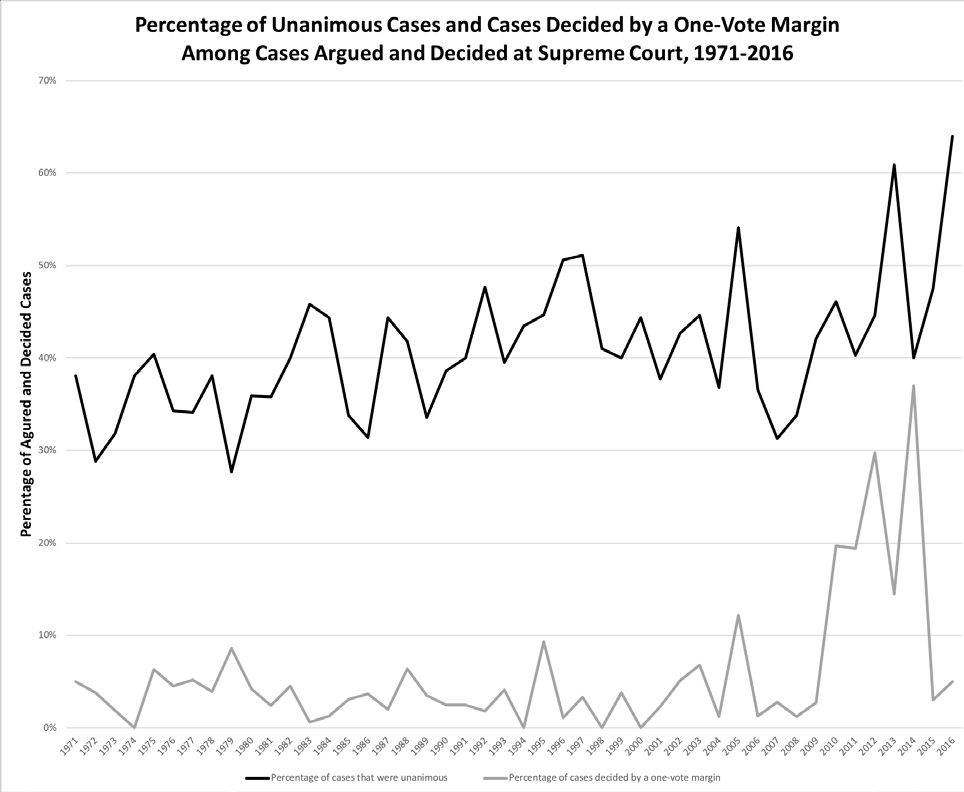
Bartels (2015) notes a “polarization paradox” whereby the percentage of 5–4 (or other one vote margin) Supreme Court decisions has been increasing at the same time that the percentage of unanimous opinions is increasing. Figure 2 shows both of these increases from 1971 to 2016 (Epstein et al. 2015, Washington University Law 2017). Note the sharp drop-off in one-margin decisions and sharp rise of unanimous decisions following the 2016 death of Justice Scalia, a temporary period of a 4–4 evenly divided partisan Supreme Court.

In fact, the Court wasn’t evenly divided during the interregnum between Scalia and Gorsuch. The only reliable conservative votes were those of Alito and Thomas. Kennedy and Roberts were swing votes, as discussed later in this post. Breyer, Ginsburg, Kagan, and Sotomayor formed a solid “liberal” bloc.

Moreover, Hasen’s figure 2 looks odd. Here it is:

Neither of the lines in Hasen’s figure 2 resembles, in shape, the results I derived from the Stat Packs at SCOTUSblog, which cover the 1995-2017 terms:

Unanimous decisions include all cases in which there was no dissenting vote, including per curiam decisions, even where the majority opinion was accompanied by one or more concurring opinions. Given the similarity of the two graphs with respect to unanimous opinions, that must be the definition used by Epstein et al. (the source of Hasen’s figure 2).

I am especially struck by the disparity between Hasen’s figure 2 and my graph with respect to the trend (or lack thereof) in decisions with a one-vote margin. (All such decisions during the 1995-2017 terms were by a 5-4 vote.) There is no “polarization paradox”. To the contrary — and as one would expect — there is a strong (though not perfect) negative relationship between unanimous and 5-4 decisions:

Color me unimpressed by Professor Hasen, at least on the evidence of “Polarization and the Judiciary”.

Just how polarized is the Court — or, rather, how polarized has it been recently? Quite polarized.

In “U.S. Supreme Court: Lines of Succession and Ideological Alignment“, I draw on the SCOTUSsblog Stat Packs to summarize the degree of disagreement among the various justices in non-unanimous cases during each of the Court’s past 13 terms. (The use of non-unanimous cases highlights the degree of disagreement among justices, which would be blurred if all cases were included in the analysis.) The statistics yield an index of polarization (P) for each justice, by term:

P = maximum percentage of non-unanimous cases in which a justice disagreed with any other justice during the term

Graphically:

A slight upward trend over the past 13 terms? Perhaps. But trend or no trend, it’s clear that there has been a great deal of polarization among most of the justices. Roberts joined Kennedy in the middle during the past four terms, but there have been (at least) seven highly polarized justices on the Court. In the past two terms, it has been Alito, Gorsuch, and Thomas (on the right) against Breyer, Ginsburg, Kagan, and Sotomayor (on the left).

I relish the hope that Kavanaugh will shore up the right. Now, if Roberts would only revert to his 2005-2013 form….

Saving the Innocent, Revisited

Paul Cassell, writing at The Volokh Conspiracy, offers statistical evidence about the wrongful conviction rate:

Justice Scalia cited a figure of 0.027% as a possible error rate. But the conventional view in the literature is that, for violent crimes, the error rate is much higher—at least 1%, and perhaps as high as 4% or even more.

My article suggests a much lower estimate is appropriate. Based on a careful review of the available empirical literature, it is possible to assemble the component parts of a wrongful conviction rate calculation by looking at error rates at trial, the ratio of wrongful convictions obtained through trials versus plea bargains, and the percentage of cases resolved through pleas. Combining empirically based estimates for each of these three factors, a reasonable (and possibly overstated) calculation of the wrongful conviction rate appears, tentatively, to be somewhere in the range of 0.016%–0.062%—a range that comfortably embraces Justice Scalia’s often-criticized figure.

This reminds me of a pair of posts from 13 years ago, which I combine below, with minor editing.

*    *     *

Better that ten guilty persons escape than that one innocent suffer.

— English jurist William Blackstone


“n” — the number of guilty persons — has increased since the late 1700s, when Blackstone wrote. Alexander “Sasha” Volokh offers some useful perspective:

Charles Dickens generously endorsed a value of n = “hundreds” for capital cases, and not just “that hundreds of guilty persons should escape,” but that they should escape “scot-free.” Dickens was, in fact, so generous that hundreds of guilty persons escaping scot-free was not only better than one innocent person suffering — it was even better “than that the possibility of any innocent man or woman having been sacrificed, should present itself, with the least appearance of reason, to the minds of any class of men!”…

Of course, such blithe invocation could easily lead too far down the road to “inconsiderate folly” and “pestiferous nonsense.” As one author noted, there is “nothing so dangerous as a maxim”:

Better that any number of savings-banks be robbed than that one innocent person be condemned as a burglar! Better that any number of innocent men, women, and children should be waylaid, robbed, ravished, and murdered by wicked, wilful, and depraved malefactors, than that one innocent person should be convicted and punished for the perpetration of one of this infinite multitude of crimes, by an intelligent and well-meaning though mistaken court and jury! Better any amount of crime than one mistake in well-meant endeavors to suppress or prevent it!…

Jeremy Bentham, founder of utilitarianism, warned against the warm fuzzy feeling that comes from large values of n:

We must be on guard against those sentimental exaggerations which tend to give crime impunity, under the pretext of insuring the safety of innocence. Public applause has been, so to speak, set up to auction. At first it was said to be better to save several guilty men, than to condemn a single innocent man; others, to make the maxim more striking, fix the number ten; a third made this ten a hundred, and a fourth made it a thousand. All these candidates for the prize of humanity have been outstripped by I know not how many writers, who hold, that, in no case, ought an accused person to be condemned, unless evidence amount to mathematical or absolute certainty. According to this maxim, nobody ought to be punished, lest an innocent man be punished….

James Fitzjames Stephen suggested that Blackstone’s maxim

resembles a suggestion that soldiers should be armed with bad guns because it is better that they should miss ten enemies than that they should hit one friend. . . . Everything depends on what the guilty men have been doing, and something depends on the way in which the innocent man came to be suspected….

The story is told of a Chinese law professor, who was listening to a British lawyer explain that Britons were so enlightened, they believed it was better that ninety-nine guilty men go free than that one innocent man be executed. The Chinese professor thought for a second and asked, “Better for whom?”

That’s the question, isn’t it? Better for whom? It’s better for the guilty, who may claim more victims, but certainly not better for those victims.

Now I read this (on July 27, 2005):

[Texas] Gov. Rick Perry changed the 28 sentences to life in prison after the Supreme Court ruled that juveniles cannot be executed because of the Eighth Amendment ban on cruel and unusual punishment.

History shows release is possible for some of them.

Death penalties [in Texas] were halted for four years after the 1972 Supreme Court decision in Furman vs. Georgia.

According to state prison records reviewed by The Dallas Morning News, 40 of the 47 Texas inmates who left death row then have been released from prison.

Two died in prison and five remain behind bars.

At least two who were released killed again. One was Kenneth McDuff, who was convicted in 1992 for killing two women. He was executed in 1998.

Of the 40 who were released, 22 committed new offenses ranging from misdemeanors to murder. About half of those paroled returned to prison because of new crimes or violations of parole. Many led quiet lives.

Evidently, in our “enlightened” society, it is better that many innocent persons be victimized so that some murderers can lead “quiet lives.”

The Decline of Collegiality

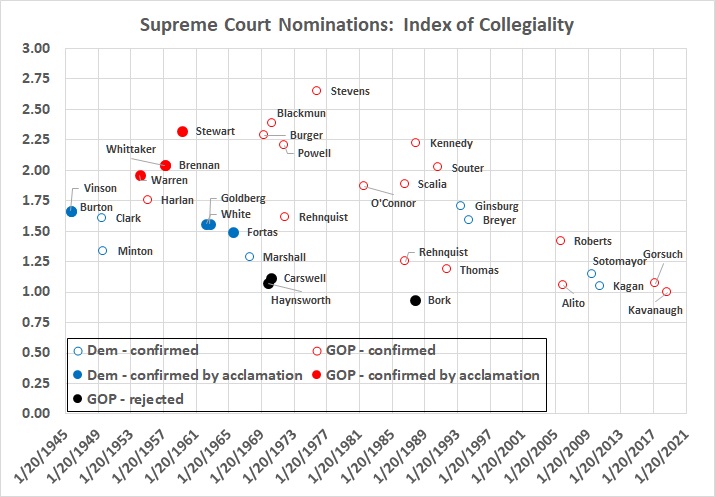
Since the end of World War II there have been 35 floor votes in the Senate to confirm or reject Supreme Court nominees. Unsurprisingly, the outcome of the 35 votes reveals a striking decline in the Senate’s collegiality.

To quantify the decline, I constructed an index of collegiality (C):

C = Fraction of votes in favor of confirming a nominee/fraction of Senate seats held by the nominating president’s party

A C score greater than 1 implies some degree of (net) support from the opposing party. The higher the C score, the greater the degree of support from the opposing party.

Examples:

  1. Tom Clark, nominated by Democrat Harry Truman, was confirmed on August 18, 1949, by a vote of 73-8; that is, he received 90 percent of the votes cast. Democrats then held a 54-42 majority in the Senate, just over 56 percent of the Senate’s 96 seats. Dividing Clark’s share of the vote by the Democrats’ share of Senate seats yields C = 1.60. Clark, in other words, received 1.6 times the number of votes controlled by the party of the nominating president.
  2. Samuel Alito, nominated by Republican George W. Bush, was confirmed on January 31, 2006, by a vote of 58-42; that is, he received 58 percent of the votes cast. Republicans then held 55 percent of the Senate’s 100 seats. The C score for Alito’s nomination is 1.05 (0.58/0.55).

Nine nominees were approved by acclamation, that is, by a unanimous voice vote. In such cases, the value of the numerator in C is 1. But C varies, even in cases of acclamation, because of variations in the fraction of seats held by the party of the nominating president. In any event, the last confirmation by acclamation was in 1965 — an ill omen for collegiality.

Three nominations were rejected in an “up or down” vote. (Several others failed, by withdrawal or lack of cloture, before reaching a final vote.) Two of the rejections were of Nixon nominees: Clement Haynsworth (1969) and G. Harold Carswell (1970). One was a Reagan nominee: Robert Bork (1987). Because the GOP held such a small fraction of Senate seats in 1969 and 1970, the C values for Haynsworth and Carswell actually exceed 1. But Bork was so roundly defeated that the C value for his nomination is less than 1 — the only such case. Kavanaugh’s nomination came close, at 1.004 — the lowest C value for a confirmation in the past 73 years.

All of this, and more, is captured in the following graph:

C peaked in 1975 with the confirmation of John Paul Stevens, a nominee of Republican Gerald Ford. (One of many disastrous nominations by GOP presidents.) It has gone downhill since then. The treatment of Brett Kavanaugh caps four decades of generally declining collegiality.

The decline began in Reagan’s presidency, and gained momentum in the presidency of Bush Sr. Clinton’s nominees fared about as well (or badly) as those of his two predecessors. But new lows (for successful nominations) were reached during the presidencies of Bush Jr., Obama, and Trump.

None of this is surprising given the deterioration of political discourse over the past several decades — and especially given the demonization of Republicans by Democrats and their allies in the media. What is surprising — gratifying, really — is that Republicans seem to be waking up to the fact that playing Mr. Nice Person will not win them any points with Democrats, the media, or their base.

The only way to win, in the present and foreseeable political climate, is to fight hard, and fight to the bitter (or sweet) end.


Related pages and posts:

Constitution: Myths and Realities (see especially “The Framers’ Fatal Error”)
Leftism
Spygate
U.S. Supreme Court: Lines of Succession and Ideological Alignmen

Liberty and Society
The Eclipse of “Old America”
Genetic Kinship and Society
America: Past, Present, and Future
IQ, Political Correctness, and America’s Present Condition
The Barbarians Within and the State of the Union
The World Turned Upside Down
The View from Here
“We the People” and Big Government
The Culture War
The Fall and Rise of American Empire
O Tempora O Mores!
Presidential Treason
A Home of One’s Own
The Criminality and Psychopathy of Statism
Decline
Two-Percent Tyranny
A Sideways Glance at Public “Education”
Greed, Conscience, and Big Government
Democracy, Human Nature, and the Future of America
1963: The Year Zero
The Beginning of the End of Liberty in America
Society
How Democracy Works
“Cheerful” Thoughts
How Government Subverts Social Norms
Turning Points
The Twilight’s Last Gleaming?
Polarization and De-facto Partition
How America Has Changed
Civil War?
Freedom of Speech and the Long War for Constitutional Governance
Retrospective Virtue-Signalling
The Left and Violence
Leftist Condescension
Red-Diaper Babies and Enemies Within
Equality
The Vast Left-Wing Conspiracy
Academic Freedom, Freedom of Speech, and the Demise of Civility
Leftism As Crypto-Fascism: The Google Paradigm
What Is Going On? A Stealth Revolution
Down the Memory Hole
“Why Can’t We All Just Get Along?”
Mass Murder: Reaping What Was Sown
“Democracy” Thrives in Darkness — and Liberty Withers
Preemptive (Cold) Civil War
The Framers, Mob Rule, and a Fatal Error
Whence Polarization?
Social Norms, the Left, and Social Disintegration
The Lesson of Alfie Evans
Can Left and Right Be Reconciled?
Freedom of Speech: Getting It Right
Justice Thomas on Masterpiece Cakeshop
Suicide or Destiny?
“Liberalism” and Virtue-Signaling
Freedom of Speech, to What End?
Conservatism vs. Ideology
O.J.’s Glove and the Enlightenment
James Burnham’s Misplaced Optimism
Where I Stand on Kavanaugh
No More SCOTUS “Swing Vote”? Good!

No More SCOTUS “Swing Vote”? Good!

NOTE: I HAVE UPDATED “U.S. SUPREME COURT: LINES OF SUCCESSION AND IDEOLOGICAL ALIGNMENT” TO REFLECT THE CONFIRMATION OF BRETT MICHAEL KAVANAUGH AS AN ASSOCIATE JUSTICE OF THE U.S. SUPREME COURT.

Justice Elena Kagan — voicing the fears of leftists — says this about the replacement of Anthony Kennedy by Brett Kavanaugh:

I think it’s been an extremely important thing for the court that in the last, really 30 years, starting with Justice O’Connor and continuing with Justice Kennedy, there has been a person who people — found the center where people couldn’t predict in that sort of way. And that’s enabled the court to look as though it was not owned by one side or another, and was indeed impartial and neutral and fair. And it’s not so clear that — I think, going forward, that sort of middle position — you know, it’s not so clear whether we’ll have it.

All of us need to be aware of that — every single one of us — and to realize how precious the court’s legitimacy is….

It’s an incredibly important thing for the court to guard is this reputation of being impartial, being neutral and not being simply an extension of a terribly polarizing process.

So the job of the Supreme Court isn’t to uphold the Constitution, but to find a middle ground between constitutional and anti-constitutional views.

I am hopeful — but not yet certain — that the addition of Justice Kavanaugh to the Court’s lineup will end the three decades of uncertainty praised by Kagan, and that it will put the Court back in the business of firmly upholding the Constitution. A business that it began to abandon in earnest during the New Deal.

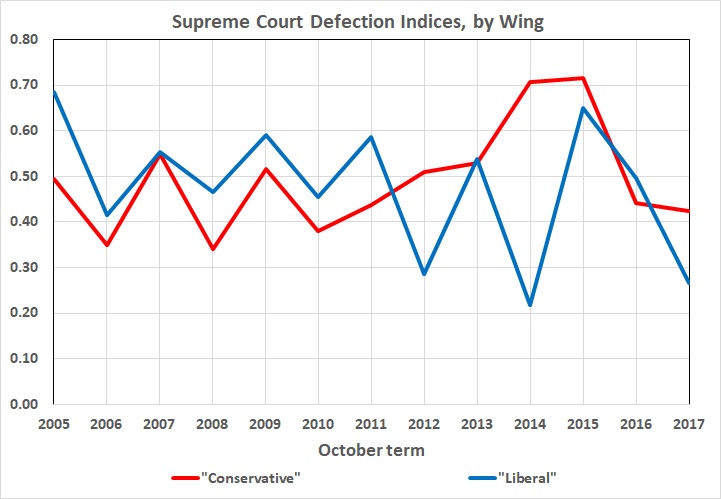
Drawing on statistics kept at SCOTUSblog, I have constructed an index of defection (D) for each justice, for the 2005-2017 terms:

D = percentage disagreement (in non-unanimous cases) with members of own wing/percentage disagreement with members of opposite wing.

The wings are the “conservative” wing (Gorsuch, Alito, Thomas, Scalia, Roberts, and Kennedy) and the “liberal” wing (Breyer, Ginsburg, Kagan, Sotomayor, Souter, and Stevens).

The lower the index, the more prone is a justice to vote with the other members of his or her wing; the higher the index, the more prone is a justice to vote with members of the opposing wing. Here’s a graph of the indices, by term:

Kennedy’s long-standing proneness to defect more often than his colleagues grew markedly in the 2014-2015 terms and receded a bit in the 2016 term. His turnaround in the 2017 term restored him to the Court’s “conservative” wing.

Roberts slipped a bit in the 2017 term but was still more in step with the “conservative” wing than he had been in the 2014-2015 terms.

Gorsuch started out strongly in his abbreviated 2016 term (he joined the Court in April 2017). His slippage in the 2017 term may have been due to the mix of cases at stake.

What’s most striking about the preceding graphs, other than Kennedy’s marked departure from the “conservative” wing after the 2010 term, is the increasing coherence (ideological, not logical) of the “liberal” wing. This graph captures the difference between the wings:

The record of the past six terms (2012-2017) is clear. The “liberals” stick together much more often than the “conservatives”. Perhaps that will change with Justice Kavanough on the Court.

New Pages

In case you haven’t noticed the list in the right sidebar, I have converted several classic posts to pages, for ease of access. Some have new names; many combine several posts on the same subject:

Abortion Q & A

Climate Change

Constitution: Myths and Realities

Economic Growth Since World War II

Intelligence

Keynesian Multiplier: Fiction vs. Fact

Leftism

Movies

Spygate

Freedom of Speech, to What End?

The left, in its drive to impose its agenda on the nation, has become censor-at-large. (See, for example, this, this, this, this, this, and this. Also, this, which addresses Google’s slanting of search results about climate research. YouTube is at it, too.)

If you have followed this blog for many years, you will know that I am not a free-speech absolutist. (See this, this, and this, for example.) Nor do I subscribe to the conceit that the “best” ideas will emerge triumphant in the so-called marketplace of ideas. (See this and this.) The “marketplace of ideas” ensures only that the most popular ideas or those with the strongest political backing will prevail. Nor is science immune to persistent error.

Regarding freedom of speech, I draw on James Burnham‘s The Struggle for the World:

Democracy in practice has never, and could never, interpret the right of free speech in an absolute and unrestricted sense. No one, for example, is allowed to advocate, and organize for, mass murder, rape, and arson. No one feels that such prohibitions are anti-democratic….

We may generalize as follows. The principles of an organized society cannot be interpreted in practice in such a way as to make organized society impossible. The special principles of a special form of government, in this case democratic government, cannot be interpreted in practice in such a way as to make that form of government impossible.

Here is Burnham again, in Suicide of the West:

Liberalism [of the kind that prevailed in the early 1960s] defines free speech and the related freedoms of assembly and association, as it does “peace” and “disarmament,” in abstraction, without tying them to specific persons and circumstance. For liberalism, these freedoms are the procedural rules sustaining a democratic society that rests on the will of the majority and solves its internal conflicts of interest and opinion through continuous discussion, negotiation and compromise. But this meaning of free speech and the related freedoms is significant and operable only for those who share the wish or at least willingness to have and preserve some sort of free and constitutional society. For those others— and they are not few among us— whose aim is to subvert, overthrow and replace free and constitutional society, these freedoms of speech, assembly and the rest are merely convenient levers to use in accomplishing their purpose.

The liberal ideologue is thus caught in the inescapable dilemma of his own making that we have previously examined. If he extends the freedoms to the subverters, they will use them, as they have done in one nation after another, to throw the free society into turmoil and in the end to destroy it. But if he denies the freedoms to anyone, he will feel, does feel, that he has betrayed his own principles, “imitated the methods of the enemy,” and thus joined the company of subverters. So, when a showdown with the subverters comes, as it comes from time to time to all nations, the liberals are demoralized in advance, if they do finally forget ideology and decide to resist, by the guilt generated from this feeling of self-betrayal. Let us note that this is a purely ideological trap. Common sense, unlike ideology, understands that you can play a game only with those who accept the rules; and that the rules’ protection does not cover anyone who does not admit their restrictions and penalties.

Bear in mind that Burnham was writing when “liberals” actually subscribed to the notion of unfettered speech — in principle, at least. The ACLU, a leading “liberal” institution, had consistently defended the speech rights of so-called hate groups and political figures deemed unpalatable by the left. I say “had” because the ACLU has joined the ban-wagon against “hate” speech, that is, speech which offends the sensitivities of “liberals”.

If there is one idea that today’s “liberals” (leftists) share with conservatives, it is that absolute freedom of speech can undermine liberty. The rub is that leftists mean something other than liberty when they use the word. Their idea of liberty includes, among many anti-libertarian things (e.g., coerced redistribution of income), the rejection and suppression of facts and opinions just because they are disagreeable to the left. (In addition to the items linked to in the first paragraph, see this item about the reaction to the mayor of Chicago’s statement about the cause of the high homicide rate in his city, and this small sample of relevant posts: here, here, here, here, here, and here.)

In sum, the left’s stance on freedom of speech has nothing to do with the preservation of liberty and everything to do with the advancement of an anti-libertarian agenda.

Here’s the game plan:

  • Define opposition to illegal immigration, Islamic terrorism, same-sex marriage, transgenderism, and other kinds violent and anti-social behavior as “hate“.
  • Associate “hate” with conservatism.
  • Watch as normally conservative politicians, business people, and voters swing left rather than look “mean” and put up a principled fight for conservative values.
  • Watch as Democrats play the “hate” card to retake the White House and Congress.

With the White House in the hands of a left-wing Democrat (is there any other kind now?) and an aggressive left-wing majority in Congress, freedom of speech, freedom of association, and property rights will become not-so-distant memories. “Affirmative action” (a.k.a. “diversity”) will be enforced on an unprecedented scale of ferocity. The nation will become vulnerable to foreign enemies while billions of dollars are wasted on the hoax of catastrophic anthropogenic global warming and “social services” for the indolent. The economy, already buckling under the weight of statism, will teeter on the brink of collapse as the regulatory regime goes into high gear and entrepreneurship is all but extinguished by taxation and regulation.

All of that will be secured by courts dominated by left-wing judges — from here to eternity.

The left’s game plan is threatened by those who speak against illegal immigration, Islamic terrorism, etc.; for freedom of association, property rights, etc.; and for the right to speak about such things. Thus the left’s virulent, often violent, and increasingly conspiratorial attacks on conservatives and the suppression of conservative discourse.

This all came to pass because of free-speech absolutism. Unfettered speech isn’t necessary to liberty. In fact, it can undermine it, given that liberty, properly understood, is not a spiritual state of bliss. It is, as I have written,

a modus vivendi, not the result of a rational political scheme. Though a rational political scheme, such as the one laid out in the Constitution of the United States, could promote liberty.

The key to a libertarian modus vivendi is the evolutionary development and widespread observance of social norms that foster peaceful coexistence and mutually beneficial cooperation.

Unfettered speech, obviously, can undermine the modus vivendi. It can do so directly, by shredding social norms — the bonds of mutual trust, respect, and forbearance that underlie the modus vivendi that is liberty. And it can do so indirectly by subverting the institutions that preserve the modus vivendi. One of those institutions, in the United States, is the rule of law under a Constitution that was meant to limit the power of government, leaving people free to govern themselves in accordance with the norms of civil society. The steady rise of governmental power has in fact shredded social norms and subverted civil society. Which is precisely what the left wants, so that it can remake “society” to its liking.

It follows, therefore, that liberty can be rescued only by suppressing the left’s anti-libertarian actions. If that seems anti-libertarian, I refer you back to James Burnham.

Winning and preserving liberty is not for the faint of heart, or for free-speech absolutists whose rationalism clouds their judgment. They are morally equivalent to pacifists who declare that preemptive war is always wrong, and who would wait until the enemy has struck a mortal blow before acting against the enemy — if then.

The left is at war against liberty, and has been for a long time. Preemptive war against the left is therefore long overdue. If the left wins, will there be freedom of speech and a “marketplace of ideas” (however flawed)? Of course not.

Ironically, leftists subscribe to the view that “extremist ideas” should be suppressed. This is from a piece at The Verge by Laura Hudson (writing before Twitter joined the ban-wagon against Alex Jones):

While many, including [Jack] Dorsey [co-founder of Twitter] seem to fear that striking Jones down from media platforms will only make him more powerful, media manipulation research lead Joan Donovan at the research institute Data & Society tells The Verge that throughout her work, she has observed the opposite: once you remove the biggest megaphones from bad actors, their power diminishes and their ability to attract larger audiences and sow disinformation decreases. Instead of promoting no-holds-barred speech, he might instead embrace the principle suggested by Boyd and Donovan in their case for quarantining extremist ideas: “all Americans have the right to speak their minds, but not every person deserves to have their opinions amplified, particularly when their goals are to sow violence, hatred and chaos.”

The second link in that quotation leads to an article at The Guardian by Arwa Mahdawi. She begins with the American Nazi Party of George Lincoln Rockwell:

Campus by campus, from Harvard to Brown to Columbia, [Rockwell] would use the violence of his ideas and brawn of his followers to become headline news. To compel media coverage….

Contemporary Jewish community groups challenged journalists to consider not covering white supremacists’ ideas. They called this strategy “quarantine”….

In regions where quarantine was deployed successfully, violence remained minimal and Rockwell was unable to recruit new party members….

Strategic silence is not a new idea. The Ku Klux Klan of the 1920s considered media coverage their most effective recruitment tactic and accordingly cultivated friendly journalists. According to Felix Harcourt, thousands of readers joined the KKK after the New York World ran a three-week chronicle of the group in 1921. Catholic, Jewish and black presses of the 1920s consciously differed from Protestant-owned mainstream papers in their coverage of the Klan, conspicuously avoiding giving the group unnecessary attention. The black press called this use of editorial discretion in the public interest “dignified silence”, and limited their reporting to KKK follies, such as canceled parades, rejected donations and resignations. Some mainstream journalists also grew suspicious of the KKK’s attempts to bait them with camera-ready spectacles. Eventually coverage declined….

The emphasis of strategic silence must be placed on the strategic over the silencing. Every story requires a choice and the recent turn toward providing equal coverage to dangerous, antisocial opinions requires acknowledging the suffering that such reporting causes. Even attempts to cover extremism critically can result in the media disseminating the methods that hate groups aim to spread, such as when Virginia’s Westmoreland News reproduced in full a local KKK recruitment flier on its front page. Media outlets who cannot argue that their reporting benefits the goal of a just and ethical society must opt for silence.

Newsrooms must understand that even with the best of intentions, they can find themselves being used by extremists. By contrast, they must also understand they have the power to defy the goals of hate groups by optimizing for core American values of equality, respect and civil discourse. All Americans have the right to speak their minds, but not every person deserves to have their opinions amplified, particularly when their goals are to sow violence, hatred and chaos [emphasis added].

I agree completely with the italicized passage. Leftists are violent and hateful toward those who disagree with them. Their return to power and the success of their agenda, which may not be far away, will result in the complete destruction of the social norms and civilizing institutions that held this country more or less together between the end of the Civil War and the 1960s. The left’s return to power will result in the suppression and criminalization of anything and anyone standing in the way of its destructive agenda.

Will a new (shooting) civil war result if (when) the left takes full control of the central government? There is much talk about the possibility, accompanied by inflated rhetoric about the people with guns (mainly conservatives) “kicking ass” of the people without guns (mainly leftists). But that is wishful and possibly suicidal thinking. If a new (shooting) civil war comes it will come only after the left has assumed control of the central government and begun its reign of terror. It will then control surveillance systems, troops, and weapons for which a mostly untrained “army” of rifle-toting patriots will be no match. Terrorist acts by the patriots, unless carefully aimed at government installations and troops actually engaged in suppressive operations, will only backfire and cause the silent majority to scurry into the protective arms of the central government.

I counsel a step back from the brink of civil war. But it’s a step that can be taken only while there is a Republican president in the White House. The left is right about strategic silence. And it works both ways. The left’s censorious ways must be , for liberty’s sake. Here is how to do it, constitutionally.

Not-So-Random Thoughts (XXII)

This is a long-overdue entry; the previous one was posted on October 4, 2017. Accordingly, it is a long entry, consisting of these parts:

Censorship and Left-Wing Bias on the Web

The Real Collusion Story

“Suicide” of the West

Evolution, Intelligence, and Race

Will the Real Fascists Please Stand Up?

Consciousness

Empathy Is Over-Rated

“Nudging”


CENSORSHIP AND LEFT-WING BIAS ON THE WEB

It’s a hot topic these days. See, for example, this, this, this, this, and this. Also, this, which addresses Google’s slanting of search results about climate research. YouTube is at it, too.

A lot of libertarian and conservative commentators are loath to demand governmental intervention because the censorship is being committed by private companies: Apple, Facebook, Google, Twitter, YouTube, et al. Some libertarians and conservatives are hopeful that libertarian-conservative options will be successful (e.g., George Gilder). I am skeptical. I have seen and tried some of those options, and they aren’t in the same league as the left-wingers, which have pretty well locked up users and advertisers. (It’s called path-dependence.) And even if they finally succeed in snapping up a respectable share of the information market, the damage will have been done; libertarians and conservatives will have been marginalized, criminalized, and suppressed.

The time to roll out the big guns is now, as I explain here:

Given the influence that Google and the other members of the left-wing information-technology oligarchy exert in this country, that oligarchy is tantamount to a state apparatus….

These information-entertainment-media-academic institutions are important components of what I call the vast left-wing conspiracy in America. Their purpose and effect is the subversion of the traditional norms that made America a uniquely free, prosperous, and vibrant nation….

What will happen in America if that conspiracy succeeds in completely overthrowing “bourgeois culture”? The left will frog-march America in whatever utopian direction captures its “feelings” (but not its reason) at the moment…

Complete victory for the enemies of liberty is only a few election cycles away. The squishy center of the American electorate — as is its wont — will swing back toward the Democrat Party. With a Democrat in the White House, a Democrat-controlled Congress, and a few party switches in the Supreme Court, the dogmas of the information-entertainment-media-academic complex will become the law of the land….

[It is therefore necessary to] enforce the First Amendment against information-entertainment-media-academic complex. This would begin with action against high-profile targets (e.g., Google and a few large universities that accept federal money). That should be enough to bring the others into line. If it isn’t, keep working down the list until the miscreants cry uncle.

What kind of action do I have in mind?…

Executive action against state actors to enforce the First Amendment:

Amendment I to the Constitution says that “Congress shall make no law … abridging the freedom of speech”.

Major entities in the telecommunications, news, entertainment, and education industries have exerted their power to suppress speech because of its content. (See appended documentation.) The collective actions of these entities — many of them government- licensed and government-funded — effectively constitute a governmental violation of the Constitution’s guarantee of freedom of speech (See Smith v. Allwright, 321 U.S. 649 (1944) and Marsh v. Alabama, 326 U.S. 501 (1946).)

And so on. Read all about it here.


THE REAL COLLUSION STORY

Not quite as hot, but still in the news, is Spygate. Collusion among the White House, CIA, and FBI (a) to use the Trump-Russia collusion story to swing the 2016 election to Clinton, and (b) failing that, to cripple Trump’s presidency and provide grounds for removing him from office. The latest twist in the story is offered by Byron York:

Emails in 2016 between former British spy Christopher Steele and Justice Department official Bruce Ohr suggest Steele was deeply concerned about the legal status of a Putin-linked Russian oligarch, and at times seemed to be advocating on the oligarch’s behalf, in the same time period Steele worked on collecting the Russia-related allegations against Donald Trump that came to be known as the Trump dossier. The emails show Steele and Ohr were in frequent contact, that they intermingled talk about Steele’s research and the oligarch’s affairs, and that Glenn Simpson, head of the dirt-digging group Fusion GPS that hired Steele to compile the dossier, was also part of the ongoing conversation….

The newly-released Ohr-Steele-Simpson emails are just one part of the dossier story. But if nothing else, they show that there is still much for the public to learn about the complex and far-reaching effort behind it.

My take is here. The post includes a long list of related — and enlightening — reading, to which I’ve just added York’s piece.


“SUICIDE” OF THE WEST

Less “newsy”, but a hot topic on the web a few weeks back, is Jonah Goldberg’s Suicide of the West. It received mixed reviews. It is also the subject of an excellent non-review by Hubert Collins.

Here’s my take:

The Framers held a misplaced faith in the Constitution’s checks and balances (see Madison’s Federalist No. 51 and Hamilton’s Federalist No. 81). The Constitution’s wonderful design — containment of a strictly limited central government through horizontal and vertical separation of powers — worked rather well until the Progressive Era. The design then cracked under the strain of greed and the will to power, as the central government began to impose national economic regulation at the behest of muckrakers and do-gooders. The design then broke during the New Deal, which opened the floodgates to violations of constitutional restraint (e.g., Medicare, Medicaid, Obamacare,  the vast expansion of economic regulation, and the destruction of civilizing social norms), as the Supreme Court has enabled the national government to impose its will in matters far beyond its constitutional remit.

In sum, the “poison pill” baked into the nation at the time of the Founding is human nature, against which no libertarian constitution is proof unless it is enforced resolutely by a benign power.

See also my review essay on James Burnham’s Suicide of the West: An Essay on the Meaning and Destiny of Liberalism.


EVOLUTION, INTELLIGENCE, AND RACE

Evolution is closely related to and intertwined with intelligence and race. Two posts and a page of mine (here, here, and here) delve some of the complexities. The latter of the two posts draws on David Stove‘s critique of evolutionary theory, “So You Think You Are a Darwinian?“.

Fred Reed is far more entertaining than Stove, and no less convincing. His most recent columns on evolution are here and here. In the first of the two, he writes this:

What are some of the problems with official Darwinism? First, the spontaneous generation of life has not been replicated…. Nor has anyone assembled in the laboratory a chemical structure able to metabolize, reproduce, and thus to evolve. It has not been shown to be mathematically possible….

Sooner or later, a hypothesis must be either confirmed or abandoned. Which? When? Doesn’t science require evidence, reproducibility, demonstrated theoretical possibility? These do not exist….

Other serious problems with the official story: Missing intermediate fossils–”missing links”– stubbornly remain missing. “Punctuated equilibrium,” a theory of sudden rapid evolution invented to explain the lack of fossil evidence, seems unable to generate genetic information fast enough. Many proteins bear no resemblance to any others and therefore cannot have evolved from them. On and on.

Finally, the more complex an event, the less likely it is to  occur by chance. Over the years, cellular mechanisms have been found to be  ever more complex…. Recently with the discovery of epigenetics, complexity has taken a great leap upward. (For anyone wanting to subject himself to such things, there is The Epigenetics Revolution. It is not light reading.)

Worth noting is that  that the mantra of evolutionists, that “in millions and millions and billions of years something must have evolved”–does not necessarily hold water. We have all heard of Sir James Jeans assertion that a monkey, typing randomly, would eventually produce all the books in the British Museum. (Actually he would not produce a single chapter in the accepted age of the universe, but never mind.) A strong case can be made that spontaneous generation is similarly of mathematically vanishing probability. If evolutionists could prove the contrary, they would immensely strengthen their case. They haven’t….

Suppose that you saw an actual monkey pecking at a keyboard and, on examining his output, saw that he was typing, page after page, The Adventures of Tom Sawyer, with no errors.

You would suspect fraud, for instance that the typewriter was really a computer programmed with Tom. But no, on inspection you find that it is a genuine typewriter. Well then, you think, the monkey must be a robot, with Tom in RAM. But  this too turns out to be wrong: The monkey in fact is one. After exhaustive examination, you are forced to conclude that Bonzo really is typing at random.

Yet he is producing Tom Sawyer. This being impossible, you would have to conclude that something was going on that you did not understand.

Much of biology is similar. For a zygote, barely visible, to turn into a baby is astronomically improbable, a suicidal assault on Murphy’s Law. Reading embryology makes this apparent. (Texts are prohibitively expensive, but Life Unfolding serves.) Yet every step in the process is in accord with chemical principles.

This doesn’t make sense. Not, anyway, unless one concludes that something deeper is going on that we do not understand. This brings to mind several adages that might serve to ameliorate our considerable arrogance. As Haldane said, “The world is not only queerer than we think, but queerer than we can think.” Or Fred’s Principle, “The smartest of a large number of hamsters is still a hamster.”

We may be too full of ourselves.

On the subject of race, Fred is no racist, but he is a realist; for example:

We have black football players refusing to stand for the national anthem.  They think that young black males are being hunted down by cops. Actually of  course black males are hunting each other down in droves but black football players apparently have no objection to this. They do not themselves convincingly suffer discrimination. Where else can you get paid six million green ones a year for grabbing something and running? Maybe in a district of jewelers.

The non-standing is racial hostility to whites. The large drop in attendance of games, of television viewership, is racial blowback by whites. Millions of whites are thinking, that, if America doesn’t suit them, football players can afford a ticket to Kenya. While this line of reasoning is tempting, it doesn’t really address the problem and so would be a waste of time.

But what, really, is the problem?

It is one that dare not raise its head: that blacks cannot compete with whites, Asians, or Latin-Americans. Is there counter-evidence? This leaves them in an incurable state of resentment and thus hostility. I think we all know this: Blacks know it, whites know it, liberals know it, and conservatives know it. If any doubt this, the truth would be easy enough to determine with carefully done tests. [Which have been done.] The furious resistance to the very idea of measuring intelligence suggests awareness of the likely outcome. You don’t avoid a test if you expect good results.

So we do nothing while things worsen and the world looks on astounded. We have mob attacks by Black Lives Matter, the never-ending Knockout Game, flash mobs looting stores and subway trains, occasional burning cities, and we do nothing. Which makes sense, because there is nothing to be done short of restructuring the country.

Absolute, obvious, unacknowledged disaster.

Regarding which: Do we really want, any of us, what we are doing? In particular, has anyone asked ordinary blacks, not black pols and race hustlers. “Do you really want to live among whites, or would you prefer a safe middle-class black neighborhood? Do your kids want to go to school with whites? If so, why? Do you want them to? Why? Would you prefer black schools to decide what and how to teach your children? Keeping whites out of it? Would you prefer having only black police in your neighborhood?”

And the big one: “Do you, and the people you actually know in your neighborhood, really want integration? Or is it something imposed on you by oreo pols and white ideologues?”

But these are things we must never think, never ask.

Which brings me to my most recent post about blacks and crime, which is here. As for restructuring the country, Lincoln saw what was needed.

The touchy matter of intelligence — its heritability and therefore its racial component — is never far from my thoughts. I commend to you Gregory Hood’s excellent piece, “Forbidden Research: How the Study of Intelligence is Crippled by Ideology“. Hood mentions some of the scientists whose work I have cited in my writings about intelligence and its racial component. See this page, for example, which give links to several related posts and excerpts of relevant research about intelligence. (See also the first part of Fred Reed’s post “Darwin’s Vigilantes, Richard Sternberg, and Conventional Pseudoscience“.)

As for the racial component, my most recent post on the subject (which provides links to related posts) addresses the question “Why study race and intelligence?”. Here’s why:

Affirmative action and similar race-based preferences are harmful to blacks. But those preferences persist because most Americans do not understand that there are inherent racial differences that prevent blacks, on the whole, from doing as well as whites (and Asians) in school and in jobs that require above-average intelligence. But magical thinkers (like [Professor John] McWhorter) want to deny reality. He admits to being driven by hope: “I have always hoped the black–white IQ gap was due to environmental causes.”…

Magical thinking — which is rife on the left — plays into the hands of politicians, most of whom couldn’t care less about the truth. They just want the votes of those blacks who relish being told, time and again, that they are “down” because they are “victims”, and Big Daddy government will come to their rescue. But unless you are the unusual black of above-average intelligence, or the more usual black who has exceptional athletic skills, dependence on Big Daddy is self-defeating because (like a drug addiction) it only leads to more of the same. The destructive cycle of dependency can be broken only by willful resistance to the junk being peddled by cynical politicians.

It is for the sake of blacks that the truth about race and intelligence ought to be pursued — and widely publicized. If they read and hear the truth often enough, perhaps they will begin to realize that the best way to better themselves is to make the best of available opportunities instead of moaning abut racism and relying on preferences and handouts.


WILL THE REAL FASCISTS PLEASE STAND UP?

I may puke if I hear Trump called a fascist one more time. As I observe here,

[t]he idea … that Trump is the new Hitler and WaPo [The Washington Post] and its brethren will keep us out of the gas chambers by daring to utter the truth (not)…. is complete balderdash, inasmuch as WaPo and its ilk are enthusiastic hand-maidens of “liberal” fascism.

“Liberals” who call conservatives “fascists” are simply engaging in psychological projection. This is a point that I address at length here.

As for Mr. Trump, I call on Shawn Mitchell:

A lot of public intellectuals and writers are pushing an alarming thesis: President Trump is a menace to the American Republic and a threat to American liberties. The criticism is not exclusively partisan; it’s shared by prominent conservatives, liberals, and libertarians….

Because so many elites believe Trump should be impeached, or at least shunned and rendered impotent, it’s important to agree on terms for serious discussion. Authoritarian means demanding absolute obedience to a designated authority. It means that somewhere, someone, has unlimited power. Turning the focus to Trump, after 15 months in office, it’s impossible to assign him any of those descriptions….

…[T]here are no concentration camps or political arrests. Rather, the #Resistance ranges from fervent to rabid. Hollywood and media’s brightest stars regularly gather at galas to crudely declare their contempt for Trump and his deplorable supporters. Academics and reporters lodged in elite faculty lounges and ivory towers regularly malign his brains, judgment, and temperament. Activists gather in thousands on the streets to denounce Trump and his voters. None of these people believe Trump is an autocrat, or, if they do they are ignorant of the word’s meaning. None fear for their lives, liberty, or property.

Still, other elites pile on. Federal judges provide legal backup, contriving frivolous theories to block administrations moves. Some rule Trump lacks even the authority to undo by executive order things Obama himself introduced by executive order. Governors from states like California, Oregon and New York announce they will not cooperate with administration policy (current law, really) on immigration, the environment, and other issues.

Amidst such widespread rebellion, waged with impunity against the constitutionally elected president, the critics’ dark warnings that America faces a dictator are more than wrong; they are surreal and damnable. They are what amounts to the howl of that half the nation still refusing to accept election results it dislikes.

Conceding Trump lacks an inmate or body count, critics still offer theories to categorize him in genus monsterus. The main arguments cite Trump’s patented belligerent personality and undisciplined tweets, his use of executive orders; his alleged obstruction in firing James Comey and criticizing Robert Mueller, his blasts at the media, and his immigration policies. These attacks weigh less than the paper they might be printed on.

Trump’s personality doubtless is sui generis for national office. If he doesn’t occasionally offend listeners they probably aren’t listening. But so what? Personality is not policy. A sensibility is not a platform, and bluster and spittle are not coercive state action. The Human Jerk-o-meter could measure Trump in the 99th percentile, and the effect would not change one law, eliminate one right, or jail one critic.

Executive Orders are misunderstood. All modern presidents used them. There is nothing wrong in concept with executive orders. Some are constitutional some are not. What matters is whether they direct executive priorities within U.S. statutes or try to push authority beyond the law to change the rights and duties of citizens. For example, a president might order the EPA to focus on the Clean Air Act more than the Clean Water Act, or vice versa. That is fine. But, if a president orders the EPA to regulate how much people can water their lawns or what kind of lawns to plant, the president is trying to legislate and create new controls. That is unconstitutional.

Many of Obama’s executive orders were transgressive and unconstitutional. Most of Trump’s executive orders are within the law, and constitutional. However that debate turns out, though, it is silly to argue the issue implicates authoritarianism.

The partisan arguments over Trump’s response to the special counsel also miss key points. Presidents have authority to fire subordinates. The recommendation authored by Deputy Attorney General Rod Rosenstein provides abundant reason for Trump to have fired James Comey, who increasingly is seen as a bitter anti-Trump campaigner. As for Robert Mueller, criticizing is not usurping. Mueller’s investigation continues, but now readily is perceived as a target shoot, unmoored from the original accusations about Russia, in search of any reason to draw blood from Trump. Criticizing that is not dictatorial, it is reasonable.

No doubt Trump criticizes the media more than many modern presidents. But criticism is not oppression. It attacks not freedom of the press but the credibility of the press. That is civically uncomfortable, but the fact is, the war of words between Trump and the media is mutual. The media attacks Trump constantly, ferociously and very often inaccurately as Mollie Hemingway and Glenn Greenwald document from different political perspectives. Trump fighting back is not asserting government control. It is just challenging media assumptions and narratives in a way no president ever has. Reporters don’t like it, so they call it oppression. They are crybabies.

Finally, the accusation that Trump wants to enforce the border under current U.S. laws, as well as better vet immigration from a handful of failed states in the Middle East with significant militant activity hardly makes him a tyrant. Voters elected Trump to step up border enforcement. Scrutinizing immigrants from a handful of countries with known terrorist networks is not a “Muslim ban.” The idea insults the intelligence since there are about 65 majority Muslim countries the order does not touch.

Trump is not Hitler. Critics’ attacks are policy disputes, not examples of authoritarianism. The debate is driven by sore losers who are willing to erode norms that have preserved the republic for 240 years.

Amen.


CONSCIOUSNESS

For a complete change of pace I turn to a post by Bill Vallicella about consciousness:

This is an addendum to Thomas Nagel on the Mind-Body Problem. In that entry I set forth a problem in the philosophy of mind, pouring it into the mold of an aporetic triad:

1) Conscious experience is not an illusion.

2) Conscious experience has an essentially subjective character that purely physical processes do not share.

3) The only acceptable explanation of conscious experience is in terms of physical properties alone.

Note first that the three propositions are collectively inconsistent: they cannot all be true.  Any two limbs entail the negation of the remaining one. Note second that each limb exerts a strong pull on our acceptance. But we cannot accept them all because they are logically incompatible.

This is one hard nut to crack.  So hard that many, following David Chalmers, call it, or something very much like it, the Hard Problem in the philosophy of mind.  It is so hard that it drives some into the loony bin. I am thinking of Daniel Dennett and those who have the chutzpah to deny (1)….

Sophistry aside, we either reject (2) or we reject (3).  Nagel and I accept (1) and (2) and reject (3). Those of a  scientistic stripe accept (1) and (3) and reject (2)….

I conclude that if our aporetic triad has a solution, the solution is by rejecting (3).

Vallicella reaches his conclusion by subtle argumentation, which I will not attempt to parse in this space.

My view is that (2) is false because the subjective character of conscious experience is an illusion that arises from the physical properties of the central nervous system. Consciousness itself is not an illusion. I accept (1) and (3). For more, see this and this.


EMPATHY IS OVER-RATED

Andrew Scull addresses empathy:

The basic sense in which most of us use “empathy” is analogous to what Adam Smith called “sympathy”: the capacity we possess (or can develop) to see the world through the eyes of another, to “place ourselves in his situation . . . and become in some measure the same person with him, and thence from some idea of his sensations, and even feel something which, though weaker in degree, is not altogether unlike them”….

In making moral choices, many would claim that empathy in this sense makes us more likely to care about others and to consider their interests when choosing our own course of action….

Conversely, understanding others’ feelings doesn’t necessarily lead one to treating them better. On the contrary: the best torturers are those who can anticipate and intuit what their victims most fear, and tailor their actions accordingly. Here, Bloom effectively invokes the case of Winston Smith’s torturer O’Brien in Orwell’s Nineteen Eighty-four, who is able to divine the former’s greatest dread, his fear of rats, and then use it to destroy him.

Guest blogger L.P. addressed empathy in several posts: here, here, here, here, here, and here. This is from the fourth of those posts:

Pro-empathy people think less empathetic people are “monsters.” However, as discussed in part 2 of this series, Baron-Cohen, Kevin Dutton in The Wisdom of Psychopaths, and other researchers establish that empathetic people, particularly psychopaths who have both affective and cognitive empathy, can be “monsters” too.

In fact, Kevin Dutton’s point about psychopaths generally being able to blend in and take on the appearance of the average person makes it obvious that they must have substantial emotional intelligence (linked to cognitive empathy) and experience of others’ feelings in order to mirror others so well….

Another point to consider however, as mentioned in part 1, is that those who try to empathize with others by imagining how they would experience another’s situation aren’t truly empathetic. They’re just projecting their own feelings onto others. This brings to mind Jonathan Haidt’s study on morality and political orientation. On the “Identification with All of Humanity Scale,” liberals most strongly endorsed the dimension regarding identification with “everyone around the world.” (See page 25 of “Understanding Libertarian Morality: The psychological roots of an individualist ideology.”) How can anyone empathize with billions of persons about whom one knows nothing, and a great number of whom are anything but liberal?

Haidt’s finding is a terrific example of problems with self-evaluation and self-reported data – liberals overestimating themselves in this case. I’m not judgmental about not understanding everyone in the world. There are plenty of people I don’t understand either. However, I don’t think people who overestimate their ability to understand people should be in a position that allows them to tamper with, or try to “improve,” the lives of people they don’t understand….

I conclude by quoting C. Daniel Batson who acknowledges the prevailing bias when it comes to evaluating altruism as a virtue. This is from his paper, “Empathy-Induced Altruistic Motivation,” written for the Inaugural Herzliya Symposium on Prosocial Motives, Emotions, and Behavior:

[W]hereas there are clear social sanctions against unbridled self-interest, there are not clear sanctions against altruism. As a result, altruism can at times pose a greater threat to the common good than does egoism.


“NUDGING”

I have addressed Richard Thaler and Cass Sunstein’s “libertarian” paternalism and “nudging in many posts. (See this post, the list at the bottom of it, and this post.) Nothing that I have written — clever and incisive as it may be — rivals Deirdre McCloskey’s take on Thaler’s non-Nobel prize, “The Applied Theory of Bossing“:

Thaler is distinguished but not brilliant, which is par for the course. He works on “behavioral finance,” the study of mistakes people make when they talk to their stock broker. He can be counted as the second winner for “behavioral economics,” after the psychologist Daniel Kahneman. His prize was for the study of mistakes people make when they buy milk….

Once Thaler has established that you are in myriad ways irrational it’s much easier to argue, as he has, vigorously—in his academic research, in popular books, and now in a column for The New York Times—that you are too stupid to be treated as a free adult. You need, in the coinage of Thaler’s book, co-authored with the law professor and Obama adviser Cass Sunstein, to be “nudged.” Thaler and Sunstein call it “libertarian paternalism.”*…

Wikipedia lists fully 257 cognitive biases. In the category of decision-making biases alone there are anchoring, the availability heuristic, the bandwagon effect, the baseline fallacy, choice-supportive bias, confirmation bias, belief-revision conservatism, courtesy bias, and on and on. According to the psychologists, it’s a miracle you can get across the street.

For Thaler, every one of the biases is a reason not to trust people to make their own choices about money. It’s an old routine in economics. Since 1848, one expert after another has set up shop finding “imperfections” in the market economy that Smith and Mill and Bastiat had come to understand as a pretty good system for supporting human flourishing….

How to convince people to stand still for being bossed around like children? Answer: Persuade them that they are idiots compared with the great and good in charge. That was the conservative yet socialist program of Kahneman, who won the 2002 Nobel as part of a duo that included an actual economist named Vernon Smith…. It is Thaler’s program, too.

Like with the psychologist’s list of biases, though, nowhere has anyone shown that the imperfections in the market amount to much in damaging the economy overall. People do get across the street. Income per head since 1848 has increased by a factor of 20 or 30….

The amiable Joe Stiglitz says that whenever there is a “spillover” — my ugly dress offending your delicate eyes, say — the government should step in. A Federal Bureau of Dresses, rather like the one Saudi Arabia has. In common with Thaler and Krugman and most other economists since 1848, Stiglitz does not know how much his imagined spillovers reduce national income overall, or whether the government is good at preventing the spill. I reckon it’s about as good as the Army Corps of Engineers was in Katrina.

Thaler, in short, melds the list of psychological biases with the list of economic imperfections. It is his worthy scientific accomplishment. His conclusion, unsupported by evidence?

It’s bad for us to be free.

CORRECTION: Due to an editing error, an earlier version of this article referred to Thaler’s philosophy as “paternalistic libertarianism.” The correct term is “libertarian paternalism.”

No, the correct term is paternalism.

I will end on that note.

The Kennedy-Roberts Court in Retrospect

Despite Justice Kennedy’s return to the Court’s conservative wing in the term just concluded (details below), he was a central player in the Court’s war on federalism and long-standing social norms. Chief Justice Roberts has (nominally) presided over the Court for the past 13 terms. But Justice Kennedy — far more often than any justice of his era — has been the Court’s main (and inconsistent) “decider”.

Kennedy’s legacy has been dissected almost ad infiinitum in the several days since he announced his retirement. I will offer just two samples of the (rightly) negative commentary about Kennedy before turning to a statistical summary of the Kennedy-Roberts years.

Christopher Roach offers this in “Kennedy’s Departure Diminishes Supreme Court . . . And That’s a Good Thing” (American Greatness, June 29, 2018):

Since the Earl Warren era, the Supreme Court has assumed enormous power over our politics, and this has become a significant obstacle to the constitutional design of Americans living as a self-governing people….

[T]he Supreme Court routinely has interfered with American self-government, either undoing or forcing results at various levels of government in accordance with its idiosyncratic and elitist views….

The Court undid California’s referendum on gay marriage after having earlier reversed Colorado’s referendum preventing gays from being added to the long list of “protected classes” in employment laws. Using the broad and vague mandates of “substantive due process” and “equal protection,” the Court simply decided the people were wrong and “irrational,” and Justice Kennedy authored opinions that accorded with the views of his friends and neighbors in Washington, D.C. In the process, the Court forbade the people of California and Colorado from undertaking the most quintessentially self-governing act for which the Constitution was designed: passing laws on controversial matters through a referendum.

This is merely an example. The Supreme Court has also second-guessed how wars are conducted, how schools are run, … has created new rights while ignoring those enshrined in the Constitution itself, and generally assumed the role of “super legislature.”

In addressing salient social issues, the Supreme Court has functioned as something of a Delphic Oracle, divining hidden mysteries in the otherwise prosaic constitutional text that disallows historically permitted practices on immigration, the treatment of enemy prisoners, abortion, and much else where the Constitution’s text is either silent or agnostic.

While preempting legislative supremacy and the broad powers of the executive, the Court is, in fact, unrepresentative in all meaningful ways. It is not, of course, supposed to be a representative institution. It is supposed to be a technical and intellectual job, devoted to the analysis of laws in light of other laws and our general law in the form of the Constitution. But it hasn’t been that since the 1930s.

So, in that milieu, it should be, if not representative, at least faithful to and sympathetic with the American people. But far from being sympathetic, its progressivism has been hostile to the mass of people and their views, labeling them irrational and bigoted when they deviate from the very narrow consensus formed among the almost exclusively Ivy League pedigreed justices. The retiring Justice Kennedy mostly embraced this snobbish and busy-body ethos….

[H]e was central to the developing “gay marriage” jurisprudence, which short-circuited the development of such rules (and limits) through legislatures. The left is probably right that this (and other anti-majoritarian rulings) shaped public opinion and pulled it beyond what might have happened using legislative means by themselves. But, at the same time, this approach generated significant backlash and resentment. These types of decisions have also made presidential elections, which should be about governance, instead into potential proxy fights on every social issue under the sun, when such issues otherwise could be resolved organically and diversely through political processes among the various states.

Here is Elizabeth Slattery, writing in “The Legacy of Justice Kennedy” (The Daily Signal, June 27, 2018):

It’s not always been easy for Supreme Court watchers to pigeonhole Kennedy’s jurisprudence. In fact, one mainstay of his jurisprudence and view of the Constitution was its inconsistency.

He authored the majority opinion in Gonzales v. Carhart and co-authored the plurality in Planned Parenthood of Southeastern Pennsylvania v. Casey, where abortion regulations were upheld under the most deferential standard of review (rational basis).

But then he joined the liberals in Whole Women’s Health v. Hellerstedt, requiring Texas to meet a higher standard of review for its commonsense regulation of abortion providers.

In Schuette v. BAMN, a case about a state’s ability to prohibit racial preferences in college admissions, Kennedy wrote:“It is demeaning to the democratic process to presume that voters are not capable of deciding an issue of this sensitivity on decent and rational grounds. … Freedom embraces the right, indeed the duty, to engage in a rational, civic discourse in order to determine how best to form a consensus to shape the destiny of the Nation and its people.”

Yet the following year, in Obergefell v. Hodges, Kennedy was unwilling to extend the same goodwill to voters to decide through the democratic process whether their states should recognize same-sex marriages, cutting short a vibrant public debate over the issue.

Writing for the majority in Fisher v. University of Texas at Austin in 2013, Kennedy held that the university must prove that its use of race in admissions met the requirements of the 14th Amendment’s Equal Protection Clause and sent the case back to the lower court. When the case returned in 2016, Kennedy wrote for the majority again, gutting his 2013 decision and allowing the university to continue sorting students by race without defining its diversity goals or proving that race was necessary to meet its goals.

Do the numbers bear out the impression of Kennedy as an unreliable “conservative”? Yes.

In “U.S. Supreme Court: Lines of Succession and Ideological Alignment“, I have drawn on statistics provided by SCOTUSsblog to summarize the degree of disagreement among the various justices in non-unanimous cases during each of the Court’s past 13 terms. (The use of non-unanimous cases highlights the degree of disagreement among justices, which would be blurred if all cases were included in the analysis.) The statistics yield an index of defection (D) for each justice, by term:

D = percentage disagreement with members of own wing/percentage disagreement with members of opposite wing.

The wings are the “conservative” wing (Gorsuch, Alito, Thomas, Scalia, Roberts, and Kennedy) and the “liberal” wing (Breyer, Ginsburg, Kagan, Sotomayor, Souter, and Stevens).

The lower the index, the more prone is a justice to vote with the other members of his or her wing; the higher the index, the more prone is a justice to vote with members of the opposing wing. Here’s a graph of the indices, by term:

Kennedy’s long-standing proneness to defect more often than his colleagues grew markedly in the 2014-2015 terms and receded a bit in the 2016 term. His turnaround in the 2017 term restored him to the Court’s “conservative” wing.

Roberts slipped a bit in the 2017 term but is more in step with the “conservative” wing than he had been in the 2014-2015 terms.

Gorsuch started out strongly in his abbreviated 2016 term (he joined the Court in April 2017). His slippage in the 2017 term may have been due to the mix of cases at stake.

Perhaps that’s the reason for Roberts’s slippage in the 2017 term — or perhaps Roberts is “growing in office”, as leftists like to say about apostate conservatives. Time will tell.

What’s most striking about the preceding graphs, other than Kennedy’s marked departure from the “conservative” wing after the 2010 term, is the increasing coherence (ideological, not logical) of the “liberal” wing. This graph captures the difference between the wings:

The record of the past 6 terms is clear. The “liberals” stick together much more often than the “conservatives”. Perhaps that will change with the replacement of Kennedy by (one hopes) a real conservative.


See also the page “Constitution: Myths and Realities“, and these posts:
Substantive Due Process, Liberty of Contract, and the States’ Police Power
Substantive Due Process and the Limits of Privacy
Rethinking the Constitution: “Freedom of Speech, and of the Press”
Abortion and the Fourteenth Amendment
Obamacare: Neither Necessary nor Proper
Privacy Is Not Sacred
Our Perfect, Perfect Constitution
Constitutional Confusion
Obamacare, Slopes, Ratchets, and the Death-Spiral of Liberty
Another Thought or Two about the Obamacare Decision
The Court in Retrospect and Prospect (II)
Abortion Rights and Gun Rights
Getting “Equal Protection” Right
Does the Power to Tax Give Congress Unlimited Power? (II)
The Beginning of the End of Liberty in America
Substantive Due Process, Liberty of Contract, and States’ “Police Power”
Why Liberty of Contract Matters
Equal Protection in Principle and Practice
Freedom of Speech and the Long War for Constitutional Governance
Restoring the Contract Clause
The Kennedy Retirement: Hope Springs Eternal
Freedom of Speech: Getting It Right
Justice Thomas on Masterpiece Cakeshop

The Kennedy Retirement

At last, and Hallelujah!

I have accordingly updated my post of May 7, “The Kennedy Retirement: Hope Springs Eternal“.