Pardon Me …

… I can’t resist. I post this with apologies to Catholics* who are sensitive to hints of blasphemy.

For decades there was a widely used response to a question the could only be answered in the affirmative:

Q. Would you like some ice cream with your cake?

A. Is the Pope Catholic?

Then along came John Paul II (Karol Józef Wojtyła), and my response became “Is the Pope Polish?”.

With the election of Francis and his subsequent pronouncements about “social justice” and “climate change” I have changed it to “Is the Pope a communist?”.
__________
* In case it matters to anyone, I am a long-lapsed Catholic and a deist who is agnostic about the Creator’s role in the operation of the universe.

That “Hurtful” Betsy Ross Flag

Fox News has the latest:

Two Democratic hopefuls have expressed their support for Nike after the sportswear company pulled sneakers featuring the Betsy Ross-designed American flag ahead of the Fourth of July holiday. The company did so after former NFL quarterback and Nike endorser Colin Kaepernick raised concerns about the shoes.

Former HUD Secretary Julián Castro told CBS News on Wednesday that he was “glad to see” Nike remove the shoes from the shelves, comparing the “painful” symbol to the Confederate flag.

“There are a lot of things in our history that are still very painful,” Castro explained. As an example, he cited “the Confederate flag that still flies in some places and is used as a symbol.”\

Former Texas congressman Beto O’Rourke also approved of Nike’s decision, noting that “white nationalist groups” have “appropriated” the Betsy Ross flag.

“I think its really important to take into account the impression that kind of symbol would have for many of our fellow Americans,” he said,  according to Jewish Insider senior political reporter Ben Jacobs.

As I understand it, the Betsy Ross flag, which became the symbol of the rebellious, united States (i.e., Colonies) in 1777, is “hurtful” because it dates from an era when slavery was legal in what became the United States. How that historical fact is “hurtful” to anyone is beyond me. The fact of slavery is reprehensible, but a flag that merely denotes America’s struggle for independence from Britain really has nothing to do with slavery, except in the slippery way that “social justice” warriors have just invented. (Clearly, they are running low on ideas.)

Well, if the Betsy Ross flag is “hurtful” to professional virtue-signalers and malcontents, it is certainly — and more legitimately — hurtful to me. I am a direct descendant of a man who, with three of his sons (one of whom I am also directly descended from), fought on the British side in the Revolutionary War. They had settled in the Colony of Pennsylvania in the 1750s and, perhaps not unwisely, chose to defend the Crown against presumptuous rebels like George Washington, Samuel Adams, Thomas Jefferson, and 53 other signatories of the Declaration of Independence — all of whom used to be called patriots. (Washington, Jefferson, and many other signatories owned slaves, but that wasn’t why they rebelled; slavery was then still legal throughout the British Empire.)

In any event, because my ancestors were Loyalists, they fled to Canada at the end of the war. And from then until the birth of my father in the United States more than 130 years later, the ancestors in my paternal line of descent were Canadian and therefore (nominally, at least) subjects of the British monarch.

So if anyone has a right to be offended by the Betsy Ross flag, it is I. But I am not offended by the flag, though I am deeply offended by the useless twits who profess to be offended by it.

“Catch 22”

There’s a new, six-part, made-for-TV adaptation of Joseph Heller’s overrated “classic”. My wife, who found the novel funny on her second go it, finds the TV version boring. I, who found the novel boring on my first (and only) go at it, find the TV version mildly entertaining because of the production and acting. But, on the whole, I begrudge the $12.95 that I paid for a one-month subscription to Hulu, which is airing the series as a “Hulu Original”. (I opted for no ads, so couldn’t avail myself of a one-month free trial of Hulu.)

So the new version of Catch-22 suggests a variant of Catch 22: Sometimes you have to pay for something in order to learn that you wouldn’t have paid for it.

Thinking about “Modern Music”

Formal musical composition in the tradition of Bach, Mozart, Beethoven, Schubert, Mendelssohn, and Dvorak (to mention only a representative selection from a vast array) took a turn for the worse in the early 1900s. “Modern” music as it was then and has remained, consists of the following styles:

Gloomy music for a gloomy day/event/epoch — sometimes vocalized for extra dreariness.

Hyper-caffeinated cacophony for noise addicts.

Ponderous musical platitudes, piled high and at great length.

Random noise and random silence, in various proportions.

Throw in dissonance, atonality, lack of rhythm — and just plain non-musicality — and you’ve got “modern” music.

Sexism

Nothing tops strident, anti-male rhetoric for sheer sexism. A woman who believes that men are unnecessary is the intellectual equivalent of the arch-environmentalist who would eradicate mankind (himself excluded no doubt) to “save” the planet. Get a real job.

“Greed”

The envious whiner, know-nothing academic, mindless mediacrat, and pandering politician mistake ambition, accomplishment, and reward for “greed”. Unless, of course, it’s the ambition, accomplishment, and reward of the envious whiner, know-nothing academic, mindless mediacrat, and pandering politician.

La Cathédrale de Notre Dame de Paris: A Recollection

My new wife and I ventured into the cathedral on a Sunday evening in June 1964. There was no queue and no entrance fee, just an old crone sitting by the poor box to acknowledge our donation. The stunning beauty of the interior was heightened by a choir singing vespers. Our everlasting memories of Notre Dame are indelibly beautiful and haunting.

A Summing Up

This post has been updated and moved to “Favorite Posts“.

Rules of Writing to Disregard?

THE NEW MATERIAL IN THIS POST HAS BEEN ADDED TO “WRITING: A GUIDE“.

Bill Vallicella, an estimable blogger-philosopher, with whom I almost always agree (and always respect) endorses Benjamin Dreyer’s “Three Writing Rules to Disregard“. Dreyer says some sensible things; for example:

A good sentence … is one that the reader can follow from beginning to end, no matter how long it is, without having to double back in confusion because the writer misused or omitted a key piece of punctuation, chose a vague or misleading pronoun, or in some other way engaged in inadvertent misdirection.

So far, so good. What about the three rules to be disregared? They are:

1. Never begin a sentence with “And” or “But.”

2. Never split an infinitive.

3. Never end a sentence with a preposition.

At my page, “Writing: A Guide“, I address only the second of Dreyer’s candidates for neglect. I will come to it in due course, after I size up Dreyer’s first and third candidates.

In the case of number 1, Dreyer sets up a straw person. It has been a very long time since a respected grammarian railed against the use of “And” or “But” at the start of a sentence. Wilson Follett says this in Modern American Usage: A Guide (1966):

A prejudice lingers from the days of schoolmarmish rhetoric that a sentence should not begin with and. The supposed rule is without foundation in grammar, logic, or art. And can join separate sentences and their meanings just as well as but can both join sentences and disjoin meanings. The false rule used to apply to but equally; it is now happily forgotten. What has in fact happened is that the traditionally acceptable but after a semicolon has been replaced by the same but after a period. Let us do the same thing with and, taking care, of course, not to write long strings of sentences each headed by And or by But.

That’s essentially Dreyer’s advice. Score one for Dreyer.

What about ending a sentence with a preposition? Bryan A Garner, a worthy successor to Follett, says this in Garner’s Modern American Usage (2009):

The spurious rule about not ending sentences with prepositions is a remnant of Latin grammar, in which a preposition was the one word that a writer could not end a sentence with….

The idea that a preposition is ungrammatical at the end of a sentence is often attributed to 18th-century grammarians. But [there it is] that idea is greatly overstated. Bishop Robert Lowth, the most prominent 18th-century grammarian, wrote that the final preposition “is an idiom, which our language is strongly inclined to: it prevails in common conversation, and suits very well with the familiar style in writing.”…

Perfectly natural-sounding sentences end with prepositions, particularly when a verb with a preposition-particle appears at the end (as in follow up or ask for). E.g.: “The act had no causal connection with the injury complained of.”

Garner goes on to warn against “such … constructions as of which, on which, and for which” that are sometimes used to avoid the use of a preposition at the end of a sentence. He argues that

“This is a point on which I must insist” becomes far more natural as “This is a point that I must insist on.”

Better yet: “I must insist on the point.”

Avoiding the sentence-ending preposition really isn’t difficult (as I just showed), unnatural, or “bad”. Dreyer acknowledges as much:

Ending a sentence with a preposition (as, at, by, for, from, of, etc.) isn’t always such a hot idea, mostly because a sentence should, when it can, aim for a powerful finale and not simply dribble off like an old man’s unhappy micturition. A sentence that meanders its way to a prepositional finish is often, I find, weaker than it ought to or could be.

What did you do that for?

is passable, but

Why did you do that?

has some snap to it.

Exactly.

Dreyer tries to rescue the sentence-ending preposition by adding this:

But to tie a sentence into a strangling knot to avoid a prepositional conclusion is unhelpful and unnatural, and it’s something no good writer should attempt and no eager reader should have to contend with.

He should have followed his own advice, and written this:

But to tie a sentence into a strangling knot to avoid a prepositional conclusion is unhelpful and unnatural. It’s something that no good writer should attempt, nor foist upon the eager reader.

See? No preposition at the end, and a punchier paragraph (especially with the elimination of Dreyer’s run-on sentence).

I remain convinced that the dribbly, sentence-ending preposition is easily avoided. And, by avoiding it, the writer or speaker conveys his meaning more clearly and forcefully.

Score one against Dreyer (and Garner).

Here comes the tie-breaker — the rule (or non-rule) about splitting infinitives.

Dreyer and Garner’s exemplar is “to boldly go where no man has gone before”, from the original Star Trek series.

What is wrong with “to go boldly”? Nothing. In fact, it makes more sense.

Why? Consider adjectives, which precede nouns in English. There’s no reason that adjectives couldn’t follow nouns (as in some other languages), but the English-speaking person has become accustomed to the adjective-noun sequence. It is “natural”.

By the same token, the verb-adverb sequence has become natural to the English-speaker. Thus, for example:

applaud loudly

bend sharply

caress softly

dance wildly.

And on and on. (There are cases in which the adverb more comfortably precedes the verb, but their occurrence doesn’t negate what follows.)

Why, then, should one say or write “to loudly applaud”, “to sharply bend”, etc., etc., contrary to the the natural practice? If it is natural to say “go boldly”, “to go boldly” is just as natural.

In fact, putting the adverb behind the verb emphasizes boldness, which is the intended effect. The Star Trek construction (and others like it) de-emphasizes boldness, contrary to the “inventive” writer’s aim.

What do Follett and Garner say?

Follett defends the occasional use of the split infinitive, but without getting down to cases. So, unusually for me, I will disregard him in this matter.

Garner defends the occasional use of the split infinitive, and gives examples of its proper use, in addition to the indefensible Star Trek usage. One example is “She expects to more than double her profits next year.” There’s something fishy about that one. Specifically, the verb in the sentence is “expects”, what follows (“to more than double…”) is an adjunct to the verb. It is a prepositional object (introduced by “to”), in which “more than” modifies “double”. The example, in other words, is irrelevant.

Garner offers other examples, most of which are either false (as above) or inferior to alternatives in which infinitives are not split.

In truth, there is a paucity of cases in which the best way to express an idea clearly requires the splitting of an infinitive. Thus the correct rule: It is rare that an idea can be expressed most clearly by splitting an infinitive; the practice is therefore wisely avoided, except by skilled writers.

Score another one against Dreyer, who is an infinitive-splitting absolutist.

The following quotation from “Writing: A Guide” should put a stake through it:

Consider the case of Eugene Volokh, a known grammatical relativist, who scoffs at “to increase dramatically” — as if “to dramatically increase” would be better. The meaning of “to increase dramatically” is clear. The only reason to write “to dramatically increase” would be to avoid the appearance of stuffiness; that is, to pander to the least cultivated of one’s readers.

Seeming unstuffy (i.e., without standards) is neither a necessary nor sufficient reason to split an infinitive. The rule about not splitting infinitives, like most other grammatical rules, serves the valid and useful purpose of preventing English from sliding yet further down the slippery slope of incomprehensibility than it has slid.

If an unsplit infinitive makes a clause or sentence seem awkward, the clause or sentence should be recast to avoid the awkwardness. Better that than make an exception that leads to further exceptions — and thence to Babel.

[Fowler’s] Modern English Usage [link] counsels splitting an infinitive where recasting doesn’t seem to work:

We admit that separation of to from its infinitive is not in itself desirable, and we shall not gratuitously say either ‘to mortally wound’ or ‘to mortally be wounded’…. We maintain, however, that a real [split infinitive], though not desirable in itself, is preferable to either of two things, to real ambiguity, and to patent artificiality…. We will split infinitives sooner than be ambiguous or artificial; more than that, we will freely admit that sufficient recasting will get rid of any [split infinitive] without involving either of those faults, and yet reserve to ourselves the right of deciding in each case whether recasting is worth while. Let us take an example: ‘In these circumstances, the Commission … has been feeling its way to modifications intended to better equip successful candidates for careers in India and at the same time to meet reasonable Indian demands.’… What then of recasting? ‘intended to make successful candidates fitter for’ is the best we can do if the exact sense is to be kept… [P. 581]

Good try, but not good enough. This would do: “In these circumstances, the Commission … has been considering modifications that would better equip successful candidates for careers in India and at the same time meet reasonable Indian demands.”

Enough said? I think so.

The Fourth Great Awakening

Be sure to see the related-reading list at the end of this post.

If you pay much attention to the posturings of the left — and how could you not? — you probably have concluded that leftism is a quasi-religious* cult.

Leftism, as we know it today, is quasi-religious because of its strongly moralistic bent, given its readiness to condemn anything that can be associated (by leftists) with white supremacy/white privilege/racism, sexism, homophobia, transphobia, Islamophobia, climate-change denialism, elitism, etc., etc., etc. (Condemnation of elitism, coming from leftist elites, epitomizes irony.)

Leftism of yore was aimed mainly at the realization of a material heaven on Earth through communism, socialism, and various forms of income and wealth redistribution. Today’s leftism, without having abandoned the objective of economic equality (or less inequality), has conjoined that objective to social equality.

In both cases, the left rejects the obvious fact that inequality is due mainly to innate differences that have deep roots in genetic inheritance, as influenced by eons of selection for traits deemed socially and economically desirable. It is possible to have equality under the law (though not when the law is written to favor certain groups), but that is the end of it. Leftists implicitly acknowledge this through their insufferably paternalistic words and deeds.

Leftists nevertheless try to impose economic and social equality because it is their desideratum. It is their religion-substitute, if you will. Why is this so? What drives leftists? I refer you to “Leftism” for at least some of the answers.

Force is necessarily required to attain equality, which is otherwise unattainable. The force wielded by government is supplemented by the power and influence of oligopolistic institutions controlled by leftists: public schools, universities, the “news” and “entertainment” media, and the information-technology industry. It has never been truer that knowledge (or, more properly, propaganda) is power.

The imposition of social and economic equality (or something nearer to it than is possible in a state of liberty), requires the abasement of those who are deemed superior (elite leftists excluded, of course). Leftism, in other words, embodies an inherently envious, vindictive, and destructive worldview. As a quasi-religion, leftism is in a league with militant Islam. The bombs and guns are at hand in the arsenal of the state, just not deployed on a massive scale — yet.

The rise of militant leftism eerily echoes the First, Second, and Third Great Awakenings, which were Protestant religious revivals. The Wikipedia article about the Third Great Awakening says that it

was marked by religious activism in American history and spans the late 1850s to the early 20th century. It affected pietistic Protestant denominations and had a strong element of social activism. It gathered strength from the postmillennial belief that the Second Coming of Christ would occur after mankind had reformed the entire earth. It was affiliated with the Social Gospel Movement, which applied Christianity to social issues and gained its force from the awakening, as did the worldwide missionary movement. New groupings emerged, such as the Holiness movement and Nazarene movements, and Christian Science.

The era saw the adoption of a number of moral causes, such as the abolition of slavery and prohibition.

The delineation of historical epochs is arbitrary, Movements such as the one described above don’t appear from nowhere, and don’t suddenly or completely end. Born-Again Christianity, which overlaps and parallels the Great Awakenings, has been around for at least 300 years, and was prominent in the U.S. in the latter decades of the twentieth century. It is still going strong, though less prominently than a few decades ago.

The same is true of the Progressive movement, which “officially” lasted from the 1880s to the 1920s. That version of Progressivism attracted many religious figures and personages of a strong religious bent. William Jennings Bryan, for example, was not just a politician who held high office and ran thrice for the presidency as a Democrat. He injected his religious fervor into his practice of politics, which set the stage for his late-life role as a Bible-thumping anti-evolutionist. (Movie buffs will remember Fredric March’s portrayal of Bryan as the “villain” of the Scopes trial in Inherit the Wind.)

The Progressive movement, though it seemed to end in the 1920s, never really died. Its agenda, has in fact been adopted wholesale, in law and by a vast majority of the populace. The New Deal had a lot to do with it, but not everything by any means. Politicians before and after FDR rose to power and held onto it by discovering “problems” and promising to “solve” them. These “problems” have ranged from the so-called trusts (monopolies and cartels) of the late 19th century — trusts that in fact made the lives of working Americans easier — to the so-called crisis of “climate change” to the seemingly endless litany of perceived “injustices” due to skin color, gender, place of birth, and so on. (Genetic inheritance and personal responsibility are of no account to a person who has the time and inclination to find injustice everywhere, except among groups that he condescends to see as oppressed.) Those few “progressive” causes that seemed to have failed, such as prohibition and eugenics, merely resurfaced in the anti-tobacco, anti-sex (of the normal kind), and pro-abortion movements.

The zombie-like nature of Progressivism is openly (if unwittingly) acknowledged by leftists. Having rejected “liberal” as a besmirched label, most of them now proudly call themselves “progressives”, albeit uncapitalized ones. So-called progressives are distinguishable from overt socialists only in their wise refusal to embrace all-out socialism, inasmuch as they are mostly from the upper echelons of the income and wealth distributions. But as affluent children of capitalism, they are willing to embrace some amount of income redistribution, just as long as their huge homes, gas-guzzling vehicles, and gross consumerism aren’t jeopardized.

The standard-issue progressive is nevertheless indistinguishable from a socialist in his unextinguishable faith in the power of the state to create heaven on Earth. Thus we have the Fourth Great Awakening.

It is, however, an Awakening with a decidedly anti-theistic ethos, and an especially anti-Christian one. The anti-Christian, neo-Pharisees of the left believe that it is right for the state to impose Christian charity, Christian “love” for one’s neighbor (as long as the neighbor is gender-confused or of another land, race, or ethnicity). Coerced “charity” is not charity, of course, but the contradiction that is lost on “progressives”.

There’s a lot more to “progressivism” than “charity”, of course. But all of its causes have the same thing in common: the worship of Power to attain the nirvana of social and economic equality (as long as the elites remain more equal than the rest).
___________

* I say “quasi-religious” because of my respect for Bill Vallicella’s arguments about the misuse of “religion” as a descriptor of a secular worldview. Vallicella rejects “religion” as a label for a worldview that doesn’t satisfy his seven point definition of religion, which begins with this:

The belief that there is what William James calls an “unseen order.” (Varieties of Religious Exerience, p. 53)  This is a realm of absolute reality that lies beyond the perception of the five outer senses and their instrumental extensions.  It is also inaccessible to inner sense or introspection.  It is also not a realm of mere abstracta or thought-contents.

A religion, in Vallicella’s view, must be founded on a belief in a supernatural being — a being that is, if nothing else, responsible for the creation and design of the sensible (material) order. All else, in Vallicella’s view, flows from that belief; thus:

[T]here is a supreme good for humans and that “our supreme good lies in harmoniously adjusting ourselves” to the “unseen order.” (Varieties, p. 53) …

[W]e are morally deficient, and … this deficiency impedes our adjustment to the unseen order….

[O]ur moral deficiency cannot be made sufficiently good by our own efforts to afford us ready access to the unseen order.

[A]djustment to the unseen order requires moral purification/transformation.

[H]elp from the side of the unseen order is available to bring about this purification and adjustment.

[T]he sensible order … is ontologically and axiologically derivative.  It is a manifestation or emanation or creation of the unseen order.


Related reading:

Graham Dennis, “Pawns in Tabloid Kingdom of Likes“, The Public Discourse, November 19, 2018

Ross Douthat, “The Huxley Trap“, The New York Times, November 18, 2018

Jim Goad, “Talking Down to the Blacks“, Taki’s Magazine, December 3, 2018

Thomas Jackson, “The Religion of anti-Racism“, American Renaissance, April 1999

Arnold Kling, “Social Justice and Moral Tribalism“, askblog, January 7, 2019

Theodore Kupfer, “What’s the Matter with White Liberals?“, National Review, November 29, 2018

Gerald J. Russello, “Our New Religion“, City Journal, December 6, 2018

Gilbert T. Sewall, “Pitrim Sirokin Revisited“, The American Conservative, January 8, 2019

Andrew Sullivan, “America’s New Religions“, New York, December 7, 2018 (the springboard for Vallicella’s post referred to above)

Joanna Szurmak and Pierre Desrochers, “The One-sided Worldview of Eco-Pessimists“, Quillette, December 3, 2018

“The Little Drummer Girl” and War

My wife and I recently watched a six-episode, made-for-TV adaptation of The Little Drummer Girl, a novel by John Le Carré‘ that was published in 1983. The story

follows the manipulations of Martin Kurtz, an Israeli spymaster who intends to kill Khalil – a Palestinian terrorist who is bombing Jewish-related targets in Europe, particularly Germany – and Charlie, an English actress and double agent working on behalf of the Israelis….

Kurtz … recruits Charlie, a “21 or 22-year-old” radical left-wing English actress, as part of an elaborate scheme to discover the whereabouts of Khalil… Joseph is Charlie’s case officer. Khalil’s younger brother Salim is abducted, interrogated, and killed by Kurtz’s unit. Joseph impersonates Salim and travels through Europe with Charlie to make Khalil believe that Charlie and Salim are lovers. When Khalil discovers the affair and contacts Charlie, the Israelis are able to track him down.

Charlie is taken to Palestinian refugee camps to be trained as a bomber. She becomes more sympathetic to the Palestinian cause, and her divided loyalties bring her close to collapse. Charlie is sent on a mission to place a bomb at a lecture given by an Israeli moderate whose peace proposals are not to Khalil’s liking. She carries out the mission under the Israelis’ supervision. As a result, Joseph kills Khalil. Charlie subsequently has a mental breakdown caused by the strain of her mission and her own internal contradictions.

I recall that the 1984 feature-film version was widely thought to be pro-Palestinian and, therefore, anti-Israeli.

Neither my wife nor I have seen the 1984 film. She has read the novel, though she doesn’t remember much about it. I haven’t read the novel. I therefore came to the made-for-TV series with little baggage, though I feared that it might prove to be anti-Israeli propaganda. I will render a verdict later in this post, after considering some relevant evidence about the novel and feature film.

According to a piece in The New York Times, published soon after the release of the feature film, the novel and film were meant to be neutral:

The main problem in attempting to remain faithful to the book was dealing with what the filmmakers saw as its political balance – striving to be even-handed in the portrayal of Israelis and Palestinians engaged in a violent struggle for their respective causes and survival in the super- charged, highly sensitive arena of current history involving the ongoing agony of the Middle East.

”We weren’t making a political film,” said [director George Roy] Hill. ”We have no political ax to grind. We were making a suspense story that happened to have a political background. But we wanted to be true to the book, which we believe to be even-handed. The book shows the Palestinians for the first time in a human light. Up until then, they were seen as bloodthirsty monsters.”…

Like the book, the film does humanize the Palestinians and, perhaps because of the medium itself which makes them and their ultimate decimation visually and painfully real to the audience, it seems likely that the film will engender even more controversy than did the book.

Mr. Le Carre thinks controversy arose because the Palestinians never had a fair hearing in the United States. ”It is true,” he said, ”that some people think that it is heretical, anti-Semitic and probably even anti- American to suggest that there is even anything to be said for the Palestinian side.”

The novelist has continued to arouse passions by publishing some articles sympathetic to the Palestinians after the Shatila massacre in 1982. Nevertheless, he denies that this makes him anti-Israeli. ”It’s almost a vulgarity to confuse a balance of compassion with a want of sympathy for Israel,” he said. ”If I had written the book later, after the full extent of the Israeli operation was known, I would have made it angrier. But I begin and I end, believe it or not, as a tremendous supporter of a concept of Israel.”…

Indeed, the movie does not proclaim itself explicitly on one side or the other. A catalog of the ills shown suffered by each side would probably add up to a fairly even score….

But still, making the movie called for tremendous amounts of surgery and, in some cases, amputation….

The change in Charlie’s character is interesting because Mr. Le Carre had specified in his original contract that Charlie be played by an English actress. ”We were unable to find a suitable English actress,” Mr. Hill said. ”When I first spoke to Diane about the part we discussed the possibility of playing it with an English accent. But then I saw the advantage of making her American – to isolate her even more from the European community. This difference, and her more advanced age, makes the whole ending scene more moving, gives it more impact. By the end she can no longer act, she can’t pretend. She has been destroyed.”…

While the changes in Charlie’s personality added a dimension, the changes in Kurtz’s removed an aspect of his character – a moral one.

In the book, Kurtz, the master-spy, has many of the same doubts as Joseph, the agent Charlie loves. The two resolve their doubts in different ways. Kurtz pushes past them by working to stop the Palestinians even if in the process he has to act against his own conscience….

In the movie Mr. Kinski, who has previously played many fierce and even demonic characters, plays Kurtz as a hard-liner. He becomes a super-efficient agent with a touch of fanaticism, who resolutely brushes away all moral qualms. The effect is to make the Israelis seem like a ruthlessly moving machine pitted against the more vulnerable Palestinians.

Mr. Le Carre originally objected to the casting of Mr. Kinski because ”I thought he carried too much baggage with him.” He said he thinks his own Kurtz is probably ”more Israeli” and not as harsh. Mr. Hill said the casting choice was made for dramatic reasons. It would have been boring, he maintains, to have on screen two characters as similar as Joseph and Kurtz. But it’s one example of how a change made for dramatic impact can subtly change the film’s psychological effect.

It would seem that the crucial casting of Kinski as Kurtz gave the film an anti-Israeli tone — intended or not — even if the novel was meant to be neutral, as Le Carré‘ insists. The made-for-TV series struck me as truer to the spirit of the novel, as Le Carré‘ describes it.

The TV series can be viewed superficially, as just another story with some compelling characters, suspenseful sequences, and a conclusive climax. The series can also seem pro-Israeli or pro-Palestinian, depending on the stance you bring to your viewing.

I admit to having been staunchly pro-Israeli for a long time, but on reflection I conclude that the TV series conveys a pro-Israeli message — and more.

Charlie’s pangs of conscience after the killings of Khalil and his henchpersons are short-lived. She retreats to a seaside resort, recovers quickly, and reconciles with Joseph. I see these anti-climactic events as indicative of a pro-Israeli slant. Although the anti-climactic events might have been contrived merely to give the series a happy ending, they rather obviously (though subtly) endorse the rightness of the cause to which Charlie was recruited.

The series also conveys, even more subtly, this crucial message: One cannot win a war — or stave off defeat — by being less than ruthless. It’s probably true that most Palestinians, like most Israelis, are just “ordinary people” trying to get on with daily life. But that doesn’t negate the reality of the unrelenting Arab-Muslim effort to terrorize and kill Israelis and to undermine Israel as a sovereign state.

The need for ruthlessness is a lesson that American leaders seemed to have learned in World War II, but which their successors failed to apply in the Korean War, the Vietnam War, the 1990-91 Gulf War, and the wars in Afghanistan and Iraq.


Related posts:
The Decision to Drop the Bomb
Delusions of Preparedness
Inside-Outside
A Moralist’s Moral Blindness
A Grand Strategy for the United States
Why We Should (and Should Not) Fight
Rating America’s Wars
Transnationalism and National Defense
Patience as a Tool of Strategy
The War on Terror, As It Should Have Been Fought
Preemptive War
Some Thoughts and Questions about Preemptive War
Defense as an Investment in Liberty and Prosperity
Defense Spending: One More Time
My Defense of the A-Bomb
Pacifism
Presidents and War
LBJ’s Dereliction of Duty
The Ken Burns Apology Tour Continues
Planning for the Last War
A Rearview Look at the Invasion of Iraq and the War on Terror
Preemptive War Revisited
The Folly of Pacifism (III)

It’s Time to Revive 1920s’ Jazz

I often wonder why the popular jazz of the 1920s, which faded in the mid-1930s, isn’t still widely popular. It’s rhythmically inventive, driving, and upbeat — as opposed to the monotonous and often dreary, dissonant, and unmelodic droning of what later became known as jazz. (I’m not writing here about the New Orleans style of jazz, which is a genre of its own, and has never died out. If you’re unsure of the distinction, click on the links at the end of this post.)

The jazz of the ’20s (and early-to-mid-’30s) evolved into the swing of the ’30s and 40s. Swing evolved into the ponderous big-band sound of the ’40s and ’50s.

Rhythmically inventive, driving, and upbeat popular music returned in the mid-’50s, with the birth of rock and roll. The Beatles and their ilk put a twist on rock and roll, and the genre evolved into what is known as classic rock — the sound that dominated the mid-’60s to early ’70s. Its variants — some of them close to the classic sound — survive and thrive to this day.

But nothing — with the possible exception of early swing — has yet to rival the musical sophistication of ’20s jazz. Bands led by the likes of Red Allen, Bix Beiderbecke, Johnny Dodds, the early Duke Ellington, Jean Goldkette, Fletcher Henderson, Isham Jones, Vincent Lopez, Jelly Roll Morton, Red Nichols, King Oliver, and Paul Whiteman (to name only a small representation) recorded thousands of foot-stomping tunes (plus innumerable blues, ballads, novelty tunes, other non-jazzy material).

It is de rigeur in some musical circles to deride the offerings of the larger ensembles, such as those led by several of the band leaders mentioned above. But their tight orchestrations delivered as much toe-tapping vitality as anything offered up by smaller groups.

For a feast of ’20s jazz — and much more — go to The Red Hot Jazz Archive, tap your toes, and lighten your spirit. (RealPlayer required.)

One of my favorites, which number in the hundreds, is “Dinah“. Not a jazzy song, you say? Well, dig these variations on a theme:

Cliff Edwards (1925)

Jean Goldkette (1926)

Joe Venuti (1928)

Red Nichols (1929)

Louis Armstrong (1930)

Bing Crosby with the Mills Brothers (1932) (After a ballad-y start, Bing rips into it. Bing as you’ve probably never heard him.)

The Boswell Sisters (1934) (The Bozzies followed Bing’s lead.)

Quintette of the Hot Club of France (1934)

Fats Waller (1935)

And feast your ears on this long anthology of Bix Beiderbecke‘s recordings. Beiderbecke crammed a long lifetime of music into his brief 28 years.

The Princess Di Effect

Theodore Dalrymple describes it:

A young British woman called Grace Millane was making her way round the world after graduation from university when she was murdered in New Zealand….

All over New Zealand … there has been an outpouring of emotion, or at any rate of public displays of emotion—there being no point in having an emotion unless you can show it in public. The candles have come out en masse, as it were, and have been lit in prominent places at what are called vigils. People at these vigils—mainly women, to judge from the photograph—stand around and look mournful, and I daresay they hug one another….

… It all seems very peculiar to me, this outpouring of kitschy emotion.

It is not confined to New Zealand, of course. Perhaps the greatest exhibition of it was after the death of Princess Diana; but these days, we have come to expect the lighting of candles whenever anybody loses his life in an unusual or spectacular way. No sooner had three people been murdered by a Muslim terrorist in Strasbourg, for example, then out came the candles, as if they had been held in waiting precisely for such an event as this.

I admit to a deep vein of dark humor. I scorned the Princess Di cult when she was alive. Upon learning of her death, I immediately formulated a ghoulish pun: Princess die.

This isn’t to minimize or dismiss the pain of anyone’s brutal death or the true emotional suffering of those near and dear to that person. But I do wonder about the emotional state of those persons who, as Dalrymple puts it, “have vigil candles at the ready at home, and joss sticks, just waiting for the occasion to demonstrate to the world the depth of their feeling and their inner goodness”.

It is of a piece with many things, including these examples of leftist hypocrisy:

  • fawning over “undocumented migrants” and homeless persons whom one wouldn’t invite into one’s home
  • lamenting “climate change” from the comfort of one’s McMansion with a 3-car garage containing at least two monstrous SUVs
  • insisting that taxes are “too low” while taking advantage of every tax break in the book
  • supporting confiscatory gun-control measures while enjoying the security of a gated manse and armed bodyguards
  • advocating “free speech” as long as it’s speech of which the advocate approves
  • insisting that coerced charity, open borders, etc., etc., accord with the teachings of Christ, especially when Christ is otherwise meaningless to the advocate of such measures

All such hypocrisy — which places burdens on others that are trifles, at most, to the hypocrite — is of relatively recent vintage. It is due, in large part, to the success of capitalism (another target of leftist hypcrites), which has shielded limousine liberals, armchair anarchists, and salon socialists from the consequences of their own stated beliefs.

Granted, there is probably little overlap between the practitioners of leftist hypocrisy and the practitioners of public grief. But both practices spring from the same urge to stroke one’s ego by virtue-signaling. As vulgar as it may be, lighting a candle at the drop of a body (pardon my dark humor) is far preferable to the social and economic damage wrought by leftist schemes.

“House of Cards” Implodes

I watched the Netflix version of House of Cards for four seasons. I gave up on it early in the fifth season because the plot twists had become too bizarre — even more bizarre than having vice-president presumptive Frank Underwood (Kevin Spacey) push Zoe Barnes (Kate Mara) under a D.C. Metrorail train early in the second season.

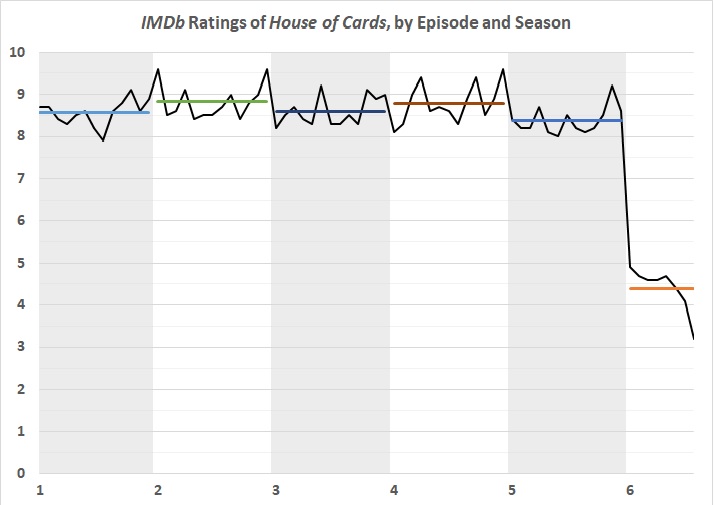
Evidently, a lot of viewers didn’t share my disenchantment with the series. The ratings assigned by Internet Movie Database (IMDb) users held up through the end of the fifth season. And the average ratings for that season are only a touch below the ratings for earlier seasons.

But when Spacey got the axe, the House of Cards fell apart — ratings-wise, that is. Here’s the story in a graph, where the black line traces the ratings for individual episodes and the horizontal bars measure season averages:

Frank/Kevin has the last laugh. Actually, it would be the first laugh for House of Cards, a somber though often gripping fantasy.

Teachable Moments

EPISODE 1

Friend: Johnny shouldn’t play so rough with that cat, it will scratch him.

“Liberal” parent: Johnny is just exploring his boundaries.

Johnny: SCREAM!

“Liberal” parent: Bad kitty. Johnny didn’t mean to hurt you, he was just being himself.

Soon-to-be ex-friend: Kitty was just being herself — and defending herself.

EPISODE 2

Parent: Johnny, where are you going?

Johnny: Out.

Parent: What are you going to do?

Johnny: Nothing.

Parent: When will you be home?

Johnny: I don’t know.

“Liberal” parent: Well, have a good time. It’s important to explore your boundaries.

Parent who actually cares about Johnny: Your answers are unacceptable. You’re grounded until you are honest with me. I may not be able to keep you from getting in trouble, but I can at least warn you of some of the dangers you might face. You’ll hate me now, but you’ll thank me in the long run — and I want you to live long enough to become a parent and behave responsibly toward your children, as I’m doing.

EPISODE 3

“Liberal” voter: I’m going to vote for the city’s proposed bond issues.

Friend: Why?

“Liberal” voter: Because the city will be able to do good things for residents if the bonds are approved.

Friend: What has happened to your property taxes over the past 10 years?

“Liberal” voter: They’ve more than doubled.

Friend: Why do you suppose they’ve doubled?

“Liberal” voter: Beats me, I’m no accountant.

Friend: You don’t suppose they’ve more than doubled because of the bond issues that have been approved in the past 10 years?

“Liberal” voter: Could be, but think of all the great things the city has done.

Friend: For you?

“Liberal” voter: Not for me, but for the disadvantaged people of this city. There are affordable housing projects and subsidies, for example.

Soon-to-be ex-friend: Did you ever stop to think that do-good voting has lots of unintended consequences? Hasn’t housing become less affordable because of the taxes engendered by bond issues? Aren’t affordable-housing tracts high-crime areas? Don’t larger city payrolls soak up much of the revenues from bonds? Couldn’t you have made substantial charitable contributions if your taxes hadn’t more than doubled in the past 10 years? What about your own children and their college educations, which have become exorbitantly expensive? Do you value the welfare of strangers — which won’t be affect much by the city’s programs — over the welfare of your own children. Do you believe that poor people are incapable of working hard and saving money to afford better housing, just as you and your parents did, or do you believe that they should be taught dependency on government? In summary, do you ever think before you vote, or do you just vote to feel good about yourself?

EPISODE 4

Generic “liberal”: I hope the migrant caravan reaches the U.S. border and overwhelms the government’s efforts to stop it.

Friend: Why do you hope that?

Generic “liberal”: Well, for one thing, borders are arbitrary. Everyone has the right to go anywhere in the world in an effort to benefit himself or herself.

Friend: You don’t believe in the sovereignty of the United States and the duty of the government to defend the territory of the United States? You don’t believe that illegal immigrants (to call them what they are) place a burden on America’s social infrastructure, a burden that taxpayers must bear — most of whom never reap the supposed benefits of immigration? You don’t believe that immigrant hordes include a disproportionate number of criminals, many of whom have been known to commit violent crimes against U.S. citizens? You don’t believe that the effect of mass, low-skill immigration is to reduce the wages and employment prospects of the economically disadvantaged Americans about whom you care so much?

Generic “liberal”: Well, all I know is that people have a right to go anywhere in search of betterment.

Soon-to-be ex-friend: So its okay if an illegal immigrant squats in your house, eats your food, and uses your credit cards?

Generic “liberal”: That’s different.

Soon-to-be ex-friend: No, it’s the same. You think it’s different because you’re wealthy enough not to be bothered by somewhat higher taxes — unlike the residents of your city who are being squeezed out by higher taxes. You live and work in places where you’re unlikely to be a victim of a violent immigrant. Your high-paying won’t be jeopardized by an influx of illegal immigrants. You are just a hypocrite.

James Burnham’s Misplaced Optimism

I will occasionally add items to the list of related readings.

James Burnham’s Suicide of the West: An Essay on the Meaning and Destiny of Liberalism was published in 1964. Had I read Burnham’s book then I would have agreed with his description of “liberalism”, as it was at the time, for I was one of the breed. I would not have agreed with Burnham’s prognosis of suicide. But I hadn’t yet seen what I would see in the following five-plus decades.

Burnham correctly foresaw that “liberalism” would lead to a kind of suicide. But he (unsurprisingly) failed to foresee the nasty turn that “liberalism” would take in America, and the fratricide (figurative, I hope) that looms on the horizon. It is that fratricide, if “liberalism” emerges triumphant, which will lead to suicide at the hands of external enemies. But I am getting ahead of myself.

Burnham (1905-1987) was, according to Wikipedia,

an American philosopher and political theorist. Burnham was a prominent Trotskyist activist in the 1930s…. Burnham left Marxism and became a public intellectual of the American conservative movement. His book, The Managerial Revolution, published in 1941, speculated on the fate of capitalism. Burnham was also an editor and a regular contributor to the American conservative publication, National Review.

There was much more to Burnham than that, according to Matthew Continetti’s “James Burnham: A Visionary Like No Other” (National Review, March 26, 2015):

By the early 1950s Burnham’s departure from liberalism had become irreparable. He did not rule out the possibility of nuclear war with the Soviet Union, he warned of a “fifth column” of Soviet infiltrators operating in the West, he dismissed pieties involving the ballot box, equality, education, and free speech, and his attitude toward Joseph McCarthy was much too ambivalent for the bourgeois liberals within his social circle. So he left….

The defection was finalized when Burnham agreed to join William F. Buckley Jr. in the creation of National Review in 1955. A quarter century later, Buckley would say of Burnham, “Beyond any question, he has been the dominant intellectual influence in the development of this journal.”

At NR, Burnham was the first person to speak at editorial meetings. He wrote a regular column on foreign affairs, penned numerous unsigned editorials and items for “The Week,” edited the biweekly National Review Bulletin newsletter, and was understood to be in charge of the magazine whenever Buckley was traveling, which was often.

As for Suicide of the West, in which Burnham forecast the eponymous demise at the hands of dmodern “liberalism”, Continetti says this:

What is liberalism? Burnham identifies 19 of its assumptions. His list … is still relevant…. He is uninterested in refuting liberalism — indeed, he does not believe such a refutation possible. “The question of the truth or falsity of an ideology is in any case of minor importance,” he writes. “Human beings believe an ideology, as a rule, not because they are convinced rationally that it is true but because it satisfies psychological and social needs and serves, or seems to serve, individual or group interests.”

Guilt is the psychological need satisfied by liberalism. Not only is man a fallen creature, according to Burnham; man is conscious of his fallen nature. And such awareness produces in him existential dread, unease about the world, a restlessness that manifests itself in enthusiastic activity. What soothes this dread for most people in most places at most times is religion. Christianity, for instance, “faces the reality of guilt, provides an adequate explanation of it, and offers a resolution of the anxiety to which it inevitably gives rise.”

But modern society, especially educated society, is secular. The religious answer is ignored, regarded as a private affair, attacked and subverted. What is an affluent and credentialed and professional and secular man to do? “Liberalism,” Burnham writes, “permits him to translate his guilt into the egalitarian, anti-discrimination, democratist, peace-seeking liberal principles, and to transform his guilty feeling into” a “passion for reform.”

Liberalism for Burnham is a form of political religion. It responds to the tragic facts of life by denying those facts and substituting myths. “Thanks to the reassuring provisions of the liberal ideology,” he writes, “I can go about my ordinary business and meanwhile take sufficient account of my moral duties by affirming my loyalty to the correct egalitarian principles, voting for the correct candidates, praising the activists and contributing to their defense funds when they get into trouble, and joining promptly in the outcry against reactionaries who pop up now and then in a desperate effort to preserve power and privilege.”

Here is Continetti’s money paragraph:

Whether it is the Soviet Union, Third World insurgents, the criminal underclass, student revolutionaries, Vladimir Putin, the Ayatollah, the Castro brothers, or Hamas, whether it is rioters, drug pushers, or pornographers, liberalism offers reasons to justify, sympathize with, and appease the agents of violence and disorder and decline. Acting like a narcotic, it enables the intellectual “to leave the real world and take refuge in that better world of his ideology where tigers purr like kittens and turn in their claws to the United Nations.” Which is why Burnham called liberalism “suicidal”: It “permits Western civilization to be reconciled to dissolution.”

Burnham was right about the moral rot inherent in the tenets of “liberalism”. And he was right to see that the rot would lead to a kind of suicide, namely, surrender to or conquest by the enemies of liberty. But the route to that suicide is somewhat different than the one envisioned by Burnham.

At the present rate — which neither Burnham nor anyone else could have foreseen in 1964 — America will first surrender to its internal enemy: the virulent leftism that has grown out of 1964’s “liberalism”. (Burnham foreshadows the transition in chapter 11, “Pas d’Ennemi à Gauche” — there Is no enemy to the left. Therefore, except in quotations where a writer uses “liberal” and its variants, I will hereinafter use “left” and its variants.)

The subsequent surrender to some coalition of external enemies will be de facto, a de jure surrender being beside the point when America has already become a moral and economic wasteland at the hands the left.

A surrender to the likes of Russia and China, whose imperialistic ambitions are undisguised, will be easy enough for the left to accept and foster. The left’s present anti-Russia rhetoric and opposition to a “trade war” with China are merely opportunistic, anti-Trump ploys. In the end, when the left triumphs over the body politic, it will revert to its usual moral relativism, reject a robust national defense as “dangerously provocative”, and consign America to vassalage. This need not be outright political subjugation; meek compliance with the social and economic regimes of the superior powers on America’s flanks will do nicely — for the superior powers and cowering leftists, that is.

It is time to give some space to Burnham. To begin at the end, here is Burnham’s prognosis, taken from chapter 16, “The Function of Liberalism”:

Liberalism is the ideology of Western suicide. When once this … is understood, everything about liberalism— the beliefs, emotions and values associated with it, the nature of its enchantment, its practical record, its future— falls into place….

… There is a really dazzling ingenuity in the liberal explanations of defeat as victory, abandonment as loyalty, timidity as courage, withdrawal as advance. The liberal ideologues proceed in a manner long familiar to both religion and psychology: by constructing a new reality of their own, a transcendental world, where the soul may take refuge from the prosaic, unpleasant world of space and time. In that new and better world, the abandonment of a million of one’s own countrymen and the capitulation to a band of ferocious terrorists become transformed into what is called “liberation.” The loss of control over the strategic axis of the Great Continent [FDR’s surrender of Eastern Europe to the USSR] becomes a vindication of universal law…. The failure to retaliate against gross insults and injuries to envoys, citizens and property becomes a proof of maturity and political wisdom. [Remember, this is 1964, before the self-inflicted defeat in Vietnam, the bug-outs from Lebanon and Somalia, the attacks on the homeland in 2001, the debacle in Benghazi, the substitution of defeat for victory in Iraq, and much more.] …

Domestic tribulations yield as readily as do foreign to the magical transformation. At the beginning of September 1963, at a moment when the nation’s constitutional and social fabric was being torn by generalized racial conflict [urban race riots] that was posing issues impossible to settle and therefore certain to become graver and more dangerous over the coming years [as it did], the American Psychological Foundation held a large conference in Philadelphia. The New York Times (September 2, 1963) singled out for report the address in which Professor Gordon W. Allport of Harvard explained that the “racial demonstrations in America are basically a sign of good national emotional health…. It is easy to imagine Professor Allport in late Roman days, explaining how the animals in the Colosseum are generally a playful lot…. You are worried, citizens, about an active enemy beachhead situated within our strategic periphery? Just let Richard Rovere run the matter through his ideological converter, and you will be relieved to discover that the Cuban situation is, on the absolute contrary, a blessing to be grateful for….

… Mr. Rovere’s incantations, though they have a rather wide public reverberation, are at several layers remove from the inner seats of power. Professor Walt Whitman Rostow, as chief of the State Department’s policy-planning staff, has stood close to the very center, and has for some years been there in spirit through his books and memoranda. In his most prestigious work, The Stages of Growth…. Professor Rostow assures us that every society, when “the pre-conditions for take-off” along the industrial path appear, moves upward in a sequence of stages that culminates in “maturity” and “the age of high-mass consumption.” That consummation duly arrived at, the aggressive habits of the immature society are discarded, and the populace seeks peace and order in which to pursue its mature goals of more autos, suburban houses and babies. It is no coincidence, you may be sure, since this is why the work exists, that Professor Rostow’s most volubly discussed example is the Soviet Union, which, it turns out, is soon to cross, granted forbearance and help from us, that final hump into the peaceful promised land of cars and toddlers.

… Translated from the ideological, what Professor Rostow is saying is: “The stronger our enemy gets, the better for us; and if he gets strong enough— preferably as strong as we or stronger— we shall have nothing to worry about.” Nobody needs to be told what a ridiculous statement that is. But what Professor Rostow is up to has nothing to do with truth and falsity about the real world. He is brewing a drug to enable our minds and his own to leave the real world and take refuge in that better world of his ideology where tigers purr like kittens and turn in their claws to the United Nations.

It is as if a man, struck with a mortal disease, were able to say and to believe, as the flush of the fever spread over his face, “Ah, the glow of health returning!”; as his flesh wasted away, “At least I am able to trim down that paunch the doctor always warned me about!”; as a finger dropped off with gangrene or leprosy, “Now I won’t have that bothersome job of trimming those nails every week!” Liberalism permits Western civilization to be reconciled to dissolution; and this function its formulas will enable it to serve right through to the very end, if matters turn out that way: for even if Western civilization is wholly vanquished or altogether collapses, we or our children will be able to see that ending, by the light of the principles of liberalism, not as a final defeat, but as the transition to a new and higher order in which Mankind as a whole joins in a universal civilization that has risen above the parochial distinctions, divisions and discriminations of the past.

America arrives at this resigned state because of the nature of leftism. Here, in paraphrase (with my parenthetical commentary), are the 19 tenets (assumptions) of leftism alluded to by Continetti, which Burnham details in chapters 3, 4, and 5 (“Human Nature and the Good Society”, “The Universal Dialogue”, and “Equality and Welfare”):

1. Man’s nature is not fixed but changing, with an indefinitely large potential for positive development. (See commentary on 16.)

2. The leftist is a rationalist. The rationalist never doubts the power of his “reason”.

3. It follows from 1 and 2 that there is nothing in human nature to block achievement of the good society, given the application of “reason”. (The “good society”, of course, is society as the leftist wishes it to be, regardless of the limitations of nature and human nature, which the leftist ignores or wills away by concocting impracticable “solutions”.)

4. Only “bad” institutions, “bad” ideas, and “bad” people (i.e., those who wish to decide for themselves) stand in the way of the achievement of the good society, that is, “progress”.

5. Most long-established institutions, ideas, and and modes of conduct are “bad” because they stand in the way of “progress”.

6. “Bad” ideas can be eliminated by universal, rationally grounded education. (This project has led to the indoctrination of generations of Americans in “progressive” ideas by public-school teachers, college professors, and the “entertainment” and “news” media.)

7. “Bad” institutions can be eliminated or made powerless (by governmental suppression or co-option) at the behest of (indoctrinated) voters, (under the rubric of “democracy”).

8. The elimination of “bad” ideas and “bad” institutions will alleviate the evils of society: crime, delinquency, war, hunger, unemployment, etc. It follows as a corollary that there is no rational basis for “blaming” criminals for their crimes, etc. They are the products of the ideas and institutions that leftism will erase.

9. The elimination of “bad” ideas requires universal and absolute freedom of opinion in the schoolroom — above a certain academic level — and in universities. (This assumption has gone by the boards, freedom of opinion having delivered the academy — and much else — safely into the hands of leftists. Now it is necessary to suppress “bad” ideas, lest they push “democracy” in the wrong direction. And not just “bad” ideas in the present, but also “bad” ideas from the past.)

10. Politics is education generalized: a school in which all voters are the pupils. Absolute freedom of speech is therefore essential if politics is deliver humanity from the evils of “bad” ideas and institutions. (This assumption has gone by the boards for the reason stated in my commentary on 9. “Bad” ideas are being suppressed by institutions with actual state power — tax-funded schools and universities, the Supreme Court [e.g., freedom from religion], and State and local governments [e.g., hate-crime laws, suppression of those who oppose homosexuality and same-sex “marriage”]. And by those with state-like power — the information-cum-social-media complex (Google, Facebook, et al.)

11. Why should there be almost-absolute freedom of speech if “reason” leads us to the truth? Because we cannot be certain that we know the truth — if, indeed, there is any such thing as objective truth. (Here, again, the impetus for freedom of speech — which gave leftism its foothold — has given way to the triumphant rise of leftism in the academy, the media, etc. Freedom of speech now means “freedom” not to be contradicted by ideas that run counter to leftist dogma.)

12. Government ought instantly to reflect the will of the (properly indoctrinated) democratic majority. (Mediating institutions and the norms fostered by them must be suppressed because they obstruct the realization of leftist dogma.)

13. There is no need for the realization of leftist dogma to stop at the water’s edge. Long-standing institutions and cultural differences being of no account, world government (reflecting the will of an avaricious majority of mankind) is desirable and attainable.

14. All men (and women) are brothers (and sisters) under the skin, given their essential attributes of plasticity and rationality. (See commentaries on 15 and 16.)

15. It follows that tribalism, patriotism, and social hierarchies and distinctions can and should be swept away. (As Orwell said, “All animals are equal, but some are more equal than others.” Leftists are consummate tribalists, witness their intramural virtue-signaling. They are patriotic about their imaginary world of “progress”, boundary-less comradeship, and freedom from the past. They — and their protegees — stand above the unwashed, in their own minds. Consider, for example, the virtue-signaling that is involved in erasing traces of the Confederacy, espousing same-sex marriage, and so on, ad nauseum.)

16. Another corollary of the foregoing is that subgroups of humanity defined by color, race, sex, or other physical or physiological attributes do not differ in their potential. (This, like much that precedes it, relies on the “blank slate” theory of the human mind. The blank-slate theory has been thoroughly debunked by a leftist no less — Steven Pinker. Leftism to the contrary notwithstanding, race and gender figure mightily in the potential and achievements of human beings.)

17. Given the innate goodness and perfectibility of mankind, and the anti-“progressive” nature of long-standing institutions (especially religion), there is no room in lefitism for religion. (This laughable proposition ignores the fact that leftism is a religion-substitute in which the banal theories of left-wing intellectuals are inculcated by public education, etc., etc., etc.)

18. War is wrong because it substitutes coercion and force for “reason”, and disrupts the effort to bind all people in their common humanity. Warriors and those who support military preparedness are therefore despicable. (This attitude was evident during the Clinton and Obama administrations, and is found generally among leftists. Their fixation on the horrors of war and the fate of warriors is nothing but an reflexive anti-war message disguised as “compassion”.)

19. Unlike the proto-liberals of the 19th century, leftists insist that the entry of government into nearly every phase of social and economic life aids rather than hinders the attainment of the good life and the good society. (This is an admission against perfectibility and rationality, and an assumption that a government consisting of imperfect and irrational human beings is somehow capable of doing what human beings cannot otherwise do cooperatively for their mutual benefit. It is an argument for that most illiberal of things: governmental coercion.)

All of this is ideological, as opposed to realistic. Thomas Sowell, in A Conflict of Visions, posits two opposing visions: the unconstrained vision of left-wing ideology, and the constrained (realistic) vision of conservatism. In chapter 2, Sowell writes:

The dichotomy between constrained and unconstrained visions is based on whether or not inherent limitations of man are among the key elements included in each vision…. These different ways of conceiving man and the world lead not merely to different conclusions but to sharply divergent, often diametrically opposed, conclusions on issues ranging from justice to war.

Burnham, in his chapter 6 (“Ideological Thinking”), illustrates the point concretely, for pages on end. Toward the end of the chapter, Burnham writes:

It is a characteristic of ideological thinking, whatever the given ideology, that it cannot be refuted by logical analysis or empirical evidence. Actually, the internal logical structure of a developed ideology is usually quite good anyway, rather like the logical structure of paranoiac obsessions, which ideologies resemble in other ways also; and when a logical gap appears — as happened to liberalism in the doctrinal shift from limited to welfare state — sufficient ingenuity can always patch it up again…. The ideology is a way of interpreting the world, an attitude toward the world and a method for dealing with the world. So long as I adhere faithfully to the ideology there is no specific happening, no observation or experiment that can unmistakably contradict it. I can always adjust my categories and my attitude to allow for whatever it is that happens or that I observe; if necessary I can shut my eyes.

There is much more of the same in chapter 7 (“A Critical Note in Passing”), where Burnham contrasts each of the 19 tenets of leftism with its conservative (realistic) counterpart. He does this in parallel lists: the l-list (leftist) and the x-list (conservative). Burnham then writes that

there is a difference in structure as well as content between the two sets of nineteen taken in their entirety.

The l-list is the verbalization of a single, more or less systematic ideology: the ideology of modern liberalism. The x-list, though it perhaps has a recognizably “conservative” cast, does not constitute an ideology, not any ideology at all. The nineteen x-beliefs are related much more loosely to each other, both logically and psychologically, than the nineteen l-beliefs.

That’s as it should be in a comparison of an idealized world and the real one.

Burnham closes the chapter by focusing on the delusional and suicidal nature of leftism:

The findings of the modern scientific study of genetics seem to strike a multiple blow at the liberal conception of man and his prospects. The fixity of unit characteristics, their biological transmission through the genes according to mathematical laws of probability, and the non-inheritability of acquired characteristics combine to reinforce the non-liberal belief that human nature has a permanent sub-stratum, that there are ineradicable differences among men not traceable to social circumstance, and that there are limits, often quite low, to what even the most perfect education could accomplish. Genetics certainly gives no support to any doctrine holding that education and social reform could transform man into a creature so radically different from what he has been as would be the case if he dropped his aggressive, destructive and other troublemaking traits. The conclusions to be drawn from genetics would, indeed, seem to be even more drastically counter to the liberal faith in secular progress….

Because the ideology of modern liberalism has become so powerful an influence in contemporary American thought and conduct, it is worth noting that the liberal doctrine of human nature is sharply at variance with the view that prevailed among the Founding Fathers of the republic….

Ignorance, liberal doctrine tells us, is in the last analysis the only obstacle to the good society— peaceful, free, just, prosperous and happy; and ignorance can be dispelled by a rational education accepting the axioms of academic freedom and free speech. Even the problem of reforming bad institutions is secondary to education, because once education overcomes ignorance, then men— men as defined by liberal ideology— will know what is wrong with the institutions, and will take steps to correct them. What do the facts show?

The facts show plainly that there are many obstacles on the road to the good society that are at least as formidable as ignorance: obstacles, such as I have cited, innate to the human organism and psyche; obstacles planted in the physical nature around us; the accumulated weight of history that unavoidably presses on all of us….

Athens was the most educated society of the ancient world and in some respects of all time; and Athens fell as much from inner decay as from external foes. Germany has been the most literate, the most thoroughly educated nation of the twentieth century; and Germany bred Hitler, Nazism and the gas chambers….

In the United States, all of our children go to school; but in many of our cities they are much worse behaved and more dangerous to society than their unschooled ancestors of a few generations ago….

There are a number of other practical dilemmas that modern liberalism cannot avoid. Take, as one additional example, the meaning of the liberal declaration against social hierarchies, segregation, discrimination, against what sets one group of men apart from others. Certainly some sorts of discrimination are of a kind that seems cruel and unjust to almost everyone. But the trouble is that human beings— the human beings of the real world— are hierarchical and segregating and discriminating animals. There has never been a human society anywhere, at any time, from the most primitive tribe to the freest republic to the most civilized empire, in which there have not been segregations, discriminations and groupings: into young and old, male and female, warrior and peasant, slave and citizen, black and brown and white, believer and unbeliever, tall and short, rich and poor, egghead and blockhead. There is always apartheid— the South African word means merely “apartness”— in some degree, on some basis or other. Even in college there are clubs and fraternities, freshmen and seniors, athletes and brains, chess players and beer drinkers and aesthetes. Prison and concentration camp are no different from other forms of human society. The French writer David Rousset, who was for some years an inmate of Nazi concentration camps, wrote a brilliant study of what he called “The Concentrationary Universe.” Its main point is to record the existence within the camps of the same patterns of social division and discrimination that exist in the outside world; and his findings have been confirmed by many ex-inmates of the Soviet camps.

Now the fact that social discriminations always exist does not justify this particular discrimination, whatever it may be. Perhaps we ought to get rid of this one, or at least try to mitigate its degree. But it shows that the attempt to get rid of all discriminations, all apartheid, is illusory. The undiscriminating effort to end all discrimination must necessarily fail. Either the old groupings remain, perhaps with new protective disguises; or they are replaced by new and different types of discrimination that may be worse than the old: party member and outsider; bureaucrat and plain citizen; college graduate and non-graduate; secret policeman and concentration camp candidate.

As Simon Mawer says in The Gospel of Judas,

the universe is not a very liberal place. That is what the modern world seems not to understand….

How might the delusional tenets of leftism lead to the suicide of the West, and of America in particular? The path should be obvious. America’s legacy is that of a limited central government standing guard over civil society — the mediating institutions (family, church, club, community, etc.) that promulgate and enforce Northern European social norms, as they were at the time of America’s founding and for some generations afterward. (I don’t mean to imply that the observance of such norms is restricted to persons of Northern European descent.)

Among the norms were (and still are in many places):

  • hard work and self-reliance, rewarded by the right to acquire, keep, and voluntarily distribute the fruits of one’s labor
  • charity and consideration for others as voluntary acts manifesting good character and social bonds
  • a preference for the tried-and-true over the novel, with an evident willingness to adopt and adapt the novel, where it demonstrates improvement
  • modesty in demeanor and conduct, that is, observance of the customs of one’s kinship-cultural-ethic group (which are also open to demonstrably harmless or beneficial change)
  • rootedness in one’s kinship-culutural-ethnic group, which manifests itself in patriotism when the nation is generally composed of (or at least dominated by) groups with congruent ethics
  • willingness and readiness to defend self, kith and kin (in a racial or ethnic sense), and way of life.

I daresay that today’s patriots hew to America as it was and could be, as opposed to what it has become at the hands of leftists.

What has it become? For huge swaths of the populace, it has become the opposite of the norms listed above. Even where there is rootedness in one’s kinship-cultural-ethnic group, it doesn’t support nationalistic patriotism if members of the group either see themselves as outsiders or reject Northern European mores.

Leftism, especially beginning with Progressivism in the late 1800s, has deliberately and steadily erased the moral legacy of Northern Europe — even among (perhaps especially among) persons of Northern European descent. This is due, in great part, to the unrelenting efforts of the information-entertainment-media-academic complex over several decades. Long gone are the days when school began with the Lord’s Prayer and Pledge of Allegiance. Binding rituals like those, and more, have been cut from the social fabric, rendering it weak and threadbare.

How could it happen? The fundamental reason is that Americans — like Westerners generally — are spoiled children of capitalism:

Before the onset of the welfare state in the 1930s, there were two ways to survive: work hard or accept whatever charity came your way. And there was only one way for most persons to thrive: work hard. That all changed after World War II, when power-lusting politicians sold an all-too-willing-to-believe electorate a false and dangerous bill of goods, namely, that government is the source of prosperity. It is not, and never has been.

That’s the economic case. The social case is similar. As the bonds of family, church, and other mediating institutions become less and less necessary to survival, they are more easily rejected. And rejected along with them are the social norms that reflect accumulated wisdom, the observance of which breeds mutual trust, respect, and forbearance. No wonder there are respectable observers who see civil war on the horizon.

It thus becomes easy to believe in and practice things that undermine prosperity and social comity. And in the absence of existential challenges, those things become believed and practiced widely because they are widely believed and practiced. This is also known as an information cascade, or more familiarly, a bandwagon effect.

The bandwagon in this case took some decades to get rolling, but get rolling it did. And so the 19 tenets of leftism became articles of faith across the deeply influential information-entertainment-media-academic complex — and thence to anyone and everyone who seeks the approval of the powers-that-be in that complex. Approval-seekers include (but are far from limited to) not only the aforementioned public-school teachers (and their impressionable pupils), but also managers of mid-sized to huge businesses who (unlike small-business owners) aren’t scrambling to keep themselves and their families afloat.

Add …

  • politicians, who — at the higher levels of government — are nothing but professional office-holders who preach “equality”, “social justice”, and even “economic fairness” because it costs them nothing and yields power and perquisites
  • legions of bureaucrats whose jobs depend on big government
  • masses of people for whom self-reliance is just an old-fashioned idea, thanks to big government
  • greater masses of people who are simply gullible and unthinking

… and you have the better (or worse) part of the nation committed to leftism.

What it all adds up to, as I have suggested, is the elevation of myths and hopes over hard-won norms and harsh realities. In that respect, Burnham’s own realism failed him at the end of Suicide, where he writes with undue and uncharacteristic optimism:

But of course the final collapse of the West is not yet inevitable; the report of its death would be premature…. There are a few small signs, here and there, that liberalism may already have started fading. Perhaps this book is one of them.

But it wasn’t to be.

In fact, the publication of Burnham’s book coincided with the resurgence of leftism in America. (For an excellent analysis of leftism as it is today, see the article by the Winegards in the reading list, below.) The electoral thrashing of an avowed conservative, Barry Goldwater, in 1964 opened the way for LBJ’s Great Society. The next several years marked the onset of America’s social, political, economic, and cultural downfall, which I have addressed here and in many other posts; for example:

Almost overnight, it seems, the nation was catapulted from the land of Ozzie and Harriet, Father Knows Best, and Leave It to Beaver to the land of the free- filthy-speech movement, Altamont, Woodstock, Hair, and the unspeakably loud, vulgar, and violent offerings that are now plastered all over the air waves, the internet, theater screens, and “entertainment” venues.

The 1960s and early 1970s were a tantrum-throwing time, and many of the tantrum-throwers moved into positions of power, influence, and wealth, having learned from the success of their main ventures: the end of the draft and the removal of Nixon from office. They schooled their psychological descendants well, and sometimes literally on college campuses. Their successors on the campuses of today — students, faculty, and administrators — carry on the tradition of reacting with violent hostility toward persons and ideas that they oppose, and supporting draconian punishments for infractions of their norms and edicts. (For myriad examples, see The College Fix.)

Adherents of the ascendant culture esteem protest for its own sake, and have stock explanations for all perceived wrongs (whether or not they are wrongs): racism, sexism, homophobia, Islamophobia, hate, white privilege, inequality (of any kind), Wall  Street, climate change, Zionism, and so on. All of these are to be combated by state action that deprives citizens of economic and social liberties.

In particular danger are the freedoms of speech and association. The purported beneficiaries of the campaign to destroy those freedoms are “oppressed minorities” (women, Latinos, blacks, Muslims, the gender-confused, etc.) and the easily offended. The true beneficiaries are leftists. Free speech is speech that is acceptable to the left. Otherwise, it’s “hate speech”, and must be stamped out. Freedom of association is bigotry, except when it is practiced by leftists in anti-male, anti-conservative, pro-ethnic, and pro-racial causes. This is McCarthyism on steroids. McCarthy, at least, was pursuing actual enemies of liberty; today’s leftists are the enemies of liberty.

The organs of the state have been enlisted in an unrelenting campaign against civilizing social norms. We now have not just easy divorce, subsidized illegitimacy, and legions of non-mothering mothers, but also abortion, concerted (and deluded) efforts to defeminize females and to neuter or feminize males, forced association (with accompanying destruction of property and employment rights), suppression of religion, absolution of pornography, and the encouragement of “alternative lifestyles” that feature disease, promiscuity, and familial instability.

The state, of course, doesn’t act of its own volition. It acts at the behest of special interests — interests with a “cultural” agenda. They are bent on the eradication of civil society — nothing less — in favor of a state-directed Rousseauvian dystopia from which Judeo-Christian morality and liberty will have vanished, except in Orwellian doublespeak.

If there are unifying themes in this petite histoire, they are the death of common sense and the rising tide of moral vacuity. The history of the United States since the 1960s supports the proposition that the nation is indeed going to hell in a handbasket.

In fact, the speed at which it is going to hell seems to have accelerated since the Charleston church shooting and the legal validation of  same-sex “marriage” in 2015. It’s a revolution (e.g., this) piggy-backing on mass hysteria. Here’s the game plan:

  • Define opposition to illegal immigration, Islamic terrorism, same-sex marriage, transgenderism, and other kinds violent and anti-social behavior as “hate“.
  • Associate “hate” with conservatism.
  • Watch as normally conservative politicians, business people, and voters swing left rather than look “mean” and put up a principled fight for conservative values. (Many of them can’t put up such a fight, anyway. Trump’s proper but poorly delivered refusal to pin all of the blame on neo-Nazis for the Charlottesville riot just added momentum to the left’s cause because he’s Trump and a “fascist” by definition.)
  • Watch as Democrats play the “hate” card to retake the White House and Congress.

With the White House in the hands of a left-wing Democrat (is there any other kind now?) and an aggressive left-wing majority in Congress, freedom of speech, freedom of association, and property rights will become not-so-distant memories. “Affirmative action” (a.k.a. “diversity”) will be enforced on an unprecedented scale of ferocity. The nation will become vulnerable to foreign enemies while billions of dollars are wasted on the hoax of catastrophic anthropogenic global warming and “social services” for the indolent. The economy, already buckling under the weight of statism, will teeter on the brink of collapse as the regulatory regime goes into high gear and entrepreneurship is all but extinguished by taxation and regulation.

All of that will be secured by courts dominated by left-wing judges — from here to eternity.

And most of the affluent white enablers dupes of the revolution will come to rue their actions. But they won’t be free to say so.

Thus will liberty — and prosperity — die in America.

It will resemble the Fall of Rome. The barbarians are already within, and will not defend America — or what little is left of it. They won’t even think it necessary because they reject America as it was meant to be.


Related reading:

Selwyn Duke, “Leftists Are Now Advocating Racial Segregation“, The New American, September 10, 2018

Jeffrey S. Flier,”As a Former Dean of Harvard Medical School, I Question Brown’s Failure to Defend Lisa Littman“, Quillette, August 31, 2018

Theodore P. Hill, “Academic Activists Send a Published Paper Down the Memory Hole“, Quillette, September 7, 2018

James Kirkpatrick, “Michael Hart’s The Rise and Fall of the United States: An Indispensable History for the Historic American Nation“, VDARE.com, September 7, 2018

Scott S. Powell, “The Whirlwind Is Already Here“, The American Spectator, September 5, 2018

Dennis Prager, “Explaining the Left, Part IV: Leftist Contempt for Middle-Class Values“, The Patriot Post, October 2, 2018

Joy Pullmann, “Explosive Ivy League Study Repressed For Finding Transgender Kids May Be A Social Contagion“, The Federalist, August 31, 2018

James R. Rogers, “The Federalist‘s Heart of Darkness“, Law and Liberty, August 7, 2018

Roger Scruton, Fools, Frauds, and Firebrands: Thinkers of the New Left, London and New York: Bloomsbury Continuum, 2015

Roger Scruton, Conservatism: An Invitation to the Great Tradition, London: All Points Books (Macmillan), 2018

Ilya Somin, “Jeffrey Rosen on ‘Madison’s Nightmare’“, The Volokh Conspiracy, September 15, 2018

Bill Vallicella, “The Left’s Attack on Merit“, Maverick Philosopher, September 30, 2018 (see especially the quotation from Richard Weaver)

Bo Winegard and Ben Winegard, “The Preachers of the Great Awokening“, Quillette, September 21, 2018

Related pages and posts:

Constitution: Myths and Realities (see especially “The Framers’ Fatal Error”)
Economic Growth Since World War II
Keynesian Multiplier: Fiction vs. Fact
Leftism
Spygate

Liberty and Society
The Eclipse of “Old America”
Genetic Kinship and Society
America: Past, Present, and Future
IQ, Political Correctness, and America’s Present Condition
The Barbarians Within and the State of the Union
The World Turned Upside Down
The View from Here
“We the People” and Big Government
The Culture War
The Fall and Rise of American Empire
O Tempora O Mores!
Presidential Treason
A Home of One’s Own
The Criminality and Psychopathy of Statism
Decline
Two-Percent Tyranny
A Sideways Glance at Public “Education”
Greed, Conscience, and Big Government
The Slow-Motion Collapse of the Economy
Democracy, Human Nature, and the Future of America
1963: The Year Zero
The Beginning of the End of Liberty in America
Society
How Democracy Works
“Cheerful” Thoughts
How Government Subverts Social Norms
Turning Points
The Twilight’s Last Gleaming?
Polarization and De-facto Partition
How America Has Changed
Civil War?
Freedom of Speech and the Long War for Constitutional Governance
Retrospective Virtue-Signalling
The Left and Violence
Leftist Condescension
Red-Diaper Babies and Enemies Within
Equality
The Vast Left-Wing Conspiracy
Academic Freedom, Freedom of Speech, and the Demise of Civility
Leftism As Crypto-Fascism: The Google Paradigm
What Is Going On? A Stealth Revolution
Down the Memory Hole
“Why Can’t We All Just Get Along?”
Mass Murder: Reaping What Was Sown
“Democracy” Thrives in Darkness — and Liberty Withers
Preemptive (Cold) Civil War
The Framers, Mob Rule, and a Fatal Error
Whence Polarization?
Social Norms, the Left, and Social Disintegration
The Lesson of Alfie Evans
Can Left and Right Be Reconciled?
Freedom of Speech: Getting It Right
Justice Thomas on Masterpiece Cakeshop
Suicide or Destiny?
“Liberalism” and Virtue-Signaling
Freedom of Speech, to What End?
Conservatism vs. Ideology
O.J.’s Glove and the Enlightenment

Word Spark

UPDATED 09/02/20

I downloaded Word Spark to my Fire tablet on March 19, 2018. (It was then also available for iOS and Android devices.) There are 600 puzzles in all, grouped in 30 packs of 20 puzzles each. Working at the rate of about 4 puzzles a day, I completed the 600th puzzle on August 2, 2018.* That puts me among the 0.02 percent of Word Spark users who have completed the entire set.

This is a game for you if you have a good vocabulary (though arcane words are avoided), are good at pattern recognition, and are tenacious. That last condition is the crucial one. It separates the doers (conservatives) from the theoreticians (leftists).

The puzzles consist of letters arranged in squares, beginning with 4 x 4 squares and going up to 7 x 7 squares. Here’s 6 x 6 puzzle:

Here’s how to play the game:

1. Trace contiguous letters to form words. There are many possible words, but only a specific set of correct ones for each puzzle. Almost all of the words are singular common nouns and adjectives. There are many words that can also be used as verbs (e.g., park, scratch, walk). Rarely is there a word that is used only as a verb; proper nouns are equally rare; and adverbs, conjunctions, and prepositions aren’t used at all (as far as I can recall). You will save a lot of time by confining yourself to singular common nouns and adjectives. Don’t bother with plurals, they aren’t used.

2. When a correct word is traced, the letters of the word move to the corresponding group of spaces below the array. (There are five correct words and corresponding groups of spaces in the image above.)

3. If a correct word includes letters that are below the top of the array, the letters above drop to fill the gaps left when the letters of the correct word drop to the answer spaces. This is important because…

4. To complete a puzzle it is necessary not only to find the correct words but also to trace them in the correct order. Finding a later word before an earlier one may make it impossible to find the earlier one because of the rearrangement of letters, as described above. You may be alerted of this by the counter-clockwise movement of the reload button, but you may not be alerted — the game seems to be quirky about these alerts. If you are stuck, make an ordered list of the words you’ve found (noting any gaps between them), and hit the reload button. Sometimes it’s necessary to do this several times during the course of a puzzle, especially at the end. Forming a correct word with the “wrong” letter(s) will throw everything off. (A “wrong” letter is a letter that belongs in the word but is chosen from the wrong cell in the array of letters. There’s often more than one way of tracing out a correct word, and it’s easy to chose the wrong way.)

5. If you are really stuck, use a hint. (A hint gives you the first letter of a word; you’re on your own after that.) You start out with 50 of them and gain 3 for every 20-pack that you complete. You can also gain a hint a day (until you reach the last 2 puzzles) by playing a 4 x 4 daily-exercise puzzle. (I didn’t discover this feature until I was in the next-to-last 20-pack of puzzles.) You can also buy hints, though I didn’t have to do that. You should have plenty of hints to work with if you start doing the daily-exercise puzzle when you start playing Word Spark. Beware: Using hints too frequently may cause you to lose your edge, with the result that you have to use more hints. I found that I resorted to hints more often when I started earning an extra hint a day.
__________
* Proof:

The solution to the 600th puzzle is:

ENVELOPE
LOSS
COCONUT
SHOCK
SPIDER
ORANGE
SCREEN
HARVEST

This isn’t a spoiler. If you’re sharp enough and tenacious enough to reach the 600th puzzle, you will be able to figure this out on your own.

UPDATE 09/02/20:

I just completed the game again, at about the same rate and with the same result. It wasn’t like cheating; after a lapse of two years I didn’t remember any of the puzzles. It was like playing the game for the first time. But twice is enough … there won’t be a third time.

The Renaming Mania Hits a New Low

I live in Austin, Texas. That is to say, I am physically present in Austin most of the time, but spiritually distant from it. One of the reasons for my spiritual distance is evident in the recent suggestion by the city’s ethics office to rename Austin because its namesake, Stephen F. Austin, was “conflicted” about slavery. (Abraham Lincoln was un-conflicted in his disdain for blacks, but that somehow isn’t held against him.)

“Austin” is just a name, like “dung” and “rattlesnake”. The full name of its namesake rarely passes through the mind of an Austiner. (“Austinite” is preferred, but it seems pretentious to me, like “Manhattanite”. “Sodomite” has a certain ring, however.) Still less frequently will an Austiner give a thought to S.F. Austin’s “conflicted” views about slavery. Only in the fevered imagination of a left-wing Austiner (which is most of them), will the views of a man who died three years before Austin acquired its name be taken as a besmirchment of the upstanding city’s pure, virtue-signaling character. (It is hard to find a city away from the Left Coast whose denizens — that’s the word — are more puffed about their city and its mythical virtues. See this post and the list at the bottom of it.)

Anyway, back to the renaming mania.

With all of the disappeared statutes, street names, names of buildings and institutions — things formerly known as Davis, Jefferson, Jackson (Andy and Stonewall), Lee, etc. etc., etc. — why have Washington and Lincoln survived? Washington was a slave-owner; Lincoln, as I have intimated, held blacks in low esteem despite his (belated) anti-slavery views.

Mine is not to reason why, or why not. Mine is to suggest that all of this unpleasantness might be avoided if all persons, places, and things were assigned unique, randomly generated alphanumeric codes.

Or perhaps new unpleasantness would simply erupt because of objections if an alphanumeric code includes certain number sequences (666, for example) or letter sequences like RWR, GWB, or DJT.

You can please some of the people none of the time (i.e., leftists). They are just born to bitch.

Suicide or Destiny?

The list of related reading at the bottom of this post is updated occasionally.

The suicide to which I refer is the so-called suicide of the West, about which Jonah Goldberg has written an eponymous book. This is from Goldberg’s essay based on the book, “Suicide of the West” (National Review, April 12, 2018):

Almost everything about modernity, progress, and enlightened society emerged in the last 300 years. If the last 200,000 years of humanity were one year, nearly all material progress came in the last 14 hours. In the West, and everywhere that followed our example, incomes rose, lifespans grew, toil lessened, energy and water became ubiquitous commodities.

Virtually every objective, empirical measure that capitalism’s critics value improved with the emergence of Western liberal-democratic capitalism. Did it happen overnight? Sadly, no. But in evolutionary terms, it did….

Of course, material prosperity isn’t everything. But the progress didn’t stop there. Rapes, deaths by violence and disease, slavery, illiteracy, torture have all declined massively, while rights for women, minorities, the disabled have expanded dramatically. And, with the exception of slavery, which is a more recent human innovation made possible by the agricultural revolution, material misery was natural and normal for us. Then suddenly, almost overnight, that changed.

What happened? We stumbled into a different world. Following sociologist Robin Fox and historian Ernest Gellner, I call this different world “the Miracle.”…

Why stress that the Miracle was both unnatural and accidental? Because Western civilization generally, and America particularly, is on a suicidal path. The threats are many, but beneath them all is one constant, eternal seducer: human nature. Modernity often assumes that we’ve conquered human nature as much as we’ve conquered the natural world. The truth is we’ve done neither….

The Founders closely studied human nature, recognizing the dangers of despots and despotic majorities alike. They knew that humans would coalesce around common interests, forming “factions.” They also understood that you can’t repeal human nature. So, unlike their French contemporaries, they didn’t try. Instead, they established our system of separated powers and enumerated rights so that no faction, including a passionate majority, could use the state’s power against other factions.

But the Founders’ vision assumed many preconditions, the two most important of which were the people’s virtue and the role of civil society. “The general government . . . can never be in danger of degenerating into a monarchy, an oligarchy, an aristocracy, or any despotic or oppressive form so long as there is any virtue in the body of the people,” George Washington argued.

People learn virtue first and most importantly from family, and then from the myriad institutions family introduces them to: churches, schools, associations, etc. Every generation, Western civilization is invaded by barbarians, Hannah Arendt observed: “We call them children.” Civil society, starting with the family, civilizes barbarians, providing meaning, belonging, and virtue.

But here’s the hitch. When that ecosystem breaks down, people still seek meaning and belonging. And it is breaking down. Its corruption comes from reasons too numerous and complex to detail here, but they include family breakdown, mass immigration, the war on assimilation, and the rise of virtual communities pretending to replace real ones.

First, the market, as Joseph Schumpeter argued, maximizes efficiency with relentless rationality, tending to break down the sinews of tradition and the foundations of civil society that enable and instill virtue. Yet those pre-rational virtues make capitalism possible in the first place.

Second, capitalism also creates a mass class of resentful intellectuals, artists, journalists, and bureaucrats who are professionally, psychologically, and ideologically committed to undermining capitalism’s legitimacy (as noted by Schumpeter and James Burnham, the author of another book titled “Suicide of the West”). This adversarial elite is its own coalition.

Thus, people increasingly look to Washington and national politics for meaning and belonging they can’t find at home. As Mary Eberstadt recently argued, the rise in identity politics coincided with family breakdown, as alienated youth looked to the artificial tribes of racial or sexual solidarity for meaning. Populism, which always wants the national government to solve local problems, is in vogue on left and right precisely because local institutions and civil society generally no longer do their jobs. Indeed, populism is its own tribalism, because “We the People” invariably means “my people.” As Jan-Werner Müller notes in his book What Is Populism?: “Populism is always a form of identity politics.”

A video at the 2012 Democratic National Convention proclaimed that “government is the only thing we all belong to.” For conservatives, this was Orwellian. But for many Americans, it was an invitation to belong. That was the subtext of “The Life of Julia” and President Obama’s call for Americans to emulate SEAL Team Six and strive in unison — towards his goals….

The American Founding’s glory is that those English colonists took their cousins’ tradition, purified it into a political ideology, and extended it farther than the English ever dreamed. And they wrote it down, thank God. The Founding didn’t apply these principles as universally as its rhetoric implied. But that rhetoric was transformative. When the Declaration of Independence was written, some dismissed the beginning as flowery boilerplate; what mattered was the ending: Independence! But the boilerplate became a creed, and America’s story is the story of that creed — those mere words — unfolding to its logical conclusion….

It seems axiomatic to me that whatever words can create, they can destroy. And ingratitude is the destroyer’s form. We teach children that the moral of the Goose that Lays the Golden Egg is the danger of greed. But the real moral of the story is ingratitude. A farmer finds an animal, which promises to make him richer than he ever imagined. But rather than nurture and protect this miracle, he resents it for not doing more. In one version, the farmer demands two golden eggs per day. When the goose politely demurs, he kills it out of a sense of entitlement — the opposite of gratitude.

The Miracle is our goose. And rather than be grateful for it, our schools, our culture, and many of our politicians say we should resent it for not doing more. Conservatism is a form of gratitude, because we conserve only what we are grateful for. Our society is talking itself out of gratitude for the Miracle and teaching our children resentment. Our culture affirms our feelings as the most authentic sources of truth when they are merely the expressions of instincts, and considers the Miracle a code word for white privilege, greed, and oppression.

This is corruption. And it is a choice. Collectively, we are embracing entitlement over gratitude. That is suicidal.

I would put it this way: About 300 years ago there arose in the West the idea of innate equality and inalienable rights. At the same time, and not coincidentally, there arose the notion of economic betterment through free markets. The two concepts — political and economic liberty — are in fact inseparable. One cannot have economic liberty without political liberty; political liberty — the ownership of oneself — implies the ownership of the fruits of one’s own labor and the right to strive for prosperity. This latter striving, as Adam Smith pointed out, works not only for the betterment of the striver but also for the betterment of those who engage in trade with him. The forces of statism are on the march (and have been for a long time). The likely result is the loss of liberty and the vibrancy and prosperity that arises from it.

I want to be clear about liberty. It is not a spiritual state of bliss. It is, as I have written,

a modus vivendi, not the result of a rational political scheme. Though a rational political scheme, such as the one laid out in the Constitution of the United States, could promote liberty.

The key to a libertarian modus vivendi is the evolutionary development and widespread observance of social norms that foster peaceful coexistence and mutually beneficial cooperation.

Liberty, in sum, is not an easy thing to attain or preserve because it depends on social comity: mutual trust, mutual respect, and mutual forbearance. These are hard to inculcate and sustain in the relatively small groupings of civil society (family, church, club, etc.). They are almost impossible to attain or sustain in a large, diverse nation-state. Interests clash and factions clamor and claw for ascendancy over other factions. (It is called tribalism, and even anti-tribalists are tribal in their striving to impose their values on others). The Constitution, as Goldberg implies, has proved unequal to the task of preserving liberty, for reasons to which I will come.

I invoke the Constitution deliberately. This essay is about the United States, not the West in general. (Goldberg gets to the same destination after a while.) Much of the West has already committed “suicide” by replacing old-fashioned (“classical“) liberalism with oppressive statism. The U.S. is far down the same path. The issue at hand, therefore, is whether America’s “suicide” can be avoided.

Perhaps, but only if the demise of liberty is a choice. It may not be a choice, however, as Goldberg unwittingly admits when he writes about human nature.

On that point I turn to John Daniel Davidson, writing in “The West Isn’t Committing Suicide, It’s Dying of Natural Causes” (The Federalist, May 18, 2018):

Perhaps the Miracle, wondrous as it is, needs more than just our gratitude to sustain it. Perhaps the only thing that can sustain it is an older order, one that predates liberal democratic capitalism and gave it its vitality in the first place. Maybe the only way forward is to go back and rediscover the things we left behind at the dawn of the Enlightenment.

Goldberg is not very interested in all of that. He does not ask whether there might be some contradictions at the heart of the liberal order, whether it might contain within it the seeds of its undoing. Instead, Goldberg makes his stand on rather narrow grounds. He posits that the Enlightenment Miracle can be defended in purely secular, utilitarian terms, which he supposes are the only terms skeptics of liberal democratic capitalism will accept.

That forces him to treat the various illiberal ideologies that came out of Enlightenment thought (like communism) as nothing more than a kind of tribalism rather than a natural consequence of the hyper-rational scientism embedded in the liberal order itself. As Richard M. Reinsch II noted last week in an excellent review of Goldberg’s book over at Law and Liberty, “If you are going to set the Enlightenment Miracle as the standard of human excellence, one that we are losing, you must also clearly state the dialectic it introduces of an exaltation of reason, power, and science that can become something rather illiberal.”

That is to say, we mustn’t kid ourselves about the Miracle. We have to be honest, not just about its benefits but also its costs….

What about science and medical progress? What about the eradication of disease? What about technological advances? Isn’t man’s conquest of nature a good thing? Hasn’t the Enlightenment and the scientific revolution and the invention of liberal democratic capitalism done more to alleviate poverty and create wealth than anything in human history? Shouldn’t we preserve this liberal order and pass it on to future generations? Shouldn’t we inculcate in our children a profound sense of gratitude for all this abundance and prosperity?

This is precisely Goldberg’s argument. Yes, he says, man’s conquest of nature is a good thing. It’s the same species of argument raised earlier this year in reaction to Patrick Deneen’s book, “Why Liberalism Failed,” which calls into question the entire philosophical system that gave us the Miracle….

[Deneen] is not chiefly interested in the problems of the modern progressive era or the contemporary political Left. He isn’t alarmed merely by political tribalism and the fraying of the social order. Those things are symptoms, not the cause, of the illness he’s diagnosing. Even the social order at its liberal best—the Miracle itself—is part of the illness.

Deneen’s argument reaches back to the foundations of the liberal order in the sixteenth  and seventeenth centuries—prior to the appearance of the Miracle, in Goldberg’s telling—when a series of thinkers embarked on a fundamentally revisionist project “whose central aim was to disassemble what they concluded were irrational religious and social norms in the pursuit of civil peace that might in turn foster stability and prosperity, and eventually individual liberty of conscience and action.”

The project worked, as Goldberg has chronicled at length, but only up to a point. Today, says Deneen, liberalism is a 500-year-old experiment that has run its course and now “generates endemic pathologies more rapidly and pervasively than it is able to produce Band-Aids and veils to cover them.”

Taking the long view of history, Deneen’s book could be understood as an extension of Lewis’s argument in “The Abolition of Man.” The replacement of moral philosophy and religion with liberalism and applied science has begun, in our lifetimes, to manifest the dangers that Lewis warned about. Deneen, writing more than a half-century after Lewis, declares that the entire liberal project manifestly has failed.

Yes, the Miracle gave us capitalism and democracy, but it also gave us hyper-individualism, scientism, and communism. It gave us liberty and universal suffrage, but it also gave us abortion, euthanasia, and transgenderism. The abolition of man was written into the Enlightenment, in other words, and the suicide of the West that Goldberg warns us about isn’t really a suicide at all, because it isn’t really a choice: we aren’t committing suicide, we’re dying of natural causes.

Goldberg is correct that we have lost our sense of gratitude, that we don’t really feel like things are as good as all that. But a large part of the reason is that the liberal order itself has robbed us of our ability to articulate what constitutes human happiness. We have freedom, we have immense wealth, but we have nothing to tell us what we should do with it, nothing to tell us what is good.

R.R. Reno, in “The Smell of Death” (First Things, May 31, 2018), comes at it this way:

At every level, our elites oppose traditional regulation of behavior based on clear moral norms, preferring a therapeutic and bureaucratic approach. They seek to decriminalize marijuana. They have deconstructed male and female roles for children. They correct anyone who speaks of “sex,” preferring to speak of “gender,” which they insist is “socially constructed.” They have ushered in a view of free speech that makes it impossible to prevent middle school boys from watching pornography on their smart phones. They insist upon a political correctness that rejects moral correctness.

The upshot is American culture circa 2018. Our ideal is a liquid world of self-definition, characterized by plenary acceptance and mutual affirmation. In practice, the children of our elites are fortunate: Their families and schools carefully socialize them into the disciplines of twenty-first-century meritocratic success while preaching openness, inclusion, and diversity. But the rest are not so fortunate. Most Americans gasp for air as they tread water. More and more drown….

Liberalism has always been an elite project of deregulation. In the nineteenth century, it sought to deregulate pre-modern economies and old patterns of social hierarchy. It worked to the advantage of the talented, enterprising, and ambitious, who soon supplanted the hereditary aristocracy.

In the last half-century, liberalism has focused on deregulating personal life. This, too, has been an elite priority. It makes options available to those with the resources to exploit them. But it has created a world in which disordered souls kill themselves with drugs and alcohol—and in which those harboring murderous thoughts feel free to act upon them.

The penultimate word goes to Malcolm Pollack (“The Magic Feather“, Motus Mentis, July 6, 2018):

Our friend Bill Vallicella quoted this, from Michael Anton, on Independence Day:

For the founders, government has one fundamental purpose: to protect person and property from conquest, violence, theft and other dangers foreign and domestic. The secure enjoyment of life, liberty and property enables the “pursuit of happiness.” Government cannot make us happy, but it can give us the safety we need as the condition for happiness. It does so by securing our rights, which nature grants but leaves to us to enforce, through the establishment of just government, limited in its powers and focused on its core responsibility.

Bill approves, and adds:

This is an excellent statement. Good government secures our rights; it does not grant them. Whether they come from nature, or from God, or from nature qua divine creation are further questions that can be left to the philosophers. The main thing is that our rights are not up for democratic grabs, nor are they subject to the whims of any bunch of elitists that manages to insinuate itself into power.

I agree all round. I hope that my recent engagement with Mr. Anton about the ontology of our fundamental rights did not give readers the impression that I doubt for a moment the importance of Americans believing they possess them, or of the essential obligation of government to secure them (or of the people to overthrow a government that won’t).

My concerns are whether the popular basis for this critically important belief is sustainable in an era of radical and corrosive secular doubt (and continuing assault on those rights), and whether the apparently irresistible tendency of democracy to descend into faction, mobs, and tyranny was in fact a “poison pill” baked into the nation at the time of the Founding. I am inclined to think it was, but historical contingency and inevitability are nearly impossible to parse with any certainty.

Arnold Kling (“Get the Story Straight“, Library of Economics and Liberty, July 9, 2018) is more succinct:

Lest we fall back into a state of primitive tribalism, we need to understand the story of the Miracle. We need to understand that it is unnatural, and we should be grateful for the norms and institutions that restrained human nature in order to make the Miracle possible.

All of the writers I have quoted are on to something, about which I have written in “Constitution: Myths and Realities“. I call it the Framers’ fatal error.

The Framers’ held a misplaced faith in the Constitution’s checks and balances (see Madison’s Federalist No. 51 and Hamilton’s Federalist No. 81). The Constitution’s wonderful design — containment of a strictly limited central government through horizontal and vertical separation of powers — worked rather well until the Progressive Era. The design then cracked under the strain of greed and the will to power, as the central government began to impose national economic regulation at the behest of muckrakers and do-gooders. The design then broke during the New Deal, which opened the floodgates to violations of constitutional restraint (e.g., Medicare, Medicaid, Obamacare,  the vast expansion of economic regulation, and the destruction of civilizing social norms), as the Supreme Court has enabled the national government to impose its will in matters far beyond its constitutional remit.

In sum, the “poison pill” baked into the nation at the time of the Founding is human nature, against which no libertarian constitution is proof unless it is enforced resolutely by a benign power.

Barring that, it is may be too late to rescue liberty in America. I am especially pessimistic because of the unraveling of social comity since the 1960s, and by a related development: the frontal assault on freedom of speech, which is the final constitutional bulwark against oppression.

Almost overnight, it seems, the nation was catapulted from the land of Ozzie and Harriet, Father Knows Best, and Leave It to Beaver to the land of the free- filthy-speech movement, Altamont, Woodstock, Hair, and the unspeakably loud, vulgar, and violent offerings that are now plastered all over the air waves, the internet, theater screens, and “entertainment” venues.

The 1960s and early 1970s were a tantrum-throwing time, and many of the tantrum-throwers moved into positions of power, influence, and wealth, having learned from the success of their main ventures: the end of the draft and the removal of Nixon from office. They schooled their psychological descendants well, and sometimes literally on college campuses. Their successors on the campuses of today — students, faculty, and administrators — carry on the tradition of reacting with violent hostility toward persons and ideas that they oppose, and supporting draconian punishments for infractions of their norms and edicts. (For myriad examples, see The College Fix.)

Adherents of the ascendant culture esteem protest for its own sake, and have stock explanations for all perceived wrongs (whether or not they are wrongs): racism, sexism, homophobia, Islamophobia, hate, white privilege, inequality (of any kind), Wall  Street, climate change, Zionism, and so on. All of these are to be combated by state action that deprives citizens of economic and social liberties.

In particular danger are the freedoms of speech and association. The purported beneficiaries of the campaign to destroy those freedoms are “oppressed minorities” (women, Latinos, blacks, Muslims, the gender-confused, etc.) and the easily offended. The true beneficiaries are leftists. Free speech is speech that is acceptable to the left. Otherwise, it’s “hate speech”, and must be stamped out. Freedom of association is bigotry, except when it is practiced by leftists in anti-male, anti-conservative, pro-ethnic, and pro-racial causes. This is McCarthyism on steroids. McCarthy, at least, was pursuing actual enemies of liberty; today’s leftists are the enemies of liberty.

The organs of the state have been enlisted in an unrelenting campaign against civilizing social norms. We now have not just easy divorce, subsidized illegitimacy, and legions of non-mothering mothers, but also abortion, concerted (and deluded) efforts to defeminize females and to neuter or feminize males, forced association (with accompanying destruction of property and employment rights), suppression of religion, absolution of pornography, and the encouragement of “alternative lifestyles” that feature disease, promiscuity, and familial instability.

The state, of course, doesn’t act of its own volition. It acts at the behest of special interests — interests with a “cultural” agenda. They are bent on the eradication of civil society — nothing less — in favor of a state-directed Rousseauvian dystopia from which Judeo-Christian morality and liberty will have vanished, except in Orwellian doublespeak.

If there are unifying themes in this petite histoire, they are the death of common sense and the rising tide of moral vacuity. The history of the United States since the 1960s supports the proposition that the nation is indeed going to hell in a handbasket.

In fact, the speed at which it is going to hell seems to have accelerated since the Charleston church shooting and the legal validation of  same-sex “marriage” in 2015. It’s a revolution (e.g., this) piggy-backing on mass hysteria. Here’s the game plan:

  • Define opposition to illegal immigration, Islamic terrorism, same-sex marriage, transgenderism, and other kinds violent and anti-social behavior as “hate“.
  • Associate “hate” with conservatism.
  • Watch as normally conservative politicians, business people, and voters swing left rather than look “mean” and put up a principled fight for conservative values. (Many of them can’t put up such a fight, anyway. Trump’s proper but poorly delivered refusal to pin all of the blame on neo-Nazis for the Charlottesville riot just added momentum to the left’s cause because he’s Trump and a “fascist” by definition.)
  • Watch as Democrats play the “hate” card to retake the White House and Congress.

With the White House in the hands of a left-wing Democrat (is there any other kind now?) and an aggressive left-wing majority in Congress, freedom of speech, freedom of association, and property rights will become not-so-distant memories. “Affirmative action” (a.k.a. “diversity”) will be enforced on an unprecedented scale of ferocity. The nation will become vulnerable to foreign enemies while billions of dollars are wasted on the hoax of catastrophic anthropogenic global warming and “social services” for the indolent. The economy, already buckling under the weight of statism, will teeter on the brink of collapse as the regulatory regime goes into high gear and entrepreneurship is all but extinguished by taxation and regulation.

All of that will be secured by courts dominated by left-wing judges — from here to eternity.

And most of the affluent white enablers dupes of the revolution will come to rue their actions. But they won’t be free to say so.

Thus will liberty — and prosperity — die in America.

And it is possible that nothing can prevent it because it is written in human nature; specifically, a penchant for the kind of mass hysteria that seems to dominate campuses, the “news” and “entertainment” media, and the Democrat Party.

Christopher Booker describes this phenomenon presciently in his book about England and America of the 1950s and 1960s, The Neophiliacs (1970):

[T]here is no dream so powerful as one generated and subscribed to by a whole mass of people simultaneously — one of those mass projections of innumerable individual neuroses which we may call a group fantasy. This is why the twentieth century has equally been dominated by every possible variety of collective make-believe — whether expressed through mass political movements and forms of nationalism, or through mass social movements….

Any group fantasy is in some sense a symptom of social disintegration, of the breaking down of the balance and harmony between individuals, classes, generations, the sexes, or even nations. For the organic relationships of a stable and secure community, in which everyone may unself-consciously exist in his own separate place and right, a group fantasy substitutes the elusive glamor of identification with a fantasy community, of being swept along as part of a uniform mass united in a common cause. But the individuals making up the mass are not, of course, united in any real sense, except through their common dress, catch phrases, slogans, and stereotyped attitudes. Behind their conformist exteriors they remain individually as insecure as ever — and indeed become even more so, for the collective dream, such as that expressed through mass advertising or the more hysterical forms of fashion, is continually aggravating their fantasy-selves and appealing to them through their insecurities to merge themselves in the mass ever more completely….

This was the phenomenon of mass psychology which was portrayed in an extreme version by George Orwell in his 1984…. But in fact the pattern described was that of every group fantasy; exactly the same that we can see, for instance, in the teen age subculture of the fifties and sixties, … or that of the left-wing progressive intellectuals, with their dream heroes such as D. H. Lawrence or Che Guevera and their ritual abuse of the “reactionaries”….

… Obviously no single development in history has done more to promote both social disintegration and unnatural conformity than the advance and ubiquity of machines and technology. Not only must the whole pressure of an industrialized, urbanized, mechanized society tend to weld its members into an ever more rootless uniform mass, by the very nature of its impersonal organization and of the processes of mass-production and standardization. But in addition the twentieth century has also provided two other factors to aggravate and to feed the general neurosis; the first being the image-conveying apparatus of films, radio, television, advertising, mass-circulation newspapers and magazines; the second the feverishly increased pace of life, from communications and transport to the bewildering speed of change and innovation, all of which has created a profound subconscious restlessness which neurotically demands to be assuaged by more speed and more change of every kind….

The essence of fantasy is that it feeds on a succession of sensations or unresolved images, each one of which arouses anticipation, followed by inevitable frustration, leading to the demand for a new image to be put in its place. But the very fact that each sensation is fundamentally unsatisfying means that the fantasy itself becomes progressively more jaded…. And so we arrive at the fantasy spiral.

Whatever pattern of fantasy we choose to look at … she shall find that it is straining through a spiral of increasingly powerful sensations toward some kind of climax…. What happens therefore is simply that, in its pursuit of the elusive image of life, freedom, and self-assertion, the fantasy pushes on in an ever-mounting spiral of demand, ever more violent, more dream-like and fragmentary, and ever more destructive of the framework of order. Further and further pushes the fantasy, always in pursuit of the elusive climax, always further from reality — until it is actually bringing about the very opposite of its aims.

That, of course, is what will happen when the left and its dupes bring down the Constitution and all that it was meant to stand for: the protection of citizens and their voluntary institutions and relationships from predators, including not least governmental predators and the factions they represent.

The Constitution, in short, was meant to shield Americans from human nature. But it seems all too likely that human nature will destroy the shield.

Thus my call for a “Preemptive (Cold) Civil War“.


Related reading:
Fred Reed, “The Symptoms Worsen”, Fred on Everything, March 15, 2015
Christopher Booker, Global Warming: A Case Study in Groupthink, Global Warming Policy Foundation, 2018
Michael Mann, “Have Wars and Violence Declined?“, Theory and Society, February 2018
John Gray, “Steven Pinker Is Wrong about Violence and War”, The Guardian, March 13, 2015
Nikita Vladimirov, “Scholar Traces Current Campus Intolerance to 60’s Radicals“, Campus Reform, March 14, 2018
Nick Spencer, “Enlightenment and Progress: Why Steven Pinker Is Wrong” Mercatornet, March 19, 2018
Steven Hayward, “Deja Vu on Campus?“, PowerLine, April 15, 2018
William A. Nitze, “The Tech Giants Must Be Stopped“, The American Conservative, April 16, 2018
Steven Hayward, “Jonah’s Suicide Hotline, and All That Stuff“, PowerLine, May 15, 2018
Jeff Groom, “40 Years Ago Today: When Solzhenitsyn Schooled Harvard“, The American Conservative, June 8, 2018
Graham Allison, “The Myth of the Liberal Order: From Historical Accident to Conventional Wisdom“, Foreign Affairs, July/August 2018
Gilbert T. Sewall, “The America That Howard Zinn Made“, The American Conservative, July 10, 2018
Mary Eberstadt, “Two Nations, Revisited“, National Affairs, Summer 2018

Related posts and pages:
Constitution: Myths and Realities
Leftism
The Psychologist Who Played God
We, the Children of the Enlightenment
Society and the State
The Eclipse of “Old America”
Genetic Kinship and Society
The Fallacy of Human Progress
The Culture War
Ruminations on the Left in America
1963: The Year Zero
Academic Ignorance
The Euphemism Conquers All
Defending the Offensive
Superiority
Whiners
A Dose of Reality
Turning Points
God-Like Minds
Non-Judgmentalism as Leftist Condescension
An Addendum to (Asymmetrical) Ideological Warfare
Social Justice vs. Liberty
The Left and “the People”
Liberal Nostrums
Liberty and Social Norms Re-examined
Equality
Academic Freedom, Freedom of Speech, and the Demise of Civility
Leftism As Crypto-Fascism: The Google Paradigm
What’s Going On? A Stealth Revolution
Disposition and Ideology
Down the Memory Hole
“Tribalists”, “Haters”, and Psychological Projection
Mass Murder: Reaping What Was Sown
Utopianism, Leftism, and Dictatorship
The Framers, Mob Rule, and a Fatal Error
Abortion, the “Me” Generation, and the Left
Abortion Q and A
Whence Polarization?
Negative Rights, Etc.
Social Norms, the Left, and Social Disintegration
Order vs. Authority
Can Left and Right Be Reconciled?
Rage on the Left
Rights, Liberty, the Golden Rule, and Leviathan

What’s With the Pink?

Women are no different than men, right? They can do everything men can do, right? (Wrong, but I’ll let it pass for now.)

Why, then, do feminists and their eunuchs among the male of the species insist on using pink to signify femininity?

Pink when it’s time to remind everyone about breast cancer. (As if reminders were needed.)

Pink to protest the elevation to the presidency of the worst male chauvinist since Bill Clinton, who was the worse one since LBJ, who was the worst one since FDR, and so on. (There should be retroactive protests of most of the male-chauvinist presidents from Harding onward, but that won’t happen because most of them were Democrats.)

Now comes pink for Mother’s (or is it Mothers’ or Mothers?) Day; thus:

After finishing a column for tomorrow I turned on the Rays game with the sound muted so I could monitor it while reading. What I found was disturbing. No, not that the Rays were trailing 17-1. That may be disturbing in New York or Boston, not even surprising here. But I see that, in honor of Mother’s Day, Rays and Orioles players are kitted out in a motley assortment of pink shoes, pink hats, pink batting gloves, pink undershirts, pink sweat-bands, even, God help us, pink bats. So I switched over to the Marlins/Braves game. Same desecration there, which I gather is MLB-wide today….

[S]urely Major League Baseball could have found a way to give a tip of the baseball cap to moms without the indignity of putting grown men in pink outfits. I just can’t watch it. I’m sure even plenty of moms, especially players’ moms, are put off by this marketing overkill. How could the players’ pit-bull agents have allowed this? Isn’t there anything in contemporary contracts about dignity? Where’s the take-no-prisoners players’ union? [Larry Thornberry, “It’s Undignified and I’ll Have None of It“, The Spectacle Blog, May 13, 2018]

Eunuchs, as I said.

The wearing of pink reminds people of the differences between the sexes (genders, in neo-speak), so how can it be allowed and encouraged? Well, it’s okay if pinkness is imposed on men (males). But heaven forbid that a girl (female) baby should be dressed in pink. Sexism! Toxic masculinity! Rank stereotyping! Call 911, it must be against the law!