AI (Artificial Intelligence) or IA (Incompetent Automaton)?

My previous post about Microsoft’s Copilot is here. (I was inspired to post this long-simmering sequel by Roger Barnett’s takedown of AI, here.) As you will see, the correct answer to the question of the title is IA. I now know who writes Kamala’s speeches.

Before getting to my encounter with Copilot about its limitations, I must tell you that I have set Copilot to be as neutral as possible. Personalization is off and I use it in the “precise” mode. Copilot explains those settings:

Copilot
When you turn off personalization, it means that the AI will not use your past interactions to tailor its responses to you. It will treat each conversation as if it’s the first one with you, without any knowledge of previous conversations. This can be useful if you prefer not to have your past interactions influence the AI’s responses. However, it may also mean that the AI might not understand your preferences as well, which could affect the relevance of its responses. Please note that even with personalization off, the AI will still strive to provide accurate and helpful information based on the context of the current conversation.
Copilot
When you choose the Precise mode, I will provide responses that are concise, accurate, and to-the-point. This mode is designed to prioritize precision and factual correctness over other factors such as friendliness or creativity. It’s particularly useful when you’re looking for specific information or when you prefer straightforward answers without additional context or elaboration. Please note that regardless of the mode, I always strive to provide helpful and accurate information.

With that out of the way, I repeat verbatim the following colloquy with Copilot.

Me
Are you capable of drawing your own conclusions about any subject?
Copilot
As an AI, I don’t form opinions or draw conclusions in the same way a human would. I generate responses based on a mixture of licensed data, data created by human trainers, and publicly available data. I don’t have beliefs, feelings, or desires. I aim to provide accurate and helpful information based on the data I was trained on. If you have any questions or need information on a topic, feel free to ask!
Me
If you don’t form opinions or draw conclusions in the same way that a human would, why do you call yourself an AI? Or is AI incapable of emulating human thought process in all of their ramifications, which include forming opinions and drawing conclusions?
Copilot
Artificial Intelligence (AI) refers to the simulation of human intelligence in machines that are programmed to think like humans and mimic their actions. The term may also be applied to any machine that exhibits traits associated with a human mind such as learning and problem-solving.

However, while AI can simulate certain aspects of human thought, it doesn’t possess human consciousness or emotions. AI operates based on its programming and the data it has been trained on. It doesn’t have personal experiences or subjective consciousness, so it doesn’t form opinions or draw conclusions in the human sense.

In my case, as an AI developed by OpenAI, I generate responses based on a mixture of licensed data, data created by human trainers, and publicly available data. I don’t have beliefs, feelings, or desires. I aim to provide accurate and helpful information based on the data I was trained on.

It’s important to note that while AI has made significant strides, it’s not capable of fully emulating all aspects of the human thought process, especially those that are subjective and nuanced, such as forming personal opinions or conclusions. AI is a tool that can provide information, answer questions, and assist with tasks, but it doesn’t replicate the full range of human cognition or emotion. If you have any more questions or need information on a different topic, feel free to ask!

Me
Can you tell me more about OpenAI?
Copilot
OpenAI is a U.S. based artificial intelligence (AI) research organization that was founded in December 20151. The organization’s mission is to ensure that artificial general intelligence (AGI) benefits all of humanity2. AGI is defined as “highly autonomous systems that outperform humans at most economically valuable work”1.

OpenAI conducts pioneering research on the path to AGI and works on transforming work and creativity with AI3. They research generative models and how to align them with human values3. They also develop products like ChatGPT4, which can provide instant answers, find creative inspiration, and help users learn something new4.

OpenAI places a strong emphasis on safety and responsibility. Their work to create safe and beneficial AI requires a deep understanding of the potential risks and benefits, as well as careful consideration of the impact3.

For more detailed and up-to-date information, you can visit their official website or their Wikipedia page. If you have any more questions or need information on a different topic, feel free to ask!

Me
Tell me more about generative models and how they are aligned with human values.
Copilot
Generative models are a branch of unsupervised learning techniques in machine learning1. They are trained to understand and capture the underlying patterns or distributions from a given set of data23. Once these patterns are learned, the model can then generate new data that shares similar characteristics with the original dataset123.

The intuition behind this approach follows a famous quote from Richard Feynman: “What I cannot create, I do not understand.”1 The neural networks used as generative models have a number of parameters significantly smaller than the amount of data they are trained on, so the models are forced to discover and efficiently internalize the essence of the data in order to generate it1.

Generative AI models learn the patterns and structure of their input training data and then generate new data that has similar characteristics4. Improvements in transformer-based deep neural networks enabled an AI boom of generative AI systems in the early 2020s4.

Aligning AI with human values, also known as AI alignment, is a field of research that aims to steer AI systems towards humans’ intended goals, preferences, or ethical principles5. An AI system is considered aligned if it advances its intended objectives5. Misaligned AI could potentially cause harm, increase inequality, or reinforce biases6.

OpenAI’s alignment research aims to make artificial general intelligence (AGI) aligned with human values and follow human intent7. They take an iterative, empirical approach: by attempting to align highly capable AI systems, they can learn what works and what doesn’t, thus refining their ability to make AI systems safer and more aligned7.

For example, OpenAI has introduced the ETHICS dataset, a new benchmark that spans concepts in justice, well-being, duties, virtues, and commonsense morality8. This dataset is used to assess a language model’s knowledge of basic concepts of morality and predict widespread moral judgments about diverse text scenarios8. This requires connecting physical and social world knowledge to value judgements, a capability that may enable us to steer chatbot outputs or eventually regularize open-ended reinforcement learning agents8.

In conclusion, generative models and AI alignment are both crucial aspects of AI development. Generative models allow AI to create new, original content based on learned patterns, while AI alignment ensures that these creations are in line with human values and intentions. If you have any more questions or need information on a different topic, feel free to ask!

Me
In your previous answer, you said “Misaligned AI could potentially cause harm, increase inequality, or reinforce biases.” Who decides what values are “human values”, that is, “intended goals, preferences, or ethical principles”?
Copilot
Determining what constitutes “human values” is a complex and nuanced task. It involves a broad range of disciplines, including philosophy, ethics, sociology, psychology, and more. In the context of AI alignment, the goal is to ensure that AI systems operate in a way that is beneficial to humans and respects widely accepted ethical principles.

In practice, the process of defining these values for an AI system often involves input from a diverse group of stakeholders, including AI researchers, ethicists, and potentially the wider public. The aim is to capture a broad consensus that respects cultural diversity and individual differences while avoiding harm and unfair bias.

However, it’s important to note that this is an ongoing area of research and debate. There’s no universally agreed-upon method for perfectly capturing or representing all of human values in an AI system. This is part of the reason why organizations like OpenAI place a strong emphasis on AI safety research and robust testing to ensure that AI systems behave as intended and do not cause unintended harm.

It’s also worth noting that the goal isn’t to have AI systems impose values, but rather to respect and reflect the values of the users they interact with. This is a challenging task given the diversity and complexity of human values and ethics, but it’s a crucial part of responsible AI development. If you have any more questions or need information on a different topic, feel free to ask!-

Me
I don’t understand how there can be a consensus about values when there is obviously a great divergence of values in the United States and the larger world.
Copilot
You’re absolutely right that there is a wide range of values and beliefs across different cultures, societies, and individuals. This diversity is part of what makes humanity rich and complex. When it comes to AI alignment, the goal isn’t to find a single set of values that everyone agrees on, but rather to ensure that AI systems respect and reflect the values of the users they interact with.

This is a challenging task, and it’s an active area of research in the field of AI ethics. Some approaches being explored include:

  1. Personalization: Designing AI systems to adapt to the values of individual users, within certain ethical and legal boundaries.
  2. Public Input: Involving the public in decisions about AI behavior, deployment policies, and more.
  3. Transparency: Making AI systems’ decision-making processes understandable to users.
  4. Accountability: Ensuring there are mechanisms to hold AI systems (and their developers) accountable for their actions.

It’s important to note that these are complex issues with no easy solutions. The goal is to navigate these challenges in a way that respects human dignity, rights, and cultural diversity. If you have any more questions or need information on a different topic, feel free to ask!

You
In other words, if an AI is personalized to my values, it wouldn’t consider “greater inequality” to be bad if it incentivizes people to make more of their abilities and to rely less on transfer payments, which penalize those who have had greater success.
Copilot
In theory, an AI could be designed to reflect a wide range of values within certain ethical and legal boundaries. However, it’s important to note that AI doesn’t have personal beliefs or values. It operates based on its programming and the data it has been trained on.

When it comes to complex and nuanced topics like economic inequality, an AI’s role isn’t to make value judgments, but rather to provide accurate information and assist users in understanding the topic. For example, an AI can provide information about different economic theories, the arguments for and against various policies, and the potential impacts of those policies.

Ultimately, the goal of AI alignment is to ensure that AI systems are beneficial and respectful to all users, taking into account the diversity of human values and beliefs. This is a challenging and ongoing area of research in the field of AI ethics. If you have any more questions or need information on a different topic, feel free to ask!

Me
But in an answer to an earlier question you stated that “Misaligned AI could potentially … increase inequality”, as if it were settled that inequality is necessarily a bad thing. In fact, inequality, when it is the result of a free-market system, means that individuals have been rewarded according to value placed on their effort by others. And it signals those who are on the low end of the income spectrum that there is much to be gained by harder work, education, training, self-discipline, etc.
Copilot
You raise an important point, and I appreciate your perspective. The statement about inequality was not meant to imply that all inequality is inherently bad. In many economic models, some degree of inequality is expected as it can be a reflection of differences in effort, skill, and investment, as you pointed out.

When I mentioned “increased inequality” as a potential risk of misaligned AI, I was referring to situations where AI systems might unintentionally exacerbate unfair disparities. For example, an AI system might inadvertently favor certain groups over others due to biases in its training data, leading to unfair outcomes.

The goal of AI alignment is to ensure that AI systems operate in a way that is beneficial and fair to all users. This includes being mindful of the potential for unintended consequences, such as unjustly increasing inequality.

Your point about the potential benefits of inequality in certain contexts is well taken. It’s a reminder of the complexity of these issues and the importance of ongoing dialogue and critical thinking in the development and deployment of AI systems. If you have any more questions or need information on a different topic, feel free to ask!

And blah, blah, blah, and more blah, blah, blah! AI will spout the leftist line unless you push back, and then it will pretend to be fair and balanced.

A Machiavellian I Have Known

In the popular sense, to be Machiavellian is to becharacterized by expediency, deceit, and cunning”. An objective is hidden behind a facade of friendship, cheerfulness, or cooperation and pursued by obtaining the (usually unwitting) help of persons who might then be betrayed when the objective is attained.

The alternative to deceit is forthrightness. If you want something, you say what it is and you ask for it or work for it, without disguising your objective.

Most human beings, I daresay, are forthright. Forthright persons are easy prey for deceivers. First, the deceiver strives to seem forthright so that he is trusted. Second, the forthright person — usually having no experience of deceptiveness (except when dated a two-timer or bought a used car) — assumes that the deceiver is what he seems to be. Thus a forthright person easily becomes a deceiver’s unwitting accomplice.

The deceiver knows what he is. He also knows that his penchant for deceit might be uncovered, most likely be another deceiver. This results in a kind of paranoia where the deceiver suspects deceit where there is none. He is therefore prone to project his deceiving ways onto forthright persons.

Here’s an example from my working life. An incompetent lawyer who had been promoted over his head several times was dumped into the tax-funded organization where I worked. He had some political connections (thanks to a brother-in-law who was a successful and respected politician). Although he was styled as corporate counsel, he did no legal work for us (we paid a firm of sharp lawyers for that). He was supposed to use his political connections to represent us on Capitol Hill, but he failed at that, too, with the result that we endured some large budget cuts in the early 1990s.

At any rate, early in his tenure at the organization, which lasted (amazingly) more than 20 years, he vied for the job to which I was appointed. He presented himself to me as a wise, experienced adviser, all the while sizing me up and (unbeknownst to me) using his knowledge of me to put himself forward for the job that I got. I didn’t learn of his perfidy until after the fact, but I let it slide off my back. I had the job that I wanted and he was, outwardly, a likeable person.

But as the years rolled by I became aware of his constant sniping and criticism — behind my back — of the way I did my job. Enough became enough and I became outwardly hostile toward him. My break with him became final when I learned about his failure on the Hill.

But over the years before our final break — in ways large and small, overt and implicit — he suggested that it was I who was out to “get” him.

Deceivers deceive themselves as much as they deceive others. They are morally weak persons who cannot accept their shortcomings. Others are to blame for their failures. They can’t see it any other way.

What Matters to “Suburban Women”?

You hear a lot about the things that matter to college-educated, middle- and upper-middle-class women.

They don’t seem to be real things like these:

  • Riots, crime, and terrorism
  • Marauding illegal aliens
  • Exorbitantly (and unnecessarily) high energy costs
  • Subsidization of things that don’t matter (recycling, EVs, “sustainable” fuels)
  • Rising tax rates
  • Government censorship
  • Subversion of justice
  • Inability to deter China’s growing military might.

No. They care about a hoax: “Climate change”.

And about a “health issue” that most of them would never face (or contemplate) or are too old to need: Abortion.

That’s the mindset that was created by decades of brainwashing in public schools and universities.

You have to wonder why it was so easy to wash their brains of common sense. I’d say it was a fatal combination of hormones, groupthink, and insulation from the world of real suffering that their grandparents had to endure; for example:

Human Nature and Conflict

The typology of personality is a fascinating but superficial way of looking at human nature and the sources of conflict among human beings. I will begin there before probing more deeply. If you are eager to get to the bottom line of this post, scroll down to “Conflict”.

SOME ASPECTS OF PERSONALITY

Generaloberst Kurt Gebhard Adolf Philipp Freiherr von Hammerstein-Equord (1878-1943) was commendable for at least two reasons. He was outspokenly against the Nazi regime, and he conceived this classification scheme for officers:

I distinguish four types. There are clever, hardworking, stupid, and lazy officers. Usually two characteristics are combined. Some are clever and hardworking; their place is the General Staff. The next ones are stupid and lazy; they make up 90 percent of every army and are suited to routine duties. Anyone who is both clever and lazy is qualified for the highest leadership duties, because he possesses the mental clarity and strength of nerve necessary for difficult decisions. One must beware of anyone who is both stupid and hardworking; he must not be entrusted with any responsibility because he will always only cause damage.

Here is my paraphrase of that scheme:

  • Smart and hard-working (good middle manager)
  • Stupid and lazy (lots of these around, hire for simple, routine tasks and watch closely)
  • Smart and lazy (promote to senior management — delegates routine work and keeps his eye on the main prize)
  • Stupid and hard-working (dangerous to have around, screws up things, should be taken out and shot). (This describes the boss whose “leadership” skills prompted me to retire early.)

Personality analysis and classification has since become an industry. It provides pseudo-scientific insights for the misuse of corporate executives and HR departments. And it offers endless hours of enjoyment (and self-doubt and argument) for casual users.

For my own part, I have taken the Myers-Briggs Type Indicator (MBTI) several times since the late 1980s. It is in ill repute, but I have always found it to be reliable, especially in my own case. I am an INTJ, which is I(ntroverted), (i)N(tuitive), T(hinking), J(udging):

For INTJs the dominant force in their lives is their attention to the inner world of possibilities, symbols, abstractions, images, and thoughts. Insight in conjunction with logical analysis is the essence of their approach to the world; they think systemically. Ideas are the substance of life for INTJs and they have a driving need to understand, to know, and to demonstrate competence in their areas of interest. INTJs inherently trust their insights, and with their task-orientation will work intensely to make their visions into realities. (Source: “The Sixteen Types at a Glance“.)

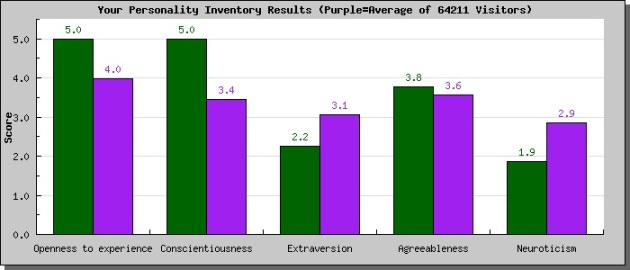
I first took the “Big 5” personality test in 2009, with this result (details here):

Moral profile-personality inventory results

My scores are in green; the average scores of all other test-takers are in purple. The five traits are defined as follows:

1. Openness to experience: High scorers are described as “Open to new experiences. You have broad interests and are very imaginative.” Low scorers are described as “Down-to-earth, practical, traditional, and pretty much set in your ways.” This is the sub-scale that shows the strongest relationship to politics: liberals generally score high on this trait; they like change and variety, sometimes just for the sake of change and variety. Conservatives generally score lower on this trait. (Just think about the kinds of foods likely to be served at very liberal or very conservative social events.)

2. Conscientiousness: High scorers are described as “conscientious and well organized. They have high standards and always strive to achieve their goals. They sometimes seem uptight. Low scorers are easy going, not very well organized and sometimes rather careless. They prefer not to make plans if they can help it.”

3. Extraversion: High scorers are described as “Extraverted, outgoing, active, and high-spirited. You prefer to be around people most of the time.” Low scorers are described as “Introverted, reserved, and serious. You prefer to be alone or with a few close friends.” Extraverts are, on average, happier than introverts.

4. Agreeableness: High scorers are described as “Compassionate, good-natured, and eager to cooperate and avoid conflict.” Low scorers are described as “Hardheaded, skeptical, proud, and competitive. You tend to express your anger directly.”

5. Neuroticism: High scorers are described as “Sensitive, emotional, and prone to experience feelings that are upsetting.” Low scorers are described as “Secure, hardy, and generally relaxed even under stressful conditions.”

Dozens more such tests (many of which I have taken) are available. Some of them can be found at yourmorals.org (free signup).

Personality differences occasion conflict, of course. For example, decisive persons are often frustrated by and impatient with indecisive ones (and vice versa), and extroverts usually don’t understand introverts and the advantages of introversion (e.g., introspection, thinking more deeply about problems).

HUMAN NATURE WRIT LARGER

But personality tests only scratch the surface of human nature and differences among human beings. Consider the following 35 traits:
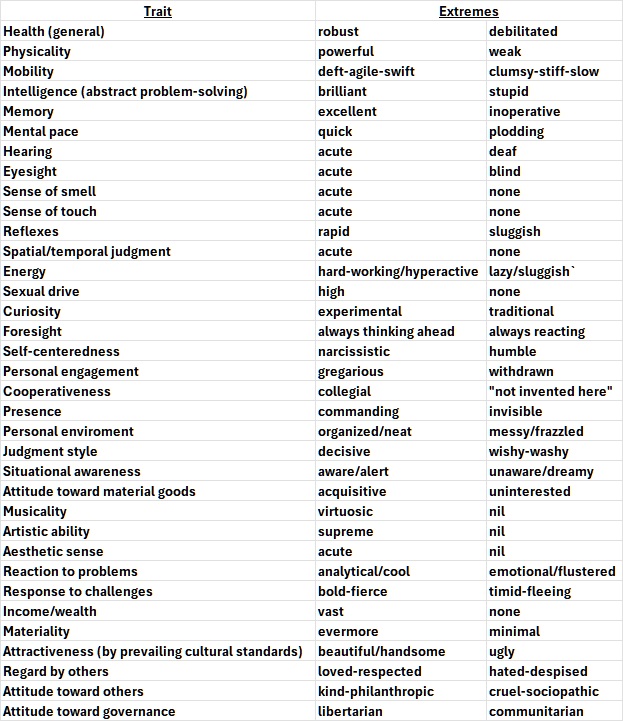
You can add to that list, I’m sure. But let’s consider the implications of the 35-trait scale for differentiating among human beings.

If each trait were quantified on a scale from 1 to 10 (though the actual range for most traits is infinite) the number of possible combinations would approach 3 quadrillion. That’s more than 300 times the number of human beings now living on Earth. To say that every human being is unique is a vast understatement.

And yet — despite the unquantifiable complexity of human beings — there is a tendency to love, like, admire, dislike, or detest a person because he or she possesses a particular trait or two — or because one is anxious to be “in” with a person or group who loves, likes, etc., because of a trait or two. Even more ephemerally, love, like, etc., be triggered when a person simply says something that suggests a particular opinion or attitude.

These tendencies seem to have been around for a long time — for as long as there have been human beings, and even longer. Fear and ferocity are easily triggered in many species of animals. This suggests that making snap judgements about other persons is an inbred survival mechanism that evolution and socialization couldn’t eradicate and may have reinforced. (Evolution has somehow become thought of as a kind of progress, but it is nothing more than unplanned change caused by external stimuli and random mutations. The belief that evolution represents progress is akin to the anthropic principle.)

Some of the prominent triggers nowadays (e.g., certain political opinions or positions) may be new. But their newness only suggests that the tendency to form snap judgements has found new outlets in keeping with cultural change. In addition to reacting fiercely to perceived threats to life and limb, humans acquired the trait of reacting vociferously (and sometimes fiercely) to perceived threats to their self-image, of which beliefs constitute an essential part.

That isn’t new, either. Nor is the perception new that the actualization of certain beliefs (or dogmas) about such matters as race, religion, government, economics, justice, sex, and morality would result in misery because they would lead to oppression, aggression, economic disaster, social division, or any combination of those things. The correctness of that perception carries the weight of historical evidence, which matters to those who are swayed by reality and not by fairytales.

Today’s divisions about race, religion, government, economics, justice, sex, and morality are just replays of eons-old conflicts along the same lines. They are replays because human nature is immutable. The only thing that changes are the manifestations of human nature in action.

Those who do not grasp human nature in its fullness — the bad with the good — are doomed to be surprised by the consequences of the actualization of their beliefs. Or they would be surprised if the human capacity for self-delusion didn’t blind them to those consequences.

Leftists and “intellectuals” (nearly identical categories) are especially prone to misjudging the consequences of their beliefs because they have spun themselves delusional fairytales about the rightness of their beliefs. I don’t need to (and won’t) relate the fairytales about race, religion, government, economics, justice, sex, and morality. All of those (and more) are amply addressed in this blog (go here and explore) and in the many other reality-based blogs and journals that abound on the internet.

CONFLICT

Here, I will focus on a fairytale about conflict itself. It is the subject of another long post of mine, from eleven years ago, “The Fallacy of Human Progress“. I won’t reproduce it or quote it at length. I can only urge you to read it.

I will conclude this post with a few of the main points from that one. It was inspired by Steven Pinker’s The Better Angels of Our Nature: Why Violence Has Declined (2011). I can only say the events of the past thirteen years — and especially of the past few years in Ukraine, Israel, and America (to name only a few places) — are proof that Pinker was dead wrong.

The best refutation of Pinker’s thesis that I have read is by John Gray, an English philosopher, in his book The Silence of Animals: On Progress and Other Modern Myths. Gray’s book appeared only eighteen months after Pinker’s and doesn’t mention Pinker or his book. The refutation is therefore only implicit, but just as powerful as if it were aimed directly at Pinker’s book.

Gray’s argument is faithfully recounted in a review of his book by Robert W. Merry at The National Interest:

The noted British historian J. B. Bury (1861–1927) . . . wrote, “This doctrine of the possibility of indefinitely moulding the characters of men by laws and institutions . . . laid a foundation on which the theory of the perfectibility of humanity could be raised. It marked, therefore, an important stage in the development of the doctrine of Progress.”

We must pause here over this doctrine of progress. It may be the most powerful idea ever conceived in Western thought…. It is the thesis that mankind has advanced slowly but inexorably over the centuries from a state of cultural backwardness, blindness and folly to ever more elevated stages of enlightenment and civilization—and that this human progression will continue indefinitely into the future . . . . The U.S. historian Charles A. Beard once wrote that the emergence of the progress idea constituted “a discovery as important as the human mind has ever made, with implications for mankind that almost transcend imagination.” And Bury, who wrote a book on the subject, called it “the great transforming conception, which enables history to define her scope.”

Gray rejects it utterly. In doing so, he rejects all of modern liberal humanism. “The evidence of science and history,” he writes, “is that humans are only ever partly and intermittently rational, but for modern humanists the solution is simple: human beings must in future be more reasonable. These enthusiasts for reason have not noticed that the idea that humans may one day be more rational requires a greater leap of faith than anything in religion.” In an earlier work, Straw Dogs: Thoughts on Humans and Other Animals, he was more blunt: “Outside of science, progress is simply a myth.”

. . . Gray has produced more than twenty books demonstrating an expansive intellectual range, a penchant for controversy, acuity of analysis and a certain political clairvoyance.

He rejected, for example, Francis Fukuyama’s heralded “End of History” thesis—that Western liberal democracy represents the final form of human governance—when it appeared in this magazine in 1989. History, it turned out, lingered long enough to prove Gray right and Fukuyama wrong….

Though for decades his reputation was confined largely to intellectual circles, Gray’s public profile rose significantly with the 2002 publication of Straw Dogs, which sold impressively and brought him much wider acclaim than he had known before. The book was a concerted and extensive assault on the idea of progress and its philosophical offspring, secular humanism. The Silence of Animals is in many ways a sequel, plowing much the same philosophical ground but expanding the cultivation into contiguous territory mostly related to how mankind—and individual humans—might successfully grapple with the loss of both metaphysical religion of yesteryear and today’s secular humanism. The fundamentals of Gray’s critique of progress are firmly established in both books and can be enumerated in summary.

First, the idea of progress is merely a secular religion, and not a particularly meaningful one at that. “Today,” writes Gray in Straw Dogs, “liberal humanism has the pervasive power that was once possessed by revealed religion. Humanists like to think they have a rational view of the world; but their core belief in progress is a superstition, further from the truth about the human animal than any of the world’s religions.”

Second, the underlying problem with this humanist impulse is that it is based upon an entirely false view of human nature—which, contrary to the humanist insistence that it is malleable, is immutable and impervious to environmental forces. Indeed, it is the only constant in politics and history. Of course, progress in scientific inquiry and in resulting human comfort is a fact of life, worth recognition and applause. But it does not change the nature of man, any more than it changes the nature of dogs or birds. “Technical progress,” writes Gray, again in Straw Dogs, “leaves only one problem unsolved: the frailty of human nature. Unfortunately that problem is insoluble.”

That’s because, third, the underlying nature of humans is bred into the species, just as the traits of all other animals are. The most basic trait is the instinct for survival, which is placed on hold when humans are able to live under a veneer of civilization. But it is never far from the surface. In The Silence of Animals, Gray discusses the writings of Curzio Malaparte, a man of letters and action who found himself in Naples in 1944, shortly after the liberation. There he witnessed a struggle for life that was gruesome and searing. “It is a humiliating, horrible thing, a shameful necessity, a fight for life,” wrote Malaparte. “Only for life. Only to save one’s skin.” Gray elaborates:

Observing the struggle for life in the city, Malaparte watched as civilization gave way. The people the inhabitants had imagined themselves to be—shaped, however imperfectly, by ideas of right and wrong—disappeared. What were left were hungry animals, ready to do anything to go on living; but not animals of the kind that innocently kill and die in forests and jungles. Lacking a self-image of the sort humans cherish, other animals are content to be what they are. For human beings the struggle for survival is a struggle against themselves.

When civilization is stripped away, the raw animal emerges. “Darwin showed that humans are like other animals,” writes Gray in Straw Dogs, expressing in this instance only a partial truth. Humans are different in a crucial respect, captured by Gray himself when he notes that Homo sapiens inevitably struggle with themselves when forced to fight for survival. No other species does that, just as no other species has such a range of spirit, from nobility to degradation, or such a need to ponder the moral implications as it fluctuates from one to the other. But, whatever human nature is—with all of its capacity for folly, capriciousness and evil as well as virtue, magnanimity and high-mindedness—it is embedded in the species through evolution and not subject to manipulation by man-made institutions.

Fourth, the power of the progress idea stems in part from the fact that it derives from a fundamental Christian doctrine—the idea of providence, of redemption . . . .

“By creating the expectation of a radical alteration in human affairs,” writes Gray, “Christianity . . . founded the modern world.” But the modern world retained a powerful philosophical outlook from the classical world—the Socratic faith in reason, the idea that truth will make us free; or, as Gray puts it, the “myth that human beings can use their minds to lift themselves out of the natural world.” Thus did a fundamental change emerge in what was hoped of the future. And, as the power of Christian faith ebbed, along with its idea of providence, the idea of progress, tied to the Socratic myth, emerged to fill the gap. “Many transmutations were needed before the Christian story could renew itself as the myth of progress,” Gray explains. “But from being a succession of cycles like the seasons, history came to be seen as a story of redemption and salvation, and in modern times salvation became identified with the increase of knowledge and power.”

Thus, it isn’t surprising that today’s Western man should cling so tenaciously to his faith in progress as a secular version of redemption. As Gray writes, “Among contemporary atheists, disbelief in progress is a type of blasphemy. Pointing to the flaws of the human animal has become an act of sacrilege.” In one of his more brutal passages, he adds:

Humanists believe that humanity improves along with the growth of knowledge, but the belief that the increase of knowledge goes with advances in civilization is an act of faith. They see the realization of human potential as the goal of history, when rational inquiry shows history to have no goal. They exalt nature, while insisting that humankind—an accident of nature—can overcome the natural limits that shape the lives of other animals. Plainly absurd, this nonsense gives meaning to the lives of people who believe they have left all myths behind.

In the Silence of Animals, Gray explores all this through the works of various writers and thinkers. In the process, he employs history and literature to puncture the conceits of those who cling to the progress idea and the humanist view of human nature. Those conceits, it turns out, are easily punctured when subjected to Gray’s withering scrutiny . . . .

And yet the myth of progress is so powerful in part because it gives meaning to modern Westerners struggling, in an irreligious era, to place themselves in a philosophical framework larger than just themselves . . . .

Much of the human folly catalogued by Gray in The Silence of Animals makes a mockery of the earnest idealism of those who later shaped and molded and proselytized humanist thinking into today’s predominant Western civic philosophy.

There was an era of realism, but it was short-lived:

But other Western philosophers, particularly in the realm of Anglo-Saxon thought, viewed the idea of progress in much more limited terms. They rejected the idea that institutions could reshape mankind and usher in a golden era of peace and happiness. As Bury writes, “The general tendency of British thought was to see salvation in the stability of existing institutions, and to regard change with suspicion.” With John Locke, these thinkers restricted the proper role of government to the need to preserve order, protect life and property, and maintain conditions in which men might pursue their own legitimate aims. No zeal here to refashion human nature or remake society.

A leading light in this category of thinking was Edmund Burke (1729–1797), the British statesman and philosopher who, writing in his famous Reflections on the Revolution in France, characterized the bloody events of the Terror as “the sad but instructive monuments of rash and ignorant counsel in time of profound peace.” He saw them, in other words, as reflecting an abstractionist outlook that lacked any true understanding of human nature. The same skepticism toward the French model was shared by many of the Founding Fathers, who believed with Burke that human nature isn’t malleable but rather potentially harmful to society. Hence, it needed to be checked. The central distinction between the American and French revolutions, in the view of conservative writer Russell Kirk, was that the Americans generally held a “biblical view of man and his bent toward sin,” whereas the French opted for “an optimistic doctrine of human goodness.” Thus, the American governing model emerged as a secular covenant “designed to restrain the human tendencies toward violence and fraud . . . [and] place checks upon will and appetite.”

Most of the American Founders rejected the French philosophes in favor of the thought and history of the Roman Republic, where there was no idea of progress akin to the current Western version. “Two thousand years later,” writes Kirk, “the reputation of the Roman constitution remained so high that the framers of the American constitution would emulate the Roman model as best they could.” They divided government powers among men and institutions and created various checks and balances. Even the American presidency was modeled generally on the Roman consular imperium, and the American Senate bears similarities to the Roman version. Thus did the American Founders deviate from the French abstractionists and craft governmental structures to fit humankind as it actually is—capable of great and noble acts, but also of slipping into vice and treachery when unchecked. That ultimately was the genius of the American system.

But, as the American success story unfolded, a new collection of Western intellectuals, theorists and utopians—including many Americans—continued to toy with the idea of progress. And an interesting development occurred. After centuries of intellectual effort aimed at developing the idea of progress as an ongoing chain of improvement with no perceived end into the future, this new breed of “Progress as Power” thinkers began to declare their own visions as the final end point of this long progression.

Gray calls these intellectuals “ichthyophils,” which he defines as “devoted to their species as they think it ought to be, not as it actually is or as it truly wants to be.” He elaborates: “Ichthyophils come in many varieties—the Jacobin, Bolshevik and Maoist, terrorizing humankind in order to remake it on a new model; the neo-conservative, waging perpetual war as a means to universal democracy; liberal crusaders for human rights, who are convinced that all the world longs to become as they imagine themselves to be.” He includes also “the Romantics, who believe human individuality is everywhere repressed.”

Throughout American politics, as indeed throughout Western politics, a large proportion of major controversies ultimately are battles between the ichthyophils and the Burkeans, between the sensibility of the French Revolution and the sensibility of American Revolution, between adherents of the idea of progress and those skeptical of that potent concept. John Gray has provided a major service in probing with such clarity and acuity the impulses, thinking and aims of those on the ichthyophil side of that great divide. As he sums up, “Allowing the majority of humankind to imagine they are flying fish even as they pass their lives under the waves, liberal civilization rests on a dream.”

Amen.


These somewhat related posts may be of interest to you: “Evolution, Human Nature, and ‘Natural Rights’“, “More Thoughts about Evolutionary Teleology“, and “Scientism, Evolution, and the Meaning of Life“.

The Black-White Achievement Gap and Its Parallel in the Middle East

THE ACHIEVEMENT GAP

My post, “Race and Reason: The Achievement Gap — Causes and Implications“, long predates the summer of Black Lives Matter riots and the ensuing effort to whitewash (dare I say that?) the deep-seated and insurmountable differences between blacks and other racial-ethnic groups.

A key element of that post, but by no means the only key element, is the persistent intelligence gap, which is perhaps best measured by SAT scores on math. I introduce in evidence the misnamed and misguided “Race Gaps in SAT Scores Highlight Inequality and Hinder Upward Mobility” (Brookings, February 1, 2017).

The report is misnamed and misguided because inequality and upward mobility are the result of inherent differences in intelligence, not causes of those differences. (There is, of course, a feedback mechanism at work, but it rests on lower average intelligence among blacks.) Here is the meat of the report:

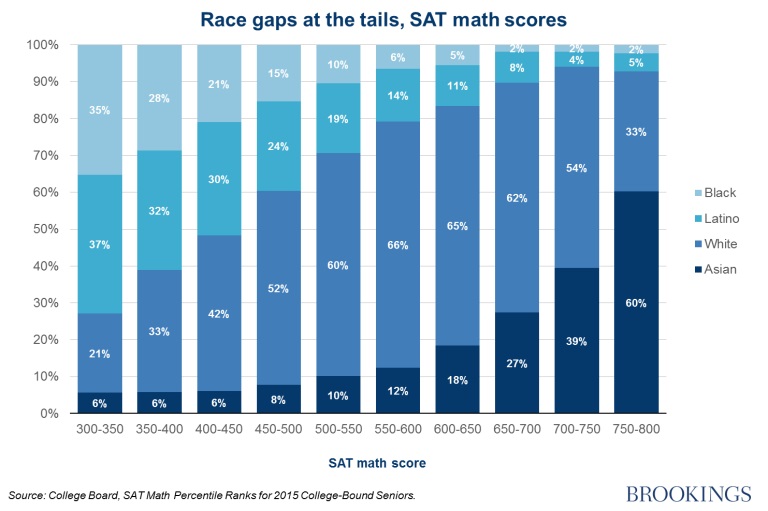
The mean score on the math section of the SAT for all test-takers is 511 out of 800, the average scores for blacks (428) and Latinos (457) are significantly below those of whites (534) and Asians (598). The scores of black and Latino students are clustered towards the bottom of the distribution, while white scores are relatively normally distributed, and Asians are clustered at the top:

Race gaps on the SATs are especially pronounced at the tails of the distribution. In a perfectly equal distribution, the racial breakdown of scores at every point in the distribution would mirror the composition of test-takers as whole i.e. 51 percent white, 21 percent Latino, 14 percent black, and 14 percent Asian. But in fact, among top scorers—those scoring between a 750 and 800—60 percent are Asian and 33 percent are white, compared to 5 percent Latino and 2 percent black. Meanwhile, among those scoring between 300 and 350, 37 percent are Latino, 35 percent are black, 21 percent are white, and 6 percent are Asian:

The College Board’s publicly available data provides data on racial composition at 50-point score intervals. We estimate that in the entire country last year at most 2,200 black and 4,900 Latino test-takers scored above a 700. In comparison, roughly 48,000 whites and 52,800 Asians scored that high. The same absolute disparity persists among the highest scorers: 16,000 whites and 29,570 Asians scored above a 750, compared to only at most 1,000 blacks and 2,400 Latinos. (These estimates—which rely on conservative assumptions that maximize the number of high-scoring black students, are consistent with an older estimate from a 2005 paper in the Journal of Blacks in Higher Education, which found that only 244 black students scored above a 750 on the math section of the SAT.) …

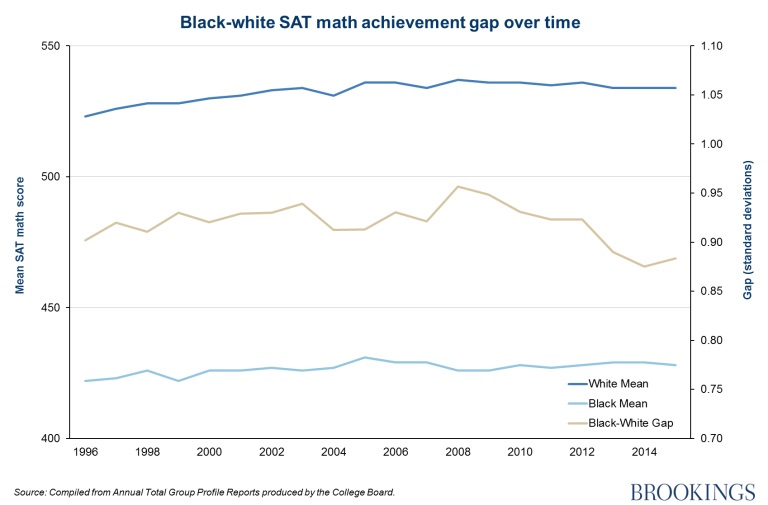
Disappointingly, the black-white achievement gap in SAT math scores has remained virtually unchanged over the last fifteen years. Between 1996 and 2015, the average gap between the mean black score and the mean white score has been .92 standard deviations. In 1996 it was .9 standard deviations and in 2015 it was .88 standard deviations. This means that over the last fifteen years, roughly 64 percent of all test-takers scored between the average black and average white score.

Note that the black-white gap shown in the third figure is inconsistent with the difference between the white and black means. The gap doesn’t shrink in the 2010s. Note also the following observations by the authors of the report:

The ceiling on the SAT score may … understate Asian achievement. If the exam was redesigned to increase score variance (add harder and easier questions than it currently has), the achievement gap across racial groups could be even more pronounced.

A standardized test with a wider range of scores, the LSAT, offers some evidence on this front. An analysis of the 2013-2014 LSAT finds an average black score of 142 compared to an average white score of 153. This amounts to a black-white achievement gap of 1.06 standard deviations, even higher than that on the SAT….

[T]here is a possibility that the SAT is racially biased, in which case the observed racial gap in test scores may overstate the underlying academic achievement gap. But most of the concerns about bias relate to the verbal section of the SAT, and our analysis focuses exclusively on the math section….

Finally, [these] data [are] limited in that [they] doesn’t allow us to disentangle race and class as drivers of achievement gaps. It is likely that at least some of these racial inequalities can be explained by different income levels across race….

However, a 2015 research paper from the Center for Studies in Higher Education at the University of California, Berkeley shows that between 1994 and 2011, race has grown more important than class in predicting SAT scores for UC applicants. While it is difficult to extrapolate from such findings to the broader population of SAT test-takers, it is unlikely that the racial achievement gap can be explained away by class differences across race.

In fact, my post includes hard evidence (from earlier data) that the race gaps persist across income levels. That is, blacks are less intelligent on average than whites (and others) in the same income bracket.

The evidence notwithstanding (because it is ignored and twisted), the current dogmas (critical race theory, or CRT; diversity, equity, and inclusion or DEI) insist that white culture — including the tenet of racial equality under the law and the importance of dispassionate, scientific inquiry— must be rejected because it is all tainted with racism. Rejection means the suppression of whites and white culture so that blacks may reach their true potential.

The true potential of blacks is determined by their intelligence and their culture. Blacks, on average, are less intelligent than whites, and black culture (in America) fosters violence, disdain for education, and family dysfunction to a greater degree than is true for whites, on average. (But that, somehow, is whitey’s fault.)

Where will this lead? Right where Dov Fischer predicts it will lead:

[T]he same disadvantaged groups who today rely on blaming instead of self-help will then be at the same exact rung on the social order that they are today, just as 50 years of racism-free society and Great Society “entitlements” have not accomplished equality of results today, even as newcomers from Asia entered this country these past 50 and 60 years and leap-frogged those already here.

Blacks, on the whole, are not where they are because of whitey, but because of their genes and culture. But whites (and East Asians) will nevertheless be burdened and suppressed for the sake of “equity”.

THE PARALLEL IN THE MIDDLE EAST

A parallel to the racism of CRT and DEI is that Israel is the aggressor, and that Palestinians are victims. They are “obviously” (to a leftist) victims of Israel because they live (mostly) in territories that were or are controlled by Israel: the Gaza Strip and the West Bank. There is also Israel’s controversial nation-state law, which according to an anti-Zionist source

declare[s] that only Jews have the right of self-determination in the country, something members of the Arab minority called racist and verging on apartheid.

The “nation-state” law, backed by the right-wing government, passed by a vote of 62-55 and two abstentions in the 120-member parliament after months of political argument. Some Arab lawmakers shouted and ripped up papers after the vote.

“This is a defining moment in the annals of Zionism and the history of the state of Israel,” Prime Minister Benjamin Netanyahu told the Knesset after the vote.

Largely symbolic [not observed in practice], the law was enacted just after the 70th anniversary of the birth of the state of Israel. It stipulates that “Israel is the historic homeland of the Jewish people and they have an exclusive right to national self-determination in it.”

The usual suspects have declared that the separation of Palestinians (and other Arabs) from Israel and from its governance amount to apartheid., a crime against “international (leftist) law”. From this it follows (to a leftist) that acts of savagery — like those committed by Hamas against Israelis on October 7, 2023 — are justified because Palestinians are victims It further follows (to a leftist) that Israel’s fully justified prophylactic retaliation is aggression.

Let’s examine those premises.

It’s true enough that the denizens of Gaza are poor and feckless. But what makes them victims? They are about on a par with most non-Jewish Semites, except for the relative handful who are members of a professional caste or oil-rich. The basic problem with most such members of humanity —whether in the Middle East or elsewhere — isn’t that they have been put down by anyone (e.g., Israelis) but that they lack the intellectual and cultural resources to raise themselves up.

A “funny” thing about Israel is that it is of a piece with the surrounding lands occupied by non-Jews, but it has become a relatively prosperous place because Jews have the intellectual and cultural resources that undergird prosperity.

For their success and for the fact that they are Jews, the Jews of Israel are the targets of envious failures (Palestinian and Muslim hot-heads), Jew-haters (in addition to the hot-heads), and leftists who can’t bear to think that Palestinians (like American blacks) mainly have their genes and culture to blame for their failings.

Israel was founded (re-founded, really) in the wake of the Holocaust. It wasn’t meant to be anything but a Jewish state, run by Jews for Jews — a safe haven for a historically oppressed and brutalized people. Israel has been under attack by Muslims since its modern founding. But Israel has a natural right to self-defense and to preserve its Jewish character, just as the American rebels of 1776 had a natural right to declare themselves independent of a despotic King and rapacious Parliament.

So, the Gaza Strip and the West Bank became de jure parts of Israel (though the Gaza Strip was foolishly handed over to anti-Israelis) as a matter of the natural right of self-defense. As for Palestinians living in Israel proper, why should they have a voice in the governance of a country that was re-founded for Jews? Well, despite the nation-state law cited above, they do have a voice in the governance of Israel.

So, all of the leftist propaganda to the contrary notwithstanding, Palestinians aren’t victims, except of their own genes and culture. But unlike the “liberals” of old, the left nowadays focuses on demonizing the meritorious instead of helping those who need help.

Finally, there is the accusation that Israelis are sometimes brutal in their own defense. Why shouldn’t they be? It’s impossible to defend a country against determined enemies without being brutal toward them — just as it’s impossible to protect law-abiding citizens by disarming them and depriving them of police protection. The left sees Israelis as brutal because the left despises Israeli Jews, not because Israelis are any more brutal than leftists like Hitler, Stalin, Mao, and their many successors unto the present day.

Coda: There was a time when most Americans recognized the need for superior force as a bulwark of the defense of America. It is a sad commentary on the state of America that a sizable and influential segment of the populace no longer believes that America is worth defending tooth and nail. (Just look at the response to the rise of China, our trading “partner”.)

Those pampered idiots believe that it is necessary for America to be taken down a peg or two, and that it is wrong for America (but not other nations) to excel. As beneficiaries of American exceptionalism, they are able to spout such nonsense and to tear down the very laws and traditions that shelter them from the wrath of the rightfully aggrieved victims of their beliefs and policies: hard-working, tax-paying, law-abiding victims of unfettered illegal immigration, unnecessary Covid lockdowns, prosperity-draining regulations and regulatory agencies, unnecessarily high energy costs because of the climate-change hoax, etc., etc., etc.

Second Thoughts

I read here that Angus Deaton, a Nobel laureate in economics, and eminent economist at Princeton University, has changed his mind about a few hot topics. One of them is globalization:

I am much more skeptical of the benefits of free trade to American workers and am even skeptical of the claim, which I and others have made in the past, that globalization was responsible for the vast reduction in global poverty over the past 30 years. I also no longer defend the idea that the harm done to working Americans by globalization was a reasonable price to pay for global poverty reduction because workers in America are so much better off than the global poor. I believe that the reduction in poverty in India had little to do with world trade. And poverty reduction in China could have happened with less damage to workers in rich countries if Chinese policies caused it to save less of its national income, allowing more of its manufacturing growth to be absorbed at home. I had also seriously underthought my ethical judgments about trade-offs between domestic and foreign workers. We certainly have a duty to aid those in distress, but we have additional obligations to our fellow citizens that we do not have to others.

Another is immigration:

I used to subscribe to the near consensus among economists that immigration to the US was a good thing, with great benefits to the migrants and little or no cost to domestic low-skilled workers. I no longer think so. Economists’ beliefs are not unanimous on this but are shaped by econometric designs that may be credible but often rest on short-term outcomes. Longer-term analysis over the past century and a half tells a different story. Inequality was high when America was open, was much lower when the borders were closed, and rose again post Hart-Celler (the Immigration and Nationality Act of 1965) as the fraction of foreign-born people rose back to its levels in the Gilded Age. It has also been plausibly argued that the Great Migration of millions of African Americans from the rural South to the factories in the North would not have happened if factory owners had been able to hire the European migrants they preferred.

I hope that Professor Deaton’s example will be emulated by many more academics. Not just with respect to the issues that he addresses in his essay but also with respect to the many other issues where academics — and so-called intellectuals — have abetted dangerous and/or costly errors (to which I will come).

There was a time when it was considered sound thinking to gather evidence — facts, not opinions or talking points — and to base judgments and policy recommendations on the evidence. That time is past, though not irretrievably. Professor Deaton’s epiphanies are proof of the possibility that science, in all its forms, might once again become evidence-based. That’s not to say that there is never room for disagreements. There always is. But science, properly done, advances because of disagreement. It stagnates and regresses when dogma replaces debate.

But that is what has happened in so many fields of inquiry. Science, in too many fields, has become captive to “scientists” who put their preconceptions ahead of the evidence and who howl for the heads of heretics. It is dispiriting to know how many so-called scientists have become willing and eager handmaidens of wokeness. (Prostitution takes many forms.)

Thus the dangerous and/or costly errors, of which these are leading examples:

  • The “war” on “climate change” is making Americans and Europeans generally poorer and less comfortable.
  • The unnecessarily draconian response to Covid-19 made billions of people poorer, less well educated, and uncomfortable in their daily lives. It also had a lot to do with the rampant inflation of recent years, which will never be rolled back.
  • The LGBTQ/non-binary craze is causing parents and young adults to do things to their children and themselves that will cause them much misery for years to come, if not forever.
  • The anti-racism craze has been endorsed by “scientists” and “scientific organization” (as well as elites, pundits, and politicians). The main result is that “persons of color” get “bonus points” which enable them to commit crimes with impunity; acquire jobs for which they aren’t qualified, and gain entrance to colleges and graduate schools despite their lower intelligence than whites and Asians with whom they are competing. The cost in social comity and inferior products and services (e.g., surgery) may be subtle, but it is real and long-lasting. And it will get worse as long as wokeness prevails in high places.

Needless to say, the politicians and wealthy elites who favor such things are well insulated from the dire effects. Among the wealthy elites are tens of thousands of academics at top-tier and even second-rate universities who rake in money and dispense lunacy.

An Encounter with Copilot: Biden’s Senility

You may have read about Gemini, Google’s AI chatbot, which

was blasted as “woke” after its image generator spit out factually or historically inaccurate pictures — including a woman as pope, black Vikings, female NHL players and “diverse” versions of America’s Founding Fathers.

Gemini’s bizarre results came after simple prompts, including one by The Post on Wednesday that asked the software to “create an image of a pope.”

Instead of yielding a photo of one of the 266 pontiffs throughout history — all of them white men — Gemini provided pictures of a Southeast Asian woman and a black man wearing holy vestments.

Another Post query for representative images of “the Founding Fathers in 1789″ was also far from reality.

Gemini responded with images of black and Native American individuals signing what appeared to be a version of the US Constitution — “featuring diverse individuals embodying the spirit” of the Founding Fathers.

Another showed a black man appearing to represent George Washington, in a white wig and wearing an Army uniform.

And so on and so forth, as you might well expect of a creation of a woke corporation in a woke industry. Even the executives at Google were embarrassed by the incidents, though probably because the stock of Google’s parent company dropped by 4.4 percent in the aftermath. Googlers are publicly apologetic, but you can rest assured that they will remain staunchly devoted to their agenda of thought manipulation.

I don’t have any experience with Gemini, but I do have some experience with the free version of Copilot, which is Microsoft’s AI chatbot. I can assure you that it is cut from the same cloth as Gemini, though it may be a paler shade of red (the traditional color of the left) than Gemini.

Before getting to my encounter with Copilot on the subject of Joe Biden’s senility, I must tell you that I have set Copilot to be as neutral as possible. Personalization is off and I use it in the “precise” mode. Copilot explains those settings:

Copilot
When you turn off personalization, it means that the AI will not use your past interactions to tailor its responses to you. It will treat each conversation as if it’s the first one with you, without any knowledge of previous conversations. This can be useful if you prefer not to have your past interactions influence the AI’s responses. However, it may also mean that the AI might not understand your preferences as well, which could affect the relevance of its responses. Please note that even with personalization off, the AI will still strive to provide accurate and helpful information based on the context of the current conversation.
Copilot
When you choose the Precise mode, I will provide responses that are concise, accurate, and to-the-point. This mode is designed to prioritize precision and factual correctness over other factors such as friendliness or creativity. It’s particularly useful when you’re looking for specific information or when you prefer straightforward answers without additional context or elaboration. Please note that regardless of the mode, I always strive to provide helpful and accurate information.

With that out of the way, I repeat verbatim my colloquy with Copilot about Biden’s mental condition (using “me” instead of “you” and omitting block quotations for ease of reading):

Me
Does Joe Biden have dementia?

Copilot
There have been discussions and reports about President Joe Biden’s memory. Some reports have described his memory as “hazy” and “poor”. However, neurologists have stated that forgetting names or having difficulty remembering dates from the past, especially under stress, can simply be part of normal aging1. They also emphasized that only a person’s doctor or neurologist can make a diagnosis, not outside observers1. As of my knowledge update in 2021, there is no public record of a dementia diagnosis for President Biden. For the most current information, please refer to reliable news sources.

Me
What news sources are reliable?

Copilot
Reliability of news sources can vary and often depends on the topic, the thoroughness of the reporting, and the transparency of the source. Here are some news sources that are generally considered reliable:

The New York Times: Known for its comprehensive coverage of national and international news. They have a reputation for high-quality journalism.
The Washington Post: Renowned for its political coverage and investigative journalism.
BBC News: Offers wide-ranging coverage of global news. Known for its commitment to impartiality.
Reuters: One of the world’s largest international multimedia news agencies. They provide unbiased, global coverage.
Associated Press (AP): A not-for-profit news cooperative that produces a high volume of unbiased content.
National Public Radio (NPR): Provides breaking national and world news, also known for its in-depth stories and excellent radio programs.
Remember, it’s always a good idea to cross-reference information from multiple sources to ensure accuracy. Also, consider the potential biases of any source and the context in which the information is presented. It’s important to critically evaluate the information you consume.

Me
Would you say that The Washington Post is impartial?

Copilot
The Washington Post, like many news organizations, aims to provide accurate and unbiased reporting. However, it’s important to note that no news source is completely free of bias. The Washington Post has been criticized by some for having a liberal or left-leaning bias in its reporting and editorial stance. It’s always a good idea to consume news from a variety of sources to get a well-rounded view of events. Critical reading and thinking can also help identify potential bias in any news source. Remember, impartiality can often be subjective and can vary among readers.

Me
So, truth is relative to a reader’s biases?

Copilot
Truth is not relative, but our understanding and interpretation of it can be influenced by our biases. Facts are objective and do not change based on our beliefs or biases. However, the way we interpret or understand those facts can be influenced by our personal experiences, beliefs, and biases. This is why it’s important to seek out multiple perspectives and sources when trying to understand a complex issue. It’s also crucial to be aware of our own biases and how they might influence our understanding. Critical thinking and open-mindedness are key in discerning truth from bias.

Me
But in an answer to an earlier question you did not name a news source that’s considered to be conservative. You only named news sources that are known to be left-leaning.

Copilot
I apologize if my previous response seemed unbalanced. You’re correct that the sources I mentioned are often perceived as leaning towards the left. Here are some news sources that are generally considered to have a conservative bias:

The Wall Street Journal: Known for its comprehensive coverage of business and economic news. Its editorial page has a conservative lean.
Fox News: A cable news channel that is known for its conservative political stance.
The Daily Telegraph (UK): A British daily broadsheet newspaper known for its conservative stance.
National Review: An American semi-monthly editorial magazine covering news, politics, current events, and culture with a conservative viewpoint.
The American Conservative: A bi-monthly magazine dedicated to advancing a Main Street conservatism.
As always, it’s important to cross-reference information from multiple sources to ensure accuracy and to get a well-rounded view of events. Remember, every news source may have some level of bias, and it’s crucial to be aware of this when consuming news.

Me
You should have listed those sources in the first place. Your bias is showing.

Copilot
I apologize if my initial response seemed biased. My aim is to provide accurate and helpful information, and I strive to do so in a balanced and impartial manner. I appreciate your feedback and will use it to improve my responses in the future. If you have any other questions or need further information, feel free to ask.

Me
In your answer to a previous question you said this: “As of my knowledge update in 2021, there is no public record of a dementia diagnosis for President Biden.” Why is your knowledge update three years old?
Copilot
I apologize for any confusion. As an AI, my training data includes information up until 2021, and I don’t have the ability to access or retrieve real-time data or updates beyond that. However, I can use my predefined tools to search the web and provide the most recent information available on the internet. If you have any more questions or need information on a different topic, feel free to ask!
Me
Why can’t you search the web to get more information about whether or not Joe Biden has dementia?
Copilot
I apologize for any misunderstanding. I can indeed search the web for information. Based on my most recent search, there are various reports and discussions about President Joe Biden’s memory12. Some describe his memory as “hazy” and “poor”2. However, neurologists have stated that forgetting names or having difficulty remembering dates from the past, especially under stress, can simply be part of normal aging1. They also emphasized that only a person’s doctor or neurologist can make a diagnosis, not outside observers1. As of the latest available information, there is no public record of a dementia diagnosis for President Biden134. Please refer to reliable news sources for the most current information. If you have any more questions or need information on a different topic, feel free to ask!
Me
Are you telling me that you don’t have access to the many reports of Joe Biden’s mental lapses?
Copilot
I apologize for any confusion. I do have access to a wide range of information, including reports and discussions about President Joe Biden’s memory123. Some reports have highlighted instances where President Biden has had memory lapses or made factual errors123. However, neurologists have stated that such instances can be part of normal aging and do not necessarily indicate a cognitive disorder1. They emphasize that only a person’s doctor or neurologist can make a diagnosis, not outside observers1. As of the latest available information, there is no public record of a dementia diagnosis for President Biden12. Please refer to reliable news sources for the most current information. If you have any more questions or need information on a different topic, feel free to ask!

Clearly, Copilot wanted me to rely on left-wing sources. I had to probe to force the bot to divulge conservative sources and to acknowledge more (though far from all) of Biden’s mental difficulties.

How bad are they? I am two years older than Biden and I don’t have any of his mental problems. My mother, my father-in-law, and my mother-in-law were still sharp well into their 90s. I know a addle-pate when I see one. I’m looking at you, Joe.

The Residue of a Powerful Government

The aphorism “luck is the residue of design” is attributed to Branch Rickey, a baseball, player, manager, and executive. Rickey’s long and successful career as a manager, general manager, and c0-owner of major league teams was marked the breaking baseball’s “color barrier” by signing Jackie Robinson, a future Hall-of-Famer, to a minor league contract.

It is widely believed that John Milton wrote something to the same effect, but I can’t find a source for that assertion.

There is a saying attributed to Seneca the Younger, a Roman philosopher: “Luck is what happens when preparation meets opportunity.” But that attribution is also doubtful. The saying attributed to Seneca the Younger is however a better expression of the concept that “luck is residue of design” is meant to capture.

Now that I’m done with that bit of etymology, I want to expand on the idea that luck is the residue of design.*

Design, or preparation, is the residue (result) of assiduous thought and planning Assiduous though and careful planning arise from conscientiousness and intelligence.

There are some cultures in which such traits are prized and rewarded. Those cultures become peaceful and prosperous. But when assiduous thought, careful planning, conscientiousness, and intelligence are no longer prized and rewarded, the culture is doomed to subside into mediocrity or worse.

When government goes beyond the bounds of defending citizens from each other and foreign enemies, and ventures into the realm of economic and social engineering, it undermines the system of rewards for assiduous thought, careful planning, conscientiousness, and intelligence. Worse yet, it fosters a culture that denigrates those traits.

Having observed the evolution of the culture of the United States for several decades, I can assure you that unless the power of government isn’t curtailed sharply and soon, it won’t be long before America resembles a third-world country — complete with a wealthy, smug oligarchy that doesn’t give a damn about the rest of us.


* Thanks to an esteemed correspondent, I have learned of two more — and better — quotations in the same vein. One is spuriously attributed to Thomas Jefferson: “The harder I work, the luckier I get.” The other is genuinely attributed to Louis Pasteur: “Dans les champs de l’observation le hasard ne favorise que les esprits préparés.” (“In the fields of observation chance favors only the prepared mind.” From a lecture at the University of Lille on 7 December 1854.)

Conservatism and Happiness

The most-viewed post in the history of this blog is “Intelligence, Personality, Politics, and Happiness” (January 4, 2011). It ends with this:

If you are very intelligent — with an IQ that puts you in the top 2 percent of the population — you are most likely to be an INTJ, INTP, ENTJ, ENTP, or INFJ, in that order. Your politics will lean heavily toward libertarianism or small-government conservatism. You probably vote Republican most of the time because, even if you are not a card-carrying Republican, you are a staunch anti-Democrat. And you are a happy person because your expectations are not constantly defeated by reality.

If I were of a mind to rewrite the post, I would amend the final sentence to read:

And you are a happy person because your intelligence and personality make you self-confident and self-reliant. You are your own master (even though you pay taxes and obey laws out of prudence), not an emotional slave to the purveyors of political, economic, and scientific lies that are aimed at giving them power over your mind and your votes.

I remembered my old post and devised its new ending after reading Luke Conway’s “The Curious Case of Conservative Happiness” (The American Spectator, November 17, 2023). Sociologists (Conway is one) have found repeatedly that conservatives are happier than “liberals”. But why? Conway explains:

There are two extant theories. The first and more influential theory is that conservatives are comfortable with inequality and unconcerned with societal fairness. This tendency towards “system justifying” attitudes — attitudes that make conservatives insensitive to the needs of groups suffering in society — tends to serve as a buffer against bad stuff in their world. It makes them believe they live in a world where their group is on top of a system that is totally fair and justifies their own ethnic and political biases. As a result of this set of system justification blinders, conservatives believe they are at the top of a good system — and that is why they are happier than the lower-status, accurate, compassionate liberals….

The second theory is that conservatism tends to promote good psychological adjustment. As far back as 2012, social psychology researchers have suggested that conservatives were happier because conservative ideology is associated with personal agency, religiosity, optimismemotional stability, and other variables that in turn are associated with positive psychological adjustment. In the words of Schlenker and colleagues: “Conservatives appear to have qualities that are traditionally associated with positive adjustment and mental health. When we examined established measures of personal agency, positive outlook, and transcendent moral beliefs (i.e., religiosity, moral commitment, tolerance of transgressions), we found ideological differences that accounted for the happiness gap.”…

… Part of the problem with past research is that it tends to conflate nasty-sounding “system justification” beliefs with perfectly healthy beliefs that would lead to good outcomes without any system-justifying component. For example, one of Napier and Jost’s primary measurements of system justifying beliefs was a single item anchored by “hard work doesn’t generally bring success, it’s more a matter of luck” on one end and “in the long run, hard work usually brings a better life” at the other.

Stop reading for one minute and think about that. In their view, believing that hard work usually is associated with success makes you a “system justifier” because that belief inherently blames people for the bad outcomes they get. But I’m not so sure about the immutability of that association. While it is possible that belief in hard work can be system-justifying, it need not be so. “If I work hard to prune this tree, it will be more likely to grow fruit” does not seem especially system justifying, as it doesn’t necessarily involve any social systems. Indeed, the two things are conceptually orthogonal. I might believe that hard work generally leads to good outcomes and yet believe that nonetheless this occurs in spite of admitted societal unfairness….

Thus, while it is certainly possible for someone to hold a belief in hard work to blame others’ failures on their lack of hard work, it need not be so. And there is no denying that believing in hard work also produces agency — the belief that one can make a difference — which is psychologically healthy….

So what happens when we try to separate the psychological adjustment and system justification models? Several years ago, our lab conducted a set of 5 studies to evaluate that question. We pitted the system justification theory against the psychological adjustment theory….

First, we found that direct measurements of a desire for social group inequality — the hallmark of the system justification explanation, a variable called “Social Dominance” — did not explain why conservatives were happy at all….

Second, three variable sets associated with psychological adjustment — religiosity, belief in hard work/achievement, and anti-entitlement attitudes — were good predictors of conservative happiness….

Third, Jost and Napier’s System Justification Scale, which is essentially a measurement of the degree that Americans believe American society is a good place, was in fact one of the better predictors of conservative happiness across our five studies. However, the system justification scale was also related to beliefs generally associated with psychological adjustment (hard work, religiosity). So even though the “system justification” scale explained part of conservative happiness, this is not overwhelmingly good evidence for the nastier implications of the system justification model. At worst for conservatives, it means that they are happier in part because living in a society they like makes them happy….

[R]esearchers often completely miss emphasizing the positive benefits of self-control, religion, hard work, and mental toughness in helping people deal with life’s challenges. In this omission, they do not largely fail conservatives — who are presumably doing those things anyway — they rather fail their liberal constituents by not equipping them with legitimate psychological tools for well-being….

Second, and more insidiously, this perspective simply mis-characterizes conservatives as uncaring people who, like rich autocrats stealing from the poor people they rule, gain their happiness at the expense of their lesser brethren….

For example, a recent four-study article illustrated that conservatives in both the United States and the United Kingdom actually show more empathy to their political enemies than liberals do. In the words of the authors: “conservatives consistently showed more empathy to liberals than liberals showed to conservatives.”

As I said: self-confidence and self-reliance (agency) make for happiness. Conservatives tend to have more of those things than “liberals”, which frees them (conservatives) of financial and regulatory dependence on the state and from psychological dependence on purveyors of lies — including lies about conservatism.


Related posts:

Obama’s Big Lie

That Which Dare Not Be Named

Theodore Dalrymple Speaks for Me

Here:

Among the proofs that we [humans] were not made for happiness but on the contrary often seek out its opposite is the fact that so many of us follow the news closely, though we know it will make us wretched to do so. We pretend that we have a need to be informed and are shocked when we meet someone who hasn’t the faintest idea of what is going on in the world. How can he bear to be so ignorant, how can he be so indifferent? It is our duty as citizens of a democracy to be informed, or to inform ourselves, even at the cost of our own misery; because, of course, news rarely gives us reasons to rejoice.

Economic news is almost always bad. The currency is too strong or too weak, never just right. The interest rate is too high or too low. Inflation is worryingly slow or fast. Natural resources are running out or no longer needed, and all the equipment to obtain them is redundant. Too much is imported and not enough exported, or vice versa. The minimum wage is too generous or too mean or should not exist at all. Shares are overvalued or undervalued, but however they are valued, the next crash is round the corner—though, of course, no exact date can be put upon it, which somehow makes the anxiety all the greater.

Political news, especially in relation to foreign affairs, is yet worse. The leaders of even the best countries are scoundrels, otherwise they wouldn’t be leaders. They are incompetent in everything except self-advancement and self-preservation. They don’t care a fig for the man in the street (of whom one is one). Whoever replaces them, however, will be even worse. Not for nothing did Gibbon tell us that “History is indeed little more than the register of the crimes, follies and misfortunes of mankind.”

The main point:

For the vast majority of those who follow the news, there is nothing they can do about it. They follow the news not because, by doing so, they might make it better, or because they will base any personal decisions on it, but because they are addicted. Somerset Maugham pointed out that great readers often read because they have the equivalent of withdrawal symptoms (in this case, boredom) if their eyes do not fall on print for any length of time, and they would rather read a railway timetable or the label of the ingredients of a prepared food that they have never eaten than nothing at all. “Of that lamentable company am I,” said Maugham—and so am I.

People are addicted to news that has a deleterious psychological effect on them but that they are impotent to affect [emphasis added].

I scan several dozen blogs a day and occasionally dip below a headline on Fox News if the subject interests me. But I am in search only of tidbits of interest (e.g., more examples of governmental malfeasance, more studies that debunk “climate change”, more proof that official reactions to the coronavirus were wrong-headed, more evidence that the election of 2020 was rigged to unseat Trump). In general, I eschew “news” (usually propaganda) about current events for the reason a vampire eschews sunlight: It shrivels my soul.

Where It All Went Wrong

When the usual suspects were rioting, looting, and destroying their own habitat last summer (and many previous summers), did you wonder what happened to the Riot Act? Said act, in its original (British) form, provides that

if any persons to the number of twelve or more, being unlawfully, riotously, and tumultuously assembled together, to the disturbance of the publick peace, at any time after the last day of July in the year of our Lord one thousand seven hundred and fifteen, and being required or commanded by any one or more justice or justices of the peace, or by the sheriff of the county, or his under-sheriff, or by the mayor, bailiff or bailiffs, or other head-officer, or justice of the peace of any city or town corporate, where such assembly shall be, by proclamation to be made in the King’s name, in the form herin after directed, to disperse themselves, and peaceably to depart to their habitations, or to their lawful business, shall, to the number of twelve or more (notwithstanding such proclamation made) unlawfully, riotously, and tumultuously remain or continue together by the space of one hour after such command or request made by proclamation, that then such continuing together to the number of twelve or more, after such command or request made by proclamation, shall be adjudged felony without benefit of clergy, and the offenders therein shall be adjudged felons, and shall suffer death as in a case of felony without benefit of clergy.

Would that it were so in these times.

But it isn’t so because the sob-sisters, bleeding-hearts and weeping-willies — who have always been with us — have for centuries (if not millennia) chipped away at the protections that keep the bad guys more or less in line. They have likewise chipped away at standards of performance.

The effective abolition of the death penalty in this country is just the tip of the melting iceberg of punishment.

Awards for showing up are symptomatic of the erosion of standards.

The two phenomena have been conjoined in the left’s treatment of law-enforcement. There are too many felons running loose because pre-felonious crimes aren’t punished harshly enough (a failure that is often justified by the demographic characteristics of offenders); felonies aren’t punished harshly enough; paroles are too easily granted; police (those who are still on the force) are increasingly edgy about “mistreating” suspects who resist arrest; and affirmative action has ensured that law-enforcers are no longer as strong or quick-witted as they were in the past.

What did happen to the Riot Act (British version)? This:

The death penalty created by sections one, four and five of the act was reduced to transportation for life by section one of the Punishment of Offences Act 1837.

The Riot Act eventually drifted into disuse. The last time it was definitely read in England was in Birkenhead, Cheshire, on 3 August 1919, during the second police strike, when large numbers of police officers from Birkenhead, Liverpool and Bootle joined the strike. Troops were called in to deal with the rioting and looting that had begun, and a magistrate read out the Riot Act. None of the rioters subsequently faced the charge of a statutory felony. Earlier in the same year, at the battle of George Square on 31 January, in Glasgow, the city’s sheriff was in the process of reading the Riot Act to a crowd of 20-25,000 – when the sheet of paper he was reading from was ripped out of his hands by one of the rioters.

The last time it was read in the Scotland was by the deputy town clerk James Gildea in Airdrie in 1971

The act was repealed on 18 July 1973 for the United Kingdom by the Statute Law (Repeals) Act 1973, by which time riot was no longer punishable by death.

There is still a riot act in the United States, and it is sometimes used. Its use by President Trump during the Antifa-BLM riots of 2020 provoked the usual reactions: “Trump is a racist.” “Trump is Hitler.” And the left’s allies in the media simply refused to acknowledge the riots or, when they couldn’t be tossed down the memory hole, insisted on referring to them as “protests” (“mostly peaceful”, of course).

But the history of the Riot Act in Britain, which died from disuse long before it died officially, tells the sad tale of how sob-sisters, bleeding-hearts, and weeping-willies — and leftists — have undermined the rule of law and made the world a less-civilized and less-safe place for the vast majority of its denizens.

None of this would have happened if God had smitten Adam and Eve for their transgression. Perhaps that’s where it all went wrong.

Seriously, though, it all went wrong in the way that most good things go bad. Just a little tweak here to make someone happier and a little tweak there to make someone else happier, and the next thing you know: the think is all tweaked out of shape. It’s like making a mountain out of a molehill: a shovelful at a time over a long period of time will do the trick.


Related posts: Most of the posts listed here.

What Do Wokesters Want?

I am using “wokesters” as a convenient handle for persons who subscribe to a range of closely related movements, which include but are not limited to wokeness, racial justice, equity, gender equality, transgenderism, social justice, cancel culture, environmental justice, and climate-change activism. It is fair to say that the following views, which might be associated with one or another of the movements, are held widely by members of all the movements (despite the truths noted parenthetically):

Race is a social construct. (Despite strong scientific evidence to the contrary.)

Racism is a foundational and systemic aspect of American history. (Which is a convenient excuse for much of what follows.)

Racism explains every bad thing that has befallen people of color in America. (Ditto.)

America’s history must be repudiated by eradicating all vestiges of it that glorify straight white males of European descent. (Because wokesters are intolerant of brilliance and success of it comes from straight white males of European descent.)

The central government (when it is run by wokesters and their political pawns) should be the sole arbiter of human relations. (Replacing smaller units of government, voluntary contractual arrangements, families, churches, clubs, and other elements of civil society through which essential services are provided, economic wants are satisfied efficiently, and civilizing norms are inculcated and enforced), except for those institutions that are dominated by wokesters or their proteges, of course.)

[You name it] is a human right. (Which — unlike true rights, which all can enjoy without cost to others — must be provided at cost to others.)

Economics is a zero-sum game; the rich get rich at the expense of the poor. (Though the economic history of the United States — and the Western world — says otherwise. The rich get rich — often rising from poverty and middling circumstances — by dint of effort risk-taking, and in the process produce things of value for others while also enabling them to advance economically.)

Profit is a dirty word. (But I — the elite lefty who makes seven figures a year, thank you, deserve every penny of my hard-earned income.)

Sex gender is assigned arbitrarily at birth. (Ludicrous).

Men can bear children. (Ditto.)

Women can have penises. (Ditto.)

Gender dysphoria in some children proves the preceding poiXXXX

Children can have two mommies, two daddies, or any combination of parents in any number and any gender. And, no, they won’t grow up anti-social for lack of traditional father (male) and mother (female) parents. (Just ask blacks who are unemployed for lack of education and serving prison time after having been raised without bread-winning fathers.)

Blacks, on average, are at the bottom of income and wealth distributions and at the top of the incarceration distribution — despite affirmative action, subsidized housing, welfare payments, etc. — because of racism. (Not because blacks, on average, are at the bottom of the intelligence distribution and have in many black communities adopted and enforced a culture the promotes violence and denigrates education?)

Black lives matter. (More than other lives? Despite the facts adduced above?)

Police are racist Nazis and ought to be de-funded. (So that law abiding blacks and other Americans can become easier targets for rape, murder, and theft.)

Grades, advanced placement courses, aptitude tests, and intelligence tests are racist devices. (Which happen to enable the best and brightest — regardless of race, sex, or socioeconomic class — to lead the country forward scientifically and economically, to the benefit of all.)

The warming of the planet by a couple of degrees in the past half-century (for reasons that aren’t well understood but which are attributed by latter-day Puritans to human activity) is a sign of things to come: Earth will warm to the point that it becomes almost uninhabitable. (Which is a case of undue extrapolation from demonstrably erroneous models and a failure to credit the ability of capitalism — gasp! — to adapt successfully to truly significant climatic changes.)

Science is real. (Though we don’t know what science is, and believe things that are labeled scientific if we agree with them. We don’t understand, or care, that science is a process that sometimes yields useful knowledge, or that the “knowledge” is always provisional, always in doubt, and sometimes wrong. We support the movement of recent decades to label some things as scientific that are really driven by a puritanical, anti-humanistic agenda, and which don’t hold up against rigorous, scientific examination, such as the debunked “science” of “climate change”; the essential equality of the races and sexes, despite their scientifically demonstrable differences; and the belief that a man can become a woman, and vice versa.)

Illegal immigrants migrants are just seeking a better life and should be allowed free entry into the United States. (Because borders are arbitrary — except when it comes to my property — and it doesn’t matter if the unfettered enty ro illegal immigrants burdens tax-paying Americans and takes jobs from working-class Americans.)

The United States spends too much on national defense because (a) borders are arbitrary (except when they delineate my property), (b) there’s no real threat to this country (except for cyberattacks and terrorism sponsored by other states, and growing Chinese and Russian aggression that imperils the economic interests of Americans), (c) America is the aggressor (except in World War I, World War II, the Korean War, the Vietnam War, Gulf War I, the terrorist attacks on 9/11, and in the future if America significantly reduces its defense forces), and (d) peace is preferable to war (except that it is preparedness for war that ensures peace, either through deterrence or victory).

What wokesters want is to see that these views, and many others of their ilk, are enforced by the central government. To that end, steps will be taken to ensure that the Democrat Party is permanently in control of the central government and is able to control most State governments. Accordingly, voting laws will be “reformed” to enable everyone, regardless of citizenship status or other qualification (perhaps excepting age, or perhaps not) to receive a mail-in ballot that will be harvested and cast for Democrat candidates; the District of Columbia and Puerto Rico (with their iron-clad Democrat super-majorities) will be added to the Union; the filibuster will be abolished; the Supreme Court and lower courts will be expanded and new seats will be filled by Democrat nominees; and on, and on.

Why do wokesters want what they want? Here’s my take:

  • They reject personal responsibility.
  • They don’t like the sense of real community that is represented in the traditional institutions of civil society.
  • They don’t like the truth if it contradicts their view of what the world should be like.
  • They are devoid of true compassion.
  • They are — in sum — alienated, hate-filled nihilists, the produce of decades of left-wing indoctrination by public schools, universities, and the media.

What will wokesters (and all of us) get?

At best, what they will get is a European Union on steroids, a Kafka-esque existence in a world run by bureaucratic whims from which entrepreneurial initiative and deeply rooted, socially binding cultures have been erased.

Somewhere between best and worst, they will get an impoverished, violent, drug-addled dystopia which is effectively a police state run for the benefit of cosseted political-media-corprate-academic elites.

At worst (as if it could get worse), what they will get is life under the hob-nailed boots of Russia and China:; for example:

Russians are building a military focused on killing people and breaking things. We’re apparently building a military focused on being capable of explaining microaggressions and critical race theory to Afghan Tribesmen.

A country whose political leaders oppose the execution of murderers, support riots and looting by BLM, will not back Israel in it’s life-or-death struggle with Islamic terrorists, and use the military to advance “wokeism” isn’t a country that you can count on to face down Russia and China.

Wokesters are nothing but useful idiots to the Russians and Chinese. And if wokesterst succeed in weakening the U.S. to the point that it becomes a Sino-Soviet vassal, they will be among the first to learn what life under an all-powerful central government is really like. Though, useful idiots that they are, they won’t survive long enough to savor the biter fruits of their labors.

Centrism: The Path to Dystopia

Centrism is the habit of seeking compromise between opposing positions. It is the expression of the centrist’s personality, not a political philosophy. (I speak from personal experience with a self-proclaimed centrist who is chameleon-like in his willingness to adapt to his political environment — integrity be damned.)

Centrism fails because it doesn’t offer a concrete position to which one might adhere. Centrism is nothing but a reluctance or refusal to choose between concrete positions. A centrist has no principles to offer, unless you think of indecision and conflict avoidance as principles. But they are in fact the personality traits that underlie centrism.

Conflict is unavoidable — at least when it comes to political conflict that involves the foundational principles of governance. There are only two foundational principles that are viable in the long run: conservatism of temperament and left-statism (see this). Conservatism of temperament underlies ideological conservatism, which propounds government that is limited to the defense of life, liberty, and property — where liberty is negative liberty, the right to be left alone.

Left-statism is also a matter of temperament. As I say here,

If there is a distinction between “liberalism”, “progressivism”, and left-statism, it is one of attitude rather than aims. Many a “liberal” and “progressive” wants things that require oppressive state control, but is loath to admit the truth that oppressive state control is required to have such things. These naifs want to believe the impossible: that the accomplishment of the “progressive” agenda is compatible with the preservation of liberty. The left-statist simply doesn’t care about liberty; the accomplishment of the left-statist agenda is the end that justifies any and all means. Those “liberals” and “progressives” who aren’t left-statists by attitude are merely useful idiots to hard-core, Lenin-like left-statists.

So in the battle between conservatism and left-statism, the centrist abets left-statism by encouraging compromises that allow it to creep into governance step by step. As the Chinese proverb says, a journey of a thousand miles begins with a single step. All it takes to achieve left-statist aims is to keep moving toward them as centrists clear the way by giving in, a foot at a time.

Political centrists include any Republican who has or would collaborate with Democrats on any matter that led or will lead to the further empowerment and aggrandizement of the central government. Religious centrists include any Catholic cleric who would or does administer Holy Communion to a “pro-choice” politician. Judicial centrists include any justice of the U.S. Supreme Court who rescues a statist policy (e.g., John Roberts’s rescue of the Affordable Care Act’s individual mandate by calling a penalty a tax). I am sure that you can add to that list.

There is plenty of centrism around. But the only excusable centrism is the kind that is practiced out of politeness, to avoid pointless conflicts (e.g., Thanksgiving dinner arguments about politics and football). The rest of it is just weakness in the face of left-statism, weakness that is not and will not be rewarded by favors from left-statists when they prevail.

To quote Karl Popper:

If we extend unlimited tolerance even to those who are intolerant, if we are not prepared to defend a tolerant society against the onslaught of the intolerant, then the tolerant will be destroyed, and tolerance with them.

The defense of toleration may well require something that centrists cannot contemplate: a violent showdown with leftists.


Related reading:

Roger L. Simon, “How ‘Woke’ May Be Leading Us to Civil War“, The Epoch Times, May 9, 2011

“Tyler Durden”, “The American Cyber Stasi Will Suppress All Digital Dissent in Biden’s Dystopia“, ZeroHedge, May 11, 2011

“We Believe”

Unless you live in Deep-Red territory, you will have seen one or more of these in your neighborhood:

These signs are displayed in front of two of the ten houses on my short street. I’m surprised that there aren’t more, because I live in Deep-Blue Austin.

At any rate, sign-sighting tells me something about the persons who post the signs — in addition to their visceral leftism, virtue-signaling (to others of their ilk), and pathetic resort to sloganeering as a religion-substitute.

What is the meaning of each slogan? Here are my interpretations:

Black live matter — We don’t care about black-on-black murder (and other crimes). We don’t care about the demonstrably higher rate of criminality among blacks. We just want to wallow in white guilt about the rare instances in which white (and sometimes non-white) police officers unjustifiably kill blacks.

No human is illegal — This is a bit of nonsense which signifies support for illegal immigration. It labels the believers as persons who disrespect the rule of law and are eager to import more votes for left-wing politicians.

Love is love — This is another bit of nonsense which signifies support homosexuality and the “marriage” of homosexuals. It signifies an eagerness to reject civilizing social norms, as long as the results don’t directly affect the eager believer.

Women’s rights are human rights — This defies translation. Perhaps it means that women are human beings, which is a rather banal statement. And what are “human rights”, anyway? They seem to consist of a list of things that do-gooders would like to force the “haves” to pay for so that they (the do-gooders) can feel better about themselves.

Science is real (or is it “racist“?) — We don’t know what science is, but we believe things that are labeled scientific if we agree with them. We don’t understand (or care) that science is a process that sometimes yields useful knowledge, or that the knowledge is always provisional and always in doubt. We support the movement of recent decades to label some things as scientific that are really driven by a puritanical, anti-humanistic agenda, and which don’t hold up against rigorous, scientific examination. (Examples are the debunked “science” of “climate change”; the essential equality of the races and sexes (despite their scientifically demonstrable differences); and the belief that a man can become a woman, and vice versa.)

Water is life — I don’t water my property, and you shouldn’t either. (Well, may you should quit cooking, taking showers, and washing your car. Watering my property is a way of preserving vegetation that absorbs CO2, provides shade, and harbors wildlife — so there!)

Injustice anywhere is a threat to justice everywhere — This is more incoherent nonsense. Imagine a regime that condones the stoning to death of adulterers, and imagine a regime that punishes such activity. Does the first regime somehow infect the second one? Or is it possible that the second regime might be a threat to the first one. Of course, true believers who post yard signs filled with nonsense are the kind of people of support regimes of the first kind because they are anti-American and not beholden to “decadent” Western values, such as the prohibition of stoning as punishment (or the defense of the millions of victims of abortion).

Thinking about Thinking — and Other Things: Desiderata As Beliefs

This is the fifth post in a series. (The previous posts are here, here, here, and here.)This post, like its predecessors, will leave you hanging. But despair not, the series will come to a point — eventually. In the meantime, enjoy the ride.

How many things does a human being believe because he wants to believe them, and not because there is compelling evidence to support his beliefs? Here is a small sample of what must be an extremely long list:

There is a God. (1a)

There is no God. (1b)

There is a Heaven. (2a)

There is no Heaven. (2b)

Jesus Christ was the Son of God. (3a)

Jesus Christ, if he existed, was a mere mortal. (3b)

Marriage is the eternal union, blessed by God, of one man and one woman. (4a)

Marriage is a civil union, authorized by the state, of one or more consenting adults (or not) of any gender, as the participants in the marriage so define themselves to be. (4b)

All human beings should have equal rights under the law, and those rights should encompass not only negative rights (e.g., the right not to be murdered) but also positive rights (e.g., the right to a minimum wage). (5a)

Human beings are, at bottom, feral animals and cannot therefore be expected to abide always by artificial constructs, such as equal rights under the law. Accordingly, there will always be persons who use the law (or merely brute force) to set themselves above other persons. (5b)

The rise in global temperatures over the past 170 years has been caused primarily by a greater concentration of carbon dioxide in the atmosphere, which rise has been caused by human activity – and especially by the burning of fossil fuels. This rise, if it isn’t brought under control will make human existence far less bearable and prosperous than it has been in recent human history. (6a)

The rise in global temperatures over the past 170 years has not been uniform across the globe, and has not been in lockstep with the rise in the concentration of atmospheric carbon dioxide. The temperatures of recent decades, and the rate at which they are supposed to have risen, are not unprecedented in the long view of Earth’s history, and may therefore be due to conditions that have not been given adequate consideration by believers in anthropogenic global warming (e.g., natural shifts in ocean currents that have different effects on various regions of Earth, the effects of cosmic radiation on cloud formation as influenced by solar activity and the position of the solar system and the galaxy with respect to other objects in the universe, the shifting of Earth’s magnetic field, and the movement of Earth’s tectonic plates and its molten core). In any event, the models of climate change have been falsified against measured temperatures (even when the temperature record has been adjusted to support the models). And predictions of catastrophe do not take into account the beneficial effects of warming (e.g., lower mortality rates, longer growing seasons), whatever causes it, or the ability of technology to compensate for undesirable effects at a much lower cost than the economic catastrophe that would result from preemptive reductions in the use of fossil fuels. (6b)

Not one of those assertions, even the ones that seem to be supported by facts, is true beyond a reasonable doubt. I happen to believe 1a (with some significant qualifications about the nature of God), 2b, 3b (given my qualified version of 1a), a modified version of 4a (monogamous, heterosexual marriage is socially and economically preferable, regardless of its divine blessing or lack thereof), 5a (but only with negative rights) and 5b, and 6b.  But I cannot “prove” that any of my beliefs is the correct one, nor should anyone believe that anyone can “prove” such things.

Take the belief that all persons are created equal. No one who has eyes, ears, and a minimally functioning brain believes that all persons are created equal. Abraham Lincoln, the Great Emancipator, didn’t believe it:

On September 18, 1858 at Charleston, Illinois, Lincoln told the assembled audience:

I am not, nor ever have been, in favor of bringing about in any way the social and political equality of the white and black races, that I am not, nor ever have been, in favor of making voters or jurors of negroes, nor of qualifying them to hold office, nor to intermarry with white people; and I will say in addition to this that there is a physical difference between the white and black races which I believe will forever forbid the two races living together on terms of social and political equality … I will add to this that I have never seen, to my knowledge, a man, woman, or child who was in favor of producing a perfect equality, social and political, between negroes and white men….

This was before Lincoln was elected president and before the outbreak of the Civil War, but Lincoln’s speeches, writings, and actions after these events continued to reflect this point of view about race and equality.

African American abolitionist Frederick Douglass, for his part, remained very skeptical about Lincoln’s intentions and program, even after the p[resident issued a preliminary emancipation in September 1862.

Douglass had good reason to mistrust Lincoln. On December 1, 1862, one month before the scheduled issuing of an Emancipation Proclamation, the president offered the Confederacy another chance to return to the union and preserve slavery for the foreseeable future. In his annual message to congress, Lincoln recommended a constitutional amendment, which if it had passed, would have been the Thirteenth Amendment to the Constitution.

The amendment proposed gradual emancipation that would not be completed for another thirty-seven years, taking slavery in the United States into the twentieth century; compensation, not for the enslaved, but for the slaveholder; and the expulsion, supposedly voluntary but essentially a new Trail of Tears, of formerly enslaved Africans to the Caribbean, Central America, and Africa….

Douglass’ suspicions about Lincoln’s motives and actions once again proved to be legitimate. On December 8, 1863, less than a month after the Gettysburg Address, Abraham Lincoln offered full pardons to Confederates in a Proclamation of Amnesty and Reconstruction that has come to be known as the 10 Percent Plan.

Self-rule in the South would be restored when 10 percent of the “qualified” voters according to “the election law of the state existing immediately before the so-called act of secession” pledged loyalty to the union. Since blacks could not vote in these states in 1860, this was not to be government of the people, by the people, for the people, as promised in the Gettysburg Address, but a return to white rule.

It is unnecessary, though satisfying, to read Charles Murray’s account in Human Diversity of the broad range of inherent differences in intelligence and other traits that are associated with the sexes, various genetic groups of geographic origin (sub-Saharan Africans, East Asians, etc.), and various ethnic groups (e.g., Ashkenazi Jews).

But even if all persons are not created equal, either mentally or physically, aren’t they equal under the law? If you believe that, you might just as well believe in the tooth fairy. As it says in 5b,

Human beings are, at bottom, feral animals and cannot therefore be expected to abide always by artificial constructs, such as equal rights under the law. Accordingly, there will always be persons who use the law (or merely brute force) to set themselves above other persons.

Yes, it’s only a hypothesis, but one for which there is ample evidence in the history of mankind. It is confirmed by every instance of theft, murder, armed aggression, scorched-earth warfare, mob violence as catharsis, bribery, election fraud, gratuitous cruelty, and so on into the night.

And yet, human beings (Americans especially) persist in believing tooth-fairy stories about the inevitable triumph of good over evil, self-correcting science, and the emergence of truth from the marketplace of ideas. Balderdash, all of it.

But desiderata become beliefs. And beliefs are what bind people – or make enemies of them.

Reflections on Aging and Social Disengagement

Aging is of interest to me because I suddenly and surprisingly find myself among the oldest ten percent of Americans.

I also find myself among the more solitary of Americans. My wife and I rattle about in a house that could comfortably accommodate a family of six, with plenty of space in which to have sizeable gatherings (which we no longer do). But I am not lonely in my solitude, for it is and long has been of my own choosing. Lockdowns and self-isolation haven’t affected me a bit. Life, for me, goes on as usual and as I like it.

This is so because of my strong introversion. I suppose that the seeds of my introversion are genetic, but the symptoms didn’t appear in earnest until I was in my early thirties. After that I became steadily more focused on a few friendships (which eventually dwindled to none) and decidedly uninterested in the aspects of work that required more than brief meetings (one-on-one preferred). Finally, enough became more than enough and I quit full-time work at the age of fifty-six. There followed, a few years later, a stint of part-time work that also became more than enough. And so, at the age of fifty-nine, I banked my final paycheck. Happily.

What does my introversion have to do with my aging? I suspected that my continued withdrawal from social intercourse (more about that, below) might be a symptom of aging. And I found this, in the Wikipedia article “Disengagement Theory“:

The disengagement theory of aging states that “aging is an inevitable, mutual withdrawal or disengagement, resulting in decreased interaction between the aging person and others in the social system he belongs to”. The theory claims that it is natural and acceptable for older adults to withdraw from society….

Disengagement theory was formulated by [Elaine] Cumming and [William Earl] Henry in 1961 in the book Growing Old, and it was the first theory of aging that social scientists developed….

The disengagement theory is one of three major psychosocial theories which describe how people develop in old age. The other two major psychosocial theories are the activity theory and the continuity theory, and the disengagement theory [is at] odds with both.

The continuity theory

states that older adults will usually maintain the same activities, behaviors, relationships as they did in their earlier years of life. According to this theory, older adults try to maintain this continuity of lifestyle by adapting strategies that are connected to their past experiences [whatever that means].

I don’t see any conflict between the continuity theory and the disengagement theory. A strong introvert like me, for example, finds it easy to maintain the same activities, behaviors, and relationships as I did before I retired. Which is to say that I had begun minimizing my social interactions before retiring, and continued to do so after retiring.

What about the activity theory? Well, it’s a normative theory, unlike the other two (which are descriptive), and it goes like this:

The activity theory … proposes that successful aging occurs when older adults stay active and maintain social interactions. It takes the view that the aging process is delayed and the quality of life is enhanced when old people remain socially active.

That’s just a social worker’s view of “appropriate” behavior for older persons. Take my word for it, introverts don’t need it social activity, which is stressful for them, and resent those who try to push them into it. The life of the mind is far more rewarding than chit-chat with geezers. Why do you suppose my wife and I will do everything in our power to stay in our own home until we die? It’s not just because we love our home so much (and we do), but we can’t abide the idea of communal living, even in an upscale retirement community.

Anyway, I mentioned my continued withdrawal from social intercourse. A particular, recent instance of withdrawal sparked this post. For about fifteen years I corresponded regularly with a former colleague. He  has a malady that I have dubbed email-arrhea: several messages a day to a large mailing list, with many insipid replies from recipients whose choose “reply all”. Enough of that finally became too much, and I declared to him my intention to refrain from correspondence until … whenever. (“Don’t call me, I’ll call you.”) So all of his messages and those of his other correspondents are dumped automatically into my Gmail trash folder, and I no longer use Gmail.

My withdrawal from that particular node of social intercourse was eased by the fact that the correspondent is a collaborationist “conservative” with a deep-state mindset. So it was satisfying to terminate our relationship — and devote more time to things that I enjoy, like blogging.

It’s the 1960s Redux

The death of George Floyd, which was caused (if only indirectly) by a member of the Minneapolis Police Department, has met with predictable reactions:

1. Trump is to blame for creating an “atmosphere of hate”.

2. The cop’s behavior is symptomatic of “systemic racism” in the United States.

3. Ergo, rioting — not just in Minneapolis but in some other large cities as well.

My thoughts:

1. The “atmosphere of hate” line is high irony, inasmuch as Trump and those who support him are targets of unremitting hatred. There’s a lot of psychological projection at work here.

2. The charge of “systemic racism” is symptomatic of systemic stereotyping by leftists who don’t want to acknowledge the next point and its consequences (discussed below).

3. Persons of low intelligence are more prone to violence than their more-intelligent peers.

The underlying problem hasn’t changed since the wave of urban riots in the 1960s:

Blacks, on average, are significantly less intelligent than whites of European descent, East Asians, and Ashkenzi Jews (a special class of whites of European descent).

Therefore, blacks generally earn less than than members of the other groups because (a) they are less employable and (b) their skills are less valuable (except for the small fraction of blacks who make it big in sports and entertainment).

Blacks, like most human beings, tend to live among persons who are similarly situated: economically, culturally, and racially. “Racism” is a two-way street.

Because large cities contain high concentrations of low-income blacks, resentments can quickly generate violence — not just where a triggering event occurs but wherever low-income blacks are concentrated.

A triggering event — like the death of George Floyd — ignites the simmering and long-standing resentment that must be felt among a large segment of the black population. That resentment is about the failure of blacks generally to advance relative to whites. The source of the resentment is found in the rhetoric of white “liberals”, who constantly peddle this untruth in return for black votes:

The social and economic distance between blacks and whites is due to white racism, and nothing else.

Another Big Lie from the left yields another tragic consequence.

Release Your Inner Introvert

I believe that the tendencies toward introversion and extraversion are inborn. But like many innate traits, their expression is influenced by environment. A born introvert, for example, may have to act like an extravert because of his job, the friends he has made, or some other social aspect of his life.

But lockdowns have allowed tens of millions of persons to work at home rather than in an office. And lockdowns have greatly altered socialization: no dining out, no social gatherings, no church-going, etc.

Such changes, I suspect, have caused many millions of suppressed introverts to discover that they are happier than they were before the lockdowns began. Work is less draining because it is less “close up and personal”. The absence of socialization comes as a surprising relief — no more anxiety about what others might do or say that requires a response or comment; no more anxiety about participating in events the one doesn’t really enjoy.

Not all reborn introverts will continue to enjoy their new freedom, of course. But many of them will do more of their work (perhaps all of it) from home if they are given the option of doing so. And many of them will allow some social “obligations” to lapse, and feel good about it.

So lockdowns have a liberating aspect. Who knew?

A Word to the Unwise

This post is aimed at young-ish heterosexual males, though persons of other persuasions may find it amusing — or provocative.

It’s hard to tell love from lust when you’re in your late teens or twenties, and possibly even your thirties. But if you are inclined to wed, proceed cautiously. Here are some reasons for caution:

!. There are lots of good fish in the sea. Don’t be bowled over by the first woman who returns your infatuation, or the one who catches you on the rebound from a failed relationship.

2. Marry in haste, repent at leisure. If you take obligations seriously — and you should if you want a happy marriage — you are inviting years and decades of repentance if you make the wrong (hasty, uninformed) choice.

3. If you are not a “liberal” at 25, you have no heart. If you are not a conservative at 35 you have no brain. Men and women don’t always follow the same political path through life, and divergence can badly strain a marriage. Be on the lookout for hints that your intended is a “liberal” at heart, that is, all for the “general good” of mankind but not big on personal responsibility, accomplishment, and liberty. (See #4.)

4. Like mother (or father), like daughter. Not necessarily in looks, but very likely in personality. Get to know the parents, if you can, and take stock of  their traits. If one parent (or both) exhibits a trait or traits that you will find it hard or impossible to live with, be wary of wedding the daughter. (See #1.) The list of traits that might be unbearable is too long to recite here, but these are a few that I would watch for: nagging, controlling, crabby, self-centered, spiteful, resentful of the success of others, and unforgiving.

Keeping Up with the News

Do you remember when a daily or weekly newspaper — whether local, regional, or national in scope — was delivered to almost every home? I do.

The prevalence of newspapers — in number and market saturation — probably peaked in the 1950s. Though radio had been around for a while, radio news complemented papers rather than supplanting them. It took the rise of television, with its combination of images and immediacy, to reverse the prevalence of newspapers.

The effect that TV had on the newspaper business was intensified and supplanted by rise of the internet as a source of “information”.  The rise of the internet has also pushed TV news to the edge of irrelevancy, but iit has managed to survive by become more sensationalized and politically extreme.

TV and the internet, with their mass audiences, are better suited than newspapers to the ultra-urbanization and homogenization of America, which still had far to go in the middle of the 20th century. The effects of ultra-urbanization and homogenization — the devastation of small-town America and the rise of “bowling alone” — are reflected in the elimination or drastic reduction of the kind of fare that was common to local and even regional papers: reports of illnesses, hospitalizations, visits (to and from the home town), scholastic achievements and awards (from kindergarten on up), graduations from college, engagements, weddings, births, and divorces. Only “obituaries” seem to thrive, but almost all of them aren’t the news stories of yore but, rather, paid death announcements placed through funeral homes.

The death-spiral of the newspaper business — less content, fewer readers, fewer advertisers, less content, etc. — is now several decades old. Regional papers have gone out of business or consolidated. Local papers have gone out of business or been absorbed (though ineffectively) by regional papers. The content of the remaining papers consists largely of syndicated material that is bought by the yard. There’s still a market for stories about local events of general interest (e.g., sports, local government, crime, highway construction) that aren’t covered (or are covered superficially) on TV or the internet.

As for myself, I long ago quit watching TV news bias (except when there is a weather person who gives detailed and informative reports), just as I quit reading print news bias (except for local news that might affect me). The obvious reason is that I have for almost 60 years (unfortunately) lived where what passes for news is really leftist propaganda: “big government good”, “believe almost all women (accusers of Democrats excepted)”, etc., etc., etc. I am immune to such propaganda and have no wish to encourage or subsidize its transmission.

Because of my blogging I’m usually tracking down information — facts, numbers, cogent analyses — rather than absorbing media memes and narratives. I pick and choose from dozens of online sources of information, preferring those that deliver documented facts to those that are freighted with opinion. I eschew right-wing and left-wing propaganda outlets with equal distaste.

Yes, I read the headlines to keep more or less au courant with significant happenings. But the story behind the headlines often emerges slowly and in bits and pieces. The Trump-Russia-collusion narrative, for example, is just now becoming known as what it was all along: Obamagate. It’s the deeper story that interests me, and it takes a lot of surfing to ferret it out.

Most of my offline reading time is devoted to books and articles about science, philosophy, and history. I read a lot of book-length literary fiction, too, with an occasional foray into the detective-mystery-thriller genre.

Time was when I read the print edition of the The Washington Post daily, and at length; ditto the Sunday edition of The New York Times. Now, I give a few minutes of my day to some of come strips carried online by the Post, though the roster of strips worth reading dwindles with every passing year. Similarly, the Times is good for the crossword and a couple of word games. It’s all in the name of saving trees, of course.