The National Psyche and Foreign Wars

I belong to a Google Group whose active members are retired scientists, engineers, mathematicians, and economists — some in their upper 80s — who worked on defense issues from the 1940s to the 2000s. The issues ranged in scope from devising improved tactics for naval, air, and ground operations to assessing the costs and effectiveness of proposed new weapon systems.

Most members of the group were government employees and/or employees of government contractors. Their attraction to government service — and its steady and rather handsome paychecks — derives, in good part, from their belief in the power of government to “solve problems,” and in the need for government to do just that. It is only natural, then, that many members of the group hold an unrealistically exalted view of the power of quantitative methods to “solve problems,” while holding naive views about the machinations of government, human nature, and history. (The pioneers of military operations research in the United States, by contrast, were realistic about the relative impotence of quantitative analysis of complex, dynamic processes.)

Here, for example, is a slightly edited exchange I had with an older member of the group:

Older member (OM):

Does anyone know whether the people of the U.S. were as little involved in the Indian Wars and the opening of the west (some would say stealing) as we seem to be involved with the wars in the Middle East and South Asia.

The greatest asset of our military is its “can do” attitude. The greatest weakness of our military is its “can do” attitude.

Me (Thomas):

I’m not sure what it means for a people to be “involved” in a war. If by “involved” you mean the popularity or unpopularity of the various wars, I have no relevant facts to offer.

But the transient popularity or unpopularity of a war (or any governmental action) shouldn’t matter. If public policy responded to the whims of the “man in the street,” we would be in deep trouble. That’s why there are prescribed processes for making governmental policy. Following the processes doesn’t ensure wise policies, but it beats the alternative of capricious governance.

Our present wars were duly authorized by Congress, and are funded by appropriations made by Congress. Given that the members of Congress are elected representatives of the people, then the people are as involved as they can be under any sensible system of government.

As for the military’s “can do” attitude, decisions about going to war — and staying at war — are the province of civilian authority. When given a war to fight, the only sensible way for the military to approach it is with a “can do” attitude. Does the military’s “can do” attitude color the advice it gives when civilian authority is considering whether to go to war, how to prosecute a war, and whether to persevere in a war? Or are military leaders duly cautious in the advice they give civilian authority, knowing the consequences for their troops and the nation if a war goes badly? I haven’t been close enough to the “inside” — nor have I read deeply enough into military history — to essay answers to those questions.

OM:

I wanted to go a little beyond what might be called the legalities and into the national psyche. The decision to go to war is an awesome political and moral  decision. It has often been said that “old men send young men to war”. In our modern adventures only a fraction of the Country has other than a remote financial involvement in our wars. A small fraction of our Legislative Branch have direct Military Service experience (the smallest in history). An even smaller number has sons or daughters in the Armed Services. We are much moe detached than when the Signers of the Declaration of Independence pledged their honor, their fortune, and their good right hand. (Quote not quite accurate).

During the Vietnam War the Country lowered its support as the costs and casualties rose. Now we do not have the draft though even so military leaders warn the political entities that we must not lose the confidence of the people even as we seem to drift away from the “Powell” Doctrine. We certainly see the heavy imprint of the Military-Industrial Complex against which President Eisenhower warned. (That speech is still on Wikipedia).

During Vietnam we had the bugbear of the “Domino Theory”. There are some who argue along those lines now regarding threats to Israel and other major American Interests. Can a small special interests group lead American policy?

I was wondering what other precedents in American History might apply. Most of the 19th Century was dominated by America’s Manifest Destiny (and losses were modes). Then came the War to end all wars. Then the Era of Good Feeling punctuated by the Washington Naval Conference, the Great Depression, and then the rise of Nazi Germany and its Axis with Italy and Japan. Have we found a bizarre combination of of Depression and Manifest Destiny with a liberal dose of hubris as we dismantle our Navy having already essentially worn out much of our Armour and still at the mercy of land mines and IED (a form of landmine).

One parallel that seems to track from the 19th Century is the corruption of the Suttlers [sic] that has transformed nicely into the Military Industrial Complex.

Thomas:

I have great difficulty with the concept of “national psyche,” and thus with generalizations about what “we” (as a nation) have done and should do. I cannot describe my own psyche, let alone the psyches of millions of other Americans, dead and alive, who differ from me (often greatly) in nature and nurture.

In any event, you come close to answering your own questions in your third paragraph, where you ask “Can a small special interests group lead American policy?” My answer is a resounding “yes.” Two, relatively small, interlocking groups of strong-willed individuals were responsible for the Revolution and the Constitution, and those groups were bound by two special interests (at least): independence from Britain (not a universally popular idea at the time) and freedom from Britain’s interference in the colonies’ commerce. (The second interest is a “bad thing” only if one view commercial interests as a “bad thing.” Unlike the historians of the Beard school, I do not.)

Various and shifting coalitions of special-interest groups have determined the foreign and domestic policies of the United States government from its beginning, and always will do so. There is no escape from such an arrangement, given our system of government — the “legalities” to which you refer. Those “legalities” — and the absence of a national psyche which somehow translates the consolidated wisdom of “the nation” into governmental policy — make it inevitable that governmental policy will be the product of various and shifting coalitions of special-interest groups. You (I mean the generic “you” and not you, [OM]) may like the resulting policies in some cases (e.g., if you are a fan of British-style health care you will consider Obamacare a great leap forward) and dislike them in other cases (e.g., if you are an opponent of foreign wars except those that in retrospect seem worthwhile, you will generally oppose foreign wars).

The “dismantling” of the Navy to which you refer is the specific policy of a specific administration (or administrations). It was not the policy of the Reagan administration, nor was it a policy of the Kennedy administration. And, I hope, it will not be the policy of the next administration. In any case, governmental policy toward the Navy is part of a larger set of policies, the combination of which is dictated by the complex interplay of various special interests and the particular psyches of elected and appointed officials. In the present case, the “dismantling” of the Navy arises from a particular view of how to defend Americans and their property and, not coincidentally, also makes certain kinds of domestic government programs more affordable. It should go without saying that the particular view of how to defend Americans (diplomacy, good will, lower defense budgets) finds opposition in millions of Americans’ psyches, as does the present administration’s commitment to various domestic programs. Liberal hawks — to the extent that they still exist — must be having a hard time digesting the present administration’s combination of domestic and foreign policies, just as conservative hawks — whose are legion — had a hard time digesting the previous administration’s combination of domestic and foreign policies.

As for the military-industrial complex, there is a coalition of interests that can be described broadly by that term, though it is a coalition fraught with internal conflicts and rivalries. If that coalition deserves blame for any excesses in defense spending and misadventures in foreign fields, it also deserves a large share of the credit for the outcomes of World War II and the Cold War.

Tip O’Neill said that all politics is local. I say that all political developments reflect the clash, compromise, and collaboration of special interests — and thus cannot be ascribed to a national psyche.

More about Consequentialism

In “‘Natural Rights’ and Consquentialism” I attacked (with logic) the concept of natural rights, and observed that

rights — when properly understood as man-made bargains — are consequentialist to their core, arising as they do (in part) from empathy and (in part) from self-interestedness.

This observation squares with something I said in “Rights, Liberty, the Golden Rule, and the Legitimate State“:

Liberty — rightly understood as the universal application of negative rights — is possible only when the Golden Rule is, in fact, the rule. The Golden Rule, which is the quintessential social norm, encapsulates a lesson learned over the eons of human coexistence. That lesson? If I desist from harming others, they (for the most part) will desist from harming me.

It seems that these observations, which I have made in one way or another in many posts, put me in good company. Don Boudreaux of Cafe Hayek, notes that

Adam Smith … [i]n The Theory of Moral Sentiments (1759) … wrote that “Our continual observations upon the conduct of others insensibly lead us to form to ourselves certain general rules concerning what is fit and proper either to be done or to be avoided.”

Just as workable economic arrangements are not, and cannot be, designed and imposed by a higher power, so too, Smith explained, workable morality itself is the product not of any grand design but of the everyday actions, reactions, observations, and practical assessments of ordinary people going about their daily business.

Which is not to say that I am necessarily right just because I am on the same wavelength as Adam Smith (in this and other respects). For, as The New Rambler says,

we have a chicken-and-egg problem. We must measure consequentialism against some value outside itself to see if the results we get are what we want. At the same time, any ideal must be tested by everyday experience to see if it is worth pursuing or in what way we can best attain it.

I admit that when I argue in favor of consequentialism, I am arguing for it (in part) because I believe — with justification (e.g., here, here, and here) — that the consequences of ordered liberty are superior to those of its alternatives: statism (even the statism of our supposedly benign “soft despotism”) and anarchy (which necessarily devolves into something worse than “soft despotism”). But, at the same time, liberty is a value unto itself (an ideal), which can be attained only under a political system with the following characteristics:

  • the general observance of evolved and evolving social norms and, accordingly, their enforcement through social censure
  • an accountable, minimal state, dedicated to the protection of its citizens and the enforcement of those social norms — and only those norms — that rise to the level of statutory law (e.g., acts that are generally recognized as fraudulent, coercive, and aggressive)
  • voice, the opportunity for dissent from social norms and laws (though not the right to have one’s dissent honored)
  • exit, the right to leave without penalty.

Those, of course, are the characteristics of civil society operating freely under the aegis of a minimal state, which is what I mean by ordered liberty. Whether rights are pre-existing entities or social bargains unshaped by the state (but sometimes enforced by it), they will emerge and flourish under ordered liberty.

In sum, The New Rambler‘s “chicken and egg” comment has led me to a reconciliation of natural rights and consequentialism. Liberty is to be sought for its own sake and because of its consequences, among which is the emergence of rights — whatever their source — whose exercise redounds to the benefit of the people who share in those rights.

The Left

The “left” of the title refers, specifically, to left-statists or (usually) leftists.

I describe statism in “Parsing Political Philosophy“:

Statism boils down to one thing: the use of government’s power to direct resources and people toward outcomes dictated by government….

The particular set of outcomes toward which government should strive depends on the statist…. But all of them are essentially alike in their desire to control the destiny of others….

“Hard” statists thrive on the idea of a powerful state; control is their religion, pure and simple. “Soft” statists profess offense at the size, scope, and cost of government, but will go on to say “government should do such-and-such,” where “such-and such” usually consists of:

  • government grants of particular positive rights, either to the statist, to an entity or group to which he is beholden, or to a group with which he sympathizes
  • government interventions in business and personal affairs, in the belief that government can do certain things better than private actors, or simply should do [certain] things….

I continue by saying that left-statists (L-S)

prefer such things as income redistribution, affirmative action, and the legitimation of gay marriage….L-S prefer government intervention in the economy, not only for the purpose of redistributing income but also to provide goods and services that can be provided more efficiently by the private sector, to regulate what remains of the private sector, and to engage aggressively in monetary and fiscal measures to maintain “full employment.” It should be evident that L-S have no respect for property rights, given their willingness to allow government to tax and regulate at will….

L-S tend toward leniency and forgiveness of criminals (unless the L-S or those close to him are the victims)…. On defense, L-S act as if they prefer Chamberlain to Churchill, their protestations to the contrary….

L-S have no room in their minds for civil society; government is their idea of “community.”…

It is no wonder that most “liberals” (L) and “progressives” (P) try to evade the “leftist” label. (I enclose “liberal,” “progressive,” and forms thereof in quotation marks because L are anything but liberal, in the core meaning of the word, and the policies favored by P are regressive in their effects on economic and social liberty.) L and P usually succeed in their evasion because the center of American politics has shifted so far to the left that Franklin Roosevelt — a leftist by any reasonable standard — would stand at the center of today’s political spectrum.

Indeed, the growing dominance of leftism can be seen in the history of the U.S. presidency. It all started with Crazy Teddy Roosevelt, the first president to dedicate himself to the use of state power to advance his cause du jour. (I do not credit the anti-Lincoln zealotry of  the Ludwig von Mises Institute.) TR’s leftism was evident in his “activist” approach to the presidency. No issue, it seems, was beneath TR’s notice or beyond the reach of the extra-constitutional powers he arrogated to himself. TR, in other words, was the role model for Woodrow Wilson, Herbert Hoover (yes, Hoover the “do nothing” whose post-Crash activism helped to bring on the Great Depression), Franklin Roosevelt, Harry Truman, John Kennedy, Lyndon Johnson, Richard Nixon, Bill Clinton, and Barack Obama. (For more about American presidents and their predilections, see this, this, and this.) Countless members of Congress and State and local officials have been, and are, “activists” in the image of TR.

In sum, the problem with America — and it boils down to a single problem — is the left’s success in advancing its agenda. What is that agenda, and how does the left advance it?

The left advances its agenda in many ways, for example, by demonizing its opponents (small-government opponents are simply “mean”), appealing to envy (various forms of redistribution), sanctifying an ever-growing list of “victimized” groups (various protected “minorities”), making a virtue of mediocrity (various kinds of risk-avoiding regulations), and taking a slice at a time (e.g., Social Security set the stage for Medicare which set for Obamacare).

The left’s essential agenda  is the repudiation of ordered liberty of the kind that arises from evolved social norms, and the replacement of that liberty by sugar-coated oppression. The bread and circuses of imperial Rome have nothing on Social Security, Medicaid, Medicare, Obamacare, and the many other forms of personal and corporate welfare that are draining America of its wealth and élan. All of that “welfare” has been bought at the price of economic and social liberty (which are indivisible). (For a broad enumeration, see this post.)

Leftists like to say that there is a difference between opposition and disloyalty. But, in the case of the left, opposition arises from a fundamental kind of disloyalty. For, at bottom, the left pursues its agenda because  it hates the idea of what America used to stand for: liberty with responsibility, strength against foreign and domestic enemies.

Most leftists are simply shallow-minded trend-followers, who believe in the power of government to do things that are “good,” “fair,” or “compassionate,” with no regard for the costs and consequences of those things. Shallow leftists know not what they do. But they do it. And their shallowness does not excuse them for having been accessories to the diminution of  America. A rabid dog may not know that it is rabid, but its bite is no less lethal for that.

The leaders of the left — the office-holders, pundits, and intelligentsia — usually pay lip-service to “goodness,” “fairness,” and “compassion.” But their lip-service fails to conceal their brutal betrayal of liberty. Their subtle and not-so-subtle treason is despicable almost beyond words. But not quite…

Related posts:
The State of the Union: 2010
The Shape of Things to Come

On Liberty
Parsing Political Philosophy
The Indivisibility of Economic and Social Liberty
Greed, Cosmic Justice, and Social Welfare
Positive Rights and Cosmic Justice
Fascism and the Future of America
Inventing “Liberalism”
Utilitarianism, “Liberalism,” and Omniscience
Utilitarianism vs. Liberty
Beware of Libertarian Paternalists
Negative Rights, Social Norms, and the Constitution
Rights, Liberty, the Golden Rule, and the Legitimate State
The Mind of a Paternalist
Accountants of the Soul
Rawls Meets Bentham
Is Liberty Possible?

The Commandeered Economy
The Price of Government
The Mega-Depression
Does the CPI Understate Inflation?
Ricardian Equivalence Reconsidered
The Real Burden of Government
The Rahn Curve at Work

Rawls Meets Bentham

Steven Landsburg writes:

Paul Krugman is at it again, casting aspersions on everyone who opposes extended unemployment benefits while offering absolutely no positive argument for those benefits. Let me explain what would count, to an economist, as a positive argument.

There’s no question that extending benefits would be good for the currently unemployed, and no question that it would be bad for those who are called on to foot the bill. Economists usually deal with that kind of conflict is by asking what policy you’d prefer if you had amnesia, and and didn’t know your own employment status…. The amnesiac is an impartial judge who is forced to care about everyone, because he/she might be anyone.

I have no wish to defend the indefensible Paul Krugman, but Landsburg’s attack is equally indefensible, combining — as it does — John Rawls’s “veil of ignorance” and the utilitarianism of Jeremy Bentham and his philosophical progeny. The “veil of ignorance,” according to Wikipedia, requires you to

imagine that societal roles were completely re-fashioned and redistributed, and that from behind your veil of ignorance you do not know what role you will be reassigned. Only then can you truly consider the morality of an issue.

This is just another way of pretending to omniscience. Try as you might to imagine your “self” away, you cannot do it. Your position about a moral issue will be your position, not that of someone else. Moreover, it will not truly be your position unless you put it into practice. Talk — like happiness research — is cheap.

Pretended omniscience is the essence of utilitarianism, which is captured in the phrase “the greatest good for the greatest number” or, more precisely “the greatest amount of happiness altogether.” From this facile philosophy grew the patently ludicrous idea that it might be possible to quantify each person’s happiness, sum those values, and arrive at an aggregate measure of total happiness for everyone.

But there is no realistic worldview in which A’s greater happiness cancels B’s greater unhappiness; never the twain shall meet.  The only way to “know” that A’s happiness cancels B’s unhappiness is to put oneself in the place of an omniscient deity — to become, in other words, an accountant of the soul.

Landsburg, in the space of a single post, has put himself in company with “liberals” like Krugman, who arrogate to themselves the ability to judge the worthiness of others. A pox on both their houses.

Related posts:
On Liberty
Greed, Cosmic Justice, and Social Welfare
Positive Rights and Cosmic Justice
Inventing “Liberalism”
Utilitarianism, “Liberalism,” and Omniscience
Utilitarianism vs. Liberty
Beware of Libertarian Paternalists
Negative Rights, Social Norms, and the Constitution
Rights, Liberty, the Golden Rule, and the Legitimate State
The Mind of a Paternalist
Accountants of the Soul

Zones of Liberty

Arnold Kling offers some suggestions for slowing or reversing our present decline into totalitarianism. One of his suggestions begins with this:

[E]nable people to escape the power of monopoly government. This could be all-out escape, as in seasteading or charter cities. Or it could be incremental escape, as I propose in Unchecked and Unbalanced, with vouchers, charter communities, and competitive government, meaning mutual associations and standard-setting bodies in which people enter and exit voluntarily.

I like the idea of charter communities, which I see as a form of competitive government. I call my version zones of liberty. These would be experiments in liberty. If successful, they would lead the way to the kind of federalism envisaged by the Framers of the original Constitution.

The 50 States (and their constituent municipalities) are incompatible with the kind of federalism envisioned by the Framers. Today’s State and municipal governments are too bureaucratic and too beholden to special interests; they have become smaller versions of the federal government. For, in today’s populous States and municipalities, coalitions of minority interests are able to tyrannize the populace. (The average State today controls the destinies of 25 times as many persons as did the average State of 1790.) Those Americans who “vote with their feet” through internal migrration do not escape to regimes of liberty so much as they escape to regimes that are less tyrannical than the ones in which they had been living.

The kind of federalism envisioned by the Framers — and the kind of federalism necessary to liberty — would require the devolution to small communities and neighborhoods of all but a few powers: war-making, the conduct of foreign affairs, and the regulation of inter-community commerce for the sole purpose of ensuring against the erection of barriers to trade. With that kind of federalism, the free markets of ideas and commerce would enable individuals to live in those communities and neighborhoods that best serve their particular conceptions of liberty.

What do I have in mind? A zone of liberty would be something like a “new city” — with a big difference. Uninhabited land would be acquired by a wealthy lover (or lovers) of liberty, who would establish a development authority for the sole purpose of selling the land in the zone. The zone would be populated initially by immigrants from other parts of the United States. The immigrants would buy parcels of land from the development authority, and on those parcels they could build homes or businesses of their choosing. Buyers of parcels would be allowed to attach perpetual covenants to the parcels they acquire, and to subdivide their parcels with (or without) the covenants attached. All homes and businesses would have to be owned by residents of the zone, in order to ensure a close connection between property interests and governance of the zone.

Infrastructure would be provided by competing vendors of energy, telecommunications, and transportation services (including roads and their appurtenances). Rights-of-way would be created through negotiations between vendors and property owners. All other goods and services — including education and medical care — would be provided by competing vendors. No vendor, whether or not a resident of the zone, would be subject to any regulation, save the threat of civil suits and prosecution for criminal acts (e.g., fraud). Any homeowner or business owner could import or export any article or service from or to any place, including another country; there would be no import controls, duties, or tariffs on imported or exported goods and services.

The zone’s government would comprise an elected council, a police force, and a court (all paid for by assessments based on the last sale price of each parcel in the zone). The police force would be empowered to keep the peace among the residents of the zone, and to protect the residents from outsiders, who would be allowed to enter the zone only with the specific consent of resident homeowners or business owners. Breaches of the peace (including criminal acts) would be defined by the development of a common law through the court. The elected council (whose members would serve single, four-year terms) would oversee the police force and court, and would impose the assessments necessary to defray the costs of government. The council would have no other powers, and it would be able to exercise its limited powers only by agreement among three-fourths of the members of the council. The members, who would not be salaried, would annually submit a proposed budget to the electorate, which would have to approve the budget by a three-fourths majority. The electorate would consist of every resident who is an owner or joint owner of a residence or business (not undeveloped land), and who has attained the age of 30.

A zone of liberty would not be bound by the laws (statutory and otherwise) of the United States, the individual States, or any of political subdivision of a State. (The federal government could impose a per-capita tax on residents of the zone, in order to defray the zone’s per-capita share of the national budget for defense and foreign affairs.) The actions of the zone’s government would be reviewable only by the U.S. Supreme Court, and then only following the passage of a bill of particulars by two-thirds of each house of Congress, and with  the concurrence the president. (A zone could be abolished only with the approval of four-fifths of each house of Congress, and with the concurrence of the president.)

Absent such an experiment, I see only one hope for liberty — albeit a slim one — a Supreme Court that revives the Constitution. Politics as usual will only take us further down the road to serfdom.

Related posts:
Is Statism Inevitable?
The Interest-Group Paradox
Utilitarianism vs. Liberty
Greed, Cosmic Justice, and Social Welfare
Positive Rights and Cosmic Justice
Fascism and the Future of America
Negative Rights, Social Norms, and the Constitution
Rights, Liberty, the Golden Rule, and the Legitimate State
The Near-Victory of Communism
Tocqueville’s Prescience
State of the Union: 2010
The Shape of Things to Come
The Real Burden of Government

A Quotation to Ponder

Thanks to Samizdata.net for this:

Full government control of all activities of the individual is virtually the goal of both national parties.

–Ludwig von Mises, Economic Freedom and Interventionism

My take: The parties differ in the kinds of activities they would control, and the degree to which they would control them. Democrats would control economic activity (including almost anything remotely related to it), speech, association, and religion (the press gets a pass because it is Democrat-controlled). Beside that ambitious (and almost-accomplished) agenda, the GOP’s agenda is relatively anarchistic.

That said, I favor the GOP, mainly because it isn’t the Democrat Party. And there is far more hope of the GOP returning to the limited-government ethic of the Harding-to-Taft era than there is of the Democrats returning to the limited-government ethic of Grover Cleveland.

Related posts:
Parsing Political Philosophy
Is Statism Inevitable?
Inventing “Liberalism”
A Bargain with the Devils of “Liberalism”
Utilitarianism vs. Liberty
Greed, Cosmic Justice, and Social Welfare
Positive Rights and Cosmic Justice
Fascism and the Future of America
Negative Rights, Social Norms, and the Constitution
Rights, Liberty, the Golden Rule, and the Legitimate State
The Near-Victory of Communism
Tocqueville’s Prescience
State of the Union: 2010
The Shape of Things to Come
The Real Burden of Government

How to Combat Beauty-ism

Now that the seekers of cosmic justice have taken care of health inequalities by ensuring that everyone enjoys equally poor health under Obamcare, they are turning their attention to inequalities in beauty. Here’s the lowdown:

In her provocative new book, The Beauty Bias: The Injustice of Appearance in Law and Life, Stanford law professor Deborah Rhode argues that workers deserve legal protection against appearance-based discrimination unless their looks are directly relevant to their job performance….

Rhode convingingly [sic] argues that beauty bias in the workplace is a widespread problem with serious consequences. Between 12 and 14 percent of workers say they’ve suffered some kind of appearance-based discrimination on the job.

It should go without saying that discrimination on the basis of appearance is unjust, especially when it comes to features individuals have little or no control over. Rhode does a good job of spelling out why such bias is offensive to human dignity and equal opportunity.

If discrimination on the basis of appearance is unjust, then discrimination on the basis of intelligence and ability must also be unjust. A very high percentage of workers have been discriminated against on the basis if their lack of intelligence, and yet individuals have little or no control over their level of intelligence. Nor do they have much control of their ability to do things that require intelligence or other genetically determined traits (e.g., exceptional eyesight, exceptional height, perfect pitch).

Therefore, following Deborah Rhode’s logic, public and private institutions should not be able to discriminate on the basis of intelligence or ability (where it is genetically dependent). Professors, most athletes, most musicians, brain surgeons, and others whose occupations demand high intelligence and/or unusual physical abilities should be chosen by lottery. Think of Debora Rhode as you go under the knife.

Seriously (not), here is how the government should deal with the problem of beauty-ism:

1. Establish national standards of beauty. This should be done by an independent commission of experts appointed by the president, subject to confirmation by the ugliest members of the Senate.

2. Assign every person over the age of 16 a beauty rating, on a scale of 1 to 8 (“10” is such a cliché). This can be done at the time of the decennial census. It would require the abolition of the mail-in form in favor of visits to every dwelling place in America by teams of beauty judges who are trained and certified by the beauty commission. Refusal to be judged would be a felony, punishable by compulsory viewing of American Idol or similar fare, as determined by the beauty commission.

3. Determine the national distribution of beauty ratings.  If the ratings are normally distributed, for example, they would occur with the following frequency per 1,000 persons: 1 = 1; 2 = 21; 3 = 136; 4 = 341; 5 = 341; 6 = 136; 7 = 21; 8 = 1 (distribution does not add to 1,000 because of rounding).

4. Require every employer (private and government) to maintain a workforce with a distribution of beauty ratings that matches the national distribution. Heads of private and government organizations (e.g., CEOs, the president, the speaker of the House) would be counted for purposes of determining compliance with the national average.

5. Give employers an opportunity to comply with the national distribution. In an arrangement similar to cap-and-trade for carbon emissions, employers could trade overly beautiful employees for underly beautiful ones. In a token bow to liberty, the terms of trade would be negotiated by the trading parties.

6. Punish employers who fail to bring their workforces into compliance with the national distribution by a date certain. Punishments would vary according to the degree of noncompliance. At a minimum, offenders would be forced to watch Dancing with the Stars. As for the most serious offenders, their personal beauty ratings would be lowered to 1, thus insulting 999 out of every 1,000 offenders and making it almost impossible for them to work anywhere. No exceptions would be made for high-ranking officials. (Note to Barack Obama, Harry Reid, and Nancy Pelosi: That means you.*)

Thus endeth today’s journey into the never-land of cosmic justice.

__________
* On the evidence of these portraits and photos of the presidents of the U.S., I conclude that average beauty rating for a president in the post-hirsute era (Wilson through Obama) is a below-average 4.4.

The Real Burden of Government

Drawing on estimates of GDP and its components, it is easy to quantify the share of economic output that is absorbed by government spending. (See, for example, “The Commandeered Economy.”) With a bit of interpretive license, it is even possible to assess the cumulative effects of government spending and regulation on economic output. (See, for example,  “The Price of Government.”)

But the real economy does not consist of a homogeneous output (GDP). The real burden of government therefore depends on the specific resources that government extracts from the private sector in the execution of particular government programs, and on the particular products and services that are affected by government regulations.

Each new or expanded government program raises the demand for and price of certain kinds of goods and services, and channels rewards (claims on goods and services) in the direction of the businesses and persons involved in providing goods and services to government; for example:

  • Social Security rewards individuals for not working. The service, in this case, is the “good feeling” that comes to politicians, etc., for having done something “compassionate.”  The effect is to raise the prices of the goods and services that prematurely retired individuals would otherwise produce, therefore reducing the well-being of the working public.
  • Medicare — another of many feel-good programs — rewards retirees by subsidizing their medical care and prescription drugs. The upshot of this feel-good program is to reduce the well-being of the working public, which must pay more for its medical services and prescription drugs (directly, through higher insurance premiums, or because of lower wages to offset the cost of employer-provided health insurance).
  • R&D conducted in government laboratories and under government grants absorbs the services of scientists and engineers, thus raising the compensation of many scientists and engineers who couldn’t do as well in the private sector (the reward) and reducing the numbers of scientists and engineers engaged in private-sector R&D (the cost). Remember the private-sector inventors, innovators, and entrepreneurs who brought you the telephone, automobiles, radio, television, any number of “wonder drugs,” computers, online shopping, etc., etc., etc.?
  • A goodly fraction of the teachers and professors at tax-funded schools and universities are rewarded with incomes that they could not earn if they worked in the private sector. (Tax-funded education also provides feel-good rewards to the usual suspects, who worship at the altar of statist inculcation.) Given that the “educators” and administrations of tax-funded educational institutions are essentially unaccountable to their “customers,” it should go without saying that tax-funded education delivers far less than the alternative: combination of private schools (including trade schools), apprenticeships, and penal institutions. Moreover, tax-funded education deprives private-sector companies of the services of (some) teachers and professors who have the skills and ability to help those companies to offer better products and services to consumers.

That’s as far as I care to take that list. You can add to it easily, just by selecting any federal, State, or local government program at random.

All of those programs, onerous as they are, have nothing on the insidious regulatory regime that has engulfed us in the past century. Regulation often are the means by which “bootleggers and Baptists” conspire to protect their interests, on the one hand (“bootleggers”), while slaking their thirst for do-goodism, on the other hand (“Baptists”). The classic case, of course, is Prohibition, which enriched bootleggers while making Baptists (and other temperance-types) feel good about saving our souls. You know how well that worked.

Obamacare is a leading example of “bootleggers and Baptists” at work. Insurance companies and the American Medical Association, anxious to protect themselves, lent their support to a program that promises to increase the demand for prescription drugs and doctors’ services. It’s a pact with the devil, of course, because (unless, by some miracle, it is repealed or declared unconstitutional) insurance companies and doctors will find that they are nothing more than government employees, in deed if not in name. And guess who will end up paying the bill? The working public, of course.

Obamacare is not a purely regulatory regime, however, because it revolves around a feel-good giveaway program. For examples of purely regulatory regimes, I turn to the myriad mundane regulations that are imposed upon us for “our own good” and at our own expense, from make-work schemes for electricians and plumbers building codes to death-inducing delays in drug approval the Pure Food and Drug Act.

More notorious (though perhaps not more damaging to the economy) are the federal government’s misadventures in “managing” the economy. A good place to begin is with the Federal Reserve’s actions from the late 1920s to the early 1930s, which helped to bring on the stock-market bubble that led to the stock-market crash that led to a recession that (with the Fed’s help) turned into the Great Depression. A good place to end is with the recent financial crisis and deep recession — a creature of Congress, the Fed, other federal suspects too numerous to mention, plus Freddie Mac and Fannie Mae — their pseudo-private-bur-really-government co-conspirators.

Have you had enough? I certainly have.

The growth of government and its incursions into our personal and business lives during the past century has done far more than rob us of wealth and income. It has ruined our character and our society, and deprived us of liberty. What has happened to self-reliance, social networks, private charity, and civil society in general? What has happened to plain old liberty, which is a value unto itself? That they are not gone with the wind is due only to the tenacity with which (some of us) hold onto them.

Government grows in power and reach because every government program and regulation — even the most benighted of them — creates a vested interest on the part of its political sponsors (in and out of government), bureaucratic managers, and dependent constituencies. New suckers are born every minute who believe that they can join the gravy train without paying the piper (to mangle a few metaphors). And when the problems created by government become too obvious to ignore, the conditioned response on the part of politicians, bureaucrats, their dependent constituencies, and most of the public is to find governmental solutions to those problems. It is the ultimate vicious circle.

Government is the problem. And it will be the problem for as long as it does more than merely protect its citizens from domestic and foreign predators, so that they can enjoy liberty and its fruits.

*     *     *

Related posts: Too numerous to mention. Begin with this list of posts at Liberty Corner, then start at the beginning of Politics & Prosperity, work your way to the present, and stay tuned.

The Unreality of Objectivism

Charles Murray, in a review of two biographies of Ayn Rand, says that

Objectivism takes as its metaphysical foundation the existence of reality that is unchanged by anything that an observer might think about it—”A is A,” as Aristotle put it, and as Rand often repeated in her own work. Objectivism’s epistemology is based on the capacity of the human mind to perceive reality through reason, and the adamant assertion that reason is the only way to perceive reality.

Objectivism is just a refined form of bunkum, which can be shown by examining its four Randian tenets (in italics, followed by my commentary):

1. Reality exists as an objective absolute — facts are facts, independent of man’s feelings, wishes, hopes or fears.

It is true, and tautologous, to say that reality exists; that is, the real has “verifiable existence.” But there are many conceptions of reality, some of them based on identical observations of the physical world. (Read about physical cosmology and quantum mechanics, for example.) There may be an objective reality, but it is trivial to say so. The reality that we perceive depends on (a) the limitations of our perception (e.g., the degree to which telescopes have been improved), and (b) the prejudices that we bring to what we are able to perceive. (Yes, everyone has prejudices.) And it always will be thus, no matter how many facts we are able to ascertain; the universe is a bottomless mystery.

In my experience, Objectivists flaunt their dedication to reality in order to assert their prejudices as if they were facts. One of those prejudices is that “natural rights” exist independently of human thought or action. But the concept of “natural rights” is an abstraction, not a concrete, verifiable reality. Abstractions are “real” only in a world of Platonic ideals. And, then, they are “real” only to those who posit them. Objectivism is therefore akin to Platonism (Platonic mysticism), in which ideas exist independently of matter; that is, they simply “are.”

It would be fair to say that Objectivism is a kind of unreality.

2. Reason (the faculty which identifies and integrates the material provided by man’s senses) is man’s only means of perceiving reality, his only source of knowledge, his only guide to action, and his basic means of survival.

Reason operates on perceptions and prejudices. To the extent that there are “real” facts, we filter and interpret them according to our prejudices. When it comes to that, Objectivists are no less prejudiced than anyone else (see above).

Reason is an admirable and useful thing, but it does not ensure valid “knowledge,” right action, or survival. Some non-cognitive precepts — such as the “Golden Rule,” “praise the Lord and pass the ammunition,” and “talk softly but carry a big stick” — are indispensable guides to action which help to ensure the collective (joint) survival of those who observe them. Survival, in the real world (as opposed to the ideal world of Objectivism) depends very much on prejudice (see Theodore Dalrymple’s In Praise of Prejudice: The Necessity of Preconceived Ideas).

3. Man — every man — is an end in himself, not the means to the ends of others. He must exist for his own sake, neither sacrificing himself to others nor sacrificing others to himself. The pursuit of his own rational self-interest and of his own happiness is the highest moral purpose of his life.

This dictum is an attack on the straw-man concept of altruism, which has no basis in reality, as I explain here and here. All of us are individualists, at bottom, in that we seek our own happiness. It just happens that some of us correlate our happiness with the happiness of (selected) others. Rand’s third tenet is both a tautology and a (lame) justification for behavior that violates social norms. Objectivists (like anarcho-capitalists) seem unable to understand that the liberty which enables them to spout their nonsense is owed, in great measure, to the existence of social norms, and that those norms arise (in large part) from observance of the “Golden Rule.”

4. The ideal political-economic system is laissez-faire capitalism. It is a system where men deal with one another, not as victims and executioners, nor as masters and slaves, but as traders, by free, voluntary exchange to mutual benefit. It is a system where no man may obtain any values from others by resorting to physical force, and no man may initiate the use of physical force against others. The government acts only as a policeman that protects man’s rights; it uses physical force only in retaliation and only against those who initiate its use, such as criminals or foreign invaders. In a system of full capitalism, there should be (but, historically, has not yet been) a complete separation of state and economics, in the same way and for the same reasons as the separation of state and church.

Here, Rand shifts gears from preaching the bed-rock prejudices and tautologies of Objectivism (tenets 1, 2, and 3) to the “ought” of Objectivism. It is hard to distinguish Rand’s fourth tenet from the tenets of libertarianism, which makes me wonder why some Objectivists scorn libertarianism (e.g., go here and scroll down). It is not as if Objectivism is reality-based, as opposed to libertarianism. In fact, consequentialist libertarianism (anathema to anarchists and Objectivists, alike) has the advantage when it comes to defending laissez-faire capitalism. The facts of history and economics are on the side of laissez-faire capitalism because it yields better results than statism (see this and this, for example).

I will not bother, here, to dismantle the jejune rejection of preemptive self-defense: the so-called non-aggression principle, which I have addressed in this post (and in several of the links therein). Nor is the notion of complete separation of state and church worth more than a link this post (and the links therein) and this one.

In sum, Objectivism reminds me very much of a late-night, dorm-room bull session: equal parts of inconsequential posturing and uninformed “philosophizing.” Sophomoric, in a word.

Related post: This Is Objectivism?

Accountants of the Soul

In a post about two of the founders of modern “liberalism,” T.H. Green, and L.T. Hobhouse, I say

Green and Hobhouse . . . were accountants of the soul. Green’s apparent delicacy in warning of too much intervention [by the state] is overcome, in the end, by his recognition of the British state (embodied in Parliament) as the proper arbiter of human conduct. Hobhouse, more boldly, presumed that he and others of his ilk (but not those who disagree with him) could determine how much of one’s property arose from “social organisation,” how much of one’s property was “held for power,” and how to expand liberty by adopting different forms of coercion than those imposed by social norms.

Once again, we are met with (presumably) intelligent persons who believe that their intelligence enables them to peer into the souls of others, and to raise them up through the blunt instrument that is the state.

It is hard to distinguish the mindset of the “liberal” from that of the “libertarian” paternalist, who does not cavil at the prospect of using the power of the state to “nudge” lesser mortals toward “choices” that he deems in their best interest. “Liberals” and “libertarian” paternalists are alike in their abstract love of mankind and particular disdain for individuals.

Related posts (broken links have been fixed):
Greed, Cosmic Justice, and Social Welfare
Positive Rights and Cosmic Justice
Fascism and the Future of America
Negative Rights, Social Norms, and the Constitution
Rights, Liberty, the Golden Rule, and the Legitimate State
Tocqueville’s Prescience
State of the Union: 2010
The Shape of Things to Come

Illegal Immigration: A Note to Libertarian Purists

Libertarian purists (e.g., Donald Boudreaux and Bryan Caplan) like to criticize the critics of illegal immigration. In the minds of libertarian purists, national borders are merely statist concoctions. It is anathema to them that the United States exists primarily for the purpose of protecting its citizens and their liberty rights. (Well, it did exist for that purpose originally and for a long time, and it still does to some extent.) Libertarian purists seem to believe that, somehow, defense would be unnecessary and rights would be enforced even if the United States did not exist as a coherent, delimited entity. Good luck with that!

In any event, libertarian purists like to criticize those critics of illegal immigration who claim that (1) the lure of welfare benefits draws illegal immigrants and (2) illegal immigrants add to the burden on tax-paying Americans. My research into those issues may be out of date, so I might decide to update my old findings (contrary to an earlier suggestion that I would drop the subject). For the time being, I am content to note the following:

1. California, with 12 percent of the nation’s population, has 32 percent of the nation’s welfare caseload.

2. California, as of January 2008, was home to 25 percent of the illegal immigrants in the United States.

More to come, perhaps.

The Land of Sunshine: A Parable

This parable is meant to be disrespectful of many things, not the least of them being our rulers and the rules they foist upon us in their disrespect for us and our liberty. It is not meant to be disrespectful of women or persons of color, except for those among them — and their political champions — who believe that past wrongs justify the multiplication of wrongs into the future.

Once upon at time — not so long ago or far away — there was a land ruled by a wise, young king. Well, he was thought wise because he orated in the unctuous, condescending tones, and he was younger than most of the kings who had preceded him. Let’s just call him “the man.”

Now, the man was known for his unbounded compassion. He would do anything for his subjects, as long as it wasn’t at his own expense or the expense of his large, raucous council of advisers. (More about them, anon.) His preferred method of paying for his acts of beneficence was to pretend that they cost nothing — a ruse that he was able to sustain by taking money from his subjects and promising to repay the debt to their descendants. (This scheme had worked well for the man’s predecessors, and so he adopted it as his own — with a vengeance.)

The man’s pseudo-compassionate heart was troubled by the inequality he found in the land. It was upsetting to him was that not all of his subjects were equal in all respects. Some of the man’s subjects were more capable than others, and therefore had higher incomes than others. Although the man was not troubled about the high incomes of lawyers, movie stars, and basketball players, he nevertheless proposed the imposition of higher taxes on high-income persons, just to get even with them.

Other of the man’s subjects were women who could not do everything that men could do, which the man deemed unfair. Although he did not bemoan the fact that men were inferior to women in many respects, he nevertheless proposed forcing employers to hire women for jobs that men could do better.

And there were those of the man’s subjects who went about with pale, sickly white skin, whereas others sported glowing, healthy-looking shades of gold. And so the man proposed to his council of advisers that all pale persons should be made darker (and thus healthier) by allowing them to spend more time in the sun, and by giving them regular doses of a rare, expensive, and effective elixir.

The council of advisers debated the man’s proposals for months on end. The council had no problem with penalizing capable persons and males, for such practices had been accepted for decades, in the name of equality. Nor did the council object to the practice of sending pale persons to work in the sun, as long as it resulted in more indoor work for the golden ones.

The council’s main objection had to do with the elixir, and whether more of it could be produced so that its new consumers could enjoy it without depriving others of its health-giving powers. In the end, the council agreed with the man that it was more important to create the impression of equality than to worry about such trivial matters as the supply of a health-giving elixir. “Trust us, it will all work out,” were the reassuring words of the council’s leaders.

And thus it came to pass that this not-so-distant land was blessed with less freedom, declining prosperity, ill-bred children, more illness, and equality — but one out of five isn’t bad for government work. The only disappointment came when the pale persons acquired red necks instead of turning golden brown.

The Shape of Things to Come

Given the “State of the Union: 2010,” you may wonder how much worse things can get in this land of the once-free. Here are some very real possibilities:

  • More curbs on freedom of speech, in the name of “protecting” certain groups (e.g., homosexuals, immigrants, Muslims) and “preserving public order” (i.e., protecting government and government officials from criticism).
  • A complete government takeover of medical services (a U.S. National Heath Service), with no provision for opting-out to private care.
  • Environmentalism and warmism rampant, with draconian restrictions on everything from where we live, the design of our housing, and the range of products and services we are allowed to buy.
  • A stagnant economy — crushed by the weight of entitlement programs, environmentalism, warmism, and income equalization — affords a lower quality of life (on a par with the U.S. of the 1950s), and is unable to support a robust defense against foreign enemies.
  • Further reductions in quality of life, brought about by economic isolation, arising partly out of protectionism, partly out of voluntary withdrawal from overseas interests (in the name of self-sufficiency), and partly out of our unwillingness and inability to defend our overseas interests in the face of superior Chinese and Russian forces.
  • The erosion of traditional morality — aided by governmental endorsement of moral relativism — leading to the increasing brutalization of the citizenry and an eventual police-state response.

I could expand the list, but it is already depressing enough.

If you cannot participate in the efforts of the Tea Party movement, the American Conservative Union, and the Club for Growth to roll back the forces of oppression in this land, support those organizations with your dollars. Every little bit helps.

The State of the Union: 2010

We are in a state of statism.

Statism, as I have said,

boils down to one thing: the use of government’s power to direct resources and people toward outcomes dictated by government. . . .

The particular set of outcomes toward which government should strive depends on the statist who happens to be expounding his views. But all of them are essentially alike in their desire to control the destiny of others. . . .

“Hard” statists thrive on the idea of a powerful state; control is their religion, pure and simple. “Soft” statists [sometimes] profess offense at the size, scope, and cost of government, but will go on to say “government should do such-and-such,” where “such-and such” usually consists of:

  • government grants of particular positive rights, either to the statist, to an entity or group to which he is beholden, or to a group with which he sympathizes
  • government interventions in business and personal affairs, in the belief that government can do certain things better than private actors, or simply should do many things other than — and sometimes in lieu of — dispensing justice and defending the nation.

Hard statists simply reject liberty. Soft statists reject it in fact even as they claim to embrace it in principle. Together, hard and soft statists have harnessed themselves and the liberty-loving minority to the yoke of the state. It is by this tyranny of the majority that America has descended into Europeanism, from which there can be no escape unless the liberty-loving minority begins actively to resist it — as did a similar minority in 1775.

If you are a “fish in water,” and cannot see the extent to which America is in thrall to statism — nationally, regionally, and locally — consider these examples of the ways in which statism grips us:

1. Compulsory public education has been used by statists to inculcate statism. Higher education — especially the so-called liberal arts — is dominated by the products of statist inculcation.

2. “Free enterprise” and freedom of personal action are barely more free than they were under Hitler or Mussolini. If you doubt that, consider the hundreds of thousands of pages comprised in the U.S. Code, its implementing regulations, and the statutes, codes, and ordinances of States and municipalities.

3.  “Private property” has gone by the wayside, in company with “free enterprise,” thanks to the same enactments. If you doubt that, think about compulsory unionism, smoking bans, the continuing misuse of eminent domain, and various restrictions on the sale and use of personal and business property.

4. Productive Americans, on the whole, pay about half of their income to their governments, for the purpose of supporting the counterproductive activities of those governments and their clients. Some of those productive Americans endorse and support this confiscatory regime because (a) they don’t understand its costs and consequences; (b) it makes them feel good; and (c) they subscribe to the Nirvana fallacy, in which an all-good, all-knowing government can (somehow) do the “right” things and do them “right.” The persistence of the Nirvana fallacy owes much to compulsory public education (point 1).

5. Our prosperity, such as it is, waxes and wanes with the whims of the Federal Reserve, which has the power to inflate, to  feed bubbles, to cause depressions, and to fund government’s profligate spending (where taxation is insufficient or politically unpopular).

6. Incentives to work and save — to be self-reliant, in other words — have been diminished by the establishment of welfare “rights,” Social Security, Medicare, and Medicaid. To this list has been added the expansion of Medicare-Medicaid known as Obamacare.

7. Affirmative action, equal lending opportunity, equal housing opportunity, and other  “preference” schemes penalize the more-capable at the expense of the less-capable. In a single stroke, such schemes enable advancement based on personal characteristics instead of merit, while destroying freedom of association and freedom of contract.

8. Various legislative, executive, and judicial acts have led to a kind of perverted legality that requires prisoners to be released when prisons become “overcrowded”; allows unborn and partially born human beings to be killed on a whim; stifles the free expression of political views for which the Founders fought and suffered; and treats foreign enemies as mere criminals with the same jurisprudential rights as the American citizens whose lives and property they would destroy.

There is much more, but that is all I can bear to acknowledge in a single post.

Is it any wonder that the Tea Party movement enjoys strong support, that Barack Obama (our statist-in-chief) merits strong disapproval, or that we must resort to civil disobedience if we are to enjoy a smattering of liberty?

Have a nice day!

The Mind of a Paternalist

The April 2010 edition of Cato Unbound, “Slippery Slopes and the New Paternalism,” is about “libertarian” paternalism and whether it deserves to be called libertarian, without the scare quotes. Richard Thaler, of whom I have written extensively (e.g., see this, this, and this), is a key contributor to the colloquy and a fierce defender of his ideas, which have had their fullest exposition in Nudge: Improving Decisions About Health, Wealth, and Happiness. The co-author of Nudge is Cass Sunstein, which should be enough to tell you that “libertarian” paternalism is about paternalism, not liberty. (Even The New York Times Magazine can’t disguise Sunstein’s arrogance.)

Thaler’s method of defending his position is to insist, repeatedly, that it is “libertarian,” even as he oozes paternalism. Consider one of his entries (“The Argument Clinic“) in the Cato Unbound colloquium, where he says the following:

[S]ince the word paternalism is what seems to give [the colloquium’s lead essayist Glen] Whitman fits, let’s re-label our policy “Best Guess”. “Best Guess” is the policy of choosing the choice architecture that is your best guess of what the participants would choose for themselves if they had the time and expertise to make an informed choice.

If that isn’t pure, presumptive arrogance, I don’t know what is. It conveys a presumption of omniscience on the part of the “best guesser,” along with a presumption that the “best guesser” ought to be making decisions for others.

Here’s another passage from Thaler’s post:

In many domains we [paternalists] can drastically improve on what is customary. Consider organ donations. In most states in the United States, to make your donation available you have to take some action such as sign the back of your driver’s license and get two witnesses to sign it. In some countries such as Spain they have switched to an “opt out” system called presumed consent. In Nudge we endorse a third approach, in this domain called “mandated choice.” It also happens to be used in my home state of Illinois.

Under this plan, when you go in to get your drivers license picture retaken every few years, you are asked whether you want to be a donor or not. You must say yes or no to get a license. About two thirds of drivers are saying yes, and lots of lives will be prolonged as a result. This is a great example of libertarian Best Guess in action. Although a large majority of people say in polls that they would want their organs harvested, many never get around to opting in, and a vocal minority in the United States object strenuously to the idea of presumed consent. So it is worthwhile to find a policy that gets many of the benefits of presumed consent without while honoring the preferences of those who object to having to opt out. Mandated choice has some other advantages in this context, namely that families are less likely to overrule the choices of the donor if that choice has been made actively rather than passively.

Let me count the assumptions: (1) Organ donation is the government’s business. (2) The government should deny a driver’s license to a person does not wish to say whether or not he wishes to be an organ donor. (3) This oppression of an individual is justified by the supposed fact that “a large majority of people . . . say that they would want their organs harvested.” Why give the government yet another excuse to intrude into private matters? The obvious answer to that question is that Thaler can’t resist the urge to lead others toward the decisions that he wants them to make. If, when you renew your driver’s license, you’re asked if you want to be an organ donor, your likely (politically correct) response is to say “yes,” even if you don’t really want to be an organ donor. This is not freedom of choice; it is subtle coercion.

Thaler stretches hard to discredit Whitman’s objections to “libertarian” paternalism; for example:

One of the examples we discuss in Nudge is an innovation by the city of Chicago on a dangerous curve on Lake Shore Drive. The city painted horizontal lines across the road that get closer and closer together as the driver approaches the apex of the curve. As we recently posted on our blog, this innovation has reduced accidents by 36%. Does Whitman think this is bad because it was implemented by the government? Should only private toll roads be allowed to think creatively? And notice that the “customary” signage in this location, which included a reduction in the speed limit to 20 mph, was less effective than the nudge.

What does this have to do the subject at hand? The government of Chicago is already in place as the paternalistic provider of Chicago’s streets — having usurped voluntary private decisions about the placement, construction, upkeep, and regulation of those streets. Given that the government is the provider of Chicago’s streets, it has assumed the duty of making those streets “safe” for their users, without the benefit of market feedback about users’ preferences as to the the tradeoff between safety and other attributes (e.g., speed). The government merely adopted an innovation (the horizontal lines), which replaced (or supplemented) another innovation (a speed-limit sign). Horizontal lines are no more or less paternalistic than speed-limit signs, merely different in their effectiveness along one dimension of street-users’ preferences.

In the examples I have given, Thaler simply assumes that government is “the answer.” Instead of arguing that decisions are best made in by private, voluntary actors, he too readily accepts the role of government and, instead, seeks ways to embed it more deeply in our lives by making it seem more effective. That is one path down the slippery slope toward serfdom — a slope that Thaler denies, even as he pours intellectual lubricant on it.

Thaler’s invocation of the Lake Shore Drive innovation is especially revealing. Only a hardened paternalist (if a closeted one) would stretch so hard (and fail) to find something non-paternalistic about one of America’s most paternalistic institutions: the government of Chicago.

The Immigration Debate

I have said all that I wish to say about immigration in a 3.5-year-old post at Liberty Corner. (Warning: Some of the links may no longer work.)

P.S. Be sure to read this relevant and thoughtful post by Eugene Volokh.

Not All Sheep

In “A Nation of Sheep,” I expressed my disappointment that the mail participation rate for Census 2010 is the same as it was for Census 2000. But not all residents of all States were equally compliant. The following table sorts the States by the changes in their participation rates between 2000 and 2010:

Change in Mail Participation Rate, by State (percentage)

State Census 2000 Census 2010 Change

Wyoming 72 68 -4

Colorado 73 70 -3

Montana 70 67 -3

Nebraska 79 76 -3

North Dakota 76 73 -3

Oklahoma 69 66 -3

South Dakota 78 75 -3
Alaska 64 62 -2
California 73 71 -2
New Mexico 65 63 -2
South Carolina 65 63 -2
West Virginia 66 64 -2
Arizona 68 67 -1
Arkansas 68 67 -1
Connecticut 75 74 -1
Idaho 75 74 -1
Iowa 79 78 -1
Louisiana 65 64 -1
Massachusetts 74 73 -1
Missouri 74 73 -1
New Hampshire 71 70 -1
New Jersey 73 72 -1
Ohio 77 76 -1
Wisconsin 82 81 -1
Kansas 75 75 0
Maryland 74 74 0
Michigan 77 77 0
Mississippi 67 67 0
Nevada 69 69 0
Oregon 74 74 0
Pennsylvania 76 76 0
Delaware 68 69 1
Georgia 69 70 1
Maine 65 66 1
New York 66 67 1
Rhode Island 70 71 1
Texas 68 69 1
Hawaii 64 66 2
Illinois 73 75 2
Indiana 76 78 2
Minnesota 78 80 2
Utah 72 74 2
Vermont 65 67 2
Washington 72 74 2

Florida 69 72 3

Virginia 73 76 3

Alabama 66 70 4

Kentucky 70 75 5

Tennessee 69 74 5

North Carolina 66 74 8

Source: Census.gov download.

I have highlighted the States in which participation rates changed significantly (i.e., by more than one standard deviation from the mean). Kudos to the residents of Wyoming, Colorado, Montana, Nebraska, North Dakota, Oklahoma, and South Dakota. Honorable mention to the residents of the next seventeen States with negative numbers: Alaska through Wisconsin. Scorn for the lamb-like residents of the thirteen States from Delaware through Washington. And a hearty b-a-a-a to the sheep-like denizens of Florida, Virginia, Alabama, Kentucky, Tennessee, and North Carolina.

Blasts from the Past

I have republished much of the pre-blog (“home page”) version of my old blog, Liberty Corner, in 29 posts at The Original Liberty Corner. (There’s a link to TOLC in the right sidebar, for permanent access.) Some of the material at TOLC is dated; most of it remains current; some of it is prescient.

The preceding post, “First Principles,” is based on one of my early contributions to the pre-blog version of Liberty Corner. From time to time, I will update other material and re-post it at this blog.

First Principles

The Constitution is for “we the people,” not “we the politicians” or “we the bureaucrats.”

A society is formed by the voluntary bonding of individuals into overlapping, ever-changing groups whose members strive to serve each others’ emotional and material needs. Government — regardless of its rhetoric — is an outside force that cannot possibly replicate societal bonding, or even foster it. At best, government can help preserve society — as it does when it deters aggression from abroad or administers justice. But in the main, government corrodes society by destroying bonds between individuals and dictating the terms of social and economic intercourse — as it does through countless laws, regulations, and programs, from Social Security to farm subsidies, from corporate welfare to the hapless “war” on drugs, from the minimum wage to affirmative action. On balance, the greatest threat to society is government itself.

The promises made in America’s Constitution are valid only within the United States, not across international borders. Even with the benefit of a common Constitution, we Americans find it harder every year to honor and respect each other’s lives, fortunes, and honor. Expecting other nations to behave as if they were bound by our Constitution is like trusting Hitler in the 1930s — an exercise in false hope and self-delusion.>Free speech is a right. A free pass based on gender, race, religion, or any other incidental characteristic is extortion.

Liberty is not anarchy, nor is it the government dictating how we may live our lives and pursue happiness.

Liberty: the right to make mistakes, to pay for them, and to profit by learning from them.

The best government is that which walks the fine line between the tyranny of anarchy and the tyranny of special interests.

The constitutional contract charges the federal government with keeping peace among the States, ensuring uniformity in the rules of inter-State and international commerce, facing the world with a single foreign policy and a national armed force, and assuring the even-handed application of the Constitution and of constitutional laws. That is all.

The business of government is to protect the lawful pursuit and enjoyment of income and wealth, not to redistribute them.

Each citizen is a unique minority of one who should enjoy the same rights as all other minorities.

The most precious right these days is the right to be left alone.

Presidential Chutzpah

Barack Obama — having pushed for and signed into law the thing known as Health Reform — which contains a phony promise to reduce the government’s budget deficit* — met yesterday with his self-created Bipartisan Fiscal Commission. The commission is to recommend ways of reducing future federal deficits. In the course of the meeting, Obama

spoke about the work he has done already towards trying to restore a stable fiscal path, from asking Congress to restore the “pay as you go” rule, to going line by line through the budget for more than $20 billion in savings, to challenging long-entrenched but outdated defense projects, to proposing a freeze in most of the discretionary budget for the next three years.

Wow! $20 billion in savings, as against a deficit of hundreds of billions of dollars — a deficit that would be exacerbated by the spending plans of our “parsimonious” president:


“An Analysis of the President’s Budgetary Proposals for Fiscal Year 2011,” March 2010, Figure 1-1.

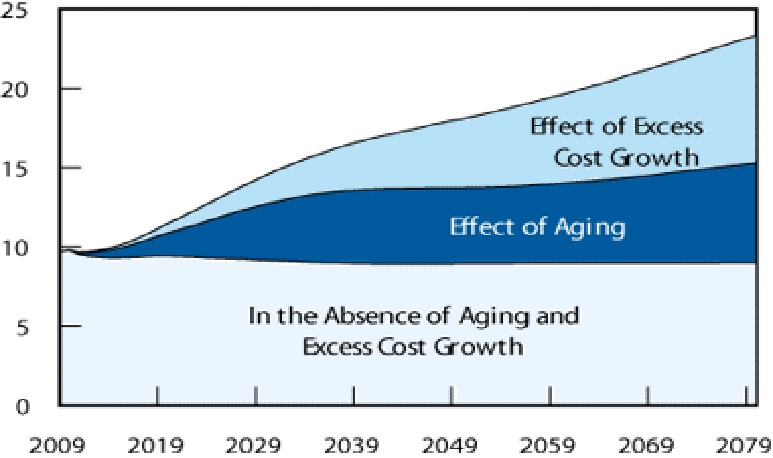
There are only two ways to reduce future deficits significantly: raise taxes or cut Social Security, Medicare, and Medicaid. The total bill for those programs (excluding the hidden costs of Obamacare) will rise from 10 percent of GDP to 23 percent of GDP when our grandchildren are in their “golden years”:


Source: Congressional Budget Office, “The Long-Term Budget Outlook,” June 2009, Box 1-2.

If the commissioners have any courage, they will recommend the gradual phase-out of Social Security, Medicare, and Medicaid — along the lines of my proposed solution:

1. Abolish Social Security payroll taxes as of a date certain (Abolition Day).

2. Pay normal benefits (those implicitly promised under the present system) to persons who are then collecting Social Security and to all other qualifying persons who have then reached the age of 62.

3. Persons who are 55 to 61 years old would receive normal benefits, pro-rated according to their contributions as of Abolition Day.

4. The retirement age for full benefits would be raised for all persons who are younger than 55 as of Abolition Day. The full retirement age is now scheduled to rise to 67 in 2027; it should rise to 73 by, say, 2020. Moreover, partial benefits would no longer be available to persons between the age of 62 and full-retirement age.

4. Persons who are 45 to 54 years old also would receive pro-rata benefits based on their contributions as of Abolition Day. But their initial benefits would be reduced on a sliding scale, so that the benefits of those persons who are 45 as of Abolition Day would be linked entirely to the CPI rather than the wage index.

5. Persons who are younger than 45 would receive a lump-sum repayment of their contributions (plus accrued interest) at full retirement age, in lieu of future benefits. That payment would automatically go to a surviving spouse or next-of-kin if the recipient dies intestate. Otherwise, the recipient could bequeath, transfer, or sell his interest in the payment at any time before it comes due.

6. The residual obligations outlined in points 2-5 would be funded by a payroll tax, which would diminish as those obligations are paid off.

Repeat, with appropriate variations, for Medicare and Medicaid [and Obamacare].

The alternative is to burden the productive sectors of the economy, thus further reducing the rate of economic growth and making Social Security, Medicare, Medicaid, and Obamacare even less affordable. Is that the future we want for our descendants?
__________
* The head of the Congressional Budget Office acknowledges that Obamacare

maintains and puts into effect a number of policies that might be difficult to sustain over a long period of time. For example, the legislation:

– Reduces the growth rate of Medicare spending (per beneficiary, adjusting for overall inflation) from about 4 percent per year for the past two decades to about 2 percent per year for the next two decades. It is unclear whether such a reduction can be achieved, and, if so, whether it would be through greater efficiencies in the delivery of health care or through reductions in access to care or the quality of care. . . .

– Establishes a tax on insurance plans with relatively high premiums in 2018 and (beginning in 2020) indexes the tax thresholds to general inflation.