
It has become obvious that COVID-19 stats are unreliable; see this, this, and this, for example. I am therefore withdrawing from the business of reporting official stats and making projections based on them. I leave that endeavor with this thought.
Category: Science and Understanding
UHI in Austin Revisited
See “Climate Hysteria: An Update” for the background of this post.
The average annual temperature in the city of Austin, Texas, rose by 3.7 degrees F between 1960 and 2019, that is, from 67.2 degrees to 70.9 degrees. The increase in Austin’s population from 187,000 in 1960 to 930,000 in 2019 accounts for all of the increase. (The population estimate for 2019 reflects a downward adjustment to compensate for an annexation in 1998 that significantly enlarged Austin’s territory and population.)
My estimate of the effect of Austin’s population increase on temperature is based on the equation for North American cities in T.R. Oke’s “City Size and the Urban Heat Island”. The equation (simplified for ease of reproduction) is
T’ = 2.96 log P – 6.41
Where,
T’ = change in temperature, degrees C
P = population, holding area constant
The author reports r-squared = 0.92 and SE = 0.7 degrees C (1.26 degrees F).
I plugged the values for Austin’s population in 1960 and 2019 into the equation, took the difference between the results, and converted that difference to degrees Fahrenheit, with this result: The effect of Austin’s population growth from 1960 to 2019 was to increase Austin’s temperature by 3.7 degrees F. What an amazing non-coincidence.
Austin’s soup weather nazi should now shut up about the purported effect of “climate change” on Austin’s temperature.
COVID-19 in the United States: Updated Statistics and Projections
Details here.
It is noteworthy that the 2019-2020 flu season was taking a much heavier than normal toll until COVID-19 came along. That alone should cast a lot of doubt on the COVID-19 figures being reported by the States and D.C. Then there is the problem of comorbidity, especially among older persons. In sum, there won’t be a good estimate of the actual death toll of COVID-19 until it’s possible to compute “excess” deaths — taking all other causes into account — when the final tally of deaths in 2020 becomes available a few years hence.
There is also the looming possibility that (1) the COVID-19 infection rate is vastly understated; (2) the COVID-19 fatality rate is therefore vastly overstated; and (3) millions of persons who are already immune to COVID-19 because they have already (unknowingly) recovered from it (believing that they had a cold, the flu, or allergies) and are being held hostage by lockdown orders that are killing the economy. (See this for example.)
Insidious Algorithms
Michael Anton inveighs against Big Tech and pseudo-libertarian collaborators in “Dear Avengers of the Free Market” (Law & Liberty, October 5, 2018):
Beyond the snarky attacks on me personally and insinuations of my “racism”—cut-and-paste obligatory for the “Right” these days—the responses by James Pethokoukis and (especially) John Tamny to my Liberty Forum essay on Silicon Valley are the usual sorts of press releases that are written to butter up the industry and its leaders in hopes of . . . what?…
… I am accused of having “a fundamental problem with capitalism itself.” Guilty, if by that is meant the reservations about mammon-worship first voiced by Plato and Aristotle and reinforced by the godfather of capitalism, Adam Smith, in his Theory of Moral Sentiments (the book that Smith himself indicates is the indispensable foundation for his praise of capitalism in the Wealth of Nations). Wealth is equipment, a means to higher ends. In the middle of the last century, the Right rightly focused on unjust impediments to the creation and acquisition of wealth. But conservatism, lacking a deeper understanding of the virtues and of human nature—of what wealth is for—eventually ossified into a defense of wealth as an end in itself. Many, including apparently Pethokoukis and Tamny, remain stuck in that rut to this day and mistake it for conservatism.
Both critics were especially appalled by my daring to criticize modern tech’s latest innovations. Who am I to judge what people want to sell or buy? From a libertarian standpoint, of course, no one may pass judgment. Under this view, commerce has no moral content…. To homo economicus any choice that does not inflict direct harm is ipso facto not subject to moral scrutiny, yet morality is defined as the efficient, non-coercive, undistorted operation of the market.
Naturally, then, Pethokoukis and Tamny scoff at my claim that Silicon Valley has not produced anything truly good or useful in a long time, but has instead turned to creating and selling things that are actively harmful to society and the soul. Not that they deny the claim, exactly. They simply rule it irrelevant. Capitalism has nothing to do with the soul (assuming the latter even exists). To which I again say: When you elevate a means into an end, that end—in not being the thing it ought to be—corrupts its intended beneficiaries.
There are morally neutral economic goods, like guns, which can be used for self-defense or murder. But there are economic goods that undermine morality (e.g., abortion, “entertainment” that glamorizes casual sex) and fray the bonds of mutual trust and respect that are necessary to civil society. (How does one trust a person who treats life and marriage as if they were unworthy of respect?)
There’s a particular aspect of Anton’s piece that I want to emphasize here: Big Tech’s alliance with the left in its skewing of information.
Continuing with Anton:
The modern tech information monopoly is a threat to self-government in at least three ways. First its … consolidation of monopoly power, which the techies are using to guarantee the outcome they want and to suppress dissent. It’s working….
Second, and related, is the way that social media digitizes pitchforked mobs. Aristocrats used to have to fear the masses; now they enable, weaponize, and deploy them…. The grandees of Professorville and Sand Hill Road and Outer Broadway can and routinely do use social justice warriors to their advantage. Come to that, hundreds of thousands of whom, like modern Red Guards, don’t have to be mobilized or even paid. They seek to stifle dissent and destroy lives and careers for the sheer joy of it.
Third and most important, tech-as-time-sucking-frivolity is infantilizing and enstupefying society—corroding the reason-based public discourse without which no republic can exist….
But all the dynamism and innovation Tamny and Pethokoukis praise only emerge from a bedrock of republican virtue. This is the core truth that libertarians seem unable to appreciate. Silicon Valley is undermining that virtue—with its products, with its tightening grip on power, and with its attempt to reengineer society, the economy, and human life.
I am especially concerned here with the practice of tinkering with AI algorithms to perpetuate bias in the name of eliminating it (e.g., here). The bias to be perpetuated, in this case, is blank-slate bias: the mistaken belief that there are no inborn differences between blacks and whites or men and women. It is that belief which underpins affirmative action in employment, which penalizes the innocent and reduces the quality of products and services, and incurs heavy enforcement costs; “head start” programs, which waste taxpayers’ money; and “diversity” programs at universities, which penalize the innocent and set blacks up for failure. Those programs and many more of their ilk are generally responsible for heightening social discord rather than reducing it.
In the upside-down world of “social justice” an algorithm is considered biased if it is unbiased; that is, if it reflects the real correlations between race, sex, and ability in certain kinds of endeavors. Charles Murray’s Human Diversity demolishes the blank-slate theory with reams and reams of facts. Social-justice warriors will hate it, just as they hated The Bell Curve, even though they won’t read the later book, just as they didn’t read the earlier one.
Flattening the Curve
What does it mean to “flatten the curve”, in the context of an epidemic? Here is Willis Eschenbach’s interpretation:
What does “flattening the curve” mean? It is based on the hope that our interventions will slow the progress of the disease. By doing so, we won’t get as many deaths on any given day. And this means less strain on a city or a country’s medical system.
Be clear, however, that this is just a delaying tactic. Flattening the curve does not reduce the total number of cases or deaths. It just spreads out the same amount over a longer time period. Valuable indeed, critical at times, but keep in mind that these delaying interventions do not reduce the reach of the infection. Unless your health system is so overloaded that people are needlessly dying, the final numbers stay the same.
I beg to differ. Or, at least, to offer a different interpretation: Flattening the curve — reducing its peak — can also reduce the total number of persons who are potentially exposed to the disease, thereby reducing the total number of persons who contract it. How does that work? It requires not only reducing the peak of the curve — the maximum number of active cases — but also reducing the length of the curve — the span of time in which a population is potentially exposed to the contagion.
Consider someone who has randomly contracted a virus from a non-human source. If that person is a hermit, the virus may kill him, or he may recover from whatever illness it causes him, but he can’t infect anyone else. Low peak, short duration.
Here’s an example of a higher peak but a relatively short duration: A person who randomly contracts a virus from a non-human source then infects many other persons in quick succession by breathing near them, sneezing on them, touching them, etc., in a short span of time (e.g., meeting and greeting at a business function). But … if the originator of the contagion and those whom he initially infects are identified and quarantined quickly enough, the contagion will spread no further.
In both cases, the “curve” will peak at some number lower than the number that would have been reached without isolation or quarantine. Moreover, and more important, the curve will terminate (go to zero) more quickly than it would have without isolation or quarantine.
The real world is more complicated than either of my examples because almost all humans aren’t hermits, and infections usually aren’t detected until after an infected person has had many encounters with uninfected persons. But the principle remains the same: The total number of persons who contract a contagious disease can be reduced through isolation and quarantine — and the sooner isolation and quarantine take effect, the lower the total number of infected persons.
Climate Hysteria: An Update
I won’t repeat all of “Climate Hysteria“, which is long but worth a look if you haven’t read it. A key part of it is a bit out of date, specifically, the part about the weather in Austin, Texas.
Last fall’s heat wave in Austin threw our local soup weather nazi into a tizzy. Of course it did; he proclaims it “nice” when daytime high temperatures are in the 60s and 70s, and complains about anything above 80. I wonder why he stays in Austin.
The weather nazi is also a warmist. He was in “climate change” heaven when, on several days in September and October, the official weather station in Austin reported new record highs for the relevant dates. To top it off, tropical storm Imelda suddenly formed in mid-September near the gulf coast of Texas and inundated Houston. According to the weather nazi, both events were due to “climate change”. Or were they just weather? My money’s on the latter.
Let’s take Imelda, which the weather nazi proclaimed to be an example of the kind of “extreme” weather event that will occur more often as “climate change” takes us in the direction of catastrophe. Those “extreme” weather events, when viewed globally (which is the only correct way to view them) aren’t occurring more often, as I document in “Hurricane Hysteria“.
Here, I want to focus on Austin’s temperature record.
There are some problems with the weather nazi’s reaction to the heat wave. First, the global circulation models (GCMs) that forecast ever-rising temperatures have been falsified. (See the discussion of GCMs here.) Second, the heat wave and the dry spell should be viewed in perspective. Here, for example are annualized temperature and rainfall averages for Austin, going back to the decade in which “global warming” began to register on the consciousnesses of climate hysterics:

What do you see? I see a recent decline in Austin’s average temperature from the El Nino effect of 2015-2016. I also see a decline in rainfall that doesn’t come close to being as severe the a dozen or so declines that have occurred since 1970.
Here’s a plot of the relationship between monthly average temperature and monthly rainfall during the same period. The 1-month lag in temperature gives the best fit. The equation is statistically significant, despite the low correlation coefficient (r = 0.24) because of the large number of observations.

Abnormal heat is to be expected when there is little rain and a lot of sunshine. In other words, temperature data, standing by themselves, are of little use in explaining a region’s climate.
Drawing on daily weather reports for the past five-and-a-half years in Austin, I find that Austin’s daily high temperature is significantly affected by rainfall, wind speed, wind direction, and cloud cover. For example (everything else being the same):
- An additional inch of rainfall induces an temperature drop of 1.4 degrees F.
- A wind of 10 miles an hour from the north induces a temperature drop of about 5.9 degrees F relative to a 10-mph wind from the south.
- Going from 100-percent sunshine to 100-percent cloud cover induces a temperature drop of 0.3 degrees F.
- The combined effect of an inch of rain and complete loss of sunshine is therefore 1.7 degrees F, even before other factors come into play (e.g., rain accompanied by wind from the north or northwest, as is often the case in Austin).
The combined effects of variations in rainfall, wind speed, wind direction, and cloud cover are far more than enough to account for the molehill temperature anomalies that “climate change” hysterics magnify into mountains of doom.
Further, there is no systematic bias in the estimates, as shown by the following plot of regression residuals:

Meteorological seasons: tan = fall (September, October, November); blue = winter (December, January, February); green = spring (March, April, May); ochre = summer (June July, August). Values greater than zero = underestimates; values less than zero = overestimates.
Summer is the most predictable of the seasons; winter, the least predicable; spring and fall are in between. However, the fall of 2019 (which included both the hot spell and cold snap discussed above) was dominated by overestimated (below-normal) temperatures, not above-normal ones, despite the weather-nazi’s hysteria to the contrary. In fact, the below-normal temperatures were the most below-normal of those recorded during the five-and-a-half year period.
The winter of 2019-2020 was on the warm side, but not abnormally so (cf. the winter of 2016-2017). Further, the warming in the winter of 2019-2020 can be attributed in part to weak El Nino conditions.
Lurking behind all of this, and swamping all other causes of the (slightly upward) temperature trend is a pronounced urban-heat-island (UHI) effect (discussed here). What the weather nazi really sees (but doesn’t understand or won’t admit) is that Austin is getting warmer mainly because of rapid population growth (50 percent since 2000) and all that has ensued — more buildings, more roads, more vehicles on the move, and less green space.
The moral of the story: If you really want to do something about the weather, move to a climate that you find more congenial (hint, hint).
COVID-19 in the United States: Latest Projections
UPDATED 04/21/20
Relying on data collected through April 20, I project about 1.3 million cases and 90,000 deaths by the middle of August. Those numbers are 50,000 and 6,000 higher than the projections that I published three days ago. However, the new numbers are based on statistical relationships that, I believe, don’t fully reflect the declining numbers of new cases and deaths discussed below. If the numbers continue to decline rapidly, the estimates of total cases and death should decline, too.
Figure 1 plots total cases and deaths — actual and projected — by date.
Figure 1

Source and notes: Derived from statistics reported by States and the District of Columbia and compiled in Template:2019–20 coronavirus pandemic data/United States medical cases at Wikipedia. The statistics exclude cases and deaths occurring among repatriated persons (i.e., Americans returned from other countries or cruise ships).
But there is good news in the actual and projected numbers of new cases and new deaths (Figure 2).
Figure 2
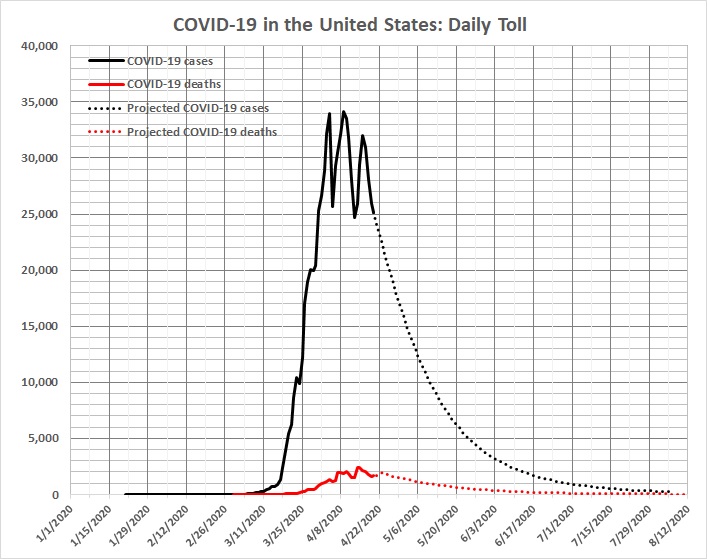
As shown in Figure 3, the daily percentage changes in new cases and deaths have been declining generally since March 19.
Figure 3

But there is, of course, a lag between new cases and new deaths. The best fit is a 7-day lag (Figure 4).
Figure 4
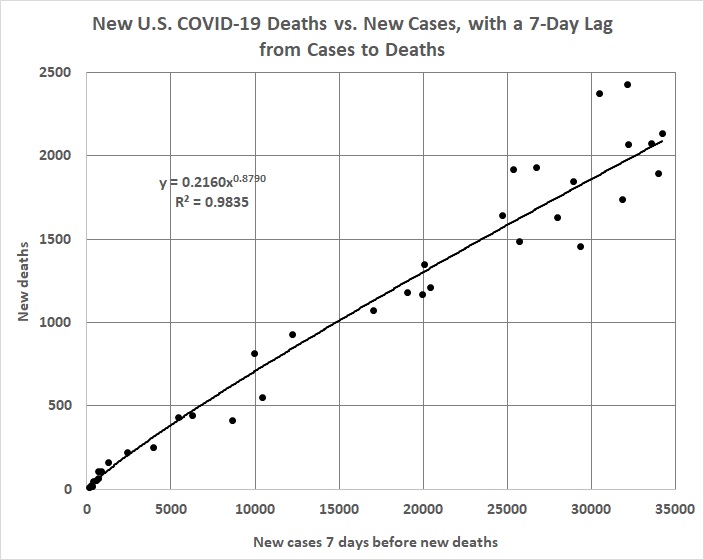
Figure 5 shows the tight relationship between new cases and new deaths when Figure 3 is adjusted to introduce the 7-day lag.
Figure 5
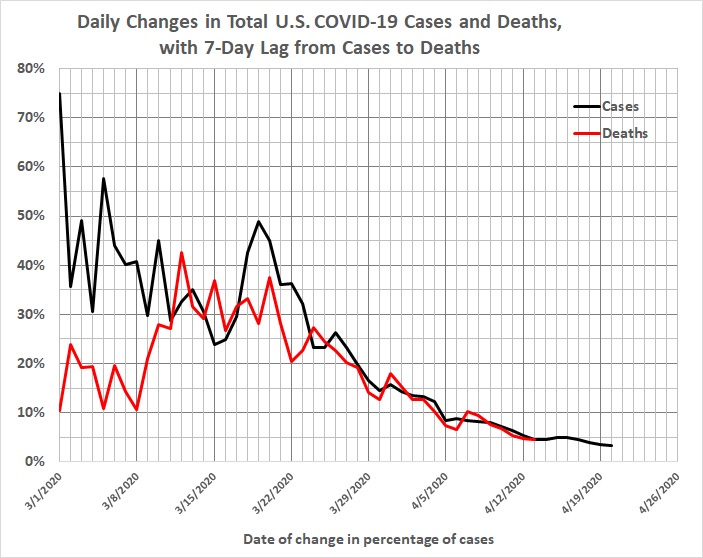
Figure 6 shows the similarly tight relationship after removing 8 “hot spots” which have the highest incidence of cases per capita — Connecticut, District of Columbia, Louisiana, Massachusetts, Michigan, New Jersey, New York, and Rhode Island.
Figure 6

Figures 5 and 6 give me added confidence that the crisis has peaked.
100,000 to 240,000 COVID-19 Deaths in the U.S.?
LATEST VERSION HERE.
COVID-19 in the United States
LATEST VERSION HERE.
COVID-19 Update and Prediction
I have updated my statistical analysis here. Note especially the continued decline in the daily rate of new cases and the low rate of new deaths per new case.
Now for the prediction. Assuming that lockdowns, quarantines, and social distancing continue for at least two more weeks, and assuming that there isn’t a second wave of COVID-19 because of early relaxation or re-infection:
- The total number of COVID-19 cases in the U.S. won’t exceed 250,000.
- The total number of U.S. deaths attributed to COVID-19 won’t exceed 10,000.
In any event, the final numbers will be well below the totals for the swine-flu epidemic of 2009-10 (59 million and 12,000) but you won’t hear about it from the leftist media.
UPDATE 03/31/20: Some sources are reporting higher numbers of U.S. cases and deaths than the source that I am using for my analysis and predictions. It is therefore possible that the final numbers (according to some sources) will be higher than my predictions. But I will be in the ballpark.
UPDATE 04/10/20: See my revised estimate.
Avoid New York (and New Yorkers) Like the Plague
The current infection rate in New York is 100 times the rate in Texas. I live in Texas, I’m happy to say.

Putting COVID-19 in Perspective for Americans
GO HERE FOR THE MOST RECENT VERSION.
What Is Natural?
Back-to-nature types, worriers about what “humans are doing to the planet”, and neurotics (leftists) generally take a dim view of the artifacts of human existence. There’s a lot of hypocrisy in that view, of course, mixed with goodly doses of envy and virtue-signalling.
A lot of the complaints heard from back-to-nature types, etc., are really esthetic. They just don’t like to envision a pipeline running across some open far away and well out of sight, ditto a distant and relatively small cluster of oil rigs. Such objections would seem to conflict with their preference for ugly bird-killing highway straddling, skyline cluttering wind farms. Chalk it up economically ignorant indoctrination in the “evils” of fossil fuels.
At any rate, what makes a pipeline, an oil rig, or even a wind farm any less natural than the artifacts constructed by lower animals to promote their survival? The main difference between the artifacts of the lower animals — bird’s nests, bee hives, beaver dams, underground burrows, etc. — and those of human beings is that human artifacts are far more ingenious and complex. Moreover, because humans are far more ingenious than the lower animals, the number of different human artifacts is far greater than the number arising from any other species, or even all of them taken together.
Granted, there are artifacts that aren’t necessary to the survival of human beings (e.g., movies, TV, and electric guitars), but those aren’t the ones that the back-to-nature crowd and its allies find objectionable. No, they object to the artifacts that enable the back-to-earthers, etc., to live in comfort.
In sum, a pipeline is just as natural as a bird’s nest. Remember that the next time you encounter an aging “flower child”. And ask her if a wind farm is more natural than a pipeline, and how she would like it if she had to forage for firewood to stay warm and cook her meals.
Lesson from the Diamond Princess: Panic Is Unwarranted
As of today there have been 696 reported cases of coronavirus among the 3,711 passengers who were aboard the Diamond Princess cruise ship. The ship was quarantined on February 1; all passengers and crew had disembarked by March 1. As of March 1, there were 6 deaths among those infected, and the number hasn’t grown (as of today).
Given the ease with which the virus could be transmitted on a ship, the Diamond Princess may represent an upper limit on contagion and mortality:
- an infection rate of 19 percent of those onboard the ship
- a fatality rate of less than 1 percent among those known to have contracted the disease
- a fatality rate of less than 2/10 of 1 percent of the population potentially exposed to the disease.
Conclusion: There is no question that coronavirus represents a significant threat to life, health, and economic activity. But the panic being fomented by the media and opportunistic politicians is unwarranted.
Preliminary Thoughts about “Theism, Atheism, and Big Bang Cosmology”
I am in the early sections of Theism, Atheism, and Big Bang Cosmology by William Lane Craig and Quentin Smith, but I am beginning to doubt that it will inform my views about cosmology. (These are spelled out with increasing refinement here, here, here, and here.) The book consists of alternating essays by Craig and Smith, in which Craig defends the classical argument for a creation (the Kalām cosmological argument) against Smith’s counter-arguments.
For one thing, Smith — who takes the position that the universe wasn’t created — seems to pin a lot on the belief prevalent at the time of the book’s publication (1993) that the universe was expanding but at a decreasing rate. It is now believed generally among physicists that the universe is expanding at an accelerating rate. I must therefore assess Smith’s argument in light of the current belief.
For another thing, Craig and Smith (in the early going, at least) seem to be bogged down in an arcane argument about the meaning of infinity. Craig takes the position, understandably, that an actual infinity is impossible in the physical world. Smith, of course, takes the opposite position. The problem here is that Craig and Smith argue about what is an empirical (if empirically undecidable) matter by resorting to philosophical and mathematical concepts. The observed and observable facts are on Craig’s side: Nothing is known to have happened in the material universe without an antecedent material cause. Philosophical and mathematical arguments about the nature of infinity seem beside the point.
For a third thing, Craig seems to pin a lot on the Big Bang, while Smith is at pains to deny its significance. Smith seems to claim that the Big Bang wasn’t the beginning of the universe; rather, the universe was present in the singularity from which the Big Bang arose. The singularity might therefore have existed all along.
Craig, on the other hand, sees the hand of God in the Big Bang. The presence of the singularity (the original clump of material “stuff”) had to have been created so that the Big Bang could follow. That’s all well and good, but what was God doing before the Big Bang, that is, in the infinite span of time before 15 billion years ago? (Is it presumptuous of me to ask?) And why should the Big Bang prove God’s existence any more than, say, a universe that came into being at an indeterminate time? The necessity of God (or some kind of creator) arises from the known character of the universe: material effects follow from material causes, which cannot cause themselves. In short, Craig pins too much on the Big Bang, and his argument would collapse if the Big Bang is found to be a figment of observational error.
There’s much more to come, I hope.
Fifty-Two Weeks on the Learning Curve
I first learned of the learning curve when I was a newly hired analyst at a defense think-tank. A learning curve
is a graphical representation of how an increase in learning (measured on the vertical axis) comes from greater experience (the horizontal axis); or how the more someone (or something) performs a task, the better they [sic] get at it.
In my line of work, the learning curve figured importantly in the estimation of aircraft procurement costs. There was a robust statistical relationship between the cost of making a particular model of aircraft and the cumulative number of such aircraft produced. Armed with the learning-curve equation and the initial production cost of an aircraft, it was easy to estimate of the cost of producing any number of the same aircraft.
The learning curve figures prominently in tests that purport to measure intelligence. Two factors that may explain the Flynn effect — a secular rise in average IQ scores — are aspects of learning: schooling and test familiarity and a generally more stimulating environment in which one learns more. The Flynn effect doesn’t measure changes in intelligence, it measures changes in IQ scores resulting from learning. There is an essential difference between ignorance and stupidity. The Flynn effect is about the former, not the latter.
Here’s a personal example of the Flynn effect in action. I’ve been doing The New York Times crossword puzzle online since February 18, 2019. I have completed all 365 puzzles published by TNYT from that date through the puzzle for February 17, 2020, with generally increasing ease:

The fitted curve is a decaying exponential, which means that progress continues but at an increasingly slower rate, which is typical of a learning curve.
The difficulty of the puzzle varies from day to day, with Monday puzzles being the easiest and Sunday puzzles being the hardest (as measured by time to complete):

For each day of the week, my best time is more recent than my worst time, and the trend of time to complete is downward for every day of the week (as reflected in the first graph above). In fact:
- My worst times were all recorded in March through June of last year.
- Today I tied my best time for a Monday puzzle.
- I set or tied my best time for the Wednesday, Friday, and Sunday puzzles in the last three weeks.
- In the same three weeks, my times for the Tuesday puzzle have twice been only a minute higher than my best.
I know that that I haven’t become more intelligent in the last 52 weeks. And being several decades past the peak of my intelligence, I am certain that it diminishes steadily, though in tiny increments (I hope). I have simply become more practiced at doing the crossword puzzle because I have learned a lot about it. For example, certain clues recur with some frequency, and they always have the same answers. Clues often have double meanings, which are hard to decipher at first, but which become easier to decipher with practice. There are other subtleties, all of which reflect the advantages of learning.
In a nutshell, I am no smarter than I was 52 weeks ago, but my ignorance of TNYT crossword puzzle has diminished significantly.
(See also “More about Intelligence“, “Selected Writings about Intelligence“, and especially “Intelligence“, in which I quote experts about the Flynn Effect.)
Psychiatry Is a Disorder
I happened upon “Schizoid personality disorder” (SPD) at Wikipedia, and wondered why it is a disorder, that is, a “bad thing”. A footnote in the article leads to a summary of SPD. Here are some excerpts:
A person with schizoid personality disorder often:
- Appears distant and detached
- Avoids social activities that involve emotional closeness with other people
- Does not want or enjoy close relationships, even with family members….
People with schizoid personality disorder often do well in relationships that don’t focus on emotional closeness. They tend to be better at handling relationships that focus on:
- Work
- Intellectual activities
- Expectations
In other words, persons who “suffer” from SPD may in fact be highly productive in pursuits that demand (and reward) prowess in science, technology, engineering, and mathematics — a.k.a. STEM. But because they don’t conform strictly to a psychiatric definition of normality they are said to have a disorder.
What is the psychiatric definition of a normal personality? This is from a page at the website of the American Psychiatric Association (APA):
Personality is the way of thinking, feeling and behaving that makes a person different from other people. An individual’s personality is influenced by experiences, environment (surroundings, life situations) and inherited characteristics. A person’s personality typically stays the same over time. A personality disorder is a way of thinking, feeling and behaving that deviates from the expectations of the culture, causes distress or problems functioning, and lasts over time.
There are 10 specific types of personality disorders. Personality disorders are long-term patterns of behavior and inner experiences that differs significantly from what is expected. The pattern of experience and behavior begins by late adolescence or early adulthood and causes distress or problems in functioning. Without treatment, personality disorders can be long-lasting. Personality disorders affect at least two of these areas:
- Way of thinking about oneself and others
- Way of responding emotionally
- Way of relating to other people
- Way of controlling one’s behavior
Types of Personality Disorders
- Antisocial personality disorder: a pattern of disregarding or violating the rights of others. A person with antisocial personality disorder may not conform to social norms, may repeatedly lie or deceive others, or may act impulsively.
- Avoidant personality disorder: a pattern of extreme shyness, feelings of inadequacy and extreme sensitivity to criticism. People with avoidant personality disorder may be unwilling to get involved with people unless they are certain of being liked, be preoccupied with being criticized or rejected, or may view themselves as not being good enough or socially inept.
- Borderline personality disorder: a pattern of instability in personal relationships, intense emotions, poor self-image and impulsivity. A person with borderline personality disorder may go to great lengths to avoid being abandoned, have repeated suicide attempts, display inappropriate intense anger or have ongoing feelings of emptiness.
- Dependent personality disorder: a pattern of needing to be taken care of and submissive and clingy behavior. People with dependent personality disorder may have difficulty making daily decisions without reassurance from others or may feel uncomfortable or helpless when alone because of fear of inability to take care of themselves.
- Histrionic personality disorder: a pattern of excessive emotion and attention seeking. People with histrionic personality disorder may be uncomfortable when they are not the center of attention, may use physical appearance to draw attention to themselves or have rapidly shifting or exaggerated emotions.
- Narcissistic personality disorder: a pattern of need for admiration and lack of empathy for others. A person with narcissistic personality disorder may have a grandiose sense of self-importance, a sense of entitlement, take advantage of others or lack empathy.
- Obsessive-compulsive personality disorder: a pattern of preoccupation with orderliness, perfection and control. A person with obsessive-compulsive personality disorder may be overly focused on details or schedules, may work excessively not allowing time for leisure or friends, or may be inflexible in their morality and values. (This is NOT the same as obsessive compulsive disorder.)
- Paranoid personality disorder: a pattern of being suspicious of others and seeing them as mean or spiteful. People with paranoid personality disorder often assume people will harm or deceive them and don’t confide in others or become close to them.
- Schizoid personality disorder: being detached from social relationships and expressing little emotion. A person with schizoid personality disorder typically does not seek close relationships, chooses to be alone and seems to not care about praise or criticism from others.
- Schizotypal personality disorder: a pattern of being very uncomfortable in close relationships, having distorted thinking and eccentric behavior. A person with schizotypal personality disorder may have odd beliefs or odd or peculiar behavior or speech or may have excessive social anxiety.
Holy mackerel, Andy, there’s hardly a “normal” person alive. And certainly none of them is a psychiatrist. The very compilation of a list of personality traits that one considers “abnormal” is a manifestation of narcissistic personality disorder and obsessive-compulsive personality disorder, at the very least.
Other than an actual disease of the brain, there is only one kind of mental “disorder” that requires treatment — criminal behavior. And the proper treatment for it is the application of criminal justice, sans psychiatric intervention. (See the articles by Thomas Szasz at FEE.)
Related posts:
I’ll Never Understand the Insanity Defense
Does Capital Punishment Deter Homicide?
Libertarian Twaddle about the Death Penalty
Crime and Punishment
Saving the Innocent?
Saving the Innocent?: Part II
More Punishment Means Less Crime
More About Crime and Punishment
More Punishment Means Less Crime: A Footnote
Clear Thinking about the Death Penalty
Let the Punishment Fit the Crime
A Precedent for the Demise of the Insanity Defense?
Another Argument for the Death Penalty
Less Punishment Means More Crime
Clear Thinking about the Death Penalty
What Is Justice?
Why Stop at the Death Penalty?
In Defense of Capital Punishment
Lock ‘Em Up
Free Will, Crime, and Punishment
Stop, Frisk, and Save Lives
Poverty, Crime, and Big Government
Crime Revisited
Rush to Judgment?
Stop, Frisk, and Save Lives II
Intuition vs. Rationality
To quote myself:
[I]ntuition [is] a manifestation of intelligence, not a cause of it. To put it another way, intuition is not an emotion; it is the opposite of emotion.
Intuition is reasoning at high speed. For example, a skilled athlete knows where and when to make a move (e.g., whether and where to swing at a pitched ball) because he subconsciously makes the necessary calculations, which he could not make consciously in the split-second that is available to him once the pitcher releases the ball.
Intuition is an aspect of reasoning (rationality) that is missing from “reason” — the cornerstone of the Enlightenment. The Enlightenment’s proponents and defenders are always going on about the power of logic applied to facts, and how that power brought mankind (or mankind in the West, at least) out of the benighted Middle Ages (via the Renaissance) and into the light of Modernity.
But “reason” of the kind associated with the Enlightenment is of the plodding variety, whereby “truth” is revealed at the conclusion of deliberate, conscious processes (e.g., the scientific method). But those processes, as I point out in the preceding paragraph, are susceptible of error because they rest on errors and assumptions that are hidden from view — often wittingly, as in the case of “climate change“.
Science, for all of its value to mankind, requires abstraction from reality. That is to say, it is reductionist. A good example is the arbitrary division of continuous social and scientific processes into discrete eras (the Middle Ages, the Renaissance, the Enlightenment, etc.). This ought to be a warning that mere abstractions are often, and mistakenly, taken as “facts”.
Reductionism makes it possible to “prove” almost anything by hiding errors and assumptions (wittingly or not) behind labels. Thus: x + y = z only when x and y are strictly defined and commensurate. Otherwise, x and y cannot be summed, or their summation can result in many correct values other than z. Further, as in the notable case of “climate change”, it is easy to assume (from bias or error) that z is determined only by x and y, when there are good reasons to believe that it is also determined by other factors: known knowns, known unknowns, and unknown unknowns.
Such things happen because human beings are ineluctably emotional and biased creatures, and usually unaware of their emotions and biases. The Enlightenment’s proponents and defenders are no more immune from emotion and bias than the “lesser” beings whom they presume to lecture about rationality.
The plodding search for “answers” is, furthermore, inherently circumscribed because it dismisses or minimizes the vital role played by unconscious deliberation — to coin a phrase. How many times have you found the answer to a question, a problem, or a puzzle by putting aside your deliberate, conscious search for the answer, only to have it come to you in a “Eureka!” moment sometime later (perhaps after a nap or good night’s sleep). That’s your brain at work in ways that aren’t well understood.
This process (to put too fine a word on it) is known as combinatorial play. Its importance has been acknowledged by many creative persons. Combinatorial play can be thought of as slow-motion intuition, where the brain takes some time to assemble (unconsciously) existing knowledge into an answer to a question, a problem, or a puzzle.
There is also fast-motion intuition, an example of which I invoked in the quotation at the top of this post: the ability of a batter to calculate in a split-second where a pitch will be when it reaches him. Other examples abound, including such vital ones as the ability of drivers to maneuver lethal objects in infinitely varied and often treacherous conditions. Much is made of the number of fatal highway accidents; too little is made of their relative infrequency given the billions of daily opportunities for their occurrence. Imagine the carnage if drivers relied on plodding “reason” instead of fast-motion intuition.
The plodding version of “reason” that has been celebrated since the Enlightenment is therefore just one leg of a triad: thinking quickly and unconsciously, thinking somewhat less quickly and unconsciously, and thinking slowly and consciously.
Wasn’t it ever thus? Of course it was. Which means that the Enlightenment and its sequel unto the present day have merely fetishized one mode of dealing with the world and its myriad uncertainties. I would have said arriving at the truth, but it is well known (except by ignorant science-idolaters) that scientific “knowledge” is provisional and ever-changing. (Just think of the many things that were supposed to be bad for you but are now supposed to be good for you, and conversely.)
I am not a science-denier by any means. But scientific “knowledge” must be taken with copious quantities of salt because it is usually inadequate in the face of messy reality. A theoretical bridge, for example, may hold up under theoretical conditions, but it is likely to collapse when built in the real world, where there is much uncertainty about present and future conditions (e.g., the integrity of materials, adherence to best construction practices, soil conditions, the cumulative effects of traffic). An over-built bridge — the best kind — is one that allows wide margins of error for such uncertainties. The same is true of planes, trains, automobiles, buildings, and much else that our lives depend on. All such things fail less frequently than in the past not only because of the advance of knowledge but also because greater material affluence enables the use of designs and materials that afford wider margins of error.
In any event, too little credit is given to the other legs of reason’s triad: fast-motion and slow-motion intuition. Any good athlete, musician, or warrior will attest the the value former. I leave it to Albert Einstein to attest to the value of the latter,
combinatory [sic] play seems to be the essential feature in productive thought — before there is any connection with logical construction in words or other kinds of signs which can be communicated to others….
[F]ull consciousness is a limit case which can never be fully accomplished. This seems to me connected with the fact called the narrowness of consciousness.
Related page and category:
“Climate Hysteria”, Updated
Here.
An Implication of Universal Connectedness
A couple of provocative pieces (here and here) led me to an observation that is so obvious that I had never articulated it: Everything is connected.
The essence of it is captured in the first verse of “Dem Bones“:
Toe bone connected to the foot bone
Foot bone connected to the heel bone
Heel bone connected to the ankle bone
Ankle bone connected to the shin bone
Shin bone connected to the knee bone
Knee bone connected to the thigh bone
Thigh bone connected to the hip bone
Hip bone connected to the back bone
Back bone connected to the shoulder bone
Shoulder bone connected to the neck bone
Neck bone connected to the head bone …
The final line gets to the bottom of it (if you are a deist or theist):
… Now hear the word of the Lord.
But belief in the connectedness of everything in the universe doesn’t depend on one’s cosmological views. In fact, a strict materialist who holds that the universe “just is” will be obliged to believe in universal connectedness because everything is merely physical (or electromagnetic), and one thing touches other things, which touch other things, ad infinitum. (The “touching” may be done by light.)
Connectedness isn’t necessarily causality; it can be mere observation. Though observation — which involves the electromagnetic spectrum — is thought to be causal with respect to sub-atomic particles. As I put it here:
There’s no question that [a] particle exists independently of observation (knowledge of the particle’s existence), but its specific characteristic (quantum state) is determined by the act of observation. Does this mean that existence of a specific kind depends on knowledge? No. It means that observation determines the state of the particle, which can then be known.
I should have been clear about the meaning of “determine”, as used above. In my view it isn’t that observation causes the quantum state that is observed. Rather, observation measures (determines) the quantum state at the instant of measurement. Here’s an illustration of what I mean:
A die is rolled. Its “quantum state” is determined (measured) when it stops rolling and is readily observed. But the quantum state isn’t caused by the act of observation. In fact, the quantum state can be observed (determined, measured) — but not caused — at any point while the die is rolling by viewing it, sufficiently magnified, with the aid of a high-speed camera.
Connectedness can also involve causality, of course. The difficult problem — addressed at the two links in the opening paragraph — is sorting out causal relationships given so much connectedness. Another term for the problem is “causal density“, which leads to spurious findings:
When there are many factors that have an impact on a system, statistical analysis yields unreliable results. Computer simulations give you exquisitely precise unreliable results. Those who run such simulations and call what they do “science” are deceiving themselves.
Is it any wonder that “scientists” tell us that one thing or another is bad for us, only to tell us at a later date that it isn’t bad for us and may even be good for us? This is a widely noted phenomenon (though insufficiently documented). But its implications for believing in, say, anthropogenic global warming seem to be widely ignored — most unfortunately.
(See also “Predicting ‘Global’ Temperatures — An Analogy with Baseball“.)
 Politics and Prosperity