Undermining the Free Society

Apropos my earlier post about “Asymmetrical (Ideological) Warfare,” I note this review by Gerald J. Russello of Kenneth Minogue’s The Servile Mind: How Democracy Erodes the Moral Life. As he summarizes Minogue, Russello writes:

The push for equality and ever more rights—two of [democracy’s] basic principles—requires a ruling class to govern competing claims; thus the rise of the undemocratic judiciary as the arbiter of many aspects of public life, and of bureaucracies that issue rules far removed from the democratic process. Should this trend continue, Minogue foresees widespread servility replacing the tradition of free government.

This new servility will be based not on oppression, but on the conviction that experts have eliminated any need for citizens to develop habits of self-control, self-government, or what used to be called the virtues.

How has democracy led to “servility,” which is really a kind of oppression? Here is my diagnosis.

It is well understood that voters, by and large, vote irrationally, that is, emotionally, on the basis of “buzz” instead of facts, and inconsistently. (See this, this, and this, for example.) Voters are prone to vote against their own long-run interests because they do not understand the consequences of the sound-bite policies advocated by politicians. American democracy, by indiscriminately granting the franchise — as opposed to limiting it to, say, married property owners over the age of 30 who have children — empowers the run-of-the-mill politician who seeks office (for the sake of prestige, power, and perks) by pandering to the standard, irrational voter.

Rationality is the application of sound reasoning and pertinent facts to the pursuit of a realistic objective (one that does not contradict the laws of nature or human nature). I daresay that most voters are guilty of voting irrationally because they believe in such claptrap as peace through diplomacy, “social justice” through high marginal tax rates, or better health care through government regulation.

To be perfectly clear, the irrationality lies not in favoring peace, “social justice” (whatever that is), health care, and the like. The irrationality lies in uninformed beliefs in such contradictions as peace through unpreparedness for war, “social justice” through soak-the-rich schemes, better health care through greater government control of medicine, etc., etc., etc. Voters whose objectives incorporate such beliefs simply haven’t taken the relatively little time it requires to process what they may already know or have experienced about history, human nature, and social and economic realities.

Why is voters’ irrationality important? Does voting really matter? Well, it’s easy to say that an individual’s vote makes very little difference. But individual votes add up. Every vote cast for a winning political candidate enhances his supposed mandate, which usually is (in his mind) some scheme (or a lot of them) to regulated our lives more than they are already regulated.

That is to say, voters (not to mention those who profess to understand voters) overlook the slippery slope effects of voting for those who promise to “deliver” certain benefits. It is true that the benefits, if delivered, would temporarily increase the well-being of certain voters. But if one group of voters reaps benefits, then another group of voters wants to reap benefits as well. Why? Because votes are not won, nor offices held, by placating a particular class of voter; many other classes of them must also be placated.

The “benefits” sought by voters (and delivered by politicians) are regulatory as well as monetary. Many voters (especially wealthy, paternalistic ones) are more interested in controlling others than they are in reaping government handouts (though they don’t object to that either). And if one group of voters reaps certain regulatory benefits, it follows (as night from day) that other groups also will seek (and reap) regulatory benefits. (Must one be a trained economist to understand this? Obviously not, because most trained economists don’t seem to understand it.)

And then there is the “peaceat-any-priceone-worldcrowd, which is hard to distinguish from the crowd that demands (and delivers) monetary and regulatory “benefits.”

So, here we are:

  • Many particular benefits are bestowed and many regulations are imposed, to the detriment of investors, entrepreneurs, innovators, inventors, and people who simply are willing to work hard to advance themselves. And it is they who are responsible for the economic growth that bestows (or would bestow) more jobs and higher incomes on everyone, from the poorest to the richest.
  • A generation from now, the average American will “enjoy” about one-fourth the real output that would be his absent the advent of the regulatory-welfare state about a century ago.

Americans have, since 1932, voted heavily against their own economic and security interests, and the economic and security interests of their progeny. But what else can you expect when — for those same 78 years — voters have been manipulated into voting against their own interests by politicians, media, “educators,” and “intelligentsia”? What else can you expect when the courts have all too often ratified the malfeasance of those same politicians?

If this is democracy, give me monarchy.

Finding Order in Chaos

Here is an apparently random plot of daily changes in an index:

Can such randomness yield an orderly outcome? To find out, click “Read more of this post.”

Continue reading “Finding Order in Chaos”

Asymmetrical (Ideological) Warfare

Leftists are  kind, caring, and generous — because they say they are. Conservatives and libertarians are none of those things — because the possession of such traits is a question of behavior, not rhetoric.

Leftists dismiss human imperfection, while finding perfection in their vision of the world as they want it to be. Conservatives and libertarians understand human imperfection and offer only a vision of betterment through striving.

The rhetoric of leftism — when it is not downright hateful toward non-leftists — has wide appeal because to adopt it for one’s own and to echo it is to make oneself feel kind, caring, generous — and powerful — at a stroke. It matters not whether the policies that flow from leftist rhetoric actually make others better off. The important things, to a leftist, are how he feels about himself and how others perceive him.

It is easy for a leftist to seem kinder, more caring, and more generous than his conservative and libertarian brethren because a leftist focuses on intentions rather than consequences. No matter that the consequences of leftist dogma could match their stated intentions only if Santa Claus or the Tooth Fairy ruled the world.

In the leftist’s imagination, of course, government is Santa Claus or the Tooth Fairy. Government, despite the fact that it consists of venal and fallible humans, somehow (in the leftist’s imagination) wields powers that enable it to make “good” things happen with the stroke of a pen and at no cost.

Or if there is a cost, it is to be borne by those despised “rich,” who dare to acquire more than their “fair share” of income and wealth. Leftists seem know who is “too rich” and what is a “fair share” by mysterious intuitions that are inaccessible to mere mortals. Leftists seem to have acquired a fine knowledge of what others deserve to earn, though that knowledge seems not to have kept many a leftist from scrambling up the ladder of material prosperity. It’s all right to be “rich” if you proclaim your heart to be in the right place.

By the same token, it is all right to dictate the terms and conditions of human striving– what is made, how it is made, whether it is made, how much of it is made, how much of it may be consumed, etc. — as long as one’s heart is in the right place. The leftist, you see, is compelled to protect mere mortals (the unwashed masses) from themselves. That is because the leftist cannot grasp the the concepts of personal responsibility and betterment through (sometimes) bitter experience.

Such realities have no meaning for the leftist. For him, human progress is attained by the magical powers of government, which can raise up the impoverished, cure the stricken, and banish strife from the land. It is up to government to do such things because, in the view of a leftist, nothing that happens to anyone (or to anyone who is on the left’s list of favored groups) is his fault — it is the fault of “society” or the uncaring, unkind, ungenerous exploiters who (in the left’s imagination) control society. (The ultimate irony is that the uncaring, unkind, and ungenerous exploiters are the leftists who, when not held in check, write the rules by which we mortals live.)

In sum, the true nature of leftism is a blend of Utopianism and power-lust. Thus, in the left’s view of things, human wants can be met, but only without mussing the face of the Earth; people can live and work wherever they choose, as long as it is in compact cities in which government owns the only means of transportation; people can say what they want and associate with whom they please, as long as they say nothing to offend certain kinds of persons and are forced to associate with them, like it or not. (The list goes on, but that is more than enough to make my point.)

The idea of allowing individuals to make their own way (and sometimes to fail in the process of trying), to become sick and die because of the “lifestyles” they prefer, and to avoid one another (usually for very good reasons) is beyond the ken of the leftist. Imperfection — in the mind of a leftist — is impermissible. Individuals must not be allowed to fail, to become ill, or to harbor ill feelings (except toward the enemies of leftism). The antidote to failure is to arrange our lives and business affairs as the leftist would like to see them arranged. All in the name of kindness, compassion, and generosity, of course.

The ideal person — to a leftist — is not a human being but a cog in the left’s design for the world.

Related posts:
Fascism with a “Friendly” Face
Penalizing “Thought Crimes”
Parsing Political Philosophy
Utilitarianism vs. Liberty
The Near-Victory of Communism
Tocqueville’s Prescience
Accountants of the Soul
Rawls Meets Bentham
The Left
The Divine Right of the Majority
I Want My Country Back

The American League’s Greatest Hitters

Through a painstaking series of adjustments for changes in playing standards and conditions, and for differences among ballparks, I have reassessed the single-season and career batting averages of the American League’s top hitters. The reassessment covers 120 players whose career average in the American League is at least .285 in at least 5,000 plate appearances.

I will devote a future post to a detailed explanation of the adjustments. In this post, I give an overview of the adjustments and present a revised ranking of the 120 players. I also discuss — but do not adjust for — the effects of age on the revised batting averages and relative standing of players.

I make three kinds of adjustments to nominal (official) BA. One adjustment is a time constant, which captures gradual changes from 1901 to the present that have worked against batters. Such changes would be the improvement of fielding gloves (which have made it harder to get hits, while also raising fielding averages), the introduction of night baseball, and the gradual increase in proportion of games played at night.

A second adjustment is an annual factor that captures the up-and-down swings in the relative difficulty of hitting. These swings have occurred because of changes in the ball, the frequency of its replacement, the size of the strike zone, and the height of the pitching mound, and perhaps other factors.

A third adjustment — one that is unique to each team-park combination — reflects the relative ease or difficulty of hitting in the various parks that have been used in the American League. In many cases the adjustment factor for a given park changes during the years of its use because of significant changes in the dimensions of the field.

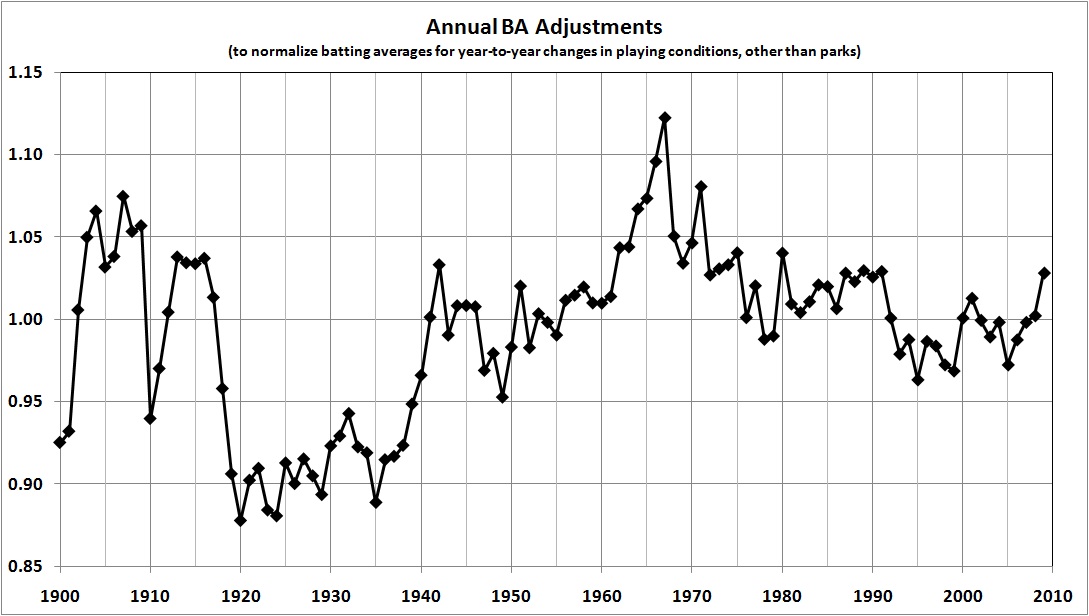
The following graph combines the effects of the first two adjustments into a single number for each season. A value greater than 1 means that each hitter’s nominal average for that season was increased to some degree. A value less than 1 means that each hitter’s average for that season was decreased to some degree.
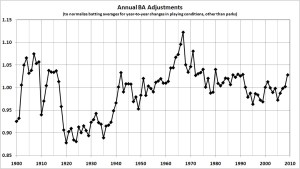

The largest upward adjustments affect averages compiled in the “deadball” years of 1902-1909 and 1913-1916, and in the “era of the pitcher,” from 1962 through 1975. The largest downward adjustments affect averages compiled in the first two years of the AL’s existence and the “lively” ball era, which — judging from the numbers — began in 1919 and lasted through 1938.

The final adjustments — for differences in parks — range widely. For example, Red Sox hiiters (including Ted Williams) suffered a penalty of 5.9 percent for the 1934-2010 seasons, when Fenway Park acquired its present dimensions. By contrast, Yankees who played in the original Yankee Stadium from 1923 through 1973 earned a boost of 4 percent because the original park (despite its short foul lines) was inimical to batters (including Joe DiMaggio).

The following graph captures the total effect of the three adjustments. Each point represents one of the 120 hitters.
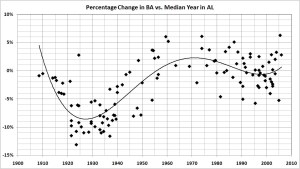
The pattern, which the curved line emphasizes, is consistent with the adjustments summarized in the first graph. The points don’t fall neatly on the curved line for three reasons: (1) variations in the length of players’ careers, (2) variations in the numbers of at-bats across seasons (and thus in the weight attached to a season in compiling a career average), and (3) the park-adjustment factor, which varies widely from park to park and (sometimes) for a particular park, if its configuration changed significantly.

How did the various adjustments affect the rankings? First, as would be expected because of the inflation of batting averages in the 1920s and 1930s, those decades are over-represented among the 120 hitters, as shown in the following table. (“Median year” refers to the decade in which a player’s median year occurs. For example, Ty Cobb’s career spanned 1905-1928, so he is counted as a member of the 1911-1920 decade in the following table and the one after it.)

Distribution of Hitters, by Decade
Median year Number Percent
1901-1910 2 1.7%
1911-1920 7 5.8%
1921-1930 17 14.2%
1931-1940 21 17.5%
1941-1950 8 6.7%
1951-1960 8 6.7%
1961-1970 3 2.5%
1971-1980 8 6.7%
1981-1990 10 8.3%
1991-2000 22 18.3%
2001-2010 14 11.7%
120 100%

The adjustments to nominal batting averages did a good job of rectifying the bias toward players of the 1920s and 1930s:

Average Rank, by Decade
Median year Nominal Adjusted Change*
1901-1910 28 17 11
1911-1920 22 23 -1
1921-1930 29 65 -36
1931-1940 44 83 -39
1941-1950 60 63 -3
1951-1960 84 54 30
1961-1970 83 43 40
1971-1980 86 49 37
1981-1990 79 52 27
1991-2000 79 64 15
2001-2010 58 79 -21
* Positive number represents improvement (higher average rank); negative number represents slippage (lower average rank).

Until someone convinces me otherwise, I conclude that the top hitters of the “deadball” era really were great by comparison with those who came later. They are not alone at the top, however. Among the top 10 in the following table are a contemporary player (Ichiro Suzuki), a player of recent memory (Rod Carew), and three Yankees who enjoyed great years in the 1920s and 1930s (Babe Ruth, Lou Gehrig, and Joe DiMaggio). Here, then, are all 120 hitters, listed in the order of adjusted rank:

Adjusted Nominal Player Years in AL Batting average % change # change
rank* rank (all-caps = Hall of Fame; asterisk = From To Nominal Adjusted in BA in rank
active)
1 12 Ichiro Suzuki* 2001 2010 .331 .353 6.2% 11
2 1 TY COBB 1905 1928 .366 .353 -3.9% -1
3 2 Shoeless Joe Jackson 1908 1920 .356 .351 -1.3% -1
4 10 NAP LAJOIE 1901 1916 .336 .333 -0.9% 6
5 3 TRIS SPEAKER 1907 1928 .345 .331 -4.0% -2
6 16 ROD CAREW 1967 1985 .328 .331 0.9% 10
7 11 EDDIE COLLINS 1906 1930 .333 .326 -2.2% 4
8 6 BABE RUTH 1914 1934 .343 .324 -6.1% -2
9 8 LOU GEHRIG 1923 1939 .340 .323 -5.4% -1
10 18 JOE DIMAGGIO 1936 1951 .325 .322 -0.7% 8
11 4 TED WILLIAMS 1939 1960 .344 .319 -7.9% -7
12 15 WADE BOGGS 1982 1999 .328 .319 -2.8% 3
13 47 Don Mattingly 1982 1995 .307 .318 3.3% 34
14 74 MICKEY MANTLE 1951 1968 .298 .317 6.0% 60
15 7 HARRY HEILMANN 1914 1929 .342 .315 -8.9% -8
16 30 Derek Jeter* 1995 2010 .314 .314 0.1% 14
17 5 GEORGE SISLER 1915 1928 .344 .313 -9.8% -12
18 36 Edgar Martinez 1987 2004 .312 .312 0.1% 18
19 25 KIRBY PUCKETT 1984 1995 .318 .311 -2.1% 6
20 89 EDDIE MURRAY 1977 1997 .295 .311 5.1% 69
21 99 Thurman Munson 1969 1979 .292 .310 6.1% 78
22 53 PAUL MOLITOR 1978 1998 .306 .310 1.2% 31
23 35 Magglio Ordonez* 1997 2010 .312 .310 -0.6% 12
24 31 Harvey Kuenn 1952 1960 .313 .309 -1.4% 7
25 44 Roberto Alomar 1991 2004 .309 .308 -0.4% 19
26 9 AL SIMMONS 1924 1944 .337 .308 -9.3% -17
27 17 EARLE COMBS 1924 1935 .325 .308 -5.6% -10
28 68 Minnie Minoso 1949 1964 .300 .307 2.4% 40
29 70 Joe Judge 1915 1934 .299 .307 2.7% 41
30 45 SAM CRAWFORD 1903 1917 .309 .307 -0.5% 15
31 55 Tony Oliva 1962 1976 .304 .307 0.7% 24
32 92 Mickey Rivers 1970 1984 .295 .306 3.7% 60
33 38 Baby Doll Jacobson 1915 1927 .311 .305 -1.9% 5
34 83 Carl Crawford* 2002 2010 .296 .305 2.8% 49
35 67 Julio Franco 1983 1999 .301 .304 1.3% 32
36 54 GEORGE BRETT 1973 1993 .305 .304 -0.3% 18
37 56 Paul O’Neill 1993 2001 .303 .304 0.1% 19
38 48 HOME RUN BAKER 1908 1922 .307 .303 -1.2% 10
39 72 Cecil Cooper 1971 1987 .298 .303 1.7% 33
40 20 SAM RICE 1915 1934 .322 .303 -6.2% -20
41 14 HEINIE MANUSH 1923 1936 .331 .303 -9.1% -27
42 32 BILL DICKEY 1928 1946 .313 .303 -3.3% -10
43 101 Lou Piniella 1964 1984 .291 .302 3.9% 58
44 29 Cecil Travis 1933 1947 .314 .302 -3.9% -15
45 103 Carney Lansford 1978 1992 .290 .302 4.1% 58
46 41 LUKE APPLING 1930 1950 .310 .302 -2.8% -5
47 50 Stuffy McInnis 1909 1922 .307 .302 -1.7% 3
48 114 Bill Skowron 1954 1967 .286 .301 5.2% 66
49 98 Luis Polonia 1987 2000 .292 .301 3.0% 49
50 84 Garret Anderson 1994 2008 .296 .301 1.5% 34
51 79 AL KALINE 1953 1974 .297 .300 0.9% 28
52 52 GEORGE KELL 1943 1957 .306 .300 -2.2% 0
53 34 Manny Ramirez* 1993 2010 .312 .300 -4.1% -19
54 81 Bernie Williams 1991 2006 .297 .299 0.7% 27
55 64 Frank Thomas 1990 2008 .301 .299 -0.8% 9
56 13 JIMMIE FOXX 1925 1942 .331 .298 -11.1% -43
57 97 Mike Hargrove 1974 1985 .292 .298 1.8% 40
58 42 Bobby Veach 1912 1925 .310 .298 -4.2% -16
59 60 Alex Rodriguez* 1994 2010 .303 .297 -2.0% 1
60 91 Kevin Seitzer 1986 1997 .295 .297 0.6% 31
61 105 John Olerud 1989 2005 .289 .297 2.5% 44
62 102 NELLIE FOX 1947 1963 .290 .297 2.2% 40
63 107 Wally Joyner 1986 2001 .289 .296 2.4% 44
64 104 Harold Baines 1980 2001 .289 .296 2.2% 40
65 112 Carlos Guillen* 1998 2010 .286 .296 3.2% 47
66 116 ROBIN YOUNT 1974 1993 .285 .295 3.4% 50
67 119 Gene Woodling 1946 1962 .284 .295 3.6% 52
68 90 LOU BOUDREAU 1938 1952 .295 .294 -0.3% 22
69 111 Raul Ibanez 1996 2008 .286 .294 2.8% 42
70 120 YOGI BERRA 1946 1963 .284 .294 3.5% 50
71 86 Kenny Lofton 1992 2007 .296 .293 -1.0% 15
72 23 HANK GREENBERG 1930 1946 .319 .293 -8.8% -49
73 93 Albert Belle 1989 2000 .295 .293 -0.8% 20
74 94 Pete Runnels 1951 1962 .294 .292 -0.7% 20
75 82 Shannon Stewart 1995 2008 .297 .292 -1.5% 7
76 66 Ivan Rodriguez 1991 2009 .301 .292 -3.0% -10
77 110 Mickey Vernon 1939 1958 .287 .292 1.8% 33
78 95 Hal McRae 1973 1987 .293 .292 -0.4% 17
79 96 Tony Fernandez 1983 2001 .293 .292 -0.4% 17
80 115 Miguel Tejada* 1997 2010 .286 .292 2.0% 35
81 22 MICKEY COCHRANE 1925 1937 .320 .291 -10.0% -59
82 78 Mike Sweeney 1995 2010 .298 .291 -2.4% -4
83 21 CHARLIE GEHRINGER 1924 1942 .320 .290 -10.5% -62
84 80 Buddy Lewis 1935 1949 .297 .290 -2.5% -4
85 49 George Burns 1914 1929 .307 .289 -6.2% -36
86 26 GOOSE GOSLIN 1921 1938 .316 .289 -9.4% -60
87 58 Mike Greenwell 1985 1996 .303 .288 -5.1% -29
88 51 Johnny Pesky 1942 1954 .307 .287 -6.7% -37
89 24 EARL AVERILL 1929 1940 .318 .287 -10.8% -65
90 88 Juan Gonzalez 1989 2005 .295 .287 -3.0% -2
91 43 John Stone 1928 1938 .310 .287 -8.0% -48
92 19 Ken Williams 1918 1929 .324 .286 -13.1% -73
93 100 Ken Griffey 1989 2010 .291 .286 -1.8% 7
94 65 Billy Goodman 1947 1961 .301 .286 -5.2% -29
95 28 Bibb Falk 1920 1931 .314 .286 -10.0% -67
96 113 Willie Wilson 1976 1992 .286 .286 0.0% 17
97 108 Rafael Palmeiro 1989 2005 .288 .285 -0.8% 11
98 59 Buddy Myer 1925 1941 .303 .285 -6.1% -39
99 69 Michael Young* 2000 2010 .300 .285 -5.3% -30
100 73 JIM RICE 1974 1989 .298 .285 -4.6% -27
101 39 Bob Meusel 1920 1929 .311 .285 -9.2% -62
102 46 Gee Walker 1931 1941 .307 .283 -8.6% -56
103 62 Ben Chapman 1930 1941 .302 .282 -7.1% -41
104 27 Jack Tobin 1916 1927 .315 .282 -11.5% -77
105 117 Alan Trammell 1977 1996 .285 .282 -1.2% 12
106 76 Mo Vaughn 1991 2000 .298 .281 -5.8% -30
107 106 Chuck Knoblauch 1991 2002 .289 .281 -2.7% -1
108 33 JOE SEWELL 1920 1933 .312 .281 -11.0% -75
109 37 Bing Miller 1921 1936 .311 .281 -10.9% -72
110 85 Bob Johnson 1933 1945 .296 .280 -6.0% -25
111 109 Johnny Damon* 1995 2010 .287 .280 -2.8% -2
112 118 CARL YASTRZEMSKI 1961 1983 .285 .279 -2.2% 6
113 61 Hal Trosky 1933 1946 .302 .278 -8.6% -52
114 40 Joe Vosmik 1930 1944 .311 .278 -11.6% -74
115 71 Sam West 1927 1942 .299 .276 -8.2% -44
116 77 Pete Fox 1933 1945 .298 .276 -8.0% -39
117 75 Dom DiMaggio 1940 1953 .298 .276 -8.1% -42
118 63 JOE CRONIN 1928 1945 .302 .275 -9.7% -55
119 87 Doc Cramer 1929 1948 .296 .274 -7.9% -32
120 57 Charlie Jamieson 1915 1932 .303 .274 -10.8% -63
* The adjusted rank considers only the 120 players listed here. Players not listed could outrank some of the players near the bottom of the list.

The names of Hall-of-Famers are capitalized to draw your attention to several who were enshrined mainly on the strength of grossly inflated batting averages.

There is more work to be done, especially with respect to age. Consider, for example, Shoeless Joe Jackson, whose career ended at age 30. Had Jackson continued to play until he was 40, say, his career average would have declined, and with it his position on the list.

Ichiro Suzuki didn’t play in the U.S. until he was 27. Would his career average be even higher if he had crossed over the Pacific in his early 20s? He is atop the list because of his post-32 performance, relative to Ty Cobb’s.

Then there is the case of Ted Williams, whose average and ranking slipped markedly because he enjoyed the friendly confines of Fenway Park. But Williams, who also hit well in his “old age,” missed a lot of peak batting time during WWII and the Korean War.

I will end, for now, with this tantalizing comparison of Suzuki, Cobb, Jackson, and Williams:
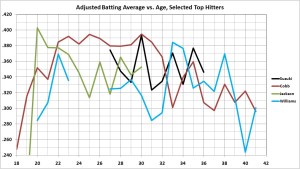

Cobb’s consistent brilliance from age 22 to age 32 borders on the amazing. Williams was a great “old” hitter, as Suzuki is proving to be. It is evident that Jackson, despite the closeness of his average to Cobb’s, probably wouldn’t have caught Cobb, unless he had finished in a Suzuki-like manner.

ADDENDUM:

Final, age-adjusted BA for the top-3 all-time AL hitters:

Cobb 0.363919
Suzuki 0.358241
Jackson 0.355946

Go here for details.

The Deficit Commission’s Deficit of Understanding

There are only three problems with the work of the Deficit Commission to date, as it has been revealed to us in the co-chairs’ briefing slides:

  • It will not survive the onslaught of special interests because it contains something to offend almost everyone, from homeowners, lenders, builders, and realtors (kill the mortgage interest deduction, indeed) to affluent retirees (bend the SS benefits curve downward, indeed).
  • It proposes higher taxes.
  • It aims at too many spending targets, and misses the elephant in the room: “entitelment” commitments, namely, Social Security, Medicare, and Medicaid (and their promised expansion via Obamacare).

The looming debt crisis and the cycle of dependency on government can be solved and broken, respectively, through the straightforward act of announcing that Social Security, Medicare, and Medicaid benefits will shrink steadily toward zero. The degree and rate of shrinkage would vary according to the age of the prospective recipient; for example:

  • Everyone now over the age of 55 would receive their current or currently promised benefits, as adjusted for inflation but not for wage growth (see next item).
  • The costly wage-parity feature of Social Security would be abolished. (Why should we subsidize retirees to keep up with the Joneses?)
  • Future benefits for persons aged 25 to 55 would be reduced on a sliding scale: from 95 percent for 55-year-olds to 5 percent for 25-year olds.
  • There would be no future benefits for persons under the age of 25.

The costs would be defrayed by a unified payroll tax, which would rise (initially) to cover persons who are older than 55 when the plan is adopted. The tax would decline — by law — as persons who are 55 and younger when the plan is adopted become eligible for benefits (or not, as the case may be).

How would individuals fund retirement and pay for health care when they have retired? A plan like the one I’ve outlined would be a great inducement to save more — and individuals could save more without sacrificing consumption as the payroll tax declines. Unlike the Social Security Ponzi scheme — where one’s “contributions’ merely pay off those who got in earlier — the higher rate of saving would generate economic growth and, thus, real returns on saving (as opposed to the phony returns on SS “contributions”). As for health care, insurance companies could get back into the business of competing to insure older Americans. And I have no doubt that joint ventures by insurance companies and health-care providers would lead to innovative and less costly ways of delivering medical care.

Following the tradition of William of Ockham, I shun the turgid, Rube-Goldbergish proposal of the Deficit Commission in favor of a frontal attack on the main cause of the deficit problem: “entitlement” commitments.

Related posts:
Economics – Growth & Decline
The Economic and Social Consequences of Government

Estimating the Rahn Curve: Or, How Government Inhibits Economic Growth

Incorporated in this post.

More about the “Permanent Democrat Majority”

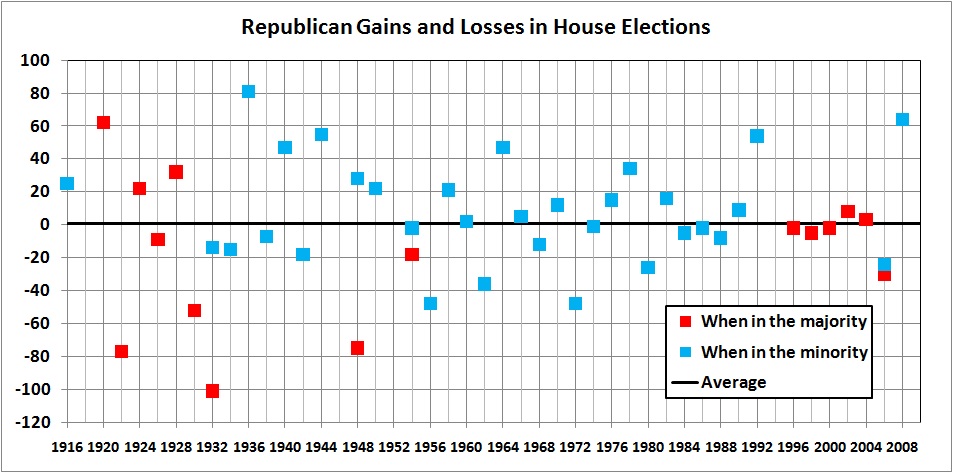
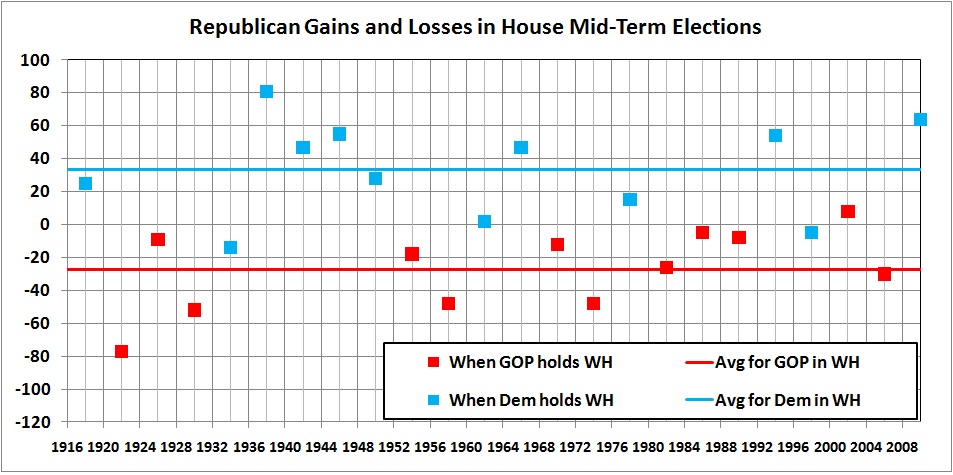
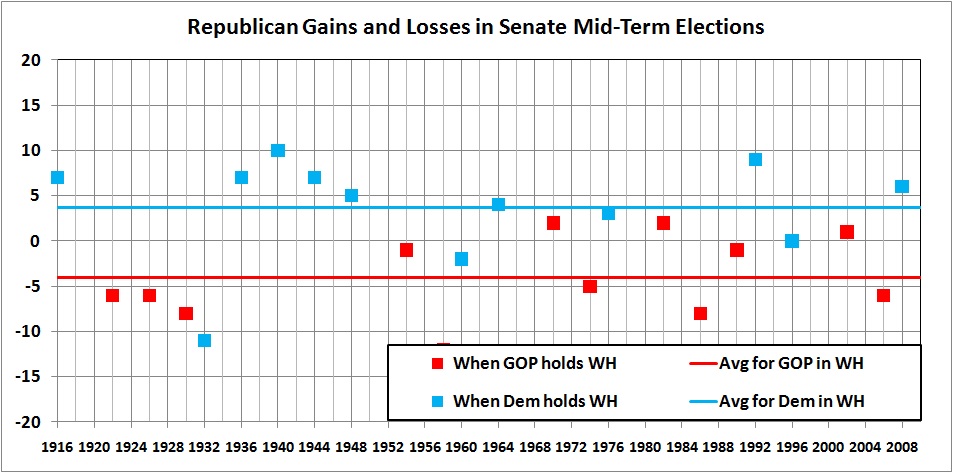
The following graphs underscore the point of the preceding post: Wishful thinking on the part of reality-based “progressives” to the contrary, there is no long-term trend toward a “permanent Democratic majority.” There is, if anything, a trend toward the GOP, which began in the 1950s.

What Happened to the Permanent Democrat Majority?

The election returns on November 2 tell a bigger story than massive disaffection with big government. They also point to a rising Republican majority. Consider, for example, the trend in the GOP’s percentage of House seats since the post-Depression lows of 1964 and 1974-76:

The 1964 low was an aberration, caused by LBJ’s landslide win over Barry Goldwater — a candidate whose then-“extreme” views went mainstream only 16 years later, with the election of Ronald Reagan. The backlash from Watergate led to the routs of 1974-76. And my trained eye tells me that 2008 was another aberration — a pause in a swing toward the GOP that began in the 1950s. So much for the “permanent Democratic majority” of which reality-based “progressives” love to boast.

Will the GOP’s fortunes rise indefinitely? Of course not — only a reality-based “progressive” would make that kind of claim. But the GOP will do well if it truly becomes — and remains — the party of limited government. It is the promise of government-light that propelled the GOP to a majority in 1994 and kept it there most of the time since.

That is the message of November 2. I urge Republican members of Congress to heed it.

Election 2010: Post-Mortem

UPDATED 11/05/10

This is a followup on my election-morning predictions, a prognosis about the next two years, and a diagnosis of the “progressive” disease.

I expected the GOP to gain eight seats in the Senate. But that prediction ran aground on the narrow wins by Democrats Michael Bennet and Harry Reid in Colorado and Nevada. The race in Washington hasn’t been decided, but it seems that Patty Murray will retain her seat.  The Alaska seat will wind up in GOP hands — it’s just a question of whose hands. So, when the dust settles, the GOP will have gained 6 seats and the Dems will retain a majority. That’s as good as it was likely to get. And it’s good enough, because with 47 seats (and only two or three RINOs in the mix) the GOP will command a cloture-proof minority.

Things turned out better in the House. I expected the GOP to end up with 237 seats. But when the dust settles on 10 9 undecided races, the GOP probably will hold between 239 seats (the current count) and 242 seats (adding 3 races now led by GOP candidates). Needless to say, the GOP will command the agenda in the House. The incoming tide of new Republican members will put a lot of pressure on GOP leaders to undo what Pelosi and company wrought. The stumbling blocks will be the Democrat-controlled Senate and the veto pen of BHO.

Republicans gained a lot of ground in the States, as indicated by the pickup of 12 governorships. (The Democrat pickup in California makes little difference in cloud-cuckoo-land, where the main difference between Arnold Schwarzenegger and his successor, Moonbeam Brown, is their accents.) Greater GOP strength at the State level will mean two things: more resistance to the expansion of federal power, and redistricting of the House in ways favorable to future Republican prospects.

The next two years at the “seat of government” (SOG) in D.C. will be filled with GOP initiatives to roll back the Obama agenda, name-calling by Democrats, and (I hope) gridlock combined with some rollback of Obamacare.

The next two years also will be filled with rationalizations by “progressives,” who — in so many words — will blame the backwardness of the American electorate for the events of November 2. “Progressives,” like their putative leader in the White House, already have adopted the myth that things would have turned out differently if only they had found a way to get their “message” across. Well, they did get their “message” across:

  • Pork disguised as stimulus, which did not and will not stimulate because the economy isn’t a hydraulic mechanism that responds automatically to pump-priming.
  • Financial regulations that will make it harder for Americans to borrow money.
  • A Rube Goldberg plan for reforming the health care “system” that will make it harder for Americans to obtain insurance and less rewarding for doctors and other providers to deliver medical services.

Such is “progressivism” at work: Good intentions (to put the best face on it) thwarted by unintended consequences because “progressives” believe that “hope and change” trump the realities of economic (and social behavior) — realities that “the masses” are able to grasp, if only viscerally.

Moreover, there was — and is — the disdain in which “progressives” hold “the masses,” who exist (in the “progressive” imagination) to be talked down to and led by the hand to the promised land of economic and social bliss — as it is envisioned by “progressives.”

I have news for “progressives.” When you talk down to most adults — and even to a lot of children — they quickly perceive three things: (a) you don’t respect their intelligence and (b) you are therefore trying to do something that’s against their interest. You really lose them when you promise things that they know (or suspect) will cost them liberty as well as money.

“Progressives” seem to believe in economic stability at any price, including the price of liberty and prosperity. A lot of “the masses” aren’t buying it. Good for them.

We’re from the Government, and We’re Here to Help You

I once said this:

Think of yourself as a business. You are good at producing certain things — as a family member, friend, co-worker, employee, or employer — and you know how to go about producing those things. What you don’t know, you can learn through education, experience, and the voluntary counsel of family, friends, co-workers, and employers. But you are unique — no one but you knows your economic and social preferences. If you are left to your own devices you will make the best decisions about how to run the “business” of getting on with your life. When everyone is similarly empowered, a not-so-miraculous thing happens: As each person gets on with the “business” of his or her own of life, each person tends to make choices that others find congenial. As you reward others with what you produce for them, economically and socially, they reward you in return. If they reward you insufficiently, you can give your “business” to those who will reward you more handsomely. But when government meddles in your affairs — except to protect you from actual harm[*] — it damages the network of voluntary associations upon which you depend in order to run your “business” most beneficially to yourself and others. The state can protect your ability to run the “business” of your life, but once you let it tell you how to run your life, you compromise your ability to make choices that are right for you.
__________
* “Actual harm” consists of actions (force, verbal and physical intimidation, fraud, theft) against persons and/or their legitimate interests (family, property, business). It is the proper business of the state to defend citizens from harm, and to deter harm. The state may preemptively defend citizens from predators (foreign and domestic) who clearly intend to inflict harm, and who possess or are in the process of obtaining the means of inflicting it.

A key shortcoming of statutes and regulations is that they impose one-size-fits-all rules on the behavior of individuals and businesses. Thus “helpful” statutes and regulations turn out to be unhelpful because they substitute rigid rules for the application of local knowledge and on-scene judgment to unique circumstances.

Here’s a simple but not far-fetched illustration of how legal rigidity causes much unseen harm. Suppose that a regulator in Washington D.C. reads a study which “proves” that left turns are more dangerous than right turns. The regulator then proposes a safety measure forbidding left turns. The measure, which applies to the States as a condition of federal funding, is approved by the regulatory agency following an outpouring of support from “public safety” advocates. The result:

The “better” way of making a left turn requires additional travel distance, and thus additional risk; two additional turns, each of which involves risk; and crossing traffic, which involves further risk (especially if the crossing is unaided by a traffic signal). Then there are the additional costs in fuel, tire wear, and time that the owners and drivers of vehicles must bear.

Such is the “helpful” nature of government. For more, see this post and follow the links therein.

Today, the Battle Begins

The GOP will win big, but that’s only the beginning.

Republicans in Congress must prove their commitment to limited, fiscally conservative government. And the Republican Party must make a compelling case to Americans that limited, fiscally conservative government is the only sure route to liberty and prosperity. If those conditions aren’t met, today’s resounding victory at the polls will be a hollow one.

Here are my final predictions.

  • Based on current Intrade odds on individual Senate races, it looks like the GOP will gain seats in Arkansas, Colorado, Illinois, Indiana, North Dakota, Nevada, Pennsylvania, and Wisconsin. This will cut the Democrat majority in the Senate from 59-41 to 51-49, and leave that body in gridlock.
  • In the House, the GOP will gain about 60 seats and a majority of 39 seats (237-198) to 41 seats (238-197). (For details of my sources and methods, see “One Week Hence” and “Will the GOP Take the House?“)

Tomorrow

UPDATED AND REVISED 11:00 PM (CT)

Rasmussen’s net unpopularity rating of Obama was -11 as of this morning, which is about as good as it gets these days. If that number were to hold on election morning, it would point to a GOP majority of 232-203 in the House.* That would represent a net gain of 53 seats for the GOP.**

HOWEVER, Rasmussen has just released the result of his generic congressional ballot for 10/31/10, which gives GOP House candidates a 12-percentage-point edge over their Democrat rivals. Allowing for some backsliding (10 percent of respondents remain noncommittal), I forecast a GOP edge of 7.4 percentage points. That translates into a 237-198 majority for the GOP — a net gain of 58 seats.

Over in the Senate, the Intrade odds on individual races indicate a 50-50 split, with a few races hanging in the balance. That would be a gain of 9 seats for the GOP.

I will issue my final predictions tomorrow morning.
__________
* For details about sources and methods, see “One Week Hence” and “Will the GOP Take the House?

** Republicans currently hold 178 seats. In addition, a seat that had been held by a Republican is vacant. I therefore use 179 as a baseline for computing GOP gains.

Scare Tactics at Work

First, there’s the well-timed al Qaeda plot. Then, there’s the Stewart-Colbert “Sanity” rally.  Both are efforts to scare independent voters away from GOP candidates on November 2.

Al Qaeda’s leaders evidently assume that America’s independent voters will emulate Spain’s voters, and rally to the party of appeasement. There may be some truth in that. With a full day to absorb the news of the aborted terror plot, Obama’s unpopularity index suddenly improved from -17 to -13 — a swing that is well outside the normal range. (For the electoral implications of this shift, see the updated version of “One Week Hence…“.) Or it could be that some independent voters are having second thoughts as election day approaches. In any event, the bomb plot was well-timed and almost certainly pushed some voters in the direction preferred by al  Qaeda.

The transparent aim of the “Sanity” rally was to shame independent voters away from an association-by-ballot with those “hate-filled, racist, fear-mongering” Tea Partiers.

How will it all turn out? We’ll know the answer to that question in less than 72 hours.

The Recession Still Lingers

UPDATED 10/30/10

The latest release from the Bureau of Economic Analysis, which includes the “advance” estimate of real GDP for the third quarter of 2010, indicates that the recession isn’t over, by my definition of a recession:

  • two or more consecutive quarters in which real GDP (annualized) is below real GDP (annualized) for an earlier quarter, during which
  • the annual (year-over-year) change in real GDP is negative in at least one quarter.

Real GDP for the third quarter was $13,260.7 billion (annualized rate, chained 2005 dollars). Although that’s better than the second quarter, it remains below the peak of $13,359.0, which was reached in the second quarter of 2008.

Here’s how real GDP has fared from the first quarter of 1947 through the third quarter of 2010 (recessions are denoted by vertical bars):

(In this version of the graph I have eliminated the 1947 recession, for lack of complete statistics, and pushed the beginning of the current recession to an earlier quarter.)

(I have added the following sentence and related graph.) Here’s a closer look at the depth and duration of post-war recessions:

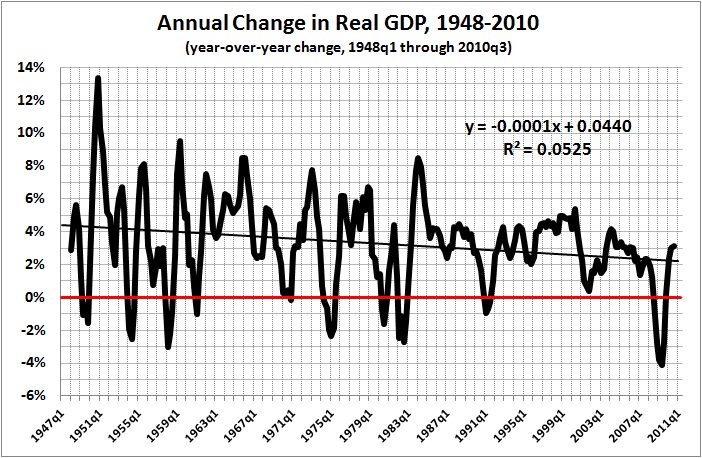
Finally, here are year-over-year changes in real GDP, from the first quarter of 1948 through the third quarter of 2010:

This graph, by the way, updates the one I used in “The Price of Government: More Evidence,” where I say:

You will notice two things about the graph. First, the economy is cyclical, thanks in part to the actions of government (e.g., the low-interest, housing-bubble recession). Second, economic growth has declined from an annual rate of around 4 percent to an annual rate of about 2 percent, because of government.

Related posts:
Economics – Growth & Decline
The Economic and Social Consequences of Government

I Want My Country Back

When a Tea Partier says something like “I want my county back,” leftists reliably label the sentiment as racist, sexist, homophobic, mean-spirited, and a lot of other things that are meant to be uncomplimentary. Well, I’m not an active member of the Tea Party movement, but I am sympathetic to it. And if I were to say “I want my country back,” here’s what I would mean by it:

Let’s start with the unlawfulness of government. The Constitution of the United States creates a “national” government of limited and enumerated powers, to act on behalf of the States and their citizens in certain matters. This “national” government has nevertheless blatantly and persistently exceeded its rightful powers. Moreover, much of what is done by all governments — not just the “national” government — is in fact unlawful at its core. There is a fundamental tenet of law — one that precedes and informs the Constitution — which is that “law” is law only when it serves the general welfare, regardless of its official status as an legislative, executive, or judicial act. Therefore, it is truly unlawful for the  “national” government or any other government in the United States to interfere with the lives, liberty, or property of Americans for the purpose of promoting special interests, however laudable those interests may seem. And yet, the “laws” under which Americans labor are, in the main, enactments that serve special interests and the power-lust of politicians, bureaucrats, and judges. In sum, I want my country (and its various parts) to return to the true “rule of law,” which is to promote the general welfare by

  • protecting all Americans from their enemies within and without
  • ensuring the free movement of all Americans
  • ensuring the free exchange of goods and services
  • and nothing more.

One of the most insidious ways in which government interferes with our liberty is by exercising a subtle but powerful form of thought control. It  is not the business of government to tell us what to believe or how we must arrive at our beliefs. But government — which puts it imprimatur on the vast majority of educational institutions and much of the “factual” information in many fields of endeavor — does all of those things. Thus, contrary to the intentions of the Founders, we have become a nation imbued with official beliefs about matters ranging from the origins of the universe to the goodness of our enemies to the climatic effects of (puny) human endeavors.

One of the key beliefs instilled by government — directly and through those who are in its thrall — is its beneficent role in our economic and social affairs. It never seems to occur to the proponents of governmental interference — or to its relatively few of its opponents — that there is a living, breathing case study which disproves the beneficence of economic meddling. When government spending and regulation played a tiny role in the economic affairs of the United States — from the 1790s to around 1900 — GDP grew at an annual rate of 4.2 percent. Now, with the regulatory-welfare state fully upon us, GDP grows at an annual rate of 3.1 percent (and falling). The difference between those two rates — when compounded over a generation, a lifetime, or a century —  ranges from significantly large to enormous. The road to economic lassitude is paved by the good intentions of regulation and spending by government. Liberty — part of which is the right to make mistakes and benefit from the resulting lessons — is a collateral victim of regulatory zeal. Liberty is a victim of government spending, as well, because it deprives individuals of some portion of the rewards for their labor and capital, and the full enjoyment of those rewards.

With respect to social matters, there is only one way to put it: Government is an enemy of society. Its main mission, when you think about it for more than a minute, is to supplant voluntary and beneficial social arrangements with schemes hatched in the vacuum of intellectualism. It is as if there were nothing to the eons-long learning that is expressed in the Ten Commandments and Golden Rule, and embodied in churches, clubs, and other voluntary, private associations. We must, instead, take our social marching orders from elites, who have their own peculiar views of what is right and just: serial polygamy, pederasty, and infanticide, to name just a few things. The social engineering favored by intellectualoids arises not from the wisdom of tradition, which fosters stable, trusting, and supportive social relationships, but from idle theorizing and a large dose of adolescent and post-adolescent rebellion.

Now, after a more than a century of “progressive” destruction of the Constitution and its restraints on government, Americans no longer enjoy the protection of government and the self-policing restraints of social custom. Instead, Americans suffer the fads and whims of the self-anointed, whose legacy lingers after their departure from the scene.

Now, after more than a century of “progressive” interference in the economic affairs of Americans, our progeny face unaffordable financial commitments, which they will be expected to honor even as their standard of living withers under the assault of taxation and regulation.

Now, after more than a century of social experimentation in which anti-social behavior has been exalted and long-standing voluntary social arrangements and institutions have been stripped of their authority, too many of our progeny are hooked on hard drugs, casual sex, and gratuitous violence as forms of “entertainment” and as “lifestyles.”

I want my country back.

The Politically Correct Cancer: Another Weapon in the War on Straight White Males

Breast cancer is by no means a matter for ridicule. But it has become the politically correct cancer, without a doubt.

There is a time during the baseball season when players wear pink caps and pink armbands, and when some of them even wield pink bats. There may be similar occurrences in basketball and football, but I don’t follow those sports, so I wouldn’t know.

The clincher came this morning, in the form of a special 24-page supplement to the Austin American-Statesman (known only as the Statesman in lefty Austin). The supplement not only contains articles about breast cancer and everything possibly related to it, but it is printed on pink newsprint. (NB: Newsprint is the kind of paper on which newspapers are printed; the impressions on the paper are made with printer’s ink.)

This latest evidence of enlightened concern about breast cancer led me to wonder if the disease really is quite the threat it’s made out to be — statistically, that is. (I know that it’s a devastating, life-threatening scourge to those who contract it.) Well the answer is “yes and no.” According to statistics for 2002-2006 (the most recent statistics published by the Centers for Disease Control and Prevention), female breast cancer is by far the most prevalent type of cancer among women in the United States. Here are the stats (annual incidence per 100,000 women):

Female Breast 121.7
Lung and Bronchus 55.8
Colon and Rectum 43.6
Corpus and Uterus, NOS 23.7
Non-Hodgkin Lymphoma 16.3
Melanomas of the Skin 14.7
Thyroid 14.2
Ovary 13.0
Kidney and Renal Pelvis 10.2
Pancreas 10.2

*     *     *

But look at this comparison of the top 10 cancers among females (left) and males (right):

Female Breast 121.7 Prostate 155.1
Lung and Bronchus 55.8 Lung and Bronchus 86.8
Colon and Rectum 43.6 Colon and Rectum 59.1
Corpus and Uterus, NOS 23.7 Urinary Bladder 37.9
Non-Hodgkin Lymphoma 16.3 Non-Hodgkin Lymphoma 23.1
Melanomas of the Skin 14.7 Melanomas of the Skin 22.6
Thyroid 14.2 Kidney and Renal Pelvis 19.6
Ovary 13.0 Oral Cavity and Pharynx 15.9
Kidney and Renal Pelvis 10.2 Leukemias 15.9
Pancreas 10.2 Pancreas 13.1
 

Total – top 10
323.4  

Total – top 10
449.1

*     *     *

Why does breast cancer get so much attention relative to prostate cancer? And why isn’t the greater overall vulnerability of males a big issue? In fact, Table B on page 5 of this official publication indicates that males are not only more vulnerable to cancer, but are generally more vulnerable to just about everything that causes death. Why isn’t there a national crusade against premature male demise?

I’ll tell you why males get short shrift. It’s the old story of opinion-and-media elites adopting the causes of groups they favor. Why are those groups favored? Because they were, at one time, oppressed by the straight-white-male-dominated “system.” (Though women — in America, at least — were neither as oppressed nor as powerless as elites like to imagine.)

And what happens when oppressed groups are no longer oppressed? Well, they remain favored by elites, who have it in their minds that an oppressed group is, by definition, morally superior to the group that had oppressed it. Thus “black” crime is somehow less blameworthy than “white” crime; the requirement to present a photo ID when voting is anti-Hispanic, not a precaution against voting fraud; AIDS is an “epidemic” to be fought by government, not a preventable disease transmitted by irresponsible sexual conduct; and so on.

Whatever happened to equality? Elites like to proclaim it as an ideal, but they choose not to practice it. (Or, if they do, it is to favor equality of outcome over neutrality of process.) The political correctness of breast cancer is just one point in evidence of elite hypocrisy.

Experts and the Economy

In “Socialist Calculation and the Turing Test,” I wrote about the

suggestion … that one can emulate the outcomes that would be produced by competitive markets — if not something “better” — by writing rules that, if followed, would mimic the behavior of competitive markets.The problem with that suggestion … is that someone outside the system must make the rules to be followed by those inside the system.

And that’s precisely where socialist planning and regulation always fail. At some point not very far down the road, the rules will not yield the outcomes that spontaneous behavior would yield. Why? Because better rules cannot emerge spontaneously from rule-driven behavior….

Where, for instance, is there room in the socialist or regulatory calculus for a rule that allows for unregulated monopoly? Yet such an “undesirable” phenomenon can yield desirable results by creating “exorbitant” profits that invite competition (sometimes from substitutes) and entice innovation. (By “unregulated” I don’t mean that a monopoly should be immune from laws against force and fraud, which must apply to all economic actors.)

I suppose exogenous rules are all right if you want economic outcomes that accord with those rules. But such rules aren’t all right if you want economic outcomes that actually reflect the wants of consumers….

Of course, the whole point of socialist planning is to produce outcomes that are desired by planners. Those desires reflect planners’ preferences, as influenced by their perceptions of the outcomes desired by certain subsets of the populace. The immediate result may be to make some of those subsets happier, but at a great cost to everyone else and, in the end, to the favored subsets as well. A hampered economy produces less for everyone.

Socialism — a.k.a. “liberalism” — is all about reliance on experts. As Don Boudreaux says,

modern “liberalism’s” ideas are about replacing an unimaginably large multitude of diverse and competing ideas – each one individually chosen, practiced, assessed, and modified in light of what F.A. Hayek called “the particular circumstances of time and place” – with a relatively paltry set of ‘Big Ideas’ that are politically selected, centrally imposed, and enforced not by the natural give, take, and compromise of the everyday interactions of millions of people but, rather, by guns wielded by those whose overriding ‘idea’ is among the most simple-minded and antediluvian notions in history, namely, that those with the power of the sword are anointed to lord it over the rest of us.

Megan McArdle puts it this way:

So we get [from central planning] what most interests wordsmiths:  a succession of enormous plans (health care exchanges! privatize social security!), most of which fail….
But all this makes me very skeptical of handing elites more power, particularly when they are given that power in order to reduce the autonomy of some other group.  (And somehow, that usually is what it’s for–you haven’t seen much lobbying for better regulation of university professor quality, even though a bad idea is probably more dangerous than a bad apple.)
J.M. Keynes — the experts’ expert — said that “Practical men, who believe themselves to be quite exempt from any intellectual influence, are usually the slaves of some defunct economist.” Keynes is the quintessential defunct economist, and mindless politicians (among others) are his slaves.

The “Forthcoming Financial Collapse”

I have written before about my membership in a Google Group

whose active members are retired scientists, engineers, mathematicians, and economists — some in their upper 80s — who worked on defense issues from the 1940s to the 2000s….

Most members of the group were government employees and/or employees of government contractors. Their attraction to government service — and its steady and rather handsome paychecks — derives, in good part, from their belief in the power of government to “solve problems,” and in the need for government to do just that. It is only natural, then, that many members of the group hold an unrealistically exalted view of the power of quantitative methods to “solve problems,” while holding naive views about the machinations of government, human nature, and history. (The pioneers of military operations research in the United States, by contrast, were realistic about the relative impotence of quantitative analysis of complex, dynamic processes.)

Here, for example, is a recent communication from one of the group’s older members:

A political scientist and former Foreign Service Officer friend proposes the following which, if valid, may complicate the U.S.’s capability to handle the forthcoming financial collapse of our country.

His formulation is as follows: (1) The World Trade Center attacks grievously damaged our self-confidence but did little but material damage. (2) On the other hand, the collapse of Lehman Brothers had impacts across the financial world and among the Central Banks of many countries. In effect, the U.S. was the instrument inflicting damage and loss on both trading partners and creditors.

Do we agree that the second is the more serious. What may be the dimensions of the impact?

If I were to reply, this is what I would say:

Your message is provocative in more than one respect. I won’t get into the material effect of the 9/11 attacks, except to say that the assessment that they caused “little material damage” seems to ignore the economic after-shock and the value of 3,000 lives lost. But I am more concerned with the policy implications of your friend’s formulation, and with what you call “the forthcoming financial collapse of our country.”

I have trouble with your friend’s formulation because it involves an irrelevant comparison. On the one hand, there was a deliberate attack on the U.S. by a foreign enemy. On the other hand, a major investment bank failed, in large part because of investments in bad securities that were issued pursuant to policies of the U.S. government (sub-prime mortgage loans and low interest rates). These are not mutually exclusive events, and should be considered separately in devising appropriate government policies (including a hands-off policy). I am sure that your friend would prefer fewer bank failures, but not at the cost of more terrorist attacks.

I turn now to government’s role (or lack thereof) in securing our economic future. Let’s begin with the collapse of Lehman Brothers. Lehman was allowed to fail because government officials didn’t want to send a “signal” that a bailout would be an automatic reward for failure. But those same officials, in their panic, reversed course with respect to other financial institutions and bailed them out. The bailouts didn’t really help credit markets (as they were supposed to) because — quite reasonably in the aftermath of a government-caused financial panic and recession — the bailed-out institutions (and others) have been slow to lend, while individuals and businesses have been slow to borrow. What the bailouts mainly did was to reinforce the view that government (i.e., taxpayers) will bear the costs of foolish endeavors — which only encourages banks (and other businesses) to undertake more foolish endeavors. The price for those endeavors will come due at the bursting of the next bubble, whatever it is and whenever it occurs.

If there is any lesson to be taken from the comparison offered by your friend, it is an old one that most Americans seem not to have learned: The real job of government is to protect citizens from foreign and domestic predators. Government does that badly enough (though I would rather have it done by government than by private parties, namely, warlords). Government is even worse at other things, like intervening in economic affairs, the unseen cost of which — in forgone economic output — dwarfs the amount spent by governments (at all levels) on defense and law-enforcement. This comparison is apt because we could better afford to pay for the protective services of government, were it to butt out of our economic affairs.

This brings me to “the forthcoming financial collapse of our country.” I assume that you refer to the huge obligations incurred by the federal government in the form of Social Security, Medicare, Medicaid — and the promised expansion of these by what has become known as Obamacare. These obligations, which now consume about 10 percent of GDP, will consume 25 percent of GDP before the end of this century. Add to them the cost of other governmental functions and the regulatory obstacles that government throws into the path of economic growth, and you do have something like an economic disaster in the making — but it may occur in slow motion (as it has for the past century), rather than in the form of a dramatic collapse.

One result of the slow-motion disaster could be a “sovereign debt crisis,” namely, the inability of the U.S. government to sell its debt except, perhaps, at very high rates of interest. In the alternative, the government, acting through the Fed, would simply “print money” in an effort to inflate its way out of the problem. But that would only make government debt less marketable while further stifling economic growth by creating great uncertainty in capital markets. The bottom line is that the “forthcoming financial collapse” — or its slow-motion equivalent — is of the government’s making, and can be averted only by getting government out of the business of running the inter-generational Ponzi schemes that we know as Social Security, Medicare, and Medicaid.

The real strength of the “country” is its people and their voluntary social and business arrangements. It is not government, which — contrary to the views of “progressives” — stands in the way of progress and prosperity.

Related posts:
The Commandeered Economy
The Price of Government
The Mega-Depression
Does the CPI Understate Inflation?
Ricardian Equivalence Reconsidered
The Real Burden of Government
Toward a Risk-Free Economy
The Rahn Curve at Work
How the Great Depression Ended
A Moral Dilemma
Our Miss Brooks
The Illusion of Prosperity and Stability
Society and the State
The Price of Government: More Evidence
Experts and the Economy
I Want My Country Back

One Week Hence . . .

The outlook for November 2, as of today (UPDATED 10/31/10):

  • (Not updated since 10/26/10.) Based on current Intrade odds on individual Senate races, it looks like the GOP will gain seats in Arkansas, Colorado, Illinois, Indiana, North Dakota, Nevada, Pennsylvania, and Wisconsin. This will cut the Democrat majority in the Senate from 59-41 to 51-49, thus enabling the GOP to block legislation despite the lingering presence of a few RINOs.
  • (Updated 10/31/10.) Over in the House, it looks like the GOP will gain about 60 seats, to re-take the House with a majority of 33 seats (234-201) to 35 seats (235-200). (Only the latter projection has been updated since 10/26/10.)
  • (Added 10/30/10; revised 10/31/10.) The well-timed discovery of a terrorist plot, combined with the “Sanity” rallies, may have helped to push some independent voters away from the GOP. Obama’s unpopularity index (as reported by Rasmussen) has improved by 6 percentage points in two days, from -19 to -17 to -13. Today’s  4-point swing is outside the normal range of day-to-day changes in the index.

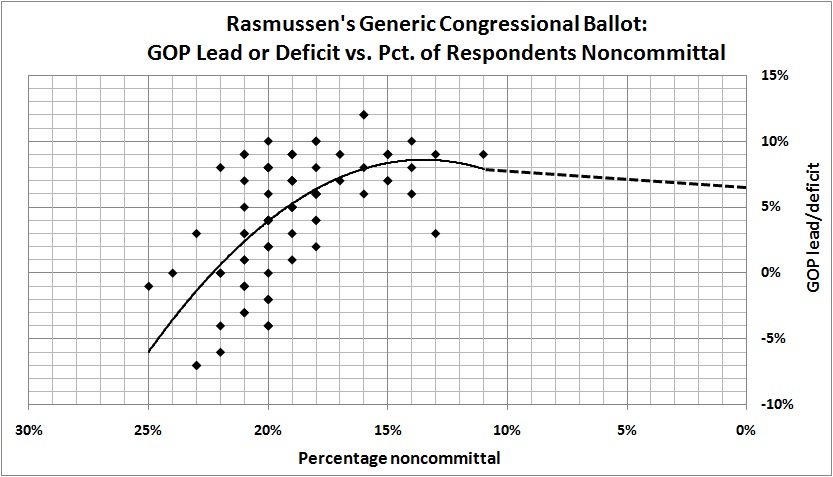
My forecast of Republican gains in the House is based on two indicators. The first is Scott Rasmussen’s generic congressional ballot, which has been polled weekly since January 11, 2009. The data points in the graph below represent the results of the poll, to date. Although the GOP enjoys a lead of 9 percentage points in the latest poll (10/24/10), my analysis indicates that there will be a slight reversal of GOP gains as more noncommittal voters choose sides. The solid black line, which is fitted to the data points, shows that the downward trend has begun. A separate statistical analysis yields the dashed black line, which indicates a GOP lead of 6.5 percentage points (a 234-201 majority) when the polls close on November 2.

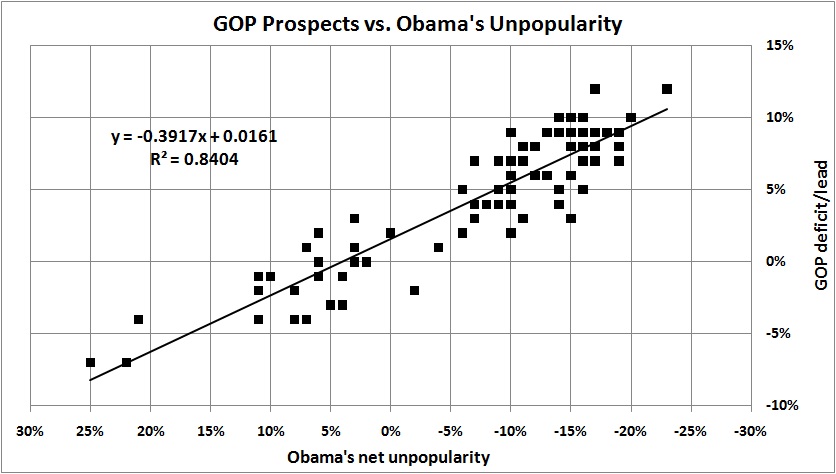
The second indicator of GOP prospects in the House is the degree of Obama’s unpopularity. The following graph depicts the relationship between Obama’s net unpopularity (percentage strongly disapproving less percentage strongly approving) and the number of percentage points by which votes cast for GOP House candidates will exceed votes cast for Democrat candidates.

This graph is derived from the results of Rasmussen’s generic congressional ballot and presidential tracking poll. The points on the graph represent the weekly results of the two Rasmussen polls for January 8, 2009, through October 24, 2010. The equation in the graph indicates that if Obama’s unpopularity index stays at its current level of -13 percentage points, GOP candidates for House seats will outpoll their Democrat opponents by6.7 percentage points on election day. That translates into a majority of 235-200.

(Added 10/31/10.) As I said in “Two Weeks Hence“:

All of this assumes no major shocks between now and election day — nothing on the order of a terror attack, a specific terror threat, a scandal involving a major political figure, and so on.

The Price of Government: More Evidence

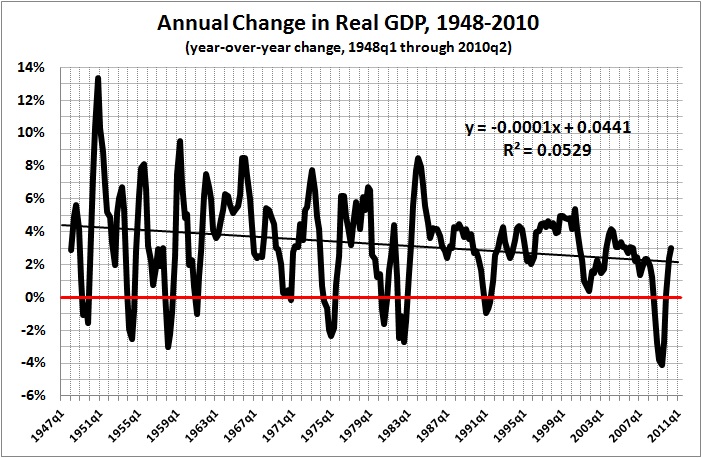
It is time to remind everyone of the economic toll that has been exacted by the growth of the regulatory-welfare state since the end of World War II:


Source: Bureau of Economic Analysis.

You will notice two things about the graph. First, the economy is cyclical, thanks in part to the actions of government (e.g., the low-interest, housing-bubble recession). Second, economic growth has declined from an annual rate of around 4 percent to an annual rate of about 2 percent, because of government.

Related posts:
Economics – Growth & Decline
The Economic and Social Consequences of Government