A Quotation to Ponder

Thanks to Samizdata.net for this:

Full government control of all activities of the individual is virtually the goal of both national parties.

–Ludwig von Mises, Economic Freedom and Interventionism

My take: The parties differ in the kinds of activities they would control, and the degree to which they would control them. Democrats would control economic activity (including almost anything remotely related to it), speech, association, and religion (the press gets a pass because it is Democrat-controlled). Beside that ambitious (and almost-accomplished) agenda, the GOP’s agenda is relatively anarchistic.

That said, I favor the GOP, mainly because it isn’t the Democrat Party. And there is far more hope of the GOP returning to the limited-government ethic of the Harding-to-Taft era than there is of the Democrats returning to the limited-government ethic of Grover Cleveland.

Related posts:
Parsing Political Philosophy
Is Statism Inevitable?
Inventing “Liberalism”
A Bargain with the Devils of “Liberalism”
Utilitarianism vs. Liberty
Greed, Cosmic Justice, and Social Welfare
Positive Rights and Cosmic Justice
Fascism and the Future of America
Negative Rights, Social Norms, and the Constitution
Rights, Liberty, the Golden Rule, and the Legitimate State
The Near-Victory of Communism
Tocqueville’s Prescience
State of the Union: 2010
The Shape of Things to Come
The Real Burden of Government

How to Combat Beauty-ism

Now that the seekers of cosmic justice have taken care of health inequalities by ensuring that everyone enjoys equally poor health under Obamcare, they are turning their attention to inequalities in beauty. Here’s the lowdown:

In her provocative new book, The Beauty Bias: The Injustice of Appearance in Law and Life, Stanford law professor Deborah Rhode argues that workers deserve legal protection against appearance-based discrimination unless their looks are directly relevant to their job performance….

Rhode convingingly [sic] argues that beauty bias in the workplace is a widespread problem with serious consequences. Between 12 and 14 percent of workers say they’ve suffered some kind of appearance-based discrimination on the job.

It should go without saying that discrimination on the basis of appearance is unjust, especially when it comes to features individuals have little or no control over. Rhode does a good job of spelling out why such bias is offensive to human dignity and equal opportunity.

If discrimination on the basis of appearance is unjust, then discrimination on the basis of intelligence and ability must also be unjust. A very high percentage of workers have been discriminated against on the basis if their lack of intelligence, and yet individuals have little or no control over their level of intelligence. Nor do they have much control of their ability to do things that require intelligence or other genetically determined traits (e.g., exceptional eyesight, exceptional height, perfect pitch).

Therefore, following Deborah Rhode’s logic, public and private institutions should not be able to discriminate on the basis of intelligence or ability (where it is genetically dependent). Professors, most athletes, most musicians, brain surgeons, and others whose occupations demand high intelligence and/or unusual physical abilities should be chosen by lottery. Think of Debora Rhode as you go under the knife.

Seriously (not), here is how the government should deal with the problem of beauty-ism:

1. Establish national standards of beauty. This should be done by an independent commission of experts appointed by the president, subject to confirmation by the ugliest members of the Senate.

2. Assign every person over the age of 16 a beauty rating, on a scale of 1 to 8 (“10” is such a cliché). This can be done at the time of the decennial census. It would require the abolition of the mail-in form in favor of visits to every dwelling place in America by teams of beauty judges who are trained and certified by the beauty commission. Refusal to be judged would be a felony, punishable by compulsory viewing of American Idol or similar fare, as determined by the beauty commission.

3. Determine the national distribution of beauty ratings.  If the ratings are normally distributed, for example, they would occur with the following frequency per 1,000 persons: 1 = 1; 2 = 21; 3 = 136; 4 = 341; 5 = 341; 6 = 136; 7 = 21; 8 = 1 (distribution does not add to 1,000 because of rounding).

4. Require every employer (private and government) to maintain a workforce with a distribution of beauty ratings that matches the national distribution. Heads of private and government organizations (e.g., CEOs, the president, the speaker of the House) would be counted for purposes of determining compliance with the national average.

5. Give employers an opportunity to comply with the national distribution. In an arrangement similar to cap-and-trade for carbon emissions, employers could trade overly beautiful employees for underly beautiful ones. In a token bow to liberty, the terms of trade would be negotiated by the trading parties.

6. Punish employers who fail to bring their workforces into compliance with the national distribution by a date certain. Punishments would vary according to the degree of noncompliance. At a minimum, offenders would be forced to watch Dancing with the Stars. As for the most serious offenders, their personal beauty ratings would be lowered to 1, thus insulting 999 out of every 1,000 offenders and making it almost impossible for them to work anywhere. No exceptions would be made for high-ranking officials. (Note to Barack Obama, Harry Reid, and Nancy Pelosi: That means you.*)

Thus endeth today’s journey into the never-land of cosmic justice.

__________
* On the evidence of these portraits and photos of the presidents of the U.S., I conclude that average beauty rating for a president in the post-hirsute era (Wilson through Obama) is a below-average 4.4.

The Psychologist Who Played God

UPDATED 02/12/14 (related reading and related posts added)

There’s a story at Slate titled “Jesus, Jesus, Jesus.” Here are some key passages:

In the late 1950s, psychologist Milton Rokeach was gripped by an eccentric plan. He gathered three psychiatric patients, each with the delusion that they were Jesus Christ, to live together for two years in Ypsilanti State Hospital to see if their beliefs would change….

…Rokeach wanted to probe the limits of identity. He had been intrigued by stories of Secret Service agents who felt they had lost contact with their original identities, and wondered if a man’s sense of self might be challenged in a controlled setting…. This … led Rokeach to orchestrate his meeting of the Messiahs and document their encounter in the extraordinary (and out-of-print) book from 1964, The Three Christs of Ypsilanti….

[T]he book makes for starkly uncomfortable reading as it recounts how the researchers blithely and unethically manipulated the lives of Leon, Joseph, and Clyde in the service of academic curiosity….

In hindsight, the Three Christs study looks less like a promising experiment than the absurd plan of a psychologist who suffered the triumph of passion over good sense. The men’s delusions barely shifted over the two years, and from an academic perspective, Rokeach did not make any grand discoveries concerning the psychology of identity and belief. Instead, his conclusions revolve around the personal lives of three particular (and particularly unfortunate) men. He falls back—rather meekly, perhaps—on the Freudian suggestion that their delusions were sparked by confusion over sexual identity, and attempts to end on a flourish by noting that we all “seek ways to live with one another in peace,” even in the face of the most fundamental disagreements. As for the ethics of the study, Rokeach eventually realized its manipulative nature and apologized in an afterword to the 1984 edition: “I really had no right, even in the name of science, to play God and interfere round the clock with their daily lives.”

Rokeach — the psychologist who played God — belonged to a coterie of left-wing psychologists who strove to portray conservatism as aberrant, and to equate it with authoritarianism. This thesis emerged in The Authoritarian Personality (1950). Here is how Alan Wolfe, who seems sympathetic to the thesis of The Authoritarian Personality, describes its principal author:

Theodor Adorno … was a member of the influential Frankfurt school of “critical theory,” a Marxist-inspired effort to diagnose the cultural deformities of late capitalism.

I was first exposed to Adorno’s conservatism-as-authoritarianism thesis in a psychology course taught by Rokeach around the time he was polishing a complementary tome, The Open and Closed Mind: Investigations into the Nature of Belief Systems and Personality Systems (related links). The bankruptcy of the Adorno-Rokeach thesis has been amply documented. (See this and this, for example.) The question is why academic leftists like Adorno and Rokeach would go to such pains to concoct an unflattering portrait of conservatives.

Keep in mind, always, that modern “liberals” are anything but liberal, in the classical sense. (See this and this, and be sure to consult Jonah Goldberg’s former blog, Liberal Fascism.) Modern “liberals” are authoritarian to the core, as is evident in the state to which they have brought us. They nevertheless persist in believing — and proclaiming — themselves to be friends of liberty, even as they seek to dictate how others should live their lives. They deny what they are because they know, deep down, that they are what they profess to abhor: authoritarians.

A classic way to resolve a deep psychological conflict of that kind is to project one’s own undesired traits onto others, especially onto one’s social and political enemies. That, I maintain, is precisely what Adorno, Rokeach, and their ilk have done in The Authoritarian Personality, The Open and Closed Mind, and similar tracts. And that, I maintain, is precisely what “liberals” do when they accuse conservatives of base motivations, such as racism and lack of empathy. Nothing is more racist than “liberal” condescension toward blacks; nothing is more lacking in empathy than “liberal” schemes that deprive blameless individuals of jobs (affirmative action) and prevent hard-working farmers and business-owners from passing their farms and businesses intact to their heirs (the estate tax). Nothing is more authoritarian than modern “liberalism.”

Milton Rokeach, rest his soul, acknowledged his penchant for authoritarianism, at least  in the case of the “Three Christs.” If only the “liberals” who govern us — and the “liberals” who cheer them on — would examine their souls, find the authoritarianism within, and root it out.

That will be a cold day in hell.

*     *     *

Related reading:
James Lindgren, “Who Fears Science?,” March 2012
John J. Ray, “A Counterblast to ‘Authoritarianism’,” Dissecting Leftism, December 20, 2013
James Lindgren, “Who Believes That Astrology Is Scientific?,” February 2014

Related posts:
Conservatism, Libertarianism, and the “Authoritarian Personality”
The F Scale, Revisited

Cuccinelli for President?

The more I learn about Ken Cuccinelli, the attorney general of Virginia, the more depressed I become by the fact that he — or someone like him — isn’t in the White House.

For example, Cuccinelli’s office is investigating Michael “Hockey Stick” Mann, who (while at the University of Virginia) accepted State funds for his research. Here is part of the AG’s statement about the matter:

The revelations of Climate-gate indicate that some climate data may have been deliberately manipulated to arrive at pre-set conclusions.  The use of manipulated data to apply for taxpayer-funded research grants in Virginia is potentially fraud.  Given this, the only prudent thing to do was to look into it.

This is a fraud investigation and the attorney general’s office is not investigating Dr. Mann’s scientific conclusions.  The legal standards for the misuse of taxpayer dollars apply the same at universities as they do at any other agency of state government.  This is about rooting out possible fraud and not about infringing upon academic freedom.

That bare statement cries out for amplification. Here are portions of an analysis posted at Watt’s Up With That?:

Mann is the former UVA professor, whose “hockey stick” temperature chart was used to promote claims that “sudden” and “unprecedented” manmade global warming “threatens” human civilization and Earth itself. The hockey stick was first broken by climatologists Willie Soon and Sallie Baliunas, who demonstrated that a Medieval Warm Period and Little Ice Age were clearly reflected in historic data across the globe, but redacted by Mann. Analysts Steve McIntyre and Ross McKitrick later showed that Mann’s computer program generated hockey-stick patterns regardless of what numbers were fed into it – even random telephone numbers; that explained why the global warming and cooling of the last millennium magically disappeared in Mann’s “temperature reconstruction.”

The Climategate emails revealed another deliberate “trick” that Mann used to generate a late twentieth-century temperature jump: he replaced tree ring data with thermometer measurements at the point in his timeline when the tree data no longer fit his climate disaster thesis.

Not surprisingly, he refused to share his data, computer codes and methodologies with skeptical scientists. Perhaps worse, Climategate emails indicate that Mann and others conspired to co-opt and corrupt the very scientific process that Carr asserts will ultimately condemn or vindicate them.

This behavior certainly gives Cuccinelli “probable cause” for launching an investigation. As the AG notes, “The same legal standards for fraud apply to the academic setting that apply elsewhere. The same rule of law, the same objective fact-finding process, will take place.” Some witch hunt.

There is simply no room in science, academia or public policy for manipulation, falsification or fraud. Academic freedom does not confer a right to engage in such practices, and both attorneys general and research institutions have a duty to root them out, especially in the case of climate change research.

Then there is Virginia’s suit for “declaratory and injunctive relief” from Obamacare. Cuccinelli’s office recently responded to the feds’ motion to quash the suit. Here is the AG’s statement:

Virginia has responded to the federal government’s attempt to dismiss the state’s lawsuit against the new federal health care law, Virginia Attorney General Ken Cuccinelli announced today.

In its motion to the court to dismiss Virginia’s lawsuit, the federal government argued that Virginia lacks the standing to bring a suit, that the suit is premature, and that the federal government has the power under the U.S. Constitution’s Commerce Clause to mandate that citizens must be covered by health insurance or pay a civil penalty.  The government also made alternative arguments based upon its taxing power and the Necessary and Proper Clause.

“If the government prevails and Congress may use the Commerce Clause to order Americans to buy private health insurance, then Congress will have been granted a virtually unlimited power to order you to buy anything.  That would amount to the end of federalism and our more than 220 years of constitutional government,” the attorney general said.

Here is a brief summary of some of the arguments:

Federal government’s arguments to dismiss the case

Virginia’s response

Virginia is not injured by the federal health care law

Because the federal health care law purports to invalidate a Virginia law (the Health Care Freedom Act) under the Constitution’s Supremacy Clause, Virginia’s sovereign interests have been injured.

Because the mandate doesn’t take effect until 2014, the case is not “ripe”

1)  Based on several previous Supreme Court decisions, if a dispute is certain to occur in the future, this does not prohibit the suit from being brought in the present

2)  Virginia has already been forced to make decisions regarding insurance exchanges under the act, as well as changes to Medicaid.  One of those decisions made the commonwealth forego more than $100 million in federal money.

Virginia’s suit is barred by the Anti-Injunction Act

The act does not apply to states under these circumstances, because Virginia’s action falls within an exception to the act that has been recognized by the Supreme Court

The government has the power under the Constitution’s Commerce Clause to mandate the purchase of individual health insurance

1)  The federal government’s argument is contrary to the text of the Constitution

2)  The federal government’s argument is contrary to the meaning of the words of the Commerce Clause as understood by the Founders

3)  The federal government’s argument is contrary to the historical context of the nation’s founding.  When Great Britain instituted a tax on tea, the colonists’ response was to boycott and to not buy tea.  Parliament had the power to regulate commerce, but even it did not attempt to force colonists to buy the taxed product.

4)  The federal government’s argument is contrary to the traditional uses of the Commerce Clause.  The clause has always been used to regulate economic activity; never inactivity.

5)  The federal government’s argument is contrary to the precedent of the U.S. Supreme Court.  The Court has set outer limits to the reaches of the Commerce Clause, including in cases such as Lopez and Morrison, saying that the clause must have principled limits, otherwise the federal government essentially would have unlimited power, rather than the limited powers enumerated in the Constitution.

Even if refusing to buy insurance is not commerce, the government can still force people to buy health insurance using the Constitution’s Necessary and Proper Clause.

1)  Since 1819, the Supreme Court has held that any use of the Necessary and Proper Clause must be consistent with both “the letter and spirit” of the Constitution.  Any interpretation that would destroy the federal form of government (where federal power is limited only to those powers enumerated in the Constitution, with remaining powers reserved to the states and the people) is not allowed under that standard.

2)  In May, the Supreme Court decided Comstock.

The Court adopted a historical approach to the use of the Necessary and Proper Clause. Because the mandate is utterly unprecedented, it is unlikely to be upheld under a historical approach.

Even if the government cannot win using the Commerce Clause and Necessary and Proper Clause arguments, the federal health insurance mandate can be justified under the government’s taxing authority.

1)  The penalty for not buying insurance is not a tax.  Congress called it a “penalty” and claimed authority to act only under the Commerce Clause.  To argue otherwise now ignores what Congress actually did.

2)  A penalty for inaction is not a tax of any kind known to the Constitution, when judged historically.

Finally, for today, there is Cuccinelli’s principled defense of the First Amendment in the case of Snyder v. Phelps. Here is the text of the press release that explains his refusal to join a case filed by the AGs of 48 other States:

Attorney General Ken Cuccinelli has decided not to join other states in an amicus brief on behalf of Albert Snyder in Snyder v. Phelps, which will soon be heard by the U.S. Supreme Court.  Mr. Snyder is the father of Matthew Snyder, a soldier killed in Iraq whose funeral was picketed by Fred Phelps and his followers at the infamous Westboro Baptist Church.

Here is our statement, given by Brian Gottstein, director of communication:

The attorney general’s office deplores the absolutely vile and despicable acts of Fred Phelps and his followers.  We also greatly sympathize with the Snyder family and all families who have experienced the hatefulness of these people.  The attorney general has always been a strong supporter of the military, both in his words and in his work as a Senator.  But the consequences of this case had to be looked at beyond what would happen just to Phelps and his followers.

This office has decided not to file a brief in Snyder v. Phelps, because the case could set a precedent that could severely curtail certain valid exercises of free speech.  If protestors – whether political, civil rights, pro-life, or environmental – said something that offended the object of the protest to the point where that person felt damaged, the protestors could be sued.  It then becomes a very subjective and difficult determination as to when the line is crossed from severely offensive speech to that which inflicts emotional distress.  Several First Amendment scholars agree.

Virginia already has a statute that we believe balances free speech rights while stopping and even jailing those who would be so contemptible as to disrupt funeral or memorial services.  That statute, 18.2-415(B), punishes as a class one misdemeanor (up to one year in jail and a fine of up to $2,500) someone who willfully disrupts a funeral or memorial service to the point of preventing or interfering with the orderly conduct of the event.

We do not think that regulation of speech through vague common law torts like intentional infliction of emotional distress strikes the proper balance between free speech and avoiding the unconscionable disruption of funerals.  We think our statute does.

So long as the protesters stay within the letter of the law, the Constitution protects their right to express their views.  In Virginia, if Phelps or others attempt this repugnant behavior, cross the line and violate the law, the attorney general’s office stands ready to provide any assistance to local prosecutors to vindicate the law.

A politician who stands on principle instead of bowing to popular outrage. How refreshing. How unusual.

Cuccinelli for President? Sounds good to me, but if you follow the first link in this post you will learn that Cuccinelli’s views on many issues would cause Democrats to unleash a latter-day anti-Goldwater scare campaign. Given the present mood of the country, however, Ken Cuccinelli could be just the right man for the times.

The Real Burden of Government

Drawing on estimates of GDP and its components, it is easy to quantify the share of economic output that is absorbed by government spending. (See, for example, “The Commandeered Economy.”) With a bit of interpretive license, it is even possible to assess the cumulative effects of government spending and regulation on economic output. (See, for example,  “The Price of Government.”)

But the real economy does not consist of a homogeneous output (GDP). The real burden of government therefore depends on the specific resources that government extracts from the private sector in the execution of particular government programs, and on the particular products and services that are affected by government regulations.

Each new or expanded government program raises the demand for and price of certain kinds of goods and services, and channels rewards (claims on goods and services) in the direction of the businesses and persons involved in providing goods and services to government; for example:

  • Social Security rewards individuals for not working. The service, in this case, is the “good feeling” that comes to politicians, etc., for having done something “compassionate.”  The effect is to raise the prices of the goods and services that prematurely retired individuals would otherwise produce, therefore reducing the well-being of the working public.
  • Medicare — another of many feel-good programs — rewards retirees by subsidizing their medical care and prescription drugs. The upshot of this feel-good program is to reduce the well-being of the working public, which must pay more for its medical services and prescription drugs (directly, through higher insurance premiums, or because of lower wages to offset the cost of employer-provided health insurance).
  • R&D conducted in government laboratories and under government grants absorbs the services of scientists and engineers, thus raising the compensation of many scientists and engineers who couldn’t do as well in the private sector (the reward) and reducing the numbers of scientists and engineers engaged in private-sector R&D (the cost). Remember the private-sector inventors, innovators, and entrepreneurs who brought you the telephone, automobiles, radio, television, any number of “wonder drugs,” computers, online shopping, etc., etc., etc.?
  • A goodly fraction of the teachers and professors at tax-funded schools and universities are rewarded with incomes that they could not earn if they worked in the private sector. (Tax-funded education also provides feel-good rewards to the usual suspects, who worship at the altar of statist inculcation.) Given that the “educators” and administrations of tax-funded educational institutions are essentially unaccountable to their “customers,” it should go without saying that tax-funded education delivers far less than the alternative: combination of private schools (including trade schools), apprenticeships, and penal institutions. Moreover, tax-funded education deprives private-sector companies of the services of (some) teachers and professors who have the skills and ability to help those companies to offer better products and services to consumers.

That’s as far as I care to take that list. You can add to it easily, just by selecting any federal, State, or local government program at random.

All of those programs, onerous as they are, have nothing on the insidious regulatory regime that has engulfed us in the past century. Regulation often are the means by which “bootleggers and Baptists” conspire to protect their interests, on the one hand (“bootleggers”), while slaking their thirst for do-goodism, on the other hand (“Baptists”). The classic case, of course, is Prohibition, which enriched bootleggers while making Baptists (and other temperance-types) feel good about saving our souls. You know how well that worked.

Obamacare is a leading example of “bootleggers and Baptists” at work. Insurance companies and the American Medical Association, anxious to protect themselves, lent their support to a program that promises to increase the demand for prescription drugs and doctors’ services. It’s a pact with the devil, of course, because (unless, by some miracle, it is repealed or declared unconstitutional) insurance companies and doctors will find that they are nothing more than government employees, in deed if not in name. And guess who will end up paying the bill? The working public, of course.

Obamacare is not a purely regulatory regime, however, because it revolves around a feel-good giveaway program. For examples of purely regulatory regimes, I turn to the myriad mundane regulations that are imposed upon us for “our own good” and at our own expense, from make-work schemes for electricians and plumbers building codes to death-inducing delays in drug approval the Pure Food and Drug Act.

More notorious (though perhaps not more damaging to the economy) are the federal government’s misadventures in “managing” the economy. A good place to begin is with the Federal Reserve’s actions from the late 1920s to the early 1930s, which helped to bring on the stock-market bubble that led to the stock-market crash that led to a recession that (with the Fed’s help) turned into the Great Depression. A good place to end is with the recent financial crisis and deep recession — a creature of Congress, the Fed, other federal suspects too numerous to mention, plus Freddie Mac and Fannie Mae — their pseudo-private-bur-really-government co-conspirators.

Have you had enough? I certainly have.

The growth of government and its incursions into our personal and business lives during the past century has done far more than rob us of wealth and income. It has ruined our character and our society, and deprived us of liberty. What has happened to self-reliance, social networks, private charity, and civil society in general? What has happened to plain old liberty, which is a value unto itself? That they are not gone with the wind is due only to the tenacity with which (some of us) hold onto them.

Government grows in power and reach because every government program and regulation — even the most benighted of them — creates a vested interest on the part of its political sponsors (in and out of government), bureaucratic managers, and dependent constituencies. New suckers are born every minute who believe that they can join the gravy train without paying the piper (to mangle a few metaphors). And when the problems created by government become too obvious to ignore, the conditioned response on the part of politicians, bureaucrats, their dependent constituencies, and most of the public is to find governmental solutions to those problems. It is the ultimate vicious circle.

Government is the problem. And it will be the problem for as long as it does more than merely protect its citizens from domestic and foreign predators, so that they can enjoy liberty and its fruits.

*     *     *

Related posts: Too numerous to mention. Begin with this list of posts at Liberty Corner, then start at the beginning of Politics & Prosperity, work your way to the present, and stay tuned.

Color Me Unsurprised…

…by this, from Daniel Klein:

Zogby researcher Zeljka Buturovic and I considered the 4,835 respondents’ (all American adults) answers to eight survey questions about basic economics. We also asked the respondents about their political leanings: progressive/very liberal; liberal; moderate; conservative; very conservative; and libertarian….

How did the six ideological groups do overall? Here they are, best to worst, with an average number of incorrect responses from 0 to 8: Very conservative, 1.30; Libertarian, 1.38; Conservative, 1.67; Moderate, 3.67; Liberal, 4.69; Progressive/very liberal, 5.26….

The survey also asked about party affiliation. Those responding Democratic averaged 4.59 incorrect answers. Republicans averaged 1.61 incorrect, and Libertarians 1.26 incorrect. (“Are You Smarter Than a Fifth-Grader?The Wall Street Journal, June 8, 2010)

Part of the explanation, of course, is that “liberals” and “progressives” derive their view of the world from their emotions: “It ought to be that way, so that’s the way it is.” Another part of the explanation is that “liberals” and “progressives” just aren’t as smart or rational as they like to think they are:

IQ and Personality
IQ and Politics
The Right Is Smarter Than the Left
The Psychology of Extremism

I wouldn’t mind it if the hubris of “liberals” and “progressives” led them to a nasty end, but they have acquired the power to take the rest of us with them.

Will the GOP Take the House?

UPDATED 07/27/2010

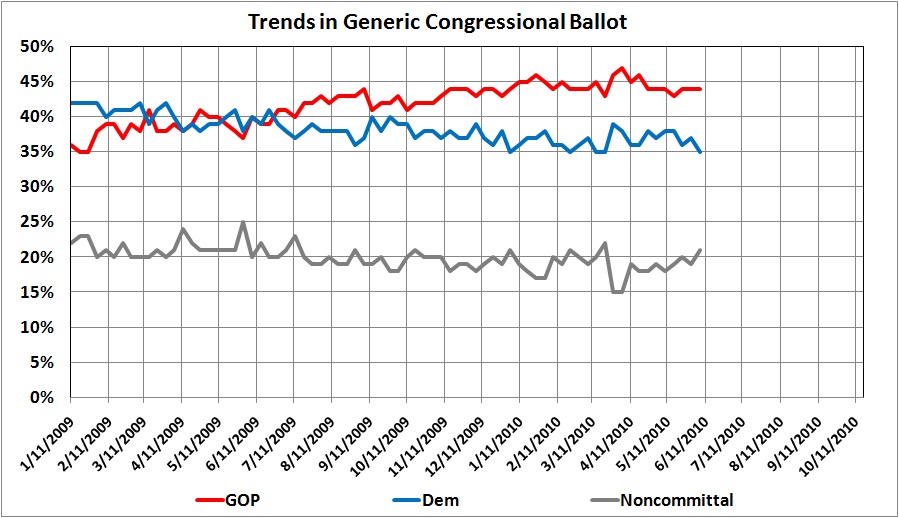
I showed, in the preceding post, the results of Rasmussen’s poll of likely voters who were asked whether they will vote for the Republican or Democrat candidate for their district’s seat in the House of Representatives. As of now, the edge goes to GOP candidates by 46 percent to 36 percent — a lead of 10 percentage points — with 18 percent noncommittal.

Were the GOP to hold onto that 10-percentage-point edge, the outcome would be even better (for the GOP) than that of the “Republican Revolution” of 1994, when Republicans re-took the House (winning 53 percent of the seats) while besting the Democrats at the ballot box by 6 percentage points.

Here are the statistics, in graphical form, for House contests from 1978 through 2008:

Source: Derived from congressional election results available through the links on this Wikipedia page.*

A 10-percentage-point win (55 GOP vs. 45 Democrat) would give the GOP about 57 percent of House seats (248), as against 43 percent for Democrats (187). That’s not a veto-proof majority,** nor is there any hope for a veto-proof GOP majority in the Senate. But, as long as Republicans hold the House, they can prevent the implementation of Obamacare (and other foolishness) simply by refusing to appropriate the necessary funds to implement it (and other things).

Pray for gridlock in D.C.
__________
* The anomalous mid-term point at 46-46 represents the election of 2006, when (I suspect) a larger-than-usual fraction of GOP incumbents held onto their seats by slim margins. The anomalous general election point at 44-41 represents the election of 2008, when (I suspect, again) another larger-than-usual fraction of GOP incumbents held onto their seats by slim margins. In both elections, the tide was running against Republicans, so they did well to hold onto as many seats as they did.

** A similar analysis of the percentage change in seats vs. the percentage change in votes yields a GOP edge of 271-164, which is too much to hope for, and still not a veto-proof majority.

Obama, Obamacare, and the Polls

Obama, once again, is in trouble with the left (e.g., this piece by Frank Rich of The New York Times). Why is he in trouble this time? Because he lacks the superhuman powers it would require of him to personally stanch the flow of oil in the Gulf of Mexico. The best he can do is throw tantrums (after much prompting from the left). But you can be sure that when the leak is plugged Obama will find a way to take credit for a feat of engineering that owed nothing to his tantrums.

Some of Obama’s fickle, leftist flock will then return to the fold, giving him a bounce in the polls, like the bounces he enjoyed following his attack on the Supreme Court in January’s State of the Union Address and the signing in March of that obaminable piece of legislation known as Obamacare:

Net approval rating: percentage of likely voters strongly approving of BO, minus percentage of likely voters strongly disapproving of BO. Derived from Rasmussen Reports’ Daily Presidential Tracking Poll. I use Rasmussen’s polling results because Rasmussen has a good track record with respect to presidential-election polling.

Obama’s last venture into positive territory occurred way back on June 29, 2009. His ratings have been (mostly) downhill ever since. It seems that his baseline approval rating is around -10 — that’s about as high as it gets when his fickle fans give him  a bounce in the polls. (The modal value for 492 polling days is -10; the modal range is -7 to -15.)

Obamacare has followed a similar course:

Net disapproval before enactment of Obmacare: percentage of poll respondents strongly disapproving of Obmacare, minus percentage of poll respondents strongly approving it (source). Net disapproval after enactment: percentage of poll respondents strongly approving of repeal, minus percentage of poll respondents strongly opposing it (source).

Despite the left’s euphoria when Obama signed his obamanation into law, Obamacare remains broadly unpopular.

In polls there is hope:

Source: results of a Rasmussen poll in which likely voters are asked whether they intend to vote for their district’s Republican or Democrat candidate.

Afterthought: You can rest assured that around Labor Day the Democrats will launch some kind of sleaze attack on the GOP. Having observed Democrats in action for six decades, I have decided that their motto should be: “When all else fails, fight dirty.” Given Tricky Dick’s track record, I hereby award him posthumous membership in the Democrat Party.

Ricardian Equivalence Reconsidered

Ricardian equivalence is an old and fascinating theory of economics. One writer summarizes it this way:

In [David] Ricardo‘s view, it does not matter whether [government] choose[s] debt financing or tax financing, because the outcome will be the same in either case. Flip a coin if you like, because in terms of the final results, raising taxes by $1,000 is equivalent to the government borrowing $1,000. This concept, appropriately called “Ricardian equivalence,” may be unfamiliar and counterintuitive. The key to understanding it is recognizing that debt financing is essentially just future taxation. If a government issues a bond today to avoid raising taxes, it will need to raise taxes tomorrow to pay off the bond when it comes due. According to Ricardo’s argument, it makes no difference to the public whether those increased taxes will come sooner (tax financing) or later (debt financing).

… Assume [government] can either impose $1,000 in taxes now to pay for [a government program], or … issue $1,000 of government debt, payable in one year for, let’s say, 10% interest. If  [government chooses] taxes, [taxypayers] have $1,000 less to spend today. That’s straightforward enough.

If, on the other hand, [government chooses] debt, then [taxpayers], being a savvy bunch who’ve seen this debt financing in action before, realize that in one year, it will be time…to pay back the people who buy the government debt. [Taxpayers] will owe those people $1,000 plus $100 in interest, for a total of $1,100. [Taxpayers] know that money must come from somewhere, so they expect that in one year, their taxes will go up by $1,100. In order to be ready for that one year from now, they put $1,000 into saving today, earning 10% interest, so that they will have the $1,100 they will need. This is $1,000 dollars today that they cannot spend today or save for reasons other than paying future taxes, so the outcome is that [taxpayers] have $1,000 less to spend today, just like they do if you raise taxes today.

But there are some standard objections to Ricardian equivalence, which the writer summarizes:

1. [T]here must be complete access to perfect capital markets so that all of the required saving and borrowing can be accomplished without friction, and people must be able to borrow at the same interest rate at which the government borrows, or the equivalence breaks down.

2. Additionally, people must care about what happens in the future, when the government debt will be repaid. If the future taxes only will apply so far in the future that the person will be dead, why save now? But if people refuse to offer to save more now, then offered savings in the economy are reduced, so interest rates would have to be higher if the government tried to borrow than if it taxed people directly today. Thus, it is assumed that either all people live long enough to see the debt be repaid, or they have children (that the parents care about and to whom they leave sufficient bequests) who will live to see that day.

3. Even if these requirements are satisfied, people must also recognize the equivalence between tax finance and debt finance in order to act accordingly. This may be the most tenuous assumption required—regardless of how fine the … educational system is, it is unlikely that public debt theory and present value calculations are included in basic, compulsory schooling.

The first two objections do not negate Ricardian equivalence, they merely make it a tendency. That is, instead of perfect equivalence, there may be approximate equivalence. In the example of a $1,000 government expenditure, taxpayers (as a group)  might save less than $1,000 if the interest rate they pay is more than the interest rate government pays, or they might save less than $1,000 if not all of them have descendants or care about them as much as they care about themselves. But, some amount will be saved, and it may be as much as $1,000.

The third objection overlooks the sophistication of the institutions and persons who have the greatest interest in government’s actions: large corporations and persons in high-income brackets. They will react to government borrowing as if it would affect them and their heirs (corporate and individual). This objection, like the first two, simply makes Ricardian equivalence a tendency.

That is as far as I will defend Ricardian equivalence, for it is unnecessarily complex and counterintuitive. It may be true that taxation and borrowing have the same (first-order) effect on the private sector. But that effect arises simply because it is government spending — not the method of financing it — which extracts resources from the private sector.

If government happens to raise taxes by an amount equal to its additional spending, then the burden of that spending falls, to a first approximation, on the persons who happen to pay the additional taxes imposed by government. Their disposable income is reduced by as much as it would be if government had inflated the prices of  the goods and services they buy. Similarly, if additional government spending happens to coincide with additional government borrowing; the real value of private saving is reduced by the inflationary effect of the additional government spending. In fact, both phenomena occur at the same time, regardless of the mix of additional taxation and/or borrowing; that is, government spending inflates the prices of goods and services and thereby erodes the value private wealth.

Related posts:
The Commandeered Economy
The Price of Government
The Mega-Depression
Does the CPI Understate Inflation?

The Unreality of Objectivism

Charles Murray, in a review of two biographies of Ayn Rand, says that

Objectivism takes as its metaphysical foundation the existence of reality that is unchanged by anything that an observer might think about it—”A is A,” as Aristotle put it, and as Rand often repeated in her own work. Objectivism’s epistemology is based on the capacity of the human mind to perceive reality through reason, and the adamant assertion that reason is the only way to perceive reality.

Objectivism is just a refined form of bunkum, which can be shown by examining its four Randian tenets (in italics, followed by my commentary):

1. Reality exists as an objective absolute — facts are facts, independent of man’s feelings, wishes, hopes or fears.

It is true, and tautologous, to say that reality exists; that is, the real has “verifiable existence.” But there are many conceptions of reality, some of them based on identical observations of the physical world. (Read about physical cosmology and quantum mechanics, for example.) There may be an objective reality, but it is trivial to say so. The reality that we perceive depends on (a) the limitations of our perception (e.g., the degree to which telescopes have been improved), and (b) the prejudices that we bring to what we are able to perceive. (Yes, everyone has prejudices.) And it always will be thus, no matter how many facts we are able to ascertain; the universe is a bottomless mystery.

In my experience, Objectivists flaunt their dedication to reality in order to assert their prejudices as if they were facts. One of those prejudices is that “natural rights” exist independently of human thought or action. But the concept of “natural rights” is an abstraction, not a concrete, verifiable reality. Abstractions are “real” only in a world of Platonic ideals. And, then, they are “real” only to those who posit them. Objectivism is therefore akin to Platonism (Platonic mysticism), in which ideas exist independently of matter; that is, they simply “are.”

It would be fair to say that Objectivism is a kind of unreality.

2. Reason (the faculty which identifies and integrates the material provided by man’s senses) is man’s only means of perceiving reality, his only source of knowledge, his only guide to action, and his basic means of survival.

Reason operates on perceptions and prejudices. To the extent that there are “real” facts, we filter and interpret them according to our prejudices. When it comes to that, Objectivists are no less prejudiced than anyone else (see above).

Reason is an admirable and useful thing, but it does not ensure valid “knowledge,” right action, or survival. Some non-cognitive precepts — such as the “Golden Rule,” “praise the Lord and pass the ammunition,” and “talk softly but carry a big stick” — are indispensable guides to action which help to ensure the collective (joint) survival of those who observe them. Survival, in the real world (as opposed to the ideal world of Objectivism) depends very much on prejudice (see Theodore Dalrymple’s In Praise of Prejudice: The Necessity of Preconceived Ideas).

3. Man — every man — is an end in himself, not the means to the ends of others. He must exist for his own sake, neither sacrificing himself to others nor sacrificing others to himself. The pursuit of his own rational self-interest and of his own happiness is the highest moral purpose of his life.

This dictum is an attack on the straw-man concept of altruism, which has no basis in reality, as I explain here and here. All of us are individualists, at bottom, in that we seek our own happiness. It just happens that some of us correlate our happiness with the happiness of (selected) others. Rand’s third tenet is both a tautology and a (lame) justification for behavior that violates social norms. Objectivists (like anarcho-capitalists) seem unable to understand that the liberty which enables them to spout their nonsense is owed, in great measure, to the existence of social norms, and that those norms arise (in large part) from observance of the “Golden Rule.”

4. The ideal political-economic system is laissez-faire capitalism. It is a system where men deal with one another, not as victims and executioners, nor as masters and slaves, but as traders, by free, voluntary exchange to mutual benefit. It is a system where no man may obtain any values from others by resorting to physical force, and no man may initiate the use of physical force against others. The government acts only as a policeman that protects man’s rights; it uses physical force only in retaliation and only against those who initiate its use, such as criminals or foreign invaders. In a system of full capitalism, there should be (but, historically, has not yet been) a complete separation of state and economics, in the same way and for the same reasons as the separation of state and church.

Here, Rand shifts gears from preaching the bed-rock prejudices and tautologies of Objectivism (tenets 1, 2, and 3) to the “ought” of Objectivism. It is hard to distinguish Rand’s fourth tenet from the tenets of libertarianism, which makes me wonder why some Objectivists scorn libertarianism (e.g., go here and scroll down). It is not as if Objectivism is reality-based, as opposed to libertarianism. In fact, consequentialist libertarianism (anathema to anarchists and Objectivists, alike) has the advantage when it comes to defending laissez-faire capitalism. The facts of history and economics are on the side of laissez-faire capitalism because it yields better results than statism (see this and this, for example).

I will not bother, here, to dismantle the jejune rejection of preemptive self-defense: the so-called non-aggression principle, which I have addressed in this post (and in several of the links therein). Nor is the notion of complete separation of state and church worth more than a link this post (and the links therein) and this one.

In sum, Objectivism reminds me very much of a late-night, dorm-room bull session: equal parts of inconsequential posturing and uninformed “philosophizing.” Sophomoric, in a word.

Related post: This Is Objectivism?

Does the CPI Understate Inflation?

REVISED AND RE-DATED

A website called Shadow Government Statistics offers an alternative estimate of inflation. According to SGS, “methodological shifts in government reporting have depressed reported inflation, moving the concept of the CPI away from being a measure of the cost of living needed to maintain a constant standard of living.” (Related post, here.) According to a chart at the linked page, year-over-year inflation is now about 9 percent, as opposed to the official government figure of about 2 percent.

The claim by SGS has merit, and not only because the definition of inflation has shifted. Specifically:

  • Government spending (at all levels) rose by 6 percentage points between 1980 and 2009. (See the graph at this post.)
  • Most government spending is inherently inflationary.

The inherently inflationary nature of government spending can be grasped by considering the case where government spending is financed by taxes:

  • Suppose that in the absence of government the GDP of the United States would be, as it is today, about $15 trillion. (Actually, as I show here, GDP would be a lot more than today’s $15 trillion were government to do nothing more than provide defense and justice.)
  • Suppose, further, that a bunch of governors arrives on the scene one fine day to announce: “You Americans need our services, so we’re going to tax you $5 trillion in order to provide things that we want you to have.” About 20 percent of the $5 trillion — the money spent on defense and justice — will be of value to almost everyone because (among other things) it protects economic activity. But most of the things our governors wants us to have — a hodge-podge of programs and regulations — will be valued mainly by those governors (i.e., politicians and bureaucrats) and narrow constituencies. The hodge-podge of programs and regulations, along with our governors’ habit of taxing success, raises the real price of government to far more than the $5 trillion shown in our national income accounts.
  • Our governors’ “generous” confiscation of $5 trillion has the same effect as if the producers of $5 trillion worth of real (non-government) goods and services walk off the job. More accurately, it’s as if they walk off the job and begin to vandalize their capital (homes, commercial buildings, computer networks, etc.). Specifically, according to the chairwoman of Obama’s Council of Economic Advisers, tax increases have a multiplier effect of about 3 (i.e., every dollar of a tax increase yields a 3-fold decrease in GDP). Another economist estimates that the supply of labor declines by 1.9 percent in response to a 1 percent cut in wages (a tax is equivalent to a cut in wages). Even transfer-payment schemes (e.g., Social Security) have a negative economic effect because they penalize producers for the benefit of non-producers.
  • Despite the reduction in real output that accompanies government,our governors pretend that they are producing $5 trillion worth of services, so (1) they levy taxes for those services, most of which taxes fall on the productive sector, and (2) they pay the producers of government services (government employees and contractors)  with those taxes.
  • In sum, government pays the producers of government services in “empty dollars,” which those producers then try to spend on real output. And so we have $15 trillion chasing $10 trillion worth of real goods and services.

That’s real inflation. No deficit spending necessary. And it happens every time our governors commandeer additional resources, thus widening the gap between what the productive sector could produce and what it actually produces.

What if government were to borrow the $5 trillion instead of imposing $5 trillion in taxes? Borrowing doesn’t change the outcome, just the way we get there. There is still $15 trillion chasing real output of $10 trillion.

Now, not all of that government spending is inherently inflationary. The protection of citizens and their property from foreign and domestic predators (defense and justice) is essential to economic growth and the orderly functioning of free markets. Government spending on defense and justice currently accounts for 8 percent of GDP, whereas government spending (at all levels) currently accounts for 36 percent of GDP. Let’s say, for the sake of argument, (1) that the “right” level of government spending is 10 percent of GDP (the level that obtained in the early 1900s), (2) that the 10 percent is funded by a system of taxes which isn’t punitive toward investors and entrepreneurs (e.g., a single, flat, tax rate), and (3) that the 10 percent is not accompanied by burdensome regulations. Even in the absence of punitive taxes and burdensome regulations, the increase in government spending from 10 to 36 percent of GDP caused prices to rise by 25 percent. Inflation of 25 percent, when spread over 80 years and more, may seem inconsequential. But it is real — real theft, that is.

Moreover, the growth of government spending has been accompanied by punitive taxes and burdensome regulations. As a result, real GDP is 68 percent below its potential. In other words, in the absence of the regulatory-welfare state, real GDP would be more than 3 times its present level.

Visible inflation is bad enough; invisible inflation is a real killer.

Physics Envy

Max Borders offers a critique of economic modeling, in which he observes that

a scientist’s model, while useful in limited circumstances, is little better than a crystal ball for predicting big phenomena like markets and climate. It is an offshoot of what F. A. Hayek called the “pretence of knowledge.” In other words, modeling is a form of scientism, which is “decidedly unscientific in the true sense of the word, since it involves a mechanical and uncritical application of habits of thought to fields different from those in which they have been formed.” (“The Myth of the Model,” The Freeman, June 10, 2010, volume 60, issue 5)

I’ve said a lot (e.g., here, here, here, here, here, here, here, and here) about modeling, economics, the social sciences in general, and the pseudo-science of climatology.

Models of complex, dynamic systems — especially social systems — are manifestations of physics envy, a term used by Stephen Jay Gould. He describes it in The Mismeasure of Man (1981) as

the allure of numbers, the faith that rigorous measurement could guarantee irrefutable precision, and might mark the transition between subjective speculation and a true science as worthy as Newtonian physics.

But there’s more to science than mere numbers. Quoting, again, from The Mismeasure of Man:

Science is rooted in creative interpretation. Numbers suggest, constrain, and refute; they do not, by themselves, specify the content of scientific theories. Theories are built upon the interpretation of numbers, and interpreters are often trapped by their own rhetoric. They believe in their own objectivity, and fail to discern the prejudice that leads them to one interpretation among many consistent with their numbers.

Ironically, The Mismeasure of Man offers a strongly biased and even dishonest interpretation of numbers (among other things). When a leading critic of physics envy falls prey to it, you know that he’s on to something.

Today’s Wisdom . . .

. . . comes from Tom Smith of The Right Coast:

I find the hostility towards the Tea Parties from libertarians hard to understand.  These people appear to generally favor small government.  Yes, they have differences on some issues, but they are much closer to libertarians than anyone else.

The only explanation that I can see for the hostility is based on a cultural view of libertarians — most of the libertarians think of themselves as part of a cultural elite and therefore reject the Sarah Palins of the world.  (I don’t mean to speak of Sarah Palin in particular, but of the Tea Partiers from her socio-economic group.)  Sad, very sad.  One would think that liberty would be more important to libertarians than self-image, but perhaps not.  Let’s hope I am wrong and the libertarians are warming to the Tea Partiers.

Invoking Hitler

Jamie Whyte is the author of Bad Thoughts – A Guide to Clear Thinking. According to the publisher, it is a

book for people who like argument. Witty, contentious, and passionate, it exposes the methods with which we avoid reasoned debate. Jamie Whyte dissects the ‘Shut up – you sound like Hitler’ and ‘You can hardly talk’ tactics, and explains why we don’t have a right to our own opinion. His writing is both laugh-out-loud funny and a serious comment on the ways in which people with power and influence avoid truth in steering public opinion.

The examples of illogical discourse used in Bad Thoughts are British. There is an Americanized version, Crimes Against Logic: Exposing the Bogus Arguments of Politicians, Priests, Journalists, and Other Serial Offenders, which the publisher describes as

a fast-paced, ruthlessly funny romp through the mulligan stew of illogic, unreason, and just plain drivel served up daily in the media by pundits, psychics, ad agencies, New Age gurus, statisticians, free trade ideologues, business “thinkers,” and, of course, politicians. Award-winning young philosopher Jamie Whyte applies his laser-like wit to dozens of timely examples in order to deconstruct the rhetoric and cut through the haze of shibboleth and doubletalk to get at the real issues.

A troubleshooting guide to both public and private discourse, Crimes Against Logic:

  • Analyzes the 12 major logical fallacies, with examples from the media and everyday life
  • Takes no prisoners as it goes up against the scientific, religious, academic, and political establishments
  • Helps you fine-tune your critical faculties and learn to skewer debaters on their own phony logic
  • Both descriptions are roughly right about Bad Thoughts (the version I own). It is witty and, for the most part, correct in its criticisms of the kinds of sloppy logic that are found routinely in politics, journalism, blogdom, and everyday conversation.

    But Whyte isn’t infallible. Perhaps, someday, I’ll offer a detailed roster of his mistakes. This post focuses on one of them, which is found under “Shut Up — You Sound Like Hitler” (pp. 46-9). Here’s the passage to which I object:

    Anyone who advocates using recent advances in genetic engineering to avoid congenital defects in humans will pretty soon be accused of adopting Nazi ideas. Never mind the fact that the Nazi goals (such as racial purity) and genetic engineering techniques (such as genocide) were quite different from those now suggested.

    Whyte seems to believe that policies should be judged by their intentions, not their consequences. Genetic engineering — which Whyte defines broadly — is acceptable to Whyte (and millions of others) — because its practitioners mean well. By that standard,

    • abortion-on-demand is acceptable because abortion is a “right” that enables a woman (and, sometimes, her partner) to escape the consequences of a procreative act;
    • judges may order the killing of (possibly) terminally ill persons who cannot communicate their own wishes; and
    • it is all right to use genetic modification techniques to breed children who are “superior” in some respects.

    I cannot find a moral distinction between such “benevolence” and Hitler’s goal of racial purity. Allow me to quote myself:

    Libertarians who applaud the outcomes of such cases as Griswold v. Connecticut and Roe v. Wade because those outcomes seem to advance personal liberty are consorting with the Devil of statism. Every time the state fails to defend innocent life it acquire a new precedent for the taking of innocent life. (“Law, Liberty, and Abortion“)

    *     *     *

    Yes, people say that they don’t want to share Terri Schiavo’s fate. What many of them mean, of course, is that they don’t want their fate decided by a judge who is willing to take the word of a relative for whom one’s accelerated death would be convenient. [Peter] Singer dishonestly seizes on reactions to the Schiavo fiasco as evidence that euthanasia will become acceptable in the United States.

    Certainly, there are many persons who would prefer voluntary euthanasia to a fate like Terri Sciavo’s. But the line between voluntary and involuntary euthasia is too easily crossed, especially by persons who, like Singer, wish to play God. If there is a case to be made for voluntary euthanasia, Peter Singer is not the person to make it.

    Singer gives away his Hitlerian game plan when he advocates killing the disabled up to 28 days after birth. Why not 28 years? Why not 98 years? Who decides — Peter Singer or an acolyte of Peter Singer? Would you trust your fate to the “moral” dictates of a person who thinks animals are as valuable as babies? (“Peter Singer’s Agenda“)

    *     *     *

    Our present world, contra [Will] Saletan, is (relative to the brave new world of genetic engineering) one of freedom and responsibility. To use the example of a baby with Down syndrome (properly Down’s syndrome), parents who choose to abort such a baby (for that is what Saletan means) have every bit as much “freedom” to make that choice (under today’s abortion laws) and are just as responsible (morally) for their decision as they would be if they were to choose bioengineering instead. Genetic engineering simply introduces different “freedoms.”

    Thus we come to the real issue, which is the wisdom (or not) of allowing genetic engineering in the first place. For, as we know from our experience with the regulatory-welfare state, once an undesirable practice gains the state’s approbation and encouragement it becomes the norm.

    And that is the broad case against allowing genetic engineering: If it gains a government-approved foothold it will become the norm. It will result in foreseeable (and unforeseeable) changes in the human condition. It will cause most of us who are alive today to wish that it had never been allowed in the first place. (“The Case against Genetic Engineering“)

    Whyte, in his eagerness to slay many dragons of illogic, sometimes stumbles on his own illogic. Not all invocations of Hitler are inapt, as Whyte seems to suggest. Genetic engineering, Whyte’s primary example, can be Hitlerian in its consequences, regardless of its proponents’ intentions.

    I say “can be Hitlerian” because genetic engineering can also be beneficial. There is, for example, negative genetic engineering to cure and treat particular disorders.

    I will continue to invoke Hitler where the invocation is apt, as it is in the cases of abortion, involuntary euthanasia, and the breeding of “superior” humans.

    What’s in a Name?

    From the Associated Press (via WaPo):

    A senior House Democrat said Tuesday that senators should fully question Supreme Court nominee Elena Kagan to make sure she supports abortion rights, in light of her previous backing for limiting late-term abortions.In a letter to the Senate Judiciary Committee, Rep. Louise M. Slaughter (N.Y.) said she views as “troubling” a 1997 memo Kagan wrote urging President Bill Clinton to back a ban on all abortions of viable fetuses except when the physical health of the mother was at risk.

    Evidently, Ms. Slaughter, originally Louise McIntosh, would prefer open season on fetuses.* She chose well when she opted to take her husband’s name.

    __________

    * I eschew the term “viable fetuses” because

    [t]he argument that a fetus is “inviable” — and therefore somehow undeserving of life — until it reaches a certain stage of development is a circular argument designed to favor abortion. A fetus (except in the case of a natural miscarriage) is viable from the moment of conception until birth as long as it is not aborted. It is abortion that makes a fetus inviable. Abortion therefore cannot be excused on the basis of presumed inviability.

    The Omniscient State at Work

    For the benefit of Paul Krugman and other worshipers of the all-wise, all-beneficent state, here’s some news from the Associated Press:

    WASHINGTON – Despite a top-to-bottom overhaul of the intelligence community after the 2001 terrorist attacks, the nation’s security system showed some of the same failures when it allowed a would-be bomber to slip aboard an airliner, congressional investigators said Tuesday.The Senate Intelligence Committee report at times contradicted the Obama administration’s assertion that the nearly catastrophic Christmas Day bombing attempt was unlike 9/11 because it represented a failure to understand intelligence, not a failure to collect and understand it.

    The congressional review is more stark than the Obama administration’s report. It lays much of the blame at the feet of the National Counterterrorism Center, which Congress created to be the primary agency in charge of analyzing terrorism intelligence.

    ‘Nuff said? Not quite. There’s this, from The Wall Street Journal:

    What a fiasco. That’s the first word that comes to mind watching Mahmoud Ahmadinejad raise his arms yesterday with the leaders of Turkey and Brazil to celebrate a new atomic pact that instantly made irrelevant 16 months of President Obama’s “diplomacy.” The deal is a political coup for Tehran and possibly delivers the coup de grace to the West’s half-hearted efforts to stop Iran from acquiring a nuclear bomb.

    Full credit for this debacle goes to the Obama Administration and its hapless diplomatic strategy. Last October, nine months into its engagement with Tehran, the White House concocted a plan to transfer some of Iran’s uranium stock abroad for enrichment. If the West couldn’t stop Iran’s program, the thinking was that maybe this scheme would delay it. The Iranians played coy, then refused to accept the offer.

    But Mr. Obama doesn’t take no for an answer from rogue regimes, and so he kept the offer on the table. As the U.S. finally seemed ready to go to the U.N. Security Council for more sanctions, the Iranians chose yesterday to accept the deal on their own limited terms while enlisting the Brazilians and Turks as enablers and political shields. “Diplomacy emerged victorious today,” declared Brazil’s President Luiz Inácio Lula da Silva, turning Mr. Obama’s own most important foreign-policy principle against him.

    Don’t you sleep better at night with those wonderful folks in D.C. watching out for you? It’s not enough that they’ve screwed up the economy in general, and are in the process of further screwing up our medical care. Now, they’re working toward dismantling our defenses against terrorists and regimes that sponsor terrorism.

    Well, you can’t say that I didn’t see it coming (here, here, and here).

    A Typical Career Arc for a Batter

    It has long been conventional wisdom in baseball that batters hit their peak in their late 20s and go into decline after the age of 30. But inasmuch as this conventional wisdom pre-dates the days of massive computerized databases and spreadsheets, can it be true, or is it the baseball equivalent of an old wives tale?

    To answer that question, I went to the Play Index feature of Baseball-Reference.com. I was able to find (thanks to a paid subscription to Play Index) the career OPS+ statistic* for all inactive or retired players from 1901 through 2009 who had at least 3,000 plate appearances. As of yesterday, there were 1,416 such players. I selected 57 of them by the simple (and essentially random) method of picking #1 Babe Ruth (career OPS+ 207) and every 25th batter thereafter: #26 Jeff Bagwell (149), #51 Babe Herman (140, and so on, down to #1401 Bill Kellefer (63). The resulting sample represents great-to-poor batters, players in all eras from 1901 onward, and careers long, short (but not too short), and in between.

    I indexed each player’s single-season OPS+ statistics to that player’s career-high OPS+. For example, Babe Ruth’s career looks like this:

    Season Age OPS+ Indexed
    1914 19 50 0.196
    1915 20 189 0.741
    1916 21 121 0.475
    1917 22 162 0.635
    1918 23 194 0.761
    1919 24 219 0.859
    1920 25 255 1.000
    1921 26 239 0.937
    1922 27 181 0.710
    1923 28 239 0.937
    1924 29 220 0.863
    1925 30 137 0.537
    1926 31 227 0.890
    1927 32 226 0.886
    1928 33 208 0.816
    1929 34 193 0.757
    1930 35 211 0.827
    1931 36 218 0.855
    1932 37 201 0.788
    1933 38 176 0.690
    1934 39 161 0.631
    1935 40 118 0.463

    After making the same computation for the other 56 batters, I plotted the indexed values for all batters against age, with the following result:


    The ages at which the players peaked (index value of 1.00) range from 22 to 36, but the polynomial curve tells the tale: major-league batters tend to improve gradually as they approach ages 29-30, and then to decline gradually thereafter.

    That is a broad generalization, based on a random sample of batters. Even within that sample, and certainly across the entire population of batters, there are many-many exceptions. Babe Ruth is a prominent exception. He peaked at age 25, by the measure of OPS+, declined somewhat, improved somewhat, and did not go into his final decline until the age of 37.

    In any event, the conventional wisdom stands up to scrutiny, but (like conventional wisdom about many things) it is a rule of thumb, not an iron-clad law of behavior.
    __________
    * Definition: “OPS+ is OPS [on-base plus slugging percentage] adjusted for the park and the league in which the player played,” where the league average for a given year is 100. Thus “An OPS+ of 150 or more is excellent and 125 very good, while an OPS+ of 75 or below is poor.”

    Accountants of the Soul

    In a post about two of the founders of modern “liberalism,” T.H. Green, and L.T. Hobhouse, I say

    Green and Hobhouse . . . were accountants of the soul. Green’s apparent delicacy in warning of too much intervention [by the state] is overcome, in the end, by his recognition of the British state (embodied in Parliament) as the proper arbiter of human conduct. Hobhouse, more boldly, presumed that he and others of his ilk (but not those who disagree with him) could determine how much of one’s property arose from “social organisation,” how much of one’s property was “held for power,” and how to expand liberty by adopting different forms of coercion than those imposed by social norms.

    Once again, we are met with (presumably) intelligent persons who believe that their intelligence enables them to peer into the souls of others, and to raise them up through the blunt instrument that is the state.

    It is hard to distinguish the mindset of the “liberal” from that of the “libertarian” paternalist, who does not cavil at the prospect of using the power of the state to “nudge” lesser mortals toward “choices” that he deems in their best interest. “Liberals” and “libertarian” paternalists are alike in their abstract love of mankind and particular disdain for individuals.

    Related posts (broken links have been fixed):
    Greed, Cosmic Justice, and Social Welfare
    Positive Rights and Cosmic Justice
    Fascism and the Future of America
    Negative Rights, Social Norms, and the Constitution
    Rights, Liberty, the Golden Rule, and the Legitimate State
    Tocqueville’s Prescience
    State of the Union: 2010
    The Shape of Things to Come

    Illegal Immigration: A Note to Libertarian Purists

    Libertarian purists (e.g., Donald Boudreaux and Bryan Caplan) like to criticize the critics of illegal immigration. In the minds of libertarian purists, national borders are merely statist concoctions. It is anathema to them that the United States exists primarily for the purpose of protecting its citizens and their liberty rights. (Well, it did exist for that purpose originally and for a long time, and it still does to some extent.) Libertarian purists seem to believe that, somehow, defense would be unnecessary and rights would be enforced even if the United States did not exist as a coherent, delimited entity. Good luck with that!

    In any event, libertarian purists like to criticize those critics of illegal immigration who claim that (1) the lure of welfare benefits draws illegal immigrants and (2) illegal immigrants add to the burden on tax-paying Americans. My research into those issues may be out of date, so I might decide to update my old findings (contrary to an earlier suggestion that I would drop the subject). For the time being, I am content to note the following:

    1. California, with 12 percent of the nation’s population, has 32 percent of the nation’s welfare caseload.

    2. California, as of January 2008, was home to 25 percent of the illegal immigrants in the United States.

    More to come, perhaps.

    The Land of Sunshine: A Parable

    This parable is meant to be disrespectful of many things, not the least of them being our rulers and the rules they foist upon us in their disrespect for us and our liberty. It is not meant to be disrespectful of women or persons of color, except for those among them — and their political champions — who believe that past wrongs justify the multiplication of wrongs into the future.

    Once upon at time — not so long ago or far away — there was a land ruled by a wise, young king. Well, he was thought wise because he orated in the unctuous, condescending tones, and he was younger than most of the kings who had preceded him. Let’s just call him “the man.”

    Now, the man was known for his unbounded compassion. He would do anything for his subjects, as long as it wasn’t at his own expense or the expense of his large, raucous council of advisers. (More about them, anon.) His preferred method of paying for his acts of beneficence was to pretend that they cost nothing — a ruse that he was able to sustain by taking money from his subjects and promising to repay the debt to their descendants. (This scheme had worked well for the man’s predecessors, and so he adopted it as his own — with a vengeance.)

    The man’s pseudo-compassionate heart was troubled by the inequality he found in the land. It was upsetting to him was that not all of his subjects were equal in all respects. Some of the man’s subjects were more capable than others, and therefore had higher incomes than others. Although the man was not troubled about the high incomes of lawyers, movie stars, and basketball players, he nevertheless proposed the imposition of higher taxes on high-income persons, just to get even with them.

    Other of the man’s subjects were women who could not do everything that men could do, which the man deemed unfair. Although he did not bemoan the fact that men were inferior to women in many respects, he nevertheless proposed forcing employers to hire women for jobs that men could do better.

    And there were those of the man’s subjects who went about with pale, sickly white skin, whereas others sported glowing, healthy-looking shades of gold. And so the man proposed to his council of advisers that all pale persons should be made darker (and thus healthier) by allowing them to spend more time in the sun, and by giving them regular doses of a rare, expensive, and effective elixir.

    The council of advisers debated the man’s proposals for months on end. The council had no problem with penalizing capable persons and males, for such practices had been accepted for decades, in the name of equality. Nor did the council object to the practice of sending pale persons to work in the sun, as long as it resulted in more indoor work for the golden ones.

    The council’s main objection had to do with the elixir, and whether more of it could be produced so that its new consumers could enjoy it without depriving others of its health-giving powers. In the end, the council agreed with the man that it was more important to create the impression of equality than to worry about such trivial matters as the supply of a health-giving elixir. “Trust us, it will all work out,” were the reassuring words of the council’s leaders.

    And thus it came to pass that this not-so-distant land was blessed with less freedom, declining prosperity, ill-bred children, more illness, and equality — but one out of five isn’t bad for government work. The only disappointment came when the pale persons acquired red necks instead of turning golden brown.