Mass (Economic) Hysteria: Income Inequality and Related Themes

It seems as though everyone’s talking and writing about stagnant wages, growing income inequality, gender discrimination in pay, concentration of wealth, no/less/too-little upward mobility, shrinking middle class, foreclosure of opportunity, end of the American Dream, higher mortality rates (due to income inequality), and on and on and on. (Insert exclamation marks to heighten the sense of outrage.)

All of these complaints — which emanate from the left and resound loudly in the media — presuppose the existence of several Platonic ideals; for example: correct wage levels, correct degrees of income and wealth inequality, correct rates of upward (and downward) mobility, an actually identifiable and permanent middle class, a measurable and optimum amount of opportunity, a definition of the American Dream that is more than pablum, and on and on.

All such ideals, of course, exist only in the minds of those who complain about stagnant wages, etc. But no matter — any excuse for further government intervention in the economy will do. And further government intervention will only harm those persons whom it is meant to help, by further reducing the rate of economic growth.

But nothing daunts true believers — Paul Krugman, Brad DeLong, Joseph Stiglitz, and their ilk — who always want government to “do something.” Their preachings bolster the pro-government-spending biases of most pundits and a large fraction of politicians. One aim of the true believers is to shape the fickle mood of the general public and garner support for government action.

Anyway, the various manifestations of economic hysteria listed in the opening paragraph can be met with logic and facts — and often are. (See the list of readings at the bottom of this post.) It’s unlikely that logic and facts will sway those who are emotionally committed to the exaction of redistributive justice, and who have no interest in its infeasibility, high costs, and perverse consequences. But until that lucky day when legitimate government is restored to the United States, its defenders must rely on logic and facts.

Consider income inequality. Not only is there inequality — which should be unsurprising, given inequality of ability, ambition, etc. — but there is supposedly a growing gap between America’s “haves” and “have-nots.” A do-gooder would leave it at that. Not being one of them, I’ll ask the questions that they’re unwilling/afraid/too-jejune to ask:

  1. What is a have? Is it someone/a household whose income exceeds the median for all persons/households? Is in the top 20 percent of all such incomes? The top 5 percent? The top 1 percent? The top 0.1 percent? (Pick your favorite point along the continuous curves in the graphs here.)
  2. Or is a have defined by his/her/its wealth? And, if so, how? (See preceding bullet.)
  3. Do haves “rig the game” so that they are, in effect, stealing from have-nots?
  4. If haves are clever and determined enough to do that, isn’t it likely that they’d still be haves without “rigging the game”?
  5. Is one’s economic status a permanent thing, or do people in fact move up and down the economic ladder during their lifetimes?
  6. Are the have-nots of today — who, mostly, aren’t the have-nots of yesteryear — really worse off than their predecessors, or are they really better off?
  7. Are they worse off relatively?
  8. Will tomorrow’s have-nots be better off if the haves are deprived of income/wealth through redistributive actions taken by government?
  9. Or will redistributive actions simply make haves worse off and less likely to do the things that make have-nots better off (e.g., give huge sums to charity, invest in growth-producing investments)?

Questions 1 and 2 are unanswerable; the distinction between a have and a have-not is purely arbitrary. (It has been said, with some accuracy, that a rich person is someone who has more more money than you.) The answers to the other questions are: (3) only to the extent that some of them are aided by government through perverse regulations favored by do-gooders; (4) yes; (5) not permanent, plenty of movement; (6) better-off absolutely than earlier have-nots; (7) probably about the same, relatively, but they’re mostly different people; (8) worse off; (9) yes, redistributive actions make have-nots worse off by hindering economic growth. (For more, see the list of readings, below.)

Before signing off, I want to say a bit more about haves, have-nots, rigging the game, and hypocritical politicians:

Most of the haves — given their ambition, intelligence, and particular skillswould succeed famously, even without rigging the game in their favor. In any event, government does most of the rigging — mainly to “protect” the have-nots from “ruthless” operators. For example, there’s licensing and regulatory barriers to entry to high-paying professions, such as the creation and trading of financial instruments, doctoring, lawyering, and making licensed, patented drugs. The entire left-leaning entertainment industry thrives on government-granted copyrights

In free markets, there would be no rigging, or it wouldn’t last long because the high profits generated by rigging would entice competition. So, if you want to blame rigging for the advantages enjoyed by the haves, blame their cronies in government, many of whom make a career of crying (all the way to the bank) about inequality. (Relevant aside: It is no coincidence that in 2012, five of the top-six counties in median household income were in the D.C. area.)

Isn’t is strange that most of the pissing and moaning about inequality emanates from people who are either in high-income brackets or whose political rank enables them to live as if they were? (Obama, Biden, and members of Congress, I’m looking at you.) Isn’t it evident that the pissing and moaning results mainly from economic illiteracy, guilt, and political opportunism? It should be evident, unless you’re a complete naïf of the kind who still believes in the tooth fairy and free lunches.

I must add that I have yet to meet a pro-equality “liberal” who pays more taxes than demanded of him by the IRS, opens his house to the homeless, or associates with the unwashed masses. As Victor Davis Hanson observes, there are no (true) socialists among the powerful and affluent lefties who spout egalitarian slogans.

I’ve addressed income inequality and related matters in several posts, including “The Last(?) Word about Income Inequality,” “Taxing the Rich,” “More about Taxing the Rich,” “In Defense of the 1%,” and “Progressive Taxation Is Alive and Well in the U.S. of A,” “How High Should Taxes Be?,” and “Some Inconvenient Facts about Income Inequality.” (See also the links embedded in and appended to those posts.)

There’s much more on the web. The following is a small sample of the vast trove of reasoned, fact-filled writings that leftists ignore because they prefer myths to facts.

Income inequality, wealth inequality, and economic mobility
Diana Furchtgott-Roth, “The Myth of Increasing Income Inequality,” The Manhattan Institute, Issues 2012, March 2012
James Pethokoukis, “Obama’s Fact-Challenged Inequality Speech,” AEIdeas, July 26, 2013
James Pethokoukis, “3 Charts That Show What’s Really Going On with Economic Mobility in the U.S.,” AEIdeas, December 12, 2013
James Pethokoukis, “If All You Know about Income Inequality Is This Famous Chart, You Really Don’t Know Much,” AEIdeas, December 23, 2013
Don Boudreaux, “Questions about and for Those People Obsessed with Income Inequality,” Cafe Hayek, December 24, 2013
Raj Chetty, et al., “Is the United States Still a Land of Opportunity? Recent Trends in Intergenerational Mobility,” Working Paper 19844, National Bureau of Economic Research, January 2014 (related: N. Gregory Mankiw, “How Much Income Inequality Is Explained by Varying Parental Resources?,” Greg Mankiw’s Blog, January 24, 2014)
John Goodman, “Myths about Inequality,” John Goodman’s Health Policy Blog, January 15, 2014
Thomas Sowell, “Fact-Free Liberals (parts I, II, and III),” creators.com, January 21, 2014
James Pethokoukis, “Does Obama Know That Wealth Inequality Is Lower Now Than 25 Years Ago?,” AEIdeas, January 21, 2014
Ironman, “Debunking Income Inequality Theory,” Political Calculations, January 23, 2014
David Harsanyi, “State of the Union: Maybe You’re Not As Screwed As They Think You Are,” The Federalist, January 27, 2014
David Henderson, “Why Income Mobility Is Larger in the Middle,” EconLog, February 10, 2014
Linda Gorman, “More Accurate Measures Suggest Declining Income Inequality [not that it matters, one way or the other],” John Goodman’s Health Policy Blog, March 14, 2014
Mark R. Rank, “From Rags to Riches to Rags,” The New York Times, April 18, 2014

Executive pay, the “undeserving” rich, and the “1%”
James Pethokoukis, “Stunning New Study Dismantles Obama’s ‘1% vs. 99%’ Inequality Argument,” AEIdeas, August 16, 2013
James Pethokoukis, “Why Steven Kaplan Says Brad DeLong Is Wrong about CEO Pay, the Superstar Theory, and Income Inequality,” AEIdeas, August 19, 2013
James Pethokoukis, “Why the Much-Hyped Oxfam Study on Global Inequality Is Misleading,” AEIdeas, January 21, 2014
Don Boudreaux, “Deidre McClosky on Oxfam’s Calculation of World Wealth ‘Distribution’,” Cafe Hayek, January 27, 2014
Walter E. Williams, “Politics of Hate and Envy,” creators.com, January 29, 2014
Robert J. Samuelson, “Myth-Making about Economic Inequality,” RealClearPolitics, February 3, 2014
N. Gregory Mankiw, “Yes, the Wealthy Can Be Deserving,” The New York Times, February 15, 2014
N. Gregory Mankiw, “CEO’s Are Paid for Performance,” Greg Mankiw’s Blog, February 17, 2014
Mark J. Perry, “‘Rich America Is Not the ‘Idle Rich’, but rather a Working America, an Educated America, and a Married America,” Carpe Diem, February 19, 2014

Rigging the system: “our” government at work
Bruce Yandle, “Bootleggers and Baptists,” Regulation, May/June 1983
Bruce Yandle “Bootleggers and Baptists in Retrospect,” Regulation, Fall 1999
Richard K. Vedder, “Federal Government Has Declared War on Work,” Commentary Articles, The Independent Institute, January 20, 2014

The effect of assortative mating on household income
Henry Harpending, “Class, Caste, and Genes,” West Hunter, January 13, 2012
Henry Harpending and Gregory Cochran, “Assortative Mating, Class, and Caste,” manuscript, December 1, 2013
Jeremy Greenwood et al., “Marry Your Like: Assortative Mating and Income Inequality,” Population Studies Center, University of Pennsylvania, January 12, 2014
Ironman, “In Which We’re Vindicated. Again.,” Political Calculations, January 28, 2014

The non-war on the middle class, women, and blacks
Mark J. Perry, “Yes, the Middle Class Has Been Disappearing, but They Haven’t Fallen into the Lower Class, They’ve Risen into the Upper Class,” Carpe Diem, July 12, 2013
Steve Sailer, “Breakthrough Study: Poor Blacks Tend to Stay Poor, Black,” Vdare.com, July 24, 2013
John B. Taylor, “The Weak Recovery Explains Rising Inequality, Not Vice Versa,” WSJ.com, September 9, 2013
John B. Taylor, “My Take on the Middle-Out View,” Economics One, September 9, 2013
James Bessen, “No, Technology Isn’t Going to Destroy the Middle Class,” The Washington Post, October 21, 2013
Bryan Caplan, “Is Average Over? Two Equivocal Graphs,” EconLog, January 4, 2014
N. Gregory Mankiw, “Does Income Inequality Increase Mortality?,” Greg Mankiw’s Blog, January 29, 2014
Christina Hoff Sommers, “No, Women Don’t Make Less Money Than Men,” The Daily Beast, February 1, 2014

Modern Liberalism as Wishful Thinking

TheFreedictionary.com defines wishful thinking as “the erroneous belief that one’s wishes are in accordance with reality.” There’s a lot of wishful thinking going on, and it’s harmful to liberty and prosperity. I’m referring to the wishful thinking that characterizes modern liberalism, which is more properly called left-statism verging on despotism.

The dysfunctional manifestations of left-statism are too many to enumerate, let alone to detail in a single post. Obamacare is merely a current dysfunctional manifestation. It has many predecessors and will have many successors, unless constitutional government can somehow be restored in the United States. Some of the manifestations take the form of laws, executive decrees, and judicial holdings. Others reflect “big ideas” that give rise to illogical and ill-founded laws, decrees, and holdings.

Without further ado …

REGULATION WORKS

I wrote an entire post about “Regulation as Wishful Thinking.” The underlying theme is that regulators (and those who support regulation) believe that they can fine-tune economic and social behavior to achieve optimal (or at least better) outcomes than the one produced by free markets. If one paragraph sums up the effects of regulation, it’s this one:

Regulation is counterproductive for several reasons. First, it curtails positive externalities [the satisfaction of consumers’ wants that is forgone due to regulatory restraints on market activity]…. The other reasons, on which I expand below, are that regulation cannot be contained to “good causes,” nor can it be tailored to do good without doing harm. These objections might be dismissed as trivial if regulatory overkill were rare and relatively costless, but it is pervasive, extremely costly its own right, and a major contributor to the economic devastation that has been wrought by the regulatory-welfare state.

Read the whole thing for the details of the argument and the evidence of the devastation. For a jarring example, see John Goodman, “FDA Regulations Kill,” John Goodman’s Health Policy Blog, February 18, 2014.

Wish: Regulation improves social and economic outcomes.

Reality: Regulation restricts the ability of people to pursue their lawful interests, and thereby harms them socially and economically.

Bottom line: Regulation is harmful, because it substitutes the judgments of “technocrats” for the decentralized knowledge of millions of citizens. Its economic cost is more than 10 percent of GDP — and it leads to unnecessary loss of life.

TAXES ARE GOOD

Consider the intuitive and also well-documented relationship between taxes and economic activity. See, for example, Christina D. and David H. Romer, “The Macroeconomic Effects of Tax Changes: Estimates Based on a New Measure of Fiscal Shocks,”  Working Paper 13264, National Bureau of Economic Research, July 2007; and William McBride, “What Is the Evidence on Taxes and Growth?,” Tax Foundation, December 18, 2012. One must bend over backward to concoct a theory which says that a rise in taxes will not reduce the rate of economic output or the growth of that rate. But such theories are propounded because their proponents favor higher taxes for two closely related reasons: more taxes enable more government spending, and more government spending usually means “social” spending. (One reason that “liberals” are against defense spending — or more of it — is that it absorbs money that could go into “social” programs.)

Wish: Higher taxes don’t reduce GDP or the rate of economic growth.

Reality: Higher taxes do reduce GDP and the rate of economic growth.

Bottom line: Higher taxes (and more government) actually harm the poor (among others) by reducing economic activity and, thereby, reducing employment. As it turns out, the effect is substantial.

THE MINIMUM WAGE HELPS LOW-SKILL WORKERS

There are economists who support the minimum wage, not necessarily because of the economic soundness of the minimum wage, but because they just like the idea that (some) low-wage workers will make more because of it. Some of those economists have even produced studies which purport to show that a minimum wage has a “small” effect on the employment of low-wage workers. As if “small” were of no consequence to those who are unable to find and keep low-wage jobs because of the minimum wage. Well, the minimum wage — and its more overtly political twin, the “living wage” — do harm low-wage workers. And that’s that. See Linda Gorman, “Minimum Wages,” The Concise Encyclopedia of Economics at The Library of Economics and Liberty. For the latest, see James Pethokoukis, “CBO: The $10.10 Minimum Wage Would Cost 500,000 Jobs, With Most Benefits Going to Non-Poor,” AEIdeas, February 18, 2014.

Wish: Government can help low-skill workers by forcing employers to pay them more.

Reality: Minimum wages and “living wages” result in less employment among low-wage workers.

Bottom line: Those who are in most need of employment, and for whom the private sector would provide employment (other things being the same), are deprived of employment by well-meaning but economically wrong-headed minimum-wage and “living wage” laws.

CAPITAL PUNISHMENT DOESN’T DETER MURDER

What about capital punishment? A paper from 1973, just a year after the U.S. Supreme Court’s decision in Furman v. Georgia effectively outlawed capital punishment, offers an exhaustive statistical analysis of the deterrent effect of capital punishment. See Isaac Ehrlich, “The Deterrent Effect of Capital Punishment: A Question of Life and Death,” Working Paper No. 18, Center for Economic Analysis of Human Institutions, National Bureau of Economic Analysis, November 1973. The author’s conclusion:

[A]n additional execution per year over the period in question [1933-1969] may have resulted, on average, in 7 or 8 fewer murders.

Later:

Previous investigations … have developed evidence used to unequivocally deny the existence of any deterrent or preventive effects of capital punishment. This evidence stems by and large from what amounts to informal tests of the sign of the simple correlation between the legal status of the death penalty and the murder rate across states and over time in a few states. Studies performing these tests have not considered systematically the actual enforcement of the death penalty, which may be a far more important factor affecting offenders’ behavior than the legal status of the penalty. Moreover, these studies have generally ignored other parameters characterizing law enforcement activity against murder, such as the probabilities o± apprehension and conviction, which appear to be systematically related to the probability of punishment by execution.

In my words:

Capital punishment is the capstone of a system of justice that used to work quite well in this country because it was certain and harsh. There must be a hierarchy of certain penalties for crime, and that hierarchy must culminate in the ultimate penalty if criminals and potential criminals are to believe that crime will be punished.

Since the reinstatement of the death penalty in 1976 (Gregg v. Georgia), with restrictions, capital punishment has become less swift and less sure than it had been. There were 1,359 executions in 1976-2013, an average of 36 a year, as against 4,863 in 1930-1972, an average of 113 a year. That is, the rate of executions has dropped by two-thirds from its pre-Furman rate. The drop in the execution rate notwithstanding, the deterrent effect of capital punishment remained strong, at least through 2000. See Hashem Dezhbaksh, Paul Robin, and Joanna Shepherd, “Does capital punishment have a deterrent effect? New evidence from post-moratorium panel data,” American Law and Economics Review 5(2): 344–376 (available in pdf format here. The authors argue that each execution deters eighteen murders, a number that reflects the larger population of the U.S. during the period covered by their analysis. It’s hard to read the two papers cited here and believe that capital punishment doesn’t deter homicide — unless you want to believe it.

Altogether, the more “humane” treatment of murderers since 1976 has cost 600 to 1,400 lives every year, or 23,000 to 53,000 lives in the past 38 years.

Wish: Capital-punishment is nothing more than murder by the state, and (non sequitur) it doesn’t deter murder, anyway.

Reality: Capital punishment is punishment, and when it is administered surely and swiftly it does deter murder.

Bottom line: Perhaps more than 50,000 murders would have been prevented if the rate of executions hadn’t been slowed drastically following the 1972-1976 moratorium on capital punishment.

MORE GUNS MEAN MORE CRIME

There’s a twisted consistency between opposition to capital punishment and support of stringent measures to control the availability of firearms. Both positions tip the scales in favor of predators and away from peaceful citizens.

To favor gun control is to engage in wishful thinking at its best (or worst). Why? Because to favor gun control is to favor the criminal over the law-abiding citizen. But according to wishful thinkers, stringent gun control would lead to a reduction violent crimes. As with the other kinds of wishful thinking addressed here, it just ain’t so.

John Lott‘s More Guns, Less Crime is the elephant in the room, and can’t be ignored. In that book, the article on which it’s based, and other books, Lott argues that allowing adults to own or carry guns leads to a significant reduction in crime. Lott’s work was controversial — some called it incendiary. Not surprisingly, many academics opened fire on it, picking and poking at Lott’s data and methods. I say not surprisingly because — in case it has escaped your attention — academics tend to be (wishful-thinking) leftists.

To save time and space, I fast-forward to a paper by Don B. Kates and Gary Mauser, “Would Banning Firearms Reduce Murder and Suicide?,” first published in Harvard’s Journal of Public Law and Policy (Vol. 30, No. 2, 2007, pp. 649-694). Here are some relevant excerpts:

There are now 40 states where qualified citizens can obtain such a handgun permit.28 As a result, the number of U.S. citizens allowed to carry concealed handguns in shopping malls, on the street, and in their cars has grown to 3.5 million men and women.29 Economists John Lott and David Mustard have suggested that these new laws contributed to the drop in homicide and violent crime rates. Based on 25 years of correlated statistics from all of the more than 3,000 American counties, Lott and Mustard conclude that adoption of these statutes has deterred criminals from confrontation crime and caused murder and violent crime to fall faster in states that adopted this policy than in states that did not.30 (op. cit., p. 658)

Footnote 30 reads, in relevant part:

This conclusion is vehemently rejected by antigun advocates and academics who oppose armed self‐defense. See, e.g., Albert W. Alschuler, Two Guns, Four Guns, Six Guns, More Guns: Does Arming the Public Reduce Crime?, 31 VAL. U. L. REV. 365, 366 (1997); Ian Ayres & John J. Donohue III, Shooting Down the ‘More Guns, Less Crime’ Hypothesis, 55 STAN. L. REV. 1193, 1197 (2003); Dan A. Black & Daniel S. Nagin, Do Right‐to‐Carry Laws Deter Violent Crime?, 27 J. LEGAL STUD. 209, 209 (1998); Franklin Zimring & Gordon Hawkins, Concealed Handguns: The Counterfeit Deterrent, RESPONSIVE COMMUNITY, Spring 1997, at 46; Daniel W. Webster, The Claims That Right‐to‐Carry Laws Reduce Violent Crime Are Unsubstantiated (Johns Hopkins Center for Gun Policy and Research, 1997). Several critics have now replicated Lott’s work using additional or different data, additional control variables, or new or different statistical techniques they deem superior to those Lott used. Interestingly, the replications all confirm Lott’s general conclusions; some even find that Lott underestimated the crime‐reductive effects of allowing good citizens to carry concealed guns. See Jeffrey A. Miron, Violence, Guns, and Drugs: A Cross‐Country Analysis, 44 J.L. & ECON. 615 (2001); David B. Mustard, The Impact of Gun Laws on Police Deaths, 44 J.L. & ECON. 635 (2001); John R. Lott, Jr. & John E. Whitley, Safe‐Storage Gun Laws: Accidental Deaths, Suicides, and Crime, 44 J.L. & ECON. 659 (2001); Thomas B. Marvell, The Impact of Banning Juvenile Gun Possession, 44 J.L. & ECON. 691 (2001); Jeffrey S. Parker, Guns, Crime, and Academics: Some Reflections on the Gun Control Debate, 44 J.L. & ECON. 715 (2001); Bruce L. Benson & Brent D. Mast, Privately Produced General Deterrence, 44 J.L. & ECON. 725 (2001); David E. Olson & Michael D. Maltz, Right‐to‐Carry Concealed Weapon Laws and Homicide in Large U.S. Counties: The Effect on Weapon Types, Victim Characteristics, and Victim‐Offender Relationships, 44 J.L. & ECON. 747 (2001); Florenz Plassmann & T. Nicolaus Tideman, Does the Right to Carry Concealed Handguns Deter Countable Crimes? Only a Count Analysis Can Say, 44 J.L. & ECON. 771 (2001); Carlisle E. Moody, Testing for the Effects of Concealed Weapons Laws: Specification Errors and Robustness, 44 J.L. & ECON. 799 (2001); see also Florenz Plassman & John Whitley, Confirming ‘More Guns, Less Crime,’ 55 STAN. L. REV. 1313, 1316 (2003). In 2003, Lott reiterated and extended his findings, which were subsequently endorsed by three Nobel laureates. See JOHN R. LOTT, JR., THE BIAS AGAINST GUNS (2003). (op. cit., pp. 658-9, emphasis added)

There are so many gems in the article that it is hard to stop quoting it. I should say “read the whole thing,” but I’ll succumb to temptation and quote a few choice passages here, and many more in the note at the bottom of this post (footnote numbers omitted for ease of reading):

[A study by Hans Toch and Alan J. Lizotte shows that] “data on firearms ownership by constabulary area in England,” like data from the United States, show “a negative correlation,” that is, “where firearms are most dense violent crime rates are lowest, and where guns are least dense violent crime rates are highest.” (p. 653)

A second misconception about the relationship between firearms and violence attributes Europe’s generally low homicide rates to stringent gun control. That attribution cannot be accurate since murder in Europe was at an all‐time low before the gun controls were introduced. (p. 653-4)

[T]wo recent studies are pertinent. In 2004, the U.S. National Academy of Sciences released its evaluation from a review of 253 journal articles, 99 books, 43 government publications, and some original empirical research. It failed to identify any gun control that had reduced violent crime, suicide, or gun accidents. The same conclusion was reached in 2003 by the U.S. Centers for Disease Control’s review of then extant studies. (p. 654)

In the late 1990s, England moved from stringent controls to a complete ban of all handguns and many types of long guns. Hundreds of thousands of guns were confiscated from those owners law‐abiding enough to turn them in to authorities. Without suggesting this caused violence, the ban’s ineffectiveness was such that by the year 2000 violent crime had so increased that England and Wales had Europe’s highest violent crime rate, far surpassing even the United States. (p. 655)

[A]doption of state laws permitting millions of qualified citizens to carry guns has not resulted in more murder or violent crime in these states. Rather, adoption of these statutes has been followed by very significant reductions in murder and violence in these states. (p. 659)

[T]he determinants of murder and suicide are basic social, economic, and cultural factors, not the prevalence of some form of deadly mechanism. In this connection, recall that the American jurisdictions which have the highest violent crime rates are precisely those with the most stringent gun controls. (p. 663)

More than 100 million handguns are owned in the United States84 primarily for self‐defense, and 3.5 million people have permits to carry concealed handguns for protection. Recent analysis reveals “a great deal of self‐defensive use of firearms” in the United States, “in fact, more defensive gun uses [by victims] than crimes committed with firearms.” It is little wonder that the

National Institute of Justice surveys among prison inmates find that large percentages report that their fear that a victim might be armed deterred them from confrontation crimes. “[T]he felons most frightened ‘about confronting an armed victim’ were those from states with the greatest relative number of privately owned firearms.” Conversely, robbery
is highest in states that most restrict gun ownership.

Concomitantly, a series of studies by John Lott and his coauthor David Mustard conclude that the issuance of millions of permits to carry concealed handguns is associated with drastic declines in American homicide rates. (p. 671)

Per capita, African‐American murder rates are much higher than the murder rate for whites. If more guns equal more death, and fewer guns equal less, one might assume gun ownership is higher among African‐ Americans than among whites, but in fact African‐ American gun ownership is markedly lower than white gun ownership. (p. 676)

The reason fewer guns among ordinary African‐Americans does not lead to fewer murders is because that paucity does not translate to fewer guns for the aberrant minority who do murder. The correlation of very high murder rates with low gun ownership in African‐American communities simply does not bear out the notion that disarming the populace as a whole will disarm and prevent murder by potential murderers. (p. 678)

In sum, the data for the decades since the end of World War II also fails to bear out the more guns equal more death mantra. The per capita accumulated stock of guns has increased, yet there has been no correspondingly consistent increase in either total violence or gun violence. The evidence is consistent with the hypothesis that gun possession levels have little impact on violence rates. (p. 685)

Wish: Gun-control (or confiscation) will reduce violent crime.

Reality: More guns, no more crime. Crime is a product of underlying social and economic factors that vary from nation to nation, region to region, and socio-economic group to socio-economic group.

Bottom line: The desire to limit or eliminate private ownership of firearms reflects a distaste for weapons and an irrational reaction to relatively rare but horrific instances of gun violence. But the effect of limiting or eliminating private ownership is to disarm law-abiding citizens and encourage crime against them.

THE LIST GOES ON …

If the list of leftist delusions isn’t infinite, it’s certainly very long. For example, there’s wishful thinking about peace, about gender discrimination, about racial equality, about crime, about income inequality, about society, about social welfare, and about the pseudo-scientific religion of global warming.

Why so many delusions? To those who believe — despite the evidence — that persons of the “liberal” (i.e., left-statist) persuasion are smarter or more rational than persons of the right, I commend my own best-selling post, “Intelligence, Personality, Politics, and Happiness,” and two articles by James Lindgren, “Who Fears Science?“and “Who Believes That Astrology Is Scientific?” (The answers may surprise you, though they shouldn’t, now that you’ve read this far.)

To wrap up this long post, I simply urge you to peruse some of my “Favorite Posts,” especially the posts under these headings:

It’s best to start with the newer posts at the bottom of each section, and work up to earlier ones, which often are referenced or incorporated in later posts.

__________
More quotations from “Would Banning Firearms Reduce Murder and Suicide?.”

Since at least 1965, the false assertion that the United States has the industrialized world’s highest murder rate has been an artifact of politically motivated Soviet minimization designed to hide the true homicide rates. Since well before that date, the Soviet Union possessed extremely stringent gun controls that were effectuated by a police state apparatus providing stringent enforcement. So successful was that regime that few Russian civilians now have firearms and very few murders involve them. Yet, manifest success in keeping its people disarmed did not prevent the Soviet Union from having far and away the highest murder rate in the developed world.6 (pp. 650-1)

Luxembourg, where handguns are totally banned and ownership of any kind of gun is minimal, had a murder rate nine times higher than Germany [with 30 guns per 100 persons] in 2002. (p. 652)

[D]espite constant and substantially increasing gun ownership, the United States saw progressive and dramatic reductions in criminal violence in the 1990s. On the other hand, the same time period in the United Kingdom saw a constant and dramatic increase in violent crime to which England’s response was ever‐more drastic gun control including, eventually, banning and confiscating all handguns and many types of long guns. Nevertheless, criminal violence rampantly increased so that by 2000 England surpassed the United States to become one of the developed world’s most violence‐ridden nations. (p. 656)

[V]iolent crime, and homicide in particular, has plummeted in the United States over the past 15 years. The fall in the American crime rate is even more impressive when compared with the rest of the world. In 18 of the 25 countries surveyed by the British Home Office, violent crime increased during the 1990s. This contrast should induce thoughtful people to wonder what happened in those nations, and to question policies based on the notion that introducing increasingly more restrictive firearm ownership laws reduces violent crime. (p. 660)

The “more guns equal more death” mantra seems plausible only when viewed through the rubric that murders mostly involve ordinary people who kill because they have access to a firearm when they get angry. If this were true, murder might well increase where people have ready access to firearms, but the available data provides no such correlation. Nations and areas with more guns per capita do not have higher murder rates than those with fewer guns per capita. (pp. 665-6)

[R]educing gun ownership by the law‐abiding citizenry— the only ones who obey gun laws—does not reduce violence or murder. The result is that high crime nations that ban guns to reduce crime end up having both high crime and stringent gun laws, while it appears that low crime nations that do not significantly restrict guns continue to have low violence rates. (p. 672)

A recent study of all counties in the United States has again demonstrated the lack of relationship between the prevalence of firearms and homicide. (p. 686)

Some Inconvenient Facts about Income Inequality

Follow these three links at Census.gov and you’ll find Table P-28, Educational Attainment—Workers 18 Years Old and Over by Mean Earnings, Age and Sex. (Similar tables are available, but the numbers reported in P-28 are based on a consistent definition of educational attainment.) Drawing on Table P-28, I constructed the following statistics for 1992 and 2012, which are years with similar rates of growth in GDP per capita (2.19 percent and 2.05 percent, respectively):

Employment earnings and 20-year changes in earnings

Men and women are separated because it’s a fact of life that — on average — they don’t earn the same incomes. This isn’t a matter of discrimination, but of differences in education (discipline as well as level of attainment), occupation, experience, and hours worked. (See, for example, “No, Women Don’t Make Less Money Than Men,” The Daily Beast, February 2, 2014.)

Tables 1, 2, 4, and 5 show something that should surprise no one: income rises with age (a proxy for experience) and level of education. This is a key fact that is never mentioned in the usual blather about income inequality. (There is, of course, a drop in real earnings among persons 65 and older, which reflects the fact that most persons in that age bracket have retired or shifted to part-time work.)

Tables 3 and 6 are especially interesting for what they reveal about changes in real income between 1992 and 2012 for cohorts at various levels of educational attainment. For example, the real earnings of men with a 9th grade education who were 18-24 years old in 1992 had risen by 94 percent 20 years later, when they were in the 35-44 age bracket.

Among the male cohorts under the age of 65 in 2012, only one (of  24) experienced a decline in real earnings. Male cohorts in the 35-54 age range show impressive rises in real income between 1992 and 2012. Among women, no cohort below age 65 experienced a drop in real income between 1992 and 2012; and most experienced a healthy increase.

Of course, some persons who worked full-time in 2012 earned less in that year than they did as full-time workers in 1992. But it’s evident that those 20 years were good for almost everyone. Otherwise, the numbers wouldn’t look as good as they do. In addition to the evidence of tables 3 and 6, consider this:  average real earnings rose by 24 percent between 1992 and 2012. (So much for wage stagnation.)

Tables 3 and 6 indicate that persons high levels of educational attainment have done better than persons at the low end of the educational ladder. That’s simply a fact of economic life, not the result of a conspiracy. It reflects the ever-increasing demand for highly technical goods and services — from nanosurgery to Google glass. In 2012, there were 1.7 million, 8.3 million, and 17.1 million persons in the top 1-, 5-, and 10-percent income brackets. Such large numbers are hardly the stuff of conspiracies.

What about the distribution of incomes? (Note to the uninitiated: Incomes aren’t “distributed,” they’re earned. “Distribution,” in this context, is shorthand for frequency distribution, a statistical term. Unfortunately, too many people interpret “distribution” as a reference to a mysterious and conspiratorial doling out of a big pie in the sky.) Taking into account the number of persons represented in each age-education group, I constructed these distributions for 1992 and 2012:

Mean income by percentile, 2012 vs 1992

The two curves have almost the same Gini coefficient: 0.239 for 1992, 0.242 for 2012. That is to say, the distribution of average incomes (taking men and women together) wasn’t any less equal in 2012 than it was in 1992.

The details for 2012 are in the next table. (Professional degrees include MD, JD, DDS, DVM, and similarly occupation-specific advanced degrees; doctorates include PhD and EdD.) The mean is $46,615; the median, $42,250.

Mean income by percentile, sex, education, age - 2012

And don’t forget, these numbers include part-timers as well as full-timers; college students as well as high-school dropouts; and a large contingent of under-educated (and probably not very bright) oldsters. These numbers don’t include the many sources of income and income-in-kind represented in the “social safety net”: unemployment compensation, disability benefits, survivors’ benefits, food stamps, Social Security, Medicare, Medicaid, and on and on.

Note to Obama and friends: Go peddle your phony stories about income inequality where they’ll be appreciated — Tsarist Russia, for example.

*     *      *

Related posts:
Why We Deserve What We Earn
Who Decides Who’s Deserving?
The Main Causes of Prosperity
Why Class Warfare Is Bad for Everyone
Fighting Myths with Facts
Debunking More Myths of Income Inequality
Ten Commandments of Economics
More Commandments of Economics
On Income Inequality
The Causes of Economic Growth
The Last(?) Word about Income Inequality
Status, Spite, Envy, and Income Redistribution
The Causes of Economic Growth
A Short Course in Economics
Addendum to a Short Course in Economics
The Price of Government
Does the Minimum Wage Increase Unemployment?
The Price of Government Redux
The Mega-Depression
The Real Burden of Government
Toward a Risk-Free Economy
Enough of “Social Welfare”
A True Flat Tax
Taxing the Rich
More about Taxing the Rich
In Defense of the 1%
Lay My (Regulatory) Burden Down
The Burden of Government
How High Should Taxes Be?
The 80-20 Rule, Illustrated
Economics: A Survey (also here)
Estimating the Rahn Curve: Or, How Government Spending Inhibits Economic Growth
Progressive Taxation Is Alive and Well in the U.S. of A.

Discounting in the Public Sector

This post is an adaptation of an article that I wrote 25 years ago. It appeared in the May-June 1989 issue of Program Manager, a magazine published in 1972-2003 by the Defense Systems Management College and its successor, the Defense Acquisition University. Several years before the article appeared, I had begun to question the soundness of the federal government’s official policy about discounting. which is stated in Circular A-94, issued by the Office of Management and Budget, Executive Office of the President.

The point of this post is to refute the case for discounting in benefit-cost or cost-effectiveness analyses of government projects. Part of my argument against discounting is made in “Discounting and ‘Libertarian Paternalism’.” This post makes a more complete case against the use of discounting in analyses of government projects.

DISCOUNTING: WHY AND WHY NOT

Discounting is a valid exercise in the evaluation of personal and business alternatives. A business, for example, will use discounting to compare alternative investments in new equipment; for example:

Implementation of project A will cost $1 million a year in years 1-5; project A will yield an annual net cash flow of $1 million in years 6-15.

Implementation of B will cost $1.5 million a year in years 1-4; B will yield $1.1 million a year in years 5-15.

Instead of undertaking either project, the firm could purchase equally risky bonds with a yield of 5 percent.

Should the firm undertake project A or project B? Discounting reveals the answer (though, for the sake of simplicity, I’m omitting risk, uncertainty, taxes, and inflation): The net present value of A, discounted at 5 percent, is $1.72 million; of B, $4.34 million. B is the preferred alternative, all other things being equal.

This result would seem backwards to a person who is used to thinking in terms of gross numbers, irrespective of the timing of outlays and returns. For example, A costs $5 million and returns $1 million a year (20 percent) when it’s up and running; whereas, B costs $6 million and returns $1.1 million a year (18.33 percent) when it’s up and running. Thus an analysis that omits timing would favor project A. But timing is important. Even though B costs more than A, B yields a greater return, and sooner (by a year). Over the relevant time span, the extra year and extra annual return of $0.1 million make B the more profitable alternative.

However, the result is sensitive to the selection of a discount rate and time horizon, both of which are judgment calls. A range of discount rates and time horizons would be chosen, to see if the preference for B is robust or weak. If A is judged less risky than B, it would be appropriate to apply a lower discount rate to A than to B. If A is likely to have a longer productive life than B (less likely to become obsolete, for example), the time horizon for A would be longer than for B.

Discounting makes sense in the private sector, despite the sensitivity of results to changes in assumptions about costs, returns, discount rate, and time horizon. For one thing, the discount rate — however uncertain — is relevant to the decision-maker; it represents the rate of return that the decision-maker could earn if he chose not to undertake project A or project B. It is his discount rate, not one chosen arbitrarily for him by someone else. For another thing, the returns (such as they turn out to be) belong to the decision-maker. When all is said and done, he (or the principal for whom he is acting) will choose a course of action that is meant to maximize his wealth or his profits. Accordingly, different decision-makers, in different circumstances, will use discount rates and time horizons appropriate to their circumstances. Discounting isn’t a one-size-fits-all procedure.

That said, it doesn’t make sense if to discount if you’re analyzing alternative projects for a government decision-maker. Why not?

1. Government is funded (ultimately) by taxes. Taxpayers have myriad discount rates. The use of a particular rate to represent a (fictional) “social” rate amounts to gross presumption.

2. Further, there’s usually a misalignment of costs and benefits. Those who bear the costs (taxpayers) aren’t likely to reap the benefits in proportion to the costs they bear. Discounting doesn’t apply when X bears the costs and Y reaps the benefits.

3. Given (1) and (2), the proponent of discounting will resort to the use of an internal rate of return (e.g., cost reductions generated by maintenance projects that can then be applied to investments in new weapon systems). The use of an internal rate of return turns out to be a horse-before-the cart proposition: the correct choice determines the discount rate; the discount rate doesn’t determine the correct choice.

Now, for the details.

THE FICTIONAL “SOCIAL” DISCOUNT RATE

The academic justification for discounting the costs of alternative government projects goes like this:

The appropriate rate of discount for public projects is one which measures the social opportunity cost. The decision to devote resources to investment in a public project means … that these resources will become unavailable for use by the private sector. And this transfer should be undertaken whenever a potential project available to the government offers social benefits greater than the loss sustained by removing these resources from the private sector. The social rate of discount, then, must be chosen in such a way that it leads to a positive number for the evaluated net benefits of a public project if and only if its gross benefits exceed its opportunity costs in the private sector. (William J. Baumol, “On the Social Rate of Discount,” American Economic Review, September 1968, pp. 789-90)

In mathematical notation:

[NPV(public benefits) > NPV(private costs)] → Undertake public project

In the next section I’ll address the almost-certain misalignment of benefits and costs.  Here, I’ll assume for the sake of argument that benefits flow only to those taxpayers who foot the bill for a public (i.e., government) project, and do so in perfect proportion to the taxes levied on each of them. Would that unlikely condition justify the public project?

Consider this example:

There is a two-person economy consisting of Adam and Eve.

If a public project is undertaken, both will be taxed the same amount and both will receive the same benefits.

Taxes are levied in year 1; benefits are received in year 2.

Adam’s discount rate is 5 percent; Eve’s discount rate is 10 percent. That is, Eve has a “high” time-preference, relative to Adam; she places more emphasis on the present, as against the future.

The public decision-maker uses a discount rate of 7.5 percent.

The dollar value of the benefits accruing to Adam and Eve can be estimated.

The net present value of the sum of those benefits exceeds the net present value of the sum of the costs borne by Adam and Eve.

Nevertheless, Eve is probably made worse off by the undertaking of the public project. Adam is probably made better off, but at Eve’s expense. Why? Let’s say that Adam and Eve each pay $100 in taxes in year 1, and that the public project breaks even (returns exactly 7.5 percent), so that each of them receives $107.50 worth of benefits in year 2. Adam, given his 5 percent discount rate, would have been made whole with benefits of $105 in year 2, so he gains $2.50. Eve, on the other hand, would have been made whole with benefits of $110 in year 2, so she loses $2.50.

All of that assumes, of course, that both Adam and Eve place any value on the benefits delivered by the public project, let alone the same value. How does the government decision-maker know what value Adam and Eve place on the benefits delivered by his project? He doesn’t; he’s just a presumptuous fellow who wants to spend Adam and Eve’s money to satisfy his own sense of how things should be.

THE MISALIGNMENT OF COSTS AND BENEFITS

Professor Baumol admits that “no optimal [social discount] rate exists” (op. cit., p. 798). Actually, no “social” discount rate exists, except in the minds of arrogant economists and government officials.

How does “society” benefit if Adam is made happy at Eve’s expense? It doesn’t, because there’s no such thing as a social-welfare function, that is, a collective degree of happiness (or unhappiness) in which Adam’s gain somehow cancels Eve’s loss.

It only gets worse in the usual case, where the benefits from a government program do not flow to taxpayers in proportion to the taxes that they pay. It would be a major miracle if benefits were somehow aligned perfectly or even passably well with tax payments, especially given progressive tax rates and deliberately regressive benefit payments (e.g., Social Security, Medicare, Medicaid, housing subsidies, food stamps).

With millions of taxpayers and non-taxpayers in the mix — each with his own discount rate, and each receiving benefits (or not) that are disproportionate to the taxes that he pays — how can anyone say with a straight face that any government project can be justified by applying a “social” discount rate to its benefits and costs?

THE IRRELEVANT INTERNAL RATE OF RETURN

Given the foregoing, insurmountable objections, the die-hard defender of public-sector discounting hops on his deus ex machina: the internal rate of return. One such die-hard is Richard Thaler (also a notorious paternalist and purported libertarian), who essayed his views in “Discounting and Fiscal Constraints: Why Discounting is Always Right” (Center for Naval Analyses, Professional Paper 257, August 1979).

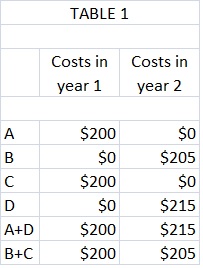
In Thaler’s simplified version of reality, a government decision-maker (manager) faces a choice between two projects that would deliver equal effectiveness (benefits). Specifically, the manager must choose between project A, at a cost of $200 in year 1, and equally-effective project B, at a cost of $205 in year 2 (op. cit., pp. 1-2). Thaler continues:

A [government] manager . . . cannot earn bank interest on funds withheld for a year. . . .  However, there will generally exist other ways for the manager to “invest” funds which are available. Examples include cost-saving expenditures, conservation measures, and preventive maintenance. These kinds of expenditures, if they have positive rates of return, permit a manager to invest money just as if he were putting the money in a savings account.

. . . Suppose a thorough analysis of cost-saving alternatives reveals that [in year 2] a maintenance project will be required at a cost of $215. Call this project D. Alternatively the project can be done [in year 1] (at the same level of effectiveness) for only $200. Call this project C. All of the options are displayed in table 1.

Discounting in the public sector_table 1

(op. cit., pp. 3-4)

Thaler believes that his example clinches the argument for discounting because the choice of project B (an expenditure of $205 in year 2) enables the manager to undertake project C in year 1, and thereby to “save” $10 in year 2.

Thaler’s “proof” is deeply flawed, as discussed in “Discounting and ‘Libertarian Paternalism’.” I’ll focus here on the essential emptiness of Thaler’s argument:

1. Even granting the availability of cost-reduction measures, their payoffs will vary widely. Thaler conveniently conjures projects C and D, with costs of $200 and $215 in years 1 and 2, respectively. He could just have well conjured a project D with a cost of $205 in year 2 — throwing A + D into a tie with B + C — or a project D with a cost of $203 in year 2 — causing A + D to look better than B + C.

2. In other words, the “correct” discount rate depends on the options available to a specific manager of a specific government activity. Yet Thaler insists on the application of a uniform discount rate by all government managers (op. cit., p. 6). By Thaler’s own example, such a practice could lead a manager to choose the wrong option.

3. To put it another way, the analyst should consider the specific options that are available to a specific manager, by constructing packages of projects that would cost the about the same in every year. Having done so (and assuming away a great deal of uncertainty about the costs and benefits of the options), the manager can then choose the package that delivers the most bang for the buck — when the bang is needed, in his judgment. There is no need to apply a discount rate. The relevant (and idiosyncratic) “discount rate” is a product of the correct choice, not a determinant of it.

FINAL WORDS ABOUT THE FUTILITY OF DISCOUNTING FOR GOVERNMENT DECISION-MAKING

Even if there were such a thing as a “social” discount rate, and even if the costs and benefits of government programs were well aligned, discounting would be an inadvisable practice in analysis for government decision-making. If a decision is to depend on the application of a particular discount rate, there must be great certainty about the future costs and benefits of alternative courses of action. But there seldom is (see “Analysis for Government Decision-Making: Demi-Science, Hemi-Demi-Science, and Sophistry“). The practice of discounting simply fosters an illusion of certainty — a potentially dangerous illusion, in the case of national defense.

O Tempora O Mores!

I was exceedingly irritated by a rah-rah piece about “affordable housing” in today’s edition of the local rag. The piece was early intended to promote subsidies that would enable low-income persons to live in mixed-income areas, that is, in the vicinity of persons with higher incomes. The writer of the piece advanced some (admittedly) not-very-convincing sociological arguments for mixed-income neighborhoods, including cost-benefit studies that purport to show that the benefits of subsidized housing outweigh the costs. He failed to mention, of course, that the persons who subsidize “affordable housing” for low-income persons are not the persons who benefit from it. Nor did he make much of the obvious fact that as people earn more, they generally prefer to live among persons with similar earnings, and not among people who earn a lot less.

But what people actually want doesn’t matter in the end, because what counts is what do-gooders want and what government can compel in the name of doing good, don’t you see? That’s why the gauleiters of our fair city persist in the subsidization of low-income housing in mixed-income areas.

In any event, the article led me to think about the many ways in which social norms have changed for the worse since the days of my Midwestern upbringing in the 1940s and 1950s. For one thing, the idea that people should work, save, and pay for their own housing — as I did and my parents did — seems to have gone to the great graveyard of quaint ideas. That graveyard is populated by such formerly vital notions as these:

Behavior is shaped by social norms, like those listed here. The norms are rooted in the Ten Commandments and time-tested codes of behavior. The norms aren’t altered willy-nilly in accordance with the wishes of “activists,” as amplified through the megaphone of the mass media.

Rules of grammar serve the useful purpose of enabling people to understand each other easily. The flouting of grammatical rules in everyday conversation is a sign of ignorance and ill-breeding, not originality.

Dead, white, European males produced some of the greatest works of art, music, literature, philosophy, science, and political theory. Those dead, white, European males are to be celebrated for their accomplishments, not derided just because they are dead or were not black/brown/tan, female, of confused gender, or inhabitants of non-European places.

Marriage is a union of man and women.

Marriage comes before children. This is not because people are pure at heart, but because it is the responsible way to start life together and to ensure that one’s children enjoy a stable, nurturing home life.

Marriage is until “death do us part.” Divorce is a recourse of last resort, not an easy way out of marital and familial responsibilities or the first recourse when one spouse disappoints or angers the other.

Children are disciplined — sometimes spanked — when they do wrong. They aren’t given long, boring, incomprehensible lectures about why they’re doing wrong. Why not? Because they usually know they’re doing wrong and are just trying to see what they can get away with.

Gentlemen don’t swear in front of ladies, and ladies don’t swear in front of gentlemen; discourse is therefore more likely to be rational, and certainly more bearable to those within earshot.

A person’s “space” is respected, as long as person is being respectful of others. A person’s space is not invaded by a loud conversation of no interest to anyone but the conversant.

A person grows old gracefully and doesn’t subject others to the sight of flabby, wrinkled tattoos (unless you were a sailor who has one tattoo on one arm). (This may seem like a nit-pick, but the epidemic of tattooing is symptomatic of the loud, brash, self-centered, faddish culture that now commands center stage in much of America.)

Drugs are taken for the treatment of actual illnesses, not for recreational purposes.

Income is earned, not “distributed.” Persons who earn a lot of money are to be respected. If you envy them to the point of wanting to take their money, you’re a pinko-commie-socialist (no joke).

Welfare is a gift that one accepts as a last resort, it is not a right or an entitlement, and it is not bestowed on persons with convenient disabilities

A man holds a door open for a woman out of courtesy, and he does the same for anyone who is obviously weaker than he is, or laden with packages

Sexism (though it isn’t called that) is nothing more than the understanding — shared by men and women — that women are members of a different sex (the only different one); are usually weaker than men; are endowed with different brain chemistry and physical skills than men (still a fact); and enjoy discreet admiration (flirting) if they’re passably good-looking, or better. Women who reject those propositions — and who try to enforce modes of behavior that assume differently — are embittered and twisted.

A mother who devotes time and effort to the making of a good home and the proper rearing of her children is a pillar of civilized society. Her life is to be celebrated, not condemned as “a waste.”

Homosexuality is a rare, aberrant kind of behavior. (And this is before AIDS proved it to be aberrant.) It’s certainly not a “lifestyle” to be celebrated and shoved down the throats of all who object to it.

Privacy is a constrained right. It doesn’t trump moral obligations, among which are the obligations to refrain from spreading a deadly disease and to preserve innocent life.

Addiction isn’t a disease; it’s a surmountable failing.

Envy is an unsavory and unseemly state of mind; a person should better himself instead of tearing others down.

Justice is for victims. Victims are persons to whom actual harm has been done by way of fraud, theft, bodily harm, murder, and suchlike. A person with a serious disease or handicap isn’t a victim, nor is a person with a drinking or drug problem.

Justice is a dish best served hot, so that would-be criminals can connect the dots between crime and punishment. Swift and sure punishment is the best deterrent of crime. Capital punishment is the ultimate deterrent because an executed killer can’t kill again.

Peace is the result of preparedness for war; lack of preparedness invites war.

The list isn’t exhaustive, but it’s certainly representative. The themes are few and simple: self-reliance, respect for others, respect for tradition, and the defense of society from predators foreign and domestic. The result is liberty: A regime of mutually beneficial coexistence based on trust.

Whence the now-dominant leftist schemes and themes, like “affordable housing” and “the undeserving rich” (a.k.a. “the 1%” and “the 0.1%”), which have replaced the dominant mores of old? Leftist ideas, like the poor, have always been with us, but their political ascendancy arises from the indoctrination mills known as the mainstream media and educational institutions. This is from an article by Graham Cunningham:

“[R]eality” as reflected in the big “old” media is—notwithstanding the relatively recent uncorking of (mainly U.S. based) conservative voices in the “new” media—still overwhelmingly liberal…. And the old media—a virtual Fifth Estate—is still a very big wild wood of seductive liberal myth and folklore. The “staccato signals of constant information” appear, in large part, to be apolitical, making them all the more persuasive. But such is the relentless focus of conservative intellectual discourse on a current affairs agenda that conservatives—never mind liberals—often cannot see the wood for the trees. It is a wood with tangled roots deep in early 20th century socialist intellectual soil. Its filigree branches have since grown and spread into every corner of 21st century public consciousness.

… As someone whose own working life has, at various times, brought me into close contact, not only with schools, colleges, and universities but also local government, the architectural profession, and the British NHS, I can attest that soft-left prejudices prevail in all of these. So the educational incubation of the professional, business, and mandarin classes is another part of the story of the rise of politically correct, middle-class, liberal orthodoxy.

It has also long been true that a great majority of school teachers will be Democrats/Labour Party voters. In varying degree they are likely to emerge from their teacher training with a soft-left baggage ranging from old-fashioned vaguely collectivist economic assumptions and Dickensian sentimental notions (like something called “The Working Class” being perennially victim of something called “The Rich”) to various newer relativist “liberation” and victimhood theologies. Plus a sympathetic take on various kinds of “anti-something-or-other” and “eco” militancy….

[T]he much more potent influence is that everyone born since the Second World War—university educated or not—will have spent a large part of their leisure time in Media Land—a virtual parallel universe, rich in sublimated myth and fairytale. Now Media Land is not some Orwellian Big-Brother conspiracy. It is in itself, too diffuse and anarchic to be a place of didactic political bias per se. Its quintessential characteristic is, rather, that it allows you—without any great effort on your part—to sustain the illusion that you know, and are entitled to have an opinion about, all manner of things beyond your direct experience. It is from these intangible, ego-flattering, seductive characteristics that its mind-bending power flows.

It is the great oracle from which we absorb not just “The News” (intrinsically an editorial semi-fiction anyway) but also the good-guy/bad-guy narratives of film and television drama, the satirical talking-heads panel show, the “shocking” lid-lifting documentary etc. So it is that—drip by drip—the public’s imagination becomes accustomed to the notion that the apparently law-abiding, white, middle-class dwellers in suburbia—though they may not in reality always be the one who have actually “done” the murder—nevertheless do have a dark side to their supposedly smug existence and their desk job in the City—which must, by the way, axiomatically be ignoble, venal and soul destroying. Whereas the violent teenage gangster turns out to have the soul of a poet buried under all those years of oppression. And the lardy, welfare-cheating couch-potato turns out to be quite a sound bloke underneath it all and good fun too. And anyone who takes to the streets in a “protest”—never mind how ignorant and bloody-minded—instantly becomes a hero whilst the target of the “protest” is instantly a villain. And so it is too that the alleged misdeeds of supposedly smug political and business elites are ruthlessly exposed and then wittily sent-up by even more smug, smartly-pants TV “personalities” whose own elite lifestyles remain relatively out of the media spotlight….

And then there is “The News”. Whilst the current affairs output of the mainstream media is not uniformly politically biased per se, it does often have the same entrenched undercurrents as the rest. Underpinning all the day-to-day news ephemera are some enduring fairytales that are both highly seductive and at the same time so diffuse as to be almost subconscious. A major example is the one in which some big bad wolf (maybe “The Government” or “Big Business”)—and definitely not you personally—is either to blame for all your problems in life or has failed to solve them for you. You—a member of “the great mass of ordinary decent people”—are a victim of some or other system or institution. Another (almost certainly subconscious) fairytale is the one in which—by the simple device of espousing “progressive” liberal attitudes—you can carry on with your (and your family’s) own personal pursuit of happiness, just like before but now with the added bonus of feeling that you—unlike those nasty “Right-wingers”—are on the side of the angels. Now that is a really seductive one! …

It is also worth noting that, quite apart from any questions of political bias as such, “The News”, with its inevitable editorial selectivity can—at least in the minds of the uncurious and suggestible—actually help to spread ignorance dressed up as illusory knowledge….

… Having so many alternative gadgets to play with, [members of the post-internet generation] are less and less likely to watch [TV] and especially “The News” and “Current Affairs”. But overall, the power of the Media-Academia Complex is likely to remain undiminished for a very long time to come. Its power comes ultimately from the illusion it creates that you can sit back and soak up all you need to “know” about the big wide world without actually having to be all that curious about it. (“How the Left Was Won,” The Imaginative Conservative, February 2014)

The 1940s and 1950s weren’t idyllic, by any means — but no era ever is, except in gauzy hindsight. There was more poverty and racism then than now. But the economy would be even more robust today, absent the incursions of the regulatory-welfare state. And racism would have declined in time, with less of the lingering resentment that was a foreseeable result of government’s heavy-handed “equality” policies. Simply enforcing existing laws so that blacks enjoyed equal treatment would have been enough.

The undoing of traditional mores began in earnest in the 1960s, with a frontal assault on traditional morality and the misguided expansion of the regulatory-welfare state. The unraveling continues to this day. Traditional morality is notable in its neglect; social cohesion is almost non-existent, except where the bonds of religion and ethnicity remain strong. The social fabric that once bound vast swaths of America has rotted — and is almost certainly beyond repair.

If Hillary Clinton possessed an ounce of intellectual honesty, she would justifiably call the great unraveling a vast, left-wing conspiracy. As Cunningham suggests, it is to some extent an unwitting conspiracy of smug, like-minded persons. But it is nevertheless a broad-based, often concerted, and nihilistic effort to undermine the foundations of morality — and economic progress.

*     *     *

Related reading:
Dwight Longnecker, “Modern Marriage – Revolution or Regression?,” The Imaginative Conservative, February 14, 2014

Related posts:
PC Madness
Why Not Marry Your Pet?
Stuff White (Liberal Yuppie) People Like
“Men’s Health”
I’ve Got a LIttle List
See also the preceding post, and the many posts listed at the bottom.

The Fall and Rise of American Empire

Most Americans don’t like the idea of empire. It smacks of power, which is comforting and enriching when you have it, though few like to admit it. In short, empire can be a good thing. Lawrence W. Reed opens “The Fall of the Republic” with this:

For nearly five centuries, Res Publica Romana—the Roman Republic—bestowed upon the world a previously unseen degree of respect for individual rights and the rule of law. When the republic expired, the world would not see those wondrous achievements again on a comparable scale for a thousand years.

Reed summarizes the decline and fall of Rome:

The Roman Republic died a death of a thousand cuts. Or, to borrow from another, well-known parable: The heat below the pot in which the proverbial frog was boiled started out as a mere flicker of a flame, then rose gradually until it was too late for the frog to escape. Indeed, for a brief time, he enjoyed a nice warm bath….

Writers from the first centuries B.C. and A.D. offered useful insights to the decline. Polybius predicted that politicians would pander to the masses, leading to the mob rule of an unrestrained democracy. The constitution, he surmised, could not survive when that happened. Sallust bemoaned the erosion of morals and character and the rise of personal power lust. Livy, Plutarch, and Cato expressed similar sentiments. To the moment of his assassination, Cicero defended the Republic against the assaults of the early dictators because he knew they would transform Rome into a tyrannical despotism.

Ultimately, the collapse of the political order of republican Rome has its origins in three developments that took root in the second century B.C., then blossomed by the end of the first. One was foreign adventure. The second was the welfare state. The third was a sacrifice of constitutional norms and the rule of law to the demands of the other two.

The American equivalent of the Roman Republic didn’t last nearly as long — only about a century, from the Spanish-American War of 1898 through 1991, which marked the end of the Cold War and victory in the Gulf War. The relative peace and prosperity of the next several years masked America’s underlying decline, which has since became evident in the military, political, and economic events of the 21st century.

The causes and symptoms of America’s decline bear a strong resemblance to the decline of Rome. Let’s start with foreign adventure. By the end of 1991, America’s influence in the world seemed assured, given collapse of the USSR and the easy victory over Iraq in response to Saddam Hussein’s grab of Kuwait. But those two events proved to be the American Empire’s last gasp.

The dust had barely settled on the Gulf War when Somalia joined the list of post-World War II military misadventures, namely, the Korean War, the Vietnam War, the lame response to the bombing of Marine barracks in Lebanon, and the jurisprudential reaction to the 1993 bombing of the World Trade Center. (Some would argue that America’s entry into World War I was also a misadventure because of the imperial origins and tragic aftermath of the peace, namely, the rise of totalitarianism. But, at least, World War I ended decisively and in a clear-cut victory for America’s side — a victory that wouldn’t have been possible without the intervention of American forces.) The seeming disinclination of American leaders to stay the course and to wreak vengeance was duly noted in Osama bin Laden’s 1996 fatwa against the United States. As if to endorse that view, the 1998 bombings of U.S. embassies in Africa were met with ineffectual missile strikes.

And then came 9/11, and in its wake the wars in Afghanistan and Iraq. Both were cast in the mold of Korea and Vietnam: not enough firepower, not enough willpower. Barack Obama’s subsequent foreign policy misadventures and general retreat from effective leadership have only cemented America’s place as a declining, feckless, no-longer-fearsome power. Whence Obama’s fecklessness? Some argue that it is evidence of a deliberate effort to debase the United States.

So much for military misadventures. Let us turn to the growth of the welfare state and the sacrifice of constitutional norms. These go hand-in-hand, and both began before America’s military misadventures after World War II.

Consider the judicial betrayal of the constitutional scheme of limited government, and of order and traditional morality. There is no way, in the course of a blog post, to assess the full scope of the betrayal, in which the U.S. Supreme Court was a willing co-conspirator. Some examples will have to do:

Home Building & Loan Association v. Blaisdell (1933) allowed governmental suspension of creditors’ remedies (i.e., foreclosure), thus undermining contractual relationships.

National Labor Relations Board v. Jones & Laughlin Steel Corporation (1937) validated the Wagner Act, which vastly expanded the ability of labor unions to extort employers, to restrict commerce, and to fatten the paychecks of union members at the expense of everyone else.

Helvering v. Davis (1937) found Social Security to be constitutional, despite the plain words of Article I, Section 8 (the enumerated powers of Congress).

Wickard v. Filburn (1942) gave Congress unlimited power to regulate anything remotely connected with interstate commerce.

Miranda v. Arizona (1966) stigmatized and hindered the efforts of police to protect the public. On the basis of “intuitive empiricism” (i.e., judicial guesswork), Miranda imposed an overly broad interpretation of the Fifth Amendment. (A subsequent empirical analysis suggests that Miranda was unwisely decided.)

Griggs v. Duke Power Company (1971) enshrined disparate impact as evidence of racial discrimination, and put the burden of proof on the accused employer.

Lemon v. Kurtzman (1971) gave judges an easy way (the “Lemon test”) to rule against any government action that might incidentally benefit religion.

Roe v. Wade (1973) authorized murder in the name of privacy.

Goss v. Lopez (1975) made it more difficult for school authorities to discipline disruptive and destructive behavior, and (in my view) established — beyond hope of reversal — the interference of the central government in matters that ought to be handled and disposed of locally.

Coker v. Georgia (1977) outlawed the death penalty in cases of rape, thus contributing to the erosion of the death penalty as a serious deterrent to the commission of heinous crimes and a just penalty for same.

Tennessee Valley authority v. Hill (1978) gave the snail darter — and as a result, all kinds of critters — precedence over human beings, under the Endangered Species Act.

Chevron U.S.A., Inc. v. Natural Resources Defense Council, Inc. (1984) vastly increased the power of regulatory agencies by decreeing “deference” toward rules made in the absence of specific congressional authorization, as long as the rules are “reasonable.”

Garcia v. San Antonio Metropolitan Transit Authority (1985) confirmed the hollowness of the Tenth Amendment and the States’ ability to exercise any power without the permission of the central government.

Kelo v. City of New London (2005) affirmed the right of any government in the United States to seize anyone’s property, at any time, for any use — even non-governmental.

National Federation of Independent Business v. Sebelius (2012) granted the federal government power to tax anyone for any purpose, even for not doing something.

Hollingsworth v. Perry (2013) left standing a federal district court judge’s self-serving declaration that California’s duly adopted ban on same-sex “marriage” was unconstitutional, thus opening the door to similar holdings by other federal judges about other States’ duly adopted bans on same-sex “marriage.”

The judiciary didn’t instigate the vast expansion of the regulatory-welfare state and the overthrow of social norms, but the judiciary abetted them.

What does the regulatory-welfare state amount to? Huge federal welfare schemes, including but not limited to Social Security, Medicare, and Medicaid; the addition of nine cabinet-level departments to the executive branch in the preceding 100 years; the creation of the cabinet-level Environmental Protection Agency (EPA); the delegation of legislative power to the EPA and other federal agencies, and ensuing accretion of rules made and enforced by those agencies; and the pervasive centralization of power in Washington, “thanks” to judicial misfeasance of the kinds listed above, and to political sleight-of-hand (e.g., “cooperative” federal-State programs like Medicare, and grants of “federal” money — i.e., taxpayers’ money — to State and local governments).

As for constitutional norms, the courts of the United States have become perversely “libertarian.” They seem driven to overturn long-standing, time-tested behavioral norms that guide individuals toward peaceful, constructive coexistence with their compatriots. Thus the “right” to an abortion in the first trimester, based on a non-existent general right of privacy, has become the right to kill a nearly born and newly born child. The “right” to practice sodomy has become an obligation to purvey goods and services to those who practice sodomy, regardless of one’s personal views about the practice. The “right” of a male student of confused gender to use the girl’s bathroom in a Maine school threatens to evolve into the “right” to walk into any damn bathroom at any time, regardless of one’s actual gender. And on and on, down the slippery slope and into unreason, barbarity, and oppression.

Where stands the Empire today? Clearly, America has less influence in the world than it had just after World War II and even after the Gulf War. What a joke it is when the American president must be rescued from the consequences of his own (possibly deliberate) haplessness by Russia’s leader, when Iran plays rope-a-dope with Obama in the matter of nuclear weapons, and when China flexes its new-found and growing military muscle without drawing a serious response from the U.S.

American power abroad could be restored in fairly short order, given the will to do so. But the hollowing out of America’s liberty and prosperity — which began in earnest with the New Deal — threatens to be permanent, given the decades-long transformation of the nation’s legal and bureaucratic infrastructure. Government — mainly the central government — now exerts financial control over 40 percent of the economy (here, see first graph), and arguably exerts regulatory control over almost all of it.

That control has long since passed from the elected “representatives” of the people to technocrats who are bent on dictating how Americans’ conduct their lives and earn their livelihoods. Thus:

In an FDA office building in suburban Maryland, the bureaucrats gather over coffee to draft rules meant to squeeze the trans fat out of snack foods.

Four blocks from the White House, in an EPA conference room: more bureaucrats, more meetings, more drafting of rules, these aimed at forcing industrialists to spend billions cutting carbon to fend off global warming.

Congress? Who needs Congress?

Americans heard President Barack Obama declare this week that he intends to bypass the gridlocked Hill to get things done on his own. What they didn’t hear: just how far he’s actually pushing his executive authority.

An in-depth examination of the administration’s actions and plans, agency by agency, regulation by regulation, reveals an executive power play that’s broad and bold — and intensely ambitious. Far more than he let on in the State of the Union, the president has marshaled the tools of his office to advance policies, many unabashedly liberal, that push deep into everyday life for tens of millions of Americans.

He wants to change how power plants operate. And what we buy for lunch. How we travel to work. And how our kids learn math. How our gasoline is formulated. How we light our aquariums.

Already, the president’s team has enacted 300 economically significant regulations, far more than Bill Clinton, George W. Bush or Ronald Reagan did in comparable periods. Some of those rules are driven by the Affordable Care Act and Dodd-Frank banking reform, the two big laws Obama pushed through Congress early in his first term, when he had Democratic majorities in both houses. But there is far more.

Follow the link and read the rest, if you have the stomach for it.

The Empire lives, but it’s a different Empire than the one that enjoyed its last hurrah in the early 1990s. The Empire now exists not to make Americans safe and prosperous, but to dominate Americans in the name of overblown and non-existent threats (e.g., sexism, racism, endangered species, global warming), out of ersatz compassion, and with the aim of attaining the impossible: equality for all. Well, equality for all but that minority of minorities — the hard-working, tax-paying, straight, white person of European or Asian descent who minds his own business and not everyone else’s. If you are one of those, and religious as well, you are a particular object of persecution and prosecution.

In sum, a new Empire has arisen on America’s shores. If it had a motto, it would be* “trillions for the regulatory-welfare state and its clients, but not enough for defense.”

*     *     *

Related reading:
Bill Gertz, “Putin’s July 4th Message,” The Washington Free Beacon, July 6, 2012
Dean Cheng, “South China Sea: China Drops a Bombshell,” The Foundry, July 7, 2012
Walter Russell Mead and staff, “Putin Tells His Ambassadors: The West Is All Washed Up,” The American Interest, July 9, 2012
Erica Ritz, “Troubling? Putin Oversees Largest Nuclear Tests since the Cold War,” The Blaze, October 20, 2012
Norman Podhoretz, “Obama’s Successful Foreign Failure,” WSJ.com, September 8, 2013
Melanie Phillips, “Putin Checkmates America,” Melanie’s Blog, September 15, 2013
Walter Russell Mead (and staff), “Mixed Messages from Washington Confuse Allies,” The American Interest, December 3, 2013
Lawrence W. Reed, “The Fall of the Republic,” The Freeman, January 8, 2014
doriangrey1, “The Iranian Rope-a-Dope,” The Wilderness of Mirrors, January 20, 2014
Bill Vallicella, “The Decline of the West: How Long Can We Last?,” Maverick Philosopher, January 21, 2014
Adam Garfinkle, “Obama’s Middle East Recessional” in four parts (here, here, here, here), The American Interest, January 21, 2014
Victor Davis Hanson, “Obama’s Recessional,” RealClearPolitics, January 22, 2014
Elise Cooper, “Barack Obama’s Foreign Policy: An Utter Failure,” American Thinker, January 26, 2014
Dan Roberts, “White House Warns Obama Ready to ‘Bypass on 2014 Agenda,” The Guardian, January 26, 2014
Alexander Boltin, “Cruz: Putin Plays Chess, Obama Plays Checkers on Foreign Policy,” The Hill, January 28, 2014
Stephanie Simon, “Obama’s Power Play,” Politico, January 31, 2014
Tom Blumer, “Is It Over and We Just Don’t Know It? Have We Lost Our Founders’ Government?,” PJ Media, February 10, 2014
Victor Davis Hanson, “An Orwellian Nation of Obamathink,” Jewish World Review, February 13, 2014
Angelo M. Codevilla, “Do We Deserve the Constitution of 2014?,” Library of Law and Liberty, February 16, 2014
Richard Winchester, “Left-Wing Totalitarianism in America,” American Thinker, February 17, 2014

Related posts:
The Near-Victory of Communism
Tocqueville’s Prescience
The Left
Our Enemy, the State
“Intellectuals and Society”: A Review
The Left’s Agenda
Rating America’s Wars
Transnationalism and National Defense
The Left and Its Delusions
The Destruction of Society in the Name of “Society”
September 20, 2001: Hillary Clinton Signals the End of “Unity”
The War on Terror, As It Should Have Been Fought
The Spoiled Children of Capitalism
Politics, Sophistry, and the Academy
Subsidizing the Enemies of Liberty
Well-Founded Pessimism
Defense as an Investment in Liberty and Prosperity
Liberty and Society
Tolerance on the Left
America: Past, Present, and Future
The Barbarians within and the State of the Union
Estimating the Rahn Curve: Or, How Government Spending Inhibits Economic Growth
America’s Financial Crisis Is Now
The World Turned Upside Down
“We the People” and Big Government
The Culture War
Defense Spending: One More Time
Parsing Political Philosophy (II)
__________
* A mockery of the words of Robert Goodloe Harper, who as a member of the U.S. House of Representatives in 1797, said “Millions for defense, but not one cent for tribute.” The remark was occasioned by a demand from France for tribute (a bribe) in exchange for the release of American ships that had been seized by the French.

Facts about Presidents

I’ve added a new page, “Facts about Presidents.” It’s meant to be a handy source for readers who are interested in such things as the age of a president upon taking office, the length of time lived after leaving office, place of birth, religious affiliation, and more.

There you will find the birth names of the presidents, many of which differ from the names by which they are known. For example, no president to date has been known as a “Junior,” yet nine were and are a “Junior” (in fact if not in name) and two others — Obams and Clinton — are entitled to letter suffixes: II and III, respectively. In sum, 11 of the 43 men who served as president were named after their fathers, which suggests that a key source of political ambition is a felt need to “prove” oneself. There is further evidence for that hypothesis: Three presidents not entitled to a post-nominal suffix also felt the need to at least equal the achievements of their fathers and grandfather: John Quincy Adams, son of John Adams; Benjamin Harrison, grandson of William Henry Harrison; and George W. Bush, son of George H.W. Bush.

Did you know that John F. Kennedy — who became president on January 20, 1961 — was 26.62 years younger than his predecessor, Dwight D. Eisenhower? That’s the largest age drop on record, and you’ll find the numbers in the second part of the three-part table of facts. Another factoid from the same part of the table: The largest age jump occurred on January 20, 1981, when James E. Carter was replaced by Ronald W. Reagan, who was 13.65 older than Carter.

Name changes? Several. Grant and Eisenhower ended up with different first and middle names than the ones they were born with. Adoptees Ford and Clinton ended up with different last names, and Ford’s was changed completely. Cleveland, Wilson, and Coolidge didn’t go by the first names given them at birth, preferring their more distinctive — and now old-fashioned — middle names.

Speaking of middle names, the first eight presidents had none. Theodore Roosevelt (president 1901-9) was the last president to lack one, though Harry Truman’s was just letter S.

There’s much more. Enjoy!

Libertarian Conservative or Conservative Libertarian? (Updated)

Here.

Speaking in Foreign Tongues

Have you wondered why it’s so hard to learn to speak a foreign language, especially as one gets older. (“Older” includes persons of high-school and college age, as opposed to toddlers.) I have some thoughts on the matter, which I’ll get to after a relevant detour into a pair of well-known English and American accents.

You’re probably familiar with the “posh” English accent, also known as Received Pronunciation (RP):

RP is defined in the Concise Oxford English Dictionary as “the standard accent of English as spoken in the south of England,”although it can be heard from native speakers throughout England and Wales…. Although there is nothing intrinsic about RP that marks it as superior to any other variety, sociolinguistic factors have given Received Pronunciation particular prestige in parts of Britain.It has thus been the accent of those with power, money and influence since the early to mid 20th century….

The modern style of RP is an accent often taught to non-native speakers learning British English…. RP is used as the standard for English in most books on general phonology and phonetics, and is represented in the pronunciation schemes of most dictionaries published in the United Kingdom.

[A] notable British phonetician, has identified the following people as RP speakers:

(More here about RP.)

If you’re unfamiliar with the speech of the Royal Family, etc., think of the Crawleys of Downton Abbey —  Elizabeth McGovern’s character excepted, of course.

RP has an American equivalent, General American (GA):

The General American accent is most closely related to a generalized Midwestern accent and is spoken particularly by many newscasters. It is thought to have evolved from the English spoken by colonials in the Mid-Atlantic states, evolved and moved west. Walter Cronkite is a good example of a broadcaster using this accent. This has led the accent to sometimes be referred to as a “newscaster accent” or “television English”. General American is sometimes promoted as preferable to other regional accents. In the United States, classes promising “accent reduction”,”accent modification” and “accent neutralization” generally attempt to teach speech patterns similar to this accent…. General American is also the accent typically taught to people learning English as a second language in the United States, as well as outside the country to anyone who wishes to learn “American English.”

Where does GA come from?

The Telsur Project … examines a number of phonetic properties by which regional accents of the U.S. may be identified. The area with Midwestern regional properties is indicated on the map: eastern Nebraska (including Omaha and Lincoln); northwestern, southern, and central Iowa (including Des Moines, Sioux City and the Iowa-side Quad Cities), with an adjacent narrow strip of northern Missouri; and western Illinois (including Peoria and the Illinois-side Quad Cities. Notably, this section of Illinois does not include the Chicago area).

Note that GA doesn’t encompass the entire Midwest, which contains a variety of distinct accents, even though most Midwesterners, seem to believe (wrongly) that they’re accent-free. For example, the Chicago accent, as I’ve heard it, has a “big city” shading — a more “aggressive” sound than the softer tones one associates with the rural and semi-urban areas of the Midwest. Many Chicagoans (e.g., the late Mayor Richard Daley) have been known to substitute “dese” and “dem” for “these” and “them.”  The accents of the Upper Midwest — Michigan, Wisconsin, and Minnesota — are also distinctive and easily mocked. (Think of the Minnesotan played by Frances McDormand in Fargo.)

GA, of course, sounds nothing like RP, nor is it considered “posh.” But, like RP, it is easily understood by other speakers of English.

Why? I think it’s because GA is a straightforward way of speaking, absent the vocal gymnastics that accompany other regional accents; for example:

  • The “a” sound is “ay”; it’s not drawn out into a nasal whine (“a-a-uh”), as it is in Upstate New York and parts of the Upper Midwest.
  • The letter “r” is pronounced “are,” not only at the beginning of a word but also in the middle and at the end. Thus words that end in “r” (or with the “r” sound) are instantly understandable to any American, even those who say “ah” for “are,” “heah” for “hear” and “hear,” “waw” and “wo-ah” for “war,” or “Cuber” for “Cuba” — to give but a few of many possible examples. (It doesn’t work the other way around. Years ago, before I became “worldly,” I had to ask a native of New York City to repeat “Clahk Milluh” three time before I — a native Midwesterner — understood that he was referring to a person named Clark Miller.)
  • The “t” is pronounced, except in words where it has long been suppressed (e.g., “often” = “offen”). Thus GA speakers say “plentiful,” not the “pleniful” of some Eastern accents.
  • The long “i” is “eye,” not the “ah” of “rahfle” (rifle) and “tahr’ (tire) that’s heard in some parts of the South.
  • Also in contrast to many Southern accents, words are pronounced crisply, not stretched; for example: “building” is “bil-ding,” not “bee-i-l-ding”; “fish” is just that, not “fee-ush.”

I could go on and on. But what I’m leading up to is this: It’s true that GA is an accent, but the simplicity of GA makes it easy to mimic. (That’s why it’s taught to non-English speakers.) British actors who try to “do” an American accent usually succeed only when they “do” GA. (British actors’ imitations of Southern accents usually seem hilarious to Southerners, as do most imitations essayed by non-Southern American actors.)

What does all of this have to do with the difficulty of mastering the pronunciation of a foreign language? My amateur guess is that two things keep most people (older than toddlers) from learning how to speak a foreign language as its native speakers do: (1) embarrassment and (2) embedded  habits of pronunciation. The two impediments are related. If you’ve grown up pronouncing vowels, consonants, diphthongs and other particles of speech in certain ways, you’re likely to feel self-conscious about pronouncing them in new ways, especially in the presence of your peers. And you’ll find it hard to pronounce particles of speech in new ways if doing so requires you to make sounds that you’re unaccustomed to making.

If, for example, you want to pronounce the “r” in garçon (boy or young man) as a French person does, you have to throw in a silent gargle, so that the “r” is almost suppressed. Then you get to “çon,” which starts out somewhere between “sone” and “sawn,” but ends with an open, nasal sound — the “n” is hinted at but not enunciated. Further, you have to resist the temptation to emphasize the first syllable, and put equal emphasis on both syllables.

See how hard it is? And that’s just a small sample of the vocal gymnastics required to speak one foreign tongue passably well. (Also required: some mastery of vocabulary and grammar, the latter of which is often more complex than in English.)

So, even if an American gets over the embarrassment of making “weird” sounds, he or she still faces the obstacle of making those sounds correctly. The same goes for non-English speakers who want to master British or American English. But if they aim to master RP or GA, their task is made easier by the relative simplicity of those two accents.

Parsing Political Philosophy (II)

This is a work in progress. The first version is here. This version expands the range of political stances by adding Despotism to Anarchism, Minarchism, and Statism. Also, this version goes into more detail about the differences between various stances. I’m leaving the first version in place because I’ve linked to it and quoted from it often, and because some of the descriptive material complements this post.

INTRODUCTION

The aim of this post and its predecessor is to find more precise political labels than Democrat, Republican, left, right, center, liberal, conservative, and libertarian. I want to show, for example, the dimensions of agreement and disagreement between a so-called liberal who wants government to dictate certain aspects of human affairs, and a so-called conservative who wants government to dictate certain other aspects of human affairs. Are they not both statists who merely have different agendas, or are there deeper differences between them? And what about the so-called libertarian who espouses some views that are anathema to many on the left (e.g., free markets) and other views that are anathema to many on the right (e.g., legalization of marijuana and harder drugs)? Are such views coherent or merely provocative?

Any one person’s political philosophy — if he may be said to have one — is likely to consist of a set of attitudes, many of them logically irreconcilable. This, I believe, is due mainly to the influence of temperament on one’s political views. It is a rare human being who does not interpret the world through the lens of his preferences, and those preferences seem to be more a matter of temperament than of knowledge and reason. Even highly intelligent persons are capable of believing in the most outlandish things because they want to believe those things.

I therefore admit that my search for more precise political labels may be — and probably is — both quixotic and reductionist. But it can, at least, shed some light on real differences — and real similarities — among various lines of political thought.

THE ESSENCE OF POLITICS

Political views, and their essential differences, cannot be organized into a taxonomy without first defining politics and its essential issues.

Politics is the means by which human beings regulate their behavior, which usually (but unnecessarily) is divided into social and economic components. The purpose of regulating behavior — whether the regulation is explicit or implicit, imposed or voluntary — is to sustain or change the modes of human interaction, and the outcomes that derive from human interaction. Some political stances are incoherent because their principles cannot yield the preferred outcomes (e.g., redistribution, a favored policy of left-statists, actually makes the poor worse off because it stifles economic growth). But incoherence does not prevent a political stance from becoming popular, or even dominant.

THE BASELINE POSITION: TRADITIONAL CONSERVATISM

The following sections of this post culminate in a taxonomy of political philosophies, which is given in a table at the end of the post. In that table, I take as a baseline a political stance that I call Right-Minarchism. It represents traditional conservatism, as it would have played out in practice under the kind of true federalism represented in the Articles of Confederation.

What is the traditional conservative position? I begin with a redaction of Russell Kirk’s “Six Canons of Conservative Thought“:

1. An understanding that political problems, at bottom, are moral problems.

2. A preference for tradition — which incorporates beneficial change — over the shackles of statism and the chaos that must ensue from anarchy.

3. Recognition that change is not the same thing as change for the better (reform), which emerges from tradition and is not imposed upon it.

4. An understanding that a flourishing civil society requires order, without which freedom is available only to despots and predators.

5. Faith in traditional mores and reliance upon them, in the main, to maintain a regimen of order that enables freedom — ordered liberty, in other words. Traditional mores are supplemented but not supplanted by the rule of law, impartially administered and no more intrusive than is required for ordered liberty.

6. Knowledge that property and liberty are inseparably connected, and that economic leveling is not economic progress.

For an elaboration on the role of government, I turn to Michael Oakeshott:

Government, … as the conservative in this matter understands it, does not begin with a vision of another, different and better world, but with the observation of the self-government practised even by men of passion in the conduct of their enterprises; it begins in the informal adjustments of interests to one another which are designed to release those who are apt to collide from the mutual frustration of a collision. Sometimes these adjustments are no more than agreements between two parties to keep out of each other’s way; sometimes they are of wider application and more durable character, such as the International Rules for for the prevention of collisions at sea. In short, the intimations of government are to be found in ritual, not in religion or philosophy; in the enjoyment of orderly and peaceable behaviour, not in the search for truth or perfection…. To govern, then, as the conservative understands it, is to provide a vinculum juris for those manners of conduct which, in the circumstances, are least likely to result in a frustrating collision of interests; to provide redress and means of compensation for those who suffer from others behaving in a contrary manners; sometimes to provide punishment for those who pursue their own interests regardless of the rules; and, of course, to provide a sufficient force to maintain the authority of an arbiter of this kind. Thus, governing is recognized as a specific and limited activity; not the management of an enterprise, but the rule of those engaged in a great diversity of self-chosen enterprises. It is not concerned with concrete persons, but with activities; and with activities only in respect of their propensity to collide with one another. It is not concerned with moral right and wrong, it is not designed to make men good or even better; it is not indispensable on account of ‘the natural depravity of mankind’ but merely because of their current disposition to be extravagant; its business is to keep its subjects at peace with one another in the activities in which they have chosen to seek their happiness. And if there is any general idea entailed in this view, it is, perhaps, that a government which does not sustain the loyalty of its subjects is worthless; and that while one which (in the old puritan phrase) ‘commands the truth’ is incapable of doing so (because some of its subjects will believe its ‘truth’ to be in error), one which is indifferent to ‘truth’ and ‘error’ alike, and merely pursues peace, presents no obstacle to the necessary loyalty.

…[A]s the conservative understands it, modification of the rules should always reflect, and never impose, a change in the activities and beliefs of those who are subject to them, and should never on any occasion be so great as to destroy the ensemble. Consequently, the conservative will have nothing to do with innovations designed to meet merely hypothetical situations; he will prefer to enforce a rule he has got rather than invent a new one; he will think it appropriate to delay a modification of the rules until it is clear that the change of circumstances it is designed to reflect has come to stay for a while; he will be suspicious of proposals for change in excess of what the situation calls for, of rulers who demand extra-ordinary powers in order to make great changes and whose utterances re tied to generalities like ‘the public good’ or social justice’, and of Saviours of Society who buckle on armour and seek dragons to slay; he will think it proper to consider the occasion of the innovation with care; in short, he will be disposed to regard politics as an activity in which a valuable set of tools is renovated from time to time and kept in trim rather than as an opportunity for perpetual re-equipment. (Rationalism in Politics and Other Essays, New and Expanded Edition, pp. 427-31)

In what follows, I synthesize Kirk and Oakeshott, and call the result Right-Minarchism.

A TAXONOMY OF PHILOSOPHIES

I begin with a rough sorting of political philosophies:

  • Anarchism is a fairly coherent (if implausible) philosophy of non-government, propounded by persons who usually call themselves anarcho-capitalists (probably because it seems a more respectable label than “anarchist”).
  • Minarchism is a somewhat more diffuse but still coherent philosophy of minimal government, propounded by persons who usually call themselves libertarians, over the objection of anarchists, who claim to be the only true libertarians.
  • Anarchists and minarchists dwell in the big tent of libertarianism.  Where anarchists are fairly monolithic in their views (government is evil because it must always be based on coercion), minarchists are of varied stripes, which I delineate below. My analyses of anarchism and minarchism span the range of libertarian ideas, so there is nothing more for me to say in this post about libertarianism as a political philosophy.
  • Statism comprises a broad set of attitudes about government’s role, propounded by “types” ranging from redneck yahoos to campus radicals, each type proclaiming itself benign (for some, if not for others). But each type would — in thought and word, if not deed — set loose the dogs of the state upon its political opponents and the vast, hapless majority. Statism, because it is so powerful and pervasive a force, merits further analysis — more aptly, dissection — into its main types.
  • Despotism is perhaps the inevitable outcome of statism. Despotism may be “hard,” as with the USSR under Stalin and Germany under Hitler, or “soft,” as with innumerable “social democrat” regimes, including the controlling regime of the United States. Under despotic rule there is no dividing line between the state’s power and individual liberty. The state can — and will — dictate to its subjects about anything.

Thus the four broad philosophies that I parse in this post are anarchism, minarchism, statism, and despotism. Here is more about each of them:

Anarchism

Anarchists believe that no one should govern others; rather, all human interactions and joint functions (e.g., a group’s efforts to defend itself against predators and enemies) should be undertaken through voluntary agreements, including contracts with private defense agencies.

Central to anarchism is the dual principle of non-coercion and non-aggression: conjoined prohibitions against the imposition of one’s will upon others and, therefore, the use of force except in self-defense or the defense of others. (Are there loopholes for dealing with imminent, predatory threats and teaching children to behave? Only an anarchist knows for sure.) Government, by definition, imposes its will by exerting superior force. Government, therefore, is illegitimate.

The non-aggression principle is the undoing of anarchism. Anarchy (purely consensual anarchy) cannot prevail. Non-aggression often is met with aggression. Anarchists (were there a viable group of them) would fall prey to well-armed aggressors (both from within the group and outside it). This inconvenient fact is of no account to doctrinaire anarchists. They are focused on the world as they would like it to be, and have little time for the world as it is, except to object when it isn’t to their liking — which is all of the time.

Minarchism

The Central Tenet: Limited Government

Minarchists are united in but one respect: Government, being inevitable if not necessary, must be kept within strict bounds. Given the inevitability of government, it is better to control it than to be controlled by it. It is therefore better to design an accountable one that can be kept within its bounds (or so minarchists hope) than to suffer an imposed regime, most likely an oppressive one.

Why do minarchists prefer strictly limited government? There are two reasons. The first reason is a desire to be left alone, or more elegantly, a deontological belief in the natural right to be left alone. (Most anarchists are deontologists.) The second, consequentalist, reason is that voluntary social and economic transactions yield better results than government-directed ones. Friedrich Hayek makes that argument, at length and successfully, in his essay, “The Use of Knowledge in Society.” Here is a small sample:

As Alfred Whitehead has said in another connection, “It is a profoundly erroneous truism, repeated by all copy-books and by eminent people when they are making speeches, that we should cultivate the habit of thinking what we are doing. The precise opposite is the case. Civilization advances by extending the number of important operations which we can perform without thinking about them.” This is of profound significance in the social field. We make constant use of formulas, symbols, and rules whose meaning we do not understand and through the use of which we avail ourselves of the assistance of knowledge which individually we do not possess. We have developed these practices and institutions by building upon habits and institutions which have proved successful in their own sphere and which have in turn become the foundation of the civilization we have built up.

What Hayek says is true not only of economic institutions but also of social ones. The seemingly uncoordinated price “system” guides economic actors toward better ways of meeting ever-changing human wants with limited resources. The social “system” accrues behavioral norms that guide individuals toward peaceful, constructive coexistence with their compatriots.

The Protection of Negative Rights

Whether deontological or consequentialist, minarchism holds that the central role of government is to protect citizens from predators, domestic and foreign. Such protection cannot be absolute, but government’s evident ability and willingness to dispense justice and defend the nation are meant, in part, to deter predators.

More generally, the ideal government is restricted to the protection of negative rights. Such rights, as opposed to positive rights, do not involve claims against others; instead, they involve the right to be left alone by others. Negative rights include the right to conduct one’s affairs without being killed, maimed, or forced or tricked into doing something against one’s will; the right to own property, as against the right of others to abscond with property or claim it as their own; the right to work for a wage and not as a slave to an “owner” who claims the product of one’s labor; and the right to move and transact business freely within government’s sphere of sovereignty (which can include overseas movements and transactions, given a government strong enough to protect them).

To a minarchist, then, rights are limited to those that can be exercised without requiring something of others (e.g., transfers of income and property). The one necessary exception is the cost of providing a government to ensure the exercise of rights. That cost must be borne, in some arbitrary way, by citizens who, on the one hand, see no need for government (i.e., anarchists) and by citizens who, on the other hand, have differing conceptions of rights and how the cost of protecting those rights should be shared.

More about Property Rights

Minarchists (like anarchists) are fierce defenders of property rights. Minarchists hold that we own what we earn (or what is given to us, freely, by others who have earned it). The right to property is a negative right, in that the enjoyment and use of that which is ours need not deny anyone else the right to enjoy and use that which is theirs. (Acts of enjoyment and use, however, must not infringe on the negative rights of others.) The denial of property rights (in whole or in part) is theft, whether committed by a private party or government. (The “public use” clause of the Fifth Amendment is applied legitimately only when government must take property, with “just compensation” in order to execute one of the few legitimate functions of government.)

There is an economic justification, as well, for minarchists’ defense of property rights. People generally use that which they own more carefully and more productively than that which they do not own. This tendency — which springs from the same psychological source as the tendency of individuals to care more for those who are closest to them — yields less waste and greater output. That outcome benefits everyone, not just the owners of economic resources.

The Role of Civil Society

There can be more to minarchy than the protection of negative rights. In the view of some minarchists, government legitimately serves the broader (but related) purpose of protecting civil society. Other minarchists have no use for what they see as the strictures of civil society; they wish only to be left alone. In their introverted myopia they fail to see that the liberty to live a peaceful, happy, and even prosperous life depends on civil society: the daily observance of person X’s negative rights by persons W, Y, and Z — and vice versa. That is so because it is impossible and — more importantly — undesirable for government to police everyone’s behavior. Liberty depends, therefore, on the institutions of society — family, church, club, and the like — through which individuals learn to treat one another with respect, through which individuals often come to the aid of one another, and through which instances of disrespect can be noted, publicized, and even punished (e.g., by criticism and ostracism).

That is civil society. And it is civil society which, many minarchists aver, government ought to protect instead of usurping and destroying as it establishes its own agencies (e.g., public schools, welfare), gives them primary and even sole jurisdiction in many matters, and funds them with tax money that could have gone to private institutions. Moreover, some minarchists aver that government ought to tolerate a broad range of accepted behaviors across the various institutions of civil society, as long as government also protects the negative rights of association and exit: the right to associate with persons of one’s choosing, and the right to live and work where one prefers.

The centrality of family, church, club, and the like, to civil society reflects a fundamental fact of the human condition: We tend to care more for those who are close to us than we do for those who are unrelated to us by blood or a direct social bond of some kind. Charity and civilization begin at home.

A Note about Left-Minarchism

This branch of minarchism attracts pseudo-libertarians who proclaim their dedication to liberty from one side of the mouth while supporting statist restrictions on liberty from the other side. The hypocrisy of left-minarchism is discussed in the table below, and by Bill McMorris in “Conservatives Will Embrace Libertarians When Libertarians Stop Embracing Government” (The Federalist, February 26, 2014).

Statism

I come now to statism, about which less need be said than about minarchism. Statism is notable mainly for its failure to understand, respect, or protect negative rights and civil society.

The Essence of Statism: Control

Statism boils down to one thing: the use of government’s power to direct resources and people toward outcomes dictated by government. Statism is orthogonal to the libertarian worldview of anarchists and minarchists.

The particular set of outcomes toward which government should strive depends on the statist who happens to be expounding his views. But all of them are essentially alike in their desire to control the destiny of others. (Two excellent posts that spell out the essential sameness of statism, whether it comes from the “left” or the “right,” are John Ray’s “The American Roots of Fascism” and Eric Scheie’s “Rule by the Freest.”)

“Hard” statists thrive on the idea of a powerful state; control is their religion, pure and simple. “Soft” statists profess offense at the size, scope, and cost of government, but will go on to say “government should do such-and-such,” where “such-and such” usually consists of:

  • government grants of particular positive rights, either to the statist, to an entity or group to which he is beholden, or to a group with which he sympathizes
  • government interventions in business and personal affairs, in the belief that government can do certain things better than private actors, or simply should do many things other than — and sometimes in lieu of — dispensing justice and defending the nation.

The distinctions between “hard” and “soft” are, for my purposes, less important than the particular kinds of positive rights and interventions preferred by statists of various stripes. I parse the variety of statists later in this post.

Feeble Excuses for Statism

Statists give various excuses for their statism. Here are three, the second and third of which are mentioned above:

  • Government is the community. (This is an odd thing to say, given that politicians elected by a minority of the populace, and often a bare majority of voters, are able to dictate to the non-voting majority. The main virtue of  many an appointed official is that he represents a particular interest group, which is a far cry from “the community.”)
  • People (or certain kinds of people) can’t do such-and-such for themselves. (This claim is credible only because government has destroyed much of civil society by fostering dependency instead of personal responsibility; by blunting entrepreneurship, business formation, and economic growth through taxation and regulation; by breaking up families through various welfare programs; by usurping many of civil society’s functions (education, care of the elderly, and charity being the three most obvious); and by heavily taxing those who would have the means to underwrite the educational and charitable institutions of civil society.)
  • Certain kinds of activities and industries must be regulated because we can’t trust certain so-an-so’s to do the right thing. (This claim is tantamount to saying that (a) only certain outcomes are acceptable, (b) risk — which is necessary to progress — can be controlled by politicians and bureaucrats, and (c) the superficial knowledge and judgments of those same politicians and bureaucrats are adequate substitutes for the vast amounts of knowledge resident in free markets and free social institutions.

The reality from which statists avert their eyes is this: Even in a “democracy” such as ours, where government is supposed to be the people’s servant, it is in fact operated by power-hungry politicians and their often-arrogant minions. The arrogant attitudes of elected and appointed officials toward the “communities” they supposedly serve are revealed by the lavish offices and perquisites they arrange for themselves. The higher they rise on the scale of political power, the more god-like they become, to themselves at least. Constituent service is a means of garnering votes — a necessary evil, handled by staffers whenever possible, and paid for by taxpayers. (A politician naturally take a more personal interest in big contributors seeking attention and favors.)

The Bottom Line about Statism

No recitation of the character and limitations of government really matters to a statist. Government is at once a statist’s god and bully of first resort.

Despotism

In “democratic” nations, despotism arrives as an outgrowth of statism. It arrives by stealth, as the state’s power becomes so pervasive and so entrenched in statutes, regulations, and judicial decrees that liberty becomes a hollow word. Every sphere of existence — religious, social, economic — is subject to interference and control by the state. The state may not exercise full control in every instance, but it has the power to do so, rhetoric about liberty to the contrary notwithstanding.

America’s despotism is “soft,” compared with the despotism of the USSR and Nazi Germany, but it is despotism, nonetheless. If you think it hyperbolic to call the America a despotism, think again, and again, and again, and again, and again. The dividing line between statism and despotism is a thin one, and if you will follow the links in the two preceding sentences, you will find many reasons to believe that America has crossed over into despotism. “Soft” verges on “hard” when myriad organs of the state — from the IRS to local zoning departments — can persecute and prosecute citizens on almost any pretext. The only saving grace is that the victims of America’s “soft” despotism still have recourse to the courts and sometimes find relief there.

REFINING THE TAXONOMY

These statements implicate several political issues:

1. Toward what social and economic outcomes ought human endeavor be aimed? The “aiming” need not be deliberate but, rather, the natural result of voluntary, cooperative action in accord with social norms.

2. Who should determine social norms, and how?

3. What behaviors should obtain?

4. How should norms be enforced?

5. What is the proper role of the state?

6. When the norms and actions of the people and the state are in conflict, how should the conflict be resolved?

7. Who benefits from the imposition of norms by the state, and who is harmed by those impositions?

8. Who should pay for functions of the state?

9. What should happen when the state exceeds its authority?

10. With respect to the foregoing matters, how should dissent acknowledged and accommodated?

The answers to those questions lead to a taxonomy in which Minarchism is divided into Right-Minarchism (the traditional conservative stance, fleshed out with its implications for governance), and Left-Minarchism. Statism is divided into Left-Statism and Right-Statism. I leave Despotism and Anarchism intact. Both stances have nuances, but both are baleful enough without being proliferated.

The following table delineates each of the six philosophies in terms of the ten questions listed above. I have placed Anarchism last, not only for convenience but also because it is the least probable of the six options.

Taxonomy of political philosophies

*     *     *

Related posts (mainly about America’s slide into statism and despotism, and the consequences thereof):
Unintended Irony from a Few Framers
Freedom of Contract and the Rise of Judicial Tyranny
The Constitution in Exile
What Is the Living Constitution?
True Federalism
FDR and Fascism
The Ruinous Despotism of Democracy
The People’s Romance
Intellectuals and Capitalism
Fascism
What Happened to Personal Responsibility?
Democracy and Liberty
The Interest-Group Paradox
Utilitarianism vs. Liberty
Fascism and the Future of America
The Real Constitution and Civil Disobedience
The Near-Victory of Communism
Tocqueville’s Prescience
Accountants of the Soul
Invoking Hitler
The Left
The Constitution: Original Meaning, Corruption, and Restoration
The Divine Right of the Majority
Our Enemy, the State
Does the Power to Tax Give Congress Unlimited Power?
“Intellectuals and Society”: A Review
Does Congress Have the Power to Regulate Inactivity?
The Left’s Agenda
The Meaning of Liberty
Understanding Hayek
The Left and Its Delusions
A Declaration of Civil Disobedience
Crimes against Humanity
Abortion and Logic
The Myth That Same-Sex “Marriage” Causes No Harm
The Spoiled Children of Capitalism
Politics, Sophistry, and the Academy
Some Thoughts and Questions about Preemptive War
Society and the State
Defense as an Investment in Liberty and Prosperity
Our Perfect, Perfect Constitution
Abortion, Doublethink, and Left-Wing Blather
Reclaiming Liberty throughout the Land
Abortion, “Gay Rights,” and Liberty
Don’t Use the “S” Word When the “F” Word Will Do
Liberty and Society
The Eclipse of “Old America”
The Capitalist Paradox Meets the Interest-Group Paradox
Genetic Kinship and Society
Liberty as a Social Construct: Moral Relativism?
Is Taxation Slavery?
A Contrarian View of Universal Suffrage
Well-Founded Pessimism
Restoring Constitutional Government: The Way Ahead
Estimating the Rahn Curve: Or, How Government Spending Inhibits Economic Growth
America’s Financial Crisis Is Now
Defining Liberty
Conservatism as Right-Minarchism
The World Turned Upside Down
Secession Made Easy
More about “Secession Made Easy”
A Better Constitution
Progressive Taxation Is Alive and Well in the U.S. of A.
“Social Insurance” Isn’t Insurance — Nor Is Obamacare
“We the People” and Big Government
The Culture War
Defense Spending: One More Time
The Pseudo-Libertarian Temperament (see also the links at the bottom)

The Pseudo-Libertarian Temperament

Todd Zywicki at The Volokh Conspiracy discusses Jonathan Haidt’s book The Righteous Mind: Why Good People are Divided by Politics and Religion:

So what’s Haidt’s argument? His basic idea is twofold. First, that people do not rationally choose their ideologies. You do not come into the political arena as a blank slate and then just examine all the moral and consequential arguments for different policies and pick the one that is most “correct.” Instead, you come into the political arena with subconscious, largely unexamined psychological beliefs….

The second part of Haidt’s argument is that once you have subconsciously chosen your ideology (you don’t rationally choose what the important factors are) you also do not rationally and objectively weigh the evidence as to whether your ideological views are “correct.” Instead, people tend to subconsciously sift the information that they take in: you tend to overvalue evidence that supports your predispositions and dismiss evidence that is inconsistent with it. As a result, “evidence” becomes self-justifying.

My decades-long migration from knee-jerk liberalism to doctrinaire libertarianism to a libertarian brand of conservatism certainly reflects the “inner me,” the son of socially conservative, Midwestern parents. It also reflects the maturity that comes with age, marriage, parenthood, home ownership, financial responsibility, and jobs that didn’t shelter me from the realities of human nature.

The migration from doctrinaire libertarian to libertarian-conservative took place in the last decade, that is, since I began blogging in 2004. Why did my political world-view shift at so late an age? Because I came to realize, without the benefit of familiarity with Haidt’s work, that one’s political views tend to be driven by one’s temperament. That struck me as an irrational way of choosing a political stance, so — despite my own “libertarian” temperament — I came around to a libertarian brand of conservatism, one that I have sometimes called Burkean-Hayekian libertarianism (or conservatism).

The typical “libertarian” — the kind of pseudo-libertarian that I refuse to be — is stridently against religion, for “open” borders, for same-sex “marriage,” for abortion, and against war (except possibly when, too late, he sees the whites of his enemy’s eyes). Mutually beneficial coexistence based on trust and respect deriving from the common observance of traditional, voluntarily evolved social norms? Are you kidding? Only “libertarians” know how their inferiors (the “masses”) should live their lives, and they don’t blink at the use of state power to make it so. How “liberal” of them.

What temperament is typical of the pseudo-libertarian? Here’s Zywicki again:

Haidt finds that [pseudo] libertarians place a much higher emphasis on rationality and logical reasoning than do other ideologies. But that doesn’t mean that [pseudo] libertarian beliefs are less-motivated by unexamined psychological predispositions than other ideologies. Again, take the idea that [pseudo] libertarians believe that “consistency” is a relevant variable for measuring the moral worth or persuasiveness of an ideology. But that is not a self-justifying claim: one still must ask why “consistency” maters or should matter. So while [pseudo] libertarians may place a higher stated value on rational argumentation, that does not mean that [pseudo] libertarian premises are any less built upon subjective psychological foundations.

Zywicki links to an article by Haidt and others, “Understanding Libertarian Morality: The Psychological Dispositions of Self-Identified Libertarians” (PLoS ONE 7(8): e42366. doi:10.1371/journal.pone.0042366), which arrives at this diagnosis of the pseudo-libertarian condition:

[They] have a unique moral-psychological profile, endorsing the principle of liberty as an end and devaluing many of the moral concerns typically endorsed by liberals or conservatives. Although causal conclusions remain beyond our current reach, our findings indicate a robust relationship between [pseudo] libertarian morality, a dispositional lack of emotionality, and a preference for weaker, less-binding social relationships [emphasis added].

That’s an uncomfortable but accurate description of my temperamental leanings, which reflect my almost-off-the-chart introversion. As the old saying goes, it takes one to know one. Thus, as I have written,

[p]seudo-libertarian rationalists seem to believe that social bonding is irrelevant to cooperative, mutually beneficial behavior; life, to them, is an economic arrangement.

Elsewhere:

[They] have no use for what they see as the strictures of civil society; they wish only to be left alone. In their introverted myopia they fail to see that the liberty to live a peaceful, happy, and even prosperous life depends on civil society….

And here:

Pseudo-libertarianism …. posits a sterile, abstract standard of conduct — one that has nothing to do with the workaday world of humanity….

That is not libertarianism. It is sophomoric dream-spinning.

Finally:

[P]seudo-libertarianism [is a] contrivance[], based … on … an unrealistic, anti-social view of humans as arms-length negotiators…. Pseudo-libertarianism can be dismissed as nothing more than a pipe-dream….

To the doctrinaire pseudo-libertarian, a perfect world would be full of cold-blooded rationalists. Well, perfect until he actually had to live in such a world.

*     *     *

Related posts:
On Liberty
Rights, Liberty, the Golden Rule, and the Legitimate State
The Unreality of Objectivism
“Natural Rights” and Consequentialism
More about Consequentialism
Line-Drawing and Liberty
Pseudo-Libertarian Sophistry vs. True Libertarianism
Positivism, “Natural Rights,” and Libertarianism
What Are “Natural Rights”?
The Golden Rule and the State
Libertarian Conservative or Conservative Libertarian?
Evolution, Human Nature, and “Natural Rights”
More about Conservative GovernanceWhy I Am Not an Extreme Libertarian
Facets of Liberty
Burkean Libertarianism
Understanding Hayek
Rights: Source, Applicability, How Held
What Is Libertarianism?
True Libertarianism, One More Time
Human Nature, Liberty, and Rationalism
Libertarianism and Morality
Libertarianism and Morality: A Footnote
Society and the State
Why Conservatism Works
Not Guilty of Libertarian Purism
Liberty and Society
The Eclipse of “Old America”
Genetic Kinship and Society
Liberty as a Social Construct: Moral Relativism?
Defending Liberty against (Pseudo) Libertarians
Defining Liberty
Conservatism as Right-Minarchism
“We the People” and Big Government
The Social Animal and the “Social Contract”
The Futile Search for “Natural Rights”

Sorkin’s Left-Wing Propaganda Machine

Thanks (?) to Netflix streaming video, I’m watching episodes of The West Wing that I had missed the first time around. I missed the episodes because I had an inkling that The West Wing portrayed do-good Democrat meddlers in a favorable light. Several seasons into the show, I finally relented to my wife’s pleas to watch it. And so I became a regular viewer.

I endured The West Wing for its snappy dialogue and semi-accurate though cartoonish, depictions of inside politics. But by the end of the series, I had tired of the show’s incessant propagandizing for leftist causes.

Then, along came Roku and streaming video, and the opportunity to see the earlier seasons that we had missed because of my recalcitrance. My wife insisted, so here I am again, watching the same snappy dialogue and semi-engaging stories unfold in the service of bigger government. And, of course, bigger is better because Aaron Sorkin makes it look that way: a wise president, crammed full of encyclopedic knowledge; staffers whose IQs must qualify them for the Triple Nine Society, and whose wit crackles like lightning in an Oklahoma thunderstorm; evil Republicans whose goal in life is to stand in the way of technocratic progress (national bankruptcy and the loss of individual freedom don’t rate a mention); and a plethora of “worthy” causes that the West-Wingers seek to advance, without regard for national bankruptcy and individual freedom.

Thus far, I’ve watched the first thirteen episodes of the first season. What have I “learned”? Here’s a sample:

When persons of the Christian right refer to “New Yorkers” they mean “Jews.” This suggests excessive sensitivity on Mr. Sorkin’s part, not to mention a tin ear. In fact, there is ample evidence that a “New Yorker” is a pushy, obnoxious person, regardless of ethnicity. But Sorkin couldn’t waste an opportunity to paint persons of the Christian right as anti-Semitic bigots.

When an American military transport is shot down by a Syrian missile, the only choices presented to President Bartlett (the all-wise, all-knowing one) are a token retaliatory strike and a massive retaliatory strike that would kill thousands of civilians. Hmm… A lot of middle ground is omitted, including a decapitation strike, which at the time (1999) would have been timely and popular in the U.S. Well, the all-wise, all-knowing (AWAK) president somehow doesn’t come up with a middle-ground plan, so he wimps out and orders the token strike. An obvious defense of Clinton’s abject wimpiness in the wake of the bombings of two U.S. embassies in 1998.

It’s okay to use sampling in the decennial census because the Constitution doesn’t say how the census should be conducted. Well, that’s the line taken by Toby Ziegler — the irritating “New Yorker” who serves as the AWAK president’s chief speech writer. However, Mr. Z fails to quote the Constitution correctly when lecturing the evil Republicans whom he summons to the White House for the purpose of delivering Mr. Sorkin’s misleading version of the Constitution’s language about the census. Mr. Z conveniently omits the word “enumeration,” which clearly implies a count, not an estimate, and which occurs twice in the clause about the census (Article I, Section 2, clause 3). Mr. Z further makes a big deal about the part of that clause which (in the original Constitution) counts a slave as three-fifths of a person. He conveniently omits to mention that (a) the three-fifths rule was mooted by the ratification of Amendment XIV in 1866, and (b) the three-fifths rule was a political compromise that favored the non-slave North, not a statement about the worthiness or unworthiness of slaves as persons. All of this finagling is in the service of the not-very-subliminal message that anyone who opposes statistical estimation of the population must be a racist. (A prescient line, which is now recycled as “everyone who opposes Obama’s policies must be a racist.”)

Then there’s the WASP-y nominee for the Supreme Court whose name must be withdrawn by the AWAK president, who (unaccountably) doesn’t know that the nominee holds views similar to those of Robert Bork about the source of rights. A strange nomination for an AWAK liberal. But the undoing of it enables the same AWAK liberal to nominate a humble judge of Hispanic ethnicity, and to show the door to the WASP-y Bork-like creep. The fact that the WASP-y nominee was represents the true minority group goes unmentioned during the closing moments of the episode. Those are given to an unseemly demonstration by members of the White House staff as the Hispanic nominee-to-be is paraded from the Oval Office through the warren of staff offices (an unlikely route), to the obvious delight of a token Hispanic staff member.

Finally, for now, there is a Matthew Shepard-like victim whose murder (like the real one) justifies the passage of thought-crime legislation. (The motive for the killing of Matthew Shepard probably wasn’t his homosexuality, though his homosexuality proved convenient to the purveyors of thought-criminalization.) In a twist that’s meant to shame critics of homosexuality, the victim’s father turns out to be a staunch defender of his late son’s “lifestyle.” This gives the father a chance to mouth off about the AWAK president’s namby-pamby approach to “gay rights” issues, such as the nominal ban on homosexuals in the armed forces. (A slam at Clinton’s “don’t ask, don’t tell” policy.) Well, leave it to a “New Yorker” like Sorkin to glorify the practitioners of disgusting physical acts that serve to spread AIDS and other dread diseases, and which bear no relation to the evolutionary purposes served by male organs and orifices. (Evolution is okay with lefties, as long as it doesn’t get in the way of debauchery or lead to disparities in intelligence.)

But the dialogue is snappy.

The Futile Search for “Natural Rights”

Timothy Sandefur has begun a guest-blogging stint at The Volokh Conspiracy, whence he will regale us with theses from his book, The Conscience of the Constitution: The Declaration of Independence and the Right to Liberty. Sandefur’s first post is “The Conscience of the Constitution: An Introduction.” In it, he writes:

The theme of my book is that the clash of these two conceptions of liberty—the right of the individual to be free, and the alleged right of some people to tell others how they may live—sets the background for understanding many of the most important conflicts in constitutional law. I argue that the central value of the U.S. Constitution is to protect individual liberty—the “sheep’s view” of freedom—and not, as the consensus of today’s lawyers, judges, and law professors seems to hold, the “wolfish” notion that people have a basic right to control the lives of others. I argue that the primacy of liberty was the basic premise of the classical liberalism that lies at the foundation of American constitutional system—that is articulated in the Declaration of Independence—and that ought to guide our interpretation of the nation’s fundamental law. I call this the “conscience” of the Constitution.’

The American founders held that people are inherently free—that is, no person has a basic entitlement to dictate how other people may lead their lives. Although today it’s common for intellectuals to dismiss the notion of natural rights as mysticism or emotionalism, it is actually a sound philosophical position. People are “created equal” in the sense that they possess their own selves (and can’t give them up; hence “inalienability”). Given that initial position of individual freedom, there must be some good reason for limiting freedom.

Let’s start with the easy part: the first sentence of the second-quoted paragraph. Did the founders really hold that people are inherently free? All founders, including slave owners? All people, including slaves? Or did the founders simply want to relocate the seat of power from London to the various State capitals, where local preferences (including anti-libertarian ones) could prevail? Wasn’t that what the Declaration of Independence and Articles of Confederation were mainly about? The Constitution simply moved some of the States’ power toward the national capital, and then mainly to establish uniformity in the conduct of foreign policy and war-making, to eliminate intra-State trade barriers, and to establish a uniform policy with respect to international trade.

On the whole, the original Constitution as amended quickly by the Bill of Rights was largely a “States’ rights” document. Certain individual rights were recognized by the central government, but it was left to the powers-that-be in each State to decide where to draw the line between individual rights and governmental powers. (As an aside I note that the Constitution remained a States’ rights document until the ratification of Amendment XIV. And then, over the decades — and through a combination of legislative, executive, and judicial actions — it became a central-government-powers document, from which much anti-libertarian mischief has emanated.)

In sum, Sandefur’s premise is wrong. The Declaration and Constitution are not libertarian manifestos — as Sandefur, in effect, characterizes them. Despite the rhetoric about “We the People,” “inalienable rights,” “liberty,” and the rest of it, the Declaration and Constitution are about who governs, and about the division of rights and powers between “the people” and government..

The essential problem with Sandefur’s analysis lies in his Manichean approach to rights. In his view, they are either inherent in individual persons or they are granted by government. (He denies the second possibility, of course.) There is a third way, which doesn’t figure in Sandefur’s post (though perhaps he addresses it in the book). The third way is hinted at in the paper by Randy Barnett, “A Law Professor’s Guide to Natural Law and Natural Rights,” to which Sandefur links: “natural rights…. describe how others ought to act towards rights-holders.”

In other words, the thing (for want of a better word) that arises from human nature is not a set of rights that each person “owns”; rather, it is an inclination or imperative to treat others as if they have rights. This idea of being inclined (or compelled) to “act toward” is more plausible than idea that “natural rights” inhere in their holders. It is so because “act toward” suggests that we (most of us) learn that it is a good thing to leave others alone as long as they do no harm to us or mean no harm to us. That is a much more plausible explanation of rights than the claim that rights inhere in individuals as rights-holders.

Given the more plausible view that rights are a matter of “acting toward” others, it should be evident — to all but romanticists of Sandefur’s ilk — that rights are not a priori (“inherent”) but arise from interpersonal bargaining (at best) and governmental edicts (at worst). It cannot be otherwise, for even if human beings are wired to leave others alone as they are left alone, it is evident that they are not wired exclusively in that way. Thus claims about “natural rights” are not only foolish but futile. Rights, inescapably, are a matter of persuasion (at best) and power (at worst, unless the power happens to be on the “right” side).

That said, as Sandefur observes in “Teleology without God,” he and I “agree on the qualities of … rights once their existence is granted.” Specifically, we seem to agree that negative rights are the only rights worthy of the name because only negative rights can be held universally.

Among those of us who agree about the proper scope of rights, should the provenance of those rights matter? I think not. The assertion that there are “natural rights” (“inalienable rights”) makes for resounding rhetoric, but (a) it is often misused in the service of positive rights and (b) it makes no practical difference in a world where power routinely accrues to those who make something-for-nothing promises of positive rights.

*     *     *

Note: Much of the foregoing is borrowed from “Evolution, Human Nature, and ‘Natural Rights’,” my last entry in an exchange of posts with Sandefur on the subject of rights. He has not, as far as I know, issued a rejoinder.

*     *     *

Related posts:

These are some of the many posts at this blog which bear on the origins, nature, suppression, and restoration of negative rights:

On Liberty
Greed, Cosmic Justice, and Social Welfare
Positive Rights and Cosmic Justice
Negative Rights
Negative Rights, Social Norms, and the Constitution
Rights, Liberty, the Golden Rule, and the Legitimate State
The Unreality of Objectivism
“Natural Rights” and Consequentialism
More about Consequentialism
Atheism, Agnosticism, and Science
Line-Drawing and Liberty
Pseudo-Libertarian Sophistry vs. True Libertarianism
Positivism, “Natural Rights,” and Libertarianism
What Are “Natural Rights”?
The Golden Rule and the State
Libertarian Conservative or Conservative Libertarian?
Liberty, Equality, Fraternity: Part I
Social Justice
Evolution, Human Nature, and “Natural Rights”
Burkean Libertarianism
Rights: Source, Applicability, How Held
What Is Libertarianism?
Nature Is Unfair
True Libertarianism, One More Time
Human Nature, Liberty, and Rationalism
Libertarianism and Morality
Libertarianism and Morality: A Footnote
Merit Goods, Positive Rights, and Cosmic Justice
More about Merit Goods
Liberty, Negative Rights, and Bleeding Hearts
Why Conservatism Works
The Pool of Liberty and “Me” Libertarianism
Liberty and Society
The Eclipse of “Old America”
Genetic Kinship and Society
Liberty as a Social Construct: Moral Relativism?
Defending Liberty against (Pseudo) Libertarians
Defining Liberty
“We the People” and Big Government
The Social Animal and the “Social Contract”

The Social Animal and the “Social Contract”

Here we go again, into “all men are brothers” territory:

“Morality can do things it did not evolve (biologically) to do,” says [Joshua] Greene [author of Moral Tribes: Emotion, Reason, and the Gap between Us and Them]. How can it do this? By switching from the intuitive “automatic mode” that underpins our gut reactions to the calculating, rational “manual mode”. This, for Greene, means embracing utilitarianism, “the native philosophy of the manual mode”. Utilitarianism takes the idea that “happiness is what matters, and everyone’s happiness counts the same”, generating the simple three-word maxim, “maximise happiness impartially”.

Greene is not the first to think that he has found “a universal moral philosophy that members of all human tribes can share” and that those who disagree are simply not being rational enough. Many a philosopher will raise an eyebrow at his claim that “the only truly compelling objection to utilitarianism is that it gets the intuitively wrong answers in certain cases”.

At least one strong objection is suggested by what Greene himself says. He knows full well that the kind of absolutely impartial perspective demanded by utilitarianism – in which the interests of your own child, partner or friends count for no more than any others – “is simply incompatible with the life for which our brains were designed”. Greene takes this as a flaw of human beings, not his preferred moral theory. But when someone, for example, dedicates a book to his wife, as Greene does, this does not reflect a failure to be appropriately objective. A world in which people showed no such preferences would be an inhuman, not an ideal, one. A morality that values human flourishing, as Greene thinks it should, should put our particular attachments at its core, not view them as “species-typical moral limitations” to be overcome.

That’s an excerpt of Julian Baggiani’s commendable review of Greene’s book and two others (“The Social Animal,” FT.com, January 3, 2014).

Greene makes two errors. First, he assumes that it’s wrong to prefer those who are closest to one, geographically and by kinship, to those who are farther away. Second, he assumes that happiness can be added, and that what should matter to a person is not his happiness but the sum of all the happiness in the world. The errors are so obvious that I won’t dwell on them here. If you want to read more about them, start with “Liberalism and Sovereignty,” “Inside-Outside,” “Modern Utilitarianism,” “The Social Welfare Function,” and “Utilitarianism vs. Liberty.” And by all means read “The Fallacy of Human Progress,” which addresses Steven Pinker’s rationalistic thesis about overcoming human nature (The Better Angels of Our Nature: Why Violence Has Declined).

Yes, human beings are social animals, but human beings are not “brothers under the skin,” and there is no use in pretending that we are. Trying to make us so, by governmental fiat, isn’t only futile but also wasteful and harmful. The futility of forced socialization is as true of the United States — a vast and varied collection of races, ethnicities, religions, and cultures — as it is of the world.

Despite the blatant reality of America’s irreconcilable diversity, American increasingly are being forced to lead their lives according to the dictates of the central government. Some apologists for this state of affairs will refer to the “common good,” which is a fiction that I address in the third, fourth, and fifth of the above-linked posts. Other apologists like to invoke the “social contract,” another fiction that Michael Huemer disposes of quite nicely:

[I]t is often said that the government derives its powers from a “social contract,” whereby the people have granted these special powers to the government. The only problem with this theory is that it is factually false—I have not in fact agreed to have a government, to pay taxes, or to obey the government’s laws.

A number of suggestions have been made as to how, despite my protestations to the contrary, I really have agreed to all those things. Here I will just mention one, because it is the one most often heard in conversation. This is the suggestion that I have “implicitly” agreed to have a government merely by residing in the government’s territory. (“If you don’t want a government, simply move to Antarctica!”) Very briefly, the problem with this suggestion is that it presupposes that the state owns all the territory over which it claims jurisdiction, or that for some other reason it has the right to exclude people from that area. But there is no way to establish such a right on the part of the state, unless one has already shown that the state has legitimate authority. This therefore cannot be presupposed in an argument designed to establish the state’s authority. In this case, the statist’s claim seems analogous to the leader of a protection racket claiming that his victims have voluntarily agreed to pay him protection money, merely by living in their own houses. There are other ways in which social contract enthusiasts claim that we have accepted the social contract, but as I explain in the book, each of them falls to equally serious objections, which show that the social contract does not come close to satisfying the generally accepted principles of real, valid contracts.

Another popular suggestion is that, in democratic nations (about half the world today), the democratic process confers authority on the government. The motivation behind this view is initially puzzling. Recall that the problem is to explain why the state may undertake actions that would be considered rights violations if anyone else were to perform them. Typically, if some type of action violates someone’s rights—for instance, theft, kidnapping, or murder—the action will not be converted into an ethically permissible, non-rights-violating one if a larger number of people support the action than oppose it. If you’re in a group of friends, and five of them decide they want to rob you, while only three oppose robbing you, this does not make it ethically permissible to rob you. Similarly, even if every law were directly authorized by a popular referendum of everyone affected by the law, it is unclear why this would render legitimate a law that would otherwise have been a rights violation. Matters are only more problematic in a society in which a minority of people vote, and they vote merely to select representatives who may or may not keep their promises, and may or may not do what their supporters wanted.

But doesn’t the government have to coerce us in the ways that it does in order to maintain itself in existence, so that it can provide law and order? And without government, wouldn’t society degenerate into a constant war of everyone against everyone? The first thing to note about this argument is that it could at most justify a tiny minority of all the powers claimed by any modern state. Perhaps the government must make laws against violence and theft and provide a court system to adjudicate disputes, in order to prevent a Hobbesian war of all against all. But why must the government control what drugs you may put into your body, what wages you may pay your employees, how much wheat you may grow on your farm, and whether you buy health insurance? Why must they subsidize agribusiness, send rockets to Mars, fund the arts, provide college loans, and run their own school system? The question is not, “Why are those programs beneficial?” The question is, “How are those programs justified by the threat of the Hobbesian war that would supposedly result from anarchy?”

Granted, sometimes it is necessary to use coercion to prevent some disaster from occurring. But having done so, one is not then ethically permitted to continue using coercion beyond the minimal amount necessary to prevent that disaster. If we really stand in danger of some sort of all-out Hobbesian war, then the state would be justified in employing the minimum coercion necessary to prevent the state of war from occurring. This would not justify their continuing to employ coercion whenever it strikes their fancy, or whenever they think they can achieve some benefit by doing so. (“The Problem of Authority,” Cato Unbound, March 4, 2013)

A point that Huemer doesn’t make in his essay is to compare Americans with the “boiling frog“:

The premise is that if a frog is placed in boiling water, it will jump out, but if it is placed in cold water that is slowly heated, it will not perceive the danger and will be cooked to death. The story is often used as a metaphor for the inability or unwillingness of people to react to significant changes that occur gradually.

The metaphor is apt. Americans — or a very large fraction of Americans — have been “boiled” stealthily:

Power has been passing to Washington for more than 100 years, in defiance of the Constitution, because of … the Nirvana fallacy, unrepresentative government, logjams and log-rolling, fiefdoms and egos, and the ratchet effect and interest-group paradox. Thus Washington is able to exert its power on the entire country, bringing big government to places that don’t want it….

[G]overnmental acts and decrees have stealthily expanded and centralized government’s power, and in the process have usurped social norms. The expansion and centralization of power occurred in spite of the specific limits placed on the central government by the original Constitution and the Tenth Amendment. These encroachments on liberty are morally illegitimate because their piecemeal adoption has robbed Americans of voice and mooted the exit option. And so, liberty-loving Americans have discovered — too late, like the proverbial frog in the pot of water — that they are impotent captives in their own land.

Voice is now so muted by “settled law” (e.g., “entitlements,” privileged treatment for some, almost-absolute control of commerce) that there a vanishingly small possibility of restoring constitutional government without violence. Exit is now mainly an option for the extremely wealthy among us. (More power to them.) For the rest of us, there is no realistic escape from illegitimate government-made law, given that the rest of the world (with a few distant exceptions) is similarly corrupt. (“‘We the People’ and Big Government,” Politics & Prosperity, November 16, 2013)

And, no, “we” — that is all of “us” — don’t want it to be that way:

If there is an “American psyche,” it has multiple-personality disorder.

What do you think when a snobbish European generalizes about Americans — a bunch of crude, gun-toting, money-grubbers? Do you think that such generalizations are correct? You probably don’t. And if you don’t, why would you think (or speak and write) as if Americans are like ants, that is, of one mind and collectively responsible for the actions of government? …

There’s no need to look abroad for inapplicable generalizations about America…. [C]onservatives and liberals have been separating themselves from each other. Only a cock-eyed optimist — the kind of person who believes that living in the same (very large) geographic requires unity — would call this a bad thing. As if proximity yields comity. It doesn’t work for a lot of families; it doesn’t work for most blacks and whites; it doesn’t work for upper-income and lower-income groups. Why should it work for most conservatives and liberals? …

But aren’t “we all in this together,” as proponents of big and bigger government are wont to proclaim? Not at all. The notion that “we are all in this together” is just a slogan, which really means “I want big and bigger government” to “solve” this or that problem — usually at the expense of persons who have done nothing to create the “problem.” “We are all in this together” is a call for action by government, not proof of a mythical “national will.” If “we” were “all in this together,” we wouldn’t need to be reminded of it. Like a good sports team or military unit, we would simply act that way. (Op. cit.)

It’s true that most human beings crave some kind of social connection. But the gap between that craving and the faux connectedness of one-size-fits-all big government can’t be bridged by ringing phrases (“We the People”), by appeals to patriotism, or by force.

Government can take my money, and it can make me do things the way “technocrats” want them done — and it can do the same to millions of other Americans. But government can’t make me (or those other millions) love the recipients of my money or feel happier because I’m doing things the “right” way. It can only make my (and those other millions) despise the recipients and detest forced conformity. Only divisiveness can prevent the complete destruction of liberty in the name of “society.”

Social unity is found not in government but in genetic kinship:

[G]enetic kinship is indispensable to society, where society is properly understood as “an enduring and cooperating social group whose members have developed organized patterns of relationships through interaction with one another.” (“Genetic Kinship and Society,” Politics & Prosperity, August 16, 2012)

It takes overeducated dunderheads like Joshua Greene to denigrate the bonds of genetic kinship, even while openly prizing them.

*     *     *

Other related posts:
On Liberty
Rights, Liberty, the Golden Rule, and the Legitimate State
Tocqueville’s Prescience
What Is Conservatism?
Zones of Liberty
Society and the State
I Want My Country Back
The Golden Rule and the State
Government vs. Community
Evolution, Human Nature, and “Natural Rights”
More about Conservative Governance
The Meaning of Liberty
Evolution and the Golden Rule
Understanding Hayek
The Golden Rule as Beneficial Learning
True Libertarianism, One More Time
Human Nature, Liberty, and Rationalism
Utilitarianism and Psychopathy
Why Conservatism Works
Reclaiming Liberty throughout the Land
Rush to Judgment
Secession, Anyone?
Race and Reason: The Achievement Gap — Causes and Implications
Liberty and Society
The Eclipse of “Old America”

The Hall of Fame and Morality

Jonathan Mahler, in the course of an incoherent article about baseball, makes this observation:

This year, not a single contemporary player was voted into the Hall of Fame because so many eligible players were suspected of steroid use. Never mind that Cooperstown has its share of racists, wife beaters and even a drug dealer. (To say nothing of the spitballers.)

Those few sentences typify the confusion rampant in Mahler’s offering. The use of steroids and other performance-enhancing drugs calls into question the legitimacy of the users’ accomplishments on the field. Racism, wife-beating, and drug-dealing — deplorable as they are — do not cast a shadow on the perpetrators’ performance as baseball players. As for the spitball, it was legal in baseball until 1920, and when it was outlawed its avowed practitioners were allowed to continue using it. (Some modern pitchers have been accused of using it from time to time, but I can’t think of one who used it so much that his career is considered a sham.)

Election to the Hall of Fame isn’t (or shouldn’t be) a moral judgment. If it were, I suspect that the Hall of Fame would be a rather empty place, especially if serial adultery and alcohol abuse were grounds for disqualification.

At the risk of being called a moral agnostic, which I am not, I say this: Election to the Hall of Fame (as a player) should reflect the integrity and excellence of on-field performance. Period.

I do have strong views about the proper qualifications for election to the Hall of Fame (as a player). You can read them here, here, and here. I’ve also analyzed the statistical evidence for indications of the use of performance-enhancing drugs by a few notable players: Barry Bonds and Mark McGwire (both guilty) and Roger Clemens (unproved).

The True Multiplier

Incorporated in this page.

Defense Spending, One More Time

A long-time friend, who for 40 years worked in and for the Pentagon, advances a rationale for defense budget-cutting that, I fear, is all-too prevalent: A defense budget that matches or exceeding the Cold War’s shouldn’t be needed when the threat of global war has receded so much.

A more complete (honest) version reads like this: The U.S. defense budget should be large enough — despite errors of intelligence, allocation, and execution, and despite the vagaries of war — to defeat a determined and skillful enemy, should that enemy not be deterred by its perceptions of U.S. military strength, the willingness of U.S. leaders to wield that strength, and their skill in doing so.

When spelled out in that way, it’s more obvious that the judgments involved in deciding the requisite size of the U.S. defense budget (let alone its allocation) are largely subjective. That is, knowing “how much is enough” was a grossly uncertain undertaking during the Cold War. So grossly uncertain that the level of U.S. defense spending during the Cold War can’t be used as a valid benchmark for U.S. defense spending in the future. All we know about Cold War defense spending is that it was adequate to deter (and probably defeat) a Potemkin-like Soviet military. We don’t know (and never can know) if it would have been adequate to the task of deterring and defeating the Soviet military that it was intended to deter and defeat.

Moreover, the formulation omits a crucial consideration. Reductions in the U.S. defense budget invite ambitious, aggressive regimes to build enough military strength to (a) deter a weaker U.S. from contesting limited military adventures that could harm U.S. interests and (b) badly damage U.S. forces deployed to contest such military adventures, with the aim of forcing U.S. withdrawal pursuant to media-orchestrated domestic backlash (as in Vietnam, Lebanon, Somalia, and Iraq).

In sum, there is no real case for the reduction of defense spending after the so-called victory in the Cold War. Indeed, the very act of cutting the U.S. defense budget invites anti-American adventurism while weakening the ability of U.S. leaders to respond to it, and therefore weakening their willingness to respond to it. The cases of Vietnam, Lebanon, and Somalia reveal a preference among post-World War II American leaders for withdrawal in the face of tenacious opposition — a concept foreign to Abraham Lincoln and Winston Churchill. That preference was duly noted in Osama bin Laden’s 1996 fatwa against the United States.

What about the fact that the U.S. — despite a lot of budget cutting — hasn’t been threatened by a truly powerful adversary since the end of the Cold War? The problem is that force reductions and force buildups aren’t time-symmetrical. Forces can be cut quickly, but can’t be reconstituted and returned to fighting shape nearly as quickly.

Unfortunately, however, war usually comes more quickly than expected, if not unexpectedly. Consider the Japanese attack on Pearl Harbor of December 7, 1941; the North Korean invasion of South Korea on June 25, 1950; and the terrorist attacks of September 11, 2001. Yes, given the evidence at hand, the U.S. should have been better prepared for those events. But unpreparedness seems to be a systemic feature of America’s squabbling, interest-group based, multi-headed, media-sensitive political “system.” This argues for a permanently high level of preparedness, attained (somehow) despite the “system.”

I’ll end on that tantalizing note.

*     *     *

Related posts:
Libertarian Nay-Saying on Foreign and Defense Policy
Libertarian Nay-Saying on Foreign and Defense Policy, Revisited
Libertarians and the Common Defense
Defense, Anarcho-Capitalist Style
War Can Be the Answer
Getting It All Wrong about the Risk of Terrorism
Now, Let’s Talk About Something Else
The Fatal Naïveté of Anarcho-Libertarianism
Thomas Woods and War
“Peace for Our Time”
Not Enough Boots
Defense as the Ultimate Social Service
Not Enough Boots: The Why of It
Blood for Oil

It *Is* the Oil
Liberalism and Sovereignty
Cato’s Usual Casuistry on Matters of War and Peace
The Media, the Left, and War
The McNamara Legacy: A Personal Perspective
The Decision to Drop the Bomb
The “Predator War” and Self-Defense
The National Psyche and Foreign Wars
Delusions of Preparedness
Inside-Outside
A Moralist’s Moral Blindness
A Grand Strategy for the United States
The Folly of Pacifism
Why We Should (and Should Not) Fight
Rating America’s Wars
Transnationalism and National Defense
The Folly of Pacifism, Again
September 20, 2001: Hillary Clinton Signals the End of “Unity”
Patience as a Tool of Strategy
The War on Terror, As It Should Have Been Fought
Preemptive War
Preemptive War and Iran
Some Thoughts and Questions about Preemptive War
Defense as an Investment in Liberty and Prosperity
More Thoughts about Patience and Its Significance
Mission Not Accomplished

Prescience about Obamacare

The estimable Charles Krauthammer writes about Obamacare:

Obamacare was sold as simply a refinement of the current system, retaining competition among independent insurers but making things more efficient, fair and generous. Free contraceptives for Sandra Fluke. Free mammograms and checkups for you and me. Free (or subsidized) insurance for some 30 million uninsured. And, mirabile dictu, not costing the government a dime….

That was a fraud from the very beginning. The law was designed to throw people off their private plans and into government-run exchanges where they would be made to overpay — forced to purchase government-mandated services they don’t need — as a way to subsidize others. (That’s how you get to the ostensible free lunch.) …

Three years ago I predicted that Obamacare would turn insurers into the lapdog equivalent of utility companies. I undershot. They are being treated as wholly owned subsidiaries. Take the phrase “strongly encouraging.” Sweet persuasion? In reality, these are offers insurers can’t refuse. Disappoint your federal master and he has the power to kick you off the federal exchanges, where the health insurance business of the future is supposed to be conducted.

Moreover, if adverse selection drives insurers into a financial death spiral — too few healthy young people to offset more costly, sicker, older folks — their only recourse will be a government bailout. Do they really want to get on the wrong side of the White House, their only lifeline when facing insolvency?

Obamacare posed as a free-market alternative to a British-style single-payer system. Then, during congressional debate, the White House ostentatiously rejected the so-called “public option.” But that’s irrelevant. The whole damn thing is the public option. The federal government now runs the insurance market, dictating deadlines, procedures, rates, risk assessments and coverage requirements. It’s gotten so cocky it’s now telling insurers to cover the claims that, by law, they are not required to.

Welcome 2014, our first taste of nationalized health care.

I must say, in all modesty, that I (and others) predicted the shape of the future more than four years ago,  well before Obamacare became “the law of the land.” See, for example, my posts dated July 27, September 12, October 9, and October 18, 2009:

Rationing and Health Care
The Perils of Nannyism: The Case of Obamacare
More about the Perils of Obamacare
Health-Care Reform: The Short of It

Other related posts:
The Unconstitutionality of the Individual Mandate
Does the Power to Tax Give Congress Unlimited Power?
Does Congress Have the Power to Regulate Inactivity?
Obamacare: Neither Necessary nor Proper
Obamacare, Slopes, Ratchets, and the Death-Spiral of Liberty
Another Thought or Two about the Obamacare Decision
Obamacare and Zones of Liberty
“Social Insurance” Isn’t Insurance — Nor Is Obamacare

The Keynesian Multiplier: Phony Math

Incorporated in this page.

Not-So-Random Thoughts (IX)

Links to the other posts in this occasional series may be found at “Favorite Posts,” just below the list of topics.

Demystifying Science

In a post with that title, I wrote:

“Science” is an unnecessarily daunting concept to the uninitiated, which is to say, almost everyone. Because scientific illiteracy is rampant, advocates of policy positions — scientists and non-scientists alike — often are able to invoke “science” wantonly, thus lending unwarranted authority to their positions.

Just how unwarranted is the “authority” that is lent by publication in a scientific journal?

Academic scientists readily acknowledge that they often get things wrong. But they also hold fast to the idea that these errors get corrected over time as other scientists try to take the work further. Evidence that many more dodgy results are published than are subsequently corrected or withdrawn calls that much-vaunted capacity for self-correction into question. There are errors in a lot more of the scientific papers being published, written about and acted on than anyone would normally suppose, or like to think. . . .

In 2005 John Ioannidis, an epidemiologist from Stanford University, caused a stir with a paper showing why, as a matter of statistical logic, the idea that only one . . . paper in 20 gives a false-positive result was hugely optimistic. Instead, he argued, “most published research findings are probably false.” As he told the quadrennial International Congress on Peer Review and Biomedical Publication, held this September [2013] in Chicago, the problem has not gone away. (The Economist, “Trouble at the Lab,” October 19, 2013)

Tell me again about anthropogenic global warming.

The “Little Ice Age” Redux?

Speaking of AGW, remember the “Little Ice Age” of the 1970s?

George Will does. As do I.

One Sunday morning in January or February of 1977, when I lived in western New York State, I drove to the news stand to pick up my Sunday Times. I had to drive my business van because my car wouldn’t start. (Odd, I thought.) I arrived at the stand around 8:00 a.m. The temperature sign on the bank across the street then read -16 degrees (Fahrneheit). The proprietor informed me that when he opened his shop at 6:00 a.m. the reading was -36 degrees.

That was the nadir of the coldest winter I can remember. The village reservoir froze in January and stayed frozen until March. (The fire department had to pump water from the Genesee River to the village’s water-treatment plant.) Water mains were freezing solid, even though they were 6 feet below the surface. Many homeowners had to keep their faucets open a trickle to ensure that their pipes didn’t freeze. And, for the reasons cited in Will’s article, many scientists — and many Americans — thought that a “little ice age” had arrived and would be with us for a while.

But science is often inconclusive and just as often slanted to serve a political agenda. (Also, see this.) That’s why I’m not ready to sacrifice economic growth and a good portion of humanity on the altar of global warming and other environmental fads.

Well, the “Little Ice Age” may return, soon:

[A] paper published today in Advances in Space Research predicts that if the current lull in solar activity “endures in the 21st century the Sun shall enter a Dalton-like grand minimum. It was a period of global cooling.” (Anthony Watts, “Study Predicts the Sun Is Headed for a Dalton-like Solar Minimum around 2050,” Watts Up With That?, December 2, 2013)

The Dalton Minimum, named after English astronomer John Dalton, lasted from 1790 to 1830.

Bring in your pets and plants, cover your pipes, and dress warmly.

Madison’s Fatal Error

Timothy Gordon writes:

After reading Montesquieu’s most important admonitions in Spirit of the Laws, Madison decided that he could outsmart him. The Montesquieuan admonitions were actually limitations on what a well-functioning republic could allow, and thus, be. And Madison got greedy, not wanting to abide by those limitations.

First, Montesquieu required republican governments to maintain limited geographic scale. Second, Montesquieu required republican governments to preside over a univocal people of one creed and one mind on most matters. A “res publica” is a public thing valued by each citizen, after all. “How could this work when a republic is peopled diversely?” the faithful Montesquieuan asks. (Nowadays in America, for example, half the public values liberty and the other half values equality, its eternal opposite.) Thirdly—and most important—Montesquieu mandated that the three branches of government were to hold three distinct, separate types of power, without overlap.

Before showing just how correct Montesquieu was—and thus, how incorrect Madison was—it must be articulated that in the great ratification contest of 1787-1788, there operated only one faithful band of Montesquieu devotees: the Antifederalists. They publicly pointed out how superficial and misleading were the Federalist appropriations of Montesquieu within the new Constitution and its partisan defenses.

The first two of these Montesquieuan admonitions went together logically: a) limiting a republic’s size to a small confederacy, b) populated by a people of one mind. In his third letter, Antifederalist Cato made the case best:

“whoever seriously considers the immense extent of territory within the limits of the United States, together with the variety of its climates, productions, and number of inhabitants in all; the dissimilitude of interest, morals, and policies, will receive it as an intuitive truth, that a consolidated republican form of government therein, can never form a perfect union.”

Then, to bulwark his claim, Cato goes on to quote two sacred sources of inestimable worth: the Bible… and Montesquieu. Attempting to fit so many creeds and beliefs into such a vast territory, Cato says, would be “like a house divided against itself.” That is, it would not be a res publica, oriented at sameness. Then Cato goes on: “It is natural, says Montesquieu, to a republic to have only a small territory, otherwise it cannot long subsist.”

The teaching Cato references is simple: big countries of diverse peoples cannot be governed locally, qua republics, but rather require a nerve center like Washington D.C. wherefrom all the decisions shall be made. The American Revolution, Cato reminded his contemporaries, was fought over the principle of local rule.

To be fair, Madison honestly—if wrongly—figured that he had dialed up the answer, such that the United States could be both vast and pluralistic, without the consequent troubles forecast by Montesquieu. He viewed the chief danger of this combination to lie in factionalization. One can either “remove the cause [of the problem] or control its effects,” Madison famously prescribed in “Federalist 10″.

The former solution (“remove the cause”) suggests the Montesquieuan way: i.e. remove the plurality of opinion and the vastness of geography. Keep American confederacies small and tightly knit. After all, victory in the War of Independence left the thirteen colonies thirteen small, separate countries, contrary to President Lincoln’s rhetoric four score later. Union, although one possible option, was not logically necessary.

But Madison opted for the latter solution (“control the effects”), viewing union as vitally indispensable and thus, Montesquieu’s teaching as regrettably dispensable: allow size, diversity, and the consequent factionalization. Do so, he suggested, by reducing them to nothing…with hyper-pluralism. Madison deserves credit: for all its oddity, the idea actually seemed to work… for a time. . . . (“James Madison’s Nonsense-Coup Against Montesqieu (and the Classics Too),” The Imaginative Conservative, December 2013)

The rot began with the advent of the Progressive Era in the late 1800s, and it became irreversible with the advent of the New Deal, in the 1930s. As I wrote here, Madison’s

fundamental error can be found in . . . Federalist No. 51. Madison was correct in this:

. . . It is of great importance in a republic not only to guard the society against the oppression of its rulers, but to guard one part of the society against the injustice of the other part. Different interests necessarily exist in different classes of citizens. If a majority be united by a common interest, the rights of the minority will be insecure. . . .

But Madison then made the error of assuming that, under a central government, liberty is guarded by a diversity of interests:

[One method] of providing against this evil [is] . . . by comprehending in the society so many separate descriptions of citizens as will render an unjust combination of a majority of the whole very improbable, if not impracticable. . . . [This] method will be exemplified in the federal republic of the United States. Whilst all authority in it will be derived from and dependent on the society, the society itself will be broken into so many parts, interests, and classes of citizens, that the rights of individuals, or of the minority, will be in little danger from interested combinations of the majority.

In a free government the security for civil rights must be the same as that for religious rights. It consists in the one case in the multiplicity of interests, and in the other in the multiplicity of sects. The degree of security in both cases will depend on the number of interests and sects; and this may be presumed to depend on the extent of country and number of people comprehended under the same government. This view of the subject must particularly recommend a proper federal system to all the sincere and considerate friends of republican government, since it shows that in exact proportion as the territory of the Union may be formed into more circumscribed Confederacies, or States oppressive combinations of a majority will be facilitated: the best security, under the republican forms, for the rights of every class of citizens, will be diminished: and consequently the stability and independence of some member of the government, the only other security, must be proportionately increased. . . .

In fact, as Montesqieu predicted, diversity — in the contemporary meaning of the word, is inimical to civil society and thus to ordered liberty. Exhibit A is a story by Michael Jonas about a study by Harvard political scientist Robert Putnam, “E Pluribus Unum: Diversity and Community in the Twenty-first Century“:

It has become increasingly popular to speak of racial and ethnic diversity as a civic strength. From multicultural festivals to pronouncements from political leaders, the message is the same: our differences make us stronger.

But a massive new study, based on detailed interviews of nearly 30,000 people across America, has concluded just the opposite. Harvard political scientist Robert Putnam — famous for “Bowling Alone,” his 2000 book on declining civic engagement — has found that the greater the diversity in a community, the fewer people vote and the less they volunteer, the less they give to charity and work on community projects. In the most diverse communities, neighbors trust one another about half as much as they do in the most homogenous settings. The study, the largest ever on civic engagement in America, found that virtually all measures of civic health are lower in more diverse settings. . . .

. . . Putnam’s work adds to a growing body of research indicating that more diverse populations seem to extend themselves less on behalf of collective needs and goals.

His findings on the downsides of diversity have also posed a challenge for Putnam, a liberal academic whose own values put him squarely in the pro-diversity camp. Suddenly finding himself the bearer of bad news, Putnam has struggled with how to present his work. He gathered the initial raw data in 2000 and issued a press release the following year outlining the results. He then spent several years testing other possible explanations.

When he finally published a detailed scholarly analysis in June in the journal Scandinavian Political Studies, he faced criticism for straying from data into advocacy. His paper argues strongly that the negative effects of diversity can be remedied, and says history suggests that ethnic diversity may eventually fade as a sharp line of social demarcation.

“Having aligned himself with the central planners intent on sustaining such social engineering, Putnam concludes the facts with a stern pep talk,” wrote conservative commentator Ilana Mercer, in a recent Orange County Register op-ed titled “Greater diversity equals more misery.”. . .

The results of his new study come from a survey Putnam directed among residents in 41 US communities, including Boston. Residents were sorted into the four principal categories used by the US Census: black, white, Hispanic, and Asian. They were asked how much they trusted their neighbors and those of each racial category, and questioned about a long list of civic attitudes and practices, including their views on local government, their involvement in community projects, and their friendships. What emerged in more diverse communities was a bleak picture of civic desolation, affecting everything from political engagement to the state of social ties. . . .

. . . In his findings, Putnam writes that those in more diverse communities tend to “distrust their neighbors, regardless of the color of their skin, to withdraw even from close friends, to expect the worst from their community and its leaders, to volunteer less, give less to charity and work on community projects less often, to register to vote less, to agitate for social reform more but have less faith that they can actually make a difference, and to huddle unhappily in front of the television.”“People living in ethnically diverse settings appear to ‘hunker down’ — that is, to pull in like a turtle,” Putnam writes. . . . (“The Downside of Diversity,” The Boston Globe (boston.com), August 5, 2007)

See also my posts, “Liberty and Society,” “The Eclipse of ‘Old America’,” and “Genetic Kinship and Society.” And these: “Caste, Crime, and the Rise of Post-Yankee America” (Theden, November 12, 2013) and “The New Tax Collectors for the Welfare State,” (Handle’s Haus, November 13, 2013).

Libertarian Statism

Finally, I refer you to David Friedman’s “Libertarian Arguments for Income Redistribution” (Ideas, December 6, 2013). Friedman notes that “Matt Zwolinski has recently posted some possible arguments in favor of a guaranteed basic income or something similar.” Friedman then dissects Zwolinski’s arguments.

Been there, done that. See my posts, “Bleeding-Heart Libertarians = Left-Statists” and “Not Guilty of Libertarian Purism,” wherein I tackle the statism of Zwolinski and some of his co-bloggers at Bleeding Heart Libertarians. In the second-linked post, I say that

I was wrong to imply that BHLs [Bleeding Heart Libertarians] are connivers; they (or too many of them) are just arrogant in their judgments about “social justice” and naive when they presume that the state can enact it. It follows that (most) BHLs are not witting left-statists; they are (too often) just unwitting accomplices of left-statism.

Accordingly, if I were to re-title [“Bleeding-Heart Libertarians = Left-Statists”] I would call it “Bleeding-Heart Libertarians: Crypto-Statists or Dupes for Statism?”.

*     *     *

Other posts in this series: I, II, III, IV, V, VI, VII, VIII