Too Much Protection for the President?

How much protection does the president need? The current scandal surrounding the Secret Service raises this question: Does the president really need so many protectors that large numbers of them have the luxury of arranging and attending parties with prostitutes?

To answer the question, I adopt the case-study method: Lincoln, Garfield, and McKinley could have used more SS protection than the none or little available to them. In every case, the VP who succeeded was a worse president than the man he succeeded. (No fan of TR am I.)

JFK had a lot of SS protection, but not as much as presidents of latter years. JFK’s death led not only to the elevation of (ugh!) LBJ but also helped LBJ ram through the Great Society legislation that has had dire consequences for the country.

My conclusion: I should be in charge of deciding the level of SS protection afforded a president, given his policies, the identity of his VP, and the likely effect of the president’s demise on the next president’s ability to “get things done.” Sympathy passage of Obama-Biden policies, followed by the election of Biden would be a bad thing.

Therefore, I would protect Obama as if he were the holiest of holies, so that he can be defeated in November.

Race and Reason: The Derbyshire Debacle

Race is one of the several badges of identity that have been recognized by leftists in their generally successful quest to obtain unmerited privileges for the bearers of those badges. Leftists will have no truck with freedom of association, property rights, or actual merit. No, their clientele must be given special dispensations, even if doing so means that others are penalized for the “sin” of not being on the left’s list of preferred identity groups.

This post is about a particular identity group: blacks. Specifically, it is about the specter that haunts every discussion of blacks: racism.

Since I began blogging at Politics & Prosperity in February 2009, I have not written much about the “race issue.” (My post about the Trayvon Martin case was about Obama’s race-baiting, not about race per se.) It is time to end this blog’s avoidance of the race issue, especially in light of Fisher v. University of Texas, a case that will be heard later this year by the U.S. Supreme Court.

It is not that I expect to influence the outcome of Fisher v. UT. Nor do I expect to influence the views of the smug, self-deluding, racist leftists who dominate UT and the political life of Austin. But as a taxpayer, I am an unwilling supporter of the racist admission policy of the University of Texas. Therefore, I can no longer stifle my disdain for that policy. If nothing else, perhaps fate (and Google) will send an errant leftist in this direction, so that he or she may be offended by what I have to say.

I wrote a lot about the race issue and its evil spawn, affirmative action, at my old blog, which I maintained from 2004 to 2008. I am not sure why I stopped writing about race when I created Politics & Prosperity soon after the inauguration of Barack Obama. Perhaps, subconsciously, I did not want my criticisms of Obama’s leftist predilections and policies to be tainted by the suggestion that I disdain him for his racial identity (which is black, despite his mixed parentage). In fact, Obama’s policies are loathsome on their own merits. The man is nothing more than a tan version of Bill Clinton, Jimmy Carter, LBJ, and FDR — all of whom I disrespect deeply. My loathing for leftists is color-blind.

Anyway, here is Politics & Prosperity‘s initial foray into the issue of race, or — more precisely — racism.

*   *   *

I do not mean by racism the view that there are races and that they differ by virtue of genetic and cultural heredity. That proposition, despite much evidence in its favor, is widely thought to be a racist one. But it is not.

Racism is undiscriminating distrust, suspicion, scorn, or hatred directed toward a racial group and its members, just because the racial group is identifiably different than the racial group with which the distrustful, suspicious, scornful, or hate-filled person — the racist — identifies. Racism knows no bounds; it is found in blacks, whites, Asians, aboriginals of all kinds, and in sub-groups of each.

Racism is an extreme form of in-group allegiance, that is, identification of oneself with a group because that identification satisfies prudential and/or emotional needs. A desire for mutual defense is a valid prudential need. Who better to turn to for defense against predators than one’s kin, neighbors, community, and network of communities linked by a common heritage? Predators may be found in each of those groups, but such groups (unless controlled by predators) can be counted on to resist predation, both internal and from without. Nor is defense against predators the only prudential need that can be satisfied by in-group allegiance; there is also, for example, mutual aid in times of natural disaster.

In-group allegiance, when rewarded by such benefits as mutual defense and mutual aid, can satisfy an emotional need for belonging, which sometimes manifests itself as patriotism. But patriotism, like racial identity, has negative consequences when it blinds its adherents to the virtues of individuals outside the in-group. The result is self-defeating insularity, which finds expression in policies that are harmful to many members of the in-group (e.g., protectionism, bans on social and economic fraternization with blacks). Racism, in other words, is a virulent kind of in-group allegiance that satisfies an emotional need while causing harm — even to its practitioners. It is akin to (though far more serious than) the kind of hooliganism that results from cultish attachments to sports teams, as in the case of European football.

Thus blinded to the virtues of individuals outside his in-group, a racist condemn all members of a despised out-group. A racist may praise the accomplishments of some members of a despised group (athletes are particular favorites), while attributing those accomplishments to racial traits or otherwise belittling the individuals whose accomplishments are noteworthy. A racist may justify his racism by citing evidence of racial differences (e.g., the lower average intelligence of blacks, compared to whites). But the racism (usually) precedes the evidence, which a racist will cite in support of his racism.

It is not racist to recognize the fact of inter-racial differences, on average, as long as one evaluates and treats individuals as individuals and recognizes that group averages do not obliterate individual differences.

It is not racist to recognize the risks of venturing into the “territory” of a racial group other than one’s own. But that recognition is racist if it is not matched by equal caution about venturing into the “territory” of certain sub-cultures of one’s own racial group. Specifically, a middle-class white person foolishly ventures into an area known as a redoubt for black gangbangers. But the same middle-class white wears racial blinders if he insouciantly ventures into Deliverance country.

Having said all of that, I admit the difficulty of telling racism apart from realism.

An excellent case in point is John Derbyshire‘s column of April 5, “The Talk: Nonblack Version,” which appeared in Taki’s Magazine. Derbyshire, for the sins of realism and candor, was immediately fired from his long-standing gig as a columnist for National Review, a creature of William F. Buckley Jr. which proclaims itself “America’s most widely read and influential magazine and website for Republican/conservative news, commentary and opinion.” Derbyshire’s offense, according to Rich Lowry, editor of NR, was to

lurch[] from the politically incorrect to the nasty and indefensible. We never would have published [“The Talk: Nonblack Version”], but the main reason that people noticed it is that it is by a National Review writer. Derb is effectively using our name to get more oxygen for views with which we’d never associate ourselves otherwise. So there has to be a parting of the ways. Derb has long danced around the line on these issues, but this column is so outlandish it constitutes a kind of letter of resignation.

(Three days after firing Derbyshire, NR fired another columnist, Robert Weissberg, for participating “in an American Renaissance conference where he delivered a noxious talk about the future of white nationalism.” I may address that case in a future post.)

Was Derbyshire’s piece “nasty and indefensible,” or simply too realistic for NR, which — as a conservative outlet — is always a prime candidate for the “racist” label that leftists like to stick on their opponents. (I often, and quite properly, refer to leftists as racists because they condescend to blacks and pursue policies that favor blacks simply for being black.)

Here are excerpts of Derbyshire’s article:

There is much talk about “the talk.”

“Sean O’Reilly was 16 when his mother gave him the talk that most black parents give their teenage sons,” Denisa R. Superville of the Hackensack (NJ) Record tells us. Meanwhile, down in Atlanta: “Her sons were 12 and 8 when Marlyn Tillman realized it was time for her to have the talk,” Gracie Bonds Staples writes in the Fort Worth Star-Telegram.

Leonard Greene talks about the talk in the New York Post. Someone bylined as KJ Dell’Antonia talks about the talk in The New York Times. Darryl Owens talks about the talk in the Orlando Sentinel.

Yes, talk about the talk is all over.

There is a talk that nonblack Americans have with their kids, too. My own kids, now 19 and 16, have had it in bits and pieces as subtopics have arisen. If I were to assemble it into a single talk, it would look something like the following.

* * * * * * * * * * * * *

(1) Among your fellow citizens are forty million who identify as black, and whom I shall refer to as black….

(2) American blacks are descended from West African populations, with some white and aboriginal-American admixture….

(3) Your own ancestry is mixed north-European and northeast-Asian, but blacks will take you to be white.

(4) The default principle in everyday personal encounters is, that as a fellow citizen, with the same rights and obligations as yourself, any individual black is entitled to the same courtesies you would extend to a nonblack citizen….

(5) As with any population of such a size, there is great variation among blacks in every human trait (except, obviously, the trait of identifying oneself as black)….

(6) As you go through life, however, you will experience an ever larger number of encounters with black Americans. Assuming your encounters are random—for example, not restricted only to black convicted murderers or to black investment bankers—the Law of Large Numbers will inevitably kick in. You will observe that the means—the averages—of many traits are very different for black and white Americans, as has been confirmed by methodical inquiries in the human sciences.

(7) Of most importance to your personal safety are the very different means for antisocial behavior, which you will see reflected in, for instance, school disciplinary measures, political corruption, and criminal convictions.

(8) These differences are magnified by the hostility many blacks feel toward whites. Thus, while black-on-black behavior is more antisocial in the average than is white-on-white behavior, average black-on-white behavior is a degree more antisocial yet.

(9) A small cohort of blacks—in my experience, around five percent—is ferociously hostile to whites and will go to great lengths to inconvenience or harm us. A much larger cohort of blacks—around half—will go along passively if the five percent take leadership in some event….

(10) Thus, while always attentive to the particular qualities of individuals, on the many occasions where you have nothing to guide you but knowledge of those mean differences, use statistical common sense:

(10a) Avoid concentrations of blacks not all known to you personally.

(10b) Stay out of heavily black neighborhoods.

(10c) If planning a trip to a beach or amusement park at some date, find out whether it is likely to be swamped with blacks on that date (neglect of that one got me the closest I have ever gotten to death by gunshot).

(10d) Do not attend events likely to draw a lot of blacks.

(10e) If you are at some public event at which the number of blacks suddenly swells, leave as quickly as possible.

(10f) Do not settle in a district or municipality run by black politicians.

(10g) Before voting for a black politician, scrutinize his/her character much more carefully than you would a white.

(10h) Do not act the Good Samaritan to blacks in apparent distress, e.g., on the highway.

(10i) If accosted by a strange black in the street, smile and say something polite but keep moving.

(11) The mean intelligence of blacks is much lower than for whites….

(12) There is a magnifying effect here, too, caused by affirmative action. In a pure meritocracy there would be very low proportions of blacks in cognitively demanding jobs. Because of affirmative action, the proportions are higher. In government work, they are very high. Thus, in those encounters with strangers that involve cognitive engagement, ceteris paribus the black stranger will be less intelligent than the white. In such encounters, therefore—for example, at a government office—you will, on average, be dealt with more competently by a white than by a black. If that hostility-based magnifying effect (paragraph 8) is also in play, you will be dealt with more politely, too. “The DMV lady“ is a statistical truth, not a myth.

(13) In that pool of forty million, there are nonetheless many intelligent and well-socialized blacks [ISWBs]…. You should consciously seek opportunities to make friends with IWSBs. In addition to the ordinary pleasures of friendship, you will gain an amulet against potentially career-destroying accusations of prejudice.

(14) Be aware, however, that there is an issue of supply and demand here….

(15) Unfortunately the demand is greater than the supply, so IWSBs are something of a luxury good, like antique furniture or corporate jets: boasted of by upper-class whites and wealthy organizations, coveted by the less prosperous. To be an IWSB in present-day US society is a height of felicity rarely before attained by any group of human beings in history. Try to curb your envy: it will be taken as prejudice (see paragraph 13).

* * * * * * * * * * * * *

You don’t have to follow my version of the talk point for point; but if you are white or Asian and have kids, you owe it to them to give them some version of the talk. It will save them a lot of time and trouble spent figuring things out for themselves. It may save their lives.

Derbyshire’s “talk” (hereafter DT) should be judged on two criteria: appropriateness and accuracy. If it is accurate, it is appropriate. Parents have a duty to educate their children in the facts of life, sexual and otherwise. To neglect that duty is to leave them open to harms that they are better able to avoid with foreknowledge and forewarning. DT (if accurate) can be called inappropriate only by persons who put political correctness above the well-being of children. To take a non-racial example, parents who fail to teach their children of the health risks of male homosexuality, and who condone homosexual experimentation by male adolescents because “there’s nothing wrong with that,” are endangering the lives of those adolescents through their politically correct passivity.

Is DT accurate? Derbyshire assiduously documents almost all of his points, in the links reproduced above and in others that are in elided passages. One weak point is (9), where Derbyshire lapses into generalizations about the percentage of blacks who are openly hostile to whites (about five percent) and the fraction of blacks (about half) who will follow the lead of hostile blacks. But these lapses do not negate the advice that follows. It is incontrovertible that some blacks have and will harm whites, and it is a staple of human nature that the “masses” (of any color) will flee from, ignore, or acquiesce in acts of savagery. (The heroism of some passengers on United 93 is nothing compared with, say, the silent acceptance of the Holocaust by masses of Germans — to offer but one case in point.) But Derbyshire’s guesses about proportions do not vitiate the points that follow: (10a)-(10i).

I find (14) and (15) to be strained, but generally accurate. However, no one is in a position to assert, as Derbyshire does in (15), that

[t]o be an IWSB in present-day US society is a height of felicity rarely before attained by any group of human beings in history.

This is pure hyperbole. Neither Derbyshire nor any other observer is in a position to judge the “felicity” of IWSBs, individually or as a group. (Group felicity is an empty construct, in any case, because one cannot sum individual states of well-being to attain a collective measure of well-being.) The assertion is also condescending, and thus suggestive of a racist attitude toward blacks.

My few objections aside, DT is accurate (on the whole) and therefore appropriate. The powers-that-be at NR are guilty of bowing to the false gods of political correctness.

I do not mean to say that Derbyshire is not a racist. He may well be one. But a racist, like a stopped clock, can sometimes be right about racial issues, just as a poor marksman can sometimes hit a bulls-eye if he expends a lot of ammunition.

This brings me to Derbyshire’s next column at Taki’s Magazine, “Talking Back,” which addresses some of the blogospheric commentary about DT. Near the end of “Talking Back,” Derbyshire offers the following:

Lefty commenters waxed large on my piece as promoting eugenics, arguing for genetic inferiority, and so on.

Now, I do have opinions about eugenics. I support, for example, the eugenic requirements in the marriage laws of my state (see under “Familial Restrictions” here)

Similarly, I have opinions about the notion of genetic success (as I prefer to frame the issue). In the long biological view, the only criterion is survival… [T]he premise of the movie Idiocracy is that coarse, dumb people will inherit the Earth by out-breeding refined, smart people. If that happens (and I wouldn’t be surprised) then from a biological perspective, which is actually my own perspective as a stone-cold empiricist, the coarse, dumb people will have proven “superior” to the refined, smart ones. Personally I prefer the latter type, but Ma Nature doesn’t care what I prefer.

Sure, I have opinions; sure, I’m willing to discuss these topics. There was nothing of them in my piece, though. I just stated facts, based on statistics gathered over decades, by both private and government agencies, accumulated and checked beyond the range of dispute. Those facts might have any of several causes, with corresponding remedies. They might be “cultural”: Perhaps a nationwide ban on rap music and malt liquor might change them. They might be biomedical, fixable by some not-yet-discovered pharmacological wonder we could put in the water supply such as fluoride. They might be manipulated by extraterrestrial powers lurking in the fogs of Jupiter, beaming malign rays at us. I didn’t speculate. I framed no hypotheses. Just the facts….

Were there any reasoned non-hostile critiques I thought were good?

Even there, I only looked at three or four, at the urging of friends. Of those, the best was Noah Millman‘s. It deserves a formal, collegial rebuttal, but I’m so far behind with absolutely everything, I daren’t think about it. I haven’t done my damn TAXES yet. Sorry, Noah. In any case, most of the points I’d make are already there in the comment thread to Noah’s piece.

It is going somewhat too far to say that DT recites “just the facts.” But it is heavily fact-based and accurate in its thrust. It is a big improvement on touchy-feely political correctness, which substitutes hopes for facts.

What about Millman’s column, “A Quick Word on the Derb,” at The American Conservative? For one thing, Millman says that Derbyshire’s injunctions (10a)-(10i) are

bad advice. To be a good application of statistical common sense, it’s not enough to know that, for example, crime rates (on average) are higher in majority-black neighborhoods. You’d need to know that the disparity was large enough, and the variance around the average small enough, so that following such a rule would actually be a decent heuristic; not to mention that there were no more finely-grained heuristics available and that the cost of applying such a sweeping heuristic in terms of the loss of experience of life and its manifold pleasures was not prohibitive.

Because here’s the thing. Granting that nobody has an obligation to be politically correct in their behavior, and granting (for the sake of argument) all of Derbyshire’s premises, what he’s still saying is that the risks are so great that it’s better simply to wall oneself off from African-Americans to the greatest degree possible. But he hasn’t actually measured the risks in absolute terms, only in relative terms: would this action reduce risk; if yes, then follow it. I wonder: does he take a similar attitude toward other risks? Toward, to take a few examples, eating raw food, bicycling without a helmet, traveling alone to a foreign country, or writing whatever one wishes for a publication like Taki’s Magazine?…

The “race realists” like to say that they are the ones who are curious about the world, and the “politically correct” types are the ones who prefer to ignore ugly reality. But the advice Derbyshire gives to his children encourages them not to be too curious about the world around them, for fear of getting hurt. And, as a general rule, that’s terrible advice for kids – and not the advice that Derbyshire has followed in his own life.

Twaddle. Derbyshire’s advice is cautionary — it is of a kind with warning one’s children about the dangers of street-racing and para-sailing. They may do such things anyway, but they may do so after taking duly precautionary measures.

Moreover, Millman’s proffered alternative is fatuous:

To be a good application of statistical common sense, it’s not enough to know that, for example, crime rates (on average) are higher in majority-black neighborhoods. You’d need to know that the disparity was large enough, and the variance around the average small enough, so that following such a rule would actually be a decent heuristic; not to mention that there were no more finely-grained heuristics available and that the cost of applying such a sweeping heuristic in terms of the loss of experience of life and its manifold pleasures was not prohibitive.

And where does one obtain these fine-grained statistics and heuristics? And on short notice? And what is the “loss of experience of life” next to the very real possibility of a dire outcome, including loss of life itself?

Millman goes on:

The “race realists” like to say that they are the ones who are curious about the world, and the “politically correct” types are the ones who prefer to ignore ugly reality. But the advice Derbyshire gives to his children encourages them not to be too curious about the world around them, for fear of getting hurt. And, as a general rule, that’s terrible advice for kids – and not the advice that Derbyshire has followed in his own life.

I have no idea about “the advice that Derbyshire has followed in his own life,” nor do I know how Millman knows what that might be. But it is evident that Derbyshire has not been killed by a black thug or black mob. Further, I cannot imagine that Derbyshire’s advice stifles his children’s curiosity, though it may help to channel that curiosity away from situations and events that are best avoided by any sensible person. There is plenty to be curious about in this world; most of it is far more interesting than wandering into strange neighborhoods and mingling in crowds of strangers.

Later:

Which brings us to the supposed point of the column. That point, I take it, is to argue that just as African-American parents have to brief their sons on how to keep themselves from ending up like Trayvon Martin, white parents have to brief their sons on how to keep themselves safe from personal violence at the hands of African-Americans. But there’s a profound lack of parallelism between the two conversations. “The Talk” is about how you are perceived by others, and how to comport yourself so as to counteract that perception. Derbyshire’s talk is about how you should perceive others. There’s no analogy. They have nothing to do with each other.

The “talks” have everything to do with each other: They are about how to avoid harm.

In sum, I am unpersuaded by Millman’s commentary. Derbyshire’s children — and other non-black children — should follow Derbyshire’s advice, just as black children should heed “the talk.”

Whether Derbyshire is a racist or a realist matters not. On the whole, he is right.

*   *   *

I will address affirmative action and other policy fiascoes in future posts.

The Candle Problem: Balderdash Masquerading as Science

For a complete treatment of the Candle Problem and several other cases of balderdash masquerading as science, go here.

In summary:

The Candle Problem is an interesting experiment, and probably valid with respect to the performance of specific tasks against tight deadlines. I think the results apply whether the stakes are money or any other kind of prize. The experiment illustrates the “choke” factor, and nothing more profound than that.

I question whether the experiment applies to the usual kind of incentive (e.g., a commissions or bonus), where the “incentee” has ample time (months, years) for reflection and research that will enable him to improve his performance and attain a bigger commission or bonus (which usually isn’t an all-or-nothing arrangement).

There’s also the dissimilarity of the Candle Problem — which involves more-or-less randomly chosen subjects, working against an artificial deadline — and actual creative thinking — usually involving persons who are experts (even if the expertise is as mundane as ditch-digging), working against looser deadlines or none at all.

Abortion, Doublethink, and Left-Wing Blather

I recently had the frustrating experience of reading and responding to the blatherings of a young woman who attends what used to be called a liberal-arts college, but should now be called a left-wing indoctrination and reinforcement center. I can only liken the experience to that of attempting conversation with a parrot.

The nexus of our interchange was the subject of abortion. All I need say about the young woman’s stand on the issue is that she is a scion of a “progressive” family* in a “liberal” bastion of this beleaguered republic. Having swallowed whole the leftist cant of her parents and peers, she was only able to regurgitate it. She is a living, breathing advertisement for the wisdom of forbidding a college education to anyone who has not yet worked in the real world of profit and loss.

The discussion began with the posting by my daughter-in-law of this image:

My daughter-in-law accompanied the image with this comment:

Just imagine the hoopla that would surround such a discovery if it were made on Mars. If it’s a discovery made in the womb of the next-door-neighbor, for some strange reason, it doesn’t count as life.

The young woman chimed in with this:

I think at least, the real problem is when this cell (arguably living or not) becomes more important than the life and well-being of the woman it’s inside of. If this were found on another planet it would not probably exist in another being–whereas on earth, there are so many other factors to consider. Just my two cents. I do agree at least this is a thought-provoking way to present this.

To which I responded:

There is no “not” about it, the cell is living. It is, moreover, a living human being in the earliest stage of its existence. It is “viable” even then, as long as it is not aborted. “More important than the life and well-being of the woman” means what? I do not believe that “life and well-being” is a major reason for abortion. The major reason, overwhelmingly, is convenience. The brutality of abortion cannot be justified by the small number of cases in which a woman’s life and health might actually be at risk.

There followed an exchange between the young woman and my daughter-in-law, with a few pertinent contributions from another party. Near the end of the exchange, the young woman admitted her imperviousness to facts and logic:

I personally feel that it is perpetuating violence to deny women full reproductive freedoms. In that case, I also feel we do indeed have different priorities/viewpoints and this probably isn’t a very productive discussion for either of us.

My daughter-in-law’s reply:

I should like to observe that if a woman is killed while she’s still gestating in the womb, she will never have the chance to be denied reproductive freedoms. Or put another way, women must be born to enjoy reproductive freedom. It is an irony that if reproductive freedom means abortion, then women will be denying other women their rights.

The young woman’s feeble rejoinder:

Reproductive freedom is not about abortion…it’s having the freedom to do what you want with your reproductive capacities.

My daughter-in-law’s knockout punch:

While it is true that abortion is not the only thing a woman can do with her reproductive capacities, it’s still part of what is called “reproductive freedom.” Simply being one option among many others does not exclude it from that classification. So it remains that women who choose abortion do, in fact, deny other women their reproductive rights as well as their very lives.

And that was the end of that exchange. I was drafting some comments about the young woman’s inane observations, but forbore when I saw that she had been routed and had withdrawn from the fray.

What follows are various of the young woman’s assertions (in italics), followed by the responses (in bold) that I had drafted:

And you [referring to my daughter-in-law] are correct, when a class of humanity is declared disposable [i.e., children in the womb], then no class is safe. I would argue however, in the United States, many kinds of people are already considered disposable: people of color, the less abled (mentally or physically), the elderly, the homeless, low-income, gender-queer and sexually-queer, etc. And are seen as disposable populations considering the high rate of incarceration of people of color, the refusal/ignorance of natives’ rights, the unequal access to education, the unequal access to reproductive health, the high rate of nursing homes, mental institutions, etc.

Another good example of inverted logic, where you attempt to justify abortion by asserting that “many kinds of people are already considered disposable.” So, if there are some disposable persons it is all right to add to the list? It is trite but true to say that two wrongs don’t make a right. As the author of Being Logical puts it, “What two wrongs make, in fact, is two wrongs.”

“People of color, the less abled (mentally or physically), the elderly, the homeless, low-income, gender-queer and sexually-queer, etc.” have nothing to do with the morality of abortion. By introducing them, you are changing the subject from abortion, not addressing it.

*   *   *

I personally feel that it is perpetuating violence to deny women full reproductive freedoms.

“It is perpetuating violence to deny women full reproductive freedoms” is another way of saying that to ban violence against a fetus is, somehow, an act of violence. George Orwell would have called this Doublethink.

*   *   *

[T]his probably isn’t a very productive discussion for either of us.

If you find yourself in a discussion that “isn’t very productive,” you should ask yourself why that is so. Is it because your interlocutor is being illogical or ignoring facts, or is it because you find yourself unable to respond logically and factually to your interlocutor? Until you are able to carry on a discussion without committing logical errors and resorting to left-wing clichés, you are well advised to share your opinions with like-minded persons.

My objections to abortion are moral and prudential. I cannot condone a brutal, life-taking practice for which the main justification is convenience. (See, for example, tables 2 through 5 of “Reasons U.S. Women Have Abortions: Qualitative and Quantitative Perspectives,” a publication of the Guttmacher Institute, a pro-abortion organization.) Prudentially, I do not want to live in a country where blameless life can be taken easily, with the encouragement of the state or at the state’s insistence. Abortion is a step down a slippery slope.

The history of abortion since Roe v. Wade is a case in point: First, it was abortion in the first trimester. Then it became abortion at any time during a pregnancy, up to and including murder at birth. (Let us not dress it up in fancy language.) There have been serious (academic) proposals to allow post-natal abortion (i.e., infanticide). The next step, which has been taken in some “civilized” countries (not to mention the Third Reich and Soviet Russia) is involuntary euthanasia to “rid the populace” of those deemed unfit.

Ah, but who does the “deeming”? That is always the question. Given the rate at which power is being centralized in this country, it is not unthinkable that decisions about life and death will be placed in the hands of faceless bureaucrats, accountable only to their masters in high places. And those bureaucrats will not care about a person’s politics when they render their decisions, for they will be drunk on the power that is vested in them.

If anyone thinks it cannot happen here, think again. No nation or class of people is immune from the disease of power-lust. The only way to prevent it from spreading and becoming ever more malevolent is to resist it at every turn.

__________
* The young woman’s parents are “yellow dog” Democrats, and decidedly well to the left of center. For example: The young woman’s father is the “friend” I addressed in “Taxing the Rich” and “More about Taxing the Rich“; the facts I adduced in those posts had absolutely no effect on his view that the rich do not deserve their riches, and that taxing them heavily would not in fact harm the economy and therefore harm the “poor” with whom he claims solidarity. The young woman’s mother reluctantly agreed to move to the more affluent, northwestern part of Austin, so that the young woman could attend better schools; the mother was loath to associate with what she called “northwest Nazis” — a Nazi (in her perverted view) being a person who had the gall to resist and resent the dictatorial, money-wasting, redistributionist policies of Austin’s solidly Democrat ruling class.

Related posts:
Law, Liberty, and Abortion
Substantive Due Process and the Limits of Privacy
Crimes against Humanity
Abortion and Logic

Free Will, Crime, and Punishment

Humans often are confronted with situations that they could not and did not foresee in detail, even if those situations were anticipated in outline. Consider aerial combat (dogfighting), before the age of air-to-air missiles.

The enemy pilot (Red) comes “out of the sun,” as he is trained to do, and as the friendly pilot (Blue) is trained to anticipate. Blue, upon seeing his adversary, must decide in an instant how to evade Red — if it is not too late to do so. Assume that Blue survives the crucial early moments of his encounter with Red. Blue’s decision about what to do next (probably) will accord with his training; that is, he will choose one of the maneuvers that he was trained in, though he may not execute it in “textbook” style. But the maneuver that he chooses, and how he specifically executes it, will depend on his (very rapid) assessment of the environment (e.g., the enemy’s rate and angle of closure, altitude, presence of clouds, topography), the condition of his aircraft and its armament (e.g., maneuverability, climb rate, ability to withstand the stress of a violent maneuver, accuracy of the machine gun, number of rounds in the magazine, amount of fuel in the tank), and his own confidence in his ability to do what he “should” do, given his necessarily imperfect assessment of the situation, his options, and his ability to exercise each of them.

The key word in all of that is “judgment.” Regardless of Blue’s genetic and behaviorial inheritance, he is in a life-or-death situation, and his goal — unless he is suicidal — is to get out of it alive. More than that, he wants to elude Red’s initial onslaught so that he can kill Red. Blue therefore assesses his options with those goals in mind, overriding whatever “instincts” might lead him to panic or choose an inappropriate option, given the specific circumstances of his encounter with Red.

Similarly, but less dramatically, humans (in the Western world, at least) make judgments about how they should act so that they can  have enough money to buy a house, be healthy, maintain a stable and happy family life, retire comfortably, and so on.  The judgments — and the behavior that follows from them — may not “come naturally”: saving instead of squandering, drinking moderately instead of heavily, remaining faithful to one’s spouse, and so on.

Thus I have no doubt that I — and most humans — can (and do) act deliberately in ways that are not strictly determined by genetic inheritance, behavioral conditioning, the moon’s cycle, the position of the stars, or any such influence. (It does seem to me that determinism has a lot in common with astrology.) Determinists bear the burden of proving that freely chosen, purposive behavior is an illusion.

Some determinists hew to their faith because it allows them to view criminals as automata who are not responsible for their actions and, therefore, undeserving of punishment. Illogically, these criminal-coddling determinists usually favor “rehabilitation” over punishment. That position is illogical because:

  • If there is free will, punishment can deter wrong-doing and keep wrong-doers out of circulation (for a while, at least). Rehabilitation will work only in those unusual cases where criminals are able to transform themselves, so that their judgments no longer have anti-social consequences.
  • If free will is lacking (either generally or for persons with certain disorders of the brain), rehabilitation is impossible because criminals are “destined” to commit anti-social acts. But punishment (incarceration or execution) will keep them from committing such acts (temporarily or permanently).

Related reading: “Is Free Will an Illusion?” (a virtual colloquium at The Chronicle of Higher Education)

Related posts:
Does Capital Punishment Deter Homicide?
Libertarian Twaddle about the Death Penalty
Crime and Punishment
Abortion and Crime
Saving the Innocent?
Saving the Innocent?: Part II
More on Abortion and Crime
More Punishment Means Less Crime
More About Crime and Punishment
More Punishment Means Less Crime: A Footnote
Clear Thinking about the Death Penalty
Let the Punishment Fit the Crime
Another Argument for the Death Penalty
Less Punishment Means More Crime
Crime, Explained
Abortion and Crime (from a different angle than the earlier post of the same name)
Lock ‘Em Up
Legislating Morality
Legislating Morality (II)

Not-So-Random Thoughts (II)

Links to the other posts in this occasional series may be found at “Favorite Posts,” just below the list of topics.

Atheism

Philip Kitcher reviews Alex Rosenberg’s The Atheist’s Guide to Reality:

The evangelical scientism of “The Atheist’s Guide” rests on three principal ideas. The facts of microphysics determine everything under the sun (beyond it, too); Darwinian natural selection explains human behavior; and brilliant work in the still-young brain sciences shows us as we really are. Physics, in other words, is “the whole truth about reality”; we should achieve “a thoroughly Darwinian understanding of humans”; and neuroscience makes the abandonment of illusions “inescapable.” Morality, purpose and the quaint conceit of an enduring self all have to go.

The conclusions are premature. Although microphysics can help illuminate the chemical bond and the periodic table, very little physics and chemistry can actually be done with its fundamental concepts and methods, and using it to explain life, human behavior or human society is a greater challenge still. Many informed scholars doubt the possibility, even in principle, of understanding, say, economic transactions as complex interactions of subatomic particles. Rosenberg’s cheerful Darwinizing is no more convincing than his imperialist physics, and his tales about the evolutionary origins of everything from our penchant for narratives to our supposed dispositions to be nice to one another are throwbacks to the sociobiology of an earlier era, unfettered by methodological cautions that students of human evolution have learned: much of Rosenberg’s book is evolutionary psychology on stilts. Similarly, the neuroscientific discussions serenely extrapolate from what has been carefully demonstrated for the sea slug to conclusions about Homo sapiens.

And David Albert gets rough with Lawrence M. Krauss’s A Universe from Nothing:

Look at how Richard Dawkins sums it up in his afterword: “Even the last remaining trump card of the theologian, ‘Why is there something rather than nothing?,’ shrivels up before your eyes as you read these pages. If ‘On the Origin of Species’ was biology’s deadliest blow to super­naturalism, we may come to see ‘A Universe From Nothing’ as the equivalent from cosmology. The title means exactly what it says. And what it says is ­devastating.”

Well, let’s see. There are lots of different sorts of conversations one might want to have about a claim like that: conversations, say, about what it is to explain something, and about what it is to be a law of nature, and about what it is to be a physical thing. But since the space I have is limited, let me put those niceties aside and try to be quick, and crude, and concrete.

Where, for starters, are the laws of quantum mechanics themselves supposed to have come from?…

Never mind. Forget where the laws came from. Have a look instead at what they say. It happens that ever since the scientific revolution of the 17th century, what physics has given us in the way of candidates for the fundamental laws of nature have as a general rule simply taken it for granted that there is, at the bottom of everything, some basic, elementary, eternally persisting, concrete, physical stuff….

The fundamental laws of nature generally take the form of rules concerning which arrangements of that stuff are physically possible and which aren’t, or rules connecting the arrangements of that elementary stuff at later times to its arrangement at earlier times, or something like that. But the laws have no bearing whatsoever on questions of where the elementary stuff came from, or of why the world should have consisted of the particular elementary stuff it does, as opposed to something else, or to nothing at all.

The fundamental physical laws that Krauss is talking about in “A Universe From Nothing” — the laws of relativistic quantum field theories — are no exception to this. The particular, eternally persisting, elementary physical stuff of the world, according to the standard presentations of relativistic quantum field theories, consists (unsurprisingly) of relativistic quantum fields. And the fundamental laws of this theory take the form of rules concerning which arrangements of those fields are physically possible and which aren’t, and rules connecting the arrangements of those fields at later times to their arrangements at earlier times, and so on — and they have nothing whatsoever to say on the subject of where those fields came from, or of why the world should have consisted of the particular kinds of fields it does, or of why it should have consisted of fields at all, or of why there should have been a world in the first place. Period. Case closed. End of story….

[Krauss] has an argument — or thinks he does — that the laws of relativistic quantum field theories entail that vacuum states are unstable. And that, in a nutshell, is the account he proposes of why there should be something rather than nothing.

But that’s just not right. Relativistic-quantum-field-theoretical vacuum states — no less than giraffes or refrigerators or solar systems — are particular arrangements of elementary physical stuff…. And the fact that particles can pop in and out of existence, over time, as those fields rearrange themselves, is not a whit more mysterious than the fact that fists can pop in and out of existence, over time, as my fingers rearrange themselves. And none of these poppings — if you look at them aright — amount to anything even remotely in the neighborhood of a creation from nothing.

None of this is news to me. This is from my post, “The Atheism of the Gaps“:

The gaps in scientific knowledge do not prove the existence of God, but they surely are not proof against God. To assert that there is no God because X, Y, and Z are known about the universe says nothing about the creation of the universe or the source of the “laws” that seem to govern much of its behavior.

(See also the many posts linked at the bottom of “The Atheism of the Gaps.”)

Caplan’s Perverse Rationalism

Regular readers of this blog will know that I have little use for the psuedo-libertarian blatherings of Bryan Caplan, one of the bloggers at EconLog. (See also this and this.) Caplan, in a recent post, tries to distinguish between “pseudo output” and “real output”:

1. Some “output” is actually destructive.  At minimum, the national “defense” of the bad countries you think justifies the national defense of all the other countries.

2. Some “output” is wasted.  At minimum, the marginal health spending that fails to improve health.

3. Some “output” doesn’t really do what consumers think it does.  At minimum, astrology.

Note: None of these flaws have any definitional libertarian component.  Even if there’s no good reason for tax-supported roads, existing government roads really are quite useful.  Still, coercive support is often a credible symptom of pseudo-output: If the product is really so great, why won’t people spend their own money on it?

Once you start passing output through these filters, the world seems full of pseudo-output.  Lots of military, health, and education spending don’t pass muster.  Neither does a lot of finance.  Or legal services. In fact, it’s arguably easier to name the main categories of “output” that aren’t fake.  Goods with clear physical properties quickly come to mind:

  • Food.  People may be mistaken about food’s nutritional properties.  But they’re not mistaken about its basic life-preserving and hunger-assuaging power – or how much they enjoy the process of eating it.
  • Structures.  People may overlook a structure’s invisible dangers, like radon.  But they’re not mistaken about its comfort-enhancing power – or how aesthetically pleasing it is.
  • Transportation.  People may neglect a transport’s emissions.  But they’re not mistaken about how quickly and comfortably it gets them from point A to point B.

Lest this seem horribly unsubjectivist, another big category of bona fide output is:

  • Entertainment.  People may be misled by entertainment that falsely purports to be factual.  But they’re not mistaken about how entertained they are.

Caplan is on to something when he says that “coerc[ed] support is often a credible symptom of pseudo-output,” but he gives away the game when he allows entertainment but dismisses astrology. In other words, if Caplan isn’t “entertained” (i.e., made to feel good) by something, it’s of no value to anyone. He is a pacifist, so he dismisses the value of defense. He (rightly) concludes that the subsidization of health care means that a lot of money is spent (at the margin) to little effect, but the real problem is not health care — it is subsidization.

Once again, I find Caplan to be a muddled thinker. Perhaps, like his colleague Robin Hanson, he is merely being provocative for the pleasure of it. Neither muddle-headedness nor provocation-for-its-own-sake is an admirable trait.

The Sociopaths Who Govern Us

I prefer “psychopath” to “sociopath,” but the words are interchangeable; thus:

(Psychiatry) a person afflicted with a personality disorder characterized by a tendency to commit antisocial and sometimes violent acts and a failure to feel guilt for such acts Also called sociopath

In “Utilitarianism and Psychopathy,” I observe that the psychopathy of law-makers is revealed “in their raw urge to control the lives of others.” I am not alone in that view.

Steve McCann writes:

This past Sunday, the Washington Post ran a lengthy front-page article on Obama’s machinations during the debt ceiling debate last summer.  Rush Limbaugh spent a considerable amount of his on-air time Monday discussing one of the highlights of the piece: Barack Obama deliberately lied to the American people concerning the intransigence of the Republicans in the House of Representatives.  The fact that a pillar of the sycophantic mainstream media would publish a story claiming that their hero lied is amazing….

What I say about Barack Obama I do not do lightly, but I say it anyway because I fear greatly for this country and can — not only from personal experience, but also in my dealing with others — recognize those failings in a person whose only interests are himself and his inbred radical ideology, which as its lynchpin desires to transform the country into a far more intrusive state by any means possible….

… Obama is extremely adept at exploiting the celebrity culture that has overwhelmed this society, as well as the erosion of the education system that has created a generation or more of citizens unaware of their history, culture, and the historical ethical standards based on Judeo-Christian teaching….

The reality is that to Barack Obama lying, aka “spin,” is normal behavior. There is not a speech or an off-the cuff comment since he entered the national stage that does not contain some falsehood or obfuscation. A speech on energy made last week and repeated on March 22 is reflective of this mindset. He is now attempting to portray himself as being in favor of drilling in order to increase oil production and approving pipeline construction, which stands in stark contrast to his stated and long-term position on energy and reiterated as recently as three weeks ago. This is a transparent and obvious ploy to once again fool the American people by essentially lying to them….

[T]here has been five years of outright lies and narcissism that have been largely ignored by the media, including some in the conservative press and political class who are loath to call Mr. Obama what he is, in the bluntest of terms, a liar and a fraud. That he relies on his skin color to intimidate, either outright or by insinuation, those who oppose his radical agenda only adds to his audacity. It is apparent that he has gotten away with his character flaws his entire life, aided and abetted by the sycophants around him; thus, he is who he is and cannot change.

Obama: Sociopath-in-Chief.

Poetic Justice

Newspaper Ad Revenues Fall to 60-Yr. Low in 2011

“Nuff said.

Why (Libertarian) Conservatism Works

Liberalism,” overt statism, and pseudo-libertarianism are contrivances, based (respectively) on state-imposed “rationality” (often nothing more than whims wrapped in pseudo-intellectual language); unapologetic brute force; and an unrealistic, anti-social view of humans as arms-length negotiators. “Liberalism” and overt statism impose the preferences of powerful elites and individuals on everyone, regardless of the effects of those impositions on the well-being of everyone. That the impositions are advertised as beneficial does not make them so; such claims are delusional and self-serving. Pseudo-libertarianism can be dismissed as nothing more than a pipe-dream; “liberalism” and overt statism are the true enemies of liberty and prosperity.

True libertarianism (libertarian conservatism) rests on six principles:

  1. Belief that political problems, at bottom, are religious and moral problems.
  2. Affection for the proliferating variety and mystery of traditional life, as distinguished from the narrowing uniformity and egalitarian and utilitarian aims of most radical systems.
  3. Conviction that civilized society requires order.
  4. Persuasion that property and freedom are inseparably connected, and that economic leveling is not economic progress.
  5. Faith in traditional mores and distrust of “sophisters and calculators.” Tradition and sound prejudice provide checks upon man’s anarchic impulse.
  6. Recognition that change and reform are not identical.

These principles, taken together, set libertarian conservatism apart from “liberalism,” overt statism, and pseudo-libertarianism. Unlike those “systems,” libertarian conservatism relies on evolved social norms to regulate interpersonal relations and to channel them in mutually beneficial directions. That is to say, libertarian consevatism “works” because it is consistent with human needs and human nature; it incorporates the lessons of experience into everyday rules of conduct.

Related reading:
The 20th  Anniversary of Hayek’s Death,” by Mike Rappaport
Why I Am Not a Libertarian,” by Nathan Schlueter

Related posts:
On Liberty
Greed, Cosmic Justice, and Social Welfare
Positive Rights and Cosmic Justice
The Interest-Group Paradox
Parsing Political Philosophy
Is Statism Inevitable?
Inventing “Liberalism”
Utilitarianism, “Liberalism,” and Omniscience
Utilitarianism vs. Liberty
Law and Liberty
Negative Rights
Negative Rights, Social Norms, and the Constitution
Rights, Liberty, the Golden Rule, and the Legitimate State
The Near-Victory of Communism
Tocqueville’s Prescience
The Mind of a Paternalist
Accountants of the Soul
Rawls Meets Bentham
Is Liberty Possible?
Our Enemy, the State
Pseudo-Libertarian Sophistry vs. True Libertarianism
Bounded Liberty: A Thought Experiment
The Meaning of Liberty
Positive Liberty vs. Liberty
Corporations, Unions, and the State
Rethinking the Constitution: “Freedom of Speech, and of the Press”
What Is Libertarianism?
Nature Is Unfair
True Libertarianism, One More Time
Human Nature, Liberty, and Rationalism
Utilitarianism and Psychopathy
A Declaration and Defense of My Prejudices about Governance
Merit Goods, Positive Rights, and Cosmic Justice
More about Merit Goods
Don’t Just Stand There, “Do Something”
What Is Bleeding-Heart Libertarianism?
Liberty, Negative Rights, and Bleeding Hearts
Legislating Morality
Legislating Morality (II)

So, Who Made You Laugh?

This is a quiz. What do the following persons have in common? (List updated 03/25/12, thanks to unlocked memories and associations flowing from them.)

*   *   *

Ed Wynn (born Isaiah Edwin Leopold, 1886–1966)

The Marx Brothers*:

Harpo Marx (born Adolph Marx, 1888–1964)

Chico Marx (born Leonard Marx, 1887–1961)

Groucho Marx (born Julius Marx, 1890–1977)

Zeppo Marx (born Herbert Marx, 1901–79)

*There was also Gummo Marx (born Milton Marx, 1893–1977), who retired from the act before his brothers made their first film.

Fanny Brice (born Fania Borach, 1891–1951)

Eddie Cantor (born Israel Iskowitz, 1892–1964)

The Three Stooges (not all at the same time):

Shemp Howard (born Samuel Horwitz, 1895–1955)

Moe Howard (born Moses Horwitz, 1897–1975)

Larry Fine (born Louis Feinberg, 1902–75)

Curly Howard (born Jerome Horwitz, 1903–52)

Joe Besser (1907–88)

Jack Benny (born Benjamin Kubelsky, 1894–1974)

George Burns (born Nathan Birnbaum, 1896–1996)

George Jessel (1898-1981)

Gertrude Berg (born Tilly Edelstein, 1899–1966)

Ritz Brothers (Al, Jimmy, and Harry Joachim, 1901–65, 1904–85, 1907–86)

Joe E. Lewis (born Joseph Klewan, 1902-1971)

Morey Amsterdam (born Moritz Amsterdam, 1908-1996)

Milton Berle (born Milton Berlinger, 1908–2002)

Mel Blanc (1908–89)

John Banner (born Johann Banner, 1910–73)

Jack E. Leonard (born Leonard Lebitsky, 1910-1963)

Sam Levenson (1911-80)

Phil Silvers (born Philip Silver, 1911–85)

Danny Kaye (born David Daniel Kaminsky, 1913–87)

Jan Murray (born Murray Janofsky, 1916–2006)

Joey Bishop (born Joseph Abraham Gottlieb, 1918-2007)

Red Buttons (born Aaron Chwatt, 1919–2006)

Werner Klemperer (1920–2000)

Walter Matthau (1920–2000)

Tony Randall (born Arthur Leonard Rosenberg, 1920–2004)

Rodney Dangerfield (born Jacob Cohen, 1921–2004)

Judy Holliday (born Judith Tuvim, 1921–65)

Abe Vigoda (born 1921)

Sid Caesar (born Isaac Sidney Caesar, 1922)

Jack Klugman (born 1922)

Carl Reiner (born 1922)

Jack Carter (born Jack Chakrin, 1923)

Buddy Hackett (born Leonard Hacker, 1924–2003)

Peter Sellers (1925-1980)

Shelley (Sheldon) Berman (born 1926)

Jerry Lewis (born Joseph Levitch, 1926)

Don Rickles (born 1926)

Tom Bosley (1927–2010)

Alan King (born Irwin Alan Kniberg, 1927-2004)

Harvey Korman (1927–2008)

Mort Sahl (born 1927)

Jerry Stiller (born 1927)

Ed Asner (born 1929)

Hal Linden (born Harold Lipshitz, 1931)

Jackie Mason (born Yacov Moshe Maza, 1931)

Joan Rivers (born Joan Alexandra Molinsky Sanger Rosenberg, 1933)

Alan Arkin (born 1934)

George Segal (born 1934)

Woody Allen (born Allan Stewart Konigsberg, 1935)

Steve Landesberg (1936-2010)

Linda Lavin (born 1937)

Suzanne Pleshette (1937–2008)

Elliott Gould (born Elliot Goldstein, 1938)

Goldie Hawn (born 1945)

Gabe Kaplan (born 1945)

Henry Winkler (born 1945)

Gilda Radner (1946–89)

Rob Reiner (born 1947)

Billy Crystal (born 1947)

Albert Brooks (born Albert Lawrence Einstein, 1947)

Andy Kaufman (1949–84)

(Primary sources: My memory and this page at Wikipedia.)

*   *   *

I’m sure that you didn’t read too far down the list before breaking the code: The list comprises persons of Jewish lineage who are (were) in show business and who crack(ed) jokes and/or act(ed) in comedic roles (some of the time, at least). What you probably won’t have surmised is that I had the pleasure of seeing or hearing every one of them (except Gummo Marx) perform — on radio, on TV, or in the movies.

If you don’t recognize a name — and younger readers won’t recognize many of them — follow the links to discover the wonderfully rich contributions of Jews to the state of laughter in America.

What, you were expecting me to list Mel Brooks (born Melvin Kaminsky, 1926) and his regulars? Sorry, but to me his stuff is dreck. And poor old Bert Lahr (born Irving Lahrheim, 1895-1967) I didn’t get.

What about Jerry Seinfeld and most of the cast of his eponymous sitcom, or some members of the cast of Friends? Sorry, bube, but them I never watched. They’re too young or I’m too old — take your pick.

*   *   *

Recommended reading:
Yiddish Words Used in English
Yiddish Dictionary Online

Obama’s Latest Act of Racism

UPDATED 03/26/12, 03/27/12

The despicably distorted mind of Barack Obama at work:

[O]bviously, this is a tragedy.  I can only imagine what these parents are going through.  And when I think about this boy, I think about my own kids.  And I think every parent in America should be able to understand why it is absolutely imperative that we investigate every aspect of this, and that everybody pulls together — federal, state and local — to figure out exactly how this tragedy happened.

So I’m glad that not only is the Justice Department looking into it, I understand now that the governor of the state of Florida has formed a task force to investigate what’s taking place.  I think all of us have to do some soul searching to figure out how does something like this happen.  And that means that examine the laws and the context for what happened, as well as the specifics of the incident.

But my main message is to the parents of Trayvon Martin.  If I had a son, he’d look like Trayvon.  And I think they are right to expect that all of us as Americans are going to take this with the seriousness it deserves, and that we’re going to get to the bottom of exactly what happened. (Said at the White House, on March 23, 2012, in answer to a reporter’s question about the killing of Trayvon Martin.)

So, Barry singles out one killing of a young black man, among the many such that were committed on or about February 26, 2012. You can be sure than Barry’s thug-in-chief, Eric Holder, will do his best to paint the killing as a racist violation of Trayvon Martin’s civil rights, thus making it a federal case and enabling Democrats to keep the race card in play well into the election cycle. Why? Because Republicans are racists, don’t you know, and the Martin case can be used as a reminder that to vote Republican (i.e., against Obama) is an act of racism.

Never mind that such a strategem is both racist and a cynical abuse of the central government’s power.

Never mind that George Zimmerman —  who is accused of killing Trayvon Martin — has a Latina mother, and that George (despite his name) looks more like a target for racists than a racist white yahoo.

Never mind that many who voted for Obama in 2008, to prove they aren’t racists, will vote against Obama in 2012, to prove they aren’t idiots. Obama’s deployment of the Trayvon Martin card is a blatant attempt to keep the idiots in his camp.

UPDATE: Trayvon Martin’s mother proves to be Obama’s equal in cynicism. From stltoday.com:

The mother of slain Florida teenager Trayvon Martin has filed papers seeking to trademark two slogans based on his name.

The U.S. Patent and Trademark Office filings by Sybrina Fulton are for the sayings “I Am Trayvon” and “Justice For Trayvon.” The applications were filed last week.

The applications say the trademarks could be used for such things as DVDs and CDs. An attorney who filed the papers says Fulton wants to protect intellectual property rights for use in projects to help other families in similar situations.

Sick.

UPDATE2: Victor Davis Hanson has more.

The Longevity of Stars

This is a film buff‘s sequel to “Conducting, Baseball, and Longevity.” There, I say that

arm-waving probably is not the key to conductors’ long lives. The evidence for that assertion is found in an analysis of the longevity of baseball players. Using the Play Index (subscription) tool at Baseball-Reference.com, I compiled lists of deceased major-league players who either pitched at least 1,000 innings or played in at least 1,000 games….

In sum, pitchers do not live as long as other players. And catchers, though they live longer than pitchers, do not live as long as other non-pitchers. So much for the idea that longevity is positively related to and perhaps abetted by vigorous and frequent arm motion.

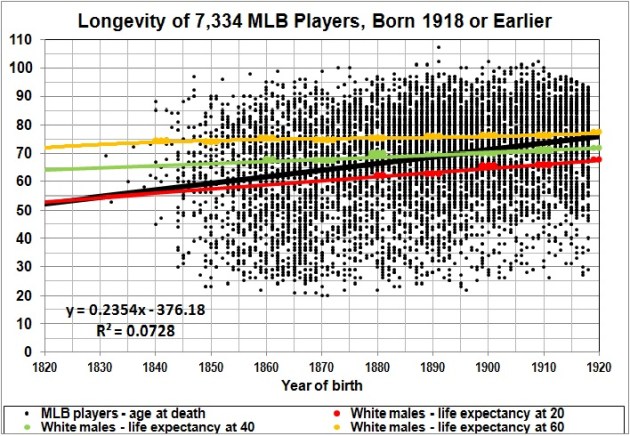
What about the longevity of baseball players in relation to that of the population of white males? I derived the following graphs from the Play Index and the table of life expectancies (both linked above):

I chose 1918 as the cutoff point for ballplayers because that is the last year in the sample of 112 conductors. (As of today, only 15 of the thousands of players born in 1918 or earlier survive** — not enough to affect the comparison.) Before I bring in the conductors, I want to point out the positive trend for longevity among ballplayers (indicated by the heavy black line), especially in relation to the trend for white, 20-year old males. The linear fit, though weak, is statistically robust, and it reflects the long, upward rise in ballplayers’ longevity that is evident in the scatter plot.

I now add conductors to the mix:

For the period covered by the statistics (birth years from 1825 through 1918), conductors enjoyed a modest and significantly insignificant increase in longevity…. By 1918, ballplayers had almost caught up with conductors. The trends suggest that, on average, today’s MLB players can expect to live longer than today’s conductors. Conductors, nevertheless, seem destined to live longer than their contemporaries in the population at large, but not because they (conductors) wave their arms a lot.

Here is my take on all of this: Conductors [and] baseball players … (among members of other identifiable groups) tend to be long-lived because they tend to be physically and mentally vigorous, to begin with. Conductors must possess stamina and intelligence to do what they do…. And, contrary to the popular view of athletes as “dumb,” they are not (as a group); in fact, intelligence and good health (a key component of athleticism) are are tightly bound.

Moreover, conductors (who make music) [and] ballplayers (who play a game) … are engaged in occupations that yield what Robert Atlas calls “gratifying stress.” And, as persons who usually enjoy above-average incomes, they are likely to enjoy better diets and better health-care than most of their contemporaries.

I conclude that occupation — conducting, playing professional baseball, etc. — is a function of the main influences on longevity — mental and physical robustness — and not the other way around. Occupation influences longevity only to the extent that increases it (at the margin) by bestowing “gratifying stress” and/or material rewards, or reduces it (at the margin) by bestowing “frustrating stress” and/or exposure to health-or life-threatening conditions.

Professional actors would seem to have much in common with ballplayers and conductors. They perform for the public, and the not-insignificant mental and physical demands of acting are met with varying degrees of recognition, adulation, and disapproval by their peers and the public. So, it would seem that actors (in general) ought to possess the mental and physical prerequisites of long life, and that “gratifying stress” might add to their longevity. Further, successful actors — by virtue of above-average earnings — should enjoy better diets and health-care than their contemporaries among the general public.

Perhaps the most prominent actors and actresses (to revert to “sexist” terminology) are those who have been nominated for an Academy Award as best in a leading or supporting role. I obtained the names of Oscar-nominated actors and actresses with this search tool, which is provided at the website of the Academy of Motion Picture Arts and Sciences. Search results indicate which of the actors and actresses are deceased. I obtained dates of birth and death from the Internet Movie Database. For consistency with my analysis of ballplayers and conductors, I limited my data set to deceased actors and actresses who were born in 1918 and earlier years. I included two living actresses — Olivia de Havilland and Joan Fontaine, born in 1916 and 1917, respectively — whose presence in the sample does not introduce a downward bias, given their advanced ages.

The resulting sample consists of 268 actors and actresses — 155 of the former, 113 of the latter — distributed as follows:

  • 54 actresses who received at least one nomination for a leading role (8 of whom also were nominated at least once for a supporting role)
  • 59 actresses who were nominated only for supporting roles
  • 71 actors who received at least one nomination for a leading role (15 of whom also were nominated at least once for a supporting role)
  • 84 actors who were nominated only for supporting roles.

The following graphs compare the longevity of these Oscar nominees (by gender and in total) with (a) the longevity trend for conductors, indicated by the dashed black lines, and (b) the life expectancies of whites at various ages, indicated by the orange, light green, and red lines (dashed for females, solid for males). Data points and trend lines for Oscar nominees are rendered in olive green.

The trend lines for the longevity of Oscar nominees are not statistically significant, but they accurately represent the average longevity of those nominees relative to the longevity of conductors and the life expectancies of whites at ages 20, 40, and 60. Some observations:

  • Oscar-nominated actors and actresses generally live far longer than one would expect of a person who had survived to the entry age for the action profession (probably about 20).
  • The trend for Oscar-nominated actresses is positive and in line with the trend for conductors, but is not rising as rapidly as the life expectancy of females in the population at large.
  • The trend for Oscar-nominated actors certainly is not positive, and may be negative. (More about this, below.)
  • In general, women have gone from living only as long as men (in the mid-1800s) to living significantly longer than men. Is there a “men’s health” issue here?)

On the last point, there is a statistically significant difference in the average ages of actors and actresses in the sample. The “bonus” for being a female is a bit more than 4 years.

Do the added gratification and (presumably) greater income that accompany leading roles have an influence on longevity? The statistical evidence is mixed. A regression on the entire sample yields a weak positive relationship between age at death and the total number of nominations received for leading and supporting roles, and a weak negative relationship between age at death and the number of nominations for leading roles.

As it turns out, those relationships do not hold for the the women in the sample; they are entirely attributable to the men. For the men, every nomination — whether for a leading or supporting role — translates to 1.8 additional years of life, but every nomination for a leading role translates to 2 fewer years of life. On average, the men who were nominated only for supporting roles outlived by almost 4 years the men who were nominated for leading roles, though the longevity trend for supporting actors is slightly negative (but not significantly so).

It seems that men who rise to the top of the film-acting profession are more likely than their less-favored peers to succumb to diseases that shorten lives: alcoholism, heart conditions, cancers, and so on. It may be that “driven” leading men are less able to cope with stress than supporting actors — and actresses.

Whatever the case, prominent film actors and actresses join ballplayers and conductors as members of a profession that requires the prerequisites of long life: mental and physical vigor. But the longevity trends among those actors and actresses — especially among the actors — suggest that the negative stresses of their profession have, with time, blunted the advantages of high income. As a result, when it comes to longevity, the general public is gaining on the stars.

Legislating Morality (II)

Donald Boudreaux is co-proprietor of Cafe Hayek. I agree with him on almost everything (defense being the notable exception), but I can’t swallow this:

Too bad that too few people realize – as does the Rev. Robertson today [regarding marijuana], and as did Mr. Rockefeller 80 years ago [regarding alcohol] – that government cannot prohibit private behaviors without unleashing consequences far worse than those of the prohibited behaviors themselves.

That’s a too-sweeping statement. Does the “prohibition” of theft and murder unleash consequences “far worse than those of the prohibited behaviors”? I don’t think so.

On the contrary, the “prohibition” by statute and ordinance of direct harms to life, liberty, and property enables the state to perform one of its two legitimate functions, which is to punish those harms and thereby deter their commission (at least partially). (The other legitimate function is to defend us from foreign predators.)

Where is the line between legitimate and illegitimate state action properly drawn? That’s a tough question. My general answer is that the state should be authorized to act in defense of long-standing social norms. Those norms used to encompass the last six of the Ten Commandments, which “prohibit” certain interpersonal transgressions: murder, adultery, theft, libel and slander, and covetousness. But under the dispensation of the “liberal” state, murder is not punished timely or adequately, adultery is encouraged (and marriages and families broken) by no-fault divorce laws, libel and slander are commonplace, and “social justice” is covetousness rampant.

I would say that “prohibition” has a rightful place in the maintenance of civil society.

Related posts:
The Principles of Actionable Harm
Line-Drawing and Liberty
Myopic Moaning about the War on Drugs
Saving the Innocent
Facets of Liberty
Crimes against Humanity
Abortion and Logic
Why Stop at the Death Penalty?
The Myth That Same-Sex “Marriage” Causes No Harm
Lock ‘Em Up
Legislating Morality

The Burden of Government

When the state is more than a “night watchman,” its cost and intrusiveness diminish liberty and prosperity. (See this and this, for example.) Thus it has come to this: Government takes far more from productive Americans than it returns to them in the form of protection from foreign and domestic predators.

This point is overlooked by the keepers of national-income accounts. To them, government spending (which properly includes so-called transfer payments) adds to GDP. In fact, it detracts from GDP. It is a tax on the output of the private sector. The following graph indicates the size of the tax and its growth with time.


Sources: See footnote.

Some observations:

  • In 2010, the average output of a private worker was worth $114,000; government confiscated 40 percent of that output, leaving $68,000 in the private sector. (These estimates do not reflect the regulatory burden, which brings the total cost of government to about 50 percent of GDP.)
  • The direct burden of government spending nearly doubled from 1950 to 2010, rising from 23 percent to 40 percent of the average private employee’s output.
  • As indicated by the trend lines, real output per worker rose at the rate of $1,125 a year, but only $645 of each year’s increment remained in the private sector. In other words, government spent 43 percent of every additional dollar’s worth of real output per worker.

*   *   *

Sources:

Estimates of GDP in year 2005 dollars are from the feature “What Was the U.S GDP Then?” at MeasuringWorth.com.

Estimates of government spending (federal, State, and local) are from Statistical Abstracts of the United States, Colonial Times to 1970: Part 2. Series Y 533-566. Federal, State, and Local Government Expenditures, by Function; and the Bureau of Economic Analysis (BEA), Table 3.1. Government Current Receipts and Expenditures (lines 34, 35). The BEA tables are available here.

I estimated private-sector employment by subtracting the number of civilian government employees from the total number of employed persons in the civilian labor force. Government employment figures come from the 2012 Statistical Abstract, Historical Statistics, No. HS–46. Governmental Employment and Payrolls: 1946 to 2001, and the Bureau of Labor Statistics, Series CES9000000001: Employment, Hours, and Earnings from the Current Employment Statistics survey (National), available here. Total civilian employment is from BLS Series LNS12000000, available here.

Not-So-Random Thoughts (I)

Links to the other posts in this occasional series may be found at “Favorite Posts,” just below the list of topics.

Secession

Ilya Somin, writing at The Volokh Conspiracy, on secession:

The US Constitution, of course, is one of many where secession is neither explicitly banned or explicitly permitted. As a result, both critics and defenders of a constitutional right of secession have good arguments for their respective positions. Unlike the preceding Articles of Confederation, the Constitution does not include a Clause stating that the federal union is “perpetual.” While the Articles clearly banned secession, the Constitution is ambiguous on the subject.

Even if state secession is constitutionally permissible, the Confederate secession of 1861 was deeply reprehensible because it was undertaken for the profoundly evil purpose of perpetuating and extending slavery. But not all secession movements have such motives. Some are undertaken for good or at least defensible reasons. In any event, there is nothing inherently contradictory about the idea of a legal secession.

Of course, whether or not a secession is legal, it may be morally justified. Conversely, a legal secession may be morally unjustified, as was the case with the Southern secession. But the history of the Southern secession does not taint the legal and moral grounds for secession. As I say here,

The constitutional contract is a limited grant of power to the central government, for the following main purposes: keeping peace among the States, ensuring uniformity in the rules of inter-State and international commerce, facing the world with a single foreign policy and a national armed force, and assuring the even-handed application of the Constitution and of constitutional laws. That is all.

It is clear that the constitutional contract has been breached. It is clear that the Constitution’s promise to “secure the Blessings of Liberty to ourselves and our Posterity”  has been blighted.

Desperate times require desperate measures. I suggest that we begin at the beginning, with a new Declaration of Independence, and proceed from there to a new Constitution.

Obamacare

In a post at The American, John F. Gaski writes:

On the central issue of ObamaCare’s notorious mandate—i.e., whether it is constitutional for the federal government to compel a consumer purchase—everything hinges on the U.S. Constitution’s Commerce Clause. That element of the Constitution gives the federal government authority to regulate interstate commerce or activities affecting it. So far, so reasonable.

But the crux of the issue is whether forcing Americans to buy healthcare is regulation of commerce in the first place. Opponents note that non-purchase of healthcare should not be considered commerce or commerce-related activity. ObamaCare apologists, including some federal judges, make the remarkable claim that a decision not to purchase qualifies as interstate commerce or activity affecting interstate commerce, the same as a decision to purchase or a purchase itself. But even the non-partisan Congressional Research Service, in its 2009 assessment of likely PPACA constitutionality, acknowledged that Commerce Clause-based federal regulatory authority targets genuine activities that affect interstate commerce, not inactivity.

How to resolve this disagreement? The answer is staring us in the face, but has remained obscure to some lawyers and jurists who cannot quite see the forest for the trees. All you really need to know is what the word “commerce” means. To wit, commerce is “exchange of goods, products, or property . . . ; extended trade” (Britannica World Language Dictionary, 1959); “the buying and selling of goods . . .; trade” (Webster’s New World Dictionary, 1964); “the buying and selling of commodities; trade” (The Merriam-Webster Dictionary, 1974); “interchange of goods or commodities, especially on a large scale . . . ; trade; business” (Dictionary.com, 2012). Uniformly, we see, the definition of commerce involves activity, not just a decision to act, and certainly not a decision to not act. The meaning of the concept of commerce presumes action, and always has. Moreover, even casual philology will confirm that the accepted meaning of “commerce” at the time of the Constitution’s drafting referenced activity, not inactivity, at least as much then as it does now (see C. H. Johnson, William & Mary Bill of Rights Journal, October 2004). In the same way, the Commerce Clause has long been construed to apply to action in or affecting commerce, from the 1824 Gibbons v. Ogden Supreme Court case onward.

I am in complete agreement:

[T]he real issue … comes down to this: Does Congress’s power to regulate interstate commerce extend to “health care” generally, just because some aspects of it involve interstate commerce? In particular, can Congress constitutionally impose the individual mandate under the rubric of the Commerce Clause or the Necessary and Proper Clause?…

It is safe to say that a proper reading of the Constitution, as exemplified in the authoritative opinions excerpted above, yields no authority for Obamacare. That monstrosity — the official, Orwellian title of which is the Patient Protection and Affordable Care Act (PPACA) — attempts to reach an aggregation known as “health care,” without any differentiation between interstate commerce, intrastate commerce, and activities that are part of neither, namely, the choices of individuals with respect to health insurance.

It may be a valid exercise of Congress’s power to regulate actual interstate commerce that touches on the provision of health care. It is not a valid exercise to aggregate everything called “health care” and to regulate it as if it were all within the reach of Congress. When that happens, there is no room left — in “health care” nor, by extension, any other loose aggregation of activities — for State action or individual choice.

In sum, Obamacare is neither a valid regulation of interstate commerce nor necessary and proper to a valid regulation of interstate commerce. It is a governmental seizure of 1/9th of the economy. The individual mandate — which is a central feature of that seizure — is nothing more than coercion. It is no less peremptory than the military draft.

Freedom of Conscience

Yes, Virginia, there is freedom of conscience in Virginia:

A bill that ensures that faith-based adoption agencies in the state of Virginia won’t be forced to place children in households led by same-sex couples has passed both houses of the General Assembly and is heading to the desk of Gov. Robert McDonnell, a supporter of the legislation, who is expected to sign it soon.

Gov. McDonnell and the majorities in the Virginia legislature are standing up for freedom of conscience, which is among the negative rights that is trampled by grants of  “positive rights” (i.e., privileges). These

are the products of presumption — judgments about who is “needy” and “deserving” — and they are bestowed on some by coercing others. These coercions extend not only to the seizure of income and wealth but also to denials of employment (e.g., affirmative action), free speech (e.g., campaign-finance “reform”), freedom of contract (e.g., mandatory recognition of unions), freedom of association (e.g., forced admission of certain groups to private organizations), freedom of conscience (e.g., forced participation in abortions), and on and on.

Income Inequality

Thomas A. Garrett, a sensible economist, says good things about income inequality:

The apparent increase in U.S. income inequality has not escaped the attention of policymakers and social activists who support public policies aimed at reducing income inequality. However, the common measures of income inequality that are derived from the census statistics exaggerate the degree of income inequality in the United States for several reasons. Furthermore, although income inequality is seen as a social ill by many people, it is important to understand that income inequality has many economic benefits and is the result of, and not a detriment to, a well-functioning economy….

…[O]ver time, a significant number of households move to higher positions along the income distribution and a significant number move to lower positions along the income distribution. Common reference to “classes” of people (e.g., the lowest 20 percent, the richest 10 percent) is very misleading because income classes do not contain the same households and people over time….

The unconstrained opportunity for individuals to create value for society, which is reflected by their income, encourages innovation and entrepreneurship. Economic research has documented a positive correlation between entrepreneurship/innovation and overall economic growth.9 A wary eye should be cast on policies that aim to shrink the income distribution by redistributing income from the more productive to the less productive simply for the sake of “fairness.” 10 Redistribution of wealth would increase the costs of entrepreneurship and innovation, with the result being lower overall economic growth for everyone.

I am losing track of the posts in which I have made the same points. See this one and this one, and the posts linked in each of them.

The Left-Libertarian (“Liberal”) Personality vs. Morality

Will Wilkinson, a left-libertarian (i.e., modern “liberal”) if ever there was one, writes about his score on the Big-Five Personality Test:

I score very high in “openness to experience” and worryingly low in “conscientiousness”.

A true libertarian (i.e., a Burkean) would score high on “openness to experience” and high on “conscientiousness” — as I do.

As I have said, differences

between various libertarian camps and between libertarians, Burkean conservatives, yahoo conservatives, “liberals,” and so on — are due as much to differences of temperament as they are to differences in knowledge and intelligence.

But temperament is a reason for political error, not an excuse for it:

[T]he desirability or undesirability of state action has nothing to do with the views of “liberals,” “libertarians,” or any set of pundits, “intellectuals,” “activists,” and seekers of “social justice.” As such, they have no moral standing, which one acquires only by being — and acting as — a member of a cohesive social group with a socially evolved moral code that reflects the lessons of long coexistence. The influence of “intellectuals,” etc., derives not from the quality of their thought or their moral standing but from the influence of their ideas on powerful operatives of the state.

See also:
Libertarianism and Morality
Libertarianism and Morality: A Footnote

Viagra and Logic

From Steven Landsburg:

Ohio State Senator Nina Turner (along with several of her counterparts in other states) has introduced legislation requiring men to undergo a series of humiliating procedures before they can fill their Viagra prescriptions. Here I am confident that Senator Turner is following in the admirable footsteps of Rush Limbaugh, by proposing a policy she doesn’t actually support in order to highlight its symmetry with a policy she finds appalling, namely recent legislation requiring women to undergo a series of humiliating procedures before they can have an abortion….

But is Senator Turner’s analogy a good one? It depends, I think, on the intent of the Ohio abortion law.

There are two possible motivations for that law. Motivation One is paternalistic, proceeding from the assumption that women will make poor choices about abortion and that we do them a favor when we discourage them. If that’s indeed the motivation, then Senator Turner’s analogy is spot-on. If we’re going to assume (with no substantial evidence) that women make poor choices about abortion, why not assume that men make poor choices about erectile dysfunction drugs? If we’re going to arrogate the power to override women’s choices, why not do the same for men?

But Motivation Two is that the legislature believes abortion is ipso facto a bad thing and wants to discourage it in any way possible, without regard to what’s in the best interest of the pregnant woman. If that’s the motivation, then Senator Turner’s analogy becomes much weaker (unless you’re really prepared to argue that erections are ipso facto a bad thing). A perfectly consistent person might fervently oppose this legislation but still consider Senator Turner’s implicit argument a bad one….

… I have the strong impression that Motivation One has been bandied about quite a bit by the proponents of these laws. So I think Senator Turner has got this right, and I admire both her logic and her gumption.

Perhaps Landsburg is trying to atone for his fit of political incorrectness in l’affaire Fluke. In any event, Landsburg has the wrong end of the stick (so to speak).

Motivations One and Two are not, in this case, independent and mutually exclusive, as Landsburg treats them. Motivation Two precedes Motivation One.That is, the motivation for pre-abortion procedures, such as fetal sonograms, is the belief that abortion is ipso facto a bad thing. The intention of legislators who vote to require such procedures is to reduce the number of abortions. (For more about the distinction between motivation and intention, see this letter to the editor of the Orlando Sentinel and a longer discussion in an old post of mine.)

Moreover, requiring men to undergo “a series of … procedures before they can fill their Viagra prescriptions” is not analogous to requiring woment to undergo pre-abortion procedures. In the case of pre-abortion procedures, the intention is to discourage a life-taking event; in the case of pre-Viagra-prescription procedures, the obvious intention is to protest pre-abortion procedures. If you think that the latter is on a moral par with the former, you suffer from an advanced case of pseudo-feminist hysteria.

Nina Turner, call your analyst.

Related posts:
A Useful Precedent
Law, Liberty, and Abortion
Substantive Due Process and the Limits of Privacy
Crimes against Humanity
Abortion and Logic

Our Perfect, Perfect Constitution

See “The Constitution: Myths and Realities“.

Still More about the “Permanent Democrat Majority”

The left likes to claim that the GOP is doomed to be the minority party, in perpetuity; for example:

On April 9, 2009, Emory political scientist Alan Abramowitz published a paper arguing that Obama’s victory “was made possible by long-term changes in the composition of the American electorate, especially the growing voting power of African-Americans, Hispanics, and other nonwhites. As a result of these demographic changes, the Democratic Party enjoys a large advantage over the Republican Party in the size of its electoral base — an advantage that is almost certain to continue growing for the foreseeable future.”

The problem is that such wishful thinking does not square with election results. As I say in “More about the ‘Permanent Democrat Majority’,” there is, if anything, a trend toward the GOP, which began in the 1950s. That statement is followed and supported by several graphs which depict the outcomes of House and Senate elections from 1916 through 2010. You can view the graphs by clicking on the link in the first sentence of the paragraph. (If you cannot follow the preceding instruction, you are probably a Democrat.)

Here is another indicator of the fallacy of the “permanent Democrat majority” thesis:


The Gallup results for 1988-2010 are derived from the first graph in Gallup’s “Democrats’ 2008 Advantage in Party ID Largest Since ’83” and the first graph in Gallup’s “Democratic Party ID Drops in 2010, Tying 22-Year Low.” The Rasmussen results for 2004-2012 are derived from Rasmussen’s “Summary of Party Affiliation” (averages of quarterly statistics for 2004-2011 and averages of January-February statistics for 2012). The congruence of Gallup and Rasmussen estimates indicates the accuracy of Rasmussen’s estimates for 2011-2012.

The trend line (dashed, purple) fits the combined Gallup-Rasmussen estimates of party affiliation. Note that the trend is away from the Democrat Party and toward the Republican Party. Enough said, for now.

Conservatives vs. “Liberals”

David Brooks occasionally writes something with which I agree. For example, in “Hey Mets! I Just Can’t Quit You” (The New York Times, March 8, 2012) he says:

There’s a core American debate between [Jack Kerouac’s] “On the Road” and [Frank Capra’s}“It’s a Wonderful Life.” “On the Road” suggests that happiness is to be found through freedom, wandering and autonomy. “It’s a Wonderful Life” suggests that happiness is found in the lifelong attachments that precede choice. It suggests that restraints can actually be blessings because they lead to connections that are deeper than temporary self-interest.

What Brooks didn’t say, but probably thought, is that “On the Road” is “liberal” and “It’s a Wonderful Life” is “conservative.” For, as Brooks observes in the next paragraph, “happiness research suggests that ‘It’s a Wonderful Life’ is correct and ‘On the Road’ is an illusion.” That’s consistent with a point I make in “Intelligence, Personality, Politics, and Happiness,” namely, that persons of the right (which includes most libertarians) are happier than “liberals.”

But the happiness of persons of the right — and therefore most of the happiness that’s in the air — is threatened by the “liberal” agenda. And most conservatives are hard put to refute that agenda with reasoned argument. Maverick Philosopher explains, in “Why Are Conservatives Inarticulate?“:

Conservatives, by and large, are doers not thinkers, builders,  not scribblers.  They are at home on the terra firma of the concrete particular but at sea in the realm of abstraction.  The know in their dumb inarticulate way that killing infants is a moral outrage but they cannot argue it out with sophistication and nuance in a manner to command the respect of their opponents.  And that’s a serious problem.

To beat the Left we must out-argue them in the ivory towers and out-slug them in the trenches.  Since by Converse Clausewitz  politics is war conducted by other means, the trench-fighters need to employ the same tactics that lefties do: slanders, lies, smears, name-calling, shout-downs, pie-throwing, mockery, derision….

Politics is war and war is ugly.  We could avoid a lot of this nastiness if we adopted federalism and voluntary Balkanization.  But that is not likely to happen: the totalitarian Left won’t allow it.  So I predict things are going to get hot in the coming years.

To paraphrase Barry Goldwater, inarticulateness in the defense of liberty is no virtue.

The intelligentsia of the right — a select group that includes George Will and does not include the likes of O’Reilly and Hannity — must arm themselves to do battle on the left’s terms. I would avoid slanders, lies, and smears, but name-calling, shout-downs, pie-throwing, mockery, and derision are certainly in order — as is the truth about the baneful effects of leftism on its supposed beneficiaries: the poor and (mostly imaginary) downtrodden. Their raison d’être, in the left’s scheme of things, has been to supply the votes that have enabled the left to exert its totalitarian will on all of us.

Related posts:
The Price of Government
Does the Minimum Wage Increase Unemployment?
The Mega-Depression
The Real Burden of Government
The Left
The Illusion of Prosperity and Stability
Society and the State
I Want My Country Back
Estimating the Rahn Curve: Or, How Government Inhibits Economic Growth
Undermining the Free Society
Intelligence, Personality, Politics, and Happiness
“Intellectuals and Society”: A Review
Government vs. Community
The Stagnation Thesis
The Left’s Agenda
The Public-School Swindle
The Evil That Is Done with Good Intentions
The Left and Its Delusions
The Destruction of Society in the Name of “Society”
Externalities and Statism
Taxes: Theft or Duty?
Society and the State
The Spoiled Children of Capitalism
Politics, Sophistry, and the Academy
Subsidizing the Enemies of Liberty
Estimating the Rahn Curve: A Sequel
Are You in the Bubble?
Lay My (Regulatory) Burden Down

Cato, the Kochs, and a Fluke

If you follow the libertarian sector of the blogosphere, as I do, you will have noted the recent dominance of two controversies: the future of Cato Institute and the subsidization of contraceptives. In the matter of Cato, it seems that the Koch brothers want to take control of Cato for the purpose of making it more “relevant” to current political issues, much to the universal dismay of the libertarians commentators whose opinions I have read. In the matter of contraceptives, it seems that the testimony of Sandra Fluke, a Georgetown University law student, has fostered libertarian-conservative agreement in opposition to Ms. Fluke’s whining plea for mandated insurance coverage of contraception (e.g., here and here).

I will not bother to recite the history of the controversies, nor will I try to summarize what various writers have said about them. If you are unfamiliar with either or both of them, start here and here, then follow the links therein. My modest aim is to show how the controversies reveal a link between left-libertarianism and the subsidization of contraceptives.

I therefore turn to Will Wilkinson, a former denizen of Cato who has described himself as a “liberaltarian.” What is a “liberaltarian”? I refer to myself:

In “More Pseudo-Libertarianism,” I say that I must come up with a new name for left-libertarians, inasmuch as they are not really libertarians. Some of them have tried “liberaltarian,” an amalgam of (modern) “liberal” and “libertarian.” To be a “liberaltarian” (with a straight face), one must believe that leftists are willing to abandon their pursuit of all-encompassing government and join left-libertarians in their pursuit of absolute fairness (by whose standards?) in economic and social outcomes. Leftists seek the latter objective, but will never be persuaded to drop the former one.

All of which suggests that  a left-libertarian is really a (witting or unwitting) collaborationist: an intellectual Vichyite or, in the parlance of the 1950s, a fellow traveler or comsymp (communist sympathizer).

Comsymp has a certain ring. Perhaps “libsymp” is what I’m looking for. I’ll give it a try.

Anyhow, the libsymp named Will Wilkinson seems to have a (libsymp-related) grievance against Cato, which is evident in his commentary about the Cato-Koch affair; for example:

Suppose Cato, without changing anything at all about its ideological orientation, were to focus more energy on some issues currently of interest to both groups like AFP [Americans for Prosperity] and groups like, say, the ACLU or Amnesty International? I think there’s a plausible argument that this would lead Cato to deliver greater libertarian bang for its donors’ bucks, while possibly even improving its non-partisan reputation.

Now, I’m not sure I buy this argument. I tend to think that a greater focus on practical political relevance would tend to exert a subtle pressure on Cato’s analysts to take it relatively easy on perceived allies when they do and say things harmful to liberty. Indeed, this pressure already exists, and it wouldn’t be a good idea to increase it, since it’s already biased toward the right. The legacy of right-fusionism has been to desensitize many libertarians to the inherently liberty-limiting aspects of social conservativism, and to reduce many self-described libertarians to acting primarily as cheerleaders for the economic agenda of “free-market” reactionaries….

For folks outside the Beltway, for whom the Cato staff are complete strangers, Cato looks like part of the right, if an odd one. There’s a reason David Boaz [Cato’s executive VP] is always complaining about newspapers identifying Cato as a “conservative” think tank, and it’s not just that David Boaz likes to complain. Just ask yourself how Cato’s work could have been more congenial to the GOP during George W. Bush’s failed attempt to reform Social Security, or during the failed attempt to block Obamacare? Cato obviously already is in the politically-relevant intellectual ammo business. And in actual large-stakes political fights in Washington, Cato is generally on the Republican side. It would not be strange to spot a Catoite at Grover Norquist’s infamous Wednesday morning meetings. Because Cato functions as part of the right.

It’s tempting to think that Cato almost never does anything to help the Democrats largely because it’s just too far to the left of the Democratic Party on foreign policy and civil liberties. Yet Cato is equally far to the “right” of the Republican Party on economic policy, welfare policy, education policy, and lots more. Social Security privatization is a forced savings program. School vouchers and/or education tax credits are taxpayer-funded education. Lower income-tax rates concede the income tax. Again and again Cato finds a way to settle on non-ideal, “second-best” economic, welfare, and education policies, and argue for them in away that provides “ammo” to the right. But it very rarely develops compromising second-best policies on foreign policy or civil liberties that would be of any practical use to dovish or civil-libertarian Democrats. Why not? Why was coming out in favor of gay marriage more controversial at Cato (the state shouldn’t be involved in marriage at all!) than coming out in favor of school vouchers (the state shouldn’t be involved in education at all!)? Why not a bigger institutional push for medical marijuana as a second-best, nose-under-the-tent alternative to outright legalization? The fact is that Cato has so deeply internalized the ethos of the venerable right-fusionist alliance that there is almost no hope of it functioning on the whole in a truly non-partisan way. I think its status-quo reputation reflects that.

I reproduced that much of Wilkinson’s post just to give you an idea of the depth of his animus toward the Cato of Ed Crane‘s making. A particular aspect of Wilkinson’s “indictment” bears on the thesis of this post. It does not take much reading between the lines to detect Wilkinson’s embrace of “positive liberty,” which is the antithesis of liberty. He spells it out more explicitly here:

[F]reedom has a number of meanings, and one of them is “ability to do stuff.”… Persons, natural or legal, are either coerced or they aren’t. Mugged people with fat wallets aren’t coerced or wrongly interfered with more than mugged people with thin wallets. They just lose more money. That conservatives and libertarians always ultimately do treat tax increases as losses of freedom suggests to me that they’re really proponents of positive liberty after all, but haven’t thought the implications through. In that case, they’re right to see growth as a matter of freedom. But then they’re also are quite wrong to think that a well-functioning welfare state isn’t a matter of freedom.

There you have it. Wilkinson — like other left-libertarians — hews to a key tenet of modern “liberalism,” which is that people are not really free unless they have a certain measure of economic wherewithal. The taking of income by taxation, in Wilkinson’s view, is morally equivalent to a lack of income.

This left-libertarian (and “liberal”) view of the world depends on the slippery use of the term “coercion.” The taking of something from a person by force or the threat of force is coercion. Taxation is coercion, and resistance to taxation is not a plea for “positive liberty.” On the other hand, there is no coercion when a person is “forced” to accept a standard of living that is arbitrarily deemed sub-standard simply because that person does not earn enough “to do stuff,” according to the arbiter’s standards of what “stuff” a person needs “to do.”

There is, in sum, no moral distance between the left-libertarian and “liberal” worldviews, both of which favor “positive liberty.” What kind of and how much “positive liberty” should be doled out are merely matters of taste. The likeness of left-libertarianism and “liberalism” reminds me of this famous anecdote:

A man asks a woman if she would be willing to sleep with him if he pays her an exorbitant sum. She replies affirmatively. He then names a paltry amount and asks if she would still be willing to sleep with him for the revised fee. The woman is greatly offended and replies as follows:

She: What kind of woman do you think I am?

He: We’ve already established that. Now we’re just haggling over the price.

Which brings me, at last, to Sandra Fluke, who has established what kind of person she is, and is just haggling over the price.

Related posts:
The Causes of Economic Growth
Positive Rights and Cosmic Justice
A Short Course in Economics
Fascism with a “Friendly” Face
Democracy and Liberty
The Interest-Group Paradox
Addendum to a Short Course in Economics
Utilitarianism, “Liberalism,” and Omniscience
Utilitarianism vs. Liberty
Fascism and the Future of America
The Indivisibility of Economic and Social Liberty
The Constitution: Original Meaning, Corruption, and Restoration
Negative Rights
Negative Rights, Social Norms, and the Constitution
The Devolution of American Politics from Wisdom to Opportunism
The Near-Victory of Communism
Tocqueville’s Prescience
Accountants of the Soul
Invoking Hitler
Rawls Meets Bentham
The Left
Enough of “Social Welfare”
A True Flat Tax
The Case of the Purblind Economist
Youthful Wisdom
The Divine Right of the Majority
Our Enemy, the State
Social Justice
Taxing the Rich
More about Taxing the Rich
Positive Liberty vs. Liberty
More Social Justice
Luck-Egalitarianism and Moral Luck
Nature Is Unfair
Elizabeth Warren Is All Wet
“Occupy Wall Street” and Religion
Merit Goods, Positive Rights, and Cosmic Justice
More about Merit Goods
What Is Bleeding-Heart Libertarianism?
The Morality of Occupying Private Property
In Defense of the 1%

Conducting, Baseball, and Longevity

It seems to be a matter of conventional wisdom that conductors (of musical performances) live longer than most mortals, and that that their above-average longevity something to the fact that the occupation of conducting involves vigorous arm motions. Various writers have looked into the matter of conductors’ longevity, and have come to various conclusions about it. In the late 1970s, for example, a medical doctor named Joseph Atlas published an article on the subject, a news account of which is available here. According to the news story,

Atlas selected a random sampling of 35 major decades symphony leaders and computed their longevity at 73.4 years, compared with 68.5 for the average American male.

Then he arrived at a series of conclusions.

Among them:

– Gratifying, or happy, stress promotes longevity.

– Driving motivation and the sense of fulfillment that comes with world recognition help forestall the ravages of age.

Atlas defines gratifying stress as the opposite of frustrating stress, which is the kind that can lead to coronaries….

…As yet there is no scientific documentation to back him up. His conclusions are hypothetical, he says, “more anecdotal than statistical.”…

…Among the prime examples of longevity, Atlas cites, is Leopold Stokowski, who was active and vital until his death at 95.

“Arturo Toscanini lived an active life to the age of 89, Bruno Walter to 85, Ernest Ansermet to 86, Walter Damrosch to 88, Arthur Fiedler is 84.”

There are problems with Atlas’s analysis, but — at bottom — Atlas is right about the longevity of conductors, and probably right that “gratifying stress” enhances longevity. Whether vigorous arm movement has anything to do with longevity is another matter, to which I will come.

As for the problems with Atlas’s analysis,consider this passage from Robert P. Abelson’s Statistics as Principled Argument (1995):

 The longevity datum on famous orchestral conductors (Atlas, 1978) provides a good example [of a spurious attribution of causality]. With what should the mean age at their deaths, 73.4 years, be compared? With orchestral players? With nonfamous conductors? With the general public?

All of the conductors studied were men, and almost all of them lived in the United States (though born in Europe). The author used the mean life expectancy of males in the U.S. population as the standard of comparison. This was 68.5 years at the time the study was done, so it appears that the conductors enjoyed about a 5-year extension of life and indeed, the author of the study jumped to the conclusion that involvement in the activity of conducting causes longer life. Since the study appeared, others have seized upon it and even elaborated reasons for a causal connection (e.g., as health columnist Brody, 1991, wrote, “it is believed that arm exercise plays a role in the longevity of conductors.”

However, as Carroll (1979) pointed out in a critique of the study, there is a subtle flaw in life-expectancy comparisons: The calculation of average life expectancy includes infant deaths along with those of adults who survive for many years. Because no infant has ever conducted an orchestra, the data from infant mortalities should be excluded from the comparison standard. Well, then, what about teenagers? They also are much too young to take over a major orchestra, so their deaths should also be excluded from the general average. Carroll argued that an appropriate cutoff age for the comparison group is at least 32 years old, an estimate of the average age of appointment to a first orchestral conducting post. The mean life expectancy among U.S. males who have already reached the age of 32 is 72.0 years, so the relative advantage, if any, of being in the famous conductor category is much smaller than suggested by the previous, flawed comparison. (p.4, quoted here)

But the comparison is not as flawed as Abelson makes it out to be. Consider the excerpts of an talk given in 2005 by Jeremiah A. Barondess, M.D., then president of the New York Academy of Medicine:

I have had more than a glancing interest in this subject [longevity] for a long time. I was first attracted to it many years ago when I came across a squib in the newspaper to the effect that Leopold Stokowski, then about 90 years old, had been the subject of a complaint to the authorities by a young woman whom he had pinched. Morals aside, I thought the act reflected a certain energy on Stokowski’s part, and I found myself led into a rumination about the apparent vigor, and then the differential longevity of symphonic conductors. Stokowski, as it turned out, lived for 95 years, and gave his last concert at the age of 93 at the Vence Festival in France. Toscanini lived to be 90, Sir Thomas Beecham 83, and Eugene Ormandy 86. The more general question that emerged for me had to do with who, in any frame of life, lives a long time, and why. And, if the posit about symphonic conductors was correct, what was it about them or their activities that was operational?

Was it the music? There is some evidence that the right side of the brain is more involved in processing music than the left, and blood flow studies have shown that the same areas of the brain that respond to euphoria-inducing stimuli like food, sex and some drugs also respond to stimulating music. How this might have to do with longevity is admittedly obscure; connections between pleasure and longevity have not been clearly established….

In any case, to return to symphonic conductors, the fact that that the sample was small and hardly random didn’t deter me much. Maybe it was just the successful ones who lived a long time. Maybe it was the music that did it. Maybe, if symphonic conductors really had preternatural longevity, it had something to do with waving their arms so much. That idea really intrigued me…. First of all, it’s plain that when people run they also move their arms a lot, so even if running is good for you, you may be able to get the same effect a lot more efficiently. And notice that arm waving is a form of upper body aerobic exercise, so the arms have a claim along that line as well, and, in any case, I found the idea that it might be better to play a little Mozart or Shostakovich and wave your arms in time with it much more congenial. Finally, in the case of symphonic conducting, an enormous amount of cognitive activity is involved, another element that has been linked to longevity.

Ultimately I felt more or less requited when I discovered a paper by Leonard Hayflick citing a MetLife study that involved 437 active and former conductors of major regional and community symphonies. The study started in 1956 and ended in 1975 when 118 of them had died, more than 20% at age 80 or older. The death rate for the entire group was 38% below that of the general population, and for conductors aged 50 to 59, a decade when stress and responsibilities are at their peak, the death rate was 56% less than that of the general population. I was somewhat disconcerted by a nearly simultaneous MetLife study that showed that corporate executives enjoyed longevity similar to that of orchestra conductors, punching a hole in the arm waving theory, though possibly not a definitive hole, since the study did not control for arm waving among the executives.

In any case, the conducting and arm waving thing had me hooked. The next thought, if you’ll forgive the expression, was that it might be interesting to compare longevity among baseball players who spent years in positions that involved a lot of throwing, and to compare them with those whose positions called for infrequent throwing. I tried to recruit to this question a bright young man who was taking a fellowship in general medicine with me, and he seemed interested. Accordingly (this was before every statistic in the world was available online, in fact before anything was available online), I provided him with the Encyclopedia of Baseball, thinking he could do the necessary with it. It contained data on everyone who had ever played professional baseball, the teams, the years and the positions played. The task proved too daunting for my young colleague, and it fell by the wayside under the pressure of other responsibilities, but, as evidence the idea wasn’t uniquely quirky, in 1988 a group at the University of Alabama published an article on the mortality experience of major league baseball players, in the New England Journal of Medicine. They assembled a cohort that included all players who had played their first games for a major league team in the United States between 1911 and 1915 and who survived at least until 1925. They had a cohort of 985 players to analyze, and successfully acquired follow-up information on 958 of them. Their average age at death was 70.7 years, the average year 1960. Infielders had the lowest overall mortality rate and catchers the highest; the differences were not statistically significant. Grouping all infielders may have blunted the study; it might have been better to compare first basemen, say, who throw relatively little, with pitchers or short stops. But there was an inverse association between standardized mortality ratios for the groups and the length of the player’s career; and being a baseball player in fact conferred a slight protective effect against death, with the cohort having only 94% of the deaths expected. It was most interesting to me that the data suggested that players who performed the best lived the longest, a fact that should bring some comfort to the accomplished people in this room. But my arm waving theory was not supported, at least by the gross categories established within the cohort. (“How to Live a Long Time: Facts, Factoids, and Descants,” Transactions of the American Clinical and Climatological Association, 116: 77–89)

It seems indisputable, based on the statistics cited by Barondess, that conductors and baseball players tend to outlive their peers. This leads to two questions: By how much do conductors and baseball players outlive their peers, and why do they and others, like corporate executives, outlive them? As Barondess suggests, the answer is not vigorous arm movement. If it were the answer, one would expect pitchers be longer-lived than other baseball players, and that is not the case.

But I am getting ahead of myself. Before considering what factors might yield a long life-span, I will present some statistics about conductors and baseball players.

I compiled a list of 152 conductors born after 1800 and before 1930 who are prominent enough to have Wikipedia entries. I obtained names of candidates for the list from this page at a site known as knowledgerush (which displays obnoxious banner ads), and from two lists at Wikipedia (one of 19th century conductors, the other of 20th century conductors). Of the 152 conductors, 18 are still living. The earliest year of birth of a living conductor is 1919. I therefore focused on the 112 conductors who were born in 1918 or earlier,* inasmuch as the inclusion of conductors born after 1918 (among them 18 living ones) would bias the analysis by understating the longevity of conductors born after 1918. Here is a plot of the 112 conductors’ ages at death, by year of birth:

The linear relationship between age at death and year of birth (dashed line) is statistically insignificant, but it roughly parallels the rising trend of life expectancies for white males aged 40 (the green line). (I used life expectancies for white, American males, given here, because there are no non-whites or females in the sample of 112 conductors.) In words, a person who — like almost everyone in the sample — had become a conductor by the age of 40 was very likely to outlive the general run of 40-year old white males, and to do so by a wide margin. By 1918, that margin had shrunk to about 6 years, but it was still large enough to say that conductors enjoyed unusually long lives. The trend line, however weak statistically, suggests that conductors will continue to enjoy unusually long lives.

But, as I have said, arm-waving probably is not the key to conductors’ long lives. The evidence for that assertion is found in an analysis of the longevity of baseball players. Using the Play Index (subscription) tool at Baseball-Reference.com, I compiled lists of deceased major-league players who either pitched at least 1,000 innings or played in at least 1,000 games in one of the following positions or groups of positions: pitcher, catcher, second base-third base-shortstop, first base-outfiield. I chose those groupings because pitchers use their arms intensely and often every few games; catchers use their arms somewhat less intensely than pitchers, but more often than other players; the second base-third base-shortstop positions involve less intense and frequent arm motions than pitching and catching, but more frequent (if not more intense) than the first base-outfield positions.

The total number of players in the sample is 1,039, broken down as follows: 592 pitchers; 41 catchers; 178 players at second, third, or short; and 228 players at first or outfield. A regression on age at death yields the following:

Age at death = 57.1 + 1.02 x number of seasons in major-league baseball – 0.004 x number of games played + 6.05 if played primarily (at least 90% of games) at 2b, 3b, or SS + 5.17 if played primarily at 1b or OF + 2.90 if played primarily at catcher.

The P-values on the intercept and coefficients are 1.7E-178,  7.89E-12, 0.05, 0.02, 0.05, and 0.33, respectively

What about pitchers? The positive coefficients on the non-pitching positions imply a negative coefficient on “pitcher.” The correlation between “pitcher” and “age at death” is negative and significant at better than the 1-percent level. The difference between the average age of pitchers at death (68.4 years) and the average age of other players at death (71.3 years) is statistically significant at the 1-percent level.

In sum, pitchers do not live as long as other players. And catchers, though they live longer than pitchers, do not live as long as other non-pitchers. So much for the idea that longevity is positively related to and perhaps abetted by vigorous and frequent arm motion.

What about the longevity of baseball players in relation to that of the population of white males? I derived the following graphs from the Play Index and the table of life expectancies (both linked above):

I chose 1918 as the cutoff point for ballplayers because that is the last year in the sample of 112 conductors. (As of today, only 15 of the thousands of players born in 1918 or earlier survive** — not enough to affect the comparison.) Before I bring in the conductors, I want to point out the positive trend for longevity among ballplayers (indicated by the heavy black line), especially in relation to the trend for white, 20-year old males. The linear fit, though weak, is statistically robust, and it reflects the long, upward rise in ballplayers’ longevity that is evident in the scatter plot.

I now add conductors to the mix:

For the period covered by the statistics (birth years from 1825 through 1918), conductors enjoyed a modest and significantly insignificant increase in longevity, indicated by the dashed black line. By 1918, ballplayers had almost caught up with conductors. The trends suggest that, on average, today’s MLB players can expect to live longer than today’s conductors. Conductors, nevertheless, seem destined to live longer than their contemporaries in the population at large, but not because they (conductors) wave their arms a lot.

If the secret of a long life is not a lot of arm-waving, what is it? I return to Dr. Barondess:

[W]e’ve heard for years that the best way to live a long time is to pick long-lived parents, and there is increasing evidence that the pace of aging is to a significant degree genetically determined, but environmental influences and personal behaviors are clearly also of great importance. Scandinavian studies have calculated the heritability of average life expectancy to be 20 to 30%, with environmental differences accounting for at least 70% of variation in age at death among twins. And studies of 7th Day Adventists suggest that optimizing health related behaviors could yield up to 25 years of good health beyond age 60 with a compression of morbidity toward the end of life. The authors of that study suggested that when it comes to aging well there is no such thing as the anti-aging industry’s free lunch. I think a better suggestion might be that a really good anti-aging maneuver is no lunch, in light of other studies connecting undereating with extension of life expectancy….

There are some data connecting a specific region on chromosome 4 to the longevity of centenarians and nonagenerians, and a number of longevity genes have been discovered in yeasts, worms and fruit flies. So apparently there are gerontogenes, or longevity-enabling genes, and the genetic contribution to longevity is being investigated with increasing enthusiasm….

There’s been a good deal of research activity, and perhaps even more in the public prints in recent years, with relation to diet and longevity, especially caloric restriction. These effects were first demonstrated in the 1930s, when it was shown that laboratory rats on limited diets live about 40% longer than normal and are resistant to many chronic diseases typical of aging. These studies have been replicated in yeasts, fruit flies, nematodes, fish, spiders and mice, and there are hints that the effect may also hold true for primates. Recent research on the mechanisms underlying these phenomena has shown that the effect of caloric restriction is tied to genetic factors….

Numerous mechanisms have been suggested without great clarification to this point, but it does appear that life lengthening through caloric restriction is not primarily related to retardation of disease processes, but rather to slowing of primary aging processes, and this is related to restriction of calories rather than specific nutrients….

On the other hand, specific nutrients may impact disease processes themselves…. One study suggested that pizza intake had the potential to reduce cardiovascular risk, presumably because of the tomato sauce component, and despite the cheese.

A number of other foodstuffs have been thought to enhance health prospects, including nuts, for their resveratrol content, organo-sulfur compounds in garlic and onions, and various carotenes. Cocoa, flavanol rich, is thought to be good for you; the makers of Mars Bars are working hard on this. So are blueberries, high in antioxidants, as are raspberries, cranberries and strawberries….

One study from Rome considered alcohol consumption and its effect on longevity. The study suggested that drinking 4 to 7 drinks per day, roughly 63 grams of alcohol, a dose some might think heroic, led to a two-year edge in life expectancy, but drinking more than 10 drinks was negatively associated with longevity. These drinks were 97% wine, primarily red, high in resveratrol content. Other studies have suggested that 250 to 500 cc. of red wine a day is associated with a diminished risk of macular degeneration, Alzheimer’s disease and cognitive deficits….

Several studies … have found that social networks among humans are important predictors of longevity, including participation in formal organizations, contact with friends or relatives, and so forth. In one study of African American women aged 55 to 96, those who were extremely isolated in a social sense were more than three times as likely to die within a five-year period of observation, an impact unaffected by the use of community senior services. A search for the effects on longevity of living as a recluse or a hermit produced no results, I imagine because follow-up would be difficult, but on the other hand a number of additional papers about socialization in humans turned up. One suggested that providing social support may be more beneficial than receiving it. Mortality was significantly reduced for individuals reported to be providers of support to friends, relatives and neighbors, and emotional support for spouses.

In a study from Columbia University, the impact of marital closeness on survival was examined in 305 older couples. Closeness was defined as naming one’s spouse as a confidant or as a source of emotional support, versus not naming, or being named by the spouse on at least one of the two dimensions, versus not being named. Husbands who were named by their wives as confidants or supports, but did not name them, were least likely to have died after six years. Compared with them, husbands who were not named by their wives as a confidant or source of social support, or did not name their wives, were from 3.3 to 4.7 times more likely to be dead. The results among wives showed a similar pattern, but a weaker one….

Studies of personal histories have illuminated some personality factors that may bear on longevity. One important investigation is the Nun Study, organized by David Snowden in 1986. In this longitudinal study of aging and dementia, he was looking at a convent community of nuns aged 74 to 106, retired from careers in a variety of sites, many of them as teachers. They tended not to drink or smoke, had similar diets, income, and quality of health care and had an active social network. Snowden examined short biographical notes written at an average age of 22, on entry into the order. These suggested that positive emotions in early life were associated with longevity, with a difference of nearly 7 years between the highest and lowest quartiles of positive emotion sentences. That is, positive emotional content in early life autobiographies was strongly associated with longevity six decades later. There was some sense that positive response patterns, or more rapid return to a positive outlook after negative events, serves to dampen the physiologic sequelae of emotional arousal, such as heart rate and blood pressure changes, and presumably also hormonal responses. In a word it’s best to be cheery, or at least positive.

Further to the effect of optimism and pessimism as risk factors for disease, Peterson and his group studied questionnaires filled out by 99 Harvard graduates in the classes of 1942 to ’44, when they were about 25 years of age, and then determined physical health from ages 30 to 60 as measured by examination by physicians. Pessimistic explanatory style, the belief that bad events are caused by stable, global or internal personal factors, predicted poor health at ages 45 through 60 even when physical and mental health at age 25 were controlled for, across an array of diseases ranging from gout to diabetes, kidney stones to hypertension. The correlations increased across the life span, from age 30 to 60.

With regard to the impact of cognitive activity on optimism, health, and possibly life expectancy, there is good reason to believe, as Guy McKhann and Marilyn Albert have pointed out, that the phrase “use it or lose it” applies. Maintaining one’s mental abilities is made easier through a variety of activities, including reading, doing crossword puzzles, learning ballroom dancing, using a computer and going to lectures or concerts. Studies have shown that in rats an enriched environment that includes exercise, toys, mirrors, tunnels and interaction with other rats strengthens connections between cells in the hippocampus and even increases the rate at which new cells are born. The idea of rat fraternization may be counterintuitive, but somewhere here there may be a link with the academic parable expressed in prior talks by Dick Johns on how to swim with sharks. Fraternization with rats, has, I think, a weaker set of academic projections, but I pass it along for what it’s worth.

Related to the last point is evidence of

[a] strong inverse correlation between early life intelligence and mortality … across different populations, in different countries, and in different epochs.”[3][4][5] Various explanations for these findings have been proposed:

“First, …intelligence is associated with more education, and thereafter with more professional occupations that might place the person in healthier environments. …Second, people with higher intelligence might engage in more healthy behaviours. …Third, mental test scores from early life might act as a record of insults to the brain that have occurred before that date. …Fourth, mental test scores obtained in youth might be an indicator of a well-put-together system. It is hypothesized that a well-wired body is more able to respond effectively to environmental insults…”[5]

A study of one million Swedish men found showed “a strong link between cognitive ability and the risk of death.”[6][7][8][9]

People with higher IQ test scores tend to be less likely to smoke or drink alcohol heavily. They also eat better diets, and they are more physically active. So they have a range of better behaviours that may partly explain their lower mortality risk.—-Dr. David Batty[7]

A similar study of 4,289 former US soldiers showed a similar relationship between IQ and mortality.[7][8][10]

The strong correlation between intelligence and mortality has raised questions as to how better public education could delay mortality.[11]

There is a known inverse correlation between socioeconomic position and health. A 2006 study found that controlling for IQ caused a marked reduction in this association.[12]

Research in Scotland has shown that a 15-point lower IQ meant people had a fifth less chance of seeing their 76th birthday, while those with a 30-point disadvantage were 37% less likely than those with a higher IQ to live that long.[13]

Here is my take on all of this: Conductors, baseball players, and corporate executives (among members of other identifiable groups) tend to be long-lived because they tend to be physically and mentally vigorous, to begin with. Conductors must possess stamina and intelligence to do what they do.To rise in the corporate world, one must be capable of working long hours, putting up with a lot of stress, and coping with many complex issues. And, contrary to the popular view of athletes as “dumb,” they are not (as a group); in fact, intelligence and good health (a key component of athleticism) are are tightly bound.

Moreover, conductors (who make music), ballplayers (who play a game) and corporate executives (who attain high status and high incomes) are engaged in occupations that yield what Robert Atlas calls “gratifying stress.” And, as persons who usually enjoy above-average incomes, they are likely to enjoy better diets and better health-care than most of their contemporaries.

The finding that pitchers do not live as long as other ballplayers supports the view that “gratifying stress” fosters longevity, whereas “frustrating stress” may shorten a person’s life. Pitchers, uniquely among ballplayers, are credited or charged with the wins and losses of their teams. And pitchers, as a group, win only half the time — an ungratifying outcome. Further, pitchers with consistently bad records do not last long in the big leagues, and end their careers having won less than 50 percent of the games for which they were held responsible (i.e., with a won-lost record below .500). Accordingly, more pitchers end their careers with losing records than with winning records: In the history of the major leagues, from 1871 through 2011, there have been 6,744 pitchers with a career record of at least one loss; only 29 percent of them (1,935) had a career won-lost record better than .500.

I conclude that occupation — conducting, playing professional baseball, etc. — is a function of the main influences on longevity — mental and physical robustness — and not the other way around. Occupation influences longevity only to the extent that increases it (at the margin) by bestowing “gratifying stress” and/or material rewards, or reduces it (at the margin) by bestowing “frustrating stress” and/or exposure to health-or life-threatening conditions.

*   *   *

The footnotes are below the fold.
Continue reading “Conducting, Baseball, and Longevity”

Defense as an Investment in Liberty and Prosperity

Drawing on GDP statistics provided by the Bureau of Economic Analysis, I constructed the following graphs. The red bands indicate years in which U.S. armed forces were fighting wars: WWII, 1942-1945; Korean War 1950-1953; Vietnam War, 1965-1973; Gulf War, 1990-1991; Afghanistan and Iraq, 2002-2011.


Source: Derived from Table 1.1.5, Gross Domestic Product (then-year dollars).


Source: Obtained by averaging two estimates. The first is a top-down estimate, which applies the percentages displayed in the preceding graph to the estimate of constant-dollar GDP given in Table 1.1.6, Real Gross Domestic Product, Chained Dollars. The second is to construct a chained 2005 dollar estimate of defense spending from Tables A, B, C, and D, which cover overlapping periods (1929-1947, 1942-1962, 1962-1982, 1977-1997, and 1995-2011), and to divide the resulting “double chained” values by the top-line estimate of GDP given in table 1.1.6.

The point of the second graph is that defense spending should not be thought of as a “share” of GDP but as the cost of protecting Americans and their interests from the world’s evil-doers, who are always in plentiful supply. If the real cost of defending America in the 21st century approaches the real cost of fighting World War II, so what? The threats are what they are; today’s enemies (actual and potential) have access to weapons and technologies that far outstrip the relatively primitive weapons and technologies used in WWII.

Moreover, critics of defense spending to the contrary, the object of defense is not to have “just enough” for a “fair fight”; the object of defense is to deter enemies and, if deterrence fails, to defeat them. It is ludicrous to say — as some pundits have said — that the U.S. has “too many” aircraft carriers because their number exceeds the number owned by the rest of the world’s navies. That is a plus, not a minus; Americans should take comfort in such superiority and demand it across the board. America’s enemies do no discriminate between left-wing appeasers and right-wing zealots; we are all targets.

In any event, here are my “takeaways” from the graphs and the history that lies behind them:

Capsule history
Low defense spending and anti-war fervor in the 1930s German and Japanese aggression lead to WWII.
Hasty demobilization after WWII N. Korea invades S. Korea after U.S. declares “lack of interest.” The Korean War is a proxy war for the USSR, which finds U.S. wanting in resolve.
Buildup of strategic forces in the 1950s Nuclear war does not ensue.
Buildup of conventional forces in the early 1960s Domestic opposition leads to a faltering (and eventually failed) U.S. effort to counter Communist aggression in Vietnam.
Post-Vietnam drawdown in the 1970s, followed by Reagan buildup in the 1980s Nuclear war does not ensue. Conventional superiority enables the U.S. to score an easy win in the defense of Kuwaiti oil from Saddam (who, mistakenly, is allowed to remain in power).
Post-Gulf War drawdown in the 1990s (Clinton balances budget on the back of defense.) Drawdown and other signs of U.S. weakness encourage 9/11; subsequent campaigns to stabilize hotbed of terrorism hindered by domestic opposition.
Lessons
Incorrect: Correct:
The availability of armed force leads to war. The appearance of weakness encourages aggressors.
The U.S. is a war-like nation. The U.S. reluctantly prepares for and fights wars.
Defense is a huge drain on the economy. Defense protects Americans and their vital overseas economic interests. As the economy grows, peacetime preparedness and regional wars take an increasingly smaller share of GDP.
Defense takes money away from vital social services. Defense is the most vital of social services; it keeps Americans alive, free, and prosperous.

Related posts:
Libertarians and the Common Defense
Libertarianism and Pre-emptive War: Part I
An Aside about Libertarianism and the War
Right On! For Libertarian Hawks Only
Conservative Criticism of the War on Terror
Why Sovereignty?
Understanding Libertarian Hawks
More about Libertarian Hawks and Doves
Defense, Anarcho-Capitalist Style
War Can Be the Answer
Getting It All Wrong about the Risk of Terrorism
Why We Fight
Getting It Almost Right about Iraq
Philosophical Obtuseness
But Wouldn’t Warlords Take Over?
Sorting Out the Libertarian Hawks and Doves
Now, Let’s Talk About Something Else
Shall We All Hang Separately?
Foxhole Rats
Foxhole Rats, Redux
Know Thine Enemy
September 11: A Remembrance
September 11: A Postscript for “Peace Lovers”
The Faces of Appeasement
Libertarianism and Preemptive War: Part II
Torture and Morality
Give Me Liberty or Give Me Non-Aggression?
We Have Met the Enemy . . .
My View of Warlordism, Seconded
Whose Liberties Are We Fighting For?
The Constitution and Warrantless “Eavesdropping”
NSA “Eavesdropping”: The Last Word (from Me)
Privacy, Security, and Electronic Surveillance
Privacy: Variations on the Theme of Liberty
Words for the Unwise
More Foxhole Rats
The Fatal Naïveté of Anarcho-Libertarianism
Final (?) Words about Preemption and the Constitution
Anarcho-Libertarian “Stretching”
Recommended Reading about NSA’s Surveillance Program
Riots, Culture, and the Final Showdown
A Rant about Torture
More Final (?) Words about Preemption and the Constitution
QandO Saved Me the Trouble
What If We Lose?
A Footnote about “Eavesdropping”
Thomas Woods and War
More than Enough Amateur Critics
Moussaoui and “White Guilt”
Jihad in Canada
In Defense of Ann Coulter
In Which I Reply to the Executive Editor of The New York Times
Post-Americans and Their Progeny
“Peace for Our Time”
Anti-Bush or Pro-Treason?
“Proportionate Response” in Perspective
Parsing Peace
Taking on Torture
Conspiracy Theorists’ Cousins
Not Enough Boots
Defense as the Ultimate Social Service
I Have an Idea
September 11: Five Years On
How to View Defense Spending
Reaching the Limit?
The Best Defense . . .
A Skewed Perspective on Terrorism
Terrorists’ “Rights” and the Military Commissions Act of 2006
More Stupidity from Cato
The Military Commissions Act of 2006
A Critique of Extreme Libertarianism
And Your Point Is?
Anarchistic Balderdash
Not Enough Boots: The Why of It
Blood for Oil

Katie Couric: Post-American
It *Is* the Oil
Here We Go Again
Christmas in Iran: Foreign Affairs According to Planet Rockwell
Torture, Revisited
Waterboarding, Torture, and Defense
9/11 Plotters and the Death Penalty
Cato’s Usual Casuistry on Matters of War and Peace
The Media, the Left, and War
Torture
September 11: A Remembrance
Getting It Wrong and Right about Iran
The “Predator War” and Self-Defense
The National Psyche and Foreign Wars
Delusions of Preparedness
Inside-Outside
A Moralist’s Moral Blindness
A Grand Strategy for the United States
The Folly of Pacifism
Why We Should (and Should Not) Fight
Rating America’s Wars
Transnationalism and National Defense
The Next 9/11?
The Folly of Pacifism, Again
September 20, 2001: Hillary Clinton Signals the End of “Unity”
NEVER FORGIVE, NEVER FORGET, NEVER RELENT!
Patience as a Tool of Strategy
The War on Terror, As It Should Have Been Fought
The Cuban Missile Crisis, Revisited
Preemptive War
Preemptive War and Iran
Some Thoughts and Questions about Preemptive War