Irrational Rationality

Economists have given “rationality” a bad name. Mario Rizzo explains:

[T]he axioms of rational choice were supposed to shed light on how people actually made choices. Then a sleight of hand occurred. It was claimed that they shed light on how rational individuals would choose – without addressing the issue of whether people were in fact rational in the sense of the axioms. Finally, it was alleged – in the face of empirical evidence that people often did not choose rationally – that the axioms defined the norms of choice. They told us how rational individuals should choose. More than that. Since being rational is taken as “good,” they show us how people should behave – full stop….

The behavioralists may well be correct that people do not act in accordance with … rationality axioms. But they are surely wrong in claiming that they ought to behave in this way. The problem is not with deficient individuals. It is a problem of deficient rationality standards.

It is an old story. Pseudo-scientific economists, suffering from physics envy, strive to reduce the complexity of human behavior to simple-minded metrics, according to which they judge human rationality. When humans fail to hew to the simple-minded preferences of economistic thinkers, it is evident (to those thinkers) that humans must be nudged toward “doing the right thing.”

When economists cross the line from theorizing about economic behavior to judging it, they put themselves on the same low plain as “liberals.” The latter, at least, are honest about wanting their own way … just because … and do not resort to cheap, pseudo-scientific tricks. They simply enforce their preferences through statutes and regulations. Why “nudge” when you can coerce?

Related posts:
Why I Don’t Hang Around with Economists
The Rationality Fallacy
Greed, Cosmic Justice, and Social Welfare
Positive Rights and Cosmic Justice
Inventing “Liberalism”
Utilitarianism, “Liberalism,” and Omniscience
Utilitarianism vs. Liberty
Beware of Libertarian Paternalists
Landsburg Is Half-Right
Negative Rights, Social Norms, and the Constitution
Rights, Liberty, the Golden Rule, and the Legitimate State
The Mind of a Paternalist
Accountants of the Soul
Physics Envy
Rawls Meets Bentham
Enough of “Social Welfare”
The Case of the Purblind Economist
The Arrogance of (Some) Economists
Extreme Economism

Lay My (Regulatory) Burden Down

UPDATE 02/05/17: The website of the Office of the Federal Register has eliminate or very cleverly hidden the source of statistics summarized in the graph below. Alternative sources, as of this date, are here and here.

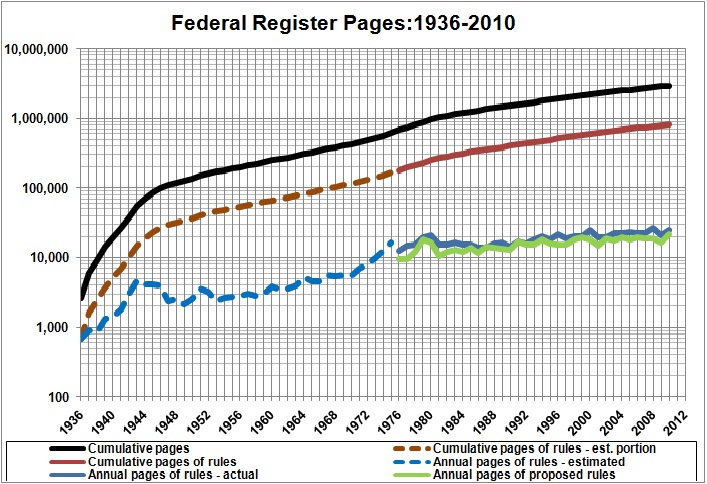
The Office of the Federal Register, undoubtedly proud of its role in the imposition of rules on Americans, publishes a statistical summary of its handiwork, from which I derived the following graph:


Source: Go to OFR page headed Tutorials, History, and Statistics and under Statistics click on XLS. Number of pages of rules for 1936-1975 estimated from the relationship between the number of pages of rules and the total number of pages in the Federal Register for 1976-2010.

Not all of the rules adopted since 1936 are still in effect, of course, but the graph gives a good indication of the growth and weight of the regulatory burden that hampers Americans and their enterprises. Do not take solace in the slower growth of rule-making pages since 1976; the page count continues to rise. Any number greater than zero represents the foreclosure of consumers’ and producers’ options — the further diminution of liberty, in other words.

How bad is it, economically? A report issued under the aegis of the U.S. Small Business Administration (yes, an arm of the central government) concludes that

the annual total cost of all federal regulations in 2008 was $1.752 trillion. Of this amount, the annual direct burden on business is $970 billion. Economic regulations represent the most costly category, with a total cost of $1.236 trillion, and with $618 billion falling initially on business. Environmental regulations represent the second most costly category in terms of total cost ($281 billion), and the cost apportioned to business is $183 billion. Compliance with the federal tax code is the third most costly category ($160 billion), and the cost of occupational safety and health, and homeland security regulations ranks last ($75 billion). (Nicole V. Crain and W. Mark Crain, Lafayette College, “The Impact of Regulatory Costs on Small Firms,” for SBA Office of Advocacy, September 2010, p. 48; cited and summarized on SBA’s website, here)

In other words governmental impositions in 2008 — a regulatory burden of $1.75 trillion and spending of $5.02 trillion — accounted for 47 percent of that year’s GDP ($14.29 trillion, in current dollars). As I have shown in other posts (e.g., here and here) the cumulative effect of governmental impositions is far greater than that.

Related reading: Henry I. Miller, “Red Tape and Pink Slips: Obama’s Imaginary Regulatory Reform,” The American, February 2, 2012

Related posts:
The Price of Government
The Price of Government Redux
The Mega-Depression
Ricardian Equivalence Reconsidered
The Real Burden of Government
Toward a Risk-Free Economy
The Rahn Curve at Work
The Illusion of Prosperity and Stability
The “Forthcoming Financial Collapse”
Estimating the Rahn Curve: Or, How Government Inhibits Economic Growth
The Deficit Commission’s Deficit of Understanding
Undermining the Free Society
The Bowles-Simpson Report
The Bowles-Simpson Band-Aid
Build It and They Will Pay
Government vs. Community
The Stagnation Thesis
America’s Financial Crisis Is Now
Money, Credit, and Economic Fluctuations
A Keynesian Fantasy Land
“Tax Expenditures” Are Not Expenditures
The Keynesian Fallacy and Regime Uncertainty
The Great Recession Is Not Over
Why the “Stimulus” Failed to Stimulate
Regime Uncertainty and the Great Recession
The Real Multiplier
Vulgar Keynesianism and Capitalism
Why Are Interest Rates So Low?
Economic Growth Since World War II
The Commandeered Economy
Estimating the Rahn Curve: A Sequel
The Real Multiplier (II)

Are the Natural Numbers Supernatural?

Steven Landsburg writes:

…It is not true that all complex things emerge by gradual degrees from simpler beginnings. In fact, the most complex thing I’m aware of is the system of natural numbers (0,1,2,3, and all the rest of them) together with the laws of arithmetic. That system did not emerge, by gradual degrees, from simpler beginnings….

…God is unnecessary not because complex things require simple antecedents but because they don’t. That allows the natural numbers to exist with no antecedents at all—and once they exist, all hell (or more precisely all existence) breaks loose: In The Big Questions I’ve explained why I believe the entire Universe is, in a sense, made of mathematics. (“There He Goes Again,” The Big Questions Blog, October 29, 2009)

*   *   *

The existence of the natural numbers explains the existence of everything else. Once you’ve got that degree of complexity, you’ve got structures within structures within structures, and one of those structures is our physical Universe. (If that sounds like gibberish, I hope it’s only because you’re not yet read The Big Questions, that you will rush out and buy a copy, and that all will then be clear.) (“Rock On,” The Big Questions Blog, February 8, 2012)

With regard to the first quotation, I said (on October 29, 2009) that

Landsburg’s assertion about natural numbers (and the laws of arithmetic) is true only if numbers exist independently of human thought, that is, if they are ideal Platonic forms. But where do ideal Platonic forms come from? And if some complex things don’t require antecedents, how does that rule out the existence of God … ?

I admit to having said that without the benefit of reading The Big Questions. I do not plan to buy or borrow the book because I doubt its soundness, given Landsburg’s penchant for wrongheadedness. But (as of today) a relevant portion of the book is available for viewing at Amazon.com. (Click here and scroll to chapter 1, “On What There Is.”) I quote from pages 4 and 6:

…I assume — at the risk of grave error — that the Universe is no mere accident. There must be some reason for it. And if it’s a compelling reason, it should explain not only why the Universe does exist, but why it must.

A good starting point, then, is to ask whether we know of anything — let alone the entire Universe — that not only does exist, but must exist. I think I know one clear answer: Numbers must exist. The laws of arithmetic must exist. Two plus two equals four in any possible universe, and two plus two would equal four even if there were no universe at all….

…Numbers exist, and they exist because they must. Admittedly, I’m being a little vague about what I mean by existence. Clearly numbers don’t exist in exactly the same sense that, say, my dining-room table exists; for one thing, my dining-room table is made of atoms, and numbers are surely not. But not everything that exists is made of atoms. I am quite sure that my hopes and dreams exist, but they’re not made of atoms. The color blue, the theory of relativity, and the idea of a unicorn exist, but none of them is made of atoms.

I am confident that mathematics exists for the same reason that I am confident my hopes and dreams exist: I experience it directly. I believe my dining-room table exists because I can feel it with my hands. I believe numbers, the laws of arithmetic, and (for that matter) the ideal triangles of Euclidean geometry exits because I can “feel” them with my thoughts.

Here is the essence of Landsburg’s case for the existence of numbers and mathematics as ideal forms:

  • Number are not made of atoms.
  • But numbers are real because Landsburg “feels” them with his thoughts.
  • Therefore, numbers are (supernatural) essences which transcend and precede the existence of the physical universe; they exist without God or in lieu of God.

It is unclear to me why Landsburg assumes that numbers do not exist because of God. Nor is it clear to my why his “feeling” about numbers is superior to other persons’ “feelings” about God.

In any event, Landsburg’s “logic,” though superficially plausible, is based on false premises. It is true, but irrelevant, that numbers are not made of atoms. Landsburg’s thoughts, however, are made of atoms. His thoughts are not disembodied essences but chemical excitations of certain neurons in his brain.

It is well known that thoughts do not have to represent external reality. Landsburg mentions unicorns, for example, though he inappropriately lumps them with things that do represent external reality: blue (a manifestation of light waves of a certain frequency range) and the theory of relativity (a construct based on observation of certain aspects of the physical universe). What Landsburg has shown, if he has shown anything, is that numbers and mathematics are — like unicorns — concoctions of the human mind, the workings of which are explicable physical processes.

Why have humans, widely separated in time and space, agreed about numbers and the manipulation of numbers (mathematics)? Specifically, with respect to the natural numbers, why is there agreement that something called “one” or “un” or “ein” (and so on) is followed by something called “two” or “deux” or “zwei,” and so on? And why is there agreement that those numbers, when added, equal something called “three” or “trois” or “drei,” and so on? Is that evidence for the transcendent timelessness of numbers and mathematics, or is it nothing more than descriptive necessity?

By descriptive necessity, I mean that numbering things is just another way of describing them. If there are some oranges on a table, I can say many things about them; for example, they are spheroids, they are orange-colored, they contain juice and (usually) seeds, and their skins are bitter-tasting.

Another thing that I can say about the oranges is that there are a certain number of them — let us say three, in this case. But I can say that only because, by convention, I can count them: one, two, three. And if someone adds an orange to the aggregation, I can count again: one, two, three, four. And, by convention, I can avoid counting a second time by simply adding one (the additional orange) to three (the number originally on the table). Arithmetic is simply a kind of counting, and other mathematical manipulations are, in one way or another, extensions of arithmetic. And they all have their roots in numbering and the manipulation of numbers, which are descriptive processes.

But my ability to count oranges and perform mathematical operations based on counting does not mean that numbers and mathematics are timeless and transcendent. It simply means that I have used some conventions — devised and perfected by other humans over the eons — which enable me to describe certain facets of physical reality. Numbers and mathematics are no more mysterious than other ways of describing things and manipulating information about them. But the information — color, hardness, temperature, number, etc. — simply arises from the nature of the things being described.

Numbers and mathematics — in the hands of persons who are skilled at working with them — can be used to “describe” things that have no known physical counterparts. But  that does not privilege numbers and mathematics any more than it does unicorns or God.

Related posts:
Atheism, Religion, and Science
The Limits of Science
Three Perspectives on Life: A Parable
Beware of Irrational Atheism
The Creation Model
The Thing about Science
Evolution and Religion
Words of Caution for Scientific Dogmatists
Science, Evolution, Religion, and Liberty
Science, Logic, and God
Is “Nothing” Possible?
Debunking “Scientific Objectivity”
Science’s Anti-Scientific Bent
Science, Axioms, and Economics
The Big Bang and Atheism
The Universe . . . Four Possibilities
Einstein, Science, and God
Atheism, Religion, and Science Redux
Pascal’s Wager, Morality, and the State
Evolution as God?
The Greatest Mystery
What Is Truth?
The Improbability of Us
A Digression about Probability and Existence
More about Probability and Existence
Existence and Creation
Probability, Existence, and Creation
The Atheism of the Gaps
Probability, Existence, and Creation: A Footnote
Scientism, Evolution, and the Meaning of Life

Liberty, Negative Rights, and Bleeding Hearts

Liberty rights are represented in the Founders’ trinity of “unalienable Rights“: “Life, Liberty, and the pursuit of Happiness.” These really constitute a unitary right, which I simply call liberty. The liberty right is unitary because liberty (as a separate right) is meaningless without life, and liberty implies the latitude to pursue happiness.

Libertarians, for the most part, think of liberty as the enjoyment of the negative right to be left alone in one’s peaceful pursuits, that is, the right not to be robbed, attacked, murdered, and so on. But in a society or polity that values and enables liberty, the right to be left alone is only half the story.

The right to be left alone is the negative sub-rule of the Golden Rule, a good formulation of which is “One should treat others as one would like others to treat oneself.” That formulation implies a positive sub-rule, which could be stated as “Be kind and charitable to others, and they (or most of them) will be kind and charitable to you.”

The positive sub-rule is prudential, not mandatory. But that does not lessen its importance, for liberty cannot prevail absent widespread observance of the positive sub-rule. Such observance creates the conditions of mutual trust and respect that foster mutual forbearance, that is, leaving others alone in their peaceful pursuits. (For more in this vein, see Richard Epstein’s refutation of the view that libertarianism is all about “me” in “No ‘Sachs Appeal’,” Defining Ideas (a Hoover Institution journal), January 24, 2012.)

Let me be clear about the applicability of the Golden Rule in an ideal libertarian society or polity: Both sub-rules — negative and positive — are to be observed voluntarily. But one of them — the negative sub-rule — may be defended by force. Observance of the positive sub-rule may not be coerced, however, because that would violate the negative sub-rule.

The negative sub-rule must be defended because negative rights will not always be respected, human nature being what it is. On the issue of how to defend negative rights, libertarians split into two camps: anarchists and minarchists. These two camps differ about the necessity of the state, which is an independent entity and not an agent of particular members (or groups of members) of a society or polity.

Anarchistic libertarians maintain that negative rights can and should be defended without the intervention of a state. In the anarchistic view, individuals and groups of individuals can contract with each other about rules of interpersonal behavior, and can empower agents to enforce the rules.

Minarchistic libertarians (or this one, at least) maintain that the existence of agents who are empowered by various members of a society or polity is nothing more than warlordism, wherein might makes right. To say that no one would use force to do more than defend one’s negative rights is to make a patently false claim about human nature. (Anarchists, after all, acknowledge the necessity of self-defense.) Minarchists therefore believe that a state should be created and empowered specifically, and exclusively, for the purpose of defending negative rights. Such a state must be generally accountable to the populace, and it must have no power other than to protect the populace from harm. (For more about anarchists, minarchists, and the inevitability of the state, go here.)

Minarchists, nevertheless, tend toward a superficial view of the state’s minimal role, namely, that the job of the state is to see that everyone is left alone, as long as his pursuits are peaceful. That is, the job of the state is to enforce the negative sub-rule of the Golden Rule. So far, so good. Even an anarchist might go along with the idea of such a state.

But here is the rub. What are peaceful pursuits, that is, pursuits which do not harm others?  Who defines them? It cannot be everyone for himself; A’s peaceful pursuit may be a nuisance (or worse) to B.

In sum, harm cannot be defined willy-nilly by individuals, nor is it the abstraction that most libertarians make it out to be with their simplistic invocation of the “harm principle.” Rather, the definition of harm must reflect broad agreement about the rules of interpersonal behavior: social norms. Those norms are not mere abstractions; they are specific rules about permissible and impermissible acts. (Caution to readers: Do not mistake state-imposed rules for social norms, though some state-imposed rules may reflect social norms.)

Like it or not, evolved social norms constitute the foundation of a libertarian society based on mutual trust and respect. And if those evolved social norms specifically proscribe such “libertarian” causes as abortion and homosexual “marriage,” where does that leave the typical “libertarian”? It leaves him wanting to repudiate or overturn social norms, without regard for the effects of doing so on social comity. (See this and this, for example.)

But the ranks of “libertarians” also number a strange breed, often self-described as left-libertarian.  These “libertarians” actively root for the violation of negative rights in the cause of “social justice.” What is “social justice”? The short answer is that it is whatever anyone wants it to be, but it is never restricted to the enforcement of negative rights. The term “social justice” may be taken confidently as code for the enforcement of positive rights by a coercive state.

Left-libertarians will jump through hoops, turn somersaults, and stand on their heads to deny that they favor the enforcement of positive rights by a coercive state. But they do. A post by Kevin Vallier (one of the Bleeding Heart Libertarians) exemplifies their acrobatics:

Libertarians Great and Small (LGS): At some point in the future a group of committed libertarians establish a libertarian free zone called Libertarian Paradise. In LP, all property is acquired and transferred in line with traditional self-ownership political theory. Deviations from these norms are quickly corrected by private and non-profit legal organizations (call them the Cops).

…Due to LP’s unbridled capitalism, its economy booms, making its inhabitants spectacularly wealthy, so much so that charity easily provides for its poorest citizens.

However, through no one person or group’s deliberate action, prosperity ebbs. Perhaps because of resource depletion, climate change or natural disaster, a class of individuals becomes systematically deprived of basic resources (call them the Small). But while they are regularly hungry, they do not starve. And while they cannot secure many basic health resources, they do not die from easily preventable diseases. However, their poverty substantially sets back their well-being.

But the trouble in LP strikes the best-off as well (call them the Great). They too grow poorer, though they remain very well-off, more than wealthy enough to maintain a high standard of living. Yet they no longer feel secure enough to donate to charity. While the Great continue to donate to charity, LP’s charitable institutions no longer have sufficient resources to adequately provide for the Small….

At first the Small petition the Cops to require the Great to pay higher service fees and to use the proceeds to provide a social safety net. But the Cops reject the Small’s petitions for fear of offending their Great clientele.

Eventually the Small grow tired of petitions and begin to occupy local banks, demanding that a small portion of the fortunes of the Great be used to provide the Small with enough food and medical care to be able to get on with their lives. The Small do so non-aggressively, organizing a poor people’s campaign to nonviolently resist LP’s property regime.

But the Great are frustrated. After all, they still give to charity and they too have grown poorer. So the Great demand that the Cops coercively remove the Small from their local banks on the grounds that the Small are violating the self-ownership principle. The Cops comply.

The Small resent the coercion and complain that it is unjustified because they are merely trying to secure basic resources for them and their children. The Cops, acting on behalf of the Great, violently prevent the Small from securing a minimally decent future for themselves and their offspring.

Vallier maintains that

Traditional libertarianism solidly endorses the coercive actions of the Cops. The Cops and their Great clients may be insufficiently benevolent but they act justly.

But social justice libertarians (Strong BHLs) have a different reaction. On their view, the Small are not criminals. In fact, their demands are justified. First, the Small have only occupied local banks after petitioning the Cops to charge higher fees. Second, by occupying local banks, the Small are merely asking the Great to provide them with a very mild safety net that, if institutionalized, would in no way prevent the Great from leading excellent lives.

The social justice libertarian can go further and argue that the property claims of the Great are illegitimate. Their claims are illegitimate because the coercion required to maintain them cannot be justified to the Small given that their well-being is substantially set back by a lack of basic food and healthcare. On the social justice view, the Small’s complaints provide legitimate grounds to revise the property rights recognized in LP to permit (and perhaps require) the Cops to provide a safety net out of the proceeds of legal fees paid by the Great.

…In this case, I’m with the Small. How about you?

And, in an effort to seal his case, Vallier adds

Pre-emptive Remarks:

(1) Please don’t respond with “That will never happen.” The purpose of LGS is to draw out your intuitions about what makes coercion and property regimes morally legitimate. That is why it is a thought experiment.

(2) Please don’t respond with “You’re a statist.” Nothing in LGS assumes that a state controls LP or that the Small want a state. These disputes are possible in a market anarchist social order and can be remedied in the name of justice through polycentric legal organizations.

(3) Please don’t respond that the Small aren’t really being coerced. Many libertarians want to determine what counts as coercion entirely by whether property claims are made in line with the self-ownership principle. But that’s implausible. Even private police forces have to use coercion to protect legitimately held property. Just because a piece of property is rightfully yours doesn’t mean your security forces don’t use coercion to protect it.

(4) Please don’t respond with a slippery slope argument. I was extremely circumspect about the sort of justification the Small employ. They reject as unjustified the coercion used against them because it requires that they remain impoverished through no fault of their own when the Great can easily aid them without any significant risk to their life prospects. To side with the Small, you don’t have to adopt any strongly prioritarian or egalitarian distributive principle.

Remark (1) is unexceptionable; I take LGS as a thought experiment, though a failed one.

As for (2), Vallier should read what he has written. When the Small petition the Cops to force the Great to come across with more money for the Small, it is evident that the Small consider the Cops to have state-like power. That is, the Small want the Cops to act like agents of the state by taking up against their own “clients,” the Great. Further, it is clear that Vallier wants the Cops to assume state-like power when he says that “the Small’s complaints provide legitimate grounds to revise the property rights recognized in LP to permit (and perhaps require) the Cops to provide a safety net out of the proceeds of legal fees paid by the Great.”

Vallier resorts to doublespeak in (3) when he says that “the Cops coercively remove the Small from their local banks.” The Cops (as agents for the Great) are employing force in defense of property rights — rights that the Small had acknowledged by virtue of their membership in the Libertarian Paradise. If there is any coercion in the scenario painted by Vallier, it is committed by the Small, when they occupy the banks in an effort to compel the Great to cough up more money.  Vallier’s use of “coercively” is gratuitous and does not belong in the phrase quoted above.

Remark (4) is slipperiness itself. Having misapplied “coercively” to the Cops defensive actions (as agents for the Great), Vallier recycles it in the statement that the Small “reject as unjustified the coercion used against them.” (As Lenin said, “A lie told often enough becomes truth.”) The Small may “reject as unjustified” their removal from private property, but that does not make their removal unjustified. (See my comments about (3).) Moreover, it is clear that Vallier adopts some kind of “distributive principle,” other than the libertarian principle upon which LP was founded, when he writes that the Small will “remain impoverished through no fault of their own.” The implied principle is that those who are better off owe something to those who are worse off. How much they owe, and under what circumstances is, of course, determined arbitrarily by “social justice” libertarians like Vallier and out-and-out statist redistributionists like Barack Obama. Their principles are the same, they just articulate them differently.

It is understandable the Vallier roots for the “little guy,” most people do; but the “little guy” is not necessarily the “good guy.” In any event, a libertarian society is impossible if the fundamental tenets of libertarianism can be overthrown simply because the “little guy” wants more than the “big guy” is willing to give. It is not as if the Greats have insisted on a narrow, “leave me alone,” kind of libertarianism; their embrace of the positive sub-rule of the Golden Rule is evident (and realistic). Vallier — like any statist — simply wants to enforce his preconceived notion of how the positive sub-rule should be applied. But the enforcement of any such notion, however well intended, is incompatible with liberty. Moreover, as I have shown, the end result of confiscation through taxation and regulation is general impoverishment; the “have nots” suffer, along with the “haves.”

Left-libertarianism is not libertarianism. And its unintended consequences are dire because slippery slopes are real. State power erodes the societal bonds upon which liberty depends, because — as subjects of the state — individual develop the habit of looking to the state for guidance about proper behavior, instead of consulting their consciences and their fellow men. One misuse of state power leads to another, eventually destroying the fragile bonds of mutual respect and forbearance that undergird liberty. (Regarding the reality of slippery slopes, consider how much the contemporary interpretation of the Constitution diverges from its real, original meaning because of accretion of wrongful interpretations; see especially “Our Perfect, Perfect Constitution,” by Michael Stokes Paulsen, University of St. Thomas School of Law.)

For proof of this, one need look no farther than America. America’s slide into statism began in earnest with with Teddy Roosevelt’s “Square Deal,” accelerated with Franklin Roosevelt’s “New Deal,” and has been compounded since through the steady accretion of power by the central government.

All in the name of “social justice.”

Related posts:
On Liberty
Greed, Cosmic Justice, and Social Welfare
Positive Rights and Cosmic Justice
The Interest-Group Paradox
Parsing Political Philosophy
Is Statism Inevitable?
Inventing “Liberalism”
Civil Society and Homosexual “Marriage”
The Price of Government
What Is Conservatism?
Utilitarianism, “Liberalism,” and Omniscience
The Real Burden of Government
Utilitarianism vs. Liberty
The Principles of Actionable Harm
Fascism and the Future of America
The Indivisibility of Economic and Social Liberty
Beware of Libertarian Paternalists
Law and Liberty
Negative Rights
Negative Rights, Social Norms, and the Constitution
Rights, Liberty, the Golden Rule, and the Legitimate State
The Price of Government Redux
The Near-Victory of Communism
The Mega-Depression
Abortion and Crime
Tocqueville’s Prescience
Discounting and Libertarian Paternalism
The Mind of a Paternalist
The State of the Union: 2010
The Shape of Things to Come
Accountants of the Soul
Invoking Hitler
The Unreality of Objectivism
Toward a Risk-Free Economy
Rawls Meets Bentham
The Rahn Curve at Work
Is Liberty Possible?
The Left
Perry v. Schwarzenegger, Due Process, and Equal Protection
Rationalism, Social Norms, and Same-Sex “Marriage”
Line-Drawing and Liberty
The Divine Right of the Majority
The Illusion of Prosperity and Stability
Society and the State
I Want My Country Back
Estimating the Rahn Curve: Or, How Government Inhibits Economic Growth
The Deficit Commission’s Deficit of Understanding
Undermining the Free Society
Our Enemy, the State
Pseudo-Libertarian Sophistry vs. True Libertarianism
The Bowles-Simpson Report
Positivism, “Natural Rights,” and Libertarianism
The Bowles-Simpson Band-Aid
What Are “Natural Rights”?
The Golden Rule and the State
Government vs. Community
Libertarian Conservative or Conservative Libertarian?
Liberty, Equality, Fraternity: Part I
The Stagnation Thesis
Bounded Liberty: A Thought Experiment
Evolution, Human Nature, and “Natural Rights”
Government Failure: An Example
The Evil That Is Done with Good Intentions
More Pseudo-Libertarianism
More about Conservative Governance
The Meaning of Liberty
Positive Liberty vs. Liberty
On Self-Ownership and Desert
In Defense of Marriage
Understanding Hayek
The Destruction of Society in the Name of “Society”
The Golden Rule as Beneficial Learning
Facets of Liberty
Burkean Libertarianism
Rights: Source, Applicability, How Held
About Democracy
What Is Libertarianism?
Nature Is Unfair
True Libertarianism, One More Time
Human Nature, Liberty, and Rationalism
Utilitarianism and Psychopathy
Externalities and Statism
“Occupy Wall Street” and Religion
A Declaration and Defense of My Prejudices about Governance
The Libertarian-Conservative Fusion Is Alive and Well
Libertarianism and Morality
Libertarianism and Morality: A Footnote
Merit Goods, Positive Rights, and Cosmic Justice
More about Merit Goods
What Is Bleeding-Heart Libertarianism?
Don’t Just Stand There, “Do Something”
The Morality of Occupying Private Property
Society and the State
Estimating the Rahn Curve: A Sequel
In Defense of the 1%
Prohibition, Abortion, and “Progressivism”

“Men’s Health”

I learned something new today. The provision of contraceptives as a “right” under employer-sponsored health-insurance plans is a “women’s health” issue. Fancy that. I had always thought of contraception in a different way. To put it delicately, contraception is like playing with fire without getting burned. “Health” has nothing to do with it.

Anyway, if women can use the power of the state to force others to pay for their contraceptives (via higher insurance premiums), men certainly should be able to use the power of the state to acquire goodies that are essential to “men’s health.” I therefore demand that the Obama administration force insurance companies to cover the following items:

  • free tickets to sporting events
  • beer, whiskey, and wine on demand
  • free premium sports packages on cable or satellite TV
  • Mondays and Fridays off, with full pay
  • provocative clothing (intimate and otherwise) for one’s “partner”
  • free subscriptions to various forms of lascivious entertainment

I’m sure there are many other things that are essential to “men’s health,” but that’s a good start.

The Real Multiplier (II)

Incorporated in this page.

Bonds for the Long Run?

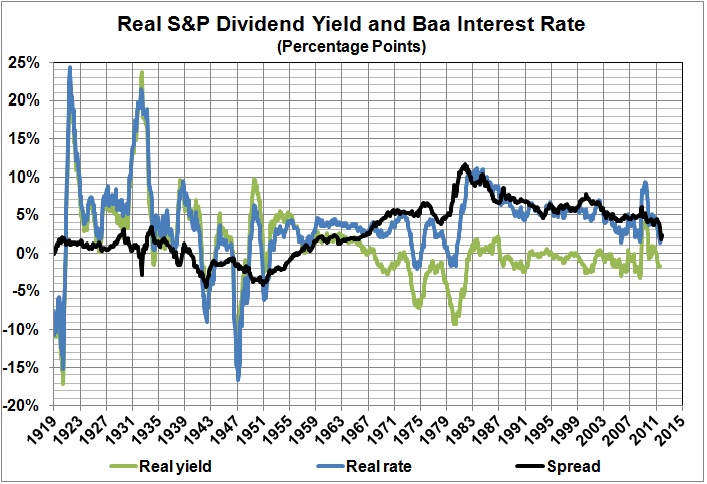
Interest rates in the low tier of investment-grade corporate bonds (Baa-rated by Moody’s) have exceeded the dividend yield on the S&P Composite Index since the 1950s:


Sources: S&P Composite dividend yield is from Robert Shiller’s data set for Irrational Exuberance. Baa rate is from the Federal Reserve Board’s monthly series of Baa rates.

The more interesting value is the spread between the real yield on the S&P Composite and the real rate of interest on Baa-rated bonds:

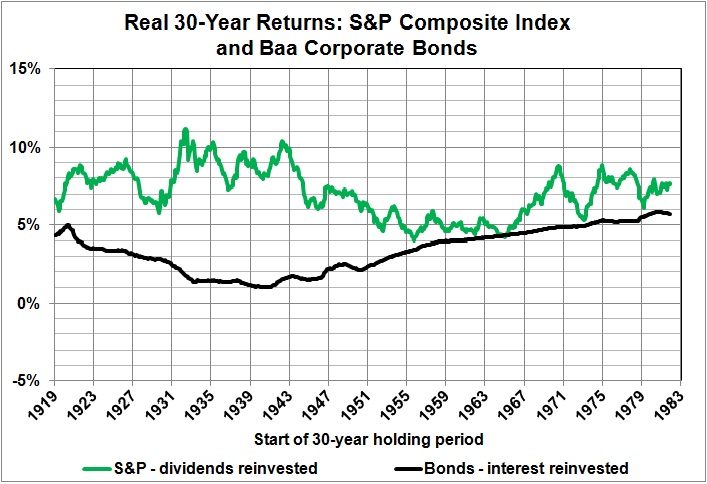
The spread, in this instance, is measured by subtracting the real S&P yield from the real interest rate. The spread was at or above 5 percentage points most of the time from 1969 to 2009. For reasons I will come to, this led to a significant narrowing of the gap between real, long-term returns on stocks and bonds:


Key assumptions: Current dividends are reinvested in the S&P Composite Index at the current value of the index. Current interest payments are reinvested in new issues of Baa-rated bonds at the then-prevailing interest rate on such bonds. Bonds mature at the end of the 30-year holding period. That holding period was chosen because, according to the St. Louis Fed, “Moody’s tries to include bonds with remaining maturities as close as possible to 30 years. Moody’s drops bonds if the remaining life falls below 20 years, if the bond is susceptible to redemption, or if the rating changes.”

The graph indicates that the “risk premiumfor stocks (relative to corporate bonds) has not disappeared, but it has become markedly smaller since the mid-1950s. Why? Because dividend payouts have not kept up with stock prices, and so yields have dropped. This, in turn, has caused stock prices to rise less than they would have had yields not fallen.

Why should falling dividend yields have affected stock prices? The long-run return to stock ownership has two components: price movements and dividends. (By contrast, the bond holder who is in for the long haul expects only to redeem his bonds at face value when they mature.) As dividend yields have shrunk relative to interest rates on corporate bonds, stocks have become somewhat less attractive relative to bonds. The net effect, over the years, has been to reduce  the demand for stocks and thus to compound the effect of smaller dividend payouts by causing downward pressure on stock prices, albeit subtly and invisibly.

Yes, stock ownership (on paper) still seems to be a more attractive long-run proposition than bond ownership. But a prudent, risk-averse investor who is willing to buy bonds and hold them to maturity can do quite well without riding the stock-market roller coaster.

Related posts:
Stocks for the Long Run?
Stocks for the Long Run? (Part II)

Legislating Morality

As noted here, I am belatedly watching Prohibition, a production of Ken Burns and Lynn Novick, which first aired on PBS in October. A main theme of the second episode is that “you can’t legislate morality.” Well, morality can be legislated — and is legislated — but enforcing it is another thing. And that is the real lesson of Prohibition in the United States, the “noble experiment” that lasted from 1920 to 1933.

When I say that morality can be legislated, I mean simply that a moral precept (e.g., “Thou shall not kill.”) can be memorialized in formal law, thus enabling the state to prosecute persons who violate the precept. Diligent prosecution reinforces the precept by punishing those who violate it and deterring would-be violators.

An important lesson of the “noble experiment” is that the ability of the state to prosecute violations of a formal law depends on the degree to which the law’s underlying moral precept is accepted among the population. Killing — when not done in the course of war or self-defense — is one thing; drinking alcohol is quite another. The one is an irrevocable harm; the other is not harmful, in itself, except possibly to the imbiber. (Yes, it is true that drinking was not banned, but the drastic reduction or cessation of drinking was the clear aim of the Eighteenth Amendment’s prohibition of “the manufacture, sale, or transportation of intoxicating liquors within, the importation thereof into, or the exportation thereof from the United States and all territory subject to the jurisdiction thereof for beverage purposes.”)

Even if a formal law is not squarely grounded in a moral precept, the law may be widely observed if (a) it is prosecuted rigorously and (b) the penalty for violating the law effectively deters the routine violation of it.

Take speeding, for example. Speeding does not, in itself, violate a moral precept. But speeding can be the proximate cause of a violation — the taking of a human life, for instance. This, in turn, can result in prosecution for vehicular homicide. There is, in other words, a moral distance between speeding and an actual wrong. Accordingly, the observance of speed limits usually depends on the likelihood of being caught and on the penalty attached to the particular instance of speeding. That is why most drivers observe the speed limit in a school zone, even before school has been dismissed and after students have left the scene. And that is why highway speed limits seem made to be broken. To put it another way, the “real law”  for school-zone speed limits is not the same as the “real law” for highway speed limits. School-zone speed limits are usually obeyed because they are enforced more stringently than highway speed limits. Highway speed limits are not enforced stringently, and (except in speed-trap jurisdictions) are usually 10 miles an hour above posted limits. Given that,  and the less-stringent enforcement of highway speed limits (except around certain holidays), the result is widespread disobedience of posted speed limits on highways.

It seems to me that to most Americans outside the “Bible Belt” — and to not a few within it — Prohibition was not akin to the imposition of a speed limit but to a ban on driving.  Restrictions on speeding are understandable (if not always observed) because an automobile is a lethal weapon, but think of the hue and cry if driving were banned. And yet, the intent of Prohibition was to ban the use of a product that is inherently less dangerous than an automobile. Alcohol is a lethal weapon only when it is wielded by an alcoholic — and then it is a means of committing suicide, not murder. In most instances, and for most persons, the consumption of alcohol does not lead directly or indirectly to the violation of moral precepts. (Laws against drinking under a certain age reflect the norms that most adults would impose on their own children and are therefore generally acceptable.)

In sum, Prohibition did legislate morality, but it was the morality of a politically effective minority of Americans. Because of that, the legislation could not be enforced effectively because its moral premise was not widely accepted. In fact, it was widely ridiculed and resisted, even by many of the persons who were sworn to enforce it. And a lot of them had no compunction about breaking the law and actively helping law-breakers, often for a price.

Prohibition is a leading example of the collusion of “bootleggers and Baptists.” This is a term coined by Bruce Yandle in “Bootleggers and Baptists–The Education of a Regulatory Economist,” which appeared 29 years ago in Cato Institute’s Regulation (Volume 7, Number 3). As Yandle explains in the article,

the pages of history are full of episodes best explained by a theory of regulation I call “bootleggers and Baptists.” Bootleggers, you will remember, support Sunday closing laws that shut down all the local bars and liquor stores. Baptists support the same laws and lobby vigorously for them. Both parties gain, while the regulators are content because the law is easy to administer. Of course, this theory is not new. In a democratic society, economic forces will always play through the political mechanism in ways determined by the voting mechanism employed. Politicians need resources in order to get elected. Selected members of the public can gain resources through the political process, and highly organized groups can do that quite handily. The most successful ventures of this sort occur where there is an overarching public concern to be addressed (like the problem of alcohol) whose “solution” allows resources to be distributed from the public purse to particular groups or from one group to another (as from bartenders to bootleggers).

In the case of Prohibition, the regulation of alcohol proved difficult to administer because the amount of money at stake fostered criminal activity and corruption.

Like most regulations — which are meant to proscribe specific activities without regard for ancillary effects — Prohibition had costly, unintended consequences. The unintended consequences of Prohibition were greater violence and widespread disrespect for the forces of “law and order,” which were either corrupt, ineffective at maintaining the peace, or dedicated to the enforcement of a morally baseless regimen.

Are You in the Bubble?

Charles Murray’s new book, Coming Apart: The State of White America, 1960–2010, is a hot topic in the sector of the blogosphere that I frequent. Kay S. Hymowitz summarizes Murray’s thesis:

According to Murray, the last 50 years have seen the emergence of a “new upper class.” By this he means something quite different from the 1 percent that makes the Occupy Wall Streeters shake their pitchforks. He refers, rather, to the cognitive elite that he and his coauthor Richard Herrnstein warned about in The Bell Curve. This elite is blessed with diplomas from top colleges and with jobs that allow them to afford homes in Nassau County, New York and Fairfax County, Virginia. They’ve earned these things not through trust funds, Murray explains, but because of the high IQs that the postindustrial economy so richly rewards.

Murray creates a fictional town, Belmont, to illustrate the demographics and culture of the new upper class. Belmont looks nothing like the well-heeled but corrupt, godless enclave of the populist imagination. On the contrary: the top 20 percent of citizens in income and education exemplify the core founding virtues Murray defines as industriousness, honesty, marriage, and religious observance….

The American virtues are not doing so well in Fishtown, Murray’s fictional working-class counterpart to Belmont. In fact, Fishtown is home to a “new lower class” whose lifestyle resembles The Wire more than Roseanne. Murray uncovers a five-fold increase in the percentage of white male workers on disability insurance since 1960, a tripling of prime-age men out of the labor force—almost all with a high school degree or less—and a doubling in the percentage of Fishtown men working less than full-time…..

Most disastrous for Fishtown residents has been the collapse of the family, which Murray believes is now “approaching a point of no return.” For a while after the 1960s, the working class hung on to its traditional ways. That changed dramatically by the 1990s. Today, under 50 percent of Fishtown 30- to 49-year-olds are married; in Belmont, the number is 84 percent. About a third of Fishtowners of that age are divorced, compared with 10 percent of Belmonters. Murray estimates that 45 percent of Fishtown babies are born to unmarried mothers, versus 6 to 8 percent of those in Belmont.

And so it follows: Fishtown kids are far less likely to be living with their two biological parents. One survey of mothers who turned 40 in the late nineties and early 2000s suggests the number to be only about 30 percent in Fishtown. In Belmont? Ninety percent—yes, ninety—were living with both mother and father. City Journal, January 25, 2012)

What is the moral of Murray’s tale? According to Hymowitz, it is that

America has become a segregated, caste society, with a born elite and an equally hereditary underclass. A libertarian, Murray believes these facts add up to an argument for limited government. The welfare state has sapped America’s civic energy in places like Fishtown, leaving a population of disengaged, untrusting slackers. It has also diminished upper-class confidence: the well-to-do dare not suggest they have a recipe for the good life. “The underpinning of the welfare state,” Murray writes, “is that, at bottom, human beings are not really responsible for the things they do.”

Not only that, but as Ilya Somin puts it,

Murray argues that a new elite class has emerged that is much more ignorant about the lives of ordinary Americans than were the elites of earlier generations….

If Murray is right, this kind of elite ignorance is the flip side of the general public’s political ignorance. Public ignorance is dangerous because it reduces the quality of voting decisions; elite ignorance because it reduces the quality of the decisions made by elites once they get into positions of power. (“Charles Murray on Elite Ignorance of Ordinary Americans,” The Volokh Conspiracy, January 25, 2012)

Somin adds:

I am far from certain that the kind of knowledge Murray describes is actually important in improving the quality of public policy. Yes, elites who make policy that affects the lives of truck drivers should have some knowledge of “their priorities.” But it’s not clear to me that knowledge of TV shows, foods, preferred sports, etc., of truck drivers is all that useful to understanding those priorities. Even the experience of living with a low income or working at a job where your body hurts at the end of the day (both stressed by Murray s especially important) may be overrated. You don’t have to do either to realize that poverty imposes substantial constraints on your life, or that physical pain is extremely unpleasant….

To be sure, there is an important sense in which elite ignorance reduces the quality of public policy. In a complex society where people have a wide variety of preferences, not even the most knowledgeable elite experts can really have enough information to impose efficient paternalistic regulations that preempt individual choice. But this problem would persist even if all our elites had a deep and extensive knowledge of non-elite culture. The solution is not so much an elite that is better-informed about the culture of the masses, but an elite whose power over those masses is more limited and decentralized.

To put it another way, the real public-policy problem is that the elites — empowered by the regulatory-welfare state — are able to impose policies that harm the social and economic fabric, and therefore harm the working class. If elites knew more about the actual “priorities” of the working class (whatever those “priorities” might be), the elites would simply concoct more misbegotten policies.

To put it yet another way, the elites relish the power of the regulatory-welfare state. It is the exercise of that power which matters to the elites, not the “real people” of the “real world,” who are an excuse for the exercise of power. In Murray’s view, which I share, those “real people” are unreal to the elites because the elites live in an upper-middle-class bubble, remote from the “real world” of Fishtown and its like.

I am proud to say that I do not live in the upper-middle-class bubble, even though my career, income history, and tastes qualify me as a resident of the bubble. My upbringing (outlined here) inoculated me from elitism. The effects of that inoculation are reflected in my score of 51 on the quiz that Murray presents in Chapter 4 of his book, “How Thick Is Your Bubble?” Murray gives the following interpretation of scores:

  • A lifelong resident of a working-class neighborhood with average television and moviegoing habits. Range: 48–99. Typical: 77.
  • A first- generation middle-class person with working-class parents and  average television and moviegoing habits. Range: 42–100. Typical: 66.
  • A first- generation upper-middle- class person with middle-class parents. Range: 11–80. Typical: 33.
  • A second- generation (or more) upper-middle-class person who has made a point of getting out a lot. Range: 0–43. Typical: 9.
  • A second- generation (or more) upper-middle-class person with the television and moviegoing habits of the upper middle class. Range: 0–20.Typical: 2.The scoring of the archetypes reflects a few realities about socioeconomic background and the bubble

I defy Murray’s categorization, for I am a first-generation upper-middle-class person with working-class parents and the television and moviegoing habits of the upper middle class. But no matter. My quiz score indicates my comprehension of the “real world” and the “real people” who inhabit it. They are not faceless game pieces to be shunted about in the name of “society” for the sake of my ego or power cravings. That is why I am neither a “liberal” nor a pseudo-libertarian like this fellow and this bunch.

Denseness about Density

Robert Bryce’s article, “Get Dense” (City Journal, Winter 2012) includes this strange paragraph:

Perhaps the most familiar example of environmentally friendly density, though, is the way humanity has concentrated itself by moving from the country to cities, a process that is happening especially rapidly in the developing world. The opposite process, suburbanization, requires far more land area per resident—and therefore more miles of streets, electricity cables, and sewer lines (see “Green Cities, Brown Suburbs,” Winter 2009). In a 2009 essay for the Atlantic, architect and author Witold Rybczynski wrote that “being truly green means returning to the kinds of dense cities and garden suburbs Americans built in the first half of the 20th century.”

Well, so what? There is much more to life than “efficiency.” Why does Bryce suppose that suburbs grew while many large cities rotted from within? The answer is that there is a strong preference for living away from crowding, filth, noise, and crime: the hallmarks of large cities.

And it may come as a surprise to Bryce to learn that “more land area per resident” is a positive good that is widely valued. Does Bryce propose to force people out of suburbs and into large cities? That seems to be the implication of his statement.

I had heretofore found the offerings of City Journal to be in the conservative-to-libertarian camp. I hope that Bryce’s article is an aberration.

Prohibition, Abortion, and “Progressivism”

I am belatedly watching Prohibition, a production of Ken Burns and Lynn Novick, which first aired on PBS in October. The program, in typical Burns style, delivers history in easy-to-swallow doses. I have seen only one of the three episodes, but that episode whets my appetite for the others because it added much to my sketchy knowledge of the events that led to the passage of the Eighteenth Amendment.

There is a libertarian slant to Prohibition, though perhaps not a deliberate one. For all that Prohibition says about the evils of “demon rum,” it says more about the evils and unintended consequences of governmental efforts to dictate private behavior. One of the talking heads points out that prohibition was as much a brainchild of “progressives” as it was of religious fundamentalists.

Although eugenics is not mentioned in Prohibition, it looms in the background. For eugenics — like prohibition of alcohol and, later, the near-prohibition of smoking — is symptomatic of the “progressive” mentality. That mentality is paternalistic, through and through. And “progressive” paternalism finds its way into the daily lives of Americans through the regulation of products and services — for our own good, of course. If you can think of a product or service that you use (or would like to use) that is not shaped by paternalistic regulation or taxes levied with regulatory intent, you must live in a cave.

However, the passing acknowledgement of “progressivism” as a force for the prohibition of alcohol is outweighed by the attention given to the role of “evangelicals” in the enactment of prohibition. I take this as a subtle swipe at anti-abortion stance of fundamentalist Protestants and adherents of the “traditional” strands of Catholicism and Judaism. Here is the “logic” of this implied attack on pro-lifers: Governmental interference in a personal choice is wrong with respect to the consumption of alcohol and similarly wrong with respect to abortion.

By that “logic,” it is wrong for government to interfere in or prosecute robbery, assault, rape, murder and other overtly harmful acts, which — after all — are merely the consequences of personal choices made by their perpetrators. Not even a “progressive” would claim that robbery, assault, etc., should go unpunished, though he would quail at effective punishment.

Not that “progressivism” is a thing of logic. It is, as many commentators have noted, a shifting set of attitudes. A “progressive” (or “liberal” or leftist) is simply a person who adheres to the current set of attitudes — the “progressive” program du jour — which the “progressive” seeks to impose by force, for our own good. The essential character of “progressivism” is paternalism wedded to statism.

George Will puts it this way:

….

Obama, an unfettered executive wielding a swollen state, began and ended his [state of the union] address by celebrating the armed forces. They are not “consumed with personal ambition,” they “work together” and “focus on the mission at hand” and do not “obsess over their differences.” Americans should emulate troops “marching into battle,” who “rise or fall as one unit.”

Well. The armed services’ ethos, although noble, is not a template for civilian society, unless the aspiration is to extinguish politics. People marching in serried ranks, fused into a solid mass by the heat of martial ardor, proceeding in lock step, shoulder to shoulder, obedient to orders from a commanding officer — this is a recurring dream of progressives eager to dispense with tiresome persuasion and untidy dissension in a free, tumultuous society.

Progressive presidents use martial language as a way of encouraging Americans to confuse civilian politics with military exertions, thereby circumventing an impediment to progressive aspirations — the Constitution and the patience it demands. As a young professor, Woodrow Wilson had lamented that America’s political parties “are like armies without officers.” The most theoretically inclined of progressive politicians, Wilson was the first president to criticize America’s founding. This he did thoroughly, rejecting the Madisonian system of checks and balances — the separation of powers, a crucial component of limited government — because it makes a government that cannot be wielded efficiently by a strong executive.

Franklin Roosevelt agreed. He complained about “the three-horse team of the American system”: “If one horse lies down in the traces or plunges off in another direction, the field will not be plowed.” And progressive plowing takes precedence over constitutional equipoise among the three branches of government. Hence FDR’s attempt to break the Supreme Court to his will by enlarging it.

In his first inaugural address, FDR demanded “broad executive power to wage a war against the emergency, as great as the power that would be given to me if we were in fact invaded by a foreign foe.” He said Americans must “move as a trained and loyal army” with “a unity of duty hitherto evoked only in time of armed strife.” The next day, addressing the American Legion, Roosevelt said it was “a mistake to assume that the virtues of war differ essentially from the virtues of peace.” In such a time, dissent is disloyalty….

Obama, aspiring to command civilian life, has said that in reforming health care, he would have preferred an “elegant, academically approved” plan without “legislative fingerprints on it” but “unfortunately” he had to conduct “negotiations with a lot of different people.” His campaign mantra “We can’t wait!” expresses progressivism’s impatience with our constitutional system of concurrent majorities. To enact and execute federal laws under Madison’s institutional architecture requires three, and sometimes more, such majorities. There must be majorities in the House and Senate, each body having distinctive constituencies and electoral rhythms. The law must be affirmed by the president, who has a distinctive electoral base and election schedule. Supermajorities in both houses of Congress are required to override presidential vetoes. And a Supreme Court majority is required to sustain laws against constitutional challenges.

“We can’t wait!” exclaims Obama, who makes recess appointments when the Senate is not in recess, multiplies “czars” to further nullify the Senate’s constitutional prerogative to advise and consent, and creates agencies (e.g., Obamacare’s Independent Payment Advisory Board and Dodd-Frank’s Consumer Financial Protection Bureau) untethered from legislative accountability.

Like other progressive presidents fond of military metaphors, he rejects the patience of politics required by the Constitution he has sworn to uphold. (“Obama to the Nation: Onward Civilian Soldiers,” The Washington Post, January 27, 2011)

*   *   *

Related posts:
Ten-Plus Commandments of Liberalism, er, Progressivism
The Pathology of Academic Leftism
Diagnosing the Left
Presidential Legacies
The Modern Presidency: A Tour of American History
An FDR Reader
Parsing Political Philosophy
Inventing “Liberalism”
Utilitarianism, “Liberalism,” and Omniscience
Fascism and the Future of America
Utilitarianism vs. Liberty
Selection Bias and the Road to Serfdom
Beware of Libertarian Paternalists
The Mind of a Paternalist
The State of the Union: 2010
The Shape of Things to Come
Accountants of the Soul
Rawls Meets Bentham
Is Liberty Possible?
The Left
The Left’s Agenda
The Left and Its Delusions
Save Me from Self-Appointed Saviors
In Defense of the 1%
A Nation of (Unconstitutional) Laws

A Nation of (Unconstitutional) Laws

I have long viewed the Constitution as a contract, which was entered into initially by the States, as authorized by the people of each State in a ratifying convention. At some point, probably long before the Civil War, the Constitution ceased to be a contract and became a law — or a conglomeration of laws, variously interpreted and enforced by the factions then in control of Congress, the executive branch, and the Supreme Court. The Civil War cemented the status of the Constitution as law by imposing it forcibly on dissenting parties: the members of the Confederate States of America.

The original contract was a compact among the States and the people thereof to form a central government of limited, enumerated powers. The main purposes of that government were to keep peace among the States, ensure a free flow of trade among the States, ensure uniformity in the rules of inter-State and international commerce, face the world with a single foreign policy and a national armed force, and ensure the even-handed application of the Constitution and of constitutional laws.

The central government is no longer the creature of a contract, bound by the terms of that contract. It has become the unaccountable arbiter of its own doings. Its laws — legislative enactments, executive orders, and judicial holdings — sometimes pay lip service to the Constitution. But the central government’s conduct is almost entirely unrelated to and unconstrained by the Constitution. Judicial holdings that affirm the original contract are notable because they are unusual.

What began as a grand bargain among equals has become a Faustian bargain.

Related posts:
Substantive Due Process, Liberty of Contract, and the States’ Police Power
Secession
A New, New Constitution
Secession Redux
A New Cold War or Secession?
The Real Constitution and Civil Disobedience
A Declaration of Independence
First Principles
Zones of Liberty
The State of the Union: 2010
The Shape of Things to Come
The Constitution: Original Meaning, Corruption, and Restoration
A Conversation with Uncle Sam

In Defense of the 1%

“Liberalism,” its adherents claim, is about things like “fairness” and “social justice.” Where “fairness” and “social justice” are lacking — as they usually are in the “liberal” worldview — the state must intervene and penalize the “privileged” so that the “less privileged” may enjoy “fairness” and “social justice.” (I call it blaming the blameless.) This kind of retributive governance cannot stand logical or empirical scrutiny, but it pleases the masses and feeds the power-lust of “liberal” politicians.

Who are the “privileged”? These days they are those who have (temporarily, at least) scaled the  heights of the income distribution. They are the so-called 1%, who (in the “liberal” and left-libertarian view) are there because they are able to “game the system” better than the 99%. Will Wilkinson has a good answer to that allegation:

I think anti-1% rhetoric is misguided and perhaps politically self-defeating. By failing to distinguish between those who became wealthy primarily by creating wealth and those who became wealthy by appropriating wealth, 1%-er/anti-oligarchy language implicitly sets itself in opposition to the kind of inventive, productive people many of us nobly aspire to become. As Kinsley says, a lot of folks really resent this, and they’re not wrong.

Making more money than 99% of one’s countrymen is, by itself, no more morally objectionable than scoring in the 99th percentile of the SAT. Indeed, generally, it’s much more morally praiseworthy; creating wealth benefits people other than oneself. Of course, some people cheat on the SAT. Cheating is wrong. But high-scorers generally aren’t screwing anyone over. Likewise, some people do get rich by cheating and screwing people over. But most people who get rich do it playing by the rules. It’s a mistake to base a protest movement on the refusal to acknowledge this….

If we’re all embedded in a fundamentally unjust, exploitative global economic structure, it’s hard to see why the American 1% should be especially salient. Why not the global 1%, or the global 10 or 20%, which would include pretty much the whole American population. If it is morally imperative to confiscate exceptional wealth and use it to meet human needs, then it is imperative to confiscate most of the wealth in all wealthy countries, not just the wealth of the wealthiest of the wealthy, and transfer it to the world‘s poor, not to the relatively well-to-do poor of the wealthiest countries.

If it’s not possible to bring in $600,000 in a year without therefore being guilty of complicity in a exploitative global system, which invalidates one’s moral claim to one’s income, it’s probably not possible to bring in an untainted, secure $60,000 either.

Of course, most complaints about the American 1% are not grounded on the view that the global political economy is a comprehensive web of exploitation. It’s based on the supposition that the domestic 1% is guilty of something or other the domestic 10 or 30 or 50% isn’t, and therefore deserves to be a target of scorn in a way the 10 or 30 or 50% does not. But, however you slice it, it’s going to be true that a lot of people in the top 1% got there in pretty much the same way a lot of people in the top 30 or 50% got there. If there’s nothing wrong with a way of making money at the 50th percentile, there’s nothing wrong with it at the 99th. And if there’s something wrong with it at the 99th, there’s something wrong with at the 50th. The unwillingness to identify specific mechanisms of unjust income acquisition, and the insistence on treating income-earners above a arbitrary cut-off point as a unified class deserving special contempt, strike me as symptoms of intellectually laziness and a less than thoroughgoing interest in justice.

There is a further, crucial criticism of the anti-1% mentality. The 1%, for the most part, consists of individuals who are smart and ambitious enough to do quite well without the unspecified mechanisms that supposedly favor them. Even with a hypothetically appealing but practically unattainable “level playing field,” I would not expect the composition of the 1% to change markedly.

In any event, there will always be a 1% of one kind or another, the left’s penchant for Nirvana fallacies to the contrary. The real-world choice is not between equality and inequality, it is between liberty and tyranny. Liberty allows a 1% consisting of an (ever-changing) economic “elite”; tyranny allows a 1% consisting of a tyrant’s henchmen and courtiers. The futile flight from economic inequality has delivered America into the hands of rabble-rousing petty tyrants — “soft” despots, if you will — who have badly damaged our economic and social liberties without quite extinguishing them.

These rabble-rousers — who are exemplified by the Roosevelts, Woodrow Wilson, LBJ, and BHO — have been enabled by the decline of constitutional republicanism and the rise of interest-group democracy. The rabble-rousers have exploited the masses’ envy and fear. But, unbeknownst to the masses, the rabble-rousers have failed to deliver prosperity and have instead delivered impoverishment.* Why? Because the rabble-rousers’ essential program is to penalize the productive through progressive taxation, affirmative action, and restrictive regulations. But the rabble-rousers seem not to know or care that their schemes also penalize the less-productive and unproductive by hindering economic growth and job creation.

If anything, the 1% is to be applauded for having succeeded against great odds. And for delivering value.

Related posts:
The Causes of Economic Growth
Positive Rights and Cosmic Justice
A Short Course in Economics
Fascism with a “Friendly” Face
Democracy and Liberty
The Interest-Group Paradox
Addendum to a Short Course in Economics
Utilitarianism, “Liberalism,” and Omniscience
Utilitarianism vs. Liberty
Fascism and the Future of America
The Indivisibility of Economic and Social Liberty
The Constitution: Original Meaning, Corruption, and Restoration
Negative Rights
Negative Rights, Social Norms, and the Constitution
The Devolution of American Politics from Wisdom to Opportunism
The Near-Victory of Communism
Tocqueville’s Prescience
Accountants of the Soul
Invoking Hitler
Rawls Meets Bentham
The Left
Enough of “Social Welfare”
A True Flat Tax
The Case of the Purblind Economist
Youthful Wisdom
The Divine Right of the Majority
Our Enemy, the State
Social Justice
Taxing the Rich
More about Taxing the Rich
Positive Liberty vs. Liberty
More Social Justice
Luck-Egalitarianism and Moral Luck
Nature Is Unfair
Elizabeth Warren Is All Wet
“Occupy Wall Street” and Religion
Merit Goods, Positive Rights, and Cosmic Justice
More about Merit Goods
What Is Bleeding-Heart Libertarianism?
The Morality of Occupying Private Property

* For more about the impoverishing effects of government, see the preceding post and follow the links at the bottom of that post.

Estimating the Rahn Curve: A Sequel

Another Entry in the Sunstein Saga

Alec Rawls, writing at his blog, Error Theory:

As Congress considers vastly expanding the power of copyright holders to shut down fair use of their intellectual property, this is a good time to remember the other activities that Obama’s “regulatory czar” Cass Sunstein wants to shut down using the tools of copyright protection. For a couple of years now, Sunstein has been advocating that the “notice and take down” model from copyright law should be used against rumors and conspiracy theories, “to achieve the optimal chilling effect.”

Why?

Sunstein seems most intent on suppressing is the accusation, leveled during the 2008 election campaign, that Barack Obama “pals around with terrorists.” (“Look Inside” page 3.) Sunstein fails to note that the “palling around with terrorists” language was introduced by the opposing vice presidential candidate, Governor Sarah Palin (who was implicating Obama’s relationship with domestic terrorist Bill Ayers). Instead Sunstein focuses his ire on “right wing websites” that make “hateful remarks about the alleged relationship between Barack Obama and the former radical Bill Ayers,” singling out Sean Hannity for making hay out of Obama’s “alleged associations” (pages 13-14).

What could possibly be more important than whether a candidate for president does indeed “pal around with terrorists”? Of all the subjects to declare off limits, this one is right up there with whether the anti-CO2 alarmists who are trying to unplug the modern world are telling the truth. And Sunstein’s own bias on the matter could hardly be more blatant. Bill Ayers is a “former” radical? Bill “I don’t regret setting bombs” Ayers? Bill “we didn’t do enough” Ayers?

For the facts of the Obama-Ayers relationship, Sunstein apparently accepts Obama’s campaign dismissal of Ayers as just “a guy who lives in my neighborhood.” In fact their relationship was long and deep. Obama’s political career was launched via a fundraiser in Bill Ayers’ living room; Obama was appointed the first chairman of the Ayers-founded Annenberg Challenge, almost certainly at Ayers’ request; Ayers and Obama served together on the board of the Woods Foundation, distributing money to radical left-wing causes; and it has now been reported by full-access White House biographer Christopher Andersen (and confirmed by Bill Ayers) that Ayers actually ghost wrote Obama’s first book Dreams from My Father.

Whenever free speech is attacked, the real purpose is to cover up the truth. Not that Sunstein himself knows the truth about anything. He just knows what he wants to suppress, which is exactly why government must never have this power.

As Rawls notes, Sunstein also wants to protect “warmists” from their critics, that is, to suppress science in the name of science:

In climate science, there is no avoiding “reference to the machinations of powerful people, who have also managed to conceal their role.” The Team has always been sloppy about concealing its machinations, but that doesn’t stop Sunstein from using climate skepticism as an exemplar of pernicious conspiracy theorizing, and his goal is perfectly obvious: he wants the state to take aggressive action that will make it easier for our powerful government funded scientists to conceal their machinations.

Rawls’s thesis is entirely unsurprising to me. This is from “Fascism with a Friendly Face,” a post I wrote almost three years ago:

Regarding the suppression of dissent, it is noteworthy that Obama’s has tagged Cass Sunstein (a Chicago crony) to head the Office of Information and Regulatory Affairs in the White House. (See this article for more about the likely direction of OIRA under Sunstein.) My biggest concern about Sunstein, who figures to be a strong influence on Obama, is his embrace of the oxymoronical thing known as “libertarian paternalism.” (For an exposition of its flaws, see this post and its predecessors, linked therein.)

“Libertarian paternalism” is nothing more than a dressed-up version of paternalism, in which the government is used to “nudge” people toward making the kinds of decisions that Sunstein and his ilk would make. That is to say, Sunstein (like too many other bright individuals) likes to believe that he knows what’s best for others. (That conceit is demolished in the posts mentioned at the end of the preceding paragraph and in these posts by an avowed utilitarian.)

“Libertarian paternalism” may seem innocuous, but there’s more to it than a bit of “nudging” (hah!) by the one-ton gorilla in the room (i.e., the federal government). Perhaps the most frightening item on Sunstein’s paternalistic agenda ties into Sen. Rockefeller’s proposal to give the president the power to shut down the internet — which amounts to the power to control the content of the internet. And make no mistake about it, Sunstein would like to control the content of the internet — for our own good, of course. I refer specifically to Sunstein’s “The Future of Free Speech,” in which he advances several policy proposals, including these:

4. . . . [T]he government might impose “must carry” rules on the most popular Websites, designed to ensure more exposure to substantive questions. Under such a program, viewers of especially popular sites would see an icon for sites that deal with substantive issues in a serious way. They would not be required to click on them. But it is reasonable to expect that many viewers would do so, if only to satisfy their curiosity. The result would be to create a kind of Internet sidewalk, promoting some of the purposes of the public forum doctrine. Ideally, those who create Websites might move in this direction on their own. If they do not, government should explore possibilities of imposing requirements of this kind, making sure that no program draws invidious lines in selecting the sites whose icons will be favoured. Perhaps a lottery system of some kind could be used to reduce this risk.

5. The government might impose “must carry” rules on highly partisan Websites, designed to ensure that viewers learn about sites containing opposing views. This policy would be designed to make it less likely for people to simply hear echoes of their own voices. Of course, many people would not click on the icons of sites whose views seem objectionable; but some people would, and in that sense the system would not operate so differently from general interest intermediaries and public forums. Here too the ideal situation would be voluntary action. But if this proves impossible, it is worth considering regulatory alternatives. [Emphasis added.]

A Left-libertarian defends Sunstein’s foray into thought control, concluding that

Sunstein once thought some profoundly dumb policies might be worth considering, but realized years ago he was wrong about that… The idea was a tentative, speculative suggestion he now condemns in pretty strong terms.

Alternatively, in the face of severe criticism of his immodest proposal, Sunstein merely went underground, to await an opportunity to revive his proposal. I somehow doubt that Sunstein, as a confirmed paternalist, truly abandoned it. The proposal certainly was not off-the-cuff, running to 11 longish web pages.  Now, judging by the bulleted list above, the time is right for a revival of Sunstein’s proposal. And there he is, heading the Office of Information and Regulatory Affairs. The powers of that office supposedly are constrained by the executive order that established it. But it is evident that the Obama adminstration isn’t bothered by legal niceties when it comes to the exercise of power. Only a few pen strokes stand between Obama and a new, sweeping executive order, the unconstitutionality of which would be of no import to our latter-day FDR.

Cass Sunstein is a dangerous man because he is intelligent, power-hungry, and overtly in favor of liberty, even as he fosters its demise.

*   *   *

Related posts:
Sunstein at the Volokh Conspiracy
More from Sunstein
Cass Sunstein’s Truly Dangerous Mind
An (Imaginary) Interview with Cass Sunstein
Libertarian Paternalism
Slippery Sunstein
A Libertarian Paternalist’s Dream World
The Short Answer to Libertarian Paternalism
Second-Guessing, Paternalism, Parentalism, and Choice
Another Thought about Libertarian Paternalism
Back-Door Paternalism
Another Voice Against the New Paternalism
Sunstein and Executive Power
The Feds and “Libertarian Paternalism”
A Further Note about “Libertarian” Paternalism
Apropos Paternalism
FDR and Fascism
Fascism
Are We All Fascists Now?
Fascism with a “Friendly” Face
Fascism and the Future of America
Discounting and Libertarian Paternalism
The Mind of a Paternalist

Three Inglorious Years


Net disapproval rating: percentage of likely voters strongly disapproving of BO, minus percentage of likely voters strongly approving of BO. Derived from Rasmussen Reports’ Daily Presidential Tracking Poll.

Save Me from Self-Appointed Saviors

A recent NYT piece by Richard Zacks (“How Dry We Aren’t“) highlights the antics of Theodore Roosevelt:

When Theodore Roosevelt was police commissioner [of New York City], from 1895 to 1897, he tried to stop the sales of beer, wine and liquor on Sundays in saloons.

Men and women, who worked six days a week in that era, were not amused. New York State Sabbath laws already forbade attending sporting events or theater performances, or selling groceries, after 10 a.m. on Sundays; the excise laws also made it illegal to sell alcohol in bars, saloons and taverns all 24 hours of the Lord’s Day.

New Yorkers in droves defied that particular edict. (Sunday actually marked the barkeep’s biggest sales day.) Saloon owners handed a bribe to precinct cops who forwarded some loot to Tammany politicians, and the city’s thirsty could discreetly slip in the side doors of saloons. For almost 40 years, it was a popular pragmatic compromise.

Enter Roosevelt. Fearless and bullheaded, the new commissioner vowed to enforce the law, both to root out bribery in the Police Department and also to reunite families on Sundays….

Roosevelt’s liquor crackdown backfired…. The city’s spirit of place, what Stephen Crane once dubbed New York’s “wild impulse,” refused to be tamed.

Theodore Roosevelt the reformer was deeply proud of his efforts to clean up New York but in his illustrious later days, running for governor, then for vice president, then president, he never won a majority vote in the city. Never take a beer away from a New Yorker.

If only it were that easy to subvert the intentions of zealous office-holders.

In another recent NYT piece (“The C.E.O. in Politics“), David Brooks observes that

great leaders tend to have an instrumental mentality. They do not feel the office is about them. They are just God’s temporary instrument in service of a larger cause. Lincoln felt he was God’s instrument in preserving the union. F.D.R. felt he was an instrument to help the common man and defeat fascism.

Whatever FDR felt, he was not a great leader. Nor was his distant cousin, Teddy Roosevelt. What they shared with other so-called great leaders was overwhelming ego: the belief that their wishes should be everyone’s wishes. And, with the help of compliant Congresses and Supreme Courts, they made it so.

TR spoke and acted as if he were God’s instrument. As president, his aspiration to savior-hood led him to embrace Progressivism (e.g., trust-busting). His actions brought an end to 40 years of rapid economic growth, which — contrary to myth — had uplifted the masses as well as the “robber barons.” After a too-brief respite from dictatorship, under Taft, Woodrow Wilson (another “leader” who thought he was an instrument of God) extended the Progressive state, and economic growth slowed further.

The Great Depression, predictably enough, swept out Hoover, whose “do something” ethic turned a recession into a depression, and brought in FDR, with his second-rate mind. He soon enough began to think of himself as a savior, empowered (by perverse logic) to uplift the downtrodden by running roughshod over America’s businesses. What he accomplished, in fact, was a deeper and longer depression. (By contrast, the economy quickly rebounded from the deep recession of 1920-21 because “do nothing” Harding did nothing but encourage business.) LBJ’s deliberate mimicking of FDR’s New Deal put in motion the Great Society, the aftermath of which has been economic growth on a par with that of the TR-Wilson era.

Now comes Barack Obama, a storefront version of TR, FDR, and LBJ. “Bush fatigue” elected him and presented him with a Democrat-controlled Congress. He took his luck for a kind of divine mandate, which he exploited to impose upon Americans his ruinous visions of universal health care, Keynesian deficit-spending, and defensive weakness (masked by the inconsequential if satisfying erasure of bin Laden).

God save us from “leaders” who want to be our saviors. For every Lincoln — whose principal legacy was the forcible stitching up of a union that has yet to heal — there are too many TRs, WWs, FDRs, LBJs, and BHOs.

Related posts:
The Price of Government
Fascism and the Future of America
The Indivisibility of Economic and Social Liberty
The Price of Government Redux
The Real Burden of Government
The Illusion of Prosperity and Stability
The Mega-Depression
Estimating the Rahn Curve: Or, How Government Inhibits Economic Growth
Money, Credit, and Economic Fluctuations
A Keynesian Fantasy Land
The Keynesian Fallacy and Regime Uncertainty
Why the “Stimulus” Failed to Stimulate
Regime Uncertainty and the Great Recession
Regulation as Wishful Thinking
Vulgar Keynesianism and Capitalism
Why Are Interest Rates So Low?
Don’t Just Stand There, “Do Something”
Economic Growth Since World War II
The Commandeered Economy

Stocks for the Long Run? (Part II)

In “Stocks for the Long Run?” I say that

unless the course of the regulatory-welfare state is reversed, a prolonged downward shift in the real rate of GDP growth is in the works — probably to about 2 percent. At that rate, expect a continuation of the present trend [since 2000] — stock-price “growth” [adjusted for inflation] of about -4 percent a year.

Be sure to note the minus sign in front of the 4.

Stocks are not bound to rise predictably over time, despite graphs like the next one, which I constructed from the data set cited in “Stocks for the Long Run?”. “Price” (the blue line) traces the real growth in the value of S&P Composite Index; “price + dividends” (the orange line) traces real growth in the value of the S&P Composite Index plus dividends paid on the stocks comprised in the index; “dividends reinvested” (the green line) traces the real value of the S&P Composite Index if dividends had been reinvested in shares of the stocks comprised in the index (green line):

From 1871 through 2010, the average annual increase in the value of the S&P Composite, with dividends reinvested, was 6.7 percent. This kind of hypothetical long-term “return” is cited often as a reason for buying and holding stocks. But a real return of 6.7 percent is not graven in stone, as the following chart indicates.

After a period of decline in the early 1900s, the cumulative rate of return on the S&P Composite, with dividends reinvested, dropped to 5.3 percent in 1920, jumped to 8.3 percent in 1929, plummeted to 5.4 percent in 1932, returned to 7.6 percent in 1966, dipped to 6.2 percent in 1982, climbed back to 7.4 percent in 2000, and (as noted above) dropped to 6.7 percent by the end of 2010. In other words, long-run averages can be moved considerably by short run bouts of what I call “irrational exuberance and rational pessimism.”

Moreover, as a practical matter, the buy-hold-reinvest strategy would not work if there were a massive influx of stock-buyers intent on buying, holding, and reinvesting dividends. They would be chasing illusory returns because massive purchases of stocks would not be rewarded (quickly, at least) by proportionate increases in corporate earnings, which is the main driver of stock prices in the long run. The more likely result would be a bubble — like those of the late 1920s and late 1990s — which would burst, leading to lower stock prices and a greater reluctance to invest in stocks.

More realistic measures of expected returns from buying and holding stocks are depicted by the “price” and “price + dividends” lines. At the end of 2010, the average annual real return on the S&P Composite Index since 1871 was 2 percent. With dividends, the average annual real return was 2.3 percent. But almost no one — not even an institutional investor — is likely to hold stocks in the S&P Composite Index for 140 years.

It makes sense, therefore, to consider shorter holding periods: 10, 20, and 30 years.

If history is any guide, consistently positive real returns on stocks are available only to the relatively rare investor who adheres doggedly to the buy-hold-reinvest strategy for 20 years or longer.

But history is not a reliable guide because — unless the course of the regulatory-welfare state is reversed — the rate of GDP growth will continue to fall, and stock prices are likely to fall in sympathy.

Related posts:
The Price of Government
The Price of Government Redux
The Mega-Depression
As Goes Greece
The Real Burden of Government
The Illusion of Prosperity and Stability
The “Forthcoming Financial Collapse”
Estimating the Rahn Curve: Or, How Government Inhibits Economic Growth
The Deficit Commission’s Deficit of Understanding
The Bowles-Simpson Report
The Bowles-Simpson Band-Aid
The Stagnation Thesis
America’s Financial Crisis Is Now
Why Are Interest Rates So Low?
Economic Growth Since World War II
The Commandeered Economy
Stocks for the Long Run?

Society and the State

Michael Oakeshott writes:

A modern state, as it emerged from a medieval realm, a patrimonial estate, a military protectorate, or a collection of colonial settlements, had three distinct features that it has never lost: an office of authority, an apparatus of power, and a mode of association….

…[S]ince a modern state has never ceased to be recognized as an association in the making, attention has always been directed to the sort of association it might be made to become no less than to what it may be perceived to be. But the exploration of this theme has been sadly hindered by confusion.

First, it is usually conducted in terms of the vocabularies of authority or of power, but in this connection these words are meaningless. To say, for example, that the conditions of association are or should be “democratic” is absurd…. [T]here are no “democratic ” rules of relationships…. Secondly, this inquiry has been almost obliterated by drivel about something called “society,” a fanciful total of unspecified relationships which only a simpleton would think of identifying with a state. (“Talking Politics,” Rationalism in Politics and Other Essays, pp. 441, 450)

There can be such a thing as “society,” but only in rare circumstances. And Oakeshott is correct when he says that only a simpleton would identify society with a state. But, as I will discuss, it is not only simpletons who identify society with a state but also cynical politicians and leftist opportunists.

With respect to society, I begin with Margaret Thatcher, who often is quoted as saying that “there is no such thing as society.” When Mrs. Thatcher said that, she was arguing against the entitlement mindset, as in ” ‘society’ owes me a roof over my head and three meals a day.” As she put it, “people must look to themselves first. It’s our duty to look after ourselves and then, also to look after our neighbor.”

There is, in fact, such a thing as society. But what is it? “Society” has many meanings. This one rings truest:

an enduring and cooperating social group whose members have developed organized patterns of relationships through interaction with one another

In other words, the state is not society. The state — in the guise of a nation, a city, a village, etc. — may compel certain behaviors, including the transfer of one’s income to strangers. Compulsion by the state is the antithesis of societal cooperation.

There is, nevertheless, a tendency — especially on the part of leftists — to claim that the state represents and serves society. The claim is wrong:

  • For the reasons given above, the identification of the state with society is nothing more than a rhetorical sleight-of-hand by which utilitarians, paternalists, do-gooders, politicians, and pundits justify the imposition of their preferences on the masses.
  • The specific acts of the state often are malign rather than benign. See, for example, any of the 140 issues of Regulation that have been published to date. Moreover, acts of the state generally involve regulatory and tax burdens that, at once, stifle prosperity and liberty.

The fact of the matter is that the state destroys society in two ways. First, it usurps the functions served by society, most notably the functions of charity and marriage. Second, it compels certain kinds of behavior instead of allowing behavior to evolve cooperatively.

Two of the stated aims of compulsion are the advancement of “social justice” and “diversity.” The former is redistributionism, pure and simple. The latter forces social and economic interactions between persons of dissimilar cultures, religions, and races — to no good end.

Social justice” is usually

code for redistributing income, either directly (through the taxing and spending power of government) or indirectly (through the power of government to require favoritism toward certain groups of persons). Make no mistake, there is no justicein “social justice,” which is nothing more than a euphemism for coercion by the state.

Social justice is possible only where there is a true society, not the bogus “society”  or “community” to which bleeding hearts and statists refer when they mean the United States or most of its political subdivisions — which have become nothing more than geopolitical prisons.

A true society or community is one in which persons are bound by more than merely residing in the same nation, state, city, or other geographic entity. A true society is one whose members voluntarily commit acts of kindness and charity toward one another, as part of the social “bargain” that is known as the Golden Rule.

That “bargain” amounts to a delicate balance of self-interested and voluntarily beneficial behavior. The self-interested aspect of behavior is mutual forbearance — leaving others alone so that they will leave you alone. The voluntarily beneficial aspect is the commission of acts of kindness and charity. It is the latter that enables the former, because acts of kindness and charity help to build a true feeling of community by creating an atmosphere of mutual respect and trust.

Purveyors of “social justice” say that the voluntary arrangements of true communities are inadequate for the purpose of meeting this or that desideratum. Whence the desiderata? From the preconceptions of the purveyors of “social justice,” of course. They would substitute their “wisdom” for the wisdom that it embedded in voluntary social and economic arrangements. And they usually succeed because their arrogance incorporates a good measure of power-lust.

In sum, true social justice  is possible only in a voluntary community that is founded on mutual forbearance, respect, and trust. It cannot be found in the kind of forcible leveling that is favored by advocates of “social justice.” There is nothing just about coercion.

“Diversity” — which encompasses and extends the state’s effort to force “equality” — is a case study in the state’s socially destructive power. In “The downside of diversity,” at The Boston Globe, Michael Jonas reports on a study by Harvard political scientist Robert Putnam, “E Pluribus Unum: Diversity and Community in the Twenty-first Century.” Putnam, according to Jonas,

has found that the greater the diversity in a community, the fewer people vote and the less they volunteer, the less they give to charity and work on community projects. In the most diverse communities, neighbors trust one another about half as much as they do in the most homogeneous settings. The study, the largest ever on civic engagement in America, found that virtually all measures of civic health are lower in more diverse settings.

John Leo, writing at City Journal (“Bowling with Our Own“), first discusses Putnam’s findings; e.g.:

Putnam’s study reveals that immigration and diversity not only reduce social capital between ethnic groups, but also within the groups themselves. Trust, even for members of one’s own race, is lower, altruism and community cooperation rarer, friendships fewer. The problem isn’t ethnic conflict or troubled racial relations, but withdrawal and isolation. Putnam writes: “In colloquial language, people living in ethnically diverse settings appear to ‘hunker down’—that is, to pull in like a turtle.”…

Neither age nor disparities of wealth explain this result. “Americans raised in the 1970s,” he writes, “seem fully as unnerved by diversity as those raised in the 1920s.” And the “hunkering down” occurred no matter whether the communities were relatively egalitarian or showed great differences in personal income. Even when communities are equally poor or rich, equally safe or crime-ridden, diversity correlates with less trust of neighbors, lower confidence in local politicians and news media, less charitable giving and volunteering, fewer close friends, and less happiness….

Leo then discusses the fact that Putnam had delayed announcing his findings:

Putnam has long been aware that his findings could have a big effect on the immigration debate. Last October, he told the Financial Times that “he had delayed publishing his research until he could develop proposals to compensate for the negative effects of diversity.” He said it “would have been irresponsible to publish without that,” a quote that should raise eyebrows. Academics aren’t supposed to withhold negative data until they can suggest antidotes to their findings…

Though Putnam is wary of what right-wing politicians might do with his findings, the data might give pause to those on the left, and in the center as well. If he’s right, heavy immigration will inflict social deterioration for decades to come, harming immigrants as well as the native-born. Putnam is hopeful that eventually America will forge a new solidarity based on a “new, broader sense of we.” The problem is how to do that in an era of multiculturalism and disdain for assimilation.

Myron Magnet, also writing at City Journal (“In the Heart of Freedom, in Chains“), addresses “elite hypocrisy, gangsta culture, and failure in black America.” Magnet asks

how can there still exist a large black urban underclass imprisoned in poverty, welfare dependency, school failure, nonwork, and crime? How even today can more black young men be entangled in the criminal-justice system than graduate from college? How can close to 70 percent of black children be born into single-mother families, which (almost all experts agree) prepare kids for success less well than two-parent families?

And answers:

The legacy of slavery and racism isn’t the reason….

Beginning around 1964, the rates of black high school graduation, workforce participation, crime, illegitimacy, and drug use all turned sharply in the wrong direction. While many blacks continued to move forward, a sizable minority solidified into an underclass, defined by self-destructive behavior that all but guaranteed failure.What was going on in the mid-sixties that could explain such a startling development? Political scientist Charles Murray gave the first answer to that question: welfare benefits sharply rose just at that moment. Offering more purchasing power than a minimum-wage job, the dole, he argued, provided an economic incentive for women to have out-of-wedlock babies and for their boyfriends to live off their welfare payments, too.

A decade after Murray, I suggested that, though welfare was part of the answer, the real explanation was larger. It was cultural, not economic. Begun by the elites, vast changes reshaped mainstream attitudes in the 1960s. Sex became fine outside marriage, and illegitimacy lost its stigma. Drugs were cool; social authority and tradition weren’t. America was deemed a racist, unjust society that victimized and impoverished blacks, who could rarely better their condition and who therefore deserved generous welfare benefits as reparations for past and present oppression. If blacks committed crime, the system that drove them to it, out of poverty or as an act of protest, was at fault: we shouldn’t blame the victim, as the saying went—meaning the poor criminal, not his prey. Since people shape their actions according to the ideas and beliefs they hold, when these new attitudes reached the inner cities, what could result but an epidemic of social dysfunction?

“Diversity” — which was born of misplaced white guilt about slavery and racism — exemplifies the state’s long habit of adopting and magnifying the destructive, anti-social consequences of elite opinion.

“Social justice” and “diversity” — and the other leftist slogans that are meant to stifle resistance to statist oppression — have nothing to do with “society” and everything to do with the use of the state to coerce the many for the satisfaction of the few. And it does not stop there.

Read on:
Intellectuals and Capitalism
Greed, Cosmic Justice, and Social Welfare
Positive Rights and Cosmic Justice
Democracy and Liberty
The Indivisibility of Economic and Social Liberty
Tocqueville’s Prescience
Accountants of the Soul
Down with “We”
The Divine Right of the Majority
I Want My Country Back
An Encounter with a Marxist
Our Enemy, the State
“Intellectuals and Society”: A Review
Social Justice
The Left’s Agenda
The Meaning of Liberty
Positive Liberty vs. Liberty
More Social Justice
On Self-Ownership and Desert
Luck-Egalitarianism and Moral Luck
The Left and Its Delusions
Externalities and Statism
Merit Goods, Positive Rights, and Cosmic Justice
The Spoiled Children of Capitalism
Politics, Sophistry, and the Academy
Subsidizing the Enemies of Liberty
More about Merit Goods

The Equal-Protection Scam and Same-Sex Marriage

Steven Horwitz, writing at Bleeding Heart Libertarians, opines that

In the world that exists, where the state is involved in marriage, I believe that….

Libertarianism requires  [federal recognition of same-sex marriage], as we often forget that the classical liberal tradition was built on two pillars: the rights of the individual against the state and equality before the law. The state may not discriminate. If it offers a benefit to some, it must offer it to all who are equally situated….

Suppose we had a Social Security system in which all residents of the US paid FICA but only white ones received the benefits. Would you argue that the libertarian position is to continue to deny people of color access to Social Security benefits on the grounds that giving the benefits to them would “extend federal power?” Would you continue to insist that the only libertarian position is to argue for the elimination of Social Security even though it continues to benefit only whites?

Double hogwash!

First, homosexuals are not “equally situated” with respect to heterosexuals. They want to call “marriage” something that cannot be marriage, as marriage has been understood for thousands of years: the union of a man and a woman in a lifelong commitment to each other. Homosexuals may choose to enter into private relationships that they call “marriage” — and no one can stop them — but those relationships are not manifestations of the time-honored social institution known as marriage.

Second, the analogy with Social Security is inapt. The recognition of marriage by the state is not a “benefit” in the same way as Social Security; that is, it is not a form of remuneration based on “contributions” to a (fictional) insurance pool. Social Security benefits are a quid pro quo; the recognition of marriage is a grant of status, in the same way that naturalization is a grant of status — the status of citizen. The state may make and change the qualifications for citizenship, because the power to do so is inherently a function of the state. But the state may not make and change the essential nature of marriage, which is a social phenomenon.

Where the state chooses to call a homosexual “marriage” a marriage, it simply indulges in legal fiction. But it is not harmless legal fiction — a crucial point that eludes “libertarians” like Horwitz; thus:

The recognition of homosexual “marriage” by the state — though innocuous to many, and an article of faith among most libertarians and liberals — is another step down the slippery slope of societal disintegration. The disintegration began in earnest in the 1930s, when Americans began to place their trust in chimerical, one-size-fits-all “solutions” offered by power-hungry, economically illiterate politicians and their “intellectual” enablers and apologists. In this instance, the state will recognize homosexual “marriage,” then bestow equal  benefits on homosexual “partners,”  and then require private entities (businesses, churches, etc.) to grant equal benefits to homosexual “partnerships.” Individuals and businesses who demur will be brought to heel through the use of affirmative action and hate-crime legislation to penalize those who dare to speak against homosexual “marriage,” the privileges that flow from it, and the economic damage wrought by those privileges.

It should be evident to anyone who has watched American politics that even-handedness is not a matter of observing constitutional limits on government’s reach, regardless of who asks for an exception; it is, rather, a matter of expanding the privileges bestowed by government so that no one is excluded. It follows that the recognition and punitive enforcement of same-sex “marriage” would be followed by the recognition and bestowal of benefits on other arrangements, including transient “partnerships” of convenience. And that surely will weaken heterosexual marriage, which is the axis around which the family revolves. The state will be saying, in effect, “Anything goes. Do your thing. The courts, the welfare system, and the taxpayer — above all — will pick up the pieces.” And so it will go….

Given the signals being sent by the state, the rate of formation of traditional, heterosexual marriages will continue to decline. (According to the Census Bureau, the percentage of adult males who are married dropped steadily from 71.1 percent in the 1960 census to 58.6 percent in the 2000 census; for females, the percentage dropped from 67.4 to 54.6. (The latest available figures, for 2009, show no significant change since 2000.) About half of each drop is explained by a rise in the percentage of adults who never marry, the other half by a rise in the percentage of divorced adults. Those statistics are what one should expect when the state signals — as it began to do increasingly after 1960 — that traditional marriage is no special thing by making it easier for couples to divorce, by subsidizing single mothers, and by encouraging women to work outside the home.

The well-known effects of such policies include higher rates of crime and lower levels of educational and economic achievement. (See this and this, for example.) Same-sex marriage would multiply these effects for the sake of mollifying a small minority of the populace.

A “libertarian” like Horwitz will assert that all such considerations are beside the point — as if the only point of liberty is “self-actualization” or similar clap-trap. I do wish that these self-styled “libertarians” would grow up and shut up.

Related posts:
Libertarianism, Marriage, and the True Meaning of Family Values
Same-Sex Marriage
“Equal Protection” and Homosexual Marriage
“Family Values,” Liberty, and the State
On Liberty
Civil Society and Homosexual “Marriage”
Perry v. Schwarzenegger, Due Process, and Equal Protection
Rationalism, Social Norms, and Same-Sex “Marriage”
Pseudo-Libertarian Sophistry vs. True Libertarianism
Libertarian Conservative or Conservative Libertarian?
Liberty, Equality, Fraternity: Part I
Bounded Liberty: A Thought Experiment
More Pseudo-Libertarianism
The Meaning of Liberty
Positive Liberty vs. Liberty
In Defense of Marriage
Burkean Libertarianism
Rights: Source, Applicability, How Held
What Is Libertarianism?
True Libertarianism, One More Time
Human Nature, Liberty, and Rationalism
The Myth That Same-Sex Marriage Causes No Harm
The Libertarian-Conservative Fusion Is Alive and Well
What Is Bleeding-Heart Libertarianism?