Economic Mobility Is Alive and Well in America

Scott Burns writes about a study

from the Urban Institute, a think tank more inclined to worry about the poor than celebrate the rich. Stephen J. Rose, the author of the study, is an accomplished labor economist with a Ph.D. from City University of New York.

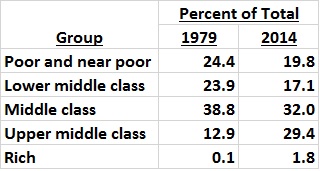
Rather than dividing all of us into quintiles and examining income changes in each quintile, Rose starts with a level of inflation-adjusted income and examines how different slices of income have done over time. In this case, he has examined 1979 through 2014, a period believed full of economic duress for most working Americans.

He divides us into five income classes:

  • The Poor and Near Poor, with incomes from $0 to $29,999 in 2014.
  • The Lower Middle class, with incomes from $30,000 to $49,999.
  • The Middle class, with incomes from $50,000 to $99,999.
  • The Upper Middle class, with incomes from $100,000 to $349,999.
  • The Rich, with incomes of at least $350,000.

All of these incomes are for what he calls a “three-person equivalent family.” A single person could have less income and be in a group, but a family of four or more would need more income to be in a particular group.

What has happened to the distribution of incomes? I pulled these numbers from figure 2 of Rose’s study:

Income distribution_Urban Institute

Color me unsurprised. I’ve seen similar results before, in these pieces, for example: Mark J. Perry’s “Yes, America’s Middle Class Has Been Disappearing…into Higher Income Groups” (Carpe Diem, December 17, 2015), and David Harsanyi’s “Sorry, Everyone: The American Middle Class Is Winning” (The Federalist, June 22, 2016).

Rose, of course, wants to make much of the inequality between the groups. But the groups don’t comprise the same people in 2014 as they did in 1979. Moreover, as the table suggest, Americans were a lot better off in 2014 than they were in 1979.

But that’s the left for you. If it ain’t equal, it ain’t right. That’s because leftists are always looking for victims instead of celebrating real progress — the kind that happens despite the best efforts of government to screw things up.

*     *     *

Related posts:
Taxing the Rich
More about Taxing the Rich
The Keynesian Fallacy and Regime Uncertainty
Creative Destruction, Reification, and Social Welfare
Why the “Stimulus” Failed to Stimulate
Regime Uncertainty and the Great Recession
Regulation as Wishful Thinking
In Defense of the 1%
Lay My (Regulatory) Burden Down
Economic Growth Since World War II
Government in Macroeconomic Perspective
Keynesianism: Upside-Down Economics in the Collectivist Cause
How High Should Taxes Be?
The 80-20 Rule, Illustrated
Economics: A Survey
Estimating the Rahn Curve: Or, How Government Spending Inhibits Economic Growth
The Keynesian Multiplier: Phony Math
The True Multiplier
Some Inconvenient Facts about Income Inequality
Mass (Economic) Hysteria: Income Inequality and Related Themes
Social Accounting: A Tool of Social Engineering
Income Inequality and Inherited Wealth: So What?
Income Inequality and Economic Growth
A Case for Redistribution, Not Made
McCloskey on Piketty
The Rahn Curve Revisited
Nature, Nurture, and Inequality
How to Eradicate the Welfare State, and How Not to Do It
Diminishing Marginal Utility and the Redistributive Urge
Capitalism, Competition, Prosperity, and Happiness
Further Thoughts about the Keynesian Multiplier
From Each According to His Ability…
Bubbling Along

The Obama Effect: Disguised Unemployment, Updated

Here.

Facts about Hall-of-Fame Hitters

In this post, I look at the batting records of the 136 position players who accrued most or all of their playing time between 1901 and 2015. With the exception of a bulge in the .340-.345 range, the frequency distribution of lifetime averages for those 136 players looks like a rather ragged normal distribution:

Distribution of HOF lifetime BA

That’s Ty Cobb (.366) at the left, all by himself (1 person = 0.7 percent of the 136 players considered here). To Cobb’s right, also by himself, is Rogers Hornsby (.358). The next solo slot to the right of Hornsby’s belongs to Ed Delahanty (.346). The bulge between .340 and .345 is occupied by Tris Speaker, Billy Hamilton, Ted Williams, Babe Ruth, Harry Heilmann, Bill Terry, Willie Keeler, George Sisler, and Lou Gehrig. At the other end, in the anchor slot, is Ray Schalk (.253), to his left in the next slot are Harmon Killebrew (.256) and Rabbit Maranville (.258). The group in the .260-.265 column comprises Gary Carter, Joe Tinker, Luis Aparacio, Ozzie Smith, Reggie Jackson, and Bill Mazeroski.

Players with relatively low batting averages — Schalk, Killibrew, etc. — are in the Hall of Fame because of their prowess as fielders or home-run hitters. Many of the high-average players were also great fielders or home-run hitters (or both). In any event, for your perusal here’s the complete list of 136 position players under consideration in this post:

Lifetime BA of 136 HOFers

For the next exercise, I normalized the Hall of Famers’ single-season averages, as discussed here. I included only those seasons in which a player qualified for that year’s batting championship by playing in enough games, compiling enough plate appearances, or attaining enough at-bats (the criteria have varied).

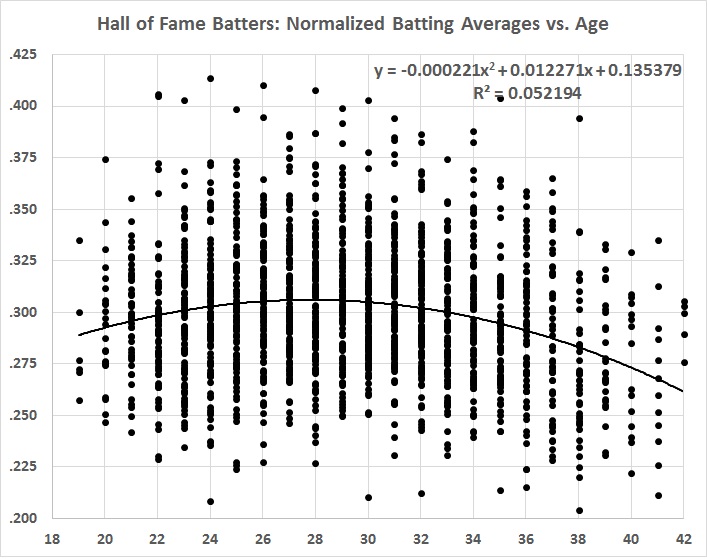
For the years 1901-2015, the Hall-of-Famers considered here compiled  1,771 seasons in which they qualified for the batting title. (That’s 13 percent of the 13,463 batting-championship-qualifying seasons compiled by all major leaguers in 1901-2015.) Plotting the Hall-of-Famers’ normalized single-season averages against age, I got this:

HOF batters - normalzed BA by age

The r-squared value of the polynomial fit, though low, is statistically significant (p<.01). The equation yields the following information:

HOF batters - changes in computed mean BA

The green curve traces the difference between the mean batting average at a given age and the mean batting average at the mean peak age, which is 28.3. For example, by the equation, the average Hall of Famer batted .2887 at age 19, and .3057 at age 28.3 — a rise of .0017 over 9.3 years.

The black line traces the change in the mean batting average from age to age; the increase is positive, though declining from ages 20 through 28, then negative (and still declining) through the rest of the average Hall of Famer’s career.

The red line represents the change in the rate of change, which is constant at -.00044 points (-4.4 percent) a year.

In tabular form:

HOF batters - mean BA stats vs age

Finally, I should note that the combined lifetime batting average of the 136 players is .302, as against the 1901-2015 average of .262 for all players. In other words, the Hall of Famers hit safely in 30.2 percent of at-bats; all players hit safely in 26.2 percent of at-bats. What’s the big deal about 4 percentage points?

To find out, I consulted “Back to Baseball,” in which I found the significant determinants of run-scoring. In the years 1901-1919 (the “dead ball” era), a 4 percentage-point (.040) rise in batting average meant, on average, an increase in runs scored per 9 innings of 1.18. That’s a significant jump in offensive output, given that the average number of runs scored per 9 innings was 3.97 in 1901-1919.

For 1920-2015, a rise in batting average of 4 percentage points meant, on average, an increase in runs scored per 9 innings of 1.03, as against an average number of runs scored per 9 innings of 4.51. That’s also significant, and it doesn’t include the effect of extra-base hits, which Hall of Famers produced at a greater rate than other players.

So Hall of Famers, on the whole, certainly made greater offensive contributions than other players, and some of them were peerless in the field. But do all Hall of Famers really belong in the Hall? No, but that’s the subject of another post.

Khizr Khan’s Muddled Logic

Anyone who follows this blog knows that I’m not a fan of Donald Trump. The only thing worse than a Trump victory in November would be a Clinton victory. But the brouhaha over Trump’s response to Khizr Khan’s speech at the DNC last week overlooks the vital truth that Khan’s speech was a load of propagandistic hogwash.

For the benefit of those of you who’ve been vacationing on Mars, Khizr Khan’s son was a U.S. Army captain who was killed in Iraq in 2004. The point of bringing Khan before the DNC was to point up Trump’s supposed anti-Muslim views. Whether or not Trump is anti-Muslim is beyond my ken, but he is anti-terorist — which is something I find hard to discern in the rhetoric of Democrats, who can’t bring themselves to associate Islam and terrorism.

It is anti-terrorism that animated Trump’s suggestion that there should be no further immigration by Muslims. Such a ban would do no more to prevent terrorist acts, given the numbers of terror-prone Muslims (and others) already in the United States, than a no-gun zone will do to prevent mass shootings by a psychopath. Nevertheless, I understand and appreciate the sentiment behind Trump’s proposal, even though it was a fatuous one that could only draw accusations of xenophobia.

And so it did, both in Hillary Clinton’s recorded introduction to Khan’s brief speech and in Khan’s brief speech itself. Without further ado, here’s the full text:

First, our thoughts and prayers are with our veterans and those who serve today. Tonight, we are honored to stand here as the parents of Capt. Humayun Khan, and as patriotic American Muslims with undivided loyalty to our country.

Like many immigrants, we came to this country empty-handed. We believed in American democracy — that with hard work and the goodness of this country, we could share in and contribute to its blessings.

We were blessed to raise our three sons in a nation where they were free to be themselves and follow their dreams. Our son, Humayun, had dreams of being a military lawyer. But he put those dreams aside the day he sacrificed his life to save his fellow soldiers.

Hillary Clinton was right when she called my son “the best of America.” If it was up to Donald Trump, he never would have been in America. Donald Trump consistently smears the character of Muslims. He disrespects other minorities — women, judges, even his own party leadership. He vows to build walls and ban us from this country.

Donald Trump, you are asking Americans to trust you with our future. Let me ask you: Have you even read the U.S. Constitution? I will gladly lend you my copy. In this document, look for the words “liberty” and “equal protection of law.”

Have you ever been to Arlington Cemetery? Go look at the graves of the brave patriots who died defending America — you will see all faiths, genders, and ethnicities.

You have sacrificed nothing and no one.

We can’t solve our problems by building walls and sowing division. We are stronger together. And we will keep getting stronger when Hillary Clinton becomes our next president.

Khan wraps himself in the flag that draped his son’s coffin. But the tragic death of his son is irrelevant to the issue at hand. It gives Khan no authority to speak about efforts to combat terrorism.

By the same token, also irrelevant are Khan’s various “arguments”:

He is — he says — a loyal and patriotic Muslim-American. So what? There are evidently a lot of Muslims — American and non-American — who are neither loyal nor patriotic, and who would (and have) killed Americans in the name of their religion.

He claims to be an immigrant who came to this country empty-handed, and who shares in and contributes to its “blessings.” So what? A lot of people come to this country, and some of them share in and contribute to its “blessings” but then turn around and kill or try to kill Americans.

His son gave his life in the service of his country. And for that, his son should be honored, and has been honored. But what does that have to do with terrorism?

Ah, here it is. If Trump had his way, Khan’s son (and Khan) wouldn’t have come to America. By the same token, neither would have the perpetrators of the World Trade Center bombing (1993), the Brooklyn Bridge shooting (1994), the killings at the Empire State Building (1997), the New York terror attack (2000), the fire-bombing of a synagogue in Ithaca (2000), the massive attacks of September 11, 2001, the Los Angeles Airport shooting (2002), the Jewish Federation shooting in Seattle (2006), the Arkansas recruiting office shooting (2009), the Fort Hood shooting (2009), the Boston Marathon bombing (2013), the Chattanooga shootings (2015), the San Bernardino attack (2015), or the Orlando nightclub shooting (2016). It’s true that there have been many other acts of violence during the same span of time, but some acts of violence would nevertheless have been prevented had Muslims not been allowed to enter the United States.

Now comes the Constitution, which is like the flag and the Declaration of Independence in its emotional appeal. In fact, the Constitution doesn’t guarantee anyone the right to immigrate. Immigration policy is a matter for Congress to decide. “Equal protection of the law[s]” applies to “[a]ll persons born or naturalized in the United States,” not to persons who wish to enter the United States and perhaps become citizens. “Liberty” is nowhere defined in the Constitution; it’s mentioned in the Preamble (which isn’t part of the Constitution), and twice elsewhere, in connection with due process of law. “Liberty” doesn’t encompass the right of an alien to enter the United States.

And it’s back to the dead who gave their lives for the United States and now lie in Arlington Cemetery (and other national cemeteries). Yes, there are all (or many) faiths, genders, and ethnicities among those dead. But their dying has nothing to do with whether Muslims should be allowed to enter the United States. In fact, there would be many fewer dead had Muslims not been allowed to enter, had terrorist attacks not ensued from their entry, and had the wars in Iraq and Afghanistan not followed from the terrorist attacks on September 11, 2001.

Whether or not Trump has sacrificed anything is beside the point. Neither has Hillary Clinton, by Khan’s standard. Yet, he ends by endorsing her because Americans will “grow stronger together” when she becomes president. Whatever that means.

And Khan to the contrary notwithstanding, Donald Trump is a piker when it comes to “building walls and sowing division.” Barack Obama has been doing it, metaphorically and actually, by rabble-rousing about “the rich”; destroying America’s health-care system; rewarding indolence with extended welfare payments, food stamps, and health insurance for slackers; stirring racial tension and fostering cop-killings by defending black thugs as “victims” and leveling blanket accusations of racism against cops; jerking the armed forces around with his on-again-off-again policies in Iraq and Afghanistan; caviling before Putin; failing to confront Chinese assertiveness; conspiring in the emasculation of the armed forces despite the obvious ambitions of Russia and China; signing (and ignoring) a treaty that will allow Iran to acquire nuclear weapons; slighting Israel, America’s only true ally in the Middle East; slighting other true allies in Eastern Europe; pushing same-sex “marriage” and gender neutrality as if thousand of years of tradition and biological facts mean nothing; and leveling the power of the central government against religious liberty.

As I said, Trump’s anti-Muslim immigration policy is fatuous. And Trump, as usual, responded to Khan with bluster and name-calling when he should have responded with facts and logic.

But that doesn’t excuse Khan’s own fatuousness or Clinton’s exploitation of his son’s death.

It’s time for principled conservatives — whose number doesn’t seem to include Senator McCain, Governor Pence, and other mealy-mouthed Republicans — to go on the attack and quit retreating in the face of the enemy. That enemy is Hillary Clinton (and other so-called progressives), whose cynical use of Khan is in keeping with her cynical political career — the foundation of which is her partnership with a sexual predator.

*     *     *

Related reading:

Clarice Feldman, “Who Is Khizr Khan, the Father of a Fallen U.S. Soldier?American Thinker, August 1, 2016

Geoffrey P. Hunt, “Hillary’s Cynical Manipulation of Captain Khan’s Sacrifice,” American Thinker, August 2, 2016

J. Marsolo, “Khizr Khan Has No Shame,” American Thinker, August 2, 2016

William Murchison, “The Khan Con and Other Modern Discontents,” The American Spectator, August 2, 2016

 

Further Pretensions of Knowledge

The Economist‘s second article in its series on “seminal economic ideas” is about Hyman Minsky’s theory that “booms sow the seeds of busts”:

Having grown up during the Depression, Minsky was minded to dwell on disaster. Over the years he came back to the same fundamental problem again and again. He wanted to understand why financial crises occurred. . . .

Minsky . . . developed his “financial-instability hypothesis”. It is an examination of how long stretches of prosperity sow the seeds of the next crisis, an important lens for understanding the tumult of the past decade. . . .

Minsky started with an explanation of investment. It is, in essence, an exchange of money today for money tomorrow. A firm pays now for the construction of a factory; profits from running the facility will, all going well, translate into money for it in coming years. Put crudely, money today can come from one of two sources: the firm’s own cash or that of others (for example, if the firm borrows from a bank). The balance between the two is the key question for the financial system.

Minsky distinguished between three kinds of financing. The first, which he called “hedge financing”, is the safest: firms rely on their future cashflow to repay all their borrowings. For this to work, they need to have very limited borrowings and healthy profits. The second, speculative financing, is a bit riskier: firms rely on their cashflow to repay the interest on their borrowings but must roll over their debt to repay the principal. This should be manageable as long as the economy functions smoothly, but a downturn could cause distress. The third, Ponzi financing, is the most dangerous. Cashflow covers neither principal nor interest; firms are betting only that the underlying asset will appreciate by enough to cover their liabilities. If that fails to happen, they will be left exposed.

Economies dominated by hedge financing—that is, those with strong cashflows and low debt levels—are the most stable. When speculative and, especially, Ponzi financing come to the fore, financial systems are more vulnerable. If asset values start to fall, either because of monetary tightening or some external shock, the most overstretched firms will be forced to sell their positions. This further undermines asset values, causing pain for even more firms. They could avoid this trouble by restricting themselves to hedge financing. But over time, particularly when the economy is in fine fettle, the temptation to take on debt is irresistible. When growth looks assured, why not borrow more? Banks add to the dynamic, lowering their credit standards the longer booms last. If defaults are minimal, why not lend more? Minsky’s conclusion was unsettling. Economic stability breeds instability. Periods of prosperity give way to financial fragility. . . .

[A]s an outsider in the sometimes cloistered world of economics, Minsky’s influence was, until recently, limited. Investors were faster than professors to latch onto his views. More than anyone else it was Paul McCulley of PIMCO, a fund-management group, who popularised his ideas. He coined the term “Minsky moment” to describe a situation when debt levels reach breaking-point and asset prices across the board start plunging. Mr McCulley initially used the term in explaining the Russian financial crisis of 1998. Since the global turmoil of 2008, it has become ubiquitous. For investment analysts and fund managers, a “Minsky moment” is now virtually synonymous with a financial crisis. . . .

. . . In a speech in 2009, before she became head of the Federal Reserve, Janet Yellen said Minsky’s work had “become required reading”. In a 2013 speech, made while he was governor of the Bank of England, Mervyn King agreed with Minsky’s view that stability in credit markets leads to exuberance and eventually to instability. Mark Carney, Lord King’s successor, has referred to Minsky moments on at least two occasions.Will the moment last? Minsky’s own theory suggests it will eventually peter out. Economic growth is still shaky and the scars of the global financial crisis visible. In the Minskyan trajectory, this is when firms and banks are at their most cautious, wary of repeating past mistakes and determined to fortify their balance-sheets. But in time, memories of the 2008 turmoil will dim. Firms will again race to expand, banks to fund them and regulators to loosen constraints. The warnings of Minsky will fade away. The further we move on from the last crisis, the less we want to hear from those who see another one coming.

I am left with this question: Is the Minskyan trajectory a bad thing or a good thing? Is there a better, feasible way to finance economic growth? Or is the alternative some kind of government-enforced algorithm in which one-size-fits-all-regulation fosters hyper-bubbles (as with the directive to lend more to poor, minority mortgagors) or hypo-bubbles (in which rising investment is stifled long before it becomes a bubble).

Government doesn’t have a good track record when it comes to fine-tuning the economy. It’s true that the economy has been somewhat more stable since the creation of the Federal Reserve in 1913. But the price of stability is high; namely, it is inversely related to long-run economic growth. And the two deepest economic downturns in America’s history — the Great Depression and the Great Recession — happened on the Fed’s watch, and can be blamed (in part, at least) on the Fed.

Economics can be a powerfully descriptive discipline. But its power to describe is far from infallible, as Arnold Kling shows in his must-read tome, Specialization and Trade: A Re-introduction to Economics. Among many things, Kling explains why the Keynesian multiplier — the hoariest of fine-tuning ideas — is a terrible idea. (I heartily agree with Kling.)

Even if economics were an infallibly descriptive discipline, it shouldn’t be taken as an infallibly prescriptive one. Friedrich Hayek put it this way in his Nobel Prize Lecture, “The Pretence of Knowledge“:

It is true that . . . systems of equations describing the pattern of a market equilibrium are so framed that if we were able to fill in all the blanks of the abstract formulae, i.e. if we knew all the parameters of these equations, we could calculate the prices and quantities of all commodities and services sold. But, as Vilfredo Pareto, one of the founders of this theory, clearly stated, its purpose cannot be “to arrive at a numerical calculation of prices”, because, as he said, it would be “absurd” to assume that we could ascertain all the data. . . .  I sometimes wish that our mathematical economists would take this to heart. I must confess that I still doubt whether their search for measurable magnitudes has made significant contributions to our theoretical understanding of economic phenomena – as distinct from their value as a description of particular situations. Nor am I prepared to accept the excuse that this branch of research is still very young: Sir William Petty, the founder of econometrics, was after all a somewhat senior colleague of Sir Isaac Newton in the Royal Society!

The chief point we must remember is that the great and rapid advance of the physical sciences took place in fields where it proved that explanation and prediction could be based on laws which accounted for the observed phenomena as functions of comparatively few variables – either particular facts or relative frequencies of events. . . .  A theory of essentially complex phenomena must refer to a large number of particular facts; and to derive a prediction from it, or to test it, we have to ascertain all these particular facts. Once we succeeded in this there should be no particular difficulty about deriving testable predictions – with the help of modern computers it should be easy enough to insert these data into the appropriate blanks of the theoretical formulae and to derive a prediction. The real difficulty, to the solution of which science has little to contribute, and which is sometimes indeed insoluble, consists in the ascertainment of the particular facts. . . .

. . . To act on the belief that we possess the knowledge and the power which enable us to shape the processes of society entirely to our liking, knowledge which in fact we do not possess, is likely to make us do much harm. In the physical sciences there may be little objection to trying to do the impossible; one might even feel that one ought not to discourage the over-confident because their experiments may after all produce some new insights. But in the social field the erroneous belief that the exercise of some power would have beneficial consequences is likely to lead to a new power to coerce other men being conferred on some authority. Even if such power is not in itself bad, its exercise is likely to impede the functioning of those spontaneous ordering forces by which, without understanding them, man is in fact so largely assisted in the pursuit of his aims. We are only beginning to understand on how subtle a communication system the functioning of an advanced industrial society is based – a communications system which we call the market and which turns out to be a more efficient mechanism for digesting dispersed information than any that man has deliberately designed.

If man is not to do more harm than good in his efforts to improve the social order, he will have to learn that in this, as in all other fields where essential complexity of an organized kind prevails, he cannot acquire the full knowledge which would make mastery of the events possible. He will therefore have to use what knowledge he can achieve, not to shape the results as the craftsman shapes his handiwork, but rather to cultivate a growth by providing the appropriate environment, in the manner in which the gardener does this for his plants. There is danger in the exuberant feeling of ever growing power which the advance of the physical sciences has engendered and which tempts man to try, “dizzy with success”, to use a characteristic phrase of early communism, to subject not only our natural but also our human environment to the control of a human will. The recognition of the insuperable limits to his knowledge ought indeed to teach the student of society a lesson of humility which should guard him against becoming an accomplice in men’s fatal striving to control society – a striving which makes him not only a tyrant over his fellows, but which may well make him the destroyer of a civilization which no brain has designed but which has grown from the free efforts of millions of individuals.

(This post offers more on this subject of the limitations of knowledge, and the implications for economic policy.)

The ability to describe a phenomenon in a general way is far from knowing how to improve on it. In fact, the ability to describe a phenomenon in a general way says nothing about whether it can be improved on. Such things as investment bubbles, market failure, and winners and losers from trade are the normative judgments of observers who simply don’t like what they see and believe (mistakenly) that they know how to “make things right.”

Baseball’s Greatest 40-and-Older Hitters

Drawing on the Play Index at Baseball-Reference.com, I discovered the following bests for major-league hitters aged 40 and older:

Most games played — Pete Rose, 732

Most games in starting lineup — Pete Rose, 643

Most plate appearances — Pete Rose, 2955

Most at-bats — Pete Rose, 2574

Most runs — Sam Rice, 327

Most hits — Pete Rose, 699

Most doubles — Sam Rice, 95

Most triples — Honus Wagner, 36

Most home runs — Carlton Fisk, 72

Most runs batted in — Carlton Fisk, 282

Most stolen bases — Rickey Henderson, 109

Most times caught stealing — Rickey Henderson, 34

Most times walked — Pete Rose, 320

Most times struck out — Julio Franco, 336

Highest batting average — Ty Cobb, .343*

Highest on-base percentage — Barry Bonds, .464*

Highest slugging percentage — Barry Bonds, .561*

Highest on-base-plus-slugging percentage (OPS) — Barry Bonds, 1.025*

Most sacrifice hits (bunts) — Honus Wagner, 45

Also of note:

Babe Ruth had only 6 home runs as a 40-year-old in his final (partial) season, as a member of the Boston Braves.

Ted Williams is remembered as a great “old” player, and he was. But his 40-and-over record (compiled in 1959-60) is almost matched by that of his great contemporary, Stan Musial (whose 40-and-older record was compiled in 1961-63):

Williams vs. Musial 40 and older
_________
* In each case, this excludes players with small numbers of plate appearances (always fewer than 20). Also, David Ortiz has a slugging average of .652 and an OPS of 1.067 for the 2016 season (his first as a 40-year-old), but the season isn’t over.

Unsurprising News about Health-Care Costs

Obama, among his many lies, promised that Obamacare would “bend the cost curve,” that is, reduce or eliminate the surge in health-care costs. Anyone with half a brain knew that Obama was either stupid or lying. He’s not stupid (though not nearly as smart as he thinks he is), so it’s obvious that he was lying. (It was obvious to me from the get-go.)

Those few Americans who have been paying attention have known that Obama was lying because they’ve been following the surge in health-care costs. This is just the latest in a series of reports delivering the bad but unexpected news.

As the U.S. economy continues to flirt with recession, this morning’s “flash” Dross Domestic Product release for the second quarter indicates “close to zero” growth. Business investment has collapsed, leaving personal consumption expenditures to drive what little growth there is….

The figures for 2015 Q2 to 2016 Q2 show growth in spending on health services accounted for one quarter of GDP growth. At a growth rate of 5.3 percent, spending on health services grow more than twice as fast as the 2.1 percent growth in non-health services GDP. Growth in health spending accounted for almost one third of the growth in services spending and one quarter of the growth in personal consumption expenditure….
Although health services spending accounts for just 12 percent of GDP, these estimates continue to indicate it will grow faster than GDP. There is no slowdown in health services spending.
I’ll report later on the latest GDP estimates, but I will tell you that “close to zero” is real year-over-year growth of 1.2 percent. Just abysmal.

Griffey and Piazza: True Hall-of-Famers or Not?

Ken Griffey Jr. and Mike Piazza have just been voted into baseball’s Hall of Fame.

Griffey belongs there. Follow this link and you’ll see, in the first table, that he’s number 45 on the list of offensive players whom I consider deserving of the honor.

Piazza doesn’t belong there. He falls short of the 8,000 plate appearances (or more) that I would require to prove excellence over a sustained span. Piazza would be a true Hall of Famer if I relaxed the standard to 7,500 plate appearances, but what’s the point of having standards if they can be relaxed just to reward popularity (or mediocrity)?


Individualism, Society, and Liberty

In “How Our Individualism Has Trapped Us in a Welfare State,” Heather Judd has taken a stab at an issue that I’ve pondered for a long time: the tension between individualism and society. Now, by “society” I mean true society:

Society — true society — consists of people who, among other things, agree as to the limits on what one may do. That shared view isn’t imposed by regulation, statute, or judicial decree — though such things will arise from the shared view in a true society. Rather, the shared view arises from the experience of living together and finding the set of customs and prohibitions that yields peaceful, willing coexistence and its concomitant: beneficially cooperative behavior. Liberty, in other words.

“The experience of living together and finding” a common “set of customs and prohibitions” seems consistent with Judd’s view of society, which she calls “an organized group of people sharing a common culture.” Judd doesn’t directly address the libertarian aspect of true society, but the thrust of her essay points in that direction. She laments the fact that

[c]ultural individualization has…cornered us into a welfare state mentality from which we cannot escape unless we replace our concept of a society of individuals with something more ordered and interconnected.

Toward the end of her essay she puts it this way:

Living together in isolation is not a sustainable social model. So long as we continue to think of the individual as the basic unit of society, our progression toward the disenchanted welfare state will continue, even while no amount of socialized government intervention will provide the human cohesion we need.

Judd’s view is that family is the backbone of society. And the drift away from families to individuals is destroying that backbone, which must be reconstructed. In her words,

government is incapable of buttressing our crumbling human connections. That task must start with rebuilding individuals into families and families into society. Like every great undertaking, the process will be slow and require sacrifice, but the recompense will be not only a healthy and sustainable society, but also, paradoxically, a stronger sense of our individual identity as we reconnect with other human beings.

I think she’s right about the breakdown of family, but her vague exhortation at the end leaves me wondering what can actually be done about it And even if there were some restoration of the family on a relatively large scale, I don’t think it would do much to alleviate the fragmentation of the United States, which has never been a society in the true meaning of the word.

Why have family ties loosened and broken? The answer, in two words: prosperity and mobility. Even without the welfare state (and despite it), a large fraction of the populace can afford to buy things like housing and elder-care that until World War II were often provided by families.

Greater mobility goes hand in hand with greater prosperity; the expansion of economic activity has been both intensive and extensive. Modern people are no different than their hunter-gatherer forbears; they go where their labors earn greater rewards. And in doing so they leave behind grandparents, parents, and siblings — most of whom are prosperous enough to fend for themselves. American families have been drifting apart for many generations. The drift was masked to some extent by the influx of European immigrants in the late 1800s and early 1900s, whose strong bonds were forged by economic necessity and mutual self-defense against xenophobic natives. But those bonds, too, have dissolved to the point that the exceptions (e.g., Amish and Hasidic communities) are notable for their rarity. And so it will be with the Hispanic immigration of recent decades, though economic necessity and ethnic differences probably will bind Hispanic immigrants far longer than they bound European ones.

So I don’t see the restoration of the family as likely — barring another World War II or Great Depression. Nor do I see the restoration of the family as necessary to the demotion of the welfare state. The welfare state does feed on individualism, but it also feeds on widespread economic ignorance and the cupidity of politicians and bureaucrats.

Economic ignorance abets cupidity, in that politicians and bureaucrats are able to feed their power-lust and line their pockets because most Americans have no grasp of the huge economic cost of the welfare state — or more accurately, the regulatory-welfare state. If the regulatory-welfare state is to be contained and diminished by electoral means, a huge number of Americans must be convinced of its exorbitant cost in dollars and liberty.

One might as well try to melt an iceberg with a hair dryer. Only a minority of economists understands or is willing to admit the dire economic consequences of the regulatory-welfare state, and only a minority of constitutional scholars understands or is willing to admit the anti-libertarian consequences of the regulatory-welfare state. More importantly — because only a small fraction of Americans is aware of what those “fringe” economists and constitutional scholars say — relatively few politicians and pundits on the national stage understand, agree with, and accurately relay those views to Americans. For every Ted Cruz there are probably two or three Bernie Sanderses.

To repeat the themes of recent posts, leftists are ruthless and they have the rhetorical advantage over principled politicians because they are very good at promising things without knowing or caring about the economic and social costs of what they promise. Their appeal to Mr. and Ms. Average and Below-Average — which is most Americans — rests on envy. Leftists are always on the lookout for privilege, which they promise to uproot:

Privilege…implies that the possessors of certain positive attributes (high intelligence, good looks, high income, access to political power) have come by those things undeservedly, and even at the expense of those who lack them: the underprivileged. [Leftists] believe implicitly in a state of nature wherein everyone would have equal endowments of intelligence, looks, etc., if only it weren’t for “bad luck.” [Leftists] believe it necessary to use the power of government to alleviate (if not eliminate) unequal endowments and to elevate the “victims” of inequality.

If you were Mr. or Ms. Average or Below-Average, would you willingly sacrifice the (illusory) prosperity of the regulatory-welfare state and reject its promise of making everyone a winner? What’s more disheartening — but unsurprising given the state of political discourse — is that  Mr. and Ms. Above-Average are not only reluctant to abandon the regulatory-welfare state, but are its staunchest proponents.

In sum, individualism is here to stay, regardless of what happens to the regulatory-welfare state, unless there is a return to the dire days of 1930-1945. And even then, the regulatory-welfare state is here to stay, unless there is a negotiated partition of the country, a (successful) secession movement, or a coup by liberty-loving patriots.

I’m sorry, but that’s the way it looks from here.

More Wisdom from Theodore Dalrymple

I’m reading his Not With a Bang But a Whimper: The Politics & Culture of Decline. It’s chock-a-block with wisdom, as is almost everything Dalrymple writes. This is from the essay “How Not to Do It”:

The state has become a vast and intricate system of patronage, whose influence very few can entirely escape. It is essentially corporatist: the central government, avid for power, sets itself up as an authority on everything and claims to be omnicompetent both morally and in practice; and by means of taxation, licensing, regulation and bureaucracy, it destroys the independence of all organisations that intervene between it and the individual citizen. If it can draw enough citizens into dependence on it, the central government can remain in power, if not forever, then for a very long time, at least until a crisis or cataclysm forces change.

At the very end of the chain of patronage…is the underclass, who (to change the metaphor slightly) form the scavengers or bottom-feeders of the whole corporatist ecosystem. Impoverished and degraded as they might be, they are nonetheless essential to the whole system, for their existence provides an ideological proof of the necessity of providential government in the first place, as well as justifying many employment opportunities in themselves.… I have seen myself…large numbers of people corrupted to the very fibre of their being by having been deprived of responsibility, purpose and self-respect, void of hope and fear alike, living in as near to purgatory as anywhere in modern society can come.

Of course, the corporatist system…is a house of cards, or perhaps a better analogy would be with a pyramid scheme. Hundreds of thousands of people are employed to perform tasks that are not merely useless but actually obstructive of real work and economically counterproductive. The bureaucracy insinuates itself into the smallest cracks of daily life.


An Addendum to Asymmetrical (Ideological) Warfare

I published “Asymmetrical (Ideological) Warfare” almost six years ago. I must say that it holds up well. In fact, I wouldn’t change a word of it. It’s fairly long, and I won’t try to summarize or excerpt it, except to repeat the opening sentence:

This post could be subtitled: “Or, why the left — Democrats and so-called liberals and progressives — enjoy a rhetorical advantage over libertarians and fiscal conservatives.”

In a few words: Leftists have the advantage of saying the kinds of things that people like to hear, especially when it comes to promising “free” stuff and visions of social perfection. There’s a lot more to it than that. Please read the whole thing.

What I didn’t say then, but will say now is that leftists have another advantage: they’re ruthless. Unlike true conservatives (not Trumpsters) and most libertarians, leftists can be ruthless, unto vicious. They pull no punches; they call people names; they skirt the law — and violate it — to get what they want (e.g., Obama’s various “executive actions”); they use the law and the media to go after their ideological opponents; and on and on.

Why the difference between leftists and true conservatives? Leftists want to rearrange the world to fit their idea of perfection. They have it all figured out, and dissent from the master plan will not be tolerated. (This is very Hitleresque and Stalinesque.) Conservatives and libertarians want people to figure out for themselves how to arrange the world within the roomy confines of simple morality (don’t cheat, don’t steal, don’t murder, etc.).

If Trump wins in November — a very big “if” — it should be an object lesson to true conservatives and libertarians. Take the gloves off and don brass knuckles. This isn’t a contest for hockey’s Lady Byng Trophy. To change the sports metaphor, we’re in the late rounds of a brutal fight, and well behind on points. It’s time to go for the knockout.

Non-Judgmentalism as Leftist Condescension

Theodore Dalrymple (Anthony Daniels), drawing on his experience as a psychiatrist who worked with prisoners, writes  about “The Gift of Language” in Not With a Bang but a Whimper: The Politics & Culture of Decline:

With a very limited vocabulary, it is impossible to make, or at least to express, important distinctions and to examine any question with conceptual care. My patients often had no words to describe what they were feeling, except in the crudest possible way, with expostulations, exclamations and physical displays of emotion.… Complex narrative and most abstractions were closed to them.

In their dealings with authority, they were at a huge disadvantage – a disaster, since so many of them depended upon various public bureaucracies for so many of their needs, from their housing and health care to their income and the education of their children.…

All this, it seems to me, directly contradicts our era’s ruling orthodoxy about language. According to that orthodoxy, every child, save the severely brain-damaged and those with very rare genetic defects, learns his or her native language with perfect facility, adequate to his needs. He does so because the faculty of language is part of human nature, inscribed in man’s physical being, as it were, and almost independent of environment.…

It follows that no language or dialect is superior to any other and that modes of verbal communication cannot be ranked according to complexity, expressiveness or any other virtue. Thus, attempts to foist alleged grammatical ‘correctness’ on native speakers of an ‘incorrect’ dialect are nothing but the unacknowledged and oppressive exercise of social control – the means by which the elites deprive whole social classes and peoples of self-esteem and keep them in permanent subordination.…

The locus classicus of this way of thinking, at least for laymen such as myself, is Steven Pinker’s book The Language Instinct.…

Pinker nails his colours to the mast at once. His book, he says, ‘will not chide you about proper usage’ because, after all, ‘[l] anguage is a complex, specialised skill which… is qualitatively the same in every individual… Language is no more a cultural invention than is upright posture,’ and men are as naturally equal in their ability to express themselves as in their ability to stand on two legs. ‘Once you begin to look at language… as a biological adaptation to communicate information,’ Pinker continues, ‘it is no longer as tempting to see language as an insidious shaper of thought.’ Every individual has an equal linguistic capacity to formulate the most complex and refined thoughts. We all have, so to speak, the same tools for thinking. ‘When it comes to linguistic form,’ Pinker says, quoting the anthropologist Edward Sapir, ‘Plato walks with the Macedonian swineherd, Confucius with the head-hunting savage of Assam.’ To put it another way, ‘linguistic genius is involved every time a child learns his or her mother tongue’.…

Children will learn their native language adequately whatever anyone does, and the attempt to teach them language is fraught with psychological perils. For example, to ‘correct’ the way a child speaks is potentially to give him what used to be called an inferiority complex. Moreover, when schools undertake such correction they risk dividing the child from his parents and social milieu, for he will speak in one way and live in another, creating hostility and possibly rejection all around him. But happily, since every child is a linguistic genius, there is no need to do any such thing. Every child will have the linguistic equipment he needs, merely by virtue of growing older.

I need hardly point out that Pinker doesn’t really believe anything of what he writes, at least if example is stronger evidence of belief than precept. Though artfully sown here and there with a demotic expression to prove that he is himself of the people, his own book is written, not surprisingly, in the kind of English that would please schoolmarms. I doubt very much whether it would have reached its 25th printing had he chosen to write it in the dialect of the slums of Newcastle-upon-Tyne, for example, or of rural Louisiana. Even had he chosen to do so, he might have found the writing rather difficult. I should like to see him try to translate a sentence from his book that I have taken at random – ‘The point that the argument misses is that, although natural selection involves incremental steps that enhance functioning, the enhancements do not have to be an existing module’ – into the language of the back streets of Glasgow or Detroit.…

Over and over again, Pinker stresses that children do not learn language by imitation; rather, they learn it because they are biologically predestined to do so.…

It is utterly implausible to suggest that imitation of parents (or other social contacts) has nothing whatever to do with the acquisition of language. I hesitate to mention so obvious a consideration, but Chinese parents tend to have Chinese-speaking children, and Portuguese parents Portuguese-speaking ones. I find it difficult to believe that this is entirely a coincidence and that imitation has nothing to do with it. Moreover, it is a sociological truism that children tend to speak not merely the language but the dialect of their parents.…

The contrast between a felt and lived reality – in this case, Pinker’s need to speak and write standard English because of its superior ability to express complex ideas – and the denial of it, perhaps in order to assert something original and striking, is characteristic of an intellectual climate in which the destruction of moral and social distinctions is proof of the very best intentions.

Pinker’s grammatical latitudinarianism…has the practical effect of encouraging those born in the lower reaches of society to remain there, to enclose them in the mental world of their particular milieu. This is perfectly all right if you also believe that all stations in life are equally good and desirable and that there is nothing to be said for articulate reflection upon human existence. In other words, grammatical latitudinarianism is the natural ideological ally of moral and cultural relativism….

…Everyone, save the handicapped, learns to run without being taught; but no-one runs 100 metres in ten seconds, or even fifteen seconds, without training. It is fatuous to expect that the most complex of human faculties, language, requires no special training to develop it to its highest possible power.

Pinker, whose fatuousness extends to a risible belief that human nature is changing for the better, has contradicted his thesis in “Why Academics Stink at Writing–and How to Fix It,” which is available here in exchange for your name, your job title, the name of your organization, and your e-mail address. How can a person who claims that ‘linguistic genius is involved every time a child learns his or her mother tongue’ turn around and criticize his academic peers for their general lack of linguistic genius? Pinker the linguistic theorist is wrong; Pinker the critic of bloated, impenetrable prose is right,

As Dalrymple suggests, Pinker’s linguistic latitudinarianism gives aid and comfort to the moral and cultural relativists of the left. Almost nothing, it seems, is beneath a leftist’s condescension; if it’s inferior it’s praiseworthy.

This pattern fits my version of Arnold Klng’s three-axis model, in which I characterize the leftist (“progressive”) axis: privileged-underprivileged. As I say in “Another Look at Political Labels,”

Privilege, for Ps [“progressives”], implies that the possessors of certain positive attributes (high intelligence, good looks, high income, access to political power) have come by those things undeservedly, and even at the expense of those who lack them: the underprivileged. Ps believe implicitly in a state of nature wherein everyone would have equal endowments of intelligence, looks, etc., if only it weren’t for “bad luck.” Ps believe it necessary to use the power of government to alleviate (if not eliminate) unequal endowments and to elevate the “victims” of inequality.

The left’s mantra should be “If it’s bad it’s good.”When a leftist praises or defends something, it’s a good sign that it’s substandard in morality or quality.

About Those High-Ranking Shills

In the midst of a funny post about the likely failure of an attempted military coup to keep Obama in office, Kurt Schlichter makes this observation:

The problem for Obama is that a significant portion of the most important element, the military, has nothing but contempt for him.

That does not include the military’s senior leadership. The sorry spectacle of senior officers slavishly going along with troop-imperiling idiocy like transsexual integration instead of throwing their stars on the table and walking out is a disgrace. So a significant number of generals would be intimidated into doing whatever Obama asks – if they can’t tell him that “No, America’s greatest strategic challenge is not slightly warmer weather,” then they haven’t the intestinal fortitude to tell him “No, I’m not putting a mech battalion on Capitol Hill.”

As I’ve pointed out before (e.g., here), a pro-liberty coup is unlikely, even if it might be the only way of restoring liberty to the land:

Military personnel (careerists, in particular) are disciplined, have direct access to the tools of power, and many of them are trained in clandestine operations. Therefore, a cadre of properly motivated careerists might possess the wherewithal necessary to seize power. But a plot to undertake a coup is easily betrayed. (Among other things, significant numbers of high-ranking officers are shills for the regulatory-welfare state.) And a coup, if successful, might deliver us from a relatively benign despotism into a decidedly malign despotism.

But unless there is a negotiated partition of the country — perhaps in response to a serious secession movement — a coup is probably the only hope for the restoration of liberty under a government that is true to the Constitution.

The alternative is a continuation of America’s descent into despotism, which — as many Americans already know — is no longer the “soft” despotism foreseen by Tocqueville.

It shouldn’t be surprising that many high-ranking officers become shills for the regulatory-welfare state. Military life demands a high degree of conformity, and academy graduates are drilled in conformity from the moment that they become plebes. And from then until they die, they are paid employees and pensioners of the state.

It takes great strength of character for a careerist to distinguish between the real Constitution that he is sworn to uphold and the statist dogmas that have replaced it. I have known such persons. But I have known, and know of, too many of the other kind — the line-toers and authority-fetishists whose allegiance is to a “system” and not to liberty.

Another Look at Political Labels

Arnold Klng’s three-axis model is a good place to start:

My model of political language is that it is driven by heuristics. The standard definition of a heuristic is that it is an aid to learning or problem-solving. I think of heuristics as mental shortcuts.…

…I claim that progressives, conservatives, and libertarians each use a different heuristic. Because they use different heuristics, they speak different languages.Each heuristic sets up an axis of favorable and unfavorable. Ps [progressives] use the heuristic of the oppressed-oppressor axis. Ps view most favorably those groups who can be regarded as oppressed or standing with the oppressed. They view most unfavorably those groups who can be regarded as oppressors. Cs [conservatives] use the heuristic of the civilization-barbarism axis. Cs view most favorably the institutions that they believe constrain and guide people toward civilized behavior, and they view most unfavorably those people who they see as trying to tear down such institutions. Ls [libertarians] use the heuristic of the freedom-coercion axis. Ls view most favorably those who defer to decisions that are made on the basis of personal choice and voluntary agreement, and they view most unfavorably those people who favor government interventions that restrict personal choice.

For the sake of grammatical consistency and accuracy, I would use characterize the three axes as follows:

  • Ps — privileged-underprivileged
  • Cs — civilized-barbaric
  • Ls — free-oppressed.

How Ps Think

Privilege, for Ps, implies that the possessors of certain positive attributes (high intelligence, good looks, high income, access to political power) have come by those things undeservedly, and even at the expense of those who lack them: the underprivileged. Ps believe implicitly in a state of nature wherein everyone would have equal endowments of intelligence, looks, etc., if only it weren’t for “bad luck.” Ps believe it necessary to use the power of government to alleviate (if not eliminate) unequal endowments and to elevate the “victims” of inequality.

As Kling puts it elsewhere, “Progressives tend to believe that we just need the right leaders to bring out the good that is in everyone,” as if nature were subject to the dictates of government. Thus the push for the “living wage,” “affordable housing,” “free” college education, access to the restroom of one’s choice, and the suppression of uncomfortable ideas that reflect traditional mores and morals — and the facts of life (e.g., gender isn’t “assigned,” it just is). The realization of such desiderata justifies (for Ps) the power of government to nullify and override constitutional and social norms, including property rights, freedom of speech, freedom of association, and freedom of conscience.

How Cs Think

Cs don’t view endowments (intelligence, looks, etc.) as matters of luck; they just are, and no blame attaches to anyone for his endowments or lack of them. Cs recognize “bad luck,” but only as a transitory phenomenon from which its recipients can rebound — with the voluntary help of family, friends, and other members of their (true) society — if they adhere to traditional mores and morals, that is, behave civilly.

Civility is manifested in three essential traits: respect for others (including their rightful possessions), self-reliance, and self-control. As Kling puts it elsewhere, “Conservatives tend to believe that we need traditional institutions and restraints to control the evil impulses that are in everyone.” Cs  view economic cooperation as part and parcel of social comity, which requires civility and is damaged by the divisive identity politics fostered by Ps.

Privilege, for Cs, is the status or wealth that accrues to a person who has earned it through self-reliance and self-control, while being respectful of others. That kind of privilege is earned, and it doesn’t come at the expense of others. Cs, unlike Ps, don’t view the world as a zero-sum game, in which someone’s “good luck” somehow causes “bad luck” for others. Rather, Cs view persistent “bad luck” as arising in large part from a lack of self-reliance and self-control. Such behavior, to Cs, is barbaric and shouldn’t be countenanced, let alone encouraged as it is by the unrealistic worldview of Ps.

How Ls Think

Ls are like Cs in the value that they place on respect for others, self-reliance, and self-control. But Ls are more sanguine than Cs about the distribution of those traits, and they see traditional mores and morals as unnecessarily burdensome. Ls believe that the world would be a more prosperous and happier place if people were free of the governmental restraints that deny them the full exercise of their powers. As Kling puts it elsewhere, “Libertarians tend to believe that we just need smaller government to bring out the good that is in everyone.”

Ls and Ps Compared

Most Ls and Ps adhere to traditional mores and morals themselves, but nevertheless view some of those mores and morals as oppressive. Thus abortion and same-sex “marriage” are widely favored among Ls and Ps, and drug use one of their “victimless” crimes.

Most Ls, unlike Ps, would refrain from using the power of government to adjust economic inequalities, except to remedy “crony capitalism” and perhaps to replace a host of welfare programs with a simpler income guarantee. Many Ls also favor government actions meant to attain “equality” (e.g., public-accommodation laws), even though such actions actually restrict freedom.

Ls, in other words, are selective in their abhorrence of government action. And Ls are like Ps in that they presume to know precisely how to rearrange the social and economic order to make everyone happier.

Introducing Os

Ps, Cs, and Ls — persons who actually have the somewhat coherent views sketched above — are in the vast minority of Americans. To the extent that the views of Ps, Cs, or Ls hold sway, it is because of the backing of non-philosophical citizens whose votes and influence tip the balance in favor of one philosophy or another. I will call them Others (Os).

Why Ps Usually Prevail

Ps have a great advantage over Cs and Ls when it comes to attracting supporters among the Os. There are all of the “free” goodies, of course, and the various “equality” policies that attract identity groups and people whose self-esteem is boosted by thinking and saying “nice” things.

The economic and social effects of the progressive agenda are only indirectly and slowly realized through stagnation and moral decay, and so Ps need not fear the wrath of voters for the consequences of their policies. In fact, every dire consequence of government action (e.g., economic stagnation, reduced labor-force participation, rising medical costs, higher housing costs, financial crises) is seen by Ps as a reason for yet more government action — and most of the Os go along with it.

Cs also have the disadvantage of being associated with groups who hate the groups that are privileged by Ps. The backing of such groups (e.g., “rednecks”) puts Cs on the defensive, and leads many of them to compromise with Ps in the (vain) hope of seeming “compassionate.” Calvin Coolidge was the most recent truly conservative president, and probably the last one.

Ls are just Ps who don’t offer “free” goodies. (The Ls who favor a guaranteed income are clear that it should replace other welfare programs, and despite that come under fire from other Ls — which is most of them — for their naive belief that guaranteed income wouldn’t be added to the other programs.) Further, when Ls insist that government should be smaller, they are attacking the god (or Santa Claus) so beloved by Ps and most Os. Ls, in other words, don’t stand a snowball’s chance of making a serious electoral dent.

*     *     *

Related posts:
Academic Bias
Intellectuals and Capitalism
On Liberty
Greed, Cosmic Justice, and Social Welfare
Positive Rights and Cosmic Justice
Fascism with a “Friendly” Face
Penalizing “Thought Crimes”
Democracy and Liberty
The Interest-Group Paradox
Parsing Political Philosophy
Inventing “Liberalism”
Civil Society and Homosexual “Marriage”
What Is Conservatism?
Utilitarianism, “Liberalism,” and Omniscience
Utilitarianism vs. Liberty
Fascism and the Future of America
The Indivisibility of Economic and Social Liberty
Negative Rights
Negative Rights, Social Norms, and the Constitution
Rights, Liberty, the Golden Rule, and the Legitimate State
The Near-Victory of Communism
Tocqueville’s Prescience
Accountants of the Soul
Rawls Meets Bentham
The Left
Asymmetrical (Ideological) Warfare
Our Enemy, the State
Pseudo-Libertarian Sophistry vs. True Libertarianism
Positivism, “Natural Rights,” and Libertarianism
“Intellectuals and Society”: A Review
The Golden Rule and the State
The Left’s Agenda
More Pseudo-Libertarianism
More about Conservative Governance
The Meaning of Liberty
Positive Liberty vs. Liberty
The Left and Its Delusions
The Golden Rule as Beneficial Learning
Facets of Liberty
Burkean Libertarianism
Rights: Source, Applicability, How Held
What Is Libertarianism?
Nature Is Unfair
True Libertarianism, One More Time
Human Nature, Liberty, and Rationalism
Utilitarianism and Psychopathy
The Spoiled Children of Capitalism
Politics, Sophistry, and the Academy
Subsidizing the Enemies of Liberty
Merit Goods, Positive Rights, and Cosmic Justice
More about Merit Goods
Why Conservatism Works
Liberty and Society
The Eclipse of “Old America”
Genetic Kinship and Society
Liberty as a Social Construct: Moral Relativism?
Defending Liberty against (Pseudo) Libertarians
Defining Liberty
Conservatism as Right-Minarchism
The Culture War
The Pseudo-Libertarian Temperament
Parsing Political Philosophy (II)
Modern Liberalism as Wishful Thinking
Getting Liberty Wrong
Romanticizing the State
Governmental Perversity
Libertarianism and the State
“Liberalism” and Personal Responsibility
Ruminations on the Left in America
My View of Libertarianism
No Wonder Liberty Is Disappearing
Academic Ignorance
More About Social Norms and Liberty
The Euphemism Conquers All
Superiority
The War on Conservatism
Whiners
A Dose of Reality
God-Like Minds
The Authoritarianism of Modern Liberalism, and the Conservative Antidote
The Technocratic Illusion
Winners and Losers
Equal Protection in Principle and Practice
Society, Polarization, and Dissent

Let’s Have that “Conversation” about Race

Heather Mac Donald, guest-blogging at The Volokh Conspiracy, gets the ball rolling:

[A]s of July 9, whites were 54 percent of the 440 police shooting victims this year whose race was known, blacks were 28 percent and Hispanics were 18 percent, according to The Washington Post’s ongoing database of fatal police shootings. Those ratios are similar to last year’s tally, in which whites made up 50 percent of the 987 fatal police shootings, and blacks, 26 percent. (The vast majority of those police homicide victims were armed or otherwise threatening the officer.)…

Typically, activists and the media measure police actions against population ratios. Given that blacks are 13 percent of the nation’s population, a 26 to 28 percent black share of police gun fatalities looks disproportionate. But policing should be measured against crime rates, not population percentages, because law enforcement today is data-driven. Officers are deployed to where people are most being victimized, and that is primarily in minority neighborhoods.

In America’s 75 largest counties, comprising most of the nation’s population, blacks constituted 62 percent of all robbery defendants in 2009, 57 percent of all murder defendants, and 45 percent of all assault defendants — but roughly 15 percent of the population in those counties. In New York, where blacks make up 23 percent of the city’s population, blacks commit three-quarters of all shootings and 70 percent of all robberies, according to victims and witnesses. (Whites, by contrast, commit less than 2 percent of all shootings in New York City and 4 percent of all robberies, though they are nearly 34 percent of the population.)

New York City’s crime disparities are repeated in virtually all American metropolises. They will determine where officers are most often called to a drive-by shooting or an armed robbery, and where officers are most likely to face violent and resisting criminals — encounters which can lead to officers’ own use of deadly force.…

In 2015, the police fatally shot 36 unarmed black males, according to The Washington Post’s typology, and 31 unarmed white males. The Post’s classification of victims as “unarmed” is literally accurate but sometimes misleading. The label can fail to convey the charged situation facing the officer who used deadly force.

At least five “unarmed” black victims had tried to grab the officer’s gun, or had been beating the cop with his own equipment. Some were shot from an accidental discharge triggered by their own assault on the officer. One had the officer on the ground and was beating him on the head so violently, breaking bones and causing other injuries, as to risk the officer’s loss of consciousness. And one individual included in the Post’s “unarmed black male victim” category was a bystander unintentionally struck by an officer’s bullet after an illegal-gun trafficker opened fire at the officer and the officer shot back. If a victim was not the intended target of a police shooting, race could have had no possible role in his death.…

[C]ontrary to the Black Lives Matter narrative, there is no government agency more dedicated to the proposition that black lives matter than the police. The data-driven, proactive policing revolution that began in the mid-1990s has saved tens of thousands of black lives that would have otherwise been lost to urban gun violence had crime remained at its early 1990s rate. Unfortunately, those crime gains are now at risk, thanks to the false narrative that police officers are infected with homicidal bias.

(See Mac Donald’s subsequent guest posts, here, here, here, and here.)

Here’s the bottom line of my post, “Crime Revisited“:

[T]he following equation explains the rate of violent and property crimes (VPC) as a function of:

BLK — the number of blacks as a decimal fraction of the population

GRO — the change in the rate of growth of real GDP per capita in the previous year, where the rate is expressed as a decimal fraction

PSQ — the square of the decimal fraction representing the proportion of the population in federal and State prisons

ORA — the number of persons of other races [mainly Hispanics and Asians] as a decimal fraction of the population.

The equation is highly significant (F = 1.44179E-31), as are the intercept and the coefficients (p-values in parentheses):

VPC =

– 333768 (3.30579E-28)

+ 339535 BLK (1.06615E-29)

– 6133 GRO (0.00065)

-174136761 PSQ (1.00729E-15)

– 27614 ORA (0.0018)….

In sum, blacks are a major cause of violent and property crimes, which are reduced by incarceration.

Propaganda from Black Lives Matter to the contrary notwithstanding, law-abiding blacks — which is the majority of them — would be foolish to yearn for a cop-free world.

*     *     *

Related posts:
Race and Reason: The Victims of Affirmative Action
Race and Reason: The Achievement Gap — Causes and Implications
“Conversing” about Race
Evolution and Race
“Wading” into Race, Culture, and IQ
Round Up the Usual Suspects
Evolution, Culture, and “Diversity”
The Harmful Myth of Inherent Equality
A Cop-Free World?

Quotation of the Day

Political correctness is communist propaganda writ small. In my study of communist societies, I came to the conclusion that the purpose of communist propaganda was not to persuade or convince, nor to inform, but to humiliate; and therefore, the less it corresponded to reality the better. When people are forced to remain silent when they are being told the most obvious lies, or even worse when they are forced to repeat the lies themselves, they lose once and for all their sense of probity. To assent to obvious lies is to co-operate with evil, and in some small way to become evil oneself. One’s standing to resist anything is thus eroded, and even destroyed. A society of emasculated liars is easy to control. I think if you examine political correctness, it has the same effect and is intended to.

Theodore Dalrymple (Anthony Daniels), interview August 31, 2005

Questions for Mr. Obama

When you said that Trayvon Martin was like the son you never had, did you mean to say that you wish you had a son who was a thug?

When you said that the shooting of Michael Brown in self-defense “exposed a racial divide” did you mean to suggest that Michael Brown was right to attack a white police officer?

After the shooting of Philandro Castile, who seemingly was armed and disobeyed a policeman’s order, did you mean to indict all police by your statement that this is “an American issue”?

After the killings of five police officers in Dallas, did you mean to signal tolerance of such killings when you asked “if the divides of race in America can ever be bridged.”

Now, after the killings of three police officers in Baton Rouge, you have said unequivocally that “there is no justification for violence against law enforcement. None.” Will you back your words with actions? Will you go after the domestic terrorists who are plotting to commit similar acts across the country?

Society, Polarization, and Dissent

One definition of liberty is the “right or power to act as one chooses.” This seems to be the usual view of the matter. But it should be obvious that liberty depends on restraint. Acting as one chooses covers a lot of ground, including acts that prevent others from doing as they choose (e.g., murder and fraud). Liberty is therefore a matter of mutual restraint, where there are agreed limits on what one may do.

Society — true society — consists of people who, among other things, agree as to the limits on what one may do. That shared view isn’t imposed by regulation, statute, or judicial decree — though such things will arise from the shared view in a true society. Rather, the shared view arises from the experience of living together and finding the set of customs and prohibitions that yields peaceful, willing coexistence and its concomitant: beneficially cooperative behavior. Liberty, in other words.

Some of the customs and prohibitions of a society will seem arbitrary and foolish to an outsider. But it is the observance of those customs and prohibitions that binds a people in mutual trust and respect. Peaceful, willing coexistence and beneficially cooperative behavior depend on mutual trust and respect.

Customs are positive acts — the ways in which people are expected to comport themselves and behave toward each other. A good example is the degree to which emotion is openly expressed or suppressed, which varies from the reserve of Japanese to the exuberance of Italians. Consistent failure to observe a society’s customs brands one as an outsider, someone who isn’t to be trusted. Such a person will find it hard to make more than a menial living, and is unlikely to have friends other than renegades like himself.

Strict prohibitions are like those found in the last six of the Ten Commandments: do not dishonor your parents; don’t commit murder, adultery, or theft; don’t lie maliciously; and don’t covet what others have. (The last of these is dishonored regularly by “social justice warriors” who liken redistribution by force to Christian charity.) The violation of prohibitions calls for prosecution by those who have been entrusted by society to enforce its norms. Punishments — which will range from execution to public shaming — are meant not only to punish wrong-doing but also deter it. Rehabilitation is the responsibility of the wrong-doer, not society.

The United States has long since ceased to be anything that resembles a society. And therein lies the source of political polarization. Governance is no longer based on shared customs and a common morality that arise from eons of coexistence. Governance and the rules on which it is based are imposed from outside of society. Those who use “society” when they mean government are ignorant and evasive.

Those of us who remember something that resembled a society bitterly resent the outsiders within (to coin a phrase) who seek to impose on everyone their version of customs and morals. It is a corrupt version that has no roots in society; it is meant, instead, to destroy what is left of it.

The path to total destruction began in the late 1800s, with the rise of the Progressive movement. Progressivism then and now is corrupt at its core because it seeks to replace the evolved social, economic, and political order with “science.” Scratch a Progressive and you find a fascist with an agenda to be imposed by the force of government.

What is the legacy of Progressivism? This:

  • the income tax and Social Security, which together with a vast regulatory regime (also a product of Progressivism) enable the central government to control the economy
  • direct election of Senators, which robbed the States of a check on the actions of the central government
  • the Federal Reserve System, which helped to bring about the Great Depression, the Great Recession, and several other economic downturns
  • public education indoctrination by psychobbable-spouting leftists
  • identity politics
  • persecution and prosecution of business success (a.k.a. antitrust action)
  • control of the production of food and drugs, with consequences ranging from wasteful labeling regulations to murderous delays in the approval of medications
  • abortion
  • Prohibition (the only Progressive “reform” to have been rescinded)
  • left-wing economic theories (income redistribution, pump-priming)
  • the theft of private property and deprivation of freedom of contract through the empowerment of labor unions, which inevitably became thuggish.

There’s more, but that’s enough to bring down any civilization. And it has.

Perhaps — because of population growth and economic and political ambition — it was inevitable that America would be transformed from a collection of interlocking societies into a vast geopolitical entity ruled by Progressives and their intellectual heirs. But whatever the causes, the transformation is almost complete…

Except for those Americans who do remember something like a true society, those Americans who know instinctively what a true society would be like, and those Americans who want to preserve the bits of true society that haven’t yet been destroyed by the fascists in Washington, their enablers in the media and academia, and their dependents throughout the land.

That’s the real polarization in America. (As opposed to the false one between leftists at one pole and faux conservatives, who simply want to move left at a slower pace.) And the polarization will not end as long as dissent remains alive.

Which is why the left is killing dissent. First they came for the students; then they came for the Christians; then…

The Opposition and Crime

Heather Mac Donald reacts to

Obama’s extraordinary statement last week alleging systemic racism in American law enforcement. He was speaking in the aftermath of two highly publicized fatal police shootings. Viral video captured the shooting of Alton Sterling in Baton Rouge, La., as officers attempted to disarm him, and the aftermath of the shooting of Philando Castile during a car stop outside St. Paul, Minn.

Those shootings look horribly unjustified based on the videos alone; but information may emerge to explain the officers’ belief that the victims were reaching for a gun.

A few hours after…Obama made his remarks, the Dallas gunman assassinated five police officers, in a rampage that police officials later reported was driven by hatred of white officers and white people generally.

…Obama’s statement undoubtedly had no causal relationship to the Dallas slaughter. But it certainly added to the record of distortion and falsehood that has stoked widespread animus toward the police.

It bears repeating: Unjustified shootings by police officers are an aberration, not the norm, and there is no evidence that racism drives police actions.

Every year, officers confront tens of thousands of armed felons without using lethal force. According to the Washington Post, police officers fatally shot 987 people in the U.S. last year; the overwhelming majority were armed or threatening deadly force.

Blacks made up a lower percentage of those police-shooting victims—26%—than would be predicted by the higher black involvement in violent crime. Whites made up 50% of police shooting victims, but you would never know it from media coverage. Note also that police officers face an 18.5 times greater chance of being killed by a black male than an unarmed black male has of being killed by a police officer.

Indifferent to these facts, …Obama on Thursday, referring to the police killings in Baton Rouge and St. Paul, said: “[T]hese are not isolated incidents. They’re symptomatic of a broader set of racial disparities that exist in our criminal justice system.” He made another sweeping allegation of law-enforcement racism, saying that there “are problems across our criminal justice system, there are biases—some conscious and unconscious—that have to be rooted out.” And he claimed that higher rates of arrests and stops among blacks reflect police discrimination; naturally, Mr. Obama remained silent about blacks’ far higher rates of crime.

Such corrosive rhetoric about the nation’s police officers and criminal-justice system is unsettling coming from the president of the United States, but it reflects how thoroughly the misinformation propagated by Black Lives Matter and the media has taken hold. Last month Supreme Court Justice Sonia Sotomayor, dissenting in a case about police searches, wrote that blacks are “routinely targeted” by law enforcement, adding that “Until their voices matter, too, our justice system will continue to be anything but.”

Hillary Clinton has also taken up this warped cause. On CNN Friday, she decried “systemic” and “implicit bias” in police departments. She also called on “white people” to better understand blacks “who fear every time their children go somewhere.”

Mrs. Clinton ought to take a look at Chicago. Through July 9, 2,090 people have been shot this year, including a 3-year-old boy shot on Father’s Day who will be paralyzed for life, an 11-year-old boy wounded on the Fourth of July, and a 4-year-old boy wounded last week. How many of the 2,090 victims in Chicago were shot by cops? Nine.

Meanwhile, Donald Trump emphasized “law and order” in a video released Friday, saying: “We must stand in solidarity with law enforcement, which we must remember is the force between civilization and total chaos.”

Given the nightmarish events of the past several days, Mr. Trump could do worse than making this presidential campaign one about that line between civilization and anarchy.

I am about to recant my opposition to Trump. Recent events remind me why the election of another Democrat to the presidency would be a deep disaster for the country. For one thing — but far from the only thing — Democrats have a penchant for seeing criminals and terrorists as victims, not as the enemies that they are.

As I wrote more than ten years ago, in the context of terrorism,

[w]e had better get used to that idea that war is the answer, and see to it that adequate force is used, sooner rather than later. Those who would use force against us will heed only force. Whether, in defeat, they will respect us or “merely” fear us is irrelevant. We are not engaged in a popularity contest, we are engaged in a clash of civilizations, which Norman Podhoretz rightly calls World War IV.

On our present political course, however, we will suffer grave losses before we get serious about winning that war. The Left (or the Opposition, as I now call it), seems insensitive to the danger that faces us.

And so it is with crime. The Opposition is just as feckless about law and order as it is about terrorism.

*      *      *

Related posts:
Black Terrorists and “White Flight”
Free Will, Crime, and Punishment
Race and Reason: The Achievement Gap — Causes and Implications
Left-Libertarians, Obama, and the Zimmerman Case
“Conversing” about Race
Stop, Frisk, and Save Lives
The Barbarians Within and the State of the Union
Evolution and Race
Presidential Treason
“Wading” into Race, Culture, and IQ
Round Up the Usual Suspects
Poverty, Crime, and Big Government
Crime Revisited
A Cop-Free World?
Amen to That

Back to Baseball

In “Does Velocity Matter?” I diagnosed the factors that account for defensive success or failure, as measured by runs allowed per nine innings of play. There’s a long list of significant variables: hits, home runs, walks, errors, wild pitches, hit batsmen, and pitchers’ ages. (Follow the link for the whole story.)

What about offensive success or failure? It turns out that it depends on fewer key variables, though there is a distinct difference between the “dead ball” era of 1901-1919 and the subsequent years of 1920-2015. Drawing on statistics available at Baseball-Reference.com. I developed several regression equations and found three of particular interest:

  • Equation 1 covers the entire span from 1901 through 2015. It’s fairly good for 1920-2015, but poor for 1901-1919.
  • Equation 2 covers 1920-2015, and is better than Equation 1 for those years. I also used it for backcast scoring in 1901-1919 — and it’s worse than equation 1.
  • Equation 5 gives the best results for 1901-1919. I also used it to forecast scoring in 1920-2015, and it’s terrible for those years.

This graph shows the accuracy of each equation:

Estimation errors as a percentage of runs scored

Unsurprising conclusion: Offense was a much different thing in 1901-1919 than in subsequent years. And it was a simpler thing. Here’s Equation 5, for 1901-1919:

RS9 = -5.94 + BA(29.39) + E9(0.96) + BB9(0.27)

Where 9 stands for “per 9 innings” and
RS = runs scored
BA = batting average
E9 = errors committed
BB = walks

The adjusted r-squared of the equation is 0.971; the f-value is 2.19E-12 (a very small probability that the equation arises from chance). The p-values of the constant and the first two explanatory variables are well below 0.001; the p-value of the third explanatory variable is 0.01.

In short, the name of the offensive game in 1901-1919 was getting on base. Not so the game in subsequent years. Here’s Equation 2, for 1920-2015:

RS9 = -4.47 + BA(25.81) + XBH(0.82) + BB9(0.30) + SB9(-0.21) + SH9(-0.13)

Where 9, RS, BA, and BB are defined as above and
XBH = extra-base hits
SB = stolen bases
SH = sacrifice hits (i.e., sacrifice bunts)

The adjusted r-squared of the equation is 0.974; the f-value is 4.73E-71 (an exceedingly small probability that the equation arises from chance). The p-values of the constant and the first four explanatory variables are well below 0.001; the p-value of the fifth explanatory variable is 0.03.

In other words, get on base, wait for the long ball, and don’t make outs by trying to steal or bunt the runner(s) along,.