The Honorable Scrooge

Ebenezer Scrooge was an honorable man because his conversion from hard-heartedness to soft-heartedness was personal. He didn’t ask others to subsidize his new-found generosity.

Scrooge stands in sharp contrast to judges and other government officials who “grow” in office, as liberals like to put it. What it means to “grow” in office is to foster an intrusive, costly government that undermines self-reliance and usurps and destroys the voluntary institutions of society and their civilizing codes of conduct.

Aperçus de Maugham

I would much sooner spend a month on a desert island with a veterinary surgeon than with a prime minister.

There is a sort of man who pays no attention to his good actions, but is tormented by his bad ones. This is the type that most often writes about himself.

It is a relief to me when I can get away and read a book.

People are hard to know. It is a slow business to induce them to tell you the particular thing about themselves that can be of use to you. They have the disadvantage that often you cannot look at them and put them aside, as you can a book, and you have to read the whole volume, as it were, only to learn that it had nothing much to tell you.

As a matter of practice it is good to be on your guard against the Englishman who speaks French perfectly; he is very likely to be a card-sharper or an attaché in the diplomatic service.

I ventured once to suggest that the liberation of women and their new-won sexual freedom had so altered men’s views of the importance of chastity that jealousy was no longer a theme for tragedy, but only for comedy.…

What added to my growing distaste for the theatre was not that directors were sometimes incompetent, but that they were necessary at all.

The writer’s only safety is to find satisfaction in his own performance. If he can realize that…he is amply rewarded for his labours, he can be indifferent to the outcome.

The conclusion I came to about men I put in the mouth of a man I met on board ship in the China Seas. “I’ll give you my opinion of the human race in a nutshell, brother,” I made him say. “Their heart’s in the right place but their head is a thoroughly inefficient organ.”

They tell me that Professor Whitehead has the most ingenious brain of anyone who is now engaged in philosophic thought. It seems to me a pity that he should not always take pains to make his sense clear. It was a good rule of Spinoza’s to indicate the nature of things by words whose customary meanings should not be altogether opposed to the meanings he desired to bestow upon them.

Schrödinger…has stated that a final and comprehensive judgment on the matter [of reality] is at present impossible. The plain man is justified in sitting on the fence, but perhaps he is prudent in keeping his legs dangling on the side of determinism.

Man has always sacrificed truth to his vanity, comfort and advantage. He lives not by truth but by make-believe, and his idealism…is merely his effort to attach the prestige of truth to the fictions he has invented to satisfy his self-conceit.

W. Somerset Maugham, The Summing Up

Presidential Dialectics

George Washington couldn’t tell a lie. Bill Clinton couldn’t tell the truth.

Teddy Roosevelt believed in talking softly but carrying a big stick. FDR carried the big stick. LBJ threw away the stick. Obama found the stick, broke it, and replaced it with a pea-shooter.

Calvin Coolidge said that the business of America is business, but it didn’t take long for FDR to change that. Now, the business of Americans is the government’s business.

JFK told Americans to ask what they could do for their country. LBJ told them what to do: Pay more taxes and support the shiftless.

Phobiaphobia

FDR said that we have nothing to fear but fear itself — whatever that means.

Obama says that we have nothing to fear from Islam, so we must guard against Islamophobia.

Moral: It is wise to fear left-wing presidents who tell us we have nothing to fear.

An epidemic of Obamaphobia would have been a good thing in 2008 and 2012.

Political Philosophies in Brief

The libertarian wants everything to be legal and nothing to be free.

The conservative wants some stuff to be illegal and nothing to be free.

The fascist wants to tell everyone what they should like because it’s the “national will.”

The socialist wants to tell everyone what they should like because it’s “good for them,” and he’ll make the rich pay for most of it.

The modern liberal is a socialist who tries to hide it by calling himself a progressive.

Voter Sovereignty

Me, to a friend who believes in majority rule (regardless of who’s in the majority or what it does):

So if a majority of your neighbors votes to burn down your house, it’s okay?

Later in our exchange I observed that the right to vote has become the right to steal.

And I’ve Got a Little List

W.S. Gilbert — the “Mr. Words” of Gilbert and Sullivan — liked to poke fun at the aristocracy; for example:

I am, in point of fact, a particularly haughty and exclusive person, of pre-Adamite ancestral descent. You will understand this when I tell you that I can trace my ancestry back to a protoplasmal atomic globule. Consequently, my family pride is something inconceivable.

Pooh-Bah (The Mikado, Act I, Part III)

Lest you think that Gilbert was some kind of democrat who swooned over the masses, consider a song that occurs in Act I, Part Va, It’s sung by Ko-Ko (the Lord High Executioner), and known popularly as “I’ve Got a Little List.” My updated version goes like this:

As some day it may happen that a victim must be found,
I’ve got a little list – I’ve got a little list
Of irritating persons to be taken out and shot,
And who never would be missed – who never would be missed!
There’s the pestilential nuisances who shout into their phones,
Baring inner secrets at the volume of trombones –
All people who wear stubbly beards and iridescent tats –
All children who are petulant and whiny little brats –
All drivers who in changing lanes do so without a glance –
And others who stare at green lights as if in lost a trance –
They’d none of ‘em be missed – they’d none of ‘em be missed!

CHORUS. He’s got ‘em on the list – he’s got ‘em on the list;
And they’ll none of ‘em be missed – they’ll none of
‘em be missed.

There’s the rap and hip-hop devotee, and the others of his ilk,
And the break-dance enthusiast – I’ve got him on the list!
And the people who eat a sushi roll and puff it in your face,
They never would be missed – they never would be missed!
Then the idiot who praises, with enthusiastic tone,
Films that don’t have endings, and all races but his own;
And the “lady” in the leotard, who looks just like a guy,
And who doesn’t need to marry, but would rather like to
try;
And that singular anomaly, the wealthy socialist –
I don’t think he’d be missed – I’m sure he’d not he missed!

CHORUS. He’s got him on the list – he’s got him on the list;
And I don’t think he’ll be missed – I’m sure
he’ll not be missed!

And that jurisprudential malcontent, who just now is rather rife,
The loose constructionist – I’ve got him on the list!
All perfumed fellows, girly men, and dykes who seek a “wife”–
They’d none of ‘em be missed–they’d none of ‘em be missed.
And apologetic statesmen of a compromising kind,
Such as – What d’ye call him –  Thing’em-bob, and
likewise – Never-mind,
And ‘St–’st–’st – and What’s-his-name, and also You-know-who –
The task of filling up the blanks I’d rather leave to you.
But it really doesn’t matter whom you put upon the list,
For they’d none of ‘em be missed – they’d none of ‘em be
missed!

CHORUS. You may put ‘em on the list – you may put ‘em on the list;
And they’ll none of ‘em be missed – they’ll none of
‘em be missed!

Compare it with the original. I would have updated the lines about apologetic statesmen to include references to Obama and Kerry, but the meter would have been disrupted.

The Meaning of Iowa

According to Wikipedia, it means “asleep.”

Oh, that’s not what you were expecting on the day after the Iowa caucuses, in which Cruz bested Trump, and Sanders came within a liver-spot of beating Clinton. (Perhaps “beating Clinton” isn’t the right phrase. The feminazi brigade would accuse me of harboring a suppressed desire to enslave women.)

How bodes Iowa for the presidential race? I haven’t the foggiest, and anyone who opines otherwise is blowing smoke. Sure, there are some obvious losers, but they were obvious losers before Iowa. The leading contenders — Cruz, Trump, Rubio, Sanders, Clinton — are still the leading contenders.

I will say that Trump doesn’t stand a wig’s chance in a windstorm of winning the GOP nomination. The only question is which Cuban-American will get it — the Canadian or the Floridian.

And I can only hope that Hillary’s close call presages an outright defeat in New Hampshire. That’s to be expected, anyway, because Bernie is from a neighboring state, which is evidently an important qualification for the presidency. It enabled Jimmy Carter to win the South (and the presidency) in 1976.

Clinton (the misogynist one) even took Louisiana twice on the strength of his upbringing in neighboring Arkansas. I must admit, however, that Clinton’s appeal to Louisianans may have been due to his reputation for womanizing. Louisianans love “colorful” politicians (i.e., crooks and womanizers).

If the November election is between Cruz/Rubio and Sanders, the contrast between candidates will be as stark as it has been since 1964, when there was a choice between Goldwater and Johnson (JFK’s VP, not Abe Lincoln’s). Come to think of it, LBJ was a womanizer, as were predecessors JFK and FDR — also Democrats. Throw Clinton into the mix and you have a formula for electoral success: Democrat womanizer.

That would seem to rule out Hillary. Oh, wait, it doesn’t.

The Bern and I

There are two big differences between Bernie Sanders and me.

First, I’m not a socialist. Quite the opposite. To quote Marie what’s-her-name, “Let them eat pizza.”

Second, I’m a crosspatch — just like Bernie — but a cheerful one. I would have called this blog The Cheerful Curmudgeon, but that’s an overused title.

How cheerful am I? Well, it makes my day when I see a flattened squirrel on the road.

To give you an idea of my curmudgeonliness, I was tempted to write “flattened bicyclist” instead of “flattened squirrel.”

That’s enough idle chit-chat for now. I’ll return tomorrow with a post-mortem of the presidential candidates who were flattened in Iowa tonight.

(Almost) Free Books

I have withdrawn my books from print publication so that I can make them available free to readers via Google Drive. Here are the links:

Leftism, Political Correctness, and Other Lunacies

On Liberty: Impossible Dreams, Utopian Schemes

“We the People” and Other American Myths

Americana, Etc.: Language, Literature, Movies, Music, Sports, Nostalgia, Trivia, and a Dash of Humor

Hint: If you save a file in Word, you can then send it to your Kindle, though I don’t know how the formatting will look.

If you prefer a bona fide Kindle edition, they’re cheap:

Leftism, Political Correctness, and Other Lunacies ($0.99)

On Liberty: Impossible Dreams, Utopian Schemes ($0.99)

“We the People” and Other American Myths ($0.99)

Americana, Etc. ($1.99)

The Kindle books are free to Kindle Unlimited subscribers.

Americana, Etc.

My latest book, Americana, Etc. — Language, Literature, Movies, Music, Sports, Nostalgia, Trivia, and a Dash of Humor, is available in paperback and on Kindle at Amazon.com.

Americana, Etc., is Volume IV of the series Dispatches from the Fifth Circle. The first three volumes are

Leftism, Political Correctness, and Other Lunacies

On Liberty: Impossible Dreams, Utopian Schemes

“We the People” and Other American Myths

There are links to and descriptions of Volumes I, II, and III in the four preceding posts.

Here’s some of the Introduction to Volume IV:

Volumes I, II, and III of this series are rather deep. It’s time for a break. The entries in this volume are sometimes serious, but the mood of the volume is light. It’s also rather random, jumping from baseball to movies to classical music to nostalgia, and so on.

I’ve included a long, final entry, “On Writing,” for want of a better venue. “On Writing” incorporates some of the ideas advanced in a few earlier entries, but it goes well beyond them. I commend it to you if you’re serious about becoming a better writer.

An annotated table of contents will give you an idea of the broad range of topics covered in Volume IV:

Political Parlance — A translation of words and phrases often used in politics.

Some Management Tips — A quiz to find out if you’re the pointy-haired boss.

Ten-Plus Commandments of Liberalism, er, Progressivism– What to believe if you want to be a good progressive (oxymoron alert).

Pet Peeves — The things that get my goat (and should get yours, too).

To Pay or Not to Pay — “Shakespeare” on taxes.

The Ghost of Impeachments Past Presents: The Trials of William Jefferson Whatsit — How Clinton’s impeachment trial should have gone.

The Good Old Days — Nostalgia.

Getting It Perfect — A satirical look at the Constitution’s amendments.

His Life as a Victim — Bill Clinton’s biography reviewed.

Modernism and the Arts — Why classical music and art went to the dogs in the 20th century.

Reveries — A remembrance of places past.

Thinking Back — The good and bad of technological change.

Thoughts of Winter — A selection of poetry for enjoying while sitting by the fire on a snowy evening.

Baseball Nostalgia — The Detroit Tigers “real” ballpark and great players.

Comix, Past and Present — The comic strips and books of my youth, some of which survive.

PC Madness — Why aren’t Norwegians up in arms about the Minnesota “Vikings”?

The Seven Faces of Blogging — A different take on Shakespeare’s “Seven Ages of Man.”

Christmas Movies — The best of the bunch.

Mister Hockey — Gordie Howe beats Wayne Gretzky, hands down, and I have the numbers to prove it.

The Passing of Red-Brick Schoolhouses and a Way of Life — The end of the age of innocence.

My Old Sears Home — Sears used to sell houses, and I owned one of them.

Baseball Realignment — Adding spice to the game, cutting off the cold ends of the season.

Wordplay — The vagaries of English pronunciation in a few lines.

Nameplay — Fun facts about the waxing and waning popularity of first names, with some excursions into president’s names.

Pride and Prejudice on Film — My favorite version, and others.

September Songs — Autumnal melancholia.

Testing for Steroids — McGwire and Bonds, guilty by the numbers.

Baseball’s Losers — Three long-suffering franchises.

The War: A Final Grade — How to feel guilty about winning the “good” war.

Did Roger Do It? — Probably, but not by the numbers.

Stuff White (Liberal Yuppie) People Like — You’ll like it if you aren’t a white liberal yuppie.

Baseball and Groundhog Day — Arcane facts about baseball standings.

The Seven-Game World Series — Not as suspenseful as it could be.

Presidential Trivia — More arcana about names, heights, longevity, etc.

The American League’s Greatest Hitters — Was Ty Cobb really the greatest of them all?

Driving and Politics — What a person’s driving habits (might) say about his politics.

A Trip to the Movies — The quality of films over the decades, with some bows to the best.

Men’s Health — Remedying an oversight in this age of feminism.

Arm-Waving and Longevity — Do conductors really live longer, and is arm-waving the cause?

So, Who Made You Laugh? — A tribute to the many great Jewish comedians and comic actors whose performances I have enjoyed for almost seven decades.

Hopefully Arrives — Language debasement with a stamp of approval (not by me).

Why Prescriptivism? — The constructive role of language rules.

I’ve Got a Little List — My updating of Sir William S. Gilbert’s lyrics.

Speaking in Foreign Tongues — Why is it hard for adult Americans to speak foreign languages properly?

A Guide to the Pronunciation of General American English — For foreigners, Southerners, and New Englanders.

Home-Field Advantage — It’s real.

Looking Askance — Satirical takes on military strategy, cabinet positions, politicians’ memoirs, and public education.

Competitiveness in Major League Baseball — There’s a lot more of it than there used to be.

May the Best Team Lose — The meaninglessness of baseball’s post-season playoffs.

“Than I” or “Than Me”? — I have the answer.

The Hall of Fame Reconsidered — How to cull the riff-raff from baseball’s “shrine.”

On Writing — How to and how not to write right.


99-Cent Book Sale

I have cut the prices of the Kindle editions of my  books to $0.99 — that’s 99 cents each. Follow the links to take advantage of this deal:

Leftism, Political Correctness, and Other Lunacies

On Liberty: Impossible Dreams, Utopian Schemes

“We the People” and Other American Myths

“We the People” and Other American Myths

My latest book is now available at Amazon.com

Book cover

Paperback edition: $14.95

Kindle edition $5.95

From the Preface:

I decided to title this volume “We the People” and Other American Myths because there are so many misconceptions about the governance of the United States, beginning with the fable that the Constitution is somehow a product of “the people.” Following closely upon that myth is the be-lief that the Supreme Court — which has violated the Constitution countless times — is the final and sole interpreter of its meaning.

Two other myths that I address in this volume are the illegality of secession and the idea that secession is “bad” be-cause it’s associated with the defense of slavery. Secession is legal, and the South had good reason to secede, other than a desire to preserve slavery.

Also addressed:

• the constitutionality of the sacred cow known as Social Security

• freedom of the press, freedom of speech, and privacy as absolute rights under the Constitution

• feel-good attitudes, such as nation = society, active presidents are great presidents, and democracy is to die for.

There’s much more packed into the 49 essays comprised in the volume.

On Liberty: Impossible Dreams, Utopian Schemes

My new book is now available at Amazon.com,

in paperback or on Kindle.

On_Liberty_Cover_for_Kindle

The paperback version is priced much too high at $16.95, though it’s just above the minimum dictated by Amazon. The Kindle edition is only $6.95.

What’s in it? An introductory chapter and 56 essays drawn from posts at Politics & Prosperity and Liberty Corner.

Here’s the text of the introductory chapter, “What Lies Ahead” (1. INTRODUCTION, 2. UNDERSTANDING LIBERTY, etc., refer to the five parts into which the book is divided):

1. INTRODUCTION

The next two essays are “A Declaration and Defense of My Prejudices about Governance” and “Parsing Political Philosophy.” “A Declaration…” tells you where I’m coming from, if you haven’t already figured it out by reading the first volume, the preface to this one, or this introductory essay. “Parsing…” details my political philosophy (right-minarchism), puts it in perspective, and presages much of what follows in Parts 2 — 5 of this volume.

2. UNDERSTANDING LIBERTY

I begin Part 2 with essays which argue that liberty is a product of social intercourse, not abstract principles, and certainly not ratiocination. Liberty is a modus vivendi, not the result of a rational political scheme. Though a rational political scheme, such as the one laid out in the Constitution of the United States, could promote liberty.

The key to a libertarian modus vivendi is the evolutionary development and widespread observance of social norms that foster peaceful coexistence and mutually beneficial cooperation. And that is liberty. The state’s sole legitimate role, other than procedural ones (e.g., the administration of voting) is the defense of liberty from foreign and domestic predators.

Is my claim that liberty is a modus vivendi based on social norms an endorsement of moral relativism? It is not, as I explain. There is also much in Part 2 about civil society, the institutions of which (family, church, club, etc.) are the keepers and transmitters of social norms. The second part also addresses the relation of liberty to science, religion, and democracy. There are several essays on the state of liberty in America (and many more in Volume I [my previous book]).

3. RIGHTS: NEGATIVE, POSITIVE, AND “NATURAL”

Liberty enables a person to exercise rights, which are the subject of Part 3. Those rights derive from social norms, which set the boundaries of permissible behavior. Social norms arise from the operation of the Golden Rule. Rights are “natural” only in the sense that they result naturally from social intercourse; they are not mysterious essences that inhere in human beings.

In a regime of liberty, rights are negative rather than positive; that is, they oblige others (including the state) to leave a person alone when his behavior is within the boundaries established by voluntarily evolved social norms. Positive rights, by contrast, entitle certain identifiable groups to benefits, the costs of which must be defrayed by everyone else. This is a fool’s game, of course, because it spurs the creation of additional positive rights for yet other groups, leaving almost everyone in the position of paying, indirectly, for benefits received. But it’s not a zero-sum game because the “house” — government — rakes in a percentage of the take.

4. LIBERTARIANISM, TRUE AND FALSE

In Part 4, I explain why traditional conservatism is true libertarianism. I also detail the vacuousness and fatuousness of the doctrines that commonly pass for libertarianism, anarchism among them.

Standard leave-me-alone libertarianism (based on the harm principle) is a form of rationalism: an undue reliance on pure reason, without regard for the realities of nature and human nature. Rationalists are fond of conjuring “perfect” political arrangements that simply won’t work.

Part 4 also exposes the essential authoritarianism of some so-called libertarians — oxymoronically called left-libertarians — who are intolerant of liberty when it yields the “wrong” results. In that respect, many so-called libertarians are like modern liberals (i.e., leftists). So, I end the Part 4 with some essays that trace the descent of modern liberalism from classical liberalism, and illuminate the parallels between modern liberalism and the “libertarian” left. (The sins of modern liberalism are treated at length in Volume I.)

5. SOME MORE “ISMs”

The final part explores Objectivism, anarchism, utilitarianism, and fascism. (I will tackle another prominent and relevant “ism” — “libertarian” paternalism — in a later volume.)

I address Objectivism because it is often confused with standard leave-me-alone libertarianism. Objectivism is a cult whose members swear fealty to “reality,” in the name of an unrealistic, sophomoric philosophy. It might as well be standard leave-me-alone libertarianism.

As long as I’m writing about unrealistic, sophomoric philosophy, there’s anarchism. I address it fleetingly in Parts 1 – 4. I return to it in Part 5 just to drive home my arguments against it.

Utilitarianism isn’t to be confused with consequentialism, which simply holds that liberty and its concomitant, negative rights, are desired (and thus desirable) because of the superior social and economic consequences of peaceful coexistence and mutually beneficial cooperation. (Liberty is desired and desirable on its own account, of course.) Utilitarians are wont to evaluate social and economic policies from the standpoint of a dictatorial actor (though utilitarians don’t seem to grasp this implication of their practice). The conceit of utilitarianism is the (implied or express) existence a social-welfare function which (somehow) sums the happiness and unhappiness of a relevant portion of humanity (the portion in which a utilitarian is interested). A policy or program is favored if it yields a greater sum of happiness (“the greatest amount of happiness altogether”), even if that greater sum includes a rise in A’s happiness at the expense of B (who is unlikely to be amused by the outcome).

Finally, I come to fascism, which seems to be the inevitable fate of representative democracies. Popular imagery to the contrary notwithstanding, fascism isn’t jack-booted despotism; rather:

Fascism is a system in which the government leaves nominal ownership of the means of production in the hands of private individuals but exercises control by means of regulatory legislation and reaps most of the profit by means of heavy taxation. In effect, fascism is simply a more subtle form of government ownership than is socialism. Under fascism, producers are allowed to keep a nominal title to their possessions and to bear all the risks involved in entrepreneurship, while the government has most of the actual control and gets a great deal of the profit (and takes none of the risks). The U.S.A. is moving increasingly away from a free-market economy and toward fascist totalitarianism. [Linda and Morris Tannehill, The Market for Liberty, p. 18]

Fascism usually is described as a right-wing phenomenon, but with respect to liberty there’s no difference between the extreme right and the extreme left. They are merely different manifestations of despotism. In the United States, fascism takes the form of a “soft” despotism, one that is outwardly benign, but which suppresses liberty nonetheless.

The arrival of American fascism (“soft” despotism, if you prefer) was inevitable because representative democracy empowers government to act on behalf of “the people.” But government can do so only by stripping power from the people through taxation and regulation. Politicians hold onto their power by seeming to deliver special benefits to various segments of the populace.

That the benefits are largely illusory, as discussed earlier, matters little. The benefits are visible (to those who receive them), while the tax and regulatory burdens are diffuse. And so, “the people” keep asking for more, and the state keeps spending, taxing, and regulating to deliver it.

Thus does democracy destroy liberty.

On that cheery note…

Leftism, Political Correctness, and Other Lunacies

NOW AVAILABLE AS A KINDLE BOOK — ONLY $4.95.

On sale now at Amazon.com (excerpts below):

Leftism, Political Correctness, and Other Lunacies

Excerpts:

Preface

This is a retired blogger’s version of John Henry Newman’s Apologia Pro Vita Sua. It may seem immodest of me to suggest intellectual kinship with Cardinal Newman, but bloggers aren’t modest. If they were, they wouldn’t expose their innermost thoughts to the world.

It’s true that many bloggers choose to remain anonymous. But that doesn’t diminish their immodesty — or their credibility. Ideas should be judged on their own merits, not by their author’s reputation or rank.

If Alexander Hamilton, James Madison, and John Jay chose to remain anonymous (to all but a few keen observers) when they wrote as Publius to urge ratification of the Constitution, why can’t a blogger emulate them in urging policies that would restore constitutional governance (as I do in many of my posts)?…

 *     *     *

Goodbye, Mr. Pitts

Politics & Prosperity, August 30, 2009

When I lived in the D.C. area and subscribed to The Washington Post, I occasionally read a column by Leonard Pitts Jr. This masochistic practice served two purposes. First, it exercised my cardiovascular system (i.e., raised my heart rate and blood pressure). Second, it helped me to keep up with what passes for wisdom among the race-card-playing set.

Mr. Pitts, who is a syndicated columnist operating out of The Miami Herald, comes by his race-card-playing naturally, as a black and — given his age (about 50) — a likely beneficiary of reverse discrimination (a.k.a. affirmative action). I should note that Pitts plays the race-card game clumsily, probably because his mental warehouse is stocked with gross generalizations and logical fallacies.

I was provoked to write this post by a recent Pitts column, to which I will come, where (in passing) he defends the socialization of medicine because other things also have been socialized. By that logic, Pitts would excuse the murder of his wife because millions of murders already have been committed….

 *     *    *

Our Miss Brooks

Politics & Prosperity, October 1, 2010

Some time back, Tom Smith of The Right Coast referred to the NYT columnist and pseudo-conservative David Brooks as “prissy little Miss Brooks.” Smith’s recycling of the appellation has not diminished its satirical effect — or its substantive accuracy.

Miss Brooks recently cringed when she contemplated an America without government, in the aftermath of a victorious Tea Party movement. Miss Brooks, it seems, is besotted with the manliness of limited-but-energetic governments

that used aggressive [emphasis added] federal power to promote growth and social mobility. George Washington used industrial policy, trade policy and federal research dollars to build a manufacturing economy alongside the agricultural one….

  *     *     *

Intellectuals and Society: A Review

Politics & Prosperity, December 8, 2010

Thomas Sowell‘s Intellectuals and Society is a rewarding and annoying book.

The book is rewarding because it adds to the thick catalog of left-wing sins that Sowell has compiled and explicated in his long career as a public intellectual. When Sowell criticizes the anti-gun, soft-on-crime, peace-at-any-price, tax-spend-and-regulate crowd, he does it by rubbing their noses in the facts and figures about the messes that have been created by the policies they have promoted….

The left’s essential agenda is the repudiation of ordered liberty of the kind that arises from evolved social norms, and the replacement of that liberty by sugar-coated oppression. The bread and circuses of imperial Rome have nothing on Social Security, Medicaid, Medicare, Obamacare, and the many other forms of personal and corporate welfare that are draining America of its wealth and élan. All of that “welfare” has been bought at the price of economic and social liberty, which are indivisible.

Leftists like to say that there is a difference between opposition and disloyalty. But, in the case of the left, opposition arises from a fundamental kind of disloyalty. For, at bottom, the left pursues its agenda because it hates the idea of what America used to stand for: liberty with responsibility, strength against foreign and domestic enemies.

Most leftists are simply shallow-minded trend-followers, who believe in the power of government to do things that are “good,” “fair,” or “compassionate,” with no regard for the costs and consequences of those things. Shallow leftists know not what they do. But they do it. And their shallowness does not excuse them for having been accessories to the diminution of America. A rabid dog may not know that it is rabid, but its bite is no less lethal for that.

The leaders of the left — the office-holders, pundits, and intelligentsia — usually pay lip-service to “goodness,” “fairness,” and “compassion.” But their lip-service fails to conceal their brutal betrayal of liberty. Their subtle and not-so-subtle treason is despicable almost beyond words. But not quite….

 *     *    *

Social Justice

Politics & Prosperity, February 12, 2011

The proximate cause of this post is a column by Nicholas Kristof, “Equality, a True Soul Food“ (The New York Times, January 1, 2011 ), in which Kristof pleads for less income inequality in the United States. His plea is based, in part, on the premise that persons of low status suffer because they envy persons of higher status (an assertion that’s based on research about monkeys)….

There is no theoretical or factual argument for income redistribution that cannot be met by a superior theoretical or factual argument against it. In the end, the case for (somehow) reducing income inequality turns on an emotional appeal for “social justice,” that is, for reshaping the world in a way that pleases the pleader. As if the pleader — in his or her pure, misguided arrogance — has superior wisdom about how the world should be shaped….

 *     *    *

In Defense of Wal-Mart

Politics & Prosperity, June 24, 2011

The U.S. Supreme Court’s finding for Wal-Mart in the case of Wal-Mart v. Dukes predictably set off a storm of criticism by Wal-Mart’s critics, who are legion. Those critics, predictably, are mainly upper-middle class professionals who do not shop at Wal-Mart, would not work at Wal-Mart, and fastidiously scorn the politics and religion of those who do shop and work at Wal-Mart….

I have news for Yuppies and other critics of Wal-Mart. There are no goon squads dragging unwilling people in from the streets to work in Wal-Mart stores. There are no Wal-Mart employees caged in their work areas. There are no secret prisons in Arkansas where they send Wal-Mart employees who elect to move on to more highly compensated jobs at other companies….

 *     *    *

The Culture War

Politics & Prosperity, November 26, 2013

“Culture war” is a familiar term, but one that I hadn’t thought deeply about until a few days ago. I read something about abortion in which “culture war” occurred. The fog lifted, and I grasped what should have been obvious to me all along: The “culture war” isn’t about “culture,” it’s about morality and liberty….

“Thanks” to the signals sent by the state — many of them in the form of legislative, executive, and judicial dictates — we now have not just easy divorce, subsidized illegitimacy, and legions of non-mothering mothers, but also abortion, concerted (and deluded ) efforts to defeminize females and to neuter or feminize males, forced association (with accompanying destruction of property and employment rights), suppression of religion, absolution of pornography, and the encouragement of “alternative lifestyles” that feature disease, promiscuity, and familial instability….

 *     *    *

Defending the Offensive

Politics & Prosperity, August 4, 2015

An image of the Battle Flag of the Army of Northern Virginia is displayed prominently in the sidebar of my blog. I do not display the flag to defend it, as one reader suggests. As I say in the text that accompanies the image of the flag, I display it to symbolize my hope for deliverance from an oppressive national government (the present one) and to signify my opposition to political correctness (of the kind that can’t tolerate the display of the flag for any purpose).

I certainly do not display the flag to defend the Confederacy’s central cause: the preservation of slavery…. But I do defend the legality of secession, as a constitutional right of States. Nor does the display signify racism on my part, because I am not racist. Clicking on the flag takes the reader to my “moral profile,” where the last entry strongly supports my claim of race-neutrality….

A lot of people just want to be offended, and they look for ways of achieving their aim. Take the controversies about the use of “niggardly.”…

Symbols of the Confederacy are the new “niggardly,” but on a grander scale. As suddenly and pervasively as the hula-hoop craze of the 1950s — and mainly because of a single act of violence in Charleston — it has become de rigeur to condemn persons, places, and things associated with the Confederacy. This is nothing but hysterical nonsense….

Clearly, the culture war has entered a new and dangerous phase, reminiscent of China’s Cultural Revolution under Mao.

Politics & Prosperity in Print

I am drawing on my best posts (see “A Summing Up“) to produce a series called Dispatches from the Fifth Circle. The first volume — Leftism, Political Correctness, and Other Lunacies — is available at Amazon.com.

I’m working on the second volume — Impossible Dreams, Utopian Schemes — and hope to publish six more after that one.

A Personal Note

UPDATED 10/12/15

I have posted only three times in August and September, and not at all since August 22. At first, I was occupied by moving my very old parents-in-law (ages 96 and 95), so that my father-in-law could receive proper care in a skilled nursing facility and my mother-in-law could have an assisted-living apartment in the same building. Just four weeks after placing my father-in-law in skilled nursing, he succumbed to his accumulated ailments. The planning of his funeral and the tying up of financial loose ends has taken up much of my time, and will continue to do so for a while longer.

On top of all that, it has been only three months since I dealt with my mother’s passing (at age 99) and closed our her (exceedingly modest) estate.

I shall return, but I can’t say when or with how much vigor.

UPDATE

Too much time has passed since my last substantive post. I have decided to suspend blogging, perhaps forever.

*     *     *

Related post: The Many-Sided Curse of Very Old Age

Why Liberty of Contract Matters

UPDATED 10/19/15

I wrote this four years ago “In Defense of Wal-Mart“:

There are no goon squads dragging unwilling people in from the streets to work in Wal-Mart stores. There are no Wal-Mart employees caged in their work areas. There are secret prisons in Arkansas where they send Wal-Mart employees who elect to move on to more highly compensated jobs at other companies.

People work at Wal-Mart because it offers them the best combination of pay, benefits, and working conditions available to them. In other words, employment at Wal-Mart usually is a step up, not a step down.

The attention of the worrying classes turned recently to Amazon, as John O. McGinnis notes:

The New York Times has recently portrayed Amazon as a workplace somewhere between the first circle of hell and a bad section of purgatory, with harsh supervisors and backbiting colleagues that are the inevitable consequence of the company’s management practices. I did not need Jeff Bezos’s demurral to doubt the accuracy of portrait. In a company this large, there will always be bad supervisors, intriguing colleagues and disgruntled employees that can support a lot of wild anecdotes. And the New York Times, a newspaper that even a former ombudsman has admitted is on the left, has an agenda of attacking business the better to justify an intrusive state. [“The Liberty to Work Under Tough Bosses,” Library of Law and Liberty, August 19, 2015]

McGinnis continues:

But let us suppose for moment that the Times portrait is more accurate than Bezos’s denial that overall these anecdotes capture the reality of the company.  Is it really any cause for concern? The employees chose to work there and can leave at any time: it is not a case of indentured servitude. The white collar jobs portrayed here pay good wages. And most important of all, we have a competitive labor market that serves the needs of employees and consumers alike. Even the Times’ description shows that many employees find the culture empowering and thrilling. Some employees stay for a long period. Others use the skills they learn to start their own businesses. It may well make perfect sense for some people to endure upfront unpleasantness—even of the kind that leads to occasional tears—to gain discipline and knowledge that will later stand them in good stead.

I couldn’t have said it better.

UPDATE:

The Atlantic reports on Amazon’s response to the Times story.  I gagged when I read this:

The company, in its post Monday, also did not challenge the other claim made in the Times story: that Amazon can be a challenging place for its female employees. One female employee, Molly Jay, who had received high ratings for years, found herself being called “a problem” after she began traveling to care for her father, who was stricken with cancer. Another, Michelle Williamson, a 41-year-old mother of three children, was told, in the words of the newspaper, “that raising children would most likely prevent her from success at a higher level because of the long hours required.” A third, Julia Cheiffetz, wrote in Medium, about being sidelined after having a child and being diagnosed with cancer. [Krishnadev Calamur, “A Blistering Response from Amazon,” October 19, 2015]

Life is full of choices. If you choose family over work, don’t expect your employers’ customers to pay you (or your employer) for time you spend away from work.

*     *     *

Related posts:

A Short Course in Economics
Law and Liberty
Creative Destruction, Reification, and Social Welfare
“Buy Local”
Substantive Due Process, Liberty of Contract, and States’ “Police Power”

The Hall of Fame Reconsidered

Several years ago I wrote some posts (e.g., here and here) about the criteria for membership in baseball’s Hall of Fame, and named some players who should and shouldn’t be in the Hall. A few days ago I published an updated version of my picks. I’ve since deleted that post because, on reflection, I find my criteria too narrow. I offer instead:

  • broad standards of accomplishment that sweep up most members of the Hall who have been elected as players
  • ranked lists of players who qualify for consideration as Hall of Famers, based on those standards.

These are the broad standards of accomplishment for batters:

  • at least 8,000 plate appearances (PA) — a number large enough to indicate that a player was good enough to have attained a long career in the majors, and
  • a batting average of at least .250 — a low cutuff point that allows the consideration of mediocre hitters who might have other outstanding attributes (e.g., base-stealing, fielding).

I rank retired batters who meet those criteria by career wins above average (WAA) per career PA. WAA for a season is a measure of a player’s total offensive and defensive contribution, relative to other players in the same season. (WAA therefore normalizes cross-temporal differences in batting averages, the frequency of home runs, the emphasis on base-stealing, and the quality of fielders’ gloves, for example.) Because career WAA is partly a measure of longevity rather than skill, I divide by career PA to arrive at a normalized measure of average performance over the span of a player’s career.

These are the broad standards of accomplishment for pitchers:

  • at least 3,000 innings pitched, or
  • appearances least 1,000 games (to accommodate short-inning relievers with long careers).

I rank retired pitchers who meet these criteria by career ERA+,. This is an adjusted earned run average (ERA) that accounts for differences in ballparks and cross-temporal differences in pitching conditions (the resilience of the baseball, batters’ skill, field conditions, etc.). Some points to bear in mind:

  • My criteria are broad but nevertheless slanted toward players who enjoyed long careers. Some present Hall of Famers with short careers are excluded (e.g., Ralph Kiner, Sandy Koufax). However great their careers might have been, they didn’t prove themselves over the long haul, so I’m disinclined to include them in my Hall of Fame.
  • I drew on the Play Index at Baseball-Reference.com for the statistics on which the lists are based. The Play Index doesn’t cover years before 1900. That doesn’t bother me because the “modern game” really began in the early 1900s (see here, here, and here). The high batting averages and numbers of games won in the late 1800s can’t be compared with performances in the 20th and 21st centuries.
  • Similarly, players whose careers were spent mainly or entirely in the Negro Leagues are excluded because their accomplishments — however great — can’t be calibrated with the accomplishments of players in the major leagues.

In the following lists of rankings, each eligible player is assigned an ordinal rank, which is based on the adjacent index number. For batters, the index number represents career WAA/PA, where the highest value (Babe Ruth’s) is equal to 100. For pitchers, the index number represents career ERA+, where the highest value (Mariano Rivera’s) is equal to 100. The lists are coded as follows:

  • Blue — elected to the Hall of Fame. (N.B. Joe Torre is a member of the Hall of Fame, but he was elected as a manager, not as a player.)
  • Red — retired more than 5 seasons but not yet elected
  • Bold (with asterisk) — retired less than 5 seasons.

Now, at last, the lists (commentary follows):

Hall of fame candidates_batters

If Bill Mazeroski is in the Hall of Fame, why not everyone who outranks him ? (Barry Bonds, Sammy Sosa, and some others excepted, of course. Note that Mark McGwire didn’t make the list; he had 7,660 PA.) There are plenty of players with more impressive credentials than Mazeroski, whose main claim to fame is a World-Series-winning home run in 1960. Mazeroski is reputed to have been an excellent second-baseman, but WAA accounts for fielding prowess — and other things. Maz’s excellence as a fielder still leaves him at number 194 on my list of 234 eligible batters.

Here’s the list of eligible pitchers:

Hall of fame candidates_pitchers

If Rube Marquard — 111th-ranked of 122 eligible pitchers — is worthy of the Hall, why not all of those pitchers who outrank him? (Roger Clemens excepted, of course.) Where would I draw the line? My Hall of Fame would include the first 100 on the list of batters and the first 33 on the list of pitchers (abusers of PEDs excepted) — and never more than 100 batters and 33 pitchers. Open-ended membership means low standards. I’ll have none of it.

As of today, the top-100 batters would include everyone from Babe Ruth through Joe Sewell (number 103 on the list in the first table). I exclude Barry Bonds (number 3), Manny Ramirez (number 61), and Sammy Sosa (number 99). The top-33 pitchers would include everyone from Mariano Rivera through Eddie Plank (number 34 on the list in the second table). I exclude Roger Clemens (number 5).

My purge would eliminate 109 of the players who are now official members of the Hall of Fame, and many more players who are likely to be elected. The following tables list the current members whom I would purge (blue), and the current non-members (red and bold)  who would miss the cut:

Hall of fame batters not in top 100

Hall of fame pitchers not in top 33

Sic transit gloria mundi.

Signature

Defending the Offensive

An image of the Battle Flag of the Army of Northern Virginia is displayed prominently in the sidebar of this blog. I do not display the flag to defend it, as one reader suggested. As it says under the image of the flag, I display it to symbolize my hope for deliverance from an oppressive national government (the present one) and to signify my opposition to political correctness (of the kind that can’t tolerate the display of the flag for any purpose).

I certainly do not display the flag to defend the Confederacy’s central cause: the preservation of slavery. (For an alternative view, see this.) But I do defend the legality of secession, as a constitutional right of States. Nor does the display signify racism on my part, because I am not racist. Clicking on the flag takes the reader to my “moral profile,” where the last entry strongly supports my claim of race neutrality.

In any event, as I told my reader,

Perhaps there are some visitors to my blog who are turned off by the flag, and who leave without reading my explanation or despite reading my explanation. Frankly, I’m too old to give a damn.

I refuse to cater to the ignorant and easily offended. The ranks of the latter seem to be growing daily. Karen Swallow Prior writes:

[I]t seems political correctness is being replaced by a new trend—one that might be called “empathetic correctness.”

While political correctness seeks to cultivate sensitivity outwardly on behalf of those historically marginalized and oppressed groups, empathetic correctness focuses inwardly toward the protection of individual sensitivities. Now, instead of challenging the status quo by demanding texts that question the comfort of the Western canon, students are demanding the status quo by refusing to read texts that challenge their own personal comfort….

The most jaw-dropping display of empathetic correctness came in a recent New York Times article reporting on the number of campuses proposing that so-called “trigger warnings” be placed on syllabi in courses using texts or films containing material that might “trigger” discomfort for students. Themes seen as needing such warnings range from suicide, abuse, and rape to anti-Semitism, “misogynistic violence,” and “controlling relationships.”…

The purpose of these trigger warnings, according to one Rutgers student calling for them, is to permit students to either plan ahead for “tackling triggering massages” [sic] or to arrange “an alternate reading schedule with their professor.” The student, a sophomore and, surprisingly, an English major (once upon a time, English majors clamored for provocative books) advocates professors warning students as to which passages contain “triggering material” and which are “safer” so that students can read only portions of the book with which “they are fully comfortable.” [“‘Empathetically Correct’ Is the New Politically Correct,” The Atlantic, May 23, 2014]

The empathetically correct mindset is beyond parody. (For more in the same vein, see “The Euphemism Conquers All.”)

A lot of people just want to be offended, and they look for ways of achieving their aim. Take the controversies about the use of “niggardly.” They became controversies for two reasons: (a) some persons who knew the meaning of the word chose to take offense just because it bears a resemblance to a racial slur; (b) some ignoramuses didn’t know the meaning of the word and chose to remain offended even when it was explained to them. (For a recounting of my experience as a user of “niggardly,” go to “On Writing” and scroll down to “Verboten Words” in Part IV.B.4.)

Symbols of the Confederacy are the new “niggardly,” but on a grander scale. As suddenly and pervasively as the hula-hoop craze of the 1950s — and mainly because of a single act of violence in Charleston — it has become de rigeur to condemn persons, places, and things associated with the Confederacy. This is nothing but hysterical nonsense.

Cue Jim Goad:

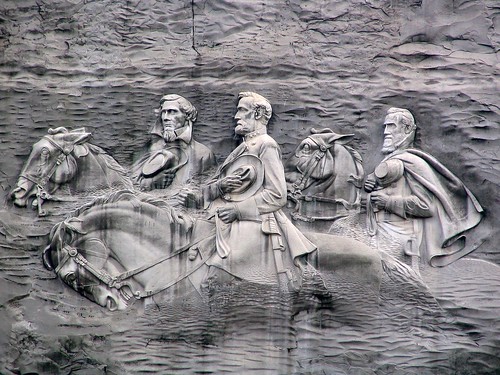
Stone Mountain is a 1,700-foot-tall grey dome rock located about a half-hour due east of downtown Atlanta. On its northern face is the largest bas-relief carving in the world—bigger even than the carving at Mount Rushmore. It depicts Confederate heroes Robert E. Lee, Stonewall Jackson, and Jefferson Davis. The mountain also features a Confederate battle flag at the base of its hiking trail.

Stone Mountain is also where the Ku Klux Klan reinvented itself in 1915 under the direction of William J. Simmons. As legend has it, the Klan would conduct nighttime cross burnings from atop that massive rock to frighten the Atlanta area’s entire black population in one big theatrical stroke of political terror.

Fast-forward a hundred years, and the Klan has clearly lost. The surrounding town of Stone Mountain is now over 75% black and about 18% white. And Atlanta hasn’t had a white mayor since the early 1970s.

Mid-June’s Charleston church shooting—involving a killer who had sullenly posed for selfies hoisting a small Rebel flag—was used as an excuse to launch a full-on cultural purge of all Confederate symbols by those who hate what they insist those symbols represent. And they insist those symbols represent HATE. And they hate that. Those symbols represent intolerance. And they will not tolerate that….

Recently a spokesman for Atlanta’s NAACP demanded that the Confederate carving “be sand-blasted off” Stone Mountain’s side. He also urged authorities to remove the Rebel flag from the mountain’s base.

This raised the hackles and chafed the sunburned necks of Confederate sympathizers across Georgia. Insisting that the flag represented “heritage, not hate,” they arranged for a pro-Confederate rally last Saturday morning at Stone Mountain Park….

[A] young black male was pleading with attendees about how he felt the flag was a provocation, and the attendees kept insisting it had nothing to do with him, especially not with hating him. But he told them that it did. And they kept insisting that it didn’t.

Smirking at an argument that kept going in circles, one peckerwood quipped to me, “That’s one of those deals where ain’t nobody going to get ahead.”

And that pithy quote encapsulated the entire event. It was an argument over what symbols represent—an argument that no one could ever win, because there is no objective answer. In the end, symbols represent whatever someone wants them to represent. One person’s heritage is another person’s hate. And the twain shall never agree. [“Of Heritage and Hate,” Taki’s Magazine, August 3, 2015]

What should and shouldn’t be considered offensive? More to the point, where should the boundaries of state action be drawn? I offer some guidelines in “The Principles of Actionable Harm“:

5. With those exceptions [e.g., defamation, treason, divulging classified information, perjury, incitement to violence, fraud and deception], a mere statement of fact, belief, opinion, or attitude cannot be an actionable harm. Otherwise, those persons who do not care for the facts, beliefs, opinions, or attitudes expressed by other persons would be able to stifle speech they find offensive merely by claiming to be harmed by it. And those persons who claim to be offended by the superior income or wealth of other persons would be entitled to recompense from those other persons….

6. …Nor can it be an actionable harm to commit a private, voluntary act which does nothing more than arouse resentment, envy, or anger in others….

9. Except in the case of punishment for an actionable harm, it is an actionable harm to bar a competent adult from

a. expressing his views, as long as they are not defamatory or meant to incite harm….

10. The proper role of the state is to enforce the preceding principles. In particular,

a. to remain neutral with respect to evolved social norms, except where those norms deny voice or exit, as with the systematic disenfranchisement or enslavement of particular classes of persons; and….

c. to ensure free expression of thought, except where such expression is tantamount to an actionable harm (as in a conspiracy to commit murder or mount a campaign of harassment)….

It would be nice if these principles were observed by politicians, the media, the punditocracy, and various interest groups (both left and right). But it won’t happen for two reasons:

  • People are tribal and love to take stances that identify the particular tribes to which they belong. Arnold Kling puts it this way: “You can take man out of tribal society, but you cannot take tribal society out of man.”
  • Elites and aspiring elites are especially enamored of tribal signaling. As a  commenter at Kling’s blog says: “The main goal of the ascendant educated left-wing white people is to differentiate themselves socially from middle-class white people.” For completeness, I would add lower-class white people, evangelicals and other defenders of traditional morality, the petite bourgeoisie, and anyone who might be suspected of voting Republican.

Clearly, the culture war has entered a new and dangerous phase, reminiscent of China’s Cultural Revolution under Mao. As Boyd Cathey writes,

in the United States today we live in a country characterized by what historian Thomas Fleming has written afflicted this nation in 1860–“a disease in the public mind,” that is, a collective madness, lacking in both reflection and prudential understanding of our history. Too many authors advance willy-nilly down the slippery slope–thus, if we ban the Battle Flag, why not destroy all those monuments to Lee and Jackson. And why stop there? Washington and Jefferson were slave holders, were they not? Obliterate and erase those names from our lexicon, tear down their monuments! Fort Hood, Fort Bragg, Fort Gordon? Change those names, for they remind us of Confederate generals! Nathan Bedford Forest is buried in Memphis? Let’s dig up him up! Amazon sells “Gone with Wind?” Well, to quote a writer at the supposedly “conservative,” Rupert Murdoch-owned New York Post, ban it, too!

It is a slippery slope, but an incline that in fact represents a not-so-hidden agenda, a cultural Marxism, that seeks to take advantage of the genuine horror at what happened in Charleston to advance its own designs which are nothing less than the remaking completely of what remains of the American nation. And, since it is the South that has been most resistant to such impositions and radicalization, it is the South, the historic South, which enters the cross hairs as the most tempting target. And it is the Battle Flag–true, it has been misused on occasion–which is not just the symbol of Southern pride, but becomes the target of a broad, vicious, and zealous attack on Western Christian tradition, itself. Those attacks, then, are only the opening salvo in this renewed cleansing effort, and those who collaborate with them, good intentions or not, collaborate with the destruction of our historic civilization. For that they deserve our scorn and our most vigorous and steadfast opposition. [“‘A Sickness in the Public Mind’: The Battle Flag and the Attack on Western Culture,” Abbeville Institute: The Abbeville Blog, August 4, 2015]

I stand with Dr. Cathey in offering scorn and most vigorous and steadfast opposition.

  *     *     *

Related reading:

*     *     *

Related posts:

The Culture War
Ruminations on the Left in America<
Privilege, Power, and Hypocrisy
Tolerance
Good Riddance
The Gaystapo at Work
The Gaystapo and Islam
The Beginning of the End of Liberty in America
The Tenor of the Times
Social Norms and Liberty
More About Social Norms and Liberty
The Madness Continues
The Euphemism Conquers All

Signature