Another Obama Lie, and a Rant

From a CBS News story about the latest Obamacare fiasco:

President Obama on Thursday announced an administrative policy change that will let people keep their existing health insurance for another year, but the plan is already facing pushback from Republicans, some Democrats and the insurance industry….

…Mr. Obama predicted Thursday, “There’s gonna be some state-by-state evaluation on how this is handled.”

He added, however, that the “key point” is that it’s no longer the Affordable Care Act that’s responsible for plans being dropped….

What a whopper. Of course the ACA is responsible. Insurance companies were diligently complying with the ACA. And that didn’t happen overnight; they began to gear up for compliance as soon as ACA became law.

Now, one of Obama’s minions issues — by unconstitutional fiat — a “fix” that can’t easily be implemented, even if allowed by the insurance commissioners of some States. It’s a blatant and cynical PR move.

Here’s the rant — mine, not Obama’s (he can rant on his own time):

Left-wing amateur hour has dragged on 4-10/12 years too long. As the bumper sticker says, don’t blame me, I didn’t vote for him.

Did I foresee this particular fiasco? Of course not, but I foresaw that Obama would try to use government in ways that would harm most hard-working, tax-paying, law-abiding Americans. Well, thanks to Obamacare, tax increases, racial politics, and various regulatory edicts he’s met my expectations. He’s also doing a good job of turning the U.S. into a second-rate power, unable to defend Americans’ far-flung overseas interests against the Russian and Chinese power grabs that are almost certainly in the works.

Even if Obama had succeeded in “bringing the country together” (or something to that effect), it would be a country that millions of us want no part of. On Thursday, November 28, if I give thanks for anything, it will be for a divided nation in which there is still principled and vigorous resistance to the likes of Barack Obama.
*     *     *
Related posts: Just about everything here.

Progressive Taxation Is Alive and Well in The U.S. of A.

THIS IS A RE-POSTING OF THE ORIGINAL, WHICH APPEARED ON JULY 20, 2012

Will Wilkinson, in the course of a good post about Obama’s big lie, writes:

I’d like to thank my colleague [a blogger who goes by D.R.] for helping me see how to make my case stronger. Of the comprehensive American tax system, he writes:

The fact of the matter is that the American tax code as a whole is almost perfectly flat. The bottom 20% of earners make 3% of the income and pay 2% of the taxes; the middle 20% make 11% and pay 10%; and the top 1% make 21% and pay 22%. Steve Forbes couldn’t have drawn it up any better.

I happen to agree with Steve Forbes that a flat tax best reflects our intuitions about proportionality and fairness, so I’m tickled to see that our system is so fair!

The link attached to “almost perfectly flat” leads to this:

The source is a “sister organization” of the union-dominated lobbying organization, Citizens for Tax Justice, which is responsible for a graph that I reproduced in “Elizabeth Warren Is All Wet“:

As I said in “Elizabeth Warren…,” Citizens for Justice

acknowledges (backhandedly) that “the rich” pay their “fair share” of all taxes — federal, State, and local….

[G]iven the source, this [graph] can be taken as a “worst case” depiction of the distribution of the total tax burden. “The rich” are paying their “fair share,” and then some, unless you believe (as leftists seem to believe) that  “the rich” are supposed to take care of everyone else.

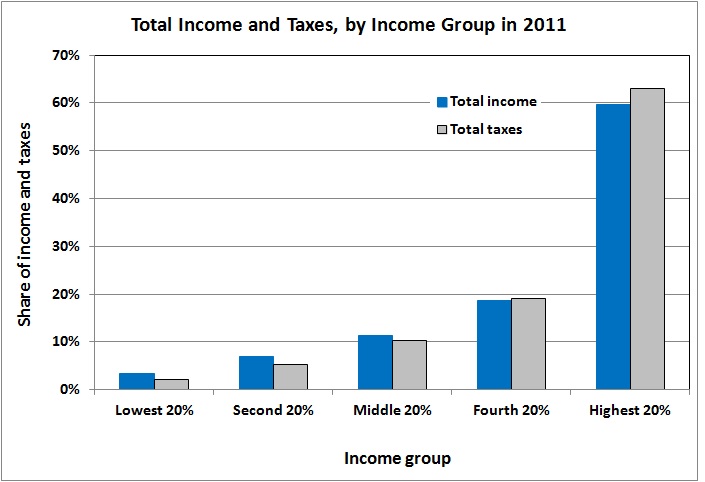
Not surprisingly, the statistics for 2011 yield a graph that looks much like the one just above:

What puzzled me, briefly, is why the Citizens for Tax Justice and Institute for Taxation and Economic Policy split the top quintile into chunks. Then it occurred to me that those left-wing outfits are trying to suppress the fact that taxpayers in the top quintile pay a disproportionate share of all taxes. Thus:

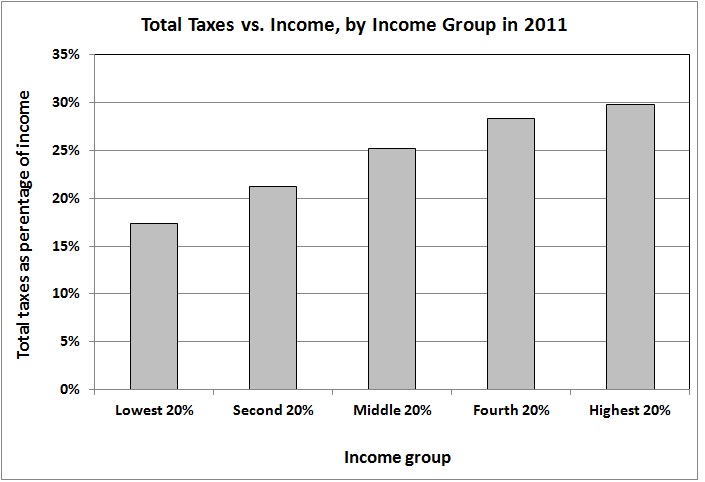
Further, the effective tax rate isn’t quite as flat as the left-wing outfits would like gullible readers to believe. Thus:

If that isn’t the picture of a progressive tax structure, I’ll eat my external hard drive.

The innumerate reader might say something like “Gee willikers, people who make more ought to pay more in taxes.” Think about it for a minute. If someone earning $100,000 pays taxes at the same rate as someone earning $10,000, the person earning $100,000 does pay more in taxes. For example: $100,000 times a tax rate of 15 percent is greater than $10,000 times a tax rate of 15 percent — 10 times greater, to be precise. Raise to 30 percent the tax rate on the person making $100,000 and, voila, his tax bill is 20 times greater than that of the person making $10,000.

A progressive tax structure penalizes success, which inhibits economic growth, which means fewer jobs and lower incomes for the low-income persons who are the supposed beneficiaries of progressive taxation. I say “supposed” because the “house” (high-paid office holders and bureaucrats, all with cushy health insurance and pension plans) takes its very large cut before any of the money extorted from those who earn it trickles down to those who don’t earn it.

Related reading:
Greg Mankiw, “The Progressivity of Taxes and Transfers
Steve Landsburg, “Charting the Tax Plans

Related posts:
A True Flat Tax
Taxing the Rich
More about Taxing the Rich
In Defense of the 1%
The Burden of Government
Economic Growth Since World War II
Economics: A Survey
The Barbarians Within and the State of the Union
Why Are Interest Rates So Low?
Estimating the Rahn Curve: Or, How Government Spending Inhibits Economic Growth
America’s Financial Crisis Is Now

Schadenfreude Wednesday

Obama's net approval since nomination of Romney
Derived from Obama Approval Index History at RasmussenReports.com.

Let’s hope the trend continues, and ends in impeachment or resignation. Disgrace isn’t nearly bad enough for BHO.

Do Managers Make a Difference?

INTRODUCTION

The activity of managing ranges from the supervision of one other person in the performance of a menial task to the supervision of the executive branch of the government of the United States. (The latter is a fair description of a president’s constitutional responsibility.) And there are many criteria for judging managers, not all of which are unambiguous or conducive to precise quantification. It may be easy, for example, to determine whether a ditch was dug on time and within budget. But what if the manager’s methods alienated workers, causing some of them to quit when the job was done and requiring the company to recruit and train new workers at some expense?

Or consider the presidency. What determines whether an incumbent is doing a good job? Polls? They are mere opinions, mostly based on impressions and political preferences, not hard facts. The passage by Congress of legislation proposed by the president? By that measure, Obama earns points for the passage of the Affordable Care Act, which if not repealed will make health care less affordable and less available.

Given the impossibility of arriving at a general answer to the tittle question, I will turn — as is my wont — to the game of baseball. You might think that the plethora of baseball statistics would yield an unambiguous answer with respect to major-league managers. As you’ll see, that’s not so.

WHAT BASEBALL STATISTICS REVEAL (OR DON’T)

Data Source

According to this page at Baseball-Reference.com, 680 different men have managed teams in the history of major-league baseball, which is considered to have begun in 1871 with the founding of the National Association. Instead of reaching that far back into the past, when the game was primitive by comparison with today’s game, I focus on men whose managing careers began in 1920 or later. It was 1920 that marked the beginning of the truly modern era of baseball, with its emphasis on power hitting. (This modern era actually consists of six sub-eras. See this and this.) In this modern era, which now spans 1920 through 2013, 399 different men have managed major-league teams. That is a sizable sample from which I had hoped to draw firm judgments about whether baseball managers, or some of them, make a difference.

Won-Lost Record

The “difference” in question is a manager’s effect — or lack thereof — on the success of his team, as measured by its won-lost (W-L) record. For the benefit of non-fans, W-L record, usually denoted W-L%, is determined by the following simple equation: W/(W + L), that is, games won divided by games won plus games lost. (The divisor isn’t number of games played because sometimes, though rarely, a baseball game is played to a tie.) Thus a team that wins 81 of its 162 games in a season has a W-L record of .500 for that season. (In baseball statistics, it is customary to omit the “0” before the decimal point, contrary to mathematical convention.)

Quantifying Effectiveness

I’m about to throw some numbers at you. But I must say more about the samples that I used in my analysis. The aggregate-level analysis described in the next section draws on the records of a subset of the 399 men whose managerial careers are encompassed in the 1920-2013 period. The subset consists of the 281 men who managed at least 162 games, which (perhaps not coincidentally) has been the number of games in a regulation season since the early 1960s. I truncated the sample where I did because the W-L records of mangers with 162 or more games are statistically better (significance level of 0.05) than the W-L records of managers with fewer than 162 games. In other words, a manager who makes it through a full season is likely to have passed a basic test of management ability: not losing “too many” games. (I address this subjective assessment later in the post.)

Following the aggregate-level analysis, I turn to an individual-level analysis of the records of those managers who led a team for at least five consecutive seasons. (I allowed into the sample some managers whose fifth full season consisted of a partial season in year 1 and a partial season in year 6, as long as the number of games in the two partial seasons added to the number of games in a full season, or nearly so. I also included a few managers whose service with a particular team was broken by three years or less.) Some managers led more than one team for at least five consecutive seasons, and each such occurrence is counted separately. For reasons that will become evident, the five seasons had to begin no earlier than 1923 and end no later than 2010.  The sample size for this analysis is 63 management tours accomplished by 47 different managers.

Results and Inferences: Aggregate Level

“Just the facts” about the sub-sample of 281 managers:
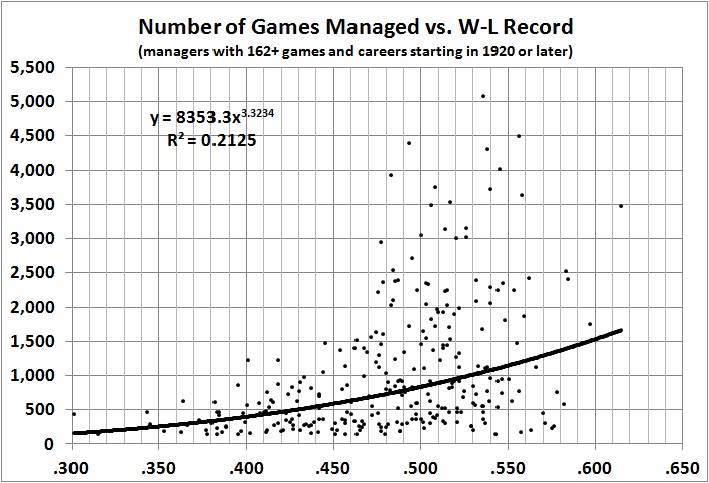
Number of games managed vs W-L record

The exponential equation, though statistically significant, tells us that W-L record explains only about 21 percent of the variation in number of games managed, which spans 162 to 5,097.

Looking closer, I found that the 28 managers in the top decile of games managed (2,368 to 5,097) have a combined W-L record of .526. But their individual W-L records range from .477 to .615, and eight of the managers compiled a career W-L record below .500. Perhaps the losers did the best they could with the teams they had. Perhaps, but it’s also quite possible that the winners were blessed with teams that made them look good. In any event, the length of a manager’s career may have little to do with his effectiveness as a manager.

Which brings me to the next topic.

Results and Inferences: Individual Level

This view is more complicated.  As mentioned above, I focused on those 47 managers who on 63 separate occasions led their respective teams for at least five consecutive seasons (with minor variations). To get at each manager’s success (or failure) during each management tour, I compared his W-L record during a tour with the W-L record of the same team in the preceding and following three seasons.

My aim in choosing five years for the minimum span of a manager’s tenure with a team was to avoid judging a manager’s performance on the basis of an atypical year or two. My aim in looking three years back and three years ahead was to establish a baseline against which to compare the manager’s performance. I could have chosen on time spans, of course, but a plausible story ensues from the choices that I made.

First, here is a graphical view of the relationship between each of the 63 managerial stints and the respective before-and-after records of the teams involved:
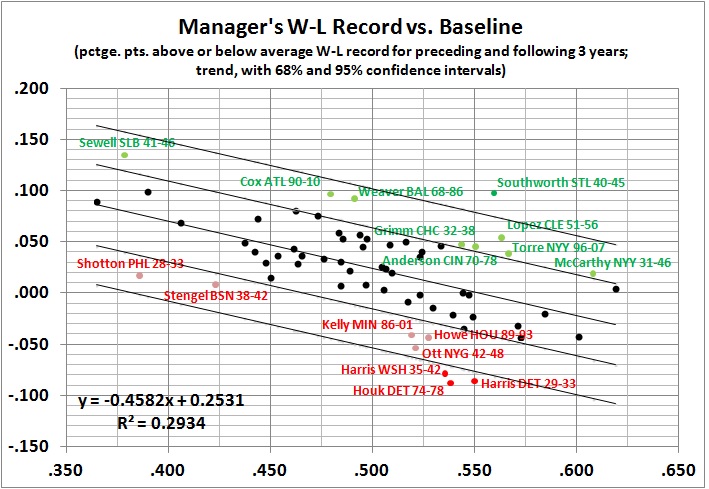
Manager's W-L record vs. baseline

A clue to deciphering the graph: Look at the data point toward the upper-left corner labeled “Sewell SLB 41-46.” The label gives the manager’s last name (Sewell for Luke Sewell, in this case), the team he managed (SLB = St. Louis Browns), and the years of his tenure (1941-46). (In the table below, all names, teams, and dates are spelled out, for all 63 observations.) During Sewell’s tenure, the Browns’ W-L record was .134 points above the average of .378 attained by the Browns in 1938-40 and 1947-49. That’s an impressive performance, and it stands well above the 68-percent confidence interval. (Confidence intervals represent the range within which certain percentages of observations are expected to fall.)

The linear fit (equation in lower-left corner) indicates a statistically significant negative relationship between the change in a team’s fortunes during a manager’s tenure and the team’s baseline performance. The negative relationship means that there is a strong tendency to “regress toward the mean,” that is toward a record that is consistent with the quality of a team’s players. In other words, the negative relationship indicates that a team’s outstanding or abysmal record my owe nothing (or very little) to a manager’s efforts.

In fact, relatively few managers succeeded in leading their teams significantly far (up or down) from baseline performance. Those managers are indicated by green (good) and red (bad) in the preceding graph.

The following table gives a rank-ordering of all 47 managers in their 63 management stints. The color-coding indicates the standing of a particular performance with respect to the trend (green = above trend, red = below trend). The shading indicates the standing of a particular performance with respect to the confidence intervals: darkest shading = above and below the 95-percent confidence interval; medium shading = between the 68-percent and 95-percent confidence intervals; lightest shading = between the 68-percent confidence intervals.
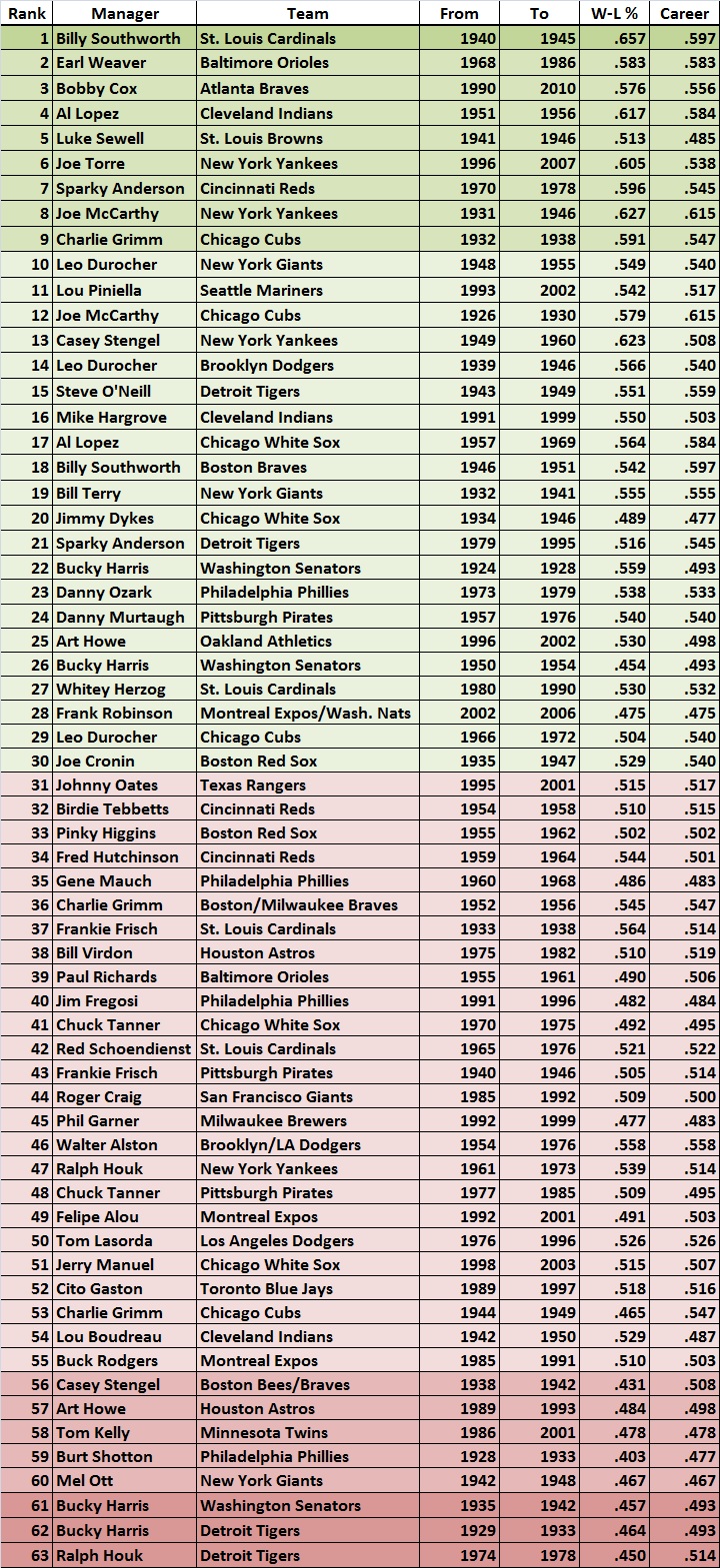
Ranking of manager's performances

Of the 63 performances, 4 of them (6.3 percent) lie outside the 95-percent confidence interval; 13 of them (20.6 percent) are between the 68-percent and 95-percent confidence intervals; the other 46 (73.0) percent are in the middle, and statistically indistinguishable.

Billy Southworth’s tour as manager of the St. Louis Cardinals in 1940-45 (#1) stands alone above the 95-percent confidence interval. Two of Bucky Harris’s four stints rank near the bottom (#61 and #62) just above Ralph Houk’s truly abysmal performance as manager of the Detroit Tigers in 1974-78 (#63).

Southworth’s tenure with the Cardinals is of a piece with his career W-L record (.597), and with his above-average performance as manager of the Boston Braves in 1946-51 (# 18). Harris had a mixed career, as indicated by his overall W-L record of .493 and two above-average tours as manager (#22 and #26). Houk’s abysmal record with the Tigers was foretold by his below-average tour as manager of the Yankees, a broken tenure that spanned 1961-73 (#47).

Speaking of the Yankees, will the real Casey Stengel please stand up? Is he the “genius” with an above-average record as Yankees manager in 1949-60, (#13) or the “bum” with a dismal record as skipper of the Boston Bees/Braves in 1938-42 (#56)? (Stengel’s ludicrous three-and-a-half-year tour as manager of the hapless New York Mets of 1962-65 isn’t on the list because of its brevity. It should be noted, however, that the Mets improved gradually after Stengel’s departure, and won the World Series in 1969.)

Stengel is one of seven managers with a single-season performance below the 68-percent confidence level. Four of the seven — Harris, Houk, Stengel, and Tom Kelly (late of the Minnesota Twins) — are among the top decile on the games-managed list. The top decile also includes seven managers who turned in performances that rank above the 68-percent confidence interval: Earl Weaver, Bobby Cox, Al Lopez, Joe Torre, Sparky Anderson, Joe McCarthy, and Charlie Grimm (#s 2-4 and 6-9).

I could go on and on about games managed vs. performance, but it boils down to this: If there were a strong correlation between the rank-order of managers’ performances in the preceding table and the number of games they managed in their careers, it would approach -1.00. (Minus because the the best performance is ranked #1 and the worst is ranked #68.) But the correlation between between rank and number of games managed in a career is only -0.196, a “very weak” correlation in the parlance of statistics.

In summary, when it comes to specific management stints, Southworth’s performance in 1940-45 was clearly superlative; the performances of Harris (1929-33, 1935-42) and Houk (1974-78) were clearly awful. In between those great and ghastly performance lie a baker’s dozen that probably merit cheers or Bronx cheers. A super-majority of the performances (the 73 percent in the middle) probably have little to do with management skills and a lot to do with other factors, to which I will come.

The Bottom Line

It’s safe to say that the number of games managed is, at best, a poor reflection of managerial ability. What this means is that (a) few managers exert a marked influence on the performance of their teams and (b) managers, for the most part, are dismissed or kept around for reasons other than their actual influence on performance. Both points are supported by the two preceding sections.

More tellingly, both points are consistent with the time-tested observation that “they” couldn’t fire the team, so “they” fired the manager.

CLOSING THOUGHTS

The numbers confirm what I saw in 30 years of being managed and 22 (overlapping) years of managing: The selection of managers is at least as random as their influence on what they manage. This is true not only in baseball but wherever there are managers, that is, throughout the world of commerce (including its entertainment sectors), the academy, and government.

The is randomness for several reasons. First, there is the difficulty of specifying managerial objectives that are measurable and consistent. A manager’s basic task might be to attain a specific result (e.g., winning more games than the previous manager, winning at least a certain number of games, turning a loss into a profit). But a manager might also be expected to bring peace and harmony to a fractious workplace. And the manager might also be charged with maintainng a”diverse” workplace and avoiding charges of discrimination? Whatever the tasks, their specification is often arbitrary and, in large organizations, impossible to relate the objective to an overarching organization goal (e.g., attaining a profit target).

Who knows if it’s possible to win more games or turn a loss into a profit, given the competition, the quality of the workforce, etc.? Is a harmonious workplace more productive than a fractious one if a fractious one is a sign of productive competitiveness?  How does one square “diversity” and forbearance toward the failings of the “diverse” (to avoid discrimination charges), while also turning a profit?

Given the complexity of management, at which I’ve only hinted, and the difficulty of judging managers, even when their “output” is well-defined (e.g., W-L record), it’s unsurprising that the ranks of managers are riddled with the ineffective and the incompetent. And such traits are often tolerated and even rewarded (e.g., raise, promotion, contract extension). Why? Here are some of the reasons:

  • Unwillingness to admit that it was a mistake to hire or promote a manager
  • A manager’s likeability or popularity
  • A manager’s connections to higher-ups
  • The cost and difficulty of firing a manager (e.g., severance pay, contract termination clauses, possibility of discrimination charges)
  • Inertia — Things seem to be going well enough, and no one has an idea of how well they should be going).

The good news is that relatively few managers make a big difference. The bad news is that the big difference is just as likely to be negative as it is to be positive. And for the reasons listed above, abysmal managers will not be rooted out until they have done a lot of damage.

So, yes, some managers — though relatively few — make a difference. But that difference is likely to prove disastrous. Just look at the course of the United States over the past 80 years.

Obamanomics: A Report Card (Updated)

See this post.


The Obama Effect: Disguised Unemployment (Updated)

Here.

The View from Here

You know what happens when a law is enacted to protect a “minority,” don’t you? The minority acquires privileged status in the eyes of the law. Any action that is claimed to deprive the “minority” of its rights brings the wrath of the state down on the purported offender. And the same law enables members of the “minority” to attain jobs, promotions, and university admissions for which they are otherwise unqualified.

My opening paragraph is prompted by the likely passage of a “gay rights in workplace” bill by the U.S. Senate. The bill is unlikely to be approved soon by the U.S. House of Representatives, but I won’t say “never.” Many members of the GOP are eager to seem “nice,” and enough of them might vote with Democrats to pass the bill and send it to B.O. for signature. Such an act of appeasement will, of course, go unrewarded by voters of the left. But panicked lawmakers are immune to logic, and devoid of principles.

The “gay rights” issue is only a symptom of America’s decay. The official elevation of gays to privileged status is of a piece with several other developments: the very possible failure of efforts to derail death-dealing Obamacare, the equally likely failure of efforts to curb murderous abortion (the gateway to involuntary euthanasia), the ever-growing dependence of Americans on an unaffordable welfare state, an unchecked regulatory apparatus, feminized and gutted defenses, groveling before enemies, and the suppression of dissent in the name of “rights,” “social justice,” “equal protection,” and other Orwellian catch-phrases.

It is altogether evident that America soon will be an irreversibly effete, statist, inhumane, and appeasing realm. In it, every truly beneficial impulse — like those that energized America’s revolution against Britain, the framing of a Constitution that promised the preservation of liberty, the defeat of oppressive regimes in wars hot and cold, and the creation of the world’s most dynamic and productive economy — will be squelched.

The barbarians within, and their willing dupes, are in the saddle. It can happen here, and it is happening here. America is about to become the land of the unfree and the home of the weak-kneed.

*     *     *

Related reading: Joe Herring, “I Am Now a Dissident (and You Should Be Too!),” American Thinker, November 6, 2013

Related posts:
Diversity
Putting Hate Crimes in Perspective
The Cost of Affirmative Action
Why Not Just Use SAT Scores?
The Face of America
Affirmative Action: A Modest Proposal
Race, Intelligence, and Affirmative Action
Affirmative Action: Two Views from the Academy
Affirmative Action, One More Time
Libertarianism, Marriage, and the True Meaning of Family Values
Same-Sex Marriage
“Equal Protection” and Homosexual Marriage
The Course of the Mainstream
A Contrarian View of Segregation
Much Food for Thought
Guilty Until Proven Innocent
After the Bell Curve
A Footnote . . .
Schelling and Segregation
Law, Liberty, and Abortion
Black Terrorists and “White Flight”
Positive Rights and Cosmic Justice: Part IV (with links to earlier parts of the series)
Timely Material
Affirmative Action: Two Views from the Academy, Revisited
It’s the Little Things That Count
A Footnote to a Footnote
Let Me Be Perfectly Clear…
FDR and Fascism
An FDR Reader
“Family Values,” Liberty, and the State
Is There Such a Thing as Society
The People’s Romance
Intellectuals and Capitalism
Fascism
Conspicuous Consumption and Race
An Honest Woman Speaks Out
Fascism with a “Friendly” Face
The Interest-Group Paradox
Parsing Political Philosophy
Is Statism Inevitable?
Inventing “Liberalism”
Civil Society and Homosexual “Marriage”
A New, New Constitution
Fascism and the Future of America
The Indivisibility of Economic and Social Liberty
Rights, Liberty, the Golden Rule, and the Legitimate State
The Perils of Nannyism: The Case of Obamacare
More about the Perils of Obamacare
Health-Care Reform: The Short of It
The Real Constitution and Civil Disobedience
The Near-Victory of Communism
Tocqueville’s Prescience
First Principles
The Shape of Things to Come
Accountants of the Soul
Invoking Hitler
Is Liberty Possible?
The Left
Perry v. Schwarzenegger, Due Process, and Equal Protection
The Constitution: Original Meaning, Corruption, and Restoration
Rationalism, Social Norms, and Same-Sex “Marriage”
A Moral Dilemma
A Conversation with Uncle Sam
Society and the State
I Want My Country Back
The “Forthcoming Financial Collapse”
Undermining the Free Society
Our Enemy, the State
Pseudo-Libertarian Sophistry vs. True Libertarianism
“Intellectuals and Society”: A Review
Government vs. Community
The Evil That Is Done with Good Intentions
The Destruction of Society in the Name of “Society”
About Democracy
Externalities and Statism
Taxes: Theft or Duty?
Bounded Liberty: A Thought Experiment
More Pseudo-Libertarianism
The Meaning of Liberty
The Left’s Agenda
Substantive Due Process and the Limits of Privacy
In Defense of Marriage
The Left and Its Delusions
The Destruction of Society in the Name of “Society”
A Declaration of Civil Disobedience
Crimes against Humanity
Abortion and Logic
The Myth That Same-Sex “Marriage” Causes No Harm
The Spoiled Children of Capitalism
Politics, Sophistry, and the Academy
Subsidizing the Enemies of Liberty
Society and the State
Are You in the Bubble?
Defense as an Investment in Liberty and Prosperity
Our Perfect, Perfect Constitution
Abortion, Doublethink, and Left-Wing Blather
Race and Reason: The Derbyshire Debacle
Race and Reason: The Victims of Affirmative Action
Not-So-Random Thoughts (III)
Race and Reason: The Achievement Gap — Causes and Implications
Don’t Use the “S” Word When the “F” Word Will Do
Liberty and Society
Tolerance on the Left
The Eclipse of “Old America”
The Capitalist Paradox Meets the Interest-Group Paradox
Genetic Kinship and Society
How Not to Cope with Government Failure
Riots, Culture, and the Final Showdown (revisited)
Where We Are, Economically
The Economic Outlook in Brief
Is Taxation Slavery?
Obamanomics: A Report Card
Well-Founded Pessimism
A Declaration of Independence
The 80-20 Rule, Illustrated
America: Past, Present, and Future
Defending Liberty against (Pseudo) Libertarians
America: Past, Present, and Future
Restoring Constitutional Government: The Way Ahead
Economic Horror Stories: The Great “Demancipation” and Economic Stagnation
The Fallacy of the Reverse-Mussolini Fallacy
“Conversing” about Race
Economics: A Survey
IQ, Political Correctness, and America’s Present Condition
The Barbarians Within and the State of the Union
Why Are Interest Rates So Low?
Estimating the Rahn Curve: Or, How Government Spending Inhibits Economic Growth
America’s Financial Crisis Is Now
The World Turned Upside Down
“We the People” and Big Government: Part I
“We the People” and Big Government: Part I (continued)
“We the People” and Big Government: Part II (first installment)

Intellectual Courage in Austin

Ken Herman’s columns in the Austin American-Statesman are among the paper’s few bright spots. I don’t always agree with Herman, whose brand of modern-style liberalism usually shines through. But he’s intelligent, analytical, witty, and fair.

I cringed inwardly this morning when I read this in Herman’s column (“Judgment on constitutionality, not on abortion,” behind a paywall):

Local U.S. District Judge Lee Yeakel showed a keen understanding of both sides of that equation this week in his decision striking down portions of Texas’ new abortion restrictions law. And, though a federal appeals court on Thursday lifted Yeakel’s injunction against enforcement of portions of the new law, he offered solid logic in throwing out the provision requiring abortion providers to have admitting privileges at a hospital within 30 miles.

“The court expresses grave reservations about allowing a hodgepodge of diverse medical committees and boards to determine, based solely on admitting privileges, which physicians may perform abortions,” he wrote, adding that the provision “places an undue burden on a woman seeking an abortion.”

What did the appeals court — a three-judge panel of the Fifth Circuit — have to say? This:

We first consider the hospital-admitting-privileges provision of H.B. 2 [the Texas law] and whether the State has made a strong showing that it is likely to succeed on the merits. We conclude that it has….

… The district court focused primarily on emergency room treatment of women experiencing complications following an abortion. This overlooks substantial interests of the State in regulating the medical profession and the State’s interest in “‘protecting the integrity and ethics of the medical profession.’” As the Supreme Court has noted, “the State has ‘legitimate concern for maintaining high standards of professional conduct’ in the practice of medicine.’” The Supreme Court has also consistently recognized that “[r]egulations designed to foster the health of a woman seeking an abortion are valid if they do not constitute an undue burden.”

The State offered more than a “conceivable state of facts that could provide a rational basis” for requiring abortion physicians to have hospital admission privileges. The State offered evidence that such a requirement fosters a woman’s ability to seek consultation and treatment for complications directly from her physician, not from an emergency room provider. There was evidence that such a requirement would assist in preventing patient abandonment by the physician who performed the abortion and then left the patient to her own devices to obtain care if complications developed. The district court’s finding to the contrary is not supported by the evidence, and in any event, “a legislative choice is not subject to courtroom factfinding and may be based on rational speculation unsupported by evidence or empirical data.”

The requirement that physicians performing abortions must have hospital admitting privileges helps to ensure that credentialing of physicians beyond initial licensing and periodic license renewal occurs….

The district court’s conclusion that a State has no rational basis for requiring physicians who perform abortions to have admitting privileges at a hospital is but one step removed from repudiating the longstanding recognition by the Supreme Court that a State may constitutionally require that only a physician may perform an abortion….

We similarly [to the U.S. Supreme Court’s opinion in Gonzales v. Carhart] conclude that the provisions of H.B. 2 requiring a physician who performs an abortion to have admitting privileges at a hospital, “measured by [their] text,” do not impose a substantial obstacle to abortions. Just as the Supreme Court concluded in Gonzales with regard to the federal Partial-Birth Abortion Ban Act of 200335 that “[t]here can be no doubt the government ‘has an interest in protecting the integrity and ethics of the medical profession,’”36 there can be no doubt that the State of Texas has this same interest, as well as an interest in protecting the health of women who undergo abortion procedures.

There is the possibility, if not the probability, however, that requiring all physicians who perform abortions to have admitting privileges at a hospital may increase the cost of accessing an abortion provider and decrease the number of physicians available to perform abortions. As the district court correctly recognized, the Supreme Court has nevertheless held that “‘[t]he fact that a law which serves a valid purpose, one not designed to strike at the right itself, has the incidental effect of making it more difficult or more expensive to procure an abortion cannot be enough to invalidate it.’”

There’s much more, but that’s enough to make this point: It should have been evident to Herman that Judge Yeakel’s “solid logic” wasn’t really solid.

I will give Herman the benefit of the doubt by suggesting that he didn’t have time to digest the Fifth Circuit’s opinion before he wrote his column. (The opinion was issued in the morning of October 31, and Herman’s column was posted at 7:28 p.m. on the same day.)

But I come to praise Herman, not to vilify him. What’s praiseworthy in his column are two paragraphs near the end:

In addition to being a most-divisive issue, abortion is one with little to no middle ground. And it’s marked by close to a total inability for one side to understand the other side.

One of the blindest spots in the argument is held by abortion rights supporters who believe the other side is driven by opposition to women’s rights. Abortion rights foes are motivated by a sincere belief that an unborn child or fetus, or whatever term you choose, is a form of life entitled to constitutional protection. You might agree, you might not. But if you don’t, it’s important that you understand that [anti-abortion] side isn’t driven by a desire to curtail woman’s rights. (Emphasis added.)

It’s hard to say it any plainer than that. Kudos to Herman for saying it, and for figuratively confronting the pro-abortion forces, which — in leftish Austin — must vastly outnumber the anti-abortion forces.

I expect Herman’s candor to be “rewarded” with irate and hateful messages from many abortion advocates. Herman must have anticipated such messages — and perhaps worse — before he published his column. I therefore admire not only his candor but also his intellectual courage.

Government Failure Comes as a Shock to Liberals

Richard Cohen of WaPo shares his disappointment in the god the failed:

Where is Casey Stengel when we need him? In 1962, as the manager of the brand new and determinedly hapless New York Mets — 40 wins, 120 losses — he looked up and down his bench one dismal day and wondered, “Can’t anybody here play this game?” That phrase kept coming at me recently as I watched the impressively inept performance of the Obama administration in both foreign and domestic policy. On a given day, this administration makes the ’62 Mets look good….

[Obama] has lately so mishandled both domestic and foreign policy that he is in mortal peril of altering his image. This unsettling and uncharacteristic incompetence became shockingly clear when Obama failed to come to grips with the Syrian civil war….

The debacle of the Affordable Care Act’s Web site raised similar questions about confidence….

Something went wrong. People could not sign up. Why? Not sure. Who’s at fault? Apparently no one. An act of God….

Poor Richard. He doesn’t get it. The problem isn’t just Barack Obama, it’s government. What Cohen is witnessing is government failure. It’s pervasive and inevitable — though its ill effects often go unremarked. (For example, the significant reduction of economic growth that has resulted from the growth of government spending and regulation.)

When government failure assumes spectacular proportions and can’t be ignored or explained away, it gets attention because it explodes the Nirvana fallacy about government that infects so many politicos, mediacrats, and real people (but not Americans on the whole).

What’s most striking about Cohen’s piece and similar outpourings from the media is that the target is a Democrat. I would say that a new dawn of realism is breaking, but that would be to indulge in the Nirvana fallacy.

*     *     *

Related posts:
Undermining the Free Society
Government vs. Community
Government Failure: An Example
Bootleggers, Baptists, and Pornography
The Public-School Swindle
The Evil That Is Done with Good Intentions
Externalities and Statism
Society and the State
David Brooks, Useful Idiot for the Left
Don’t Use the “S” Word When the “F” Word Will Do
How Not to Cope with Government Failure
Well-Founded Pessimism
America: Past, Present, and Future
IQ, Political Correctness, and America’s Present Condition
The Barbarians Within and the State of the Union
Why Are Interest Rates So Low?
Vulgar Keynesianism and Capitalism
Estimating the Rahn Curve: Or, How Government Spending Inhibits Economic Growth
America’s Financial Crisis Is Now
The World Turned Upside Down
“We the People” and Big Government: Part I
“We the People” and Big Government: Part I (continued)
“We the People” and Big Government: Part 2 (first installment)

A Better Constitution

Here.

*     *     *

Related posts:
A New, New Constitution
The Real Constitution and Civil Disobedience
A Declaration of Independence
First Principles
The Constitution: Original Meaning, Corruption, and Restoration
A Conversation with Uncle Sam
A Declaration of Civil Disobedience
Our Perfect, Perfect Constitution
Restoring Constitutional Government: The Way Ahead

“We the People” and Big Government (Part 2)

Incorporated into this post.

The Obama Effect: Disguised Unemployment (Updated)

Here.

“We the People” and Big Government: Part 1 (continued)

Incorporated into this post.

“We the People” and Big Government: Part I

Incorporated into this post.

More about “Secession Made Easy”

Read “Secession Made Easy,” which addresses inter-State secession, that is, the annexation of a portion of one State by another State. Then consider the table below. It includes some moves not mentioned in the earlier post, and assesses the potential gains accruing to the GOP if parts of some States were shifted to neighboring States.

Secession made easy - table

The baseline is the current lineup of U.S. Senate seats, governorships, and State legislatures.  The potentially big gains for the GOP are found in the Senate. Those gains would be worth the (possible) loss of a single governorship, because the addition of nine GOP Senate seats would shift control of Congress to the GOP. (This assumes that the House remains indefinitely under GOP control for some years to come, which may be a heroic assumption.) Further, the GOP would continue to control about 3/5 of State legislatures — a big advantage when it comes to congressional redistricting.

In any event, some denizens of Blue States would become citizens of Red States — a prize in itself.

See also “The Constitution: Myths and Realities“.

Secession Made Easy

It seems that the “Red” areas of several “Blue” States are agitating to secede from those States. It seems, also, that there is a way to secede that might pass legal scrutiny: the seceding portion of a State (the Red counties of Blue-dominated Maryland, for instance) hooks up with a more congenial State (West Virginia, for instance). Half a loaf certainly would be better than none if you’re a conservative in a conservative region of California, Colorado, Maryland, or Michigan — to name a few of the many possibilities.

The upshot of a half-a-loaf strategy with respect to secession would be … what? Some Red States would become Redder and some Blue States would become Bluer. Would the balance of political power be affected? Consider some possibilities:

  • California/Nevada — Northern California plus Nevada could push Nevada into Red territory. A plus for the GOP in the U.S. Senate and control of Nevada’s government.
  • Colorado/Kansas/Utah — Merging eastern Colorado into Kansas and western Colorado into Utah wouldn’t change the political landscape, but the ex-Coloradans would be happier.
  • Delaware/Maryland/Virginia/West Virginia — Two mergers here: southern Delaware and eastern Maryland into Virginia, western Maryland into West Virginia. Virginia would become more reliably Red; West Virginia, almost Deep Red. Pluses for the GOP in the U.S. Senate and control of the governments of Virginia and West Virginia.
  • Illinois/Ohio — Moving southern Illinois into Ohio would make Ohio more reliably Red.
  • Michigan/Wisconsin — If Wisconsin were to annex Michigan’s upper peninsula (and perhaps the northern part of the lower peninsula) it would become firmly Red. Perhaps a tossup, given Michigan’s occasional Reddish tinge, but the ex-Michiganders would be happier.

Those are the obvious possibilities; there may be others.

The problem with all of this, of course, is that Democrats will do the math and fiercely resist any such rearrangements.

But nothing venture, nothing gain. In other words, go for it!

Be sure to read the follow-up post, here.

See also “The Constitution: Myths and Realities“.

The Most Disgusting Thing I’ve Read Today

UPDATED 07/01/14 (below)

It’s a post at a blog called Lion of the Blogosphere, the proprietor of which evidently has delusions of grandeur. The post is “Abortion and the just-world fallacy.” (No, I won’t link to the blog or the post.) The author, one Mr. Lion (of the Blogosphere), seems to be an unabashed proponent of abortion for the “underclass.”

Mr. Lion’s latest abomination begins with this:

To quote Wikipedia, “the just-world hypothesis or just-world fallacy is the cognitive bias (or assumption) that a person’s actions always bring morally fair and fitting consequences to that person, so that all noble actions are eventually rewarded and all evil actions are eventually punished. “

I see this cognitive bias in many of the comments to anything I post about abortion. Anti-abortion people have this bias that they believe that banning abortion (which is supposed to be evil) will bring better outcomes. But the reality, as I keep pointing out, is that abortion is effective at reducing the birthrate of poor women.

Until I was enlightened by Mr. Lion, I had no idea that opposition to abortion arises from the just-world fallacy. I had thought, all along, that those of us who oppose abortion do so because it is a eugenic practice that involves the state-condoned taking of innocent lives. Or, because it is a sin — as some opponents prefer to say.

Superior beings like Mr. Lion (and Mr. Hitler) have no qualms about eugenic practices. Well, they don’t if they’re not on the receiving end of those practices. I wonder how Mr. Lion will enjoy the eugenic program known as Obamacare, with its inevitable death panels (though they won’t be called that) — a program that he implores Republicans to accept as the law of the land.

Mr. Lion justifies his pro-abortion position on cost-effectiveness grounds:

[A]ccording to the Guttmacher Institute “Forty-two percent of women obtaining abortions have incomes below 100% of the federal poverty level ($10,830 for a single woman with no children)” and another “twenty-seven percent of women obtaining abortions have incomes between 100–199% of the federal poverty level.

So we see that the women most likely to have abortions are those who should be having abortions, women who have no way to support their children except by collecting welfare, and children raised by welfare moms are many times more likely to be criminals….

I already said “disgusting,” didn’t I? Why not just take the women out and shoot them? That would be cheaper than giving them abortions, wouldn’t it?

Mr. Lion would make a good technocrat, given his readiness to treat human beings like numbers and erase them at will. But “good” isn’t excellent; excellent technocrats are able to feign compassion and disguise their viciousness.

What about crime and abortion? I cut Mr. Lion off just as he was about to add this:

[S]o it’s not surprising at all that Steven D. Levitt, author of Freakonomics, found that abortion reduced crime. (And Levitt rigorously rebuts Steve Sailer who tried to argue that it didn’t.)

Oh, really? Well, as it happens, Levitt’s “rigorous rebuttal” isn’t very rigorous. As I point out here,

Levitt’s findings are built on statistical quicksand. From the abstract of a paper by Christopher L. Foote and Christopher F. Goetz of the Boston Fed:

[A] fascinating paper by Donohue and Levitt (2001, henceforth DL) . . . purports to show that hypothetical individuals resulting from aborted fetuses, had they been born and developed into youths, would have been more likely to commit crimes than youths resulting from fetuses carried to term. We revisit that paper, showing that the actual implementation of DL’s statistical test in their paper differed from what was described. . . .We show that when DL’s key test is run as described and augmented with state‐level population data, evidence for higher per capita criminal propensities among the youths who would have developed, had they not been aborted as fetuses, vanishes.

There’s a lot more about the Levitt-Sailer controversy here; the bottom line, in my view, favors Sailer. My own analysis (here) also refutes Levitt.

The moral of the story: If you’re going to be an excellent technocrat in the United States, you must (a) take care to disguise your viciousness, and (b) quote unimpeachable sources (i.e., not Steven Levitt).

UPDATE 07/01/14 – for readers coming here via a link in a comment at Mr. Lion’s blog

Here’s the comment:

If you haven’t read this guy’s blog, he’s disgusted with Lion’s position on pro-abortion for prole and NAM women.

https://politicsandprosperity.com/2013/10/11/the-most-disgusting-thing-ive-read-today/

He seems to think Lion’s take on it is about eugenics, but it’s more about IQ leading to poor outcomes. One needs to understand that perpetual proledom and NAMdom is a good measure of IQ. Multigenerational poverty, dysfunctionality and underachievement are a result of low IQs.

The commenter seems to think that “Lion’s take” isn’t about eugenics. A state-sponsored effort to reduce the numbers of low-IQ “proles” and “NAMs” is nothing but an exercise in eugenics.

Unsplit Infinitives

A RERUN OF A POST AT MY OLD BLOG, FROM MAY 1, 2008

Eugene Volokh, a known grammatical relativist, scoffs at “to increase dramatically,” as if “to dramatically increase” would be better. But better in what way: clearer or less stuffy? The meaning of “to increase dramatically” is clear. The only reason to write “to dramatically increase” would be to avoid the appearance of stuffiness.

Seeming unstuffy (i.e., without standards) is neither a necessary nor sufficient reason to split an infinitive. The rule about unsplit infinitives, like most other grammatical rules, serves the valid and useful purpose of preventing English from sliding yet further down the slippery slope of incomprehensibility than it has slid already. If an unsplit infinitive makes a clause or sentence seem awkward, the clause or sentence should be rewritten to avoid the awkwardness. Better that than make an exception that leads to further exceptions — and thence to babel.

Related posts:
Remedial Vocabulary Training
One Small Step for Literacy
Punctuation
Data Are
“Hopefully” Arrives
Hopefully, This Post Will Be Widely Read
Why Prescriptivism?

A Human Person

A RERUN (WITH LIGHT EDITING) OF A POST AT MY OLD BLOG, FROM MAY 5, 2008

The ludicrous and (it seems) increasingly popular assertion that plants have rights should not distract us from the more serious issue of fetal rights. (My position on the issue can be found among these links.) Maverick Philosopher explains how abortion may be opposed for non-religious reasons:

It is often assumed that opposition to abortion can be based only on religious premises. This assumption is plainly false. To show that it is is false, one need merely give an anti-abortion argument that does not invoke any religious tenet, for example:1. Infanticide is morally wrong.
2. There is no morally relevant difference between abortion and infancticide.
Therefore
3. Abortion is morally wrong.

Whether one accepts this argument or not, it clearly invokes no religious premise. It is therefore manifestly incorrect to say or imply that all opposition to abortion must be religiously-based. Theists and atheists alike could make use of the above argument.

MP then links to a piece by Nat Hentoff, an atheist and Leftist. Hentoff writes, apropos Barack Obama and abortion, that

I admire much of Obama’s record, including what he wrote in “The Audacity of Hope” about the Founders’ “rejection of all forms of absolute authority, whether the king, the theocrat, the general, the oligarch, the dictator, the majority … George Washington declined the crown because of this impulse.”

But on abortion, Obama is an extremist. He has opposed the Supreme Court decision that finally upheld the Partial-Birth Abortion Ban Act against that form of infanticide. Most startlingly, for a professed humanist, Obama — in the Illinois Senate — also voted against the Born Alive Infant Protection Act….

Furthermore, as “National Right to Life News” (April issue) included in its account of Obama’s actual votes on abortion, he “voted to kill a bill that would have required an abortionist to notify at least one parent before performing an abortion on a minor girl from another state.”

These are conspiracies — and that’s the word — by pro-abortion extremists to transport a minor girl across state lines from where she lives, unbeknownst to her parents. This assumes that a minor fully understands the consequences of that irredeemable act. As I was researching this presidential candidate’s views on the unilateral “choice” that takes another’s life, I heard on the radio what Obama said during a Johnstown, Pa., town hall meeting on March 29 as he was discussing the continuing dangers of exposure to HIV/AIDS infections:

“When it comes specifically to HIV/AIDS, the most important prevention is education, which should include — which should include abstinence education and teaching children, you know, that sex is not something casual. But it should also include — it should also include other, you know, information about contraception because, look, I’ve got two daughters, 9 years old and 6 years old. I am going to teach them first of all about values and morals.

“But if they make a mistake,” Obama continued, “I don’t want them punished with a baby.”

Among my children and grandchildren are two daughters and three granddaughters; and when I hear anyone, including a presidential candidate, equate having a baby as punishment, I realize with particular force the impact that the millions of legal abortions in this country have had on respect for human life.

And that’s the crux of the issue: respect for human life.

Thus I turn to a Peter Lawler’s “A Human Person, Actually,” in which Lawler reviews Embryo: A Defense of Human Life, by Robert P. George and Christopher Tollefsen:

The embryo, George and Tollefsen argue, is a whole being, possessing the integrated capability to go through all the phases of human development. An embryo has what it takes to be a free, rational, deliberating, and choosing being; it is naturally fitted to develop into a being who can be an “uncaused cause,” a genuinely free agent. Some will object, of course, that the embryo is only potentially human. The more precise version of this objection is that the embryo is human—not a fish or a member of some other species—but not yet a person. A person, in this view, is conscious enough to be a free chooser right now. Rights don’t belong to members of our species but to persons, beings free enough from natural determination to be able to exercise their rights. How could someone have rights if he doesn’t even know that he has them?…

Is the embryo a “who”? It’s true enough that we usually don’t bond with embryos or grieve when they die. Doubtless, that’s partly because of our misperception of who or what an embryo is. But it’s also because we have no personal or loving contact with them. We tend to think of persons as beings with brains and hearts; an embryo has neither. But personal significance can’t be limited to those we happen to know and love ourselves; my powers of knowing and loving other persons are quite limited, and given to the distortions of prejudice. Whether an embryo is by nature a “who” can be determined only by philosophical reflection about what we really know.The evidence that George and Tollefsen present suggests that there are only two non-arbitrary ways to consider when a “what” naturally becomes a “who.” Either the embryo is incapable of being anything but a “who”; from the moment he or she comes to be, he or she is a unique and particular being capable of exhibiting all the personal attributes associated with knowing, loving, and choosing. Or a human being doesn’t become a “who” until he or she actually acquires the gift of language and starts displaying distinctively personal qualities. Any point in between these two extremes—such as the point at which a fetus starts to look like a human animal or when the baby is removed from the mother’s womb—is perfectly arbitrary. From a purely rational or scientific view, the price of being unable to regard embryos as “whos” is being unable to regard newborn babies as “whos”….

As I say here,

abortion is of a piece with selective breeding and involuntary euthanasia, wherein the state fosters eugenic practices that aren’t far removed from those of the Third Reich. And when those practices become the norm, what and who will be next? Libertarians, of all people, should be alert to such possibilities. Instead of reflexively embracing “choice” they should be asking whether “choice” will end with fetuses.

Most libertarians, alas, mimic “liberals” and “progressives” on the issue of abortion. But there are no valid libertarian arguments for abortion, just wrong-headed ones.