Sorkin’s Left-Wing Propaganda Machine

Thanks (?) to Netflix streaming video, I’m watching episodes of The West Wing that I had missed the first time around. I missed the episodes because I had an inkling that The West Wing portrayed do-good Democrat meddlers in a favorable light. Several seasons into the show, I finally relented to my wife’s pleas to watch it. And so I became a regular viewer.

I endured The West Wing for its snappy dialogue and semi-accurate though cartoonish, depictions of inside politics. But by the end of the series, I had tired of the show’s incessant propagandizing for leftist causes.

Then, along came Roku and streaming video, and the opportunity to see the earlier seasons that we had missed because of my recalcitrance. My wife insisted, so here I am again, watching the same snappy dialogue and semi-engaging stories unfold in the service of bigger government. And, of course, bigger is better because Aaron Sorkin makes it look that way: a wise president, crammed full of encyclopedic knowledge; staffers whose IQs must qualify them for the Triple Nine Society, and whose wit crackles like lightning in an Oklahoma thunderstorm; evil Republicans whose goal in life is to stand in the way of technocratic progress (national bankruptcy and the loss of individual freedom don’t rate a mention); and a plethora of “worthy” causes that the West-Wingers seek to advance, without regard for national bankruptcy and individual freedom.

Thus far, I’ve watched the first thirteen episodes of the first season. What have I “learned”? Here’s a sample:

When persons of the Christian right refer to “New Yorkers” they mean “Jews.” This suggests excessive sensitivity on Mr. Sorkin’s part, not to mention a tin ear. In fact, there is ample evidence that a “New Yorker” is a pushy, obnoxious person, regardless of ethnicity. But Sorkin couldn’t waste an opportunity to paint persons of the Christian right as anti-Semitic bigots.

When an American military transport is shot down by a Syrian missile, the only choices presented to President Bartlett (the all-wise, all-knowing one) are a token retaliatory strike and a massive retaliatory strike that would kill thousands of civilians. Hmm… A lot of middle ground is omitted, including a decapitation strike, which at the time (1999) would have been timely and popular in the U.S. Well, the all-wise, all-knowing (AWAK) president somehow doesn’t come up with a middle-ground plan, so he wimps out and orders the token strike. An obvious defense of Clinton’s abject wimpiness in the wake of the bombings of two U.S. embassies in 1998.

It’s okay to use sampling in the decennial census because the Constitution doesn’t say how the census should be conducted. Well, that’s the line taken by Toby Ziegler — the irritating “New Yorker” who serves as the AWAK president’s chief speech writer. However, Mr. Z fails to quote the Constitution correctly when lecturing the evil Republicans whom he summons to the White House for the purpose of delivering Mr. Sorkin’s misleading version of the Constitution’s language about the census. Mr. Z conveniently omits the word “enumeration,” which clearly implies a count, not an estimate, and which occurs twice in the clause about the census (Article I, Section 2, clause 3). Mr. Z further makes a big deal about the part of that clause which (in the original Constitution) counts a slave as three-fifths of a person. He conveniently omits to mention that (a) the three-fifths rule was mooted by the ratification of Amendment XIV in 1866, and (b) the three-fifths rule was a political compromise that favored the non-slave North, not a statement about the worthiness or unworthiness of slaves as persons. All of this finagling is in the service of the not-very-subliminal message that anyone who opposes statistical estimation of the population must be a racist. (A prescient line, which is now recycled as “everyone who opposes Obama’s policies must be a racist.”)

Then there’s the WASP-y nominee for the Supreme Court whose name must be withdrawn by the AWAK president, who (unaccountably) doesn’t know that the nominee holds views similar to those of Robert Bork about the source of rights. A strange nomination for an AWAK liberal. But the undoing of it enables the same AWAK liberal to nominate a humble judge of Hispanic ethnicity, and to show the door to the WASP-y Bork-like creep. The fact that the WASP-y nominee was represents the true minority group goes unmentioned during the closing moments of the episode. Those are given to an unseemly demonstration by members of the White House staff as the Hispanic nominee-to-be is paraded from the Oval Office through the warren of staff offices (an unlikely route), to the obvious delight of a token Hispanic staff member.

Finally, for now, there is a Matthew Shepard-like victim whose murder (like the real one) justifies the passage of thought-crime legislation. (The motive for the killing of Matthew Shepard probably wasn’t his homosexuality, though his homosexuality proved convenient to the purveyors of thought-criminalization.) In a twist that’s meant to shame critics of homosexuality, the victim’s father turns out to be a staunch defender of his late son’s “lifestyle.” This gives the father a chance to mouth off about the AWAK president’s namby-pamby approach to “gay rights” issues, such as the nominal ban on homosexuals in the armed forces. (A slam at Clinton’s “don’t ask, don’t tell” policy.) Well, leave it to a “New Yorker” like Sorkin to glorify the practitioners of disgusting physical acts that serve to spread AIDS and other dread diseases, and which bear no relation to the evolutionary purposes served by male organs and orifices. (Evolution is okay with lefties, as long as it doesn’t get in the way of debauchery or lead to disparities in intelligence.)

But the dialogue is snappy.

The Hall of Fame and Morality

Jonathan Mahler, in the course of an incoherent article about baseball, makes this observation:

This year, not a single contemporary player was voted into the Hall of Fame because so many eligible players were suspected of steroid use. Never mind that Cooperstown has its share of racists, wife beaters and even a drug dealer. (To say nothing of the spitballers.)

Those few sentences typify the confusion rampant in Mahler’s offering. The use of steroids and other performance-enhancing drugs calls into question the legitimacy of the users’ accomplishments on the field. Racism, wife-beating, and drug-dealing — deplorable as they are — do not cast a shadow on the perpetrators’ performance as baseball players. As for the spitball, it was legal in baseball until 1920, and when it was outlawed its avowed practitioners were allowed to continue using it. (Some modern pitchers have been accused of using it from time to time, but I can’t think of one who used it so much that his career is considered a sham.)

Election to the Hall of Fame isn’t (or shouldn’t be) a moral judgment. If it were, I suspect that the Hall of Fame would be a rather empty place, especially if serial adultery and alcohol abuse were grounds for disqualification.

At the risk of being called a moral agnostic, which I am not, I say this: Election to the Hall of Fame (as a player) should reflect the integrity and excellence of on-field performance. Period.

I do have strong views about the proper qualifications for election to the Hall of Fame (as a player). You can read them here, here, and here. I’ve also analyzed the statistical evidence for indications of the use of performance-enhancing drugs by a few notable players: Barry Bonds and Mark McGwire (both guilty) and Roger Clemens (unproved).

The Culture War

“Culture war” is a familiar term, but one that I hadn’t thought deeply about until a few days ago. I read something about abortion in which “culture war” occurred. The fog lifted, and I grasped what should have been obvious to me all along: The “culture war” isn’t about “culture,” it’s about morality and liberty. Rod Dreher, in the course of a premature paean to Barack Obama’s “diplomatic” approach to ideological strife, gets it right:

The source of our culture war is conflicting visions of what it means to be free and what it means to be an American – and even what it means to be fully human. More concretely, as Princeton’s Robert George has written, they have to do mainly “with sexuality, the transmitting and taking of human life, and the place of religion and religiously informed moral judgment in public life.” Because the cultural left and cultural right hold to irreconcilable orthodoxies on these questions, we find scant cultural consensus. That’s life in America. Unless we become a homogenous country, we will continue to struggle to live together, staying true to our deepest beliefs while respecting the liberty of others to stay true to their own. But we do not live in a libertarian Utopia. We can’t have it all. If, for example, courts constitutionalized same-sex marriage, as gay activists seek, that would have a ground-shaking effect on religious liberty, public schooling and other aspects of American life. Without question, it would intensify the culture war, as partisans of the left and right fight for what each considers a sacred principle. What irritates conservatives is the liberals’ groundless conceit that they fight from a values-neutral position, while the right seeks to impose its norms on others. Nonsense. Marriage was a settled issue until liberals began using courts to impose their moral vision on (so far) an unwilling majority. Who fired the first shot there? (“Obama Won’t End the Culture Wars,” RealClearPolitics, February 16, 2009)

And it doesn’t matter whether the unwilling are a majority or a minority. Just about everyone is a loser in the war against morality and liberty. When social norms — long-established rules of behavior — are sundered willy-nilly the result is a breakdown of the voluntary order known as civil society. The liberty to live a peaceful, happy, and even prosperous life depends on civil society: the daily observance of person X’s negative rights by persons W, Y, and Z — and vice versa. That is so because it is impossible and — more importantly — undesirable for the state to police everyone’s behavior. Liberty depends, therefore, on the institutions of society — family, church, club, and the like — through which individuals learn to treat one another with respect, through which individuals often come to the aid of one another, and through which instances of disrespect can be noted, publicized, and even punished (e.g., by criticism and ostracism). That is civil society, which the state ought to protect, but instead usurps and destroys. Usurping is one of the state’s primary (and illegitimate) functions. The state establishes agencies (e.g., public schools, welfare), gives them primary and even sole jurisdiction in many matters, and funds them with tax money that could have gone to private institutions. Worse, however, is the way in which the state destroys the social norms that foster social harmony — mutual respect and trust — without which a people cannot flourish.  As I observed some years ago, in connection with same-sex “marriage”:

Given the signals being sent by the state, the rate of formation of traditional, heterosexual marriages will continue to decline. (According to the Census Bureau, the percentage of adult males who are married dropped steadily from 71.1 percent in the 1960 census to 58.6 percent in the 2000 census; for females, the percentage dropped from 67.4 to 54.6. About half of each drop is explained by a rise in the percentage of adults who never marry, the other half by a rise in the percentage of divorced adults. Those statistics are what one should expect when the state signals — as it began to do increasingly after 1960 — that traditional marriage is no special thing by making it easier for couples to divorce, by subsidizing single mothers, and by encouraging women to work outside the home.)

“Thanks” to the signals sent by the state — many of them in the form of legislative, executive, and judicial dictates — we now have not just easy divorce, subsidized illegitimacy, and legions of non-mothering mothers, but also abortion, concerted (and deluded) efforts to defeminize females and to neuter or feminize males, forced association (with accompanying destruction of property and employment rights), suppression of religion, absolution of pornography, and the encouragement of “alternative lifestyles” that feature disease, promiscuity, and familial instability. The state, of course, doesn’t act of its own volition. It acts at the behest of special interests — interests with a “cultural” agenda. Dreher calls them liberals. I call them left-statists. They are bent on the eradication of civil society — nothing less — in favor of a state-directed Rousseauvian dystopia from which morality and liberty will have vanished, except in Orwellian doublespeak.

*     *     *

Related reading: Trevor Thomas, “The Laughable Liberal ‘Moral Imperative’,” American Thinker, December 1, 2013 Deborah C. Tyler, “Morality, Anti-Morality, and Socialism,” American Thinker, December 1, 2013 Related posts: Refuting Rousseau and His Progeny Libertarianism, Marriage, and the True Meaning of Family Values The Consequences of Roe v. Wade The Old Eugenics in a New Guise The Left, Abortion, and Adolescence Moral Luck Consider the Children Same-Sex Marriage “Equal Protection” and Homosexual Marriage Law, Liberty, and Abortion Equal Time: The Sequel Marriage and Children Abortion and the Slippery Slope More on Abortion and Crime Peter Singer’s Agenda Parenting, Religion, Culture, and Liberty Singer Said It A “Person” or a “Life”? A Wrong-Headed Take on Abortion Crime, Explained “Family Values,” Liberty, and the State Intellectuals and Capitalism Civil Society and Homosexual “Marriage” Rawls Meets Bentham The Left Perry v. Schwarzenegger, Due Process, and Equal Protection Rationalism, Social Norms, and Same-Sex “Marriage” “Intellectuals and Society”: A Review Our Enemy, the State Pseudo-Libertarian Sophistry vs. True Libertarianism The Left’s Agenda More Pseudo-Libertarianism More about Conservative Governance The Meaning of Liberty Positive Liberty vs. Liberty On Self-Ownership and Desert In Defense of Marriage The Left and Its Delusions Burkean Libertarianism Crimes against Humanity Abortion and Logic True Libertarianism, One More Time Human Nature, Liberty, and Rationalism Utilitarianism and Psychopathy The Myth That Same-Sex “Marriage” Causes No Harm The Spoiled Children of Capitalism Politics, Sophistry, and the Academy Subsidizing the Enemies of Liberty Libertarianism and Morality Libertarianism and Morality: A Footnote Society and the State Are You in the Bubble? Legislating Morality Legislating Morality (II) Abortion, Doublethink, and Left-Wing Blather Abortion, “Gay Rights,” and Liberty Race and Reason: The Achievement Gap — Causes and Implications Liberty and Society Tolerance on the Left The Eclipse of “Old America” Genetic Kinship and Society Liberty as a Social Construct: Moral Relativism? Defending Liberty against (Pseudo) Libertarians “Conversing” about Race Defining Liberty “We the People” and Big Government

Lincoln, the Poet President

Seven score and ten years ago, Abraham Lincoln delivered a “little noted nor long remembered” speech at Gettysburg. The 150th anniversary of that speech is a fitting occasion on which to recall Lincoln’s poetic prose.

Lincoln ended his First Inaugural Address (March 4, 1861) with these words:

…We are not enemies, but friends. We must not be enemies. Though passion may have strained it must not break our bonds of affection. The mystic chords of memory, stretching from every battlefield and patriot grave to every living heart and hearthstone all over this broad land, will yet swell the chorus of the Union, when again touched, as surely they will be, by the better angels of our nature.

Lincoln’s Gettysburg Address (November 19, 1863) is no less majestic:

…we can not dedicate—we can not consecrate—we can not hallow—this ground. The brave men, living and dead, who struggled here, have consecrated it, far above our poor power to add or detract. The world will little note, nor long remember what we say here, but it can never forget what they did here. It is for us the living, rather, to be dedicated here to the unfinished work which they who fought here have thus far so nobly advanced. It is rather for us to be here dedicated to the great task remaining before us—that from these honored dead we take increased devotion to that cause for which they gave the last full measure of devotion—that we here highly resolve that these dead shall not have died in vain—that this nation, under God, shall have a new birth of freedom—and that government of the people, by the people, for the people, shall not perish from the earth.

Lincoln’s eloquence soared again in his Second Inaugural Address (March 4, 1865), delivered just weeks before the end of the Civil War:

…Fondly do we hope, fervently do we pray, that this mighty scourge of war may speedily pass away. Yet, if God wills that it continue until all the wealth piled by the bondsman’s two hundred and fifty years of unrequited toil shall be sunk, and until every drop of blood drawn with the lash shall be paid by another drawn with the sword, as was said three thousand years ago, so still it must be said “the judgments of the Lord are true and righteous altogether.”

With malice toward none, with charity for all, with firmness in the right as God gives us to see the right, let us strive on to finish the work we are in, to bind up the nation’s wounds, to care for him who shall have borne the battle and for his widow and his orphan, to do all which may achieve and cherish a just and lasting peace among ourselves and with all nations.

The View from Here

You know what happens when a law is enacted to protect a “minority,” don’t you? The minority acquires privileged status in the eyes of the law. Any action that is claimed to deprive the “minority” of its rights brings the wrath of the state down on the purported offender. And the same law enables members of the “minority” to attain jobs, promotions, and university admissions for which they are otherwise unqualified.

My opening paragraph is prompted by the likely passage of a “gay rights in workplace” bill by the U.S. Senate. The bill is unlikely to be approved soon by the U.S. House of Representatives, but I won’t say “never.” Many members of the GOP are eager to seem “nice,” and enough of them might vote with Democrats to pass the bill and send it to B.O. for signature. Such an act of appeasement will, of course, go unrewarded by voters of the left. But panicked lawmakers are immune to logic, and devoid of principles.

The “gay rights” issue is only a symptom of America’s decay. The official elevation of gays to privileged status is of a piece with several other developments: the very possible failure of efforts to derail death-dealing Obamacare, the equally likely failure of efforts to curb murderous abortion (the gateway to involuntary euthanasia), the ever-growing dependence of Americans on an unaffordable welfare state, an unchecked regulatory apparatus, feminized and gutted defenses, groveling before enemies, and the suppression of dissent in the name of “rights,” “social justice,” “equal protection,” and other Orwellian catch-phrases.

It is altogether evident that America soon will be an irreversibly effete, statist, inhumane, and appeasing realm. In it, every truly beneficial impulse — like those that energized America’s revolution against Britain, the framing of a Constitution that promised the preservation of liberty, the defeat of oppressive regimes in wars hot and cold, and the creation of the world’s most dynamic and productive economy — will be squelched.

The barbarians within, and their willing dupes, are in the saddle. It can happen here, and it is happening here. America is about to become the land of the unfree and the home of the weak-kneed.

*     *     *

Related reading: Joe Herring, “I Am Now a Dissident (and You Should Be Too!),” American Thinker, November 6, 2013

Related posts:
Diversity
Putting Hate Crimes in Perspective
The Cost of Affirmative Action
Why Not Just Use SAT Scores?
The Face of America
Affirmative Action: A Modest Proposal
Race, Intelligence, and Affirmative Action
Affirmative Action: Two Views from the Academy
Affirmative Action, One More Time
Libertarianism, Marriage, and the True Meaning of Family Values
Same-Sex Marriage
“Equal Protection” and Homosexual Marriage
The Course of the Mainstream
A Contrarian View of Segregation
Much Food for Thought
Guilty Until Proven Innocent
After the Bell Curve
A Footnote . . .
Schelling and Segregation
Law, Liberty, and Abortion
Black Terrorists and “White Flight”
Positive Rights and Cosmic Justice: Part IV (with links to earlier parts of the series)
Timely Material
Affirmative Action: Two Views from the Academy, Revisited
It’s the Little Things That Count
A Footnote to a Footnote
Let Me Be Perfectly Clear…
FDR and Fascism
An FDR Reader
“Family Values,” Liberty, and the State
Is There Such a Thing as Society
The People’s Romance
Intellectuals and Capitalism
Fascism
Conspicuous Consumption and Race
An Honest Woman Speaks Out
Fascism with a “Friendly” Face
The Interest-Group Paradox
Parsing Political Philosophy
Is Statism Inevitable?
Inventing “Liberalism”
Civil Society and Homosexual “Marriage”
A New, New Constitution
Fascism and the Future of America
The Indivisibility of Economic and Social Liberty
Rights, Liberty, the Golden Rule, and the Legitimate State
The Perils of Nannyism: The Case of Obamacare
More about the Perils of Obamacare
Health-Care Reform: The Short of It
The Real Constitution and Civil Disobedience
The Near-Victory of Communism
Tocqueville’s Prescience
First Principles
The Shape of Things to Come
Accountants of the Soul
Invoking Hitler
Is Liberty Possible?
The Left
Perry v. Schwarzenegger, Due Process, and Equal Protection
The Constitution: Original Meaning, Corruption, and Restoration
Rationalism, Social Norms, and Same-Sex “Marriage”
A Moral Dilemma
A Conversation with Uncle Sam
Society and the State
I Want My Country Back
The “Forthcoming Financial Collapse”
Undermining the Free Society
Our Enemy, the State
Pseudo-Libertarian Sophistry vs. True Libertarianism
“Intellectuals and Society”: A Review
Government vs. Community
The Evil That Is Done with Good Intentions
The Destruction of Society in the Name of “Society”
About Democracy
Externalities and Statism
Taxes: Theft or Duty?
Bounded Liberty: A Thought Experiment
More Pseudo-Libertarianism
The Meaning of Liberty
The Left’s Agenda
Substantive Due Process and the Limits of Privacy
In Defense of Marriage
The Left and Its Delusions
The Destruction of Society in the Name of “Society”
A Declaration of Civil Disobedience
Crimes against Humanity
Abortion and Logic
The Myth That Same-Sex “Marriage” Causes No Harm
The Spoiled Children of Capitalism
Politics, Sophistry, and the Academy
Subsidizing the Enemies of Liberty
Society and the State
Are You in the Bubble?
Defense as an Investment in Liberty and Prosperity
Our Perfect, Perfect Constitution
Abortion, Doublethink, and Left-Wing Blather
Race and Reason: The Derbyshire Debacle
Race and Reason: The Victims of Affirmative Action
Not-So-Random Thoughts (III)
Race and Reason: The Achievement Gap — Causes and Implications
Don’t Use the “S” Word When the “F” Word Will Do
Liberty and Society
Tolerance on the Left
The Eclipse of “Old America”
The Capitalist Paradox Meets the Interest-Group Paradox
Genetic Kinship and Society
How Not to Cope with Government Failure
Riots, Culture, and the Final Showdown (revisited)
Where We Are, Economically
The Economic Outlook in Brief
Is Taxation Slavery?
Obamanomics: A Report Card
Well-Founded Pessimism
A Declaration of Independence
The 80-20 Rule, Illustrated
America: Past, Present, and Future
Defending Liberty against (Pseudo) Libertarians
America: Past, Present, and Future
Restoring Constitutional Government: The Way Ahead
Economic Horror Stories: The Great “Demancipation” and Economic Stagnation
The Fallacy of the Reverse-Mussolini Fallacy
“Conversing” about Race
Economics: A Survey
IQ, Political Correctness, and America’s Present Condition
The Barbarians Within and the State of the Union
Why Are Interest Rates So Low?
Estimating the Rahn Curve: Or, How Government Spending Inhibits Economic Growth
America’s Financial Crisis Is Now
The World Turned Upside Down
“We the People” and Big Government: Part I
“We the People” and Big Government: Part I (continued)
“We the People” and Big Government: Part II (first installment)

Unsplit Infinitives

A RERUN OF A POST AT MY OLD BLOG, FROM MAY 1, 2008

Eugene Volokh, a known grammatical relativist, scoffs at “to increase dramatically,” as if “to dramatically increase” would be better. But better in what way: clearer or less stuffy? The meaning of “to increase dramatically” is clear. The only reason to write “to dramatically increase” would be to avoid the appearance of stuffiness.

Seeming unstuffy (i.e., without standards) is neither a necessary nor sufficient reason to split an infinitive. The rule about unsplit infinitives, like most other grammatical rules, serves the valid and useful purpose of preventing English from sliding yet further down the slippery slope of incomprehensibility than it has slid already. If an unsplit infinitive makes a clause or sentence seem awkward, the clause or sentence should be rewritten to avoid the awkwardness. Better that than make an exception that leads to further exceptions — and thence to babel.

Related posts:
Remedial Vocabulary Training
One Small Step for Literacy
Punctuation
Data Are
“Hopefully” Arrives
Hopefully, This Post Will Be Widely Read
Why Prescriptivism?

Values and Geography

The World Values Survey is

a worldwide investigation of sociocultural and political change….

… carried out by an international network of social scientists, with local funding for each survey (though in some cases, it has been possible to raise supplementary funds from outside sources). In exchange for providing the data from interviews with a representative national sample of at least 1,000 people in their own society, each participating group gets immediate access to the data from all of the other participating societies. Thus, they are able to compare the basic values and beliefs of the people of their own society with those of more than 60 other societies…..

“Society” here means “nation,” not “society” properly understood. Nevertheless, the cross-national comparisons yielded by the survey are revealing, and generally ring true.

Let’s begin with a graph from an analysis of recent survey results, presented in Ronald Inglehart and Christian Wenzel’s “Changing Mass Priorities: The Link between Modernization and Democracy“:

Locations of 53 societies on global cultural map in 2005-2007

What does it mean? Here are excerpts of the authors’ observations:

… The World Values Survey and EuropeanValues Study (hereafter referred to as the WVS/EVS) provide evidence that the transition from agrarian to industrial society produces one set of changes, and the rise of postindustrial societies produces another set of changes in peoples’ values and motivations. Analyses of WVS/EVS data reveal two major dimensions of cross-cultural variation: a traditional versus secular-rational values dimension and a survival versus self-expression values dimension.These two dimensions tap scores of attitudinal variables, and are robust enough that researchers obtain similar results using various combinations of these variables….

Factor analysis of data from the 43 societies in the 1990 WVS/EVS found that these two dimensions accounted for over half of the cross-national variance in scores of variables. When this analysis was replicated with data from the 1995–1998 surveys, the same two dimensions emerged—although the new analysis included 23 additional countries.12 The same two dimensions also emerged in analysis of data from the 2000–2001 surveys.
Figure 1 shows the locations of 52 countries on these two dimensions, using the data from the 2005–2007 WVS…. Relative scores on these two dimensions have been stable attributes of most countries throughout the period from 1981 to 2007.

Our revised version of modernization theory holds that rising levels of existential security are conducive to a shift from traditional values to secular-rational values, and from survival values to self-expression values. Accordingly, all of the high-income countries rank high on both dimensions, falling into the upper-right region of the chart—while all of the low and lower-middle-income countries rank low on both dimensions, falling into the lower-left region of the chart.

But the evidence also supports the Weberian view that a society’s religious values leave a lasting imprint. The publics of protestant Europe show relatively similar values across scores of questions—as do the publics of Catholic Europe, the Confucian-influenced societies, the Orthodox societies, the English-speaking countries, Latin America, and sub-Saharan Africa. The cross-national differences found in the large-N surveys reflect each society’s economic and socio-cultural history.

Cross-national differences are huge. Thus, the proportion saying that God is very important in their lives ranges from 98 percent in relatively traditional countries to 3 percent in secular-rational countries. Cross-national differences dwarf the differences within given societies….

… Thus, Italy is at the center of Figure 1, near Spain but a substantial distance from most other societies. Although individual Italians can fall anywhere on the map, there is surprisingly little overlap between the prevailing orientations of large groups of Italians and their peers in other countries: most nationalities are at least one or two standard deviations away from the Italians. The same holds true of Slovenians, Norwegians, Mexicans, Americans, Russians, British and other nationalities….

All of that is well and good, but the groupings drawn in Figure 1 are often tenuous.*  To take a few examples:

  • Japan is placed in the Confucian group, but it is closer to the Germanys than it is to other members of the Confucian group.
  • China and South Korea are placed in the Confucian group, but they are sandwiched between members of the Orthodox group.
  • Romania (Orthodox) is closer to Iraq (South Asia) than it is to other members of its assigned group.
  • The conjunction of the South Asia, Latin America, and Africa groups is replete with countries that are closer to each other than they are to other members of their respective groups.
  • The U.S. is lumped with other English-speaking countries. but on the vertical dimension there is a signficant distance (about 3 standard deviations) between the U.S. and Britain.

Further, Figure 1 covers a limited time span. Robustness and completeness would be served by showing comparisons over a longer span, and by showing trends (to the extent that there are any).

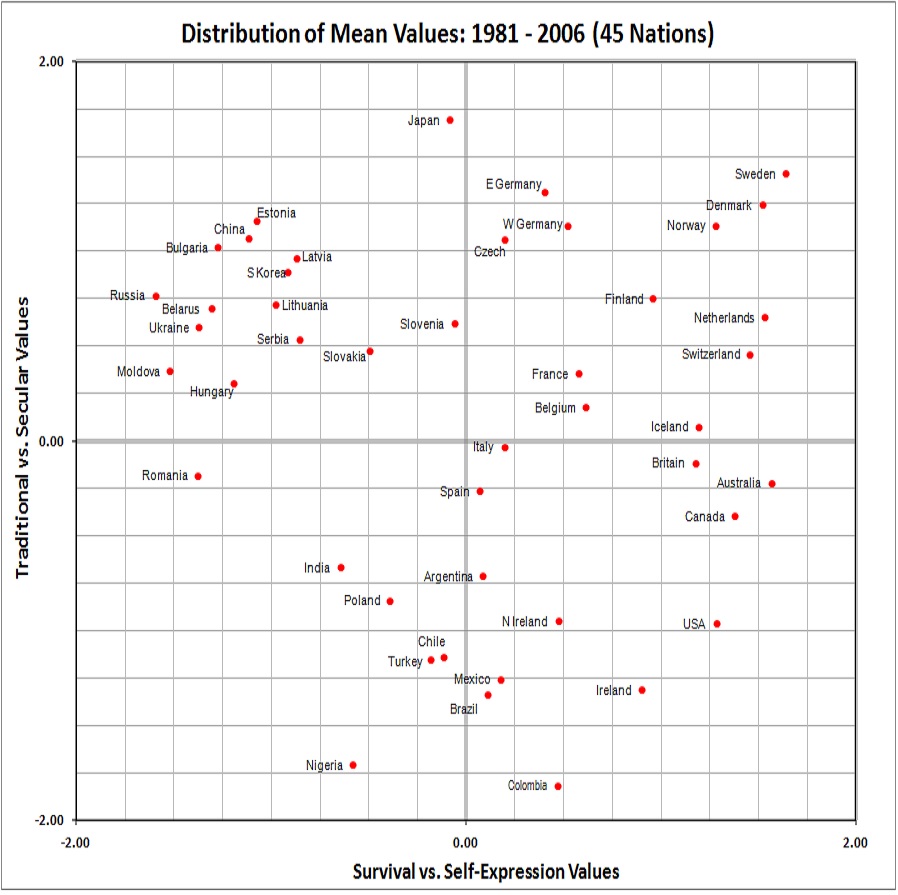
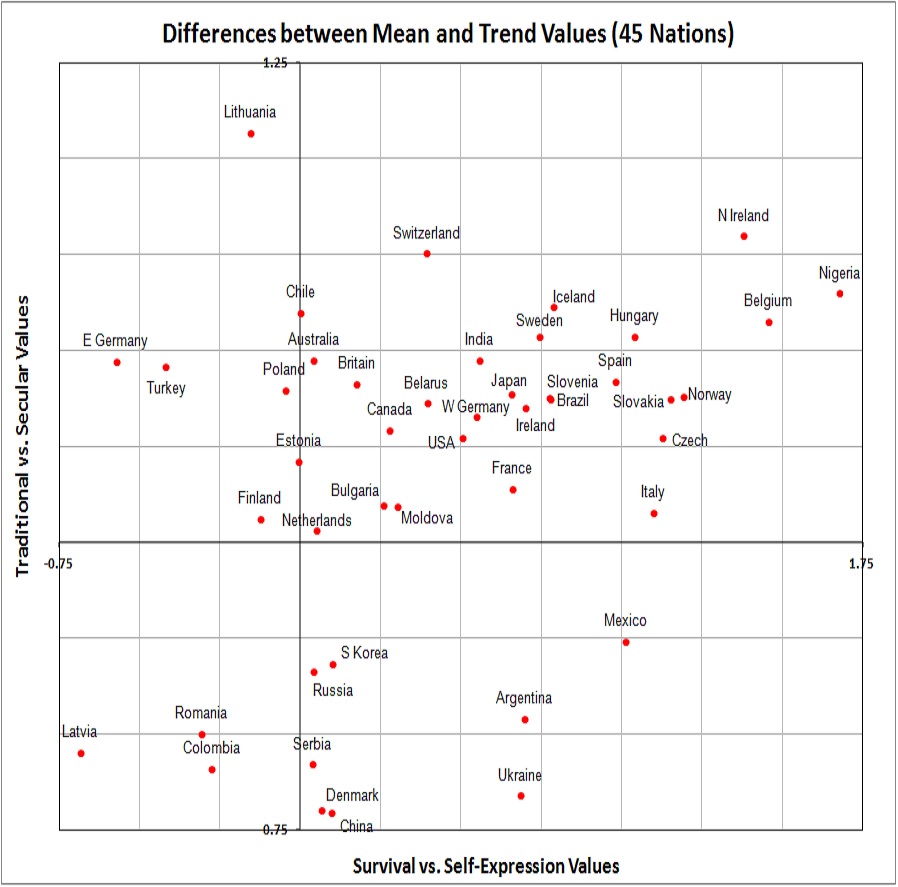
Accordingly, using data for 1981-2006 (“National-Level Value Scores on the Two Major Values Dimensions, for All Nations and Waves“), I constructed the graphs below. The first graph is a plot of the means for each country, where a country is included only if it appears in at least three of the five surveys (1981, 1990, 1995, 2000, 2006). The second graph is a plot of the difference between each country’s mean and its predicted position in 2013, as estimated by using the LINEST function of Excel. Although the two graphs are drawn to different scales, because of differences in the spread of plot points, the gridlines in both graphs are 0.25 standard deviations apart. Therefore, a vertical or horizontal distance of 4 gridlines represents 1 standard deviation.

Values - distribution of means, 1981-2006

Values - differences between means and trends

In the first graph, the distance between points indicates degree of significance. Thus, for example, the vertical distance between Japan and Colombia is about 14 gridlines, or 2.5 standard deviations. That is, indeed, a significant difference. Similarly, Sweden is about 13 gridlines (2.25 standard deviations) from Russia in the horizontal dimension; another separation that I would consider significant. Make what you will of it; there are some unsurprising clusters; for example:

  • Several formerly Communist countries are grouped in the northwest quadrant.
  • Nordic countries (Sweden, Denmark, Norway) are grouped in the upper part of the northeast quadrant.
  • Britain, Australia, and Canada form a fairly tight grouping.

On the other hand, here are some other examples:

  • The Britain-Australia-Canada cluster is close to the point for Iceland, which (surprisingly) is fairly far from the the Sweden-Denmark-Norway cluster.
  • Japan — perhaps unsurprisingly, as the most Westernized of Asian nations — stands well apart from China and South Korea, which are in a cluster with former Communist countries.
  • Italy and Spain aren’t significantly far from France and Belgium, nor are the latter significantly far from Finland and Iceland.

The best that I can make of the first graph is a rough east-west split along the horizontal axis, and, of course, a rough less-religious to more-religious split along the vertical axis.

What about the trends that are indicated in the second graph? There, the relevant distance is from the 0,0 intersection of the axes. That is so because the graph depicts the predicted change (in 2013) from each country’s mean for 1981-2006. Only Lithuania is on a course to move vertically by 4 or more gridlines (1 or more standard deviations). Further, there’s a lot of downward movement.

The preceding observations suggest that, in general, there isn’t strong movement away from traditional values toward secular ones. That’s consistent with the Weberian view: religious values have a lasting effect. I would add that they have a lasting effect where they’re not suppressed — as they were in the former Communist countries, and as they are by the “thought police” of many Western European countries and Canada.

There is, however, a definite rightward movement, away from survival values. In fact, several countries are on a course to move horizontally by 4 or more gridlines: Spain, Hungary, Italy, Czech Republic, Slovakia, Norway, Northern Ireland, Belgium, and Nigeria. The movement away from survival values toward what the authors call self-expression values is consistent with the general rise of living standards in much of the world.

In sum, the groupings drawn by the authors in their Figure 1 are strained and uninformative. If you believe that the “values” surveys yield meaningful aggregations, look beyond the authors’ groupings to the data presented in my two graphs. And draw your own conclusions.
__________
* A similar but later mapping is found here. Similar criticisms apply to it.

The Barbarians Within and the State of the Union

As empires die, the barbarians usually gather at the gates, preparing a final rush. Unfortunately our savages are already inside. They are in the public schools, the universities, and downtown in the cities. They make our movies, set social policy from afar, instill appropriate values in our children. They do not know that they are savages. They now rule us, and there is nothing we can do about it.

Except watch. Vast disasters make splendid theater. This one is going to be a doozy.

— Fred Reed (Nekkid in Austin, iUniverse, 2002)

Reed is right. He must be right because he agrees with me about America’s future. (See “Well-Founded Pessimism” and “America: Past, Present, and Future.”) Reed also agrees with me about the causes of that future.

Some would say that “we” have done it to ourselves. But that is wrong. The truth is that some of “us” have done it to the rest of “us.”

Who are the doers? Reed gets it partly right, but he (like most social observers) overlooks the “secret” ingredient: leftist lying and treachery. (Though he is alert and scathing about one of its powerful instruments: political correctness.*)

Leftists lie to themselves and to others. The purpose of these lies is to advance collectivism, and to do so at the expense of America’s economic and military security.

By collectivism, I mean not just the obvious things (e.g., government control of the economy, income redistribution). Collectivism also embraces forced egalitarianism, regardless of differences in ability, skill, and effort — and to the detriment of freedom of speech, freedom of association, and property rights.

As for the willingness (eagerness) of leftists to forgo economic and military security, consider just a few examples: It is the left that opposes free trade. It is the left that constantly calls for higher taxes on “the rich,” to punish success and deter growth-producing investments. It was the left that sniveled about Reagan’s “dangerous and provocative” arms buildup — the buildup that brought the USSR to its knees. It is the left that, since the “McGovern revolution” of 1972 has turned the Democrat Party into a party of military weakness and appeasement — appeasement of Soviet and Chinese Communism, of Islamic terrorism, and of any other “ism” but American patriotism.

Leftists lie to themselves (engage in magical thinking) in order to justify (to themselves and the gullible) their upside-down woldview. Thus, for example, they embrace the pseudo-sciences of climatology and macroeconomics, which justify costly and aggrandizing state action (e.g., limitations on the use of fossil fuels, the conscription of scarce resources by government in the name of “stimulus”). Perhaps the biggest lie that leftists tell themselves is that they really believe in collectivism and egalitarianism, when they patently do not.

Leftists lie to others — usually deploying the lies they tell themselves  — in order to advance egalitarian collectivism and weaken America. There are the straightforward lies about policy matters as the need to combat man-made global warming by adopting expensive and inefficient “solutions” (think “green” energy, for example), and the effectiveness of “stimulus” spending. Beyond that, there are hoaxes and the Big LIe about Communism, the effects of which burden America more than two decades after the purported demise of Communism. (Note to reader: Hitler, inventor of the Big Lie, was a leftist — not a demented conservative, as later Big Liars would have you believe.)

Before I elaborate on the Big Lie and its accompanying treachery, I will set the stage by say a bit about a kind of “little lie” that appeals to leftists: the hoax.

What kind of political gain accrues to a hoax? Sympathy for a favored “minority group” — usually blacks, women, and persons suffering from real or feigned gender confusion. Beyond sympathy, of course, there is the hope of favored treatment through changes in social norms, forced and reinforced by codes of conduct, and statutes. Favored treatment means more-than-equal treatment for a “minority group” and less-than-equal treatment for persons not in the “minority group” — for example, the erosion of rights (property, speech, and association), and the loss of jobs, promotions, and university admissions.

Prominent, politically inspired/exploited hoaxes of recent times include:

  • The “rape” of Tawana Brawley, a black female
  • The fatal beating of Matthew Shepard, supposedly because of his homosexuality (more here)
  • The “rape” of a black female members of Duke University’s lacrosse team

What about the Big Lie? Well, the aim is the same: to twist the truth and advance the left’s domestic agenda:

the repudiation of ordered liberty of the kind that arises from evolved social norms, and the replacement of that liberty by sugar-coated oppression. The bread and circuses of imperial Rome have nothing on Social Security, Medicaid, Medicare, Obamacare, and the many other forms of personal and corporate welfare that are draining America of its wealth and élan. All of that “welfare” has been bought at the price of economic and social liberty (which are indivisible). (For a broad enumeration, see this post.)

In foreign affairs, the left’s agenda is the erosion of America’s military and economic might, because (insert one or more of the following morally relativistic-politically “realistic” positions):

  • No other country [at present] poses a military challenge to the U.S. [As if this were a permanent condition which would survive prolonged decimation of America’s armed forces.]
  • it is wrong for America to attack other countries. [Always? Even when those other countries are hotbeds of terrorism?]
  • Other countries (e.g., Iran) ought to have nuclear weapons if they want them; after all, the U.S. has them. [Well, why didn’t we offer the A-bomb to Japan instead of using it to end World War II and save millions of lives?]
  • America is nothing special and doesn’t deserve to be stronger and richer than other countries. [Easily said when you are protected by America’s strength and benefit from its quasi-free and still potent economic system, but would you really weaken and impoverish America — and yourself — just to be “no better” than, say, a sub-Saharan country?]
  • “We” must rely in international institutions instead of being the word’s policeman and/or bully. [Rely on ‘international institutions’ even if they are controlled by states that wish ill on America, states that promote ideals other than America’s (professed) ones of liberty and equality of opportunity.
  • The inevitable “convergence” of Communism and capitalism will lead America down the path of socialism and accommodation with the USSR, so we might as well relax and enjoy it.

Reasonable people may disagree about the necessary size and shape of America’s defenses. Reasonable people may disagree about the wisdom of a particular military operation. Reasonable people may disagree about the threat posed by Iran. But reasonable people will not hold the preceding convictions as absolutely and fervently as they are held by leftists, without regard for the facts or the consequences for the liberty and prosperity of Americans.

For decades, the left indulged in one of its biggest Big Lies — a lie perpetrated with the clear purpose of fostering collectivism and military weakness — anti-anti-Communism:

… Whittaker Chambers experienced this [Big Lie] at its punishing extreme. Chambers, probably the most famous American ex-Communist ever, was a former courier for Soviet military intelligence, subsequently an editor at Time magazine, and, in passing, curiously, the English translator of the 1923 Austrian novel Bambi, which became the 1942 Disney cartoon. His exceedingly wise decision to retain hard evidence attesting to his espionage work in the 1930s helped convict, most sensationally, Alger Hiss— the Ivy-educated, well-connected former State Department official and progenitor of the United Nations, president of the Carnegie Endowment for International Peace, and all-around poster boy of the Liberal Establishment. Starting in 1950, Hiss served four years in jail for perjury charges related to Soviet espionage.

Then what happened? Did a thankful President Truman crown Chambers in laurels and congratulate him on behalf of a grateful nation for exposing a Communist conspiracy metastasizing at the highest levels of the federal government?

Never has a simple “no” been less adequate…. At one point in his testimonial [Witness], Chambers encapsulates the physics of anti-anti-Communism this way: “I had been warned repeatedly that the brunt of official wrath was directed, not against Alger Hiss as a danger, but against me for venturing to testify to the danger.”

It bears restating: Officialdom was enraged not by the danger posed by Hiss, a Soviet military intelligence agent “continuously since 1935,” but by Chambers for testifying to the danger….

… When did anti-Communism itself— the philosophical and political drive against state domination of the individual— become a radioactive inheritance of perceived bigotry and mass hysteria to be passed down, gingerly, generation to generation? …

The so-called McCarthy Era is the obvious place to search for answers, since the narrative we can all recite tells us that the Red-hunting Republican senator from Wisconsin was himself singlehandedly responsible for the evisceration of ideological opposition to Communism— anti-Communism— rendering said anti-Communism into a kind of disease. The remedy was said to be a steadying dose of anti-anti-Communism, despite the often heavy pro-Communist side effects. McCarthy accomplished all of this, the same narrative goes, with his crude zealotry and wild overreach, hectoring and destroying American innocents who had the misfortune to be dragged before his investigatory Senate committee for nothing. “Name one Communist or Soviet agent ever identified by McCarthy,” goes the perpetual challenge to this day, regardless of evidence from both Soviet and American archives that corroborate FBI reports, sworn testimonies, and other facts amassed in support of innumerable McCarthy investigations into the Soviet penetration of the federal government…. (Diana West, American Betrayal: The Secret Assault on Our Nation’s Character, St. Martin’s Press, 2013**)

What was the Big Lie of anti-anti-Communism? The story line went like this: Communism stands for a noble ideal (regardless of what Communism invariably looks like in practice), and the Soviet Union’s expansionism is merely defensive. Any criticism of the Soviet Union — including criticism of its espionage and infiltration of the U.S. government — is therefore bad. Anti-Soviet (anti-Communist) views must therefore be discredited.

This story line was advanced by Communist agents working inside the U.S. government, with the help of the usual suspects: academics, show-biz types (with a few notable and ostracized exceptions), and politicians and bureaucrats — many of whom agreed with the story line and others of whom sought election and advancement by placating the left and, at the same time, adopting the “sophisticated” posture of moral relativism and political realism.

By 1995, when the collectivist cause needed no special protection — having advanced from FDR’s New Deal to LBJ’s Great Society, and having been consolidated in the years since — the U.S. government finally released materials amassed by the Venona project,

a long-running secret collaboration of the United States and United Kingdom intelligence agencies involving cryptanalysis of messages sent by intelligence agencies of the Soviet Union, the majority of them during World War II….

During the initial years of the Cold War, the Venona project was a source of information on Soviet intelligence-gathering activity that was directed at the Western military powers. Although unknown to the public, and even to Presidents Franklin D. Roosevelt and Harry S. Truman, these programs were of importance concerning crucial events of the early Cold War….

… Sometime in 1945, the existence of the Venona program was revealed to the Soviet Union by the NKVD agent and United States Army SIGINT analyst and cryptologist Bill Weisband….

To what extent the various individuals were involved with Soviet intelligence is a topic of dispute. While a number of academics and historians assert that most of the individuals mentioned in the Venona decrypts were most likely either clandestine assets and/or contacts of Soviet intelligence agents, others argue that many of those people probably had no malicious intentions and committed no crimes [emphasis added].

Well, of course, “many of those people” were innocent. But many were not. Among the many non-innocents:

And that’s just a sample of a long list of known Soviet agents. Did you notice the presence on the list of the Rosenbergs, as well as a large number of government officials (Alger Hiss among them)? Protestations and “proof” of the innocence of the Rosenbergs, Hiss, and others were key components of the Big anti-anti-Communist Lie.

America’s hollow victory in the Cold War brought with it the end of anti-Communism and anti-anti-Communism as political preoccupations. But the Big Lie lives on, in the service of a collectivist and weak America. How could that have happened if America “won” the Cold War? The bitter truth is that every living person of influence in the U.s. was raised during the reign of the Big (anti-anti-Communist) Lie or in the succeeding generations that were (and are) dominated “educators” who persist unto this day in spreading  the gospel of collectivism at home and weakness abroad. (It is not a sign of strength to kill a few terrorists at long distance with armed drones or to back with words and deeds the efforts of anti-American insurgents aiming to replace one kind of tyranny with their own.)

The lamentable truth is that America’s political elites, their enablers in the academy and the media, their financial backers, and their constituents and dupes (the “masses”) have together succeeded in yoking America with “soft” despotism:

Soft despotism is simply a more polite term than fascism (or socialism) for pervasive government control of our affairs:

Soft despotism is a term coined by Alexis de Tocqueville describing the state into which a country overrun by “a network of small complicated rules” might degrade. Soft despotism is different from despotism (also called ‘hard despotism’) in the sense that it is not obvious to the people. Soft despotism gives people the illusion that they are in control, when in fact they have very little influence over their government. (Source: Wikipedia.)

Soft despotism is “soft” only in that citizens aren’t dragged from their houses at night and executed for imaginary crimes against the state — though they are hauled into court for not wearing seatbelts, for smoking in bars, and for various other niggling offenses to the sensibilities of nanny-staters.

Despite the absence of arbitrary physical punishment, soft despotism is despotism, period. It can be nothing but despotism when the state holds sway over your paycheck, your retirement plan, your medical care, your choice of associates, and thousands of other details of your life — from the drugs you may not buy to the kind of car you can’t drive, from where you can build a house to the features that your house must include.

“Soft despotism,” in other words, is too soft a term for the regime under which we live. I therefore agree with Tom Smith: “Fascism” is a good descriptor of our present condition, so I’ll continue to use it.

Consider Obamacare, which — unlike Hillarycare — may survive:

When Obama was campaigning on behalf of his health care law one mantra was repeated ad nauseam: If you like your current plan, you can keep it. To put it gently, this hasn’t turned out to be the case, as more and more employers are opting to drop health coverage for their employees, pushing them onto the insurance exchanges…. The Wall Street Journal reports:

Instead of subsidizing retiree health premiums directly, IBM will give retirees an annual contribution via a health retirement account that they can use to buy Medicare Advantage plans and supplemental Medicare policies on the exchange, as well as pay for other medical expenses. Retirees who don’t enroll in a plan through Extend Health won’t receive the subsidy. […]

Few employees can now count on big companies to provide retirement health care. Only 28% of large companies that offer health benefits to employees offered retiree coverage in 2013, down from 34% in 2006 and 66% in 1988, according to a 2013 survey by the Kaiser Family Foundation.

This is huge. Far from being a status quo law, Obamacare has become a weapon of mass destruction against traditional employer plans…. (“Obamacare Is Destroying Employer-Based Health Plans,” Via Media, September 9, 2013)

Anyone who knew anything about the likely effects of Obamacare knew that it was sold with this purpose in mind: To undermine employer-based plans and, thus, to garner support for single-payer (i.e., government-provided) health insurance. That, in turn, would practically complete government’s takeover of health care in the U.S., given its control of everything else involved in health care through regulation and the power over providers that accompanies Medicare and Medicaid. (This, too, probably shall not pass.)

And healthcare is but one aspect of an economy that has been commandeered by government spending and regulation, in the name of and for “the people.” For it is well known that most Americans oppose government spending and regulation, in the abstract, while supporting those very things when push comes to shove. (See, for example, this and this.)

Not that the state of the economy will matter much when America is no longer able to effectively defend its citizens and their legitimate overseas interests:

… The fate of the free world no longer rests with the US. It now rests with Putin. He and the mullahs in Iran, presented with the spectacle of the preening narcissist in the White House gazing in rapt adoration at his own reflection, are surely laughing fit to bust.

And why shouldn’t the First Narcissist preen? For he has achieved precisely what he wanted, his true goal that I described in this blog when Obama first ran for President: to extend the reach of the state over peoples’ lives at home, to emasculate the power of America abroad, and to make the free white world the slave of those he falsely characterised as the victims of that white world’s oppression…. (Melanie Phillips, “Putin Checkmates America,” Melanie’s Blog, September 15, 2013)

(Norman Podhoretz delivers a more elaborate version of Phillips’s thesis at “Obama’s Successful Foreign Failure,” The Wall Street Journal, September 8, 2013.)

And the Big Lie continues, transmogrified from anti-anti-Communism to anti-anti-Islamism:

[S]hortly after 9/11, a time when some among us were beginning to realize that what we were all hearing 24/7 on cable, on NPR, in The New York Times, from all the experts … was out of sync with what we were watching before our eyes. In other words, the narrative—“ Islam is peace”— was not supported by the evidence: Islam is violence. Islam is slavery (Sudan). Islam is forced conversion (Egypt). Islam is child rape (Iran, Afghanistan, Saudi Arabia, South Yorkshire, too). Islam is pillage (Somalia). Islam is religious cleansing (Iraq). Islam is death for apostasy (Swat Valley, Harvard University, too8). Islam is censorship (everywhere). Islam is conquest (Cyprus, Israel, Kosovo, Philippines, the 751 government-ID’d no-go zones of France). Such fact-based observations, of course, trigger charges of that sin of sins—“ Islamophobia” (“ racism” being its domestic twin)— but does mere name-calling (“ Islamophobe”) make these serious crimes and their real victims go away? In our world, yes. Over nearly a century of Big Lies we have learned to discount fact and disable logic. As in a frustration dream, the crimes, the victims, and their suffering vanish in today’s magic word, “Islamophobia.” What remains— slanderous allegations of “prejudice,” permanent brands of “bias”— triggers the revulsion reflex in the postmodern brain, still programmed to be vigilant against racism, lynch mobs, the KKK, and the like.

Extant or not, functional or not, these usually faux stimuli create outrage Islam exploits as “Islamophobia.” … This pattern is very old. In pre-McCarthy times, the all-powerful word that stopped the logic process cold was “Red-baiter.” …

… Islam, we are told, has nothing to do with anything bad. How could it? Islam means “peace,” said the forty-third president of the United States. No, in fact, Islam means “submission.” There’s a huge difference, and it explains why Islam celebrated the fall of the Twin Towers in Gaza, Kabul, and Queens. Dhimmitude, already evident in our society, goes a long way to explain why we didn’t dare show that we had noticed.

What we were witnessing was the marshaling forces of the latest, greatest Big Lie…. I saw how … this Big Lie was actively pressed on us by cadres of agents of Islam and their own armies of useful fools: members of the Muslim Brotherhood fobbed off as advocates of a pluralistic, American Islam, the Iran Lobby, Saudi princelings, the international Islamic bloc now known as the Organization of Islamic Cooperation (OIC), the Bush administration, the Obama administration, practically anyone on a TV soundstage. All “reasonable people,” they peddled the same Big Lie: Islam is a religion of peace.

The history of the decade that followed, then, became a stuttering story of mongrel words and phrases (from “Islamofascism” to “violent extremism”) and morphing suffixes (“ ist,” “ism”). It was a time of now-you-see-it, now-you-don’t terminology (jihad, jihadist, sharia, mujahideen, shahid, taqqiyya, jizya, caliphate). Apt phrases became verboten (“ Islamic terrorism,” “Muslim violence,” “Islamic jihad”), as did concepts uniquely or characteristically Islamic: religious supremacism, censorship, slavery, pederasty, “honor killings,” “grooming,” and totalitarianism, among others. We may have intuited that “apostasy” did not go out with Galileo, and that beheadings did not end with the French Revolution, but  … Islam is a religion of peace. The real threat, we decided to believe, or thought we had no choice but to believe (or just didn’t think), is “violent extremism.”…

Limiting our brains to this empty phrase, however, has done extreme violence to our thought processes…. After all, if the problem is “violent extremism,” what’s the problem? Have a nice flight….

Islam is the totalitarian threat of today. However, because we continue the “deceit and double-speak” we adopted in response to Communism, we are unable to deal with the new threat— the new Communism of today. We deal with Islam the same way we dealt with Communism: Having been subverted and undermined, we apologize and converge.

As [Geert] Wilders asked, What is wrong with modern Western man? Did something happen to him? I think the answer is yes: Communism happened to him. Solomon aside, there was something novel under the Communist sun; under the shorter-lived Nazi sun, too. In his 1998 book Century of Horrors: Communism, Nazism, and the Uniqueness of the Shoah, Alain Besançon explains what that was: “Communism and Nazism set out to change something more fundamental than mores— that is, the very rule of morality, of our sense of good and evil. And in this, they committed acts unknown in prior human experience.”

And in this, our world was transformed….

Where “good” and “evil” are old-fashioned and laughable (and bracketed by quotation marks), moral relativism takes hold— Lenin’s universal legacy. Solzhenitsyn wondered what would happen next: “But if we are to be deprived of the concepts of good and evil, what will be left? Nothing but the manipulation of each other.”

The manipulation of each other through the manipulation of narratives….

… All these decades later, no one wants information or to open their eyes to the Muslim Brotherhood’s self-described “civilization jihad,” either. It hurts our heads. It exhausts our limited lexicon of ideology…. (Diana West, op. cit.)

*     *     *

This year marks the 80th anniversary of the ascendancy of FDR, his “Brain Trust,” and the New Deal. It is an anniversary to be mourned, not celebrated. Mourned because it means that Americans’ prosperity and liberty have been eroded and imperiled by eight decades of leftist lies and treachery.

Thus the land of the free and the home of the brave has become the land of the handout-seeker and the home of the appeaser. That is the unfortunate state of the Union in 2013.

*     *     *

Related reading:
Arnold Kling, “Our New Technocratic Masters,” Askblog, February 3, 2013
Victor Davis Hanson, “The Glue Holding America Together,” RealClearPolitics, June 28, 2013
Victor Davis Hanson,”Liberal Apartheid,” RealClearPolitics, July 8, 2013
M. Stanton Evans, “In Defense of Diana West,” cnsnews.com, September 13, 2013

*     *     *

Related posts:
The Course of the Mainstream
FDR and Fascism
An FDR Reader
The People’s Romance
Intellectuals and Capitalism
Fascism
Fascism with a “Friendly” Face
The Interest-Group Paradox
Parsing Political Philosophy
Is Statism Inevitable?
Inventing “Liberalism”
The Shape of Things to Come
Fascism and the Future of America
The Indivisibility of Economic and Social Liberty
Rights, Liberty, the Golden Rule, and the Legitimate State
The Near-Victory of Communism
Tocqueville’s Prescience
Accountants of the Soul
Invoking Hitler
Is Liberty Possible?
The Left
Our Enemy, the State
“Intellectuals and Society”: A Review
The Left’s Agenda
The Left and Its Delusions
The Destruction of Society in the Name of “Society”
The Spoiled Children of Capitalism
Politics, Sophistry, and the Academy
Subsidizing the Enemies of Liberty
Are You in the Bubble?
Where We Are, Economically
The Economic Outlook in Brief
Obamanomics: A Report Card
Liberty and Society
Tolerance on the Left
The Eclipse of “Old America”
Genetic Kinship and Society
Well-Founded Pessimism
Is There Such a Thing as Society
Defense as an Investment in Liberty and Prosperity
Liberty and Society
Tolerance on the Left
The Eclipse of “Old America”
Genetic Kinship and Society
Liberty as a Social Construct: Moral Relativism?
America: Past, Present, and Future
Defending Liberty against (Pseudo) Libertarians
The Fallacy of the Reverse-Mussolini Fallacy
__________
* From Fred Reed (op. cit.):

Feminists wanted congress to pass a vast program of funding for every left-wing cause that incited enthusiasm in the sterile nests of NOW. They called it the Violence Against Women Act, and men deferentially gave it to them. Of course to vote against it, no matter what it actually said (and almost no one knew) would have been to seem to favor violence against women. A law to exterminate orphans, if called the Domestic Violence Prevention Act, would pass without demur.

There followed yet more male deference to female desires. When women wanted to go into the military to have babies, or a Soldier Experience, men couldn’t bring themselves to say no.

When the women couldn’t perform as soldiers, men graciously lowered standards so they could appear to. It was the equivalent of helping a woman over a log in the park, the legal and institutional parallel of murmuring, “Don’t worry your pretty little head about a thing.”

On and on it went. The aggregate effect has been that women have gained real power, while (or by) managing in large part to continue to exact deference and, crucially, to avoid the accountability that should come with power. A minor example is women who want the preferential treatment that women now enjoy, and yet expect men to pay for their dates. In today’s circumstances, this is simple parasitism.

Today men are accountable for their behavior. Women are not. The lack of accountability, seldom clearly recognized, is the bedrock of much of today’s feminist misbehavior, influence, and politics. Its pervasiveness is worth pondering.

** West’s book is controversial — to put it mildly — even among conservatives. Key charges and counter-charges about American Betrayal can be found here:

Ronald Radosh, “McCarthy on Steroids,” FrontPage Mag, August 7, 2013

John Earl Haynes and Harvey Klehr, “Was Harry Hopkins a Soviet Spy?,” FrontPage Mag, August 16, 2013

Diana West, “Published: The Rebuttal in Three Parts [links provided],” dianawest.net, September 10, 2013

West’s style — breathless, repetitive, discursive, often logic-challenged — should not blind you to the essence of her argument, which I have tried to capture in the quotations from her book. Read American Betrayal, read the entries in the debate, consult your own knowledge of America’s past 80 years (if you have much knowledge of those times), and judge for yourself. But don’t commit what I call the fallacy of particularism, which is to discredit an entire thesis because the supporting argument is incorrect in some particulars. (That’s how O.J. got off: “If it [a glove left near the murder scene] doesn’t fit, you must acquit.”) West may not be right about every detail; she has, in my estimation, got the big picture right. For example, even if West is wrong in her assertion that FDR’s right-hand man, Harry Hopkins, was a Soviet agent, she is right about his baleful influence on the foreign and domestic policies of the U.S. government. And his influence lives on.

Annoyances

A curmudgeon (of which caste I am a member), makes it the work of a lifetime to eschew social intercourse that doesn’t derive from an emotional, intellectual, or transactional relationship. Among the many kinds of social intercourse that I strive to avoid are these:

  1. Junk mail
  2. Junk calls
  3. E-mail spam
  4. Blog spam.

The volume of junk mail has declined markedly in recent years, thanks to the internet. The remnant is easily dealt with: I throw it out.

I long ago brought junk calls under control by (a) monitoring incoming calls, (b) letting most of them go to my answering machine, and (c) using a call blocker to prevent recurring calls from solicitors, political campaigns, and other pestilences.

E-mail spam became so annoying at a former e-mail address that I changed my address, with excellent results.

My blog has no comment spam because I don’t allow comments. But despite countermeasures against trackback spam, I have been unable to eliminate it on a few posts. I’m not content to delete it; I want to prevent it. Like junk mail, junk calls, and other forms of spam, trackback spam is an offense against civilization, and those who emit it should be boiled in oil.

Why do I continue to receive trackback spam on a few posts, and what will I do about it? I suspect that spammers infected those posts while they were open to trackbacks; that is, the spammers implanted code that enables them to continue to post trackback spam despite my countermeasures against it. So here’s what I will do about it: Reissue the infected posts using new, uninfected text and images. (Stay tuned for three See the four old/new posts in the coming days dated September 19, 2013.)

Will that work? I fervently hope so, because I like spam about as much as I like cockroaches. The only good cockroach is a dead one. The only good spammer is one who has been drawn, quartered, and bludgeoned.

Next on my coping menu: Austin’s drivers, and bicyclists who insist on acting as if roads were built for them. I can’t avoid driving, so I can’t avoid other drivers and bicyclists. Perhaps I shall buy a tank.

After that? “I’ve Got a Little List.”

September 11 — A Roundup

Some previous posts about 9/11, its roots, and its politics:

Wednesday, February 15, 2006

Riots, Culture, and the Final Showdown

Prologue

This is about the broader implications of the riotous reaction of Muslims to cartoons that ran in a Danish newspaper last October. For the full story, with commentary and plenty of relevant links, go to Michelle Malkin’s blog and start with her post of January 30, “Support Denmark: Why the Forbidden Cartoons Matter,” then read on to the present.

My jumping-off point is this kind of news:

Protesters in Pakistan Target West

LAHORE, Pakistan – Thousands of protesters rampaged through two cities Tuesday, storming into a diplomatic district and torching Western businesses and a provincial assembly in Pakistan’s worst violence against the Prophet Muhammad drawings, officials said. At least two people were killed and 11 injured.

Three Killed in Massive Cartoon Protests

PESHAWAR, Pakistan – Gunfire and rioting erupted Wednesday as tens of thousands of people took to the streets in Pakistan’s third straight day of violent protests over the Prophet Muhammad cartoons. Three people were killed, including an 8-year-old boy.

The second story continues with this:

The European Union condemned both the cartoons, first printed in a Danish newspaper in September, and what it called “systematic incitement to violence” against European diplomatic missions by some unidentified governments.

Bruce Bawer has more about European groveling, and isolated acts of courage, here. Michelle Malkin has plenty to say about the groveling of major American media outlets at her blog (e.g., here). A recent story from the zone of political correctness the academy, reports the suspension of the editors of the Daily Illini (the “independent” student newspaper of the University of Illinois) for having reproduced the cartoons.

The reactions on the part of the EU, much of America’s press, and (I safely assert) most of academia are manifestations of a widespread urge to appease fanatical Islam, about which appeasement I will say more later in this post.

I write here without animus toward Islam, as a religion. My attitude toward Islam as a cultural amalgam of the religious and the social is expressed ably by Occam’s Carbuncle:

. . . What little I know of [Islam] isn’t very appealing at all. It’s rather medieval if you ask me. Not that I hate Muslims. . . . I just don’t care. . . . I don’t believe what they believe and I’m not about to start. Ever. More importantly, I will read what I want to read and I will express myself as I see fit, not within the strictures of Sharia [the code of law based on the Koran], but according to my rights as a citizen of a liberal democracy. That means Muslims do not have the right to impose upon me their own views of what is or is not proper, what is or is not sacrilege or blasphemy. . . . They may not damage my property or my person as reprisal for anything I might say or write. They may express themselves as freely as I. They may insult me. They may shun me. They might even consider ignoring me. But they may not threaten me. They may not do harm in furtherance of the precepts of their religion, just as I may not do harm to show my objection to their dogma.

The following concepts are central to my analysis of Islamic culture, as a force in the affairs of the world:

Despair: To be overcome by a sense of futility or defeat.

Paranoia: Extreme, irrational distrust of others.

Now, on with the post.

Executive Summary

A sense of futility or defeat can be inflicted upon a people by its enemies, or it can be self-inflicted by the culture of the people. A mass culture that prizes mysticism at the expense of rationality and industriousness will, if only subconsciously, come to envy cultures that profit from rationality and industriousness. But the people of the mystical culture will disavow their envy, because to do so would be to admit the inferiority of their culture. They will, instead, take the paranoid view that their backwardness is somehow caused by other cultures — cultures that are “out to get them.” This paranoia focuses the despair of the backward culture, so that its emerges in the form of rage against the culture’s supposed enemies.

The paranoid leaders of a paranoid culture pose an especial danger because of their ability to marshal weapons of mass destruction, and to deploy those weapons in a “righteous” war. In the case of Islamic paranoia, the handwriting is on the wall — and writ in blood.

The West can either act to prevent repititions of 9/11, Madrid, and London — on a larger scale — or it can do nothing and, in doing nothing, invite the conflagration. The choice is nigh. The will to act is in doubt.

Islam: A Culture of Despair and Paranoia

I am struck by the similarity of the Muslim riots — in France last year and in the Middle East this year — to the riots in the “ghettos” of Detroit, Los Angeles, etc. Those riots, like the Muslim ones, were sparked by specific events (e.g., the murder of MLK Jr. and the beating of Rodney King). But those sparks caused explosions because they touched the volatile fuel of desperation.

Whence that fuel? It is created by the chronic illness of the underlying culture. A chronically ill person experiences stress because of his inability to function normally. Prolonged stress can lead to frustration, anger, hopelessness, and, at times, depression. The chronic, self-generated illness of the Muslim culture is similar to that of the black and white “redneck” culture:

There have always been large disparities, even within the native black population of the U.S. Those blacks whose ancestors were “free persons of color” in 1850 have fared far better in income, occupation, and family stability than those blacks whose ancestors were freed in the next decade by Abraham Lincoln.

What is not nearly as widely known is that there were also very large disparities within the white population of the pre-Civil War South and the white population of the Northern states. Although Southern whites were only about one-third of the white population of the U.S., an absolute majority of all the illiterate whites in the country were in the South. . . .

Disparities between Southern whites and Northern whites extended across the board from rates of violence to rates of illegitimacy. American writers from both the antebellum South and the North commented on the great differences between the white people in the two regions. So did famed French visitor Alexis de Tocqueville.

None of these disparities can be attributed to either race or racism. . . . The people who settled in the South came from different regions of Britain than the people who settled in the North–and they differed as radically on the other side of the Atlantic as they did here–that is, before they had ever seen a black slave.

Slavery also cannot explain the difference between American blacks and West Indian blacks living in the United States because the ancestors of both were enslaved. When race, racism, and slavery all fail the empirical test, what is left?

Culture is left.

The culture of the people who were called “rednecks” and “crackers” before they ever got on the boats to cross the Atlantic was a culture that produced far lower levels of intellectual and economic achievement, as well as far higher levels of violence and sexual promiscuity. That culture had its own way of talking, not only in the pronunciation of particular words but also in a loud, dramatic style of oratory with vivid imagery, repetitive phrases and repetitive cadences.

Although that style originated on the other side of the Atlantic in centuries past, it became for generations the style of both religious oratory and political oratory among Southern whites and among Southern blacks–not only in the South but in the Northern ghettos in which Southern blacks settled. . . .

The redneck culture proved to be a major handicap for both whites and blacks who absorbed it. Today, the last remnants of that culture can still be found in the worst of the black ghettos, whether in the North or the South, for the ghettos of the North were settled by blacks from the South. The counterproductive and self-destructive culture of black rednecks in today’s ghettos is regarded by many as the only “authentic” black culture–and, for that reason, something not to be tampered with. Their talk, their attitudes, and their behavior are regarded as sacrosanct. (Thomas Sowell, at OpinionJournal, paraphrasing his essay “Black Rednecks and White Liberals,” from the eponymous book.)

Islamic culture, broadly speaking, seems much like redneck culture in its preference for mysticism or ritual over rationality and industriousness — as well as in its attitude toward women. The adherents of an irrational, indolent culture who have any exposure to other cultures must know that their culture holds them back materially, and that they would be better off if they were to adopt the rational and industrious ways of other cultures. (The closely held wealth of the oil sheikhs has nothing to do with Islam; it is a fortuitous artifact of the geology of the Middle East and the industry of the West.) But to adopt the ways of wealthier cultures is to admit the shortcomings of one’s own culture — and to break with one’s family, friends, and authority figures.

Thus the adherents of the backward culture remain mired in their self-inflicted despair and, instead of blaming themselves and their culture for their backwardness, they blame the outsiders whose relative success they envy. And when their despair erupts in rage it is (in the paranoid view) legitimate to attack the blameworthy — “city folk,” “honkies,” Korean and Jewish merchants, “infidels,” and so on — because they are responsible for keeping us down.

Islamic Paranoia Writ Large

Paranoia is bad enough when it motivates (sometimes organized) mobs to kill, plunder, and destroy. Paranoia is far worse when it motivates leaders who command (or seek to command) the technology of mass destruction — leaders such as Hitler, Stalin, bin Laden, and Iran’s Mahmoud Ahmadinejad. Ahmadinejad is perhaps best known to Americans for his “alleged” involvement in the Iran Hostage Crisis of 1979 and for his utterances about the United States and Israel; for example:

The establishment of the occupying regime of Qods [Jerusalem]was a major move by the world oppressor [the United States] against the Islamic world. . . .

The Palestinian nation represents the Islamic nation [Umma] against a system of oppression, and thank God, the Palestinian nation adopted Islamic behavior in an Islamic environment in their struggle and so we have witnessed their progress and success. . . .

Our dear Imam [Ayatollah Khomeini] said that the occupying regime [Israel] must be wiped off the map and this was a very wise statement. We cannot compromise over the issue of Palestine. Is it possible to create a new front in the heart of an old front. This would be a defeat and whoever accepts the legitimacy of this regime [Israel] has in fact, signed the defeat of the Islamic world. Our dear Imam targeted the heart of the world oppressor in his struggle, meaning the occupying regime. I have no doubt that the new wave that has started in Palestine, and we witness it in the Islamic world too, will eliminate this disgraceful stain from the Islamic world. But we must be aware of tricks.

For over 50 years the world oppressor tried to give legitimacy to the occupying regime and it has taken measures in this direction to stabilize it. . . .

Recently they [the Israelis] tried a new trick. They want to show the evacuation from the Gaza strip, which was imposed on them by Palestinians [oh, really?], as a final victory for the Palestinians and end the issue of Palestine. . . .

I warn all leaders of the Islamic world that they should be aware of this trick. Anyone who recognizes this regime [Israel] because of the pressure of the World oppressor, or because of naiveté or selfishness, will be eternally disgraced and will burn in the fury of the Islamic nations. (From a speech given in Tehran, Iran, on October 16, 2005, to an Islamic Student Associations conference on “The World Without Zionism.”)

The Culture Clash and the Final Showdown

Ahmadinejad, like bin Laden, whips despair into rage, a rage that is aimed at the imagined “enemies” of Islam. Bin Laden, of course, has succeeded in turning some of those imagined enemies into real ones by attacking them. Ahmadinejad seems bent on following bin Laden’s lead, but on a larger scale.

It is too late to appease such fanatics — much as some Westerners would like to try appeasement — because The West (the United States, in particular) has “insulted” Islamic fanatics in three fundamental ways: by the creation of Israel, by the “exploitation” of the Middle East’s geology, and by the defense of Israel and those Middle Eastern governments that permit the “exploitation.” Given that history, the only way to appease paranoid Islamists is for Americans to don the raiment of mystical asceticism, which might appeal to a select circle of self-flagellants, but to very few others of us.

What I am saying, really, is that a final showdown with fundamentalist Islam is inevitable. Most Americans did not understand the inevitability of that showdown until September 11, 2001 — and many Americans (including most “intellectuals” and many politicians who should know better) still refuse to acknowledge the significance of that day’s events. The doubters seem to be trapped in 1938, waiting for the UN or a Democrat president to announce “peace in our time,” or in 1939-40, unwilling to believe that America could be the target of a fanatical ideology.

It is futile to hope that hard-core Islam can be deflected through political correctness (e.g., banning speech that might offend Muslims), diplomatic maneuverings, support for dissidents, or other such transparently weak responses to aggression, terrorism, and the accumulation of weapons of mass destruction. In fact, such responses are worse than futile; they encourge what they seek to discourage because they display weakness — just as displays of weakness on the part of the United States from 1979 onward encouraged the events of September 11, 2001.

The next stage of the showdown, if it is allowed to happen, will come when al Qaeda (or one of its ilk) acquires and uses weapons of mass destruction in Europe or the United States. The following stage of the showdown, if it is allowed to come to that, will come when Iran acquires nuclear weapons.

I repeat: The question is not whether those events will happen, but when they will happen if they are not thwarted by intelligence-gathering, clandestine operations, conventional military operations, and massive strikes against hard military targets (including nuclear “power” facilities). Force is the only thing that will stop Islamic fanatics; force is the only response that they will heed — just as the Japanese, fanatical as they were, had no choice in the end but to abandon their fanatical ways.

It Is a Question of Will

We had better get used to that idea that war is the answer, and see to it that adequate force is used, sooner rather than later. Those who would use force against us will heed only force. Whether, in defeat, they will respect us or “merely” fear us is irrelevant. We are not engaged in a popularity contest, we are engaged in a clash of civilizations, which Norman Podhoretz rightly calls World War IV.

On our present political course, however, we will suffer grave losses before we get serious about winning that war. The Left (or the Opposition, as I now call it), seems insensitive to the danger that faces us. The voices of doubt and division are many and loud. They range from librarians, academicians and celebrities (too numerous to link), and hypocrites in the media to former vice president Gore and many current members of Congress (e.g., these), some of whom would prefer to impeach President Bush for defending us through a constitutional surveillance program than face up to the enemy without. Their preferred vision of government — strength at home and weakness in foreign affairs — is precisely opposite the vision of the Framers of the Constitution.

Ben Shapiro goes too far in suggesting “that Congress ought to revivify sedition prosecutions,” but he is right about the likely effect of the Opposition’s outpourings; for example:

Let us consider . . . the probable consequences of Gore’s mea culpa [before a Saudi audience] on behalf of the “majority” of his countrymen. No doubt his words will fuel the massive tide of propaganda spewing forth from Muslim dictatorships around the globe. No doubt his words will be used to bolster the credibility of horrific disinformation like the Turkish-made, Gary-Busey-and-Billy Zane-starring monstrosity “Valley of the Wolves: Iraq,” which accuses American troops of war atrocities and depicts a Jewish-American doctor (Busey) slicing organs out of Arab victims and shipping the body parts off to New York, London and Israel. No doubt Gore’s speech will precipitate additional violence against Americans in Iraq and around the globe.

(Not to mention the media’s constant re-hashing of Abu Ghraib.)

Thomas Sowell, as usual, gets to the heart of the matter:

With Iran advancing step by step toward nuclear weapons, while the Europeans wring their hands and the United Nations engages in leisurely discussion, this squeamishness about tapping terrorists’ phone contacts in the United States is grotesque.

Has anyone been paying attention to the audacity of the terrorists? Some in the media seem mildly amused that Palestinian terrorists are threatening Denmark because of editorial cartoons that they found offensive.

Back in the 1930s, some people were amused by Hitler, whose ideas were indeed ridiculous, but by no means funny.

This was not the first threat against a Western country for exercising their freedom in a way that the Islamic fanatics did not like. Osama bin Laden threatened the United States on the eve of our 2004 elections, if we didn’t vote the way he wanted.

When he has nuclear weapons, such threats cannot be ignored, when the choice is between knuckling under or seeing American cities blasted off the face of the earth.

That is the point of no return — and we are drifting towards it, chattering away about legalisms and politics.

Which leads me to the ultimate question, which James Q. Wilson addresses in “Divided We Stand: Can a Polarized Nation Win a Protracted War?” Wilson concludes:

A final drawback of polarization is more profound. Sharpened debate is arguably helpful with respect to domestic issues, but not for the management of important foreign and military matters. The United States, an unrivaled superpower with unparalleled responsibilities for protecting the peace and defeating terrorists, is now forced to discharge those duties with its own political house in disarray.

We fought World War II as a united nation, even against two enemies (Germany and Italy) that had not attacked us. We began the wars in Korea and Vietnam with some degree of unity, too, although it was eventually whittled away. By the early 1990s, when we expelled Iraq from Kuwait, we had to do so over the objections of congressional critics. In 2003 we toppled Saddam Hussein in the face of catcalls from many domestic leaders and opinion-makers. Now, in stabilizing Iraq and helping that country create a new free government, we have proceeded despite intense and mounting criticism, much of it voiced by politicians who before the war agreed that Saddam Hussein was an evil menace in possession of weapons of mass destruction and that we had to remove him.

Denmark or Luxembourg can afford to exhibit domestic anguish and uncertainty over military policy; the United States cannot. A divided America encourages our enemies, disheartens our allies, and saps our resolve–potentially to fatal effect. What Gen. Giap of North Vietnam once said of us is even truer today: America cannot be defeated on the battlefield, but it can be defeated at home. Polarization is a force that can defeat us.

Let us hope — against hope, I fear — that the Opposition comes to its senses before it is too late.

*****

The Next 9/11?

Obama has released a paper titled “Empowering Local Partners to Prevent Violent Extremism in the United States.” It ends — as one would expect of a screed bearing Obama’s imprimatur — with a statement of “guiding principles”:

We must continually enhance our understanding of the threat posed by violent extremism and the ways in which individuals or groups seek to radicalize Americans, adapting our approach as needed….

We must do everything in our power to protect the American people from violent extremism while protecting the civil rights and civil liberties of every American….

We must build partnerships and provide support to communities based on mutual trust, respect, and understanding….

We must use a wide range of good governance programs—including those that promote immigrant integration and civic engagement, protect civil rights, and provide social services—that may help prevent radicalization that leads to violence….

We must support local capabilities and programs to address problems of national concern….

Government officials and the American public should not stigmatize or blame communities because of the actions of a handful of individuals….

Strong religious beliefs should never be confused with violent extremism….

Though we will not tolerate illegal activities, opposition to government policy is neither illegal nor unpatriotic and does not make someone a violent extremist….

That must set a record for the highest number of treacly, politically correct, operationally useless and self-defeating statements made in the span of a typewritten page.

If this is how the Obama administration sets about protecting Americans from terrorism, I fear that the next 9/11 isn’t far off.

For example, I challenge the administration to tell me that the following has not happened and cannot happen in the United States:

  • A large but dispersed collection of improvised weapons for improvised, mortar-style attacks has been gathered in and around major U.S. cities and transportation and energy nodes.
  • These weapons are positioned so that their activation, on a massive scale would create havoc and panic — and might well disrupt transportation and communication networks. (With a massive salvo, not every weapon must reach its target.)
  • These weapons can be activated remotely — perhaps through signals transmitted from a single point — so that they can be fired in coordinated waves. Each successive wave disrupts and complicates rescue and recovery efforts that ensue from preceding waves, heightens confusion and panic, and lays the groundwork for economic disaster and political repression.

Obama’s political correctness, I fear, goes hand-in-hand with his demonstrated fecklessness in matters of national security. The intelligence and special operations forces of the United States should be capable of detecting and dismantling a threat of the kind outlined above. But will they be given the necessary resources and leeway? I doubt it.

*****

September 20, 2001: Hillary Clinton Signals the End of “Unity”

This is my 9/11 post, a day early. For my remembrance of 9/11, go here.

I reluctantly watched George W. Bush’s post-9/11 speech before a joint session of Congress. I say “reluctantly” because I cannot abide the posturing, pomposity, and wrong-headedness that are the usual ingredients of political speeches — even speeches that follow events like the attack on Pearl Harbor and the atrocities of 9/11. (Churchill’s rallying speeches during World War II are another thing: masterworks of inspirational oratory.)

In any event, Bush’s performance was creditable (thanks, no doubt, to his writers and ample preparation). And I found nothing to fault in what he said, inasmuch as I am a libertarian hawk. The vigorous and evidently sincere applause that greeted Bush’s applause lines — applause that arose from Democrats as well as Republicans — seemed to confirm the prevailing view that Americans (or their political leaders, at least) were defiantly united in the fight against terrorism.

But I noted then, and have never forgotten, the behavior of Hillary Clinton, who was a freshman senator. Some of Clinton’s behavior is captured in this video clip, from 11:44 to 12: 14. The segment opens with Bush saying

Terror unanswered can not only bring down buildings, it can threaten the stability of legitimate governments. And you know what, we’re not going to allow it.

The assemblage then rises in applause. The camera zooms to Hillary Clinton, who seems aware of it and stares at the camera briefly while applauding tepidly. (Compare her self-centered reaction with that of the noted camera-hog Chuck Shumer, who is standing next to her, applauding vigorously, and looking toward Bush.) Clinton then turns away from the camera and, while still applauding tepidly, directs a smirk at someone near her. I also noted — but cannot readily find on video — similar behavior, include eye-rolling, at the conclusion of Bush’s speech.

Clinton — as a veteran political campaigner who knew that her behavior would draw attention — was sending a clear signal of her reluctance to support Bush because … because why? Because he had an opportunity for leadership that her husband had squandered through his lame responses to the 1993 bombing of the World Trade Center, the downing of U.S. helicopters in Somalia, and the bombings of U.S. embassies in East Africa? Because Bush was a Republican who had won the presidency after great controversy? Because she resented not being at the center of attention after having been there for eight years, as an influential FLOTUS?

Yes Clinton was “hawkish” on the wars in Afghanistan and Iraq. But I will always suspect that her hawkishness was, in part, a kind of atonement for her public display of disdain for George W. Bush on an occasion when such a display was inappropriate. No president should be given leave to do as he will, for any reason, but neither should his unexceptionable remarks on a solemn occasion be mocked.

Regardless of Clinton’s later stances, her behavior on January 20, 2011, signaled that the war on terror would become a partisan feast for Democrats and head-in-the clouds pseudo-libertarians. And it became just that.

*****

NEVER FORGIVE, NEVER FORGET, NEVER RELENT!

For an egregious view of 9/11 and events since, see Robin Hanson’s post,”Forget 9/11.” Read my comment.* And then forget Robin Hanson. What a jerk.

P.S. Hanson can shove Krugman up his a**, and vice versa. They make a nice couple. Bill Vallicella, on the other hand, is a voice of reason, as is another Hanson (Victor Davis).

P.P.S. See also my previous post about 9/11, “September 20, 2001: Hillary Clinton Signals the End of ‘Unity’.”

P.P.P.S. If you wonder why I react so strongly to Hanson and Krugman, see “September 11: A Remembrance.” I despise the likes of Hanson and Krugman, whose extreme libertarianism and extreme statism seem unbounded by taste and reality.
__________
* Defense against terrorists, not solidarity with victims, explains the “pissing away” of three trillion dollars. But you are not in a position to say that it was “pissed away,” unless you happen to know, with some certainty, just how much or how little physical and economic security was bought with the three trillion dollars. I detect a bias on your part against defense spending. Or do you believe that the U.S. wouldn’t have been attacked if only (insert your favorite gripe against U.S. foreign policy here)?

What does the fact that half a billion persons have died since 9/11 have to do with the deaths of the three thousand victims of 9/11? If your spouse was murdered, I suppose you’d say “Oh well, people die every day.” Same thing, right?

Were long-standing legal principles trashed? Maybe. But the ACLU is hardly an unbiased judge of such things. Try this for some balance: http://originalismblog.typepad.com/the-originalism-blog/2011/09/comment-on-911.html.

Finally, I second Adam’s comment that you are looking down on a natural human reaction to what was seen (quite properly) as a dramatic event. Actually, “dramatic” is an understatement. It was a concerted act of barbarism, not the everyday occurrence that you liken it to.

*****

The War on Terror, As It Should Have Been Fought

The war on terror encompasses more than military action, but military action is a necessary part of it. However, as with the Vietnam War, the military response to the attacks of September 11, 2001, have been half-hearted and therefore inconclusive. What should have been done? The answers are given in two recent essays at the Claremont Review of Books.

In “The Lost Decade” (October 20, 2011), Angelo M. Codevilla writes:

America’s ruling class lost the “War on Terror.” During the decade that began on September 11, 2001, the U.S. government’s combat operations have resulted in some 6,000 Americans killed and 30,000 crippled, caused hundreds of thousands of foreign casualties, and spent—depending on various estimates of direct and indirect costs—somewhere between 2 and 3 trillion dollars. But nothing our rulers did post-9/11 eliminated the threat from terrorists or made the world significantly less dangerous. Rather, ever-bigger government imposed unprecedented restrictions on the American people and became the arbiter of prosperity for its cronies, as well as the manager of permanent austerity for the rest. Although in 2001 many referred to the United States as “the world’s only superpower,” ten years later the near-universal perception of America is that of a nation declining, perhaps irreversibly. This decade convinced a majority of Americans that the future would be worse than the past and that there is nothing to be done about it. This is the “new normal.” How did this happen?…

America’s current ruling class, the people who lost the War on Terror, monopolizes the upper reaches of American public life, the ranks of those who make foreign and domestic policy, including the leadership of the Republican and Democratic parties. It is more or less homogeneous socially and intellectually. In foreign affairs, the change from the Bush to the Obama Administrations was barely noticeable. In domestic matters, the differences are more quantitative than qualitative. Dissent from the ruling class is rife among the American people, but occurs mostly on the sidelines of our politics. If there is to be a reversal of the ongoing defeats, both foreign and domestic, that have discredited contemporary America’s bipartisan mainstream, heretofore marginal people will have to generate it, applying ideas and practices recalled from America’s successful past.

The world of 2011 is even less congenial to America and Americans than it was on September 10, 2001. The U.S. government is not responsible for all the ways in which the world was menacing then and is menacing now, of course. Regardless of what America did, China’s challenge to the post-1945 Peace of the Pacific was going to become more serious. Vladimir Putin’s neo-Soviet Russia was not and could not be anything but a major bother. Western Europe would be living off civilizational capital it had lost the will to replenish, irrespective of any American deeds or entreaties. The Muslim world would be choking on the dysfunctions inherent in its government and cultures.

But U.S. policy has made things worse because the liberal internationalists, realists, and neoconservatives who make up America’s foreign policy Establishment have all assumed that Americans should undertake the impossible task of changing such basic facts, rather than confining themselves to the difficult but vital work of guarding U.S. interests against them. For the Establishment, 9/11 meant opportunities to press for doing more of what they had always tried to do….

After 9/11 President George W. Bush told the American people to go shopping and behave normally. In short: forget that you will never again be free to live as before. Think about money. This advice followed naturally from the government’s decision to persist in its ways instead of lifting terrorism’s burden from America. What might have happened if, instead, Bush had told Americans that the terror threat would not last forever, because their government would now undertake some expensive military operations that would soon allow normal life to resume? To support those operations the government would have had to cut back other spending and perhaps raise some taxes. No doubt, in fall 2001 the American people would have accepted these sacrifices. But they would have demanded results. Since the administration was not about to try that, it sought to satisfy the American people with the pretend-safety of “homeland security,” with images of U.S. troops in combat, and perhaps above all with domestic prosperity fueled by record-low interest rates and massive deficit-spending.

This pretend-prosperity aimed not only to anesthetize criticism of endless war, but also to feed both political parties’ many constituencies—the ruling class’s standard procedure. Both parties joined in expanding federal guarantees for sub-prime mortgages, subsidies for education, alternative fuels, and countless activities dear to well-connected players. Both parties congratulated themselves for establishing new entitlements for prescription drugs and for medical care for children. When the “great recession” began in 2007 Democrats blamed Republicans’ excessive spending on “the wars,” while Republicans blamed it on Democrats’ excessive spending on everything else. Both are correct, and both are responsible….

What should have been done? Mark Helprin gives the prescription, in “The Central Proposition” (same source, September 13, 2011):

True shock and awe following upon September 11, when the world was with us, could have pitched the Middle East (and beyond, including the Islamists) into something resembling its torpor under European domination or its shock after the Arab-Iraeli War of 1967. That is to say, pacified for a time, with attacks on the West subsiding. And if the West could have resisted the arrogance of the victor and been magnanimous, who knows for how long such a period would have been extended? Instead, we exhibit the generosity of the soon-to-be defeated, otherwise known as concession and surrender.

Comporting with the idea that if you’re going to have a war it’s a good idea to win it, and with the Powell Doctrine, General Eric Shinseki’s recommendations, the lessons of military history, the American way of war, and simple common sense, an effective response to September 11 would have required an effort of greater scale than that of the Gulf War—i.e., all in. With a full and fully prepared “punch through,” we could have reached Baghdad in three days, and instead of staying there for a decade or more put compliant officials or generals in power (which is more or less what we’re doing now) and wheeled left to Damascus, smashing the Syrian army against the Israeli anvil and putting another compliant regime in place before returning to the complex of modern military bases at the northern borders of Saudi Arabia. There, our backs to the sea, which we control, and our troops hermetically sealed by the desert and safe from insurgency, we could have occupied the center of gravity in the heart of the Middle East, able to sprint with overwhelming force within a few days to either Baghdad, Damascus, or Riyadh.

Having suffered very few casualties, our forces would have been rested, well-trained, ready for deployment in other parts of the world, and able to dictate to (variously and where applicable) the Syrians, Iraqis, and Saudis that they eradicate their terrorists, stay within their borders, abandon weapons of mass destruction, break alliances with Iran and Hezbollah, keep the oil price down, and generally behave themselves. These regimes live for power, do anything for survival, and have secret police who can flush out terrorists with ruthless efficiency. Such strategy, had we adopted it, would have been demanding and imperious, yes, but not as demanding and imperious as ten years of war across much of the Middle East. Our own economy and alliances need not have been disrupted, our polity not so severely divided, and far fewer people would have suffered.

What happened between World War II and September 11, 2001, to change the American way of war from tenacity to pusillanimity? A lot of what happened has to do with the ascendancy of leftism, which too many conservatives seem bent on accommodating for fear of seeming mean-spirited and (in the case of too many conservative politicians) for the sake of gaining office.

Beyond that, and more importantly, there is the decline of willpower. On that point, I turn to Andrew Klavan:

A book called Willpower has been making a splash lately and will, I’m told, appear on the New York Times bestseller list next week. I have not read the book yet, but while in New York last week at the behest of the Manhattan Institute, I attended an MI-sponsored presentation by the book’s authors, psychology researcher Roy F. Baumeister and science writer John Tierney.

Willpower surpasses even intelligence as a predictor of success in life. And Baumeister has performed a number of experiments that convinced him that willpower is something like a muscle:  it can be strengthened, conserved, and fatigued. Like a muscle, it also needs to be fueled. Baumeister’s assertion that glucose in the blood is essential to willpower has featured in the headlines about the book.

But in the question period after the presentation, I asked Baumeister how else, aside from eating well, could willpower be strengthened. His response was this:  Exercise strengthens willpower just as it strengthens muscles. Even a meaningless exercise of will — training yourself to use your left hand for a task instead of your right, for instance — can make the will stronger over time. He added — I quote from memory: “When I was a boy, I used to be baffled by the idea of profanity. I used to wonder why there should be all these words that everyone knew but nobody used. But now I understand:  that strengthens willpower.”

Well, right. In other words, behaving well, behaving responsibly, learning the norms of politeness and refusing to abandon them without good reason tend to make you a more self-controlled, successful, and finally better person.

This is precisely the wisdom my generation threw away. Their promiscuity, adolescent foul-mouthedness, bad manners, and disregard for tradition — all of which they claimed were a new kind of freedom — were in fact the precursors to the very oldest kind of slavery:  slavery to one’s own impulses and desires…. (“‘Willpower’ and the Suckiest Generation” (Klavan on the Culture, September 26, 2011)

In so many words, a lack of staying power. If one goes through life expecting to be rewarded at every turn for having done nothing, one acquires a habit of mind that precludes doing what is necessary to remain alive and free.

Drone warfare is not wrong (as leftists and extreme libertarian would have it) because it uses technology to kill our enemies. But drown warfare is symptom of the moral torpor that has overtaken most Americans, especially our so-called leaders. It is an (illusory) easy way out of a situation that defies an easy solution and demands the application of vastly more military might than our so-called leaders have been willing to muster.

*****

The Next 9/11?

Obama has released a paper titled “Empowering Local Partners to Prevent Violent Extremism in the United States.” It ends — as one would expect of a screed bearing Obama’s imprimatur — with a statement of “guiding principles”:

We must continually enhance our understanding of the threat posed by violent extremism and the ways in which individuals or groups seek to radicalize Americans, adapting our approach as needed….

We must do everything in our power to protect the American people from violent extremism while protecting the civil rights and civil liberties of every American….

We must build partnerships and provide support to communities based on mutual trust, respect, and understanding….

We must use a wide range of good governance programs—including those that promote immigrant integration and civic engagement, protect civil rights, and provide social services—that may help prevent radicalization that leads to violence….

We must support local capabilities and programs to address problems of national concern….

Government officials and the American public should not stigmatize or blame communities because of the actions of a handful of individuals….

Strong religious beliefs should never be confused with violent extremism….

Though we will not tolerate illegal activities, opposition to government policy is neither illegal nor unpatriotic and does not make someone a violent extremist….

That must set a record for the highest number of treacly, politically correct, operationally useless and self-defeating statements made in the span of a typewritten page.

If this is how the Obama administration sets about protecting Americans from terrorism, I fear that the next 9/11 isn’t far off.

For example, I challenge the administration to tell me that the following has not happened and cannot happen in the United States:

  • A large but dispersed collection of improvised weapons for improvised, mortar-style attacks has been gathered in and around major U.S. cities and transportation and energy nodes.
  • These weapons are positioned so that their activation, on a massive scale would create havoc and panic — and might well disrupt transportation and communication networks. (With a massive salvo, not every weapon must reach its target.)
  • These weapons can be activated remotely — perhaps through signals transmitted from a single point — so that they can be fired in coordinated waves. Each successive wave disrupts and complicates rescue and recovery efforts that ensue from preceding waves, heightens confusion and panic, and lays the groundwork for economic disaster and political repression.

Obama’s political correctness, I fear, goes hand-in-hand with his demonstrated fecklessness in matters of national security. The intelligence and special operations forces of the United States should be capable of detecting and dismantling a threat of the kind outlined above. But will they be given the necessary resources and leeway? I doubt it.

*****

September 20, 2001: Hillary Clinton Signals the End of “Unity”

This is my 9/11 post, a day early. For my remembrance of 9/11, go here.

I reluctantly watched George W. Bush’s post-9/11 speech before a joint session of Congress. I say “reluctantly” because I cannot abide the posturing, pomposity, and wrong-headedness that are the usual ingredients of political speeches — even speeches that follow events like the attack on Pearl Harbor and the atrocities of 9/11. (Churchill’s rallying speeches during World War II are another thing: masterworks of inspirational oratory.)

In any event, Bush’s performance was creditable (thanks, no doubt, to his writers and ample preparation). And I found nothing to fault in what he said, inasmuch as I am a libertarian hawk. The vigorous and evidently sincere applause that greeted Bush’s applause lines — applause that arose from Democrats as well as Republicans — seemed to confirm the prevailing view that Americans (or their political leaders, at least) were defiantly united in the fight against terrorism.

But I noted then, and have never forgotten, the behavior of Hillary Clinton, who was a freshman senator. Some of Clinton’s behavior is captured in this video clip, from 11:44 to 12: 14. The segment opens with Bush saying

Terror unanswered can not only bring down buildings, it can threaten the stability of legitimate governments. And you know what, we’re not going to allow it.

The assemblage then rises in applause. The camera zooms to Hillary Clinton, who seems aware of it and stares at the camera briefly while applauding tepidly. (Compare her self-centered reaction with that of the noted camera-hog Chuck Shumer, who is standing next to her, applauding vigorously, and looking toward Bush.) Clinton then turns away from the camera and, while still applauding tepidly, directs a smirk at someone near her. I also noted — but cannot readily find on video — similar behavior, include eye-rolling, at the conclusion of Bush’s speech.

Clinton — as a veteran political campaigner who knew that her behavior would draw attention — was sending a clear signal of her reluctance to support Bush because … because why? Because he had an opportunity for leadership that her husband had squandered through his lame responses to the 1993 bombing of the World Trade Center, the downing of U.S. helicopters in Somalia, and the bombings of U.S. embassies in East Africa? Because Bush was a Republican who had won the presidency after great controversy? Because she resented not being at the center of attention after having been there for eight years, as an influential FLOTUS?

Yes Clinton was “hawkish” on the wars in Afghanistan and Iraq. But I will always suspect that her hawkishness was, in part, a kind of atonement for her public display of disdain for George W. Bush on an occasion when such a display was inappropriate. No president should be given leave to do as he will, for any reason, but neither should his unexceptionable remarks on a solemn occasion be mocked.

Regardless of Clinton’s later stances, her behavior on January 20, 2011, signaled that the war on terror would become a partisan feast for Democrats and head-in-the clouds pseudo-libertarians. And it became just that.

*****

NEVER FORGIVE, NEVER FORGET, NEVER RELENT!

For an egregious view of 9/11 and events since, see Robin Hanson’s post,”Forget 9/11.” Read my comment.* And then forget Robin Hanson. What a jerk.

P.S. Hanson can shove Krugman up his a**, and vice versa. They make a nice couple. Bill Vallicella, on the other hand, is a voice of reason, as is another Hanson (Victor Davis).

P.P.S. See also my previous post about 9/11, “September 20, 2001: Hillary Clinton Signals the End of ‘Unity’.”

P.P.P.S. If you wonder why I react so strongly to Hanson and Krugman, see “September 11: A Remembrance.” I despise the likes of Hanson and Krugman, whose extreme libertarianism and extreme statism seem unbounded by taste and reality.
__________
* Defense against terrorists, not solidarity with victims, explains the “pissing away” of three trillion dollars. But you are not in a position to say that it was “pissed away,” unless you happen to know, with some certainty, just how much or how little physical and economic security was bought with the three trillion dollars. I detect a bias on your part against defense spending. Or do you believe that the U.S. wouldn’t have been attacked if only (insert your favorite gripe against U.S. foreign policy here)?

What does the fact that half a billion persons have died since 9/11 have to do with the deaths of the three thousand victims of 9/11? If your spouse was murdered, I suppose you’d say “Oh well, people die every day.” Same thing, right?

Were long-standing legal principles trashed? Maybe. But the ACLU is hardly an unbiased judge of such things. Try this for some balance: http://originalismblog.typepad.com/the-originalism-blog/2011/09/comment-on-911.html.

Finally, I second Adam’s comment that you are looking down on a natural human reaction to what was seen (quite properly) as a dramatic event. Actually, “dramatic” is an understatement. It was a concerted act of barbarism, not the everyday occurrence that you liken it to.

*****

Mission Not Accomplished

From Walter Russell Mead’s “Al-Qaeda Is Alive and Well“:

Contrary to exclamations from the Obama administration and the mainstream press, Al-Qaeda is not dead, not gone, and not “on its last legs.” In fact, the regional groups that together make up “Al-Qaeda” have had different fortunes in recent months, as Daveed Gartenstein-Ross reports for Foreign Policy, but its fighters are still out there….

It seems that Al-Qaeda willingly hid from public view, regrouped, explored new areas of operation, trained, and gathered recruits, all before the 9/11/12 attack in Benghazi—and all amid repeated spiking of the football in Washington over the killings of Osama bin Laden and Abu Yahya al-Libi, among others….

Americans have a pattern of prematurely declaring victory in these kinds of long, drawn-out struggles. Think back to Lyndon Johnson’s “light at the end of the tunnel” in Vietnam, the “death throes” of the Iraqi insurgency that Vice President Cheney thought he saw, and the triumphal crowing after bin Laden’s death that Al-Qaeda was on the verge of strategic defeat. We ought to be more careful declaring victory, especially when we aren’t exactly sure to begin with what victory would even look like.

As if to underscore Mead’s warning, here is a tidbit from The Telegraph:

Al-Qaeda has been blamed for a recent series of forest fires across Europe, as the head of Russia’s Federal Security Service claimed they were set by arsonists as part of the group’s low-cost attack strategy.

“One should note that setting fires to forests in the countries of the European Union is a new tendency in al-Qaeda’s strategy of a ‘thousand cuts’,” Alexander Bortnikov said, according to state news agency RIA Novosti, at a meeting of heads of security agencies.

“This method allows (al-Qaeda) to inflict significant economic and moral damage without serious preliminary preparations, technical equipment or significant expenses.”

In linking al-Qaeda to the deadly wildfires, Mr Bortnikov pointed to calls to launch a “forest jihad” by various extremist websites which he said also publish detailed instructions about how and where to best carry out arson.

He said it was very difficult for special services to find and prosecute such arsonists.

Deadly fires have swept through forest land in EU countries such as Portugal and Spain over the past few months, killing scores of people and forcing thousands to evacuate. (“Al-Qaeda blamed for Europe-wide forest fires,” October 4, 2012)

It seems to me that someone ought to be taking seriously the kind of scenario that I laid out in “The Next 9/11?”:

…I challenge the [Obama] administration to tell me that the following has not happened and cannot happen in the United States:

  • A large but dispersed collection of improvised weapons for improvised, mortar-style attacks has been gathered in and around major U.S. cities and transportation and energy nodes.
  • These weapons are positioned so that their activation, on a massive scale would create havoc and panic — and might well disrupt transportation and communication networks. (With a massive salvo, not every weapon must reach its target.)
  • These weapons can be activated remotely — perhaps through signals transmitted from a single point — so that they can be fired in coordinated waves. Each successive wave disrupts and complicates rescue and recovery efforts that ensue from preceding waves, heightens confusion and panic, and lays the groundwork for economic disaster and political repression.

Obama’s political correctness, I fear, goes hand-in-hand with his demonstrated fecklessness in matters of national security. The intelligence and special operations forces of the United States should be capable of detecting and dismantling a threat of the kind outlined above. But will they be given the necessary resources and leeway? I doubt it.

I wrote that more than a year before the murders of the U.S. ambassador to Libya and three other Americans. Murders that underscore Obama’s insouciant incompetence in the face of a determined enemy.

The Good, the Bad, and the Abominable

This brief guide to leftist orthodoxy is prompted by current reading (to be discussed in a future post):

GOOD BAD
Marxist socialist mass-murderers (Stalin, Mao) National socialist mass-murderer (Hitler)
Socialism Capitalism
Homosexuality & gender confusion Unalloyed heterosexuality
Shacking up (in any combination of sexes) Traditional marriage
Female Male
Persons of color (but not “yellow”) Whites
Dribbles & scribbles Representational art
Noise, dissonance, atonality Melody, harmony, rhythm
Public schools (except for one’s own children) Home schooling
Illegal immigrants (especially when they work cheap) Voter ID laws
Laid back (lazy) Ambitious
Spontaneous (impulsive) Disciplined
Europe, Islam America (before the left seized it)
Big government, high taxes Small government, low taxes
Political correctness Free (but non-treasonous) speech
“Disadvantaged” criminals Cops
Killing babies Killing killers

*****

Related posts:
How to Deal with Left-Wing Academic Blather
The Case Against Campus Speech Codes
The Illogical Left, via Leiter
Like a Fish in Water
Apropos Academic Freedom and Western Values
Singer Said It
Why So Few Free-Market Economists?
Academic Bias
Intellectuals and Capitalism
How to Combat Beauty-ism
Defining Treasonous Speech
Sexist Nonsense
The Firing of Juan Williams
The Politically Correct Cancer: Another Weapon in the War on Straight White Males
Asymmetrical (Ideological) Warfare
“Buy Local”
“Net Neutrality”
Intelligence, Personality, Politics, and Happiness
Giving Back, Again
The Left’s Agenda
Peter Presumes to Preach
Luck-Egalitarianism and Moral Luck
Union-Busting
The Left and Its Delusions
In Defense of Wal-Mart
An Economist’s Special Pleading: Affirmative Action for the Ugly
Union Thuggery
Elizabeth Warren Is All Wet
The Spoiled Children of Capitalism
Politics, Sophistry, and the Academy
Subsidizing the Enemies of Liberty
Another Entry in the Sunstein Saga
Are You in the Bubble?
Abortion, Doublethink, and Left-Wing Blather
Obesity and Statism
Political Correctness vs. Civility
IQ, Political Correctness, and America’s Present Condition

Not-So-Random Thoughts (VIII)

Links to the other posts in this occasional series may be found at “Favorite Posts,” just below the list of topics.

I begin with a post of mine, “Civil Society and Homosexual ‘Marriage’“:

[A]s sure as the sun sets in the west, the state will begin to apply the equal protection clause of the Fourteenth Amendment in order to protect homosexual “marriage” from its critics. Acting under the rubric of “civil rights” — and  in keeping with the way that anti-discrimination laws have been applied to date — the state will deal harshly with employers, landlords, and clergy who seem to discriminate against homosexual “marriage” and its participants.

And right on schedule:

[T]he New Mexico Supreme Court has found that a photographer who declined to photograph a gay “wedding” was at fault… (Tom Trinko, “New Mexico Takes a Stab at Nullifying the Constitution,” American Thinker, August 25, 2013)

See also my post “Abortion, ‘Gay Rights,” and Liberty.

*****

Keir Maitland nails the pseudo-libertarian mentality:

Libertarians are being torn apart from within. Two groups are responsible for this: the libertines and the liberal bigots. ‘Liberal bigots’ is a phrase that I have stolen from Peter Hitchens and I am using it to describe a group within the libertarian movement who are more concerned about being politically correct than defending anybody’s right to discriminate. By libertines, I mean simply those who view libertarianism as a rebellion against tradition, hierarchy, morality and authority….

The former, the liberal bigots, in my view are often ‘thin libertarians’ of the worst kind: libertarians who believe in the nonaggression axiom and nothing else. These people can only think in terms of libertarian legal theory and, as cultural Marxists, will defend anybody’s way of life, except, oddly enough, a traditionalist and antiegalitarian way of life. The latter, however, are usually ‘thick libertarians’…. Thick libertarians are libertarians who, in addition to being well-versed in libertarian law, think about how a libertarian society would, could and should function. Thick libertarians judge not only whether or not something is legal, but whether it is conducive to libertarian ends. However, sadly, the modal thick libertarian is a libertine: someone who believes that prosperity, happiness and other good ends, for which we all strive, are achieved not through a ‘sensible’ lifestyle but through a relatively reckless one. (“Libertines and Liberal Bigots,” Libertarian Alliance Blog, August 22, 2013)

Maitland’s assessment harmonizes with my own, which I’ve expressed in several posts, including “Defending Liberty against (Pseudo) Libertarians“:

(Pseudo) libertarians like to demonstrate their bogus commitment to liberty by proclaiming loudly their support for unfettered immigration, unfettered speech, unfettered abortion, unfettered same-sex coupling (and legal recognition thereof as “marriage’), and unfettered you-name-it.. In the minds of these moral relativists, liberty is a dream world where anything goes — anything of which they approve, that is….

Another staple of (pseudo) libertarian thought is a slavish devotion to privacy — when that devotion supports a (pseudo) libertarian position. Economists like Caplan and Boudreaux are cagy about abortion. But other (pseudo) libertarians are less so; for example:

I got into a long conversation yesterday with a [Ron] Paul supporter who took me to task for my criticisms of Paul’s positions. For one thing, he insisted, Paul’s position on abortion wasn’t as bad as I made it out, because Paul just thinks abortion is a matter for the states. I pointed out that in my book, saying that states can violate the rights of women [emphasis added] is no more libertarian than saying that the federal government can violate the rights of women.

Whence the “right” to abort an unborn child? Here, according to the same writer:

I do believe that abortion is a liberty protected by the Fourteenth Amendment….

This train of “logic” is in accord with the U.S. Supreme Court’s manufactured “right” to an abortion under the Fourteenth (or was it the Ninth?) Amendment, which I have discussed in various places, including here. All in the name of “privacy.”…

It is no wonder that many (pseudo) libertarians like to call themselves liberaltarians. It is hard to distinguish (pseudo) libertarians from “liberals,” given their shared penchant for decrying and destroying freedom of association and evolved social norms. It is these which underlie the conditions of mutual respect, mutual trust, and forbearance that enable human beings to coexist peacefully and cooperatively. That is to say, in liberty.

*****

A recent foray into constitutional issues unearthed this commentary about the opinion delivered by Chief Justice Roberts in the case of Obamacare:

Oh, how far we’ve deviated from our Founders in just over 200 years.

The entire country is pouring over an incoherent, internally contradictory, ill-conceived and politically motivated decision by Chief Justice Roberts, which grants Congress the power to regulate anything that moves and the power to tax anything that moves and anything that doesn’t move….

If we take the reasoning of Roberts to its logical conclusion, Congress would be able to coerce individuals to buy broccoli once a week, so long as they levy a tax on those who fail to comply with the law.  Putting aside the facial absurdity of Roberts’s tax power jurisprudence, his opinion on the Commerce Clause is nothing to cheer.  While Roberts clearly stated that the Commerce Clause does not grant the federal government the right to regulate inactivity (although it can evidently tax inactivity), he obliquely upheld their authority to regulate any activity under that misconstrued clause.

Amidst the garrulous analysis from the conservative pundit class on the Roberts decision, there is a one-page dissent from Justice Thomas (in addition to his joint dissent with the other 3 conservatives) that has been overlooked….

Take a look at this paragraph from Thomas’s dissent (last two-pages of pdf):

I dissent for the reasons stated in our joint opinion, but I write separately to say a word about the Commerce Clause. The joint dissent and THE CHIEF JUSTICE cor­rectly apply our precedents to conclude that the Individual Mandate is beyond the power granted to Congress under the Commerce Clause and the Necessary and Proper Clause. Under those precedents, Congress may regulate“economic activity [that] substantially affects interstate commerce.” United States v. Lopez, 514 U. S. 549, 560 (1995). I adhere to my view that “the very notion of a ‘substantial effects’ test under the Commerce Clause is inconsistent with the original understanding of Congress’ powers and with this Court’s early Commerce Clause cases.” United States v. Morrison, 529 U. S. 598, 627 (2000) (THOMAS, J., concurring); see also Lopez, supra, at 584–602 (THOMAS, J., concurring); Gonzales v. Raich, 545

….

Justice Thomas is hearkening back to the Founders.  Not only is every word of Obamacare unconstitutional and an anathema to every tenet of our founding, most of the other programs created in recent years are as well.  The fact that Roberts said the Commerce Clause and the Necessary and Proper Clause don’t apply to inactivity is not a victory for constitutional conservatives.  The implicit notion that the federal government can regulate any activity is appalling to conservatives.

Here’s what James Madison had to say about the Commerce Clause in a letter to Joseph C. Cabell in 1829:

For a like reason, I made no reference to the “power to regulate commerce among the several States.” I always foresaw that difficulties might be started in relation to that power which could not be fully explained without recurring to views of it, which, however just, might give birth to specious though unsound objections. Being in the same terms with the power over foreign commerce, the same extent, if taken literally, would belong to it. Yet it is very certain that it grew out of the abuse of the power by the importing States in taxing the non-importing, and was intended as a negative and preventive provision against injustice among the States themselves, rather than as a power to be used for the positive purposes of the General Government, in which alone, however, the remedial power could be lodged.

….

The reality is that not only is Obamacare unconstitutional, almost every discretionary department, welfare program, and entitlement program is unconstitutional…. (Daniel Horowitz, “Thomas Dissents: It’s All Unconstitutional,” RedState (Member Diary), June 29, 2012)

On the general issue of the subversion of constitutional limits on governmental power, see “The Constitution: Original Meaning, Corruption, and Restoration.” Specifically related to Obamacare and the individual mandate: “The Unconstitutionality of the Individual Mandate,” “Does the Power to Tax Give Congress Unlimited Power?,” “Does Congress Have the Power to Regulate Inactivity?,” and “Obamacare: Neither Necessary nor Proper.”

*****

Also from RedState, a story that reads in part:

Sadly, we have deviated from our constitutional form of government over the past century.  That’s why Mark Levin has written The Liberty Amendments, a set of proposed constitutional amendments that will unambiguously downsize the federal government by targeting specific loopholes that have allowed the statists to adulterate our Constitution.  Far from this being a radically new vision, Levin proves – through founding documents and floor debates at the Constitutional Congress – how his ideas are in line with what the Founders envisioned in our Federal government.  It’s just that after years of deviating from the Constitution, it has become clear that we need very specific limitations on federal abuses – abuses that have gone far beyond the imagination of our Founders – in order to restore the Republic. (Daniel Horowitz, “Mark Levin’s Liberty Amendments,” Red State (Member Diary), August 13, 2013)

The story includes a good summary of Levin’s amendments. Recommended reading.

A New, New Constitution” covers the same ground, and more. It’s long, but it closes a lot of loopholes that have been opened by legislative, executive, and judicial action.

*****

I turn, finally, to a pair of items by James Pethokoukis with self-explanatory titles: “The Great Stagnation: JP Morgan Declares US Potential GDP Growth Just Half of What It Used to Be” (AEIdeas, August 12, 2013) and “Why Wall Street Thinks the Future Isn’t What It Used to Be” (AEIdeas, August 13, 2013). Read those pieces, and then go to “The Stagnation Thesis” (and follow the links therein) and “Why Are Interest Rates So Low?” (which is replete with more links). The latter post concludes with this:

As long as business remains (rightly) pessimistic about the twin burdens of debt and regulation, the economy will sink deeper into stagnation. The only way to overcome that pessimism is to scale back “entitlements” and regulations, and to do so promptly and drastically.

In sum, the present focus on — and debate about — conventional macroeconomic “fixes” (fiscal vs. monetary policy) is entirely misguided. Today’s economists and policy-makers should consult Hayek, not Keynes or Friedman or their intellectual descendants. If economists and policy-makers would would read and heed Hayek — the Hayek of 1944 onward, in particular –  they would understand that our present and future economic morass is entirely political in origin: Failed government policies have led to more failed government policies, which have shackled both the economy and the people.

Economic and political freedoms are indivisible. It will take the repeal of the regulatory-welfare state to restore prosperity and liberty to the land.

Amen.

As for how the regulatory-welfare state might be repealed, read “Restoring Constitutional Government: The Way Ahead.

The Value of Experience, Updated

Here.

Political Correctness vs. Civility

Rust belt philosopher (Eli Horowitz) doesn’t care for Stella Morabito’s “Dissecting Political Correctness” (Public Discourse, August 13, 2013). Here’s Horowitz’s commentary, in full:

Stella Morabito may be on the wrong side, but she’s not wrong just because she’s on the wrong side. So to speak.

“Victory in the war of ideas often hinges more on the conditions of battle than on the quality of arguments. You know this instinctively if you’ve ever been shouted down, smeared, or ignored when you were simply trying to state a point. Truly civil public discourse becomes much harder when our dialogue is hijacked by thought policing—euphemistically referred to as ‘political correctness,’ or PC.Political correctness has cultivated an illusion of support for laws that undermine fundamental institutions of society, including marriage and family. The only way to dispel this illusion, and to reverse the damage these laws will do, is to revive true civil discourse.”

Morabito’s tiresome bigotry aside, she describes in this article the idea of “an opinion cascade,” which (loosely) is the thing that happens when an idea achieves such memetic dominance that it is protected and promoted within a given group by the sorts of mechanisms that she describes (i.e., stigma, media endorsements, etc.); in short, a cascade is a thing that shifts “the conditions of battle.” You might think, given that description and the paragraphs above, that she was opposed to such cascades altogether. After all, she says that these cascades are at least sometimes incompatible with “truly civil public discourse,” which she takes to be a good and even a necessary thing. Yet the fact of the matter is quite the opposite: she likes cascades, just so long as they benefit her side.

“If enough people come out of isolation and shed the fear of speaking their minds, a genuine cascade of truth will ensue. Then civil society can be rebuilt, and real public discourse based on reason and logic can flourish.”

Clearly, this is unforgivably stupid. She begins by claiming that civil discourse cannot happen when people are “shouted down, smeared, or ignored,” and that’s absolutely correct. She also says that opinion cascades establish those forms of stigma, and that’s also correct. Put these two facts together and you’ll easily conclude that no cascade can be compatible with civil discourse, because every cascade will include the construction of new conversational stigmas. Pretty straightforward, right? Except then, at the end, Morabito fucks it up: her cascades, she says, allow civil discourse to flourish. Alas, that’s bullshit: the right cascades are the ones that establish the proper stigmas (among other criteria), and the proper stigmas do not stop being stigmas just because they’re proper.

Morabito’s main point seems to elude Horowitz. Morabito — perhaps not clearly enough — equates “opinion cascades” with “manufactured cascades,” and these are not the same as the social norms that manufactured cascades are meant to overturn. Long-standing norms are not manufactured cascades. As Edward Feser explains in “Hayek and Tradition,”

[t]radition, being nothing other than the distillation of centuries of human experience, itself provides the surest guide to determining the most rational course of action. Far from being opposed to reason, reason is inseparable from tradition, and blind without it. The so-called enlightened mind thrusts tradition aside, hoping to find something more solid on which to make its stand, but there is nothing else, no alternative to the hard earth of human experience….

Liberty and happiness cannot be found in the abstract; they must be found in the real world, among real people. There is no escaping the fact that the attainment of something like liberty and happiness requires the acceptance of — and compliance with — some social norms that one may find personally distasteful if not oppressive.

The knee-jerk libertarian and “liberal” will say, for example, that abortion and same-sex marriage are consistent with and required by liberty. But they are not. They are steps down a slippery slope toward the further loss of liberty, just as the “progressivism” of the Roosevelts nudged and pushed us down a slippery slope toward the regulatory-welfare state in which we are now mired.

Libertarians and “liberals” seem willing to credit is the possibility that abortion is of a piece with selective breeding and involuntary euthanasia, wherein the state fosters eugenic practices that aren’t far removed from those of the Third Reich. And when those practices become the norm, what and who will be next? Libertarians, of all people, should be alert to such possibilities. Instead of reflexively embracing “choice” they should be asking whether “choice” will end with fetuses.

The same principle applies to same-sex marriage; it will have consequences that most libertarians are unwilling to consider. Although it’s true that traditional, heterosexual unions have their problems, those problems have been made worse, not better, by the intercession of the state. (The loosening of divorce laws, for example, signaled that marriage was to be taken less seriously, and so it has been.) Nevertheless, the state — in its usual perverse wisdom — may create new problems for society by legitimating same-sex marriage, thus signaling that traditional marriage is just another contractual arrangement in which any combination of persons may participate. Heterosexual marriage — as Jennifer Roback Morse explains — is a primary and irreplicable civilizing force. The recognition of homosexual marriage by the state will undermine that civilizing force. The state will be saying, in effect, “Anything goes. Do your thing. The courts, the welfare system, and the taxpayer — above all — will “pick up the pieces.” And so it will go.

In sum, Morabito doesn’t f*** it up. She defends civilizing social norms against organized and virulent campaigns to overthrow them. (For a closer look at those campaigns and their essential dishonesty, see this and the third item in this post.)

Moreover, Horowitz’s language underscores Morabito’s point about the incivility of politically correct discourse. Morabito makes a polite case against the strident language of political correctness. Horowitz not only attacks Morabito’s argument (and gets it wrong), but also resorts to “tiresome bigotry,” “unforgivably stupid,” “fucks it up,” and “bullshit.” As if to prove Morabito’s charge, Horowitz commits a written version of “shouting down” and “smearing.”

Related posts:
I Missed This One
A Century of Progress?
The Marriage Contract
Feminist Balderdash
Libertarianism, Marriage, and the True Meaning of Family Values
Consider the Children
Marriage and Children
Same-Sex Marriage
“Equal Protection” and Homosexual Marriage
Social Norms and Liberty
A Footnote about Liberty and the Social Compact
Finding Liberty
The Harm Principle
Footnotes to “The Harm Principle”
The Harm Principle, Again
Parenting, Religion, Culture, and Liberty
“Family Values,” Liberty, and the State
On Liberty
Civil Society and Homosexual “Marriage”
Perry v. Schwarzenegger, Due Process, and Equal Protection
Rationalism, Social Norms, and Same-Sex “Marriage”
Pseudo-Libertarian Sophistry vs. True Libertarianism
The Myth That Same-Sex “Marriage” Causes No Harm
Bounded Liberty: A Thought Experiment
More Pseudo-Libertarianism
The Meaning of Liberty
Positive Liberty vs. Liberty
In Defense of Marriage
Not-So-Random Thoughts (IV) (third item)
Burkean Libertarianism
What Is Libertarianism?
True Libertarianism, One More Time
Liberty and Society
Tolerance on the Left
Liberty as a Social Construct: Moral Relativism?

Fighting Modernity

Yesterday, in this post, I quoted this one. The writer, one Tim Stanley, makes some other good points; for example:

I don’t belong in this era and I really do not like it….

Traditionalists have little to no political power, precisely because they are out of step with the age and so out of step with the democratic will. So, short of building a time machine and going back to the 1860s, what is there left to do?…

I’ve reached the conclusion that traditionalists should reject politics and focus on art. We should take back control of the cultural institutions – universities, academies, churches, periodicals – and use them to promote beauty. We should try to live charitably, fully and well – to be examples and trend setters…. And we should not accept our fate as mere critics of civilisation … but instead become the architects of a new one. For we traditionalists don’t contribute nearly enough to our society. Helping to improve it could mean anything from blogging to writing a symphony.

It is premature to give up on politics, and it is quixotic to seek control of universities (or very many of them).But until that day when traditionalists are no longer free to express themselves openly, the least we can do is strive to preserve a semblance of beauty, civility, and truth in literature and the arts, in political discourse, and even in science, which is becoming a tool of statist schemers.

The Fallacy of Human Progress

Steven Pinker’s The Better Angels of Our Nature: Why Violence Has Declined is cited gleefully by leftists and cockeyed optimists as evidence that human beings, on the whole, are becoming kinder and gentler because of:

  • The Leviathan – The rise of the modern nation-state and judiciary “with a monopoly on the legitimate use of force,” which “can defuse the [individual] temptation of exploitative attack, inhibit the impulse for revenge, and circumvent…self-serving biases.”
  • Commerce – The rise of “technological progress [allowing] the exchange of goods and services over longer distances and larger groups of trading partners,” so that “other people become more valuable alive than dead” and “are less likely to become targets of demonization and dehumanization”;
  • Feminization – Increasing respect for “the interests and values of women.”
  • Cosmopolitanism – the rise of forces such as literacy, mobility, and mass media, which “can prompt people to take the perspectives of people unlike themselves and to expand their circle of sympathy to embrace them”;
  • The Escalator of Reason – an “intensifying application of knowledge and rationality to human affairs,” which “can force people to recognize the futility of cycles of violence, to ramp down the privileging of their own interests over others’, and to reframe violence as a problem to be solved rather than a contest to be won.”

I can tell you that Pinker’s book is hogwash because two very bright leftists — Peter Singer and Will Wilkinson — have strongly and wrongly endorsed some of its key findings. Singer writes:

Pinker argues that enhanced powers of reasoning give us the ability to detach ourselves from our immediate experience and from our personal or parochial perspective, and frame our ideas in more abstract, universal terms. This in turn leads to better moral commitments, including avoiding violence. It is just this kind of reasoning ability that has improved during the 20th century. He therefore suggests that the 20th century has seen a “moral Flynn effect, in which an accelerating escalator of reason carried us away from impulses that lead to violence” and that this lies behind the long peace, the new peace, and the rights revolution. Among the wide range of evidence he produces in support of that argument is the tidbit that since 1946, there has been a negative correlation between an American president’s I.Q. and the number of battle deaths in wars involving the United States.

I disposed of this staggeringly specious correlation here:

There is the convenient cutoff point of 1946. Why 1946? Well, it enables Pinker-Singer to avoid the inconvenient fact that the Civil War, World War I, and World War II happened while the presidency was held by three men who [purportedly] had high IQs: Lincoln, Wilson, and FDR….

If you buy the brand of snake oil being peddled by Pinker-Singer, you must believe that the “dumbest” and “smartest” presidents are unlikely to get the U.S. into wars that result in a lot of battle deaths, whereas some (but, mysteriously, not all) of the “medium-smart” presidents (Lincoln, Wilson, FDR) are likely to do so….

Let us advance from one to two explanatory variables. The second explanatory variable that strongly suggests itself is political party. And because it is not good practice to omit relevant statistics (a favorite gambit of liars), I estimated an equation based on “IQ” and battle deaths for the 27 men who served as president from the first Republican presidency (Lincoln’s) through the presidency of GWB….

In other words, battle deaths rise at the rate of 841 per IQ point (so much for Pinker-Singer). But there will be fewer deaths with a Republican in the White House (so much for Pinker-Singer’s implied swipe at GWB)….

All of this is nonsense, of course, for two reasons: [the] estimates of IQ are hogwash, and the number of U.S. battle deaths is a meaningless number, taken by itself.

… [The] estimates of presidents’ IQs put every one of them — including the “dumbest,” U.S. Grant — in the top 2.3 percent of the population. And the mean of Simonton’s estimates puts the average president in the top 0.1 percent (one-tenth of one percent) of the population. That is literally incredible.

As for Wilkinson, he praises statistics adduced by Pinker that show a decline in the use of capital punishment:

In the face of such a decisive trend in moral culture, we can say a couple different things. We can say that this is just change and says nothing in particular about what is really right or wrong, good or bad. Or we can take take say this is evidence of moral progress, that we have actually become better. I prefer the latter interpretation for basically the same reasons most of us see the abolition of slavery and the trend toward greater equality between races and sexes as progress and not mere morally indifferent change. We can talk about the nature of moral progress later. It’s tricky. For now, I want you to entertain the possibility that convergence toward the idea that execution is wrong counts as evidence that it is wrong.

My observation:

I would count convergence toward the idea that execution is wrong as evidence that it is wrong, if … that idea were (a) increasingly held by individuals who (b) had arrived at their “enlightenment” unnfluenced by operatives of the state (legislatures and judges), who take it upon themselves to flout popular support of the death penalty. What we have, in the case of the death penalty, is moral regress, not moral progress.

Moral regress because the abandonment of the death penalty puts innocent lives at risk. Capital punishment sends a message, and the message is effective when it is delivered: it deters homicide. And even if it didn’t, it would at least remove killers from our midst, permanently. By what standard of morality can one claim that it is better to spare killers than to protect innocents? For that matter, by what standard of morality is it better to kill innocents (in the womb) than to spare killers? Proponents of abortion (like Singer and Wilkinson) — who by and large oppose capital punishment — are completely lacking in moral authority.

Returning to Pinker’s thesis that violence has declined, I quote a review at Foseti:

Pinker’s basic problem is that he essentially defines “violence” in such a way that his thesis that violence is declining becomes self-fulling. “Violence” to Pinker is fundamentally synonymous with behaviors of older civilizations. On the other hand, modern practices are defined to be less violent than newer practices.

A while back, I linked to a story about a guy in my neighborhood who’s been arrested over 60 times for breaking into cars. A couple hundred years ago, this guy would have been killed for this sort of vandalism after he got caught the first time. Now, we feed him and shelter him for a while and then we let him back out to do this again. Pinker defines the new practice as a decline in violence – we don’t kill the guy anymore! Someone from a couple hundred years ago would be appalled that we let the guy continue destroying other peoples’ property without consequence. In the mind of those long dead, “violence” has in fact increased. Instead of a decline in violence, this practice seems to me like a decline in justice – nothing more or less.

Here’s another example, Pinker uses creative definitions to show that the conflicts of the 20th Century pale in comparison to previous conflicts. For example, all the Mongol Conquests are considered one event, even though they cover 125 years. If you lump all these various conquests together and you split up WWI, WWII, Mao’s takeover in China, the Bolshevik takeover of Russia, the Russian Civil War, and the Chinese Civil War (yes, he actually considers this a separate event from Mao), you unsurprisingly discover that the events of the 20th Century weren’t all that violent compared to events in the past! Pinker’s third most violent event is the “Mideast Slave Trade” which he says took place between the 7th and 19th Centuries. Seriously. By this standard, all the conflicts of the 20th Century are related. Is the Russian Revolution or the rise of Mao possible without WWII? Is WWII possible without WWI? By this consistent standard, the 20th Century wars of Communism would have seen the worst conflict by far. Of course, if you fiddle with the numbers, you can make any point you like.

There’s much more to the review, including some telling criticisms of Pinker’s five reasons for the (purported) decline in violence. That the reviewer somehow still wants to believe in the rightness of Pinker’s thesis says more about the reviewer’s optimism than it does about the validity of Pinker’s thesis.

That thesis is fundamentally flawed, as Robert Epstein points out in a review at Scientific American:

[T]he wealth of data [Pinker] presents cannot be ignored—unless, that is, you take the same liberties as he sometimes does in his book. In two lengthy chapters, Pinker describes psychological processes that make us either violent or peaceful, respectively. Our dark side is driven by a evolution-based propensity toward predation and dominance. On the angelic side, we have, or at least can learn, some degree of self-control, which allows us to inhibit dark tendencies.

There is, however, another psychological process—confirmation bias—that Pinker sometimes succumbs to in his book. People pay more attention to facts that match their beliefs than those that undermine them. Pinker wants peace, and he also believes in his hypothesis; it is no surprise that he focuses more on facts that support his views than on those that do not. The SIPRI arms data are problematic, and a reader can also cherry-pick facts from Pinker’s own book that are inconsistent with his position. He notes, for example, that during the 20th century homicide rates failed to decline in both the U.S. and England. He also describes in graphic and disturbing detail the savage way in which chimpanzees—our closest genetic relatives in the animal world—torture and kill their own kind.

Of greater concern is the assumption on which Pinker’s entire case rests: that we look at relative numbers instead of absolute numbers in assessing human violence. But why should we be content with only a relative decrease? By this logic, when we reach a world population of nine billion in 2050, Pinker will conceivably be satisfied if a mere two million people are killed in war that year.

The biggest problem with the book, though, is its overreliance on history, which, like the light on a caboose, shows us only where we are not going. We live in a time when all the rules are being rewritten blindingly fast—when, for example, an increasingly smaller number of people can do increasingly greater damage. Yes, when you move from the Stone Age to modern times, some violence is left behind, but what happens when you put weapons of mass destruction into the hands of modern people who in many ways are still living primitively? What happens when the unprecedented occurs—when a country such as Iran, where women are still waiting for even the slightest glimpse of those better angels, obtains nuclear weapons? Pinker doesn’t say.

Pinker’s belief that violence is on the decline reminds me of “it’s different this time,” a phrase that was on the lips of hopeful stock-pushers, stock-buyers, and pundits during the stock-market bubble of the late 1990s. That bubble ended, of course, in the spectacular crash of 2000.

Predictions about the future of humankind are better left in the hands of writers who see human nature whole, and who are not out to prove that it can be shaped or contained by the kinds of “liberal” institutions that Pinker so obviously favors.

Consider this, from an article by Robert J. Samuelson at The Washington Post:

[T]he Internet’s benefits are relatively modest compared with previous transformative technologies, and it brings with it a terrifying danger: cyberwar. Amid the controversy over leaks from the National Security Agency, this looms as an even bigger downside.

By cyberwarfare, I mean the capacity of groups — whether nations or not — to attack, disrupt and possibly destroy the institutions and networks that underpin everyday life. These would be power grids, pipelines, communication and financial systems, business record-keeping and supply-chain operations, railroads and airlines, databases of all types (from hospitals to government agencies). The list runs on. So much depends on the Internet that its vulnerability to sabotage invites doomsday visions of the breakdown of order and trust.

In a report, the Defense Science Board, an advisory group to the Pentagon, acknowledged “staggering losses” of information involving weapons design and combat methods to hackers (not identified, but probably Chinese). In the future, hackers might disarm military units. “U.S. guns, missiles and bombs may not fire, or may be directed against our own troops,” the report said. It also painted a specter of social chaos from a full-scale cyberassault. There would be “no electricity, money, communications, TV, radio or fuel (electrically pumped). In a short time, food and medicine distribution systems would be ineffective.”

But Pinker wouldn’t count the resulting chaos as violence, as long as human beings were merely starving and dying of various diseases. That violence would ensue, of course, is another story, which is told by John Gray in The Silence of Animals: On Progress and Other Modern Myths. Gray’s book — published  18 months after Better Angels — could be read as a refutation of Pinker’s book, though Gray doesn’t mention Pinker or his book.

The gist of Gray’s argument is faithfully recounted in a review of Gray’s book by Robert W. Merry at The National Interest:

The noted British historian J. B. Bury (1861–1927) … wrote, “This doctrine of the possibility of indefinitely moulding the characters of men by laws and institutions . . . laid a foundation on which the theory of the perfectibility of humanity could be raised. It marked, therefore, an important stage in the development of the doctrine of Progress.”

We must pause here over this doctrine of progress. It may be the most powerful idea ever conceived in Western thought—emphasizing Western thought because the idea has had little resonance in other cultures or civilizations. It is the thesis that mankind has advanced slowly but inexorably over the centuries from a state of cultural backwardness, blindness and folly to ever more elevated stages of enlightenment and civilization—and that this human progression will continue indefinitely into the future…. The U.S. historian Charles A. Beard once wrote that the emergence of the progress idea constituted “a discovery as important as the human mind has ever made, with implications for mankind that almost transcend imagination.” And Bury, who wrote a book on the subject, called it “the great transforming conception, which enables history to define her scope.”

Gray rejects it utterly. In doing so, he rejects all of modern liberal humanism. “The evidence of science and history,” he writes, “is that humans are only ever partly and intermittently rational, but for modern humanists the solution is simple: human beings must in future be more reasonable. These enthusiasts for reason have not noticed that the idea that humans may one day be more rational requires a greater leap of faith than anything in religion.” In an earlier work, Straw Dogs: Thoughts on Humans and Other Animals, he was more blunt: “Outside of science, progress is simply a myth.”

…Gray has produced more than twenty books demonstrating an expansive intellectual range, a penchant for controversy, acuity of analysis and a certain political clairvoyance.

He rejected, for example, Francis Fukuyama’s heralded “End of History” thesis—that Western liberal democracy represents the final form of human governance—when it appeared in this magazine in 1989. History, it turned out, lingered long enough to prove Gray right and Fukuyama wrong….

Though for decades his reputation was confined largely to intellectual circles, Gray’s public profile rose significantly with the 2002 publication of Straw Dogs, which sold impressively and brought him much wider acclaim than he had known before. The book was a concerted and extensive assault on the idea of progress and its philosophical offspring, secular humanism. The Silence of Animals is in many ways a sequel, plowing much the same philosophical ground but expanding the cultivation into contiguous territory mostly related to how mankind—and individual humans—might successfully grapple with the loss of both metaphysical religion of yesteryear and today’s secular humanism. The fundamentals of Gray’s critique of progress are firmly established in both books and can be enumerated in summary.

First, the idea of progress is merely a secular religion, and not a particularly meaningful one at that. “Today,” writes Gray in Straw Dogs, “liberal humanism has the pervasive power that was once possessed by revealed religion. Humanists like to think they have a rational view of the world; but their core belief in progress is a superstition, further from the truth about the human animal than any of the world’s religions.”

Second, the underlying problem with this humanist impulse is that it is based upon an entirely false view of human nature—which, contrary to the humanist insistence that it is malleable, is immutable and impervious to environmental forces. Indeed, it is the only constant in politics and history. Of course, progress in scientific inquiry and in resulting human comfort is a fact of life, worth recognition and applause. But it does not change the nature of man, any more than it changes the nature of dogs or birds. “Technical progress,” writes Gray, again in Straw Dogs, “leaves only one problem unsolved: the frailty of human nature. Unfortunately that problem is insoluble.”

That’s because, third, the underlying nature of humans is bred into the species, just as the traits of all other animals are. The most basic trait is the instinct for survival, which is placed on hold when humans are able to live under a veneer of civilization. But it is never far from the surface. In The Silence of Animals, Gray discusses the writings of Curzio Malaparte, a man of letters and action who found himself in Naples in 1944, shortly after the liberation. There he witnessed a struggle for life that was gruesome and searing. “It is a humiliating, horrible thing, a shameful necessity, a fight for life,” wrote Malaparte. “Only for life. Only to save one’s skin.” Gray elaborates:

Observing the struggle for life in the city, Malaparte watched as civilization gave way. The people the inhabitants had imagined themselves to be—shaped, however imperfectly, by ideas of right and wrong—disappeared. What were left were hungry animals, ready to do anything to go on living; but not animals of the kind that innocently kill and die in forests and jungles. Lacking a self-image of the sort humans cherish, other animals are content to be what they are. For human beings the struggle for survival is a struggle against themselves.

When civilization is stripped away, the raw animal emerges. “Darwin showed that humans are like other animals,” writes Gray in Straw Dogs, expressing in this instance only a partial truth. Humans are different in a crucial respect, captured by Gray himself when he notes that Homo sapiens inevitably struggle with themselves when forced to fight for survival. No other species does that, just as no other species has such a range of spirit, from nobility to degradation, or such a need to ponder the moral implications as it fluctuates from one to the other. But, whatever human nature is—with all of its capacity for folly, capriciousness and evil as well as virtue, magnanimity and high-mindedness—it is embedded in the species through evolution and not subject to manipulation by man-made institutions.

Fourth, the power of the progress idea stems in part from the fact that it derives from a fundamental Christian doctrine—the idea of providence, of redemption….

“By creating the expectation of a radical alteration in human affairs,” writes Gray, “Christianity . . . founded the modern world.” But the modern world retained a powerful philosophical outlook from the classical world—the Socratic faith in reason, the idea that truth will make us free; or, as Gray puts it, the “myth that human beings can use their minds to lift themselves out of the natural world.” Thus did a fundamental change emerge in what was hoped of the future. And, as the power of Christian faith ebbed, along with its idea of providence, the idea of progress, tied to the Socratic myth, emerged to fill the gap. “Many transmutations were needed before the Christian story could renew itself as the myth of progress,” Gray explains. “But from being a succession of cycles like the seasons, history came to be seen as a story of redemption and salvation, and in modern times salvation became identified with the increase of knowledge and power.”

Thus, it isn’t surprising that today’s Western man should cling so tenaciously to his faith in progress as a secular version of redemption. As Gray writes, “Among contemporary atheists, disbelief in progress is a type of blasphemy. Pointing to the flaws of the human animal has become an act of sacrilege.” In one of his more brutal passages, he adds:

Humanists believe that humanity improves along with the growth of knowledge, but the belief that the increase of knowledge goes with advances in civilization is an act of faith. They see the realization of human potential as the goal of history, when rational inquiry shows history to have no goal. They exalt nature, while insisting that humankind—an accident of nature—can overcome the natural limits that shape the lives of other animals. Plainly absurd, this nonsense gives meaning to the lives of people who believe they have left all myths behind.

In the Silence of Animals, Gray explores all this through the works of various writers and thinkers. In the process, he employs history and literature to puncture the conceits of those who cling to the progress idea and the humanist view of human nature. Those conceits, it turns out, are easily punctured when subjected to Gray’s withering scrutiny….

And yet the myth of progress is so powerful in part because it gives meaning to modern Westerners struggling, in an irreligious era, to place themselves in a philosophical framework larger than just themselves….

Much of the human folly catalogued by Gray in The Silence of Animals makes a mockery of the earnest idealism of those who later shaped and molded and proselytized humanist thinking into today’s predominant Western civic philosophy.

There was an era of realism, but it was short-lived:

But other Western philosophers, particularly in the realm of Anglo-Saxon thought, viewed the idea of progress in much more limited terms. They rejected the idea that institutions could reshape mankind and usher in a golden era of peace and happiness. As Bury writes, “The general tendency of British thought was to see salvation in the stability of existing institutions, and to regard change with suspicion.” With John Locke, these thinkers restricted the proper role of government to the need to preserve order, protect life and property, and maintain conditions in which men might pursue their own legitimate aims. No zeal here to refashion human nature or remake society.

A leading light in this category of thinking was Edmund Burke (1729–1797), the British statesman and philosopher who, writing in his famous Reflections on the Revolution in France, characterized the bloody events of the Terror as “the sad but instructive monuments of rash and ignorant counsel in time of profound peace.” He saw them, in other words, as reflecting an abstractionist outlook that lacked any true understanding of human nature. The same skepticism toward the French model was shared by many of the Founding Fathers, who believed with Burke that human nature isn’t malleable but rather potentially harmful to society. Hence, it needed to be checked. The central distinction between the American and French revolutions, in the view of conservative writer Russell Kirk, was that the Americans generally held a “biblical view of man and his bent toward sin,” whereas the French opted for “an optimistic doctrine of human goodness.” Thus, the American governing model emerged as a secular covenant “designed to restrain the human tendencies toward violence and fraud . . . [and] place checks upon will and appetite.”

Most of the American Founders rejected the French philosophes in favor of the thought and history of the Roman Republic, where there was no idea of progress akin to the current Western version. “Two thousand years later,” writes Kirk, “the reputation of the Roman constitution remained so high that the framers of the American constitution would emulate the Roman model as best they could.” They divided government powers among men and institutions and created various checks and balances. Even the American presidency was modeled generally on the Roman consular imperium, and the American Senate bears similarities to the Roman version. Thus did the American Founders deviate from the French abstractionists and craft governmental structures to fit humankind as it actually is—capable of great and noble acts, but also of slipping into vice and treachery when unchecked. That ultimately was the genius of the American system.

But, as the American success story unfolded, a new collection of Western intellectuals, theorists and utopians—including many Americans—continued to toy with the idea of progress. And an interesting development occurred. After centuries of intellectual effort aimed at developing the idea of progress as an ongoing chain of improvement with no perceived end into the future, this new breed of “Progress as Power” thinkers began to declare their own visions as the final end point of this long progression.

Gray calls these intellectuals “ichthyophils,” which he defines as “devoted to their species as they think it ought to be, not as it actually is or as it truly wants to be.” He elaborates: “Ichthyophils come in many varieties—the Jacobin, Bolshevik and Maoist, terrorizing humankind in order to remake it on a new model; the neo-conservative, waging perpetual war as a means to universal democracy; liberal crusaders for human rights, who are convinced that all the world longs to become as they imagine themselves to be.” He includes also “the Romantics, who believe human individuality is everywhere repressed.”

Throughout American politics, as indeed throughout Western politics, a large proportion of major controversies ultimately are battles between the ichthyophils and the Burkeans, between the sensibility of the French Revolution and the sensibility of American Revolution, between adherents of the idea of progress and those skeptical of that potent concept. John Gray has provided a major service in probing with such clarity and acuity the impulses, thinking and aims of those on the ichthyophil side of that great divide. As he sums up, “Allowing the majority of humankind to imagine they are flying fish even as they pass their lives under the waves, liberal civilization rests on a dream.”

And so it goes. On the left there are the ichtyophils of America, represented in huge numbers by “progressives” and their constituents and dupes (i.e., a majority of the public). They are given aid and comfort by a small but vociferous number of pseudo-libertarians (as discussed here, for example). On the right stands a throng of pseudo-conservatives — mainly identified with the Republican Party — who are prone to adopt the language and ideals of progressivism, out of power-lust and ignorance. Almost entirely muted by the sound and fury emanating from left and right — and relatively few in number — are the true libertarians: Burkean conservatives.

And so Leviathan grows, crushing the liberty envisioned by our Burkean Founders in the name of “progress” (i.e., social and economic engineering). And as Robert Samuelson points out, the growth of Leviathan doesn’t ensure our immunity to chaos and barbarity in the event of a debilitating attack on our fragile infrastructure. It is ironic that we would be better able to withstand such an attack without descending into chaos and barbarity had not Leviathan weakened and sundered many true social bonds, in the name of “progress.”

Our thralldom to an essentially impotent Leviathan is of no importance to Pinker, to “progressives,” or the dupes and constituents of “progressivism.” They have struck their Faustian bargain with Leviathan, and they will pay the price, sooner or later. Unfortunately, all of us will pay the price — even those of us who despise and resist Leviathan.

*     *     *

Related reading: Wesley Morganston, “The Long, Slow Collapse: What Whig History Can’t Explain,” Theden, October 26, 2014

Related posts:
Democracy vs. Liberty
Something Controversial
More about Democracy and Liberty
Yet Another Look at Democracy
Law, Liberty, and Abortion
Abortion and the Slippery Slope
Privacy: Variations on the Theme of Liberty
An Immigration Roundup
Illogic from the Pro-Immigration Camp
The Ruinous Despotism of Democracy
On Liberty
Illegal Immigration: A Note to Libertarian Purists
Inside-Outside
A Moralist’s Moral Blindness
Pseudo-Libertarian Sophistry vs. True Libertarianism
The Folly of Pacifism
Positivism, “Natural Rights,” and Libertarianism
What Are “Natural Rights”?
The Golden Rule and the State
Libertarian Conservative or Conservative Libertarian?
Bounded Liberty: A Thought Experiment
Evolution, Human Nature, and “Natural Rights”
More Pseudo-Libertarianism
More about Conservative Governance
The Meaning of Liberty
Positive Liberty vs. Liberty
On Self-Ownership and Desert
In Defense of Marriage
Understanding Hayek
Rethinking the Constitution: Freedom of Speech and of the Press
The Golden Rule as Beneficial Learning
Why I Am Not an Extreme Libertarian
Facets of Liberty
Burkean Libertarianism
Rights: Source, Applicability, How Held
The Folly of Pacifism, Again
What Is Libertarianism?
True Libertarianism, One More Time
Human Nature, Liberty, and Rationalism
Utilitarianism and Psychopathy
Privacy Is Not Sacred
A Declaration and Defense of My Prejudices about Governance
The Libertarian-Conservative Fusion Is Alive and Well
Libertarianism and Morality
Libertarianism and Morality: A Footnote
Merit Goods, Positive Rights, and Cosmic Justice
More about Merit Goods
What Is Bleeding-Heart Libertarianism?
Society and the State
Prohibition, Abortion, and “Progressivism”
Liberty, Negative Rights, and Bleeding Hearts
Cato, the Kochs, and a Fluke
Conservatives vs. “Liberals”
Not-So-Random Thoughts (II)
Why Conservatism Works
The Pool of Liberty and “Me” Libertarianism
Bleeding-Heart Libertarians = Left-Statists
Enough with the Bleeding Hearts, Already
Not Guilty of Libertarian Purism
Liberty and Society
The Eclipse of “Old America”
Genetic Kinship and Society
Liberty as a Social Construct: Moral Relativism?
A Contrarian View of Universal Suffrage
Well-Founded Pessimism
Defending Liberty against (Pseudo) Libertarians

Driving and Politics (2)

In an earlier post I described 16 bad-driving habits that are common in Austin, and concluded that

the prevalence of bad-driving behavior in Austin — where “liberalism” is hard-left and dominant — reflects the essentially anti-social character of “liberalism.” Despite the lip-service that “liberals” give to such things as compassion, community, and society, they worship the state and use its power to do their will — without thought or care for the lives and livelihoods thus twisted and damaged.

I can now test my hypothesis, having learned of Allstate Insurance Company’s Annual Best Drivers Report. According to this page at Allstate’s web site, the report “ranks America’s 200 largest cities in terms of car collision frequency to identify which cities have the safest drivers.” (Actually, the report cover 195 cities, not 200, but that discrepancy doesn’t affect my analysis.)

Allstate rates each city according to the difference between the accident rate for Allstate-insured drivers in that city and the national average for Allstate-insured drivers. The report also gives each city’s rank on the accident-rate measure, its population, its population rank, and the average number of years between accidents.

The report has some limitations, which are described here (in the sixth paragraph). But the main limitation seems to be the exclusion of Massachusetts — and therefore Boston, with its notoriously bad drivers and predominantly Democrat voters — because Allstate (wisely) doesn’t operate in that State. That relationship is consistent with my hypothesis. But as I am about to show, the hypothesis is well-supported despite the absence of Boston.

To test the hypothesis, I compared Allstate’s 20 best cities and 20 worst cities, after excluding three very large ones (New York, Los Angeles, and Philadelphia) from the sample of worst cities. I did that because — as one would expect — a city’s accident rate is positively correlated with its population; the more drivers there are in an area, the greater the likelihood that they’ll run into each other. This is true for the 195 cities covered by Allstate’s report, though the correlation is only 0.198. (This is actually a rather weak correlation, and with a standard error of 0.069, it barely manages to be significantly greater than zero.)

In any event, the 20 best cities had an average accident rate 18 percent below the national average; the 20 worst cities (excluding NYC, LA, and Philly) had an average accident rate 57 percent above the national average. The average populations of the two samples — 247,000 and 280,000 — are not significantly different; that is, the comparison isn’t biased by the use of two essentially different samples (with respect to population).

The 20 best cities, with an average accident rate 18 percent below the national average, are situated in counties* whose voters gave Mitt Romney 48 percent of the popular vote in 2012. The 20 worst cities, with an average accident rate 57 above the national average, are situated in counties that gave Mitt Romney only 32 percent of the popular vote in 2012. Taking the lower Romney percentage as an indication of a city’s leftishness, these results strongly support my hypothesis that bad driving and left-wing politics go together.

To put it another way, a jerk’s a jerk — in the voting booth and on the highway.
__________
* I obtained voting percentages from Dave Leip’s Atlas of U.S. Presidential Elections, where county-level voting records are readily available. I used counties as proxies for the cities on Allstate’s list, except where city-level records were given for cities that are coterminous with counties, and for cities that are independent of counties.

“Conversing” about Race

UPDATED BELOW, 08/04/13

The “conversation” about race so devoutly wished by Barack Obama, Eric Holder, and their ilk (of all colors) doesn’t seem to be on the track that they have in mind. That track, as some have noted, is for Obama, Holder, et al. to tell us white folks how to think about black folks, and thenceforth to think and act accordingly.

It seems that it has become acceptable for commentators outside what are known as “racialist” circles to acknowledge openly certain facts of life that are strongly tied to race. Thus, on July 20, we have Ron Unz declaring that

if we examine the official FBI arrest statistics, we find that these seem to support the most straightforward interpretation of our racial crime correlations.  For example, blacks in America were over six times as likely to be arrested for homicide in 2011 as non-blacks and over eight times as likely to be arrested for robbery; the factors for previous years were usually in a similar range.  The accuracy of this racial pattern of arrests is generally confirmed by the corresponding racial pattern of victim-identification statements, also aggregated by the FBI.

This declaration of facts is especially noteworthy, coming from Unz, who is a firm disbeliever in the proposition that intelligence has a strong genetic component. (I have addressed Unz’s treatise at length — and negatively — in this post.)

Then, along came Victor Davis Hanson on July 25, writing at National Review Online — the organ whose editor had fired John Derbyshire for his infelicitous comments about race (in another venue). Among other tidbits about young black males and crime, Hanson offered this:

I suspect — and statistics would again support such supposition — that [Attorney General Eric ]Holder privately is more worried that his son is in greater danger of being attacked by other black youths than by either the police or a nation of white-Hispanic George Zimmermans on the loose.

Will Hanson go the way of Derbyshire and be fired by NRO? It seems unlikely. Hanson is far more temperate than Derbyshire, as Derbyshire gladly demonstrates in his commentary on Hanson’s column; for example:

The race issue in America is a tadpole, with black/nonblack the mighty head and everything else an inconsequential tail.

In per capita intensity of feeling, black hatred of nonblacks is about an 8 out of 10, nonblack dislike of blacks about a 3 or 4, and any other antagonism you care to name—Hispanic hostility to East Asians, Hmong feelings about Native Americans, whatever—well down below 1.

And in the sheer amount of sturm und drang generated, the conflict is, as I keep telling you, really just between two big blocs of white people who loathe each other, the liberal bloc recruiting nonwhites as not-much-trusted support troops—a Cold Civil War.  As Prof. Hanson said, the liberal bloc personally avoids the great mass of blacks as much as they can—except when a latrine trench needs digging.

That’s more like it. And there’s a lot more where that came from. (UPDATE: Derbyshire’s followup, in which he tackles Hanson’s distortions of his views, is here.)

Well, I can be as inflammatory as Mr. Derbyshire, and so I will quote a recent bit of advice about how to be stupid:

… Intelligence is largely potential and theoretical, but stupidity is practical….

The key ingredient in applied stupidity is lack of effort….

Teachers often blame poor educational performance on the home lives of their students, insisting that lack of parental involvement deprives the children of motivation, and keeps good study habits from taking root….

Stupid behavior correlates fairly well with childish behavior, because let’s face it, kids do a lot of silly things.  This is to be expected – they’re children, after all.  They have limited experience, they have trouble staying focused, and they can’t control their impulses.  An adult who displays these traits on a constant basis will reliably behave stupidly.  Acting in a mature manner – seeking information, staying focused, delaying immediate gratification, and remaining patient – is therefore a good strategy for avoiding stupidity.  Courteous behavior, the hallmark of adult communication, is a combination of these behaviors.  The acolyte of stupidity should therefore be short-tempered, rude, impatient, and hostile at all times.

Anyone can make mistakes, but consistency is the difference between error and folly.  Smart people make mistakes and learn from them.  Stupid people make the same mistakes over and over again.  That’s not necessarily because they can’t learn from their mistakes.  Sometimes they refuse to learn…..

Apathy is another sinkhole for energy.  Apathetic people don’t care, so they don’t try.  The result is functionally equivalent to stupidity.  A mind pumped full of despair, and convinced the world is hopelessly stacked against it, loses the enthusiasm necessary to process information and make good decisions.

The inability to express yourself clearly may lead others to conclude you are stupid.  This could be viewed as yet another manifestation of apathy and carelessness.  The basic rules of grammar and syntax are durable, fairly straightforward, and taught repeatedly to children during every year of their primary education.  Someone who doesn’t make the effort to express themselves using those basic rules of clear speech, knowing that listeners expect them to be followed, is either being lazy or arrogant, which for the purposes of stupidity engineering have similar practical results….

Most people have the neural capacity to conduct themselves in a reasonably intelligent and expressive manner, so if you want to be stupid, the key technique is to avoid putting any effort into thinking.  Tell yourself that you shouldn’t have to try hard, or that the rest of the world should accommodate your indolence.  Insist that it’s unfair to expect patience or diligence from you. Share your raw emotional reactions with the world around you, in the most crudely impassioned manner possible…. Rely on aggression instead of co-operation, demands instead of persuasion, and nihilism over optimism.  Focus on what you deserve, not what you have earned.  Accept responsibility for nothing, because that’s the first step in learning from your mistakes, and you can’t afford a single step in that direction, if you wish to remain stupid.

There’s plenty of such stupidity to go around, but too much of it seems to find its way into black communities. Thomas Sowell would say that this is mainly due to what he calls “black redneck” culture — a position that I have addressed by saying:

If “black redneck” culture is the cause of the inter-racial gap in IQ, and if blacks choose to perpetuate the “black redneck” culture, then the perpetuation of the IQ gap might as well be genetic. For, it will be the result of blacks’ self-imposed servitude to the forces of ignorance.

That is the kind of “conversation” about race which Obama, Holder, and their ilk ought to initiate. Bill Cosby tried, and for his pains has been vilified, and his message has been ignored by spineless, race-baiting politicians — black and “liberal” white, alike.

UPDATE — Related reading: Bill Vallicella, “Cleveland Heights Coventry Art Fair Canceled Again,” Maverick Philosopher, August 4, 2013

Related posts:
Diversity
Putting Hate Crimes in Perspective
The Cost of Affirmative Action
The Face of America
Race and Acceptance
Affirmative Action: A Modest Proposal
Race, Intelligence, and Affirmative Action
Affirmative Action: Two Views from the Academy
Affirmative Action, One More Time
A Contrarian View of Segregation
Much Food for Thought
A Law Professor to Admire
Guilty Until Proven Innocent
After the Bell Curve
A Footnote . . .
Schelling and Segregation
A Black Bigot Speaks
More Anti-Black Bigotry from the Left
Societal Suicide
A “Taste” for Segregation
Black Terrorists and “White Flight”
Affirmative Action: Two Views from the Academy, Revisited

It’s the Little Things That Count
A Footnote to a Footnote
Let Me Be Perfectly Clear…
Racism among the Deracinated
Crime, Explained
Lock ‘Em Up
Conspicuous Consumption and Race
I Want My Country Back
A Declaration and Defense of My Prejudices about Governance (item 3)
Legislating Morality
Legislating Morality (II)
Obama’s Latest Act of Racism
Free Will, Crime, and Punishment
Race and Reason: The Derbyshire Debacle
Race and Reason: The Victims of Affirmative Action
Not-So-Random Thoughts (III) (second item)
Race and Reason: The Achievement Gap — Causes and Implications
The Hidden Tragedy of the Assassination of Lincoln
Left-Libertarians, Obama, and the Zimmerman Case

The Fallacy of the Reverse-Mussolini Fallacy

UPDATED BELOW

Ilya Somin describes it and gives an example:

People fall prey to the Reverse Mussolini Fallacy any time they make an argument to the effect that “bad people believe X, therefore X must be wrong.” The flaw in this reasoning is that bad people can still be right about some things. In the abstract, almost everyone recognizes that. But many still fall prey to the Reverse Mussolini Fallacy in practice, even if they understand its flaws in theory.

Unfortunately, the Reverse Mussolini Fallacy often crops up in conservative and libertarian reactions to PC excesses on the left. I suspect it’s an additional reason for the sympathy that some libertarians and conservatives display towards the Confederacy, especially if they do so out of ignorance. It’s easy for such people to decide that if PC leftists hate the Confederacy, that must mean that the Confederacy was actually a good thing.

It’s not that simple.

PC leftists hate the Confederacy not only because of slavery (a hatred shared by anyone entitled to call himself a libertarian or conservative), but also because the Confederacy stands for hatred of an unconstitutionally powerful central government.

It is the idea of secession from such a government that rightly attracts many libertarians and conservatives. And it is that idea which rightly leads those libertarians and conservatives to detest PC leftists, whose anti-Confederacy stance is really a cynical defense of statism.

UPDATE:

Somin, in an addendum to his post, says that my response, which he quotes in full, “exemplifies the very fallacy the post [his post] criticizes.” He continues:

Even if PC leftists have dubious motives for hating the Confederacy, that does not prove that the hatred is unjustified or that the Confederacy is somehow good. Moreover, as I discuss here, the Confederates did not in fact oppose having “an unconstitutionally powerful central government.” They had not problem with constitutionally dubious federal power so long as that power was used to bolster slavery, as in the case of the Fugitive Slave Act. And they also didn’t have a principled commitment to state autonomy, as witness their efforts to coerce Kentucky and Missouri into joining the Confederacy, despite the fact that the majority of the population (including even the white population) in those states wanted to stay in the Union. Finally, as I have emphasized on several occasions (e.g. here), Confederate secession can only be considered a “rightful” exercise of popular sovereignty if you completely discount the views of the black population of the seceding states. If you count them as part of the people whose consent was required for secession, then it becomes clear that secession from the Union did not have majority support in any state in the South.

There is no doubt that some libertarians and conservatives are guilty of a reverse-Mussolini fallacy, as described by Somin. But he seems to have missed my main point, probably because I didn’t make it clearly enough.

I certainly said nothing to indicate that “the Confederacy is somehow good.” What I said was that “the Confederacy stands for hatred of an unconstitutionally powerful central government.” I should have made it clear that the Confederacy stands for (symbolizes) hatred of an unconstitutionally powerful central government because it represents a course of action (secession) with which many libertarians and conservatives sympathize, given the unconstitutional power wielded by today’s central government. I did not mean to say — and did not say — that the Confederacy itself stood for hatred of an unconstitutionally powerful central government.

Nor did I say — or mean to say — that the hatred of PC leftists for the Confederacy is unjustified, to the extent that it is legitimate. But it is a facile hatred, on a par with hating Hitler and Stalin. I give little credence to facile hatred when it is directed at a symbol of resistance to the very kind of government that PC leftists admire.

Further, it seems to me that PC leftists deliberately commit a logical fallacy when they make the following claim (as many of them do): Libertarians and conservatives want a government that is as limited in its power as, say, the government of the late 1800s; therefore, those libertarians and conservatives want to revert to the racial and sexual oppression that was rampant in that era.

Logical fallacies abound. But I didn’t commit one in my original post.

UPDATE 2:

To make explicit a point that is implicit in what I’ve said, admiration for what the Confederacy symbolizes — becoming free of an unconstitutionally powerful central government — is animated by hatred of that government. I very much doubt that admiration for what the Confederacy symbolizes has anything to do with the views of PC leftists.

As for my own view of the Confederacy:

1. I believe that secession was (and is) legal (see this, for example). But that doesn’t absolve the Confederacy of its sins …

2. The defeat of the Confederacy was salutary because it meant the end of slavery in the United States.

If some libertarians and conservatives actually admire the Confederacy, I am confident that they are in the vast minority among libertarians and conservatives. (I dismiss pro-Confederacy-Stars-and-Bars-waving yahoos, who no more deserve to be called “conservative” than today’s leftists deserve to be called “liberal.”)

UPDATE 3:

I should add that when it comes to secession, Somin and I seem to agree about the importance of separating legality (which is one issue) from cause (which is a separate ssue). (See the first section of this post.) Further, on the whole, I have bee favorably impressed by Somin’s writings at The Volokh Conspiracy. (See also this, this, and this.)

Economic Horror Stories: The Great “Demancipation” and Economic Stagnation

UPDATED 08/03/13

Alternate title: “What We Can Learn from the Labor-Force Participation Rate”

The wholesale entry of women into the labor force after 1960 was considered (and still is, by many) to be a key sign women’s “emancipation.” Because of the baleful effects of that “emancipation,” I prefer to call it “demancipation.” What baleful effects? I begin with this, from a post that I wrote more than eight years ago:

Monetary measures of GDP exclude a lot of things that might be captured in the term “quality of life”; for example:

[F]ailing to account for the output produced within households may lead to misleading comparisons of economy-wide production, as conventionally measured. The female labor force participation rate in the United States has grown enormously since the early part of the 20th century. To the extent that the entry of women into paid employment has reduced the effort women devote to household production, the long-term trend in output, as measured by gross domestic product (GDP), may exaggerate the true growth in national output. [Committee on National Statistics (CNSTAT), Designing Nonmarket Accounts for the United States: Interim Report (2003), p. 9 in HTML version]

The “effort that women devote to household production” involves a lot more than shopping, cooking, cleaning, and all of the other activities usually associated with the term “housewife.” Not the least among those activities is the raising of children. Child-rearing (a quaint but still meaningful phrase) includes more than feeding, bathing, and toilet training. Parents — and especially mothers — impart lessons about civility — lessons that are neglected when children are left on their own to disport with friends, watch TV, and imbibe the nihilistic lyrics that pervade popular music.Yet, the apparently robust growth of real GDP per capita between owes much to the huge increase in the proportion of women seeking work outside the home. The labor-force participation rate for women of “working age” (14 and older in 1900, 16 and older in 2000) grew from 19 percent in 1900 to 60 percent in 2000, while the rate for men dropped only slightly, from 80 percent to 75 percent. Who knows how much damage society has suffered — and will yet suffer — because of the exodus into the workforce of women with children at home?

I went on, in that post and in later ones, to address the damage.

As it turned out, both the female participation rate and the overall rate peaked around 2000 (details here, Table 585). Here is a picture of the overall rate since 1960:

Labor force participation rate_Jan 1960 - Jul 2013
Source: Bureau of Labor Statistics, Labor Force Statistics from the Current Population Survey, Civilian Labor Force Participation Rate (LNS11300000).

The end of demancipation around 2000 wasn’t necessarily an unmixed blessing. Why? Because the graph points to another horror story: economic stagnation.

Look at relationship of the labor-force participation rate and recessions, which are represented by the gray columns in the chart. (The recessionary periods are those defined by the National Bureau of Economic Research, here.) Each recession has marked a reduction or leveling off of the labor force participation rate. This is an unsurprising relationship because dimmed prospects for employment will deter persons from joining or rejoining the labor force.

But the decline since 2000 — and especially since 2009 — is eloquent testimony to a growing lack of faith in the country’s economic prospects. That lack of faith is entirely justified, as I have explained in many of the following related posts:
The Laffer Curve, “Fiscal Responsibility,” and Economic Growth
The Causes of Economic Growth
In the Long Run We Are All Poorer
A Short Course in Economics
Addendum to a Short Course in Economics
The Price of Government
The Price of Government Redux
The Mega-Depression
As Goes Greece
Ricardian Equivalence Reconsidered
The Real Burden of Government
The Illusion of Prosperity and Stability
Estimating the Rahn Curve: Or, How Government Inhibits Economic Growth
Taxing the Rich
More about Taxing the Rich
America’s Financial Crisis Is Now
A Keynesian Fantasy Land
The Keynesian Fallacy and Regime Uncertainty
Why the “Stimulus” Failed to Stimulate
The “Jobs Speech” That Obama Should Have Given
Say’s Law, Government, and Unemployment
Unemployment and Economic Growth
Regime Uncertainty and the Great Recession
Regulation as Wishful Thinking
The Real Multiplier
Vulgar Keynesianism and Capitalism
Why Are Interest Rates So Low?
The Commandeered Economy
Estimating the Rahn Curve: A Sequel
In Defense of the 1%
The Real Multiplier (II)
Lay My (Regulatory) Burden Down
The Burden of Government
Economic Growth Since World War II
More Evidence for the Rahn Curve
The Economy Slogs Along
The Obama Effect: Disguised Unemployment
The Stock Market as a Leading Indicator of GDP
Government in Macroeconomic Perspective
Where We Are, Economically
Keynesianism: Upside-Down Economics in the Collectivist Cause
The Economic Outlook in Brief
Obamanomics: A Report Card