Economists As Scientists

This is the third entry in a series of loosely connected posts on economics. The first entry is here and the second entry is here. (Related posts by me are noted parenthetically throughout this one.)

Science is something that some people “do” some of the time. There are full-time human beings and part-time scientists. And the part-timers are truly scientists only when they think and act in accordance with the scientific method.*

Acting in accordance with the scientific method is a matter of attitude and application. The proper attitude is one of indifference about the correctness of a hypothesis or theory. The proper application rejects a hypothesis if it can’t be tested, and rejects a theory if it’s refuted (falsified) by relevant and reliable observations.

Regarding attitude, I turn to the most famous person who was sometimes a scientist: Albert Einstein. This is from the Wikipedia article about the Bohr-Einstein debate:

The quantum revolution of the mid-1920s occurred under the direction of both Einstein and [Niels] Bohr, and their post-revolutionary debates were about making sense of the change. The shocks for Einstein began in 1925 when Werner Heisenberg introduced matrix equations that removed the Newtonian elements of space and time from any underlying reality. The next shock came in 1926 when Max Born proposed that mechanics were to be understood as a probability without any causal explanation.

Einstein rejected this interpretation. In a 1926 letter to Max Born, Einstein wrote: “I, at any rate, am convinced that He [God] does not throw dice.” [Apparently, Einstein also used the line in Bohr’s presence, and Bohr replied, “Einstein, stop telling God what to do.” — TEA]

At the Fifth Solvay Conference held in October 1927 Heisenberg and Born concluded that the revolution was over and nothing further was needed. It was at that last stage that Einstein’s skepticism turned to dismay. He believed that much had been accomplished, but the reasons for the mechanics still needed to be understood.

Einstein’s refusal to accept the revolution as complete reflected his desire to see developed a model for the underlying causes from which these apparent random statistical methods resulted. He did not reject the idea that positions in space-time could never be completely known but did not want to allow the uncertainty principle to necessitate a seemingly random, non-deterministic mechanism by which the laws of physics operated.

It’s true that quantum mechanics was inchoate in the mid-1920s, and that it took a couple of decades to mature into quantum field theory. But there’s more than a trace of “attitude” in Einstein’s refusal to accept quantum mechanics, to stay abreast of developments in the theory, and to search quixotically for his own theory of everything, which he hoped would obviate the need for a non-deterministic explanation of quantum phenomena.

Improper application of the scientific method is rife. See, for example the Wikipedia article about the replication crisis, John Ioannidis’s article, “Why Most Published Research Findings Are False.” (See also “Ty Cobb and the State of Science” and “Is Science Self-Correcting?“) For a thorough analysis of the roots of the crisis, read Michael Hart’s book, Hubris: The Troubling Science, Economics, and Politics of Climate Change.

A bad attitude and improper application are both found among the so-called scientists who declare that the “science” of global warming is “settled,” and that human-generated CO2 emissions are the primary cause of the apparent rise in global temperatures during the last quarter of the 20th century. The bad attitude is the declaration of “settled science.” In “The Science Is Never Settled” I give many prominent examples of the folly of declaring it to be “settled.”

The improper application of the scientific method with respect to global warming began with the hypothesis that the “culprit” is CO2 emissions generated by the activities of human beings — thus anthropogenic global warming (AGW). There’s no end of evidence to the contrary, some of which is summarized in these posts and many of the links found therein. There’s enough evidence, in my view, to have rejected the CO2 hypothesis many times over. But there’s a great deal of money and peer-approval at stake, so the rush to judgment became a stampede. And attitude rears its ugly head when pro-AGW “scientists” shun the real scientists who are properly skeptical about the CO2 hypothesis, or at least about the degree to which CO2 supposedly influences temperatures. (For a depressingly thorough account of the AGW scam, read Michael Hart’s Hubris: The Troubling Science, Economics, and Politics of Climate Change.)

I turn now to economists, as I have come to know them in more than fifty years of being taught by them, working with them, and reading their works. Scratch an economist and you’re likely to find a moralist or reformer just beneath a thin veneer of rationality. Economists like to believe that they’re objective. But they aren’t; no one is. Everyone brings to the table a large serving of biases that are incubated in temperament, upbringing, education, and culture.

Economists bring to the table a heaping helping of tunnel vision. “Hard scientists” do, too, but their tunnel vision is generally a good thing, because it’s actually aimed at a deeper understanding of the inanimate and subhuman world rather than the advancement of a social or economic agenda. (I make a large exception for “hard scientists” who contribute to global-warming hysteria, as discussed above.)

Some economists, especially behavioralists, view the world through the lens of wealth-and-utility-maximization. Their great crusade is to force everyone to make rational decisions (by their lights), through “nudging.” It almost goes without saying that government should be the nudger-in-chief. (See “The Perpetual Nudger” and the many posts linked to therein.)

Other economists — though far fewer than in the past — have a thing about monopoly and oligopoly (the domination of a market by one or a few sellers). They’re heirs to the trust-busting of the late 1800s and early 1900s, a movement led by non-economists who sought to blame the woes of working-class Americans on the “plutocrats” (Rockefeller, Carnegie, Ford, etc.) who had merely made life better and more affordable for Americans, while also creating jobs for millions of them and reaping rewards for the great financial risks that they took. (See “Monopoly and the General Welfare” and “Monopoly: Private Is Better than Public.”) As it turns out, the biggest and most destructive monopoly of all is the federal government, so beloved and trusted by trust-busters — and too many others. (See “The Rahn Curve Revisited.”)

Nowadays, a lot of economists are preoccupied by income inequality, as if it were something evil and not mainly an artifact of differences in intelligence, ambition, and education, etc. And inequality — the prospect of earning rather grand sums of money — is what drives a lot of economic endeavor, to good of workers and consumers. (See “Mass (Economic) Hysteria: Income Inequality and Related Themes” and the many posts linked to therein.) Remove inequality and what do you get? The Soviet Union and Communist China, in which everyone is equal except party operatives and their families, friends, and favorites.

When the inequality-preoccupied economists are confronted by the facts of life, they usually turn their attention from inequality as a general problem to the (inescapable) fact that an income distribution has a top one-percent and top one-tenth of one-percent — as if there were something especially loathsome about people in those categories. (Paul Krugman shifted his focus to the top one-tenth of one percent when he realized that he’s in the top one percent, so perhaps he knows that’s he’s loathsome and wishes to deny it, to himself.)

Crony capitalism is trotted out as a major cause of very high incomes. But that’s hardly a universal cause, given that a lot of very high incomes are earned by athletes and film stars beside whom most investment bankers and CEOs are making peanuts. Moreover, as I’ve said on several occasions, crony capitalists are bright and driven enough to be in the stratosphere of any income distribution. Further, the fertile soil of crony capitalism is the regulatory power of government that makes it possible.

Many economists became such, it would seem, in order to promote big government and its supposed good works — income redistribution being one of them. Joseph Stiglitz and Paul Krugman are two leading exemplars of what I call the New Deal school of economic thought, which amounts to throwing government and taxpayers’ money at every perceived problem, that is, every economic outcome that is deemed unacceptable by accountants of the soul. (See “Accountants of the Soul.”)

Stiglitz and Krugman — both Nobel laureates in economics — are typical “public intellectuals” whose intelligence breeds in them a kind of arrogance. (See “Intellectuals and Society: A Review.”) It’s the kind of arrogance that I mentioned in the preceding post in this series: a penchant for deciding what’s best for others.

New Deal economists like Stiglitz and Krugman carry it a few steps further. They ascribe to government an impeccable character, an intelligence to match their own, and a monolithic will. They then assume that this infallible and wise automaton can and will do precisely what they would do: Create the best of all possible worlds. (See the many posts in which I discuss the nirvana fallacy.)

New Deal economists, in other words, live their intellectual lives  in a dream-world populated by the likes of Jiminy Cricket (“When You Wish Upon a Star”), Dorothy (“Somewhere Over the Rainbow”), and Mary Jane of a long-forgotten comic book (“First I shut my eyes real tight, then I wish with all my might! Magic words of poof, poof, piffles, make me just as small as [my mouse] Sniffles!”).

I could go on, but you should by now have grasped the point: What too many economists want to do is change human nature, channel it in directions deemed “good” (by the economist), or simply impose their view of “good” on everyone. To do such things, they must rely on government.

It’s true that government can order people about, but it can’t change human nature, which has an uncanny knack for thwarting Utopian schemes. (Obamacare, whose chief architect was economist Jonathan Gruber, is exhibit A this year.) And government (inconveniently for Utopians) really consists of fallible, often unwise, contentious human beings. So government is likely to march off in a direction unsought by Utopian economists.

Nevertheless, it’s hard to thwart the tax collector. The regulator can and does make things so hard for business that if one gets off the ground it can’t create as much prosperity and as many jobs as it would in the absence of regulation. And the redistributor only makes things worse by penalizing success. Tax, regulate, and redistribute should have been the mantra of the New Deal and most presidential “deals” since.

I hold economists of the New Deal stripe partly responsible for the swamp of stagnation into which the nation’s economy has descended. (See “Economic Growth Since World War II.”) Largely responsible, of course, are opportunistic if not economically illiterate politicians who pander to rent-seeking, economically illiterate constituencies. (Yes, I’m thinking of old folks and the various “disadvantaged” groups with which they have struck up an alliance of convenience.)

The distinction between normative economics and positive economics is of no particular use in sorting economists between advocates and scientists. A lot of normative economics masquerades as positive economics. The work of Thomas Piketty and his comrades-in-arms comes to mind, for example. (See “McCloskey on Piketty.”) Almost everything done to quantify and defend the Keynesian multiplier counts as normative economics, inasmuch as the work is intended (wittingly or not) to defend an intellectual scam of 80 years’ standing. (See “The Keynesian Multiplier: Phony Math,” “The True Multiplier,” and “Further Thoughts about the Keynesian Multiplier.”)

Enough said. If you want to see scientific economics in action, read Regulation. Not every article in it exemplifies scientific inquiry, but a good many of them do. It’s replete with articles about microeconomics, in which the authors uses real-world statistics to validate and quantify the many axioms of economics.

A final thought is sparked by Arnold Kling’s post, “Ed Glaeser on Science and Economics.” Kling writes:

I think that the public has a sort of binary classification. If it’s “science,” then an expert knows more than the average Joe. If it’s not a science, then anyone’s opinion is as good as anyone else’s. I strongly favor an in-between category, called a discipline. Think of economics as a discipline, where it is possible for avid students to know more than ordinary individuals, but without the full use of the scientific method.

On this rare occasion I disagree with Kling. The accumulation of knowledge about economic variables, or pseudo-knowledge such as estimates of GDP (see “Macroeconomics and Microeconomics“), either leads to well-tested, verified, and reproducible theories of economic behavior or it leads to conjectures, of which there are so many opposing ones that it’s “take your pick.” If that’s what makes a discipline, give me the binary choice between science and story-telling. Most of economics seems to be story-telling. “Discipline” is just a fancy word for it.

Collecting baseball cards and memorizing the statistics printed on them is a discipline. Most of economics is less useful than collecting baseball cards — and a lot more destructive.

Here’s my hypothesis about economists: There are proportionally as many of them who act like scientists as there are baseball players who have career batting averages of at least .300.
__________
* Richard Feynman, a physicist and real scientist, had a different view of the scientific method than Karl Popper’s standard taxonomy. I see Feynman’s view as complementary to Popper’s, not at odds with it. What is “constructive skepticism” (Feynman’s term) but a gentler way of saying that a hypothesis or theory might be falsified and that the act of falsification may point to a better hypothesis or theory?
Economics and Science

This is the second entry in what I expect to be a series of loosely connected posts on economics. The first entry is here.

Science is unnecessarily daunting to the uninitiated, which is to say, the vast majority of the populace. Because scientific illiteracy is rampant, advocates of policy positions — scientists and non-scientists alike — are able to invoke “science” wantonly, thus lending unwarranted authority to their positions.

Here I will dissect science, then turn to economics and begin a discussion of its scientific and non-scientific aspects. It has both, though at least one non-scientific aspect (the Keynesian multiplier) draws an inordinate amount of attention, and has many true believers within the profession.

Science is knowledge, but not all knowledge is science. A scientific body of knowledge is systematic; that is, the granular facts or phenomena which comprise the body of knowledge must be connected in patterned ways. The purported facts or phenomena of a science must represent reality, things that can be observed and measured in some way. Scientists may hypothesize the existence of an unobserved thing (e.g., the ether, dark matter), in an effort to explain observed phenomena. But the unobserved thing stands outside scientific knowledge until its existence is confirmed by observation, or because it remains standing as the only plausible explanation of observable phenomena. Hypothesized things may remain outside the realm of scientific knowledge for a very long time, if not forever. The Higgs boson, for example, was hypothesized in 1964 and has been tentatively (but not conclusively) confirmed since its “discovery” in 2011.

Science has other key characteristics. Facts and patterns must be capable of validation and replication by persons other than those who claim to have found them initially. Patterns should have predictive power; thus, for example, if the sun fails to rise in the east, the model of Earth’s movements which says that it will rise in the east is presumably invalid and must be rejected or modified so that it correctly predicts future sunrises or the lack thereof. Creating a model or tweaking an existing model just to account for a past event (e.g., the failure of the Sun to rise, the apparent increase in global temperatures from the 1970s to the 1990s) proves nothing other than an ability to “predict” the past with accuracy.

Models are usually clothed in the language of mathematics and statistics. But those aren’t scientific disciplines in themselves; they are tools of science. Expressing a theory in mathematical terms may lend the theory a scientific aura, but a theory couched in mathematical terms is not a scientific one unless (a) it can be tested against facts yet to be ascertained and events yet to occur, and (b) it is found to accord with those facts and events consistently, by rigorous statistical tests.

A science may be descriptive rather than mathematical. In a descriptive science (e.g., plant taxonomy), particular phenomena sometimes are described numerically (e.g., the number of leaves on the stem of a species), but the relations among various phenomena are not reducible to mathematics. Nevertheless, a predominantly descriptive discipline will be scientific if the phenomena within its compass are connected in patterned ways, can be validated, and are applicable to newly discovered entities.

Non-scientific disciplines can be useful, whereas some purportedly scientific disciplines verge on charlatanism. Thus, for example:

  • History, by my reckoning, is not a science because its account of events and their relationships is inescapably subjective and incomplete. But a knowledge of history is valuable, nevertheless, for the insights it offers into the influence of human nature on the outcomes of economic and political processes.
  • Physics is a science in most of its sub-disciplines, but there are some (e.g., cosmology) where it descends into the realm of speculation. It is informed, fascinating speculation to be sure, but speculation all the same. The idea of multiverses, for example, can’t be tested, inasmuch as human beings and their tools are bound to the known universe.
  • Economics is a science only to the extent that it yields empirically valid insights about  specific economic phenomena (e.g., the effects of laws and regulations on the prices and outputs of specific goods and services). Then there are concepts like the Keynesian multiplier, about which I’ll say more in this series. It’s a hypothesis that rests on a simplistic, hydraulic view of the economic system. (Other examples of pseudo-scientific economic theories are the labor theory of value and historical determinism.)

In sum, there is no such thing as “science,” writ large; that is, no one may appeal, legitimately, to “science” in the abstract. A particular discipline may be a science, but it is a science only to the extent that it comprises a factual and replicable body of patterned knowledge. Patterned knowledge includes theories with predictive power.

A scientific theory is a hypothesis that has thus far been confirmed by observation. Every scientific theory rests eventually on axioms: self-evident principles that are accepted as true without proof. The principle of uniformity (which can be traced to Galileo) is an example of such an axiom:

Uniformitarianism is the assumption that the same natural laws and processes that operate in the universe now have always operated in the universe in the past and apply everywhere in the universe. It refers to invariance in the metaphysical principles underpinning science, such as the constancy of causal structure throughout space-time, but has also been used to describe spatiotemporal invariance of physical laws. Though an unprovable postulate that cannot be verified using the scientific method, uniformitarianism has been a key first principle of virtually all fields of science

Thus, for example, if observer B is moving away from observer A at a certain speed, observer A will perceive that he is moving away from observer B at that speed. It follows that an observer cannot determine either his absolute velocity or direction of travel in space. The principle of uniformity is a fundamental axiom of modern physics, most notably of Einstein’s special and general theories of relativity.

There’s a fine line between an axiom and a theory. Was the idea of a geocentric universe an axiom or a theory? If it was taken as axiomatic — as it surely was by many scientists for about 2,000 years — then it’s fair to say that an axiom can give way under the pressure of observational evidence. (Such an event is what Thomas Kuhn calls a paradigm shift.) But no matter how far scientists push the boundaries of knowledge, they must at some point rely on untestable axioms, such as the principle of uniformity. There are simply deep and (probably) unsolvable mysteries that science is unlikely to fathom.

This brings me to economics, which — in my view — rests on these self-evident axioms:

1. Each person strives to maximize his or her sense of satisfaction, which may also be called well-being, happiness, or utility (an ugly word favored by economists). Striving isn’t the same as achieving, of course, because of lack of information, emotional decision-making, buyer’s remorse, etc

2. Happiness can and often does include an empathic concern for the well-being of others; that is, one’s happiness may be served by what is usually labelled altruism or self-sacrifice.

3. Happiness can be and often is served by the attainment of non-material ends. Not all persons (perhaps not even most of them) are interested in the maximization of wealth, that is, claims on the output of goods and services. In sum, not everyone is a wealth maximizer. (But see axiom number 12.)

4. The feeling of satisfaction that an individual derives from a particular product or service is situational — unique to the individual and to the time and place in which the individual undertakes to acquire or enjoy the product or service. Generally, however, there is a (situationally unique) point at which the acquisition or enjoyment of additional units of a particular product or service during a given period of time tends to offer less satisfaction than would the acquisition or enjoyment of units of other products or services that could be obtained at the same cost.

5. The value that a person places on a product or service is subjective. Products and services don’t have intrinsic values that apply to all persons at a given time or period of time.

6. The ability of a person to acquire products and services, and to accumulate wealth, depends (in the absence of third-party interventions) on the valuation of the products and services that are produced in part or whole by the person’s labor (mental or physical), or by the assets that he owns (e.g., a factory building, a software patent). That valuation is partly subjective (e.g., consumers’ valuation of the products and services, an employer’s qualitative evaluation of the person’s contributions to output) and partly objective (e.g., an employer’s knowledge of the price commanded by a product or service, an employer’s measurement of an employees’ contribution to the quantity of output).

7. The persons and firms from which products and services flow are motivated by the acquisition of income, with which they can acquire other products and services, and accumulate wealth for personal purposes (e.g., to pass to heirs) or business purposes (e.g., to expand the business and earn more income). So-called profit maximization (seeking to maximize the difference between the cost of production and revenue from sales) is a key determinant of business decisions but far from the only one. Others include, but aren’t limited to, being a “good neighbor,” providing employment opportunities for local residents, and underwriting philanthropic efforts.

8. The cost of production necessarily influences the price at which a good or and service will be offered for sale, but doesn’t solely determine the price at which it will be sold. Selling price depends on the subjective valuation of the products or service, prospective buyers’ incomes, and the prices of other products and services, including those that are direct or close substitutes and those to which users may switch, depending on relative prices.

9. The feeling of satisfaction that a person derives from the acquisition and enjoyment of the “basket” of products and services that he is able to buy, given his income, etc., doesn’t necessarily diminish, as long as the person has access to a great variety of products and services. (This axiom and axiom 12 put paid to the myth of diminishing marginal utility of income.)

10. Work may be a source of satisfaction in itself or it may simply be a means of acquiring and enjoying products and services, or acquiring claims to them by accumulating wealth. Even when work is satisfying in itself, it is subject to the “law” of diminishing marginal satisfaction.

11. Work, for many (but not all) persons, is no longer be worth the effort if they become able to subsist comfortably enough by virtue of the wealth that they have accumulated, the availability of redistributive schemes (e.g., Social Security and Medicare), or both. In such cases the accumulation of wealth often ceases and reverses course, as it is “cashed in” to defray the cost of subsistence (which may be far more than minimal).

12. However, there are not a few persons whose “work” is such a great source of satisfaction that they continue doing it until they are no longer capable of doing so. And there are some persons whose “work” is the accumulation of wealth, without limit. Such persons may want to accumulate wealth in order to “do good” or to leave their heirs well off or simply for the satisfaction of running up the score. The justification matters not. There is no theoretical limit to the satisfaction that a particular person may derive from the accumulation of wealth. Moreover, many of the persons (discussed in axiom 11) who aren’t able to accumulate wealth endlessly would do so if they had the ability and the means to take the required risks.

13. Individual degrees of satisfaction (happiness, etc.) are ephemeral, nonquantifiable, and incommensurable. There is no such thing as a social welfare function that a third party (e.g., government) can maximize by taking from A to give to B. If there were such a thing, its value would increase if, for example, A were to punch B in the nose and derive a degree of pleasure that somehow more than offsets the degree of pain incurred by B. (The absurdity of a social-welfare function that allows As to punch Bs in their noses ought to be enough shame inveterate social engineers into quietude — but it won’t. They derive great satisfaction from meddling.) Moreover, one of the primary excuses for meddling is that income (and thus wealth) has a  diminishing marginal utility, so it makes sense to redistribute from those with higher incomes (or more wealth) to those who have less of either. Marginal utility is, however, unknowable (see axioms 4 and 5), and may not always be negative (see axioms 9 and 12).

14. Whenever a third party (government, do-gooders, etc.) intervene in the affairs of others, that third party is merely imposing its preferences on those others. The third party sometimes claims to know what’s best for “society as a whole,” etc., but no third party can know such a thing. (See axiom 13.)

15. It follows from axiom 13 that the welfare of “society as a whole” can’t be aggregated or measured. An estimate of the monetary value of the economic output of a nation’s economy (Gross Domestic Product) is by no means an estimate of the welfare of “society as a whole.” (Again, see axiom 13.)

That may seem like a lot of axioms, which might give you pause about my claim that some aspects of economics are scientific. But economics is inescapably grounded in axioms such as the ones that I propound. This aligns me (mainly) with the Austrian economists, whose leading light was Ludwig von Mises. Gene Callahan writes about him at the website of the Ludwig von Mises Institute:

As I understand [Mises], by categorizing the fundamental principles of economics as a priori truths and not contingent facts open to empirical discovery or refutation, Mises was not claiming that economic law is revealed to us by divine action, like the ten commandments were to Moses. Nor was he proposing that economic principles are hard-wired into our brains by evolution, nor even that we could articulate or comprehend them prior to gaining familiarity with economic behavior through participating in and observing it in our own lives. In fact, it is quite possible for someone to have had a good deal of real experience with economic activity and yet never to have wondered about what basic principles, if any, it exhibits.

Nevertheless, Mises was justified in describing those principles as a priori, because they are logically prior to any empirical study of economic phenomena. Without them it is impossible even to recognize that there is a distinct class of events amenable to economic explanation. It is only by pre-supposing that concepts like intention, purpose, means, ends, satisfaction, and dissatisfaction are characteristic of a certain kind of happening in the world that we can conceive of a subject matter for economics to investigate. Those concepts are the logical prerequisites for distinguishing a domain of economic events from all of the non-economic aspects of our experience, such as the weather, the course of a planet across the night sky, the growth of plants, the breaking of waves on the shore, animal digestion, volcanoes, earthquakes, and so on.

Unless we first postulate that people deliberately undertake previously planned activities with the goal of making their situations, as they subjectively see them, better than they otherwise would be, there would be no grounds for differentiating the exchange that takes place in human society from the exchange of molecules that occurs between two liquids separated by a permeable membrane. And the features which characterize the members of the class of phenomena singled out as the subject matter of a special science must have an axiomatic status for practitioners of that science, for if they reject them then they also reject the rationale for that science’s existence.

Economics is not unique in requiring the adoption of certain assumptions as a pre-condition for using the mode of understanding it offers. Every science is founded on propositions that form the basis rather than the outcome of its investigations. For example, physics takes for granted the reality of the physical world it examines. Any piece of physical evidence it might offer has weight only if it is already assumed that the physical world is real. Nor can physicists demonstrate their assumption that the members of a sequence of similar physical measurements will bear some meaningful and consistent relationship to each other. Any test of a particular type of measurement must pre-suppose the validity of some other way of measuring against which the form under examination is to be judged.

Why do we accept that when we place a yardstick alongside one object, finding that the object stretches across half the length of the yardstick, and then place it alongside another object, which only stretches to a quarter its length, that this means the first object is longer than the second? Certainly not by empirical testing, for any such tests would be meaningless unless we already grant the principle in question. In mathematics we don’t come to know that 2 + 2 always equals 4 by repeatedly grouping two items with two others and counting the resulting collection. That would only show that our answer was correct in the instances we examined — given the assumption that counting works! — but we believe it is universally true. [And it is universally true by the conventions of mathematics. If what we call “5” were instead called “4,” 2 + 2 would always equal 5. — TEA] Biology pre-supposes that there is a significant difference between living things and inert matter, and if it denied that difference it would also be denying its own validity as a special science. . . .

The great fecundity from such analysis in economics is due to the fact that, as acting humans ourselves, we have a direct understanding of human action, something we lack in pondering the behavior of electrons or stars. The contemplative mode of theorizing is made even more important in economics because the creative nature of human choice inherently fails to exhibit the quantitative, empirical regularities, the discovery of which characterizes the modern, physical sciences. (Biology presents us with an interesting intermediate case, as many of its findings are qualitative.) . . .

[A] person can be presented with scores of experiments supporting a particular scientific theory is sound, but no possible experiment ever can demonstrate to him that experimentation is a reasonable means by which to evaluate a scientific theory. Only his intuitive grasp of its plausibility can bring him to accept that proposition. (Unless, of course, he simply adopts it on the authority of others.) He can be led through hundreds of rigorous proofs for various mathematical theorems and be taught the criteria by which they are judged to be sound, but there can be no such proof for the validity of the method itself. (Kurt Gödel famously demonstrated that a formal system of mathematical deduction that is complex enough to model even so basic a topic as arithmetic might avoid either incompleteness or inconsistency, but always must suffer at least one of those flaws.) . . .

This ultimate, inescapable reliance on judgment is illustrated by Lewis Carroll in Alice Through the Looking Glass. He has Alice tell Humpty Dumpty that 365 minus one is 364. Humpty is skeptical, and asks to see the problem done on paper. Alice dutifully writes down:

365 – 1 = 364

Humpty Dumpty studies her work for a moment before declaring that it seems to be right. The serious moral of Carroll’s comic vignette is that formal tools of thinking are useless in convincing someone of their conclusions if he hasn’t already intuitively grasped the basic principles on which they are built.

All of our knowledge ultimately is grounded on our intuitive recognition of the truth when we see it. There is nothing magical or mysterious about the a priori foundations of economics, or at least nothing any more magical or mysterious than there is about our ability to comprehend any other aspect of reality.

(Callahan has more to say here. For a technical discussion of the science of human action, or praxeology, read this. Some glosses on Gödel’s incompleteness theorem are here.)

I omitted an important passage from the preceding quotation, in order to single it out. Callahan says also that

Mises’s protégé F.A. Hayek, while agreeing with his mentor on the a priori nature of the “logic of action” and its foundational status in economics, still came to regard investigating the empirical issues that the logic of action leaves open as a more important undertaking than further examination of that logic itself.

I agree with Hayek. It’s one thing to know axiomatically that the speed of light is constant; it is quite another (and useful) thing to know experimentally that the speed of light (in empty space) is about 671 million miles an hour. Similarly, it is one thing to deduce from the axioms of economics that demand curves generally slope downward; it is quite another (and useful) thing to estimate specific demand functions.

But one must always be mindful of the limitations of quantitative methods in economics. As James Sheehan writes at the website of the Mises Institute,

economists are prone to error when they ascribe excessive precision to advanced statistical techniques. They assume, falsely, that a voluminous amount of historical observations (sample data) can help them to make inferences about the future. They presume that probability distributions follow a bell-shaped pattern. They make no provision for the possibility that past correlations between economic variables and data were coincidences.

Nor do they account for the possibility, as economist Robert Lucas demonstrated, that people will incorporate predictable patterns into their expectations, thus canceling out the predictive value of such patterns. . . .

As [Nassim Nicholas] Taleb points out [in Fooled by Randomness], the popular Monte Carlo simulation “is more a way of thinking than a computational method.” Employing this way of thinking can enhance one’s understanding only if its weaknesses are properly understood and accounted for. . . .

Taleb’s critique of econometrics is quite compatible with Austrian economics, which holds that dynamic human actions are too subjective and variegated to be accurately modeled and predicted.

In some parts of Fooled by Randomness, Taleb almost sounds Austrian in his criticisms of economists who worship “the efficient market religion.” Such economists are misguided, he argues, because they begin with the flawed hypothesis that human beings act rationally and do what is mathematically “optimal.” . . .

As opposed to a Utopian Vision, in which human beings are rational and perfectible (by state action), Taleb adopts what he calls a Tragic Vision: “We are faulty and there is no need to bother trying to correct our flaws.” It is refreshing to see a highly successful practitioner of statistics and finance adopt a contrarian viewpoint towards economics.

Yet, as Arnold Kling explains, many (perhaps most) economists have lost sight of the axioms of economics in their misplaced zeal to emulate the methods of the physical sciences:

The most distinctive trend in economic research over the past hundred years has been the increased use of mathematics. In the wake of Paul Samuelson’s (Nobel 1970) Ph.D dissertation, published in 1948, calculus became a requirement for anyone wishing to obtain an economics degree. By 1980, every serious graduate student was expected to be able to understand the work of Kenneth Arrow (Nobel 1972) and Gerard Debreu (Nobel 1983), which required mathematics several semesters beyond first-year calculus.

Today, the “theory sequence” at most top-tier graduate schools in economics is controlled by math bigots. As a result, it is impossible to survive as an economics graduate student with a math background that is less than that of an undergraduate math major. In fact, I have heard that at this year’s American Economic Association meetings, at a seminar on graduate education one professor quite proudly said that he ignored prospective students’ grades in economics courses, because their math proficiency was the key predictor of their ability to pass the coursework required to obtain an advanced degree.

The raising of the mathematical bar in graduate schools over the past several decades has driven many intelligent men and women (perhaps women especially) to pursue other fields. The graduate training process filters out students who might contribute from a perspective of anthropology, biology, psychology, history, or even intense curiosity about economic issues. Instead, the top graduate schools behave as if their goal were to produce a sort of idiot-savant, capable of appreciating and adding to the mathematical contributions of other idiot-savants, but not necessarily possessed of any interest in or ability to comprehend the world to which an economist ought to pay attention.

. . . The basic question of What Causes Prosperity? is not a question of how trading opportunities play out among a given array of goods. Instead, it is a question of how innovation takes place or does not take place in the context of institutional factors that are still poorly understood.

Mathematics, as I have said, is a tool of science, it’s not science in itself. Dressing hypothetical relationships in the garb of mathematics doesn’t validate them.

Where, then, is the science in economics? And where is the nonsense? I’ve given you some hints (and more than hints). There’s more to come.

The Essence of Economics

This is the first entry in what I expect to be a series of loosely connected posts on economics.

Market-based voluntary exchange is an important if not dominant method of satisfying wants. To grasp that point, think of your day: You sleep and awaken in a house or apartment that you didn’t build yourself, but which is “yours” by dint of payments that you make from income you earn by doing things of value to other persons.* During your days at home, in a workplace, or in a vacation spot you spend many hours using products and services that you buy from others — everything from toilet paper, soap, and shampoo to clothing, food, transportation, entertainment, internet access, etc.

It is not that the things that you do for yourself and in direct cooperation with others are unimportant or valueless. Economists acknowledge the psychic value of self-sufficiency and the economic value of non-market cooperation, but they can’t measure the value of those things. Economists typically focus on market-based exchange because it involves transactions with measurable monetary values.

Another thing that economists can’t deal with, because it’s beyond the ken of economics, is the essence of life itself: one’s total sense of well-being, especially as it is influenced by the things done for oneself, solitary joys (reading, listening to music), and the happiness (or sadness) shared with friends and loved ones.

In sum, despite the pervasiveness of voluntary exchange, economics really treats only the marginalia of life — the rate at which a person would exchange a unit of X for a unit of Y, not how X or Y stacks up in the grand scheme of living.

That is the essence of economics, as a discipline. There is much more to it than that, of course; for example, how supply meets demand, how exogenous factors affect economic behavior, how activity at the level of the person or firm sends ripples across the economy, and why those ripples can’t be aggregated meaningfully.

More to come.
__________
* Obviously, a lot of people derive their income from transfer payments (Social Security, food stamps, etc.), which I’ll address in future posts.

Not-So-Random Thoughts (XVIII)

Links to the other posts in this occasional series may be found at “Favorite Posts,” just below the list of topics.

Charles Murray opines about “America Against Itself“:

With the publication in 2012 of Coming Apart: The State of White America, 1960-2010, political scientist Charles Murray – celebrated and denigrated in equal measure for his earlier works, Losing Ground (1984) and The Bell Curve (1994) – produced a searing, searching analysis of a nation cleaving along the lines of class, a nation, as he put it, ‘coming apart at the seams’. On the one side of this conflicted society, as Murray sees it, there is the intellectual or ‘cognitive’ elite, graduates of America’s leading universities, bound together through marriage and work, and clustered together in the same exclusive zipcodes, places such as Beverly Hills, Santa Monica and Boston. In these communities of the likeminded, which Murray gives the fictional title of ‘Belmont’, the inhabitants share the same values, the same moral outlook, the same distinct sense of themselves as superior. And on the other side, there is the ‘new lower class’, the white Americans who left education with no more than a high-school diploma, who increasingly divorce among themselves, endure unemployment together, and are gathered in neighbourhoods that Murray gives the title of ‘Fishtown’ – inspired by an actual white, blue-collar neighbourhood of the same name in Philadelphia.

It is in Fishtown that the trends Murray identifies as the most damaging over the past 50 years – family breakdown, loss of employment, crime and a loss of social capital – are felt and experienced. Its inhabitants have a set of values (albeit threadbare ones), an outlook and a way of life that are entirely at odds with those from Belmont. And it is between these two almost entirely distinct moral communities, that the new Culture Wars now appear to be being fought….

Collins: I was thinking about how, in Coming Apart, you explore how the elites seek to distance themselves from the working class. They eat so-called healthier foods, they have different child-rearing practices, and so on. Then, from afar, they preach their preferred ways to the working class, as if they know better. The elites may no longer preach traditional civic virtues, as you note in Coming Apart, but they are still preaching, in a way. Only now they’re preaching about health, parenting and other things.

Murray: They are preaching. They are legislating. They are creating policies. The elites (on both the right and the left) do not get excited about low-skill immigration. Let’s face it, if you are members of the elite, immigration provides you with cheap nannies, cheap lawn care, and so on. There are a variety of ways in which it is a case of ‘hey, it’s no skin off my back’ to have all of these new workers. The elites are promulgating policies for which they do not pay the price. That’s true of immigration, that’s true of education. When they support the teachers’ unions in all sorts of practices that are terrible for kids, they don’t pay that price. Either they send their kids to private schools, or they send their kids to schools in affluent suburbs in which they, the parents, really do have a lot of de facto influence over how the school is run.

So they don’t pay the price for policy after policy. Perhaps the most irritating to me – and here we are talking about preaching – is how they are constantly criticising the working class for being racist, for seeking to live in neighbourhoods in which whites are the majority. The elites live in zipcodes that are overwhelmingly white, with very few blacks and Latinos. The only significant minorities in elite zipcodes are East and South Asians. And, as the American sociologist Andrew Hacker has said, Asians are ‘honorary whites’. The integration that you have in elite neighbourhoods is only for the model minority, not for other minorities. That’s a kind of hypocrisy, to call working-class whites ‘racist’ for doing exactly the same thing that the elites do. It’s terrible.

The elites live in a bubble, which Murray explains in Coming Apart, and which I discuss in “Are You in the Bubble?” — I’m not — and “Bubbling Along.”

*     *     *

Meanwhile, in the climate war, there’s an interesting piece about scientists who got it right, but whose article was pulled because they used pseudonyms. In “Scientists Published Climate Research Under Fake Names. Then They Were Caught” we learn that

they had constructed a model, a mathematical argument, for calculating the average surface temperature of a rocky planet. Using just two factors — electromagnetic radiation beamed by the sun into the atmosphere and the atmospheric pressure at a planet’s surface — the scientists could predict a planet’s temperature. The physical principle, they said, was similar to the way that high-pressure air ignites fuel in a diesel engine.

If proved to be the case on Earth, the model would have dramatic implications: Our planet is warming, but the solar radiation and our atmosphere would be to blame, not us.

It seems to me that their real sin was contradicting the “settled science” of climatology.

Well, Francis Menton — author of “The ‘Science’ Underlying Climate Alarmism Turns Up Missing” — has something to say about that “settled science”:

In the list of President Obama’s favorite things to do, using government power to save the world from human-caused “climate change” has to rank at the top.  From the time of his nomination acceptance speech in June 2008 (“this was the moment when the rise of the oceans began to slow and our planet began to heal . . .”), through all of his State of the Union addresses, and right up to the present, he has never missed an opportunity to lecture us on how atmospheric warming from our sinful “greenhouse gas” emissions is the greatest crisis facing humanity….

But is there actually any scientific basis for this?  Supposedly, it’s to be found in a document uttered by EPA back in December 2009, known as the “Endangerment Finding.”  In said document, the geniuses at EPA purport to find that the emissions of “greenhouse gases” into the atmosphere are causing a danger to human health and welfare through the greenhouse warming mechanism.  But, you ask, is there any actual proof of that?  EPA’s answer (found in the Endangerment Finding) is the “Three Lines of Evidence”….

The news is that a major new work of research, from a large group of top scientists and mathematicians, asserts that EPA’s “lines of evidence,” and thus its Endangerment Finding, have been scientifically invalidated….

So the authors of this Report, operating without government or industry funding, compiled the best available atmospheric temperature time series from 13 independent sources (satellites, balloons, buoys, and surface records), and then backed out only ENSO (i.e., El Nino/La Nina) effects.  And with that data and that sole adjustment they found: no evidence of the so-called Tropical Hot Spot that is the key to EPA’s claimed “basic physical understanding” of the claimed atmospheric greenhouse warming model, plus no statistically significant atmospheric warming at all to be explained.

What an amazing non-coincidence. That’s exactly what I found when I looked at the temperature record for Austin, Texas, since the late 1960s, when AGW was supposedly making life miserable for the planet. See “AGW in Austin? (II)” and the list of related readings and posts at the bottom. See also “Is Science Self Correcting?” (answer: no).

*     *     *

REVISED 11/18/16

Ten years ago, I posted “An Immigration Roundup,” a collection of 13 posts dated March 29 through September 22, 2006. The bottom line: to encourage and allow rampant illegal immigration borders on social and economic suicide. I remain a hardliner because of the higher crime rate among Hispanics (“Immigration and Crime“), and because of Steven Camarota’s “So What Is the Fiscal and Economic Impact of Immigration?“:

The National Academies of Sciences, Engineering, and Medicine have just released what can fairly be described as the most comprehensive look at the economic and fiscal impact of immigration on the United States. It represents an update of sorts of a similar NAS study released in 1997, in the middle of an earlier immigration debate. Overall the report is quite balanced, with a lot of interesting findings….
The most straightforward part of the study is its assemblage of estimates of the current fiscal impact of immigrants. The study shows that immigrants (legal and illegal) do not come close to paying enough in taxes to cover their consumption of public services at the present time. The NAS present eight different scenarios based on different assumptions about the current fiscal impact of immigrants and their dependent children — and every scenario is negative. No matter what assumption the NAS makes, immigrants use more in public services than they pay in taxes. The largest net drain they report is $299 billion a year. It should be pointed out that native-born American are also shown to be a net fiscal drain, mainly because of the federal budget deficit — Washington gives out a lot more than it takes in. But the fiscal drain created by immigrants is disproportionately large relative to the size of their population. Equally important, a fiscal drain caused by natives may be unavoidable. Adding more immigrants who create a fiscal drain, on the other hand, can be avoided with a different immigration policy….
With regard to economics — jobs and wages — the results in the NAS study, based on the standard economic model, show that immigration does make the U.S economy larger by adding workers and population. But a larger economy is not necessarily a benefit to natives. The report estimates that the actual benefit to the native-born could be $54.2 billion a year — referred to as the “immigrant surplus.” This is the benefit that accrues to American businesses because immigration increases the supply of workers and reduces American wages. Several points need to be made about this estimate. First, to generate this surplus, immigration has to create a very large redistribution of income from workers to owners of capital. The model works this way: Immigration reduces the wages of natives in competition with immigrant workers by $493.9 billion annually, but it increases the income of businesses by $548.1 billion, for a net gain of $54.2 billion. Unfortunately, the NAS does not report this large income redistribution, though it provides all the information necessary to calculate it. A second key point about this economic gain is that, relative to the income of natives, the benefit is very small, representing a “0.31 percent overall increase in income” for native-born Americans.
Third, the report also summarizes empirical studies that have tried to measure directly the impact of immigration on the wages of natives (the analysis above being based on economic theory rather than direct measurement). The size of the wage impact in those empirical studies is similar to that shown above. The NAS report cites over a dozen studies indicating that immigration does reduce wages primarily for the least-educated and poorest Americans. It must be pointed out, however, that there remains some debate among economists about immigration’s wage impact. The fourth and perhaps most important point about the “immigrant surplus” is that it is eaten up by the drain on the public fisc. For example, the average of all eight fiscal scenarios is a net drain (taxes minus services) of $83 billion a year at the present time, a good deal larger than the $54.2 billion immigrant surplus.

There’s much more, but that’s enough for me. Build that wall!

*     *     *

It’s also time to revisit the question of crime. Heather Mac Donald says “Yes, the Ferguson Effect Is Real,” and Paul Mirengoff shows that “Violent Crime Jumped in 2015.” I got to the root of the problem in “Crime Revisited,” to which I’ve added “Amen to That” and “Double Amen.”

What’s the root of the problem? A certain, violence-prone racial minority, of course, and also under-incarceration. Follow all of the links in the preceding paragraph, and read and weep.

The Wages of Simplistic Economics

If this Wikipedia article accurately reflects what passes for microeconomics these days, the field hasn’t advanced since I took my first micro course almost 60 years ago. And my first micro course was based on Alfred Marshall’s Principles of Economics, first published in 1890.

What’s wrong with micro as it’s taught today, and as it has been taught for the better part of 126 years? It’s not the principles themselves, which are eminently sensible and empirically valid: Supply curves slope upward, demand curves slope downward, competition yields lower prices, etc. What’s wrong is the heavy reliance on two-dimensional graphical representations of the key variables and their interactions; for example, how utility functions (which are gross abstractions) generate demand curves, and how cost functions generate supply curves.

The cautionary words of Marshall and his many successors about the transitory nature of such variables is no match for the vivid, and static, images imprinted in the memories of the millions of students who took introductory microeconomics as undergraduates. Most of them took no additional courses in micro, and probably just an introductory course in macroeconomics — equally misleading.

Micro, as it is taught now, seems to purvey the same fallacy as it did when Marshall’s text was au courant. The fallacy, which is embedded in the easy-to-understand-and remember graphs of supply and demand under various competitive conditions, is the apparent rigidity of those conditions. Professional economists (or some of them, at least) understand that economic conditions are fluid, especially in the absence of government regulation. But the typical student will remember the graph that depicts the dire results of a monopolistic market and take it as a writ for government intervention; for example:

Power that controls the economy should be in the hands of elected representatives of the people, not in the hands of an industrial oligarchy.

William O. Douglas
(dissent in U.S. v. Columbia Steel Co.)

Quite the opposite is true, as I argue at length in this post. Douglas, unfortunately, served on the Supreme Court from 1939 to 1975. He majored in English and economics, and presumably had more than one course in economics. But he was an undergraduate in the waning days of the anti-business, pro-regulation Progressive Era. So he probably never got past the simplistic idea of “monopoly bad, trust-busting good.”

If only the Supreme Court (and government generally) had been blessed with men like Maxwell Anderson, who wrote this:

When a gov­ernment takes over a people’s eco­nomic life, it becomes absolute, and when it has become absolute, it destroys the arts, the minds, the liberties, and the meaning of the people it governs. It is not an ac­cident that Germany, the first paternalistic state of modern Eu­rope, was seized by an uncontrol­lable dictator who brought on the second world war; not an accident that Russia, adopting a centrally administered economy for human­itarian reasons, has arrived at a tyranny bloodier and more abso­lute than that of the Czars. And if England does not turn back soon, she will go this same way. Men who are fed by their govern­ment will soon be driven down to the status of slaves or cattle.

The Guaranteed Life” (preface to
Knickerbocker Holiday, 1938, revised 1950)

And it’s happening here, too.

The Rahn Curve Revisited

Moved.

Unintended Consequences

Now comes this unsurprising revelation from The Economist:

Forcing job applicants to declare they have a criminal record—whether or not it is relevant to the post—allows employers to filter out ex-convicts, it is argued, and prevents them finding the sort of work that would help them stay out of prison. So activists across the world have called for “ban-the-box” laws, which prohibit employers from inquiring about criminal histories prior to job interviews or offers.

Some 24 states and many municipalities in America have now introduced laws along those lines….

A paper by Jennifer Doleac of the University of Virginia and Benjamin Hansen of the University of Oregon, published on August 1st, looked at the impact of introducing ban-the-box policies on labour-market data from America’s population census. It found that withholding criminal-record data from employers encouraged them to treat certain minority groups as if they were more likely to have criminal pasts. In areas where ban-the-box laws have taken effect, the study found, the probability of being employed has fallen by 5.1% for young, low-skilled African-American men, and by 2.9% for young, low-skilled Hispanic men….

Other research backs up this conclusion. Amanda Agan of Princeton University and Sonja Starr of the University of Michigan sent 15,000 fictitious job applications to employers in New York and New Jersey. Before ban-the-box was introduced in these states, white applicants received around 7% more callbacks than similar black applicants. But when the policy took effect the gap increased to 45%.

How do you think a lot of employers cope with racial hiring quotas affirmative action? They use names and other clues to identify those applicants for employment who are black. They then weed out all but those black candidates who seem exceptionally well-qualified, and obviously better-qualified than the white or Asian candidates — which is often none. Why? Because once a black person shows up for an interview, he or she becomes a potential liability — a prospective employee who, if not hired, can file a racial discrimination claim. And it costs a lot of money to defend racial discrimination claims.

Result: Racial hiring quotas affirmative action means that fewer blacks are hired than would otherwise be the case.

*     *     *

Related posts:

Guilty Until Proven Innocent

Race and Reason: The Victims of Affirmative Action


Jonathan Swift Redux?

Bryan Caplan seems to be muscling in on Jonathan Swift‘s literary territory: satire. Consider Caplan’s post “Murder Equivalents“:

Economists’ [sic] have long struggled to get non-economists to put a dollar value on human life.  We’ve almost completely failed.  No matter how high the dollar value you use, non-economists hear callous minimization of human suffering.  Is there any way to quantify the magnitude of Awful without seeming awful yourself?

I say there is.  From now on, let us measure each horror in “Murder Equivalents.”  The Murder Equivalent of X, by definition, is the number of ordinary murders that would be just as bad as X.  The concept allows for the reasonable possibility that some deaths are less bad than a normal murder.  The Murder Equivalent of an accidental death, for example, might only be .5  The concept also allows for the reasonable possibility than some deaths are worse than a normal murder.  The Murder Equivalent for a death by terrorism, for example, might be 2.  A terrible war that lays a country waste might be twice the number of deaths from war crimes, plus the number of civilian deaths, plus .5 times the number of soldier deaths, plus one per $10 M in property damage.

Logically, this re-scaling is no better than a sophisticated Value of Life calculation.  Psychologically, however, it’s far better.  Comparing something to murder doesn’t sound callous.  Nor does it minimize the badness.  It only puts the world in perspective.  Many salacious front-page horror headlines are clearly less bad than one murder.  Thinking in terms of Murder Equivalents would help diffuse such distractions, reducing the risk of costly crusades against relatively minor problems.

Yes, I know that many people will angrily reject any metric that potentially implies their gut emotional reactions are unreasonable.  As usual, I’m working at the margin.  How can we get more people to think numerately about the horrors of the world?  Murder Equivalents is the best idea I’ve got.

Caplan’s modest proposal is Swiftian, even if it’s not meant to be. I refer, of course, to Dean Swift’s A Modest Proposal for Preventing the Children of Poor People From Being a Burthen to Their Parents or Country, and for Making Them Beneficial to the Publick, wherein the author (an Anglo-Irishman) “suggests that the impoverished Irish might ease their economic troubles by selling their children as food for rich gentlemen and ladies.”

Numerate thinking about the horrors of the world seems to belong in a category with Swift’s idea. Why, pray tell, is thinking numerately about the horrors of the world an improvement on thinking emotionally about them? An emotional reaction to horror is a valid reaction. Murder and terrorism are abhorrent, and ought not be smoothed over by equating them with accidental death or death by old age. Yet, that’s what Caplan’s cold-blooded alternative invites.

Death by old age is death by old age; death by accident is death by accident; death by murder or terrorism is neither, and can’t be calibrated with either of them by an arbitrarily assigned coefficient. Murder is an intentional act that can be deterred and avenged. (The best way yet devised of deterring murder is by executing murderers, swiftly (no pun intended) and surely. Not only does execution send a “message” to would-be murderers, many of whom will heed it, but it prevents murderers from murdering again.) Terrorism is an intentional act that can be prevented, deterred, and avenged, it’s not just another “risk” — like being struck by lightning — as some fatuous economists would have it. Murder and terrorism are not merely death by accident or old age with higher coefficients.

In any event, how would the coefficient (relative value) of death by murder or terrorism be assigned? By a know-it-all professor of economics like Bryan Caplan? Even a first-year student of economics could tell you that the only meaningful relative value is the one that results from a market exchange between a willing seller (the prospective victim) and a willing buyer (the prospective murderer). In a word: price. The problem (for Caplan) is that every murder would have a different price, and a lot of murders would have a price of infinity, because the prospective victims would be unwilling to be murdered at any price.

Multiplicative Hogwash

The Economist offers an almost-balanced view of the Keynesian multiplier, starting with its inception in Keynes’s General Theory, its theoretical refinement by Alvin Hansen and Paul Samuelson, and subsequent theoretical and empirical work. This sums it up: “Decades after its conception, Keynes’s multiplier remains as relevant, and as controversial, as ever.” It’s relevant only in the sense that a lot of economists and policy-makers still believe in it. What it is is hogwash:

The Keynesian Multiplier: Phony Math
The True Multiplier
Further Thoughts about the Keynesian Multiplier

Economic Mobility Is Alive and Well in America

Scott Burns writes about a study

from the Urban Institute, a think tank more inclined to worry about the poor than celebrate the rich. Stephen J. Rose, the author of the study, is an accomplished labor economist with a Ph.D. from City University of New York.

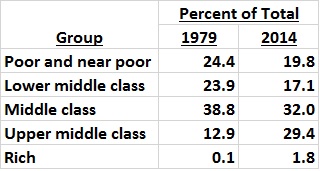
Rather than dividing all of us into quintiles and examining income changes in each quintile, Rose starts with a level of inflation-adjusted income and examines how different slices of income have done over time. In this case, he has examined 1979 through 2014, a period believed full of economic duress for most working Americans.

He divides us into five income classes:

  • The Poor and Near Poor, with incomes from $0 to $29,999 in 2014.
  • The Lower Middle class, with incomes from $30,000 to $49,999.
  • The Middle class, with incomes from $50,000 to $99,999.
  • The Upper Middle class, with incomes from $100,000 to $349,999.
  • The Rich, with incomes of at least $350,000.

All of these incomes are for what he calls a “three-person equivalent family.” A single person could have less income and be in a group, but a family of four or more would need more income to be in a particular group.

What has happened to the distribution of incomes? I pulled these numbers from figure 2 of Rose’s study:

Income distribution_Urban Institute

Color me unsurprised. I’ve seen similar results before, in these pieces, for example: Mark J. Perry’s “Yes, America’s Middle Class Has Been Disappearing…into Higher Income Groups” (Carpe Diem, December 17, 2015), and David Harsanyi’s “Sorry, Everyone: The American Middle Class Is Winning” (The Federalist, June 22, 2016).

Rose, of course, wants to make much of the inequality between the groups. But the groups don’t comprise the same people in 2014 as they did in 1979. Moreover, as the table suggest, Americans were a lot better off in 2014 than they were in 1979.

But that’s the left for you. If it ain’t equal, it ain’t right. That’s because leftists are always looking for victims instead of celebrating real progress — the kind that happens despite the best efforts of government to screw things up.

*     *     *

Related posts:
Taxing the Rich
More about Taxing the Rich
The Keynesian Fallacy and Regime Uncertainty
Creative Destruction, Reification, and Social Welfare
Why the “Stimulus” Failed to Stimulate
Regime Uncertainty and the Great Recession
Regulation as Wishful Thinking
In Defense of the 1%
Lay My (Regulatory) Burden Down
Economic Growth Since World War II
Government in Macroeconomic Perspective
Keynesianism: Upside-Down Economics in the Collectivist Cause
How High Should Taxes Be?
The 80-20 Rule, Illustrated
Economics: A Survey
Estimating the Rahn Curve: Or, How Government Spending Inhibits Economic Growth
The Keynesian Multiplier: Phony Math
The True Multiplier
Some Inconvenient Facts about Income Inequality
Mass (Economic) Hysteria: Income Inequality and Related Themes
Social Accounting: A Tool of Social Engineering
Income Inequality and Inherited Wealth: So What?
Income Inequality and Economic Growth
A Case for Redistribution, Not Made
McCloskey on Piketty
The Rahn Curve Revisited
Nature, Nurture, and Inequality
How to Eradicate the Welfare State, and How Not to Do It
Diminishing Marginal Utility and the Redistributive Urge
Capitalism, Competition, Prosperity, and Happiness
Further Thoughts about the Keynesian Multiplier
From Each According to His Ability…
Bubbling Along

The Obama Effect: Disguised Unemployment, Updated

Here.

Further Pretensions of Knowledge

The Economist‘s second article in its series on “seminal economic ideas” is about Hyman Minsky’s theory that “booms sow the seeds of busts”:

Having grown up during the Depression, Minsky was minded to dwell on disaster. Over the years he came back to the same fundamental problem again and again. He wanted to understand why financial crises occurred. . . .

Minsky . . . developed his “financial-instability hypothesis”. It is an examination of how long stretches of prosperity sow the seeds of the next crisis, an important lens for understanding the tumult of the past decade. . . .

Minsky started with an explanation of investment. It is, in essence, an exchange of money today for money tomorrow. A firm pays now for the construction of a factory; profits from running the facility will, all going well, translate into money for it in coming years. Put crudely, money today can come from one of two sources: the firm’s own cash or that of others (for example, if the firm borrows from a bank). The balance between the two is the key question for the financial system.

Minsky distinguished between three kinds of financing. The first, which he called “hedge financing”, is the safest: firms rely on their future cashflow to repay all their borrowings. For this to work, they need to have very limited borrowings and healthy profits. The second, speculative financing, is a bit riskier: firms rely on their cashflow to repay the interest on their borrowings but must roll over their debt to repay the principal. This should be manageable as long as the economy functions smoothly, but a downturn could cause distress. The third, Ponzi financing, is the most dangerous. Cashflow covers neither principal nor interest; firms are betting only that the underlying asset will appreciate by enough to cover their liabilities. If that fails to happen, they will be left exposed.

Economies dominated by hedge financing—that is, those with strong cashflows and low debt levels—are the most stable. When speculative and, especially, Ponzi financing come to the fore, financial systems are more vulnerable. If asset values start to fall, either because of monetary tightening or some external shock, the most overstretched firms will be forced to sell their positions. This further undermines asset values, causing pain for even more firms. They could avoid this trouble by restricting themselves to hedge financing. But over time, particularly when the economy is in fine fettle, the temptation to take on debt is irresistible. When growth looks assured, why not borrow more? Banks add to the dynamic, lowering their credit standards the longer booms last. If defaults are minimal, why not lend more? Minsky’s conclusion was unsettling. Economic stability breeds instability. Periods of prosperity give way to financial fragility. . . .

[A]s an outsider in the sometimes cloistered world of economics, Minsky’s influence was, until recently, limited. Investors were faster than professors to latch onto his views. More than anyone else it was Paul McCulley of PIMCO, a fund-management group, who popularised his ideas. He coined the term “Minsky moment” to describe a situation when debt levels reach breaking-point and asset prices across the board start plunging. Mr McCulley initially used the term in explaining the Russian financial crisis of 1998. Since the global turmoil of 2008, it has become ubiquitous. For investment analysts and fund managers, a “Minsky moment” is now virtually synonymous with a financial crisis. . . .

. . . In a speech in 2009, before she became head of the Federal Reserve, Janet Yellen said Minsky’s work had “become required reading”. In a 2013 speech, made while he was governor of the Bank of England, Mervyn King agreed with Minsky’s view that stability in credit markets leads to exuberance and eventually to instability. Mark Carney, Lord King’s successor, has referred to Minsky moments on at least two occasions.Will the moment last? Minsky’s own theory suggests it will eventually peter out. Economic growth is still shaky and the scars of the global financial crisis visible. In the Minskyan trajectory, this is when firms and banks are at their most cautious, wary of repeating past mistakes and determined to fortify their balance-sheets. But in time, memories of the 2008 turmoil will dim. Firms will again race to expand, banks to fund them and regulators to loosen constraints. The warnings of Minsky will fade away. The further we move on from the last crisis, the less we want to hear from those who see another one coming.

I am left with this question: Is the Minskyan trajectory a bad thing or a good thing? Is there a better, feasible way to finance economic growth? Or is the alternative some kind of government-enforced algorithm in which one-size-fits-all-regulation fosters hyper-bubbles (as with the directive to lend more to poor, minority mortgagors) or hypo-bubbles (in which rising investment is stifled long before it becomes a bubble).

Government doesn’t have a good track record when it comes to fine-tuning the economy. It’s true that the economy has been somewhat more stable since the creation of the Federal Reserve in 1913. But the price of stability is high; namely, it is inversely related to long-run economic growth. And the two deepest economic downturns in America’s history — the Great Depression and the Great Recession — happened on the Fed’s watch, and can be blamed (in part, at least) on the Fed.

Economics can be a powerfully descriptive discipline. But its power to describe is far from infallible, as Arnold Kling shows in his must-read tome, Specialization and Trade: A Re-introduction to Economics. Among many things, Kling explains why the Keynesian multiplier — the hoariest of fine-tuning ideas — is a terrible idea. (I heartily agree with Kling.)

Even if economics were an infallibly descriptive discipline, it shouldn’t be taken as an infallibly prescriptive one. Friedrich Hayek put it this way in his Nobel Prize Lecture, “The Pretence of Knowledge“:

It is true that . . . systems of equations describing the pattern of a market equilibrium are so framed that if we were able to fill in all the blanks of the abstract formulae, i.e. if we knew all the parameters of these equations, we could calculate the prices and quantities of all commodities and services sold. But, as Vilfredo Pareto, one of the founders of this theory, clearly stated, its purpose cannot be “to arrive at a numerical calculation of prices”, because, as he said, it would be “absurd” to assume that we could ascertain all the data. . . .  I sometimes wish that our mathematical economists would take this to heart. I must confess that I still doubt whether their search for measurable magnitudes has made significant contributions to our theoretical understanding of economic phenomena – as distinct from their value as a description of particular situations. Nor am I prepared to accept the excuse that this branch of research is still very young: Sir William Petty, the founder of econometrics, was after all a somewhat senior colleague of Sir Isaac Newton in the Royal Society!

The chief point we must remember is that the great and rapid advance of the physical sciences took place in fields where it proved that explanation and prediction could be based on laws which accounted for the observed phenomena as functions of comparatively few variables – either particular facts or relative frequencies of events. . . .  A theory of essentially complex phenomena must refer to a large number of particular facts; and to derive a prediction from it, or to test it, we have to ascertain all these particular facts. Once we succeeded in this there should be no particular difficulty about deriving testable predictions – with the help of modern computers it should be easy enough to insert these data into the appropriate blanks of the theoretical formulae and to derive a prediction. The real difficulty, to the solution of which science has little to contribute, and which is sometimes indeed insoluble, consists in the ascertainment of the particular facts. . . .

. . . To act on the belief that we possess the knowledge and the power which enable us to shape the processes of society entirely to our liking, knowledge which in fact we do not possess, is likely to make us do much harm. In the physical sciences there may be little objection to trying to do the impossible; one might even feel that one ought not to discourage the over-confident because their experiments may after all produce some new insights. But in the social field the erroneous belief that the exercise of some power would have beneficial consequences is likely to lead to a new power to coerce other men being conferred on some authority. Even if such power is not in itself bad, its exercise is likely to impede the functioning of those spontaneous ordering forces by which, without understanding them, man is in fact so largely assisted in the pursuit of his aims. We are only beginning to understand on how subtle a communication system the functioning of an advanced industrial society is based – a communications system which we call the market and which turns out to be a more efficient mechanism for digesting dispersed information than any that man has deliberately designed.

If man is not to do more harm than good in his efforts to improve the social order, he will have to learn that in this, as in all other fields where essential complexity of an organized kind prevails, he cannot acquire the full knowledge which would make mastery of the events possible. He will therefore have to use what knowledge he can achieve, not to shape the results as the craftsman shapes his handiwork, but rather to cultivate a growth by providing the appropriate environment, in the manner in which the gardener does this for his plants. There is danger in the exuberant feeling of ever growing power which the advance of the physical sciences has engendered and which tempts man to try, “dizzy with success”, to use a characteristic phrase of early communism, to subject not only our natural but also our human environment to the control of a human will. The recognition of the insuperable limits to his knowledge ought indeed to teach the student of society a lesson of humility which should guard him against becoming an accomplice in men’s fatal striving to control society – a striving which makes him not only a tyrant over his fellows, but which may well make him the destroyer of a civilization which no brain has designed but which has grown from the free efforts of millions of individuals.

(This post offers more on this subject of the limitations of knowledge, and the implications for economic policy.)

The ability to describe a phenomenon in a general way is far from knowing how to improve on it. In fact, the ability to describe a phenomenon in a general way says nothing about whether it can be improved on. Such things as investment bubbles, market failure, and winners and losers from trade are the normative judgments of observers who simply don’t like what they see and believe (mistakenly) that they know how to “make things right.”

Unsurprising News about Health-Care Costs

Obama, among his many lies, promised that Obamacare would “bend the cost curve,” that is, reduce or eliminate the surge in health-care costs. Anyone with half a brain knew that Obama was either stupid or lying. He’s not stupid (though not nearly as smart as he thinks he is), so it’s obvious that he was lying. (It was obvious to me from the get-go.)

Those few Americans who have been paying attention have known that Obama was lying because they’ve been following the surge in health-care costs. This is just the latest in a series of reports delivering the bad but unexpected news.

As the U.S. economy continues to flirt with recession, this morning’s “flash” Dross Domestic Product release for the second quarter indicates “close to zero” growth. Business investment has collapsed, leaving personal consumption expenditures to drive what little growth there is….

The figures for 2015 Q2 to 2016 Q2 show growth in spending on health services accounted for one quarter of GDP growth. At a growth rate of 5.3 percent, spending on health services grow more than twice as fast as the 2.1 percent growth in non-health services GDP. Growth in health spending accounted for almost one third of the growth in services spending and one quarter of the growth in personal consumption expenditure….
Although health services spending accounts for just 12 percent of GDP, these estimates continue to indicate it will grow faster than GDP. There is no slowdown in health services spending.
I’ll report later on the latest GDP estimates, but I will tell you that “close to zero” is real year-over-year growth of 1.2 percent. Just abysmal.

Independence Day 2016: The Way Ahead

Prudence…will dictate that Governments long established should not be changed for light and transient causes; and accordingly all experience hath shewn, that mankind are more disposed to suffer, while evils are sufferable, than to right themselves by abolishing the forms to which they are accustomed. But when a long train of abuses and usurpations…reduce them under absolute Despotism, it is their right, it is their duty, to throw off such Government, and to provide new Guards for their future security.… [A]nd such is now the necessity which constrains them to alter their former Systems of Government. The history…is a history of repeated injuries and usurpations, all having in direct object the establishment of an absolute Tyranny over these States.

Declaration of Independence
(In Congress. July 4, 1776. The unanimous Declaration
of the thirteen united States of America)

*      *      *

It is fitting, in this summer of discontent, to be faced with a choice between the spiritual descendants of P.T. Barnum and Lady Macbeth. Washington, Jefferson, and Madison are spinning in their graves, at high velocity.

The candidacies of Trump and Clinton are symptoms of the looming demise of liberty in the United States. There hasn’t been a candidate since Ronald Reagan who actually understood and believed that Americans would be freer and therefore more prosperous if the central government were contained within the four corners of the Constitution. (And even Reagan had a soft spot in his heart for Social Security.) Nevertheless, it is appalling but unsurprising that liberty’s end is in sight just 27 years after Reagan left office.

What went wrong? And how did it go wrong so quickly? Think back to 1928, when Americans were more prosperous than ever and the GOP had swept to its third consecutive lopsided victory in a presidential race. All it took to snatch disaster from the jaws of delirium was a stock-market crash in 1929 (fueled by the Fed) that turned into a recession that turned into a depression (also because of the Fed). The depression became the Great Depression, and it lasted until the eve of World War II, because of the activist policies of Herbert Hoover and Franklin Roosevelt, which suppressed recovery instead of encouraging it. There was even a recession (1937-38) within the depression, and the national unemployment rate was still 15 percent in 1940. It took the biggest war effort in the history of the United States to bring the unemployment rate back to its pre-depression level.

From that relatively brief but deeply dismal era sprang a new religion: faith in the central government to bring peace and prosperity to the land. Most Americans of the era — like most human beings of every era — did not and could not see that government is the problem, not the solution. Victory in World War II, which required central planning and a commandeered economy, helped to expunge the bitter taste of the Great Depression. And coming as it did on the heels of the Great Depression, reinforced the desperate belief — shared by too many Americans — that salvation is to be found in big government.

The beneficial workings of the invisible hand of competitive cooperation are just too subtle for most people to grasp. The promise of a quick fix by confident-sounding politicians is too alluring. FDR became a savior-figure because he talked a good game and was an inspiring war leader, though he succumbed to pro-Soviet advice.

With war’s end, the one-worlders and social engineers swooped on a people still jittery about the Great Depression and fearful of foreign totalitarianism. (The native-born variety was widely accepted because of FDR’s mythic status.) Schools and universities became training grounds for the acolytes of socialism and amoral internationalism.

Warren Henry is right when he says that

progressivism is…broadly accepted by the American public, inculcated through generations of progressive dominance of education and the media (whether that media is journalism or entertainment). Certainly Democrats embrace it. Now the political success of Donald J. Trump has opened the eyes of the Right to the fact that Republicans largely accept it….

Republicans have occasionally succeeded in slowing the rate at which America has become more progressive. President Reagan was able to cut income tax rates and increase defense spending, but accepted tax increases to kick the can on entitlements and could not convince a Democratic Congress to reduce spending generally. Subsequent administrations generally have been worse. A Republican Congress pressured Bill Clinton into keeping his promise on welfare reform after two vetoes. He did so during a period when the end of the Cold War and the revenues from the tech bubble allowed Washington to balance budgets on the Pentagon’s back. Unsurprisingly, welfare reform has eroded in the ensuing decades.

Accordingly, the big picture remains largely unchanged. Entitlements are not reformed, let alone privatized. To the contrary, Medicare was expanded during a GOP administration, if less so than it would have been under a Democratic regime…. Programs are almost never eliminated, let alone departments.

The Right also loses most cultural battles, excepting abortion and gun rights. Notably, the inroads on abortion may be due as much to the invention and deployment of the sonogram as the steadfastness of the pro-life movement. Otherwise, political and cultural progressivism has been successful in their march through the institutions, including education, religion, and the family.

Curricula increasingly conform to the progressive fashions of the moment, producing generations of precious snowflakes unequipped even to engage in the critical thinking public schools claim to prioritize over an understanding of the ages of wisdom that made us a free and prosperous people. Church membership and attendance continues their long-term decline. A country that seriously debated school prayer 30 years ago now debates whether Christians must be forced to serve same-sex weddings.

Marriage rates continue their long-term decline. Divorce rates have declined from the highs reached during the generation following the sexual revolution, but has generally increased over the course of the century during which progressivism has taken hold (despite the declining marriage rate). Those advocating reform of the nation’s various no-fault divorce laws are few and generally considered fringe.

There’s more, but disregard Henry’s reification of America when he should write “most Americans”:

Meanwhile, America has voted for decade after decade of tax-and-spend, borrow-and-spend, or some hybrid of the two. If the white working class is now discontented with the government’s failure to redress their grievances, this is in no small part due to the ingrained American expectation that government will do so, based on the observation that government typically hungers to increase government dependency (not that the white working class would use these terms).…

In sum, while it is correct to note that elites are not doing their jobs well, it is more difficult to conclude that elites have not been responding to the political demands of the American public as much as they have driven them.…

The presidential nominees our two major parties have chosen are largely viewed as awful. But Hillary Clinton and Donald Trump offer two slightly different versions of the same delusion: that progressivism works, if only the elites were not so stupid. This delusion is what most Americans currently want to believe.

Sad but disastrously true. Dependency on government has become deeply ingrained in the psyche of most Americans. As Timothy Taylor points out,

[g]overnment in the United States, especially at the federal level, has become more about transfer payments and less about provision of goods and services.…

[There has been an] overall upward rise [of transfer payments] in the last half-century from 5% of GDP back in the 1960s to about 15% of GDP in the last few years….

The political economy of such a shift is simple enough: programs that send money to lots of people tend to be popular. But I would hypothesize that this ongoing shift not only reflects voter preferences, but also affect how Americans tend to perceive the main purposes of the federal government. Many Americans have become more inclined to think of federal budget policy not in terms of goods or services or investments that it might perform, but in terms of programs that send out checks.

What lies ahead? Not everyone is addicted to government. There are millions of Americans who want less of it — a lot less — rather than more of it. Here, with some revisions and an addition, are options I spelled out three years ago:

1. Business as usual — This will lead to more and more government control of our lives and livelihoods, that is, to less and less freedom and prosperity (except for our technocratic masters, of course).

2. Rear-guard action — This option is exemplified by the refusal of some States to expand Medicaid and to establish insurance exchanges under the Affordable Care Act. This bit of foot-dragging doesn’t cure the underlying problem, which is accretion of illegitimate power by the central government. Further, it can be undone by fickle voters and fickle legislatures, as they succumb to the siren-call of “free” federal funds.

3. Geographic sorting — The tendency of “Blue” States to become “bluer” and “Red” States to become “redder” suggests that Americans are sorting themselves along ideological lines. As with rear-guard action, however, this tendency — natural and laudable as it is — doesn’t cure the underlying problem: the accretion of illegitimate power by the central government. Lives and livelihoods in every State, “Red” as well as “Blue,” are controlled by the edicts of the legislative, executive, and judicial branches of the central government. There is little room for State and local discretion. Moreover, much of the population shift toward “Red” must be understood as opportunistic (e.g., warmer climates, right-to-work laws) and not as an endorsement of “Red” politics.

4. Civil disobedience — Certainly called for, but see options 5, 6, and 7.

5. Underground society and economy — Think EPA-DOL-FBI-IRS-NSA, etc., etc., and then dismiss this as a serious option for most Americans.

6. The Benedict Option, about which Bruce Frohnen writes:

[Rod] Dreher has been writing a good deal, of late, about what he calls the Benedict Option, by which he means a tactical withdrawal by people of faith from the mainstream culture into religious communities where they will seek to nurture and strengthen the faithful for reemergence and reengagement at a later date….

The problem with this view is that it underestimates the hostility of the new, non-Christian society [e.g., this and this]….

Leaders of this [new, non-Christian] society will not leave Christians alone if we simply surrender the public square to them. And they will deny they are persecuting anyone for simply applying the law to revoke tax exemptions, force the hiring of nonbelievers, and even jail those who fail to abide by laws they consider eminently reasonable, fair, and just.

7. A negotiated partition of the country — An unlikely option (discussed in this post and in some of the posted linked to therein) because, as discussed in option 6, “Blue” will not countenance the loss of control over millions of lives and livelihoods.

8. Secession — This is legal and desirable — as long as the New Republic of free states is truly free — but (a) it is likely to be met with force and therefore (b) unlikely to attract a critical mass of States.

9. Coup — Suggested several years ago by Thomas Sowell:

When I see the worsening degeneracy in our politicians, our media, our educators, and our intelligentsia, I can’t help wondering if the day may yet come when the only thing that can save this country is a military coup.

Glenn Reynolds, who is decidedly anti-coup, writes

that the American Constitution, along with traditional American political culture in general, tends to operate against those characteristics, and to make the American polity more resistant to a coup than most. It is also notable, however, that some changes in the Constitution and in political culture may tend to reduce that resistance….

The civics-book statement of American government is that Congress passes laws that must be signed by the president (or passed over a veto), and that those laws must be upheld by thejudiciary to have effect. In practice, today’s government operates on a much more fluid basis, with administrative agencies issuing regulations that have the force of law – or, all too often, “guidance” that nominally lacks the force of law but that in practice constitutes a command – which are then enforced via agency proceedings.…

[I]t seems likely that to the extent that civilians, law enforcement, and others become used to obeying bureaucratic diktats that lack a clear basis in civics-book-style democratic process, the more likely they are to go along with other diktats emanating from related sources. This tendency to go along with instructions without challenging their pedigree would seem to make a coup more likely to succeed, just as a tendency to question possibly unlawful or unconstitutional requirements would tend to make one less likely to do so. A culture whose basis is “the law is what the bureaucrats say it is, at least unless a court says different,” is in a different place than one whose starting impulse is “it’s a free country.”…

[P]ersistent calls for a government-controlled “Internet kill switch”49 – justified, ostensibly, by the needs of cyberdefense or anti-terrorism – could undercut that advantage [of a decentralized Internet]. If whoever controlled the government could shut down the Internet, or, more insidiously, filter its content to favor the plotters’ message and squelch opposition while presenting at least a superficial appearance of normality, then things might actually be worse than they were in [Fletcher Knebel and Charles Bailey’s Seven Days in May, which imagined an attempted coup by a Curtis LeMay-like general].…

[T]he most significant barrier to a coup d’etat over American history has probably stemmed simply from the fact that such behavior is regarded as un-American. Coups are for banana republics; in America we don’t do that sort of thing. This is an enormously valuable sentiment, so long as the gap between “in America” and “banana republics” is kept sufficiently broad. But it is in this area, alas, that I fear we are in the worst shape. When it comes to ideological resistance to coups d’etat, there are two distinct groups whose opinions matter: The military, and civilians. Both are problematic….

[T]here are some troubling trends in civilian/military relations that suggest that we should be more worried about this subject in the future than we have been in the past…

Among these concerns are:

  • A “societal malaise,” with most Americans thinking that the country was on “the wrong track.”
  • A “deep pessimism about politicians and government after years of broken promises,” leading to an “environment of apathy” among voters that scholars regard as a precursor to a coup.
  • A strong belief in the effectiveness and honor of the military, as contrasted to civilian government.
  • The employment of military forces in non-military missions, from humanitarian aid to drug interdiction to teaching in schools and operating crucial infrastructure.
  • The consolidation of power within the military – with Congressional approval – into a small number of hands….
  • A reduction in the percentage of the officer corps from places outside the major service academies.…
  • A general insulation of the military from civilian life…. “Military bases, complete with schools, churches, stores, child care centers, and recreational areas, became never-to-be-left islands of tranquility removed from the chaotic crime-ridden environment outside the gates…. Thus, a physically isolated and intellectually alienated officer corps was paired with an enlisted force likewise distanced from the society it was supposed to serve [quoting from an essay by Charles J. Dunlap, “The Origins Of The American Military Coup of 2012,” Parameters, Winter, 1992-93, at 2]….

[D]istrust in the civilian government and bureaucracy is very high. A 2016 Associated Press/National Opinion Research Center poll found that more than 6 in 10 Americans have “only slight confidence – or none at all” that the federal government can successfully address the problems facing the nation. And, as the AP noted, this lack of confidence transcends partisan politics: “Perhaps most vexing for the dozen or so candidates vying to succeed President Barack Obama, the poll indicates widespread skepticism about the government’s ability to solve problems, with no significant difference in the outlook between Republicans and Democrats.”

As a troubling companion to this finding, the YouGov poll on military coups…also found a troubling disconnect between confidence in civilian government and confidence in the military: “Some 71% said military officers put the interests of the country ahead of their own interests, while just 12% thought the same about members of Congress.” While such a sharp contrast in views about civilian government and the military is not itself an indicator of a forthcoming coup, it is certainly bad news. Also troubling are polls finding that a minority of voters believes that the United States government enjoys the consent of the governed.63 This degree of disconnection and disaffection, coupled with much higher prestige on the part of the military, bodes ill.

Or well, if you believe that a coup is the only possible salvation from despotism.

Military personnel (careerists, in particular) are disciplined, have direct access to the tools of power, and many of them are trained in clandestine operations. Therefore, a cadre of properly motivated careerists might possess the wherewithal necessary to seize power. But a plot to undertake a coup is easily betrayed. (Among other things, significant numbers of high-ranking officers are shills for the regulatory-welfare state.) And a coup, if successful, might deliver us from a relatively benign despotism into a decidedly malign despotism.

But unless there is a negotiated partition of the country — perhaps in response to a serious secession movement — a coup is probably the only hope for the restoration of liberty under a government that is true to the Constitution.

The alternative is a continuation of America’s descent into despotism, which — as many Americans already know — is no longer the “soft” despotism foreseen by Tocqueville.

*      *      *

Related posts (in addition to those linked to throughout this one):
The Real Constitution and Civil Disobedience
A Declaration of Independence
A Declaration of Civil Disobedience
The States and the Constitution
And many more here

Winners and Losers

Steven Landsburg has a provocative post. His point seems to be that those who focus on the “losers” from free trade “want us to conclude either that free trade is not a good thing, or that at the very least, the winners should compensate the losers.”

Landsburg continues:

This strikes me as an extraordinarily dishonest way of arguing, because pretty much nobody ever argues this way about anything else, even though every policy change in history has created both winners and losers. In fact, every human action has both winners and losers. When Archie takes Betty instead of Veronica to the ice cream shoppe instead of the movies, both Veronica and the theater owner lose out. It does not follow that all human actions are wrong, or immoral, or should be discouraged by law, and it does not follow that all human actions should be followed by compensation to the losers.

What I object to — aside from Landsburg’s habitual use of “us,” which suggests some kind of collective consciousness at work — is his unfortunate, if inadvertent, endorsement of the idea that every human action has both winners and losers. “Winner” and “loser” are terms that properly apply to persons who are engaged in some kind of contest or bet. The rest — which includes just about everything — is just life. Stuff happens: Veronica doesn’t go the movies with Archie; American steelworkers lose jobs; dinosaurs become extinct.

Except when government is involved. Government action changes the natural course of human events, the course that they would take in a society that is bound by shared beliefs, language, and customs (or norms). A government of a relatively small or close-knit geopolitcal entity may act in accordance with and reinforce societal norms, but the governance of the United States has long since become something else: a set of interlocking dictatorial regimes (federal, State, and local) bent on enforcing rules designed on high, sometimes with the intention of favoring specific groups. Those specific groups have something that the ruling caste wants: money, influence, and votes.

Government acts legitimately only when it does things that would be done by a cohesive social group. Self-defense is one of those things. When government wages war in defense of its citizens, it has a claim to legitimacy — though the soundness of the claim depends on the necessity of the war and the skill and efficiency with which it is waged. When government executes murderers it legitimately exacts justice and deters more murders — though the soundness of the claim depends on the swiftness and fairness with which executions occur. A foreign enemy isn’t a loser, he’s an enemy. An executed murderer isn’t a loser, he’s a recipient of justice.

But beyond defense, justice, and the even-handed representation of Americans’ interests in foreign capitals, there is nothing that government can claim as a legitimate function. Government’s forays into welfare, for example, are destructive of private charity and go far beyond what a well-functioning social group would allow, in that they discourage work and saving. Social Security and Medicare, for example, don’t just mimic private charity toward the poorest and sickest of the elderly population, they benefit even the the wealthiest and healthiest of Americans. Social Security benefits and the market value of Medicare (as insurance) can easily raise a retired couple’s effective income from, say, $250,000 to $300,000 or $325,000. That’s not charity, it’s middle-class and upper-middle-class welfare. (I don’t mean to suggest that the wealthiest should be forced to subsidize everyone else; that’s a socially and economically destructive idea that I’ll not bother to discuss here.)

There’s much more to government than spending, of course, There’s also the vast web of regulations that has been spun by government at all levels. Regulations alter the course of social and economic intercourse, as they are meant to do. The justification is usually either “for your own good” or “for the good of group X.” In any event, social norms and incentives to work and save are subverted by those who believe, wrongly, that they can subvert those norms and incentives without inviting unintended consequences. The Great Recession, for example, was caused by regulation, not deregulation.

It has come to pass that many of government’s fiscal and regulatory interventions are rationalized as efforts to “level the playing” field and compensate “losers” for the “unfair” advantages enjoyed by “winners.” But such language masks a presumption that there are better social and economic arrangements and better outcomes — which, of course, are known to those who use such language. This is called the nirvana fallacy, the invalid comparison of imperfect reality to imagined perfection.

It therefore surprises me that Steven Landsburg, who is super-rational and a stickler for accuracy, would invoke “winners” and “losers.” To do so lends aid and comfort to the proponents of social and economic engineering.

It might be said, with some justice, that government interventions create winners and losers. But what those interventions really create are dependents and victims. The dependents are the tens of millions of Americans who rely on government welfare and government grants of privilege (e.g., affirmative action, regulatory protection from competition, subsidized loans). The victims are the tens of millions of Americans who pay directly for such privileges (e.g., high marginal tax rates, regulatory infringements on liberty, suppression of free speech and association, theft of property rights), and the 300-million-plus whose income is far less than it would be in the absence of fiscal and regulatory interventions, which are damaging to economic growth.

A person who earns an honest living as an investment banker, baseball player, or movie star and makes millions of dollars a year isn’t a winner, in the proper sense of the word, he’s just being rewarded according to the value placed on his efforts by those who pay for them. A person who earns a pittance because he’s an illegal immigrant who can’t speak English and has no particular skills isn’t a loser, he’s just being rewarded according to the value placed on his efforts by those who pay for them. Veronica isn’t a loser because Archie prefers Betty, she’s just another beautiful girl who can probably land someone better looking and richer than Archie. The theater owner isn’t a loser because Archie doesn’t take Veronica to the movies, he’s just another businessman who’s in the wrong business if the loss of two customers for one night is a big deal.

Let’s get real and quit calling people winners and losers when they’re not playing games or making bets. Let’s get real and start talking about those who are dependent on government and those who are its victims, which is just about everyone but the politicians and bureaucrats who feast at the public trough.

And, yes, I do mean to say that most of the dependents and enablers of big government are its victims. Such are the wages of social dissolution and economic ignorance.

The Stock Market 15 Years from Now

I won’t bore you with a bunch of tables and graphs. I’ll just tell you that I’ve played around with inflation-adjusted stock-market indices (the Wilshire 5000 Total Return and the S&P Composite), and have discovered the following:

  • Internal relationships (future performance vs. prior performance) suggest that 15 years from now real stock prices will have risen at a compounded annual rate of +5 to +10 percent.
  • External relationships (future performance vs. current AAA corporate bond rate) suggest that 15 years from now real stock prices will have dropped at a compounded annual rate of about -5 percent.

The second result is based on a positive long-run relationship between the bond rate and stock-market performance. Why would there be such a relationship if an interest-rate hike usually causes stock prices to drop? Well, that’s a short-run phenomenon. But over the long run, higher interest rates mean more demand for money, which means that companies are making investments to generate higher profits. And over a period of sufficient length, like 15 years, those higher profits are realized and reflected in stock prices.

In sum, low interest rates signal sluggish business activity. Interest rates are at historically low levels, and have remained stubbornly low for a simple reason. It’s not just that inflation is low. It’s also that the demand for money is weak because the regulatory regime makes it more increasingly difficult and unprofitable for businesses to form and expand.

I see no hope for true regulatory reform, which would involve the beheading of almost every government bureaucrat in the United States. Therefore, my bet is on negative stock-market performance over the next 15 years — and beyond.

It can happen here if it can happen in Japan, where the Nikkei 225 index stands at 42 percent of its nominal level on December 1, 1989. Adjusted for inflation, the index probably has dropped about 75 percent in 27 years, which is a real  decline of -5 percent a year.

*     *     *

Related reading: Jon Hilsenrath, “Yellen Points to Slow Growth and Low Rates in the Long Run,” The Wall Street Journal, June 21, 2016

Related posts:
Economic Growth Since World War II (with links to many more related posts)
Bonds for the Long Run?
Why Are Interest Rates So Low?

The Basic Income Guarantee (BIG): Or, How to Make Government Bigger

The Basic Income Guarantee (BIG), also known as Universal Basic Income (UBI), is the latest fool’s gold of “libertarian” thought. John Cochrane devotes too much time and blog space to the criticism and tweaking of the idea. David Henderson cuts to the chase by pointing out that even a “modest” BIG — $10,000 per adult American per year — would result in “a huge increase in federal spending, a huge increase in tax rates, and a huge increase in the deadweight loss from taxes.”

Aside from the fact that BIG would be a taxpayer-funded welfare program — to which I generally object — it would necessarily add to the already heavy burden on taxpayers, even though it is touted as a substitute for many (all?) extant welfare programs. The problem is that the various programs are aimed at specific recipients (e.g., women with dependent children, families with earned incomes below a certain level). As soon as a specific but “modest” proposal is seriously floated in Congress, various welfare constituencies will find that proposal wanting because their “entitlements” would shrink. A BIG bill would pass muster only if it allowed certain welfare programs to continue, in addition to BIG, or if the value of BIG were raised to a level that such that no welfare constituency would be a “loser.”

In sum, regardless of the aims of its proponents — who, ironically, tend to call themselves libertarians — BIG would lead to higher welfare spending and more enrollees in the welfare state.

The Obama Effect: Disguised Unemployment, Revised and Updated

Here.

Economic Growth since World War II, Revised and Updated

Here.

The Pathological Urge to Regulate

It has been revealed that the devastating explosion of a fertilizer plant in West, Texas, three years ago was caused by an act of arson. The usual suspects were quick to leap on the smoldering ruins and bodies of West to proclaim them victims of under-regulation.

The belief that human error and criminality can be defeated by regulation, and in complete disregard for its huge costs, is pathological. One (ugly) aspect of the same pathological urge is the commission of “hate crime” hoaxes in an effort to discredit anyone who isn’t committed to “diversity” and all that other socially destructive rot.