
The GOP, once again, enjoys a 10 percentage-point lead in Rasmussen’s generic congressional ballot. Accordingly, the GOP stands to add 70 seats and take a 61-seat majority — a far better performance than the “Republican revolution” of 1994, which vaulted the GOP to a 25-seat majority. See “Will the GOP Take the House?” for the details of my estimate.
Category: Electoral Politics
The Left
The “left” of the title refers, specifically, to left-statists or (usually) leftists.
I describe statism in “Parsing Political Philosophy“:
Statism boils down to one thing: the use of government’s power to direct resources and people toward outcomes dictated by government….
The particular set of outcomes toward which government should strive depends on the statist…. But all of them are essentially alike in their desire to control the destiny of others….
“Hard” statists thrive on the idea of a powerful state; control is their religion, pure and simple. “Soft” statists profess offense at the size, scope, and cost of government, but will go on to say “government should do such-and-such,” where “such-and such” usually consists of:
- government grants of particular positive rights, either to the statist, to an entity or group to which he is beholden, or to a group with which he sympathizes
- government interventions in business and personal affairs, in the belief that government can do certain things better than private actors, or simply should do [certain] things….
I continue by saying that left-statists (L-S)
prefer such things as income redistribution, affirmative action, and the legitimation of gay marriage….L-S prefer government intervention in the economy, not only for the purpose of redistributing income but also to provide goods and services that can be provided more efficiently by the private sector, to regulate what remains of the private sector, and to engage aggressively in monetary and fiscal measures to maintain “full employment.” It should be evident that L-S have no respect for property rights, given their willingness to allow government to tax and regulate at will….
L-S tend toward leniency and forgiveness of criminals (unless the L-S or those close to him are the victims)…. On defense, L-S act as if they prefer Chamberlain to Churchill, their protestations to the contrary….
L-S have no room in their minds for civil society; government is their idea of “community.”…
It is no wonder that most “liberals” (L) and “progressives” (P) try to evade the “leftist” label. (I enclose “liberal,” “progressive,” and forms thereof in quotation marks because L are anything but liberal, in the core meaning of the word, and the policies favored by P are regressive in their effects on economic and social liberty.) L and P usually succeed in their evasion because the center of American politics has shifted so far to the left that Franklin Roosevelt — a leftist by any reasonable standard — would stand at the center of today’s political spectrum.
Indeed, the growing dominance of leftism can be seen in the history of the U.S. presidency. It all started with Crazy Teddy Roosevelt, the first president to dedicate himself to the use of state power to advance his cause du jour. (I do not credit the anti-Lincoln zealotry of the Ludwig von Mises Institute.) TR’s leftism was evident in his “activist” approach to the presidency. No issue, it seems, was beneath TR’s notice or beyond the reach of the extra-constitutional powers he arrogated to himself. TR, in other words, was the role model for Woodrow Wilson, Herbert Hoover (yes, Hoover the “do nothing” whose post-Crash activism helped to bring on the Great Depression), Franklin Roosevelt, Harry Truman, John Kennedy, Lyndon Johnson, Richard Nixon, Bill Clinton, and Barack Obama. (For more about American presidents and their predilections, see this, this, and this.) Countless members of Congress and State and local officials have been, and are, “activists” in the image of TR.
In sum, the problem with America — and it boils down to a single problem — is the left’s success in advancing its agenda. What is that agenda, and how does the left advance it?
The left advances its agenda in many ways, for example, by demonizing its opponents (small-government opponents are simply “mean”), appealing to envy (various forms of redistribution), sanctifying an ever-growing list of “victimized” groups (various protected “minorities”), making a virtue of mediocrity (various kinds of risk-avoiding regulations), and taking a slice at a time (e.g., Social Security set the stage for Medicare which set for Obamacare).
The left’s essential agenda is the repudiation of ordered liberty of the kind that arises from evolved social norms, and the replacement of that liberty by sugar-coated oppression. The bread and circuses of imperial Rome have nothing on Social Security, Medicaid, Medicare, Obamacare, and the many other forms of personal and corporate welfare that are draining America of its wealth and élan. All of that “welfare” has been bought at the price of economic and social liberty (which are indivisible). (For a broad enumeration, see this post.)
Leftists like to say that there is a difference between opposition and disloyalty. But, in the case of the left, opposition arises from a fundamental kind of disloyalty. For, at bottom, the left pursues its agenda because it hates the idea of what America used to stand for: liberty with responsibility, strength against foreign and domestic enemies.
Most leftists are simply shallow-minded trend-followers, who believe in the power of government to do things that are “good,” “fair,” or “compassionate,” with no regard for the costs and consequences of those things. Shallow leftists know not what they do. But they do it. And their shallowness does not excuse them for having been accessories to the diminution of America. A rabid dog may not know that it is rabid, but its bite is no less lethal for that.
The leaders of the left — the office-holders, pundits, and intelligentsia — usually pay lip-service to “goodness,” “fairness,” and “compassion.” But their lip-service fails to conceal their brutal betrayal of liberty. Their subtle and not-so-subtle treason is despicable almost beyond words. But not quite…
Related posts:
The State of the Union: 2010
The Shape of Things to Come
On Liberty
Parsing Political Philosophy
The Indivisibility of Economic and Social Liberty
Greed, Cosmic Justice, and Social Welfare
Positive Rights and Cosmic Justice
Fascism and the Future of America
Inventing “Liberalism”
Utilitarianism, “Liberalism,” and Omniscience
Utilitarianism vs. Liberty
Beware of Libertarian Paternalists
Negative Rights, Social Norms, and the Constitution
Rights, Liberty, the Golden Rule, and the Legitimate State
The Mind of a Paternalist
Accountants of the Soul
Rawls Meets Bentham
Is Liberty Possible?
The Commandeered Economy
The Price of Government
The Mega-Depression
Does the CPI Understate Inflation?
Ricardian Equivalence Reconsidered
The Real Burden of Government
The Rahn Curve at Work
As the Fourth Approaches, Good News
Obama’s net approval rating has retreated to -20, following an inexplicable spike a few days ago:

Net approval rating: percentage of likely voters strongly approving of BO, minus percentage of likely voters strongly disapproving of BO. Derived from Rasmussen Reports’ Daily Presidential Tracking Poll. I use Rasmussen’s polling results because Rasmussen has a good track record with respect to presidential-election polling.
Will the GOP Take the House? — Updated
The GOP now enjoys a 10 percentage-point lead in Rasmussen’s generic congressional ballot. Accordingly, the GOP stands to gain another 4 House seats. See “Will the GOP Take the House?” for details.
A Quotation to Ponder
Thanks to Samizdata.net for this:
Full government control of all activities of the individual is virtually the goal of both national parties.
–Ludwig von Mises, Economic Freedom and Interventionism
My take: The parties differ in the kinds of activities they would control, and the degree to which they would control them. Democrats would control economic activity (including almost anything remotely related to it), speech, association, and religion (the press gets a pass because it is Democrat-controlled). Beside that ambitious (and almost-accomplished) agenda, the GOP’s agenda is relatively anarchistic.
That said, I favor the GOP, mainly because it isn’t the Democrat Party. And there is far more hope of the GOP returning to the limited-government ethic of the Harding-to-Taft era than there is of the Democrats returning to the limited-government ethic of Grover Cleveland.
Related posts:
Parsing Political Philosophy
Is Statism Inevitable?
Inventing “Liberalism”
A Bargain with the Devils of “Liberalism”
Utilitarianism vs. Liberty
Greed, Cosmic Justice, and Social Welfare
Positive Rights and Cosmic Justice
Fascism and the Future of America
Negative Rights, Social Norms, and the Constitution
Rights, Liberty, the Golden Rule, and the Legitimate State
The Near-Victory of Communism
Tocqueville’s Prescience
State of the Union: 2010
The Shape of Things to Come
The Real Burden of Government
Cuccinelli for President?
The more I learn about Ken Cuccinelli, the attorney general of Virginia, the more depressed I become by the fact that he — or someone like him — isn’t in the White House.
For example, Cuccinelli’s office is investigating Michael “Hockey Stick” Mann, who (while at the University of Virginia) accepted State funds for his research. Here is part of the AG’s statement about the matter:
The revelations of Climate-gate indicate that some climate data may have been deliberately manipulated to arrive at pre-set conclusions. The use of manipulated data to apply for taxpayer-funded research grants in Virginia is potentially fraud. Given this, the only prudent thing to do was to look into it.
This is a fraud investigation and the attorney general’s office is not investigating Dr. Mann’s scientific conclusions. The legal standards for the misuse of taxpayer dollars apply the same at universities as they do at any other agency of state government. This is about rooting out possible fraud and not about infringing upon academic freedom.
That bare statement cries out for amplification. Here are portions of an analysis posted at Watt’s Up With That?:
Mann is the former UVA professor, whose “hockey stick” temperature chart was used to promote claims that “sudden” and “unprecedented” manmade global warming “threatens” human civilization and Earth itself. The hockey stick was first broken by climatologists Willie Soon and Sallie Baliunas, who demonstrated that a Medieval Warm Period and Little Ice Age were clearly reflected in historic data across the globe, but redacted by Mann. Analysts Steve McIntyre and Ross McKitrick later showed that Mann’s computer program generated hockey-stick patterns regardless of what numbers were fed into it – even random telephone numbers; that explained why the global warming and cooling of the last millennium magically disappeared in Mann’s “temperature reconstruction.”
The Climategate emails revealed another deliberate “trick” that Mann used to generate a late twentieth-century temperature jump: he replaced tree ring data with thermometer measurements at the point in his timeline when the tree data no longer fit his climate disaster thesis.
Not surprisingly, he refused to share his data, computer codes and methodologies with skeptical scientists. Perhaps worse, Climategate emails indicate that Mann and others conspired to co-opt and corrupt the very scientific process that Carr asserts will ultimately condemn or vindicate them.
This behavior certainly gives Cuccinelli “probable cause” for launching an investigation. As the AG notes, “The same legal standards for fraud apply to the academic setting that apply elsewhere. The same rule of law, the same objective fact-finding process, will take place.” Some witch hunt.
There is simply no room in science, academia or public policy for manipulation, falsification or fraud. Academic freedom does not confer a right to engage in such practices, and both attorneys general and research institutions have a duty to root them out, especially in the case of climate change research.
Then there is Virginia’s suit for “declaratory and injunctive relief” from Obamacare. Cuccinelli’s office recently responded to the feds’ motion to quash the suit. Here is the AG’s statement:
Virginia has responded to the federal government’s attempt to dismiss the state’s lawsuit against the new federal health care law, Virginia Attorney General Ken Cuccinelli announced today.
In its motion to the court to dismiss Virginia’s lawsuit, the federal government argued that Virginia lacks the standing to bring a suit, that the suit is premature, and that the federal government has the power under the U.S. Constitution’s Commerce Clause to mandate that citizens must be covered by health insurance or pay a civil penalty. The government also made alternative arguments based upon its taxing power and the Necessary and Proper Clause.
“If the government prevails and Congress may use the Commerce Clause to order Americans to buy private health insurance, then Congress will have been granted a virtually unlimited power to order you to buy anything. That would amount to the end of federalism and our more than 220 years of constitutional government,” the attorney general said.
Here is a brief summary of some of the arguments:
Federal government’s arguments to dismiss the case
Virginia’s response
Virginia is not injured by the federal health care law
Because the federal health care law purports to invalidate a Virginia law (the Health Care Freedom Act) under the Constitution’s Supremacy Clause, Virginia’s sovereign interests have been injured.
Because the mandate doesn’t take effect until 2014, the case is not “ripe”
1) Based on several previous Supreme Court decisions, if a dispute is certain to occur in the future, this does not prohibit the suit from being brought in the present
2) Virginia has already been forced to make decisions regarding insurance exchanges under the act, as well as changes to Medicaid. One of those decisions made the commonwealth forego more than $100 million in federal money.
Virginia’s suit is barred by the Anti-Injunction Act
The act does not apply to states under these circumstances, because Virginia’s action falls within an exception to the act that has been recognized by the Supreme Court
The government has the power under the Constitution’s Commerce Clause to mandate the purchase of individual health insurance
1) The federal government’s argument is contrary to the text of the Constitution
2) The federal government’s argument is contrary to the meaning of the words of the Commerce Clause as understood by the Founders
3) The federal government’s argument is contrary to the historical context of the nation’s founding. When Great Britain instituted a tax on tea, the colonists’ response was to boycott and to not buy tea. Parliament had the power to regulate commerce, but even it did not attempt to force colonists to buy the taxed product.
4) The federal government’s argument is contrary to the traditional uses of the Commerce Clause. The clause has always been used to regulate economic activity; never inactivity.
5) The federal government’s argument is contrary to the precedent of the U.S. Supreme Court. The Court has set outer limits to the reaches of the Commerce Clause, including in cases such as Lopez and Morrison, saying that the clause must have principled limits, otherwise the federal government essentially would have unlimited power, rather than the limited powers enumerated in the Constitution.
Even if refusing to buy insurance is not commerce, the government can still force people to buy health insurance using the Constitution’s Necessary and Proper Clause.
1) Since 1819, the Supreme Court has held that any use of the Necessary and Proper Clause must be consistent with both “the letter and spirit” of the Constitution. Any interpretation that would destroy the federal form of government (where federal power is limited only to those powers enumerated in the Constitution, with remaining powers reserved to the states and the people) is not allowed under that standard.
2) In May, the Supreme Court decided Comstock.
The Court adopted a historical approach to the use of the Necessary and Proper Clause. Because the mandate is utterly unprecedented, it is unlikely to be upheld under a historical approach.
Even if the government cannot win using the Commerce Clause and Necessary and Proper Clause arguments, the federal health insurance mandate can be justified under the government’s taxing authority.
1) The penalty for not buying insurance is not a tax. Congress called it a “penalty” and claimed authority to act only under the Commerce Clause. To argue otherwise now ignores what Congress actually did.
2) A penalty for inaction is not a tax of any kind known to the Constitution, when judged historically.
Finally, for today, there is Cuccinelli’s principled defense of the First Amendment in the case of Snyder v. Phelps. Here is the text of the press release that explains his refusal to join a case filed by the AGs of 48 other States:
Attorney General Ken Cuccinelli has decided not to join other states in an amicus brief on behalf of Albert Snyder in Snyder v. Phelps, which will soon be heard by the U.S. Supreme Court. Mr. Snyder is the father of Matthew Snyder, a soldier killed in Iraq whose funeral was picketed by Fred Phelps and his followers at the infamous Westboro Baptist Church.
Here is our statement, given by Brian Gottstein, director of communication:
The attorney general’s office deplores the absolutely vile and despicable acts of Fred Phelps and his followers. We also greatly sympathize with the Snyder family and all families who have experienced the hatefulness of these people. The attorney general has always been a strong supporter of the military, both in his words and in his work as a Senator. But the consequences of this case had to be looked at beyond what would happen just to Phelps and his followers.
This office has decided not to file a brief in Snyder v. Phelps, because the case could set a precedent that could severely curtail certain valid exercises of free speech. If protestors – whether political, civil rights, pro-life, or environmental – said something that offended the object of the protest to the point where that person felt damaged, the protestors could be sued. It then becomes a very subjective and difficult determination as to when the line is crossed from severely offensive speech to that which inflicts emotional distress. Several First Amendment scholars agree.
Virginia already has a statute that we believe balances free speech rights while stopping and even jailing those who would be so contemptible as to disrupt funeral or memorial services. That statute, 18.2-415(B), punishes as a class one misdemeanor (up to one year in jail and a fine of up to $2,500) someone who willfully disrupts a funeral or memorial service to the point of preventing or interfering with the orderly conduct of the event.
We do not think that regulation of speech through vague common law torts like intentional infliction of emotional distress strikes the proper balance between free speech and avoiding the unconscionable disruption of funerals. We think our statute does.
So long as the protesters stay within the letter of the law, the Constitution protects their right to express their views. In Virginia, if Phelps or others attempt this repugnant behavior, cross the line and violate the law, the attorney general’s office stands ready to provide any assistance to local prosecutors to vindicate the law.
A politician who stands on principle instead of bowing to popular outrage. How refreshing. How unusual.
Cuccinelli for President? Sounds good to me, but if you follow the first link in this post you will learn that Cuccinelli’s views on many issues would cause Democrats to unleash a latter-day anti-Goldwater scare campaign. Given the present mood of the country, however, Ken Cuccinelli could be just the right man for the times.
The Real Burden of Government
Drawing on estimates of GDP and its components, it is easy to quantify the share of economic output that is absorbed by government spending. (See, for example, “The Commandeered Economy.”) With a bit of interpretive license, it is even possible to assess the cumulative effects of government spending and regulation on economic output. (See, for example, “The Price of Government.”)
But the real economy does not consist of a homogeneous output (GDP). The real burden of government therefore depends on the specific resources that government extracts from the private sector in the execution of particular government programs, and on the particular products and services that are affected by government regulations.
Each new or expanded government program raises the demand for and price of certain kinds of goods and services, and channels rewards (claims on goods and services) in the direction of the businesses and persons involved in providing goods and services to government; for example:
- Social Security rewards individuals for not working. The service, in this case, is the “good feeling” that comes to politicians, etc., for having done something “compassionate.” The effect is to raise the prices of the goods and services that prematurely retired individuals would otherwise produce, therefore reducing the well-being of the working public.
- Medicare — another of many feel-good programs — rewards retirees by subsidizing their medical care and prescription drugs. The upshot of this feel-good program is to reduce the well-being of the working public, which must pay more for its medical services and prescription drugs (directly, through higher insurance premiums, or because of lower wages to offset the cost of employer-provided health insurance).
- R&D conducted in government laboratories and under government grants absorbs the services of scientists and engineers, thus raising the compensation of many scientists and engineers who couldn’t do as well in the private sector (the reward) and reducing the numbers of scientists and engineers engaged in private-sector R&D (the cost). Remember the private-sector inventors, innovators, and entrepreneurs who brought you the telephone, automobiles, radio, television, any number of “wonder drugs,” computers, online shopping, etc., etc., etc.?
- A goodly fraction of the teachers and professors at tax-funded schools and universities are rewarded with incomes that they could not earn if they worked in the private sector. (Tax-funded education also provides feel-good rewards to the usual suspects, who worship at the altar of statist inculcation.) Given that the “educators” and administrations of tax-funded educational institutions are essentially unaccountable to their “customers,” it should go without saying that tax-funded education delivers far less than the alternative: combination of private schools (including trade schools), apprenticeships, and penal institutions. Moreover, tax-funded education deprives private-sector companies of the services of (some) teachers and professors who have the skills and ability to help those companies to offer better products and services to consumers.
That’s as far as I care to take that list. You can add to it easily, just by selecting any federal, State, or local government program at random.
All of those programs, onerous as they are, have nothing on the insidious regulatory regime that has engulfed us in the past century. Regulation often are the means by which “bootleggers and Baptists” conspire to protect their interests, on the one hand (“bootleggers”), while slaking their thirst for do-goodism, on the other hand (“Baptists”). The classic case, of course, is Prohibition, which enriched bootleggers while making Baptists (and other temperance-types) feel good about saving our souls. You know how well that worked.
Obamacare is a leading example of “bootleggers and Baptists” at work. Insurance companies and the American Medical Association, anxious to protect themselves, lent their support to a program that promises to increase the demand for prescription drugs and doctors’ services. It’s a pact with the devil, of course, because (unless, by some miracle, it is repealed or declared unconstitutional) insurance companies and doctors will find that they are nothing more than government employees, in deed if not in name. And guess who will end up paying the bill? The working public, of course.
Obamacare is not a purely regulatory regime, however, because it revolves around a feel-good giveaway program. For examples of purely regulatory regimes, I turn to the myriad mundane regulations that are imposed upon us for “our own good” and at our own expense, from make-work schemes for electricians and plumbers building codes to death-inducing delays in drug approval the Pure Food and Drug Act.
More notorious (though perhaps not more damaging to the economy) are the federal government’s misadventures in “managing” the economy. A good place to begin is with the Federal Reserve’s actions from the late 1920s to the early 1930s, which helped to bring on the stock-market bubble that led to the stock-market crash that led to a recession that (with the Fed’s help) turned into the Great Depression. A good place to end is with the recent financial crisis and deep recession — a creature of Congress, the Fed, other federal suspects too numerous to mention, plus Freddie Mac and Fannie Mae — their pseudo-private-bur-really-government co-conspirators.
Have you had enough? I certainly have.
The growth of government and its incursions into our personal and business lives during the past century has done far more than rob us of wealth and income. It has ruined our character and our society, and deprived us of liberty. What has happened to self-reliance, social networks, private charity, and civil society in general? What has happened to plain old liberty, which is a value unto itself? That they are not gone with the wind is due only to the tenacity with which (some of us) hold onto them.
Government grows in power and reach because every government program and regulation — even the most benighted of them — creates a vested interest on the part of its political sponsors (in and out of government), bureaucratic managers, and dependent constituencies. New suckers are born every minute who believe that they can join the gravy train without paying the piper (to mangle a few metaphors). And when the problems created by government become too obvious to ignore, the conditioned response on the part of politicians, bureaucrats, their dependent constituencies, and most of the public is to find governmental solutions to those problems. It is the ultimate vicious circle.
Government is the problem. And it will be the problem for as long as it does more than merely protect its citizens from domestic and foreign predators, so that they can enjoy liberty and its fruits.
* * *
Related posts: Too numerous to mention. Begin with this list of posts at Liberty Corner, then start at the beginning of Politics & Prosperity, work your way to the present, and stay tuned.
Will the GOP Take the House?
UPDATED 07/27/2010
I showed, in the preceding post, the results of Rasmussen’s poll of likely voters who were asked whether they will vote for the Republican or Democrat candidate for their district’s seat in the House of Representatives. As of now, the edge goes to GOP candidates by 46 percent to 36 percent — a lead of 10 percentage points — with 18 percent noncommittal.
Were the GOP to hold onto that 10-percentage-point edge, the outcome would be even better (for the GOP) than that of the “Republican Revolution” of 1994, when Republicans re-took the House (winning 53 percent of the seats) while besting the Democrats at the ballot box by 6 percentage points.
Here are the statistics, in graphical form, for House contests from 1978 through 2008:

Source: Derived from congressional election results available through the links on this Wikipedia page.*
A 10-percentage-point win (55 GOP vs. 45 Democrat) would give the GOP about 57 percent of House seats (248), as against 43 percent for Democrats (187). That’s not a veto-proof majority,** nor is there any hope for a veto-proof GOP majority in the Senate. But, as long as Republicans hold the House, they can prevent the implementation of Obamacare (and other foolishness) simply by refusing to appropriate the necessary funds to implement it (and other things).
Pray for gridlock in D.C.
__________
* The anomalous mid-term point at 46-46 represents the election of 2006, when (I suspect) a larger-than-usual fraction of GOP incumbents held onto their seats by slim margins. The anomalous general election point at 44-41 represents the election of 2008, when (I suspect, again) another larger-than-usual fraction of GOP incumbents held onto their seats by slim margins. In both elections, the tide was running against Republicans, so they did well to hold onto as many seats as they did.
** A similar analysis of the percentage change in seats vs. the percentage change in votes yields a GOP edge of 271-164, which is too much to hope for, and still not a veto-proof majority.
Obama, Obamacare, and the Polls
Obama, once again, is in trouble with the left (e.g., this piece by Frank Rich of The New York Times). Why is he in trouble this time? Because he lacks the superhuman powers it would require of him to personally stanch the flow of oil in the Gulf of Mexico. The best he can do is throw tantrums (after much prompting from the left). But you can be sure that when the leak is plugged Obama will find a way to take credit for a feat of engineering that owed nothing to his tantrums.
Some of Obama’s fickle, leftist flock will then return to the fold, giving him a bounce in the polls, like the bounces he enjoyed following his attack on the Supreme Court in January’s State of the Union Address and the signing in March of that obaminable piece of legislation known as Obamacare:

Net approval rating: percentage of likely voters strongly approving of BO, minus percentage of likely voters strongly disapproving of BO. Derived from Rasmussen Reports’ Daily Presidential Tracking Poll. I use Rasmussen’s polling results because Rasmussen has a good track record with respect to presidential-election polling.
Obama’s last venture into positive territory occurred way back on June 29, 2009. His ratings have been (mostly) downhill ever since. It seems that his baseline approval rating is around -10 — that’s about as high as it gets when his fickle fans give him a bounce in the polls. (The modal value for 492 polling days is -10; the modal range is -7 to -15.)
Obamacare has followed a similar course:

Net disapproval before enactment of Obmacare: percentage of poll respondents strongly disapproving of Obmacare, minus percentage of poll respondents strongly approving it (source). Net disapproval after enactment: percentage of poll respondents strongly approving of repeal, minus percentage of poll respondents strongly opposing it (source).
Despite the left’s euphoria when Obama signed his obamanation into law, Obamacare remains broadly unpopular.
In polls there is hope:
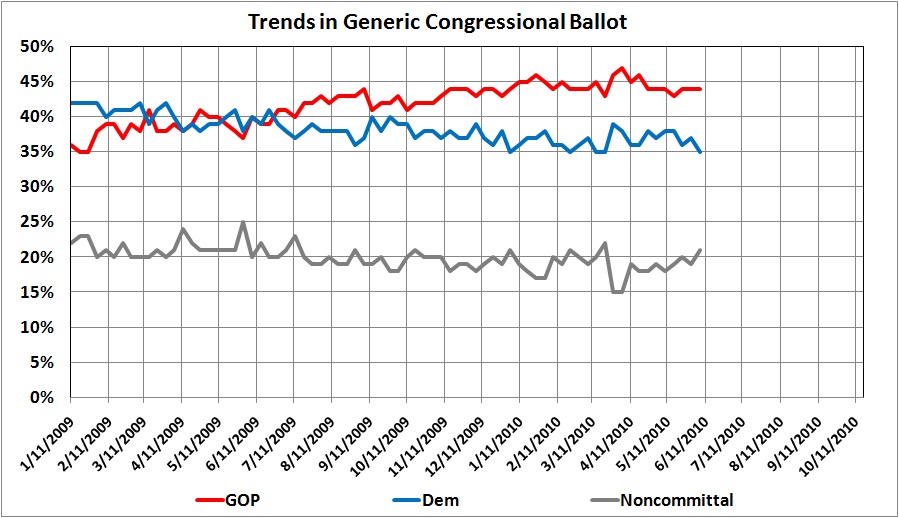
Source: results of a Rasmussen poll in which likely voters are asked whether they intend to vote for their district’s Republican or Democrat candidate.
Afterthought: You can rest assured that around Labor Day the Democrats will launch some kind of sleaze attack on the GOP. Having observed Democrats in action for six decades, I have decided that their motto should be: “When all else fails, fight dirty.” Given Tricky Dick’s track record, I hereby award him posthumous membership in the Democrat Party.
The Shape of Things to Come
Given the “State of the Union: 2010,” you may wonder how much worse things can get in this land of the once-free. Here are some very real possibilities:
- More curbs on freedom of speech, in the name of “protecting” certain groups (e.g., homosexuals, immigrants, Muslims) and “preserving public order” (i.e., protecting government and government officials from criticism).
- A complete government takeover of medical services (a U.S. National Heath Service), with no provision for opting-out to private care.
- Environmentalism and warmism rampant, with draconian restrictions on everything from where we live, the design of our housing, and the range of products and services we are allowed to buy.
- A stagnant economy — crushed by the weight of entitlement programs, environmentalism, warmism, and income equalization — affords a lower quality of life (on a par with the U.S. of the 1950s), and is unable to support a robust defense against foreign enemies.
- Further reductions in quality of life, brought about by economic isolation, arising partly out of protectionism, partly out of voluntary withdrawal from overseas interests (in the name of self-sufficiency), and partly out of our unwillingness and inability to defend our overseas interests in the face of superior Chinese and Russian forces.
- The erosion of traditional morality — aided by governmental endorsement of moral relativism — leading to the increasing brutalization of the citizenry and an eventual police-state response.
I could expand the list, but it is already depressing enough.
If you cannot participate in the efforts of the Tea Party movement, the American Conservative Union, and the Club for Growth to roll back the forces of oppression in this land, support those organizations with your dollars. Every little bit helps.
Not Conservative Enough
Some pundits were amazed that Sen. Robert Bennett was denied re-nomination by a GOP convention in Utah. After all, they said, Bennett earned an American Conservative Union rating of 84 in 2009. How much more should Utah Republicans expect? A lot more in a State that is staunchly Republican and cast more than 62 percent of its votes for McCain in 2008 (trailing only Oklahoma at 66 percent and Wyoming at 65 percent).
It turns out that Bennett’s lifetime ACU rating (83.63) earned him 27th place among the 40 Republicans who sat in the Senate at the end of 2009:
| ACU Lifetime Ratings through 2009: GOP Senators | |||
| Rank | Rating | Member | State |
| 1 | 98.67 | BARRASSO | WYOMING |
| 2 | 98.55 | DeMINT | S. CAROLINA |
| 3 | 98 | COBURN | OKLAHOMA |
| 4 | 97.66 | INHOFE | OKLAHOMA |
| 5 | 96.75 | KYL | ARIZONA |
| 6 | 96 | RISCH | IDAHO |
| 7 | 95.08 | SESSIONS | ALABAMA |
| 8 | 95 | JOHANNS | NEBRASKA |
| 9 | 94.54 | BUNNING | KENTUCKY |
| 10 | 94.37 | ENSIGN | NEVADA |
| 11 | 93.82 | VITTER | LOUISIANA |
| 12 | 93.14 | CORNYN | TEXAS |
| 13 | 92.83 | CHAMBLISS | GEORGIA |
| 14 | 92.82 | ENZI | WYOMING |
| 15 | 92.76 | BROWNBACK | KANSAS |
| 16 | 92.27 | CRAPO | IDAHO |
| 17 | 91 | BURR | N. CAROLINA |
| 18 | 90.8 | WICKER | MISSISSIPPI |
| 19 | 89.77 | HUTCHISON | TEXAS |
| 20 | 89.68 | GRAHAM | S. CAROLINA |
| 21 | 89.66 | McCONNELL | KENTUCKY |
| 22 | 89.15 | HATCH | UTAH |
| 23 | 89.09 | ISAKSON | GEORGIA |
| 24 | 87.97 | THUNE | S. DAKOTA |
| 25 | 86.86 | ROBERTS | KANSAS |
| 26 | 86 | LeMIEUX | FLORIDA |
| 27 | 83.63 | BENNETT | UTAH |
| 28 | 83.5 | GRASSLEY | IOWA |
| 29 | 83.33 | CORKER | TENNESSEE |
| 30 | 81.97 | McCAIN | ARIZONA |
| 31 | 81.9 | BOND | MISSOURI |
| 32 | 80.13 | COCHRAN | MISSISSIPPI |
| 33 | 79 | ALEXANDER | TENNESSEE |
| 34 | 78.68 | GREGG | NEW HAMPSHIRE |
| 35 | 77.26 | LUGAR | INDIANA |
| 36 | 75.43 | SHELBY | ALABAMA |
| 37 | 70.19 | MURKOWSKI | ALASKA |
| 38 | 69.83 | VOINOVICH | OHIO |
| 39 | 49.43 | COLLINS | MAINE |
| 40 | 47.88 | SNOWE | MAINE |
Derived from American Conservative Union, Congressional Ratings 2009, 2009 Senate Ratings.
Obviously, it would be more difficult — and even foolhardy — for Maine Republicans to eject Senators Collins and Snowe, but there are plenty of firmly-Red States whose GOP constituencies aren’t getting their votes’ worth out of their senators. For example, the following States gave their electoral votes to the not-very-stellar Republican candidates in the last three presidential elections, and yet those States have GOP senators with ACU lifetime ratings below 90:
Alabama — Richard Shelby (75.43 ACU rating)
Alaska — Lisa Murkowski (70.19)
Arizona — John McCain (81.97)
Georgia — Sonny Isakson (89.09)
Kansas — Pat Roberts (86.86)
Kentucky — Mitch McConnell (89.66)
Mississippi — Thad Cochran (80.13)
South Carolina — Lindsey Graham (89.68)
South Dakota — John Thune (87.97)
Tennessee — Lamar Alexander (79.00), Bob Corker (83.33)
Texas — Kay Bailey Hutchison (89.77)
Utah — Orrin Hatch (89.15)
I’ve used bold type to highlight the weakest of the lot, though I’m certainly not enamored of the rest — several of whom (e.g., Thad Cochran, Lindsey Graham, Orrin Hatch, and Kay Bailey Hutchison) hold safe seats and could earn much higher ACU scores, if they chose to do so.
By the way, I have reviewed the ACU’s positions on the votes considered in rating senators for 2009. As a pro-life libertarian hawk, I find myself in agreement with the ACU’s positions on those votes and in agreement with the ACU’s principles.
Blasts from the Past
I have republished much of the pre-blog (“home page”) version of my old blog, Liberty Corner, in 29 posts at The Original Liberty Corner. (There’s a link to TOLC in the right sidebar, for permanent access.) Some of the material at TOLC is dated; most of it remains current; some of it is prescient.
The preceding post, “First Principles,” is based on one of my early contributions to the pre-blog version of Liberty Corner. From time to time, I will update other material and re-post it at this blog.
First Principles
The Constitution is for “we the people,” not “we the politicians” or “we the bureaucrats.”
A society is formed by the voluntary bonding of individuals into overlapping, ever-changing groups whose members strive to serve each others’ emotional and material needs. Government — regardless of its rhetoric — is an outside force that cannot possibly replicate societal bonding, or even foster it. At best, government can help preserve society — as it does when it deters aggression from abroad or administers justice. But in the main, government corrodes society by destroying bonds between individuals and dictating the terms of social and economic intercourse — as it does through countless laws, regulations, and programs, from Social Security to farm subsidies, from corporate welfare to the hapless “war” on drugs, from the minimum wage to affirmative action. On balance, the greatest threat to society is government itself.
The promises made in America’s Constitution are valid only within the United States, not across international borders. Even with the benefit of a common Constitution, we Americans find it harder every year to honor and respect each other’s lives, fortunes, and honor. Expecting other nations to behave as if they were bound by our Constitution is like trusting Hitler in the 1930s — an exercise in false hope and self-delusion.>Free speech is a right. A free pass based on gender, race, religion, or any other incidental characteristic is extortion.
Liberty is not anarchy, nor is it the government dictating how we may live our lives and pursue happiness.
Liberty: the right to make mistakes, to pay for them, and to profit by learning from them.
The best government is that which walks the fine line between the tyranny of anarchy and the tyranny of special interests.
The constitutional contract charges the federal government with keeping peace among the States, ensuring uniformity in the rules of inter-State and international commerce, facing the world with a single foreign policy and a national armed force, and assuring the even-handed application of the Constitution and of constitutional laws. That is all.
The business of government is to protect the lawful pursuit and enjoyment of income and wealth, not to redistribute them.
Each citizen is a unique minority of one who should enjoy the same rights as all other minorities.
The most precious right these days is the right to be left alone.
How’s “He” Doing?
“He” is Barack Obama (BO), who presides over the left half of the nation and dictates to the right half. In an early post about BO’s popularity — or lack thereof — I observed that his “approval rating may have dropped for the wrong reasons; that is, voters expect him to “do something” about jobs, health care, etc.”
And, sure enough, when BO used his first state of the union address to reiterate his allegiance to the New Deal, his unpopularity dwindled a bit. And when he and his co-conspirators — Reid and Pelosi — rammed their health-care bill through Congress, his unpopularity again dwindled.
The good news is that BO remains generally unpopular:
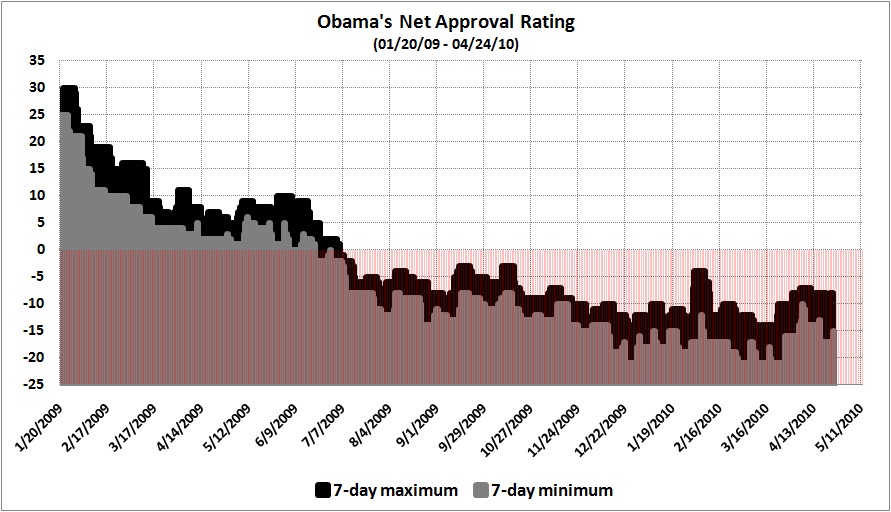
Net approval rating: percentage of likely voters strongly approving of BO, minus percentage of likely voters strongly disapproving of BO. Derived from Rasmussen Reports’ Daily Presidential Tracking Poll. I use Rasmussen’s polling results because Rasmussen has a good track record with respect to presidential-election polling.
In polls there is hope.
The State of the Union, Obama-style
My fellow Democrats — and anyone else who may be watching — I make this special appearance tonight for the purpose of gloating, er, celebrating our recent victory, which was won against the will of the people, and which will make them poorer and less healthy. But never mind that, the important thing is to have played the game of politics and won — the consequences be damned.
Having succeeded in attaining a major goal of this administration, I will now turn to our other major goals, which are to:
- tax and regulate Americans until their entrepreneurial spirit and work ethic sink to European levels
- reject our traditional allies, while bowing to the forces that would destroy us — which will make us even more European.
I close this brief address by paraphrasing the sainted John F. Kennedy: Ask not what your country can do for you, but what your country can do to you if you are a heterosexual male with a good job, above-average income, and traditional views about family, morality, limited government, and fiscal responsibility. The worst is yet to come. Bwah-ha-ha-ha-ha.
Good News?
GRAPHIC UPDATED 12/14/09
What’s bad news for Obama is good news for the country. As I have said:
To hope that Obama fails is not to wish ill for the nation; to the contrary, it is to hope that Obama’s policies fail of realization because they are seen (rightly) as inimical to liberty and prosperity.
It is my sincere and fervent hope that the following trends portend good news for the liberty and prosperity of Americans:
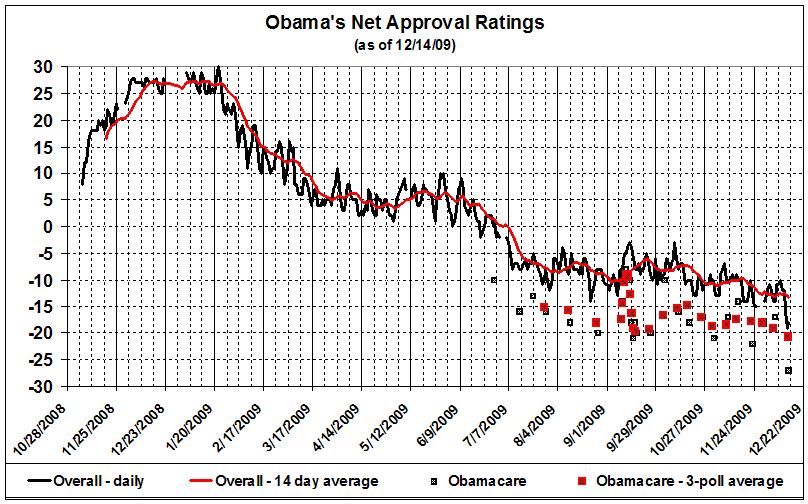
Sources: Rasmussen Reports Daily Presidential Tracking Poll and Health Care Reform Poll. Overall net approval ratings represent the difference in the percentage of respondents strongly approving and strongly disapproving of Obama (negative numbers mean net disapproval). Health care ratings represent the difference in the percentage of respondents strongly supporting and strongly opposing Obama’s health care “plan,” or what they take to be his plan. I use Rasmussen’s polling results because Rasmussen has a good track record with respect to presidential-election polling.
The Devolution of American Politics from Wisdom to Opportunism
The canonization of Ted Kennedy by the American left and its “moderate” dupes — in spite of Kennedy’s tawdry, criminal past — reminds me of the impeachment trial of William Jefferson Clinton. Clinton’s defense attorney Cheryl Mills said this toward the end of her summation:
[T]his president’s record on civil rights, on women’s rights, on all of our rights is unimpeachable.
In other words, Clinton could lie under oath and obstruct justice because his predatory behavior toward particular women and the criminal acts they led to were excused by his being on the “right side” on the general issue of “women’s rights.” That makes as much sense as allowing a murderer to go free because he believes in capital punishment.
The purpose of this post, however, isn’t to explore the depths of leftist hypocrisy. There is plenty of hypocrisy to go around, and it isn’t found only on the left — just mostly, it seems.
What I want to explore here is the question of “character” and its bearing on governance. I begin with the late James David Barber who, in Presidential Character: Predicting Performance in the White House, looks at America’s presidents through the lens of personality. Barber concocts four broad types:
“active-positive” (high self-esteem, flexible, goal-oriented), “active-negative” (compulsive, power-seeking), “passive-positive” (genial and agreeable but easily wounded) and “passive-negative” (dutiful, withdrawing from political fights).
Barber writes engagingly and almost convincingly, until you understand that what he offers is simplistic, rear-view-mirror nonsense that happens to justify his political preferences.
Barber prefers “active-positive” presidents. Which is to say that Barber, like most liberal-arts academicians, favors “active” presidents — presidents who seek to expand the powers of the presidency and the government beyond their constitutional bounds — as long as their temperaments are “positive” (think FDR and Truman), as opposed to “negative” (think Wilson and Nixon).
Calvin Coolidge, on the other hand, is one of Barber’s “passive-negative” presidents, “sullen and withdrawn, viewing the office as a burden.” Coolidge, though taciturn, was not a sullen person, and he viewed the presidency as a constitutional trust, not a license to reshape the nation and its political institutions to his own liking. As I have said (here and here), Coolidge was
Harding’s dignified, reticent successor. Had Coolidge chosen to run for re-election in 1928 he probably would have won. And if he had won, his inbred conservatism probably would have kept him from trying to “cure” the recession that began in 1929. Thus, we might not have had the Great Depression, FDR, the New Deal, etc., etc., etc.
* * *
Coolidge was known as “Silent Cal” because he was a man of few words. He said only what was necessary for him to say, and he meant what he said. That was in keeping with his approach to the presidency. He was not the “activist” that reporters and historians like to see in the presidency; he simply did the job required of him by the Constitution, which was to execute the laws of the United States.
The contrast between “active-positive” and “passive-negative” points to the real “character issue” in politics: the distinction between opportunistic politicians and wise ones. (Contrast adj. 1 here with adj. 1 here.)
An opportunistic politician disregards or is ignorant of the wisdom embedded in social norms and the laws that derive from them. An opportunistic politician is enamored of change (for change’s sake) — regardless of its costs or consequences — as long as it yields popularity, votes, and power. An opportunistic politician, all rhetoric to the contrary, cares for and caters to only to those who bestow popularity, votes, and power. An opportunistic politician — with the help of dupes in the media, academia, and “progressive” circles — successfully masks his essential ruthlessness behind a reputation for “compassion” and “service.”
A wise politician understands that the first and only duty of government is to defend the negative rights of citizens:
- freedom from force and fraud (including the right of self-defense against force)
- property ownership (including the right of first possession)
- freedom of contract (including contracting to employ/be employed)
- freedom of association and movement
- restitution or compensation for violations of the foregoing rights.
A wise politician understands how easily government intervention can rend the painstakingly woven fabric of custom — without which humans could not coexist in peace and prosperity — and will seek intervention only where custom tramples negative rights.
Among the most opportunistic politicians of our era have been Bill Clinton and Ted Kennedy, but they merely stand out from their peers as being more opportunistic than most. Their spiritual forbears include George Wallace, (who played the race card of a different suit), Huey Long, and the two Roosevelts.
The ranks of wise American politicians (and presidents) are led by George Washington and Abraham Lincoln. Is it fair to contrast Clinton, Kennedy, and their ilk with Washington and Lincoln? Why not? Washington and Lincoln were made of flesh and blood; they were not perfect as men or presidents. But they rose above their imperfections instead of succumbing to them. They respected humanity and — instead of trying to dominate it — sought to protect it from the arbitrary actions of government. Thus Washington fought British tyranny and resisted its replication on our shores; Lincoln crushed the evil that was slavery, rather than accommodate it.
Our historical distance from the likes of Washington and Lincoln should not lead us to assume that their kind is no longer to be found. It is just that their kind is far less likely to be found in politics these days, the currency of politics having been debased as America has spiraled downward into statism:
As people become accustomed to a certain level of state action, they take that level as a given. Those who question it are labeled “radical thinkers” and “out of the mainstream.” The “mainstream” — having taken it for granted that the state should “do something” — argues mainly about how much more it should do and how it should do it, with cost as an afterthought.
Perhaps the best metaphor for our quandary is the death spiral. Reliance on the state creates more problems than it solves. But, having become accustomed to relying on the state, the polity relies on the state to deal with the problems caused by its previous decisions to rely on the state. That only makes matters worse, which leads to further reliance on the state, etc., etc. etc.
More specifically, unleashing the power of the state to deal with matters best left to private action diminishes the ability of private actors to deal with problems and to make progress, thereby fostering the false perception that state action is inherently superior. At the same time, the accretion of power by the state creates dependencies and constituencies, leading to support for state action in the service of particular interests. Coalitions of such interests resist efforts to diminish state action and support efforts to increase it. Thus the death spiral.
The opportunistic politician — seeking popularity, votes, and power — hastens our descent; the wise one tries to reverse it. Which brings me back to Calvin Coolidge . . . and to his only (somewhat effective) counterpart in recent history: Ronald Reagan.
Coolidge’s presidency, as noted above, earned us a respite from the depradations of Teddy Roosevelt and Woodrow Wilson, but fate intervened, in the form of the Great Depression, panic, and the opportunism of FDR.
Reagan’s presidency was more a glimmer of hope than a respite. And the glimmer of hope has been extinguished by mediocrity (Bush I), opportunism (Clinton), mediocrity (Bush II), and opportunism (BHO).
It is my belief (and fear) that wisdom can be restored to American politics only by a major crisis, one which can be blamed unambiguously on the machinations of opportunistic politicians.
Civil War, Close Elections, and Voters’ Remorse
Apropos the proposition that a new (cold) civil war is emerging, I introduce the following graph into evidence:
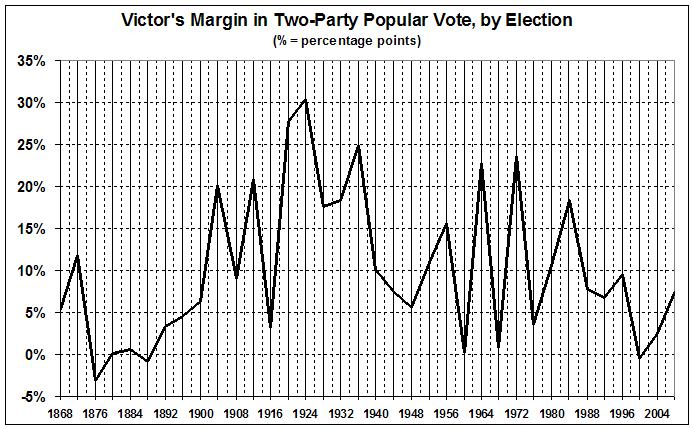 Source: Derived from data available at Dave Leip’s Atlas of U.S. Presidential Elections.
If the closeness of recent elections (as measured by the popular vote) means anything, it means that the United States is about as divided is it was in the the last quarter of the 19th century, when the passions surrounding the Civil War still raged in the country. Not that there’s anything wrong with disunity, as long as you’re on the right side of it. Nor is unity desirable when it revolves around statists (like the Roosevelts and LBJ) or criminals (like Nixon and Clinton).
The apparent “healing” of 2008 — which merely reflected Bush’s unpopularity and McCain’s lameness as a candidate — has lasted about as long as a Hollywood marriage:
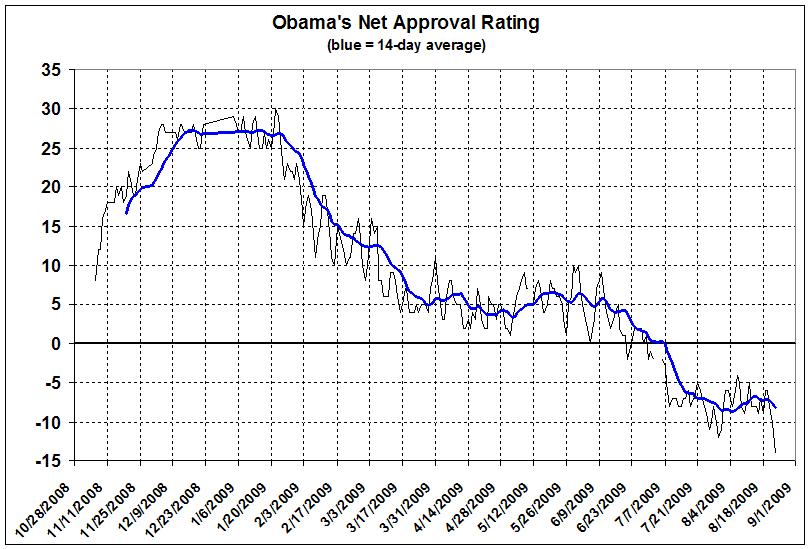 Source: Derived from the presidential tracking poll at Rasmussen Reports.
On the subject of voters’ remorse — for that is what it is — I note that just before the election of 2008 Democrats led Republicans by 47 percent to 41 percent on Rasmussen’s “generic congressional ballot,” whereas the most recent poll (August 16) has Republicans ahead of Democrats by 43 percent to 38 percent.
A Long Row to Hoe
In “A Welcome Trend,” I point to Obama’s declining popularity and note that
the trend — if it continues — offers hope for GOP gains in the mid-term elections, if not a one-term Obama-cy.
Of course, it is early days yet. Popularity lost can be regained. Clinton succeeded in making himself so unpopular during his first two years in office that the GOP was able to seize control of Congress in the 1994 mid-term elections. But Clinton was able to regroup, win re-election in 1996, and leave the presidency riding high in the polls, despite (or perhaps because of) his impeachment.
Focusing on 2012, and assuming that Obama runs for re-election, what must the GOP do to unseat him? In “There Is Hope in Mudville,” I offer this:
What about 2012? Can the GOP beat Obama? Why not? A 9-State swing would do the job, and Bush managed a 10-State swing in winning the 2000 election. If Bush can do it, almost anyone can do it — well, anyone but another ersatz conservative like Bob Dolt or John McLame.
Not so fast. A closer look at the results of the 2008 election is in order:
- Based on the results of the 2004-2008 elections, I had pegged Iowa, New Hampshire, and New Mexico as tossup States: McCain lost them by 9.5, 9.6, and 15.1 percentage points, respectively.
- I had designated Florida, Ohio, and Nevada as swing-Red States — close, but generally leaning toward the GOP. McCain lost the swing-Red States by 2.8, 4.6, and 12.5 percentage points, respectively.
- Of the seven States I had designated as leaning-Red, McCain lost Viginia (6.3 percentage points) and Colorado (9.0 percentage points). (He held onto Missouri by only 0.1 percentage point.)
- McCain also managed to lose two firm-Red States: North Carolina (0.3) and Indiana (1.0).
The tossups are no longer tossups. It will take a strong GOP candidate to reclaim them in 2012. The same goes for Nevada, Virginia, and Colorado. Only Florida, Ohio, North Carolina, and Indiana are within easy reach for the GOP’s next nominee.
McCain did better than Bush in the following States: Oklahoma, Alabama, Louisiana, West Virginia, Tennessee, and Massachusetts. The first five were already firm- and leaning-Red, so McCain’s showing there was meaningless. His small gain in Massachusetts (1.7 percentage points) is likewise meaningless; Obama won the Bay State by 25.8 percentage points. In sum, there is no solace to be found in McCain’s showing.
The GOP can win in 2012 only if
- Obama descends into Bush-like unpopularity, and stays there; or
- Obama remains a divisive figure (which he is, all posturing to the contrary) and the GOP somehow nominates a candidate who is a crowd-pleaser and a principled, articulate spokesman for limited government.
The GOP must not offer a candidate who promises to do what Obama would do to this country, only to do it more effectively and efficiently. The “base” will stay home in droves, and Obama will coast to victory — regardless of his unpopularity and divisiveness.
I hereby temper the optimistic tone of my earlier posts. The GOP has a long row to hoe.
A Welcome Trend
 Derived from Rasmussen Reports, Daily Presidential Tracking Poll, Obama Approval Index History. I use Rasmussen’s polling results because Rasmussen has a good track record with respect to presidential-election polling.
Obama’s approval rating may have dropped for the wrong reasons; that is, voters expect him to “do something” about jobs, health care, etc. But voters have come to expect presidents to “do something” about various matters which are none of government’s business. So, even if voters have become less approving of Obama for the wrong reasons, the trend — if it continues — offers hope for GOP gains in the mid-term elections, if not a one-term Obama-cy.
 Politics and Prosperity