
My thesis, which I posted here in August, looks better every day. The argument is brief, though the entry is long because of the ever-expanding list of links to supporting material. The recent infighting between Comey and Brennan supports my view that Brennan was the ringleader and Comey was nothing more than what he has always been: an opportunistic suck-up. In any event, the bottom line — a deep-state conspiracy against Trump, before and after the election — looks more like the truth with every new revelation about the Obama administration’s shenanigans.
Category: Electoral Politics
Not with a Bang
This is the way the world ends
This is the way the world ends
This is the way the world ends
Not with a bang but a whimper.
T.S. Elliot, The Hollow Men
It’s also the way that America is ending. Yes, there are verbal fireworks aplenty, but there will not be a “hot” civil war. The country that my parents and grandparents knew and loved — the country of my youth in the 1940s and 1950s — is just fading away.
This would not necessarily be a bad thing if the remaking of America were a gradual, voluntary process, leading to time-tested changes for the better. But that isn’t the case. The very soul of America has been and is being ripped out by the government that was meant to protect that soul, and by movements that government not only tolerates but fosters.
Before I go further, I should explain what I mean by America, which is not the same thing as the geopolitical entity known as the United States, though the two were tightly linked for a long time.
America was a relatively homogeneous cultural order that fostered mutual respect, mutual trust, and mutual forbearance — or far more of those things than one might expect in a nation as populous and far-flung as the United States. Those things — conjoined with a Constitution that has been under assault since the New Deal — made America a land of liberty. That is to say, they fostered real liberty, which isn’t an unattainable state of bliss but an actual (and imperfect) condition of peaceful, willing coexistence and its concomitant: beneficially cooperative behavior.
The attainment of this condition depends on social comity, which depends in turn on (a) genetic kinship and (b) the inculcation and enforcement of social norms, especially the norms that define harm.
All of that is going by the boards because the emerging cultural order is almost diametrically opposite that which prevailed in America. The new dispensation includes:
- casual sex
- serial cohabitation
- subsidized illegitimacy
- abortion on demand
- easy divorce
- legions of non-mothering mothers
- concerted (and deluded) efforts to defeminize females and to neuter or feminize males
- gender-confusion as a burgeoning norm
- “alternative lifestyles” that foster disease, promiscuity, and familial instability
- normalization of drug abuse
- forced association (with accompanying destruction of property and employment rights)
- suppression of religion
- rampant obscenity
- identity politics on steroids
- illegal immigration as a “right”
- “free stuff” from government (Social Security was meant to be self-supporting)
- America as the enemy
- all of this (and more) as gospel to influential elites whose own lives are modeled mostly on old America.
As the culture has rotted, so have the ties that bound America.
The rot has occurred to the accompaniment of cacophony. Cultural coarsening begets loud and inconsiderate vulgarity. Worse than that is the cluttering of the ether with the vehement and belligerent propaganda, most of it aimed at taking down America.
The advocates of the new dispensation haven’t quite finished the job of dismantling America. But that day isn’t far off. Complete victory for the enemies of America is only a few election cycles away. The squishy center of the electorate — as is its wont — will swing back toward the Democrat Party. With a Democrat in the White House, a Democrat-controlled Congress, and a few party switches in the Supreme Court (of the packing of it), the dogmas of the anti-American culture will become the law of the land; for example:
Billions and trillions of dollars will be wasted on various “green” projects, including but far from limited to the complete replacement of fossil fuels by “renewables”, with the resulting impoverishment of most Americans, except for comfortable elites who press such policies).
It will be illegal to criticize, even by implication, such things as abortion, illegal immigration, same-sex marriage, transgenderism, anthropogenic global warming, or the confiscation of firearms. These cherished beliefs will be mandated for school and college curricula, and enforced by huge fines and draconian prison sentences (sometimes in the guise of “re-education”).
Any hint of Christianity and Judaism will be barred from public discourse, and similarly punished. Islam will be held up as a model of unity and tolerance.
Reverse discrimination in favor of females, blacks, Hispanics, gender-confused persons, and other “protected” groups will be required and enforced with a vengeance. But “protections” will not apply to members of such groups who are suspected of harboring libertarian or conservative impulses.
Sexual misconduct (as defined by the “victim”) will become a crime, and any male person may be found guilty of it on the uncorroborated testimony of any female who claims to have been the victim of an unwanted glance, touch (even if accidental), innuendo (as perceived by the victim), etc.
There will be parallel treatment of the “crimes” of racism, anti-Islamism, nativism, and genderism.
All health care in the United States will be subject to review by a national, single-payer agency of the central government. Private care will be forbidden, though ready access to doctors, treatments, and medications will be provided for high officials and other favored persons. The resulting health-care catastrophe that befalls most of the populace (like that of the UK) will be shrugged off as a residual effect of “capitalist” health care.
The regulatory regime will rebound with a vengeance, contaminating every corner of American life and regimenting all businesses except those daring to operate in an underground economy. The quality and variety of products and services will decline as their real prices rise as a fraction of incomes.
The dire economic effects of single-payer health care and regulation will be compounded by massive increases in other kinds of government spending (defense excepted). The real rate of economic growth will approach zero.
The United States will maintain token armed forces, mainly for the purpose of suppressing domestic uprisings. Given its economically destructive independence from foreign oil and its depressed economy, it will become a simulacrum of the USSR and Mao’s China — and not a rival to the new superpowers, Russia and China, which will largely ignore it as long as it doesn’t interfere in their pillaging of respective spheres of influence. A policy of non-interference (i.e., tacit collusion) will be the order of the era in Washington.
Though it would hardly be necessary to rig elections in favor of Democrats, given the flood of illegal immigrants who will pour into the country and enjoy voting rights, a way will be found to do just that. The most likely method will be election laws requiring candidates to pass ideological purity tests by swearing fealty to the “law of the land” (i.e., abortion, unfettered immigration, same-sex marriage, freedom of gender choice for children, etc., etc., etc.). Those who fail such a test will be barred from holding any kind of public office, no matter how insignificant.
Are my fears exaggerated? I don’t think so, given what has happened in recent decades and the cultural revolutionaries’ tightening grip on the Democrat party. What I have sketched out can easily happen within a decade after Democrats seize total control of the central government.
Will the defenders of liberty rally to keep it from happening? Perhaps, but I fear that they will not have a lot of popular support, for three reasons:
First, there is the problem of asymmetrical ideological warfare, which favors the party that says “nice” things and promises “free” things.
Second, What has happened thus far — mainly since the 1960s — has happened slowly enough that it seems “natural” to too many Americans. They are like fish in water who cannot grasp the idea of life in a different medium.
Third, although change for the worse has accelerated in recent years, it has occurred mainly in forums that seem inconsequential to most Americans, for example, in academic fights about free speech, in the politically correct speeches of Hollywood stars, and in culture wars that are conducted mainly in the blogosphere. The unisex-bathroom issue seems to have faded as quickly as it arose, mainly because it really affects so few people. The latest gun-control mania may well subside — though it has reached new heights of hysteria — but it is only one battle in the broader war being waged by the left. And most Americans lack the political and historical knowledge to understand that there really is a civil war underway — just not a “hot” one.
Is a reversal possible? Possible, yes, but unlikely. The rot is too deeply entrenched. Public schools and universities are cesspools of anti-Americanism. The affluent elites of the information-entertainment-media-academic complex are in the saddle. Republican politicians, for the most part, are of no help because they are more interested on preserving their comfortable sinecures than in defending America or the Constitution.
On that note, I will take a break from blogging — perhaps forever. I urge you to read one of my early posts, “Reveries“, for a taste of what America means to me. As for my blogging legacy, please see “A Summing Up“, which links to dozens of posts and pages that amplify and support this post.
Il faut cultiver notre jardin.
Voltaire, Candide
Related reading:
Michael Anton, “What We Still Have to Lose“, American Greatness, February 10, 2019
Rod Dreher, “Benedict Option FAQ“, The American Conservative, October 6, 2015
Roger Kimball, “Shall We Defend Our Common History?“, Imprimis, February 2019
Joel Kotkin, “Today’s Cultural Engineers“, newgeography, January 26, 2019
Daniel Oliver, “Where Has All the Culture Gone?“, The Federalist, February 8, 2019
Malcolm Pollack, “On Civil War“, Motus Mentis, March 7, 2019
Fred Reed, “The White Man’s Burden: Reflections on the Custodial State“, Fred on Everything, January 17, 2019
Gilbert T. Sewall, “The Diminishing Authority of the Bourgeois Culture“, The American Conservative, February 4, 2019
Bob Unger, “Requiem for America“, The New American, January 24, 2019
A Summing Up
This post has been updated and moved to “Favorite Posts“.
The Fickle Electorate
The fickleness of the electorate is due mainly to what I call its “squishy center“. The squishiness has often spread far beyond the center, to engulf huge chunks of the electorate.
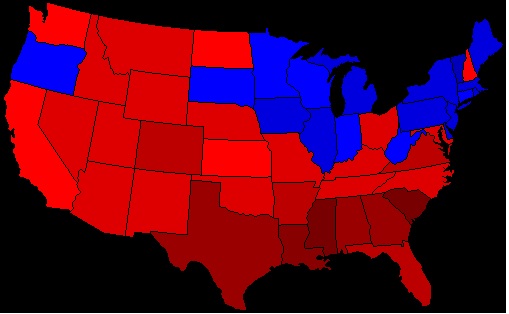
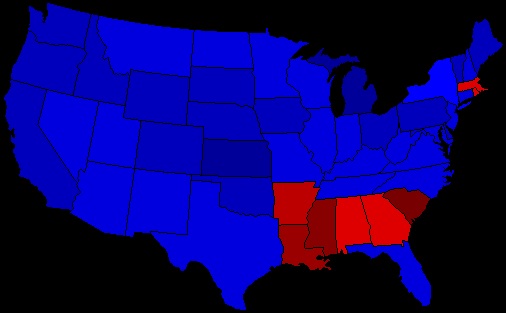
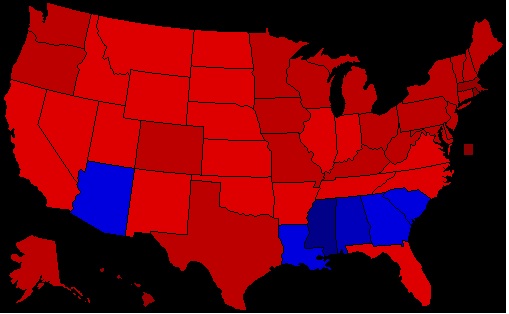
The maps below illustrate this by contrasting electoral-vote outcomes for successive elections in which electoral-vote outcomes swung wildly. The maps are borrowed from Dave Leip’s Atlas of U.S. Presidential Elections. Leip uses red for Democrat, blue for Republican, and green for third-party candidates. The color for each State indicates the party affiliation of the candidate who won the State’s electoral votes. The shading (from darker to lighter) indicates the width of the candidate’s popular-vote victory in the State (from landslide to squeaker).
1. William Howard Taft (R) won convincingly in 1908 — taking most of the States outside the “solid (Democrat) South“, but went down in flames in 1912. That election was won by Woodrow Wilson (D), mainly because of the Progressive Party candidacy of Theodore Roosevelt. TR took won more States (those in green) than did WHT.
1908

1912

2. Wilson easily won re-election in 1916, but disillusionment set in and Warren G. Harding (R) coasted to victory in 1920, losing only the “solid South” (minus Tennessee).
1916
1920

3. Another eight years and another romp, this time by Herbert C. Hoover (R) in the election of 1928. Hoover took a chunk out of the “solid South” because his main opponent was Alfred Emmanuel Smith (D), a Catholic New Yorker. Hoover, in turn, was trounced by Franklin Delano Roosevelt (D) because of the onset of the Great Depression during Hoover’s term of office. (It is a widely ignored fact that FDR’s policies only prolonged the depression.)
1928
1932

4. Harry S Truman (D) won the 1948 election by a comfortable electoral-vote margin. It would have been more comfortable had not four States of the “solid South” succumbed to Strom Thurmond’s “Dixiecrat” (segregationist) allure. Dwight D. Eisenhower (R) turned the tables in 1952 by sweeping the electoral map outside of the “solid South” and even encroaching on it.
1948

1952
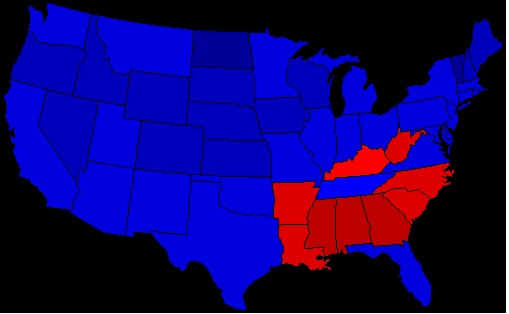
5. The election of 1964 pitted Barry M. Goldwater (R) against the incumbent-via-murder, Lyndon B. Johnson (D). LBJ’s incumbency and scare tactics were repaid by the electoral votes of all but Goldwater’s home State (Arizona) and some States of what was by then becoming the “solid (Republican) South”. You know the rest of the story: The rancor ignited by the Vietnam War and urban (black) riots led to a convincing defeat for Hubert H. Humphrey, the Democrat who ran when LBJ turned tail for Texas. The winner, Richard M. Nixon (R), would have won even more handily had it not been for the segregationist candidacy of George C. Wallace.
1964
1968

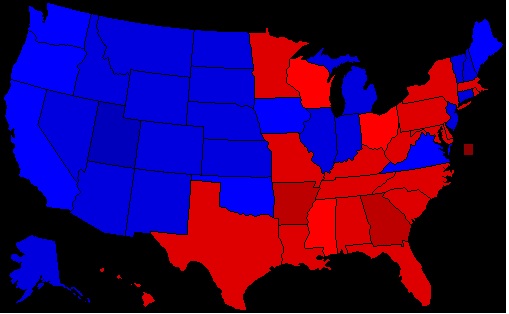
6. The electoral whipsaw effect intensified in the elections of 1972, 1976, and 1980. Nixon won the first of them in the most lopsided electoral-vote victory since FDR’s near-sweep in 1936. Dreams (or nightmares) of a Republican era were dashed by the Watergate scandal and Nixon’s resignation. In the aftermath, James E. (Jimmy) Carter (D) handily beat Gerald R. Ford (R). Carter’s victory was due in large part to Southern voters who temporarily returned to the Democrat fold because Carter (a Georgian) was perceived as “one of them”, even though he wasn’t (by a country mile). Carter’s ineptness as president was duly rewarded in 1980 when Ronald W. Reagan (R) came close to sweeping all of the States. (He came even closer in 1984, when he lost only Minnesota, the home state of his Democrat opponent, and D.C. — of course.)
1972

1976
1980

7. The last of the wild swings (thus far) occurred in the elections of 1988 and 1992. George H.W. Bush (R) handily won the former election. He might well have won in 1992 but for the intervention of H. Ross Perot, whose third-party candidacy tipped the scales to William J. Clinton — in an eerie re-run of the election of 1912. Clinton, like Carter in 1976, was also helped by the perception that he was a Southern boy — thus his inroads into what by then had become the “solid (Republican) South”.
1988

1992

What will 2020 bring? I made a guess soon after the election of 2016.
All the business of war, and indeed all the business of life, is to endeavour to find out what you don’t know by what you do; that’s what I called ‘guessing what was at the other side of the hill’.
The next presidential election is just on the other side of the hill. God save America from a reversal of the last one.
Democrat Values
Virginia’s Democrat governor, Ralph Northam, is under fire from Democrats for (perhaps) having harbored racist thoughts 35 years ago, when he was 25 years old. He is not under fire from Democrats for his recent endorsement of infanticide. That’s all you need to know about today’s Democrat Party.
Wall Wondering
Democrats are for “the people”, right? So why did House Democrats reject pay for federal workers (many of them struggling to make ends meet), even as the shutdown continues?
For that matter, why are Democrats unwilling to put up $5.7 billion — a mere molecule of H2O in the vast sea of federal spending (more than $7 trillion per annum) — if government does such great things for “the people”? Think of all the “benefits” that are foregone because the Democrats oppose an expenditure that would add less than one-tenth of one percent to federal spending?
A border wall would help to protect Americans from an influx of criminals and welfare-spongers. Why don’t Democrats care about “the people” who are victimized by crime and higher taxes?
Why have so many Democrat politicians changed their tune about securing the southern border in just a few years? It must be something in the water they drink. The same thing happened with same-sex “marriage”, “medical” marijuana, and “rare” abortion. I guess that’s to be expected when their guiding principle is to irk people who remind them of their parents and teachers. (It’s called prolonged adolescent-rebellion syndrome.)
Is “the wall” the left’s Waterloo or the right’s Alamo? It could turn into Fort Sumter if Congress doesn’t fund it and the courts block emergency spending.
These are interesting times, to say the least. I hope to live long enough to see America restored to sanity, but I am not hopeful of that.
Related post: The Left and “the People”
Ben Shapiro’s Fallacy
Ben Shapiro, arguing against the use of emergency powers to fund the border wall, says this:
Proponents of President Donald Trump would like to see power centralized in the presidency; antagonists of Trump would like to see power centralized in the FBI.
Trump’s allies seem eager for Trump to declare a national emergency in order to appropriate funds for a border wall….
It’s good that the legislative branch checks the executive branch, and it’s good that the executive branch must remain in control of executive branch agencies.
Here’s the easy test: How would you feel if the situations were reversed?
I must note, first, that Shapiro badly overstates the case when he asserts that Trump’s proponents ” would like to see power centralized in the presidency,” and that “antagonists of Trump would like to see power centralized in the FBI.” Trump’s proponents would like to see power exercised responsibly, and most of the Democrats in Congress (as well as many Republicans) routinely fail to do that. Refusal to fund the border wall, merely to thwart Trump, is just a current and egregious example of that failure. Those same Democrats want the FBI to have power only when it comes to Trump; otherwise, they would prefer to emasculate the FBI. Democrats’ embrace of the FBI is a matter of political convenience, not principled conviction.
Now for the fallacy, which is implicit in Shapiro’s question, “How would you feel if the situations were reversed?” That question implies the following syllogism:
It is bad for the executive to use emergency powers.
The use of emergency powers is dictated by precedent.
Therefore, if Trump desists from using emergency powers, a future president (even a Democrat) will also desist and thereby avoid doing a bad thing.
The syllogism is logically valid, in that the conclusion follows from the premises. But the conclusion is arguably false because a Democrat — an Obama, for instance — is unlikely to be swayed by precedent in the matter of emergency powers.
Is “Trump Fatigue” Setting In?
SUPERSEDED BY “TRUMP IN THE POLLS: AN UPDATE“.
Every week since the first inauguration of Obama, Rasmussen Reports has asked 2,500 likely voters whether they see the country as going in the “right direction” or being on the “wrong track”. The graph below shows the ratios of “right direction”/”wrong track” for Trump and Obama:
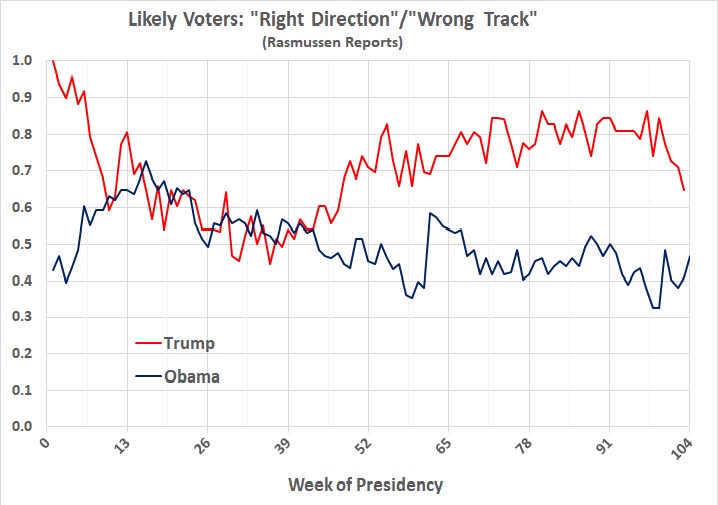
The ratio for Trump, after a quick honeymoon start, fell into the same range as Obama’s. But it jumped with the passage of the tax cut in December 2017, and rose (raggedly) until six months ago. After leveling off for five months, the ratio began to drop sharply a month ago.
I would chalk it up to “Trump fatigue”. Trump is still better than the alternative, but I suspect that two years of tweeted outrage — even though mostly justified — is wearing on people who otherwise support his policies.
Yes, I know all about the relentless anti-Trump campaign from the left and NeverTrump “conservatives”. The graph suggests that Trump did a good job of countering that until recent months. The graph also suggests that Trump has to claim new, substantive victories before the tide turns against him. Tweeting won’t cut it.
Trump (and the country) has a lot at stake in the several pending issues; for example, the showdown over the border wall, Syria, North Korea, trade talks, the state of the economy, and the perception that his White House is or isn’t in chaos. Looming over all of it is the Mueller investigation and a concerted effort by House Democrats to undercut Trump on all fronts.
The coming weeks and months could bring a steady stream of bad news — or some surprisingly good news — for Trump. But it will have to be genuinely good news, not bombastic tweets from the Oval Office. It is time for Trump to retire his Twitter account.
Keep your eye on the “right direction”/”wrong track” ratio.
Anti-Elitism
Anti-elitism has shown great strength in various places, including the U.S., Italy, Brazil, and France. The proximate causes of anti-elitist uprisings aren’t all the same, but the underlying sentiment is: We are sick and tired of being dictated to and victimized by the political-media-academic-managerial establishment and its pet groups and causes.
Will the phenomenon endure and spread, or will it fade away like the Tea Party?
The answer depends on the ability of anti-elites to move into positions of power, and to remain there while remaining anti-elite. Power is seductive and corrupting. So anti-elitism is most likely to succeed and endure where it is led by persons, like Donald Trump, who already have wealth and power and (seem) to have a sincere appreciation of the grievances that underlie anti-elitism.
Related: True Populism
GHWB
George Herbert Walker Bush (June 12, 1924 – November 30, 2018) is the new leader in the clubhouse. That is to say, he is now the oldest member of the Dead Presidents Club, at the age of 94.47 years.
GHWB replaced Gerald Ford, who made it to 93.45. Ford replaced Ronald Reagan, who made it to 93.33.
Jimmy (now 94.17) will replace GHWB if he lives to March 25, 2019.
John Adams (90.67) and Herbert Hoover (90.19) are the other occupants of the club’s exclusive 90+ room. As many members of the club (5) lived into their 90s as lived into their 80s.
Will Jimmy make it 6 to 5, or will he become the club’s first centenarian? He already holds the record for having outlived his presidency. He’s almost at the 38-year mark, well beyond Hoover’s 31.63. The only president of the past half-century who was worse than Carter is Obama, who will probably break Carter’s miserable record for post-presidential pestilence.
For more in this vein, see the updated version of “Presidents: Key Dates and Various Trivia“.
Is There a Republican President in Our Future?
Ann Coulter doesn’t speak for me, though I often agree with her. She recently said this:
If either [Texas or Florida] ever flip, no Republican ever gets elected president again. Three out of four Hispanics in Texas are under the age of 18. So, each day Trump doesn’t fulfill the immigration promises — his voters are dying off and Democratic voters, Hillary’s voters are registering to vote. So, I hope he keeps his promise. This is why we wanted a wall.
There are also cultural and economic reasons to want a wall. But the electoral reason is good enough for me.
The flipping problem isn’t confined to States that are becoming more Hispanic, such as Arizona, Colorado, and Texas. There is the the southward creep of the Northeastern influence into North Carolina and Georgia (it has already vanquished Virginia). And there is the tenuous hold on States that flipped to the GOP column in 2016: Florida, Iowa, Michigan, Ohio, Pennsylvania, and Wisconsin.
All in all, and despite my bold prediction about 2020 (tempered here), the GOP has much to fear. Consider the presidential elections of 2000 and 2016, both won by GOP candidates with less than half of the two-party popular vote. Bush garnered 270 electoral votes with 49.7 percent of the two-party vote; Trump took 304 electoral votes with 48.9 percent of the two-party vote. Trump’s greater margin of victory is due to his (mostly narrow) victories in States lost by Bush (Iowa, Michigan, Ohio, Pennsylvania, and Wisconsin) more than offsetting the loss of States won by Bush (Colorado, Nevada, New Hampshire, and Virginia).
It’s entirely possible that the squishy center of the electorate will come to its senses and reject the party (Democrat, that is) which has aligned itself with identity politics, sexual deviancy, oppression, lawlessness, violence, and anti-Americanism. But I am not sanguine, given the dominance of that party’s minions in public education, the academy, and the “news” and “entertainment” media for so many decades.
I therefore offer this cautionary analysis of electoral trends. In the table below, electoral votes (EVs) are distributed according to Trump’s share of each-State’s two-party popular vote, and whether that was greater (+) or smaller (-) than Bush’s share in 2000. (Note: for simplicity, I have included in Trump’s total of 305, 2 EVs that Trump would have won from Texas, but for unfaithful electors. I have also ignored 1 EV awarded to Trump under Maine law, which awards an EV to the winner in each congressional district and 2 EVs to the statewide winner. I have included in Clinton’s total 6 EVs that eluded her because of faithles electors in Hawaii and Washington.)

I arbitrarily (but reasonably) sorted the 16 share/trend columns into 6 “solidity groups”, indicated by the color-coded values near the bottom of the table. Shades of red, from dark to light, indicate the degree of likelihood that the States in those groups will stay in the GOP camp. Shades of blue from light to dark, indicate the degree of likelihood that States in those groups will stay in the Democrat camp.
The two groups in the center — lightest red and lightest blue — comprise the at-risk EVs for the two parties. Unsurprisingly, there are far more at-risk GOP EVs than there are at-risk Democrat EVs: 155 to 24.
This isn’t to say that Republicans won’t win any more presidential elections. But barring a surge of (deserved) disenchantment with Democrats, the day may come when the GOP routinely selects a sacrificial lamb for slaughter every fourth November.
Related reading: Julia Gelatt and Jie Zong, “Settling In: A Profile of the Unauthorized Immigrant Population in the United States“, Migration Policy Institute, November 2018
An Aside about the Cold Civil War
Imprimis has published a lecture by Charles R. Kesler, editor of Clarement Review of Books, about “America’s Cold Civil War“. It’s worth a read, but Kesler’s rendering of the subversion of the Constitution is on the skimpy side, as is his analysis of options for a resolution of the cold civil war. For a more complete treatment of those and related matters, see my page, “Constitution: Myths and Realities“, and the many posts listed at the bottom of the page.
One passage in Kesler’s lecture caught my attention:
Since 1968, the norm in America has been divided government: the people have more often preferred to split control of the national government between the Democrats and the Republicans rather than entrust it to one party. This had not previously been the pattern in American politics. Prior to 1968, Americans would almost always (the exceptions proved the rule) entrust the Senate, the House of Representatives, and the Presidency to the same party in each election. They would occasionally change the party, but still they would vote for a party to run the government. Not so for the last 50 years.
I decided to look at the numbers to see if Kesler has it right. In fact, the “norm” of divided government began in Eisenhower’s presidency. The GOP eked out a narrow hold on both houses of Congress in 1952, when Ike won his first term.. But the GOP relinquished that hold in 1954, and didn’t regain until 1994, during Clinton’s presidency. Since 1952 only JFK, LBJ, and Carter — Democrats all — enjoyed same-party control of Congress throughout their presidencies.
The real story, as I see it, is the unusual era from 1952 through 1988, when Republican presidential candidates outpolled their congressional counterparts. Here, for your entertainment (if not edification), is a graphical version of the story (right-click to open a larger image in a new tab):

A “Referendum” on Trump?
UPDATED 11/20/18
I was wrong when I predicted (here and here) that the Dems wouldn’t retake the House. They did, and in rather convincing fashion. Including three undecided races (two GOP leaders, one Dem leader), the Dems will have gained 39 seats. That’s a pretty good showing by historical standards:

So, was 2018 a “wave election” for Democrats, as many Democrats and pundits expected it to be? I don’t know, and neither does anyone else. “Wave” is vague. (Pun intended.)
But I will say this: If there had been something like a “wave”, the Dems would have retaken the Senate, too. They certainly were in a position to do so, needing only a net gain of only two seats to go from a 49-51 minority to a 51-49 majority. (I’m counting two so-called independents as Dems because that’s how they vote.) But, instead, the GOP added two seats (assuming that Sen. Hyde-Smith of Mississippi retains hers in next week’s runoff), and will open the 116th Congress with a 53-47 majority.
Here’s how 2018 stacks up against previous mid-term results for the Senate:
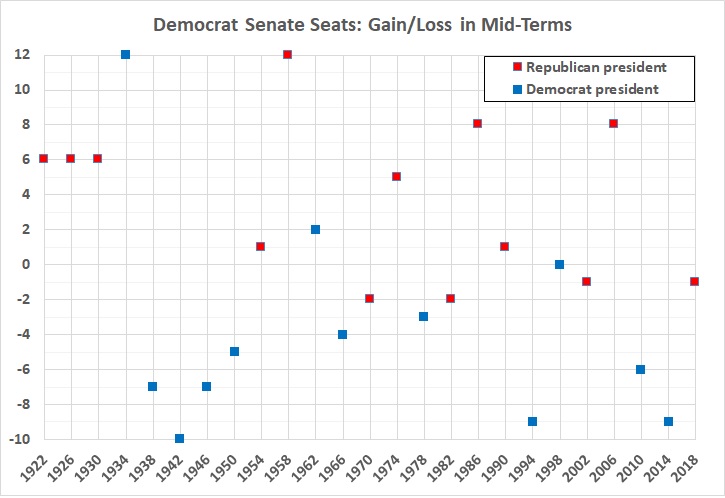
Why the disparity between the House and Senate in this year’s mid-terms?
If the mid-terms had been a “referendum” on Trump, as often suggested (even by Trump), the House and Senate would have gone in the same direction. They didn’t because the election wasn’t entirely about Trump.
One story is that the Dems gained in the House because of a focus on health care. It is the Dems’ own creation — Obamacare — that has pushed health-care costs and premiums ever higher in recent years. But that matters not to ignorant voters, who are sucked in by promises to “get it right”. Dems are good at making such promises.
The Senate results tell a different story. It was possible for Trump to lend visible and vocal support to GOP Senate candidates in a way that he couldn’t for the vastly greater number of GOP House candidates. So, if anything, the “referendum” on Trump occurred in Senate races, and Trump won.
2020 Vision (II)
I made a bold prediction in “2020 Vision“:
- Trump holds Florida, Iowa, Michigan, Ohio, and Pennsylvania.
- He adds Maine, Minnesota, Nevada, and New Hampshire.
- Of the usually Red States that are sliding toward the Blue column — Arizona, Georgia, North Carolina, and Texas — he loses only Arizona.
Bottom line, 318 electoral votes, and possibly even a majority of the fictitious “national” popular vote.
I will now temper that prediction by pointing out (unnecessarily) that the GOP candidate (probably Trump) will have a higher hill to climb than the Democrat candidate.
Here’s how the 2020 electoral vote looks to me, at the moment: solid Democrat, 235; solid Republican, 132; in play, 171. I am still confident that Trump (or his successor) can win in 2020 — the “Blue Wall” is a myth. But victory won’t come as easily as my earlier post implied.
The States in play in 2020 (and the number of electoral votes for each) are:
Florida (29)
Georgia (16)
Maine (4)
Michigan (16)
Minnesota (10)
Nevada (6)
New Hampshire (4)
Ohio (18)
Pennsylvania (20)
Texas (38)
Wisconsin (10)
Visually (with blue for Republican, red for Democrat, and purple for in play):

Adapted from the electoral map for 2016 at Dave Leip’s Atlas of U.S. Presidential Elections. Leip uses blue for Republican and red for Democrat.
2020 Vision
Trump confounded most expectations in 2016 by taking Florida, Iowa, and Ohio — all Blue since 2004 — and nudging two long-time Blue States — Michigan and Pennsylvania — into the Red column.
What about 2020? A lot of water will flow under the bridge and over the dam in the next two years, but at the moment I see it this way:
- Trump holds Florida, Iowa, Michigan, Ohio, and Pennsylvania.
- He adds Maine, Minnesota, Nevada, and New Hampshire.
- Of the usually Red States that are sliding toward the Blue column — Arizona, Georgia, North Carolina, and Texas — he loses only Arizona.
Bottom line, 318 electoral votes, and possibly even a majority of the fictitious “national” popular vote.
Election 2018
Final forecast here. Good news for the GOP.
A Bobo in Cloud-Cuckoo Land
Bret Stephens, one of the tame “conservatives” at The New York Times, has an op-ed to which my attention was drawn this morning: “Why Aren’t Democrats Walking Away With the Mid-Terms?“.
Stephens touches upon a thesis that has been enunciated by many. I will come to it by way of Arnold Kling — an unusually sensible economist (e.g., he calls standard macroeconomics “hydraulic economics” and derides the implicit assumption that the economy is single unit — a big GDP factory). Kling has written a book (now in second edition) called The Three Languages of Politics: Talking Across the Political Divide. Here are some relevant passages:
In politics, I claim that progressives, conservatives, and libertarians are like tribes speaking different languages. The language that resonates with one tribe does not connect with the others. As a result, political discussions do not lead to agreement. Instead, most political commentary serves to increase polarization. The points that people make do not open the minds of people on the other side. They serve to close the minds of the people on one’s own side.
Which political language do you speak? Of course, your own views are carefully nuanced, and you would never limit yourself to speaking in a limited language. So think of one of your favorite political commentators, an insightful individual with whom you generally agree. Which of the following statements would that commentator most likely make?
(P) [Progressive] My heroes are people who have stood up for the underprivileged. The people I cannot stand are the people who are indifferent to the oppression of women, minorities, and the poor.
(C) [Conservative] My heroes are people who have stood up for Western values. The people I cannot stand are the people who are indifferent to the assault on the moral virtues and traditions that are the foundation for our civilization.
(L) [Libertarian] My heroes are people who have stood up for individual rights. The people I cannot stand are the people who are indifferent to government taking away people’s ability to make their own choices….
I call this the three-axes model of political communication. A progressive will communicate along the oppressor-oppressed axis, framing issues in terms of the (P) dichotomy. A conservative will communicate along the civilization-barbarism axis, framing issues in terms of the (C) dichotomy. A libertarian will communicate along the liberty-coercion axis, framing issues in terms of the (L) dichotomy….
I do not believe that the three-axes model serves to explain or to describe the different political ideologies. I am not trying to say that political beliefs are caused by one’s choice of axis. Nor am I saying that people think exclusively in terms of their preferred axis. What I am saying is that when we communicate about issues, we tend to fall back on one of the three axes. By doing so, we engage in political tribalism. We signal to members of our tribe that we agree with them, and we enhance our status in the tribe. However, even though it appears that we are arguing against people from other tribes, those people pay no heed to what we say. It is as if we are speaking a foreign language….
The three axes allow each tribe to assert moral superiority. The progressive asserts moral superiority by denouncing oppression and accusing others of failing to do so. The conservative asserts moral superiority by denouncing barbarism and accusing others of failing to do so. The libertarian asserts moral superiority by denouncing coercion and accusing others of failing to do so….
In 2016, Donald Trump surprised many people— including me— by emerging as a powerful political force and prevailing in the presidential election. Trump’s success confounded many analytical frameworks that had worked well in the past, and the three-axes model is not particularly helpful, either.
Progressives certainly viewed Trump through the oppressor-oppressed axis, seeing his pronouncements and his supporters as tinged with racism and threats toward other victim classes. Libertarians viewed Trump through the liberty-coercion axis, seeing him as authoritarian and a danger to liberty.
Conservatives, however, were divided. One faction, represented by a number of writers at the conservative publication National Review, viewed Trump negatively along the civilization-barbarism axis. They saw Trump as scornful of important traditional institutions, including civil discourse, the U.S. Constitution, the Republican Party, and the principle of free trade.
The other conservative faction saw Trump’s opponent in the general election, Hillary Clinton, as a greater threat to civilization. Writing under the pseudonym, Publius Decius Mus, an essayist on the Claremont Institute website described voting against Clinton as analogous to the passengers on one of the planes hijacked on 9/ 11 who managed to storm the cockpit and keep the hijackers from hitting their intended target.
In my view, Trump opened up a new axis. He accomplished that by appealing to people who differ from those with whom I am most acquainted. Some have termed this new axis populist versus elite, or outsider versus insider….
Perhaps the main dividing line is best described in terms of cosmopolitanism. The sections of the country that most strongly supported Hillary Clinton were large cities located along the coasts, where affluent people are used to engaging with foreign cultures, either locally or by traveling abroad. The sections of the country that most strongly supported Donald Trump were rural and small-town areas located away from the coast, where interaction with foreign cultures is much less frequent.
To describe the cosmopolitan outlook, recall the expression “bourgeois bohemians,” coined by journalist David Brooks almost two decades ago. Brooks was describing a cosmopolitan elite, one that enjoys foreign travel and celebrates cultural diversity. The Bobos, as Brooks dubbed them, probably feel more comfortable in Prague than in Peoria.
As I see it, Donald Trump’s supporters were the anti-Bobos. They distrusted foreign people and cultures. But above all, they distrusted and resented the Bobos, and the feeling was mutual. Thus, the axis that I believe best fits the Trump phenomenon is Bobo versus anti-Bobo.
I think this is right. Bret Stephens is a Bobo who believes that “the real threat of the Trump presidency isn’t economic or political catastrophe. It’s moral and institutional corrosion — the debasement of our discourse and the fracturing of our civic bonds.”
Stephens seems not to understand that — in the view of anti-Bobos — civic bonds were fractured long ago by the Bobos who championed school busing, affirmative action, and all that followed under the heading of identity politics, including “open borders”. The anti-Bobos of the North were taken for granted as reliable Democrat voters, largely ignored (by both parties), and then sneered at by Democrats. Hillary Clinton’s characterization of the anti-Bobos (of all regions) as “deplorables” was merely confirmatory, and probably enabled Trump’s victory by putting him over the top in Iowa, Michigan, Ohio, Pennsylvania, and Wisconsin. Trump’s genius has been to speak the language of anti-Bobos and make them feel as if they are valued.
It is unclear to me what “deeper threat [Trump’s] his presidency represents”, as Stephens puts it. Trump, as I argue above, is not divisive. Bobo policies — shared by “establishment” politicians of both parties — have been divisive. Stephens and his ilk (of all parties) simply want the anti-Bobos to shut up, get back in the fold, and accept the crumbs that fall from the Bobos’ table. The “deeper threat”, in other words, is an end to the Bobos’ long reign of error in Washington.
Stephens’s Bobo-ism is fully on display in the final paragraph of his op-ed, where he writes that “The tragedy of Pittsburgh illustrates, among other things, that the president cannot unite us, even in our grief.” What I saw was an immediate attack on Trump for having created an “atmosphere of hate” (shades of Dallas 1963). Trump’s personal behavior — which reflects his long-standing pro-Jewish sympathies — was exemplary, as was the behavior of Rabbi Myers. How, precisely, was Trump supposed to “unite us” when there are tens of millions of Americans — goaded on by the mainstream media — who despise him for the sheer enjoyment of it?
Trump and Election 2018
GO TO “TRUMP IN THE POLLS: AN UPDATE” FOR LATER POLLING DATA.
This was a final update before election day. The Dems won a majority in the House, though a narrow one. Meanwhile, the GOP has increased its majority in the Senate. That is the better half of the loaf because control of the Senate means that Trump can continue to remake the judiciary in a conservative image. Further, the House will be perceived as the obstructionist body for the next two years, setting the stage for a GOP restoration there. Barring the unforeseeable, a largely successful Trump presidency will set the stage for Republican dominance in 2020.
How is Trump’s popularity these days? And how will his standing with voters affect the outcome of tomorrow’s elections?
Trump’s approval ratings have been fairly steady since early in the year, with a recent uptick that bodes well for GOP candidates:
FIGURE 1
 Derived from Rasmussen Reports approval ratings for Trump.
Lest you believe that those numbers are weak, consider this comparison with Obama’s numbers:
FIGURE 2
 Derived from Rasmussen Reports approval ratings for Obama and Trump.
In this age of polarization, it’s hard for any president to routinely attain high marks:
FIGURE 3
 Source: Same as figure 2.
The good news, again, is that Trump’s strong approval rating has been significantly higher than Obama’s for the past several months.
Ratios of the ratios in figure 2 yield enthusiasm ratios: the strength of strong approval ratings relative to overall approval ratings:
FIGURE 4
 Source: Same as figure 2.
Since the spike associated with the Singapore summit, Trump”s enthusiasm ratio has settled into a range that is comfortably higher than Obama’s.
There is a different poll that is more revealing of Trump’s popularity. Every week since the first inauguration of Obama, Rasmussen Reports has asked 2,500 likely voters whether they see the country as going in the “right direction” or being on the “wrong track”. The following graph shows the ratios of “right direction”/”wrong track” for Trump and Obama:
FIGURE 5
 Source: Rasmussen Reports, “Right Direction or Wrong Track“.
The ratio for Trump, after a quick honeymoon start, fell into the same range as Obama’s. But it jumped with the passage of the tax cut in December 2017, and has remained high since then, despite the faux scandals concocted by the leftist media and their concerted attack on Trump.
Figure 5 suggests that the squishy center of the electorate is lining up behind Trump, despite the incessant flow of negative “reporting” about him and his policies. (See “related reading” at the end of this post.) His base is with him all the way.
Trump’s coattails may be be decisive in November. Based on an analysis of the relationships between Obama’s popularity (or unpopularity) and the outcome of House elections, it looks like the GOP will hold the House while losing about 10 seats. (This is a very rough estimate with a wide margin of error.)
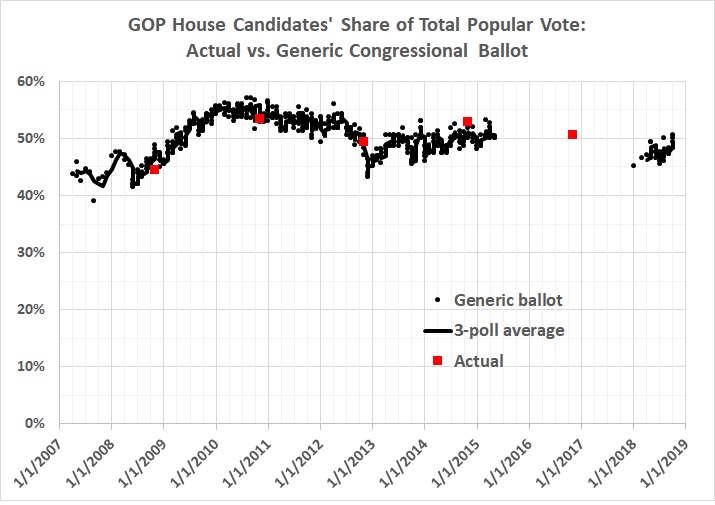
Rasmussen’s generic congressional ballot affords a similar view. The polling data, which are behind a paywall, span April 2007 to May 2015 (when the poll was discontinued), and January 2018 (when the poll was resumed) to the present.
This graph compares the polling results to date with the actual nationwide vote shares compiled by House candidates in the general elections of 2008, 2010, 2010, and 2014:
FIGURE 6
Taking a closer look:
FIGURE 7
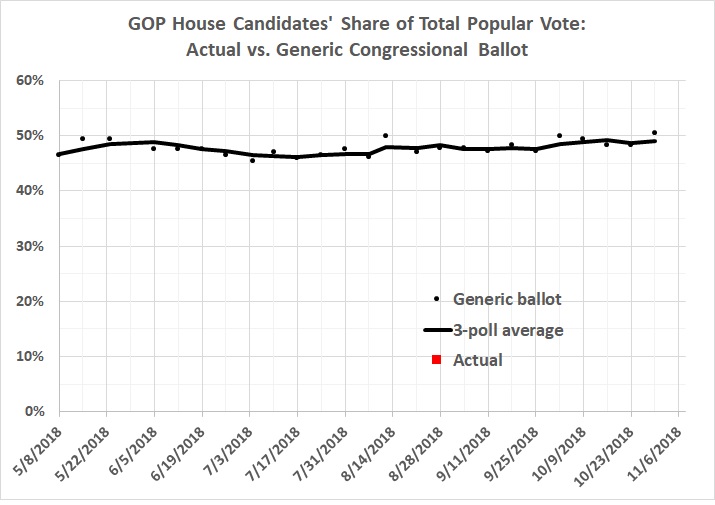
Rasmussen advertises a 2-percentage-point margin of error, which is borne out by the results for the elections of 2008-2014. In fact, the generic congressional ballot was spot-on in 2010 and 2012, while the GOP under-performed slightly in 2008 (the year of the financial crisis) and over-performed slightly in 2014 (a mid-term referendum on Obama).
Let’s say, for the sake of argument, that this year’s polls are spot-on. The latest poll (figure 7) gives the GOP 51 percent of the two-party vote. How does that translate into House seats? Recent history is probably the best guide:
FIGURE 8

A 51-percent share of the vote would give the GOP about 52 percent of House seats; that is, the GOP would hold the House. In fact, two years ago the GOP won more than 55 percent of House seats with 50.5 percent of the two-party vote.
There’s more evidence against the loss of the House:
1. I correlated measures of Obama’s popularity (or lack thereof) with with the outcomes of House mid-terms during his presidency. I then applied those correlations to measures of Trump’s popularity (or lack thereof), which is markedly higher than Obama’s at this stage of their respective presidencies (according to Rasmussen, at least).
2. I correlated the outcomes of post-WWII mid-terms during GOP presidencies with the GOP presidents’ shares of the 2-party vote in the preceding elections. I then applied that result to Trump’s share of the 2-party vote in 2016.
Both methods yield the same result for 2018: a loss of 4 House seats by the GOP (yes, four seats, not 4 percent of seats). The estimates are surrounded by a wide margin of error. Given that, the results support the view that the GOP will hold the House.
In the end, the outcome will depend on turnout. Are Democrats more charged up than Republicans? I don’t think so.
Stay tuned.
Related reading:
Alex Castellanos, “How Trump Has Managed to Defy Gravity“, RealClearPolitics, July 31, 2018
Selwyn Duke, “Media Collusion: 100-Plus Papers Agree to Simultaneously Run Anti-Trump Editorials“, The New American, August 14, 2018
Dennis Prager, “The Greatest Hysteria in American History“, RealClearPolitics, July 24, 2018
Ned Ryun, “None Dared Call It Treason … When It Was a Democrat“, American Greatness, July 24, 2018
What Happens Next?
In what direction will leftists move after next month’s elections?
1. Will they be chastened by defeat and tone down their verbal and physical violence?
2. Will they be frustrated by defeat and keep it up?
3. Will they tone it down if broadly victorious?
4. Will they keep it up if broadly victorious, in the belief that more of the same will yield more of the same.
5. Or will they just keep it up because leftism and violence are intertwined?
The left isn’t monolithic, of course. The loony-left fringe — which is much more than a fringe — will choose #5.
Most left-wing politicians, on the other hand, will probably tone it down — win, lose, or draw. That is, they will choose #1 or #3.
I expect that it will come down to #1. This is from a recent article (behind a paywall) at Rasmussen Reports:
Republicans are madder about the Kavanaugh controversy than Democrats are and more determined to vote in the upcoming elections because of it.
A new Rasmussen Reports national telephone and online survey finds that 54% of all Likely U.S. Voters say they are more likely to vote in the upcoming midterm elections because of the controversy surrounding President Trump’s U.S. Supreme Court nominee. Only nine percent (9%) say they are less likely to vote. Thirty-four percent (34%) say the controversy will have no impact on their vote.
Sixty-two percent (62%) of Republicans are more likely to vote because of the Kavanaugh controversy, compared to 54% of Democrats and 46% of voters not affiliated with either major political party.
Sixty-two percent (62%) of all voters are angry about the U.S. Senate’s treatment of Kavanaugh, with 42% who are Very Angry. Fifty-six percent (56%) are angry about how the Senate treated Christine Blasey Ford, the woman who accused Kavanaugh of sexual assault, including 35% who are Very Angry.
Sixty-four percent (64%) of Republicans are Very Angry about the Senate’s treatment of Kavanaugh, a view shared by 30% of Democrats and 34% of unaffiliated voters. By comparison, fewer Democrats (48%) are Very Angry about the Senate’s treatment of Ford; 28% of GOP voters and 30% of unaffiliateds agree.
Democrats’ five-point lead on the weekly Rasmussen Reports Generic Congressional Ballot has vanished. The two parties are now tied with less than a month until Election Day. We’ll be watching to see if this is the beginning of a post-Kavanaugh trend.
Related posts:
Election 2018 — Latest Updates
“Trump Defies Gravity” — Note especially the “Right Direction”/”Wrong Track” ratio in figure 5 (and in the sidebar). It’s near its post-honeymoon peak for Trump. And it’s about twice as large as the ratio of eight years earlier, when BHO was running ruining the country.
“The House Hangs in the Balance” — Signs that the House will remain in GOP hands.
 Politics and Prosperity