Why Conservatives Shouldn’t Compromise

It’s tempting, sometimes, to compromise with the left’s agenda, which is top-down regulation of social and economic relations. The agenda has a huge constituency, after all. Think of the tens of millions of persons who would be harmed in the short run, if not for a long time, if a leftist scheme were undone.

Consider Obamacare, for example. A key provision of Obamacare — the camel’s nose, head, and shoulders in the tent of universal health care (a.k.a., socialized medicine) — is the vast expansion of eligibility for Medicaid. In the 30-some States that have opted to participate in the expanded program, persons with incomes up to 133 percent of the poverty line are eligible, including adults without dependent children.

It would seem that only a Simon Legree or Ebenezer Scrooge would deny Medicaid coverage to those millions who have obtained it by way of Obamacare. Or it would until the following considerations come to mind:

  • The poverty line is a misleading metric. It’s a relative measure of income, not an absolute one. Most “poor” persons in today’s America are anything but poor in relation the truly poor of the world, and they live far above a subsistence level. The poverty line is nothing but an arbitrary standard that justifies income redistribution.
  • Other persons, with their own problems, are paying for the government’s generous “gift” to the semi-poor. But who is really in a position to say that the problems of Medicaid recipients are more deserving of subsidization than the problems facing those who defray the subsidy?
  • If expanded Medicaid coverage were withdrawn, those now covered would be no worse off than they had been before taxpayers were forced to subsidize them.
  • Being relatively poor used to be a good reason for a person to work his way up the ladder of success. Perhaps not far up the ladder, but in an upward direction. It meant learning skills — on the job, if necessary — and using those skills to move on to more-demanding and higher-paying jobs. Redistributive measures — Medicaid subsidies, food stamps, extended unemployment benefits, etc. — blunt the incentive to better oneself and, instead, reinforce dependency on government.

I will underscore the last point. The lack of something, if it’s truly important to a person, is an incentive for that person to find a way to afford the something. That’s what my parents’ generation did, even in the depths of the Great Depression, without going on the dole. There’s no reason why later generations can’t do it; it’s merely assumed that they can’t. But lots of people do it. I did it; my children did it; my grandchildren are doing it.

Republicans used to say such things openly and with conviction, before they became afraid of seeming “mean.” Principled conservatives should still be thinking and saying such things. When conservatives compromise their principles because they don’t want to seem “mean,” they are complicit in the country’s march down the road to serfdom — dependency on and obeisance to the central government.

Every advance in the direction of serfdom becomes harder and harder to reverse. The abolition of Social Security, Medicare, and Medicaid is now unthinkable, even though those programs have caused hundreds of millions of Americans to become addicted to government handouts.

And how does government pay for those handouts? In part, it taxes many of the people who receive them. It also pays generous salaries and benefits of the army of drones who administer them. It’s a Ponzi scheme enforced at gunpoint.

The best time — usually the only time — to kill a government program is before it starts. That’s why conservatives shouldn’t compromise.

The Problem with Political Correctness

UPDATED BELOW 12/09/16

Why do conservatives and (some) libertarians cringe and react negatively to political correctness? I mean by political correctness “language, policies, or measures that are intended to avoid offense or disadvantage to particular groups in society.” Further, critics of p.c. use the term “as a pejorative, implying that these policies are excessive,” not to mention the language and measures of p.c.-ness.

There are several reasons to reject p.c.-ness:

  1. It is often condescending toward the identity groups it is meant to protect and advance.
  2. It is meant to hide the truth about common characteristics of such groups.
  3. It implies that those persons who don’t join in p.c.-ness are racist bigots with minds that are closed to reality (which is exactly what 1 and 2 say about proponents of p.c.-ness).
  4. The policies and measures that flow from p.c.-ness usually go beyond “avoiding disadvantage to particular groups” to confer advantage on particular groups.
  5. Such policies and measures are therefore anti-libertarian, and often are costly and ineffective (even counterproductive).
  6. Such policies and measures tend to penalize persons who have had nothing to do with any real disadvantages that may have befallen various identity groups.

I can’t speak for conservatives as a group — though they should be a “protected group” (I write sarcastically). But I can tell you that my rejection of p.c.-ness is based on all six of those reasons. And the sum of the six is a devastating attack on social comity (or what’s left of it), even-handed treatment of all persons under the law, freedom of speech, freedom of association, property rights, and the economic well-being of the nation. Other than that, there’s nothing wrong with p.c.-ness.

Whatever merit there is in p.c.-ness, it is canceled by the bad odor that surrounds it. P..c.-ness is a variant of crying wolf: The more often it’s invoked, the less believable it becomes. There’s a corollary: The more people who require p.c. treatment, the fewer people who are left to be blamed for the conditions that p.c.-ness is meant to remedy. Or, if almost everyone is a “victim,” almost no one is a “victim.”

Unless you believe, of course, that straight, white males of European descent are to blame for every bad thing that has befallen every other identity group. Or unless you believe that it’s simply “unfair” for straight, white males of European descent to have been so dominant for so long in so many fields of endeavor.

Was it “unfair” of Newton and Einstein to have been the greatest of physicists? Was in “unfair” of Abraham Lincoln to have been the president who conquered the South and thereby put an end to slavery? Is it “unfair” that there seems to be something in the genetic makeup of East Asians that gives them higher IQs on average than whites, who have higher IQs on average than blacks? (Why aren’t whites complaining about the “unfairness” of the distribution of IQs?) Is it “unfair” that (in the United States, at least) whites, who are on average smarter than blacks, earn more than blacks on average? If that is “unfair,” why is it “fair” that the NBA is dominated by black athletes whose IQs are lower than the IQs of white physicists but who earn many, many times as much as white physicists do?

The problem with “fairness,” which is at the heart of p.c.-ness, is that it is a reality-free concept. It doesn’t take account of the facts of life, such as those alluded to in the preceding paragraph. It assumes that differences in outcomes (e.g., relative earnings, literary fame, scientific achievements, political advancement) are due mainly to one’s membership (or lack thereof) in an identity group. P.c.-ness leaves no room for reality. It leaves no room for individual responsibility. It seeks special treatment for groups of people, regardless of the mental, physical, or moral capacity of each member of a group. (It’s just a variant of white supremacy.)

Which brings me to the deeper reason why conservatives and (some) libertarians instinctively cringe and react negatively to political correctness. Conservatives and libertarians are big on personal responsibility. It’s at the center of libertarianism. It plays an important role in conservatism, where personal responsibility includes not only responsibility for one’s self and for one’s role in society (properly understood), but also responsibility for the observance and continuance of time-tested social norms.

Political correctness casts personal responsibility aside and replaces it with identity politics. That’s the deeper reason why conservatives and (some) libertarians cringe and react negatively to it.

UPDATE 12/09/16

Travis Scott focuses on one (of many) counterproductive effects of political correctness in “The Science Says Putting Women into Combat Endangers National Security” (The Federalist, December 9, 2016). Title of the article speaks for itself. I will quote two passages. The first is about the apprehension of an intruder who climbed over a fence at the White House:

In 2014, a veteran named Omar Gonzalez jumped a fence and rushed the White House. He had a weapon, and made it all the way across the green lawn and into the White House. He was first confronted in the White House by a lone guard, whom he overpowered with ease. He ran through the White House and was not apprehended until he got to the East Room.

Many of the news reports failed to mention that the guard Gonzalez overpowered was a female member of the Secret Service, and that the people who apprehended Gonzalez were males. While the president’s life may have been put in jeopardy by putting a female guard between him and a knife-wielding wild man (a guard the Secret Service had deemed physically fit enough to defend the president), other issues were addressed instead, such as “added layers” of security to the lawn of the White House.

That’s just a single illustration of the folly of the politically correct position which says that women can do everything that men can do. (Most men — conservatives ones, at least — wouldn’t think of claiming that they can do everything that women can do.) More generally, with respect to gender integration of combat forces, Scott writes about the Marine Corps study:

Coinciding with all previous research and scientific findings, in military training also women fail at incredibly higher rates at physically demanding tasks. In 2015, the Marine Corps concluded a yearlong study of how de-sexing units would affect combat readiness. They found: “all-male units were faster, more lethal and able to evacuate casualties in less time… All-male squads, the study found, performed better than mixed gender units across the board. The males were more accurate hitting targets, faster at climbing over obstacles, better at avoiding injuries.” Similar studies within our military, and even from other countries, reinforce these findings.

Irrationally, government officials in the Obama administration have opted to ignore all available scientific data to forward their own politically correct agenda. This suggests they didn’t care what the science said to begin with. It means they are willing to degrade the quality of the military’s effectiveness to artificially advance women who can’t compete by the same standards, and by doing this they are knowingly putting our soldiers at greater risk for injury and death. For this, their actions are condemnable before God and all the men of their country.

While some nitpick the all-male versus mixed-sex units study, no one has suggested studying how effective all-male units would be against all-female units. Not only are there simply not enough women capable and willing to fill such roles, but nobody thinks all-female units could be as effective as all-male units. It should stand to reason that because we know women are weaker then men on a biological level, that it should be obvious that integrating women into all-male units would tactically weaken those units. When you take these plain truths and put them together, the Marine Corps findings aren’t all that surprising.

Sgt. Maj. Justin D. Lehew, who was a part of this Marine Corps study, lashed back at critics who claimed “better women could have been picked,” and that the evaluators’ mindsets were “biased” against women from the start:

We selected our best women for this test unit, selected our most mature female leaders as well. The men (me included) were the most progressive and open minded that you could get… The best women in The GCEITF as a group in regard to infantry operations were equal or below in most all cases to the lowest 5 percent of men as a group in this test study. They are slower on all accounts in almost every technical and tactical aspect and physically weaker in every aspect across the range of military operations… Listen up folks. Your senior leadership of this country does not want to see America overwhelmingly succeed on the battlefield, it wants to ensure that everyone has an opportunity to pursue whatever they want regardless of the outcome on national security…There is nothing gender biased about this, it is what it is. You will never see a female Quarterback in the NFL, there will never be a female center on any NHL team and you will never see a female batting in the number 4 spot for the New York Yankees. It is what it is.

What it comes down to is this: Conservatives are realists. Politically correct “liberals” are fantasists.

Freedom of Speech and the Long War for Constitutional Governance

Freedom of speech is at the heart of the war between the friends and enemies of liberty. The Constitution’s guarantee of freedom of speech is misunderstood. The social order that underlies liberty has been undermined by the Supreme Court’s free-speech absolutism. At the same time, the kind of speech that should be protected by the First Amendment is increasingly suppressed by the enemies of liberty, who will find succor in Justice Kennedy’s ruling in Obergefell v. Hodges.

The restoration of freedom of speech, properly understood, will take a long time and determined action by conservatives. It will require a counter-revolution against the insidious, decades-long spread of leftist doctrines by “educators” and the media.

THE SLIPPERY SLOPE AWAY FROM REASONED DISSENT

Bill Vallicella (Maverick Philosopher) characteristically asks a tough question, and answers it:

Ought flag burning come under the rubric of protected speech?  Logically prior question: Is it speech at all?  What if I make some such rude gesture in your face as ‘giving you the finger.’  Is that speech?  If it is, I would like to know what proposition it expresses.  ‘Fuck you!’ does not express a proposition.  Likewise for the corresponding gesture with the middle finger.  And if some punk burns a flag, I would like to know what proposition the punk is expressing.

The Founders were interested in protecting reasoned dissent, but the typical act of flag burning by the typical leftist punk does not rise to that level.  To have reasoned or even unreasoned dissent there has to be some proposition that one is dissenting from and some counter-proposition that one is advancing, and one’s performance has to make more or less clear what those propositions are.  I think one ought to be skeptical of arguments that try to subsume gestures and physical actions under speech.

The only reasonable objection to Vallicella’s position is that a government which can outlaw flag-burning or finger-flipping can outlaw any form of expression. The objection is a slippery-slope argument: allow X (suppression of certain forms of expression) and Y (suppression of any kind of expression, at the whim of government) is sure to follow.

What has happened, in fact, is the opposite: Forms of expression (i.e., speech and symbolic acts) that had been outlawed have been made legal by the U.S. Supreme Court. Examples are the showing of films that the authorities of a State considered obscene, the utterance or publication of statements advocating the overthrow of government, and flag-burning. The Court has developed something like an absolute position regarding freedom of speech — or, more accurately, freedom of expression.

For example, only where advocacy of and organization for an overthrow of government is deemed to be a “clear and present danger” can such advocacy or organization be curbed. Which is somewhat like waiting to shoot at an enemy armed with a long-range rifle until you are able to see the whites of his eyes. Or, perhaps more aptly in the 21st century, waiting until a terrorist strikes before acting against him. Which is too late, of course, and impossible in the usual case of suicide-cum-terror.

And therein lies the dangerous folly of free-speech absolutism. A general and compelling case against the current reign of absolutism is made by David Lowenthal in No Liberty for License: The Forgotten Logic of the First Amendment. Lowenthal’s case is summarized in Edward J. Erler’s review of the book (“The First Amendment and the Theology of Republican Government,” Interpretation, Spring 2000):

The thesis of David Lowenthal’s [book] is as bold as it is simple: “the First Amendment, intended as a bulwark of the republic, has become a prime agent of its destruction” (p. xiv). Lowenthal rightly argues that the First Amendment was adopted for a political purpose; it sought to protect only those liberties necessary for the preservation of republican government. Today, however, the focus of the First Amendment is on “individual rights” rather than the common good, at it is this “over-expansion of individual liberty” that Lowenthal believes has led to the vast decline of the “moral and political health of the republic,” a decline that undermines the very foundations of liberty itself. Indeed, the Supreme Court has “made individual freedom its god — at the expense of the moral, social, and political needs of ordered society” (p. xiv).

Lowenthal argues that this corruption in First Amendment jurisprudence was caused by the deliberate departure from the intentions of its framers: “the great impetus for movement in the direction of extreme liberty came not from within the system but from new philosophies and theories, mostly imported from abroad…. The main culprit here, according to Lowenthal, is John Stuart Mill who, in the hands of Justices Holmes and Brandeis, became the intellectual guide for a “second, hidden founding” (pp. 54, 45, 248, 250, 253, 267, 273). It was Mill who “supplied a new theoretical foundation for liberty, calling for its vast expansion in the name of freedom of thought,” and by the middle of the twentieth century, those forces set in motion by modernity, “relativism and subjectivism,” had become the dominant mode of thought informing constitutional interpretation (p. 267). Mill and his epigones replaced the founders as the source for understanding the Constitution.

The efforts of Holmes and Brandeis, of course, were part of the larger Progressive movement. The explicit goal of Progressivism was to free the Constitution from its moorings of the founding, most particularly from the “static” doctrines of the Declaration of Independence and its reliance on the permanent truths of the “laws of nature and nature’s God.” Progressivism itself was only one strain of modernity, but it shared with the other strains the depreciation of both reason and revelation as sources of moral and political authority. Progressivism was phenomenally successful in it debunking of the founding and its reformist zeal appealed wholly to the passions. It sought to liberate the passions from the constraints of morality, whereas the founders appealed to the “reason … of the public” (The Federalist, No. 49 [Rossiter, ed.] p. 317) as the foundation of moral and political order. The appeal to reason will always be more difficult than the appeal to passion, especially when the appeal to passion has itself assumed a kind of “moral” authority. It should not be surprising therefore that the success of the “Holmes-Brandeis school of jurisprudence,” in Lowenthal’s estimation, “is wholly out of keeping with its intrinsic merits” (p. 61).

Progressivism was a wholly alien doctrine; it derived not from any thought of the founding, but from Continental thought, principally of Hegel. The result was moral relativism verging on nihilism. But Lowenthal rightly questions “whether any alien doctrines, any doctrines other than those of the founders and framers, written into the language of the Constitution, should be so employed” (p. 54). Lowenthal supports original intent jurisprudence because the ideas of the framers and founders “remain constitutionally, politically, and morally superior to those that have displaced them” (p. xxii). Lowenthal does not minimize the difficulty of restoring the founding to its rightful place; he believe the republic is in grave danger and the danger is more than abundantly evident in the current understanding of the First Amendment. Lowenthal’s account is not that of a mere intellectual; it is written with a verve, moral passion, and deep understanding that is almost unknown among intellectuals.

The First Amendment, in the hands of the Supreme Court, has become inimical to the civil and state institutions that enable liberty. The Court has been so busy protecting the right of the media to subvert the national defense, that it hasn’t spared the time to extend its free-speech absolutism by striking down speech codes at taxpayer-funded universities. That’s perverse because, among many things, speech codes are intended to suppress the very kind of political dissent that the First Amendment was meant to protect. It isn’t protected because it’s conservative dissent from “liberal” orthodoxy.

ENTER THE AMORPHOUS HARM PRINCIPLE

One aspect of that orthodoxy, which Lowenthal addresses, is John Stuart Mill’s harm principle:

[T]he sole end for which mankind are warranted, individually or collectively in interfering with the liberty of action of any of their number, is self-protection. That the only purpose for which power can be rightfully exercised over any member of a civilized community, against his will, is to prevent harm to others. [John Stuart Mill, On Liberty (1869), Chapter I, paragraph 9.]

This is empty rhetoric. Theodore Dalrymple exposes its emptiness in “The Simple Truth about J.S. Mill’s Simple Truth” (Library of Law and Liberty, July 20, 2015). Dalrymple writes about the legalization of drugs, but his indictment of the harm principle is general:

I can do as I please, and take what I like, so long as I harm no others.

One can easily sympathize with this attempt to delimit the relations between the individual and the state or other powerful authorities. Every government today is in practice vastly more oppressive than that of George III in the American colonies. Which of us does not feel an increasing weight on him of regulation, prohibition, and compulsion from on high—most of it nowadays supposedly for our own good—to help us lead a better or a longer life whether we want it or not? How are we to hold back the flood of official intrusion into our lives without a principle to distinguish legitimate from illegitimate intrusion?…

The objections to the Millian premise of the call to drug legalization are well-known. Man is a social as well as a political animal, and except for the very few who live in genuine isolation, almost all that we do affects someone else….

We may, indeed we ought to, have a bias or presumption in favor of individual liberty, and we should also have a lively appreciation of the fact that interference with liberty to prevent harm to others may actually cause more harm than it prevents. Moreover, because liberty is a good in itself, loss of liberty is a harm in itself, always to be taken into account.

None of this means that there is a very clear principle that can lay down in advance the limits of liberty, such as Mill wants (and the would-be legalizers of drugs rely upon)….

The libertarian position with regard to drugs would be more convincing if the costs of the choices of those who took them could be brought home to them alone. We know that, in practice, they are shared….

In short, there is no “very simple principle” of the kind that Mill enunciated, with an eloquence that disguised a certain hollowness, that establishes as inherently wrong the forbidding of citizens to take whatever drugs they like. By the same token, there is no very simple principle that will determine which drugs should be permitted and which banned.

If it is right to begin permitting the consumption of a heretofore banned drug, it must, therefore, be on other grounds than that “the sole end for which mankind are warranted individually or collectively in interfering with the liberty of action of any of their number is self-protection.” As Einstein said, a theory should be as simple as possible, but not simpler than possible.

(See also: “Toleration Extremism: Notes on John Stuart Mill“, Maverick Philosopher, January 14, 2015.)

THE SUBVERSION OF SOCIAL NORMS IS THE SUBVERSION OF LIBERTY

Harm must be defined. And its definition must arise from voluntarily evolved social norms. Such norms evince and sustain the mutual trust, respect, forbearance, and voluntary aid that — taken together — foster willing, peaceful coexistence and beneficially cooperative behavior. And what is liberty but willing, peaceful coexistence and beneficially cooperative behavior?

Behavior is shaped by social norms. Those norms once were rooted in the Ten Commandments and time-tested codes of behavior. They weren’t nullified willy-nilly in accordance with the wishes of “activists,” as amplified through the megaphone of the mass media, and made law by the Supreme Court. What were those norms? Here are some of the most important ones:

Marriage is a union of one man and one woman. Nothing else is marriage, despite legislative, executive, and judicial decrees that substitute brute force for the wisdom of the ages.

Marriage comes before children. This is not because people are pure at heart, but because it is the responsible way to start life together and to ensure that one’s children enjoy a stable, nurturing home life.

Marriage is until “death do us part.” Divorce is a recourse of last resort, not an easy way out of marital and familial responsibilities or the first recourse when one spouse disappoints or angers the other.

Children are disciplined — sometimes spanked — when they do wrong. They aren’t given long, boring, incomprehensible lectures about why they’re doing wrong. Why not? Because they usually know they’re doing wrong and are just trying to see what they can get away with.

Drugs are taken for the treatment of actual illnesses, not for recreational purposes.

Income is earned, not “distributed.” Persons who earn a lot of money are to be respected. If you envy them to the point of wanting to take their money, you’re a pinko-commie-socialist (no joke).

People should work, save, and pay for their own housing. The prospect of owning one’s own home, by dint of one’s own labor, is an incentive to work hard and to advance oneself through the acquisition of marketable skills.

Welfare is a gift that one accepts as a last resort, it is not a right or an entitlement, and it is not bestowed on persons with convenient disabilities.

Sexism (though it isn’t called that) is nothing more than the understanding — shared by men and women — that women are members of a different sex (the only different one); are usually weaker than men; are endowed with different brain chemistry and physical skills than men (still a fact); and enjoy discreet admiration (flirting) if they’re passably good-looking, or better. Women who reject those propositions — and who try to enforce modes of behavior that assume differently — are embittered and twisted.

A mother who devotes time and effort to the making of a good home and the proper rearing of her children is a pillar of civilized society. Her life is to be celebrated, not condemned as “a waste.”

Homosexuality is a rare, aberrant kind of behavior. (And that was before AIDS proved it to be aberrant.) It’s certainly not a “lifestyle” to be celebrated and shoved down the throats of all who object to it.

Privacy is a constrained right. It doesn’t trump moral obligations, among which are the obligations to refrain from spreading a deadly disease and to preserve innocent life.

Addiction isn’t a disease; it’s a surmountable failing.

Justice is for victims. Victims are persons to whom actual harm has been done by way of fraud, theft, bodily harm, murder, and suchlike. A person with a serious disease or handicap isn’t a victim, nor is a person with a drinking or drug problem.

Justice is a dish best served hot, so that would-be criminals can connect the dots between crime and punishment. Swift and sure punishment is the best deterrent of crime. Capital punishment is the ultimate deterrent because an executed killer can’t kill again.

Peace is the result of preparedness for war; lack of preparedness invites war.

The list isn’t exhaustive, but it’s certainly representative. The themes are few and simple: respect others, respect tradition, restrict government to the defense of society from predators foreign and domestic. The result is liberty: A regime of mutually beneficial coexistence based on mutual trust and respect. That’s all it takes — not big government bent on dictating new norms just because it can.

But by pecking away at social norms that underlie mutual trust and respect, “liberals” have sundered the fabric of civilization. There is among Americans the greatest degree of mutual enmity (dressed up as political polarization) since the Civil War.

The mutual enmity isn’t just political. It’s also racial, and it shows up as crime. Heather Mac Donald says “Yes, the Ferguson Effect Is Real,” and Paul Mirengoff shows that “Violent Crime Jumped in 2015.” I got to the root of the problem in “Crime Revisited,” to which I’ve added “Amen to That” and “Double Amen.” What is the root of the problem? A certain, violence-prone racial minority, of course, and also under-incarceration (see “Crime Revisited”).

The Ferguson Effect is a good example of where the slippery slope of free-speech absolutism leads. More examples are found in the violent protests in the wake of Donald Trump’s electoral victory. The right “peaceably to assemble, and to petition the Government for a redress of grievances” has become the right to assemble a mob, disrupt the lives of others, destroy the property of others, injure and kill others, and (usually) suffer no consequences for doing so — if you are a leftist or a member of one of the groups patronized by the left, that is.

THE REVERSE SLIPPERY-SLOPE

But that’s not the end of it. There’s a reverse slippery-slope effect when it comes to ideas opposed by the left. There are, for example, speech codes at government-run universities; hate-crime laws, which effectively punish speech that offends a patronized group; and penalties in some States for opposing same-sex “marriage” (a recent example is documented here).

Justice Kennedy’s egregious majority opinion in Obergefell v.Hodges lays the groundwork for more suppression. This is from Chief Justice Roberts’s dissent (references omitted):

Respect for sincere religious conviction has led voters and legislators in every State that has adopted same-sex marriage democratically to include accommodations for religious practice. The majority’s decision imposing same-sex marriage cannot, of course, create any such accommodations. The majority graciously suggests that religious believers may continue to “advocate” and “teach” their views of marriage. The First Amendment guarantees, however, the freedom to “exercise” religion.Ominously, that is not a word the majority uses.

Hard questions arise when people of faith exercise religion in ways that may be seen to conflict with the new right to same-sex marriage—when, for example, a religious college provides married student housing only to opposite-sex married couples, or a religious adoption agency declines to place children with same-sex married couples. Indeed, the Solicitor General candidly acknowledged that the tax exemptions of some religious institutions would be in question if they opposed same-sex marriage. There is little doubt that these and similar questions will soon be before this Court. Unfortunately, people of faith can take no comfort in the treatment they receive from the majority today.

Perhaps the most discouraging aspect of today’s decision is the extent to which the majority feels compelled to sully those on the other side of the debate. The majority offers a cursory assurance that it does not intend to disparage people who, as a matter of conscience, cannot accept same-sex marriage. That disclaimer is hard to square with the very next sentence, in which the majority explains that “the necessary consequence” of laws codifying the traditional definition of marriage is to “demea[n]or stigmatiz[e]” same-sex couples. The majority reiterates such characterizations over and over. By the majority’s account, Americans who did nothing more than follow the understanding of marriage that has existed for our entire history—in particular, the tens of millions of people who voted to reaffirm their States’ enduring definition of marriage—have acted to “lock . . . out,” “disparage,”“disrespect and subordinate,” and inflict “[d]ignitary wounds” upon their gay and lesbian neighbors. These apparent assaults on the character of fairminded people will have an effect, in society and in court. Moreover, they are entirely gratuitous. It is one thing for the majority to conclude that the Constitution protects a right to same-sex marriage; it is something else to portray everyone who does not share the majority’s “better informed understanding” as bigoted.

Justice Alito, in his dissent, foresees that the majority opinion

will be used to vilify Americans who are unwilling to assent to the new orthodoxy. In the course of its opinion,the majority compares traditional marriage laws to laws that denied equal treatment for African-Americans and women. The implications of this analogy will be exploited by those who are determined to stamp out every vestige of dissent.

Perhaps recognizing how its reasoning may be used, the majority attempts, toward the end of its opinion, to reassure those who oppose same-sex marriage that their rights of conscience will be protected. We will soon see whether this proves to be true. I assume that those who cling to old beliefs will be able to whisper their thoughts in the recesses of their homes, but if they repeat those views in public, they will risk being labeled as bigots and treated as such by governments, employers, and schools.

I expect Roberts and Alito to be proved right unless the election of Donald Trump soon results in a conservative majority on the Court, that is, the replacement of Kennedy or one of his allies in Obergefell v. Hodges.

In sum, there is no longer such a thing as the kind of freedom of speech intended by the Framers of the Constitution. There is on the one hand license for “speech” that subverts and flouts civilizing social norms — the norms that underlie liberty. There is on the other hand a growing tendency to suppress speech that supports civilizing social norms.

A WAR BY ANY OTHER NAME

What I have just described is a key component of the left’s continuing and relentless effort to reshape the world to its liking. Leftists don’t care about the licentious consequences of free-speech absolutism because they’re insulated from those consequences (or so they believe). Their motto should be “I’m all right, Jack.”

But leftists do care about making government big and all-powerful, so that it can enact the programs and policies they favor. To that end, leftists seek to suppress political dissent and to subvert voluntary cooperative behavior, which is found not only in evolved social norms but also in free markets. The people must be brought to heel at the command of big brother, who knows best.

It is war, in other words, and more than a culture war. It’s a war between the enemies of liberty and those who want liberty, not license. The problem is that too many of those who want liberty don’t know that there is a war. For one thing, those who want liberty aren’t necessarily self-described libertarians; rather, they’re traditional conservatives (Burkean libertarians) who, by nature, are attuned to beneficial cooperation, not ideological conflict. For another thing, many of those who want liberty have been brainwashed into believing that leftists also want liberty but are misguided about how to attain it.

It may be too late to pull victory from the jaws of defeat. But while there is still freedom to challenge the enemies of liberty there is still hope for the restoration of constitutional governance.

I would return to first principles. The United States was reconstituted in 1788 when the Constitution was ratified. As stated in the preamble to the Constitution, one of the purposes for reconstituting the nation was to “secure the Blessings of Liberty to ourselves and our Posterity.”

Why, then, should the government of the United States tolerate the promulgation of anti-libertarian views? It is evident that in practice the free-speech slippery slope really leads away from liberty not toward it. I’m referring not just to riotous, licentious behavior that flouts civilizing norms and undermines them. I’m also referring to something much deeper and more subversive than that: the toleration of speech that has turned the Constitution on its head by converting the central government from a miserly, non-interfering night watchman to a partisan, micro-managing nanny with deep pockets into which almost everyone is allowed to dip.

This means, at a minimum, and end to free-speech absolutism, which has become a license for two-percent tyranny and the destruction of civilizing social norms. It also means taking a hard line with respect to advocates of big, intrusive government. It will be a cold day in hell before there is a president and a Congress and a Supreme Court who consistently and concertedly take a hard line — and carry it into action. Donald Trump is preferable to Hillary Clinton, but he is a far cry from Ronald Reagan, let alone Calvin Coolidge (my favorite president). The Republican majorities in Congress are infested with special pleaders who will log-roll until the cows come home. The Supreme Court will continue to be the Kennedy Court until Trump is able to replace Kennedy or one of the leftists with whom he allies increasingly often — assuming that Trump will stay true to his word about the conservative character of his nominees.

In sum, there’s no prospect of quick or certain victory in the war to restore constitutional governance to Washington and liberty to the land.

THE LONG WAR AHEAD

Conservatives must be prepared for and committed to a long war, with the aim of changing the character of the institutions that — in addition to family — hold the most sway over the minds of future leaders and the voters who will select those leaders: public schools, universities, and the media.

The long war will be a war to transform fundamentally the prevailing ethos of a nation that has sunk gradually into decadence and despotism. (Barack Obama’s “fundamental transformation” was nothing more than the proverbial frosting on the proverbial cake.) How does one even begin to wage such a war?

I would begin by following a key maxim of war-fighting: concentration of force. Roll up one enemy unit at a time instead of attacking on a broad front. As each enemy unit falls, the rest become relatively weaker by having fewer friendly units to call on for support.

Imagine, for example, a conservative takeover of several major universities,* which might be abetted by a concentrated campaign by conservative trustees with the support of friendly forces within the universities, and a few sympathetic media outlets, all backed by a loud and sustained chorus of supportive reporting, commentary, and outright propaganda emanating from the blogosphere. University administrators, as we have seen, are especially sensitive to changes in the prevailing direction of opinion, especially if that opinion is fomented within universities. Thus, if one major university were to move sharply in a conservative direction, it would take less effort to move a second one, even less effort to move a third one, and so on.

With universities falling into line, it would be a fairly simple task to remake the face of public education. It is universities, after all, which are mainly responsible for the left-wing indoctrination that most public-school teachers and administrators have been spreading throughout most of the land for many decades. It wouldn’t take a generation for the new, conservative disposition to spread. It would spread almost like wildfire for the same reasons that it would spread rapidly among universities: the desire to be “on the right side of history,” no matter what side it is. It would become more or less permanent, however, as new waves of students leave the universities that have converted to conservatism and begin to spread its gospel in public schools.

The conversion of the media would proceed in parallel with the conversion of public schools. It would be a self-inflicted conversion, born of the desire to please an audience that is becoming more and more conservative. The act of pleasing that audience would, in turn, result in the dissemination of stories with a conservative slant, which would help to speed the conversion of the as-yet unconverted members of the audience.

As for how to arrange a conservative takeover of a major university, I would begin with those few that have shown themselves ripe for conversion. Perhaps it’s one of the 27 universities that is a rated a “green-light institution” by the Foundation for Individual Rights in Education (FIRE). The University of Chicago is a recent and prominent addition to that list.

Wherever the campaign begins, it should begin with a university whose trustees, sources of income, faculty, and current ideological balance make it ready to be pushed into the ranks of conservative institutions. Perhaps it would be a matter of electing a few more conservative trustees, with the help of a major donation from a conservative source. Perhaps a key department could be moved to the conservative side of the ledger by the hiring of a few faculty members. Perhaps the university needs only a slight push to become a leader in the refutation of speech codes, “safe spaces,” “trigger warnings,” and in the open embrace of conservative speakers and movements.

The devil is in the details, and I’m not conversant enough with the state of any university to suggest how or where to begin the campaign. But begin it must — and soon, before it’s too late to reverse the incoming tide of leftist regimentation of all aspects of our lives.
__________
* A takeover is better than a startup. A takeover not only means that there’s one less “enemy” to fight, but it also means that some “enemy” forces have been converted to friendly ones, which sets a precedent for more takeovers. Fox News Channel is a case in point. Its creation didn’t reduce the number of left-wing outlets. And the growth of FNC’s market share at the expense of left-wing outlets (mainly CNN) merely tapped into a ready market for a somewhat conservative outlet; it didn’t create that market. Further, FNC isn’t “serious” in the way that a university is, and so its slant is more easily dismissed as propaganda than would be the emanations from a major university.

Intelligence, Assortative Mating, and Social Engineering

UPDATED 11/18/16 (AT THE END)

What is intelligence? Why does it matter in “real life”? Are intelligence-driven “real life” outcomes — disparities in education and income — driving Americans apart? In particular, is the intermarriage of smart, educated professionals giving rise to a new hereditary class whose members have nothing in common with less-intelligent, poorly educated Americans, who will fall farther and farther behind economically? And if so, what should be done about it, if anything?

INTELLIGENCE AND WHY IT MATTERS IN “REAL LIFE”

Thanks to a post at Dr. James Thompson’s blog, Psychological comments, I found Dr. Linda Gottredson‘s paper, “Why g Matters: The Complexity of Everyday Life” (Intelligence 24:1, 79-132, 1997). The g factor — or just plain g — is general intelligence. I quote Gottredson’s article at length because it makes several key points about intelligence and why it matters in “real life.” For ease of reading, I’ve skipped over the many citations and supporting tables than lend authority to the article.

[W]hy does g have such pervasive practical utility? For example, why is a higher level of g a substantial advantage in carpentry, managing people, and navigating vehicles of all kinds? And, very importantly, why do those advantages vary in the ways they do? Why is g more helpful in repairing trucks than in driving them for a living? Or more for doing well in school than staying out of trouble?…

Also, can we presume that similar activities in other venues might be similarly affected by intelligence? For example, if differences in intelligence change the odds of effectively managing and motivating people on the job, do they also change the odds of successfully dealing with one’s own children? If so, why, and how much?

The heart of the argument I develop here is this: For practical purposes, g is the ability to deal with cognitive complexity — in particular, with complex information processing. All tasks in life involve some complexity, that is, some information processing. Life tasks, like job duties, vary greatly in their complexity (g loadedness). This means that the advantages of higher g are large in some situations and small in others, but probably never zero….

Although researchers disagree on how they define intelligence, there is virtual unanimity that it reflects the ability to reason, solve problems, think abstractly, and acquire knowledge. Intelligence is not the amount of information people know, but their ability to recognize, acquire, organize, update, select, and apply it effectively. In educational contexts, these complex mental behaviors are referred to as higher order thinking skills.

Stated at a more molecular level, g is the ability to mentally manipulate information — “to fill a gap, turn something over in one’s mind, make comparisons, transform the input to arrive at the output”….

[T]he active ingredient in test items seems to reside in their complexity. Any kind of item content-words, numbers, figures, pictures, symbols, blocks, mazes, and so on-can be used to create less to more g-loaded tests and test items. Differences in g loading seem to arise from variations in items’ cognitive complexity and thus the amount of mental manipulation they require….

Life is replete with uncertainty, change, confusion, and misinformation, sometimes minor and at times massive. From birth to death, life continually requires us to master abstractions, solve problems, draw inferences, and make judgments on the basis of inadequate information. Such demands may be especially intense in school, but they hardly cease when one walks out the school door. A close look at job duties in the workplace shows why….

When job analysis data for any large set of jobs are factor analyzed, they always reveal the major distinction among jobs to be the mental complexity of the work they require workers to perform. Arvey’s job analysis is particularly informative in showing that job complexity is quintessentially a demand for g….

Not surprisingly, jobs high in overall complexity require more education, .86 and .88, training, .76 and .51, and experience, .62 — and are viewed as the most prestigious, . 82. These correlations have sometimes been cited in support of the training hypothesis discussed earlier, namely, that sufficient training can render differences in g moot.

However, prior training and experience in a job never fully prepare workers for all contingencies. This is especially so for complex jobs, partly because they require workers to continually update job knowledge, .85. As already suggested, complex tasks often involve not only the appropriate application of old knowledge, but also the quick apprehension and use of new information in changing environments….

Many of the duties that correlate highly with overall job complexity suffuse our lives: advising, planning, negotiating, persuading, supervising others, to name just a few….

The National Adult Literacy Survey (NALS) of 26,000 persons aged 16 and older is one in a series of national literacy assessments developed by the Educational Testing Service (ETS) for the U.S. Department of Education. It is a direct descendent, both conceptually and methodologically, of the National Assessment of Educational Progress (NAEP) studies of reading among school-aged children and literacy among adults aged 21 to 25.

NALS, like its NAEP predecessors, is extremely valuable in understanding the complexity of everyday life and the advantages that higher g provides. In particular, NALS provides estimates of the proportion of adults who are able to perform everyday tasks of different complexity levels….

A look at the items in Figure 2 reveals their general relevance to social life. These are not obscure skills or bits of knowledge whose value is limited to academic pursuits. They are skills needed to carry out routine transactions with banks, social welfare agencies, restaurants, the post office, and credit card agencies; to understand contrasting views on public issues (fuel efficiency, parental involvement in schools); and to comprehend the events of the day (sports stories, trends in oil exports) and one’s personal options (welfare benefits, discount for early payment of bills, relative merits between two credit cards)….

[A]lthough the NALS items represent skills that are valuable in themselves, they are merely samples from broad domains of such skill. As already suggested, scores on the NALS reflect people’s more general ability (the latent trait) to master on a routine basis skills of different information-processing complexity….

[I]ndeed, the five levels of NALS literacy are associated with very different odds of economic well-being….

Each higher level of proficiency substantially improves the odds of economic well-being, generally halving the percentage living in poverty and doubling the percentage employed in the professions or management….

The effects of intelligence-like other psychological traits-are probabilistic, not deterministic. Higher intelligence improves the odds of success in school and work. It is an advantage, not a guarantee. Many other things matter.

However, the odds disfavor low-IQ people just about everywhere they turn. The differences in odds are relatively small in some aspects of life (law-abidingness), moderate in some (income), and large in others (educational, occupational attainment). But they are consistent. At a minimum (say, under conditions of simple tasks and equal prior knowledge), higher levels of intelligence act like the small percentage (2.7%) favoring the house in roulette at Monte Carlo — it yields enormous gains over the long run. Similarly, all of us make stupid mistakes from time to time, but higher intelligence helps protect us from accumulating a long, debilitating record of them.

To mitigate unfavorable odds attributable to low IQ, an individual must have some equally pervasive compensatory advantage-family wealth, winning personality, enormous resolve, strength of character, an advocate or benefactor, and the like. Such compensatory advantages may frequently soften but probably never eliminate the cumulative impact of low IQ. Conversely, high IQ acts like a cushion against some of life’s adverse circumstances, perhaps partly accounting for
why some children are more resilient than others in the face of deprivation and abuse….

For the top 5% of the population (over IQ 125), success is really “yours to lose.” These people meet the minimum intelligence requirements of all occupations, are highly sought after for their extreme trainability, and have a relatively easy time with the normal cognitive demands of life. Their jobs are often high pressure, emotionally draining, and socially demanding …, but these jobs are prestigious and generally pay well. Although very high IQ individuals share many of the vicissitudes of life, such as divorce, illness, and occasional unemployment, they rarely become trapped in poverty or social pathology. They may be saints or sinners, healthy or unhealthy, content or emotionally troubled. They may or may not work hard and apply their talents to get ahead, and some will fail miserably. But their lot in life and their prospects for living comfortably are comparatively rosy.

There are, of course, multiple causes of different social and economic outcomes in life. However, g seems to be at the center of the causal nexus for many. Indeed, g is more important than social class background in predicting whether White adults obtain college degrees, live in poverty, are unemployed, go on welfare temporarily, divorce, bear children out of wedlock, and commit crimes.

There are many other valued human traits besides g, but none seems to affect individuals’ life chances so systematically and so powerfully in modern life as does g. To the extent that one is concerned about inequality in life chances, one must be concerned about differences in g….

Society has become more complex-and g loaded-as we have entered the information age and postindustrial economy. Major reports on the U.S. schools, workforce, and economy routinely argue, in particular, that the complexity of work is rising.

Where the old industrial economy rewarded mass production of standardized products for large markets, the new postindustrial economy rewards the timely customization and delivery of high-quality, convenient products for increasingly specialized markets. Where the old economy broke work into narrow, routinized, and closely supervised tasks, the new economy increasingly requires workers to work in cross-functional teams, gather information, make decisions, and undertake diverse, changing, and challenging sets of tasks in a fast-changing and dynamic global market….

Such reports emphasize that the new workplace puts a premium on higher order thinking, learning, and information-processing skills — in other words, on intelligence. Gone are the many simple farm and factory jobs where a strong back and willing disposition were sufficient to sustain a respected livelihood, regardless of IQ. Fading too is the need for highly developed perceptual-motor skills, which were once critical for operating and monitoring machines, as technology advances.

Daily life also seems to have become considerably more complex. For instance, we now have a largely moneyless economy-checkbooks, credit cards, and charge accounts-that requires more abstract thought, foresight, and complex management. More self-service, whether in banks or hardware stores, throws individuals back onto their own capabilities. We struggle today with a truly vast array of continually evolving complexities: the changing welter of social services across diverse, large bureaucracies; increasing options for health insurance, cable, and phone service; the steady flow of debate over health hazards in our food and environment; the maze of transportation systems and schedules; the mushrooming array of over-the-counter medicines in the typical drugstore; new technologies (computers) and forms of communication (cyberspace) for home as well as office.

Brighter individuals, families, and communities will be better able to capitalize on the new opportunities this increased complexity brings. The least bright will use them less effectively, if at all, and so fail to reap in comparable measure any benefits they offer. There is evidence that increasing proportions of individuals with below-average IQs are having trouble adapting to our increasingly complex modern life and that social inequality along IQ lines is increasing.

CHARLES MURRAY AND FISHTOWN VS. BELMONT

At the end of the last sentence, Gottfredson refers to Richard J. Herrnstein and Charles Murray’s The Bell Curve: Intelligence and Class Structure in American Life (1994). In a later book, Coming Apart: The State of White America, 1960-2010 (2012), Murray tackles the issue of social (and economic) inequality. Kay S. Hymowitz summarizes Murray’s thesis:

According to Murray, the last 50 years have seen the emergence of a “new upper class.” By this he means something quite different from the 1 percent that makes the Occupy Wall Streeters shake their pitchforks. He refers, rather, to the cognitive elite that he and his coauthor Richard Herrnstein warned about in The Bell Curve. This elite is blessed with diplomas from top colleges and with jobs that allow them to afford homes in Nassau County, New York and Fairfax County, Virginia. They’ve earned these things not through trust funds, Murray explains, but because of the high IQs that the postindustrial economy so richly rewards.

Murray creates a fictional town, Belmont, to illustrate the demographics and culture of the new upper class. Belmont looks nothing like the well-heeled but corrupt, godless enclave of the populist imagination. On the contrary: the top 20 percent of citizens in income and education exemplify the core founding virtues Murray defines as industriousness, honesty, marriage, and religious observance….

The American virtues are not doing so well in Fishtown, Murray’s fictional working-class counterpart to Belmont. In fact, Fishtown is home to a “new lower class” whose lifestyle resembles The Wire more than Roseanne. Murray uncovers a five-fold increase in the percentage of white male workers on disability insurance since 1960, a tripling of prime-age men out of the labor force—almost all with a high school degree or less—and a doubling in the percentage of Fishtown men working less than full-time…..

Most disastrous for Fishtown residents has been the collapse of the family, which Murray believes is now “approaching a point of no return.” For a while after the 1960s, the working class hung on to its traditional ways. That changed dramatically by the 1990s. Today, under 50 percent of Fishtown 30- to 49-year-olds are married; in Belmont, the number is 84 percent. About a third of Fishtowners of that age are divorced, compared with 10 percent of Belmonters. Murray estimates that 45 percent of Fishtown babies are born to unmarried mothers, versus 6 to 8 percent of those in Belmont.

And so it follows: Fishtown kids are far less likely to be living with their two biological parents. One survey of mothers who turned 40 in the late nineties and early 2000s suggests the number to be only about 30 percent in Fishtown. In Belmont? Ninety percent—yes, ninety—were living with both mother and father….

For all their degrees, the upper class in Belmont is pretty ignorant about what’s happening in places like Fishtown. In the past, though the well-to-do had bigger houses and servants, they lived in towns and neighborhoods close to the working class and shared many of their habits and values. Most had never gone to college, and even if they had, they probably married someone who hadn’t. Today’s upper class, on the other hand, has segregated itself into tony ghettos where they can go to Pilates classes with their own kind. They marry each other and pool their incomes so that they can move to “Superzips”—the highest percentiles in income and education, where their children will grow up knowing only kids like themselves and go to college with kids who grew up the same way.

In short, America has become a segregated, caste society, with a born elite and an equally hereditary underclass. A libertarian, Murray believes these facts add up to an argument for limited government. The welfare state has sapped America’s civic energy in places like Fishtown, leaving a population of disengaged, untrusting slackers….

But might Murray lay the groundwork for fatalism of a different sort? “The reason that upper-middle-class children dominate the population of elite schools,” he writes, “is that the parents of the upper-middle class now produce a disproportionate number of the smartest children.” Murray doesn’t pursue this logic to its next step, and no wonder. If rich, smart people marry other smart people and produce smart children, then it follows that the poor marry—or rather, reproduce with—the less intelligent and produce less intelligent children. [“White Blight,” City Journal, January 25, 2012]

In the last sentence of that quotation, Hymowitz alludes to assortative mating.

ADDING 2 AND 2 TO GET ?

So intelligence is real; it’s not confined to “book learning”; it has a strong influence on one’s education, work, and income (i.e., class); and because of those things it leads to assortative mating, which (on balance) reinforces class differences. Or so the story goes.

But assortative mating is nothing new. What might be new, or more prevalent than in the past, is a greater tendency for intermarriage within the smart-educated-professional class instead of across class lines, and for the smart-educated-professional class to live in “enclaves” with their like, and to produce (generally) bright children who’ll (mostly) follow the lead of their parents.

How great are those tendencies? And in any event, so what? Is there a potential social problem that will  have to be dealt with by government because it poses a severe threat to the nation’s political stability or economic well-being? Or is it just a step in the voluntary social evolution of the United States — perhaps even a beneficial one?

Is there a growing tendency toward intermarriage among the smart-educated-professional class? It depends on how you look at it. Here, for example, are excerpts of commentaries about a paper by Jeremy Greenwood et al., “Marry Your Like: Assortative Mating and Income Inequality” (American Economic Review, 104:5, 348-53, May 2014 — also published as NBER Working Paper 19289):

[T]he abstract is this:

Has there been an increase in positive assortative mating? Does assortative mating contribute to household income inequality? Data from the United States Census Bureau suggests there has been a rise in assortative mating. Additionally, assortative mating affects household income inequality. In particular, if matching in 2005 between husbands and wives had been random, instead of the pattern observed in the data, then the Gini coefficient would have fallen from the observed 0.43 to 0.34, so that income inequality would be smaller. Thus, assortative mating is important for income inequality. The high level of married female labor-force participation in 2005 is important for this result.

That is quite a significant effect. [Tyler Cowen, “Assortative Mating and Income Inequality,” Marginal Revolution, January 27, 2014]

__________

The wage gap between highly and barely educated workers has grown, but that could in theory have been offset by the fact that more women now go to college and get good jobs. Had spouses chosen each other at random, many well-paid women would have married ill-paid men and vice versa. Workers would have become more unequal, but households would not. With such “random” matching, the authors estimate that the Gini co-efficient, which is zero at total equality and one at total inequality, would have remained roughly unchanged, at 0.33 in 1960 and 0.34 in 2005.

But in reality the highly educated increasingly married each other. In 1960 25% of men with university degrees married women with degrees; in 2005, 48% did. As a result, the Gini rose from 0.34 in 1960 to 0.43 in 2005.

Assortative mating is hardly mysterious. People with similar education tend to work in similar places and often find each other attractive. On top of this, the economic incentive to marry your peers has increased. A woman with a graduate degree whose husband dropped out of high school in 1960 could still enjoy household income 40% above the national average; by 2005, such a couple would earn 8% below it. In 1960 a household composed of two people with graduate degrees earned 76% above the average; by 2005, they earned 119% more. Women have far more choices than before, and that is one reason why inequality will be hard to reverse. [The Economist, “Sex, Brains, and Inequality,” February 8, 2014]

__________

I’d offer a few caveats:

  • Comparing observed GINI with a hypothetical world in which marriage patterns are completely random is a bit misleading. Marriage patterns weren’t random in 1960 either, and the past popularity of “Cinderella marriages” is more myth than reality. In fact, if you look at the red diagonals [in the accompanying figures], you’ll notice that assortative mating has actually increased only modestly since 1960.
  • So why bother with a comparison to a random counterfactual? That’s a little complicated, but the authors mainly use it to figure out why 1960 is so different from 2005. As it turns out, they conclude that rising income inequality isn’t really due to a rise in assortative mating per se. It’s mostly due to the simple fact that more women work outside the home these days. After all, who a man marries doesn’t affect his household income much if his wife doesn’t have an outside job. But when women with college degrees all started working, it caused a big increase in upper class household incomes regardless of whether assortative mating had increased.
  • This can get to sound like a broken record, but whenever you think about rising income inequality, you always need to keep in mind that over the past three decades it’s mostly been a phenomenon of the top one percent. It’s unlikely that either assortative mating or the rise of working women has had a huge impact at those income levels, and therefore it probably hasn’t had a huge impact on increasing income inequality either. (However, that’s an empirical question. I might be wrong about it.)

[Kevin Drum, “No the Decline of Cinderella Marriages Probably Hasn’t Played a Big Role in Rising Income Inequality,” Mother Jones, January 27, 2014]

In sum:

  • The rate of intermarriage at every level of education rose slightly between 1960 and 2005.
  • But the real change between 1960 and 2005 was that more and more women worked outside the home — a state of affairs that “progressives” applaud. It is that change which has led to a greater disparity between the household incomes of poorly educated couples and those of highly educated couples. (Hereinafter, I omit the “sneer quotes” around “progressives,” “progressive,” and “Progressivism,” but only to eliminate clutter.)
  • While that was going on, the measure of inequality in the incomes of individuals didn’t change. (Go to “In Which We’re Vindicated. Again,” Political Calculations, January 28, 2014, and scroll down to the figure titled “GINI Ratios for U.S. Households, Families, and Individuals, 1947-2010.”)
  • Further, as Kevin Drum notes, the rise in income inequality probably has almost nothing to do with a rise in the rate of assortative mating and much to do with the much higher incomes commanded by executives, athletes, entrepreneurs, financiers, and “techies” — a development that shouldn’t bother anyone, even though it does bother a lot of people. (See my post “Mass (Economic) Hysteria: Income Inequality and Related Themes,” and follow the many links therein to other posts of mine and to the long list of related readings.)

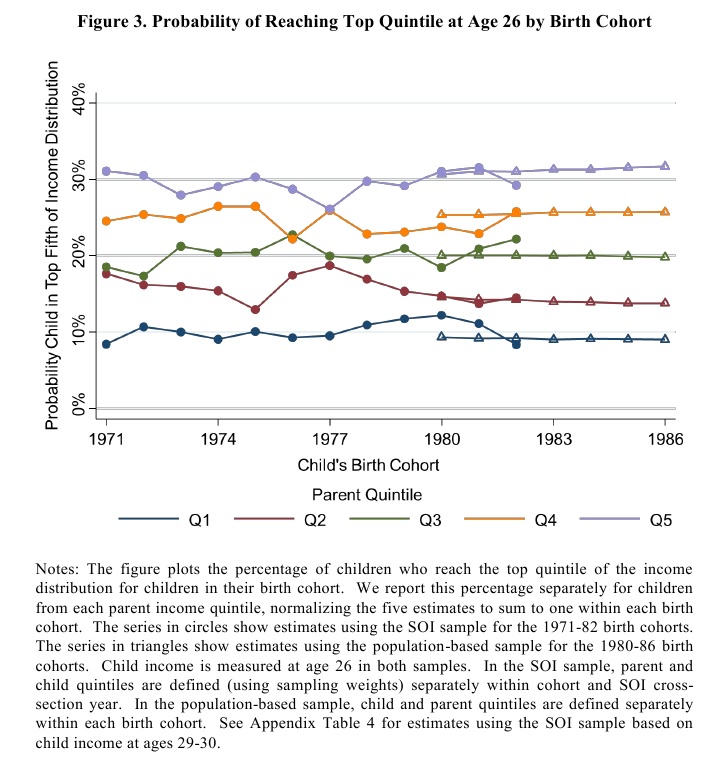
Moreover, intergenerational mobility in the United States hasn’t changed in the past several decades:

Our analysis of new administrative records on income shows that children entering the labor market today have the same chances of moving up in the income distribution relative to their parents as children born in the 1970s. Putting together our results with evidence from Hertz (2007) and Lee and Solon (2009) that intergenerational elasticities of income did not change significantly between the 1950 and 1970 birth cohorts, we conclude that rank-based measures of social mobility have remained remarkably stable over the second half of the twentieth century in the United States….

The lack of a trend in intergenerational mobility contrasts with the increase in income inequality in recent decades. This contrast may be surprising given the well-known negative correlation between inequality and mobility across countries (Corak 2013). Based on this “Great Gatsby curve,” Krueger (2012) predicted that recent increases in inequality would increase the intergenerational persistence of income by 20% in the U.S. One explanation for why this prediction was not borne out is that much of the increase in inequality has been driven by the extreme upper tail (Piketty and Saez 2003, U.S. Census Bureau 2013). In [Chetty et al. 2014, we show that there is little or no correlation between mobility and extreme upper tail inequality – as measured e.g. by top 1% income shares – both across countries and across areas within the U.S….

The stability of intergenerational mobility is perhaps more surprising in light of evidence that socio-economic gaps in early indicators of success such as test scores (Reardon 2011), parental inputs (Ramey and Ramey 2010), and social connectedness (Putnam, Frederick, and Snellman 2012) have grown over time. Indeed, based on such evidence, Putnam, Frederick, and Snellman predicted that the “adolescents of the 1990s and 2000s are yet to show up in standard studies of intergenerational mobility, but the fact that working class youth are relatively more disconnected from social institutions, and increasingly so, suggests that mobility is poised to plunge dramatically.” An important question for future research is why such a plunge in mobility has not occurred. [Raj Chetty et al., “Is the United States Still a Land of Opportunity? Recent Trends in Intergenerational Mobility,” NBER Working Paper 19844, January 2014]

Figure 3 of the paper by Chetty et al. nails it down:
chetty-et-al-figure-3

The results for ages 29-30 are close to the results for age 26.

What does it all mean? For one thing, it means that the children of top-quintile parents reach the top quintile about 30 percent of the time. For another thing, it means that, unsurprisingly, the children of top-quintile parents reach the top quintile more often than children of second-quintile parents, who reach the top quintile more often than children of third-quintile parents, and so on.

There is nevertheless a growing, quasi-hereditary, smart-educated-professional-affluent class. It’s almost a sure thing, given the rise of the two-professional marriage, and given the correlation between the intelligence of parents and that of their children, which may be as high as 0.8. However, as a fraction of the total population, membership in the new class won’t grow as fast as membership in the “lower” classes because birth rates are inversely related to income.

And the new class probably will be isolated from the “lower” classes. Most members of the new class work and live where their interactions with persons of “lower” classes are restricted to boss-subordinate and employer-employee relationships. Professionals, for the most part, work in office buildings, isolated from the machinery and practitioners of “blue collar” trades.

But the segregation of housing on class lines is nothing new. People earn more, in part, so that they can live in nicer houses in nicer neighborhoods. And the general rise in the real incomes of Americans has made it possible for persons in the higher income brackets to afford more luxurious homes in more luxurious neighborhoods than were available to their parents and grandparents. (The mansions of yore, situated on “Mansion Row,” were occupied by the relatively small number of families whose income and wealth set them widely apart from the professional class of the day.) So economic segregation is, and should be, as unsurprising as a sunrise in the east.

WHAT’S THE PROGRESSIVE SOLUTION TO THE NON-PROBLEM?

None of this will assuage progressives, who like to claim that intelligence (like race) is a social construct (while also claiming that Republicans are stupid); who believe that incomes should be more equal (theirs excepted); who believe in “diversity,” except when it comes to where most of them choose to live and school their children; and who also believe that economic mobility should be greater than it is — just because. In their superior minds, there’s an optimum income distribution and an optimum degree of economic mobility — just as there is an optimum global temperature, which must be less than the ersatz one that’s estimated by combining temperatures measured under various conditions and with various degrees of error.

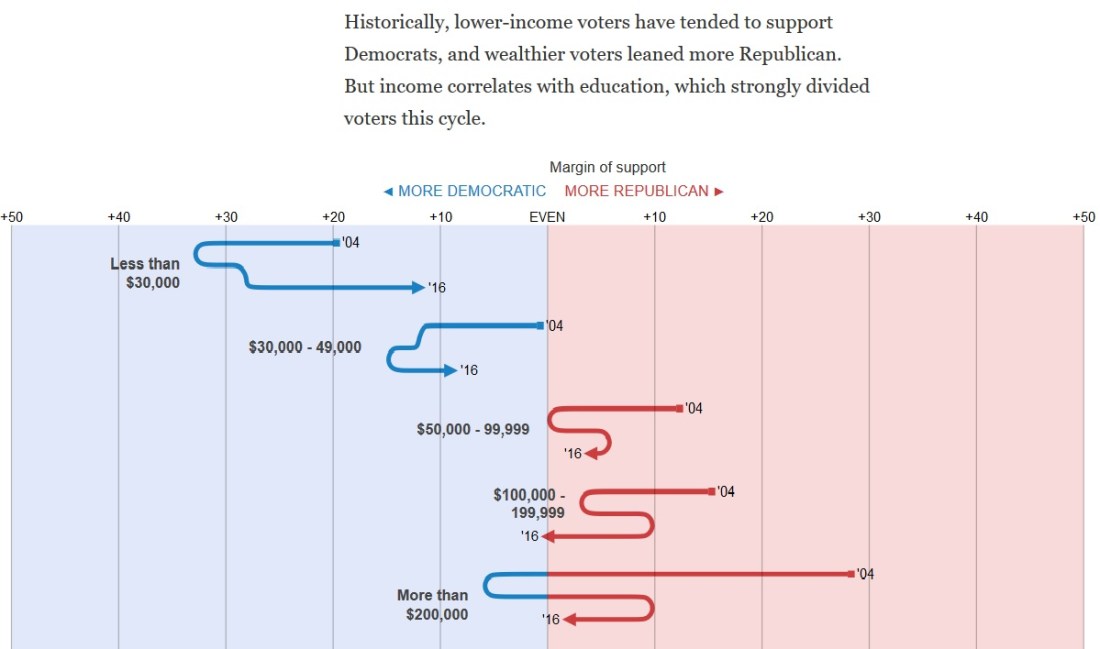
The irony of it is that the self-segregated, smart-educated-professional-affluent class is increasingly progressive. Consider the changing relationship between party preference and income:
voting-vs-income
Source: K.K. Rebecca Lai et al., “How Trump Won the Election According to Exit Polls,” The New York Times, November 16, 2016.

The elections between 2004 and 2016 are indicated by the elbows in the zig-zag lines for each of the income groups. For example, among voters earning more than $200,000,  the Times estimates that almost 80 percent (+30) voted Republican in 2004, as against 45 percent in 2008, 60 percent in 2012, and just over 50 percent in 2016. Even as voters in the two lowest brackets swung toward the GOP (and Trump) between 2004 and 2016, voters in the three highest brackets were swinging toward the Democrat Party (and Clinton).

Those shifts are consistent with the longer trend among persons with bachelor’s degrees and advanced degrees toward identification with the Democrat Party. See, for example, the graphs showing relationships between party affiliation and level of education at “Party Identification Trends, 1992-2014” (Pew Research Center, April 7, 2015). The smart-educated-professional-affluent class consists almost entirely of persons with bachelor’s and advanced degrees.

So I ask progressives, given that you have met the new class and it is you, what do you want to do about it? Is there a social problem that might arise from greater segregation of socio-economic classes, and is it severe enough to warrant government action. Or is the real “problem” the possibility that some people — and their children and children’s children, etc. — might get ahead faster than other people — and their children and children’s children, etc.?

Do you want to apply the usual progressive remedies? Penalize success through progressive (pun intended) personal income-tax rates and the taxation of corporate income; force employers and universities to accept low-income candidates (whites included) ahead of better-qualified ones (e.g., your children) from higher-income brackets; push “diversity” in your neighborhood by expanding the kinds of low-income housing programs that helped to bring about the Great Recession; boost your local property and sales taxes by subsidizing “affordable housing,” mandating the payment of a “living wage” by the local government, and applying that mandate to contractors seeking to do business with the local government; and on and on down the list of progressive policies?

Of course you do, because you’re progressive. And you’ll support such things in the vain hope that they’ll make a difference. But not everyone shares your naive beliefs in blank slates, equal ability, and social homogenization (which you don’t believe either, but are too wedded to your progressive faith to admit). What will actually be accomplished — aside from tokenism — is social distrust and acrimony, which had a lot to do with the electoral victory of Donald J. Trump, and economic stagnation, which hurts the “little people” a lot more than it hurts the smart-educated-professional-affluent class.

Where the progressive view fails, as it usually does, is in its linear view of the world and dependence on government “solutions.” As the late Herbert Stein said, “If something cannot go on forever, it will stop.” The top 1-percent doesn’t go on forever; its membership is far more volatile than that of lower income groups. Neither do the top 10-percent or top quintile go on forever. There’s always a top 1-percent, a top 10-percent and top quintile, by definition. But the names change constantly, as the paper by Chetty et al. attests.

The solution to the pseudo-problem of economic inequality is benign neglect, which isn’t a phrase that falls lightly from the lips of progressives. For more than 80 years, a lot of Americans — and too many pundits, professors, and politicians — have been led astray by that one-off phenomenon: the Great Depression. FDR and his sycophants and their successors created and perpetuated the myth that an activist government saved America from ruin and totalitarianism. The truth of the matter is that FDR’s policies prolonged the Great Depression by several years, and ushered in soft despotism, which is just “friendly” fascism. And all of that happened at the behest of people of above-average intelligence and above-average incomes.

Progressivism is the seed-bed of eugenics, and still promotes eugenics through abortion on demand (mainly to rid the world of black babies). My beneficial version of eugenics would be the sterilization of everyone with an IQ above 125 or top-40-percent income who claims to be progressive.

WHAT IS THE REAL PROBLEM? (ADDED 11/18/16)

It’s not the rise of the smart-educated-professional-affluent class. It’s actually a problem that has nothing to do with that. It’s the problem pointed to by Charles Murray, and poignantly underlined by a blogger named Tori:

Over the summer, my little sister had a soccer tournament at Bloomsburg University, located in central Pennsylvania. The drive there was about three hours and many of the towns we drove through shocked me. The conditions of these towns were terrible. Houses were falling apart. Bars and restaurants were boarded up. Scrap metal was thrown across front lawns. White, plastic lawn chairs were out on the drooping front porches. There were no malls. No outlets. Most of these small towns did not have a Walmart, only a dollar store and a few run down thrift stores. In almost every town, there was an abandoned factory.

My father, who was driving the car, turned to me and pointed out a Trump sign stuck in a front yard, surrounded by weeds and dead grass. “This is Trump country, Tori,” He said. “These people are desperate, trapped for life in these small towns with no escape. These people are the ones voting for Trump.”

My father understood Trump’s key to success, even though it would leave the media and half of America baffled and terrified on November 9th. Trump’s presidency has sparked nationwide outrage, disbelief and fear.

And, while I commend the passion many of my fellow millennials feels towards minorities and the fervency they oppose the rhetoric they find dangerous, I do find many of their fears unfounded.  I don’t find their fears unfounded because I negate the potency of racism. Or the potency of oppression. Or the potency of hate.

I find these fears unfounded because these people groups have an army fighting for them. This army is full of celebrities, politicians, billionaires, students, journalists and passionate activists. Trust me, minorities will be fine with an army like this defending them.

And, I would argue, that these minorities aren’t the only ones who need our help. The results of Tuesday night did not expose a red shout of racism but a red shout for help….

The majority of rhetoric going around says that if you’re white, you have an inherent advantage in life. I would argue that, at least for the members of these small impoverished communities, their whiteness only harms them as it keeps their immense struggles out of the public eye.

Rural Americans suffer from a poverty rate that is 3 points higher than the poverty rate found in urban America. In Southern regions, like Appalachia, the poverty rate jumps to 8 points higher than those found in cities. One fifth of the children living in poverty live rural areas. The children in this “forgotten fifth” are more likely to live in extreme poverty and live in poverty longer than their urban counterparts. 57% of these children are white….

Lauren Gurley, a freelance journalist, wrote a piece that focuses on why politicians, namely liberal ones, have written off rural America completely. In this column she quotes Lisa Pruitt, a law professor at the University of California who focuses many of her studies on life in rural America. Pruitt argues that mainstream America ignores poverty stricken rural America because the majority of America associates rural poverty with whiteness. She attributes America’s lack of empathy towards white poverty to the fact that black poverty is attributed to institutionalized racism, while white people have no reason to be poor, unless poor choices were made….

For arguably the first time since President Kennedy in the 1950’s, Donald Trump reached out to rural America. Trump spoke out often about jobs leaving the US, which has been felt deeply by those living in the more rural parts of the country. Trump campaigned in rural areas, while Clinton mostly campaigned in cities. Even if you do not believe Trump will follow through on his promises, he was still one of the few politicians who focused his vision on rural communities and said “I see you, I hear you and I want to help you.”

Trump was the “change” candidate of the 2016 election. Whether Trump proposed a good change or bad change is up to you, but it can’t be denied that Trump offered change. Hillary Clinton, on the other hand, was the establishment candidate. She ran as an extension of Obama and, even though this appealed to the majority of voters located in cities, those in the country were looking for something else. Obama’s policies did little to help  alleviate the many ailments felt by those in rural communities. In response, these voters came out for the candidate who offered to “make America great again.”

I believe that this is why rural, white communities voted for Trump in droves. I do not believe it was purely racism. I believe it is because no one has listened to these communities’ cries for help. The media and our politicians focus on the poverty and deprivation found in cities and, while bringing these issues to light is immensely important, we have neglected another group of people who are suffering. It is not right to brush off all of these rural counties with words like “deplorable” and not look into why they might have voted for Trump with such desperation.

It was not a racist who voted for Trump, but a father who has no possible way of providing a steady income for his family. It was not a misogynist who voted for Trump, but a mother who is feeding her baby mountain dew out of a bottle. It was not a deplorable who voted for Trump, but a young man who has no possibility of getting out of a small town that is steadily growing smaller.

The people America has forgotten about are the ones who voted for Donald Trump. It does not matter if you agree with Trump. It does not matter if you believe that these people voted for a candidate who won’t actually help them. What matters is that the red electoral college map was a scream for help, and we’re screaming racist so loud we don’t hear them. Hatred didn’t elect Donald Trump; People did. [“Hate Didn’t Elect Donald Trump; People Did,” Tori’s Thought Bubble, November 12, 2016]

Wise words. The best way to help the people of whom Tori writes — the people of Charles Murray’s Fishtown — is to ignore the smart-educated-professional-affluent class. It’s a non-problem, as discussed above. The best way to help the forgotten people of America is to unleash the latent economic power of the United States by removing the dead hand of government from the economy.


Economically Liberal, Socially Conservative

A provocative piece by Samuel Gregg, “Markets, Catholicism, and Libertarianism” (Public Discourse, October 24, 2016) reminds me of an idea for a post that flitted through my aging brain a while back. Gregg writes:

In a recent American Prospect article, John Gehring maintains that Catholics like myself who regard markets as the most optimal set of economic conditions are effectively promoting libertarian philosophy. Gehring’s concerns about libertarianism and what he calls “free market orthodoxy” have been echoed in other places.

The generic argument seems to be the following. Promoting market approaches to economic life involves buying into libertarian ideology. . . .

What [Gregg and other] critics seem to miss is that a favorable assessment of markets and market economics need not be premised on acceptance of libertarianism in any of its many forms. . . .

Libertarianism’s great strength lies in economics. Prominent twentieth-century libertarian economists, such as Ludwig von Mises and Friedrich von Hayek, made major contributions to the critique of socialist economics.. . . .

Philosophically speaking, Mises associated himself, especially in Human Action (1949), with Epicureanism and utilitarianism. Hayek’s views were more complicated. While his Law, Legislation and Liberty (1973/1976/1979) rejected Benthamite utilitarianism, Hayek embraced a type of indirect-rule utilitarianism in works such as The Constitution of Liberty (1960). He also articulated progress-for-the-sake-of-progress arguments and social evolutionist positions heavily shaped by David Hume’s writings.

Such philosophical views are characteristic of many self-described libertarians. . . .

None of the above-noted contributions to economics by Mises and Hayek are, however, dependent upon any of their libertarian philosophical commitments.

That’s exactly right. The great insight of libertarian economics is that people acting freely and cooperatively through markets will do the best job of producing goods and services that match consumers’ wants. Yes, there’s lack of information, asymmetrical information, buyer’s remorse, and (supposed) externalities (which do find their way into prices). But the modern “solution” to such problems is one-size-fits-all regulation, which simply locks in the preferences of regulators and market incumbents, and freezes out (or makes very expensive) the real solutions that are found through innovation, entrepreneurship, and competition.

Social conservatism is like the market liberalism of libertarian economics. Behavior is channeled in cooperative, mutually beneficial, and voluntary ways by the institutions of civil society: family, church, club, community, and — yes — commerce. It is channeled by social norms that have evolved from eons of voluntary social intercourse. Those norms are the bedrock and “glue” of civilization. Government is needed only as the arbiter of last resort, acting on behalf of civil society as the neutral enforcer of social norms of the highest order: prohibitions of murder, rape, theft, fraud, and not much else. Civil society, if left alone, would deal adequately with lesser transgressions through inculcation and disapprobation (up to and including ostracism). When government imposes norms that haven’t arisen from eons of trial-and-error it undermines civil society and vitiates the civilizing influence of social norms.

The common denominator of market liberalism and social conservatism is that both are based on real-world behavior. Trial and error yields information that free actors are able to exploit for their betterment and (intended or not) the betterment of others.

Related posts:
Pseudo-Libertarian Sophistry vs. True Libertarianism
More Pseudo-Libertarianism
More about Conservative Governance
Burkean Libertarianism
True Libertarianism, One More Time
Why Conservatism Works
Liberty and Society
Liberty as a Social Construct: Moral Relativism?
Defending Liberty against (Pseudo) Libertarians
Parsing Political Philosophy (II)
Modern Liberalism as Wishful Thinking
Romanticizing the State
Governmental Perversity
Libertarianism and the State
“Liberalism” and Personal Responsibility
My View of Libertarianism
More About Social Norms and Liberty
The Authoritarianism of Modern Liberalism, and the Conservative Antidote
Another Look at Political Labels
Individualism, Society, and Liberty
Social Justice vs. Liberty

My Platform

A voting guide published in my local newspaper asks seven questions of the presidential candidates. I list them below, with the answers that I would give were I a candidate for the presidency of the United States.

Question 1: What is your personal statement?

I am sick and tired of the nanny state, which is centered in Washington DC and extends into almost every city, town, and village in America.

Question 2: What are your top three goals?

Economic and social liberty for all Americans; protection of the lives, liberty, and property of innocent Americans; defense of Americans’ legitimate overseas interests.

Question 3: What will you do to support a vibrant economy across the U.S.?

I will send legislative proposals to Congress that will deregulate the economy; eliminate the death tax and corporate income taxes; reduce the central government to its essential and legitimate functions (mainly national defense), and cut taxes accordingly; and phase out all unconstitutional federal programs (which is most of them), beginning with Social Security, Medicare, and Medicaid. I will revoke all executive-branch policies that are contrary to the program spelled out in the preceding sentence.

Question 4: What, if any, actions will you support to create a pathway to citizenship?

I will ask Congress to deter illegal immigration by eliminating welfare programs that attract it; to provide the manpower and technical means to prevent, detect, and prosecute illegal immigration; and to establish more stringent citizenship requirements, including demonstrated proficiency in English. I will revoke all executive-branch policies that are contrary to the program spelled out in the preceding sentence.

Question 5: What should government do to provide an equitable, quality public education for all children pre-K through grade 12?

The central government should have no role in the funding of education or in the making of policies related to it. I will make one exception, for liberty’s sake, which is to propose an amendment to the Constitution that would require every State (and therefore the subordinate jurisdictions in every State) to allow parents to choose the schools to which they send their children, and to give vouchers to parents who choose private schools. The value of each State’s voucher would be the average cost of educating a child in grades K-12 in that State. (It would be up to each State to decide how to recover the shares owed by local jurisdictions.)

Question 6: What actions would you support the U.S. undertake to protect its interests abroad?

In view of the rising Russian and Chinese threats to Americans’ overseas interests — and the persistent threat posed by terrorist organizations — I will ask Congress to rebuild the nation’s armed forces, at least to the levels attained as a result of President Reagan’s buildup; to provide for the acquisition of superior, all-source intelligence capabilities; to support a robust research and development program for defense and intelligence systems; and to provide the funding needed to fully man our armed forces with well-trained personnel, and to keep the forces in a high state of readiness for sustained combat operations.

Regarding the use of armed forces, I will act immediately and vigorously to defend Americans’ legitimate overseas interests, which include international commerce around the globe, and to protect resources that directly affect international commerce (e.g., oil-rich regions on land and at sea). As necessary, I will seek the authorization of Congress to conduct sustained combat operations for those purposes.

I will not otherwise use or seek the approval of Congress to use the armed forces of the United States, which are maintained at great cost to Americans for the benefit of Americans. Those forces are not maintained for the purpose of defending countries that refuse to spend enough money to defend themselves, nor to “build nations” or engage in humanitarian operations that have no direct bearing on the safety of Americans or their interests. By the same token, America’s armed forces should be used to help defend nations that attempt to defend themselves and whose defeat would destabilize regions of strategic value to Americans’ interests.

Finally, I will not enter into treaties or agreements of any kind with the leaders of nations whose aim is clearly to undermine Americans’ legitimate economic interests. To that end, I will renounce Barack Obama’s agreement with Iran, his endorsement of the Paris agreement regarding so-called anthropogenic global warming, and all other agreements detrimental to the interests of Americans.

I will further ask to Congress to direct by law that the United States withdraw from the United Nations, which serves mainly as a showplace for regimes hostile to Americans’ constitutional ideals and interests. The U.N. will be given two years in which to remove all of its offices and personnel from the United States. I expect the U.N. to become overtly hostile to the United States when this country has withdrawn from it, but those member states who provoke and finance hostile acts on the part of the U.N. will be held to account, and will not be able to hide behind the false front of the United Nations.

Question 7: What kinds of policies will you pursue to promote social and racial justice for all Americans?

I will nominate judges and executive-branch officials who are demonstrably faithful to the Constitution of the United States, as its various portions were understood when they were ratified or modified through Article V amendments. This will mean the reversal of many judicial and executive actions that are contrary to the moral traditions that underlie the greatness of America, and which have been contravened arbitrarily to serve narrow interests and misguided ideologies. I am especially eager to defend life against those who seek to destroy and defile it, and to see that there is truly “equal protection of the law” by restoring freedom of speech and association where they have been suppressed in the name of equal protection.

Social and moral issues such as same-sex marriage should be decided by the States, and preferably by the people themselves, through the peaceful and voluntary evolution and operation of social norms. Such issues are outside the constitutional purview of the central government.

Human Rights and Animal Rights

I’ve said plenty about my view of rights, as you’ll see if you follow the links to the posts listed at the bottom of this one. In summary, rights are

  • duties toward other persons, not innate essences (whether spiritual or evolutionary)
  • social constructs, derived from eons of social intercourse
  • roughly similar across many cultures (especially Western ones) because of the innate similarity of human beings and the continuity of acculturation.

To be clear, I’m referring to fundamental, negative rights about which there is broad social (if not legal) agreement. Negative rights include the right not to be

  • murdered or physically injured on purpose — as opposed to being punished for a crime; killed or harmed by a person who is defending others, himself, or his property; self-defense, or killed or injured in a war
  • psychologically taunted in a way that is meant to be harmful — as opposed to being challenged by “uncomfortable” ideas or put in a stressful situation that is meant to test one’s mettle or build one’s character
  • forced into servitude or its functional equivalent (e.g., imprisonment), except as punishment for a crime
  • victimized by theft or fraud
  • libeled or slandered.

Positive rights (e.g., the “right” to tax-funded subsidies of various kinds, the “right” to preferment in hiring and university admissions) are rights in name only because they lack the voluntary provenance of a negative right. Positive rights are fiat rights, imposed by executive, legislative, or judicial action. That there is considerable support for some positive rights doesn’t negate their non-voluntary nature. It’s true that in some close-knit groups there are voluntary positive rights, such as the right to charity. But such rights usually don’t extend to persons outside the close-knit group in the way that negative rights do.

Positive rights can’t be conferred without the imposition of involuntary costs (taxes, preferential treatment) on large portions of the populace. In other words, positive rights are privileges accorded some persons (at the expense of others). Negative rights, by contrast, are reciprocal and do not impose costs on anyone. (It’s true that in a large polity the defense of negative rights requires the maintenance of police, courts, and armed forces. But that seems to be a consequence of the size of the polity and not the nature of negative rights.)

I could refer to negative rights as “natural rights” because they arise naturally from the coexistence of human beings in socially and culturally bound groups. But I have long rejected the term “natural rights” because it carries the connotation that such rights are of mysterious origin, perhaps even a supernatural one. So I will call them customary rights.

What about animals? They don’t have rights — other than legally manufactured ones — because they’re not participants in the social and cultural milieu from which customary rights arise. Rights, as I’ve explained, represent a bargain (usually tacit) among human beings about the conditions of their coexistence. Animals — even those closest to human beings in their intellectual prowess — simply aren’t part of that bargain and (I believe) are incapable of being part of it.

To the extent that animals have rights, they are manufactured by human beings and then conferred on animals, much as the positive right to an income subsidy is conferred on those who receive it. This isn’t to say that some animal rights aren’t widely and voluntarily recognized. Freedom from torture is one such right. But the animals who are spared from torture aren’t parties to the social tradition from which the right arose.

This leads to the following questions: What fiat rights, if any, should animals have? Who should devise and enforce such rights? How should violators be treated?

I won’t address those questions here. I’ll simply note that aside from a few points on which empathic persons (that is, almost everyone) will agree (e.g., animals shouldn’t be tortured), there’s a wide range of views about the proper treatment of animals. For example, the most humane treatment is (generally) accorded those animals that are most like human beings (i.e., the other great apes) or which are most often kept as pets. The treatment accorded other animals depends on their perceived utility to human beings and their perceived degree of sentience. (Bugs are low on the totem-pole of rights.)

Only a relatively small number of extremists will insist on according animals something like the customary rights of human beings. Take the right not to be killed. Should that right apply even to a poisonous snake or a pesky and potentially pestilential insect? An extremist who answers yes is probably the kind of person who says that it’s always wrong to kill another human being, even in self-defense, but who also favors abortion on demand. The cause of “animal rights” is a mania — impervious to facts and logic — much like the cause of combating so-called anthropogenic global warming (see this post and the many readings and posts listed at the bottom).

In any event, animals don’t have customary rights that arise naturally among (most) groupings of human beings. Animals enjoy fiat rights, to the extent that they enjoy any rights at all. “Animal rights” zealots aren’t the kind of people who should have a say in the scope and application of those rights.

Related posts:
Negative Rights
Negative Rights, Social Norms, and the Constitution
Rights, Liberty, the Golden Rule, and the Legitimate State
“Natural Rights” and Consequentialism
Positivism, “Natural Rights,” and Libertarianism
What Are “Natural Rights”?
Evolution, Human Nature, and “Natural Rights”
Positive Liberty vs. Liberty
The Golden Rule as Beneficial Learning
Rights: Source, Applicability, How Held
Merit Goods, Positive Rights, and Cosmic Justice
More about Merit Goods
Liberty and Society
The Eclipse of “Old America”
Genetic Kinship and Society
Liberty as a Social Construct: Moral Relativism?
The Futile Search for “Natural Rights”
More About Social Norms and Liberty
Social Justice vs. Liberty

Does Liberty Still Have a Fighting Chance?

Lawrence W. Reed, president of the Foundation for Economic Education, uses FEE’s website to argue that “Liberty Still Has a Fighting Chance“:

So here we are now, decades into the very egalitarian welfare state Tocqueville warned would be the death of American exceptionalism. It threatens to make us like all the other forgettable welfare states that languish in history’s dustbins, Greece included. Should we just assume it’s inevitable and go along for the ride? Or should we muster the character that built a nation and that Tocqueville identified as quintessentially American?

If you’re pessimistic, then you’re no longer part of the solution. You’ve become part of the problem. What chance does liberty have if its supposed friends desert it in its hour of need or speak ill of its prospects?

Ask yourselves, What good purpose could a defeatist attitude possibly promote? Will it make me work harder for the causes I know are right? Is there anything about liberty that an election or events in Congress disprove? If I exude a pessimistic demeanor, will it help attract newcomers to the ideas I believe in? Is this the first time in history that believers in liberty have lost some battles? If we simply throw in the towel, will that enhance the prospects for future victories? Do we turn back just because the hill we have to climb got a little steeper?

This is not the time to abandon time-honored principles. I can’t speak for you, but someday, I want to go to my reward and be able to look back and say, “I never gave up. I never became part of the problem I tried to solve. I never gave the other side the luxury of winning anything without a rigorous, intellectual contest. I never missed an opportunity to do my best for what I believed in, and it never mattered what the odds or the obstacles were. I did my part.”

Remember that we stand on the shoulders of many people who came before us and who persevered through far darker times. The American patriots who shed their blood and suffered through unspeakable hardships as they took on the world’s most powerful nation in 1776 are certainly among them. But I am also thinking of the brave men and women behind the Iron Curtain who resisted the greatest tyranny of the modern age and won. I think of those like Hayek and Mises who kept the flame of liberty flickering in the 1940s. I think of the heroes like William Wilberforce and Thomas Clarkson who fought to end slavery and literally changed the conscience and character of Britain in the face of the most daunting of disadvantages. And I think of the Scots who, 456 years before the Declaration of Independence, put their lives on the line to repel English invaders with these thrilling words: “It is not for honor or glory or wealth that we fight, but for freedom alone, which no good man gives up except with his life.”

As I think about what some of those great men and women faced, the obstacles before us today seem rather puny.

This is a moment when our true character, the stuff we’re really made of, will show itself. If we retreat, that would tell me we were never really worthy of the battle in the first place. But if we resolve to let these challenging times build our character and rally our dispirited friends to new levels of dedication, we will look back on this occasion someday with pride at how we handled it. Have you called a friend yet today to explain to him or her why liberty should be a top priority?

Nobody ever promised that liberty would be easy to attain or simple to keep. The world has always been full of greedy thieves and thugs, narcissistic power seekers, snake-oil charlatans, unprincipled ne’er-do-wells, and arrogant busybodies. No true friend of liberty should just roll over and play dead for any of them.

Take an inventory every day of what you’re doing for liberty. Get more involved in the fight. There are plenty of things you can do. If your state isn’t a right-to-work state, work to make it so. Support people and organizations like the Foundation for Economic Education that are teaching young people about the importance of liberty and character. Get behind the Compact for America and its plan for a balanced federal budget and an end to reckless spending and debt. Work for school choice in your state to help break the government monopoly on education. And be the very best example for liberty and character that you can possibly be in everything you do.

Whatever you do, don’t give up no matter what. Remember these words of the great US Supreme Court justice George Sutherland: “The saddest epitaph which can be carved in memory of a vanished liberty is that it was lost because its possessors failed to stretch forth a saving hand while yet there was time.”

Can Tocqueville’s American exceptionalism be restored? Can it last? You bet it can. The American Dream still lives, in the hearts of those who love liberty and refuse to meekly surrender it. So let’s wipe the frowns off our faces and get to work. Our future, our children’s future — liberty’s future — all depend on us.

This is nothing more than a platitudinous pep talk, delivered to a team that’s trailing by 12 touchdowns at half-time. Reed offers no actionable advice that will truly make a difference. Joining and supporting fringe groups won’t dim the promise of big government, which is to deliver seemingly free benefits to a broad, interlocking coalition of well-financed, media-backed, vote-rich interest groups. Reed is whistling in the dark.

I’m not being a defeatist. I’m being a realist. Liberty can be restored only when liberty-lovers get realistic about what it will take to restore it — and then act accordingly. What will it take? See “Independence Day 2016: The Way Ahead.”

What about the kinds of resistance counseled by Reed? Well, they might slow or even temporarily halt America’s descent into grim, impoverished, regimented statism. But they won’t prevent it. Only drastic action will do that.

Related, realistic posts about the state of America:
The Interest-Group Paradox
Rethinking the Constitution: “Freedom of Speech, and of the Press”
Well-Founded Pessimism
America: Past, Present, and Future
The Barbarians Within and the State of the Union
“We the People” and Big Government
The Culture War
The Fall and Rise of American Empire
O Tempora O Mores!
Democracy, Human Nature, and the Future of America
1963: The Year Zero
Society
How Democracy Works
“Cheerful” Thoughts
How Government Subverts Social Norms
Turning Points
The Twilight’s Last Gleaming?

Utilitarianism vs. Liberty (II)

This post has moved.


Individualism, Society, and Liberty

In “How Our Individualism Has Trapped Us in a Welfare State,” Heather Judd has taken a stab at an issue that I’ve pondered for a long time: the tension between individualism and society. Now, by “society” I mean true society:

Society — true society — consists of people who, among other things, agree as to the limits on what one may do. That shared view isn’t imposed by regulation, statute, or judicial decree — though such things will arise from the shared view in a true society. Rather, the shared view arises from the experience of living together and finding the set of customs and prohibitions that yields peaceful, willing coexistence and its concomitant: beneficially cooperative behavior. Liberty, in other words.

“The experience of living together and finding” a common “set of customs and prohibitions” seems consistent with Judd’s view of society, which she calls “an organized group of people sharing a common culture.” Judd doesn’t directly address the libertarian aspect of true society, but the thrust of her essay points in that direction. She laments the fact that

[c]ultural individualization has…cornered us into a welfare state mentality from which we cannot escape unless we replace our concept of a society of individuals with something more ordered and interconnected.

Toward the end of her essay she puts it this way:

Living together in isolation is not a sustainable social model. So long as we continue to think of the individual as the basic unit of society, our progression toward the disenchanted welfare state will continue, even while no amount of socialized government intervention will provide the human cohesion we need.

Judd’s view is that family is the backbone of society. And the drift away from families to individuals is destroying that backbone, which must be reconstructed. In her words,

government is incapable of buttressing our crumbling human connections. That task must start with rebuilding individuals into families and families into society. Like every great undertaking, the process will be slow and require sacrifice, but the recompense will be not only a healthy and sustainable society, but also, paradoxically, a stronger sense of our individual identity as we reconnect with other human beings.

I think she’s right about the breakdown of family, but her vague exhortation at the end leaves me wondering what can actually be done about it And even if there were some restoration of the family on a relatively large scale, I don’t think it would do much to alleviate the fragmentation of the United States, which has never been a society in the true meaning of the word.

Why have family ties loosened and broken? The answer, in two words: prosperity and mobility. Even without the welfare state (and despite it), a large fraction of the populace can afford to buy things like housing and elder-care that until World War II were often provided by families.

Greater mobility goes hand in hand with greater prosperity; the expansion of economic activity has been both intensive and extensive. Modern people are no different than their hunter-gatherer forbears; they go where their labors earn greater rewards. And in doing so they leave behind grandparents, parents, and siblings — most of whom are prosperous enough to fend for themselves. American families have been drifting apart for many generations. The drift was masked to some extent by the influx of European immigrants in the late 1800s and early 1900s, whose strong bonds were forged by economic necessity and mutual self-defense against xenophobic natives. But those bonds, too, have dissolved to the point that the exceptions (e.g., Amish and Hasidic communities) are notable for their rarity. And so it will be with the Hispanic immigration of recent decades, though economic necessity and ethnic differences probably will bind Hispanic immigrants far longer than they bound European ones.

So I don’t see the restoration of the family as likely — barring another World War II or Great Depression. Nor do I see the restoration of the family as necessary to the demotion of the welfare state. The welfare state does feed on individualism, but it also feeds on widespread economic ignorance and the cupidity of politicians and bureaucrats.

Economic ignorance abets cupidity, in that politicians and bureaucrats are able to feed their power-lust and line their pockets because most Americans have no grasp of the huge economic cost of the welfare state — or more accurately, the regulatory-welfare state. If the regulatory-welfare state is to be contained and diminished by electoral means, a huge number of Americans must be convinced of its exorbitant cost in dollars and liberty.

One might as well try to melt an iceberg with a hair dryer. Only a minority of economists understands or is willing to admit the dire economic consequences of the regulatory-welfare state, and only a minority of constitutional scholars understands or is willing to admit the anti-libertarian consequences of the regulatory-welfare state. More importantly — because only a small fraction of Americans is aware of what those “fringe” economists and constitutional scholars say — relatively few politicians and pundits on the national stage understand, agree with, and accurately relay those views to Americans. For every Ted Cruz there are probably two or three Bernie Sanderses.

To repeat the themes of recent posts, leftists are ruthless and they have the rhetorical advantage over principled politicians because they are very good at promising things without knowing or caring about the economic and social costs of what they promise. Their appeal to Mr. and Ms. Average and Below-Average — which is most Americans — rests on envy. Leftists are always on the lookout for privilege, which they promise to uproot:

Privilege…implies that the possessors of certain positive attributes (high intelligence, good looks, high income, access to political power) have come by those things undeservedly, and even at the expense of those who lack them: the underprivileged. [Leftists] believe implicitly in a state of nature wherein everyone would have equal endowments of intelligence, looks, etc., if only it weren’t for “bad luck.” [Leftists] believe it necessary to use the power of government to alleviate (if not eliminate) unequal endowments and to elevate the “victims” of inequality.

If you were Mr. or Ms. Average or Below-Average, would you willingly sacrifice the (illusory) prosperity of the regulatory-welfare state and reject its promise of making everyone a winner? What’s more disheartening — but unsurprising given the state of political discourse — is that  Mr. and Ms. Above-Average are not only reluctant to abandon the regulatory-welfare state, but are its staunchest proponents.

In sum, individualism is here to stay, regardless of what happens to the regulatory-welfare state, unless there is a return to the dire days of 1930-1945. And even then, the regulatory-welfare state is here to stay, unless there is a negotiated partition of the country, a (successful) secession movement, or a coup by liberty-loving patriots.

I’m sorry, but that’s the way it looks from here.

Society, Polarization, and Dissent

One definition of liberty is the “right or power to act as one chooses.” This seems to be the usual view of the matter. But it should be obvious that liberty depends on restraint. Acting as one chooses covers a lot of ground, including acts that prevent others from doing as they choose (e.g., murder and fraud). Liberty is therefore a matter of mutual restraint, where there are agreed limits on what one may do.

Society — true society — consists of people who, among other things, agree as to the limits on what one may do. That shared view isn’t imposed by regulation, statute, or judicial decree — though such things will arise from the shared view in a true society. Rather, the shared view arises from the experience of living together and finding the set of customs and prohibitions that yields peaceful, willing coexistence and its concomitant: beneficially cooperative behavior. Liberty, in other words.

Some of the customs and prohibitions of a society will seem arbitrary and foolish to an outsider. But it is the observance of those customs and prohibitions that binds a people in mutual trust and respect. Peaceful, willing coexistence and beneficially cooperative behavior depend on mutual trust and respect.

Customs are positive acts — the ways in which people are expected to comport themselves and behave toward each other. A good example is the degree to which emotion is openly expressed or suppressed, which varies from the reserve of Japanese to the exuberance of Italians. Consistent failure to observe a society’s customs brands one as an outsider, someone who isn’t to be trusted. Such a person will find it hard to make more than a menial living, and is unlikely to have friends other than renegades like himself.

Strict prohibitions are like those found in the last six of the Ten Commandments: do not dishonor your parents; don’t commit murder, adultery, or theft; don’t lie maliciously; and don’t covet what others have. (The last of these is dishonored regularly by “social justice warriors” who liken redistribution by force to Christian charity.) The violation of prohibitions calls for prosecution by those who have been entrusted by society to enforce its norms. Punishments — which will range from execution to public shaming — are meant not only to punish wrong-doing but also deter it. Rehabilitation is the responsibility of the wrong-doer, not society.

The United States has long since ceased to be anything that resembles a society. And therein lies the source of political polarization. Governance is no longer based on shared customs and a common morality that arise from eons of coexistence. Governance and the rules on which it is based are imposed from outside of society. Those who use “society” when they mean government are ignorant and evasive.

Those of us who remember something that resembled a society bitterly resent the outsiders within (to coin a phrase) who seek to impose on everyone their version of customs and morals. It is a corrupt version that has no roots in society; it is meant, instead, to destroy what is left of it.

The path to total destruction began in the late 1800s, with the rise of the Progressive movement. Progressivism then and now is corrupt at its core because it seeks to replace the evolved social, economic, and political order with “science.” Scratch a Progressive and you find a fascist with an agenda to be imposed by the force of government.

What is the legacy of Progressivism? This:

  • the income tax and Social Security, which together with a vast regulatory regime (also a product of Progressivism) enable the central government to control the economy
  • direct election of Senators, which robbed the States of a check on the actions of the central government
  • the Federal Reserve System, which helped to bring about the Great Depression, the Great Recession, and several other economic downturns
  • public education indoctrination by psychobbable-spouting leftists
  • identity politics
  • persecution and prosecution of business success (a.k.a. antitrust action)
  • control of the production of food and drugs, with consequences ranging from wasteful labeling regulations to murderous delays in the approval of medications
  • abortion
  • Prohibition (the only Progressive “reform” to have been rescinded)
  • left-wing economic theories (income redistribution, pump-priming)
  • the theft of private property and deprivation of freedom of contract through the empowerment of labor unions, which inevitably became thuggish.

There’s more, but that’s enough to bring down any civilization. And it has.

Perhaps — because of population growth and economic and political ambition — it was inevitable that America would be transformed from a collection of interlocking societies into a vast geopolitical entity ruled by Progressives and their intellectual heirs. But whatever the causes, the transformation is almost complete…

Except for those Americans who do remember something like a true society, those Americans who know instinctively what a true society would be like, and those Americans who want to preserve the bits of true society that haven’t yet been destroyed by the fascists in Washington, their enablers in the media and academia, and their dependents throughout the land.

That’s the real polarization in America. (As opposed to the false one between leftists at one pole and faux conservatives, who simply want to move left at a slower pace.) And the polarization will not end as long as dissent remains alive.

Which is why the left is killing dissent. First they came for the students; then they came for the Christians; then…

Independence Day 2016: The Way Ahead

Prudence…will dictate that Governments long established should not be changed for light and transient causes; and accordingly all experience hath shewn, that mankind are more disposed to suffer, while evils are sufferable, than to right themselves by abolishing the forms to which they are accustomed. But when a long train of abuses and usurpations…reduce them under absolute Despotism, it is their right, it is their duty, to throw off such Government, and to provide new Guards for their future security.… [A]nd such is now the necessity which constrains them to alter their former Systems of Government. The history…is a history of repeated injuries and usurpations, all having in direct object the establishment of an absolute Tyranny over these States.

Declaration of Independence
(In Congress. July 4, 1776. The unanimous Declaration
of the thirteen united States of America)

*      *      *

It is fitting, in this summer of discontent, to be faced with a choice between the spiritual descendants of P.T. Barnum and Lady Macbeth. Washington, Jefferson, and Madison are spinning in their graves, at high velocity.

The candidacies of Trump and Clinton are symptoms of the looming demise of liberty in the United States. There hasn’t been a candidate since Ronald Reagan who actually understood and believed that Americans would be freer and therefore more prosperous if the central government were contained within the four corners of the Constitution. (And even Reagan had a soft spot in his heart for Social Security.) Nevertheless, it is appalling but unsurprising that liberty’s end is in sight just 27 years after Reagan left office.

What went wrong? And how did it go wrong so quickly? Think back to 1928, when Americans were more prosperous than ever and the GOP had swept to its third consecutive lopsided victory in a presidential race. All it took to snatch disaster from the jaws of delirium was a stock-market crash in 1929 (fueled by the Fed) that turned into a recession that turned into a depression (also because of the Fed). The depression became the Great Depression, and it lasted until the eve of World War II, because of the activist policies of Herbert Hoover and Franklin Roosevelt, which suppressed recovery instead of encouraging it. There was even a recession (1937-38) within the depression, and the national unemployment rate was still 15 percent in 1940. It took the biggest war effort in the history of the United States to bring the unemployment rate back to its pre-depression level.

From that relatively brief but deeply dismal era sprang a new religion: faith in the central government to bring peace and prosperity to the land. Most Americans of the era — like most human beings of every era — did not and could not see that government is the problem, not the solution. Victory in World War II, which required central planning and a commandeered economy, helped to expunge the bitter taste of the Great Depression. And coming as it did on the heels of the Great Depression, reinforced the desperate belief — shared by too many Americans — that salvation is to be found in big government.

The beneficial workings of the invisible hand of competitive cooperation are just too subtle for most people to grasp. The promise of a quick fix by confident-sounding politicians is too alluring. FDR became a savior-figure because he talked a good game and was an inspiring war leader, though he succumbed to pro-Soviet advice.

With war’s end, the one-worlders and social engineers swooped on a people still jittery about the Great Depression and fearful of foreign totalitarianism. (The native-born variety was widely accepted because of FDR’s mythic status.) Schools and universities became training grounds for the acolytes of socialism and amoral internationalism.

Warren Henry is right when he says that

progressivism is…broadly accepted by the American public, inculcated through generations of progressive dominance of education and the media (whether that media is journalism or entertainment). Certainly Democrats embrace it. Now the political success of Donald J. Trump has opened the eyes of the Right to the fact that Republicans largely accept it….

Republicans have occasionally succeeded in slowing the rate at which America has become more progressive. President Reagan was able to cut income tax rates and increase defense spending, but accepted tax increases to kick the can on entitlements and could not convince a Democratic Congress to reduce spending generally. Subsequent administrations generally have been worse. A Republican Congress pressured Bill Clinton into keeping his promise on welfare reform after two vetoes. He did so during a period when the end of the Cold War and the revenues from the tech bubble allowed Washington to balance budgets on the Pentagon’s back. Unsurprisingly, welfare reform has eroded in the ensuing decades.

Accordingly, the big picture remains largely unchanged. Entitlements are not reformed, let alone privatized. To the contrary, Medicare was expanded during a GOP administration, if less so than it would have been under a Democratic regime…. Programs are almost never eliminated, let alone departments.

The Right also loses most cultural battles, excepting abortion and gun rights. Notably, the inroads on abortion may be due as much to the invention and deployment of the sonogram as the steadfastness of the pro-life movement. Otherwise, political and cultural progressivism has been successful in their march through the institutions, including education, religion, and the family.

Curricula increasingly conform to the progressive fashions of the moment, producing generations of precious snowflakes unequipped even to engage in the critical thinking public schools claim to prioritize over an understanding of the ages of wisdom that made us a free and prosperous people. Church membership and attendance continues their long-term decline. A country that seriously debated school prayer 30 years ago now debates whether Christians must be forced to serve same-sex weddings.

Marriage rates continue their long-term decline. Divorce rates have declined from the highs reached during the generation following the sexual revolution, but has generally increased over the course of the century during which progressivism has taken hold (despite the declining marriage rate). Those advocating reform of the nation’s various no-fault divorce laws are few and generally considered fringe.

There’s more, but disregard Henry’s reification of America when he should write “most Americans”:

Meanwhile, America has voted for decade after decade of tax-and-spend, borrow-and-spend, or some hybrid of the two. If the white working class is now discontented with the government’s failure to redress their grievances, this is in no small part due to the ingrained American expectation that government will do so, based on the observation that government typically hungers to increase government dependency (not that the white working class would use these terms).…

In sum, while it is correct to note that elites are not doing their jobs well, it is more difficult to conclude that elites have not been responding to the political demands of the American public as much as they have driven them.…

The presidential nominees our two major parties have chosen are largely viewed as awful. But Hillary Clinton and Donald Trump offer two slightly different versions of the same delusion: that progressivism works, if only the elites were not so stupid. This delusion is what most Americans currently want to believe.

Sad but disastrously true. Dependency on government has become deeply ingrained in the psyche of most Americans. As Timothy Taylor points out,

[g]overnment in the United States, especially at the federal level, has become more about transfer payments and less about provision of goods and services.…

[There has been an] overall upward rise [of transfer payments] in the last half-century from 5% of GDP back in the 1960s to about 15% of GDP in the last few years….

The political economy of such a shift is simple enough: programs that send money to lots of people tend to be popular. But I would hypothesize that this ongoing shift not only reflects voter preferences, but also affect how Americans tend to perceive the main purposes of the federal government. Many Americans have become more inclined to think of federal budget policy not in terms of goods or services or investments that it might perform, but in terms of programs that send out checks.

What lies ahead? Not everyone is addicted to government. There are millions of Americans who want less of it — a lot less — rather than more of it. Here, with some revisions and an addition, are options I spelled out three years ago:

1. Business as usual — This will lead to more and more government control of our lives and livelihoods, that is, to less and less freedom and prosperity (except for our technocratic masters, of course).

2. Rear-guard action — This option is exemplified by the refusal of some States to expand Medicaid and to establish insurance exchanges under the Affordable Care Act. This bit of foot-dragging doesn’t cure the underlying problem, which is accretion of illegitimate power by the central government. Further, it can be undone by fickle voters and fickle legislatures, as they succumb to the siren-call of “free” federal funds.

3. Geographic sorting — The tendency of “Blue” States to become “bluer” and “Red” States to become “redder” suggests that Americans are sorting themselves along ideological lines. As with rear-guard action, however, this tendency — natural and laudable as it is — doesn’t cure the underlying problem: the accretion of illegitimate power by the central government. Lives and livelihoods in every State, “Red” as well as “Blue,” are controlled by the edicts of the legislative, executive, and judicial branches of the central government. There is little room for State and local discretion. Moreover, much of the population shift toward “Red” must be understood as opportunistic (e.g., warmer climates, right-to-work laws) and not as an endorsement of “Red” politics.

4. Civil disobedience — Certainly called for, but see options 5, 6, and 7.

5. Underground society and economy — Think EPA-DOL-FBI-IRS-NSA, etc., etc., and then dismiss this as a serious option for most Americans.

6. The Benedict Option, about which Bruce Frohnen writes:

[Rod] Dreher has been writing a good deal, of late, about what he calls the Benedict Option, by which he means a tactical withdrawal by people of faith from the mainstream culture into religious communities where they will seek to nurture and strengthen the faithful for reemergence and reengagement at a later date….

The problem with this view is that it underestimates the hostility of the new, non-Christian society [e.g., this and this]….

Leaders of this [new, non-Christian] society will not leave Christians alone if we simply surrender the public square to them. And they will deny they are persecuting anyone for simply applying the law to revoke tax exemptions, force the hiring of nonbelievers, and even jail those who fail to abide by laws they consider eminently reasonable, fair, and just.

7. A negotiated partition of the country — An unlikely option (discussed in this post and in some of the posted linked to therein) because, as discussed in option 6, “Blue” will not countenance the loss of control over millions of lives and livelihoods.

8. Secession — This is legal and desirable — as long as the New Republic of free states is truly free — but (a) it is likely to be met with force and therefore (b) unlikely to attract a critical mass of States.

9. Coup — Suggested several years ago by Thomas Sowell:

When I see the worsening degeneracy in our politicians, our media, our educators, and our intelligentsia, I can’t help wondering if the day may yet come when the only thing that can save this country is a military coup.

Glenn Reynolds, who is decidedly anti-coup, writes

that the American Constitution, along with traditional American political culture in general, tends to operate against those characteristics, and to make the American polity more resistant to a coup than most. It is also notable, however, that some changes in the Constitution and in political culture may tend to reduce that resistance….

The civics-book statement of American government is that Congress passes laws that must be signed by the president (or passed over a veto), and that those laws must be upheld by thejudiciary to have effect. In practice, today’s government operates on a much more fluid basis, with administrative agencies issuing regulations that have the force of law – or, all too often, “guidance” that nominally lacks the force of law but that in practice constitutes a command – which are then enforced via agency proceedings.…

[I]t seems likely that to the extent that civilians, law enforcement, and others become used to obeying bureaucratic diktats that lack a clear basis in civics-book-style democratic process, the more likely they are to go along with other diktats emanating from related sources. This tendency to go along with instructions without challenging their pedigree would seem to make a coup more likely to succeed, just as a tendency to question possibly unlawful or unconstitutional requirements would tend to make one less likely to do so. A culture whose basis is “the law is what the bureaucrats say it is, at least unless a court says different,” is in a different place than one whose starting impulse is “it’s a free country.”…

[P]ersistent calls for a government-controlled “Internet kill switch”49 – justified, ostensibly, by the needs of cyberdefense or anti-terrorism – could undercut that advantage [of a decentralized Internet]. If whoever controlled the government could shut down the Internet, or, more insidiously, filter its content to favor the plotters’ message and squelch opposition while presenting at least a superficial appearance of normality, then things might actually be worse than they were in [Fletcher Knebel and Charles Bailey’s Seven Days in May, which imagined an attempted coup by a Curtis LeMay-like general].…

[T]he most significant barrier to a coup d’etat over American history has probably stemmed simply from the fact that such behavior is regarded as un-American. Coups are for banana republics; in America we don’t do that sort of thing. This is an enormously valuable sentiment, so long as the gap between “in America” and “banana republics” is kept sufficiently broad. But it is in this area, alas, that I fear we are in the worst shape. When it comes to ideological resistance to coups d’etat, there are two distinct groups whose opinions matter: The military, and civilians. Both are problematic….

[T]here are some troubling trends in civilian/military relations that suggest that we should be more worried about this subject in the future than we have been in the past…

Among these concerns are:

  • A “societal malaise,” with most Americans thinking that the country was on “the wrong track.”
  • A “deep pessimism about politicians and government after years of broken promises,” leading to an “environment of apathy” among voters that scholars regard as a precursor to a coup.
  • A strong belief in the effectiveness and honor of the military, as contrasted to civilian government.
  • The employment of military forces in non-military missions, from humanitarian aid to drug interdiction to teaching in schools and operating crucial infrastructure.
  • The consolidation of power within the military – with Congressional approval – into a small number of hands….
  • A reduction in the percentage of the officer corps from places outside the major service academies.…
  • A general insulation of the military from civilian life…. “Military bases, complete with schools, churches, stores, child care centers, and recreational areas, became never-to-be-left islands of tranquility removed from the chaotic crime-ridden environment outside the gates…. Thus, a physically isolated and intellectually alienated officer corps was paired with an enlisted force likewise distanced from the society it was supposed to serve [quoting from an essay by Charles J. Dunlap, “The Origins Of The American Military Coup of 2012,” Parameters, Winter, 1992-93, at 2]….

[D]istrust in the civilian government and bureaucracy is very high. A 2016 Associated Press/National Opinion Research Center poll found that more than 6 in 10 Americans have “only slight confidence – or none at all” that the federal government can successfully address the problems facing the nation. And, as the AP noted, this lack of confidence transcends partisan politics: “Perhaps most vexing for the dozen or so candidates vying to succeed President Barack Obama, the poll indicates widespread skepticism about the government’s ability to solve problems, with no significant difference in the outlook between Republicans and Democrats.”

As a troubling companion to this finding, the YouGov poll on military coups…also found a troubling disconnect between confidence in civilian government and confidence in the military: “Some 71% said military officers put the interests of the country ahead of their own interests, while just 12% thought the same about members of Congress.” While such a sharp contrast in views about civilian government and the military is not itself an indicator of a forthcoming coup, it is certainly bad news. Also troubling are polls finding that a minority of voters believes that the United States government enjoys the consent of the governed.63 This degree of disconnection and disaffection, coupled with much higher prestige on the part of the military, bodes ill.

Or well, if you believe that a coup is the only possible salvation from despotism.

Military personnel (careerists, in particular) are disciplined, have direct access to the tools of power, and many of them are trained in clandestine operations. Therefore, a cadre of properly motivated careerists might possess the wherewithal necessary to seize power. But a plot to undertake a coup is easily betrayed. (Among other things, significant numbers of high-ranking officers are shills for the regulatory-welfare state.) And a coup, if successful, might deliver us from a relatively benign despotism into a decidedly malign despotism.

But unless there is a negotiated partition of the country — perhaps in response to a serious secession movement — a coup is probably the only hope for the restoration of liberty under a government that is true to the Constitution.

The alternative is a continuation of America’s descent into despotism, which — as many Americans already know — is no longer the “soft” despotism foreseen by Tocqueville.

*      *      *

Related posts (in addition to those linked to throughout this one):
The Real Constitution and Civil Disobedience
A Declaration of Independence
A Declaration of Civil Disobedience
The States and the Constitution
And many more here

Now for Texit, and More

Unless the parliament of the so-called United Kingdom double-crosses the majority of English, Welsh, Scottish, and Northern Irish voters who approved Brexit, the UK will officially withdraw from the European Union. That’s good news for those of us who oppose dictatorship by distant bureaucrats.

There’s a parallel movement known as Texit, which is dedicated to the secession of Texas from the union known as the United States. Some backers of Texit believe wrongly that the Treaty of Annexation which made Texas a State has an escape clause. It doesn’t, but secession is nevertheless legal, not only for Texas but for all States.

It is telling — and encouraging — that even Donald Trump, the non-conservative and weak prospective GOP nominee, seems likely (at this date) to win the electoral votes of 20 States. In numbers there is strength. A secession movement would have a greater chance of success if it encompassed several States.

Sign me up.

The Twilight’s Last Gleaming?

Arnold Kling reviews Yuval Levin’s The Fractured Republic: Renewing America’s Social Contract in the Age of Individualism:

Levin rejects the binary choice between strong central government and pure individualism. Instead, he extols what he calls the mediating institutions of families, local government, religious institutions, and charity. His idea of paradise would be a nation in which these institutions are allowed to experiment with a variety of ways of trying to help nurture and educate citizens who are capable of exercising freedom.

If Levin is right, then it would help to have the federal government back away from many of the responsibilities it has taken on over the past fifty years. Instead, more authority and responsibility should be left to these mediating institutions.

For me, Levin offers an appealing vision. However, I wonder if it can ever attract broad public support. In 2016, it appears to me that Americans do not value freedom as much as they used to. If President Obama represented the nostalgia for the era of Lyndon Johnson’s Great Society, then currently his party seems to be moving even further to the left, with many believing that some form of socialism is the answer. On the Republican side, it seems ironic that the candidate who gained ascendancy by promising to wall off our southern neighbors would appear to wish to run the United States like a Latin American strongman. And on college campuses, many students and administrators prefer “safe spaces” to free speech.

I worry that mediating institutions have lost their effectiveness. The broad middle class has given way to a bifurcated society, with the highly-educated and the less-educated no longer attending the same churches or sharing similar life experiences. The close-knit neighborhood has given way to the anonymous city, where local government is mostly responsive to powerful public sector unions and favor-seeking businesses. Perhaps this means that Levin’s vision is nearly as unrealistic as those that he criticizes. Restoring our mediating institutions might be yet another exercise in trying to squeeze the toothpaste back into the tube.

I share Kling’s pessimism. Not only will the left not allow government to back off, but even if government were to back off, it would be too late to rescue liberty in much of the country. In my commentary about David D. Friedman’s pro-anarchy tract, The Machinery of Freedom, I observed that the America of two or three generations ago

would have done quite will without government because its inhabitants — even the rich and powerful and best and brightest — were largely bound by common customs and common sense. [The America of today] — riddled as it is with dependency on the state and the divisions arising from the politics of “social justice” — has neither the collective will nor the wherewithal to resist the dictatorship or warlordism that surely would follow in the wake of the (extremely unlikely) replacement of government by anarchy.

Dictatorship or warlordism wouldn’t follow the restoration of constitutional governance in the United States, but neither would liberty blossom. For the reasons adduced by Kling and me, the partial vacuum left by the shrinkage of the central government would be filled by many a State and local government — at the behest of majorities of their government-addicted constituencies.

To find liberty, a person would probably have to move to a village, town, or small city in one of the States that has been solidly “Red” for a decade or more. But many such locales would eventually succumb to the influx of refugees from big-government, high-tax jurisdictions. Those refugees usually are fleeing the tax and regulatory consequences of the very programs that they support — and will continue to support because they don’t seem to understand that it is the programs they support which yield the high taxes and draconian regulations that they detest.

Liberty in the United States has been the victim of economic illiteracy and cupidity. Liberty might be rescued — temporarily — by the (unlikely) shrinkage of the central government. The permanent salvation of liberty would require eternal vigilance, accompanied by a strictly enforced ban on the promulgation of anti-libertarian ideas and anti-social practices. License granted in the name of liberty subverts liberty.

It is no coincidence that economic progress, which depends greatly on mutual trust and respect, has faltered badly since the arrival of the Great Society and the rise of the counter-culture. It is bread and circuses all over again.

The barbarians are within and at the gates.

*      *      *

Related posts:

On Liberty

The Interest-Group Paradox

Rethinking the Constitution: “Freedom of Speech, and of the Press”

Well-Founded Pessimism

America: Past, Present, and Future

IQ, Political Correctness, and America’s Present Condition

The Barbarians Within and the State of the Union

“We the People” and Big Government

The Culture War

The Fall and Rise of American Empire

O Tempora O Mores!

Democracy, Human Nature, and the Future of America

1963: The Year Zero

Society

How Democracy Works

“Cheerful” Thoughts

How Government Subverts Social Norms

Turning Points

Old America, New America, and Anarchy

I’m less than satisfied by yesterday’s post, for two reasons. First, my critical comments about David D. Friedman’s The Machinery of Freedom are rather less abundant than they could have been. Second, and more important, I omitted the most telling criticism of Friedman’s book — and of political philosophy in general — which is a fixation on system, to the neglect of human nature.

It’s ironic that Friedman, an avowed and articulate anarchist, devotes a large fraction of his 378-page book to detailed descriptions of how justice and defense could be provided in the absence of government. Well, you might ask, what’s wrong with that? Justice and defense are important functions, and it’s reasonable to explain how they could be provided in the absence of government.

Here’s what’s wrong: the pretense of knowledge. No one has the foggiest idea of how actually to eliminate government, nor of how to avert dictatorship or warlordism in the wake of its demise. This might not have been the case two or three generations ago, before the dominance of the regulatory-welfare state and the eclipse of Old America:

The United States, for a very long time, was a polity whose disparate parts cohered, regionally if not nationally, because the experience of living in the kind of small community sketched above was a common one. Long after the majority of Americans came to live in urban complexes, a large fraction of the residents of those complexes had grown up in small communities.

This was Old America — and it was predominant for almost 200 years after America won its independence from Britain. Old America‘s core constituents, undeniably, were white, and they had much else in common: observance of the Judeo-Christian tradition; British and north-central European roots; hard work and self-reliance as badges of honor; family, church, and club as cultural transmitters, social anchors, and focal points for voluntary mutual aid. The inhabitants of Old America were against “entitlements” (charity was real and not accepted lightly); for punishment (as opposed to excuses about poverty, etc.); overtly religious or respectful of religion (and, in either case, generally respectful of the Ten Commandments, especially the last six of them); personally responsible (stuff happens, and it is rarely someone else’s fault); polite, respectful, and helpful to strangers (who are polite and respectful); patriotic (the U.S. was better than other countries and not beholden to international organizations, wars were fought to victory); and anti-statist (even if communitarian in a voluntary way). Living on the dole, weirdness for its own sake, open hostility to religion, habitual criminality, “shacking up,” and homosexuality were disgraceful aberrations, not “lifestyles” to be tolerated, celebrated, or privileged.

It is now de rigeur to deride the culture of Old America, and to call its constituents greedy, insensitive, hidebound, culturally retrograde, and — above all — intolerant.  But what does that make the proponents and practitioners of the counter-culture of the ’60s and ’70s (many of whom have long-since risen to positions of prominence and power), of the LGBT counter-culture that is now so active and adamant about its “rights,” and of recently imported cultures that seek dominance rather than assimilation (certain Latins and Muslims, I am looking at you)?

These various counter-culturalists and incomers have not been content to establish their own communities; rather, they have sought to overthrow Old America. Intolerance is their essence. They are not merely reacting to the intolerance that may be directed at them. No, they are intolerant, and militantly so. They seek to destroy what is left of Old America. — and they have enlisted the power of the state in that effort.

Old America would have done quite will without government because its inhabitants — even the rich and powerful and best and brightest — were largely bound by common customs and common sense. New America — riddled as it is with dependency on the state and the divisions arising from the politics of “social justice” — has neither the collective will nor the wherewithal to resist the dictatorship or warlordism that surely would follow in the wake of the (extremely unlikely) replacement of government by anarchy.

Now, it may seem that I am pretending to knowledge, and I am to some degree. But my assessment of the future of an (impossibly) anarchistic America is based on a realistic view of what America has been and become. What Friedman offers is, by contrast, a shallow and sterile exercise in dreamscape design.

Quick Hits

There’s work underway to

find any of the genetic variants associated with intelligence, however weak and inconsistent they may be, and then look up the published literature to see how frequent those variants are in any racial group.

I’m fairly certain how it will turn out, if the work isn’t sabotaged by those who fear the truth.

Academe’s war on conservatism continues. What else is new?

There’s also a (not new) internet-based war on conservatism (e.g., here and here). Cass Sunstein, a leading light of the anti-free speech forces, was Obama’s regulatory czar. Connect the dots.

Robert Higgs hates the use of “we,” “us,” and “our” in policy discourse. So do I.

Steven Horwitz offers a concise and elegant gloss of Hayek’s “The Use of Knowledge in Society.” I’ve addressed Hayek’s essay here, and a related one (“The Pretence of Knowledge“) here.

There’s More to It Than Religious Liberty

Many opponents of ordinances and statutes that mandate things like gay-wedding cake-baking cast their opposition as a matter of religious liberty. But such opposition isn’t just about religious liberty, it’s about liberty — period. The liberty of free people to choose with whom they will associate and do business.

What about ordinances and statutes that grant restroom choice to gender-confused persons, voyeurs, and predators. Isn’t that a matter of freedom of association? Only for the gender-confused, the voyeurs, and the predators. Most people don’t relish the invasion of a very private space by those who wish to “make a statement,” or worse.

Law-makers of various stripes — from the justices of the U.S. Supreme Court to the city council of Charlotte — seem to have lost sight of the deep wisdom that’s embedded in long-standing social norms. Whether the norm is the definition of marriage as a union of one man and one woman or the segregation of restrooms by (visible) gender, it serves a socially valuable function by encouraging constructive behavior (e.g., the rearing of children in a stable home environment with role models of both sexes) and discouraging destructive behavior (e.g., uninvited intimacy).

As I say, there’s more to it than religious liberty.

*     *     *

Related posts:

Two-Percent Tyranny

How to Protect Property Rights and Freedom of Association and Expression

How Government Subverts Social Norms

Identity and Crime

Politics & Prosperity in Print

I am drawing on my best posts (see “A Summing Up“) to produce a series called Dispatches from the Fifth Circle. The first volume — Leftism, Political Correctness, and Other Lunacies — is available at Amazon.com.

I’m working on the second volume — Impossible Dreams, Utopian Schemes — and hope to publish six more after that one.

Not-So-Random Thoughts (XVI)


Links to the other posts in this occasional series may be found at “Favorite Posts,” just below the list of topics. This is an especially long entry in the series, so I’ve labeled each item. You can navigate directly to items by clicking on any of the following links:

“Libertarian” Paternalism

Drug Prohibition

Unconstitutionality of Social Security and Medicare

Où est Charlie Hebdo?

Speaking of Censorship

Censorship-Plus

The Disparate Impact of Government

Putting the Civil War in Perspective

*     *     *


“Libertarian” Paternalism

Timothy Taylor asks “Who Will Nudge the Nudgers?” in a post about a paper by W. Kip Viscusi and Ted Gayer:

Viscusi and Gayer point out a number of reasons why less-than-rational behavioral responses may be more prevalent among government decision-makers than for economic actors in the private economy. Here are some examples: 1) Private actors (like consumers and firms) need to bear the immediate costs of their decisions in a direct way, while elected officials and regulators do not. 2) Public policies are often influenced by the loud voice of concentrated special interests, who can overwhelm the quieter and more diffuse voices for the general interest. 3) Market actions evolve from an interaction of many buyers and sellers, and the checks and balances that such a process provides, but government actions can evolve from a much smaller number of potentially overconfident technocrats, who have a personal and career interest in pushing their own agendas. [The Conversible Economist, July 21, 2015]

There’s much more. Read it, then see my post, “The Perpetual Nudger.” I point out that “nudgers” (e.g., Richard Thaler) are really wannabe dictators:

What seems to bother Thaler is that most people aren’t Econs [hyper-rational calculators]; their tastes and preferences seem irrational to him, and it’s his (self-appointed) role in life to force them to make “correct” decisions (i.e., the decisions he would make).

There’s much more in the many posts to which I link at the end of “The Perpetual Nudger.”

Return to the top of this post.

*     *     *


Drug Prohibition

The estimable Theodore Dalrymple strikes again:

[I]t is not true that problems with drugs arise only when or because they are prohibited.

The relationship between crime and drug prohibition is also much more complex than the legalizers would have us believe. It is certainly true that gangs quickly form that try to control drug distribution in certain areas, and that conflict between the aspirant gangs leads to violence…. But here I would point out two things: first that the violence of such criminal gangs was largely confined to the subculture from which they emerged, so that other people were not much endangered by it; and second that, in my dealings with such people, I did not form the impression that, were it not for the illegality of drugs, they would otherwise be pursuing perfectly respectable careers. If my impression is correct, then the illegality of drugs might protect the rest of society from their criminality: the illegal drug trade being the occasion, but not the cause, of their violence.

What about Prohibition, is the natural reply? It is true that the homicide rate in the United States fell dramatically in the wake of repeal. By the 1960s, however, when alcohol was not banned, it had climbed higher than during Prohibition…. Moreover, what is less often appreciated, the homicide rate in the United States rose faster in the thirteen years before than in the thirteen years during Prohibition. (In other respects, Prohibition was not as much of a failure as is often suggested: alcohol-related problems such as liver disease declined during it considerably. But no consequences by themselves can justify a policy, otherwise the amputation of thieves’ hands would be universal.) Al Capone was not a fine upstanding citizen before Prohibition turned him into a gangster. [“Ditching Drug Prohibition: A Dissent,” Library of Law and Liberty, July 23, 2015, and the second in a series; see also “The Simple Truth about J.S. Mill’s Simple Truth,” op. cit., July 20, 2015; “Myths and Realities of Drug Addiction, Consumption, and Crime,” op. cit., July 31, 2015; and “Closing Argument on the Drug Issue,” op. cit., August 4, 2015]

This reminds me of my post, “Prohibition, Abortion, and ‘Progressivism’,” in which I wrote about the Ken Burns series, Prohibition. Here’s some of it:

Although eugenics is not mentioned in Prohibition, it looms in the background. For eugenics — like prohibition of alcohol and, later, the near-prohibition of smoking — is symptomatic of the “progressive” mentality. That mentality is paternalistic, through and through. And “progressive” paternalism finds its way into the daily lives of Americans through the regulation of products and services — for our own good, of course. If you can think of a product or service that you use (or would like to use) that is not shaped by paternalistic regulation or taxes levied with regulatory intent, you must live in a cave.

However, the passing acknowledgement of “progressivism” as a force for the prohibition of alcohol is outweighed by the attention given to the role of “evangelicals” in the enactment of prohibition. I take this as a subtle swipe at anti-abortion stance of fundamentalist Protestants and adherents of the “traditional” strands of Catholicism and Judaism. Here is the “logic” of this implied attack on pro-lifers: Governmental interference in a personal choice is wrong with respect to the consumption of alcohol and similarly wrong with respect to abortion.

By that “logic,” it is wrong for government to interfere in or prosecute robbery, assault, rape, murder and other overtly harmful acts, which — after all — are merely the consequences of personal choices made by their perpetrators. Not even a “progressive” would claim that robbery, assault, etc., should go unpunished, though he would quail at effective punishment.

“Progressives” just don’t know where to draw lines. (Witness the many phantom red lines that Obama has drawn for Syria and  Iran.) It’s centuries too late to prohibit the consumption of alcohol (not that I’d wish it had happened); it’s still not too late to prohibit the consumption of hard, death-dealing drugs. If those drugs are legalized, it won’t be long before taxpayers are forced to pay for the drug habits of a growing population of drug abusers. That’s the “progressive” way.

Return to the top of this post.

*     *     *


Unconstitutionality of Social Security and Medicare

Mike Rappaport makes the case, and concludes with this:

Now that we have had Social Security and Medicare for generations and people have relied upon them, I don’t think that the original meaning can be enforced to hold them unconstitutional.  Precedent should allow them to continue.  But it is worth remembering that these programs would have never taken their pernicious form if the Constitution’s original meaning had been followed in the first place. [“The Unconstitutionality of Social Security and Medicare,” Library of Law and Liberty, July 23, 2015]

This comes as no surprise to me. Here’s a bit from a recent post, “Does the Power to Tax Give Congress Unlimited Power? (II),” which refers to a much older one:

[T]he power to tax is not unlimited. Taxes levied by the central government must be levied for the purpose of executing powers specifically enumerated in Article I, Section 8 of the Constitution. Nevertheless, the majority NFIB v. Sebelius chose not only to distort the individual mandate — which is clearly a penalty, not a tax — but also to willfully disregard the Constitution’s expressed limitations on the powers of Congress. Even if the individual mandate were a tax, Congress cannot constitutionally levy such a tax because the Affordable Care Act isn’t contemplated in its enumerated powers. (ACA derives its supposedly constitutional status from the Court’s decision in 1935 to declare the Social Security Act constitutional, even though it isn’t. See my post of October 31, 2004, “Social Security Is Unconstitutional.”)

Return to the top of this post.

*     *     *


Où est Charlie Hebdo?

As dead (in spirit) as the 12 who were murdered in January. Mark Steyn writes:

I mentioned a few days ago the announcement by Charlie Hebdo that they are no longer in the business of Mohammed cartoons:

So another non-senseless act has paid off bigtime for the Islamic enforcers. I regret the decision, although I understand it.

Which I do. Almost everyone who mattered at Charlie Hebdo is dead. What did they die for? A hashtag and a candlelight vigil? None of those who seized eagerly on #JeSuisCharlie as the cause du jour, from Angela Merkel and François Hollande to George Clooney and Helen Mirren to thousands in the streets of Paris and millions across the Internet, were willing to do the one thing that would have mattered, and show the reason why they died. Which is why such sterling champions of free speech as PLO leader Mahmoud Abbas and Sultan Erdogan’s vizier Ahmet Davutoglu were happy to march in the big post-slaughter parade. Do you think they’d have been there if any of the dead’s multitudes of new “friends” were waving Charlie magazine covers?…

And so, after a similar but fortunately less bloody attack in Texas [link added], virtually the entire American media decided to blame the victim and took it as read that Islam now has an opt-out from the First Amendment. You can’t fence off Islam and contain the damage to freedom of speech: the decision to surrender it incrementally leads inevitably to its total loss. On the day of his murder, I quoted the words of Stéphane “Charb” Charbonnier, Laurent Sourisseau’s predecessor as Charlie editor, from two years earlier:

It may seem pompous, but I’d rather die standing than live on my knees.

It’s not pompous, but it is lonely. And the slippery, weaselly nature of the post-bloodbath support told Charlie Hebdo it was only going to get lonelier. It’s hard standing on your feet when everyone else with the #JeSuisCharlie buttons is on their knees, bottoms in the air, prostrate before the fanatics. And so Charb’s successor has opted to live on his knees. [“The Knees Have It,” SteynOnline, July 22, 2015]

Color me unsurprised. In the aftermath of the slaughter in January, I wrote “Sober Reflections on ‘Charlie Hebdo’.” Here’s some of it:

[Charlie Hebdo is] a stridently left-wing rag that mocks religion (of all kinds), and anything else deemed too “respectable” for the adolescent tastes of its staff.

What’s most striking about the “Je suis Charlie” movement is its pure hypocrisy….

Yes, the left gets up in arms when some of its members are slaughtered by Muslim pigs (I love that phrase). But this is the same, hypocritical left that condones and promotes censorship….

The slaughter at Charlie Hebdo is not a reason for solidarity with the left, but a reason to oppose the left and its clients — especially (but not exclusively) the murderous adherents of Islam.

Return to the top of this post.

*     *     *


Speaking of Censorship

Erick Erickson writes about

an organized movement within the gay rights community that is sometimess referred to as the “gay mafia.” They want to harass those who disagree with their agenda and silence any dissent from their agenda. They have worked overtime in the past twenty-four hours because an AP poll shows that the number of Americans who now support gay marriage has declined since the Supreme Court’s ruling and a majority believe Christian businesses should not be compelled to provide goods and services to gay weddings.

They cannot have that. They also cannot have books and data that dispute their claims. One such book is by my friend Ryan Anderson. The book is called Truth Overruled: The Future of Marriage and Religious Freedom. A subgroup of the gay mafia who call themselves “Flying Monkeys” are flinging poo in the direction of Ryan’s book.

In particular, they have organized a campaign to down vote Ryan’s book on Amazon.com. The Daily Signal has screenshots of the gay mafia’s online conversations encouraging people to go “review” Ryan’s book and give it one star reviews.

The people have not read the book. But they want you to think the book is a terrible read. They are attacking Ryan personally and attacking arguments they have not even read. Anyone who knows Ryan knows he takes a very scholarly approach to the marriage arguments and has provided a great deal of foresight into the movement again marriage.

You can order Ryan’s book on the Kindle now or get a print edition next month via Amazon. I highly recommend it. [“The Gay Mafia Wants to Stop You from Doing This,” RedState, July 21, 2015]

I have ordered it.

We in the U.S. have thus far been spared the excesses of censorship that plague Canada. One such excess is the subject of my post, “Free Speech Ends at the Northern Border.” That an overstatement, of course, because censorship is rife in America, especially on college campuses. Just check out the website of The Foundation for Individual Rights in Education.

See also my posts “The Gaystapo at Work,” “The Gaystapo and Islam.” “The Beginning of the End of Liberty in America,” and “The Tenor of the Times.”

Return to the top of this post.

*     *     *


Censorship-Plus

In a closely related development, there’s a portentous recent ruling by the Equal Employment Opportunity Commission:

Last week, the Equal Employment Opportunity Commission dropped an astounding ruling: By a 3-2 vote, it concluded that “sexual orientation is inherently a ‘sex-based consideration,’ and an allegation of discrimination based on sexual orientation is necessarily an allegation of sex discrimination under Title VII.”

This is a big deal: The Commission’s recommendations shape rulings on federal employees’ workplace-discrimination claims, and its field offices deal with claims made by employees at private organizations, as well. But the ruling is also a reminder of how complicated—and unresolved—the post-Obergefell legal landscape is. The Supreme Court’s ruling in favor of same-sex marriage at the end of June has set the country up for two new waves of discrimination claims: those made by same-sex couples and LGBT workers, and those made by religious Americans who oppose same-sex marriage. The two may seem distinct or even opposed, but they’re actually intertwined: In certain cases, extending new rights to LBGT workers will necessarily lead to religious-freedom objections, and vice versa.

Right now, it’s impossible to know how these claims will fall out. It’s been less than a month since the ruling, and much of the legal theory on these issues is just that: theory. In Congress, there’s at least some effort to reconcile the two sides. As my colleague Russell Berman wrote on Friday, Democrats are pushing for legislation which would include prohibitions on discrimination in education, housing, and public accommodation, and Republicans may well sign on—if that legislation allows for religious exemptions. No matter what passes, the issues will remain tangled. These will be some of the questions courts and legislatures have to untangle in the wake of Obergefell. [Emma Green, “Gay Rights May Come at the Cost of Religious Freedom,” The Atlantic, July 27, 2015]

It’s not just religious liberty that’s under attack, it’s liberty — period. It’s clear that the federal government is gearing up to tell Americans what they may say about others and who they must associate with, like it or not:

Most citizens will, of course, attempt to exercise their freedom of speech, and many business owners will, of course, attempt to exercise their freedom of association. But for every person who insists on exercising his rights, there will be at least as many (and probably more) who will be cowed, shamed, and forced by the state into silence and compliance with the new dispensation. And the more who are cowed, shamed, and forced into silence and compliance, the fewer who will assert their rights. Thus will the vestiges of liberty vanish.

That’s from my post, “The Beginning of the End of Liberty in America,” which I published on the day of the Obergefell diktat.

Return to the top of this post.

*     *     *


The Disparate Impact of Government

Speaking of impending atrocities, Michael Barone takes on “HUD’s ‘Disparate Impact’ War on Suburban America“:

Disparate impact. It’s a legal doctrine that may be coming soon to your suburb (if you’re part of the national majority living in suburbs).

Bringing it there will be the Obama Department of Housing and Urban Development’s Affirmatively Furthering Fair Housing program. It has been given a green light to impose the rule from Justice Anthony Kennedy’s majority opinion in the Supreme Court’s 5-4 decision [link added] in Texas Department of Housing and Community Affairs v. Inclusive Communities Project. [Kennedy must have been warming up for his Obergefell diktat, which came on the following day. — TEA]

The decision purports to interpret the Fair Housing Act of 1968 as authorizing lawsuits if municipal policies have a “disparate impact” as measured by the racial percentages of those affected — this despite the fact that the words of the Fair Housing Act prohibit only intentional racial discrimination….

In every large metropolitan area with a significant black population, you won’t find a single census tract with 0 black residents. Blacks sometimes encounter resistance when trying to buy or rent a house that they can afford, which is unjust and infuriating, and a problem for which the Fair Housing Act provides remedies.

But, of course, that has not created an America in which every community has the same percentage as the national average of blacks and whites, Hispanics and Asians, marrieds and singles, gays and straights, Protestants and Catholics and Jews and Muslims.

Free choice never shakes out that way. Throughout history, Americans and immigrants have tended to choose to cluster with likeminded people….

How did disparate impact come into the law? In a 1971 Supreme Court case, Griggs v. Duke Power Co., the Court, acting when memory was still fresh of Southern resistance to desegregation, ruled that the company’s aptitude test amounted to discrimination because whites passed at higher rates than blacks. But that’s true of most aptitude tests — which as a result aren’t used much in hiring any more. [creators.com, July 21, 2015]

Don’t tell it to the “social justice” police in D.C. They don’t want to hear it.

The 1971 “disparate impact” ruling by the Supreme Court ranks among the 16 cases that I list as examples of “the judicial betrayal of the constitutional scheme of limited government, and of order and traditional morality,” in “The Fall and Rise of American Empire.” (I would now add the Kennedy Court’s decisions about “disparate impact,” same-sex “marriage,” and Obamacare subsidies.)

“Disparate impact” isn’t just about where people live and work. Malcolm Pollack is on the case:

Here is an item that’s been going around over the past couple of days: an essay by Paul Sperry describing the Obama administration’s latest race-leveling operation.

The idea is to fish for “disparate impact” violations, wherever they can be found — in housing, lending, school discipline, academic performance, enrollment in gifted-student programs, etc. — and to use the coercive power of the State to flatten outcomes.

The Left has a secret weapon here, and in the current cultural climate, it’s a beaut. Here’s how it works:

1) If you go looking for disparate outcomes by racial groups (or by sex), you’ll certainly find them. They are real, and persistent. (See, for example, just how persistent they can be, here.)

2) When such disparate outcomes occur, there are only two possible causes: either they are due to an external obstacle, or something intrinsic to the group itself.

3) If all racial groups are assumed, as by current social convention they must be, to have exactly identical distributions of every cognitive and behavioral trait, then any variation in outcome that disparately affects a particular racial group must be evidence of some external obstacle. This can only be due to racism and injustice, and therefore it is just and proper for the State to detect and remove it, by whatever means necessary.

4) If however, you suggest that disparities under neutral policies may be due, even in part, to innate differences in the distribution of cognitive and behavioral characteristics in different racial groups, then you are a racist. (If you present actual evidence of such differences, you’re a “scientific” racist.) Moreover, the fact that you are even thinking such things is evidence of the persistence and prevalence of racism in general, which in turns confirms the assumption that disparate outcomes are the result of pervasive and intractable racism, and not innate differences. This is what justifies redoubled efforts on the part of the State to bring every aspect of our lives under racial scrutiny, and impose corrective measures wherever disparate outcomes are found.

So: notwithstanding that race, as we are told, is a “social construct” with no basis in reality, the government will spare no effort to group people by race, and to scour vast collections of intrusively gathered data to find inequalities in social and economic outcomes — not on any individual basis, but by race. But despite race being real enough, apparently, to justify making such racial categorizations, race can have no deeper reality as regards any shared characteristics that might contribute to such inequalities. Race is, in other words, real, but only real enough to serve, somehow, as a marker for defining groups, and thereby to serve as the basis of racism, without having any other actual properties. Moreover (and this is what makes the whole thing work so beautifully): if you disagree with any of this, you are yourself a racist — and you have thereby just demonstrated that persistent racism is indeed the problem.

Thanks to this secret weapon, we have moved beyond — far beyond — the idea that particular differences in outcomes may be due to specific and remediable instances of conscious and intentional racism. As we go Forward, we have a new paradigm: differences in outcomes simply ARE racism, now and forever.

That’s some catch!

[“A Respectful Whistle,” waka waka waka, July 21, 2015]

(I couldn’t resist reproducing Pollack’s brilliant post in its entirety. If you don’t already follow his blog, you should do so.)

Return to the top of this post.

*     *     *


Putting the Civil War in Perspective

Walter Williams does it brilliantly:

Was President Abraham Lincoln really for outlawing slavery? Let’s look at his words. In an 1858 letter, Lincoln said, “I have declared a thousand times, and now repeat that, in my opinion neither the General Government, nor any other power outside of the slave states, can constitutionally or rightfully interfere with slaves or slavery where it already exists.” … Debating Sen. Stephen Douglas, Lincoln said, “I am not, nor ever have been, in favor of making voters or jurors of Negroes nor of qualifying them to hold office nor to intermarry with white people; and I will say in addition to this that there is a physical difference between the white and black races, which I believe will forever forbid the two races living together on terms of social and political equality.”

What about Lincoln’s Emancipation Proclamation? Here are his words: “I view the matter (of slaves’ emancipation) as a practical war measure, to be decided upon according to the advantages or disadvantages it may offer to the suppression of the rebellion.” …

Lincoln did articulate a view of secession that would have been heartily endorsed by the Confederacy: “Any people anywhere, being inclined and having the power, have the right to rise up and shake off the existing government and form a new one that suits them better. … Nor is this right confined to cases in which the whole people of an existing government may choose to exercise it. Any portion of such people that can may revolutionize and make their own of so much of the territory as they inhabit.” Lincoln expressed that view in an 1848 speech in the U.S. House of Representatives, supporting the secession of Texas from Mexico.

Why didn’t Lincoln share the same feelings about Southern secession? Following the money might help with an answer. Throughout most of our nation’s history, the only sources of federal revenue were excise taxes and tariffs. During the 1850s, tariffs amounted to 90 percent of federal revenue. Southern ports paid 75 percent of tariffs in 1859. What “responsible” politician would let that much revenue go? [“Historical Ignorance II,” creators.com, July 22, 2015]

(There’s more in William Sullivan’s “Lincoln vs. Lee: How History Is Distorted to Preserve Legends,” American Thinker, August 1, 2015.)

Yes, it can be asserted (with some degree of accuracy) that slavery was the proximate cause of the Civil War, because it was the issue of slavery that brought to a head the longstanding tension between North and South. But the leaders of the South also had a righteous cause, in principle: the cause of constitutional government. This is from my post, “The Southern Secession Reconsidered“:

What tends to be forgotten is the South’s pre-Civil War stance with respect to the central government. Southern resistance to the centralization of political power, and to the central government’s unconstitutional exercises of power, long pre-dated the Southern secession and was founded on a valid interpretation of the Constitution.

The Civil War, as a forcible act of reunification, is defensible only insofar as a main result was the end of slavery in the United States. On constitutional grounds, however, the Southern secession was valid and should not have been contested. [Chapter and verse follow.]

My current view of the Constitution — “How Libertarians Ought to Think About the Constitution” — is more cynical and sweeping:

What does all of this mean for secession? Here it is, from the beginning and by the numbers:

1. The Constitution was a contract, but not a contract between “the people.” It was a contract drawn by a small fraction of the populace of twelve States, and put into effect by a small fraction of the populace of nine States….

2. Despite their status as “representatives of the people,” the various fractions of the populace that drafted and ratified the Constitution had no moral authority to bind all of their peers, and certainly no moral authority to bind future generations….

3. The Constitution was and is binding only in the way that a debt to a gangster who demands “protection money” is binding. It was and is binding because state actors have the power to enforce it, as they see fit to interpret it….

4. The Constitution contains provisions that can be and sometimes have been applied to advance liberty. But such applications have depended on the aims and whims of those then in positions of power.

5. It is convenient to appeal to the Constitution in the cause of liberty … but that doesn’t change the fact that the Constitution was not and never will be a law enacted by “the people” of the United States or any State thereof.

6. Any person and any government in the United States may therefore, in principle, reject the statutes, executive orders, and judicial holdings of the United States government (or any government) as non-binding.

7. Secession is one legitimate form of rejection….

8. An  act of secession may be put down — through legal process or force of arms — but that doesn’t alter the (limited) legitimacy of the act.

9. Given the preceding, any act of secession is no less legitimate than was the adoption of the Constitution.

10. The legitimacy of an act of secession isn’t colored by its proximate cause, whether that cause is a desire to preserve slavery, or to escape oppressive taxation and regulation by the central government, or to live in a civil society that is governed by the Golden Rule. The proximate cause must be evaluated on its own merits, or lack thereof.

If the feds continue their assault on liberty, secession will become an increasingly attractive option. There are other options, including de facto secession.

Return to the top of this post.

Signature

More about Social Norms and Liberty

I recently revised my page, “Social Norms and Liberty,” and announced that revision in this post. I say in the post that “social norms — long-standing and voluntarily evolved — [are] the bedrock of a truly libertarian order.” Neither the page nor the post is meant to stand alone in supporting that proposition. Many of the posts listed at the bottom of the page are meant to do that.

But I fear that I’ve never been clear enough about which social norms foster liberty. Thus the following rough taxonomy of social norms and their relationship to each other and to liberty:

Taxonomy of social norms

Liberty is attainable where civil society prevails — where there is in fact and spirit a regime of willing, peaceful coexistence and beneficially cooperative behavior. Such a regime allows for a minimal state, one that is limited to the protection of citizens from predators, foreign and domestic, who commit (or would commit) prohibited acts.

How do I know when someone isn’t to be trusted with my liberty? When he habitually signals — by deeds, words, or allegiances — the rejection of core social norms that conduce to liberty.

I do not distinguish between “personal” and “official” behavior. The actions of tyrants belie whatever honeyed words they use to justify those actions. A politician like Obama, for example, is as much of a tyrant (if less murderous) as a Hitler, Stalin, Mao, or Castro — his election by “the people” and his rhetoric about “fairness,” etc., to the contrary notwithstanding. His policies are destructive of economic and social liberty, and may yet prove destructive of the physical liberty of Americans. Those who adulate and enable him (and his ilk) are simply not to be trusted, even if their adulation and support are naive.

The same goes for anyone in this country who adheres to a version of Islam that professes jihad against America and Americans. Any such person (or group) may be “American” in man-made law, but he or she is no more to be respected or trusted than a murdering, drug-pushing, woman-beating gang member.

*     *     *

Related reading: Theodore Dalrymple, “The Simple Truth about J.S. Mill’s Simple Truth,” Library of Law and Liberty, July 20, 2015

*     *     *

Related posts — everything listed at “Social Norms and Liberty,” but especially:

Facets of Liberty
“We the People” and Big Government

Signature