Does Liberty Still Have a Fighting Chance?

Lawrence W. Reed, president of the Foundation for Economic Education, uses FEE’s website to argue that “Liberty Still Has a Fighting Chance“:

So here we are now, decades into the very egalitarian welfare state Tocqueville warned would be the death of American exceptionalism. It threatens to make us like all the other forgettable welfare states that languish in history’s dustbins, Greece included. Should we just assume it’s inevitable and go along for the ride? Or should we muster the character that built a nation and that Tocqueville identified as quintessentially American?

If you’re pessimistic, then you’re no longer part of the solution. You’ve become part of the problem. What chance does liberty have if its supposed friends desert it in its hour of need or speak ill of its prospects?

Ask yourselves, What good purpose could a defeatist attitude possibly promote? Will it make me work harder for the causes I know are right? Is there anything about liberty that an election or events in Congress disprove? If I exude a pessimistic demeanor, will it help attract newcomers to the ideas I believe in? Is this the first time in history that believers in liberty have lost some battles? If we simply throw in the towel, will that enhance the prospects for future victories? Do we turn back just because the hill we have to climb got a little steeper?

This is not the time to abandon time-honored principles. I can’t speak for you, but someday, I want to go to my reward and be able to look back and say, “I never gave up. I never became part of the problem I tried to solve. I never gave the other side the luxury of winning anything without a rigorous, intellectual contest. I never missed an opportunity to do my best for what I believed in, and it never mattered what the odds or the obstacles were. I did my part.”

Remember that we stand on the shoulders of many people who came before us and who persevered through far darker times. The American patriots who shed their blood and suffered through unspeakable hardships as they took on the world’s most powerful nation in 1776 are certainly among them. But I am also thinking of the brave men and women behind the Iron Curtain who resisted the greatest tyranny of the modern age and won. I think of those like Hayek and Mises who kept the flame of liberty flickering in the 1940s. I think of the heroes like William Wilberforce and Thomas Clarkson who fought to end slavery and literally changed the conscience and character of Britain in the face of the most daunting of disadvantages. And I think of the Scots who, 456 years before the Declaration of Independence, put their lives on the line to repel English invaders with these thrilling words: “It is not for honor or glory or wealth that we fight, but for freedom alone, which no good man gives up except with his life.”

As I think about what some of those great men and women faced, the obstacles before us today seem rather puny.

This is a moment when our true character, the stuff we’re really made of, will show itself. If we retreat, that would tell me we were never really worthy of the battle in the first place. But if we resolve to let these challenging times build our character and rally our dispirited friends to new levels of dedication, we will look back on this occasion someday with pride at how we handled it. Have you called a friend yet today to explain to him or her why liberty should be a top priority?

Nobody ever promised that liberty would be easy to attain or simple to keep. The world has always been full of greedy thieves and thugs, narcissistic power seekers, snake-oil charlatans, unprincipled ne’er-do-wells, and arrogant busybodies. No true friend of liberty should just roll over and play dead for any of them.

Take an inventory every day of what you’re doing for liberty. Get more involved in the fight. There are plenty of things you can do. If your state isn’t a right-to-work state, work to make it so. Support people and organizations like the Foundation for Economic Education that are teaching young people about the importance of liberty and character. Get behind the Compact for America and its plan for a balanced federal budget and an end to reckless spending and debt. Work for school choice in your state to help break the government monopoly on education. And be the very best example for liberty and character that you can possibly be in everything you do.

Whatever you do, don’t give up no matter what. Remember these words of the great US Supreme Court justice George Sutherland: “The saddest epitaph which can be carved in memory of a vanished liberty is that it was lost because its possessors failed to stretch forth a saving hand while yet there was time.”

Can Tocqueville’s American exceptionalism be restored? Can it last? You bet it can. The American Dream still lives, in the hearts of those who love liberty and refuse to meekly surrender it. So let’s wipe the frowns off our faces and get to work. Our future, our children’s future — liberty’s future — all depend on us.

This is nothing more than a platitudinous pep talk, delivered to a team that’s trailing by 12 touchdowns at half-time. Reed offers no actionable advice that will truly make a difference. Joining and supporting fringe groups won’t dim the promise of big government, which is to deliver seemingly free benefits to a broad, interlocking coalition of well-financed, media-backed, vote-rich interest groups. Reed is whistling in the dark.

I’m not being a defeatist. I’m being a realist. Liberty can be restored only when liberty-lovers get realistic about what it will take to restore it — and then act accordingly. What will it take? See “Independence Day 2016: The Way Ahead.”

What about the kinds of resistance counseled by Reed? Well, they might slow or even temporarily halt America’s descent into grim, impoverished, regimented statism. But they won’t prevent it. Only drastic action will do that.

Related, realistic posts about the state of America:
The Interest-Group Paradox
Rethinking the Constitution: “Freedom of Speech, and of the Press”
Well-Founded Pessimism
America: Past, Present, and Future
The Barbarians Within and the State of the Union
“We the People” and Big Government
The Culture War
The Fall and Rise of American Empire
O Tempora O Mores!
Democracy, Human Nature, and the Future of America
1963: The Year Zero
Society
How Democracy Works
“Cheerful” Thoughts
How Government Subverts Social Norms
Turning Points
The Twilight’s Last Gleaming?
Not-So-Random Thoughts (XVIII)

Links to the other posts in this occasional series may be found at “Favorite Posts,” just below the list of topics.

Charles Murray opines about “America Against Itself“:

With the publication in 2012 of Coming Apart: The State of White America, 1960-2010, political scientist Charles Murray – celebrated and denigrated in equal measure for his earlier works, Losing Ground (1984) and The Bell Curve (1994) – produced a searing, searching analysis of a nation cleaving along the lines of class, a nation, as he put it, ‘coming apart at the seams’. On the one side of this conflicted society, as Murray sees it, there is the intellectual or ‘cognitive’ elite, graduates of America’s leading universities, bound together through marriage and work, and clustered together in the same exclusive zipcodes, places such as Beverly Hills, Santa Monica and Boston. In these communities of the likeminded, which Murray gives the fictional title of ‘Belmont’, the inhabitants share the same values, the same moral outlook, the same distinct sense of themselves as superior. And on the other side, there is the ‘new lower class’, the white Americans who left education with no more than a high-school diploma, who increasingly divorce among themselves, endure unemployment together, and are gathered in neighbourhoods that Murray gives the title of ‘Fishtown’ – inspired by an actual white, blue-collar neighbourhood of the same name in Philadelphia.

It is in Fishtown that the trends Murray identifies as the most damaging over the past 50 years – family breakdown, loss of employment, crime and a loss of social capital – are felt and experienced. Its inhabitants have a set of values (albeit threadbare ones), an outlook and a way of life that are entirely at odds with those from Belmont. And it is between these two almost entirely distinct moral communities, that the new Culture Wars now appear to be being fought….

Collins: I was thinking about how, in Coming Apart, you explore how the elites seek to distance themselves from the working class. They eat so-called healthier foods, they have different child-rearing practices, and so on. Then, from afar, they preach their preferred ways to the working class, as if they know better. The elites may no longer preach traditional civic virtues, as you note in Coming Apart, but they are still preaching, in a way. Only now they’re preaching about health, parenting and other things.

Murray: They are preaching. They are legislating. They are creating policies. The elites (on both the right and the left) do not get excited about low-skill immigration. Let’s face it, if you are members of the elite, immigration provides you with cheap nannies, cheap lawn care, and so on. There are a variety of ways in which it is a case of ‘hey, it’s no skin off my back’ to have all of these new workers. The elites are promulgating policies for which they do not pay the price. That’s true of immigration, that’s true of education. When they support the teachers’ unions in all sorts of practices that are terrible for kids, they don’t pay that price. Either they send their kids to private schools, or they send their kids to schools in affluent suburbs in which they, the parents, really do have a lot of de facto influence over how the school is run.

So they don’t pay the price for policy after policy. Perhaps the most irritating to me – and here we are talking about preaching – is how they are constantly criticising the working class for being racist, for seeking to live in neighbourhoods in which whites are the majority. The elites live in zipcodes that are overwhelmingly white, with very few blacks and Latinos. The only significant minorities in elite zipcodes are East and South Asians. And, as the American sociologist Andrew Hacker has said, Asians are ‘honorary whites’. The integration that you have in elite neighbourhoods is only for the model minority, not for other minorities. That’s a kind of hypocrisy, to call working-class whites ‘racist’ for doing exactly the same thing that the elites do. It’s terrible.

The elites live in a bubble, which Murray explains in Coming Apart, and which I discuss in “Are You in the Bubble?” — I’m not — and “Bubbling Along.”

*     *     *

Meanwhile, in the climate war, there’s an interesting piece about scientists who got it right, but whose article was pulled because they used pseudonyms. In “Scientists Published Climate Research Under Fake Names. Then They Were Caught” we learn that

they had constructed a model, a mathematical argument, for calculating the average surface temperature of a rocky planet. Using just two factors — electromagnetic radiation beamed by the sun into the atmosphere and the atmospheric pressure at a planet’s surface — the scientists could predict a planet’s temperature. The physical principle, they said, was similar to the way that high-pressure air ignites fuel in a diesel engine.

If proved to be the case on Earth, the model would have dramatic implications: Our planet is warming, but the solar radiation and our atmosphere would be to blame, not us.

It seems to me that their real sin was contradicting the “settled science” of climatology.

Well, Francis Menton — author of “The ‘Science’ Underlying Climate Alarmism Turns Up Missing” — has something to say about that “settled science”:

In the list of President Obama’s favorite things to do, using government power to save the world from human-caused “climate change” has to rank at the top.  From the time of his nomination acceptance speech in June 2008 (“this was the moment when the rise of the oceans began to slow and our planet began to heal . . .”), through all of his State of the Union addresses, and right up to the present, he has never missed an opportunity to lecture us on how atmospheric warming from our sinful “greenhouse gas” emissions is the greatest crisis facing humanity….

But is there actually any scientific basis for this?  Supposedly, it’s to be found in a document uttered by EPA back in December 2009, known as the “Endangerment Finding.”  In said document, the geniuses at EPA purport to find that the emissions of “greenhouse gases” into the atmosphere are causing a danger to human health and welfare through the greenhouse warming mechanism.  But, you ask, is there any actual proof of that?  EPA’s answer (found in the Endangerment Finding) is the “Three Lines of Evidence”….

The news is that a major new work of research, from a large group of top scientists and mathematicians, asserts that EPA’s “lines of evidence,” and thus its Endangerment Finding, have been scientifically invalidated….

So the authors of this Report, operating without government or industry funding, compiled the best available atmospheric temperature time series from 13 independent sources (satellites, balloons, buoys, and surface records), and then backed out only ENSO (i.e., El Nino/La Nina) effects.  And with that data and that sole adjustment they found: no evidence of the so-called Tropical Hot Spot that is the key to EPA’s claimed “basic physical understanding” of the claimed atmospheric greenhouse warming model, plus no statistically significant atmospheric warming at all to be explained.

What an amazing non-coincidence. That’s exactly what I found when I looked at the temperature record for Austin, Texas, since the late 1960s, when AGW was supposedly making life miserable for the planet. See “AGW in Austin? (II)” and the list of related readings and posts at the bottom. See also “Is Science Self Correcting?” (answer: no).

*     *     *

REVISED 11/18/16

Ten years ago, I posted “An Immigration Roundup,” a collection of 13 posts dated March 29 through September 22, 2006. The bottom line: to encourage and allow rampant illegal immigration borders on social and economic suicide. I remain a hardliner because of the higher crime rate among Hispanics (“Immigration and Crime“), and because of Steven Camarota’s “So What Is the Fiscal and Economic Impact of Immigration?“:

The National Academies of Sciences, Engineering, and Medicine have just released what can fairly be described as the most comprehensive look at the economic and fiscal impact of immigration on the United States. It represents an update of sorts of a similar NAS study released in 1997, in the middle of an earlier immigration debate. Overall the report is quite balanced, with a lot of interesting findings….
The most straightforward part of the study is its assemblage of estimates of the current fiscal impact of immigrants. The study shows that immigrants (legal and illegal) do not come close to paying enough in taxes to cover their consumption of public services at the present time. The NAS present eight different scenarios based on different assumptions about the current fiscal impact of immigrants and their dependent children — and every scenario is negative. No matter what assumption the NAS makes, immigrants use more in public services than they pay in taxes. The largest net drain they report is $299 billion a year. It should be pointed out that native-born American are also shown to be a net fiscal drain, mainly because of the federal budget deficit — Washington gives out a lot more than it takes in. But the fiscal drain created by immigrants is disproportionately large relative to the size of their population. Equally important, a fiscal drain caused by natives may be unavoidable. Adding more immigrants who create a fiscal drain, on the other hand, can be avoided with a different immigration policy….
With regard to economics — jobs and wages — the results in the NAS study, based on the standard economic model, show that immigration does make the U.S economy larger by adding workers and population. But a larger economy is not necessarily a benefit to natives. The report estimates that the actual benefit to the native-born could be $54.2 billion a year — referred to as the “immigrant surplus.” This is the benefit that accrues to American businesses because immigration increases the supply of workers and reduces American wages. Several points need to be made about this estimate. First, to generate this surplus, immigration has to create a very large redistribution of income from workers to owners of capital. The model works this way: Immigration reduces the wages of natives in competition with immigrant workers by $493.9 billion annually, but it increases the income of businesses by $548.1 billion, for a net gain of $54.2 billion. Unfortunately, the NAS does not report this large income redistribution, though it provides all the information necessary to calculate it. A second key point about this economic gain is that, relative to the income of natives, the benefit is very small, representing a “0.31 percent overall increase in income” for native-born Americans.
Third, the report also summarizes empirical studies that have tried to measure directly the impact of immigration on the wages of natives (the analysis above being based on economic theory rather than direct measurement). The size of the wage impact in those empirical studies is similar to that shown above. The NAS report cites over a dozen studies indicating that immigration does reduce wages primarily for the least-educated and poorest Americans. It must be pointed out, however, that there remains some debate among economists about immigration’s wage impact. The fourth and perhaps most important point about the “immigrant surplus” is that it is eaten up by the drain on the public fisc. For example, the average of all eight fiscal scenarios is a net drain (taxes minus services) of $83 billion a year at the present time, a good deal larger than the $54.2 billion immigrant surplus.

There’s much more, but that’s enough for me. Build that wall!

*     *     *

It’s also time to revisit the question of crime. Heather Mac Donald says “Yes, the Ferguson Effect Is Real,” and Paul Mirengoff shows that “Violent Crime Jumped in 2015.” I got to the root of the problem in “Crime Revisited,” to which I’ve added “Amen to That” and “Double Amen.”

What’s the root of the problem? A certain, violence-prone racial minority, of course, and also under-incarceration. Follow all of the links in the preceding paragraph, and read and weep.

Brandeis’s Ignorance

Louis D. Brandeis (1856-1941; Supreme Court justice, 1916-1939) penned many snappy aphorisms. Here’s one that “progressives” are especially fond of: “Behind every argument is someone’s ignorance.” Here it is in larger context:

Behind every argument is someone’s ignorance. Re-discover the foundation of truth and the purpose and causes of dispute immediately disappear.

Spoken like the true technocrat that Brandeis was. The “truth” was his to know, and to enforce through government action, beginning long before his ascent to the Supreme Court.

There are fundamental and irreconcilable differences that Brandeis’s “truth” cannot bridge. Brandeis and his intellectual kin would never admit that, of course, so bent were (and are) they on imposing their “truth” on all Americans.

Is it ignorant to value liberty over the promise of economic security, especially when it’s obtained at the expense of liberty?

Is it ignorant to treat terrorism as a risk that’s categorically different than a traffic accident or lightning strike?

Is it ignorant to defend traditional values and their civilizing influence against the depradations of one’s cultural and physical enemies?

Is is ignorant to fear that America’s police and armed forces will become less able to defend peaceful citizens when those forces are weakened in the name of “sexual equality”?

Is it ignorant to oppose the subversion of the institution of marriage, which is the bedrock of civil society, in the name of “marriage equality”?

“Progressives” will answer “yes” to all the questions. Thus proving the ignorance of “progressives” and the wisdom of opposing “progressivism.”

Related posts:
Getting It All Wrong about the Risk of Terrorism
A Skewed Perspective on Terrorism
Intellectuals and Capitalism
Intellectuals and Society: A Review
The Left’s Agenda
The Left and Its Delusions
The Myth That Same-Sex “Marriage” Causes No Harm
The Spoiled Children of Capitalism
Politics, Sophistry, and the Academy
Subsidizing the Enemies of Liberty
Are You in the Bubble?
Defense as an Investment in Liberty and Prosperity
Abortion, Doublethink, and Left-Wing Blather
Abortion, “Gay Rights,” and Liberty
The 80-20 Rule, Illustrated
Economic Horror Stories: The Great “Demancipation” and Economic Stagnation
The Culture War
The Keynesian Multiplier: Phony Math
The True Multiplier
The Pretence of Knowledge
Social Accounting: A Tool of Social Engineering
“The Science Is Settled”
The Limits of Science, Illustrated by Scientists
A Case for Redistribution, Not Made
Evolution, Culture, and “Diversity”
Ruminations on the Left in America
McCloskey on Piketty
The Rahn Curve Revisited
Nature, Nurture, and Inequality
The Real Burden of Government
Diminishing Marginal Utility and the Redistributive Urge
Rationalism, Empiricism, and Scientific Knowledge
Academic Ignorance
The Euphemism Conquers All
Superiority
The “Marketplace” of Ideas
Whiners
A Dose of Reality
Ty Cobb and the State of Science
Understanding Probability: Pascal’s Wager and Catastrophic Global Warming
God-Like Minds
The Beginning of the End of Liberty in America
Revisiting the “Marketplace” of Ideas
The Technocratic Illusion
Capitalism, Competition, Prosperity, and Happiness
Further Thoughts about the Keynesian Multiplier
The Precautionary Principle and Pascal’s Wager
Marriage: Privatize It and Revitalize It
From Each According to His Ability…
Non-Judgmentalism as Leftist Condescension
An Addendum to (Asymmetrical) Ideological Warfare
Unsurprising News about Health-Care Costs
Further Pretensions of Knowledge
“And the Truth Shall Set You Free”
Social Justice vs. Liberty
The Wages of Simplistic Economics
Is Science Self-Correcting?

Hillary’s Health

Originally published as “Stroke?” on 09/18/16

UPDATED 09/20/16 & 09/21/16

Not long ago I listed some potentially election-changing events. Among them: Hillary Clinton might suffer a stroke. This video of Clinton’s reaction to the bombing in NYC, this discussion of the symptoms and causes of stroke, and the medical histories of Clinton’s parents lead me to suspect that she suffered one on September 11 when she collapsed after abruptly leaving a 9/11 memorial ceremony.

Either that or she’s heavily medicated because of another medical problem that’s more serious than the pneumonia that she supposedly had or has. What medical problem might that be? There’s been a lot of speculation about Parkinson’s disease, which is another credible explanation of Clinton’s behavior.

UPDATE 09/20/16

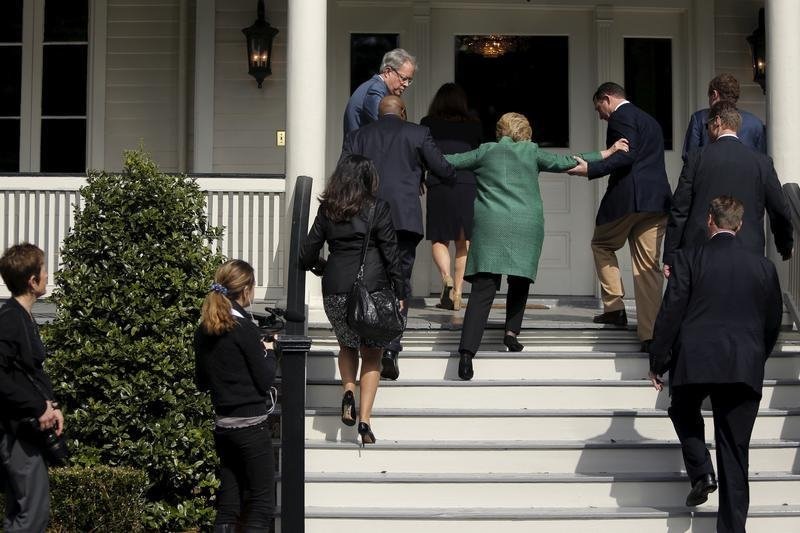
Photo taken 09/19/16. No comment necessary:

clinton-helped-up-stairs
(Source: http://www.trump-conservative.com/news/hillary-clinton-helped-up-stairs-at-temple-university-rally-low-turnout/)

UPDATE 09/21/16

Thomas Lifson wonders about Hillary’s intermittent exotropia (uncoordinated eyeball movement), which is a particular form of strabismus. It could be a symptom of Graves’ disease. But, given the severe concussion Hillary incurred four years ago, trauma-related strabisumus seems most likely:

Many things and/or events can cause a strabismus. They include genetics, inappropriate development of the “fusion center” of the brain, problems with the controlled center of the brain, injuries to muscles or nerves or other problems involving the muscles or nerves. Surprisingly, most cases of strabismus are not a result of a muscle problem, but are due to the control system — the brain.

What other health problems might have caused the fall that led to the concussion, or have resulted from the concussion? Parkinson’s disease is one possibility, of course.

I don’t expect a complete and candid answer from Hillary or her camp.

The Wages of Simplistic Economics

If this Wikipedia article accurately reflects what passes for microeconomics these days, the field hasn’t advanced since I took my first micro course almost 60 years ago. And my first micro course was based on Alfred Marshall’s Principles of Economics, first published in 1890.

What’s wrong with micro as it’s taught today, and as it has been taught for the better part of 126 years? It’s not the principles themselves, which are eminently sensible and empirically valid: Supply curves slope upward, demand curves slope downward, competition yields lower prices, etc. What’s wrong is the heavy reliance on two-dimensional graphical representations of the key variables and their interactions; for example, how utility functions (which are gross abstractions) generate demand curves, and how cost functions generate supply curves.

The cautionary words of Marshall and his many successors about the transitory nature of such variables is no match for the vivid, and static, images imprinted in the memories of the millions of students who took introductory microeconomics as undergraduates. Most of them took no additional courses in micro, and probably just an introductory course in macroeconomics — equally misleading.

Micro, as it is taught now, seems to purvey the same fallacy as it did when Marshall’s text was au courant. The fallacy, which is embedded in the easy-to-understand-and remember graphs of supply and demand under various competitive conditions, is the apparent rigidity of those conditions. Professional economists (or some of them, at least) understand that economic conditions are fluid, especially in the absence of government regulation. But the typical student will remember the graph that depicts the dire results of a monopolistic market and take it as a writ for government intervention; for example:

Power that controls the economy should be in the hands of elected representatives of the people, not in the hands of an industrial oligarchy.

William O. Douglas
(dissent in U.S. v. Columbia Steel Co.)

Quite the opposite is true, as I argue at length in this post. Douglas, unfortunately, served on the Supreme Court from 1939 to 1975. He majored in English and economics, and presumably had more than one course in economics. But he was an undergraduate in the waning days of the anti-business, pro-regulation Progressive Era. So he probably never got past the simplistic idea of “monopoly bad, trust-busting good.”

If only the Supreme Court (and government generally) had been blessed with men like Maxwell Anderson, who wrote this:

When a gov­ernment takes over a people’s eco­nomic life, it becomes absolute, and when it has become absolute, it destroys the arts, the minds, the liberties, and the meaning of the people it governs. It is not an ac­cident that Germany, the first paternalistic state of modern Eu­rope, was seized by an uncontrol­lable dictator who brought on the second world war; not an accident that Russia, adopting a centrally administered economy for human­itarian reasons, has arrived at a tyranny bloodier and more abso­lute than that of the Czars. And if England does not turn back soon, she will go this same way. Men who are fed by their govern­ment will soon be driven down to the status of slaves or cattle.

The Guaranteed Life” (preface to
Knickerbocker Holiday, 1938, revised 1950)

And it’s happening here, too.

Hot Post

Thanks to Free Republic, a five-year-old post of mine attracted an inordinate number of visitors over the weekend. The post is “September 20, 2001: Hillary Clinton Signals the End of ‘Unity’.” Go and see it for yourself.

The “Shy Trump Supporter” Hypothesis

Scott Adams — the creator of Dilbert — has some thoughts about the “shy Trump supporter” hypothesis:

For starters, we can say with certainty that they exist…. People feel comfortable telling me privately, and also anonymously online, that they hide their Trump support from their spouse and coworkers. So we know they exist. We just don’t know how many.

We know that sometimes robocall surveys and online surveys show more Trump support than human-to-human polling. So that might be an indicator, but we don’t know what other variables are in play.

…I’m guessing some Shy Trump Supporters “park” their votes with Gary Johnson (polling at 9.3%) or Jill Stein (polling at 3.3%).

But I wonder if the Shy Trump supporters are mostly parked with Johnson because of gender (consciously or unconsciously), whereas Stein is more of a real protest vote against Clinton. Anecdotally, Shy Trump Supporters tell me they do park their pre-vote preferences with Johnson….

Then you also have the question of turnout. Trump is clearly generating the most enthusiasm in public appearances. I would think that translates into more new voters….

I predict that 3% of voters are Shy Trump Supporters. As polls continue to tighten, especially in battleground states, that will be enough for an electoral landslide for Trump.

Here’s my take. It’s unlikely that much of Gary Johnson’s support comes from disaffected Democrats. He’s a fiscal-conservative-small-government-is-best candidate. If there are disaffected Democrats who aren’t yet ready to push the button for Clinton — or who never will be ready — they’re in the Jill Stein camp.

Johnson’s support, which is running around 9 percent, is improbably high for a Libertarian candidate. Johnson got 1 percent of the popular vote in 2012. The only Libertarian candidate to do better was Ed Clark in 1980, with 1.1 percent.

What about “respectable” (non-segregationist) third-party upstarts like John Anderson and Ross Perot, who garnered 7 to 19 percent of the popular vote in the elections of 1980, 1992, and 1996? Well, the Libertarian Party isn’t an upstart. It’s been around since the election of 1976, and has never gained traction. Johnson just isn’t making the waves that Anderson and Perot did.

So I believe that Scott Adams is right. A lot of “shy Trump supporters” are claiming that they’ll vote for Johnson, but most of them will vote — if they do vote — for Trump. My evidence? Trump’s standing in Rasmussen’s poll is strongly (r-squared = 0.6) and negatively correlated with Johnson’s standing. As voters decide that they aren’t going to waste votes on Johnson, they’ll turn (mainly) to Trump.

Does that mean a win for Trump on election day? Not necessarily. I’ve run some numbers on the polling relationships to date. Here’s what they imply:

If Johnson’s popular-vote share slips from its current 9 percent to 3 percent on election day — which is 3 times better than his showing in 2012 — Trump would pick up 3 percentage points. On the other hand, if Stein’s support slips from its current 2 percent to 1 percent on election day — 3 times better than her showing in 2012 — Clinton would pick up 0.7 percentage point. So far, so good, for Trump.

But as the “other-undecided” vote shrinks from its present level of 7 percent to 1 percent (a bit higher than in recent elections), Clinton will pick up 5.5 percentage points while Trump picks up only 1.3 percentage point.

Adding it up, there’s a likely gain for Trump of 4+ percentage points and a likely gain for Clinton of 6+ percentage points. Adding those numbers to Rasmussen’s latest results for Trump (39 percent) and Clinton (43 percent) yields something like 43 or 44 percent for Trump and 49 or 50 percent for Clinton.

That’s consistent with the results of another method. Based on trends to date, if Trump and Clinton take 95 percent of the total popular vote (leaving 3 percent for Johnson, 1 percent for Stein, and 1 percent for “other”), Clinton will get 50 percent of the total,  as against 45 percent for Trump. Clinton’s margin of 5 percent exceeds the 3-percent margin of error in Rasmussen’s polling. With 52 or 53 percent of the two-party popular vote (50 percent divided by 95 percent), Clinton would win at least 60 percent of the electoral vote. (In 2012, Obama won 62 percent of  the electoral vote with 52 percent of the two-party popular vote.) So it’s looking good for Clinton.

All of this is predicated on trends over the past several months.  Those trends might continue, allowing Clinton to “run out the clock.” But a major event could change everything. For example, Clinton might have a stroke, Assange might reveal truly damning e-mails, Trump might demolish Clinton in the debates, etc. Those are the “known unknowns.” It’s impossible to list the “unknown unknowns” — but they’re out there.

As I’ve said before, the only thing worse than a Trump victory would be a Clinton victory. There’s a chance that Trump would nominate constitutionalists to the Supreme Court; there’s no chance that Clinton would  do so.

Not-So-Random Thoughts (XVII)

Links to the other posts in this occasional series may be found at “Favorite Posts,” just below the list of topics.

*     *     *

Victor Davis Hanson offers “The More Things Change, the More They Actually Don’t.” It echoes what I say in “The Fallacy of Human Progress.” Hanson opens with this:

In today’s technically sophisticated and globally connected world, we assume life has been completely reinvented. In truth, it has not changed all that much.
And he proceeds to illustrate his point (and mine).

*     *     *

Dr. James Thompson, and English psychologist, often blogs about intelligence. Here are some links from last year that I’ve been hoarding:

Intelligence: All That Matters” (a review of a book by Stuart Ritchie)

GCSE Genes” (commentary about research showing the strong relationship between genes and academic achievement)

GWAS Hits and Country IQ” (commentary about preliminary research into the alleles related to intelligence)

Also, from the International Journal of Epidemiology, comes “The Association between Intelligence and Lifespan Is Mostly Genetic.”

All of this is by way of reminding you of my many posts about intelligence, which are sprinkled throughout this list and this one.

*     *     *

How bad is it? This bad:

Thomas Lifson, “Mark Levin’s Plunder and Deceit

Arthur Milikh, “Alexis de Tocqueville Predicted the Tyranny of the Majority in Our Modern World

Steve McCann, “Obama and Neo-fascist America

Related reading: “Fascism, Pots, and Kettles,” by me, of course.

Adam Freedman’s book, A Less than Perfect Union: The Case for States’ Rights. States’ rights can be perfected by secession, and I make the legal case for it in “A Resolution of Secession.”

*     *     *

In a different vein, there’s Francis Menton’s series about anthropogenic global warming. The latest installment is “The Greatest Scientific Fraud of All Time — Part VIII.” For my take on the subject, start with “AGW in Austin?” and check out the readings and posts listed at the bottom.

Consistent Conservatism

[A] person’s political philosophy — if he may be said to have one — is likely to consist of a set of attitudes, many of them logically irreconcilable. This, I believe, is due mainly to the influence of temperament on one’s political views. It is a rare human being who does not interpret the world through the lens of his preferences, and those preferences seem to be more a matter of temperament than of knowledge and reason. Even highly intelligent persons are capable of believing in the most outlandish things because they want to believe those things.

Parsing Political Philosophy (II),” Politics & Prosperity

*       *      *

I offer myself as an example of the operation of temperament on political preferences. I am, by nature, a conservative person. For example, I’m cautious about change. It’s my view that if a thing works reasonably well, tinkering with it will probably cause it to stop working well, or at all. For that reason, I dislike meddling in the affairs of others. I don’t know what they know about their own circumstances, so I presume that they’re acting in their own best interests. And if they mess up their lives, it’s up to them to make things right if they can. And if they can’t, it’s not my responsibility to clean up the mess that they’ve made. But, in typically conservative fashion, I will try to help them if I’m attached to them by blood or another strong bond.

By extension, I intensely dislike government meddling because it can mess up so many lives, even (and especially) lives that would otherwise be well lived. It follows that government has only one legitimate function, which is to protect Americans from force and fraud. That implies a vigorous defense of Americans and their overseas interests against enemies, foreign and domestic. The purpose of a vigorous defense is to enable Americans to lead their lives (lawfully) as they deem best; it is not to make America safe for governmental meddling in social and economic affairs.

Government, in short, should be conservative in the way that I am conservative. Some would call me a libertarian, but it is my long-held position that conservatism is true libertarianism.

My consistent conservatism is reflected in my attitude toward WikiLeaks. I was gladdened by this recent news:

WikiLeaks founder Julian Assange promised he’s not done leaking information that could be damaging to Hillary Clinton. During an interview this week with Fox’s Megyn Kelly he said the documents would be “significant” in perhaps turning the tide of the 2016 election by giving voters a better understanding who they’re electing.

Not that I’m a Donald Trump fan; I’m not, as you will know if you’re a regular reader of this blog. But I welcome almost any development that might keep that lying, hypocritical statist Hillary Clinton out of the White House.

Am I a hypocrite, too? My visceral (conservative) reaction to activists, protestors, and rabble-rousers is “go away and mind your own business.” That was my reaction to WikiLeaks when I first heard of it — and Julian Assange — six years ago, in connection with the release of documents related to the wars in Iraq and Afghanistan.

When it comes to war-making in defense of Americans and their overseas interests, my conservative (i.e., cautious) view is that it’s better to kill enemies sooner rather than later. Delay gives enemies a chance to build their strength, and to use it in unexpected ways.

I know that the politicians and generals who wage war aren’t always or often brilliant about how they do it. But perfection is hard to come by, so I’m willing to tolerate mistakes as long as they err on the side of “too much” defense. (LBJ’s Vietnam vacillations were maddening to me; he should have gone all out or bugged out, but he did neither.) I was therefore angered by the revelations six years ago because it seemed to me that they put America’s war-fighters in jeopardy, or at least compromised America’s ability to wage war.

So, no, I don’t think I’m hypocritical in the least. Anything (non-violent) that helps to take down a domestic enemy like Hillary Clinton is acceptable. Anything (violent or non-violent) that damages America’s defenses against foreign enemies is unacceptable, and often treasonous.

Conservative in temperament, conservative in politics, consistently conservative. That’s my motto.

“And the Truth Shall Set You Free”

The truth contained in Drs. Lawrence Mayer and Paul McHugh’s “Sexuality and Gender” (The New Atlantis No. 50, Fall 2016) will fall on the same deaf ears as many other truths. The “party of science” is really the party of magical thinking — about many things, including economics, climate, race, war, and (most recently) “gender.”

“Gender” is the latest egregious example of seeing the world as one wishes it were, instead of the way it is. “Gender” smacks of Victorian prudery; it’s a euphemism for “sex.” But it’s more than that, because it connotes more than a mere biological fact of life; it connotes a state of mind that somehow transcends biology. (Very Zen, don’t you think?)

Among the subjects addressed by Drs. Mayer and McHugh is “gender identity” The executive summary of Part Three, which addresses that subject, gives these findings:

● The hypothesis that gender identity is an innate, fixed property of human beings that is independent of biological sex — that a person might be “a man trapped in a woman’s body” or “a woman trapped in a man’s body” — is not supported by scientific evidence.

● According to a recent estimate, about 0.6% of U.S. adults identify as a gender that does not correspond to their biological sex.

● Studies comparing the brain structures of transgender and non-transgender individuals have demonstrated weak correlations between brain structure and cross-gender identification. These correlations do not provide any evidence for a neurobiological basis for cross-gender identification.

● Compared to the general population, adults who have undergone sex-reassignment surgery continue to have a higher risk of experiencing poor mental health outcomes. One study found that, compared to controls, sex-reassigned individuals were about 5 times more likely to attempt suicide and about 19 times more likely to die by suicide.

● Children are a special case when addressing transgender issues. Only a minority of children who experience cross-gender identification will continue to do so into adolescence or adulthood.

● There is little scientific evidence for the therapeutic value of interventions that delay puberty or modify the secondary sex characteristics of adolescents, although some children may have improved psychological well-being if they are encouraged and supported in their cross-gender identification. There is no evidence that all children who express gender-atypical thoughts or behavior should be encouraged to become transgender.

Don’t get me wrong, I bear no animus toward those few persons who are truly conflicted about their sexuality. But I have no sympathy for juvenile faddishness and the unseemly (and temporarily halted) eradication of privacy in the name of “gender equality.” It’s as if time-honored codes of conduct have somehow become unnecessary and unduly discriminatory. (Where have we heard that before?)

And, as usual, the rush to remake the world in a new, trendy image won’t stop with “equality.” It will become (and has become, in some places) verboten to refer to anyone by anything but an approved label, just as it has become verboten in some places to refuse to bake a wedding cake or provide flowers for a homosexual “marriage.”

It’s easy enough for a black, a woman, or any one of a long list of “protected groups” to march into an EEOC office and file a baseless discrimination claim. It’s unsurprising that the list of protected groups now encompasses anyone who identifies as LGB or T. (What’s wrong with Q?)

What I want to know is why the EEOC and all of the other equality-enforcing agencies of government are still in business. Given the relatively small number of persons who aren’t in a protected group — namely straight, white, non-Hispanic males under the age of 40 who are neither disabled (a broad category) or veterans — it seems to me that equality has already been achieved. Except for the unprotected, of course, but only their mothers give two hoots about them (maybe).

*     *     *

Related posts:
Two-Percent Tyranny
The Culture War
Ruminations on the Left in America
The Euphemism Conquers All
Superiority
The War on Conservatism
How Government Subverts Social Norms
Identity and Crime
There’s More to It Than Religious Liberty
The Authoritarianism of Modern Liberalism, and the Conservative Antidote
Privilege, Power, and Hypocrisy
The Beginning of the End of Liberty in America
The Technocratic Illusion
“Fairness”
Equal Protection in Principle and Practice
Society, Polarization, and Dissent

True Confession, New Resolution

RETRACTED AS HOPELESSLY NAIVE. SEE, FOR EXAMPLE, MANY SUBSEQUENT POSTS, INCLUDING BUT FAR FROM LIMITED TO Leftism As Crypto-Fascism: The Google Paradigm AND What’s Going On? A Stealth Revolution

I spent 30 years at a defense think-tank. There were many things that I liked about it, and a few things that I didn’t like about it. The thing that I disliked most was the way in which some senior managers and many analysts offered criticism. They practiced a perverted version of the Socratic method. Instead of working with the author of an analysis to improve it, they would keep probing the weak points of he work — or more correctly, the analyst’s ability to explain and defend it — and leave the analyst melting in a puddle of mortification.

I resented that kind of criticism when it was aimed at me, and when I saw it being aimed at others. (I was involved in the creation of a mock “seal” for the  hazing sessions that were led by a former president of the think-tank. The seal displayed the motto “Nibbled to death by ducks.”) But I often resorted to the method when I was the critic. Human nature is like that.

I am here to confess (as I just did), to repent (as I hope I am doing), and to enter onto the path of righteousness (as I hope I will).

The most constructive way to offer criticism, in my experience, is to put yourself in the place of the person you are criticizing. Try to understand the issue at hand, as he sees it, and try to understand the way he comes at the issue. If you get “inside” that person’s mind, you can then talk to him about the problem in a way that he understands. From there, you can work with him to improve whatever it is he is seeking to improve — be it the Navy’s choice of a new weapon system or the opportunities available to low-income persons.

I know that a person’s political views are largely a matter of temperament, and for that reason not always susceptible to change by appealing to facts or logic. But political views are nevertheless changeable, in the way that a person who is addicted to drugs or alcohol will overcome his addiction — if he understands that he can do it, and will live a miserable life and die miserably if he doesn’t.

I am also aware that leftists — who are the usual targets of my criticism — do not often (or perhaps ever) respond constructively to conciliatory statements. As I say here,

leftists can be ruthless, unto vicious. They pull no punches; they call people names; they skirt the law — and violate it — to get what they want (e.g., Obama’s various “executive actions”); they use the law and the media to go after their ideological opponents; and on and on.

Nevertheless, this blog is but a pinprick on the vast hide of leftism. Perhaps it will be more effective if I make a greater effort to understand what leftists want, and try to appeal to them on that basis, instead of preaching to the choir of libertarian-conservatives as I often do.

*     *     *

Related reading and viewing:

Jonathan Haidt, “Why the Centre Cannot Hold in America, Europe, and Psychology” (Heterodox Academy, August 9, 2016). This is an introduction to Haidt’s recent speech at the American Psychological Association’s annual convention in Denver, where he addressed the causes and consequences of political polarization.

A video of the speech: https://youtu.be/vAE-gxKs6gM

PowerPoint slides: http://heterodoxacademy.org/wp-content/uploads/2016/08/haidt.APA-2016-lecture-on-polarization.for-posting.compressed.pptx

PDF version of the slides: http://heterodoxacademy.org/wp-content/uploads/2016/08/haidt.APA-2016-lecture-on-polarization.slides-for-printing.pdf

Pontius Pilate: Modern Politician

Thou art a king, then? Pilate asked. And Jesus answered, It is thy own lips that have called me a king. What I was born for, what I came into the world for, is to bear witness of the truth. Whoever belongs to the truth, listens to my voice. Pilate said to him, What is truth? And with that he went back to the Jews again, and told them, I can find no fault in him. You have a custom of demanding that I should release one prisoner at paschal time; would you have me release the king of the Jews? Whereupon they all made a fresh outcry; Barabbas, they said, not this man. Barabbas was a robber.

John 18:37-40


But the chief priests and elders had persuaded the multitude to ask for Barabbas and have Jesus put to death; and so, when the governor openly asked them, Which of the two would you have me release? they said, Barabbas. Pilate said to them, What am I to do, then, with Jesus, who is called Christ? They said, Let him be crucified. And when the governor said, Why, what wrong has he done? they cried louder than ever, Let him be crucified. And so, finding that his good offices went for nothing, and the uproar only became worse, Pilate sent for water and washed his hands in full sight of the multitude, saying as he did so, I have no part in the death of this innocent man; it concerns you only.

Matthew 27:20-24

*     *     *

Pilate is a modern man. In asking “What is truth?” he marks himself as a moral relativist, someone who scorns the idea that one moral system can be better than another. He would have reacted to the terrorist attacks of September 11, 2001, in the vein of many leftists: “We were asking for it.”

And like a politician who “accepts full responsibility” for a disastrous decision — but pays no penalty — Pilate ceremonially absolves himself of blame in the death of Christ. As if the ceremonial act (or rote apology) somehow rectifies a grave error of judgment or dereliction of duty. Pilate, having gone through the motions, remains in high office — just like a modern politician.

The Obama Effect: Disguised Unemployment, Updated

Here.

Khizr Khan’s Muddled Logic

Anyone who follows this blog knows that I’m not a fan of Donald Trump. The only thing worse than a Trump victory in November would be a Clinton victory. But the brouhaha over Trump’s response to Khizr Khan’s speech at the DNC last week overlooks the vital truth that Khan’s speech was a load of propagandistic hogwash.

For the benefit of those of you who’ve been vacationing on Mars, Khizr Khan’s son was a U.S. Army captain who was killed in Iraq in 2004. The point of bringing Khan before the DNC was to point up Trump’s supposed anti-Muslim views. Whether or not Trump is anti-Muslim is beyond my ken, but he is anti-terorist — which is something I find hard to discern in the rhetoric of Democrats, who can’t bring themselves to associate Islam and terrorism.

It is anti-terrorism that animated Trump’s suggestion that there should be no further immigration by Muslims. Such a ban would do no more to prevent terrorist acts, given the numbers of terror-prone Muslims (and others) already in the United States, than a no-gun zone will do to prevent mass shootings by a psychopath. Nevertheless, I understand and appreciate the sentiment behind Trump’s proposal, even though it was a fatuous one that could only draw accusations of xenophobia.

And so it did, both in Hillary Clinton’s recorded introduction to Khan’s brief speech and in Khan’s brief speech itself. Without further ado, here’s the full text:

First, our thoughts and prayers are with our veterans and those who serve today. Tonight, we are honored to stand here as the parents of Capt. Humayun Khan, and as patriotic American Muslims with undivided loyalty to our country.

Like many immigrants, we came to this country empty-handed. We believed in American democracy — that with hard work and the goodness of this country, we could share in and contribute to its blessings.

We were blessed to raise our three sons in a nation where they were free to be themselves and follow their dreams. Our son, Humayun, had dreams of being a military lawyer. But he put those dreams aside the day he sacrificed his life to save his fellow soldiers.

Hillary Clinton was right when she called my son “the best of America.” If it was up to Donald Trump, he never would have been in America. Donald Trump consistently smears the character of Muslims. He disrespects other minorities — women, judges, even his own party leadership. He vows to build walls and ban us from this country.

Donald Trump, you are asking Americans to trust you with our future. Let me ask you: Have you even read the U.S. Constitution? I will gladly lend you my copy. In this document, look for the words “liberty” and “equal protection of law.”

Have you ever been to Arlington Cemetery? Go look at the graves of the brave patriots who died defending America — you will see all faiths, genders, and ethnicities.

You have sacrificed nothing and no one.

We can’t solve our problems by building walls and sowing division. We are stronger together. And we will keep getting stronger when Hillary Clinton becomes our next president.

Khan wraps himself in the flag that draped his son’s coffin. But the tragic death of his son is irrelevant to the issue at hand. It gives Khan no authority to speak about efforts to combat terrorism.

By the same token, also irrelevant are Khan’s various “arguments”:

He is — he says — a loyal and patriotic Muslim-American. So what? There are evidently a lot of Muslims — American and non-American — who are neither loyal nor patriotic, and who would (and have) killed Americans in the name of their religion.

He claims to be an immigrant who came to this country empty-handed, and who shares in and contributes to its “blessings.” So what? A lot of people come to this country, and some of them share in and contribute to its “blessings” but then turn around and kill or try to kill Americans.

His son gave his life in the service of his country. And for that, his son should be honored, and has been honored. But what does that have to do with terrorism?

Ah, here it is. If Trump had his way, Khan’s son (and Khan) wouldn’t have come to America. By the same token, neither would have the perpetrators of the World Trade Center bombing (1993), the Brooklyn Bridge shooting (1994), the killings at the Empire State Building (1997), the New York terror attack (2000), the fire-bombing of a synagogue in Ithaca (2000), the massive attacks of September 11, 2001, the Los Angeles Airport shooting (2002), the Jewish Federation shooting in Seattle (2006), the Arkansas recruiting office shooting (2009), the Fort Hood shooting (2009), the Boston Marathon bombing (2013), the Chattanooga shootings (2015), the San Bernardino attack (2015), or the Orlando nightclub shooting (2016). It’s true that there have been many other acts of violence during the same span of time, but some acts of violence would nevertheless have been prevented had Muslims not been allowed to enter the United States.

Now comes the Constitution, which is like the flag and the Declaration of Independence in its emotional appeal. In fact, the Constitution doesn’t guarantee anyone the right to immigrate. Immigration policy is a matter for Congress to decide. “Equal protection of the law[s]” applies to “[a]ll persons born or naturalized in the United States,” not to persons who wish to enter the United States and perhaps become citizens. “Liberty” is nowhere defined in the Constitution; it’s mentioned in the Preamble (which isn’t part of the Constitution), and twice elsewhere, in connection with due process of law. “Liberty” doesn’t encompass the right of an alien to enter the United States.

And it’s back to the dead who gave their lives for the United States and now lie in Arlington Cemetery (and other national cemeteries). Yes, there are all (or many) faiths, genders, and ethnicities among those dead. But their dying has nothing to do with whether Muslims should be allowed to enter the United States. In fact, there would be many fewer dead had Muslims not been allowed to enter, had terrorist attacks not ensued from their entry, and had the wars in Iraq and Afghanistan not followed from the terrorist attacks on September 11, 2001.

Whether or not Trump has sacrificed anything is beside the point. Neither has Hillary Clinton, by Khan’s standard. Yet, he ends by endorsing her because Americans will “grow stronger together” when she becomes president. Whatever that means.

And Khan to the contrary notwithstanding, Donald Trump is a piker when it comes to “building walls and sowing division.” Barack Obama has been doing it, metaphorically and actually, by rabble-rousing about “the rich”; destroying America’s health-care system; rewarding indolence with extended welfare payments, food stamps, and health insurance for slackers; stirring racial tension and fostering cop-killings by defending black thugs as “victims” and leveling blanket accusations of racism against cops; jerking the armed forces around with his on-again-off-again policies in Iraq and Afghanistan; caviling before Putin; failing to confront Chinese assertiveness; conspiring in the emasculation of the armed forces despite the obvious ambitions of Russia and China; signing (and ignoring) a treaty that will allow Iran to acquire nuclear weapons; slighting Israel, America’s only true ally in the Middle East; slighting other true allies in Eastern Europe; pushing same-sex “marriage” and gender neutrality as if thousand of years of tradition and biological facts mean nothing; and leveling the power of the central government against religious liberty.

As I said, Trump’s anti-Muslim immigration policy is fatuous. And Trump, as usual, responded to Khan with bluster and name-calling when he should have responded with facts and logic.

But that doesn’t excuse Khan’s own fatuousness or Clinton’s exploitation of his son’s death.

It’s time for principled conservatives — whose number doesn’t seem to include Senator McCain, Governor Pence, and other mealy-mouthed Republicans — to go on the attack and quit retreating in the face of the enemy. That enemy is Hillary Clinton (and other so-called progressives), whose cynical use of Khan is in keeping with her cynical political career — the foundation of which is her partnership with a sexual predator.

*     *     *

Related reading:

Clarice Feldman, “Who Is Khizr Khan, the Father of a Fallen U.S. Soldier?American Thinker, August 1, 2016

Geoffrey P. Hunt, “Hillary’s Cynical Manipulation of Captain Khan’s Sacrifice,” American Thinker, August 2, 2016

J. Marsolo, “Khizr Khan Has No Shame,” American Thinker, August 2, 2016

William Murchison, “The Khan Con and Other Modern Discontents,” The American Spectator, August 2, 2016


Unsurprising News about Health-Care Costs

Obama, among his many lies, promised that Obamacare would “bend the cost curve,” that is, reduce or eliminate the surge in health-care costs. Anyone with half a brain knew that Obama was either stupid or lying. He’s not stupid (though not nearly as smart as he thinks he is), so it’s obvious that he was lying. (It was obvious to me from the get-go.)

Those few Americans who have been paying attention have known that Obama was lying because they’ve been following the surge in health-care costs. This is just the latest in a series of reports delivering the bad but unexpected news.

As the U.S. economy continues to flirt with recession, this morning’s “flash” Dross Domestic Product release for the second quarter indicates “close to zero” growth. Business investment has collapsed, leaving personal consumption expenditures to drive what little growth there is….

The figures for 2015 Q2 to 2016 Q2 show growth in spending on health services accounted for one quarter of GDP growth. At a growth rate of 5.3 percent, spending on health services grow more than twice as fast as the 2.1 percent growth in non-health services GDP. Growth in health spending accounted for almost one third of the growth in services spending and one quarter of the growth in personal consumption expenditure….
Although health services spending accounts for just 12 percent of GDP, these estimates continue to indicate it will grow faster than GDP. There is no slowdown in health services spending.
I’ll report later on the latest GDP estimates, but I will tell you that “close to zero” is real year-over-year growth of 1.2 percent. Just abysmal.

Individualism, Society, and Liberty

In “How Our Individualism Has Trapped Us in a Welfare State,” Heather Judd has taken a stab at an issue that I’ve pondered for a long time: the tension between individualism and society. Now, by “society” I mean true society:

Society — true society — consists of people who, among other things, agree as to the limits on what one may do. That shared view isn’t imposed by regulation, statute, or judicial decree — though such things will arise from the shared view in a true society. Rather, the shared view arises from the experience of living together and finding the set of customs and prohibitions that yields peaceful, willing coexistence and its concomitant: beneficially cooperative behavior. Liberty, in other words.

“The experience of living together and finding” a common “set of customs and prohibitions” seems consistent with Judd’s view of society, which she calls “an organized group of people sharing a common culture.” Judd doesn’t directly address the libertarian aspect of true society, but the thrust of her essay points in that direction. She laments the fact that

[c]ultural individualization has…cornered us into a welfare state mentality from which we cannot escape unless we replace our concept of a society of individuals with something more ordered and interconnected.

Toward the end of her essay she puts it this way:

Living together in isolation is not a sustainable social model. So long as we continue to think of the individual as the basic unit of society, our progression toward the disenchanted welfare state will continue, even while no amount of socialized government intervention will provide the human cohesion we need.

Judd’s view is that family is the backbone of society. And the drift away from families to individuals is destroying that backbone, which must be reconstructed. In her words,

government is incapable of buttressing our crumbling human connections. That task must start with rebuilding individuals into families and families into society. Like every great undertaking, the process will be slow and require sacrifice, but the recompense will be not only a healthy and sustainable society, but also, paradoxically, a stronger sense of our individual identity as we reconnect with other human beings.

I think she’s right about the breakdown of family, but her vague exhortation at the end leaves me wondering what can actually be done about it And even if there were some restoration of the family on a relatively large scale, I don’t think it would do much to alleviate the fragmentation of the United States, which has never been a society in the true meaning of the word.

Why have family ties loosened and broken? The answer, in two words: prosperity and mobility. Even without the welfare state (and despite it), a large fraction of the populace can afford to buy things like housing and elder-care that until World War II were often provided by families.

Greater mobility goes hand in hand with greater prosperity; the expansion of economic activity has been both intensive and extensive. Modern people are no different than their hunter-gatherer forbears; they go where their labors earn greater rewards. And in doing so they leave behind grandparents, parents, and siblings — most of whom are prosperous enough to fend for themselves. American families have been drifting apart for many generations. The drift was masked to some extent by the influx of European immigrants in the late 1800s and early 1900s, whose strong bonds were forged by economic necessity and mutual self-defense against xenophobic natives. But those bonds, too, have dissolved to the point that the exceptions (e.g., Amish and Hasidic communities) are notable for their rarity. And so it will be with the Hispanic immigration of recent decades, though economic necessity and ethnic differences probably will bind Hispanic immigrants far longer than they bound European ones.

So I don’t see the restoration of the family as likely — barring another World War II or Great Depression. Nor do I see the restoration of the family as necessary to the demotion of the welfare state. The welfare state does feed on individualism, but it also feeds on widespread economic ignorance and the cupidity of politicians and bureaucrats.

Economic ignorance abets cupidity, in that politicians and bureaucrats are able to feed their power-lust and line their pockets because most Americans have no grasp of the huge economic cost of the welfare state — or more accurately, the regulatory-welfare state. If the regulatory-welfare state is to be contained and diminished by electoral means, a huge number of Americans must be convinced of its exorbitant cost in dollars and liberty.

One might as well try to melt an iceberg with a hair dryer. Only a minority of economists understands or is willing to admit the dire economic consequences of the regulatory-welfare state, and only a minority of constitutional scholars understands or is willing to admit the anti-libertarian consequences of the regulatory-welfare state. More importantly — because only a small fraction of Americans is aware of what those “fringe” economists and constitutional scholars say — relatively few politicians and pundits on the national stage understand, agree with, and accurately relay those views to Americans. For every Ted Cruz there are probably two or three Bernie Sanderses.

To repeat the themes of recent posts, leftists are ruthless and they have the rhetorical advantage over principled politicians because they are very good at promising things without knowing or caring about the economic and social costs of what they promise. Their appeal to Mr. and Ms. Average and Below-Average — which is most Americans — rests on envy. Leftists are always on the lookout for privilege, which they promise to uproot:

Privilege…implies that the possessors of certain positive attributes (high intelligence, good looks, high income, access to political power) have come by those things undeservedly, and even at the expense of those who lack them: the underprivileged. [Leftists] believe implicitly in a state of nature wherein everyone would have equal endowments of intelligence, looks, etc., if only it weren’t for “bad luck.” [Leftists] believe it necessary to use the power of government to alleviate (if not eliminate) unequal endowments and to elevate the “victims” of inequality.

If you were Mr. or Ms. Average or Below-Average, would you willingly sacrifice the (illusory) prosperity of the regulatory-welfare state and reject its promise of making everyone a winner? What’s more disheartening — but unsurprising given the state of political discourse — is that  Mr. and Ms. Above-Average are not only reluctant to abandon the regulatory-welfare state, but are its staunchest proponents.

In sum, individualism is here to stay, regardless of what happens to the regulatory-welfare state, unless there is a return to the dire days of 1930-1945. And even then, the regulatory-welfare state is here to stay, unless there is a negotiated partition of the country, a (successful) secession movement, or a coup by liberty-loving patriots.

I’m sorry, but that’s the way it looks from here.

More Wisdom from Theodore Dalrymple

I’m reading his Not With a Bang But a Whimper: The Politics & Culture of Decline. It’s chock-a-block with wisdom, as is almost everything Dalrymple writes. This is from the essay “How Not to Do It”:

The state has become a vast and intricate system of patronage, whose influence very few can entirely escape. It is essentially corporatist: the central government, avid for power, sets itself up as an authority on everything and claims to be omnicompetent both morally and in practice; and by means of taxation, licensing, regulation and bureaucracy, it destroys the independence of all organisations that intervene between it and the individual citizen. If it can draw enough citizens into dependence on it, the central government can remain in power, if not forever, then for a very long time, at least until a crisis or cataclysm forces change.

At the very end of the chain of patronage…is the underclass, who (to change the metaphor slightly) form the scavengers or bottom-feeders of the whole corporatist ecosystem. Impoverished and degraded as they might be, they are nonetheless essential to the whole system, for their existence provides an ideological proof of the necessity of providential government in the first place, as well as justifying many employment opportunities in themselves.… I have seen myself…large numbers of people corrupted to the very fibre of their being by having been deprived of responsibility, purpose and self-respect, void of hope and fear alike, living in as near to purgatory as anywhere in modern society can come.

Of course, the corporatist system…is a house of cards, or perhaps a better analogy would be with a pyramid scheme. Hundreds of thousands of people are employed to perform tasks that are not merely useless but actually obstructive of real work and economically counterproductive. The bureaucracy insinuates itself into the smallest cracks of daily life.


An Addendum to Asymmetrical (Ideological) Warfare

I published “Asymmetrical (Ideological) Warfare” almost six years ago. I must say that it holds up well. In fact, I wouldn’t change a word of it. It’s fairly long, and I won’t try to summarize or excerpt it, except to repeat the opening sentence:

This post could be subtitled: “Or, why the left — Democrats and so-called liberals and progressives — enjoy a rhetorical advantage over libertarians and fiscal conservatives.”

In a few words: Leftists have the advantage of saying the kinds of things that people like to hear, especially when it comes to promising “free” stuff and visions of social perfection. There’s a lot more to it than that. Please read the whole thing.

What I didn’t say then, but will say now is that leftists have another advantage: they’re ruthless. Unlike true conservatives (not Trumpsters) and most libertarians, leftists can be ruthless, unto vicious. They pull no punches; they call people names; they skirt the law — and violate it — to get what they want (e.g., Obama’s various “executive actions”); they use the law and the media to go after their ideological opponents; and on and on.

Why the difference between leftists and true conservatives? Leftists want to rearrange the world to fit their idea of perfection. They have it all figured out, and dissent from the master plan will not be tolerated. (This is very Hitleresque and Stalinesque.) Conservatives and libertarians want people to figure out for themselves how to arrange the world within the roomy confines of simple morality (don’t cheat, don’t steal, don’t murder, etc.).

If Trump wins in November — a very big “if” — it should be an object lesson to true conservatives and libertarians. Take the gloves off and don brass knuckles. This isn’t a contest for hockey’s Lady Byng Trophy. To change the sports metaphor, we’re in the late rounds of a brutal fight, and well behind on points. It’s time to go for the knockout.

Quotation of the Day

Political correctness is communist propaganda writ small. In my study of communist societies, I came to the conclusion that the purpose of communist propaganda was not to persuade or convince, nor to inform, but to humiliate; and therefore, the less it corresponded to reality the better. When people are forced to remain silent when they are being told the most obvious lies, or even worse when they are forced to repeat the lies themselves, they lose once and for all their sense of probity. To assent to obvious lies is to co-operate with evil, and in some small way to become evil oneself. One’s standing to resist anything is thus eroded, and even destroyed. A society of emasculated liars is easy to control. I think if you examine political correctness, it has the same effect and is intended to.

Theodore Dalrymple (Anthony Daniels), interview August 31, 2005

“Fairness”

“Fairness” usually is invoked when a person or group seeks special treatment — unfairness, in other words. Here’s what’s unfair:

Making Johnny share his toys with Billy when Johnny is having a perfectly good time playing by himself.

If Billy wants to be treated fairly, he should bring his own toys and refuse to share them with Johnny. Then they can bargain about which toys to play with jointly and which toys to trade, either temporarily or permanently.

Refusing to let Abby into college because a less-qualified candidate happens to have darker skin than Abby, and there aren’t “enough” darker-skinned students.

If only there were more darker-skinned students, college authorities say, they would feel more secure and mingle with white students, thus giving the white students a broader “life experience.” How many more darker-skinned students? Well, there’s no magic number, the college must continue to prefer less-qualified darker-skinned students over white ones until mingling magically occurs. In any event, mingling is unlikely to be fostered by raising the dark-to-white ratio, though when the ratio gets large enough a certain kind of mingling will occur: Mobs of dark students will start to give the white ones some “life experience” by attacking them.

Taking money from Jack and giving it to Joe because Joe doesn’t earn “enough.”

Joe doesn’t earn much money, relative to Jack, for one or more of several reasons: Joe is dumber, lazier, less well-educated, less well-connected, or less lucky. But Jack didn’t cause Joe’s dumbness, laziness, lack of education, lack of connections, or unluckiness. Why is it “fair” to penalize Jack for things that aren’t his fault? Because everyone “deserves” a certain minimum standard of living? Who says so, a bunch of politicians who know that there are a lot of votes to be gained by spreading Jack’s money around? Jesus Christ was big on charity, but when government takes money from Jack and gives it to Joe, it’s not charity — it’s legalized theft.

Changing the definition of marriage because homosexuals want to be “married.”

For thousands of years it has been understood that marriage is a bonding of male to female. This definition seldom was so well understood and accepted that it was unnecessary to make it explicit until it came under attack. The attackers then claimed that it was “hateful” to make the definition explicit, and that persons of the same sex ought to be able to wed each other. So it’s “hateful” to defend a principle? Isn’t it therefore hateful to call someone hateful in defense of the principle that same-sex couples should be able to wed, even though the idea is relatively new and defies an understood definition of marriage that’s thousands of years old? In fact, it’s fair to call the shrill proponents of same-sex marriage hateful.

Allowing anyone who claims to “be” a female to use restrooms designated for women.

Do you know how to tell a female from a male? You don’t? Then you’d better ask your Mommy or Daddy to explain it to you — again. Do you claim to believe that a person’s sex is what that person says it is, even if the outward evidence contradicts that person’s claim? Perhaps, then, you will believe me when I say that I am God and will smite you for being such a ninny. Oh, you don’t believe me? Then why should you believe the tall, bearded fellow with a deep voice who barges into the “ladies” room and insists that he’s really a woman? Why does your judgment fail you in such cases? Because it’s only “fair” to the bearded guy to believe his story? But what if it isn’t “fair” to the real females who want privacy from prying male-like persons when they go into the “ladies” room? You’re not being fair, you’re just sticking it to “the system” because it gives you a thrill. As fads go, swallowing the transgender line makes as much sense as swallowing goldfish.

Not advising the prosecution of Hillary Clinton because “no reasonable prosecutor” would purse the case, after describing clear violations by Mrs. Clinton of an unambiguous statute.

That is unfair because, as the Director of the FBI admitted, almost anyone other than Mrs. Clinton (or another highly placed politician) would be prosecuted.