“Local Control”

I have written before about the hypocrisy of local control:

[T]he ultimate in local control is the freedom to do as one wishes with one’s own property — barring actual criminality, of course. Dictation by … left-wing city council[s] and the[ir] hired hands in … various bureaucracies isn’t that kind of local control — it’s local tyranny.

I omitted to mention that the very left-wingers who cry “local control” to justify local tyranny are also proponents of national control in a long list of matters ranging from retirement and health care to the suppression of the freedoms of religious exercise, association, and speech.

True local control is at the personal and interpersonal level, not in a city hall dominated by tax-gobbling hacks.

Real Americans

Many years ago, in the early 1960s, when the civil-rights movement was in its heyday, an older woman of my acquaintance objected to the idea that blacks are Americans. Americans, to her, were whites of European origin. Bill Vallicella offers a more nuanced view:

There has to be a broad base of shared agreement on all sorts of things….

No comity without commonality….

… “[O]ne people” should not be understood racially or ethnically. An enlightened nationalism is not  a white nationalism.  America is of course  ‘a proposition nation.’ You will find the propositions in the founding documents such as the Declaration of Independence.

I don’t give a flying enchilada whether you are Hispanic or Asian.  If you immigrated legally, accept the propositions, drop the hyphens, and identify as an American, then I say you are one of us. I’ll even celebrate the culinary diversity you contribute.

But…

That being understood, it is also true that whites discovered these America-constitutive propositions and are well-equipped to appreciate and uphold them, and better equipped than some other groups.

My money is on commonality — in language, in culture, in a deep attachment to the view that liberty is incompatible with a government that does more than protect citizens from domestic and foreign predators and leeches.

Thus, as Vallicella puts it:

Do not think of leftists and ‘progressives’ as fellow citizens; they are merely among us as disorderly elements and domestic enemies.  There can be no peace with them because they represent an ‘existential threat.’ Not to our physical existence so  much as to our way of life, which is of course more important than our mere physical existence as animals.

I would add that those who give aid and comfort to the left by consistently and overwhelmingly voting for Democrats are not fellow citizens. In that sense, the vast majority of blacks (but certainly not all of them) must be excluded — not because they are black, as my acquaintance would have it, but because they abet the destruction of liberty. They are far from alone, however, and most of their accomplices are white.

(See also “The British Roots of the Founding, and of Liberty in America“.)

Why Government Screws Up

Abstraction is the problem. Government officials and their enablers in the academy have a habit of judging voluntary social and economic outcomes by arbitrary standards. From there, they go on to prescribe costly, flawed, and counterproductive social and economic policies.

For example: The “poverty rate” (an artificial construct) is “too high”; therefore, poor people should be given handouts, which only worsen poverty by disincentivizing work. Or “not enough” persons have health insurance; therefore, taxpayers must be penalized for their success by subsidizing the health insurance of low-income persons, whose health outcomes are barely affected by their easier (and costly) access to health care. Or blacks are “discriminated against” because they have lower grades, lower earnings, etc., than whites East Asians, and Ashkenzi Jews; therefore, persons in the latter three categories must be penalized (through adverse selection for jobs, promotions, university admissions), in favor of blacks — despite the fact that the noted disparities are due to differences in intelligence. (There’s more here, here, and here.)

Though much of the private sector has became government-like in its huge, bloated, rent-seeking rigidity, it remains inherently superior in its ability to detect and solve actual problems. Why? Competition and pursuit of profit. When an entrepreneur perceives a need, he perceives a real one — a product or service that fills a gap or improves on an existing product or service. Yes, the entrepreneur doesn’t always get it right, but because there are many, many entrepreneurs all seeking to satisfy needs, they get it right in the aggregate.

Entrepreneurs, unlike government officials and academics, aren’t trying to second-guess markets. Instead, they’re using markets to advance the interests of consumers, in the hope of making profits — which are the reward for advancing consumers’ interests.

Government officials and academics, on the other hand, have no skin in the game. Their “profit” comes from imposing their will on others, however costly, inefficient, and socially and economically counterproductive that may be. And when they fail, they aren’t held accountable, except occasionally on election day. But most government officials and academics are unaffected by that kind of “accountability”, so they aren’t deterred from making the same mistake (more government) again and again. Hope springs eternal failure isn’t penalized.

Government screws up because government officials and their academic enablers have no skin in the game. They are paid regardless of how badly they do, and their prestige depends not on the actual success or failure of their schemes, but on the mere adoption of those schemes.

Not with a Bang

This is the way the world ends
Not with a bang but a whimper.

T.S. Elliot, The Hollow Men

It’s also the way that America is ending. Yes, there are verbal fireworks aplenty, but there will not be a “hot” civil war. The country that my parents and grandparents knew and loved — the country of my youth in the 1940s and 1950s — is just fading away.

This would not necessarily be a bad thing if the remaking of America were a gradual, voluntary process, leading to time-tested changes for the better. But that isn’t the case. The very soul of America has been and is being ripped out by the government that was meant to protect that soul, and by movements that government not only tolerates but fosters.

Before I go further, I should explain what I mean by America, which is not the same thing as the geopolitical entity known as the United States, though the two were tightly linked for a long time.

America was a relatively homogeneous cultural order that fostered mutual respect, mutual trust, and mutual forbearance — or far more of those things than one might expect in a nation as populous and far-flung as the United States. Those things — conjoined with a Constitution that has been under assault since the New Deal — made America a land of liberty. That is to say, they fostered real liberty, which isn’t an unattainable state of bliss but an actual (and imperfect) condition of peaceful, willing coexistence and its concomitant: beneficially cooperative behavior.

The attainment of this condition depends on social comity, which depends in turn on (a) genetic kinship and (b) the inculcation and enforcement of social norms, especially the norms that define harm.

All of that is going by the boards because the emerging cultural order is almost diametrically opposite that which prevailed in America. The new dispensation includes:

  • casual sex
  • serial cohabitation
  • subsidized illegitimacy
  • abortion on demand
  • easy divorce
  • legions of non-mothering mothers
  • concerted (and deluded) efforts to defeminize females and to neuter or feminize males
  • gender-confusion as a burgeoning norm
  • “alternative lifestyles” that foster disease, promiscuity, and familial instability
  • normalization of drug abuse
  • forced association (with accompanying destruction of property and employment rights)
  • suppression of religion
  • rampant obscenity
  • identity politics on steroids
  • illegal immigration as a “right”
  • “free stuff” from government (Social Security was meant to be self-supporting)
  • America as the enemy
  • all of this (and more) as gospel to influential elites whose own lives are modeled mostly on old America.

As the culture has rotted, so have the ties that bound America.

The rot has occurred to the accompaniment of cacophony. Cultural coarsening begets loud and inconsiderate vulgarity. Worse than that is the cluttering of the ether with the vehement and belligerent propaganda, most of it aimed at taking down America.

The advocates of the new dispensation haven’t quite finished the job of dismantling America. But that day isn’t far off. Complete victory for the enemies of America is only a few election cycles away. The squishy center of the electorate — as is its wont — will swing back toward the Democrat Party. With a Democrat in the White House, a Democrat-controlled Congress, and a few party switches in the Supreme Court (of the packing of it), the dogmas of the anti-American culture will become the law of the land; for example:

Billions and trillions of dollars will be wasted on various “green” projects, including but far from limited to the complete replacement of fossil fuels by “renewables”, with the resulting impoverishment of most Americans, except for comfortable elites who press such policies).

It will be illegal to criticize, even by implication, such things as abortion, illegal immigration, same-sex marriage, transgenderism, anthropogenic global warming, or the confiscation of firearms. These cherished beliefs will be mandated for school and college curricula, and enforced by huge fines and draconian prison sentences (sometimes in the guise of “re-education”).

Any hint of Christianity and Judaism will be barred from public discourse, and similarly punished. Islam will be held up as a model of unity and tolerance.

Reverse discrimination in favor of females, blacks, Hispanics, gender-confused persons, and other “protected” groups will be required and enforced with a vengeance. But “protections” will not apply to members of such groups who are suspected of harboring libertarian or conservative impulses.

Sexual misconduct (as defined by the “victim”) will become a crime, and any male person may be found guilty of it on the uncorroborated testimony of any female who claims to have been the victim of an unwanted glance, touch (even if accidental), innuendo (as perceived by the victim), etc.

There will be parallel treatment of the “crimes” of racism, anti-Islamism, nativism, and genderism.

All health care in the United States will be subject to review by a national, single-payer agency of the central government. Private care will be forbidden, though ready access to doctors, treatments, and medications will be provided for high officials and other favored persons. The resulting health-care catastrophe that befalls most of the populace (like that of the UK) will be shrugged off as a residual effect of “capitalist” health care.

The regulatory regime will rebound with a vengeance, contaminating every corner of American life and regimenting all businesses except those daring to operate in an underground economy. The quality and variety of products and services will decline as their real prices rise as a fraction of incomes.

The dire economic effects of single-payer health care and regulation will be compounded by massive increases in other kinds of government spending (defense excepted). The real rate of economic growth will approach zero.

The United States will maintain token armed forces, mainly for the purpose of suppressing domestic uprisings. Given its economically destructive independence from foreign oil and its depressed economy, it will become a simulacrum of the USSR and Mao’s China — and not a rival to the new superpowers, Russia and China, which will largely ignore it as long as it doesn’t interfere in their pillaging of respective spheres of influence. A policy of non-interference (i.e., tacit collusion) will be the order of the era in Washington.

Though it would hardly be necessary to rig elections in favor of Democrats, given the flood of illegal immigrants who will pour into the country and enjoy voting rights, a way will be found to do just that. The most likely method will be election laws requiring candidates to pass ideological purity tests by swearing fealty to the “law of the land” (i.e., abortion, unfettered immigration, same-sex marriage, freedom of gender choice for children, etc., etc., etc.). Those who fail such a test will be barred from holding any kind of public office, no matter how insignificant.

Are my fears exaggerated? I don’t think so, given what has happened in recent decades and the cultural revolutionaries’ tightening grip on the Democrat party. What I have sketched out can easily happen within a decade after Democrats seize total control of the central government.

Will the defenders of liberty rally to keep it from happening? Perhaps, but I fear that they will not have a lot of popular support, for three reasons:

First, there is the problem of asymmetrical ideological warfare, which favors the party that says “nice” things and promises “free” things.

Second, What has happened thus far — mainly since the 1960s — has happened slowly enough that it seems “natural” to too many Americans. They are like fish in water who cannot grasp the idea of life in a different medium.

Third, although change for the worse has accelerated in recent years, it has occurred mainly in forums that seem inconsequential to most Americans, for example, in academic fights about free speech, in the politically correct speeches of Hollywood stars, and in culture wars that are conducted mainly in the blogosphere. The unisex-bathroom issue seems to have faded as quickly as it arose, mainly because it really affects so few people. The latest gun-control mania may well subside — though it has reached new heights of hysteria — but it is only one battle in the broader war being waged by the left. And most Americans lack the political and historical knowledge to understand that there really is a civil war underway — just not a “hot” one.

Is a reversal possible? Possible, yes, but unlikely. The rot is too deeply entrenched. Public schools and universities are cesspools of anti-Americanism. The affluent elites of the information-entertainment-media-academic complex are in the saddle. Republican politicians, for the most part, are of no help because they are more interested on preserving their comfortable sinecures than in defending America or the Constitution.

On that note, I will take a break from blogging — perhaps forever. I urge you to read one of my early posts, “Reveries“, for a taste of what America means to me. As for my blogging legacy, please see “A Summing Up“, which links to dozens of posts and pages that amplify and support this post.

Il faut cultiver notre jardin.

Voltaire, Candide


Related reading:

Michael Anton, “What We Still Have to Lose“, American Greatness, February 10, 2019

Rod Dreher, “Benedict Option FAQ“, The American Conservative, October 6, 2015

Roger Kimball, “Shall We Defend Our Common History?“, Imprimis, February 2019

Joel Kotkin, “Today’s Cultural Engineers“, newgeography, January 26, 2019

Daniel Oliver, “Where Has All the Culture Gone?“, The Federalist, February 8, 2019

Malcolm Pollack, “On Civil War“, Motus Mentis, March 7, 2019

Fred Reed, “The White Man’s Burden: Reflections on the Custodial State“, Fred on Everything, January 17, 2019

Gilbert T. Sewall, “The Diminishing Authority of the Bourgeois Culture“, The American Conservative, February 4, 2019

Bob Unger, “Requiem for America“, The New American, January 24, 2019

A Summing Up

This post has been updated and moved to “Favorite Posts“.

The Good News and Real News about Inflation and Earnings

GOOD NEWS

The CPI isn’t signalling a recession.

Household income, adjusted for inflation, continues to rise to new heights.

BUT . . .

Inflation is in the eye (or wallet) of the beholder. It is arbitrarily estimated by sampling the prices of defined “baskets” of products and services. Your “basket” probably differs greatly from the official ones used by the Bureau of Labor Statistics.

Almost no household is a typical one.

REAL NEWS

Aggregate statistics are almost meaningless. There is no such thing as social welfare. Only you can decide if you’re better off than you were yesterday.


Related posts:
Microeconomics and Macroeconomics
Unorthodox Economics: 2. Pitfalls (especially the third entry about social welfare)
Unorthodox Economics: 5. Economic Progress, Microeconomics, and Microeconomics

Recent Updates

In case you hadn’t noticed, I have in the past few days added new links to the following post and pages:

The Green New Deal Is a Plan for Economic Devastation

Climate Change

Favorite Posts

Intelligence

Spygate

I have also updated “Writing: A Guide“.

The Shutdown Was a Plus for the Economy

The “non-partisan” (but pro-government) Congressional Budget Office has assessed the economic effects of the five-week partial shutdown of the government that started on December 22, 2018, and ended on January 25, 2019. According to CBO,

real (that is, inflation-adjusted) gross domestic product (GDP) in the fourth quarter of 2018 was reduced by $3 billion (in 2019 dollars) in relation to what it would have been otherwise…. In the first quarter of 2019, the level of real GDP is estimated to be $8 billion lower than it would have been….

Although most of the real GDP lost during the fourth quarter of 2018 and the first quarter of 2019 will eventually be recovered, CBO estimates that about $3 billion will not be.

In truth, real GDP will rise as a result of the inactivity of government bureaucrats. By how much? Not a lot, relative to real GDP, which is measured in the trillions of dollars. But it will rise, as I explain in “Keynesian Multiplier: Fiction vs. Fact“, because there is a negative relationship between government spending and real GDP, other things being equal:

kT = ∆Y/∆F = -0.340Y0

Where,

kT = the true multiplier

Y = real GDP

F = fraction of GDP spent by governments at all levels, including transfer payments (e.g., Social Security, Medicare, and Medicaid)

Y0 = real GDP in the period during which F changes

Even a slight decrease in government spending has an out-sized — and beneficial — effect on GDP.

Never Give In

Never, never, in nothing great or small, large or petty, never give in except to convictions of honour and good sense. Never yield to force; never yield to the apparently overwhelming might of the enemy.

Winston S. Churchill, October 1941

*     *     *

I was reminded of Churchill’s exhortation by Gregory Hood’s article about the reaction of Beltway “conservatives” to Tucker Carlson’s excoriation of Mitt Romney’s craven attack on President Trump. Hood says, among many things, that

flowery tributes to “freedom” by conservatives and libertarians sound like a modern-day Italian quoting the legal codes of the Papal States. If “freedom” means control over your own property, Americans have not been free for at least fifty years….

The distinction between Tucker Carlson and his Conservatism Inc. critics is the distinction between confrontation and collaboration.

Collaboration is also known as compromise, a word favored by faux conservatives because it connotes virtue. But there is nothing virtuous about it. Compromise between good and evil necessarily results in more evil.

A leading case in point is the vast expansion of government handouts — in which “conservatives” have been complicit — beginning with and since the New Deal. As I say here,

[t]he lack of something, if it’s truly important to a person, is an incentive for that person to find a way to afford the something. That’s what my parents’ generation did, even in the depths of the Great Depression, without going on the dole. There’s no reason why later generations can’t do it; it’s merely assumed that they can’t. But lots of people do it. I did it; my children did it; my grandchildren are doing it.

Republicans used to say such things openly and with conviction, before they became afraid of seeming “mean.” Principled conservatives should still be thinking and saying such things. When conservatives compromise their principles because they don’t want to seem “mean,” they are complicit in the country’s march down the road to serfdom — dependency on and obeisance to the central government.

Every advance in the direction of serfdom becomes harder and harder to reverse. The abolition of Social Security, Medicare, and Medicaid is now unthinkable, even though those programs have caused hundreds of millions of Americans to become addicted to government handouts….

The best time — usually the only time — to kill a government program is before it starts. That’s why conservatives shouldn’t compromise.

Build the wall, drain the swamp, nominate justices who drive leftists crazy. Never give in.

Not-So-Random Thoughts (XXIII)

CONTENTS

Government and Economic Growth

Reflections on Defense Economics

Abortion: How Much Jail Time?

Illegal Immigration and the Welfare State

Prosperity Isn’t Everything

Google et al. As State Actors

The Transgender Trap


GOVERNMENT AND ECONOMIC GROWTH

Guy Sorman reviews Alan Greenspan and Adrian Wooldridge’s Capitalism in America: A History. Sorman notes that

the golden days of American capitalism are over—or so the authors opine. That conclusion may seem surprising, as the U.S. economy appears to be flourishing. But the current GDP growth rate of roughly 3 percent, after deducting a 1 percent demographic increase, is rather modest, the authors maintain, compared with the historic performance of the postwar years, when the economy grew at an annual average of 5 percent. Moreover, unemployment appears low only because a significant portion of the population is no longer looking for work.

Greenspan and Wooldridge reject the conventional wisdom on mature economies growing more slowly. They blame relatively slow growth in the U.S. on the increase in entitlement spending and the expansion of the welfare state—a classic free-market argument.

They are right to reject the conventional wisdom.  Slow growth is due to the expansion of government spending (including entitlements) and the regulatory burden. See “The Rahn Curve in Action” for details, including an equation that accurately explains the declining rate of growth since the end of World War II.


REFLECTIONS ON DEFENSE ECONOMICS

Arnold Kling opines about defense economics. Cost-effectiveness analysis was the big thing in the 1960s. Analysts applied non-empirical models of warfare and cost estimates that were often WAGs (wild-ass guesses) to the comparison of competing weapon systems. The results were about as accurate a global climate models, which is to say wildly inaccurate. (See “Modeling Is not Science“.) And the results were worthless unless they comported with the prejudices of the “whiz kids” who worked for Robert Strange McNamara. (See “The McNamara Legacy: A Personal Perspective“.)


ABORTION: HOW MUCH JAIL TIME?

Georgi Boorman says “Yes, It Would Be Just to Punish Women for Aborting Their Babies“. But, as she says,

mainstream pro-lifers vigorously resist this argument. At the same time they insist that “the unborn child is a human being, worthy of legal protection,” as Sarah St. Onge wrote in these pages recently, they loudly protest when so-called “fringe” pro-lifers state the obvious: of course women who willfully hire abortionists to kill their children should be prosecuted.

Anna Quindlen addressed the same issue more than eleven years ago, in Newsweek:

Buried among prairie dogs and amateur animation shorts on YouTube is a curious little mini-documentary shot in front of an abortion clinic in Libertyville, Ill. The man behind the camera is asking demonstrators who want abortion criminalized what the penalty should be for a woman who has one nonetheless. You have rarely seen people look more gobsmacked. It’s as though the guy has asked them to solve quadratic equations. Here are a range of responses: “I’ve never really thought about it.” “I don’t have an answer for that.” “I don’t know.” “Just pray for them.”

You have to hand it to the questioner; he struggles manfully. “Usually when things are illegal there’s a penalty attached,” he explains patiently. But he can’t get a single person to be decisive about the crux of a matter they have been approaching with absolute certainty.

… If the Supreme Court decides abortion is not protected by a constitutional guarantee of privacy, the issue will revert to the states. If it goes to the states, some, perhaps many, will ban abortion. If abortion is made a crime, then surely the woman who has one is a criminal. But, boy, do the doctrinaire suddenly turn squirrelly at the prospect of throwing women in jail.

“They never connect the dots,” says Jill June, president of Planned Parenthood of Greater Iowa.

I addressed Quindlen, and queasy pro-lifers, eleven years ago:

The aim of Quindlen’s column is to scorn the idea of jail time as punishment for a woman who procures an illegal abortion. In fact, Quindlen’s “logic” reminds me of the classic definition of chutzpah: “that quality enshrined in a man who, having killed his mother and father, throws himself on the mercy of the court because he is an orphan.” The chutzpah, in this case, belongs to Quindlen (and others of her ilk) who believe that a woman should not face punishment for an abortion because she has just “lost” a baby.

Balderdash! If a woman illegally aborts her child, why shouldn’t she be punished by a jail term (at least)? She would be punished by jail (or confinement in a psychiatric prison) if she were to kill her new-born infant, her toddler, her ten-year old, and so on. What’s the difference between an abortion and murder? None. (Read this, then follow the links in this post.)

Quindlen (who predictably opposes capital punishment) asks “How much jail time?” in a cynical effort to shore up the anti-life front. It ain’t gonna work, lady.

See also “Abortion Q & A“.


ILLEGAL IMMIGRATION AND THE WELFARE STATE

Add this to what I say in “The High Cost of Untrammeled Immigration“:

In a new analysis of the latest numbers [by the Center for Immigration Studies], from 2014, 63 percent of non-citizens are using a welfare program, and it grows to 70 percent for those here 10 years or more, confirming another concern that once immigrants tap into welfare, they don’t get off it.

See also “Immigration and Crime” and “Immigration and Intelligence“.

Milton Friedman, thinking like an economist, favored open borders only if the welfare state were abolished. But there’s more to a country than GDP. (See “Genetic Kinship and Society“.) Which leads me to…


PROSPERITY ISN’T EVERYTHING

Patrick T. Brown writes about Oren Cass’s The Once and Future Worker:

Responding to what he cutely calls “economic piety”—the belief that GDP per capita defines a country’s well-being, and the role of society is to ensure the economic “pie” grows sufficiently to allow each individual to consume satisfactorily—Cass offers a competing hypothesis….

[A]s Cass argues, if well-being is measured by considerations in addition to economic ones, a GDP-based measurement of how our society is doing might not only be insufficient now, but also more costly over the long term. The definition of success in our public policy (and cultural) efforts should certainly include some economic measures, but not at the expense of the health of community and family life.

Consider this line, striking in the way it subverts the dominant paradigm: “If, historically, two-parent families could support themselves with only one parent working outside the home, then something is wrong with ‘growth’ that imposes a de facto need for two incomes.”…

People need to feel needed. The hollowness at the heart of American—Western?—society can’t be satiated with shinier toys and tastier brunches. An overemphasis on production could, of course, be as fatal as an overemphasis on consumption, and certainly the realm of the meritocrats gives enough cause to worry on this score. But as a matter of policy—as a means of not just sustaining our fellow citizen in times of want but of helping him feel needed and essential in his family and community life—Cass’s redefinition of “efficiency” to include not just its economic sense but some measure of social stability and human flourishing is welcome. Frankly, it’s past due as a tenet of mainstream conservatism.

Cass goes astray by offering governmental “solutions”; for example:

Cass suggests replacing the current Earned Income Tax Credit (along with some related safety net programs) with a direct wage subsidy, which would be paid to workers by the government to “top off” their current wage. In lieu of a minimum wage, the government would set a “target wage” of, say, $12 an hour. If an employee received $9 an hour from his employer, the government would step up to fill in that $3 an hour gap.

That’s no solution at all, inasmuch as the cost of a subsidy must be borne by someone. The someone, ultimately, is the low-wage worker whose wage is low because he is less productive than he would be. Why is he less productive? Because the high-income person who is taxed for the subsidy has that much less money to invest in business capital that raises productivity.

The real problem is that America — and the West, generally — has turned into a spiritual and cultural wasteland. See, for example, “A Century of Progress?“, “Prosperity Isn’t Everything“, and “James Burnham’s Misplaced Optimism“.


GOOGLE ET AL. AS STATE ACTORS

In “Preemptive (Cold) Civil War” (03/18/18) I recommended treating Google et al. as state actors to enforce the free-speech guarantee of the First Amendment against them:

The Constitution is the supreme law of the land. (Article V.)

Amendment I to the Constitution says that “Congress shall make no law … abridging the freedom of speech”.

Major entities in the telecommunications, news, entertainment, and education industries have exerted their power to suppress speech because of its content…. The collective actions of these entities — many of them government- licensed and government-funded — effectively constitute a governmental violation of the Constitution’s guarantee of freedom of speech (See Smith v. Allwright, 321 U.S. 649 (1944) and Marsh v. Alabama, 326 U.S. 501 (1946).)

I recommended presidential action. But someone has moved the issue to the courts. Tucker Higgins has the story:

The Supreme Court has agreed to hear a case that could determine whether users can challenge social media companies on free speech grounds.

The case, Manhattan Community Access Corp. v. Halleck, No. 17-702, centers on whether a private operator of a public access television network is considered a state actor, which can be sued for First Amendment violations.

The case could have broader implications for social media and other media outlets. In particular, a broad ruling from the high court could open the country’s largest technology companies up to First Amendment lawsuits.

That could shape the ability of companies like Facebook, Twitter and Alphabet’s Google to control the content on their platforms as lawmakers clamor for more regulation and activists on the left and right spar over issues related to censorship and harassment.

The Supreme Court accepted the case on [October 12]….

the court of Chief Justice John Roberts has shown a distinct preference for speech cases that concern conservative ideology, according to an empirical analysis conducted by researchers affiliated with Washington University in St. Louis and the University of Michigan.

The analysis found that the justices on the court appointed by Republican presidents sided with conservative speech nearly 70 percent of the time.

“More than any other modern Court, the Roberts Court has trained its sights on speech promoting conservative values,” the authors found.

Here’s hoping.


THE TRANSGENDER TRAP

Babette Francis and John Ballantine tell it like it is:

Dr. Paul McHugh, the University Distinguished Service Professor of Psychiatry at Johns Hopkins Medical School and the former psychiatrist-in-chief at Johns Hopkins Hospital, explains that “‘sex change’ is biologically impossible.” People who undergo sex-reassignment surgery do not change from men to women or vice versa.

In reality, gender dysphoria is more often than not a passing phase in the lives of certain children. The American Psychological Association’s Handbook of Sexuality and Psychology has revealed that, before the widespread promotion of transgender affirmation, 75 to 95 percent of pre-pubertal children who were uncomfortable or distressed with their biological sex eventually outgrew that distress. Dr. McHugh says: “At Johns Hopkins, after pioneering sex-change surgery, we demonstrated that the practice brought no important benefits. As a result, we stopped offering that form of treatment in the 1970s.”…

However, in today’s climate of political correctness, it is more than a health professional’s career is worth to offer a gender-confused patient an alternative to pursuing sex-reassignment. In some states, as Dr. McHugh has noted, “a doctor who would look into the psychological history of a transgendered boy or girl in search of a resolvable conflict could lose his or her license to practice medicine.”

In the space of a few years, these sorts of severe legal prohibitions—usually known as “anti-reparative” and “anti-conversion” laws—have spread to many more jurisdictions, not only across the United States, but also in Canada, Britain, and Australia. Transgender ideology, it appears, brooks no opposition from any quarter….

… Brown University succumbed to political pressure when it cancelled authorization of a news story of a recent study by one of its assistant professors of public health, Lisa Littman, on “rapid-onset gender dysphoria.” Science Daily reported:

Among the noteworthy patterns Littman found in the survey data: twenty-one percent of parents reported their child had one or more friends who become transgender-identified at around the same time; twenty percent reported an increase in their child’s social media use around the same time as experiencing gender dysphoria symptoms; and forty-five percent reported both.

A former dean of Harvard Medical School, Professor Jeffrey S. Flier, MD, defended Dr. Littman’s freedom to publish her research and criticized Brown University for censoring it. He said:

Increasingly, research on politically charged topics is subject to indiscriminate attack on social media, which in turn can pressure school administrators to subvert established norms regarding the protection of free academic inquiry. What’s needed is a campaign to mobilize the academic community to protect our ability to conduct and communicate such research, whether or not the methods and conclusions provoke controversy or even outrage.

The examples described above of the ongoing intimidation—sometimes, actual sackings—of doctors and academics who question transgender dogma represent only a small part of a very sinister assault on the independence of the medical profession from political interference. Dr. Whitehall recently reflected: “In fifty years of medicine, I have not witnessed such reluctance to express an opinion among my colleagues.”

For more about this outrage see “The Transgender Fad and Its Consequences“.

True Populism

Populism, according to Wikipedia,

refers to a range of approaches which emphasise the role of “the people” and often juxtapose this group against “the elite”. There is no single definition of the term, which developed in the 19th century and has been used to mean various things since that time. Few politicians or political groups describe themselves as “populists”, and in political discourse the term is often applied to others pejoratively….

[T]he ideational approach … defines populism as an ideology which presents “the people” as a morally good force against “the elite”, who are perceived as corrupt and self-serving. Populists differ in how “the people” are defined, but it can be based along class, ethnic, or national lines. Populists typically present “the elite” as comprising the political, economic, cultural, and media establishment, all of which are depicted as a homogenous entity and accused of placing the interests of other groups—such as foreign countries or immigrants—above the interests of “the people”. According to this approach, populism is a thin-ideology which is combined with other, more substantial thick ideologies such as nationalism, liberalism, or socialism. Thus, populists can be found at different locations along the left–right political spectrum and there is both left-wing populism and right-wing populism.

Just as “the elite” isn’t homogeneous, neither is “the people”. True populism therefore demands a decentralized polity, according to the principle of subsidiarity:

[M]atters ought to be handled by the smallest, lowest or least centralized competent authority. Political decisions should be taken at a local level if possible, rather than by a central authority.

This is a conservative principle because deciding matters locally means that they are usually handled in accordance with social norms that prevail locally, and which reflect local conditions. This is in contrast with one-size-fits-all “solutions” imposed by distant officials who have no appreciation of local knowledge and norms, and who — in any event — are usually hostile to those things.

Subsidiarity is also, in theory, a libertarian principle. Too many self-styled libertarians, however, are quick to abandon the principle in favor of state-imposed rules that favor their views about how “society” should be organized. Thus — and to the detriment of social comity and stability — we have state-imposed abortion, a state-imposed edict to honor same-sex “marriage”, state-imposed “tolerance” of unsafe sexual acts, the rending of families by lax divorce laws, and on and on.

It is populist resentment of elite dominance that enabled Trump’s electoral victory. “Drain the swamp” is a good part of it. The rest is mainly a desire for the preservation (or restoration) of traditional American culture, the protection of which requires selective immigration and strong defenses.

The principle and spirit of populism — and its enemies — is captured by Bertrand de Jouvenel in his 1945 epic, On Power: The Natural History of its Growth:

Every Power is sure to attack centrifugal tendencies. But the behaviour of democratic Power offers in this respect some peculiar features of a striking kind. It claims its mission to be that of liberating man from the constraints put on him by the old Power, which was the more or less direct descendant of conquest. But that did not stop the Convention from guillotining the Federalists [in the French Revolution], the English Parliament from wiping out, in some of the bloodiest repressions of history, the separatist nationalism in Ireland, or the government at Washington from launching a war such as Europe had never yet seen to crush the attempt of the Southern States to form themselves into a separate unity….

This hostility to the formation of smaller communities is inconsistent with the claim to have inaugurated government of the people by itself, for clearly a government answers more closely to that description in smaller communities than in larger. Only in smaller communities can citizens choose their ruler directly from men whom they know personally. Only in them can justification be found for the encomium pronounced by Montesquieu:

The people is well fitted to choose …. The people knows well whether a man has often seen active service and what successes he has won: therefore it is well equipped to choose a general. It knows whether a judge attends to his duties; whether most people leave his court satisfied; whether or not he is corrupt: therein is knowledge sufficient for it to elect a praetor…. These are all facts which make a public square a better-informed place than the palace of a king.

But the new men whom the popular voice has made masters of the imperium have never shown any inclination to a regime of that kind. It was distasteful to them, as the heirs of the monarchical authority, to fritter away their estate on subordinating themselves. On the contrary, strong in the strength of a new legitimacy, their one aim was to increase it. Against the federalist conception [the Abbe] Sieyès [1748-1836] was their mouthpiece: “… a general administration which, starting from a common centre, will reach uniformly to the remotest parts of the Empire — a body of laws which, through its elements are provided by the body of citizens, takes bodily form at as distant a level as that of the National Assembly, to whom alone it belongs to interpret the general wish, that wish which thereafter falls with all the weight of an irresistible force on those very wills which have joined in the formation of it.” [Liberty Press edition (1993), pp. 286-288, links added, emphasis in original]

Plus ça change, plus c’est la même chose.

A Bobo in Cloud-Cuckoo Land

Bret Stephens, one of the tame “conservatives” at The New York Times, has an op-ed to which my attention was drawn this morning: “Why Aren’t Democrats Walking Away With the Mid-Terms?“.

Stephens touches upon a thesis that has been enunciated by many. I will come to it by way of Arnold Kling — an unusually sensible economist (e.g., he calls standard macroeconomics “hydraulic economics” and derides the implicit assumption that the economy is single unit — a big GDP factory). Kling has written a book (now in second edition) called The Three Languages of Politics: Talking Across the Political Divide. Here are some relevant passages:

In politics, I claim that progressives, conservatives, and libertarians are like tribes speaking different languages. The language that resonates with one tribe does not connect with the others. As a result, political discussions do not lead to agreement. Instead, most political commentary serves to increase polarization. The points that people make do not open the minds of people on the other side. They serve to close the minds of the people on one’s own side.

Which political language do you speak? Of course, your own views are carefully nuanced, and you would never limit yourself to speaking in a limited language. So think of one of your favorite political commentators, an insightful individual with whom you generally agree. Which of the following statements would that commentator most likely make?

(P) [Progressive] My heroes are people who have stood up for the underprivileged. The people I cannot stand are the people who are indifferent to the oppression of women, minorities, and the poor.

(C) [Conservative] My heroes are people who have stood up for Western values. The people I cannot stand are the people who are indifferent to the assault on the moral virtues and traditions that are the foundation for our civilization.

(L) [Libertarian] My heroes are people who have stood up for individual rights. The people I cannot stand are the people who are indifferent to government taking away people’s ability to make their own choices….

I call this the three-axes model of political communication. A progressive will communicate along the oppressor-oppressed axis, framing issues in terms of the (P) dichotomy. A conservative will communicate along the civilization-barbarism axis, framing issues in terms of the (C) dichotomy. A libertarian will communicate along the liberty-coercion axis, framing issues in terms of the (L) dichotomy….

I do not believe that the three-axes model serves to explain or to describe the different political ideologies. I am not trying to say that political beliefs are caused by one’s choice of axis. Nor am I saying that people think exclusively in terms of their preferred axis. What I am saying is that when we communicate about issues, we tend to fall back on one of the three axes. By doing so, we engage in political tribalism. We signal to members of our tribe that we agree with them, and we enhance our status in the tribe. However, even though it appears that we are arguing against people from other tribes, those people pay no heed to what we say. It is as if we are speaking a foreign language….

The three axes allow each tribe to assert moral superiority. The progressive asserts moral superiority by denouncing oppression and accusing others of failing to do so. The conservative asserts moral superiority by denouncing barbarism and accusing others of failing to do so. The libertarian asserts moral superiority by denouncing coercion and accusing others of failing to do so….

In 2016, Donald Trump surprised many people— including me— by emerging as a powerful political force and prevailing in the presidential election. Trump’s success confounded many analytical frameworks that had worked well in the past, and the three-axes model is not particularly helpful, either.

Progressives certainly viewed Trump through the oppressor-oppressed axis, seeing his pronouncements and his supporters as tinged with racism and threats toward other victim classes. Libertarians viewed Trump through the liberty-coercion axis, seeing him as authoritarian and a danger to liberty.

Conservatives, however, were divided. One faction, represented by a number of writers at the conservative publication National Review, viewed Trump negatively along the civilization-barbarism axis. They saw Trump as scornful of important traditional institutions, including civil discourse, the U.S. Constitution, the Republican Party, and the principle of free trade.

The other conservative faction saw Trump’s opponent in the general election, Hillary Clinton, as a greater threat to civilization. Writing under the pseudonym, Publius Decius Mus, an essayist on the Claremont Institute website described voting against Clinton as analogous to the passengers on one of the planes hijacked on 9/ 11 who managed to storm the cockpit and keep the hijackers from hitting their intended target.

In my view, Trump opened up a new axis. He accomplished that by appealing to people who differ from those with whom I am most acquainted. Some have termed this new axis populist versus elite, or outsider versus insider….

Perhaps the main dividing line is best described in terms of cosmopolitanism. The sections of the country that most strongly supported Hillary Clinton were large cities located along the coasts, where affluent people are used to engaging with foreign cultures, either locally or by traveling abroad. The sections of the country that most strongly supported Donald Trump were rural and small-town areas located away from the coast, where interaction with foreign cultures is much less frequent.

To describe the cosmopolitan outlook, recall the expression “bourgeois bohemians,” coined by journalist David Brooks almost two decades ago. Brooks was describing a cosmopolitan elite, one that enjoys foreign travel and celebrates cultural diversity. The Bobos, as Brooks dubbed them, probably feel more comfortable in Prague than in Peoria.

As I see it, Donald Trump’s supporters were the anti-Bobos. They distrusted foreign people and cultures. But above all, they distrusted and resented the Bobos, and the feeling was mutual. Thus, the axis that I believe best fits the Trump phenomenon is Bobo versus anti-Bobo.

I think this is right. Bret Stephens is a Bobo who believes that “the real threat of the Trump presidency isn’t economic or political catastrophe. It’s moral and institutional corrosion — the debasement of our discourse and the fracturing of our civic bonds.”

Stephens seems not to understand that — in the view of anti-Bobos — civic bonds were fractured long ago by the Bobos who championed school busing, affirmative action, and all that followed under the heading of identity politics, including “open borders”. The anti-Bobos of the North were taken for granted as reliable Democrat voters, largely ignored (by both parties), and then sneered at by Democrats. Hillary Clinton’s characterization of the anti-Bobos (of all regions) as “deplorables” was merely confirmatory, and probably enabled Trump’s victory by putting him over the top in Iowa, Michigan, Ohio, Pennsylvania, and Wisconsin. Trump’s genius has been to speak the language of anti-Bobos and make them feel as if they are valued.

It is unclear to me what “deeper threat [Trump’s] his presidency represents”, as Stephens puts it. Trump, as I argue above, is not divisive. Bobo policies — shared by “establishment” politicians of both parties — have been divisive. Stephens and his ilk (of all parties) simply want the anti-Bobos to shut up, get back in the fold, and accept the crumbs that fall from the Bobos’ table. The “deeper threat”, in other words, is an end to the Bobos’ long reign of error in Washington.

Stephens’s Bobo-ism is fully on display in the final paragraph of his op-ed, where he writes that “The tragedy of Pittsburgh illustrates, among other things, that the president cannot unite us, even in our grief.” What I saw was an immediate attack on Trump for having created an “atmosphere of hate” (shades of Dallas 1963). Trump’s personal behavior — which reflects his long-standing pro-Jewish sympathies — was exemplary, as was the behavior of Rabbi Myers. How, precisely, was Trump supposed to “unite us” when there are tens of millions of Americans — goaded on by the mainstream media — who despise him for the sheer enjoyment of it?

Enough, Already!

In “Trump Defies Gravity“, and other posts about electoral trends, I contrast President Trump’s approval ratings with and those of his predecessor, over whom the media fawned ad nauseum. As I often note, Trump’s ratings are higher than Obama’s, despite the anti-Trump hysteria in which most of the media engage.

A new page at this blog, “Trump Coverage” A Chronology“, summarizes events related to Donald Trump’s presidency that have drawn media attention. The chronology is taken from Wikipedia‘s pages about newsworthy events in the United States during 2016, 2017, and 2018.

The summary begins with the aftermath of the election of November 8, 2016. Not all of the events listed in Wikipedia‘s chronologies occurred in the U.S., which leads me to wonder why the “migrant caravans” of 2018 aren’t included. They were and are clearly aimed at challenging Trump’s stance on immigration, and provoking incidents that cast Trump in a bad light.

At any rate, the tone of Wikipedia‘s narratives — which I copied verbatim — reflects the one-sided, negative, and apocalyptic coverage that bombards those Americans who bother to read or view mainstream media outlets.

JFK and the Cuban Missile Crisis

Speaking of JFK, as I do tangentially in the preceding post, I am reminded by Humberto Fontava, writing at FrontPage Mag, that the Cuban Missile Crisis was drawing to an inglorious end 56 years ago:

Those who think “Fake News” started with Trump’s term and the media’s “slobbering love affair” with a U.S. president started during Obama’s should have seen John F. Kennedy’s term.

Imagine Obama’s term with no Fox News, internet or talk radio. That’s about what JFK enjoyed. And tragically, the fairy tales Kennedy’s court scribes (with their media cohorts of the time) concocted about JFK’s Pattonesque handling of the Cuban Missile Crisis prevail in media/academic circles even today.

In fact, that Khrushchev swept the floor with cowed Kennedy during the Cuban Missile Crisis was mainstream conservative conclusion throughout much of the Cold War. Richard Nixon and Barry Goldwater, for instance, represented opposite poles of the Republican establishment of their time.

“We locked Castro’s communism into Latin America and threw away the key to its removal,” growled Barry Goldwater about the JFK’s Missile Crisis “solution.”

“Kennedy pulled defeat out of the jaws of victory,” complained Richard Nixon. “Then gave the Soviets squatters rights in our backyard.”

Generals Curtis Le May and Maxwell Taylor represented opposite poles of the military establishment.

“The biggest defeat in our nation’s history!” bellowed Air Force chief Curtis Lemay while whacking his fist on his desk upon learning the details of the deal.

“We missed the big boat,” complained Gen. Maxwell Taylor after learning of same.

“We’ve been had!” yelled then Navy chief George Anderson upon hearing on October 28, 1962, how JFK “solved” the missile crisis. Adm. Anderson was the man in charge of the very “blockade” against Cuba.

“It’s a public relations fable that Khrushchev quailed before Kennedy,” wrote Alexander Haig. “The legend of the eyeball to eyeball confrontation invented by Kennedy’s men paid a handsome political dividend. But the Kennedy-Khrushchev deal was a deplorable error resulting in political havoc and human suffering through the America’s.”

William Buckley’s National Review devoted several issues to exposing and denouncing Kennedy’s appeasement. The magazine’s popular “The Third World War” column by James Burnham roundly condemned Kennedy’s Missile Crisis solution as “America’s Defeat.”

Even Democratic luminary Dean Acheson despaired: “This nation lacks leadership,” he grumbled about the famous “Ex-Comm meetings” so glorified in the movie Thirteen Days. “The meetings were repetitive and without direction. Most members of Kennedy’s team had no military or diplomatic experience whatsoever. The sessions were a waste of time.”

But not for the Soviets. “We ended up getting exactly what we’d wanted all along,” snickered Nikita Khrushchev in his diaries, “security for Fidel Castro’s regime and American missiles removed from Turkey and Italy. Until today the U.S. has complied with her promise not to interfere with Castro and not to allow anyone else to interfere with Castro. After Kennedy’s death, his successor Lyndon Johnson assured us that he would keep the promise not to invade Cuba.”

There’s much more. Read the whole thing.

My own views, which span several posts, are gathered here:

The botched [Bay of Pigs] invasion pushed Castro closer to the USSR, which led to the Cuban missile crisis.

JFK’s inner circle was unwilling to believe that Soviet missile facilities were enroute to Cuba, and therefore unable to act before the facilities were installed. JFK’s subsequent unwillingness to attack the missile facilities made it plain to Kruschev that the the Berlin Wall (erected in 1961) would not fall and that the U.S. would not risk armed confrontation with the USSR (conventional or nuclear) for the sake of the peoples behind the Iron Curtain. Thus the costly and tension-ridden Cold War persisted for almost another three decades. (“Whose Incompetence Do You Trust?“)

*   *   *

I should add that Kennedy’s willingness to withdraw missiles from Turkey — a key element of the settlement with the USSR — played into Nikita Krushchev‘s hands, further emboldening the Soviet regime. (“Presidential Legacies“)

*   *   *

JFK succeeded Eisenhower before the [Bay of Pigs] invasion took place, in April 1961. JFK approved changes in the invasion plan that resulted in the failure of the invasion. The most important change was to discontinue air support for the invading forces. The exiles were defeated, and Castro has remained firmly in control of Cuba.

The failed invasion caused Castro to turn to the USSR for military and economic assistance. In exchange for that assistance, Castro agreed to allow the USSR to install medium-range ballistic missiles in Cuba. That led to the so-called Cuban Missile Crisis in 1962. Many historians give Kennedy credit for resolving the crisis and avoiding a nuclear war with the USSR. The Russians withdrew their missiles from Cuba, but JFK had to agree to withdraw American missiles from bases in Turkey. (“The Modern Presidency: A Tour of American History since 1900“)

*   *   *

The Cold War had some “hot” moments and points of high drama. Perhaps the most notable of them was the so-called Cuban Missile Crisis of 1962, which was not the great victory proclaimed by the Kennedy administration and its political and academic sycophants… That the U.S. won the Cold War because the USSR’s essential bankruptcy was exposed by Ronald Reagan’s defense buildup is a fact that only left-wingers and dupes will deny. They continue to betray their doomed love of communism by praising the hapless Mikhail Gorbachev for doing the only thing he could do in the face of U.S. superiority: surrender and sunder the Soviet empire. America’s Cold War victory owes nothing to LBJ (who wasted blood and treasure in Vietnam), Richard Nixon (who would have sold his mother for 30 pieces of silver), or Jimmy Carter (whose love for anti-American regimes and rebels knows no bounds). (“Rating America’s Wars“)

How does JFK stack up against other presidents? I still like my 14-year-old debunking of historians’ perennial ranking of presidents. Here’s my pithy commentary about JFK, who was placed in the “above average” category

Spent most of his time in bed (sick or with mistresses), so how can he be ranked?

Nothing became JFK’s presidency like the pomp and undeserved encomiums that ensued his leaving of it.

Do We “Belong” to Government?

A video that played during the Democrat National Convention in 2012 includes this infamous line: “Government is the only thing we all belong to.” I used to reject as literal-minded the kind of interpretation offered by Chris Christie:

I watched [the video] and I didn’t find a whole lot noteworthy about it, except for this: the Democratic National Convention, this is what they said about what Democrats believe. They said, ‘Government is the only thing we all belong to.’

Now I want you to listen to that again. I’m gonna say it slowly. I want you to listen to it again. This is what the Democrats under Barack Obama believe: ‘Government is the only thing we all belong to.’…

[T]he Constitution doesn’t start by saying, ‘We the government,’ does it? It says, ‘We the people.’ All power and authority emanates from the people, and that power and authority, which through that document and our other laws we delegate to the government is the power and authority they have. They belong to us.

You see, that’s what we believed from the founding of our country, but Barack Obama believes something very, very different. He absolutely believes we belong to him. He believes that we are just pawns to be moved around his giant chessboard of government. He’s gonna pick the winners and the losers.

In my guile, I ascribed a different meaning to the statement: “We the people” belong to government in the same way that a Rotarian belongs to the Rotary Club, a Boy Scout belongs to the Boy Scouts, etc. That is, “we the people” are members of a huge club known as the government of the United States. “Our” membership in the club ensures that it works for “our” collective benefit.

Not that I agreed with that interpretation. What would happen to you if you stopped paying your “dues”, that is, your taxes? You wouldn’t be kicked out of the club, you’d be put in a special place that the club maintains for recalcitrant members: prison. It’s a crazy kind of club that admits new members who don’t pay dues, and who sponge off other members. I’m talking about illegal immigrants, of course.

But I was wrong, and Christie was right, as I will come to.

First, I must point out the vast difference between love of country and “belonging” to the apparatus that runs it.

There are patriots who love the United States and swear allegiance to it. But their love is love of country, not love of government. In particular, it’s love of “old America” — still alive (or fondly remembered) in many places:

Old America‘s core constituents, undeniably, were white, and they had much else in common: observance of the Judeo-Christian tradition; British and north-central European roots; hard work and self-reliance as badges of honor; family, church, and club as cultural transmitters, social anchors, and focal points for voluntary mutual aid. The inhabitants of Old America were against “entitlements” (charity was real and not accepted lightly); for punishment (as opposed to excuses about poverty, etc.); overtly religious or respectful of religion (and, in either case, generally respectful of the Ten Commandments, especially the last six of them); personally responsible (stuff happens, and it is rarely someone else’s fault); polite, respectful, and helpful to strangers (who are polite and respectful); patriotic (the U.S. was better than other countries and not beholden to international organizations, wars were fought to victory); and anti-statist (even if communitarian in a voluntary way). Living on the dole, weirdness for its own sake, open hostility to religion, habitual criminality, “shacking up,” and homosexuality were disgraceful aberrations, not “lifestyles” to be tolerated, celebrated, or privileged.

All of that has long been under attack by leftists of the kind who believe that we all “belong” to government in the way that Chris Christie understood. Government is leftists’ poor substitute for the social and cultural richness of real America. It is their religion-substitute, as well.

Hegel saw it coming:

The State subsumes family and civil society and fulfills them…. An individual’s “supreme duty is to be a member of the state”…. Members of a Hegelian State are happy even to sacrifice their lives for the State.

As Bertrand de Jouvenel puts it,

[Hegel’s] novel conception of society had momentous consequences. The idea of the common good now gets a completely different content from its former one. It is no longer a question simply of helping each individual to realize his own private good … but of achieving a social good of much less definite character…. [A]ll is changed when the rights that belong to individuals … give place to an ever more exalted morality which must needs be realized in society….

… There is now a collective being, which is of far greater importance than individuals: clearly, then, the right transcendent of sovereignty belongs to non other. It is the sovereignty of the nation which is, as has often been stressed, a very different thing from the sovereignty of the people…. [S]ociety fulfills itself as a whole only to the extent that partakers of it know themselves for members and see it in their end; from which it follows logically that those only who have attained to this knowledge are steering society toward its fulfillment. In them is all guidance and leadership; the general will coincides with their will only; theirs is the general will. [On Power: The Natural History of its Growth, Liberty Press edition (1993), pp. 54-55]

So, yes, it is true that in the left’s view we do “belong” to government. Not the government “of the people”, but the government of the administrative state championed by Woodrow Wilson:

Wilson insisted that “administration lies outside the proper sphere of politics” and that “general laws which direct these things to be done are as obviously outside of and above administration.” He likened administration to a machine that functions independent of the changing mood of its leaders. Such a line of demarcation is intended to focus responsibility for actions taken on the people or persons in charge. As Wilson put it, “public attention must be easily directed, in each case of good or bad administration, to just the man deserving of praise or blame. There is no danger in power, if only it be not irresponsible. If it be divided, dealt out in share to many, it is obscured”. Essentially, he contended that the items under the discretion of administration must be limited in scope, as to not block, nullify, obfuscate, or modify the implementation of governmental decree made by the executive branch.

Which suits leftists as long as the decrees are theirs, and do not inconvenience them too much. Leftists have this way of believing that they will survive the “revolution”, unlike their counterparts in the France of the 1790s and the Russia of Lenin and Stalin. The tragedy is that they will take the rest of us with them.


Related pages and posts:

Leftism
Leftism: A Bibliography

Liberty and Society
The Eclipse of “Old America”
Genetic Kinship and Society
“We the People” and Big Government
An Ideal World
James Burnham’s Misplaced Optimism

The Decline of Collegiality

Since the end of World War II there have been 35 floor votes in the Senate to confirm or reject Supreme Court nominees. Unsurprisingly, the outcome of the 35 votes reveals a striking decline in the Senate’s collegiality.

To quantify the decline, I constructed an index of collegiality (C):

C = Fraction of votes in favor of confirming a nominee/fraction of Senate seats held by the nominating president’s party

A C score greater than 1 implies some degree of (net) support from the opposing party. The higher the C score, the greater the degree of support from the opposing party.

Examples:

  1. Tom Clark, nominated by Democrat Harry Truman, was confirmed on August 18, 1949, by a vote of 73-8; that is, he received 90 percent of the votes cast. Democrats then held a 54-42 majority in the Senate, just over 56 percent of the Senate’s 96 seats. Dividing Clark’s share of the vote by the Democrats’ share of Senate seats yields C = 1.60. Clark, in other words, received 1.6 times the number of votes controlled by the party of the nominating president.
  2. Samuel Alito, nominated by Republican George W. Bush, was confirmed on January 31, 2006, by a vote of 58-42; that is, he received 58 percent of the votes cast. Republicans then held 55 percent of the Senate’s 100 seats. The C score for Alito’s nomination is 1.05 (0.58/0.55).

Nine nominees were approved by acclamation, that is, by a unanimous voice vote. In such cases, the value of the numerator in C is 1. But C varies, even in cases of acclamation, because of variations in the fraction of seats held by the party of the nominating president. In any event, the last confirmation by acclamation was in 1965 — an ill omen for collegiality.

Three nominations were rejected in an “up or down” vote. (Several others failed, by withdrawal or lack of cloture, before reaching a final vote.) Two of the rejections were of Nixon nominees: Clement Haynsworth (1969) and G. Harold Carswell (1970). One was a Reagan nominee: Robert Bork (1987). Because the GOP held such a small fraction of Senate seats in 1969 and 1970, the C values for Haynsworth and Carswell actually exceed 1. But Bork was so roundly defeated that the C value for his nomination is less than 1 — the only such case. Kavanaugh’s nomination came close, at 1.004 — the lowest C value for a confirmation in the past 73 years.

All of this, and more, is captured in the following graph:

C peaked in 1975 with the confirmation of John Paul Stevens, a nominee of Republican Gerald Ford. (One of many disastrous nominations by GOP presidents.) It has gone downhill since then. The treatment of Brett Kavanaugh caps four decades of generally declining collegiality.

The decline began in Reagan’s presidency, and gained momentum in the presidency of Bush Sr. Clinton’s nominees fared about as well (or badly) as those of his two predecessors. But new lows (for successful nominations) were reached during the presidencies of Bush Jr., Obama, and Trump.

None of this is surprising given the deterioration of political discourse over the past several decades — and especially given the demonization of Republicans by Democrats and their allies in the media. What is surprising — gratifying, really — is that Republicans seem to be waking up to the fact that playing Mr. Nice Person will not win them any points with Democrats, the media, or their base.

The only way to win, in the present and foreseeable political climate, is to fight hard, and fight to the bitter (or sweet) end.


Related pages and posts:

Constitution: Myths and Realities (see especially “The Framers’ Fatal Error”)
Leftism
Spygate
U.S. Supreme Court: Lines of Succession and Ideological Alignmen

Liberty and Society
The Eclipse of “Old America”
Genetic Kinship and Society
America: Past, Present, and Future
IQ, Political Correctness, and America’s Present Condition
The Barbarians Within and the State of the Union
The World Turned Upside Down
The View from Here
“We the People” and Big Government
The Culture War
The Fall and Rise of American Empire
O Tempora O Mores!
Presidential Treason
A Home of One’s Own
The Criminality and Psychopathy of Statism
Decline
Two-Percent Tyranny
A Sideways Glance at Public “Education”
Greed, Conscience, and Big Government
Democracy, Human Nature, and the Future of America
1963: The Year Zero
The Beginning of the End of Liberty in America
Society
How Democracy Works
“Cheerful” Thoughts
How Government Subverts Social Norms
Turning Points
The Twilight’s Last Gleaming?
Polarization and De-facto Partition
How America Has Changed
Civil War?
Freedom of Speech and the Long War for Constitutional Governance
Retrospective Virtue-Signalling
The Left and Violence
Leftist Condescension
Red-Diaper Babies and Enemies Within
Equality
The Vast Left-Wing Conspiracy
Academic Freedom, Freedom of Speech, and the Demise of Civility
Leftism As Crypto-Fascism: The Google Paradigm
What Is Going On? A Stealth Revolution
Down the Memory Hole
“Why Can’t We All Just Get Along?”
Mass Murder: Reaping What Was Sown
“Democracy” Thrives in Darkness — and Liberty Withers
Preemptive (Cold) Civil War
The Framers, Mob Rule, and a Fatal Error
Whence Polarization?
Social Norms, the Left, and Social Disintegration
The Lesson of Alfie Evans
Can Left and Right Be Reconciled?
Freedom of Speech: Getting It Right
Justice Thomas on Masterpiece Cakeshop
Suicide or Destiny?
“Liberalism” and Virtue-Signaling
Freedom of Speech, to What End?
Conservatism vs. Ideology
O.J.’s Glove and the Enlightenment
James Burnham’s Misplaced Optimism
Where I Stand on Kavanaugh
No More SCOTUS “Swing Vote”? Good!

MAD and McNamara

With the anti-Kavanaugh anti-Constitution circus almost over (temporarily), it is time to revisit the weighty matter of defense strategy. In particular, there are some loose threads hanging from my earlier posts (here and here) about mutually assured destruction (MAD).

I have been using this definition of MAD:

[It] is a doctrine of military strategy and national security policy in which a full-scale use of nuclear weapons by two or more opposing sides would cause the complete annihilation of both the attacker and the defender…. It is based on the theory of deterrence, which holds that the threat of using strong weapons against the enemy prevents the enemy’s use of those same weapons.

Implicit in that definition is the sensible view that mutually assured deterrence obtains even where there is a significant disparity in the strengths of opposing forces, as long as the weaker of the forces is strong enough to wreak vast devastation on an enemy. This view is consistent with the concept of overkill: a destructive nuclear capacity exceeding the amount needed to destroy an enemy.

At any rate, I recently discovered something about MAD that I should have learned long ago. The lesson came from Roger Barnett — a professional strategist and esteemed correspondent — who sent me a copy of a chapter that he contributed to American National Security Policy: Essays in Honor of William R. Van Cleave.

Armed with what Dr. Barnett says about MAD (in the course of a deservedly scathing critique of Robert S. McNamara), I went further into the Wikipedia article quoted above, and found this:

The doctrine [MAD] requires that neither side construct shelters on a massive scale. If one side constructed a similar system of shelters, it would violate the MAD doctrine and destabilize the situation, because it would not have to fear the consequences of a second strike. The same principle is invoked against missile defense.

In other words, there is a strict (and improbable) version of MAD that implies a fine balance of strategic-nuclear offenses and defenses. The purpose of this fine balance isn’t mutually assured deterrence; it is mutually assured destruction. Anything that changes the balance is thought to be dangerously destabilizing, thus inviting a preemptive strategic-nuclear attack by the party against which the fine balance has tipped.

This flies in the face of experience and logic. There was no such fine balance throughout the years of the Cold War. The U.S. and USSR had quantitatively and qualitatively different offensive and defensive strategic-nuclear forces. Despite that state of affairs, MAD (in my loose sense of the term) held together for decades. Nothing that the U.S. or USSR did during those decades upset the rough balance of forces. Not the construction of air-raid shelters. Not efforts to develop missile defenses, Not pronouncements about a U.S. strategy of attacking Soviet ballistic-missile submarines in their bastion. Not exercises aimed at demonstrating the ability to undertake such attacks. And so on, into the night.

None of the those things — predictably decried by hand-wringers (mainly appeasing leftists who begrudge defense spending) — was, and is, enough to upset the rough balance of forces that held, and holds, MAD in place. U.S. leaders, for example, could not know with enough certainty that an anti-missile defense system would thwart a retaliatory strike by the USSR, and thus enable the U.S. to launch an devastating first strike. (Nor have U.S. leaders ever been blood-thirsty enough to contemplate such a thing.)  The same kinds of uncertainties (if not lack of blood-thirstiness) have held Soviet and Russian leaders in check.

As I say here (using Russia to stand for the USSR, as well):

The main lesson of the Cold War and its sequel in the US-Russia relationship is that MAD works among major powers.

MAD works mainly because of ASSF – assuredly survivable strategic forces, or enough of them to retaliate (perhaps more than once). It was and is impossible, even with first strikes against all three legs of Russia’s strategic-nuclear triad, to nullify Russia’s strategic retaliatory capability. The same goes for the U.S. triad and retaliatory capability.

These truths have been and are understood by U.S. and Russian leaders. Were they not understood, MAD might have failed at any of the several stress points that arose in the past 70 years.

Mr. McNamara nevertheless hewed to the strict version of MAD. Why, and to what end? I call upon Dr. Barnett for the why:

What underlay McNamara’s thinking about assured destruction was complex. It was a combination of a myopic trust in systems analysis and cost-effectiveness based on an overweening belief in the primacy of technology in the conduct of warfare; a deficiency of knowledge about, a thoroughgoing disinterest in, and a total want of respect for Soviet strategic thought; and, most importantly, an absence of faith and confidence in the rightness of America’s cause and the ability of U.S. leaders to make correct, humane, moral judgments. This combination set the United States on a course for humiliation and political failure in Vietnam, and imposed on the world a false and deeply immoral understanding of strategic interactions among states….

… Mr. McNamara rationalized [assured destruction] initially by arguing publicly that the Soviet Leaders‘ have decided they have lost the quantitative race, and they are not seeking to engage us in that contest…. There is no indication that the Soviets are seeking to develop a strategic nuclear force as large as ours.” Earlier, at the time of the Cuban Missile Crisis. McNamara claimed that parity in strategic weapons had already been attained by the Soviet Union, even though the actual balance of strategic weapons disproportionately favored the United States…..

… Later, assured destruction was said to be the controlling factor to prevent a spiraling out-of-control action-reaction strategic arms race. There was no need to continue to add offensive weapons to the U.S. arsenal so long as an assured assured-destruction capability was maintained.

In spite of such blatant contradiction, McNamara’s henchmen went on to argue that imbalances in the size of strategic arsenals was “destabilizing.” If Country A had appreciably more strategic weapons than Country B, then deterrence was unstable. There would be a temptation on the part of the stronger to launch a disarming strike against the weaker, especially in time of crisis. Furthermore, so long as large differences in inventories of strategic weapons existed, arms control would be impossible; for the weaker side would have no incentive to agree not to build up to equal the stronger, and the latter would have no incentive to reduce its superiority through negotiations. This led to Mr. McNamara’s welcoming the Soviet buildup in strategic weapons: as a consequence the strategic balance would be stabilized, any temptation by the United States to strike first would be scotched, and the foundation for arms control would be put in place.

To what end? I return to Dr. Barnett:

[T]o McNamara, MAD was a horrific bluff — indeed the most terrifying bluff ever issued. Given much of what McNamara said, then and since, there was no intention to carry out the threat posed by assured destruction. It was merely a device to limit the size of the U.S. offensive nuclear arsenal, promote arms control, and prevent the dedicated pursuit of strategic defenses.

As a veteran of the Pentagon during the McNamara regime, I concur wholeheartedly in Dr. Barnett’s judgment:

McNamara’s great, inexcusable moral blunder was to abandon strategic defenses and to lay MAD [mutually assured destruction] as the cornerstone of strategic stability. The damage that wrongheaded course has already caused is immeasurable, and the potential for even greater harm to the United States is truly frightening. At the time McNamara, as Secretary of Defense!, turned away from the key concept of defending U.S. citizens, the entire prospect of space-basing of defenses, for example, had hardly been conceived. Perhaps MAD was necessary as a stop-gap, temporary solution in the absence of defenses. To argue that strategic defenses can never work, can always be overcome, will fuel arms races, and will run contrary to arms control is to be absolutely wrong, and immoral on all counts.

Amen.


Related posts:

The McNamara Legacy: A Personal Perspective
The Decision to Drop the Bomb
The “Predator War” and Self-Defense
Delusions of Preparedness
A Grand Strategy for the United States
Transnationalism and National Defense
The War on Terror, As It Should Have Been Fought
Some Thoughts and Questions about Preemptive War
Defense as an Investment in Liberty and Prosperity
Defense Spending: One More Time
My Defense of the A-Bomb
Pacifism
Today’s Lesson in Economics: How to Think about War
Much Ado about Civilian Control of the Military
LBJ’s Dereliction of Duty
A Rearview Look at the Invasion of Iraq and the War on Terror
Preemptive War Revisited
Bellicosity or Bargaining Strategy?
It’s a MAD, MAD, MAD, MAD World
The Folly of Pacifism (III)
MAD, Again
“MAD, Again”: A Footnote


Where I Stand on Kavanaugh

As I acquire new information about Christine Blasey Ford’s porous and perjurious memory, I will add links at the bottom of this post.

The cold civil war that rages in America became a bit hotter on September 27, 2018, when Judge Brett Kavanaugh bared his righteous outrage and dared to attack the Democrats who are hypocritically attacking him. Hypocritically? Yes, because Ted Kennedy, Bill Clinton, and Keith Ellison (among many others) have been spared the wrath of Democrats for having committed acts during their adulthood that are far better documented than the charges leveled against Judge Kavanaugh.

Now, Kavanaugh is under attack for having bared his outrage. As if he were not entitled to outrage because, after all, “women must be believed”. There’s a syllogism in there somewhere. It probably goes like this:

Women never lie.

Christine Blasey Ford is a women.

Therefore, Christine Blasey Ford isn’t lying.

That’s a logically valid statement. But, as any respectable professor of logic would tell you, a logically valid statement isn’t necessarily a true statement. The truth of a logically valid statement depends on the truth of its premises. The major premise — women never lie — is prima facie untrue. “Women must be believed” doesn’t pass the smell test.

That’s not to say that sexual assault doesn’t happen. It does, and it should be reported to the police and investigated by the police — as soon as possible after it happens.

Nor do I rule out the possibility that something like the events retailed by CBF happened in 1982. Though there is vast room for doubt given the vagueness and lateness of CBF’s recovered memory, and the lack (thus far) of corroboration by persons she has named as participants in the “party” where she was purportedly attacked. UPDATE: CBF  may soon join the ranks of exposed hoaxers. See this.

If (most of) the Republicans on the Senate Judiciary Committee accept Kavanaugh’s denial of CBF’s allegation, it is only because the Democrats on the committee are bent on convicting Kavanaugh on the flimsiest of evidence, so as to deny the “conservative wing” of the Court a majority.. This is another battle in the cold civil war, which is about control of government and, ultimately, control of our lives. The Republicans, for all of their many faults, are on the side of liberty. The Democrats, for all of their much worse faults, are on the side of oppression. That’s what it comes down to.

In any event, with respect to CBF’s allegation, what is the worst-case scenario? It is that Kavanaugh — as a 17-year-old — did something in a drunken state that he would not have done when sober. What does that have to do with his qualifications for sitting on the Supreme Court if, as seems to be the case, he has never come close to doing something similar in the ensuing 36 years, drunk or sober?

The correct answer is “nothing”. As lawprof blogger Tom Smith says,

a lot of people in positions of high authority are not very nice at all. Some of the Dems on the Senate Judiciary Committee make me want a long, hot shower after listening to them. I care about the environment, so I don’t listen to them. Some of the judges I have known were frankly a**holes, always jockeying for political advantage and not caring deeply about the law. Indeed, we seem to have entered an era in which few people care deeply about the law, attributable mostly it seems to me, and ironically, to law professors. Judge K seems ambitious but to at least care about the law.

In politics, you reach a point, usually near the beginning but almost always by the end, where you have to choose the greater good or the lesser evil. That’s where we are with Judge K. It’s possible he did sexually assault Ford long ago and does not remember it or half-remembers it now. It’s possible Ford has confabulated her memory of this possibly fictional incident. Lots of things are possible. Few lives, except mine of course, could stand up to the sort of hyperpartisan de- and reconstruction that K’s has been subject to. K seems to have been clean as a whistle since at least his graduation from law school. If he was something of a frat boy aggressor while drunk against young women, he seems to have gotten over that a long time ago, if indeed he actually had anything to get over. And yes, I realize this tags me as one of those old white guys who does not think it’s practical to dredge up 30+ year old accusations against an otherwise outstanding-seeming judge in a hyper-political context.

Here’s the bottom line:

But just hypothetically [emphasis added], whom would you choose: a guy who was perhaps, maybe, based on far from ideal memories from 30+ years ago, a heavy drinker and sexual assaulter, but who would uphold the basic structure of the republic, versus another Sotomayor, who is arguendo personally morally upstanding, but who would gnaw obsessively at the pilings under-girding our form of government? Given the choice, I know what I would do.

As the saying goes: Me, too.


CBF’s incredibility:

Sean Davis, “Christine Blasey Ford’s Ex-Boyfriend Told Senate Judiciary He Witnessed Her Coach A Friend On Polygraphs“, The Federalist, October 2, 2018

Christopher DGroot: “Christine Ford: A Singular Fraud“, FrontPage Mag, October 9, 2018

Quin Hillyer, “Ford: Confused. Kavanaugh: Innocent“, The American Spectator, October 3, 2018

Scott Johnson, “Visualize This“, Power Line, October 3, 2018

Kimberlee Kaye, “Grassley’s Gloves are Off: Third Request for Withheld Evidence Mentions Recently Uncovered Information’“, Legal Insurrection, October 5, 2018

R. Corl Kirkwood, “Multiple Perjury Counts For Kavanaugh Accuser Ford? Records, Boyfriend Contradict Sworn Testimony“, The New American, October 3, 2018

Thomas Lifson, “Blasey Ford Facing Perjury Trap?“, American Thinker, October 3, 2018

Patricia McCarthy, “The Kavanaugh Setup Becomes Clear“, American Thinker, October 5, 2018

Ilana Mercer, “Christine Blah-Blah Ford and Her Hiippocampus“, American Greatness, October 5, 2018

Tyler Watkins, “On the Fallibility of Memory and Importance of Evidence“, Quillette, October 4, 2018

Michael Thau, “Did the Deep State Recruit Christine Blasey Ford?“, American Greatness, October 15, 2018

Chistopher DeGroot, “Christine Ford, Washington Post, and Junk Science“, FrontPage Mag, October 19, 2018

Michael Thau, “Christine Blasey Ford’s Polygraph Was B.S.”, American Greatness, October 21, 2018

Lisa Boothe, “The Media’s Orchestrated Smear of Brett Kavanaugh“, Fox News, October 30, 2018

Kristina Wong, “Senate Report Reveals Christine Blasey Ford Had an Encounter Similar to Her Kavanaugh Claim“, Breitbart.com, November 4, 2018

Margot Cleveland, “7 Top Takeaways from Grassley’s Report about Kavanaugh’s Accusers“, The Federalist, November 5, 2018

James Burnham’s Misplaced Optimism

I will occasionally add items to the list of related readings.

James Burnham’s Suicide of the West: An Essay on the Meaning and Destiny of Liberalism was published in 1964. Had I read Burnham’s book then I would have agreed with his description of “liberalism”, as it was at the time, for I was one of the breed. I would not have agreed with Burnham’s prognosis of suicide. But I hadn’t yet seen what I would see in the following five-plus decades.

Burnham correctly foresaw that “liberalism” would lead to a kind of suicide. But he (unsurprisingly) failed to foresee the nasty turn that “liberalism” would take in America, and the fratricide (figurative, I hope) that looms on the horizon. It is that fratricide, if “liberalism” emerges triumphant, which will lead to suicide at the hands of external enemies. But I am getting ahead of myself.

Burnham (1905-1987) was, according to Wikipedia,

an American philosopher and political theorist. Burnham was a prominent Trotskyist activist in the 1930s…. Burnham left Marxism and became a public intellectual of the American conservative movement. His book, The Managerial Revolution, published in 1941, speculated on the fate of capitalism. Burnham was also an editor and a regular contributor to the American conservative publication, National Review.

There was much more to Burnham than that, according to Matthew Continetti’s “James Burnham: A Visionary Like No Other” (National Review, March 26, 2015):

By the early 1950s Burnham’s departure from liberalism had become irreparable. He did not rule out the possibility of nuclear war with the Soviet Union, he warned of a “fifth column” of Soviet infiltrators operating in the West, he dismissed pieties involving the ballot box, equality, education, and free speech, and his attitude toward Joseph McCarthy was much too ambivalent for the bourgeois liberals within his social circle. So he left….

The defection was finalized when Burnham agreed to join William F. Buckley Jr. in the creation of National Review in 1955. A quarter century later, Buckley would say of Burnham, “Beyond any question, he has been the dominant intellectual influence in the development of this journal.”

At NR, Burnham was the first person to speak at editorial meetings. He wrote a regular column on foreign affairs, penned numerous unsigned editorials and items for “The Week,” edited the biweekly National Review Bulletin newsletter, and was understood to be in charge of the magazine whenever Buckley was traveling, which was often.

As for Suicide of the West, in which Burnham forecast the eponymous demise at the hands of dmodern “liberalism”, Continetti says this:

What is liberalism? Burnham identifies 19 of its assumptions. His list … is still relevant…. He is uninterested in refuting liberalism — indeed, he does not believe such a refutation possible. “The question of the truth or falsity of an ideology is in any case of minor importance,” he writes. “Human beings believe an ideology, as a rule, not because they are convinced rationally that it is true but because it satisfies psychological and social needs and serves, or seems to serve, individual or group interests.”

Guilt is the psychological need satisfied by liberalism. Not only is man a fallen creature, according to Burnham; man is conscious of his fallen nature. And such awareness produces in him existential dread, unease about the world, a restlessness that manifests itself in enthusiastic activity. What soothes this dread for most people in most places at most times is religion. Christianity, for instance, “faces the reality of guilt, provides an adequate explanation of it, and offers a resolution of the anxiety to which it inevitably gives rise.”

But modern society, especially educated society, is secular. The religious answer is ignored, regarded as a private affair, attacked and subverted. What is an affluent and credentialed and professional and secular man to do? “Liberalism,” Burnham writes, “permits him to translate his guilt into the egalitarian, anti-discrimination, democratist, peace-seeking liberal principles, and to transform his guilty feeling into” a “passion for reform.”

Liberalism for Burnham is a form of political religion. It responds to the tragic facts of life by denying those facts and substituting myths. “Thanks to the reassuring provisions of the liberal ideology,” he writes, “I can go about my ordinary business and meanwhile take sufficient account of my moral duties by affirming my loyalty to the correct egalitarian principles, voting for the correct candidates, praising the activists and contributing to their defense funds when they get into trouble, and joining promptly in the outcry against reactionaries who pop up now and then in a desperate effort to preserve power and privilege.”

Here is Continetti’s money paragraph:

Whether it is the Soviet Union, Third World insurgents, the criminal underclass, student revolutionaries, Vladimir Putin, the Ayatollah, the Castro brothers, or Hamas, whether it is rioters, drug pushers, or pornographers, liberalism offers reasons to justify, sympathize with, and appease the agents of violence and disorder and decline. Acting like a narcotic, it enables the intellectual “to leave the real world and take refuge in that better world of his ideology where tigers purr like kittens and turn in their claws to the United Nations.” Which is why Burnham called liberalism “suicidal”: It “permits Western civilization to be reconciled to dissolution.”

Burnham was right about the moral rot inherent in the tenets of “liberalism”. And he was right to see that the rot would lead to a kind of suicide, namely, surrender to or conquest by the enemies of liberty. But the route to that suicide is somewhat different than the one envisioned by Burnham.

At the present rate — which neither Burnham nor anyone else could have foreseen in 1964 — America will first surrender to its internal enemy: the virulent leftism that has grown out of 1964’s “liberalism”. (Burnham foreshadows the transition in chapter 11, “Pas d’Ennemi à Gauche” — there Is no enemy to the left. Therefore, except in quotations where a writer uses “liberal” and its variants, I will hereinafter use “left” and its variants.)

The subsequent surrender to some coalition of external enemies will be de facto, a de jure surrender being beside the point when America has already become a moral and economic wasteland at the hands the left.

A surrender to the likes of Russia and China, whose imperialistic ambitions are undisguised, will be easy enough for the left to accept and foster. The left’s present anti-Russia rhetoric and opposition to a “trade war” with China are merely opportunistic, anti-Trump ploys. In the end, when the left triumphs over the body politic, it will revert to its usual moral relativism, reject a robust national defense as “dangerously provocative”, and consign America to vassalage. This need not be outright political subjugation; meek compliance with the social and economic regimes of the superior powers on America’s flanks will do nicely — for the superior powers and cowering leftists, that is.

It is time to give some space to Burnham. To begin at the end, here is Burnham’s prognosis, taken from chapter 16, “The Function of Liberalism”:

Liberalism is the ideology of Western suicide. When once this … is understood, everything about liberalism— the beliefs, emotions and values associated with it, the nature of its enchantment, its practical record, its future— falls into place….

… There is a really dazzling ingenuity in the liberal explanations of defeat as victory, abandonment as loyalty, timidity as courage, withdrawal as advance. The liberal ideologues proceed in a manner long familiar to both religion and psychology: by constructing a new reality of their own, a transcendental world, where the soul may take refuge from the prosaic, unpleasant world of space and time. In that new and better world, the abandonment of a million of one’s own countrymen and the capitulation to a band of ferocious terrorists become transformed into what is called “liberation.” The loss of control over the strategic axis of the Great Continent [FDR’s surrender of Eastern Europe to the USSR] becomes a vindication of universal law…. The failure to retaliate against gross insults and injuries to envoys, citizens and property becomes a proof of maturity and political wisdom. [Remember, this is 1964, before the self-inflicted defeat in Vietnam, the bug-outs from Lebanon and Somalia, the attacks on the homeland in 2001, the debacle in Benghazi, the substitution of defeat for victory in Iraq, and much more.] …

Domestic tribulations yield as readily as do foreign to the magical transformation. At the beginning of September 1963, at a moment when the nation’s constitutional and social fabric was being torn by generalized racial conflict [urban race riots] that was posing issues impossible to settle and therefore certain to become graver and more dangerous over the coming years [as it did], the American Psychological Foundation held a large conference in Philadelphia. The New York Times (September 2, 1963) singled out for report the address in which Professor Gordon W. Allport of Harvard explained that the “racial demonstrations in America are basically a sign of good national emotional health…. It is easy to imagine Professor Allport in late Roman days, explaining how the animals in the Colosseum are generally a playful lot…. You are worried, citizens, about an active enemy beachhead situated within our strategic periphery? Just let Richard Rovere run the matter through his ideological converter, and you will be relieved to discover that the Cuban situation is, on the absolute contrary, a blessing to be grateful for….

… Mr. Rovere’s incantations, though they have a rather wide public reverberation, are at several layers remove from the inner seats of power. Professor Walt Whitman Rostow, as chief of the State Department’s policy-planning staff, has stood close to the very center, and has for some years been there in spirit through his books and memoranda. In his most prestigious work, The Stages of Growth…. Professor Rostow assures us that every society, when “the pre-conditions for take-off” along the industrial path appear, moves upward in a sequence of stages that culminates in “maturity” and “the age of high-mass consumption.” That consummation duly arrived at, the aggressive habits of the immature society are discarded, and the populace seeks peace and order in which to pursue its mature goals of more autos, suburban houses and babies. It is no coincidence, you may be sure, since this is why the work exists, that Professor Rostow’s most volubly discussed example is the Soviet Union, which, it turns out, is soon to cross, granted forbearance and help from us, that final hump into the peaceful promised land of cars and toddlers.

… Translated from the ideological, what Professor Rostow is saying is: “The stronger our enemy gets, the better for us; and if he gets strong enough— preferably as strong as we or stronger— we shall have nothing to worry about.” Nobody needs to be told what a ridiculous statement that is. But what Professor Rostow is up to has nothing to do with truth and falsity about the real world. He is brewing a drug to enable our minds and his own to leave the real world and take refuge in that better world of his ideology where tigers purr like kittens and turn in their claws to the United Nations.

It is as if a man, struck with a mortal disease, were able to say and to believe, as the flush of the fever spread over his face, “Ah, the glow of health returning!”; as his flesh wasted away, “At least I am able to trim down that paunch the doctor always warned me about!”; as a finger dropped off with gangrene or leprosy, “Now I won’t have that bothersome job of trimming those nails every week!” Liberalism permits Western civilization to be reconciled to dissolution; and this function its formulas will enable it to serve right through to the very end, if matters turn out that way: for even if Western civilization is wholly vanquished or altogether collapses, we or our children will be able to see that ending, by the light of the principles of liberalism, not as a final defeat, but as the transition to a new and higher order in which Mankind as a whole joins in a universal civilization that has risen above the parochial distinctions, divisions and discriminations of the past.

America arrives at this resigned state because of the nature of leftism. Here, in paraphrase (with my parenthetical commentary), are the 19 tenets (assumptions) of leftism alluded to by Continetti, which Burnham details in chapters 3, 4, and 5 (“Human Nature and the Good Society”, “The Universal Dialogue”, and “Equality and Welfare”):

1. Man’s nature is not fixed but changing, with an indefinitely large potential for positive development. (See commentary on 16.)

2. The leftist is a rationalist. The rationalist never doubts the power of his “reason”.

3. It follows from 1 and 2 that there is nothing in human nature to block achievement of the good society, given the application of “reason”. (The “good society”, of course, is society as the leftist wishes it to be, regardless of the limitations of nature and human nature, which the leftist ignores or wills away by concocting impracticable “solutions”.)

4. Only “bad” institutions, “bad” ideas, and “bad” people (i.e., those who wish to decide for themselves) stand in the way of the achievement of the good society, that is, “progress”.

5. Most long-established institutions, ideas, and and modes of conduct are “bad” because they stand in the way of “progress”.

6. “Bad” ideas can be eliminated by universal, rationally grounded education. (This project has led to the indoctrination of generations of Americans in “progressive” ideas by public-school teachers, college professors, and the “entertainment” and “news” media.)

7. “Bad” institutions can be eliminated or made powerless (by governmental suppression or co-option) at the behest of (indoctrinated) voters, (under the rubric of “democracy”).

8. The elimination of “bad” ideas and “bad” institutions will alleviate the evils of society: crime, delinquency, war, hunger, unemployment, etc. It follows as a corollary that there is no rational basis for “blaming” criminals for their crimes, etc. They are the products of the ideas and institutions that leftism will erase.

9. The elimination of “bad” ideas requires universal and absolute freedom of opinion in the schoolroom — above a certain academic level — and in universities. (This assumption has gone by the boards, freedom of opinion having delivered the academy — and much else — safely into the hands of leftists. Now it is necessary to suppress “bad” ideas, lest they push “democracy” in the wrong direction. And not just “bad” ideas in the present, but also “bad” ideas from the past.)

10. Politics is education generalized: a school in which all voters are the pupils. Absolute freedom of speech is therefore essential if politics is deliver humanity from the evils of “bad” ideas and institutions. (This assumption has gone by the boards for the reason stated in my commentary on 9. “Bad” ideas are being suppressed by institutions with actual state power — tax-funded schools and universities, the Supreme Court [e.g., freedom from religion], and State and local governments [e.g., hate-crime laws, suppression of those who oppose homosexuality and same-sex “marriage”]. And by those with state-like power — the information-cum-social-media complex (Google, Facebook, et al.)

11. Why should there be almost-absolute freedom of speech if “reason” leads us to the truth? Because we cannot be certain that we know the truth — if, indeed, there is any such thing as objective truth. (Here, again, the impetus for freedom of speech — which gave leftism its foothold — has given way to the triumphant rise of leftism in the academy, the media, etc. Freedom of speech now means “freedom” not to be contradicted by ideas that run counter to leftist dogma.)

12. Government ought instantly to reflect the will of the (properly indoctrinated) democratic majority. (Mediating institutions and the norms fostered by them must be suppressed because they obstruct the realization of leftist dogma.)

13. There is no need for the realization of leftist dogma to stop at the water’s edge. Long-standing institutions and cultural differences being of no account, world government (reflecting the will of an avaricious majority of mankind) is desirable and attainable.

14. All men (and women) are brothers (and sisters) under the skin, given their essential attributes of plasticity and rationality. (See commentaries on 15 and 16.)

15. It follows that tribalism, patriotism, and social hierarchies and distinctions can and should be swept away. (As Orwell said, “All animals are equal, but some are more equal than others.” Leftists are consummate tribalists, witness their intramural virtue-signaling. They are patriotic about their imaginary world of “progress”, boundary-less comradeship, and freedom from the past. They — and their protegees — stand above the unwashed, in their own minds. Consider, for example, the virtue-signaling that is involved in erasing traces of the Confederacy, espousing same-sex marriage, and so on, ad nauseum.)

16. Another corollary of the foregoing is that subgroups of humanity defined by color, race, sex, or other physical or physiological attributes do not differ in their potential. (This, like much that precedes it, relies on the “blank slate” theory of the human mind. The blank-slate theory has been thoroughly debunked by a leftist no less — Steven Pinker. Leftism to the contrary notwithstanding, race and gender figure mightily in the potential and achievements of human beings.)

17. Given the innate goodness and perfectibility of mankind, and the anti-“progressive” nature of long-standing institutions (especially religion), there is no room in lefitism for religion. (This laughable proposition ignores the fact that leftism is a religion-substitute in which the banal theories of left-wing intellectuals are inculcated by public education, etc., etc., etc.)

18. War is wrong because it substitutes coercion and force for “reason”, and disrupts the effort to bind all people in their common humanity. Warriors and those who support military preparedness are therefore despicable. (This attitude was evident during the Clinton and Obama administrations, and is found generally among leftists. Their fixation on the horrors of war and the fate of warriors is nothing but an reflexive anti-war message disguised as “compassion”.)

19. Unlike the proto-liberals of the 19th century, leftists insist that the entry of government into nearly every phase of social and economic life aids rather than hinders the attainment of the good life and the good society. (This is an admission against perfectibility and rationality, and an assumption that a government consisting of imperfect and irrational human beings is somehow capable of doing what human beings cannot otherwise do cooperatively for their mutual benefit. It is an argument for that most illiberal of things: governmental coercion.)

All of this is ideological, as opposed to realistic. Thomas Sowell, in A Conflict of Visions, posits two opposing visions: the unconstrained vision of left-wing ideology, and the constrained (realistic) vision of conservatism. In chapter 2, Sowell writes:

The dichotomy between constrained and unconstrained visions is based on whether or not inherent limitations of man are among the key elements included in each vision…. These different ways of conceiving man and the world lead not merely to different conclusions but to sharply divergent, often diametrically opposed, conclusions on issues ranging from justice to war.

Burnham, in his chapter 6 (“Ideological Thinking”), illustrates the point concretely, for pages on end. Toward the end of the chapter, Burnham writes:

It is a characteristic of ideological thinking, whatever the given ideology, that it cannot be refuted by logical analysis or empirical evidence. Actually, the internal logical structure of a developed ideology is usually quite good anyway, rather like the logical structure of paranoiac obsessions, which ideologies resemble in other ways also; and when a logical gap appears — as happened to liberalism in the doctrinal shift from limited to welfare state — sufficient ingenuity can always patch it up again…. The ideology is a way of interpreting the world, an attitude toward the world and a method for dealing with the world. So long as I adhere faithfully to the ideology there is no specific happening, no observation or experiment that can unmistakably contradict it. I can always adjust my categories and my attitude to allow for whatever it is that happens or that I observe; if necessary I can shut my eyes.

There is much more of the same in chapter 7 (“A Critical Note in Passing”), where Burnham contrasts each of the 19 tenets of leftism with its conservative (realistic) counterpart. He does this in parallel lists: the l-list (leftist) and the x-list (conservative). Burnham then writes that

there is a difference in structure as well as content between the two sets of nineteen taken in their entirety.

The l-list is the verbalization of a single, more or less systematic ideology: the ideology of modern liberalism. The x-list, though it perhaps has a recognizably “conservative” cast, does not constitute an ideology, not any ideology at all. The nineteen x-beliefs are related much more loosely to each other, both logically and psychologically, than the nineteen l-beliefs.

That’s as it should be in a comparison of an idealized world and the real one.

Burnham closes the chapter by focusing on the delusional and suicidal nature of leftism:

The findings of the modern scientific study of genetics seem to strike a multiple blow at the liberal conception of man and his prospects. The fixity of unit characteristics, their biological transmission through the genes according to mathematical laws of probability, and the non-inheritability of acquired characteristics combine to reinforce the non-liberal belief that human nature has a permanent sub-stratum, that there are ineradicable differences among men not traceable to social circumstance, and that there are limits, often quite low, to what even the most perfect education could accomplish. Genetics certainly gives no support to any doctrine holding that education and social reform could transform man into a creature so radically different from what he has been as would be the case if he dropped his aggressive, destructive and other troublemaking traits. The conclusions to be drawn from genetics would, indeed, seem to be even more drastically counter to the liberal faith in secular progress….

Because the ideology of modern liberalism has become so powerful an influence in contemporary American thought and conduct, it is worth noting that the liberal doctrine of human nature is sharply at variance with the view that prevailed among the Founding Fathers of the republic….

Ignorance, liberal doctrine tells us, is in the last analysis the only obstacle to the good society— peaceful, free, just, prosperous and happy; and ignorance can be dispelled by a rational education accepting the axioms of academic freedom and free speech. Even the problem of reforming bad institutions is secondary to education, because once education overcomes ignorance, then men— men as defined by liberal ideology— will know what is wrong with the institutions, and will take steps to correct them. What do the facts show?

The facts show plainly that there are many obstacles on the road to the good society that are at least as formidable as ignorance: obstacles, such as I have cited, innate to the human organism and psyche; obstacles planted in the physical nature around us; the accumulated weight of history that unavoidably presses on all of us….

Athens was the most educated society of the ancient world and in some respects of all time; and Athens fell as much from inner decay as from external foes. Germany has been the most literate, the most thoroughly educated nation of the twentieth century; and Germany bred Hitler, Nazism and the gas chambers….

In the United States, all of our children go to school; but in many of our cities they are much worse behaved and more dangerous to society than their unschooled ancestors of a few generations ago….

There are a number of other practical dilemmas that modern liberalism cannot avoid. Take, as one additional example, the meaning of the liberal declaration against social hierarchies, segregation, discrimination, against what sets one group of men apart from others. Certainly some sorts of discrimination are of a kind that seems cruel and unjust to almost everyone. But the trouble is that human beings— the human beings of the real world— are hierarchical and segregating and discriminating animals. There has never been a human society anywhere, at any time, from the most primitive tribe to the freest republic to the most civilized empire, in which there have not been segregations, discriminations and groupings: into young and old, male and female, warrior and peasant, slave and citizen, black and brown and white, believer and unbeliever, tall and short, rich and poor, egghead and blockhead. There is always apartheid— the South African word means merely “apartness”— in some degree, on some basis or other. Even in college there are clubs and fraternities, freshmen and seniors, athletes and brains, chess players and beer drinkers and aesthetes. Prison and concentration camp are no different from other forms of human society. The French writer David Rousset, who was for some years an inmate of Nazi concentration camps, wrote a brilliant study of what he called “The Concentrationary Universe.” Its main point is to record the existence within the camps of the same patterns of social division and discrimination that exist in the outside world; and his findings have been confirmed by many ex-inmates of the Soviet camps.

Now the fact that social discriminations always exist does not justify this particular discrimination, whatever it may be. Perhaps we ought to get rid of this one, or at least try to mitigate its degree. But it shows that the attempt to get rid of all discriminations, all apartheid, is illusory. The undiscriminating effort to end all discrimination must necessarily fail. Either the old groupings remain, perhaps with new protective disguises; or they are replaced by new and different types of discrimination that may be worse than the old: party member and outsider; bureaucrat and plain citizen; college graduate and non-graduate; secret policeman and concentration camp candidate.

As Simon Mawer says in The Gospel of Judas,

the universe is not a very liberal place. That is what the modern world seems not to understand….

How might the delusional tenets of leftism lead to the suicide of the West, and of America in particular? The path should be obvious. America’s legacy is that of a limited central government standing guard over civil society — the mediating institutions (family, church, club, community, etc.) that promulgate and enforce Northern European social norms, as they were at the time of America’s founding and for some generations afterward. (I don’t mean to imply that the observance of such norms is restricted to persons of Northern European descent.)

Among the norms were (and still are in many places):

  • hard work and self-reliance, rewarded by the right to acquire, keep, and voluntarily distribute the fruits of one’s labor
  • charity and consideration for others as voluntary acts manifesting good character and social bonds
  • a preference for the tried-and-true over the novel, with an evident willingness to adopt and adapt the novel, where it demonstrates improvement
  • modesty in demeanor and conduct, that is, observance of the customs of one’s kinship-cultural-ethic group (which are also open to demonstrably harmless or beneficial change)
  • rootedness in one’s kinship-culutural-ethnic group, which manifests itself in patriotism when the nation is generally composed of (or at least dominated by) groups with congruent ethics
  • willingness and readiness to defend self, kith and kin (in a racial or ethnic sense), and way of life.

I daresay that today’s patriots hew to America as it was and could be, as opposed to what it has become at the hands of leftists.

What has it become? For huge swaths of the populace, it has become the opposite of the norms listed above. Even where there is rootedness in one’s kinship-cultural-ethnic group, it doesn’t support nationalistic patriotism if members of the group either see themselves as outsiders or reject Northern European mores.

Leftism, especially beginning with Progressivism in the late 1800s, has deliberately and steadily erased the moral legacy of Northern Europe — even among (perhaps especially among) persons of Northern European descent. This is due, in great part, to the unrelenting efforts of the information-entertainment-media-academic complex over several decades. Long gone are the days when school began with the Lord’s Prayer and Pledge of Allegiance. Binding rituals like those, and more, have been cut from the social fabric, rendering it weak and threadbare.

How could it happen? The fundamental reason is that Americans — like Westerners generally — are spoiled children of capitalism:

Before the onset of the welfare state in the 1930s, there were two ways to survive: work hard or accept whatever charity came your way. And there was only one way for most persons to thrive: work hard. That all changed after World War II, when power-lusting politicians sold an all-too-willing-to-believe electorate a false and dangerous bill of goods, namely, that government is the source of prosperity. It is not, and never has been.

That’s the economic case. The social case is similar. As the bonds of family, church, and other mediating institutions become less and less necessary to survival, they are more easily rejected. And rejected along with them are the social norms that reflect accumulated wisdom, the observance of which breeds mutual trust, respect, and forbearance. No wonder there are respectable observers who see civil war on the horizon.

It thus becomes easy to believe in and practice things that undermine prosperity and social comity. And in the absence of existential challenges, those things become believed and practiced widely because they are widely believed and practiced. This is also known as an information cascade, or more familiarly, a bandwagon effect.

The bandwagon in this case took some decades to get rolling, but get rolling it did. And so the 19 tenets of leftism became articles of faith across the deeply influential information-entertainment-media-academic complex — and thence to anyone and everyone who seeks the approval of the powers-that-be in that complex. Approval-seekers include (but are far from limited to) not only the aforementioned public-school teachers (and their impressionable pupils), but also managers of mid-sized to huge businesses who (unlike small-business owners) aren’t scrambling to keep themselves and their families afloat.

Add …

  • politicians, who — at the higher levels of government — are nothing but professional office-holders who preach “equality”, “social justice”, and even “economic fairness” because it costs them nothing and yields power and perquisites
  • legions of bureaucrats whose jobs depend on big government
  • masses of people for whom self-reliance is just an old-fashioned idea, thanks to big government
  • greater masses of people who are simply gullible and unthinking

… and you have the better (or worse) part of the nation committed to leftism.

What it all adds up to, as I have suggested, is the elevation of myths and hopes over hard-won norms and harsh realities. In that respect, Burnham’s own realism failed him at the end of Suicide, where he writes with undue and uncharacteristic optimism:

But of course the final collapse of the West is not yet inevitable; the report of its death would be premature…. There are a few small signs, here and there, that liberalism may already have started fading. Perhaps this book is one of them.

But it wasn’t to be.

In fact, the publication of Burnham’s book coincided with the resurgence of leftism in America. (For an excellent analysis of leftism as it is today, see the article by the Winegards in the reading list, below.) The electoral thrashing of an avowed conservative, Barry Goldwater, in 1964 opened the way for LBJ’s Great Society. The next several years marked the onset of America’s social, political, economic, and cultural downfall, which I have addressed here and in many other posts; for example:

Almost overnight, it seems, the nation was catapulted from the land of Ozzie and Harriet, Father Knows Best, and Leave It to Beaver to the land of the free- filthy-speech movement, Altamont, Woodstock, Hair, and the unspeakably loud, vulgar, and violent offerings that are now plastered all over the air waves, the internet, theater screens, and “entertainment” venues.

The 1960s and early 1970s were a tantrum-throwing time, and many of the tantrum-throwers moved into positions of power, influence, and wealth, having learned from the success of their main ventures: the end of the draft and the removal of Nixon from office. They schooled their psychological descendants well, and sometimes literally on college campuses. Their successors on the campuses of today — students, faculty, and administrators — carry on the tradition of reacting with violent hostility toward persons and ideas that they oppose, and supporting draconian punishments for infractions of their norms and edicts. (For myriad examples, see The College Fix.)

Adherents of the ascendant culture esteem protest for its own sake, and have stock explanations for all perceived wrongs (whether or not they are wrongs): racism, sexism, homophobia, Islamophobia, hate, white privilege, inequality (of any kind), Wall  Street, climate change, Zionism, and so on. All of these are to be combated by state action that deprives citizens of economic and social liberties.

In particular danger are the freedoms of speech and association. The purported beneficiaries of the campaign to destroy those freedoms are “oppressed minorities” (women, Latinos, blacks, Muslims, the gender-confused, etc.) and the easily offended. The true beneficiaries are leftists. Free speech is speech that is acceptable to the left. Otherwise, it’s “hate speech”, and must be stamped out. Freedom of association is bigotry, except when it is practiced by leftists in anti-male, anti-conservative, pro-ethnic, and pro-racial causes. This is McCarthyism on steroids. McCarthy, at least, was pursuing actual enemies of liberty; today’s leftists are the enemies of liberty.

The organs of the state have been enlisted in an unrelenting campaign against civilizing social norms. We now have not just easy divorce, subsidized illegitimacy, and legions of non-mothering mothers, but also abortion, concerted (and deluded) efforts to defeminize females and to neuter or feminize males, forced association (with accompanying destruction of property and employment rights), suppression of religion, absolution of pornography, and the encouragement of “alternative lifestyles” that feature disease, promiscuity, and familial instability.

The state, of course, doesn’t act of its own volition. It acts at the behest of special interests — interests with a “cultural” agenda. They are bent on the eradication of civil society — nothing less — in favor of a state-directed Rousseauvian dystopia from which Judeo-Christian morality and liberty will have vanished, except in Orwellian doublespeak.

If there are unifying themes in this petite histoire, they are the death of common sense and the rising tide of moral vacuity. The history of the United States since the 1960s supports the proposition that the nation is indeed going to hell in a handbasket.

In fact, the speed at which it is going to hell seems to have accelerated since the Charleston church shooting and the legal validation of  same-sex “marriage” in 2015. It’s a revolution (e.g., this) piggy-backing on mass hysteria. Here’s the game plan:

  • Define opposition to illegal immigration, Islamic terrorism, same-sex marriage, transgenderism, and other kinds violent and anti-social behavior as “hate“.
  • Associate “hate” with conservatism.
  • Watch as normally conservative politicians, business people, and voters swing left rather than look “mean” and put up a principled fight for conservative values. (Many of them can’t put up such a fight, anyway. Trump’s proper but poorly delivered refusal to pin all of the blame on neo-Nazis for the Charlottesville riot just added momentum to the left’s cause because he’s Trump and a “fascist” by definition.)
  • Watch as Democrats play the “hate” card to retake the White House and Congress.

With the White House in the hands of a left-wing Democrat (is there any other kind now?) and an aggressive left-wing majority in Congress, freedom of speech, freedom of association, and property rights will become not-so-distant memories. “Affirmative action” (a.k.a. “diversity”) will be enforced on an unprecedented scale of ferocity. The nation will become vulnerable to foreign enemies while billions of dollars are wasted on the hoax of catastrophic anthropogenic global warming and “social services” for the indolent. The economy, already buckling under the weight of statism, will teeter on the brink of collapse as the regulatory regime goes into high gear and entrepreneurship is all but extinguished by taxation and regulation.

All of that will be secured by courts dominated by left-wing judges — from here to eternity.

And most of the affluent white enablers dupes of the revolution will come to rue their actions. But they won’t be free to say so.

Thus will liberty — and prosperity — die in America.

It will resemble the Fall of Rome. The barbarians are already within, and will not defend America — or what little is left of it. They won’t even think it necessary because they reject America as it was meant to be.


Related reading:

Selwyn Duke, “Leftists Are Now Advocating Racial Segregation“, The New American, September 10, 2018

Jeffrey S. Flier,”As a Former Dean of Harvard Medical School, I Question Brown’s Failure to Defend Lisa Littman“, Quillette, August 31, 2018

Theodore P. Hill, “Academic Activists Send a Published Paper Down the Memory Hole“, Quillette, September 7, 2018

James Kirkpatrick, “Michael Hart’s The Rise and Fall of the United States: An Indispensable History for the Historic American Nation“, VDARE.com, September 7, 2018

Scott S. Powell, “The Whirlwind Is Already Here“, The American Spectator, September 5, 2018

Dennis Prager, “Explaining the Left, Part IV: Leftist Contempt for Middle-Class Values“, The Patriot Post, October 2, 2018

Joy Pullmann, “Explosive Ivy League Study Repressed For Finding Transgender Kids May Be A Social Contagion“, The Federalist, August 31, 2018

James R. Rogers, “The Federalist‘s Heart of Darkness“, Law and Liberty, August 7, 2018

Roger Scruton, Fools, Frauds, and Firebrands: Thinkers of the New Left, London and New York: Bloomsbury Continuum, 2015

Roger Scruton, Conservatism: An Invitation to the Great Tradition, London: All Points Books (Macmillan), 2018

Ilya Somin, “Jeffrey Rosen on ‘Madison’s Nightmare’“, The Volokh Conspiracy, September 15, 2018

Bill Vallicella, “The Left’s Attack on Merit“, Maverick Philosopher, September 30, 2018 (see especially the quotation from Richard Weaver)

Bo Winegard and Ben Winegard, “The Preachers of the Great Awokening“, Quillette, September 21, 2018

Related pages and posts:

Constitution: Myths and Realities (see especially “The Framers’ Fatal Error”)
Economic Growth Since World War II
Keynesian Multiplier: Fiction vs. Fact
Leftism
Spygate

Liberty and Society
The Eclipse of “Old America”
Genetic Kinship and Society
America: Past, Present, and Future
IQ, Political Correctness, and America’s Present Condition
The Barbarians Within and the State of the Union
The World Turned Upside Down
The View from Here
“We the People” and Big Government
The Culture War
The Fall and Rise of American Empire
O Tempora O Mores!
Presidential Treason
A Home of One’s Own
The Criminality and Psychopathy of Statism
Decline
Two-Percent Tyranny
A Sideways Glance at Public “Education”
Greed, Conscience, and Big Government
The Slow-Motion Collapse of the Economy
Democracy, Human Nature, and the Future of America
1963: The Year Zero
The Beginning of the End of Liberty in America
Society
How Democracy Works
“Cheerful” Thoughts
How Government Subverts Social Norms
Turning Points
The Twilight’s Last Gleaming?
Polarization and De-facto Partition
How America Has Changed
Civil War?
Freedom of Speech and the Long War for Constitutional Governance
Retrospective Virtue-Signalling
The Left and Violence
Leftist Condescension
Red-Diaper Babies and Enemies Within
Equality
The Vast Left-Wing Conspiracy
Academic Freedom, Freedom of Speech, and the Demise of Civility
Leftism As Crypto-Fascism: The Google Paradigm
What Is Going On? A Stealth Revolution
Down the Memory Hole
“Why Can’t We All Just Get Along?”
Mass Murder: Reaping What Was Sown
“Democracy” Thrives in Darkness — and Liberty Withers
Preemptive (Cold) Civil War
The Framers, Mob Rule, and a Fatal Error
Whence Polarization?
Social Norms, the Left, and Social Disintegration
The Lesson of Alfie Evans
Can Left and Right Be Reconciled?
Freedom of Speech: Getting It Right
Justice Thomas on Masterpiece Cakeshop
Suicide or Destiny?
“Liberalism” and Virtue-Signaling
Freedom of Speech, to What End?
Conservatism vs. Ideology
O.J.’s Glove and the Enlightenment
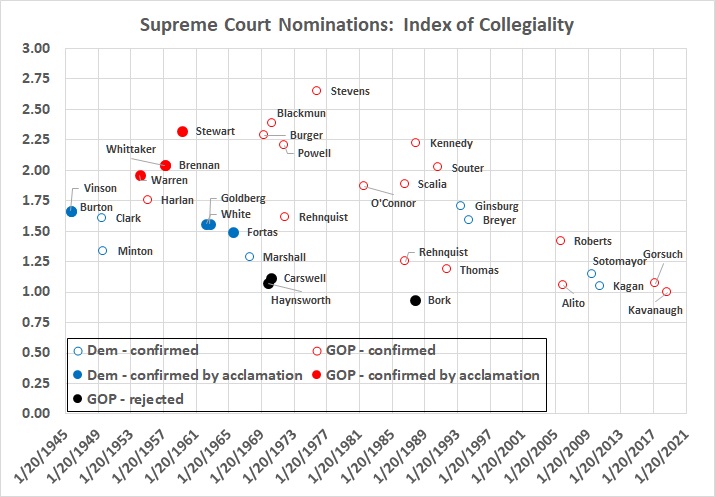
Not-So-Random Thoughts (XXII)

This is a long-overdue entry; the previous one was posted on October 4, 2017. Accordingly, it is a long entry, consisting of these parts:

Censorship and Left-Wing Bias on the Web

The Real Collusion Story

“Suicide” of the West

Evolution, Intelligence, and Race

Will the Real Fascists Please Stand Up?

Consciousness

Empathy Is Over-Rated

“Nudging”


CENSORSHIP AND LEFT-WING BIAS ON THE WEB

It’s a hot topic these days. See, for example, this, this, this, this, and this. Also, this, which addresses Google’s slanting of search results about climate research. YouTube is at it, too.

A lot of libertarian and conservative commentators are loath to demand governmental intervention because the censorship is being committed by private companies: Apple, Facebook, Google, Twitter, YouTube, et al. Some libertarians and conservatives are hopeful that libertarian-conservative options will be successful (e.g., George Gilder). I am skeptical. I have seen and tried some of those options, and they aren’t in the same league as the left-wingers, which have pretty well locked up users and advertisers. (It’s called path-dependence.) And even if they finally succeed in snapping up a respectable share of the information market, the damage will have been done; libertarians and conservatives will have been marginalized, criminalized, and suppressed.

The time to roll out the big guns is now, as I explain here:

Given the influence that Google and the other members of the left-wing information-technology oligarchy exert in this country, that oligarchy is tantamount to a state apparatus….

These information-entertainment-media-academic institutions are important components of what I call the vast left-wing conspiracy in America. Their purpose and effect is the subversion of the traditional norms that made America a uniquely free, prosperous, and vibrant nation….

What will happen in America if that conspiracy succeeds in completely overthrowing “bourgeois culture”? The left will frog-march America in whatever utopian direction captures its “feelings” (but not its reason) at the moment…

Complete victory for the enemies of liberty is only a few election cycles away. The squishy center of the American electorate — as is its wont — will swing back toward the Democrat Party. With a Democrat in the White House, a Democrat-controlled Congress, and a few party switches in the Supreme Court, the dogmas of the information-entertainment-media-academic complex will become the law of the land….

[It is therefore necessary to] enforce the First Amendment against information-entertainment-media-academic complex. This would begin with action against high-profile targets (e.g., Google and a few large universities that accept federal money). That should be enough to bring the others into line. If it isn’t, keep working down the list until the miscreants cry uncle.

What kind of action do I have in mind?…

Executive action against state actors to enforce the First Amendment:

Amendment I to the Constitution says that “Congress shall make no law … abridging the freedom of speech”.

Major entities in the telecommunications, news, entertainment, and education industries have exerted their power to suppress speech because of its content. (See appended documentation.) The collective actions of these entities — many of them government- licensed and government-funded — effectively constitute a governmental violation of the Constitution’s guarantee of freedom of speech (See Smith v. Allwright, 321 U.S. 649 (1944) and Marsh v. Alabama, 326 U.S. 501 (1946).)

And so on. Read all about it here.


THE REAL COLLUSION STORY

Not quite as hot, but still in the news, is Spygate. Collusion among the White House, CIA, and FBI (a) to use the Trump-Russia collusion story to swing the 2016 election to Clinton, and (b) failing that, to cripple Trump’s presidency and provide grounds for removing him from office. The latest twist in the story is offered by Byron York:

Emails in 2016 between former British spy Christopher Steele and Justice Department official Bruce Ohr suggest Steele was deeply concerned about the legal status of a Putin-linked Russian oligarch, and at times seemed to be advocating on the oligarch’s behalf, in the same time period Steele worked on collecting the Russia-related allegations against Donald Trump that came to be known as the Trump dossier. The emails show Steele and Ohr were in frequent contact, that they intermingled talk about Steele’s research and the oligarch’s affairs, and that Glenn Simpson, head of the dirt-digging group Fusion GPS that hired Steele to compile the dossier, was also part of the ongoing conversation….

The newly-released Ohr-Steele-Simpson emails are just one part of the dossier story. But if nothing else, they show that there is still much for the public to learn about the complex and far-reaching effort behind it.

My take is here. The post includes a long list of related — and enlightening — reading, to which I’ve just added York’s piece.


“SUICIDE” OF THE WEST

Less “newsy”, but a hot topic on the web a few weeks back, is Jonah Goldberg’s Suicide of the West. It received mixed reviews. It is also the subject of an excellent non-review by Hubert Collins.

Here’s my take:

The Framers held a misplaced faith in the Constitution’s checks and balances (see Madison’s Federalist No. 51 and Hamilton’s Federalist No. 81). The Constitution’s wonderful design — containment of a strictly limited central government through horizontal and vertical separation of powers — worked rather well until the Progressive Era. The design then cracked under the strain of greed and the will to power, as the central government began to impose national economic regulation at the behest of muckrakers and do-gooders. The design then broke during the New Deal, which opened the floodgates to violations of constitutional restraint (e.g., Medicare, Medicaid, Obamacare,  the vast expansion of economic regulation, and the destruction of civilizing social norms), as the Supreme Court has enabled the national government to impose its will in matters far beyond its constitutional remit.

In sum, the “poison pill” baked into the nation at the time of the Founding is human nature, against which no libertarian constitution is proof unless it is enforced resolutely by a benign power.

See also my review essay on James Burnham’s Suicide of the West: An Essay on the Meaning and Destiny of Liberalism.


EVOLUTION, INTELLIGENCE, AND RACE

Evolution is closely related to and intertwined with intelligence and race. Two posts and a page of mine (here, here, and here) delve some of the complexities. The latter of the two posts draws on David Stove‘s critique of evolutionary theory, “So You Think You Are a Darwinian?“.

Fred Reed is far more entertaining than Stove, and no less convincing. His most recent columns on evolution are here and here. In the first of the two, he writes this:

What are some of the problems with official Darwinism? First, the spontaneous generation of life has not been replicated…. Nor has anyone assembled in the laboratory a chemical structure able to metabolize, reproduce, and thus to evolve. It has not been shown to be mathematically possible….

Sooner or later, a hypothesis must be either confirmed or abandoned. Which? When? Doesn’t science require evidence, reproducibility, demonstrated theoretical possibility? These do not exist….

Other serious problems with the official story: Missing intermediate fossils–”missing links”– stubbornly remain missing. “Punctuated equilibrium,” a theory of sudden rapid evolution invented to explain the lack of fossil evidence, seems unable to generate genetic information fast enough. Many proteins bear no resemblance to any others and therefore cannot have evolved from them. On and on.

Finally, the more complex an event, the less likely it is to  occur by chance. Over the years, cellular mechanisms have been found to be  ever more complex…. Recently with the discovery of epigenetics, complexity has taken a great leap upward. (For anyone wanting to subject himself to such things, there is The Epigenetics Revolution. It is not light reading.)

Worth noting is that  that the mantra of evolutionists, that “in millions and millions and billions of years something must have evolved”–does not necessarily hold water. We have all heard of Sir James Jeans assertion that a monkey, typing randomly, would eventually produce all the books in the British Museum. (Actually he would not produce a single chapter in the accepted age of the universe, but never mind.) A strong case can be made that spontaneous generation is similarly of mathematically vanishing probability. If evolutionists could prove the contrary, they would immensely strengthen their case. They haven’t….

Suppose that you saw an actual monkey pecking at a keyboard and, on examining his output, saw that he was typing, page after page, The Adventures of Tom Sawyer, with no errors.

You would suspect fraud, for instance that the typewriter was really a computer programmed with Tom. But no, on inspection you find that it is a genuine typewriter. Well then, you think, the monkey must be a robot, with Tom in RAM. But  this too turns out to be wrong: The monkey in fact is one. After exhaustive examination, you are forced to conclude that Bonzo really is typing at random.

Yet he is producing Tom Sawyer. This being impossible, you would have to conclude that something was going on that you did not understand.

Much of biology is similar. For a zygote, barely visible, to turn into a baby is astronomically improbable, a suicidal assault on Murphy’s Law. Reading embryology makes this apparent. (Texts are prohibitively expensive, but Life Unfolding serves.) Yet every step in the process is in accord with chemical principles.

This doesn’t make sense. Not, anyway, unless one concludes that something deeper is going on that we do not understand. This brings to mind several adages that might serve to ameliorate our considerable arrogance. As Haldane said, “The world is not only queerer than we think, but queerer than we can think.” Or Fred’s Principle, “The smartest of a large number of hamsters is still a hamster.”

We may be too full of ourselves.

On the subject of race, Fred is no racist, but he is a realist; for example:

We have black football players refusing to stand for the national anthem.  They think that young black males are being hunted down by cops. Actually of  course black males are hunting each other down in droves but black football players apparently have no objection to this. They do not themselves convincingly suffer discrimination. Where else can you get paid six million green ones a year for grabbing something and running? Maybe in a district of jewelers.

The non-standing is racial hostility to whites. The large drop in attendance of games, of television viewership, is racial blowback by whites. Millions of whites are thinking, that, if America doesn’t suit them, football players can afford a ticket to Kenya. While this line of reasoning is tempting, it doesn’t really address the problem and so would be a waste of time.

But what, really, is the problem?

It is one that dare not raise its head: that blacks cannot compete with whites, Asians, or Latin-Americans. Is there counter-evidence? This leaves them in an incurable state of resentment and thus hostility. I think we all know this: Blacks know it, whites know it, liberals know it, and conservatives know it. If any doubt this, the truth would be easy enough to determine with carefully done tests. [Which have been done.] The furious resistance to the very idea of measuring intelligence suggests awareness of the likely outcome. You don’t avoid a test if you expect good results.

So we do nothing while things worsen and the world looks on astounded. We have mob attacks by Black Lives Matter, the never-ending Knockout Game, flash mobs looting stores and subway trains, occasional burning cities, and we do nothing. Which makes sense, because there is nothing to be done short of restructuring the country.

Absolute, obvious, unacknowledged disaster.

Regarding which: Do we really want, any of us, what we are doing? In particular, has anyone asked ordinary blacks, not black pols and race hustlers. “Do you really want to live among whites, or would you prefer a safe middle-class black neighborhood? Do your kids want to go to school with whites? If so, why? Do you want them to? Why? Would you prefer black schools to decide what and how to teach your children? Keeping whites out of it? Would you prefer having only black police in your neighborhood?”

And the big one: “Do you, and the people you actually know in your neighborhood, really want integration? Or is it something imposed on you by oreo pols and white ideologues?”

But these are things we must never think, never ask.

Which brings me to my most recent post about blacks and crime, which is here. As for restructuring the country, Lincoln saw what was needed.

The touchy matter of intelligence — its heritability and therefore its racial component — is never far from my thoughts. I commend to you Gregory Hood’s excellent piece, “Forbidden Research: How the Study of Intelligence is Crippled by Ideology“. Hood mentions some of the scientists whose work I have cited in my writings about intelligence and its racial component. See this page, for example, which give links to several related posts and excerpts of relevant research about intelligence. (See also the first part of Fred Reed’s post “Darwin’s Vigilantes, Richard Sternberg, and Conventional Pseudoscience“.)

As for the racial component, my most recent post on the subject (which provides links to related posts) addresses the question “Why study race and intelligence?”. Here’s why:

Affirmative action and similar race-based preferences are harmful to blacks. But those preferences persist because most Americans do not understand that there are inherent racial differences that prevent blacks, on the whole, from doing as well as whites (and Asians) in school and in jobs that require above-average intelligence. But magical thinkers (like [Professor John] McWhorter) want to deny reality. He admits to being driven by hope: “I have always hoped the black–white IQ gap was due to environmental causes.”…

Magical thinking — which is rife on the left — plays into the hands of politicians, most of whom couldn’t care less about the truth. They just want the votes of those blacks who relish being told, time and again, that they are “down” because they are “victims”, and Big Daddy government will come to their rescue. But unless you are the unusual black of above-average intelligence, or the more usual black who has exceptional athletic skills, dependence on Big Daddy is self-defeating because (like a drug addiction) it only leads to more of the same. The destructive cycle of dependency can be broken only by willful resistance to the junk being peddled by cynical politicians.

It is for the sake of blacks that the truth about race and intelligence ought to be pursued — and widely publicized. If they read and hear the truth often enough, perhaps they will begin to realize that the best way to better themselves is to make the best of available opportunities instead of moaning abut racism and relying on preferences and handouts.


WILL THE REAL FASCISTS PLEASE STAND UP?

I may puke if I hear Trump called a fascist one more time. As I observe here,

[t]he idea … that Trump is the new Hitler and WaPo [The Washington Post] and its brethren will keep us out of the gas chambers by daring to utter the truth (not)…. is complete balderdash, inasmuch as WaPo and its ilk are enthusiastic hand-maidens of “liberal” fascism.

“Liberals” who call conservatives “fascists” are simply engaging in psychological projection. This is a point that I address at length here.

As for Mr. Trump, I call on Shawn Mitchell:

A lot of public intellectuals and writers are pushing an alarming thesis: President Trump is a menace to the American Republic and a threat to American liberties. The criticism is not exclusively partisan; it’s shared by prominent conservatives, liberals, and libertarians….

Because so many elites believe Trump should be impeached, or at least shunned and rendered impotent, it’s important to agree on terms for serious discussion. Authoritarian means demanding absolute obedience to a designated authority. It means that somewhere, someone, has unlimited power. Turning the focus to Trump, after 15 months in office, it’s impossible to assign him any of those descriptions….

…[T]here are no concentration camps or political arrests. Rather, the #Resistance ranges from fervent to rabid. Hollywood and media’s brightest stars regularly gather at galas to crudely declare their contempt for Trump and his deplorable supporters. Academics and reporters lodged in elite faculty lounges and ivory towers regularly malign his brains, judgment, and temperament. Activists gather in thousands on the streets to denounce Trump and his voters. None of these people believe Trump is an autocrat, or, if they do they are ignorant of the word’s meaning. None fear for their lives, liberty, or property.

Still, other elites pile on. Federal judges provide legal backup, contriving frivolous theories to block administrations moves. Some rule Trump lacks even the authority to undo by executive order things Obama himself introduced by executive order. Governors from states like California, Oregon and New York announce they will not cooperate with administration policy (current law, really) on immigration, the environment, and other issues.

Amidst such widespread rebellion, waged with impunity against the constitutionally elected president, the critics’ dark warnings that America faces a dictator are more than wrong; they are surreal and damnable. They are what amounts to the howl of that half the nation still refusing to accept election results it dislikes.

Conceding Trump lacks an inmate or body count, critics still offer theories to categorize him in genus monsterus. The main arguments cite Trump’s patented belligerent personality and undisciplined tweets, his use of executive orders; his alleged obstruction in firing James Comey and criticizing Robert Mueller, his blasts at the media, and his immigration policies. These attacks weigh less than the paper they might be printed on.

Trump’s personality doubtless is sui generis for national office. If he doesn’t occasionally offend listeners they probably aren’t listening. But so what? Personality is not policy. A sensibility is not a platform, and bluster and spittle are not coercive state action. The Human Jerk-o-meter could measure Trump in the 99th percentile, and the effect would not change one law, eliminate one right, or jail one critic.

Executive Orders are misunderstood. All modern presidents used them. There is nothing wrong in concept with executive orders. Some are constitutional some are not. What matters is whether they direct executive priorities within U.S. statutes or try to push authority beyond the law to change the rights and duties of citizens. For example, a president might order the EPA to focus on the Clean Air Act more than the Clean Water Act, or vice versa. That is fine. But, if a president orders the EPA to regulate how much people can water their lawns or what kind of lawns to plant, the president is trying to legislate and create new controls. That is unconstitutional.

Many of Obama’s executive orders were transgressive and unconstitutional. Most of Trump’s executive orders are within the law, and constitutional. However that debate turns out, though, it is silly to argue the issue implicates authoritarianism.

The partisan arguments over Trump’s response to the special counsel also miss key points. Presidents have authority to fire subordinates. The recommendation authored by Deputy Attorney General Rod Rosenstein provides abundant reason for Trump to have fired James Comey, who increasingly is seen as a bitter anti-Trump campaigner. As for Robert Mueller, criticizing is not usurping. Mueller’s investigation continues, but now readily is perceived as a target shoot, unmoored from the original accusations about Russia, in search of any reason to draw blood from Trump. Criticizing that is not dictatorial, it is reasonable.

No doubt Trump criticizes the media more than many modern presidents. But criticism is not oppression. It attacks not freedom of the press but the credibility of the press. That is civically uncomfortable, but the fact is, the war of words between Trump and the media is mutual. The media attacks Trump constantly, ferociously and very often inaccurately as Mollie Hemingway and Glenn Greenwald document from different political perspectives. Trump fighting back is not asserting government control. It is just challenging media assumptions and narratives in a way no president ever has. Reporters don’t like it, so they call it oppression. They are crybabies.

Finally, the accusation that Trump wants to enforce the border under current U.S. laws, as well as better vet immigration from a handful of failed states in the Middle East with significant militant activity hardly makes him a tyrant. Voters elected Trump to step up border enforcement. Scrutinizing immigrants from a handful of countries with known terrorist networks is not a “Muslim ban.” The idea insults the intelligence since there are about 65 majority Muslim countries the order does not touch.

Trump is not Hitler. Critics’ attacks are policy disputes, not examples of authoritarianism. The debate is driven by sore losers who are willing to erode norms that have preserved the republic for 240 years.

Amen.


CONSCIOUSNESS

For a complete change of pace I turn to a post by Bill Vallicella about consciousness:

This is an addendum to Thomas Nagel on the Mind-Body Problem. In that entry I set forth a problem in the philosophy of mind, pouring it into the mold of an aporetic triad:

1) Conscious experience is not an illusion.

2) Conscious experience has an essentially subjective character that purely physical processes do not share.

3) The only acceptable explanation of conscious experience is in terms of physical properties alone.

Note first that the three propositions are collectively inconsistent: they cannot all be true.  Any two limbs entail the negation of the remaining one. Note second that each limb exerts a strong pull on our acceptance. But we cannot accept them all because they are logically incompatible.

This is one hard nut to crack.  So hard that many, following David Chalmers, call it, or something very much like it, the Hard Problem in the philosophy of mind.  It is so hard that it drives some into the loony bin. I am thinking of Daniel Dennett and those who have the chutzpah to deny (1)….

Sophistry aside, we either reject (2) or we reject (3).  Nagel and I accept (1) and (2) and reject (3). Those of a  scientistic stripe accept (1) and (3) and reject (2)….

I conclude that if our aporetic triad has a solution, the solution is by rejecting (3).

Vallicella reaches his conclusion by subtle argumentation, which I will not attempt to parse in this space.

My view is that (2) is false because the subjective character of conscious experience is an illusion that arises from the physical properties of the central nervous system. Consciousness itself is not an illusion. I accept (1) and (3). For more, see this and this.


EMPATHY IS OVER-RATED

Andrew Scull addresses empathy:

The basic sense in which most of us use “empathy” is analogous to what Adam Smith called “sympathy”: the capacity we possess (or can develop) to see the world through the eyes of another, to “place ourselves in his situation . . . and become in some measure the same person with him, and thence from some idea of his sensations, and even feel something which, though weaker in degree, is not altogether unlike them”….

In making moral choices, many would claim that empathy in this sense makes us more likely to care about others and to consider their interests when choosing our own course of action….

Conversely, understanding others’ feelings doesn’t necessarily lead one to treating them better. On the contrary: the best torturers are those who can anticipate and intuit what their victims most fear, and tailor their actions accordingly. Here, Bloom effectively invokes the case of Winston Smith’s torturer O’Brien in Orwell’s Nineteen Eighty-four, who is able to divine the former’s greatest dread, his fear of rats, and then use it to destroy him.

Guest blogger L.P. addressed empathy in several posts: here, here, here, here, here, and here. This is from the fourth of those posts:

Pro-empathy people think less empathetic people are “monsters.” However, as discussed in part 2 of this series, Baron-Cohen, Kevin Dutton in The Wisdom of Psychopaths, and other researchers establish that empathetic people, particularly psychopaths who have both affective and cognitive empathy, can be “monsters” too.

In fact, Kevin Dutton’s point about psychopaths generally being able to blend in and take on the appearance of the average person makes it obvious that they must have substantial emotional intelligence (linked to cognitive empathy) and experience of others’ feelings in order to mirror others so well….

Another point to consider however, as mentioned in part 1, is that those who try to empathize with others by imagining how they would experience another’s situation aren’t truly empathetic. They’re just projecting their own feelings onto others. This brings to mind Jonathan Haidt’s study on morality and political orientation. On the “Identification with All of Humanity Scale,” liberals most strongly endorsed the dimension regarding identification with “everyone around the world.” (See page 25 of “Understanding Libertarian Morality: The psychological roots of an individualist ideology.”) How can anyone empathize with billions of persons about whom one knows nothing, and a great number of whom are anything but liberal?

Haidt’s finding is a terrific example of problems with self-evaluation and self-reported data – liberals overestimating themselves in this case. I’m not judgmental about not understanding everyone in the world. There are plenty of people I don’t understand either. However, I don’t think people who overestimate their ability to understand people should be in a position that allows them to tamper with, or try to “improve,” the lives of people they don’t understand….

I conclude by quoting C. Daniel Batson who acknowledges the prevailing bias when it comes to evaluating altruism as a virtue. This is from his paper, “Empathy-Induced Altruistic Motivation,” written for the Inaugural Herzliya Symposium on Prosocial Motives, Emotions, and Behavior:

[W]hereas there are clear social sanctions against unbridled self-interest, there are not clear sanctions against altruism. As a result, altruism can at times pose a greater threat to the common good than does egoism.


“NUDGING”

I have addressed Richard Thaler and Cass Sunstein’s “libertarian” paternalism and “nudging in many posts. (See this post, the list at the bottom of it, and this post.) Nothing that I have written — clever and incisive as it may be — rivals Deirdre McCloskey’s take on Thaler’s non-Nobel prize, “The Applied Theory of Bossing“:

Thaler is distinguished but not brilliant, which is par for the course. He works on “behavioral finance,” the study of mistakes people make when they talk to their stock broker. He can be counted as the second winner for “behavioral economics,” after the psychologist Daniel Kahneman. His prize was for the study of mistakes people make when they buy milk….

Once Thaler has established that you are in myriad ways irrational it’s much easier to argue, as he has, vigorously—in his academic research, in popular books, and now in a column for The New York Times—that you are too stupid to be treated as a free adult. You need, in the coinage of Thaler’s book, co-authored with the law professor and Obama adviser Cass Sunstein, to be “nudged.” Thaler and Sunstein call it “libertarian paternalism.”*…

Wikipedia lists fully 257 cognitive biases. In the category of decision-making biases alone there are anchoring, the availability heuristic, the bandwagon effect, the baseline fallacy, choice-supportive bias, confirmation bias, belief-revision conservatism, courtesy bias, and on and on. According to the psychologists, it’s a miracle you can get across the street.

For Thaler, every one of the biases is a reason not to trust people to make their own choices about money. It’s an old routine in economics. Since 1848, one expert after another has set up shop finding “imperfections” in the market economy that Smith and Mill and Bastiat had come to understand as a pretty good system for supporting human flourishing….

How to convince people to stand still for being bossed around like children? Answer: Persuade them that they are idiots compared with the great and good in charge. That was the conservative yet socialist program of Kahneman, who won the 2002 Nobel as part of a duo that included an actual economist named Vernon Smith…. It is Thaler’s program, too.

Like with the psychologist’s list of biases, though, nowhere has anyone shown that the imperfections in the market amount to much in damaging the economy overall. People do get across the street. Income per head since 1848 has increased by a factor of 20 or 30….

The amiable Joe Stiglitz says that whenever there is a “spillover” — my ugly dress offending your delicate eyes, say — the government should step in. A Federal Bureau of Dresses, rather like the one Saudi Arabia has. In common with Thaler and Krugman and most other economists since 1848, Stiglitz does not know how much his imagined spillovers reduce national income overall, or whether the government is good at preventing the spill. I reckon it’s about as good as the Army Corps of Engineers was in Katrina.

Thaler, in short, melds the list of psychological biases with the list of economic imperfections. It is his worthy scientific accomplishment. His conclusion, unsupported by evidence?

It’s bad for us to be free.

CORRECTION: Due to an editing error, an earlier version of this article referred to Thaler’s philosophy as “paternalistic libertarianism.” The correct term is “libertarian paternalism.”

No, the correct term is paternalism.

I will end on that note.