Human Nature and Conflict

The typology of personality is a fascinating but superficial way of looking at human nature and the sources of conflict among human beings. I will begin there before probing more deeply. If you are eager to get to the bottom line of this post, scroll down to “Conflict”.

SOME ASPECTS OF PERSONALITY

Generaloberst Kurt Gebhard Adolf Philipp Freiherr von Hammerstein-Equord (1878-1943) was commendable for at least two reasons. He was outspokenly against the Nazi regime, and he conceived this classification scheme for officers:

I distinguish four types. There are clever, hardworking, stupid, and lazy officers. Usually two characteristics are combined. Some are clever and hardworking; their place is the General Staff. The next ones are stupid and lazy; they make up 90 percent of every army and are suited to routine duties. Anyone who is both clever and lazy is qualified for the highest leadership duties, because he possesses the mental clarity and strength of nerve necessary for difficult decisions. One must beware of anyone who is both stupid and hardworking; he must not be entrusted with any responsibility because he will always only cause damage.

Here is my paraphrase of that scheme:

  • Smart and hard-working (good middle manager)
  • Stupid and lazy (lots of these around, hire for simple, routine tasks and watch closely)
  • Smart and lazy (promote to senior management — delegates routine work and keeps his eye on the main prize)
  • Stupid and hard-working (dangerous to have around, screws up things, should be taken out and shot). (This describes the boss whose “leadership” skills prompted me to retire early.)

Personality analysis and classification has since become an industry. It provides pseudo-scientific insights for the misuse of corporate executives and HR departments. And it offers endless hours of enjoyment (and self-doubt and argument) for casual users.

For my own part, I have taken the Myers-Briggs Type Indicator (MBTI) several times since the late 1980s. It is in ill repute, but I have always found it to be reliable, especially in my own case. I am an INTJ, which is I(ntroverted), (i)N(tuitive), T(hinking), J(udging):

For INTJs the dominant force in their lives is their attention to the inner world of possibilities, symbols, abstractions, images, and thoughts. Insight in conjunction with logical analysis is the essence of their approach to the world; they think systemically. Ideas are the substance of life for INTJs and they have a driving need to understand, to know, and to demonstrate competence in their areas of interest. INTJs inherently trust their insights, and with their task-orientation will work intensely to make their visions into realities. (Source: “The Sixteen Types at a Glance“.)

I first took the “Big 5” personality test in 2009, with this result (details here):
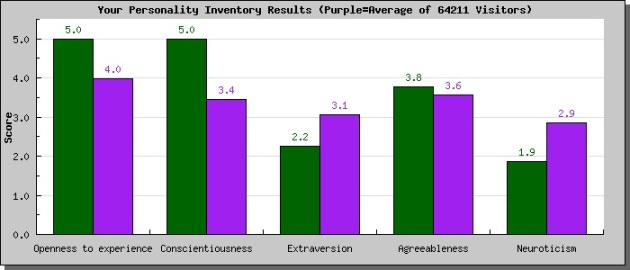
Moral profile-personality inventory results

My scores are in green; the average scores of all other test-takers are in purple. The five traits are defined as follows:

1. Openness to experience: High scorers are described as “Open to new experiences. You have broad interests and are very imaginative.” Low scorers are described as “Down-to-earth, practical, traditional, and pretty much set in your ways.” This is the sub-scale that shows the strongest relationship to politics: liberals generally score high on this trait; they like change and variety, sometimes just for the sake of change and variety. Conservatives generally score lower on this trait. (Just think about the kinds of foods likely to be served at very liberal or very conservative social events.)

2. Conscientiousness: High scorers are described as “conscientious and well organized. They have high standards and always strive to achieve their goals. They sometimes seem uptight. Low scorers are easy going, not very well organized and sometimes rather careless. They prefer not to make plans if they can help it.”

3. Extraversion: High scorers are described as “Extraverted, outgoing, active, and high-spirited. You prefer to be around people most of the time.” Low scorers are described as “Introverted, reserved, and serious. You prefer to be alone or with a few close friends.” Extraverts are, on average, happier than introverts.

4. Agreeableness: High scorers are described as “Compassionate, good-natured, and eager to cooperate and avoid conflict.” Low scorers are described as “Hardheaded, skeptical, proud, and competitive. You tend to express your anger directly.”

5. Neuroticism: High scorers are described as “Sensitive, emotional, and prone to experience feelings that are upsetting.” Low scorers are described as “Secure, hardy, and generally relaxed even under stressful conditions.”

Dozens more such tests (many of which I have taken) are available. Some of them can be found at yourmorals.org (free signup).

Personality differences occasion conflict, of course. For example, decisive persons are often frustrated by and impatient with indecisive ones (and vice versa), and extroverts usually don’t understand introverts and the advantages of introversion (e.g., introspection, thinking more deeply about problems).

HUMAN NATURE WRIT LARGER

But personality tests only scratch the surface of human nature and differences among human beings. Consider the following 35 traits:
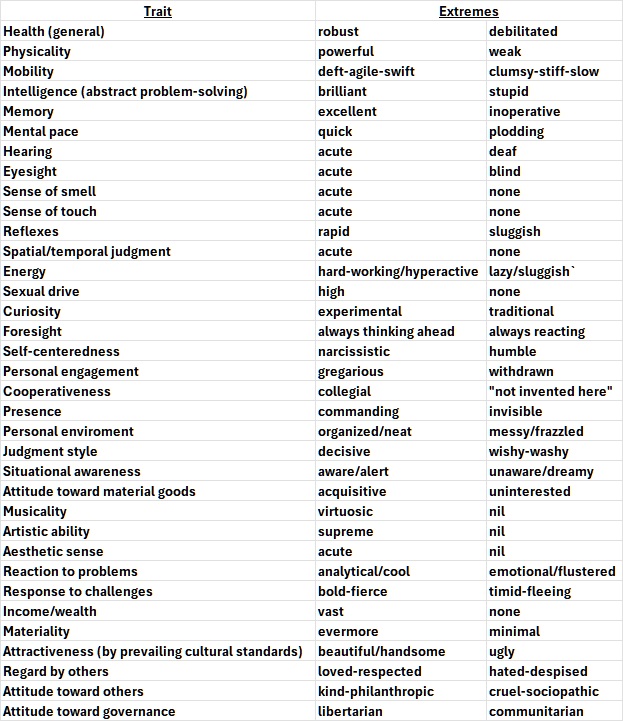
You can add to that list, I’m sure. But let’s consider the implications of the 35-trait scale for differentiating among human beings.

If each trait were quantified on a scale from 1 to 10 (though the actual range for most traits is infinite) the number of possible combinations would approach 3 quadrillion. That’s more than 300 times the number of human beings now living on Earth. To say that every human being is unique is a vast understatement.

And yet — despite the unquantifiable complexity of human beings — there is a tendency to love, like, admire, dislike, or detest a person because he or she possesses a particular trait or two — or because one is anxious to be “in” with a person or group who loves, likes, etc., because of a trait or two. Even more ephemerally, love, like, etc., be triggered when a person simply says something that suggests a particular opinion or attitude.

These tendencies seem to have been around for a long time — for as long as there have been human beings, and even longer. Fear and ferocity are easily triggered in many species of animals. This suggests that making snap judgements about other persons is an inbred survival mechanism that evolution and socialization couldn’t eradicate and may have reinforced. (Evolution has somehow become thought of as a kind of progress, but it is nothing more than unplanned change caused by external stimuli and random mutations. The belief that evolution represents progress is akin to the anthropic principle.)

Some of the prominent triggers nowadays (e.g., certain political opinions or positions) may be new. But their newness only suggests that the tendency to form snap judgements has found new outlets in keeping with cultural change. In addition to reacting fiercely to perceived threats to life and limb, humans acquired the trait of reacting vociferously (and sometimes fiercely) to perceived threats to their self-image, of which beliefs constitute an essential part.

That isn’t new, either. Nor is the perception new that the actualization of certain beliefs (or dogmas) about such matters as race, religion, government, economics, justice, sex, and morality would result in misery because they would lead to oppression, aggression, economic disaster, social division, or any combination of those things. The correctness of that perception carries the weight of historical evidence, which matters to those who are swayed by reality and not by fairytales.

Today’s divisions about race, religion, government, economics, justice, sex, and morality are just replays of eons-old conflicts along the same lines. They are replays because human nature is immutable. The only thing that changes are the manifestations of human nature in action.

Those who do not grasp human nature in its fullness — the bad with the good — are doomed to be surprised by the consequences of the actualization of their beliefs. Or they would be surprised if the human capacity for self-delusion didn’t blind them to those consequences.

Leftists and “intellectuals” (nearly identical categories) are especially prone to misjudging the consequences of their beliefs because they have spun themselves delusional fairytales about the rightness of their beliefs. I don’t need to (and won’t) relate the fairytales about race, religion, government, economics, justice, sex, and morality. All of those (and more) are amply addressed in this blog (go here and explore) and in the many other reality-based blogs and journals that abound on the internet.

CONFLICT

Here, I will focus on a fairytale about conflict itself. It is the subject of another long post of mine, from eleven years ago, “The Fallacy of Human Progress“. I won’t reproduce it or quote it at length. I can only urge you to read it.

I will conclude this post with a few of the main points from that one. It was inspired by Steven Pinker’s The Better Angels of Our Nature: Why Violence Has Declined (2011). I can only say the events of the past thirteen years — and especially of the past few years in Ukraine, Israel, and America (to name only a few places) — are proof that Pinker was dead wrong.

The best refutation of Pinker’s thesis that I have read is by John Gray, an English philosopher, in his book The Silence of Animals: On Progress and Other Modern Myths. Gray’s book appeared only eighteen months after Pinker’s and doesn’t mention Pinker or his book. The refutation is therefore only implicit, but just as powerful as if it were aimed directly at Pinker’s book.

Gray’s argument is faithfully recounted in a review of his book by Robert W. Merry at The National Interest:

The noted British historian J. B. Bury (1861–1927) . . . wrote, “This doctrine of the possibility of indefinitely moulding the characters of men by laws and institutions . . . laid a foundation on which the theory of the perfectibility of humanity could be raised. It marked, therefore, an important stage in the development of the doctrine of Progress.”

We must pause here over this doctrine of progress. It may be the most powerful idea ever conceived in Western thought…. It is the thesis that mankind has advanced slowly but inexorably over the centuries from a state of cultural backwardness, blindness and folly to ever more elevated stages of enlightenment and civilization—and that this human progression will continue indefinitely into the future . . . . The U.S. historian Charles A. Beard once wrote that the emergence of the progress idea constituted “a discovery as important as the human mind has ever made, with implications for mankind that almost transcend imagination.” And Bury, who wrote a book on the subject, called it “the great transforming conception, which enables history to define her scope.”

Gray rejects it utterly. In doing so, he rejects all of modern liberal humanism. “The evidence of science and history,” he writes, “is that humans are only ever partly and intermittently rational, but for modern humanists the solution is simple: human beings must in future be more reasonable. These enthusiasts for reason have not noticed that the idea that humans may one day be more rational requires a greater leap of faith than anything in religion.” In an earlier work, Straw Dogs: Thoughts on Humans and Other Animals, he was more blunt: “Outside of science, progress is simply a myth.”

. . . Gray has produced more than twenty books demonstrating an expansive intellectual range, a penchant for controversy, acuity of analysis and a certain political clairvoyance.

He rejected, for example, Francis Fukuyama’s heralded “End of History” thesis—that Western liberal democracy represents the final form of human governance—when it appeared in this magazine in 1989. History, it turned out, lingered long enough to prove Gray right and Fukuyama wrong….

Though for decades his reputation was confined largely to intellectual circles, Gray’s public profile rose significantly with the 2002 publication of Straw Dogs, which sold impressively and brought him much wider acclaim than he had known before. The book was a concerted and extensive assault on the idea of progress and its philosophical offspring, secular humanism. The Silence of Animals is in many ways a sequel, plowing much the same philosophical ground but expanding the cultivation into contiguous territory mostly related to how mankind—and individual humans—might successfully grapple with the loss of both metaphysical religion of yesteryear and today’s secular humanism. The fundamentals of Gray’s critique of progress are firmly established in both books and can be enumerated in summary.

First, the idea of progress is merely a secular religion, and not a particularly meaningful one at that. “Today,” writes Gray in Straw Dogs, “liberal humanism has the pervasive power that was once possessed by revealed religion. Humanists like to think they have a rational view of the world; but their core belief in progress is a superstition, further from the truth about the human animal than any of the world’s religions.”

Second, the underlying problem with this humanist impulse is that it is based upon an entirely false view of human nature—which, contrary to the humanist insistence that it is malleable, is immutable and impervious to environmental forces. Indeed, it is the only constant in politics and history. Of course, progress in scientific inquiry and in resulting human comfort is a fact of life, worth recognition and applause. But it does not change the nature of man, any more than it changes the nature of dogs or birds. “Technical progress,” writes Gray, again in Straw Dogs, “leaves only one problem unsolved: the frailty of human nature. Unfortunately that problem is insoluble.”

That’s because, third, the underlying nature of humans is bred into the species, just as the traits of all other animals are. The most basic trait is the instinct for survival, which is placed on hold when humans are able to live under a veneer of civilization. But it is never far from the surface. In The Silence of Animals, Gray discusses the writings of Curzio Malaparte, a man of letters and action who found himself in Naples in 1944, shortly after the liberation. There he witnessed a struggle for life that was gruesome and searing. “It is a humiliating, horrible thing, a shameful necessity, a fight for life,” wrote Malaparte. “Only for life. Only to save one’s skin.” Gray elaborates:

Observing the struggle for life in the city, Malaparte watched as civilization gave way. The people the inhabitants had imagined themselves to be—shaped, however imperfectly, by ideas of right and wrong—disappeared. What were left were hungry animals, ready to do anything to go on living; but not animals of the kind that innocently kill and die in forests and jungles. Lacking a self-image of the sort humans cherish, other animals are content to be what they are. For human beings the struggle for survival is a struggle against themselves.

When civilization is stripped away, the raw animal emerges. “Darwin showed that humans are like other animals,” writes Gray in Straw Dogs, expressing in this instance only a partial truth. Humans are different in a crucial respect, captured by Gray himself when he notes that Homo sapiens inevitably struggle with themselves when forced to fight for survival. No other species does that, just as no other species has such a range of spirit, from nobility to degradation, or such a need to ponder the moral implications as it fluctuates from one to the other. But, whatever human nature is—with all of its capacity for folly, capriciousness and evil as well as virtue, magnanimity and high-mindedness—it is embedded in the species through evolution and not subject to manipulation by man-made institutions.

Fourth, the power of the progress idea stems in part from the fact that it derives from a fundamental Christian doctrine—the idea of providence, of redemption . . . .

“By creating the expectation of a radical alteration in human affairs,” writes Gray, “Christianity . . . founded the modern world.” But the modern world retained a powerful philosophical outlook from the classical world—the Socratic faith in reason, the idea that truth will make us free; or, as Gray puts it, the “myth that human beings can use their minds to lift themselves out of the natural world.” Thus did a fundamental change emerge in what was hoped of the future. And, as the power of Christian faith ebbed, along with its idea of providence, the idea of progress, tied to the Socratic myth, emerged to fill the gap. “Many transmutations were needed before the Christian story could renew itself as the myth of progress,” Gray explains. “But from being a succession of cycles like the seasons, history came to be seen as a story of redemption and salvation, and in modern times salvation became identified with the increase of knowledge and power.”

Thus, it isn’t surprising that today’s Western man should cling so tenaciously to his faith in progress as a secular version of redemption. As Gray writes, “Among contemporary atheists, disbelief in progress is a type of blasphemy. Pointing to the flaws of the human animal has become an act of sacrilege.” In one of his more brutal passages, he adds:

Humanists believe that humanity improves along with the growth of knowledge, but the belief that the increase of knowledge goes with advances in civilization is an act of faith. They see the realization of human potential as the goal of history, when rational inquiry shows history to have no goal. They exalt nature, while insisting that humankind—an accident of nature—can overcome the natural limits that shape the lives of other animals. Plainly absurd, this nonsense gives meaning to the lives of people who believe they have left all myths behind.

In the Silence of Animals, Gray explores all this through the works of various writers and thinkers. In the process, he employs history and literature to puncture the conceits of those who cling to the progress idea and the humanist view of human nature. Those conceits, it turns out, are easily punctured when subjected to Gray’s withering scrutiny . . . .

And yet the myth of progress is so powerful in part because it gives meaning to modern Westerners struggling, in an irreligious era, to place themselves in a philosophical framework larger than just themselves . . . .

Much of the human folly catalogued by Gray in The Silence of Animals makes a mockery of the earnest idealism of those who later shaped and molded and proselytized humanist thinking into today’s predominant Western civic philosophy.

There was an era of realism, but it was short-lived:

But other Western philosophers, particularly in the realm of Anglo-Saxon thought, viewed the idea of progress in much more limited terms. They rejected the idea that institutions could reshape mankind and usher in a golden era of peace and happiness. As Bury writes, “The general tendency of British thought was to see salvation in the stability of existing institutions, and to regard change with suspicion.” With John Locke, these thinkers restricted the proper role of government to the need to preserve order, protect life and property, and maintain conditions in which men might pursue their own legitimate aims. No zeal here to refashion human nature or remake society.

A leading light in this category of thinking was Edmund Burke (1729–1797), the British statesman and philosopher who, writing in his famous Reflections on the Revolution in France, characterized the bloody events of the Terror as “the sad but instructive monuments of rash and ignorant counsel in time of profound peace.” He saw them, in other words, as reflecting an abstractionist outlook that lacked any true understanding of human nature. The same skepticism toward the French model was shared by many of the Founding Fathers, who believed with Burke that human nature isn’t malleable but rather potentially harmful to society. Hence, it needed to be checked. The central distinction between the American and French revolutions, in the view of conservative writer Russell Kirk, was that the Americans generally held a “biblical view of man and his bent toward sin,” whereas the French opted for “an optimistic doctrine of human goodness.” Thus, the American governing model emerged as a secular covenant “designed to restrain the human tendencies toward violence and fraud . . . [and] place checks upon will and appetite.”

Most of the American Founders rejected the French philosophes in favor of the thought and history of the Roman Republic, where there was no idea of progress akin to the current Western version. “Two thousand years later,” writes Kirk, “the reputation of the Roman constitution remained so high that the framers of the American constitution would emulate the Roman model as best they could.” They divided government powers among men and institutions and created various checks and balances. Even the American presidency was modeled generally on the Roman consular imperium, and the American Senate bears similarities to the Roman version. Thus did the American Founders deviate from the French abstractionists and craft governmental structures to fit humankind as it actually is—capable of great and noble acts, but also of slipping into vice and treachery when unchecked. That ultimately was the genius of the American system.

But, as the American success story unfolded, a new collection of Western intellectuals, theorists and utopians—including many Americans—continued to toy with the idea of progress. And an interesting development occurred. After centuries of intellectual effort aimed at developing the idea of progress as an ongoing chain of improvement with no perceived end into the future, this new breed of “Progress as Power” thinkers began to declare their own visions as the final end point of this long progression.

Gray calls these intellectuals “ichthyophils,” which he defines as “devoted to their species as they think it ought to be, not as it actually is or as it truly wants to be.” He elaborates: “Ichthyophils come in many varieties—the Jacobin, Bolshevik and Maoist, terrorizing humankind in order to remake it on a new model; the neo-conservative, waging perpetual war as a means to universal democracy; liberal crusaders for human rights, who are convinced that all the world longs to become as they imagine themselves to be.” He includes also “the Romantics, who believe human individuality is everywhere repressed.”

Throughout American politics, as indeed throughout Western politics, a large proportion of major controversies ultimately are battles between the ichthyophils and the Burkeans, between the sensibility of the French Revolution and the sensibility of American Revolution, between adherents of the idea of progress and those skeptical of that potent concept. John Gray has provided a major service in probing with such clarity and acuity the impulses, thinking and aims of those on the ichthyophil side of that great divide. As he sums up, “Allowing the majority of humankind to imagine they are flying fish even as they pass their lives under the waves, liberal civilization rests on a dream.”

Amen.


These somewhat related posts may be of interest to you: “Evolution, Human Nature, and ‘Natural Rights’“, “More Thoughts about Evolutionary Teleology“, and “Scientism, Evolution, and the Meaning of Life“.

“Human Nature” by David Berlinski: A Revew

I became fan of David Berlinksi, who calls himself a secular Jew, after reading The Devil’s Delusion: Atheism and Its Scientific Pretensions, described on Berlinkski’s personal website as

a biting defense of faith against its critics in the New Atheist movement. “The attack on traditional religious thought,” writes Berlinski, “marks the consolidation in our time of science as the single system of belief in which rational men and women might place their faith, and if not their faith, then certainly their devotion.”

Here is most of what I say in “Atheistic Scientism Revisited” about The Devil’s Delusion:

Berlinski, who knows far more about science than I do, writes with flair and scathing logic. I can’t do justice to his book, but I will try to convey its gist.

Before I do that, I must tell you that I enjoyed Berlinski’s book not only because of the author’s acumen and biting wit, but also because he agrees with me. (I suppose I should say, in modesty, that I agree with him.) I have argued against atheistic scientism in many blog posts (see below).

Here is my version of the argument against atheism in its briefest form (June 15, 2011):

  1. In the material universe, cause precedes effect.
  2. Accordingly, the material universe cannot be self-made. It must have a “starting point,” but the “starting point” cannot be in or of the material universe.
  3. The existence of the universe therefore implies a separate, uncaused cause.

There is no reasonable basis — and certainly no empirical one — on which to prefer atheism to deism or theism. Strident atheists merely practice a “religion” of their own. They have neither logic nor science nor evidence on their side — and eons of belief against them.

As for scientism, I call upon Friedrich Hayek:

[W]e shall, wherever we are concerned … with slavish imitation of the method and language of Science, speak of “scientism” or the “scientistic” prejudice…. It should be noted that, in the sense in which we shall use these terms, they describe, of course, an attitude which is decidedly unscientific in the true sense of the word, since it involves a mechanical and uncritical application of habits of thought to fields different from those in which they have been formed. The scientistic as distinguished from the scientific view is not an unprejudiced but a very prejudiced approach which, before it has considered its subject, claims to know what is the most appropriate way of investigating it. [The Counter Revolution Of Science]

As Berlinski amply illustrates and forcibly argues, atheistic scientism is rampant in the so-called sciences. I have reproduced below some key passages from Berlinski’s book. They are representative, but far from exhaustive (though I did nearly exhaust the publisher’s copy limit on the Kindle edition). I have forgone the block-quotation style for ease of reading, and have inserted triple asterisks to indicate (sometimes subtle) changes of topic. [Go to my post for the excerpts.]

On the strength of The Devil’s Delusion, I eagerly purchased Berlinski’s latest book, Human Nature. I have just finished it, and cannot summon great enthusiasm for it. Perhaps that is so because I expected a deep and extended examination of the title’s subject. What I got, instead, was a collection of 23 disjointed essays, gathered (more or less loosely) into seven parts.

Only the first two parts, “Violence” and “Reason”, seem to address human nature, but often tangentially. “Violence” deals specifically with violence as manifested (mainly) in war and murder. The first essay, titled “The First World War”, is a tour de force — a dazzling (and somewhat dizzying) reconstruction of the complex and multi-tiered layering of the historical precedent, institutional arrangements, and personalities that led to the outbreak of World War I.

Aha, I thought to myself, Berlinkski is warming to his task, and will flesh out the relevant themes at which he hints in the first essay. And in the second and third essays, “The Best of Times” and “The Cause of War”, Berlinski flays the thesis of Steven Pinker’s The Better Angels of Our Nature: Why Violence Has Declined. But my post, “The Fallacy of Human Progress“, does a better job of it, thanks to the several critics and related sources quoted therein.

Berlinski ends the third essay with this observation:

Men go to war when they think that they can get away with murder.

Which is tantamount to an admission that Berlinski has no idea why men go to war, or would rather not venture an opinion on the subject. There is much of that kind of diffident agnosticism throughout the book, which is captured in his reply to an interviewer’s question in the book’s final essay:

Q. Would you share with us your hunches and suspicions about spiritual reality, the trend in your thinking, if not your firm beliefs?

A. No. Either I cannot or I will not. I do not know whether I am unable or unwilling. The question elicits in me a stubborn refusal. Please understand. It is not an issue of privacy. I have, after all, blabbed my life away: Why should I call a halt here? I suppose that I am by nature a counter-puncher. What I am able to discern of the religious experience often comes about reactively. V. S. Naipaul remarked recently that he found the religious life unthinkable.

He does? I was prompted to wonder. Why does he?

His attitude gives rise to mine. That is the way in which I wrote The Devil’s Delusion: Atheism and Its Scientific Pretensions.

Is there anything authentic in my religious nature?

Beats me.

That is a legitimate reply, but — I suspect — an evasive one.

Returning to the book’s ostensible subject, the second part, “Reason”, addresses human nature mainly in a negative way, that is, by pointing out (in various ways) flaws in the theory of evolution. There is no effort to knit the strands into a coherent theme. The following parts stray even further from the subject of the book’s title, and are even more loosely connected.

This isn’t to say that the book fails to entertain, for it often does that. For example, buried in a chapter on language, “The Recovery of Case”, is this remark:

Sentences used in the ordinary give-and-take of things are, of course, limited in their length. Henry James could not have constructed a thousand-word sentence without writing it down or suffering a stroke. Nor is recursion needed to convey the shock of the new. Four plain-spoken words are quite enough: Please welcome President Trump.

(I assume, given Berlinski’s track record for offending “liberal” sensibilities, that the italicized words refer to the shock of Trump’s being elected, and are not meant to disparage Trump.)

But the book also irritates, not only by its failure to deliver what the title seems to promise, but also by Berlinski’s proclivity for using the abstruse symbology of mathematical logic where words would do quite nicely and more clearly. In the same vein — showing off — is the penultimate essay, “A Conversation with Le Figaro“, which reproduces (after an introduction by Berlinksi) of a transcript of the interview — in French, with not a word of translation. Readers of the book will no doubt be more schooled in French than the typical viewer of prime-time TV fare, but many of them will be in my boat. My former fluency in spoken and written French has withered with time, and although I could still manage with effort to decipher the meaning of the transcript, it proved not to be worth the effort so I gave up on it.

There comes a time when once-brilliant persons can summon flashes of their old, brilliant selves but can no longer emit a sustained ray of brilliance. Perhaps that is true of Berlinski. I hope not, and will give him another try if he gives writing another try.

Not-So-Random Thoughts (XVII)

Links to the other posts in this occasional series may be found at “Favorite Posts,” just below the list of topics.

*     *     *

Victor Davis Hanson offers “The More Things Change, the More They Actually Don’t.” It echoes what I say in “The Fallacy of Human Progress.” Hanson opens with this:

In today’s technically sophisticated and globally connected world, we assume life has been completely reinvented. In truth, it has not changed all that much.
And he proceeds to illustrate his point (and mine).

*     *     *

Dr. James Thompson, and English psychologist, often blogs about intelligence. Here are some links from last year that I’ve been hoarding:

Intelligence: All That Matters” (a review of a book by Stuart Ritchie)

GCSE Genes” (commentary about research showing the strong relationship between genes and academic achievement)

GWAS Hits and Country IQ” (commentary about preliminary research into the alleles related to intelligence)

Also, from the International Journal of Epidemiology, comes “The Association between Intelligence and Lifespan Is Mostly Genetic.”

All of this is by way of reminding you of my many posts about intelligence, which are sprinkled throughout this list and this one.

*     *     *

How bad is it? This bad:

Thomas Lifson, “Mark Levin’s Plunder and Deceit

Arthur Milikh, “Alexis de Tocqueville Predicted the Tyranny of the Majority in Our Modern World

Steve McCann, “Obama and Neo-fascist America

Related reading: “Fascism, Pots, and Kettles,” by me, of course.

Adam Freedman’s book, A Less than Perfect Union: The Case for States’ Rights. States’ rights can be perfected by secession, and I make the legal case for it in “A Resolution of Secession.”

*     *     *

In a different vein, there’s Francis Menton’s series about anthropogenic global warming. The latest installment is “The Greatest Scientific Fraud of All Time — Part VIII.” For my take on the subject, start with “AGW in Austin?” and check out the readings and posts listed at the bottom.

Democracy, Human Nature, and America’s Future

Like many (most?) persons of a libertarian stripe, I see democracy as an enemy of liberty. Democracy is popularly thought of as

a form of government in which the supreme power is vested in the people and exercised directly by them or by their elected agents under a free electoral system.

There are two things wrong with this view. First, the “supreme power” isn’t just exercised by elected agents but, with their blessing, it is exercised mainly by unelected agents: judges, law-enforcement personnel, regulators of myriad economic activities at all levels of government, and on and on. Many of these appointed functionaries write the very rules that they and others enforce — rules that often are barely recognizable as deriving from ordinances and statutes enacted by elected agents.

In sum, what is called democracy in America can reasonably be called fascism, in the proper meaning of the word. It isn’t called that mainly because neither “the people” nor the elite purveyors of fascism are willing to face facts. And then there are the many (far too many) Americans who don’t seem to object to an intrusive state.

Here’s the second problem with the popular view of democracy: It implies that a majority of voters — or a majority of their elected agents — should have unlimited power to meddle in everyone’s personal and business affairs. The implication has become fact, with the sweeping aside of constitutional checks on the powers of the legislative and executive branches, with the connivance of the judicial branch. The elected agents of “the people” — and those agents’ appointed functionaries — have acquired unlimited power by pandering to “the people,” by appealing to their envy, greed, and deluded faith in central planning.

What all of this illustrates is something that was obvious to the Framers of the Constitution: Even if there were (or could be) such a thing as political equality, democracy is dangerous because it can’t be constrained. Why would anyone expect “the people” or their elected representatives or their appointed functionaries to limit the power of the state to the defense of citizens? “The people” believe — wrongly, in most cases — that the state’s unlimited power makes them better off. In fact, the true beneficiaries of the state’s power are elected officials, appointed functionaries, and their pseudo-capitalist cronies.

True believers will retort that the problem isn’t with democracy, it’s with the way that democracy has been put into practice. They are indulging in the nirvana fallacy, the tendency to believe in “more perfect” systems that can somehow be attained despite human nature. In short, true believers substitute “ought to be” (in their view) for “what can be.”

They are no different than the true believers in socialism, who maintain — despite all evidence to the contrary — that “true socialism” is possible but hasn’t yet been put into practice. It would be possible only if socialism (like democracy) didn’t involve human beings. No system that involves human beings can rise above the tendencies of human nature, among which, as noted above, are envy and greed.

Then, there is power-lust. This may be less prevalent than envy and greed, but it is more dangerous because it exploits envy and greed, and amplifies their effects. Almost no politician, regardless of his rhetoric, is driven by a pure desire to “do good”; he is almost certainly driven by a desire to use his power to do what he thinks of — or rationalizes — as “good.”

And use his power he will, for he believes that it is his right and duty to make rules for others to obey. This is always done in the name of “good,” but is really done in the service of cronies and constituents who enable the politician to remain in power. In short, the last person to trust with high office is a person who seeks it. That is why elections usually come down to a choice among the lesser of evils.

What is to be done about democracy in America? Nothing like the revocation of near-universal suffrage, of course. The natives (of all hues, creeds, genders, and origins) wouldn’t stand for it. The only viable reform is constitutional, that is, a constant chipping-away at the power of the state.

And how is that to be accomplished, inasmuch as the GOP has proved to be an unreliable ally in the fight against statism? Perhaps the GOP would be less faint-hearted if it were to control the White House and Congress. And perhaps the best thing to come of that control would be the replacement of a Ruth Bader Ginsburg by another Clarence Thomas. (I hold little hope for courageous action on entitlements and regulatory excesses.) But, given the electorate’s fickleness, it wouldn’t be many years before an Antonin Scalia is replaced by a reincarnated William O. Douglas. In sum, I hold little hope that the Supreme Court will rescue liberty from democracy.

It’s also possible that GOP control might result in an Article V convention:

…[O]n the Application of the Legislatures of two thirds of the several States, [Congress] shall call a Convention for proposing Amendments, which … shall be valid to all Intents and Purposes, as Part of this Constitution, when ratified by the Legislatures of three fourths of the several States, or by Conventions in three fourths thereof, as the one or the other Mode of Ratification may be proposed by the Congress….

But what would be the thrust of any proposed amendments that leap the high hurdle of ratification, “The Constitution says this, and we mean it”? The Constitution already says this, and it’s ignored.

What’s needed is real action, not the mere placement of words on paper. Thus the best (and perhaps only) hope for a permanent withdrawal from the precipice of totalitarianism is de facto secession:

This has begun in a small way, with State-level legalization of marijuana, which has happened in spite of the central government’s de jure power to criminalize it. It is therefore imaginable that GOP control of the White House and Congress would embolden some GOP-controlled States to openly flout federal laws, regulations, and judicial decrees about such matters as same-sex marriage, environmental emissions, and Obamacare — to name a few obvious targets. The result, if it came to pass, would be something like the kind of federalism envisioned by the Framers of the Constitution.

Beyond that, the only hope for liberty seems to lie in drastic (but unlikely) action.

*     *     *

Related reading:
Hans-Hermann Hoppe, “Natural Elites, Intellectuals, and the State,” Mises Institute, July 31, 2006
Hans-Hermann Hoppe, A Short History of Man: Progress and Decline, Mises Institute, March 5, 2015
Hans von Spakovsky, “Book Review: Mike Lee on the 6 ‘Lost’ Provisions of the Constitution,” The Daily Signal, April 8, 2015
Myron Magnet, “The Dead Constitution,” City Journal, April 10, 2015

Related posts:
The State of Nature
Democracy and Liberty
The Interest-Group Paradox
Fascism and the Future of America
The Near-Victory of Communism
Tocqueville’s Prescience
The Constitution: Original Meaning, Corruption, and Restoration
Our Perfect, Perfect Constitution
Restoring Constitutional Government: The Way Ahead
“We the People” and Big Government
How Libertarians Ought to Think about the Constitution
An Agenda for the GOP
The States and the Constitution
No Wonder Liberty Is Disappearing

Signature

Nature, Nurture, and Inequality

I almost always agree with John Derbyshire, and this post by him is no exception. But he does err in the course of the aforementioned post when he says:

The Left, which I am using to mean approximately people who want a more egalitarian society [a generous characterization], believe that the causes of human inequality are external to the individual human being. If you fix the external causes, then you get a more equal society. The Right, who are more tolerant of inequality, believe that components of human nature are innate. Customary and traditional social arrangements that are not obviously harmful shouldn’t be disturbed for projects of human improvement that are likely to prove futile.

Both sides have a case. The Left does have a case. Human nature has somewhat improved. Rigid hereditary social hierarchies of the kind that a conservative over 200 years ago would have fought to the death for, proved to be not as necessary as they thought. Most human beings in most places no longer enslave, eat, or publicly torture each other. So human nature does improve. Many of you have probably read Stephen Pinker’s recent book about the long term decline of violence. We’re kinder and gentler than our remote ancestors.

Pinker’s book is hogwash. I won’t repeat all of the reasons for saying that. Just go here and see for yourself. See also this excellent article by William Kirkpatrick.

Derbyshire soon gets back on track:

But the Right also has a case. And much of the strength of that case comes from the last few decades of research in the human sciences.

Individual personality seems to resemble what physicists call “shape memory alloys.” These are metal alloys that you can construct that remember their shape—you can take a bar of this stuff and bend it into a knot, and when you heat it up, it unbends itself and remembers its original shape. Human nature seems to be much like that. You can push people in certain directions during childhood and adolescence, but the finished adult human being seems to follow the Judith Rich Harris model: 50% heredity and the rest environmental.

I am sure that some of you know that last month [October 2014] was the twentieth anniversary of the publication of Richard Herrnstein and Charles Murray‘s book, The Bell Curve. There have been a number of commemorative articles on human science websites. The grand metaphysician of the Human Biodiversity movement, Steve Sailer, published what I thought, was a very witty comment about it. He said that there had been a complete change in our understanding of, for example, educational attainment. Statistically, 20 years ago there was definitely a hierarchy of educational attainment. At the top you had Orientals, below them you had Caucasians, below them you had Chicanos, and below them you had Blacks on average statistical attainment. Now things are completely different. Now there is a new hierarchy. At the top you have Asians, second you have Whites, third you have Hispanics, and fourth you have African Americans.

So, bottom line there, not much has changed. Where the Left favors a belief in high levels of malleability, reality does not seem to agree.

But reality, as usual, eludes the left. Consider for example The Economist, which is a useful tool of the left. Here is Dr. James Thompson on the case:

There is much innocent fun to be gained from The Economist’s coy avoidance of the genetics of intelligence. They are mired in Blank-Slatism, but are cautiously tip-toeing towards admitting a few things, only to then back away again, thus taking them back to where they came from. This is not all bad: by conceding the importance of intelligence and then immediately saying it is driven by wealth they keep the Faith, whatever it is, but hint that they know more than they will let on in public….

…[I]n The Economist’s view brighter people marrying brighter people is not seen as a positive development, but a practice which “increases inequality”. Of course, duller people marrying duller people also increased inequality. In fact, couples assort themselves on intelligence more than anything else:

http://drjamesthompson.blogspot.com/2014/12/five-gold-rings-inherited.html ….

In a related article they spell out their concerns: An hereditary meritocracy: The children of the rich and powerful are increasingly well suited to earning wealth and power themselves. That’s a problem….

[T]he problem seems to be that they deserve to get ahead, the bounders! …

None of The Economist’s articles or the papers they quote make it clear that intelligence must be considered a driving force in economic life and, consequently, in earnings, social status and resultant wealth. Curious, isn’t it, that a magazine written by the smart fraction for the smart fraction cannot bear to mention the smart fraction in a positive light? Perhaps they fear they will be cursed by the deity, or slaughtered by the baying mob. Noblesse oblige.

[The quotations are from “The Economist Takes a Half Step Forwards,” Psychological Comments, January 23, 2015. Thompson refers to three articles in The Economist: “America’s New Aristocracy,” “Getting ‘Em Young,” and “An Hereditary Meritocracy,” all dated January 24, 2015.]

In the left’s demented view, it would be better if the human race were populated by seven billion equally stupid (and equally unattractive) persons, all scrambling for survival, than to allow the brightest to intermarry and produce a relative handful of intelligent producers whose efforts enrich the lives of the billions (or a large fraction of them). Heaven forbid that the relative handful should thus be rewarded with more than a “fair share” of the riches that they create.

I am certain, beyond a shadow of a doubt, that the “smart fraction” would not want to live in a world where its superior intelligence glibness went unrewarded.

*     *     *

Related posts:
Academic Bias
Intellectuals and Capitalism
“Intellectuals and Society”: A Review
The Left’s Agenda
The Left and Its Delusions
The Spoiled Children of Capitalism
Politics, Sophistry, and the Academy
Subsidizing the Enemies of Liberty
Are You in the Bubble?
The Fallacy of Human Progress
The Culture War
Income Inequality and Economic Growth
A Case for Redistribution, Not Made
Greed, Conscience, and Big Government
Ruminations on the Left in America
McCloskey on Piketty
The Rahn Curve Revisited

Signature

“Going Viral” in the 1500s

From “How Luther went viral” (The Economist, December 17, 2011):

The start of the Reformation is usually dated to Luther’s nailing of his “95 Theses on the Power and Efficacy of Indulgences” to the church door in Wittenberg on October 31st 1517….

Although they were written in Latin, the “95 Theses” caused an immediate stir, first within academic circles in Wittenberg and then farther afield. In December 1517 printed editions of the theses, in the form of pamphlets and broadsheets, appeared simultaneously in Leipzig, Nuremberg and Basel, paid for by Luther’s friends to whom he had sent copies. German translations, which could be read by a wider public than Latin-speaking academics and clergy, soon followed and quickly spread throughout the German-speaking lands. Luther’s friend Friedrich Myconius later wrote that “hardly 14 days had passed when these propositions were known throughout Germany and within four weeks almost all of Christendom was familiar with them.”

The unintentional but rapid spread of the “95 Theses” alerted Luther to the way in which media passed from one person to another could quickly reach a wide audience. “They are printed and circulated far beyond my expectation,” he wrote in March 1518 to a publisher in Nuremberg who had published a German translation of the theses. But writing in scholarly Latin and then translating it into German was not the best way to address the wider public. Luther wrote that he “should have spoken far differently and more distinctly had I known what was going to happen.” For the publication later that month of his “Sermon on Indulgences and Grace”, he switched to German, avoiding regional vocabulary to ensure that his words were intelligible from the Rhineland to Saxony. The pamphlet, an instant hit, is regarded by many as the true starting point of the Reformation….

Modern society tends to regard itself as somehow better than previous ones, and technological advance reinforces that sense of superiority. But history teaches us that there is nothing new under the sun. Robert Darnton, an historian at Harvard University, who has studied information-sharing networks in pre-revolutionary France, argues that “the marvels of communication technology in the present have produced a false consciousness about the past—even a sense that communication has no history, or had nothing of importance to consider before the days of television and the internet.” Social media are not unprecedented: rather, they are the continuation of a long tradition. Modern digital networks may be able to do it more quickly, but even 500 years ago the sharing of media could play a supporting role in precipitating a revolution. Today’s social-media systems do not just connect us to each other: they also link us to the past.

Luther’s success, if it may be called that, was owed not so much to the new technology of printing as to certain constants of human nature:

1. Distant authority is more credible than a familiar source. CEOs resort to this kind of authority when they hire “expert” consultants to rubber-stamp decisions that they — the CEOs — had already reached, so as to “sell” the intended audience (board of directors, senior managers, employees) on the correctness of the decisions. More generally, what is said in print, on the air, on the internet, etc., is accepted as authoritative because it is (usually) delivered in tones of great certainty, supported by fabricated and/or cherry-picked evidence, and originates from a source that cannot be questioned directly and is (wrongly, for the most part) assumed to be authoritative.

2. Last in, last believed. There is a strong tendency to make judgments based on the most recent facts and/or opinions to which one is exposed, especially among persons with little education, persons whose education is non-scientific, and persons of below-average intelligence.

3. Confirmation bias. This is at work in almost everyone, even the “best and brightest.” A person who already leans toward a position will search out and seize upon “facts” that support the position. Distant authority plays a key role in enabling confirmation bias. And once a person finds “the answer” to something — whether the answer is communism, the welfare state, carbon-emission reductions, etc. — he becomes less prone to believe the last thing he hears. But the last thing that swayed him could well have been a speech by FDR denouncing “economic royalists” or one of Al Gore’s presentations about global warming. No mind is more closed than that of an “open minded liberal.”

A man who is not a Liberal at sixteen has no heart; a man who is not a Conservative at sixty has no head.

-– attributed to Benjamin Disraeli

Human Nature, Liberty, and Rationalism

Michael Shermer writes about political philosophy and human nature in “Liberty and Science” at Cato Unbound:

In the Realistic Vision, human nature is relatively constrained by our biology and evolutionary history, and therefore social and political systems must be structured around these realities, accentuating the positive and attenuating the negative aspects of our natures. A Realistic Vision rejects the blank slate model that people are so malleable and responsive to social programs that governments can engineer their lives into a great society of its design, and instead believes that family, custom, law, and traditional institutions are the best sources for social harmony. The Realistic Vision recognizes the need for strict moral education through parents, family, friends, and community because people have a dual nature of being selfish and selfless, competitive and cooperative, greedy and generous, and so we need rules and guidelines and encouragement to do the right thing….

[T]he evidence from psychology, anthropology, economics, and especially evolutionary theory and its application to all three of these sciences supports the Realistic Vision of human nature….

6. The power of family ties and the depth of connectedness between blood relatives. Communities have tried and failed to break up the family and have children raised by others; these attempts provide counter evidence to the claim that “it takes a village” to raise a child. As well, the continued practice of nepotism further reinforces the practice that “blood is thicker than water.”

7. The principle of reciprocal altruism—I’ll scratch your back if you’ll scratch mine”—is universal; people do not by nature give generously unless they receive something in return, even if what they receive is social status.

8. The principle of moralistic punishment—I’ll punish you if you do not scratch my back after I have scratched yours—is universal; people do not long tolerate free riders who continually take but almost never give….

11. The almost universal nature of within-group amity and between-group enmity, wherein the rule-of-thumb heuristic is to trust in-group members until they prove otherwise to be distrustful, and to distrust out-group members until they prove otherwise to be trustful.

12. The almost universal desire of people to trade with one another, not for the selfless benefit of others or the society, but for the selfish benefit of one’s own kin and kind; it is an unintended consequence that trade establishes trust between strangers and lowers between-group enmity, as well as produces greater wealth for both trading partners and groups.

So far, so good. But Shermer then goes off track: “I believe that the Realistic Vision of human nature is best represented by the libertarian political philosophy….” He defines that philosophy earlier:

Libertarianism is grounded in the Principle of Equal Freedom: All people are free to think, believe, and act as they choose, so long as they do not infringe on the equal freedom of others. Of course, the devil is in the details of what constitutes “infringement”….

(See also the Harm Principle, which is a corollary of the Principle of Equal Freedom.)

Yes, the devil is in the details, as Will Wilkinson explains in “The Indeterminacy of Political Philosophy“:

[E]very conception of freedom or liberty when stated in broad outlines is relatively indeterminate. In order to arrive at a recognizably “libertarian” version of a conception of freedom requires filling out the conception in not-at-all obvious ways. This is true even of the classic libertarian conception of liberty as non-coercion. Generally, libertarians rely on a tendentiously loaded conception of coercion that simply stipulates that commonsense forms of emotional, psychological, and social coercion aren’t really coercive in the relevant sense.

Wilkinson goes too far when he indicts “emotional, psychological, and social coercion,” which he does at greater length here. It would not be far-fetched to say that Wilkinson finds coercion everywhere, even in the exercise of property rights, which are so well established that only a Marxist (I had thought) would consider them an instrument of coercion. It seems that Wilkinson — like most of the so-called libertarians who frequent the internet — yearns for super-human beings who are devoid of basic human traits and impulses.

The fact is that — psychopaths and dictators excepted — we are all “coerced,” not in Wilkinson’s sense of the word but in the sense that we must often constrain our behavior and make compromises with others (i.e., become “socialized”) if we are to live in liberty. This is a point that I made in my first post at this blog (“On Liberty“), and which I have repeated many times:

[T]he general observance of social norms … enables a people to enjoy liberty, which is:

peaceful, willing coexistence and its concomitant: beneficially cooperative behavior

That, simply stated, is liberty or something as close to it as can be found on Earth.

Peaceful, willing coexistence and beneficially cooperative behavior can occur only among actual human beings, with all of their inborn traits and impulses. Yes, peaceful coexistence requires human beings to curb those traits and impulses, to some degree, but those traits and impulses cannot be suppressed entirely. If they could, there would be no need for discussions of this kind: “When men are pure, laws are useless….” (Benjamin Disraeli).

And so, coexistence is shaped by human traits and impulses, just as spacetime is shaped by the masses of gravitational bodies. The conditions of coexistence are as inseparable from human nature as the curvature of spacetime is from its contents. If liberty is to be more than a slogan, it must account for human beings as they really are. That is to say, liberty must account for human beings as Michael Shermer describes them. Thus:

  • Liberty is a modus vivendi, not a mysterious essence with an independent, timeless existence (like a Platonic ideal).
  • Liberty arises from in-group solidarity, which is based on shared customs, beliefs (including religious ones), and a moral code that defines harmful acts and requires voluntary, peaceful cooperation among members of the group. (This means that there are many groups whose customs, beliefs, and moral codes are not libertarian, even though such groups may evince solidarity and cooperation.)
  • Liberty is possible (but problematic) where there are many such interconnected groups under the aegis of a minimal state — one that exacts justice for acts that all groups consider harmful (e.g., murder, theft, rape), keeps the peace among groups, and protects all groups from external predators. (The federalism of the original Constitution fostered liberty, but only to the extent that individual States enforced their Bills of Rights, enabled local governance, and forbade slavery.)
  • By virtue of geography, a state’s client groups may include some that are predatory, either economically and socially (seeking subsidies and other privileges) or criminally (acting violently toward other groups and their members). A minimal state that is dedicated to liberty will deny privileges and give no quarter to violence.
  • Resistance to trade and immigration across international boundaries — as social stances taken in full knowledge of the potential benefits of trade and immigration — are legitimate political positions, except when they are held by trade unionists and their political allies, who seek to deprive other Americans of the benefits of trade and immigration. (Economists who presume to lecture about the wisdom of trade and immigration are guilty of reducing what can be deep social issues to shallow economic ones.)
  • Because liberty is a manifestation of in-group solidarity, it is legitimate for groups that are comprised in a state to question and resist actions by the state that require the acceptance, on equal terms, of persons and groups (a) whose mores are not in keeping with those of extant groups and (b) whose influence could result in the enforcement by the state of anti-libertarian measures.
  • Liberty, in a phrase, begins “at home” (the state willing) and extends only as far as the social boundaries of a group that coheres in mutual trust, respect, forbearance, and aid. There is a slim possibility of state-fostered liberty, but it can realized only where the state exacts justice for acts that all groups consider harmful, keeps the peace among groups, and protects all groups from external predators. (In those respects, there is a promise of liberty — but a promise not kept — in the Constitution of the United States.)
  • But liberty is less likely to be found “at home” (or anywhere) because the social fabric has been sundered by the state’s impositions (e.g., usurping charitable functions and discouraging them by progressive taxation, the anti-religion trajectory of judicial holdings, the undermining of swift and sure justice by outlawing the death penalty and making it difficult to enforce, allowing abortion that borders on infanticide, mocking and undermining the institution of marriage).

Liberty, in other words, is a product of social intercourse, not of abstract principles, and certainly not of ratiocination. The last-mentioned, which often yields agreement between “liberals” and “libertarians” on such matters as abortion, defense, immigration, and homosexual “marriage,” also finds them deeply divided on such matters as property rights, regulation, and various forms of redistribution (Social Security, Medicare, humanitarian aid in the U.S. and overseas, and so on). Ratiocination, in other words, is unlikely to transcend the temperament of the ratiocinator. (Wilkinson essentially agrees, in “The Indeterminacy of Political Philosophy,” but seems not to heed himself.)

To put it another way, the desirability or undesirability of state action has nothing to do with the views of “liberals,” “libertarians,” or any set of pundits, “intellectuals,” “activists,” and seekers of “social justice.” As such, they have no moral standing, which one acquires only by being — and acting as — a member of a cohesive social group with a socially evolved moral code that reflects the lessons of long coexistence. The influence of “intellectuals,” etc., derives not from the quality of their thought or their moral standing but from the influence of their ideas on powerful operatives of the state.

In short, the only truly libertarian intellectual stance is anti-rationalism. As Michael Oakeshott explains, a rationalist

never doubts the power of his ‘reason … to determine the worth of a thing, the truth of an opinion or the propriety of an action. Moreover, he is fortified by a belief in a ‘reason’ common to all mankind, a common power of rational consideration….

… And having cut himself off from the traditional knowledge of his society, and denied the value of any education more extensive than a training in a technique of analysis, he is apt to attribute to mankind a necessary inexperience in all the critical moments of life, and if he were more self-critical he might begin to wonder how the race had ever succeeded in surviving. (“Rationalism in Politics,” pp. 5-7, as republished in Rationalism in Politics and Other Essays)

An anti-rationalist refuses to view life through the formalistic lens of  “rights, freedoms and personal empowerment,” to lift a phrase from Leon Kass’s “The Wisdom of Repugnance.” An anti-rationalist trusts the wisdom that is accrued in social norms, and thinks very carefully before trying to change those norms. As Kass puts it, in the context of cloning,

repugnance is the emotional expression of deep wisdom, beyond reason’s power fully to articulate it….

Repugnance … revolts against the excesses of human willfulness, warning us not to transgress what is unspeakably profound. Indeed, in this age in which everything is held to be permissible so long as it is freely done, in which our given human nature no longer commands respect, in which our bodies are regarded as mere instruments of our autonomous rational wills, repugnance may be the only voice left that speaks up to defend the central core of our humanity. Shallow are the souls that have forgotten how to shudder.

Related posts:
On Liberty
What Is Conservatism?
Utilitarianism, “Liberalism,” and Omniscience
Utilitarianism vs. Liberty
The Principles of Actionable Harm
The Indivisibility of Economic and Social Liberty
Negative Rights
Negative Rights, Social Norms, and the Constitution
Rights, Liberty, the Golden Rule, and the Legitimate State
Accountants of the Soul
The Unreality of Objectivism
“Natural Rights” and Consequentialism
Rawls Meets Bentham
More about Consequentialism
Rationalism, Social Norms, and Same-Sex “Marriage”
Inside-Outside
A Moralist’s Moral Blindness
Society and the State
Undermining the Free Society
Pseudo-Libertarian Sophistry vs. True Libertarianism
Positivism, “Natural Rights,” and Libertarianism
“Intellectuals and Society”: A Review
What Are “Natural Rights”?
The Golden Rule and the State
Government vs. Community
Libertarian Conservative or Conservative Libertarian?
Bounded Liberty: A Thought Experiment
Evolution, Human Nature, and “Natural Rights”
More Pseudo-Libertarianism
More about Conservative Governance
The Meaning of Liberty
Positive Liberty vs. Liberty
On Self-Ownership and Desert
In Defense of Marriage
Understanding Hayek
The Destruction of Society in the Name of “Society”
The Golden Rule as Beneficial Learning
Facets of Liberty
Burkean Libertarianism
Rights: Source, Applicability, How Held
What Is Libertarianism?
Nature Is Unfair
True Libertarianism, One More Time