Is “Trump Fatigue” Setting In?

SUPERSEDED BY “TRUMP IN THE POLLS: AN UPDATE“.

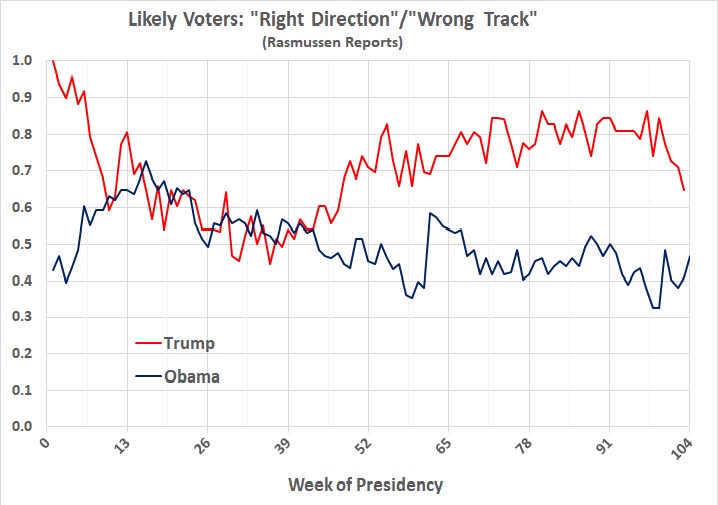
Every week since the first inauguration of Obama, Rasmussen Reports has asked 2,500 likely voters whether they see the country as going in the “right direction” or being on the “wrong track”. The graph below shows the ratios of “right direction”/”wrong track” for Trump and Obama:

The ratio for Trump, after a quick honeymoon start, fell into the same range as Obama’s. But it jumped with the passage of the tax cut in December 2017, and rose (raggedly) until six months ago. After leveling off for five months, the ratio began to drop sharply a month ago.

I would chalk it up to “Trump fatigue”. Trump is still better than the alternative, but I suspect that two years of tweeted outrage — even though mostly justified — is wearing on people who otherwise support his policies.

Yes, I know all about the relentless anti-Trump campaign from the left and NeverTrump “conservatives”. The graph suggests that Trump did a good job of countering that until recent months. The graph also suggests that Trump has to claim new, substantive victories before the tide turns against him. Tweeting won’t cut it.

Trump (and the country) has a lot at stake in the several pending issues; for example, the showdown over the border wall, Syria, North Korea, trade talks, the state of the economy, and the perception that his White House is or isn’t in chaos. Looming over all of it is the Mueller investigation and a concerted effort by House Democrats to undercut Trump on all fronts.

The coming weeks and months could bring a steady stream of bad news — or some surprisingly good news — for Trump. But it will have to be genuinely good news, not bombastic tweets from the Oval Office. It is time for Trump to retire his Twitter account.

Keep your eye on the “right direction”/”wrong track” ratio.

It’s “Seguin”, Not “Sequin”

This is from a piece by Teri Webster, “Off-Duty Officer, Citizen, Thwart Potential Church Massacre Early Sunday in Texas” (The Blaze, December 30, 2018):

A potential tragedy was avoided early Sunday after police in Sequin, Texas, arrested a man who may have been planning to open fire on a church to fulfill what he claimed was a “prophecy.”

What happened?

Police went to the 2400 block of West Kingsbury Street around 7 a.m. after witnesses reported seeing a man with a gun who was wearing tactical-style clothing and a surgical face shield,” the Sequin Gazette reported. An off-duty officer who first arrived at the scene said the suspect told him he was on his way to a church to fulfill a prophecy. The suspect was carrying a loaded firearm and extra ammunition, police said.

Seguin police arrested Tony Albert, 33, who was booked at the Guadalupe County Jail on charges of possession of marijuana and felony possession of firearm….

Ms. Webster writes “Sequin” twice before getting it right with “Seguin”. Her misspelling caught my eye because Seguin is near a route that I have taken several times from Austin to the Gulf Coast of Texas.

A trifle, you say? Not at all. It’s representative of the myriad errors — far more serious ones — that readers, listeners, and viewers don’t spot because they’re unfamiliar with the subject at hand. Errors that are made because reporters don’t know any better than to parrot their sources: global-warming alarmists, proponents of social panaceas, race-intelligence denialists, etc., etc., etc.

The next time you read, listen to, or view a “news” story that seems to push the global-warming agenda, paid family leave, inherent equality in all things (black basketball players excluded), ask yourself if the reporter knows the difference between “Sequin” and “Seguin”.

It’s Time to Revive 1920s’ Jazz

I often wonder why the popular jazz of the 1920s, which faded in the mid-1930s, isn’t still widely popular. It’s rhythmically inventive, driving, and upbeat — as opposed to the monotonous and often dreary, dissonant, and unmelodic droning of what later became known as jazz. (I’m not writing here about the New Orleans style of jazz, which is a genre of its own, and has never died out. If you’re unsure of the distinction, click on the links at the end of this post.)

The jazz of the ’20s (and early-to-mid-’30s) evolved into the swing of the ’30s and 40s. Swing evolved into the ponderous big-band sound of the ’40s and ’50s.

Rhythmically inventive, driving, and upbeat popular music returned in the mid-’50s, with the birth of rock and roll. The Beatles and their ilk put a twist on rock and roll, and the genre evolved into what is known as classic rock — the sound that dominated the mid-’60s to early ’70s. Its variants — some of them close to the classic sound — survive and thrive to this day.

But nothing — with the possible exception of early swing — has yet to rival the musical sophistication of ’20s jazz. Bands led by the likes of Red Allen, Bix Beiderbecke, Johnny Dodds, the early Duke Ellington, Jean Goldkette, Fletcher Henderson, Isham Jones, Vincent Lopez, Jelly Roll Morton, Red Nichols, King Oliver, and Paul Whiteman (to name only a small representation) recorded thousands of foot-stomping tunes (plus innumerable blues, ballads, novelty tunes, other non-jazzy material).

It is de rigeur in some musical circles to deride the offerings of the larger ensembles, such as those led by several of the band leaders mentioned above. But their tight orchestrations delivered as much toe-tapping vitality as anything offered up by smaller groups.

For a feast of ’20s jazz — and much more — go to The Red Hot Jazz Archive, tap your toes, and lighten your spirit. (RealPlayer required.)

One of my favorites, which number in the hundreds, is “Dinah“. Not a jazzy song, you say? Well, dig these variations on a theme:

Cliff Edwards (1925)

Jean Goldkette (1926)

Joe Venuti (1928)

Red Nichols (1929)

Louis Armstrong (1930)

Bing Crosby with the Mills Brothers (1932) (After a ballad-y start, Bing rips into it. Bing as you’ve probably never heard him.)

The Boswell Sisters (1934) (The Bozzies followed Bing’s lead.)

Quintette of the Hot Club of France (1934)

Fats Waller (1935)

And feast your ears on this long anthology of Bix Beiderbecke‘s recordings. Beiderbecke crammed a long lifetime of music into his brief 28 years.

The Princess Di Effect

Theodore Dalrymple describes it:

A young British woman called Grace Millane was making her way round the world after graduation from university when she was murdered in New Zealand….

All over New Zealand … there has been an outpouring of emotion, or at any rate of public displays of emotion—there being no point in having an emotion unless you can show it in public. The candles have come out en masse, as it were, and have been lit in prominent places at what are called vigils. People at these vigils—mainly women, to judge from the photograph—stand around and look mournful, and I daresay they hug one another….

… It all seems very peculiar to me, this outpouring of kitschy emotion.

It is not confined to New Zealand, of course. Perhaps the greatest exhibition of it was after the death of Princess Diana; but these days, we have come to expect the lighting of candles whenever anybody loses his life in an unusual or spectacular way. No sooner had three people been murdered by a Muslim terrorist in Strasbourg, for example, then out came the candles, as if they had been held in waiting precisely for such an event as this.

I admit to a deep vein of dark humor. I scorned the Princess Di cult when she was alive. Upon learning of her death, I immediately formulated a ghoulish pun: Princess die.

This isn’t to minimize or dismiss the pain of anyone’s brutal death or the true emotional suffering of those near and dear to that person. But I do wonder about the emotional state of those persons who, as Dalrymple puts it, “have vigil candles at the ready at home, and joss sticks, just waiting for the occasion to demonstrate to the world the depth of their feeling and their inner goodness”.

It is of a piece with many things, including these examples of leftist hypocrisy:

  • fawning over “undocumented migrants” and homeless persons whom one wouldn’t invite into one’s home
  • lamenting “climate change” from the comfort of one’s McMansion with a 3-car garage containing at least two monstrous SUVs
  • insisting that taxes are “too low” while taking advantage of every tax break in the book
  • supporting confiscatory gun-control measures while enjoying the security of a gated manse and armed bodyguards
  • advocating “free speech” as long as it’s speech of which the advocate approves
  • insisting that coerced charity, open borders, etc., etc., accord with the teachings of Christ, especially when Christ is otherwise meaningless to the advocate of such measures

All such hypocrisy — which places burdens on others that are trifles, at most, to the hypocrite — is of relatively recent vintage. It is due, in large part, to the success of capitalism (another target of leftist hypcrites), which has shielded limousine liberals, armchair anarchists, and salon socialists from the consequences of their own stated beliefs.

Granted, there is probably little overlap between the practitioners of leftist hypocrisy and the practitioners of public grief. But both practices spring from the same urge to stroke one’s ego by virtue-signaling. As vulgar as it may be, lighting a candle at the drop of a body (pardon my dark humor) is far preferable to the social and economic damage wrought by leftist schemes.

More Stock-Market Analysis (II)

Today’s trading on U.S. stock markets left the Wilshire 5000 Total Market Full-Cap index 17 percent below its September high. How low will the market go? When will it bounce back? There’s no way to know, which is the main message of “Shiller’s Folly” and “More Stock-Market Analysis“.

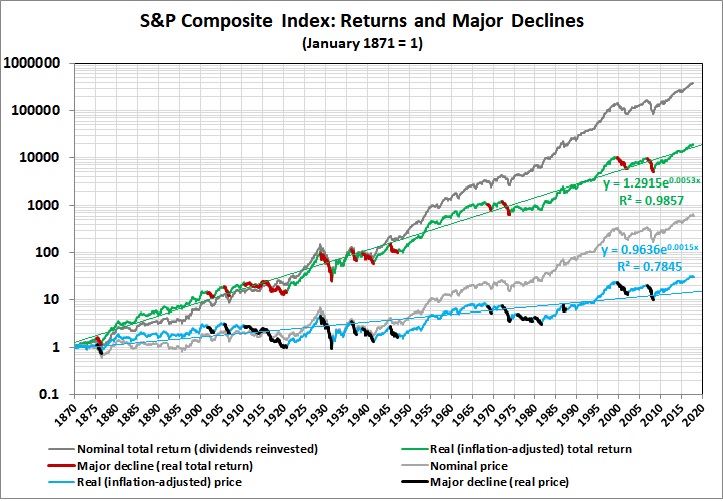
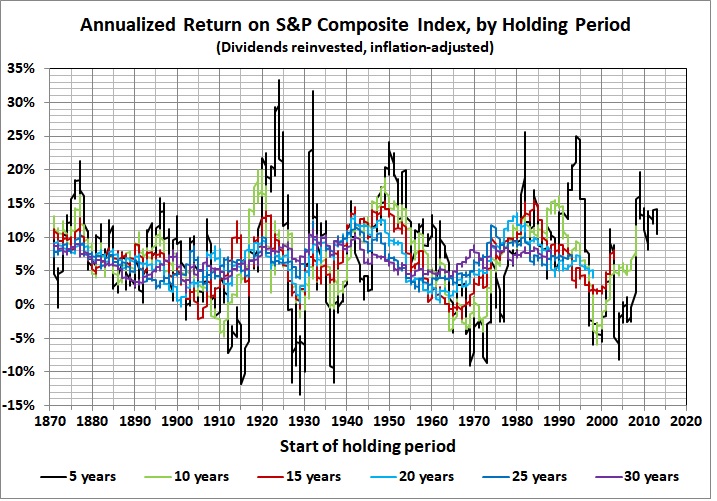
Herewith are three relevant exhibits based on the S&P Composite index as reconstructed by Robert Shiller (commentary follows):

In the following notes, price refers to the value of the index; real price is the inflation-adjusted value of the index; total return is the value with dividends reinvested; real total return is the inflation-adjusted value of total return.

  • The real price trend represents an annualized gain of 1.8 percent (through November 2018).
  • The real total return trend represents an annualized gain of 6.5 percent (through September 2018).
  • In month-to-month changes, real price has gone up 56 percent of the time; real total return has gone up 61 percent of the time.
  • Real price has been in a major decline about 24 percent of the time, where a major decline is defined as a real price drop of more than 25 percent over a span of at least 6 months.
  • The picture is a bit less bleak for total returns (about 20 percent of the time) because the reinvestment of dividends somewhat offsets price drops.
  • Holding a broad-market index fund is never a sure thing. Returns fluctuate wildly. Impressive real returns (e.g., 20 percent and higher) are possible in the shorter run (e.g., 5-10 years), but so are significantly negative returns. Holding a fund longer reduces the risk of a negative return while also suppressing potential gains.
  • Long-run real returns of greater than 5 percent a year are not to be scoffed at. It takes a lot of research, patience, and luck to do better than that with individual stocks and specialized mutual funds.

More Stock-Market Analysis

I ended “Shiller’s Folly” with the Danish proverb, it is difficult to make predictions, especially about the future.

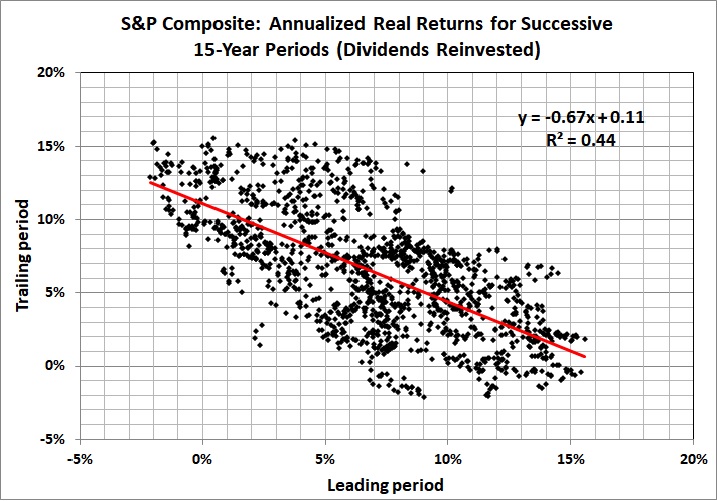
Here’s more in that vein. Shiller uses a broad market index, the S&P Composite (S&P), which he has reconstructed back to January 1871. I keep a record of the Wilshire 5000 Full-Cap Total-Return Index (WLX), which dates back to December 1970. When dividends for stocks in the S&P index are reinvested, its performance since December 1970 is almost identical to that of the WLX:

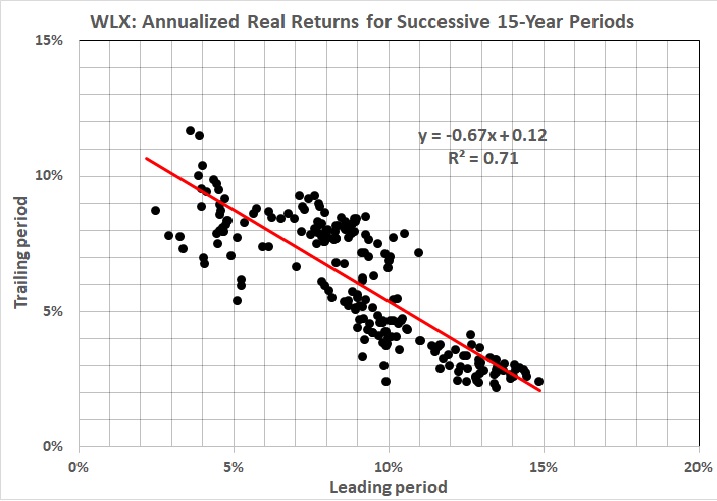
It is a reasonable assumption that if the WLX extended back to January 1871 its track record would nearly match that of the S&P. Therefore, one might assume that past returns on the WLX are a good indicator of future returns. In fact, the relationship between successive 15-year periods is rather strong:

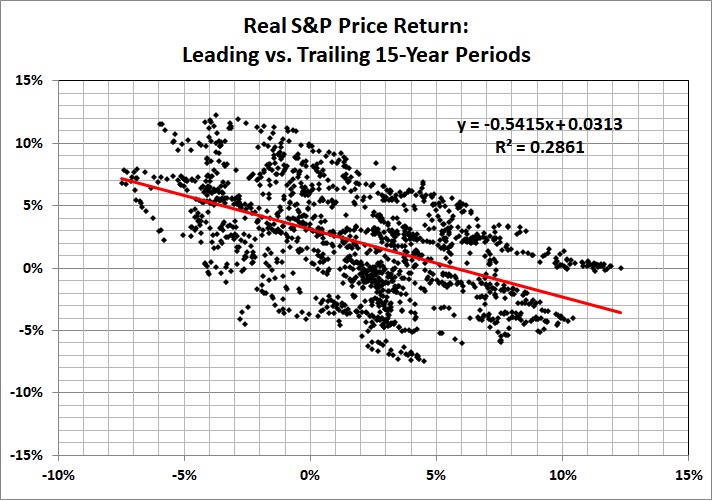
But that seemingly strong relationship is an artifact of the relative brevity of the track record of the WLX.  Compare the relationship in the preceding graph with the analogous one for the S&P, which goes back an additional 100 years:

The equations are almost identical — and they predict almost the same real returns for the next 15 years: about 6 percent a year. But the graph immediately above should temper one’s feeling of certainty about the long-run rate of return on a broad market index fund or a well-diversified portfolio of stocks.


Related posts:
Stocks for the Long Run?
Stocks for the Long Run? (Part II)
Bonds for the Long Run?
Much Ado about the Price-Earnings Ratio
Whither the Stock Market?
Shiller’s Folly

Anti-Elitism

Anti-elitism has shown great strength in various places, including the U.S., Italy, Brazil, and France. The proximate causes of anti-elitist uprisings aren’t all the same, but the underlying sentiment is: We are sick and tired of being dictated to and victimized by the political-media-academic-managerial establishment and its pet groups and causes.

Will the phenomenon endure and spread, or will it fade away like the Tea Party?

The answer depends on the ability of anti-elites to move into positions of power, and to remain there while remaining anti-elite. Power is seductive and corrupting. So anti-elitism is most likely to succeed and endure where it is led by persons, like Donald Trump, who already have wealth and power and (seem) to have a sincere appreciation of the grievances that underlie anti-elitism.


Related: True Populism

Introspection

No man is an island. But I am a gated peninsula.


Related: Solitude for the Masses (and the items linked to therein)

Shiller’s Folly

Robert Shiller‘s most famous (or infamous) book, is Irrational Exuberance (2000). According to the Wikipedia article about the book,

the text put forth several arguments demonstrating how the stock markets were overvalued at the time. The stock market collapse of 2000 happened the exact month of the book’s publication.

The second edition of Irrational Exuberance was published in 2005 and was updated to cover the housing bubble. Shiller wrote that the real estate bubble might soon burst, and he supported his claim by showing that median home prices were six to nine times greater than median income in some areas of the country. He also showed that home prices, when adjusted for inflation, have produced very modest returns of less than 1% per year. Housing prices peaked in 2006 and the housing bubble burst in 2007 and 2008, an event partially responsible for the Worldwide recession of 2008-2009.

However, as the Wikipedia article notes,

some economists … challenge the predictive power of Shiller’s publication. Eugene Fama, the Robert R. McCormick Distinguished Service Professor of Finance at The University of Chicago and co-recipient with Shiller of the 2013 Nobel Prize in Economics, has written that Shiller “has been consistently pessimistic about prices,”[ so given a long enough horizon, Shiller is bound to be able to claim that he has foreseen any given crisis.

(A stopped watch is right twice a day, but wrong 99.9 percent of the time if read to the nearest minute. I also predicted the collapse of 2000, but four years too soon.)

One of the tools used by Shiller is a cyclically-adjusted price-to-earnings ratio known as  CAPE-10 . It is

a valuation measure usually applied to the US S&P 500 equity market. It is defined as price divided by the average of ten [previous] years of earnings … , adjusted for inflation. As such, it is principally used to assess likely future returns from equities over timescales of 10 to 20 years, with higher than average CAPE values implying lower than average long-term annual average returns.

CAPE-10, like other economic indicators of which I know, is a crude tool:

For example, the annualized real rate of price growth for the S&P Composite Index from October 2003 to October 2018 was 4.6 percent. The value of CAPE-10 in October 2003 was 25.68. According to the equation in the graph (which includes the period from October 2003 through October 2018), the real rate of price growth should have been -0.6 percent. The actual rate is at the upper end of the wide range of uncertainty around the estimate.

Even a seemingly more robust relationship yields poor results. Consider this one:

The equation in this graph produces a slightly better but still terrible estimate: price growth of -0.2 percent over the 15 years ending in October 2018.

If you put stock (pun intended) in the kinds of relationships depicted above, you should expect real growth in the S&P Composite Index to be zero for the next 15 years — plus or minus about 6 percentage points. It’s the plus or minus that matters — a lot — and the equations don’t help you one bit.

As the Danish proverb says, it is difficult to make predictions, especially about the future.

Not-So-Random Thoughts (XXIII)

CONTENTS

Government and Economic Growth

Reflections on Defense Economics

Abortion: How Much Jail Time?

Illegal Immigration and the Welfare State

Prosperity Isn’t Everything

Google et al. As State Actors

The Transgender Trap


GOVERNMENT AND ECONOMIC GROWTH

Guy Sorman reviews Alan Greenspan and Adrian Wooldridge’s Capitalism in America: A History. Sorman notes that

the golden days of American capitalism are over—or so the authors opine. That conclusion may seem surprising, as the U.S. economy appears to be flourishing. But the current GDP growth rate of roughly 3 percent, after deducting a 1 percent demographic increase, is rather modest, the authors maintain, compared with the historic performance of the postwar years, when the economy grew at an annual average of 5 percent. Moreover, unemployment appears low only because a significant portion of the population is no longer looking for work.

Greenspan and Wooldridge reject the conventional wisdom on mature economies growing more slowly. They blame relatively slow growth in the U.S. on the increase in entitlement spending and the expansion of the welfare state—a classic free-market argument.

They are right to reject the conventional wisdom.  Slow growth is due to the expansion of government spending (including entitlements) and the regulatory burden. See “The Rahn Curve in Action” for details, including an equation that accurately explains the declining rate of growth since the end of World War II.


REFLECTIONS ON DEFENSE ECONOMICS

Arnold Kling opines about defense economics. Cost-effectiveness analysis was the big thing in the 1960s. Analysts applied non-empirical models of warfare and cost estimates that were often WAGs (wild-ass guesses) to the comparison of competing weapon systems. The results were about as accurate a global climate models, which is to say wildly inaccurate. (See “Modeling Is not Science“.) And the results were worthless unless they comported with the prejudices of the “whiz kids” who worked for Robert Strange McNamara. (See “The McNamara Legacy: A Personal Perspective“.)


ABORTION: HOW MUCH JAIL TIME?

Georgi Boorman says “Yes, It Would Be Just to Punish Women for Aborting Their Babies“. But, as she says,

mainstream pro-lifers vigorously resist this argument. At the same time they insist that “the unborn child is a human being, worthy of legal protection,” as Sarah St. Onge wrote in these pages recently, they loudly protest when so-called “fringe” pro-lifers state the obvious: of course women who willfully hire abortionists to kill their children should be prosecuted.

Anna Quindlen addressed the same issue more than eleven years ago, in Newsweek:

Buried among prairie dogs and amateur animation shorts on YouTube is a curious little mini-documentary shot in front of an abortion clinic in Libertyville, Ill. The man behind the camera is asking demonstrators who want abortion criminalized what the penalty should be for a woman who has one nonetheless. You have rarely seen people look more gobsmacked. It’s as though the guy has asked them to solve quadratic equations. Here are a range of responses: “I’ve never really thought about it.” “I don’t have an answer for that.” “I don’t know.” “Just pray for them.”

You have to hand it to the questioner; he struggles manfully. “Usually when things are illegal there’s a penalty attached,” he explains patiently. But he can’t get a single person to be decisive about the crux of a matter they have been approaching with absolute certainty.

… If the Supreme Court decides abortion is not protected by a constitutional guarantee of privacy, the issue will revert to the states. If it goes to the states, some, perhaps many, will ban abortion. If abortion is made a crime, then surely the woman who has one is a criminal. But, boy, do the doctrinaire suddenly turn squirrelly at the prospect of throwing women in jail.

“They never connect the dots,” says Jill June, president of Planned Parenthood of Greater Iowa.

I addressed Quindlen, and queasy pro-lifers, eleven years ago:

The aim of Quindlen’s column is to scorn the idea of jail time as punishment for a woman who procures an illegal abortion. In fact, Quindlen’s “logic” reminds me of the classic definition of chutzpah: “that quality enshrined in a man who, having killed his mother and father, throws himself on the mercy of the court because he is an orphan.” The chutzpah, in this case, belongs to Quindlen (and others of her ilk) who believe that a woman should not face punishment for an abortion because she has just “lost” a baby.

Balderdash! If a woman illegally aborts her child, why shouldn’t she be punished by a jail term (at least)? She would be punished by jail (or confinement in a psychiatric prison) if she were to kill her new-born infant, her toddler, her ten-year old, and so on. What’s the difference between an abortion and murder? None. (Read this, then follow the links in this post.)

Quindlen (who predictably opposes capital punishment) asks “How much jail time?” in a cynical effort to shore up the anti-life front. It ain’t gonna work, lady.

See also “Abortion Q & A“.


ILLEGAL IMMIGRATION AND THE WELFARE STATE

Add this to what I say in “The High Cost of Untrammeled Immigration“:

In a new analysis of the latest numbers [by the Center for Immigration Studies], from 2014, 63 percent of non-citizens are using a welfare program, and it grows to 70 percent for those here 10 years or more, confirming another concern that once immigrants tap into welfare, they don’t get off it.

See also “Immigration and Crime” and “Immigration and Intelligence“.

Milton Friedman, thinking like an economist, favored open borders only if the welfare state were abolished. But there’s more to a country than GDP. (See “Genetic Kinship and Society“.) Which leads me to…


PROSPERITY ISN’T EVERYTHING

Patrick T. Brown writes about Oren Cass’s The Once and Future Worker:

Responding to what he cutely calls “economic piety”—the belief that GDP per capita defines a country’s well-being, and the role of society is to ensure the economic “pie” grows sufficiently to allow each individual to consume satisfactorily—Cass offers a competing hypothesis….

[A]s Cass argues, if well-being is measured by considerations in addition to economic ones, a GDP-based measurement of how our society is doing might not only be insufficient now, but also more costly over the long term. The definition of success in our public policy (and cultural) efforts should certainly include some economic measures, but not at the expense of the health of community and family life.

Consider this line, striking in the way it subverts the dominant paradigm: “If, historically, two-parent families could support themselves with only one parent working outside the home, then something is wrong with ‘growth’ that imposes a de facto need for two incomes.”…

People need to feel needed. The hollowness at the heart of American—Western?—society can’t be satiated with shinier toys and tastier brunches. An overemphasis on production could, of course, be as fatal as an overemphasis on consumption, and certainly the realm of the meritocrats gives enough cause to worry on this score. But as a matter of policy—as a means of not just sustaining our fellow citizen in times of want but of helping him feel needed and essential in his family and community life—Cass’s redefinition of “efficiency” to include not just its economic sense but some measure of social stability and human flourishing is welcome. Frankly, it’s past due as a tenet of mainstream conservatism.

Cass goes astray by offering governmental “solutions”; for example:

Cass suggests replacing the current Earned Income Tax Credit (along with some related safety net programs) with a direct wage subsidy, which would be paid to workers by the government to “top off” their current wage. In lieu of a minimum wage, the government would set a “target wage” of, say, $12 an hour. If an employee received $9 an hour from his employer, the government would step up to fill in that $3 an hour gap.

That’s no solution at all, inasmuch as the cost of a subsidy must be borne by someone. The someone, ultimately, is the low-wage worker whose wage is low because he is less productive than he would be. Why is he less productive? Because the high-income person who is taxed for the subsidy has that much less money to invest in business capital that raises productivity.

The real problem is that America — and the West, generally — has turned into a spiritual and cultural wasteland. See, for example, “A Century of Progress?“, “Prosperity Isn’t Everything“, and “James Burnham’s Misplaced Optimism“.


GOOGLE ET AL. AS STATE ACTORS

In “Preemptive (Cold) Civil War” (03/18/18) I recommended treating Google et al. as state actors to enforce the free-speech guarantee of the First Amendment against them:

The Constitution is the supreme law of the land. (Article V.)

Amendment I to the Constitution says that “Congress shall make no law … abridging the freedom of speech”.

Major entities in the telecommunications, news, entertainment, and education industries have exerted their power to suppress speech because of its content…. The collective actions of these entities — many of them government- licensed and government-funded — effectively constitute a governmental violation of the Constitution’s guarantee of freedom of speech (See Smith v. Allwright, 321 U.S. 649 (1944) and Marsh v. Alabama, 326 U.S. 501 (1946).)

I recommended presidential action. But someone has moved the issue to the courts. Tucker Higgins has the story:

The Supreme Court has agreed to hear a case that could determine whether users can challenge social media companies on free speech grounds.

The case, Manhattan Community Access Corp. v. Halleck, No. 17-702, centers on whether a private operator of a public access television network is considered a state actor, which can be sued for First Amendment violations.

The case could have broader implications for social media and other media outlets. In particular, a broad ruling from the high court could open the country’s largest technology companies up to First Amendment lawsuits.

That could shape the ability of companies like Facebook, Twitter and Alphabet’s Google to control the content on their platforms as lawmakers clamor for more regulation and activists on the left and right spar over issues related to censorship and harassment.

The Supreme Court accepted the case on [October 12]….

the court of Chief Justice John Roberts has shown a distinct preference for speech cases that concern conservative ideology, according to an empirical analysis conducted by researchers affiliated with Washington University in St. Louis and the University of Michigan.

The analysis found that the justices on the court appointed by Republican presidents sided with conservative speech nearly 70 percent of the time.

“More than any other modern Court, the Roberts Court has trained its sights on speech promoting conservative values,” the authors found.

Here’s hoping.


THE TRANSGENDER TRAP

Babette Francis and John Ballantine tell it like it is:

Dr. Paul McHugh, the University Distinguished Service Professor of Psychiatry at Johns Hopkins Medical School and the former psychiatrist-in-chief at Johns Hopkins Hospital, explains that “‘sex change’ is biologically impossible.” People who undergo sex-reassignment surgery do not change from men to women or vice versa.

In reality, gender dysphoria is more often than not a passing phase in the lives of certain children. The American Psychological Association’s Handbook of Sexuality and Psychology has revealed that, before the widespread promotion of transgender affirmation, 75 to 95 percent of pre-pubertal children who were uncomfortable or distressed with their biological sex eventually outgrew that distress. Dr. McHugh says: “At Johns Hopkins, after pioneering sex-change surgery, we demonstrated that the practice brought no important benefits. As a result, we stopped offering that form of treatment in the 1970s.”…

However, in today’s climate of political correctness, it is more than a health professional’s career is worth to offer a gender-confused patient an alternative to pursuing sex-reassignment. In some states, as Dr. McHugh has noted, “a doctor who would look into the psychological history of a transgendered boy or girl in search of a resolvable conflict could lose his or her license to practice medicine.”

In the space of a few years, these sorts of severe legal prohibitions—usually known as “anti-reparative” and “anti-conversion” laws—have spread to many more jurisdictions, not only across the United States, but also in Canada, Britain, and Australia. Transgender ideology, it appears, brooks no opposition from any quarter….

… Brown University succumbed to political pressure when it cancelled authorization of a news story of a recent study by one of its assistant professors of public health, Lisa Littman, on “rapid-onset gender dysphoria.” Science Daily reported:

Among the noteworthy patterns Littman found in the survey data: twenty-one percent of parents reported their child had one or more friends who become transgender-identified at around the same time; twenty percent reported an increase in their child’s social media use around the same time as experiencing gender dysphoria symptoms; and forty-five percent reported both.

A former dean of Harvard Medical School, Professor Jeffrey S. Flier, MD, defended Dr. Littman’s freedom to publish her research and criticized Brown University for censoring it. He said:

Increasingly, research on politically charged topics is subject to indiscriminate attack on social media, which in turn can pressure school administrators to subvert established norms regarding the protection of free academic inquiry. What’s needed is a campaign to mobilize the academic community to protect our ability to conduct and communicate such research, whether or not the methods and conclusions provoke controversy or even outrage.

The examples described above of the ongoing intimidation—sometimes, actual sackings—of doctors and academics who question transgender dogma represent only a small part of a very sinister assault on the independence of the medical profession from political interference. Dr. Whitehall recently reflected: “In fifty years of medicine, I have not witnessed such reluctance to express an opinion among my colleagues.”

For more about this outrage see “The Transgender Fad and Its Consequences“.

GHWB

George Herbert Walker Bush (June 12, 1924 – November 30, 2018) is the new leader in the clubhouse. That is to say, he is now the oldest member of the Dead Presidents Club, at the age of 94.47 years.

GHWB replaced Gerald Ford, who made it to 93.45. Ford replaced Ronald Reagan, who made it to 93.33.

Jimmy (now 94.17) will replace GHWB if he lives to March 25, 2019.

John Adams (90.67) and Herbert Hoover (90.19) are the other occupants of the club’s exclusive 90+ room. As many members of the club (5) lived into their 90s as lived into their 80s.

Will Jimmy make it 6 to 5, or will he become the club’s first centenarian? He already holds the record for having outlived his presidency. He’s almost at the 38-year mark, well beyond Hoover’s 31.63. The only president of the past half-century who was worse than Carter is Obama, who will probably break Carter’s miserable record for post-presidential pestilence.

For more in this vein, see the updated version of “Presidents: Key Dates and Various Trivia“.