Rights, Liberty, the Golden Rule, and Leviathan

Rights arise from voluntary and enduring social relationships. In that respect, they are natural because they represent the accommodations that a people make with each other in order to coexist peacefully and to their mutual benefit. (Natural rights, as I define them, are not the same thing as the kind of “natural rights” that many philosophers, political theorists, mystics and opportunistic politicians claim to find hovering in human beings like Platonic essences. See this, this, this, and this, for example.)

Natural rights, in sum, are the interpersonal claims that a people agree upon and (mainly) observe in their daily interactions. The claims can be negative (do not kill, except in self-defense) or positive (children must be clothed, fed, and taught about rights). For reasons discussed later, such claims are valid and generally honored even if there isn’t a superior power (a chieftain, monarch, or state apparatus) to enforce them.

Liberty is the condition in which agreed rights are generally observed, and enforced when they are violated. Liberty, in other words, is the condition of peaceful, willing coexistence and its concomitant: beneficially cooperative behavior. Peaceful, willing coexistence does not imply “an absence of constraints, impediments, or interference”, which is a standard definition of liberty. Rather, it implies that there is necessarily a degree of compromise (voluntary constraint) for the sake of beneficially cooperative behavior. Even happy marriages are replete with voluntary constraints on behavior, constraints that enable the partners to enjoy the blessings of union.

That’s all there is to it. Liberty isn’t a nirvana-like state of euphoria; it’s just what everyday life is like when people are able to coexist by their own lights, perhaps under the aegis of a superior power which does nothing but ensure that they are able to do so.

The persistence of natural rights and liberty among a people is fostered primarily by mutual trust, respect, and forbearance. Punishment of violations of rights (and therefore of liberty) helps, too, as long as the punishment is generally agreed upon and applied consistently.

Natural rights, as discussed thus far, are distinct from “rights” (sometimes “natural rights”) that people demand of a superior power. (See, for example, the UN Declaration of Human Rights, which is a wish-list of things that people are “entitled” to.) Those are really privileges. Government can (and sometimes does) recognize and protect truly natural rights, but it doesn’t manufacture them. The Bill of Rights, for example, consists of a hodge-podge of actual rights (e.g., the right to bear arms), and privileges (e.g., protection from self-incrimination). Some of the latter are special dispensations made necessary by the existence of government itself, that is, promises made by the government to protect the people from its superior power.

As mentioned in passing earlier, rights are usually divided into two categories: negative and positive. Negative rights are natural rights that can be exercised without requiring anything of others but reciprocal forbearance [1]. Wikipedia puts it this way:

Adrian has a negative right to x against Clay if and only if Clay is prohibited from acting upon Adrian in some way regarding x…. A case in point, if Adrian has a negative right to life against Clay, then Clay is required to refrain from killing Adrian….

To spin out the example, there is a negative right not to be harmed (killed in this case) as long as Clay is forbidden to kill Adrian, Adrian is forbidden to kill Clay, both are forbidden to kill others, and others are forbidden to kill anyone. This is a widely understood and accepted negative right. But it is not an unconditional right. There are also widely understood and accepted exceptions to it, such as killing in self-defense.

In any event, the textbook explanation of negative rights, such as the one given by Wikipedia, is appealing. But it is simplistic, like John Stuart Mill’s harm principle.

“Negative rights” and “harm”, by themselves, are mere abstractions. It seems obvious that a person shouldn’t be harmed as long as he is doing no harm to others, which is the essence of Wikipedia‘s explanation. But “harm” is the operative word. Harm isn’t an abstraction; it’s a real thing — many real things — with concrete meanings. And those concrete meanings arise from social interactions and the norms born of them.

For example, libertarians consider it a negative right to sell one’s home to another person without interference by one’s neighbors (or the state acting on their behalf). One’s neighbors must forbear intervention, just as the seller must forbear intervention against the sales of the neighbors’ homes. But intervention may be necessary to prevent harm.

The part that libertarians usually get wrong is forbearance. Libertarians assume forbearance. They assume forbearance because they assume away — or simply ignore — the possibility that a voluntary transaction between two parties may result in harm to third parties.

But what if the buyer is an absentee owner who rents rooms to all and sundry (resulting in parking problems, an eyesore property, etc.)? Libertarians reject zoning as an infringement on the negative right of property ownership. So what are put-upon neighbors supposed to do about the absentee landlord who rents rooms to all and sundry? Well, the neighbors can always complain to the city government if things get out of hand, can’t they? Yes, but in the meantime harm will have been done, and the police may not be able to put a stop to it unless the harm actually violates a statute or ordinance that the police and courts are willing and able to enforce without being attacked as racist pigs, or some such thing.

Does the libertarian conception of negative rights have room in it for homeowners’ associations that actually allow neighborhoods to define harm, as it applies to their particular circumstances, and act to prevent it? In my experience, the libertarian conception of negative property rights — thou shalt not interfere in the sale of a house — has become enshrined in statutes and ordinances that de-fang homeowners’ associations, making them powerless to prevent harm by enforcing restrictive covenants (e.g., against renting rooms) that libertarians decry as infringements of negative rights.

The only negative rights worthy of the name are specific rights that are recognized within a voluntary and enduring association of persons. Violations of those rights undermine the fabric of mutual trust and mutual forbearance that enable a people to coexist in beneficial, voluntary cooperation. That — not some imaginary nirvana — is liberty.

By the same token, a voluntary and enduring association of persons can recognize positive rights. That is to say, positive rights — those broadly accepted as part and parcel of peaceful, willing coexistence and its concomitant: beneficially cooperative behavior — are just as much an aspect of liberty as are negative rights. (Doctrinaire libertarians, who aren’t really libertarians, mistakenly decry all positive rights as antithetical to liberty.)

Returning to the Wikipedia article quoted above, and the example of Adrian and Clay,

Adrian has a positive right to x against Clay if and only if Clay is obliged to act upon Adrian in some way regarding x…. [I]f Adrian has a positive right to life against Clay, then Clay is required to act as necessary to preserve the life of Adrian.

Negative and positive rights are compatible with each other in the context of the Golden Rule, or ethic of reciprocity: One should treat others as one would expect others to treat oneself. This is a truly natural law, for reasons I will come to.

The Golden Rule can be expanded into two, complementary sub-rules:

  • Do no harm to others, lest they do harm to you.
  • Be kind and charitable to others, and they will be kind and charitable to you.

The first sub-rule fosters negative rights. The second sub-rule fosters positive rights. But, as discussed earlier, the rights in question are specific — not abstract injunctions — because they are understood and recognized in the context of voluntary and enduring social relationships.

I call the Golden Rule a natural law because it’s neither a logical construct (e.g., the “given-if-then” formulation discussed here) nor a state-imposed one. Its long history and widespread observance (if only vestigial) suggest that it embodies an understanding that arises from the similar experiences of human beings across time and place. The resulting behavioral convention, the ethic of reciprocity, arises from observations about the effects of one’s behavior on that of others and mutual agreement (tacit or otherwise) to reciprocate preferred behavior, in the service of self-interest and empathy.

That is to say, the convention is a consequence of the observed and anticipated benefits of adhering to it. Those benefits accrue not only to the person who complies with the Golden Rule in a particular situation (the actor), but also to the person (or persons) who benefit from compliance (the beneficiary). The consequences of compliance don’t usually redound immediately to the actor, but they redound indirectly over the long-term because the actor (and many more like him) do their part to preserve the convention. It follows that the immediate impetus for observance of the convention is a mixture of two considerations: (a) an understanding of the importance of preserving the convention and (b) empathy on the part of the actor toward the beneficiary.

The Golden Rule will be widely observed within a group only if the members of the group are (a) generally agreed about the definition of harm, (b) value kindness and charity (in the main), and (c) perhaps most importantly see that their acts have beneficial consequences. If those conditions are not met, the Golden Rule descends from convention to slogan.

Is the Golden Rule susceptible of varying interpretations across groups, and is it therefore a vehicle for moral relativism? Yes, with qualifications. It’s true that groups vary in their conceptions of permissible behavior. For example, the idea of allowing, encouraging, or aiding the death of old persons is not everywhere condemned. (Many — with whom I wouldn’t choose to coexist voluntarily — embrace it as a concomitant of a government-run or government-regulated health-care “system” that treats the delivery of medical services as matter of rationing.) Infanticide has a long history in many cultures; modern, “enlightened” cultures have simply replaced it with abortion. (More behavior that is beyond the pale of my preferred society.) Slavery is still an acceptable practice in some places, though those enslaved (as in the past) usually are outsiders. Homosexuality has a long history of condemnation, and occasional acceptance. (To be pro-homosexual nowadays — and especially to favor homosexual “marriage” — has joined the litany of “causes” that connote membership in the tribe of “enlightened” “progressives” [a.k.a., “liberals” and leftists], along with being for abortion [i.e., pre-natal infanticide] and against the consumption of fossil fuels — except for one’s McMansion and SUV, of course.)

The foregoing recitation suggests a mixture of reasons for favoring or disfavoring various behaviors, that is, regarding them as beneficial or harmful. Those reasons range from utilitarianism (calculated weighing of costs and benefits) to status-signaling. In between, there are religious and consequentialist reasons for favoring or disfavoring various behaviors. Consequentialist reasoning goes like this: Behavior X can be indulged responsibly and without harm to others, but there a strong risk that it will not be indulged responsibly, or that it will lead to behavior Y, which has repercussions for others. Therefore, it’s better to put X off-limits, or to severely restrict and monitor it.

Consequentialist reasoning applies to euthanasia (it’s easy to slide from voluntary to involuntary acts, especially when the state controls the delivery of medical care); infanticide and abortion (forms of involuntary euthanasia and signs of disdain for life); homosexuality (a depraved, risky practice — especially among males — that can ensnare impressionable young persons who see it as an “easy” way to satisfy sexual urges); alcohol and drugs (addiction carries a high cost, for the addict, the addict’s family, and sometimes for innocent bystanders). In the absence of governmental edicts to the contrary, long-standing attitudes toward such behaviors would prevail in most places. (Socially and geographically isolated enclaves are welcome to kill themselves off and purify the gene pool.)

The exceptions discussed above to the contrary notwithstanding, there’s a mainstream interpretation of the Golden Rule — one that still holds in many places — which rules out certain kinds of behavior, except in extreme situations, and permits certain other kinds of behavior. There is, in other words, a “core” Golden Rule that comes down to this:

  • Killing is wrong, except in self-defense. (Capital punishment is just that: punishment. It’s also a deterrent to murder. It isn’t “murder,” muddle-headed defenders of baby-murder to the contrary notwithstanding.)
  • Various kinds of unauthorized “takings” are wrong, including theft (outright and through deception). (This explains popular resistance to government “takings” ,especially when it’s done on behalf of private parties. The view that it’s all right to borrow money from a bank and not repay it arises from the mistaken beliefs that (a) it’s not tantamount to theft and (b) it harms no one because banks can “afford it”.)
  • Libel and slander are wrong because they are “takings” by word instead of deed.
  • It is wrong to turn spouse against spouse, child against parent, or friend against friend. (And yet, such things are commonly portrayed in books, films, and plays as if they are normal occurrences, often desirable ones. And it seems to me that reality increasingly mimics “art”.)
  • It is right to be pleasant and kind to others, even under provocation, because “a mild answer breaks wrath: but a harsh word stirs up fury” (Proverbs 15:1).
  • Charity is a virtue, but it should begin at home, where the need is most certain and the good deed is most likely to have its intended effect. (Leftists turn a virtue into an imposition when they insist that “charity” — as in income redistribution — is a proper job of government.)

None of these observations would be surprising to a person raised in the Judeo-Christian tradition, or even in the less vengeful branches of Islam. The observations would be especially unsurprising to an American who was raised in a rural, small-town, or small-city setting, well removed from a major metropolis, or who was raised in an ethnic enclave in a major metropolis. For it is such persons and, to some extent, their offspring who are the principal heirs and keepers of the Golden Rule in America.

An ardent individualist — particularly an anarcho-capitalist — might insist that social comity can be based on the negative sub-rule, which is represented by the first five items in the “core” list. I doubt it. There’s but a short psychological distance from mean-spiritedness — failing to be kind and charitable — to sociopathy, a preference for harmful acts. Ardent individualists will disagree with me because they view kindness and charity as their business, and no one else’s. They’re right about that, but kindness and charity are nevertheless indispensable to the development of mutual trust among people who in an enduring social relationship. Without mutual trust, mutual restraint becomes problematic and co-existence becomes a matter of “getting the other guy before he gets you” — a convention that I hereby dub the Radioactive Rule.

Nevertheless, the positive sub-rule, which is represented by the final two items in the “core” list, can be optional for the occasional maverick. An extreme individualist (or introvert or grouch) could be a member in good standing of a society that lives by the Golden Rule. He would be a punctilious practitioner of the negative rule, and would not care that his unwillingness to offer kindness and charity resulted in coldness toward him. Coldness is all he would receive (and want) because, as a punctilious practitioner of the negative rule; his actions wouldn’t necessarily invite harm.

But too many extreme individualists would threaten the delicate balance of self-interested and voluntarily beneficial behavior that’s implied in the Golden Rule. Even if lives and livelihoods did not depend on acts of kindness and charity — and they probably would — mistrust would set it in. And from there, it would be a short distance to the Radioactive Rule.

Of course, the delicate balance would be upset if the Golden Rule were violated with impunity. For that reason, the it must be backed by sanctions. Non-physical sanctions would range from reprimands to ostracism. For violations of the negative sub-rule, imprisonment and corporal punishment would not be out of the question.

Now comes a dose of reality. Self-governance is possible only for a group of about 25 to 150 persons: the size of a hunter-gatherer band or Hutterite colony. It seems that self-governance breaks down when a group is larger than 150 persons. Why should that happen? Because mutual trust, mutual respect, and mutual forbearance — the things implied in the Golden Rule — depend very much on personal connections. A person who is loathe to say a harsh word to an acquaintance, friend, or family member — even when provoked — often waxes abusive toward strangers, especially in this era of e-mail and comment threads, where face-to-face encounters aren’t involved.

More generally, it’s a human tendency to treat family members, friends, and acquaintances differently than strangers; the former are accorded more trust, more cooperation, and more kindness than the latter. Why? Because there’s usually a difference between the consequences of behavior that’s directed toward strangers and the consequences of behavior that’s directed toward persons one knows, lives among, and depends upon for restraint, cooperation, and help. The allure of  doing harm without penalty (“getting away with something”) or receiving without giving (“getting something for nothing”)  becomes harder to resist as one’s social distance from others increases.

The preference of like for like is derided by libertarians and leftists as tribalism, which is like the pot calling the kettle black. There’s no one who is more tribal than a leftist, who weighs every word spoken by another person to ensure that person’s alignment with the left’s current dogmas. (Libertarians have it easier, inasmuch as most of them are loners by disposition, and thrive on contrariness.) But the preference of like for like is quite rational: Cooperation and help include mutual defense (and concerted attack, in the case of leftists).

When self-governance breaks down, it becomes necessary to spin off a new group or to establish a central power (a state) to establish and enforce rules of behavior (negative and positive). The problem, of course, is that those vested with the power of the state quickly learn to use it to advance their own preferences and interests, and to perpetuate their power by granting favors to those who can keep them in office. It is a rare state that is created for the sole purpose of protecting its citizens from one another (as the referee of last resort) and from outsiders, and rarer still is the state that remains true to such purposes.

In sum, the Golden Rule — as a uniting way of life — is quite unlikely to survive the passage of a group from a self-governing community to a component of a state. Nor does the Golden Rule as a uniting way of life have much chance of revival or survival where the state already dominates. The Golden Rule may operate within non-kinship groups (e.g., parishes, clubs, urban enclaves) by regulating the interactions among the members of such groups. It may have a vestigial effect on face-to-face interactions between stranger and stranger, but that effect arises in part from the fear of giving offense that will be met with hostility or harm, not from a communal bond.

In any event, the dominance of the state distorts behavior. For example, the state may enable and encourage acts (e.g., abortion, homosexuality) that had been discouraged as harmful by group norms. And the state will diminish the ability of members of a group to bestow charity on one another through the loss of income to taxes and the displacement of private charity by state-run schemes that mimic charity (e.g., Social Security).

The all-powerful state destroys liberty, even while sometimes defending it. This is done not just by dictating how people must live their lives, which is bad enough. It is also done by eroding the social bonds that liberty is built upon — the bonds that secure peaceful, willing coexistence and its concomitant: beneficially cooperative behavior.
__________
[1] Here is a summary of negative rights, by Randy Barnett:

A libertarian … favors the rigorous protection of certain individual rights that define the space within which people are free to choose how to act. These fundamental rights consist of (1) the right of private property, which includes the property one has in one’s own person; (2) the right of freedom of contract by which rights are transferred by one person to another; (3) the right of first possession, by which property comes to be owned from an unowned state; (4) the right to defend oneself and others when fundamental rights are being threatened; and (5) the right to restitution or compensation from those who violate another’s fundamental rights. [“Is the Constitution Libertarian?”, Georgetown Public Law Research Paper No. 1432854 (posted at SSRN July 14, 2009), p. 3]

Borrowing from and elaborating on Barnett’s list, I come to the following set of negative rights:

  • freedom from force and fraud (including the right of self-defense against force)
  • property ownership (including the right of first possession)
  • freedom of contract (including contracting to employ/be employed)
  • freedom of association and movement
  • restitution or compensation for violations of the foregoing rights.

This set of negative rights that would obtain in a state which devolves political decisions to the level of socially cohesive groups, while serving only as the defender of such rights (in the last resort) against domestic and foreign predators.

Constitution: Myths and Realities

A new page, here. It’s very long, but it consolidates and organizes several old posts.

Suicide

Suicide has garnered a lot of attention in recent days. As noted in a study by the Centers for Disease Control and Prevention, the rate has been rising steadily since it bottomed out in 2000. I discussed suicide at some length in “Suicidal Despair and the ‘War on Whites’” (June 26, 2017). I have updated a few graphs and a bit of text to accommodate the latest figures. But the bottom line remains unchanged. What is it? The “war on whites” is a red herring. Go there and see for yourself.

Climate Scare Tactics: The Mythical Ever-Rising 30-Year Average

Incorporated in this page.

Justice Thomas on “Masterpiece Cakeshop”

It is well known by now that cake maker Jack Phillips, proprietor of Masterpiece Cakeshop in Denver, prevailed in an opinion written by Justice Kennedy.  At issue were the Colorado Civil Rights Commission’s actions in assessing Phillips’s reasons for declining to make a cake for a same-sex couple’s wedding celebration. The commission’s actions violated the free exercise clause of the First Amendment. Specifically, in Kennedy’s words:

The Commission gave “every appearance,” of adjudicating [Phillips’s] religious objection based on a negative normative “evaluation of the particular justification” for his objection and the religious grounds for it, but government has no role in expressing or even suggesting whether the religious ground for Phillips’ conscience-based objection is legitimate or illegitimate. The inference here is thus that Phillips’ religious objection was not considered with the neutrality required by the Free Exercise Clause. The State’s interest could have been weighed against Phillips’ sincere religious objections in a way consistent with the requisite religious neutrality that must be strictly observed. But the official expressions of hostility to religion in some of the commissioners’ comments were inconsistent with that requirement, and the Commission’s disparate consideration of Phillips’ case compared to the cases of the other bakers suggests the same.

This is a narrow ruling, as many commentators have observed, in that it does not address the fundamental issue of the right of Phillips (or anyone similarly situated) to refuse to express views contrary to his beliefs — religious or not.

Justice Thomas, in a concurring opinion (joined by Justice Gorsuch), gets it right:

The First Amendment, applicable to the States through the Fourteenth Amendment, prohibits state laws that abridge the “freedom of speech.” When interpreting this command, this Court has distinguished between regulations of speech and regulations of conduct. The latter generally do not abridge the freedom of speech, even if they impose “incidental burdens” on expression….

Although public-accommodations laws generally regulate conduct, particular applications of them can burden protected speech. When a public-accommodations law “ha[s] the effect of declaring . . . speech itself to be the public accommodation,” the First Amendment applies with full force…. When [a Massachusetts] law required the sponsor of a St. Patrick’s Day parade to include a parade unit of gay, lesbian, and bisexual Irish-Americans, the Court unanimously held that the law violated the sponsor’s right to free speech. Parades are “a form of expression,” this Court explained, and the application of the public-accommodations law “alter[ed] the expressive content” of the parade by forcing the sponsor to add a new unit. The addition of that unit compelled the organizer to “bear witness to the fact that some Irish are gay, lesbian, or bisexual”; “suggest . . . that people of their sexual orientation have as much claim to unqualified social acceptance as heterosexuals”;and imply that their participation “merits celebration.” While this Court acknowledged that the unit’s exclusion might have been “misguided, or even hurtful,” ibid., it rejected the notion that governments can mandate“thoughts and statements acceptable to some groups or,indeed, all people” as the “antithesis” of free speech….

The parade . . . was an example of what this Court has termed “expressive conduct.” This Court has long held that “the Constitution looks beyond written or spoken words as mediums of expression,” and that “[s]ymbolism is a primitive but effective way of communicating idea.” Thus, a person’s “conduct may be ‘sufficiently imbued with elements of communication to fall within the scope of the First and Fourteenth Amendments.’” Applying this principle, the Court has recognized a wide array of conduct that can qualify as expressive, including nude dancing, burning the American flag, flying an upside-down American flag with a taped-on peace sign, wearing a military uniform, wearing a black armband, conducting a silent sit-in, refusing to salute the American flag, and flying a plain red flag….

Phillips’ creation of custom wedding cakes is expressive. The use of his artistic talents to create a well-recognized symbol that celebrates the beginning of a marriage clearly communicates a message. The use of his artistic talents to create a well-recognized symbol that celebrates the beginning of a marriage clearly communicates a message—certainly more so than nude dancing….

States cannot punish protected speech because some group finds it offensive, hurtful, stigmatic, unreasonable, or undignified. “If there is a bedrock principle underlying the First Amendment, it is that the government may not prohibit the expression of an idea simply because society finds the idea itself offensive or disagreeable.”… If the only reason a public-accommodations law regulates speech is “to produce a society free of . . . biases” against the protected groups, that purpose is “decidedly fatal” to the law’s constitutionality, “for it amounts to nothing less than a proposal to limit speech in the service of orthodox expression.”…

[T]he fact that this Court has now decided Obergefell v. Hodges [does not] somehow diminish Phillips’ right to free speech. [As CJ Roberts wrote in in dissenting opinion in Obergefell,] “It is one thing . . . to conclude that the Constitution protects a right to same-sex marriage; it is something else to portray everyone who does not share [that view] as bigoted” and unentitled to express a different view. This Court is not an authority on matters of conscience, and its decisions can (and often should) be criticized. The First Amendment gives individuals the right to disagree about the correctness of Obergefell and the morality of same-sex marriage. [The majority opinion in ] Obergefell itself emphasized that the traditional understanding of marriage “long has been held—and continues to be held—in good faith by reasonable and sincere people here and throughout the world.” If Phillips’ continued adherence to that understanding makes him a minority after Obergefell, that is all the more reason to insist that his speech be protected….

In Obergefell, I warned that the Court’s decision would “inevitabl[y] . . . come into conflict” with religious liberty,“as individuals . . . are confronted with demands to participate in and endorse civil marriages between same-sex couples.” This case proves that the conflict has already emerged. Because the Court’s decision vindicates Phillips’ right to free exercise, it seems that religious liberty has lived to fight another day. But, in future cases, the freedom of speech could be essential to preventing Obergefell from being used [in Justice Alito’s words] to “stamp out every vestige of dissent” and “vilify Americans who are unwilling to assent to the new orthodoxy.”

That should have been the majority opinion.


Related posts:
The Writing on the Wall
How to Protect Property Rights and Freedom of Association and Expression
The Beginning of the End of Liberty in America
Marriage: Privatize It and Revitalize It
Equal Protection in Principle and Practice
Freedom of Speech and the Long War for Constitutional Governance
Freedom of Speech: Getting It Right

Revisiting the Laffer Curve

Among the claims made in favor of the Tax Cuts and Jobs Act of 2017 was that the resulting tax cuts would pay for themselves. Thus the Laffer curve returned briefly to prominence, after having been deployed to support the Reagan and Bush tax cuts of 1981 and 2001.

The idea behind the Laffer curve is straightforward. Taxes inhibit economic activity, that is, the generation of output and income. Tax-rate reductions therefore encourage work, which yields higher incomes. Higher incomes mean that there is more saving from which to finance growth-producing capital investment. Lower tax rates also make investment more attractive by increasing the expected return on capital investments. Lower tax rates therefore stimulate economic output by encouraging work and investment (supply-side economics). Under the right conditions, lower tax rates may generate enough additional income to yield an increase in tax revenue.

I believe that there are conditions under which the Laffer curve works as advertised. But so what? The Laffer curve focuses attention on the wrong economic variable: tax revenue. The economic variables that really matter — or that should matter — are the real rate of growth and the income available to Americans after taxes. More (real) economic growth means higher (real) income, across the board. More government spending means lower (real) income; the Keynesian multiplier is a cruel myth.

A new Laffer curve is in order, one that focuses on the effects of taxation on economic growth, and thus on the aggregate output of products and services available to consumers.

Let us begin at the beginning, with this depiction of the Laffer curve (via Forbes):

This is an unusually sophisticated depiction of the curve, in that it shows a growth-maximizing tax rate which is lower than the revenue-maximizing rate. It also shows that the growth-maximizing rate is greater than zero, for a good reason.

With real taxes (i.e., government spending) at zero or close to it, the rule of law would break down and the economy would be a shambles. But government spending above that required to maintain the rule of law (i.e., adequate policing, administration of justice, and national defense) interferes with the efficient operation of markets, both directly (by pulling resources out of productive use) and indirectly (by burdensome regulation financed by taxes).

Thus a tax rate higher than that required to sustain the rule of law1 leads to a reduction in the rate of (real) economic growth because of disincentives to work and invest. A reduction in the rate of growth pushes GDP below its potential level. Further, the effect is cumulative. A reduction in GDP means a reduction in investment, which means a reduction in future GDP, and on and on.

I will quantify the Laffer curve in two steps. First, I will estimate the tax rate at which revenue is maximized, taking the simplistic view that changes in the tax rate do not change the rate of economic growth. I will draw on Christina D. Romer and David H. Romer’s “The Macroeconomic Effects of Tax Changes: Estimates Based on a New Measure of Fiscal Shocks” (American Economic Review, June 2010, pp. 763-801).

The Romers estimate the effects of exogenous changes in taxes on GDP. (“Exogenous” meaning tax cuts aimed at stimulating the economy, as opposed, for example, to tax increases triggered by economic growth.) Here is their key finding:

Figure 4 summarizes the estimates by showing the implied effect of a tax increase of one percent of GDP on the path of real GDP (in logarithms), together with the one-standard-error bands. The effect is steadily down, first slowly and then more rapidly, finally leveling off after ten quarters. The estimated maximum impact is a fall in output of 3.0 percent. This estimate is overwhelmingly significant (t = –3.5). The two-standard-error confidence interval is (–4.7%,–1.3%). In short, tax increases appear to have a very large, sustained, and highly significant negative impact on output. Since most of our exogenous tax changes are in fact reductions, the more intuitive way to express this result is that tax cuts have very large and persistent positive output effects. [pp. 781-2]

The Romers assess the effects of tax cuts over a period of only 12 quarters (3 years). Some of the resulting growth in GDP during that period takes the form of greater spending on capital investments, the payoff from which usually takes more than 3 years to realize. So a tax cut of 1 percent of GDP yields more than a 3-percent rise in GDP over the longer run. But let’s keep it simple and use the relationship obtained by the Romers: a 1-percent tax cut (as a percentage of GDP) results in a 3-percent rise in GDP.

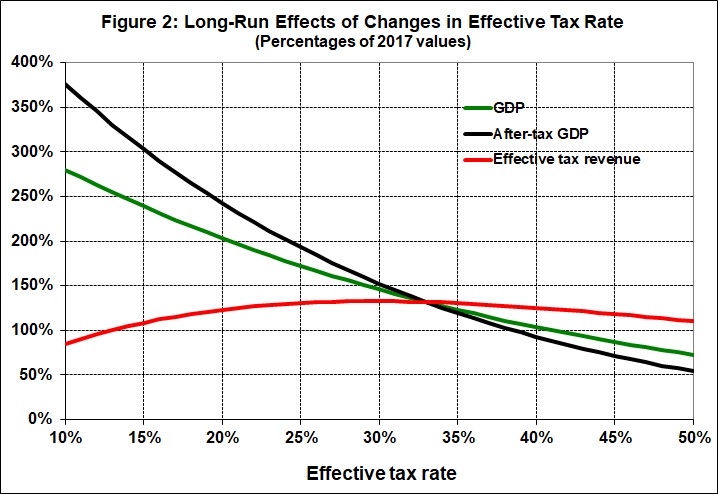
With that number in hand, and knowing the effective tax rate (33 percent of GDP in 20172), it is then easy to compute the short-run effects of changes in the effective tax rate on GDP, after-tax GDP, and tax revenue:


Effective tax revenue represents the dollar amount extracted from the economy through government spending at the stated percentage of GDP. (Spending includes transfer payments, which take from those who produce and give to those who do not.) Effective tax rate represents the dollar amount extracted from the economy, divided by GDP at the given tax rate. (GDP is based on the Romers’ estimate of the marginal effect of a change in the tax rate.)

It is a coincidence that tax revenue is maximized at the current (2017) effective tax rate of 33 percent. The coincidence occurs because, according to the Romers, every $1 change in tax revenue (or government spending that draws resources from the real economy) yields a $3 change in GDP, at the margin. If the marginal rate of return were lower than 3:1, the revenue-maximizing rate would be greater than 33 percent. If the marginal rate of return were higher than 3:1, the revenue-maximizing rate would be less than 33 percent.

In any event, the focus on tax revenue is entirely misplaced. What really matters, given that the prosperity of Americans is (or should be) of paramount interest, is GDP and especially after-tax GDP. Both would rise markedly in response to marginal cuts in real taxes (i.e., government spending). Democrats don’t want to hear that, of course, because they want government to decide how Americans spend the money that they earn. The idea that a far richer America would need far less government — subsidies, nanny-state regulations, etc. — frightens them.

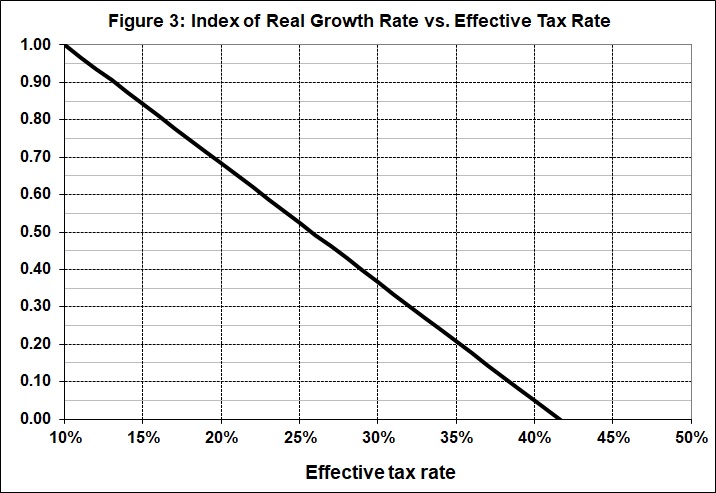
It gets better (or worse, if you’re a big-government fan) when looking at the long-run effects of lower government spending on the rate of growth. I am speaking of the Rahn curve, which I estimate here. Holding other things the same, every percentage-point reduction in the real tax rate (government spending as a fraction of GDP) means an increase of 0.35 percentage point in the rate of real GDP growth. This is a long-run relationship because it takes time to convert some of the tax reduction to investment, and then to reap the additional output generated by the additional investment. It also takes time for workers to respond to the incentive of lower taxes by adding to their skills, working harder, and working in more productive jobs.

This graph depicts the long-run effects of changes in the effective tax rate, taking into account changes in the real growth rate from a base of 2.8 percent (the year-over-year rate for the most recent fiscal quarter):

Note that the same real tax revenue would be realized at an effective tax rate of 13 percent of GDP. At that rate, GDP would rise to 2.5 times its 2017 value (instead of 1.6 times as shown in Figure 1), and after-tax GDP would rise to 3.3 times its 2017 value (instead of 2.1 times as shown in Figure 1).

The real Laffer curve — the one that people ought to pay attention to — is the Rahn curve. Holding everything else constant, here is the relationship between the real growth rate and the effective tax rate:

Laffer revisited_3

At the current effective tax rate — 33 percent of GDP — the economy is limping along at about one-third of its potential growth. That is actually good news, inasmuch as the real growth rate dipped perilously close to 1 percent several times during the Obama administration, even after the official end of the Great Recession.

But it will take many years of spending cuts (relative to GDP, at least) and deregulation to push growth back to where it was in the decades immediately after World War II. Five percent isn’t out of the question.
__________

1. Total government spending, when transfer payments were negligible, amounted to between 5 and 10 percent of GDP between the Civil War and the Great Depression (Series F216-225, “Percent Distribution of National Income or Aggregate Payments, by Industry, in Current Prices: 1869-1968,” in Chapter F, National Income and Wealth, Historical Statistics of the United States, Colonial Times to 1970: Part 1). The cost of an adequate defense is a lot higher than it was in those relatively innocent times. Defense spending now accounts for about 3.5 percent of GDP. An increase to 5 percent wouldn’t render the U.S. invulnerable, but it would do a lot to deter potential adversaries. So at 10 percent of GDP, government spending on policing, the administration of justice, and defense — and nothing else — should be more than adequate to sustain the rule of law.

2. The effective tax rate on GDP in 2017 was 33.4 percent. That number represents total government government expenditures (line 37 of BEA Table 3.1), divided GDP (line 1 of BEA Table 1.15). The nominal tax rate on GDP was 30 percent; that is, government receipts (line 34 of BEA Table 3.1) accounted for 30 percent of GDP. (The BEA tables are accessible here.) I use the effective tax rate in this analysis because it truly represents the direct costs levied on the economy by government. (The indirect cost of regulatory activity adds about $2 trillion, bringing the total effective tax to 44 percent.)

Selected Writings about Intelligence

I have treated intelligence many times; for example:

Positive Rights and Cosmic Justice: Part IV
Race and Reason: The Achievement Gap — Causes and Implications
“Wading” into Race, Culture, and IQ
The Harmful Myth of Inherent Equality
Bigger, Stronger, and Faster — But Not Quicker?
The IQ of Nations
Some Notes about Psychology and Intelligence
“Science” vs. Science: The Case of Evolution, Race, and Intelligence
More about Intelligence
Not-So-Random Thoughts (XXI), fifth item
Intelligence and Intuition
Intelligence, Personality, Politics, and Happiness
Intelligence As a Dirty Word

The material below consists entirely of quotations from cited sources. The quotations are consistent with and confirm several points made in the earlier posts:

  • Intelligence has a strong genetic component; it is heritable.
  • Race is a real manifestation of genetic differences among sub-groups of human beings. Those subgroups are not only racial but also ethnic in character.
  • Intelligence therefore varies by race and ethnicity, though it is influenced by environment.
  • Specifically, intelligence varies in the following way: There are highly intelligent persons of all races and ethnicities, but the proportion of highly intelligent persons is highest among Ashkenazi Jews, followed in order by East Asians, Northern Europeans, Hispanics (of European/Amerindian descent), and sub-Saharan Africans — and the American descendants of each group.
  • Males are disproportionately represented among highly intelligent persons, relative to females. Males have greater quantitative skills (including spatio-temporal aptitude) relative to females; whereas, females have greater verbal skills than males.
  • Intelligence is positively correlated with attractiveness, health, and longevity.
  • The Flynn effect (rising IQ) is a transitory environmental effect brought about by environment (e.g., better nutrition) and practice (e.g., learning and application of technical skills). The Woodley effect is (probably) a long-term dysgenic effect among people whose survival and reproduction depends more on technology (devised by a relatively small portion of the populace) than on the ability to cope with environmental threats (i.e., intelligence).

I have moved the supporting material to a new page: “Intelligence“.

Freedom of Speech: Getting It Right

Congress shall make no law … abridging the freedom of speech….

Constitution of the United States, Amendment I

* * *

[T]he sole end for which mankind are warranted, individually or collectively in interfering with the liberty of action of any of their number, is self-protection. That the only purpose for which power can be rightfully exercised over any member of a civilized community, against his will, is to prevent harm to others….

If all mankind minus one, were of one opinion, and only one person were of the contrary opinion, mankind would be no more justified in silencing that one person, than he, if he had the power, would be justified in silencing mankind.

John Stuart Mill, On Liberty (1869), Chapter I and Chapter II

* * *

[T]he character of every act depends upon the circumstances in which it is done. The most stringent protection of free speech would not protect a man in falsely shouting fire in a theatre and causing a panic. It does not even protect a man from an injunction against uttering words that may have all the effect of force. The question in every case is whether the words used are used in such circumstances and are of such a nature as to create a clear and present danger that they will bring about the substantive evils that Congress has a right to prevent. It is a question of proximity and degree.

Oliver Wendell Holmes Jr., Schenck v. United States (1919)

* * *

To justify suppression of free speech there must be reasonable ground to fear that serious evil will result if free speech is practiced. There must be reasonable ground to believe that the danger apprehended is imminent. There must be reasonable ground to believe that the evil to be prevented is a serious one.

Louis D. Brandeis, Whitney v. People of State of California (1927),
joined by Holmes

* * *

The First Amendment has been systematically misapplied for the past 100 years, thanks mainly to Holmes and Brandeis. Mill’s generalizations are fatuous nonsense. Here is a palate-cleanser:

[O]nly where advocacy of and organization for an overthrow of government is deemed to be a “clear and present danger” can such advocacy or organization be curbed. Which is somewhat like waiting to shoot at an enemy armed with a long-range rifle until you are able to see the whites of his eyes. Or, perhaps more aptly in the 21st century, waiting until a terrorist strikes before acting against him. Which is too late, of course, and impossible in the usual case of suicide-cum-terror.

And therein lies the dangerous folly of free-speech absolutism….

The First Amendment, in the hands of the Supreme Court, has become inimical to the civil and state institutions that enable liberty….

[Mill’s harm principle] is empty rhetoric….

Harm must be defined. And its definition must arise from voluntarily evolved social norms. Such norms evince and sustain the mutual trust, respect, forbearance, and voluntary aid that — taken together — foster willing, peaceful coexistence and beneficially cooperative behavior. And what is liberty but willing, peaceful coexistence and beneficially cooperative behavior?

Behavior is shaped by social norms. Those norms once were rooted in the Ten Commandments and time-tested codes of behavior. They weren’t nullified willy-nilly in accordance with the wishes of “activists,” as amplified through the megaphone of the mass media, and made law by the Supreme Court. What were those norms? Here are some of the most important ones:

Marriage is a union of one man and one woman. Nothing else is marriage, despite legislative, executive, and judicial decrees that substitute brute force for the wisdom of the ages.

Marriage comes before children. This is not because people are pure at heart, but because it is the responsible way to start life together and to ensure that one’s children enjoy a stable, nurturing home life.

Marriage is until “death do us part.” Divorce is a recourse of last resort, not an easy way out of marital and familial responsibilities or the first recourse when one spouse disappoints or angers the other.

Children are disciplined — sometimes spanked — when they do wrong. They aren’t given long, boring, incomprehensible lectures about why they’re doing wrong. Why not? Because they usually know they’re doing wrong and are just trying to see what they can get away with.

Drugs are taken for the treatment of actual illnesses, not for recreational purposes.

Income is earned, not “distributed.” Persons who earn a lot of money are to be respected. If you envy them to the point of wanting to take their money, you’re a pinko-commie-socialist (no joke).

People should work, save, and pay for their own housing. The prospect of owning one’s own home, by dint of one’s own labor, is an incentive to work hard and to advance oneself through the acquisition of marketable skills.

Welfare is a gift that one accepts as a last resort, it is not a right or an entitlement, and it is not bestowed on persons with convenient disabilities….

A mother who devotes time and effort to the making of a good home and the proper rearing of her children is a pillar of civilized society. Her life is to be celebrated, not condemned as “a waste.”

Homosexuality is a rare, aberrant kind of behavior. (And that was before AIDS proved it to be aberrant.) It’s certainly not a “lifestyle” to be celebrated and shoved down the throats of all who object to it.

Privacy is a constrained right. It doesn’t trump moral obligations, among which are the obligations to refrain from spreading a deadly disease and to preserve innocent life.

Addiction isn’t a disease; it’s a surmountable failing….

Justice is a dish best served hot, so that would-be criminals can connect the dots between crime and punishment. Swift and sure punishment is the best deterrent of crime. Capital punishment is the ultimate deterrent because an executed killer can’t kill again.

Peace is the result of preparedness for war; lack of preparedness invites war.

The list isn’t exhaustive, but it’s certainly representative. The themes are few and simple: respect others, respect tradition, restrict government to the defense of society from predators foreign and domestic. The result is liberty: A regime of mutually beneficial coexistence based on mutual trust and respect. That’s all it takes — not big government bent on dictating new norms just because it can.

But by pecking away at social norms that underlie mutual trust and respect, “liberals” have sundered the fabric of civilization….

The right “peaceably to assemble, and to petition the Government for a redress of grievances” has become the right to assemble a mob, disrupt the lives of others, destroy the property of others, injure and kill others, and (usually) suffer no consequences for doing so — if you are a leftist or a member of one of the groups patronized by the left, that is.

But that’s not the end of it. There’s a reverse slippery-slope effect when it comes to ideas opposed by the left. There are, for example, speech codes at government-run universities; hate-crime laws, which effectively punish speech that offends a patronized group; and penalties in some States for opposing same-sex “marriage”….

In sum, there is no longer such a thing as the kind of freedom of speech intended by the Framers of the Constitution. There is on the one hand license for “speech” that subverts and flouts civilizing social norms — the norms that underlie liberty. There is on the other hand a growing tendency to suppress speech that supports civilizing social norms.

Freedom of Speech and the Long War for Constitutional Governance“,
Politics and Prosperity

* * *

See also:
Rethinking the Constitution: “Freedom of Speech, and of the Press”
Abortion and the Fourteenth Amendment
Privacy Is Not Sacred
The Contemporary Meaning of the Bill of Rights: First Amendment
How to Protect Property Rights and Freedom of Association and Expression
The Beginning of the End of Liberty in America
There’s More to It Than Religious Liberty
Equal Protection in Principle and Practice
Academic Freedom, Freedom of Speech, and the Demise of Civility
Preemptive (Cold) Civil War
The Framers, Mob Rule, and a Fatal Error
The Constitution: Myths and Realities

“This Has to Stop”

That’s a typical reaction to the latest (but, sadly, not last) mass shooting at a school (or anywhere else). What is the point of saying “this has to stop”? To express one’s outrage? It’s safe to assume that anyone who has an ounce of feeling for other people is outraged by mass shootings.

No, the point of it is virtue-signaling. But that’s all there is to it. Where’s the beef — the “solution” to the problem? Is it to tighten laws about access to guns, when the already tight laws aren’t being enforced well enough, and couldn’t be given the imperfections in human institutions? Is it to stop making “assault rifles” and large magazines when there are already so many in circulation that it won’t matter if no more are made. (Will there be an equally ridiculous and futile ban on the manufacture of knives and materials that can be made to explode?) Is the “solution” to clamp down on gun and ammunition sellers, period, when there are so many of them operating in the black market that it wouldn’t deter anyone who is serious about committing crimes?

Or is the “solution” to confiscate all firearms and ammunition (when they are volunteered or readily found), leaving law-abiding citizens at the mercy of those who scoff at the law? Yes, that must be it. Because it would be possible to confiscate millions of firearms and hundreds of millions of rounds of ammunition. And the resulting piles of guns and bullets would make an impressive showing on TV and in news photos. But it would be all for show. Except that the law-abiding Americans who turned in their guns and ammo would thenceforth be defenseless against the army of thugs and criminals that would remain at large.

What has to stop is the cultural erosion that has made almost routine something that was rare more than 50 years ago: mass murder. Mass murder isn’t happening because there are “too many” guns out there; America has been well armed since before the Revolutionary War. It’s happening because an increasing fraction of the population lacks a strong conscience, upbringing in an intact family, and strict discipline.


Related reading:
Gilbert T. Sewall, “How We Defined Deviancy Down and Got a Culture of Violence“, The American Conservative, May 22, 2018
Brandon J. Weichert, “Maybe America Should Ban Guns“, The American Spectator, May 24, 2018 (Weichert’s real target is moral decay, which the left has encouraged and abetted.)


Related posts:
Mass Murder: Reaping What Was Sown
Utilitarianism (and Gun Control) vs. Liberty

The Constitution: Myths and Realities

I have posted The Constitution: Myths and Realities at Realities. This very long article reworks and consolidates many posts at Politics & Prosperity. It’s worth your time if you haven’t thought critically about the role of the States in the creation of the Constitution, the legality of secession, and much more, including a strong argument that Americans aren’t morally bound by the Constitution.

The article runs 15,000 words, but still omits much relevant material from this blog. Thus the links to 21 posts in the pingbacks at the bottom of the article. Follow the links there for complementary and supplementary readings.

Moral Relativism from the Times

The headline in The New York Times Says It All: “As U.S. Demands Nuclear Disarmament, It Moves to Expand Its Own Arsenal“. As if an enlightened policy would be to disarm the U.S. first and hope (without hope) that other countries would follow suit.

I wonder if the authors of the piece really gave any thought to the matter. If they had, they might have concluded that it would be better for the U.S. to have a monopoly on nuclear weapons so that (a) no one could threaten the U.S. or its citizens’ overseas interests with a nuclear attack and (b) the U.S. could more easily protect its citizens and their overseas interests. It’s like having your favorite team ahead 10-0 going into the bottom of the 9th inning, instead of being tied 1-1. But the U.S., of course, isn’t the left’s favorite team.

The “reporters” who work for the Times — like their “liberal” brethren” throughout the U.S. — have swallowed the poison pill of moral relativism and transnationalism:

Mindless internationalism equates sovereignty with  jingoism, protectionism, militarism, and other deplorable “isms”. It ignores or denies the hard reality that Americans and their legitimate overseas interests are threatened by nationalistic rivalries and anti-Western fanaticism. “Transnationalism” is just a “soft” form of aggression; it would erode American values from the inside out, though American leftists hardly need any help from their foreign allies.

In the real world of powerful international rivals and determined, resourceful fanatics, the benefits afforded Americans by our (somewhat eroded) constitutional contract — most notably the enjoyment of civil liberties, the blessings of  free markets, and the protections of a common defense — are inseparable from and dependent upon the sovereignty of the United States.  To cede that sovereignty for the sake of mindless internationalism is to risk the complete loss of the benefits promised by the Constitution.

None of that matters to a “liberal”. Better the U.S. should be blackmailed by a tin-pot dictatorship than it should spend money to ensure against blackmail by any power, small or large. The U.S. is such an awful place, after all, so rife with sins of the left’s imagining. That’s why the leftists moved to Canada and Europe — I wish.

What’s With the Pink?

Women are no different than men, right? They can do everything men can do, right? (Wrong, but I’ll let it pass for now.)

Why, then, do feminists and their eunuchs among the male of the species insist on using pink to signify femininity?

Pink when it’s time to remind everyone about breast cancer. (As if reminders were needed.)

Pink to protest the elevation to the presidency of the worst male chauvinist since Bill Clinton, who was the worse one since LBJ, who was the worst one since FDR, and so on. (There should be retroactive protests of most of the male-chauvinist presidents from Harding onward, but that won’t happen because most of them were Democrats.)

Now comes pink for Mother’s (or is it Mothers’ or Mothers?) Day; thus:

After finishing a column for tomorrow I turned on the Rays game with the sound muted so I could monitor it while reading. What I found was disturbing. No, not that the Rays were trailing 17-1. That may be disturbing in New York or Boston, not even surprising here. But I see that, in honor of Mother’s Day, Rays and Orioles players are kitted out in a motley assortment of pink shoes, pink hats, pink batting gloves, pink undershirts, pink sweat-bands, even, God help us, pink bats. So I switched over to the Marlins/Braves game. Same desecration there, which I gather is MLB-wide today….

[S]urely Major League Baseball could have found a way to give a tip of the baseball cap to moms without the indignity of putting grown men in pink outfits. I just can’t watch it. I’m sure even plenty of moms, especially players’ moms, are put off by this marketing overkill. How could the players’ pit-bull agents have allowed this? Isn’t there anything in contemporary contracts about dignity? Where’s the take-no-prisoners players’ union? [Larry Thornberry, “It’s Undignified and I’ll Have None of It“, The Spectacle Blog, May 13, 2018]

Eunuchs, as I said.

The wearing of pink reminds people of the differences between the sexes (genders, in neo-speak), so how can it be allowed and encouraged? Well, it’s okay if pinkness is imposed on men (males). But heaven forbid that a girl (female) baby should be dressed in pink. Sexism! Toxic masculinity! Rank stereotyping! Call 911, it must be against the law!

Trump: The Consequential President

Ed Rogers, writing in The Washington Post on May 10, offers some back-handed praise of Donald Trump and his presidency:

For the Trump administration, the absence of disaster usually has to suffice as good news. Well, I wouldn’t say President Trump is on a roll, but he has had several good days.

Specifically, the outcome of Tuesday’s Senate primaries made it more likely that the GOP will retain control of the Senate, the clean break with the Iran deal can be considered a bold display of resolve, and two judges have fanned back special counsel Robert S. Mueller III — perhaps curbing his overreach. Progress toward an agreement with North Korea seems to be proceeding quickly. In fact, Secretary of State Mike Pompeo secured the release of three Americans on Wednesday who had been held prisoner, and President Trump announced he will meet with Kim Jong Un in Singapore on June 12. Regarding North Korea, Jeff Greenfield wrote in a Politico piece titled “Thinking the Unthinkable: What if Trump Succeeds?” last week that recognizing all of Trump’s flaws provides “all the more reason to retain a sense of perspective; to be able to consider seriously the proposition that this misbegotten president has somehow achieved an honest-to-God diplomatic success.”

Then there are the recent polls from Reuters-Ipsos, Gallup, CBS and CNN which show that the president’s job approval is ticking up. The unemployment rate is at an 18-year low; according to the National Federation of Independent Business, not only are record levels of small businesses reporting profit growth, but also the Small Business Optimism Index continues to sustain record-high levels. Americans have confidence in Trump’s handling of the economy. And at least for the time being, even the generic ballot is moving in Trump’s favor.

In addition, a few of the president’s critics are stumbling. The mainstream media did themselves real harm with the debacle of this year’s White House Correspondents Dinner, and Trump tormentor New York Attorney General Eric Schneiderman was forced to resign following allegations of repeated abuse of multiple women….

… Yet the Trump presidency could be an exploding cigar. Just as you begin to settle in and get used to it, the whole thing could blow apart.

To state the obvious, Trump is his own worst enemy — and he won’t change. Feckless Democrats won’t bring him down, Republicans have acquiesced, much of the media has become annoying background noise, and Mueller doesn’t seem to have a silver bullet. Only Trump can destroy Trump.

A correspondent of mine had some incisive things to say about the state of affairs:

I think Trump is not only consequential, but also significant. To me, in this context, consequential means changing important things from the way they had been. Significant, means historically noteworthy. I think he will be the most significant president since Ronald Reagan. Interestingly, both Trump and Reagan followed presidents that were not significant presidents, leaving little legacy to mark their terms in office. If Trump were to be impeached and awarded the Nobel Peace Prize, remote possibilities, he would be significant 100 years from now. He is, and will be, significant for grabbing a political party and making it his party, even though he is not a politician. TR, also a Nobel winner, did the same.

Trump may also be significant for being unsavory and getting away with it.

My reaction follows:

Reagan accomplished three consequential things, in my view. First, he made old-fashioned conservatism somewhat respectable, though he was and still is reviled on the left for having done so. Second, his determined effort to rebuild the armed forces — to call the bluff of the USSR — was probably the main cause of the Soviet surrender in the Cold War. Third, his political support of Volcker’s tight-money policies, coupled with the tax-rate cuts he pushed through Congress led to the taming of inflation and a resumption of strong economic growth after years of “malaise”.

Thus far, only 16 months into his presidency, Trump has done three consequential things. First, he has nominated a conservative justice to the Supreme Court (though this didn’t change the balance on the Court) and a slew of district and appellate court judges, who seem to be solid conservatives. (There haven’t been any howls of outrage from the conservative sector of the internet.) Second, he has changed the image of American defense and foreign policy from defeatism (clearly the upshot of Obama’s “leading from behind”) to something like Reaganesque doggedness. (In tandem with that, he has backed the enlargement of the defense budget, though not yet, I believe, on a Reagenseque scale.) Third, he has deliberately (and somewhat effectively, as far as I know) pushed for a rollback of regulations that he views as especially harmful to the economy. His stance on immigration is loud and controversial, but it remains to be seen whether it will be consequential.

Maybe I’ve missed some important things, but my bottom line is agreement with my correspondent. It is entirely possible that by the end of Trump’s (first?) term the U.S. legal system will have shifted sharply toward a literal reading of the Constitution; the U.S. will not be in danger of military or political eclipse by Russia and/or China; membership in the nuclear club will not have expanded; trouble-makers like Iran and North Korea will have been “tamed”; and the rate of economic growth will be at its highest since the end of World War II, with a concomitant reduction in the real unemployment rate (much of which is still hidden in a low labor-force participation rate) and a somewhat higher (but not economically debilitating) rate of inflation.

If all or most of that happens — a big if — it will cement the political realignment in the country that was sparked by Trump’s candidacy. The Democrat party will increasingly be the home of affluent, well-educated whites (mangers, aspiring managers, academics, techies). Blacks will still be there for the Dems, though not in their former numbers, now that they are beginning to learn three things: Trump will not send them to concentration camps; white Democrats take them for granted while talking down to them; and blacks have done worse, not better, since Democrats began to throw money and special privileges at them. Hispanics will still be there for the Dems, perhaps in higher numbers than before because of Trump’s perceived “racism”. But the “blue collar” classes and regions will turn increasingly Red. Thus the Midwest, despite Blue enclaves in the big cities, will shift back toward the GOP. The South will remain Red, with the exception of Virginia and perhaps North Carolina, which are becoming extensions of the Northeast (though it will be less reliably Democrat because of the blue-collar shift). The Left Coast will remain reliably on the left, but the push to split California and liberate its conservatives will grow. If it succeeds, the GOP will become even stronger in Congress and in the electoral college. Regardless of what happens in California, the new GOP will be stronger politically than it has been at any time since World War II.

All of that could go by the wayside if there’s a real war involving the U.S., a recession, or a scandal beyond the known fact of Trump’s dalliances (i.e., an actual crime of consequence, not the payoff to Stormy). But barring such things, there will be a new GOP, and it will be stronger than the old one for some years to come.

As for Trump’s personal life, if things go nearly as well as they might, it will merit an asterisk in history books. Balanced historians (they’re hard to come by) will simply note that Trump was one of many presidents who couldn’t keep his pants zipped up, but that he succeeded in spite of it. They might even note that (among men, at least) there is a strong connection between sexual and political drive. Though the last observation will be out of bounds in the new Victorian era that is descending upon us.

The Kennedy Retirement: Hope Springs Eternal

UPDATED 06/27/18, ON THE OCCASION OF KENNEDY’S RETIREMENT ANNOUNCEMENT

Law professor and blogger Tom Smith (The Right Coast) quotes from and comments on yet another speculative piece about the (hoped for) retirement of Justice Anthony Kennedy:

The Washington rumor mill is churning with speculation about whether Justice Anthony Kennedy will retire at the end of the Supreme Court’s term next month.

The rumors seem to pop up annually in recent years. But with Kennedy’s 30th year on the high court passing in February and the justice nearing 82, the whispers about his future seem to be growing louder.

via www.washingtonexaminer.com

But how will the country endure without its chief moral arbiter? At every turn, Justice Kennedy has been there to make the final, incoherent distinction between right and wrong, between popular and unpopular, between what strange and incomprehensible thing the Law seems to say and what the murk at the heart of his conscience demands, at least for now.

Somebody should write something about this — the making of uber-political decisions on the basis of law-like rhetoric, which everybody knows is just politics, but which everyone agrees should be cloaked as law, while still knowing it is politics. Maybe this is a good thing? Keeps the lid on and all that? But no one has practiced this craft (?), art (?), or rubbishy self-indulgence (?) more semi-artfully than Justice Kennedy. He’s the un-Bork, the un-Ginsburg. He’s what you get.

I couldn’t possibly have put it that well. Kennedy has been fairly consistent in his use of judicial power to undermine civilizing social norms and the rule of law. Although he came out on the correct and decisive side of some crucial issues in the waning days of his justiceship, he too eagerly strove for “balance” and too timidly took up the cause of liberty (e.g., Masterpiece Cakeshop).

There is a canard, which I have read many times during the past few years, that Supreme Court Justices tend to retire during the tenure of president who is of the same party as the president who nominated them. This is the kind of balderdash that becomes “knowledge” among reporters and pundits who can’t be bothered to look up the facts.

Well, I have looked up the facts, and here’s what they tell me about the 35 justices* who have resigned or retired since 1900:

  • Slightly more than half of them (18) left office under a president of the same party as the president who nominated them.
  • Nine others are Democrat appointees who retired with a Republican in the White House. The last of these was Thurgood Marshall, who was nominated by LBJ and retired 27 years ago, during the presidency of G.H.W. Bush. Marshall’s retirement was like a gift from heaven because it resulted in the nomination and (painful) confirmation of Clarence Thomas, a faithful constitutionalist.
  • The remaining eight were Republican nominees who retired with a Democrat in the White House. Three of the last four justices to retire are in this category: Harry Blackmun (author of the infamous Roe v. Wade decision), nominated by Nixon and retired under Clinton; David Souter (another RINO), nominated by G.H.W. Bush and retired under Obama; and John Paul Stevens (the biggest RINO in captivity), nominated by Gerald Ford and retired under Obama.

It is poetic (pun intended) that Kennedy decided to retire during Trump’s presidency, so that he can be replaced by a constitutionalist in the mold of Alito, Thomas, or Gorsuch. I assume plausibly that Trump will in fact nominate someone in that mold.

Here’s the big picture, a plot of retirements by year and their effect on the nominal balance of party affiliations on the Supreme Court:

Party switches by justices
__________
* Here’s the chronological list of retirements, which the name of each retiring justice, the name of the president who nominated him (and year of accession to the Court), the name of the president at the time of the justice’s retirement (and year of retirement), and the effect of the retirement on the nominal party alignment of the Court:

Charles Evans Hughes – Taft 1910 – Wilson 1916 (GOP to Dem)
John Hessin Clarke – Wilson 1916 – Harding 1922 (Dem to GOP)
William Rufus Day – T. Roosevelt 1903 – Harding 1922 (Same)
William Howard Taft – Harding 1921 – Hoover 1930 (Same)
Oliver Wendell Holmes Jr. – T. Roosevelt 1902 – Hoover 1932 (Same)
Willis Van Devanter – Taft 1911 – F. Roosevelt 1937 (GOP to Dem)
George Sutherland – Harding 1922 – F. Roosevelt 1938 (GOP to Dem)
Louis Dembitz Brandeis – Wilson 1916 – F. Roosevelt 1939 (Same)
James Clark McReynolds – Wilson 1941 – F. Roosevelt 1941 (Same)
Charles Evans Hughes – Hoover 1930 – F. Roosevelt 1941 (GOP to Dem)
James Francis Byrnes – F. Roosevelt 1941 – F. Roosevelt 1942 (Same)
Owen Josephus Roberts – Hoover 1930 – Truman 1945 (GOP to Dem)
Robert Houghwout Jackson – F. Roosevelt 1941 – Eisenhower 1954 (Dem to GOP)
Sherman Minton – Truman 1949 – Eisenhower 1956 (Dem to GOP)
Stanley Forman Reed – F. Roosevelt 1938 – Eisenhower 1957 (Dem to GOP)
Harold Hitz Burton – Truman 1945 – Eisenhower 1958 (Dem to GOP)
Felix Frankfurter – F. Roosevelt 1939 – Kennedy 1962 (Same)
Arthur Joseph Goldberg – Kennedy 1962 – L. Johnson 1965 (Same)
Thomas Campbell Clark – Truman 1949 – L. Johnson 1967 (Same)
Abraham Fortas – L. Johnson 1965 – Nixon 1969 (Dem to GOP)
Earl Warren – Eisenhower 1954 – Nixon 1969 (Same)
Hugo Lafayette Black – F. Roosevelt 1937 – Nixon 1971 (Dem to GOP)
John Marshall Harlan II – Eisenhower 1955 – Nixon 1971 (Same)
William Orville Douglas – F. Roosevelt 1939 – Ford 1975 (Dem to GOP)
Potter Stewart – Eisenhower 1959 – Reagan 1981 (Same)
Warren Earl Burger – Nixon 1969 – Reagan 1986 (Same)
Lewis Franklin Powell Jr. – Nixon 1972 – Reagan 1987 (Same)
William Joseph Brennan Jr. – Eisenhower 1957 – Bush I 1990 (Same)
Thurgood Marshall – L. Johnson 1967 – Bush I 1991 (Dem to GOP)
Byron Raymond White – Kennedy 1962 – Clinton 1993 (Same)
Harry Andrew Blackmun – Nixon 1970 – Clinton 1994 (GOP to Dem)
Sandra Day O’Connor – Reagan 1981 – Bush II 2006 (Same)
David Hackett Souter – Bush I 1990 – Obama 2009 (GOP to Dem)
John Paul Stevens – Ford 1975 – Obama 2010 (GOP to Dem)
Anthony McLeod Kennedy – Reagan 1988 – Trump 2018 (Same)

The list includes Charles Evans Hughes twice. He first joined the Court in 1910, and resigned in 1916 to run for the presidency as a Republican. Hughes was then nominated as chief justice in 1930, to succeed William Howard Taft. Taft was the only person to have served as President of the United States and Supreme Court justice.

Rage on the Left

Back in the days when I was a “liberal” I was put off by such things as the rioting and looting in the aftermath of the assassination of MLK, the riotous behavior of anti-war protesters (even though I was against the Vietnam War as it was being fought), the filthy-speech movement, the occupation of campus buildings, and the many protest marches that blocked traffic and often led to violence.

Why? Because my “liberalism” wasn’t a sign of inner rage on my part. It was a mark of my belief — a wrong belief as I have come to understand — that “society” can be organized rationally (i.e., by government). My “liberalism” wasn’t based on irrational rage. I was therefore put off by the kinds of things mentioned above because they were external manifestations of rage. You could see it in the faces, speech, and body language of the rioters and protesters.

And you can see it in the faces, speech, and body language of today’s leftists. Always demanding things because — in their view — the world doesn’t match up to their idea of perfection. They take it personally, and it shows.

Today’s leftists are tantrum-throwers, just as were their forebears in the 1960s and 1970s. And today’s leftists are more dangerous than were their forebears because they are much more influential. For one thing, there are many tantrum-throwers of yore in positions of power who are sympathetic to their emotional descendants, and who share their solipsistic view of the world: They want what they want, they want it now, and they will do anything to get it.


Related posts:
Asymmetrical (Ideological) Warfare
The Left’s Agenda
The Left and Its Delusions
The Spoiled Children of Capitalism
The Culture War
Ruminations on the Left in America
Superiority
Whiners
God-Like Minds
Non-Judgmentalism as Leftist Condescension
An Addendum to (Asymmetrical) Ideological Warfare
The Left and Violence
The Left and Evergreen State: Reaping What Was Sown
Leftism
Leftism As Crypto-Fascism: The Google Paradigm
What Is Going On? A Stealth Revolution
Utopianism, Leftism, and Dictatorship
Abortion, the “Me” Generation, and the Left
Whence Polarization?
Social Norms, the Left, and Social Disintegration
Can Left and Right Be Reconciled?

Can Left and Right Be Reconciled?

TWO DIMENSIONS OF POLITICAL THOUGHT

The political views of left and right* should be understood as ideological and psychological phenomena. Left and right aren’t distinguished just by what people think, but more deeply by why people think as they do. Some people just see the world differently than others. And that fundamental difference is reinforced and magnified by identifying with a particular political camp, imbibing the views that issue from it, and seeking out evidence for those views to the exclusion of contrary evidence (confirmation bias).

Why is the key to the irreconcilability of hard leftism and staunch conservatism.  What matters, but it is a less definitive discriminator between left and right because what people think is more malleable.

WHAT IS A MOVEABLE FEAST

What people think is influenced heavily by family, friends, neighbors, church, club, co-workers, professional colleagues, and so on. The urge to belong and the need for approval have a lot to do with what one says to others. The need for cognitive consonance pushes people in the direction of “believing” what they say. Thus it is easy to say what meets with the approval of one’s key social groups, to move one’s opinions as the opinions of the groups move, to believe that those opinions are correct, to seize on supporting “evidence” (anecdotes, slanted news, etc.), and to reject information that doesn’t support one’s opinions.

An introvert is more likely to seek facts — or what he takes to be facts — than to be swayed by groupthink in forming his views. By the same token, it is probably easier for an introvert to change his views than it is for an extravert to do so. In any event, a person who is open to new ideas, and whose social milieu changes in character, may find that his views evolve with time. He may also be struck by an insight (“mugged by reality”) to the same effect.

There is also the kind of person who is temperamentally unsuited to the political views that he holds as a matter of social conditioning. That kind of person, unlike the person whose views are matched to his temperament, will be more open to alternative ideas and to insights that may reshape his views.

Overlaid on social influences are signals emitted by authoritative sources. For many persons, the morality of a particular behavior (e.g., divorce, abortion, same-sex “marriage”) depends on how that behavior is depicted in news and entertainment media, or is treated as a matter of law.

Though a person who is temperamentally predisposed to conservatism, or leftism, is unlikely to switch sides for any of the reasons discussed thus far, there is what I call the “squishy center” of the electorate that swings many an election — and thus government policy.

For example, every week since the first inauguration of Barack Obama, Rasmussen Reports** has asked 2,500 likely voters whether they see the country as going in the “right direction” or being on the “wrong track”. During Obama’s tenure, the percentage of respondents saying “right direction” ranged from 13 to 43; the percentages for “wrong track” ranged from 51 to 80. If voters were consistent, a majority would have said “right direction” and a minority would have said “wrong track” since the inauguration of Donald Trump. But “right direction” has garnered only 29 to 47 percent thus far in Trump’s presidency, while “wrong track” is still almost always in the majority, at 47 to 65 percent.

Here’s my interpretation: Hard leftists said “right direction” when Obama was in the White House; staunch conservatives have been saying “right direction” since Trump moved into the White House; and the “squishy center” has all the while been swinging from one side to the other, depending on passing events.

Scraping away the squishy center, I estimate that about one-third of the electorate is hard left and about one-third is staunchly conservative; thus:

Figure 3

I don’t mean to minimize the importance of what people think. Bandwagon effects are powerful politically. I am convinced, for example, that Justice Kennedy’s 5-4 majority opinion in favor of same-sex “marriage” (Obergefell v. Hodges) signaled to the squishy center that being on the “right side of history” means siding with the libertines of the left against long-standing social norms.

Obergefell v. Hodges certainly emboldened the hard left. As I put it on the day of Justice Kennedy’s fateful ruling,

for every person who insists on exercising his rights, there will be at least as many (and probably more) who will be cowed, shamed, and forced by the state into silence and compliance with the new dispensation. And the more who are cowed, shamed, and forced into silence and compliance, the fewer who will assert their rights. Thus will the vestiges of liberty vanish.

Just look at the increasingly anti-male, anti-white, anti-conservative, anti-free-speech behavior on the part of Facebook Google, the other left-dominated social media, and much of academia. It has gone from threatening to frightening in the past three years.

GETTING TO WHY: A PRELIMINARY EXPLANATION

There is something deeper than social conformity at work among the hard left and staunch right. That something rules out reconciliation.

My earlier attempt at pinpointing the essential difference between left and right is here. I say, in part, that

“Liberals” are more neurotic than conservatives. That is, “liberals” have a “tendency to experience unpleasant emotions easily, such as anger, anxiety, depression, and vulnerability.”…

Anxious persons are eager to sacrifice better but less certain outcomes — the fruits of liberty — for “safe” ones. Anxious persons project their anxieties onto others, and put their trust in exploitative politicians who play on their anxieties even if they don’t share them. This combination of anxieties and power-lust yields “social safety net” programs and regulations aimed at reducing risks and deterring risk-taking.. At the same time, American “liberals” — being spoiled children of capitalism — have acquired a paradoxical aversion to the very things that would ensure their security: swift and sure domestic justice, potent and demonstrably ready armed forces.

Conservatives tend toward conscientiousness more than liberals do; that is, they “display self-discipline, act dutifully, and strive for achievement against measures or outside expectations.” (This paper summarizes previous research and arrives at the same conclusion about the positive correlation between conscientiousness and conservatism.) In other words, conservatives (by which I don’t mean yahoos) gather relevant facts, think things through, assess the risks involved in various courses of action, and choose to take risks (or not) accordingly. When conservatives choose to take risks, they do so after providing for the possibility of failure (e.g., through insurance and cash reserves). Confident, self-reliant conservatives are hindered by governmental intrusions imposed at the behest of anxious “liberals.” All that conservatives need from government is protection from domestic and foreign predators. What they get from government is too little protection and too much interference.

A DEEPER LOOK AT WHY

My hypothesis is consistent with that of Stephen Messenger (who blogs at The Independent Whig). Messenger’s hypothesis, which builds on the work of Jonathan Haidt, is spelled out in a recent article at Quillette, “Towards a Cognitive Theory of Politics“. Here’s some of it:

In brief, my theory holds that the political Left and Right are best understood as psychological profiles featuring different combinations of ‘moral foundations’ … and cognitive style…. To define ideologies in terms of beliefs, values, etc., is to confuse cause and effect.

Moral foundations are evolved psychological mechanisms of social perception, subconscious intuitive cognition, and conscious reasoning described by Haidt in The Righteous Mind….

Haidt allows that there are probably many moral foundations, but he has focused his efforts on identifying the most powerful. He’s identified six so far, summarized as follows in The Righteous Mind on pages 178-179 unless otherwise noted:

  • Care/Harm (sensitivity to signs of suffering and need)
  • Fairness/Cheating (sensitivity to indications that another person is likely to be a good or bad partner for collaboration and reciprocal altruism)
  • Liberty/Oppression (sensitivity to, and resentment of, attempted domination)
  • Loyalty/Betrayal (sensitivity to signs that another person is (or is not) a team player)
  • Authority/Subversion (sensitivity to signs of rank or status, and to signs that other people are (or are not) behaving properly given their position)
  • Sanctity/Degradation (sensitivity to pathogens, parasites, and other threats that spread by physical tough or proximity)….

He calls the first three foundations the “individualizing” foundations because their main emphasis is on the autonomy and well-being of the individual. The latter three are “binding” foundations because they help individuals form cooperative groups for the mutual benefit of all members….

Cognitive styles … are ways of thinking; operating systems, if you will, like Windows and iOS, that process information received from the social environment. There are two predominant cognitive styles, traced through 2,400 years of human history by Arthur Herman in his book The Cave and the Light: Plato and Aristotle and the Struggle for the Soul of Western Civilization, in which Plato and Aristotle serve as metaphors for each, summarized in the following two short passages:

Despite their differences, Plato and Aristotle agreed on many things.  They both stressed the importance of reason as our guide for understanding and shaping the world. Both believed that our physical world is shaped by certain eternal forms that are more real than matter. The difference was that Plato’s forms existed outside matter, whereas Aristotle’s forms were unrealizable without it. (p. 61)

The twentieth century’s greatest ideological conflicts do mark the violent unfolding of a Platonist versus Aristotelian view of what it means to be free and how reason and knowledge ultimately fit into our lives (p.539-540)

Plato thought that everything in the real world is but a pale imitation of its ideal self, and it is the role of the enlightened among us to help us see the ideal and to help steer society toward it. This is the style of thinking behind RFK’s “I dream things that never were and ask ‘Why not?’” John Lennon’s “Imagine,” President Obama’s “Fundamentally Transform,” and even Woodrow Wilson’s progressivism.

Aristotle agreed that we should always strive to improve the human condition, but argued that the real world in which we live sets practical limits on what’s achievable. The human mind is not infinitely capable, nor is human nature infinitely malleable. If we’re not mindful of such limitations, or if we try to ‘fix’ them, our good intentions can end up doing more harm than good and lead us down the proverbial road to hell.

These two cognitive styles can be thought of, respectively, as WEIRD (Western, Educated, Industrialized, Rich, and Democratic) and holistic. In The Righteous Mind, Haidt describes the peculiarities of WEIRD individuals, as follows:

WEIRD people think more analytically (detaching the focal object from its context, assigning it to a category, and then assuming that what’s true about the category is true about the object). (p. 113)

[WEIRD thinkers tend to] see a world full of separate objects rather than relationships. (p. 113)

Putting this all together, it makes sense that WEIRD philosophers since Kant and Mill have mostly generated moral systems that are individualistic, rule-based, and universalist. (p. 113-114)

Worldwide, this kind of thinking is a statistical outlier because most people and cultures think holistically.3 Holistic thinkers tend to see a world full of relationships rather than objects, and they have a stronger tendency toward consilience. As Haidt explains:

When holistic thinkers in a non-WEIRD culture write about morality, we get something more like the Analects of Confucius, a collection of aphorisms and anecdotes that can’t be reduced to a single rule. (p. 114)

WEIRD Platonic rationalism and holistic Aristotelian empiricism can be thought of as the two ends of a spectrum of cognitive styles. Few people are at the extremes; most are somewhere in between.

The psychological profiles of Left and Right differ in the degree to which they tend to favor the cognitive styles and the moral foundations. A series of studies of cognitive styles has found that “liberals think more analytically (more WEIRD) than conservatives”:

[L]iberals think more analytically (an element of WEIRD thought) than moderates and conservatives. Study 3 replicates this finding in the very different political culture of China, although it held only for people in more modernized urban centers. These results suggest that liberals and conservatives in the same country think as if they were from different cultures.4

Haidt’s studies of moral foundations show that liberals tend to employ the individualizing foundations and, of those, mostly the care/harm foundation, whereas conservatives tend to use of all of them equally. There’s no conservative foundation that’s not also a liberal foundation but, for all practical purposes, half of the conservative foundations are unavailable to liberal social cognition. The graphic below comes from Haidt’s TED Talk [link added], and it shows that this pattern holds true in every culture studied on every continent, suggesting it is a human universal.

….

In sum, the liberal psychological profile tends toward the Platonic cognitive style combined with the three-foundation moral matrix.  The conservative profile leans toward the Aristotelian cognitive style with the all-foundation moral matrix. The libertarian profile seems to be made up of the Aristotelian style combined with a moral matrix that emphasizes liberty/oppression more than the other foundations. [Ed. note: So-called libertarians are like realists who view the world through a pinhole instead of a picture window.]

As I have argued before, concepts like liberty, equality, justice, and fairness take on different—even mutually exclusive—meanings depending on which psychological profile is interpreting them. The Left’s bias toward outcome-based conceptions of ‘positive’ liberty seems to follow naturally from its profile of Platonic rationalism focused on the moral foundation of care. The Right’s tendency to favor process-based conceptions of ‘negative’ liberty follows from its profile of Aristotelian empiricism in combination with all of the moral foundations.

It’s almost as if Left and Right are speaking different languages, in which each uses the same words but attaches starkly different meanings to them. Both sides agree that liberty is a great thing, but because neither side realizes that their understanding of it is different from that of the other they talk past one another, or worse, assume their opponent is stupid, ignorant, or wicked due to the failure to grasp concepts that in their own minds are self-evident.

The American economist and social theorist Thomas Sowell describes the way these two profiles have played out in the real world since the late 1700s in his book A Conflict of Visions: Ideological Origins of Political Struggles. Liberal psychology is reflected by thinkers like Godwin, Condorcet, Mill, Laski, Voltaire, Paine, Holbach, Saint-Simon, Robert Owen, and G.B. Shaw. The conservative profile is seen in the likes of Smith, Burke, Hamilton, Malthus, Hayek, and Hobbes.

A Cognitive Theory of Politics can help us to improve our understanding historical events. For example, Sowell observes that the liberal ‘vision,’ or psychological profile, can be seen as the engine of the French Revolution. Jonathan Haidt made the same observation in a lecture he gave at the Stanford University Center for Compassion and Altruism Research (CCARE) entitled “When Compassion Leads to Sacrilege.” In contrast, Sowell argues that the American founding was a fundamentally conservative movement. A reading of The Federalist Papers through the lens of the Cognitive Theory of Politics bears him out, and Burke—who supported the American Revolution but opposed the French Revolution—would probably agree….

… The political polarization of America described by Charles Murray in his book Coming Apart is best understood as a self-sorting of the population based primarily on cognitive styles.

SYNTHESIS AND CONCLUSION

Putting it all together, leftists are attached mainly to the moral foundation of harm/care because of their nueroticism. But they pursue security for themselves and those to whom they are neurotically attached — various “victim” groups — by seizing upon idealized solutions. The apotheosis of those idealized solutions is big government, which has the magical power — in the left’s idealization of it — to right all wrongs without a misstep. (Defense is excluded from the magical thinking of the left because the need to defend the nation implies that America is worth defending, but it isn’t — to the leftist — because it falls so far short of his idea of perfection. Defense is also exempted because it draws resources from the things that would make America more perfect in the fascistic mind: socialized medicine, a guaranteed income, free day-care, free college for all, and on and on.)

Staunch conservatives, on the other hand, know that government is flawed because its leaders and minions are fallible human beings. Further, it is impossible for government to possess all of the information required to make better decisions than people can make for themselves through mutually beneficial cooperation. That cooperation occurs in the myriad institutions of civil society, which include but are far from limited to markets for the exchange of products and services. Staunch conservatives — who can also be called right-minarchists or libertarian conservatives — therefore decry the expansion of government power beyond that which is required to protect civil society from domestic and foreign predators.

Messenger, despite those fundamental differences, is hopeful about a reconciliation between left and right:

A Cognitive Theory of Politics offers a new lens through which we can better understand human history and more clearly see ourselves and each other. Using this tool, we can better understand how we got to where we are, what’s happening to us now, and the available paths forward. A more accurate, science-based, universal understanding of the ‘Social Animal’ (humans) by the social animal might break the language barrier between Left and Right and provide a common foundation of knowledge from which productive debate can ensue.

I disagree. Hard leftists and staunch conservatives are “wired” differently, as Haidt has shown, and as Messenger has acknowledged.

The staunch conservative sees civil society as a whole, understands that it is unitary, knows that it is self-correcting because people learn from experience, and accepts its outcomes as the best that can be attained in a real world of real people.

The leftist can’t see the forest for the trees. He sees particular outcomes that displease him, and is willing to use the power of government to rearrange civil society in an effort to “remedy” those outcomes. He doesn’t understand, or care, that the results will be worse: a weaker economy, fewer jobs for those most in need of them, more racial tension, more broken families, and so on, up to and including an irremediably polarized nation.

Moreover, because leftists are at bottom self-centered, they cannot tolerate dissent. Dissent from a leftist regime is ultimately dealt with by suppression and violence. What we see now on campuses and in social media is merely a foretaste of what will happen if the left succeeds in its aim of seizing firm control of America. All else will follow from that.

This leads to an obvious conclusion: Left and right — the hard left and staunch conservatism, in particular — are irreconcilable. They are in fact locked in a death-struggle over the future of America. The squishy center is along for the ride, and will change its tune (what it says) and allegiance opportunistically, in the hope that it will end up on the “right side of history”.
__________
* Given the actual stances of those who are usually identified as “left” and “right”, there is absurdity in a conventional characterization of the left-right political spectrum like this:

Generally, the left-wing is characterized by an emphasis on “ideas such as freedom, equality, fraternity, rights, progress, reform and internationalism”, while the right-wing is characterized by an emphasis on “notions such as authority, hierarchy, order, duty, tradition, reaction and nationalism”.

The truth of the matter is almost 180 degrees from the caricature presented above. But Wikipedia is the source, so what do you expect?

I have explained many times (e.g., here) that the left is fascistic, while the right — excluding its yahoo component and some of its so-called libertarian component — is liberty-loving. (Liberty is properly defined as an attainable modus vivendi rather than an imaginary nirvana). So the real question of the title should be: Can American fascism and (true) anti-fascism be reconciled?

But I have refrained from using the “f” word, despite its lexical accuracy, and stuck with “left” and “right” despite the erroneous association of conservatism (i.e., the right) with authoritarianism (i.e., fascism). Just remember that “right” is often used to mean “correct”, and if anything is correct when it comes to striving for liberty, it is conservatism.

** I cite Rasmussen Reports because of its good track record — here and here, for example. Its polls are usually more favorable toward Republicans. Though the polls are generally accurate, they are out of step with the majority of polls, which are biased toward Democrats. This  has caused Rasmussen Reports to be labeled “Republican-leaning”, as the other polls weren’t “Democrat-leaning”. There is a parallel with the labeling of Fox News as a “conservative” outlet (though it isn’t always), while the other major TV news outlets laughably claim to be neutral.


Related posts:
Libertarian-Conservatives Are from the Earth, Liberals Are from the Moon
The Worriers
More about the Worrying Classes
Refuting Rousseau and His Progeny
“Intellectuals and Society”: A Review
The Left’s Agenda
The Left and Its Delusions
Human Nature, Liberty, and Rationalism
Society and the State
Liberty and Society
Tolerance on the Left
The Eclipse of “Old America”
Genetic Kinship and Society
“We the People” and Big Government
The Culture War
Getting Liberty Wrong
The Barbarians Within and the State of the Union
The Beginning of the End of Liberty in America
Turning Points
There’s More to It Than Religious Liberty
Equal Protection in Principle and Practice
Social Justice vs. Liberty
Economically Liberal, Socially Conservative
The Left and “the People”
Why Conservatives Shouldn’t Compromise
Liberal Nostrums
The Harm Principle Revisited: Mill Conflates Society and State
Liberty and Social Norms Re-examined
Equality
Academic Freedom, Freedom of Speech, and the Demise of Civility
Self-Made Victims
Leftism
Leftism As Crypto-Fascism: The Google Paradigm
What Is Going On? A Stealth Revolution
Disposition and Ideology
How’s Your (Implicit) Attitude?
Down the Memory Hole
“Why Can’t We All Just Get Along?”
“Tribalists”, “Haters”, and Psychological Projection
Mass Murder: Reaping What Was Sown
Andrew Sullivan Almost Gets It
Utopianism, Leftism, and Dictatorship
Pronoun Profusion
“Democracy” Thrives in Darkness — and Liberty Withers
Preemptive (Cold) Civil War
My View of Mill, Endorsed
The Framers, Mob Rule, and a Fatal Error
Abortion, the “Me” Generation, and the Left
Abortion Q and A
Whence Polarization?
Negative Rights, Etc.
Social Norms, the Left, and Social Disintegration
The Lesson of Alfie Evans
Order vs. Authority

More Evidence against College for Everyone

Here’s a datum:

My eldest grandchild is 23 years old. He’s a bright, articulate lad, but far more interested in doing than in reading. He has been working since he graduated from (home) high school, but not without a purpose in mind. Last fall, he enrolled in a course to learn a trade that he has always wanted to pursue. He passed the course with flying colors, quickly got a good job as a result, and from that job moved into the kind of job that he has long sought. He is happy, and I am happy for him.

But that’s not all. His job, though technically demanding, is “blue collar”. When I was his age, freshly equipped with a B.A. and some graduate school, I moved into the world of “white collar” work as an entry-level analyst at a government-sponsored think-tank in the D.C. area. Hot stuff, right?

Well, converting my starting salary to an hourly rate and adjusting it for inflation, I was making just about what my grandson is making now. But since graduating from high school he has been earning and saving money instead of cluttering a college campus. And he owns a pickup truck. When I started at the think-tank, I might have had a few hundred dollars in a checking account. And I couldn’t afford a car until I had worked for several months.

Will my grandson eventually make as money as I was able to make by feeding at the public trough? Given his ambition and foresight there’s no reason he can’t make a lot more than I did — and by doing things that people are actually willing to pay for instead of siphoning the U.S. Treasury.

College not only isn’t for everyone, it’s for almost no one. As I said seven years ago,

[w]hen I entered college [in 1958], I was among the 28 percent of high-school graduates then attending college. It was evident to me that about half of my college classmates didn’t belong in an institution of higher learning. Despite that, the college-enrollment rate among high-school graduates has since doubled.

Which means that only about one-fourth (or less) of today’s high-school graduates are really college material. That’s not a rap against them. It’s a rap against the insane idea of college for almost everyone. That would be a huge burden on taxpayers, a shameful misdirection of talent, and a massive drain on the economic potential of the nation.


Related posts:
The Higher-Education Bubble
Is College for Everyone?
The Dumbing-Down of Public Schools
College Is for Almost No One
About Those “Underpaid” Teachers

Order vs. Authority

I am an orderly person: an organized, neat, planner. As an orderly person, I have no problem with the idea of living in a community where one’s property must conform to certain standards: the color of house paint, style of siding, height of grass, prompt removal of empty trash bins from the street, only guests’ cars parked in the street (and not overnight), garage door closed when garage isn’t in use, etc.

I know people who object to such rules, and consider them authoritarian. But the occupant of a community with strict environmental standards knows (or should know) what he’s getting into. Living in a regime of strict environmental standards as a matter of choice doesn’t signify a preference for authoritarianism, it signifies a preference for neatness. I, for one, have no desire to push other people around; leave me alone and I’ll leave you alone.

Oddly, though, the people I know who express disdain for communities with strict environmental standards like to think of themselves as “libertarian”. But they are not; they are “liberals” who have a strong preference for authoritarianism, that is, pushing other people around (e.g., Obamacare, “green” regulations). It’s just that, like most people, they don’t like to be pushed around. There’s no better word for such people than “hypocrite”.

The Lesson of Alfie Evans

Alfie Evans, though he is probably doomed to die because of his physical ailment, deserves a better end than the one that government of Britain has decreed for him. This tone of this post is relatively calm compared to the black rage that I feel on behalf of Alfie and his parents.

When the state becomes your health-care provider, the state can kill you without benefit of a trial. It would be known as involuntary euthanasia were it not for the fact that the act of murder is passive rather than active.

When the state controls the output of a product or service, that product or service must be rationed. The state has no other way to respond to consumer demand. It is not a business competing for customers; drawing on available resources to respond to demand; or taking risks that may yield a profit (the reward for success) or a loss (the penalty for failure). It is just a machine dictating the rate at which the products and services under its control will be provided, and — with the help of algorithms and favoritism — determining for whom they will be provided. The state certainly doesn’t create supply in response to demand. In fact, it stifles supply with its often-ridiculously low reimbursement rates and onerous regulations. The state has no business being in business. It certainly has no business being in the health-care business.

But when, like Alfie’s parents, you challenge the state’s authority is such matters, you can’t expect compassion or flexibility. The rules are the rules, and a relaxation of the rules would call into question the authority upon which the state relies to maintain its monopoly power. If Alfie Evans were allowed treatment in another country, what would that say about the state of health care in Britain? Well, what it would say is what observant people around the world have known for decades: Britain’s National Health Service is a crime, wrapped in a bureaucracy, inside a pseudo-egalitarian facade.

Socialized medicine is of a piece with other examples of magical thinking, which abounds on the left; for example:

  • There can be a single-payer system of health care without “death panels”. (The case at hand.)
  • Women can do everything that men can do, but it doesn’t work the other way … just because.
  • Mothers can work outside the home without damage to their children.
  • Race is a “social construct”; there is no such thing as intelligence; women and men are mentally and physically equal in all respects; and the under-representation of women and blacks in certain fields is therefore due to rank discrimination (but it’s all right if blacks dominate certain sports and women now far outnumber men on college campuses).
  • A minimum wage can be imposed without an increase in unemployment.
  • Taxes can be raised without discouraging investment and therefore reducing the rate of economic growth.
  • Peace can be had without preparedness for war. (A reality that most British leaders ignored in the 1930s, despite Churchill’s warnings.)
  • Regulation doesn’t reduce the rate of economic growth and foster “crony capitalism”. There can “free lunches” all around.
  • Health insurance premiums will go down while the number of mandates is increased.
  • The economy can be stimulated through the action of the Keynesian multiplier, which is nothing but phony math.
  • “Green” programs create jobs (but only because they are inefficient).
  • Every “right” under the sun can be granted without cost (e.g., affirmative action racial-hiring quotas, which penalize blameless whites; the Social Security Ponzi scheme, which burdens today’s workers and cuts into growth-inducing saving).

Why do such fallacies persist, and so often dictate state action? To round out the psychological profile of leftism, one must add to magical thinking the closely related nirvana fallacy (hypothetical perfect is always better than feasible reality); large doses of neurotic hysteria (e.g., the overpopulation fears of Paul Ehrlich, the AGW hoax of Al Gore et al.); and adolescent rebellion (e.g., the post-election tantrum-riots of 2016).

The rhetoric of leftism — when it is not downright hateful toward non-leftists — has wide appeal because to adopt it for one’s own and to echo it is to make oneself feel kind, caring, generous — and powerful — at a stroke. It matters not whether the policies that flow from leftist rhetoric actually make others better off. The important things, to a leftist, are how he feels about himself and how others perceive him.

It is easy for a leftist to seem kinder, more caring, and more generous than his conservative and libertarian brethren because a leftist focuses on intentions rather than consequences. No matter that the consequences of leftist dogma could match their stated intentions only if Santa Claus or the Tooth Fairy ruled the world.

In the leftist’s imagination, of course, government is Santa Claus or the Tooth Fairy. Government, despite the fact that it consists of venal and fallible humans, somehow (in the leftist’s imagination) wields powers that enable it to make “good” things happen with the stroke of a pen and at no cost. Or only at the expense of the despised “rich”, even though most of them, it seems, are elite leftists.


Related reading:

David French, “Alfie Evans Foreshadows a Dark American Future“, National Review, April 26, 2018
Ramesh Ponnuru, “Alfie Evans and Libertarianism“, National Review, May 8, 2018 (Ponnuro quotes Michael Cannon of Cato Institute. Cannon’s remarks remind me why I rejected Cato’s brand of faux libertarianism and find little difference between it and leftism.)


Related posts:
Rationing and Health Care
The Perils of Nannyism: The Case of Obamacare
More about the Perils of Obamacare
Health-Care Reform: The Short of It
Asymmetrical (Ideological) Warfare
“Intellectuals and Society”: A Review
The Left’s Agenda
The Left and Its Delusions
Ruminations on the Left in America
God-Like Minds
An Addendum to (Asymmetrical) Ideological Warfare
The Left and Violence
Leftism
Leftism As Crypto-Fascism: The Google Paradigm
“Tribalists”, “Haters”, and Psychological Projection
Utopianism, Leftism, and Dictatorship
Social Norms, the Left, and Social Disintegration

Social Norms, the Left, and Social Disintegration

Leftists like to taunt conservatives by saying that it is “conservative” to accept the status quo. But leftists know that the much of the status quo was attained by applying the power of the state to override a status quo that resulted from voluntary interactions among people. To question the new status quo becomes an occasion for official abuse (e.g., Mike Pompeo), or for levying civil and criminal penalties against the questioner (e.g., Jack Phillips).

Michael J. Totten has issued a useful reminder about the facts of life under leftitst totalitarianism:

As Christopher Hitchens once said of North Korea, communist states are places where everything that isn’t absolutely compulsory is absolutely forbidden. Mounting any kind of resistance against them is nearly impossible unless and until the state loses its will to continue.

And if you believe that today’s American leftists aren’t totalitarians at heart, I urge you to read this and this.

How did we get here? In addition to the raw exercise of political power, the left has deployed a clever gambit, which some libertarians have adopted in all seriousness because of their inability to see that social norms underlie liberty. (More about that below.) The gambit is to argue for the normalization of behavior that would otherwise be socially discouraged or illegal (e.g., homosexuality, pot-smoking, and worse) because it “just comes naturally”. Why, leftists and libertarians ask, should “natural acts” be discouraged or penalized?

The “natural act” defense is shallow and diversionary. Anything that a person can do is a “natural act” — literally. Such acts include not only murder — which leftists are loath to punish properly — but also various forms of “sexual misconduct”. This is a new, amorphous category of crime which encompasses almost any kind of behavior frowned on by strident feminists and the eunuchs who worship at their feet. It is a “crime” which leftists are quick to punish without benefit of due process.

In that regard, given the nature of the male human being, what is more natural than an attempt to flirt with an attractive female? But in today’s version of leftism, a rather innocent thing like a wolf-whistle or even holding a door open for a woman has become an act of aggression. But a physically dangerous and potentially deadly act such as anal intercourse is a “natural” act of love. (Do leftists ever check their ideas for logical consistency?)

Such contradictions just go to show that the real issue isn’t the “naturalness” of an act, but whether it should be allowed, and who decides whether it should be allowed.

It is taken for granted, even by leftists, that murder, theft, fraud, and various kinds of assault are unallowable, if not punishable in ways that serve the causes of justice and deterrence. Those leftists who are rationalists (as most of them are) will say that punishment is necessary because the world (or the United States, at least) would be a terrible place in which to live if anyone could murder, steal from, or assault anyone else with impunity.

But that is a superficial explanation for the evolution and application of social norms. They are about bonding, the essential ingredient of liberty (discussed below). Punishment isn’t just a response to wrong-doing; it’s an essential means of preserving the bonds that underlie liberty.

Leftists — who like to argue for government programs in aid of this and that group or cause by saying (inter alia) that “we’re all in this together” — think and act in the opposite direction. That which leftists prefer is to be made policy by force rather than being tested in the acid of use.

A classic example is the decree by Justice Anthony Kennedy, writing for the 5-4 majority in  Obergefell v. Hodges, which brushed aside a social norm thousands of years old in favor of “doing what comes naturally”. Kennedy quotes a district court’s ruling in a same-sex marriage case:

[I]t is wholly illogical to believe that state recognition of the love and commitment between same-sex couples will alter the most intimate and personal decisions of opposite-sex couples.

It may be illogical, but only if one grants the premises implicit in that statement. A key one is that people ignore signals sent by the state. They do not, of course, because of behavioral conditioning and the power of the state to enforce its edicts. (Consider, for example, the cake-makers, florists, and photographers who dared to say that they wouldn’t provide services for same-sex “weddings” and have been punished severely for their impunity.) People do heed the signals sent by the state, and the minions of the state count on that because the state cannot be everywhere all the time. (For every brave cake-maker there are thousands of complaisant shopkeepers, managers, and executives — eager to line up behind the new dispensation for fear of ostracism, and worse.)

And so, when the state undermines long-standing norms that discourage divorce, sodomy, and homosexual coupling, such behaviors become legitimate despite their anti-social effects. Certainly, there were such behaviors before they were legitimated by the state, but they were the exceptions that underscored the norms. The state has normalized the exceptions.

If anyone can be blamed for the low estate of social norms today, it is John Stuart Mill. He is the father of modern leftism, though he is usually thought of as a proponent of “classical liberalism”. Mill’s harm principle, enunciated in his long essay, On Liberty (1869), is the sand upon which leftism is built:

That principle is, that the sole end for which mankind are warranted, individually or collectively in interfering with the liberty of action of any of their number, is self-protection. That the only purpose for which power can be rightfully exercised over any member of a civilized community, against his will, is to prevent harm to others. [Chapter I, paragraph 9]

This seemingly libertarian principle is in fact anti-libertarian, as I explain at length in “On Liberty”. In that post I focus on harm. As I say there,

the only plausible interpretation of the harm principle is as follows: An individual may do as he pleases, as long as he does not believe that he is causing harm to others. That is Mill’s prescription for liberty. It is, in fact, an invitation to license and anarchy.

Here is Mill, again:

Society can and does execute its own mandates: and if it issues wrong mandates instead of right, or any mandates at all in things with which it ought not to meddle, it practises a social tyranny more formidable than many kinds of political oppression, since, though not usually upheld by such extreme penalties, it leaves fewer means of escape, penetrating much more deeply into the details of life, and enslaving the soul itself. Protection, therefore, against the tyranny of the magistrate is not enough: there needs protection also against the tyranny of the prevailing opinion and feeling; against the tendency of society to impose, by other means than civil penalties, its own ideas and practices as rules of conduct on those who dissent from them; to fetter the development, and, if possible, prevent the formation, of any individuality not in harmony with its ways, and compel all characters to fashion themselves upon the model of its own. [Chapter I, paragraph 5]

There’s the rub. Who decides when the “tyranny of prevailing opinion and feeling” is too oppressive? In the end, it must be the state.

“State” is nothing more than an impressive-sounding word that really denotes the amalgam of elected officials, judges, bureaucrats, interest groups, corporate Quislings, and “reliable” voters who control the power of government — even when the more statist of the two major parties is formally out of power.

There are those who say that the state embodies the nation, which is like saying that the lion-tamer embodies the lion. The state most certainly is not society, but it is has the power to be far more tyrannical than society’s “prevailing opinion and feeling”.

Mill’s touchy-feely followers — libertarians and old-fashioned “liberals” — made a bargain with the devil when they opted to empower the state to overthrow those despised social norms. When long-established rules of behavior are sundered willy-nilly the result is a breakdown of the voluntary order known as civil society.

Liberty — the state of peaceful, willing, and beneficially cooperative coexistence, based on mutual trust, respect, and forbearance —  depends on the institutions of society. It is those institutions — family, church, club, and the like — through which individuals learn to treat one another with respect; through which individuals often come to the aid of one another; and through which instances of disrespect can be noted, publicized, and even punished (e.g., by criticism and ostracism). That is civil society, which the state ought to protect, but instead usurps and destroys.

The state usurps civil society through agencies vested with primary and even sole jurisdiction in many matters (e.g., public schools, health insurance for the elderly), and funding them with tax money that could have gone to private institutions. Worse, however, is the way in which the state destroys the social norms that foster social harmony — mutual respect and trust — without which a people cannot flourish. (Why should I — or any reasonable person who isn’t in thrall to “intellectual” fads — trust a person who advocates infanticide in the womb or birth canal, who believes that anal intercourse is a natural act of love, who insists that science is “settled” by consensus, or who wants to establish a single-payer system of health-care with its inevitable death panels? I could go on, but you get the idea.)

Yes, there have been some actual wrongs that have been sustained by social norms. The worst wrong in American history was slavery, which drew on a widespread disdain for blacks as intellectually inferior and a fear of them as violent savages. This isn’t quite the same thing as a norm that prescribes behavior, but it underlies the now mainly tacit agreement among most whites (even affluent “liberals”) to “hold the line” against social integration. It’s important to note that the norm wasn’t restricted to the South, nor did it die with the end of slavery. Nor could it die, because it has a basis in truth — a truth that leftists embrace subtly, but tellingly, in the bigotry of low expectations.

Let me be perfectly clear: I am by no means apologizing for slavery. But it wasn’t a social norm per se; it was a practice that was validated, in part, by a social norm (prevailing attitudes toward blacks). Slavery was far from a universal practice; in 1860, about one-third of the families in the South owned slaves. More families undoubtedly would have owned slaves had they been able to afford them, but slavery wasn’t the norm in the South, and far from the norm in the North, even though most Northern whites shared the prevailing view of blacks. On that score, I quote a quintessential Northerner, the Great Emancipator himself:

I will say then that I am not, nor ever have been, in favor of bringing about in any way the social and political equality of the white and black races, [applause]—that I am not nor ever have been in favor of making voters or jurors of negroes, nor of qualifying them to hold office, nor to intermarry with white people; and I will say in addition to this that there is a physical difference between the white and black races which I believe will forever forbid the two races living together on terms of social and political equality. And inasmuch as they cannot so live, while they do remain together there must be the position of superior and inferior, and I as much as any other man am in favor of having the superior position assigned to the white race. I say upon this occasion I do not perceive that because the white man is to have the superior position the negro should be denied every thing. I do not understand that because I do not want a negro woman for a slave I must necessarily want her for a wife. [Cheers and laughter.] My understanding is that I can just let her alone. I am now in my fiftieth year, and I certainly never have had a black woman for either a slave or a wife. So it seems to me quite possible for us to get along without making either slaves or wives of negroes. I will add to this that I have never seen, to my knowledge, a man, woman or child who was in favor of producing a perfect equality, social and political, between negroes and white men. I recollect of but one distinguished instance that I ever heard of so frequently as to be entirely satisfied of its correctness—and that is the case of Judge Douglas’s old friend Col. Richard M. Johnson. [Laughter.] I will also add to the remarks I have made (for I am not going to enter at large upon this subject), that I have never had the least apprehension that I or my friends would marry negroes if there was no law to keep them from it, [laughter] but as Judge Douglas and his friends seem to be in great apprehension that they might, if there were no law to keep them from it, [roars of laughter] I give him the most solemn pledge that I will to the very last stand by the law of this State, which forbids the marrying of white people with negroes. [Continued laughter and applause.] [Abraham Lincoln, in the 4th Lincoln-Douglas debate, at Charleston, Illinois, on September 18, 1858]

(The prevailing attitude in the North was the same more than 100 years later, when I left the North for a job in the South, and found the natives to be like those I had left behind. Nor are attitudes really any different today, as far as I can tell — especially among affluentliberals” who undoubtedly pay lip service to “diversity”.)

Slavery was, above all, an economic institution that was kept in place by the political power of slave-owners, to the benefit of not a few Northern manufacturers, merchants, and bankers. To put it another way, slavery was really the product of state action at the behest of special interests. It doesn’t take a social norm to produce a great evil. All it takes is political power.

In summary, neither slavery nor any other wrong negates the irreplaceable value of social norms as an essential civilizing force. Nor do such wrongs validate the state’s power to override long-standing norms. That power is a two-edged sword. A state that is powerful enough to abolish slavery is also powerful enough to enact slavery of a different kind: forcing people to surrender a large portion of their income (and thus wealth) for the benefit of groups favored by the state.

“Thanks” to the state — and despite long-standing social norms — we now have not only easy divorce, subsidized illegitimacy, and legions of non-mothering mothers, but also abortion, concerted (and deluded) efforts to defeminize females and to neuter or feminize males, forced association (with accompanying destruction of property and employment rights), suppression of religion, absolution of pornography, and the encouragement of “alternative lifestyles” that foster disease, promiscuity, and familial instability. The state, of course, doesn’t act of its own volition. It acts at the behest of leftists (and their clientele and enablers), who are bent on the eradication of civil society — nothing less — in favor of a state-directed Rousseauvian dystopia from which morality and liberty will have vanished, except in Orwellian doublespeak.

Those who scorn social norms often mock the “social oppression” that is captured in “What will the neighbors think?” But “social repression” is always with us. “What will the neighbors think?” has simply been replaced among leftists by “What will my ‘liberal’ friends think if I question today’s ‘liberal’ dogmas?” Those dogmas have ranged, over the decades, from eugenics (even before Hitler became a household word), prohibition, repeal of prohibition, peace through unilateral disarmament, overpopulation, global cooling, peak oil, global warming, carbon footprints, recycling, income inequality, unconscious racism, white privilege, forced integration, forced segregation (if blacks want it), coeducation, mixed-sex dorms, single-sex schools, any reference to or image of a firearm, keeping score, winning, cultural appropriation, diversity, globalization, free speech (not), homophobia, same-sex “marriage”, prohibition of smoking (pot excepted), gender “assignment” at birth, “free” college for all, “settled science”, collective guilt (but only for straight, white, conservative males of European descent, and Germans in 1933-1945), racial profiling and stereotyping (except when leftists do it), etc., etc., etc. All of which can be categorized as the triumph of hope over facts and experience.

“Social repression” — leftist style — now runs amok in the land. Witness political correctness in the nth degree, shout-downs of conservative speakers, trigger warnings, the demand for “safe spaces” where contrary views aren’t uttered, the banning of conservative views from social media, etc., etc., etc. Old-fashioned “social repression” didn’t hold a candle to the oppressiveness and destructiveness of today’s version.

Leftism, with its profusion of socially destructive dicta, is undoubtedly the least natural of political stances. It arises not from nationalistic or religious fervor, an informed view of human nature, or a principled view of rights and responsibilities. It arises from the political dilettantism of the spoiled children of capitalism. It has split the country into warring social camps — mostly in rhetoric but sometimes in actual battle.

It’s the left’s fault.


Related reading:
John Craig, “The Left vs. Natural Instincts“, American Renaissance, January 18, 2018
Theodore Dalrymple, “Mary Neal Lives On“, Taki’s Magazine, January 13, 2018
Theodore Dalrymple, “An Uncivil Society“, Taki’s Magazine, March 31, 2018
Rod Dreher, “A Time of Tribalism“, The American Conservative, April 27, 2018
Rod Dreher, “‘The Therapeutic Is Our Ultimate Terrorist’“, The American Conservative, April 28, 2018
Brian Jones, “Civic Chaos and the Myth of Autonomy“, Public Discourse, January 25, 2018
John O. McGinnis, “The Divide between Jefferson and Adams on Human Nature Is Ours Too“, Law and Liberty, January 17, 2018
Francis Menton, “Climate Science and the Process of Orthodoxy Enforcement“, Manhattan Contrarian, January 14, 2018
Gilbert T. Sewall, “The Man Who Foresaw the West’s Fantasia“, The American Conservative, January 25, 2018
Amy Wax, “Are We Free to Discuss America’s Real Problems?“, Imprimis, January 2018


Related posts:
Refuting Rousseau and His Progeny
The Left’s Agenda
In Defense of Marriage
The Left and Its Delusions
Abortion and Logic
The Myth That Same-Sex “Marriage” Causes No Harm
Society and the State
Abortion, Doublethink, and Left-Wing Blather
Abortion, “Gay Rights,” and Liberty
Liberty and Society
Tolerance on the Left
The Eclipse of “Old America”
Genetic Kinship and Society
“We the People” and Big Government
The Culture War
Getting Liberty Wrong
The Barbarians Within and the State of the Union
Abortion Rights and Gun Rights
Getting “Equal Protection” Right
The Writing on the Wall
How to Protect Property Rights and Freedom of Association and Expression
The Principles of Actionable Harm
Judicial Supremacy: Judicial Tyranny
The Beginning of the End of Liberty in America
Turning Points
There’s More to It Than Religious Liberty
Equal Protection in Principle and Practice
Social Justice vs. Liberty
Economically Liberal, Socially Conservative
The Transgender Fad and Its Consequences
The Left and “the People”
Why Conservatives Shouldn’t Compromise
Liberal Nostrums
The Harm Principle Revisited: Mill Conflates Society and State
Liberty and Social Norms Re-examined
Roundup: Civil War, Solitude, Transgenderism, Academic Enemies, and Immigration
Equality
Academic Freedom, Freedom of Speech, and the Demise of Civility
Self-Made Victims
Leftism
Leftism As Crypto-Fascism: The Google Paradigm
What Is Going On? A Stealth Revolution
Disposition and Ideology
How’s Your (Implicit) Attitude?
Down the Memory Hole
“Why Can’t We All Just Get Along?”
Sexual Misconduct: A New Crime, a New Kind of Justice
“Tribalists”, “Haters”, and Psychological Projection
Mass Murder: Reaping What Was Sown
Andrew Sullivan Almost Gets It
Utopianism, Leftism, and Dictatorship
Pronoun Profusion
“Democracy” Thrives in Darkness — and Liberty Withers
Preemptive (Cold) Civil War
My View of Mill, Endorsed
The Framers, Mob Rule, and a Fatal Error
Abortion, the “Me” Generation, and the Left
Abortion Q and A
Whence Polarization?
Negative Rights, Etc.