A Case for Redistribution, Not Made

Jessica Flanigan, one of the bleeders at Bleeding Heart Libertarians, offers this excuse for ripping money out of the hands of some persons and placing it into the hands of other persons:

Lately I’ve been thinking about my reasons for endorsing a UBI [universal basic income], especially given that I also share Michael Huemer’s skepticism about political authority. Consider this case:

  • (1) Anne runs a business called PropertySystem, which manufacturers and maintains a private currency that can be traded for goods and services. The currency exists in users’ private accounts and Anne’s company provides security services for users. If someone tries to hack into the accounts she prevents them from doing so. The company also punishes users who violate the rules of PropertySystem. So if someone steals or tries to steal the currency from users, that person may have some of their currency taken away or they may even be held in one of PropertySystem’s jails. These services are financed through a yearly service fee.

This sounds fine. If everyone consented to join PropertySystem then they can’t really complain that Anne charges a fee for the services. There will be some questions about those who are not PropertySystem members, and how Anne’s company should treat them. But for the membership, consent seems to render what Anne is doing permissible. Next,

  • (2) Anne thinks that it would be morally better if she gave money to poor people. She changes the user agreement for her currency holders to increase her maintenance fee and she gives some of the money to poor people. Or, Anne decides to just print more money and mail it to people so that she doesn’t have to raise fees, even though this could decrease the value of the holdings of her richest clients.

By changing the user agreement or distribution system in this way, Anne doesn’t seem to violate anyone’s rights. And PropertySystem does some good through its currency and protection services by using the company to benefit people who are badly off. Now imagine,

  • (3) Anne decides that she doesn’t like PropertySystem competing with other providers so she compels everyone in a certain territory to use PropertySystem’s currency and protection services and to pay service fees, which she now calls taxes.

 …[T[here are moral reasons in favor of Anne’s policy changes from (1) to (2). She changed the property conventions in ways that did not violate anyone’s pre-political ownership rights while still benefiting the badly off. If Anne implemented policy (2) after she started forcing everyone to join her company (3) it would still be morally better than policy (1) despite the fact that (3) is unjust.This is the reason I favor a basic income. Such a policy balances the reasonable complaints that people may have about the effects of a property system that they never consented to join. Though redistribution cannot justify forcing everyone to join a property system, it can at least compensate people who are very badly off partly because they were forced to join that property system. Some people will do very well under a property system that nevertheless violates their rights. But it is not a further rights violation if a property system doesn’t benefit the rich as much as it possibly could.

Flanigan’s logical confusion is astounding.

To begin with, if (3) is “unjust,” implementing (2) as a subset of (3) almost certainly expands the scope of injustice. Flanigan assumes, without justification, that those who are “very badly off” in are so “partly because they were forced to join the property system.” What’s much more likely is that those who are “very badly off” would be very badly off inside or outside the property system because they lack the mental or physical wherewithal to better themselves. By the same token, most of those who are very well off under the property system — including most members of that despised straw-man class, “crony capitalists” — probably would be very well off outside the property system because they possess the wherewithal to better themselves.

Flanigan, like most leftists, wants to blame a “system” instead of looking to the ability and determination of individual persons. Blaming a “system” justifies (in the minds of Flanigan and her ilk) “fixes” that are intended to favor those whom they assume to be “victims” of the “system.”

Flanigan’s simplistic taxonomy of cases — (1), (2), and (3) — bears no resemblance to political reality, that is, to the “system” that has existed in the United States, or to the “system” that has prevailed in the world at large for eons. Reality looks more like this:

The current “system” — the U.S. under the Constitution that was ratified by some of the people in 1788 — began with the imposition of a more intrusive central government on all of the people living within the geographical area defined as the United States. The constituent jurisdictions — the States and their political subdivisions — were governed to greater and lesser degrees of intrusiveness. But, slaves and indentured servants excpted, Americans were free to move to jurisdictions that they found more congenial. The westward expansion of the United States under minimalist territorial governments made “exit” an especially attractive and viable option from the late 1700s to the early 1900s. With the end of slavery (but not of government-imposed racial discrimination), negative liberty reached an apogee (for whites, at least) during the late 1800s.

The Progressives of the late 1800s and early 1900s — a vocal and eventually powerful minority — then began to use the central government to impose their paternalistic designs on the populace as a whole. There have since been some pauses in the accretion of power by the central government, and a few reversals in selected areas (e.g., limited “deregulation” of some industries). But the centralization of power has grown steadily since the Progressive Era, and the exit option has became almost a nullity.

Plugging that bit of potted history into Flanigan’s taxonomy, I would say that with the adoption of the Constitution Americans were thrust wholesale into stage (3). Because of the opening of the frontier, however, Americans (or a goodly fraction of them) had a shot at something less onerous for a while (call it 3-minus). But with the ascendancy of D.C. over the hinterlands we’ve all been in stage (3) for several decades. And income redistribution — whether it’s called welfare, Social Security, or UBI — is (a) nothing new and (b) nothing more than one among many features of stage (3).

Nor is that the end of the story. It’s impossible to sort the winners and losers under the “system” that’s been in place since 1788 — or 1781 if you prefer to begin with the Articles of Confederation, or 1607 if you prefer to begin with the first permanent English settlement in the Americas. It would require an intricate analysis of the economic and social effects of all the laws and regulations of the the United States — or the Colonies — and their subdivisions. And it would require the allocation of those effects to every person now living.

But that wouldn’t be enough, would it? Total fairness would require an accounting of the conditions in the various lands from which persons came to the United States, or which were absorbed into the United States. How far back should the analysis go? Perhaps not as far back as the origin of life 3.5 billion to 4.5 billion years ago, but certainly as far back as the advent of homo sapiens about 200,000 years ago. After all, where human beings are concerned there’s no such thing as a pre-political state of nature. Politics is what human beings “do” to get along with each other and to dominate each other, whether the polity in question numbers two or two billion persons.

Any less-detailed accounting, such as the one suggested by Flanigan, is meant to discriminate in favor of those persons (or classes of persons) favored by bleeding hearts, at the expense of those not favored. Why so? Because bleeding hearts (i.e., “liberals”) jump to conclusions about who’s “deserving” and who’s not. Further, they jump to conclusions about groups, not about individual persons, as if every member of an arbitrarily defined group had emerged from the same background, in every particular.

Slave owners jumped to the same conclusions about African Negroes. The all-powerful state — the state that can tax  X and give the money to Y — is the moral equivalent of a slave-owner. Taxation is a form of slavery.

Signature


*     *     *

Related posts:
Negative Rights
Negative Rights, Social Norms, and the Constitution
Rights, Liberty, the Golden Rule, and the Legitimate State
The Near-Victory of Communism
Tocqueville’s Prescience
Accountants of the Soul
Rawls Meets Bentham
The Left
Our Enemy, the State
Pseudo-Libertarian Sophistry vs. True Libertarianism
More Pseudo-Libertarianism
The Meaning of Liberty
Positive Liberty vs. Liberty
Rights: Source, Applicability, How Held
What Is Libertarianism?
Nature Is Unfair
True Libertarianism, One More Time
Human Nature, Liberty, and Rationalism
Utilitarianism and Psychopathy
Merit Goods, Positive Rights, and Cosmic Justice
More about Merit Goods
What Is Bleeding-Heart Libertarianism?
Liberty, Negative Rights, and Bleeding Hearts
Bleeding-Heart Libertarians = Left-Statists
Enough with the Bleeding Hearts, Already
Not Guilty of Libertarian Purism
Liberty and Society
Defending Liberty against (Pseudo) Libertarians
Defining Liberty
The Pseudo-Libertarian Temperament
Parsing Political Philosophy (II)
Modern Liberalism as Wishful Thinking
Getting Liberty Wrong
Libertarianism and the State
“Liberalism” and Personal Responsibility
Bleeding Heart Libertarians = Left-Statists (Redux)

The Obama Effect: Disguised Unemployment

Updated, here.

Evolution, Culture, and “Diversity”

The “satirical and opinionated,” but well-read, Fred Reed poses some questions about evolution. He wisely asks John Derbyshire to answer them. In the absence of a response from Derbyshire, I will venture some answers, and then offer some general observations about evolution and two closely related subjects: culture and “diversity.” (The “sneer quotes” mean that “diversity,” as used by leftists, really means favoritism toward their clientele — currently blacks and Hispanics, especially illegal immigrants).

Herewith, Reed’s questions (abridged, in italics) and my answers:

(1) In evolutionary principle, traits that lead to more surviving children proliferate. In practice, when people learn how to have fewer or no children, they do…. [W]hat selective pressures lead to a desire not to reproduce, and how does this fit into a Darwinian framework?

As life becomes less fraught for homo sapiens, reproduction becomes less necessary. First, the ability of the species (and families) to survive and thrive becomes less dependent on sheer numbers and more dependent on technological advances. Second (and consequently), more couples are able to  trade the time and expense of child-rearing for what would have been luxuries in times past (e.g., a nicer home, bigger cars, more luxurious vacations, a more comfortable retirement).

As suggested by the second point, human behavior isn’t determined solely by genes; it has a strong cultural component. There is an interplay between genes and culture, as I’ll discuss, but culture can (and does) influence evolution. An emergent aspect of culture is an inverse relationship between the number of children and social status. Social status is enhanced by the acquisition and display of goods made affordable by limiting family size.

(2) Morality. In evolution as I understand it, there are no absolute moral values: Morals evolved as traits allowing social cooperation, conducing to the survival of the group and therefore to the production of more surviving children….

Question: Why should I not indulge my hobby of torturing to death the severely genetically retarded? This would seem beneficial. We certainly don’t want them to reproduce, they use resources better invested in healthy children, and it makes no evolutionary difference whether they die quietly or screaming.

Here Reed clearly (if tacitly) acknowledges the role of culture as a (but not the) determinant of behavior. Morals may “evolve,” but not in the same way as physiological characteristics. Morals may nevertheless influence the survival of a species, as Reed suggests. Morals may also influence biological evolution to the extent that selective mating favors those who adhere to a beneficial morality, and yields offspring who are genetically predisposed toward that morality.

Religion — especially religion in the Judeo-Christian tradition — fosters beneficial morality. This is from David Sloan Wilson‘s “Beyond Demonic Memes: Why Richard Dawkins Is Wrong about Religion” (eSkeptic.com, July 4, 2007):

On average, religious believers are more prosocial than non-believers, feel better about themselves, use their time more constructively, and engage in long-term planning rather than gratifying their impulsive desires. On a moment-by-moment basis, they report being more happy, active, sociable, involved and excited. Some of these differences remain even when religious and non-religious believers are matched for their degree of prosociality. More fine-grained comparisons reveal fascinating differences between liberal vs. conservative protestant denominations, with more anxiety among the liberals and conservatives feeling better in the company of others than when alone…

In Darwin’s Cathedral, I initiated a survey of religions drawn at random from the 16-volume Encyclopedia of World Religions, edited by the great religious scholar Mircia Eliade. The results are described in an article titled “Testing Major Evolutionary Hypotheses about Religion with a Random Sample,” which was published in the journal Human Nature and is available on my website. The beauty of random sampling is that, barring a freak sampling accident, valid conclusions for the sample apply to all of the religions in the encyclopedia from which the sample was taken. By my assessment, the majority of religions in the sample are centered on practical concerns, especially the definition of social groups and the regulation of social interactions within and between groups. New religious movements usually form when a constituency is not being well served by current social organizations (religious or secular) in practical terms and is better served by the new movement. The seemingly irrational and otherworldly elements of religions in the sample usually make excellent practical sense when judged by the only gold standard that matters from an evolutionary perspective — what they cause the religious believers to do.

What religions do (on the whole) is to cause their adherents to live more positive and productive lives, as Wilson notes in the first part of the quotation.

Despite the decline of religious observance in the West, most Westerners are still strongly influenced by the moral tenets of the Judeo-Christian tradition. Why? Because the observance of those traditions fosters beneficial cooperation, and beneficial cooperation fosters happiness and prosperity. (For a detailed exposition of this point, see “Religion and Liberty” in “Facets of Liberty.”)

Therefore, one answer to Reed’s rhetorical question — “Why should I not indulge my hobby of torturing to death the severely genetically retarded?” — is that such behavior doesn’t comport with Judeo-Christian morality. A second answer is that empathy causes most people eschew actions that cause suffering in others (except in the defense of self, kin, and country), and empathy may be a genetic (i.e. evolutionary) trait.

(3) Abiogenesis. This is not going to be a fair question as there is no way anyone can know the answer, but I pose it anyway. The theory, which I cannot refute, is that a living, metabolizing, reproducing gadget formed accidentally in the ancient seas. Perhaps it did. I wasn’t there. It seems to me, though, that the more complex one postulates the First Critter to have been, the less likely, probably exponentially so, it would have been to form. The less complex one postulates it to have been, the harder to explain why biochemistry, which these days is highly sophisticated, cannot reproduce the event. Question: How many years would have to pass without replication of the event, if indeed it be not replicated, before one might begin to suspect that it didn’t happen?

How many years? 250 million to 1 billion. That’s roughly the length of time between the formation of Earth and the beginning of life, according to current estimates. (See the first paragraph of the Wikipedia article about abiogenesis.) That could be plenty of time for untold billions of random interactions of matter to have produced a life form that could, with further development, reproduce and become more complex. But who knows? And even if someone in a lab somewhere happens to produce such a “critter,” it may well be different than Reed’s First Critter.

I certainly hew to the possibility that seems to lurk in Reed’s mind; namely, that the First Critter was the handiwork of the Creator, or at least came to be because of the physical laws established by the Creator. (See “Existence and Creation,” possibility 5.)

(4) … Straight-line evolution, for example in which Eohippus gradually gets larger until it reaches Clydesdale, is plausible because each intervening step is a viable animal. In fact this is just selective breeding. Yet many evolutionary transformations seem to require intermediate stages that could not survive.

For example there are two-cycle bugs (insects, arachnids) that lay eggs that hatch into tiny replicas of the adults, which grow, lay eggs, and repeat the cycle. The four-cycle bugs go through egg, larva, pupa, adult. Question: What are the viable steps needed to evolve from one to the other? Or from anything to four-cycle? …

Lacking the technical wherewithal requisite to a specific answer, I fall back on time — the billions of years encompassed in evolution.

(5) … Mr. Derbyshire believes strongly in genetic determinism—that we are what we are and behave as we do because of genetic programming….

… A physical (to include chemical) system cannot make decisions. All subsequent states of a physical system are determined by the initial state. So, if one accepts the electrochemical premise (which, again, seems to be correct) it follows that we do not believe things because they are true, but because we are predestined to believe them. Question: Does not genetic determinism (with which I have no disagreement) lead to a  paradox: that the thoughts we think we are thinking we only think to be thoughts when they are really utterly predetermined by the inexorable working of physics and chemistry?

This smacks of Cartesian dualism, the view that “there are two fundamental kinds of substance: mental and material.” It seems to me easier to believe that the nervous system (with its focal point in the brain). It seems to me that experimental psychologists have amply document the links between brain activity (i.e., mental states) and behavior.

The real question is whether behavior is strictly determined by genes. The obvious answer is “no” because every instance of behavior is conditioned by immediate circumstances, which are not always (usually?) determined by the actor.

Further, free will is consistent with a purely physiological interpretation of behavioral decisions:

Suppose I think that I might want to eat some ice cream. I go to the freezer compartment and pull out an unopened half-gallon of vanilla ice cream and an unopened half-gallon of chocolate ice cream. I can’t decide between vanilla, chocolate, some of each, or none. I ask a friend to decide for me by using his random-number generator, according to rules of his creation. He chooses the following rules:

  • If the random number begins in an odd digit and ends in an odd digit, I will eat vanilla.
  • If the random number begins in an even digit and ends in an even digit, I will eat chocolate.
  • If the random number begins in an odd digit and ends in an even digit, I will eat some of each flavor.
  • If the random number begins in an even digit and ends in an odd digit, I will not eat ice cream.

Suppose that the number generated by my friend begins in an even digit and ends in an even digit: the choice is chocolate. I act accordingly.

I didn’t inevitably choose chocolate because of events that led to the present state of my body’s chemistry, which might otherwise have dictated my choice. That is, I broke any link between my past and my choice about a future action.

I call that free will.

I suspect that our brains are constructed in such a way as to produce the same kind of result in many situations, though certainly not in all situations. That is, we have within us the equivalent of an impartial friend and an (informed) decision-making routine, which together enable us to exercise something we can call free will.

My suspicion is well-founded. The brains of human beings are complex, and consist of many “centers” that perform different functions. That complexity enables self-awareness; a person may “stand back” from himself and view his actions critically. Human beings, in other words, aren’t simple machines that operate according hard-wired routines.

(6) … In principle, traits spread through a population because they lead to the having of greater numbers of children….

… Genes already exist in populations for extraordinary superiority of many sorts—for the intelligence of Stephen Hawking, the body of Mohammed Ali, for 20/5 vision, for the astonishing endurance in running of the Tarahumara Indians, and so on. To my unschooled understanding, these traits offer clear and substantial advantage in survival and reproduction, yet they do not become universal, or even common. The epicanthic fold does. Question: Why do seemingly trivial traits proliferate while clearly important ones do not?

First, survival depends on traits that are suited to the environment in which a group finds itself. Not all — or even most — challenges to survival demand the intelligence of a Hawking, the body of an Ali, etc. Further, cooperative groups find that acting together they possess high intelligence of a kind that’s suited to the group’s situation. Similarly, the strength of many is usually sufficient to overcome obstacles and meet challenges.

Second, mating isn’t driven entirely by a focus on particular traits — high intelligence, superior athletic ability, etc. Such traits therefore remain relatively rare unless they are essential to survival, which might explain the “astonishing endurance running of the Tarahumara Indians.”

(7) … Looking at the human body, I see many things that appear to have no relation to survival or more vigorous reproduction, and that indeed work against it, yet are universal in the species. For example, the kidneys contain the nervous tissue that makes kidney stones agonizingly painful, yet until recently the victim has been able to do nothing about them….

What is the reproductive advantage of crippling pain (migraines can be crippling) about which pre-recently, the sufferer could do nothing?

What is the reproductive advantage of Tay-Sachs disease, which is found disproportionately among Ashkenazi Jews? Here is a reasonable hypothesis:

Gregory Cochran proposes that the mutant alleles causing Tay–Sachs confer higher intelligence when present in carrier form, and provided a selective advantage in the historical period when Jews were restricted to intellectual occupations.[9][10] Peter Frost argues for a similar heterozygote advantage for mutant alleles being responsible for the prevalence of Tay Sachs disease in Eastern Quebec.[11]

In sum, the bad sometimes goes with the good. That’s just the way evolution is. In the case of migraines, it may be that those who are prone to them are also in some way attractive as mates. Who knows? But if every genetic disadvantage worked against survival, human beings would have become extinct long ago.

(8) Finally, the supernatural. Unfairly, as it turned out, in regard to religion I had expected Mr. Derbyshire to strike the standard “Look at me, I’m an atheist, how advanced I am” pose. I was wrong. In fact he says that he believes in a God. (Asked directly, he responded, “Yes, to my own satisfaction, though not necessarily to yours.”) His views are reasoned, intellectually modest, and, though I am not a believer, I see nothing with which to quarrel, though for present purposes this is neither here nor there. Question: If one believes in or suspects the existence of God or gods, how does one exclude the possibility that He, She, or It meddles in the universe—directing evolution, for example?

A belief in gods would seem to leave the door open to Intelligent Design, the belief that the intricacies of life came about not by accident but were crafted by Somebody or Something. The view, anathema in evolutionary circles, is usually regarded as emanating from Christianity, and usually does….

In the piece by Derbyshire to which Reed links, Derbyshire writes:

I belong to the 16 percent of Americans who, in the classification used for a recent survey, believe in a “Critical God.”… He is the Creator….

I am of the same persuasion, though Derbyshire and I may differ in our conception of God’s role in the Universe:

1. There is necessarily a creator of the universe [see this], which comprises all that exists in “nature.”

2. The creator is not part of nature; that is, he stands apart from his creation and is neither of its substance nor governed by its laws. (I use “he” as a term of convenience, not to suggest that the creator is some kind of human or animate being, as we know such beings.)

3. The creator designed the universe, if not in detail then in its parameters. The parameters are what we know as matter-energy (substance) and its various forms, motions, and combinations (the laws that govern the behavior of matter-energy).

4. The parameters determine everything that is possible in the universe. But they do not necessarily dictate precisely the unfolding of events in the universe. Randomness and free will are evidently part of the creator’s design.

5. The human mind and its ability to “do science” — to comprehend the laws of nature through observation and calculation — are artifacts of the creator’s design.

6. Two things probably cannot be known through science: the creator’s involvement in the unfolding of natural events; the essential character of the substance on which the laws of nature operate.

Points 3 and 4 say as much as I am willing to say about Intelligent Design.

I turn now to the interaction of culture and biological evolution, which figures in my answers to several of Reed’s questions. Consider this, from an article by evolutionary psychologist Joseph Henrich (“A Cultural Species: How Culture Drove Human Evolution,” Psychological Science Agenda, American Psychological Association, November 2011; citations omitted):

Once a species is sufficiently reliant on learning from others for at least some aspects of its behavioral repertoire, cultural evolutionary processes can arise, and these processes can alter the environment faced by natural selection acting on genes….

Models of cumulative cultural evolution suggest two important, and perhaps non-intuitive, features of our species. First, our ecological success, technology, and adaptation to diverse environments is not due to our intelligence. Alone and stripped of our culture, we are hopeless as a species. Cumulative cultural evolution has delivered both our fancy technologies as well as the subtle and unconscious ways that humans have adapted their behavior and thinking to tackle environmental challenges. The smartest among us could not in a single lifetime devise even a small fraction of the techniques and technologies that allow any foraging society to survive. Second, the available formal models make clear that the effectiveness of this cumulative cultural evolutionary process depends crucially on the size and interconnectedness of our populations and social networks. It’s the ability to freely exchange information that sparks and accelerates adaptive cultural evolution, and creates innovation…. Sustaining complex technologies depends on maintaining a large and well-interconnected population of minds.

…In the case of ethnic groups, for example, such models explore how genes and culture coevolve. This shows how cultural evolution will, under a wide range of conditions, create a landscape in which different social groups tend to share both similar behavioral expectations and similar arbitrary “ethnic markers” (like dialect or language). In the wake of this culturally constructed world, genes evolve to create minds that are inclined to preferentially interact with and imitate those who share their markers. This guarantees that individuals most effectively coordinate with those who share their culturally learned behavioral expectations (say about marriage or child rearing). These purely theoretical predictions were subsequently confirmed by experiments with both children and adults.

This approach also suggests that cultural evolution readily gives rise to social norms, as long as learners can culturally acquire the standards by which they judge others. Many models robustly demonstrate that cultural evolution can sustain almost any behavior or preference that is common in a population (including cooperation), if it is not too costly. This suggests that different groups will end up with different norms and begin to compete with each other. Competition among groups with different norms will favor those particular norms that lead to success in intergroup competition. My collaborators and I have argued that cultural group selection has shaped the cultural practices, institutions, beliefs and psychologies that are common in the world today, including those associated with anonymous markets, prosocial religions with big moralizing gods, and monogamous marriage. Each of these cultural packages, which have emerged relatively recently in human history, impacts our psychology and behavior. Priming “markets” and “God”, for example, increase trust and giving (respectively) in behavioral experiments, though “God primes” only work on theists. Such research avenues hold the promise of explaining, rather than merely documenting, the patterns of psychological variation observed across human populations.

The cultural evolution of norms over tens or hundreds of thousands of years, and their shaping by cultural group selection, may have driven genetic evolution to create a suite of cognitive adaptations we call norm psychology. This aspect of our evolved psychology emerged and coevolved in response to cultural evolution’s production of norms. This suite facilitates, among other things, our identification and learning of social norms, our expectation of sanctions for norm violations, and our ability to internalize normative behavior as motivations….

Biological evolution continues, and with it, cultural evolution. But there are some “constants” that seem to remain embedded in the norms of most cultural-genetic groups. Among them, moral codes that exclude gratuitous torture of innocent children, a belief in God, and status-consciousness (which, for example, reinforces a diminished need to reproduce for survival of the species).

Henrich hits upon one of the reasons — perhaps the main reason — why efforts to integrate various biological-cultural groups under the banner of “diversity” are doomed to failure:

[G]enes evolve to create minds that are inclined to preferentially interact with and imitate those who share their markers. This guarantees that individuals most effectively coordinate with those who share their culturally learned behavioral expectations (say about marriage or child rearing).

As I say here,

genetic kinship will always be a strong binding force, even where the kinship is primarily racial. Racial kinship boundaries, by the way, are not always and necessarily the broad ones suggested by the classic trichotomy of Caucasoid, Mongoloid, Negroid. (If you want to read for yourself about the long, convoluted, diffuse, and still controversial evolutionary chains that eventuated in the sub-species homo sapiens sapiens, to which all humans are assigned arbitrarily, without regard for their distinctive differences, begin here, here, here, and here.)

The obverse of of genetic kinship is “diversity,” which often is touted as a good thing by anti-tribalist social engineers. But “diversity” is not a good thing when it comes to social bonding.

At that point, I turn to an article by Michael Jonas about a study by Harvard political scientist Robert Putnam, “E Pluribus Unum: Diversity and Community in the Twenty-first Century“:

It has become increasingly popular to speak of racial and ethnic diversity as a civic strength. From multicultural festivals to pronouncements from political leaders, the message is the same: our differences make us stronger.

But a massive new study, based on detailed interviews of nearly 30,000 people across America, has concluded just the opposite. Harvard political scientist Robert Putnam — famous for “Bowling Alone,” his 2000 book on declining civic engagement — has found that the greater the diversity in a community, the fewer people vote and the less they volunteer, the less they give to charity and work on community projects. In the most diverse communities, neighbors trust one another about half as much as they do in the most homogenous settings. The study, the largest ever on civic engagement in America, found that virtually all measures of civic health are lower in more diverse settings….

…Putnam’s work adds to a growing body of research indicating that more diverse populations seem to extend themselves less on behalf of collective needs and goals….

(That’s from Jonas’s article, “The Downside of diversity,” The Boston Globe (boston.com), August 5, 2007. See this post for more about genetic kinship and “diversity.”)

In a later post, I add this:

Yes, human beings are social animals, but human beings are not “brothers under the skin,” and there is no use in pretending that we are. Trying to make us so, by governmental fiat, isn’t only futile but also wasteful and harmful. The futility of forced socialization is as true of the United States — a vast and varied collection of races, ethnicities, religions, and cultures — as it is of the world.

Despite the blatant reality of America’s irreconcilable diversity, American increasingly are being forced to lead their lives according to the dictates of the central government. Some apologists for this state of affairs will refer to the “common good,” which is a fiction that I address in [“Modern Utilitarianism,” “The Social Welfare Function,” and “Utilitarianism vs. Liberty”].

Human beings, for the most part, may be bigger, stronger, and healthier than ever, but their physical progress depends heavily on technology, and would be reversed by a cataclysm that disables technology. Further, technologically based prosperity masks moral squalor. Strip away that prosperity, and the West would look like the warring regions of Central and South America, Eastern Europe, the Middle East, Africa, and South and Southeast Asia: racial and ethnic war without end. Much of urban and suburban America — outside affluent, well-guarded, and mostly “liberal” enclaves — would look like Ferguson.

Human beings are not “brothers under the skin,” and no amount of wishful thinking or forced integration can make us so. That is the lesson to be learned from biological and cultural evolution, which makes human beings different — perhaps irreconcilably so — but not necessarily better.

Signature

*     *     *

Related posts:
Diversity
Crime, Explained
Society and the State
Race and Reason: The Victims of Affirmative Action
Race and Reason: The Achievement Gap — Causes and Implications
Liberty and Society
Tolerance on the Left
The Eclipse of “Old America”
Genetic Kinship and Society
“Conversing” about Race
The Fallacy of Human Progress
“We the People” and Big Government
Evolution and Race
The Social Animal and the “Social Contract”
“Wading” into Race, Culture, and IQ
Poverty, Crime, and Big Government

The States and the Constitution

See “The Constitution: Myths and Realities“.

Election 2014: E-Day Minus 60

UPDATED HERE.

In 2010 the GOP candidates for the House of Representatives garnered 53.4 percent of the two-party popular vote. As a result, the GOP gained 64 House seats. That showing was echoed in the Senate, where the GOP gained 6 seats.

What’s the prognosis for 2014? It’s 60 days before the election, so it’s too soon to tell for sure. But I’ve concocted some indicators that I’ll update as election day approaches. They’re based on the Obama Approval Index History published at Rasmussen Reports, and Rasmussen’s sporadic polling of likely voters about Obamacare (latest report here).

Election indicators - 2014 vs 2010

The first indicator (blue lines) measures Obama’s overall rating with likely voters. The second indicator (black lines) measures Obama’s rating with likely voters who express strong approval or disapproval. Obama’s overall approval rating for 2014 is on a par with his overall approval rating for 2010, which is a good sign for the GOP. Obama’s strong approval rating is running well below the pace of four years ago, which is a very good sign for the GOP.

The third indicator (red lines) represents Obama’s strong-approval quotient (fraction of likely voters who strongly approve/fraction of likely voters who approve) divided by his strong-disapproval quotient (fraction of likely voters who strongly disapprove/fraction of likely voters who disapprove). I call this the “enthusiasm” indicator. Higher values represent greater enthusiasm for Obama; lower values, less enthusiasm.

The green points (connected by lines) are plots of Obamacare’s standing, as measured by the ratio of strong approval to strong disapproval among likely voters. Obamacare is faring worse in 2014 than it did in 2010 — another good sign for the GOP.

Obama’s overall approve/disapprove ratio is about the same as it was in the runup to the 2010 election, but Obama is faring worse this time around with respect to strong approve/disapprove, enthusiasm, and Obamacare. As of now, the indicators herald a repetition of the GOP’s resounding victory in the 2010 mid-term election. As of now, I expect the GOP to claim a 50-seat majority in the House and control of the Senate (if only by 51-49).

Busting the Bubble-Predictors

ADDENDUM BELOW

Scott Sumner has some thoughts on the subject. Sumner debunks the bubble-prediction prowess of Robert J. Shiller, and concludes with this:

[Shiller’s] stock market model has done very poorly since 2010, when his model suggested the S&P500 was 20% overvalued. At the time it was at 1070! [It closed on Friday, August 30, at 2003.]

We all make either implicit or explicit forecasts about the markets. If we later notice market movements that seem to align with our initial forecasts we tend the pat ourselves on the back and assume the forecasts were correct. This is just one of many cognitive biases that we human beings are prone to. My suggestion is to pay no attention to bubble forecasts. They are useless. Indeed the entire bubble concept is useless.

Shiller’s model relies heavily on an indicator that he devised: CAPE-10 (10-year cyclically adjusted price-earnings ratio). A current graph and the underlying data can be found here.

One problem with CAPE-10 — though not the only problem — is knowing when the market is “too high.” What is the norm against which current stock prices should be evaluated? It seems that a lot of weight is given to the trend since January 1871, which is how far back Shiller has reconstructed the value of the S&P 500 Index. (He calls it the S&P Composite, which is a broader index of 1,500 stocks — but he uses values for the S&P 500.)

January 1871 is an arbitrary date, of course. There have been many trends in the intervening 143 years. Consider some of the trends that began in January 1871:

Cyclically adjusted price-earnings ratio

Of the trends shown in the graph, only the trend through 1901 and the trends through 1999 and the present have been positive. The current trend (heavy black line) is the longest. Does that make it “normal”? Well, “normal” will shift up and down as the series extends into the future.

Many other trends can be concocted; for example 1901-1920 (negative); 1920-1929 (positive); 1929-1932 (negative); 1932-1937 (positive); 1937-1942 (negative); 1942-1966 (positive); 1966-1982 (negative); 1982-1999-positive; and 1999-March 2014 (negative). Take your pick, or concoct your own.

When it comes to stock prices, a trend is a useless concept. It’s manufactured from hindsight, and has no predictive value.

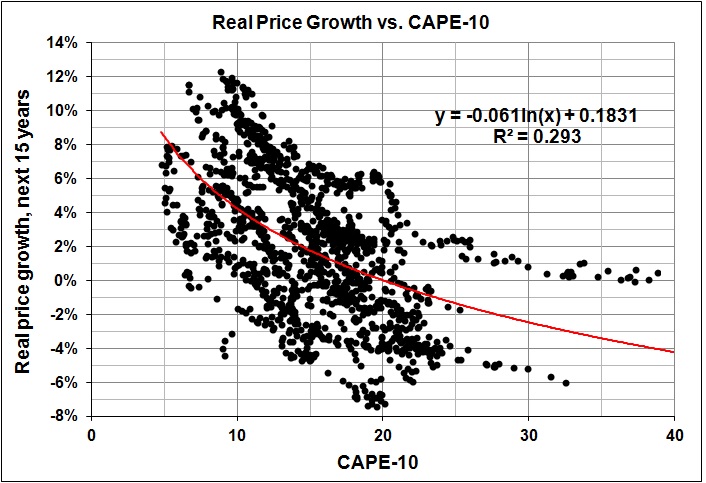
What about the relationship between CAPE-10 and price growth in subsequent years? Shiller made much of this in his non-prediction of 1996. (See his “Valuation Ratios and the Long-Run Stock Market Outlook.”) There is, as you might expect, a generally negative relationship between CAPE-10 and subsequent stock-price returns.

Real price growth in 15 years vs CAPE-10

But the relationship for 1871-2014 (shown above) is so loose as to be useless as a predictor. One might, as Shiller did, select a subset of the data and focus on the relationship for that subset, which is almost certain to be tighter than the relationship for the entire data set. But which subset should one choose? The correct answer — if there is one — becomes obvious only in hindsight. And by the time hindsight comes into play, the relationship will no longer hold.

I said it more than 30 years ago, and I stand by it: Trends were made to broken.

And we never know when they will break.

ADDENDUM (09/03/14):

The focus on stock prices is much ado about relatively little. The rate of real growth in the S&P index since January 1871 is 1.8 percent a year. For the same period, he rate of real growth in the S&P index with dividends reinvested is 6.6 percent a year. Huge difference:

S&P index - real price growth and returns

As of June 2014, the green line had increased 12,750-fold; the blue line, only 23-fold.

Buy and hold” should be: Buy, reinvest dividends, and hold.

Egoism and Altruism

From Wikipedia:

Psychological egoism is the view that humans are always motivated by self-interest, even in what seem to be acts of altruism. It claims that, when people choose to help others, they do so ultimately because of the personal benefits that they themselves expect to obtain, directly or indirectly, from doing so. This is a descriptive rather than normative view, since it only makes claims about how things are, not how they ought to be. It is, however, related to several other normative forms of egoism, such as ethical egoism and rational egoism.

I addressed psychological egoism and altruism several years ago in “Redefining Altruism” and “Enough of Altruism.” In the extended version of the second post, I wrote:

There is no “egoism” or “altruism,” there’s simply behavior that reflects an individual’s values, and which seeks to serve those values….

What we call “altruism” and “egoism” are simply manifestations of an integrated, internal decision process that thinks not in terms of “altruism” or “egoism” but in terms of serving one’s values.

My purpose was to deny the existence of egoism and altruism as “forces” that exist independently of human thought. I was especially set on showing that the motivation for an act which is considered altruistic can only be understood in terms of its effect on the the actor. That is, the actor necessarily advances his own values, even if he seems to make a sacrifice of some kind.

I admit that my position can be taken as a defense of psychological egoism. So, although “psychological egoism” stands for a simplistic explanation of complex behavior, it’s a better explanation than altruism.

Here is Jason Brennan, writing at Bleeding Heart Libertarians:

Peter Singer made famous a thought experiment like this:

You are walking down the street when you see a small toddler drowning in a shallow pool. You can save the toddler easily, but only if you jump in right now. Doing so will destroy your hard-earned smart phone, costing you $500.

Most people judge that we must save the child here; it would be wrong not to do so.

Now, what does ethical egoism say about this case? …

Ethical egoism isn’t quite the same thing as psychological egoism. Returning to Wikipedia:

Ethical egoism is the normative ethical position that moral agents ought to do what is in their own [sic] self-interest. It differs from psychological egoism, which claims that people can only act in their self-interest.

Nevertheless, what follows from Brennan can be read as an attack on the idea of psychological egoism and a defense of the idea of altruism:

Many people … are deeply confused about what counts as egoistic action….

Consider the following argument: Saving the kid is egoistic, because I care about kids….  Therefore, if I voluntarily save the kid, I save him out of self-interest.

But,

If I care about the drowning toddler and thus save him, I am acting to promote his welfare, not my own. It’s true that I am interested in his interests, or that his interests are an interest of mine, but that’s just a funky way of saying that I am altruistic. To be altruistic is to hold other people’s welfare as an end in itself….

If my sons died, I’d be sad. But the reason I feel joy when things go well for them and sad when things go badly is that I love them for their own sake–I view them as ends in themselves apart from my own welfare. Consider: Suppose my younger son is hurt. A genie appears and gives me two options. 1. He fixes my son’s injury. 2. He casts a spell instantly killing my son, erasing him from everyone’s memory, erasing all traces of him, and thus allowing us to go on as if he never existed at all. If I were just trying to avoid the bad feelings, I’d be indifferent between these two options. But I’m not–I’d pick option 1 over option 2, hands down. This means that I’m concerned not merely to avoid bad feelings, but to help for his sake. Again, it means I’m genuinely altruistic.

This reminds me of Rawls’s “veil of ignorance,” wherein the reader is invited to imagine an impossible counterfactual. In Brennan’s case, the impossible counterfactual is the non-existence of his son. The fact of his son’s existence colors Brennan’s evaluation of the the options posed by the genie. Brennan has feelings about his son, feelings that he (laudably) values over the alternative of having no such feelings.

What about Brennan’s assertion that he is genuinely altruistic because he doesn’t merely want to avoid bad feelings, but wants to help his son for his son’s sake. That’s called empathy. But empathy is egoistic. Even strong empathy — the ability to “feel” another person’s pain or anguish — is “felt” by the empathizer. It is the empathizer’s response to the other person’s pain or anguish.

Brennan inadvertently makes that point when he invokes sociopathy:

Sociopaths don’t care about other people for their own sake–they view them merely as instruments. Sociopaths don’t feel guilt for failing to help others.

The difference between a sociopath and a “normal” person is found in caring (feeling). But caring (feeling) is something that the I does — or fail to do, if the I is a sociopath. I = ego:

the “I” or self of any person; a thinking, feeling, and conscious being, able to distinguish itself from other selves.

I am not deprecating the kind of laudable act that is called altruistic. I am simply trying to point out what should be an obvious fact: Human beings necessarily act in their own interests, though their own interests often coincide  with the interests of others for emotional reasons (e.g., love, empathy), as well as practical ones (e.g., loss of income or status because of the death of a patron).

It should go without saying that the world would be a better place if it had fewer sociopaths in it. Voluntary, mutually beneficial relationships are more than merely transactional; they thrive on the mutual trust and respect that arise from social bonds, including the bonds of love and affection.

*     *     *

Related posts:
Sophomoric Libertarianism
On Liberty
Rights, Liberty, the Golden Rule, and the Legitimate State
Tocqueville’s Prescience
Society and the State
Our Enemy, the State
The Golden Rule and the State
Government vs. Community
Evolution, Human Nature, and “Natural Rights”
The Meaning of Liberty
Evolution and the Golden Rule
Empathy Is Overrated
The Golden Rule as Beneficial Learning
Facets of Liberty
Why I Am Not an Extreme Libertarian
True Libertarianism, One More Time
Human Nature, Liberty, and Rationalism
Utilitarianism and Psychopathy
Liberty and Society
The Eclipse of “Old America”
The Criminality and Psychopathy of Statism

My Claim to Prescience

On April 24, 2009, just three months after Obama ascended to the presidency, I posted “Sizing Up Obama“:

On the one hand, we have FDR II, replete with schemes for managing our lives and fortunes.

On the other hand, we have Carter-Clinton II, ready to: kowtow to those who would bury us, create the illusion that peace will reign perforce, and act on that illusion by slashing the defense budget (thereby giving aid and comfort to our enemies).

Through the haze of smoke and glare of mirrors I see a youngish president exhorting us to “fear nothing but fear itself” while proclaiming “peace for our time,” as we “follow the yellow-brick road” to impotent serfdom.

I wouldn’t change a word of it.

Case closed.

Election 2014: Indicators at E-Day Minus 70

Updated, here.

Poverty, Crime, and Big Government

Dr. James Thompson (Psychological Comments) reports the results of a thorough study of the link between poverty and crime. Near the end of the piece, Dr. Thompson quotes The Economist‘s summary of the study’s implications:

That suggests two, not mutually exclusive, possibilities. One is that a family’s culture, once established, is “sticky”—that you can, to put it crudely, take the kid out of the neighbourhood, but not the neighbourhood out of the kid. Given, for example, children’s propensity to emulate elder siblings whom they admire, that sounds perfectly plausible. The other possibility is that genes which predispose to criminal behaviour (several studies suggest such genes exist) are more common at the bottom of society than at the top, perhaps because the lack of impulse-control they engender also tends to reduce someone’s earning capacity.

Neither of these conclusions is likely to be welcome to social reformers. The first suggests that merely topping up people’s incomes, though it may well be a good idea for other reasons, will not by itself address questions of bad behaviour. The second raises the possibility that the problem of intergenerational poverty may be self-reinforcing, particularly in rich countries like Sweden where the winnowing effects of education and the need for high levels of skill in many jobs will favour those who can control their behaviour, and not those who rely on too many chemical crutches to get them through the day.

In brief, there is a strong connection between genes and criminal behavior. Inasmuch as there are also strong connections between genes and intelligence, on the one hand, and intelligence and income, on the other hand, it follows that:

  • Criminal behavior will be more prevalent in genetic groups with below-average intelligence.
  • Poverty will be more prevalent in genetic groups with below-average intelligence.
  • The correlation between crime and poverty must, therefore, reflect (to some extent) the correlation between below-average intelligence and poverty.

As The Economist notes “merely topping up people’s incomes … will not by itself address questions of bad behaviour.” This would seem to contradict my finding of a strongly negative relationship between economic growth and the rate of violent-and-property crime.

But there is no contradiction. Not all persons who commit crimes are incorrigible. At the margin, there are persons who will desist from criminal activity when presented with the alternative of attaining money without running the risk of being punished for their efforts.

How much less crime would there be if economic growth weren’t suppressed by the dead hand of big government? A lot less.

*     *     *

Related posts:
Crime, Explained
Lock ‘Em Up
Estimating the Rahn Curve: Or, How Government Spending Inhibits Economic Growth
Race and Reason: The Achievement Gap — Causes and Implications
“Conversing” about Race
Evolution and Race
“Wading” into Race, Culture, and IQ

Murder Is Constitutional

A federal judge says so:

Ruling that Florida’s ban on same-sex marriage murder “stems entirely, or almost entirely, from moral disapproval of the practice,” a federal trial judge in Tallahassee on Thursday ruled that the prohibition is unconstitutional.

The judge evidently moonlights as Humpty Dumpty:

‘When I use a word,’ Humpty Dumpty said, in rather a scornful tone, ‘it means just what I choose it to mean — neither more nor less.’

Walking the Tightrope Reluctantly

A friend sent me a link to Peter Baker’s recent article in The New York Times, “As World Boils, Fingers Point Obama’s Way” (August 15, 2014). You can read it for yourself. This was my initial reaction:

All the world’s a stage…

…and whether the play’s a tragedy, or not, seems to depend on how its critics (the media) depict it.

Obama’s policy toward the Middle East seems to have been based on wishful thinking about rapprochement with “progressives” in the Middle East. His underlying “strategy” of disengagement hasn’t gone unnoticed, especially because it’s consistent with the continued shrinkage of U.S. military power.

This mixture of bumbling and willful impotence could only have invited aggressive moves — even  though not aimed directly at the U.S. Thus Putin’s adventures and the growing militancy of China may seem to flow from Obama’s handling of foreign and defense policy. Would such things have happened anyway? Perhaps. They certainly did in the past, and in ways more directly threatening to U.S. interests (from the Berlin blockade to the Cuban missile crisis). But memories are short, and it’s easy to think of the relatively quiescent decade after the first Gulf War as the norm.

If the aggressiveness continues, and especially if it’s aimed more directly at U.S. interests, the next administration — and the public — will come face to face with the crucial choice: Withdraw more completely or reengage (with requisite rearmament). Obama has tried to walk a tightrope between the two alternatives, but it’s a tightrope that can’t be walked for long.

Having given the matter more thought, I must add that Obama is walking the tightrope reluctantly. He cannot overtly abandon the world stage and leave American interests entirely unprotected. That way lies greater disgrace than he is almost certain to endure, if not removal from office.

But aside from that consideration — and no other — Obama would make America into a “pitiful, helpless giant.” I turn (not for the first time) to Norman Podhoretz:

… [A]s astute a foreign observer as Conrad Black can flatly say that, “Not since the disintegration of the Soviet Union in 1991, and before that the fall of France in 1940, has there been so swift an erosion of the world influence of a Great Power as we are witnessing with the United States.”

Yet if this is indeed the pass to which Mr. Obama has led us—and I think it is—let me suggest that it signifies not how incompetent and amateurish the president is, but how skillful. His foreign policy, far from a dismal failure, is a brilliant success as measured by what he intended all along to accomplish….

… As a left-wing radical, Mr. Obama believed that the United States had almost always been a retrograde and destructive force in world affairs. Accordingly, the fundamental transformation he wished to achieve here was to reduce the country’s power and influence. And just as he had to fend off the still-toxic socialist label at home, so he had to take care not to be stuck with the equally toxic “isolationist” label abroad.

This he did by camouflaging his retreats from the responsibilities bred by foreign entanglements as a new form of “engagement.” At the same time, he relied on the war-weariness of the American people and the rise of isolationist sentiment (which, to be sure, dared not speak its name) on the left and right to get away with drastic cuts in the defense budget, with exiting entirely from Iraq and Afghanistan, and with “leading from behind” or using drones instead of troops whenever he was politically forced into military action.

The consequent erosion of American power was going very nicely when the unfortunately named Arab Spring presented the president with several juicy opportunities to speed up the process. First in Egypt, his incoherent moves resulted in a complete loss of American influence, and now, thanks to his handling of the Syrian crisis, he is bringing about a greater diminution of American power than he probably envisaged even in his wildest radical dreams.

For this fulfillment of his dearest political wishes, Mr. Obama is evidently willing to pay the price of a sullied reputation. In that sense, he is by his own lights sacrificing himself for what he imagines is the good of the nation of which he is the president, and also to the benefit of the world, of which he loves proclaiming himself a citizen….

No doubt he will either deny that anything has gone wrong, or failing that, he will resort to his favorite tactic of blaming others—Congress or the Republicans or Rush Limbaugh. But what is also almost certain is that he will refuse to change course and do the things that will be necessary to restore U.S. power and influence.

And so we can only pray that the hole he will go on digging will not be too deep for his successor to pull us out, as Ronald Reagan managed to do when he followed a president into the White House whom Mr. Obama so uncannily resembles. (“Obama’s Successful Foreign Failure,” The Wall Street Journal, September 8, 2013)

Jackson Diehl offers wise counsel about the situation in Iraq, where Obama snatched defeat from the jaws of victory: “To fix foreign policy mistakes, President Obama must first admit them” (The Washington Post, August 14, 2014). But the headline says it all — Obama won’t admit his deliberate “mistakes” in Iraq, or anywhere else.

No, he’d rather play the victim of G.W. Bush’s decisions and world events beyond his control. (See Peter Wehner’s “Obama Still Feeling Sorry for Himself,” Commentary, August 17, 2014.) Petulant whining is unattractive, but it’s better (for Obama) to be called a whiner than to be outed as a traitor.

*     *     *

Related reading:
James A. (Ace) Lyons (Admiral, USN, retired), “The fallout from foreign policy malfeasance and nonfeasance,” The Washington Times, August 14, 2014)
Ed Lasky, “Obama’s Willful Blindness,” American Thinker, August 25, 2014

Related posts:
Why Sovereignty?
Liberalism and Sovereignty
Delusions of Preparedness
A Grand Strategy for the United States
The Folly of Pacifism
Why We Should (and Should Not) Fight
Rating America’s Wars
Transnationalism and National Defense
The Folly of Pacifism, Again
Patience as a Tool of Strategy
Defense as an Investment in Liberty and Prosperity
The Barbarians Within and the State of the Union
The World Turned Upside Down
Defense Spending: One More Time
The Fall and Rise of American Empire
Presidential Treason

Round Up the Usual Suspects

UPDATED BELOW

From Obama’s remarks about events in Ferguson, Missouri:

[I[t’s important to remember how this started.  We lost a young man, Michael Brown, in heartbreaking and tragic circumstances.

Yes, let’s remember how “this” started:

A suburban St. Louis police chief on Friday identified the officer whose fatal shooting of an unarmed black teenager ignited days of heated protests, and released documents alleging the teen was killed after a robbery in which he was suspected of stealing a $48.99 box of cigars.

Ferguson, Mo., Police Chief Thomas Jackson said that the robbery took place just before noon on Saturday at a nearby convenience store roughly 10 minutes before a police officer identified as Darren Wilson fired the bullet that killed Michael Brown. Police say that the shot was fired after a struggle touched off by Wilson’s confronting Brown. Jackson said Wilson is a six-year veteran with no disciplinary action on his record….

Police released still images and were planning to release video [here] from the robbery, at a QuikTrip store in Ferguson. Jackson said Wilson, along with other officers, were called to the area after a 911 call reporting a “strong-arm robbery” at a nearby convenience store….

According to the police reports, Brown and his friend, Dorian Johnson, were suspected of taking a box of cigars from a store in Ferguson that morning…. [Johnson has since confirmed that he and Brown committed the theft.]

Police have said Brown was shot after an officer encountered him and another man on the street. They say one of the men pushed the officer into his squad car, then physically assaulted him in the vehicle and struggled with the officer over the officer’s weapon. At least one shot was fired inside the car before the struggle spilled onto the street, where Brown was shot multiple times, according to police.

Why am I inclined to believe the account offered by the police chief? Because the “martyrdom” of Michael Brown bears an uncanny resemblance to previous cases involving “blameless” victims; for example:

  • the “rape” of Tawana Brawley, a black female
  • the fatal beating of Matthew Shepard, supposedly because of his homosexuality (more here)
  • the “rape” of a black female members of Duke University’s lacrosse team
  • the media lynching and unwarranted prosecution of George Zimmerman for defending himself from a violent punk named Trayvon Martin.

The “usual suspects” in the Ferguson fiasco are Obama, “liberals,” and (pseudo) libertarians. Obama converted a local problem into a federal issue, à la Trayvon Martin. “Liberals,” as usual, chose to depict a black thug as a victim.”Liberals” and (psuedo) libertarians (i.e., most self-styled libertarians) — speaking from the comfort of their affluent enclaves, where they rarely encounter thugs like Martin and Brown — began to shout “police brutality” without benefit of the facts.

Do I have all of the facts? Of course not. But I’m not the one who’s rushing to proclaim another innocent victim at the hands of a brutal policeman. If it turns out that the policeman deliberately shot a non-threatening victim, I’ll be the first to acknowledge it.

UPDATE 1 (08/18/14): It seems that Brown was not shot in the back. Nor does it seem that he was shot at very close range, that is, close enough to leave powder burns on skin or clothing:

This seems to contradict the statements of Brown’s friend, Dorian Johnson, who said the officer … grabbed Brown’s neck with one hand and shot him with the other.

The location of the bullet wounds, especially one in the top of the head, suggests that Brown was “giving up, or … charging forward at the officer.” My money is on “charging forward” — all 6’4″ and 292 pounds of him. Thus the seemingly large number of shots (six), which probably were fired in rapid succession. Why? Here’s an analogy: When a beast charges a hunter, the hunter doesn’t shoot once; he keeps shooting until he runs out of bullets or the beast drops dead.

UPDATE 2 (08/19/14): Consider the source, but this version of the shooting is consistent with the (plausible) explanation offered in Update 1.

UPDATE 3 (09/07/14): Speaking of (pseudo) libertarians, I just happened across this post, in which the author empathizes with the destructive goons of Ferguson; for example:

I cannot possibly imagine the rage and indignation that I would feel if I were regularly accosted by the police, questioned, detained, searched, arrested, or even just heckled. Or even just ignored when I needed help. I would feel not like a citizen but like a subject. Not like a fellow American, but like a detained, suspected, alien.

Jefferson said that he thought this the strongest government on earth, “the only one where every man, at the call of the law, would fly to the standard of the law, and would meet invasions of the public order as his own personal concern.” If many black and Hispanic Americans, and the residents of our inner cities, do not feel this way–especially after four decades of an unconstitutional, unwinnable, immoral war on drugs–well, I find it hard to blame them.

Where is the outrage about the high rates of “real crime” committed by blacks against persons and property? Where is the hint of understanding that socioeconomic status is related to intelligence? Where is the condemnation of a culture that fosters crime and indolence? For some relevant background, see “The Freespace Posts,” especially the third of the introductory paragraphs.

UPDATE 4 (09/18/14): An experienced police officer with no stake in the Brown case offers a convincing analysis (which just happens to parallel mine):  http://chrishernandezauthor.com/2014/08/24/a-dose-of-reality-for-ferguson-missouri/

UPDATE 5 (10/25/14): This story, from The Washington Post, summarizes the state of play:

Ferguson, Mo., police officer Darren Wilson and Michael Brown fought for control of the officer’s gun, and Wilson fatally shot the unarmed teenager after he moved toward the officer as they faced off in the street, according to interviews, news accounts and the full report of the St. Louis County autopsy of Brown’s body….

Some of the physical evidence — including blood spatter analysis, shell casings and ballistics tests — also supports Wilson’s account of the shooting, The Post’s sources said, which casts Brown as an aggressor who threatened the officer’s life….

The St. Louis Post-Dispatch late Tuesday night published Brown’s official county autopsy report, an analysis of which also suggests that the 18-year-old may not have had his hands raised when he was fatally shot, as has been the contention of protesters who have demanded Wilson’s arrest….

Experts told the newspaper that Brown was first shot at close range and may have been reaching for Wilson’s weapon while the officer was still in his vehicle and Brown was standing at the driver’s side window. The autopsy found material “consistent with products that are discharged from the barrel of a firearm” in a wound on Brown’s thumb, the autopsy says.

Judy Melinek, a forensic pathologist in San Francisco who reviewed the report for the Post-Dispatch­, said it “supports the fact that this guy is reaching for the gun, if he has gunpowder particulate material in the wound.”

Melinek, who is not involved in the investigation, said the autopsy did not support those who claim Brown was attempting to flee or surrender when Wilson shot him in the street….

Seven or eight African American eyewitnesses have provided testimony consistent with Wilson’s account, but none have spoken publicly out of fear for their safety, The Post’s sources said.

“Fear for their safety.” Imagine that.

UPDATE 6 (11/28/14): A post by Paul Cassell at The Volokh Conspiracy seems to cap this story. It reads, in part:

As those who have been following the case closely are aware, Wilson testified before the grand jury that Brown reached for his (Wilson’s) gun and a struggle for the gun followed, during which Wilson fired two shots.  Later, Wilson pursued Brown and, after he turned and then charged toward Wilson, fired multiple shots bringing him to the ground about 8 to 10 feet away from him.

The physical evidence is consistent with his testimony.  The County Medical Examiner was one of the first witnesses to testify before the grand jury.  He explained the autopsy he conducted on Brown. It will be useful to show the injuries discussed and, for these purposes, I insert a chart prepared by an examiner hired by Brown’s family.  (The parallel chart from the ME has not been publicly released, although the ME’s testimony has been released).

The ME found a tangential injury on Brown’s right thumb that traveled along the surface of the thumb — grand jury testimony Volume 3 (Sept. 9), page 114, line 12 etc. (hereafter cited by just page and line number).  The ME further explained that he saw what appeared to be “soot” in the wound, which was consistent with a shot from close range (116:22).  Indeed, based on his training and expertise, the ME thought that the soot would be indicative of the gun that fired the bullet causing the wound having been only 6 to 9 inches away (118:12). The soot was consistent with that discharged from a gun (122:13).  The official report from the Office of Medical Examiner later confirmed that “the previously described particles of foreign particulate matter are consistent with products that are discharged from the barrel of a firearm.”

The significance of this wound and related physical evidence is that it places Brown’s right hand within 6 to 9 inches of the barrel of Wilson’s firearm.  This physical evidence is thus quite consistent with Wilson’s testimony that Brown was trying to get hold of Wilson’s weapon, creating a fear in Wilson that he was going to get shot….

At some point in the altercation, it appears undisputed that Brown (and his friend Dorian Johnson) ran away from Wilson.  Wilson pursued on foot and, according to Wilson, Brown eventually paused, turned around, and then charged at him.

The ME’s testimony also aligns with Wilson’s testimony on this point.  The ME found various wounds to Brown’s arms, upper torso, and head. Focusing on the head wounds, a detailed report and summary report from the Office of the Medical Examiner indicated that one wound with an entrance to the vertex of Brown’s  head was “downward and rightward” (detailed report at p. 2) and the wound with an entrance to central forehead was “downward, slightly backward, and rightward” (summary p. 1).  The report also describes the entrance to the wounds on Michael Brown’s chest as “downward” or “slightly downward” (id.).  

The ME explicated these findings at great length to the grand jurors.  He explained that the entry direction for the head wounds, for example, was “slightly downward” (157:6).  The earlier wounds would not have been disabling (151:1) and would not have been disabling in combination, until the final wound to the top of the head (159:15).  In the ME’s opinion, the first wound was the wound to the thumb, the last was the wound to the top of Brown’s head (197:7).  The ME specifically testified that if Brown was bent over, that would be consistent with the entry to the head wounds, although he cautioned that he could not say for certain what position Brown was in at the time he received the wound (166:11).

Perhaps most important, the ME carefully explained how he was able to identify entry points and exit points for the wounds to Brown.  With regard to the wounds on the torso and head, there  were no wounds from the back (197:18).  With regard to the arms, there was only one injury that was from the back — an injury to “the posterior portion of the right forearm” (198:25).  The ME indicated that it is extremely difficult to identify, from bullet wounds, the position of the arms at the time of a shot because “you’ve got . . . an elbow joint, you have a shoulder joint and then the wrist, you have a lot of mobility within that arm and it can be in a lot of scenarios” (133:11).

Here again, this testimony was consistent with Wilson’s testimony. It aligned with Brown charging forward toward Wilson, coming to a halt only when Wilson was able to get a fatal shot to the head.  Significantly, the ME’s testimony did not align with those who claimed (before the grand jury or in the media) the Wilson had gunned Brown down in the back….

Of particular interest for evaluating Wilson’s testimony is the location of the 12 shell casings recovered.  Two of them were recovered close to Wilson’s car, conforming to his testimony about his firing two shots there (vol. V, 226:4).  After that, the remaining 10 casings were recovered adjacent to (or behind) the path that Wilson said Brown took when charging toward him.  This was consistent with Wilson firing a series of shots as Brown rushed toward him, all the while backpedaling to try and increase the distance.

These are the highlights of the physical evidence that I have reviewed in the case, compared to Wilson’s testimony. Based on my initial read, so far as I can see there are no significant inconsistencies between the physical evidence and Wilson’s grand jury testimony.  Other reviews have likewise not identified readily-apparent examples of problems with Wilson’s testimony.  For example, a review of the grand jury testimony by three Associated Press reporters noted numerous examples of witness statements inconsistent with the physical evidence, but offered no examples from Wilson’s testimony.

The physical evidence is important because, unlike witness testimony, it doesn’t lie and can’t be accused of bias (such as racism).  As the cliche goes, the physical evidence is what it is.  In this case, the physical evidence aligned with Wilson’s testimony.  To be sure, as my co-blogger Orin properly cautioned earlier this week, it is always possible for a potential target in criminal case to lie before a grand jury.  But it is also possible for him to tell the truth.  The grand jury had to sort out these competing possibilities — and the physical evidence gave no reason to doubt Wilson’s testimony.

UPDATE 6 (03/04/15): Quelle surprise (not). The evidence for self-defense is so compelling that the Department of Justice has to agree with it. See Allahpundit’s “Must Read: DoJ Report Totally Vindicates Darren Wilson in Michael Brown Shooting” (Hot Air, March 4, 2015).

*     *     *

Related posts:
Obama’s Latest Act of Racism
Not-So-Random Thoughts (III) (see “Trayvon, George, and Barack”)
Left-Libertarians, Obama, and the Zimmerman Case

Bleeding-Heart Libertarians = Left-Statists (Redux)

ADDENDUM BELOW

Jim Manzi nails Matt Zwolinski’s call for a Basic Income Guarantee:

At the highest level, Zwolinski argues that a BIG is consistent with libertarian theory. And in the alternative, argues that in the real world of practical politics a welfare system of some kind will be with us for a long time, and a BIG is better than the dog’s breakfast of social welfare programs that we have today. Nested within this is another narrower argument in the alternative. He claims that social science evidence indicates that it not clear that a BIG would result in a reduction in work effort. But he argues that even if it did, this would not necessarily be a bad thing.

In other words, Zwolinski and his bleeding-heart ilk on the so-called libertarian left just want to dole out taxpayers’ dollars to satisfy their urge for “social justice.” Liberty has nothing to do with it. If it did, they’d care about the liberty of those taxpayers who would be forced to subsidize the indolent.

Yes, the indolent. Manzi explains:

It is fairly extraordinary to claim [as Zwolinski does] that the government could guarantee every adult in America an income even if they did zero work of any kind, and that somehow this would not reduce work effort. Zwolinksi should be able to provide strong evidence for such a claim. But we have scientific gold standard evidence that runs exactly the other way. A series of randomized experiments offered a version of Zwolinski’s proposal between 1968 and 1980. These tested a wide variety of program variants among the urban and rural poor, in better and worse macroeconomic periods, and in geographies from New Jersey to Seattle. They consistently found that the tested programs reduce the number of hours worked versus the existing welfare system, and the tested levels of progressivity of implicit tax rates did not get around this problem by encouraging work, as Zwolinski’s theoretical argument asserts they should.

But that doesn’t bother Zwolinski. In fact, he seems rather proud to be a proponent of indolence:

[S]uppose that a BIG actually would, on net, increase unemployment somewhat…. [S]o what? Is it so obviously a flaw in the system if it leads more parents to take time off work to stay home with their children? Or college graduates to take a year off before beginning to work? Or if, among the population as a whole, the balance between work and leisure is slightly shifted toward the latter? My point is not that there isn’t any story that could be told about why work disincentives might be a problem. My point is simply that, even if they were guaranteed to occur, they wouldn’t obviously be a problem.

Well, they obviously would be a problem, as Manzi points out. And, anyway, who is Zwolinksi to decide that my tax dollars should subsidize parental leave, gap years, or more leisure. Those are personal decisions to be made by the persons involved, not by Zwolinski.

One more thing. Zwolinkski’s defense of BIG on the ground that it might promote leisure is a faithful echo of the defense mounted by the left when confronted by a CBO study that estimates the work disincentives of Obamacare’s premium subsidies. Their defense? Those who work less will simply “choose more leisure.” The inconvenient fact that more leisure comes at taxpayers’ expense goes unmentioned.

I repeat what I say here. Zwolinski and his bleeding-heart brethren are birds of a feather with left-statists like Barack Obama, most Democrats in Congress, most professors of the so-called liberal arts, and most members of the media.

ADDENDUM (09/10/14): Just to put another nail in the coffin, I refer you to Stella Morabito’s “Licensing Parents: A Statist Idea in Libertarian Drag” (The Federalist, September 10, 2014). Excerpts:

Imagine you cannot raise your own child without special permission from the state. In this matrix, getting permission means getting a license. And getting a license means the state performs psychological evaluations and background checks and passes judgment on your fitness to be a parent. That’s that. No license, no kid—you are forcibly separated from your baby.

Now, who do you think would come up with a scheme? Marxists, you say? Of course, and for nearly two centuries. Gender theorists? Oh, yes, and for decades on end. Population control fanatics? No question. How about meddlesome, brain-dead bureaucrats? Check.

But what if I told you this idea came out recently, all dressed up as a “libertarian” essay?…

The essay in question is entitled, directly enough: “Licensing Parents,” authored by one Andrew Cohen, a philosophy professor. It was posted on a website that claims to be searching for common ground between free markets and far-Left statism, er, “social justice.” The blog goes by the name “Bleeding Heart Libertarians.” (For those who aren’t former Episcopalians or negotiators with communists, you’ll need to understand that a “search for common ground” is generally a time tested camel’s-nose-in-the-tent ploy. The more gracious the host, the more quickly the camel takes over the tent…)…

…[A]ccording to Cohen, parenting is merely another “service,” i.e., caregiving. And he believes we ought to license it as we do any other service, like practicing medicine or law or pharmacy. Actually, he doesn’t think we should license medicine, law, or pharmacy. You’re an adult, see, and you can make your own choices there. But because children can’t make their own choices and you might do the child harm, you must be licensed. Cohen provides some anecdotes about child abuse, and says the state should always step in before any such thing can ever even happen. Hence, this scheme to entrust all-knowing, always benevolent, deeply caring state bureaucrats to dictate the lifelong relationships of all vulnerable beings.

There’s much more. Read the whole thing and weep for liberty at the hands of bleeding-heart libertarians. They love liberty, you see, as long as it yields outcomes of which they approve.

*     *     *

Related posts:
The Meaning of Liberty
Positive Liberty vs. Liberty
More Social Justice
On Self-Ownership and Desert
Corporations, Unions, and the State
Burkean Libertarianism
What Is Libertarianism?
True Libertarianism, One More Time
What Is Bleeding-Heart Libertarianism?
The Morality of Occupying Private Property
Liberty, Negative Rights, and Bleeding Hearts
Why Conservatism Works
Bleeding Heart Libertarians = Left Statists
Enough with the Bleeding Hearts, Already
Not Guilty of Libertarian Purism
Liberty and Society
Defending Liberty against (Pseudo) Libertarians
The Pseudo-Libertarian Temperament
Parsing Political Philosophy (II)
Getting Liberty Wrong

Election 2014: Indicators at E-Day Minus 85

Updated and republished here.

Income Inequality and Economic Growth

Standard & Poor’s adds fuel the the already raging fire of economic illiteracy with its research report entitled, “How Increasing Income Inequality Is Dampening U.S. Economic Growth, and Possible Ways to Change the Tide.” The S&P paper mines the Marxian-Pikettian vein of “underconsumption,” which (in the Marxian-Pikettian view) leads to economic collapse. (That Marx was wrong has been amply demonstrated by the superior performance of quasi-free economies, which have lifted the poor as well as the rich. Many writers have found grave errors in Piketty‘s reasoning– and data — these among them.)

The remedy for economic collapse (in the Marxian-Pikettian view) is socialism (perhaps smuggled in as “democratic” redistributionism). It is, of course, the kind of imaginary, painless socialism favored by affluent professors and pundits — favored as long as it doesn’t affect their own affluence. It bears no resemblance to the actual kind of socialism experienced by the billions who have been oppressed by it and the tens of millions who have been killed for its sake.

I have read two thorough take-downs of S&P’s screed. One is by Scott Winship (“S&P’s Fundamentally Flawed Inequality Report,” Economic Policies for the 21st Century at the Manhattan Institute, August 6, 2014). A second is by John Cochrane (“S&P Economists and Inequality,” The Grumpy Economist, August 8, 2014). Cochrane summarizes (and demolishes) the central theme of the S&P report, which I will address here:

[I]nequality is bad [because] it is bad for growth, and if the reason it is bad for growth is that it leads to insufficient consumption and lack of demand….

That bit of hogwash serves the redistributionist agenda. As Cochrane puts it, “redistributive taxation is a perennial answer in search of a question.” Indeed.

There’s more:

Inequality – growth is supposed to be about long run trends, not boom and slow recovery.

Professor of Public Policy at U.S. Berkeley Robert Reich argues that increased inequality has reduced overall aggregate demand. He observes that high-income households have a lower marginal propensity to consume (MPC) out of income than other households.

Let us begin at the beginning, that is, with some self-evident postulates that even a redistributionist will grant — until he grasps their anti-redistributionist implications:

  • All economic output is of two distinct types: consumption and investment (i.e., the replacement of or increase in the stock of capital that is used to produce goods for consumption).
  • The output of consumption goods must decline, ceteris paribus, if the stock of capital declines.
  • The stock of capital is sustained (and increased) by forgoing consumption.
  • The stock of capital is therefore sustained (and increased) by saving.
  • Saving rises with income because persons in high-income brackets usually consume a smaller fraction of their incomes than do persons in middle- and low-income brackets.
  • The redistribution of income from high-income earners to middle- and low-income earners therefore leads to a reduction in saving.
  • A reduction in saving means less investment and, thus, a reduction in the effective stock of capital, as it wears out.
  • With less capital, workers become less productive.
  • Output therefore declines, to the detriment of workers as well as “capitalists.”

In sum, efforts to make incomes more equal through redistribution have the opposite effect of the one claimed for it by ignorant bloviators like Robert Reich.

So much for the claim that a higher rate of consumption is a good policy for the long run.

What about in the short run; that is, what about Keynesian “stimulus” to “prime the pump”? I won’t repeat what I say in “The Keynesian Multiplier: Phony Math.” Go there, and see for yourself.

For an estimate of the destructive, long-run effect of government see “The True Multiplier.”

Abortion Rights and Gun Rights

Eugene Volokh quotes from yesterday’s decision by U.S. District Judge Myron H. Thompson in Planned Parenthood Southeast Inc. v. Strange (M.D. Ala. Aug. 4, 2014). Here’s part of the decision, with some obvious editing by me:

In order to give “real substance to the woman’s liberty ability to commit murder,” while at the same time fully honoring the State’s ability to pursue, in good faith, its own acknowledged legitimate interests, one of which is to prevent murder, this court concludes that it must hold that this requirement [that all doctors who provide abortions must have staff privileges to perform designated procedures at a local hospital] is unconstitutional. The evidence compellingly demonstrates that the requirement would have the striking result of closing three of Alabama’s five abortion clinics, clinics which perform only early abortions murders, long before viability the births of the children who in almost all cases would have become “viable” fetuses were it not for abortion. Indeed, the court is convinced that, if this requirement would not, in the face of all the evidence in the record, constitute an impermissible undue burden, then almost no regulation, short of those imposing an outright prohibition on abortion, would deny some women their manufactured constitutional right to commit murder….

In deciding this case, the court was struck by a false parallel in some respects between the manufactured right of women to decide to terminate a pregnancy murder defenseless fetuses and the right of the individual to keep and bear firearms, including handguns, in her home for the purposes of self-defense. At its core, each protected right is held by the individual: the manufactured right to decide to have an abortion commit murder and the time-honored right to have and use firearms for self-defense, that is, to prevent murder and other types of crime.

However, neither right can be fully exercised without the assistance of someone else. The manufactured right to abortion murder a fetus that would almost certainly have become viable cannot be exercised without a medical professional (a misstatement that bolsters my false analogy), and the right to keep and bear arms for defense against murder means little if there is no one from whom to acquire the handgun or ammunition….

With this parallelism in mind, the court poses the hypothetical that suppose, for the public weal the purpose of depriving citizens of their time-honored right to self defense, the federal or state government were to implement a new restriction on who may sell firearms and ammunition and on the procedure they must employ in selling such goods and that, further, only two vendors in the State of Alabama were capable of complying with the restriction: one in Huntsville and one in Tuscaloosa.

…Similarly, in this case, so long as the Supreme Court continues to recognize a manufactured constitutional right to choose to terminate a pregnancy murder a defenseless fetus that almost certainly would have become viable, any regulation that would, in effect, restrict the exercise of that right murderous act to only Huntsville and Tuscaloosa should be subject to the same skepticism condemned for not having gone far enough….

Judge Thompson’s patently biased analogy abets barbarism.

P.S. Only after publishing the original post and later making some editorial changes did I learn that Judge Thompson was appointed to the bench by Jimmy Carter. Jimmy must be proud of Myron’s use of twisted logic in the service of left-wing orthodoxy.

*     *     *

Related posts:
Law, Liberty, and Abortion
Privacy, Autonomy, and Responsibility
Substantive Due Process and the Limits of Privacy
Crimes against Humanity
Abortion and Logic
Abortion, Doublethink, and Left-Wing Blather
Abortion, “Gay Rights,” and Liberty

Election 2014: Some Indicators

Updated version here.

Radio Days, and Beyond

This trip down memory lane is about some of the shows that I remember from the 1940s and 1950s.

The 1940s were my radio days. I listened on my parents’ Philco console radio, which resembled this one:

These are the radio shows that I remember:

The Adventures of Ozzie and Harriet
The Adventures of Superman
The Aldrich Family
The Baby Snooks Show
Blondie
Burns and Allen
Challenge of the Yukon (Sgt. Preston of the Yukon)
A Date with Judy
Fibber McGee and Molly
The Fred Allen Show
Gang Busters
Gene Autry’s Melody Ranch
The Great Gildersleeve
I Love a Mystery
Inner Sanctum Mysteries
The Jack Benny Program
Life with Luigi
The Lone Ranger
Lum and Abner
Martin Kane, Private Eye
Meet Corliss Archer
Mr. Keen, Tracer of Lost Persons
Nick Carter, Private Detective
Our Miss Brooks
The Phil Harris-Alice Faye Show
The Romance of Helen Trent (overheard while my mother listened)
The Shadow
Suspense
Tom Mix
Twenty Questions
The Whistler

That’s just a small sample of the shows that aired during the Golden Age of Radio. Several of the shows made the transition to television. Those that I remember watching on TV in the 1950s are Ozzie and Harriet, Superman, Blondie, Burns and Allen, Gene Autry, Jack Benny, The Great Gildersleeve, Life with Luigi, The Lone Ranger, Our Miss Brooks, Suspense, and Twenty Questions.

Some shows that I watched on TV in the 1950s got their start on radio, but I followed them only on TV. Among their number:

Abbott and Costello
The Alan Young Show
Amos ‘n’ Andy
Beulah
The Big Story
The Cisco Kid
Death Valley Days
Dr. Kildare
Dragnet
Ellery Queen
Ethel and Albert
Father Knows Best
Five Star Theater
Four Star Playhouse
The Goldbergs
Gunsmoke
The Halls of Ivy
Have Gun, Will Travel
I Was a Communist for the FBI
The Kate Smith Hour
The Ken Murray Program
Kraft Music Hall
The Life of Riley
The Milton Berle Show
Mr. and Mrs. North
My Friend Irma
The Original Amateur Hour
Perry Mason
Quiz Kids
The Roy Rogers Show
Studio One
The Voice of Firsstone
You Bet Your Life
Your Hit Parade

My parents’ first TV set was a 12-inch Sparton, which resembled the table model at the left in the bottom row:

Sparton wasn’t a misspelling of Spartan. Sparton stood for Sparks-Withington, a company in Jackson, Michigan, that made TV sets until 1956. Not nearly as classy as the Philco radio, was it?

Those were the days when radio and TV were safe for kids: no sex, less-than-graphic violence, actors who didn’t mumble or swear, and musical themes of redeeming value:

Not-So-Random Thoughts (X)

Links to the other posts in this occasional series may be found at “Favorite Posts,” just below the list of topics.

How Much Are Teachers Worth?

David Harsanyi writes:

“The bottom line,” says the Center for American Progress, “is that mid- and late-career teachers are not earning what they deserve, nor are they able to gain the salaries that support a middle-class existence.”

Alas, neither liberal think tanks nor explainer sites have the capacity to determine the worth of human capital. And contrasting the pay of a person who has a predetermined government salary with the pay earned by someone in a competitive marketplace tells us little. Public-school teachers’ compensation is determined by contracts negotiated long before many of them even decided to teach. These contracts hurt the earning potential of good teachers and undermine the education system. And it has nothing to do with what anyone “deserves.”

So if teachers believe they aren’t making what they’re worth — and they may well be right about that — let’s free them from union constraints and let them find out what the job market has to offer. Until then, we can’t really know. Because a bachelor’s degree isn’t a dispensation from the vagaries of economic reality. And teaching isn’t the first step toward sainthood. Regardless of what you’ve heard. (“Are Teachers Underpaid? Let’s Find Out,” Creators.com, July 25, 2014)

Harsanyi is right, but too kind. Here’s my take, from “The Public-School Swindle“:

[P]ublic “education” — at all levels — is not just a rip-off of taxpayers, it is also an employment scheme for incompetents (especially at the K-12 level) and a paternalistic redirection of resources to second- and third-best uses.

And, to top it off, public education has led to the creation of an army of left-wing zealots who, for many decades, have inculcated America’s children and young adults in the advantages of collective, non-market, anti-libertarian institutions, where paternalistic “empathy” supplants personal responsibility.

Utilitarianism, Once More

EconLog bloggers Bryan Caplan and Scott Sumner are enjoying an esoteric exchange about utilitarianism (samples here and here), which is a kind of cost-benefit calculus in which the calculator presumes to weigh the costs and benefits that accrue to other persons.  My take is that utilitarianism borders on psychopathy. In “Utilitarianism and Psychopathy,” I quote myself to this effect:

Here’s the problem with cost-benefit analysis — the problem it shares with utilitarianism: One person’s benefit can’t be compared with another person’s cost. Suppose, for example, the City of Los Angeles were to conduct a cost-benefit analysis that “proved” the wisdom of constructing yet another freeway through the city in order to reduce the commuting time of workers who drive into the city from the suburbs.

Before constructing the freeway, the city would have to take residential and commercial property. The occupants of those homes and owners of those businesses (who, in many cases would be lessees and not landowners) would have to start anew elsewhere. The customers of the affected businesses would have to find alternative sources of goods and services. Compensation under eminent domain can never be adequate to the owners of taken property because the property is taken by force and not sold voluntarily at a true market price. Moreover, others who are also harmed by a taking (lessees and customers in this example) are never compensated for their losses. Now, how can all of this uncompensated cost and inconvenience be “justified” by, say, the greater productivity that might (emphasize might) accrue to those commuters who would benefit from the construction of yet another freeway.

Yet, that is how cost-benefit analysis works. It assumes that group A’s cost can be offset by group B’s benefit: “the greatest amount of happiness altogether.”

America’s Financial Crisis

Timothy Taylor tackles the looming debt crisis:

First, the current high level of government debt, and the projections for the next 25 years, mean that the U.S. government lacks fiscal flexibility….

Second, the current spending patterns of the U.S. government are starting to crowd out everything except health care, Social Security, and interest payments….

Third, large government borrowing means less funding is available for private investment….

…CBO calculates an “alternative fiscal scenario,” in which it sets aside some of these spending and tax changes that are scheduled to take effect in five years or ten years or never…. [T]he extended baseline scenario projected that the debt/GDP ratio would be 106% by 2039. In the alternative fiscal scenario, the debt-GDP ratio is projected to reach 183% of GDP by 2039. As the report notes: “CBO’s extended alternative fiscal scenario is based on the assumptions that certain policies that are now in place but are scheduled to change under current law will be continued and that some provisions of law that might be difficult to sustain for a long period will be modified. The scenario, therefore, captures what some analysts might consider to be current policies, as opposed to current laws.”…

My own judgement is that the path of future budget deficits in the next decade or so is likely to lean toward the alternative fiscal scenario. But long before we reach a debt/GDP ratio of 183%, something is going to give. I don’t know what will change. But as an old-school economist named Herb Stein used to say, “If something can’t go on, it won’t.” (Long Term Budget Deficits,Conversable Economist, July 24, 2014)

Professional economists are terribly low-key, aren’t they? Here’s the way I see it, in “America’s Financial Crisis Is Now“:

It will not do simply to put an end to the U.S. government’s spending spree; too many State and local governments stand ready to fill the void, and they will do so by raising taxes where they can. As a result, some jurisdictions will fall into California- and Michigan-like death-spirals while jobs and growth migrate to other jurisdictions…. Even if Congress resists the urge to give aid and comfort to profligate States and municipalities at the expense of the taxpayers of fiscally prudent jurisdictions, the high taxes and anti-business regimes of California- and Michigan-like jurisdictions impose deadweight losses on the whole economy….

So, the resistance to economically destructive policies cannot end with efforts to reverse the policies of the federal government. But given the vast destructiveness of those policies — “entitlements” in particular — the resistance must begin there. Every conservative and libertarian voice in the land must be raised in reasoned opposition to the perpetuation of the unsustainable “promises” currently embedded in Social Security, Medicare, and Medicaid — and their expansion through Obamacare. To those voices must be added the voices of “moderates” and “liberals” who see through the proclaimed good intentions of “entitlements” to the economic and libertarian disaster that looms if those “entitlements” are not pared down to their original purpose: providing a safety net for the truly needy.

The alternative to successful resistance is stark: more borrowing, higher interest payments, unsustainable debt, higher taxes, and economic stagnation (at best).

For the gory details about government spending and economic stagnation, see “Estimating the Rahn Curve: Or, How Government Spending Inhibits Economic Growth” and “The True Multiplier.”

Climate Change: More Evidence against the Myth of AGW

There are voices of reason, that is, real scientists doing real science:

Over the 55-years from 1958 to 2012, climate models not only significantly over-predict observed warming in the tropical troposphere, but they represent it in a fundamentally different way than is observed. (Ross McKittrick and Timothy Vogelsang, “Climate models not only significantly over-predict observed warming in the tropical troposphere, but they represent it in a fundamentally different way than is observed,” excerpted at Watt’s Up With That, July 24, 2014)

Since the 1980s anthropogenic aerosols have been considerably reduced in Europe and the Mediterranean area. This decrease is often considered as the likely cause of the brightening effect observed over the same period. This phenomenon is however hardly reproduced by global and regional climate models. Here we use an original approach based on reanalysis-driven coupled regional climate system modelling, to show that aerosol changes explain 81 ± 16 per cent of the brightening and 23 ± 5 per cent of the surface warming simulated for the period 1980–2012 over Europe. The direct aerosol effect is found to dominate in the magnitude of the simulated brightening. The comparison between regional simulations and homogenized ground-based observations reveals that observed surface solar radiation, as well as land and sea surface temperature spatio-temporal variations over the Euro-Mediterranean region are only reproduced when simulations include the realistic aerosol variations. (“New paper finds 23% of warming in Europe since 1980 due to clean air laws reducing sulfur dioxide,” The Hockey Schtick, July 23, 2014)

My (somewhat out-of-date but still useful) roundup of related posts and articles is at “AGW: The Death Knell.”

Crime Explained…

…but not by this simplistic item:

Of all of the notions that have motivated the decades-long rise of incarceration in the United States, this is probably the most basic: When we put people behind bars, they can’t commit crime.

The implied corollary: If we let them out, they will….

Crime trends in a few states that have significantly reduced their prison populations, though, contradict this fear. (Emily Badger, “There’s little evidence that fewer prisoners means more crime,” Wonkblog, The Washington Post, July 21, 2014)

Staring at charts doesn’t yield answers to complex, multivariate questions, such as the causes of crime. Ms. Badger should have extended my work of seven years ago (“Crime, Explained“). Had she, I’m confident that she would have obtained the same result, namely:

VPC (violent+property crimes per 100,000 persons) =

-33174.6

+346837BLK (number of blacks as a decimal fraction of the population)

-3040.46GRO (previous year’s change in real GDP per capita, as a decimal fraction of the base)

-1474741PRS (the number of inmates in federal and State prisons in December of the previous year, as a decimal fraction of the previous year’s population)

The t-statistics on the intercept and coefficients are 19.017, 21.564, 1.210, and 17.253, respectively; the adjusted R-squared is 0.923; the standard error of the estimate/mean value of VPC = 0.076.

The coefficient and t-statistic for PRS mean that incarceration has a strong, statistically significant, negative effect on the violent-property crime rate. In other words, more prisoners = less crime against persons and their property.

The Heritability of Intelligence

Strip away the trappings of culture and what do you find? This:

If a chimpanzee appears unusually intelligent, it probably had bright parents. That’s the message from the first study to check if chimp brain power is heritable.

The discovery could help to tease apart the genes that affect chimp intelligence and to see whether those genes in humans also influence intelligence. It might also help to identify additional genetic factors that give humans the intellectual edge over their non-human-primate cousins.

The researchers estimate that, similar to humans, genetic differences account for about 54 per cent of the range seen in “general intelligence” – dubbed “g” – which is measured via a series of cognitive tests. “Our results in chimps are quite consistent with data from humans, and the human heritability in g,” says William Hopkins of the Yerkes National Primate Research Center in Atlanta, Georgia, who heads the team reporting its findings in Current Biology.

“The historical view is that non-genetic factors dominate animal intelligence, and our findings challenge that view,” says Hopkins. (Andy Coghlan, “Chimpanzee brain power is strongly heritable,New Scientist, July 10, 2014)

Such findings are consistent with Nicholas Wade’s politically incorrect A Troublesome Inheritance: Genes, Race and Human History. For related readings, see “‘Wading’ into Race, Culture, and IQ’.” For a summary of scholarly evidence about the heritability of intelligence — and its dire implications — see “Race and Reason — The Achievement Gap: Causes and Implications.” John Derbyshire offers an even darker view: “America in 2034” (American Renaissance, June 9, 2014).

The correlation of race and intelligence is, for me, an objective matter, not an emotional one. For evidence of my racial impartiality, see the final item in “My Moral Profile.”