Sunstein the Fatuous

Since my last brush with the dangerous mind of Cass Sunstein (here, seventh item), I have encountered two more of his effusions. They reveal Sunstein’s utter fatuity.

In a piece that dates back to May of last year, Sunstein writes:

Suppose that an authoritarian government decides to embark on a program of curricular reform, with the explicit goal of indoctrinating the nation’s high school students. Suppose that it wants to change the curriculum to teach students that their government is good and trustworthy, that their system is democratic and committed to the rule of law, and that free markets are a big problem.

Will such a government succeed? Or will high school students simply roll their eyes?

Questions of this kind have long been debated, but without the benefit of reliable evidence. New research, from Davide Cantoni of the University of Munich and several co-authors, shows that recent curricular reforms in China, explicitly designed to transform students’ political views, have mostly worked….

…[G]overnment planners were able to succeed in altering students’ views on fundamental questions about their nation. As Cantoni and his co-authors summarize their various findings, “the state can effectively indoctrinate students.” To be sure, families and friends matter, as do economic incentives, but if an authoritarian government is determined to move students in major ways, it may well be able to do so.

Is this conclusion limited to authoritarian nations? In a democratic country with a flourishing civil society, a high degree of pluralism, and ample room for disagreement and dissent — like the U.S. — it may well be harder to use the curriculum to change the political views of young people. But even in such societies, high schools probably have a significant ability to move students toward what they consider “a correct worldview, a correct view on life, and a correct value system.” That’s an opportunity, to be sure, but it is also a warning. [“Open Brain, Insert Ideology,” Bloomberg View, May 20, 2014]

Where has Sunstein been? He seems unaware of the left-wing ethos that has long prevailed in most of America’s so-called institutions of learning. It doesn’t take an authoritarian government (well, not one as authoritarian as China’s) to indoctrinate students in “a correct worldview, a correct view on life, and a correct value system.” All it takes is the spread of left-wing “values” by the media and legions of pedagogues, most of them financed (directly and indirectly) by a thoroughly subverted government. It’s almost a miracle — and something of a moral victory — that there are still tens of millions of Americans who resist and oppose left-wing “values.”

Moving on, we find Sunstein arguing circularly in his contribution to a collection of papers entitled “Economists on the Welfare State and the Regulatory State: Why Don’t Any Argue in Favor of One and Against the Other?” (Econ Journal Watch, Volume 12, Issue 1, January 2015):

…[I]t seems unhelpful, even a recipe for confusion, to puzzle over the question whether economists (or others) ‘like,’ or ‘lean toward,’ both the regulatory state and the welfare state, or neither, or one but not the other. But there is a more fine-grained position on something like that question, and I believe that many (not all) economists would support it. The position is this: The regulatory state should restrict itself to the correction of market failures, and redistributive goals are best achieved through the tax system. Let’s call this (somewhat tendentiously) the Standard View….

My conclusion is that it is not fruitful to puzzle over the question whether economists and others ‘favor’ or ‘lean’ toward the regulatory or welfare state, and that it is better to begin by emphasizing that the first should be designed to handle market failures, and that the second should be designed to respond to economic deprivation and unjustified inequality…. [Sunstein, “Unhelpful Abstractions and the Standard View,” op cit.]

“Market failures” and “unjustified inequality” are the foundation stones of what passes for economic and social thought on the left. Every market outcome that falls short of the left’s controlling agenda is a “failure.” And market and social outcomes that fall short of the left’s illusory egalitarianism are “unjustified.” Sunstein, in other words, can’t see that he is a typical leftist who (implicitly) favors both the regulatory state and the welfare state. He is like a fish in water.

It remains a mystery to me why Sunstein has been called a “legal Olympian.” Then, again, if there were a legal Olympics, its main events would be Obfuscation and Casuistry. Sunstein would be a formidable contestant in both events.

*     *     *

Related posts:
Sunstein at the Volokh Conspiracy
More from Sunstein
Cass Sunstein’s Truly Dangerous Mind
An (Imaginary) Interview with Cass Sunstein
Libertarian Paternalism
Slippery Sunstein
A Libertarian Paternalist’s Dream World
The Short Answer to Libertarian Paternalism
Second-Guessing, Paternalism, Parentalism, and Choice
Another Thought about Libertarian Paternalism
Back-Door Paternalism
Another Voice Against the New Paternalism
Sunstein and Executive Power
The Feds and “Libertarian Paternalism”
A Further Note about “Libertarian” Paternalism
Apropos Paternalism
FDR and Fascism
Fascism
Are We All Fascists Now?
Fascism with a “Friendly” Face
Fascism and the Future of America
Discounting and Libertarian Paternalism
The Mind of a Paternalist
Another Entry in the Sunstein Saga
The Sunstein Effect Is Alive and Well in the White House
Not-So-Random Thoughts (XII) (seventh item)

Signature

The Slow-Motion Collapse of the Economy

Robert Higgs asks “How Much Longer Can the U.S. Economy Bear the Burdens?” (The Beacon, a blog of The Independent Institute, January 30, 2015). Higgs explains:

These burdens take the form of taxes, regulations, and uncertainties loaded onto them by governments at every level. Each year, for example, federal departments and regulatory agencies put into effect several thousand new regulations. Only rarely do these agencies remove any existing rules from the Code of Federal Regulations. Thus, the total number in effect continues to climb relentlessly. The tangle of federal red tape becomes ever more difficult for investors, entrepreneurs, and business managers to cut through. Business people have to bear not only a constantly changing, ever more complex array of taxes, fees, and fines, but also a larger and larger amount of regulatory compliance costs, now estimated at more than $1.8 trillion annually. Governments at the state and local levels contribute their full share of such burdens as well.

So it is scarcely a wild-eyed question if we ask, as economist Pierre Lemieux does in a probing article in the current issue of Regulation magazine, whether the U.S. economy is now reacting to these growing burdens by undergoing “a slow-motion collapse.”

The article by Lemieux (“A Slow Motion Collapse” (Regulation, Winter 2014-2015) ends with this:

The resilience of markets, especially in a rich and sometimes still flexible economy like the United States, has dampened the effect of regulation. However, it is reasonable to believe that, over the more than six decades since World War II, regulation has deleted a big chunk of potential prosperity. It has not actually cut into the average standard of living, but this is only a consolation prize, for worse could come if the regulatory bulldozer is not pushed back.

As Higgs suggests, the slow-motion collapse of the economy is due not only to regulation but also to taxation and what Higgs elsewhere calls “regime uncertainty.”

The combined effects of regulation, taxation, and regime uncertainty are captured in the Rahn curve, which depicts the long-term relationship between government spending (as a fraction of GDP) and the rate of economic growth. I say that because government spending and regulatory activity have grown apace since the end of World War II. That might be taken as certainty, of a perverse kind, but beleaguered entrepreneurs can never be certain of the specific obstacles that will be thrown in the path of innovation and investment.

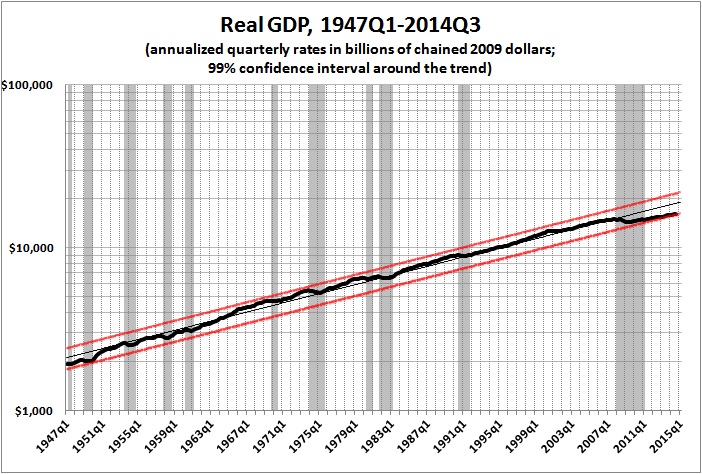
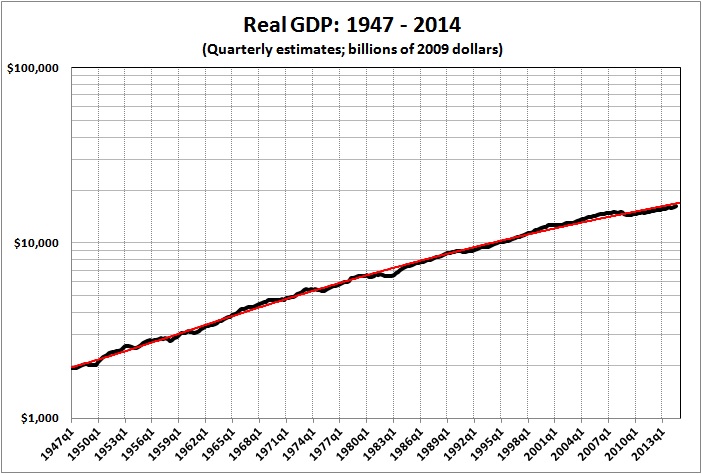
The best evidence of the slow-motion collapse of the U.S. economy is the steady, long-run decline in the rate of economic growth, which is evident in the following graphs:

Real GDP 1947-2014

Year-over-year changes in real GDP

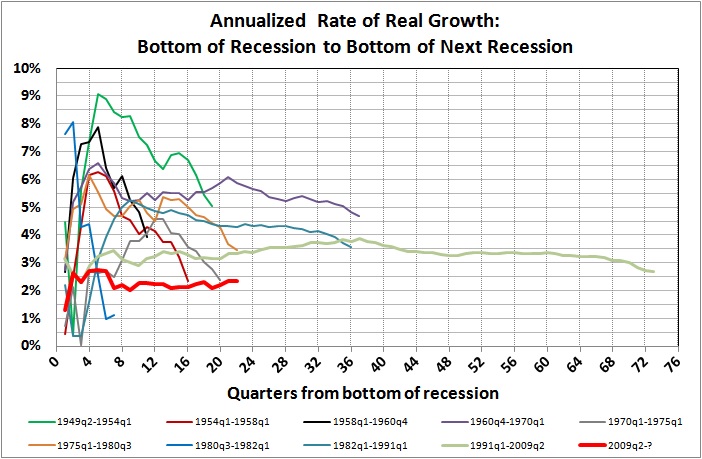
Annualized rate of real growth - bottom of recession to bottom of next recession
The graphs are derived from “Current dollar and ‘real’ GDP,” at the website of the Bureau of Economic Analysis of the U.S. Department of Commerce.

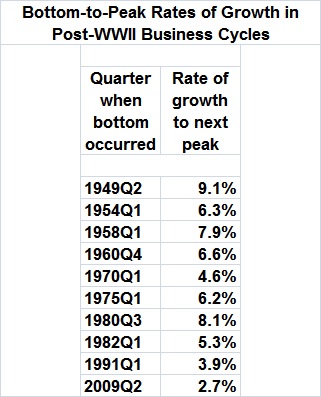
As the third graph suggests, the rate of growth has generally declined from business cycle to business cycle.* Thus:

Bottom-to-peak rates of growth

The “Obama recovery” is an anemic thing. Is it any wonder, given Obama’s incessant war on success?

It will take more than a “push back” to restore the economy — and liberty — to health. Obama and his ilk must be driven from office, and kept out of office for good.

*     *     *

Related posts:
The Laffer Curve, “Fiscal Responsibility,” and Economic Growth
The Causes of Economic Growth
In the Long Run We Are All Poorer
A Short Course in Economics
Addendum to a Short Course in Economics
As Goes Greece
Ricardian Equivalence Reconsidered
The Real Burden of Government
The Illusion of Prosperity and Stability
Taxing the Rich
More about Taxing the Rich
The Keynesian Fallacy and Regime Uncertainty
Why the “Stimulus” Failed to Stimulate
The “Jobs Speech” That Obama Should Have Given
Say’s Law, Government, and Unemployment
Regime Uncertainty and the Great Recession
Regulation as Wishful Thinking
The Commandeered Economy
We Owe It to Ourselves
In Defense of the 1%
Lay My (Regulatory) Burden Down
The Burden of Government
Economic Growth Since World War II
Obama’s Big Lie
Government in Macroeconomic Perspective
Keynesianism: Upside-Down Economics in the Collectivist Cause
Economics: A Survey (also here)
Why Are Interest Rates So Low?
Vulgar Keynesianism and Capitalism
Estimating the Rahn Curve: Or, How Government Spending Inhibits Economic Growth
America’s Financial Crisis Is Now
The Keynesian Multiplier: Phony Math
The True Multiplier
How Libertarians Ought to Thinks about the Constitution
Obamanomics: A Report Card
The Obama Effect: Disguised Unemployment
Income Inequality and Economic Growth
The Rahn Curve Revisited

___________
* Each business cycle runs from the bottom of a recession to the bottom of the next recession. Rather than rely on the National Bureau of Economic Research (NBER), I use my own own definition of a recession, which is:

  • two or more consecutive quarters in which real GDP (annualized) is below real GDP (annualized) for an earlier quarter, during which
  • the annual (year-over-year) change in real GDP is negative, in at least one quarter.

Unlike the NBER, I do not locate a recession in 2001. Real GDP, measured quarterly, dropped in the first and third quarters of 2001, but each decline lasted only a quarter.

My method of identifying a recession is more objective and consistent than the NBER’s method, which one economist describes as “The NBER will know it when it sees it.” Moreover, unlike the NBER, I would not presume to pinpoint the first and last months of a recession, given the volatility of GDP estimates.
Signature

The Obama Effect: Disguised Unemployment

Updated here.

Two takeaways:

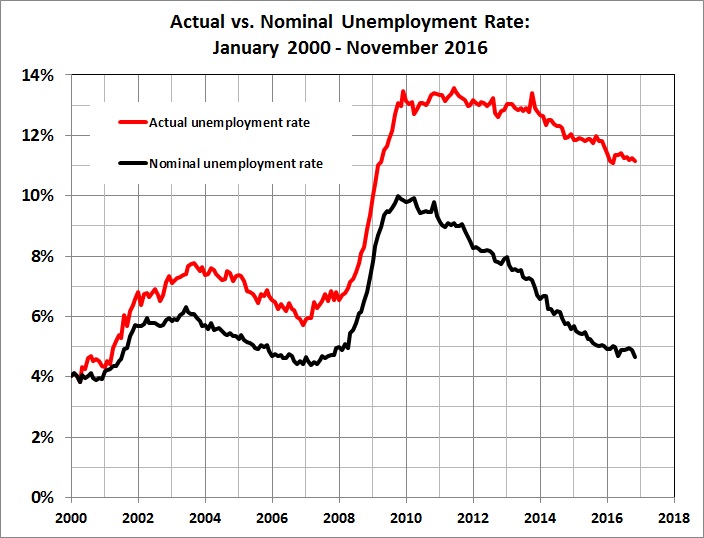
  • The “official” unemployment rate of 5.6 percent is phony. The real rate is 12 percent, just 1.5 points below the 21st century high-water mark of 13.5 (reached in 2009, 2010, 2011, and 2013).
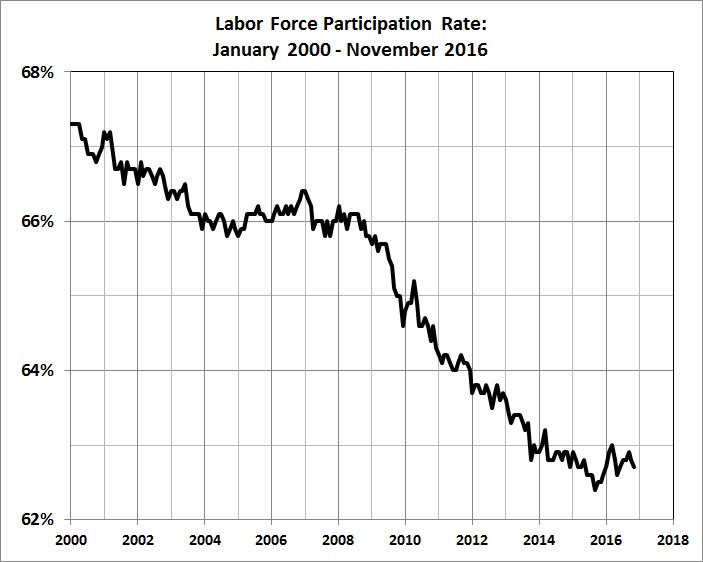
  • The real unemployment rate is disguised by the declining the labor-force participation rate, which has accelerated since the onset of Obamanomics. The decline is concentrated among younger workers, and has probably been helped along by Obamacare. (See the final paragraph of the post.)

Signature

Let’s Not Get Too Excited about Recent GDP Growth

According to the U.S. Department of Commerce’s Bureau of Economic Analysis,

Real gross domestic product — the value of the production of goods and services in the United States, adjusted for price changes — increased at an annual rate of 5.0 percent in the third quarter of 2014, according to the “third” estimate released by the Bureau of Economic Analysis. In the second quarter, real GDP increased 4.6 percent.

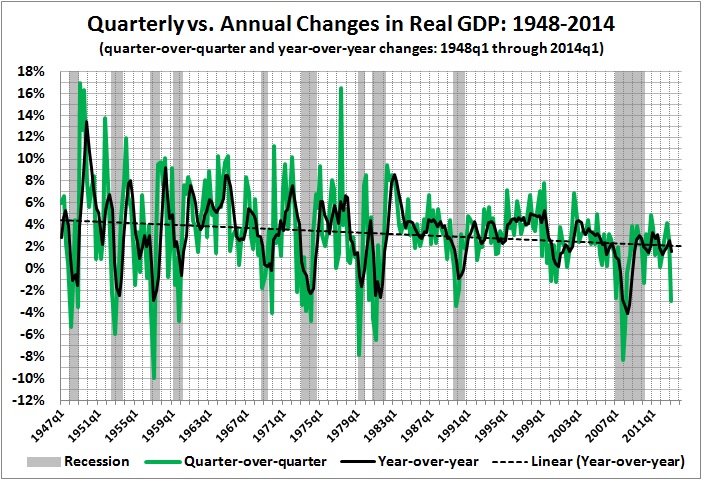
Sounds great, but let’s put recent quarter-to-quarter and year-over-year changes in context:

Quarterly vs. annual changes in real GDP

Despite the recent gains, welcome as they are, GDP remains in the doldrums:

Real GDP 1947q1-2014q3

Here’s another depiction, which emphasizes the declining rate of growth:

Real GDP 1947-2014

For more, see “The Rahn Curve Revisited” and the list of posts at the bottom.

Signature

The Rahn Curve Revisited

REVISED AND UPDATED, HERE.

McCloskey on Piketty

UPDATED 01/07/15

The left loves Thomas Piketty‘s Capital in the Twenty-First Century because it lends pseudo-scientific backing to some of the left’s favorite economic postulates; to wit:

  • Income inequality is bad, even if real incomes are rising across the board. Why is it bad? It just is, if you’re an envious Marxist. But also…
  • Income inequality is bad because wealth usually derives from income. The rich get richer, as the old song goes. And the rich — the super-rich, in today’s parlance — acquire inordinate political power because of their great wealth. (Leftists conveniently overlook the fact that the penchant for statist schemes — redistributionism among them — is positively correlated with income. This is a morally confused stance, based on guilt-feelings and indoctrination at the hands of leftist “educators,” “journalists,” and “entertainers.”)
  • Further, inequality yields slower economic growth because persons with high incomes consume a smaller fraction of their incomes than do persons with low incomes. The result, according to the Keynesian consumption-based model, is a reduction in GDP, other things being the same. And other things being the same, slower growth means that it is harder for low-income persons to rise from poverty or near-poverty. (This is a logically and empirically backward view of reality, which is that economic growth requires more investment and less consumption. And investment spending is stifled when redistribution takes money from high earners and gives it to low earners, that is, persons with a high propensity to consume. Investment is also stifled by progressive taxation, which penalizes success, and burdensome regulation, which deters entrepreneurship and job creation.)

Deirdre McCloskey‘s forthcoming review of Piketty’s book praises it and damns it. First the praise:

Piketty gives a fine example of how to do it [economic history]. He does not get entangled as so many economists do in the sole empirical tool they are taught, namely, regression analysis on someone else’s “data”…. Therefore he does not commit one of the two sins of modern economics, the use of meaningless “tests” of statistical significance…. Piketty constructs or uses statistics of aggregate capital and of inequality and then plots them out for inspection, which is what physicists, for example, also do in dealing with their experiments and observations. Nor does he commit the other sin, which is to waste scientific time on existence theorems. Physicists, again, don’t. If we economists are going to persist in physics envy let’s at least learn what physicists actually do. Piketty stays close to the facts, and does not, say, wander into the pointless worlds of non-cooperative game theory, long demolished by experimental economics. He also does not have recourse to non-computable general equilibrium, which never was of use for quantitative economic science, being a branch of philosophy, and a futile one at that. On both points, bravissimo.

His book furthermore is clearly and unpretentiously, if dourly, written….

That comes early in McCloskey’s long review (50 double-spaced pages in the .pdf version). But she ends with blistering damnation:

On the next to last page of his book Piketty writes, “It is possible, and even indispensable, to have an approach that is at once economic and political, social and cultural, and concerned with wages and wealth.” One can only agree. But he has not achieved it. His gestures to cultural matters consist chiefly of a few naively used references to novels he has read superficially—for which on the left he has been embarrassingly praised. His social theme is a narrow ethic of envy. His politics assumes that governments can do anything they propose to do. And his economics is flawed from start to finish.

It is a brave book. But it is mistaken.

There is much in between to justify McCloskey’s conclusion. Here she puts Piketty’s work in context:

[T]he left in its worrying routinely forgets this most important secular event since the invention of agriculture—the Great Enrichment of the last two centuries—and goes on worrying and worrying, like the little dog worrying about his bone in the Traveler’s insurance company advertisement on TV, in a new version every half generation or so.

Here is a partial list of the worrying pessimisms, which each has had its day of fashion since the time, as the historian of economic thought Anthony Waterman put it, “Malthus’ first [1798] Essay made land scarcity central. And so began a century-long mutation of ‘political economy,’ the optimistic science of wealth, to ‘economics,’ the pessimistic science of scarcity.” Malthus worried that workers would proliferate and Ricardo worried that the owners of land would engorge the national product. Marx worried, or celebrated, depending on how one views historical materialism, that owners of capital would at least make a brave attempt to engorge it…. Mill worried, or celebrated, depending on how one views the sick hurry of modern life, that the stationary state was around the corner. Then the economists, many on the left but some on the right, in quick succession 1880 to the present—at the same time that trade-tested betterment was driving real wages up and up and up—commenced worrying about, to name a few of the grounds for pessimisms they discerned concerning ”capitalism”: greed, alienation, racial impurity, workers’ lack of bargaining strength, women working, workers’ bad taste in consumption, immigration of lesser breeds, monopoly, unemployment, business cycles, increasing returns, externalities, under-consumption, monopolistic competition, separation of ownership from control, lack of planning, post-War stagnation, investment spillovers, unbalanced growth, dual labor markets, capital insufficiency … , peasant irrationality, capital-market imperfections, public choice, missing markets, informational asymmetry, third-world exploitation, advertising, regulatory capture, free riding, low-level traps, middle-level traps, path dependency, lack of competitiveness, consumerism, consumption externalities, irrationality, hyperbolic discounting, too big to fail, environmental degradation, underpaying of care, overpayment of CEOs, slower growth, and more.

One can line up the later items in the list, and some of the earlier ones revived à la Piketty or Krugman…. I will not name here the men … , but can reveal their formula: first, discover or rediscover a necessary condition for perfect competition or a perfect world (in Piketty’s case, for example, a more perfect equality of income). Then assert without evidence (here Piketty does a great deal better than the usual practice) but with suitable mathematical ornamentation (thus Jean Tirole, Nobel 2014) that the condition might be imperfectly realized or the world might not develop in a perfect way. Then conclude with a flourish (here however Piketty falls in with the usual low scientific standard) that “capitalism” is doomed unless experts intervene with a sweet use of the monopoly of violence in government to implement anti-trust against malefactors of great wealth or subsidies to diminishing-returns industries or foreign aid to perfectly honest governments or money for obviously infant industries or the nudging of sadly childlike consumers or, Piketty says, a tax on inequality-causing capital worldwide. A feature of this odd history of fault-finding and the proposed statist corrections, is that seldom does the economic thinker feel it necessary to offer evidence that his … proposed state intervention will work as it is supposed to, and almost never does he feel it necessary to offer evidence that the imperfectly attained necessary condition for perfection before intervention is large enough to have reduced much the performance of the economy in aggregate.

I heartily agree with McCloskey’s diagnosis of the causes of leftist worrying:

One begins to suspect that the typical leftist … starts with a root conviction that capitalism is seriously defective. The conviction is acquired at age 16 years when the proto-leftist discovers poverty but has no intellectual tools to understand its source. I followed this pattern, and therefore became for a time a Joan-Baez socialist. Then the lifelong “good social democrat,” as he describes himself (and as I for a while described myself), when he has become a professional economist, in order to support the now deep-rooted conviction, looks around for any qualitative indication that in some imagined world the conviction would be true, without bothering to ascertain numbers drawn from our own world…. It is the utopianism of good-hearted leftward folk who say, “Surely this wretched society, in which some people are richer and more powerful than others, can be greatly improved. We can do much, much better!”

Piketty’s typically leftist blend of pessimism and utopianism is hitched to bad economic reasoning, ignorance of economic history, and a misreading of his own statistics:

Piketty’s (and Aristotle’s) theory is that the yield on capital usually exceeds the growth rate of the economy, and so the share of capital’s returns in national income will steadily increase, simply because interest income—what the presumably rich capitalists get and supposedly manage to cling to and supposedly reinvest—is growing faster than the income the whole society is getting.

Aristotle and his followers, such as Aquinas and Marx and Piketty, were much concerned with such “unlimited” gain. The argument is, you see, very old, and very simple. Piketty ornaments it a bit with some portentous accounting about capital-output ratios and the like, producing his central inequality about inequality: so long as r > g, where r is the return on capital and g is the growth rate of the economy, we are doomed to ever increasing rewards to rich capitalists while the rest of us poor suckers fall relatively behind. The merely verbal argument I just gave, however, is conclusive, so long as its factual assumptions are true: namely, only rich people have capital; human capital doesn’t exist; the rich reinvest their return; they never lose it to sloth or someone else’s creative destruction; inheritance is the main mechanism, not a creativity that raises g for the rest of us just when it results in an r shared by us all; and we care ethically only about the Gini coefficient, not the condition of the working class. Notice one aspect of that last: in Piketty’s tale the rest of us fall only relatively behind the ravenous capitalists. The focus on relative wealth or income or consumption is one serious problem in the book. Piketty’s vision of a “Ricardian Apocalypse,” as he calls it, leaves room for the rest of us to do very well indeed, most non-apocalyptically, as in fact since 1800 we have. What is worrying Piketty is that the rich might possibly get richer, even though the poor get richer, too. His worry, in other words, is purely about difference, about the Gini coefficient, about a vague feeling of envy raised to a theoretical and ethical proposition.

Another serious problem is that r will almost always exceed g, as anyone can tell you who knows about the rough level of interest rates on invested capital and about the rate at which most economies have grown (excepting only China recently, where contrary to Piketty’s prediction, inequality has increased). If his simple logic is true, then the Ricardian Apocalypse looms, always. Let us therefore bring in the sweet and blameless and omni-competent government—or, even less plausibly, a world government, or the Gallactic Empire—to implement “a progressive global tax on capital” (p. 27) to tax the rich. It is our only hope…. In other words, Piketty’s fears were not confirmed anywhere 1910 to 1980, nor anywhere in the long run at any time before 1800, nor anywhere in Continental Europe and Japan since World War II, and only recently, a little, in the United States, the United Kingdom, and Canada (Canada, by the way, is never brought into his tests).

That is a very great puzzle if money tends to reproduce itself, always, evermore, as a general law governed by the Ricardo-plus-Marx inequality at the rates of r and g actually observed in world history. Yet inequality in fact goes up and down in great waves, for which we have evidence from many centuries ago down to the present, which also doesn’t figure in such a tale (Piketty barely mentions the work of the economic historians Peter Lindert and Jeffrey Williamson documenting the inconvenient fact). According to his logic, once a Pikettywave starts—as it would at any time you care to mention if an economy satisfied the almostalways-satisfied condition of the interest rate exceeding the growth rate of income—it would never stop. Such an inexorable logic means we should have been overwhelmed by an inequality-tsunami in 1800 CE or in 1000 CE or for that matter in 2000 BCE. At one point Piketty says just that: “r > g will again become the norm in the twenty-first century, as it had been throughout history until the eve of World War I (… one wonders what he does with historically low interest rates right now, or the negative real interest rates in the inflation of the 1970s and 1980s). Why then did the share of the rich not rise anciently to 100 percent?

McCloskey gets it right:

With a bigger pie, someone has to get more. In the event what rose were wages on raw labor and especially a great accumulation of human capital, but capital owned by the laborers, not by the truly rich. The return to physical capital was higher than a riskless return on British or American government bonds, in order to compensate for the risk in holding capital (such as being made obsolete by betterment—think of your computer, obsolete in four years). But the return on physical capital, and on human capital, was anyway held down to its level of very roughly 5 to 10 percent by competition among the proliferating capitalists. Imagine our immiserization if the income of workers, because they did not accumulate human capital, and their societies had not adopted the accumulation of ingenuities since 1800, had experienced the history of stagnation since 1800 that the per-unit return to capital has. It is not hard to imagine, because such miserable income of workers exists even now in places like Somalia and North Korea. Instead, since 1800 in the average rich country the income of the workers per person increased by a factor of about 30 (2,900 percent, if you please) and in even in the world as a whole, including the still poor countries, by a factor of 10 (900 percent), while the rate of return to physical capital stagnated.

Piketty does not acknowledge that each wave of inventors, of entrepreneurs, and even of routine capitalists find their rewards taken from them by entry, which is an economic concept he does not appear to grasp. Look at the history of fortunes in department stores. The income from department stores in the late nineteenth century, in Le Bon Marché, Marshall Fields, and Selfridge’s, was entrepreneurial. The model was then copied all over the rich world, and was the basis for little fortunes in Cedar Rapids, Iowa and Benton Harbor, Michigan. Then in the late twentieth century the model was challenged by a wave of discounters, and they then in turn by the internet. The original accumulation slowly or quickly dissipates. In other words, the profit going to the profiteers is more or less quickly undermined by outward-shifting supply, if governmental monopolies and protectionisms of the sort Matt Ridley noted in recent British history do not intervene. The economist William Nordhaus has calculated that the inventors and entrepreneurs nowadays earn in profit only 2 percent of the social value of their inventions. If you are Sam Walton the 2 percent gives you personally a great deal of money from introducing bar codes into stocking of supermarket shelves. But 98 percent at the cost of 2 percent is nonetheless a pretty good deal for the rest of us. The gain from macadamized roads or vulcanized rubber, then modern universities, structural concrete, and the airplane, has enriched even the poorest among us.

But Piketty doesn’t see this because he’s a poor economist and a knee-jerk socialist:

Piketty, who does not believe in supply responses [as discussed below], focuses instead on the great evil of very rich people having seven Rolex watches by mere inheritance. Lillian Bettancourt, heiress to the L’Oréal fortune (p. 440), the third richest woman in the world, who “has never worked a day in her life, saw her fortune grow exactly as fast as that of [the admittedly bettering] Bill Gates.” Ugh, Piketty says, which is his ethical philosophy in full.

*     *     *

[T]he effect of inherited wealth on children is commonly to remove their ambition, as one can witness daily on Rodeo Drive. Laziness—or for that matter regression to the mean of ability—is a powerful equalizer. “There always comes a time,” Piketty writes against his own argument, “when a prodigal child squanders the family fortune” (p. 451), which was the point of the centuries-long struggle in English law for and against entailed estates.

*     *     *

Because Piketty is obsessed with inheritance, moreover, he wants to downplay entrepreneurial profit, the trade-tested betterment that has made the poor rich. It is again Aristotle’s claim that money is sterile and interest is therefore unnatural. Aristotle was on this matter mistaken. It is commonly the case, contrary to Piketty, and setting aside the cheapening of our goods produced by the investments of their wealth by the rich, that the people with more money got their more by being more ingeniously productive, for the benefit of us all—getting that Ph.D., for example, or being excellent makers of automobiles or excellent writers of horror novels or excellent throwers of touchdown passes or excellent providers of cell phones, such as Carlos Slim of Mexico, the richest man in the world (with a little boost, it may be, from corrupting the Mexican parliament). That Frank Sinatra became richer than most of his fans was not an ethical scandal. The “Wilt Chamberlain” example devised by the philosopher Robert Nozick (Piketty mentions John Rawls, but not Nozick, Rawls’ nemesis) says that if we pay voluntarily to get the benefit of clever CEOs or gifted athletes there is no further ethical issue. The unusually high rewards to the Frank Sinatras and Jamie Dimons and Wilt Chamberlains come from the much wider markets of the age of globalization and mechanical reproduction, not from theft. Wage inequality in the rich countries experiencing an enlarging gap of rich vs. poor, few though the countries are (Piketty’s finding, remember: Canada, U.S.A., U.K.)), is mainly, he reports, caused by “the emergence of extremely high remunerations at the summit of the wage hierarchy, particularly among top managers of large firms.” The emergence, note, has nothing to do with r > g.

How poor an economist? Consider:

Piketty’s definition of wealth does not include human capital, owned by the workers, which has grown in rich countries to be the main source of income, when it is combined with the immense accumulation since 1800 of capital in knowledge and social habits, owned by everyone with access to them. Therefore his laboriously assembled charts of the (merely physical and private) capital/output ratio are erroneous. They have excluded one of the main forms of capital in the modern world. More to the point, by insisting on defining capital as something owned nearly always by rich people, Piketty mistakes the source of income, which is chiefly embodied human ingenuity, not accumulated machines or appropriated land.

*    *     *

The fundamental technical problem in the book, however, is that Piketty the economist does not understand supply responses….

Startling evidence of Piketty’s miseducation occurs as early as page 6. He begins by seeming to concede to his neoclassical opponents…. “To be sure, there exists in principle a quite simple economic mechanism that should restore equilibrium to the process [in this case the process of rising prices of oil or urban land leading to a Ricardian Apocalypse]: the mechanism of supply and demand. If the supply of any good is insufficient, and its price is too high, then demand for that good should decrease, which would lead to a decline in its price.” [This] clearly mix[es] up movement along a demand curve with movement of the entire curve, a first-term error at university. The correct analysis (we tell our first-year, first-term students at about week four) is that if the price is “too high” it is not the whole demand curve that “restores equilibrium” … , but an eventually outward-moving supply curve. The supply curve moves out because entry is induced by the smell of super-normal profits, in the medium and long run (which is the Marshallian definition of the terms). New oil deposits are discovered, new refineries are built, new suburbs are settled, new high-rises saving urban land are constructed, as has in fact happened massively since, say, 1973, unless government has restricted oil exploitation (usually on environmental grounds) or the building of high-rises (usually on corrupt grounds). Piketty goes on—remember: it does not occur to him that high prices cause after a while the supply curve to move out; he thinks the high price will cause the demand curve to move in, leading to “a decline in price” (of the scarce item, oil’s or urban land)—“such adjustments might be unpleasant or complicated.” To show his contempt for the ordinary working of the price system he imagines comically that “people should . . . take to traveling about by bicycle.” The substitutions along a given demand curve, or one mysteriously moving in, without any supply response “might also take decades, during which landlords and oil well owners might well accumulate claims on the rest of the population” (now he has the demand curve moving out, for some reason faster than the supply curve moves out) “so extensive that they could they could easily [on grounds not argued] come to own everything that can be owned, including” in one more use of the comical alternative, “bicycles, once and for all.” Having butchered the elementary analysis of entry and of substitute supplies, which after all is the economic history of the world, he speaks of “the emir of Qatar” as a future owner of those bicycles, once and for all. The phrase must have been written before the recent and gigantic expansion of oil and gas exploitation in Canada and the United States….

Piketty, it would seem, has not read with understanding the theory of supply and demand that he disparages, such as Smith (one sneering remark on p. 9), Say (ditto, mentioned in a footnote with Smith as optimistic), Bastiat (no mention), Walras (no mention), Menger (no mention), Marshall (no mention), Mises (no mention), Hayek (one footnote citation on another matter), Friedman (pp. 548-549, but only on monetarism, not the price system). He is in short not qualified to sneer at self-regulated markets (for example on p. 572), because he has no idea how they work. It would be like someone attacking the theory of evolution (which is identical to the theory the economists use of entry and exit in self-regulating markets—the supply response, an early version of which inspired Darwin) without understanding natural selection or the the Galton-Watson process or modern genetics.

McCloskey continues:

Beyond technical matters in economics, the fundamental ethical problem in the book is that Piketty has not reflected on why inequality by itself would be bad…. The motive of the true Liberal … should not be equality but [says Joshua Monk, a character in Anthony Trollope’s novel, Phineas] “the wish of every honest [that is, honorable] man . . . to assist in lifting up those below him.” Such an ethical goal was to be achieved, says Monk the libertarian liberal (as Richard Cobden and John Bright and John Stuart Mill were, and Bastiat in France at the time, and in our times Hayek and Friedman, or for that matter M’Cluskie), not by direct programs of redistribution, nor by regulation, nor by trade unions, but by free trade and tax-supported compulsory education and property rights for women—and in the event by the Great Enrichment, which finally in the late nineteenth century started sending real wages sharply up, Europe-wide, and then world-wide.

The absolute condition of the poor has been raised overwhelmingly more by the Great Enrichment than by redistribution. The economic historians Ian Gazeley and Andrew Newell noted in 2010 “the reduction, almost to elimination, of absolute poverty among working households in Britain between 1904 and 1937.” “The elimination of grinding poverty among working families,” they show, “was almost complete by the late thirties, well before the Welfare State.” Their Chart 2 exhibits income distributions in 1886 prices at 1886, 1906, 1938, and 1960, showing the disappearance of the classic line of misery for British workers, “round about a pound a week.”

And it didn’t stop there:

In 2013 the economists Donald Boudreaux and Mark Perry noted that “according to the Bureau of Economic Analysis, spending by households on many of modern life’s ‘basics’—food at home, automobiles, clothing and footwear, household furnishings and equipment, and housing and utilities—fell from 53 percent of disposable income in 1950 to 44 percent in 1970 to 32 percent today.” It is a point which the economic historian Robert Fogel had made in 1999 for a longer span. The economist Steven Horwitz summarizes the facts on labor hours required to buy a color TV or an automobile, and notes that “these data do not capture . . . the change in quality . . . . The 1973 TV was at most 25 inches, with poor resolution, probably no remote control, weak sound, and generally nothing like its 2013 descendant. . . . Getting 100,000 miles out of a car in the 1970s was cause for celebration. Not getting 100,000 miles out of a car today is cause to think you bought a lemon.”

Nor in the United States are the poor getting poorer. Horwitz observes that “looking at various data on consumption, from Census Bureau surveys of what the poor have in their homes to the labor time required to purchase a variety of consumer goods, makes clear that poor Americans are living better now than ever before. In fact, poor Americans today live better, by these measures, than did their middle class counterparts in the 1970s.” In the summer of 1976 an associate professor of economics at the University of Chicago had no air conditioning in his apartment. Nowadays many quite poor Chicagoans have it. The terrible heat wave in Chicago of July 1995 killed over 700 people, mainly low-income. Yet earlier heat waves in 1936 and 1948, before air-conditioning was at all common, had probably killed many more.

There is one point at which McCloskey almost veers off course, but she recovers nicely:

To be sure, it’s irritating that a super rich woman buys a $40,000 watch. The purchase is ethically objectionable. She really should be ashamed. She should be giving her income in excess of an ample level of comfort—two cars, say, not twenty, two houses, not seven, one yacht, not five—to effective charities…. But that many rich people act in a disgraceful fashion does not automatically imply that the government should intervene to stop it. People act disgracefully in all sorts of ways. If our rulers were assigned the task in a fallen world of keeping us all wholly ethical, the government would bring all our lives under its fatherly tutelage, a nightmare achieved approximately before 1989 in East Germany and now in North Korea.

And that is the key point, to my mind. Perfection always eludes the human race, even where its members have managed to rise from the primordial scramble for sustenance and above Hobbes’s “warre, as is of every man, against every man.” Economic progress without economic inequality is impossible, and efforts to reduce inequality by punishing economic success must inevitably hinder progress, which is built on the striving of entrepreneurs. Further, the methods used to punish economic success are anti-libertarian — whether they are the police-state methods of the Soviet Union or the “soft despotism” of the American regulatory-welfare state.

So what if an entrepreneur — an Edison, Rockefeller, Ford, Gates, or Jobs — produces something of great value to his fellow men, and thus becomes rich and adorns his spouse with a $40,000 watch, owns several homes, and so on? So what if that same entrepreneur is driven (in part, at least) by a desire to bestow great wealth upon his children? So what if that same entrepreneur chooses to live among and associate with other persons of great wealth? He has no obligation to “give back”; he has already given by providing his fellow men with something that they value enough to make him rich. (Similarly, the super-star athlete and actor.)

McCloskey gets the penultimate word:

Supposing our common purpose on the left and on the right, then, is to help the poor, … the advocacy by the learned cadres of the left for equalizing restrictions and redistributions and regulations can be viewed at best as thoughtless. Perhaps, considering what economic historians now know about the Great Enrichment, but which the left clerisy, and many of the right, stoutly refuse to learn, it can even be considered unethical. The left clerisy such as Tony Judt or Paul Krugman or Thomas Piketty, who are quite sure that they themselves are taking the ethical high road against the wicked selfishness of Tories or Republicans or La Union pour un Mouvement Populaire, might on such evidence be considered dubiously ethical. They are obsessed with first-[order] changes that cannot much help the poor, and often can be shown to damage them, and are obsessed with angry envy at the consumption of the uncharitable rich, of whom they personally are often examples (what will you do with your royalties, Professor Piketty?), and the ending of which would do very little to improve the position of the poor. They are very willing to stifle through taxing the rich the trade-tested betterments which in the long run have gigantically helped the poor, who were the ancestors of most of the rest of us.

I added the emphasis to underscore what seems to me to be the left’s greatest ethical offense in the matter of inequality, as it is in the matter of race relations: hypocrisy. Hypocritical leftists like Judt, Krugman, and Pikkety (to name only a few of their ilk) aren’t merely wrong in their views about how to help the (relatively) poor, they make money (and a lot of it) by espousing their erroneous views. They obviously see nothing wrong with making a lot of money. So why is it all right for them to make a lot of money — more than 99.9 percent of the world’s population, say — but not all right for other persons to make even more money? The dividing line between deservingness and greed seems always to lie somewhere above their munificent earnings.

UPDATE:

As John Cochrane notes,

Most Piketty commentary … focuses on the theory, r>g, and so on. After all, that’s easy and you don’t have to read hundreds of pages.

Cochrane then points to a paper by Philip W. Magness and Robert P. Murphy (listed below in “Related reading”) that focuses on the statistics that Piketty compiled and relied on to advance his case for global redistribution of income and wealth. Here is the abstract of the paper:

Thomas Piketty’s Capital in the 21st Century has been widely debated on theoretical grounds, yet continues to attract acclaim for its historically-infused data analysis. In this study we conduct a closer scrutiny of Piketty’s empirics than has appeared thus far, focusing upon his treatment of the United States. We find evidence of pervasive errors of historical fact, opaque methodological choices, and the cherry-picking of sources to construct favorable patterns from ambiguous data. Additional evidence suggests that Piketty used a highly distortive data assumption from the Soviet Union to accentuate one of his main historical claims about global “capitalism” in the 20th century. Taken together, these problems suggest that Piketty’s highly praised and historically-driven empirical work may actually be the book’s greatest weakness.

I’ve quickly read Magness and Murphy’s paper. It seems to live up to the abstract. Piketty (and friends) may challenge Magness and Murphy, but Piketty bears the burden of showing that he hasn’t stacked the empirical deck in favor of his redistributionist message. Not that the empirical flaws should matter, given the theoretical flaws exposed by McCloskey and others, but Piketty’s trove of spurious statistics should be discredited before it becomes a standard reference.

*     *     *

Related reading:
David R. Henderson, “An Unintended Case for More Capitalism,” Regulation, Fall 2014
John Cochrane, “Why and How We Care about Inequality,” The Grumpy Economist, September 29, 2014
John Cochrane, “Envy and Excess,” The Grump Economist, October 1, 2014
Mark J. Perry, “New CBO Study Shows That ‘The Rich’ Don’t Just Pay Their ‘Fair Share,’ They Pay Almost Everybody’s Share,” Carpe Diem, November 15, 2014
Mark J. Perry, “IRS Data Show That the Vast Majority of Taxpayers in the ‘Fortunate 400’ Are Only There for One Year,” Carpe Diem, November 25, 2014
Robert Higgs, “income Inequality Is a Statistical Artifact,” The Beacon (Independent Institute), December 1, 2014
John Cochrane, “McCloskey on Piketty and Friends,” The Grumpy Economist, December 2, 2014
James Pethokoukis, “IMF Study, ‘No Evidence ‘High-End’ Income Inequality Hurts Economic Growth,” AEI.org, December 9, 2014
Philip W. Magness and Robert P. Murphy, “Challenging the Empirical Contribution of Thomas Piketty’s Capital in the 21st Century,” Journal of Private Enterprise, forthcoming

Related posts:
Taxing the Rich
More about Taxing the Rich
The Keynesian Fallacy and Regime Uncertainty
Creative Destruction, Reification, and Social Welfare
Why the “Stimulus” Failed to Stimulate
Regime Uncertainty and the Great Recession
Regulation as Wishful Thinking
In Defense of the 1%
Lay My (Regulatory) Burden Down
Economic Growth Since World War II
Government in Macroeconomic Perspective
Keynesianism: Upside-Down Economics in the Collectivist Cause
How High Should Taxes Be?
The 80-20 Rule, Illustrated
Economics: A Survey
Estimating the Rahn Curve: Or, How Government Spending Inhibits Economic Growth
The Keynesian Multiplier: Phony Math
The True Multiplier
Some Inconvenient Facts about Income Inequality
Mass (Economic) Hysteria: Income Inequality and Related Themes
Social Accounting: A Tool of Social Engineering
Income Inequality and Inherited Wealth: So What?
Income Inequality and Economic Growth
A Case for Redistribution, Not Made

Signature

The Obama Effect: Disguised Unemployment

Updated Here.

Two takeaways:

  • The “official” unemployment rate of 5.9 percent is phony. The real rate remains at 12.4 percent, just 1.1 points below the 21st century high-water mark of 13.5 (reached in 2009, 2010, 2011, and 2013).
  • The real unemployment rate is disguised by the continued decline of the labor-force participation rate — a decline that has accelerated since the onset of Obamanomics. The decline is concentrated among younger workers, and has probably been helped along by Obamacare. (See the final paragraph of the post.)

Signature

A Case for Redistribution, Not Made

Jessica Flanigan, one of the bleeders at Bleeding Heart Libertarians, offers this excuse for ripping money out of the hands of some persons and placing it into the hands of other persons:

Lately I’ve been thinking about my reasons for endorsing a UBI [universal basic income], especially given that I also share Michael Huemer’s skepticism about political authority. Consider this case:

  • (1) Anne runs a business called PropertySystem, which manufacturers and maintains a private currency that can be traded for goods and services. The currency exists in users’ private accounts and Anne’s company provides security services for users. If someone tries to hack into the accounts she prevents them from doing so. The company also punishes users who violate the rules of PropertySystem. So if someone steals or tries to steal the currency from users, that person may have some of their currency taken away or they may even be held in one of PropertySystem’s jails. These services are financed through a yearly service fee.

This sounds fine. If everyone consented to join PropertySystem then they can’t really complain that Anne charges a fee for the services. There will be some questions about those who are not PropertySystem members, and how Anne’s company should treat them. But for the membership, consent seems to render what Anne is doing permissible. Next,

  • (2) Anne thinks that it would be morally better if she gave money to poor people. She changes the user agreement for her currency holders to increase her maintenance fee and she gives some of the money to poor people. Or, Anne decides to just print more money and mail it to people so that she doesn’t have to raise fees, even though this could decrease the value of the holdings of her richest clients.

By changing the user agreement or distribution system in this way, Anne doesn’t seem to violate anyone’s rights. And PropertySystem does some good through its currency and protection services by using the company to benefit people who are badly off. Now imagine,

  • (3) Anne decides that she doesn’t like PropertySystem competing with other providers so she compels everyone in a certain territory to use PropertySystem’s currency and protection services and to pay service fees, which she now calls taxes.

 …[T[here are moral reasons in favor of Anne’s policy changes from (1) to (2). She changed the property conventions in ways that did not violate anyone’s pre-political ownership rights while still benefiting the badly off. If Anne implemented policy (2) after she started forcing everyone to join her company (3) it would still be morally better than policy (1) despite the fact that (3) is unjust.This is the reason I favor a basic income. Such a policy balances the reasonable complaints that people may have about the effects of a property system that they never consented to join. Though redistribution cannot justify forcing everyone to join a property system, it can at least compensate people who are very badly off partly because they were forced to join that property system. Some people will do very well under a property system that nevertheless violates their rights. But it is not a further rights violation if a property system doesn’t benefit the rich as much as it possibly could.

Flanigan’s logical confusion is astounding.

To begin with, if (3) is “unjust,” implementing (2) as a subset of (3) almost certainly expands the scope of injustice. Flanigan assumes, without justification, that those who are “very badly off” in are so “partly because they were forced to join the property system.” What’s much more likely is that those who are “very badly off” would be very badly off inside or outside the property system because they lack the mental or physical wherewithal to better themselves. By the same token, most of those who are very well off under the property system — including most members of that despised straw-man class, “crony capitalists” — probably would be very well off outside the property system because they possess the wherewithal to better themselves.

Flanigan, like most leftists, wants to blame a “system” instead of looking to the ability and determination of individual persons. Blaming a “system” justifies (in the minds of Flanigan and her ilk) “fixes” that are intended to favor those whom they assume to be “victims” of the “system.”

Flanigan’s simplistic taxonomy of cases — (1), (2), and (3) — bears no resemblance to political reality, that is, to the “system” that has existed in the United States, or to the “system” that has prevailed in the world at large for eons. Reality looks more like this:

The current “system” — the U.S. under the Constitution that was ratified by some of the people in 1788 — began with the imposition of a more intrusive central government on all of the people living within the geographical area defined as the United States. The constituent jurisdictions — the States and their political subdivisions — were governed to greater and lesser degrees of intrusiveness. But, slaves and indentured servants excpted, Americans were free to move to jurisdictions that they found more congenial. The westward expansion of the United States under minimalist territorial governments made “exit” an especially attractive and viable option from the late 1700s to the early 1900s. With the end of slavery (but not of government-imposed racial discrimination), negative liberty reached an apogee (for whites, at least) during the late 1800s.

The Progressives of the late 1800s and early 1900s — a vocal and eventually powerful minority — then began to use the central government to impose their paternalistic designs on the populace as a whole. There have since been some pauses in the accretion of power by the central government, and a few reversals in selected areas (e.g., limited “deregulation” of some industries). But the centralization of power has grown steadily since the Progressive Era, and the exit option has became almost a nullity.

Plugging that bit of potted history into Flanigan’s taxonomy, I would say that with the adoption of the Constitution Americans were thrust wholesale into stage (3). Because of the opening of the frontier, however, Americans (or a goodly fraction of them) had a shot at something less onerous for a while (call it 3-minus). But with the ascendancy of D.C. over the hinterlands we’ve all been in stage (3) for several decades. And income redistribution — whether it’s called welfare, Social Security, or UBI — is (a) nothing new and (b) nothing more than one among many features of stage (3).

Nor is that the end of the story. It’s impossible to sort the winners and losers under the “system” that’s been in place since 1788 — or 1781 if you prefer to begin with the Articles of Confederation, or 1607 if you prefer to begin with the first permanent English settlement in the Americas. It would require an intricate analysis of the economic and social effects of all the laws and regulations of the the United States — or the Colonies — and their subdivisions. And it would require the allocation of those effects to every person now living.

But that wouldn’t be enough, would it? Total fairness would require an accounting of the conditions in the various lands from which persons came to the United States, or which were absorbed into the United States. How far back should the analysis go? Perhaps not as far back as the origin of life 3.5 billion to 4.5 billion years ago, but certainly as far back as the advent of homo sapiens about 200,000 years ago. After all, where human beings are concerned there’s no such thing as a pre-political state of nature. Politics is what human beings “do” to get along with each other and to dominate each other, whether the polity in question numbers two or two billion persons.

Any less-detailed accounting, such as the one suggested by Flanigan, is meant to discriminate in favor of those persons (or classes of persons) favored by bleeding hearts, at the expense of those not favored. Why so? Because bleeding hearts (i.e., “liberals”) jump to conclusions about who’s “deserving” and who’s not. Further, they jump to conclusions about groups, not about individual persons, as if every member of an arbitrarily defined group had emerged from the same background, in every particular.

Slave owners jumped to the same conclusions about African Negroes. The all-powerful state — the state that can tax  X and give the money to Y — is the moral equivalent of a slave-owner. Taxation is a form of slavery.

Signature


*     *     *

Related posts:
Negative Rights
Negative Rights, Social Norms, and the Constitution
Rights, Liberty, the Golden Rule, and the Legitimate State
The Near-Victory of Communism
Tocqueville’s Prescience
Accountants of the Soul
Rawls Meets Bentham
The Left
Our Enemy, the State
Pseudo-Libertarian Sophistry vs. True Libertarianism
More Pseudo-Libertarianism
The Meaning of Liberty
Positive Liberty vs. Liberty
Rights: Source, Applicability, How Held
What Is Libertarianism?
Nature Is Unfair
True Libertarianism, One More Time
Human Nature, Liberty, and Rationalism
Utilitarianism and Psychopathy
Merit Goods, Positive Rights, and Cosmic Justice
More about Merit Goods
What Is Bleeding-Heart Libertarianism?
Liberty, Negative Rights, and Bleeding Hearts
Bleeding-Heart Libertarians = Left-Statists
Enough with the Bleeding Hearts, Already
Not Guilty of Libertarian Purism
Liberty and Society
Defending Liberty against (Pseudo) Libertarians
Defining Liberty
The Pseudo-Libertarian Temperament
Parsing Political Philosophy (II)
Modern Liberalism as Wishful Thinking
Getting Liberty Wrong
Libertarianism and the State
“Liberalism” and Personal Responsibility
Bleeding Heart Libertarians = Left-Statists (Redux)

The Obama Effect: Disguised Unemployment

Updated, here.

Busting the Bubble-Predictors

ADDENDUM BELOW

Scott Sumner has some thoughts on the subject. Sumner debunks the bubble-prediction prowess of Robert J. Shiller, and concludes with this:

[Shiller’s] stock market model has done very poorly since 2010, when his model suggested the S&P500 was 20% overvalued. At the time it was at 1070! [It closed on Friday, August 30, at 2003.]

We all make either implicit or explicit forecasts about the markets. If we later notice market movements that seem to align with our initial forecasts we tend the pat ourselves on the back and assume the forecasts were correct. This is just one of many cognitive biases that we human beings are prone to. My suggestion is to pay no attention to bubble forecasts. They are useless. Indeed the entire bubble concept is useless.

Shiller’s model relies heavily on an indicator that he devised: CAPE-10 (10-year cyclically adjusted price-earnings ratio). A current graph and the underlying data can be found here.

One problem with CAPE-10 — though not the only problem — is knowing when the market is “too high.” What is the norm against which current stock prices should be evaluated? It seems that a lot of weight is given to the trend since January 1871, which is how far back Shiller has reconstructed the value of the S&P 500 Index. (He calls it the S&P Composite, which is a broader index of 1,500 stocks — but he uses values for the S&P 500.)

January 1871 is an arbitrary date, of course. There have been many trends in the intervening 143 years. Consider some of the trends that began in January 1871:

Cyclically adjusted price-earnings ratio

Of the trends shown in the graph, only the trend through 1901 and the trends through 1999 and the present have been positive. The current trend (heavy black line) is the longest. Does that make it “normal”? Well, “normal” will shift up and down as the series extends into the future.

Many other trends can be concocted; for example 1901-1920 (negative); 1920-1929 (positive); 1929-1932 (negative); 1932-1937 (positive); 1937-1942 (negative); 1942-1966 (positive); 1966-1982 (negative); 1982-1999-positive; and 1999-March 2014 (negative). Take your pick, or concoct your own.

When it comes to stock prices, a trend is a useless concept. It’s manufactured from hindsight, and has no predictive value.

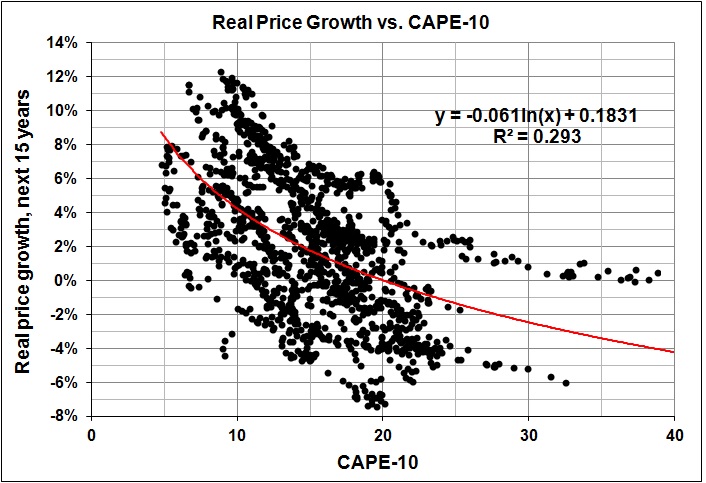
What about the relationship between CAPE-10 and price growth in subsequent years? Shiller made much of this in his non-prediction of 1996. (See his “Valuation Ratios and the Long-Run Stock Market Outlook.”) There is, as you might expect, a generally negative relationship between CAPE-10 and subsequent stock-price returns.

Real price growth in 15 years vs CAPE-10

But the relationship for 1871-2014 (shown above) is so loose as to be useless as a predictor. One might, as Shiller did, select a subset of the data and focus on the relationship for that subset, which is almost certain to be tighter than the relationship for the entire data set. But which subset should one choose? The correct answer — if there is one — becomes obvious only in hindsight. And by the time hindsight comes into play, the relationship will no longer hold.

I said it more than 30 years ago, and I stand by it: Trends were made to broken.

And we never know when they will break.

ADDENDUM (09/03/14):

The focus on stock prices is much ado about relatively little. The rate of real growth in the S&P index since January 1871 is 1.8 percent a year. For the same period, he rate of real growth in the S&P index with dividends reinvested is 6.6 percent a year. Huge difference:

S&P index - real price growth and returns

As of June 2014, the green line had increased 12,750-fold; the blue line, only 23-fold.

Buy and hold” should be: Buy, reinvest dividends, and hold.

Poverty, Crime, and Big Government

Dr. James Thompson (Psychological Comments) reports the results of a thorough study of the link between poverty and crime. Near the end of the piece, Dr. Thompson quotes The Economist‘s summary of the study’s implications:

That suggests two, not mutually exclusive, possibilities. One is that a family’s culture, once established, is “sticky”—that you can, to put it crudely, take the kid out of the neighbourhood, but not the neighbourhood out of the kid. Given, for example, children’s propensity to emulate elder siblings whom they admire, that sounds perfectly plausible. The other possibility is that genes which predispose to criminal behaviour (several studies suggest such genes exist) are more common at the bottom of society than at the top, perhaps because the lack of impulse-control they engender also tends to reduce someone’s earning capacity.

Neither of these conclusions is likely to be welcome to social reformers. The first suggests that merely topping up people’s incomes, though it may well be a good idea for other reasons, will not by itself address questions of bad behaviour. The second raises the possibility that the problem of intergenerational poverty may be self-reinforcing, particularly in rich countries like Sweden where the winnowing effects of education and the need for high levels of skill in many jobs will favour those who can control their behaviour, and not those who rely on too many chemical crutches to get them through the day.

In brief, there is a strong connection between genes and criminal behavior. Inasmuch as there are also strong connections between genes and intelligence, on the one hand, and intelligence and income, on the other hand, it follows that:

  • Criminal behavior will be more prevalent in genetic groups with below-average intelligence.
  • Poverty will be more prevalent in genetic groups with below-average intelligence.
  • The correlation between crime and poverty must, therefore, reflect (to some extent) the correlation between below-average intelligence and poverty.

As The Economist notes “merely topping up people’s incomes … will not by itself address questions of bad behaviour.” This would seem to contradict my finding of a strongly negative relationship between economic growth and the rate of violent-and-property crime.

But there is no contradiction. Not all persons who commit crimes are incorrigible. At the margin, there are persons who will desist from criminal activity when presented with the alternative of attaining money without running the risk of being punished for their efforts.

How much less crime would there be if economic growth weren’t suppressed by the dead hand of big government? A lot less.

*     *     *

Related posts:
Crime, Explained
Lock ‘Em Up
Estimating the Rahn Curve: Or, How Government Spending Inhibits Economic Growth
Race and Reason: The Achievement Gap — Causes and Implications
“Conversing” about Race
Evolution and Race
“Wading” into Race, Culture, and IQ

Income Inequality and Economic Growth

Standard & Poor’s adds fuel the the already raging fire of economic illiteracy with its research report entitled, “How Increasing Income Inequality Is Dampening U.S. Economic Growth, and Possible Ways to Change the Tide.” The S&P paper mines the Marxian-Pikettian vein of “underconsumption,” which (in the Marxian-Pikettian view) leads to economic collapse. (That Marx was wrong has been amply demonstrated by the superior performance of quasi-free economies, which have lifted the poor as well as the rich. Many writers have found grave errors in Piketty‘s reasoning– and data — these among them.)

The remedy for economic collapse (in the Marxian-Pikettian view) is socialism (perhaps smuggled in as “democratic” redistributionism). It is, of course, the kind of imaginary, painless socialism favored by affluent professors and pundits — favored as long as it doesn’t affect their own affluence. It bears no resemblance to the actual kind of socialism experienced by the billions who have been oppressed by it and the tens of millions who have been killed for its sake.

I have read two thorough take-downs of S&P’s screed. One is by Scott Winship (“S&P’s Fundamentally Flawed Inequality Report,” Economic Policies for the 21st Century at the Manhattan Institute, August 6, 2014). A second is by John Cochrane (“S&P Economists and Inequality,” The Grumpy Economist, August 8, 2014). Cochrane summarizes (and demolishes) the central theme of the S&P report, which I will address here:

[I]nequality is bad [because] it is bad for growth, and if the reason it is bad for growth is that it leads to insufficient consumption and lack of demand….

That bit of hogwash serves the redistributionist agenda. As Cochrane puts it, “redistributive taxation is a perennial answer in search of a question.” Indeed.

There’s more:

Inequality – growth is supposed to be about long run trends, not boom and slow recovery.

Professor of Public Policy at U.S. Berkeley Robert Reich argues that increased inequality has reduced overall aggregate demand. He observes that high-income households have a lower marginal propensity to consume (MPC) out of income than other households.

Let us begin at the beginning, that is, with some self-evident postulates that even a redistributionist will grant — until he grasps their anti-redistributionist implications:

  • All economic output is of two distinct types: consumption and investment (i.e., the replacement of or increase in the stock of capital that is used to produce goods for consumption).
  • The output of consumption goods must decline, ceteris paribus, if the stock of capital declines.
  • The stock of capital is sustained (and increased) by forgoing consumption.
  • The stock of capital is therefore sustained (and increased) by saving.
  • Saving rises with income because persons in high-income brackets usually consume a smaller fraction of their incomes than do persons in middle- and low-income brackets.
  • The redistribution of income from high-income earners to middle- and low-income earners therefore leads to a reduction in saving.
  • A reduction in saving means less investment and, thus, a reduction in the effective stock of capital, as it wears out.
  • With less capital, workers become less productive.
  • Output therefore declines, to the detriment of workers as well as “capitalists.”

In sum, efforts to make incomes more equal through redistribution have the opposite effect of the one claimed for it by ignorant bloviators like Robert Reich.

So much for the claim that a higher rate of consumption is a good policy for the long run.

What about in the short run; that is, what about Keynesian “stimulus” to “prime the pump”? I won’t repeat what I say in “The Keynesian Multiplier: Phony Math.” Go there, and see for yourself.

For an estimate of the destructive, long-run effect of government see “The True Multiplier.”

Baseball or Soccer? David Brooks Misunderstands Life

David Brooks — who is what passes for a conservative at The New York Times — once again plays useful idiot to the left. Brooks’s latest offering to the collectivist cause is “Baseball or Soccer?” Here are the opening paragraphs of Brooks’s blathering, accompanied by my comments (underlined, in brackets):

Baseball is a team sport, but it is basically an accumulation of individual activities. [So is soccer, and so is any team sport. For example, at any moment the ball is kicked by only one member of a team, not by the team as a whole.] Throwing a strike, hitting a line drive or fielding a grounder is primarily an individual achievement. [This short list omits the many ways in which baseball involves teamwork; for example: every pitch, involves coordination between pitcher and catcher, and fielders either position themselves according to the pitch that’s coming or are able to anticipate the likely direction of a batted ball; the double play is an excellent and more obvious example of teamwork; so is the pickoff play, from pitcher to baseman or catcher to baseman; the hit and run play is another obvious example of teamwork; on a fly to the outfield, where two fielders are in position to make the catch, the catch is made by the fielder in better position for a throw or with the better throwing arm.] The team that performs the most individual tasks well will probably win the game. [Teamwork consists of the performance of individual tasks, in soccer as well as in baseball.]

Soccer is not like that. [False; see above.] In soccer, almost no task, except the penalty kick and a few others, is intrinsically individual. [False; see above.] Soccer, as Simon Critchley pointed out recently in The New York Review of Books, is a game about occupying and controlling space. [So is American football. And so what?] ….

As Critchley writes, “Soccer is a collective game, a team game, and everyone has to play the part which has been assigned to them, which means they have to understand it spatially, positionally and intelligently and make it effective.” [Hmm… Sounds like every other team sport, except that none of them — soccer included, is “collective.” All of them — soccer included — involve cooperative endeavors of various kinds. The success of those cooperative endeavors depends very much on the skills that individuals bring to them. The real difference between soccer and baseball is that baseball demands a greater range of individual skills, and is played in such a way that some of those skills are on prominent display.] ….

Most of us spend our days thinking we are playing baseball, but we are really playing soccer. [To the extent that any of us think such things, those who think they are playing baseball, rather than soccer, are correct. See the preceding comment.]

At this point, Brooks shifts gears. I’ll quote some relevant passages, then comment at length:

We think we individually choose what career path to take, whom to socialize with, what views to hold. But, in fact, those decisions are shaped by the networks of people around us more than we dare recognize.

This influence happens through at least three avenues. First there is contagion. People absorb memes, ideas and behaviors from each other the way they catch a cold…. The overall environment influences what we think of as normal behavior without being much aware of it. Then there is the structure of your network. There is by now a vast body of research on how differently people behave depending on the structure of the social networks. People with vast numbers of acquaintances have more job opportunities than people with fewer but deeper friendships. Most organizations have structural holes, gaps between two departments or disciplines. If you happen to be in an undeveloped structural hole where you can link two departments, your career is likely to take off.

Innovation is hugely shaped by the structure of an industry at any moment. Individuals in Silicon Valley are creative now because of the fluid structure of failure and recovery….

Finally, there is the power of the extended mind. There is also a developed body of research on how much our very consciousness is shaped by the people around us. Let me simplify it with a classic observation: Each close friend you have brings out a version of yourself that you could not bring out on your own. When your close friend dies, you are not only losing the friend, you are losing the version of your personality that he or she elicited.

Brooks has gone from teamwork — which he gets wrong — to socialization and luck. As with Brooks’s (failed) baseball-soccer analogy, the point is to belittle individual effort by making it seem inconsequential, or less consequential than the “masses” believe it to be.

You may have noticed that Brooks is re-running Obama’s big lie: “If you’ve got a business — you didn’t build that.  Somebody else made that happen.” As I wrote here,

… Obama is trying, not so subtly, to denigrate those who are successful in business (e.g., Mitt Romney) and to make a case for redistributionism. The latter rests on Obama’s (barely concealed) premise that the fruits of a collective enterprise should be shared on some basis other than market valuations of individual contributions….

It is (or should be) obvious that Obama’s agenda is the advancement of collectivist statism. I will credit Obama for the sincerity of his belief in collectivist statism, but his sincerity only underscores and how dangerous he is….

Well, yes, everyone is strongly influenced by what has gone before, and by the social and economic milieu in which one finds oneself. Where does that leave us? Here:

  • Social and economic milieu are products of individual acts, including acts that occur in the context of cooperative efforts.
  • It is up to the individual to make the most (or least) of his social and economic inheritance and milieu.
  • Those who make the most (or least) of their background and situation are rightly revered or despised for their individual efforts. Consider, for example, Washington and Lincoln, on the one hand, and Hitler and Stalin, on the other hand.
  • Beneficial cooperation arises from the voluntary choices of individuals. Destructive “cooperation” (collectivism)  — the imposition of rules through superior force (usually government) — usually thwarts the individual initiative and ingenuity that underlie scientific and economic progress.

Brooks ends with this:

Once we acknowledge that, in life, we are playing soccer, not baseball, a few things become clear. First, awareness of the landscape of reality is the highest form of wisdom. It’s not raw computational power that matters most; it’s having a sensitive attunement to the widest environment, feeling where the flow of events is going. Genius is in practice perceiving more than the conscious reasoning. [A false distinction between baseball and soccer, followed by false dichotomies.]

Second, predictive models [of what?] will be less useful [than what?]. Baseball is wonderful for sabermetricians. In each at bat there is a limited [but huge] range of possible outcomes. Activities like soccer are not as easily renderable statistically, because the relevant spatial structures are harder to quantify. [B.S. “Sabermetrics” is coming to soccer.] Even the estimable statistician Nate Silver of FiveThirtyEight gave Brazil a 65 percent chance of beating Germany. [An “estimable statistician” would know that such a statement is meaningless; see the discussion of probability here.]

Finally, Critchley notes that soccer is like a 90-minute anxiety dream — one of those frustrating dreams when you’re trying to get somewhere but something is always in the way. This is yet another way soccer is like life. [If you seek a metaphor for life, try blowing a fastball past a fastball hitter; try punching the ball to right when you’re behind in the count; try stealing second, only to have the batter walked intentionally; try to preserve your team’s win with a leaping catch and a throw to home plate; etc., etc., etc.]

The foregoing parade of non sequitur, psychobabble, and outright error simply proves that Brooks doesn’t know what he’s talking about. I hereby demote him from “useful idiot” to plain old “idiot.”

*     *     *

Related posts:
He’s Right, Don’t Listen to Him
Killing Conservatism in Order to Save It
Ten Commandments of Economics
More Commandments of Economics
Three Truths for Central Planners
Columnist, Heal Thyself
Our Miss Brooks
Miss Brooks’s “Grand Bargain”
More Fool He
Dispatches from the Front
David Brooks, Useful Idiot for the Left
“We the People” and Big Government
“Liberalism” and Personal Responsibility

Every Silver Lining Has a Cloud

Today’s big economic news is the decline in real GDP reported by the Department of Commerce’s Bureau of Economic Analysis (BEA): an annualized rate of minus 2.9 percent from the fourth quarter of 2013 to the first quarter of 2014. Except for times when the economy was in or near recession, that’s the largest decline recorded since the advent of quarterly GDP estimates:

Quarterly vs annual changes in real GDP - 1948-2014
Derived from the “Current dollar and real GDP series” issued by BEA. See this post for my definition of a recession.

What’s the silver lining? Quarter-to-quarter changes in real GDP are more volatile than year-over-year and long-run changes. Some will take solace in the fact that real GDP rose by (a measly) 1.5 percent between the first quarter or 2013 and the first quarter of 2014. (Though they will conveniently ignore the long-run trend, marked by the dashed line in the graph.)

What’s the cloud? Well, as I pointed out above, the quarter-to-quarter decline in the first quarter of 2014 is unprecedented in the post-World War II era. Unless the sharp drop in the first quarter of 2014 is a one-off phenomenon (as suggested by some cheerleaders for Obamanomics), it points two possibilities:

  • The economy is in recession, as will become evident when the BEA reports on GDP for the second quarter of 2014.
  • The economy isn’t in recession — strictly speaking — but the dismal performance in the first quarter presages an acceleration of the downward trend marked by the dashed line in the graph. (For those of you who care about such things, the chance that the trend line reflects random “noise” in GDP statistics is less than 1 in 1 million.)

Even if there’s a rebound in the second quarter of 2014, the big picture is clear: The economy is in long-term decline, for reasons that I’ve discussed in the following posts:

The Laffer Curve, “Fiscal Responsibility,” and Economic Growth
The Causes of Economic Growth
In the Long Run We Are All Poorer
A Short Course in Economics
Addendum to a Short Course in Economics
The Price of Government
The Price of Government Redux
The Mega-Depression
As Goes Greece
Ricardian Equivalence Reconsidered
The Real Burden of Government
The Illusion of Prosperity and Stability
Taxing the Rich
More about Taxing the Rich
A Keynesian Fantasy Land
The Keynesian Fallacy and Regime Uncertainty
Why the “Stimulus” Failed to Stimulate
The “Jobs Speech” That Obama Should Have Given
Say’s Law, Government, and Unemployment
Unemployment and Economic Growth
Regime Uncertainty and the Great Recession
Regulation as Wishful Thinking
The Real Multiplier
The Commandeered Economy
We Owe It to Ourselves
In Defense of the 1%
Lay My (Regulatory) Burden Down
The Burden of Government
Economic Growth Since World War II
The Economy Slogs Along
Government in Macroeconomic Perspective
Keynesianism: Upside-Down Economics in the Collectivist Cause
The Price of Government, Once More
Economic Horror Stories: The Great “Demancipation” and Economic Stagnation
Economics: A Survey (also here)
Why Are Interest Rates So Low?
Vulgar Keynesianism and Capitalism
Estimating the Rahn Curve: Or, How Government Spending Inhibits Economic Growth
America’s Financial Crisis Is Now
The Keynesian Multiplier: Phony Math
The True Multiplier
The Obama Effect: Disguised Unemployment
Obamanomics: A Report Card

See especially “Regime Uncertainty and the Great Recession,” “Estimating the Rahn Curve: Or, How Government Spending Inhibits Economic Growth,” and “The True Multiplier.”

Income Inequality and Inherited Wealth: So What?

Greg Mankiw offers a refreshing take on  Thomas Piketty’s infamous thesis, Capital in the Twenty-First Century. Mankiw opens by asking, “Is inherited wealth making a comeback?” He continues:

Yes, says Thomas Piketty…. Inherited wealth has always been with us, of course, but Mr. Piketty believes that its importance is increasing. He sees a future that combines slow economic growth with high returns to capital. He reasons that if capital owners save much of their income, their wealth will accumulate and be passed on to their heirs. He concludes that individuals’ living standards will be determined less by their skill and effort and more by bequests they receive.

To be sure, one can poke holes in Mr. Piketty’s story. Since the book came out, numerous economists have been doing exactly that in book reviews, blog posts and academic analyses.

Moreover, given economists’ abysmal track record in forecasting, especially over long time horizons, any such prognostication should be taken with a shaker or two of salt. The Piketty scenario is best viewed not as a solid prediction but as a provocative speculation.

But it raises the question: So what? What’s wrong with inherited wealth?…

The bottom line is that inherited wealth is not an economic threat. Those who have earned extraordinary incomes naturally want to share their good fortune with their descendants. Those of us not lucky enough to be born into one of these families benefit as well, as their accumulation of capital raises our productivity, wages and living standards.

Unlike Mankiw, I would have stopped at “so what?” The incessant attacks on income inequality and inherited wealth arise not only from faulty economic reasoning, as Mankiw points out, but also from envy and resentment.

Envy and resentment are found among non-achievers, of course, but they are rampant in the ranks of the affluent. There we find pseudo-academic poseurs like Paul Krugman and Robert Reich, leftist pundits, well-heeled politicos, and cossetted bureaucrats who feast on the spoils of the welfare state. These hypocrites can’t attack “the rich” with a straight face, so they attack “the very rich,” a class that they define (conveniently) to exclude themselves.

That said, I can’t resist the temptation to add to Mankiw’s short list of links to posts and articles that are critical of Piketty’s analysis. Here’s a small sample of related readings:

Richard A. Epstein, “The Piketty Fallacy,” The Libertarian, May 5, 2014
Arnold Kling, “More Contra Piketty,” askblog, May 21, 2014
Scott Sumner, “The Middle Class Is Doing Fine,” EconLog, May 21, 2014
Pejman Yousefzedah, “Facts Are Stubborn Things … As Thomas Piketty Is Beginning to Find Out,” Pejman Yousefzedah, May 23, 2014
Ed Morrissey, “The Perils of Piketty,” Hot Air, May 25, 2014
Tim Worstall, “Why Income Inequality Is Really Very Good for Us Indeed,” The Adam Smith Institute, June 2, 2014
Mark J. Perry, “Sorry Krugman, Stiglitz, and Pikkety: Income Inequality for Individual Americans Has Been Flat for More Than 50 Years,” Carpe Diem, June 5, 2014

For many more readings, see the links at the bottom of “Mass (Economic) Hysteria: Income Inequality and Related Themes.” See also my many posts tagged “income inequality,” and follow the links therein.

(Full disclosure: I am an “unprivileged” child of “unprivileged”parents. I have inherited not so much as a penny. In 31 years of salaried, full-time employment, I earned above-average compensation. My earnings were in the top-5 percent of individual incomes for a few years at the end of my full-time working career.)

Playing the Social Security Trust Fund Shell Game

There’s a simple way to calculate the size of the federal government’s debt at any point in the future:

D’ = D – R + S – T

Where,

D’ = Amount of debt at a future date

D = Present debt

R = Federal government’s revenues from all sources (including Social Security taxes), from the present to the future date

S = Federal government’s spending for all purposes (including SS benefits), from the present to the future date

T = Value of Treasury securities redeemed by the SS trust fund to defray the gap between SS taxes collected and SS benefits paid

(For an explanation of how the redemption of securities by the trust fund can reduce the debt, see below.)

The present level of debt (D) is approximately equal to the debt ceiling. Therefore, as long as the deficit (R – S) is greater than the value of securities redeemed by the trust fund (T) to pay current benefits, the debt ceiling must rise or spending must be cut. (Aside: The ability of SS trustees to redeem trust fund holdings and pay benefits is simply a mechanism for ensuring the payment of full benefits until the trust fund is exhausted, regardless of any budget crunch. The trust fund, itself, is nothing more than a set of numbers in a government ledger. It isn’t an asset, any more than swampland is an asset to a sucker who buys it sight unseen.)

In theory, the trust fund could be exploited to get around the ceiling, by redeeming more holdings than required for the payment of current benefits. It’s a ploy was used in the past but is now illegal, Michael McConnell explained it in 2011:

The Social Security Trust Fund holds over $2 trillion [now over $2.7 trillion] in special Treasury securities, which it is legally entitled to redeem when necessary for the payment of benefits. When the Treasury redeems those bonds, the public debt will correspondingly be reduced, which will enable it to auction new bonds to investors, without violating the debt ceiling. This is precisely what happened during the debt ceiling crisis in 1985. Then, it was a Democratic House of Representatives that refused to raise the ceiling at the behest of a Republican President (an episode conveniently forgotten by those who wish to paint the Republican House today as uniquely evil for insisting that a debt ceiling increase be accompanied by spending reductions). The Social Security trustees cashed in some $9 billion in special Treasury securities for the payment of benefits, and the Treasury auctioned off the same amount in new U.S. bonds, without violating the debt ceiling. Here is how the Comptroller General described the event:

The Treasury Department estimated that it would have insufficient cash on November 1 to pay social security benefits and other government obligations. In order for these payments to be made, the Treasury needed to borrow money from the public, and in order to borrow the money, Treasury had to reduce its outstanding debt below the statutory limit. Therefore, on November 1 the Secretary redeemed $9.613 billion of the Trust Funds’ long-term securities, and $1.9 billion of securities held by certain other government-managed trust funds, to permit public borrowing of about $13 billion.

In this way, the Reagan Treasury was able to continue to pay Social Security benefits without interruption, despite the failure of Congress to raise the debt ceiling at the time.

The Comptroller General ruled that these redemptions were lawful, except that the trust fund redeemed more securities than were actually necessary for the payment of benefits. Some years later, Congress passed a statute codifying the Comptroller General’s decision. Public Law 104-121, section 107(a), prohibits redemption of special securities held by Social Security prior to maturity for any purpose other than the payment of benefits or administrative expenses. This statute is significant for two reasons. First, it confirms that the trustees have authority to redeem the special securities prior to maturity for the payment of benefits, and second, it prevents the executive from using the trust fund as a massive kitty to avoid the effect of the debt ceiling.

What could happen if the law were repealed? This:

1. Given the estimated size of the trust fund at the end of 2014 (as reported here), trust fund holdings could be liquidated as follows: FY 2015 — $469 billion; FY 2016 — $536 billion; FY 2017 — $576 billion; FY 2018 — $627 billion; FY 2019 — $722 billion; FY 2020 — $144 billion. The payout in FY 2020 would exhaust the trust fund. The total ($3.1 trillion) exceeds the estimated value of the trust fund at the end of 2014 ($2.8 trillion) because the trust fund would be credited with interest on its remaining holdings while those holdings were being drawn down.

2. The redemptions in 2015-2019 would entirely offset projected budget deficits for those years; the redemption in 2020 would offset about one-fifth of that year’s projected deficit. (See Table 1 here.) Thus it wouldn’t be necessary to reduce federal spending from currently projected levels until some time in 2020.

3. Under present law, however, depletion of the trust fund means that SS benefits must then be cut to a level that can be sustained by SS taxes. The cuts would be relatively small at first, but would grow steadily through the years. (Go here and compare the columns “non-interest income” and “cost” for the years 2020 and beyond.) For example, benefits in 2021 would have to be reduced to 90 percent of the level currently planned for that year; by 2030, benefits would have to be reduced to 80 percent of the planned level.

The good news — if the ploy could be executed — is that the Social Security crisis would be brought forward to the near future, instead of being deferred until 2033, when the trust fund is now expected to vanish. The undeniable urgency of the situation might compel Congress and the president to act — and perhaps to do something about the federal government’s entire fiscal mess — instead of continuing to kick the can down the road.

The bad news is that the federal government would run huge deficits for the next several years (at least). Programs that are unaffordable in the long run would be kept alive to acquire larger constituencies. Accordingly, it would be harder to curtail or kill them.

The real solution, of course, isn’t fiscal trickery; it’s fiscal responsibility. Let’s hope that 2017 brings with it a Congress and White House controlled by the non-RINO wing of the GOP.

*     *     *

Related posts:
Economics: A Survey (also here)
Why Are Interest Rates So Low?
Estimating the Rahn Curve: Or, How Government Spending Inhibits Economic Growth
America’s Financial Crisis Is Now
“Social Insurance” Isn’t Insurance — Nor Is Obamacare
The Keynesian Multiplier: Phony Math
The True Multiplier

Alienation

This much of Marx’s theory of alienation bears a resemblance to the truth:

The design of the product and how it is produced are determined, not by the producers who make it (the workers)….

[T]he generation of products (goods and services) is accomplished with an endless sequence of discrete, repetitive, motions that offer the worker little psychological satisfaction for “a job well done.”

These statements are true not only of assembly-line manufacturing. They’re also true of much “white collar” work — certainly routine office work and even a lot of research work that requires advanced degrees in scientific and semi-scientific disciplines (e.g., economics).

One result of alienation, especially among males, is the mid-life crisis, which often causes them to deplore the “rat race” and even to seek a way out of it. (I’ve been there.)

I thought of alienation because of a recent post at West Hunter. It’s short, so I’m reproducing it in full:

Many have noted how difficult it is to persuade hunter-gatherers to adopt agriculture, or more generally, to get people to adopt a more intensive kind of agriculture.

It’s worth noting that, given the choice, few individuals pick the more intensive, more ‘civilized’ way of life, even when their ancestors have practiced it for thousands of years.

Benjamin Franklin talked about this. “When an Indian Child has been brought up among us, taught our language and habituated to our Customs, yet if he goes to see his relations and makes one Indian Ramble with them, there is no perswading him ever to return. [But] when white persons of either sex have been taken prisoners young by the Indians, and lived a while among them, tho’ ransomed by their Friends, and treated with all imaginable tenderness to prevail with them to stay among the English, yet in a Short time they become disgusted with our manner of life, and the care and pains that are necessary to support it, and take the first good Opportunity of escaping again into the Woods, from whence there is no reclaiming them.”

I suspect that there’s a lot of truth in those observations. Why? Because the life of the hunter-gatherer, however fraught, is less rationalized than the kind of life that’s represented by intensive agriculture, let alone modern manufacturing and office work.

The hunter-gatherer isn’t “a cog in a machine,” he is the machine. He is the shareholder, the manager, the worker, and the consumer, all in one. His work with others is truly cooperative. It is like the execution of a game-winning touchdown by a football team, and unlike the passing of a product from stage to stage in an assembly line, or the passing of a virtual piece of paper from computer to computer.

No wonder so many males find relief from their alienation by watching sports on TV. There, they see real teamwork (however artificial the game), and they see that teamwork rewarded by victory (though not always victory by the home-town team). The beer helps, too.

Social Accounting: A Tool of Social Engineering

Steven Landsburg writes about social accounting here and here. In the first-linked post, Landsburg says:

Economic theory tells us that under quite general hypotheses, the private value of an activity is in synch with its social value. If growing an orange makes you a dollar richer, that’s because growing that orange makes the world a dollar richer. And that’s good, because it encourages people to grow all and only those oranges that are (socially) worth growing.

Here’s my version of the “general hypotheses”: People engage in voluntary exchange if it benefits them. The buyers of an orange is willing to pay the grower $1 for the orange because the benefit derived from the orange is worth (at least) $1 to the  buyer. At the same time, the grower is willing to sell oranges for $1 apiece because he expects (at least) to cover his costs if he sells oranges at that price. (His costs include the interest that he could have earned had he put his money into, say, an equally risky corporate bond instead of land, trees, and equipment.)

Now comes the hard part, which Landsburg skips. Does growing an orange and selling it for $1 really make the world a dollar richer? The buyer of the orange is “richer” (i.e., better off) only to the extent that the enjoyment/satisfaction/utility he derives from the orange is greater than the enjoyment/satisfaction/utility that he would have derived from an alternative use of his dollar. The alternatives include giving away the dollar, buying something other than an orange (maybe something less expensive that yields the buyer as much or more enjoyment/satisfaction/utility), and saving the dollar, that is, making it available for investment in, say, an orange grove.

It may be convenient to add the dollar values of final transactions and call the resulting number GDP (or GWP, gross world product). But adding $1 to GDP doesn’t mean that the world (or the U.S.) is $1 richer for it, even in the scenario described by Landsburg. For one thing, there’s no common denominator for enjoyment/satisfaction/utility, which are personal matters. For a second thing, the marginal gain in enjoyment/satisfaction/utility — the difference between first-best (buying an orange for $1) and second-best (e.g., saving $1) — is also a personal matter without a common denominator. (What’s more, there are many scenarios in which the addition of $1 to GDP makes the world poorer; for example: government entices workers into government service by offering above-market compensation, and then has those workers produce economy-stultifying regulations.)

As for the essential meaninglessness of GDP as a measure of anything, I borrow from an old post of mine:

Consider A and B, who discover that, together, they can have more clothing and more food if each specializes: A in the manufacture of clothing, B in the production of food. Through voluntary exchange and bargaining, they find a jointly satisfactory balance of production and consumption. A makes enough clothing to cover himself adequately, to keep some clothing on hand for emergencies, and to trade the balance to B for food. B does likewise with food. Both balance their production and consumption decisions against other considerations (e.g., the desire for leisure).

A and B’s respective decisions and actions are microeconomic; the sum of their decisions, macroeconomic. The microeconomic picture might look like this:

  • A produces 10 units of clothing a week, 5 of which he trades to B for 5 units of food a week, 4 of which he uses each week, and 1 of which he saves for an emergency.
  • B, like A, uses 4 units of clothing each week and saves 1 for an emergency.
  • B produces 10 units of food a week, 5 of which she trades to A for 5 units of clothing a week, 4 of which she consumes each week, and 1 of which she saves for an emergency.
  • A, like B, consumes 4 units of food each week and saves 1 for an emergency.

Given the microeconomic picture, it is trivial to depict the macroeconomic situation:

  • Gross weekly output = 10 units of clothing and 10 units of food
  • Weekly consumption = 8 units of clothing and 8 units of food
  • Weekly saving = 2 units of clothing and 2 units of food

You will note that the macroeconomic metrics add no useful information; they merely summarize the salient facts of A and B’s economic lives — though not the essential facts of their lives, which include (but are far from limited to) the degree of satisfaction that A and B derive from their consumption of food and clothing.

The customary way of getting around the aggregation problem is to sum the dollar values of microeconomic activity. But this simply masks the aggregation problem by assuming that it is possible to add the marginal valuations (i.e., prices) of disparate products and services being bought and sold at disparate moments in time by disparate individuals and firms for disparate purposes. One might as well add two bananas to two apples and call the result four bapples.

The essential problem is that A and B will derive different kinds and amounts of enjoyment from clothing and food, and that those different kinds and amounts of enjoyment cannot be summed in any meaningful way. If meaningful aggregation is impossible for A and B, how can it be possible for an economy that consists of millions of economic actors and an untold variety of goods and services? And how is it possible when technological change yields results such as this?

GDP, in other words, is nothing more than what it seems to be on the surface: an estimate of the dollar value of economic output. It is not a measure of “social welfare” because there is no such thing.

And yet, Landsburg (among many economists) seems to believe that it’s possible to measure “social welfare,” that is, to measure how much “richer” the world is because of voluntary exchange. (I wouldn’t think of accusing Landsburg or any other economist — Paul Krugman and Brad DeLong excepted — of equating government spending and “social welfare.”)

This isn’t a first for Landsburg. About four years ago he wrote this:

Suppose you live next door to Bill Gates. Bill likes to play loud music at night. You’re a light sleeper. Should he be forced to turn down the volume?

An efficiency analysis would begin, in principle (though it might not be so easy in practice) by asking how much Bill’s music is worth to him (let’s say we somehow know that the answer is $10,000) and how much your sleep is worth to you (let’s say $25). It is important to realize from the outset that no economist thinks those numbers in any way measure Bill’s subjective enjoyment of his music or your subjective annoyance. Only a crazy person would think such a thing, and I’ve never met anybody who’s that crazy in that particular way. Instead, these numbers primarily reflect the fact that Bill is a whole lot richer than you are. Nevertheless, the economist will surely declare it inefficient to take $10,000 worth of enjoyment from Bill in order to give you $25 worth of sleep. We call that a $9,975 deadweight loss.

Landsburg properly denies the commensurability of the two experiences, and then turns around and declares them commensurate. My comment, at the time:

The problem with this kind of thinking should be obvious to anyone with the sense God gave a goose. The value of Bill’s enjoyment of loud music and the value of “your” enjoyment of sleep, whatever they may be, are irrelevant because they are incommensurate. They are separate, variably subjective entities. Bill’s enjoyment (at a moment in time) is Bill’s enjoyment. “Your” enjoyment (at a moment in time) is your enjoyment. There is no way to add, subtract, divide, or multiply the value of those two separate, variably subjective things. Therefore, there is no such thing (in this context) as a deadweight loss because there is no such thing as “social welfare” — a summation of the state of individuals’ enjoyment (or utility, as some would have it).

Prices serve the useful purpose of helping individual persons and firms to move toward maximum utility and maximum profits. (I say “move toward” because the vagaries of life seldom accommodate the attainment of nirvana.) Prices do not — do not — enable the attainment of “efficiency,” that is, the maximization of “social welfare.” They cannot because there is no such thing.

Only a dedicated social engineer could believe that it’s possible to sum degrees of happiness across individuals, or claim that a public project is justified because the costs (imposed on one set of persons) exceed the benefits (enjoyed by a mostly different set of persons).

*     *      *

Related posts:
Socialist Calculation and the Turing Test
Income and Diminishing Marginal Utility
Greed, Cosmic Justice, and Social Welfare
Positive Rights and Cosmic Justice
Utilitarianism, ‘Liberalism,’ and Omniscience
Utilitarianism vs. Liberty
Accountants of the Soul
Rawls Meets Bentham
The Case of the Purblind Economist
Enough of ‘Social Welfare’
Macroeconomics and Microeconomics
Social Justice
Positive Liberty vs. Liberty
More Social Justice
Luck Egalitarianism and Moral Luck
Utilitarianism and Psychopathy

The Obama Effect: Disguised Unemployment

REVISED AND UPDATED 12/02/16 — A COMPANION PIECE TO “ECONOMIC GROWTH SINCE WORLD WAR II” (REVISED AND UPDATED 05/31/16)

By the measure of real unemployment, the Great Recession is still with us. Nor is it likely to end anytime soon, given the anti-business and anti-growth policies and rhetoric of the Obama administration.

Officially, the unemployment rate stands at 4.6 percent, as of November 2016. Unofficially — but in reality — the unemployment rate stands 6.6 percentage points higher at 11.2 percent. While the official unemployment rate has dropped by 5.4 percentage points from its peak in 2009, the real unemployment rate has dropped by only 2.3 percentage points since then.

No amount of “stimulus” or “quantitative easing” will create jobs when employers and entrepreneurs are loath to take the risk of expanding and starting businesses, given Obama’s penchant for regulating against success and taxing it when it is achieved. The job-killing effects of Obamacare will only worsen the situation. And, of course, taxing “the rich” is a sure way to hamper economic growth by stifling productive effort, innovation, and investment.

How can I say that the real unemployment rate is 6.6 percentage points above the real rate? Easily. Just follow this trail of definitions, provided by the official purveyor of unemployment statistics, the Bureau of Labor Statistics:

Unemployed persons (Current Population Survey)
Persons aged 16 years and older who had no employment during the reference week, were available for work, except for temporary illness, and had made specific efforts to find employment sometime during the 4-week period ending with the reference week. Persons who were waiting to be recalled to a job from which they had been laid off need not have been looking for work to be classified as unemployed.

Unemployment rate
The unemployment rate represents the number unemployed as a percent of the labor force.

Labor force (Current Population Survey)
The labor force includes all persons classified as employed or unemployed in accordance with the definitions contained in this glossary.

Labor force participation rate
The labor force as a percent of the civilian noninstitutional population.

Civilian noninstitutional population (Current Population Survey)
Included are persons 16 years of age and older residing in the 50 States and the District of Columbia who are not inmates of institutions (for example, penal and mental facilities, homes for the aged), and who are not on active duty in the Armed Forces.

In short, if you are 16 years of age and older, not confined to an institution or on active duty in the armed forces, but have not recently made specific efforts to find employment, you are not (officially) a member of the labor force. And if you are not (officially) a member of the labor force because you have given up looking for work, you are not (officially) unemployed — according to the BLS. Of course, you are really unemployed, but your unemployment is well disguised by the BLS’s contorted definition of unemployment.

What has happened is this: Since the first four months of 2000, when the labor-force participation rate peaked at 67.3 percent, it has declined to 62.7 percent:

labor-force-participation-rate
Source: See next graph.

Why the decline, which had came to a halt during G.W. Bush’s second term but resumed in late 2008? The slowdown of 2000 (coincident with the bursting of the dot-com bubble) and the shock of 9/11 can account for the decline from 2000 to 2004, as workers chose to withdraw from the labor force when faced with dimmer employment prospects. But what about the sharper decline that began near the end of Bush’s second term?

There we see not only the demoralizing effects of the Great Recession but also the lure of incentives to refrain from work, namely, extended unemployment benefits, the relaxation of welfare rules, the aggressive distribution of food stamps, and “free” healthcare” for an expanded Medicaid enrollment base and 20-somethings who live in their parents’ basements.* Need I add that both the prolongation of the Great Recession and the enticements to refrain from work are Obama’s doing? (That’s on the supply side. On the demand side, of course, there are the phony and even negative effects of “stimulus” spending, the chilling effects of regime uncertainty, which has persisted beyond the official end of the Great Recession, and the expansion of government spending.)

If the labor-force participation rate had remained at its peak of 67.3 percent, so that the disguised unemployed was no longer disguised, the official unemployment rate would have reached 13.5 percent in December 2009, as against the nominal peak of 10 percent in October 2009. Further, instead of declining to the phony rate of 4.6 percent in November 2016, the official unemployment rate would have stayed almost constant — hovering between 11 percent and 13.5 percent.

The growing disparity between the real and nominal unemployment rates is evident in this graph:

actual-vs-nominal-unemployment-rate
Derived from Series LNS12000000, Seasonally Adjusted Employment Level; Series LNS11000000, Seasonally Adjusted Civilian Labor Force Level; and Series LNS11300000, Seasonally Adjusted Civilian labor force participation rate. All are available at BLS, Labor Force Statistics from the Current Population Survey.

_________
* Contrary to some speculation, the labor-force participation rate is not declining because older workers are retiring earlier. The participation rate among workers 55 and older rose steadily from 1994 to 2014. The decline is concentrated among workers under the age of 55, and especially workers in the 16-24 age bracket. (See this table at BLS.gov.) Why? My conjecture: The Great Recession caused a shakeout of marginal (low-skill) workers, many of whom simply dropped out of the labor market. And it became easier for them to drop out because, under Obamacare, many of them became eligible for Medicaid and many others enjoy prolonged coverage (until age 26) under their parents’ health plans.

Signature

*     *     *

Related reading:

Randall Holcombe, “Long-Term Unemployment Benefits Expire; Long-Term Unemployment Falls,” Mises Economics Blog, September 10, 2014

Arnold Kling, “The State of the Economy,” askblog, October 12, 2014

Stephen Moore, “Why Are So Many Employers Unable to Fill Jobs?The Daily Signal, April 6, 2015

Related posts: See the list here.

Obamanomics: A Report Card

See this post.