Who Shot JFK, and Why? (Updated)

Here.

The Beginning of the End of Liberty in America

SEVERAL ITEMS HAVE BEEN ADDED TO THE LIST OF RELATED READINGS SINCE THE INITIAL PUBLICATION OF THIS POST ON 06/26/15

Winston Churchill, speaking in November 1942 about the victory of the Allies in the Second Battle of El Alamein, said this:

This is not the end. It is not even the beginning of the end. But it is, perhaps, the end of the beginning.

We may have reached the end of the legal battle over same-sex “marriage” with today’s decision by five justices of the Supreme Court in the case of Obergefell v. Hodges. But that decision probably also marks the beginning of the end of liberty in America.

Consider these passages from Chief Justice Roberts’s dissent (citations omitted):

…Today’s decision … creates serious questions about religious liberty. Many good and decent people oppose same-sex marriage as a tenet of faith, and their freedom to exercise religion is—unlike the right imagined by the majority—actually spelled out in the Constitution.

Respect for sincere religious conviction has led voters and legislators in every State that has adopted same-sex marriage democratically to include accommodations for religious practice. The majority’s decision imposing same-sex marriage cannot, of course, create any such accommodations. The majority graciously suggests that religious believers may continue to “advocate” and “teach” their views of marriage…. The First Amendment guarantees, however, the freedom to “exercise” religion. Ominously, that is not a word the majority uses.

Hard questions arise when people of faith exercise religion in ways that may be seen to conflict with the new right to same-sex marriage—when, for example, a religious college provides married student housing only to opposite-sex married couples, or a religious adoption agency declines to place children with same-sex married couples. Indeed, the Solicitor General candidly acknowledged that the tax exemptions of some religious institutions would be in question if they opposed same-sex marriage…. There is little doubt that these and similar questions will soon be before this Court. Unfortunately, people of faith can take no comfort in the treatment they receive from the majority today.

Perhaps the most discouraging aspect of today’s decision is the extent to which the majority feels compelled to sully those on the other side of the debate. The majority offers a cursory assurance that it does not intend to disparage people who, as a matter of conscience, cannot accept same-sex marriage…. That disclaimer is hard to square with the very next sentence, in which the majority explains that “the necessary consequence” of laws codifying the traditional definition of marriage is to “demea[n]or stigmatiz[e]” same-sex couples…. The majority reiterates such characterizations over and over. By the majority’s account, Americans who did nothing more than follow the understanding of marriage that has existed for our entire history—in particular, the tens of millions of people who voted to reaffirm their States’ enduring definition of marriage—have acted to “lock . . . out,” “disparage,”“disrespect and subordinate,” and inflict “[d]ignitary wounds” upon their gay and lesbian neighbors…. These apparent assaults on the character of fair minded people will have an effect, in society and in court…. Moreover, they are entirely gratuitous. It is one thing for the majority to conclude that the Constitution protects a right to same-sex marriage; it is something else to portray everyone who does not share the majority’s “better informed understanding” as bigoted….

Justice Alito puts it more plainly:

[Today’s decision] will be used to vilify Americans who are unwilling to assent to the new orthodoxy. In the course of its opinion,the majority compares traditional marriage laws to laws that denied equal treatment for African-Americans and women…. The implications of this analogy will be exploited by those who are determined to stamp out every vestige of dissent.

Perhaps recognizing how its reasoning may be used, the majority attempts, toward the end of its opinion, to reassure those who oppose same-sex marriage that their rights of conscience will be protected…. We will soon see whether this proves to be true. I assume that those who cling to old beliefs will be able to whisper their thoughts in the recesses of their homes, but if they repeat those views in public, they will risk being labeled as bigots and treated as such by governments, employers, and schools….

…By imposing its own views on the entire country, the majority facilitates the marginalization of the many Americans who have traditional ideas. Recalling the harsh treatment of gays and lesbians in the past, some may think that turnabout is fair play. But if that sentiment prevails, the Nation will experience bitter and lasting wounds.

Erick Erickson drives it home:

Make no mistake — this is not the end of a march, but the beginning of a new march. You will be made to care. You will be forced to pick a side. Should you pick the side of traditional marriage, you can expect left to be ruthless. After all, the Supreme Court has said gay marriage is a not just a right, but a fundamental right. [“The Supremes Decide,” RedState, June 26, 2015]

Erickson counsels civil disobedience:

It’s time to defy the court on this. It’s time to fight back. Nonviolent civil disobedience is the only option we have been left under this terrible ruling. We will be heard. [“It’s Time for Civil Disobedience,” RedState, June 26, 2015]

Most citizens will, of course, attempt to exercise their freedom of speech, and many business owners will, of course, attempt to exercise their freedom of association. But for every person who insists on exercising his rights, there will be at least as many (and probably more) who will be cowed, shamed, and forced by the state into silence and compliance with the new dispensation. And the more who are cowed, shamed, and forced into silence and compliance, the fewer who will assert their rights. Thus will the vestiges of liberty vanish.

That’s how it looks from here on this new day of infamy.

*     *     *

Related reading:

*     *     *

Related posts:

The Marriage Contract
Libertarianism, Marriage, and the True Meaning of Family Values
Same-Sex Marriage
“Equal Protection” and Homosexual Marriage
Marriage and Children
Civil Society and Homosexual “Marriage”
The Constitution: Original Meaning, Corruption, and Restoration
Perry v. Schwarzenegger, Due Process, and Equal Protection
Rationalism, Social Norms, and Same-Sex “Marriage”
Asymmetrical (Ideological) Warfare
In Defense of Marriage
A Declaration of Civil Disobedience
The Myth That Same-Sex “Marriage” Causes No Harm
Liberty and Society
The View from Here
The Culture War
Surrender? Hell No!
Posner the Fatuous
Getting “Equal Protection” Right
The Writing on the Wall
How to Protect Property Rights and Freedom of Association and Expression
The Gaystapo at Work
The Gaystapo and Islam

Signature

Does the Power to Tax Give Congress Unlimited Power? (II)

Today’s opinion of a majority of the Supreme Court in the case of King v. Burwell upholds subsidies to participants in federally established Obamacare exchanges despite the plain language of the Affordable Care Act. In the words of Justice Scalia, whose dissent was joined by Justices Alito and Thomas,

this Court’s two decisions on the Act will surely be remembered through the years. The somersaults of statutory interpretation they have performed (“penalty” means tax, “further [Medicaid] payments to the State” means only incremental Medicaid payments to the State, “established by the State”means not established by the State) will be cited by litigants endlessly, to the confusion of honest jurisprudence.And the cases will publish forever the discouraging truth that the Supreme Court of the United States favors some laws over others, and is prepared to do whatever it takes to uphold and assist its favorites.

I dissent.

And I most vehemently dissent.

Today’s decision is a painful reminder of three posts that I published in December 2010: “The Unconstitutionality of the Individual Mandate,” “Does the Power to Tax Give Congress Unlimited Power?,” and “Does Congress Have the Power to Regulate Inactivity?.” The posts appeared 18 months before Chief Justice Roberts’s twisted logic in NFIB v. Sebelius upheld the Affordable Care Act’s individual mandate by calling it a tax.

In the second of the three posts listed above, I argued that the power to tax is not unlimited. Taxes levied by the central government must be levied for the purpose of executing powers specifically enumerated in Article I, Section 8 of the Constitution. Nevertheless, the majority NFIB v. Sebelius chose not only to distort the individual mandate — which is clearly a penalty, not a tax — but also to willfully disregard the Constitution’s expressed limitations on the powers of Congress. Even if the individual mandate were a tax, Congress cannot constitutionally levy such a tax because the Affordable Care Act isn’t contemplated in its enumerated powers. (ACA derives its supposedly constitutional status from the Court’s decision in 1935 to declare the Social Security Act constitutional, even though it isn’t. See my post of October 31, 2004, “Social Security Is Unconstitutional.”)

In the first edition of this post, I cited James Madison and linked to “The Unconstitutionality of the Individual Mandate,” where I cite many more. But I neglected Henry St. George Tucker III, who in a speech given at a meeting of the Georgia Bar Association in June 1927 put paid to the notion that Congress’s power to tax is unlimited in scope. The speech, “Judge Story’s Position on the So-Called General Welfare Clause,” is quite long, and deserving of quotation at length. (The links are mine, of course):

The words “the general welfare” are to be found in two places in the Constitution—in the preamble thereto and in Article 1, section 8, clause 1. All reputable writers concur in the statement that the words of the preamble to the Constitution consti­tute no grants of power, and therefore our investigation is confined to the words as found in Article 1, section 8, clause 1. which reads,

“The Congress shall have power lo lay and collect taxes, duties, imposts and excises, to pay the debts and provide for the common defense and general welfare of the United States but all duties, imposts, and excises shall be uniform throughout the United States.” …

Hamilton’s fight in the Convention [of 1787] was to give to Congress unlimited power. Pinckney’s plan pre­scribed definite powers to Congress. This was the struggle of the Convention, and while Hamilton’s plan, on this clause, was practically voted down six times in the Convention, either directly or by vot­ing up a distinct opposing proposition, his followers have struggled to show that the words “the general welfare” put into clause 1, section 8, Arti­cle 1. really mean what was specifically rejected by the Convention six times….

Judge [Joseph] Story’s position on this subject can best be seen from quoting his own words on the sub­ject, beginning at Sec. 906 of his Commentaries, page 628, Vol, 1….

The argument of Judge Story  (contained in sections 909 and 910) which demolishes the theory of the Hamiltonians, shows conclusively that the words “the common defense and general welfare,” as found in [Article I, section 8], constitute no substantive grant of power; and he further denies that these words contain any power whatsoever. His argu­ment is irresistible in its conclusion to any un­biased mind, but it furnishes an equally powerful argument against his claim that the words “to pro­vide for the common defense and general welfare” are merely words of limitation on the taxing power, for his argument for the latter claim is based upon the relationship of those words solely to the first clause of section 8, and excludes their relationship to the other seventeen distinct clauses in that sentence. He would thus exclude these words “common de­fense and general welfare” from any participation in the construction of the whole sentence. How can that consist with his language in sections 909 and 910?…

…[T]he framers of the Con­stitution left this  matter  in  no  doubt,  for the eighteenth clause of this section 8, after enumer­ating one by one seventeen grants of power, reads:

“The Congress shall have power to make all laws which shall be necessary and proper for carrying into execution the foregoing posters, and all other powers vested by this Con­stitution in the Government of the United States, or in any Department or Officer thereof.”

This coefficient clause therefore constitutes the constitutional limitation on the taxing power of Congress; but any law passed by Congress to carry out an express grant must be necessary and bona fide appropriate to the end. So Congress, desiring to carry out some regulation of commerce that requires an appropriation, may by law appropriate money for it under this coefficient clause, for the end is legitimate and the appropriation is bona fide appropriate to the end. So as to every other grant of power to Congress that may require money….

The proposition of Mr. Hamilton would have given Congress unlimited power to create recep­tacles and then fill them up with appropriations from the treasury. Judge Story stoutly denies such power as intended to be given in the Constitution, but claims the power in Congress to appropriate money to any persons, associations, or corporations if in their opinion it would conduce to the general welfare of the people. Under this view the courts are without power to obstruct any such measure, as it is to be left to Congress alone to determine, and not the courts. Judge Story denies that the Hamil­tonian claim could be sound because it would make of the Government one of unlimited powers, which he says, as we have seen, was never intended by the Convention; but if Congress is without restraint in selecting objects of appropriation, and the tax power is likewise unlimited, is it not apparent that the union of these two unlimited powers in Con­gress creates a government of unlimited power? The roads may be different that lead to the same end, but it the end, a government of unlimited power, which Judge Story well says, was never in­tended be the same, his construction must be re­jected, as it leads inevitably to the same result, if not to a worse result….

Judge Story’s conclusion that these words “common defense and general welfare” are simply a limitation upon the taxing power of the Govern­ment, while denying to them any constructive power, results in this anomalous condition, that the Federal Government, under these words, can con­struct or create no instrumentality unless the power be granted in the Constitution, but may yet appro­priate the money raised by taxation to such organ­ization constructed by the States or other power; that is, that while the Congress could not create a university in every State, it would have the power, if in its opinion it was for the “general welfare” to appropriate money to run them after being estab­lished by the States….

If Judge Story’s interpretation of this clause be ad­mitted, namely that these words are merely limita­tions on the taxing power of Congress, the real difficulty is still left unsolved, for he assumes, once it is granted that they are merely words of limitation on the taxing power, that Congress is clothed with the power of determining what is the common defense and general welfare. But this is mere assumption. If no definition or description of these words is found in the Constitution, and if the Constitution failed to give their meaning, there might be some reason to adopt his suggestion; but if there be a reasonable construction of the Constitution defining these words, why should that reasonable construction be set aside to give to Congress an unlimited control over the whole Government, which Judge Story has so eloquently decried? What is the common defense? What is the general welfare of the United States, Who is to determine this common defense and general welfare? What authority, under the Constitution, has the power to say what objects come within these two terms’ If taxation can be had legitimately to meet the demands of these two extensive terms where shall taxation end? What are its limits? If the objects to which taxation can be applied are unlimited, then the union of the power of taxation with the power of determining the objects to which it may be applied constitute the most tremendous engine of oppression of a free people every [sic] conceived of by the ingenuity of man. Yet, Judge Story assumes that Congress has the power to de­termine what is the common defense and what is the general welfare of the United States, and that when Congress has determined that a certain object is for the common defense or the general welfare, it may appropriate the tax money which it is authorized to levy, for that purpose. This unites in Congress two great powers, dangerous because unlimited, the one to select the objects of its favor, and the other the power to appropriate money from the treasury for such ob­jects. The unlimited power to tax and the unlimited power to determine their benefactions, are, by Judge Story, united in the Congress, and yet Judge Story (Section 909) affirms that this Government was intended to be a government of limited powers only. The relief from this illogical impasse, into which the learned Judge would drive us, is found in the simple examina­tion of Article I, section 8, clause 1, and the seventeen succeeding clauses, constituting the whole sentence. The manner in which this Article was considered and adopted in the Convention, the care with which each grant was discussed and adopted, constituting the limitations on the powers of Congress, show con­clusively that no one power, which could submerge all other powers, was ever intended by the framers of the Constitution….

…Three times in two days, on the 22nd and 2srd of August [1787], the Convention indorsed a resolution of this nature: That the Congress should “fulfill the engagements and discharge the debts of the United States”. What engagements had the United States? They are chiefly specified in the eighteen specific grants in the Pinckney plan finally adopted August 16th.  Do not the words “fulfill the engage­ments” interpret the meaning of “common defense and general welfare”? Are not those the only engagements of the Government Of the United States? Undoubtedly, having determined for the honor of their country that there should be an express provision to pay the debts some other words would have to be supplied to save to the Congress the right to carry out the grants of power to Congress thereinafter enumerated, and to show that its power to appropriate money was not confined alone to the payment of the debts. What should these additional words be? They selected these words: “To provide for the common defense and general wel­fare” as they embraced all the subsequent [enumerated] grants of power which the Convention had already determined should constitute that amount of common defense and of general welfare which the Federal Government ought to control; and being merely words of general import and without power in the Articles of Confed­eration from which they came, brought with them to the Constitution of the United States the same in­nocuous character [emphasis added]….

Thus we find in our conclusion that there is no general welfare clause in the Constitution; that the power of Congress to legislate for every object which in their opinion might be for the benefit of the people, pressed by Mr. Hamilton in the Convention, was six times, directly or indirectly, rejected by that body; and, in spite of that, his followers have sought to con­strue these words as meaning what the authors of the Constitution had six times successively rejected….

Congress, various presidents, and the Supreme Court have subsequently undone the work of the Framers, most recently on June 24, 2015, in King v. Burwell. The Constitution has become a hollow shell into which the proponents of dictatorial government may pour any meaning that advances their dictatorial whims.

*     *     *

See “The Constitution: Myths and Realities“.

“Than I” or “Than Me”?

Which of these sentences do you prefer?

“John is older than I.”

“John is older than me.”

The first sentence is favored by pedants; the second, by “average people,” or so it seems to me. Unusually, I’m on the side of “average people,” not because there are more of them (democracy is the bane of liberty) but because the second sentence is grammatically correct.

Some pedants try to justify the first sentence (and similar ones) by asserting that it means “John is older than I am,” where “am” is an understood word. That is a strained explanation for a simple comparison of the attributes of two entities. It leaves “am” dangling. Some pedants try to avert the “dangle” by asserting that “John is older than I” means “John is older than I am old.” But “I am old” is nonsensical in this context: “I” is not necessarily old, just younger than John.

Alternatively, pedants assert that “than” is functioning as a conjunction, a word that “connects words, phrases, clauses, or sentences.” (A definition that affords no distinction.) However, if you follow the first link in the preceding sentence, you will learn that a conjunction may overlap with other parts of speech. In the case of “than” it often does just that; that is, it also serves as a preposition: a word “that is used to show the relation of a noun or noun-equivalent (the object of the preposition) to some other word in the sentence” (Harbrace College Handbook, 6th editiion, p. 457). That is precisely the function of “than” in “John is older than me.”

Generalizing from the case of John and me, I must respectfully disagree with Garner’s Modern American Usage. It is an excellent guide that I have been using for several months in place of Follett’s Modern American Usage, which had been my guide for more than forty years. On page 805 of Garner’s, the author (Bryan A. Garner) gives examples of what he considers wrong usages; his corrections are in parentheses (his sources are omitted, for brevity):

  • “Too many of our students seem to struggle…. Are we really that much smarter than them [read they]?”
  • “What makes the story even juicier is that Pamela, 74, has allegedly been feuding for years with her two former stepdaughters, both of them slightly older than her [read she] — and one of them may face financial difficulties.”
  • “Scrambling to improve his chances, Donald Skelton, a safe-deposit manager at Chase plans to go to night school this summer at age 46. He had a rude awakening after 23 years at the bank when he learned that his daughter, fresh out of college, earned more than him [read he].”
  • The sun on the runway illuminated their hair, which was bobbed to shoulder length and styled to the same tint — all in their thirties (he was fifty-eight at the time), twenty years younger than him [read he?], and of the same height.”

Garner’s uncertainty in the fourth example suggests a lack of confidence in his assertion that “than” is (in such cases) a conjunction rather than a preposition.

I am confident that “than” is a preposition in cases of the kind adduced by Garner; that is, it expresses a relationship between two entities.

My bottom line: In a comparative statement where “than” intervenes between a noun and a noun-substitute, the word that follows “than” should take the objective case: me, him, them, and so on. It not only sounds more natural (to most people), but it’s also grammatically correct.

*     *     *

Related posts:

Remedial Vocabulary Training
One Small Step for Literacy
Punctuation
Data Are
“Hopefully” Arrives
Hopefully, This Post Will Be Widely Read
Why Prescriptivism?
Unsplit Infinitives
Lincoln, the Poet President
On Writing
Tolerance

Signature

Getting Real About Empathy – Part 3 of 5: Moral Implications and Consequences

A guest post by L. P. Here are links to part 1part 2, part 4, and part 5.

It is often assumed that if people were more empathetic and compassionate, we’d see fewer conflicts and wars. Continuing from my previous post, I make the case that it’s inaccurate to view high empathy and the lack thereof in black-and-white terms. As it happens, empathy and compassion can lead to conflict because of whom one empathizes with and feels compassion for. The stronger the empathy and compassion, the more one tends to act in the interest of those one empathizes with. Consider Claus Lamm’s and Jasminka Majdandžić’s findings in “The role of shared neural activations, mirror neurons, and morality in empathy – A critical comment“:

In the public but at times also in the academic discourse, it appears to be taken for granted that empathy can act as a remedy or a stronghold against anti-social phenomena which seem to affect our society to an increasing extent – such as the selfish greed in the financial industry supposedly contributing to the global financial crisis, or the many armed conflicts we are witnessing these days, ranging from Syria over the Ukraine to Gaza. For instance, US-president Barack Obama has repeatedly spoken of an empathy deficit in our modern society, and stated that an “empathy crisis” may be at the root of the economic and political crises we are experiencing (2006, June 19). Such views have certainly been influenced by the folk intuition that empathy motivates prosocial behavior, such as helping others in need. Indeed, this intuition has received widespread support from social psychology (see Batson, 1991), as well as more recently from the field of social neuroscience. For instance, Hein et al. (2010) demonstrated that individual differences in altruistic behavior (taking over painful shocks from another person) were predicted by activation of empathy-related neural responses in left anterior insula (see also Hein et al., 2011, Masten et al., 2011 and Mathur et al., 2010). At first glance, such a link between empathy and altruism might imply that increasing empathy in our society will reduce egoism and selfishness and the social conflicts associated with them (Rifkin, 2010).

However, such propositions overlook the fact that empathy is sensitive to deeply-rooted parochialism and ingroup bias (see Chiao and Mathur, 2010). This implies that it will motivate altruistic action in a way that prefers to help or cooperate with persons and groups that we perceive as closer or more similar to us…

Finally, we need to consider that people may be able to empathize with others (in the sense of being able to feel what they are feeling, or “feeling as”) and still harm them. The “tools of empathy” or knowledge about them at times may even be deliberately exploited to inflict harm in others, for instance in persons with psychopathic personality traits. Only recently, a series of social neuroscience studies has added to our knowledge of the psychopathic mind and how he or she is able to engage in such a-moral or a-social behavior. Interestingly, these studies suggest that psychopaths seem to show a lower propensity for empathy (in the sense of affect sharing), yet are able to feel what others are feeling when explicitly instructed to do so – though the exact way in which this instructing should be devised is still somewhat controversial, with different studies yielding somewhat different results ( Decety et al., 2013a, Decety et al., 2013b and Keysers and Gazzola, 2014b for review; Lockwood et al., 2013a, Lockwood et al., 2014, Meffert et al., 2013 and Pfabigan et al., 2014). Anecdotal evidence also suggests that the capacity to fully (and possibly empathically) sense the effects of one’s actions, but to deliberately modify one’s behavioral response to it can be exploited to do harm rather than to increase the welfare of others…

Unfortunately, we do not have to go all the way to psychopathy to illustrate how empathy can be exploited for one’s own and not for the greater good. For instance, we probably all know competitive situations, such as in sports, in which team tactics exploit our knowledge of how our opponents will feel and act in response to certain actions (such as the “psychological warfare” that might be applied during penalties shots in football), or conflicts with friends or loved ones in which our enhanced ability to empathize with them may provide us with all the more effective tools to hurt their feelings.

To describe the results of a recent study conducted by Anneke E. K. Buffone and Michael J. Poulin (see “Empathy, Target Distress, and Neurohormone Genes Interact to Predict Aggression for Others–Even Without Provocation“), Tom Jacobs writes in “This is the Dark Side of Empathy“:

[P]articipants were, to a surprising degree, willing to inflict pain on a second person to help a distressed individual they felt empathy for. This occurred in spite of the fact that (a) both were total strangers, and (b) the second person had done absolutely nothing wrong.

The results should put a damper on what the researchers call “recent enthusiasm for interventions that involve administering caregiving-related neurohormones or empathy training.”

It seems that Sáez et al., who’re excited about prolonging the effects of dopamine in people’s brains, haven’t considered the conclusions of this study. In another report of this study, “Can love make us mean? Researchers explore the relationship between empathy and aggression,” Poulin elaborates on the neurochemical process through which empathy and compassion for another triggers aggression:

“Both oxytocin and vasopressin seem to serve a function leading to increased ‘approach behaviors,'” says Poulin, associate professor of psychology. “People are motivated by social approach or getting closer to others.”

But Poulin adds that people approach one another for many reasons, including aggression, so it stands to reason that if compassion is linked to the action of these hormones and these hormones are linked to social approach behaviors that they might help account for the link between compassion and aggression.

The researchers conducted a two-part study consisting of a survey and an experiment. “The results of both the survey and the experiment indicate that the feelings we have when other people are in need, what we broadly call empathic concern or compassion, can predict aggression on behalf of those in need,” says Poulin. “In situations where we care about someone very much, as humans, we were motivated to benefit them, but if there is someone else in the way, we may do things to harm that third party.”

And that reaction is not because the third party has done anything wrong.

Such findings should appeal to common sense. However, for those born on the “wrong” side of the empathy spectrum (yes, there’s a genetic contribution according to Baron-Cohen and other researchers), today’s pro-empathy bandwagon resembles the start of a witch-hunt. People, by and large, don’t evaluate the value of empathy or lack thereof in an objective manner. This bias transcends political ideology but appears especially pronounced among those on the left whose self-definition places central importance on empathy and compassion and influences the tenor of academic research, as in this article.

Even worse, for a group that gives lip service to tolerance, inclusion, and acceptance of diversity, this widespread clamoring for people to be more empathetic goes against those aforementioned espoused values because less empathetic individuals are also part of life’s natural diversity. The question “Should serious people be more fun-loving to make society a happier place?” has an obvious counterpart: “Or should fun-loving people be more serious so that more work gets accomplished?”  The same kinds of questions should be asked with regard to empathy.

In Part 4, I’ll wrap up this discussion with other critical questions and final remarks.

Recap: Empathy, far from alleviating conflict, can cause or exacerbate it. Further, the drive to elevate empathy above other traits is intolerant, short-sighted, and unscientific.


Privilege, Power, and Hypocrisy

The Almighty is not a liberal… The Almighty is the driving force for the entire universe and the universe is not a very liberal place. That is what the modern world seems not to understand….

Simon Mawer, The Gospel of Judas

*     *     *

Complaints about privilege are really complaints about power. How did privilege and power come to be conflated? Let’s begin with an authoritative definition* of privilege:

A right, advantage, or immunity granted to or enjoyed by a person, or a body or class of persons, beyond the common advantages of others; an exemption in a certain case from certain burdens or liabilities.

Are all privileges unjust? Do privileges necessarily confer power or arise from it?

Good Privilege and Days of Yore

There was a time when most privileges were neither unjust nor a sign of power: when younger men ceded their seats on buses to older persons and pregnant women, when a man could hold open a door for a woman and be thanked for it instead of being repaid with a stony glare or silence; when a fit person would cede a seat to a crippled one; and so on.

Was there anything wrong with such behaviors? Only a revisionist who views the world through contemporary mores (of a politically correct hue)  would think so. Such behaviors were in fact widely practiced and accepted as fitting and proper. They were not condescending or demeaning. They did not confer power or arise from it, except to the extent that persons who had the power to grant them did so voluntarily and out of pity or respect for those who received them. But the grantors’ power was only situational, not general. A better word for it would be opportunity, as in the opportunity to do a good deed for a fellow human being.

The Decline of Civility and the Rise of Big Government

Such behaviors have gone out of style, or nearly so, not because they were considered improper but because manners have coarsened. Manners have coarsened because people — not all people but too many of them — have become self-centered and inconsiderate of others. My view is that the rise of the “me” generation in the 1960s curtailed instances of public kindness, thus producing fewer instances of good manners that might be copied and repeated, thus leading to the further recession of good manners, etc.

The “me” generation didn’t arise spontaneously. Its rise was an integral part of the breakdown of the social fabric that big government has abetted and encouraged. What breakdown? Anthony Esolen describes it all too well:

[W]hen we ask, “Why are the churches empty?” we might also ask, “Why are our public buildings so ugly? Why do we no longer have any folk art to speak of? Why do neighbors not know one another? Why are there no dances for everyone of all ages to enjoy? Why is the sight of a young lad and lass holding hands as rare now as public indecency used to be? Why is no one getting married? Why have family trees turned into family sticks, or family briars?

“Why are there so many feral young men and women, tattooed and slovenly, loitering about shopping malls or slouching towards the internet for their porn? Why are there so many old neighborhoods, roads, and bridges crumbling, while millions of young men are unemployed or, worse, unemployable? Why do so many teachers believe it their duty to tear down the glories of their own civilization, calling it ‘critical thinking,’ without a passing thought as to what will remain in their place? Who are what used to be called the ‘leading men’ of an ordinary town? Are there any? Who are what used to be called ‘city fathers’? Are there any?

“Where are the songs of yesteryear? Where are the poems? Where are the holidays? What happened to the parades and the marching bands?

“What virtue do we honor, other than what we call tolerance, which turns out not to be tolerance at all but the ‘virtue’ of demanding that there should be no honor granted to virtue?” [“What Is a Healthy Culture?,” The Imaginative Conservative, June 16, 2015]

Walter Williams puts it this way:

A civilized society’s first line of defense is not the law, police and courts but customs, traditions, rules of etiquette and moral values. These behavioral norms — mostly transmitted by example, word of mouth and religious teachings — represent a body of wisdom distilled over the ages through experience and trial and error. They include important thou-shalt-nots, such as thou shalt not murder, thou shalt not steal and thou shalt not cheat. They also include all those courtesies that have traditionally been associated with ladylike and gentlemanly conduct.

The failure to fully transmit these values and traditions to subsequent generations represents one of the failings of what journalist Tom Brokaw called “The Greatest Generation.” People in this so-called great generation, who lived during the trauma of the Great Depression and fought World War II, not only failed to transmit the moral values of their parents but also are responsible for government programs that will deliver economic chaos….

For nearly three-quarters of a century, the nation’s liberals have waged war on traditional values, customs and morality. Our youths have been counseled that there are no moral absolutes. Instead, what’s moral or immoral is a matter of personal opinion. During the 1960s, the education establishment began to challenge and undermine lessons children learned from their parents and Sunday school with fads such as “values clarification.” So-called sex education classes are simply indoctrination that undermines family and church strictures against premarital sex. Lessons of abstinence were considered passe and replaced with lessons about condoms, birth control pills and abortions. Further undermining of parental authority came with legal and extralegal measures to assist teenage abortions with neither parental knowledge nor parental consent….

If it were only the economic decline threatening our future, there might be hope. It’s the moral decline that spells our doom. [“Culture and Social Pathology,” creators.com, June 16, 2015]

Williams hints at the role of government in the sundering of the social fabric. Let’s spell it out. As government has become all-powerful and crushingly intrusive (with respect to Americans, if not with respect to their enemies) personal responsibility and the civilizing bonds of society have been replaced by dependency on the state and the use of its power to advance the interest of some at the expense of all. (See “The Interest-Group Paradox” for more about this phenomenon and its folly.)

The privileges that are accorded out of kindness, of which I wrote earlier, arise from civil society, and they are dying with it. People seem less willing than they were in the past to accord such privileges to others.

Privilege as a Dirty Word

With the withering away of civil society, privilege is now thought of mainly as something that someone demands or takes because of his rank, socioeconomic status, gender, or race. Privilege-taking was widely scorned until the arrival of the age of identity politics. Consider the phrase “rank has its privileges” (RHIP), which is a term of derogation that applies where persons of high status (judges, elected officials, corporate executives, military “brass”) enjoy perquisites or escape punishments because of their status.

Then there’s the case of the “privileged brat” — a young person who acts haughtily toward others. This is usually someone whose parents are affluent and on whom the parents have lavished money (or the things that it can buy) — someone, in other words, who has come to think of himself as “special” and whose wishes are to be taken as commands by others. I could add examples, but they would be of the same type: the privilege-taker who exploits his status to demand things of others.

Who are today’s dominant privilege-takers?

Unjust Stereotyping

Is a white person — better yet, a straight, white male of European descent (preferably non-Mediterranean) — necessarily privileged in either sense discussed here: a beneficiary of privileges voluntarily accorded by others or a privilege-taker who demands and receives favors based on his race, gender, and ethnicity?

If you select either answer you’re making the grievously wrong generalization that all heterosexual, white males of non-Mediterranean European descent (hetwhims for short) are not alike. Further, many hetwhims who seem to be “privileged” owe their privilege to causes other than gender, race, and ethnicity: Intelligence, other innate traits, and hard work should come to mind. (If you say, factually, that whites of European descent are generally smarter than, say, persons of African descent, you are unlikely to be a person who pigeonholes all hetwhims as “privileged.”)

Let’s make it real by asking if the following types of hetwhim are privileged:

  • a redneck hetwhim of below-average intelligence who comes from a poor Appalachian family
  • any hetwhim of average or below average intelligence who comes from a family with below-average income
  • a hetwhim who has been denied a job or promotion for which he was, objectively, the best candidate because he was competing with non-hetwhims, especially blacks, women, or — nowadays — homosexuals
  • a hetwhim who has a mental or physical condition that makes it impossible for him to enjoy what passes for a normal life
  • a hetwhim who is actively discriminated against in a university setting — as a student, professor, or prospective professor — because of his gender, color, and sexual orientation and not because of his actual beliefs or qualifications
  • one of the tens of millions of hetwhims in the United States who simply does the best he can with his mental and physical endowment, and whose achievements are due to those endowments and his efforts, plain and simple.

Blaming any of them for what befalls others — usually because of their own faults and failings — is nothing less than blaming the blameless. (See my post, “Luck-Egalitarianism and Moral Luck.”)

The Hypocrisy of the Truly Privileged

The stereotyping of hetwims as privileged is laughable when it is done by affluent hetwims in the media and academia. It is especially laughable when it is done by privileged members of the so-called victim groups: the president and his wife, many cabinet members and other high officials, many members of Congress, their counterparts at the State and local levels, a disproportionately high percentage of functionaries at all levels of government, and on and on throughout the ranks of business, the media, and academia. Beginning with the president, these privileged masses include more than a fair share of mediocrities who would not be where they are if they had to rely on their natural endowments, and if they could not exploit the misplaced guilt that underlies political correctness, affirmative action, and other modes of injustice.

“Injustice” is an apt word:

The obsession of seeing everything in race-coloured terms is itself racist. Anti-racism pursed by zealots transforms itself into the very vice it deplores. This is the cost of identity politics, and its close bedmate, victimology enterprises — the desire to judge, define, represent and indict the individual by the group he or she belongs to. Every human being’s experience in its infinite particularities and potentials transcends category. [Rex Murphy, “‘White Privilege’ on the March,” The National Post, May 15, 2015]

Another apt word is “payback.” The non-victims of non-privilege — with the considerable aid of their privileged allies on the left — are in the process of paying back tens of millions of hetwhims for their imagined sins. Payback may be cathartically pleasurable, but it isn’t justice — social, racial, or other. It’s just plain vindictiveness.

What about “fairness,” which is a favorite word of the racism-sexism-social-justice warriors? “Fairness” is the first refuge of the envious and their morally corrupt allies on the left. Whenever I hear “It just isn’t fair to [insert name of “victimized” group],” I think of a petulant child who lost a game because of his own lack of skill.

*     *     *

Related posts:

Refuting Rousseau and His Progeny
Liberty and “Fairness”
The Adolescent Rebellion Syndrome
Academic Bias
The F-Scale Revisited
Intellectuals and Capitalism
Greed, Cosmic Justice, and Social Welfare
Positive Rights and Cosmic Justice
The Interest-Group Paradox
The State of the Union 2010
The Shape of Things to Come
Sexist Nonsense
Inside-Outside
Asymmetrical (Ideological) Warfare
“Intellectuals and Society”: A Review
Government vs. Community
Social Justice
The Left’s Agenda
More Social Justice
The Evil That Is Done with Good Intentions
Luck-Egalitarianism and Moral Luck
The Left and Its Delusions
The Destruction of Society in the Name of “Society”
An Economist’s Special Pleading: Affirmative Action for the Ugly
Nature is Unfair
The Spoiled Children of Capitalism
Politics, Sophistry, and the Academy
Subsidizing the Enemies of Liberty
Our Perfect, Perfect Constitution
Constitutional Confusion
Race and Reason: The Achievement Gap — Causes and Implications
Liberty and Society
The Eclipse of “Old America”
The Capitalist Paradox Meets the Interest-Group Paradox
Genetic Kinship and Society
America: Past, Present, and Future
Defending Liberty against (Pseudo) Libertarians
Left-Libertarians, Obama, and the Zimmerman Case
“Conversing” about Race
The Fallacy of Human Progress
Political Correctness vs. Civility
IQ, Political Correctness, and America’s Present Condition
Defining Liberty
“We the People” and Big Government
Evolution and Race
The Culture War
The Fall and Rise of American Empire
Some Inconvenient Facts about Income Inequality
Modern Liberalism as Wishful Thinking
Mass (Economic) Hysteria: Income Inequality and Related Themes
Getting Liberty Wrong
Romanticizing the State
“Wading” into Race, Culture, and IQ
“Liberalism” and Personal Responsibility
Income Inequality and Economic Growth
Round Up the Usual Suspects
Poverty, Crime, and Big Government
Evolution, Culture, and “Diversity”
A Case for Redistribution, Not Made
Greed, Conscience, and Big Government
Ruminations on the Left in America
The Harmful Myth of Inherent Equality
My View of Libertarianism
Crime Revisited
Getting “Equal Protection” Right
A Cop-Free World?
Nature, Nurture, and Inequality
Tolerance
The Real Burden of Government
No Wonder Liberty Is Disappearing
Diminishing Marginal Utility and the Redistributive Urge
How to Protect Property Rights and Freedom of Association and Expression
Democracy, Human Nature, and the Future of America
The Gaystapo at Work
The Gaystapo and Islam
1963: The Year Zero

__________
* The Compact Edition of the Oxford English Dictionary (New York: The Oxford University Press, Sixth Printing in the United States, September 1973), Volume 2, p. 2307, at 3.

Signature

Getting Real About Empathy – Part 2 of 5: Critical Roles and Contributions of the Less Empathetic

A guest post by L. P. Here are links to part 1part 3, part 4, and part 5.

Various affective and cognitive empathy levels can be adaptive or maladapative depending on the context. Psychologist Simon Baron-Cohen demonstrates this in his model of empathy which assigns a value to each type of empathy on a scale of 0 (least) to 6 (most) with a “positive” or “negative” tag. However, these values signify positions on a continuous spectrum (serving to facilitate communication regarding individuals’ position on the spectrum), so individuals can fall between these discrete values. Based on Carole Jahme’s review of Baron-Cohen’s Zero Degrees of Empathy*:

Narcissists, borderline and psychopathic personalities are introduced as people lacking “affective empathy” – the ability to feel others’ feelings. Baron-Cohen’s new paradigm classifies these personality types as “zero-negative”: a zero amount of affective empathy being a negative condition, because the ability to self-regulate the way they treat others is significantly compromised.
By contrast, Baron-Cohen defines people with Asperger’s syndrome or classic autism, which is his own field, as “zero-positive”. Like the zero-negatives these people lack affective empathy, but in addition they score zero on “cognitive empathy” – thinking others’ thoughts.
Because some zero-positive individuals have, through their unusual ability to systemise, pushed human culture forwards with their discoveries (Einstein was late to talk – a sign of classic autism – yet he was an extreme systemiser who discovered E = mc2), Baron-Cohen categorises them “zero empathy positive”.

Although the examples above pertain to individuals who have a disorder or disability, the balance between affective and cognitive empathy varies among people without dysfunctions as well. See “The balance between feeling and knowing: affective and cognitive empathy are reflected in the brain’s intrinsic functional dynamics,” Social Cognitive and Affective Neuroscience Vol. 7, No. 6 (2012).

Returning to the example of doctors, with which I ended part 1, zero affective empathy can be a positive condition as doctors and surgeons are able to perform their jobs best without affective empathy’s self-regulation. Hence, those who do well in these occupations tend either to have low affective empathy or to engage in regulatory tactics that shut off affective empathy as needed (e.g., talking themselves out of experiencing the emotional contagion). As there have been calls to rectify various medical professionals’ poor bedside manner, it’s important to note that even those who’re supportive of increasing doctors’ and surgeons’ capacity for empathy have called for restraint in this endeavor. In “Is the Quest to Build a Kinder, Gentler Surgeon Misguided?,” Wen Shen writes:

WE WANT IT ALL: brilliant technical surgeons with outstanding interpersonal skills. In trying to shape our trainees to be all things to everyone, however, we run the risk of creating a workforce caught somewhere in the middle, not doing anything well.

In “Why Doctors Should Be More Empathetic–But Not Too Much More,” Omar Sultan Haque and Adam Waytz add:

The job of any physician is therefore part empathic and part problem solving. This constitutes an inherent trade-off in medicine because the human brain does not have infinite computational resources or time to perform both tasks equally well. One must be caring while also figuring out a proper diagnosis, prognosis and treatment, often under conditions of uncertainty.

Just as only using one’s cognitive problem-solving skills would not necessarily lead to the best outcomes for patients, only employing one’s empathic and emotional skills doesn’t lead to the best outcomes, either. Empathy is not an inherent good in medical care, but a relative one. As with deliberative reflection and abstraction, empathy is also useful only in certain degrees and in certain contexts, but can be unproductive or destructive in others.

It is the interaction of context and empathy, rather than the inherent empathy surpluses or deficits by themselves, that determines whether the composition of context and empathy is positive or negative. This means that even a surplus of both affective and cognitive empathy, which Baron-Cohen would assign the value of 6, has the potential for negative outcomes. For example, one popular but wrong assumption is that psychopaths are unempathetic. This is inaccurate because, in order to be able to manipulate, one needs to understand other people very well. In fact, the consensus in psychopathology research is that psychopaths have strong cognitive empathy. Further, it’s not uncommon for them to have affective empathy as well. However, they are able to turn it on and off at will (see footnote). Carole Jahme mentions another negative manifestation:

A second book about altruism is due to be published later this year: Pathological Altruism, edited by Barbara Oakley et al. It’s a collection of essays focusing on the downside of empathy-fuelled altruism, and Baron-Cohen has contributed a chapter on the extreme female brain. This personality type is a candidate for maladaptive altruism because the more empathic one is the more the needs of others are prioritised over the needs of self.

What’s being described is a “6-negative” or “six empathy negative” which manifests itself in the type of dysfunctional helping described in this post. The fact that empathy can have negative as well as positive consequence should spur a number of interesting questions. For example: Which individual do you view more favorably, a zero-positive or a six-negative? How about a zero-negative and a six-negative? A zero-positive and a six-positive?

Returning to the aims of Sáez et al., it appears likely that increasing people’s sensitivity to social inequality and eliciting support for dividing resources equally has undesirable side effects. Disturbingly, however, I have yet to see such pro-empathy articles explore and discuss the potential downsides of inducing more empathy and compassionate action.  Again, these include increasing dysfunctional helping behavior in some individuals as well as negatively impacting the work of gifted zero-positive individuals, medical professionals, and others. Unfortunately, when balanced discussion is missing, I’ve found that people generally jump onto the pro-empathy bandwagon without thinking about the potential costs.

What else can go wrong if people’s empathy is amplified? In Part 3, I illustrate how empathy and compassion don’t necessarily translate into sound morals and, further, how empathy can spur unjustified aggressive acts.

Recap: Empathy isn’t all-or-nothing; there are degrees of it, both positive and negative. Further, it has both positive and negative effects. And it is just one personality trait among many personality traits that help to determine a person’s contributions to society.

***

*While Simon Baron-Cohen is a recognized expert on autism, other prevalent cognitive and affective empathy patterns have been found for those with Borderline Personality Disorder, Autism, Asperger’s, and psychopathy. Specifically, others assert that individuals with Borderline Personality Disorder have affective empathy but not cognitive empathy. Rather than being low on both, those with Autism or Asperger’s have also been found to have affective empathy.

Meanwhile, psychopaths can either have cognitive empathy but not affective empathy or have both but are able to consciously regulate their own affective empathy. According to the LiveScience article, “Coldhearted Psychopaths Feel Empathy Too,” which summarizes a magnetic resonance imaging (MRI) study by neuroscientist Christian Keysers:

[W]hen the psychopaths were instructed to try to empathize while watching the videos, their brains showed the same level of activity in these brain areas as normal individuals.

“They seem to have a switch they can turn on and off that turns their empathy on and off depending on the situation,” Keysers told LiveScience.

The findings suggest psychopaths are, in fact, capable of empathy, if they consciously control it. This ability may explain why a psychopath can be charming in one instant, and brutal the next, the researchers say.

For more information on the information presented in this footnote, see the following articles:

Dissecting empathy: high levels of psychopathic and autistic traits are characterized by difficulties in different social information processing domains,” Frontiers in Human Neuroscience Vol. 7, Article 1 (2013).

Response to Smith’s Letter to the Editor ‘Emotional Empathy in Autism Spectrum Conditions: Weak, Intact, or Heightened?‘” J Autism Dev Disord Vol. 39, No. 12 (2009)

The balance between feeling and knowing: affective and cognitive empathy are reflected in the brain’s intrinsic functional dynamics,” Social Cognitive and Affective Neuroscience Vol. 7, No. 6 (2012)

Two systems for empathy: a double dissociation between emotional and cognitive empathy in inferior frontal gyrus versus ventromedial prefrontal lesions,” Brain Vol. 132, No. 3 (2009)

Who cares? Revisiting empathy in Asperger syndrome,” J Autism Dev Disord Vol. 37, No. 4 (2007)

Getting Real About Empathy – Part 1 of 5: Introduction to Concepts

A guest post by L. P. Here are links to part 2part 3, part 4, and part 5.

According to recent news, researchers at UC Berkeley and UC San Francisco found that prolonging dopamine’s effect in the brain makes people more sensitive to inequality and more willing to divide resources equally. Judging from their comments, it’s clear that they view empathy-induced egalitarianism as a virtue. The original study by Ignacio Sáez, Lusha Zhu, Eric Set, Andrew Kayser, and Ming Hsu, “Dopamine Modulates Egalitarian Behavior in Humans,” in Current Biology Vol. 25, Issue 7 (2015) can be found here.

In this post, I offer a nuanced view of empathy and compassion as well as a critique of the aforementioned researchers’ assumptions and mission. As an introduction to the concept of empathy, here is how Frans De Waal described empathy in Good Natured: The Origins of Right and Wrong in Humans and Other AnimalsEmpathy is not an all-or-nothing phenomenon, and many forms of empathy exist between the extremes of mere agitation at the distress of another and full understanding of their predicament. De Waal’s conception of empathy and related discussion appears in “The empathetic brain and its dysfunction in psychiatric populations: implications for intervention across different conditions,” BioPsychoSocial Medicine Vol. 1, No. 22 (2007).

First, let’s define empathy before breaking it into its component parts. Simply put, empathy is the ability to understand another’s state of mind (e.g., thoughts and emotions). It’s important to note, however, that empathy requires the one attempting to empathize with another not to confuse the self and the other. Contrary to popular belief, you don’t put yourself in another person’s shoes in order to empathize. Instead, you must understand the other person well enough to know how the other person experiences wearing his or her shoes. It’s been found, however, that even while people think they understand others, they are generally egocentric and unable to suppress their self-perspective. This “self-bias,” described at length in “Social Neuroscience of Empathy” by Jean Decety and Sara Hodges, is an important point I will revisit in my critique of assumptions Sáez et al. are making.

A regulatory and monitoring mechanism that modulates inner states enables people to distinguish between themselves and their own feelings from others. This ability, referred to as “cognitive appraisal,” involves keeping track of the origins (self or other) of experienced feelings. This mechanism is described more in depth in “The empathetic brain and its dysfunction in psychiatric populations: implications for intervention across different clinical conditions,” BioPsychoSocial Medicine Vol. 1, No. 22 (2007) and “On the Nature, Modeling, and Neural Bases of Social Ties” by Frans van Winden, Mirre Stallen, and Richard Ridderinkhof.

Understanding (via affective or cognitive empathy) only leads individuals to take prosocial action if they also have access to a component that neuroscientists and psychologists call “compassionate empathy” (also referred to as “empathetic concern” or “prosocial motivation”). The neural pathways and brain regions involved are described at length in “The neural components of empathy: Predicting daily prosocial behavior” Social Cognitive and Affective Neuroscience Advance Access (2012) and “The Neural Bases for Empathy,” The Neuroscientist Vol. 17, No. 1 (2011).

In recent years, cognitive and affective empathy have enjoyed much attention as different degrees of each have been found to correlate with various personalities. Cognitive empathy (also referred to as “cognitive perspective-taking”), is the ability to recognize and identify (unemotionally) another’s emotions or state of mind by perceiving and evaluating observable hints about another’s state of mind (e.g., facial expression, tone of voice, body language). Affective empathy (also known as “emotional empathy” and “affective resonance”) involves knowing another’s state of mind through experiencing emotional contagion (i.e., feeling what the other feels), and this type of empathy has the capacity to regulate individuals’ actions.

People who have cognitive empathy but not affective empathy can still successfully fake emotional resonance in order to mirror others. However, one of the practical benefits of having access to affective empathy along with cognitive empathy is that the additional visceral experience of others’ emotions enables people to mirror others more accurately than when cognitive empathy functions alone. Finally, people’s ability to consciously regulate (i.e., turn off and on) their affective empathy varies.

To illustrate these concepts, let’s consider a typical situation some doctors deal with. Ideally, a doctor can recognize that the patient is anxious (via cognitive empathy) but would not feel the patient’s anxiety (via affective empathy) when it’s time to deliver an injection. The emotional contagion would become an impediment to giving the shot. In other words, empathy can be and often is counterproductive. That said, although it’s common for one type of empathy to spark another so that they work in tandem, affective and cognitive empathy can function independently as well. Finally, people can be high, moderate, or low on any or all types of empathy.

In part 2, “Critical Roles and Contributions of the Less Empathetic” and part 3, “Moral Implications and Consequences,” I will expand on the range of problems and benefits that result from having individuals of various degrees of empathy as members of society.

Recap: Empathy, which has cognitive and affective components, is too often thought of as purely good. But empathy can be dysfunctional in some contexts. And empathy can be exploited for evil purposes.


Judicial Supremacy: Judicial Tyranny

UPDATED 06/25/15

There has been much ado in the legalosphere about “judicial supremacy.” Randy Barnett gives a good summary of (and links to) the views of various constitutional scholars, then puts the power of the judiciary in constitutional context:

In some respects “judicial supremacy”–like “judicial activism”–is a deliberately loaded pejorative term. I agree entirely with the “departmentalist” vision identified by [Michael Stokes] Paulsen and [Ed] Whelan that each constitutional actor has a duty to adhere to the written Constitution that is independent of the opinions of other constitutional actors…. As a separate and co-equal branch of government, the judiciary gets to render its opinion on the constitutionality of a law, but only if the other branches first decide the measure is constitutional. Because, as Evan Bernick points out, the judiciary’s concurrence that a law is constitutional is a function of its equality to the other branches not its supremacy…. In short, the judicial power to invalidate a law because it is unconstitutional is a manifestation of judicial equality, not judicial supremacy. But this necessarily means that the law is void unless the judiciary concurs, and this judgment is then “binding” on the other branches, just as the other branches refusal to enact or sign a law is binding on the judiciary…. So, the “myth of judicial supremacy” is itself a myth. The “judicial power” to nullify unconstitutional laws was no invention of John Marshall in Marbury but was well accepted at the time the Constitution was adopted. All assumed that courts could render a law “void”–indeed that this was their duty–and their judgment would necessarily be binding on the other branches. Nor does this power make the judiciary “supreme.” It merely recognizes the concurrence of a coequal judiciary as the last line of defense of the rights retained by the people. [“In Defense of Judicial Equality,” The Volokh Conspiracy, June 3, 2015]

But when the Supreme Court’s judgments subvert the Constitution  or uphold its subversion, the Court doesn’t defend “the rights retained by the people,” it deletes them. Take three examples of economic legislation:

  • the Wagner Act, which (despite some softening through subsequent legislation) allows labor unions to force themselves on employers and on employees (except where State legislators and governors have mustered the courage to enact right-to-work laws)
  • the Social Security Act, which, as amended, forces Americans to contribute to a Ponzi-like “retirement savings” scheme, and has led to the nationalization and bureaucratization of health care through Medicare, Medicaid, and their expansion under Obamacare.

In each of these monumentally anti-libertarian cases, the Supreme Court failed to defend the “rights retained by the people.” Neither directly nor by implication  does the Constitution empower Congress and the president to do what is done by the three acts cited above; namely:

  • to dictate to workers and employers the terms and conditions of employment
  • to operate a pension plan and force citizens to join it
  • to commandeer the country’s health-care system and dictate the products and services it provides, the prices at which they are provided, and to whom they are provided.

Pardon me while I scoff at the notion that the Supreme Court is “the last line of defense of the rights retained by the people.” Well, it may be the last line of defense, but it has proved time and again to be a porous defense. With defenders like the Supreme Court, the Constitution and the rights of the people need no enemies.

UPDATE 06/25/15: Six of the nine justices of the Supreme Court have just proved my point with their decision in the case of King v. Burwell, wherein the Court upholds subsidies to participants in federally established Obamacare exchanges despite the plain language of the Affordable Care Act. In the words of Justice Scalia, whose dissent was joined by Justices Alito and Thomas:

[T]his Court’s two decisions on the Act will surely be remembered through the years. The somersaults of statutory interpretation they have performed (“penalty” means tax, “further [Medicaid] payments to the State” means only incremental Medicaid payments to the State, “established by the State”means not established by the State) will be cited by litigants endlessly, to the confusion of honest jurisprudence.And the cases will publish forever the discouraging truth that the Supreme Court of the United States favors some laws over others, and is prepared to do whatever it takes to uphold and assist its favorites.

I dissent.

And I most vehemently dissent. Further, I decline to give my allegiance to the government of the United States as it is now constituted, and vow to disobey every unlawful act of that government, to the extent that I can while providing for myself and my family.

*     *     *

Related reading:

*     *     *

Related posts:

When Must the Executive Enforce the Law?
More on the Debate about Judicial Supremacy
Another Look at Judicial Supremacy
Freedom of Contract and the Rise of Judicial Tyranny
Judicial Interpretation
Is Nullification the Answer to Judicial Supremacy?
The Alternative to Nullification
No Way Out? The Wrong Case for Judicial Review
An Answer to Judicial Supremacy?
The Constitution: Who Has the Last Word?
The Slippery Slope of Constitutional Revisionism The Real Constitution and Civil Disobedience
The Constitution: Original Meaning, Corruption, and Restoration
Our Perfect, Perfect Constitution
How Libertarians Ought to Think about the Constitution

See also “The Constitution: Myths and Realities“.

Signature

Not-So-Random Thoughts (XV)

Links to the other posts in this occasional series may be found at “Favorite Posts,” just below the list of topics.

*     *     *

Victor Davis Hanson writes:

This descent into the Dark Ages will not end well. It never has in the past. [“Building the New Dark-Age Mind,” Works and Days, June 8, 2015]

Hamson’s chronicle of political correctness and doublespeak echoes one theme of my post, “1963: The Year Zero.”

*     *     *

Timothy Taylor does the two-handed economist act:

It may be that the question of “does inequality slow down economic growth” is too broad and diffuse to be useful. Instead, those of us who care about both the rise in inequality and the slowdown in economic growth should be looking for policies to address both goals, without presuming that substantial overlap will always occur between them. [“Does Inequality Reduce Economic Growth: A Skeptical View,” The Conversible Economist, May 29, 2015]

The short answer to the question “Does inequality reduce growth?” is no. See my post “Income Inequality and Economic Growth.” Further, even if inequality does reduce growth, the idea of reducing inequality (through income redistribution, say) to foster growth is utilitarian and therefore morally egregious. (See “Utilitarianism vs. Liberty.”)

*     *     *

In “Diminishing Marginal Utility and the Redistributive Urge” I write:

[L]eftists who deign to offer an economic justification for redistribution usually fall back on the assumption of the diminishing marginal utility (DMU) of income and wealth. In doing so, they commit (at least) four errors.

The first error is the fallacy of misplaced concreteness which is found in the notion of utility. Have you ever been able to measure your own state of happiness? I mean measure it, not just say that you’re feeling happier today than you were when your pet dog died. It’s an impossible task, isn’t it? If you can’t measure your own happiness, how can you (or anyone) presume to measure and aggregate the happiness of millions or billions of individual human beings? It can’t be done.

Which brings me to the second error, which is an error of arrogance. Given the impossibility of measuring one person’s happiness, and the consequent impossibility of measuring and comparing the happiness of many persons, it is pure arrogance to insist that “society” would be better off if X amount of income or wealth were transferred from Group A to Group B….

The third error lies in the implicit assumption embedded in the idea of DMU. The assumption is that as one’s income or wealth rises one continues to consume the same goods and services, but more of them….

All of that notwithstanding, the committed believer in DMU will shrug and say that at some point DMU must set in. Which leads me to the fourth error, which is an error of introspection….  [If over the years] your real income has risen by a factor of two or three or more — and if you haven’t messed up your personal life (which is another matter) — you’re probably incalculably happier than when you were just able to pay your bills. And you’re especially happy if you put aside a good chunk of money for your retirement, the anticipation and enjoyment of which adds a degree of utility (such a prosaic word) that was probably beyond imagining when you were in your twenties, thirties, and forties.

Robert Murphy agrees:

[T]he problem comes in when people sometimes try to use the concept of DMU to justify government income redistribution. Specifically, the argument is that (say) the billionth dollar to Bill Gates has hardly any marginal utility, while the 10th dollar to a homeless man carries enormous marginal utility. So clearly–the argument goes–taking a dollar from Bill Gates and giving it to a homeless man raises “total social utility.”

There are several serious problems with this type of claim. Most obvious, even if we thought it made sense to attribute units of utility to individuals, there is no reason to suppose we could compare them across individuals. For example, even if we thought a rich man had units of utility–akin to the units of his body temperature–and that the units declined with more money, and likewise for a poor person, nonetheless we have no way of placing the two types of units on the same scale….

In any event, this is all a moot point regarding the original question of interpersonal utility comparisons. Even if we thought individuals had cardinal utilities, it wouldn’t follow that redistribution would raise total social utility.

Even if we retreat to the everyday usage of terms, it still doesn’t follow as a general rule that rich people get less happiness from a marginal dollar than a poor person. There are many people, especially in the financial sector, whose self-esteem is directly tied to their earnings. And as the photo indicates, Scrooge McDuck really seems to enjoy money. Taking gold coins from Scrooge and giving them to a poor monk would not necessarily increase happiness, even in the everyday psychological sense. [“Can We Compare People’s Utilities?,” Mises Canada, May 22, 2015]

See also David Henderson’s “Murphy on Interpersonal Utility Comparisons” (EconLog, May 22, 2015) and Henderson’s earlier posts on the subject, to which he links. Finally, see my comment on an earlier post by Henderson, in which he touches on the related issue of cost-benefit analysis.

*     *     *

Here’s a slice of what Robert Tracinski has to say about “reform conservatism”:

The key premise of this non-reforming “reform conservatism” is the idea that it’s impossible to really touch the welfare state. We might be able to alter its incentives and improve its clanking machinery, but only if we loudly assure everyone that we love it and want to keep it forever.

And there’s the problem. Not only is this defeatist at its core, abandoning the cause of small government at the outset, but it fails to address the most important problem facing the country.

“Reform conservatism” is an answer to the question: how can we promote the goal of freedom and small government—without posing any outright challenge to the welfare state? The answer: you can’t. All you can do is tinker around the edges of Leviathan. And ultimately, it won’t make much difference, because it will all be overwelmed in the coming disaster. [“Reform Conservatism Is an Answer to the Wrong Question,” The Federalist, May 22, 2015]

Further, as I observe in “How to Eradicate the Welfare State, and How Not to Do It,” the offerings of “reform conservatives”

may seem like reasonable compromises with the left’s radical positions. But they are reasonable compromises only if you believe that the left wouldn’t strive vigorously to undo them and continue the nation’s march toward full-blown state socialism. That’s the way leftists work. They take what they’re given and then come back for more, lying and worse all the way.

See also Arnold Kling’s “Reason Roundtable on Reform Conservatism” (askblog, May 22, 2015) and follow the links therein.

*     *     *

I’ll end this installment with a look at science and the anti-scientific belief in catastrophic anthropogenic global warming.

Here’s Philip Ball in “The Trouble With Scientists“:

It’s likely that some researchers are consciously cherry-picking data to get their work published. And some of the problems surely lie with journal publication policies. But the problems of false findings often begin with researchers unwittingly fooling themselves: they fall prey to cognitive biases, common modes of thinking that lure us toward wrong but convenient or attractive conclusions. “Seeing the reproducibility rates in psychology and other empirical science, we can safely say that something is not working out the way it should,” says Susann Fiedler, a behavioral economist at the Max Planck Institute for Research on Collective Goods in Bonn, Germany. “Cognitive biases might be one reason for that.”

Psychologist Brian Nosek of the University of Virginia says that the most common and problematic bias in science is “motivated reasoning”: We interpret observations to fit a particular idea. Psychologists have shown that “most of our reasoning is in fact rationalization,” he says. In other words, we have already made the decision about what to do or to think, and our “explanation” of our reasoning is really a justification for doing what we wanted to do—or to believe—anyway. Science is of course meant to be more objective and skeptical than everyday thought—but how much is it, really?

Whereas the falsification model of the scientific method championed by philosopher Karl Popper posits that the scientist looks for ways to test and falsify her theories—to ask “How am I wrong?”—Nosek says that scientists usually ask instead “How am I right?” (or equally, to ask “How are you wrong?”). When facts come up that suggest we might, in fact, not be right after all, we are inclined to dismiss them as irrelevant, if not indeed mistaken….

Given that science has uncovered a dizzying variety of cognitive biases, the relative neglect of their consequences within science itself is peculiar. “I was aware of biases in humans at large,” says [Chris] Hartgerink [of Tilburg University in the Netherlands], “but when I first ‘learned’ that they also apply to scientists, I was somewhat amazed, even though it is so obvious.”…

One of the reasons the science literature gets skewed is that journals are much more likely to publish positive than negative results: It’s easier to say something is true than to say it’s wrong. Journal referees might be inclined to reject negative results as too boring, and researchers currently get little credit or status, from funders or departments, from such findings. “If you do 20 experiments, one of them is likely to have a publishable result,” [Ivan] Oransky and [Adam] Marcus [who run the service Retraction Watch] write. “But only publishing that result doesn’t make your findings valid. In fact it’s quite the opposite.”9 [Nautilus, May 14, 2015]

Zoom to AGW. Robert Tracinski assesses the most recent bit of confirmation bias:

A lot of us having been pointing out one of the big problems with the global warming theory: a long plateau in global temperatures since about 1998. Most significantly, this leveling off was not predicted by the theory, and observed temperatures have been below the lowest end of the range predicted by all of the computerized climate models….

Why, change the data, of course!

Hence a blockbuster new report: a new analysis of temperature data since 1998 “adjusts” the numbers and magically finds that there was no plateau after all. The warming just continued….

How convenient.

It’s so convenient that they’re signaling for everyone else to get on board….

This is going to be the new party line. “Hiatus”? What hiatus? Who are you going to believe, our adjustments or your lying thermometers?…

The new adjustments are suspiciously convenient, of course. Anyone who is touting a theory that isn’t being borne out by the evidence and suddenly tells you he’s analyzed the data and by golly, what do you know, suddenly it does support his theory—well, he should be met with more than a little skepticism.

If we look, we find some big problems. The most important data adjustments by far are in ocean temperature measurements. But anyone who has been following this debate will notice something about the time period for which the adjustments were made. This is a time in which the measurement of ocean temperatures has vastly improved in coverage and accuracy as a whole new set of scientific buoys has come online. So why would this data need such drastic “correcting”?

As climatologist Judith Curry puts it:

The greatest changes in the new NOAA surface temperature analysis is to the ocean temperatures since 1998. This seems rather ironic, since this is the period where there is the greatest coverage of data with the highest quality of measurements–ARGO buoys and satellites don’t show a warming trend. Nevertheless, the NOAA team finds a substantial increase in the ocean surface temperature anomaly trend since 1998.

….

I realize the warmists are desperate, but they might not have thought through the overall effect of this new “adjustment” push. We’ve been told to take very, very seriously the objective data showing global warming is real and is happening—and then they announce that the data has been totally changed post hoc. This is meant to shore up the theory, but it actually calls the data into question….

All of this fits into a wider pattern: the global warming theory has been awful at making predictions about the data ahead of time. But it has been great at going backward, retroactively reinterpreting the data and retrofitting the theory to mesh with it. A line I saw from one commenter, I can’t remember where, has been rattling around in my head: “once again, the theory that predicts nothing explains everything.” [“Global Warming: The Theory That Predicts Nothing and Explains Everything,” The Federalist, June 8, 2015]

Howard Hyde also weighs in with “Climate Change: Where Is the Science?” (American Thinker, June 11, 2015).

Bill Nye, the so-called Science Guy, seems to epitomize the influence of ideology on “scientific knowledge.”  I defer to John Derbyshire:

Bill Nye the Science Guy gave a commencement speech at Rutgers on Sunday. Reading the speech left me thinking that if this is America’s designated Science Guy, I can be the nation’s designated swimsuit model….

What did the Science Guy have to say to the Rutgers graduates? Well, he warned them of the horrors of climate change, which he linked to global inequality.

We’re going to find a means to enable poor people to advance in their societies in countries around the world. Otherwise, the imbalance of wealth will lead to conflict and inefficiency in energy production, which will lead to more carbon pollution and a no-way-out overheated globe.

Uh, given that advanced countries use far more energy per capita than backward ones—the U.S.A. figure is thirty-four times Bangladesh’s—wouldn’t a better strategy be to keep poor countries poor? We could, for example, encourage all their smartest and most entrepreneurial people to emigrate to the First World … Oh, wait: we already do that.

The whole climate change business is now a zone of hysteria, generating far more noise—mostly of a shrieking kind—than its importance justifies. Opinions about climate change are, as Greg Cochran said, “a mark of tribal membership.” It is also the case, as Greg also said, that “the world is never going to do much about in any event, regardless of the facts.”…

When Ma Nature means business, stuff happens on a stupendously colossal scale.  And Bill Nye the Science Guy wants Rutgers graduates to worry about a 0.4ºC warming over thirty years? Feugh.

The Science Guy then passed on from the dubiously alarmist to the batshit barmy.

There really is no such thing as race. We are one species … We all come from Africa.

Where does one start with that? Perhaps by asserting that: “There is no such thing as states. We are one country.”

The climatological equivalent of saying there is no such thing as race would be saying that there is no such thing as weather. Of course there is such a thing as race. We can perceive race with at least three of our five senses, and read it off from the genome. We tick boxes for it on government forms: I ticked such a box for the ATF just this morning when buying a gun.

This is the Science Guy? The foundational text of modern biology bears the title On the Origin of Species by Means of Natural Selection, or the Preservation of Favored Races in the Struggle for Life. Is biology not a science?

Darwin said that populations of a species long separated from each other will diverge in their biological characteristics, forming races. If the separation goes on long enough, any surviving races will diverge all the way to separate species. Was Ol’ Chuck wrong about that, Mr. Science Guy?

“We are one species”? Rottweilers and toy poodles are races within one species, a species much newer than ours; yet they differ mightily, not only in appearance but also—gasp!—in behavior, intelligence, and personality. [“Nye Lied, I Sighed,” Taki’s Magazine, May 21, 2015]

This has gone on long enough. Instead of quoting myself, I merely refer you to several related posts:

Demystifying Science
AGW: The Death Knell
Evolution and Race
The Limits of Science (II)
The Pretence of Knowledge
“The Science Is Settled”
The Limits of Science, Illustrated by Scientists
Rationalism, Empiricism, and Scientific Knowledge
AGW in Austin?

Signature

Academic Ignorance

When I was a senior at Michigan State University in 1961-1962, I became a research assistant in the School of Labor and Industrial Relations. The school invited graduate students from other countries to spend a few months there to get acquainted with the U.S. and labor issues in the U.S. One of the invitees was an Egyptian named Ahmed. Ahmed was a burly fellow with a shaved head and dark skin. At first glance, he could have passed for an American black.

Having grown up among lower-middle-class and lower-class whites, I knew the prevailing attitude toward blacks, which was — to put it simply — bigoted. The idea that Northerners were less bigoted than Southerners was laughable to me. It’s true that there were far more lynchings of blacks in the South than in the North, and it’s true that the South enforced segregation through Jim Crow laws. But most Northerners disliked blacks and avoided contact with them to the extent possible.

I said as much to Ahmed, as a warning, in the presence of a director of the school, who demurred. I daresay that the director, despite his academic knowledge of labor issues, probably had little contact with denizens of the lower classes, and such contact as he had probably was limited to fleeting exchanges with gas-station attendants, store clerks, and the like. I didn’t press my view, but I wasn’t dissuaded from it by the director’s protestations.

I mention this incident because I recently came into possession of the deed to the burial plots of my parents. The deed, which was issued by a Michigan cemetery in 1954, includes this provision:

No interment shall ever be made except for the remains of members of the white caucasian race.

Such covenants are no longer legal, but they reflect attitudes among white Northerners that probably haven’t changed much in 61 years — especially in the wake of Ferguson and Baltimore. I remain steadfast in my view that racism was (and is) as deeply ingrained in Northerners as in Southerners, the attitudes of cosseted Northern elites to the contrary notwithstanding.

You’ll know that I’m right if you hail from the lower classes of the North or know a bit of history — which includes white vs. black riots and KKK activity in the North (see this and this, for example). It gives me no pleasure to be right, but I am offended by the ignorance of comfortable academics, who see the world as they think it ought to be, not as it is.

Today’s academics remain profoundly ignorant of the real world, just in different ways.

Signature

1963: The Year Zero

[A] long habit of not thinking a thing WRONG, gives it a superficial appearance of being RIGHT…. Time makes more converts than reason.

Thomas Paine, Common Sense

If ignorance and passion are the foes of popular morality, it must be confessed that moral indifference is the malady of the cultivated classes. The modern separation of enlightenment and virtue, of thought and conscience, of the intellectual aristocracy from the honest and common crowd is the greatest danger that can threaten liberty.

Henri Frédéric Amiel, Journal

The Summer of Love ignited the loose, Dionysian culture that is inescapable today. The raunch and debauchery, radical individualism, stylized non-conformity, the blitzkrieg on age-old authorities, eventually impaired society’s ability to function.

Gilbert T. Sewall, “Summer of Love, Winter of Decline

*     *     *

If, like me, you were an adult when John F. Kennedy was assassinated, you may think of his death as a watershed moment in American history. I say this not because I’m an admirer of Kennedy the man (I am not), but because American history seemed to turn a corner when Kennedy was murdered. To take the metaphor further, the corner marked the juncture of a sunny, tree-lined street (America from the end of World War II to November 22, 1963) and a dingy, littered street (America since November 22, 1963).

Changing the metaphor, I acknowledge that the first 18 years after V-J Day were by no means halcyon, but they were the spring that followed the long, harsh winter of the Great Depression and World War II. Yes, there was the Korean War, but that failure of political resolve was only a rehearsal for later debacles. McCarthyism, a political war waged (however clumsily) on America’s actual enemies, was benign compared with the war on civil society that began in the 1960s and continues to this day. The threat of nuclear annihilation, which those of you who were schoolchildren of the 1950s will remember well, had begun to subside with the advent of JFK’s military policy of flexible response, and seemed to evaporate with JFK’s resolution of the Cuban Missile Crisis (however poorly he managed it). And for all of his personal faults, JFK was a paragon of grace, wit, and charm — a movie-star president — compared with his many successors, with the possible exception of Ronald Reagan, who had been a real movie star.

What follows is an impression of America since November 22, 1963, when spring became a long, hot summer, followed by a dismal autumn and another long, harsh winter — not of deprivation, and perhaps not of war, but of rancor and repression.

This petite histoire begins with the Vietnam War and its disastrous mishandling by LBJ, its betrayal by the media, and its spawning of the politics of noise. “Protests” in public spaces and on campuses are a main feature of the politics of noise. In the new age of instant and sympathetic media attention to “protests,” civil and university authorities often refuse to enforce order. The media portray obstructive and destructive disorder as “free speech.” Thus do “protestors” learn that they can, with impunity, inconvenience and cow the masses who simply want to get on with their lives and work.

Whether “protestors” learned from rioters, or vice versa, they learned the same lesson. Authorities, in the age of Dr. Spock, lack the guts to use force, as necessary, to restore civil order. (LBJ’s decision to escalate gradually in Vietnam — “signaling” to Hanoi — instead of waging all-out war was of a piece with the “understanding” treatment of demonstrators and rioters.) Rioters learned another lesson — if a riot follows the arrest, beating, or death of a black person, it’s a “protest” against something (usually white-racist oppression, regardless of the facts), not wanton mayhem. After a lull of 21 years, urban riots resumed in 1964, and continue to this day.

LBJ’s “Great Society” marked the resurgence of FDR’s New Deal — with a vengeance — and the beginning of a long decline of America’s economic vitality. The combination of the Great Society (and its later extensions, such as Medicare Part D and Obamacare) with the rampant growth of regulatory activity has cut the rate of economic growth from 5 percent to 2 percent.  The entrepreneurial spirit has been crushed; dependency has been encouraged and rewarded; pension giveaways have bankrupted public treasuries across the land. America since 1963 has been visited by a perfect storm of economic destruction that seems to have been designed by America’s enemies.

The Civil Rights Act of 1964 unnecessarily crushed property rights, along with freedom of association, to what end? So that a violent, dependent, Democrat-voting underclass could arise from the Great Society? So that future generations of privilege-seekers could cry “discrimination” if anyone dares to denigrate their “lifestyles”? There was a time when immigrants and other persons who seemed “different” had the good sense to strive for success and acceptance as good neighbors, employees, and merchants. But the Civil Rights Act of 1964 and its various offspring — State and local as well as federal — are meant to short-circuit that striving and to force acceptance, whether or not a person has earned it. The vast, silent majority is caught between empowered privilege-seekers and powerful privilege-granters. The privilege-seekers and privilege-granters are abetted by dupes who have, as usual, succumbed to the people’s romance — the belief that government represents society.

Presidents, above all, like to think that they represent society. What they represent, of course, are their own biases and the interests to which they are beholden. Truman, Ike, and JFK were imperfect presidential specimens, but they are shining idols by contrast with most of their successors. The downhill slide from the Vietnam and the Great Society to Obamacare and lawlessness on immigration has been punctuated by many shameful episodes; for example:

  • LBJ — the botched war in Vietnam, repudiation of property rights and freedom of association (the Civil Rights Act)
  • Nixon — price controls, Watergate
  • Carter — dispiriting leadership and fecklessness in the Iran hostage crisis
  • Reagan — bugout from Lebanon, rescue of Social Security
  • Bush I — failure to oust Saddam when it could have been done easily, the broken promise about taxes
  • Clinton — bugout from Somalia, push for an early version of Obamacare, budget-balancing at the cost of defense, and perjury
  • Bush II — No Child Left Behind Act, Medicare Part D, the initial mishandling of Iraq, and Wall Street bailouts
  • Obama — stimulus spending, Obamacare, reversal of Bush II’s eventual success in Iraq, naive backing for the “Arab spring,”  acquiescence to Iran’s nuclear ambitions, unwillingness to acknowledge or do anything about the expansionist aims of Russia and China, neglect or repudiation of traditional allies (especially Israel), and refusal to take care that the immigration laws are executed faithfully.

Only Reagan’s defense buildup and its result — victory in the Cold War — stands out as a great accomplishment. But the victory was squandered: The “peace dividend” should have been peace through continued strength, not unpreparedness for the post 9/11 wars and the resurgence of Russia and China.

The war on defense has been accompanied by a war on science. The party that proclaims itself the party of science is anything but that. It is the party of superstitious, Luddite anti-science. Witness the embrace of extreme environmentalism, the arrogance of proclamations that AGW is “settled science,” unjustified fear of genetically modified foodstuffs, the implausible doctrine that race is nothing but a social construct, and on and on.

With respect to the nation’s moral well-being, the most destructive war of all has been the culture war, which assuredly began in the 1960s. Almost overnight, it seems, the nation was catapulted from the land of Ozzie and Harriet, Father Knows Best, and Leave It to Beaver to the land of the free- filthy-speech movement, Altamont, Woodstock, Hair, and the unspeakably loud, vulgar, and violent offerings that are now plastered all over the air waves, the internet, theater screens, and “entertainment” venues.

Adherents of the ascendant culture esteem protest for its own sake, and have stock explanations for all perceived wrongs (whether or not they are wrongs): racism, sexism, homophobia, Islamophobia, hate, white privilege, inequality (of any kind), Wall  Street, climate change, Zionism, and so on.

Then there is the campaign to curtail freedom of speech. This purported beneficiaries of the campaign are the gender-confused and the easily offended (thus “microagressions” and “trigger warnings”). The true beneficiaries are leftists. Free speech is all right if it’s acceptable to the left. Otherwise, it’s “hate speech,” and must be stamped out. This is McCarthyism on steroids. McCarthy, at least, was pursuing actual enemies of liberty; today’s leftists are the enemies of liberty.

There’s a lot more, unfortunately. The organs of the state have been enlisted in an unrelenting campaign against civilizing social norms. As I say here,

we now have not just easy divorce, subsidized illegitimacy, and legions of non-mothering mothers, but also abortion, concerted (and deluded) efforts to defeminize females and to neuter or feminize males, forced association (with accompanying destruction of property and employment rights), suppression of religion, absolution of pornography, and the encouragement of “alternative lifestyles” that feature disease, promiscuity, and familial instability. The state, of course, doesn’t act of its own volition. It acts at the behest of special interests — interests with a “cultural” agenda….  They are bent on the eradication of civil society — nothing less — in favor of a state-directed Rousseauvian dystopia from which morality and liberty will have vanished, except in Orwellian doublespeak.

If there are unifying themes in this petite histoire, they are the death of common sense and the rising tide of moral vacuity — thus the epigrams at the top of the post. The history of the United States since 1963 supports the proposition that the nation is indeed going to hell in a handbasket.

Read on.

*     *     *

Related reading:

*     *     *

Related posts:

Refuting Rousseau and His Progeny
Killing Free Speech in Order to Save It
The Adolescent Rebellion Syndrome
The Ruinous Despotism of Democracy
Academic Bias
The F-Scale Revisited
The Modern Presidency: A Tour of American History
The People’s Romance
Intellectuals and Capitalism
On Liberty
Greed, Cosmic Justice, and Social Welfare
Positive Rights and Cosmic Justice
Liberalism and Sovereignty
The Interest-Group Paradox
Getting It Wrong and Right about Iran
The Real Constitution and Civil Disobedience
The State of the Union 2010
The Shape of Things to Come
Sexist Nonsense
The Constitution: Original Meaning, Corruption, and Restoration
Delusions of Preparedness
Inside-Outside
Asymmetrical (Ideological) Warfare
A Grand Strategy for the United States
The Folly of Pacifism
The Unconstitutionality of the Individual Mandate
“Intellectuals and Society”: A Review
Does the Power to Tax Give Congress Unlimited Power?
Does Congress Have the Power to Regulate Inactivity?
Is the Anger Gone?
Government vs. Community
Social Justice
The Left’s Agenda
More Social Justice
Why We Should (and Should Not) Fight
Rating America’s Wars
The Public-School Swindle
The Evil That Is Done with Good Intentions
Transnationalism and National Defense
Luck-Egalitarianism and Moral Luck
The Left and Its Delusions
In Defense of Wal-Mart
The Destruction of Society in the Name of “Society”
The Folly of Pacifism, Again
An Economist’s Special Pleading: Affirmative Action for the Ugly
September 20, 2001: Hillary Clinton Signals the End of “Unity”
The War on Terror, As It Should Have Been Fought
Obamacare: Neither Necessary nor Proper
The Spoiled Children of Capitalism
Politics, Sophistry, and the Academy
Subsidizing the Enemies of Liberty
Defense as an Investment in Liberty and Prosperity
Our Perfect, Perfect Constitution
Free Will, Crime, and Punishment
Constitutional Confusion
Obamacare, Slopes, Ratchets, and the Death-Spiral of Liberty
Obamacare and Zones of Liberty
Race and Reason: The Achievement Gap — Causes and Implications
Obama’s Big Lie
Liberty and Society
The Eclipse of “Old America”
The Capitalist Paradox Meets the Interest-Group Paradox
Genetic Kinship and Society
America: Past, Present, and Future
Defending Liberty against (Pseudo) Libertarians
Left-Libertarians, Obama, and the Zimmerman Case
“Conversing” about Race
The Fallacy of Human Progress
Fighting Modernity
Political Correctness vs. Civility
IQ, Political Correctness, and America’s Present Condition
AGW: The Death Knell
The Barbarians Within and the State of the Union
Defining Liberty
The World Turned Upside Down
“We the People” and Big Government
Evolution and Race
The Culture War
Defense Spending: One More Time
The Fall and Rise of American Empire
Some Inconvenient Facts about Income Inequality
Modern Liberalism as Wishful Thinking
Mass (Economic) Hysteria: Income Inequality and Related Themes
Presidential Treason
Getting Liberty Wrong
Romanticizing the State
The Limits of Science (II)
The Pretence of Knowledge
“The Science Is Settled”
“Wading” into Race, Culture, and IQ
“Liberalism” and Personal Responsibility
Income Inequality and Economic Growth
Round Up the Usual Suspects
Walking the Tightrope Reluctantly
Poverty, Crime, and Big Government
Evolution, Culture, and “Diversity”
A Case for Redistribution, Not Made
Greed, Conscience, and Big Government
Ruminations on the Left in America
The Harmful Myth of Inherent Equality
My View of Libertarianism
Crime Revisited
Getting “Equal Protection” Right
McCloskey on Piketty
The Rahn Curve Revisited
The Slow-Motion Collapse of the Economy
A Cop-Free World?
Nature, Nurture, and Inequality
Tolerance
How to Eradicate the Welfare State, and How Not to Do It
Does Obama Love America?
The Real Burden of Government
No Wonder Liberty Is Disappearing
Diminishing Marginal Utility and the Redistributive Urge
How to Protect Property Rights and Freedom of Association and Expression
Obamanomics in Action
Democracy, Human Nature, and the Future of America
Rationalism, Empiricism, and Scientific Knowledge
The Gaystapo at Work
The Gaystapo and Islam
AGW in Austin?

Signature

The Principles of Actionable Harm

I prefer — as a minarchistic libertarian (a radical-right-minarchist, to be precise) — an accountable, constrained state to the the condition of anarchy. This leads to warlordism and thence to despotism. But the state must be held to its proper realm of action, namely, dispensing justice and defending citizens. Its purpose in doing those things — and the sole justification for its being — is to protect negative rights (including property rights) and civil society. (For more about the proper role of the state, go to “Parsing Political Philosophy” and under the section headed “Minarchism,” see “The Protection of Negative Rights,” “More about Property Rights,” and the “Role of Civil Society.”)

Specifically:

1. An actionable harm — a harm against which the state may properly act — is one that deprives a person of negative rights or undermines the voluntarily evolved institutions and norms of civil society.

2. The state should not act — or encourage action by private entities — except as it seeks to deter, prevent, or remedy an actionable harm to its citizens.

3. An actionable harm may be immediate (as in the case of murder) or credibly threatened (as in the case of a conspiracy to commit murder). But actionable harms extend beyond those that are immediate or credibly threatened. They also result from actions by the state that strain and sunder the bonds of trust that make it possible for a people to coexist civilly, through the mutual self-restraint that arises from voluntarily evolved social norms. The use of state power has deeply eroded such norms. The result has been to undermine the trust and self-restraint that enable a people to enjoy liberty and its fruits; for example:

  • Affirmative action and other forms of forced racial integration deny property rights and freedom of association, prolong racial animosity, and impose unwarranted economic harm on those who are guilty of nothing but the paleness of their skin.
  • The legal enshrinement of gay rights leads to the suppression of speech and the denial of freedoms of expression and association, at the expense of citizens who have done nothing worse than refuse to recognize a “lifestyle choice” of which they disapprove, as should be their right.

4. An expression of thought cannot be an actionable harm unless it

a. is defamatory; or

b. would directly obstruct governmental efforts to deter, prevent, or remedy an actionable harm (e.g., divulging classified defense information, committing perjury); or

c. intentionally causes or would directly cause an actionable harm (e.g., plotting to commit an act of terrorism, forming a lynch mob); or

d. purposely — through a lie or the withholding of pertinent facts — causes a person to act against self-interest; or

e. purposely — through its intended influence on government — results in what would be an actionable harm if committed by a private entity (e.g., the taking of income from persons who earn it, simply to assuage the envy of those who earn less). (The remedy for such harms should not be the suppression or punishment of the harmful expressions; the remedy should be the enactment and enforcement of restrictions on the ability of government to act as it does.)

5. With those exceptions, a mere statement of fact, belief, opinion, or attitude cannot be an actionable harm. Otherwise, those persons who do not care for the facts, beliefs, opinions, or attitudes expressed by other persons would be able to stifle speech they find offensive merely by claiming to be harmed by it. And those persons who claim to be offended by the superior income or wealth of other persons would be entitled to recompense from those other persons. (It takes little imagination to see the ramifications of such thinking; rich heterosexuals, for example, could claim to be offended by the existence of persons who are poor or homosexual, and could demand their extermination as a remedy.)

6. It cannot be an actionable harm to commit a private, voluntary act of omission (e.g., the refusal of social or economic relations for reasons of personal preference), other than a breach of contract or fiduciary responsibility. Nor can it be an actionable harm to commit a private, voluntary act which does nothing more than arouse resentment, envy, or anger in others. A legitimate state does not  judge, punish, or attempt to influence private, voluntary acts that are not otherwise actionable harms.

7. By the same token, a legitimate state does not judge, punish, or attempt to influence private, voluntary acts of commission which have undesirable but avoidable consequences. For example:

  • Government prohibition of smoking on private property is illegitimate because non-smokers could choose not to frequent or work at establishments that allow smoking.
  • Other government restrictions on the use of private property (e.g., laws that bar restrictive covenants or mandate public accommodation) are illegitimate because they (1) diminish property rights and (2) discourage ameliorating activities (e.g., the evolution away from cultural behaviors that play into racial prejudice, investments in black communities and black-run public accommodations).
  • Tax-funded subsidies for retirement and health care are illegitimate because they discourage hard work, saving, and other prudent habits — habits that would lead to less dependence on government, were those habits encouraged.

8. It is also wrong for the state to make and enforce distinctions among individuals that have the effect of advantaging some persons because of their age, gender, sexual orientation, skin color, ethnicity, religion, or economic status.

9. Except in the case of punishment for an actionable harm, it is an actionable harm to bar a competent adult from

a. expressing his views, as long as they are not defamatory or meant to incite harm (voice); or

b. moving to a place of his choosing (exit).

(As a practical matter, voice is of little consequence if the state’s power of the lives and livelihoods of citizens has grown so great that it cannot be undone except by revolution. Further, exit becomes meaningless when the central government’s power reaches into every corner of the nation and leaves persons of ordinary means with no place to turn. In the present circumstances, it follows that the state daily commits actionable harms against citizens of the United States.)

10. The proper role of the state is to enforce the preceding principles. In particular,

a. to remain neutral with respect to evolved social norms, except where those norms deny voice or exit, as with the systematic disenfranchisement or enslavement of particular classes of persons; and

b. to foster economic freedom (and therefore social freedom) by ensuring open trade within the nation and (to the extent compatible with national security) open trade with (but selective immigration from) other nations; and

c. to ensure free expression of thought, except where such expression is tantamount to an actionable harm (as in a conspiracy to commit murder or mount a campaign of harassment); and

d. to see that just laws — those enacted in accordance with the principles of actionable harm — are enforced swiftly and surely, with favoritism toward no person or class of persons; and

e. to defend citizens against predators, foreign and domestic.

*     *     *

The principles of actionable harm are not rules for making everyone happy. They are rules for ensuring that each of us is able to pursue happiness without impinging on the happiness of others.

The state should apply the principles of actionable harm only to citizens and legitimate residents of the United States. Sovereignty is otherwise meaningless; the United States exists for the protection of citizens and persons legitimately resident; it is not an eleemosynary institution.

By the same token, those who would harm citizens and legitimate residents of the United States must be treated summarily and harshly, as necessary.

*     *     *

Related posts:

Why Sovereignty?
Parsing Political Philosophy
Negative Rights
Negative Rights, Social Norms, and the Constitution
Rights, Liberty, the Golden Rule, and the Legitimate State
The Golden Rule and the State
The Meaning of Liberty
Positive Liberty vs. Liberty
Facets of Liberty
Liberty and Society
The Eclipse of “Old America”
Genetic Kinship and Society
Liberty as a Social Construct: Moral Relativism?
Defending Liberty against (Pseudo) Libertarians
Defining Liberty
Conservatism as Right-Minarchism
Parsing Political Philosophy (II)
Getting Liberty Wrong
Romanticizing the State
Libertarianism and the State
My View of Libertarianism

Signature

The Perpetual Nudger

Richard Thaler, about whose “libertarian” paternalism I’ve written many times, is at it again. Thaler, in case you don’t know of him, is co-author (with Cass Sunstein) of Nudge: Improving Decisions About Health, Wealth, and Happiness. Thaler’s partnership with Sunstein should be enough to tell you that “libertarian” paternalism is about paternalism, not liberty. (My many essays about Thaler, Sunstein, and their works and minds are among the “related posts” at the bottom of this one.)

What’s Thaler up to now? It seems that he’s written a new book, Misbehaving: The Making of Behavioral Economics, from which he has drawn “Unless You Are Spock, Irrelevant Things Matter in Economic Behavior” (The New York Times, May 8, 2015). The article displays three of Thaler’s pet tricks:

  • He misrepresents classical microeconomics.
  • He assumes (implicitly) that everyone should make economic decisions from an omniscient, end-of-life perspective.
  • He substitutes his economic desiderata for the free choices of millions of persons.

Regarding Thaler’s misrepresentation of classical microeconomics, consider these passages from his article:

Economists [who adhere to traditional microeconomic theory] discount any factors that would not influence the thinking of a rational person. These things are supposedly irrelevant. But unfortunately for the theory, many supposedly irrelevant factors do matter.

Economists create this problem with their insistence on studying mythical creatures often known as Homo economicus. I prefer to call them “Econs”— highly intelligent beings that are capable of making the most complex of calculations but are totally lacking in emotions. Think of Mr. Spock in “Star Trek.” In a world of Econs, many things would in fact be irrelevant.

No Econ would buy a larger portion of whatever will be served for dinner on Tuesday because he happens to be hungry when shopping on Sunday. Your hunger on Sunday should be irrelevant in choosing the size of your meal for Tuesday. An Econ would not finish that huge meal on Tuesday, even though he is no longer hungry, just because he had paid for it. To an Econ, the price paid for an item in the past is not relevant in making the decision about how much of it to eat now.

An Econ would not expect a gift on the day of the year in which she happened to get married, or be born. What difference do these arbitrary dates make?…

Of course, most economists know that the people with whom they interact do not resemble Econs. In fact, in private moments, economists are often happy to admit that most of the people they know are clueless about economic matters. But for decades, this realization did not affect the way most economists did their work. They had a justification: markets. To defenders of economics orthodoxy, markets are thought to have magic powers.

This reads more like the confession of an Econ than an accurate description of the principles of microeconomics. Even in those benighted days when I learned the principles of “micro” — just a few years ahead of Thaler — it was understood that the assumption of rationality was an approximation of the tendency of individuals to try to make themselves better off by making choices that would do so, given their tastes and preferences and the information that they possess at the time or could obtain at a cost commensurate with the value of the decision at hand.

Yes, there are Econs, but they’re usually economists who also know full well that the mass of people don’t behave like Econs (as Thaler admits), and for whom the postulate of utter rationality is, as I’ve suggested, shorthand for an imprecise tendency. The fact that most human beings aren’t Econs doesn’t vitiate the essential truth of the traditional theory of choice. What seems to bother Thaler is that most people aren’t Econs; their tastes and preferences seem irrational to him, and it’s his (self-appointed) role in life to force them to make “correct” decisions (i.e., the decisions he would make).

I’ll say more about that. But I can’t let Thaler’s views about markets pass without comment. He continues:

There is a version of this magic market argument that I call the invisible hand wave…. Words and phrases such as high stakes, learning and arbitrage are thrown around to suggest some of the ways that markets can do their magic, but it is my claim that no one has ever finished making the argument with both hands remaining still.

Hand waving is required because there is nothing in the workings of markets that turns otherwise normal human beings into Econs. For example, if you choose the wrong career, select the wrong mortgage or fail to save for retirement, markets do not correct those failings. In fact, quite the opposite often happens. It is much easier to make money by catering to consumers’ biases than by trying to correct them.

This is a perverted description of the role of markets. And it betrays the peculiar vantage point from which Thaler views economic decision-making. Markets provide information, much of which reflects decisions already made by others. Markets, in other words, enable persons who are contemplating decisions to learn from the decisions of others — whether those others view their decisions as bad, good, or indifferent. But it’s up to persons who are contemplating decisions to take advantage of the information provide by markets. I’ve never known anyone to suggest that markets are antidote of sorts for choices already made.

Moreover, markets don’t merely “cater to consumers’ biases.” Markets enable businesses to shape consumers’ tastes and preferences by presenting them with information about the availability and advantages of new and improved products and services. Markets transmit information in two directions, not just from consumers to producers.

What about people who make “bad” choices, such as choosing the “wrong” career, selecting the “wrong” mortgage, or failing to save for retirement? That’s Thaler the Nudge talking. He wants to save people from such fates. While he’s at it, perhaps he can also save them from choosing the wrong spouse or the wrong number of children.

I say that because when Thaler writes about “wrong” choices in such matters, he writes as if people can and should make their minute-by-minute, hour-by-hour, day-by-day, week-by-week, and year-by-year decisions by reckoning (like an Econ) how those decisions will affect their “score” when they reach the finish line of life, or some other arbitrary point in time. What about all those points in between, don’t they count, too? And who knows when the finish line will arrive? Given such quandaries and uncertainties, how are the irrational masses supposed to cope? Well, they don’t — or so Thaler would like to believe. So it follows that Thaler must cope for them, but only when it comes to his pet projects (e.g., automatic enrollment in 401(k) plans). He’s silent about the myriad other decisions that real people face.

Why should Thaler care if X chooses the “wrong” career, takes a mortgage he can’t afford, doesn’t save “enough” for retirement, chooses the “wrong” spouse, or has “too many” children? It’s paternalistic thinking like Thaler’s that leads politicians to concoct programs that transfer the cost of bad choices from those who make them to those who are just trying to live their lives without making them. I expect that Thaler would respond by saying that government is already in the business of making such transfers, so the best thing is to reduce the need for them. No, the best thing is to make individuals responsible for the consequences of their choices, and let them — and others — learn from the consequences. The best thing is to dismantle the dependency-creating, handout-giving functions of government. And a behavioral economist like Thaler is just the kind of person who could mount a strong economic case against those functions — if he were of a mind to do so.

Thaler doesn’t seem to be of a mind to do so because what he really wants is for people to make the “right” decisions, by his lights. Why? Because he knows what’s best for all of us; for example:

Consider defined-contribution retirement plans like 401(k)’s. Econs would have no trouble figuring out how much to save for retirement and how to invest the money, but mere humans can find it quite tough. So knowledgeable employers have incorporated three [features] in their plan design: they automatically enroll employees (who can opt out), they automatically increase the saving rate every year, and they offer a sensible default investment choice like a target date fund. These features significantly improve the outcomes of plan participants…. [TEA: This assumes that everyone should care more about retirement income than about anything else, at the margin.]

These retirement plans also have a supposedly relevant factor: Contributions and capital appreciation are tax-sheltered until retirement. This tax break was created to induce people to save more….

[The authors of a recent study] conclude: “…Automatic enrollment or default policies that nudge individuals to save more could have larger impacts on national saving at lower social cost.”

Get it? One of the objectives of nudging people to participate in 401(k) plans is to raise the national saving rate. Anyone who’s passingly familiar with this blog knows that I often decry government policies that discourage saving, especially by imposing more taxes on high-earners, because such policies reduce saving and therefore reduce investment and economic growth. But saving should be a voluntary thing, and the national saving rate should emerge from voluntary decisions. It shouldn’t be dictated by those, like Thaler, who view a higher national saving rate as a holy grail, to be advanced by policies that effectively dictate the “choices” that people make. But that’s Thaler for you: Imposing his economic desiderata on others.

I learned one thing from Thaler’s article: He’s a quintessential Econ. Pot. Kettle. Black.

*     *     *

Related reading: John Cochrane, “Homo Economicus or Homo Paleas?,” The Grumpy Economist, May 22, 2015 (In which Professor Cochrane reinforces some of my points and makes some others — all telling.)

*     *     *

Related posts:

The Rationality Fallacy
Libertarian Paternalism
A Libertarian Paternalist’s Dream World
The Short Answer to Libertarian Paternalism
Second-Guessing, Paternalism, Parentalism, and Choice
Another Thought about Libertarian Paternalism
Back-Door Paternalism
Another Voice Against the New Paternalism
Slippery Paternalists
The Feds and “Libertarian Paternalism”
A Further Note about “Libertarian” Paternalism
Apropos Paternalism
Irrationality, Suboptimality, and Voting
Beware of Libertarian Paternalists
More about Paternalism
Columnist, Heal Thyself
Discounting and Libertarian Paternalism
The Mind of a Paternalist
The Mind of a Paternalist, Revisited
Pseudo-Libertarian Sophistry vs. True Libertarianism
Irrational Rationality
Not-So-Random Thoughts (III) (third item)
The Sunstein Effect Is Alive and Well in the White House (see “related posts” for many more about Sunstein)
Not-So-Random Thoughts (XII) (eighth item)

Signature

The Gaystapo and Islam

Politics, as usual, makes strange bedfellows. The Gaystapo — which includes a lot of non-gays — wants to punish anyone who declines to endorse same-sex “marriage” by providing such things as flowers, cakes, and pizzas for occasions related to such “marriages.” Islamists want to punish (quite literally) anyone who dares to draw, exhibit, or publish an image of Muhammad.

Here’s where it gets really weird — if you’re a stickler for logical consistency. Islamists are well-known for their condemnation and punishment of homosexuality. But it is safe to say that persons who are sympathetic to Islam and willing to overlook such “peccadillos” as the stoning to death of queers (and unfaithful female spouses) constitute a large fraction of the Gaystapo. Oh, I should have mentioned Shari’ah law, which doesn’t seem to bother the typical member of the Gaystapo, even though it forces Islam down the throats of all who are subject to it — and the goal of Islamists is to subject everyone to it.

Which brings me to the common denominator of Islamism and the Gaystapo (and the left, generally): a strong taste for repression. They’re not such strange bedfellows, after all.

*     *     *

Related reading:

Related posts:

See especially Wrong for the Wrong Reasons

Also:
FDR and Fascism
An FDR Reader
The People’s Romance
Intellectuals and Capitalism
Fascism
Fascism with a “Friendly” Face
Inventing “Liberalism”
The Shape of Things to Come
Fascism and the Future of America
The Indivisibility of Economic and Social Liberty
The Near-Victory of Communism
Tocqueville’s Prescience
Accountants of the Soul
Invoking Hitler
The Left
Our Enemy, the State
“Intellectuals and Society”: A Review
The Left’s Agenda
The Left and Its Delusions
The Destruction of Society in the Name of “Society”
The Spoiled Children of Capitalism
Politics, Sophistry, and the Academy
Subsidizing the Enemies of Liberty
Are You in the Bubble?
Liberty and Society
Tolerance on the Left
America: Past, Present, and Future
The Barbarians Within and the State of the Union
The World Turned Upside Down
The Fall and Rise of American Empire
Presidential Treason
“A Date Which Will Live in Infamy”
The Criminality and Psychopathy of Statism
Romanticizing the State
Ruminations on the Left in America
The Gaystapo at Work

Signature

AGW in Austin?

“Climate change” is religion refracted through the lens of paganism.

Melanie Phillips

There is a hypothesis that the purported rise in global temperatures since 1850 (or some shorter span if you’re embarrassed by periods of notable decline after 1850) was or is due mainly or solely to human activity, as manifested in emissions of CO2. Adherents of this hypothesis call the supposed phenomenon by various names: anthropogenic global warming (AGW), just plain global warming, climate change, and climate catastrophe, for example.

Those adherents loudly advocate measures that (they assert) would reduce CO2 emissions by enough to avoid climatic catastrophe. They have been advocating such measures for about 25 years, yet climate catastrophe remains elusive. (See “pause,” below.) But the true believers in AGW remain steadfast in their faith.

Actually, belief in catastrophic AGW requires three leaps of faith. The first leap is to assume the truth of the alternative hypothesis — a strong and persistent connection between CO2 emissions and global temperatures — without having found (or even looked for) scientific evidence which disproves the null hypothesis, namely, that there isn’t a strong and persistent connection between CO2 emissions and global temperatures. The search for such evidence shouldn’t be confined to the near-past, but should extend centuries, millennia, and eons into the past. The problem for advocates of AGW is that a diligent search of that kind works against the alternative hypothesis and supports the null hypothesis. As a result, the advocates of AGW confine their analysis to the recent past and substitute kludgy computer models, full of fudge-factors, for a disinterested examination of the actual causes of climate change. There is strong evidence that such causes include solar activity and its influence on cloud formation through cosmic radiation. That truth is too inconvenient for the AGW mob, as are many other truths about climate.

The second leap of faith is to assume that rising temperatures, whatever the cause, are a bad thing. This, despite the known advantages of warmer climates: longer growing seasons and lower death rates, to name but two. This is so because believers in AGW and policies that would (according to them) mitigate it, like to depict worst-case scenarios about the extent of global warming and its negative effects.

The third leap of faith is related to the first two. It is the belief that policies meant to mitigate global warming — policies that mainly involve the curtailment of CO2 emissions — would be (a) effective and (b) worth the cost. There is more than ample doubt about both propositions, which seem to flow from the kind of anti-scientific mind that eagerly embraces the alternative hypothesis without first having disproved the null hypothesis. It is notable that “worth the cost” is a value judgment which springs readily from the tongues and keyboards of affluent Westerners like __________ who already have it made. (Insert “Al Gore”, “high-end Democrats,” “liberal pundits and politicians,” etc.)

Prominent among the leapers-of-faith in my neck of the woods is the “chief weathercaster” of an Austin TV station. We watch his weather forecasts because he spews out more information than his competitors, but I must resist the urge to throw a brick through my TV screen when his mask slips and he reveals himself as a true believer in AGW. What else should I expect from a weather nazi who proclaims it “nice” when daytime high temperatures are in the 60s and 70s, and who bemoans higher temperatures?

Like any nazi, he projects his preferences onto others — in this case his viewership. This undoubtedly includes a goodly number of persons (like me) who moved to Austin and stay in Austin for the sake of sunny days when the thermometer is in the 80-to-95-degree range. It is a bit much when temperatures are consistently in the high 90s and low 100s, as they are for much of Austin’s summer. But that’s the price of those sunny days in the 80s and low 90s, unless you can afford to live in San Diego or Hawaii instead of Austin.

Anyway, the weather nazi would make a great deal out of the following graph:
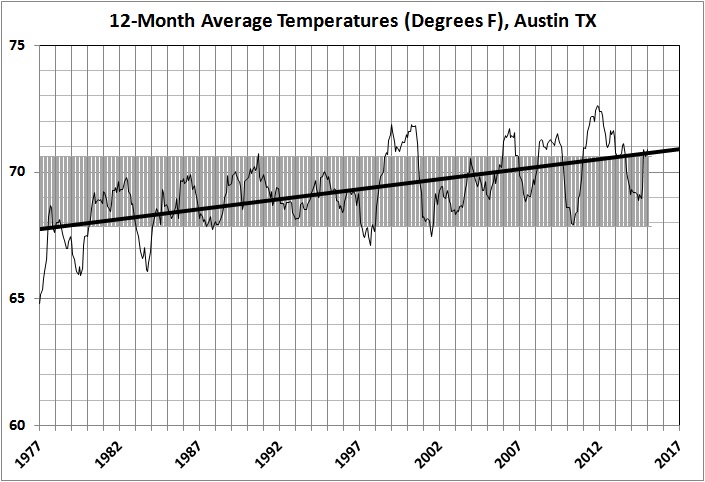
12-month average temperatures in Austin_1977-2015

The graph covers the period from April 1977 through April 2015. The jagged line represents 12-month averages of monthly averages for the official National Weather Service stations in Austin: Mueller Airport (until July 1999) and Camp Mabry (July 1999 to the present). (There’s a history of Austin’s weather stations in a NOAA document, “Austin Climate Summary.”) The upward trend is unmistakeable. Equally unmistakeable is the difference between the early and late years of the period — a difference that’s highlighted by the y-error bars, which represent a span of plus-and-minus one standard deviation from the mean for the period.

Your first question should be “Why begin with April 1977?” Well, it’s a “good” starting point — if you want to sell AGW — because the 12-month average temperature as of April 1977 was the lowest in 64 years. After all, it was the seemingly steep increase in temperatures after 1970 that sparked the AGW business.

What about the “fact” that temperatures have been rising since about 1850? The “fact” is that temperatures have been recorded in a relatively small number of locales continuously since the 1850s, though the reliability of the temperature data and their relationship to any kind of “global” average is in serious doubt. The most reliable data come from weather satellites, and those have been in operation only since the late 1970s.

A recent post by Bob Tisdale, “New UAH Lower Troposphere Temperature Data Show No Global Warming for More Than 18 Years” (Watts Up With That?, April 29, 2015), summarizes the history of satellite readings, in the course of documenting the “pause” in global warming. The “pause,” if dated from 2001, has lasted 14 years; if dated from 1997, it has lasted 18 years. In either event, the “pause” has lasted about as long as the rise in late-20th century temperatures that led to the AGW hypothesis.

What about those observations since the 1850s? Riddled with holes, that’s what. And even if they were reliable and covered a good part of the globe (which they aren’t and don’t), they wouldn’t tell the story that AGW enthusiasts are trying to sell. Take Austin, for example, which has a (broken) temperature record dating back to 1856:
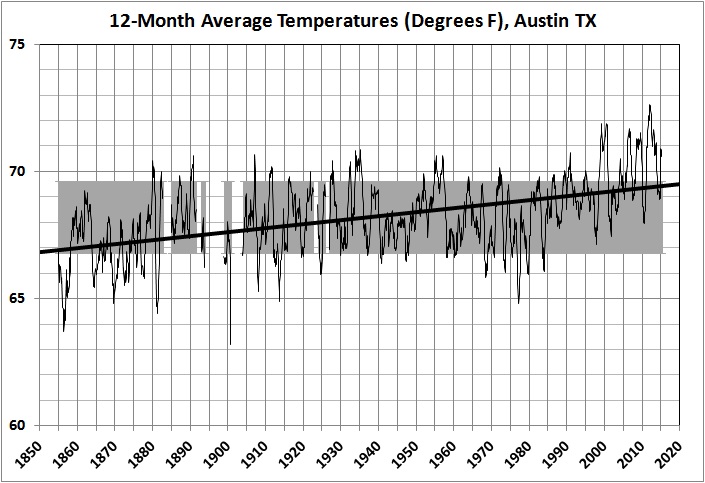
12-month average temperatures in Austin_1856-2015

Looks just like the first graph? No, it doesn’t. The trend line and error bars suggest a trend that isn’t there. Strip away the trend line and the error bars, and you see this:
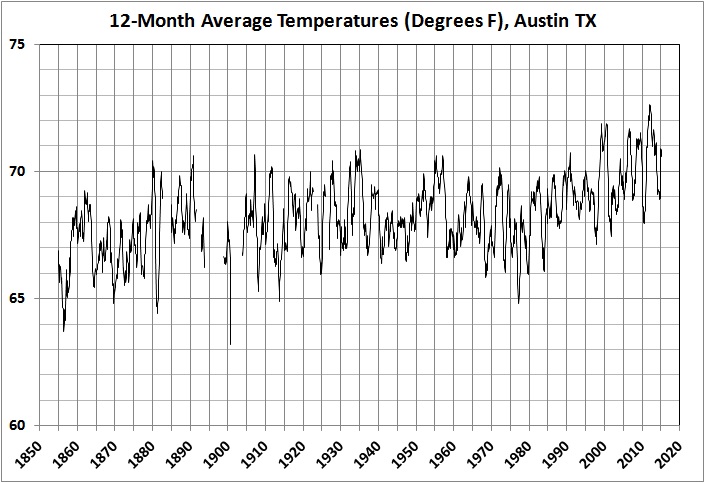
12-month average temperatures in Austin_1856-2015_2

Which is what? There’s a rise in temperatures between the 1850s and the early 1890s, consistent with the gradual warming that followed the Little Ice Age. The gap between the early 1890s and mid-19naughts seems to have been marked by lower temperatures. It’s possible to find several mini-trends between the mid-19naughts and 1977, but the most obvious “trend” is a flat line for the entire period:
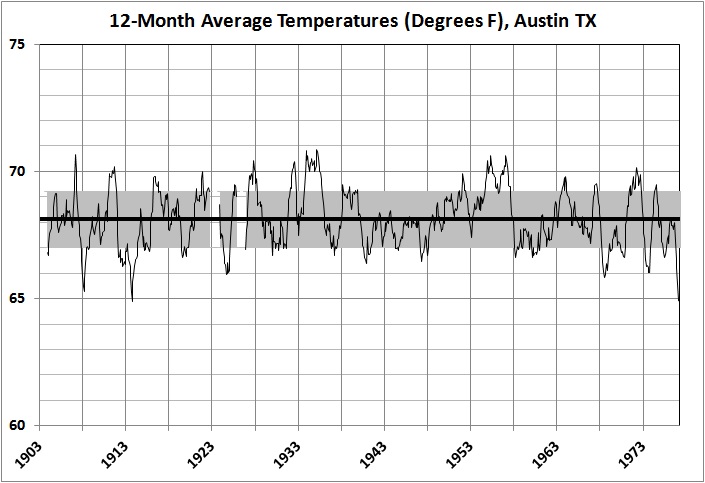
12-month average temperatures in Austin_1903-1977

Following the sudden jump between 1977 and 1980, the “trend” remains almost flat through 1997, albeit at a slightly higher level:
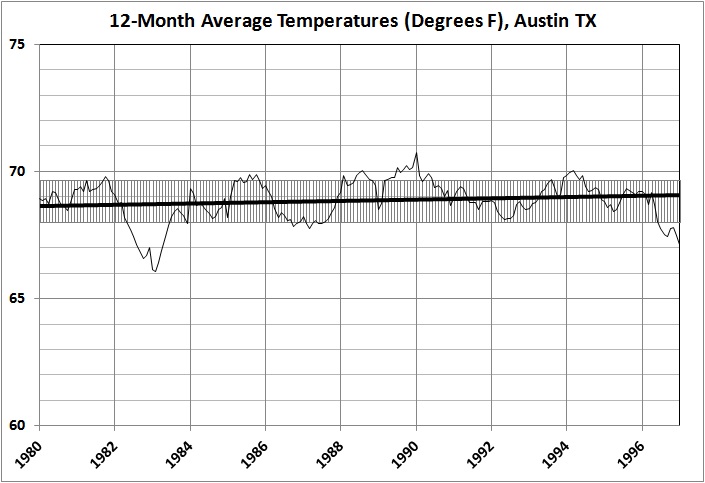
12-month average temperatures in Austin_1980-1997

The sharpest upward trend really began after the very strong (and naturally warming) El Niño of 1997-1998:
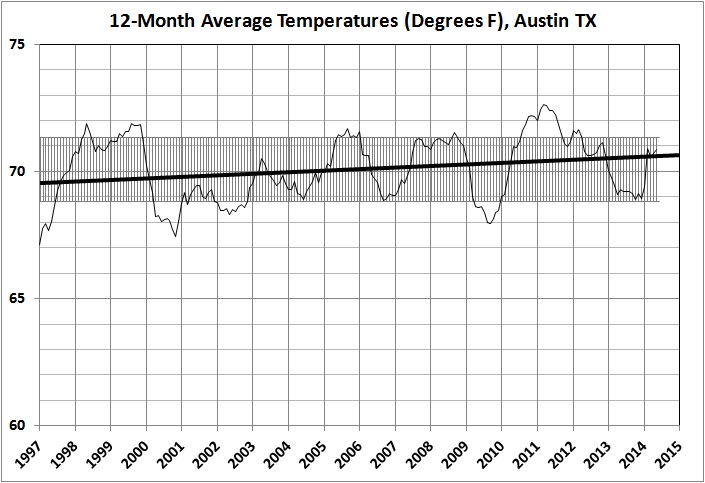
12-month average temperatures in Austin_1997-2015

Oh, wait! It turns out that Austin’s sort-of hot-spell from 1998 to the present coincides with the “pause” in global warming:
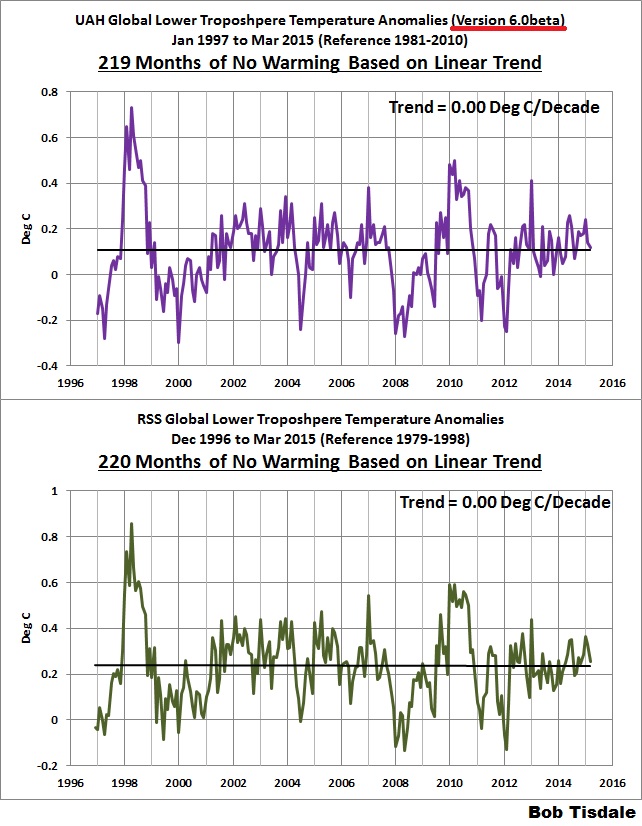
The pause_from WUWT_20150429
Source: Bob Tisdale, “New UAH Lower Troposphere Temperature Data Show No Global Warming for More Than 18 Years,” Watts Up With That?, April 29, 2015.

What a revolting development this would be for our local weather nazi, if he could be bothered to acknowledge it. And if he did, he’d have to look beyond the egregious AGW hypothesis for an explanation of the warmer temperatures that he abhors. Where should he look? Here: the rapid increase in Austin’s population, combined with a drought.

The rapid increase in Austin’s population since 2000 probably has caused an acceleration of the urban heat-island (UHI) effect. This is known to inflate city temperatures above those in the surrounding countryside by several degrees.

What about drought? In Austin, the drought of recent years is far less severe than the drought of the 1950s, but temperatures have risen more in recent years than they did in the 1950s:
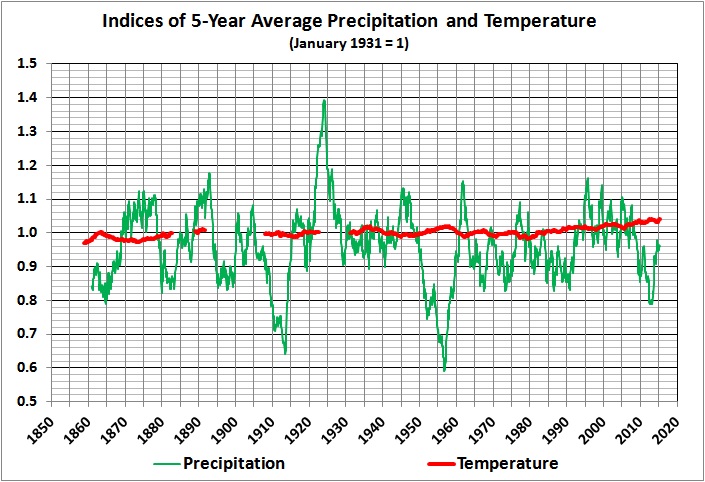
Indices of 5-year average precipitation and temperature

Why? Because Austin’s population is now six times greater than it was in the 1950s. The UHI effect has magnified the drought effect.

Conclusion: Austin’s recent hot weather has nothing to do with AGW. But don’t try to tell that to a weather nazi — or to the officials of the City of Austin, who lurch zombie-like onward in their pursuit of “solutions” to a non-problem.

BE SURE TO READ THE SEQUEL, IN WHICH I QUANTIFY THE EFFECTS OF PRECIPITATION AND POPULATION, LEAVING NOTHING ON THE TABLE FOR AGW.

*     *     *

Related reading:
U.S. climate page at WUWT
Articles about UHI at WUWT
Roy W. Spencer, “Global Urban Heat Island Effect Study – An Update,” WUWT, March 10, 2010
Anthony Watts, “UHI – Worse Than We Thought?,” WUWT, August 20, 2014
Christopher Monckton of Brenchley, “The Great Pause Lengthens Again,” WUWT, January 3, 2015
Anthony Watts, “Two New Papers Suggest Solar Activity Is a ‘Climate Pacemaker‘,” WUWT, January 9, 2015
John Hinderaker, “Was 2014 Really the Warmest Year Ever?,” PowerLine, January 16, 2015
Roy W. Spencer, John R. Christy, and William D. Braswell, “Version 6.0 of the UAH Temperature Dataset Released: New LT Trend = +0.11 C/decade,” DrRoySpencer.com, April 28, 2015
Bob Tisdale, “New UAH Lower Troposphere Temperature Data Show No Global Warming for More Than 18 Years,” WUWT, April 29, 2015
Patrick J. Michaels and Charles C. Knappenberger, “You Ought to Have a Look: Science Round Up—Less Warming, Little Ice Melt, Lack of Imagination,” Cato at Liberty, May 1, 2015
Mike Brakey, “151 Degrees Of Fudging…Energy Physicist Unveils NOAA’s “Massive Rewrite” Of Maine Climate History,” NoTricksZone, May 2, 2015 (see also David Archibald, “A Prediction Coming True?,” WUWT, May 4, 2015)
Christopher Monckton of Brenchley, “El Niño Has Not Yet Paused the Pause,” WUWT, May 4, 2015
Anthony J. Sadar and JoAnn Truchan, “Saul Alinsky, Climate Scientist,” American Thinker, May 4, 2015
Clyde Spencer, “Anthropogenic Global Warming and Its Causes,” WUWT, May 5, 2015
Roy W. Spencer, “Nearly 3,500 Days since Major Hurricane Strike … Despite Record CO2,” DrRoySpencer.com, May 8, 2015

Related posts:
AGW: The Death Knell (with many links to related readings and earlier posts)
Not-So-Random Thoughts (XIV) (second item)

Signature

The Gaystapo At Work

UPDATE 1 (BELOW) ON 04/27/15 AT 3:15 PM CT

UPDATE 2 (BELOW) ON 04/30/15 AT 5:45 PM CT

The story is told in the text of a widget that appeared in my sidebar for about 18 hours:

If — unlike the Gaystapo — you believe in property rights, freedom of expression, and freedom of association, please consider making donations to the following small-business owners:

Click here to donate to Aaron and Melissa Klein, who face a $135,000 fine for refusing to bake a cake.

Click here to donate to Barronelle Stutzman, a florist who has been prosecuted for refusing to sell flowers.

Click here to support the owners of Memories Pizza, who have been harassed and threatened for refusing to sell pizzas.

Because there will be more of the same, I have established a fund-raising effort to funnel money to future victims of politically correct persecutions: RestoreLibertyUSA. [UPDATE 04/27/15: Unsurprisingly, GoFundMe pulled the plug on my campaign, just as it pulled the plug on the Kleins’ campaign. The enemies of liberty are at work full-time. Their method is simple; if you disagree with them they call you a “hater” — end of discussion. They are the haters, of course; they hate everyone who disagrees with them, and they will go to any lengths to silence dissent from their views.]

The first link above leads to a donation page at SamaritansPurse.org. That page was established after GoFundMe, a crowdfunding operation, put a stop to the Kleins’ fundraising effort there. (See, for example, Valerie Richardson’s “Gay-Rights Advocates Torpedo GoFundMe Campaign for Christian-Owned Bakery,” The Washington Times, April 25, 2015.)

Upon reading about the Kleins and their treatment by GoFundMe, I decided on Sunday evening (April 26) to set up a fund-raising campaign at GoFundMe. I didn’t specifically mention the Kleins in my description of the campaign, but my intention to help them and other victims of the Gaystapo was clear. I then posted the sidebar widget. (In its original form, it didn’t include the second link in the paragraph about the Kleins and the final passage in brackets, both of which I added this morning before removing the widget.) Within a few hours after I had set up my campaign, GoFundMe sent me an e-mail message, which I didn’t see until this morning. It reads, in relevant part:

We are writing to inform you that your GoFundMe campaign has been removed due to a violation of our Terms & Conditions.

The content of your campaign falls under our “Not Allowed on GoFundMe” section. You may view this in our Terms & Conditions here – http://www.gofundme.com/terms

Unfortunately, our Terms & Conditions, along with strictly enforced policies from the payments industry, prohibit GoFundMe from allowing you to continue raising money for this campaign….

I replied:

I have reviewed your terms and conditions. I don’t see anything listed under “Not Allowed on GoFundMe” that pertains to my campaign. Please be specific.

I will update this post [again] if GoFundMe responds.

UPDATE 1: I was waiting for this shoe to drop: “After Bakers’ Fundraising Campaign Shut Down, Florist Who Rejected Same-Sex Wedding Faces Same Fate” (Kelsey Harkness, The Daily Signal, April 27, 2015).

UPDATE 2: GoFundMe didn’t respond directly to my reply, but did — belatedly — change its written policy to conform to its deletion of my campaign and others. Kelsey Harkness provides the details in “After Shutting Down Christian Bakers’ Fundraising Campaign, GoFundMe Makes Policy Change” (The Daily Signal, April 30, 2015). It’s GoFundMe’s right to refuse my business, of course. It’s too bad that GoFundMe and the Gaystapo don’t recognize that others have the same right — the unconstitutional “public accommodation” provisions of the 1964 Civil Rights Act to the contrary notwithstanding.

*     *     *

Related reading:
Myron Magnet, “Free Speech in Peril,” City Journal, Spring 2015
Brendan O’Neill, “The Slow Death of Free Speech in Britain (America, You’re Next!),” Reason.com, April 26, 2015
Kelsey Harkness, “Should GoFundMe and Christian Bakers Be Treated the Same? We Ask,” The Daily Signal, April 28, 2015 [A good question, to which two obviously homosexual and fair-minded persons answered “they should be treated the same.”]

Related posts:
No Wonder Liberty Is Disappearing
How to Protect Property Rights and Freedom of Association and Expression
Democracy, Human Nature, and America’s Future
Good Riddance

Signature

Povertocracy: How Helpers Sustain the Poverty Industry

This is a guest post by L. P., whose psychological insights are a welcome addition to this blog.

As this is my first post, I’ll preface this discussion by describing how I came to recognize the dark side of helping behavior. Being the bookish person that I am, I didn’t think to look up and take notice of the ideological difference between me and the majority of my peers during the course of study. Upon graduating with an advanced degree it was, at that point, too late for me to go back and choose another field in which I would not be a “black sheep.”

Looking back, I realize that the ideological difference, and the different societal roles that we envisioned for ourselves, arose from our different motives for choosing to study psychology, and from our temperaments as they relate to motives. The left-leaning psychologists I’ve come to know chose psychology because they wanted to help individuals or improve humanity as a whole. I chose psychology because I only wanted to understand people but didn’t have the foggiest idea what I wanted to ultimately do this knowledge, if anything at all.

Temperament was likely at the root of why my peers regard helping behavior with starry-eyed Pollyanna simplicity as well. In contrast, I’d envision how good can come out of doing nothing and how negative consequences result from intervention, thus justifying my unwillingness to get off my duff to lend a hand. Who would’ve thought that laziness can open up your mind in ways do-goodery does not?

I can’t quantify the negative impact that institutionalized assistance has had on people it purports to help. But the prevailing focus on the positive effects of do-goodery ensures that its negative effects are overlooked.

Before addressing the psychological process through which inappropriate help disempowers people, let’s consider what Graham Hancock says about the negative impact of government-sponsored interna­tional development aid as well as the immunity from criticism that helping behavior enjoys:

It would seem, then, that official development assistance is neither necessa­ry nor suffi­cient for ‘development’: the poor thrive without it in some coun­tries; in others, where it is plentifully available, they suffer the most abject mise­ries. Such suffering, furthermore, as I have argued throughout this book, often occurs not in spite of aid but because of it. To continue with the charade seems to me to be absurd. Garnered and justi­fied in the name of the destitute and the vulnerable, aid’s main function in the past half century has been to create and then entrench a powerful new class of rich and privileged people. In that notorious club of parasites and hangers-on made up of the United Nations, the World Bank and the bilateral agencies, it is aid – and nothing else – that has provided hundreds of thou­sands of ‘jobs for the boys’ and that has permitted record-breaking standards to be set in self-serving behaviour, arrogance, paternalism, moral cowardice and mendacity. [Lords of Poverty: The Freewheeling Lifestyles, Power, Pres­ti­ge and Corruption of the Multibillion Dollar Aid Business (Lon­don: Mandarin, 1991), pp. 192-193]

The “official aid industry” is realized outside the control of the taxpayer. External control, but internal control as well, is virtually non-existent, according to Hancock, because it is concerned with disaster relief, food relief, medical help, in short: with helping. It is not appropriate in the presence of all that misery to question or criticize the helpers who, in professional and paid positions, go to foreign countries in order to assuage the needs of others. The chari­table impulse at the root of much aid-giving is at its most potent during disasters and emergencies. It is, however, a dou­ble-edged sword. On the one hand it raises lots of money. On the other it stifles questi­ons about the uses to which this mo­ney is put – and makes those who ask such questions look rather chur­lish. Critici­zing humanita­rianism and generosity is like criticizing the institution of mother­hood; it is just not ‘the done thing.’” [Ibid., p. 5]

Further, Godfried Engbersen observes that

poverty generates work, not only for researchers, but also for the professionals participating in those poverty-programs. In the Netherlands, we see a significant growth in the number of employment and education projects, but the effects of this new poverty industry in improving the lot of welfare recipients and long-term unemployed are this far very limited. [“Moderne armoede: feit en fictie,” So­ci­ologi­sche Gids 38:1 (1991), pp. 7-23]

To understand how help can perpetuate conditions it purports to alleviate, the question, “Why do individuals, groups or organizations apply themselves to helping other people, groups or countries?” must be considered in greater depth. Theo N.M. Schuyt mentions a few darker motives: helpers’ own fear and helplessness (e.g, fear of those they are helping), self-interest, and the need for social control. Schuyt discusses these motives at length in “The Magnetism of Power in Helping Relationships. Professional Attitude and Asymmetry,” Social Work and Society International Online Journal Vol. 2, No. 1 (2004).

To fully appreciate how help can hinder people, we must examine the subtle but influential negative assumptions that underlie the act of helping others and the messages received by those who are helped. Research articles by Francesca D’Errico, Giovanna Leone, and Isabella Poggi about teachers who overhelp their students  are informative in this regard. Although they must be purchased to view in their entirety, the previews support my view as to how helping reinforces negative self-evaluations of those in need; go here and  here (click “Look Inside”).

Whether one is giving or receiving help, a judgment about what one party has and the other lacks (e.g., resources, ability, etc.) precedes the interaction. Once this judgment is accepted, both parties’ understanding of the power asymmetry in the helping relationship is established:

We do not only evaluate others, but also ourselves, thus making up our self-image, a set of evaluative (and non-evaluative) beliefs about ourselves… But from self image the degree of autonomy of a person depends: if one has a positive evaluation of his own capacities and efficacy, he will pursue his goals in an autonomous and self-confident way. At school, for example, negative evaluations may have a serious impact on a pupil’s self-image, sense of efficacy, and learning: they tend to dis-able him, to make him less active, and possibly induce him to refrain from action. [Isabella Poggi and Francesca D’Errico, “Social Signals and the action – cognition loop. The case of over-help and evaluation,” Proceedings of IEEE International Conference on Affective Computing and Intelligent Interaction (New York: IEEE, 2009)]

One must wonder how dysfunctional motives, such as the ones listed above, warp helpers’ perception of themselves and the intended recipients of their help. Within the microcosm of the classroom, it is clear that negative self-evaluations on the part of students result when the teacher overhelps. According to Poggi and D’Errico,

Overhelping teachers induce more negative evaluations, more often concerning general capacities, and frequently expressed indirectly. This seems to show that the overhelp offered blocks a child’s striving for autonomy since it generates a negative evaluation, in particular the belief of an inability of the receiver. [Ibid.]

In conclusion, the manner in which overhelp negatively impacts social relationships and cognition has long been regarded as the reason why the poor stay poor. (See Schuyt, op. cit.)  In the effort to convince everyday do-gooders who support this type of aid because of their own dysfunctional emotional states, however, it will be necessary to frame the information in a more palatable way. In this regard, D’Errico et al. offer a few key questions and guidelines for distinguishing between help that promotes empowerment and autonomy from help that encourages dependency.

1. Is the problem to be solved possible manageable by the helped one?
2. May a humiliating intention (vs. a caring one) be inferred from the helping behavior?
3. Do the consequences of the helping behavior increase (vs. decrease) the power asymmetry needed for the help to occur?

Over-help occurs when the answer to at least one of these questions is positive. If answer to n.2 is negative, then over-help is in good face[sic], and we may speak of benevolent over-help; if positive, we may label it as malevolent over-help. [Francesca D’Errico, Giovanna Leone, and Isabella Poggi, “Types of Help in the Teacher’s Multimodal Behavior,” Human Behavior Understanding, Lecture Notes in Computer Science, Volume 6219 (2010), pp 125-139]

I see this as a starting point. What else can we do to dismantle the status of altruism and helping behavior as sacred cows? How else can we reframe the discussion in such a way that would encourage others to regard these issues with more objectivity? Any thoughts?

Related reading: Leone, G.. eds. (2009) Le ambivalenze dell’aiuto. Teorie e pratiche del dare e del ricevere. Unicopli, Milano

Welcoming a Guest Blogger

I’m very pleased to announce the addition of a guest blogger — Libertarian Psychologist, a.k.a. L. P. — to the roster of Politics & Prosperity.

L. P.’s education and work as a researcher, writer, and former telework consultant span various branches of psychology. She earned her B.A. in Psychology at the University of California at Berkeley and her M.A. in Psychology (with an emphasis in Industrial-Organizational Psychology) at California State University in Sacramento. Her exploratory nature also led her to study law, for a time, at McGeorge School of Law at the University of the Pacific and, later, to undertake doctoral coursework in Social Psychology at University of Nevada in Reno. As a self-directed free-thinker however, she finds the most educational value in autodidactism (self-directed learning), and is also a devoted student at the “school of hard knocks.”

Upon leaving academia, she followed her interests in personality and evolutionary psychology as well as political science. She then discovered libertarianism and recognized the ills of an overreaching governmental system. In addressing the problems of statism, she will write on the following topics:

  • Indoctrination into liberal ideology in public schools and universities: scope and effects on the direction of U.S. politics since the end of WWII.
  • Psychological impact of statist policies, especially with regard to dysfunctional “help” that undermines and disempowers people’s sense of agency (i.e., the social damage that results from interventions like affirmative action).
  • Critiques of contemporary social-engineering endeavors.
  • The roots of political differences from the perspective of personality and evolutionary psychology.
  • The effective communication of libertarian ideas to liberals.
  • The possibility or impossibility of a liberal-libertarian fusion.
  • Advantages of policies (private as well as public) that foster teleworking, virtual teams, etc. (i.e., how employers benefit from being able to attract and keep certain highly productive but seemingly “antisocial” types of workers.)

Signature

Good Riddance

When I read that Angie’s List had protested Indiana’s Religious Freedom Restoration Act by withdrawing a proposal before the Indianapolis City Council to expand its headquarters, I sent the following message to Angie’s List:

Knock it off. It’s tiresome and irksome. I subscribe to Angie’s List for information about local merchants. If one cent of my subscription fee goes toward your political posturing, I’m being short-changed.

The reply was (expectedly) replete with doublespeak; for example:

The company is putting the [expansion] project on hold until it can fully understand the implications of the freedom restoration act on its employees, both current and future.

Angie’s List has a number of employees who are members of unrepresented groups. The expansion project calls for Angie’s List to make a substantial commitment to hiring.  We are concerned that this bill may create an atmosphere where it will be difficult for us to retain and attract talent.

“Unrepresented groups” seem to have plenty of representation. If Angie’s List is really worried about the “atmosphere” in Indiana, it should leave Indiana, not just delay an expansion project. As I said: posturing.

A lot of other subscribers to Angie’s List must have complained, with this result:

Bill Oesterle, co-founder and chief executive of Angie’s List, announced he is stepping down from his position just weeks after the company took an outspoken stance against Indiana’s Religious Freedom Restoration Act.

Oesterle’s announcement comes after Angie’s List decided to withdraw a proposal before the Indianapolis City Council to expand its headquarters….

Oesterle told TheStatehouseFile.com the debate over religious liberty “came at a time when I was naturally thinking about what I might do for the rest of my life.”

“So I came to just the obvious realization that you have to pick,” said Oesterle. “You have to be a public company CEO or you can go work on political and social issues. You can’t do both.”

The Daily Signal previously reported the American Family Association and Family Research Council called for supporters of religious freedom to “Take Angie Off Your List” in a boycott of the company.

Tony Perkins, president of Family Research Council, said in a statement that Oesterle “jumped on the left’s misinformation bandwagon, using his company as leverage in the fight against religious liberty.”

“His position as CEO, he explained, is ‘incompatible’ with his political involvement–a view that was no doubt reinforced courtesy of former subscribers,” said Perkins.

I hope that Brandon Eich is enjoying a bit of schadenfreude. I must admit that I am.

Signature