The President’s Power to Kill Enemy Combatants

Michael Stokes Paulsen, an estimable professor of constitutional law of whom I’ve written before, takes a scholarly swing at the pantywaists who object to the killing of enemy combatants who happen to be U.S. citizens. Here’s the gist of Paulsen’s argument:

First, is there a constitutionally authorized state of war? The answer is yes: The Authorization for Use of Military Force (AUMF) of September 18, 20011 is a legally operative constitutional authorization of war.

Second, was al-Awlaki a legitimate military target—an enemy combatant falling within the scope of this war authorization? The answer, again, is yes: Anwar al-Awlaki was a person who fit within the scope of the AUMF’s authorization for use of force against enemy combatants.

Third, are decisions about targeting and killing enemy combatants within the President’s exclusive Commander in Chief Clause power to wage and conduct war, when authorized? The answer is a resounding yes: The President might legitimately and lawfully judge Anwar al-Awlaki to be an enemy combatant, covered by the September 18, 2001 AUMF.

Fourth, is al-Awlaki’s citizenship relevant?  Here, the correct answer is no—or at least it should be “no”: The Supreme Court wrongly seems to think that citizenship is, sometimes, relevant. The correct answer is that, in terms of the constitutional application of the war power, the citizenship of an enemy combatant, fighting for a force or power with whom the United States is at war, is not relevant, so long as that combatant falls within the description of persons or groups subject to the application of the war power.

Fifth, does there exist in our constitutional system what might be called a “Due Process of War” Clause that requires further judicial authorization—or some form of “kill warrant”—as a precondition to targeting an enemy combatant? The answer is no, or again, it should be “no”: The same Supreme Court decision that wrongly seems to make citizenship relevant also seemingly implies, equally wrongly, that targeting decisions are subject to judicial review or some other form of judicial legal process, at least in the case of U.S. citizen enemy combatants.

Sixth, what is the relevance of international law? The answer is that international law is primarily a political and diplomatic constraint on war-waging,4 not a domestic legal constraint that can alter or displace the constitutional powers of the President as Commander in Chief. [“Drone On: The Commander in Chief Power to Target and Kill Americans,” 38 Harvard Journal of Law & Public Policy 43 (2015)]

If you know of Paulsen and his writings, you know that he despises leftists like Barack Obama. Accordingly, Paulsen ends with this:

What if the nation has a poor, ineffectual Commander in Chief serving as President? Sadly—and with all due respect—that is the situation in which the United States finds itself today. We have, right now, an exceedingly poor Commander in Chief serving in the office of President of the United States, arguably the weakest such commander in more than 100 years. The current occupant of the office appears to lack the essential qualities of a good Commander in Chief: decisiveness, moral clarity, consistency, conviction, political and personal acumen, diplomatic savvy, strategic sense and vision, resiliency, thick-skinned moral toughness, and good old-fashioned guts. As I write, the U.S. President is not a strong person, and is not a strong Commander in Chief. The consequences in terms of world events, lost wars, invasions, and deaths, are evident for all to see and have been much commented upon by others.

My point here, however, is that none of this goes to the existence of constitutional power. As poor as the Commander in Chief may be at any given point of time, in terms of personal qualities and abilities, he or she always retains the constitutional powers of the office. These include the power to target and kill enemy combatants in time of war, including U.S. citizens, by available weapons technology when the President determines that they are active enemy combatants engaged in war against the United States. That this is a fearsome and important power is only another reason why it is so vitally important to elect a person with the requisite abilities and character to perform so awesome a task as serving as Commander in Chief of U.S. military forces in time of constitutionally authorized war.

Zing!

Signature

“Blue Wall” Hype

Michael Barone’s analysis of the so-called Blue Wall is must-read. Barone opens with this:

Do Republicans have a realistic chance to win the next presidential election? Some analysts suggest the answer is no. They argue that there is a 240-electoral-vote “blue wall” of 18 states and D.C. that have gone Democratic in the last six presidential elections.

A Democratic nominee needs only 30 more electoral votes to win the presidency, they note accurately. A Republican nominee, they suggest, has little chance of breaking through the blue wall. He (or she) would have to win 270 of the 298 other electoral votes.

Democrats do have an advantage in the electoral vote, because heavily Democratic clusters clinch about 170 electoral votes for them, while Republicans have a lock on only about 105. But the blue wall theory, like all political rules of thumb, is true only till it’s not. And this one could easily prove inoperative in a competitive 2016 race. [“Democrats’ ‘Blue Wall’ Not Impregnable to Republicans — If They’re Smart,” AEI.org, February 17, 2014]

Barone then demonstrates the flimsiness of the “Blue Wall.” Here’s my take:

The right GOP candidate with the right message can win some or all of the States that Obama won narrowly in 2012. In the table below, they’re the States whose electoral votes are highlighted in pale blue in the Tossup column (Florida, Ohio, and Virginia) and the States in the Swing Blue column (Colorado, Iowa, Michigan, Minnesota, Nevada, New Hampshire, Pennsylvania, and Wisconsin). If the GOP candidate were to hold all of the States won by Romney and take the additional Tossup and Swing Blue States, he or she would garner 347 electoral votes — a resounding victory.

Election 2012 - closeness of election, by State
Source: Derived from this table at Dave Leip’s Atlas of U.S. Presidential Elections.

Signature

The Obamacare Effect: Greater Distrust of Government

I think it’s not a coincidence that voters’ fears of the federal government ramped up in 2013, with policy cancellations and premium hikes, and again in 2015, as fines taxes for non-coverage loom: Voters views of federal government Source: Rasmussen Reports, here, here, here, here, here, and here. Signature

How to Eradicate the Welfare State, and How Not to Do It

I’ll begin with how not to do it. One way of not doing it is simply not to do it, which is the left’s way. In fact, the left is always on the lookout for ways to expand the welfare state.

Reform conservatives offer less obvious ways not to do it. And the left loves them for it. Consider, for example, Noah Smith’s list of “People I Admire” and see if you can spot what Smith’s “admirable” persons have in common. Hint: They are either lefties or they do things that lefties like.

What’s James Pethokoukis doing on that list? Pethokoukis is an economist at American Enterprise Institute (AEI), which has been described as right-leaning and conservative. Why, then, does Smith admire Pethokoukis? Because, in Smith’s words, Pethokoukis is a “reform conservative.”

And what is reform conservatism? According to Ross Douthat,

It’s rooted in two major premises, which I would summarize as follows:

1) The core economic challenge facing the American experiment is not income inequality per se, but rather stratification and stagnation — weak mobility from the bottom of the income ladder and wage stagnation for the middle class. These challenges are bound up in a growing social crisis — a retreat from marriage, a weakening of religious and communal ties, a decline in workforce participation — that cannot be solved in Washington D.C. But economic and social policy can make a difference nonetheless, making family life more affordable, upward mobility more likely, and employment easier to find.

2) The existing welfare-state institutions we’ve inherited from the New Deal and the Great Society, however, often make these tasks harder rather than easier: Their exploding costs crowd out every other form of spending, require middle class tax increases and threaten to drag on economic growth; their tangled web of subsidies and credits and tax breaks often benefit the already-affluent and create perverse incentives for the poor, and the distortions created by the way they pay for health care, in particular, contribute mightily to the rising cost of health insurance and thus the stagnation of middle class incomes. So we don’t face a choice between streamlining the welfare state and making it more supportive of work and family; we should be doing both at once.

Proceeding from these premises, the basic “reform conservative” agenda looks something like this:

a. A tax reform that caps deductions and lowers rates, but also reduces the burden on working parents and the lower middle class, whether through an expanded child tax credit or some other means of reducing payroll tax liability. (Other measures that might improve the prospects of low-skilled men, ranging from a larger earned income tax credit to criminal justice reforms that reduce the incarceration rate, should also be part of the conversation.)

b. A repeal or revision of Obamacare that aims to ease us toward a system of near-universal catastrophic health insurance, and includes some kind of flat tax credit or voucher explicitly designed for that purpose.

c. A Medicare reform along the lines of the Wyden-Ryan premium support proposal, and a Social Security reform focused on means testing and extending work lives rather than a renewed push for private accounts.

d. An immigration reform that tilts much more toward Canadian-style recruitment of high-skilled workers, and that doesn’t necessarily seek to accelerate the pace of low-skilled immigration. (Any amnesty should follow the implementation of E-Verify rather than the other way around, guest worker programs should not be expanded, etc.)

e. A “market monetarist” monetary policy as an alternative both to further fiscal stimulus and to the tight money/fiscal austerity combination advanced by many Republicans today.

f. An attack not only on explicit subsidies for powerful incumbents (farm subsidies, etc.), but also other protections and implicit guarantees, in arenas ranging from copyright law to the problem of “Too Big To Fail.” [“What Is Reform Conservatism?,” The New York Times, May 30, 2013]

Such proposals may seem like reasonable compromises with the left’s radical positions. But they are reasonable compromises only if you believe that the left wouldn’t strive vigorously to undo them and continue the nation’s march toward full-blown state socialism. That’s the way leftists work. They take what they’re given and then come back for more, lying and worse all the way. As Saul Alinsky (a source of inspiration for Barack Obama) says in Rules for Radicals:

The third rule of the ethics of means and ends is that in war the end justifies almost any means.

The left is always at war, and will be at war until the United States becomes unrecognizable by a survivor of the 1950s, let alone a Founding Father: a nation whose official policies punish success, subvert civil society, and leave Americans defenseless against domestic and foreign predators.

What this means is that “reforms” like those listed by Douthat can be achieved only by opposing them, not by agreeing to them up front. But that’s not what Pethokoukis proposes. For example, with respect to Social Security, he endorses a proposal by Andrew Biggs that would work like this, according to Pethokoukis:

First, workers would be enrolled automatically in an employer-sponsored retirement account and contribute at least 1.5% of pay, matched dollar for dollar by their employers. Second, Social Security’s government-provided benefits would be transformed into a flat universal benefit mean to improve social-insurance protections for low-income Americans. Biggs: “If you put the two benefits together, this poverty-level benefit, plus the individual accounts, the result is near what Social Security promised to pay, but can’t afford. It’s a more reliable system for low-income folks and it’s more affordable on the tax end.” [“Joni Ernst, the Tea Party, and Conservative Reform,” AEI.org, February 10, 2014[

Why throw in the towel now? Because, according to Biggs,

President Bush’s 2001 Commission to Strengthen Social Security (on which I was a staffer) wrote that once the program began to run payroll-tax deficits — something that happened this year — policymakers would face difficult choices to raise taxes, cut benefits, reduce other programs, or increase the budget deficit. … With personal accounts, we face the same choices, only sooner. If workers invest part of their Social Security taxes in personal accounts, they could indeed earn higher returns and generate higher benefits without taking more risk. But diverting taxes to accounts leaves the program short of what is needed to pay benefits to today’s retirees. To cover these “transition costs,” we would need to generate new revenues for the program, either by raising taxes, cutting other programs, or borrowing. [“Personal Accounts Are No Cure-All,” National Review Online, August 30, 2010]

The real problem, as Biggs sees it, isn’t that shifting to personal accounts (for younger workers) would lead to transition costs, but that those costs would come sooner. So what? The end of Social Security revenue surpluses doesn’t alter the fact that non-retirees will have to pay higher taxes to avert a reduction of retirees’ benefits, it just makes the fact more apparent.

In other words, the likes of Biggs and Pethokoukis are willing to sacrifice privatization on the altar of public relations. The dog that doesn’t bark in their proposals is real reform of Social Security. Privatization isn’t real reform because it accepts a basic premise of Social Security: Americans must and should be forced to save for retirement. The joke is that Social Security doesn’t foster saving; it’s a transfer-payment Ponzi scheme.

Real reform means eradication, albeit gradual eradication, like this:

1. Repeal and replace Social Security as of a date certain. Call it Abolition Day (AD), which would occur 12 months from the day on which reform legislation is enacted.

2. After AD, the federal government would continue to pay benefits to persons who are then collecting Social Security. The federal government would also pay benefits to persons who turn 55 before AD but who haven’t yet begun to collect benefits. Persons who are 45 to 54 years old on AD would receive benefits that are pro-rated according to the Social Security taxes that they and their employers had paid as of AD. Cost-of-living increases for benefits paid after AD would be tied to chained CPI. (This is a better measure of inflation, and it doesn’t rise as fast as CPI-W, the price index now used to compute cost-of-living increases.)

3. Persons who are younger than 45 on AD would receive a lump-sum repayment of Social Security taxes paid by them and their employers, plus interest at, say, the rate on 10-year Treasury notes. The repayment would be made when a person turns 70. It would automatically go to a surviving spouse or next-of-kin if the recipient dies intestate. Otherwise, the recipient could bequeath, transfer, or sell his interest in the payment at any time before it comes due.

4. For persons who are 45 to 54 years old on AD, the retirement age for full benefits would be raised to 70, and the minimum age for partial benefits would be raised to 65. (Full retirement age is now scheduled to rise to 67 in 2027; the minimum age for partial benefits is currently set at 62.)

5. The residual obligations outlined above would be funded by a special payroll tax, which would diminish as obligations are liquidated, then vanish.

But what about retirees (and their households) whose incomes are below the poverty line? It might be necessary to provide for them, to ensure the passage of reform legislation. But it would be self-defeating to offer a program for the indigent. An important goal of Social Security reform is to encourage work and saving — not to preemptively discourage work and saving by rewarding indolence.

A deal for the passage of reform might include separate legislation that provides for stringently means-tested income support. The amount of support would be aimed at boosting the total income of a retiree (or his household) to the poverty line. Examiners would take into account an applicant’s income (including income in kind) from all sources, and an applicant’s assets (with a look-back period of several years and criminal penalties for hiding assets). For an applicant who is married or a member of a household, the income and assets of a spouse and/or other members of the household would be taken into account. Benefits wouldn’t be paid to able-bodied and able-minded persons who are unemployed and below retirement age.  (No handouts to slackers who still live at home.)

How might such a “radical” plan be enacted?

Proponents of reform — Republicans, presumably — must launch a vigorous, pro-reform campaign the minute that they gain control of both Houses of Congress and the White House. They must sustain the campaign for several months before Congress sends a bill to the president, to ensure broad support for the enactment of reform. And to prevent their efforts from being stymied by Democrats, they must change the rules of the Senate to eliminate the filibuster and other obstructive tactics.

Here are the key elements of the campaign:

  • Document, publicize, and ceaselessly emphasize the the size of the tax increases that will result if Social Security benefits aren’t reduced to match projected revenues.
  • Point out, relentlessly, that a large fraction of Americans (cite number) who “contribute” to Social Security will earn worse “returns” that they would by putting their money into safe, interest-bearing investments (e.g., investment-grade corporate bonds).
  • Emphasize the true, original purpose of Social Security: keep the poorest of the elderly out of poverty.
  • Show how much less costly it would be if Social Security were restored to its original purpose.
  • Explain that their program (a) achieves the original purpose of Social Security, (b) enables the non-poor to do better for themselves than they would with Social Security, and (c) fosters economic growth that reduces dependence on Social Security:

Enough of Social Security. What about Douthat’s other “reforms”?

Tax reform that caps deductions and lowers rates, but also reduces the burden on working parents and the lower middle class, whether through an expanded child tax credit or some other means of reducing payroll tax liability.

This is too complex and easily manipulated. What’s needed is a true flat tax.

Repeal or revision of Obamacare that aims to ease us toward a system of near-universal catastrophic health insurance, and includes some kind of flat tax credit or voucher explicitly designed for that purpose.

Just repeal Obamacare and its partners-in-crime — Medicare and Medicaid — and phase them out gracefully (along the lines of my proposal for Social Security). Eliminate regulations that hinder interstate competition. Provide for the indigent — and only the indigent — through means-tested vouchers (along the lines of my proposal for Social Security).

Medicare reform along the lines of the Wyden-Ryan premium support proposal.

See above.

Immigration reform that tilts much more toward Canadian-style recruitment of high-skilled workers, and that doesn’t necessarily seek to accelerate the pace of low-skilled immigration. (Any amnesty should follow the implementation of E-Verify rather than the other way around, guest worker programs should not be expanded, etc.)

Immigration reform should discourage low-skilled immigration, as opposed to Obama’s policy of encouraging it. Discouraging it requires stronger security at the borders, a vigorous and well-publicized deportation effort, and the end of subsidies (no free health care, no free schooling, no eligibility for income or housing subsidies, no drivers’ licenses, etc.).

A “market monetarist” monetary policy as an alternative both to further fiscal stimulus and to the tight money/fiscal austerity combination advanced by many Republicans today.

Eliminate the Federal Reserve, a leading cause of the Great Depression and Great Recession. Allow free banking. Fiscal and monetary policy should be “none,” as in the case of the Depression of 1920-21, the depression that cured itself. (NB: The Fed caused that one, too.)

An attack not only on explicit subsidies for powerful incumbents (farm subsidies, etc.), but also other protections and implicit guarantees, in arenas ranging from copyright law to the problem of “Too Big To Fail.”

Douthat gets this one right. But one out of seven is a batting average of 0.143 — abject failure in any league.

“Attack” is the key word in Douthat’s unusual stroke of boldness. Liberty is born of attack, not compromise.

Signature

Some Thoughts about Probability (Updated)

Here.

Tolerance

Bryan Caplan struggles to define tolerance. This seems to be what he’s searching for:

a disposition to allow freedom of choice and behavior

TheFreeDictionary.com, Thesaurus, Noun, 2

With that definition in mind, I’ll address the reasons given by Caplan for practicing tolerance:

1. People’s moral objections to how other people use their own person and property are usually greatly overstated – or simply wrong.  Think about how often people sneer at the way others dress, talk, or even walk.  Think about how often people twist personality clashes into battles of good versus evil.  From a calm, detached point of view, most of these complaints are simply silly.

The link points to a post in which Caplan confesses his own immature silliness. What’s missing are the “complaints” that are not “simply silly.” Take abortion, for example. It’s a practice that’s often defended on pseudo-libertarian grounds: a patently contrived right to privacy, for example. Caplan is cagey about abortion. If he is opposed to it, his reasons seem utilitarian rather than moral. In any event, opposition to abortion is not mere silliness; it is based on a profound moral objection to murder.

Nor should so-called personality clashes be dismissed as silliness. For example, during my 30 years as an analyst and manager at a major defense think-tank, I was a party to five conflicts (lasting months and years) that ignorant bystanders might have called personality clashes (and some bystanders did just that). But all five conflicts involved substantive differences about management methods, business ethics, or contractual performance.

Contra Caplan, I believe that differences about principle or substance give rise to most so-called personality clashes. It’s easy to dislike a person — and hard to disguise dislike — when that person reveals himself as incompetent, venal, manipulative, or corrupt. It seems to me that Caplan’s unfounded characterization of “most” disputes as personality clashes, and his back-handed dismissal of them as “battles of good versus evil,”  reflects his own deep-seated taste for conflict avoidance, as an avowed and outspoken pacifist.

*     *     *

2. People’s moral objections to how other people use their own person and property often conflate innocent ignorance with willful vice.

I’ll have to compensate for Caplan’s vagueness by offering examples of what he might have in mind:

Al disapproves of Bob’s drunken driving, which caused a serious accident. Bob didn’t know he had been drinking vodka-spiked lemonade.

Bob was innocently ignorant of the vodka in the lemonade when he was drinking it. But Bob probably knew that he wasn’t fit to drive if he was impaired enough to have an alcohol-induced accident. It’s therefore reasonable to disapprove of Bob’s drunken driving, even though he didn’t intend to drink alcohol.

Jimmy and Johnny were playing with matches, and started a fire that caused their family’s house to burn to the ground. They escaped safely, but all of their family’s possessions — many of them irreplaceable — were lost. Nor did insurance cover the full cost of rebuilding their house.

Jimmy and Johnny may have been innocent, but it’s hard not to disapprove of their parents for lax child-rearing or imprudence (not keeping matches safely hidden from children).

Alison looked carefully before changing lanes, but a car on her right was in her blind spot. She almost hit the car as she began to change lanes, but pulled back into her own lane before hitting it. Jake, the driver of the other car, was enraged by the near collision and honked at Allison.

Jake was rightly enraged. He might have been killed. Alison may have looked carefully, but it’s evident that she didn’t look carefully enough.

LaShawn enjoys rap music, especially loud rap music. (Is there any other way to play it?) He has some neighbors who don’t enjoy rap music and don’t want to hear it. The only way to get LaShawn to turn down the volume is to complain to him about the music. It doesn’t occur to LaShawn that the volume is too high and that his neighbors might not care for rap music.

This used to be called “lack of consideration,” and it was rightly thought of as a willful vice.

DiDi is a cell-phone addict. She’s on the phone almost everywhere she goes, yakking it up with her friends. DiDi doesn’t seem to care that her overheard conversations — loud and one-sided — are annoying and distracting to many of the persons who are subjected to them.

Lack of consideration, again.

Jerry has a fondness for booze. But he stays sober until Friday night, when he goes to his local bar and gets plastered. The more he drinks the louder and more obnoxious he becomes.

When Jerry gets drunk, he isn’t in control of himself, in some psychological sense. Thus his behavior might be said, by some, to arise out of innocent ignorance. But Jerry is in control of himself before he gets drunk. He surely knows how he behaves when he’s drunk, and how his behavior affects others. Jerry’s drunken behavior arises from a willful vice.

Ted and Deirdre, a married couple, are highly paid yuppies. They worked hard to earn advanced degrees, and they work hard at their socially valued professions (physician and psychologist). They live in an upscale, gated community, drive $75,000 cars, dine at top-rated restaurants, etc. And yet, despite the obvious connection between their hard work and their incomes (and what those incomes afford them), they are ardent “liberals.” (See the sidebar for my views on modern “liberalism.”) They vote for left-wing candidates, and contribute as much as the law allows to the campaigns of left-wing candidates. They have many friends who are like them in background, accomplishments, and political views.

This may seem like a case of innocent ignorance, but it’s not. Ted and Deirdre (and their friends) are intelligent. They understand incentives. They understand (or they would, if they thought about it) that progressive taxation and regulations blunt incentives to work, save, and invest. They therefore understand (or could easily understand) that the plight of the poor and “downtrodden” who are supposed to be helped by progressive taxation and regulations is actually made worse by those things. They certainly understand such things viscerally because they make every effort to reduce their taxes (through legal means, of course); they do not contribute voluntarily to the U.S. Treasury (even though they know that they could); and they dislike regulations that affect them directly. Ted and Deidre (and the legions like them) allow their guilt-driven desire for “equality” to obscure easily grasped facts of life. They ignore or suppress the facts of life in order to preen as “caring” persons. At bottom, their ignorance is willful, and inexcusable in persons of intelligence.

In sum, it’s far from evident to me that “how other people use their own person[s] and property often conflate[s] innocent ignorance with willful vice.” There’s much less innocent ignorance in the world than Caplan would like to believe.

*     *     *

3. People’s best-founded moral objections to how other people use their own person and property are usually morally superfluous.  Why?  Because the Real World already provides ample punishment.  Consider laziness.  Even from a calm, detached point of view, a life of sloth seems morally objectionable.  But there’s no need for you to berate the lazy – even inwardly.  Life itself punishes laziness with poverty and unemployment… So even if you accept (as I do) the Rossian principle that a just world links virtue with pleasure and vice with pain, there is no need to add your harsh condemnation to balance the cosmic scales.

On what planet does Caplan live? Governments in the United States — the central government foremost among them — reward and encourage sloth through extended unemployment benefits, bogus disability payments, food stamps, etc., etc. etc. There’s every reason to voice one’s displeasure with such goings on, and to give force to that displeasure by working and voting against the policies and politicians who make it possible for the slothful to live on the earnings of others.

*     *     *

4. The “especially strangers” parenthetical preempts the strongest counter-examples to principled tolerance.  There are obvious cases where you should strongly oppose what your spouse, children, or friends do with themselves or their stuff.  But strangers?  Not really.

Yes, really. See all of my comments above.

*     *     *

5. Intolerance is bad for the intolerant.  As Buddha never said, “Holding onto anger is like drinking poison and expecting the other person to die.”  The upshot is that the Real World punishes intolerance along with laziness, drunkenness, and gluttony.  Perhaps this is the hidden wisdom of the truism that “Haters gonna hate.

Here Caplan makes the mistake of identifying intolerance with anger. A person who is intolerant of carelessness, thoughtlessness, and willful vice isn’t angry all the time. He may be angered by careless, thoughtlessness, and willful vice when he sees them, but his anger is righteous, targeted, and controlled. Generally, he’s a happy person because he’s probably conservative.

It’s all well and good to tolerate freedom of choice and behavior, in the abstract. But civilization depends crucially on intolerance of particular choices and behaviors that result in real harm to others — psychic, material, and physical. Tolerance of such choices and behaviors is simply a kind of appeasement, which is what I would expect of Caplan — a man who can safely preach pacifism because he is well-guarded by the police and defense forces of his locality, State, and nation.

*     *    *

Related posts:
The Folly of Pacifism
The Folly of Pacifism, Again
More Pseudo-Libertarianism
Defending Liberty against (Pseudo) Libertarians

Signature

Sunstein the Fatuous

Since my last brush with the dangerous mind of Cass Sunstein (here, seventh item), I have encountered two more of his effusions. They reveal Sunstein’s utter fatuity.

In a piece that dates back to May of last year, Sunstein writes:

Suppose that an authoritarian government decides to embark on a program of curricular reform, with the explicit goal of indoctrinating the nation’s high school students. Suppose that it wants to change the curriculum to teach students that their government is good and trustworthy, that their system is democratic and committed to the rule of law, and that free markets are a big problem.

Will such a government succeed? Or will high school students simply roll their eyes?

Questions of this kind have long been debated, but without the benefit of reliable evidence. New research, from Davide Cantoni of the University of Munich and several co-authors, shows that recent curricular reforms in China, explicitly designed to transform students’ political views, have mostly worked….

…[G]overnment planners were able to succeed in altering students’ views on fundamental questions about their nation. As Cantoni and his co-authors summarize their various findings, “the state can effectively indoctrinate students.” To be sure, families and friends matter, as do economic incentives, but if an authoritarian government is determined to move students in major ways, it may well be able to do so.

Is this conclusion limited to authoritarian nations? In a democratic country with a flourishing civil society, a high degree of pluralism, and ample room for disagreement and dissent — like the U.S. — it may well be harder to use the curriculum to change the political views of young people. But even in such societies, high schools probably have a significant ability to move students toward what they consider “a correct worldview, a correct view on life, and a correct value system.” That’s an opportunity, to be sure, but it is also a warning. [“Open Brain, Insert Ideology,” Bloomberg View, May 20, 2014]

Where has Sunstein been? He seems unaware of the left-wing ethos that has long prevailed in most of America’s so-called institutions of learning. It doesn’t take an authoritarian government (well, not one as authoritarian as China’s) to indoctrinate students in “a correct worldview, a correct view on life, and a correct value system.” All it takes is the spread of left-wing “values” by the media and legions of pedagogues, most of them financed (directly and indirectly) by a thoroughly subverted government. It’s almost a miracle — and something of a moral victory — that there are still tens of millions of Americans who resist and oppose left-wing “values.”

Moving on, we find Sunstein arguing circularly in his contribution to a collection of papers entitled “Economists on the Welfare State and the Regulatory State: Why Don’t Any Argue in Favor of One and Against the Other?” (Econ Journal Watch, Volume 12, Issue 1, January 2015):

…[I]t seems unhelpful, even a recipe for confusion, to puzzle over the question whether economists (or others) ‘like,’ or ‘lean toward,’ both the regulatory state and the welfare state, or neither, or one but not the other. But there is a more fine-grained position on something like that question, and I believe that many (not all) economists would support it. The position is this: The regulatory state should restrict itself to the correction of market failures, and redistributive goals are best achieved through the tax system. Let’s call this (somewhat tendentiously) the Standard View….

My conclusion is that it is not fruitful to puzzle over the question whether economists and others ‘favor’ or ‘lean’ toward the regulatory or welfare state, and that it is better to begin by emphasizing that the first should be designed to handle market failures, and that the second should be designed to respond to economic deprivation and unjustified inequality…. [Sunstein, “Unhelpful Abstractions and the Standard View,” op cit.]

“Market failures” and “unjustified inequality” are the foundation stones of what passes for economic and social thought on the left. Every market outcome that falls short of the left’s controlling agenda is a “failure.” And market and social outcomes that fall short of the left’s illusory egalitarianism are “unjustified.” Sunstein, in other words, can’t see that he is a typical leftist who (implicitly) favors both the regulatory state and the welfare state. He is like a fish in water.

It remains a mystery to me why Sunstein has been called a “legal Olympian.” Then, again, if there were a legal Olympics, its main events would be Obfuscation and Casuistry. Sunstein would be a formidable contestant in both events.

*     *     *

Related posts:
Sunstein at the Volokh Conspiracy
More from Sunstein
Cass Sunstein’s Truly Dangerous Mind
An (Imaginary) Interview with Cass Sunstein
Libertarian Paternalism
Slippery Sunstein
A Libertarian Paternalist’s Dream World
The Short Answer to Libertarian Paternalism
Second-Guessing, Paternalism, Parentalism, and Choice
Another Thought about Libertarian Paternalism
Back-Door Paternalism
Another Voice Against the New Paternalism
Sunstein and Executive Power
The Feds and “Libertarian Paternalism”
A Further Note about “Libertarian” Paternalism
Apropos Paternalism
FDR and Fascism
Fascism
Are We All Fascists Now?
Fascism with a “Friendly” Face
Fascism and the Future of America
Discounting and Libertarian Paternalism
The Mind of a Paternalist
Another Entry in the Sunstein Saga
The Sunstein Effect Is Alive and Well in the White House
Not-So-Random Thoughts (XII) (seventh item)

Signature

Nature, Nurture, and Inequality

I almost always agree with John Derbyshire, and this post by him is no exception. But he does err in the course of the aforementioned post when he says:

The Left, which I am using to mean approximately people who want a more egalitarian society [a generous characterization], believe that the causes of human inequality are external to the individual human being. If you fix the external causes, then you get a more equal society. The Right, who are more tolerant of inequality, believe that components of human nature are innate. Customary and traditional social arrangements that are not obviously harmful shouldn’t be disturbed for projects of human improvement that are likely to prove futile.

Both sides have a case. The Left does have a case. Human nature has somewhat improved. Rigid hereditary social hierarchies of the kind that a conservative over 200 years ago would have fought to the death for, proved to be not as necessary as they thought. Most human beings in most places no longer enslave, eat, or publicly torture each other. So human nature does improve. Many of you have probably read Stephen Pinker’s recent book about the long term decline of violence. We’re kinder and gentler than our remote ancestors.

Pinker’s book is hogwash. I won’t repeat all of the reasons for saying that. Just go here and see for yourself. See also this excellent article by William Kirkpatrick.

Derbyshire soon gets back on track:

But the Right also has a case. And much of the strength of that case comes from the last few decades of research in the human sciences.

Individual personality seems to resemble what physicists call “shape memory alloys.” These are metal alloys that you can construct that remember their shape—you can take a bar of this stuff and bend it into a knot, and when you heat it up, it unbends itself and remembers its original shape. Human nature seems to be much like that. You can push people in certain directions during childhood and adolescence, but the finished adult human being seems to follow the Judith Rich Harris model: 50% heredity and the rest environmental.

I am sure that some of you know that last month [October 2014] was the twentieth anniversary of the publication of Richard Herrnstein and Charles Murray‘s book, The Bell Curve. There have been a number of commemorative articles on human science websites. The grand metaphysician of the Human Biodiversity movement, Steve Sailer, published what I thought, was a very witty comment about it. He said that there had been a complete change in our understanding of, for example, educational attainment. Statistically, 20 years ago there was definitely a hierarchy of educational attainment. At the top you had Orientals, below them you had Caucasians, below them you had Chicanos, and below them you had Blacks on average statistical attainment. Now things are completely different. Now there is a new hierarchy. At the top you have Asians, second you have Whites, third you have Hispanics, and fourth you have African Americans.

So, bottom line there, not much has changed. Where the Left favors a belief in high levels of malleability, reality does not seem to agree.

But reality, as usual, eludes the left. Consider for example The Economist, which is a useful tool of the left. Here is Dr. James Thompson on the case:

There is much innocent fun to be gained from The Economist’s coy avoidance of the genetics of intelligence. They are mired in Blank-Slatism, but are cautiously tip-toeing towards admitting a few things, only to then back away again, thus taking them back to where they came from. This is not all bad: by conceding the importance of intelligence and then immediately saying it is driven by wealth they keep the Faith, whatever it is, but hint that they know more than they will let on in public….

…[I]n The Economist’s view brighter people marrying brighter people is not seen as a positive development, but a practice which “increases inequality”. Of course, duller people marrying duller people also increased inequality. In fact, couples assort themselves on intelligence more than anything else:

http://drjamesthompson.blogspot.com/2014/12/five-gold-rings-inherited.html ….

In a related article they spell out their concerns: An hereditary meritocracy: The children of the rich and powerful are increasingly well suited to earning wealth and power themselves. That’s a problem….

[T]he problem seems to be that they deserve to get ahead, the bounders! …

None of The Economist’s articles or the papers they quote make it clear that intelligence must be considered a driving force in economic life and, consequently, in earnings, social status and resultant wealth. Curious, isn’t it, that a magazine written by the smart fraction for the smart fraction cannot bear to mention the smart fraction in a positive light? Perhaps they fear they will be cursed by the deity, or slaughtered by the baying mob. Noblesse oblige.

[The quotations are from “The Economist Takes a Half Step Forwards,” Psychological Comments, January 23, 2015. Thompson refers to three articles in The Economist: “America’s New Aristocracy,” “Getting ‘Em Young,” and “An Hereditary Meritocracy,” all dated January 24, 2015.]

In the left’s demented view, it would be better if the human race were populated by seven billion equally stupid (and equally unattractive) persons, all scrambling for survival, than to allow the brightest to intermarry and produce a relative handful of intelligent producers whose efforts enrich the lives of the billions (or a large fraction of them). Heaven forbid that the relative handful should thus be rewarded with more than a “fair share” of the riches that they create.

I am certain, beyond a shadow of a doubt, that the “smart fraction” would not want to live in a world where its superior intelligence glibness went unrewarded.

*     *     *

Related posts:
Academic Bias
Intellectuals and Capitalism
“Intellectuals and Society”: A Review
The Left’s Agenda
The Left and Its Delusions
The Spoiled Children of Capitalism
Politics, Sophistry, and the Academy
Subsidizing the Enemies of Liberty
Are You in the Bubble?
The Fallacy of Human Progress
The Culture War
Income Inequality and Economic Growth
A Case for Redistribution, Not Made
Greed, Conscience, and Big Government
Ruminations on the Left in America
McCloskey on Piketty
The Rahn Curve Revisited

Signature

A Cop-Free World?

Rolling Stone recently turned from rape fiction to nonsense of the kind on display in José Martín’s “Policing Is a Dirty Job, But Nobody’s Gotta Do It: 6 Ideas for a Cop-Free World” (December 16, 2014). Some excerpts and commentary (in bold):

  1. Unarmed mediation and intervention teams

Unarmed but trained people, often formerly violent offenders themselves, patrolling their neighborhoods to curb violence right where it starts. This is real and it exists in cities from Detroit to Los Angeles. Stop believing that police are heroes because they are the only ones willing to get in the way of knives or guns – so are the members of groups like Cure Violence, who were the subject of the 2012 documentary The Interrupters.

It’s real? Wonderful. How effective is it in Detroit, for example? Does it prevent all crime? If not, shouldn’t there also be neighborhood courts? (Yes, says Martin; see #3.) And shouldn’t those courts reflect neighborhood mores, which seem to condone a wide range of anti-social acts, like looting and burning? (And what does the straw man non sequitur about cops as heroes have to do with anything?)

  1. The decriminalization of almost every crime

What is considered criminal is something too often debated only in critical criminology seminars, and too rarely in the mainstream. Violent offenses count for a fraction of the 11 to 14 million arrests every year, and yet there is no real conversation about what constitutes a crime and what permits society to put a person in chains and a cage.

Well, there’s the answer to the problem of crime: Decree that here’s (almost) no such thing as crime. So, there’s really no need for neighborhood patrols, is there? All that’s required is a “conversation” about what constitutes crime. I thought that “conversation” took place several thousand years ago, when God spake to Moses. It also takes place in legislative chambers across the land. What Martin really wants isn’t a “conversation” about what constitutes a crime. Clearly, he wants a definition of crime that suits him. I doubt that his definition would include the theft of cigars from a convenience store.

  1. Restorative Justice

Also known as reparative or transformative justice, these models represent an alternative to courts and jails. From hippie communes to the IRA and anti-Apartheid South African guerrillas to even some U.S. cities like Philadelphia’s experiment with community courts, spaces are created where accountability is understood as a community issue and the entire community, along with the so-called perpetrator and the victim of a given offense, try to restore and even transform everyone in the process.

Yes, let’s “transform” thugs. What a great idea. Rehabilitative justice has such a wonderful track record — just ask the victims of real rapes, real muggings, real thefts, and real murders (oops, can’t ask them). And let’s “restore” property and lives that have been  “transformed” beyond restoration by the acts of violent criminals.

  1. Direct democracy at the community level

Reducing crime is not about social control. It’s not about cops, and it’s not a bait-and-switch with another callous institution. It’s giving people a sense of purpose. Communities that have tools to engage with each other about problems and disputes don’t have to consider what to do after anti-social behaviors are exhibited in the first place.

Reducing crime is about social control — the control that’s exerted through social norms that are taught and enforced in the home and in properly constituted courts of law, with the help of police and prosecutors. The real problem is that certain neighborhoods and communities fail to exert proper social control (in part because of family-destroying government policies), to the dismay of many persons in those neighborhoods and communities. And when local thugs run out of things and people to vandalize, steal, beat, rape, and murder in their neighborhoods and communities, it’s easy for them to take their act elsewhere. That’s one reason I want police in my neighborhood.
  1. Community patrols

This one is a wildcard. Community patrols can have dangerous racial overtones, from pogroms to the KKK to George Zimmerman. But they can also be an option that replaces police with affected community members when police are very obviously the criminals.

Let’s hope that the “affected community members” are armed, so they can defend themselves from thugs like Trayvon Martin and Michael Brown.

Who are the “obvious criminals” among the police? Darren Wilson, who shot Brown in self-defense? Daniel Pantaleo, who was attempting to arrest Eric Garner for breaking a law? Cops aren’t angels, but consider what they’re up against.

  1. Here’s a crazy one: mental health care

In 2012, Mayor Rahm Emanuel closed up the last trauma clinics in some of Chicago’s most violent neighborhoods. In New York, Rikers Island jails as many people with mental illnesses “as all 24 psychiatric hospitals in New York State combined,” which is reportedly 40% of the people jailed at Rikers. We have created a tremendous amount of mental illness, and in the real debt and austerity dystopia we’re living in, we have refused to treat each other for our physical and mental wounds.

Crazy, indeed. Who are the “we” who “have created a tremendous amount of mental illness [etc.]” and who “have refused to treat each other”? I can’t imagine any way in I am responsible for the culture of irresponsibility and violence that prevails in the kinds of “neighborhoods” and “communities” of which Martin writes. If anyone outside those neighborhoods and communities is responsible, it is do-gooders in government and their allies on the left, who have insisted on giving handouts without demanding work in return (handouts that have caused the breakage of countless families), and whose policies (e.g., the minimum wage, anti-business ordinances, anti-school choice) rob people of education, jobs, and the dignity that goes with them.
*     *     *
Martin writes in the usual truth-denying mode of leftism. The world is full of victims, especially victims of white power. The underlying causes of poverty, criminality, and familial dysfunctionality are ignored because they derive from a noxious compound of leftist policies and genetic and cultural heredity.
*     *     *
Related reading:
Fred Reed, “Real-Life Policing“, Fred on Everything, October 10, 2014
Chris Hernandez, “Ferguson, Idiot Cops, and Experts Who Know Nothing At All“, chrishernandezauthor, December 12, 2014
Fred Reed, “Solving the Police Problem“, Fred on Everything, December 31, 2014
Taki Theodoracopulos, “The Year of the Truth Camps“, Taki’s Magazine, January 3, 2015
Derek Cohen, “Ignore Rolling Stone’s Dangerously Naive Ideas about a Cop-Free World“, The Federalist, January 6, 2014
Aaron M. Renn, “Why Policing?“, City Journal, January 12, 2015
Lee Ellis, “Race/Ethnicity and Criminal Behavior: Neurohormonal Influences“, Journal of Criminal Justice 51 (2017) 34–58
*     *     *

Related posts:
The Left and Its Delusions
Are You in the Bubble?
Race and Reason: The Victims of Affirmative Action
Race and Reason: The Achievement Gap — Causes and Implications
“Conversing” about Race
Evolution and Race
“Wading” into Race, Culture, and IQ
Round Up the Usual Suspects
Evolution, Culture, and “Diversity”
Poverty, Crime, and Big Government
Ruminations on the Left in America
Crime Revisited

Signature

The Slow-Motion Collapse of the Economy

Robert Higgs asks “How Much Longer Can the U.S. Economy Bear the Burdens?” (The Beacon, a blog of The Independent Institute, January 30, 2015). Higgs explains:

These burdens take the form of taxes, regulations, and uncertainties loaded onto them by governments at every level. Each year, for example, federal departments and regulatory agencies put into effect several thousand new regulations. Only rarely do these agencies remove any existing rules from the Code of Federal Regulations. Thus, the total number in effect continues to climb relentlessly. The tangle of federal red tape becomes ever more difficult for investors, entrepreneurs, and business managers to cut through. Business people have to bear not only a constantly changing, ever more complex array of taxes, fees, and fines, but also a larger and larger amount of regulatory compliance costs, now estimated at more than $1.8 trillion annually. Governments at the state and local levels contribute their full share of such burdens as well.

So it is scarcely a wild-eyed question if we ask, as economist Pierre Lemieux does in a probing article in the current issue of Regulation magazine, whether the U.S. economy is now reacting to these growing burdens by undergoing “a slow-motion collapse.”

The article by Lemieux (“A Slow Motion Collapse” (Regulation, Winter 2014-2015) ends with this:

The resilience of markets, especially in a rich and sometimes still flexible economy like the United States, has dampened the effect of regulation. However, it is reasonable to believe that, over the more than six decades since World War II, regulation has deleted a big chunk of potential prosperity. It has not actually cut into the average standard of living, but this is only a consolation prize, for worse could come if the regulatory bulldozer is not pushed back.

As Higgs suggests, the slow-motion collapse of the economy is due not only to regulation but also to taxation and what Higgs elsewhere calls “regime uncertainty.”

The combined effects of regulation, taxation, and regime uncertainty are captured in the Rahn curve, which depicts the long-term relationship between government spending (as a fraction of GDP) and the rate of economic growth. I say that because government spending and regulatory activity have grown apace since the end of World War II. That might be taken as certainty, of a perverse kind, but beleaguered entrepreneurs can never be certain of the specific obstacles that will be thrown in the path of innovation and investment.

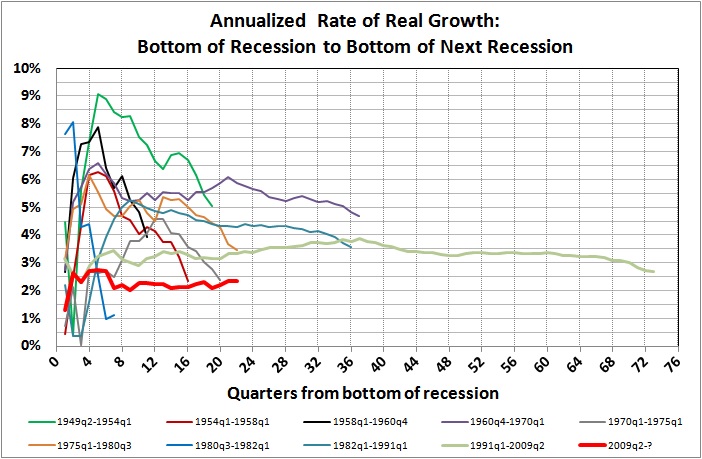
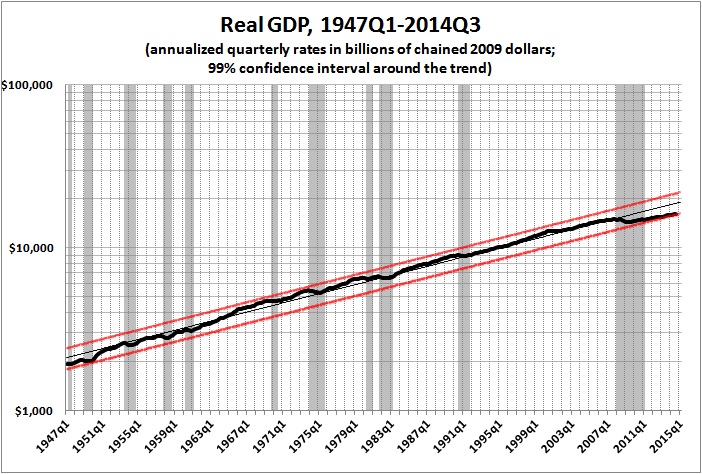
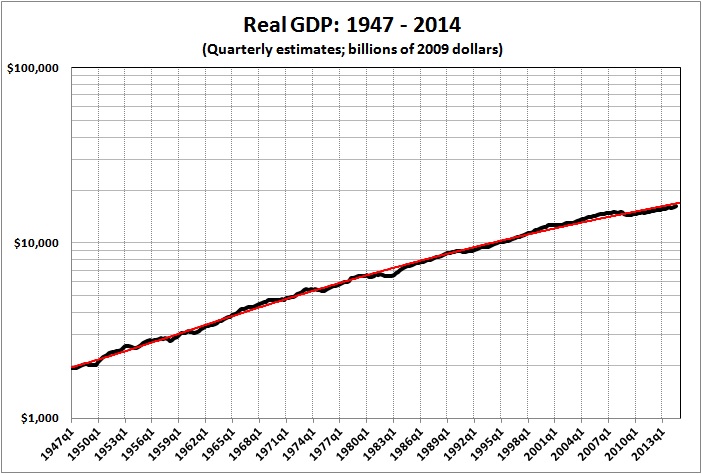
The best evidence of the slow-motion collapse of the U.S. economy is the steady, long-run decline in the rate of economic growth, which is evident in the following graphs:

Real GDP 1947-2014

Year-over-year changes in real GDP

Annualized rate of real growth - bottom of recession to bottom of next recession
The graphs are derived from “Current dollar and ‘real’ GDP,” at the website of the Bureau of Economic Analysis of the U.S. Department of Commerce.

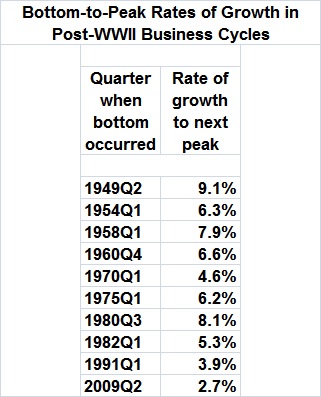
As the third graph suggests, the rate of growth has generally declined from business cycle to business cycle.* Thus:

Bottom-to-peak rates of growth

The “Obama recovery” is an anemic thing. Is it any wonder, given Obama’s incessant war on success?

It will take more than a “push back” to restore the economy — and liberty — to health. Obama and his ilk must be driven from office, and kept out of office for good.

*     *     *

Related posts:
The Laffer Curve, “Fiscal Responsibility,” and Economic Growth
The Causes of Economic Growth
In the Long Run We Are All Poorer
A Short Course in Economics
Addendum to a Short Course in Economics
As Goes Greece
Ricardian Equivalence Reconsidered
The Real Burden of Government
The Illusion of Prosperity and Stability
Taxing the Rich
More about Taxing the Rich
The Keynesian Fallacy and Regime Uncertainty
Why the “Stimulus” Failed to Stimulate
The “Jobs Speech” That Obama Should Have Given
Say’s Law, Government, and Unemployment
Regime Uncertainty and the Great Recession
Regulation as Wishful Thinking
The Commandeered Economy
We Owe It to Ourselves
In Defense of the 1%
Lay My (Regulatory) Burden Down
The Burden of Government
Economic Growth Since World War II
Obama’s Big Lie
Government in Macroeconomic Perspective
Keynesianism: Upside-Down Economics in the Collectivist Cause
Economics: A Survey (also here)
Why Are Interest Rates So Low?
Vulgar Keynesianism and Capitalism
Estimating the Rahn Curve: Or, How Government Spending Inhibits Economic Growth
America’s Financial Crisis Is Now
The Keynesian Multiplier: Phony Math
The True Multiplier
How Libertarians Ought to Thinks about the Constitution
Obamanomics: A Report Card
The Obama Effect: Disguised Unemployment
Income Inequality and Economic Growth
The Rahn Curve Revisited

___________
* Each business cycle runs from the bottom of a recession to the bottom of the next recession. Rather than rely on the National Bureau of Economic Research (NBER), I use my own own definition of a recession, which is:

  • two or more consecutive quarters in which real GDP (annualized) is below real GDP (annualized) for an earlier quarter, during which
  • the annual (year-over-year) change in real GDP is negative, in at least one quarter.

Unlike the NBER, I do not locate a recession in 2001. Real GDP, measured quarterly, dropped in the first and third quarters of 2001, but each decline lasted only a quarter.

My method of identifying a recession is more objective and consistent than the NBER’s method, which one economist describes as “The NBER will know it when it sees it.” Moreover, unlike the NBER, I would not presume to pinpoint the first and last months of a recession, given the volatility of GDP estimates.
Signature

The Obama Effect: Disguised Unemployment

Updated here.

Two takeaways:

  • The “official” unemployment rate of 5.6 percent is phony. The real rate is 12 percent, just 1.5 points below the 21st century high-water mark of 13.5 (reached in 2009, 2010, 2011, and 2013).
  • The real unemployment rate is disguised by the declining the labor-force participation rate, which has accelerated since the onset of Obamanomics. The decline is concentrated among younger workers, and has probably been helped along by Obamacare. (See the final paragraph of the post.)

Signature

Sober Reflections on “Charlie Hebdo”

Some of the rabid dogs who brutally murdered 12 persons at the offices of Charlie Hebdo were put down, as they should have been.

But I’m not joining the hysterical cult of “Je suis Charlie.” Why not? I begin with Peter (the good) Hitchens, who writes:

Once again we are ruled by a Dictatorship of Grief. Ever since the death of Princess Diana, we have been subject to these periodic spasms when everyone is supposed to think and say the same thing, or else.

We were told on Friday that ‘politicians from all sides’ had lined up to attack Ukip’s Nigel Farage for supposedly ‘exploiting’ the Paris massacre.

Mr Farage had (quite reasonably) pointed out that the presence of Islamist fanatics in our midst might have something to do with, a) uncontrolled mass migration from the Muslim world, and b) decades of multicultural refusal to integrate them into our laws and customs.

Rather than disputing this with facts and logic (admittedly this would be hard), the three ‘mainstream’ parties joined in screeching condemnation….

The Liberal Democrat Nick Clegg said Mr Farage was ‘making political points’ on the ‘back of bloody murders’.

Well, who wasn’t? A sanctimonious unanimity descended on politics and the media. ‘Je suis Charlie,’ everyone said. It was an issue of liberty, we all said. They can’t silence us, stop us drawing cartoons, etc etc etc.

Great mountains of adjectives piled up on every corner, much like those hills of flowers and teddy bears we like to place at the scenes of tragedies.

You can feel the presence of the snarling conformist mob, waiting for some dissenter on whom they can fall, kicking and biting. So-called social media, in fact an intolerant and largely brainless electronic mob, has made this much worse since the sad death of the Princess.

Speaking of intolerance, that’s the name of Charlie‘s game. It’s a stridently left-wing rag that mocks religion (of all kinds), and anything else deemed too “respectable” for the adolescent tastes of its staff.

What’s most striking about the “Je suis Charlie” movement is its pure hypocrisy. Back to Hitchens:

As for freedom, here’s an interesting thing. The French Leftist newspaper Liberation reported on September 12, 1996, that three stalwarts of Charlie Hebdo (including Stephane ‘Charb’ Charbonnier) had campaigned in their magazine to collect more than 170,000 signatures for a petition calling for a ban on the French National Front party. They did this in the name of the ‘Rights of Man’.

You, like me, may dislike the National Front greatly. But lovers of liberty simply do not seek to ban parties they do not like.

This is a double paradox. The French National Front exists mainly because a perfectly reasonable concern about mass immigration was sneeringly dismissed by the mainstream French parties. Something similar is happening in Germany, where large demonstrations against ‘the Islamisation of the West’ in many cities have been scornfully attacked by that country’s elite.

Yes, the left gets up in arms when some of its members are slaughtered by Muslim pigs (I love that phrase). But this is the same, hypocritical left that condones and promotes censorship. Clarice Feldman nails it:

Count me in the camp with Matthew Continetti, who gives countless examples of liberal hypocrisy about free speech including the following examples:

Do liberals actually believe in the right to offend? Their attitude seems to me to be ambivalent at best. And this equivocation was apparent within hours of the attack, when news outlets censored or refused to publish the images for which the Charlie Hebdo editors were killed. Classifying satire or opinion as “hate speech” subject to regulation is not an aberration. It is commonplace.

Indeed, the outpouring of support for free speech in the aftermath of the Paris attack coincides with, and partially obscures, the degradation of speech rights in the West. Commencement last year was marked by universities revoking appearances by speakers Condoleezza Rice and Ayaan Hirsi Ali for no other reason than that mobs disagreed with the speakers’ points of view. I do not recall liberals rallying behind Condi and Hirsi Ali then.

He adds to the mix of examples, Brendan Eich’s opposition to gay marriage costing him his job, the Chicago Sun Times’ removal of a Kevin D. Williamson article critical of transgender activism, Brandeis University’s unremitting assaults on a student for publicizing another student’s cheering  the assassination of police officers, blaming an obscure video for the violent attack in Benghazi. Worse yet, there’s the political and academic efforts to shut off free speech which might offend someone, (someone, I observe, who usually just happens to hold the views prevailing among the left-wing professors and administrators)….

Obama can’t even bring himself to speak plainly about the savages whose deeds have sparked millions to rally in the name of Charlie. Scott Johnson is on the case:

President Obama performed the obligatory characterization of the terrorist attack on Charlie Hebdo in Paris last week as “cowardly” and “evil.” “Evil” it certainly was. “Cowardly” would probably be an adjective more appropriate to the Obama administration’s characterization of Islamist terrorism as “violent extremism,” though “stupid” certainly shouldn’t be overlooked either.

President Obama and his administration refuse to identify the ideology that inspires our enemy. They continue to yammer incessantly about “extremism” and “extremists.” Islam is not to be mentioned, unless it is to be appeased and defended. Obama is himself something of an extremist on the subject.

Of course he is, as Clarice Feldman reminds us:

[H]ere’s what Obama said in 2012 after the slaughter in Benghazi: “A crude and disgusting video sparked outrage throughout the Muslim world.  Now, I have made it clear that the United States government had nothing to do with this video, and I believe its message must be rejected by all who respect our common humanity. It is an insult not only to Muslims, but to America as well — for as the city outside these walls makes clear, we are a country that has welcomed people of every race and every faith. We are home to Muslims who worship across our country. We not only respect the freedom of religion, we have laws that protect individuals from being harmed because of how they look or what they believe. We understand why people take offense to this video because millions of our citizens are among them…. The future must not belong to those who slander the prophet of Islam.”

(What does it mean, this phrase: “The future must not belong to those who slander the prophet of Islam”, if not an incitement to attack targets like Hedbo?)

The future must not belong to Islam or its apologists on the left. It must not belong to those who are afraid to speak the truth about the aims of Islam. It must not belong to anti-Semites.

The slaughter at Charlie Hebdo is not a reason for solidarity with the left, but a reason to oppose the left and its clients — especially (but not exclusively) the murderous adherents of Islam.

Solidarity with the left suborns what Victor Davis Hanson rightly calls multicultural suicide:

Multiculturalism is one of those buzzwords that does not mean what it should. The ancient and generic Western study of many cultures is not multiculturalism. Rather, the trendy term promotes non-Western cultures to a status equal with or superior to Western culture largely to fulfill contemporary political agendas….

…In terms of the challenge of radical Islam, multiculturalism manifests itself in the abstract with the notion that Islamists are simply the fundamentalist counterparts to any other religion. Islamic extremists are no different from Christian extremists, as the isolated examples of David Koresh or the Rev. Jim Jones are cited ad nauseam as the morally and numerically equivalent bookends to thousands of radical Islamic terrorist acts that plague the world each month. We are not to assess other religions by any absolute standard, given that such judgmentalism would inevitably be prejudiced by endemic Western privilege….

Most of the millions who today paid lip-service to liberty in the streets of Paris and other cosmopolitan capitals will tomorrow resume their war against liberty, in the name of multiculturalism and other manifestations of political correctness.

*     *     *

Related reading, in addition to the articles and posts quoted and linked above:
John Ransom, “In the Clash of Intolerants, I’m Not Charlie,” Townhall.com, January 10, 2015
Selwyn Duke, “Je ne suis pas Charlie (I’m Sane),” American Thinker, January 12, 2015
Takimag, “The Week That Perished” (first entry), January 12, 2015
Mark Steyn, “Where’s the Lead in the Pencil?,” SteynOnline, January 14, 2015
Jaci Greggs, “Meet the Hypocrites Who Did Attend the Paris Unity Rally,” The Federalist, January 15, 2014
Andrew Napolitano, “What Freedom of Speech?,” The Unz Review, January 15, 2015
Theden, “#JeSuisUsefulIdiot:Western Leaders Exploit the Paris Attacks,” January 25, 2015

*     *     *

Related post: Riots, Culture, and the Final Showdown

Signature

Not-So-Random Thoughts (XII)

Links to the other posts in this occasional series may be found at “Favorite Posts,” just below the list of topics.

*     *     *

Intolerance as Illiberalism” by Kim R. Holmes (The Public Discourse, June 18, 2014) is yet another reminder, of innumerable reminders, that modern “liberalism” is a most intolerant creed. See my ironically titled “Tolerance on the Left” and its many links.

*     *     *

Speaking of intolerance, it’s hard to top a strident atheist like Richard Dawkins. See John Gray’s “The Closed Mind of Richard Dawkins” (The New Republic, October 2, 2014). Among the several posts in which I challenge the facile atheism of Dawkins and his ilk are “Further Thoughts about Metaphysical Cosmology” and “Scientism, Evolution, and the Meaning of Life.”

*     *     *

Some atheists — Dawkins among them — find a justification for their non-belief in evolution. On that topic, Gertrude Himmelfarb writes:

The fallacy in the ethics of evolution is the equation of the “struggle for existence” with the “survival of the fittest,” and the assumption that “the fittest” is identical with “the best.” But that struggle may favor the worst rather than the best. [“Evolution and Ethics, Revisited,” The New Atlantis, Spring 2014]

As I say in “Some Thoughts about Evolution,”

Survival and reproduction depend on many traits. A particular trait, considered in isolation, may seem to be helpful to the survival and reproduction of a group. But that trait may not be among the particular collection of traits that is most conducive to the group’s survival and reproduction. If that is the case, the trait will become less prevalent. Alternatively, if the trait is an essential member of the collection that is conducive to survival and reproduction, it will survive. But its survival depends on the other traits. The fact that X is a “good trait” does not, in itself, ensure the proliferation of X. And X will become less prevalent if other traits become more important to survival and reproduction.

The same goes for “bad” traits. Evolution is no guarantor of ethical goodness.

*     *     *

It shouldn’t be necessary to remind anyone that men and women are different. But it is. Lewis Wolpert gives it another try in “Yes, It’s Official, Men Are from Mars and Women from Venus, and Here’s the Science to Prove It” (The Telegraph, September 14, 2014). One of my posts on the subject is “The Harmful Myth of Inherent Equality.” I’m talking about general tendencies, of course, not iron-clad rules about “men’s roles” and “women’s roles.” Aside from procreation, I can’t readily name “roles” that fall exclusively to men or women out of biological necessity. There’s no biological reason, for example, that an especially strong and agile woman can’t be a combat soldier. But it is folly to lower the bar just so that more women can qualify as combat soldiers. The same goes for intellectual occupations. Women shouldn’t be discouraged from pursuing graduate degrees and professional careers in math, engineering, and the hard sciences, but the qualifications for entry and advancement in those fields shouldn’t be watered down just for the sake of increasing the representation of women.

*     *     *

Edward Feser, writing in “Nudge Nudge, Wink Wink” at his eponymous blog (October 24, 2014), notes

[Michael] Levin’s claim … that liberal policies cannot, given our cultural circumstances, be neutral concerning homosexuality.  They will inevitably “send a message” of approval rather than mere neutrality or indifference.

Feser then quotes Levin:

[L]egislation “legalizing homosexuality” cannot be neutral because passing it would have an inexpungeable speech-act dimension.  Society cannot grant unaccustomed rights and privileges to homosexuals while remaining neutral about the value of homosexuality.

Levin, who wrote that 30 years ago, gets a 10 out 10 for prescience. Just read “Abortion, ‘Gay Rights’, and Liberty” for a taste of the illiberalism that accompanies “liberal” causes like same-sex “marriage.”

*     *     *

“Liberalism” has evolved into hard-leftism. It’s main adherents are now an elite upper crust and their clients among the hoi polloi. Steve Sailer writes incisively about the socioeconomic divide in “A New Caste Society” (Taki’s Magazine, October 8, 2014). “‘Wading’ into Race, Culture, and IQ” offers a collection of links to related posts and articles.

*     *     *

One of the upper crust’s recent initiatives is so-called libertarian paternalism. Steven Teles skewers it thoroughly in “Nudge or Shove?” (The American Interest, December 10, 2014), a review of Cass Sunstein’s Why Nudge? The Politics of Libertarian Paternalism. I have written numerous times about Sunstein and (faux) libertarian paternalism. The most recent entry, “The Sunstein Effect Is Alive and  Well in the White House,” ends with links to two dozen related posts. (See also Don Boudreaux, “Where Nudging Leads,” Cafe Hayek, January 24, 2015.)

*     *     *

Maria Konnikova gives some space to Jonathan Haidt in “Is Social Psychology Biased against Republicans?” (The New Yorker, October 30, 2014). It’s no secret that most academic disciplines other than math and the hard sciences are biased against Republicans, conservatives, libertarians, free markets, and liberty. I have something to say about it in “The Pseudo-Libertarian Temperament,” and in several of the posts listed here.

*     *     *

Keith E. Stanovich makes some good points about the limitations of intelligence in “Rational and Irrational Thought: The Thinking that IQ Tests Miss” (Scientific American, January 1, 2015). Stanovich writes:

The idea that IQ tests do not measure all the key human faculties is not new; critics of intelligence tests have been making that point for years. Robert J. Sternberg of Cornell University and Howard Gardner of Harvard talk about practical intelligence, creative intelligence, interpersonal intelligence, bodily-kinesthetic intelligence, and the like. Yet appending the word “intelligence” to all these other mental, physical and social entities promotes the very assumption the critics want to attack. If you inflate the concept of intelligence, you will inflate its close associates as well. And after 100 years of testing, it is a simple historical fact that the closest associate of the term “intelligence” is “the IQ test part of intelligence.”

I make a similar point in “Intelligence as a Dirty Word,” though I don’t denigrate IQ, which is a rather reliable predictor of performance in a broad range of endeavors.

*     *     *

Brian Caplan, whose pseudo-libertarianism rankles, tries to defend the concept of altruism in “The Evidence of Altruism” (EconLog, December 30, 2014). Caplan aids his case by using the loaded “selfishness” where he means “self-interest.” He also ignores empathy, which is a key ingredient of the Golden Rule. As for my view of altruism (as a concept), see “Egoism and Altruism.”

Steroids in Baseball: A Counterproductive Side Show or an Offensive Boon?

The widespread use of steroids and other performance-enhancing drugs (PEDs) in recent decades probably led to an increase in extra-base hits. But, paradoxically, the emphasis on power hitting may have led to a decrease in run production. Or maybe not.

I begin with a statistic that I call Slugging+ (abbreviated as SLG+). It measures total bases on hits and walks per plate appearance:

(1) SLG+ = [1B + 2B(2) + 3B(3) + HR(4) + BB]/PA

where,
1B = singles
2B = doubles
3B = triples
HR = home runs
BB = bases-on-balls (walks)
PA = plate appearances

(I prefer SLG+ to OPS — a popular statistic that combines on-base-average and slugging percentage. OPS is the sum of two fractions with different denominators, PA and AB (at-bats), and it double-counts hits, which are in the numerator of both fractions.)

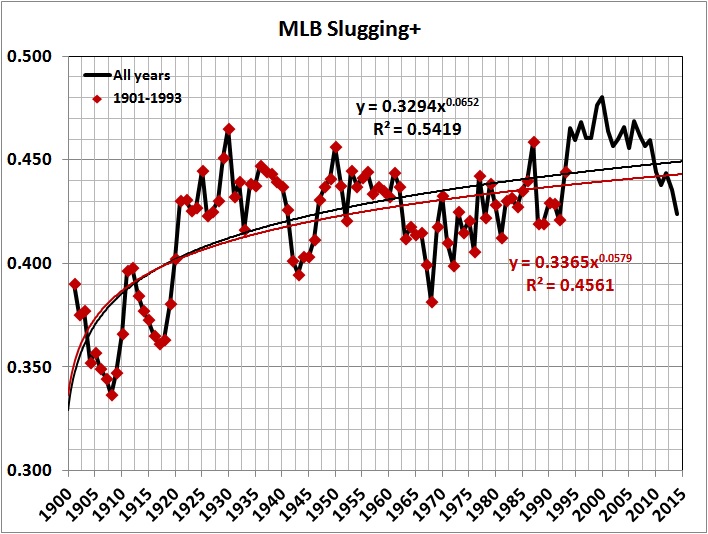
The following graph of SLG+ is suggestive:

SLG+ 1901-2014

The values of SLG+ after 1993 — and especially for the years 1994-2009 — boost the regression line markedly upward.

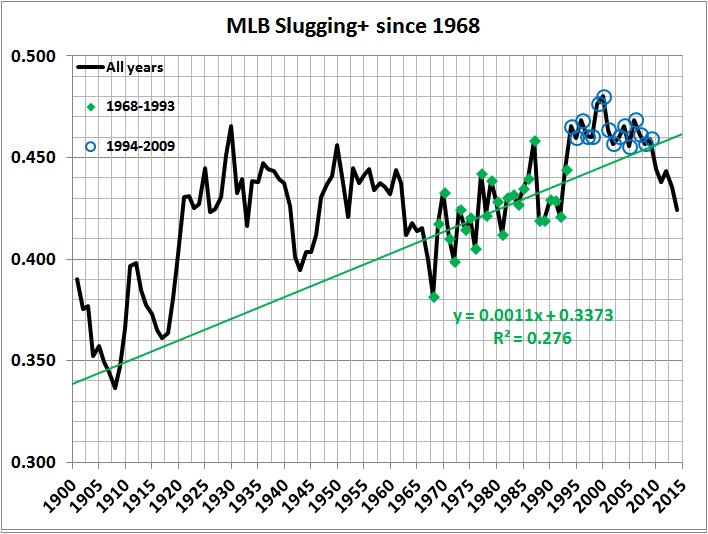
A similar picture emerges in the next graph, which focuses on the years after 1968, when offensive statistics reached a nadir:

SLG+ since 1968

SLG+ values for 1994-2009 lie above the trend line.

On the evidence of the two preceding graphs I designate 1994-2009 as the era of PEDs. (I know that PEDs didn’t come into use in 1994 and disappear from the scene after 2009. It’s just that their effects are most obvious during 1994-2009.)

So much for the effect of PEDs on power hitting. What about the effect of PEDs on run production? You might expect that the unsurpassed surge in power hitting during the PEDs era resulted in an unsurpassed surge in run production: But it didn’t:

MLB team runs per game

Why did run production in the PEDs era fall short of run production in 1921-1942, the original “lively ball” era. Here’s my hypothesis: The frequency of home runs was on the rise during the original “lively ball” era. But the game in that era was still strongly influenced by the dynamic style of play of the preceding “dead ball” era. Scoring in the lively-ball era still depended heavily on slapping out base hits, taking the extra base on an outfield hit, and the hit-and-run. Those practices dwindled in later years, when scoring became more a matter of waiting for sluggers to deliver home runs, when they weren’t drawing walks or striking out. Some of the differences are evident in this graph:

Selected MLB statistics_1901-2014

It turns out that the emphasis on power hitting (especially home-run hitting) may be counterproductive. The relationship between runs per game (R) and other significant variables for the period 1921-2014 looks like this:

(2) R = – 0.220 + 18.7(BA) + 0.721(2B) + 1.26(HR) – 0.160(SO) – 0.0540(BatAge)

where,
BA = batting average
2B = doubles per game
HR = home runs per game
SO = strikeouts per game
BatAge = average age of batters

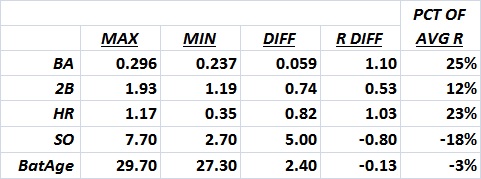
Applying (2) to the actual range of values for each variable, I get:

Effect of variables on run production_1921-2014

“Max” and “min” are the maximum and minimum values for 1921-2014. “Diff” is the difference between the maximum and minimum values. “R diff” represents the number of runs accounted for by “Diff,” based on equation (2). “Pct. of avg. R” is “R diff” as a percentage of the average number of runs per game during 1921-2014.

Team statistics for 2014 yield a somewhat more detailed but similar result:

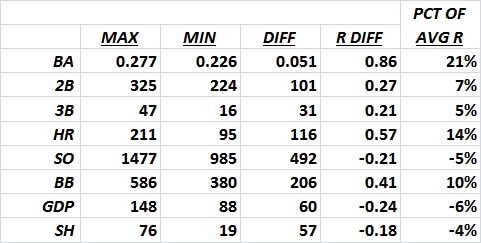
(3) R = – 0.153 + 16.8(BA) + 0.00269(2B) + 0.00675(3B) + 0.00488(HR) – 0.000428(SO) + 0.00198(BB) – 0.00408(GDP) – 0.00314(SH)

where,
BA = team batting average
2B = doubles hit by team
3B = triples hit by team
HR = home runs hit by team
SO = team strikeouts
BB = team walks
GDP = number of times a team grounds into double plays
SH = number of times a team executes a sacrifice hit (a bunt that advances a base runner)

Applying (3) to the actual range of values for each variable, I get:

Effect of variables on run production_2014

For a third look, I analyzed the offensive records of the 560 players with at least 3,000 plate appearances whose careers started no sooner than 1946 and ended no later than 1993. I computed, for each player, a measure of his career run-scoring potential (R*):

(4) R* = [(1B + 2(2B) + 3(3B) + 4(HR) + BB + HBP + SH + SF – GDP + SB – CS]/PA

where,
1B = singles
2B = doubles
3B = triples
HR = home runs
BB = bases on balls
HBP = hit by pitcher
SH = sacrifice hits
SF = sacrifice flies
GDP = grounded into double plays
SB = stolen bases
CS = caught stealing
PA = plate appearances

This regression equation explains R*:

(5) R* = 0.0521 + 0.796(1B)  + 1.794(2B) + 3.29 (3B) + 3.68(HR) + 0.998(BB) – 0.0450(SO) + 1.18(SB – CS)

(The explanatory variables are career totals divided by total number of plate appearances. The equation has an r-squared of 0.985, with extremely significant F- and p-values.)

I derived the following table of elasticities from (5):

Elasticities of variables

Elasticity measures the responsiveness of R* to a change in the value of each variable. Thus, for example, a 1-percent increase in 1B/PA would cause R* to increase by 0.135 percent, and so on. The elasticities suggest that singles hitters generate more scoring opportunities than home-run hitters, on the whole. Case closed?

Not at all. Look at this table of cross-correlations:

Cross correlations

Even though there’s a strong, positive correlation between HR/PA and SO/PA,  the elasticity on SO/PA is relatively small. Further, the elasticity on BB/PA is relatively high, and BB/PA is strongly and negatively correlated with 1B/PA — and less strongly but positively correlated with HR/PA. This leads me to suspect that the elasticities on 1B/PA and HR/PA overstate the contributions of singles hitters and understate the contributions of home-run hitters.

I forced a regression in which the only explanatory variables are 1B, 2B, 3B, and HR. The resulting equation yields these elasticities:

Elasticities of variables_2

(I obtained similar results when I revisited the statistics for 1921-2014 and the 2014 season.)

This is a less-than-satisfactory result because the underlying equation omits several explanatory variables. But it hints at the value of hitters with extra-base power, especially home-run hitters. Issues of health and integrity aside, it seems that a “juiced” hitter can do his team a lot of good — if he doesn’t strike out a lot more or walk a lot less than usual in his pursuit of more home runs.

All of this uncertainty reminds me of “Baseball Statistics and the Consumer Price Index,” where I say this:

There are many variations in the conditions of play that have resulted in significant changes in offensive statistics. Among those changes are the use of cleaner and more tightly wound baseballs, the advent of night baseball, better lighting for night games, bigger gloves, lighter bats, bigger and stronger players, the expansion of the major leagues in fits and starts, the size of the strike zone, the height of the pitching mound, and — last but far from least in this list — the integration of black and Hispanic players into major league baseball. In addition to these structural variations, there are others that mitigate against the commensurability of statistics over time; for example, the rise and decline of each player’s skills, the skills of teammates (which can boost or depress a player’s performance), the characteristics of a player’s home ballpark (where players generally play half their games), and the skills of the opposing players who are encountered over the course of a career.

Despite all of these obstacles to commensurability, the urge to evaluate the relative performance of players from different teams, leagues, seasons, and eras is irrepressible. Baseball-Reference.com is rife with such evaluations; the Society for American Baseball Research (SABR) revels in them; many books offer them (e.g., this one); and I have succumbed to the urge more than once.

It is one thing to have fun with numbers. It is quite another thing to ascribe meanings to them that they cannot support.

All I can safely say about the effect of PEDs on run-scoring is that the PEDs era saw more of it than the preceding era (see the third graph, “MLB Team Runs per Game”).

In the end, the seemingly large effect of PEDs may be illusory:

…In congressional testimony in 2005, [Sandy] Alderson [former general manager of the Oakland A’s] said that during the 1990s, other factors “obscured a steroid problem”:

Home runs and run production were increasing during the time but not always year to year. At the same time, strength programs were in vogue across baseball. Hitter-friendly ballparks were being built. Expansion had occurred in 1993 and again in 1998. Two seasons, ’94 and ’95, had been shortened by a players’ strike. Bat design had changed and there was an emphasis with many clubs on having more offensive players even at traditionally defensive positions. [From pp. 62-3 of the Mitchell report, listed in “Related reading.”]

The factors cited by Alderson probably boosted the rate at which batters were pumping out extra-base hits. Another significant factor is the size of the strike zone, which had been shrinking for years before it began to expand around 2009-10. Has power hitting declined because of the growing strike zone or because fewer players are using PEDs? The right answer is “yes.”

Uncertainty rears its head again.

*     *     *

Acknowledgement: This analysis draws on statistics provided by Baseball-Reference.com.

*    *     *

Related reading:
Mitchell Grossman et al., “Steroids in Major League Baseball,” undated
Baseball Prospectus, “Baseball between the Numbers: What Do Statistics Tell Us About Steroids?,” March 9, 2006
George J. Mitchell, “Report to the Commissioner of Baseball of an Independent Investigation into the Illegal Use of Steroids and Other Performance Enhancing Substances by Players in Major League Baseball,” December 13, 2007
Zachary D. Rymer, “Proof That the Steroids-Era Power Surge in Baseball Has Been Stopped,” Bleacher Report, May 22, 2013
Brian M. Mills, “Expert Workers, Performance Standards, and On-the-Job Training: Evaluating Major League Baseball Umpires,” Journal of Economic Literature, August 27, 2014
Jon Roegele, “Baseball’s Strike Zone Expansion Is Out of Control,” Slate, October 15, 2014

Signature

Let’s Not Get Too Excited about Recent GDP Growth

According to the U.S. Department of Commerce’s Bureau of Economic Analysis,

Real gross domestic product — the value of the production of goods and services in the United States, adjusted for price changes — increased at an annual rate of 5.0 percent in the third quarter of 2014, according to the “third” estimate released by the Bureau of Economic Analysis. In the second quarter, real GDP increased 4.6 percent.

Sounds great, but let’s put recent quarter-to-quarter and year-over-year changes in context:

Quarterly vs. annual changes in real GDP

Despite the recent gains, welcome as they are, GDP remains in the doldrums:

Real GDP 1947q1-2014q3

Here’s another depiction, which emphasizes the declining rate of growth:

Real GDP 1947-2014

For more, see “The Rahn Curve Revisited” and the list of posts at the bottom.

Signature

Some Thoughts about Probability

REVISED 02/09/15 WITH AN ADDENDUM AT THE END OF THE POST

This post is prompted by a reader’s comments about “The Compleat Monty Hall Problem.” I open with a discussion of probability and its inapplicability to single games of chance (e.g., one toss of a coin). With that as background, I then address the reader’s specific comments. I close with a discussion of the debasement of the meaning of probability.

INTRODUCTORY REMARKS

What is probability? Is it a property of a thing (e.g., a coin), a property of an event involving a thing (e.g., a toss of the coin), or a description of the average outcome of a large number of such events (e.g., “heads” and “tails” will come up about the same number of times)? I take the third view.

What does it mean to say, for example, that there’s a probability of 0.5 (50 percent) that a tossed coin will come up “heads” (H), and a probability of 0.5 that it will come up “tails” (T)? Does such a statement have any bearing on the outcome of a single toss of a coin? No, it doesn’t. The statement is only a short way of saying that in a sufficiently large number of tosses, approximately half will come up H and half will come up T. The result of each toss, however, is a random event — it has no probability.

That is the standard, frequentist interpretation of probability, to which I subscribe. It replaced the classical interpretation , which is problematic:

If a random experiment can result in N mutually exclusive and equally likely outcomes and if NA of these outcomes result in the occurrence of the event A, the probability of A is defined by

P(A) = {N_A \over N} .

There are two clear limitations to the classical definition.[16] Firstly, it is applicable only to situations in which there is only a ‘finite’ number of possible outcomes. But some important random experiments, such as tossing a coin until it rises heads, give rise to an infinite set of outcomes. And secondly, you need to determine in advance that all the possible outcomes are equally likely without relying on the notion of probability to avoid circularity….

A similar charge has been laid against frequentism:

It is of course impossible to actually perform an infinity of repetitions of a random experiment to determine the probability of an event. But if only a finite number of repetitions of the process are performed, different relative frequencies will appear in different series of trials. If these relative frequencies are to define the probability, the probability will be slightly different every time it is measured. But the real probability should be the same every time. If we acknowledge the fact that we only can measure a probability with some error of measurement attached, we still get into problems as the error of measurement can only be expressed as a probability, the very concept we are trying to define. This renders even the frequency definition circular.

Not so:

  • There is no “real probability.” If there were, the classical theory would measure it, but the classical theory is circular, as explained above.
  • It is therefore meaningless to refer to “error of measurement.” Estimates of probability may well vary from one series of trials to another. But they will “tend to a fixed limit” over many trials (see below).

There are other approaches to probability. See, for example, this, this, and this.) One approach is known as propensity probability:

Propensities are not relative frequencies, but purported causes of the observed stable relative frequencies. Propensities are invoked to explain why repeating a certain kind of experiment will generate a given outcome type at a persistent rate. A central aspect of this explanation is the law of large numbers. This law, which is a consequence of the axioms of probability, says that if (for example) a coin is tossed repeatedly many times, in such a way that its probability of landing heads is the same on each toss, and the outcomes are probabilistically independent, then the relative frequency of heads will (with high probability) be close to the probability of heads on each single toss. This law suggests that stable long-run frequencies are a manifestation of invariant single-case probabilities.

This is circular. You observe the relative frequencies of outcomes and, lo and behold, you have found the “propensity” that yields those relative frequencies.

Another approach is Bayesian probability:

Bayesian probability represents a level of certainty relating to a potential outcome or idea. This is in contrast to a frequentist probability that represents the frequency with which a particular outcome will occur over any number of trials.

An event with Bayesian probability of .6 (or 60%) should be interpreted as stating “With confidence 60%, this event contains the true outcome”, whereas a frequentist interpretation would view it as stating “Over 100 trials, we should observe event X approximately 60 times.”

Or consider this account:

The Bayesian approach to learning is based on the subjective interpretation of probability.   The value of the proportion p is unknown, and a person expresses his or her opinion about the uncertainty in the proportion by means of a probability distribution placed on a set of possible values of p….

“Level of certainty” and “subjective interpretation” mean “guess.” The guess may be “educated.” It’s well known, for example, that a balanced coin will come up heads about half the time, in the long run. But to say that “I’m 50-percent confident that the coin will come up heads” is to say nothing meaningful about the outcome of a single coin toss. There are as many probable outcomes of a coin toss as there are bystanders who are willing to make a statement like “I’m x-percent confident that the coin will come up heads.” Which means that a single toss doesn’t have a probability, though it can be the subject of many opinions as to the outcome.

Returning to reality, Richard von Mises eloquently explains frequentism in Probability, Statistics and Truth (second revised English edition, 1957). Here are some excerpts:

The rational concept of probability, which is the only basis of probability calculus, applies only to problems in which either the same event repeats itself again and again, or a great number of uniform elements are involved at the same time. Using the language of physics, we may say that in order to apply the theory of probability we must have a practically unlimited sequence of uniform observations. [P. 11]

*     *     *

In games of dice, the individual event is a single throw of the dice from the box and the attribute is the observation of the number of points shown by the dice. In the game of “heads or tails”, each toss of the coin is an individual event, and the side of the coin which is uppermost is the attribute. [P. 11]

*     *     *

We must now introduce a new term…. This term is “the collective”, and it denotes a sequence of uniform events or processes which differ by certain observable attributes…. All the throws of dice made in the course of a game [of many throws] from a collective wherein the attribute of the single event is the number of points thrown…. The definition of probability which we shall give is concerned with ‘the probability of encountering a single attribute in a given collective’. [Pp. 11-12]

*     *     *

[A] collective is a mass phenomenon or a repetitive event, or, simply, a long sequence of observations for which there are sufficient reasons to believe that the relative frequency of the observed attribute would tend to a fixed limit if the observations were indefinitely continued. The limit will be called the probability of the attribute considered within the collective. [P. 15, emphasis in the original]

*     *     *

The result of each calculation … is always … nothing else but a probability, or, using our general definition, the relative frequency of a certain event in a sufficiently long (theoretically, infinitely long) sequence of observations. The theory of probability can never lead to a definite statement concerning a single event. The only question that it can answer is: what is to be expected in the course of a very long sequence of observations? [P. 33, emphasis added]

As stated earlier, it is simply meaningless to say that the probability of H or T coming up in a single toss is 0.5. Here’s the proper way of putting it: There is no reason to expect a single coin toss to have a particular outcome (H or T), given that the coin is balanced, the toss isn’t made is such a way as to favor H or T, and there are no other factors that might push the outcome toward H or T. But to say that P(H) is 0.5 for a single toss is to misrepresent the meaning of probability, and to assert something meaningless about a single toss.

If you believe that probabilities attach to a single event, you must also believe that a single event has an expected value. Let’s say, for example, that you’re invited to toss a coin once, for money. You get $1 if H comes up; you pay $1 if T comes up. As a believer in single-event probabilities, you “know” that you have a “50-50 chance” of winning or losing. Would you play a single game, which has an expected value of $0? If you would, it wouldn’t be because of the expected value of the game; it would be because you might win $1, and because losing $1 would mean little to you.

Now, change the bet from $1 to $1,000. The “expected value” of the single game remains the same: $0. But the size of the stake wonderfully concentrates your mind. You suddenly see through the “expected value” of the game. You are struck by the unavoidable fact that what really matters is the prospect of winning $1,000 or losing $1,000, because those are the only possible outcomes.

Your decision about playing a single game for $1,000 will depend on your finances (e.g., you may be very wealthy or very desperate for money) and your tolerance for risk (e.g., you may be averse to risk-taking or addicted to it). But — if you are rational — you will not make your decision on the basis of the fictional expected value of a single game, which derives from the fictional single-game probabilities of H and T. You will decide whether you’re willing and able to risk the loss of $1,000.

Do I mean to say that probability is irrelevant to a single play of the Monty Hall problem, or to a choice between games of chance? If you’re a proponent of propensity, you might say that in the Monty Hall game the prize has a propensity to be behind the other unopened door (i.e., the door not chosen by you and not opened by the host). But does that tell you anything about the actual location of the prize in a particular game? No, because the “propensity” merely reflects the outcomes of many games; it says nothing about a single game, which (like Schrödinger’s cat) can have only a single outcome (prize or no prize), not 2/3 of one.

If you’re a proponent of Bayesian probability, you might say that you’re confident with “probability” 2/3 that the prize is behind the other unopened door. But that’s just another way of saying that contestants win 2/3 of the time if they always switch doors. That’s the background knowledge that you bring to your statement of confidence. But someone who’s ignorant of the Monty Hall problem might be confident with 1/2 “probability” that the prize is behind the other unopened door. And he could be right about a particular game, despite his lower level of confidence.

So, yes, I do mean to say that there’s no such thing as a single-case probability. You may have an opinion ( or a hunch or a guess) about the outcome of a single game, but it’s only your opinion (hunch, guess). In the end, you have to bet on a discrete outcome. If it gives you comfort to switch to the unopened door because that’s the winning door 2/3 of the time (according to classical probability) and about 2/3 of the time (according to the frequentist interpretation), be my guest. I might do the same thing, for the same reason: to be comfortable about my guess. But I’d be able separate my psychological need for comfort from the reality of the situation:

A single game is just one event in the long series of events from which probabilities emerge. I can win the Monty Hall game about 2/3 of the time in repeated plays if I always switch doors. But that probability has nothing to do with a single game, the outcome of which is a random occurrence.

REPLIES TO A READER’S COMMENTS

I now turn to the reader’s specific comments, which refer to “The Compleat Monty Hall Problem.” (You should read it before continuing with this post if you’re unfamiliar with the Monty Hall problem or my analysis of it.) The reader’s comments — which I’ve rearranged slightly — are in italic type. (Here and there, I’ve elaborated on the reader’s comments; my elaborations are placed in brackets and set in roman type.) My replies are in bold type.

I find puzzling your statement that a probability cannot “describe” a single instance, eg one round of the Monty Hall problem.

See my introductory remarks.

While the long run result serves to prove the probability of a particular outcome, that does not mean that that probability may not be assigned to a smaller number of instances. That is the beauty of probability.

The long-run result doesn’t “prove” the probability of a particular outcome; it determines the relative frequency of occurrence of that outcome — and nothing more. There is no probability associated with a “smaller number of instances,” certainly not 1 instance. Again, see my introductory remarks.

If the [Monty Hall] game is played once [and I don’t switch doors], I should budget for one car [the prize that’s usually cited in discussions of the Monty hall problem], and if it is played 100 times [and I never switch doors], I budget for 33….

“Budget” seems to refer to the expected number of cars won, given the number of plays of the game and a strategy of never switching doors. The reader contradicts himself by “budgeting” for 1 car in a single play of the Monty Hall problem. In doing so, he is being unfaithful to his earlier statement: “While the long run result serves to prove the probability of a particular outcome, that does not mean that that probability may not be assigned to a smaller number of instances.” Removing the double negatives, we get “probability may be assigned to a smaller number of instances.” Given that 1 is a smaller number than 100, it follows, by the reader’s logic, that his “budget” for a single game should be 1/3 car (assuming, as he does, a strategy of not switching doors). The reader’s problem here is his insistence that a probability expresses something other than the long-run relative frequency of a particular outcome.

To justify your contrary view, you ask how you can win 2/3 of a car [the long-run average if the contestant plays many games and always switches doors]; you can win or you can not win, you say, you cannot partly win. Is this not sophistry or a straw man, sloppy reasoning at best, to convince uncritical thinkers who agree that you cannot drive 2/3 of a car?

My “contrary view” of what? My view of statistics isn’t “contrary.” Rather, it’s in line with the standard, frequentist interpretation.

It’s a simple statement of obvious fact you can’t win 2/3 of a car. There’s no “sophistry” or “straw man” about it. If you can’t win 2/3 of a car, what does it mean to assign a probability of 2/3 to winning a car by adopting the switching strategy? As discussed above, it means only one thing: A long series of games will be won about 2/3 of the time if all contestants adopt the switching strategy.

On what basis other than an understanding of probability would you be optimistic at the prospect of being offered one chance of picking a single Golden Ball worth $1m from a bag of just three balls and pessimistic about your prospects of picking the sole Golden Ball from a barrel of 10,000 balls?

The only difference between the two games is that on the one hand you have a decent (33%) chance of winning and on the other hand you have a lousy (0.01%) chance. Isn’t it these disparate probabilities that give you cause for optimism or pessimism, as the case may be?

“Optimism” and “pessimism” — like “comfort” — are subjective terms for ill-defined states of mind. There are persons who will be “optimistic” about a given situation, and persons who will be “pessimistic” about the same situation. For example: There are hundreds of millions of persons who are “optimistic” about winning various lotteries, even though they know that the grand prize in each lottery will be assigned to only one of millions of possible numbers. By the same token, there are hundreds of millions of persons who, knowing the same facts, refuse to buy lottery tickets because they are “pessimistic” about the likely outcome of doing so. But “optimism” and “pessimism” — like “comfort” — have nothing to do with probability, which isn’t an attribute of a single game.

If probability cannot describe the chances of each of the two one-off “games”, does that mean I could not provide a mathematical basis for my advice that you play the game with 3 balls (because you have a one-in-three chance of winning) rather than the ball in the barrel game which offers a one in ten thousand chance of winning?

You can provide a mathematical basis for preferring the game with 3 balls. But you must, in honesty, state that the mathematical basis applies only to many games, and that the outcome of a single game is unpredictable.

It might be that probability cannot reliably describe the actual outcome of a single event because the sample size of 1 game is too small to reflect the long-run average that proves the probability. However, comparing the probabilities for winning the two games describes the relative likelihood of winning each game and informs us as to which game will more likely provide the prize.

If not by comparing the probability of winning each game, how do we know which of the two games has a better chance of delivering a win? One cannot compare the probability of selecting the Golden Ball from each of the two games unless the probability of each game can be expressed, or described, as you say.

Here, the reader comes close to admitting that a probability can’t describe the (expected) outcome of a single event (“reliably” is superfluous). But he goes off course when he says that “comparing the probabilities for the two games … informs us as to which game will more likely provide the prize.” That statement is true only for many plays of the two ball games. It has nothing to do with a single play of either ball game. The choice there must be based on subjective considerations: “optimism,” “pessimism,” “comfort,” a guess, a hunch, etc.

Can I not tell a smoker that their lifetime risk of developing lung cancer is 23% even though smokers either get lung cancer or they do not? No one gets 23% cancer. Did someone say they did? No one has 0.2 of a child either but, on average, every family in a census did at one stage have 2.2 children.

No, the reader may not (honestly) tell a smoker that his lifetime risk of developing lung cancer is 23 percent, or any specific percentage. The smoker has one life to live; he will either get lung cancer or he will not. What the reader may honestly tell the smoker is that statistics based on the fates of a large number of smokers over many decades indicate that a certain percentage of those smokers contracted lung cancer. The reader should also tell the smoker that the frequency of the incidence of lung cancer in a large population varies according to the number of cigarettes smoked daily. (According to Wikipedia: “For every 3–4 million cigarettes smoked, one lung cancer death occurs.[1][132]“) Further, the reader should note that the incidence of lung cancer also varies with the duration of smoking at various rates, and with genetic and environmental factors that vary from person to person.

As for family size, given that the census counts only post-natal children (who come in integer values), how could “every family in a census … at one stage have 2.2 children”? The average number of children across a large number of families may be 2.2, but surely the reader knows that “every family” did not somehow have 2.2 children “at one stage.” And surely the reader knows that average family size isn’t a probabilistic value, one that measures the relative frequency of an event (e.g., “heads”) given many repetitions of the same trial (e.g., tossing a fair coin), under the same conditions (e.g., no wind blowing). Each event is a random occurrence within the long string of repetitions. The reader may have noticed that family size is in fact strongly determined (especially in Western countries) by non-random events (e.g., deliberate decisions by couples to reproduce, or not). In sum, probabilities may represent averages, but not all (or very many) averages represent probabilities.

If not [by comparing probabilities], how do we make a rational recommendation and justify it in terms the board of a think-tank would accept? [This seems to be a reference to my erstwhile position as an officer of a defense think-tank.]

Here, the reader extends an inappropriate single-event view of probability to an inappropriate unique-event view. I would not have gone before the board and recommended a course of action — such as bidding on a contract for a new line of work — based on a “probability of success.” That would be an absurd statement to make about an event that is defined by unique circumstances (e.g., the composition of the think-tank’s staff at that time, the particular kind of work to be done, the qualifications of prospective competitors’ staffs). I would simply have spelled out the facts and the uncertainties. And if I had a hunch about the likely success or failure of the venture, I would have recommended for or against it, giving specific reasons for my hunch (e.g., the relative expertise of our staff and competitors’ staffs). But it would have been nothing more than a hunch; it wouldn’t have been my (impossible) assessment of the probability of a unique event.

Boards (and executives) don’t base decisions on (non-existent) probabilities; they base decisions on unique sets of facts, and on hunches (preferably hunches rooted in knowledge and experience). Those hunches may sometimes be stated as probabilities, as in “We’ve got a 50-50 chance of winning the contract.” (Though I would never say such a thing.) But such statements are only idiomatic, and have nothing to do with probability as it is properly understood.

CLOSING THOUGHTS

The reader’s comments reflect the popular debasement of the meaning of probability. The word has been adapted to many inappropriate uses: the probability of precipitation (a quasi-subjective concept), the probability of success in a business venture (a concept that requires the repetition of unrepeatable events), the probability that a batter will get a hit in his next at-bat (ditto, given the many unique conditions that attend every at-bat), and on and on. The effect of all such uses (and, often, the purpose of such uses) is to make a guess seem like a “scientific” prediction.

ADDENDUM (02/09/15)

The reader whose comments about “The Compleat Monty Hall Problem” I address above has submitted some additional comments.

The first additional comment pertains to this exchange where the reader’s remarks are in italics and my reply is in bold:

If the [Monty Hall] game is played once [and I don’t switch doors], I should budget for one car [the prize that’s usually cited in discussions of the Monty hall problem], and if it is played 100 times [and I never switch doors], I budget for 33….

“Budget” seems to refer to the expected number of cars won, given the number of plays of the game and a strategy of never switching doors. The reader contradicts himself by “budgeting” for 1 car in a single play of the Monty Hall problem. In doing so, he is being unfaithful to his earlier statement: “While the long run result serves to prove the probability of a particular outcome, that does not mean that that probability may not be assigned to a smaller number of instances.” Removing the double negatives, we get “probability may be assigned to a smaller number of instances.” Given that 1 is a smaller number than 100, it follows, by the reader’s logic, that his “budget” for a single game should be 1/3 car (assuming, as he does, a strategy of not switching doors). The reader’s problem here is his insistence that a probability expresses something other than the long-run relative frequency of a particular outcome.

The reader’s rejoinder (with light editing by me):

The game-show producer “budgets” one car if playing just one game because losing one car is a possible outcome and a prudent game-show producer would cover all possibilities, the loss of one car being one of them.  This does not contradict anything I have said, it is simply the necessary approach to manage the risk of having a winning contestant and no car.  Similarly, the producer budgets 33 cars for a 100-show season [TEA: For consistency, “show” should be “game”].

The contradiction is between the reader’s use of an expected-value calculation for 100 games, but not for a single game. If the game-show producer knows (how?) that contestants will invariably stay with the doors they’ve chosen initially, a reasonable budget for a 100-game season is 33 cars. (But a “reasonable” budget isn’t a foolproof one, as I show below.) By the same token, a reasonable budget for a single game — a game played only once, not one game in a series — is 1/3 car. After all, that is the probabilistic outcome of a single game if you believe that a probability can be assigned to a single game. And the reader does believe that; here’s the first sentence of his original comments:

I find puzzling your statement that a probability cannot “describe” a single instance, eg one round of the Monty Hall problem. [See the section “Replies to a Reader’s Comments” in “Some Thoughts about Probability.”]

Thus, according the reader’s view of probability, the game-show producer should budget for 1/3 car. After all, in the reader’s view, there’s a 2/3 probability that a contestant won’t win a car in a one-game run of the show.

The reader could respond that cars come in units of one. True, but the designation of a car as the prize is arbitrary (and convenient for the reader). The prize could just as well be money — $30,000 for example. If the contestant wins a car in the (rather contrived) one-game run of the show, the producer then (and only then) gives the contestant a check for $30,000. But, by the reader’s logic, the game has two other equally likely outcomes: the contestant loses and the contestant loses. If those outcomes prevail, the producer doesn’t have to write a check. So, the average prize for the one-game run of the show would be $10,000, or the equivalent of 1/3 car.

Now, the producer might hedge his bets because the outcome of a single game is uncertain; that is, he might budget one car or $30,000. But by the same logic, the producer should budget 100 cars or $3,000,000 for 100 games, not 33 cars or $990,000. Again, the reader contradicts himself. He uses an expected-value calculation for one game but not for 100 games.

What is a “reasonable” budget for 100 games, or fewer than 100 games? Well, it’s really a subjective call that the producer must make, based on his tolerance for risk. The producer who budgets 33 cars or $990,000 for 100 games on the basis of an expected-value calculation may find himself without a job.

Using a random-number generator, I set up a simulation of the outcomes of games 1 through 100, where the contestant always stays with the door originally chosen . Here are the results of the first five simulations that I ran:
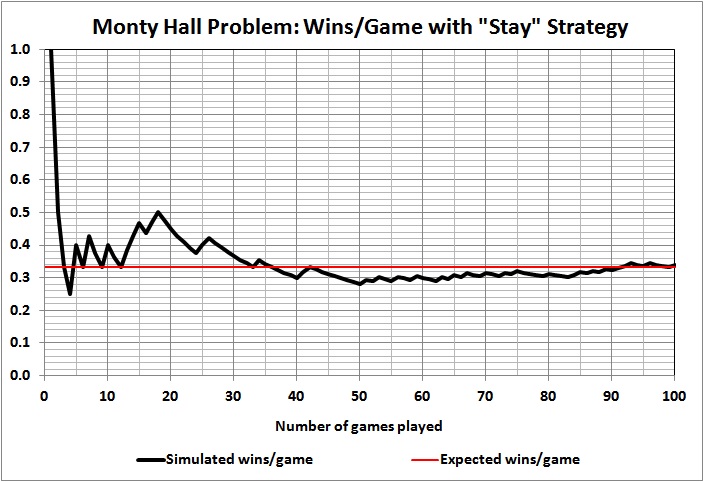
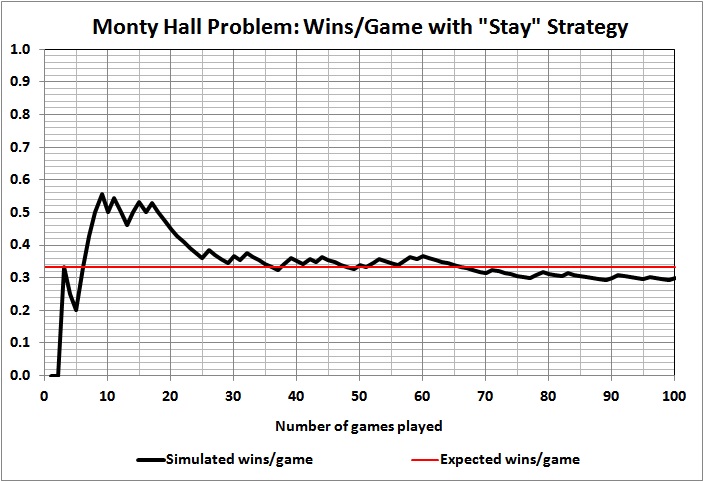
Results of 100 games_1

Results of 100 games_2

Results of 100 games_3

Results of 100 games_4

Results of 100 games_5

Some observations:

Outcomes of individual games are unpredictable, as evidenced by the wild swings and jagged lines, the latter of which persist even at 100 games.

Taking the first game as a proxy for a single-game run of the show, we see that the contestant won that game in just one of the five simulations. To put it another way, in four of the five cases the producer would have thrown away his money on a rapidly depreciating asset (a car) if had offered a car as the prize.

Results vary widely and wildly after the first game. At 10 and 20 games, contestants are doing better than expected in four of the five simulations. At 30 games, contestants are doing as well or better than expected in all five simulations. At 100 games, contestants are doing better than expected in two simulation, worse than expected in two simulation, and exactly as expected in one simulation. What should the producer do with such information? Well, it’s up to the producer and his tolerance for risk. But a prudent producer wouldn’t budget 33 cars or $990,000 just because that’s the expected value of 100 games.

It can take a lot of games to yield an outcome that comes close to 1/3 car per game. A game-show producer could easily lose his shirt by “betting” on 1/3 car per game for a season much shorter than 100 games, and even for a season of 100 games.

*     *     *

The reader’s second additional comment pertains to this exchange:

On what basis other than an understanding of probability would you be optimistic at the prospect of being offered one chance of picking a single Golden Ball worth $1m from a bag of just three balls and pessimistic about your prospects of picking the sole Golden Ball from a barrel of 10,000 balls?

The only difference between the two games is that on the one hand you have a decent (33%) chance of winning and on the other hand you have a lousy (0.01%) chance. Isn’t it these disparate probabilities that give you cause for optimism or pessimism, as the case may be?

“Optimism” and “pessimism” — like “comfort” — are subjective terms for ill-defined states of mind. There are persons who will be “optimistic” about a given situation, and persons who will be “pessimistic” about the same situation. For example: There are hundreds of millions of persons who are “optimistic” about winning various lotteries, even though they know that the grand prize in each lottery will be assigned to only one of millions of possible numbers. By the same token, there are hundreds of millions of persons who, knowing the same facts, refuse to buy lottery tickets because they are “pessimistic” about the likely outcome of doing so. But “optimism” and “pessimism” — like “comfort” — have nothing to do with probability, which isn’t an attribute of a single game.

The reader now says this:

Optimism or pessimism are states as much as something being hot or cold, or a person perspiring or not, and one would find a lot more confidence among contestants playing a single instance of a 1-in-3 game than one would find amongst contestants playing a 1-in-1b game.

Apart from differing probabilities, how would you explain the higher levels of confidence among players of the 1-in-3 game?

Alternatively, what about a “game” involving 2 electrical wires, one live and one neutral, and a game involving one billion electrical wires, only one of which is live?  Contestants are offered $1m if they are prepared to touch one wire.  No one accepts the dare in the 1-in-2 game but a reasonable percentage accept the dare in the 1-in-1b game.

Is the probable outcome of a single event a factor in the different rates of uptake between the two games?

The reader begs the question by introducing “hot or cold” and “perspiring or not,” which have nothing to do with objective probabilities (long-run frequencies of occurrence) and everything to do with individual attitudes toward risk-taking. That was the point of my original response, and I stand by it. The reader simply tries to evade the point by reading the minds of his hypothetical contestants (“higher levels of confidence among players of the 1-in-3 game”). He fails to address the basic issue, which is whether or not there are single-case probabilities — an issue that I addressed at length in “Some Thoughts…”.

The alternative hypotheticals involving electrical wires are just variants of the original one. They add nothing to the discussion.

*     *     *

Enough of this. If the reader — or anyone else — has some good arguments to make in favor of single-case probabilities, drop me a line. If your thoughts have merit, I may write about them.

Signature

The Many-Sided Curse of Very Old Age

Here’s a tale that will be familiar to millions of the Greatest generation and their children of the Silent and Baby Boomer generations:

My grandparents and my wife’s grandparents were born in the years from 1875 to 1899. Their ages at death ranged from 25 to 96, for an average of 62.

My wife’s parents are still living, at the ages of 95 and 94. My father died at the age of 72, but my mother lives on at almost-99. That’s an average age of 90 — and rising.

My wife’s father was 6 when his father died and 56 when his mother died.

My wife’s mother was 14 when her father died and 52 when her mother died.

My mother was 25 when her father died and 61 when her mother died.

My father was 7 when his mother died and 35 when his father died.

My wife and I are 70-plus, and our three remaining parents are still going on … and on …

A long-lived parent is a mixed blessing. If you’re close to a parent, that parent’s growing dependence on you becomes a labor of love. If you’re not close to a parent, his or her long life simply imposes a labor of duty. In either case, the labor comes at an age when the child is on the downslope of energy.

What’s worse is that the rather competent, energetic, and often engaging parent of one’s earlier years is replaced by the addled, hobbled, and dull parent of one’s “golden years.” Financial prudence becomes miserliness; gregariousness turns into the retelling of stories and jokes for the umpteenth time; admirable determination gives way to pointless stubbornness.

Very old age is a test of character, and it’s a great disappointment when a parent fails the test. Too often, the facade of good cheer crumbles, to reveal extreme egoism, irresponsibility, and rancid bigotry.

I blame Medicare, in good part, for the miseries that very old age inflicts on the very old and on their children. I also blame Medicare for the miseries that it has inflicted and will continue to inflict on American taxpayers and workers.

The idea of ensuring access to health care is laudable, but Medicare — like so many government programs — has baleful side effects. To begin with, Medicare is yet another instance of the presumptuousness of the powerful. Big Brother presumes to know better than his subjects how they should spend their money and arrange their lives.

Medicare wasn’t sold as a subsidy, but it is one, just like Social Security and Medicaid. As with Social Security, the Medicare payroll tax doesn’t finance the full cost of the program. But because there are Medicare (and Social Security) taxes, most retirees believe (wrongly) that they have paid for their Medicare (and Social Security) benefits. They then consume their Medicare benefits with abandon because those benefits are almost free to them.

Instead of helping the truly penurious, Medicare (like Social Security) has become a middle-class welfare program. It relieves millions of workers from the responsibility of saving enough to pay for (or insure) their health care in old age. Thus the disincentivizing effects of Medicare (and Social Security) have caused and will continue to cause hundreds of millions of workers to produce far less than they would otherwise have produced. But drone-like politicians don’t understand such things.

The ever-growing cost of Medicare (with Social Security and Medicaid) threatens the well-being of future generations. Our progeny will be saddled with the exorbitant cost of caring for and subsidizing a burgeoning population of long-lived retirees — so many of whom know that they have lived too long and pray nightly “to shuffle[] off this mortal coil.”

We and our progeny will be hard-pressed to bear the exorbitant cost of Medicare and its socialistic ilk. The economy will sink deeper into the doldrums as resources are diverted from capital investments to subsidize oldsters who, for the most part, could have saved enough to pay for their own care and feeding had they not been discouraged from doing so.

The perfect storm of rising costs and slower economic growth means that future generations of Americans will be less well-fed, less well-clothed, less well-sheltered, and less healthy than the Greatest, the Silent, and the Boomer generations. There is great irony in the naming of Medicare, Medicaid, and Social Security.

*     *     *

Related reading:
Life Expectancy Graphs at Mapping History
Steve Calfo et al., “Last Year of Life Study,” Centers for Medicare & Medicaid Services, Office of the Actuary (undated)
Frank R. Lichtenberg, “The Effects of Medicare on Health Care Utilization and Outcomes,” Frontiers in Health Policy Research (Volume 5), MIT Press, January 2002
Kenneth Y. Chay et al., “Medicare, Hospital Utilization and Mortality: Evidence from the Program’s Origins,” NBER conference paper, February 2010
Theodore Dalrymple, “The Demand for Perfection,” Taki’s Magazine, December 14, 2014
Timothy Taylor, “How Medicare Spending Rises with Age,” The Conversable Economist, January 15, 2015

*     *     *

Related posts:
As Goes Greece
The Commandeered Economy
America’s Financial Crisis Is Now
The Rahn Curve Revisited

Signature

Presidential Trivia: Recurring First Names

Among the 44 Presidents of the United States, there are eight first names that occur more than once. Do you know the eight names? Do you know the middle names (if any) and last names that go with the first names? Try to answer those questions without peeking at a list of presidents, then go to the bottom of this page for the answers.

The Rahn Curve Revisited

REVISED AND UPDATED, HERE.

McCloskey on Piketty

UPDATED 01/07/15

The left loves Thomas Piketty‘s Capital in the Twenty-First Century because it lends pseudo-scientific backing to some of the left’s favorite economic postulates; to wit:

  • Income inequality is bad, even if real incomes are rising across the board. Why is it bad? It just is, if you’re an envious Marxist. But also…
  • Income inequality is bad because wealth usually derives from income. The rich get richer, as the old song goes. And the rich — the super-rich, in today’s parlance — acquire inordinate political power because of their great wealth. (Leftists conveniently overlook the fact that the penchant for statist schemes — redistributionism among them — is positively correlated with income. This is a morally confused stance, based on guilt-feelings and indoctrination at the hands of leftist “educators,” “journalists,” and “entertainers.”)
  • Further, inequality yields slower economic growth because persons with high incomes consume a smaller fraction of their incomes than do persons with low incomes. The result, according to the Keynesian consumption-based model, is a reduction in GDP, other things being the same. And other things being the same, slower growth means that it is harder for low-income persons to rise from poverty or near-poverty. (This is a logically and empirically backward view of reality, which is that economic growth requires more investment and less consumption. And investment spending is stifled when redistribution takes money from high earners and gives it to low earners, that is, persons with a high propensity to consume. Investment is also stifled by progressive taxation, which penalizes success, and burdensome regulation, which deters entrepreneurship and job creation.)

Deirdre McCloskey‘s forthcoming review of Piketty’s book praises it and damns it. First the praise:

Piketty gives a fine example of how to do it [economic history]. He does not get entangled as so many economists do in the sole empirical tool they are taught, namely, regression analysis on someone else’s “data”…. Therefore he does not commit one of the two sins of modern economics, the use of meaningless “tests” of statistical significance…. Piketty constructs or uses statistics of aggregate capital and of inequality and then plots them out for inspection, which is what physicists, for example, also do in dealing with their experiments and observations. Nor does he commit the other sin, which is to waste scientific time on existence theorems. Physicists, again, don’t. If we economists are going to persist in physics envy let’s at least learn what physicists actually do. Piketty stays close to the facts, and does not, say, wander into the pointless worlds of non-cooperative game theory, long demolished by experimental economics. He also does not have recourse to non-computable general equilibrium, which never was of use for quantitative economic science, being a branch of philosophy, and a futile one at that. On both points, bravissimo.

His book furthermore is clearly and unpretentiously, if dourly, written….

That comes early in McCloskey’s long review (50 double-spaced pages in the .pdf version). But she ends with blistering damnation:

On the next to last page of his book Piketty writes, “It is possible, and even indispensable, to have an approach that is at once economic and political, social and cultural, and concerned with wages and wealth.” One can only agree. But he has not achieved it. His gestures to cultural matters consist chiefly of a few naively used references to novels he has read superficially—for which on the left he has been embarrassingly praised. His social theme is a narrow ethic of envy. His politics assumes that governments can do anything they propose to do. And his economics is flawed from start to finish.

It is a brave book. But it is mistaken.

There is much in between to justify McCloskey’s conclusion. Here she puts Piketty’s work in context:

[T]he left in its worrying routinely forgets this most important secular event since the invention of agriculture—the Great Enrichment of the last two centuries—and goes on worrying and worrying, like the little dog worrying about his bone in the Traveler’s insurance company advertisement on TV, in a new version every half generation or so.

Here is a partial list of the worrying pessimisms, which each has had its day of fashion since the time, as the historian of economic thought Anthony Waterman put it, “Malthus’ first [1798] Essay made land scarcity central. And so began a century-long mutation of ‘political economy,’ the optimistic science of wealth, to ‘economics,’ the pessimistic science of scarcity.” Malthus worried that workers would proliferate and Ricardo worried that the owners of land would engorge the national product. Marx worried, or celebrated, depending on how one views historical materialism, that owners of capital would at least make a brave attempt to engorge it…. Mill worried, or celebrated, depending on how one views the sick hurry of modern life, that the stationary state was around the corner. Then the economists, many on the left but some on the right, in quick succession 1880 to the present—at the same time that trade-tested betterment was driving real wages up and up and up—commenced worrying about, to name a few of the grounds for pessimisms they discerned concerning ”capitalism”: greed, alienation, racial impurity, workers’ lack of bargaining strength, women working, workers’ bad taste in consumption, immigration of lesser breeds, monopoly, unemployment, business cycles, increasing returns, externalities, under-consumption, monopolistic competition, separation of ownership from control, lack of planning, post-War stagnation, investment spillovers, unbalanced growth, dual labor markets, capital insufficiency … , peasant irrationality, capital-market imperfections, public choice, missing markets, informational asymmetry, third-world exploitation, advertising, regulatory capture, free riding, low-level traps, middle-level traps, path dependency, lack of competitiveness, consumerism, consumption externalities, irrationality, hyperbolic discounting, too big to fail, environmental degradation, underpaying of care, overpayment of CEOs, slower growth, and more.

One can line up the later items in the list, and some of the earlier ones revived à la Piketty or Krugman…. I will not name here the men … , but can reveal their formula: first, discover or rediscover a necessary condition for perfect competition or a perfect world (in Piketty’s case, for example, a more perfect equality of income). Then assert without evidence (here Piketty does a great deal better than the usual practice) but with suitable mathematical ornamentation (thus Jean Tirole, Nobel 2014) that the condition might be imperfectly realized or the world might not develop in a perfect way. Then conclude with a flourish (here however Piketty falls in with the usual low scientific standard) that “capitalism” is doomed unless experts intervene with a sweet use of the monopoly of violence in government to implement anti-trust against malefactors of great wealth or subsidies to diminishing-returns industries or foreign aid to perfectly honest governments or money for obviously infant industries or the nudging of sadly childlike consumers or, Piketty says, a tax on inequality-causing capital worldwide. A feature of this odd history of fault-finding and the proposed statist corrections, is that seldom does the economic thinker feel it necessary to offer evidence that his … proposed state intervention will work as it is supposed to, and almost never does he feel it necessary to offer evidence that the imperfectly attained necessary condition for perfection before intervention is large enough to have reduced much the performance of the economy in aggregate.

I heartily agree with McCloskey’s diagnosis of the causes of leftist worrying:

One begins to suspect that the typical leftist … starts with a root conviction that capitalism is seriously defective. The conviction is acquired at age 16 years when the proto-leftist discovers poverty but has no intellectual tools to understand its source. I followed this pattern, and therefore became for a time a Joan-Baez socialist. Then the lifelong “good social democrat,” as he describes himself (and as I for a while described myself), when he has become a professional economist, in order to support the now deep-rooted conviction, looks around for any qualitative indication that in some imagined world the conviction would be true, without bothering to ascertain numbers drawn from our own world…. It is the utopianism of good-hearted leftward folk who say, “Surely this wretched society, in which some people are richer and more powerful than others, can be greatly improved. We can do much, much better!”

Piketty’s typically leftist blend of pessimism and utopianism is hitched to bad economic reasoning, ignorance of economic history, and a misreading of his own statistics:

Piketty’s (and Aristotle’s) theory is that the yield on capital usually exceeds the growth rate of the economy, and so the share of capital’s returns in national income will steadily increase, simply because interest income—what the presumably rich capitalists get and supposedly manage to cling to and supposedly reinvest—is growing faster than the income the whole society is getting.

Aristotle and his followers, such as Aquinas and Marx and Piketty, were much concerned with such “unlimited” gain. The argument is, you see, very old, and very simple. Piketty ornaments it a bit with some portentous accounting about capital-output ratios and the like, producing his central inequality about inequality: so long as r > g, where r is the return on capital and g is the growth rate of the economy, we are doomed to ever increasing rewards to rich capitalists while the rest of us poor suckers fall relatively behind. The merely verbal argument I just gave, however, is conclusive, so long as its factual assumptions are true: namely, only rich people have capital; human capital doesn’t exist; the rich reinvest their return; they never lose it to sloth or someone else’s creative destruction; inheritance is the main mechanism, not a creativity that raises g for the rest of us just when it results in an r shared by us all; and we care ethically only about the Gini coefficient, not the condition of the working class. Notice one aspect of that last: in Piketty’s tale the rest of us fall only relatively behind the ravenous capitalists. The focus on relative wealth or income or consumption is one serious problem in the book. Piketty’s vision of a “Ricardian Apocalypse,” as he calls it, leaves room for the rest of us to do very well indeed, most non-apocalyptically, as in fact since 1800 we have. What is worrying Piketty is that the rich might possibly get richer, even though the poor get richer, too. His worry, in other words, is purely about difference, about the Gini coefficient, about a vague feeling of envy raised to a theoretical and ethical proposition.

Another serious problem is that r will almost always exceed g, as anyone can tell you who knows about the rough level of interest rates on invested capital and about the rate at which most economies have grown (excepting only China recently, where contrary to Piketty’s prediction, inequality has increased). If his simple logic is true, then the Ricardian Apocalypse looms, always. Let us therefore bring in the sweet and blameless and omni-competent government—or, even less plausibly, a world government, or the Gallactic Empire—to implement “a progressive global tax on capital” (p. 27) to tax the rich. It is our only hope…. In other words, Piketty’s fears were not confirmed anywhere 1910 to 1980, nor anywhere in the long run at any time before 1800, nor anywhere in Continental Europe and Japan since World War II, and only recently, a little, in the United States, the United Kingdom, and Canada (Canada, by the way, is never brought into his tests).

That is a very great puzzle if money tends to reproduce itself, always, evermore, as a general law governed by the Ricardo-plus-Marx inequality at the rates of r and g actually observed in world history. Yet inequality in fact goes up and down in great waves, for which we have evidence from many centuries ago down to the present, which also doesn’t figure in such a tale (Piketty barely mentions the work of the economic historians Peter Lindert and Jeffrey Williamson documenting the inconvenient fact). According to his logic, once a Pikettywave starts—as it would at any time you care to mention if an economy satisfied the almostalways-satisfied condition of the interest rate exceeding the growth rate of income—it would never stop. Such an inexorable logic means we should have been overwhelmed by an inequality-tsunami in 1800 CE or in 1000 CE or for that matter in 2000 BCE. At one point Piketty says just that: “r > g will again become the norm in the twenty-first century, as it had been throughout history until the eve of World War I (… one wonders what he does with historically low interest rates right now, or the negative real interest rates in the inflation of the 1970s and 1980s). Why then did the share of the rich not rise anciently to 100 percent?

McCloskey gets it right:

With a bigger pie, someone has to get more. In the event what rose were wages on raw labor and especially a great accumulation of human capital, but capital owned by the laborers, not by the truly rich. The return to physical capital was higher than a riskless return on British or American government bonds, in order to compensate for the risk in holding capital (such as being made obsolete by betterment—think of your computer, obsolete in four years). But the return on physical capital, and on human capital, was anyway held down to its level of very roughly 5 to 10 percent by competition among the proliferating capitalists. Imagine our immiserization if the income of workers, because they did not accumulate human capital, and their societies had not adopted the accumulation of ingenuities since 1800, had experienced the history of stagnation since 1800 that the per-unit return to capital has. It is not hard to imagine, because such miserable income of workers exists even now in places like Somalia and North Korea. Instead, since 1800 in the average rich country the income of the workers per person increased by a factor of about 30 (2,900 percent, if you please) and in even in the world as a whole, including the still poor countries, by a factor of 10 (900 percent), while the rate of return to physical capital stagnated.

Piketty does not acknowledge that each wave of inventors, of entrepreneurs, and even of routine capitalists find their rewards taken from them by entry, which is an economic concept he does not appear to grasp. Look at the history of fortunes in department stores. The income from department stores in the late nineteenth century, in Le Bon Marché, Marshall Fields, and Selfridge’s, was entrepreneurial. The model was then copied all over the rich world, and was the basis for little fortunes in Cedar Rapids, Iowa and Benton Harbor, Michigan. Then in the late twentieth century the model was challenged by a wave of discounters, and they then in turn by the internet. The original accumulation slowly or quickly dissipates. In other words, the profit going to the profiteers is more or less quickly undermined by outward-shifting supply, if governmental monopolies and protectionisms of the sort Matt Ridley noted in recent British history do not intervene. The economist William Nordhaus has calculated that the inventors and entrepreneurs nowadays earn in profit only 2 percent of the social value of their inventions. If you are Sam Walton the 2 percent gives you personally a great deal of money from introducing bar codes into stocking of supermarket shelves. But 98 percent at the cost of 2 percent is nonetheless a pretty good deal for the rest of us. The gain from macadamized roads or vulcanized rubber, then modern universities, structural concrete, and the airplane, has enriched even the poorest among us.

But Piketty doesn’t see this because he’s a poor economist and a knee-jerk socialist:

Piketty, who does not believe in supply responses [as discussed below], focuses instead on the great evil of very rich people having seven Rolex watches by mere inheritance. Lillian Bettancourt, heiress to the L’Oréal fortune (p. 440), the third richest woman in the world, who “has never worked a day in her life, saw her fortune grow exactly as fast as that of [the admittedly bettering] Bill Gates.” Ugh, Piketty says, which is his ethical philosophy in full.

*     *     *

[T]he effect of inherited wealth on children is commonly to remove their ambition, as one can witness daily on Rodeo Drive. Laziness—or for that matter regression to the mean of ability—is a powerful equalizer. “There always comes a time,” Piketty writes against his own argument, “when a prodigal child squanders the family fortune” (p. 451), which was the point of the centuries-long struggle in English law for and against entailed estates.

*     *     *

Because Piketty is obsessed with inheritance, moreover, he wants to downplay entrepreneurial profit, the trade-tested betterment that has made the poor rich. It is again Aristotle’s claim that money is sterile and interest is therefore unnatural. Aristotle was on this matter mistaken. It is commonly the case, contrary to Piketty, and setting aside the cheapening of our goods produced by the investments of their wealth by the rich, that the people with more money got their more by being more ingeniously productive, for the benefit of us all—getting that Ph.D., for example, or being excellent makers of automobiles or excellent writers of horror novels or excellent throwers of touchdown passes or excellent providers of cell phones, such as Carlos Slim of Mexico, the richest man in the world (with a little boost, it may be, from corrupting the Mexican parliament). That Frank Sinatra became richer than most of his fans was not an ethical scandal. The “Wilt Chamberlain” example devised by the philosopher Robert Nozick (Piketty mentions John Rawls, but not Nozick, Rawls’ nemesis) says that if we pay voluntarily to get the benefit of clever CEOs or gifted athletes there is no further ethical issue. The unusually high rewards to the Frank Sinatras and Jamie Dimons and Wilt Chamberlains come from the much wider markets of the age of globalization and mechanical reproduction, not from theft. Wage inequality in the rich countries experiencing an enlarging gap of rich vs. poor, few though the countries are (Piketty’s finding, remember: Canada, U.S.A., U.K.)), is mainly, he reports, caused by “the emergence of extremely high remunerations at the summit of the wage hierarchy, particularly among top managers of large firms.” The emergence, note, has nothing to do with r > g.

How poor an economist? Consider:

Piketty’s definition of wealth does not include human capital, owned by the workers, which has grown in rich countries to be the main source of income, when it is combined with the immense accumulation since 1800 of capital in knowledge and social habits, owned by everyone with access to them. Therefore his laboriously assembled charts of the (merely physical and private) capital/output ratio are erroneous. They have excluded one of the main forms of capital in the modern world. More to the point, by insisting on defining capital as something owned nearly always by rich people, Piketty mistakes the source of income, which is chiefly embodied human ingenuity, not accumulated machines or appropriated land.

*    *     *

The fundamental technical problem in the book, however, is that Piketty the economist does not understand supply responses….

Startling evidence of Piketty’s miseducation occurs as early as page 6. He begins by seeming to concede to his neoclassical opponents…. “To be sure, there exists in principle a quite simple economic mechanism that should restore equilibrium to the process [in this case the process of rising prices of oil or urban land leading to a Ricardian Apocalypse]: the mechanism of supply and demand. If the supply of any good is insufficient, and its price is too high, then demand for that good should decrease, which would lead to a decline in its price.” [This] clearly mix[es] up movement along a demand curve with movement of the entire curve, a first-term error at university. The correct analysis (we tell our first-year, first-term students at about week four) is that if the price is “too high” it is not the whole demand curve that “restores equilibrium” … , but an eventually outward-moving supply curve. The supply curve moves out because entry is induced by the smell of super-normal profits, in the medium and long run (which is the Marshallian definition of the terms). New oil deposits are discovered, new refineries are built, new suburbs are settled, new high-rises saving urban land are constructed, as has in fact happened massively since, say, 1973, unless government has restricted oil exploitation (usually on environmental grounds) or the building of high-rises (usually on corrupt grounds). Piketty goes on—remember: it does not occur to him that high prices cause after a while the supply curve to move out; he thinks the high price will cause the demand curve to move in, leading to “a decline in price” (of the scarce item, oil’s or urban land)—“such adjustments might be unpleasant or complicated.” To show his contempt for the ordinary working of the price system he imagines comically that “people should . . . take to traveling about by bicycle.” The substitutions along a given demand curve, or one mysteriously moving in, without any supply response “might also take decades, during which landlords and oil well owners might well accumulate claims on the rest of the population” (now he has the demand curve moving out, for some reason faster than the supply curve moves out) “so extensive that they could they could easily [on grounds not argued] come to own everything that can be owned, including” in one more use of the comical alternative, “bicycles, once and for all.” Having butchered the elementary analysis of entry and of substitute supplies, which after all is the economic history of the world, he speaks of “the emir of Qatar” as a future owner of those bicycles, once and for all. The phrase must have been written before the recent and gigantic expansion of oil and gas exploitation in Canada and the United States….

Piketty, it would seem, has not read with understanding the theory of supply and demand that he disparages, such as Smith (one sneering remark on p. 9), Say (ditto, mentioned in a footnote with Smith as optimistic), Bastiat (no mention), Walras (no mention), Menger (no mention), Marshall (no mention), Mises (no mention), Hayek (one footnote citation on another matter), Friedman (pp. 548-549, but only on monetarism, not the price system). He is in short not qualified to sneer at self-regulated markets (for example on p. 572), because he has no idea how they work. It would be like someone attacking the theory of evolution (which is identical to the theory the economists use of entry and exit in self-regulating markets—the supply response, an early version of which inspired Darwin) without understanding natural selection or the the Galton-Watson process or modern genetics.

McCloskey continues:

Beyond technical matters in economics, the fundamental ethical problem in the book is that Piketty has not reflected on why inequality by itself would be bad…. The motive of the true Liberal … should not be equality but [says Joshua Monk, a character in Anthony Trollope’s novel, Phineas] “the wish of every honest [that is, honorable] man . . . to assist in lifting up those below him.” Such an ethical goal was to be achieved, says Monk the libertarian liberal (as Richard Cobden and John Bright and John Stuart Mill were, and Bastiat in France at the time, and in our times Hayek and Friedman, or for that matter M’Cluskie), not by direct programs of redistribution, nor by regulation, nor by trade unions, but by free trade and tax-supported compulsory education and property rights for women—and in the event by the Great Enrichment, which finally in the late nineteenth century started sending real wages sharply up, Europe-wide, and then world-wide.

The absolute condition of the poor has been raised overwhelmingly more by the Great Enrichment than by redistribution. The economic historians Ian Gazeley and Andrew Newell noted in 2010 “the reduction, almost to elimination, of absolute poverty among working households in Britain between 1904 and 1937.” “The elimination of grinding poverty among working families,” they show, “was almost complete by the late thirties, well before the Welfare State.” Their Chart 2 exhibits income distributions in 1886 prices at 1886, 1906, 1938, and 1960, showing the disappearance of the classic line of misery for British workers, “round about a pound a week.”

And it didn’t stop there:

In 2013 the economists Donald Boudreaux and Mark Perry noted that “according to the Bureau of Economic Analysis, spending by households on many of modern life’s ‘basics’—food at home, automobiles, clothing and footwear, household furnishings and equipment, and housing and utilities—fell from 53 percent of disposable income in 1950 to 44 percent in 1970 to 32 percent today.” It is a point which the economic historian Robert Fogel had made in 1999 for a longer span. The economist Steven Horwitz summarizes the facts on labor hours required to buy a color TV or an automobile, and notes that “these data do not capture . . . the change in quality . . . . The 1973 TV was at most 25 inches, with poor resolution, probably no remote control, weak sound, and generally nothing like its 2013 descendant. . . . Getting 100,000 miles out of a car in the 1970s was cause for celebration. Not getting 100,000 miles out of a car today is cause to think you bought a lemon.”

Nor in the United States are the poor getting poorer. Horwitz observes that “looking at various data on consumption, from Census Bureau surveys of what the poor have in their homes to the labor time required to purchase a variety of consumer goods, makes clear that poor Americans are living better now than ever before. In fact, poor Americans today live better, by these measures, than did their middle class counterparts in the 1970s.” In the summer of 1976 an associate professor of economics at the University of Chicago had no air conditioning in his apartment. Nowadays many quite poor Chicagoans have it. The terrible heat wave in Chicago of July 1995 killed over 700 people, mainly low-income. Yet earlier heat waves in 1936 and 1948, before air-conditioning was at all common, had probably killed many more.

There is one point at which McCloskey almost veers off course, but she recovers nicely:

To be sure, it’s irritating that a super rich woman buys a $40,000 watch. The purchase is ethically objectionable. She really should be ashamed. She should be giving her income in excess of an ample level of comfort—two cars, say, not twenty, two houses, not seven, one yacht, not five—to effective charities…. But that many rich people act in a disgraceful fashion does not automatically imply that the government should intervene to stop it. People act disgracefully in all sorts of ways. If our rulers were assigned the task in a fallen world of keeping us all wholly ethical, the government would bring all our lives under its fatherly tutelage, a nightmare achieved approximately before 1989 in East Germany and now in North Korea.

And that is the key point, to my mind. Perfection always eludes the human race, even where its members have managed to rise from the primordial scramble for sustenance and above Hobbes’s “warre, as is of every man, against every man.” Economic progress without economic inequality is impossible, and efforts to reduce inequality by punishing economic success must inevitably hinder progress, which is built on the striving of entrepreneurs. Further, the methods used to punish economic success are anti-libertarian — whether they are the police-state methods of the Soviet Union or the “soft despotism” of the American regulatory-welfare state.

So what if an entrepreneur — an Edison, Rockefeller, Ford, Gates, or Jobs — produces something of great value to his fellow men, and thus becomes rich and adorns his spouse with a $40,000 watch, owns several homes, and so on? So what if that same entrepreneur is driven (in part, at least) by a desire to bestow great wealth upon his children? So what if that same entrepreneur chooses to live among and associate with other persons of great wealth? He has no obligation to “give back”; he has already given by providing his fellow men with something that they value enough to make him rich. (Similarly, the super-star athlete and actor.)

McCloskey gets the penultimate word:

Supposing our common purpose on the left and on the right, then, is to help the poor, … the advocacy by the learned cadres of the left for equalizing restrictions and redistributions and regulations can be viewed at best as thoughtless. Perhaps, considering what economic historians now know about the Great Enrichment, but which the left clerisy, and many of the right, stoutly refuse to learn, it can even be considered unethical. The left clerisy such as Tony Judt or Paul Krugman or Thomas Piketty, who are quite sure that they themselves are taking the ethical high road against the wicked selfishness of Tories or Republicans or La Union pour un Mouvement Populaire, might on such evidence be considered dubiously ethical. They are obsessed with first-[order] changes that cannot much help the poor, and often can be shown to damage them, and are obsessed with angry envy at the consumption of the uncharitable rich, of whom they personally are often examples (what will you do with your royalties, Professor Piketty?), and the ending of which would do very little to improve the position of the poor. They are very willing to stifle through taxing the rich the trade-tested betterments which in the long run have gigantically helped the poor, who were the ancestors of most of the rest of us.

I added the emphasis to underscore what seems to me to be the left’s greatest ethical offense in the matter of inequality, as it is in the matter of race relations: hypocrisy. Hypocritical leftists like Judt, Krugman, and Pikkety (to name only a few of their ilk) aren’t merely wrong in their views about how to help the (relatively) poor, they make money (and a lot of it) by espousing their erroneous views. They obviously see nothing wrong with making a lot of money. So why is it all right for them to make a lot of money — more than 99.9 percent of the world’s population, say — but not all right for other persons to make even more money? The dividing line between deservingness and greed seems always to lie somewhere above their munificent earnings.

UPDATE:

As John Cochrane notes,

Most Piketty commentary … focuses on the theory, r>g, and so on. After all, that’s easy and you don’t have to read hundreds of pages.

Cochrane then points to a paper by Philip W. Magness and Robert P. Murphy (listed below in “Related reading”) that focuses on the statistics that Piketty compiled and relied on to advance his case for global redistribution of income and wealth. Here is the abstract of the paper:

Thomas Piketty’s Capital in the 21st Century has been widely debated on theoretical grounds, yet continues to attract acclaim for its historically-infused data analysis. In this study we conduct a closer scrutiny of Piketty’s empirics than has appeared thus far, focusing upon his treatment of the United States. We find evidence of pervasive errors of historical fact, opaque methodological choices, and the cherry-picking of sources to construct favorable patterns from ambiguous data. Additional evidence suggests that Piketty used a highly distortive data assumption from the Soviet Union to accentuate one of his main historical claims about global “capitalism” in the 20th century. Taken together, these problems suggest that Piketty’s highly praised and historically-driven empirical work may actually be the book’s greatest weakness.

I’ve quickly read Magness and Murphy’s paper. It seems to live up to the abstract. Piketty (and friends) may challenge Magness and Murphy, but Piketty bears the burden of showing that he hasn’t stacked the empirical deck in favor of his redistributionist message. Not that the empirical flaws should matter, given the theoretical flaws exposed by McCloskey and others, but Piketty’s trove of spurious statistics should be discredited before it becomes a standard reference.

*     *     *

Related reading:
David R. Henderson, “An Unintended Case for More Capitalism,” Regulation, Fall 2014
John Cochrane, “Why and How We Care about Inequality,” The Grumpy Economist, September 29, 2014
John Cochrane, “Envy and Excess,” The Grump Economist, October 1, 2014
Mark J. Perry, “New CBO Study Shows That ‘The Rich’ Don’t Just Pay Their ‘Fair Share,’ They Pay Almost Everybody’s Share,” Carpe Diem, November 15, 2014
Mark J. Perry, “IRS Data Show That the Vast Majority of Taxpayers in the ‘Fortunate 400’ Are Only There for One Year,” Carpe Diem, November 25, 2014
Robert Higgs, “income Inequality Is a Statistical Artifact,” The Beacon (Independent Institute), December 1, 2014
John Cochrane, “McCloskey on Piketty and Friends,” The Grumpy Economist, December 2, 2014
James Pethokoukis, “IMF Study, ‘No Evidence ‘High-End’ Income Inequality Hurts Economic Growth,” AEI.org, December 9, 2014
Philip W. Magness and Robert P. Murphy, “Challenging the Empirical Contribution of Thomas Piketty’s Capital in the 21st Century,” Journal of Private Enterprise, forthcoming

Related posts:
Taxing the Rich
More about Taxing the Rich
The Keynesian Fallacy and Regime Uncertainty
Creative Destruction, Reification, and Social Welfare
Why the “Stimulus” Failed to Stimulate
Regime Uncertainty and the Great Recession
Regulation as Wishful Thinking
In Defense of the 1%
Lay My (Regulatory) Burden Down
Economic Growth Since World War II
Government in Macroeconomic Perspective
Keynesianism: Upside-Down Economics in the Collectivist Cause
How High Should Taxes Be?
The 80-20 Rule, Illustrated
Economics: A Survey
Estimating the Rahn Curve: Or, How Government Spending Inhibits Economic Growth
The Keynesian Multiplier: Phony Math
The True Multiplier
Some Inconvenient Facts about Income Inequality
Mass (Economic) Hysteria: Income Inequality and Related Themes
Social Accounting: A Tool of Social Engineering
Income Inequality and Inherited Wealth: So What?
Income Inequality and Economic Growth
A Case for Redistribution, Not Made

Signature