How to Eradicate the Welfare State, and How Not to Do It

I’ll begin with how not to do it. One way of not doing it is simply not to do it, which is the left’s way. In fact, the left is always on the lookout for ways to expand the welfare state.

Reform conservatives offer less obvious ways not to do it. And the left loves them for it. Consider, for example, Noah Smith’s list of “People I Admire” and see if you can spot what Smith’s “admirable” persons have in common. Hint: They are either lefties or they do things that lefties like.

What’s James Pethokoukis doing on that list? Pethokoukis is an economist at American Enterprise Institute (AEI), which has been described as right-leaning and conservative. Why, then, does Smith admire Pethokoukis? Because, in Smith’s words, Pethokoukis is a “reform conservative.”

And what is reform conservatism? According to Ross Douthat,

It’s rooted in two major premises, which I would summarize as follows:

1) The core economic challenge facing the American experiment is not income inequality per se, but rather stratification and stagnation — weak mobility from the bottom of the income ladder and wage stagnation for the middle class. These challenges are bound up in a growing social crisis — a retreat from marriage, a weakening of religious and communal ties, a decline in workforce participation — that cannot be solved in Washington D.C. But economic and social policy can make a difference nonetheless, making family life more affordable, upward mobility more likely, and employment easier to find.

2) The existing welfare-state institutions we’ve inherited from the New Deal and the Great Society, however, often make these tasks harder rather than easier: Their exploding costs crowd out every other form of spending, require middle class tax increases and threaten to drag on economic growth; their tangled web of subsidies and credits and tax breaks often benefit the already-affluent and create perverse incentives for the poor, and the distortions created by the way they pay for health care, in particular, contribute mightily to the rising cost of health insurance and thus the stagnation of middle class incomes. So we don’t face a choice between streamlining the welfare state and making it more supportive of work and family; we should be doing both at once.

Proceeding from these premises, the basic “reform conservative” agenda looks something like this:

a. A tax reform that caps deductions and lowers rates, but also reduces the burden on working parents and the lower middle class, whether through an expanded child tax credit or some other means of reducing payroll tax liability. (Other measures that might improve the prospects of low-skilled men, ranging from a larger earned income tax credit to criminal justice reforms that reduce the incarceration rate, should also be part of the conversation.)

b. A repeal or revision of Obamacare that aims to ease us toward a system of near-universal catastrophic health insurance, and includes some kind of flat tax credit or voucher explicitly designed for that purpose.

c. A Medicare reform along the lines of the Wyden-Ryan premium support proposal, and a Social Security reform focused on means testing and extending work lives rather than a renewed push for private accounts.

d. An immigration reform that tilts much more toward Canadian-style recruitment of high-skilled workers, and that doesn’t necessarily seek to accelerate the pace of low-skilled immigration. (Any amnesty should follow the implementation of E-Verify rather than the other way around, guest worker programs should not be expanded, etc.)

e. A “market monetarist” monetary policy as an alternative both to further fiscal stimulus and to the tight money/fiscal austerity combination advanced by many Republicans today.

f. An attack not only on explicit subsidies for powerful incumbents (farm subsidies, etc.), but also other protections and implicit guarantees, in arenas ranging from copyright law to the problem of “Too Big To Fail.” [“What Is Reform Conservatism?,” The New York Times, May 30, 2013]

Such proposals may seem like reasonable compromises with the left’s radical positions. But they are reasonable compromises only if you believe that the left wouldn’t strive vigorously to undo them and continue the nation’s march toward full-blown state socialism. That’s the way leftists work. They take what they’re given and then come back for more, lying and worse all the way. As Saul Alinsky (a source of inspiration for Barack Obama) says in Rules for Radicals:

The third rule of the ethics of means and ends is that in war the end justifies almost any means.

The left is always at war, and will be at war until the United States becomes unrecognizable by a survivor of the 1950s, let alone a Founding Father: a nation whose official policies punish success, subvert civil society, and leave Americans defenseless against domestic and foreign predators.

What this means is that “reforms” like those listed by Douthat can be achieved only by opposing them, not by agreeing to them up front. But that’s not what Pethokoukis proposes. For example, with respect to Social Security, he endorses a proposal by Andrew Biggs that would work like this, according to Pethokoukis:

First, workers would be enrolled automatically in an employer-sponsored retirement account and contribute at least 1.5% of pay, matched dollar for dollar by their employers. Second, Social Security’s government-provided benefits would be transformed into a flat universal benefit mean to improve social-insurance protections for low-income Americans. Biggs: “If you put the two benefits together, this poverty-level benefit, plus the individual accounts, the result is near what Social Security promised to pay, but can’t afford. It’s a more reliable system for low-income folks and it’s more affordable on the tax end.” [“Joni Ernst, the Tea Party, and Conservative Reform,” AEI.org, February 10, 2014[

Why throw in the towel now? Because, according to Biggs,

President Bush’s 2001 Commission to Strengthen Social Security (on which I was a staffer) wrote that once the program began to run payroll-tax deficits — something that happened this year — policymakers would face difficult choices to raise taxes, cut benefits, reduce other programs, or increase the budget deficit. … With personal accounts, we face the same choices, only sooner. If workers invest part of their Social Security taxes in personal accounts, they could indeed earn higher returns and generate higher benefits without taking more risk. But diverting taxes to accounts leaves the program short of what is needed to pay benefits to today’s retirees. To cover these “transition costs,” we would need to generate new revenues for the program, either by raising taxes, cutting other programs, or borrowing. [“Personal Accounts Are No Cure-All,” National Review Online, August 30, 2010]

The real problem, as Biggs sees it, isn’t that shifting to personal accounts (for younger workers) would lead to transition costs, but that those costs would come sooner. So what? The end of Social Security revenue surpluses doesn’t alter the fact that non-retirees will have to pay higher taxes to avert a reduction of retirees’ benefits, it just makes the fact more apparent.

In other words, the likes of Biggs and Pethokoukis are willing to sacrifice privatization on the altar of public relations. The dog that doesn’t bark in their proposals is real reform of Social Security. Privatization isn’t real reform because it accepts a basic premise of Social Security: Americans must and should be forced to save for retirement. The joke is that Social Security doesn’t foster saving; it’s a transfer-payment Ponzi scheme.

Real reform means eradication, albeit gradual eradication, like this:

1. Repeal and replace Social Security as of a date certain. Call it Abolition Day (AD), which would occur 12 months from the day on which reform legislation is enacted.

2. After AD, the federal government would continue to pay benefits to persons who are then collecting Social Security. The federal government would also pay benefits to persons who turn 55 before AD but who haven’t yet begun to collect benefits. Persons who are 45 to 54 years old on AD would receive benefits that are pro-rated according to the Social Security taxes that they and their employers had paid as of AD. Cost-of-living increases for benefits paid after AD would be tied to chained CPI. (This is a better measure of inflation, and it doesn’t rise as fast as CPI-W, the price index now used to compute cost-of-living increases.)

3. Persons who are younger than 45 on AD would receive a lump-sum repayment of Social Security taxes paid by them and their employers, plus interest at, say, the rate on 10-year Treasury notes. The repayment would be made when a person turns 70. It would automatically go to a surviving spouse or next-of-kin if the recipient dies intestate. Otherwise, the recipient could bequeath, transfer, or sell his interest in the payment at any time before it comes due.

4. For persons who are 45 to 54 years old on AD, the retirement age for full benefits would be raised to 70, and the minimum age for partial benefits would be raised to 65. (Full retirement age is now scheduled to rise to 67 in 2027; the minimum age for partial benefits is currently set at 62.)

5. The residual obligations outlined above would be funded by a special payroll tax, which would diminish as obligations are liquidated, then vanish.

But what about retirees (and their households) whose incomes are below the poverty line? It might be necessary to provide for them, to ensure the passage of reform legislation. But it would be self-defeating to offer a program for the indigent. An important goal of Social Security reform is to encourage work and saving — not to preemptively discourage work and saving by rewarding indolence.

A deal for the passage of reform might include separate legislation that provides for stringently means-tested income support. The amount of support would be aimed at boosting the total income of a retiree (or his household) to the poverty line. Examiners would take into account an applicant’s income (including income in kind) from all sources, and an applicant’s assets (with a look-back period of several years and criminal penalties for hiding assets). For an applicant who is married or a member of a household, the income and assets of a spouse and/or other members of the household would be taken into account. Benefits wouldn’t be paid to able-bodied and able-minded persons who are unemployed and below retirement age.  (No handouts to slackers who still live at home.)

How might such a “radical” plan be enacted?

Proponents of reform — Republicans, presumably — must launch a vigorous, pro-reform campaign the minute that they gain control of both Houses of Congress and the White House. They must sustain the campaign for several months before Congress sends a bill to the president, to ensure broad support for the enactment of reform. And to prevent their efforts from being stymied by Democrats, they must change the rules of the Senate to eliminate the filibuster and other obstructive tactics.

Here are the key elements of the campaign:

  • Document, publicize, and ceaselessly emphasize the the size of the tax increases that will result if Social Security benefits aren’t reduced to match projected revenues.
  • Point out, relentlessly, that a large fraction of Americans (cite number) who “contribute” to Social Security will earn worse “returns” that they would by putting their money into safe, interest-bearing investments (e.g., investment-grade corporate bonds).
  • Emphasize the true, original purpose of Social Security: keep the poorest of the elderly out of poverty.
  • Show how much less costly it would be if Social Security were restored to its original purpose.
  • Explain that their program (a) achieves the original purpose of Social Security, (b) enables the non-poor to do better for themselves than they would with Social Security, and (c) fosters economic growth that reduces dependence on Social Security:

Enough of Social Security. What about Douthat’s other “reforms”?

Tax reform that caps deductions and lowers rates, but also reduces the burden on working parents and the lower middle class, whether through an expanded child tax credit or some other means of reducing payroll tax liability.

This is too complex and easily manipulated. What’s needed is a true flat tax.

Repeal or revision of Obamacare that aims to ease us toward a system of near-universal catastrophic health insurance, and includes some kind of flat tax credit or voucher explicitly designed for that purpose.

Just repeal Obamacare and its partners-in-crime — Medicare and Medicaid — and phase them out gracefully (along the lines of my proposal for Social Security). Eliminate regulations that hinder interstate competition. Provide for the indigent — and only the indigent — through means-tested vouchers (along the lines of my proposal for Social Security).

Medicare reform along the lines of the Wyden-Ryan premium support proposal.

See above.

Immigration reform that tilts much more toward Canadian-style recruitment of high-skilled workers, and that doesn’t necessarily seek to accelerate the pace of low-skilled immigration. (Any amnesty should follow the implementation of E-Verify rather than the other way around, guest worker programs should not be expanded, etc.)

Immigration reform should discourage low-skilled immigration, as opposed to Obama’s policy of encouraging it. Discouraging it requires stronger security at the borders, a vigorous and well-publicized deportation effort, and the end of subsidies (no free health care, no free schooling, no eligibility for income or housing subsidies, no drivers’ licenses, etc.).

A “market monetarist” monetary policy as an alternative both to further fiscal stimulus and to the tight money/fiscal austerity combination advanced by many Republicans today.

Eliminate the Federal Reserve, a leading cause of the Great Depression and Great Recession. Allow free banking. Fiscal and monetary policy should be “none,” as in the case of the Depression of 1920-21, the depression that cured itself. (NB: The Fed caused that one, too.)

An attack not only on explicit subsidies for powerful incumbents (farm subsidies, etc.), but also other protections and implicit guarantees, in arenas ranging from copyright law to the problem of “Too Big To Fail.”

Douthat gets this one right. But one out of seven is a batting average of 0.143 — abject failure in any league.

“Attack” is the key word in Douthat’s unusual stroke of boldness. Liberty is born of attack, not compromise.

Signature

The Slow-Motion Collapse of the Economy

Robert Higgs asks “How Much Longer Can the U.S. Economy Bear the Burdens?” (The Beacon, a blog of The Independent Institute, January 30, 2015). Higgs explains:

These burdens take the form of taxes, regulations, and uncertainties loaded onto them by governments at every level. Each year, for example, federal departments and regulatory agencies put into effect several thousand new regulations. Only rarely do these agencies remove any existing rules from the Code of Federal Regulations. Thus, the total number in effect continues to climb relentlessly. The tangle of federal red tape becomes ever more difficult for investors, entrepreneurs, and business managers to cut through. Business people have to bear not only a constantly changing, ever more complex array of taxes, fees, and fines, but also a larger and larger amount of regulatory compliance costs, now estimated at more than $1.8 trillion annually. Governments at the state and local levels contribute their full share of such burdens as well.

So it is scarcely a wild-eyed question if we ask, as economist Pierre Lemieux does in a probing article in the current issue of Regulation magazine, whether the U.S. economy is now reacting to these growing burdens by undergoing “a slow-motion collapse.”

The article by Lemieux (“A Slow Motion Collapse” (Regulation, Winter 2014-2015) ends with this:

The resilience of markets, especially in a rich and sometimes still flexible economy like the United States, has dampened the effect of regulation. However, it is reasonable to believe that, over the more than six decades since World War II, regulation has deleted a big chunk of potential prosperity. It has not actually cut into the average standard of living, but this is only a consolation prize, for worse could come if the regulatory bulldozer is not pushed back.

As Higgs suggests, the slow-motion collapse of the economy is due not only to regulation but also to taxation and what Higgs elsewhere calls “regime uncertainty.”

The combined effects of regulation, taxation, and regime uncertainty are captured in the Rahn curve, which depicts the long-term relationship between government spending (as a fraction of GDP) and the rate of economic growth. I say that because government spending and regulatory activity have grown apace since the end of World War II. That might be taken as certainty, of a perverse kind, but beleaguered entrepreneurs can never be certain of the specific obstacles that will be thrown in the path of innovation and investment.

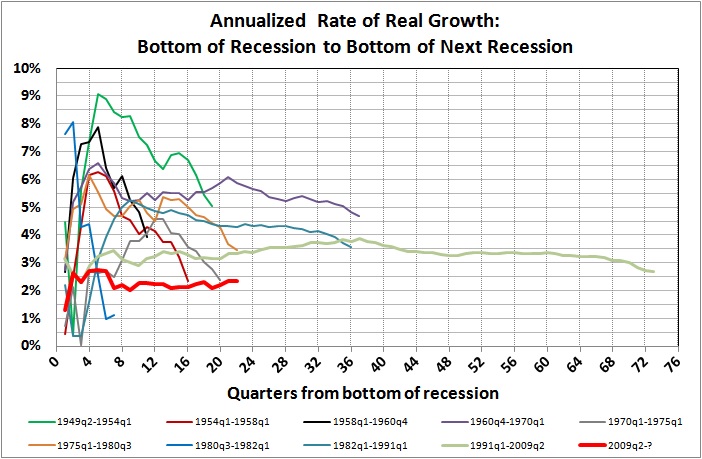
The best evidence of the slow-motion collapse of the U.S. economy is the steady, long-run decline in the rate of economic growth, which is evident in the following graphs:

Real GDP 1947-2014

Year-over-year changes in real GDP

Annualized rate of real growth - bottom of recession to bottom of next recession
The graphs are derived from “Current dollar and ‘real’ GDP,” at the website of the Bureau of Economic Analysis of the U.S. Department of Commerce.

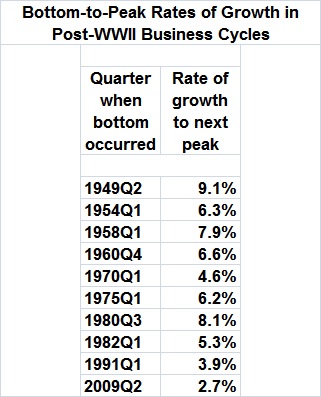
As the third graph suggests, the rate of growth has generally declined from business cycle to business cycle.* Thus:

Bottom-to-peak rates of growth

The “Obama recovery” is an anemic thing. Is it any wonder, given Obama’s incessant war on success?

It will take more than a “push back” to restore the economy — and liberty — to health. Obama and his ilk must be driven from office, and kept out of office for good.

*     *     *

Related posts:
The Laffer Curve, “Fiscal Responsibility,” and Economic Growth
The Causes of Economic Growth
In the Long Run We Are All Poorer
A Short Course in Economics
Addendum to a Short Course in Economics
As Goes Greece
Ricardian Equivalence Reconsidered
The Real Burden of Government
The Illusion of Prosperity and Stability
Taxing the Rich
More about Taxing the Rich
The Keynesian Fallacy and Regime Uncertainty
Why the “Stimulus” Failed to Stimulate
The “Jobs Speech” That Obama Should Have Given
Say’s Law, Government, and Unemployment
Regime Uncertainty and the Great Recession
Regulation as Wishful Thinking
The Commandeered Economy
We Owe It to Ourselves
In Defense of the 1%
Lay My (Regulatory) Burden Down
The Burden of Government
Economic Growth Since World War II
Obama’s Big Lie
Government in Macroeconomic Perspective
Keynesianism: Upside-Down Economics in the Collectivist Cause
Economics: A Survey (also here)
Why Are Interest Rates So Low?
Vulgar Keynesianism and Capitalism
Estimating the Rahn Curve: Or, How Government Spending Inhibits Economic Growth
America’s Financial Crisis Is Now
The Keynesian Multiplier: Phony Math
The True Multiplier
How Libertarians Ought to Thinks about the Constitution
Obamanomics: A Report Card
The Obama Effect: Disguised Unemployment
Income Inequality and Economic Growth
The Rahn Curve Revisited

___________
* Each business cycle runs from the bottom of a recession to the bottom of the next recession. Rather than rely on the National Bureau of Economic Research (NBER), I use my own own definition of a recession, which is:

  • two or more consecutive quarters in which real GDP (annualized) is below real GDP (annualized) for an earlier quarter, during which
  • the annual (year-over-year) change in real GDP is negative, in at least one quarter.

Unlike the NBER, I do not locate a recession in 2001. Real GDP, measured quarterly, dropped in the first and third quarters of 2001, but each decline lasted only a quarter.

My method of identifying a recession is more objective and consistent than the NBER’s method, which one economist describes as “The NBER will know it when it sees it.” Moreover, unlike the NBER, I would not presume to pinpoint the first and last months of a recession, given the volatility of GDP estimates.
Signature

A Case for Redistribution, Not Made

Jessica Flanigan, one of the bleeders at Bleeding Heart Libertarians, offers this excuse for ripping money out of the hands of some persons and placing it into the hands of other persons:

Lately I’ve been thinking about my reasons for endorsing a UBI [universal basic income], especially given that I also share Michael Huemer’s skepticism about political authority. Consider this case:

  • (1) Anne runs a business called PropertySystem, which manufacturers and maintains a private currency that can be traded for goods and services. The currency exists in users’ private accounts and Anne’s company provides security services for users. If someone tries to hack into the accounts she prevents them from doing so. The company also punishes users who violate the rules of PropertySystem. So if someone steals or tries to steal the currency from users, that person may have some of their currency taken away or they may even be held in one of PropertySystem’s jails. These services are financed through a yearly service fee.

This sounds fine. If everyone consented to join PropertySystem then they can’t really complain that Anne charges a fee for the services. There will be some questions about those who are not PropertySystem members, and how Anne’s company should treat them. But for the membership, consent seems to render what Anne is doing permissible. Next,

  • (2) Anne thinks that it would be morally better if she gave money to poor people. She changes the user agreement for her currency holders to increase her maintenance fee and she gives some of the money to poor people. Or, Anne decides to just print more money and mail it to people so that she doesn’t have to raise fees, even though this could decrease the value of the holdings of her richest clients.

By changing the user agreement or distribution system in this way, Anne doesn’t seem to violate anyone’s rights. And PropertySystem does some good through its currency and protection services by using the company to benefit people who are badly off. Now imagine,

  • (3) Anne decides that she doesn’t like PropertySystem competing with other providers so she compels everyone in a certain territory to use PropertySystem’s currency and protection services and to pay service fees, which she now calls taxes.

 …[T[here are moral reasons in favor of Anne’s policy changes from (1) to (2). She changed the property conventions in ways that did not violate anyone’s pre-political ownership rights while still benefiting the badly off. If Anne implemented policy (2) after she started forcing everyone to join her company (3) it would still be morally better than policy (1) despite the fact that (3) is unjust.This is the reason I favor a basic income. Such a policy balances the reasonable complaints that people may have about the effects of a property system that they never consented to join. Though redistribution cannot justify forcing everyone to join a property system, it can at least compensate people who are very badly off partly because they were forced to join that property system. Some people will do very well under a property system that nevertheless violates their rights. But it is not a further rights violation if a property system doesn’t benefit the rich as much as it possibly could.

Flanigan’s logical confusion is astounding.

To begin with, if (3) is “unjust,” implementing (2) as a subset of (3) almost certainly expands the scope of injustice. Flanigan assumes, without justification, that those who are “very badly off” in are so “partly because they were forced to join the property system.” What’s much more likely is that those who are “very badly off” would be very badly off inside or outside the property system because they lack the mental or physical wherewithal to better themselves. By the same token, most of those who are very well off under the property system — including most members of that despised straw-man class, “crony capitalists” — probably would be very well off outside the property system because they possess the wherewithal to better themselves.

Flanigan, like most leftists, wants to blame a “system” instead of looking to the ability and determination of individual persons. Blaming a “system” justifies (in the minds of Flanigan and her ilk) “fixes” that are intended to favor those whom they assume to be “victims” of the “system.”

Flanigan’s simplistic taxonomy of cases — (1), (2), and (3) — bears no resemblance to political reality, that is, to the “system” that has existed in the United States, or to the “system” that has prevailed in the world at large for eons. Reality looks more like this:

The current “system” — the U.S. under the Constitution that was ratified by some of the people in 1788 — began with the imposition of a more intrusive central government on all of the people living within the geographical area defined as the United States. The constituent jurisdictions — the States and their political subdivisions — were governed to greater and lesser degrees of intrusiveness. But, slaves and indentured servants excpted, Americans were free to move to jurisdictions that they found more congenial. The westward expansion of the United States under minimalist territorial governments made “exit” an especially attractive and viable option from the late 1700s to the early 1900s. With the end of slavery (but not of government-imposed racial discrimination), negative liberty reached an apogee (for whites, at least) during the late 1800s.

The Progressives of the late 1800s and early 1900s — a vocal and eventually powerful minority — then began to use the central government to impose their paternalistic designs on the populace as a whole. There have since been some pauses in the accretion of power by the central government, and a few reversals in selected areas (e.g., limited “deregulation” of some industries). But the centralization of power has grown steadily since the Progressive Era, and the exit option has became almost a nullity.

Plugging that bit of potted history into Flanigan’s taxonomy, I would say that with the adoption of the Constitution Americans were thrust wholesale into stage (3). Because of the opening of the frontier, however, Americans (or a goodly fraction of them) had a shot at something less onerous for a while (call it 3-minus). But with the ascendancy of D.C. over the hinterlands we’ve all been in stage (3) for several decades. And income redistribution — whether it’s called welfare, Social Security, or UBI — is (a) nothing new and (b) nothing more than one among many features of stage (3).

Nor is that the end of the story. It’s impossible to sort the winners and losers under the “system” that’s been in place since 1788 — or 1781 if you prefer to begin with the Articles of Confederation, or 1607 if you prefer to begin with the first permanent English settlement in the Americas. It would require an intricate analysis of the economic and social effects of all the laws and regulations of the the United States — or the Colonies — and their subdivisions. And it would require the allocation of those effects to every person now living.

But that wouldn’t be enough, would it? Total fairness would require an accounting of the conditions in the various lands from which persons came to the United States, or which were absorbed into the United States. How far back should the analysis go? Perhaps not as far back as the origin of life 3.5 billion to 4.5 billion years ago, but certainly as far back as the advent of homo sapiens about 200,000 years ago. After all, where human beings are concerned there’s no such thing as a pre-political state of nature. Politics is what human beings “do” to get along with each other and to dominate each other, whether the polity in question numbers two or two billion persons.

Any less-detailed accounting, such as the one suggested by Flanigan, is meant to discriminate in favor of those persons (or classes of persons) favored by bleeding hearts, at the expense of those not favored. Why so? Because bleeding hearts (i.e., “liberals”) jump to conclusions about who’s “deserving” and who’s not. Further, they jump to conclusions about groups, not about individual persons, as if every member of an arbitrarily defined group had emerged from the same background, in every particular.

Slave owners jumped to the same conclusions about African Negroes. The all-powerful state — the state that can tax  X and give the money to Y — is the moral equivalent of a slave-owner. Taxation is a form of slavery.

Signature


*     *     *

Related posts:
Negative Rights
Negative Rights, Social Norms, and the Constitution
Rights, Liberty, the Golden Rule, and the Legitimate State
The Near-Victory of Communism
Tocqueville’s Prescience
Accountants of the Soul
Rawls Meets Bentham
The Left
Our Enemy, the State
Pseudo-Libertarian Sophistry vs. True Libertarianism
More Pseudo-Libertarianism
The Meaning of Liberty
Positive Liberty vs. Liberty
Rights: Source, Applicability, How Held
What Is Libertarianism?
Nature Is Unfair
True Libertarianism, One More Time
Human Nature, Liberty, and Rationalism
Utilitarianism and Psychopathy
Merit Goods, Positive Rights, and Cosmic Justice
More about Merit Goods
What Is Bleeding-Heart Libertarianism?
Liberty, Negative Rights, and Bleeding Hearts
Bleeding-Heart Libertarians = Left-Statists
Enough with the Bleeding Hearts, Already
Not Guilty of Libertarian Purism
Liberty and Society
Defending Liberty against (Pseudo) Libertarians
Defining Liberty
The Pseudo-Libertarian Temperament
Parsing Political Philosophy (II)
Modern Liberalism as Wishful Thinking
Getting Liberty Wrong
Libertarianism and the State
“Liberalism” and Personal Responsibility
Bleeding Heart Libertarians = Left-Statists (Redux)

Not-So-Random Thoughts (X)

Links to the other posts in this occasional series may be found at “Favorite Posts,” just below the list of topics.

How Much Are Teachers Worth?

David Harsanyi writes:

“The bottom line,” says the Center for American Progress, “is that mid- and late-career teachers are not earning what they deserve, nor are they able to gain the salaries that support a middle-class existence.”

Alas, neither liberal think tanks nor explainer sites have the capacity to determine the worth of human capital. And contrasting the pay of a person who has a predetermined government salary with the pay earned by someone in a competitive marketplace tells us little. Public-school teachers’ compensation is determined by contracts negotiated long before many of them even decided to teach. These contracts hurt the earning potential of good teachers and undermine the education system. And it has nothing to do with what anyone “deserves.”

So if teachers believe they aren’t making what they’re worth — and they may well be right about that — let’s free them from union constraints and let them find out what the job market has to offer. Until then, we can’t really know. Because a bachelor’s degree isn’t a dispensation from the vagaries of economic reality. And teaching isn’t the first step toward sainthood. Regardless of what you’ve heard. (“Are Teachers Underpaid? Let’s Find Out,” Creators.com, July 25, 2014)

Harsanyi is right, but too kind. Here’s my take, from “The Public-School Swindle“:

[P]ublic “education” — at all levels — is not just a rip-off of taxpayers, it is also an employment scheme for incompetents (especially at the K-12 level) and a paternalistic redirection of resources to second- and third-best uses.

And, to top it off, public education has led to the creation of an army of left-wing zealots who, for many decades, have inculcated America’s children and young adults in the advantages of collective, non-market, anti-libertarian institutions, where paternalistic “empathy” supplants personal responsibility.

Utilitarianism, Once More

EconLog bloggers Bryan Caplan and Scott Sumner are enjoying an esoteric exchange about utilitarianism (samples here and here), which is a kind of cost-benefit calculus in which the calculator presumes to weigh the costs and benefits that accrue to other persons.  My take is that utilitarianism borders on psychopathy. In “Utilitarianism and Psychopathy,” I quote myself to this effect:

Here’s the problem with cost-benefit analysis — the problem it shares with utilitarianism: One person’s benefit can’t be compared with another person’s cost. Suppose, for example, the City of Los Angeles were to conduct a cost-benefit analysis that “proved” the wisdom of constructing yet another freeway through the city in order to reduce the commuting time of workers who drive into the city from the suburbs.

Before constructing the freeway, the city would have to take residential and commercial property. The occupants of those homes and owners of those businesses (who, in many cases would be lessees and not landowners) would have to start anew elsewhere. The customers of the affected businesses would have to find alternative sources of goods and services. Compensation under eminent domain can never be adequate to the owners of taken property because the property is taken by force and not sold voluntarily at a true market price. Moreover, others who are also harmed by a taking (lessees and customers in this example) are never compensated for their losses. Now, how can all of this uncompensated cost and inconvenience be “justified” by, say, the greater productivity that might (emphasize might) accrue to those commuters who would benefit from the construction of yet another freeway.

Yet, that is how cost-benefit analysis works. It assumes that group A’s cost can be offset by group B’s benefit: “the greatest amount of happiness altogether.”

America’s Financial Crisis

Timothy Taylor tackles the looming debt crisis:

First, the current high level of government debt, and the projections for the next 25 years, mean that the U.S. government lacks fiscal flexibility….

Second, the current spending patterns of the U.S. government are starting to crowd out everything except health care, Social Security, and interest payments….

Third, large government borrowing means less funding is available for private investment….

…CBO calculates an “alternative fiscal scenario,” in which it sets aside some of these spending and tax changes that are scheduled to take effect in five years or ten years or never…. [T]he extended baseline scenario projected that the debt/GDP ratio would be 106% by 2039. In the alternative fiscal scenario, the debt-GDP ratio is projected to reach 183% of GDP by 2039. As the report notes: “CBO’s extended alternative fiscal scenario is based on the assumptions that certain policies that are now in place but are scheduled to change under current law will be continued and that some provisions of law that might be difficult to sustain for a long period will be modified. The scenario, therefore, captures what some analysts might consider to be current policies, as opposed to current laws.”…

My own judgement is that the path of future budget deficits in the next decade or so is likely to lean toward the alternative fiscal scenario. But long before we reach a debt/GDP ratio of 183%, something is going to give. I don’t know what will change. But as an old-school economist named Herb Stein used to say, “If something can’t go on, it won’t.” (Long Term Budget Deficits,Conversable Economist, July 24, 2014)

Professional economists are terribly low-key, aren’t they? Here’s the way I see it, in “America’s Financial Crisis Is Now“:

It will not do simply to put an end to the U.S. government’s spending spree; too many State and local governments stand ready to fill the void, and they will do so by raising taxes where they can. As a result, some jurisdictions will fall into California- and Michigan-like death-spirals while jobs and growth migrate to other jurisdictions…. Even if Congress resists the urge to give aid and comfort to profligate States and municipalities at the expense of the taxpayers of fiscally prudent jurisdictions, the high taxes and anti-business regimes of California- and Michigan-like jurisdictions impose deadweight losses on the whole economy….

So, the resistance to economically destructive policies cannot end with efforts to reverse the policies of the federal government. But given the vast destructiveness of those policies — “entitlements” in particular — the resistance must begin there. Every conservative and libertarian voice in the land must be raised in reasoned opposition to the perpetuation of the unsustainable “promises” currently embedded in Social Security, Medicare, and Medicaid — and their expansion through Obamacare. To those voices must be added the voices of “moderates” and “liberals” who see through the proclaimed good intentions of “entitlements” to the economic and libertarian disaster that looms if those “entitlements” are not pared down to their original purpose: providing a safety net for the truly needy.

The alternative to successful resistance is stark: more borrowing, higher interest payments, unsustainable debt, higher taxes, and economic stagnation (at best).

For the gory details about government spending and economic stagnation, see “Estimating the Rahn Curve: Or, How Government Spending Inhibits Economic Growth” and “The True Multiplier.”

Climate Change: More Evidence against the Myth of AGW

There are voices of reason, that is, real scientists doing real science:

Over the 55-years from 1958 to 2012, climate models not only significantly over-predict observed warming in the tropical troposphere, but they represent it in a fundamentally different way than is observed. (Ross McKittrick and Timothy Vogelsang, “Climate models not only significantly over-predict observed warming in the tropical troposphere, but they represent it in a fundamentally different way than is observed,” excerpted at Watt’s Up With That, July 24, 2014)

Since the 1980s anthropogenic aerosols have been considerably reduced in Europe and the Mediterranean area. This decrease is often considered as the likely cause of the brightening effect observed over the same period. This phenomenon is however hardly reproduced by global and regional climate models. Here we use an original approach based on reanalysis-driven coupled regional climate system modelling, to show that aerosol changes explain 81 ± 16 per cent of the brightening and 23 ± 5 per cent of the surface warming simulated for the period 1980–2012 over Europe. The direct aerosol effect is found to dominate in the magnitude of the simulated brightening. The comparison between regional simulations and homogenized ground-based observations reveals that observed surface solar radiation, as well as land and sea surface temperature spatio-temporal variations over the Euro-Mediterranean region are only reproduced when simulations include the realistic aerosol variations. (“New paper finds 23% of warming in Europe since 1980 due to clean air laws reducing sulfur dioxide,” The Hockey Schtick, July 23, 2014)

My (somewhat out-of-date but still useful) roundup of related posts and articles is at “AGW: The Death Knell.”

Crime Explained…

…but not by this simplistic item:

Of all of the notions that have motivated the decades-long rise of incarceration in the United States, this is probably the most basic: When we put people behind bars, they can’t commit crime.

The implied corollary: If we let them out, they will….

Crime trends in a few states that have significantly reduced their prison populations, though, contradict this fear. (Emily Badger, “There’s little evidence that fewer prisoners means more crime,” Wonkblog, The Washington Post, July 21, 2014)

Staring at charts doesn’t yield answers to complex, multivariate questions, such as the causes of crime. Ms. Badger should have extended my work of seven years ago (“Crime, Explained“). Had she, I’m confident that she would have obtained the same result, namely:

VPC (violent+property crimes per 100,000 persons) =

-33174.6

+346837BLK (number of blacks as a decimal fraction of the population)

-3040.46GRO (previous year’s change in real GDP per capita, as a decimal fraction of the base)

-1474741PRS (the number of inmates in federal and State prisons in December of the previous year, as a decimal fraction of the previous year’s population)

The t-statistics on the intercept and coefficients are 19.017, 21.564, 1.210, and 17.253, respectively; the adjusted R-squared is 0.923; the standard error of the estimate/mean value of VPC = 0.076.

The coefficient and t-statistic for PRS mean that incarceration has a strong, statistically significant, negative effect on the violent-property crime rate. In other words, more prisoners = less crime against persons and their property.

The Heritability of Intelligence

Strip away the trappings of culture and what do you find? This:

If a chimpanzee appears unusually intelligent, it probably had bright parents. That’s the message from the first study to check if chimp brain power is heritable.

The discovery could help to tease apart the genes that affect chimp intelligence and to see whether those genes in humans also influence intelligence. It might also help to identify additional genetic factors that give humans the intellectual edge over their non-human-primate cousins.

The researchers estimate that, similar to humans, genetic differences account for about 54 per cent of the range seen in “general intelligence” – dubbed “g” – which is measured via a series of cognitive tests. “Our results in chimps are quite consistent with data from humans, and the human heritability in g,” says William Hopkins of the Yerkes National Primate Research Center in Atlanta, Georgia, who heads the team reporting its findings in Current Biology.

“The historical view is that non-genetic factors dominate animal intelligence, and our findings challenge that view,” says Hopkins. (Andy Coghlan, “Chimpanzee brain power is strongly heritable,New Scientist, July 10, 2014)

Such findings are consistent with Nicholas Wade’s politically incorrect A Troublesome Inheritance: Genes, Race and Human History. For related readings, see “‘Wading’ into Race, Culture, and IQ’.” For a summary of scholarly evidence about the heritability of intelligence — and its dire implications — see “Race and Reason — The Achievement Gap: Causes and Implications.” John Derbyshire offers an even darker view: “America in 2034” (American Renaissance, June 9, 2014).

The correlation of race and intelligence is, for me, an objective matter, not an emotional one. For evidence of my racial impartiality, see the final item in “My Moral Profile.”

Two-Percent Tyranny

In case you hadn’t noticed, marriage — long the cornerstone of civil society — is being redefined out of existence by the gay lobby. I say redefined out of existence because marriage becomes meaningless when any odd coupling is recognized in law as marriage.

In case you hadn’t noticed, bicycle lanes are choking the streets of “progressive” cities — Austin being a case in point with which I’m too familiar. The bicyclists for whose benefit those lanes have been marked are notable for their arrogant behavior (e.g., deliberately hogging traffic lanes and forcing lines of motor vehicles to crawl behind them).

The recognition of gay “marriage” and the encouragement of bicycling are “liberal” causes, of course. And as is usual with “liberals,” the causes are promoted with religious fervor, regardless of the consequences. Both causes have led to the manufacture of “rights” by public officials. To put it another way, the “rights” in question aren’t rights that arise from voluntarily evolved social norms. (To anticipate a “liberal” objection to voluntarily evolved social norms, slavery isn’t one — it’s a state-sponsored practice.)

In sum, the gay “marriage” and bicycling movements are instances of tyranny on behalf of two-percent minorities. It just happens that about two percent of Americans are homosexual, and about two percent of commuting is done by bicycle in most “bicycle friendly cities.” (The nationwide share is a paltry 0.6 percent.)

It’s “our” government at work, in its usual wrong-headed way.

*     *     *

Related posts:
Libertarianism, Marriage, and the True Meaning of Family Values
Same-Sex “Marriage”
“Equal Protection” and Homosexual “Marriage”
Parenting, Religion, Culture, and Liberty
“Family Values,” Liberty, and the State
Civil Society and Homosexual “Marriage”
Perry v. Schwarzenegger, Due Process, and Equal Protection
Rationalism, Social Norms, and Same-Sex “Marriage”
Pseudo-Libertarian Sophistry vs. True Libertarianism
In Defense of Marriage
The Myth That Same-Sex “Marriage” Causes No Harm

Life in Austin (1)
Life in Austin (2)
Life in Austin (3)
Driving and Politics (1)
Driving and Politics (2)

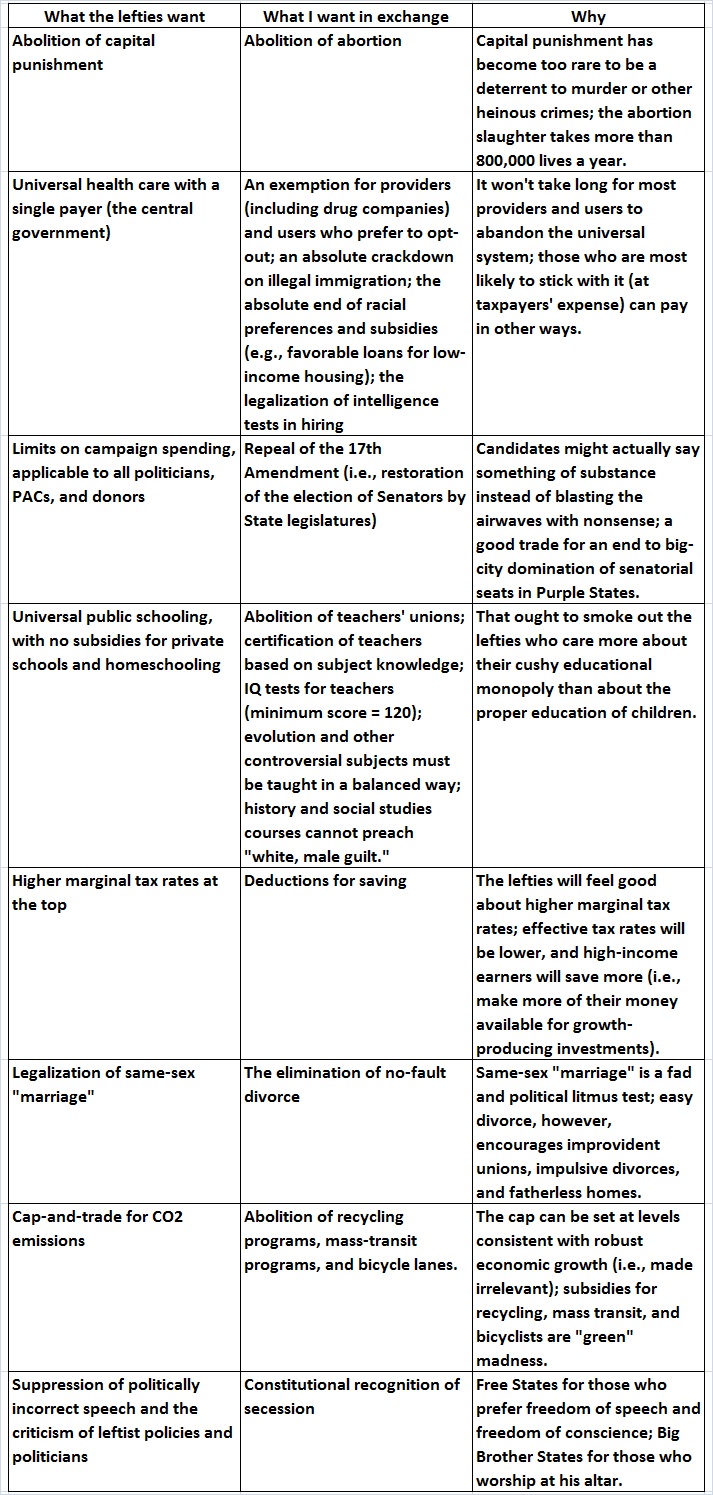
Let’s Make a Deal

Let's make a deal

The last deal negates all of the concessions made in the other deals — for those of us who will choose to live in Free States.

Has America Always Been Leftist?

Dr. John J. Ray, writing at Dissecting Leftism, enraged some Americans with two recent posts about America and leftism. I’m grateful to Dr. Ray for publishing, in a subsequent post, a message that I sent to him about the two posts in question. Herein, I elaborate on the points that I made in my message to Dr. Ray.

In “America Has Always Been Leftist,” Dr. Ray asserts the following:

As most Americans learn around the time of Thanksgiving, America was founded by fanatical communists.  They forbad [sic] private ownership of land and insisted that all produce be shared communally.  If that’s not communism, nothing is.  They were such fanatics that a third of them had to starve to death before they decided that communism wasn’t such a good idea and went back to the way things had always been done in stodgy old England.

So what should we expect of a nation dominated by the descendants of fanatical communists?  What we should expect is exactly what we actually got, I submit.

But before I get to that, let me  ensure complete clarity about what the core of Leftism is.  The content of Leftism changes from time to time.  Before WWII, Leftists world wide were energetic champions of eugenics, for instance.  Leftists now abhor it.  So what is constant in Leftism?  Anger.  Leftists in all eras are so dissatisfied with the society in which they live that they want sweeping changes to it. And they thirst for power to achieve that.  That is Leftism.

Pace Dr. Ray, it is well known that the “fanatical communists” of Plymouth Colony quickly abandoned their experiment in communism; for example, Jerry Bowyer writes:

…America was founded by socialists who had the humility to learn from their initial mistakes and embrace freedom.

One of the earliest and arguably most historically significant North American colonies was Plymouth Colony, founded in 1620 in what is now known as Plymouth, Massachusetts. As I’ve outlined in greater detail here before (Lessons From a Capitalist Thanksgiving), the original colony had written into its charter a system of communal property and labor.

As William Bradford recorded in his Of Plymouth Plantation, a people who had formerly been known for their virtue and hard work became lazy and unproductive. Resources were squandered, vegetables were allowed to rot on the ground and mass starvation was the result. And where there is starvation, there is plague. After 2 1/2 years, the leaders of the colony decided to abandon their socialist mandate and create a system which honored private property. The colony survived and thrived and the abundance which resulted was what was celebrated at that iconic Thanksgiving feast….

It is, moreover, an exaggeration to say that America is “a nation dominated by the descendants of fanatical communists.” First, as I’ve just pointed out, the inhabitants of Plymouth Colony were hardly fanatical. If they had been, they would have chosen the sure impoverishment (and probable death) of communism over the relative prosperity (and liberty) that came their way when they abandoned their infatuation with communism.

Second, only a small minority of today’s Americans — even of today’s white Americans — can count themselves as “full blooded” descendants of the inhabitants of Plymouth Colony or other early settlers might also have harbored socialistic delusions. There have been too many immigrants from continental Europe and too much “miscegenation” for that to be true.

Third, and fundamentally, it is meaningless to generalize about “Americans,” as I’ve explained at length here. There are and have been individual Americans of many political persuasions, most of them confused and contradictory.

That said, I do agree, generally, with Dr. Ray’s characterization of the motivations underlying the War of Independence. In his next post, “Has America Always Been Leftist?,” Dr. Ray says this:

I did learn something very important from [the critics of “America Has Always Been Leftist”].  It was vividly brought home to me how impressive fine words are to most people.  When even patriotic American conservatives can be taken in by them, it shows why Leftists have so much influence. Leftists are nothing but fine words.  To me fine words are only provisionally important.  They have to be backed up by deeds and it is the deeds that matter.

An excellent example of how fine words impress even conservatives  is the preamble to the Declaration of Independence.  It is full of fine words and noble sentiments.  Most political documents are.  Stalin’s Soviet constitution also was a high-minded document proclaiming all sorts of rights for Soviet citizens  — rights which were denied in fact.

So once you look past the grand generalizations of the Declaration’s introduction and get to the nitty gritty of what the Yankee grandees really wanted fixed, you see that it is very mundane, if not ignoble.  What was really bothering them was restrictions on their powers to legislate.  They wanted more laws, not less!   Very Leftist.

And from THAT starting point you can see why the war was fought and for whose benefit.  The grandees concerned had a lot of influence and were good at fine talk so they could muster an army — and they did.  And who benefited from the war?  Was it the poor farmers and tradesmen who died as foot-soldiers in it?  No way!  It was the grandees who started the war.  They emerged with exactly what they wanted:  More power.

I am sorry if that account sounds offensive to people who still believe the original propaganda, but if you ignore the fancy talk and just look at the facts, that is what happened.

Dr. Ray’s sweeping use of “Leftist” aside, his main point is well taken. I made a similar observation in response to a post by Timothy Sandefur, who was then guest-blogging at The Volokh Conspiracy. Sandefur, writing about his book The Conscience of the Constitution, asserted that “The American founders held that people are inherently free—that is, no person has a basic entitlement to dictate how other people may lead their lives.” I responded:

Did they, really? All of them, including the slave owners? Or did they simply want to relocate the seat of power from London to the various State capitals, where local preferences (including anti-libertarian ones) could prevail? Wasn’t that what the Declaration of Independence and Articles of Confederation were all about? The Constitution simply moved some of the power toward the national capital, mainly for the conduct of foreign policy and trade. Despite that, the Constitution was a “States’ rights” document, and remained that way until the ratification of Amendment XIV, from which much anti-libertarian mischief has emanated.

In response to Sandefur’s next post, I wrote:

Why can’t you [Sandefur] just admit that the Declaration of Independence was a p.r. piece, penned (in the main) by a slave-owner and subscribed to by various and sundry elites who (understandably) resented their treatment at the hands of a far-away sovereign and Parliament? You’re trying to make more of the Declaration — laudable as its sentiments are — than should be made of it….

In sum, the War of Independence isn’t all that it’s cracked up to be.

And there’s no doubt that liberty suffered in the long run as a result of the North’s victory in the Civil War. I return to Dr. Ray’s “America Has Always Been Leftist,” where he says this:

“Only” half a million men died [in the Civil War].  And for what?  EVERY other country on earth abolished slavery without the need for a war.  Does that not tell us something?  It should.  In his famous letter to Horace Greeley [link added], Lincoln himself admitted that slavery was not the main issue.  The issue was the dominance of central government.  V.I. Lenin call your office.  Lincoln didn’t call it “dominance of central government”, of course.  He called it “the union” but the result is the same.

And just about everything Lincoln did was without a shred of constitional justification and in fact breached the constitution.  Hitler at least had the grace to get an “enabling act” passed by the German parliament.  Lincoln just marched on regardless. He destroyed the liberty of the press (there goes your first amendment) and locked up thousands of war opponents (there goes your 4th amendment).  But most centrally, Lincoln’s whole enterprise was a defiance of the basic American constitutional dispensation that the states are sovereign, not the federal government.  Lincoln turned that on its head.  The feds now became the main source of power and authority.  There is no doubt that Lincoln talked a good talk.  He even used to persuade me once.  But his deeds reek of Fascism.

A good example of the large gap between his deeds and words is that masterpiece of propaganda, the Gettysburg address.  Goebbels admired it for good reason.  In case anybody hasn’t noticed, Lincoln claimed that his war was to ensure “government of the people, by the people, for the people” — which was exactly what he had just denied to the South!  Only Yankees are people, apparently.  Hitler thought certain groups weren’t people too.

Overwrought? Perhaps, but if Lincoln wasn’t a left-statist, he at least set an example for extra-constitutional activism that inspired Theodore Roosevelt’s hyper-activism (e.g., see this and this). TR, of course, set an example that was followed and enlarged upon by most of his successors, unto the present day.

Another anti-libertarian legacy of the Civil War is the false belief that it “proved” the unconstitutionality of secession. Balderdash! Secession is legal, Justice Scalia’s dictum to the contrary notwithstanding. (See this, this, and this, for example.) And the ever-present threat of secession might have helped to keep the central government from overstepping its constitutional bounds.

I must conclude, however, that the American Revolution and Civil War have little to do with “left” (or “right”) and much to do with human venality and power-lust, which are found in persons of all political persuasions.

The genius of the Constitution was that it provided mechanisms for curbing the anti-libertarian effects of venality and power-lust. The tragedy of the Constitution is that those mechanisms have been destroyed. If Dr. Ray were to say that Americans have gradually lost their liberty through successive and cumulative violations of the Constitution, I would agree with him

And if Dr. Ray were to say that Americans have become the captives of a leftist state, and are likely to remain so, I would agree with him.

*     *     *

Related posts:
FDR and Fascism
The Modern Presidency: A Tour of American History
An FDR Reader
The People’s Romance
Secession
The Near-Victory of Communism
A Declaration of Independence
Tocqueville’s Prescience
Invoking Hitler
The Left
The Constitution: Original Meaning, Corruption, and Restoration
I Want My Country Back
Our Enemy, the State
The Left’s Agenda
The Meaning of Liberty
The Southern Secession Reconsidered
The Left and Its Delusions
Burkean Libertarianism
A Declaration and Defense of My Prejudices about Governance
Society and the State
Why Conservatism Works
Liberty and Society
Tolerance on the Left
The Eclipse of “Old America”
A Contrarian View of Universal Suffrage
Defending Liberty against (Pseudo) Libertarians
Defining Liberty
Conservatism as Right-Minarchism
“We the People” and Big Government
Parsing Political Philosophy (II)
How Libertarians Ought to Think about the Constitution
Romanticizing the State
Libertarianism and the State

Playing the Social Security Trust Fund Shell Game

There’s a simple way to calculate the size of the federal government’s debt at any point in the future:

D’ = D – R + S – T

Where,

D’ = Amount of debt at a future date

D = Present debt

R = Federal government’s revenues from all sources (including Social Security taxes), from the present to the future date

S = Federal government’s spending for all purposes (including SS benefits), from the present to the future date

T = Value of Treasury securities redeemed by the SS trust fund to defray the gap between SS taxes collected and SS benefits paid

(For an explanation of how the redemption of securities by the trust fund can reduce the debt, see below.)

The present level of debt (D) is approximately equal to the debt ceiling. Therefore, as long as the deficit (R – S) is greater than the value of securities redeemed by the trust fund (T) to pay current benefits, the debt ceiling must rise or spending must be cut. (Aside: The ability of SS trustees to redeem trust fund holdings and pay benefits is simply a mechanism for ensuring the payment of full benefits until the trust fund is exhausted, regardless of any budget crunch. The trust fund, itself, is nothing more than a set of numbers in a government ledger. It isn’t an asset, any more than swampland is an asset to a sucker who buys it sight unseen.)

In theory, the trust fund could be exploited to get around the ceiling, by redeeming more holdings than required for the payment of current benefits. It’s a ploy was used in the past but is now illegal, Michael McConnell explained it in 2011:

The Social Security Trust Fund holds over $2 trillion [now over $2.7 trillion] in special Treasury securities, which it is legally entitled to redeem when necessary for the payment of benefits. When the Treasury redeems those bonds, the public debt will correspondingly be reduced, which will enable it to auction new bonds to investors, without violating the debt ceiling. This is precisely what happened during the debt ceiling crisis in 1985. Then, it was a Democratic House of Representatives that refused to raise the ceiling at the behest of a Republican President (an episode conveniently forgotten by those who wish to paint the Republican House today as uniquely evil for insisting that a debt ceiling increase be accompanied by spending reductions). The Social Security trustees cashed in some $9 billion in special Treasury securities for the payment of benefits, and the Treasury auctioned off the same amount in new U.S. bonds, without violating the debt ceiling. Here is how the Comptroller General described the event:

The Treasury Department estimated that it would have insufficient cash on November 1 to pay social security benefits and other government obligations. In order for these payments to be made, the Treasury needed to borrow money from the public, and in order to borrow the money, Treasury had to reduce its outstanding debt below the statutory limit. Therefore, on November 1 the Secretary redeemed $9.613 billion of the Trust Funds’ long-term securities, and $1.9 billion of securities held by certain other government-managed trust funds, to permit public borrowing of about $13 billion.

In this way, the Reagan Treasury was able to continue to pay Social Security benefits without interruption, despite the failure of Congress to raise the debt ceiling at the time.

The Comptroller General ruled that these redemptions were lawful, except that the trust fund redeemed more securities than were actually necessary for the payment of benefits. Some years later, Congress passed a statute codifying the Comptroller General’s decision. Public Law 104-121, section 107(a), prohibits redemption of special securities held by Social Security prior to maturity for any purpose other than the payment of benefits or administrative expenses. This statute is significant for two reasons. First, it confirms that the trustees have authority to redeem the special securities prior to maturity for the payment of benefits, and second, it prevents the executive from using the trust fund as a massive kitty to avoid the effect of the debt ceiling.

What could happen if the law were repealed? This:

1. Given the estimated size of the trust fund at the end of 2014 (as reported here), trust fund holdings could be liquidated as follows: FY 2015 — $469 billion; FY 2016 — $536 billion; FY 2017 — $576 billion; FY 2018 — $627 billion; FY 2019 — $722 billion; FY 2020 — $144 billion. The payout in FY 2020 would exhaust the trust fund. The total ($3.1 trillion) exceeds the estimated value of the trust fund at the end of 2014 ($2.8 trillion) because the trust fund would be credited with interest on its remaining holdings while those holdings were being drawn down.

2. The redemptions in 2015-2019 would entirely offset projected budget deficits for those years; the redemption in 2020 would offset about one-fifth of that year’s projected deficit. (See Table 1 here.) Thus it wouldn’t be necessary to reduce federal spending from currently projected levels until some time in 2020.

3. Under present law, however, depletion of the trust fund means that SS benefits must then be cut to a level that can be sustained by SS taxes. The cuts would be relatively small at first, but would grow steadily through the years. (Go here and compare the columns “non-interest income” and “cost” for the years 2020 and beyond.) For example, benefits in 2021 would have to be reduced to 90 percent of the level currently planned for that year; by 2030, benefits would have to be reduced to 80 percent of the planned level.

The good news — if the ploy could be executed — is that the Social Security crisis would be brought forward to the near future, instead of being deferred until 2033, when the trust fund is now expected to vanish. The undeniable urgency of the situation might compel Congress and the president to act — and perhaps to do something about the federal government’s entire fiscal mess — instead of continuing to kick the can down the road.

The bad news is that the federal government would run huge deficits for the next several years (at least). Programs that are unaffordable in the long run would be kept alive to acquire larger constituencies. Accordingly, it would be harder to curtail or kill them.

The real solution, of course, isn’t fiscal trickery; it’s fiscal responsibility. Let’s hope that 2017 brings with it a Congress and White House controlled by the non-RINO wing of the GOP.

*     *     *

Related posts:
Economics: A Survey (also here)
Why Are Interest Rates So Low?
Estimating the Rahn Curve: Or, How Government Spending Inhibits Economic Growth
America’s Financial Crisis Is Now
“Social Insurance” Isn’t Insurance — Nor Is Obamacare
The Keynesian Multiplier: Phony Math
The True Multiplier

Wrong for the Wrong Reasons

When in search of provocative material, I often flip through the pages of The Great Quotations — a left-slanted tome compiled by the late and long-lived George Seldes. Today, I came across this:

Overthrow of the Government by force and violence is certainly a substantial enough interest for the Government to limit speech. Indeed, this is the ultimate value of any society, for if a society cannot protect its very structure from armed internal attack, it must follow that no subordinate value can be protected.

That’s from Chief Justice Fred M. Vinson’s majority opinion in Dennis v. United States (1951). Here’s an outline of the case and its aftermath, as given at Wikipedia:

In 1948, eleven Communist Party leaders were convicted of advocating the violent overthrow of the U.S. government and for the violation of several points of the Smith Act. The party members who had been petitioning for socialist reforms claimed that the act violated their First Amendment rights to freedom of speech and that they served no clear and present danger to the nation….

[In the original trial] Prosecutor John McGohey did not assert that the defendants had a specific plan to violently overthrow the U.S. government, but rather alleged that the CPUSA’s philosophy generally advocated the violent overthrow of governments.[7] To prove this, the prosecution proffered articles, pamphlets and books (such as The Communist Manifesto) written by authors such as Karl Marx and Joseph Stalin.[8] The prosecution argued that the texts advocated violent revolution, and that by adopting the texts as their political foundation, the defendants were also personally guilty of advocating violent overthrow of the government.[9]

Petitioners were found guilty by the trial court and the decision was affirmed by the Second Circuit Court of Appeals. The Supreme Court granted writ of certiorari, but limited it to whether section two or three of the Smith Act violated the First Amendment and whether the same two sections violated the First and Fifth Amendments because of indefiniteness….

Handed down as a 6-2 decision by the Court on June 4, 1951, the judgment and a plurality opinion was delivered by Chief Justice of the United States Fred M. Vinson, who was joined by Justices Stanley Forman Reed, Sherman Minton, and Harold H. Burton. Separate concurring opinions were delivered by Justices Felix Frankfurter and Robert H. Jackson. Justices Hugo Black and William O. Douglas wrote separate dissenting opinions. Justice Tom C. Clark did not participate in this case.

The Court rule affirmed the conviction of the petitioner, a leader of the Communist Party in the United States. Dennis had been convicted of conspiring and organizing for the overthrow and destruction of the United States government by force and violence under provisions of the Smith Act. In affirming the conviction, a plurality of the Court adopted Judge Learned Hand’s formulation of the clear and probable danger test, an adaptation of the clear and present danger test:

In each case [courts] must ask whether the gravity of the “evil,” discounted by its improbability, justifies such invasion of free speech as necessary to avoid the danger….

[I]n 1969, Brandenburg v. Ohio held that “mere advocacy” of violence was per se protected speech. Brandenburg was a de facto overruling of Dennis, defining the bar for constitutionally unprotected speech to be incitement to “imminent lawless action”.[20]

This is from Wikipedia‘s account of Brandenburg v. Ohio:

The Court held that government cannot punish inflammatory speech unless that speech is directed to inciting, and is likely to incite, imminent lawless action.[1]

Brandenburg completely did away with Denniss central holding and held that “mere advocacy” of any doctrine, including one that assumed the necessity of violence or law violation, was per se protected speech.

And this is from the final paragraph of the Court’s ruling in Brandenburg:

[W]e are here confronted with a statute which, by its own words and as applied, purports to punish mere advocacy and to forbid, on pain of criminal punishment, assembly with others merely to advocate the described type of action. 4 Such a statute falls within the condemnation of the First and Fourteenth Amendments.

So, in effect (though not in so many words), the Brandenburg Court found the Dennis Court to be wrong. Not wrong about the wrongness of overthrowing the government, just wrong about when the wrongness may be prosecuted. The Dennis Court was prematurely protective.

To put it another way, it’s all right to advocate wrong-doing, as long as the advocacy doesn’t lead directly to the wrong-doing.

Well, the Dennis Court may have been wrong, but not for the reason cited by the Brandenburg Court, which is also wrong. Why? Because it invites endless hair-splitting about the point at which advocacy translates to action. If the action being advocated is wrong, isn’t it also wrong — constitutional niceties aside — to advocate the action? I’m certainly not advocating thought-crime prosecution, but I am not satisfied with the Brandenburg Court’s conclusion.

If the purpose of the United States, as originally constituted, was to foster liberty, why should the government of the United States tolerate the promulgation of anti-libertarian views? Freedom of speech, after all, is just one manifestation of liberty. And that manifestation could vanish, with the rest, under an anti-libertarian regime.

Here’s the counter-argument: If government is allowed to suppress speech that promulgates the overthrow of America’s constitutional values in favor of anti-libertarian ones (e.g., communism), couldn’t the government then suppress speech that might have a tenuous connection with the idea of overthrowing America’s constitutional values? Government could, for example, suppress speech that proposes the establishment of a socialistic scheme that isn’t contemplated in the Constitution, such as Social Security. And if government could suppress speech of that kind, it could also suppress speech aimed at amending the Constitution to legalize socialistic schemes.

That wouldn’t be so bad, but the power to suppress speech is easily adapted to anti-libertarian uses. Untoward speech and thoughts about “protected groups” could be outlawed. Oops! Such speech and thoughts have been outlawed. “Hate thoughts” may be inferred as the unspoken motivation for a crime, given the personal characteristics of the (supposed) victim of the crime.

By now, you may have concluded that the problem isn’t the Constitution, it’s government. Or, more concretely, the persons and groups who are able to command the power of government. No piece of paper can protect liberty from the anti-libertarian machinations of government officials and the voting blocs to which they are beholden.

Which brings me back to the quotation at the beginning of this post, Chief Justice Vinson’s muddled rationale for the Supreme Court’s holding in Dennis v. United States:

Overthrow of the Government by force and violence is certainly a substantial enough interest for the Government to limit speech. Indeed, this is the ultimate value of any society, for if a society cannot protect its very structure from armed internal attack, it must follow that no subordinate value can be protected.

Government is not society. Nor does the United States comprise a single society, but rather multitudes of societies and interest groups: some desirous of liberty, others desirous of domination. The latter have prevailed, and have come to dominate those that desire liberty. Accordingly, “subordinate” values (e.g., free speech, property rights, and freedom of association) have not been protected by government.

Government, as it now stands, is unworthy of protection by the friends of liberty. In fact, it is (or should be) in need of protection from the friends of liberty. And may they prevail.

*     *     *

Related posts:
An Agenda for the Supreme Court
Liberals and the Rule of Law
The Slippery Slope of Constitutional Revisionism
A Hypothetical Question
The Real Constitution and Civil Disobedience
A Declaration of Independence
First Principles
Zones of Liberty
The Constitution: Original Meaning, Corruption, and Restoration
A Declaration of Civil Disobedience
Rethinking the Constitution: “Freedom of Speech, and of the Press”
Society and the State
Our Perfect, Perfect Constitution
Reclaiming Liberty throughout the Land
A New Constitution for a New Republic
Restoring Constitutional Government: The Way Ahead
“We the People” and Big Government
How Libertarians Ought to Think about the Constitution

Governmental Perversity

People are sometimes by harmed natural events such as earthquakes, hurricanes, tornadoes, and floods. Though such events may be exogenous to human activity,they are somewhat predictable, in that people can know (or learn) where and (sometimes) approximately when such events are likely to occur. That knowledge, in turn, allows people to cope with natural events in three ways:

  • Move away from or avoid areas prone to natural disasters, at least during times of heightened risk.
  • Taking physical measures to reduce the damage caused by natural events.
  • Buying insurance to help defray the costs resulting a natural disaster.

Moral hazard enters the picture when government intervenes to encourage people to live in high-risk areas by insuring risks that private insurers will not insure (e.g., floods), by underwriting certain physical measures (e.g., the installation of bulkheads and pumping systems), and by reimbursing losses sustained by persons who insist on living in high-risk areas — as if to do so were a God-given right. Through such actions, government encourages unremunerative risk-taking, and transfers most of the resulting losses to those citizens who choose not to put themselves in harm’s way.

Now, egregious as it is, the moral hazard created by government with respect to natural disasters is nothing compared with the moral hazard created by government with respect to financial disasters. The recent financial crisis-cum-deep recession is but the latest in a long string of government-caused and government-aided economic messes.

In the recent case, the Federal Reserve and pseudo-private arms of the federal government (Freddie Mac and Fannie Mae) loosened the money supply and encouraged lenders to grant loans to marginal borrowers. Financial institutions were further encouraged to take undue risks by having seen, in times past, that there were bailouts at the end of the tunnel. Not all troubled firms were bailed out during the recent financial crisis, but enough of them were to ensure that the hope of being bailed out still shines brightly. Nor were bailouts limited to financial institutions; troubled companies like General Motors, which should have been put out of their misery, were given new life, at a high cost to taxpayers.

And so, thanks to government, people and businesses continue to take undue risks at the expense of their fellow citizens. Meanwhile — through taxes and regulations — government continues to discourage privately financed risk-taking (entrepreneurship) that is essential to economic growth.

Perversity, thy name is government.

*     *     *

Related posts:
The Stagnation Thesis
Taxing the Rich
More about Taxing the Rich
Money, Credit, and Economic Fluctuations
A Keynesian Fantasy Land
The Keynesian Fallacy and Regime Uncertainty
Regime Uncertainty and the Great Recession
Regulation as Wishful Thinking
In Defense of the 1%
Lay My (Regulatory) Burden Down
Economic Growth Since World War II
The Capitalist Paradox Meets the Interest-Group Paradox
Government in Macroeconomic Perspective
The 80-20 Rule, Illustrated
Economics: A Survey (also here)
Why Are Interest Rates So Low?
Vulgar Keynesianism and Capitalism
Estimating the Rahn Curve: Or, How Government Spending Inhibits Economic Growth
America’s Financial Crisis Is Now
Progressive Taxation Is Alive and Well in the U.S. of A.
Some Inconvenient Facts about Income Inequality
Mass (Economic) Hysteria: Income Inequality and Related Themes
The Criminality and Psychopathy of Statism

More Lessons from Baseball

Regular readers of this blog will know that I sometimes draw on the game of baseball and its statistics to make points about various subjects — longevity, probability, politics, management, and cosmology, for example. (See the links at the bottom of this post.)

Today’s sermon is about the proper relationship between owners and management. I will address two sets of graphs giving the won-lost (W-L) records of the “old 16” major-league franchises. The “old 16” refers to the 8 franchises in the National League (NL) and the 8 franchises in American League (AL) in 1901, the first year of the AL’s existence as a major league. Focusing on the “old 16” affords the long view that’s essential in thinking about success in an endeavor, whether it is baseball, business, or empire-building.

The first graph in each set gives the centered 11-year average W-L record for each of the old teams in each league, and for the league’s expansion teams taken as a group. The 11-year averages are based on annual W-L records for 1901-2013. The subsequent graphs in each set give, for each team and group of expansion teams, 11-year averages and annual W-L records. Franchise moves from one city to another are indicated by vertical black lines. The titles of each graph indicates the city or cities in which the team has been located and the team’s nickname or nicknames.

Here are the two sets of graphs:

W-L records of old-8 NL franchises

W-L records of old-8 AL franchises

What strikes me about the first graph in each set is the convergence of W-L records around 1990. My conjecture: The advent of free agency in the 1970s must have enabled convergence. Stability probably helped, too. The AL had been stable since 1977, when it expanded to 14 teams; the NL had been stable since 1969, when it expanded to 12 teams. As the expansion teams matured, some of them became more successful, at the expense of the older teams. This explanation is consistent with the divergence after 1993, with the next round of expansion (there was another in 1998). To be sure, all of this conjecture warrants further analysis. (Here’s an analysis from several years ago that I still like.)

Let’s now dispose of franchise shifts as an explanation for a better record. I observe the following:

The Braves were probably on the upswing when they moved from Boston to Milwaukee in 1953. They were on the downswing at the time of their second move, from Milwaukee to Atlanta in 1966. It took many years and the acquisition of astute front office and a good farm system to turn the Braves around.

The Dodgers’ move to LA in 1958 didn’t help the team, just the owners’ bank accounts. Ditto the Giants’ move to San Francisco in 1958.

Turning to the AL, the St. Louis Browns became the latter-day Baltimore Orioles in 1954. That move was accompanied by a change in ownership. The team’s later successes seem to have been triggered by the hiring of Paul Richards and Lee McPhail to guide the team and build its farm system. The Orioles thence became a good-to-great from the mid-1960 to early 1980s, with a resurgence in the late 1980s and early 1990s. The team’s subsequent decline seems due to the meddlesome Peter Angelos, who became CEO in 1993.

The Athletics, like the Braves, moved twice. First, in 1955 from Philadelphia to Kansas City, and again in 1968 from Kansas City to Oakland. The first move had no effect until Charles O. Finley took over the team. His ownership carried over to Oakland. Finley may have been the exceptional owner whose personal involvement in the team’s operations helped to make it successful. But the team’s post-Finely record (1981-present) under less-involved owners suggests otherwise. The team’s pre-Kansas City record reflects Connie Mack’s tight-fisted ways. Mack — owner-manager of the A’s from 1901 until 1950 — was evidently a good judge of talent and a skilled field manager, but as an owner he had a penchant for breaking up great teams to rid himself of high-priced talent — with disastrous consequences for the A’s W-L record from the latter 1910s to late 1920s, and from the early 1930s to the end of Mack’s reign.

The Washington Senators were already resurgent under owner Calvin Griffith when the franchise was moved to Minnesota for the 1961 season. The Twins simply won more consistently than they had under the tight-fisted ownership of Clark Griffith, Calvin’s father.

Bottom line: There’s no magic in a move. A team’s success depends on the willingness of owners to spend bucks and to hire good management — and then to get out of the way. (Yes, George Steinbrenner bankrolled a lot of pennant-winning teams during his ownership years, from 1973 to 2010, but the Yankees’ record improved as “The Boss” became a less-intrusive owner from the mid-1990s until his death.)

There are many other stories behind the graphs — just begging to be told, but I’ll leave it at that.

Except to say this: The “owners” of America aren’t “the people,” romantic political pronouncements to the contrary notwithstanding. As government has become more deeply entrenched in the personal and business affairs of Americans, there has emerged a ruling class which effectively “owns” America. It is composed of professional politicians and bureaucrats, who find ample aid and comfort in the arms of left-wing academicians and the media. The “owners’ grip on power is sustained by the votes of the constituencies to which they pander.

Yes, the constituencies include “crony capitalists,” who benefit from regulatory barriers to competition and tax breaks. Though it must be said that they produce things, and would probably do well without the benefits they reap from professional politicians and bureaucrats. Far more powerful are the non-producers, who are granted favors based on their color, gender, age, etc., in return for the tens of millions of votes that they cast to keep the “owners” in power.

Far too many Americans are whiners who grovel at the feet of their “owners,” begging for handouts. Far too few Americans are self-managed winners.

*     *     *

Related posts:

More Miscellany

Politicos on Parade

Most politicians — especially but not only liberals — pay lip service to the Constitution but tend not to honor it. They have a passion for laws and regulations that dictate, in the name of “good,” how people will live their lives, run their businesses, and spend their incomes. They seem not to understand or care that such laws and regulations undermine liberty and thus, to borrow a phrase, the general welfare that flows from liberty.

A “do-nothing” Congress is the best kind of Congress. Would that there were such a thing.

Career politician: a person who has succeeded in fooling just enough of the people almost all of the time.

The Presidency in Perspective

As the presidency has gone from Washington to Clinton, so too has it gone from service to self-gratification, from honor to corruption, from courage to cowardice, and from dignity to disrepute. The fault lies not in the office but in an electorate that has tolerated — nay, encouraged — the debasement of Washington’s legacy.

The presidency is as dignified or debased as its incumbent.

The impeachment (and removal) of a President is not a constitutional crisis. Rather, it reaffirms the soundness of the Constitution’s design for the orderly transfer of executive power. Through impeachment and removal the nation may, without recourse to mayhem or insurrection, be relieved of a President who has dishonored his trust.

Legal proceedings against a President do not disable the presidency, only the ability of the incumbent to serve. Amendment XXV provides for such instances:

Whenever the President transmits to the President pro tempore of the Senate and the Speaker of the House of Representatives his written declaration that he is unable [for any reason] to discharge the powers and duties of his office, and until he transmits to them a written declaration to the contrary, such powers and duties shall be discharged by the Vice President as Acting President.

Presidents come and go but the nation survives [maybe] and thrives [sort of].

Social-isms

Where is it written in the Constitution that the federal government is a repository for retirement savings?

A “liberal” of the Twentieth Century persuasion is a person who presumes to tell others how to live their lives. This use of the word “liberal” is a corruption of language fully consistent with the intellectual corruption of American politics.

Would those who decry meritocracy replace it with mediocracy?

The culture of “public service” was born in the New Deal, came to maturity with John F. Kennedy’s New Frontier (“ask what you can do for your country”), and continues to thrive, as always, amongst Ivy-leaguers with all the answers, idealistic naifs as yet un-mugged by reality, and lawyers bent on acquiring inside knowledge and cultivating future business.

In Their Own Words…

Newsweek quotes Alan Dershowitz as saying “Yes, I would defend [Hitler]. And I would win.” No matter that justice would lose.

The constitutional balance, as seen by Hamilton and Madison in The Federalist Papers:

It will always be far more easy for the State governments to encroach upon the national authorities than for the national government to encroach upon the State authorities. (Hamilton, No. 17)

[T]here is greater probability of encroachments by the members upon the federal head than by the federal head upon the members. (Hamilton, No. 31)

The State governments will have the advantage of the federal government…in respect to…the weight of personal influence which each side will possess…the powers respectively vested in them…[and] the…faculty of resisting and frustrating the measures of each other. (Madison, No. 45)

The powers delegated by the proposed Constitution to the federal government are few and defined. Those which are to remain in the State governments are numerous and indefinite. The former will be exercised principally on external objects, as war, peace, negotiation, and foreign commerce; with which last the power of taxation will, for the most part, be connected. (Madison, No. 45)

[T]he powers proposed to be lodged in the federal government are as little formidable to those reserved to the individual States as they are indispensably necessary to accomplish the purposes of the Union; and that all those alarms which have been sounded of a mediated and consequential annihilation of the State governments must, on the most favorable interpretation, be ascribed to the chimerical fears of the authors of them. (Madison, No. 46)

Thus is paved the road to hell.

“Cato” foresaw in 1787 that: “the great powers of the president…would lead to oppression and ruin”; the national government “would be an asylum of the base, idle, avaricious, and ambitious,” a “court [with] language and manners different from [ours]”; and “rulers in all governments will erect an interest separate from the ruled, which will have a tendency to enslave them.”

Miscellany, Potpourri, and Other Stuff That Comes to Mind

  • If there’s welfare for devastated foreigners, farmers, and owners of beachfront property, why not welfare for the devastated taxpayer? Give us a break — a tax break.
  • Re the “patients’ bill of rights”: The doctors have made their bargain with the devil — and we’ll all pay the bill.
  • Taxes and regulations drain almost half of the output of the U.S. economy. Where’s the outrage?
  • It’s time for the annual installment of “As the Fiscal Year Turns.” Stay tuned as the media foment fear and loathing of the Republican-controlled Congress — the evil-doer in this annual budget drama. Will the evil Congress shut down the government? Will the good guys in the White House come to the rescue and keep the government running? Frankly, my dears, who gives a damn? Does the federal government run our lives or are “we the people” in charge of ourselves? Shut it down. Let them eat red tape in Washington.
  • Truth is to government as daylight is to vampires.
  • Kansas is to science as a gorilla is to tapdancing.
  • If a nation must draft its soldiers, is it a nation worth fighting for?
  • Democrats — having embraced balanced budgets as a sign of “fiscal responsibility” — must keep taxes high to keep the welfare state intact. They know where their votes come from.
  • The latest liberal bogeyman is “urban sprawl.” Of course there’s urban sprawl. Not everyone wants to live in the hot, crowded, noisy, filthy confines of downtown Washington, D.C. — and its ilk — and pay twice what it costs to live in the suburbs. Unlike the rest of us, Al Bore and his fellow limousine liberals can live in the city and remain well-insulated from the “joys” of city life.
  • Patients already have the right to pay for uninsured medical expenses. The so-called “patients’ bill of rights” is merely a way of forcing everyone else to chip in. But some people still believe in free lunches — or free-loading.
  • The government’s so-called budget surplus is merely the difference between extortionate taxes and extravagant spending.
  • Instead of government of the people, by the people, for the people, we have government of the people, by the politicians, for the special interests.
  • GOP = Groveling Over-the-hill Party.
  • The GOP in 1994 was the “party of ideas”; the GOP in 1999 is the “party of pushovers” (for big-government liberals). What more proof do we need that a “principled politician” is a rare beast if not an oxymoron?
  • Given the events of the last year, it would be a good idea to limit politicians to a total of one term of office, any office, per lifetime.
  • Isn’t it odd that the draft-dodgers of the Vietnam era — who are now safely out of harm’s way — favor foreign adventures?
  • There’s really little difference between conservatives — who like government when it gives the “right” answers — and liberals — who like government when it gives the “left” answers. Both like government as long as they’re in charge of it.
  • In the best of all worlds, the end of the impeachment trial would mean the end of news from Washington.
  • Arguing about what to do with the budget surplus is like arguing about how to split the loot from a bank robbery.
  • The government that wants to invest your Social Security “contributions” for you is the same government that sued Microsoft for being “too” successful.
  • If the President is responsible for peace in the world and prosperity at home, he must be responsible for good weather and low golf scores as well.
  • Could Republicans and Democrats follow the NBA’s example and delay the start of the 2000 campaign until, say, after November 7, 2000?
  • If we’re truly lucky the Y2K bug will shut down TV for the duration of the next presidential campaign.
  • A race between Gore and Bush seems likely, which means that we’ll have another four-letter President.
  • If the Founding Fathers had been guided by polls we would be known as the Undecided States of America.
  • A politician is often a lawyer who has to hire other lawyers to keep himself out of jail.
  • Those who say that the era of big government is over he must be talking about the Soviet Union.
  • Here’s a success strategy for the Republicans: Drive the religious right out of the party and into the arms of the Democrats.
  • Old saying: “If you need a friend in Washington, buy a dog.” New corollary: “Check the dog for a wire before taking it home.”

Why Do We Have Government?

Government is just another means of getting things done, but it is seldom the best means. All governmental functions could be performed by private institutions — in most cases, if not all, with better results for society at large.

Much of what government does it is able to do because of its coercive power — not because it offers the best deal in town. Goverment either commands resources that could be put to other uses or tells us how to act. Private institutions, by contrast, thrive only to the extent that they provide goods and services we want and are willing to pay for. And, whereas we are compelled to support government, like it or not, we are not compelled to support businesses whose products, services, and rules we may not like.

Are there, nevertheless, gunctions that should be entrusted to government, even where private institutions could perform those functions more efficiently? The answer is “yes,” but to get to it I must first give the general argument against government.

The General Case against Government

Every governmental act — from taxation by local authorities to fighting a foreign war — disrupts our private affairs and results in the redistribution of wealth and income. Governmental acts therefore make some persons better off and some persons worse off.

Apologists for government argue from the Benthamite principle of “the greatest good for the greatest number” — as if the individual gains and losses from a governmental act could be summed to show that the act has a “net positive effect on the social welfare function.” But there is no such thing as “social welfare”; there are only individual states of well-being, which cannot be summed. To put it another way, one person’s happiness is incommensurate with another person’s sadness. No matter how much money one person has, it is presumptious of government to take some of that person’s money and give it to another person. But that is exactly what government does whenever it acts — often, quite deliberately and openly.

The Special Case for Government

The proper role of government is to enable each of us to strive to maximize his or her well-being, as long as we don’t forcefully or fraudulently diminish the well-being of other persons in our striving.

Protection from force and fraud may be a public good. I say “may” because I’m not sure, but I suppose the following argument can be made: Government is the only resort for “insurance” against force and fraud. Some forms of private insurance can be bought (e.g., bodyguards), but private insurance is “unenforceable” unless government is there to back it up. I would be willing to stipulate that adequate defense forces and criminal-justice systems can be raised through “user fees” (voluntary taxation at a flat rate or amount), the free-rider problem notwithstanding.

Government interference is therefore illegitimate (except in cases of force or fraud) because it presumes to make society as a whole better off when it cannot do so. As long as there are any losers, society as a whole cannot be better off.

There is no way government can compensate the losers without creating other losers. True, but speaking “Paretally” wouldn’t the compensation have to be arranged in such a way that only those taxpayers who want to compensate transit users are required to pay compensation, and then only in amounts they are willing to pay? Here, of course, it seems unlikely that the free-rider problem could be overcome, which suggests that public roads, rights of way, and transportation systems ought to be sold at auction to private operators.

Therefore, government should not interfere in private affairs, except in cases of force or fraud. Tough public-policy questions remain; for example: Should government interfere before the fact to prevent force or fraud, or should government wait until there is evidence of force or fraud? How much government interference is “enough” and who should finance it? Can the failure to disclose information be fraudulent? What about the failure to disclose things that some consumers may consider harmful (e.g., the presence of gene-spliced foods) but which the producer does not (a) know about or (b) consider harmful?

Obama: It’s About the Future, or Hope, or Change… or Something

Guest post by Postmodern Conservative.

This YouTube video is not only a hilarious parody on Obama, it’s a nice send-up of campaign-speak in general. I’ve taken the liberty of transcribing the narration. It’s very quotable.

Man 1: I’m voting for Barrack Obama because I believe in the future.
Narrator: A vote for Obama is a vote for the future.
Man 2: Because the future is ahead of us, and the past has come before us, and the future is yet to come.
Narrator
: A vote for Obama is a vote for hope.
Woman 1: I believe Obama believes in hope, and hopes for a future filled with hope.
Narrator
: If you believe change can’t happen if you don’t do something, vote Obama.
Woman 2
: I believe that we, U.S. Americans, want change, and Obama will change things, and not leave us unchanged.
Narrator
: If you believe that the future is not now, and not in the past, vote Obama.
Woman 3
: The past is, like, history, and that is so, like, yesterday.
Narrator
: If you hope that there is a candidate that believes in hope, vote for Obama. If you believe that Obama believes in everything you believe in, vote for hope, vote for change, vote Obama.

The Insatiable State and Its Enablers

Who are the enablers of the insatiable state? They are many; among them are those who believe, contrary to experience, that the state must intervene in the operation of the economy in order to “save” it; those who futilely want the state to enact “social justice”; those who simply want to get “their fair share”, that is, what they can’t (or won’t) earn by openly and fairly by competing with other companies and individuals for business and jobs.

Many enablers operate from the premise that another little bit won’t “cost much” and will have observable benefits (for a particular interest group). Voters, the ultimate enablers, fall for that line and ignore or forget the slippery slope and the ratchet effect:

[O]nce a polity becomes accustomed to relying on the state for a particular thing that could be done better through private action, it becomes easier for that polity to ask the state to do other things that could be done better through private action….

[And a]s people become accustomed to a certain level of state action, they take that level as a given. Those who question it are labeled “radical thinkers” and “out of the mainstream.” The “mainstream” — having taken it for granted that the state should “do something” — argues mainly about how much more it should do and how it should do it, with cost as an afterthought.

Other enablers — namely, politicians, their hangers-on, and the more sophisticated beneficiaries of their largesse — have simpler and more cynical motives: to impose their will on others (power) and/or to profit from the exercise (theft).

The excuses of “compassion,” “fairness,” and “consumer protection” are rationalizations for power-lust and theft. The powerful can sustain their power — and thus feed their power-lust — only through (legalized) theft. Power-lust is raison d’être of the insatiable state; theft is its inevitable modus operandi.

Why Hillary Won’t Quit

Hillary won’t quit because she is infused with power-lust and an obdurate unwillingness to acknowledge (to herself) that she has any failings. She is like her husband in both respects.

Hillary, given her psychological inability to accept defeat in any form, is now grasping for the life-raft of racism. She believes that she is electable because she is white, whereas Barack Obama is unelectable because he is black. From that belief springs a further one: Enough superdelegates will perceive the “truth” of her belief before it is too late, and they will swing the nomination to her.

P.S. WSJ.com‘s James Taranto (“Best of the Web Today”) offers a similar analysis of Hillary’s “white strategy,” an analysis that I hadn’t read at the time of posting.

Election 2008: Ninth Forecast (Updated)

Here.

Understanding Defense Think-Tanks

TomDispatch.com reproduces Chalmers Johnson’s review of Soldiers of Reason: The RAND Corporation and the Rise of the American Empire, by Alex Abella. Although Johnson is wrong about American “imperialism,” the causes of the Cold War, and the role of RAND (the prototypical defense think-tank) in fostering and prolonging the Cold War. But Johnson is right in his characterization of defense think-tanks and their denizens. For example:

[RAND’s] ideological bent was disguised in statistics and equations, which allegedly made its analyses “rational” and “scientific.” Abella writes:

“If a subject could not be measured, ranged, or classified, it was of little consequence in systems analysis, for it was not rational. Numbers were all — the human factor was a mere adjunct to the empirical.”

In my opinion, Abella here confuses numerical with empirical. Most RAND analyses were formal, deductive, and mathematical but rarely based on concrete research into actually functioning societies. RAND never devoted itself to the ethnographic and linguistic knowledge necessary to do truly empirical research on societies that its administrators and researchers, in any case, thought they already understood….

It is also important to note that RAND’s analytical errors were not just those of commission — excessive mathematical reductionism — but also of omission. As Abella notes, “In spite of the collective brilliance of RAND there would be one area of science that would forever elude it, one whose absence would time and again expose the organization to peril: the knowledge of the human psyche.”

Following the axioms of mathematical economics, RAND researchers tended to lump all human motives under what the Canadian political scientist C. B. Macpherson called “possessive individualism” and not to analyze them further. Therefore, they often misunderstood mass political movements, failing to appreciate the strength of organizations like the Vietcong and its resistance to the RAND-conceived Vietnam War strategy of “escalated” bombing of military and civilian targets.

What Johnson says of RAND is typical of defense think-tanks. They tend to recruit academically minded Ph.D.s, whose understanding of the real world is off-center to begin with, and which remains almost completely innocent of the actual practice of statecraft and warfare. (See this post for a small sample.)

In my experience (30 years’ worth), the output of a defense think tank is seven parts theoretical, mathematical, and speculative (i.e., bull—-) and one part empirical.

Election 2008: Ninth Forecast

The Presidency – Method 1

Intrade posts State-by-State odds odds on the outcome of the presidential election in November. I assign all of a State’s electoral votes to the party whose nominee that is expected to win that State. Where the odds are 50-50, I split the State’s electoral votes between the two parties.

As of today, the odds point to this result:

Democrat — 309 electoral votes (EVs)

Republican — 229 EVs

The Presidency – Method 2 (UPDATED, 05/09/08)

I have devised a “secret formula” for estimating the share of electoral votes cast for the winner of the presidential election. (The formula’s historical accuracy is described in my second forecast.) The formula currently yields these estimates of the outcome of this year’s presidential election:

Democrat — 241 to 288 EVs 241 to 357 EVs

Republican — 250 to 297 EVs 181 to 297 EVs

I have revised my “secret formula.” One result of the revision is that the margin of error is greater than before, thus the broad span of estimates. But the estimate produced by method 1 is almost exactly same as the mean estimate by method 2 (239 EVs), which gives me more confidence in method 2.

U.S. Senate

Democrats will gain five Senate seats: picking up one each in Alaska, Colorado, New Hampshire, New Mexico, and Virginia. The balance in the Senate will change from 51 Democrats (including Lieberman and Sanders, both nominally independent) and 49 Republicans to 56 Democrats and 44 Republicans.

Even if John McCain wins the election, he will face a Senate that could filibuster his nominations, given the several RINOs among the 44 GOP members.